
The groups in Pew Research Center’s political typology – which goes beyond political party to place Americans into groups based on their political values and attitudes – vary a great deal in how much attention they are paying to the midterm elections, what their early voting preferences are, and how their views of Donald Trump have changed over the course of his second term.
This analysis is a companion to the Center’s 2026 Political Typology. To learn more about the typology, start with the main report’s overview.To find which group is your best fit, take the quiz.
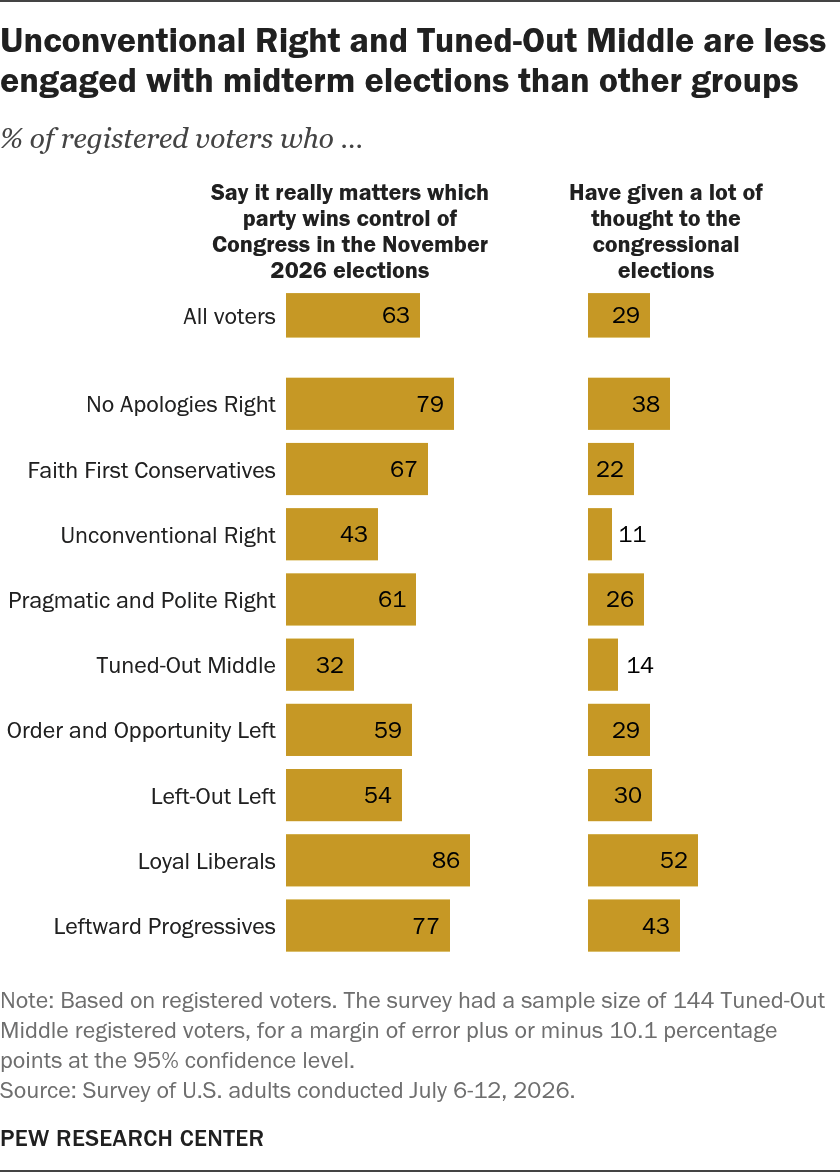
Engagement with the November elections follows a similar pattern to the overall interest and engagement with politics of the typology groups – with some exceptions.
| group | Say it really matters which party wins control of Congress in the November 2026 elections | Have given a lot of thought to the congressional elections | |
|---|---|---|---|
| All voters | all | 63 | 29 |
| No Apologies Right | typology | 79 | 38 |
| Faith First Conservatives | typology | 67 | 22 |
| Unconventional Right | typology | 43 | 11 |
| Pragmatic and Polite Right | typology | 61 | 26 |
| Tuned-Out Middle | typology | 32 | 14 |
| Order and Opportunity Left | typology | 59 | 29 |
| Left-Out Left | typology | 54 | 30 |
| Loyal Liberals | typology | 86 | 52 |
| Leftward Progressives | typology | 77 | 43 |
Three of the most partisan and ideologically consistent groups (Leftward Progressives and Loyal Liberals on the left, No Apologies Right on the right) continue to be the most invested in elections, but Faith First Conservatives are not paying as much attention as the other highly ideological groups.
Three groups with more mixed partisan affiliation and political values (Pragmatic and Polite Right, Order and Opportunity Left and Left-Out Left) are modestly engaged with the elections at this point. At least half of voters in each of these groups say the outcome really matters, and between 26% and 30% say they have given the elections a lot of thought.
But one Republican-oriented group with a mix of political values, Unconventional Right, are considerably less engaged than others in this year’s elections: Just 11% of Unconventional Right registered voters say they have thought much about it, and 43% say the outcome really matters.
| group | Democratic candidate | Republican candidate | Another candidate | Not sure | NET Another candidate/Not sure | |
|---|---|---|---|---|---|---|
| All voters | all | 43 | 37 | 5 | 14 | 20 |
| No Apologies Right | typology | 2 | 91 | 6 | 2 | 8 |
| Faith First Conservatives | typology | 1 | 81 | 4 | 15 | 18 |
| Unconventional Right | typology | 12 | 62 | 4 | 22 | 26 |
| Pragmatic and Polite Right | typology | 32 | 46 | 7 | 14 | 21 |
| Tuned-Out Middle | typology | 34 | 22 | 12 | 32 | 43 |
| Order and Opportunity Left | typology | 61 | 12 | 5 | 21 | 26 |
| Left-Out Left | typology | 69 | 3 | 8 | 20 | 28 |
| Loyal Liberals | typology | 95 | <1 | 3 | 2 | 5 |
| Leftward Progressives | typology | 90 | 1 | 6 | 3 | 8 |
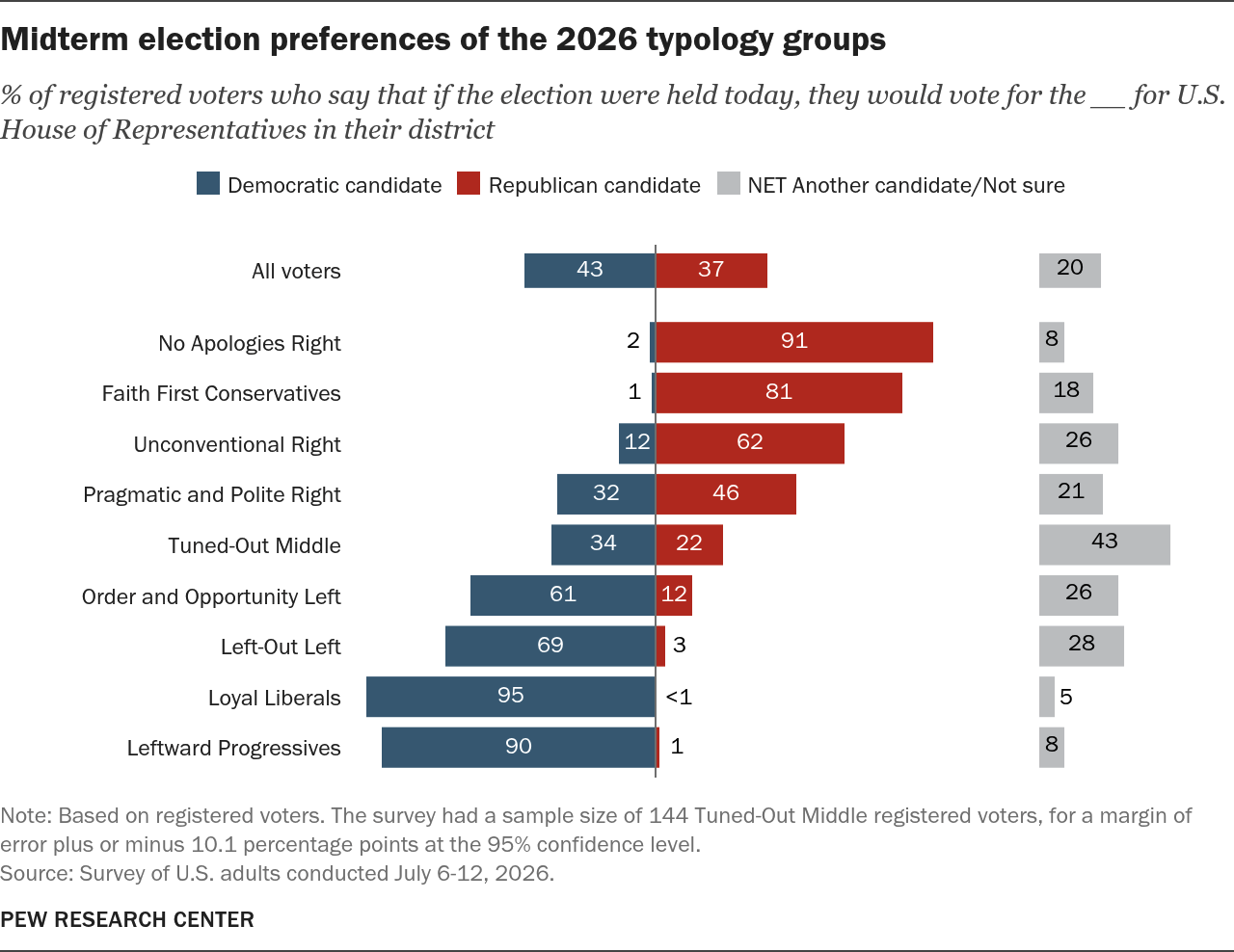
Tuned-Out Middle – a group largely defined by their low interest in politics – are hardly thinking about the elections at all and are largely unconcerned with which party has control of Congress next year.
Midterm preferences
Across the typology groups, support for candidates in the 2026 congressional elections among registered voters broadly parallels the groups’ overall partisan affiliations (and how they voted in 2024 for president).
About a quarter of voters in the more politically and ideologically mixed groups say they will support a candidate from a third party or are unsure of how they will vote. Nearly as many voters who are Faith First Conservatives (18%) also say this.
Trump’s job approval over time among the typology groups
President Donald Trump’s job approval remains highest among the most consistently Republican and conservative groups (89% of No Apologies Right and 77% of Faith First Conservatives), though smaller shares of these groups approve now than in the weeks after he took office in 2025.

| Date | Leftward Progressives | Loyal Liberals | Left-Out Left | Order and Opportunity Left | Tuned-Out Middle | Pragmatic and Polite Right | Unconventional Right | Faith First Conservatives | No Apologies Right |
|---|---|---|---|---|---|---|---|---|---|
| 7/12/26 | 0 | 3 | 7 | 16 | 35 | 34 | 51 | 77 | 89 |
| 4/26/26 | 0 | 2 | 5 | 17 | 27 | 36 | 53 | 81 | 90 |
| 1/26/26 | <1 | 2 | 7 | 19 | 33 | 36 | 60 | 84 | 94 |
| 9/28/25 | 0 | 2 | 8 | 20 | 39 | 40 | 67 | 90 | 95 |
| 8/10/25 | 0 | 3 | 7 | 18 | 37 | 35 | 64 | 86 | 93 |
| 6/8/25 | 0 | 2 | 9 | 19 | 41 | 41 | 68 | 90 | 98 |
| 4/13/25 | 0 | 2 | 11 | 19 | 42 | 41 | 65 | 90 | 96 |
| 2/2/25 | 0 | 3 | 15 | 26 | 51 | 50 | 78 | 94 | 100 |
Trump’s job approval has fallen most sharply among the groups that are right-oriented but ideologically mixed:
Among Unconventional Right – a group that voted for him by an overwhelming margin in 2024 – 51% now approve of the way he is handling his job as president, down from 78% at the start of this second term.
Among Pragmatic and Polite Right – a group that also broke for Trump in 2024 by a narrower margin – just 34% now approve of his performance, down from 50% at the beginning of his term.
Tuned-Out Middle’s approval of Trump’s performance has also declined over this period, to 35% approving today.
Relatively few Americans in the typology groups that are left of center (Order and Opportunity Left, Left-Out Left, Loyal Liberals and Leftward Progressives) approve of Trump’s job performance.


