Pew-Knight Initiative

FOR RELEASE FEBRUARY 11, 2026

Americans’ Complicated Relationship With News

In an era when many say the news finds them, there is no consensus about the importance of following the news

BY Kirsten Eddy, Michael Lipka, Katerina Eva Matsa, Christopher St. Aubin and Elisa Shearer

FOR MEDIA OR OTHER INQUIRIES:

Communications Department
202.419.4372
www.pewresearch.org

RECOMMENDED CITATION

Pew Research Center, February 2026, "Americans’ Complicated Relationship With News"

About the Pew-Knight Initiative

The Pew-Knight Initiative supports new research on how Americans absorb civic information, form beliefs and identities, and engage in their communities. Pew Research Center is a nonpartisan, nonadvocacy fact tank that informs the public about the issues, attitudes and trends shaping the world. Knight Foundation is a social investor committed to supporting informed and engaged communities.

© Pew Research Center 2026

About this research

This report from the Pew-Knight Initiative looks at how Americans think about their role in the news environment.

Why we did this

With information coming at people faster than ever before, and a seemingly endless array of options competing for Americans’ attention and trust, we wanted to evaluate the attitudes and behaviors of regular people when it comes to their role in navigating the news.

In some ways, this is a natural follow-up to our recent studies on what “news” means to the public today, how news habits are changing and how Americans view the role of journalists in society. With these reports, we have looked at opinions about both sides of the relationship between news producers and news consumers in the U.S.

Learn more about Pew Research Center and our research on news habits and media.

How we did this

We surveyed 3,560 U.S. adults from Dec. 8 to 14, 2025. Everyone who took part in this survey is a member of the Center’s American Trends Panel. The survey represents the views of the full U.S. adult population.

We also conducted nine online focus group discussions led by PSB Insights with 45 U.S. adults, held from June 10 to 18, 2025. These discussions do not represent the entire U.S. population. This report shares findings and quotes from the focus groups to help illustrate and add detail to the survey results. Quotes were lightly edited for spelling, punctuation and clarity.

Here are the survey questions used for this report, the detailed responses and the methodology.

This is a Pew Research Center report from the Pew-Knight Initiative, a research program funded jointly by The Pew Charitable Trusts and the John S. and James L. Knight Foundation. Find related reports online at https://alpha.pewresearch.org/pewresearch-org/pew-knight/.

Table of contents

  • About the Pew-Knight Initiative
  • About this research
  • Americans’ Complicated Relationship With News
  • The age divide in how Americans think about news
  • What does it mean to ‘do your own research,’ and how often do Americans do it?
  • Who should make sure people know how to verify news, according to Americans?
  • Why Americans discuss the news – or don’t – with others
  • Few say Americans have a responsibility to pay for news
  • Why Americans think news habits are changing, in their own words
  • Acknowledgments
  • Methodology

Americans’ Complicated Relationship With News

In an era when many say the news finds them, there is no consensus about the importance of following the news

Americans today describe a complicated relationship with the news. Most say being informed is essential for civic life – especially voting – yet many feel overwhelmed, skeptical and selective about how they engage with information, according to a new Pew Research Center study from the Pew-Knight Initiative.

Majority of Americans say being informed about the news is essential to voting but many find the news overwhelming or irrelevant

A central tension shapes today’s news landscape. Most people believe Americans have a civic responsibility to be informed when they vote. But far fewer say regularly following news is extremely or very important in general, and roughly half say they can stay informed even if they don’t actively follow it.

The reality of how people get news nowadays plays into this tension. Americans are evenly split between those who mostly get news because they are seeking it out and those who mostly let news find them. But either way, the high volume of information reaching people from a wide variety of sources brings with it several challenges.

For one, people feel the onus is on news consumers to check whether the news they get is accurate. Americans have far more confidence in their own ability to do this than in other people’s ability.

News fatigue is also widespread – and shaping Americans’ news choices. About half of U.S. adults say they are worn out by the amount of news these days, and people are more likely to say most of the news they come across is not relevant to their lives than to say it is relevant. Following the news often feels like an obligation, and only about one-in-ten Americans say they follow it solely because they enjoy it.

Many have adjusted their news habits: Two-thirds say they have stopped getting news from a specific source, and six-in-ten say they have reduced their overall news intake.

These are some of the key findings of a survey of more than 3,500 U.S. adults that Pew Research Center conducted in December 2025 and nine focus groups held in June 2025. To learn more about this study, read “About this research.”

Skip to:

  • How important is following the news, and what does it help people do?
  • How Americans check the accuracy of news
  • Americans are split in whether they mostly seek news or come across it
  • Are Americans tuning out the news?

How important is following the news, and what does it help people do?

Americans see following the news as essential in some ways, particularly for civic participation. Eight-in-ten U.S. adults – including similar shares of Republicans and Democrats – say Americans have a responsibility to be informed about the news when they vote.
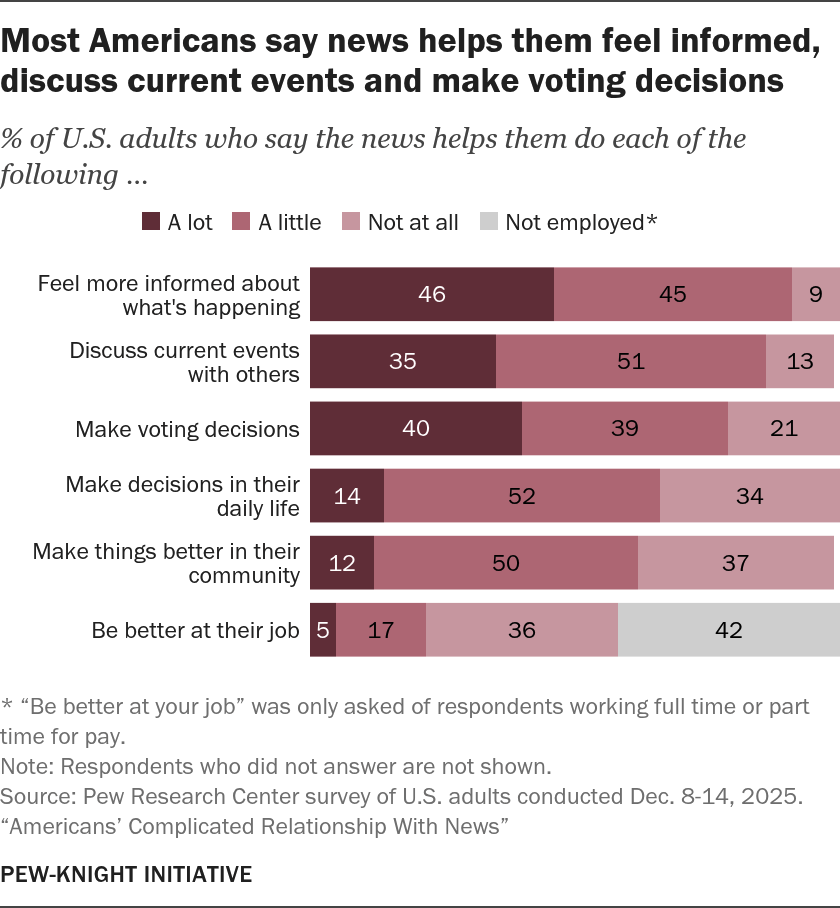
Most Americans say news helps them feel informed, discuss current events and make voting decisions

A similar share (78%) say the news helps them at least a little with making voting decisions, including 40% who say it helps a lot. Large majorities also say the news helps them feel informed about what’s happening (91%) and discuss current events with others (86%) at least a little.

Read more on why Americans discuss the news (or don’t) with others.

“News has a way of affecting us in different ways,” said a man in his 50s who was part of focus groups held for this study. “It can affect our financial wealth. It can affect our physical health. It can affect whether we decide to go out the door that day or not. So for me, it’s a critical part, it’s a routine part of my day.”

This is not true for everybody. People are less inclined to say that the news helps them make decisions in their daily lives or improve their community – with small shares of adults saying the news helps them a lot in doing either of these things. At least a third of Americans say the news doesn’t help them at all in making daily decisions or improving their community.

“It is so easy to access information,” a man in his 60s said. “But that doesn’t mean you’re well informed.”

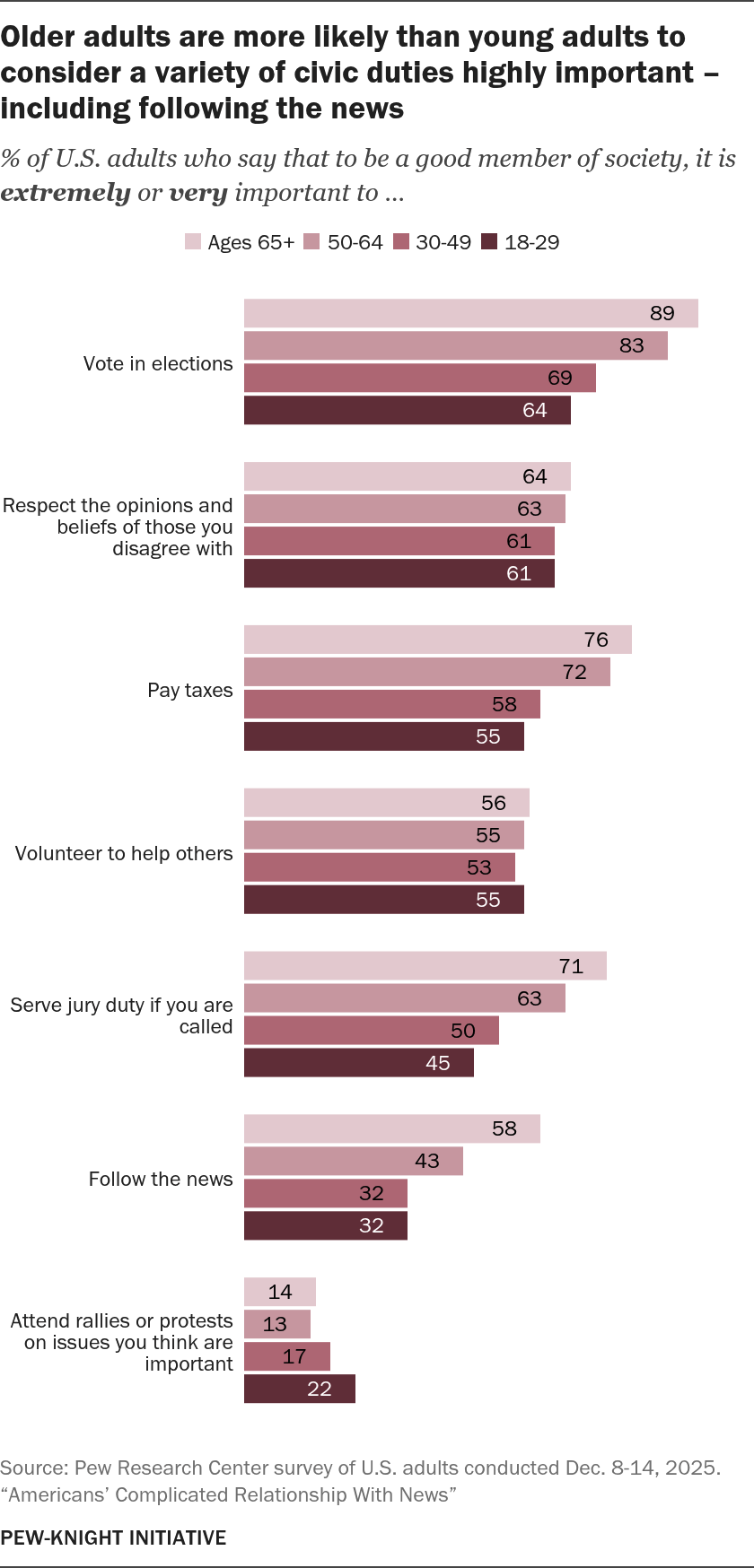
The survey asked Americans whether various civic behaviors are important to being a good member of society. Following the news ranks below voting, paying taxes, respecting others’ views, serving jury duty and volunteering in the eyes of U.S. adults.

Younger adults consistently place lower importance than older adults on several of these civic duties – especially following the news.

Read more on differences in how younger and older Americans get and think about news.

Relatively few Americans strongly associate following the news with being a good member of society

There are also mixed views on what specific news habits matter. Most U.S. adults say it is extremely or very important for people to avoid sharing inaccurate information and get news from multiple sources. Smaller shares say it is highly important to get news from sources with a range of political views or get news on a regular basis.
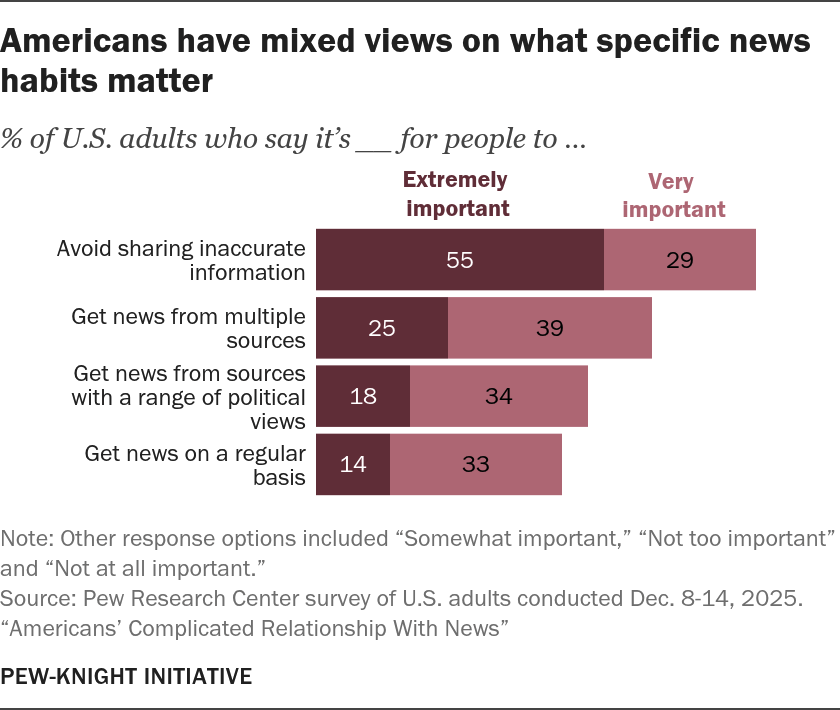
Americans have mixed views on what specific news habits matter

Democrats and Democratic-leaning independents (53%) are somewhat more likely than Republicans and GOP leaners (43%) to say regularly getting news is highly important.

Only 8% of Americans say people in the U.S. have a responsibility to pay for news, and most do not pay for it themselves. One woman in her 20s who was part of our focus groups said, “I don’t think that information should be a privilege.”

Read more on how Americans feel about paying for news.

How Americans check the accuracy of news

Going into this study, we already knew that Americans feel like they are regularly encountering inaccurate information, and that many are having a hard time figuring out what is true.

This new survey finds that nearly all Americans say it is at least somewhat important for people to do their own research to check the accuracy of the news they get (94%), including two-thirds (66%) who say it is extremely or very important.

Read more on what Americans think it means to “do your own research” when it comes to news.

Americans are far more confident in their own ability to check the accuracy of news than in others

At the same time, people have much more confidence in their own ability to check the accuracy of a news story than they do in others. Most U.S. adults say they are very (29%) or somewhat (50%) confident they would know what steps to take to verify the accuracy of a news story. But only a quarter are very (3%) or somewhat (22%) confident in other people’s ability to do so.

“I think ideally you can … absorb the information, and then do your own kind of research into understanding what they’ve delivered,” a man in his 30s said in a focus group. “And it helps you become more informed. I don’t think others do that, though. I think that’s a problem.”

When asked who should be most responsible for making sure Americans know how to check accuracy, the largest share (44%) say individuals themselves – ahead of news organizations (22%), teachers or schools (9%) and the government (9%).

Read more details on these findings.

Americans are split in whether they mostly seek news or come across it

The rapid growth of digital platforms has reshaped how news reaches people. News that once required deliberate effort – for example, turning on the TV or picking up a newspaper – now regularly finds people in digital spaces or through conversations with others.

“News finds you nowadays,” a man in his 40s said.

Americans are now evenly divided between those who mostly seek out news and who mostly come across it

Americans are now evenly divided between those who mostly get news because they are looking for it (50%) and those who mostly happen to come across it (49%). And a similar percentage of Americans (47%) say they can stay informed even when they don’t actively follow the news.

A woman in her 20s said, “Even when you’re not pursuing it, something’s being put in front of you.”

Americans who mostly seek out news are much more likely than those who mostly come across it to say it is extremely or very important for people to regularly get news (62% vs. 32%). They’re also much more likely to say that following the news is highly important to being a good member of society (55% vs. 26%).

Different types of news also reach people in different ways. Americans are more likely to get up-to-date and in-depth information about an issue or event because they are looking for it than because they happen to find it.

But the reverse is true for opinions or funny posts about an issue or event. For example, 64% of Americans say they mostly get opinions about issues or events because they happen to come across them, compared with 21% who say they mostly seek out opinions.

Are Americans tuning out the news?

There are many possible reasons why fewer Americans are now seeking out news.

About half of Americans say they are worn out by news, and many have tuned out

About half of Americans (52%) say they are worn out by the amount of news there is these days, compared with 34% who say they are not worn out (the remainder say they are not sure).

“It’s good to be informed, but too much information is just like an overload,” a man in his 40s explained.

And nearly half (48%) of U.S. adults say most of the news they encounter is not relevant to their life, while 35% say it is mostly relevant. Republicans are less likely than Democrats to say most of the news they come across is relevant to them.

Many Americans have tuned out, at least temporarily: Two-thirds say they have ever stopped getting news from a specific source, and six-in-ten have reduced their news intake overall at some point.
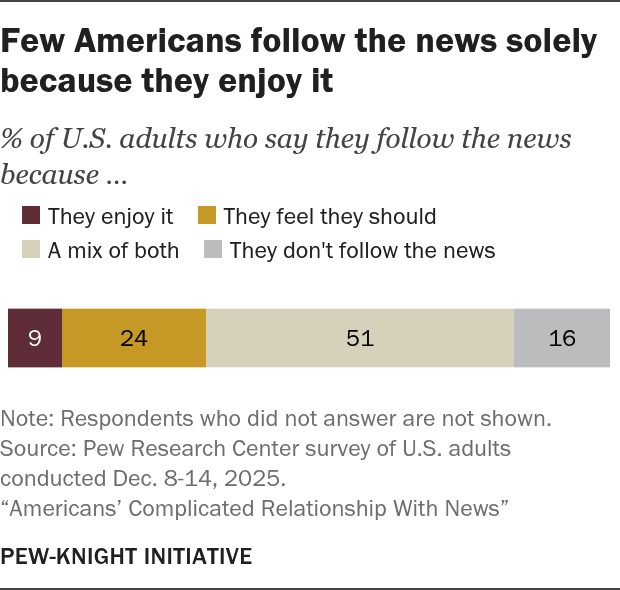
Few Americans follow the news solely because they enjoy it

Even though many feel personally exhausted, half of U.S. adults say news consumption in the country overall has been rising in the past decade, while 18% say it has been falling. This reflects another disconnect between people’s own experiences and what they feel is going on around them.

Ultimately, relatively few Americans (9%) say they follow the news just because they enjoy it. By comparison, 24% say they do so only because they feel like they should. About half (51%) cite a mix of these two reasons, while 16% say they don’t follow the news at all.
The age divide in how Americans think about news

Age is one of the clearest dividing lines in Americans’ relationship with news. Differences show up in how people encounter news, how much importance they place on getting news regularly, and how news fits into their daily lives and civic responsibilities.

These findings are based on a Pew Research Center survey of U.S. adults aimed at understanding how Americans are thinking about and experiencing news today. Read key findings from the full study.

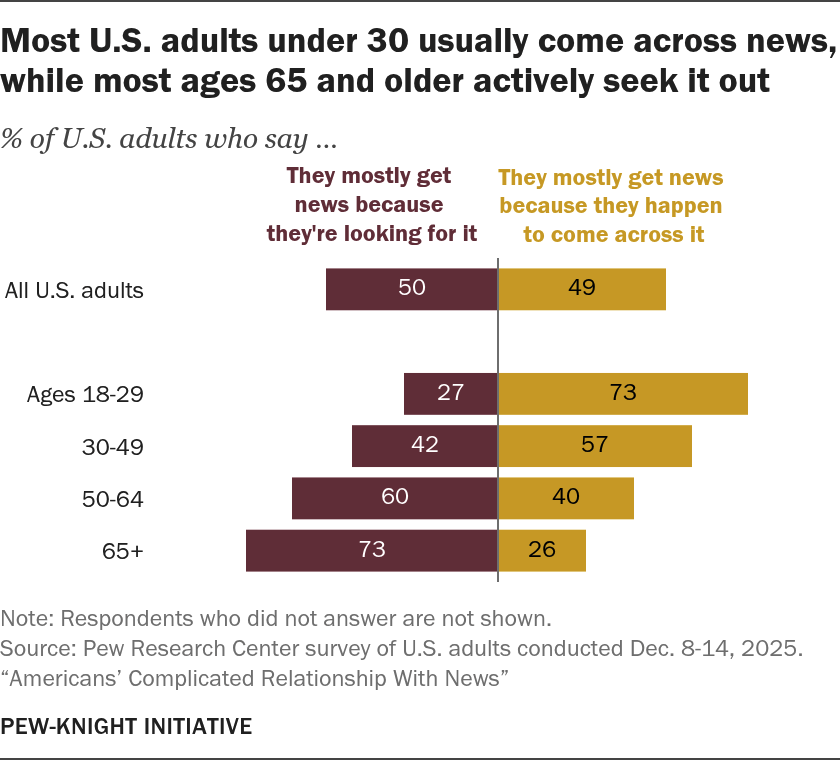
Most U.S. adults under 30 usually come across news, while most ages 65 and older actively seek it out

Perhaps the starkest divergence involves the way people of different ages encounter news. Older Americans are much more likely to be news seekers – people who say they mostly get news because they are looking for it. Younger adults tend to get news because they happen to come across it.

About three-quarters of adults under 30 (73%) say they mostly get news because they happen to come across it. An identical share of those 65 and older (73%) say they mostly get news because they are looking for it.

Similarly, the two youngest age groups – those ages 18 to 29 and 30 to 49 – are less likely than older adults to say they closely follow international, national or local news.

These differing approaches are also reflected in how Americans think about staying informed and in how much importance they place on regularly consuming news.

We asked respondents which comes closer to their view: whether they need to actively follow the news to stay informed, or if they can stay informed even if they don’t actively follow the news. Adults ages 65 and older are the only age group in which a majority say they need to actively follow it. All other age groups are more likely to say the opposite.

“I think [news] follows me,” a woman in her 20s said in focus group discussions held as part of this study. “I feel like I can’t get away from information nowadays.”

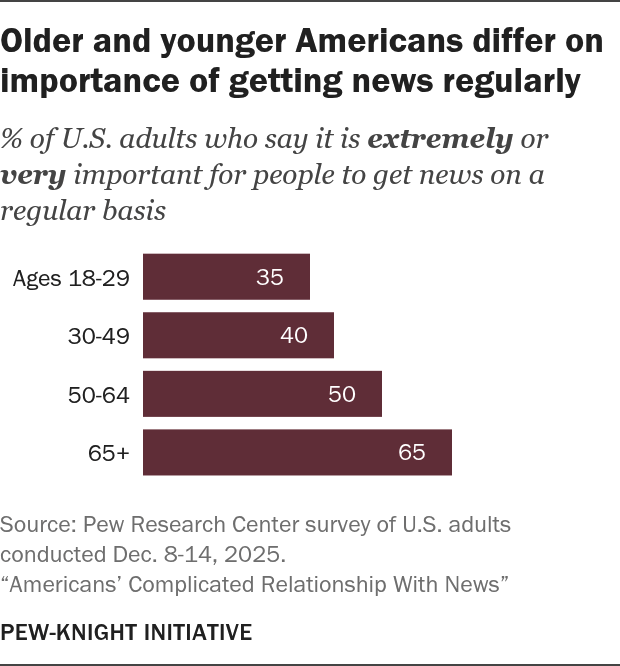
Older and younger Americans differ on importance of getting news regularly

The survey also included a series of questions about whether people think different news habits are important. Younger adults are less likely to say it’s important to get news on a regular basis at all. About a third of adults under 30 (35%) and 40% of those ages 30 to 49 see this as extremely or very important for people to do, compared with half of those 50 to 64 and 65% of those 65 and older.

Meanwhile, majorities of adults in all age groups say it is extremely or very important to avoid sharing inaccurate information and to get news from multiple sources. And about half or more in each age group say the same about getting news from sources with a range of political views.

“The right way [to consume news] to me is to consume it from multiple sources, on every side, so that you can get the facts, make sure the facts align all across,” a man in his 30s said.

Age differences in views toward news as a civic duty

Americans of different age groups also differ in the responsibilities they associate with being a good member of society – including following the news.

Older adults are more likely than younger adults to consider several civic duties highly important, such as voting in elections, paying taxes and serving jury duty.

But one of the starkest differences involves following the news: Those ages 65 and older are far more likely than adults under 50 to say following the news is extremely or very important to being a good member of society (58% vs. 32%).

Older adults are more likely than young adults to consider a variety of civic duties highly important – including following the news

“Because we have to vote,” a woman in her 50s said. “We’re going to have to make decisions, ongoing, about who to trust and what to do and where to put our money and how to protect our safety. … So the news is important for that.”

Even so, following news ranks toward the bottom of the list of the civic activities we asked about for all age groups.

Younger adults report less time for news and find it less relevant

Adults under 50 are more likely than those 50 and older to say they don’t have enough time to follow the news.

Younger adults are more likely to cite obstacles to following the news

News fatigue is also higher among younger Americans: 57% of adults under 50 say they’re worn out by the amount of news there is these days, compared with 46% of those ages 50 and older. (A similar question we asked in 2019 did not find age differences.)

“I get so tired of it, I have to turn away,” a man in his 40s said. “What’s that saying? Was it one of those mafia movies? ‘I try to get away, you pull me right back in.’”

About half of adults under 50 (52%) say most of the news they come across is not relevant to their lives, compared with 44% of those 50 and older. And one-in-five adults under 30 say it’s hard for them to understand the news they come across, slightly higher than all other age groups.

“There’s some times where … you may not have the time to really understand something at the level that it needs to be understood,” a man in his 40s explained. “There are certain stories that … you can’t consume the entire thing in two minutes to really understand it. You have to put more time into it. Not everyone has that.”

What does it mean to ‘do your own research,’ and how often do Americans do it?

In an era of declining trust in news organizations and heightened concerns about false information online, “doing your own research” has become a common step Americans take. Nearly all Americans (94%) – including similar shares of Republicans and Democrats – say it is at least somewhat important for people to do their own research to check the accuracy of the news they get. About two-thirds say this is extremely or very important (66%).

Most Americans think it is important for people to 'do their own research' to check the accuracy of the news % of U.S. adults who say it is __ for people to do their own research to check the accuracy of the news they get
Extremely importantVery importantSomewhat importantNot too/Not at all important
U.S. adults24%41%29%5%

Note: Respondents who did not answer are not shown.

Source: Pew Research Center survey of U.S. adults conducted Dec. 8-14, 2025.“Americans’ Complicated Relationship With News”

But while the phrase may seem simple on the surface, Americans mean many different things when they use it. And in some political and cultural contexts – especially around topics like vaccines and health guidelines – the phrase can also mean actively questioning what major news organizations or official sources say.

Focus group discussions underscored this complexity. As one man in his 40s explained, “I’ve never liked the term ‘do your own research’ because … it assumes someone knows how to research, someone knows how to evaluate sources, someone knows how to challenge their own biases and preconceived notions of what is truth or not. And that’s not easy. It’s not simple.”

These findings are based on a Pew Research Center survey of U.S. adults aimed at understanding how Americans are thinking about and experiencing news today. Read key findings from the full study.

How often do Americans ‘do their own research’ about the news?

A large majority of U.S. adults (82%) say they at least sometimes “do their own research” to check the accuracy of a news story. This includes 37% who say they do this extremely or very often.

A majority of Americans at least sometimes ‘do their own research’ about a news story % of U.S. adults who say that they do their own research to check the accuracy of a news story …
Extremely/Very oftenSometimesRarely/Never
All U.S. adults37%44%18%
Rep/Lean Rep39%43%17%
Dem/Lean Dem37%46%17%

Note: Respondents who did not answer are not shown.

Source: Pew Research Center survey of U.S. adults conducted Dec. 8-14, 2025. “Americans’ Complicated Relationship With News”

These figures are similar for both Republicans and Democrats, including independents who lean toward each party. However, supporters of the two parties differ modestly in what counts to them as “doing your own research” (details below).

There are also some differences across demographic groups, although majorities across all groups say they do their own research:

  • Older adults (ages 65 and older) are less likely than younger groups to say they at least sometimes do their own research.
  • Adults with a high school diploma or less education are also less likely to say they at least sometimes do their own research.

What does ‘doing your own research’ mean to Americans?

While the vast majority of Americans say they at least sometimes “do their own research,” there is no single definition of what this means.

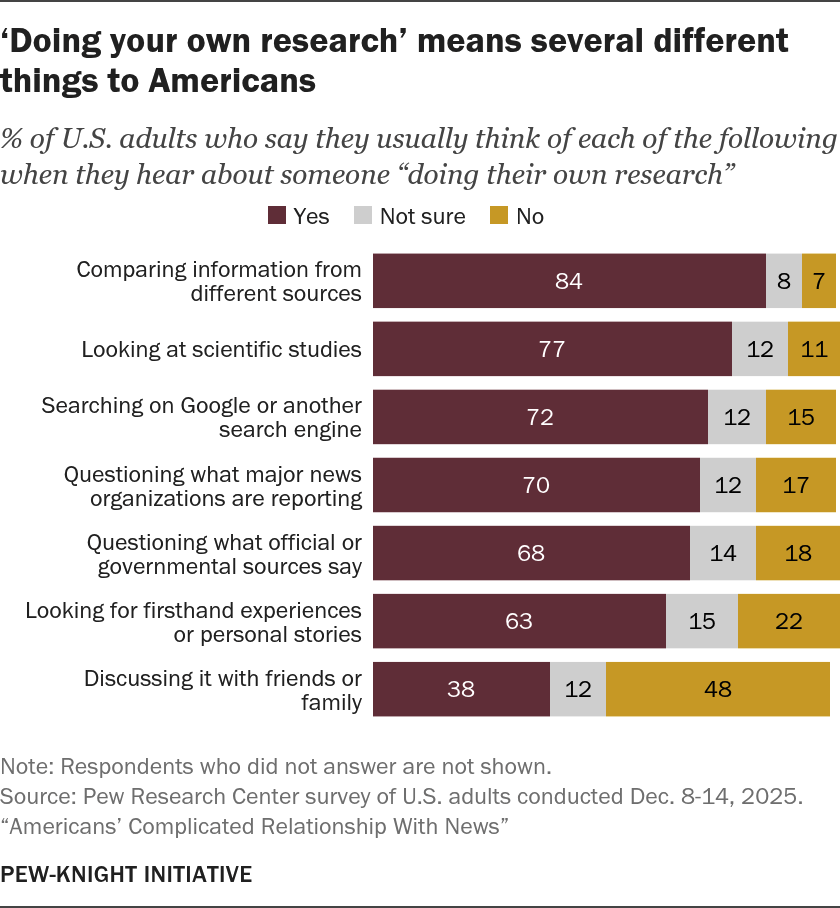
‘Doing your own research’ means several different things to Americans

Americans associate a wide range of information-gathering practices with the idea of doing their own research. But it is also commonly linked with the idea of questioning mainstream sources like news organizations or government sources.

More Americans say they think of comparing information from different sources (84%) as “doing your own research” than any of the other options we asked about in the survey.

Many focus group participants cited this idea, both as how they define “doing your own research” and as a broader approach they use to check the accuracy of news and information. As one man in his 30s said, “Cross-verify information. Go online and look at other sources for it. See if that actually exists or choose to learn more about something, just digging into the history of it, just doing your own research. I don’t know, it’s in the title; isn’t it?”

Most U.S. adults also say they think of looking at scientific studies (77%) and searching on Google or other search engines (72%) as “doing your own research.” And about seven-in-ten say the same about questioning what major news organizations (70%) or official or governmental sources (68%) say.

A majority of Americans (63%) also say that looking for firsthand experiences and personal stories is something they think of when they hear about someone “doing their own research.”

“I like to go for original sources,” a man in his 60s said. “The ones that were really there.”

Fewer Americans (38%) think that discussions with friends or family count as “doing your own research,” with about half (48%) saying they do not make this association.

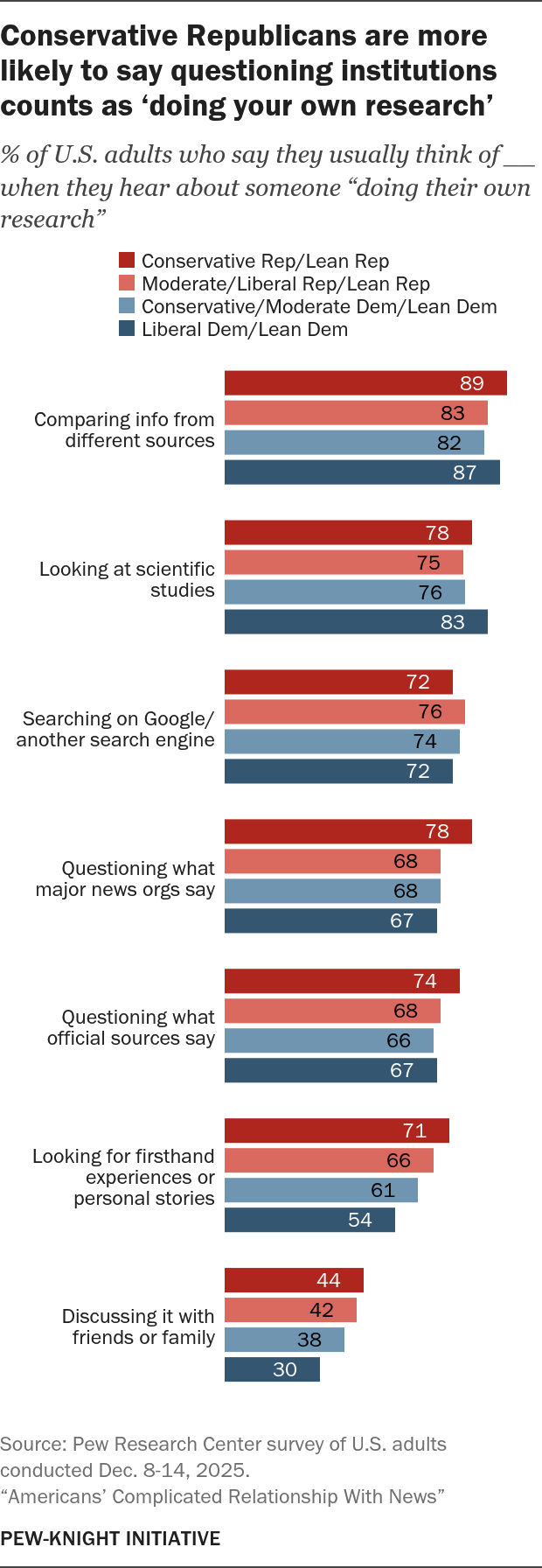
Conservative Republicans are more likely to say questioning institutions counts as ‘doing your own research’

Political differences also emerge. Republicans and Democrats are about equally likely to say comparing information from different sources, reading scientific studies or searching on Google qualifies as “doing your own research.” But Republicans are somewhat more likely than Democrats to say several practices count.

Republicans who identify as politically conservative are especially likely to see questioning what major news organizations or official sources say as “doing your own research,” even compared with Republicans who identify as moderate or liberal.

Meanwhile, party differences in perceptions of looking for firsthand accounts or personal stories or discussions with friends or family as “doing your own research” are driven by both ends of the ideological spectrum. Democrats who identify as politically liberal are less likely than all other groups to say either of these practices counts as “doing your own research.”

Who should make sure people know how to verify news, according to Americans?

As Americans navigate an increasingly complex information environment – one shaped by rapid advancements in artificial intelligence – some observers wonder whose job it is to ensure people (especially young people) know what information they can trust and how to check whether news is accurate.

Americans are far more confident in their own ability to check the accuracy of news than in others

Our data, including focus groups with everyday Americans, highlights a consistent tension: People recognize checking accuracy as essential, but there is no consensus on who should bear the primary responsibility for teaching these skills, sometimes described as “media literacy.”

Most Americans (79%) feel at least somewhat confident in their own ability to check the accuracy of a news story. This includes 29% who say they are very confident they would know what steps to take, and 50% who say they are somewhat confident. Still, in an information environment where about half of U.S. adults say it is difficult to determine what is true and what is not when they get news, there is plenty of uncertainty.

And confidence drops when considering other people: A quarter of U.S. adults say they are at least somewhat confident that others would know what steps to take to check the accuracy of a news story, including just 3% who say they are very confident. Republicans and Democrats express similarly low levels of confidence in other people to know how to check facts in the news.

These findings are based on a Pew Research Center survey of U.S. adults aimed at understanding how Americans are thinking about and experiencing news today. Read key findings from the full study.

Despite this skepticism, Americans are most likely to say that the burden ultimately falls on individual people to know how to check the accuracy of news.

44% of adults say individuals should be responsible for ensuring they know how to check if news is accurate

When asked who should be most responsible for making sure Americans know how to check if news is accurate:

  • 44% say individuals should be most responsible – by far the largest share.
  • 22% say news organizations should carry this responsibility.
  • Smaller shares say this should fall to teachers or schools (9%), the government (9%), parents or family members (5%), and tech or social media companies (4%)

Party differences

We find two key differences in these perceptions by political party:

  • Republicans and independents who lean toward the Republican Party are more likely than Democrats and Democratic leaners to say individuals themselves should be the most responsible for making sure Americans know how to check the accuracy of news (52% vs. 37%).
  • Democrats (14%) are more likely than Republicans (4%) to say teachers or schools should be the most responsible for this. Democrats also have more positive views of K-12 public schools and universities.

How we approached this question in focus groups

In focus group discussions about media literacy, we introduced the question slightly differently. Rather than asking who should be “most responsible for making sure Americans know how to check if news is accurate,” the focus group moderator asked participants who, if anyone, they think should be responsible for teaching media literacy, defined as the skills or critical thinking used to evaluate the quality of the news.

Perhaps as a result, teachers and schools regularly came up as an answer.

“I had the experiences in high school where a teacher had to take a second and stop the curriculum because this was important, we needed to know this before graduating and becoming adults, that we needed to know how to … find factual statements and be well-informed adults,” a woman in her 20s said. “And this should be taught. It shouldn’t just be, you’re put out into the world and be like, ‘Fend for yourself.’”

A man in his 40s put it this way: “There’s a place for it in school and the educational system. … Yes, there’s a responsibility for that to be in the home as well, but … it goes back to the question of, is there a right way. No, because everyone does it a different way in their own household, or they consume it in a different manner. So at a way that is consistent, the only way you can really do that is if it’s somewhere everyone has the same baseline for learning, and that’s in school.”

Why Americans discuss the news – or don’t – with others

Discussing news is a key way Americans make sense of what is happening around them. Many say these conversations help them learn, share perspectives and feel connected. At the same time, a growing share of Americans have stopped talking to certain people about political news because of something they said.

Our data explores both sides of this dynamic: why discussing the news remains valuable, and why many people are pulling back.

These findings are based on a Pew Research Center survey of U.S. adults aimed at understanding how Americans are thinking about and experiencing news today. Read key findings from the full study.

About three-quarters of U.S. adults (76%) say they discuss the news with others at least sometimes, including 28% who do so extremely or very often. One-in-five say they do this rarely, while only 3% say they never discuss news with others.

Even in a digital era when most Americans encounter and engage with news online, the majority of U.S. adults say they most often discuss the news in person (74%).

Far smaller shares say they do so primarily by phone or video calls (8%); text, email or direct messaging (7%); or social media posts (5%).

Although younger Americans are slightly more likely to say they discuss news digitally – via social media or text, email or direct messaging – large majorities of all age groups most often have these conversations in person.

How, and with whom, people talk about the news may vary. In focus group discussions held as part of this study, one woman in her 50s said: “There’s certain audiences my mouth stays shut, and other ones where it just won’t stop. So it’s who I feel comfortable around. And a lot of times, I’ll listen to other people. If I’m not going to say anything, I’m going to listen because I do want to know what people are thinking.”

What do people get out of news discussions?

There are several common experiences people have when discussing news with others. For example, most Americans say they at least sometimes learn something new about an issue or event (88%), share their own opinion about an issue (86%), feel connected with others (80%) and correct information they believe is inaccurate (79%).

A smaller share – but still more than half (59%) – say they at least sometimes change their own opinion about an issue when discussing the news with others. Just 4% say this happens all or most of the time.

Most Americans at least sometimes learn something new, share opinions, feel connected with others and correct information when discussing the news

Meanwhile, 37% of Americans say they at least sometimes argue with others when discussing the news.

More people are stepping away from political news conversations

A rising share of Americans (56%) say they have stopped talking to someone about political or election news, whether in person or online, because of something they said. This is up from 45% who said the same in 2024.

The share of Americans who have stopped talking to someone about political news has grown % of U.S. adults who say they have ever stopped talking to someone about political or election news, whether in person or online, because of something that person said
DatePercent
201945%
202042%
202445%
202556%

Source: Pew Research Center survey of U.S. adults conducted Dec. 8-14, 2025. For dates of other surveys, refer to the topline.“Americans’ Complicated Relationship With News”

Some groups are more likely to have stopped talking to someone about political news:

  • Liberal Democrats. About three-quarters of liberal Democrats (77%) say they’ve ever done this – 22 percentage points higher than among conservative or moderate Democrats (55%). Conservative Republicans (53%) and moderate or liberal Republicans (46%) are also considerably less likely than liberal Democrats to say they have stopped talking to someone about political news because of something they said.
  • More-educated Americans. About two-thirds of college graduates (65%) have stopped talking to someone about political news, versus 58% of those with some college education and 46% of adults with a high school education or less.
  • Older adults. At least half of Americans across all age groups have done this – but those ages 65 and older are more likely than adults under 3o to say this has happened (62% vs. 51%).

Some focus group participants discussed tempering what news they discuss based on who they’re talking to. “I can talk about the economy with just about anybody if they’re willing to listen to the boring stuff,” a Democratic man in his 40s said. “But if we go into politics and stuff like that – I’ve lost a lot of friends.”

A Republican woman in her 40s said, “I tend to only really talk about political things when I know I’m with people that are like-minded, just because there’s – it’s just easier that way.”

Why people avoid conversations about the news

Nearly equal shares of U.S. adults say concern about making things uncomfortable (58%), a lack of knowledge about the news (57%) or a lack of interest in talking about the news (57%) has kept them from discussing it with others.

Young adults are more likely to say lack of knowledge, interest has kept them from discussing the news with others

Different groups sometimes have different reasons for not talking about news with others. For instance, young adults are more likely than older Americans to say a lack of knowledge or interest has kept them from discussing news. And passive news consumers – those who say they mostly come across news rather than seek it out – are also more likely to say this is the case.

One woman in her 30s said, “If you’re going to have a conversation [about news], you should be well educated on it, and the pros and the cons, and both sides of the spectrum, so that you can have an intelligent conversation with whom you’re sharing it with.”

Democrats and independents who lean toward the Democratic Party, along with more-educated and higher-income Americans, are most likely to say they have avoided discussing the news with others out of concern about making things uncomfortable.

“We’re in that space right now where you don’t want to offend anybody, especially if you’re close with them right now,” a Democratic woman in her 30s said. “So you’re kind of just like, hey, I’m going to keep this article to myself, and if I do share it, it will probably be with somebody, like maybe one or two people that I absolutely trust, and that’s it.”

Few say Americans have a responsibility to pay for news

How news is funded is central to the sustainability of journalism, yet most Americans do not see paying for it as their responsibility. This analysis explores how the public thinks about paying for news, the reasons behind their views, and who is most likely to pay.

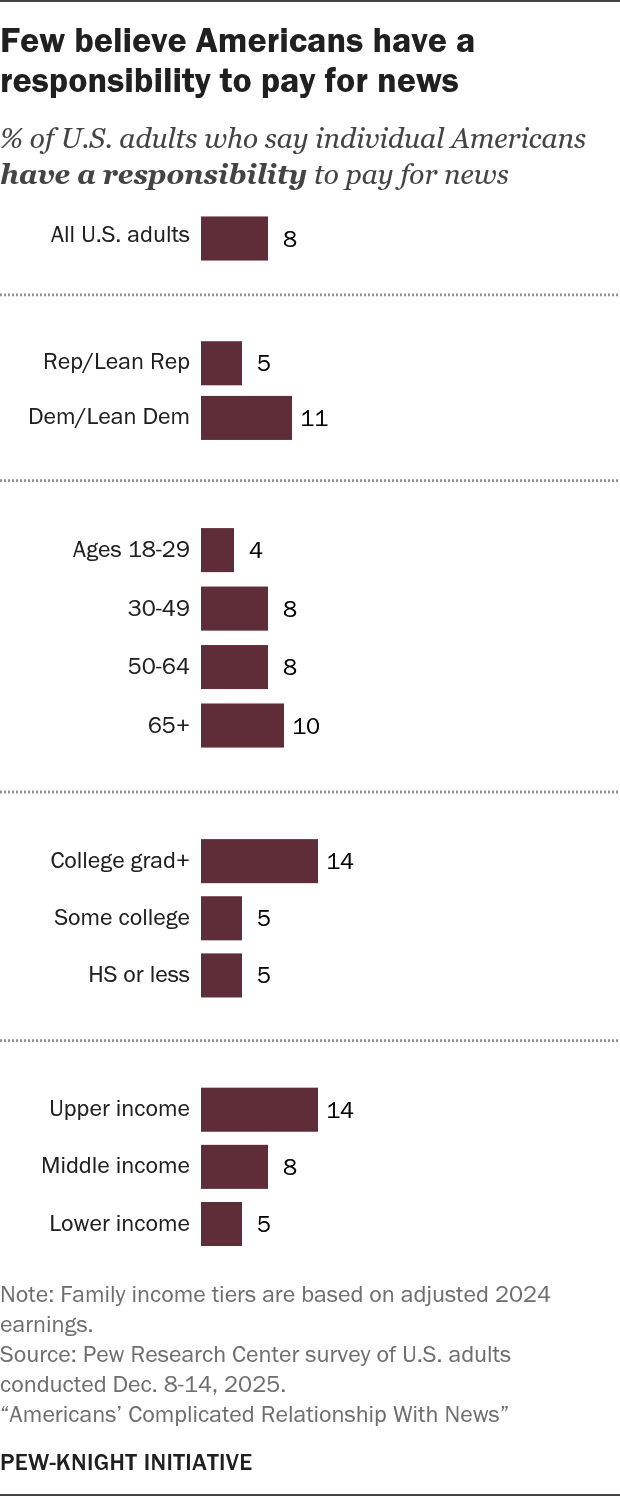
Few believe Americans have a responsibility to pay for news

Our findings reflect a recurring theme: Americans value being informed, but they feel a limited obligation to contribute financially to the system that produces the news.

These findings are based on a Pew Research Center survey of U.S. adults aimed at understanding how Americans are thinking about and experiencing news today. Read key findings from the full study.

Just 8% of U.S. adults say individual Americans have a responsibility to pay for news. This may connect to the fact that many Americans think that news organizations should make most of their money from advertising, not subscriptions or government funding, and that most think news organizations are doing at least somewhat well financially.

In focus group discussions held as part of the study, some participants expressed a view that paying for news shouldn’t be a responsibility. “I don’t think that information should be a privilege,” one woman in her 20s said.  

A woman in her 50s said, “I don’t pay to go to church, to get a spiritual message, you know? And if you’re true, and your mission is to relay facts that are fundamentally important for people’s well-being, do I need to pay you for that?”

Others observed that the money to pay for newsgathering has to come from somewhere. “I think somebody has to pay those journalists,” a man in his 60s said. “Somebody has to – it’s costly to travel around. It’s costly to report the news. And so I think it’s good for our society that we have reliable, objective journalism.”

Some groups are slightly more likely to see paying for news as a responsibility:

  • Democrats and independents who lean Democratic are more likely than Republicans and GOP leaners to say Americans have a responsibility to pay (11% vs. 5%).
  • People with high levels of education and adults with higher incomes are more likely to say people have this responsibility.

Few people pay for news themselves

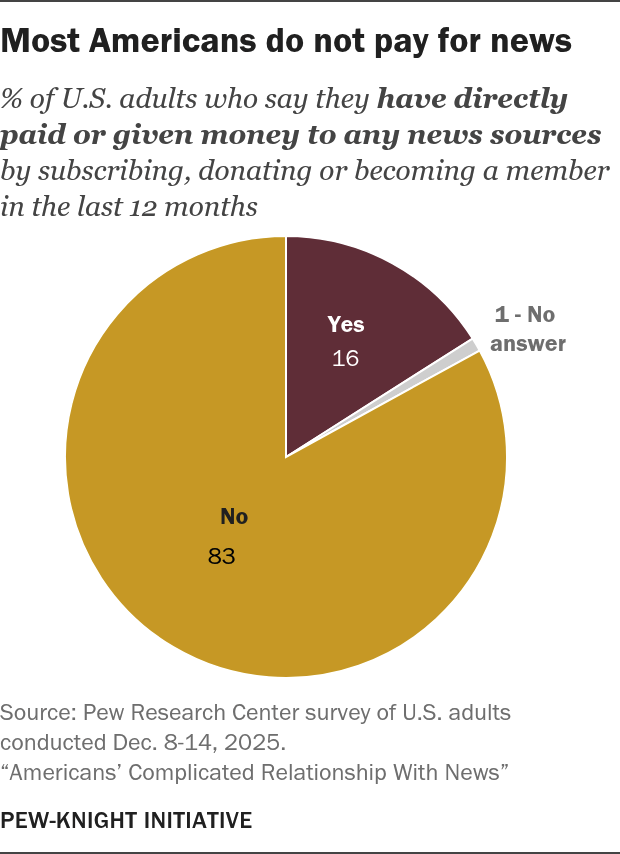
Consistent with attitudes about responsibility, relatively few Americans (16%) say they have paid for news in the past year – whether through subscriptions, memberships or donations.

Most Americans do not pay for news

Again, the groups more likely to pay include:

  • Upper-income Americans (30%)
  • Those with a postgraduate degree (35%)
  • Liberal Democrats (29%)

These patterns are similar to what we found in a March 2025 survey.

Why many Americans don’t pay for news

Focus group discussions highlight a few reasons many Americans don’t pay for news, including that plenty of it is available for free. One participant, a man in his 20s, said, “I feel like it’s a luxury to pay for news. … I think there’s still news accessible via free outlets, like just Googling something.”

“In some ways, I hate to pay for another subscription to another channel or subscribing to something,” a woman in her 50s explained. “I don’t want to give anybody that money. So I’m kind of like, if I can find a free news source, then I prefer that.”

Some said they support the concept of paying for news, including supporting independent journalists or creators through platforms like Substack, but felt subscription fatigue from being asked to pay for access to multiple news sources.

As a man in his 40s said, “You want to read different people’s articles, they want you to pay. And you like all these people, but … I can’t do $5 for 20 people. That’s a lot. It adds up.”

How do Americans think news organizations should make money?

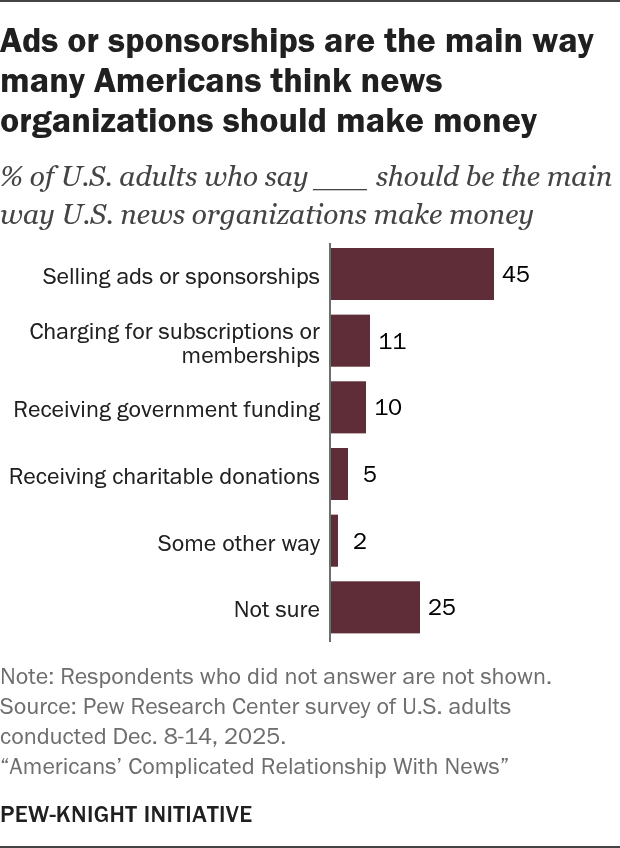
When asked how U.S. news organizations should make most of their money, Americans are most likely to say advertising or sponsorships (45%). Much smaller shares say charging for subscriptions or memberships (11%), receiving government funding (10%), or receiving charitable donations (5%).

Ads or sponsorships are the main way many Americans think news organizations should make money

A quarter of Americans say they are not sure how news outlets should make money.

Advertising revenue was the main source of revenue for daily newspapers, as well as most forms of television news, for much of the 20th century. But advertising revenue for the newspaper industry dropped dramatically in the last two decades and in recent years fell below circulation revenue for the first time in nearly 70 years of recorded data.

Both Republicans (51%) and Democrats (41%) are most likely to select advertising or sponsorships as the main way news organizations should make money. Democrats are modestly more likely than Republicans to say the main source of income should be government funding (14% vs. 7%).

Younger Americans also are more likely than their elders to say government funding is the main way news organizations should make money (15% of adults under 50 vs. 5% of those 50 and older). Still, selling advertising is the most common response even among young Americans.

Focus group conversations – particularly the following exchange among three participants in their 20s after they were asked about who should be responsible for ensuring people have access to news – revealed some people’s mixed feelings about the concept of government-funded journalism.

Participant 1: I’m thinking. My first thought was the government, but then I’m like, I don’t know if state-sanctioned journalism is a good idea.

Participant 2: Dangerous tightrope.

Participant 1: Yeah, because I’m like, well, it’s a public service, but then there’s a high risk there.

Moderator: [Participant], how do you feel about that? Who should do it?

Participant 3: I don’t know. … The only channel I trust is PBS. So I don’t know if there’s – we should never …

Participant 2: Isn’t that publicly funded?

Participant 3: Yeah. If Elmo could do it, sure. But I don’t think there is one person we can give the job. Because there’s always going to be someone that’s power hungry and trying to influence one idea.

Most Americans say news organizations are doing at least somewhat well financially

About a third of Americans (34%) say U.S. news organizations are doing extremely or very well financially, while 37% say news outlets are doing somewhat well. About a quarter (27%) say news organizations are doing not too well or not well at all financially.

Most Americans say news organizations are doing at least somewhat well financially % of U.S. adults who say they think U.S. news organizations are doing __ financially
Somewhat wellVery wellExtremely wellNot well at allNot too well
All U.S. adults37%23%11%4%23%
Upper income33%18%8%4%36%
Middle income38%24%11%3%23%
Lower income38%23%13%5%19%

Note: Respondents who did not answer are not shown. Family income tiers are based on adjusted 2024 earnings.

Source: Pew Research Center survey of U.S. adults conducted Dec. 8-14, 2025.“Americans’ Complicated Relationship With News”

These perceptions may help explain why relatively few people feel a responsibility to pay for news: Many believe news organizations are at least somewhat stable financially, despite well-documented revenue declines in some parts of the industry.

In the newspaper industry, for example, revenues have dropped dramatically, and many newspapers have closed or experienced layoffs as their business models ceased to be profitable.

Local TV and cable news businesses have not seen such drastic declines, with election advertising bolstering local television revenues. But cable news revenues have also begun to show signs of decline, particularly for CNN and MSNBC (now known as MS NOW).

Upper-income Americans are more likely than those with lower incomes to say news organizations are doing not too well or not at all well financially (40% say this). Liberal Democrats are also especially likely to say this: 38% say news organizations are not doing well.

Why Americans think news habits are changing, in their own words

Many Americans say they feel worn out by the amount of news that’s out there and have tuned out at some point, either by no longer following a source or decreasing how much news they get overall. At the same time, survey trends show that fewer Americans closely follow the news than a decade ago, with younger adults consistently consuming less than their older peers.

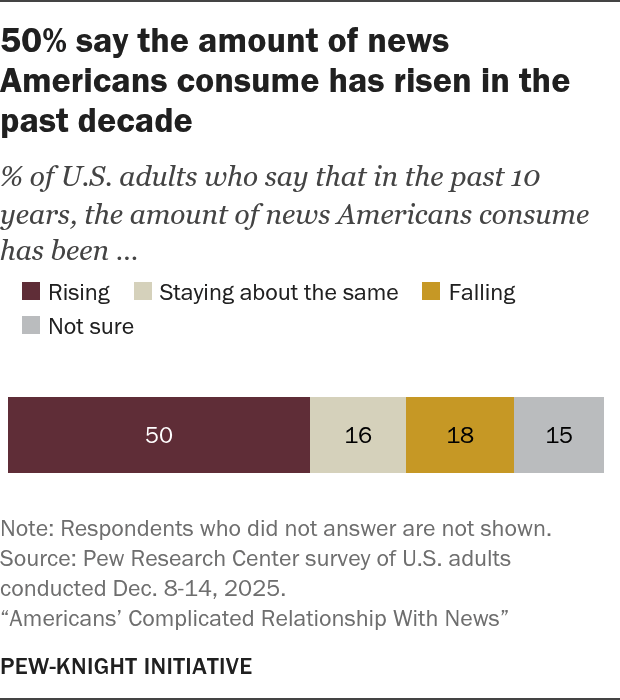
50% say the amount of news Americans consume has risen in the past decade

Despite these trends, half of U.S. adults say Americans as a whole now consume more news than they did 10 years ago. Far fewer (18%) say Americans’ news consumption has decreased. The rest say news consumption has been relatively steady (16%), or that they aren’t sure (15%).

To understand why, we spoke with 45 everyday Americans in nine focus groups. These discussions weren’t meant to reflect overall public opinion, but they did reveal interesting insights into how people think about and interpret changes in news consumption over time. Their explanations drew heavily on personal experience and life transitions that changed how they follow the news. Below are some of the themes that surfaced and what they had to say in their own words.

This is part of a study of U.S. adults aimed at understanding how Americans are thinking about and experiencing news today. Read key findings from the full study.

News is everywhere: Why people think news consumption is rising

Participants frequently described an environment saturated with information. Even those who try to avoid news said it often shows up uninvited.

“There are a lot more different ways that you can consume news now than you used to be able to, so it sucks in more people from different walks of life.”
– Woman, 60s

“Yeah, I feel like before we had cellphones, we just used to watch the regular news at night, you know? But nowadays on the phones, you get alerts from Apple News telling you, hey, something happened in California. Or, hey, this is happening. And I didn’t even sign up for it, but it just comes. … So that has changed a lot, and now it has become the standard for many people, I think.”
– Man, 40s

Many mentioned Americans’ transition from traditional news sources like newspapers and TV to digital platforms and social media. They also expressed that news consumption (including their own) has increased because of the range of new sources available to them.

“So 20-something years ago, I got most of my news from maybe three channels, like ABC, NBC, stuff like that, or in a newspaper. … Nowadays, no more newspaper. Don’t watch TV that much because everything’s streamed, so most of the stuff is online. … There’s just tons of ways to get more information. So I consume more of it because there’s just a lot more of it to be able to consume.”
– Man, 40s

“There’s more options now to consume news. You have these podcasts. You can check the news on social media sites … even when you open a social media site like Twitter, there’s news everywhere. So yeah, that’s why I feel like we tend to consume it more.”
– Woman, 30s

“A large part of why I think it’s rising is because people are aware earlier. The kids on TikTok, my middle school niece knew what was going on just as much as I did. Like, I was not paying attention to the news in middle school, but it’s popping up on her feed, so she’s asking, ‘Hey, what’s the situation on this?’”
– Woman, 20s

Some participants lamented the shift, saying a “news overload” has forced them to step away from it or consume it more intentionally to protect their mental health.

How news habits change in different life stages

Participants described how transitions in their own lives reshaped their news habits – sometimes increasing interest, sometimes limiting it. Some discussed how life experiences – ranging from college and parenting to career changes and military service – have shaped and reshaped their news habits and preferences. These life moments influenced what topics felt relevant and how much attention participants gave to the news.

Some participants described how growing older had changed their relationships with news:

“Well, I want to know more now, like as I’m older now. I didn’t care before. I just want to know more.”
– Woman, 40s

“Through life, I’ve gained different awarenesses I might not have had as a young person. Like now, as I’m going into my late 50s, 60s, I think more about financial news or what’s affecting the markets or what’s going to be affecting my retirement.”
– Woman, 50s

Others described how parenting, new jobs or college have changed what news they followed or opened new areas of interest.

“I think work and having a kid transitioned into more specific information with a focus of what I want to hear.”
– Man, 30s

“For me it was going to college. I think before, I just kind of relied on whatever my parents would tell me about what’s going on in the world. … When I got to college and was around people my age, some people who were more informed, some people who were less informed, I kind of saw … more people that were different than me. And I realized, like, oh, I want to be more informed about this, about what’s going on in the world. … And I wasn’t necessarily just listening to what my parents told me 24/7. Instead, I could form my own opinions.”
– Woman, 30s

“If I think back to when I was little, my parents would have on Walter Cronkite or something. That’s 30 minutes, and not even. … Where today because of being an investment professional, I have to focus in on [news] way more, and I’ll usually have Bloomberg in my office as a background.”
– Man, 60s

How world events shape people’s news consumption

Major national and global events – terrorist attacks, pandemics, natural disasters and international conflicts – often serve as turning points that shift participants’ attention to news. For some, these events make the news feel more urgent and personally relevant, increasing their news consumption. For others, the constant stream of high-stakes developments creates news fatigue.

“Prior to 9/11, I didn’t know anything about the Middle East. After 9/11, I wanted to know all about it, you know? So that was a life-changing event.”
– Man, 40s

“I think for me, COVID was a bit of a turning point because it was just – you know, you heard nonstop COVID stuff all day, every day for months. And so I think to me that just got really old, became very repetitive.”
– Man, 30s

“I think I’ve personally been more focused [than in the past] on global news, world news. Just because it affects my day-to-day. Are we going into World War III? Stuff that’s going to affect the people that follow me on a day-to-day basis.”
– Man, 20s (military)

How changes in trust affect people’s news choices

At times, participants in these focus group discussions described changing their news habits as a response to shifting levels of trust in different news sources – something we’ve heard in our other work. These experiences reflect broader patterns of declining trust in information from national and local news organizations, especially among Republicans.

Some participants said they now curate their news more carefully, whether by verifying what they come across or by narrowing their consumption to a small set of trusted sources.

“I think it’s just kind of having to learn to be more discerning over time. It used to be, as a kid, I could just turn on the news on TV and it’s like everything is believable and credible. But in a world where everything has become much more biased, and there’s unreliable and biased sources, you have to kind of take things with a grain of salt and look at where is it coming from, and who’s the source, and what is their main goal? And you just have to put a filter on it.”
– Woman, 40s, Republican

Others described a broader loss of confidence, saying they no longer know who or what to trust:

“The news is not the truth anymore. We don’t know who to trust no more.”
– Woman, 50s, Democrat

Acknowledgments

This is a Pew Research Center report from the Pew-Knight Initiative, a research program funded jointly by The Pew Charitable Trusts and the John S. and James L. Knight Foundation. Find related reports online at https://alpha.pewresearch.org/pewresearch-org/pew-knight/.

Research

Kirsten Eddy, Senior Researcher
Katerina Eva Matsa, Director, News and Information Research
Michael Lipka, Associate Director, News and Information Research
Christopher St. Aubin, Research Analyst
Elisa Shearer, Senior Researcher
Jacob Liedke, Former Research Analyst
Joanne Haner, Research Assistant
Naomi Forman-Katz, Research Analyst
Sawyer Reed, Research Assistant
Emily Tomasik, Research Analyst
Luxuan Wang, Research Associate

Editorial and Graphic Design

David Kent, Senior Editorial Specialist
Peter Bell, Associate Director, Design and Production
Andrea Caumont, Associate Director, Digital Outreach

Communications and Web Publishing

Sogand Afkari, Communications Manager 
Talia Price, Communications Associate
Justine Coleman, Associate Digital Producer

In addition, the project benefited greatly from the administrative work of Meera Ramshankar and the guidance of the Pew Research Center methodology team: Courtney Kennedy, Andrew Mercer, Ashley Amaya, Dorene Asare-Marfo, Dana Popky, Anna Brown, Arnold Lau and Thomas May. We are also thankful for the PSB Insights project team’s work conducting this study’s focus groups.

Methodology

This is a Pew Research Center report from the Pew-Knight Initiative, a research program funded jointly by The Pew Charitable Trusts and the John S. and James L. Knight Foundation.

The American Trends Panel survey methodology

Overview

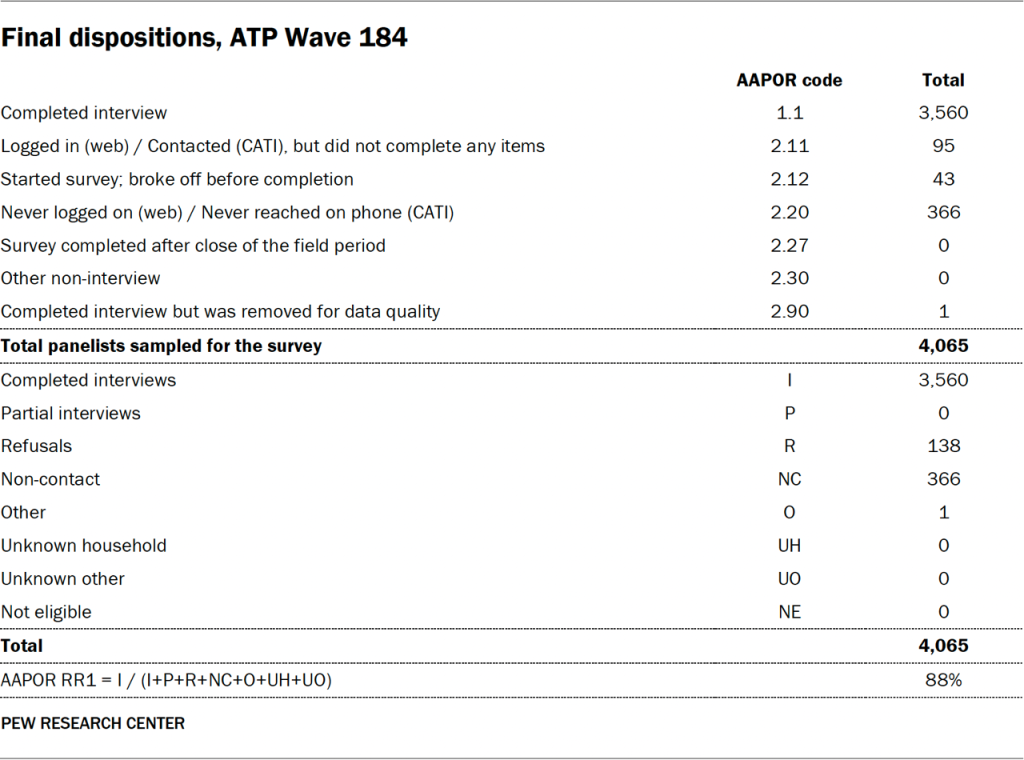
Data in this report comes from Wave 184 of the American Trends Panel (ATP), Pew Research Center’s nationally representative panel of randomly selected U.S. adults. The survey was conducted from Dec. 8 to Dec. 14, 2025. A total of 3,560 panelists responded out of 4,065 who were sampled, for a survey-level response rate of 88%.

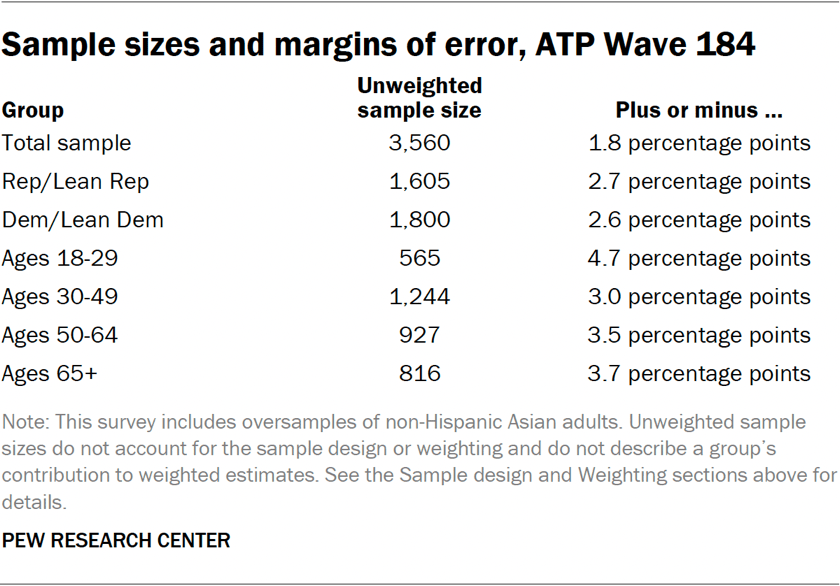
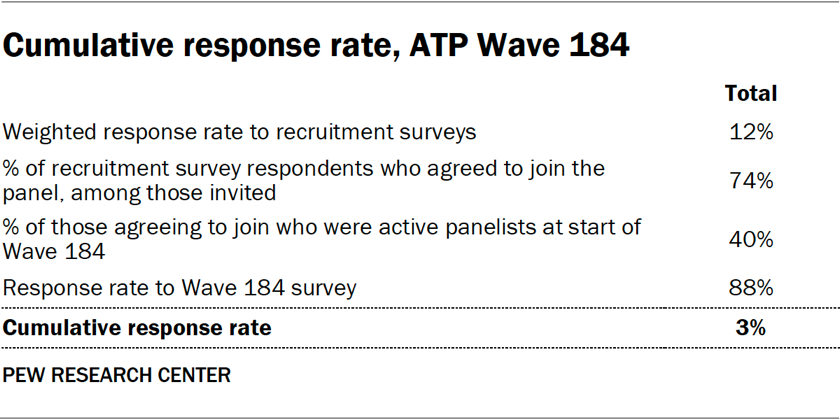
The cumulative response rate accounting for nonresponse to the recruitment surveys and attrition is 3%. The break-off rate among panelists who logged on to the survey and completed at least one item is 1%. The margin of sampling error for the full sample of 3,560 respondents is plus or minus 1.8 percentage points.

The survey includes an oversample of non-Hispanic Asian adults in order to provide more precise estimates of the opinions and experiences of this smaller demographic subgroup. Oversampled groups are weighted back to reflect their correct proportions in the population.

SSRS conducted the survey for Pew Research Center via online (n=3,417) and live telephone (n=143) interviewing. Interviews were conducted in both English and Spanish.

To learn more about the ATP, read “About the American Trends Panel.”

Panel recruitment

Since 2018, the ATP has used address-based sampling (ABS) for recruitment. A study cover letter and a pre-incentive are mailed to a stratified, random sample of households selected from the U.S. Postal Service’s Computerized Delivery Sequence File. This Postal Service file has been estimated to cover 90% to 98% of the population.1 Within each sampled household, the adult with the next birthday is selected to participate. Other details of the ABS recruitment protocol have changed over time but are available upon request.2 Prior to 2018, the ATP was recruited using landline and cellphone random-digit-dial surveys administered in English and Spanish.

A national sample of U.S. adults has been recruited to the ATP approximately once per year since 2014. In some years, the recruitment has included additional efforts (known as an “oversample”) to improve the accuracy of data for underrepresented groups. For example, Hispanic adults, Black adults and Asian adults were oversampled in 2019, 2022 and 2023, respectively.

Sample design

The overall target population for this survey was noninstitutionalized persons ages 18 and older living in the United States. It featured a stratified random sample from the ATP in which non-Hispanic Asian adults were selected with certainty. The remaining panelists were sampled at rates designed to ensure that the share of respondents in each stratum is proportional to its share of the U.S. adult population to the greatest extent possible. Respondent weights are adjusted to account for differential probabilities of selection as described in the Weighting section below.

Questionnaire development and testing

The questionnaire was developed by Pew Research Center in consultation with SSRS. The web program used for online respondents was rigorously tested on both PC and mobile devices by the SSRS project team and Pew Research Center researchers. The SSRS project team also populated test data that was analyzed in SPSS to ensure the logic and randomizations were working as intended before launching the survey.

Incentives

All respondents were offered a post-paid incentive for their participation. Respondents could choose to receive the post-paid incentive in the form of a check or gift code to Amazon.com, Target.com or Walmart.com. Incentive amounts ranged from $5 to $20 depending on whether the respondent belongs to a part of the population that is harder or easier to reach. Differential incentive amounts were designed to increase panel survey participation among groups that traditionally have low survey response propensities.

Data collection protocol

The data collection field period for this survey was Dec. 8 to Dec. 14, 2024. Surveys were conducted via self-administered web survey or by live telephone interviewing.

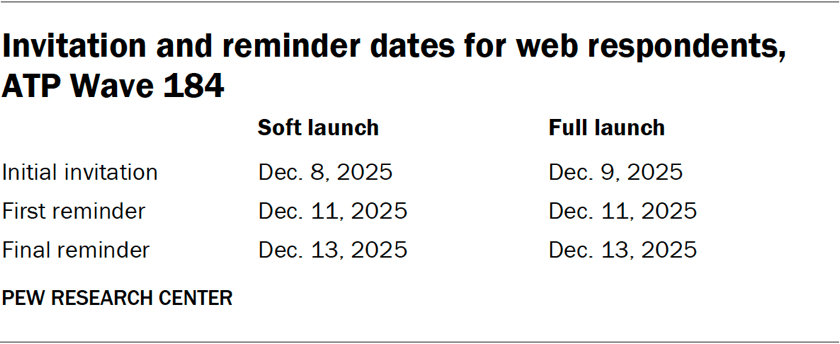
For panelists who take surveys online:3 Postcard notifications were mailed to a subset on Dec. 8.4 Survey invitations were sent out in two separate launches: soft launch and full launch. Sixty panelists were included in the soft launch, which began with an initial invitation sent on Dec. 8. All remaining English- and Spanish-speaking sampled online panelists were included in the full launch and were sent an invitation on Dec. 9.

Table showing invitation and reminder dates for web respondents for ATP Wave 184

Panelists participating online were sent an email invitation and up to two email reminders if they did not respond to the survey. ATP panelists who consented to SMS messages were sent an SMS invitation with a link to the survey and up to two SMS reminders.

For panelists who take surveys over the phone with a live interviewer: Prenotification postcards were mailed on Dec. 5. Soft launch took place on Dec. 8 and involved dialing until a total of six interviews had been completed. All remaining English- and Spanish-speaking sampled phone panelists’ numbers were dialed throughout the remaining field period. Panelists who take surveys via phone can receive up to six calls from trained SSRS interviewers.

Data quality checks

To ensure high-quality data, Center researchers performed data quality checks to identify any respondents showing patterns of satisficing. This includes checking for whether respondents left questions blank at very high rates or always selected the first or last answer presented. As a result of this checking, one ATP respondent was removed from the survey dataset prior to weighting and analysis.

Weighting

The ATP data is weighted in a process that accounts for multiple stages of sampling and nonresponse that occur at different points in the panel survey process. First, each panelist begins with a base weight that reflects their probability of recruitment into the panel. These weights are then calibrated to align with the population benchmarks in the accompanying table to correct for nonresponse to recruitment surveys and panel attrition. If only a subsample of panelists was invited to participate in the wave, this weight is adjusted to account for any differential probabilities of selection.

Among the panelists who completed the survey, this weight is then calibrated again to align with the population benchmarks identified in the accompanying table and trimmed at the 1st and 99th percentiles to reduce the loss in precision stemming from variance in the weights. Sampling errors and tests of statistical significance take into account the effect of weighting.

Table showing American Trends Panel weighting dimensions

The following table shows the unweighted sample sizes and the error attributable to sampling that would be expected at the 95% level of confidence for different groups in the survey.

Table showing the sample sizes and margins of error for ATP Wave 184

Sample sizes and sampling errors for other subgroups are available upon request. In addition to sampling error, one should bear in mind that question wording and practical difficulties in conducting surveys can introduce error or bias into the findings of opinion polls.

Dispositions and response rates

Table showing the final dispositions for ATP Wave 184
Table showing the cumulative response rate for ATP Wave 184

How family income tiers are calculated

Family income data reported in this study is adjusted for household size and cost-of-living differences by geography. Panelists then are assigned to income tiers that are based on the median adjusted family income of all American Trends Panel members. The process uses the following steps:

  1. First, panelists are assigned to the midpoint of the income range they selected in a family income question that was measured on either the most recent annual profile survey or, for newly recruited panelists, their recruitment survey. This provides an approximate income value that can be used in calculations for the adjustment.
  2. Next, these income values are adjusted for the cost of living in the geographic area where the panelist lives. This is calculated using price indexes published by the U.S. Bureau of Economic Analysis. These indexes, known as Regional Price Parities (RPP), compare the prices of goods and services across all U.S. metropolitan statistical areas as well as non-metro areas with the national average prices for the same goods and services. The most recent available data at the time of the annual profile survey is from 2023. Those who fall outside of metropolitan statistical areas are assigned the overall RPP for their state’s non-metropolitan area.
  3. Family incomes are further adjusted for the number of people in a household using the methodology from Pew Research Center’s previous work on the American middle class. This is done because a four-person household with an income of say, $50,000, faces a tighter budget constraint than a two-person household with the same income.
  4. Panelists are then assigned an income tier. “Middle-income” adults are in families with adjusted family incomes that are between two-thirds and double the median adjusted family income for the full ATP at the time of the most recent annual profile survey. The median adjusted family income for the panel is roughly $77,800. Using this median income, the middle-income range is about $51,900 to $155,600. Lower-income families have adjusted incomes less than $51,900 and upper-income families have adjusted incomes greater than $155,600 (all figures expressed in 2024 dollars and scaled to a household size of three). A panelist is assigned “no answer” in the income tier variable if they did not provide all three pieces of information needed to calculate their tier (family income, household size and residential address).

Two examples of how a given area’s cost-of-living adjustment was calculated are as follows: the Pine Bluff metropolitan area in Arkansas is a relatively inexpensive area, with a price level that is 19.7% less than the national average. The San Francisco-Oakland-Berkeley metropolitan area in California is one of the most expensive areas, with a price level that is 18.2% higher than the national average. Income in the sample is adjusted to make up for this difference. As a result, a family with an income of $40,200 in the Pine Bluff area is as well off financially as a family of the same size with an income of $59,100 in San Francisco.

Focus groups

Pew Research Center worked with PSB Insights to conduct nine 90-minute online focus groups with 45 U.S. adults from June 10 to June 18, 2025. These discussions are not nationally representative. This report includes findings and quotes from the second half of these focus groups to help illustrate and add nuance to the survey findings.

Table showing the demographic characteristics of focus group participants

Recruitment

PSB Insights recruited participants using quotas for gender, age, party affiliation, education, race and ethnicity, self-reported news engagement level and primary medium of news consumption. All participants had to be 18 years of age or older (19 or older if living in Alabama or Nebraska and 21 or older if living in Mississippi), live in the U.S., and have access to a computer or mobile device with high-speed internet access and a working webcam.

Eligible participants had to be willing and able to contribute to the research, complete an online pre-session activity, attend the focus group on the set date and time, and sign an informed consent form before they could participate. This included agreement that all responses could be used in research reports, though participants’ names and identifying information would remain private and not be used in any reports.

For each focus group, seven participants were recruited and five were selected to participate. The research team overrecruited participants to account for “no-shows,” as well as participants who may experience other issues preventing participation. Each participant was offered a $225 incentive.

The first six focus groups were organized by political affiliation (Republicans, Democrats and independents) and primary news source (traditional or nontraditional) to capture a range of perspectives. Traditional news sources included television, radio, print publications, and news websites or apps noted as a participant’s primary source of news. Nontraditional sources included social media, search engines, podcasts, online forums and email newsletters noted as a participant’s primary source of news.

Additional focus groups were conducted with adults ages 18 to 29, adults 50 and older, and those who reported low levels of news use.

Online pre-session activity

Before each focus group, participants completed an online pre-session activity with both written and video questions. This helped guide the group discussions and introduced participants to the general topic before the focus group began.

Discussion

The Pew Research Center and PSB Insights research teams developed the discussion guide through an iterative process. After the first focus group, the teams made minor changes, including cutting some questions and adjusting the wording of others to better explore key topics.

After the moderator set ground rules and participants introduced themselves, each focus group discussed a range of topics related to their experiences with news. This analysis focused on participants’ personal approaches to getting news, including why they follow it, how their news habits have changed over time, what they see as “good” news habits, barriers to following the news, how they verify and share news, the role of media literacy, and views about paying for news.

Analysis

All human-generated transcripts were analyzed and coded by the Pew Research Center research team using ATLAS.ti, a qualitative data analysis software program.

Two members of the research team wrote analytical memos while observing each focus group, noting similarities and differences across participants and linking individual experiences to broader themes. In addition, two coders separately analyzed each focus group transcript in ATLAS.ti using a codebook that was developed before analysis, based on the survey findings, and refined during analysis as new themes emerged from participants’ responses. After coding was completed, the research team brought together key findings and selected quotes.

This process allowed the team to identify major patterns in the data and to organize and categorize relevant quotes, including linking them to participants’ demographic characteristics. Multiple members of the research team observed and analyzed the focus groups to ensure that the findings accurately reflect the full range of participants’ views and experiences.

Reporting

This report includes selected quotes from participants. Quotes were lightly edited by Pew Research Center staff for spelling, punctuation and clarity.