Pew Research Center

FOR RELEASE AUGUST 20, 2020

Nearly Half of U.S. Adults Say Dating Has Gotten Harder for Most People in the Last 10 Years

A majority of women say they have experienced harassing behavior from someone they went on a date with

BY Anna Brown

FOR MEDIA OR OTHER INQUIRIES:

Communications Department
202.419.4372
www.pewresearch.org

RECOMMENDED CITATION

Pew Research Center, August 2020, "Nearly Half of U.S. Adults Say Dating Has Gotten Harder for Most People in the Last 10 Years"

About Pew Research Center

Pew Research Center is a nonpartisan, nonadvocacy fact tank that informs the public about the issues, attitudes and trends shaping the world. It does not take policy positions. The Center conducts public opinion polling, demographic research, computational social science research and other data-driven research. It studies politics and policy; news habits and media; the internet and technology; religion; race and ethnicity; international affairs; social, demographic and economic trends; science; research methodology and data science; and immigration and migration. Pew Research Center is a subsidiary of The Pew Charitable Trusts, its primary funder.

© Pew Research Center 2026

Table of contents

  • About Pew Research Center
  • Nearly Half of U.S. Adults Say Dating Has Gotten Harder for Most People in the Last 10 Years
  • 1. A profile of single Americans
  • 2. Personal experiences and attitudes of daters
  • 3. Public attitudes about today’s dating landscape
  • Acknowledgments
  • Methodology

Nearly Half of U.S. Adults Say Dating Has Gotten Harder for Most People in the Last 10 Years

A majority of women say they have experienced harassing behavior from someone they went on a date with

How we did this

Pew Research Center conducted this study to understand Americans’ attitudes toward and personal experiences with dating and relationships. These findings are based on a survey conducted Oct. 16-28, 2019, among 4,860 U.S. adults. This includes those who took part as members of Pew Research Center’s American Trends Panel (ATP), an online survey panel that is recruited through national, random sampling of residential addresses, as well as respondents from the Ipsos KnowledgePanel who indicated that they identify as lesbian, gay or bisexual (LGB).

Recruiting ATP panelists by phone or mail ensures that nearly all U.S. adults have a chance of selection. This gives us confidence that any sample can represent the whole U.S. adult population (see our Methods 101 explainer on random sampling). To further ensure that each ATP survey reflects a balanced cross-section of the nation, the data are weighted to match the U.S. adult population by gender, race, ethnicity, partisan affiliation, education and other categories.

For more, see the report’s methodology about the project. You can also find the questions asked, and the answers the public provided, in this topline.

Terminology

Partnered adults are those who say they are currently married, living with a partner or in a committed romantic relationship.

Single or unpartnered adults are those who say they are currently not married, living with a partner or in a committed romantic relationship. A small share of single adults report that they are casually dating someone.

Daters, single-and-looking and on the dating market all indicate that someone is currently not married, living with a partner or in a committed romantic relationship and has indicated that they are looking for a committed romantic relationship only, casual dates only or either a committed romantic relationship or casual dates.

Not dating, not looking, non-daters or not on the dating market means someone is not married, living with a partner or in a committed romantic relationship and has indicated that they are not currently looking for a relationship or dates.

Relationship, committed relationship and committed romantic relationship are used interchangeably.

Casually dating someone refers to single adults who say they are currently casually dating someone – regardless of whether they say they are looking for a committed romantic relationship, casual dates or neither.

LGB is sometimes used as a shorthand for adults who identify as lesbian, gay or bisexual, regardless of the sex of their partner, if they are partnered.

Online dating users or online daters refer to the 30% of respondents in this survey who answered yes to the following question: “Have you ever used an online dating site or dating app?”

References to White and Black adults include only those who are non-Hispanic and identify as only one race. Hispanics are of any race. The views and experiences of Asian Americans are not analyzed separately in this report due to sample limitations. Data for Asian Americans and other racial and ethnic groups are incorporated into the general population figures throughout the report.

References to college graduates or people with a college degree comprise those with a bachelor’s degree or more education. Some college includes those with an associate degree and those who attended college but did not obtain a degree. High school refers to those who have a high school diploma or its equivalent, such as a General Education Development (GED) certificate.

All references to party affiliation include those who lean toward that party. Republicans include those who identify as Republicans and independents who say they lean toward the Republican Party, and Democrats include those who identify as Democrats and independents who say they lean toward the Democratic Party.

References to those living in urban, suburban and rural areas are based on respondents’ answer to the following question: “How would you describe the community where you currently live? (1) urban, (2) suburban, (3) rural.”
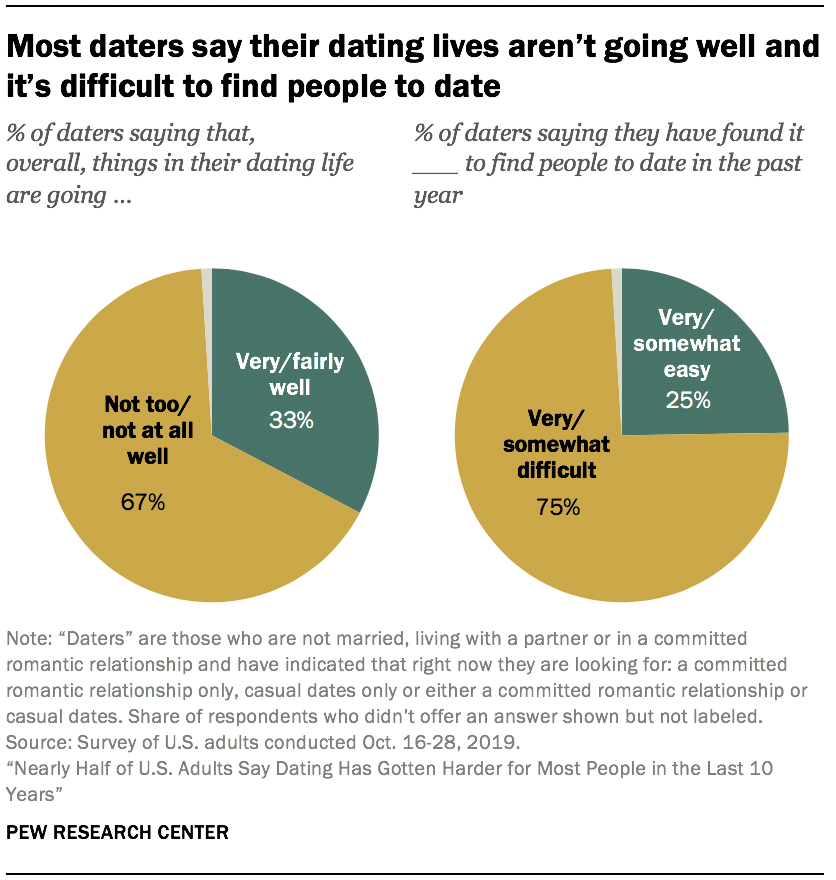
Most daters say their dating lives aren’t going well and it’s difficult to find people to date

As more Americans turn to online dating and the #MeToo movement leaves its imprint on the dating scene, nearly half of U.S. adults – and a majority of women – say that dating has become harder in the last 10 years.

Among those who are on the dating market – the 15% of American adults who are single and looking for a committed relationship or casual dates – most say they are dissatisfied with their dating lives and that it has been difficult to find people to date, according to a Pew Research Center survey conducted in October 2019.1

Other publications from this survey

  • The Virtues and Downsides of Online Dating
  • Dating and Relationships in the Digital Age
  • Lesbian, gay and bisexual online daters report positive experiences – but also harassment
  • Most Democrats who are looking for a relationship would not consider dating a Trump voter
  • Roughly six-in-ten online daters in the U.S. are concerned about data collection
  • 10 facts about Americans and online dating
  • Young women often face sexual harassment online – including on dating sites and apps
  • About half of never-married Americans have used an online dating site or app
  • Q&A: How and why we studied online dating in the U.S.

While single-and-looking men and women report equal levels of dissatisfaction with their dating lives and the ease of finding people to date, women are more likely to say they have had some particularly negative experiences. Most women who are currently single and looking to date (65%) say they have experienced at least one of six harassing behaviors asked about in the survey from someone they were dating or had been on a date with, such as being touched in a way that made them uncomfortable or rumors being spread about their sexual history. This compares with 50% of men who are single and looking. The pattern holds when looking at all women and men, whether they are currently on the dating market or not.

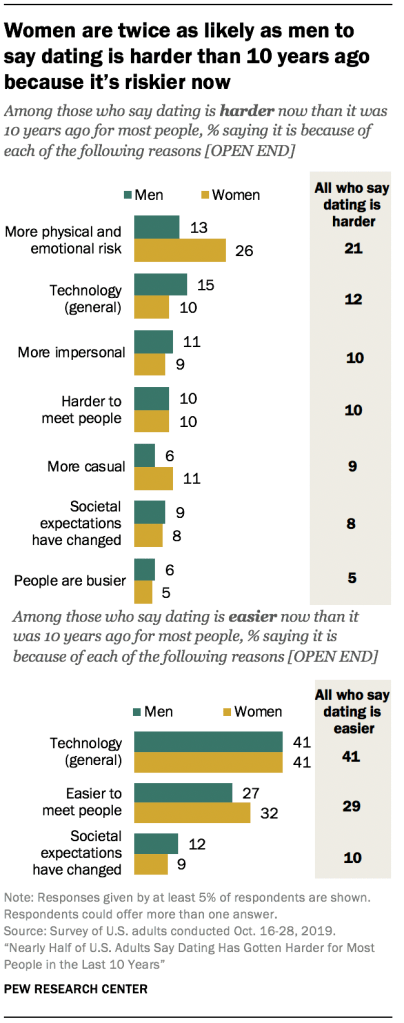
Women are also more likely to see risk – both physical and emotional – when it comes to dating. When those who say dating has become harder for most people in the last 10 years are asked to describe in their own words why they think this is the case, women are twice as likely as men to cite increased risk. For their part, men are more likely than women to say technology is a reason dating has gotten harder. Overall, 47% of Americans say dating is now harder than it was 10 years ago, while 19% say it’s easier and 33% say it’s about the same.
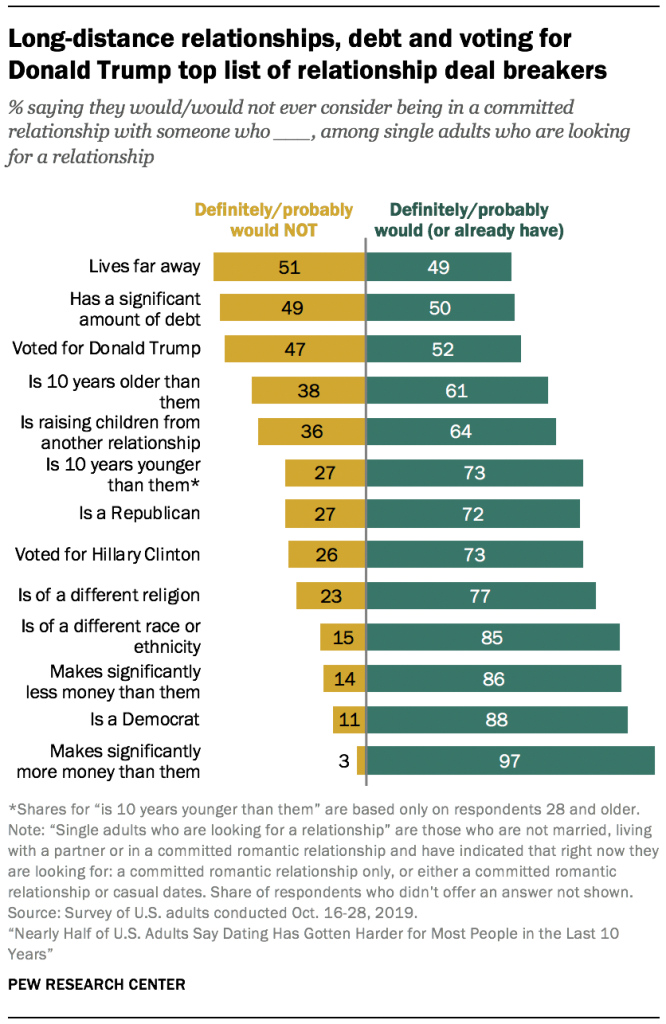
Long-distance relationships, debt and voting for Donald Trump top list of relationship deal breakers

Singles who are looking for a relationship are generally open to dating people with many different traits and from a variety of backgrounds. For example, large majorities say they would consider a relationship with someone of a different religion or different race or ethnicity than them. Most also say they would seriously date someone who makes significantly more or significantly less money than them. When it comes to being in a relationship with someone who lives far away, has a significant amount of debt, or who voted for Donald Trump, however, many of those who are looking for a relationship would hesitate.

The nationally representative survey of 4,860 U.S. adults was conducted online Oct. 16-28, 2019 – before the coronavirus pandemic shook the dating landscape – using Pew Research Center’s American Trends Panel.2

Among the other key findings:

Most Americans say it’s harder for men to know how to behave on dates in the era of the #MeToo movement
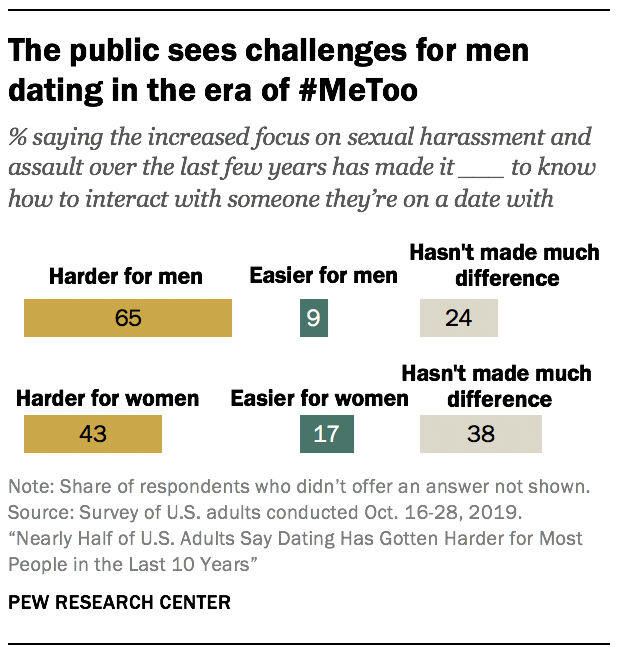
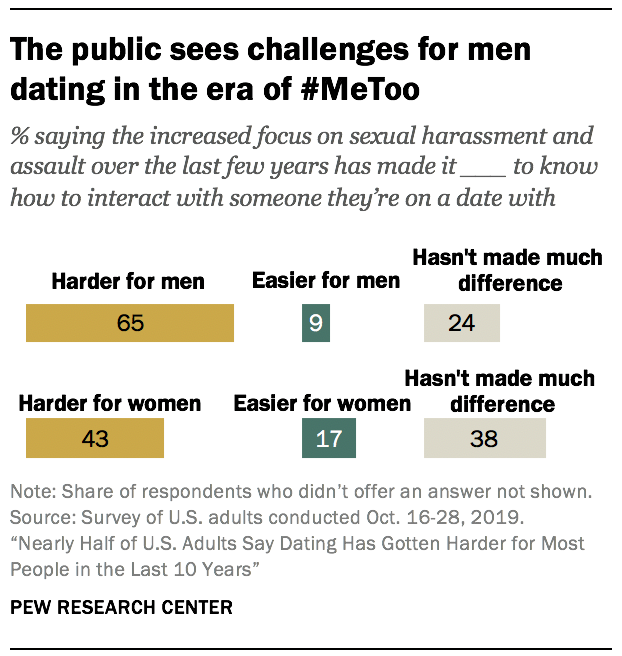
The public sees challenges for men dating in the era of #MeToo

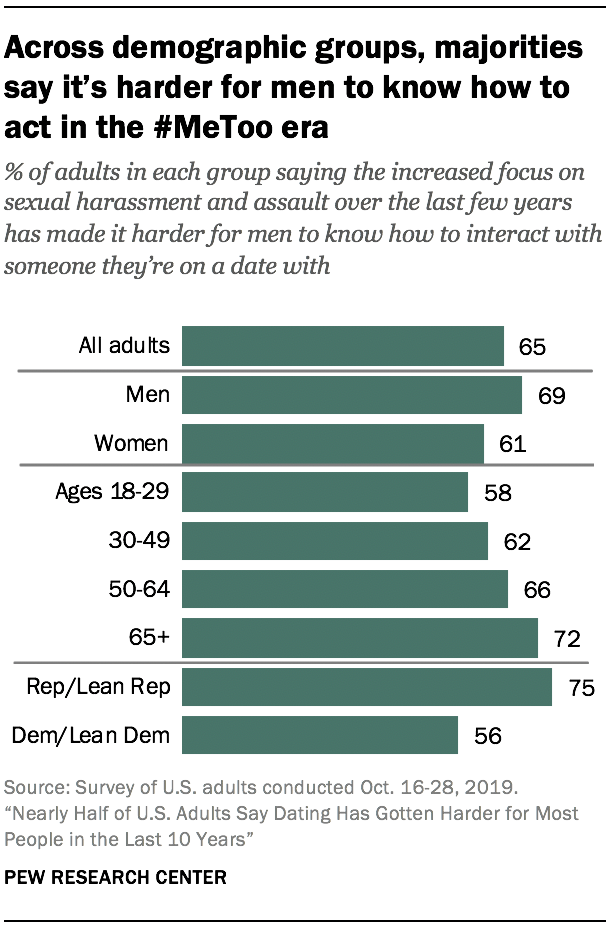
A majority of the overall public (65%) says the increased focus on sexual harassment and assault in the last few years has made it harder for men to know how to interact with someone they’re on a date with. About a quarter (24%) say it hasn’t made much difference, and 9% say it has become easier for men to know how to behave. Fewer people think this focus on harassment and assault has made it harder for women to know how to interact with someone they’re on a date with (43%), while 38% say it hasn’t made much difference for women.

Men – especially older men – and Republicans are more likely than women and Democrats to say it’s harder for men to know how to act when dating in the era of the #MeToo movement, though majorities across the board express this view. For example, 75% of men ages 50 and older say it is now harder for men to know how to behave on dates, compared with 63% of men younger than 50, 58% of women younger than 50 and 63% of women 50 and older.

Premarital sex is largely seen as acceptable, but most view sex on a first date and open relationships as taboo
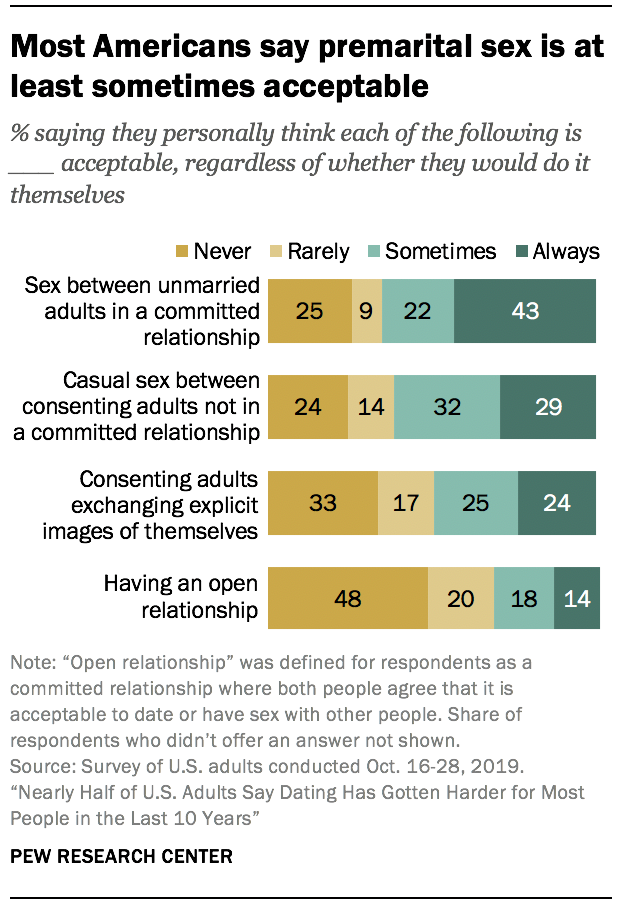
Most Americans say premarital sex is at least sometimes acceptable

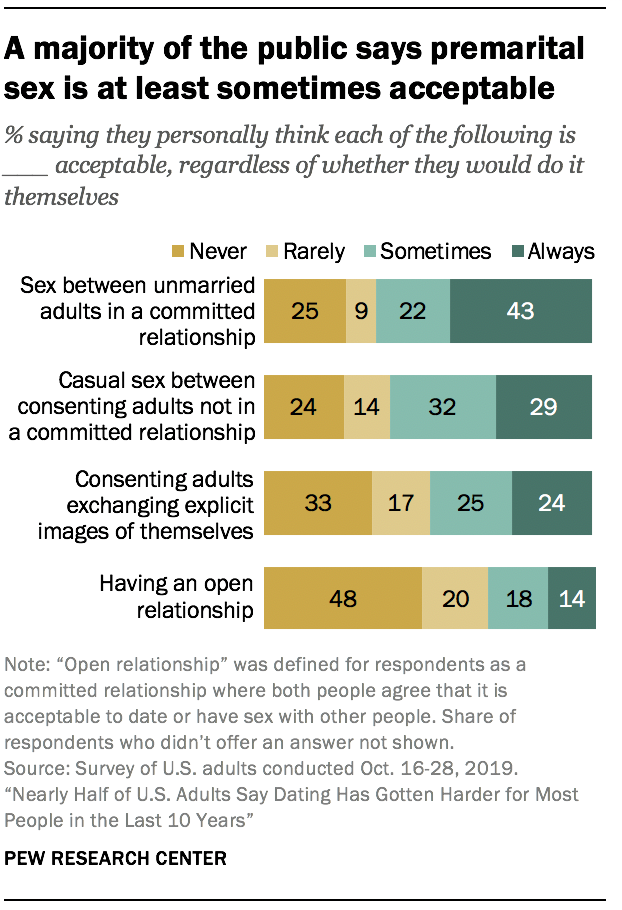
Most adults (65%) say sex between unmarried adults in a committed relationship is acceptable at least sometimes, including 43% who say this is always acceptable. Casual sex between consenting adults who are not in a committed relationship is also seen as generally acceptable (62%). About half (49%) say it is acceptable for consenting adults to exchange explicit images of themselves.

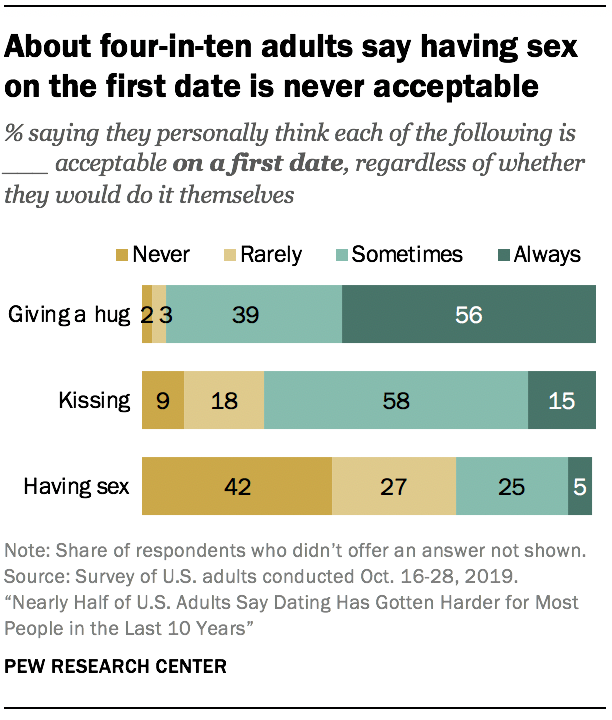
When it comes to open relationships – that is, a committed relationship where both people agree that it is acceptable to date or have sex with other people – the public is less accepting. Some 32% think this can be acceptable at least sometimes (regardless of whether they would do it themselves), while 48% say open relationships are never acceptable. Having sex on a first date is also still seen as taboo by some. While 30% say it can be acceptable under some or all circumstances, 42% say it is never acceptable.

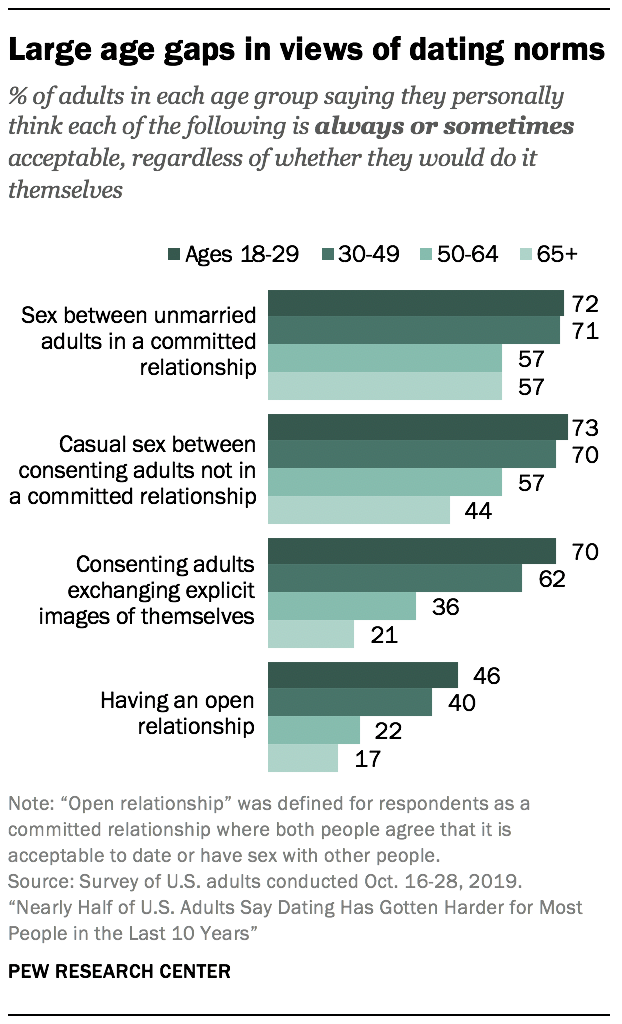
Younger adults are more likely to see these dating norms as acceptable – sometimes dramatically so. For example, 70% of 18- to 29-year-olds say consenting adults exchanging explicit images of themselves can be acceptable at least sometimes, compared with just 21% of those ages 65 and older. Lesbian, gay and bisexual (LGB) adults also tend to be more accepting of these norms than their straight counterparts. In fact, LGB adults are the only demographic group studied in which a majority said that open relationships are always or sometimes acceptable (61% vs. 29% of straight adults).

Vast majorities say that breaking up through technology is mostly unacceptable, and few say they would ‘ghost’ someone
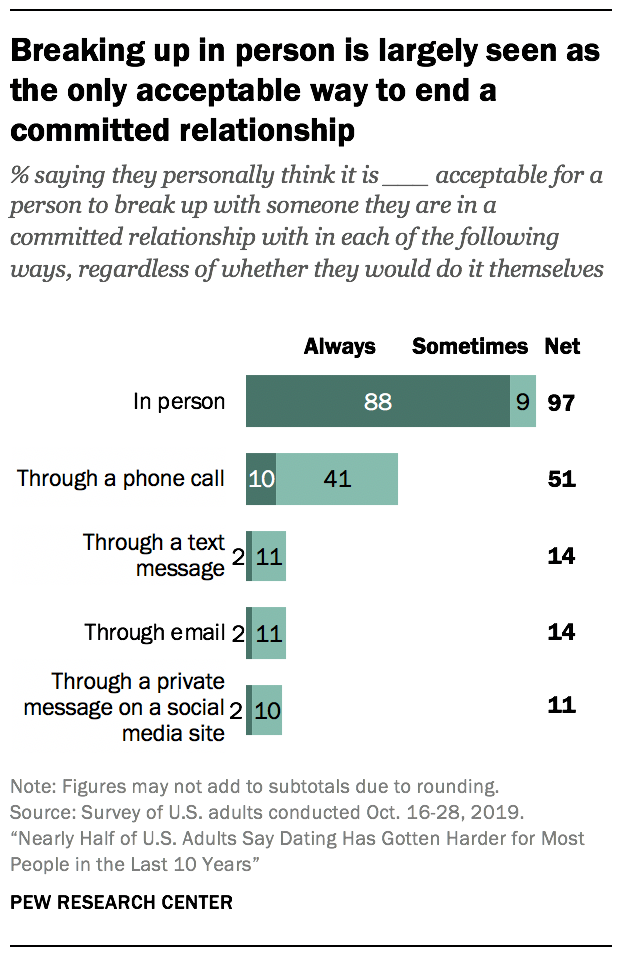
Breaking up in person is largely seen as the only acceptable way to end a committed relationship

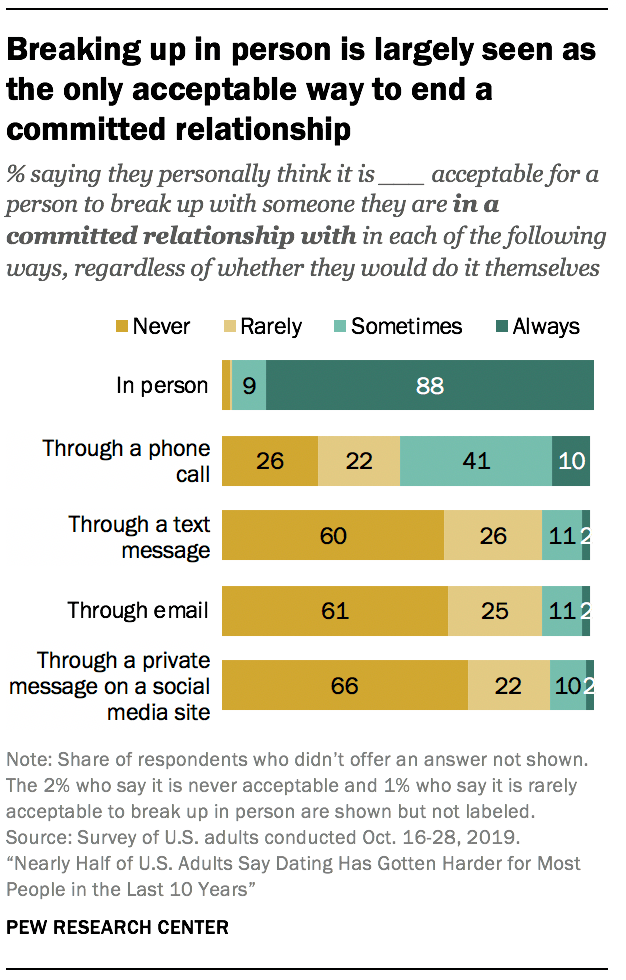
Despite concerns that Americans’ rising dependence on communicating through technology would lead to more impersonal breakups through devices, most agree that breaking up in person is the way to go. The vast majority of adults say that it is always or sometimes acceptable for a person to break up with a committed romantic partner in person (97%). About half (51%) say it is at least sometimes acceptable to break up over the phone – though only 10% say this is always acceptable. Far fewer say it can be acceptable to break up through a text message (14%), email (14%) or private message on a social media site (11%). In fact, most say it is never acceptable to end committed relationships through those forms of technology. The shares are strikingly similar when it comes to breaking up with someone a person is casually dating rather than in a committed relationship with.

The survey also asked those who are single and looking for a relationship or dates how they would let someone know they didn’t want to go out with them again after a first date. Only 8% say they would ghost someone (cut off communication). About half (52%) say they wouldn’t take the initiative to reach out but would let the other person know if they got in touch. The remaining share (40%) say they would contact the other person to let them know. Single-and-looking men are evenly split on whether they would proactively let the other person know if they didn’t want to go out again after the first date (47%) or wait for the other person to contact them before letting them know (47%). A majority of single-and-looking women (59%), on the other hand, would respond if the other person got in touch first, while 30% say they would proactively reach out and let the other person know.

Single people overall report that they don’t feel much pressure from society and the people they know to find a partner
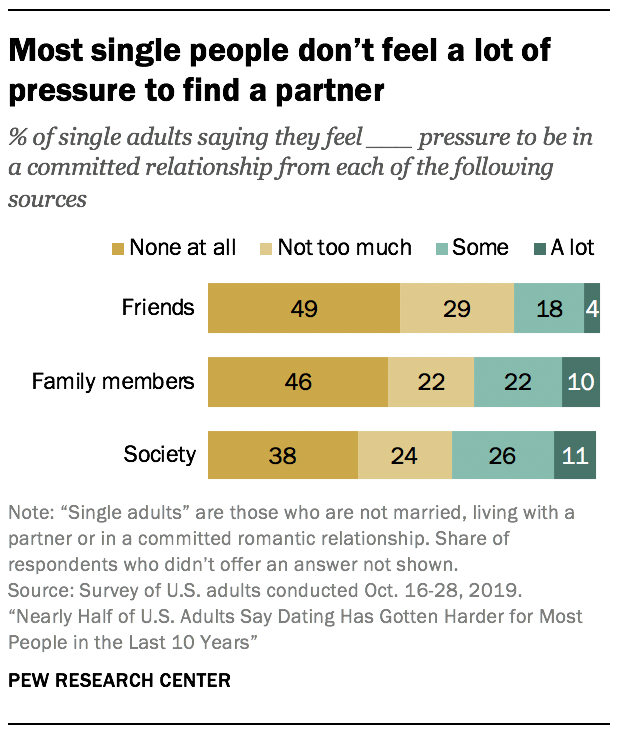
Most single people don’t feel a lot of pressure to find a partner

Most single people (including both those on and off the dating market) say they don’t feel a lot of pressure to find a partner from their friends, family or society in general. About two-in-ten (22%) say they feel at least some pressure from friends, while 31% say the same about family members and 37% say they feel society is pressuring them.

Feeling pressure to be in a committed relationship is highly dependent on age. Younger singles feel much more pressure from each source. For example, 53% of single 18- to 29-year-olds say there is at least some pressure from society to find a partner, compared with 42% of 30- to 49-year-olds, 32% of 50- to 64-year-olds and 21% of those ages 65 and older. In fact, a majority of singles 65 and older – the vast majority of whom are widowed or divorced, in contrast to young singles who are mostly never married – say they feel no pressure at all from each of these sources.

Single women and men give different reasons for difficulty finding people to date
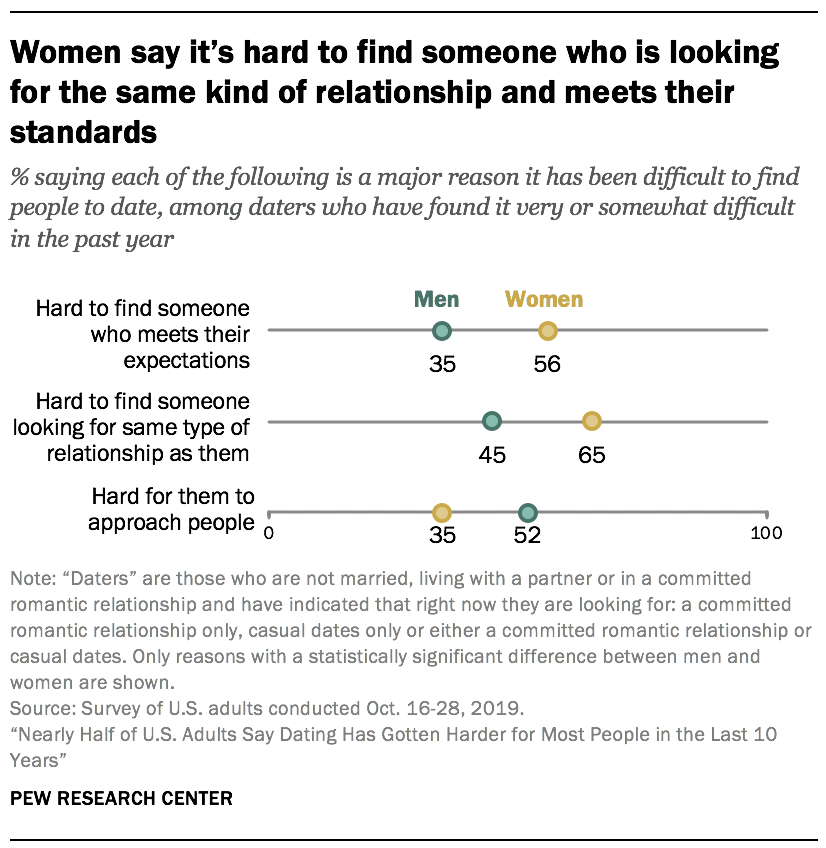
Women say it’s hard to find someone who is looking for the same kind of relationship and meets their standards

Daters who had difficulty finding people to date in the past year were asked about some of the possible reasons that might be the case. Among these daters, the most common explanations include the challenge of finding someone who is looking for the same type of relationship (53% say this is a major reason), difficulty in approaching people (46%) and trouble finding someone who meets their expectations (43%).

There are large differences by gender on this topic. Single-and-looking women are far more likely than single-and-looking men to say that trouble finding someone who was looking for the same kind of relationship or who meets their expectations are major reasons they’ve had difficulty. In turn, men are much more likely than women to say difficulty approaching people is a major reason.

Roughly one-in-ten partnered adults met their partners online, but this is far more common among some groups

A plurality of those who are married, living with a partner or in a committed romantic relationship say they first met their spouse or partner through friends or family (32%). Smaller shares say they met through work (18%) or school (17%), and still fewer met their partner online (12%).
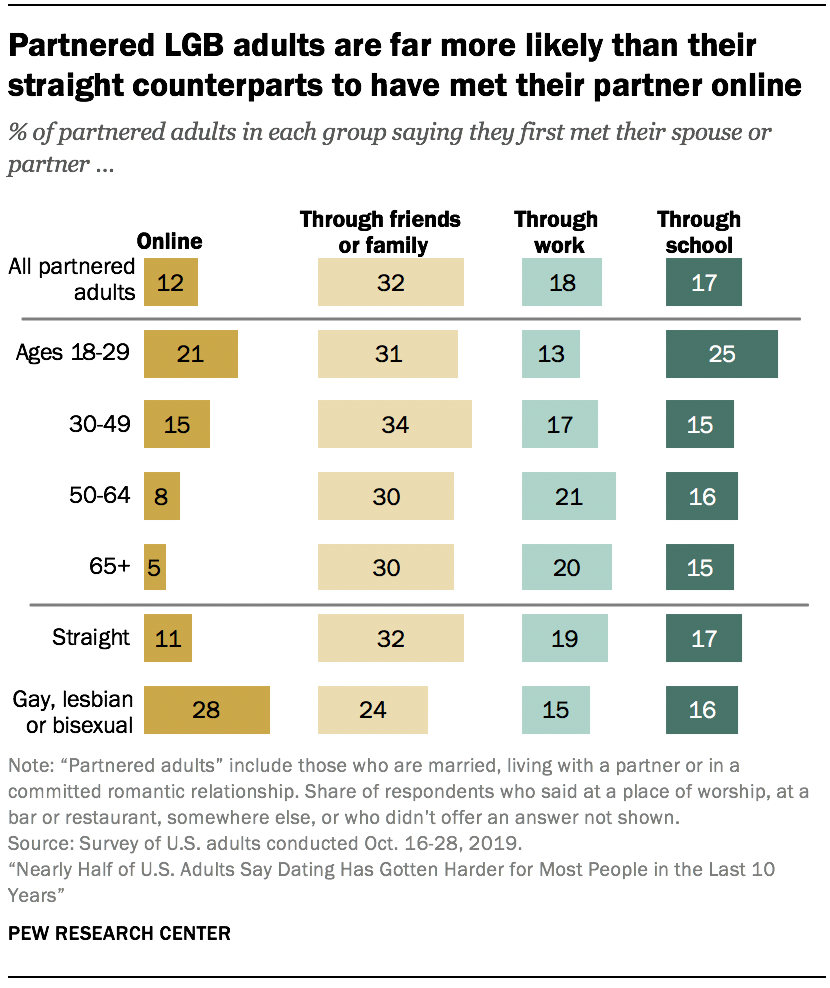
Partnered LGB adults are far more likely than their straight counterparts to have met their partner online

While relatively small shares of partnered adults first met their partner online, some groups are more likely to have done so. About one-in-five partnered adults ages 18 to 29 (21%) say they met their partner online, compared with 15% or fewer among their older counterparts. And LGB adults are far more likely to have first met their partner online than straight adults (28% vs. 11%).

Overall, three-in-ten adults say they have used an online dating site or app, and a majority (57%) of those users say their experiences with online dating were positive. Most also say it was easy to find people they were physically attracted to and who shared their hobbies and interests.

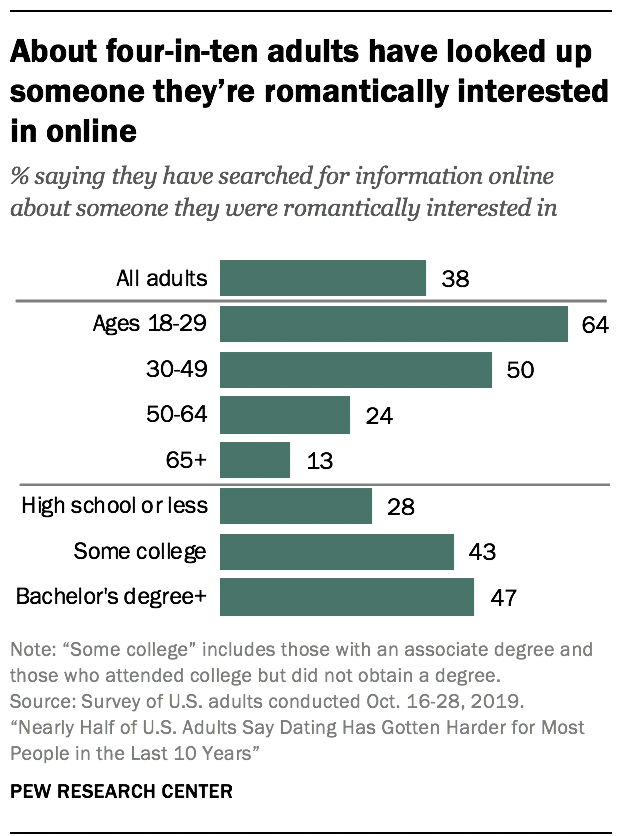
Online dating isn’t the only way Americans are using the internet to help them navigate the dating scene. About four-in-ten adults (38%) say they have searched for information online about someone they were romantically interested in. This is especially common among young adults: 64% of those younger than age 30 say they have done this.

Half of single adults – and a majority of single women – are not on the dating market

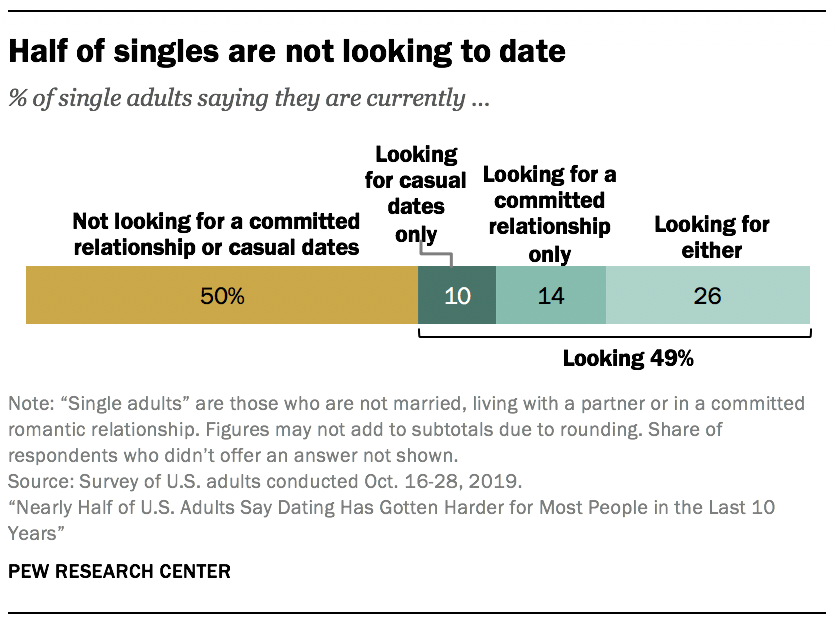
Fully half of single adults say they are not currently looking for a relationship or dates. Among those who are on the dating market, about half are open to either a committed relationship or casual dates.

Half of singles are not looking for relationship or dates

Single men are far more likely than single women to be looking for a relationship or dates – 61% vs. 38%. This gender gap is especially apparent among older singles.

Among singles who are not looking to date, having more important priorities right now and just enjoying the single life are among the most common reasons cited. Non-daters younger than age 50 are particularly likely to say they have more important priorities at the moment.
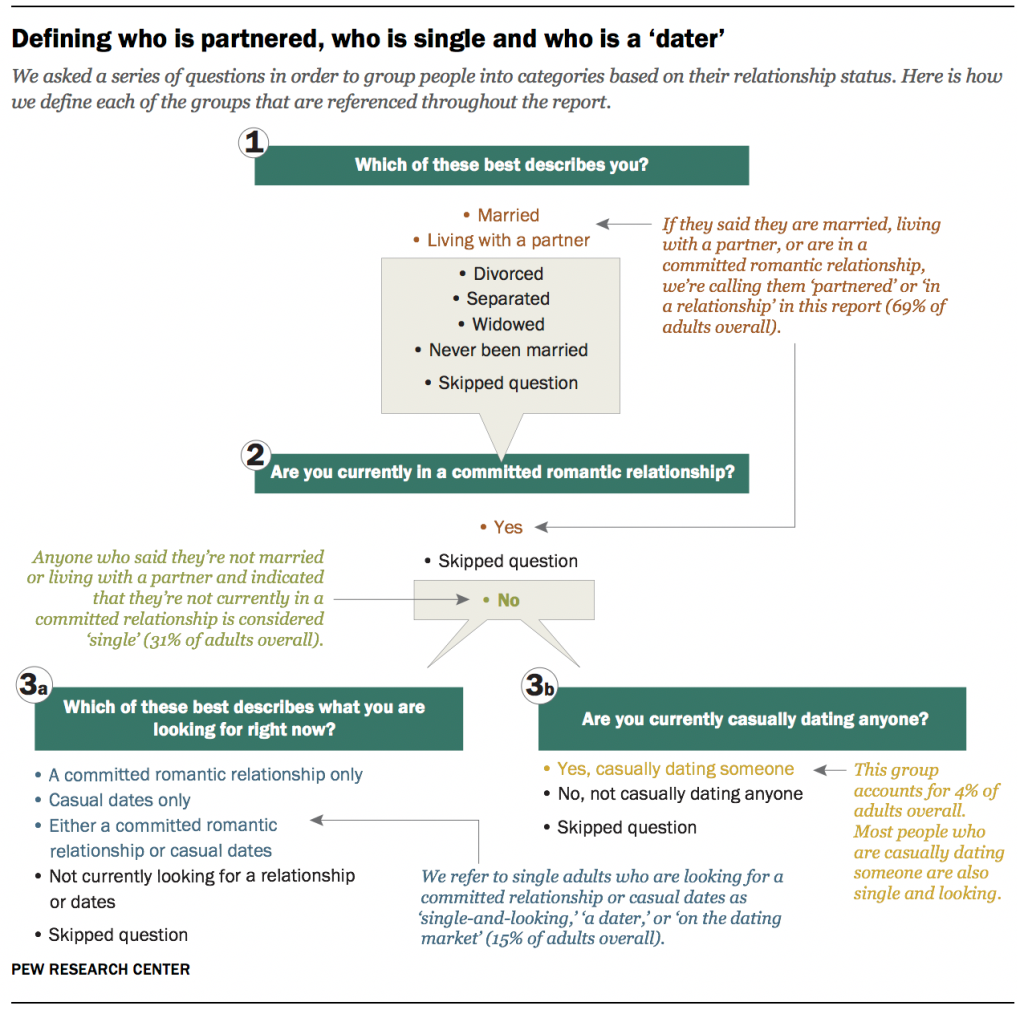
Defining who is partnered, who is single and who is a ‘dater’

1. A profile of single Americans

Many single adults in the U.S. are content being on their own. Of the half who are not looking for a relationship or dates at the moment, having more important priorities and enjoying being single are their top reasons why they are not looking to date.

For those who are on the dating market, about half are open to either a relationship or casual dates, and relatively few are looking only for something casual. In particular, daters younger than age 40 are less likely than older daters to be looking for only casual dates.

A small share of singles report that they are, in fact, currently casually dating someone. This group includes singles of all ages and most of them are open to a relationship if one comes along.

Among those who are married or in a relationship, meeting through friends or family is the most popular way to have met their partner. But meeting online is common among younger adults and those who are lesbian, gay or bisexual (LGB).

Share of adults who are single varies by race, age, education and sexual orientation

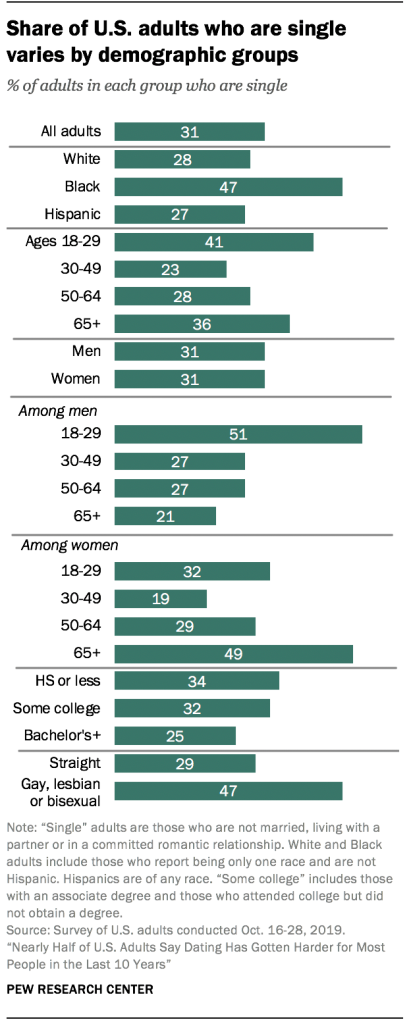
Share of U.S. adults who are single varies by demographic groups

While about three-in-ten U.S. adults (31%) say they are single – that is, not married, living with a partner or in a committed romantic relationship – that share varies widely across demographic groups. The youngest and oldest Americans are the most likely to be single – 41% of those ages 18 to 29 and 36% of those 65 and older say they are single, compared with 23% of those 30 to 49 and 28% of those 50 to 64.

These age differences bely huge differences by gender. Among men, those younger than 30 are by far the most likely to be single: About half of men in this age group (51%) are single, compared with only 27% of those ages 30 to 49 and 50 to 64 and 21% of men 65 and older. Women, by contrast, are by far most likely to be single later in life – roughly half of women ages 65 and older are unpartnered (49%), while those ages 30 to 49 are the least likely to be single (19%). Roughly three-in-ten women ages 18 to 29 (32%) and 50 to 64 (29%) are single.

The fact that men and women tend to be single at very different stages of life reflects both men’s shorter life expectancy and their tendency to marry later in life than women.

There are also differences in the share who are single by race and educational attainment. Black adults (47%) are much more likely to be single than White (28%) or Hispanic (27%) adults. About a third of those with a high school diploma or less education (34%) or some college experience (32%) are single, compared with 25% of those with at least a bachelor’s degree.

While 47% of adults who identify as gay, lesbian or bisexual are single, only 29% of straight adults are. LGB Americans do tend to be younger on average than those who are straight (among those surveyed, the median age of LGB respondents is 35 compared with 48 among straight adults), but these differences are just as large after controlling for age. For example, 56% of LGB adults ages 18 to 29 are single, compared with 37% of those who are straight.

Many singles aren’t looking to date right now

Half of singles are not looking to date

Half of singles say they are not currently looking for a relationship or dates, while about a quarter say they are looking for either a committed romantic relationship or casual dates (26%), and smaller shares say they are looking only for a committed romantic relationship (14%) or only for casual dates (10%). Whether people are looking to date or not can be explained, in part, by gender, age and past relationships – factors which are inextricably linked, but all have an impact.

Majorities of singles in the 18-to-29 and 30-to-49 age groups are interested in a relationship or dates, but that’s not the case for their older counterparts. Half of those ages 50 to 64 and three-quarters of those 65 and older are not looking for either a relationship or dates at the moment.
Most older single women are not looking to date

Those who have never been married are more likely to be looking to date (62%), but divorced and widowed singles lean more toward not dating at the moment (56% and 74%, respectively). This at least partly reflects the age differences among those with different marital histories.

Men are far more likely than women to be on the dating market: 61% of single men say they are currently looking for a relationship or dates, compared with 38% of single women.

The gender differences are heavily concentrated among older singles. While men and women younger than 40 are roughly equally likely to not be looking for a relationship or dates (33% and 39%, respectively), men and women 40 and older are very different. A majority of older women (71%) say they aren’t looking to date right now, compared with 42% of men 40 and older.

Many singles on the dating market are open to either a relationship or casual dates, while one-in-five are looking only for something casual

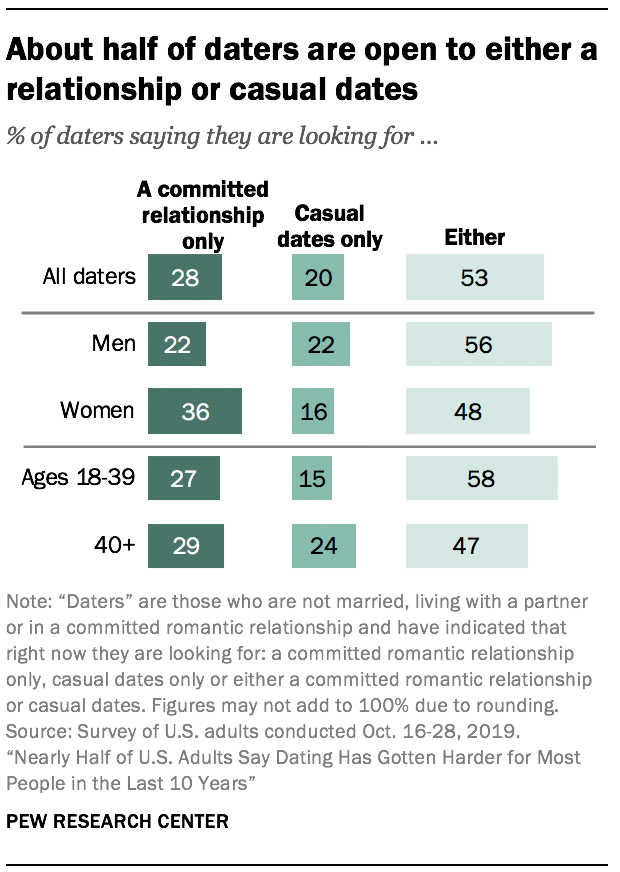
About half of daters are open to either a relationship or casual dates

Among singles who are on the dating market, roughly half (53%) are open to either a committed relationship or casual dates. Among those who are looking for only one arrangement, more are looking for a relationship than casual dates (28% vs. 20% of singles who are looking to date).

Women daters are significantly more likely than men to be exclusively seeking a committed relationship (36% say they are looking for this, compared with 22% of men).

While the share looking only for a relationship doesn’t vary much by age, older daters (40 and older) are more likely than younger daters to be looking only for something casual (24% vs. 15%), and less likely to be open to either a relationship or casual dates (47% compared with 58%).

A quarter of divorced, separated or widowed single people on the dating market are looking only for casual dates, higher than the share of never-married daters who are looking for the same (17%). However, these differences can primarily be explained by age and gender.

A small share of those who are not currently married, living with a partner or in a committed relationship (13%) report that they are casually dating someone. These singles are keeping their options open: 52% say they are open to either a committed romantic relationship or casual dates, while only 5% say they are not looking for a relationship or dates right now. The remaining share is split between those who are looking only for a relationship (24%) or only casual dates (19%).

Singles who aren’t looking to date cite more important priorities and enjoying the single life as reasons for not dating

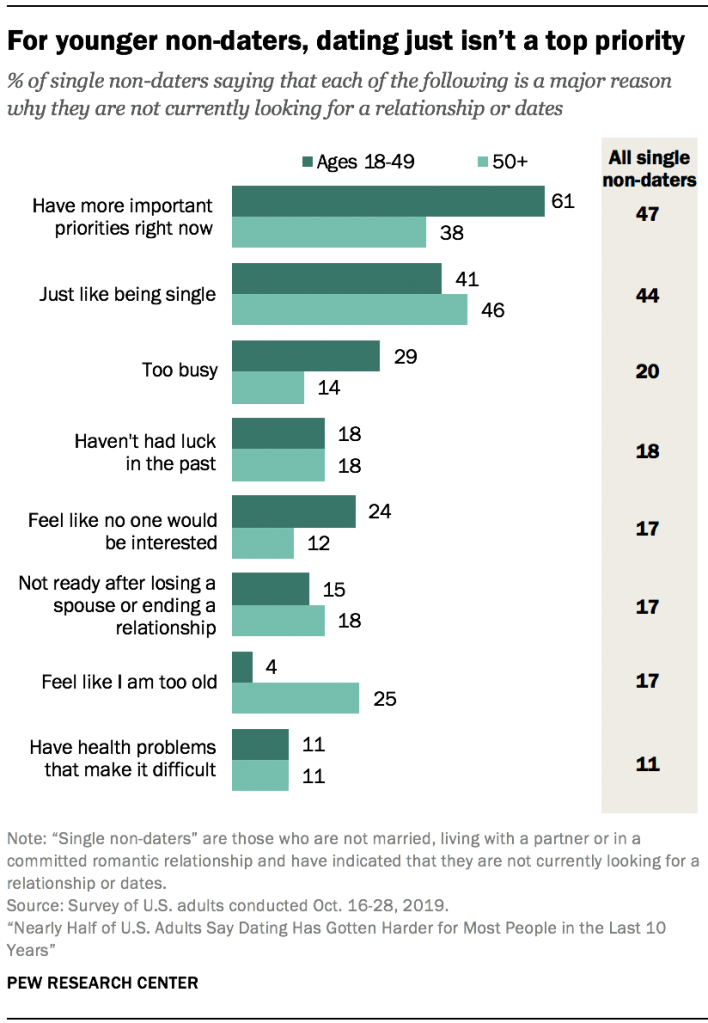
Among those who aren’t looking for a relationship or dates right now (half of all singles), two reasons stand out: that they have more important priorities right now and that they just like being single. These are cited as major reasons why they are not looking by 47% and 44% of non-daters, respectively.

Roughly one-in-five single adults who are not looking for a relationship or dates right now say that being too busy (20%), not having had luck with dating or relationships in the past (18%), feeling like no one would be interested in dating them (17%) and feeling like they are too old to date (17%) are major reasons why they are off the dating market. A smaller share (11%) say they have health problems that make it difficult to date.

For younger non-daters, dating just isn’t a top priority

These reasons vary by age. For non-daters younger than 50, having more important priorities is the dominant reason why they are not looking for a relationship or dates (61% say so).3 Meanwhile, 38% of older non-daters say the same. Younger non-daters are about twice as likely as those ages 50 and older to say being too busy (29% vs. 14%) and feeling no one would be interested in dating them (24% vs. 12%) are major reasons why they are not looking to date at the moment.
For their part, non-daters 50 and older are more likely to say that feeling too old to date is a major reason they’re not looking (25%) – but even 4% of those younger than 50 say the same. Non-daters age 65 and older are particularly likely to say this (30%).

Men and women see eye to eye on almost all these reasons for not looking to date. The one exception is that male non-daters are about twice as likely as female non-daters to say that feeling like no one would be interested in dating them is a major reason they’re not looking to date (26% of men say this compared with 12% of women).

Introductions through family or friends are the most common way people meet a partner, but meeting partners online is common among some groups

Looking at adults whose dating days are behind them – at least for the time being – friends and family were the most common source in helping them find a match. About a third (32%) of adults who are married, living with a partner or in a committed relationship say that is how they first met their current partner, while 18% say they met through work, 17% through school, 12% online, 8% at a bar or restaurant, 5% at a place of worship and 8% somewhere else.

Meeting online is more common among those in relatively new relationships. Among those who have been in their current romantic relationship for less than three years, meeting online is just as common as meeting through friends or family (28% met online compared with 27% through friends or family).

Younger partnered adults are more likely to have met online – 21% of those ages 18 to 29 and 15% of those 30 to 49 say they first met their partner online, compared with 8% of those 50 to 64 and 5% of those 65 and older. The youngest age group (18 to 29) is more likely than their older counterparts to have met their partners in school, while adults older than 50 are more likely to have met at work than younger people.

Meeting online is equally popular among those who say they now live in urban and suburban areas (14% of partnered adults in each type of community say they met online) but significantly less common among those living in rural areas (8%). This is the case even when taking into account that urban and suburban residents tend to be younger than those in rural areas.

Meeting online is one of the most popular ways for LGB adults to meet partners

Previous research suggests that online dating is a particularly common way to meet for populations with a small pool of potential partners, such as LGB daters. The survey finds that partnered LGB adults are just as likely to have met their partner online (28%) as through friends and family (24%). This is far higher than the share of straight Americans who met their partner online (11%). Even when controlling for the fact that LGB adults tend to be younger than their straight counterparts, they are still much more likely to have met their partner online. For example, among partnered LGB adults younger than 40, 32% met their partner online compared with 17% of straight adults in the same age group.4 Single LGB adults are also more likely than single straight adults to be currently online dating (37% vs. 24%).

Meeting online doesn’t necessarily mean through an online dating site or app. While a majority of those who met their partner online say they met through a dating site or app (61%), a significant share reports meeting through a social media site or app (21%). Smaller shares say they met their partner in an online discussion forum (10%), a texting or messaging app (3%) or online gaming (3%).

Singles who have never been in a committed relationship tend to be young and not looking for a relationship or dates

About a third of never-married single adults (35%) say that they have never been in a committed romantic relationship. These singles are younger on average – single adults who have never been in a relationship have a median age of 24, compared with 35 among those who have been in a relationship. Still, 21% of never-married singles age 40 and older say they have never been in a relationship. Roughly four-in-ten (42%) of those younger than 40 say the same.

Never-married single men and women are about equally likely to have never been in a relationship (35% and 37%, respectively).

Those who have never been in a relationship are less likely to be looking for a relationship or dates than never-married singles who have some experience with committed relationships (53% vs. 67%).

2. Personal experiences and attitudes of daters

Most people who are on the dating market say their dating life is not going well and that it’s been hard to find people to date. They give a variety of possible explanations for this difficulty, but men and women report different reasons.  Many men say it’s difficult for them to approach people, while majorities of women say it’s hard to find someone looking for the same type of relationship as them and who meets their expectations.

Many Americans, whether they are currently on the dating market or not, report having had negative dating experiences. A majority of women (as well as 35% of men) say they’ve experienced some kind of harassing behavior from someone they were dating or on a date with, ranging from receiving an unwanted sexually explicit image to being pressured for sex or having someone share a sexually explicit image of them without their consent. And about three-in-ten (and a higher share of young adults) say they have had someone they’ve gone out with suddenly stop answering their phone calls or messages without explanation.

Single-and-looking adults are overall open to dating people with a variety of different traits, including people who make significantly more or less money than them and people who are a different race or religion. But there is less agreement when it comes to dating someone who lives far away, has a lot of debt, or voted for Donald Trump.

Most daters don’t feel like their dating life is going well and say it’s been difficult to find people to date

Two-thirds of those who are single and looking for a relationship or dates say their dating life is either going not too well or not at all well (67%), while 33% say it’s going very or fairly well. Majorities of daters across divides by gender, age, race and ethnicity, education, sexual orientation and marital history say their dating life is not going well.

People who are looking only for a relationship (78%) are more likely than those who are open to casual dates (63%) to say their dating life is not going well. On the flip side, people who are single and looking for a relationship or dates but are currently casually dating someone are generally satisfied with their dating life. About seven-in-ten of this group (69%) say their dating life is going very or fairly well, compared with just 21% of daters who are not casually dating anyone.

Most daters (75%) say it’s been very or somewhat difficult in the last year to find people to date. A quarter say it’s been very or somewhat easy, with only 5% saying it has been very easy. Again, there are few differences across demographic groups.

Those who live in suburban or rural areas report finding people to date somewhat harder than those who live in urban areas. Eight-in-ten of those in suburban and rural areas say this has been very or somewhat difficult, compared with 64% of those in urban areas.

Those who are looking only for a relationship are more likely than those who are open to casual dates to say it has been difficult to find people to date (82% vs. 72%).

Daters who have had difficulty finding people to date give a variety of reasons

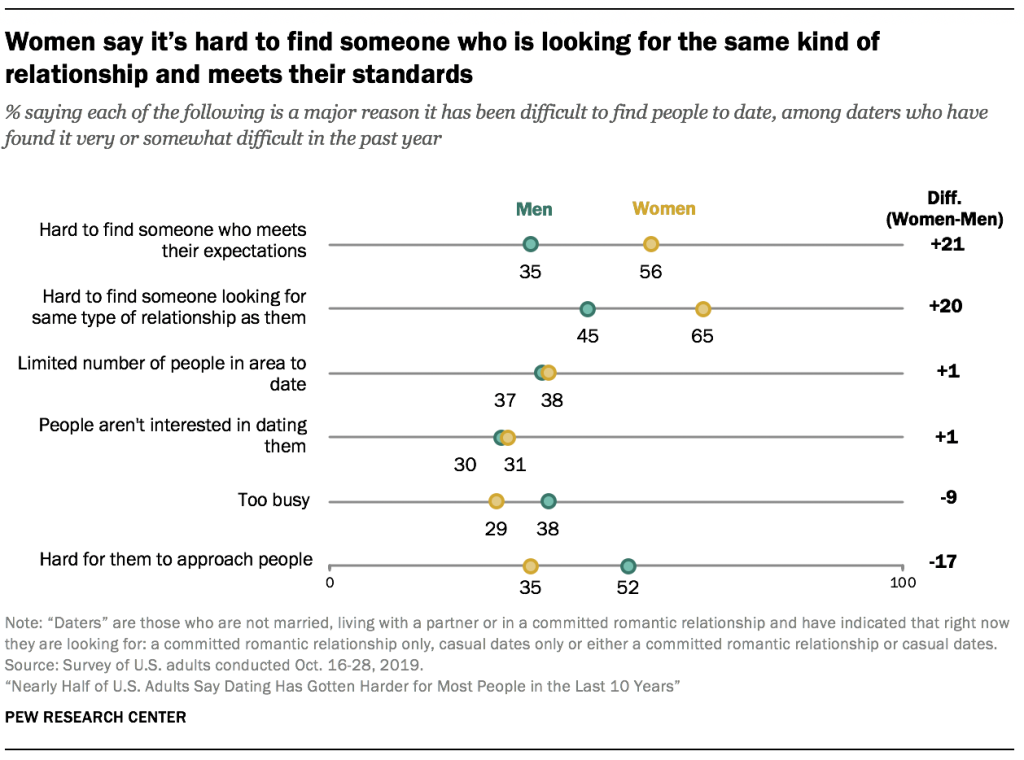
Among these daters who report that they have had difficulty in the past year finding someone to date, no one explanation for their difficulty stands out as most important. The challenges of finding someone looking for the same type of relationship (53%), finding it hard to approach people (46%) and finding someone who meets one’s expectations (43%) top the list as major reasons why it has been difficult to find people to date. However, substantial shares also say the limited number of people in their area to date (37%), being too busy (34%) and people not being interested in dating them (30%) are major reasons.

This belies the fact that there are large gender gaps on some of these items. Women who have found it difficult to date are much more likely than men to say a major reason for their difficulty is that it’s hard to find someone who meets their expectations (56% vs. 35%) and that it’s hard to find someone looking for the same kind of relationship as them (65% vs. 45%).

For their part, men are more likely to say difficulty in approaching people (52% of men vs. 35% of women) and being too busy (38% vs. 29%) are major reasons it has been difficult to find people to date.

Women say it’s hard to find someone who is looking for the same kind of relationship and meets their standards

Some of these reasons are equally common among different age groups. For example, 53% of both those younger than 40 and those 40 and older say a major reason they’ve had difficulty is that it’s hard to find someone looking for the same kind of relationship. Other reasons are much more common among younger singles who have had difficulty finding people to date lately. Those younger than 40 are much more likely to say it’s hard to approach people (65% say this is a major reason they’ve had difficulty, compared with 27% of those 40 and older). Younger daters are also more likely than their older counterparts to say being too busy (43% vs. 26%) and that people aren’t interested in dating them (38% vs. 23%) are major reasons they have found it difficult to find people to date.

College graduates are more likely than those who do not have a bachelor’s degree (54% vs. 39%) to say a major reason they have had difficulty finding people to date is that it’s hard to find someone who meets their expectations.

A majority of online dating users report positive experiences

Of the 30% of U.S. adults who have ever used an online dating site or app, a majority (57%) say their experiences with online dating were very or somewhat positive. Men and women are about equally likely to have had positive experiences online dating. Most online dating users also say they found it easy to find people who they were physically attracted to, shared their hobbies and interests, seemed like someone they wanted to meet in person, and were looking for the same kind of relationship.

Despite these positive experiences, daters who are currently online dating or have online dated in the past are no more likely than those who have never online dated to say their dating life is going well.

For more about Americans’ personal experiences with online dating, see “The Virtues and Downsides of Online Dating.”

Long-distance relationships, debt and voting for Donald Trump top list of relationship deal breakers

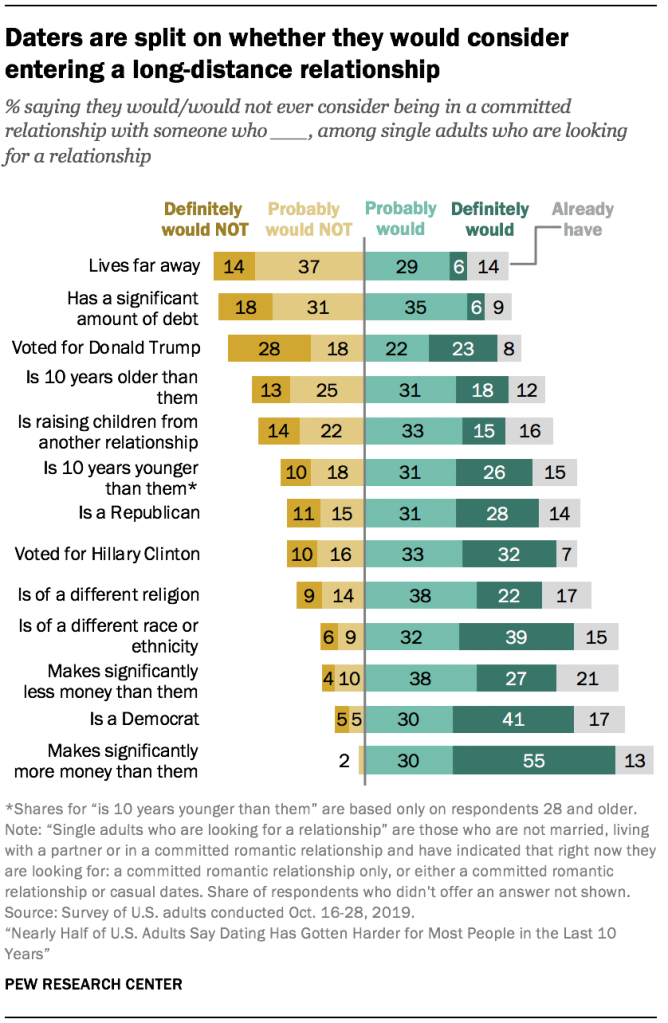
Daters are split on whether they would consider entering a long-distance relationship

Overall, singles who are looking for a relationship are open to dating people with many different traits and from a variety of backgrounds. Some traits give people pause more than others, though.5

These daters are split when it comes to whether they would consider being in a relationship with someone who lives far away (51% say they probably or definitely would not), has a significant amount of debt (49%) or voted for Donald Trump (47%). Being in a relationship with someone who is 10 years older than them (38% say they wouldn’t consider it) or raising children from another relationship (36%) would also give some daters pause.

For more about who would and wouldn’t consider a relationship with a partisan or Trump or Clinton voter, see “Most Democrats who are looking for a relationship would not consider dating a Trump voter.”

About a quarter or fewer of daters who are looking for a relationship say they definitely or probably wouldn’t consider being in a relationship with someone who is 10 years younger than them (27%), is a Republican (27%), voted for Hillary Clinton (26%), is of a different religion (23%), is of a different race or ethnicity (15%), makes significantly less money than them (14%) or is a Democrat (11%).6 Hardly anyone says they wouldn’t be in a relationship with someone who makes significantly more money than them (3%).

Single women who are looking for a relationship are much more likely than their male counterparts to say they would not consider entering a relationship with someone who is 10 years younger than them (42% of women say they wouldn’t, compared with just 16% of men). And the inverse is true when it comes to dating someone 10 years older: 47% of men say they wouldn’t consider being in a relationship with someone 10 years older, while 27% of women say the same.

While both men and women who are seeking a relationship are generally open to dating someone who makes either less or more money than them, women are roughly three times as likely as men to say they wouldn’t consider being in a relationship with someone who makes significantly less money than them (24% vs. 7%). Very small shares of both men and women say they wouldn’t be in a relationship with someone who makes significantly more money than them (3% and 2%, respectively).

There are also some significant differences between younger and older people who are looking for a relationship. About six-in-ten of those ages 40 and older (59%) say they probably or definitely would not consider being in a relationship with someone who has significant debt, compared with 41% of adults younger than 40. Meanwhile, those younger than 40 are more resistant to the idea of seriously dating someone with children from another relationship (42% say they wouldn’t consider it, compared with 28% of those 40 and older). Daters who are ages 28 to 39 are more likely to say they wouldn’t consider being in a relationship with someone 10 years younger than them (39% vs. 21% of those 40 and older). Younger and older daters are equally likely to be willing to seriously date someone 10 years older than them.

Republicans are more likely than Democrats to say they probably or definitely wouldn’t consider being in a committed relationship with someone of a different race or ethnicity (21% vs. 12%).

Democrats are much more likely to say they would not consider a relationship with someone who voted for Trump (71%) compared with the share of Republicans who would not consider seriously dating someone who voted for Clinton (47%).

It is also worth noting that the overall share of daters looking for a relationship who say they definitely would not consider being in a relationship with someone who voted for Trump (28%) is at least 10 percentage points higher than any of the other characteristics asked about in this question.

Most single people aren’t feeling too much pressure to find a partner

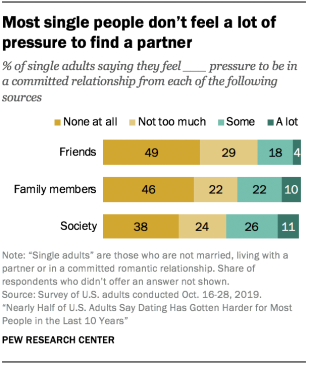
The majority of single adults don’t feel a great deal of pressure to be in a committed relationship. Some 37% say they feel a lot or some pressure from society to find a partner and 31% say they feel pressure from their family.7 Just 22% say the same about pressure coming from their friends. Very small shares say they feel a lot of pressure from each of these sources.

Most single people don’t feel a lot of pressure to find a partner

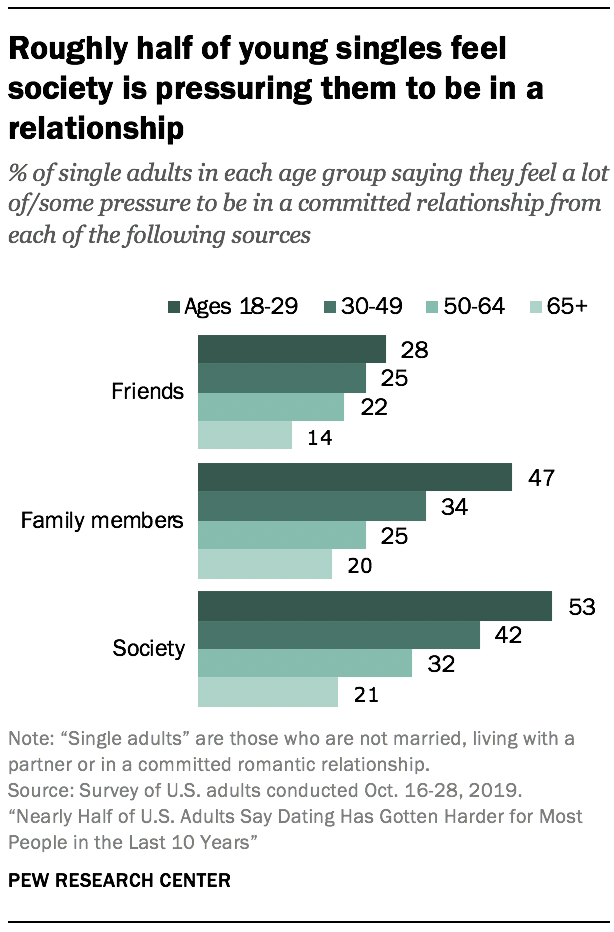
Though single people overall don’t feel a lot of pressure to be partnered, the picture is different when looking only at young singles. Among those ages 18 to 29, 53% say they feel that society puts a lot of or some pressure on them to be in a relationship. Smaller shares of older singles say the same, including just 21% of those 65 and older – the vast majority of whom are widowed or divorced (by contrast, the vast majority of 18- to 29-year-old singles have never been married).

Young singles are also far more likely than their older counterparts to say they face pressure from their family members to be part of a couple: 47% of 18- to 29-year-olds say there is a lot or some pressure, compared with 34% of those ages 30 to 49, 25% of those 50 to 64 and 20% of those 65 and older.

Roughly half of young singles feel society is pressuring them to be in a relationship

Young singles feel less pressure to find a partner from their friends than from other sources, but 18- to 29-year-olds are still twice as likely than those 65 and older to say there is at least some pressure from their friends (28% vs. 14%).

Over half of singles 65 and older say they feel no pressure at all from each of these sources.

Single men and women are roughly equally likely to say they face a lot of or some pressure to find a partner from society and their friends. But men are more likely to say they feel pressure from family members (38% say they feel a lot of or some pressure, compared with 26% of women).

Meanwhile, women are more likely than men to say they feel no pressure at all from each of these sources, by margins of 12 percentage points or more.

The pressures single people feel from family, friends or society don’t seem to be motivating them to find a partner. Those who feel pressure are no more likely than those who don’t to say they are looking for a relationship or dates, or that they are currently online dating, even after taking demographic differences into account.

Women bear the brunt of harassing behaviors from people they’re dating

Consistent with past research that women are much more likely than men to say they have experienced sexual harassment in the workplace and elsewhere, including online and on online dating sites and apps, women also report being harassed by people they were dating or had been on a date with at much higher rates than men.

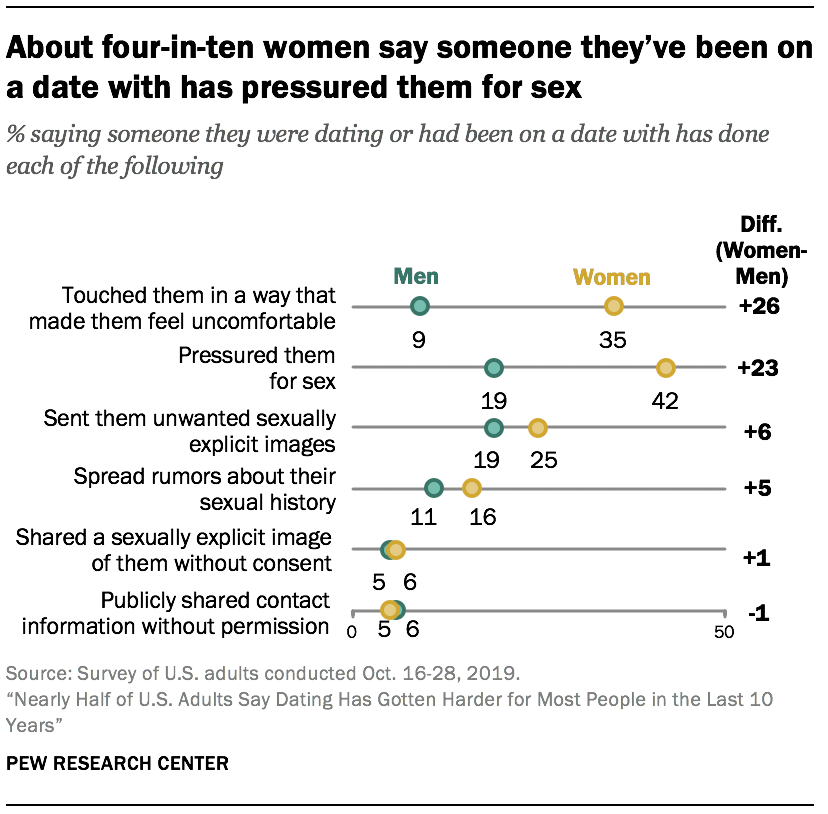
Women are much more likely than men to say someone they have dated or been on a date with has pressured them for sex (42% vs. 19%) or touched them in a way that made them feel uncomfortable (35% vs. 9%). The gender gap is smaller, but women are still more likely than men to report that someone they have dated sent them sexually explicit images they didn’t ask for (25% vs. 19%) or spread rumors about their sexual history (16% vs. 11%). Relatively small shares of both men and women report that someone they’ve dated has shared a sexually explicit image of them without their consent or publicly shared their contact information or address without permission (sometimes called “doxing”).

About four-in-ten women say someone they’ve been on a date with has pressured them for sex

Adults younger than age 40 are more likely than older adults to say that someone they have dated has pressured them for sex (38% vs. 26%), sent them unwanted explicit images (34% vs. 14%), spread rumors about their sexual history (20% vs. 10%), publicly shared their contact information (9% vs. 4%) or shared an explicit image of them without their consent (10% vs. 3%). There is no age difference in whether someone reports that a date has touched them in a way that made them uncomfortable.

When it comes to receiving unwanted sexual images and someone spreading rumors about their sexual history, the gender gap is only present among those younger than 40. Some 42% of younger women say someone they’ve dated has sent them explicit images they didn’t ask for, compared with 26% of younger men, while 14% of both men and women who are 40 and older say the same. Women younger than 40 are also more likely than men younger than 40 to say someone they have dated has spread rumors about their sexual history (23% vs. 16%), while roughly equal shares of women and men 40 and older say the same (11% and 8%, respectively). Previously released findings from the survey show that young women are also more commonly the target of harassing behavior on online dating sites and apps.

Black (31%) and Hispanic (28%) adults are more likely than White adults (18%) to say they have received unwanted explicit images from someone they were dating or had been on a date with. Black adults (10%) are also more likely to say someone has publicly shared their contact information without their permission, compared with White (4%) and Hispanic (5%) adults.

Adults who identify as lesbian, gay or bisexual are more likely than their straight counterparts to say they have experienced each of these harassing behaviors. LGB online daters also report higher rates of harassment on online dating sites and apps.

Younger people more likely to have looked up someone they were romantically interested in online

Not only have many Americans used the internet to seek out relationships or dates, they are using the internet to gather information as well. Roughly four-in-ten adults (38%), whether they are currently single or not, say they have searched for information online about someone they were interested in romantically.

About four-in-ten adults have looked up someone they’re romantically interested in online

Most young adults ages 18 to 29 (64%) say they have done this, compared with 50% of 30- to 49-year-olds, 24% of 50- to 64-year-olds and only 13% of those 65 and older.

Those with a bachelor’s degree or more are more likely than those with less education to say they have ever searched for information on a potential romantic partner online (47% vs. 35%). These age and education findings hold even when accounting for the fact that younger and more educated adults are more likely to use the internet.

Roughly seven-in-ten of those who have used an online dating site or app (71%) say they have searched for information online on someone they were interested in.

About three-in-ten adults say they have been ‘ghosted’

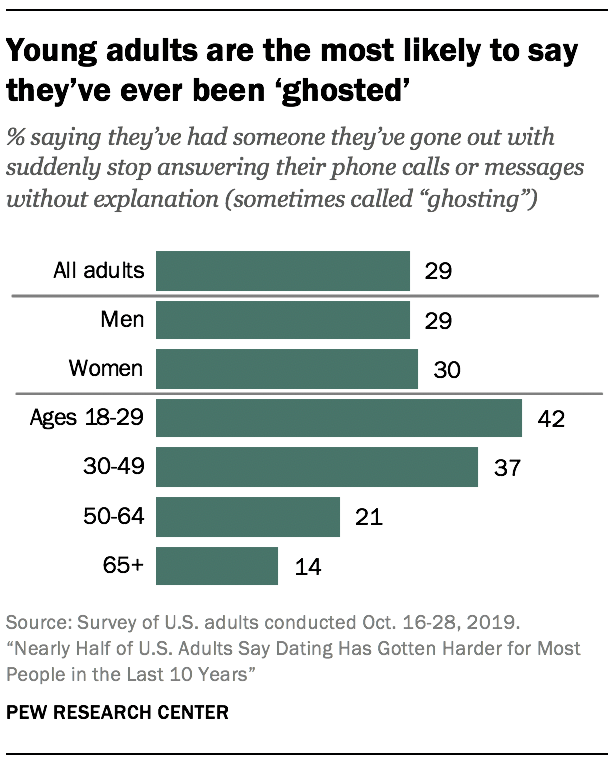
The majority of adults (62%) say they have heard the term “ghosting” before – that is, ending a relationship or casual dating situation by suddenly not responding to calls or messages with no explanation. About three-in-ten (29%) say they have actually experienced this.

Young adults are the most likely to say they’ve ever been ‘ghosted’

Young adults, as well as those who are currently on the dating market (regardless of their ages), are among the most likely to have been ghosted. About four-in-ten (42%) 18- to 29-year-olds (42%), regardless of their current relationship status, say they have experienced this. Some 37% of 30- to 49-year-olds (37%) also say they’ve been ghosted, compared with 21% of 50- to 64-year-olds and 14% of those 65 and older.

People with online dating experience (53%) are more likely to report that they’ve been ghosted than those without any experience dating online (19%). Those who are currently online dating are particularly likely to say this (62%).

Men and women are equally likely to say they have experienced ghosting before (29% and 30%, respectively).

CORRECTION (Aug. 21, 2020): The headline of the chart “About four-in-ten women say someone they’ve been on a date with has pressured them for sex” was updated to reflect the numbers in the chart. There were no changes to the findings, and the changes did not affect the report’s substantive findings.

3. Public attitudes about today’s dating landscape

Nearly half of Americans think dating has gotten harder in the last 10 years – especially women, who are much more likely than men to say dating now comes with more risk. Many think the recent increased focus on sexual harassment and assault has made it harder to know how to behave on dates, particularly for men.

It’s safe to say that cultural norms around sex and dating have loosened over the years. Still, some practices are considered taboo by many Americans. For example, while most adults say premarital sex is acceptable, only about one-third say the same about open relationships – that is, a committed relationship where both people agree that it is acceptable to date or have sex with other people.

And while options for how to break up with someone have expanded as people are connected through many different platforms, most still say breaking up in person is the way to go.

Almost half of the public says dating has gotten harder in the last 10 years

Nearly half of U.S. adults (47%) say dating is harder today for most people compared with 10 years ago, while a third say it is about the same and 19% say it’s easier today.

Women are much more likely than men to say dating has gotten harder (55% vs. 39%). Black women (62%) are more likely than Hispanic women (50%) to say dating has gotten harder, while 55% of White women say the same. Only 9% of Black women say dating has gotten easier in the last decade, compared with 14% of White women and 27% of Hispanic women.

Overall, 54% of Black, 48% of White and 42% of Hispanic adults say dating has gotten harder. Hispanics (31%) are about twice as likely as White (16%) or Black (14%) adults to say dating is now easier.

In every age group except for those 65 and older, more say dating is harder today than say it’s easier or the same as it was 10 years ago. Adults 65 and older are about as likely to say it’s gotten harder (43%) as they are to say it’s about the same as it was (40%). Adults younger than 50 are more likely than those who are older to say dating has gotten easier in the last 10 years: 27% of those ages 18 to 29 and 21% of those ages 30 to 49 say it has gotten easier, compared with 15% each of those 50 to 64 and 65 and older.

People who are in a committed relationship but not married or living with their partner (57%) or are currently on the dating market (54%) are more likely than their counterparts who are married or living with a partner (46%) or single but not looking for a relationship or dates (40%) to say dating is harder. Among singles who are on the dating market, those who are looking for a committed relationship only are more likely to say dating is harder now (62%) than those who are open to casual dates or only looking for casual dates (50%).

Increased physical and emotional risk is commonly cited as a reason dating has gotten harder; many say technology has made dating easier

Women are twice as likely as men to say dating is harder than 10 years ago because it’s riskier now

Among the 47% of Americans who say dating is harder now than it was 10 years ago, the increased risk of dating today – including physical risk as well as the risk of getting scammed or lied to – stands out as the most-often-cited reason why dating is harder (21% cite this). Roughly one-in-ten point to technology (12%), the idea that dating has become more impersonal (10%) or that it’s harder to meet people now (10%), the more casual nature of dating today (9%), or changing societal expectations, morals or gender roles (8%). A slightly smaller share (5%) blame the difficulty of dating on people being busier these days.

Women are twice as likely as men (26% vs. 13%) to say increased risk is a reason dating is harder now. They are also more likely than men to say that it’s harder now because dating has become more casual (11% vs. 6%). For their part, men are somewhat more likely to say technology is a reason (15% vs. 10%).

Older adults are more likely to see increased risk as a reason dating is harder now: 23% of those 65 and older and 30% of those 50 to 64 point to increased risk, compared with 16% of 30- to 49-year-olds and 13% of adults younger than 30.

There is no significant difference between those with online dating experience and those who have never used online dating when it comes to whether technology is a reason dating is harder now.

In their own words: Why do you think dating is harder today than it was 10 years ago for most people?

“A lot of people catfish people and pretend to be something they are not.” Woman, 38 years old, married

“…STDs [sexually transmitted diseases] are totally out of control here…” Man, 70, single

“Because there are a lot of crazy people out there and the internet allows that crazy to be masked longer than it used to be.” Woman, 33, married

“Apps encourage snap judgments so initial contact is often not even made.” Man, 53, single

“[Cellphones] and Facebook compete with quality time.” Man, 60, single

“Cultural norms have changed, harder to find people who want relationships and not just ‘hooking up.’” Woman, 20, living with partner

“If you are a Christian, too much is expected of you to do against your belief.” Woman, 88, single

“People are more independent now.” Woman, 75, married

“Romanticism is pretty much dead. We live in a culture where having feelings for someone is undesirable. To be vulnerable with someone is taboo.” Woman, 25, in a committed relationship

“Relationship, gender and sexuality roles have been upended and no one knows what they’re doing.” Man, 35, married

When it comes to why dating has gotten easier in the last 10 years, technology tops the list. Among the 19% of respondents who say dating is now easier, about four-in-ten (41%) say technology is a reason. This is followed by 29% who say it is easier to meet people now and 10% who say that changing societal expectations, morals and gender roles have made it easier to date.

Men and women who say dating has gotten easier give similar reasons for this. There are also no significant differences by age.

Technology is far more likely to be mentioned by those who say dating has gotten easier than by those who say it’s gotten harder. About two-thirds (66%) of those who say dating is now easier either point to technology in general or otherwise mention technology in their answer, compared with 31% of those who say dating is now harder.

In their own words: Why do you think dating is easier today than it was 10 years ago for most people?

“Because [of] online dating you can meet people without leaving your house.” Woman, 48 years old, in a committed relationship

“Because [there] are tons of dating websites and apps that are geared towards different [kinds] of people.” Man, 51, married

“10 years ago you actually had to go out and meet people; now you can find someone from the comfort of your own home.” Woman, 30, single

“Males and females tend to do more socializing in groups today than in the more distant past. This makes it easier to meet.” Man, 76, married

“Dating apps are now the norm. It seems like the answer to the ‘how did you two meet’ question is more often than not met with the name of a dating app.” Woman, 25, living with a partner

“For queer people it is easier to be open and find potential partners.” Woman, 26, living with a partner

“Parents are not as strict these days.” Woman, 69, single

“The ‘rules’ that used to apply are more relaxed now. It’s easier and more acceptable for women to initiate contact.” Woman, 58, single

“Lowered moral standards.” Man, 72, married

A plurality says online dating has had a neither positive nor negative effect on dating and relationships

When it comes to the impact online dating sites and apps have had on the broader landscape of dating and relationships these days, half of adults say it has been neither positive nor negative. The remainder of the public is divided: 22% say online dating has had a mostly positive impact while 26% say it has been mostly negative.

Those who have experience with online dating (29%) are more likely than those who don’t (21%) to say online dating has had a positive impact on dating and relationships overall, although minorities in both groups say this is the case. Similar shares of those who have online dated and those who haven’t say the impact has been negative.

Those who met their current partner online are much more likely than those who met their partner in some other way to say online dating’s impact has been positive (40% vs. 21%).

Most say it’s harder for men to know how to behave on dates in the era of the #MeToo movement

The public sees challenges for men dating in the era of #MeToo

Most Americans say it has become harder for men to know how to interact with someone they’re on a date with due to the increased focus on sexual harassment and assault over the last few years. Some 65% say this, while 9% say this focus has made it easier for men and 24% say it hasn’t made much difference. Opinions are more mixed when it comes to the impact on women. Fewer than half (43%) say it is harder for women to know how to behave on dates as a result of the attention paid to sexual harassment and assault, while 17% say this has made it easier for women and 38% say it hasn’t made much of a difference.

Men and women see eye to eye on the impact the #MeToo movement has had on women, but men (69%) are more likely than women (61%) to say this increased focus on sexual harassment and assault has made it harder for men to know how to interact – though most in each group agree it has made it harder.

Across demographic groups, majorities say it’s harder for men to know how to act in the #MeToo era

Older people are more likely than younger adults to see challenges for men dating in the era of #MeToo. For example, 72% of those ages 65 and older say it is now harder for men to know how to interact with someone they’re on a date with, compared with 66% of those 50 to 64, 62% of those 30 to 49 and 58% of those 18 to 29. Older men are particularly likely to say this – 75% of those 50 and older say it is now harder for men to know how to behave, compared with 63% of men younger than 50 and 58% of younger women. Some 63% of women age 50 and older say the same.

Older adults are also more likely to say it is now harder for women to know how to behave with someone they’re on a date with, but men and women have roughly the same opinions across age groups.

Republicans are more likely than Democrats to say the recent focus on sexual harassment and assault has made it harder for both men (75% vs. 56%) and women (49% vs. 38%) to know how to act. Republican men are particularly likely to say it has become harder for men (81%, compared with 69% of Republican women). Among Democrats, men and women are equally likely to say this.

Older Democrats are more likely than younger Democrats to say it is harder for men to know how to act in the era of #MeToo (61% of Democrats ages 50 and older compared with 53% of Democratic adults younger than 50). However, there is no significant difference by age among Republicans about whether it has become harder for men.

Among single people, those who are currently on the dating market (64%) are more likely than singles who are not looking for a relationship or dates (56%) to say that it is harder for men to know how to act now.

Whether or not someone has experienced any kind of harassing behaviors from someone they dated or were on a date with (such as being pressured for sex or someone they were dating spreading rumors about their sexual history) does not appear to influence views on this topic. This is true among both men and women.

Most say premarital sex is acceptable behavior, while sex on a first date and open relationships are taboo for most people

A majority of the public says premarital sex is at least sometimes acceptable

Roughly half of adults (48%) say having an open relationship – that is, a committed relationship where both people agree that it is acceptable to date or have sex with other people – is never acceptable, regardless of whether they would do it themselves. An additional 20% say it is rarely acceptable and 32% say it is acceptable either sometimes or always.

Other sexual and dating practices are generally seen as more acceptable, at least in some circumstances. About half (49%) say it is at least sometimes acceptable for consenting adults to exchange sexually explicit images of themselves. Most say casual sex between consenting adults not in a committed relationship (62%) and sex between unmarried adults who are in a committed relationship (65%) can be acceptable. Still, about a quarter of the public sees casual sex (24%) or premarital sex (25%) as never acceptable.

Large age gaps in views of dating norms

Adults of different ages view some of these norms in drastically different ways. When it comes to exchanging sexually explicit photos of oneself, young adults ages 18 to 29 are more than three times as likely as those 65 and older to say this is always or sometimes acceptable (70% compared with 21%).

Some 46% of 18- to 29-year-olds and 40% of 30- to 49-year-olds say open relationships are acceptable. By contrast, 22% of 50- to 64-year-olds and 17% of those 65 and older say the same.

While the differences are less dramatic, younger adults are also significantly more accepting of premarital sex and casual sex than their older counterparts. Still, majorities of all age groups say that premarital sex is acceptable.

While men and women see eye to eye on premarital sex, men are much more likely than women to find casual sex (70% vs. 55%) and exchanging explicit images of oneself (57% vs. 41%) acceptable always or sometimes. And while a minority of both men and women say open relationships are acceptable, men (35%) are more accepting than women (29%).

Adults with a college degree or more education are more likely than those with some college experience or less to see each of these items as acceptable. The same is true of Democrats and those who lean to the Democratic Party compared with Republicans and Republican leaners. In fact, Democrats are twice as likely to say open relationships are acceptable (42%, compared with 21% of Republicans).

Large gaps also exist between those who identify as lesbian, gay or bisexual and those who identify as straight. LGB adults were the only demographic group studied in which a majority say that having an open relationship is always or sometimes acceptable (61%, compared with 29% of straight adults). A large majority also says that two consenting adults exchanging sexually explicit images of themselves is acceptable at least sometimes (74% of LGB adults vs. 47% of their straight counterparts). Majorities of both groups say that premarital and casual sex are acceptable, but LGB adults again are significantly more likely to say this.

When it comes to the acceptability of each of these dating norms, the differences between Democrats and Republicans and between LGB and straight adults remain even after controlling for demographic differences between the groups, such as age, race and religiosity.

Most say it’s usually necessary to ask for permission before kissing someone on a date

Respondents were also asked whether it was acceptable to kiss someone on a date without asking for permission first. Most (60%) say this is rarely or never acceptable (including 36% who say it is never acceptable), while 39% say it can be acceptable at least sometimes.

Men and women and people of all ages are about equally likely to say kissing without asking permission is never acceptable. Black adults (57%), however, are much more likely to say this is never acceptable, compared with 31% of White and 39% of Hispanic adults. Democrats and those with some college or less education are also more likely to think that kissing without asking permission is never acceptable.

Relatively few adults say having sex on a first date is acceptable

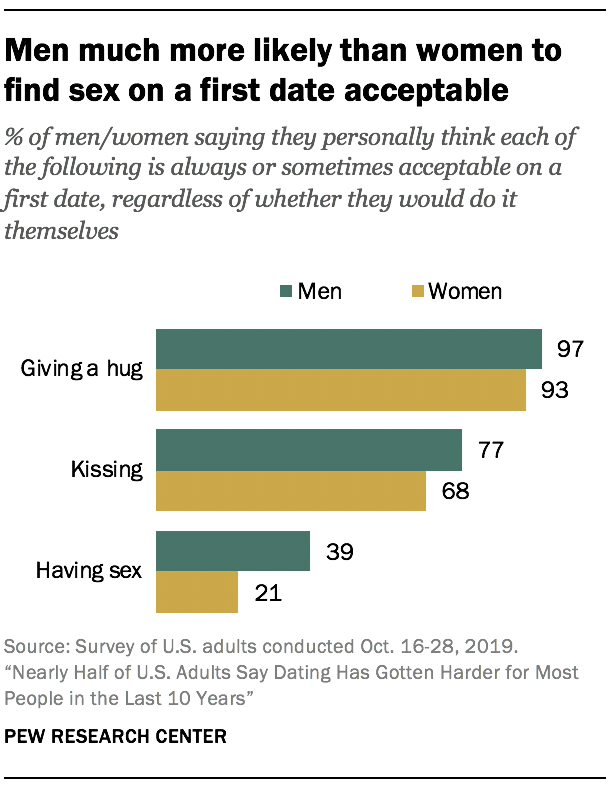
There is some disagreement about what sort of behavior is appropriate on a first date. While nearly all of the public thinks it’s acceptable at least sometimes to hug on a first date, there is some gray area when it comes to kissing, and relatively few say having sex is acceptable on a first date (regardless of whether they would do it themselves).

Fully 95% of adults say that giving a hug would be acceptable always or sometimes on a first date, including 56% who say it is always acceptable. Most also say kissing is acceptable (72%), but far fewer say this is always acceptable (15%).

About four-in-ten adults say having sex on the first date is never acceptable

When it comes to sex on the first date, 30% say this is always or sometimes acceptable. Meanwhile 27% say it’s rarely acceptable and 42% say it is never acceptable.

Men are more likely than women to see each of these behaviors as acceptable on a first date, but the gender gap is especially wide when it comes to having sex. About four-in-ten men (39%) say having sex on a first date can be acceptable at least sometimes, compared with 21% of women.

The difference between younger and older Americans is also widest when it comes to sex. While roughly four-in-ten adults ages 18 to 29 (42%) and 30 to 49 (38%) say having sex on a first date is always or sometimes acceptable, the shares are much lower among 50- to 64-year-olds (21%) and those 65 and older (13%). Adults younger than 50 are also more likely than their older counterparts to say that giving a hug and kissing on a first date are acceptable, but the differences are much smaller.

Men much more likely than women to find sex on a first date acceptable

Democrats and Republicans mostly see eye to eye on whether hugging and kissing are acceptable on a first date, but Democrats (38%) are more likely than Republicans (21%) to say having sex is acceptable at least sometimes.

LGB adults are more likely than their straight counterparts to say kissing on a first date is acceptable, though large shares in each group say this (79% vs. 72%). And LGB adults much more likely than those who are straight to say the same about having sex (52% vs. 27%).

Breaking up with someone through technology, ‘ghosting’ are largely seen as unacceptable

Though people have been ending romantic relationships in impersonal ways at least since the advent of the Dear John letter, the countless new ways of communicating with romantic partners have brought up concerns that breaking up through technology may become the new norm. But despite the role technology plays in dating and relationships these days, most people say breaking up in person is the only acceptable way to do it – even with casual dating partners.

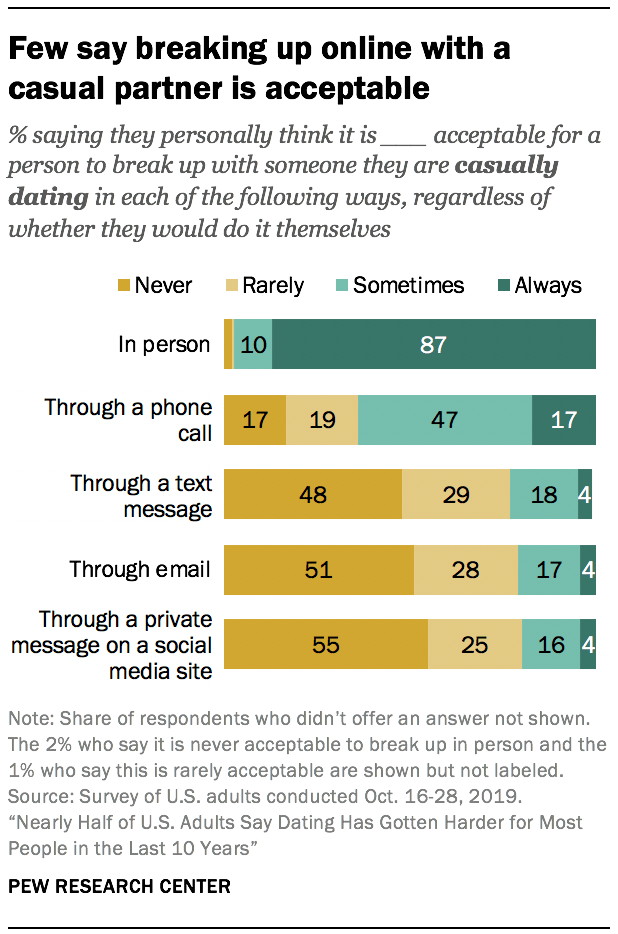
Nearly all U.S. adults (97%) say it is at least sometimes acceptable to break up in person with someone they are in a committed relationship with, including 88% who say this is always acceptable. By contrast, about half (51%) say it can be acceptable to break up through a phone call at least sometimes, with only 10% saying this is always acceptable. Much smaller shares say it is at least sometimes acceptable to break up through a text message (14%), email (14%) or a private message on a social media site (11%). In fact, majorities say each of those methods of ending a committed relationship are never acceptable.

Breaking up in person is largely seen as the only acceptable way to end a committed relationship

Men are somewhat more likely than women to say ending a committed relationship over the phone can be acceptable (55% vs. 47%), but otherwise men and women mostly agree on these break-up norms.

Adults younger than 50 are more likely than those who are older to say it’s at least sometimes acceptable to break up through a phone call (57% vs. 43%), text message (16% vs. 11%) or social media private message (15% vs. 8%). There is no difference by age in whether it is acceptable to break up via email.

Most agree that breaking up in person is preferable even when it’s only a casual relationship

When asked the same question, but about a person breaking up with someone they are casually dating, the results are strikingly similar to those about ending a committed relationship.

Again, the vast majority (97%) say it’s at least sometimes acceptable to break up in person. Breaking up with a casual partner over the phone is seen as somewhat more acceptable than ending a committed relationship over the phone (64% vs. 51%), but still only a small share say this is always acceptable.

Few say breaking up online with a casual partner is acceptable

About one-in-five adults say it is always or sometimes acceptable to break up with a casual partner by text message (22%), email (20%) or social media private message (20%).

The patterns of gender and age differences are largely the same for breaking up with a casual partner and ending a committed relationship.

Only about one-in-ten single-and-looking adults say they would ‘ghost’ someone they didn’t want to see again

Despite apocryphal warnings of “ghosting,” or suddenly stopping answering phone calls or messages without explanation, few people on the dating market say they would do this after a first date. Only 8% say they would do this, compared with 40% who say they would contact the person and let them know they didn’t want to go out again. About half (52%) say they wouldn’t proactively contact the person but would let them know they weren’t interested if the person tried to get in touch.

Single-and-looking men are split on whether they would contact the person after the first date and let them know (47%) or wait for the other person to contact them before letting them know (also 47%). Meanwhile, women on the dating market are much more likely to say they would only let the other person know if they got in touch first (59%) than say they would reach out to let the person know (30%).

Young singles on the dating market – those ages 18 to 29 – are more likely than their older counterparts to say they would take the direct approach by proactively contacting the person. About half in this age group (49%) say this, compared with 37% of daters ages 30 to 49 and 34% of those 50 and older. 

Acknowledgments

Pew Research Center received invaluable advice in developing the questionnaire from Amanda Lenhart, Program Director, Health and Data, Data & Society, and Michael J. Rosenfeld, Professor of Sociology, Stanford University.

This report is a collaborative effort based on the input and analysis of the following individuals. Find related reports online at pewresearch.org/pewresearch-org/social-trends

Kim Parker, Director, Social Trends Research Lee Rainie, Director, Internet and Technology Research Juliana Horowitz, Associate Director, Research Monica Anderson, Associate Director, Research Anna Brown, Research Associate Deja Thomas, Research Assistant Jesse Bennett, Research Assistant Emily A. Vogels, Research Associate Erica Turner, Former Research Intern Aaron Smith, Director, Data Labs Andrew Perrin, Research Analyst Tanya Arditi, Communications Manager Gar Meng Leong, Communications Associate Colin Lahiff, Former Communications Associate Travis Mitchell, Copy Editor and Digital Producer Michael Keegan, Senior Information Graphics Designer

In addition, the project benefited greatly from the guidance of Pew Research Center’s methodology team: Courtney Kennedy, Andrew Mercer, Nick Bertoni, Joshua Ferno, Dorene Asare-Marfo, Nick Hatley and Arnold Lau, as well as from feedback by the following Pew Research Center staff: Jeffrey Gottfried, Baxter Oliphant, Dennis Quinn and Rachel Weisel.


Methodology

The American Trends Panel survey methodology

The American Trends Panel (ATP), created by Pew Research Center, is a nationally representative panel of randomly selected U.S. adults. Panelists participate via self-administered web surveys. Panelists who do not have internet access at home are provided with a tablet and wireless internet connection. The panel is being managed by Ipsos.

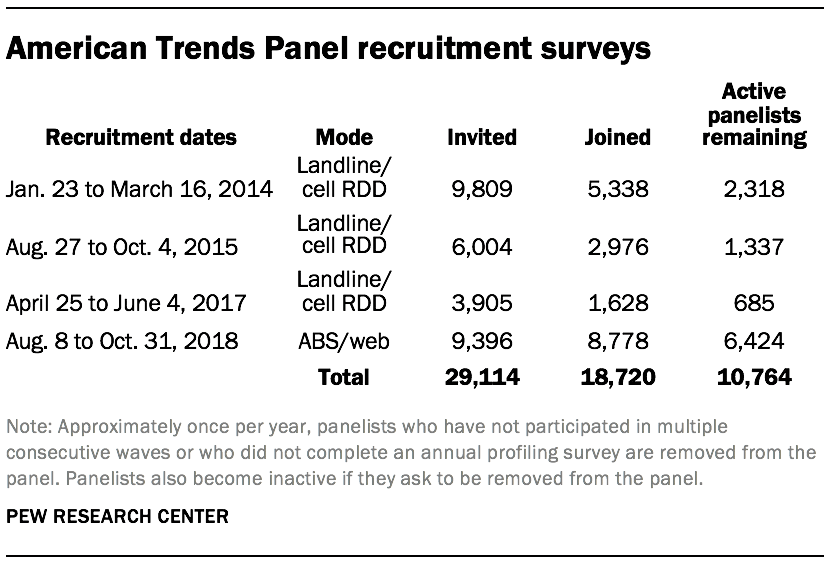
American Trends Panel recruitment surveys

Data in this report are drawn from the panel wave conducted Oct. 16 to Oct. 28, 2019. A total of 4,860 panelists responded out of 5,887 who were sampled, for a response rate of 82.6%. This includes 4,458 from the ATP and an oversample of 1,429 respondents sampled from Ipsos’ KnowledgePanel that previously indicated that they identify as lesbian, gay, or bisexual (LGB). This does not include three panelists who were removed from the data due to extremely high rates of refusal or straightlining. The cumulative response rate accounting for nonresponse to the recruitment surveys and attrition is 5.3%. The break-off rate among panelists who logged onto the survey and completed at least one item is 1.2%. The margin of sampling error for the full sample of 4,860 respondents is plus or minus 2.1 percentage points.

The subsample from the ATP was selected by grouping panelists into eight strata so demographic groups that are underrepresented in the panel had a higher probability of selection than overrepresented groups:

  • Stratum A consists of panelists who identify as LGB, use online dating sites or apps, and are single and looking for a relationship. They were sampled at a rate of 100%.
  • Stratum B consists of panelists who identify as LGB, do NOT use online dating sites or apps, and are single and looking for a relationship. They were sampled at a rate of 100%.
  • Stratum C consists of panelists that are who do NOT identify as LGB, use online dating sites or apps, and are single and looking for a relationship. They were sampled at a rate of 41.5%.
  • Stratum D consists of panelists who are non-internet users. They were sampled at a rate of 87.5%.
  • Stratum E consists of panelists with a high school education or less. They were sampled at a rate of 69.9%.
  • Stratum F consists of panelists that are Hispanic, unregistered to vote, or non-volunteers. They were sampled at a rate of 29.2%.
  • Stratum G consists of panelists that are black or 18-34 years old. They were sampled at a rate of 15%.
  • Stratum H consists of the remaining panelists. They were sampled at a rate of 11.1%.

The ATP was created in 2014, with the first cohort of panelists invited to join the panel at the end of a large, national, landline and cellphone random-digit-dial survey that was conducted in both English and Spanish. Two additional recruitments were conducted using the same method in 2015 and 2017, respectively. Across these three surveys, a total of 19,718 adults were invited to join the ATP, of which 9,942 agreed to participate.

In August 2018, the ATP switched from telephone to address-based recruitment. Invitations were sent to a random, address-based sample (ABS) of households selected from the U.S. Postal Service’s Delivery Sequence File. In each household, the adult with the next birthday was asked to go online to complete a survey, at the end of which they were invited to join the panel. For a random half-sample of invitations, households without internet access were instructed to return a postcard. These households were contacted by telephone and sent a tablet if they agreed to participate. A total of 9,396 were invited to join the panel, and 8,778 agreed to join the panel and completed an initial profile survey. Of the 18,720 individuals who have ever joined the ATP, 10,764 remained active panelists and continued to receive survey invitations at the time this survey was conducted.

The U.S. Postal Service’s Delivery Sequence File has been estimated to cover as much as 98% of the population, although some studies suggest that the coverage could be in the low 90% range.8

Weighting

Weighting dimensions

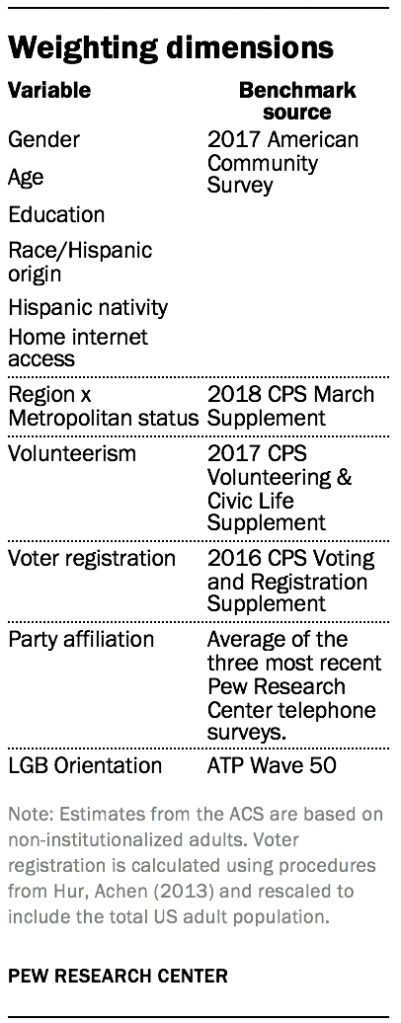
The ATP data were weighted in a multistep process that begins with a base weight incorporating the respondents’ original survey selection probability and the fact that in 2014 and 2017 some respondents were subsampled for invitation to the panel. The next step in the weighting uses an iterative technique that aligns the sample to population benchmarks on the dimensions listed in the accompanying table. For this wave, an additional weighting parameter was added to adjust for oversampling LGB-identifying respondents.

Sampling errors and test of statistical significance take into account the effect of weighting. Interviews are conducted in both English and Spanish, but the American Trends Panel’s Hispanic sample is predominantly U.S. born and English speaking.

In addition to sampling error, one should bear in mind that question wording and practical difficulties in conducting surveys can introduce error or bias into the findings of opinion polls.

The following table shows the unweighted sample size and the error attributable to sampling that would be expected at the 95% level of confidence:

Sample sizes and sampling errors for subgroups are available upon request.

© Pew Research Center, 2020