Pew Research Center

FOR RELEASE DECEMBER 5, 2017

On Gender Differences, No Consensus on Nature vs. Nurture

Americans say society places a higher premium on masculinity than on femininity

BY Kim Parker, Juliana Menasce Horowitz and Renee Stepler

FOR MEDIA OR OTHER INQUIRIES:

Communications Department
202.419.4372
www.pewresearch.org

RECOMMENDED CITATION

Pew Research Center, December 2017, "On Gender Differences, No Consensus on Nature vs. Nurture"

About Pew Research Center

Pew Research Center is a nonpartisan, nonadvocacy fact tank that informs the public about the issues, attitudes and trends shaping the world. It does not take policy positions. The Center conducts public opinion polling, demographic research, computational social science research and other data-driven research. It studies politics and policy; news habits and media; the internet and technology; religion; race and ethnicity; international affairs; social, demographic and economic trends; science; research methodology and data science; and immigration and migration. Pew Research Center is a subsidiary of The Pew Charitable Trusts, its primary funder.

© Pew Research Center 2026

Table of contents

  • About Pew Research Center
  • On Gender Differences, No Consensus on Nature vs. Nurture
  • 1. Americans are divided on whether differences between men and women are rooted in biology or societal expectations
  • 2. Americans see different expectations for men and women
  • 3. Americans see society placing more of a premium on masculinity than on femininity
  • 4. Gender, generation and partisanship come into play in attitudes about raising boys and girls
  • Acknowledgments
  • Methodology

On Gender Differences, No Consensus on Nature vs. Nurture

Americans say society places a higher premium on masculinity than on femininity

Twenty-five years after the release of the bestseller “Men are from Mars, Women are from Venus,” the debate over how and why men and women are different and what that means for their roles in society is far from settled. A new Pew Research Center survey finds that majorities of Americans say men and women are basically different in the way they express their feelings, their physical abilities, their personal interests and their approach to parenting. But there is no public consensus on the origins of these differences. While women who perceive differences generally attribute them to societal expectations, men tend to point to biological differences.
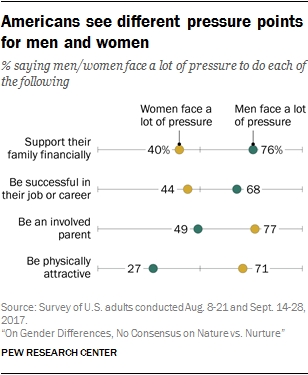
Americans see different pressure points for men and women

The public also sees vastly different pressure points for men and women as they navigate their roles in society. Large majorities say men face a lot of pressure to support their family financially (76%) and to be successful in their job or career (68%); much smaller shares say women face similar pressure in these areas. At the same time, seven-in-ten or more say women face a lot of pressure to be an involved parent (77%) and be physically attractive (71%). Far fewer say men face these types of pressures, and this is particularly the case when it comes to feeling pressure to be physically attractive: Only 27% say men face a lot of pressure in this regard.

When asked in an open-ended question what traits society values most in men and women, the differences were also striking. The top responses about women related to physical attractiveness (35%) or nurturing and empathy (30%). For men, one-third pointed to honesty and morality, while about one-in-five mentioned professional or financial success (23%), ambition or leadership (19%), strength or toughness (19%) and a good work ethic (18%). Far fewer cite these as examples of what society values most in women.

The survey also finds a sense among the public that society places a higher premium on masculinity than it does on femininity. About half (53%) say most people in our society these days look up to men who are manly or masculine; far fewer (32%) say society looks up to feminine women. Yet, women are more likely to say it’s important to them to be seen by others as womanly or feminine than men are to say they want others to see them as manly or masculine.

Using the terms ‘manly or masculine’ and ‘womanly or feminine’

Prior to conducting the survey, Pew Research Center conducted a qualitative test with nearly 200 men who were asked to list some traits and characteristics that come to mind when they think of a man who is manly or masculine and nearly 200 women who were asked what comes to mind when they think of a woman who is womanly or feminine. While these terms can have different meanings for different people, the qualitative testing revealed that respondents tended to associate “manly or masculine” with a common set of descriptions that relate to strength, confidence and certain physical traits. Some commonly used words included “strong,” “assertive,” “muscular,” “confident,” “deep voice” and “facial hair.” When it comes to traits and characteristics used to describe women who are “womanly or feminine,” some frequently used terms included “grace” or “graceful,” “beauty” or “beautiful,” “caring,” and “nurturing.” Many people also mentioned wearing makeup and dresses.

There are key demographic and political fault lines that cut across some of these views. Just as Republicans and Democrats are divided in their views on gender equality, they have divergent opinions about why men and women are different on various dimensions. Attitudes on gender issues also often differ by education, race and generation.

The nationally representative survey of 4,573 adults was conducted online Aug. 8-21 and Sept. 14-28, 2017, using Pew Research Center’s American Trends Panel.1 Among the key findings:

Americans are divided along gender and party lines over whether differences between men and women are rooted in biology or societal expectations
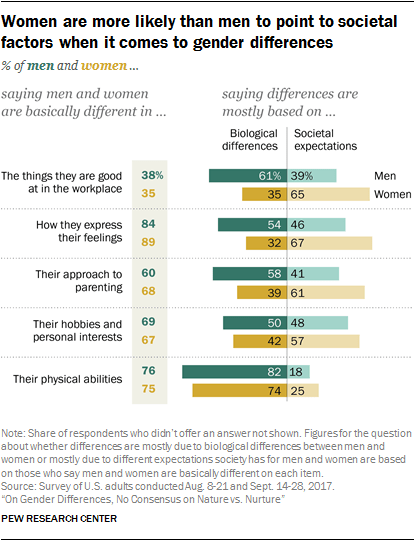
Women are more likely than men to point to societal factors when it comes to gender differences

Women and men who see gender differences in some key areas tend to have divergent views of the roles biology and society play in shaping these differences. Most women who see gender differences in the way people express their feelings, excel at work and approach parenting say those differences are mostly based on societal expectations. Men who see differences in these areas tend to believe biology is the driver.

Similarly, Democrats and Democratic-leaning independents are far more likely than Republicans and those who lean to the GOP to say gender differences are mostly based on societal expectations rather than on biological differences between men and women. About two-thirds of Democrats who say men and women are basically different in how they express their feelings, their approach to parenting, and their hobbies and personal interests say these differences are rooted in societal expectations. Among their Republican counterparts, about four-in-ten or fewer share those views.

The public sees similarities between men and women in the workplace

While majorities of Americans see gender differences across various realms, one area where they see more similarities is at work: 63% say men and women are basically similar when it comes to the things they are good at in the workplace, while 37% say they are mostly different. Men and women express similar views on this.

Among Democrats, there is a clear sense that men and women are similar when it comes to the things they are good at in the workplace: 69% say this is the case, while 30% say men and women are basically different in this regard. While Republicans are more divided, more see similarities (55%) than differences (44%) in the things men and women are good at in the workplace.

Millennial men are far more likely than those in older generations to say men face pressure to throw a punch if provoked, join in when others talk about women in a sexual way, and have many sexual partners

Most men say men in general face at least some pressure to be emotionally strong (86%) and to be interested in sports (71%); about six-in-ten (57%) say men face pressure to be willing to throw a punch if provoked, while smaller but sizable shares of men say men face pressure to join in when other men are talking about women in a sexual way (45%) and to have many sexual partners (40%).
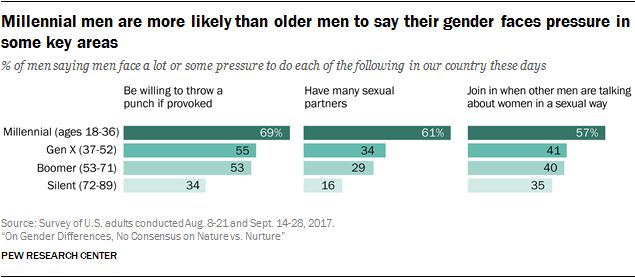
Millennial men are more likely than older men to say their gender faces pressure in some key areas

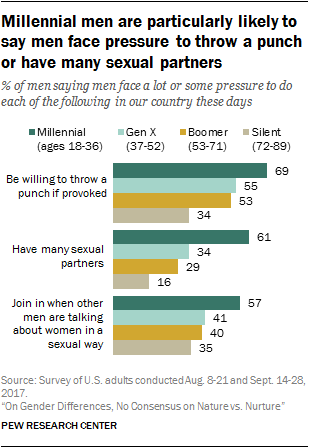
Millennial men stand out from their older counterparts in three of these areas: 69% say there is at least some pressure on men to be willing to throw a punch; 55% of Gen X and 53% of Boomer men and even smaller shares of men in the Silent Generation (34%) say men face pressure in this regard. And while about six-in-ten Millennial men say there is at least some pressure on men in general to have many sexual partners (61%) and to join in when other men are talking about women in a sexual way (57%), about four-in-ten or fewer older men say men face at least some pressure in these areas.

While the question asked about pressures men face in general, it is possible that respondents were drawing on their or their friends’ personal experiences when answering. As such, the generational gaps in views of how much pressure men face in these realms may reflect, at least in part, their age and their stage in life.

Democrats are more likely than Republicans to say society values masculinity – and also more likely to see this as a bad thing

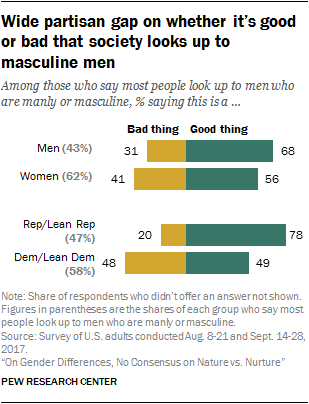
Wide partisan gap on whether it’s good or bad that society looks up to masculine men

About six-in-ten Democrats and Democratic-leaning independents (58%) say most people in our society these days look up to men who are manly or masculine, while 4% say society looks down on these men and 37% say it neither looks up to nor down on them. Among Republicans and those who lean to the Republican Party, 47% say society looks up to masculine men; 12% say society looks down on them and 41% say neither answer applies.

Republicans who say society looks up to masculine men overwhelmingly say this is a good thing (78%). Democrats aren’t convinced: Among those who say society looks up to masculine men, almost identical shares say this is a good thing (49%) as say it is a bad thing (48%).

While smaller shares of Americans say most people in our society look up to feminine women than say most people look up to masculine men, a solid majority of those who say society looks up to women who are feminine (83%) also say this is a good thing; just 15% say it’s a bad thing that society looks up to feminine women. Overall, 60% of those who say most people look up to masculine men see this as a good thing, while 37% say it is bad.

Race and educational attainment are linked to how people see their own masculinity or femininity
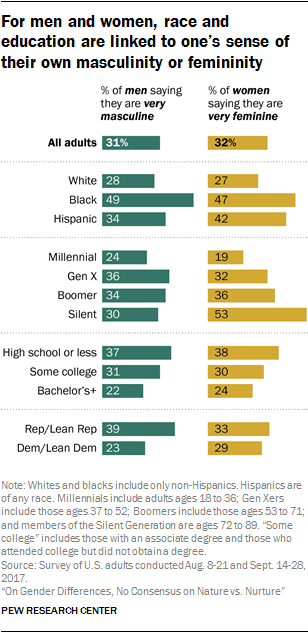
For men and women, race and education are linked to one’s sense of their own masculinity or femininity

Men and women give similar answers when asked to describe themselves in terms of their own masculinity or femininity. About three-in-ten men (31%) say they are very manly or masculine, while 54% describe themselves as somewhat masculine and 15% say they are not too or not at all masculine. Among women, 32% say they are very womanly or feminine, 54% say they are somewhat feminine and 14% say they are not too or not at all feminine.

Black men are more likely than white men to say they are very masculine, and the same pattern holds for women. About half of black men (49%) and black women (47%) describe themselves as either very masculine or very feminine, compared with 28% of white men who say they are very masculine and 27% of white women who see themselves as very feminine. While about a third of men and women without a four-year college degree say they are very masculine or feminine (34% each), smaller shares of those who have a bachelor’s degree or more education describe themselves this way (22% and 24%, respectively).

The survey also finds a wide generational gap in the way women see their own femininity. While about half (53%) of women in the Silent Generation say they are very feminine, about a third of Boomer (36%) and Gen X (32%) women and an even smaller share of Millennial women (19%) see themselves this way. There is no clear link between a man’s age and the way he sees his masculinity.

Among men, Republicans are more likely than Democrats to say they are very manly or masculine: 39% of Republican men – vs. 23% of their Democratic counterparts – describe themselves this way. And while 21% of Democratic men say they are not too or not at all masculine, just 8% of Republican men say the same. Views are more uniform across party lines when it comes to how women see themselves.

When it comes to raising children, more see advantages in exposing girls than boys to activities typically associated with the other gender
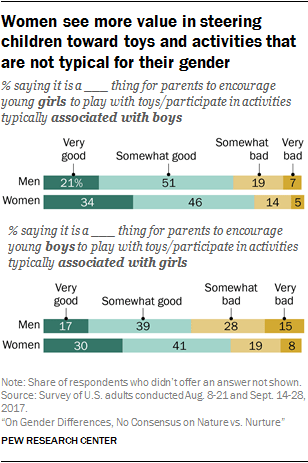
Women see more value in steering children toward toys and activities that are not typical for their gender

Most adults are open to the idea of exposing young girls and boys to toys and activities that are typically associated with the opposite gender. About three-quarters (76%) say it’s a good thing for parents of young girls to encourage their daughters to play with toys or participate in activities that are typically associated with boys; a somewhat smaller majority (64%) says it’s a good thing for parents of young boys to encourage them to play with toys or participate in activities usually thought of as being for girls.

Women are more likely than men to say parents should encourage their children to engage in activities that are typically associated with the opposite gender, but the difference is more pronounced when it comes to views about raising boys. Large majorities of women (80%) and men (72%) say it’s a good thing for parents of young girls to do this; 71% and 56%, respectively, say parents of young boys should encourage them to play with toys or participate in activities typically associated with girls.

Democrats and Democratic-leaning independents are more likely than Republicans and those who lean Republican to say it’s good for parents to break with gender norms in raising children, and here, too, the difference is most pronounced when it comes to raising boys. About eight-in-ten Democrats (78%) – vs. 47% of Republicans – say it’s a good thing for parents of young boys to encourage them to play with toys and participate in activities typically associated with girls.

Americans differ over what should be emphasized in raising boys vs. girls
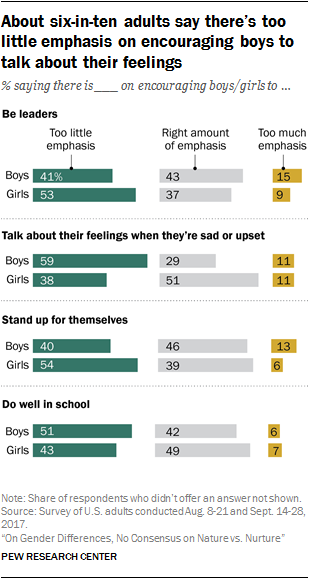
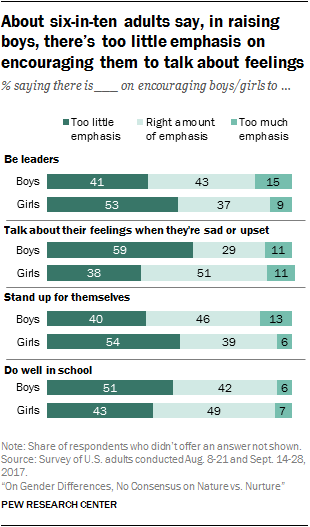
About six-in-ten adults say there’s too little emphasis on encouraging boys to talk about their feelings

Americans offer different assessments of how boys and girls are being raised these days when it comes to specific traits and behaviors. The biggest gap can be seen in encouraging children to talk about their feelings when they are sad or upset: 59% of adults say there is too little emphasis on encouraging boys to talk about their feelings, while only 38% say the same about girls (51% say things are about right in this area when it comes to girls). And while 51% say there should be more emphasis on encouraging boys to do well in school, somewhat smaller shares (43%) say there should be more emphasis on this for girls.

When it comes to what’s lacking for girls these days, more Americans say there is too little emphasis on encouraging girls to be leaders and to stand up for themselves than say there is too little emphasis when it comes to encouraging boys in these areas. About half say more should be done to encourage girls to be leaders (53%) and to stand up for themselves (54%), compared with about four-in-ten who say the same about encouraging boys to do each of these.

Women are more likely than men to say there is too little emphasis on encouraging girls to be leaders: 57% of women say this, compared with 49% of men. But when it comes to encouraging leadership in boys, views are reversed, with larger shares of men (46%) than women (38%) saying there should be more emphasis on this.

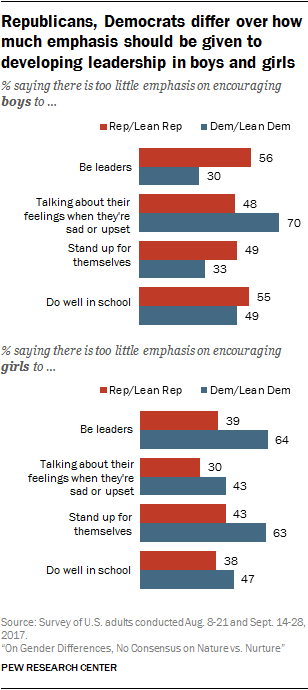
There is a party split on this issue as well. Democrats are much more likely than Republicans to say there is too little emphasis on leadership for girls – 64% of Democrats say this compared with 39% of Republicans. For their part, a majority of Republicans (56%) say there is too little emphasis on this trait for boys; only 30% of Democrats agree.

Terminology

All references to party affiliation include those who lean toward that party: Republicans include those who identify as Republicans and independents who say they lean toward the Republican Party, and Democrats include those who identify as Democrats and independents who say they lean toward the Democratic Party.

References to Millennials include adults who are ages 18 to 36 in 2017. Generation Xers include those who are ages 37 to 52, Baby Boomers include those who are 53 to 71 and members of the Silent Generation include those ages 72 to 89.

References to college graduates or people with a college degree comprise those with a bachelor’s degree or more. “Some college” includes those with an associate degree and those who attended college but did not obtain a degree. “High school” refers to those who have a high school diploma or its equivalent, such as a General Education Development (GED) certificate.

References to whites and blacks include only those who are non-Hispanic and identify as only one race. Hispanics are of any race.
1. Americans are divided on whether differences between men and women are rooted in biology or societal expectations

Most Americans – including majorities across demographic groups – say men and women are basically different when it comes to how they express their feelings (87%), their physical abilities (76%), their hobbies and personal interests (68%), and their approach to parenting (64%). In contrast, about six-in-ten Americans (63%) say men and women are basically similar when it comes to the things they are good at in the workplace.

Among those who see gender differences across these various realms, there is no clear consensus about whether these differences are primarily rooted in biology or in societal expectations. The one exception relates to views about differences in physical abilities: 78% of those who say men and women are basically different in this area say this is mostly due to biology, while 21% point to different expectations society has for men and women.

When it comes to the way men and women express their feelings, a majority of those who say there is a difference point to societal expectations (58%), but a substantial share (42%) say these differences are biological. And views are more evenly divided when it comes to gender differences on hobbies and personal interests (53% say they are based on societal expectations vs. 46% who point to biology), approach to parenting (52% vs. 47%) and the things men and women are good at in the workplace (53% vs. 47%).

Women are more likely than men to point to societal expectations for gender differences

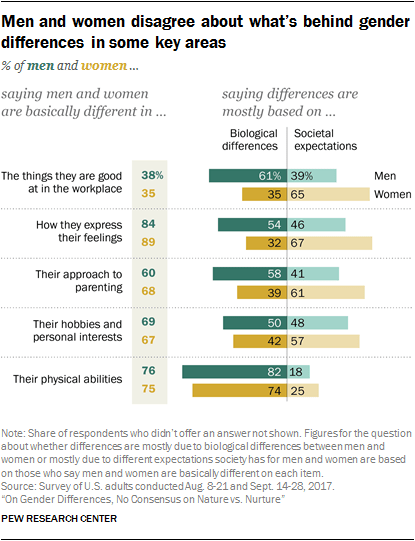
Men and women disagree about what’s behind gender differences in some key areas

While majorities of men and women see gender differences when it comes to the way men and women approach parenting and how they express their feelings, there is a wide gap between the two groups in views of whether these differences are mostly based on biology or on different expectations society has for men and women. For example, two-thirds of women who say men and women are basically different in how they express their feelings – vs. 46% of men – say these differences are mostly based on societal expectations. And while 61% of women who see a gender difference in approaches to parenting say these differences are rooted in societal expectations, a similar share of men (58%) point to biology.

Men and women also offer different views on the roles of biology and societal expectations when it comes to gender differences in the workplace. Relatively small shares of men (38%) and women (35%) say there are differences when it comes to what each gender is good at in the workplace. Among those who do see a difference, 65% of women say they are mostly based on different expectations society has for men and women, while 35% point to biology. In contrast, about six-in-ten men who see gender differences in the workplace (61%) say they are mostly biological.

When it comes to gender differences on hobbies, personal interests and physical abilities, assessments of the roles biology and societal expectations play don’t vary as much between men and women. Among those who say men and women have different hobbies and personal interests, 57% of women and 48% of men say this is mostly based on different expectations society has for each gender, a difference that is not statistically significant. And among those who see gender differences in physical abilities, solid majorities of men and women point to biology (82% of men and 74% of women).

Wide partisan gaps in views of the roles of biology and societal expectations

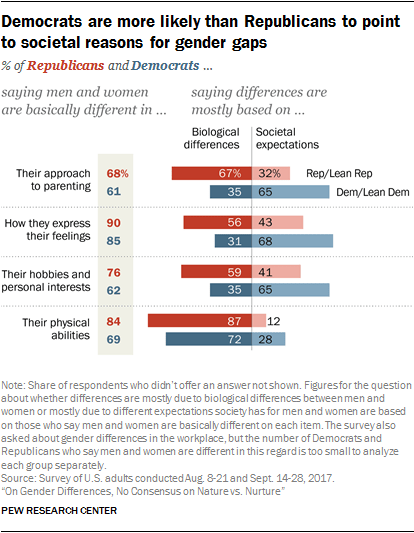
Democrats are more likely than Republicans to point to societal reasons for gender gaps

Republicans and Republican-leaning independents are generally more likely than Democrats and those who lean Democratic to see differences between men and women, but more than half of each group say men and women are different in how they express their feelings (90% vs. 85%, respectively), their physical abilities (84% vs. 69%), their hobbies and personal interests (76% vs. 62%), and their approach to parenting (68% vs. 61%).

Democrats and Republicans who see gender differences across various realms offer widely different explanations for why men and women are different, with Democrats more often pointing to societal reasons and Republicans citing biology.

About two-thirds of Democrats and Democratic-leaning independents who say men and women are basically different in how they express their feelings, their approach to parenting, and their hobbies and personal interests say these differences are mostly based on societal expectations for men and women. Among their Republican and Republican-leaning counterparts, 32% say differences in how men and women approach parenting are rooted in societal expectations, while about four-in-ten say the same about differences in how men and women express their feelings (43%) and in their hobbies and personal interests (41%).

While most Republicans and Democrats who say men and women are different when it comes to their physical abilities say these differences are mostly biological, Democrats are about twice as likely as Republicans to say they are based on the expectations society has for men and women (28% vs. 12%).

For the most part, Americans don’t see differences between men and women as a bad thing

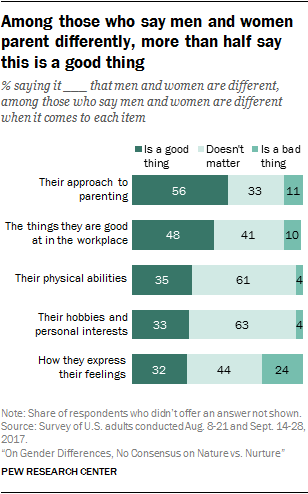
Among those who say men and women parent differently, more than half say this is a good thing

The public doesn’t necessarily see a problem with the notion that men and women are different. In fact, many who say there are differences between men and women say this is a good thing, particularly when it comes to differences in parenting (56% say it’s a good thing that men and women have different approaches) and in the things they are good at in the workplace (48%). About a third of those who see gender differences in physical abilities (35%) or hobbies and personal interests (33%) say it’s a good thing that men and women are different in these areas, while about six-in-ten say it doesn’t matter.

Opinions are somewhat more varied among those who say men and women are different in how they express their feelings. About a third in this group (32%) see this as a good thing and 24% say it is a bad thing; 44% say it doesn’t matter. Women who see a gender difference in how people express their feelings are about three times as likely as men to say this is a bad thing (34% vs. 11%, respectively). For their part, men are more likely than women to say it’s a good thing that men and women are different in this regard (43% of men say this, vs. 23% of women).

People who say gender differences are driven by biology are generally more likely than those who point to society to say it’s a good thing that men and women are different. Still, for the most part, relatively few among those who say gender differences are rooted in societal expectations think this is a bad thing.

For example, when it comes to gender differences in approaches to parenting, 72% of those who say these differences are based on biology say it’s a good thing that men and women are different in this regard; among those who say these differences are driven mostly by societal expectations, 41% say it’s a good thing that men and women are different in their approaches to parenting, 40% say it doesn’t matter and 19% say it’s a bad thing.

About half say society should be more accepting of people taking on roles typically associated with the opposite gender

Even as most of the public sees differences between men and women across various realms, there is a sense among many Americans that society should be more accepting of men and women taking on roles that are traditionally associated with the opposite gender.

About half of Americans (49%) say society isn’t accepting enough of women taking on roles that are typically associated with men, while 36% say society is about right and 14% say it is too accepting of women doing this. Similarly, 46% say society is not accepting enough of men taking on roles that are typically associated with women; 39% say it is about right and 14% say it is too accepting.

Views about gender roles vary considerably by gender and party identification. Among women, 58% say society isn’t accepting enough of women taking on roles typically associated with men, while slightly fewer (53%) say the same about society’s position on men taking on traditionally female roles. Smaller shares of men say society should be more accepting of women (39%) and men (38%) taking on roles typically associated with the other gender.

Democrats and Democratic-leaning independents are about twice as likely as Republicans and those who lean to the GOP to say society should be more accepting of women and men taking on roles typically associated with the opposite gender. At least six-in-ten Democrats say society should be more accepting of men (60%) and women (66%) doing this, compared with about three-in-ten Republicans.

While about half of white, black and Hispanic adults say society should be more accepting of men taking on roles typically associated with women, blacks and Hispanics are more likely than whites to say society is too accepting of this: About a quarter of blacks (24%) and 17% of Hispanics say this, compared with 11% of whites. There are no significant differences in the shares of blacks, whites and Hispanics saying society is too accepting or not accepting enough of women taking on roles typically associated with men.

2. Americans see different expectations for men and women

The public has very different views about what society values most in men and what it values in women. While many say that society values honesty, morality and professional success in men, the top qualities for women are physical attractiveness and being nurturing and empathetic.

When asked in an open-ended format to name the traits or characteristics that society values most in men, honesty and morality tops the list, with 33% saying this. About a quarter (23%) say society values professional and financial success most in men, including 14% who specifically mention money or being rich, 6% who reference jobs or careers and 6% who cite being a breadwinner.2 And roughly one-in-five adults point to ambition, leadership or assertiveness (19%), strength or toughness (19%) and a good work ethic (18%) as qualities society values most in men.3

Some of the top traits listed for men are also mentioned as characteristics that society values most in women, but by significantly smaller shares. About one-in-ten say society values ambition, leadership or assertiveness (9%) and a good work ethic (9%) most in women; just 5% mention strength or toughness. In fact, 28% volunteer traits related to ambition, leadership and assertiveness when asked what qualities people in our society believe women should not have, far more than cite any other trait or characteristic.

When it comes to what society values most in women, traits associated with one’s physical appearance are among the most often mentioned: 35% volunteered something having to do with physical attractiveness or beauty. Three-in-ten say that society values being nurturing and empathetic most in women, including 11% who specifically mention being a parent or caregiver and 6% who mention traits like kindness or being helpful. By contrast, significantly smaller shares of Americans say that society values physical attractiveness or being nurturing or empathetic most for men (11% each).

When it comes to traits or characteristics people in our society believe men should not have, no response stands out: Somewhat similar shares say most people in our society believe men should not be emotional or sensitive (15%), intolerant (11%), ambitious, assertive or a leader (11%), weak or vulnerable (11%), or dishonest or immoral (10%).

Public sees more pressure for men on job and career front

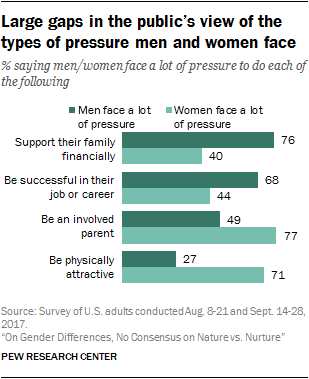
Large gaps in the public’s view of the types of pressure men and women face

When asked about the extent to which men and women feel pressure in different realms of their lives – from jobs, to family responsibilities, to personal appearance – the public sees clear gender differences. In particular, far higher shares say men face a lot of pressure to support their family and to be successful at work. And while solid majorities say women face a lot of pressure to be an involved parent and to be physically attractive, about half or fewer see these as pressure points for men.

About three-quarters of Americans (76%) say men face a lot of pressure to support their family financially, compared with 40% who say the same about women. And while about two-thirds (68%) say men face a lot of pressure to be successful in their job or career, fewer than half (44%) say women face the same type of pressure.

By contrast, far larger shares of the public say that women are pressured to be an involved parent and to be physically attractive. Most Americans (77%) say women face a lot of pressure to be an involved parent; 49% say the same for men. Roughly seven-in-ten (71%) say women face a lot of pressure to be physically attractive, but just 27% say the same of men.

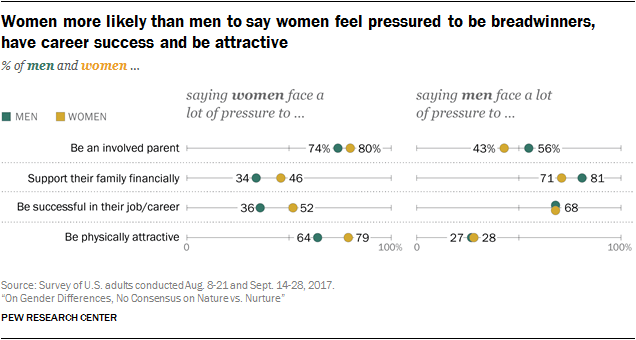
There are some gender gaps in views about the pressures faced by men and women. By double-digit margins, women are more likely than men to say women face a lot of pressure to support their family financially (a 12-percentage-point gap), to be successful in their job or career (16 points) and to be physically attractive (15 points). Large majorities of men and women agree that women face a lot of pressure to be an involved parent (74% and 80%, respectively).

At the same time, men are more likely than women to say that men face a lot of pressure to be an involved parent (a 13-point gap) and to support their family financially (10 points). Similar shares of men and women say that men face a lot of pressure to be successful in their job or career and to be physically attractive.

Women more likely than men to say women feel pressured to be breadwinners, have career success and be attractive
Less-educated adults see greater pressure for women to provide financially and for men to be involved parents than their counterparts

There are also gaps along educational lines in assessments of the pressures men and women face. About half of adults with a high school diploma or less (49%) say women face a lot of pressure to support their family financially, compared with 36% of those with some college experience and 31% with a bachelor’s degree or higher. Similarly, 48% of those with a high school diploma or less say women face a lot of pressure to be successful in their job or career, compared with 40% of those with a bachelor’s degree or higher (43% with some college experience say the same).

By contrast, those with at least a bachelor’s degree are more likely than those with less education to say women face a lot of pressure to be an involved parent or be physically attractive. For example, 84% of adults with at least a bachelor’s degree say women face a lot of pressure to be physically attractive, compared with 73% of those with some college experience and 60% with a high school diploma or less.

When it comes to pressures men face, adults with a bachelor’s degree are more likely than their less-educated counterparts to say men face a lot of pressure to be successful in their job or career, but they are less likely to say men feel pressured to be an involved parent or be physically attractive. Three-quarters of adults with at least a bachelor’s degree say that men face a lot of pressure to be successful in their job or career, compared with 68% with some college experience and 62% with a high school diploma or less. By contrast, 61% with a high school diploma or less say that men face a lot of pressure to be an involved parent, compared with 46% with some college experience and 38% with at least a bachelor’s degree. About a third of adults with a high school diploma or less (32%) say men face a lot of pressure to be physically attractive; 28% of adults with some college experience and 20% with a bachelor’s degree or higher agree. Most adults across all educational groups say that men face a lot of pressure when it comes to supporting their family financially.

While Republicans and Democrats generally agree on how much pressure men face in these different areas, Democrats are more likely than Republicans to say women face a lot of pressure in each of these. For example, 49% of Democrats and Democratic-leaning independents say women face a lot of pressure to be successful in their job or career, compared with 38% of Republicans and those who lean to the GOP. And while majorities of Democrats and Republicans say women face a lot of pressure to be physically attractive, Democrats are more likely to say this is the case (77% vs. 65%).

Among men, sharp generational differences in views of pressures men face

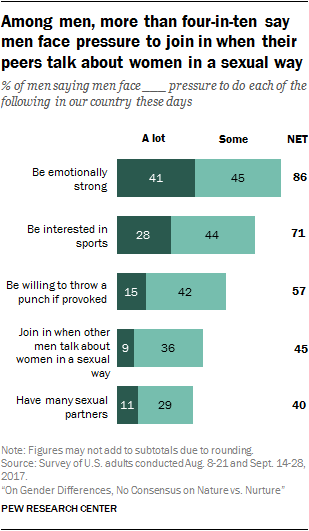
Among men, more than four-in-ten say men face pressure to join in when their peers talk about women in a sexual way

In recent years, research looking at the messages boys and men get from society about what it means to “be a man” has received increased attention. The survey asked men how much pressure they think men in general face to do each of the following: be emotionally strong, be interested in sports, be willing to throw a punch if provoked, join in when other men are talking about women in a sexual way, and have many sexual partners.

Most men say men face at least some pressure to be emotionally strong (86%) and to be interested in sports (71%). About six-in-ten (57%) say men face pressure to be willing to throw a punch if provoked. Smaller but substantial shares say men face at least some pressure to join in when other men are talking about women in a sexual way (45%) and to have many sexual partners (40%).

Millennial men are particularly likely to say men face pressure to throw a punch or have many sexual partners

Millennial men are far more likely than older men to say men face pressure to be willing to throw a punch, to join in when other men are talking about women in a sexual way and to have many sexual partners. About seven-in-ten Millennial men (69%) say men face at least some pressure to throw a punch if provoked, compared with 55% of Gen Xers, 53% of Boomers and 34% of men from the Silent Generation. When it comes to having many sexual partners, 61% of Millennial men say there is at least some pressure to do so, compared with 34% of Gen Xers, 29% of Boomers and 16% from the Silent Generation. And while 57% of Millennial men say men face pressure to join in when other men are talking about women in a sexual way, about four-in-ten or fewer men in other generations say the same. There are no significant differences in the shares of men across generations who say men face at least some pressure to be emotionally strong or be interested in sports.

Unmarried men are more likely than those who are married to say men generally face pressure to have many sexual partners (47% vs. 32%) and to join in when other men talk about women in a sexual way (52% vs. 38%). Still, among those who are married and those who are not, Millennial men are more likely than their older counterparts to say men face at least some pressure in these areas.

For the most part, white, black and Hispanic men share similar views about the pressures men face, but black and Hispanic men are more likely than their white counterparts to say men face at least some pressure to join in when other men are talking about women in a sexual way (54% of black men and 56% of Hispanic men vs. 42% of white men). And while majorities of white, black and Hispanic men say men face pressure to be interested in sports, blacks and Hispanics are more likely to say this is the case (81% and 80%, respectively, vs. 68% of whites).

3. Americans see society placing more of a premium on masculinity than on femininity

About half of Americans (53%) say most people in our society these days look up to men who are manly or masculine, while 7% say society looks down on these men; 39% say society neither looks up to nor down on men who are manly or masculine. When asked how they think society generally sees women who are womanly or feminine, about a third of the public (32%) says society looks up to and 11% say society looks down on them; a majority (57%) says society neither looks up to nor down on women who are feminine.

Views about how society sees feminine women are fairly consistent across demographic and partisan groups, but men and women – as well as Democrats and Republicans – have different perceptions of how society sees masculine men. Women are more likely than men to say society looks up to men who are manly or masculine: 62% of women say this is the case, compared with 43% of men. Democrats and Democratic-leaning independents (58%) are more likely than their Republican and Republican-leaning counterparts (47%) to say society looks up to men who are masculine.

Wide partisan gap on whether it’s good or bad that society looks up to masculine men

Views are even more polarized along party lines when those who say most people in our society look up to men who are manly or masculine are asked whether this is a good thing or a bad thing. A solid majority of Republicans who say society generally looks up to masculine men (78%) consider this to be a positive thing. In contrast, Democrats who say society looks up to these men are about evenly split: 49% say this is a good thing and 48% say it is a bad thing.

Men and women who say society looks up to men who are manly or masculine also offer somewhat different assessments of whether this is a good thing or a bad thing. Two-thirds of men (68%) who say society looks up to masculine men see this as a positive thing; a much narrower majority of women (56%) say the same.

Overall, 60% of Americans who say society looks up to masculine men see this as a good thing, while 37% say it is a bad thing. And while relatively few say most people look up to feminine women, those who say this is the case overwhelmingly see it as a positive thing (83% say it is a good thing vs. 15% bad thing).

Women about twice as likely to say it’s very important for them to be seen as feminine as men are about being seen as masculine

While Americans tend to think society places more of a premium on masculinity than on femininity, women are more likely to say it’s important to them, personally, to be seen by others as womanly or feminine than men are to say it’s important that others see them as manly or masculine.

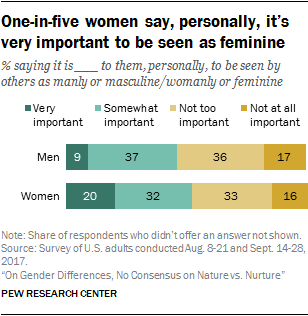
One-in-five women say, personally, it’s very important to be seen as feminine

About half of women (52%) say it’s at least somewhat important for them to be seen as feminine, including 20% who say this is very important to them. Among men, slightly less than half (46%) say it’s important to them, personally, that others see them as masculine, with just 9% saying this is very important.

Perhaps not surprising, men who say society looks up to masculine men are more likely than other men to also say it’s important for them to be seen by others as manly or masculine; and the same is true of women who say society generally looks up to feminine women (they are more likely to say it’s important to them, personally, to be seen as womanly or feminine). Still, while about seven-in-ten women who say society looks up to feminine women (69%) say it’s important that others see them as such, a smaller share of men who say society looks up to masculine men (55%) want others to see them as manly or masculine.

Across generations, Millennial and Gen X men and women are about equally likely to say it’s important for them to be seen as masculine or feminine, respectively: About half of men and women in each of these generations say this. Among older generations, however, the shares of women saying it’s important that others see them as feminine is far higher than the share of men saying it’s important that others see them as masculine (55% of Boomer women vs. 40% of Boomer men and 59% of Silent women vs. 36% of Silent men).

For men and women, one’s sense of their own masculinity or femininity varies by race, education

Race, education, party linked to how men see their masculinity

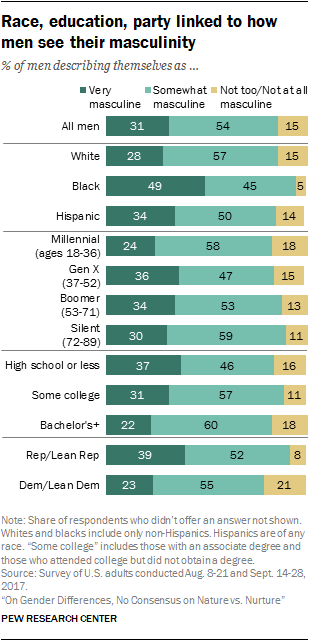
Men and women offer nearly identical answers when asked how they would describe themselves in terms of their masculinity or femininity. About three-in-ten men (31%) say they are very manly or masculine, 54% describe themselves as somewhat masculine and 15% say they are not too or not at all masculine. Similarly, 32% of women say they are very womanly or feminine, while 54% say they are somewhat feminine and 14% say they are not too or not at all feminine.

Black men and women are more likely than their white counterparts to describe themselves as very masculine or feminine. About half of black men (49%) see themselves as very masculine, compared with 28% of white men. Similarly, 47% of black women say they are very feminine, while 27% of white women describe themselves this way. About four-in-ten Hispanic women (42%) and 34% of Hispanic men say they are very feminine or masculine, respectively.

Educational attainment is also linked to how men and women see themselves. Roughly four-in-ten men with a high school diploma or less education (37%) and 31% of those with some college say they are very manly or masculine, compared with 22% of men with a bachelor’s degree or more education. The shares of women in each educational group who say they are very womanly or feminine are nearly identical to those who say they are very masculine among their male counterparts: 38% of women with no college experience, 30% of those with some college and 24% of those with at least a bachelor’s degree describe themselves this way.

In other ways, the patterns are quite different between men and women. For example, while there is no clear link between a man’s age and how he sees his masculinity, Millennial women are considerably less likely than women in older generations to describe themselves as very womanly or feminine. About one-in-five Millennial women (19%) say they are very feminine, compared with about a third of Gen X (32%) and Boomer (36%) women and an even larger share of women in the Silent Generation (53%).

Among men, Republicans are more likely than Democrats to describe themselves as very manly or masculine: About four-in-ten Republican and Republican-leaning men (39%) do so, compared with about a quarter of Democratic and Democratic-leaning men (23%). Among Democrats, nearly identical shares describe themselves as not too or not at all masculine (21%) as say they are very masculine (23%). Just 8% of Republican men say they aren’t particularly masculine. Partisan differences don’t stand out in the same way when it comes to how women see themselves.

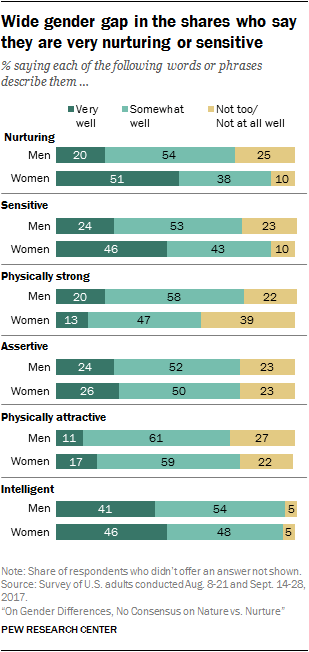
Women are far more likely than men to describe themselves as nurturing or sensitive

Wide gender gap in the shares who say they are very nurturing or sensitive

In addition to asking how men and women see themselves in terms of their masculinity or femininity, the survey asked men and women how well certain words or phrases describe them. For the most part, responses didn’t vary considerably by gender. For example, similar shares of men (24%) and women (26%) say they are very assertive. And while women are somewhat more likely than men to say they are very intelligent (46% vs. 41%, respectively) or physically attractive (17% vs. 11%), these gaps are relatively narrow.

In contrast, there is a wide gap in the shares of men and women who describe themselves as very nurturing and very sensitive. Women are more than twice as likely as men to say they are very nurturing: 51% of women describe themselves this way, compared with 20% of men. And while 46% of women say they are very sensitive, about a quarter of men (24%) say the same.

Women who describe themselves as very feminine are particularly likely to say they are very nurturing (65% vs. 48% of those who say they are somewhat feminine and 35% of those who say they are not too or not at all feminine) and very sensitive (55% vs. 44% and 33%, respectively). Among men, three-in-ten or fewer among those who say they are very, somewhat or not particularly masculine describe themselves as very nurturing or sensitive.

When it comes to physical strength, men are only slightly more likely than women to say they are very strong (20% vs. 13%). But when those who say they are at least somewhat physically strong are considered, the gap widens considerably: 78% of men say they are at least somewhat strong, compared with 60% of women. About four-in-ten women (39%) – vs. 22% of men – say they are not too or not at all strong. Among men who describe themselves as very masculine, 40% say they are very strong, compared with 12% of men who say they are somewhat masculine and 7% of those who say they are not too or not at all masculine. Women who say they are very feminine are also more likely than those saying they are less feminine to say they are very strong (21% vs. 9% of those who say they are somewhat feminine and 11% not too or not at all feminine).

Black men and women are more likely than their white counterparts to say they are very strong and very attractive. About a third of black men (35%) say the phrase “physically strong” describes them very well, compared with 18% of white men. And while 22% of black women say they are very strong, 10% of white women say the same. Among Hispanics, 22% of men and 16% of women describe themselves as very strong.

When it comes to looks, 30% of black men consider themselves very attractive, compared with about one-in-ten white (8%) and Hispanic (10%) men. And while about a third of black women (34%) and a quarter of Hispanic women say they are very attractive, just 12% of white women describe themselves this way.

Black men are also about twice as likely as white men to say they are very nurturing: 36% of black men describe themselves this way, vs. 17% of white men. No such difference is evident between black women and white women. Black women are far more likely than white women to say they are very intelligent, however (62% vs. 43%), while the difference in the shares of black men and white men who describe themselves this way is not significant.

4. Gender, generation and partisanship come into play in attitudes about raising boys and girls

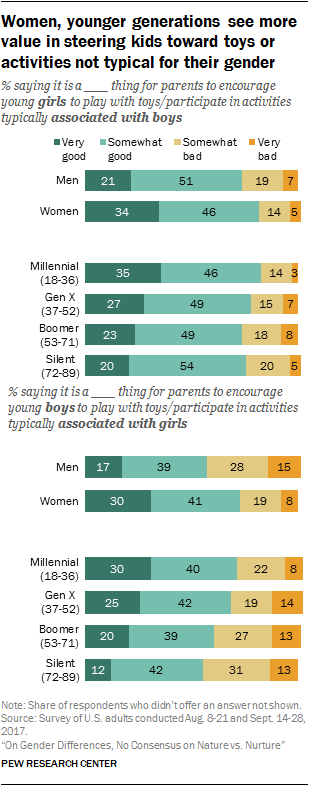
Most American adults are open to the idea of exposing young girls and boys to toys and activities that are typically associated with the opposite gender. Roughly three-quarters (76%) say it is a good thing for parents of young girls to encourage them to play with toys or participate in activities that are typically associated with boys; this includes 28% who say this is a very good thing. Fewer, but still a majority (64%), say it is a good thing for parents to encourage boys to play with toys or engage in activities usually thought of as being for girls (24% say this is a very good thing).

Women are more likely than men to say breaking with gender norms is a good approach to take in raising both girls and boys. Large majorities of women (80%) and men (72%) say it’s a good thing to steer girls toward boy-oriented toys and activities; women are much more likely to say this is a very good thing (34% of women compared with 21% of men). When it comes to raising boys, 71% of women but only 56% of men say it’s a good thing for parents to encourage boys to play with toys or engage in activities usually associated with girls (30% of women compared with 17% of men say this is a very good thing).

There are generational differences in views on raising boys and girls, with younger generations more open to the idea of introducing young children to toys and activities that are usually associated with the opposite gender. But across generations adults are more accepting of encouraging girls to engage in boys’ activities than they are of encouraging boys to explore girl-oriented activities.

Women, younger generations see more value in steering kids toward toys or activities not typical for their gender

Roughly eight-in-ten Millennials (81%) say it’s a good thing for parents to encourage their girls to engage in activities that are typically associated with boys, compared with 76% of Gen Xers, 72% of Boomers and 73% of members of the Silent Generation. Roughly a third of Millennials (35%) say this is a very good thing, compared with about one-in-four or fewer among older generations.

Millennials (69%) and Gen Xers (67%) are more likely than Boomers (59%) and members of the Silent Generation (54%) to say it’s a good thing for parents to encourage young boys to play with toys and pursue activities normally associated with girls. Three-in-ten Millennials, compared with 12% in the Silent Generation, say this is a very good thing.

There are generational differences within genders as well. Among Millennial and Gen X women, the shares saying it’s a very good thing for parents of young girls to encourage them to play with toys or do activities that are usually associated with boys (42% and 37%, respectively) are substantially higher than among women from the Baby Boom and Silent generations (28% and 22%). The patterns are similar when it comes to raising boys.

Millennial men are about twice as likely as their older counterparts to say it’s a very good thing to steer girls toward male-oriented activities – 29% of Millennial men say this compared with 17% across the three other adult generations.

Masculinity and femininity factor into views about raising boys and girls

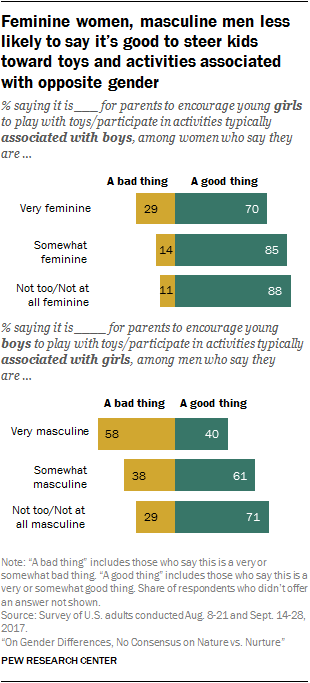
Feminine women, masculine men less likely to say it’s good to steer kids toward toys and activities associated with opposite gender

The survey finds some evidence that the way a man views his own masculinity is related to his ideas about raising children. Among men who describe themselves as very manly or masculine, 40% say it’s a good thing for parents to encourage boys to play with toys or take part in activities that are normally associated with girls; 58% say this is a bad thing. The share saying this is a bad thing is significantly lower among men who describe themselves as somewhat manly or masculine (38%) or as not too or not at all masculine (29%). Fully 71% of men who say they are not too or not at all masculine say steering boys toward these toys and activities is a good thing.

Men who see themselves as very masculine are also less enthused about encouraging girls to do things usually seen as male-oriented: 37% of very masculine men say this is a bad thing compared with 23% of men who say they are somewhat masculine and 16% of those who say they are not too or not at all masculine.

Similarly, women’s own sense of femininity is tied to their views on raising children. While 70% of women who describe themselves as very feminine or womanly say it is a good thing for parents to encourage girls to play with toys and do activities that are usually associated with boys, women who don’t describe themselves this way are significantly more likely to say the same (85%); 24% of women who describe themselves as very feminine or womanly say this is a very good thing compared with 38% who say they are somewhat feminine and 41% who say they are not too or not at all feminine.

Women who say they are very feminine are also more resistant than other women to the idea of steering boys toward toys and activities that are most often associated with girls – 37% of very feminine women say this is a bad thing compared with 24% of women who say they are somewhat feminine and 20% who describe themselves as not too or not at all feminine.

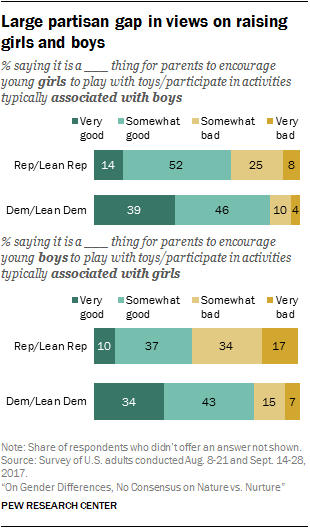
Large partisan gap in views on raising girls and boys

Beyond gender and generation there are significant partisan gaps in views about raising girls and boys. Democrats are much more in favor of the idea of exposing girls and boys to toys and activities normally associated with the opposite gender. Overall, 85% of Democrats say it’s a good thing for parents to encourage girls to do things normally associated with boys and 78% say it’s a good thing to encourage boys to do things that are thought to be more girl-like. Fewer Republicans say the same: 66% say it’s a good thing to encourage girls in this way and 47% say the same about boys.

Democrats feel more strongly about this than Republicans. For example, 34% of Democrats but only 10% of Republicans say it’s a very good thing for parents to encourage boys to play with toys or participate activities normally associated with girls. Among Republicans 52% say this is a bad thing, including 17% who say it’s a very bad thing.

Majorities say too little emphasis on talking about feelings for boys, being leaders and standing up for themselves for girls

About six-in-ten adults say, in raising boys, there’s too little emphasis on encouraging them to talk about feelings

Americans have different views when it comes to how much emphasis there should be in encouraging certain traits and behaviors in boys versus girls. The biggest difference can be seen on encouraging children to talk about their feelings when they are sad or upset. Roughly six-in-ten adults (59%) say there is too little emphasis on this in raising boys today; 29% say the emphasis is about right and 11% say there’s too much emphasis on this. Far fewer adults (38%) say there’s too little emphasis on encouraging girls to talk about their feelings; 51% say the emphasis is about right and 11% say there’s too much emphasis.

On the other hand, 54% of adults say there is too little emphasis on encouraging girls to stand up for themselves. Fewer than half (40%) say there’s too little emphasis on encouraging boys to stand up for themselves.

Similarly, when it comes to encouraging children to be leaders, Americans are more likely to say there is too little emphasis on this in raising girls than they are to say the same about raising boys. About half (53%) say there is too little focus on encouraging girls to be leaders; 41% say the same about boys.

About half of the public (51%) says there needs to be more emphasis on encouraging boys to do well in school. A somewhat smaller share (43%) says the same about girls.

Men and women, Republicans and Democrats have different ideas on where the emphasis should be in raising girls and boys

There are some significant gaps between men and women in views on these issues. Women are more likely than men to think both boys and girls should be encouraged more to share their feelings. Two-thirds of women, compared with 52% of men, say there is too little emphasis on this for boys. Similarly, 45% of women, but only 30% of men, say there is too little emphasis on this for girls.

While a greater share of men than women say there is not enough emphasis on encouraging boys to be leaders (46% of men compared with 38% of women), just the opposite is true for girls. More women (57%) than men (49%) say there is too little emphasis on encouraging girls to be leaders. Millennial women stand out in this regard: 68% say that there needs to be more emphasis on this compared with 55% of Gen X women, 53% of Boomers and 44% among the Silent Generation.

Women are more likely than men to say that girls don’t get enough encouragement to do well in school (48% of women vs. 37% of men). Men, on the other hand, are more likely than women to say boys need more encouragement to stand up for themselves (45% of men say there is too little emphasis on this for boys, compared with 35% of women).

Among men, those who describe themselves as very manly or masculine are particularly likely to say boys should be more encouraged to be leaders – 61% of these men say there is too little emphasis on this for boys, compared with about 40% or less of men who do not describe themselves this way. Men who see themselves as very masculine are less likely than other men to say there is too little emphasis on encouraging boys to talk about their feelings: 44% say this, compared with 55% of men who describe themselves as somewhat masculine and 63% of those who say they are not too or not at all masculine.

Women who see themselves as very feminine or womanly seem to have fewer concerns about how girls are being raised these days than women who describe themselves as less feminine. For example, roughly half of women who say they are very feminine (48%) say there is too little emphasis on encouraging girls to be leaders; a significantly larger share (63%) of women who describe themselves as somewhat or not too or not at all feminine say there is too little emphasis on this. And, while 46% of very feminine women say there is too little emphasis on encouraging girls to stand up for themselves, 63% of women who describe themselves as less feminine say the same.

Republicans, Democrats differ over how much emphasis should be given to developing leadership in boys and girls

Republicans and Democrats are also divided over the extent to which these traits and behaviors should be emphasized in raising boys and girls. There’s a particularly large gap when it comes to encouraging boys and girls to be leaders. A majority of Republicans (56%) say there is too little emphasis on this trait for boys; only 30% of Democrats agree. For their part Democrats are much more likely than Republicans to say there is too little emphasis on leadership for girls – 64% of Democrats say this compared with 39% of Republicans.

Similarly, while more Republicans (49%) than Democrats (33%) say there is too little emphasis on teaching boys to stand up for themselves, just the opposite is true when it comes to girls. Roughly six-in-ten Democrats (63%) say there’s too little emphasis on this for girls, compared with only 43% of Republicans.

Democrats are more likely than Republicans to say there’s too little emphasis on encouraging both boys and girls to talk about their feelings. And Democrats are more likely than Republicans to say girls should receive more encouragement to do well in school.


Acknowledgments

Pew Research Center received invaluable advice on the development of the questionnaire from Scott Coltrane, former Provost, University of Oregon; Michael Kimmel, Distinguished Professor of Sociology and Gender Studies, Stony Brook University; and Brigid Schulte, Director of Better Life Lab and The Good Life Initiative, New America.

This report is a collaborative effort based on the input and analysis of the following individuals. Find related reports online at www.pewresearch.org/pewresearch-org/social-trends.

Kim Parker, Director, Social Trends Research Juliana Horowitz, Associate Director, Research                

Renee Stepler, Research Analyst Anna Brown, Research Analyst Anthony Cilluffo, Research Assistant Nikki Graf, Research Associate Gretchen Livingston, Senior Researcher Claudia Deane, Vice President, Research Molly Rohal, Communications Manager Jessica Pumphrey, Communications Associate Michael Keegan, Information Graphics Designer David Kent, Copy Editor Travis Mitchell, Digital Producer


Methodology

The American Trends Panel (ATP), created by Pew Research Center, is a nationally representative panel of randomly selected U.S. adults recruited from landline and cellphone random-digit-dial surveys. Panelists participate via monthly self-administered web surveys. Panelists who do not have internet access are provided with a tablet and wireless internet connection. The panel is being managed by Abt Associates.

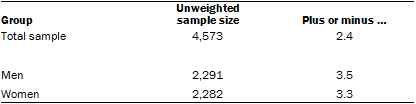
Data in this report are based on 4,573 respondents who participated in both the Aug. 8-21, 2017, and the Sept. 14-28, 2017, waves of the panel. The margin of sampling error for the full sample of 4,573 respondents is plus or minus 2.4 percentage points.

Members of the American Trends Panel were recruited from several large, national landline and cellphone random-digit-dial surveys conducted in English and Spanish. At the end of each survey, respondents were invited to join the panel. The first group of panelists was recruited from the 2014 Political Polarization and Typology Survey, conducted Jan. 23 to March 16, 2014. Of the 10,013 adults interviewed, 9,809 were invited to take part in the panel and a total of 5,338 agreed to participate.4 The second group of panelists was recruited from the 2015 Pew Research Center Survey on Government, conducted Aug. 27 to Oct. 4, 2015. Of the 6,004 adults interviewed, all were invited to join the panel, and 2,976 agreed to participate.5 The third group of panelists was recruited from a survey conducted April 25 to June 4, 2017. Of the 5,012 adults interviewed in the survey or pretest, 3,905 were invited to take part in the panel and a total of 1,628 agreed to participate.6

The ATP data were weighted in a multi-step process that begins with a base weight incorporating the respondents’ original survey selection probability and the fact that in 2014 some panelists were subsampled for invitation to the panel. Next, an adjustment was made for the fact that the propensity to join the panel and remain an active panelist varied across different groups in the sample. The final step in the weighting uses an iterative technique that aligns the sample to population benchmarks on a number of dimensions. Gender, age, education, race, Hispanic origin and region parameters come from the U.S. Census Bureau’s 2015 American Community Survey. The county-level population density parameter (deciles) comes from the 2010 U.S. decennial census. The telephone service benchmark comes from the January-June 2016 National Health Interview Survey and is projected to 2017. The volunteerism benchmark comes from the 2015 Current Population Survey Volunteer Supplement. The party affiliation benchmark is the average of the three most recent Pew Research Center general public telephone surveys. The internet access benchmark comes from the 2017 ATP Panel Refresh Survey. Respondents who did not previously have internet access are treated as not having internet access for weighting purposes. Sampling errors and statistical tests of significance take into account the effect of weighting. Interviews are conducted in both English and Spanish, but the Hispanic sample in the American Trends Panel is predominantly native born and English speaking.

The following table shows the unweighted sample sizes and the error attributable to sampling that would be expected at the 95% level of confidence for different groups in the survey:

Sample sizes and sampling errors for other subgroups are available upon request.

In addition to sampling error, one should bear in mind that question wording and practical difficulties in conducting surveys can introduce error or bias into the findings of opinion polls.

The combined two waves had a response rate of 68.0% (4,573 responses among 6,722 individuals in the panel). Taking account of the combined, weighted response rate for the recruitment surveys (10.0%) and attrition from panel members who were removed at their request or for inactivity, the cumulative response rate for the combined two ATP waves is 2.3%.7

© Pew Research Center, 2017