Pew Research Center

FOR RELEASE JUNE 22, 2017

America’s Complex Relationship With Guns

An in-depth look at the attitudes and experiences of U.S. adults

BY Kim Parker, Juliana Menasce Horowitz, Ruth Igielnik, J. Baxter Oliphant and Anna Brown

FOR MEDIA OR OTHER INQUIRIES:

Communications Department
202.419.4372
www.pewresearch.org

RECOMMENDED CITATION

Pew Research Center, June 2017, "America’s Complex Relationship With Guns"

About Pew Research Center

Pew Research Center is a nonpartisan, nonadvocacy fact tank that informs the public about the issues, attitudes and trends shaping the world. It does not take policy positions. The Center conducts public opinion polling, demographic research, computational social science research and other data-driven research. It studies politics and policy; news habits and media; the internet and technology; religion; race and ethnicity; international affairs; social, demographic and economic trends; science; research methodology and data science; and immigration and migration. Pew Research Center is a subsidiary of The Pew Charitable Trusts, its primary funder.

© Pew Research Center 2026

Table of contents

  • About Pew Research Center
  • America’s Complex Relationship With Guns
  • 1. The demographics of gun ownership
  • 2. Guns and daily life: Identity, experiences, activities and involvement
  • 3. Views of gun safety and the key responsibilities of gun owners
  • 4. Views of guns and gun violence
  • 5. Views on gun policy
  • Acknowledgments
  • Methodology

America’s Complex Relationship With Guns

An in-depth look at the attitudes and experiences of U.S. adults

For the most recent data on gun owners, read our 2023 report “For Most U.S. Gun Owners, Protection Is the Main Reason They Own a Gun.”
As a nation, the U.S. has a deep and enduring connection to guns. Integrated into the fabric of American society since the country’s earliest days, guns remain a point of pride for many Americans. Whether for hunting, sport shooting or personal protection, most gun owners count the right to bear arms as central to their freedom. At the same time, the results of gun-related violence have shaken the nation, and debates over gun policy remain sharply polarized.

A new Pew Research Center survey attempts to better understand the complex relationship Americans have with guns and how that relationship intersects with their policy views.

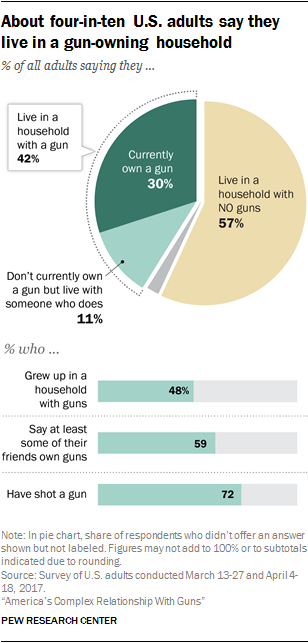
The survey finds that Americans have broad exposure to guns, whether they personally own one or not. At least two-thirds have lived in a household with a gun at some point in their lives. And roughly seven-in-ten – including 55% of those who have never personally owned a gun – say they have fired a gun at some point. Today, three-in-ten U.S. adults say they own a gun, and an additional 36% say that while they don’t own one now, they might be open to owning a gun in the future. A third of adults say they don’t currently own a gun and can’t see themselves ever doing so.

To be sure, experiences with guns aren’t always positive: 44% of U.S. adults say they personally know someone who has been shot, either accidentally or intentionally, and about a quarter (23%) say they or someone in their family have been threatened or intimidated by someone using a gun. Half see gun violence as a very big problem in the U.S. today, although gun owners and non-owners offer divergent views on this.

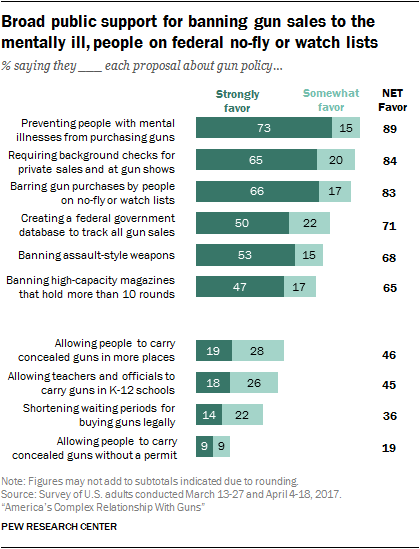
Gun owners and non-owners are also deeply divided on several gun policy proposals, but there is agreement on some restrictions, such as preventing those with mental illnesses and those on federal watch lists from buying guns. Among gun owners, there is a diversity of views on gun policy, driven in large part by party affiliation.

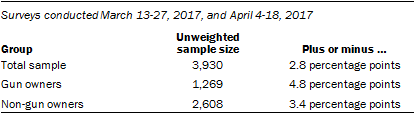
The nationally representative survey of 3,930 U.S. adults, including 1,269 gun owners, was conducted March 13 to 27 and April 4 to 18, 2017, using the Pew Research Center’s American Trends Panel.1 Among the key findings:

The ties that bind gun owners to their firearms are often deep
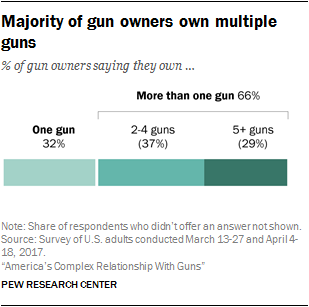
A majority of gun owners (66%) own multiple firearms, and about three-quarters (73%) say they could never see themselves not owning a gun.

Many American gun owners exist in a social context where gun ownership is the norm. Roughly half of all gun owners (49%) say that all or most of their friends own guns. In stark contrast, among those who don’t own a gun, only one-in-ten say that all or most of their friends own guns.

Experience with guns starts relatively early particularly for those who grew up in a gun-owning household. Men who grew up in a household with guns and who have ever shot a gun report that they first fired a gun when they were, on average, 12 years old. Among women who grew up in gun-owning households and who have ever shot a gun, the average age at which they first fired a gun is 17. Men tend to become gun owners at an earlier age than women: 19 years old, on average, vs. 27 years old for women.

For most gun owners, owning a firearm is tied to their personal freedom

One key and defining characteristic of gun owners is the extent to which they associate the right to own guns with their own personal sense of freedom – 74% of gun owners say this right is essential, compared with only 35% of non-gun owners who say the same.

While the right to own guns is highly valued by most gun owners, not all gun owners see gun ownership the same way. Half of all gun owners say owning a gun is important to their overall identity – with 25% saying this is very important and another 25% calling it somewhat important. Three-in-ten gun owners say owning a gun is not too important to their identity and 20% say it’s not at all important.

White men are especially likely to be gun owners, but ownership crosses demographic boundaries

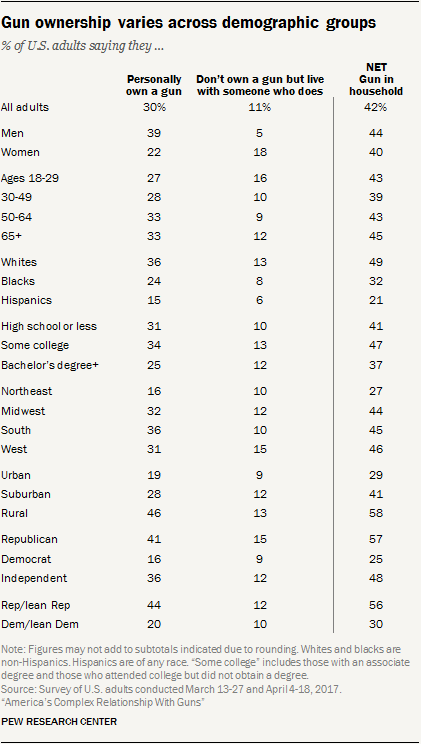
About half of white men (48%) say they own a gun. By comparison, about a quarter of white women and nonwhite men (24% each) own guns, along with 16% of nonwhite women. 2 There is also an education gap in gun ownership and that, too, is particularly pronounced among whites: 41% of whites without a bachelor’s degree are gun owners, compared with about a quarter of whites with at least a bachelor’s degree (26%).

Geographically, gun ownership is less concentrated in the Northeast than in other regions in the country, and there is a vast urban-rural divide across regions. Among adults who live in rural areas, 46% say they own a gun. By comparison, 28% of adults who live in the suburbs and even fewer – 19% – in urban areas own a gun.

The demographics of gun ownership
 

Male gun owners tend to be more immersed in gun culture than their female counterparts
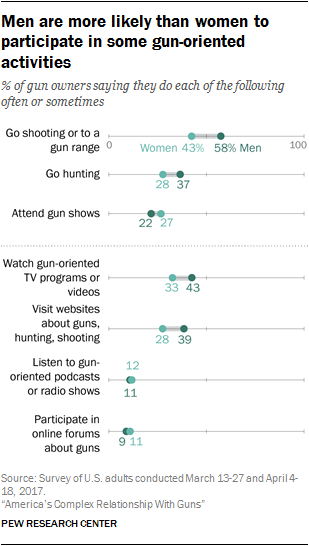
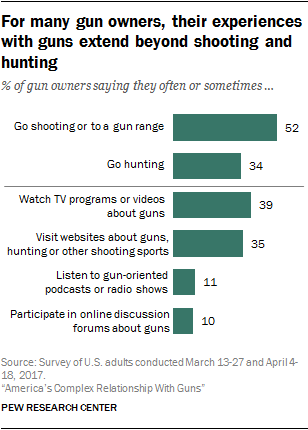
From hunting and shooting to visiting gun-related websites and watching gun-oriented TV programs, there are many activities available to gun enthusiasts. About half of gun owners (52%) say they go shooting or to a gun range often or sometimes; 34% go hunting and 24% attend gun shows at least sometimes.

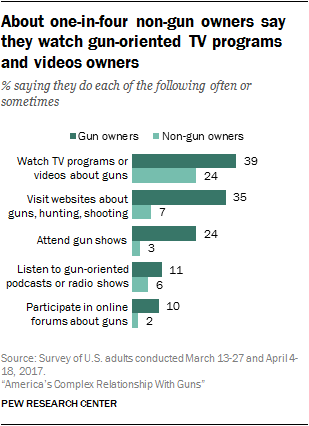
When it comes to gun-oriented media, roughly four-in-ten gun owners (39%) report that they at least sometimes watch TV shows and videos about guns, and 35% visit websites about guns, hunting or other shooting sports. Gun-related podcasts, radio shows and online discussion forums are less popular: About one-in-ten gun owners say they listen to gun-oriented podcasts or radio shows (11%) or participate in online discussion forums about guns (10%) at least sometimes.

Male gun owners are more likely than women who own guns to engage in some of these activities. For example, 58% of men who own guns say they go shooting or to a gun range at least sometimes, compared with 43% of female gun owners. Men also hunt at higher rates than women and watch more gun-oriented TV shows or videos.

Consistent with their more frequent engagement in gun-related activities, male gun owners are more socially connected to other gun owners than their female counterparts: 54% of men who own guns say all or most of their friends are also gun owners, while 40% of women say the same.

Protection tops the list of reasons for owning a gun

Two-thirds of gun owners say protection is a major reason they own a gun. By comparison, about four-in-ten (38%) cite hunting as a major reason and three-in-ten cite sport shooting, including target shooting, trap and skeet. Fewer point to a gun collection (13%) or to their job (8%) as being central to why they own a gun. To be sure, for many gun owners, these reasons overlap: 44% offer more than one major reason for owning a gun.

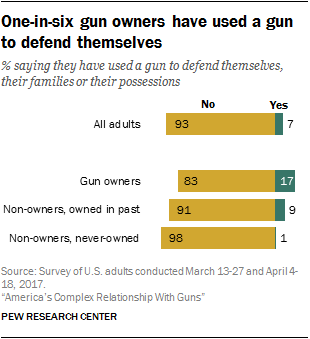
Roughly one-in-seven adults who own or have owned a gun (15%) say they have fired or threatened to fire a gun to defend themselves, their family or their possessions.

Regardless of the reasons for owning a gun, most gun owners don’t think their having a firearm is public business, but they also aren’t going out of their way to hide the fact that they own a gun. Eight-in-ten gun owners say they don’t mind if other people know they own a gun, but they don’t set out to tell them; 14% say they’d rather other people not know that they have a firearm, and 6% actively do want others to know.

For many gun owners, a gun is often close at hand
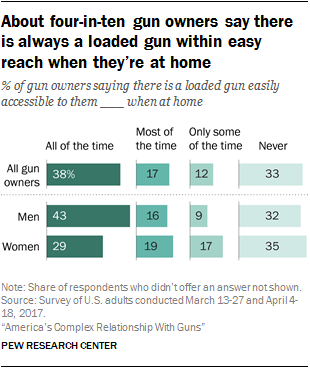
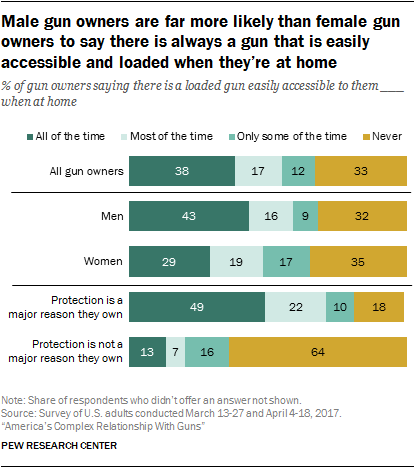
Roughly four-in-ten gun owners (38%) say there is a gun that is both loaded and easily accessible to them all of the time when they’re at home. Men are especially likely to have a loaded gun at the ready: 43% of male gun owners vs. 29% of women who own guns say a loaded gun is always easily accessible.

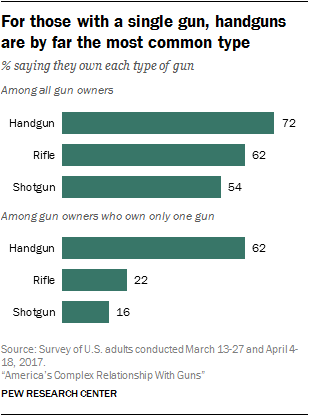
Overall, about seven-in-ten gun owners say they own a handgun or a pistol (72%), while 62% say they own a rifle and 54% own a shotgun. Handguns are more common among those who own a gun for protection.

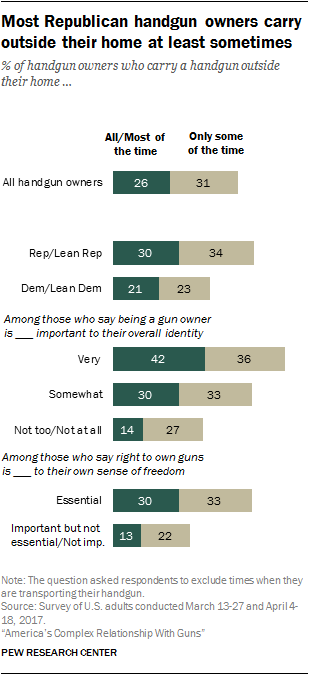
Among those who own a handgun, about one-in-four (26%) say they carry their gun with them outside of their home all or most of the time, a share that rises to 41% among those who think of their local community as unsafe.

When it comes to gun safety in homes with children, there are some areas of agreement about key precautions
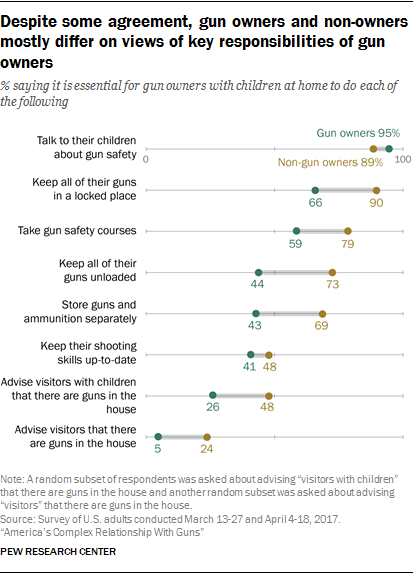
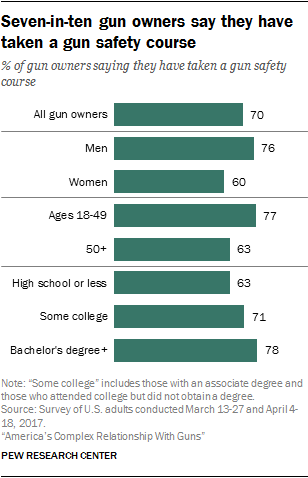
Of the many possible safety precautions gun owners could take when they live with children in the home, three receive majority support from both non-owners and those who currently own a firearm. Nearly all gun owners (95%) believe that talking to children about gun safety is essential, followed by 66% who say all guns should be kept in a locked place when there are children living in the home, and 59% who say gun owners who are parents should take a gun safety course. Majorities of non-gun owners also say these are essential measures for gun owners with children in the home.

The majority of Americans who don’t own guns feel it is also essential for gun owners with children living in the home to keep their guns unloaded and in a separate spot from the ammunition. Gun owners disagree. Majorities say these measures are either important but not essential or not important, even in households with children.

When asked about their own habits, roughly half of gun owners with children under 18 living at home say all of the guns in their home are kept in a locked place (54%) and all are unloaded (53%).

Still, many gun owners with children say at least some of their guns are kept unlocked and loaded. In fact, 30% of these gun owners say there is a gun that is both loaded and easily accessible to them all of the time when they’re at home.

Americans who own guns largely disagree with non-owners on gun policy, but some proposals have support from both groups

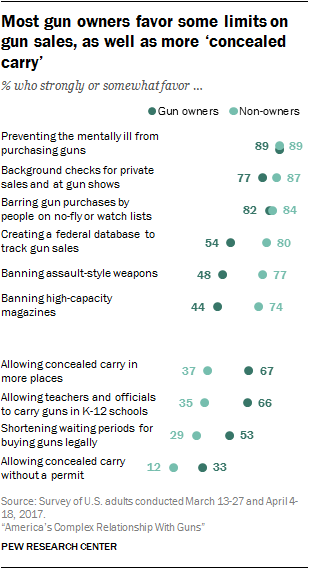
Solid majorities of both gun owners and non-owners favor limiting access to guns for people with mental illnesses and individuals who are on the federal no-fly or watch lists (82% or higher favor among each group). In addition, strong majorities favor background checks for private sales and at gun shows (77% among gun owners and 87% among non-owners).

The groups are more divided when it comes to three other policy proposals: creating a federal database to track gun sales; banning assault-style weapons; and banning high-capacity magazines. Even so, significant shares of gun owners are open to these proposals. Roughly half of gun owners (54%) say they would favor creating a federal database, and 48% favor a ban on assault weapons. Some 44% of gun owners favor banning high-capacity magazines. Support for these proposals is much higher among non-gun owners, with about three-quarters or more saying they would support each of these proposals.

At the same time, majorities of gun owners favor proposals that would expand gun rights, such as allowing people to carry concealed guns in more places and allowing teachers and school officials to carry guns in K-12 schools – proposals that are each supported by only about a third of non-owners.

Even among gun owners, Republicans and Democrats don’t see eye to eye on gun policy
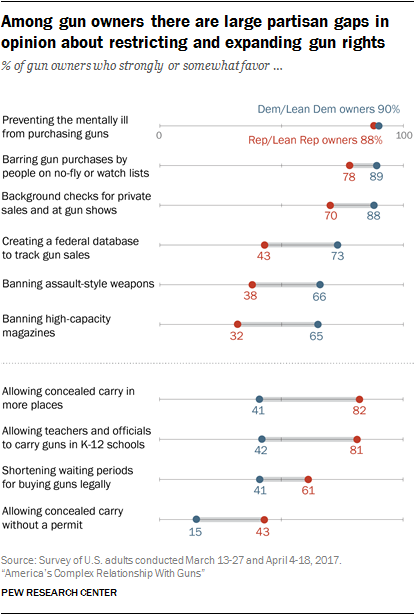
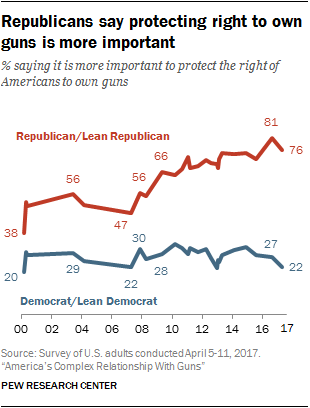
There is a partisan divide in gun ownership: More than four-in-ten Republicans and Republican-leaning independents are gun owners (44%), compared with 20% of Democrats and independents who lean Democratic.

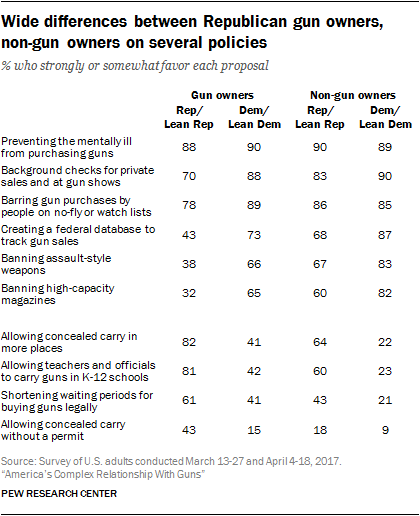
There is also a partisan divide on views of gun policy, and these differences remain even after controlling for gun ownership. For example, Republican gun owners are much more resistant than Democratic gun owners to creating a database to track gun sales and banning assault-style weapons and high-capacity magazines. On the flip side, Republicans are also more open to proposals that would expand gun rights. A prime example: 82% of Republican gun owners favor expanding concealed carry laws to more places, compared with 41% of their Democratic counterparts.

Republican gun owners are about twice as likely as Democratic gun owners to say owning a gun is essential to their freedom (91% vs. 43%), and there are also behavioral differences between these two groups. For example, Republican handgun owners are more likely than their Democratic counterparts to say they carry their gun with them, even if only some of the time (63% vs. 45%). Fully 55% of Democrats who own a handgun say they never carry.

At the most basic level, gun owners and non-owners disagree on the extent to which gun violence is a problem in the U.S.

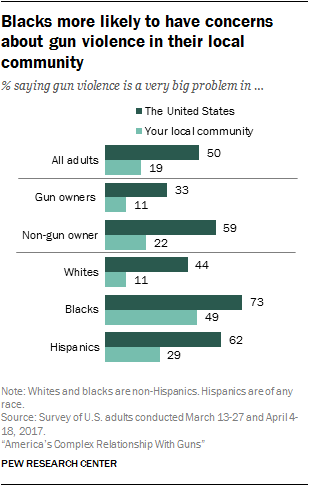
Half of Americans describe gun violence as a very big problem in the United States, but the perceptions of gun owners and those who don’t own guns differ considerably. While a majority of those who do not own guns (59%) see gun violence as a major problem in the country today, a third of adults who own guns say this is a very big problem. Democrats and Republicans also offer different assessments, with Democrats far more likely to describe gun violence as a very big problem, and the partisan divide remains when controlling for gun ownership.

Americans see many factors as playing a role in gun violence in the country today. Fully 86% say the ease with which people can illegally obtain guns contributes to gun violence a great deal or a fair amount; more than half say the same about family instability (74%), lack of economic opportunities (65%), the amount of gun violence in video games (60%), the ease with which people can legally obtain guns (60%), and the amount of gun violence in movies and television (55%).

Gun owners and non-owners alike point to the ease with which people can illegally obtain guns as a major contributor to gun violence in the U.S., but opinions diverge when it comes to guns obtained legally. Two-thirds of non-gun owners see the ease with which people can legally obtain guns as contributing at least a fair amount to gun violence; less than half (44%) of gun owners share this view.

It follows that non-gun owners are much more likely than gun owners to say further restricting legal gun sales would result in fewer mass shootings (56% vs. 29%); and non-gun owners are also more likely to say an increase in gun ownership would lead to more crime overall (44% vs. 13%). For their part, 54% of gun owners say there would be less crime if more people owned guns, and 33% say it wouldn’t make much difference.

About a quarter of U.S. adults say they or someone in their family have been threatened or intimidated by someone using a gun

Many Americans (44%) say they personally know someone who has been shot, either accidentally or intentionally. This is particularly common among black adults, 57% of whom say they know someone who has been shot; about four-in-ten whites (43%) and Hispanics (42%) say the same.

Higher share of gun owners (51%) than non-owners (40%) report that they know someone who has been shot, either accidentally or intentionally.

Separately, about a quarter of Americans (23%) – including roughly equal shares of gun owners and non-owners – say they or someone in their family have been threatened or intimidated by someone using a gun. Again, blacks are more likely than whites to say they have had this experience: About a third of blacks (32%) say they or someone in their family have been threatened or intimidated by someone with a gun, compared with 20% of whites. About a quarter of Hispanics (24%) say this has happened to them or to someone else in their family.

Roughly one-in-five gun owners belongs to the NRA

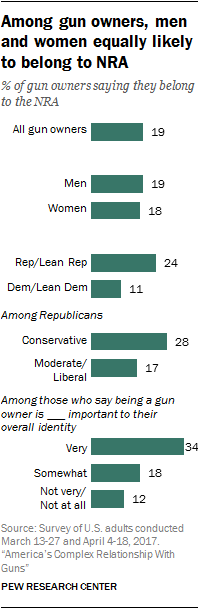
Overall, 19% of all U.S. gun owners say they belong to the NRA. Republican and Republican-leaning gun owners are twice as likely as Democratic and Democratic-leaning gun owners to say they belong to the NRA (24% vs. 11%). And, among Republicans, conservatives have significantly higher rates of membership – 28% vs. 17% of moderate or liberal Republicans.

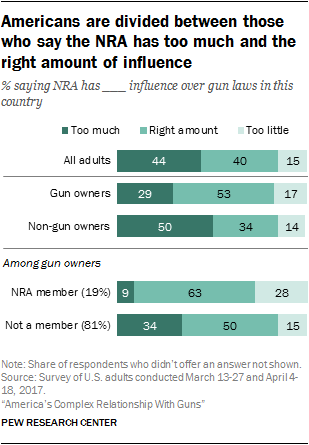
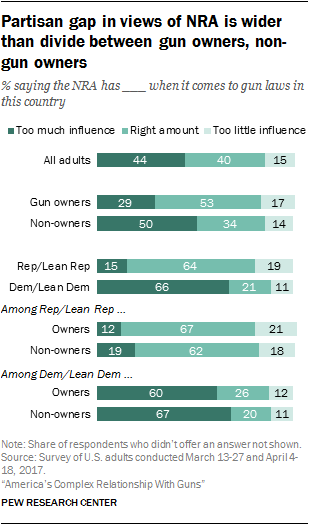
The public is divided when it comes to the amount of influence the NRA has over guns laws in the U.S. While 44% of all adults say the NRA has too much influence over gun legislation, 40% say it has the right amount of influence. Relatively few (15%) say the NRA has too little influence.
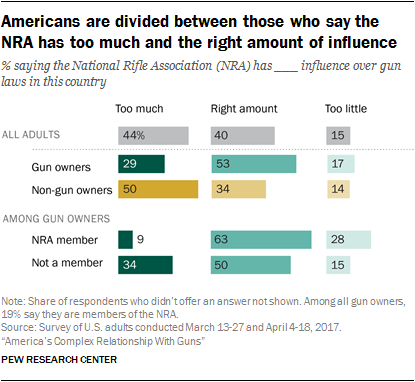
For their part, NRA members are largely satisfied with the amount of influence the organization has over gun laws in the U.S. About six-in-ten (63%) say the NRA has the right amount of influence and 28% say it has too little influence. Only 9% of NRA members say the organization has too much influence over gun laws. Among non-gun owners, 50% view the NRA as too influential.

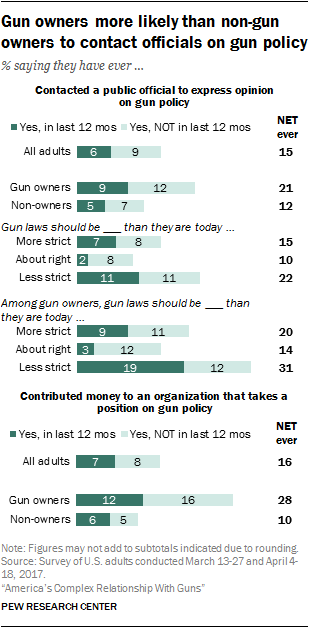
Gun owners are more likely than non-gun owners to have ever contacted a public official to express their opinion on gun policy. About one-in-five gun owners (21%) say they have done this, compared with 12% of non-gun owners.

The remainder of this report examines in greater detail the public’s experiences with guns as well as views on gun policies. Chapter 1 looks at the demographics of gun ownership and the reasons people own guns. It also explores early experiences with guns, such as growing up in a gun-owning household and participating in hunting or sport shooting. Chapter 2 focuses on the role guns have in the daily life of gun owners, including whether they carry a gun outside their home, how often they engage in gun-related activities or consume gun-oriented media, and their social ties to other gun owners. It also looks at negative experiences some people have had with guns. Chapter 3 examines the public’s views on the responsibilities of gun ownership, with an emphasis on the differences between what gun owners and non-owners consider essential safety measures for gun owners to follow. Chapter 4  explores what Americans see as contributing factors to gun violence. Chapter 5 focuses on the public’s views on policy proposals to restrict or expand access to guns.

Terminology

Unless otherwise specified, “guns” refers to firearms and not to airsoft guns, such as paintball, BB or pellet guns.

“Gun owners” are those who say they personally own one or more guns. “Non-owners who live in a gun-owning household” are those who say they do not personally own any guns, but someone else in their household does.

Those who did not grow up with guns in the home includes those who say, as far as they know, there were never any guns in their household when they were growing up or they are not sure if there were guns in their household when they were growing up.

Those who are said to have children in the household or at home are those who are a parent or guardian to a child younger than 18 who lives in their household.

References to college graduates or people with a college degree comprise those with a bachelor’s degree or more. “Some college” refers to those with a two-year degree or those who attended college but did not obtain a degree. “High school” refers to those who have attained a high school diploma or its equivalent, such as a General Education Development (GED) certificate.

References to whites and blacks include only those who are non-Hispanic and identify as only one race. Hispanics are of any race.

All references to party affiliation, excluding one reference in chapter 1, include those who lean toward that party: Republicans include those who say they lean toward the Republican Party and Democrats include those who say they lean toward the Democratic Party.

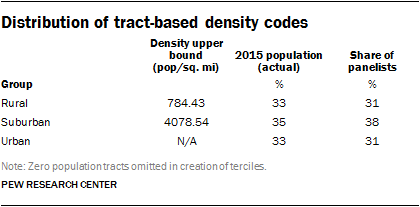
References to adults who live in an urban, suburban or rural area are based on an analysis that takes into account the density of the area where they live based on their address or the location of their telephone number or their ZIP code if they didn’t provide an address. For a more detailed explanation of how community type was coded, see the Methodology section of the report.
1. The demographics of gun ownership

Understanding gun ownership in America is not as simple as knowing who does and does not own a gun. Some Americans who don’t personally own guns live with someone who does or may have owned a gun in the past. And many who don’t currently own a gun, including those who have never owned one, may be open to doing so in the future.

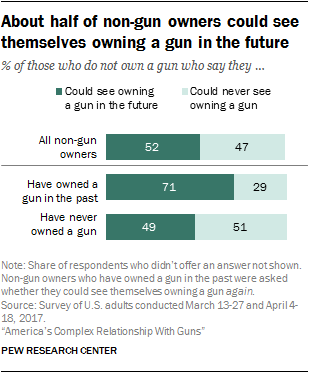
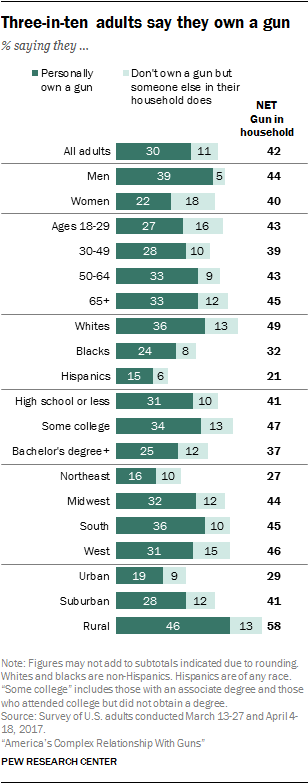
Three-in-ten American adults say they currently own a gun, and another 11% say they don’t personally own a gun but live with someone who does. Among those who don’t currently own a gun, about half say they could see themselves owning one in the future.

For those with a single gun, handguns are by far the most common type

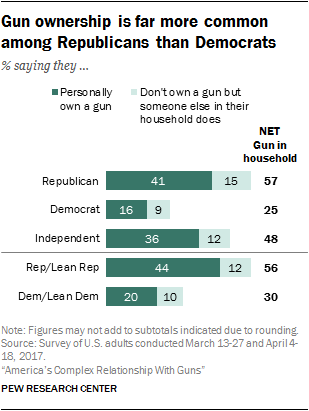
Gun ownership is more common among men than women, and white men are particularly likely to be gun owners. Among those who live in rural areas, 46% say they are gun owners, compared with 28% of those who live in the suburbs and 19% in urban areas. There are also significant differences across parties, with Republican and Republican-leaning independents more than twice as likely as Democrats and those who lean Democratic to say they own a gun (44% vs. 20%).

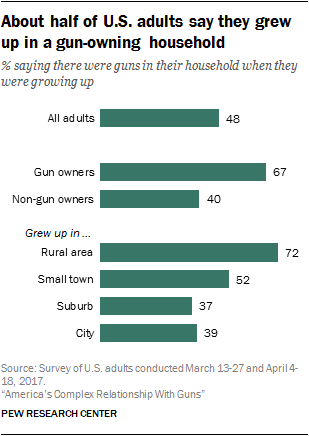
For many adults who own guns, exposure to guns happened at an early age. About two-thirds of current gun owners (67%) say there were guns in their household growing up, and 76% report that they first fired a gun before they were 18. While non-gun owners are less likely to have grown up in a gun-owning household, a substantial share (40%) say this is the case, and about six-in-ten (61%) say they have fired a gun.

Most gun owners cite multiple reasons for owning a gun. In fact, eight-in-ten say they have more than one reason for owning, and 44% have more than one major reason. Still, protection tops the list, with 67% of current gun owners saying this is a major reason they personally own a gun. About four-in-ten say the same about hunting (38%), while three-in-ten say sport shooting, including target, trap and skeet shooting is a major reason they own a gun. Fewer cite a gun collection (13%) or their job (8%) as major reasons for owning a gun.

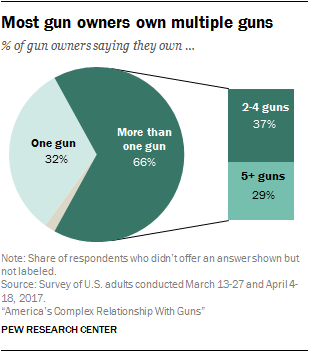
Two-thirds of gun owners say they own more than one gun, including 29% who own five or more guns. About seven-in-ten say they own a handgun or pistol (72%), while 62% own a rifle and 54% own a shotgun. Among those who own a single gun, most (62%) say that gun is a handgun or pistol, while far fewer say they own a rifle (22%) or a shotgun (16%).

Measuring gun ownership

Measuring gun ownership comes with its own set of challenges. For example, unlike many demographic questions, there is not a definitive data source from the government or elsewhere on how many American adults own guns.

The new survey asked about gun ownership differently than previous Pew Research Center reports. It collected responses online, where people may be more willing to share sensitive information than they would be over the phone or in person. Furthermore, the survey was conducted among adults who have responded to Pew Research Center surveys in the past as part of the American Trends Panel and thus may be more comfortable answering the questions. Finally, it asked about gun ownership using two separate questions to measure personal and household ownership instead of collecting this information with a single question, as has been the case with previous Pew Research Center reports.

Despite these changes, the share of U.S. adults in the new survey who report that they personally own a gun or who live with someone who does is similar to what the Center found in a survey conducted by telephone in August 2016. Both surveys are consistent with rates of gun ownership reported by the Gallup Organization, but somewhat higher than that reported by the General Social Survey (GSS), which is conducted face to face.

Gun ownership is most common among men, whites

Three-in-ten adults say they own a gun

About four-in-ten adults (42%) report that there is a gun in their household, with three-in-ten saying they personally own a gun and 11% saying they don’t own a gun but someone else in their household does.

Gun ownership varies considerably across demographic groups. For example, about four-in-ten men (39%) say they personally own a gun, compared with 22% of women. And while 36% of whites report that they are gun owners, about a quarter of blacks (24%) and 15% of Hispanics say they own a gun.

White men are especially likely to be gun owners: About half (48%) say they own a gun, compared with about a quarter of white women and nonwhite men (24% each) and 16% of nonwhite women.

Like the gender gap, the education gap in gun ownership is particularly pronounced among whites. Overall, about three-in-ten adults with a high school diploma or less (31%) and 34% of those with some college education say they own a gun; a quarter of those with a bachelor’s degree or more say the same. Among whites, about four-in-ten of those with a high school diploma or less (40%) or with some college (42%) are gun owners, compared with roughly a quarter of white college graduates (26%). There is no significant difference in the rate of gun ownership across educational attainment among nonwhites.

Regionally, Northeasterners stand out as the least likely to own guns: 16% of adults who live in the Northeast say they own a gun, about half the share who say this in the South (36%), Midwest (32%) and West (31%).

Gun ownership is far more common among Republicans than Democrats

Across all regions, gun ownership varies considerably between those who live in rural and urban areas, with rural dwellers far more likely than those who live in urban areas to say they own a gun. Overall, 46% of Americans who live in rural parts of the country own a gun, compared with 28% of those who live in the suburbs and 19% of those in urban areas.

Besides demographic differences, clear partisan divides emerge when it comes to gun ownership. Republicans and Republican-leaning independents are more than twice as likely as Democrats and Democratic-leaning independents to say they own a gun (44% vs. 20%). This partisan gap remains even after controlling for demographic differences.

Among the 11% of Americans who don’t personally own a gun but live in a gun-owning household, relatively few (19%) say they ever use the gun or guns in their household.

Most gun owners could never see themselves not owning a gun

Roughly three-quarters of Americans who currently own a gun (73%) say they can’t see themselves ever not owning one, and this is the case among majorities of gun owners across demographic groups.

Perhaps not surprisingly, those who see owning a gun as central to their overall identity are particularly committed to gun ownership. For example, 89% of gun owners who see owning a gun as very or somewhat important to their overall identity say they can’t see themselves ever not owning a gun, compared with 58% of those who say owning a gun is not too important or not at all important their sense of identity.

And while 85% of gun owners who say the right to own guns is essential to their sense of freedom say they can’t see themselves ever not owning a gun at some point, 41% of those who don’t see the right to own guns as essential say the same.

Many non-gun owners are open to owning a gun in the future

About half of non-gun owners could see themselves owning a gun in the future

In addition to the three-in-ten adults who currently own a gun, another 10% say they have owned one in the past; 58% say they have never owned a gun.

Many adults who don’t currently own a gun say they could see themselves owning one at some point. In fact, 52% of all non-gun owners – and 71% of those who have owned a gun in the past – say they could see themselves owning a gun in the future.

Consistent with patterns in gun ownership, a higher share of men than women who don’t currently own guns say they could see themselves doing so at some point; 62% of men who don’t own guns say this is the case, compared with 45% of women. And while 62% of non-gun owners who live in rural areas say they could see themselves owning a gun at some point, smaller shares of those who live in a suburban (49%) or urban (50%) areas say the same.

Two-thirds of gun owners cite protection as a major reason for owning a gun

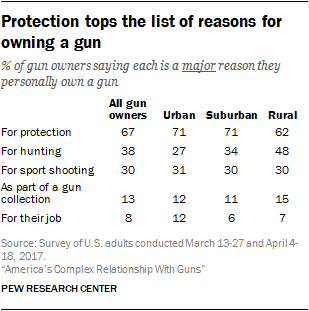
Most gun owners cite more than one reason for owning a gun, but protection tops the list, with 67% of gun owners saying this is a major reason they personally own a gun. About four-in-ten (38%) say hunting is a major reason they own a gun, while three-in-ten cite sport shooting, including target, trap and skeet shooting. Fewer gun owners cite a gun collection (13%) or their job (8%) as major reasons.

Men and women are about equally likely to say protection is a major reason they own a gun: 65% and 71%, respectively, say this is the case. But higher shares of male than female gun owners say hunting (43% of men vs. 31% of women) and sport shooting (34% vs. 23%) are major reasons they personally own a gun.

Protection tops the list of reasons for owning a gun

For the most part, gun owners in urban, suburban and rural areas offer similar reasons for owning guns. For example, about seven-in-ten of those who live in urban or suburban areas say protection is a major reason they own a gun (71% each), as do most gun owners in rural parts of the country (62%). And across community types, about three-in-ten cite sport shooting as a major reason.

When it comes to hunting, however, rural gun owners are far more likely than their urban or suburban counterparts to say it is as an important reason they own a gun; 48% of gun owners in rural areas say this, compared with 34% in the suburbs and 27% in urban parts of the country.

Interestingly, gun owners who see their local community as unsafe are not significantly more likely than those who say they live in a safe community to say protection is central to why they own a gun. About three-quarters of gun owners who say the community where they live is not too safe or not at all safe (74%) – and 66% of those who say they live in a community that is very or somewhat safe – cite protection as a major reason they own gun. There is a significant link, however, between owning a gun for protection and perceptions of whether the world, broadly speaking, has become more dangerous. While about seven-in-ten gun owners who say the world has become more dangerous cite protection as a major reason they own a gun (72%), half of those who don’t see the world that way say protection is central to why they own a gun. Overall, 69% of all U.S. adults – and 75% of those who own a gun – say the world has become a more dangerous place.

About two-thirds of gun owners own more than one gun

Most gun owners own multiple guns

Most gun owners (66%) say they own more than one gun, with about three-in-ten (29%) saying they own five or more guns. This is, perhaps, not surprising, considering that eight-in-ten gun owners cite more than one reason for owning a gun – including 44% who say there is more than one major reason – and may need different types of guns for different purposes. In fact, most gun owners who cite only one reason for owning a gun say they own a single gun (65%); in contrast, 74% of those who say they own a gun for more than one reason report having at least two guns.

Men are particularly likely to own multiple guns: About three-quarters of male gun owners (74%) say they own two or more guns, compared with 53% of female gun owners. This reflects, in part, the fact that men who own guns are more likely than their female counterparts to have more than one reason for doing so. Still, even after controlling for the number of reasons they own a gun, male gun owners remain more likely than their female counterparts to own multiple guns.

Overall, about seven-in-ten gun owners say they own a handgun or pistol (72%), while 62% own a rifle and 54% own a shotgun. While similar shares of male and female gun owners own a handgun (73% and 71%, respectively), rifles and shotgun are more popular among men. Roughly seven-in-ten male gun owners (69%) say they own a rifle and 60% own a shotgun, compared with 50% and 44% of women who own each type of gun, respectively.

Among gun owners with only one gun, handguns are by far the most common type of gun: 62% say this is the type of gun they own, while 22% own a rifle and 16% own a shotgun.

Most gun owners say there were guns in their household growing up

About half of U.S. adults say they grew up in a gun-owning household

Adults who describe the community where they grew up as rural are particularly likely to have grown up with a gun in their household: 72% in this group say this is the case. Still, a substantial share of those who grew up in a small town (52%), a suburb (37%) or a city (39%) say guns were present in their home when they were growing up.

Regardless of the type of community they lived in growing up, adults who grew up with guns in their households are far more likely than those who did not to be gun owners themselves. About four-in-ten who grew up in a gun-owning household say they currently own a gun (42%), compared with 19% of those who didn’t grow up with guns in their household. While this difference is most pronounced among those who grew up in rural areas – 48% of those who grew up with guns now own a gun vs. 12% of those who didn’t grow up with guns in their household – it is also evident among those who grew up in small towns, suburbs or cities.

Among non-gun owners, about six-in-ten of those who grew up in a gun-owning household say they could see themselves owning a gun at some point (61%). Of those who didn’t grow up with guns in their household, smaller shares say the same (46%).

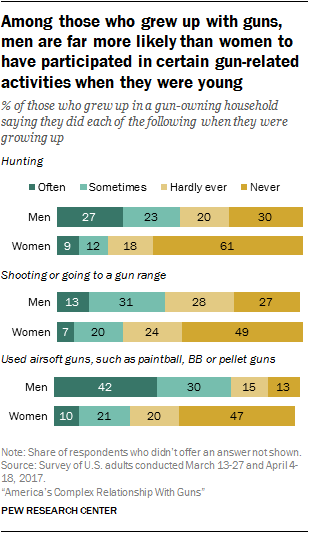
Among those who grew up with guns, men are far more likely than women to have participated in certain gun-related activities when they were young

Reasons for having had guns in the household growing up vary considerably across community type. For example, eight-in-ten adults who grew up in a gun-owning household in a rural area cite hunting as a reason there were guns in their household, while fewer cite protection (57%) or sport shooting (51%). In contrast, seven-in-ten of those who grew up in a gun-owning household in a city say there were guns in their household for protection; about half cite hunting (51%) or sport shooting (50%) as reasons there were guns in their household growing up.

Protection is cited far more often by adults younger than 30 than their older counterparts as a reason there were guns in their household growing up. About eight-in-ten young adults who grew up in a gun-owning household (79%) say this was a reason, compared with 66% of those ages 30 to 49, 60% of those ages 50 to 64, and just 34% of those ages 65 and older.

By contrast, older Americans who grew up in a gun-owning household are far more likely than younger adults who grew up with guns to point to hunting as a reason guns were present in their household. About eight-in-ten of those ages 65 and older (84%) and 73% of those ages 50 to 64 cite hunting as a reason; a narrower majority of adults ages 30 to 49 who grew up in a gun-owning household (60%) and about half of those younger than 30 (52%) cite hunting.

Higher shares of men than women who grew up with guns in the household say they participated in certain gun-related activities

While men and women are equally likely to say there were guns in their household growing up, men who grew up in a gun-owning household are far more likely than their female counterparts to say they went hunting or shooting when they were growing up. About half of men who grew up with guns in their homes say they went hunting often (27%) or sometimes (23%). Among women who grew up in a gun-owning household, about one-in-five (22%) say they went hunting at least sometimes when they were growing up, while most say they hardly ever (18%) or never (61%) did this.

Men who grew up in a gun-owning household are also more likely than women who grew up with guns in their homes to say they went shooting or to a gun range growing up, though relatively few men or women say they did this often (13% and 7%, respectively). About four-in-ten men who grew up in a gun-owning household (44%) say they went shooting or to a gun range at least sometimes when they were growing up, while about a quarter of women (27%) say the same.

Among adults who didn’t grow up in a gun-owning household, few say they went hunting or shooting when they were growing up. But men who didn’t grow up with guns are somewhat more likely than women who didn’t grow up with guns to say they participated in these activities at least sometimes. One-in-ten men who didn’t grow up with guns in their household say they went hunting often or sometimes, compared with 5% of women. And while 16% of men in this group went shooting or to a gun range at least sometimes when they were growing up, even smaller shares of women did so (6%).

When it comes to airsoft guns, such as paintball, BB or pellet guns, 57% of men – including 72% of those who grew up with guns in their household and 42% of those who didn’t – say they used them often or sometimes when they were growing up. Just 20% of women say they used airsoft guns at least sometimes when they were growing up.

Gun ownership tends to happen at an earlier age for those who grew up with guns in their household

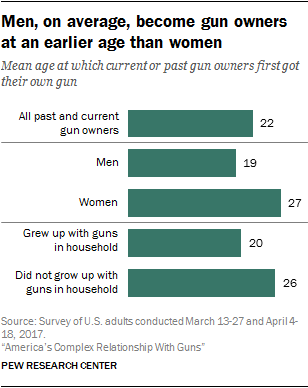
Men, on average, become gun owners at an earlier age than women

Among all current and past gun owners, the average age at which Americans say they first became gun owners is 22 years. Nearly four-in-ten current or past gun owners (37%) report that they were younger than 18 when they first got their own gun.

Current or past gun-owners who grew up with guns in their household report that they first became gun owners at an earlier age than those who didn’t grow up in a gun-owning household.

About half of those who grew up with guns (47%) say they were younger than 18 when they first got their own gun, compared with 19% of those who didn’t grow up with guns in their household.

Among men who own or have owned a gun and who grew up in a gun-owning household, 61% say they personally became gun owners before they turned 18; a quarter of women in the same group say they were younger than 18 when they first got their own gun. On average, men who grew up in a gun-owning household report that they first got their own gun when they were 17, compared with an average age of 26 for women who grew up with guns in their household.

Overall, men who currently own guns or who have done so in the past report that they first became gun owners at age 19, on average; for women who own or previously owned guns, that age is 27.

Most Americans say they have fired a gun at some point

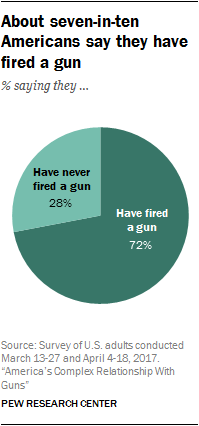
About seven-in-ten Americans say they have fired a gun

About seven-in-ten adults (72%) say they have fired a gun at some point in their lives. While this is particularly the case among those who own or have owned a gun (95%), about half of those who have never personally owned a gun say they have fired one (55%).

Large majorities of about nine-in-ten or more among current and past gun owners say they have fired a gun, and this is true across demographic groups. Among those who have never owned a gun, however, there are some significant demographic differences in the shares who say they have fired one. In many ways, these differences mirror the patterns in gun ownership.

For example, men who have never owned a gun are more likely than their female counterparts to say they have fired one (64% vs. 50%). About two-thirds (68%) of whites who have never owned a gun say they have fired one at some point, compared with 32% of blacks and 35% of Hispanics who have never owned a gun. And while 68% of those who live in rural areas who have never owned a gun say they have fired one, about half of those who live in urban (48%) or suburban (56%) areas have had this experience.

Among adults who have never personally owned a gun, seven-in-ten of those who grew up with guns in their household say they have fired a gun at some point, compared with 47% of those who didn’t grow up in a gun-owning household. Whether they have or have not personally owned a gun, the average age at which those who grew up with guns in the household say they first fired a gun is 14 years, compared with 20 years among those who didn’t grow up in a gun-owning household.

Men who grew up in a gun-owning household report that they first fired a gun when they were, on average, 12 years old. Among women who grew up with guns in their household, the average age at which they first fired a gun is 17.

Most Americans say society has a negative view of gun owners, but that people in their own communities look at gun owners is a positive way

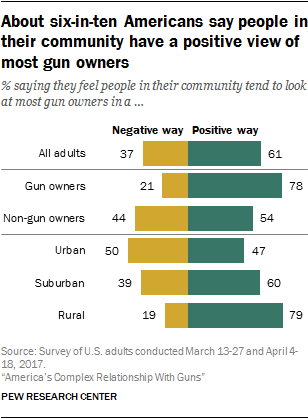
About six-in-ten Americans say people in their community have a positive view of most gun owners

A majority of Americans say that society tends to have a negative view of gun owners, a perception that is somewhat more common among non-gun owners than among those who own a gun. About six-in-ten Americans who don’t own a gun (61%) say society has a negative view of gun owners, while 38% say society’s views are generally positive. Opinions are more mixed among gun owners themselves: 54% say society tends to have a negative view and 45% say it has a positive view of most gun owners.

Americans have a different assessment of how people in their own communities view gun owners. Most (61%) say people in their community generally view gun owners in a positive way, and this is particularly the case among those who live in rural communities. About eight-in-ten adults who live in a rural area (79%) say people in their community generally have a positive view of gun owners; just 47% of those in urban areas say the same about people in their community.

Gun owners are far more likely than non-gun owners to say people in their community look at most gun owners in a positive way; 78% of gun owners say this is the case, compared with 53% of non-gun owners. Assessments vary between gun owners and those who don’t own guns across community types, but differences are particularly pronounced among those who live in urban or suburban areas.

For example, while 66% of urban gun owners say people in their community generally have a positive view of most gun owners, less than half of those who do not own guns in urban areas say this is the case (42%). In rural areas, gun owners are somewhat more likely than those who don’t own guns to say people in their community look at gun owners in a positive way, but majorities of both groups offer this assessment (85% and 74%, respectively).


2. Guns and daily life: Identity, experiences, activities and involvement

Americans own guns for a variety of reasons, and the ways in which they use their guns differ. Gun use also varies along key demographic, social and attitudinal dimensions.

Overall, about a third of gun owners say they go hunting often (12%) or sometimes (22%), while roughly half say they go shooting or to a gun range with some frequency (13% often, 40% sometimes). Among those who own a handgun, roughly one-in-four (26%) carry their gun with them outside of their home all or most of the time, and an additional 31% say they carry some of the time.

For many gun owners, their experiences with guns extend beyond shooting and hunting

Gun owners are divided when it comes to how important owning a gun is to their overall identity. One-in-four say it is very important, while the rest view this as somewhat important or not important. Those who say being a gun owner is very important to their identity are nearly unanimous in their belief that the right to own a gun is essential to their personal freedom.

Many, but not all, gun owners exist in a social context where gun ownership is the norm. Roughly half of all gun owners say that all or most of their friends own guns. An additional 38% say some of their friends own guns and 13% say only a few do. In stark contrast, among the non-gun owning public, only one-in-ten say all or most of their friends own guns. These social connections are strongly tied to gun use, as gun owners who say all or most of their friends own guns engage more frequently in hunting and sport shooting than those with fewer friends that own guns.

The broader gun culture in the U.S. extends beyond hunting and shooting to clubs, associations and media and entertainment outlets. About a third or more of gun owners say they often or sometimes watch TV programs or videos about guns or visit websites about guns, hunting or other shooting sports. Younger gun owners are among the most likely to consume some types of gun-related media. Among all gun owners, about one-in-four say they often or sometimes attend gun shows.

Men and women who own guns interact with them in different ways – with male gun owners hunting and shooting more frequently than their female counterparts and consuming some forms of gun-oriented media at higher rates. There are also differences by age and educational attainment in the extent to which guns are a part of the day-to-day lives of gun owners.

Majority of gun owners say right to own guns is essential to personal freedom

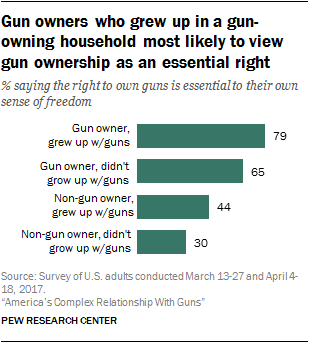
Gun owners who grew up in a gun-owning household most likely to view gun ownership as an essential right

For today’s gun owners, the right to own guns nearly rivals other rights laid out in the U.S. Constitution in terms of its personal salience. About three-quarters of gun owners (74%) say this right is essential to their own sense of freedom. Among those who do not own guns, only 35% view the right to own guns as an essential right.

Gun owners and non-owners tend to agree on other top-tier constitutional rights. Roughly equal shares say freedom of speech, the right to vote, the right to privacy and freedom of religion are essential to their own sense of freedom.

Views on the essential nature of the right to own guns are linked both to current gun ownership and personal history. Gun owners who grew up with guns in their household are among the most likely to say the right to own guns is essential to their personal sense of freedom – 79% hold this view. Gun owners who did not grow up with guns feel less strongly about this; 65% say the right to own guns is essential to their sense of freedom. Similarly, among non-gun owners, 44% of those who grew up with guns view the right to own guns as essential, compared with 30% of those who did not to grow up in a gun-owning household.

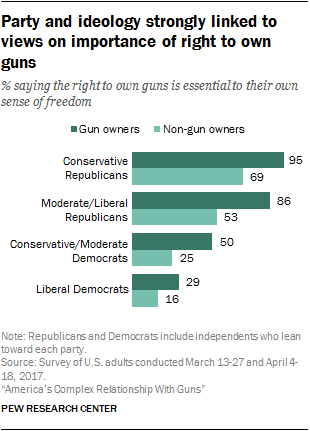
Party and ideology strongly linked to views on importance of right to own guns

Partisanship and ideology are strongly correlated with views about the importance of gun ownership as a guaranteed right. And those differences hold up among gun owners and non-owners alike. For Republican gun owners and independents that lean Republican, gun ownership is nearly on par with free speech, the right to vote, the right to privacy and freedom of religion. Among conservative Republican gun owners (and Republican leaners), 95% say the right to own guns is essential to their own sense of freedom. Somewhat fewer (86%) moderate to liberal Republican gun owners view the right to own guns as essential to their freedom.

Roughly seven-in-ten (69%) conservative Republicans who do not own guns view the right to own guns as essential. Among moderate and liberal Republicans who don’t own guns fewer (53%) hold this view.

Among conservative and moderate Democrats and independents that lean Democratic, gun owners are twice as likely as non-owners to say the right to own guns is essential to them (50% vs. 25%). Relatively few liberal Democrats view the right to own guns as essential to their freedom, but the gun owners among this group are significantly more likely than non-owners to hold this view (29% vs. 16%).

For one-in-four gun owners, owning a gun is very important to their identity

America’s gun owners are divided over whether owning a gun is central to who they are. Some 25% say this is a very important part of their overall identity and another 25% say it is somewhat important. At the same time, fully half say being a gun owner is not too important to their overall identity (30%) or not important at all (20%).

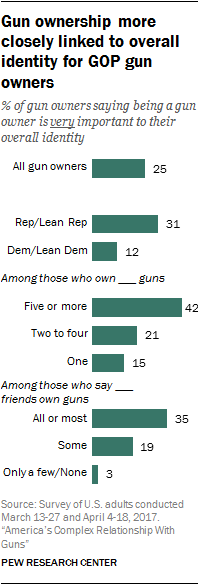
Gun ownership more closely linked to overall identity for GOP gun owners

Roughly equal shares of men and women who own guns say being a gun owner is very important to their identity. Gun owners with a high school diploma or less education are significantly more likely than more educated gun owners to view gun ownership as central to who they are – 34% of those with no formal education beyond high school say this is very important to their overall identity, compared with 20% of those who have attended or graduated from college.

Republican gun owners are nearly three times as likely as Democrats who own guns to say owning a gun is very important to their overall identity: 31% of Republicans or independents who lean Republican say this, compared with 12% of Democrats and independents who lean to the Democratic Party.

In addition, gun owners who own five or more guns see a stronger link between their gun ownership and their overall identity. Among those who own five or more firearms, 42% say being a gun owner is very important to their overall identity. Only 21% of those who own two to four guns and 15% who own one gun say the same.

Similarly, gun owners who have strong social ties to other gun owners are more likely than those with fewer ties to see their gun ownership as important to their identity. Some 35% of those who say all or most of their friends own guns also say being a gun owner is very important to their overall identity, compared with 19% of those who say some of their friends own guns and only 3% of those who say only a few or none of their friends own guns.

More than eight-in-ten gun owners say at least some of their friends also own guns

When it comes to their social circles, about half of gun owners (49%) say that all or most of their friends also are gun owners, and another 38% say some of their friends are; just 13% of gun owners say only a few of their friends own guns and virtually no gun owners (less than 1%) say that none of their friends do. In contrast, only one-in-ten adults who don’t own guns say all or most of their friends are gun owners; 37% say some of their friends own guns, while 32% say only a few do and 21% say none of their friends own guns.

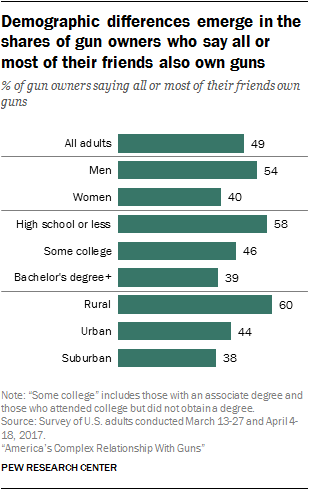
Demographic differences emerge in the shares of gun owners who say all or most of their friends also own guns

Perhaps not surprisingly, since gun ownership is more common in rural parts of the country, gun owners who live in such areas are far more likely than those who live in a suburb or urban area to say all or most of their friends also own guns. Six-in-ten gun owners in rural areas say this is the case, compared with 38% in suburban and 44% in urban areas. Non-gun owners in rural areas are also somewhat more likely than those in other types of communities to say all or most of their friends own guns, though relatively few non-gun owners in rural (16%), urban (7%) or suburban (9%) areas say this is the case.

Among male gun owners, 54% say all or most of their friends also own guns; smaller shares of women who own guns say this is the case (40%). It is also more common for less-educated gun owners to socialize with other gun owners: 58% of those with a high school diploma or less say all or most of their friends also own guns, compared with 46% of gun owners with some college and 39% of those with at least a bachelor’s degree.

Eight-in-ten gun owners say they don’t mind if other people know they own a gun, but don’t go out of their way to tell them; 14% say they’d rather other people not know that they own a gun and 6% want others to know. Answers to this question don’t vary significantly across demographic groups or party lines.

Sport shooting is a more common activity among gun owners than hunting

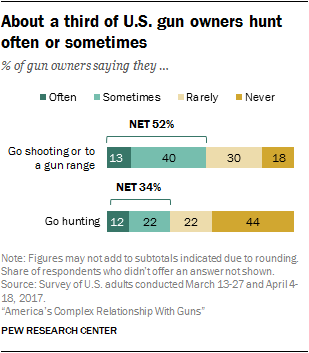
About half of gun owners say they often (13%) or sometimes (40%) go shooting or to a gun range. Some 30% say they rarely go shooting and 18% say they never do.

About half of gun owners say they often (13%) or sometimes (40%) go shooting or to a gun range. Some 30% say they rarely go shooting and 18% say they never do.

About a third of U.S. gun owners hunt often or sometimes

Hunting is less common: Roughly a third of gun owners say they often (12%) or sometimes (22%) go hunting. Some 22% say they rarely go hunting and 44% say they never do.

Among non-owners who say they have shot a gun at some point, 6% say they often or sometimes go shooting or to a gun range and 5% say they go hunting at least sometimes.

When it comes to hunting, there’s a gap among gun owners, although it’s relatively modest: 37% of male gun owners say they go hunting often or sometimes, compared with 28% of female owners.

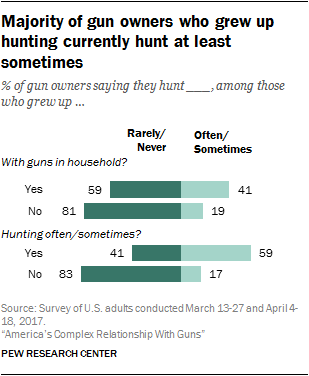
Majority of gun owners who grew up hunting currently hunt at least sometimes

Republican gun owners and independents that lean Republican are more likely than Democratic gun owners and Democratic-leaning independents to say hunting is a major reason they own a gun, and there is a similar party gap in which group hunts more frequently. Roughly four-in-ten Republican gun owners (39%) say they hunt at least sometimes, compared with 24% of Democrats.

Gun owners who grew up with guns in their household are about twice as likely as gun owners who did not grow up with guns to say they often or sometimes hunt (41% vs. 19%). And among gun owners who say they hunted at least sometimes when they were growing up, roughly six-in-ten (59%) say they still hunt at least sometimes. Relatedly, gun owners living in rural areas – who are more likely to have hunted when they were growing up – report hunting at much higher rates than those living in urban and suburban areas. Roughly four-in-ten rural gun owners (42%) say they hunt often or sometimes, compared with roughly a quarter of those living in suburban and urban areas.

Gun owners who hunt are far more likely than those who do not hunt to have five or more guns. Roughly two-thirds (67%) of those who hunt often own at least five firearms, compared with 46% of those who hunt sometimes, 27% of those who rarely hunt and 11% who never hunt.

The gender gap in hunting can also be seen in sport shooting. Roughly six-in-ten male gun owners (58%) say they go shooting or to a range at least sometimes, compared with 43% of women who own guns. Among men and women, younger gun owners (those under age 50) are more likely than their older counterparts to say they often or sometimes go shooting.

The partisan gap is similar as well. Even though Republican and Democratic gun owners are equally likely to say sport shooting is a major reason they own a gun, Republicans report shooting or going to a gun range more frequently than do Democrats (58% of Republicans vs. 42% of Democrats say they do this often or sometimes).

More than half of handgun owners carry outside their home at least sometimes

Every state in the U.S. allows individuals to carry concealed weapons, although most require a permit in order to do so. And the open carrying of handguns in public places is permitted in a majority of states, again with certain restrictions which vary from state to state.

Most Republican handgun owners carry outside their home at least sometimes

About seven-in-ten gun owners (72%) say they own a handgun, and, of those, about a quarter (26%) say they carry it outside their home all or most of the time, with 11% saying they always carry a handgun. (This does not include times when they might be transporting the gun.) Roughly three-in-ten (31%) carry some of the time, and 43% say they never carry a handgun outside of their home.

There is no gender gap in carrying a handgun – roughly equal shares of men and women who own a handgun say they carry outside of their home. And there are no significant differences by education, region or community type.

There is, however, a partisan gap: Roughly six-in-ten (63%) of Republicans or Republican-leaning independents who own a handgun or pistol say they carry a handgun outside of their home at least some of the time, compared with 45% of Democrats or Democratic-leaning independents who own a handgun.

Carrying a handgun is a much more common occurrence for those who say owning a gun is at least a somewhat important part of their identity than it is for other gun owners. Among handgun owners, about three-quarters (78%) who say owning a gun is very important to their overall identity say they carry a gun outside of their home at least some of the time. This includes 42% who say they carry all or most of the time. By contrast, roughly four-in-ten (42%) handgun owners who say owning a gun is not too or not at all important to their overall identity say they carry at least some of the time (14% of these handgun owners carry all or most of the time).

Similarly, carrying a gun outside the home at least some of the time is more prevalent among gun owners who view owning a gun as essential to their personal freedom, than it is for other gun owners (63% vs. 36%).

Handgun owners who live in communities they feel are unsafe tend to carry their guns with them more often. Among those who say their community is not too or not at all safe from crime, 41% of handgun owners carry their gun with them all or most of the time. Only about half as many (22%) of those who say their community is very or somewhat safe say they carry a handgun with the same frequency.

Republicans, Democrats have different reasons for not carrying

Among handgun owners who say they never carry a gun outside of their home, a majority (64%) say the reason they never carry is because they don’t want to. Roughly a third (36%) say there is some other reason that they don’t carry. While the survey didn’t specifically explore these reasons, some explanations offered by gun owners in a series of focus groups include legal restrictions in the state where they live or that haven’t gotten around to fulfilling the necessary requirements to be able to carry legally.

Among gun owners, men and women equally likely to belong to NRA

Democrats who own handguns but do not carry them outside their home are much more likely to say they don’t carry because they don’t want to – 76% of Democrats say this, compared with 56% of Republicans. Among Republicans who don’t carry outside their home, 44% say they have some other reason for not carrying; only 24% of Democrats who don’t carry say the same.

About one-in-five gun owners say they are members of the NRA

Overall, 19% of all U.S. gun owners say they belong to the NRA. Among gun owners, roughly equal shares of men and women say they are NRA members, and there are no significant differences across age groups or by educational attainment.

Across income groups, membership rates are highest among gun owners with annual household incomes of $100,000 or more. Roughly three-in-ten (29%) of these higher-income gun owners say they belong to the NRA, compared with 17% of those earning between $75,000 and $99,999 and an equal share of those earning less than $75,000.

Republican and Republican-leaning independent gun owners are about twice as likely as gun owners who are Democrats and Democratic-leaning independents to say they belong to the NRA – 24% vs. 11%. And, among Republicans, conservatives have significantly higher rates of membership – 28% vs. 17% of moderate or liberal Republicans.

Americans are divided between those who say the NRA has too much and the right amount of influence

The survey findings suggest that gun owners who strongly identify with their gun ownership are more apt to join the NRA. Among those who say being a gun owner is very important to their overall identity, 34% are NRA members. The share is smaller for those who say being a gun owner is somewhat important (18% belong to the NRA) or not important (12%). In addition, gun owners who got their first gun before they turned 18 are about twice as likely as those who first acquired a gun as an adult to belong to the NRA (27% vs. 14%).

There is no clear public consensus about the impact the NRA has on the nation’s gun laws: 44% of all Americans say the NRA has too much influence, 40% say it has the right amount of influence and 15% say the NRA has too little influence. Among gun owners more say the NRA has too much influence (29%) than say it has too little (17%).

For their part, gun owners who are NRA members are largely satisfied with the amount of influence the organization has over gun laws in the U.S. About six-in-ten (63%) say the NRA has the right amount of influence and 28% would like to see it have even more influence. Only 9% of NRA members say the organization has too much influence over gun laws. Gun owners who are not members of the NRA are more likely than their counterparts who do belong to say the organization has too much influence over gun laws (34% say this).

Gun ranges and hunting clubs more popular with younger gun owners

Relatively few gun owners say they are a member of a gun or shooting club or gun range (13%) or that they belong to a hunting club (5%).

Membership in these types of establishments is more common among younger gun owners. Roughly one-in-five gun owners ages 18 to 49 (18%) say they belong to a shooting club or gun range, compared with 9% among those ages 50 and older. Among gun owners ages 18 to 29, 13% belong to a hunting club; only 3% of those ages 30 and older say they belong.

Gun owners who go shooting frequently are particularly likely to be members of a gun or shooting club or gun range: 48% of those who say they go shooting often are members of these types of establishment, compared with 15% of those who go shooting sometimes and even fewer among those who rarely or never go shooting. However, membership in hunting clubs is relatively uncommon even among those who say they go hunting often: Just 12% in this group say they belong to a hunting club.

Roughly a third of gun owners visit gun-related websites often or sometimes

About one-in-four non-gun owners say they watch gun-oriented TV programs and videos owners

Gun owners have a variety of options these days for pursuing their interest in guns – from websites devoted to guns and hunting, to podcasts, to gun shows.

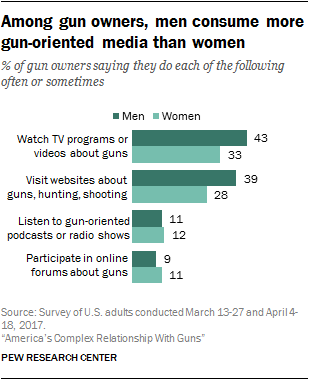
Among gun owners, men consume more gun-oriented media than women

About four-in-ten gun owners say they often (8%) or sometimes (31%) watch gun-oriented TV programs or videos, and a similar share say they visit websites about guns, hunting or other shooting sports (8% say they do this often and 27% sometimes).

Of course, all of these outlets are available to non-gun owners as well, and some do take advantage of them. About one-in-four non-gun owners say they watch gun-oriented TV programs or videos often (5%) or sometimes (20%). Non-gun owners are much less likely than gun owners to say they visit websites about guns, hunting or shooting (1% often, 7% sometimes).

There are significant gender gaps when it comes to consuming these types of gun-0riented media. While 43% of male gun owners say they often or sometimes watch gun-related TV shows or videos, 33% of female guns owners say the same. Similarly, when it comes to visiting websites with gun-related content, 39% of male gun owners say they do this at least sometimes, compared with 28% of female gun owners.

There is also a significant education gap on most of these measures. For example, gun owners without a bachelor’s degree are much more likely than those who do have a bachelor’s degree to watch gun-oriented TV shows or videos (44% vs. 24%)

Gun owners who say all or most of their friends own guns are more likely to watch these shows and videos – 44% say they do this at least sometimes, compared with 34% of those who say some, only a few or none of their friends own guns.

About one-in-four gun owners attend gun shows often or sometimes

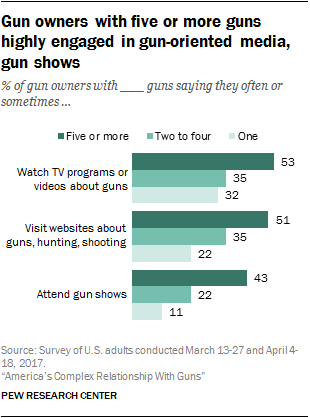
Gun owners with five or more guns highly engaged in gun-oriented media, gun shows

Overall, about a quarter of gun owners say they attend gun shows often (4%) or sometimes (20%). Roughly three-in-ten (29%) say they hardly ever attend gun shows and 47% say they never do.

Among gun owners, men and women are equally likely to say they go to gun shows at least sometimes, but the education gap that is apparent on gun-oriented media can also be seen here. While roughly three-in-ten (28%) gun owners without a bachelor’s degree say they go to gun shows often or sometimes, only 14% of gun owners with a bachelor’s degree say the same.

In addition, Republican gun owners are more likely than their Democratic counterparts to regularly attend gun shows – 28% of Republicans and independents that lean Republican vs. 18% of Democrats and Democratic-leaning independents say they go to gun shows often or sometimes.

When it comes to watching gun-related TV and video, visiting websites and attending gun shows, gun owners with multiple firearms are among the most likely to engage in these activities. Roughly half of gun owners with five or more guns say they watch gun-oriented TV or videos or visit websites related to guns and hunting at least sometimes. Significantly smaller shares of those with fewer guns do the same.

Owners with five or more weapons are at least twice as likely as those with fewer weapons to say they attend gun shows often or sometimes.

Relatively few gun owners listen to gun-oriented podcasts or radio shows – about one-in-ten listen often (2%) or sometimes (9%). Younger gun owners are more likely to listen at least sometimes: 21% of those under 30 say they do, compared with 9% among gun owners ages 30 and older.

About one-in-ten gun owners say they often (1%) or sometimes (8%) participate in online discussion forums about guns. Again, younger gun owners are more likely than their older counterparts to participate in these types of forums – 22% among those under 30 vs. 7% for 30 and older.

Dangerous encounters with guns vary by gun ownership, key demographics

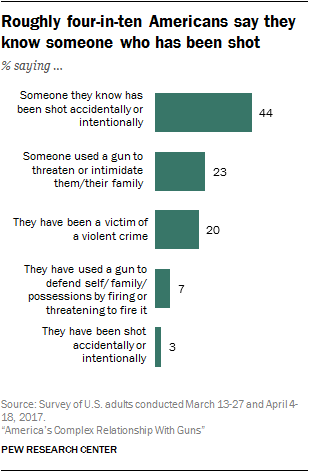
Roughly four-in-ten Americans say they know someone who has been shot

A significant share of Americans (44%) say that someone they know has been shot, either accidentally or intentionally. Some 3% of all adults say they have been personally shot either accidentally or intentionally.

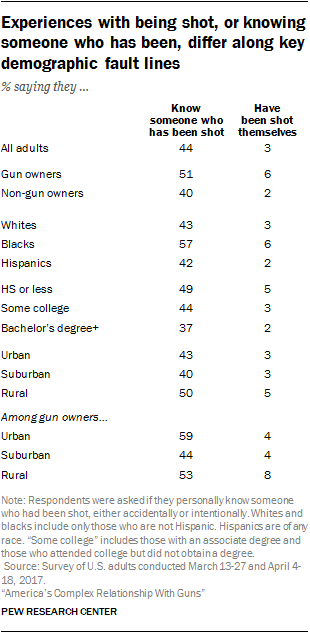
Gun owners are significantly more likely than non-gun owners to know someone personally who has been shot (51% vs. 40% of non-owners), and they are also more likely to report that have been shot themselves (6% vs. 2%).

Experiences with being shot, or knowing someone who has been, differ along key demographic fault lines

There are demographic differences as well. Roughly six-in-ten (57%) blacks, compared with 43% of whites and 42% of Hispanics, personally know someone who has been shot either accidentally or on purpose.

There is also a divide by educational attainment: Roughly half of adults with a high school diploma or less say they know someone who has been shot, compared with 37% of adults with a bachelor’s degree or higher.

Americans living in rural parts of the country are also more likely to know someone who has been shot. Half of rural residents know someone who has been shot. By comparison, Americans living in the suburbs and in urban areas are less likely to know someone who has been shot (40% and 43%, respectively).

However, these differences largely evaporate among gun owners. Among urban gun owners, 59% say they know someone who has been shot. This is roughly equal to the share of rural gun owners who know someone who has been shot (53%).

Blacks, low-income Americans more likely to have been threatened by someone with a gun

Overall, roughly one-in-four Americans (23%) say someone has used a gun to threaten or intimidate them or their family. Gun owners are no more likely to have experienced this than non-gun owners.

There is, however, a significant racial gap. Roughly a third of blacks (32%) say someone has used a gun to threaten or intimidate them or their family, compared with 20% of whites. About a quarter of Hispanics (24%) say this has happened to them or their family members.

Men and women are about equally likely to say someone has threatened or intimidated them or their family. Among men, those ages 50 and older are more likely than younger men to say someone has used a gun to threaten or intimidate them (28% among older men, 21% among younger men).

One-in-six gun owners have used a gun to defend themselves

Americans are much less likely to have ever fired or threatened to fire a gun to defend themselves, their families or their possessions than they are to have been threatened by a gun. Some 7% say they have had this experience.

Not surprisingly, gun owners and those who have owned a gun in the past are much more likely than those who have never owned a gun to report that they have used a gun to defend themselves, their family or their property. Only 1% of non-gun owners who have never owned a gun say they have used a gun to defend themselves. Roughly one-in-ten (9%) of those who have owned a gun in the past but no longer do, say they have done this. Among current gun owners, 17% say they have used a gun to defend themselves.

The extent to which gun owners see owning a gun as part of their identity is strongly linked to experiences using a gun for self-defense. About one-in-five (22%) gun owners who say owning a gun is a very important part of their overall identity say they’ve defended themselves with a gun. By contrast, about half as many (12%) gun owners who say their ownership is not too important or not at all important to their identity have used a gun in self-defense.

Looking at experiences with crime more broadly, one-in-five adults say they have been the victim of a violent crime, whether a gun was used or not. And roughly equal shares of gun owners (21%) and non-owners (20%) say they have had this type of experience.


3. Views of gun safety and the key responsibilities of gun owners

Just as reasons for owning guns and using them in daily life vary, so do the ways in which gun owners store their guns and the extent to which they see certain measures – such as taking gun safety courses – as essential.

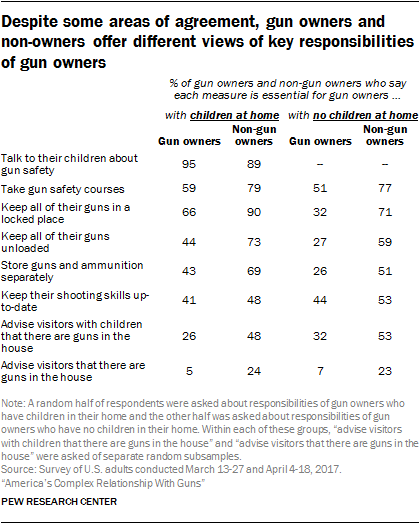
Despite some areas of agreement, gun owners and non-owners offer different views of key responsibilities of gun owners

Majorities of gun owners and non-owners alike agree that it’s essential for gun owners who live with children in the home to talk to their children about gun safety, to take gun safety courses, and to keep all of their guns in a locked place. Most non-gun owners also say gun owners with children in the house should keep all of their guns unloaded and store guns and ammunition separately, but this view doesn’t have majority support among those who own guns.

When it comes to letting visitors know that there are guns in the home, relatively few gun owners see this as essential. In fact, just about a third (32%) say gun owners with no children at home should let visitors who bring children by know about the presence of guns, and even fewer (7%) say gun owners should advise guests with no children that there are guns in the home. Meanwhile, about half of adults who don’t own guns say gun owners should advise their guests with children about the presence of guns. About a third of gun owners (36%) say all of the guns in their own home are generally kept in a locked place, and 44% say all are kept unloaded. Roughly four-in-ten gun owners – including 30% of those with children under 18 at home – say there is a gun that is both loaded and easily accessible to them all of the time when they are at home.

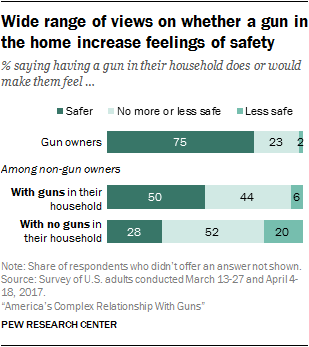
As might be expected, most gun owners (75%) say they feel safer with a gun in their household than they would without a gun. Views are more divided among those who don’t own a gun but live in a gun-owning household: About as many say having a gun makes them feel safer than they would feel if there wasn’t a gun in their household (50%) as say they feel no more or less safe with a gun in their household (44%). Among those who neither own a gun nor live with someone who does, slightly more say they would feel safer if they had a gun in their household (28%) than say a gun would make them feel less safe (20%); 52% say they wouldn’t feel more or less safe with a gun in their household.

Americans have widely different views of how gun owners should store their guns and ammunition depending on whether there are children in the home

Americans’ opinions of how gun owners should store their guns and ammunition vary significantly when they are asked to consider gun owners who do and do not have children in their home. For example, about eight-in-ten say it’s essential for gun owners with children in their home to keep all of their guns in a locked place (83%); about six-in-ten (58%) say the same about gun owners who don’t have children in their home. And while around six-in-ten or more say it’s essential for gun owners with children at home to keep all of their guns unloaded (65%) and to store their guns and ammunition separately (61%), far smaller shares say it’s essential for those with no children in their home to take these measures (48% and 43%, respectively).

Gun owners and non-owners alike are more likely to view each of these measures as essential if there are children in the home. But whether they are asked to consider gun owners with or without children in the home, far higher shares of those who don’t own guns than those who do own them say it’s essential for gun owners to keep all of their guns in a locked place, keep all of their guns unloaded, and store their guns and ammunition separately. In each case, a difference of 24 percentage points or more separates the views of gun owners and non-gun owners, with the widest gap on views of whether it’s essential for gun owners with no children in their home to keep their guns in a locked place – about seven-in-ten of those who do not own guns (71%) say it is, while just 32% of gun owners agree.

When asked if gun owners should advise visitors that there are guns in the house, far higher shares say it’s essential for gun owners to do this when they are asked about visitors with children than when the question does not specifically mention children. Roughly half of adults (47%) say it’s essential for gun owners who don’t have children at home to let visitors with children know about the presence of guns; just 17% said it would be essential for gun owners to advise visitors that this is the case when it is not mentioned that the visitors include children. In each case, those who don’t own guns are more likely than those who do own them to say it’s essential to advise visitors that there are guns in the house.

Overwhelming majorities of those who do and don’t own guns consider it essential for gun owners with children in their home to talk to their children about gun safety; 95% of gun owners and 89% of non-gun owners say this is essential.

When it comes to views on training on gun safety and shooting skills, the presence of children in the home is less significant

Americans don’t distinguish between the essential responsibilities of gun owners with and without children in their home when it comes to taking gun safety courses or keeping shooting skills up-to-date. For example, similar shares say it’s essential for gun owners with children in the home and those with no children in their home to take gun safety courses (73% and 68%, respectively). And about half say it’s essential for gun owners to keep their shooting skills up-to-date, whether they do or don’t have children in their home (46% and 50%).

Those who do not own guns are about one and a half times more likely than those who own guns to say it’s essential for gun owners to take gun safety courses. About three-quarters of non-gun owners (77%) say this is essential for gun owners with no children in their home; 51% of gun owners say the same. The pattern is similar when gun owners and non-owners are asked about those who have children in their home.

Most gun owners say there is at least one gun in their home that is not kept in a locked place

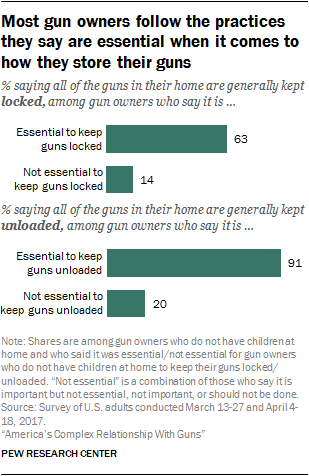
Most gun owners follow the practices they say are essential when it comes to how they store their guns

About a third of gun owners (36%) say they generally keep all of the guns in their home in a locked place, while 63% say there is at least one gun that is not kept locked. When asked whether they keep their guns loaded or unloaded, 44% of gun owners say there are no loaded guns in their home, while 55% say there is at least one gun that is kept loaded. Among gun owners who have children younger than 18 at home, 54% say all of the guns in their home are kept locked, compared with 30% of those with no children living in their home. And while 53% of gun owners with children at home say none of the guns in the home are kept loaded, 40% of those with no children say the same.

For the most part, the way gun owners keep their guns is consistent with how they say other gun owners should behave. For example, 63% of gun owners with no children at home who say it’s essential for gun owners in their situation to keep all of their guns locked say that all of their guns are, in fact, kept locked, compared with 14% of those who don’t see this as essential. And while fully 91% of those who say all guns should be kept unloaded say this is how they keep all of the guns in their home, just 20% of those who don’t consider this essential say all of their guns are kept unloaded.3

Most gun owners have taken a safety course

Seven-in-ten gun owners say they have taken a gun safety course such as weapons training, hunter safety or firearm safety. While this is particularly the case among those who consider it essential for gun owners to take such courses – 83% of gun owners with no children in the house who say it is essential also say they have done this – about half of those who don’t consider this essential (55%) also say they have taken a gun safety course.

Gun owners with multiple guns are more likely than those who own only one gun to report taking a gun safety course. About three-quarters of those who own two or more guns (77%) say they have done so, compared with 55% of those who own a single gun.

Majorities of gun owners across demographic groups say they have taken a gun safety course, but some differences emerge. For example, male gun owners are more likely than their female counterparts to say they have done this (76% vs. 60%). And while about three-quarters of those younger than 50 (77%) say they have taken a gun safety course, somewhat smaller shares of older gun owners (63%) say the same. Among gun owners with at least a bachelor’s degree, 78% say they have taken a gun safety course, compared with 63% of those with a high school diploma or less education.

Seven-in-ten gun owners say they have taken a gun safety course

Among those who don’t personally own a gun, similar shares of those who currently live in a gun-owning household and those who don’t say they have taken a gun safety course (22% and 19%, respectively).

Legal requirements regarding gun safety courses vary widely by state. Many states require hunter education training or safety courses in order to obtain a hunting permit or permit to carry a handgun, and some states require a course or exam in order to own or purchase a gun.

Majority of American parents – including half of non-gun owners – say they have talked with their children about gun safety

About six-in-ten parents (60%) say they have talked with their children under the age of 18 about gun safety. This includes 82% of gun owners and about half of non-owners (51%).

Among non-owners, women are more likely than men to say they have talked with their children about this (58% vs. 37%). Those who live in the Midwest (64%) or South (59%) are more likely than those in the Northeast (31%) or West (40%) to say they have done this. There are no notable demographic differences among gun owners in the shares who say they have talked with their children about gun safety.

About four-in-ten gun owners have a loaded gun easily accessible to them at all times when at home

Male gun owners are far more likely than female gun owners to say there is always a gun that is easily accessible and loaded when they’re at home

Some four-in-ten gun owners (38%) report that there is a gun that is both loaded and easily accessible to them all of the time when they are at home, and another 17% say this is the case most of the time; 12% of gun owners say they have easy access to a loaded gun only some of the time when they’re at home, and a third say they never do.

Male gun owners are far more likely than their female counterparts to say there is a gun that is both loaded and easily accessible to them all of the time when they are at home; 43% of men who own guns say this is the case, compared with 29% of women. This gender gap is particularly pronounced among gun owners younger than 50. Among this group, 41% of men and just 17% of women say they have easy access to a loaded gun all of the time when they’re at home. Among those 50 and older, similar shares of men and women say this is the case (44% and 40%, respectively).

Among gun owners with a high school education or less, 45% say they have a gun that is both loaded and easily accessible all of the time when they’re at home. Somewhat smaller shares of those with some college or with a bachelor’s degree say the same (33% of each).

Perhaps not surprisingly, gun owners who say protection is a major reason they own a gun are more likely than those who say it is a minor reason or not a reason they own a gun to report that there is a gun that is both loaded and easily accessible all of the time when they’re at home (49% vs. 13% of those who say protection is a minor reason or not a reason they own a gun). In fact, 64% of those who do not consider protection a major reason they own a gun say they never have a gun that is loaded and easily accessible when they’re at home. (For more on reasons for owning guns, see Chapter 1.)

Similarly, gun owners who say their local community is not too safe or not at all safe from crime are somewhat more likely than those who describe their community as very or somewhat safe to say they have easy access to a loaded gun all of the time when they’re at home (46% vs. 35%).

Gun owners and non-owners who live with someone who owns a gun offer different views on whether having a gun in the household makes them feel safer

Wide range of views on whether a gun in the home increase feelings of safety

Three-quarters of gun owners say they feel safer with a gun in their household than they would without a gun; about a quarter (23%) say having a gun doesn’t make them feel any more or less safe than they would if there wasn’t a gun in their household (just 2% of gun owners say a gun makes them feel less safe). Among non-owners who say someone else in their household owns a gun, similar shares say having a gun in their household makes them feel safer (50%) as say having a gun doesn’t make them feel any more or less safe (44%); 6% of non-owners who live in a gun-owning household say they feel less safe than they would without a gun in the household.

Among those who do not own guns but live in a gun-owning household, 57% of those who grew up with a gun in their household say having a gun at home makes them feel safer than they would without a gun; 40% of those who didn’t grow up in a gun-owning household say the same.

Meanwhile, about half of non-owners who don’t live in a gun-owning household (52%) say having a gun wouldn’t make them feel safer or less safe, with slightly more saying they would feel safer (28%) than saying they would feel less safe (20%) if there was a gun in their household.

Among this group, about half of those who say they could see themselves owning a gun (47%) say having a gun in the household would make them feel safer than they do without a gun; just 9% of those who say they could never own a gun say a gun would make them feel safer. About a third of those who can’t see themselves ever owning a gun (32%) say they would feel less safe with a gun in their home, while 59% say they would feel no more or less safe.

4. Views of guns and gun violence

Most Americans say gun violence is a problem in the U.S., but fewer see this as a problem in their local community. Overall, half of all U.S adults say gun violence is a very big problem in this country, and an additional 33% say it is a moderately big problem. By comparison, less than half (44%) say gun violence is a very big problem (19%) or moderately big (25%) problem in their community. Views on the severity of gun violence, nationally and locally, differ dramatically between gun owners and those who do not own guns.

When asked about the underlying reasons for gun violence in the U.S., many Americans point to the ease with which people can illegally obtain guns. About half of adults (53%) say this contributes a great deal to gun violence and roughly a third (32%) say this contributes a fair amount.

While gun owners and non-owners share similar views on the extent to which access to illegal guns has a great deal of impact on gun violence, there is much less agreement when it comes to the ease with which people can legally obtain guns, with non-gun owners far more likely than those who own guns to say this contributes to gun violence a great deal or a fair amount.

There also is less agreement between those who do and do not own guns on the extent to which other factors – family instability, a lack of economic opportunities and gun-related media– contribute to gun violence in the U.S.

On the whole, the public is divided over the potential impact having more guns in the U.S. would have on overall crime rates. Roughly a third (35%) say that if more Americans owned guns there would be more crime; a similar share (33%) says if more people owned guns there would be less crime, and another third (32%) say there would be little effect. Gun owners and non-gun owners have differing views on this. On balance, gun owners say having more people with guns would lead to less crime, while a plurality of non-gun owners say more guns would lead to higher crime rates.

About half of the public (47%) says that if it were harder for people to legally obtain guns, there would be fewer mass shootings in the U.S. Roughly four-in-ten (39%) say making it harder for people to legally buy guns would not impact the number of mass shootings, and 13% say this would result in more shootings. Non-gun owners are much more likely than gun owners to say further restricting legal gun sales would result in fewer mass shootings (56% vs. 29%). For their part, 53% of gun owners say increasing restrictions wouldn’t make any difference.

Whether or not gun sales are regulated, most adults see little link between access to guns and likelihood of committing a crime. Large majorities of gun owners and non-gun owners say that if someone wants to commit a crime, they will find a way to do it whether they have access to a gun or not.

Gun owners and non-gun owners are divided on how they see violence in the U.S., local communities

Blacks more likely to have concerns about gun violence in their local community

There is a stark divide in views about the severity of gun violence between gun owners and those who do not own a gun, with non-owners roughly twice as likely to say gun violence is a very big problem – both in the nation and in their local community. Nearly six-in-ten (59%) non-owners say gun violence is a very big problem in the U.S., while just one-third (33%) of gun owners say the same. Similarly, among those who do not own guns, 22% say gun violence is a very big problem in their community; only 11% of gun owners say the same.

Concerns about gun violence, particularly in local communities, vary greatly by race. Nearly half (49%) of blacks and 29% of Hispanics say gun violence is a very big problem in their local community; just 11% of whites rate this as a very big problem.

Americans living in rural areas are, on the whole, less concerned about violence in their local communities. Just 8% of rural Americans say gun violence is a very big problem in their local area.

Americans living closer to cities, either in the suburbs (19%) or in urban areas (28%), are more likely to say gun violence is a big problem near them. Among gun owners, rural residents are much less likely to see gun violence as a problem in their community; just 5% say this is a very big problem while 16% of suburban gun owners say the same.

When it comes to assessments of the extent to which gun violence is a problem in the country more generally, large partisan differences emerge. One-third (32%) of Republicans and Republican-leaning independents say they think gun violence is a very big problem nationally; two times as many (65%) Democrats and independents who lean toward the Democratic Party share the same view. This difference persists among gun owners. Half (50%) of Democratic gun owners say they think gun violence is a very big problem in the U.S., compared with 22% of Republican gun owners.

Women also express more concern about gun violence in the United States. More than half of women (56%) say this is a very big problem, compared with 44% of men. A similar pattern is seen when women and men are asked about gun violence in their own communities.

Ease of access to illegal guns seen as the biggest contributor to gun violence

About half of adults say ease of access to illegal guns contributes a great deal to gun violence

When asked about the factors that may be contributing to gun violence in the U.S. today, many Americans point to the ease with which people can illegally obtain guns. Fully 86% cite this as contributing a great deal or a fair amount to gun violence. Some 14% say it doesn’t contribute much or at all. Far fewer adults say legal access to guns contributes to gun violence: 60% say this contributes a great deal or a fair amount to gun violence in this country, while four-in-ten say it is not a contributing factor.

Eight-in-ten or more gun owners and non-owners point to impact ease of access to illegal guns has on gun violence

Many Americans point to forces beyond gun access as contributing factors in gun violence in the U.S. For example, roughly three-quarters (74%) of Americans say family instability contributes a great deal or fair amount to gun violence. Fewer cite a lack of economic opportunities (65%) and the amount of gun violence in video games (60%) and movies and TV (55%) as contributing factors.

Eight-in-ten or more gun owners and non-owners both cite ease of access to illegal guns as contributing a great deal or fair amount to gun violence (83% of gun owners, 87% of non-gun owners). The two groups further diverge, however, when thinking about the ease with which people can legally obtain guns: 44% of gun owners, compared with 67% of non-gun owners, say this contributes a great deal or fair amount to gun violence. Gun owners and non-owners also disagree about the role of family instability and violence in the media, with more non-gun owners than gun owners consistently citing these factors as contributing to gun violence.

While adults of all ages list access to illegal guns as the top contributor to gun violence, those ages 65 and older are nearly two times more likely than younger adults to cite violence in video games (82% say this contributes a great deal or fair amount to gun violence) and violence in movies and television (77%); by contrast, 42% of adults ages 18 to 29 point to violence in video games and 39% point to violence in television and movies as major contributors to gun violence.

There also are large differences by race. Fully 73% of blacks cite access to legal guns as contributing at least a fair amount to gun violence, compared with 54% of whites. Blacks are also more likely than whites to cite violence in video games (72% of blacks say this contributes a great deal vs. 59% of whites) as a driver of gun violence.

While men and women both list access to illegal guns as a top contributor to gun violence in the U.S., gender differences are particularly evident when looking at violence in the media. Women are 18 percentage points more likely than men to cite violence in television and movies as contributing at least a fair amount to gun violence (64% vs 46%) and 21 points more likely to cite violence in video games as a contributing factor (70% among women vs 49% among men).

Clear partisan differences emerge when looking at the underlying factors that contribute to gun violence. While Democrats and Democratic-leaning independents are slightly more likely than Republicans and Republican-leaning independents to say ease of access to illegal guns contribute a great deal or a fair amount to gun violence (88% vs 84%), Democrats are nearly two times more likely to say access to legal guns contributes to gun violence (76% vs 39%). This gap persists when controlling for gun ownership: 72% of Democratic and Democratic-leaning gun owners say access to legal guns contributes a great deal to gun violence, compared with 28% of Republican and Republican-leaning gun owners.

Mixed views on the impact more guns would have on crime rates

The public is evenly split when it comes to the potential impact that more Americans owning guns would have on crime in the U.S. Roughly equal shares say that if more Americans owned guns there would be less crime (33%), more crime (35%) and that there would be no difference in the amount of crime (32%).

Seven-in-ten Republican gun owners say more guns would mean less crime

Gun owners and non-owners are deeply divided on whether more guns would lead to more or less crime. About half (54%) of gun owners say they think more Americans owning guns would reduce crime, while 23% of non-gun owners say the same. A 44% plurality of non-gun owners expect that more guns would lead to an uptick in crime.

Wide partisan differences also emerge on views of whether more guns would lead to more or less crime, and these differences persist when controlling for gun ownership. For example, 71% of Republican or Republican-leaning gun owners say there would be less crime if more Americans owned guns; just about a quarter of Democratic or Democratic-leaning gun owners (24%) agree.

Within party, owners are more likely than non-owners to say more guns would lead to less crime. Among Republicans the gap between gun owners and non-owners is particularly wide. Seven-in-ten (71%) Republican gun owners say more guns would lead to less crime, compared with fewer than half (43%) of non-gun owning Republicans. Among Democrats, one-quarter of gun owners say they think there would be less crime if more Americans owned guns (24%), while 13% of Democratic non-gun owners expect the same.

There is a stark divide in attitudes of whites and blacks on the effect more guns would have on crime. While 45% of blacks say if more Americans owned guns, there would be more crime, only 29% of whites agree (39% of whites say there would be less crime).

Most non-gun owners say making it harder to obtain guns would reduce mass shootings

Nearly half (47%) of Americans say that if it was harder for people to legally obtain guns in the United States, there would be fewer mass shootings in this country. About four-in-ten (39%) say it would make no difference in the number of these incidents and 13% say it would result in more mass shootings.

A majority of gun owners say stricter access to guns would not decrease mass shootings

Mirroring their differing views on the impact of more guns on crime, gun owners and non-owners are divided on the impact increased legal hurdles would have on mass shootings. Fully 56% of non-gun owners expect that if it were harder to obtain guns, the number of mass shootings would decline; 32% expect it would stay the same. Meanwhile, about half of gun owners (53%) expect that this would have no impact on the number of mass shootings.

Most see little link between access to guns and likelihood of committing crime

Democrats and Democratic-leaning independents are more than two times as likely to say limitations on legal access to guns would result in fewer mass shootings (64%) than Republicans and Republican-leaning independents (27%). This pattern holds even when controlling for gun ownership.

When it comes to the role guns play in violent crime, three-quarters (75%) of Americans say that people who want to kill or harm others would find a way to do so whether or not they had access to a gun. Just 24% say they think someone is less likely to kill or harm others without access to a gun.

The pattern is nearly identical when it comes to people who want to kill or harm themselves: 73% say they would find a way to do this regardless of whether they had access to a gun, while 27% say those who want to kill or harm themselves would be less likely to do it if they didn’t have access.

Gun owners are more likely to say those who want to kill or harm others would find a way to do so without a gun, but majorities of gun owners and non-owners alike say this is the case (84% vs. 70%, respectively).

There are partisan differences among gun owners. Democratic gun owners are roughly six times more likely to say someone who wanted to kill or harm others would be less likely to do so without access to a gun: 31% of Democrats or independents who lean Democratic say this, compared with 5% of Republicans and independents who lean to the Republican Party.

5. Views on gun policy

The public is divided in overall views of gun policy in the United States. Yet large majorities of Americans continue to support a number of specific gun policy proposals, including restrictions on gun sales to the mentally ill and expanded gun background checks.

Attitudes about guns and gun policies divide gun owners and non-owners, Republicans and Democrats, and urban, suburban and rural residents.

Overall, 52% of Americans say gun laws should be stricter than they are today, while nearly as many say they are about right (30%) or should be less strict than they are today (18%).

Americans also differ about who should be able to own guns, where guns should be legally permitted and what types of guns should be legally available.

A majority of Americans (64%) say most people should be able to legally own guns, but some people should not. There is less agreement on the places that guns should be legally permitted and the types of guns that should be legally available.

Most people take a middle-ground approach on both questions: 35% say guns should be permitted in most places, while some places should be off-limits; another 28% say guns should be allowed in some places but not most places.

Broad public support for banning gun sales to the mentally ill, people on federal no-fly or watch lists

Similarly, a majority (70%) says that most or some types of guns should be legally available for sale in the U.S.; just 20% say almost all types of guns should be legally available, while only 10% say almost no types should be available.

As in the past, a number of specific gun policy proposals draw extensive public support. About nine-in-ten Americans (89%) favor preventing people with mental illnesses from purchasing guns. Nearly as many favor requiring background checks for private gun sales and at gun shows (84%) and barring gun purchases by people on no-fly or watch lists (83%). Roughly two-thirds or more strongly favor all of these proposals.
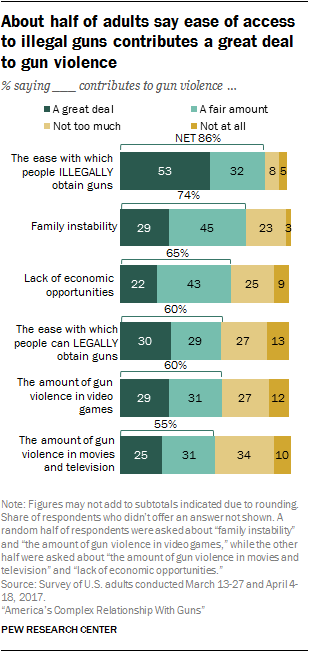
Substantial majorities also favor creating a federal government database to track all gun sales (71%), banning assault-style weapons (68%), and banning high-capacity magazines that hold more than 10 rounds of ammunition (65%).

Proposals for easing gun laws draw much less support. About half say they favor allowing people to carry concealed guns in more places (46%) and allowing teachers and school officials to carry guns in K-12 schools (45%). Even fewer Americans support shortening waiting periods for buying guns legally (36%).
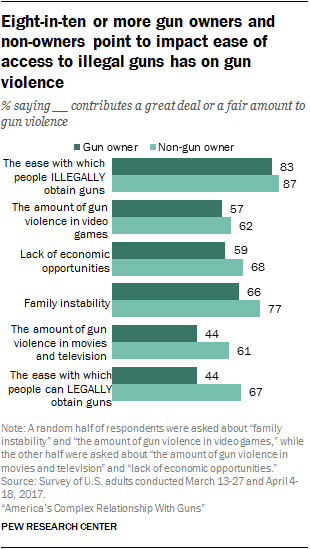
The public is broadly opposed to allowing people to carry concealed guns without a permit: 81% oppose this proposal, with two-thirds strongly opposed. Just 19% favor allowing people to carry concealed guns without a permit.

Gun owners, non-gun owners differ on most policies

Most gun owners favor some limits on gun sales, as well as more ‘concealed carry’

Large majorities of gun owners and non-gun owners favor banning gun sales to the mentally ill, expanded background checks on gun sales and barring gun purchases by people on federal no-fly or watch lists. But there is less agreement on other policy proposals, including those that would make it easier to purchase and carry a gun.

Among those who don’t own guns, 80% favor creation of a federal database to track gun sales, 77% back an assault-weapons ban and 74% support a ban on high-capacity ammunition magazines. No more than about half of gun owners support any of these policies.

The differences are just as stark regarding proposals for easing gun restrictions. Two-thirds of gun owners favor allowing people to carry concealed guns in more places (67%) and allowing teachers and school officials to carry guns in elementary and secondary schools (66%). These proposals draw support from less than 40% of people who do not own guns.

Other proposals draw less support from both groups, though about half of gun owners (53%) favor shorter waiting periods on gun sales, compared with 29% of non-gun owners. Just a third of gun owners and only 12% of non-gun owners support allowing people to carry guns without a permit.

Partisanship and gun ownership are factors in views of gun policies

Wide differences between Republican gun owners, non-gun owners on several policies

Partisan views on gun policy proposals fall along similar lines as the opinions of gun owners and non-gun owners. Large majorities in both parties favor preventing the mentally ill from buying guns (89% each), background checks for private gun sales and gun shows (90% of Democrats, 77% of Republicans), and barring people on federal watch lists from buying guns (85% of Democrats, 82% of Republicans).

Other proposals are much more divisive. For instance, only about a quarter of Democrats and Democratic-leaning independents (26%) support allowing people to carry concealed guns in more places, compared with 72% of Republicans and Republican leaners. The gap is nearly as wide in support for allowing teachers and school officials to carry guns in schools (26% of Democrats, 69% of Republicans).

Both partisanship and gun ownership are key factors in attitudes about gun policies. On several issues, there are wide differences between Republican and Democratic gun owners – and even larger differences between members of both parties who do not own guns.

Republicans generally are more likely than Democrats to own guns: 44% of Republicans and Republican leaners say they own at least one gun, compared with 20% of Democrats and Democratic leaners. (For more on who owns guns, see Chapter 1.)

There is broad support among gun owners and non-gun owners in both parties for the bans on gun sales to the mentally ill and people on no-fly or watch lists, as well as for background checks on private gun sales.

But Republican gun owners stand out for their low levels of support for a federal gun database and bans on assault-style weapons and high-capacity ammunition magazines. Just 43% of Republican gun owners back a federal gun database, 38% favor a ban on assault-style weapons and 32% support banning sales of high-capacity ammunition magazines.

Among Republicans who do not own guns – and Democratic gun owners and non-gun owners – each of these proposals draws majority support.
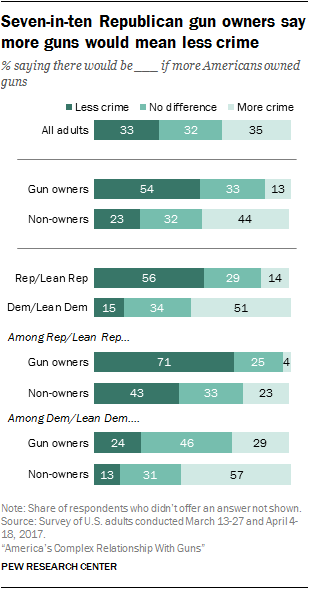
Overall, more Republicans than Democrats favor proposals to loosen gun control laws; however, this support is significantly stronger among Republican gun owners than among non-owners. Similarly, Democrats are less supportive overall, but Democratic gun owners give these proposals somewhat more support than Democrats who don’t own guns.

A larger share of Republican gun owners support each of the proposals to loosen gun laws than any other group. About eight-in-ten favor allowing concealed carry in more places (82%) and allowing teachers to carry in schools (81%). A smaller majority backs shortening waiting periods to buy guns (61%), and about two-in-five favor concealed carry without a permit (43%).

Majorities of both Democratic gun owners and Republican non-owners have similar attitudes about shortening waiting periods and allowing concealed carry without a permit. These groups are divided on expanding concealed carry to more places and allowing teachers to carry guns in schools: about three-in-five Republicans non-owners favor them, compared with two-in-five Democratic owners – a gap of about 20 percentage points on each.
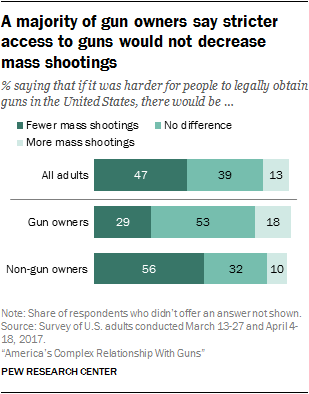
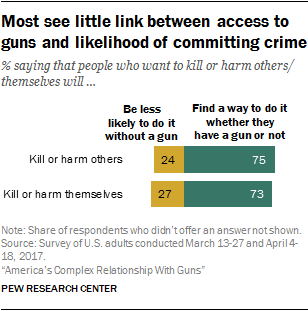
Democrats who do not own guns are strongly opposed to all of these proposals that would make gun laws less strict: Only about one-in-five support expanding conceal carry, carrying by teachers and shortening waiting periods, and just 9% support concealed carry without a permit.

Rural and urban residents diverge in views of many gun policies

Urban and rural residents back federal gun database, ban on assault-style weapons

Views on gun policies also vary widely by the types of communities in which people live. Rural residents are generally more skeptical of proposals to toughen gun laws than are people who live in suburban and urban areas. Rural residents also tend to be more supportive of proposals to loosen gun restrictions.

In part, these gaps reflect differences in partisanship and gun ownership in these communities. Rural residents are more likely than urban and suburban residents to identify as Republicans or lean Republican; people who live in rural areas also are more likely to own guns than those in other communities.

Still, majorities of rural, suburban and urban residents favor a federal gun database, expanded background checks and some restrictions on gun sales.

However, 57% of rural residents support allowing people to carry concealed guns in more places. Less than half of those in suburbs (45%) and urban areas (38%) support increased concealed carry. There are similar differences among people in different types of communities in views of allowing teachers and school officials to carry guns in K-12 schools.

About half of Americans favor stricter gun laws

Majorities of Democrats who don’t own guns – and those who do – favor stricter gun laws

As with views of specific gun policy proposals, opinions about whether gun laws in the U.S. generally should be stricter or less strict are divided by partisanship, gun ownership and community type.

Democrats broadly favor making gun laws stricter than they are today. Three-quarters of Democrats and Democratic leaners – including 78% of non-gun owners and 62% of gun owners – say gun laws in this country should be stricter than they are today.

Republicans and Republican leaners are divided: 46% say current gun laws are “about right,” while 30% say they should be less strict and 24% say they should be stricter.

About half of Republican gun owners (52%) and 40% of Republican non-gun owners say gun laws are about right. More than a third of Republicans who do not own guns (35%) support stricter gun laws in the U.S., compared with just 10% of Republican gun owners. And while 37% of Republican gun owners say gun laws should be less strict, only 24% of Republican non-gun owners say the same.

Views of stricter gun laws vary by feelings about future personal gun ownership

Another factor in attitudes about the nation’s gun laws is how gun owners and people who do not own guns feel about the prospect of their own future gun ownership. Most people who own guns say they can never see themselves not owning a gun: Among this group, just 18% say gun laws should be stricter. Among the smaller share of gun owners who say at some point they could see themselves not owning a gun, 59% favor stricter gun laws.

Among those who do not currently own guns, about as many say they could see themselves owning a gun at some point as say they could never see themselves owning a gun.

Among non-gun owners who are open to the possibility of owning a gun in the future, 51% favor stricter gun laws. By contrast, 75% of non-gun owners who say they can never see themselves owning a gun back stricter gun laws.

Majority says most people should be able to own guns

Gun owners and non-gun owners hold different views about who should be able to legally own guns, where guns should legally be permitted, and what types of guns should be legally available.

Few say ‘almost everyone’ or ‘almost no one’ should be able to legally own guns

A majority of the public (64%) says that most people, but not all, should be able to legally own guns; however, there is a 24-percentage-point gap between owners and non-owners on this question. Fully 80% of gun owners say most people should be able to own guns, plus another 9% who say almost everyone should be able to. A majority of non-owners say most people should be able to own guns (56%), but about one-third either say that some, but not most, people should be able to own guns (24%) or say that almost no one should be able to own guns (12%).

Some respondents who said most, but not all, people should be able to own guns legally were asked to describe in their own words “what should disqualify someone from being able to legally own guns.” Many gun owners and non-owners said people with mental health issues should be disqualified, as well as those who have felony convictions or histories of violent behavior.

Greater differences emerge between owners and non-owners on the places guns should be allowed and what types of guns should be available.

A majority of gun owners say people should be able to carry guns at least most places, while non-owners are more divided on the issue. About twice as many gun owners (34%) than non-owners (15%) say people should be able to carry guns almost everywhere. Conversely, four times more non-owners (20%) than gun owners (5%) say people should be able to carry almost nowhere.

Some who said people should be able to carry guns most, but not all, places were asked “what are some of the places … people should not be able to legally carry guns?” Many mentioned crowded public places, schools, movie theaters and places that serve alcohol.

The share saying almost all types of guns should be legally available (36%) is higher among gun owners as well. Far fewer non-owners say this (12%). About twice as many non-gun owners (34%) as gun owners (15%) say some, but not most, types of guns should be available.

Those who said most, but not all, types of guns should be legally available were asked to share, in their own words, “What are some of the types of guns you think should not be legally available to buy?” These respondents frequently mentioned military-style weapons – though definitions of what constitutes “military style” differed considerably. Some people mentioned semiautomatic or automatic rifles, such as AK-47s, while others mentioned more powerful military equipment such as missiles, explosives, tanks and fighter aircraft.

Supporters of less strict gun laws more likely to contact elected officials

Gun owners more likely than non-gun owners to contact officials on gun policy

While relatively few people have ever contacted public officials about guns (15%) or given money to organizations taking positions on the issue (16%), gun owners are more politically engaged on gun issues than other Americans.

Gun owners are more likely than non-gun owners to say they have ever contacted public officials to express their opinion on gun policy: 21% of owners say they have done this, including 9% who say they did so in the past 12 months, while only 12% of non-owners say they have ever done this.

Furthermore, those who think gun laws should be less strict are more likely to contact public officials on the issue (22% have ever done so), compared with those who think gun laws should be stricter (15%) or are about right (10%). This gap increases further among gun owners: About as many gun owners who want less strict laws (19%) have contacted officials in the last year as owners who want stricter laws have ever contacted officials (20%).

A larger share of gun owners contribute money to organizations that take positions on gun policy (28% have ever done so and 12% have in the last year) than non-owners (10% ever and 6% in the last year).

Public split over protecting right to own guns or controlling gun ownership

Public remains closely divided on controlling guns and protecting rights

The public is closely divided over whether it is more important to protect the right of Americans to own guns or to control gun ownership. In a nationally representative Pew Research Center survey conducted April 5 to 11, 2017, among 1,501 adults over 18, 51% said it was more important to control gun ownership and 47% said protecting the right to own guns is more important (see long term trends on the public’s views about guns).

These attitudes have been mostly stable over the past eight years – with the public about evenly divided between protecting gun rights and controlling ownership.

Republicans say protecting right to own guns is more important

Attitudes on which is more important have shifted about 5 points since last August, however. Then, 52% said it was more important to protect gun rights, compared with 46% who said it was more important to control gun ownership.

Republicans and Democrats remain widely divided over the importance of protecting the right of Americans to own guns. About three-quarters of Republicans and Republican leaners (76%) say protecting gun rights is more important, compared with about a quarter of Democrats and Democratic leaners (22%).

The gap between the two parties has increased significantly since 2000, when there was an 18-percentage-point gap between Republicans and Democrats. Today there is a 54-point gap.

Public divided over the National Rifle Association’s influence on gun laws

Partisan gap in views of NRA is wider than divide between gun owners, non-gun owners

The public is divided over whether the National Rifle Association (NRA) has too much influence or the right amount when it comes to gun laws in this country: 44% say it has too much and 40% say the right amount. Another 15% say it has too little influence.

Compared with gun owners, adults who do not own guns are more likely to say the NRA has too much influence. Half of non-owners say the NRA has too much influence and just 34% say the right amount. About half of gun owners (53%) say the NRA has the right amount of influence and 29% say it has too much. Few in either group say it has too little (17% among gun owners and 14% among non-owners).

There are bigger differences in the way the NRA is viewed among Republicans and Democrats. Two-thirds of Democrats and Democratic leaners say the NRA has too much influence; only 15% of Republicans and Republican leaners say the same. About two-thirds of Republicans say it has the right amount of influence, compared with 21% of Democrats.

A similar share of Republican gun owners and non-owners say the NRA has the right amount of influence (67% of owners and 62% of non-owners). Democrats tend to see the NRA similarly, regardless of whether they personally own a gun: 60% of Democratic gun owners say the NRA has too much influence; 67% of Democrats without a gun say the same.

Acknowledgments

Pew Research Center received invaluable advice on the development of the questionnaire from Mary Zeiss Stange, professor emeritus of women’s studies and religion at Skidmore College, and David Yamane, professor of sociology at Wake Forest University. A series of focus groups with gun owners in Roanoke and Alexandria, Virginia, and Baltimore, Maryland, also helped inform the design of the survey questionnaire.

This report is a collaborative effort based on the input and analysis of the following individuals. Find related reports online at www.pewresearch.org/pewresearch-org/social-trends.

Kim Parker, Director, Social Trends Research Juliana Horowitz, Associate Director, Social Trends Research Ruth Igielnik, Research Associate Baxter Oliphant, Research Associate Anna Brown, Research Analyst Jocelyn Kiley, Associate Director, Political Research Claudia Deane, Vice President, Research Carroll Doherty, Director, Political Research Hannah Fingerhut, Research Assistant Nick Bertoni, Panel Manager Andrew Mercer, Senior Research Methodologist Renee Stepler, Research Analyst Nikki Graf, Research Associate Anthony Cilluffo, Research Assistant Samantha Smith, Research Assistant Rich Morin, Senior Editor Molly Rohal, Communications Manager Bridget Johnson, Communications Associate Michael Keegan, Information Graphics Designer Aleksandra Sandstrom, Copy Editor Travis Mitchell, Digital Producer

Methodology

Surveys conducted March 13-27, 2017, and April 4-18, 2017

The American Trends Panel (ATP), created by the Pew Research Center, is a nationally representative panel of randomly selected U.S. adults recruited from landline and cellphone random-digit dial (RDD) surveys. Panelists participate via monthly self-administered web surveys. Panelists who do not have internet access are provided with a tablet and wireless internet connection. The panel is being managed by Abt Associates.

Most of the data in this report are based on 3,930 respondents who participated in both the March 13 to 27, 2017, and April 4 to 18, 2017, waves of the panel. The margin of sampling error for the full sample of 3,930 respondents is plus or minus 2.8 percentage points.

Members of the American Trends Panel were recruited from two large, national landline and cellphone random-digit dial surveys conducted in English and Spanish. At the end of each survey, respondents were invited to join the panel. The first group of panelists was recruited from the 2014 Political Polarization and Typology Survey, conducted January 23 to March 16, 2014. Of the 10,013 adults interviewed, 9,809 were invited to take part in the panel and a total of 5,338 agreed to participate.4 The second group of panelists was recruited from the 2015 Survey on Government, conducted Aug. 27 to Oct. 4, 2015. Of the 6,004 adults interviewed, all were invited to join the panel, and 2,976 agreed to participate.5

The ATP data were weighted in a multistep process that begins with a base weight incorporating the respondents’ original survey selection probability and the fact that in 2014 some panelists were subsampled for invitation to the panel. Next, an adjustment was made for the fact that the propensity to join the panel and remain an active panelist varied across different groups in the sample. The final step in the weighting uses an iterative technique that aligns the sample to population benchmarks on a number of dimensions. Gender, age, education, race, Hispanic origin and region parameters come from the U.S. Census Bureau’s 2015 American Community Survey. The county-level population density parameter (deciles) comes from the 2010 U.S. decennial census. The telephone service benchmark is comes from the January-June 2016 National Health Interview Survey and is projected to 2017. The volunteerism benchmark comes from the 2015 Current Population Survey Volunteer Supplement. The party affiliation benchmark is the average of the three most recent Pew Research Center general public telephone surveys. The internet access benchmark comes from the 2015 Pew Research Center Survey on Government. Respondents who did not previously have internet access are treated as not having internet access for weighting purposes. Sampling errors and statistical tests of significance take into account the effect of weighting. Interviews are conducted in both English and Spanish, but the Hispanic sample in the American Trends Panel is predominantly native born and English speaking.

The following table shows the unweighted sample sizes and the error attributable to sampling that would be expected at the 95% level of confidence for different groups in the survey:


Sample sizes and sampling errors for other subgroups are available upon request.

In addition to sampling error, one should bear in mind that question wording and practical difficulties in conducting surveys can introduce error or bias into the findings of opinion polls.

The combined two waves had a response rate of 76% (3,930 responses among 5,155 individuals in the panel). Taking account of the combined, weighted response rate for the recruitment surveys (10.0%) and attrition from panel members who were removed at their request or for inactivity, the cumulative response rate for the combined two ATP waves is 2.6%.6

Survey conducted April 5-11, 2017

Some of the analysis in this report is based on telephone interviews conducted April 5 to 11, 2017, among a national sample of 1,501 adults, 18 years of age or older, living in all 50 U.S. states and the District of Columbia (375 respondents were interviewed on a landline telephone, and 1,126 were interviewed on a cellphone, including 693 who had no landline telephone). The survey was conducted by interviewers at Princeton Data Source under the direction of Princeton Survey Research Associates International. A combination of landline and cellphone random-digit dial samples were used; both samples were provided by Survey Sampling International. Interviews were conducted in English and Spanish. Respondents in the landline sample were selected by randomly asking for the youngest adult male or female who is now at home. Interviews in the cell sample were conducted with the person who answered the phone, if that person was an adult 18 years of age or older. For detailed information about our survey methodology, see https://alpha.pewresearch.org/pewresearch-org/methodology/u-s-survey-research/

The combined landline and cellphone samples are weighted using an iterative technique that matches gender, age, education, race, Hispanic origin and nativity, and region to parameters from the 2015 Census Bureau’s American Community Survey and population density to parameters from the decennial census. The sample also is weighted to match current patterns of telephone status (landline only, cellphone only, or both landline and cellphone), based on extrapolations from the 2016 National Health Interview Survey. The weighting procedure also accounts for the fact that respondents with both landline and cellphones have a greater probability of being included in the combined sample and adjusts for household size among respondents with a landline phone. The margins of error reported and statistical tests of significance are adjusted to account for the survey’s design effect, a measure of how much efficiency is lost from the weighting procedures.

The following table shows the unweighted sample sizes and the error attributable to sampling that would be expected at the 95% level of confidence for different groups in the survey:


Sample sizes and sampling errors for other subgroups are available upon request.

In addition to sampling error, one should bear in mind that question wording and practical difficulties in conducting surveys can introduce error or bias into the findings of opinion polls.

Pew Research Center undertakes all polling activity, including calls to mobile telephone numbers, in compliance with the Telephone Consumer Protection Act and other applicable laws.

Community type coding

Data

Data for each census tract were obtained from the Census Bureau. Tract population was taken from American FactFinder, table ID B01003 (“Total Population”), 2015 ACS five-year estimates. Land area for each tract was taken from the 2015 U.S. Gazetteer files. Population density in people per square mile is calculated as follows:

population density = population/(land area)

The share of the tract population living in a census-designated rural place is calculated from American FactFinder, table ID P2 (“Urban and Rural”), 2010 census SF1 100% data. Since the Census Bureau’s urban and rural definitions are complete and opposites (i.e. the shares living in rural and urban areas add to 100%), only the share living in a rural area is kept in the dataset. This information was last calculated after the 2010 decennial census. Besides being slightly outdated, these data do not reflect changes to census tracts since 2010. This issue affects only a small number of tracts.

Metropolitan area status in 2015 is based on the Office of Management and Budget (OMB) definitions and available from the Census Bureau. Metropolitan areas are determined at the county level. In order to match tracts with counties, the first five digits of the tract ID code (which correspond to the county FIPS codes) are used.

To merge individual census tracts to American Trends Panelists, longitude and latitude were geocoded based on address provided by the panelist. An 81% majority of respondents to waves 25 and 26 of the panel were able to be matched to their census tract using this method.

Calculating density groupings

First, the tracts are ordered by population density, least dense to most dense. All tracts with no population are discarded for the purposes of calculating the percentile breaks.

Upper bound population densities are provided for the breaks in the table below. These values correspond to respective percentile rankings. For example, the upper bound of the first tercile, 784.43 people/sq. mile, is the 33rd percentile of the data.


Respondents who did not provide an address and therefore were not able to be geocoded (19% of respondents to waves 25 and 26 of the panel) were instead assigned a community designation based on the location of their telephone number or provided ZIP code in a community of a specific size. For landline numbers, urban/suburban/rural designations are based on OMB definitions and are appended to each number in the sample by the survey sample vendor. OMB defines an urban area as the central portion of a metropolitan statistical area (MSA) while suburban is non-central portions of the MSA and rural encompasses all areas of the country that are not within an MSA. For cellphone numbers, respondents are asked the ZIP code in which they live and then those cellphone respondents are matched to known community type designations based on landlines in the same ZIP code.

Pew Research Center is a nonprofit, tax-exempt 501(c)(3) organization and a subsidiary of The Pew Charitable Trusts, its primary funder.

© Pew Research Center, 2017