
Pew Research Center

FOR RELEASE DECEMBER 17, 2015

Parenting in America

Outlook, worries, aspirations are strongly linked to financial situation

FOR MEDIA OR OTHER INQUIRIES:

Communications Department
202.419.4372
www.pewresearch.org

RECOMMENDED CITATION

Pew Research Center, December 2015, "Parenting in America"

About Pew Research Center

Pew Research Center is a nonpartisan, nonadvocacy fact tank that informs the public about the issues, attitudes and trends shaping the world. It does not take policy positions. The Center conducts public opinion polling, demographic research, computational social science research and other data-driven research. It studies politics and policy; news habits and media; the internet and technology; religion; race and ethnicity; international affairs; social, demographic and economic trends; science; research methodology and data science; and immigration and migration. Pew Research Center is a subsidiary of The Pew Charitable Trusts, its primary funder.

© Pew Research Center 2026

Table of contents

  • About Pew Research Center
  • Parenting in America
  • 1. The American family today
  • 2. Satisfaction, time and support
  • 3. Parenting approaches and concerns
  • 4. Child care and education: quality, availability and parental involvement
  • 5. Children’s extracurricular activities
  • Acknowledgments
  • Methodology

Parenting in America

Outlook, worries, aspirations are strongly linked to financial situation

For the latest data on parenting in America, see “Parenting in America Today” (January 2023).

Parents’ view of their neighborhood differs sharply by income

Contemporary debates about parenthood often focus on parenting philosophies: Are kids better off with helicopter parents or a free-range approach? What’s more beneficial in the long run, the high expectations of a tiger mom or the nurturing environment where every child is a winner? Is overscheduling going to damage a child or help the child get into a good college? While these debates may resonate with some parents, they often overlook the more basic, fundamental challenges many parents face – particularly those with lower incomes. A broad, demographically based look at the landscape of American families reveals stark parenting divides linked less to philosophies or values and more to economic circumstances and changing family structure.

A new Pew Research Center survey conducted Sept. 15-Oct. 13, 2015, among 1,807 U.S. parents with children younger than 18 finds that for lower-income parents, financial instability can limit their children’s access to a safe environment and to the kinds of enrichment activities that affluent parents may take for granted. For example, higher-income parents are nearly twice as likely as lower-income parents to rate their neighborhood as an “excellent” or “very good” place to raise kids (78% vs. 42%). On the flip side, a third of parents with annual family incomes less than $30,000 say that their neighborhood is only a “fair” or “poor” place to raise kids; just 7% of parents with incomes in excess of $75,000 give their neighborhood similarly low ratings.

More concern about violence, teenage pregnancy among lower-income parents

Along with more negative ratings of their neighborhoods, lower-income parents are more likely than those with higher incomes to express concerns about their children being victims of violence. At least half of parents with family incomes less than $30,000 say they worry that their child or children might be kidnapped (59%) or get beat up or attacked (55%), shares that are at least 15 percentage points higher than among parents with incomes above $75,000. And about half (47%) of these lower-income parents worry that their children might be shot at some point, more than double the share among higher-income parents.

Concerns about teenage pregnancy and legal trouble are also more prevalent among lower-income parents. Half of lower-income parents worry that their child or one of their children will get pregnant or get a girl pregnant as a teenager, compared with 43% of higher-income parents. And, by a margin of 2-to-1, more lower-income than higher-income parents (40% vs. 21%) say they worry that their children will get in trouble with the law at some point.

There are some worries, though, that are shared across income groups. At least half of all parents, regardless of income, worry that their children might be bullied or struggle with anxiety or depression at some point. For parents with annual family incomes of $75,000 or higher, these concerns trump all others tested in the survey.

The survey also finds that lower-income parents with school-age children face more challenges than those with higher incomes when it comes to finding affordable, high-quality after-school activities and programs. About half (52%) of those with annual family incomes less than $30,000 say these programs are hard to find in their community, compared with 29% of those with incomes of $75,000 or higher. And when it comes to the extracurricular activities in which their children participate after school or on weekends, far more higher-income parents than lower-income parents say their children are engaged in sports or organizations such as the scouts or take lessons in music, dance or art. For example, among high-income parents, 84% say their children have participated in sports in the 12 months prior to the survey; this compares with 59% among lower-income parents.

The link between family structure and financial circumstances

For U.S. kids, strong link between parents’ marital status and likelihood of living in poverty

The dramatic changes that have taken place in family living arrangements have no doubt contributed to the growing share of children living at the economic margins. In 2014, 62% of children younger than 18 lived in a household with two married parents – a historic low, according to a new Pew Research Center analysis of data from the U.S. Census Bureau. The share of U.S. kids living with only one parent stood at 26% in 2014. And the share in households with two parents who are living together but not married (7%) has risen steadily in recent years.1

These patterns differ sharply across racial and ethnic groups. Large majorities of white (72%) and Asian-American (82%) children are living with two married parents, as are 55% of Hispanic children. By contrast only 31% of black children are living with two married parents, while more than half (54%) are living in a single-parent household.

The economic outcomes for these different types of families vary dramatically. In 2014, 31% of children living in single-parent households were living below the poverty line, as were 21% of children living with two cohabiting parents.2 By contrast, only one-in-ten children living with two married parents were in this circumstance. In fact, more than half (57%) of those living with married parents were in households with incomes at least 200% above the poverty line, compared with just 21% of those living in single-parent households.

Most parents say they’re doing a good job raising their kids

Millennial moms give themselves high marks

Across income groups, however, parents agree on one thing: They’re doing a fine job raising their children. Nearly identical shares of parents with incomes of $75,000 or higher (46%), $30,000 to $74,999 (44%) and less than $30,000 (46%) say they are doing a very good job as parents, and similar shares say they are doing a good job.

Though parental scorecards don’t differ by income, they do vary across other demographic divides, such as gender and generation. Among all parents, more mothers than fathers say they are doing a very good job raising their children (51% vs. 39%), and Millennial mothers are particularly inclined to rate themselves positively. Nearly six-in-ten (57%) moms ages 18 to 34 say they are doing a very good job as a parent, a higher share than Millennial dads (43%) or any other generational group.

Regardless of how they see themselves, parents care a lot about how others perceive their parenting skills. For married or cohabiting parents, the opinion of their spouse or partner matters the most: 93% of these parents say it matters a lot to them that their spouse or partner sees them as a good parent. But most single parents (56%) also say they care a lot that their child’s other parent sees them as a good parent.

Most parents want others to see them as good parents

About seven-in-ten (72%) parents want their own parents to think they are doing a good job raising their children, and smaller but substantive shares care a lot that their friends (52%) and people in their community (45%) see them as good parents.

Parents are nearly evenly divided about whether their children’s successes and failures are more a reflection of how they are doing as parents (46%) or of their children’s own strengths and weaknesses (42%). Parents of younger children feel more personally responsible for their children’s achievements or lack thereof, while parents of teenagers are much more likely to say that it’s their children who are mainly responsible for their own successes and failures.

There are significant differences along racial lines as well, with black and Hispanic parents much more likely than whites to say their children’s successes and failures are mainly a reflection of the job they are doing as parents.

Mothers are more overprotective than fathers

About six-in-ten parents (62%) say they can sometimes be overprotective, while just a quarter say they tend to give their children too much freedom. More also say they criticize their kids too much than say they offer too much praise (44% vs. 33%). American parents are more divided on whether they sometimes “stick to their guns” too much or give in too quickly (43% each).

A gender gap in parenting styles

In several key ways, mothers and fathers approach parenting differently. Mothers are more likely than fathers to say that they sometimes are overprotective of their children, give in too quickly and praise their children too much.

Mothers also have more extensive support networks that they rely on for advice about parenting. They’re much more likely than fathers to turn to family members and friends and to take advantage of parenting resources such as books, magazines and online sources. For example, while 43% of moms say they turn to parenting websites, books or magazines at least sometimes for parenting advice, about a quarter (23%) of dads do the same. And moms are more than twice as likely as dads to say they at least occasionally turn to online message boards, listservs or social media for advice on parenting (21% vs. 9%).

In at least one key area gender does not make a difference: mothers and fathers are equally likely to say that being a parent is extremely important to their overall identity. About six-in-ten moms (58%) and dads (57%) say this, and an additional 35% and 37%, respectively, say being a parent is very important to their overall identity.

Parental involvement – how much is too much?

The survey findings, which touch on different aspects of parenting and family life, paint a mixed portrait of American parents when it comes to their involvement in their children’s education. About half (53%) of those with school-age children say they are satisfied with their level of engagement, but a substantial share (46%) wish they could be doing more. And while parents generally don’t think children should feel badly about getting poor grades as long as they try hard, about half (52%) say they would be very disappointed if their children were average students.

Most college graduates say too much parental involvement in a child’s education can be a bad thing

A narrow majority of parents (54%) say parents can never be too involved in their children’s education. But about four-in-ten (43%) say too much parental involvement in a child’s education can be a bad thing, a view that is particularly common among parents with more education and higher incomes. For example, while majorities of parents with a post-graduate (65%) or a bachelor’s (57%) degree say too much involvement could have negative consequences, just 38% of those with some college and 28% with no college experience say the same.

Black and Hispanic parents have a much different reaction to this question than do white parents, even after controlling for differences in educational attainment. Fully 75% of black and 67% of Hispanic parents say a parent can never be too involved in a child’s education. About half of white parents (47%) agree.

Whether or not they feel too much involvement can be a bad thing, a majority of parents are involved – at least to some extent – in their children’s education. Among parents with school-age children, 85% say they have talked to a teacher about their children’s progress in school over the 12 months leading up to the survey. Roughly two-thirds (64%) say they have attended a PTA meeting or other special school meeting. And 60% have helped out with a special project or class trip at their children’s school. Parents’ level of engagement in these activities is fairly consistent across income groups.

Reading aloud is one way parents can get involved in their children’s education even before formal schooling begins. Among parents with children under the age of 6, about half (51%) say they read aloud to their children every day, and those who have graduated from college are far more likely than those who have not to say this is the case. About seven-in-ten (71%) parents with a bachelor’s degree say they read to their young children every day, compared with 47% of those with some college and 33% of those with a high school diploma or less.

Kids are busy, and so are their parents

Kids of higher-income parents are more likely to be in extracurricular activities

American children – including preschoolers – participate in a variety of extracurricular activities. At least half of parents with school-age children say their kids have played sports (73%), participated in religious instruction or youth groups (60%), taken lessons in music, dance or art (54%) or done volunteer work (53%) after school or on the weekends in the 12 months preceding the survey.

Among those with children younger than 6, four-in-ten say their young children have participated in sports, and about as many say they have been part of an organized play group; one-third say their children have taken music, dance or art lessons.

Parents with annual family incomes of $75,000 or higher are far more likely than those with lower incomes to say their children have participated in extracurricular activities. For parents with school-age children, the difference is particularly pronounced when it comes to doing volunteer work (a 27 percentage point difference between those with incomes of $75,000 or higher and those with incomes less than $30,000), participating in sports (25 points), and taking music, dance or art lessons (21 points). Similarly, by double-digit margins, higher-income parents with children younger than 6 are more likely than those with lower incomes to say their young children have participated in sports or taken dance, music or art lessons in the 12 months prior to the survey.

Parents with higher incomes are also more likely to say their children’s day-to-day schedules are too hectic with too many things to do. Overall, 15% of parents with children between ages 6 and 17 describe their kids’ schedules this way. Among those with incomes of $75,000 or higher, one-in-five say their children’s schedules are too hectic, compared with 8% of those who earn less than $30,000.

But if kids are busy, their parents are even busier. About three-in-ten (31%) parents say they always feel rushed, even to do the things they have to do, and an additional 53% say they sometimes feel rushed. Not surprisingly, parents who feel rushed at least sometimes are more likely than those who almost never feel rushed to see parenting as tiring and stressful and less likely to see it as enjoyable all of the time.

Spanking is an unpopular form of discipline, but one-in-six use it at least sometimes

Use of spanking differs across racial and education groups

Parents employ many methods to discipline their children. The most popular is explaining why a child’s behavior is inappropriate: three-quarters say they do this often. About four-in-ten (43%) say they frequently take away privileges, such as time with friends or use of TV or other electronic devices, and a roughly equal share say they give a “timeout” (41% of parents with children younger than 6) as a form of discipline, while about one-in-five (22%) say they often resort to raising their voice or yelling.

Spanking is the least commonly used method of discipline – just 4% of parents say they do it often. But one-in-six parents say they spank their children at least some of the time as a way to discipline them. Black parents (32%) are more likely than white (14%) and Hispanic (19%) parents to say they sometimes spank their children and are far less likely to say they never resort to spanking (31% vs. 55% and 58%, respectively).

Spanking is also correlated with educational attainment. About one-in-five (22%) parents with a high school diploma or less say they use spanking as a method of discipline at least some of the time, as do 18% of parents with some college and 15% of parents with a bachelor’s degree. In contrast, just 8% of parents with a post-graduate degree say they often or sometimes spank their children.

Parental worries differ sharply by race, ethnicity

Key differences in parental concerns across racial lines

In addition to the economic gaps that underlie parents’ worries about the safety and well-being of their children, wide racial gaps exist on a few key items. White parents are far more likely than black parents to worry that their kids might struggle with anxiety or depression (58% vs. 35%) or that they might have problems with drugs or alcohol (40% vs. 23%). Black parents, in turn, worry more than white parents do that their children might get shot at some point. About four-in-ten (39%) black parents say this is a concern, compared with about one-in-five (22%) white parents. And this difference persists even when looking at white and black parents who live in urban areas, where there is more concern about shootings.

On each of these items and others tested in the survey, Hispanic parents are more likely than white and black parents to express concern. These differences are driven, at least in part, by high levels of concern among foreign-born Hispanics, who tend to have lower household incomes and lower levels of educational attainment than native-born Hispanics.

The remainder of this report includes an examination of changing family structures in the U.S. as well as detailed analyses of findings from the new Pew Research Center survey. Chapter 1 looks at the changing circumstances in which children are raised, drawing on demographic data, largely from U.S. government sources. This analysis highlights the extent to which parents’ changing marital and relationship status affects overall family makeup, and it also includes detailed breakdowns by key demographic characteristics such as race, education and household income. Chapters 2 through 5 explore findings from the new survey, with Chapter 2 focusing on parents’ assessments of the job they are doing raising their children and their families’ living circumstances. Chapter 3 looks at parenting values and philosophies. Chapter 4 examines child care arrangements and parents’ involvement in their children’s education. And Chapter 5 looks at extracurricular activities.

Other key findings

  • About six-in-ten (62%) parents with infants or preschool-age children say that it’s hard to find child care in their community that is both affordable and high quality, and this is true across income groups. Most working parents with annual family incomes of $75,000 or higher (66%) say their young children are cared for in day care centers or preschools, while those earning less than $30,000 rely more heavily on care by family members (57%).
  • On average, parents say children should be at least 10 years old before they should be allowed to play in front of their house unsupervised while an adult is inside. Parents say children should be even older before they are allowed to stay home alone for about an hour (12 years old) or to spend time at a public park unsupervised (14 years old).
  • Roughly a third of parents (31%) with children ages 6 to 17 say they have helped coach their child in a sport or athletic activity in the past year. Fathers (37%) are more likely than mothers (27%) to say they have done this.
  • Nine-in-ten parents with children ages 6 to 17 say their kids watch TV, movies or videos on a typical day, and 79% say they play video games. Parents whose children get daily screen time are split about whether their children spend too much time on these activities (47%) or about the right amount of time (50%).
  • Eight-in-ten (81%) parents with children younger than 6 say that their young children watch videos or play games on an electronic device on a daily basis. Roughly a third (32%) of these parents say their kids spend too much time on these activities; 65% say the amount of time is about right.

Terminology

Throughout this report, references to college graduates or parents with a college degree comprise those with a bachelor’s degree or more. “Some college” refers to those with a two-year degree or those who attended college but did not obtain a degree. “High school” refers to those who have attained a high school diploma or its equivalent, such as a General Education Development (GED) certificate.

Mentions of “school-age” children refer to those ages 6 to 17. “Teenagers” include children ages 13 to 17.

References to white and black parents include only those who are non-Hispanic. Hispanics are of any race.

Mentions of Millennials include those who were ages 18 to 34 at the time of the survey. Gen Xers are ages 35 to 50. Baby Boomers are ages 51 to 69.
1. The American family today

For updated data, read our 2023 essay “The Modern American Family.”

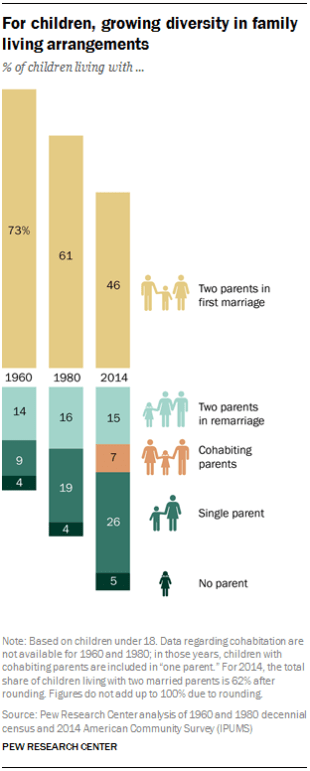
For children, growing diversity in family living arrangements

Family life is changing. Two-parent households are on the decline in the United States as divorce, remarriage and cohabitation are on the rise. And families are smaller now, both due to the growth of single-parent households and the drop in fertility. Not only are Americans having fewer children, but the circumstances surrounding parenthood have changed. While in the early 1960s babies typically arrived within a marriage, today fully four-in-ten births occur to women who are single or living with a non-marital partner. At the same time that family structures have transformed, so has the role of mothers in the workplace – and in the home. As more moms have entered the labor force, more have become breadwinners – in many cases, primary breadwinners – in their families.

As a result of these changes, there is no longer one dominant family form in the U.S. Parents today are raising their children against a backdrop of increasingly diverse and, for many, constantly evolving family forms. By contrast, in 1960, the height of the post-World War II baby boom, there was one dominant family form. At that time 73% of all children were living in a family with two married parents in their first marriage. By 1980, 61% of children were living in this type of family, and today less than half (46%) are. The declining share of children living in what is often deemed a “traditional” family has been largely supplanted by the rising shares of children living with single or cohabiting parents.

Not only has the diversity in family living arrangements increased since the early 1960s, but so has the fluidity of the family. Non-marital cohabitation and divorce, along with the prevalence of remarriage and (non-marital) recoupling in the U.S., make for family structures that in many cases continue to evolve throughout a child’s life. While in the past a child born to a married couple – as most children were – was very likely to grow up in a home with those two parents, this is much less common today, as a child’s living arrangement changes with each adjustment in the relationship status of their parents. For example, one study found that over a three-year period, about three-in-ten (31%) children younger than 6 had experienced a major change in their family or household structure, in the form of parental divorce, separation, marriage, cohabitation or death.

The growing complexity and diversity of families

The two-parent household in decline

The share of children living in a two-parent household is at the lowest point in more than half a century: 69% are in this type of family arrangement today, compared with 73% in 2000 and 87% in 1960. And even children living with two parents are more likely to be experiencing a variety of family arrangements due to increases in divorce, remarriage and cohabitation.3 Today, fully 62% of children live with two married parents – an all-time low. Some 15% are living with parents in a remarriage and 7% are living with parents who are cohabiting.4 Conversely, the share of children living with one parent stands at 26%, up from 22% in 2000 and just 9% in 1960.

These changes have been driven in part by the fact that Americans today are exiting marriage at higher rates than in the past. Now, about two-thirds (67%) of people younger than 50 who had ever married are still in their first marriage. In comparison, that share was 83% in 1960.5 And while among men about 76% of first marriages that began in the late 1980s were still intact 10 years later, fully 88% of marriages that began in the late 1950s lasted as long, according to analyses of Census Bureau data.6

The rise of single-parent families, and changes in two-parent families

Black children and those with less educated parents less likely to be living in two-parent households

Despite the decline over the past half century in children residing with two parents, a majority of kids are still growing up in this type of living arrangement.7 However, less than half—46%—are living with two parents who are both in their first marriage. This share is down from 61% in 19808 and 73% in 1960.

An additional 15% of children are living with two parents, at least one of whom has been married before. This share has remained relatively stable for decades.

In the remainder of two-parent families, the parents are cohabiting but are not married. Today 7% of children are living with cohabiting parents; however a far larger share will experience this kind of living arrangement at some point during their childhood. For instance, estimates suggest that about 39% of children will have had a mother in a cohabiting relationship by the time they turn 12; and by the time they turn 16, almost half (46%) will have experience with their mother cohabiting. In some cases, this will happen because a never-married mother enters into a cohabiting relationship; in other cases, a mother may enter into a cohabiting relationship after a marital breakup.

The decline in children living in two-parent families has been offset by an almost threefold increase in those living with just one parent—typically the mother.9 Fully one-fourth (26%) of children younger than age 18 are now living with a single parent, up from just 9% in 1960 and 22% in 2000. The share of children living without either parent stands at 5%; most of these children are being raised by grandparents.10

The majority of white, Hispanic and Asian children are living in two-parent households, while less than half of black children are living in this type of arrangement. Furthermore, at least half of Asian and white children are living with two parents both in their first marriage. The shares of Hispanic and black children living with two parents in their first marriage are much lower.

Asian children are the most likely to be living with both parents—fully 84% are, including 71% who are living with parents who are both in their first marriage. Some 13% of Asian kids are living in a single-parent household, while 11% are living with remarried parents, and just 3% are living with parents who are cohabiting.

Roughly eight-in-ten (78%) white children are living with two parents, including about half (52%) with parents who are both in their first marriage and 19% with two parents in a remarriage; 6% have parents who are cohabiting. About one-in-five (19%) white children are living with a single parent.

Among Hispanic children, two-thirds live with two parents. All told, 43% live with two parents in their first marriage, while 12% are living with parents in a remarriage, and 11% are living with parents who are cohabiting. Some 29% of Hispanic children live with a single parent.

The living arrangements of black children stand in stark contrast to the other major racial and ethnic groups. The majority – 54% – are living with a single parent. Just 38% are living with two parents, including 22% who are living with two parents who are both in their first marriage. Some 9% are living with remarried parents, and 7% are residing with parents who are cohabiting.

Children with at least one college-educated parent are far more likely to be living in a two-parent household, and to be living with two parents in a first marriage, than are kids whose parents are less educated.11 Fully 88% of children who have at least one parent with a bachelor’s degree or more are living in a two-parent household, including 67% who are living with two parents in their first marriage.

In comparison, some 68% of children who have a parent with some college experience are living in a two-parent household, and just 40% are living with parents who are both in a first marriage. About six-in-ten (59%) children who have a parent with a high school diploma are in a two-parent household, including 33% who are living with parents in their first marriage. Meanwhile, just over half (54%) of children whose parents lack a high school diploma are living in a two-parent household, including 33% whose parents are in their first marriage.

Blended families
One-in-six kids is living in a blended family

According to the most recent data, 16% of children are living in what the Census Bureau terms “blended families” – a household with a stepparent, stepsibling or half-sibling. This share has remained stable since the early 1990s, when reliable data first became available. At that time 15% of kids lived in blended family households. All told, about 8% are living with a stepparent, and 12% are living with stepsiblings or half-siblings.12

Many, but not all, remarriages involve blended families.13 According to data from the National Center for Health Statistics, six-in-ten (63%) women in remarriages are in blended families, and about half of these remarriages involve stepchildren who live with the remarried couple.

Hispanic, black and white children are equally likely to live in a blended family. About 17% of Hispanic and black kids are living with a stepparent, stepsibling or a half-sibling, as are 15% of white kids. Among Asian children, however, 7% – a far smaller share – are living in blended families. This low share is consistent with the finding that Asian children are more likely than others to be living with two married parents, both of whom are in their first marriage.

The shrinking American family

Among women, fertility is declining

Fertility in the U.S. has been on the decline since the end of the post-World War II baby boom, resulting in smaller families. In the mid-1970s, a 40% plurality of mothers who had reached the end of their childbearing years had given birth to four or more children.14 Now, a similar share (41%) of mothers at the end of their childbearing years has had two children, and just 14% have had four or more children.15

At the same time, the share of mothers ages 40 to 44 who have had only one child has doubled, from 11% in 1976 to 22% today. The share of mothers with three children has remained virtually unchanged at about a quarter.

Women’s increasing educational attainment and labor force participation, and improvements in contraception, not to mention the retreat from marriage, have all likely played a role in shrinking family size.

Among Hispanics and the less educated, bigger families

Family size varies markedly across races and ethnicities. Asian moms have the lowest fertility, and Hispanic mothers have the highest. About 27% of Asian mothers and one-third of white mothers near the end of their childbearing years have had three or more children. Among black mothers at the end of their childbearing years, four-in-ten have had three or more children, as have fully half (50%) of Hispanic mothers.

Similarly, a gap in fertility exists among women with different levels of educational attainment, despite recent increases in the fertility of highly educated women. For example, just 27% of mothers ages 40 to 44 with a post-graduate degree such as a master’s, professional or doctorate degree have borne three or more children, as have 32% of those with a bachelor’s degree. Among mothers in the same age group with a high school diploma or some college, 38% have had three or more kids, while among moms who lack a high school diploma, the majority – 55% – have had three or more children.

The rise of births to unmarried women and multi-partner fertility

Not only are women having fewer children today, but they are having them under different circumstances than in the past. While at one time virtually all births occurred within marriage, these two life events are now far less intertwined. And while people were much more likely to “mate for life” in the past, today a sizable share have children with more than one partner – sometimes within marriage, and sometimes outside of it.

Births to unmarried women

The decoupling of marriage and childbearing

In 1960, just 5% of all births occurred outside of marriage. By 1970, this share had doubled to 11%, and by 2000 fully one-third of births occurred to unmarried women. Non-marital births continued to rise until the mid-2000s, when the share of births to unmarried women stabilized at around 40%.16

Not all babies born outside of a marriage are necessarily living with just one parent, however. The majority of these births now occur to women who are living with a romantic partner, according to analyses of the National Survey of Family Growth. In fact, over the past 20 years, virtually all of the growth in births outside of marriage has been driven by increases in births to cohabiting women.17

Researchers have found that, while marriages are less stable than they once were, they remain more stable than cohabiting unions. Past analysis indicates that about one-in-five children born within a marriage will experience the breakup of that marriage by age 9. In comparison, fully half of children born within a cohabiting union will experience the breakup of their parents by the same age. At the same time, children born into cohabiting unions are more likely than those born to single moms to someday live with two married parents. Estimates suggest that 66% will have done so by the time they are 12, compared with 45% of those who were born to unmarried non-cohabiting moms.

The share of births occurring outside of marriage varies markedly across racial and ethnic groups. Among black women, 71% of births are now non-marital, as are about half (53%) of births to Hispanic women. In contrast, 29% of births to white women occur outside of a marriage.

For the less educated, more births outside of marriage

Racial differences in educational attainment explain some, but not all, of the differences in non-marital birth rates.

New mothers who are college-educated are far more likely than less educated moms to be married. In 2014 just 11% of women with a college degree or more who had a baby in the prior year were unmarried. In comparison, this share was about four times as high (43%) for new mothers with some college but no college degree. About half (54%) of those with only a high school diploma were unmarried when they gave birth, as were about six-in-ten (59%) new mothers who lacked a high school diploma.

Multi-partner fertility

Related to non-marital births is what researchers call “multi-partner fertility.” This measure reflects the share of people who have had biological children with more than one partner, either within or outside of marriage. The increase in divorces, separations, remarriages and serial cohabitations has likely contributed to an increase in multi-partner fertility. Estimates vary, given data limitations, but analysis of longitudinal data indicates that almost 20% of women near the end of their childbearing years have had children by more than one partner, as have about three-in-ten (28%) of those with two or more children. Research indicates that multi-partner fertility is particularly common among blacks, Hispanics, and the less educated.

Parents today: older and better educated

While parents today are far less likely to be married than they were in the past, they are more likely to be older and to have more education.

In 1970, the average new mother was 21 years old. Since that time, that age has risen to 26 years. The rise in maternal age has been driven largely by declines in teen births. Today, 7% of all births occur to women under the age of 20; as recently as 1990, the share was almost twice as high (13%).

While age at first birth has increased across all major race and ethnic groups, substantial variation persists across these groups. The average first-time mom among whites is now 27 years old. The average age at first birth among blacks and Hispanics is quite a bit younger – 24 years – driven in part by the prevalence of teen pregnancy in these groups. Just 5% of births to whites take place prior to age 20, while this share reaches 11% for non-Hispanic blacks and 10% for Hispanics. On the other end of the spectrum, fully 45% of births to whites are to women ages 30 or older, versus just 31% among blacks and 36% among Hispanics.

Mothers today are also far better educated than they were in the past. While in 1960 just 18% of mothers with infants at home had any college experience, today that share stands at 67%. This trend is driven in large part by dramatic increases in educational attainment for all women. While about half (49%) of women ages 15 to 44 in 1960 lacked a high school diploma, today the largest share of women (61%) has at least some college experience, and just 19% lack a high school diploma.

Mothers moving into the workforce

Among mothers, rising labor force participation

In addition to the changes in family structure that have occurred over the past several decades, family life has been greatly affected by the movement of more and more mothers into the workforce. This increase in labor force participation is a continuation of a century-long trend; rates of labor force participation among married women, particularly married white women, have been on the rise since at least the turn of the 20th century. While the labor force participation rates of mothers have more or less leveled off since about 2000, they remain far higher than they were four decades ago.

In 1975, the first year for which data on the labor force participation of mothers are available, less than half of mothers (47%) with children younger than 18 were in the labor force, and about a third of those with children younger than 3 years old were working outside of the home. Those numbers changed rapidly, and, by 2000, 73% of moms were in the labor force. Labor force participation today stands at 70% among all mothers of children younger than 18, and 64% of moms with preschool-aged children. About three-fourths of all employed moms are working full time.

Among mothers with children younger than 18, blacks are the most likely to be in the labor force –about three-fourths are. In comparison, this share is 70% among white mothers. Some 64% of Asian mothers and 62% of Hispanic mother are in the workforce. The relatively high proportions of immigrants in these groups likely contribute to their lower labor force involvement – foreign-born moms are much less likely to be working than their U.S.-born counterparts.

The more education a mother has, the more likely she is to be in the labor force. While about half (49%) of moms who lack a high school diploma are working, this share jumps to 65% for those with a high school diploma. Fully 75% of mothers with some college are working, as are 79% of those with a college degree or more.

Along with their movement into the labor force, women, even more than men, have been attaining higher and higher levels of education. In fact, among married couples today, it is more common for the wife to have more education than the husband, a reversal of previous patterns. These changes, along with the increasing share of single-parent families, mean that more than ever, mothers are playing the role of breadwinner—often the primary breadwinner—within their families.

In four-in-ten families, mom is the primary breadwinner

Today, 40% of families with children under 18 at home include mothers who earn the majority of the family income.18 This share is up from 11% in 1960 and 34% in 2000. The bulk of these breadwinner moms—8.3 million—are either unmarried or are married and living apart from their spouse.19 The remaining 4.9 million, who are married and living with their spouse, earn more than their husbands. While families with married breadwinner moms tend to have higher median incomes than married-parent families where the father earns more ($88,000 vs. $84,500), families headed by unmarried mothers have incomes far lower than unmarried father families. In 2014, the median annual income for unmarried mother families was just $24,000.

Breadwinner moms are particularly common in black families, spurred by very high rates of single motherhood. About three-fourths (74%) of black moms are breadwinner moms. Most are unmarried or living apart from their spouse (61%), and the remainder (13%) earn more than their spouse. Among Hispanic moms, 44% are the primary breadwinner; 31% are unmarried, while 12% are married and making more than their husbands. For white mothers, 38% are the primary breadwinners—20% are unmarried moms, and 18% are married and have income higher than that of their spouses. Asian families are less likely to have a woman as the main breadwinner in their families, presumably due to their extremely low rates of single motherhood. Just 11% of Asian moms are unmarried. The share who earn more than their husbands—20%— is somewhat higher than for the other racial and ethnic groups.

The flip side of the movement of mothers into the labor force has been a dramatic decline in the share of mothers who are now stay-at-home moms. Some 29% of all mothers living with children younger than 18 are at home with their children. This marks a modest increase since 1999, when 23% of moms were home with their children, but a long-term decline of about 20 percentage points since the late 1960s when about half of moms were at home.

While the image of “stay-at-home mom” may conjure images of “Leave It to Beaver” or the highly affluent “opt-out mom”, the reality of stay-at-home motherhood today is quite different for a large share of families. In roughly three-in-ten of stay-at-home-mom families, either the father is not working or the mother is single or cohabiting. As such, stay-at-home mothers are generally less well off than working mothers in terms of education and income. Some 49% of stay-at-home mothers have at most a high-school diploma compared with 30% among working mothers. And the median household income for families with a stay-at-home mom and a full-time working dad was $55,000 in 2014, roughly half the median income for families in which both parents work full-time ($102,400).20

2. Satisfaction, time and support

With the complicated fabric of the changing American family as a backdrop, the new Pew Research Center survey provides insight into how today’s parents are raising their children and laying the groundwork for their futures. Most parents say they are doing a good job raising their children, but some clearly face more challenges than others. Financial stress can affect parents’ overall sense of well-being and their assessments of how they are doing as parents and even the extent to which they feel supported in their parenting efforts by family and friends.

Overall, the vast majority of U.S. parents say being a mother or father is enjoyable, rewarding and an important part of their overall identity. Most are satisfied with the amount of time they spend with their children, but at the same time, sizable minorities say they always feel rushed in their daily lives and most say they find parenting tiring and stressful at least some of the time. This chapter explores parents’ overall assessments of the role they play as parents, the challenges they face, and the networks and resources they draw on for support.

The varying quality of neighborhoods

Parents’ view of their neighborhood differs sharply by income, race

While parents are possibly the most important variable in a child’s life, where the child is raised matters, too. A neighborhood can determine what schools children attend, who their friends are and what they can do in their free time. Most U.S. parents say their neighborhood is an excellent (34%) or very good (28%) place to raise children. One-in-five say their neighborhood is a good place to raise children. And 18% describe their neighborhood as fair (13%) or poor (5%). But there are stark differences in these assessments along socioeconomic lines.

Parents with annual family incomes of $75,000 or higher give much more positive assessments of their neighborhoods than do middle- and lower-income parents: 78% say their neighborhood is an excellent or very good place to raise children, compared with 59% of those earning $30,000 to $74,999 and 42% of those earning less than $30,000 annually. Higher-income parents are twice as likely as those with incomes under $30,000 to say their neighborhood is an excellent place to raise children (44% vs. 22%). Among middle-income parents, 31% give their neighborhood an excellent rating.

Lower-income parents, in turn, are far more likely to describe their neighborhood as a fair or poor place to raise kids. Fully a third of parents with incomes below $30,000 give their neighborhood a negative rating, compared with 18% of middle-income parents and 7% of those with incomes of $75,000 or higher.

Large racial differences are apparent as well. Roughly seven-in-ten white parents say that their neighborhood is an excellent or very good place to raise children, while only about four-in-ten black and Hispanic parents say the same. Black (31%) and Hispanic (29%) parents are more than twice as likely as white parents (12%) to say their neighborhood is a fair or poor place to raise children. There is a significant, though smaller, racial difference in neighborhood assessments even after controlling for income. Among those with annual family incomes of $50,000 or higher, 79% of white parents and 68% of non-white parents say their neighborhood is an excellent or very good place to raise children.

One-in-ten parents say they can’t make ends meet

One-in-five single parents say they can’t meet basic expenses

When asked about their household’s financial situation, U.S. parents describe a range of circumstances. One-third of parents say they live comfortably. Roughly the same share (32%) say they are able to meet their basic expenses with a little left over for extras. One-in-four parents say they are just able to meet their basic expenses, and 9% say they don’t even have enough to meet their basic expenses.

Household financial circumstances differ markedly by family type. Among married parents, roughly four-in-ten (39%) say they live comfortably. Significantly smaller shares of parents who are living with a partner (23%) or have no spouse or partner (18%) say they live comfortably. Fully one-in-five (19%) of those with no spouse or partner say they don’t have enough money to meet their basic expenses. That is three times the rate as among married parents.

Financial well-being linked to outlook on life and parenting

Parents who live comfortably give themselves higher ratings for parenting

Overall, about half of parents (46%) say they are doing a very good job as a parent. An equal share say they are doing a good job. Relatively few say they are doing a fair (7%) or poor (1%) job.

While these ratings are not strongly linked to parents’ income or education, there is a strong correlation between parents’ perceived financial well-being and their assessments of how they are doing raising their children. Parents who say they live comfortably give themselves higher ratings than parents who have less financial breathing room. Some 56% of parents who describe their household financial situation as comfortable say they are doing a very good job as a parent. Among those who say they can meet their basic expenses with a little left over or just meet their expenses, about half say they are doing a good (rather than a very good) job as a parent. For those who have trouble meeting their expenses, 39% say they are doing a very good job as a parent, 38% say they are doing a good job, and 21% say they are doing only a fair or poor job.

There is a significant gender gap on this question, with more mothers than fathers saying they are doing a very good job as a parent (51% vs. 39%). There are also differences by age, with younger parents (those ages 18 to 29) more likely than their older counterparts to give themselves top marks for parenting.

Millennial moms give themselves high marks for parenting

The age gap is driven almost entirely by younger mothers. In fact, Millennial moms (those ages 18 to 34) are more likely than any other generational group to say they are doing a very good job as a parent. Fully 57% of Millennial mothers say this, compared with 48% of Gen X mothers and 41% of Baby Boomer mothers. Among Millennials, mothers are much more likely than fathers to give themselves the highest rating (43% of Millennial dads say they are doing a very good job as a parent).

White and black parents are significantly more likely than Hispanic parents to give themselves high ratings for their parenting. About half of white (47%) and black parents (51%) say they are doing a very good job, compared with 38% of Hispanic parents.

Parents’ marital status is not highly correlated with the overall ratings they give themselves for parenting. Whether they are married, living with a partner or neither, parents are about equally likely to say they are doing a very good job. And there are no significant differences among mothers depending on their work situation. Roughly equal shares of those who work full time (50%), those who work part time (54%) and those who do not work outside the home (51%) say they are doing a very job as a parent.

Parents who have only young children in the home give themselves higher marks than parents who have teens at home. Among those whose oldest child is younger than 6, 52% say they are doing a very good job as a parent. By comparison, of parents with at least one teen in the house, 42% say the same.

Most parents care what others think of their parenting skills

About 9-in-10 parents say it matters “a lot” that spouse or partner sees them as a good parent

Parents care a lot about what their spouse or partner thinks of how they are doing as a parent, and they care what their own parents think as well. The opinions of friends and neighbors are important, too, but less so.

Among parents who are married, 92% say it matters a lot to them that their spouse sees them as a good parent. For those who are living with a partner, 95% say the same about their partner. This sentiment is shared across all major demographic groups. Among single parents, 56% say it matters a lot to them that their children’s other parent thinks they are doing a good job as a parent; an additional 20% say this matters a little.

About seven-in-ten mothers and fathers (72%) say it matters a lot to them that their own parents see them as a good parent. An additional 17% say this matters a little to them, and 10% say it doesn’t matter at all. Similar shares of mothers (73%) and fathers (71%) say it matters a lot to them that their parents think they are a good parent. Hispanic parents are more likely than white or black parents to say their own parents’ opinion matters a lot to them – 86% of Hispanic parents say this, compared with 75% of black parents and 68% of white parents.

Parents place less importance on the opinions of friends and people in their community. About half (52%) say it matters a lot to them that their friends see them as a good parent. An additional 27% say this matters a little to them, and 20% say it doesn’t matter at all. There is no significant difference between mothers and fathers on this measure – both value their friends’ opinions about equally.

Some 45% of parents say it matters a lot to them that people in their community see them as a good parent. Again, there are no significant differences between mothers and fathers. Parents with at least some college experience (43%) are somewhat less likely than those with a high school diploma or less (51%) to say it matters a lot to them what people in the community think of their parenting. And middle- and higher-income parents are less likely than lower-income parents to say this matters a lot to them.

Among religious groups, parents who are white, evangelical Protestants are more likely than white mainline Protestants or Catholics to say they care a lot about what people in their community think of how they are doing as a parent: 53% of white evangelical Protestants vs. 41% of white mainline Protestants and 38% of white Catholics say it matters a lot to them that people in their community see them as a good parent.

Parenting matters to overall identity

For most, being a parent is central to their identity

For the vast majority of American parents, being a mother or father is an important part of their overall identity. Roughly six-in-ten (58%) say being a parent is extremely important to their identity, and an additional 36% say it is very important. Some 5% say being a parent is somewhat important to their identity, and only 1% say it’s not too important.

Mothers and fathers are equally likely to say that parenting is central to who they are: 57% of fathers say being a dad is extremely important to their overall identity, and 58% of mothers say the same about being a mom. Millennial parents (60%) are somewhat more likely than parents who are Baby Boomers (51%) to say being a parent is extremely important to their identity. Some 58% of Gen X parents say the same.

While white and black parents are equally likely to say being a mother or father is an extremely important part of their identity (62% and 61%, respectively), Hispanic parents are less likely to say this (47%).

Being a mother or father is an equally important part of parents’ identity, regardless of the age of their children. Whether their youngest child is a preschooler or a teenager, parents are about equally likely to say being a parent is extremely important to their overall identity (60% among those whose youngest child is younger than 6, and 54% among those whose youngest is between ages 13 and 17).

The extent to which mothers and fathers consider being a parent central to their overall identity does not vary significantly by marital status. About the same share of married parents, those who live with a partner and those who don’t have a spouse or partner say being a mother or father is extremely important to their identity. Similarly, working moms are just as likely as stay-at-home moms to say being a mother is central to their overall identity.

The upside of parenting

Parents of young children find parenting more enjoyable, rewarding

About nine-in-ten parents say being a parent is rewarding for them all (53%) or most (35%) of the time. And a similar share say being a parent is enjoyable all (43%) or most (47%) of the time. Roughly equal shares of mothers and fathers say that parenting is rewarding and enjoyable all of the time.

Parents with a college degree are somewhat less likely than other parents to say that being a parent is rewarding and enjoyable all of the time. For example, 31% of parents who have a bachelor’s degree or more education say being a parent is enjoyable for them all of the time. Some 45% of parents with some college education and 54% of those who never attended college say parenting is enjoyable all of the time.

There is a significant age gap in the extent to which parents find parenting rewarding and enjoyable—these views differ by the age of the parent and by the age of their children. Millennial parents (52%) are more likely than Gen X or Boomer parents (39% for both groups) to say that parenting is enjoyable all of the time.

It’s not surprising that younger parents find parenting more enjoyable given that they tend to have younger children. The survey finds that parents who have only young children (under age 6) are more likely than parents with older children to say that parenting is enjoyable and rewarding. Fully six-in-ten parents whose oldest (or only) child is younger than 6 say being a parent is rewarding all of the time. This compares with 51% of parents whose oldest child is between the ages of 6 and 12 and 50% of those whose oldest child is 13 to 17.

Similarly, while 55% of parents whose oldest child is younger than 6 say being a parent is enjoyable all of the time, only about four-in-ten parents whose oldest child is ages 6 to 12 (39%) or 13 to 17 (41%) say the same.

And the downside of parenting

Mothers, more than fathers, find being a parent tiring

The survey finds that more parents say parenting is rewarding and enjoyable than say it is tiring and stressful. Still, one-third of parents say their job as a parent is tiring all (15%) or most (18%) of the time, and one-quarter say being a parent is stressful all (10%) or most (15%) of the time. Overwhelming majorities say being a parent is tiring or stressful at least some of the time.

Mothers are somewhat more likely than fathers to say that being a parent is tiring all or most of the time (37% vs. 29%). Some 15% of dads say that parenting is never tiring, compared with 8% of moms. The views of mothers and fathers are more similar when it comes to the stress of being a parent, though fathers are still somewhat more likely than mothers to say parenting is never stressful (12% vs. 7%).

Children’s ages make a difference here as well. Parents who have at least one child younger than 6 are more likely than parents who do not to say parenting is tiring for them. Among those whose youngest (or only) child is younger than 6, 39% say parenting is tiring all or most of the time. Among parents whose youngest child is ages 6 to 12, 32% say parenting is tiring all or most of the time, and among those whose youngest child is ages 13 to 17, 25% say this.

Feeling rushed?

Parents who always feel rushed are more tired, stressed than other parents

Feeling like there aren’t enough hours in the day no doubt contributes to feelings of stress and fatigue among parents. And most parents today say that they feel rushed at least some of the time. In fact, 31% say they always feel rushed, even to do the things they have to do. An additional 53% say they sometimes feel rushed. Only 15% of parents say they never feel rushed. Mothers are somewhat more likely than fathers to say they always feel rushed (33% vs. 28%), but even among fathers, 81% say they feel rushed at least some of the time. And among mothers, full-time working moms (40%) are significantly more likely than those who work outside the home part time or not at all (29%) to say they always feel rushed.

Parents who say they always feel rushed are more likely than other parents to say that parenting is tiring all of the time (22% vs. 12% of parents who say they feel rushed sometimes or almost never) and they are twice as likely to say that being a parent is stressful all of the time (16% vs. 7%).

Parents with three or more children aren’t any more likely than parents with one child to say they always feel rushed. And there are no significant differences according to children’s ages. Parents whose oldest child is a teenager and those whose children are all under age 6 are equally likely to say they always feel rushed.

Finding time for family, friends and leisure

Many parents say they spend too little time with kids, partners, friends

Even though many parents feel rushed in their daily lives, most (59%) say that they spend about the right amount of time with their children. About a third (36%) say they spend too little time with their children, and 5% say they spend too much time. There is a significant gender gap on this question: mothers (66%) are much more likely than fathers (50%) to say they spend the right amount of time with their children. Roughly half of dads (48%) say they spend too little time with their kids, compared with 25% of moms.

For mothers, work arrangements are linked to their feelings about the amount of time they have to spend with their children. Four-in-ten (39%) full-time working moms say they spend too little time with their children, compared with only 14% of moms who work part time or don’t work outside the home at all. For their part, half of full-time working fathers say they have too little time to spend with their children, significantly larger than the share of full-time working mothers who said the same.21

While relatively few parents say they spend too much time with their children, parents who have only young children are more likely to say this than parents with school-aged children. Among those whose oldest child is younger than 6, 11% say they spend too much time with their kids. By comparison, only 4% of those whose oldest child is 6 or older say the same.

When asked about the time they spend with their spouse or partner, about six-in-ten (59%) married or cohabiting parents say they spend about the right amount of time. Still, a sizable share (38%) say they spend too little time with their spouse or partner. Very few (2%) say they spend too much time.

Mothers and fathers tend to agree on this point—nearly identical shares say they spend the right amount of time with their spouse or partner. White parents (41%) are more likely than black (29%) or Hispanic (32%) parents to say they spend too little time with their spouse or partner.

Married parents are less satisfied with the amount of time they spend with their spouse than cohabiting parents are with the amount of time they spend with their partner. Among married parents, 40% say they don’t spend enough time with their spouse, and 58% say they spend the right amount of time. Among parents who are living with a partner but not married, fully 70% say they spend about the right amount of time with their partner; only 22% say they spend too little time.

Just as work arrangements are linked to attitudes about time spent with children, in households where both the mom and the dad work full time parents are less satisfied with the amount of time they spend with their spouse or partner. Fully 44% of parents in these two full-time working parent households say they spend too little time with their spouse or partner. By comparison, only about a third of parents in households where only one parent works full time say the same (35%). These differences are largely driven by the attitudes of mothers with different work situations: Moms who work full time (44%) are much more likely than those who work part time (27%) or not at all (34%) to say they spend too little time with their spouse or partner.

Most full-time working moms say they don’t have enough free time for friends, hobbies

When it comes to free time, away from the kids, parents are evenly split. About half (53%) say that they don’t have enough time (or volunteer that they have no free time) away from their children to get together with friends or pursue hobbies and other interests, while 46% say they have about the right amount of time to do these things.

Nearly identical shares of mothers (53%) and fathers (52%) say they don’t have enough free time. And there are no significant differences by race or education. Financial well-being is linked to perceptions about free time: 57% of those who say they live comfortably also say they have about the right amount of time away from their children to pursue outside interests. Among parents who say they can’t even meet their basic expenses, only 32% say they have enough free time.

Parents who have multiple children are less satisfied with the amount of free time they have away from their kids: 58% of parents with two children and 55% of those with three or more say they don’t have enough time to spend with friends or on hobbies; 46% of parents with only one child say the same.

There are significant differences among mothers by employment status. Fully 59% of full-time working moms say they don’t have enough time to spend with friends or pursue outside interests. Part-time working moms (48%) and moms who don’t work outside the home (47%) are less likely to express this sentiment. Full-time working dads are less likely than full-time working moms to say they don’t have enough time to spend with friends or pursue outside interests – some 45% of full-time working dads say this, while 52% of these dads are satisfied with the amount of time they have for these pursuits.

Some parents feel more supported than others

Most American parents say that they have at least some support from friends or extended family when it comes to raising their children – 44% say they have a lot of support and an additional 39% say they have some support. Some 15% of U.S. parents say they have almost no support when it comes to raising their children, and 2% volunteer that they have no support at all.

Moms and dads express similar views about their parenting support networks: 45% of mothers and 44% of fathers say they have a lot of support from friends and extended family when it comes to raising their children. The differences across racial and ethnic groups and by educational attainment are minimal.

Marital status is also linked to parents’ perceptions about the level of support they receive from friends and extended family. Parents without a spouse or partner (22%) are significantly more likely than married parents (15%) to say that they have almost no support (or none at all) when it comes to raising their children.

Whom do parents turn to for parenting advice?

Moms, more than dads, turn to family and friends for parenting advice

When parents need advice on raising their children, those who are married or living with a partner lean heavily on that person. Some 57% of these parents say they often turn to their spouse or partner for advice about parenting. An additional 23% say they sometimes rely on their spouse or partner for this type of advice, 8% say they rarely do, and 11% say they never do. Mothers and fathers are equally likely to say that they turn to their spouse or partner for advice on parenting.

Parents are less reliant on other family members and on friends for parenting advice. Overall, 27% of parents say they often ask a family member (other than their spouse or partner, if they have one) for advice about raising their children. About a third (37%) say they sometimes do this, 21% say they rarely do and 16% say never they never do. Parents whose only or oldest child is younger than 6 are somewhat more likely than those with children ages 6 to 17 to say they often rely on a family members for advice about parenting (33% vs. 25%).

Parents are less likely to use friends as a source of parenting advice. Overall, 15% of parents say they often turn to their friends for advice on parenting, and 35% say they sometimes do. Fully half of parents say they rarely (25%) or never (24%) check in with friends when they need advice about child rearing.

There are significant gaps between mothers and fathers when it comes to seeking advice from family and friends. Mothers are much more likely than fathers to say they often turn to family members (other than their spouse or partner) for advice about parenting. Roughly a third of mothers (32%) say they often rely on family members for advice, while only 19% of fathers say they do the same. Some 44% of dads say they rarely or never get advice on parenting from family members, compared with 30% of moms.

The gender gap is also large when it comes to friends. Roughly one-in-five mothers (21%) say they often turn to friends for advice about raising their children, and an additional 38% of moms say they sometimes do this. By comparison, 8% of dads say they often lean on friends for parenting advice, and 33% say they sometimes do. Three-in-ten dads say they never get parenting advice from friends (31% vs. 18% of moms).

Parenting books, magazines, Facebook and more

Half of college-educated moms get advice from parenting websites, books, magazines

Relatively few parents say they rely on outside resources (rather than people) for parenting advice. Fewer than one-in-ten (7%) say they often turn to parenting websites, books or magazines for advice on how to raise their children. Even fewer (4%) say they regularly rely on online message boards, listservs or social media such as Facebook for parenting advice.

Still, a significant share say they consult these outlets at least some of the time. About a third (34%) say they often or sometimes get advice from parenting websites, books or magazines, while 22% say they rarely do this and 44% say they never do. Internet sites where information is shared are used less often: 15% say they often or sometimes turn to online message boards, listservs or social media for parenting advice, 20% say they rarely do this and 64% say they never do.

There are significant gaps between mothers and fathers in their reliance on these types of resources. Mothers (43%) are almost twice as likely as fathers (23%) to say they often or sometimes turn to parenting websites, books or magazines for advice. More than half of dads (56%) say they never use these types of resources for parenting advice, compared with 34% of moms. Mothers are more than twice as likely as fathers to say that they turn to online message boards, listservs or social media at least sometimes for advice on raising their kids (21% of moms vs. 9% of dads).

College-educated moms are among the most likely to utilize these parenting resources. Fully half of moms with a college degree say they often or sometimes get advice from parenting websites, book or magazines. This compares with 39% of moms without a bachelor’s degree. There is an education gap among fathers as well, and, as a result, dads without a college degree are among the least likely to rely on parenting websites, books or magazines for advice (20% do so at least sometimes compared with 29% of college-educated dads).

Similarly, college-educated moms are among the most likely to use online resources where information is shared to get parenting advice. One-in-four moms with a college degree say they often or sometimes turn to online message boards, listservs or social media for parenting advice. Fewer moms without a college degree (18%) say the same. There is no education gap among dads on this measure – 8% of college-educated dads and 9% of dads without a college degree say they often or sometimes use these types of resources.

Parents who have a young child in the house are significantly more likely than parents with older children to say that they turn to any of these sources for parenting advice. Among those whose youngest child is under age 6, 43% say they often or sometimes turn to parenting websites, books or magazines for parenting advice. Among those who youngest child is between the ages of 6 and 12, 32% say they do this, and among those whose youngest child is ages 13 to 17, 21% say the same.

Similarly, 20% of parents whose youngest child is under age 6 say they often or sometimes rely on online message boards, listservs or social media for parenting advice. About half the share of parents whose youngest child is age 6 or older say the same (11%).

3. Parenting approaches and concerns

American parents across demographic groups say being a parent is central to who they are, but the ways they approach parenting – and the concerns they have about their children – vary in some significant ways between mothers and fathers as well as across generations, and racial, ethnic, and socioeconomic groups.

For example, while similar shares of black and white parents say it is extremely important to them for their children to grow up to be honest and ethical and caring and compassionate, black parents place more value than white parents on raising their kids to be hardworking, ambitious and financially independent. Black parents, as well as those who are Hispanic, are also more likely than white parents to say their children’s successes and failures mostly reflect the job they’re doing as parents, while whites are more likely to say this mostly reflects their children’s own strengths and weakness.

When it comes to concerns about challenges their children may face, bullying and mental health issues such as anxiety and depression top the list. But for black and Hispanic parents, as well as for those with lower incomes, the fear that their child or one of their children might get shot at some point is relatively common. And among parents with annual family incomes of less than $30,000, concerns about teenage pregnancy, physical attacks and their kids getting in trouble with the law are also more prevalent than among those who earn $75,000 or more.

This chapter explores the parenting styles and philosophies of parents across demographic groups, as well as their concerns and aspirations for their children’s future.

Parenting styles differ between mothers and fathers

Most parents say they can be overprotective at times

A majority of American parents (62%) say they can sometimes be overprotective, and this is particularly the case among mothers. Nearly seven-in-ten (68%) moms describe themselves this way, compared with 54% of dads. About one-in-five (19%) moms and a third of dads say they are the type of parent who sometimes gives too much freedom.

Mothers are also more likely than fathers to describe themselves as a parent who sometimes gives in too quickly. Overall, the same share of parents say they give in too quickly as say they stick to their guns too much (43% each). Among moms, half say they sometimes give in too quickly, while 38% say they sometimes stick to their guns too much. Dads’ answers are nearly the mirror opposite: half say they sometimes stick to their guns too much, while 35% say they sometimes give in too quickly.

Mothers and fathers also describe themselves differently when asked if they are the type of parent who criticizes or praises too much. Among all parents, somewhat more say they criticize too much (44%) than praise too much (33%), and this is especially the case among dads. About half (49%) of dads say they sometimes criticize their kids too much, while 29% say they sometimes offer too much praise. Among moms, about an equal share say they sometimes are too critical (39%) as say they sometimes praise their kids too much (36%).

Millennials more likely to say they sometimes give too much praise

Parenting styles across generations

Millennials and older parents describe their parenting styles in different ways, but these differences can be attributed, at least in part, to the fact that Millennials tend to have younger children. For example, about two-thirds (68%) of Millennial parents say they can sometimes be overprotective, compared with 60% of Gen X and 54% of Boomer parents. But when looking only at parents who have children younger than 6, about an equal share of Millennials (71%) and older parents (65%) say they can sometimes be overprotective. Similarly, while Millennials are more likely than older parents to say they sometimes stick to their guns too much when it comes to their children, the difference virtually disappears when only those with young children are considered.

Yet, there is one area in which Millennials stand out, even when looking only at parents with children younger than 6: Millennials are more likely than Gex X or Boomer parents to describe themselves as parents who can sometimes praise too much. Four-in-ten Millennials say this, while 35% say they can sometimes criticize too much. In contrast, about half of Gen X and Boomer parents say they sometimes criticize too much (47% and 48%, respectively), while 31% of Gen Xers and 24% of Boomers say they sometimes give too much praise.

Other demographic differences in parenting styles also stand out. For example, college-educated parents are more likely than those who did not attend college to say they sometimes criticize their kids too much; half of parents with a bachelor’s degree or higher and 45% of those with some college describe themselves this way, compared with 36% of parents with a high school diploma or less.

Across racial and ethnic groups, Hispanics are more likely than white or black parents to say they sometimes praise their kids too much; 42% of Hispanic parents say this, compared with about three-in-ten white (30%) and black (31%) parents. When it comes to describing themselves as overprotective, about seven-in-ten black (70%) and Hispanic (72%) parents do so, compared with a narrower majority of white parents (57%). And black parents (54%) are more likely than white (43%) and Hispanic (41%) parents to say they sometimes stick to their guns too much when it comes to parenting.

Many parents say their kids’ successes and failures reflect parenting

Parents are divided on how they view their children’s successes and failures

American parents are quite divided on how much responsibility they bear for the happy victories and inevitable defeats their children face as they grow up. For some (46%), their children’s successes and failures reflect, for the most part, the job they’re doing as parents. But about an equal share (42%) say these ups and downs mostly reflect their children’s own strengths and weaknesses. Fathers are somewhat more likely to say their children’s successes and failure mostly reflect the job they’re doing as parents (47%) than they are to say they reflect the kids’ own strengths and weaknesses (40%). Moms are evenly divided: 44% give each answer.

There are also some modest differences by race.  Among whites, about half (47%) say their kids’ successes and failures are mostly a reflection of the children’s own strengths or weaknesses, while somewhat fewer (40%) say it mostly reflects the job they’re doing as parents. Among black and Hispanic parents, however, narrow majorities (54% and 57%, respectively) say their children’s successes and failures are mostly a reflection of the job they’re doing as parents.

There are also some differences across education groups. Among parents who have a bachelor’s degree, more say their children’s successes and failures mostly reflect their children’s own strengths and weaknesses (48%) than say this mostly reflects the job they are doing as parents (40%). The opposite is true among those with some college or with a high school diploma or less.

In some ways, views on whether the responsibility lies more with the parent or the child depend on the age of the child. In particular, parents of teenagers are far more likely than parents with younger children to give their offspring the credit, or the blame. About half (54%) of parents whose youngest child is between ages 13 and 17 say their children’s successes and failures mostly reflect their children’s own strengths and weakness, compared with about four-in-ten for parents whose youngest child is 12 or under.

One-in-six use spanking as discipline at least sometimes

Few parents say they spank their kids often as a way to discipline

American parents employ many methods of discipline with their children, but explaining why their behavior wasn’t appropriate is the one used most frequently: three-quarters of parents say they do this often, while about four-in-ten say they often take away privileges (43%) or give a “timeout” (41% of parents with kids younger than 6). About one-in-five (22%) parents say they often raise their voice or yell at their kids, and 4% say they turn to spanking often as a way to discipline their kids.

With the exception of spanking, mothers are more likely than fathers to say they rely on each method of discipline often. For example, nearly half (47%) of moms say they often take away privileges, compared with 39% of dads who say the same. And while majorities of mothers and father say they often discipline by explaining to their kids why their behavior was inappropriate, more moms than dads say they do this (80% vs. 70%). An equal share of moms and dads (4% each) say they often spank their children when they need to be disciplined.

While few parents say they frequently rely on spanking, more than four-in-ten (45%) have used this method of discipline with their children, with 17% saying they use it at least some of the time and 28% who rarely spank; 53% say they never spank their children. Black parents are more likely than white or Hispanic parents to say they give spankings at least some of the time: one-third say this, compared with 14% of white parents and 19% of Hispanic parents. And while at least half of white (55%) and Hispanic (58%) parents say they never rely on spanking as a form of discipline, far fewer black parents (31%) say this.

Spanking is also correlated with educational attainment: Parents with a post-graduate degree are less likely than those with a college degree or less education to say they spank their children at least some of the time. Some 8% among the most educated parents say this is the case, compared with 15% of college graduates who did not obtain a post-graduate degree, 18% of those with some college experience, and 22% of those with a high school diploma or less. Among parents with a post-graduate degree, 64% say they never spank, compared with about half of those with less education.

For the most part, reliance on other methods of discipline does not vary as much across demographic groups, but white parents with children younger than 6 are more likely than black and Hispanic parents with children in the same age group to say they often give “timeouts” as a form of discipline (50% vs. 33% and 27%, respectively). And while roughly eight-in-ten among those with at least some college say they often explain to their children why their behavior was inappropriate, about six-in-ten of those with a high school diploma or less say they do this often.

Parents want to raise honest, compassionate and hardworking kids

Honesty, compassion, hard work trump financial independence, ambition when it comes to parents’ hopes for their kids

About seven-in-ten (71%) American parents say it is extremely important to them that their children be honest and ethical as adults, and at least six-in-ten place the same importance on having kids who grow up to be caring and compassionate (65%) and hardworking (62%).

Financial independence is seen as extremely important by a narrower majority (54%) of American parents, while fewer than half (45%) say it is extremely important to them that their children be ambitious as adults.

About the same shares of white and black parents say it is extremely important to them for their children to be honest and ethical and caring and compassionate as adults. But, by double digits, black parents are more likely than white parents to hope their children grow up to be hardworking (72% vs. 62%), financially independent (67% vs. 53%) and ambitious (60% vs. 46%). Hispanic parents are less likely than white or black parents to say they consider each of the five items tested an extremely important trait for their children to have as adults.

Higher-income parents are more likely than those with lower incomes to say it is extremely important to them that their children grow up to be honest and ethical, but majorities across income groups say this (79% among those with annual family incomes of $75,000 or higher, 70% with incomes between $30,000 and $74,999, and 63% with incomes less than $30,000). About two-thirds or more of parents in the higher-income group say it is extremely important for their kids to be caring and compassionate (71%) and hardworking (66%) as adults. Among those in the lower-income group, about six-in-ten say both of these traits are extremely important (57% and 58%, respectively).

For the most part, there are no generational differences in the traits parents value most, but Millennial parents are more likely than older parents to say it is extremely important to them that their kids grow up to be ambitious. About half (52%) of Millennial parents say this, compared with about four-in-ten Gen X (43%) and Boomer (40%) parents.

About four-in-ten place high value on college degree

Mothers and non-white and lower-income parents place more importance on college degrees

About four-in-ten (42%) parents say it is extremely important to them that their children earn a college degree, and an additional 31% say this is very important to them. Mothers are more likely than fathers to say a college degree is extremely important (46% vs. 37%).

Black and Hispanic parents are more likely than white parents to say it is extremely important to them that their children earn a college degree; about six-in-ten (62%) African American and 52% of Hispanic parents say this, compared with about a third (34%) of white parents.

Parents with lower incomes are also more likely than those with higher incomes to value a college degree. Half of parents with an annual family income below $30,000 say it is extremely important to them that their children graduate from college, compared with about four-in-ten of those with incomes between $30,000 and $74,999 (37%) and those with incomes of $75,000 or higher (39%).

The relationship between having a college degree and seeing it as essential to one’s child is not as clear. While parents who have a bachelor’s degree are more likely than those with some college to say it is extremely important to them that their children earn a college degree (46% vs. 36%), they are no more likely than those with a high school diploma or less (42%) to say this is the case.

Bullying tops list of parents’ concerns

Six-in-ten parents worry their children might be bullied at some point

Six-in-ten parents worry that their child or any of their children might be bullied at some point, and at least half also worry that their children might struggle with anxiety or depression (54%) or that they might be kidnapped (50%). About four-in-ten parents express concerns about their children getting beat up or attacked (45%), getting pregnant or getting a girl pregnant as a teenager (43%) and having problems with drugs or alcohol (41%).

Smaller but substantial shares of parents worry that their children might get shot at some point; about three-in-ten (31%) say this is a concern. And about a quarter (27%) worry their children might get in trouble with the law.

Mothers are particularly concerned about bullying, mental health, and kidnappings. About two-thirds (65%) of mothers worry that their child or children might be bullied at some point, compared with 55% of fathers who worry about this. Similarly, mothers are more likely than fathers to say they worry that their children might struggle with anxiety or depression (57% vs. 51%) and that their kids might be kidnapped (55% vs. 44%).

Parents with higher and lower incomes don’t always share the same concerns

Parental concerns vary across income groups, with those with an annual family income below $30,000 far more likely than those with incomes of $75,000 or higher to worry about violence, teenage pregnancy and legal trouble for their kids. For example, 55% of lower-income parents worry that their children might be beat up or attacked, and 47% worry they might get shot at some point. Among those in the high income group, 38% worry about their children being physically attacked, while about a one-in-five (22%) are concerned about gun violence.

Similarly, more parents with family incomes below $30,000 (50%) than those with incomes of $75,000 or higher (43%) worry that their child or children might get pregnant or get a girl pregnant as a teenager. And those with low incomes are about twice as likely as those with high incomes to say they worry their kids might get in trouble with the law at some point (40% vs. 21%, respectively).

Parental concerns vary across racial and ethnic groups

There are also some differences in the concerns expressed by parents across different racial and ethnic backgrounds. In particular white parents are far more likely than black parents to worry that their kids might struggle with anxiety or depression (58% vs. 35%) or that they might have problems with drugs or alcohol (40% vs. 23%). Black parents, in turn, are more likely to worry their kids might get shot at some point. About four-in-ten (39%) black parents say this is a concern, compared with about one-in-five (22%) white parents, and this difference persists even when looking only at white and black parents who live in urban areas, where there is more concern about shootings. Overall, 40% of all parents in urban areas worry that their child or children might get shot, compared with 29% of parents in the suburbs and 21% of parents in rural parts of the country.

On nearly all items tested, Hispanic parents are more likely than white or black to express concern. By double digits, more Hispanic than black or white parents say they worry that their child or children might be bullied, be kidnapped, get beat up or attacked, get pregnant or get a girl pregnant as teenager, have problems with alcohol, get shot, and get in trouble with the law. Hispanic parents are about as likely as white parents – and far more likely than black parents – to worry about their kids struggling with anxiety or depression.

Concerns about bullying and kidnappings are especially prevalent among parents with kids younger than 13. At least six-in-ten parents whose only or youngest child is younger than 6 (66%) or between ages 6 and 12 (62%) say that they worry their children might be bullied at some point, compared with about half (49%) of those whose youngest child is a teenager. Similarly, about six-in-ten (57%) parents with children younger than 6 worry that their children might be kidnapped, compared with 50% of those whose youngest child is between 6 and 12 years old, and even fewer among those with only teenagers (38%).

At what age should children be left alone without adult supervision?

Parents say kids should be at least 10 to be alone at home or in public without adult supervision

While some states and jurisdictions have laws or guidelines about when children can or should be allowed to be at home or in public without adult supervision, the decision often rests with parents, and half or more say kids should be at least 10 years old before they are allowed to play in front of the house, stay home alone for a short period, or spend time at a public park unsupervised.

The average age at which parents say children should be allowed to play in front of the house unsupervised while an adult is inside is 10. On average, parents say children should be older than that before they are allowed to stay home alone for about an hour (12 years old) or to spend time at a public park unsupervised (14 years old).

Parents’ notions about when it is OK for children to be unsupervised at home and in public are correlated with their views of their neighborhood as a good place to raise kids. For example, among parents who describe their neighborhood as excellent or very good, the average age at which a child should be allowed to play in front of the house unsupervised is 9, compared with 11 for those who describe their neighborhood as fair or poor. Similarly, those who give their neighborhood high marks say a child should be 13 years old in order to spend time at a public park unsupervised; those who say their neighborhood is a fair or poor place to raise kids say children should be at least 15 to be at a public park unsupervised.

On two of the three items, Hispanic parents give a higher age, on average, than do white or black parents. For example, the average age at which Hispanic parents say children should be allowed to spend time at a public park unsupervised is 15, compared with 13 among white parents and 14 among black parents. Similarly, Hispanic parents think children should be 14 before they can stay home alone for about an hour, while white parents say this should be allowed to happen when children are 12 and black parents say it should happen when children are 13. When it comes to letting kids play in front of the house while an adult is inside, white parents give a considerably lower age (9 years old) than do black or Hispanic parents (12 years old each).

Divorced and separated parents more likely to disagree about raising kids

One-in-five separated or divorced parents say they disagree with children’s other parent often

While mothers and fathers approach parenting differently in many respects, from the way they describe themselves as parents to the concerns they have, relatively few say they often have disagreements with their spouse, partner, or children’s other parent about how to raise the kids.

Overall, about one-in-ten (9%) say this is the case; an additional 30% say they sometimes have disagreements, while most say they rarely (45%) or never (15%) do.

Parents who are divorced or separated are more likely than other parents to say they often have disagreements about child rearing with the other parent of their child or children. One-in-five divorced or separated parents say this is the case, compared with 12% of parents who have never been married and are not cohabiting, 8% of those who are living with a partner with whom they share at least one child, and 7% of those who are married to the parent of one or more of their children.

But divorced or separated parents are also among the most likely to say they never have disagreements with their children’s other parent. One-in-five say this, compared with 16% of cohabiting and 13% of married parents. Single parents who have never been married are the most likely to say they never have disagreements with their children’s other parent about how to raise the kids; 32% say this.

4. Child care and education: quality, availability and parental involvement

Many parents say that too much parental involvement in a child’s education can be a bad thing, and about half of those with school-age children say they are satisfied with the level of their own involvement in their children’s education. Still, more than four-in-ten say they wish they could be more involved. This is particularly the case among black parents; about six-in-ten say they would like to be more involved, compared with about four-in-ten white and Hispanic parents.

Child care is a major concern for parents with children who are not yet school age. A majority of parents with one or more children younger than 6 say it’s hard to find high-quality, affordable child care in their community. Among parents with school-age children, about four-in-ten say it’s hard to find after-school activities and programs that are both affordable and high quality. Black parents – as well as those with lower incomes – are more likely than other parents to say this is a challenge for them.

This chapter explores parents’ involvement in their children’s education and school activities, as well as child care and after-school arrangements, across different socioeconomic and racial groups. It also looks at parents’ approaches to education, including how much pressure they put on their children to succeed academically and whether they would be disappointed if their children got average grades.

Parents have mixed views about children’s academic performance

Most parents generally agree that kids shouldn’t feel bad about poor grades as long as they try hard

Parents generally feel that children should never feel bad about themselves because of poor grades in school as long as they try hard; 41% say this is very close to their view, and an additional 34% say it is somewhat close. Still, about a quarter (23%) of parents say this is not too close or not at all close to their opinion.

Mothers are more likely than fathers to say the sentiment that kids shouldn’t feel bad about their academic performance as long as they try hard is very close to their own view; about half (47%) of moms say this, compared with a third of dads.

There are no significant differences on this question across generations or racial, educational or income groups, but there is a difference in how parents with different ideological leanings approach this. Fully half of parents who describe themselves as politically liberal say the notion that children should never feel bad about themselves because of poor grades as long as they try hard is very close to their own view; fewer conservative (39%) and moderate (32%) parents say this is the case. Despite this ideological difference, partisan splits are not evident on this question.

Many would be disappointed if their children got poor grades

While parents generally agree that children shouldn’t feel bad about themselves because of poor grades as long as they make an effort, many say they would be very disappointed if their child got average grades in school. About one-in-five say this is very close (19%) to the way they feel, and about a third (32%) say it is somewhat close. Somewhat more fathers (22%) than mothers (17%) say this comes very close to their view, but about half in each group say it is at least somewhat close.

Parents who have a bachelor’s degree are considerably more likely than those who don’t to say that the statement, “I would be very disappointed if my child got average grades in school” comes at least somewhat close to their own view; 60% among college graduates say this, compared with 45% of parents with some college and 48% of those with a high school diploma or less. Similarly, parents with annual family incomes of $75,000 or higher are more likely than those with lower incomes to say this comes at least somewhat close to their view (58% vs. 47% of those with incomes under $30,000).

Most parents say they put the right amount of pressure on their kids

Low-income parents slightly more likely to say they don’t put enough pressure on their kids to do well in school

The large majority of American parents with school-age children say they put the right amount of pressure on their kids to do well in school (82%), but one-in-ten say they don’t put enough pressure on their kids, and 7% say they exert too much pressure.

Parents who do not have a college degree are twice as likely as those who do to say they don’t put enough pressure on their kids to do well in school (12% vs. 6%), although about three-quarters or more across education groups say they put the right amount of pressure on their kids. Similarly, those with lower incomes are slightly more likely than those with higher incomes to say they could be putting more academic pressure on their kids; 16% of those with annual family incomes below $30,000 say this, compared with 10% of those with incomes between $30,000 and $74,999 and 7% of those with incomes of $75,000 or higher.

Most parents are satisfied with the quality of education their kids are getting

Half of parents with school-age children say they are very satisfied with the quality of education their children are receiving at school, and an additional 36% are somewhat satisfied; just 13% say they are very (4%) or somewhat (9%) dissatisfied.

For many parents, opinions about the quality of education at their kids’ schools and views about their neighborhoods go hand in hand. Six-in-ten parents with school-age children who describe their neighborhood as an excellent place to raise kids say they are very satisfied with the education their kids are getting. About half (52%) of those who say their neighborhood is a very good place to raise kids, and fewer among those who rate their neighborhood as good (39%) or fair or poor (40%), are very satisfied with the quality of education their children are receiving.

Hispanic parents are more likely than white or black parents to say they are very satisfied with the quality of education at their kids’ schools (62% vs. 49% and 48%, respectively).

Can too much parental involvement in a child’s education be a bad thing?

About half say parents could never be too involved in their kids’ education

About half (54%) of American parents say parents can never be too involved when it comes to their children’s education, but about four-in-ten (43%) say too much involvement could be a bad thing. Mothers are somewhat less likely than fathers to say too much parental involvement in a child’s education could be a bad thing (40% vs. 47%).

Views about parental involvement in a child’s education also vary by race and ethnicity, with white parents far more likely than black or Hispanic parents to say too much can be a bad thing. About as many whites say this (51%) as say a parent could never be too involved (47%). In contrast, only 23% of black parents and 28% of Hispanic parents think too much parental involvement in a child’s education could be a bad thing, while 75% and 67%, respectively, say parents could never be too involved.

Parents with a bachelor’s degree, as well as those with higher incomes, are more likely than those with less education and lower incomes to say too much parental involvement in a child’s education could be a bad thing. Six-in-ten college graduates say this, compared with 38% of parents with some college and 28% of parents with a high school diploma or less. On the flip side, at least six-in-ten of those with some college (60%) or no college (68%) say one could never be too involved, compared with 37% of parents with a college degree or more. But even among parents who have graduated from college, those with a post-graduate degree are more likely than those without to say too much parental involvement in their kids’ education could be a bad thing (65% vs. 57%).

Similarly, 59% of parents with an annual family income of $75,00o or higher say too much involvement could have negative effects. Four-in-ten parents with family incomes between $30,000 and $74,999 and even fewer (23%) among those with an income under $30,000 share this view.

Across generations, Millennials are more likely than older parents to say parents could never be too involved in their children’s education, but these differences are driven primarily by the views of Millennial moms. Overall, 61% of Millennial parents say one could never be too involved, compared with 52% of Gen X parents and 51% of Boomer parents. Like mothers and fathers in older generations, about half (51%) of Millennial dads say parents could never be too involved in their children’s education; 66% of Millennial moms share this view.

About half of parents wish they could be more involved

About six-in-ten black parents wish they could be more involved in their kids’ education

When it comes to assessments of their own involvement in their kids’ education, close to half (46%) of parents of school-age children say they wish they could be doing more, although somewhat more (53%) say they are satisfied with the way things are. Dads are somewhat more likely than moms to say they wish they could be more involved in their kids’ education (49% vs. 43%).

Self-assessments also differ by race and ethnicity. About six-in-ten (58%) black parents wish they could be doing more when it comes to their children’s education, compared with about four-in-ten white (43%) and Hispanic (41%) parents. There is not a clear link between parents’ education or income and assessments of their involvement in their children’s education.

Full-time working moms are less satisfied with their level of involvement in children’s education

Unmarried parents are more likely than those who are married to say they wish they could be doing more when it comes to their children’s education. While about four-in-ten (42%) married parents would like to be more involved in their children’s education, 56% of those who are unmarried say this is the case.

Moms who work full time are more likely than those who work part time or are not employed to say they wish they could be more involved in their children’s education (50% vs. 32% and 40%, respectively). Among dads, however, there is no significant difference in the shares of those who are employed full time (49%) and those who are employed part time or not employed (53%) saying they wish they could be doing more when it comes to involvement in their children’s education.22

Most parents say they’re involved with school-related activities

Most moms and dads say they have participated in school meetings and activities

More than eight-in-ten (85%) parents with one or more school-age children say they talked to a teacher about their children’s academic progress in the 12 months prior to the survey, and at least six-in-ten attended a PTA or other special school meeting (64%) or helped out with special projects, activities or a class trip at school (60%). Overall, about four-in-ten (43%) say they did all three of these activities in the year prior to the survey, while about half (49%) did one or two, and just 8% were not engaged in any of these school-related activities.

Moms are somewhat more likely than dads to say they participated in each of these activities in the previous 12 months, although majorities in both groups say they have done each of these things.

For example, nine-in-ten mothers with school-age children say they talked to a teacher about their children’s academic progress in the 12 months prior to the survey, compared with 78% of fathers with kids in the same age group. Similarly, 67% of moms say they attended a PTA meeting or other special school meeting and 63% helped out with special projects, activities or class trips; among dads, 61% say they attended a school meeting and 57% say they volunteered to help out with a special project or activity.

White parents are somewhat more likely than black or Hispanic parents to say they helped out with a special project, activity or class trip in the 12 months before the survey (63% vs. 56% and 51%, respectively). But a larger share of black parents (75%) than white parents (63%) say they attended a PTA meeting or other special school meeting over that period; 68% of Hispanic parents say they did this.

Across socioeconomic groups, parents with higher incomes and those who attended college are far more likely than those with lower incomes and those with a high school education or less to say they helped out with special projects, activities or a class trip at their children’s school during the 12 months prior to the survey. About seven-in-ten higher-income and college-educated parents (69% each) say they did this over that period, compared with about half of those with annual family incomes less than $30,000 and those who did not attend college.

Parents with at least some college experience are also more likely than other parents to say they attended a PTA or other school meetings or talked to a teacher about their children’s progress in the 12 months before the survey. When it comes to participation in these activities, differences across income groups is modest at best.

After-school arrangements vary by income

Higher-income parents are more likely to have their kids in after-school activities

Seven-in-ten parents say their school-age children go home after school, while about a quarter say they participate in after-school activities (18%) or use an after-care program (8%). Parents with higher incomes are more likely than those with lower incomes to say their children participate in after-school activities or go to an after-care program; 32% of those with annual family incomes of $75,000 or higher use one of these options, compared with 24% of those with incomes between $30,000 and $74,999 and 17% of those with incomes below $30,000. Parents with incomes below $30,000 are more likely to say their children go home after school; about eight-in-ten (79%) say this, compared with about two-thirds of those with higher incomes.

Parents of teenagers are more likely than those whose only or oldest child is ages 6 to 12 to say their children participate in after-school activities (22% vs. 12%), while after-care programs are a more popular option for those with younger school-age kids than for those whose oldest child is a teenager (13% vs. 4%).

Perhaps not surprisingly, parents in two-parent households where both parents work full time are more likely than those in families where one works full time and one works part time and families where only one parent is working outside of the home to use after-care programs (11% vs. 3% and 4%, respectively). But about the same shares of parents in families where both parents work full time (22%) and in families with one parent who works full time and one who works part time (25%) say their children participate in after-school activities; just 9% of families with one parent at home say this. In these families, 79% say their kids go home after school, compared with 68% in families where both parents work at least part time.

For some parents, good after-school programs can be hard to find

Big racial, income gaps in availability of after-school programs

Most parents of school-aged children are upbeat about the availability of after-school activities in their community, although many say affordable, high-quality programs are hard to find. Roughly six-in-ten parents with children ages 6 to 17 say it is very (25%) or somewhat (34%) easy to find affordable, high-quality after-school activities and programs for school-aged children in their community. About four-in-ten say it is very (14%) or somewhat (25%) hard to find these activities.

Mothers (43%) are somewhat more likely than fathers (33%) to say it’s difficult to find good after-school activities where they live. And there are major gaps by race and socioeconomic status. Many black parents (56%) with school-aged children say it is hard to find affordable, high-quality after-school programs in their community; only 43% say this is easy. By contrast, about six-in-ten white (62%) and Hispanic parents (59%) say it’s easy to find these types of activities for school-aged kids where they live.

Parents from lower-income families have a more negative assessment of the availability of after-school programs in their communities than parents in higher-income families. Among parents with school-aged children who say their annual family income is less than $30,000, 52% say it is hard to find high-quality, affordable after-school programs where they live; 45% say this is easy. Parents from middle-income families lean in the opposite direction, with 55% saying it’s easy to find these after-school activities and 43% saying it’s hard. Parents with family incomes in excess of $75,000 have a much more positive view: 70% say it’s easy (and 29% say it’s hard) to find affordable, high-quality activities for school-aged children where they live.

Finding affordable, high-quality day care

Most parents, regardless of income, say good, affordable child care is hard to find

About half (48%) of working parents with at least one child younger than 6 say their children attend day care or preschool, while 45% say their kids are cared for by a family member when the parents are at work, and 16% rely on a nanny or babysitter.

White parents with young children are more likely than non-white parents to say their kids attend day care or preschool (55% vs. 39%). Those with annual family incomes of $75,000 or more are about twice as likely as those with lower incomes to say their young children are in this type of child care arrangement (66% vs. 32%). In turn, those with incomes below $75,000 are far more likely than those with higher incomes to rely on a family member to care for their children while they are at work (57% vs. 35%).23

Child care can be a major expense for working parents, and the cost has gone up significantly in recent years. Census data show that average weekly child care expenses for families with working mothers increased from $84 per week in 1985 to $143 per week in 2011 (both in 2011 dollars).24 And the burden of child care costs falls more heavily on lower-income parents, as it takes up a larger proportion of their household earnings.

The challenges parents face in finding and affording child care for their young children are reflected in one striking finding from the survey: A majority of parents with one or more children younger than 6 say it is very (29%) or somewhat (33%) hard to find affordable, high-quality child care in their community. Mothers and fathers agree on this point. And there are few differences among parents from different races, income groups or educational backgrounds.

Unmarried parents are more likely than those who are married to say that it’s hard to find high quality, affordable day care where they live (70% vs. 58%). And families with two full-time working parents – who are highly likely to be in need of child care – are much more likely to say this is a challenge in their community than are those in families in which one of the parents does not work outside of the home. Among parents in families where both the mother and father work full time, 67% say it’s hard to find affordable, high-quality day care where they live. By comparison, some 53% of in families with a parent at home say the same.

How involved are parents in their young kids’ education?

Mothers and fathers equally involved in day care and preschool activities

Nearly half (45%) of parents with at least one child younger than 6 say that they have a child who attends a day care, preschool or pre-kindergarten program. An overwhelming majority of these parents (89%) say that, in the 12 months prior to the survey, they talked to a teacher or caregiver at their child’s day care or preschool about their child’s development. Mothers (90%) and fathers (87%) are about equally likely to say they did this.

About seven-in-ten (69%) parents whose children younger than 6 are enrolled in day care or preschool say they attended a parent meeting or other special meeting at the facility in the year leading up to the survey. Again, similar shares of mothers (72%) and fathers (66%) say they did this.

Half of parents with young children in day care or preschool say they helped out with special projects, activities or class trips in the year prior to the survey.

Half of parents read to their young children daily

Strong link between parents’ gender, race, educational background and reading aloud to young children

Among all parents with at least one child under the age of 6, 51% say that they read aloud to their young children every day. An additional 31% say that they read to their children a few times a week. Some 8% say that they do this about once a week, and 9% say they read aloud less often than that.

There is a significant gender gap on this item: Mothers (58%) are more likely than fathers (43%) to say that they read to their young children every day.

White parents with young children are significantly more likely than non-white parents to say that they read to their young children daily. About six-in-ten (59%) white parents say they read aloud to their kids every day, compared with 39% of non-white parents. A higher share of non-white parents than white parents say they read to their children a few times a week (39% vs. 27%).

Parents with a bachelor’s degree are among the most likely to say they read aloud to their young children every day – 71% say they do. By comparison, 47% of parents with some college education and 33% of those with a high school diploma or less say they do the same.

Finally, while about six-in-ten married parents (57%) say they read to their infants or preschoolers on a daily basis, only 38% of unmarried parents say they do.

5. Children’s extracurricular activities

Most parents with one or more school-age children say it is easy to find after-school activities and programs in their community, and this is reflected in the fact that most parents say their children participated in some form of extracurricular activity in the 12 months prior to the survey. Sports or athletic activities are the most popular, but at least half of parents say their children ages 6 to 17 have participated in religious instruction, taken music, dance or art lessons, or done volunteer work.

Even more parents report that their school-age children watch TV, movies or videos (90%) or play games (79%) on any electronic device on a typical day, and about half of these parents say their children spend too much time on these activities. About eight-in-ten parents with children younger than 6 also say their children have screen time on a typical day, but fewer say their children spend too much time watching videos or playing games on electronic devices.

The survey finds that parents with higher income and higher education generally are more likely to report that their children participate in various activities after school. Meanwhile, these parents tend to worry more about their children doing too much. These findings are consistent with what sociologists have found about parenting approaches among parents of different socioeconomic status.25

Parents’ income and education linked to kids’ extracurricular activities

Extracurricular activities are more common in higher-income families

The survey asked parents with school-aged children about a variety of activities that take place outside of regular school hours. Sports are by far the most popular extracurricular activity for kids in this age group. About seven-in-ten parents (73%) with at least one child ages 6 to 17 say that their children participated in sports or athletic activities in the 12 months prior to the survey. Religious-based activities are also quite common: 60% of parents say that their children were in a church youth group or received religious instruction. About half of parents (54%) say that their children took music, dance or art lessons over that period, and a similar share (53%) say their children did volunteer work.

About one-in-three parents (36%) say that their children received regular tutoring or extra academic preparation in the 12 months before the survey. And about one-in-five (23%) parents say that their children participated in an organization such as the scouts. Among parents of teenagers, 36% say that their children had a part-time job during the 12 months leading up to the survey.

Parents with higher income and education are more likely to report that their children participate in various extracurricular activities. Among parents with an annual family income of $75,000 or higher, 84% say their children participated in sports or athletic activities in the 12 months prior to the survey; 62% say their children took music, dance or art lessons. By contrast, some 59% of parents with annual incomes of less than $30,000 say their children participated in sports, and 41% say their children took lessons in music, dance or art over that period.

A similar pattern is evident across education groups, with college graduates more likely than those with some college or with a high school diploma or less to say their children have participated in extracurricular activities. For example, about eight-in-ten (83%) parents with a bachelor’s degree say their children participated in sports or athletic activities in the year prior to the survey, and 66% say that their children took music, dance or art lessons. Among parents with a high school education or less, the shares are 63% and 42%, respectively.

In addition to sports and arts, children from families with higher income and education are more likely to do volunteer work than other children. Some 64% of parents with annual family incomes of $75,000 or higher say their children did volunteer work in the year prior to the survey, and the share among middle-income parents and low-income parents (less than $30,000) is 49% and 37%, respectively. Meanwhile, 62% of parents with a college degree say that their children did volunteer work over that period, compared with 54% of parents with some college education and 41% of parents with a high school education or less.

Overall, relatively small shares of parents across socioeconomic groups say their school-age children participate in an organization like the scouts, but here, too, participation is more common among families with higher income and education. For example, 28% of parents with college degrees say their child or at least one of their children was a scout in the year leading up to the survey, compared with 20% of parents without a bachelor’s degree.

Teenagers from higher-income families are more likely than their peers to have had some work experience in the year before the survey. Among parents with annual incomes of $75,000 or higher, 45% say their teenager worked at a part-time job during this period. About a third (34%) of middle-income parents and 25% of lower-income parents say the same.

Some children’s activities are linked to parents’ racial background

Race and ethnicity are linked to participation in some extracurricular activities but not to others. When it comes to athletic activities, there are no significant differences by race: white (75%), black (68%) and Hispanic (69%) parents are about equally likely to say that their school-aged children participated in sports in the year prior to the survey. And roughly equivalent shares of white (55%), black (47%) and Hispanic (52%) parents say their children took music, dance or art lessons over that period.

White and black parents are more likely than Hispanic parents to report that their children participated in religious instruction or church youth activities in the 12 months prior to the survey. And black and Hispanic parents are more likely than white parents to say that their children have received tutoring or extra academic help over that period.

White parents are more likely than other parents to report that their children did volunteer work, had a part-time job or participated in an organization like the scouts in the 12 months leading up to the survey.

For the most part, parents with younger school-age kids are as likely as those with teenagers to say their children participate in extracurricular activities. The exception is volunteering: Two-thirds (67%) of parents with only teenagers at home say that their children did volunteer work over the year prior to the survey, compared with 36% of those whose oldest child is between ages 6 and 12.

Three-in-ten parents have coached their children’s sports

Parents with younger children are more active in coaching their kids’ sports

Parents often play an active role in children’s activities. About three-in-ten parents of school-age children (31%) say that in the 12 months leading up to the survey, they helped coach a sport or athletic activity in which their children participate. Parents from different incomes and education, as well as racial and ethnic backgrounds, are equally likely to say they have done that over the same period.

More fathers (37%) than mothers (27%) say they helped with coaching their children’s sports in the year prior to the survey, and parents with younger school-age children are more likely than those with teenagers to say this is the case. Among parents whose children are all under age 13, about four-in-ten (38%) had helped with coaching, compared with 26% of parents with only teenagers at home.

Few parents describe their children’s schedule as hectic

Are children’s day-to-day schedules too hectic?

While most parents say their children participate in extracurricular activities, relatively few say that their children’s schedules are too hectic. According to most parents (72%) with children between the ages of 6 and 17, things are just about right when it comes to their children’s day-to-day schedule. An additional 11% say their children have too much free time on their hands. Some 15% say their children’s daily schedule is too hectic with too many things to do.

There are significant differences by race and income in parents’ perceptions about how busy their children’s schedules are. White parents (18%) are twice as likely as black parents (9%) to say that the schedules are too hectic. Among Hispanic parents, 5% say their kids’ daily schedules are too busy.

Parents with higher incomes are more likely than those with lower incomes to say their children’s daily schedule is too hectic. One-in-five parents with an annual family income of $75,000 or more think their children have too many things to do during the day, compared with 13% of parents with an annual income of $30,000 to $74,999, and 8% of parents with incomes less than $30,000.

Parents who report that their children are involved in a greater variety of activities are more likely than other parents to say that their children’s schedule is too hectic. For example, 8% of parents whose kids are in one activity or no activities say their kids’ schedules are too hectic, compared with 15% of those whose kids participate in two activities and 22 of those who say they participate in three or four.26 Still majorities of parents – regardless of the number of activities in which their children participate – say things are about right when it comes to their kids’ schedules.

On a typical day, a vast majority of children watch TV or play video games

About eight-in-ten or more say their kids spend time watching videos or playing games on electronic devices

The most common after-school activities for today’s children may be sedentary. Nine-in-ten parents report that their children ages 6 to 17 watch TV, movies or videos (on any device) on a typical day, and about eight-in-ten say their school-age children play video games. Majorities of about three-quarters or more across racial, education and income groups say their children engage in these activities on a typical day.

About half say their kids get too much screen time

Overall, parents of school-age children are split about whether their children have too much screen time or about the right amount, based on the parent’s assessment: some 47% of parents whose child or children watch videos or play games on a typical day think their children spend too much time on TV, videos and games, while 50% think their children spend about the right amount of time on these activities.

Compared with white (55%) or black parents (47%), Hispanic parents (23%) whose children have daily screen time are less likely to say that their children spend too much time in front of a screen. Instead, a majority of these parents (73%) say their children’s screen time is the right amount.

Parents with higher education tend to worry a little more about their children’s screen time. More than half of parents with a bachelor’s degree (56%) say that their children spend too much time on TV and video games, compared with 47% of parents with some college education, and 36% of parents with high school education or less.

Parents with higher incomes are also more likely to be concerned about their children’s screen time. Some 56% of parents with an annual income of $75,000 or higher say that their children spend too much time watching TV or playing video games. By comparison, 46% of parents with incomes of $30,000 to $74,999 and 33% of those in lower-income families say their children spend too much time on these activities.

Children’s ages may also play a role in their screen time. Among parents with only teenagers at home, 52% say that their children spend too much time watching TV or videos or playing video games, compared with 43% of parents whose children are all under 13 years old.

A recent study on children’s media use finds that teenagers spend an average of nine hours per day on media use (through TV, Internet, smartphones, and so on) for purposes other than school or homework, and that children ages 8 to 12 spend about six hours per day in these activities.27 The study also suggests that low-income children are less likely than others to have access to computers, tablets and smartphones. However, when they do have access, they are more likely to spend more time on these devices.

Four-in-ten parents with young children say their kids participate in sports

College-educated parents are more likely to say their young children participate in activities

Organized activities such as sports or lessons in music or arts are less common among younger children. Four-in-ten parents of children ages 5 or younger say their kids participated in sports or athletic activities in the 12 months prior to the survey, and one-in-three parents say their children took music, dance or art lessons over that period. About four-in-ten (39%) say their young children participated in an organized play group in the 12 months.

Parents’ education has a lot to do with their young children’s activities. College-educated parents are more likely than parents with lower educational levels to report that their children participate in all three activities asked in the survey. Nearly half of college-educated parents (49%) say that their kids younger than 6 participated in sports or athletic activities in the 12 months leading up to the survey; a similar share (48%) says their kids took music, dance or art lessons, and 44% say their kids were in a play group. By contrast, the shares among parents with high school education or less are 33%, 20% and 31%, respectively.

Family income also plays a role in young children’s activities. About half of parents with family incomes of $75,000 or more (51%) say their child or children participated in sports, compared with 33% of parents with family incomes of $30,000 or less. Parents with higher incomes (46%) are also more likely than low-income parents (21%) to say that their kids took music, dance or art lessons in the 12 months prior to the survey. However, parents’ income does not seem to affect whether their children participate in an organized play group. Also, parents with different racial and ethnic backgrounds are equally likely to say that their kids have participated in these three activities.

TV, video games are popular among young children

Preschoolers are also frequently in front of a screen. On a typical day, a majority of parents (81%) say that their child or children ages 5 or younger watch TV or movies or play games on any type of electronic device (such as a computer, tablet or cell phone). Meanwhile, about a third of parents whose children have daily screen time (32%) worry that their children spend too much time on these devices, although more parents think their children’s screen time is about right (65%).

White parents are more likely than non-white parents to be concerned about their young children’s screen time (39% vs. 19%). College-educated parents whose children watch videos or play games on most days are also more likely than parents who have a high school education or less to say that their young children spend too much time in front of a screen (37% vs. 25%).28

Acknowledgments

This report is a collaborative effort based on the input and analysis of the following individuals:

Primary researchers Kim Parker, Director of Social Trends Research Juliana Menasce Horowitz, Associate Director, Research

Research team Gretchen Livingston, Senior Researcher Wendy Wang, Senior Researcher Renee Stepler, Researcher Assistant Eileen Patten, Research Analyst Gustavo López, Research Assistant Claudia Deane, Vice President, Research Michael Suh, Associate Digital Producer Michael Keegan, Information Graphics Designer Marcia Kramer, Kramer Editing Services

Methodology

The analysis in this report is based on telephone interviews conducted from Sept. 15 to Oct. 13, 2015, among a nationally representative sample of 1,807 parents, 18 years of age or older, with children under 18, living in all 50 U.S. states and the District of Columbia (635 respondents were interviewed on a landline telephone and 1,172 were interviewed on a cell phone, including 697 who had no landline telephone). The survey was conducted by interviewers at Princeton Data Source under the direction of Princeton Survey Research Associates International.

A combination of landline and cell phone random digit dial (RDD) samples was used; both samples were provided by Survey Sampling International. Interviews were conducted in English and Spanish. Respondents in the landline sample were selected by randomly asking for the youngest adult male or female who was home at the time. Interviews in the cell sample were conducted with the person who answered the phone, if that person was an adult 18 years of age or older. To supplement the fresh RDD sample, interviews were completed among a sample of parents who recently participated in the PSRAI Weekly Omnibus survey and a recent Pew Research Center political survey. Approximately half of respondents were obtained from the RDD sample and half from the callback sample.

For the RDD sample, the combined landline and cell phone sample are weighted using an iterative technique that matches gender, age, education, race, Hispanic origin and nativity, and region to parameters of parents from the 2013 Census Bureau’s American Community Survey and population density to parameters from the 2010 Decennial Census. The sample also is weighted to match current patterns of telephone status (landline only, cell phone only, or both landline and cell phone), based on extrapolations from the 2014 National Health Interview Survey. The weighting procedure also accounts for the fact that respondents with both landline and cell phones have a greater probability of being included in the combined sample and adjusts for household size among respondents with a landline phone.

For the callback sample, the final weight used in the original survey was applied as the first-stage weight. The second stage of weighting balances sample demographics to population parameters of parents as described above. The population density and phone use parameters were derived from an analysis of all Pew political survey data collected in 2015. The margins of error reported and statistical tests of significance are adjusted to account for the survey’s design effect, a measure of how much efficiency is lost from the weighting procedures.

For detailed information about our survey methodology, see https://alpha.pewresearch.org/pewresearch-org/methodology/u-s-survey-research/

The following table shows the unweighted sample sizes and the error attributable to sampling that would be expected at the 95% level of confidence for different groups in the survey:

ST_2015-12-17_parenting-66

Sample sizes and sampling errors for other subgroups are available upon request.

In addition to sampling error, one should bear in mind that question wording and practical difficulties in conducting surveys can introduce error or bias into the findings of opinion polls.

Pew Research Center is a nonprofit, tax-exempt 501(c)(3) organization and a subsidiary of The Pew Charitable Trusts, its primary funder.

© Pew Research Center, 2015