
Pew Research Center

FOR RELEASE JULY 17, 2014

In Post-Recession Era, Young Adults Drive Continuing Rise in Multi-Generational Living

The number of Americans living in multi-generational households, which spiked during the Great Recession, has risen to a record 57 million in 2012, including about one-in-four young adults ages 25-34.

BY Richard Fry and Jeffrey S. Passel

FOR MEDIA OR OTHER INQUIRIES:

Communications Department
202.419.4372
www.pewresearch.org

RECOMMENDED CITATION

Pew Research Center, July 2014, "In Post-Recession Era, Young Adults Drive Continuing Rise in Multi-Generational Living"

About Pew Research Center

Pew Research Center is a nonpartisan, nonadvocacy fact tank that informs the public about the issues, attitudes and trends shaping the world. It does not take policy positions. The Center conducts public opinion polling, demographic research, computational social science research and other data-driven research. It studies politics and policy; news habits and media; the internet and technology; religion; race and ethnicity; international affairs; social, demographic and economic trends; science; research methodology and data science; and immigration and migration. Pew Research Center is a subsidiary of The Pew Charitable Trusts, its primary funder.

© Pew Research Center 2026

Table of contents

  • About Pew Research Center
  • In Post-Recession Era, Young Adults Drive Continuing Rise in Multi-Generational Living
  • The Growth in Multi-generational Family Households
  • Young Adults Driving Growth in Multi-generational Living
  • References
  • Appendix A: Additional Tables
  • Appendix B: Notes on Terminology and Methodology

In Post-Recession Era, Young Adults Drive Continuing Rise in Multi-Generational Living

The number of Americans living in multi-generational households, which spiked during the Great Recession, has risen to a record 57 million in 2012, including about one-in-four young adults ages 25-34.

After three decades of steady but measured growth, the arrangement of having multiple generations together under one roof spiked during the Great Recession of 2007-2009 and has kept on growing in the post-recession period, albeit at a slower pace, according to a new Pew Research Center analysis of U.S. Census Bureau data.

[tweetable url="http://pewrsr.ch/1ysKtJs" alt="24% of young adults ages 25-34 lived in multi-generational households in 2012, up from 18.7% in 2007 and 11% in 1980"]
Young Adults Now More Likely Than Oldest Adults to Live in a Multi-generational Household

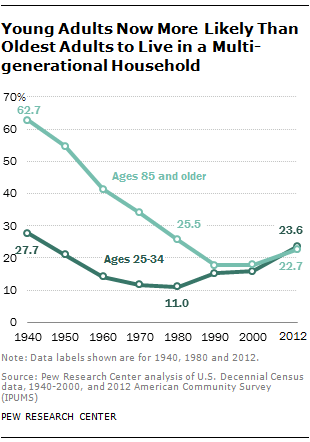
Historically, the nation’s oldest Americans have been the age group most likely to live in multi-generational households. But in recent years, younger adults have surpassed older adults in this regard. In 2012, 22.7% of adults ages 85 and older lived in a multi-generational household, just shy of the 23.6% of adults ages 25 to 34 in the same situation.

The increase in multi-generational living since 2010 is apparent across genders and among most racial and ethnic groups. While the share of young adults ages 25 to 34 living in multi-generational households has increased most rapidly, the share increased across all age groups with one exception: Among those ages 65 to 84, the share living in a multi-generational household decreased slightly between 2010 and 2012.

[tweetable url="http://pewrsr.ch/1ysKtJs" alt="26% of men and 21% of women ages 25 to 34 were living in multi-generational households in 2012"]

Which Young Adults Are We Counting?

This analysis does not include persons living in group quarters (including college students residing in dormitories) or young adults ages 18-24 living with their parents. However, these young adults could be classified as residing in a multi-generational household if the other members of their household qualify (some examples are if they are living with a parent along with a grandparent, a sibling age 25 or older or their own child).

The Great Recession resulted in a large loss in employment for young adults. But the fact that a larger share of young men than women are now living in multi-generational arrangements does not necessarily imply that the job losses since 2007 have been greater among young men. Studies generally tend to show that, though men lost more jobs in the recession, men have also disproportionately gained jobs during the recovery (Carnevale, Jayasundera, and Cheah, 2012). Rather, it might simply be that young men’s living arrangements are more sensitive to employment fluctuations than young women’s are (Mather, 2011).
Increase in Multi-generational Living Among the Young Cuts Across Genders

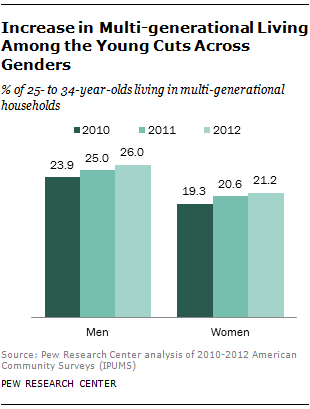
The post-recession increase in multi-generational living among 25- to 34-year-olds is apparent among both men and women. The share of this age group living in multi-generational households increased by about 2 percentage points from 2010 to 2012 irrespective of gender.

The growing tendency of young adults—male and female—to live in multi-generational households may be another manifestation of their delayed entry into adulthood. Previous Pew Research Center studies have shown that young adults are marrying at later ages and staying in school longer. Both of these factors may be contributing to the rising share of young adults living with their parents or other family members.

In addition, the declining employment and wages of less-educated young adults may be undercutting their capacity to live independently of their parents. Unemployed adults are much more likely to live in multi-generational households than adults with jobs are. A 2011 Pew Research report found that in 2009, 25% of the unemployed lived in a multi-generational household, compared with 16% of those with jobs. Since job-holding is strongly associated with higher levels of education, the increase in young adults living with their parents since the recession is most apparent among those without a bachelor’s degree.

[tweetable url="http://pewrsr.ch/1ysKtJs" alt="Racial and ethnic minorities are generally more likely to live in multi-generational households."]Racial and ethnic minorities generally have been more likely to live in multi-generational family arrangements, and their numbers have grown with increased immigration since the 1970s.

The long-term increase in multi-generational living since 1980 also reflects the country’s changing racial and ethnic composition. Racial and ethnic minorities generally have been more likely to live in multi-generational family arrangements, and their numbers have grown with increased immigration since the 1970s. In 2012 about one-in-four Hispanics and blacks lived in a multi-generational household. Asian Americans were the most likely of the major racial and ethnic groups to live in multi-generational arrangements (27%). By comparison, 14% of non-Hispanic whites lived with multiple generations of family. The racial and ethnic patterns of multi-generational living were fairly similar in 1980. That year, racial and ethnic minorities made up 20% of the population; today they account for 37%.

The remainder of this report examines both the recent increase in U.S. multi-generational living and the longer-term trends over the past century. The final section looks in more detail at recent changes in multi-generational living arrangements by age, gender and race and ethnicity.

About the Data

Findings in this report are based on Pew Research calculations of the U.S. Census Bureau’s American Community Surveys (ACS) from 2006 to 2012, provided by the Integrated Public-Use Microdata Series (IPUMS). The trends on Americans’ living arrangements come from Pew Research calculations of Decennial Census data from 1900 to 2000 also provided by IPUMS. The IPUMS are compiled by the University of Minnesota Population Center. Documentation is available at http://usa.ipums.org/usa/doc.shtml.

For this report, multi-generational households include households with:

  • Two generations: parents (or in-laws) and adult children ages 25 and older (or children-in-law); either generation can “head” the household
  • Three generations: parents (or in-laws), adult children (or children-in-law), grandchildren
  • “Skipped” generations: grandparents and grandchildren, without parents
  • More than three generations

The definition of a multi-generational household used in this report is more expansive than the definition used by the Census Bureau. For a more detailed description of types of households and the methodology used see Appendix B.

The counts of multi-generational family households for 2006, 2007, 2008 and 2009 marginally differ from previously published Pew Research Center estimates. The previous multi-generational population numbers are based on survey data tied to previous Census Bureau population estimates that have since been revised. In the wake of the 2010 Decennial Census the Census Bureau revised the 2006 to 2009 population estimates. The Pew Research Center revised the weights for the 2006 to 2009 ACS to conform to the updated Census Bureau population estimates. The resulting series of multi-generational population estimates are consistent over time but marginally differ from previous estimates.

A Note on Terminology

A multi-generational household is a household that includes at least two adult generations (for example, parents and adult children ages 25 or older where either generation can be the household head) or two non-sequential generations (for example, grandparents and grandchildren of any age). For a more detailed definition, see Appendix B.

All references to adult children are to those ages 25 or older, so 18- to 24-year-olds living at home are not treated as an adult generation.

All references to whites, blacks and Asians are to the non-Hispanic components of those populations. Asians also include Pacific Islanders. Hispanics are of any race.

The Growth in Multi-generational Family Households

The growing number of Americans living in multi-generational households reflects more than the overall increase in the U.S. population. From 2009 to 2012, the number of people living in multi-generational households increased from 51.5 million to 56.8 million. Over that same time period, the share of the population living in multi-generational households rose from 16.8% to 18.1%.

From 2007 to 2010, the multi-generational population grew substantially—swelling by well over 2 million people per year. Since 2010, the multi-generational population has increased at a slower rate—roughly 1 million per year.

Annual Increase in Multi-generational Population Has Diminished in Post-Recession Era

However, the Great Recession and its aftermath only accelerated an increase in multi-generational living arrangements that had been unfolding for several decades. In 1980, a post-World War II low of 12.1% of the population resided in a multi-generational household. By 2007, 15.5% of the population lived in a multi-generational household.

Looking back further in time, the modern rise in multi-generational households was a reversal of a previous trend. Throughout most of the 20th century intergenerational coresidence was declining. This downward trend was particularly sharp among the elderly. In 1900, 57% of adults ages 65 and older lived in a multi-generational household. By 1980, only 17% lived with multiple generations of family.

A number of factors likely contributed to the decreased tendency for the elderly to live with adult children early in the century. Marked improvements in the health of the elderly diminished infirmity and boosted their capacity to live independently. Rising incomes and the establishment of Social Security and private pensions greatly increased the financial well-being of older adults, enabling the elderly to afford privacy and independent living (McGarry and Schoeni, 2000).

Multi-generational Households More Common Among Foreign Born

In addition to rising affluence, demographic factors played a role. Fertility declined substantially during the 1900s, reducing the number of children with whom elderly parents could potentially reside (Schoeni, 1998). And economic opportunities, with the transformation of the economy from an agrarian to an industrial basis, led many adult children to leave the family home and seek opportunities in the emerging labor market (Ruggles, 2007).

Since immigrants are more likely than U.S.-born Americans to live with multiple generations in the home, there is little doubt that some of the growth in multi-generational living is due to the third great wave of immigration that commenced with the passage of the Immigration and Nationality Act of 1965. Since 1980, the share of households headed by an immigrant has doubled (from 7% to 14% in 2012). In 2009, 16% of households headed by an immigrant were multi-generational, compared with 10% of households with a U.S.-born head.

Young Adults Driving Growth in Multi-generational Living

The post-recession uptick in the population living in multi-generational arrangements has been particularly pronounced among young adults ages 25 to 34. In 2012, 23.6% of this age group lived in a multi-generational household, up from 21.6% in 2010.

Recent Increase in Multi-generational Living Most Pronounced Among Young Adults

Historically, the oldest Americans, those ages 85 and older, have been the most likely to live with multiple generations of family. However, in 2011 young adults ages 25 to 34 eclipsed those ages 85 and older as the group most likely to live in a multi-generational household. By 2012, 22.7% of the oldest Americans resided with multiple generations of kin, compared with 23.6% of young adults ages 25 to 34.

Looking back to 1980, young adults ages 25 to 34 were less likely (11%) than the population as a whole (12.1%) to live in a multi-generational household. The past 30 years have seen a sharp reversal, with young adults ages 25 to 34 (23.6%) now substantially more likely than the general population (18.1%) to live in these types of households.

Some of the long-run increase in multi-generational living arrangements among young adults is due to their greater difficulties in establishing economic self-sufficiency as a result of declining labor market opportunities (Sironi and Furstenberg, 2012; Kahn, et. al., 2013). This is particularly true for young men without a four-year college education. For example, real hourly wages declined between 5% and 25% for men with less than a bachelor’s degree between 1979 and 2010, with the steepest declines among the youngest and least-educated men. By contrast, women with at least a high school education have experienced wage gains (Autor and Wasserman, 2013).

There have also been well-known changes in the social behaviors of young adults. This generation of young adults is marrying at later ages, so the pool of unmarried young adults—a group much more likely to live with their parents—is expanding. According to the Census Bureau, the median age at first marriage in 2013 is estimated to be 29 for men and almost 27 for women. In 1980, the median age of first marriage for both men and women was between four and five years younger.

Increase in Multi-generational Living Sharper for 25- to 34-Year-olds

The fact that young adults were once less likely than the nation’s seniors to live in multi-generational households but are now more likely to do so may reflect, in part, the changing economic fortunes of the nation’s young compared with older age groups. Poverty rates among the nation’s 65 and older population have markedly fallen over the past 50 years. In contrast, poverty has risen among young adults since the 1980s. While the likelihood of residing in a multi-generational household may not be a direct measure of economic well-being (or lack thereof), there is evidence that the changing patterns of multi-generational living parallel “the general trends toward the greater economic security of older adults and the increasing financial strain experienced by younger adults.” (Kahn, et. al., 2013)

Age and Gender

In general, women are more likely than men to live in a multi-generational household. In 2012, 19% of women lived in such arrangements, compared with 17% of men. This partly reflects the likelihood that women, on average, live longer than men. In addition, women ages 65 and older are much less likely than similarly aged men to be married, and, just as with young adults, older adults who are unmarried are more likely to live in multi-generational households.

The main exception to this general gender pattern in multi-generational living arrangements occurs among young adults age 25 to 34, where young men (26%) are significantly more likely than young women (21%) to live with multiple generations of family.

Young men ages 25 to 34 are more likely than men ages 85 and older to live in multi-generational households (19% of older men do). By contrast, women ages 85 and older are substantially more likely to live in a multi-generational arrangement (25% do) than are young women ages 25 to 34 (21%).

In Most Age Groups, Women More Likely Than Men to Live With Multiple Generations of Family

Who Is the Head of the Household?

In census data, each household is counted as being headed by one person, generally the one who owns or rents the house or apartment. Since the household head might be construed as the household member with the greatest financial resources and most financial independence, there is considerable interest in determining who is living with whom in a multi-generational household. For instance, in a two-generation multi-generational family household, are the parent and the adult child (age 25 or older) living in the parent’s home or the adult child’s home? That is, which generation is the head of the household?

Relationship to Head of Household of Multi-generational Household Population, by Age Group, 2012

By and large, the patterns of relationship to the head of the household have not markedly changed from 1980 to 2012. In 2012, most young adults living in multi-generational households were the child of the household head and hence living in their parent(s)’ house. Among those ages 25 to 34, 80% fell into this category in 2012. As adults age they are less likely to be living in a parent’s household and more likely to be either the head, the spouse of the head or living in a household headed by their adult child. Among 65- to 84-year-olds living with multiple generations of family, nearly two-thirds (64%) were the head or spouse of the head. It is only among the nation’s oldest Americans in multi-generational households in which a majority (59%) are the parent of the head and hence living in their adult child’s abode.

One significant change in these overall patterns has been among children living in multi-generational households. Increasingly these children live in their grandparent(s)’ house, not their parent(s)’ house, suggesting that economic assets and wherewithal have shifted from young adults toward older adults. In 1980, only 39% of children younger than 18 in multi-generational arrangements were the grandchild of the household head. By 2012, many more children younger than 18 in multi-generational households were the grandchild of the head (55%). In most cases, when a child resides with a grandparent, at least one of the child’s parents also resides in the household. In 2012, such children typically lived in the grandparent(s)’ house, not their parent(s)’ house.

Multi-generational Living Increased Among Most Racial and Ethnic Groups


The share of people living in multi-generational households has increased across most racial and ethnic groups in the post-recession period.

Non-Hispanic whites have experienced the greatest increase on a percentage-point basis. In 2012, 14.3% of non-Hispanic whites lived in a multi-generational household, up 0.6 percentage point from the 2010 level (13.7%). Some minority populations have also become more likely to live in multi-generational households since the recession ended. In 2012, Asian Americans were the racial or ethnic group most likely to live with multiple generations of kin (27.2%). Using census data, it is difficult to know how far back historically Asian Americans have held this distinction due to the changes in census racial classification that occurred in 2000. By comparison, about 25% of blacks lived in a multi-generational household in 2012. Among Hispanics 24% lived in multi-generational households in 2012.

Types of Multi-generational Households

Multi-generational Population, by Type of Household, 2009 and 2012

Of the 56.8 million people living in a multi-generational household in 2012, 27.3 million (48%) lived in a household made up of two adult generations of the same family (with the youngest adult at least 25 years of age). Another 26.5 million (47%) lived in a household with three or more generations of family members. Nearly 3 million (5%) lived in a “skipped” generation household consisting of a grandparent and grandchild, but no parent. This is a slightly different pattern of prominence by type than observed in 2009, when the population in three or more generation households slightly outnumbered the population in two adult generation households.


References

Autor, David, and Melanie Wasserman. 2013. Wayward Sons: The Emerging Gender Gap in Labor Markets and Education. Washington, D.C.: Third Way, March.

Carnevale, Anthony P., Tamara Jayasundera, and Ban Cheah. 2012. “The College Advantage: Weathering the Economic Storm.” Washington, D.C.: Georgetown Center for Education and the Workforce, August.

Fry, Richard, et. al. 2011. “The Rising Age Gap in Economic Well-being.” Washington, D.C.: Pew Research Center Social and Demographic Trends Project, November.

Fry, Richard. 2013. “A Rising Share of Young Adults Live in Their Parents’ Home.” Washington, D.C.: Pew Research Center Social and Demographic Trends Project, August.

Kahn, Joan R., Frances Goldscheider, and Javier Garcia-Manglano. 2013. “Growing Parental Economic Power in Parent-Adult Child Households: Coresidence and Financial Dependency in the United States, 1960-2010.” Demography, vol. 50, pp. 1449-75.

Kochhar, Rakesh, and D’Vera Cohn. 2011. “Fighting Poverty in a Bad Economy, Americans Move in with Relatives.” Washington, D.C.: Pew Research Center Social and Demographic Trends Project, October.

Livingston, Gretchen. 2013. “At Grandmother’s House We Stay.” Washington, D.C.: Pew Research Center Social and Demographic Trends Project, September.

Lofquist, Daphne A. 2012. “Multigenerational Households: 2009-2011.” Washington, D.C.: US Census Bureau, October. American Community Survey brief ACSBR/11-03.

Mather, Mark. 2011. “In U.S., a Sharp Increase in Young Men Living at Home.” Washington, D.C.: Population Reference Bureau, September.

McGarry, Kathleen, and Robert F. Schoeni. “Social Security, Economic Growth, and the Rise in Independence of Elderly Widows in the 20th Century.” Demography, vol. 37, pp. 221-36.

Parker, Kim. 2012. “The Boomerang Generation.” Washington, D.C.: Pew Research Center Social and Demographic Trends Project, March.

Payne, Krista K., and Jennifer Copp. 2013. “Young Adults in the Parental Home and the Great Recession.” Bowling Green State University: National Center for Family and Marriage Research, FP-13-07.

Pew Research Center. 2013. “Second Generation Americans.” Washington, D.C.: Pew Research Center Social and Demographic Trends Project, February.

Ruggles, Steven. 2007. “The Decline of Intergenerational Coresidence in the United States, 1850 to 2000.” American Sociological Review, vol. 72, pp. 964-989.

[Machine-readable database]

Schoeni, Robert F. 1998. “Reassessing the Decline in Parent-Child Old-age Coresidence during the Twentieth Century.” Demography, vol. 35, no. 3, pp. 307-313.

Sironi, Maria, and Frank F. Furstenberg. 2012. “Trends in the Economic Independence of Young Adults in the United States: 1973-2007.” Population Development and Review, December, vol. 38, no. 4, pp. 609-630.

Taylor, Paul, et. al. 2010. “The Return of the Multi-Generational Family Household.” Washington, D.C.: Pew Research Center Social and Demographic Trends Project, March.

Appendix A: Additional Tables

Households by Multi-generational Status, 2006-2012

Appendix B: Notes on Terminology and Methodology

Generations. The number of generations in a household is determined by the relationship of each person in the household to the head. Each household has a “base” generation determined by the reference person or head of the household. Others in the base generation include the reference person’s spouse, siblings and siblings in law. Generations beyond this base are defined by individual relationships:

  1. Base generation: reference person, spouse, sibling, sibling in law
  2. Children (“-1” generation): child of head, child in law
  3. Parents (“+1” generation): parent of head, parent in law
  4. Grandchildren (“-2” generation): grandchild of head
  5. Others: great-grandchild of head, grandparent of head

The University of Minnesota Population Center’s IPUMS datasets permit determining generational composition for other types of relationships (e.g., aunt, uncle, niece, nephew) and for persons not related to the household head because the dataset identifies parental linkages (for each person in the household) where possible. So two generations are also present if a person is determined to have a parent (in the household) based on the IPUMS variables “MOMLOC” and “POPLOC.” If the parent also has a parent, a third generation is present.

Multi-generational Households. For our analyses, save for one exception, multi-generational households are defined as households with at least two generations of adults. The principal type of multi-generational household actually has two generations only—parent(s) and the adult child(ren). This can take the form of:

  1. Householder (and spouse), parent (or parent in law)
  2. Householder (and spouse), adult child (or child in law)

So, a typical nuclear family with a householder, a spouse, and young children would not be classified as a multi-generational household.

In our analyses, we define adult children as those ages 25 and older rather than ages 18 and older. With this definition, the vast majority of college students living at home are not treated as an adult generation.

The next most common type of multi-generational household is the three generation household. There are a number of variants on this type, but the major ones differ as to whether the householder is in the middle generation (i.e., a “sandwich” household) or the older generation (i.e., a “grandparent” household):

  1. Householder (and spouse), parent (or parent in law), child (or child in law)
  2. Householder (and spouse), child (or child in law), grandchild

Note that in these households, the children do not have to be adults.

The only type of multi-generational household we define that does not necessarily include two adult generations is what might be called the “skipped” generation household. In these households, a grandchild is present but the grandchild’s parental generation is not present in the household (i.e., it is “skipped”). These multi-generational family households can be of two types:

  1. Householder (and spouse), grandchild
  2. Householder (and spouse), grandparent

Most households are not multi-generational households; they are single-generation households (the householder and possibly a spouse) or two-generation, adult-minor child households. In the early years of the 20th century, there were twice as many of these two generation households as one generation households. This pattern began to change in 1930 as one generation households increased in prevalence. By 1970, there were roughly equal numbers of the two households. In 2008, there were 70% more one generation than two generation households.

The definition of a multi-generational household used in this report is more expansive than the definition used by the Census Bureau. The Census Bureau defines multi-generational households as follows: A multi-generational household is one that contains three or more parent-child generations; for example, the householder, child of householder (biological, stepchild or adopted child), and grandchildren of householder. A householder with a parent or parent-in-law of the householder and a child of the householder may also be a multi-generational household (see page B-6 in: http://www.census.gov/prod/cen2010/doc/sf1.pdf).

According to the Census Bureau American FactFinder, 3.8% of U.S. households in 2012 were multi-generational. The definition used in this report finds that 11.2% of all households in 2012 were multi-generational.