
Pew Research Center

FOR RELEASE MARCH 14, 2013

Modern Parenthood

Roles of Moms and Dads Converge as They Balance Work and Family

FOR MEDIA OR OTHER INQUIRIES:

Communications Department
202.419.4372
www.pewresearch.org

RECOMMENDED CITATION

Pew Research Center, March 2013, "Modern Parenthood"

About Pew Research Center

Pew Research Center is a nonpartisan, nonadvocacy fact tank that informs the public about the issues, attitudes and trends shaping the world. It does not take policy positions. The Center conducts public opinion polling, demographic research, computational social science research and other data-driven research. It studies politics and policy; news habits and media; the internet and technology; religion; race and ethnicity; international affairs; social, demographic and economic trends; science; research methodology and data science; and immigration and migration. Pew Research Center is a subsidiary of The Pew Charitable Trusts, its primary funder.

© Pew Research Center 2026

Table of contents

  • About Pew Research Center
  • Modern Parenthood
  • Chapter 1: Changing Views About Work
  • Chapter 2: Balancing Work and Family Life
  • Chapter 3: Outcomes
  • Chapter 4: How Mothers and Fathers Spend Their Time
  • Chapter 5: Americans’ Time at Paid Work, Housework, Child Care, 1965 to 2011
  • Chapter 6: Time in Work and Leisure, Patterns by Gender and Family Structure
  • References
  • Appendix 1: Additional Charts
  • Appendix 2: Characteristics of Men and Women in Different Family Settings
  • Appendix 3: Time Use Activities for Paid Work, Housework, Child Care and Leisure
  • Appendix 4: Topline Questionnaire

Modern Parenthood

Roles of Moms and Dads Converge as They Balance Work and Family

The way mothers and fathers spend their time has changed dramatically in the past half century. Dads are doing more housework and child care; moms more paid work outside the home. Neither has overtaken the other in their “traditional” realms, but their roles are converging, according to a new Pew Research Center analysis of long-term data on time use.

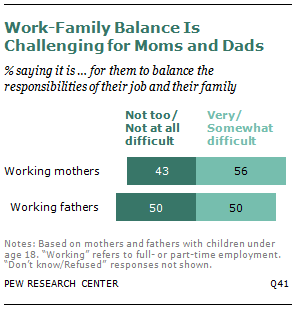
At the same time, roughly equal shares of working mothers and fathers report in a new Pew Research Center survey feeling stressed about juggling work and family life: 56% of working moms and 50% of working dads say they find it very or somewhat difficult to balance these responsibilities.

Still, there are important gender role differences. While a nearly equal share of mothers and fathers say they wish they could be at home raising their children rather than working, dads are much more likely than moms to say they want to work full time. And when it comes to what they value most in a job, working fathers place more importance on having a high-paying job, while working mothers are more concerned with having a flexible schedule.1

However, mothers’ attitudes toward work have changed considerably in recent years. Among mothers with children under age 18, the share saying they would prefer to work full time has increased from 20% in 2007 to 32% in 2012. Tough economic times may have ushered in a new mindset, as women in the most difficult financial circumstances are among the most likely to say working full time is the ideal situation for them.
SDT-2013-03-Modern-Parenthood-02
SDT-2013-03-Modern-Parenthood-03

At the same time, the public remains conflicted about what is best for children. Among all adults, only 16% say the ideal situation for a young child is to have a mother who works full time. A plurality of adults (42%) say mothers working part time is ideal, and one-third say it’s best for young children if their mothers do not work at all outside of the home.

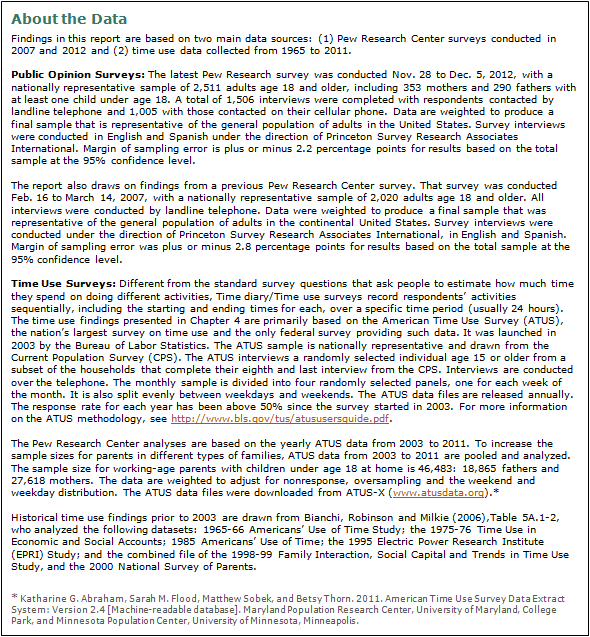
These findings are based on a new Pew Research survey of 2,511 adults nationwide conducted Nov. 28-Dec. 5, 2012, and an analysis of the American Time Use Survey (ATUS). The ATUS, which began in 2003, is a nationally representative telephone survey that measures the amount of time people spend doing various activities throughout the day. It is sponsored by the U.S. Bureau of Labor Statistics and is conducted by the U.S. Census Bureau. Data collected from 2003 through 2011 include interviews with more than 124,000 respondents. Comparable time diary data are available going back as far as 1965, allowing for an analysis of trends over a nearly 50-year period.2

Balancing Work and Family

The Pew Research survey finds that about half (53%) of all working parents with children under age 18 say it is difficult for them to balance the responsibilities of their job with the responsibilities of their family. There is no significant gap in attitudes between mothers and fathers: 56% of mothers and 50% of fathers say juggling work and family life is difficult for them.

Feeling rushed is also a part of everyday life for today’s mothers and fathers. Among those with children under age 18, 40% of working mothers and 34% of working fathers say they always feel rushed.

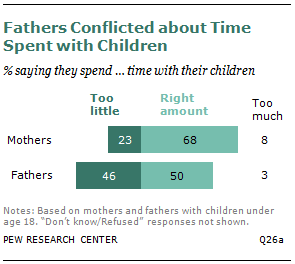
With so many demands on their time, many parents wonder whether they are spending the right amount of time with their children. Overall, 33% of parents with children under age 18 say they are not spending enough time with their children. Fathers are much more likely than mothers to feel this way. Some 46% of fathers say they are not spending enough time with their children, compared with 23% of mothers. Analysis of time use data shows that fathers devote significantly less time than mothers to child care (an average of seven hours per week for fathers, compared with 14 hours per week for mothers). Among mothers, 68% say they spend the right amount of time with their children. Only half of fathers say the same. Relatively few mothers (8%) or fathers (3%) say they spend too much time with their children.

Mothers, Fathers and Time Use

A lot has changed for women and men in the 50 years since Betty Friedan wrote “The Feminine Mystique.” Women have made major strides in education and employment, and the American workplace has been transformed. But with these changes have come the added pressures of balancing work and family life, for mothers and fathers alike. Trends in time use going back to 1965 clearly show how the increased participation of women in the workforce has affected the amount of time mothers devote to paid work. In 2011, mothers spent, on average, 21 hours per week on paid work, up from eight hours in 1965. Over the same period, the total amount of time mothers spend in non-paid work has gone down somewhat.

For their part, fathers now spend more time engaged in housework and child care than they did half a century ago. And the amount of time they devote to paid work has decreased slightly over that period. Fathers have by no means caught up to mothers in terms of time spent caring for children and doing household chores, but there has been some gender convergence in the way they divide their time between work and home.
SDT-2013-03-Modern-Parenthood-04

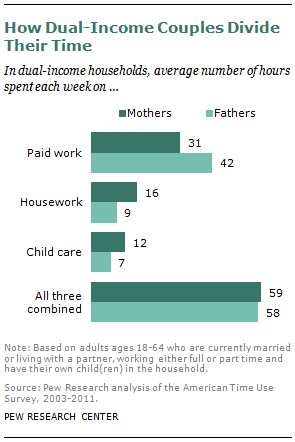
Roughly 60% of two-parent households with children under age 18 have two working parents. In those households, on average, fathers spend more time than mothers in paid work, while mothers spend more time on child care and household chores. However, when their paid work is combined with the work they do at home, fathers and mothers are carrying an almost equal workload.

How Do Today’s Mothers and Fathers Rate Themselves?
SDT-2013-03-Modern-Parenthood-05

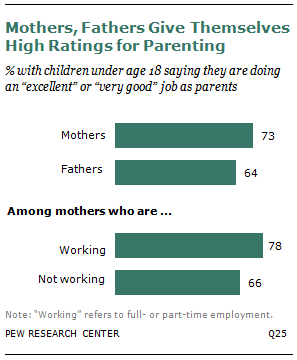
In spite of challenges they face, today’s parents give themselves good grades overall for the job they are doing raising their children. Among all parents with children under age 18, 24% say they have done an excellent job, and an additional 45% say they have done a very good job. Some 24% say they have done a good job, and only 6% rate their job as parents as fair or poor.

Mothers give themselves somewhat higher ratings than do fathers: 73% of mothers say they are doing an excellent or very good job as a parent, compared with 64% of fathers.

Working mothers give themselves slightly higher ratings than non-working mothers for the job they are doing as parents. Among mothers with children under age 18 who work full or part time, 78% say they are doing an excellent or very good job as parents. Among mothers who are not employed, 66% say the same.

Other Key Survey Findings

  • The rise in the share of mothers saying they would prefer to work full time since 2007 has been more pronounced among working mothers themselves than among those who do not work outside of the home. Fully 37% of today’s working mothers say their ideal situation would be to work full time, up from 21% of working mothers in 2007. (Among non-working mothers, the increase from 16% to 22% is not statistically significant.)
  • The new Pew Research survey finds a strong correlation between financial well-being and views about the ideal work situation. Among women who say they “don’t even have enough to meet basic expenses,” about half (47%) say the ideal situation for them is to work full time. By contrast, only 31% of women who say they “live comfortably” say working full time is their ideal situation.
  • Marital status is also strongly linked to views about the ideal work situation, and the gap in views between married and unmarried mothers has widened significantly in recent years. Among unmarried mothers, about half (49%) say working full time would be their ideal. This is up dramatically from 26% who said the same in 2007. Only 23% of married mothers today say their ideal situation would be to work full time, basically unchanged from 2007.
  • A plurality of mothers (45%) and about four-in-ten fathers (41%) say the best thing for a young child is to have a mother who works part time. Relatively few (16%) say having a mother who works full time is best for children. Mothers’ views about this have remained relatively consistent over the past few years, while fathers’ attitudes have changed significantly. In 2009, 54% of fathers with children under age 17 said the ideal situation for young children was to have a mother who did not work at all outside the home; today only 37% of fathers say that—a drop of 17 percentage points.
  • When asked how difficult it is for them to balance the responsibilities of work and family life, 16% of working mothers and 15% of working fathers say it is very difficult. Overall, 56% of working mothers and 50% of working fathers say it’s either very or somewhat difficult for them to balance work and family.
  • Whether parents feel they spend enough time with their children has a big impact on how they evaluate their parenting. Parents who think they spend the right amount of time with their children are about three times as likely as parents who say they spend too little time with their children to say they are doing an excellent job parenting (30% vs. 11%).
  • Among mothers with children under age 18, married moms are happier overall than unmarried moms. Fully 43% of married mothers say they are very happy with their life these days; only 23% of unmarried mothers say the same. There is also a significant gap in happiness between working and non-working mothers: 45% of non-working mothers say they are very happy, compared with 31% of mothers who work either full or part time. When other factors (race, ethnicity, income and education) are taken into account, marriage is a significant predictor of a mother’s happiness while employment status is not.

Other Key Time Use Findings

  • The amount of time parents spend with their children continues to go up. Fathers have nearly tripled their time with children since 1965. Mothers’ time with children has also increased, and today’s mothers spend more time with their children than mothers did in the 1960s. There is still a large gender gap in time spent with children: Mothers spend about twice as much time with their children as fathers do (13.5 hours per week for mothers in 2011, compared with 7.3 hours for fathers).
  • The amount of time parents spent doing housework has changed significantly too. Fathers’ time spent doing household chores has more than doubled since 1965 (from an average of about four hours per week to about 10 hours). Mothers’ time doing housework has gone down significantly over the same period (from 32 hours per week to 18).
  • Married parents spend more time at work than unmarried parents, counting housework, child care and paid work together, and have less leisure time than other parents. Married parents are also more egalitarian than cohabiting couples. Married fathers’ time in paid and unpaid work totals about 55.5 hours per week, 1.4 hours more than that of married mothers. Yet the total work hours for cohabiting fathers are almost three hours less than that of cohabiting mothers.
  • When paid work, child care and housework are combined, parents in dual-income households have a more equal division of labor than parents in single-earner households. In dual-income households, fathers put in, on average, 58 hours of total work time a week, compared with 59 hours for mothers. In households where the father is the sole breadwinner, his total workload exceeds that of his spouse or partner by roughly 11 hours (57 vs. 46 hours per week). In households where the mother is the sole breadwinner, her total workload exceeds that of her spouse or partner by about 25 hours (58 vs. 33 hours per week).
  • Men spend more time than women in leisure activities (such as watching TV, playing games, socializing and exercising). The gender gap in leisure time is bigger among men and women who do not have children in the house (37 hours per week for men vs. 32 hours per week for women). Among parents with children under age 18, fathers spend, on average, 28 hours per week on leisure activities, while mothers spend 25 hours on leisure.

Roadmap to the Report

The report is divided into two main sections. Section I, Public Opinion Survey Findings (Chapters 1-3), is based mainly on the new Pew Research survey. Chapter 1 looks at women’s growing presence in the labor market and explores changing attitudes about work. Chapter 2 looks at the challenges mothers and fathers face in attempting to balance work and family life. Chapter 3 explores how these challenges are affecting parents—both in terms of their overall happiness and in how they evaluate the job they are doing raising their children.

Section II of the report, Time Use Findings (Chapters 4-6), primarily draws from time use surveys and includes public opinion questions related to time use when available. Chapter 4 provides an overview of how mothers and fathers spend their time in the workplace and at home and how they feel about their time. Chapter 5 goes into detail about the long-term trend in time use among men and women—and fathers and mothers—over the past five decades. Chapter 6 looks at current time use patterns among parents of different family types and living arrangements.

Acknowledgements

Paul Taylor, executive vice president of the Pew Research Center and director of Social & Demographic Trends, provided the editorial guidance and also edited the report. Eileen Patten, Research Assistant, assisted in drafting several chapters of the report and also helped with charts, formatting and number checking. Ana Gonzalez-Barrera, Research Associate with Pew Research’s Hispanic Center, assisted with number checking. Marcia Kramer of Kramer Editing Services copy-edited the report.

The Pew Research Center thanks Margaret Usdansky of Syracuse University for her contribution in the initial planning of the project and her exploration of the American Time Use Survey data and Suzanne Bianchi of University of California, Los Angeles for her insights in historical time use surveys and her expertise in time use research. Gretchen Livingston and Rick Fry, both senior researchers at Pew Research’s Hispanic Center, contributed economic and demographic research for the report. Cary Funk, Senior Researcher at Pew Research’s Forum on Religion and Public Life, helped with data analysis.
SDT-2013-03-Modern-Parenthood-06

Chapter 1: Changing Views About Work

Much of the change in the way mothers and fathers spend their time has been driven by women’s growing presence in the workplace. And the pressures of modern parenthood are inextricably linked to the competing demands of work and home life that face both mothers and fathers today.

Although they have reached near parity with men in terms of their representation in the labor force, many women, especially mothers, still wrestle with what their “ideal” situation would be—working or not working, working full time vs. part time. Since 2007, there has been a significant spike in the share of mothers who say working full time would be ideal for them. This chapter will explore mothers’ changing views about work and what the public believes is best for children. It will also look at what mothers and fathers value most in a job.

Women in the Labor Force

SDT-2013-03-Modern-Parenthood-07

Today women make up almost half (47%) of the U.S. labor force, up from 38% in 1970. Women’s share in the labor force rose steadily from 1970 to about 1990. It leveled off in the mid-1990s and has remained relatively stable since then.

In 2012, 68% of women ages 16 to 64 were in the labor force—that is, they were either employed full or part time or unemployed but looking for work. This compares with 79% of working-age men.

Among mothers with children—especially those with school-aged children—a slightly higher share is in the labor force. Among all mothers with children younger than 18, 71% are labor force participants. That share is higher still for mothers with children ages 6 to 17 (76%) but somewhat lower for those with very young children (65%).

SDT-2013-03-Modern-Parenthood-08

The share of mothers in the labor force increased sharply from 1975 to 2000. Only 39% of women with children under the age of six were in the labor force in 1975; by 2000 the share had risen to 65%.

While a plurality of today’s mothers (47%) say their ideal situation would be to work part time, in reality most working mothers are employed full time. Among all mothers with children younger than 18 in 2012, 51% had worked full time in the previous year, 19% worked part time and 29% did not work at all.3

Mothers’ Views about Work Change with the Times

Mothers’ views about whether and how much they would like to work have changed significantly in the recent years. Compared with 2007, more mothers now say working full time would be ideal for them, and significantly fewer say not working at all would be ideal.

However, this change may be more a reaction to outside forces than a natural evolution of views. The Pew Research Center has measured this on three separate occasions over the past 15 years, and at each point in time, women have expressed a different set of attitudes. Between 1997 and 2007, the share of mothers with children younger than 18 who said their ideal situation was to work full time fell significantly, from 30% to 20%.4 Over that same 10-year period, the share of mothers who said they would prefer to work part time went from 44% to 50% (not a statistically significant change). And the share saying their ideal situation would be to not work at all stayed largely unchanged (26% in 1997 and 29% in 2007).

SDT-2013-03-Modern-Parenthood-09

Between 2007 and 2012, mothers’ views about full-time work moved in the opposite direction. The share saying that full-time work would be ideal for them rose sharply, from 20% to 32%, while the share saying they would prefer not to work at all fell from 29% to 20%. The share opting for part-time work did not change significantly (50% in 2007 and 47% in 2012).

There was no clear explanation for the change in attitudes from 1997 to 2007, but the more recent shift occurred during one of the most difficult economic periods in recent history. The Great Recession, which officially started in December 2007 and ended in June 2009, had an impact on mothers and fathers alike. A Pew Research survey conducted in May 2010 found that among all adults in the labor force, more than half (55%) had experienced some type of work-related hardship during the recession—a spell of unemployment, a cut in pay, a reduction in hours or a forced move to part-time work. These experiences may have helped to reshape mothers’ views toward work.5

More Working Mothers Now Prefer Full-Time Work

SDT-2013-03-Modern-Parenthood-10

The recent shift toward a preference for full-time work has been more pronounced among working mothers themselves than among those who are not employed. Fully 37% of today’s working mothers say their ideal situation would be to work full time, up from 21% of working mothers in 2007. (Among non-working mothers, the increase from 16% to 22% is not statistically significant.)

Only 11% of working mothers say their ideal situation would be not to work at all, down from 19% in 2007. Part-time work remains the most appealing option for working mothers; 50% now say working part time would be ideal for them, down marginally from 60% in 2007.

Among mothers who do not work outside the home, in 2007, roughly half (48%) said not working was their ideal situation. Today only 36% of these mothers say the same. The share saying they would prefer to work either full or part time has increased slightly over the same period (from 49% in 2007 to 63% now).

For their part, fathers prefer full-time work. Fully 75% of fathers with children under age 18 say working full time is ideal for them. Some 15% say working part time would be ideal, and

10% say they would prefer not to work at all. In general, fathers’ views about what is ideal for them have not changed significantly in recent years. In 2007, 72% of fathers with children under age 18 said working full time would be ideal for them, 12% said they would like to work part time and 16% said they would prefer not to work at all.

Tough Economic Times and Changing Attitudes about Work

SDT-2013-03-Modern-Parenthood-11

The new Pew Research survey finds a strong correlation between financial well-being and views about the ideal work situation, particularly among women. Respondents were asked to describe their household’s financial situation, and among women who say they “don’t even have enough to meet basic expenses,” nearly half (47%) say the ideal situation for them is to work full time.

By contrast, among women who say they “live comfortably” only 31% say working full time is their ideal situation. Fully one-third (34%) of this group says not working at all would be ideal for them. Women who say they can meet their basic expenses but do not live comfortably are more evenly split between whether working full time or working part time would be ideal for them.

Similarly, income is tied to mothers’ views about what is ideal for them. Some 40% of mothers with annual family incomes of less than $50,000 say full-time work would be best for them, compared with 25% of mothers with incomes of $50,000 or higher.

Mothers and the Marriage Gap

SDT-2013-03-Modern-Parenthood-12

Marital status is also strongly related to views about the ideal work situation, and the gap in views between married and unmarried mothers has widened significantly in recent years. For married mothers with children under age 18, working part time is the most desirable situation—53% say this would be ideal for them. About one-in-four married mothers (23%) say their ideal situation would be to work full time, not significantly different from the share saying this in 2007 (17%).

SDT-2013-03-Modern-Parenthood-13

Among unmarried mothers, about half (49%) say working full time would be their ideal. This is up dramatically from 26% who said the same in 2007. About one-third (36%) of unmarried moms say they would ideally like to work part time, and only 15% say what would be ideal for them would be not working at all.

As a group, unmarried mothers find themselves in a much different financial situation than married mothers. Only 15% of unmarried mothers with children younger than 18 say their family income was $50,000 or higher last year. By contrast, among married mothers, 62% report having an annual family income of $50,000 or higher. Among unmarried mothers, fully 61% say their income was below $30,000 last year. This compares with 19% among married mothers. This suggests that choosing full-time work may be more of an economic necessity than a lifestyle choice, especially for unmarried mothers.

According to data from the U.S. Census Bureau, the share of single mothers has been steadily rising over the past 50 years. In 1960, only 8% of mothers with children in their custody were single mothers. Today, about three-in-ten (31%) mothers are unmarried.6

What’s Ideal for Children?

SDT-2013-03-Modern-Parenthood-14

There remains somewhat of a disconnect between what mothers describe as their ideal work situation and what society says is ideal for children. While 32% of mothers with children under age 18 say they would prefer to work full time, only 16% of all adults say having a mother who works full time is ideal for a young child. A plurality of adults (42%) say having a mother who works part time is ideal for a young child, and one-third say having a mother who doesn’t work at all is ideal. The public’s views on this have changed somewhat since 2009, when 43% of all adults said the ideal situation for a young child was to have a mother who doesn’t work at all.

Mothers and fathers are largely in agreement on what is best for young children. Mothers’ views about this have remained relatively consistent over the past few years, while fathers’ attitudes have changed. In 2009, 54% of fathers with children under age 17 said the ideal situation for young children was to have a mother who did not work at all. Today only 37% of fathers with children under age 18 say this—a drop of 17 percentage points.

Mothers’ views about what is best for children differ widely depending on their own circumstances. Mothers who are employed full time are much more likely than mothers who do not work to say having a working mother is ideal for a young child (75% vs. 44%). Even so, most full-time working mothers don’t endorse their own situation. Only 22% say having a mother who works full time is best for a young child, while 53% say having a mother who works part time is ideal. About one-in-five (19%) mothers who work full time say having a mother who doesn’t work at all is best for a child.

Mothers who don’t work have a much different view. Fully half (51%) say having a mother who stays home is ideal for a young child. Only 11% say having a full-time working mother is ideal, and 32% say having a mother who works part time is the best situation for a young child.

Views on What’s Best for Children Differ by Race, Age

SDT-2013-03-Modern-Parenthood-15

Among all adults, blacks (31%) are much more likely than whites (13%) to say that the ideal situation for young children is to have a mother who works full time. Only one-in-four blacks say it’s best for young children if their mother does not work at all outside the home; this compares with 36% of whites. The gap on this issue between black men and white men is particularly large. While 40% of white men say the ideal situation for a young child is to have a mother who stays home, only 21% of black men agree. The views of Hispanics are similar to those of whites.

There is also an age gap in views about what’s best for children. Adults under age 50 are more likely than those ages 50 and older to say having a working mother is the best thing for a young child. Some 18% of those under age 50 say having a mother who works full time is the ideal situation for a young child, and an additional 47% say having a mother who works part time is ideal.

By contrast, among those ages 50 and older, only 13% say having a full-time working mother is ideal for children, and 37% say having a mother who works part time would be best. Fully 40% of those ages 50 and older say the ideal situation for a young child is to have a mother who doesn’t work at all outside the home. Only 28% of adults under age 50 agree. The age differences are more pronounced among men than among women.

What’s Ideal for Mothers and Fathers with Young Children?

Survey respondents were also asked what the ideal situation is for mothers and fathers with young children. Among all adults, only 12% say it’s best for mothers of young children to work full time. A 47% plurality say working part time is the ideal situation for mothers of young children, and one-third say it’s best if these mothers not work at all outside the home.

The public has much different views about what is best for fathers of young children. Fully seven-in-ten adults say the ideal situation for men with young children is to work full time. One-in-five endorse part-time work for fathers of young children, and only 4% say the ideal situation for these dads would be not to work at all.

Fathers themselves are bigger proponents than mothers of full-time work for parents with young children. Among fathers with children under age 18, 17% say the ideal situation for mothers of young children is to work full time. Only 7% of mothers agree with this. When it comes to what’s ideal for fathers, there is somewhat more agreement: 75% of fathers say the ideal situation for fathers of young children is to work full time; 66% of mothers agree.

Mothers, Fathers and Work Life

SDT-2013-03-Modern-Parenthood-16

When it comes to their work lives, mothers and fathers place a great deal of importance on job security and personal fulfillment. Among working parents with children under age 18, roughly equal shares of mothers (78%) and fathers (80%) say having job security is extremely important to them. And they value nearly as much having a job they enjoy: 74% of working mothers and 69% of working fathers say this is extremely important to them.

Having a flexible work schedule is much more important to working mothers than it is to working fathers. Fully seven-in-ten working mothers with children under age 18 say having a flexible schedule is extremely important to them. Only about half (48%) of working fathers place the same level of importance on this.

There is a large gap between parents and non-parents in the value each places on having a flexible work schedule. Among working women with no children under age 18, only 43% say having a flexible work schedule is extremely important to them (vs. 70% of working mothers). And among working men with no minor children, 36% say this is extremely important (vs. 48% of working fathers).

Mothers and fathers differ in the importance they place on having a high-paying job. Four-in-ten working fathers say having a high-paying job is extremely important to them, compared with three-in-ten working mothers.

Among working mothers, there is a significant gap between those who are married and unmarried in terms of the value they place on having a high-paying job. Only 26% of those who are married say this is extremely important to them personally, while 39% of those who are unmarried say having a high-paying job is extremely important.

Job Satisfaction

SDT-2013-03-Modern-Parenthood-17

While not all women agree about what their own ideal work situation would be, those who do work are generally satisfied with their job. Overall, 27% of women who work at least part time say they are completely satisfied with their job, and an additional 62% are mostly satisfied. Only about one-in-ten are completely (3%) or mostly (6%) dissatisfied with their job.

Women who work part time are no more or less satisfied with their jobs than those who work full time.

Working mothers are less satisfied with their jobs than are working women who do not have minor children. Among all working mothers with children under age 18, 21% say they are completely satisfied with their job; this compares with 32% of working women without children under age 18.

Men are more likely than women to say they are completely satisfied with their job (34% vs. 27%). And the gap between mothers and fathers is even wider. Among working fathers with children under age 18, 38% say they are completely satisfied with their job (only 21% of working mothers say the same).

Chapter 2: Balancing Work and Family Life

One of the challenges for working parents is finding enough time to do it all. Many say they feel rushed, and more than half say they have difficulty balancing the responsibilities of their job and their family life. While working mothers and fathers divide their time differently—with fathers concentrating somewhat more on paid work and mothers more on home and children—moms and dads are equally likely to find the juggling act challenging.

Feeling Rushed?

SDT-2013-03-Modern-Parenthood-18

Overall, 25% of adults say they “always” feel rushed, and an additional 47% say they “sometimes” feel rushed. Parents with children under age 18 are significantly more likely than adults who do not have children in that age group to say they always feel rushed, even to do the things they have to do (34% vs. 20%, respectively). Only 18% of parents say they almost never feel rushed, compared with 31% of adults with no children under age 18. Similar shares of fathers (32%) and mothers (37%) say they are always in a rush.

Working parents are more likely than non-working parents to say that they always feel rushed. Some 37% of employed parents say they are always rushed, and an additional 47% say they sometimes feel rushed. Among parents who are not employed, 27% say they are always rushed and 45% say they are sometimes in a rush. Among mothers, non-working mothers are more than twice as likely as working mothers (24% vs. 11%) to say they almost never feel rushed.7

Married and unmarried parents are about equally liked to say they always feel rushed (36% and 31%, respectively). However, unmarried parents (25%) are significantly more likely than married parents (15%) to say they almost never feel rushed.

Parents who live in dual-income households report feeling busier than those who live in a household where only one spouse or partner is employed. About four-in-ten (39%) parents in dual-earner partnerships say they are always rushed, compared with 28% of parents for whom either they or their partner is not working.

Managing Work and Family

SDT-2013-03-Modern-Parenthood-19

Mothers and fathers feel equally pressured these days when it comes to managing their time between work and family. Among those with children under age 18, half of working fathers and 56% of working mothers say that balancing the responsibilities of their job with the responsibilities of their family is very or somewhat difficult.

Among all working parents with children under age 18, 15% say it is very difficult and 37% say it is somewhat difficult to balance their work and their family life. About one-third (32%) say it is not too difficult, and 15% say it is not at all difficult.

In the Pew Research survey, this question was asked among employed people who were either parents of children younger than 18 or married. Those who did not have children under age 18 (i.e., who are married with grown children or married without any children) were less likely than parents of young children to say it was difficult for them to manage work and family simultaneously—31% of those without children under age 18 say this balance is very or somewhat difficult, compared with 53% of those who have young children.

Parents in dual-income households are no more likely than those in single-income households to say it is very or somewhat difficult to balance the responsibilities of work and family life (54% vs. 49%, respectively).

There is no historical trend for the Pew Research question, so it is difficult to say how the level of difficulty men and women experience in balancing work and family life has changed over time. However, another national survey offers some clues. The Families and Work Institute conducted a survey of the U.S. workforce in 2008 that included questions about work-life balance. This survey found that fathers were more much likely to feel conflicts between their working lives and personal lives in 2008 than they had been in 1977, while mothers experienced only a modest increase in these conflicts over the same period. In 1977, 35% of employed fathers whose spouse or partner worked and 41% of employed mothers in dual-earner couples said they experienced at least some work-life conflict.8 In 2008, the share of fathers saying this had increased to 60%, while the share of mothers saying so went up only marginally to 47%.9

Working vs. Staying Home with the Kids

SDT-2013-03-Modern-Parenthood-20

Not only do many working mothers and fathers find it difficult to balance work and family, fully half say they would like to be home with their children, rather than working. Survey respondents were asked which statement best describes how they balance work and family: (1) They would prefer to be at home raising their children, but they need to work because they need the income; or (2) Even though it takes them away from their family, they enjoy their work and want to keep working. Among all working parents with children under age 18, 50% say they would prefer to be home raising their children, while 46% say they want to keep working.

Mothers and fathers have nearly identical views on this question. Roughly half of working mothers (52%) and fathers (48%) say they would prefer to be home with their children but they have to work because they need the income. Some 42% of mothers and 49% of fathers say that even though work takes them away from their families, they enjoy their work and want to keep working. (These differences are not statistically significant.)

SDT-2013-03-Modern-Parenthood-21

NBC News and the Wall Street Journal asked this question of working mothers 12 years ago, and opinions have changed very little since then. In 2000, 48% of working mothers with children under age 18 said they would prefer to be home with their children but needed to work, and 44% said they would like to keep working even though it took them away from their family.10

Income and education are strongly correlated with the desire to be at home rather than working. Among working parents with annual household incomes of less than $50,000, fully 63% say they would prefer to be home with their children but need to work because they need the income. This compares with 39% of working parents with incomes of $50,000 or higher. Similarly, working parents who have not attended college are more likely than those who have to say they would prefer to be home with their children (62% vs. 42%).

Chapter 3: Outcomes

How Do Today’s Mothers and Fathers Rate Themselves as Parents?

SDT-2013-03-Modern-Parenthood-22

In spite of the challenges they face, today’s parents give themselves good grades overall for the job they are doing raising their children. Among all parents with children under age 18, 24% say they are doing an excellent job, and an additional 45% say they are doing a very good job. Some 24% say they are doing a good job, and only 6% say they are doing a fair or poor job as parents.

Mothers give themselves somewhat higher grades than do fathers: 73% of mothers with children under age 18 say they are doing an excellent or very good job as a parent, compared with 64% of fathers.

Married parents with children younger than 18 give themselves higher ratings than do unmarried parents. Some 72% of married parents say they are doing an excellent or very good job raising their children, compared with 63% of unmarried parents.

Among mothers, those who are working give themselves particularly high ratings—78% of working moms say they are doing an excellent or good job raising their children. Among non-working mothers, 66% say the same.

Whether parents feel they spend enough time with their children has a big impact on how they evaluate their parenting. Parents who think they spend the right amount of time with their children are about three times as likely as parents who say they spend too little time with their children to say they are doing an excellent job parenting (30% vs. 11%). Overall, 77% of parents who say they spend the right amount of time with their kids also say they are doing an excellent or very good job as parents; only 54% of those who say they spend too little time rate themselves as doing an excellent or very good job.

Similarly, parents who say they have difficulty balancing work and family life are harder on themselves when it comes to evaluating their parenting. Among working parents who say balancing the responsibilities of their job and their family is difficult for them, two-thirds give themselves an excellent or very good rating for the job they are doing as parents. By contrast, among working parents who say balancing these responsibilities is not difficult for them, 77% give themselves high marks.

Parents’ self-evaluations differ somewhat by key demographic groups. Among parents with children of any age, white and black parents give themselves similar grades for their parenting, while Hispanic parents are much harder on themselves. Only 56% of Hispanic parents say they are doing an excellent or very good job as parents, while 72% of white parents and 67% of black parents give themselves high marks for parenting.11

Education is also linked to parents’ self-assessments. Among parents with children under age 18, those who have attended or graduated from college rate their parenting more favorably than those who have not attended college: 73% of parents with some college experience say they are doing an excellent or very good job as parents, compared with 63% of those with no college experience.

Some Parents are Happier than Others

The stresses and joys of parenthood are inextricably linked to overall happiness and well-being. It is nearly impossible, using survey data alone, to disaggregate the factors that contribute to happiness. However, some interesting patterns emerge relating to work and family life.

SDT-2013-03-Modern-Parenthood-23

In general, adults with children of any age tend to be somewhat happier than those who do not have children.12 Three-in-ten parents (31%) say they are “very happy,” 48% say they are “pretty happy” and 17% say they are “not too happy.” Among adults with no children, 24% say they are very happy, 60% say they are pretty happy and 14% say they are not too happy.

SDT-2013-03-Modern-Parenthood-24
SDT-2013-03-Modern-Parenthood-25

Among parents with children under age 18, mothers (36%) and fathers (30%) report roughly equal levels of happiness. However, a slightly larger share of fathers than mothers say they are not too happy (17% vs. 11%). Married parents are happier than unmarried parents (38% vs. 23% say they are very happy).

There is a significant gap in happiness between married and unmarried mothers. Among married mothers with children under age 18, 43% say they are very happy with their life overall. By contrast, only 23% of unmarried mothers say they are very happy.

There is also a gap in happiness between working and non-working mothers. While 45% of mothers who do not work are very happy with their life, only 31% of working mothers say they are very happy.

Further statistical analysis suggests that marriage trumps employment status when it comes to moms’ happiness. When race, ethnicity, educational attainment and income are held constant, marital status is a significant predictor of overall happiness, but work status is not.13

Work-Life Balance and Happiness

SDT-2013-03-Modern-Parenthood-26

While parenthood can be a source of great happiness, the stresses and strains of balancing work and family life may have an impact on overall well-being. Working parents who say they find it difficult to manage the responsibilities of their job and their family are somewhat less happy overall than those who don’t have difficulty balancing these things. Only 26% of those who say it’s difficult for them to balance work and family say they are very happy, compared with 36% of those who don’t have difficulty balancing.

Further analysis shows there is a much stronger correlation between happiness and work-life balance among working fathers than among working mothers. While 23% of working fathers who say it’s difficult to balance work and family life are very happy overall, 38% of fathers who don’t have difficulty balancing say they are very happy. There is no significant difference in the level of happiness among working women who say balancing work and family is difficult for them (30% are very happy) and those who say it is not (32%).14

Similarly, parents who say they do not spend enough time with their children are less happy than those who say they spend the right amount of time with their children. Among those parents who say they spend too little time with their children, 26% say they are very happy overall. This compares with 36% of those who say they spend the right amount of time with their children.

Chapter 4: How Mothers and Fathers Spend Their Time

The work lives of American men and women have become more similar since the 1960s, measured by time in both paid work for a job and unpaid work at home. The average hours spent per week at job-related activities has declined from 42 hours in 1965 to 37 hours in 2011 for fathers, but increased from eight hours to 21 hours for mothers.15

On the home front, fathers today spend more than twice as much time doing housework as they did in the 1960s (10 hours vs. four hours per week), and mothers have cut their housework time almost in half during the same period (18 hours vs. 32 hours per week). These analyses are based on historical time diary data16 as well the more recent American Time Use Survey, which asked nationally representative samples of Americans about activities they did in the previous day sequentially.

Parents’ time with their children continues to go up. Fathers have nearly tripled their time with their children (from 2.5 hours in 1965 to 7.3 hours per week in 2011). After a decline in the 1970s and ’80s, mothers’ time with their children has also increased, and today’s mothers spend more time with their children than mothers did in the 1960s. Despite the increase in child care time among fathers, American mothers spend about twice as much time with their children as fathers do.17 In 2011, the average child care time is 7.3 hours per week for fathers and 13.5 hours per week for mothers.

SDT-2013-03-Modern-Parenthood-28

The total work time for parents, which includes both paid and unpaid (housework and child care) work, has increased slightly over more than four decades, and the total workload for mothers and fathers has been nearly identical. In 1965, fathers spent about 49 hours per week in paid work, housework and child care combined, compared with 54 hours in 2011. Mothers’ total work time was 51 hours in 1965 and 53 hours in 2011.

What has changed more over this period is the allocation of time. More than 80% of mothers’ work time in 1965 was spent taking care of the house and caring for children; that share dropped to about 60% by 2011. In contrast, more of fathers’ time is now spent in unpaid work; the share of work time fathers devote to housework and caring for children has increased from 14% to 31%.

Work and Leisure Time among Parents in Different Types of Families

American families have undergone dramatic changes in the past five decades, as the share of adults who are married has declined from 72% in 1960 to about 50% today.18 Compared with single fathers and fathers who live with a partner, married fathers work longer hours in their job and have the least amount of leisure time. Married mothers, meanwhile, spend more time in housework than do single or cohabiting mothers, but they also have the least amount of leisure time. As a result, married parents spend more time at work than unmarried parents, counting housework, child care and paid work together, and have less leisure time than other parents.

SDT-2013-03-Modern-Parenthood-29

On average, married fathers’ overall weekly workloads are 1.4 hours more than those of married mothers, while the workload for cohabiting fathers is almost three hours less than that of cohabiting mothers. Single fathers’ overall work time is slightly longer than that of single mothers (51 hours per week vs. 50 hours). Regardless of their family arrangements, fathers in general have more leisure time than mothers.

SDT-2013-03-Modern-Parenthood-30

The gender gap in work and leisure is more closely related to how couples arrange their paid and unpaid work. Among parents who are married or living with a partner, dual-income couples are the most egalitarian couples, even though they do not divide up their work in a 50-50 way. Dual-income fathers spend about 11 hours more than mothers in paid work per week, but mothers make up their hours by spending more time on average time in child care and housework. Dual-income fathers have more leisure time than mothers; the gap is about 4.5 hours per week.

Time in work and leisure is somewhat unbalanced among single-income families, especially when the mother is the breadwinner. Working mothers are overburdened in this arrangement: They spend about 25 hours more in total work time per week, but 20 hours less in leisure, than their non-employed partners do. In contrast, when working fathers are the sole breadwinner, their overall work time is about 11 hours per week more than their non-employed partner’s, and their leisure time is about four hours less than their partners’ leisure time.

How Do Parents Feel about their Time?

SDT-2013-03-Modern-Parenthood-31

Findings from the time diary data are largely echoed by how parents feel about their time in a recent Pew Research Center survey. About half of adults with children under age 18 (49%) say that they spend more time with their children than their parents did when they were young. One-third say that their own child care time is the same as their parents’. This is consistent with the rising child care time for parents since the 1960s based on the time use data.

SDT-2013-03-Modern-Parenthood-32

Given that American fathers’ time with children is only about half of mothers’, it is not surprising to find that American fathers with children under age 18 are twice as likely as mothers to say they don’t spend enough time with their children. According to a recent Pew Research survey, 46% of fathers say they spend too little time with their children, compared with 23% of mothers. A majority of mothers (68%) say they spend the right amount of time with their children, compared with only half of fathers.

When it comes to “who does more” child care as well as household chores and responsibilities among married or cohabiting parents, both mothers and fathers indicate that mothers usually do more—although a higher share of fathers report that these responsibilities are shared equally.

Even though findings from the time use data suggest that generally men spend more time than women in leisure activities, there is no significant gender difference in how adults view their free time. Among parents with children under age 18, 48% say that they generally feel like they have enough free time to do the things they want to do. The share falls to 44% among working parents with young children. In contrast, a vast majority of parents without young children (70%) report that they have enough free time, in part because a higher share of these adults are retired.

The rest of this section goes into details about the long-term trend of Americans’ time at work and at home as well as time use patterns among parents of different family types and living arrangements. Public opinion questions related to time use are also discussed when available.

Chapter 5: Americans’ Time at Paid Work, Housework, Child Care, 1965 to 2011

One of the most significant changes in American society in the past half century is women’s increasing presence in the workplace. In 1965, 42% of women ages 16 to 64 were employed, about half of the rate among men (85%). Women’s employment rate rose steadily and peaked at 68% in 2000. In the past decade, the employment rate has dropped for both women and men, especially as the recession took a heavy toll on workers. By 2011, about 71% of men ages 16 to 64 were employed, as were 62% of women in the same age bracket.19

The changes in employment have affected how men and women use their time, both at work and at home. In 1965, working-age men (ages 18 to 64) on average spent 46 hours per week at paid work; by 2011, the number had fallen to about 35 hours per week.20 Working-age women doubled their time at paid work, from 15 hours per week in 1965 to 30 hours per week in 1998; the amount has gone down somewhat in the recent decade, to 25 hours per week in 2011.

On the home front, men are spending more time doing housework than they did in the 1960s, while women have cut back their hours in this area. Men’s housework time has doubled from four hours per week in 1965 to about nine hours per week in 2011. Women, meanwhile, have cut their housework time almost in half, from about 28 hours per week to 15 hours per week during the same period.

SDT-2013-03-Modern-Parenthood-34

Child care time for men has increased over time, from one hour per week to about two hours. For women, the average time spent taking care of children has been relatively stable, ranging from five to six hours per week. Because not all men or women have children, the average child care time for all is much lower than it is for parents.

SDT-2013-03-Modern-Parenthood-35

Child care: Married mothers with young children are the major driving force for the rise of women’s employment rate. In 1968, about 37% of working-age married women with young children were employed; in 2011, it was about 65%.21

Despite the trend of more mothers working for pay, American parents’ time with children continues to go up. Fathers have nearly tripled the time they spend with their children (from 2.5 hours in 1965 to 7.3 hours today). After a slight decline in the 1970s and ’80s, mothers’ time with children has also increased, and today’s mothers spend more time with their children than mothers did in the 1960s.

The trend applies to both married and single parents, although married parents generally spend more time with their children than single parents. The time married mothers devoted to child care increased from 10.6 hours per week in 1965 to 14.3 hours per week in 2011, and married fathers’ time spent on child care increased from 2.6 hours to 7.2 hours during the same period. In contrast, single mothers increased the time they spend with their children from 5.8 hours per week in 1985 to 11.3 hours per week in 2011. Single fathers’ time with their children increased from less than one hour per week in 1985 to about eight hours per week in 2011.22

Despite the increase in child care time, American mothers still spend about twice as much time with their children as fathers do. In 2011, child care time was 7.3 hours per week for fathers and 13.5 hours per week for mothers.

What Do Parents Think about Child Care?

SDT-2013-03-Modern-Parenthood-36

Public opinion toward child care time largely reflects these changes. When asked to compare the amount of time they spend with their children with how much time their parents spent with them, about half (49%) of adults with children under age 18 say they spend more time with their kids than their parents spent with them. One-third say they spend about the same amount of time, and only 17% say that they spend less time with their children than their own parents spent with them. Earlier surveys on this question in 1993 and 2009 show similar results.23

Married and unmarried parents hold similar views about this comparison, although unmarried parents are more likely than married parents to say that they spend less time with their kids than their parents spent with them (22% vs. 15%). Mothers working full time are more likely than mothers who either work part time or do not work for pay at all to say that they spend less time with their children than their parents spent with them (21% vs. 10%).

American parents generally feel OK about the amount of time they spend with their children. Six-in-ten parents with children under age 18 say that they spend the right amount of time with their children, while one-third say that the time they spend with their children is not enough. Married parents are more likely than unmarried parents to say that they spend the right amount of time with their children (64% vs.52%).

SDT-2013-03-Modern-Parenthood-37

Time diary data show that fathers’ child care time is about half that of mothers, which may explain why fathers feel they spend insufficient time with their children. Some 46% of fathers with children under age 18 say that they spend too little time with their children. That is twice the share of mothers (23%) who say so. In contrast, the majority of mothers (68%) say that the time they spend with their children is about right, compared with half of fathers.

Working mothers are more likely than non-working mothers to say they spend too little time with their children (26% vs. 17%).

SDT-2013-03-Modern-Parenthood-38

Housework: As with child care, American mothers spend more time than fathers doing housework. However, the gap has narrowed. In 1965, working-age mothers on average spent about 32 hours per week on housework—such chores as cleaning, cooking and laundry—while fathers spent about four hours per week on housework. Mothers’ time spent on housework has declined dramatically since the 1960s, and today’s mothers spend about half as much time doing household chores as mothers did in the 1960s. American fathers, meanwhile, are more involved in housework. Today’s fathers spend about 10 hours per week doing household chores—more than double the amount of time fathers spent on that in the mid-1960s. As a result, the gap between fathers’ and mothers’ time devoted to housework has decreased from 28 hours per week in 1965 to about eight hours per week in 2011.

The decline in time spent doing housework does not apply only to mothers. Working-age women in general have reduced their time in this area. And men overall, not just fathers, have increased the time they spend on housework activities. Wider use of household appliances such as washing machines and dryers, and dishwashers—not to mention the invention of microwave ovens—may have made time saving in household activities possible. In addition, as women and mothers spend more time at the workplace, they have less time available for household chores.

SDT-2013-03-Modern-Parenthood-39

Paid work: Working-age American fathers spent 42 hours per week at paid work in 1965.24 Their paid work hours decreased gradually, hitting a low of 35 hours per week in the mid-1990s, and then crept back up over the past decade to about 37 hours per week. In contrast, mothers’ time in paid work has increased significantly since the 1960s, reaching a peak of 23 hours in the mid-1990s and then declining slightly.

As a result, the gap between fathers’ and mothers’ paid work time was the smallest in the mid-1990s (about 12 hours per week), and it increased to about 16 hours per week in 2011. But in both instances, the gap was much smaller than it was in the mid-1960s, when less than 40% of women with children under the age of 18 worked outside home,25 and the gap between fathers and mothers was nearly 34 hours per week.

SDT-2013-03-Modern-Parenthood-40

Time in paid work is determined largely by parents’ employment situation. The employment trend from 2003 to 2011 suggests that the share of mothers and fathers who are employed has gone down. However, among fathers who are employed, more are working part time: The share of employed fathers working part time increased from 3.8% in 2003 to 6.6% in 2011. Among working mothers, the share of part-time workers has changed only slightly during the same period, from 25.8% to 26.6%.26

The trend in paid work time among employed parents is somewhat different from the one among all parents. Employed mothers worked an average of 30.7 hours per week in 2003 and 33 hours per week in 2011. The opposite trend occurred for employed fathers; their time at work has declined from 42.6 hours per week in 2003 to 41.4 hours per week in 2011.

Commuting time is another factor that is related to the work time, even though it is unpaid. Between 2003 and 2011, commuting time for employed adults ages 18 to 64 went up from 2.8 hours per week to 3.2 hours. On average, men spend about one hour more per week commuting than women do. Parents’ commuting hours are similar to adults overall, and fathers spend more time commuting than do mothers.

Chapter 6: Time in Work and Leisure, Patterns by Gender and Family Structure

Taking paid and unpaid work time together, working-age American men and women differ very little in their total work time. Analyses of pooled data from the American Time Use Survey of 2003 to 2011 indicate that on average, men spend about 10 hours more than women per week in paid work, although women spend about six hours more than men in household work and about three additional hours in child care, bringing the total work time to 45.6 hours per week for men and 45.2 hours for women.

However, men spend more time than women in leisure activities, which includes TV time, playing games, sports and a series of other activities.27 The gender gap in leisure is about five hours per week.

Having children at home changes people’s time use patterns. Men who have kids spend more hours in paid work, while the opposite is true for women. Fathers with children under age 18 on average spend 38 hours per week in paid work, seven hours more than the amount of paid work time spent by men who do not have children at home, yet mothers spend less time in paid work than working-age women without children at home (22 hours per week vs. 25 hours).

SDT-2013-03-Modern-Parenthood-42

Despite the fact that mothers still do more housework and child care than fathers, fathers’ overall work time (including unpaid work at home) is actually two hours more than that of mothers. Fathers also enjoy more leisure time than mothers; the gap is close to three hours per week. For adults who do not have young children at home, the gender gap for total work time is minimal, although the leisure gap is wider: men without young children at home spend about five hours per week more in leisure than women in the same situation.

Since the mid-1960s, the total work time for parents has increased slightly, and the gap between fathers and mothers is fairly small. In 1965, working-age fathers spent about 49 hours per week in paid and unpaid work combined; mothers spent 51 hours per week.

However, the allocation of work time for mothers and fathers has changed dramatically. In 1965, 83% of mothers’ work time was spent doing housework and caring for children; the share of unpaid work for fathers was only 14%. More than four decades later, fathers’ overall work time has increased to about 54 hours per week; their share of unpaid work is about 31%. Mother’s total work time has also slightly increased to nearly 53 hours per week in 2011, but their share of unpaid work has dropped to about 60%.

Fathers and Mothers in Different Family Settings

While overall marriage rates have fallen significantly, most parents with children at home are married. According to 2003 to 2011 pooled ATUS data, about 80% of parents ages 18 to 64 with children younger than 18 are married and living with a spouse, an additional 16% of parents are not, and about 4% of parents live with a partner. Fathers are more likely than mothers to be married and living with a spouse.

SDT-2013-03-Modern-Parenthood-43
SDT-2013-03-Modern-Parenthood-44

Compared with single fathers and fathers who live with a partner, married fathers work the longest hours and enjoy the least amount of leisure time. Their time in housework and child care is relatively high as well. Single fathers spend 10 hours per week in housework (similar to married fathers) but less time in child care than men who are married or cohabiting. Fathers living with a partner have the most leisure time, averaging 33 hours per week.

Similar to married fathers, married mothers spend less leisure time than do mothers in other family settings. Married mothers spend the longest time in housework (19 hours per week), compared with single mothers (14 hours) or mothers living with a partner (16 hours). Single mothers spend less time in child care than do married or cohabiting mothers, but their hours at paid work are longer than for mothers in other family settings.

Gender Gap among Married or Cohabiting Couples

Parents who live with a partner are a small minority of parents (4%). Compared with married couples, cohabiting couples are younger, less educated and less likely to be employed. They also have fewer children at home than married couples, and their kids are a bit younger.28

Using the yardstick of overall workload, married couples with children are more egalitarian than cohabiting couples. On average, married fathers’ time in paid and unpaid work totals 55.5 hours per week, 1.4 hours more than that of married mothers. The total work hours for cohabiting fathers are almost three hours less than those of cohabiting mothers.

SDT-2013-03-Modern-Parenthood-45

Compared with cohabiting couples, married couples seem to be more “specialized” in allocating their time: Dads spend more time in paid work, and moms take over more housework and child care. Married dads spend 18 hours per week more in paid work than do married moms, and in return, moms spend about 10 hours more in housework and seven hours more in child care, which brings the total work time of married dads to about one hour per week more than moms.

Fathers living with a partner spend much less time at paid work than do married fathers, but mothers who cohabit spend about the same amount of time in paid work as married mothers. The result is in a gender gap in paid work among cohabiting couples that is lower than it is among married couples. Cohabiting mothers spend less time than married mothers in housework (16 hours per week vs. 19 hours), but their child care time is about the same. Cohabiting mothers’ longer hours in child care and housework are not offset by longer paid work hours from their partners, and therefore the gender gap of total work time among cohabiting couples is actually larger.

Fathers have more leisure time than their partners, regardless of marital status.

How Do Couples View the Division of Labor at Home?

SDT-2013-03-Modern-Parenthood-46

Time use data show that among married and cohabiting couples with children, mothers spend about twice as much time as fathers in housework and child care. Findings from the public opinion survey indicate that couples generally have a good sense of who does more at home.

When asked how child care work is divided at home, four-in-ten fathers acknowledge that their partners usually do more than they do: only 5% say that they do more child care than their partners. Half of mothers say that they do more than their partners; only 4% say their partners do more child care. About half of fathers (53%) say that they share the child care responsibilities equally with their partners, compared with 44% of mothers.

Fathers and mothers seem to be less in agreement over who takes on more household chores and responsibilities. Three-in-ten fathers say that their partners do more housework than they do, and one-in-ten say they do more housework than their partners. A higher share of mothers (54%) say they are the ones who do more household chores; only 6% say their partners do more.

From fathers’ perspectives, housework is more of a shared task. Six-in-ten fathers who are married or living with a partner say that they share the household chores and responsibilities equally with their partners; 40% of mothers say the same.

Dual-Earner Couples

SDT-2013-03-Modern-Parenthood-47

Among working-age parents with young children who are either married or living with a partner, a majority (59%) are dual-income couples and an additional 32% fall in the pattern of “Ozzie and Harriet” where dad is the breadwinner and mom is the homemaker. About 6% of couples have reversed the traditional model with mothers becoming the sole provider for the family. For a small group of couples (3%), neither parent works for pay.29

Since both partners need to juggle work and home responsibilities, the overall work time among dual-earner couples is fairly even: 58 hours per week for fathers and 58.6 hours for mothers. Dual-income couples do not necessarily divide up their work in a 50-50 way. Fathers spend about 42 hours per week at the paid work, nearly 11 hours more than mothers. Mothers, instead, spend longer hours in child care and housework than fathers. However, fathers in dual-income households have more leisure time than mothers, so the gap is 4.5 hours per week.

One reason that working mothers log in less time at paid work is that they are much more likely than fathers to work part time. In 2011, only about 7% fathers ages 18 to 65 worked part time, compared with about 27% of mothers.30

Stay-at-Home Dads vs. Stay-at-Home Moms

Stay-at-home dads are much less common than stay-at-home moms. Only about 6% of fathers who are married or living with a partner stay at home and take care of kids and the house, compared with 30% of mothers in a similar arrangement. Compared with fathers who are either in dual-earner arrangements or are the sole earner for the family, stay-at-home fathers are slightly older (the average age is 41), less likely to be white and college educated. Stay-at-home mothers are slightly younger than mothers who work for pay (age 36 vs. 38), they tend to have more children and their children are younger as well.31

SDT-2013-03-Modern-Parenthood-48

When mothers are the sole breadwinner in the family, they spend about 25 hours more per week in total work time, but 20 hours less in leisure than their non-employed partners. In contrast, when working fathers are the sole breadwinners, their overall work time is about 11 hours per week more than their partners, and their leisure time is about four hours less than their partners.

Stay-at-home fathers help out more in housework and child care than do working fathers. They average about 18 hours per week in doing housework and 11 hours in taking care of the kids, the highest levels of all fathers. Their housework and child care hours are longer than their partners’, although the difference is not big. Stay-at-home fathers spend about four hours more per week than their working partners in housework, and about two hours more per week in child care. Yet their leisure time is nearly double that of their partners (43 hours per week vs. 23 hours).

In contrast, when moms stay at home and dads work for pay, they average about 26 hours per week in housework and about 20 hours in child care, more than three times as much as what their working partners put into these activities. Stay-at-home mothers have more leisure time than their partners who work for pay, but only by less than four hours.

For a small group of couples with kids, neither partner works for pay (about 3% from 2003 to 2011). Interestingly, when there is no obligation of paid work for either partner, mothers still spend nearly twice as much as time in housework and child care work than do fathers (38 hours per week vs. 22 hours).

Free Time: Delusion or Real Deal?

SDT-2013-03-Modern-Parenthood-49

Free time is usually measured by the residual time after subtracting time spent in paid work, housework, child care, commuting and personal care, while leisure time is more about time spent in activities that relate to relaxation. Between 2003 and 2008, fathers had on average 32 hours per week of free time; mothers had 31 hours.32 Fathers also had more leisure time than mothers, as discussed earlier in the chapter using 2003 to 2011 ATUS: On average, fathers spend about 28 hours per week on leisure activities, roughly three hours more than mothers.

Fathers and mothers seem to experience their free time differently. Mothers’ free time is often interrupted, which may make it hard for them to relax (Bianchi, et al. 2006; Mattingly & Bianchi 2003). Moreover, mothers tend to spend more time than fathers in multitasking; the additional hours spent on multitasking are mainly related to time spent on housework and child care (Offer & Schneider 2011).

The recent Pew Research survey asked respondents whether or not they felt they had enough free time to do the things they want to do. Surprisingly, no gender differences are found about how men and women evaluate their free time, nor did fathers and mothers differ in their views. More than six-in-ten adults say that generally they feel like they have enough free time to do the things they want to do.

Adults ages 65 or older are more likely than adults at younger ages to say that they have enough free time, and the adults in their 30s and 40s are the least likely to say so. About eight-in-ten adults ages 65 and older (83%) say that they have enough free time to do the things they want to do, compared with 63% of adults ages 18 to 29, 64% of those ages 50 to 64 and 52% of those ages 30 to 49.

Having young children is associated with how people feel about their free time. Seven-in-ten adults who do not have children under age 18 say that they have enough free time, compared with 48% of adults with young children. Some 72% of adults with grown children over ages 18 feel that they have enough free time to do the things they want to do.

Unmarried parents are more likely than married parents to say that they do not have enough time to do the things they want to do. And working parents with young children feel a lack of free time: More than half (55%) say they do not have enough free time, and 44% say that they do. Employed fathers and mothers view their free time similarly.

References

Bianchi, Suzanne M., John P. Robinson, and Melissa A. Milkie. 2006. Changing Rhythms of American Family Life. New York: Russell Sage Foundation.

[Machine-readable database]

Mattingly, M.J., and Suzanne M. Bianchi. 2003. “Gender Difference in the Quantity and Quality of Free Time: The U.S. Experience,” Social Forces, March 2003, vol. 81, no. 3, pp. 999-1030.

Offer, Shira, and Barbara Schneider. 2011 “Revisiting the Gender Gap in Time-Use Patterns: Multitasking and Well-Being among Mothers and Fathers in Dual-Earner Families,” American Sociological Review, vol. 76, no. 6, pp. 809-833.

Sayer, Liana C. 2005. “Gender, Time and Inequality: Trends in Women’s and Men’s Paid Work, Unpaid Work and Free Time,” Social Forces, vol. 84, no. 1, pp. 285-303.

Appendix 1: Additional Charts

SDT-2013-03-Modern-Parenthood-A02
SDT-2013-03-Modern-Parenthood-A03

Appendix 2: Characteristics of Men and Women in Different Family Settings

Appendix 3: Time Use Activities for Paid Work, Housework, Child Care and Leisure

Appendix 4: Topline Questionnaire

SDT-2013-03-Modern-Parenthood-A07
SDT-2013-03-Modern-Parenthood-A08
SDT-2013-03-Modern-Parenthood-A09
SDT-2013-03-Modern-Parenthood-A10
SDT-2013-03-Modern-Parenthood-A11
SDT-2013-03-Modern-Parenthood-A12
SDT-2013-03-Modern-Parenthood-A13
SDT-2013-03-Modern-Parenthood-A14
SDT-2013-03-Modern-Parenthood-A15
SDT-2013-03-Modern-Parenthood-A16
SDT-2013-03-Modern-Parenthood-A17
SDT-2013-03-Modern-Parenthood-A18
SDT-2013-03-Modern-Parenthood-A19