
Pew Research Center

FOR RELEASE JANUARY 30, 2013

The Sandwich Generation

Rising Financial Burdens for Middle-Aged Americans

BY Kim Parker and Eileen Patten

FOR MEDIA OR OTHER INQUIRIES:

Communications Department
202.419.4372
www.pewresearch.org

RECOMMENDED CITATION

Pew Research Center, January 2013, "The Sandwich Generation"

About Pew Research Center

Pew Research Center is a nonpartisan, nonadvocacy fact tank that informs the public about the issues, attitudes and trends shaping the world. It does not take policy positions. The Center conducts public opinion polling, demographic research, computational social science research and other data-driven research. It studies politics and policy; news habits and media; the internet and technology; religion; race and ethnicity; international affairs; social, demographic and economic trends; science; research methodology and data science; and immigration and migration. Pew Research Center is a subsidiary of The Pew Charitable Trusts, its primary funder.

© Pew Research Center 2026

Table of contents

  • About Pew Research Center
  • The Sandwich Generation
  • Financial Support Across Generations
  • Caregiving for Older Family Members
  • Emotional Ties

The Sandwich Generation

Rising Financial Burdens for Middle-Aged Americans

With an aging population and a generation of young adults struggling to achieve financial independence, the burdens and responsibilities of middle-aged Americans are increasing. Nearly half (47%) of adults in their 40s and 50s have a parent age 65 or older and are either raising a young child or financially supporting a grown child (age 18 or older). And about one-in-seven middle-aged adults (15%) is providing financial support to both an aging parent and a child.
SDT-2013-01-30-SG-00-02

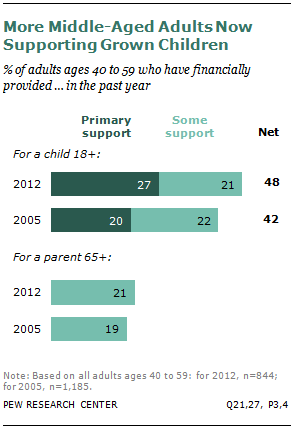
While the share of middle-aged adults living in the so-called sandwich generation has increased only marginally in recent years, the financial burdens associated with caring for multiple generations of family members are mounting. The increased pressure is coming primarily from grown children rather than aging parents.

According to a new nationwide Pew Research Center survey, roughly half (48%) of adults ages 40 to 59 have provided some financial support to at least one grown child in the past year, with 27% providing the primary support. These shares are up significantly from 2005. By contrast, about one-in-five middle-aged adults (21%) have provided financial support to a parent age 65 or older in the past year, basically unchanged from 2005. The new survey was conducted Nov. 28-Dec. 5, 2012 among 2,511 adults nationwide.

Looking just at adults in their 40s and 50s who have at least one child age 18 or older, fully 73% have provided at least some financial help in the past year to at least one such child. Many are supporting children who are still in school, but a significant share say they are doing so for other reasons. By contrast, among adults that age who have a parent age 65 or older, just 32% provided financial help to a parent in the past year.

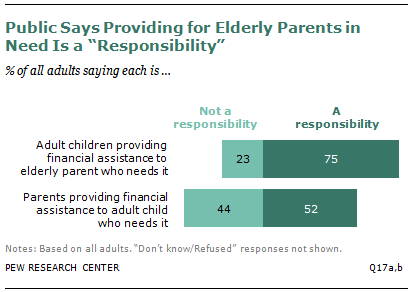
While middle-aged adults are devoting more resources to their grown children these days, the survey finds that the public places more value on support for aging parents than on support for grown children. Among all adults, 75% say adults have a responsibility to provide financial assistance to an elderly parent who is in need; only 52% say parents have a similar responsibility to support a grown child.

One likely explanation for the increase in the prevalence of parents providing financial assistance to grown children is that the Great Recession and sluggish recovery have taken a disproportionate toll on young adults. In 2010, the share of young adults who were employed was the lowest it had been since the government started collecting these data in 1948. Moreover, from 2007 to 2011 those young adults who were employed full time experienced a greater drop in average weekly earnings than any other age group.1

A Profile of the Sandwich Generation

Adults who are part of the sandwich generation—that is, those who have a living parent age 65 or older and are either raising a child under age 18 or supporting a grown child—are pulled in many directions.2 Not only do many provide care and financial support to their parents and their children, but nearly four-in-ten (38%) say both their grown children and their parents rely on them for emotional support.

Who is the sandwich generation? Its members are mostly middle-aged: 71% of this group is ages 40 to 59. An additional 19% are younger than 40 and 10% are age 60 or older. Men and women are equally likely to be members of the sandwich generation. Hispanics are more likely than whites or blacks to be in this situation. Three-in-ten Hispanic adults (31%) have a parent age 65 or older and a dependent child. This compares with 24% of whites and 21% of blacks.
SDT-2013-01-30-SG-00-03

More affluent adults, those with annual household incomes of $100,000 or more, are more likely than less affluent adults to be in the sandwich generation. Among those with incomes of $100,000 or more, 43% have a living parent age 65 or older and a dependent child. This compares with 25% of those making between $30,000 and $100,000 a year and only 17% of those making less than $30,000.

Married adults are more likely than unmarried adults to be sandwiched between their parents and their children: 36% of those who are married fall into the sandwich generation, compared with 13% of those who are unmarried. Age is a factor here as well, since young adults are both less likely to be married and less likely to have a parent age 65 or older.

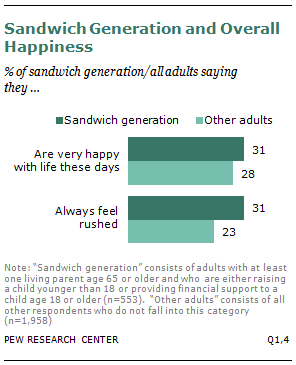
Presumably life in the sandwich generation could be a bit stressful. Having an aging parent while still raising or supporting one’s own children presents certain challenges not faced by other adults—caregiving and financial and emotional support to name just a few. However, the survey suggests that adults in the sandwich generation are just as happy with their lives overall as are other adults. Some 31% say they are very happy with their lives, and an additional 52% say they are pretty happy. Happiness rates are nearly the same among adults who are not part of the sandwich generation: 28% are very happy, and 51% are pretty happy.

Sandwich-generation adults are somewhat more likely than other adults to say they are often pressed for time. Among those with a parent age 65 or older and a dependent child, 31% say they always feel rushed even to do the things they have to do. Among other adults, the share saying they are always rushed is smaller (23%).
SDT-2013-01-30-SG-00-04

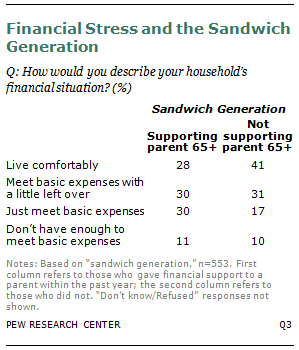
For members of the sandwich generation who not only have an aging parent but have also provided financial assistance to a parent, the strain of supporting multiple family members can have an impact on financial well-being.3 Survey respondents were asked to describe their household’s financial situation. Among those who are providing financial support to an aging parent and supporting a child of any age, 28% say they live comfortably, 30% say they have enough to meet their basic expenses with a little left over for extras, 30% say they are just able to meet their basic expenses and 11% say they don’t have enough to meet even basic expenses. By contrast, 41% of adults who are sandwiched between children and aging parents, but not providing financial support to an aging parent, say they live comfortably.

Family Responsibilities
SDT-2013-01-30-SG-00-05

When survey respondents were asked if adult children have a responsibility to provide financial assistance to an elderly parent in need, fully 75% say yes, they do. Only 23% say this is not an adult child’s responsibility. By contrast, only about half of all respondents (52%) say parents have a responsibility to provide financial assistance to a grown child if he or she needs it. Some 44% say parents do not have a responsibility to do this.

When it comes to providing financial support to an aging parent in need, there is strong support across most major demographic groups. However, there are significant differences across age groups. Adults under age 40 are the most likely to say an adult child has a responsibility to support an elderly parent in need. Eight-in-ten in this age group (81%) say this is a responsibility, compared with 75% of middle-aged adults and 68% of those ages 60 or older. Adults who are already providing financial support to an aging parent are no more likely than those who are not currently doing this to say this is responsibility.

On the question of whether parents have a responsibility to support their grown children, personal experience does seem to matter. Parents whose children are younger than 18 are less likely than those who have a child age 18 or older to say that it is a parent’s responsibility to provide financial support to a grown child who needs it (46% vs. 56%). And those parents who are providing primary financial support to a grown child are among the most likely to say this is a parent’s responsibility (64%).

Financial Support for Aging Parents and Grown Children
SDT-2013-01-30-SG-00-06

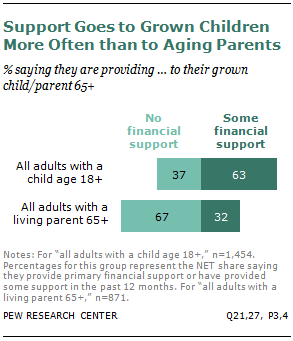
While most adults believe there is a responsibility to provide for an elderly parent in financial need, about one-in-four adults (23%) have actually done this in the past year. Among those who have at least one living parent age 65 or older, roughly one-third (32%) say they have given their parent or parents financial support in the past year. And for most, this is more than just a short-term commitment. About seven-in-ten (72%) of those who have given financial assistance to an aging parent say the money was for ongoing expenses.

Similar shares of middle-aged, younger and older adults say they have provided some financial support to their aging parents in the past year. It is worth noting that many parents age 65 or older may not be in need of financial assistance, so there is not necessarily a disconnect between the share saying adult children have a responsibility to provide for an aging parent who is in need and the share who have provided this type of support.

Overall, Americans are more likely to be providing financial support to a grown child than they are to an aging parent. Among all adults, 30% say they have given some type of financial support to a grown child in the past year. Among those who have a grown child, more than six-in-ten (63%) have done this.

Here the burden falls much more heavily on adults who are middle-aged than on their younger or older counterparts. Among adults ages 40 to 59 with at least one grown child, 73% say they have provided financial support in the past year. Among those ages 60 and older with a grown child, only about half (49%) say they have given that child financial support. Very few of those under age 40 have a grown child.

Of those middle-aged parents who are providing financial assistance to a grown child, more than half say they are providing the primary support, while about four-in-ten (43%) say they are not providing primary support but have given some financial support in the past 12 months. Some 62% of the parents providing primary support say they are doing so because their child is enrolled in school. However, more than one third (36%) say they are doing this for some other reason.

The focus in this report is on the financial flows from middle-aged adults to their aging parents and their grown children. Of course, money also flows from parents who are 65 or older to their middle-aged children. While the new Pew Research survey did not explore these financial transfers, previous surveys have found that a significant share of older adults provide financial help to their grown children. A Pew Research survey conducted in Sept. 2011 found that among adults 65 and older with at least one grown child age 25 or older, 44% said they had given financial support to a grown child in the past year.4

Beyond Finances: Providing Care and Emotional Support

While some aging parents need financial support, others may also need help with day-to-day living. Among all adults with at least one parent age 65 or older, 30% say their parent or parents need help to handle their affairs or care for themselves; 69% say their parents can handle this on their own.

Middle-aged adults are the most likely to have a parent age 65 or older (68% say they do). And of that group, 28% say their parent needs some help. Among those younger than 40, only 18% have a parent age 65 or older; 20% of those ages 60 and older have a parent in that age group. But for those in their 60s and beyond who do still have a living parent, the likelihood that the parent will need caregiving is relatively high. Fully half of adults age 60 or older with a living parent say the parent needs help with day-to-day living.

When aging adults need assistance handling their affairs or caring for themselves, family members often help out. Among those with a parent age 65 or older who needs this type of assistance, 31% say they provide most of this help, and an additional 48% say they provide at least some of the help.

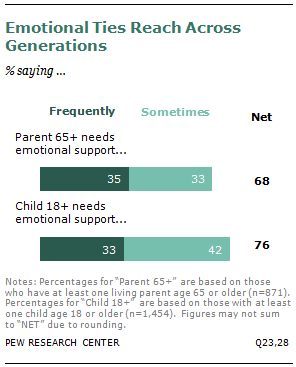
In addition to helping their aging parents with day-to-day living, many adults report that their parents rely on them for emotional support. Among all adults with a living parent age 65 or older, 35% say that their parent or parents frequently rely on them for emotional support, and 33% say their parents sometimes rely on them for emotional support. One-in-five say their parents hardly ever rely on them in this way, and 10% say they never do.
SDT-2013-01-30-SG-00-07

Even among those who say their parents do not need help handling their affairs or caring for themselves, 61% say their parents rely on them for emotional support at least sometimes. For those whose parents do need help with daily living, fully 84% report that their parents rely on them for emotional support at least some of the time.

Not surprisingly, the older the parent, the more likely he or she is to require emotional support. Among adults with a parent age 80 or older, 75% say their parents turn to them for emotional support frequently or sometimes. This compares with 64% among those who have a parent ages 65 to 79.

Emotional support also flows from parents to grown children, even children who are financially independent. Overall, 33% of parents with at least one child age 18 or older say their grown child or children depend on them frequently for emotional support. An additional 42% say their grown children sometimes rely on them for emotional support.

When it comes to grown children, there is a link between financial and emotional support. Among parents who say they are providing primary financial support to their grown child or children, 43% say their children frequently rely on them for emotional support and 45% say they sometimes do. By comparison, only 24% of those who say they do not provide any financial support to their grown children say their children frequently rely on them for emotional support, and 39% say their children sometimes rely on them for this type of support.

Boomers Moving Out of the Sandwich Generation
SDT-2013-01-30-SG-00-08

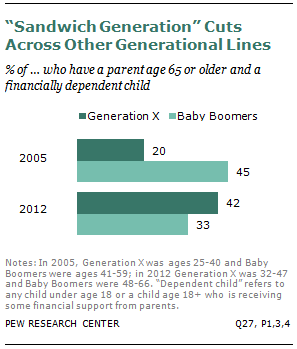
Today members of the Baby Boomer generation and Generation X are represented in the “sandwich generation.” But the balance has shifted significantly. When the Pew Research Center explored this topic in 2005, Baby Boomers made up the majority of the sandwich generation. They were more than twice as likely as members of the next generation—Generation X—to have a parent age 65 or older and be supporting a child (45% vs. 20%). Since 2005, many Baby Boomers have aged out of the sandwich generation, and today adults who are part of Generation X are more likely than Baby Boomers to find themselves in this situation: 42% of Gen Xers have parent age 65 or older and a dependent child, compared with 33% of Boomers.5

This report will focus largely on adults ages 40 to 59, loosely defined as “middle aged.” While this group may not share a generational label, many of its members do have a shared set of experiences, challenges and responsibilities given the unique position they inhabit, sandwiched between their children and their aging parents.

Middle-aged adults who make up the core of the sandwich generation are living out these challenges and, in the process, perhaps ushering in a new set of family dynamics. Most middle-aged parents with grown children say their relationship with their children is different from the relationship they had with their own parents at a comparable age. Half say the relationship is closer, while 12% say it’s less close and 37% say the relationship is about the same. Older adults (those ages 60 and older) are less likely than middle-aged parents to say they have a closer relationship with their grown children than they had with their own parents (44%), and they are more likely to say the relationship is about the same (45%).

The remainder of this report will look at the basic building blocks of intergenerational relationships in more detail. The first section will look at attitudes about financial responsibilities and the reality of financial transfers. The second section will look at caregiving for older adults. How many older adults need assistance with day-to-day living, and who is providing that care? The third section will look at emotional ties across generations and explore the extent to which aging parents rely on their children and grown children rely on their parents for emotional support.
SDT-2013-01-30-SG-00-09

Financial Support Across Generations

Americans believe overwhelmingly that adult children are obligated to provide financial assistance to an aging parent if needed: 75% say this is a responsibility, 23% say it is not. This sentiment is shared across most major demographic groups: men and women; whites, blacks and Hispanics; college graduates and those with only a high school education. Adults under age 40 are somewhat more likely than middle-aged and older adults to view this as a responsibility. Fully 81% of those ages 18 to 39 say adult children have a responsibility to provide financial support their elderly parents; 75% of adults ages 40 to 59 agree with this, as do 68% of those ages 60 and older.

This sentiment cuts across partisan and ideological lines, with about three-quarters of Republicans, Democrats, conservatives and liberals agreeing that providing for an aging parent in need is an adult child’s responsibility.

Adults who have a parent age 65 or older are no more or less likely to view this as a responsibility than are those who do not have a parent in this age group. Moreover, those who have provided this type of assistance to their own parents express nearly identical views as those who have not done so.

SDT-2013-01-30-SG-01-01

The public is less convinced that parents have an obligation to support a grown child who needs financial assistance. About half of all adults (52%) say providing such assistance to a grown child is a parent’s responsibility.

Views on this issue are fairly consistent across major demographic groups. Older adults are somewhat more likely than middle-aged and younger adults to say parents have an obligation to help out a grown child in need. Some 57% of those ages 60 and older consider this a responsibility, compared with 51% of those ages 40 to 59 and 50% of those younger than 40.

Adults who have a child age 18 or older are more likely than those who do not have a child in this age group to say parents have a responsibility to support their grown children (56% vs. 49%). And adults who have actually provided financial assistance to their grown children are even more likely to view this as a responsibility. Among those who have provided any support to their grown children in the past 12 months, 62% say parents have a responsibility to provide financial assistance to a grown child if needed. Among those who have a grown child but have not provided financial support in the past year, only 46% agree.

Helping Parents in Need

SDT-2013-01-30-SG-01-02

About one-third (32%) of all adults with a parent age 65 or older say that they have given a parent financial support in the past 12 months. Of those who have given this type of support, a strong majority (72%) say it went toward ongoing expenses.

The share of adults providing this type of support has not changed significantly since the Pew Research Center first measured it in 2005. At that time, 29% of adults with a parent age 65 or older said they had provided financial help to a parent in the past year. Of that group, 41% said they had provided the money on a regular basis, while 53% said the money was given for special circumstances.

Middle-aged adults are more likely than younger and older adults to have a living parent age 65 or older, and therefore they are more likely to be providing financial assistance to a parent. Among all adults ages 40 to 59, 21% have a parent age 65 or older and have given financial help to a parent in the past year. This compares with 6% of younger adults and 7% of adults ages 60 and older.

Beyond middle-aged adults, other demographic groups stand out in terms of their level of financial support for their aging parents. Among those with at least one parent age 65 or older, Hispanics and blacks are much more likely than whites to be helping out a parent financially. Some 65% of Hispanics and 40% of blacks say they have provided financial support to a parent in the past 12 months. This compares with 24% of whites.

There are also sharp differences across income groups. Adults with lower annual household incomes are more likely than those with higher incomes to be supporting their aging parents. Among those with at least one parent age 65 or older, 44% with an annual income of less than $50,000 say they provided some financial support to a parent in the past year. By contrast, among those with incomes of $50,000 or higher, only 23% say they did the same.

SDT-2013-01-30-SG-01-03

In addition, more financial help is flowing to aging mothers than to fathers. Among respondents whose father has died, fully 42% say they have given financial help to their mother (age 65 or older) in the past year. Among those whose father (65 or older) is living but their mother has passed away, only 25% say they have helped out their father financially. And among those with two living parents (both of whom are age 65 or older) one-in-four say they have provided financial help to a parent in the past year.

Helping Grown Children in Need

It turns out that grown children may be more financially needy than aging parents. Among all adults with at least one child age 18 or older, nearly two-thirds (63%) say they have provided at least some financial support to a grown child in the past 12 months.

This burden falls most heavily on middle-aged adults. Of all adults ages 40 to 59, nearly half (48%) have provided financial support to a grown child in the past year. Among those middle-aged adults who have a child age 18 or older, fully 73% have provided some assistance to at least one of their grown children. This compares with 49% among those ages 60 and older with at least one grown child.

SDT-2013-01-30-SG-01-04

Different types of financial assistance flow to grown children. Some parents are the primary source of financial support for their grown children. Others are providing some assistance though not the primary support. Among all adults with at least one child age 18 or older, 31% say they provide the primary financial support to one or all of their grown children. Among adults ages 40 to 59 with a grown child, fully 42% provide primary support. This represents a significant increase from 2005, when 33% of adults ages 40 to 59 with at least one child age 18 or older said they were providing primary financial care to a grown child.

Among those parents who are providing primary support to a grown child, roughly half (52%) say they are supporting their child or children because they are enrolled in school. An additional 46% say they are providing this support for some other reason. In 2005, parents were somewhat more likely to say they were providing primary support because their grown child or children were in school (56%), and somewhat fewer said it was for some other reason (39%).

Hispanic parents are more likely than black or white parents to say they are providing primary support to a grown child. Among Hispanic adults with at least one grown child, 54% say they are providing primary financial support to a child age 18 or older. This compares with 36% among black parents and 27% among white parents.

Low-income parents are somewhat less likely to be providing primary financial support to a grown child, but middle-income and upper-income parents are about equally likely to be doing so. Among those with annual household incomes less than $30,000, some 27% of parents with at least one child age 18 or older say they are providing primary financial support to a grown child. This compares with 34% of those making between $30,000 and $100,000 and 39% of those with incomes in excess of $100,000.

Of those parents who are not providing primary support to a grown child, about half (46%) say they have given at least some financial assistance to a grown child in the past 12 months. The profile of these parents who help their grown children occasionally but do not provide primary support is somewhat different from the primary supporters. Parents in the highest income category are much more likely to have provided this type of support. Among parents with annual incomes of $100,000 or higher who are not providing primary financial support, 66% say that they have given some financial assistance in the past year. This compares with 49% of parents with incomes between $30,000 and $100,000 and only 40% of those making less than $30,000 a year.

Sandwiched Between Parents and Grown Children

SDT-2013-01-30-SG-01-05

For some adults, the financial burdens and responsibilities go both ways—they are both supporting an aging parent and helping out a grown child. Only about 8% of all adults fall into this category, but among middle-aged adults the share is significantly higher. Some 15% of adults age 40 to 59 are providing financial support to a parent age 65 or older as well as either raising a minor child or supporting a grown child. This compares with 4% of those either younger than 40 or age 60 and older.

Across most major demographic groups, fewer than one-in-ten adults fall into this category (providing financial support to both an aging parent and a child). There is, however, one important exception. Hispanic adults are more than twice as likely as blacks or whites to be in this situation. Among all Hispanics, 21% say that they have given financial assistance to an aging parent in the past year and that they are either raising a young child or supporting a grown child. This compares with 8% of blacks and 5% of whites.

There are no significant differences across income or educational groups in the share providing financial assistance to both parents and children.

Caregiving for Older Family Members

In addition to financial support, many middle-aged adults are providing other types of care to their aging parents. And if they are not caring for their parents now, most expect they will be in the future. The Pew Research survey finds that 14% of adults in their 40s and 50s have already cared for an aging parent or other elderly family member, and nearly seven-in-ten say that it is “very” (48%) or “somewhat” (20%) likely they will have to do this in the future.

Those in their 50s (17%) are more likely than those in their 40s (9%) to have already cared for a family member. But the share of those in their 40s who say it is very or somewhat likely they will have to in the future (78%) significantly exceeds the share of adults in their 50s who say the same (59%).

Nearly two-in-ten adults ages 60 and older (18%) say they have already cared for an aging family member, but relatively few in comparison to younger adults think they will have to in the future (38% say it’s very or somewhat likely). Among adults ages 60 and older, only 20% still have a living parent, so many know with certainty that they will not be caring for a parent.

Among adults younger than 40, the exact opposite is the case. Only 3% have already performed this duty, about six-in-ten (62%) think it is very likely they will have to in the future, and a quarter think it is somewhat likely. Women (13%) are more likely than men (8%) to have already cared for an aging family member, while a roughly equal share of women (66%) and men (69%) expect they will in the future. Whites are the oldest of the major racial and ethnic groups, so unsurprisingly they are also the most likely to have already cared for an older family member. While 13% of whites say they have done this, smaller shares of blacks (7%) and Hispanics (4%) say they have. But Hispanics are the most likely of these groups to expect to care for an aging family member in the future (64% say it is very likely, compared with 48% of blacks and 43% of whites).

Married people (70%) are slightly more likely than those who are not married (65%) to say they expect to care for an aging family member in the future, perhaps because of the presence of parents-in-law in addition to their own parents. There are no significant differences in the share of married and unmarried people who say they have already cared for an aging family member.

Among middle-aged adults (those ages 40 to 59), some 14% say they have cared for an aging family member in the past or that they are currently doing so. An additional 68% say it is very or somewhat likely that they will have this responsibility in the future.

Not surprisingly, the older one’s parents are, the more likely they are to have already taken an aging family member into their care. About two-in-ten middle-aged adults with at least one parent age 80 or older have a history of caregiving (21%). This share is only 9% among those whose parents are ages 65 to 79. But three-quarters of middle-aged adults with parents ages 65 to 79 expect to care for give aid to an older family member at some point.

SDT-2013-01-30-SG-02-02

Adults in their 40s and 50s who do not have a parent age 65 or older (that is, their parents are either younger than 65 or no longer living) are equally likely as those with one or more parents ages 65 and older to have cared for an aging family member in the past but are significantly less likely to say it is likely they will have to do so in the future (58% vs. 73%).

According to data from the Bureau of Labor Statistics, 16% of all Americans ages 15 and older (including 23% of Americans ages 45 to 64) provided some level of unpaid care to an adult age 65 or older in 2011. More than four-in-ten eldercare providers (42%) were caring for a parent. The majority of caregivers were women (56%), and a quarter (23%) of the men and women providing care were parents with at least one child younger than 18 in their household.6

Does Your Parent Need Help?

SDT-2013-01-30-SG-02-03

Among adults with at least one parent age 65 or older, three-in-ten say their aging parent or parents need help to handle their affairs or care for themselves, while 69% say their parents can handle these things on their own.

Age is a huge factor in parents’ independence, as younger adults are more likely to have younger parents. While 28% of all middle-aged adults have a parent who needs help, the share is significantly higher among those in their 50s (35%) than among those in their 40s (22%). In this measure, adults in their 40s closely resemble adults younger than 40. Among adults ages 60 and older with living parents, half say their parents need help with day-to-day activities. However, a smaller share of these adults have living parents (20%, compared with 63% of adults in their 50s and 93% of adults younger than 50).

Adults with annual family incomes less than $75,000 are more likely than those with higher incomes to say they have parents who need help (35% vs. 22%), even when retirees (who are likely to have lower incomes and older parents) are removed from the equation.

SDT-2013-01-30-SG-02-04

The share of adults ages 40 to 59 who say their parent needs help varies greatly by the age of their parents as well. Among those with at least one parent age 80 or older, nearly half (46%) say they have a parent who needs care. Among adults with at least one aging parent younger than 80, less than half that share (19%) say the same.

Additionally, the need for practical care is lower when both parents are living (21%) than when only one parent is living (35%), though this may be related to the age of the parent in addition to the lack of a companion.

Who Provides Most of the Help?

Among all adults with an aging parent who say their parent or parents need care, 31% say they provide most of the help, 39% say someone else in the family does it, and 14% say most of the care is managed by paid help or assisted living facilities.

SDT-2013-01-30-SG-02-05

About six-in-ten (62%) adults with parents who require practical assistance are ages 40 to 59 (14% are younger, 23% are older). Among these middle-aged adults, about one-third (36%) say they provide most of the help. Another third say someone else in the family provides this help (35%), and one-in-ten say the parent has paid help (13%). One-in-ten (11%) volunteer that it is some combination of two or more of these things, and 3% volunteer that government programs provide most of the assistance.

SDT-2013-01-30-SG-02-06

Among middle-aged members of the sandwich generation with a parent who needs care, about three-in-ten (29%) say they are providing most of the care. About four-in-ten (38%) say someone else in the family is caring for their parent, and 15% say the parent has paid help. Some 12% say it is some combination of these things.

In all, one-in-ten adults in their 40s and 50s with a parent age 65 and older are providing primary care for a parent. This compares with 5% of younger adults and 14% of older adults.

Respondents who said they did not provide most of the care were then asked if they provided any of the care to a parent who needs it. In addition to the 36% of middle-aged adults who say they provide most of the help to a parent who requires care, 45% say they provide some of it.

This means that about a quarter (23%) of all adults in their 40s or 50s who have at least one parent age 65 or older (regardless of whether that parent needs assistance) are providing at least some day-to-day assistance to a parent.7 The share of adults in their 50s who are caregivers to an aging parent (29%) is significantly higher than the share in their 40s (17%), due in large part to the overall older age of their parents.

There are some differences in the shares of adults who provide most or some of the care to their aging parent or parents.8 Women are more likely than men to be providing primary care to an aging parent (13% vs. 7%). And those who are not married (15%) are more likely than those who are married (7%) to provide most of the care to a parent. However, there are no differences between men and women or between married and unmarried individuals in the shares who provide at least some care.

Individuals with family incomes below $75,000 are more likely to provide most or some of the help to a needy parent than those with higher incomes (28% vs. 18%), a trend that exists even among the non-retired.

Emotional Ties

While some middle-aged adults are providing financial support to aging parents and grown children, even more are providing emotional support. Among adults in their 40s and 50s with at least one parent age 65 or older and one or more grown children, 55% provide emotional support to both their aging parents and their grown children. One-in-ten provide this support to just a parent, and a significantly larger share (23%) provide it to just a grown child. Only 12% of middle-aged adults with grown children and aging parents do not say they at least sometimes provide emotional support to either.

Overall, 68% of all adults with parents age 65 and older say their parents depend on them frequently or sometimes for emotional support, and 76% of all adults with children age 18 and older say the same of their children. Among all adults in their 40s and 50s, the shares are similar to the general population’s (66% and 80%, respectively), though this age group has a higher share of adults who have both aging parents and grown children.

Emotional Ties with Aging Parents

SDT-2013-01-30-SG-03-02

About a third (35%) of all adults with at least one parent age 65 or older say at least one parent relies on them “frequently” for emotional support. Another third (33%) says their parent relies on them “sometimes.”

Women with an aging parent are more likely than men to say their parent relies on them for emotional support on a frequent basis. Four-in-ten women (39%) say this, compared with three-in-ten men (30%).

SDT-2013-01-30-SG-03-03

Older adults—who are more likely to have older parents—are more likely than younger adults to say their parent requires frequent emotional support. Among adults ages 60 and older with at least one elderly parent, fully 43% say this, compared with 30% of adults younger than 40. Among middle-aged adults with a parent age 65 or older, about a third (34%) say their parent often depends on them emotionally.

Just as with practical and financial caregiving, adults whose family income is below $75,000 are more likely than those with higher incomes to have lent emotional support to an aging parent (38% vs. 30%).

Also similar to other types of caregiving, the older one’s parents, the more likely adults are to be providing them with emotional care. Among adults in their 40s and 50s, those with at least one parent age 80 or older are much more likely than those with parents ages 65 to 79 to say their parent relies on them frequently for emotional support (47% vs. 28%).

SDT-2013-01-30-SG-03-04

The need for emotional support also differs based on whether both parents are still living. Among middle-aged adults for whom both parents are still living, 27% say their parents rely on them for frequently emotional support, while 42% of those with only one living parent say the parent relies on them that often.

Finally, the three types of care – practical, financial and emotional – are closely tied. About six-in-ten middle-aged adults (62%) who say their parents need help to handle their affairs or care for themselves also say their parents rely on them for emotional support on a frequent basis, compared with 24% of adults who say their parents can handle things on their own. And among those who have given their parents financial support in the past 12 months, 54% say they give emotional support frequently, compared with 25% of those who say they didn’t give money to their parents.

SDT-2013-01-30-SG-03-05

Overall, 13% of adults ages 40 to 59 with aging parents provide all three kinds of assistance—that is, they provide at least some help handling the parent’s affairs or caregiving, have given money to them in the past 12 months and have “frequently” or “sometimes” given emotional support. Two-in-ten adults in their 40s and 50s have provided two of the three kinds of assistance to their aging parents, and 39% provide one of the three services for their parents. About a quarter (27%) of adults with a parent age 65 or older say they don’t provide practical, financial or emotional care for their parents.

Emotional Ties with Grown Children

SDT-2013-01-30-SG-03-06

When it comes to emotional support, grown children are more dependent than aging parents. Among adults ages 40 to 59 with both grown children and aging parents, 78% say their grown children rely on them “frequently” or “sometimes” for emotional support, while 65% say the same about their aging parents.

Overall, a third of all adults with at least one child age 18 or older say their child relies on them for emotional support on a frequent basis, and 42% say their child relies on them sometimes. Only about a quarter (23%) say their child “hardly ever” or “never” relies on them for emotional support.

SDT-2013-01-30-SG-03-07

As with emotional support for aging parents, women are more likely than men to say their grown children turn to them for emotional support. Some 40% of women say they frequently provide emotional support to a grown child, compared with 26% of men. Men are much more likely to say they “hardly ever” or “never” emotionally support their grown children compared to women (29% vs. 18%).

Middle-aged parents of grown children—who are more likely to have children just entering adulthood—are more likely than older parents to say they frequently help their grown children with emotional support (39% vs. 26%). The survey does not provide enough detail to look at support based on the precise age group of the children, as it does with aging parents.

Adults who have provided some financial support to their children over the past 12 months are also more likely to say their child frequently depends on them for emotional support (see table on page 27). About four-in-ten (43%) parents ages 40 to 59 who provided either primary or some financial support over the past 12 months say their child also frequently depends on them for emotional support. About three-in-ten (29%) parents who did not provide any financial support to their children over the past year say the same.

How Close Are Parents to Their Grown Children?

SDT-2013-01-30-SG-03-08

About half of all adults with a grown child say their relationship with their children is closer than the relationship they had with their own parents at a comparable age. An additional 41% say their relationship is about the same as the one they had with their parents. Only 11% say their relationship with their own children is less close than the relationship they had with their parents.

Women are more likely than men to say the relationship they have with their grown children is stronger than the relationship they had with their parents (52% vs. 41%), while men are more likely than women to say their relationship is less close (16% vs. 6%). Men and women are equally likely to say the parent-grown child relationship has not changed much (41% and 40%, respectively).

SDT-2013-01-30-SG-03-09

In addition to lending more frequent emotional support, middle-aged parents are also more likely than those ages 60 and older to see an improvement in the relationship with their children compared with their own upbringing (50% vs. 44%). However, they are also slightly more likely than older parents to see a decline in the parent-grown child relationship (12% vs. 9%), while older parents (45%) are more likely than younger parents (37%) to see little change over the generations.

Among those with at least one child age 18 or older, married parents (50%) are significantly more likely than unmarried parents (42%) to say that their relationship with their children is closer, while unmarried parents (17%) are more likely than married parents (7%) to say their relationship is less close.

Parents with annual family incomes of $75,000 or higher are particularly likely to report improved relationships with their own grown children—60% of adults with family incomes higher than $75,000 say their relationship is better than the one they shared with their parents, compared with 39% of people with incomes lower than $30,000. Among those who fall between these two income ranges, 46% say their relationship is better than their relationship was with their parents. Furthermore, those at the lower end of the income scale (16%) are more likely than those in the middle (8%) or higher end (8%) to say their relationships is less close than the one they shared with their parents.

SDT-2013-01-30-SG-03-10

Middle-aged parents who are providing financial support to their children say they experience more emotional closeness with their grown children than their parents did with them. Some 53% of parents ages 40 to 59 who gave financial support to their grown child in the past 12 months see an improvement in their relationship with their grown children over their own relationships with their parents at a similar age. This share is 41% among middle-aged parents who did not provide monetary support to their grown children. And those who didn’t provide financial support are more likely to say they are less close with their children than their parents were with them (19% vs. 10% among those who gave support).

“Can I Talk to Mom?”

SDT-2013-01-30-SG-03-11

People with two living parents are much more likely to say they have more contact with their mother than with their father. Half (51%) of adults say they are closer with their mother, while only 15% say they are closer with their father. About a third of adults (34%) say that they have equal contact with both parents.

However, the share saying they have the most contact with mom has dropped over the past several Pew Research surveys. In early 2009, 57% of adults said they had the most contact with their mother and in late 2005, 61% said this. The share saying they have equal contact with their parents is up from 2005, when only 21% said this.

While women are still more likely than men to list their mother as the parent they are closer to (56% vs. 46%), the decrease in the share of women choosing mom over dad in the past seven years has been the sharpest. In 2012, 56% of women said this, down from 70% in 2005. The share of men saying their mother was their closer parent is similar in 2012 (46%) and 2005 (50%).

SDT-2013-01-30-SG-03-12

For both men and women, the share saying they have equal contact with their parents has increased. A third of women now say this, up from 18% in 2005; about a third of men (35%) also say this now, up from 25% in 2005.

College grads (41%) are more likely than those with some college education (30%) or a high school diploma or less (32%) to say that they have equal contact with their parents.

Not surprisingly, among those whose parents live in the same household, the share saying they have equal contact with both parents is higher than among those whose parents are not living together. Fully 43% of adults whose parents live together say this, compared with 21% of adults whose parents live apart from each other. Among adults with parents who are not living in the same household, the mother is overwhelmingly the closer parent, with 62% saying they have more contact with their mothers, compared with 17% saying they have more contact with their fathers. Among those whose parents live together, 43% say they are closer with their mother and 14% say they are closer with their father.