Pew Research Center

FOR RELEASE JULY 6, 2011

Two Years of Economic Recovery: Women Lose Jobs, Men Find Them

During the sluggish two-year recovery from the Great Recession, men have gained 768,000 jobs while women have lost 218,000 jobs. This new gender gap in employment trends represents a sharp turnabout from the recession itself, when men lost more than twice as many jobs as women.

BY Rakesh Kochhar

FOR MEDIA OR OTHER INQUIRIES:

Communications Department
202.419.4372
www.pewresearch.org

RECOMMENDED CITATION

Pew Research Center, July 2011, "Two Years of Economic Recovery: Women Lose Jobs, Men Find Them"

About Pew Research Center

Pew Research Center is a nonpartisan, nonadvocacy fact tank that informs the public about the issues, attitudes and trends shaping the world. It does not take policy positions. The Center conducts public opinion polling, demographic research, computational social science research and other data-driven research. It studies politics and policy; news habits and media; the internet and technology; religion; race and ethnicity; international affairs; social, demographic and economic trends; science; research methodology and data science; and immigration and migration. Pew Research Center is a subsidiary of The Pew Charitable Trusts, its primary funder.

© Pew Research Center 2026

Table of contents

  • About Pew Research Center
  • Two Years of Economic Recovery: Women Lose Jobs, Men Find Them
  • II. Employment in the Recovery
  • III. Employment in the Recession
  • IV. Unemployment in the Recession and Recovery
  • V. A Brief History of Employment Trends in Recessions and Recoveries
  • Appendix Table

Two Years of Economic Recovery: Women Lose Jobs, Men Find Them

During the sluggish two-year recovery from the Great Recession, men have gained 768,000 jobs while women have lost 218,000 jobs. This new gender gap in employment trends represents a sharp turnabout from the recession itself, when men lost more than twice as many jobs as women.

I. Overview

The sluggish recovery from the Great Recession has been better for men than for women. From the end of the recession in June 2009 through May 2011, men gained 768,000 jobs and lowered their unemployment rate by 1.1 percentage points to 9.5%. 1 Women, by contrast, lost 218,000 jobs during the same period, and their unemployment rate increased by 0.2 percentage points to 8.5%, according to a new Pew Research Center analysis of Bureau of Labor Statistics data.

These post-recession employment trends are a sharp turnabout from the gender patterns that prevailed during the recession itself, when men lost more than twice as many jobs as women. Men accounted for 5.4 million, or 71%, of the 7.5 million jobs that disappeared from the U.S. economy from December 2007 through June 2009.

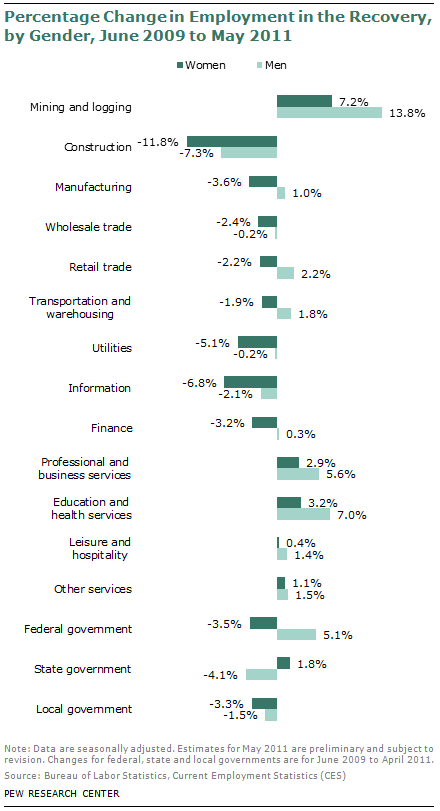
Employment trends during the recovery have favored men over women in all but one of the 16 major sectors of the economy identified in this report. In five sectors, notably in retail trade, men have gained jobs while women have lost them. In five other sectors, including education and health services and professional and business services, men gained jobs at a faster rate than women. And in an additional five sectors, such as construction and local governments, men lost jobs at a slower rate than women. The sole exception to these patterns is state government, a sector of the economy in which women have added jobs during the recovery while men have lost them.

A Historical Perspective: What Is New About this Recovery?

From a gender perspective, the recovery from the Great Recession has defied modern norms. Women fared better than men in the first two years of all other economic recoveries since 1970. Both women and men gained jobs, with women doing so at a faster rate, immediately after the recessions in 1969-70, 1973-75, 1980-82 and 1990-91. 2 Neither women nor men gained jobs two years into the recovery from the 2001 recession, but losses for women were only half as much as for men. The recovery from the Great Recession is the first since 1970 in which women have lost jobs even as men have gained them.

These cyclical patterns since 1970 have played out in an era when women have generally been gaining jobs at a faster rate than men, in large part due to their transition from the home to the labor force. The labor force participation rate, which is the share of the working-age population that is working or looking for work, increased for women from 43.3% in 1970 to 59.9% in 2000. During that period, the labor force participation rate for men decreased from 79.7% in 1970 to 74.8% in 2000.

By 2000, the long-term growth in the labor force participation rate of women had ceased, and in the aftermath of two recessions in the ensuing decade, it declined. However, the labor force participation rate for men also fell during the decade—and by a greater amount. Thus, differential trends in labor market activity for women and men do not appear to be the cause of the gender role reversal in jobs lost and gained in the current recovery.

It is not entirely clear why men are doing better than women in the current recovery. An analysis of employment by sectors offers no definitive answer. For example, women are more heavily concentrated than men in the government sector (federal, state and local), which has shed jobs in the recovery. From June 2009 to May 2011, women lost 297,000 government-sector jobs, while men lost just 133,000. But this explains only a small portion of the gender gap in employment growth during the recovery.

The more notable developments are that men have found jobs in sectors where women have not, and that men made stronger advances than women in other sectors. In particular, women lost a total of 433,000 jobs in manufacturing, retail trade and finance during the recovery, while men gained 253,000 jobs in those sectors. Two other sectors—professional and business services and education and health services—gave women a strong boost; 691,000 new jobs in those sectors went to women. But men did even better, gaining 804,000 jobs in those two sectors. There is no ready explanation for why employment growth in these sectors has favored men. 3

The Recession and the Recovery: Who Has Lost More?

The Great Recession itself was harder on men. During the recession—from December 2007 to June 2009—men lost 5.4 million jobs and women lost 2.1 million. Job growth for men since the end of the recession has fallen well short of a full recovery. From December 2007 to May 2011, employment of men has fallen by 4.6 million. Their unemployment rate has increased from 5.1% to 9.5%. For women, 2.4 million jobs have been lost since December 2007, and their unemployment rate has increased from 4.9% to 8.5%. Thus, over the full arc of the recession and recovery to date, the weakness in the economy has been harder on men.

Trends in the Unemployment Rate

Unemployment rates by gender have moved in tandem with employment levels. Men experienced a sharper increase in the unemployment rate during the recession. In the recovery, the unemployment rate for men has decreased, but it has increased for women.

Changes in the unemployment rate for women and men transcended race, ethnicity and nativity. Men, whether Hispanic, white, black, Asian, native born or foreign born, experienced higher increases than women in the unemployment rate in the recession. The recovery has proceeded uniformly for men across race, ethnicity and nativity—the unemployment rate has dropped for all groups of men. Among women in the recovery, the unemployment rate for white women decreased, but it increased for Hispanic, black and Asian women. The unemployment rate for native-born women was virtually unchanged, but it increased for foreign-born women.

About the Data

This report analyzes labor market outcomes for men and women during the Great Recession—from December 2007 to June 2009—and in the first two years of the recovery—from June 2009 to May 2011. The data for this report are mainly from the Bureau of Labor Statistics (BLS). Employment trends are from its monthly Current Employment Statistics (CES) survey and encompass workers on the payrolls of nonfarm establishments. As such, farmworkers, private household workers and the self-employed are among those whose jobs are not tallied in the CES. Unemployment rate trends are from the Current Population Survey (CPS), a monthly survey of about 55,000 households conducted jointly by the BLS and the Census Bureau.

The analysis of unemployment rates by race, ethnicity and nativity is based on Pew Research Center tabulations from CPS data. Data from three monthly surveys were combined to create larger sample sizes and to conduct the analysis on a quarterly basis. The time period covered by this part of the study is from the fourth quarter of 2007 to the fourth quarter of 2010. These estimates are nonseasonally adjusted, and comparisons are limited to the same quarter from one year to the next. Estimates derived by the Center from the CPS data are adjusted for annual, technical revisions to the CPS and will not match estimates published by the BLS (For details on the adjustments to the CPS data, see Kochhar, Rakesh, C. Soledad Espinoza and Rebecca Hinze-Pifer. “After the Great Recession: Foreign Born Gain Jobs; Native Born Lose Jobs,” Pew Hispanic Center, October 29, 2010 (https://alpha.pewresearch.org/pewresearch-org/hispanic/reports/report.php?ReportID=129).

Other Key Findings

Employment in the Recession

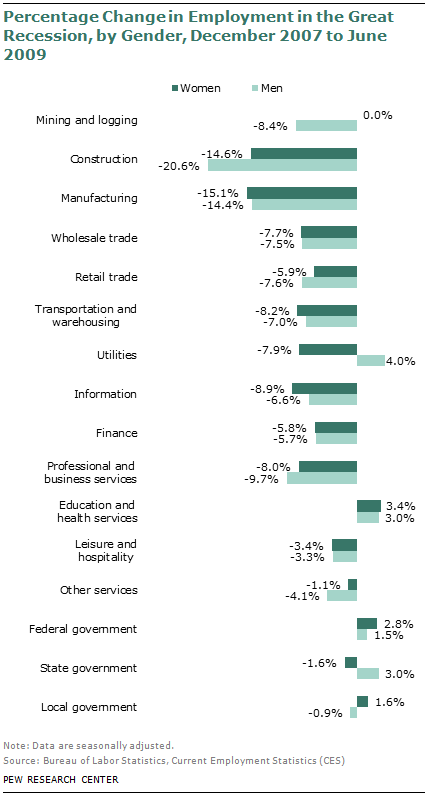
  • Employment trends by sector were similar for men and women in the recession—they lost jobs at similar rates in most sectors. There were three exceptions—men gained jobs in the utilities sector and state governments while women lost jobs, and women gained jobs in local governments while men lost jobs.
  • The gender gap in jobs lost in the recession stems from how men and women are distributed across sectors. Men are concentrated in industries where job losses were most severe—construction and manufacturing—and less well represented in industries that continued to add jobs in the recession—education and health services.

Unemployment

  • Trends in the unemployment rate are consistent with changes in employment levels. The unemployment rate for men increased more sharply in the recession, from 5.1% in December 2007 to 10.6% in June 2009, compared with an increase from 4.9% to 8.3% for women.
  • In the first two years of the recovery, the unemployment rate for men has fallen from 10.6% to 9.5%; for women, it has increased slightly, from 8.3% to 8.5%.

Historical Trends

  • Employment trends in the Great Recession, by gender, were similar to those in the past five recessions—men fared worse than women. In three recessions—1969-70, 1973-75 and 1980-82—women actually gained jobs as they streamed from the home to the office in large numbers.
  • Changes in the unemployment rate confirm the unique nature of the current recovery. It is the first recovery in which the unemployment rates for men and women have gone in opposite directions—falling for men but rising for women.

About the Report

This report was researched and written by Rakesh Kochhar, senior researcher of the Social & Demographic Trends project of the Pew Research Center. The report was edited by Paul Taylor, executive vice president of the Pew Research Center and director of the Social & Demographic Trends project. Research assistants Daniel Dockterman and Seth Motel assisted with charts and number checking. The report was copy-edited by Marcia Kramer. The author thanks Mark Hugo Lopez for his comments on earlier drafts.

II. Employment in the Recovery

The recovery from the Great Recession is not off to a good start for women. From June 2009, when the recession ended, to May 2011, women have lost 218,000 jobs, with their employment level falling from 65.1 million to 64.9 million. Men, however, are finding new jobs in the recovery. Their employment level increased from 65.4 million in June 2009 to 66.1 million in May 2011, a gain of 768,000 jobs. Since 1970, this is the first two-year period into an economic recovery in which women have lost jobs even as men have gained them.

The contrasting trends for men and women in the recovery are reopening the gender gap in employment. At the start of the recession, in December 2007, men held 3.4 million more jobs than women. In the recession, job losses for men were more severe than for women and by the end, in June 2009, men held only 223,000 more jobs than women. This gap stretched out to 1.2 million in May 2011, two years into the economic recovery.

Although the latest trends in employment are working in favor of men, the full period of the recession and the recovery has set men back more than women. From December 2007 to May 2011, the employment of men has decreased from 70.7 million to 66.1 million, or by 4.6 million. For women, employment has fallen from 67.3 million to 64.9 million, or by 2.4 million. Thus, while men have taken an early lead in the recovery, they still have far more ground to cover than women to return to pre-recession employment levels.

Employment Trends in the Recovery by Industry

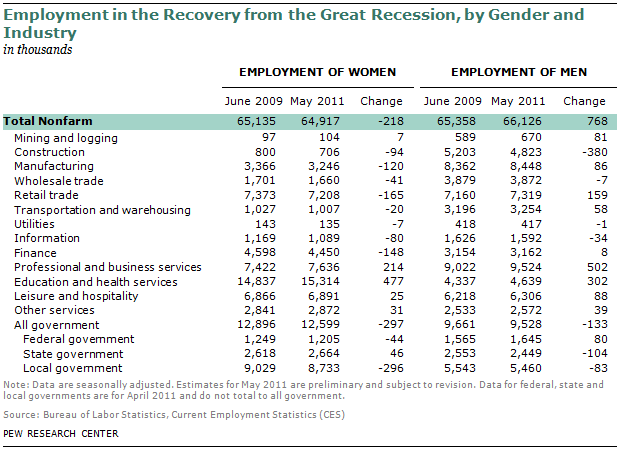
The relative strength of the economic recovery for men is widespread—they have fared better than women in all but one of 16 major sectors of the economy identified in this report. In five sectors, men gained jobs while women lost jobs. These sectors are manufacturing; retail trade; transportation and warehousing; finance; and the federal government. The most notable of these is retail trade, where men gained 159,000 jobs in the recovery and women lost 165,000 jobs. In the five sectors combined, men found 392,000 new jobs while women lost 497,000 jobs. This gap is at the heart of the difference in the employment recovery for men and women.

In five other sectors—mining and logging; education and health services; professional and business services; other services; and leisure and hospitality—both men and women gained jobs, but men did so at a faster rate. Most notably, men gained 804,000 jobs in professional and business services and education and health services. Women, for whom education and health services is a significant source of jobs, gained 691,000 jobs in those two sectors. These five industries combined employed 1 million more men and 754,000 more women.

In five sectors, both men and women lost jobs but the rate of job loss was more severe for women. These sectors are construction; wholesale trade; utilities; information; and local governments. For women, job losses in local government were also large in absolute terms—296,000. Men lost 380,000 jobs in construction alone. But their rate of job loss in construction—7.3% from June 2009 to May 2011—was less than the 11.8% decline experienced by women in construction. Collectively, these five sectors shed 505,000 jobs held by men and 519,000 jobs held by women.

In only one sector—state governments—have women gained jobs in the economic recovery and men have not. Overall, the government sector—federal, state and local combined—shed 297,000 jobs held by women and 133,000 jobs held by men.4 The private, nonfarm sector added 980,000 jobs in the economic recovery: 901,000 filled by men but only 79,000 filled by women. 5

Men and Women Are in Different Industries: How Has That Affected Their Jobs Recovery?

One reason that employment outcomes may differ during recessions and recoveries is that women and men are concentrated in different industries. For example, in June 2009, 22.8% of women were working in education and health services, compared with 6.6% of men. Meanwhile, only 6.4% of women were employed in construction and manufacturing, compared with 20.8% of men. Thus, growth in education and health services would favor women and growth in construction and manufacturing would favor men.

Is it the case that women are not doing as well as men in finding jobs in the recovery because the industries they lean to are underperforming? The short answer is, no. Education and health services—areas of strength for women—outperformed other sectors in adding jobs during the recovery. But construction and manufacturing—among the sectors men lean to most—remain mired in an economic slump.

To gain further insight into the issue, employment change for women can be simulated assuming that women are distributed across industries in the same fashion as men. That is, suppose that 6.6% of women were employed in education and health services in June 2009 instead of 22.8% as was actually the case; 20.8% were employed in construction and manufacturing instead of just 6.4%; and so on for the other industries. Given that hypothetical distribution, if women still experienced the same percentage change in employment in each industry as they actually did, the overall decrease in their employment would have been 1.2 million, not just 218,000.

What if men had been distributed across industries like women? In other words, what if 22.8% of men, not 6.6%, were in education and health services, and so on in other industries? Under those circumstances, men would have gained 1.6 million jobs in the economic recovery, not just 768,000.

The simulations show that the gender gap in employment during the recovery may be deeper than revealed by published statistics. Women may have lost up to 1 million jobs more during the recovery if they did not have strong representation in growing industries such as education and health services. Conversely, men might have gained nearly 1 million more jobs if not for their greater reliance on the construction and manufacturing sectors.

III. Employment in the Recession

The Great Recession had a severe impact on the employment of both women and men. Women lost 2.1 million jobs in the recession, their employment level dropping from 67.3 million in December 2007 to 65.1 million in June 2009. Job losses for men were even greater. Their employment fell from 70.7 million to 65.4 million, a loss of 5.4 million jobs. 6 Because men lost so many more jobs during the recession, employment levels for men and women had reached near equality by June 2009. That was an unprecedented development, but it was short-lived—the employment gap has widened again in favor of men during the recovery.

Employment Trends in the Recession by Industry

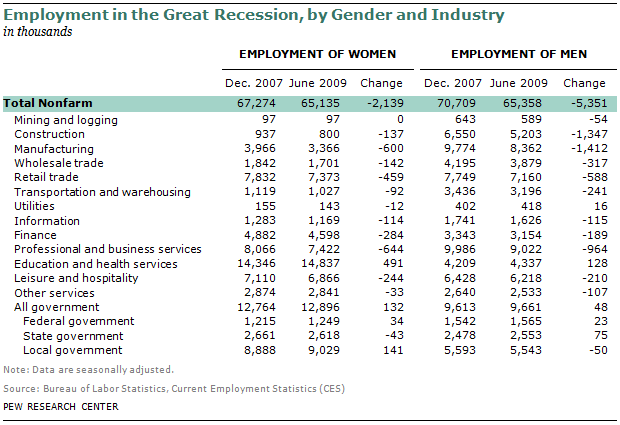
Employment trends for men and women in the recession were similar across industries, in contrast to the recovery. Testifying to the depth and breadth of the recession, both men and women lost jobs at virtually the same rates in 10 sectors. In two sectors—education and health services and federal government—they gained jobs at a similar rate even during the recession. There were only three instances of opposing trends—men gained jobs in the utilities sector and state governments while women lost jobs, and women gained jobs in local governments while men lost them.

Job losses were widespread, with the construction and manufacturing sectors shedding them at the greatest rate. Men lost a total of 2.8 million jobs in these two sectors alone, and women lost 737,000 jobs. Other sectors with large reductions in employment were retail trade and professional and business services. Collectively, these two sectors let go 1.1 million women and 1.6 million men. The finance industry, a sector at the heart of the economic crisis, shed 284,000 jobs held by women and 189,000 jobs held by men.

Education and health services created 619,000 jobs during the recession, of which 491,000 were filled by women and 128,000 by men. That is not an unusual development for this sector—its employment has grown at a faster pace than any other sector since 1970, and it has added jobs through previous recessions as well. Another source of job creation in the recession was the federal government, adding 57,000 jobs, of which 34,000 went to women and 23,000 to men. Women also benefited from the addition of 141,000 jobs in local governments during the recession. 7

Because men and women lost jobs at similar rates across sectors in the recession, the gender gap in employment loss stems largely from how men and women are distributed across industries. At the start of the recession, in December 2007, men were present in much larger numbers in industries where job losses were most severe—construction and manufacturing. Meanwhile, women were present in much larger numbers in industries that continued to add jobs in the recession—education and health services and local governments.

The number of jobs saved by women during the recession may be ascertained by estimating the number of jobs they would have lost if they had been distributed across industries like men in December 2007. This means assuming that at the start of the recession, only 6.0% of women, not 21.3%, were employed in education and health services and that 23.1% of women, not 7.3%, were in construction and manufacturing, and so on for other sectors. Under this hypothetical distribution, and given the actual job loss rate for women in each industry, it is estimated women would have lost 4.5 million jobs in the recession, not the 2.1 million they actually lost.

The implication is that the industries in which women are concentrated provided substantial shelter during the recession, cutting the potential job loss for women by more than half. If this exercise is repeated for men, that is, if they are assumed to be distributed across industries like women are in December 2007, it is estimated they might have lost 2.7 million jobs in the recession, rather than 5.4 million. These estimates show that virtually the entire gender gap in jobs lost in the recession is due to the concentration of women and men in different sectors of the economy.

IV. Unemployment in the Recession and Recovery

Changes in the unemployment rates for men and women during the recession and recovery are consistent with changes in employment levels. At the beginning of the recession, in December 2007, the unemployment rates were virtually equal for men (5.1%) and women (4.9%). During the recession, the unemployment rate for men rose more sharply, rising to 10.6% by June 2009, compared with 8.3% for women.

The first two years of the recovery have failed to reverse the increase in the unemployment rate for women. Indeed, with some fluctuations, the unemployment rate for women continued to increase for more than a year, peaking at 8.9% in November 2010. As of May 2011, the rate had edged downward to 8.5%.

The unemployment rate for men peaked at 11.4% in October 2009. Since then, it has been mostly on the decline. In May 2011, the unemployment rate for men stood at 9.5%, nearly two percentage points less than its peak in October 2009.

The changes in the unemployment rates for men and women largely reflect trends in employment during the recession and recovery—women lost fewer jobs in the recession but only men have regained jobs in the recovery.

Another influence on the unemployment rate is labor force participation. If an unemployed person stops actively looking for work, that person is no longer counted as a member of the labor force or among the unemployed. That can serve to lower the unemployment rate without there being an increase in employment. Conversely, as more people choose to enter the labor force and actively look for work, that can boost the unemployment rate even though there has been no reduction in employment.

Did differences in labor force participation among men and women lead to differences in how their unemployment rates have changed over the recession and recovery? During the recession, there was no change in labor force participation among women—59.4% of working-age women (ages 16 and older) were employed or looking for work in December 2007, and 59.5% were similarly engaged in June 2009. Thus, a change in labor force participation is not a factor in how the unemployment rate for women rose in the recession. The labor force participation rate for men did drop somewhat over the course of the recession—from 73.1% to 72.3%. That may have dampened the increase in the unemployment rate for men during the recession.

During the first two years of the recovery, labor force participation rates have fallen for both genders—from 59.5% to 58.2% for women and from 72.3% to 70.6% for men. Thus, there is no notable difference in labor force activity among men and women that might serve to explain why, in the recovery, unemployment rates for men and women have behaved differently.

Changes in the Unemployment Rate by Race, Ethnicity and Nativity

Gender trends in the unemployment rate transcend race, ethnicity and nativity. During the recession, the unemployment rates of men—whether Hispanic, white, black, Asian, native born or foreign born—increased more than those of women of similar race, ethnicity and nativity. For example, the unemployment rate for Hispanic men increased 7.9 percentage points from the fourth quarter of 2007 to the fourth quarter of 2009, while the rate for Hispanic women increased by 4.9 percentage points. 8The gender gap was highest among Hispanics and blacks and lowest among Asians.

The recovery has proceeded uniformly for men across race, ethnicity and nativity—all have experienced drops in the unemployment rate. The greatest decrease was for black men, whose unemployment rate fell 1.2 percentage points in the recovery. Black men had also the greatest increase in the unemployment rate during the recession.

Among women, only white women experienced a decrease in the unemployment rate in the first two years of the recovery—the rate continued to increase for Hispanic, black and Asian women. The greatest increase was for Hispanic women—1.2 percentage points. The unemployment rate for native-born women was virtually unchanged in the recovery, but it increased 0.4 percentage points for foreign-born women.

V. A Brief History of Employment Trends in Recessions and Recoveries

Have the employment trends for men and women in the Great Recession and the subsequent recovery been different from those in past episodes? The answer is, during the recession, no, but during the recovery, yes.

Since 1969, six episodes of recession and recovery have occurred. The recessions preceding the Great Recession lasted from December 1969 to November 1970, November 1973 to March 1975, January 1980 to November 1982 (two episodes counted as one in this report), 9 July 1990 to March 1991, and March 2001 to November 2001. (The dates shown in the accompanying figure are slightly different because employment changes are computed from one month before the start of the recession to the last month of the recession.)

In all recessions since 1969, including the Great Recession, employment outcomes for men were worse than for women. However, the recovery from the Great Recession is the first since 1970 in which, two years after the recession ended, women have lost jobs while men have gained jobs. It is also the first recovery in which the unemployment rate for men has fallen even as the unemployment rate for women has risen.

Men have experienced job losses in all recessions since 1969. The most severe job losses for men occurred during the recessions from January 1980 to November 1982, when their employment fell 5.9%, and during the Great Recession, which caused a 7.6% decline in men’s employment.

Women did not always lose jobs in recessions—their employment increased during the 1969-70, 1973-75 and 1980-82 recessions. That is a consequence of the rapid movement of women from the home to the office in those decades. The labor force participation rate for women increased from 43.3% in 1970 to 51.5% percent in 1980, and then again to 57.5% by 1990. The rise in the number of women in the labor force was sufficient to mask the effects of the recessions on their employment level. As the labor force participation rate stabilized for women in the 1990s, they, too, experienced drops in employment during recessions.

Employment trends during the first two years of economic recoveries reveal rapid gains in jobs for both genders during the 1970s and the 1980s. In part, that is because many jobs lost in those recessions were a consequence of temporary layoffs, restored quickly as the economic climate improved. In more recent recessions, especially in the Great Recession, the role of temporary layoffs diminished and permanent reductions in workforces were the more significant force behind rising unemployment. Thus, recoveries from the 1991 recession and the recessions in this decade are associated with sluggish gains in employment. 10

Regardless of the rates at which jobs returned after recessions, job growth for women outpaced job growth for men in the recoveries in 1970-72, 1975-77, 1982-84 and 1991-93. Both men and women continued to lose jobs in the two years following the 2001 recession, but women lost them at a slower rate. It is only in the recovery from the Great Recession that women have lost jobs while men have gained them.

Trends in the unemployment rate reaffirm the unique nature of the recovery from the Great Recession. Historically, the unemployment rate for men has tended to increase more than for women during recessions.

During economic recoveries, the unemployment rate for men and women has not necessarily fallen, but it has mostly moved in the same direction. In the 1982-84 recovery, the unemployment rate for men decreased 4.0 percentage points and the rate for women fell 2.5 percentage points. In the 2001-03 recovery, the unemployment rate rose 0.5 percentage points for men and 0.3 percentage points for women. The current recovery is the first in which the unemployment rates for men and women have gone in opposite directions—falling for men (1.1 percentage points) but rising for women (0.2 percentage points).

Appendix Table