
The Public Renders a Split Verdict On Changes in Family Structure
The American public is sharply divided in its judgments about the sweeping changes in the structure of the American family that have unfolded over the past half century. About a third generally accepts the changes; a third is tolerant but skeptical; and a third considers them bad for society.
Overview
The American public is sharply divided in its judgments about the sweeping changes in the structure of the American family that have unfolded over the past half century. About a third generally accepts the changes; a third is tolerant but skeptical; and a third considers them bad for society.

This finding emerges from an analysis that the Pew Research Center conducted of responses to a survey in which a nationally representative sample of 2,691 adults were asked whether they considered the following seven trends to be good, bad or of no consequence to society: more unmarried couples raising children; more gay and lesbian couples raising children; more single women having children without a male partner to help raise them; more people living together without getting married; more mothers of young children working outside the home; more people of different races marrying each other; and more women not ever having children.
About a third (31%) of survey respondents are Accepters. Anywhere from half to two-thirds of this group say these trends make no difference to society. But of the remainder who express an opinion, more say that most of the trends are good than say they are bad. Women, Hispanics, East Coast residents and adults who seldom or never attend religious services are more likely than others to be represented in this group.
A similar share of the public (32%) rejects virtually every trend that the Accepters tolerate or endorse. A majority say five of the seven changes are bad for society; the only trends they generally accept are interracial marriage and fewer women having children. They are the only group in which a majority (61%) says it is harmful for mothers of small children to work outside the home. Whites, older adults, Republicans, the religiously observant and married adults are overrepresented in this group. They are the Rejecters.
The third and somewhat larger group (37%) are the Skeptics.1 While they generally share most of the tolerant views of the Accepters, they also express concern about the impact of these trends on society. On one of the trends—single motherhood—they and the Accepters have stark differences. Virtually all Skeptics say mothers having children without male partners to help raise them is bad for society. Among Accepters, just 2% say this. When asked about the six other trends examined in the survey, a majority of Skeptics say each makes no difference or is good for society. Young people, Democrats and political independents, and minorities are disproportionately more likely to be in this group.
The remainder of this report explores these three groups in more detail. The next section examines how the three groups differ from each other on the seven demographic trends included in the survey. The section that follows looks at the demographics of each group, and a final section examines the views of the three groups on other issues.
But first, a note about the limitations of this analysis. Not everyone in each cluster evaluates each of the trends in exactly the same way. Overall, however, members of each group are more similar to one another in terms of their responses to the questions than they are to those in the other two groups. Also, while the three clusters described in this report do a good job of summarizing the pattern of responses to these seven questions, our analysis might have produced different results had we used different questions or measured people’s judgments in different ways.
Forming Clusters to Help Characterize Views on Demographic Change
Do Americans believe that the sweeping demographic changes affecting family life in the past half century have been good for society, bad for society, or have they made no difference? And, if their judgments differ, are there patterns in public opinion on this topic that enable analysts to place respondents into reasonably coherent clusters? If so, what are the sizes and demographic characteristics of these groups?
To answer these questions, a statistical technique known as cluster analysis was applied to these survey data. The analysis looked across the nationally representative sample of 2,691 adults and grouped together those who shared similar judgments about the impact of seven key demographic trends on society. The survey asked whether each of the following seven trends had been “a good thing for our society, a bad thing for our society or doesn’t it make much difference”: more unmarried couples raising children; more gay and lesbian couples raising children; more single women having children without a male partner to help raise them; more people living together without getting married; more mothers of young children working outside the home; more people of different races marrying each other; and more women not ever having children.
Cluster analysis typically produces a number of “solutions,” each containing different numbers of clusters or groups. These cluster solutions are then evaluated on the basis of their statistical properties as well as on the more subjective criteria of how easily explainable the clusters are and how well they appear to describe the data. Three cluster solutions were evaluated: a two-cluster, a three-cluster and a four-cluster model. In the end, a three-cluster solution described in this report emerged as the one that offered the best combination of statistical properties and made the most substantive sense.
Judging Each Trend: How the Groups Differ
Overall, relatively small percentages of Accepters, Rejecters and Skeptics say any of the seven trends have been “a good thing for society.” But the three groups differ sharply on whether each of these seven changes has been bad or has had no significant impact.
Perhaps the most striking difference occurs in attitudes toward single motherhood between the two more tolerant groups. Virtually all Skeptics (99%) say the increase single in motherhood is bad for society. In contrast, nearly nine-in-ten Accepters say the increase in single women having children has made no difference (74%) or is “a good thing for society” (13%).

So sizable is the difference between Accepters and Skeptics on this single trend that the division of the Accepters and Skeptics is driven primarily—though though not solely—by views on single motherhood. In fact, these two generally similar groups would merge into a single cluster if the question about single motherhood were removed from the analysis.

On the other trends, the pattern is more predictable: Accepters are the most tolerant, Skeptics are less accepting and Rejecters generally disapprove of most of these changes. Here is how the groups align on these six trends:
People living together without getting married
Nearly all Rejecters (95%) say the rise in cohabitation among singles has been “a bad thing” for society—and not a single one says it has been good. Conversely, about two-thirds of all Accepters (67%) and Skeptics (65%) say cohabitation has had no impact.
Gay and lesbian couples raising children
Substantial majorities of Accepters (81%) and Skeptics (67%) say gay parenting has made no real difference or say it is a good thing. In contrast, nearly nine-in-ten Rejecters (87%) say the trend is bad for society, while no member of this group says it has been positive.
Unmarried couples raising children
More than nine-in-ten Rejecters (93%) say it is bad for society if mom and dad are not married. Once again, not a single Rejecter thinks this trend is a good thing, and only 6% say it has made no difference. Among Accepters, about eight-in-ten (81%) say unmarried couples raising children has had no impact on society or has been a positive development. A smaller majority of Skeptics (71%) agrees that the impact of this trend has been neutral or good.
More mothers of young children working outside the home
A substantial majority of Rejecters (61%) say working moms with small children at home is bad for society. In contrast, more than six-in-ten Skeptics (63%) and Accepters (77%) say this change has not been damaging. But with the exception of single moms, this trend is the one that disturbs Skeptics the most: a third (33%) say the growing share of working moms with young children is bad for society, a view shared by 18% of Accepters.
More women not ever having children
At least half of all Accepters, Rejecters and Skeptics agree that the increase in women without children has had no impact or has been good for society. But the size of these majorities varies from 52% among Rejecters to 70% among Skeptics and 74% among Accepters. Compared with other trends, more Accepters say the increase in women without children is a bad thing for society (20%), while 18% say the increase in working mothers of young children has been harmful. Not surprisingly, however, Rejecters are more than twice as likely as Accepters to disapprove of this trend (43% say it is bad) and so do a quarter of Skeptics.
More people of different races marrying each other
Finally a widely shared verdict: Three-quarters or more of each group say the increase in interracial marriage has done no harm to society or is a positive development. Still, about a quarter (24%) of Rejecters say this trend is bad for society, while only 11% of Skeptics and 6% of Accepters agree.
Demographic Differences
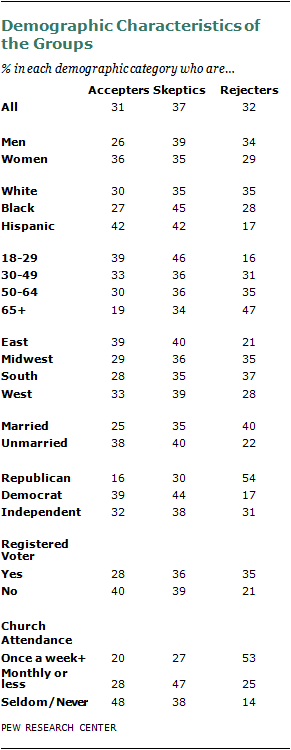
Demographics as well as attitudes divide the three groups. Religiously observant adults, older adults, whites, married adults, Republicans and men generally express the greatest misgivings about the seven trends tested in the survey and tend to fall into the Rejecter group. At the same time, younger people, Hispanics, unmarried adults, Democrats, women and Easterners are consistently more likely to say these changes have had no real impact or have been good for society. They tend to be Accepters or Skeptics.
Religious observance, as measured by attendance at religious services, produces the biggest differences in views. More than half of those who attend services once a week or more are Rejecters—more than triple the proportion who seldom or never goes to worship services (53% vs. 14%).
On the reverse side of the same coin, adults who say they rarely or never go to services are more than twice as likely as frequent attendees to be members of the Accepters group (48% vs. 20%).
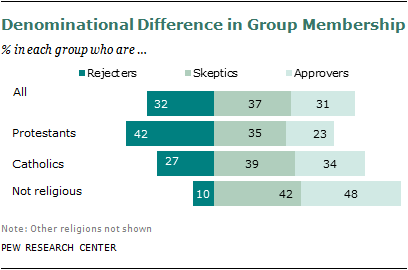
Religious affiliation also matters. More than four-in-ten Protestants are Rejecters, especially socially conservative white Evangelicals (62%). Some 27% of Catholics are Rejecters, while 10% of non-religious adults fall into this group.
Older adults express greater disapproval than younger adults of the seven trends tested in the survey. Nearly half of all adults 65 and older (47%) fall into the Rejecters group, compared with only 16% of those younger than 30. At the same time, young people are significantly more likely than those 65 and older to be Accepters (39% vs. 19%).
By a wide margin, Hispanics are far more accepting of these social changes than are whites. More than four-in-ten Hispanics are Accepters (42%), while an equal proportion are Skeptics. In contrast, whites are the most disapproving of these changes. More than a third (35%) are Rejecters, double the share of Hispanics (17%). Age could explain much of these differences: About a third of Hispanics (33%) are younger than 30, compared with 18% of whites and 22% of blacks, and it is this younger age group that is the most accepting of these changes.
Blacks are more measured in their reaction to these trends. Nearly half (45%) are Skeptics. An additional 27% are Accepters, about the same proportion as whites, while about an equal share are Rejecters (28%).
Married men and women are consistently more disapproving of these trends than are those who are unmarried. Four-in-ten married adults are Rejecters, nearly double the proportion of unmarried in this group (40% vs. 22%). Conversely, nearly four-in-ten (38%) singles are Accepters, compared with a quarter of all married people. Married couples with children younger than 18 are less accepting than are childless married couples (36% are Rejecters vs. 26%).
Where you live and how you vote also help to differentiate the three groups. Easterners are more likely to be Accepters (39%) than are people living in the Midwest (29%) or South (28%).
Republicans are significantly more likely to be Rejecters (54%) than Democrats (17%) or political independents (31%). In contrast, Democrats and Independents disproportionately fall into the Accepter group compared with Republicans (39% and 32% vs. 16%). However, pluralities of both Democrats and political independents are Skeptics (44% and 38%), compared with 30% of Republicans.
Other Views

Accepters, Rejecters and Skeptics have different views on wide range of other topics tested in the survey related to marriage and family.
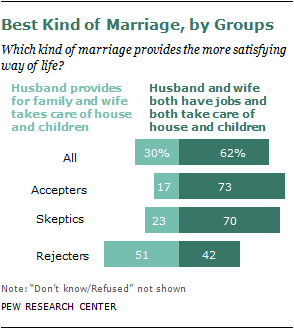
For example, about seven-in-ten Accepters and Skeptics say the ideal marriage is one in which both the husband and wife work outside the home and both parents share child care responsibilities. Rejecters are divided. About half (51%) say the “traditional” marriage in which the husband is the breadwinner and the wife takes care of the household and children provides the more satisfying life. But more than four-in-ten (42%) disagree and side with the two more accepting groups in favoring a marriage in which both parents work outside the home and share child care duties.
Who is a family? On some types of living arrangements, the groups broadly agree. Overwhelming proportions of Accepters (91%), Rejecters (91%) and Skeptics (83%) say a married couple without children is a family.
Large majorities—96% of Accepters, 87% of Skeptics and 74% of all Rejecters—also say a single parent raising at least one child is a family. These findings are particularly striking for Rejecters and Skeptics. Virtually every member of both groups says that more women raising children without a male partner is bad for society. Nonetheless, large majorities of both groups say that this arrangement constitutes a family.
The two most tolerant groups say that an unmarried couple with children is a family (96% of Accepters and 86% of Skeptics). Rejecters are divided. Slightly more than half (55%) say this arrangement constitutes a family, while 42% disagree.
The three groups diverge on whether other living arrangements are families. Majorities of Accepters (84%) and Skeptics (75%) say same-sex couples with children are families, more than double the proportion of Rejecters (31%) who share this view.
The three groups have an even larger disagreement about two other arrangements. More than six-in-ten Accepters say unmarried couples without children (60%) and childless same-sex couples (68%) are families. Fewer than half of all Skeptics share this view (48% for unmarried childless couples and 47% for same-sex couples), while only about one-in-five Rejecters say these arrangements are families.
The Future of Marriage and the Family
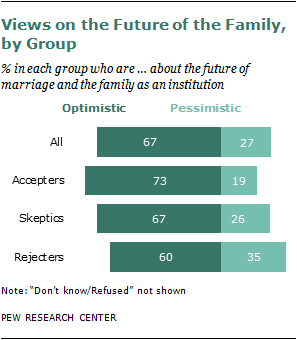
While the groups may disagree about the definition of a family, all three are upbeat about the prospects for the family as an institution.
Asked if they were optimistic or pessimistic about the future of marriage and the family, more than two-thirds of Accepters (73%) and Skeptics (67%) say they are hopeful, a view shared by 60% of Rejecters.

