Pew Research Center

FOR RELEASE OCTOBER 25, 2023

How Americans View Future Harms From Climate Change in Their Community and Around the U.S.

63% expect climate impacts to worsen in their lifetime

BY Alec Tyson and Brian Kennedy

FOR MEDIA OR OTHER INQUIRIES:

Communications Department
202.419.4372
www.pewresearch.org

RECOMMENDED CITATION

Pew Research Center, October 2023, "How Americans View Future Harms From Climate Change in Their Community and Around the U.S."

About Pew Research Center

Pew Research Center is a nonpartisan, nonadvocacy fact tank that informs the public about the issues, attitudes and trends shaping the world. It does not take policy positions. The Center conducts public opinion polling, demographic research, computational social science research and other data-driven research. It studies politics and policy; news habits and media; the internet and technology; religion; race and ethnicity; international affairs; social, demographic and economic trends; science; research methodology and data science; and immigration and migration. Pew Research Center is a subsidiary of The Pew Charitable Trusts, its primary funder.

© Pew Research Center 2026

Table of contents

  • About Pew Research Center
  • How Americans View Future Harms From Climate Change in Their Community and Around the U.S.
  • 1. Views on future climate impacts, environmental harms
  • 2. What groups can make the biggest impact on climate change?
  • 3. Climate activism
  • Acknowledgments
  • Methodology
  • Appendix: Detailed chart and tables

How Americans View Future Harms From Climate Change in Their Community and Around the U.S.

63% expect climate impacts to worsen in their lifetime

How we did this

Pew Research Center conducted this study to understand Americans’ views of climate change and its impact on the country. For this analysis, we surveyed 8,842 U.S. adults from Sept. 25 to Oct. 1, 2023.

Everyone who took part in the survey is a member of the Center’s American Trends Panel (ATP), an online survey panel that is recruited through national, random sampling of residential addresses. This way, nearly all U.S. adults have a chance of selection. The survey is weighted to be representative of the U.S. adult population by gender, race, ethnicity, partisan affiliation, education and other categories. Read more about the ATP’s methodology.

Here are the questions used for this report, along with responses, and its methodology.

A new Pew Research Center survey finds a majority of Americans think climate change is causing harm to people in the United States today and 63% expect things to get worse in their lifetime.

When it comes to the personal impact of climate change, most Americans think they’ll have to make at least minor sacrifices over their lifetime because of climate change, but a relatively modest share think climate impacts will require them to make major sacrifices in their own lives.

July 2023 was hotter than any other month in the global temperature record, and the United Nations climate panel has warned of growing impacts from climate change barring major reductions in greenhouse gas emissions worldwide.
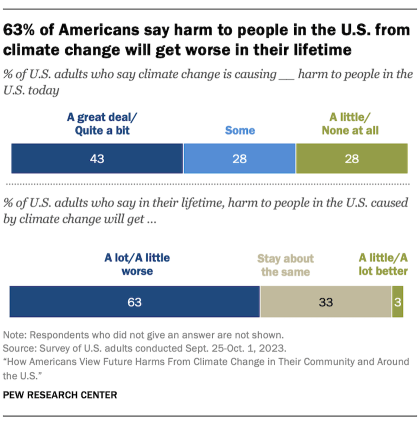
Chart shows 63% of Americans say harm to people in the U.S. from climate change will get worse in their lifetime

The Center survey of 8,842 U.S. adults conducted Sept. 25-Oct. 1, 2023, finds that 43% of Americans think climate change is causing a great deal or quite a bit of harm to people in the U.S. today. An additional 28% say it is causing some harm.

Looking ahead, young adults ages 18 to 29 are especially likely to foresee worsening climate impacts: 78% think harm to people in the U.S. caused by climate change will get a little or a lot worse in their lifetime.
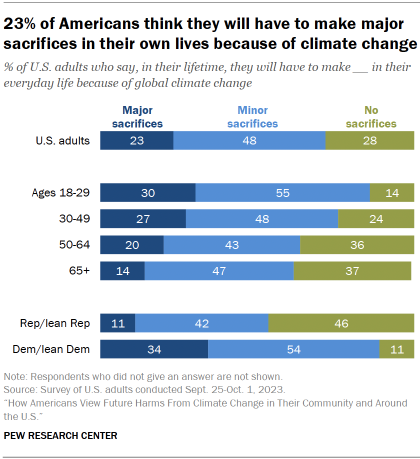
Chart shows 23% of Americans think they will have to make major sacrifices in their own lives because of climate change

About a quarter of Americans (23%) think they’ll have to make major sacrifices in their everyday lives because of climate change. A larger share (48%) expects to make minor sacrifices because of climate impacts and 28% of Americans expect to make no sacrifices at all.

Republicans and Democrats have much different expectations for how climate change will impact their lives. Just under half of all Republicans and Republican-leaning independents expect to make no sacrifices in their everyday lives because of climate change. By comparison, 88% of Democrats and Democratic-leaning independents expect to have to make at least minor sacrifices.

These partisan gaps are closely tied to differing expectations about national impacts: 86% of Democrats expect harms from climate change in the U.S. to get worse during their lifetime; just 37% of Republicans say the same.

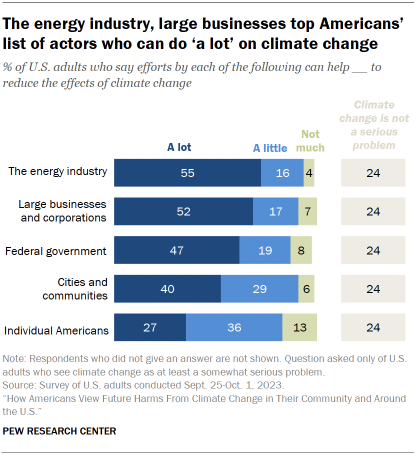
More broadly, the public believes individual Americans can make less of a difference on climate change than other major actors. For example, 55% think the energy industry can do a lot to reduce the effects of climate change and 52% say this about large businesses and corporations. By comparison, far fewer (27%) say individual Americans can do a lot to reduce climate impacts.

Climate change consistently ranks lower than other national issues like the economy, health care and crime on the public’s list of national priorities for the president and Congress. Nonetheless, 74% say the U.S. should participate in international efforts to address the issue and majorities support a number of specific policies intended to reduce the effects of climate change, such as providing a tax credits to businesses for developing carbon capture and storage technologies.

Views on climate activism

Despite widespread concern about future climate impacts there has been a slight decline in participation in forms of climate activism. The survey finds 21% of of U.S. adults say they have participated in at least one of four climate-related activities in the last year, including donating money to a climate organization or attending a climate protest. This is down slightly from two years ago when 24% of Americans said they had participated in a climate-related activity.
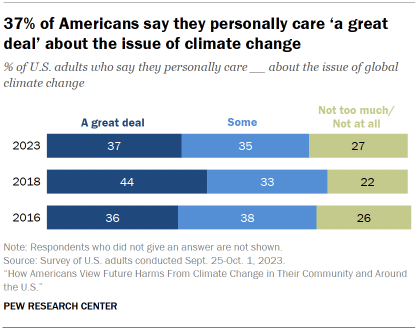
Chart shows 37% of Americans say they personally care ‘a great deal’ about the issue of climate change

Furthermore, Americans are largely skeptical that climate activism builds public support for the issue or spurs elected officials to act. Just 28% think climate activism makes people more likely to support action on climate change and only 11% say it is extremely or very effective at getting elected officials to act on the issue. For more, read Chapter 3 of the report, “Climate activism.”

Consistent with the slight decline in levels of climate activism, there has been no increase in personal concern on the issue in recent years. Overall, 37% say they personally care a great deal about the issue of climate change. This share is down 7 percentage points from 2018 and about the same as it was in 2016, the first time the Center asked the question.

How Americans view the expertise of climate scientists

A related analysis finds only about one-third of Americans think climate scientists understand “very well” whether climate change is happening. An even smaller share says climate scientists understand the causes of climate change very well.

For more, read “Americans continue to have doubts about climate scientists’ understanding of climate change.”

The survey findings are organized into three chapters exploring the following topics in more detail:

  • Expectations for future climate change impacts
  • What groups Americans think can make a difference on climate change
  • Climate activism and engagement

Public expectations of future climate impacts locally and around the U.S.

Experts predict that some regions of the U.S. will face more severe climate impacts than others. Americans also make distinctions when asked to think about future climate impacts on some different places around the country.
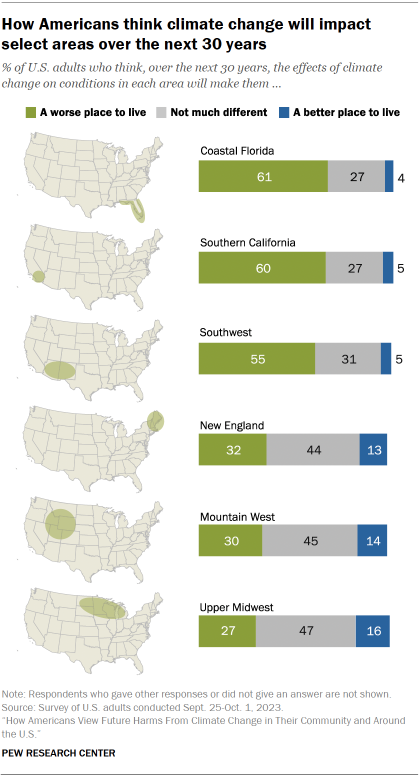
Chart shows how Americans think climate change will impact select areas over the next 30 years

Majorities expect that coastal Florida (61%), Southern California (60%) and the Southwest (55%) will become worse places to live over the next 30 years because of the effects of climate change.

Assessments of other areas are less negative. Only around three-in-ten think New England (32%) and the Mountain West (30%) will become worse places to live over the next 30 years because of climate change; 27% say this about the Upper Midwest.

Americans’ assessments of the impact of climate change on their own communities tilt more negative than positive, though a sizable share do not expect much change. Overall, 41% think their own community will become a worse place to live over the next 30 years due to the effects of climate change. Just 7% think climate impacts will make conditions in their community better, while 41% think climate impacts won’t change conditions in their area much.

Democrats (59%), young adults (56%) and Americans living in the Western region of the country (51%) are among the groups most likely to believe conditions in their community will become worse in the next 30 years because of climate change. Read more about these differences in Chapter 1.

Emotional reactions to climate news and information

Seven-in-ten Americans say they’ve felt sad about what is happening to the Earth, when they’ve seen news and information about climate change recently. Half say they’ve felt motivated to do more to address the issue when they saw climate news and information recently.
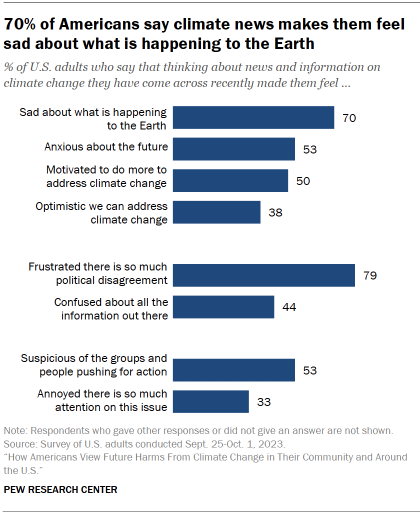
Chart shows 70% of Americans say climate news makes them feel sad about what is happening to the Earth

A sense of optimism about progress is not widely held: 38% say they’ve felt optimistic we can address climate change when they’ve seen news and information on the topic. A June 2023 Center survey found just 33% of Americans think the U.S. and other countries around the world will do enough to avoid the worst impacts of climate change.

Americans’ most common emotional reaction to climate news is feeling frustrated that there is so much political disagreement on the issue; 79% say they’ve felt this way recently.

A sense of skepticism toward climate advocates also registers with a sizable share of the public: 53% of Americans say they’ve felt suspicious of the groups and people pushing for action on climate change when they’ve seen climate news and information recently. An August Pew Research Center study used qualitative interviews to explore the views of those who do not see urgency on climate change; the analysis found that crisis language on climate change often drove suspicion and deeper mistrust among participants who see climate change as a lower-tier priority.

Chart shows Majority of Democrats say climate news makes them feel anxious while majority of Republicans say they feel suspicious of the groups pushing action

Republicans and Democrats have starkly different emotional responses to news and information on climate change.

Among Democrats and Democratic leaners:

  • 88% say they felt sad about what is happening to the Earth.
  • 73% felt anxious about the future.
  • 72% felt motivated to do more to address the issue.

Still, fewer than half of Democats (45%) say they felt optimistic about addressing the issue when they’ve seen climate news and information recently.

Among Republicans and Republican leaners:

  • 78% felt suspicious of the groups and people pushing for action on climate change.
  • 58% felt annoyed there is so much attention on the issue of climate change.
  • 51% felt confused about all the information out there about climate change.

Despite broad skepticism within the GOP toward groups pushing action on climate change, half of Republicans say they felt sad about what is happening to the Earth when they recently came across climate news and information.

One sentiment that registers with large shares of Republican and Democrats alike is frustration that there is so much political disagreement over climate change: 86% of Democrats and 73% of Republicans express this feeling.

1. Views on future climate impacts, environmental harms

Americans are far more likely to say the effects of climate change will make their local community a worse rather than better place to live over the next 30 years, but many also say they don’t expect much change in local conditions. These attitudes vary considerably by factors like age, partisan affiliation and region.

Differences by party

Chart shows majorities of young adults and Democrats say climate change will make their local area a worse place to live

A majority of Democrats and Democratic leaners (59%) say they expect climate change to make conditions in their local community worse over the next 30 years. Far fewer (28%) say climate change won’t make much difference in their area and just 10% think climate impacts will improve their local conditions.

In contrast, a majority of Republicans and Republican leaners (55%) say they expect climate change to not make much difference on their community in the next 30 years. Another 22% say they expect living conditions in their local community to get worse over the next 30 years, while 5% say that living conditions will get better. Nearly two-in-ten Republicans (18%) do not believe climate change is impacting communities.

Views vary by age group

Younger adults are more likely than older adults to expect adverse impacts from climate change in their communities. Overall, 56% of young adults ages 18 to 29 say their local community will be a worse place to live because of climate change in the next 30 years, while only 9% say climate change will make their local community a better place to live. Roughly three-in-ten young adults do not think climate change will have much of an effect on conditions in their area.

By comparison, the most commonly held view among adults ages 65 and older is that climate change will not have much effect on conditions in their area (52%) over the next 30 years. About a third (32%) think climate change will make their community a worse place to live in the coming decades. 

Age differences among Republicans and Democrats

Age differences are seen within both the Republican and Democratic parties when it comes to expectations about local climate impacts.

Republicans ages 18 to 29 (37%) are more likely than Republicans ages 65 and older (14%) to expect climate change to make their local communities worse. Two-thirds of older Republicans say climate change will not make much difference on conditions in their local communities, compared with 45% of younger Republicans.

The age gap is more modest within the Democratic Party. Still, the youngest Democrats are 10 points more likely than the oldest Democrats to expect their area to become a worse place to live because of climate change over the next 30 years (65% vs. 55%).

Regional differences

Chart shows Americans living in the West are most likely to say climate change will make their local areas worse

Across the four major U.S. regions, Westerners are most likely to expect climate change to make local conditions in their area worse, while Midwesterners are least likely to say this.

About half of adults living in the West say climate change will make their community a worse place to live. By comparison, 30% of residents in the Midwest say the same.

Americans living in the South and Northeast fall in between, with roughly four-in-ten in both regions expecting climate change to make local conditions worse over the next 30 years.

This pattern of regional differences is seen among both Republicans and Democrats, though partisans remain far apart in their expectations within each region.

For example, in the West, 71% of Democrats and 28% of Republicans expect conditions in their community to worsen over the next 30 years. By comparison, in the Midwest, relatively smaller shares of both groups expect climate change to make their community a worse place to live, though Democrats remain much more likely than Republicans to say this (47% vs. 15%).

Expectations for future environmental problems, tech advances

Chart shows Majorities expect a range of environmental harms to worsen in the U.S. over the next 30 years

Asked to think more broadly about future environmental conditions, Americans see a range of negative impacts as likely to come to pass.

About three-quarters of Americans say a growing number of plant and animal species will definitely or probably become extinct over the next 30 years.

Majorities also see other environmental harms as likely to happen:

  • 61% say heatwaves will definitely or probably cause large numbers of people in the U.S. to die every year.
  • 58% think rising sea levels will force large numbers of people to move away from coastal areas over the next 30 years.
  • 54% expect widespread drought in the Western U.S. states will cause most rivers to dry up.

These questions did not directly ask about the role of climate change on these environmental harms. However, Americans who see climate change as a serious problem are much more likely than those who see it as a less serious problem to say each of these environmental harms will probably or definitely happen. For example, 85% of Americans who describe climate change as an extremely or very serious problem say heatwaves will definitely or probably cause large numbers of people to die over the next 30 years. Among those who see climate change as a not too serious problem or not a problem, just 16% say this. (Read the Appendix for more details on this analysis.)

The survey also asked Americans about how technology and infrastructure may change in response to environmental conditions.

About two-thirds of Americans say most homes and buildings will definitely or probably need major upgrades to withstand extreme weather events over the next 30 years. A smaller majority (57%) expects that renewable sources will produce most of the country’s energy in 30 years. In 2022, renewable energy sources – such as wind, solar and hydropower – were used to generate about 22% of total electricity in the U.S.

Other forms of technology are currently less widespread, but could be further developed in future decades. Direct air capture is a technology that involves machines removing carbon dioxide from the atmosphere, which the U.S. Department of Energy plans to build and use in coming years. Other technologies are in development that aim to cool oceans and influence weather through various approaches.

Sizable shares of Americans, but not majorities, expect these emerging technologies to become commonplace in the next 30 years:

  • 45% of Americans say it is definitely or probably likely that countries will use technology to cool oceans and influence the weather.
  • 42% say it is definitely or probably likely that machines will take large amounts of carbon dioxide out of the air and store it in the ground.

Partisans differ in expectations for future environmental conditions

Chart shows Democrats are more likely than Republicans to say environmental harms will occur in coming decades

Democrats are much more likely than Republicans to expect both worsening environmental harms and changes in technology and infrastructure over the next 30 years.

Roughly eight-in-ten Democrats say heatwaves will definitely or probably cause large numbers of people to die in the U.S. each year and that rising sea levels will force large number of Americans to move away from the coast.

By contrast, fewer than half of Republicans expect these environmental harms to happen over the next three decades.

On infrastructure and technological changes, Democrats (82%) are more likely than Republicans (46%) to say homes and buildings will need major upgrades to withstand extreme weather events. And a majority of Democrats (70%) expect most energy in the U.S. to be produced by renewable sources in 30 years, compared with fewer than half of Republicans (42%) who expect this to happen.

Partisan gaps are smaller over the emerging technologies of carbon capture and ocean cooling, with neither group confident that these technologies will be in place. Still, Democrats are somewhat more likely than Republicans to think both large-scale carbon capture (50% vs. 34%, respectively) and geoengineering to cool oceans (51% vs. 38%) are likely in 30 years.

2. What groups can make the biggest impact on climate change?

Americans think the energy industry and large businesses can help the most to reduce the effects of climate change. The public sees individual Americans as having less ability to make an impact.

A majority of U.S. adults (55%) say efforts by the energy industry can help a lot to reduce the effects of climate change. A slightly smaller share (52%) say large businesses and corporations can help a lot to address climate change.

Chart shows the energy industry, large businesses top Americans’ list of actors who can do ‘a lot’ on climate change

When it comes to the federal government, 47% think it can help a lot to reduce the effects of climate change; 40% say this about cities and communities.

Of the five groups asked about in the survey, the public ranks individual Americans as the least impactful on climate change. About a quarter of U.S. adults (27%) say efforts by individual Americans can help a lot to reduce the effects of climate change.

Nonetheless, majorities believe each of the groups asked about in the survey – including individual Americans – can do at least a little to reduce the effects of climate change. Few say there’s not much difference these groups can make on climate change.

These questions were asked only of the roughly three-quarters of Americans who say climate change is an extremely, very or somewhat serious problem. Those who said climate change is not too serious or not a problem were not asked these questions; this group makes up 24% of U.S. adults. 

Views on climate adaptation and mitigation

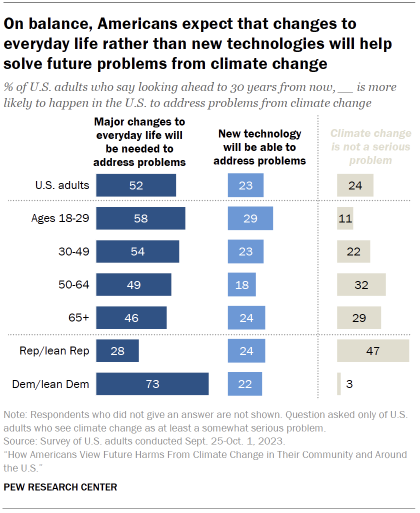
Asked to look ahead to 30 years from now, far more Americans think major changes to everyday life will be needed to address the problems from climate change than believe new technology will be able to address most problems stemming from climate impacts.

Chart shows on balance, Americans expect that changes to everyday life rather than new technologies will help solve future problems from climate change

About half of Americans (52%) think major changes to everyday life will be needed to address climate problems. Fewer than half as many (23%) say new technology will be able to address most problems from climate change.

The remaining share of the public (24%) thinks climate change is not a problem. Only those who say climate change is at least a somewhat serious problem were asked this question.

Most Democrats (73%) think major changes to everyday life will be needed to address problems from climate change, while a much smaller share (22%) think new technology will be able to address most problems.

Of the 53% of Republicans who think climate change is at least a somewhat serious problem, views are more evenly divided between saying changes to everyday life will be needed (28%) and new technology will solve most problems from climate change (24%).

Partisan differences in shares who say climate change is a highly serious problem

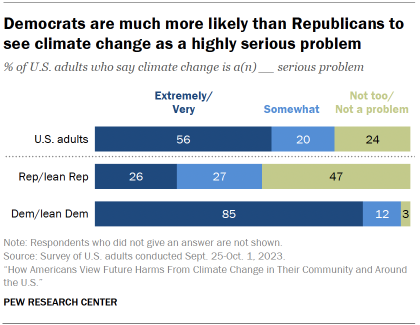
Overall, 56% of Americans say climate change is an extremely or very serious problem. Another 20% say it is a somewhat serious problem. About a quarter of Americans (24%) describe climate change as not too serious of a problem or not a problem at all.

Chart shows Democrats are much more likely than Republicans to see climate change as a highly serious problem

A vast majority of Democrats (85%) say climate change is an extremely or very serious problem. By contrast, 47% of Republicans view climate change as not too serious or not a problem at all. About a quarter of Republicans say climate change is an extremely or a very serious problem; 27% say it is a somewhat serious problem.

Among the GOP, moderate and liberal Republicans are much more likely than conservative ones to describe climate change as an extremely or very serious problem (42% vs. 17%). A majority of conservative Republicans (58%) think climate change is not too serious or not a problem.

Views on human activity as a contributor to climate change

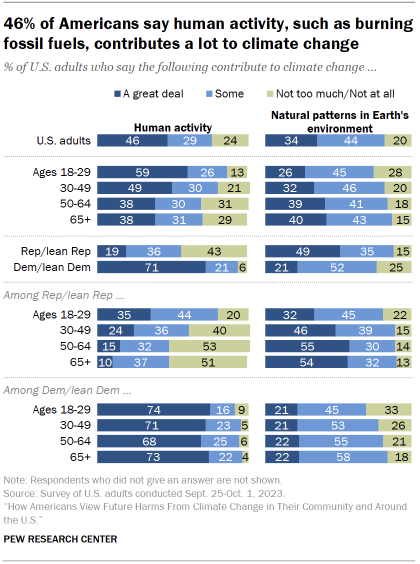
Chart shows 46% of Americans say human activity, such as burning fossil fuels, contributes a lot to climate change

Overall, 46% of Americans think human activity contributes a great deal to climate change. About three-in-ten (29%) say human activity, such as the burning of fossil fuels, contributes some to climate change. Another 24% say it contributes not too much or not at all.

The share of Americans who say human activity contributes a great deal to climate change is unchanged since last year and slightly lower than in 2019, the first time the Center asked this question.

The survey also asked Americans how much they think natural patterns in the Earth’s environment contribute to climate change. About one-third (34%) say natural patterns contribute a great deal, while 44% say they contribute some and 20% say they contribute not too much or not at all. The share of Americans who say natural patterns contribute a great deal to climate change is virtually identical to in 2019.

Partisan affiliation and climate change beliefs

Most Democrats (71%) think human activity contributes a great deal to climate change. By contrast, just 19% of Republicans hold this view. A larger share of Republicans say human activity contributes not much or not at all to climate change (43%).

Republicans are more than twice as likely as Democrats to think natural patterns in the Earth’s environment contribute a great deal to climate change (49% vs. 21%).

Age and climate change beliefs

Younger Americans are more likely than their older counterparts to say human activity contributes a great deal to climate change. Among those ages 18 to 29, about six-in-ten (59%) think human activity contributes a great deal, compared with 38% those 65 and older.

Age differences are more pronounced among Republicans than Democrats. Among Republicans, those ages 18 to 29 are 25 points more likely than those ages 65 and older to say human activity contributes a great deal to climate change (35% vs. 10%). By comparison, similar majorities of both younger and older Democrats say human activity contributes a great deal to climate change.

3. Climate activism

The survey finds that the share of Americans who say they have participated in one of four forms of climate activism has declined slightly since two years ago. And there’s limited belief among the public generally that climate activism changes minds or drives elected officials to act.

Recent months have seen a number of high-profile climate demonstrations including the delay of a U.S. Open tennis match due to environmental protestors and marches in New York ahead of United Nations meetings to urge world leaders to end the use of fossil fuels.

Chart shows share of Americans who have participated in a climate-related activity is down slightly from 2021

The survey asked Americans if they have done each of the following in the last year: attended a climate change protest or rally; volunteered for an activity focused on addressing climate change; donated money to an organization focused on climate change; or contacted an elected official to urge them to address climate change.

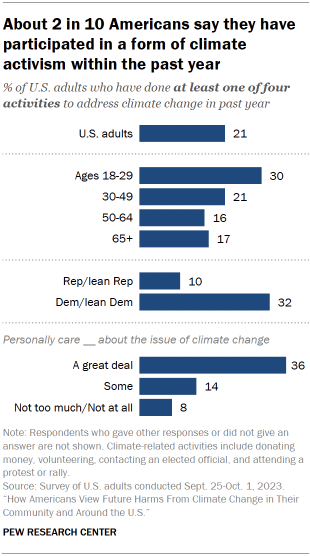
Overall, 21% of Americans say they have participated in at least one of these activities in the last year, down slightly from 24% in 2021. Two years ago, many places in the U.S. saw restrictions on public gatherings and activities due to policies aimed at limiting the spread of the coronavirus. 

Rates of participation in climate activism differ by the following measures:

Partisan affiliation

Chart shows About 2 in 10 Americans say they have participated in a form of climate activism within the past year

Democrats and independents who lean to the Democratic Party are about three times more likely than Republicans and Republican-leaning independents to say they have participated in at least one of these activities to address climate change in the past year (32% vs. 10%).

Age

Younger adults are more likely to say they have engaged in climate activism than older adults: 30% of adults ages 18 to 29 say they have participated in at least one of four activities in the past year, compared with 17% of those ages 65 and older.

Personal concern about climate change

Those who say they personally care a great deal about climate change are much more likely than those who say they care some to have participated in at least one of four climate-related activities in the last year (36% vs. 14%).

Skepticism that climate activism changes minds or spurs political action

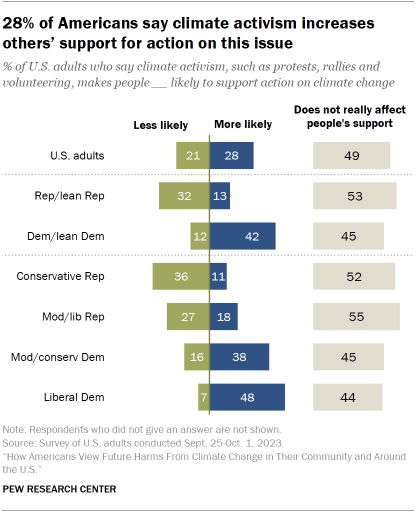
A relatively small share of the public (28%) believes that climate activism, such as protests and rallies, makes people more likely to support action on climate change.

Chart shows 28% of Americans say climate activism increases others’ support for action on this issue

About half of Americans (49%) say climate activism does not really affect people’s levels of support, and 21% believe it has the opposite of its intended effect and makes people less likely to support action on climate change.

Views differ by party

Democrats (42%) are more likely than Republicans (13%) to believe climate activism makes people more likely to support climate action. Within the Democratic Party, liberals (48%) are somewhat more confident than moderates and conservatives (38%) that climate activism builds public support for the issue.

Public perceptions of climate activism’s influence on elected officials

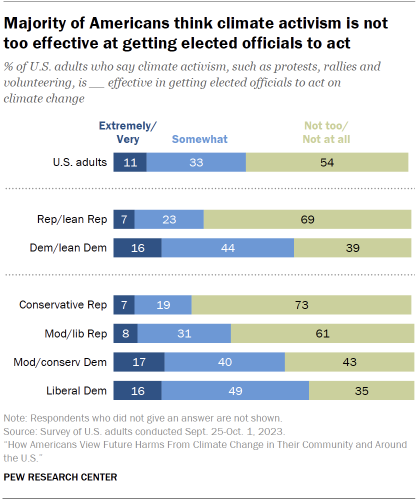
Chart shows Majority of Americans think climate activism is not too effective at getting elected officials to act

Just 11% of Americans say climate activism is extremely or very effective in getting elected officials to act on climate change; 33% say it is somewhat effective. A narrow majority of Americans (54%) say that climate activism is not too or not at all effective in getting elected official to act on climate change.

Relatively few Republicans (7%) and Democrats (16%) say climate activism is extremely or very effective at driving action among elected officials.

However, a majority of Democrats believe climate activism is at least somewhat effective at motivating action from elected officials. By contrast, 69% of Republicans believe it is not too or not at all effective.

How often Americans talk about climate change

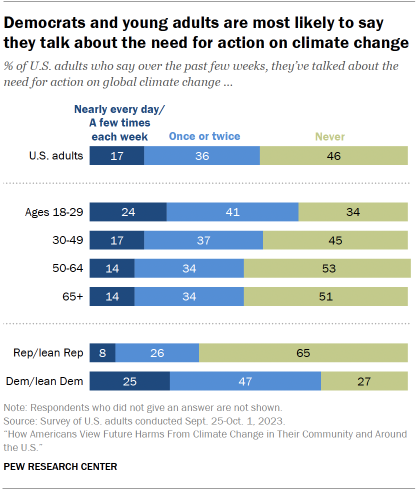
Chart shows Democrats and young adults are most likely to say they talk about the need for action on climate change

Overall, 53% of U.S. adults say they have talked about the need for action on global climate change in the past few weeks. By comparison, 46% say they have not talked about the need to address climate change recently.

Reflecting their views about the importance of the issue generally, Democrats (72%) are far more likely than Republicans (35%) to say they have talked about the need for action on climate change within the last week.

The youngest adults are more likely than those ages 3o to 49 and those 50 and older to say they’ve talked recently about the need for action on climate change. 

Acknowledgments

This report is made possible by The Pew Charitable Trusts. It is a collaborative effort based on the input and analysis of the following individuals. Find related reports online at: pewresearch.org/pewresearch-org/science.

Primary research team       

Alec Tyson, Associate Director, Science and Society Research
Brian Kennedy, Senior Researcher
Giancarlo Pasquini, Research Associate
Emma Kikuchi, Research Assistant    

Editorial and graphic design          

Rebecca Leppert, Copy Editor
Kaitlyn Radde, Associate Information Graphics Designer

Communications and web publishing      

Haley Nolan, Communications Manager
Kelsey Beveridge, Communications Associate
Reem Nadeem, Digital Producer

In addition, the project benefited greatly from the guidance of the Pew Research Center methodology team: Courtney Kennedy, Andrew Mercer, Ashley Amaya, Dorene Asare-Marfo, Dana Popky, Anna Brown and Arnold Lau.

The project also benefited greatly from the guidance of former Director of Science and Society Research Cary Funk.

Methodology

The American Trends Panel survey methodology

Overview

The American Trends Panel (ATP), created by Pew Research Center, is a nationally representative panel of randomly selected U.S. adults. Panelists participate via self-administered web surveys. Panelists who do not have internet access at home are provided with a tablet and wireless internet connection. Interviews are conducted in both English and Spanish. The panel is being managed by Ipsos.

Data in this report is drawn from ATP Wave 135, conducted from Sept. 25 to Oct. 1, 2023, and includes an oversample of Hispanic men, non-Hispanic Black men, and non-Hispanic Asian adults in order to provide more precise estimates of the opinions and experiences of these smaller demographic subgroups. These oversampled groups are weighted back to reflect their correct proportions in the population.

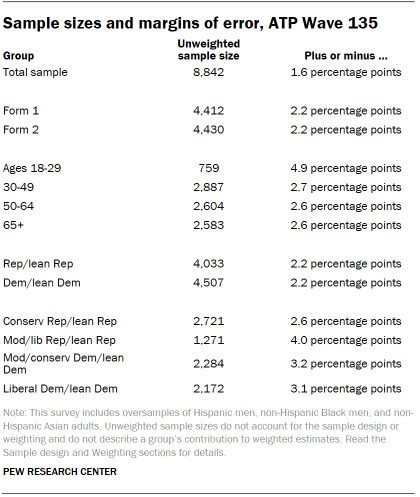
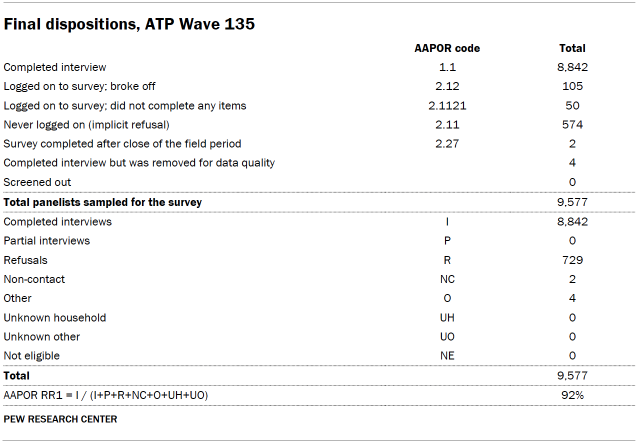
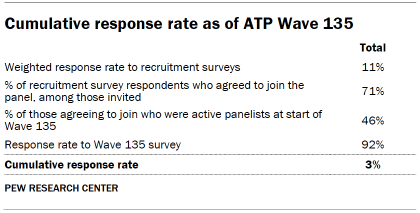
A total of 8,842 panelists responded out of 9,577 who were sampled, for a response rate of 92%. The cumulative response rate accounting for nonresponse to the recruitment surveys and attrition is 3%. The break-off rate among panelists who logged on to the survey and completed at least one item is 1%. The margin of sampling error for the full sample of 8,842 respondents is plus or minus 1.6 percentage points.

Panel recruitment

Table shows American Trends Panel recruitment surveys

The ATP was created in 2014, with the first cohort of panelists invited to join the panel at the end of a large, national, landline and cellphone random-digit-dial survey that was conducted in both English and Spanish. Two additional recruitments were conducted using the same method in 2015 and 2017, respectively. Across these three surveys, a total of 19,718 adults were invited to join the ATP, of whom 9,942 (50%) agreed to participate.

In August 2018, the ATP switched from telephone to address-based sampling (ABS) recruitment. A study cover letter and a pre-incentive are mailed to a stratified, random sample of households selected from the U.S. Postal Service’s Delivery Sequence File. This Postal Service file has been estimated to cover as much as 98% of the population, although some studies suggest that the coverage could be in the low 90% range.1 Within each sampled household, the adult with the next birthday is asked to participate. Other details of the ABS recruitment protocol have changed over time but are available upon request.2

We have recruited a national sample of U.S. adults to the ATP approximately once per year since 2014. In some years, the recruitment has included additional effort (known as an “oversample”) to boost sample size with underrepresented groups. For example, Hispanic, Black and Asian adults were oversampled in 2019, 2022 and 2023, respectively.

Across the six address-based recruitments, a total of 23,862 adults were invited to join the ATP, of whom 20,917 agreed to join the panel and completed an initial profile survey. Of the 30,859 individuals who have ever joined the ATP, 11,944 remained active panelists and continued to receive survey invitations at the time this survey was conducted.

The American Trends Panel never uses breakout routers or chains that direct respondents to additional surveys.

Sample design

The overall target population for this survey was noninstitutionalized persons ages 18 and older living in the U.S., including Alaska and Hawaii. It featured a stratified random sample from the ATP in which Hispanic men, non-Hispanic Black men, and non-Hispanic Asian adults were selected with certainty. The remaining panelists were sampled at rates designed to ensure that the share of respondents in each stratum is proportional to its share of the U.S. adult population to the greatest extent possible. Respondent weights are adjusted to account for differential probabilities of selection as described in the Weighting section below.

Questionnaire development and testing

The questionnaire was developed by Pew Research Center in consultation with Ipsos. The web program was rigorously tested on both PC and mobile devices by the Ipsos project management team and Pew Research Center researchers. The Ipsos project management team also populated test data that was analyzed in SPSS to ensure the logic and randomizations were working as intended before launching the survey.

Incentives

All respondents were offered a post-paid incentive for their participation. Respondents could choose to receive the post-paid incentive in the form of a check or a gift code to Amazon.com or could choose to decline the incentive. Incentive amounts ranged from $5 to $20 depending on whether the respondent belongs to a part of the population that is harder or easier to reach. Differential incentive amounts were designed to increase panel survey participation among groups that traditionally have low survey response propensities.

Data collection protocol

The data collection field period for this survey was Sept. 25 to Oct. 1, 2023. Postcard notifications were mailed to all ATP panelists with a known residential address on Sept. 25.

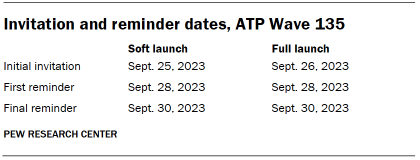
Invitations were sent out in two separate launches: soft launch and full launch. Sixty panelists were included in the soft launch, which began with an initial invitation sent on Sept. 25. The ATP panelists chosen for the initial soft launch were known responders who had completed previous ATP surveys within one day of receiving their invitation. All remaining English- and Spanish-speaking sampled panelists were included in the full launch and were sent an invitation on Sept. 26.

Table shows Invitation and reminder dates, ATP Wave 135

All panelists with an email address received an email invitation and up to two email reminders if they did not respond to the survey. All ATP panelists who consented to SMS messages received an SMS invitation and up to two SMS reminders.

Data quality checks

To ensure high-quality data, the Center’s researchers performed data quality checks to identify any respondents showing clear patterns of satisficing. This includes checking for very high rates of leaving questions blank, as well as always selecting the first or last answer presented. As a result of this checking, four ATP respondents were removed from the survey dataset prior to weighting and analysis.

Weighting

Table shows American Trends Panel weighting dimensions

The ATP data is weighted in a multistep process that accounts for multiple stages of sampling and nonresponse that occur at different points in the survey process. First, each panelist begins with a base weight that reflects their probability of selection for their initial recruitment survey. These weights are then rescaled and adjusted to account for changes in the design of ATP recruitment surveys from year to year.

Finally, the weights are calibrated to align with the population benchmarks in the accompanying table to correct for nonresponse to recruitment surveys and panel attrition. If only a subsample of panelists was invited to participate in the wave, this weight is adjusted to account for any differential probabilities of selection.

Among the panelists who completed the survey, this weight is then calibrated again to align with the population benchmarks identified in the accompanying table and trimmed at the 1st and 99th percentiles to reduce the loss in precision stemming from variance in the weights. Sampling errors and tests of statistical significance take into account the effect of weighting.

The following table shows the unweighted sample sizes and the error attributable to sampling that would be expected at the 95% level of confidence for different groups in the survey.

Table shows Sample sizes and margins of error, ATP Wave 135

Sample sizes and sampling errors for other subgroups are available upon request. In addition to sampling error, one should bear in mind that question wording and practical difficulties in conducting surveys can introduce error or bias into the findings of opinion polls.

Dispositions and response rates

Table shows Final dispositions, ATP Wave 135
Table shows Cumulative response rate as of ATP Wave 135

© Pew Research Center, 2023

Appendix: Detailed chart and tables

Chart shows 23% of Americans say they will have to make major sacrifices in their own lives because of climate change
Chart shows 52% of Americans say climate change is causing significant harm to people around the world today
Chart shows 37% of Americans say they personally care a great deal about the issue of climate change
Chart shows Americans who see climate change as a problem are more likely to expect future environmental harms