Pew Research Center

FOR RELEASE JUNE 28, 2023

Majorities of Americans Prioritize Renewable Energy, Back Steps to Address Climate Change

But many foresee problems ahead with transition to renewables and oppose breaking from fossil fuels altogether

BY Brian Kennedy, Cary Funk and Alec Tyson

FOR MEDIA OR OTHER INQUIRIES:

Communications Department
202.419.4372
www.pewresearch.org

RECOMMENDED CITATION

Pew Research Center, June 2023, "Majorities of Americans Prioritize Renewable Energy, Back Steps to Address Climate Change"

About Pew Research Center

Pew Research Center is a nonpartisan, nonadvocacy fact tank that informs the public about the issues, attitudes and trends shaping the world. It does not take policy positions. The Center conducts public opinion polling, demographic research, computational social science research and other data-driven research. It studies politics and policy; news habits and media; the internet and technology; religion; race and ethnicity; international affairs; social, demographic and economic trends; science; research methodology and data science; and immigration and migration. Pew Research Center is a subsidiary of The Pew Charitable Trusts, its primary funder.

© Pew Research Center 2026

Table of contents

  • About Pew Research Center
  • Majorities of Americans Prioritize Renewable Energy, Back Steps to Address Climate Change
  • 1. What Americans think about an energy transition from fossil fuels to renewables
  • 2. How Americans see Biden’s climate policies
  • 3. Majorities of Americans say too little is being done on key areas of environmental protection
  • Acknowledgments
  • Methodology
  • Appendix: Detailed charts on climate, energy, environment

Majorities of Americans Prioritize Renewable Energy, Back Steps to Address Climate Change

But many foresee problems ahead with transition to renewables and oppose breaking from fossil fuels altogether

How we did this

Pew Research Center conducted this study to understand Americans’ views of climate, energy and environmental issues. For this analysis, we surveyed 10,329 U.S. adults from May 30 to June 4, 2023.

Everyone who took part in the survey is a member of the Center’s American Trends Panel (ATP), an online survey panel that is recruited through national, random sampling of residential addresses. This way, nearly all U.S. adults have a chance of selection. The survey is weighted to be representative of the U.S. adult population by gender, race, ethnicity, partisan affiliation, education and other categories. Read more about the ATP’s methodology.

Here are the questions used for this report, along with responses, and its methodology.

A new Pew Research Center survey finds large shares of Americans support the United States taking steps to address global climate change and back an energy landscape that prioritizes renewable sources like wind and solar. At the same time, the findings illustrate ongoing public reluctance to make sweeping changes to American life to cut carbon emissions. Most Americans oppose ending the production of gas-powered vehicles by 2035 and there’s limited support for steps like eliminating gas lines from new buildings.

This report comes about a year after the 2022 Inflation Reduction Act introduced policies and incentives meant to dramatically reduce the country’s reliance on fossil fuels, a signature part of the Biden administration’s efforts on climate change. The survey takes stock of how Americans feel about related questions on climate, energy and environmental policy, including proposed changes to how Americans power their homes and cars and what to do about the impacts communities face from extreme weather.

The Pew Research Center survey of 10,329 U.S. adults conducted May 30 to June 4, 2023, finds:

  • 74% of Americans say they support the country’s participation in international efforts to reduce the effects of climate change.
  • 67% of U.S. adults prioritize the development of alternative energy sources such as wind, solar and hydrogen power over increasing the production of fossil fuel energy sources.

By sizable margins, Americans support a number of specific policy proposals aimed at reducing the effects of climate change through targeting greenhouse gas emissions and carbon in the atmosphere:

  • Overwhelming majorities support planting about a trillion trees around the world to absorb carbon emissions (89%) and requiring oil and gas companies to seal methane gas leaks from oil wells (85%).
  • 76% favor providing a tax credit to businesses that develop carbon capture technologies and 70% support taxing corporations based on their carbon emissions.
  • 61% favor requiring power plants to eliminate all carbon emissions by the year 2040.
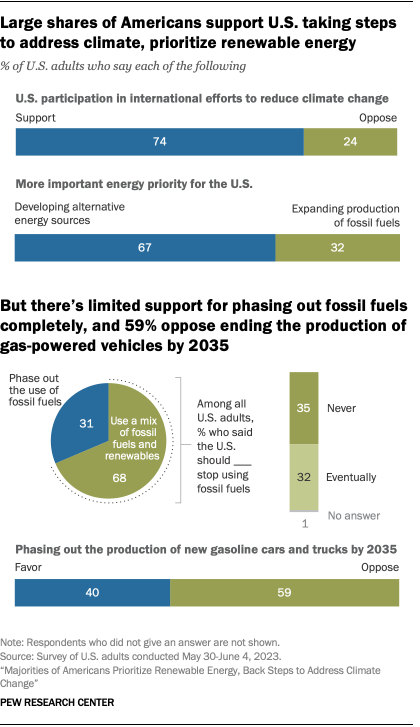
A bar chart showing that large shares of Americans support the U.S. taking steps to address climate and prioritize renewable energy.

Still, there are limits to public support for major changes to the way homes, cars and the electrical grid are powered.

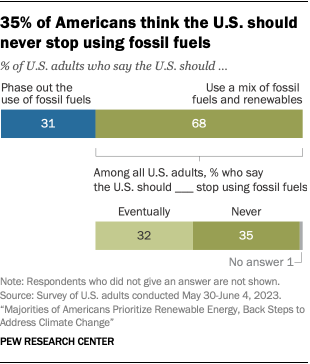
Only 31% of Americans currently support phasing out the use of fossil fuel energy sources altogether. Another 32% say the U.S. should eventually stop using fossil fuels, but don’t believe the country is ready now. And 35% think the U.S. should never stop using fossil fuels to meet its energy needs.

Less than half of the public (40%) favors phasing out the production of gas-powered cars and trucks. Support for this policy is 7 percentage points lower than it was two years ago. And underscoring the strong feelings big changes to American life can engender, 45% say they would feel upset if gas-powered cars were phased out; fewer than half as many (21%) would feel excited.

When it comes to the construction of new buildings, slightly more Americans oppose (51%) than favor (46%) requiring most new buildings to run only on electricity, with no gas lines, a recent flashpoint in state legislatures and national climate conversations.

Republicans and Democrats continue to offer competing visions on climate and energy issues. Deep Republican skepticism toward a renewable energy transition is a major factor behind much of the overall public’s reluctance to make a sharp break from fossil fuels.

But views within both party coalitions defy simple categorization. And some of the most far-reaching policies aimed at addressing climate change and carbon emissions garner a less-than-enthusiastic response from Democrats, as well as outright opposition from Republicans.

A closer look at the two major party coalitions on climate and energy issues

Key views among Republicans

  • 73% say they would be upset if gas-powered vehicles were phased out.
  • 58% say expanding oil, coal and natural gas production should be the country’s energy priority.

And yet …

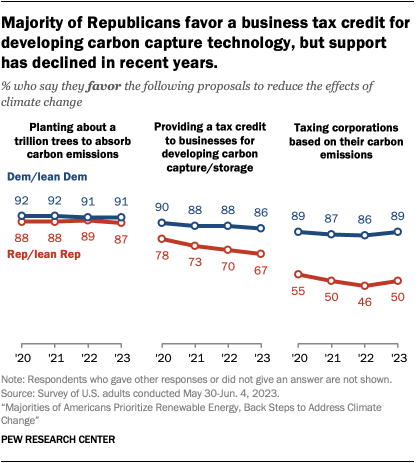
  • 67% favor a business tax credit for developing carbon capture technologies.
  • 70% support more solar panel farms and 60% favor more wind farms.

Within the GOP …

  • There are sizable differences in views on climate and energy between moderates and conservatives.
  • Those under 30 express the least support for fossil fuel energy sources.

Republicans and Republican-leaning independents prioritize oil, coal and natural gas development over renewable energy sources and have deep concerns (especially around prices) about what a transition to renewable energy would mean for the country.

Some proposed changes, like phasing out new gas-power vehicles provoke a strong negative response: 73% of Republicans say they would be upset by this. And stacked up against other national issues, climate change consistently ranks as a low priority for Republicans.

But these attitudes do not preclude Republican support for climate policies and renewable energy altogether. Two-thirds favor a business tax credit for the development of carbon capture technologies and majorities support more solar panel and wind farms, when these energy sources are not placed in competition with fossil fuel development.

Within the GOP, moderates and young Republicans often offer the most support for action on climate change and a shift toward renewable energy, though they make up a relatively smaller share of all Republicans and GOP leaners compared with conservatives and older Republicans.

Democrats and Democratic-leaning independents overwhelmingly back the U.S. participating in international efforts to address global climate change. By a 90% to 10% margin, Democrats say renewable energy sources should be given priority over the development of oil, coal and natural gas.

Key views among Democrats

  • 94% support U.S. participation in international efforts to reduce the effects of climate change.
  • 90% say renewable energy sources should be given priority over the production of fossil fuels.
  • 80% expect a major transition to renewable energy would improve air and water quality.

Even so …

  • 51% oppose phasing out fossil fuels completely.

Within the Democratic coalition …

  • 61% of liberals are ready to phase out the use of fossil fuels altogether and 76% support ending gas-vehicle production.
  • By contrast, 62% of moderates and conservatives think fossil fuels should be part of the energy mix and 53% support ending production of gas vehicles.

Democrats, by and large, foresee benefits from an energy transition in the U.S., including better air and water quality, job opportunities in the energy sector and greater energy independence.

Despite this favorable stance toward climate action and renewable energy, 51% of Democrats oppose phasing out fossil fuels altogether, saying instead, that oil, coal and natural gas should continue to be part of the mix of energy sources the country relies on.

Within the Democratic Party, large majorities across age and ideological groups are generally supportive of shifting toward renewable energy and policies to address climate change.

Still, important differences do emerge, especially regarding the pace of an energy transition: 61% of liberals are ready to phase out the use of fossil fuels altogether, while 62% of moderates and conservatives say they should be part of a mix of sources for now, along with renewables. And while a large share of liberals (76%) back ending the production of new gas-powered vehicles by 2035, support among moderates and conservative is more limited (53%).

What role should government play in communities at high risk of extreme weather?

As communities across the country confront the risks posed by extreme weather, such as wildfires, severe storms and coastal erosion, Americans express an openness to some policy proposals for communities at high risk from these events.

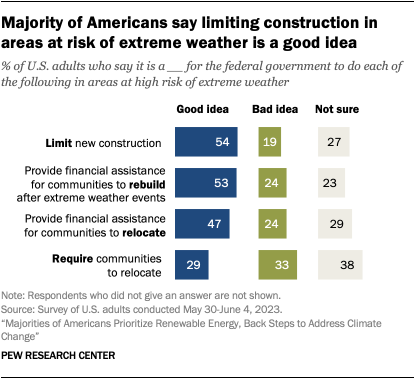
  • More say it’s a good idea than a bad idea for the federal government to limit new construction in communities at high risk of extreme weather (54% to 19%). Another 27% say they are not sure of their views on this.
  • 53% of Americans think it’s a good idea for the federal government to provide financial assistance to help communities rebuild after extreme weather events. Far fewer (24%) call this a bad idea and 23% say they’re not sure.
  • By a 47% to 24% margin, more say it’s a good idea than a bad idea for the federal government to provide financial assistance for communities to relocate from areas at high risk of extreme weather.
  • But there’s less public support for the federal government requiring communities to relocate from high-risk areas: 29% call this a good idea, compared with 33% who say it is a bad idea and 38% who say they’re not sure.

When it comes to firsthand experiences with extreme weather and its connection with climate change:

  • 69% of Americans say they’ve experienced at least one of five types of extreme weather in the past year: Long periods of unusually hot weather (45%), severe weather such as floods or intense storms (44%), droughts or water shortages (33%), major wildfires (18%) and rising sea levels that erode beaches and shorelines (16%).
  • Majorities of Americans who say they’ve experienced extreme weather in the last year believe that climate change has contributed a lot or a little to these events.

How do Americans see Biden’s climate agenda today?

Overall, 45% of Americans say the Biden administration’s policies on climate change are taking the country in the right direction, while slightly more (50%) say they have the country headed in the wrong direction. This overall rating reflects a sharp partisan divide: 76% of Democrats see President Joe Biden’s climate policies as heading in the right direction; by contrast, 82% of Republicans say they’re taking the country in the wrong direction.

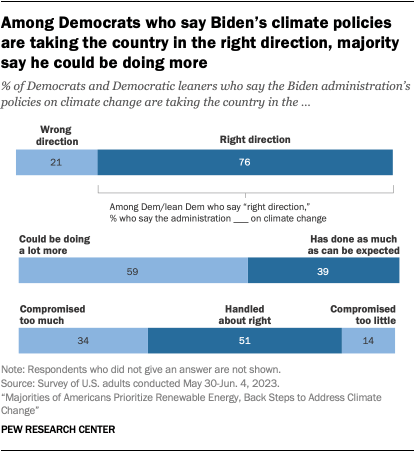
Within Biden’s own party, there are signs that Democrats aren’t completely satisfied with the administration’s actions on climate. Among the majority of Democrats who think Biden’s climate policies are pointed in the right direction:

  • 59% say that Biden could be doing a lot more on climate change, compared with a smaller share (39%) who say he’s done as much as can be expected.
  • And while 51% of Democrats who agree with Biden’s overall direction on climate say he’s taken about the right approach toward compromise, 34% say he has compromised too much on climate policy.

The recently approved Willow oil drilling project in Alaska garnered wide attention in energy and climate circles, but the Biden administration’s decision did not register widely with the public: 68% of Americans say they’ve heard nothing at all about this issue; 32% say they’ve heard at least a little about it.

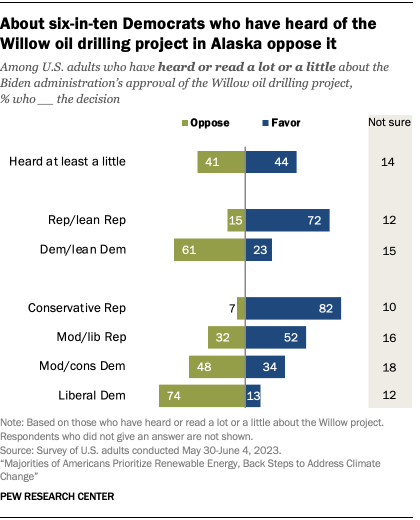
The Biden administration’s decision to approve the Willow project is unpopular with Democrats who are aware of it: By 61% to 23%, more Democrats who have heard of the project oppose than favor it. Liberal Democrats aware of the issue are especially critical (74% oppose the decision). 

Do Americans support government efforts to address environmental disparities across communities?

Most Americans support the federal government playing a major (46%) or minor (29%) role addressing differences across communities in their health risks from pollution and other environmental problems. A small share (8%) say the federal government should play no role in this, while 16% say they’re not sure.

The issue of environmental health disparities across communities is fairly well known to the public: 77% of Americans say they’ve heard a lot or a little about this issue, while 22% say they haven’t heard about it.

Large majorities of Democrats (68%) and those most familiar with the issue (73%) support the federal government playing a major role addressing community differences in health risks from pollution and environmental problems. 
1. What Americans think about an energy transition from fossil fuels to renewables

Most Americans think the U.S. should prioritize the development of renewable energy over fossil fuel sources. At the same time, most say they are not ready to stop using fossil fuel energy sources altogether. And a sizable share think the U.S. should never stop using fossil fuel sources.

Renewable sources, such as wind and solar, are expected to make up a growing share of the U.S. energy supply relative to fossil fuel sources such as oil, coal and natural gas in coming years. Last year renewable energy sources, including wind, solar and hydropower, generated more electricity than coal in the U.S. Legislation passed during the Biden administration, such as the Inflation Reduction Act, are expected to increase the pace of an energy transition.

A bar chart that shows 35% of Americans think the U.S. should never stop using fossil fuels.

In the new survey, 67% of Americans say the U.S. should prioritize developing alternative energy sources, such as wind, solar and hydrogen technology, while 32% say the priority should be expanding the exploration and production of oil, coal and natural gas.

Read the Appendix for more on this question, including a shift away from renewables among Republicans that occurred at the outset of the Biden administration.

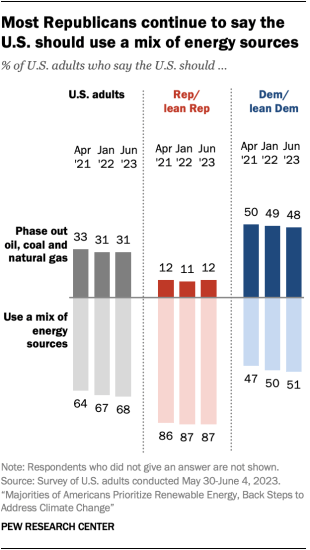
While the public prioritizes renewable energy development, just 31% say they are ready to phase out the use of oil, coal and natural gas completely. A much larger share (68%) say the U.S. should continue to use fossil fuels, alongside renewables, as part of the mix of energy sources the country relies on.

The roughly two-thirds of Americans who support using a mix of renewables and fossil fuels are closely divided over whether the U.S. should ever stop using oil, coal and natural gas: 32% of Americans favor a mix of sources now but think the U.S. should eventually stop using fossil fuel energy sources, while 35% favor using a mix of sources now and say the U.S. should never stop using oil, coal and natural gas.

A bar chart that shows a majority of Republicans say the U.S. should never stop using fossil fuels.

Republicans and Democrats offer very different views on what role oil, coal and natural gas should play in the country’s energy landscape.

An overwhelming majority of Republicans and Republican leaners (87%) think the U.S. should use a mix of fossil fuel and renewable energy sources. Looking ahead, 57% of Republicans believe the U.S. should never stop using oil, coal, and natural gas.

In contrast, most Democrats and Democratic leaners think the U.S. should end the use of fossil fuels, but there are some differences in views over the timeline.

About half of Democrats (48%) are ready to phase out fossil fuels now; another 35% think they should be part of the mix currently, but that the country should eventually stop using them. A relatively small share of Democrats (15%) say the country should never stop using oil, coal and natural gas.

Public expectations on how a renewable energy transition would impact the country

A bar chart showing that a Majority of Americans see unexpected problems from an energy transition as at least somewhat likely.

Americans think a major shift from fossil fuels to renewable energy sources in the U.S. would come with some difficulties for the country. But they also see potential benefits, such as improved air and water quality and a more positive than negative impact on jobs in the energy sector.

Still, many worry that an energy transition would push consumer prices higher. As with views on energy sources generally, Republicans and Democrats have quite different expectations for what a renewable energy transition would bring for the U.S.

Overall, 34% say the country would be very likely to encounter unexpected problems if the U.S. greatly reduces energy production from fossil fuels while increasing production from renewable sources; another 38% say unexpected problems would be somewhat likely.

Among Republicans, a majority (57%) think an energy transition to renewables would very likely lead to unexpected problems and 31% say this would make unexpected problems somewhat likely. A majority of Democrats also think unexpected problems from an energy transition would be at least somewhat likely (60%), but just 14% consider this very likely.

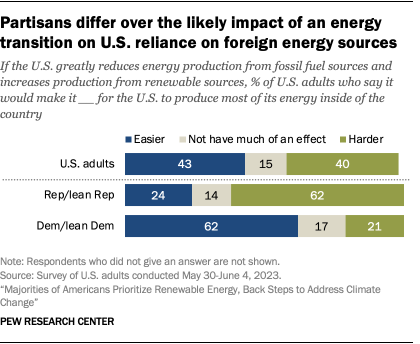
The new survey finds the public has mixed views about the likely effect of an energy transition on the country’s energy independence: 43% think an energy transition would make U.S. independence from foreign energy sources easier and 40% say it would be harder.

A 2022 Center survey found a majority of Americans said reducing U.S. dependence on foreign energy sources should be a top priority for the country’s energy policies.

A bar chart that shows partisans differ over the likely impact of an energy transition on U.S. reliance on foreign energy sources.

A 62% majority of Republicans think that energy independence from other countries would be harder with a major shift to reliance on renewable energy sources. By contrast, 62% of Democrats think that energy independence would be easier.

The Center survey asked about a number of potential consequences from shifting away from fossil fuels and toward renewable energy sources.

A bar chart that shows Americans think an energy transition would have a more negative than positive impact on consumer prices.

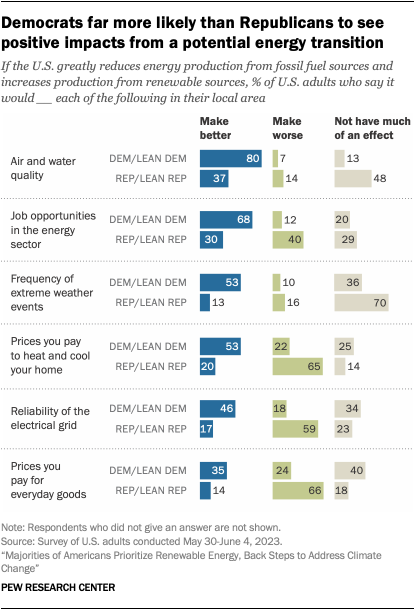
Americans are most optimistic about how an energy transition would impact environmental quality: 59% think that air and water quality would get better if the U.S. greatly reduced fossil fuel energy production and increased production from renewable sources. Three-in-ten say this energy transition would not have much effect on air and water quality, while 11% say it would make air and water quality worse.

On balance, more Americans think a renewable energy transition would make local job opportunities in the energy sector better (49%) than worse (25%).

Concerns are more pronounced when it comes to prices. Slightly more Americans think an energy transition would make the prices they pay to heat and cool their homes worse (42%) than better (37%). And by a wider margin (44% to 25%) Americans think such a transition would make prices for everyday goods worse than better.

Democrats have a largely positive outlook on what an energy transition would mean for the country. Majorities think it would improve air and water quality (80%) and local job prospects in the energy sector (68%). And, on balance, more think it would help than hurt the frequency of extreme weather events, prices to heat and cool homes, and the reliability of the electrical grid.

A chart showing that Democrats are far more likely than Republicans to see positive impacts from a potential energy transition.

Still, Democrats do have some reservations about the impact on consumer prices: 35% think a major shift toward renewable energy would make prices for consumer goods better. About one-quarter (24%) say this shift would make prices worse and four-in-ten think it would not have much of an effect.

Republicans are largely pessimistic about the likely effects of an energy transition.

Two-thirds of Republicans (66%) think consumer prices would get worse, as would home heating and cooling costs (65%). Roughly six-in-ten Republicans (59%) expect the reliability of the electric grid to go down.

And there’s skepticism toward environmental benefits: 48% say a transition would not have much effect on air and water quality, and 70% think there would be no effect on the frequency of extreme weather events.

CORRECTION (May 22, 2025): A previous version of this report misstated the percentage of Democrats who said shifting to renewable energy would make prices of consumer goods worse in the body text. The accompanying chart gave the correct figure (24%).

Republican support for increasing wind and solar power, while still a majority, continues to edge downward

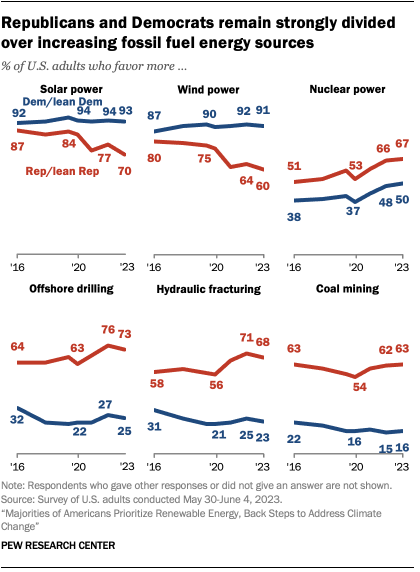
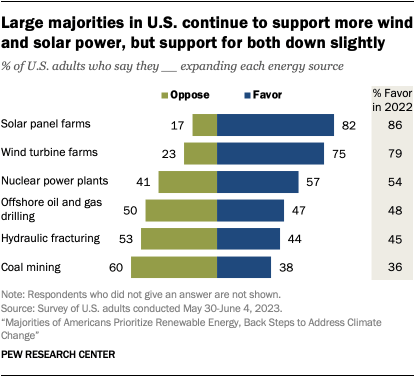
Americans remain broadly in favor of expanding solar and wind power: 82% of U.S. adults favor more solar panel farms and 75% favor more wind turbine farms. A smaller majority of Americans (57%) favor expanding nuclear power. Support for expanding other energy sources is lower: Fewer than half support more offshore oil and gas drilling (47%), hydraulic fracturing (44%) or coal mining (38%). Refer to the Appendix for details.

A chart showing that Republicans and Democrats remain strongly divided over increasing fossil fuel energy sources.

Democrats and Republicans remain deeply divided over fossil fuel development. There’s more common ground when it comes to renewables, though the partisan gap over expanding wind and solar power has been widening.

As of 2020, overwhelming majorities of both Democrats and Republicans were in favor of more solar and wind power. Since that time, Republican support has declined.

In the new survey, 93% of Democrats say they favor more solar panel farms, compared with 70% of Republicans. The share of Republicans who favor more solar power is down 14 percentage points since 2020 and 7 points since the survey last year.

Six-in-ten Republicans favor more wind power in the new survey, down 15 points since 2020 and 4 points in the last year. Meanwhile, 91% of Democrats favor more wind turbine farms.

The drop in support for solar and wind power has been especially pronounced among conservative Republicans. The share of conservative Republicans who favor more solar power is down 17 points from 2020 (from 80% to 63%) and the share who favor more wind power is down 18 points (from 69% to 51%) over the same time period.

Partisan differences remain wide over support for increasing fossil fuel energy sources. For example, 73% of Republicans favor more offshore oil and gas drilling, while just 25% of Democrats favor this.

There are similarly wide partisan differences over expanding hydraulic fracturing for oil and natural gas (68% of Republicans favor vs. 23% of Democrats) and coal mining (63% of Republicans vs. 16% of Democrats).

Republicans’ levels of support for more hydraulic fracturing, offshore drilling and coal mining have all moved about 10 points higher since 2020.

Republicans remain more likely to favor expanding nuclear power plants than Democrats (67% vs. 50%). Support for nuclear power has increased in both party coalitions in recent years. Men also continue to be far more likely than women to favor expanding nuclear power plants (71% vs. 44%).

A majority of Republicans who have heard of the Willow oil drilling project favor the Biden administration decision, while Democrats aware of the project oppose it

In March, the Biden administration approved the Willow oil drilling project on lands located in the federally owned National Petroleum Reserve in Alaska.

While the approval drew wide criticism from climate activists, the Center survey finds limited familiarity with the project. Just 3% of Americans say they have heard or read a lot about it and 29% say they have heard or read a little. About seven-in-ten (68%) say they have heard or read nothing at all about the Biden administration approving the Willow project.

A bar chart that shows about six-in-ten Democrats who have heard of the Willow oil drilling project in Alaska oppose it.

Among those with at least a little awareness of this, 44% say they favor the Biden administration approving the drilling project, while 41% oppose it. The remaining 14% say they are not sure of their view on this.

In contrast to public views of Biden’s job approval and handling of other issues, a majority of Republicans (72%) with some awareness of the Willow project say they favor the decision. 

A majority of Democrats familiar with the project oppose the Biden administration’s decision (61%).

These patterns are broadly in keeping with partisan views on energy priorities for the country and support for more offshore oil and gas drilling.

Differences among Republicans by ideology, age over views about fossil fuels and prioritizing renewable energy sources

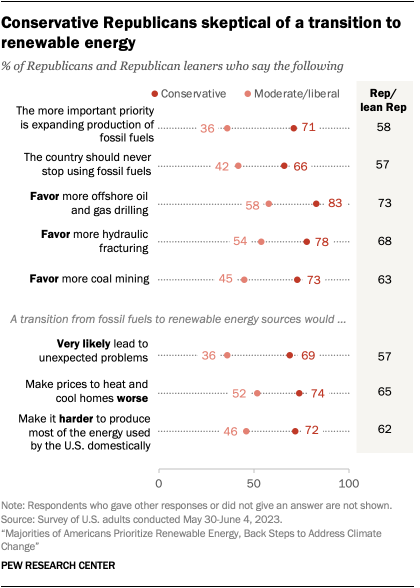
A dot plot that shows conservative Republicans skeptical of a transition to renewable energy.

Views among Republicans about these issues are far from uniform. Conservative Republicans are far more likely than moderate or liberal Republicans to support expanding fossil fuel energy sources.

For example, 71% of conservative Republicans favor prioritizing the production of fossil fuels over the development of alternative energy sources. Moderate and liberal Republicans tilt the other direction, with 36% saying they would prioritize fossil fuels and a majority (63%) saying they would prioritize development of alternative energy sources.

Similarly, a 73% majority of conservative Republicans favor more coal mining while 54% of moderate and liberal Republicans oppose this.

Age differences among Republicans are also common in views about energy issues, with older Republicans more likely than younger Republicans to support the continued use of fossil fuels. These differences hold even when controlling for ideology.

A dot plot showing that younger Republicans are less likely than older Republicans to say the country should never stop 
using fossil fuels.

For example, 31% of Republicans ages 18 to 29 say the country should never stop using fossil fuels. In comparison, a majority of older Republicans (including 68% of Republicans ages 65 and older) say this.

Republicans under 30 are far less convinced that unexpected problems are ahead in a future energy transition that greatly reduces energy production from fossil fuel sources and increases production from renewable sources: 32% say unexpected problems are very likely, compared with 69% of Republicans ages 65 and older.

Past Center surveys have also found large differences between older and younger Republicans in views on energy issues and climate policy.

Majority of Americans continue to oppose phasing out gasoline cars and trucks by 2035

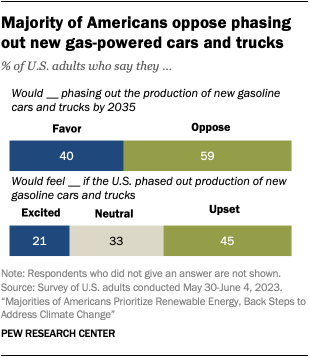
A bar chart showing that a majority of Americans oppose phasing out new gas-powered cars and trucks.

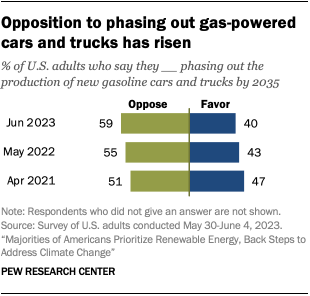
A majority of Americans remain opposed to phasing out gasoline cars and trucks by 2035. In the new survey, 40% of Americans favor this idea while 59% oppose it. The share of Americans who support phasing out gasoline cars and trucks is down 7 percentage points since 2021. Over this period of time, support for phasing out gasoline cars and trucks has ticked down among both Democrats and Republicans. Refer to the Appendix for this data.

When asked about their general reaction to the idea of phasing out the production of gas-powered vehicles, just 21% of Americans say they would be excited by the prospect. More than twice as many (45%) say they would be upset; 33% say their feelings would be neutral.

A bar chart that shows opposition to phasing out gas-powered cars and trucks has risen.

The U.S. transportation sector is the largest contributor to carbon emissions, and a majority of those emissions come from gasoline-powered passenger cars and trucks. In April, the Biden administration proposed new emission limits for automakers that would dramatically reduce the number of gasoline-powered cars and trucks automakers could sell. Several states are planning to ban the sale of gasoline cars and trucks after 2035.

Republicans oppose phasing out gasoline cars and trucks by 2035 by a large margin (84% to 16%). But views among Democrats are largely supportive: 64% favor phasing out gasoline cars and trucks, while 35% oppose this idea.

A bar chart that shows 84% of Republicans oppose phasing out gasoline cars by 2035, while 64% of Democrats favor this.

Liberal Democrats are especially supportive of phasing out gasoline cars and trucks (76% favor), while moderate and conservative Democrats are more closely divided (53% favor, 46% oppose).

Across both parties, younger Americans are more supportive of this shift. Among all adults under age 30, a 56% majority favor phasing out gasoline cars and trucks by 2035, while 43% oppose this. By contrast, majorities of adults ages 30 and older oppose phasing out gasoline cars and trucks. For instance, among those ages 65 and older, 69% oppose this idea.

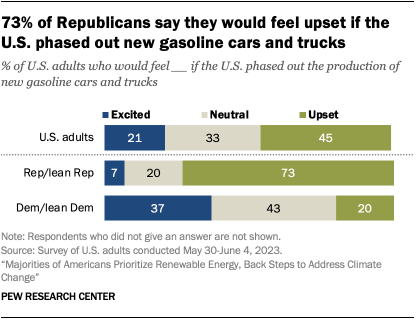
A bar chart that shows 73% of Republicans say they would feel upset if the U.S. phased out new gasoline cars and trucks.

There are also wide differences in emotional reactions to the idea of phasing out the production of combustion-engine vehicles.

About three-quarters of Republicans (73%) say they would feel upset if gas cars were phased out. Among Democrats, a larger share say they would feel excited (37%) than upset (20%), while 43% of this group says they would feel neutral about the change.

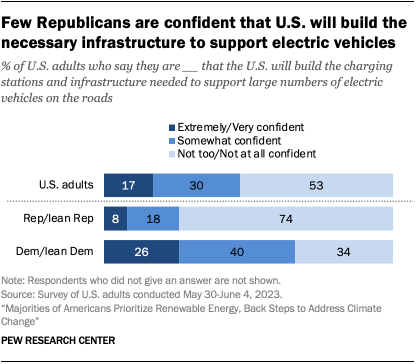
A bar chart showing that few Republicans are confident that U.S. will build the necessary infrastructure to support electric vehicles.

While the Biden administration has attempted to develop electric vehicle (EV) infrastructure, Americans have limited confidence that the country will build a network of charging stations to support these vehicles.

Just 17% of Americans say they are extremely or very confident that the U.S. will build the necessary charging stations and infrastructure while 30% are somewhat confident; 53% say they are not too or not at all confident.

Legislation passed during the Biden administration set aside $5 billion to build a network of charging stations. Many EV drivers find the current public charging system difficult. Republicans are particularly skeptical that the U.S. will build the charging stations and infrastructure needed to support EVs: 74% have not too much or no confidence this will happen.

38% of Americans would consider an electric vehicle for their next purchase; half say they would be unlikely to do this

A bar chart that shows Democrats, younger adults and urban residents are more open to purchasing an electric vehicle.

Americans are cool to the idea of making an electric vehicle purchase in the near term. Half of U.S. adults say they are not too or not at all likely to seriously consider an EV the next time they purchase a car or truck.

By comparison, 38% of Americans say they are very (15%) or somewhat (23%) likely to seriously consider an EV for their next vehicle purchase.

The public’s modest enthusiasm for purchasing an EV themselves is in line with their opposition to phasing out gas-powered vehicles. Interest in purchasing an EV is down 4 percentage points from when it was last measured in a 2022 Center survey.

Those most inclined to consider purchasing an electric vehicle in the future include the relatively small share of Americans (9%) who already own a hybrid or electric vehicle; 68% of this group says they are at least somewhat likely to seriously consider this, including four-in-ten who say they are very likely to do so.

Other groups who are more open to purchasing an EV in the future include Democrats (56% say they are at least somewhat likely to give this serious consideration), people who live in urban areas (48%), and young adults ages 18 to 29 (48%).

On the other hand, a majority of Republicans (70%), those who live in rural areas (65%) and adults ages 65 and older (59%) say they are not too or not at all likely to seriously consider an electric vehicle for their next purchase.

A bar chart that shows most U.S. adults who are considering buying an electric vehicle cite helping the environment, saving money on gas as reasons why.

Americans who are at least somewhat likely to purchase an EV in the future say that both environmental benefits and cost savings are an attraction. About seven-in-ten of this group say that helping the environment (72%) and saving money on gas (70%) are major reasons to purchase an electric vehicle.

A much smaller share of those at least somewhat likely to consider purchasing an EV say that “keeping up with the latest trends in vehicles” is a consideration.

U.S. homeowners have a limited appetite for converting home systems to electric

There’s modest interest among homeowners in steps that would improve the energy efficiency of their homes by doing things like converting gas stoves and water heaters to electric. Some steps garner more appeal than others, however, and many have considered upgrading (or have already upgraded) their home’s insulation.

A bar chart that shows a majority of U.S. homeowners have seriously considered improving their home’s insulation, 
or have already done this.

Three-in-ten homeowners say they have improved their home’s insulation in the past and another 26% say they have seriously considered doing so in the past year. A third of homeowners say they have not seriously considered a home insulation upgrade and 10% say this does not apply to their situation.

About three-in-ten homeowners (28%) say they have seriously considered installing solar panels on their home in the past year; 7% of homeowners say they already have home solar panels.

Homeowners living in the West are more likely to say they have solar panels. Democratic homeowners across all regions are more likely than their Republican counterparts to say they have seriously considered installing solar panels within the past year. These patterns are in keeping with a 2022 Center survey. (Note that the response options in the new survey include an option to specify that installing solar panels “does not apply to me,” thus the percentages are not directly comparable across the two surveys.)

Relatively small shares of homeowners say they have seriously considered replacing their gas oven or stove with an electric or induction system (7%), installing an electric heat pump system to heat and cool their home (11%), or replacing their gas water heater with an electric system (11%).

2. How Americans see Biden’s climate policies

On balance, slightly more Americans say the Biden administration’s policies on climate change are taking the country in the wrong direction (50%) than the right direction (45%). As with most assessments of the administration, Republicans and Democrats offer opposing viewpoints on this question.

Climate change action has been a central goal of Biden’s administration. In 2022, he signed the Inflation Reduction Act into law, which included a host of policies designed to address climate change. The administration has also proposed EPA rules to address carbon emissions, such as requiring power plants to eliminate emissions by 2040 and requiring oil and gas companies to seal methane leaks.

The administration has also moved forward with oil and gas projects, including the approval of the Willow drilling project in Alaska that attracted criticism from environmental activists.

About three-quarters of Democrats and those who lean to the Democratic Party (76%) say the Biden administration’s climate policies are taking the country in the right direction. Among Republicans and Republican-leaning independents, 82% say Biden is moving the country in the wrong direction. These numbers are little changed since the question was last asked in May 2022.

Democrats’ views differ by age. Younger Democrats offer less support for the administration than older Democrats. Among Democrats ages 18 to 29, 64% say Biden’s climate policies are moving the country in the right direction, compared with 87% among Democrats ages 65 and older.

About three-quarters of Democrats approve of Biden’s direction on climate but many among this group think he could be doing more

A bar chart that shows among Democrats who say Biden’s climate policies are taking the country in the right direction, majority say he could be doing more.

Among the 76% of Democrats who say that Biden’s climate policies are moving the country in the right direction, the survey finds signs that this constituency is not completely satisfied with the administration’s efforts.

A majority (59%) of this group says that the Biden administration could be doing a lot more on climate change, while 39% say it has done as much as can be expected.

Among Democrats who say Biden’s climate policies are moving the country in the right direction, 51% think he’s handled compromise on climate policy about right, but 34% say he’s compromised too much. Another 14% say he’s compromised too little.

Most Liberal Democrats (81%) are in alignment with Biden on the direction of climate policy. Even so, among liberals who say his policies are moving the country in the right direction, 66% think he could be doing more and 44% say he has compromised too much on climate.

Public support for policies to address climate change

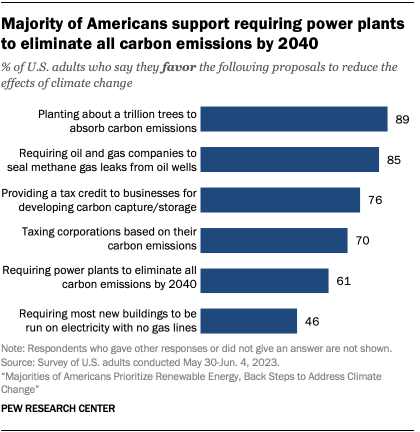
A bar chart showing that a majority of Americans support requiring power plants to eliminate all carbon emissions by 2040.

Americans’ support for action on climate change is reflected in their views of some specific policy proposals.

Roughly nine-in-ten (89%) favor planting about a trillion trees to absorb carbon emissions. Large majorities also favor requiring oil and gas companies to seal methane gas leaks from oil wells (85%), providing a tax credit for businesses for developing carbon capture and storage (76%) and taxing corporations based on their carbon emissions (70%).

A somewhat smaller majority of Americans support requiring power plants to eliminate all carbon emissions by 2040 (61%).

Requiring most new buildings to be run on electricity with no gas lines receives the least support of the items included in the survey: 46% favor this idea while 51% oppose it.

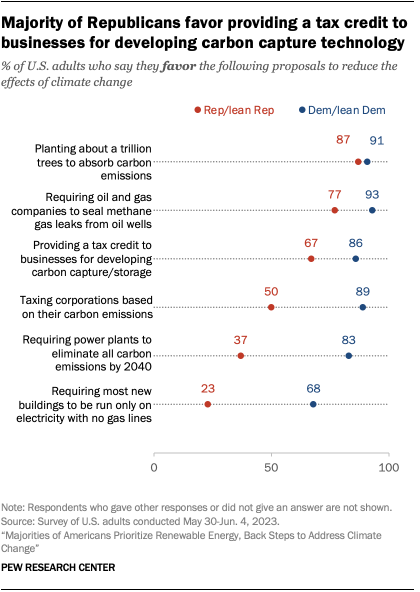
A dot plot that shows a majority of Republicans favor providing a tax credit to businesses for developing carbon capture technology.

Large shares of Democrats and Republicans support planting about a trillion trees to absorb carbon emissions (91% and 87%, respectively).

Majorities of both parties also support requiring oil and gas companies to seal gas leaks from oil wells and providing a tax credit to businesses for carbon capture and storage, though Democrats are still more likely than Republicans to support these proposals.

On other climate proposals, partisans are more divided. About nine-in-ten (89%) Democrats favor taxing corporations based on their carbon emissions, compared with half of Republicans.

And while majorities of Democrats support requiring power plants to eliminate carbon emissions by 2040 and requiring most new buildings to be run only on electricity, these proposals garner more opposition than support among Republicans. 

Protecting the environment and low consumer costs are important considerations for the public in climate proposals

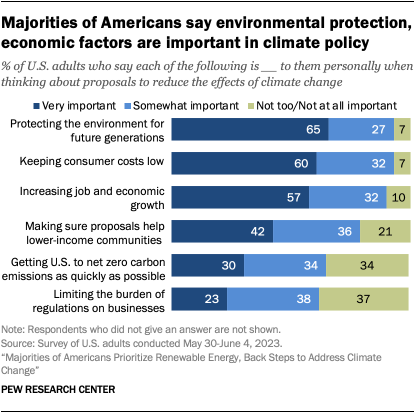
A bar chart that shows majorities of Americans say environmental protection, economic factors are important in climate policy.

When asked what’s important to them in proposals to reduce the effects of climate change, 65% of Americans say protecting the quality of the environment for future generations is a very important factor. Economic considerations also feature prominently: 60% say keeping consumer costs low is a very important consideration to them in climate proposals and 57% say increasing job and economic growth is very important to them.

Smaller shares place the highest level of importance on making sure climate proposals help lower-income communities (42% very important) or getting the U.S. to net zero carbon emissions as quickly as possible (30%). Just 23% say that limiting the burden of regulations on businesses is very important to them personally when considering proposals to reduce the effect of climate change. 

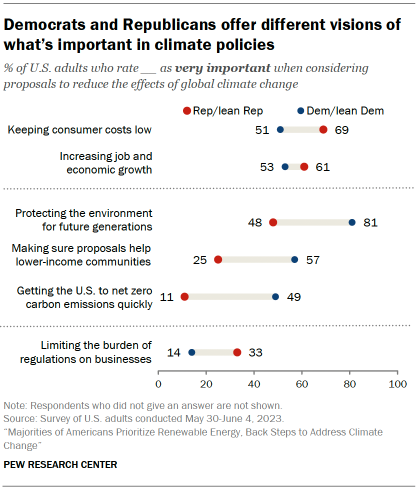
A dot plot that shows Democrats and Republicans offer different visions of what’s important in climate policies.

Partisans have differing priorities when it comes to climate change proposals.

Among Democrats, protecting the quality of the environment for future generations is their clear top consideration (81% say this is very important), followed by making sure proposals help lower-income communities (57%).

About half of Democrats say increasing jobs and economic growth (53%) and keeping consumer costs low (51%) are very important considerations to them personally.

By comparison, Republicans place greater emphasis on economic factors: 69% say keeping consumer costs low is a very important consideration to them in climate proposals and 61% say increasing job opportunities and economic growth is very important. Protecting the environment for future generations is seen as a very important consideration by 48% of Republicans.

Majority of Americans support U.S. participation in international climate efforts

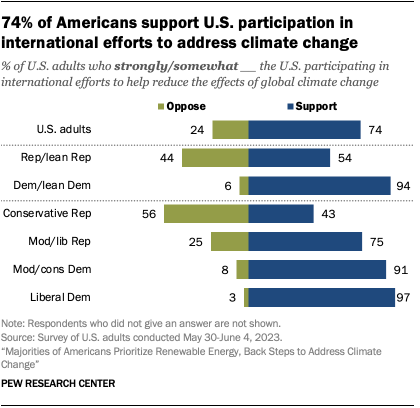
A bar chart showing 74% of Americans support U.S. participation in international efforts to address climate change.

In a global context, Americans offer broad support for U.S. involvement with international efforts to deal with climate change. But there’s less consensus about how big a role the U.S. should play compared with other countries with large economies.

Overall, 74% support the U.S. participating in international efforts to help reduce the effects of climate change; just 24% say they oppose this.

An overwhelming share of Democrats (94%) back U.S. engagement with international efforts to address climate change. Views are less one-sided among Republicans; still, a narrow majority (54%) say they support this, while 44% are opposed.

There are sizable gaps within the GOP on this question. A majority of moderate and liberal Republicans (75%) support U.S. participation in international climate efforts. By contrast, 56% of conservative Republicans say they oppose this. Across age groups, younger Republicans ages 18 to 29 (71%) and 30 to 49 (58%) are more likely to support U.S. global efforts than Republicans ages 50 and older (48%).

A bar chart that shows 56% say the U.S. should do about as much as other large economies to help reduce climate effects.

The public is divided over how much the U.S. is currently contributing to global efforts to deal with climate change. Overall, 36% think the U.S. is doing more than other countries with large economies to reduce the effects of climate change, compared with 32% who say the U.S. is doing about as much as others and 30% who think the U.S. is doing less than others.

Since January 2022, there’s been a modest 4-point increase in the share of Americans who say the U.S. is doing more than other countries with large economies to deal with climate change and a corresponding 6-point decline in the share saying the U.S. is doing less than others.

There’s more agreement among Americans when it comes to the role the U.S. should play internationally on climate change. Overall, 56% say the U.S. should do about as much as other countries with large economies to reduce the effects of global climate change. About a quarter (27%) say the U.S. should do more than other large economies, while 15% think it should do less.

Among Republicans, 55% think the U.S. is currently doing more than other countries with large economies to address climate change. As for the country’s appropriate role, 64% of Republicans think it should do about as much as other large economies to address the issue. Democrats hold varied perceptions of how much the U.S. is currently doing: 41% say it is doing less than other large economies to reduce the effect of global climate change, while 37% say it is doing about as much as others and 21% think the U.S. is doing more than other countries with large economies. There’s also no consensus among Democrats over how much the U.S. should do.

Close to half (48%) think the U.S. should do about as much as other large economies to deal with the issue, but 41% think the U.S. should do more than others. A small share (9%) think the U.S. should do less than other countries with large economies.

Just 33% of Americans believe the U.S. and other countries around the world will do enough to avoid the worst impacts from climate change

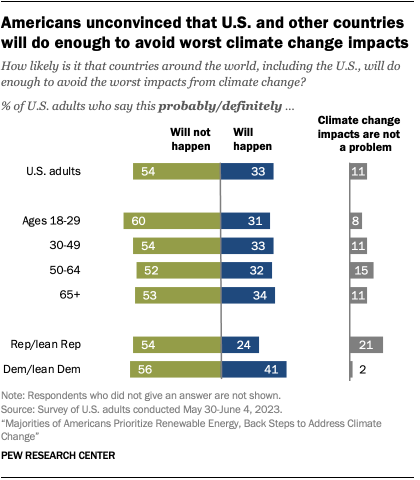
Americans are not especially optimistic that efforts to address climate change will stave off its most serious impacts. A narrow majority (54%) say the U.S. and other countries around the world will probably or definitely not do enough to avoid the worst impacts of climate change. A much smaller share (33%) think the U.S. and others will likely do enough to avoid the worst impacts. About one-in-ten (11%) say they don’t believe climate change impacts are a problem.

A bar chart showing that Americans are unconvinced that U.S. and other countries will do enough to avoid worst climate change impacts.

Republicans are significantly more likely than Democrats to say climate change impacts are not a problem (21% vs. 2%), but neither group is particularly optimistic that the U.S. and other countries around the world will do enough to avoid the worst impacts from climate change. Young Democrats are particularly skeptical. A majority (64%) of Democrats ages 18 to 29 say the U.S. and other countries are unlikely to do enough to avoid the worst climate impacts. Older Democrats tend to be more evenly divided in their outlook on this question.

How Americans see the federal government’s role in communities at high risk of extreme weather

A bar chart that shows a majority of Americans say limiting construction in areas at risk of extreme weather is a good idea.

Extreme weather events, such as floods or droughts, are expected to become more frequent and intense in coming years due to climate change. Communities at high risk of these events face questions about how to confront challenges from extreme weather, including what role government should play.

Overall, 54% of Americans think it is a good idea for the federal government to limit new construction in communities at high risk of extreme weather, while 19% say this is a bad idea and another 27% are unsure. About half (47%) say it’s a good idea for the federal government to provide financial assistance for communities in high-risk areas to relocate; fewer (24%) call this a bad idea.

At the same time, the public is generally supportive of a federal role to help communities in high-risk areas rebuild: 53% say that it is a good idea for the government to provide financial assistance for communities to rebuild after an event occurs, compared with 24% who call this a bad idea.

There’s little enthusiasm for the federal government requiring communities to relocate from high-risk areas: 29% of U.S. adults say this is a good idea, compared with 33% who say it’s a bad idea and 38% who say they aren’t sure.

A chart that shows about two-thirds of Democrats say it’s a good idea for the federal government to limit new construction in areas at risk of extreme weather.

Democrats are more supportive than Republicans of the federal government playing a role in communities at high risk of extreme weather.

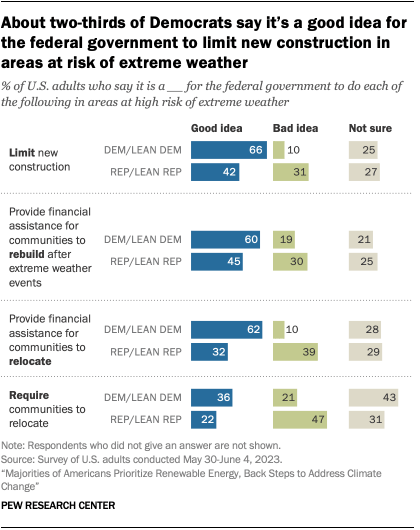
About two-thirds of Democrats say it would be a good idea for the federal government to limit new construction in areas at high risk of extreme weather. Views among Republicans are more mixed: 42% say this is a good idea, compared with 31% who say it’s a bad idea and 27% who say they’re not sure.

About six-in-ten Democrats (62%) say it’s a good idea for the federal government to provide financial assistance for communities to relocate from areas at high risk of extreme weather. By contrast, Republicans are more likely to view this as a bad than good idea (39% vs. 32%).

While Democrats support federal efforts to limit construction and incentivize relocation, they also support federal assistance to help communities rebuild after extreme weather events. Overall, 60% of Democrats think it’s a good idea for the federal government to financially assist communities with rebuilding after extreme weather events, compared with just 19% who say this is a bad idea. Among Republicans, 45% say this is a good idea, while 30% call it a bad idea and 25% say they’re not sure.

Neither partisan group is particularly supportive of the federal government requiring communities at high risk of extreme weather to relocate, though a somewhat larger share of Democrats (36%) than Republicans (22%) says this is a good idea.

A dot plot that shows experience with extreme weather and views on the federal government’s role in high-risk communities.

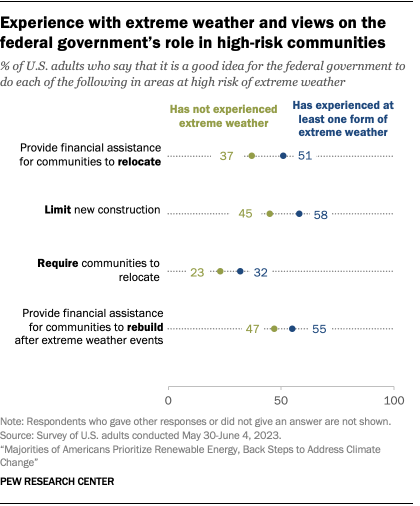
There are some differences in views about the federal government’s role in communities at high risk of extreme weather between those who say they’ve experienced an extreme weather event themselves and those who say they have not.

For instance, 51% of those who say their area has faced an extreme weather event recently think it’s a good idea for the federal government to provide financial assistance to communities at high risk to relocate, compared with 37% of people who have not experienced an extreme weather event in the last year.

Experiences with extreme weather

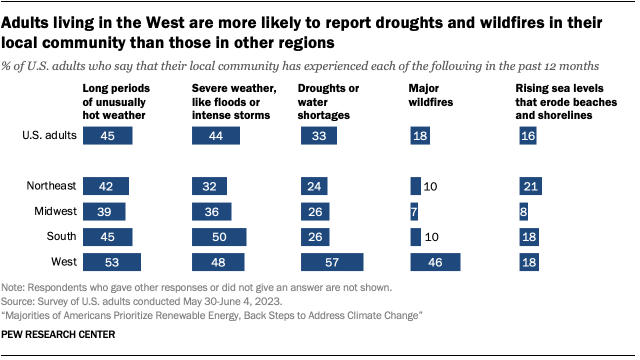
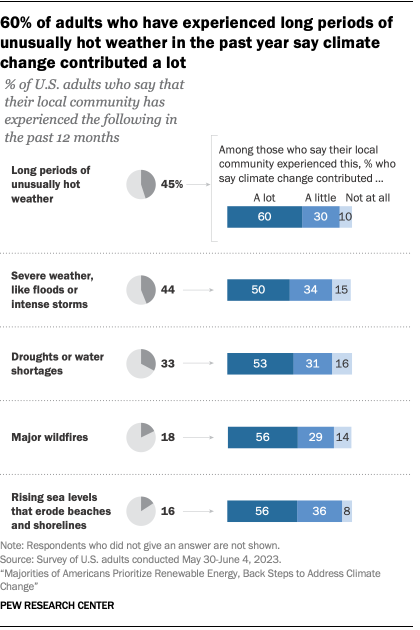
A majority of Americans (69%) say they have experienced at least one of five types of extreme weather in their own community over the last year. Long periods of unusually hot weather and severe weather, like floods or intense storms, have been experienced by 45% and 44% of Americans, respectively. A third say they’ve experienced droughts or water shortages, while fewer say they have experienced major wildfires (18%) or rising sea levels that erode beaches and shorelines (16%).

These reports of extreme weather differ across regions in the country. The biggest differences are in the experiences of major wildfires – 46% of adults living in the West say they have experienced these in the past year compared with no more than 10% of adults living in other regions. Adults in the West are also the most likely to have experienced droughts or water shortages.

Partisanship also plays a role in perceptions of extreme weather. Democrats are more likely than Republicans to report their community has experienced extreme weather, a difference that holds when looking at people who live in the same geographic region.

A chart that shows adults living in the West are more likely to report droughts and wildfires in their local community than those in other regions.

Most Americans who have experienced extreme weather events see a connection to climate change

A chart that shows 60% of adults who have experienced long periods of unusually hot weather in the past year say climate change contributed a lot.

Among adults who report experiencing a form of extreme weather in the last year, most say climate change has contributed a lot or a little to these events.

For example, 90% of adults who have experienced long periods of unusually hot weather in the past year say that climate change contributed a lot (60%) or a little (30%) to this.

Similarly, more than eight-in-ten of those who have experienced coastal erosion, major wildfires, droughts and severe weather like floods or intense storms believe climate change has contributed to these events.

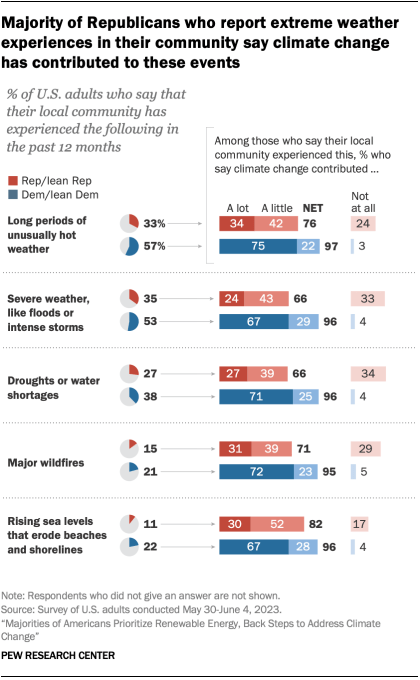
Majorities of Democrats and Republicans who report experiencing extreme weather within the last year believe that climate change has contributed to these events. However, larger majorities of Democrats than Republicans take this view and Democrats are much more likely than Republicans to think climate change has contributed a lot.

A chart that shows a majority of Republicans who report extreme weather experiences in their community say climate change has contributed to these events.

For instance, nearly all Democrats who have experienced long periods of unusually hot weather in the last year believe climate change has contributed at least a little to this, including 75% who think it has contributed a lot.

Among Republicans who say their community has experienced long periods of unusually hot weather, 76% think climate change has contributed at least a little to this, including 34% who say it has contributed a lot.

Perceptions of climate change’s impact on extreme weather are roughly similar to those measured a year ago in May 2022, the last time the Center asked these questions.

3. Majorities of Americans say too little is being done on key areas of environmental protection

Majorities of Americans say that the federal government is doing too little to protect key areas of the environment.

Overall, 63% of U.S. adults say the federal government is doing too little to protect the quality of lakes, rivers and streams. Just 7% say too much is being done here, while 29% say the federal government is doing about the right amount in this area.

More than half of Americans also say that the federal government is doing too little to protect air quality (58%) and to protect animals and their habitats (55%).

When it comes to federal efforts on climate change, 56% say the government is doing too little on the issue, compared with 20% who say it is doing too much and 23% who say they are doing about the right amount.

About half (48%) think too little is being done to protect open lands in national parks and nature preserves, while 44% think the federal government is doing about the right amount in this area.

Majorities of Democrats see room for more federal action in areas of environmental protection

Democrats are much more likely than Republicans to say the federal government is doing too little across all five areas of environmental protection included in the survey.

For example, 77% of Democrats say the federal government is doing too little to protect water quality of lakes, rivers and streams, compared with 47% of Republicans who say the same.

The largest gap seen on this set of questions is over the federal role on climate change: 80% of Democrats say too little is being done here. By contrast, Republicans are more likely to say the federal government is doing too much (39%) rather than too little (29%) to reduce the effects of climate change.

Line charts that show Republicans and Democrats continue to be far apart in views of the federal government’s efforts protecting the environment.

Within the GOP, there are differences by political ideology over the federal government’s role in environmental protection.

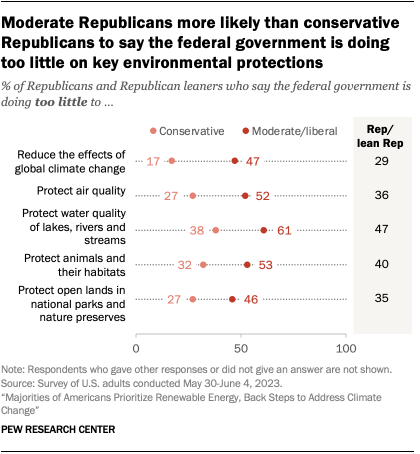
A dot plot that shows moderate Republicans more likely than conservative Republicans to say the federal government is doing too little on key environmental protections.

Moderate Republicans are more likely than conservative Republicans to say the federal government is doing too little across each of the five areas included in the survey.

About six-in-ten moderate and liberal Republicans (61%) say the federal government is doing too little to protect lakes, rivers and streams. A smaller share of conservative Republicans hold this view (38%).

On climate change, 47% of moderate and liberal Republicans say too little is being done to reduce the effects of global climate change, compared with just 17% of conservative Republicans who say this.

Among Democrats, majorities of liberals as well as moderates and conservatives say the federal government is doing too little in most areas of environmental concern. Still, there are differences in how widely these views are held, with larger majorities of liberal Democrats saying the federal government is doing too little on environmental issues.

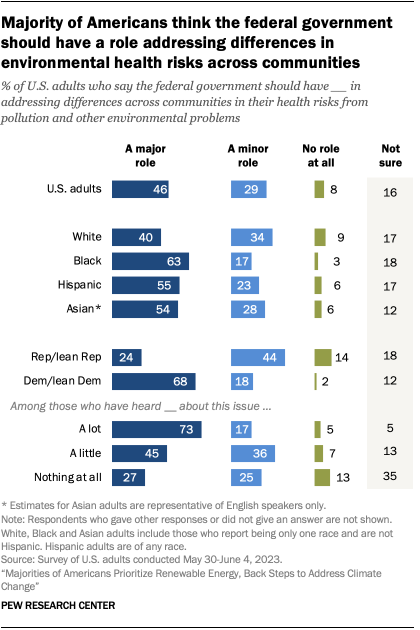
Most Americans see a role for the federal government addressing differences in environmental health risks across communities

A bar chart that shows majority of Americans think the federal government should have a role addressing differences in environmental health risks across communities.

About three-quarters of Americans think the federal government should have a major (46%) or minor (29%) role addressing differences across communities in their health risks from pollution and other environmental problems. A small share (8%) say the government should play no role in this and 16% say they aren’t sure.

Environmental factors such as air and water quality differ across communities, as people with lower incomes and racial and ethnic minorities are more likely than others to live in areas with environmental risks.

Democrats are much more likely than Republicans to say the federal government should have a major role in this (68% vs. 24%). Still, a majority of Republicans say the government should have a least a minor role.

Black, Hispanic and English-speaking Asian adults are more likely than White adults to say the federal government should play a major role in this issue. There are only modest differences by level of income, with majorities across groups supporting at least a minor role for the federal government addressing differences across communities in their environmental health risks.

Americans are generally aware of issues regarding disparities in environmental quality across communities: 77% say they have heard a lot or a little about this, compared with 22% who say they have not heard about this issue.

Those who say they are most familiar with the issue of different environmental health risks across communities are the most supportive of a federal role. Among those who have heard a lot about this issue, 73% say the federal government should play a major role addressing differences across communities in their health risks from pollution and other environmental problems.

Republicans and Democrats remain far apart over the value of environmental laws and regulations

A bar chart showing that 80% of Democrats say environmental laws are worth the cost; majority of Republicans say economic costs outweigh the benefits.

Just over half (53%) of Americans say stricter environmental laws and regulations are worth the cost while slightly fewer (45%) say they cost too many jobs and hurt the economy.
Views on this question have changed little in the last two years, but positive views of environmental laws remain lower than in September 2o19, when 65% said they were worth the cost.

Eight-in-ten Democrats and Democratic leaners view environmental laws as worth the cost. By contrast, just 25% of Republicans and Republican leaners say this, while 74% say they cost too many jobs and hurt the economy.

Ratings of the impact of environmental laws among Republicans turned more negative between September 2019 and April 2021, a period of time with a change in presidential administrations. This shift in views among Republicans drove the overall decline in public assessments of the value of environmental laws seen in that period.

Views of environmental laws differ by ideology within both parties.

Among Republicans and Republican leaners, 83% of conservatives say stricter environmental cost too many jobs and hurt the economy. This view is less widely held among moderate and liberal Republicans: 59% say environmental laws cost too many jobs and hurt the economy, compared with 40% who say they are worth the cost.

Among Democrats and Democratic leaners, 91% of liberals view stricter environmental laws as worth the cost. Among moderate and conservative Democrats, 70% say this while 29% think they cost too many jobs and hurt the economy.

Which environmental problems do Americans see in their local area?

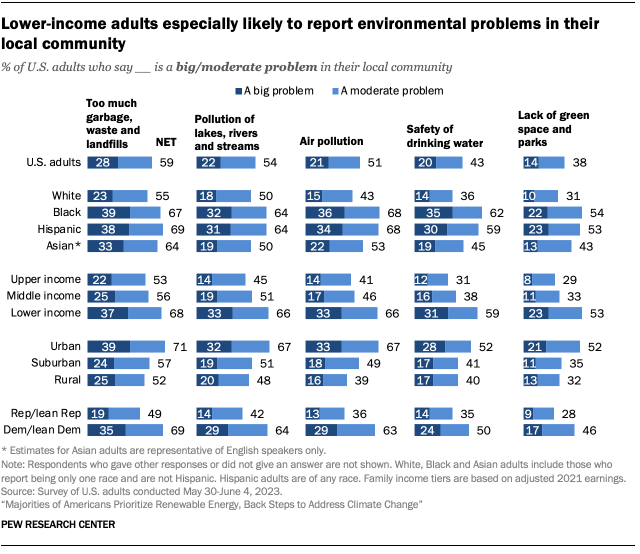
Many Americans see environmental problems in their own local communities, as adults with lower incomes and Black and Hispanic adults are especially likely to see problems in their area. Urban residents are also more likely to perceive environmental problems in their communities than those in suburban or rural areas.

Among all U.S. adults, 59% say their local community has a big or moderate problem with too much garbage and landfills; 54% say they have a big or moderate problem with the pollution of lakes, rivers and streams in their area. Roughly half (51%) say air pollution in their area is at least a moderate problem, while 43% say this about the safety of drinking water and 38% describe the lack of green space and parks in their community as a big or moderate problem.

A chart showing that lower-income adults especially likely to report environmental problems in their local community.

Majorities of lower-income adults say most of the environmental problems in the survey are at least a moderate problem in their community. For instance, 66% of lower-income adults view air pollution as a big or moderate problem in their community and 59% say this about the safety of drinking water. Smaller shares of middle- and upper-income adults see specific environmental problems in their area.

Black and Hispanic adults are more likely than White adults to say each type of environmental problem is a big or moderate problem in their local communities. The largest differences are seen for the problems of safe drinking water and air pollution. For example, 62% of Black adults and 59% of Hispanic adults say the safety of drinking water is at least a moderate problem in their area, compared with 36% of White adults. Perceptions of local environmental issues among English-speaking Asian adults generally fall between those of White adults and Black and Hispanic adults. The survey sample primarily includes English-speaking Asian adults and, therefore, may not be representative of the overall Asian adult population.

Across community types, majorities of urban residents view too much garbage and landfills (71%), pollution of lakes, rivers and streams (67%) and air pollution (67%) as big or moderate problems in their community. While many in suburban and rural areas also report these issues, they do so at significantly lower rates. For example, 49% of people who live in suburban areas and 39% of those in rural areas say air pollution is at least a moderate problem where they live.

Acknowledgments

This report is made possible by The Pew Charitable Trusts. It is a collaborative effort based on the input and analysis of the following individuals. Find related reports online at: pewresearch.org/pewresearch-org/science.

Primary research team       

Cary Funk, Director, Science and Society Research  
Alec Tyson, Associate Director, Science and Society Research
Brian Kennedy, Senior Researcher
Giancarlo Pasquini, Research Associate
Alison Spencer, Research Analyst
Stephanie Ross, Research Intern      

Editorial and graphic design          

Rebecca Leppert, Editorial Assistant
Kaitlyn Radde, Associate Information Graphics Designer

Communications and web publishing      

Haley Nolan, Communications Manager
Kelsey Beveridge, Communications Associate
Reem Nadeem, Associate Digital Producer
Beshay Sakla, Associate Digital Producer

In addition, the project benefited greatly from the guidance of the Pew Research Center methodology team: Courtney Kennedy, Andrew Mercer, Ashley Amaya, Dorene Asare-Marfo, Dana Popky and Arnold Lau.

Methodology

The American Trends Panel survey methodology

Overview

The American Trends Panel (ATP), created by Pew Research Center, is a nationally representative panel of randomly selected U.S. adults. Panelists participate via self-administered web surveys. Panelists who do not have internet access at home are provided with a tablet and wireless internet connection. Interviews are conducted in both English and Spanish. The panel is being managed by Ipsos.

Data in this report is drawn from ATP Wave 128, conducted from May 30 to June 4, 2023, and includes an oversample of Hispanic, non-Hispanic Asian, non-Hispanic Black, and 18- to 29-year-old adults in order to provide more precise estimates of the opinions and experiences of these smaller demographic subgroups. These oversampled groups are weighted back to reflect their correct proportions in the population.

A table showing American Trends Panel recruitment surveys.

A total of 10,329 panelists responded out of 12,178 who were sampled, for a response rate of 85%. The cumulative response rate accounting for nonresponse to the recruitment surveys and attrition is 3%. The break-off rate among panelists who logged on to the survey and completed at least one item is 2%. The margin of sampling error for the full sample of 10,329 respondents is plus or minus 1.5 percentage points.

Panel recruitment

The ATP was created in 2014, with the first cohort of panelists invited to join the panel at the end of a large, national, landline and cellphone random-digit-dial survey that was conducted in both English and Spanish. Two additional recruitments were conducted using the same method in 2015 and 2017, respectively. Across these three surveys, a total of 19,718 adults were invited to join the ATP, of whom 9,942 (50%) agreed to participate.

In August 2018, the ATP switched from telephone to address-based recruitment. Invitations were sent to a stratified, random sample of households selected from the U.S. Postal Service’s Delivery Sequence File. Sampled households receive mailings asking a randomly selected adult to complete a survey online. A question at the end of the survey asks if the respondent is willing to join the ATP. In 2020 and 2021 another stage was added to the recruitment. Households that did not respond to the online survey were sent a paper version of the questionnaire, $5 and a postage-paid return envelope. A subset of the adults who returned the paper version of the survey were invited to join the ATP. This subset of adults received a follow-up mailing with a $10 pre-incentive and invitation to join the ATP.

Across the five address-based recruitments, a total of 23,176 adults were invited to join the ATP, of whom 20,341 agreed to join the panel and completed an initial profile survey. In each household, one adult was selected and asked to go online to complete a survey, at the end of which they were invited to join the panel. Of the 30,283 individuals who have ever joined the ATP, 12,404 remained active panelists and continued to receive survey invitations at the time this survey was conducted.

The U.S. Postal Service’s Delivery Sequence File has been estimated to cover as much as 98% of the population, although some studies suggest that the coverage could be in the low 90% range.1 The American Trends Panel never uses breakout routers or chains that direct respondents to additional surveys.

Sample design

The overall target population for this survey was noninstitutionalized persons ages 18 and older living in the U.S., including Alaska and Hawaii. It featured a stratified random sample from the ATP in which Hispanic, non-Hispanic Asian, non-Hispanic Black and 18- to 29-year-old adults were selected with certainty. The remaining panelists were sampled at rates designed to ensure that the share of respondents in each stratum is proportional to its share of the U.S. adult population to the greatest extent possible. Respondent weights are adjusted to account for differential probabilities of selection as described in the Weighting section below.

Questionnaire development and testing

The questionnaire was developed by Pew Research Center in consultation with Ipsos. The web program was rigorously tested on both PC and mobile devices by the Ipsos project management team and Pew Research Center researchers. The Ipsos project management team also populated test data that was analyzed in SPSS to ensure the logic and randomizations were working as intended before launching the survey.

Incentives

All respondents were offered a post-paid incentive for their participation. Respondents could choose to receive the post-paid incentive in the form of a check or a gift code to Amazon.com or could choose to decline the incentive. Incentive amounts ranged from $5 to $20 depending on whether the respondent belongs to a part of the population that is harder or easier to reach. Differential incentive amounts were designed to increase panel survey participation among groups that traditionally have low survey response propensities.

Data collection protocol

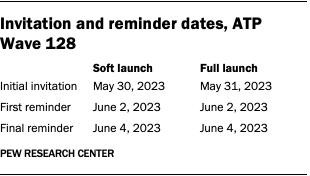
 The data collection field period for this survey was May 30 to June 4, 2023. Postcard notifications were mailed to all ATP panelists with a known residential address on May 30. 

A table showing invitation and reminder dates, ATP Wave 128.

Invitations were sent out in two separate launches: soft launch and full launch. Sixty panelists were included in the soft launch, which began with an initial invitation sent on May 30. The ATP panelists chosen for the initial soft launch were known responders who had completed previous ATP surveys within one day of receiving their invitation. All remaining English- and Spanish-speaking sampled panelists were included in the full launch and were sent an invitation on May 31.

All panelists with an email address received an email invitation and up to two email reminders if they did not respond to the survey. All ATP panelists who consented to SMS messages received an SMS invitation and up to two SMS reminders.

Data quality checks

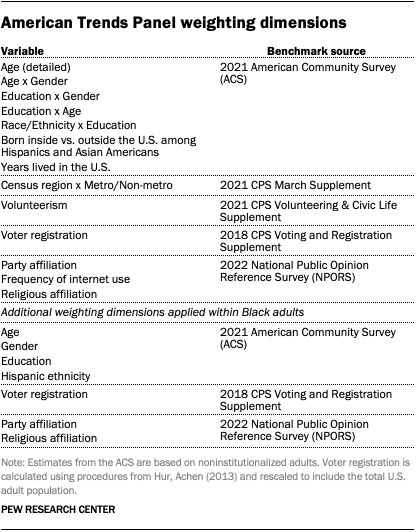
A table that shows the American Trends Panel weighting dimensions.

To ensure high-quality data, the Center’s researchers performed data quality checks to identify any respondents showing clear patterns of satisficing. This includes checking for very high rates of leaving questions blank, as well as always selecting the first or last answer presented. As a result of this checking, 19 respondents were removed from the survey dataset. An additional 70 respondents were removed from the survey due to a sample loading error which occurred during survey launch. All 89 ATP respondents were excluded from the data prior to weighting and analysis.

Weighting

The ATP data is weighted in a multistep process that accounts for multiple stages of sampling and nonresponse that occur at different points in the survey process. First, each panelist begins with a base weight that reflects their probability of selection for their initial recruitment survey. These weights are then rescaled and adjusted to account for changes in the design of ATP recruitment surveys from year to year.

Finally, the weights are calibrated to align with the population benchmarks in the accompanying table to correct for nonresponse to recruitment surveys and panel attrition. If only a subsample of panelists was invited to participate in the wave, this weight is adjusted to account for any differential probabilities of selection.

Among the panelists who completed the survey, this weight is then calibrated again to align with the population benchmarks identified in the accompanying table and trimmed at the 1st and 99th percentiles to reduce the loss in precision stemming from variance in the weights. Sampling errors and tests of statistical significance take into account the effect of weighting.

The following table shows the unweighted sample sizes and the error attributable to sampling that would be expected at the 95% level of confidence for different groups in the survey.

A table that shows sample sizes and margins of error, ATP Wave 128.

Sample sizes and sampling errors for other subgroups are available upon request. In addition to sampling error, one should bear in mind that question wording and practical difficulties in conducting surveys can introduce error or bias into the findings of opinion polls.

Dispositions and response rates

A table that shows final dispositions, ATP Wave 128.
A table showing the cumulative response rate as of ATP Wave 128.

Adjusting income and defining income tiers

To create upper-, middle- and lower-income tiers, respondents’ 2021 family incomes were adjusted for differences in purchasing power by geographic region and household size. “Middle-income” adults live in families with annual incomes that are two-thirds to double the median family income in the panel (after incomes have been adjusted for the local cost of living and household size). The middle-income range for the American Trends Panel is about $43,800 to $131,500 annually for an average family of three. Lower-income families have incomes less than roughly $43,800, and upper-income families have incomes greater than roughly $131,500 (all figures are expressed in 2021 dollars).

Based on these adjustments, 29% of respondents in Wave 128 are lower income, 47% are middle income and 18% fall into the upper-income tier. An additional 6% either didn’t offer a response to the income question or the household size question.

Here is more information about how the income tiers were determined.

© Pew Research Center, 2023

Appendix: Detailed charts on climate, energy, environment

A bar chart that shows most Republicans continue to say the U.S. should use a mix of energy sources.
A bar chart that shows large majorities in U.S. continue to support more wind and solar power, but support for both down slightly.
A bar chart showing that support for phasing out gasoline cars and trucks by 2035 has lowered over the past two years.
Line charts that show a majority of Republicans favor a business tax credit for developing carbon capture technology, but support has declined in recent years.