Pew Research Center

FOR RELEASE JUNE 14, 2022

Hispanic Americans’ Trust in and Engagement With Science

Increasing representation in science seen as important for attracting more Hispanic people to science

BY Cary Funk and Mark Hugo Lopez

FOR MEDIA OR OTHER INQUIRIES:

Communications Department
202.419.4372
www.pewresearch.org

RECOMMENDED CITATION

Pew Research Center, June 2022, "Hispanic Americans’ Trust in and Engagement With Science"

About Pew Research Center

Pew Research Center is a nonpartisan, nonadvocacy fact tank that informs the public about the issues, attitudes and trends shaping the world. It does not take policy positions. The Center conducts public opinion polling, demographic research, computational social science research and other data-driven research. It studies politics and policy; news habits and media; the internet and technology; religion; race and ethnicity; international affairs; social, demographic and economic trends; science; research methodology and data science; and immigration and migration. Pew Research Center is a subsidiary of The Pew Charitable Trusts, its primary funder.

© Pew Research Center 2026

Table of contents

  • About Pew Research Center
  • Hispanic Americans’ Trust in and Engagement With Science
  • 1. A brief statistical portrait of U.S. Hispanics
  • 2. Hispanic Americans’ experiences with health care
  • 3. Hispanic Americans’ trust in medical scientists and views about the potential for researcher misconduct
  • 4. High engagement with COVID-19 news among Hispanic adults
  • 5. Many Hispanic Americans see more representation, visibility as helpful for increasing diversity in science
  • Acknowledgments
  • Methodology
  • Appendix: Detailed charts and tables

Hispanic Americans’ Trust in and Engagement With Science

Increasing representation in science seen as important for attracting more Hispanic people to science

How we did this

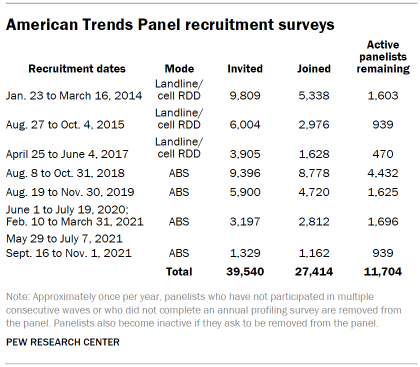
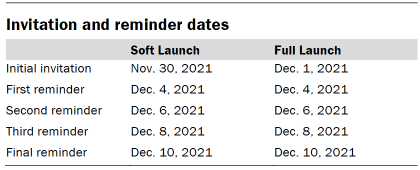
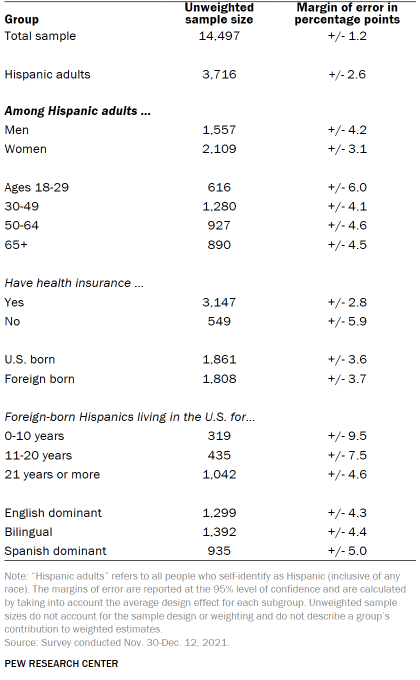
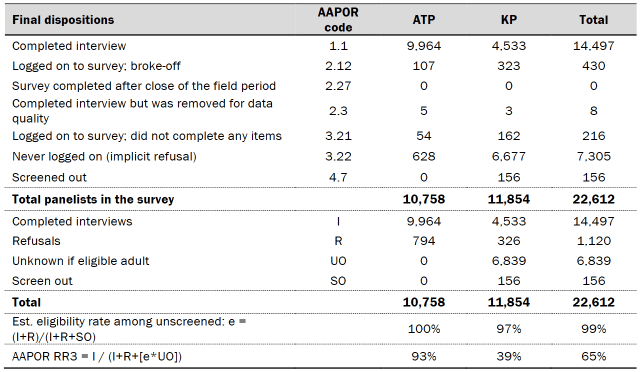
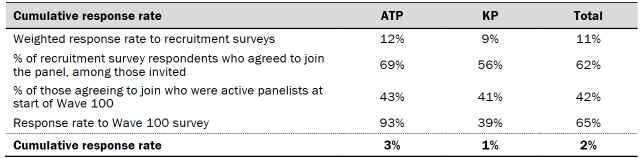
Pew Research Center conducted this study to understand Hispanic Americans’ perspectives of and experiences with science. We surveyed U.S. adults from Nov. 30 to Dec. 12, 2021, including 3,716 Hispanic adults (inclusive of those who identify as any race). A total of 14,497 U.S. adults completed the survey. A previous report looked at Black Americans’ views and future reports will analyze views among the overall U.S. adult population.

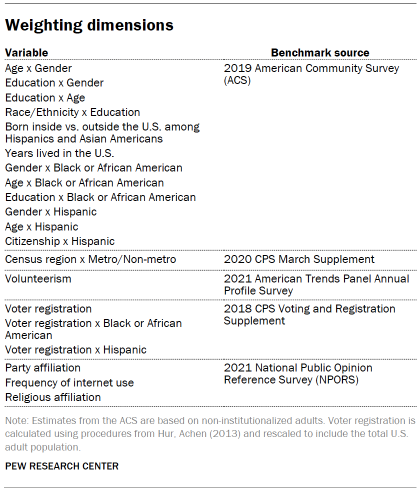
The survey was conducted on Pew Research Center’s American Trends Panel (ATP) and included an oversample of Black and Hispanic adults from the Ipsos KnowledgePanel. Respondents on both panels are recruited through national, random sampling of residential addresses. This way nearly all U.S. adults have a chance of selection. The survey is weighted to be representative of the U.S. adult population by gender, race, ethnicity, partisan affiliation, education and other categories. Read more about the ATP’s methodology.

Here are the survey questions used for this report, along with responses, and its methodology.

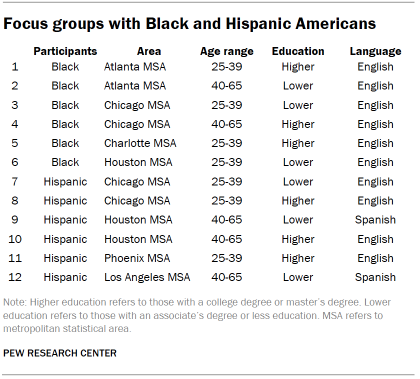
The Center also completed six focus groups with Hispanic Americans from July 13-22, 2021. The focus groups were moderated by Martha Garma Zipper of MGZ Research. Each group discussion was held online for 90 minutes and included three to six men and women; there were a total of 29 participants. Each group was designed to include younger and older age groups, people with higher and lower levels of education, and those living in the metropolitan areas of Chicago, IL; Houston, TX; Phoenix, AZ; and Los Angeles, CA.

Here is the moderator guide used for the focus group discussions, and more on its methodology.

This study was informed by advice from a group of advisers with expertise related to Black and Hispanic Americans’ attitudes and experiences in science, health, STEM education and other areas. Pew Research Center remains solely responsible for all aspects of the research, including any errors associated with its products and findings.

This report is made possible by The Pew Charitable Trusts, which received support from the Chan Zuckerberg Initiative.

Terminology

The terms Hispanic and Latino are used interchangeably in this report.

U.S. Hispanic population, Hispanic population, U.S. Latino population and Latino population refer to all people who self-identify as Hispanic or Latino in the United States, including children and adults. This includes those who say their race is White, Black, Asian or some other race and those who identify as multi-racial. The terms U.S. Hispanic population, Hispanic population, U.S. Latino population and Latino population are used interchangeably in this report.

Hispanic Americans, Hispanic adults, Latinos, Latino adults and Latino people refer to survey respondents who self-identify as Hispanic or Latino in the U.S. This includes those who say their race is White, Black, Asian or some other race and those who identify as multi-racial. The terms Hispanic Americans, Hispanic adults, Latinos Latino adults and Latino people are used interchangeably in this report.

U.S. born refers to persons born in the 50 states or the District of Columbia.

Foreign-born Hispanic Americans refers to persons born outside of the U.S. or born in Puerto Rico. Although individuals born in Puerto Rico are U.S. citizens by birth, they are grouped with those born in another country for the purposes of this report for a variety of reasons: They are born into a culture that is primarily Spanish-speaking, and on many points their attitudes, views and beliefs are much closer to those of Hispanics born outside the U.S. than of Hispanics born in the 50 states or the District of Columbia, even when compared with those who identify themselves as being of Puerto Rican origin. The terms Hispanic immigrants and foreign-born Hispanic Americans are used interchangeably throughout the report and refer to this group.

Language dominance is a composite measure based on self-described assessments of speaking and reading abilities. Those classified as Spanish-dominant are more proficient in Spanish than in English (i.e., they speak and read Spanish “very well” or “pretty well” but rate their English speaking and reading ability lower). Bilingual refers to people who say they are proficient in both English and Spanish. Those classified as English-dominant are more proficient in English than in Spanish.

Hispanic Americans are one of the fastest growing groups in the nation, a trend that now extends far beyond historic Hispanic population centers to every region and state across the nation. Hispanic Americans are a diverse population, tracing their roots to the island of Puerto Rico, Mexico and more than 20 other nations across Central and South America, with experiences and views about American society often differing widely depending on whether they were born in the United States or immigrated to the country.

A new Pew Research Center survey, accompanied by a series of focus groups, takes an in-depth look at Hispanic Americans’ views and experiences with science spanning interactions with health care providers and STEM schooling, their levels of trust in scientists and medical scientists, and engagement with science-related news and information in daily life.

Hispanic adults hold largely trusting views of both medical scientists and scientists to act in the public’s interests. Hispanic adults’ encounters with the health and medical care system are varied, reflecting the diverse nature of the U.S. Hispanic population across characteristics such as nativity, language proficiency, gender, age and education.

Representation is a theme seen across issue areas in the new survey and the data underscores some of the challenges Hispanic adults view – and report experiencing – when it comes to increasing Hispanic representation and engagement with science and allied fields.

Hispanic Americans are glaringly underrepresented among the ranks of scientists and those in allied professions. Hispanic adults make up 17% of the U.S. workforce but just 8% of those working in a science, technology, engineering or math (STEM) job. Since 2010, there has been an increasing share of Hispanic students attending and graduating from college as well as a rise in the share earning a bachelor’s degree in a STEM field. Even so, Hispanic students remain underrepresented among college graduates and among master’s and doctoral degree-earners in STEM.
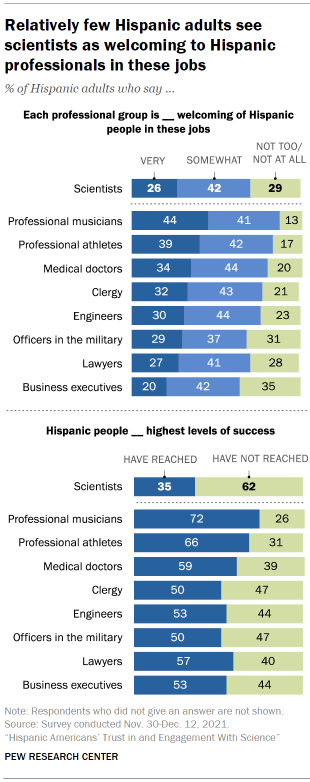
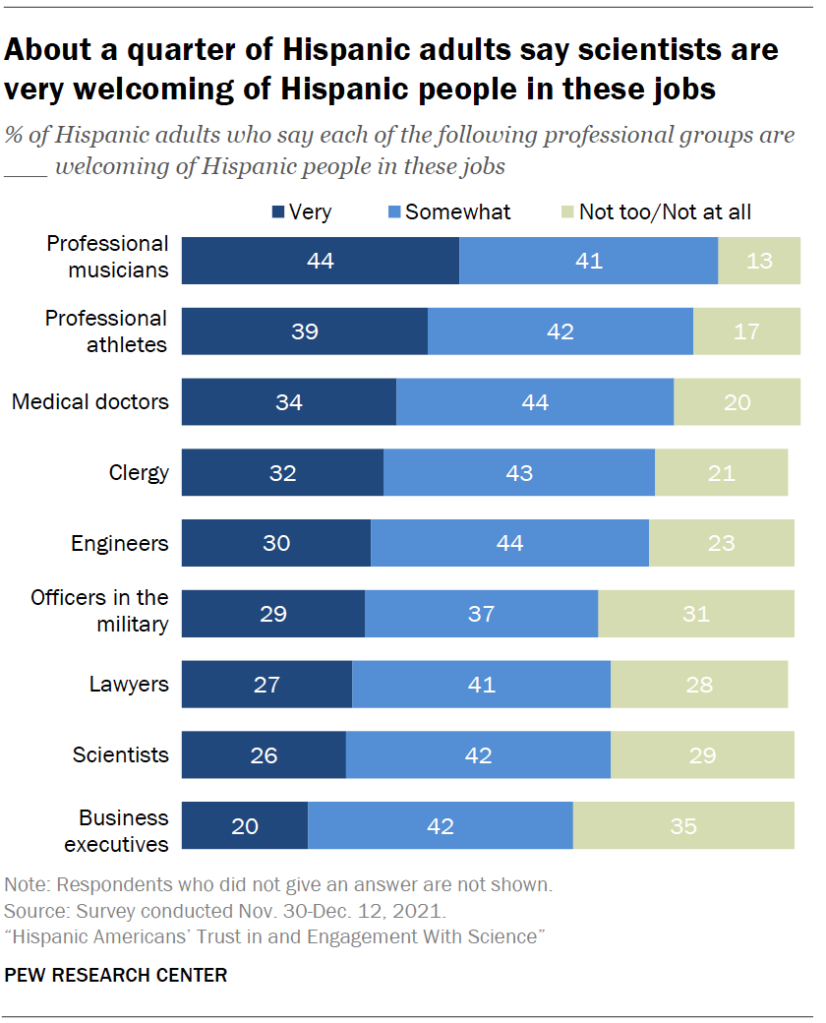
Chart shows relatively few Hispanic adults see scientists as welcoming to Hispanic professionals in these jobs

The survey findings suggest that most Latinos see scientific professions as potentially “unwelcoming” to Latino people. For example, just 26% of Latinos feel that scientists as a professional group are very welcoming of Latinos in these jobs; another 42% say they are somewhat welcoming. About three-in-ten (29%) view scientists as not too or not at all welcoming of Latinos in their ranks.

Perceptions of medical doctors’ openness toward Latino colleagues are slightly better: roughly a third describe medical doctors as very welcoming of Latinos in these jobs (34%). While scientists are not the only professional group that Latinos view as less than very welcoming, perceptions of scientists are among the lowest measured across the nine groups included in the survey.

Hispanic adults also express a sense that Hispanic people are not visible at the highest levels of success in science careers. About six-in-ten say that Hispanic people have not reached the highest levels of success as scientists; fewer (35%) believe that they have.

Perceptions of Hispanic achievement as engineers and medical doctors are relatively more positive: 53% and 59%, respectively, think Hispanic people have reached the highest levels of success in these professions.

One focus group participant put the connection between representation and trust this way:

“I think we need to know more Latino scientists. I think … well, actually, I don’t know any Latino scientists that I would say, “Oh yes. That’s that scientist … So maybe if we knew some scientists that made a discovery that was Latino we would trust science more.” – Latina, age 25-39

The survey highlights greater visible achievement among Hispanic Americans as a potential driver of STEM engagement among Hispanic Americans, including the pursuit of college degrees in these fields.

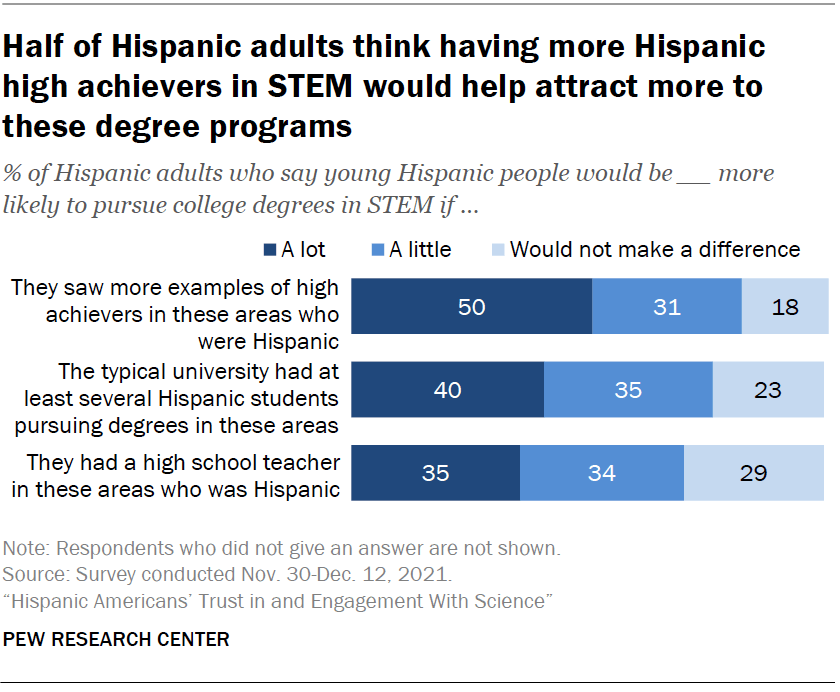
Chart shows half of Hispanic adults think having more Hispanic high achievers in STEM would help a lot to attract more to these degree programs

A large majority of Hispanic adults say that seeing more examples of high achievers in STEM who are Hispanic would help a lot (50%) or a little (31%) to encourage more young Hispanic people to pursue college degrees in STEM fields.

Majorities also say young Hispanic people would be at least a little more likely to pursue college degrees in STEM if the typical university had at least several Hispanic students in STEM degree programs and if Hispanic students had a high school STEM teacher who was Hispanic.

A sizable share of Hispanic college students are the first in their immediate family to attend college. The survey finds first-generation Hispanic college students are especially likely to view representation in the form of more examples of high-achieving Hispanic people in STEM as a catalyst for greater engagement: 60% think this would make young Hispanic people a lot more likely to pursue STEM degree programs.

When thinking about ways to increase engagement with science among Hispanic Americans, focus group participants frequently raised the issue of representation.

“More of us. We need to see more of our people.” – Latino, age 25-39

“Just that, incorporate more Latino people in it, starting with school, involve kids in technology and science, and develop more projects about strategies, those type of things, for the kids to get more interested and see it more like a game and therefore begin to have a love for science.” – Latina, age 40-65

Past experiences with STEM schooling can play a pivotal role in whether or not people engage with science or pursue further training or a job in STEM. The survey paints a mixed picture when it comes to Latinos’ past experiences in the classroom.

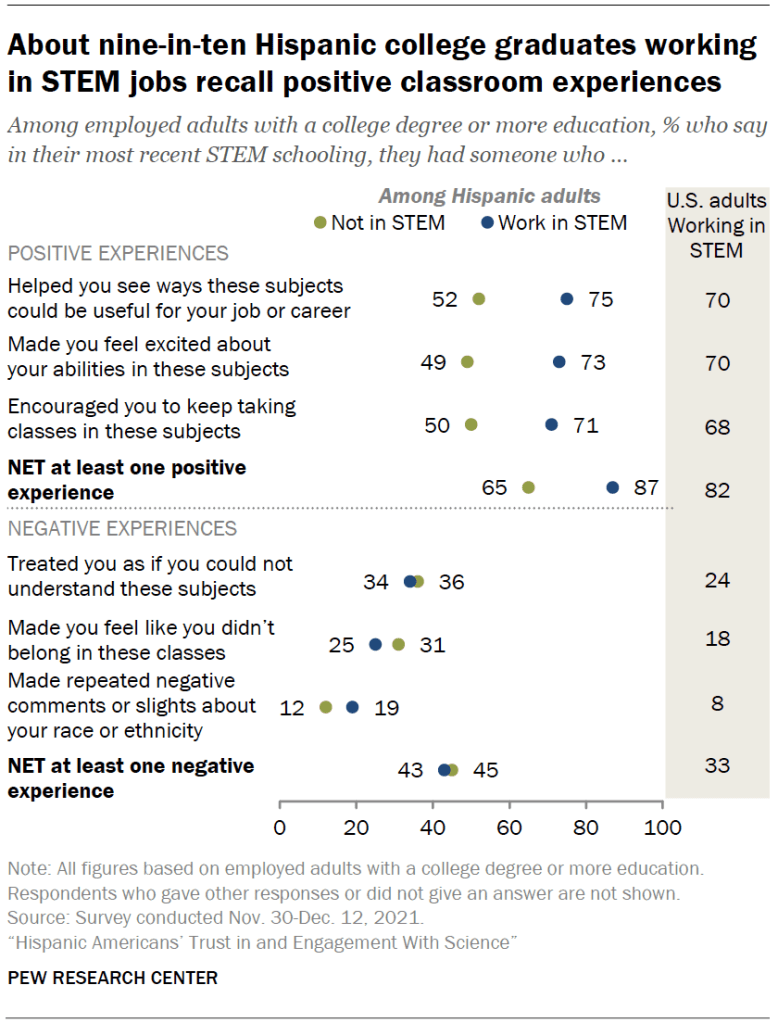
Most Hispanic college graduates working in STEM fields can recall positive experiences from their most recent educational experiences in science, technology, engineering and math – such as someone who encouraged them to keep taking classes in these subjects.

However, Hispanic college graduates working in STEM jobs are significantly more likely than non-Hispanic White college graduates in these positions to say they faced mistreatment in their most recent STEM schooling. For instance, 34% say they can recall someone treating them as if they could not understand the subject matter – significantly higher than the share of non-Hispanic White adults working in STEM who say this (22%).

In all, 43% of college-educated Hispanic STEM workers say they had at least one of the three negative experiences asked about in the survey. The experiences of Hispanic college graduates in this regard are similar to those of Black college graduates, who are also far more likely than non-Hispanic White college graduates to recall any of these three negative experiences in their STEM schooling.

Chart shows Hispanic college graduates working in STEM are more likely than their non-Hispanic White counterparts to recall mistreatment in STEM schooling

The survey, conducted Nov. 30 to Dec. 12, 2021, includes 3,716 Hispanic adults; findings based on all Hispanic adults surveyed have a margin of error of plus or minus 2.6 percentage points.

The questions asked in the survey were informed by a set of six focus groups among Hispanic adults, conducted virtually in July 2021, that elicited views about the COVID-19 pandemic, experiences and beliefs about the health and medical care systems, as well as people’s interests in science topics and their thoughts about ways to increase trust and engagement with science in Hispanic communities. The study also drew guidance from a panel of advisers with expertise on Hispanic and Black Americans’ views and experiences in American society broadly and in connection with science, health and STEM education.

A common theme recurring in both focus group discussions and conversations with the expert advisory panel was how the diversity of the U.S. Hispanic population is central to experiences with science across all aspects of society.

The survey data reveal these differences by characteristics such as nativity and language proficiency across science topics, but they appear especially central to Hispanic Americans’ interactions with and views about medical care.

Chart shows about a third of Hispanic adults say they would prefer a health care provider who speaks Spanish

For instance, while the share of Latinos with health insurance is up over the last decade, Latino immigrants remain less likely than those born in the U.S. to have health insurance. Latino immigrants (especially those who have been in the country for 20 years or less) also are less likely than other Latinos to say they have seen a health care provider in the past year or that they have a primary care provider who they usually turn to when they are sick or need health care.

The interconnected characteristics of nativity and language proficiency are major factors shaping preferences in seeking out health care. Foreign-born Hispanic adults – a group that is much more likely to be Spanish-language dominant – are far more likely than those born in the U.S. to say they prefer to see a Spanish-speaking health care provider (58% t0 12%) and to prefer a Hispanic provider (47% to 20%).

Underscoring issues of representation in the medical profession, just 7% of all physicians and surgeons are Hispanic, according to a Center analysis of federal government data, far lower than the share of Hispanics in the overall workforce.

When it comes to negative experiences with health care, 52% of Latino adults say they’ve had at least one of six negative experiences with health care providers in the past – such as having to speak up to get the proper care. In this, experiences of Latino adults are more similar than different to those of all U.S. adults.

However, the relatively small share of Hispanic Americans who identify their race as Black (3%) are much more likely than Hispanic Americans who identify as White or as some other race to report negative health care interactions. A large majority of Black Hispanic adults (69%) say they’ve faced one of six negative experiences with health care providers, such as feeling that the pain they were experiencing was not being taken seriously. By contrast, a smaller share of White Hispanic adults (50%) say they’ve had one of these six negative experiences with doctors or other health care providers.

Trust in medical scientists and engagement with COVID-19 news and information

The coronavirus pandemic and the development of COVID-19 vaccines has put renewed focus on public levels of trust in medical scientists and scientists, especially in the Hispanic population that has faced disparate health impacts from COVID-19.

Hispanic adults hold largely trusting views of both medical scientists and scientists to act in the public’s interests. About three-in-ten Hispanic adults (29%) hold a strong level of trust in medical scientists, saying they have a great deal of confidence in them to act in the public’s best interests. Half say they have a fair amount of confidence in medical scientists, while 20% express more negative views, saying they have not too much or no confidence in medical scientists.

Trust in scientists is similarly positive. A large majority of Hispanic Americans have either a great deal (26%) or a fair amount (48%) of confidence in scientists to act in the public’s best interests. (Half of the survey respondents were asked for their views of medical scientists and half were asked for their views of scientists, generally.)
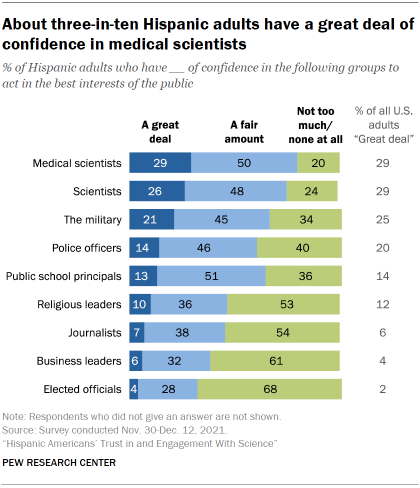
Chart shows about three-in-ten Hispanic adults have a great deal of confidence in medical scientists

Hispanic Americans’ trust in medical scientists and scientists is higher than it is for other groups and institutions, including the military, police officers and K-12 public school principals.

Still, as with the general population, Hispanic Americans’ confidence in medical scientists is down from earlier in the coronavirus pandemic. In April 2020, 45% of Hispanic adults had a great deal of confidence in medical scientists. That figure was 30% in November 2020 and is roughly the same (29%) in the current survey. Similarly, confidence in scientists has also fallen since the early stages of the coronavirus outbreak.

As with views of scientists in the general population, Hispanic adults with a college degree or more education are generally more trusting of medical scientists and scientists than those with less education. Hispanic Democrats tend to hold more trusting views of these groups than do Hispanic Republicans – in line with partisanship patterns seen among all U.S. adults.

Hispanic Americans’ broadly positive views of scientists are consistent with the reliance they report on experts to make sense of news about the coronavirus and COVID-19 vaccines.

Hispanic adults express broad engagement with coronavirus news and information; the survey was fielded in December 2021, amid a surge of coronavirus cases stemming from the omicron variant. About half of Hispanic adults (47%) say they talked about coronavirus-related news nearly every day or a few times a week. Among social media users, 73% of Hispanics report having seen coronavirus content in the past few weeks. These levels of engagement with coronavirus news and information among Hispanic adults are similar to those seen among all U.S. adults.
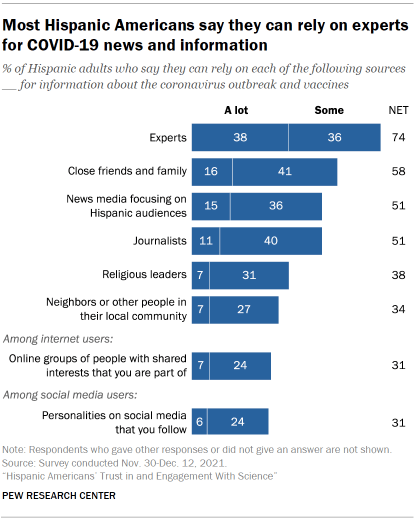
Chart shows most Hispanic Americans say they can rely on experts for COVID-19 news and information

Changes to public health guidance and information about the coronavirus outbreak and vaccines have proven confusing to many Americans. When asked about potential sources of coronavirus information, Hispanic Americans are more likely to say they can rely on information from experts than any of seven other sources considered in the survey.

Roughly three-quarters of Hispanic adults (74%) say they can rely on information from experts in this area either a lot or some; 21% say they can rely on experts not too much or at all.

Close friends and family also play a prominent role when it comes to information about the COVID-19 outbreak and vaccines: 58% of Latinos say they can rely on close friends and family a lot or some.

About half of Latinos say the same about information on this topic from journalists and from news media focused on Latino audiences. Smaller shares say they can rely on other sources for information about the coronavirus outbreak and vaccines, including religious leaders and neighbors.

1. A brief statistical portrait of U.S. Hispanics

The U.S. Hispanic population reached 62.1 million in 2020, accounting for 19% of all Americans and making it the nation’s second largest racial or ethnic group, behind White Americans and ahead of Black Americans, according to the U.S. Census Bureau. It is also one of the fastest growing groups in the U.S. Between 2010 and 2020, the country’s Hispanic population grew 23%, up from 50.5 million in 2010 (the Asian population grew faster over the same decade). Since 1970, when Hispanics made up 5% of the U.S. population and numbered 9.6 million, the Hispanic population has grown more than sixfold.

Chart shows U.S. Hispanic population reached more than 62 million in 2020

Latinos are reshaping national and state-level demographics

With such sizable and rapid growth, U.S. Latinos have shaped the nation’s demographic story for several decades. From 2010 to 2020, they accounted for about half of U.S. population growth, a pattern continued from 2000 to 2010. As a result, the Latino population has grown in just about every corner of the nation. Today, while California, Texas and Florida hold about half of the U.S. Latino population, the fastest growth rates are in states such as North Dakota (up 148% between 2010 and 2020) and South Dakota (up 75% over the same period).

Growing Hispanic populations are also reshaping the demographics of states. In the last decade, Hispanics became the largest racial or ethnic group in California for the first time. California joins New Mexico as the two U.S. states where Hispanics are the largest racial or ethnic group. And the future demographics of many states are poised to be further shaped by Hispanics. In 2000, in eight states, 20% or more of kindergartners were Hispanics. By 2017, that number had grown to 18 states plus the District of Columbia.

The diverse origins of U.S. Hispanics

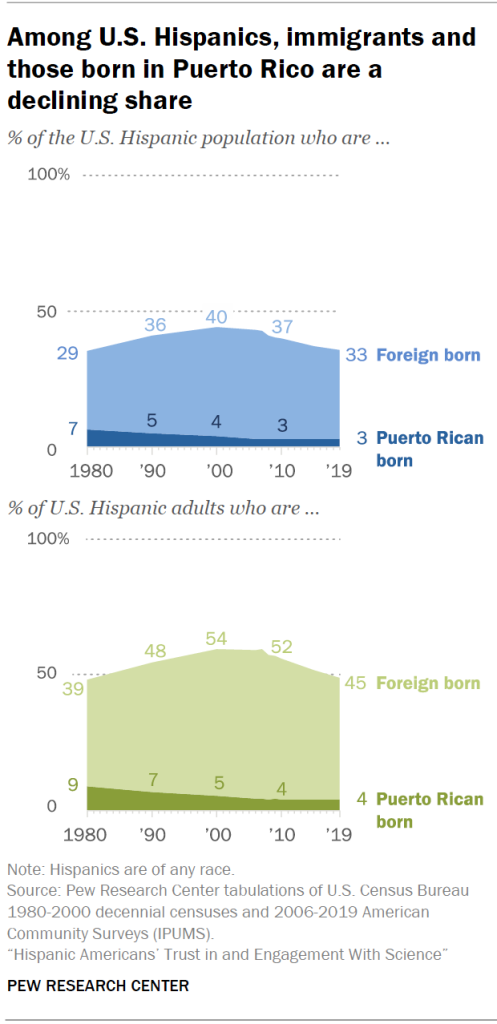
Chart shows among U.S. Hispanics, immigrants and those born in Puerto Rico are a declining share

Hispanics are a diverse group with deep roots in Latin America. In 2019, 61.5% of all Hispanics indicated they were of Mexican origin – either they were born in Mexico or traced their ancestor’s roots to Mexico, according to Center analysis of U.S. Census Bureau data. At 37.2 million people in 2019, this makes the Mexican origin population the largest among U.S. Hispanics.

The next largest group is Latinos of Puerto Rican origin – those born either in Puerto Rico or who trace their family’s roots to Puerto Rico. Puerto Ricans account for 9.7% of the U.S. Latino population. Cubans, Salvadorans, Dominicans, Guatemalans, Colombians and Hondurans all round out the largest groups, each with a population of a million or more in 2019.

At the same time, the origins of Hispanics have been changing. Between 2010 and 2019, the fastest growing origin groups were Venezuelans (up 126%), Guatemalans (up 49%) and Hondurans (up 47%). By comparison, the Mexican population grew just 13% over the same period, and the Ecuadorian population grew the slowest, just 6% between 2010 and 2019.

U.S. born Latinos comprise a majority, immigrants make up a declining share of U.S. Latinos today

In 2019, about 19.8 million, or one-third, of all Latinos living in the U.S. were born outside the country, and an additional 1.9 million, or 3%, were born in Puerto Rico (those born in Puerto Rico are U.S. citizens at birth). Both groups have seen an increase in their population numbers since 2010. The number of Latino immigrants living in the U.S. was up from 19 million in 2010, and the number of Puerto Rican-born Latinos living in the U.S. was up from 1.5 million.

But, the share of U.S. Latinos born in another country peaked at 40% in 2000, and has declined since then, reflecting a slowdown in immigration from Latin America since then. Among Latino adults, the share born in another country stood at 44.8% in 2019, down from a peak of 55% in 2007.

The share of U.S. Latinos who were born in Puerto Rico is falling too, though it has rebounded some with increases in out-migration from the island following Hurricanes Maria and Irma in 2017. In 1960, the Puerto Rican-born share among U.S. Latinos peaked at 11%, but has since settled at around 3% since 2010.

Across Hispanic origin groups, the share born outside the U.S. varies widely. Venezuelans have the highest immigrant share, at 77%, followed by Paraguayans at 65% and Hondurans at 63%. But notably, across all groups except Venezuelans and Spaniards, the immigrant share has been in decline over the last decade as the Hispanic population becomes more settled.

At the same time, the number of Hispanics born in the U.S. has grown. Their share of the Hispanic population has risen too, from 59.9% in 2000 to 67.3% in 2019. This reflects the greater contribution to Hispanic population growth of births in the U.S. to Hispanic parents compared with the arrival of new immigrants, a trend that has become more pronounced in the last decade. Among adult Hispanics, the U.S.-born share increased, from its recent low of 45% in 2007 to 55.2% in 2019.

A growing share of Latinos are English proficient

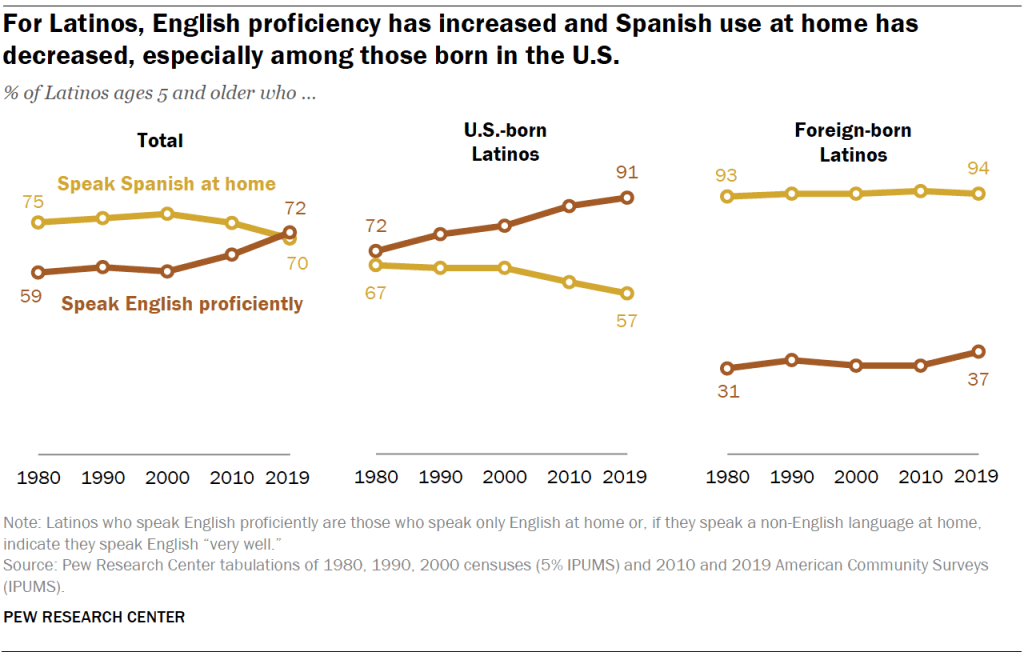
English proficiency is rising among U.S. Latinos. In 2019, the most recent available data from the U.S. Census Bureau, 72% of all Latinos ages 5 and older indicated they spoke English proficiently, up from 59% in 1980. Many of the gains in English proficiency for the group have come since 2000, reflecting the slowdown in Latin American immigration this century. At the same time, the share of Latinos who speak Spanish at home is falling. In 2019, seven-in-ten Latinos ages 5 and older spoke Spanish at home, down from a peak of 78% in 2000.

Changes in language use have been more pronounced among U.S.-born Hispanics. In 2019, 91% spoke English proficiently, up from 72% in 1980. Meanwhile, the share that speak Spanish at home fell, to 57% in 2019 from 67% in 1980. By contrast, changes in language use among Hispanic immigrants is mixed. English proficiency is up: In 2019, 37% spoke English proficiently, a jump from 31% in 1980. At the same time, Spanish use at home remains high: 94% of Hispanic immigrants spoke Spanish at home in 2019, about the same as in 1980.

Chart shows for Latinos, English proficiency has increased and Spanish use at home has decreased, especially among those born in the U.S.

See the Appendix for a profile of Hispanic adults in the survey sample.

‘Hispanic’ or ‘Latino’? It matters to some but about half don’t have a preference

The pan-ethnic labels Hispanic and Latino have been used over recent decades to describe the diverse population of 62.1 million people who trace their roots to Latin America or to Spain. Both labels have a long history in the U.S., and both have official government recognition. Hispanic has been officially in use since the 1970s, with Latino added in the 1990s. Organizations like Pew Research Center use the two terms interchangeably, as is done in this report.

While the two terms have official recognition and are broadly used, the population they are meant to describe is generally ambivalent about the two labels. For example, a 2018 Pew Research Center national, bilingual survey of this population asked which term respondents preferred to describe themselves. Roughly half (54%) indicated they had no preference for either, 27% preferred Hispanic and 18% preferred Latino. These results are little changed from 2002 when 53% indicated no preference, 34% preferred Hispanic and 13% preferred Latino.

Responses from focus group participants about these terms reflect this ambivalence. Some were open to either term, saying:

“I don’t have a preference. I’ve never actually thought of that question, but neither bother me, so I don’t really care.” – Hispanic woman, age 25-39

“I guess I don’t really prefer either. I’m okay with Latino or Hispanic.”– Hispanic man, 25-39

For other focus group participants, however, one label or the other is preferred. Some thought of themselves as Hispanic, saying,

“I consider myself a Hispanic.” – Hispanic woman, 40-65

“… I consider myself Hispanic. Or more Mexicana, because my parents were from Mexico.” – Hispanic woman, 40-65

For others, Latino is preferred:

“And I like to be called ‘Latina!’, with flavor!” – Hispanic woman, 40-65

“Latino, like the South Americans.” – Hispanic man, 40-65

More recently, a new pan-ethnic label has emerged in the U.S. – Latinx. It is a gender-neutral term meant to describe the population of people who trace their roots to Latin America. However, the term is largely unknown among the population it is meant to describe: 76% of Latino adults said they had not heard of Latinx, according to a Pew Research survey in 2019. And among all Latino adults, just 3% indicated they use it to describe their own identity.

2. Hispanic Americans’ experiences with health care

Hispanic Americans face a number of challenges when it comes to access to health care and medical treatments. Overall, Hispanic adults are less likely than other Americans to have health insurance and to receive preventative medical care. Language and cultural barriers, as well as factors such as higher levels of poverty, particularly among recent Hispanic immigrants, are among the social and economic dynamics that contribute to disparate health outcomes for Hispanic Americans. The COVID-19 pandemic is a stark illustration of health disparities: Hispanic Americans are far more likely than White Americans to have been hospitalized or died because of the coronavirus.

Chart shows 53% of Hispanic adults say health risks in jobs are major reason for generally worse health outcomes

The Center survey asked people for their beliefs about the factors behind health disparities for Hispanic people.

Hispanic Americans cite working in occupations with health risks as the top factor for why Hispanic people generally have worse health outcomes than other U.S. adults. Overall, 53% say that working jobs that put them at risk for health problems is a major reason for health disparities among Hispanic people in the U.S.; another 27% say this is a minor reason and 19% say it is not a reason.

About half (48%) say less access to quality medical care where they live is a major reason for worse health outcomes among Hispanic people in the U.S., and 27% say this is a minor reason.

When it comes to navigating the health care system, 44% say that more communication problems from language or cultural differences is a major reason why Hispanic people have generally worse health outcomes than other adults in the U.S.

Preexisting health conditions are also seen as a factor: 40% say a major reason for worse health outcomes is that Hispanic people are more likely to have preexisting conditions.

Hispanic Americans are relatively less likely to see differential treatment as major factors: 30% say health care providers being less likely to give Hispanic people the most advanced medical care is a major reason for health disparities, while 27% say that hospitals and medical centers giving Hispanics’ well-being lower priority is a major reason. Still, for these two items – as for all items included in the list – majorities say each is at least a minor factor for why Hispanic people in the U.S. generally have worse health outcomes than other adults.

In focus group discussions, some participants shared their feelings that doctors may not always offer the best treatment options to Hispanic people. One participant talked about the assumptions health care providers make this way:

“I think a lot of times when they see us coming in or they see that they’re helping us out, they don’t feel like they have to give us the best medicine or they need to give us the best hope because they already feel like we probably come in with bogus insurance, if we even have insurance … So, they give us stuff that’s not as great or they don’t give us all the best information because they feel like we’re poor.” – Hispanic man, age 25-39

There are some differences in views about these factors between Democrats and Republicans. Hispanic Democrats are more likely to consider several of these options as major reasons for health inequities including the types of jobs Hispanic adults hold and limited access to quality medical care in their local community. Still, majorities of Hispanic Republicans see most of these issues as at least a minor reason for worse health outcomes for Hispanic Americans. See the Appendix for details.

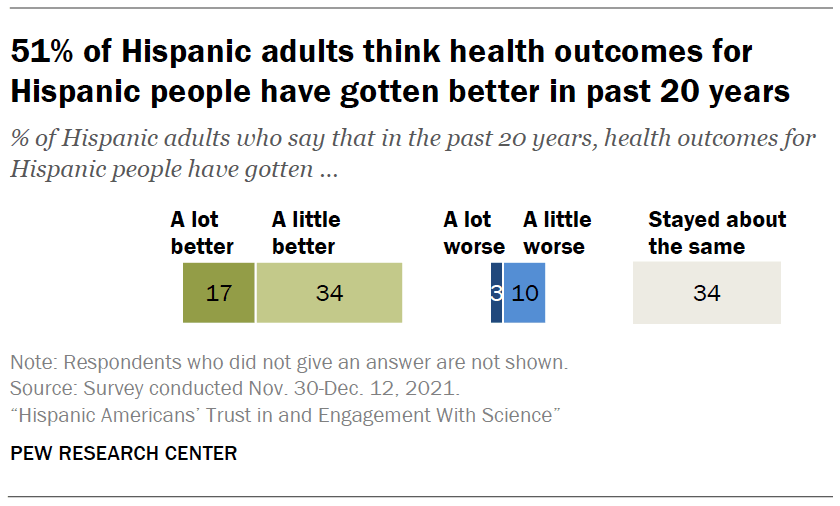
Chart shows 51% of Hispanic adults think health outcomes for Hispanic people have gotten better in past 20 years

Hispanic Americans have mixed views on how much progress has been made in health outcomes for Hispanic people in the last 20 years. About half (51%) say health outcomes for Hispanic people have gotten a lot (17%) or a little (34%) better. However, 34% say they have stayed about the same, and 13% say they have gotten a lot or a little worse.

About half of recent Hispanic immigrants have a primary care provider

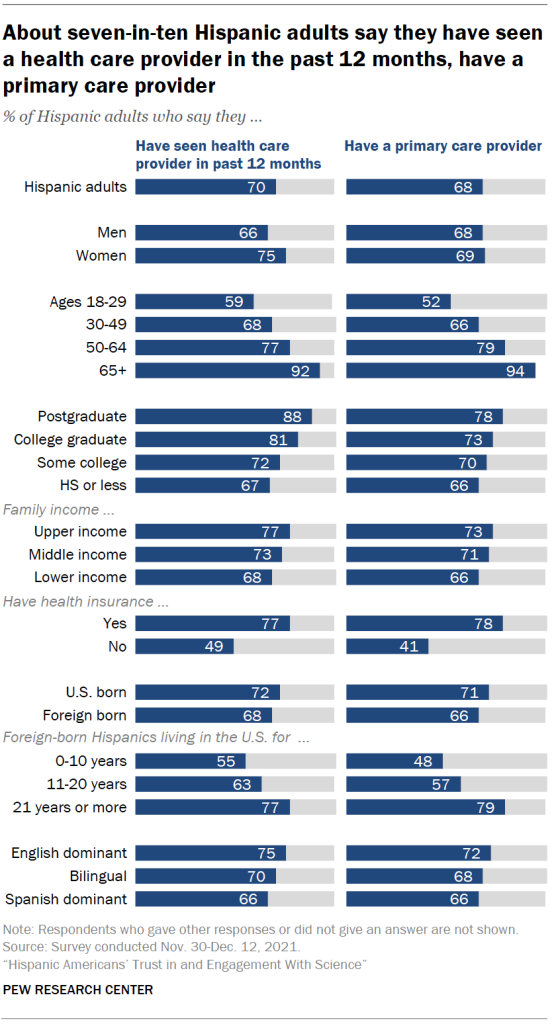
Chart shows about seven-in-ten Hispanic adults say they have seen a health care provider in the past 12 months, have a primary care provider

Regular access to health care is seen as essential for preventative care and treatment for conditions such as diabetes, a disease that Hispanic Americans are more likely to die from than other U.S. adults.

Seven-in-ten Hispanic adults say they have seen a doctor or other health care provider in the past 12 months. About three-in-ten (29%) say they have not done this. Hispanic adults are less likely than all U.S. adults to say they have seen a health care provider within the last year (70% vs. 82%).
Overall, 68% of Latinos say they currently have a person they think of as their primary care provider they usually see when they are sick. A somewhat higher share of all U.S. adults (76%) say they have a primary care provider.

Among Latinos, recent access to health care and having a primary care provider vary greatly by age and health insurance status; and among first-generation Latino immigrants, experiences differ by the number of years spent in the U.S.

A large majority (92%) of Hispanic adults ages 65 and older say they’ve seen a health care provider in the last 12 months. Smaller majorities of younger Hispanic adults – including 59% of those ages 18 to 29 – say they’ve seen a doctor or other health care provider recently.

Hispanics born in the U.S. are slightly more likely than those born in other countries to say they’ve seen a doctor or other health care provider within the last 12 months (72% to 68%).

There are wide differences among Hispanic immigrants: 55% of those who have been living in the U.S. for 10 years or less say they have seen a health care provider in the past year, compared with 63% of those who have been in the U.S. 11 to 20 years and 77% of immigrants who have been in the U.S. more than 20 years.

Hispanic adults with health insurance are 28 percentage points more likely than those without health insurance to say they’ve seen a doctor or other health care provider in the last 12 months (77% vs. 49%). Half of Hispanic adults without health insurance say they have not seen a provider within the last year.

The share of Hispanic Americans who are uninsured has declined over the last decade. According to a KFF analysis of data from the American Community Survey, 20% of Hispanic Americans under age 65 lacked health insurance in 2019. By comparison, in 2010 – before the implementation of the Affordable Care Act – 33% of Hispanic Americans under age 65 did not have health insurance.

Even so, Hispanic Americans remain more likely than other racial and ethnic groups – including White and Black Americans – to be uninsured.

There are similar patterns when it comes to having a primary care provider across these characteristics and experiences. About half (48%) of recent Hispanic immigrants (living in the U.S. 10 years or less) say they have a primary care provider. Those without health insurance (41%) and Hispanic adults under age 30 (52%) are also less likely than other Hispanic Americans to say they have a primary care provider.

Hispanic adults also report communication challenges in health care settings; just under half (46%) say they have a close friend or family member who needs a Spanish-speaking health care provider or translator.

Three-in-ten say they have a close friend or family member who worries about their legal status in the U.S. when thinking about going to see a health care provider. See Appendix for more details on these two questions.

Chart shows Hispanic adults are closely divided over how easy – or difficult – it is to understand process of getting medical care

Hispanic Americans are evenly divided over how easy it is to understand the process for getting medical care: 50% say it’s very or somewhat easy to understand the process for getting medical care at hospitals and medical centers, while about as many (49%) say this process is very or somewhat hard to understand.

Views among Hispanic adults are similar to those of all U.S. adults, 51% of whom say it’s easy to understand the process of getting medical care.

Younger Hispanic adults, ages 18 to 29, are more likely than older adults to say it’s hard to understand the process of getting care.

Those who do not have health insurance are more likely to say the process is hard to understand (55%, compared with 47% of those insured).

Hispanic adults, across family income levels, are roughly divided over whether the process of getting medical care is easy or hard to understand.

Those with a high school diploma or less education are more likely than those with higher levels of education to say it’s easy to understand the process for getting medical care.

Latinos born in the U.S. and those born outside of the U.S. hold roughly the same views on this issue. And those who are Spanish-language dominant are no more likely than others to say the process of getting medical care is hard to understand; in fact, they are more inclined to say it is easy.1

When it comes to cost, half of Latinos say their out-of-pocket expenses for their most recent health care visit was about “what is fair,” 31% say they paid more than what is fair and 15% say their out-of-pocket expenses were less than what is fair. See the Appendix for details.

Hispanic Americans offer broadly positive ratings of the quality of health care they received most recently

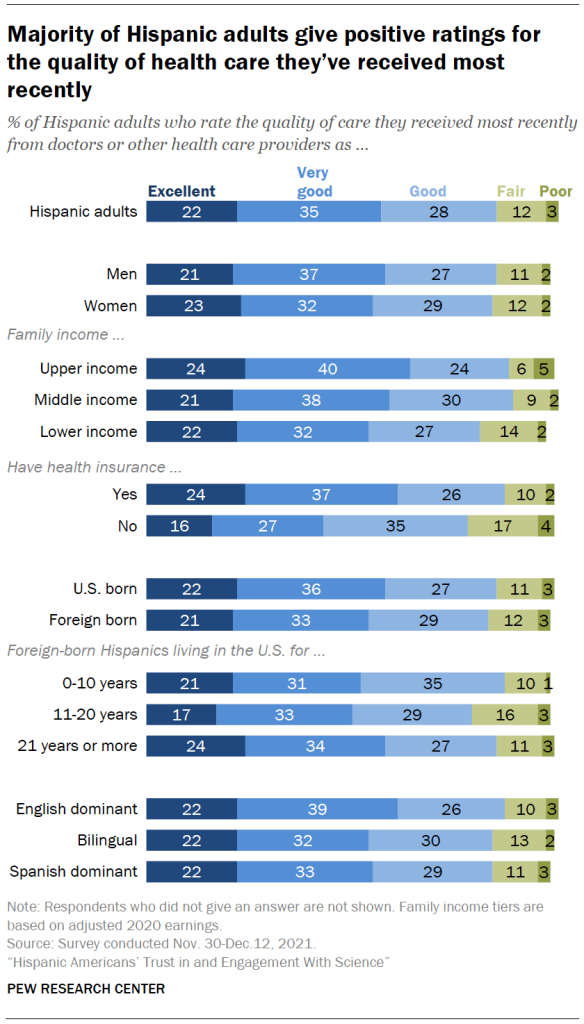
Chart shows majority of Hispanic adults give positive ratings for the quality of health care they’ve received most recently

A majority of Hispanic Americans (56%) say the care they have received most recently from doctors or other health care providers has been excellent or very good; another 28% describe it as good. Fewer (14%) say the recent care they received has been fair or poor.

A 61% majority of Hispanic adults with health insurance say their recent care has been excellent or very good, compared with 43% of those without health insurance.

Those with lower family incomes are somewhat less likely than middle- and upper-income families to report recent positive experiences with health care. Still, 54% of lower-income Hispanics say they received excellent or very good care at their last health care visit.

Roughly half of Hispanic Americans say they have had negative health care experiences, difficulties getting the care they needed in the past

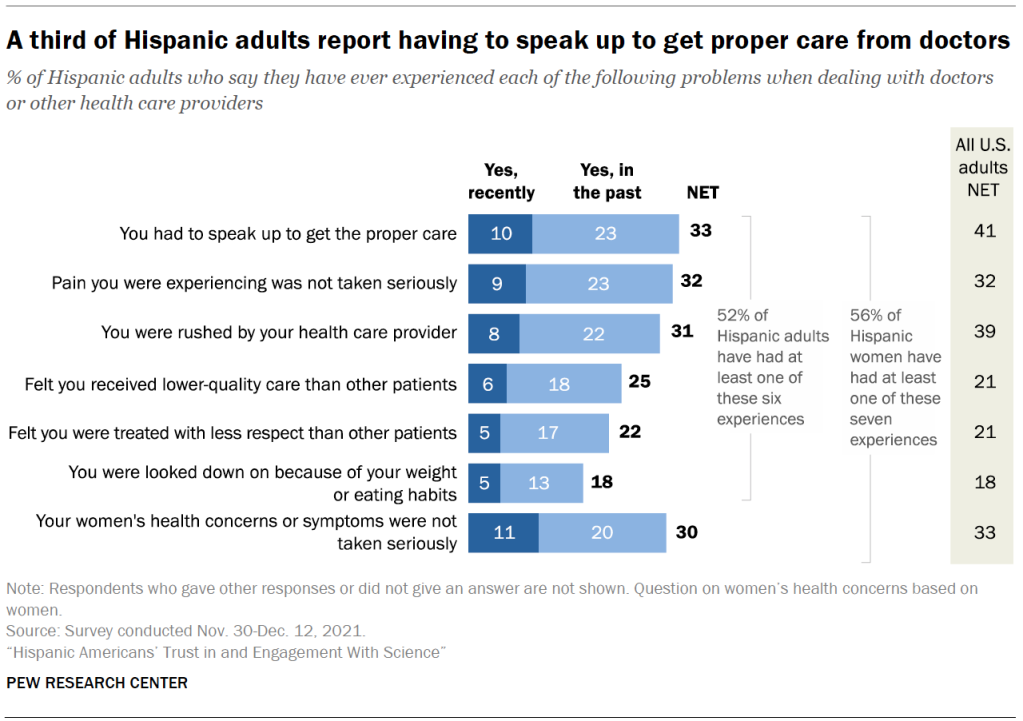
While most Hispanic adults offer positive ratings of the care they’ve received recently, negative experiences with the health care system are also fairly commonplace: 52% say they’ve had at least one of several negative experiences with health care providers at some point in their lives.

A third of Hispanic adults say they’ve had to speak up to get the proper care when dealing with doctors or other health care providers, either recently (10%) or at some point in the past (23%).

Chart shows a third of Hispanic adults report having to speak up to get proper care from doctors

A similar share (32%) say they’ve felt the pain they were experiencing was not being taken seriously in recent or past interactions with health care providers, and 31% say they’ve felt rushed when receiving health care.

A quarter of U.S. Hispanics say they felt they received lower-quality care than other patients either recently or in the past; 74% say this has not happened to them.

When it comes to respect in health care settings, 22% of Hispanic adults say there’s been a time when they felt they were treated with less respect than other patients; 18% say they felt looked down on because of their weight or eating habits.

Among Hispanic women, 30% say their women’s health concerns or symptoms were not taken seriously, either recently or in past interactions with doctors or other health care providers.

Chart shows Black Hispanic adults are more likely to report negative experiences with doctors than White Hispanic adults

Hispanic adults are about as likely as all U.S. adults to report having had these types of negative health care experiences. For example, the same shares of Hispanic adults and all U.S. adults say the pain they were experiencing was not taken seriously by health care providers in either recent or past experiences receiving medical care (32% each). When the six negative experiences asked of both men and women are taken together, Hispanic adults (52%) are slightly less likely than all U.S. adults (58%) to say they’ve had at least one of these negative experiences at some point in the past.

Of the six items asked of both men and women, Latinas are a bit more likely than Latinos to say they had at least one of these negative health care experiences in the past (55% vs. 49%).

Younger Latino adults are more likely than older adults to say they have had at least one of these negative experiences when seeking health care. In particular, younger Latinas are especially likely to report negative health care experiences when compared with both older women and men across age groups. See the Appendix for details.

Hispanic Americans who identify their race as Black (3% of all Hispanic adults) are particularly likely to say they have had trouble getting health care in the past. Among this group, about half (52%) say they have had to speak up to get proper care, compared with roughly three-in-ten among Hispanic adults who identify as White (31%) or as some other race (32%). Across the six questions, 69% of Black Hispanic adults say they have experienced at least one of these difficulties getting appropriate care, compared with about half of other Hispanic adults.

Preference for Spanish-speaking or Hispanic health care providers

Chart shows 58% of Hispanic immigrants say they prefer to see a Spanish-speaking health care provider

About a third of Hispanic adults say they prefer to see a Spanish-speaking doctor or other health care provider, while 51% say it doesn’t make a difference to them and 13% would rather not see a Spanish-speaking provider.

Just 7% of all physicians and surgeons are Hispanic and just 9% of all health care practitioners and technicians are Hispanic, according to Center analysis of federal government data.

About eight-in-ten (81%) Hispanic adults who are Spanish language dominant prefer to see a Spanish-speaking health care provider, underscoring the potential for communication issues in receiving medical care. Much smaller shares of bilingual (27%) or English dominant (5%) Hispanics prefer a Spanish-speaking provider.

Among Hispanic immigrants – about half of whom mostly speak and read in Spanish – 58% say they prefer a Spanish speaking doctor or other health care provider. Preference for a Spanish-speaking health care provider is more widespread among Hispanic immigrants who have been in the country for less than 21 years than among those who have been in the U.S. longer.

Many focus group participants who primarily speak Spanish talked about their preference for a health care provider who could communicate with them in Spanish. One shared,

“It’s easier to explain the discomfort and understand the indications. Although, if you have an interpreter, it is not the same in my opinion … I feel more comfortable when my doctor speaks Spanish.” – Hispanic woman, age 40-65

In focus group conversations, one participant described the challenges of assessing medical information in this way:

“There’s always doubt when you’re receiving information. Especially if you’re first-generation here coming from a different country. You have your reservations. You always want to go back for a second opinion or ask somebody that you know.” – Hispanic man, age 25-39

Chart shows about two-thirds of recent Hispanic immigrants say they prefer to see a Hispanic health care provider

Preferences for seeing a Hispanic health care provider are similar to preferences for a Spanish-speaking provider.

A third of Hispanic adults say they prefer to see a Hispanic health care provider, while 59% say it makes no difference and 7% say they would rather not see a Hispanic provider.

Spanish-dominant Hispanic adults and Hispanic immigrants – especially more recent immigrants – are again among those most likely to say they prefer to see a Hispanic doctor or other health care provider.

One focus group participant explained the reasons he preferred to have a Hispanic health care provider this way:

“And if someone is just like you from the same race, they would probably be more prone to understand and know the illnesses that we deal with because we’re the same. So they might be more able to help you maybe on a more personal kinship level then as somebody who doesn’t understand illnesses or something like Hispanics go through because they’re white or something else.” – Hispanic man, age 25-39

Other participants also felt that a Hispanic health care provider would understand them better than others:

“And I think it is important to me, just the representation of it being a Hispanic doctor … I just feel maybe they’re going to understand me more than me going to another doctor of color.” – Hispanic woman, age 40-65

“It’s important that they know if we have … We’re prone for more diseases based on race and ethnicity, so I want someone to know that for myself and my kids. That, for me, is very important, for sure. If they’re not the same race as I am, then they have to have some sort of understanding cultural-wise or something like that. But I do look for that.” – Hispanic woman, age 25-39

Even so, when asked to consider how Hispanic health care providers compare with others, large majorities of Hispanic Americans say they think a Hispanic doctor or other health care provider is about the same as others at providing them with quality care.

Chart shows majorities of Hispanic adults view a Hispanic doctor as about the same as others at key aspects of care

About eight-in-ten (78%) Hispanic Americans view a Hispanic health care provider as about the same as other providers when it comes to getting the best quality medical care. Of those who see a difference, more say a Hispanic health care provider is better (16%) than worse (3%) than others at providing them with quality care.

Views are similar when it comes to other aspects of care, including being treated with respect, concern for their best interests and taking their medical concerns seriously. Large majorities of Hispanic adults say a Hispanic health care provider is about the same as others in these regards. About two-in-ten say a Hispanic health care provider is better than others in each of these three areas.

A 56% majority of Hispanic Americans say they have seen a health care provider of the same ethnicity in the past. There is hardly any difference in the view that a Hispanic health care provider is better than others at providing key elements of care between those who have seen a Hispanic health care provider in the past and those who have not.

In focus group discussions, some participants said that they did not see a difference in quality of care between Hispanic health care providers and other providers:

“I mean, for me, it doesn’t matter, but if maybe you asked the generation before us, then maybe. Like my parents, I want to think that they would like someone that spoke their language that maybe had some kind of a similar background. I could care less what you look like, my mentality in my life is full of every ethnicity, every gender. I’m very open.” – Hispanic woman, age 25-39

“I don’t feel like the provider has to look like me … The reviews, where you really look into it. To me, that’s not important. If it’s Hispanic, fine, if it’s not, it’s fine as well.” – Hispanic woman, age 40-65

Majorities of Hispanic adults across most demographic groups, language and immigration characteristics view a Hispanic health care provider as about the same as others at providing key aspect of medical care.

Chart shows Spanish-dominant Hispanic Americans are more likely than those who mainly speak English to think Hispanic health care providers are better at key aspects of care

Still, there are some differences in views: Somewhat higher shares of Spanish-dominant than English-dominant Hispanics view a Hispanic health care provider as better than others across key aspects of care.

For instance, 28% of Spanish-dominant Hispanics say a Hispanic health care provider is better than others at taking their symptoms and concerns seriously; English-dominant Hispanics are half as likely to express this view (14%).

Younger Hispanic adults ages 18 to 29 are more likely than older adults to view Hispanic health care providers as better than others at meeting their needs. For instance, 27% of Hispanic adults ages 18 to 29 say a Hispanic health care provider is better than others at treating them with respect. Among older Hispanic adults ages 65 and older, just 11% express this view. Still, the majority across all age groups say that Hispanic health care providers are about the same as others in this regard. See Appendix for details.

3. Hispanic Americans’ trust in medical scientists and views about the potential for researcher misconduct

Hispanic adults have broadly positive views of medical scientists, as well as of scientists generally. Yet their views of medical research scientists – and the work they do – are nuanced, with concerns about misconduct and accountability existing alongside positive views of medical scientists as a group.

A large majority of Hispanic Americans have a great deal or fair amount of confidence in medical scientists to act in the public’s best interest. Ratings of medical scientists are more positive than those for other prominent groups and institutions in society, including public school principals, police officers and religious leaders.

On balance, Hispanic adults think that medical research scientists generally do a good job in their work, care about people’s interests and provide fair and accurate information about their research.

However, concerns about scientific misconduct and accountability also are widely held. A 57% majority of Hispanic adults describe medical research misconduct as a very or moderately big problem – higher than the share of all U.S. adults who say this. And a majority (55%) say serious cases of medical research misconduct are just as likely today as in the past, rejecting the idea that safeguards in place today will prevent serious cases of medical research misconduct.

Views of medical scientists among Hispanic adults vary across characteristics, including partisan affiliation and education. Democrats and Democratic leaning-independents hold more positive views than Republicans and Republican leaners; those with higher levels of education express greater confidence in medical scientists than those with lower levels of education. The relatively small share of Hispanic adults who say they know “a lot” about what medical research scientists do have some of the most positive views of their conduct and research.

Most Hispanic Americans express trusting views of medical scientists, scientists

Hispanic adults express more confidence in medical scientists and scientists to act in the best interests of the public than other major groups and institutions in society.

About eight-in-ten Latino adults say they have at least a fair amount of confidence of medical scientists (79%, including 29% have a great deal of confidence in medical scientists). Three-quarters of Latino adults have at least a fair amount of confidence in scientists, including 26% who have a great deal of confidence. (Half of the survey respondents were asked to rate their confidence in medical scientists, while half were asked about scientists.)

Fewer Hispanic Americans – though still a majority – have at least a fair amount of confidence in the military (65%), public school principals (63%) and police officers (59%).

Slightly fewer than half of Hispanic Americans have at least a fair amount of confidence in religious leaders (46%) and journalists (45%). Smaller minorities have at least a fair amount of confidence in business leaders (38%) and elected officials (31%).

Confidence in medical scientists and scientists has declined in the last two years among Hispanic adults, mirroring a similar trend among the general population. The share of Hispanic adults with a great deal of confidence in medical scientists declined from 45% in April 2020 to 29% in the current survey; the share with a great deal of confidence in scientists declined from 39% to 26%. Confidence in other groups and institutions have also declined in the last two years. For example, 21% of Hispanic adults have a great deal of confidence in the military, down 10 percentage points from April 2020.

Hispanic Democrats have more confidence in medical scientists and scientists to act in the best interests of the public than Hispanic Republicans

Chart shows large partisan differences in confidence in medical scientists among Hispanic adults

As with the general U.S. population, there are sizable differences between political groups when it comes to levels of trust in scientists. Hispanic Democrats are 20 percentage points more likely than Hispanic Republicans to have a great deal of confidence in medical scientists (36% vs. 16%).

Similarly, among Hispanic adults, 31% of Democrats have a great deal of confidence in scientists, compared with 19% of Republicans.

For both medical scientists and scientists, Hispanic adults with no college experience are less likely than college graduates to say they have a great deal of confidence in these groups to act in the best interests of the public.

Hispanic Americans see medical researchers’ competence in a largely positive light

The Center survey asked respondents to rate their levels of trust in medical research scientists across multiple dimensions in order to gain a better understanding of people’s trust in them.

Among Hispanic adults, 38% say they are confident that medical researchers do a good job all or most of the time, 40% say they do so some of the time and another 19% rate medical researchers as competent only a little or none of the time.

Chart shows Hispanic adults are largely positive in rating medical researchers’ competence

Smaller shares of Hispanic adults say that medical researchers care about people’s best interests or provide fair and accurate information all or most of the time; still, majorities rate medical researchers more positively than negatively in these regards.

Hispanic Americans’ trust in medical researchers on these dimensions of behavior are roughly the same as when last assessed in 2019. Views among the overall U.S. population about medical researchers are broadly similar.

Hispanic Americans are less trusting of medical researchers when it comes to questions of scientific integrity. As with all U.S. adults, small shares of Hispanic adults say that medical researchers are transparent about potential conflicts of interest with industry (16%) or admit and take responsibility for their mistakes when they happen (14%) all or most of the time. Should medical researchers be involved in research misconduct, few believe scientific institutions would hold them accountable; just 14% of Hispanic Americans say such researchers would face serious consequences for their misdeeds all or most of the time.

Public trust in medical research scientists varies by how familiar people are with what such scientists do. The Center survey provided survey respondents a brief description, stating: “Medical research scientists conduct research to investigate human diseases, and test methods to prevent and treat them.”

Chart shows Hispanic Americans most familiar with what medical researchers do see them in a more positive light

About one-in-ten (11%) Hispanic adults say they know a lot about what medical research scientists do, 54% know a little and about a third (34%) report knowing nothing at all.

Among the smaller share of Hispanic Americans who know a lot about what medical researchers do, trust in them is higher. For instance, about half of this group say that medical researchers care about people’s best interests all or most of the time. Trust in medical researchers’ caring for others is lower among those who are less familiar with the work of medical researchers.

There are also some differences by gender. Latinos tend to express greater trust in medical researchers than Latinas when it comes to their competence, caring and trustworthiness of information. Similarly, Latinos are more inclined than Latinas to think that medical researchers can be trusted to admit and take responsibility for their mistakes when they occur.

As with overall trust in medical scientists, Hispanic Democrats are more trusting of medical researchers’ competence, caring, trustworthiness of information and scientific integrity than Hispanic Republicans. There are no more than modest differences in levels of trust in medical researchers across these dimensions by nativity. See the Appendix for details.

A majority of Hispanic Americans, especially first-generation immigrants, see medical research misconduct as a problem

Chart shows 57% of Hispanic adults say that medical research misconduct is at least a moderately big problem

A majority (57%) of Hispanic adults say that medical research misconduct is at least a moderately big problem, with 20% saying it is a very big problem. A similar share of Hispanic adults (60%) saw medical research misconduct as at least a moderately big problem when last asked in 2019.

Hispanic adults are more likely than the general population to consider medical research misconduct at least a moderately big problem (57% vs. 48%), a pattern also seen in 2019.

Black Americans are also more likely than the general population to consider medical research misconduct a very or moderately big problem (55%). For more on Black Americans’ views about medical research misconduct, see “Black Americans’ Views of Engagement with Science.”

Concern about medical research misconduct is higher among first-generation immigrants, meaning foreign-born Latinos, compared with those born in the U.S., who are at least second-generation immigrants (62% vs 52%).

Chart shows foreign-born Hispanic Americans are especially likely to see medical research misconduct as a problem

Similarly, Hispanic adults who primarily speak Spanish (64%) are most likely to be concerned about misconduct by medical researchers, followed by bilingual (58%) and primarily English-speaking Hispanic adults (52%).

Those with lower incomes and less education also tend to express more concern about medical research misconduct.

Hispanic Americans’ awareness of past research misconduct is higher among those who identify as Black

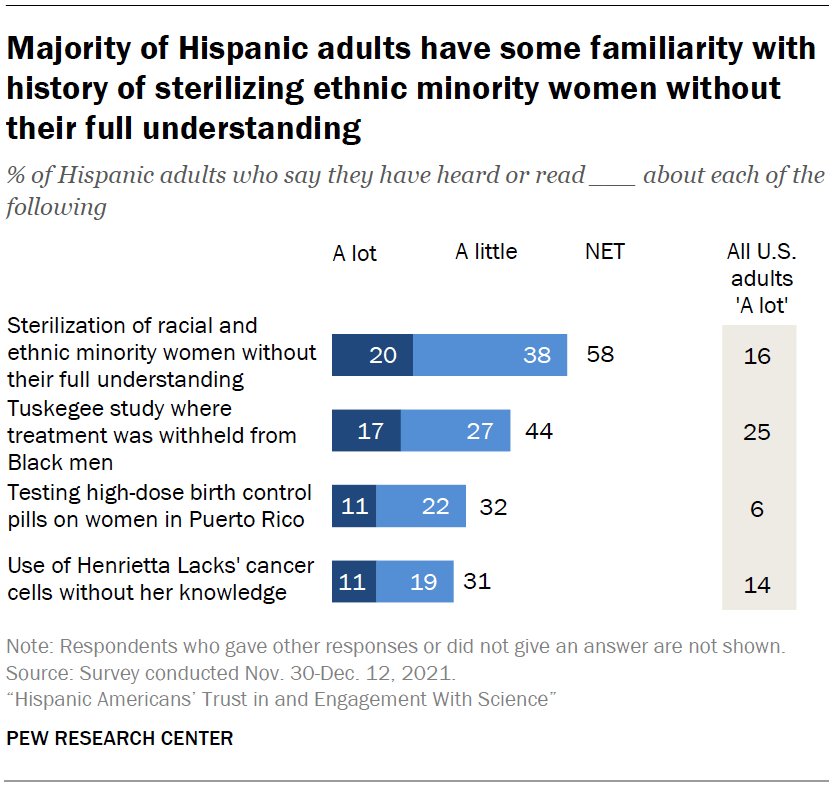
Chart shows majority of Hispanic adults have some familiarity with history of sterilizing ethnic minority women without their full understanding

The Center survey asked respondents how much they had heard or read about a handful of past instances that involved racial and ethnic minority groups and raised ethical questions or were later found to violate ethical codes of conduct.

Hispanic Americans’ awareness of such cases was highest for medical doctors who sterilized racial and ethnic minority women without their full understanding. A majority of Hispanic adults (58%) say they had heard or read at least a little about this. Awareness about the misuse of sterilization procedures is roughly similar among the general U.S. population.

Fewer than half of Latinos (44%) say they have heard at least a little about the U.S. Public Health Service Syphilis Study at Tuskegee, commonly known as the Tuskegee syphilis study, in which syphilis treatment was withheld from Black men in the study, resulting in preventable deaths and a worsening of symptoms among study participants.

A relatively small share of Hispanic adults (3%) identify their race as Black. Among Hispanic adults who identify as Black, 61% say they’ve heard a lot or a little about the Tuskegee syphilis study, compared with fewer (42%) White Hispanic adults. Larger shares of Black than White Hispanic adults are familiar with all four cases of misconduct or alleged misconduct asked about on the survey.

One focus group participant talked about his wariness of medical research, saying,

“They used to do experiments on African Americans and minorities that were illegal experiments on us. That they told us it was supposed to lead to this outcome, but it ended up leaving us with life-threatening sicknesses. It was killing us all and they tricked us. So when you think about that, they did that to both Hispanics and African Americans. So when you know your history, that’s why it’s important to know history, you know your history, you’re not a fool and just signing up and taking and letting people put these different shots and stuff inside your body, on your will. When they’ve done stuff like this in the past and what it did to us.” – Black Hispanic man, age 25-39

About a third of Hispanic Americans (32%) say they are familiar with medical testing done in Puerto Rico using high-dose birth control pills without a full explanation of the study and its risks, which included long-term effects on fertility. Foreign-born Hispanic adults were more likely to have heard about this than U.S.-born Hispanic adults (37% to 28%). (There are not enough survey respondents in the Puerto Rican diaspora for separate analysis.)

Chart shows those who identify as Black Hispanic are especially aware of these cases of misconduct

About three-in-ten Latinos (31%) say they know at least a little about the case of Henrietta Lacks, a Black woman whose cancer cells were used by medical researchers without her or her family’s knowledge or consent.

College-educated Latinos are generally more aware of these cases than those with some college or less education. Educational differences are particularly wide for awareness of the Tuskegee syphilis study: 73% of Latino postgraduates have heard at least a little about this case of misconduct, compared with 37% of those with a high school or less education. See the Appendix for details.

Overall, Latino Americans are less likely than Black Americans to have heard or read at least a little about the Tuskegee study (44% vs. 75%), the use of Henrietta Lacks’ cancer cells for research without her knowledge (31% vs. 48%) and the sterilization of ethnic minority women without their full understanding (58% vs. 68%). However, they are equally likely to have heard at least a little about the testing of high-dose birth control pills on women in Puerto Rico. For more on Black Americans’ views on science, including cases of medical misconduct, see “Black Americans’ Views of and Engagement With Science”.

Over half of Hispanic adults say research misconduct is just as likely today as in the past

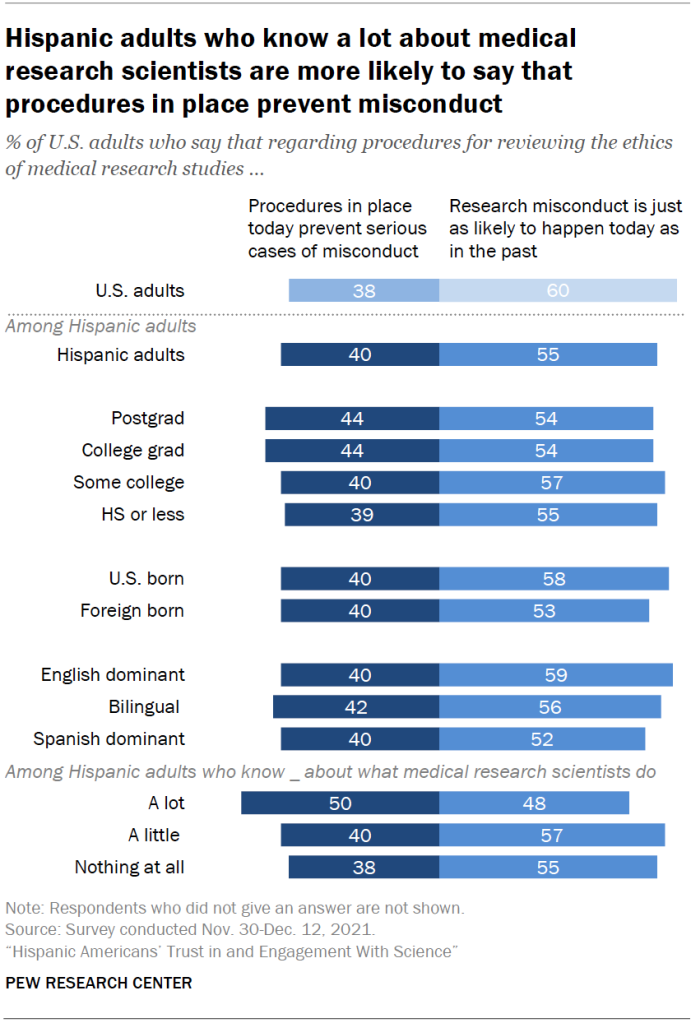
Chart shows Hispanic adults who know a lot about medical research scientists are more likely to say that procedures in place prevent misconduct

In 1979, the federal government instituted a code of ethics and regulations for research conducted by the government or by organizations that receive federal funding; it was intended to prevent serious cases of misconduct, such as the Tuskegee syphilis study, from recurring.

The Center survey asked respondents for their overall judgments. Fewer than half of Hispanic Americans (40%) say that procedures in place today will prevent serious cases of medical research misconduct; a 55% majority say, instead, that research misconduct is just as likely to happen today as in the past.

The majority view is shared widely among Hispanic Americans across gender, age, education, political party and nativity.

Among the overall U.S. population, a slightly larger share (60%) say that research misconduct is just as likely to happen today as in the past.

4. High engagement with COVID-19 news among Hispanic adults

The coronavirus outbreak and the development of COVID-19 vaccines have placed science news in the spotlight. Hispanic Americans report broad engagement with coronavirus news and information and smaller shares have engaged with science news generally.

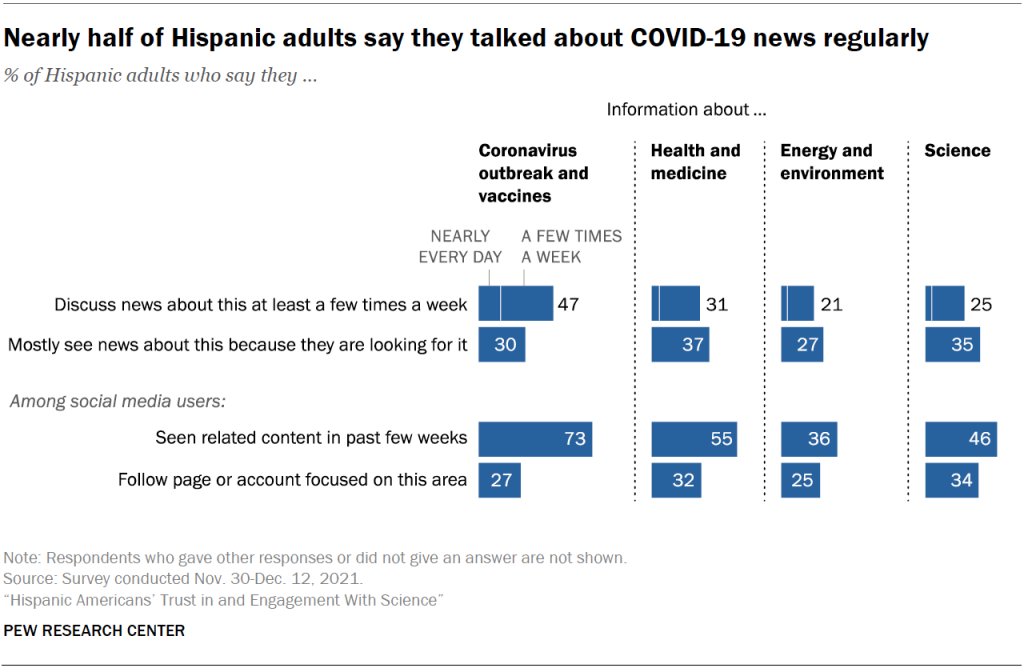
Nearly half of Hispanic adults (47%) say, when the survey was fielded in December 2021, they were talking about the coronavirus outbreak and vaccines nearly every day or a few times a week; another 25% say they were talking about it at least a few times a month. Nearly three-quarters of Hispanic social media users (73%) reported having seen content about the outbreak in recent weeks. Engagement with coronavirus news and information on these measures is roughly on par with levels of engagement among all U.S. adults.

When it comes to who Hispanic Americans feel they can turn to for coronavirus information, a large majority (74%) say they can rely a lot or some on information from experts about the outbreak and vaccines. The survey also highlights the important role friends and family play: 58% of Hispanic adults say they can rely at least some on close friends and family for information about the coronavirus outbreak and vaccines.

There are differences among Hispanic adults by partisanship when it comes to news and information about the coronavirus outbreak. Republican and Republican-leaning Hispanic adults are much less likely than Democrats and Democratic leaners to say they can rely on experts for coronavirus information.

In assessing information about the coronavirus outbreak, the most widely held reaction by Hispanic adults – expressed by majorities of both Republicans and Democrats – is having felt frustrated that there is so much political disagreement in this area. The challenge of interpreting coronavirus news and information is also apparent: Majorities of Hispanic adults report having felt reassured that understanding in this area is always being updated and report having found it difficult to know what to think because there is so much conflicting information.

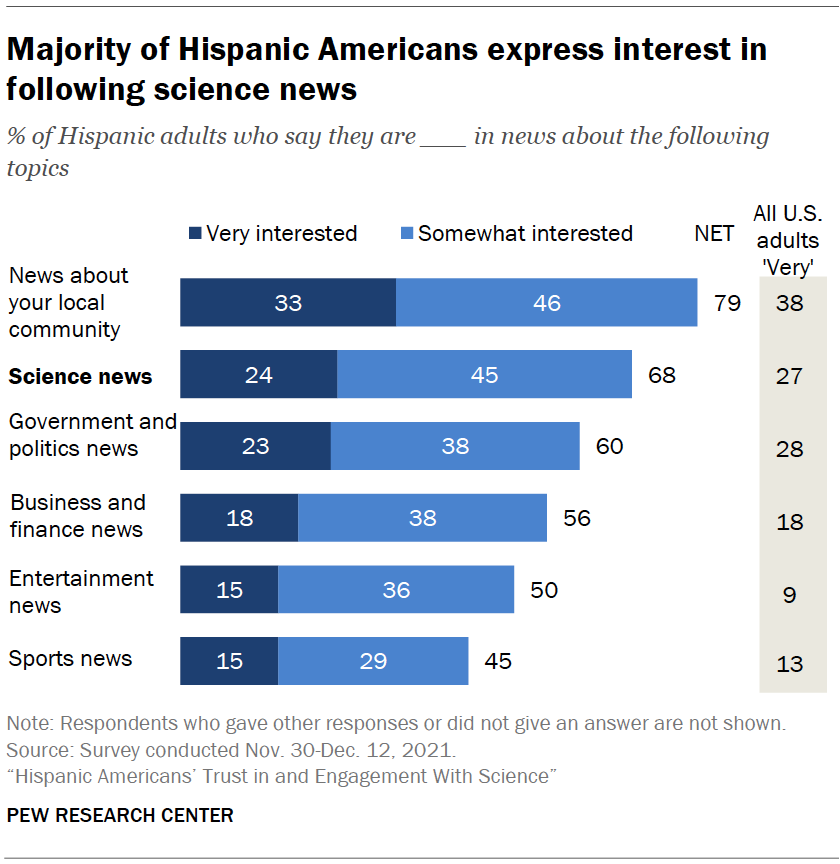
When it comes to science news generally, 24% of Hispanic adults say they are very interested in following news about science. Interest in science news is especially strong among Hispanic adults with a postgraduate degree and those with higher family incomes.

Nearly three-quarters of Hispanic adults on social media have seen COVID-19-related content there

Among Hispanic Americans, about half (47%) say they discussed news about the coronavirus outbreak and vaccines nearly every day or a few times a week in December 2021, when the survey was fielded. A quarter say they talked about the outbreak a few times a month and the same share (25%) say they talked about it less often than that. Hispanic adults were about as likely as all U.S. adults to say they were talking about the coronavirus outbreak and vaccines late last year.

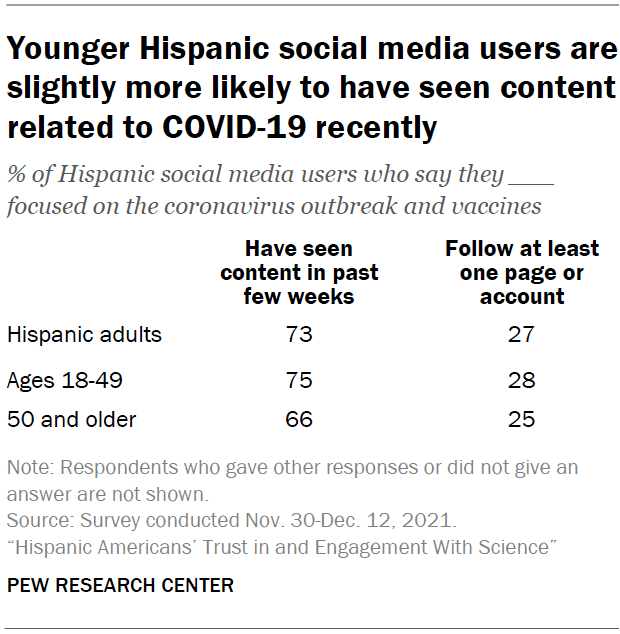
Among Hispanic social media users, a majority (73%) report seeing content related to the coronavirus outbreak and vaccines on social media within the past few weeks. This is about the same as the 68% of all U.S. adult social media users who say they have seen this type of content recently. About a quarter (27%) of Hispanic social media users say they follow a page or account that focuses on information about the coronavirus outbreak.

Chart shows nearly half of Hispanic adults say they talked about COVID-19 news regularly

Younger Hispanic social media users ages 18 to 49 are more likely to have seen content related to the coronavirus outbreak and vaccines on social media than older users ages 50 and older (75% vs. 66%). However, similar shares of Hispanic social media users across age groups report following a page or account focused on coronavirus content.

Chart shows younger Hispanic social media users are slightly more likely to have seen content related to COVID-19 recently

When it comes to news about the coronavirus outbreak and vaccines, Hispanic adults are much more likely to say they primarily see this type of news because they happen to come across it (69%) rather than to say that they are actively seeking it out (30%).

COVID-19 news often highlighted the direct relevance of science information for people’s lives. One focus group participant explained his reasons for paying attention to news about the coronavirus outbreak and vaccines as follows:

“It’s very important for my health because of my family and those around me. For example, I heard that Pfizer wanted to apply a third dose, you have to be vigilant because if you have that and there is a third vaccine you have to be aware of that.” – Hispanic man, age 40-65

By comparison, Hispanic adults report discussing other science-related topics much less often than the coronavirus outbreak. Overall, 31% say they discussed news about health and medicine at least a few times a week, while 25% say this about science topics generally and 21% say this about energy and environment news.

The share of Hispanic adults who report talking about science news at least a few times a week is slightly higher than in a 2017 Center survey (25% vs. 20%). However, the share of Hispanic social media users saying they follow a page or account related to science is about the same as it was in 2017 (34% vs. 31%). The share of Hispanic adults who report being very interested in science news is also about the same as it was in 2017 (24% vs. 26%).

Majorities of Hispanic Americans say they can rely at least some on experts along with close family and friends for COVID-19 information

When asked about which sources they can rely on for information about the coronavirus outbreak, experts top the list of sources for Hispanic Americans, followed by close friends and family.

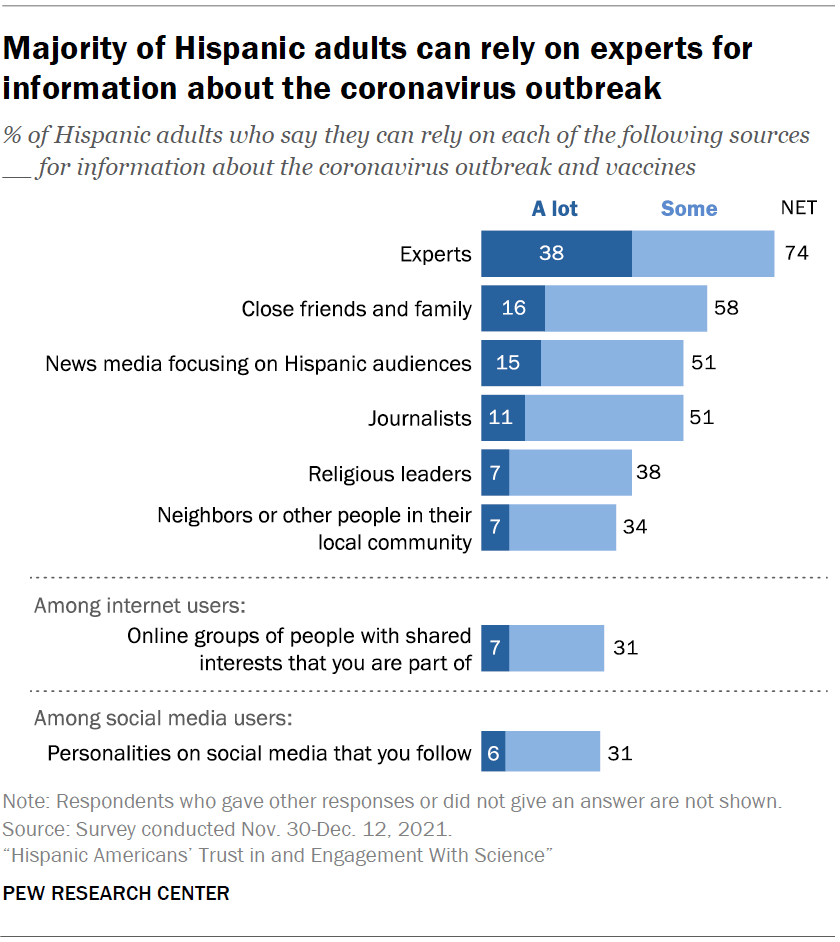
Chart shows majority of Hispanic adults can rely on experts for information about the coronavirus outbreak

A majority (74%) of Hispanic adults say they can rely either a lot or some on information from experts about the coronavirus and vaccines.

More than half (58%) say they can rely on close friends and family for this type of information. The shares of Hispanic adults who rely on experts and on friends and family for information about the coronavirus and vaccines are similar to those among all U.S. adults.

Overall, 51% of Hispanic adults say they can rely on journalists a lot or some for coronavirus information; the same share (51%) say they can turn to news media that focuses specifically on Hispanic audiences.

Fewer say they can rely at least some on religious leaders (38%) and neighbors or people in their local community (34%) for information about the coronavirus outbreak and vaccines.

Among Hispanic internet users, 31% say they can rely a lot or some on online interest groups they are a part of for coronavirus information. Among Hispanic social media users, 31% say they can rely at least some on personalities on social media that they follow for news about the outbreak and vaccines.

Chart shows Hispanic Democrats more likely than those in GOP to feel they can rely on experts for coronavirus information

There are significant differences by partisan affiliation when it comes to people’s sense that they can rely on experts for coronavirus news and information. Hispanic adults who identify with or lean toward the Democratic Party are much more likely to say they can rely at least some on experts than are Hispanics who identify with or lean toward the Republican Party (82% to 59%). This gap mirrors the one seen among all U.S. adults.

Across levels of educational attainment, a larger majority of Hispanic adults with a college degree or more (82%) than those who have not completed college (72%) say they can rely at least some on experts for information about the coronavirus outbreak and vaccines.

Foreign-born Hispanic adults are somewhat more likely than those born in the U.S. to say they can rely on experts for coronavirus information (80% to 68%).

Hispanic Americans report a mix of reactions to COVID-19 news

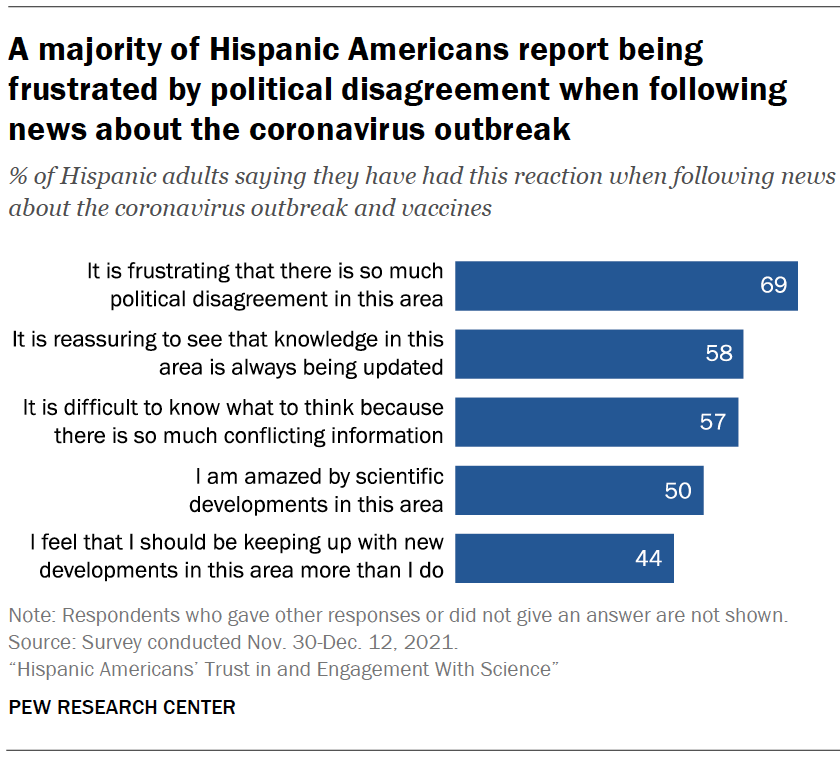
In following information about the coronavirus outbreak and vaccines, 69% of Hispanic adults say they have felt frustrated that there is so much political disagreement in this area.

Chart shows a majority of Hispanic Americans report being frustrated by political disagreement when following news about the coronavirus outbreak

Hispanic adults report a mix of other reactions to coronavirus news, ranging from reassurance to difficulty making sense of conflicting information.

About six-in-ten Latinos (58%) say it is reassuring to see that knowledge about the outbreak and vaccines is always being updated. Yet about the same percentage (57%) say they’ve felt that it is difficult to know what to think about the coronavirus outbreak and vaccines because there is so much conflicting information.

These mixed sentiments are shared among the entire U.S. adult population: 56% say that it is reassuring to see knowledge being updated, while 62% say it’s difficult to know what to think because of so much conflicting information.

Half of Latinos say information about the coronavirus outbreak and vaccines has made them feel amazed by scientific developments in this area; 44% say they’ve felt that they should be doing more to keep up with new developments around coronavirus news. Hispanic adults are more likely than all U.S. adults to say they’ve felt like they should be doing more to keep up with coronavirus information (44% vs. 33%).

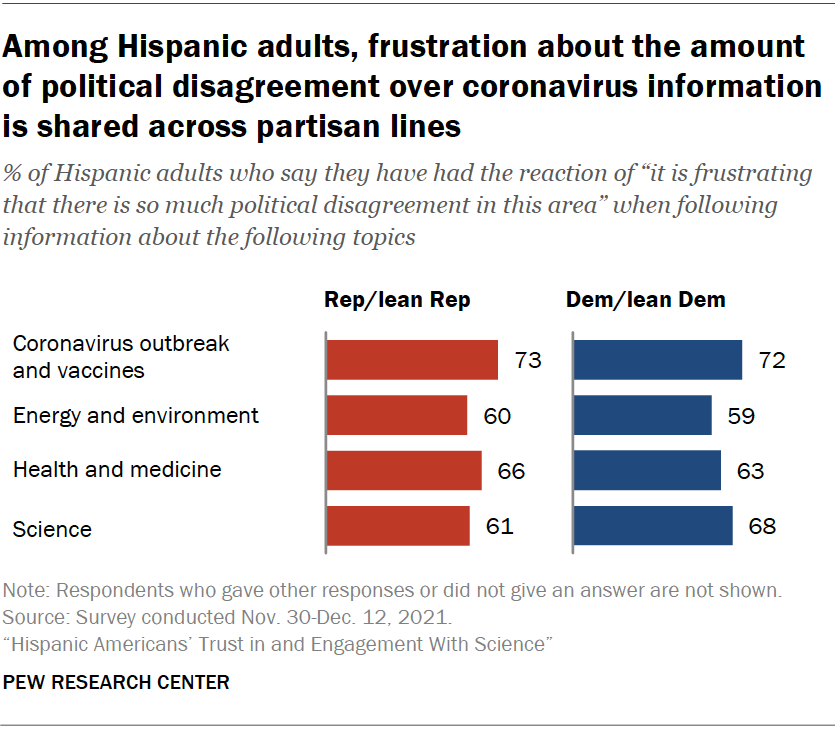
The sense of frustration about political disagreement over coronavirus news and information is shared by both Hispanic Democrats and Republicans. Among Hispanic Republicans and Republican leaners, 73% say it’s frustrating that there is so much political disagreement in this area; about as many Hispanic Democrats and Democratic leaners say the same (72%).

Chart shows among Hispanic adults, frustration about the amount of political disagreement over coronavirus information is shared across partisan lines

Majorities of Hispanic adults also say it’s frustrating to see so much political disagreement in the other science-related topics covered in the survey: 63% say this about science information generally, while the same share (63%) says this about health and medical information and 57% say this about information regarding energy and the environment.

The sense of frustration about political disagreement in science topic areas is generally shared by Hispanics who align with each of the major parties in the U.S.

A majority of Hispanic adults heard about community events related to COVID-19 over past year

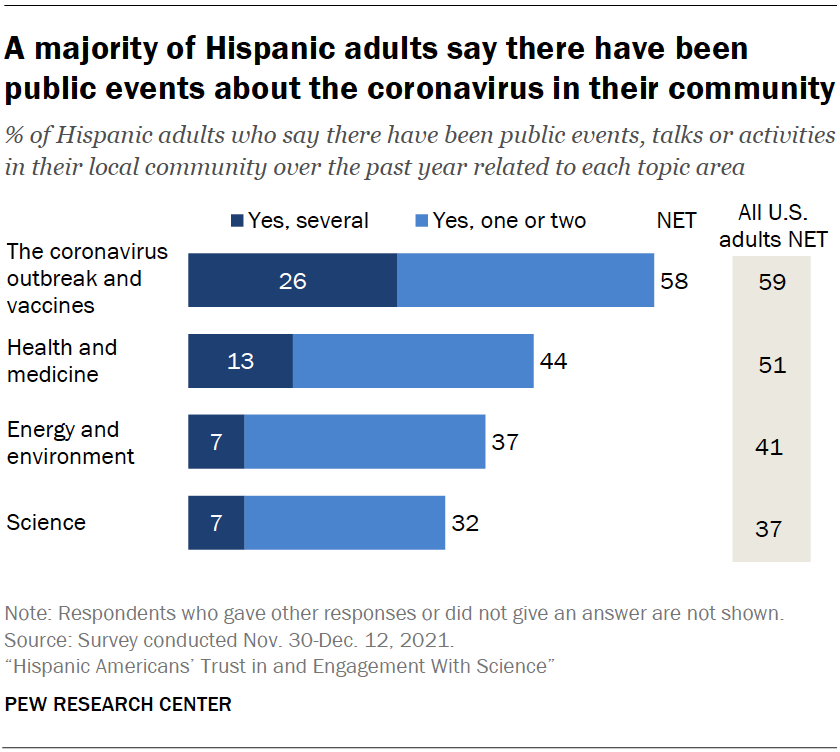
Chart shows a majority of Hispanic adults say there have been public events about the coronavirus in their community

A majority (58%) of Hispanic adults say that there has been at least one public event related to the coronavirus outbreak and vaccines in their local community over the past year. A similar share of all U.S. adults (59%) say there have been events related to the coronavirus outbreak and vaccines in their local community.

Compared to coronavirus-related events, Hispanic adults are less likely to say there have been public events, talks or activities related to health and medicine (44%) or energy and the environment (37%).

Only about a third of Hispanic adults (32%) say there have been public activities or events about science generally in their local community over the past year.

In Their Own Words: Recommendations for Increasing Engagement in Hispanic American Communities

Focus group participants had a range of advice for those wanting to increase science engagement among Hispanic Americans. Many talked about the need to integrate science into family and community life and encouraged those in the science community to start a dialogue, to show their interest in Hispanic communities and to show their trustworthiness.

“I think there needs to be a more open dialogue, I think just between people who are part of that community, whether they’re part of the Hispanic community or whether they’re part of the science or medicine field, about really what intentions are for people of your community and what we’re trying to do just to help you … There should just be more of an open, honest dialogue between the communities.” – Latina, age 25-39

“And then having a person who’s bilingual instead of having an interpreter is easier, and it creates more comfort. And they’re more likely to show up if they know. Or maybe if that person talks to another important community leader in that town, then that leader could kind of spread the word and bring more people in. You could also talk to a lot at churches and have a talk after meetings or after their service, or have a date there and then tell the priest, “Hey invite them or come talk to them.“” – Latina, age 25-39

“I think our leaders from our community should go be out there. In the Hispanic community, more Hispanic leaders to go out and educate and communicate. And make them feel safe. Hey, it’s okay. If you need something, we’re here. We’re not here because of this, we’re here for this. But education and leadership to be out there.” – Latina, age 40-65

Several participants talked about the importance of representation to build trust and interest in science over the lifespan.

“More of us. We need to see more of our people.” – Latino, age 25-39“Just that, incorporate more Latino people in it, starting with school, involve kids in technology and science, and develop more projects about strategies, those type of things, for the kids to get more interested and see it more like a game and therefore begin to have a love for science.” – Latina, age 40-65

Interest in following science news ranks high compared with other news topics; 24%of Hispanic Americans are very interested in science news

Chart shows majority of Hispanic Americans express interest in following science news

Nearly seven-in-ten Hispanic adults say they are either very (24%) or somewhat (45%) interested in following science news. Interest in science news ranks high on a list of topics included in the survey, trailing only interest in local community news (79% very or somewhat interested).

A larger share of Hispanic adults say they are at least somewhat interested in science news than say this about government and politics news (60%) and business and finance news (56%), as well as news about entertainment and sports.

A 2017 survey found a roughly similar share of Hispanic Americans expressing interest in science news; 26% said they were very interested in following science news.

Chart shows Hispanic adults with higher levels of education report greater interest in science news

Hispanic adults with higher levels of education express greater interest in science news than those with lower levels of education. For instance, 41% of those with a postgraduate degree say they are very interested in science news, compared with 21% of those with a high school diploma or less education.

A somewhat larger share of Hispanic men than women say they are very interested in following science news (28% to 20%). These same patterns by education and gender in science news interest are also seen among all U.S. adults.

Hispanic adults who say they had a Hispanic science, technology, engineering or math teacher in high school are 7 percentage points more likely than those who did not to say they are very interested in science news (28% t0 21%). The survey design cannot speak to whether having a Hispanic STEM teacher plays a causal role in Hispanic adults’ interest in science news.

5. Many Hispanic Americans see more representation, visibility as helpful for increasing diversity in science

An important throughline in the Pew Research Center survey findings is the importance of representation and visibility for Hispanic Americans in science and allied fields.

At a big-picture level, many Hispanic Americans report that scientists as a group have limited openness to Hispanic people in the profession. Roughly a quarter of Hispanic Americans consider scientists as a group to be very welcoming to fellow Hispanic professionals in these roles. Similarly, fewer than half of Hispanic Americans consider science an area where Hispanic Americans have reached the highest levels of professional achievement. Ratings of scientists on each of these two metrics rank toward the bottom of a list of eight other professional groups.

There has been a rise in the share of Hispanic students attending and graduating from college as well as a rise in the share of Hispanic students earning a bachelor’s degree in a STEM field (up from 8% in 2010 to 12% in 2018, according to Center analysis of U.S. Department of Education data). Even so, Hispanic students remain underrepresented in STEM degree programs, relative to all college graduates.

Asked to think about several possible ways to increase the number of young Hispanic people who pursue college degrees in STEM fields, most Hispanic Americans endorse the idea that more high achievers in STEM who are Hispanic would serve as a catalyst for more young Hispanic people to follow in their footsteps.

Among Hispanic college graduates working in a STEM occupation – a group likely to have completed high-level classes in STEM subjects – many recall a mix of positive and negative experiences in the classroom. Most say they had at least one of three positive experiences in their most recent STEM schooling, such as being encouraged to pursue more classes in these fields – as do most college-educated STEM workers in the general population. But a larger share of Hispanic college graduates working in STEM than in the general population of STEM workers say they experienced some form of mistreatment in their STEM schooling including being treated as if they couldn’t understand the subject matter, made to feel like they don’t belong or receiving repeated negative comments about their race.

Hispanic college graduates working in STEM include both U.S.-born and foreign-born Hispanic adults, some of whom may have completed STEM schooling in a foreign country. However, among college-educated Hispanic adults, there are hardly any differences between those born in the U.S. and those born in another country when it comes to the shares who have experienced these positive or negative STEM schooling experiences.

Fewer than half of Hispanic Americans see scientists as very welcoming to Hispanic professionals

Hispanic Americans continue to be underrepresented in the STEM workforce. According to Pew Research Center analysis of federal government data, Hispanic workers make up 17% of total employment across all occupations, but just 8% of all STEM workers. Hispanic workers are underrepresented across all STEM job types, including health-related jobs, life sciences, math, physical sciences, computer and engineering jobs.

About a quarter of Hispanic adults say scientists are very welcoming of Hispanic people in these jobs

Perceptions of STEM professions could play a role in these patterns. The Center survey asked Hispanic adults for their perceptions of scientists, engineers and a range of other professional groups.

When it comes to perceptions of openness to Hispanic professionals, scientists are rated near the bottom of the nine groups considered in the survey.

Professional musicians followed by professional athletes are seen as the most open; about four-in-ten or more Hispanic Americans rate each of these groups as very welcoming to Hispanic professionals in these roles.

About a third of Hispanic adults say medical doctors are very welcoming to Hispanic professionals (34%), while 44% say medical doctors are somewhat welcoming and two-in-ten consider medical doctors to be not too or not at all welcoming to Hispanic professionals in medicine.

Three-in-ten Hispanic Americans say that engineers, as a group, are very welcoming; 26% of Hispanic adults say scientists are very welcoming to Hispanic professionals in these occupations.

Business executives are rated the lowest of the nine professional groups: 20% of Hispanic Americans say business executives are very welcoming to Hispanic professionals in these positions, 42% say business executives are somewhat welcoming and 35% say business executives are not too or not at all welcoming to Hispanic people in these jobs.

Chart shows Hispanic Americans less likely to see Hispanic achievement in science relative to other professions

Hispanic Americans hold roughly similar views of the openness of these three STEM professional groups to Hispanic professionals – scientists, engineers and medical doctors – across education, age and nativity. See Appendix for details.

The survey also asked whether or not people saw prominent achievement for Hispanic people across a range of professional groups. (Half of the survey respondents rated how welcoming each professional group is and half rated whether or not Hispanic people have reached the highest levels of success in each professional group.)

Here, too, the professions seen as most open to Hispanic people include professional musicians and professional athletes, while scientists rank at the bottom of the list.

About seven-in-ten (72%) Hispanic adults say that Hispanic people have reached the highest levels of success as professional musicians, while two-thirds (66%) say this of professional athletes. Majorities of Hispanic adults say that Hispanic people have achieved at the highest levels as medical doctors (59%) and lawyers (57%).

Engineers are at the median of the nine professional groups, with 53% of Hispanic adults saying that Hispanic people have reached the highest levels of success as engineers.

Scientists were least likely to be seen in this way; 35% of Hispanic adults say that Hispanic people have reached the highest levels of success as scientists.

Perceptions of the three STEM professions asked about are broadly similar across demographic characteristics. However, foreign-born Hispanic adults are more inclined to say that Hispanic people have reached the highest levels of success as scientists, engineers and medical doctors; they are also more likely to see prominent Hispanic achievement for other professional groups, including lawyers and business executives.

Hispanic men are more likely than women to say Hispanic people have reached high levels of achievement as engineers (59% vs. 48%). Hispanic men are also more likely than women to rate engineers as very welcoming to Hispanic professionals. See Appendix for details.

Focus group participants spoke to the importance of visibility for Hispanic Americans in these professions when questioned about ways to build trust in scientists among Hispanic Americans. One participant said:

“I think we need to know more Latino scientists. I think … well, actually, I don’t know any Latino scientists that I would say, “Oh yes. That’s that scientist … So maybe if we knew some scientists that made a discovery that was Latino we would trust science more.” – Hispanic woman, age 25-39

Another talked about the importance of visible Hispanic achievements in science this way:

“If scientists are trying to get the attention of Latinos, yes, it is important that we see and relate to them in the health care world or anywhere that we see somebody relatable. I believe that if more knowledge or presence is known about scientists and what they discover and I don’t know, a small commercial, a spokesperson, somebody that everybody trusts in the Latino culture, artists, things that can vouch for them, I think that will bring awareness to it.” – Hispanic man,  age 25-39

More Latino high-achievers in STEM seen as important for increasing Latino representation in degree programs

Latinos see a number of factors as influencing why some young people do not pursue STEM degrees including a belief that STEM subjects are too hard, limited access to high-quality education and lack of a mentor that encourages them to pursue these degrees.

Hispanic Americans see range of reasons that young people don’t pursue STEM degrees

Half of Latino adults say that a major reason young people choose not to pursue STEM in college is because they think these subjects are too hard, with another 30% saying this is a minor reason. (Note that these questions refer to young people, generally, without regard to a particular racial or ethnic group.)

Around half of Latinos also see lack of access to quality education to prepare for STEM fields (49%) or not having a mentor encouraging them to pursue a STEM degree (47%) as major reasons young people choose not to study STEM subjects in higher education.

About four-in-ten Latinos say a major reason that young people do not pursue STEM degrees is because they are just not interested in these subjects (42%). Somewhat smaller shares of Latinos (31%) say that young people do not pursue STEM degrees because they think these subjects are not useful for their careers.

The shares of Hispanic adults saying each of these is a major deterrent to young people pursuing STEM degrees are similar to the shares of U.S. adults overall who say this.

College-educated Hispanic adults more likely to see lack of access to quality education as a major reason young people do not pursue STEM degrees

In thinking about reasons why more young people do not pursue STEM degrees, Hispanic adults with higher levels of education see some of these reasons as more important, especially the role of a mentor. 

A majority of Hispanic adults with a postgraduate (56%) or college degree (57%) say not having mentors to encourage them is a major reason young people do not pursue STEM degrees. A smaller share (42%) of Hispanic adults with a high school degree or less education say this.

College-educated Hispanic Americans are also more inclined to think that seeing STEM subjects as too difficult is a major reason more young people do not pursue degrees in these fields; 58% say this is a major reason, compared with 46% of Hispanic adults with a high school degree or less education.

Those with higher levels of education are more likely than those with a high school degree or less education to see lack of access to quality education as a major reasons young people choose not to pursue STEM degrees.

A 2021 Pew Research Center analysis found increasing shares of Hispanics were enrolling in college and earning bachelor’s degrees in STEM fields prior to the pandemic. Even with the recent gains, Hispanic Americans were still underrepresented among STEM degree recipients in the most recent data available on this from the U.S. Department of Education. In 2018, 12% of Hispanic college graduates earned a degree in a STEM field, lower than the share of Hispanic graduates among all bachelor’s degree recipients (15%).

Following the outbreak of COVID-19, undergraduate enrollment declined in the U.S. Among Hispanic students, undergraduate enrollment declined by 7% from fall 2019 to fall 2021, according to the National Student Clearinghouse Research Center. Overall undergraduate enrollment was down by a similar share (8%) over this two-year period.

An analysis of data from the National Postsecondary Student Aid Study found that in 2016, 44% of Hispanic college students had parents who did not attend college. In comparison, smaller shares of non-Hispanic Black students (34%), Asian (29%) and non-Hispanic White college students (22%) were first-generation college students.

Among the Hispanic adults with at least some college experience who say they are the first in their immediate family to attend college, a 56% majority say that not having a mentor is a major reason young people do not pursue college degrees in STEM. Among those with some college education who were not the first in their families to attend college, 49% see a lack of mentors as a major reason for young people not pursuing STEM studies.

When asked specifically about factors that would make young Hispanic people more likely to pursue STEM college degrees, majorities of Hispanic Americans say that more visible representation of Hispanic students in these programs would help.

Chart shows half of Hispanic adults think having more Hispanic high achievers in STEM would help attract more to these degree programs

Half of Hispanic Americans say that young Hispanic people would be a lot more likely to pursue a STEM degree if they saw examples of high achievers in this area who were Hispanic. Another 31% say this would make young Hispanic people at least a little more likely to pursue STEM degrees in college.

Sizable shares of Hispanic adults also say that more representation – that is, having at least several Hispanic students in STEM degree programs at the typical university – would help a lot (40%) to make young Hispanic people pursue college degrees in STEM. And 35% think that having a high school teacher in STEM subjects who was Hispanic would help a lot.

College-educated Hispanic adults are especially likely to see all three of these ideas as helpful for encouraging more young Hispanic people to pursue STEM in college. About six-in-ten of this group say that having more examples of high achievers in STEM who are Hispanic would help a lot to attract more young Hispanic adults to these degree programs. See the Appendix for details.

Among Hispanic adults who have attended college, those who were the first in their families to do so were more likely than other college attendees to say that each of these measures would make young Hispanic people more likely to pursue college degrees in STEM. For example, 60% of those who were the first in their families to attend college say that more examples of high achievers in these areas would make young Hispanic people a lot more likely to pursue STEM degrees, compared with 51% of those who were not the first in their family to attend college.

First-generation college attendees especially likely to see representation as a factor for encouraging more young Hispanic people to pursue STEM degrees

The importance of role models and representation was a common theme in focus groups discussions. Responding to a question about the importance of Hispanic STEM teachers in high school, one participant said:

“I also think that it would be good for the students to see that the Hispanic teachers are successful. And that they would be able to do the same thing.” – Hispanic woman, age 40-65

Another participant shared her personal experience with having a Hispanic STEM teacher in high school:

“I could speak from experience that in sixth grade I had an amazing teacher. She taught like a Mexican heritage club and she was also a science teacher. I really looked up to her and I could say that it was important. And now that I identified later in life as a woman, Hispanic, science teacher, I definitely think that that’s important for a young, Hispanic, girl to know. That math is an opportunity that she can go to the moon if she wants. But seeing a woman in science is going to help her, I believe. Or a young boy. But Hispanic in general, they’re going to appreciate that. Especially if they’re a person of position.” – Hispanic woman, age 20-39

Hispanic adults who predominantly speak Spanish are more likely than those who predominantly speak English to say that each of these factors would make young Hispanic people a lot more likely to pursue college degrees in STEM.2 For example, 47% of Hispanic adults who mainly speak Spanish say that the typical university having at least several Hispanic students in these degree programs would encourage more young Hispanic people to pursue STEM degrees, compared with 37% of Hispanic adults who mainly speak English. See the Appendix for details.

Hispanic STEM workers with a college degree are more likely to report positive encouragements, as well as mistreatment, in STEM schooling

Thinking back to their time in STEM education, Hispanic adults are, overall, more likely to report positive than negative experiences. Nearly all high school graduates in the U.S. are required to take at least some science, technology, engineering or math classes in order to graduate. The survey asked this group about their most recent experience with STEM classes. Among Hispanic adults with a high school degree or more education, 61% recall at least one positive experience in the STEM classroom. Still, nearly four-in-ten of this group (37%) say they had at least one of the following negative experiences: being treated as if they couldn’t understand the subject matter, made to feel like they don’t belong or receiving repeated negative comments about their race.

Chart shows about half of Hispanic high school graduates say someone made them feel excited about their abilities in STEM

Around half of Hispanic adults with a high school degree or more education say that someone made them feel excited about their abilities, helped them see ways these subjects could be useful for their job or encouraged them to keep taking STEM classes (47% each).

Smaller, yet still sizable, shares of Hispanic adults with at least a high school degree recall mistreatment. Three-in-ten say that in their most recent STEM schooling, someone treated them as if they could not understand these subjects. A quarter say that someone made them feel like they did not belong in their most recent STEM schooling, and 14% of this group say that someone made repeated negative comments or slights about their race or ethnicity.

These recollections offer insight into Hispanic high school graduates’ lasting memories from STEM educational experiences, but they do not capture the full context of these experiences or the frequency – whether isolated or repeated in nature – of positive and negative experiences in STEM education.

A majority of U.S. adults (59%) who have graduated from high school report having had at least one of these positive experiences, and a third of U.S. adults report having had at least one of these negative experiences in their most recently STEM schooling. The share of high school graduates who report having had at least one negative experience in their STEM schooling is higher among Hispanic adults (37%) and all Black adults (39%) than it is among non-Hispanic White adults (30%).

About nine-in-ten Hispanic college graduates working in STEM jobs recall positive classroom experiences

Hispanic college graduates working in STEM jobs – a group likely to have taken higher-level classes in STEM subjects – are especially likely to report positive experiences in their most recent STEM schooling.

Among this group, three-quarters say someone helped them see ways these subjects could be useful for their job or career and a similar share (73%) say someone made them feel excited about their abilities in these subjects. About seven-in-ten (71%) of this group say that someone encouraged them to keep taking classes in these subjects. In all, 87% of Hispanic college-educated STEM workers say they had at least one of these positive experiences.

Hispanic college graduates not working in STEM jobs today are much less likely to report any of these positive experiences in their most recent STEM schooling (65% say they experienced at least one). Among this group, half say they felt encouraged to keep taking classes in these subjects.

More than four-in-ten Hispanic college graduates working in STEM say that they experienced some form of mistreatment or microaggression in their most recent STEM schooling (43%). A similar share of Hispanic college graduates working in non-STEM jobs say they have had at least one of these negative experiences (45%).

Among all U.S. STEM workers with a college degree, 82% say they had at least one of these three positive experiences in their most recent STEM schooling. A third say they experienced at least one of these three forms of mistreatment in their past STEM schooling. However, there are sizable differences in experiences with the types of mistreatment by race and ethnicity. Among college-educated STEM workers, Hispanic (43%) and Black STEM workers (45%) are more likely than White STEM workers (30%) to have had one of these three negative experiences in their most recent STEM schooling.

Having had a Hispanic high school teacher in STEM subjects is associated with more positive experiences in STEM schooling overall, though this may not be a causal effect. About seven-in-ten (68%) of Hispanic high school graduates who had a Hispanic high school STEM teacher report having had at least one of these positive experiences in STEM, compared with 53% of those who did not have a Hispanic STEM teacher. Note, however, that the survey design cannot address whether or not having a Hispanic high school teacher in a STEM subject has a causal role in these experiences. See Appendix for details.

Acknowledgments

This report is made possible by The Pew Charitable Trusts, which received support from the Chan Zuckerberg Initiative. It is a collaborative effort based on the input and analysis of the following individuals. Find related reports online at: pewresearch.org/pewresearch-org/science.

Primary research team       

Cary Funk, Director, Science and Society Research
Mark Hugo Lopez, Director, Race and Ethnicity Research
Alec Tyson, Associate Director, Science and Society Research
Brian Kennedy, Senior Researcher
Giancarlo Pasquini, Research Associate
Alison Spencer, Research Assistant   
Emily Saks, Research Assistant

Editorial and graphic design          

Janakee Chavda, Editorial Assistant
Margaret Porteus, Information Graphics Designer

Communications and web publishing      

Haley Nolan, Communications Associate
Reem Nadeem, Associate Digital Producer

Advisers        

The Pew Research Center is extremely grateful to a group of advisers who helped inform the development of the research study and provided guidance throughout each phase of the research. These include several Pew Research Center staff with primary responsibility for Center research related to race and ethnicity, as well as others around the nation who shared their time and expertise with the Center. Pew Research Center remains solely responsible for all aspects of the research, including any errors associated with its products and findings.

The advisory group includes:

  • Ms. Monica Anderson, Associate Director, Internet and Technology Research, Pew Research Center
  • Dr. Shetay Ashford-Hanserd, Associate Professor, Department of Organization, Workforce, and Leadership Studies, Texas State University
  • Dr. Lawrence D. Bobo, Dean of Social Science and W. E. B. Du Bois Professor of the Social Sciences, Social Science Division, Harvard University
  • Dr. Eduardo Bonilla-Silva, James B. Duke Distinguished Professor of Sociology, Duke University
  • Dr. Kiana Cox, Research Associate, Race and Ethnicity Research, Pew Research Center
  • Mr. Samuel E. Dyson, Civic Science Fellow 2020-2021, Science in Society Funder Collaborative
  • Dr. Marla A. Franco, Assistant Vice Provost, Hispanic Serving Institution Initiatives, Office of the Provost, University of Arizona
  • Dr. Evelynn M. Hammonds, Barbara Gutmann Rosenkrantz Professor of the History of Science and Professor of African and African American Studies, Harvard University
  • Dr. Mark Hugo Lopez, Director, Race and Ethnicity Research, Pew Research Center
  • Dr. Daniel E. Martínez, Associate Professor, School of Sociology, University of Arizona
  • Dr. Besheer Mohamed, Senior Researcher, Religion Research, Pew Research Center
  • Dr. Neil Ruiz, Associate Director, Race and Ethnicity Research, Pew Research Center
  • Dr. Ruth Enid Zambrana, Professor, Department of Women’s Studies and Director of the Consortium on Race, Gender and Ethnicity, University of Maryland

The Center also offers special thanks to Lisa Gaines McDonald of Research Explorers, Inc. and Martha Garma Zipper of MGZ Research. Lisa McDonald oversaw the focus group study and served as a moderator for group discussions with Black Americans; Martha Zipper was the moderator for focus groups with Hispanic participants, including those whose primary language was Spanish. They provided an invaluable overview of insights from these discussions for the advisory group and staff of the Center.

Methodology

The American Trends Panel survey methodology

Overview

The American Trends Panel (ATP), created by Pew Research Center, is a nationally representative panel of randomly selected U.S. adults. Panelists participate via self-administered web surveys. Panelists who do not have internet access at home are provided with a tablet and wireless internet connection. Interviews are conducted in both English and Spanish. The panel is being managed by Ipsos.

Data in this report is drawn from the panel wave conducted from Nov. 30 to Dec. 12, 2021. A total of 14,497 panelists responded out of 22,612 who were sampled, for a response rate of 65%. This includes 9,964 respondents from the ATP and an oversample of 4,533 Black or Hispanic Americans from Ipsos’ KnowledgePanel. The cumulative response rate accounting for nonresponse to the recruitment surveys and attrition is 2%. The break-off rate among panelists who logged on to the survey and completed at least one item is 3%. The margin of sampling error for the full sample of 14,497 respondents is plus or minus 1.2 percentage points.

Panel recruitment

Table showing American Trends Panel recruitment

The ATP was created in 2014, with the first cohort of panelists invited to join the panel at the end of a large, national, landline and cellphone random-digit-dial (RDD) survey that was conducted in both English and Spanish. Two additional recruitments were conducted using the same method in 2015 and 2017, respectively. Across these three surveys, a total of 19,718 adults were invited to join the ATP, of whom 9,942 (50%) agreed to participate.

In August 2018, the ATP switched from telephone to address-based recruitment. Invitations were sent to a stratified, random sample of households selected from the U.S. Postal Service’s Delivery Sequence File. Sampled households receive mailings asking a randomly selected adult to complete a survey online. A question at the end of the survey asks if the respondent is willing to join the ATP. Starting in 2020 another stage was added to the recruitment. Households that do not respond to the online survey are sent a paper version of the questionnaire, $5 and a postage-paid return envelope. A subset of the adults returning the paper version of the survey are invited to join the ATP. This subset of adults receive a follow-up mailing with a $10 pre-incentive and invitation to join the ATP.

Across the four address-based recruitments, a total of 19,822 adults were invited to join the ATP, of whom 17,472 agreed to join the panel and completed an initial profile survey. In each household, the adult with the next birthday was asked to go online to complete a survey, at the end of which they were invited to join the panel. Of the 27,414 individuals who have ever joined the ATP, 11,704 remained active panelists and continued to receive survey invitations at the time this survey was conducted.

The U.S. Postal Service’s Delivery Sequence File has been estimated to cover as much as 98% of the population, although some studies suggest that the coverage could be in the low 90% range.3 The American Trends Panel never uses breakout routers or chains that direct respondents to additional surveys.

About the Ipsos KnowledgePanel

The Ipsos KnowledgePanel (KP) is an online probability-based panel representative of the U.S. adult population. Households without internet connection are provided with a web-enabled device and free internet service. KnowledgePanel’s recruitment process was originally based on a national RDD sampling methodology. In 2009, the panel switched to using an address-based sampling (ABS) methodology. Additional information about the recruitment, sampling and weighting procedures for the Ipsos KnowledgePanel are available here.

Sample design

The overall target population for this survey was non-institutionalized persons ages 18 and older, living in the U.S., including Alaska and Hawaii. It featured a stratified random sample from the ATP in which panelists were assigned to the first matching stratum in the following order: tablet households, foreign-born Hispanics, U.S.-born Hispanics, people not registered to vote, people with a high school education or less, foreign-born Asian Americans, people ages 18 to 34, non-Hispanic Black adults, people who use the internet weekly or less, non-volunteers and a final stratum comprised of any remaining panelists not assigned to any of the above. Panelists recruited Sept. 16 to Nov. 1, 2021, were selected with certainty. The remaining strata were sampled at rates designed to ensure that the share of respondents in each stratum is proportional to its share of the U.S. adult population to the greatest extent possible. Respondent weights are adjusted to account for differential probabilities of selection as described in the Weighting section below.

The ATP was supplemented with an oversample from the KnowledgePanel, in which all panelists who had previously identified as Black or African American, or Hispanic (including those who identify as Hispanic or Black in combination with another race) were included in the sample.

Questionnaire development and testing

The questionnaire was developed by Pew Research Center in consultation with Ipsos. The web program was rigorously tested on both PC and mobile devices by the Ipsos project management team and Center researchers. The Ipsos project management team also populated test data that was analyzed in SPSS to ensure the logic and randomizations were working as intended before launching the survey.

Incentives

All respondents were offered a post-paid incentive for their participation. Respondents could choose to receive the post-paid incentive in the form of a check or a gift code to Amazon.com or could choose to decline the incentive. Incentive amounts ranged from $5 to $20 depending on whether the respondent belongs to a part of the population that is harder or easier to reach. Differential incentive amounts were designed to increase panel survey participation among groups that traditionally have low survey response propensities.

Ipsos operates an ongoing modest incentive program for KnowledgePanel to encourage participation and create member loyalty. The incentive program includes special raffles and sweepstakes with both cash rewards and other prizes to be won. Typically, panel members are assigned no more than one survey per week. On average, panel members complete two to three surveys per month with durations of 10 to 15 minutes per survey. An additional incentive is usually provided for longer surveys.

Data collection protocol

The data collection field period for this survey was Nov. 30-Dec. 12, 2021. Postcard notifications were mailed to all ATP panelists with a known residential address on Nov. 30, 2021. 

Invitations were sent out in two separate launches: soft launch and full launch. Sixty ATP panelists and 526 KP panelists were included in the soft launch, which began with an initial invitation sent on Nov. 30, 2021. The ATP panelists chosen for the initial soft launch were known responders who had completed previous ATP surveys within one day of receiving their invitation. All remaining English- and Spanish-speaking panelists were included in the full launch and were sent an invitation on Dec. 1, 2021.

All panelists with an email address received an email invitation and up to four email reminders if they did not respond to the survey. All ATP panelists that consented to SMS messages received an SMS invitation and up to four SMS reminders.

Table showing invitation and reminder dates

Data quality checks

To ensure high-quality data, the Center’s researchers performed data quality checks to identify any respondents showing clear patterns of satisficing. This includes checking for very high rates of leaving questions blank, as well as always selecting the first or last answer presented. As a result of this checking, five ATP and three KP respondents were removed from the survey dataset prior to weighting and analysis.

Weighting

The data was weighted in a multistep process that accounts for multiple stages of sampling and nonresponse that occur at different points in the survey process. First, each panelist begins with a base weight that reflects their probability of selection for their initial recruitment survey. These weights were then adjusted to account for each panelist’s probability of being sampled to participate in this wave.

Table showing weighting dimensions

Next, respondents were placed into groups defined by the cross-classification of panel (ATP vs. KnowledgePanel), Black identification and Hispanic identification. Within each group, the weights for each respondent were scaled to be proportional to that group’s effective sample size. The groups were then recombined and the weights were poststratified so that the weighted proportions of non-Hispanic Black, Hispanic Black and other Hispanic adults matched that of the U.S. adult population.

The weights were then further calibrated to align with the population benchmarks identified in the accompanying table and trimmed at the 1st and 99th percentiles to reduce the loss in precision stemming from variance in the weights. In a final step, the trimmed weights were again poststratified to ensure that the weighted proportion of non-Hispanic Black, Hispanic Black and other Hispanic adults matched that of the U.S. adult population. Sampling errors and test of statistical significance take into account the effect of weighting.

Some of the population benchmarks used for weighting come from surveys conducted prior to the coronavirus outbreak that began in February 2020. However, the weighting variables for ATP members recruited in 2021 were measured at the time they were recruited to the panel. Likewise, the profile variables for existing panelists were updated from panel surveys conducted in July or August 2021. For KnowledgePanel respondents, many of the weighting variables were measured on this wave.

This does not pose a problem for most of the variables used in the weighting, which are quite stable at both the population and individual levels. However, volunteerism may have changed over the intervening period in ways that make their 2021 measurements incompatible with the available (pre-pandemic) benchmarks. To address this, volunteerism is weighted to an estimated benchmark that attempts to account for possible changes in behavior.

The weighting parameter is estimated using the volunteerism profile variable that was measured on the full American Trends Panel in 2021 but weighted using the profile variable that was measured in 2020. For all other weighting dimensions, the more recent panelist measurements were used. For ATP panelists recruited in 2021, the 2020 volunteerism measure was imputed using data from existing panelists with similar characteristics.

The following table shows the unweighted sample sizes and the error attributable to sampling that would be expected at the 95% level of confidence for different groups in the survey.

Table showing unweighted sample sizes and margins of error

Sample sizes and sampling errors for other subgroups are available upon request. In addition to sampling error, one should bear in mind that question wording and practical difficulties in conducting surveys can introduce error or bias into the findings of opinion polls.

Dispositions and response rates

Table showing dispositions
Table showing cumulative response rate

Adjusting income and defining income tiers

To create upper-, middle- and lower-income tiers, respondents’ 2020 family incomes were adjusted for differences in purchasing power by geographic region and household size. “Middle-income” adults live in families with annual incomes that are two-thirds to double the median family income in the panel (after incomes have been adjusted for the local cost of living and household size). The middle-income range for the American Trends Panel is about $42,000 to $125,900 annually for an average family of three. Lower-income families have incomes less than roughly $42,000, and upper-income families have incomes greater than roughly $125,900 (all figures expressed in 2020 dollars).

Based on these adjustments, 30% of respondents are lower income, 47% are middle income and 18% fall into the upper-income tier. An additional 6% did not offer a response to the income question or the household size question.

For more information about how the income tiers were determined, please see here.

Focus groups

Table showing focus groups with Black and Hispanic Americans

Pew Research Center completed a series of focus groups from July 13-22, 2021. Six groups were conducted with Black Americans and another six groups were conducted with Hispanic Americans. The focus groups were coordinated by Research Explorers. Those with Black Americans were moderated by Lisa Gaines McDonald of Research Explorers, Inc. Those with Hispanic Americans were moderated by Martha Garma Zipper of MGZ Research.

Each group discussion was held online for 90 minutes and included three to six men and women; there were a total of 28 Black American and 29 Hispanic American participants.

Each group was designed to include younger and older age groups and people with higher and lower levels of education. Those with higher education levels included any who had a four-year college degree or a master’s degree. Those with lower education levels included those with a two-year associate’s degree or less education. Those currently working in professional roles in a STEM occupation were not eligible to participate.

Groups with Black Americans included those living in the metropolitan areas of Atlanta, GA; Chicago, IL; Charlotte, NC; and Houston, TX. Groups with Hispanic Americans were conducted in English or in Spanish with those living in the metropolitan areas of Chicago, IL; Houston, TX; Phoenix, AZ; and Los Angeles, CA. The focus group design is shown in the table.

The moderator guide is included here. Discussions covered a wide range of topics including:  

  • Experiences during the coronavirus pandemic and views of scientific advice for ways to protect public health and stop the spread of the virus;
  • Experiences in medical and health care settings for treatment of minor health issues and, separately, for treatment of serious health issues;
  • Involvement with other aspects of science in daily life and ways people think about science;
  • Encounters with science in high school or after high school, including college and perceptions of jobs in science;
  • Media and social media sources for information related to science;
  • Perceptions of the effects of science on society; and
  • Recommendations on what needs to happen for Black and Hispanic Americans to have more confidence in the science community.

© Pew Research Center, 2022

Appendix: Detailed charts and tables

Chart shows Hispanic Democrats more likely than Republicans to see multiple issues as major reasons for worse health outcomes among Hispanics
Chart shows Hispanic adults under 50 more likely to say they know someone who needs a Spanish speaking health care provider
Chart shows three-in-ten Hispanic adults say a close friend or family member worries about legal status when seeking health care
Chart shows Hispanic adults’ views of recent health care costs
Table shows younger Hispanic adults more likely to report negative experiences with health care providers
Table shows among Latinos – as well as White and Black adults – younger women are especially likely to report negative experiences with health care providers
Table shows Hispanic adults with a close friend or family member who worries about their legal status in the U.S. report more negative experiences with doctors
Chart shows younger Hispanic adults more likely to say that Hispanic health care providers are better than others at taking their concerns seriously
Chart shows Hispanic adults who know more about medical research scientists see them as more competent
Chart shows Hispanic Americans with a college degree are more likely to have heard about past cases of research misconduct
Chart shows fewer than half of Hispanic adults see these STEM professions as very welcoming to Hispanic people
Chart shows about six-in-ten Hispanic adults say Hispanic people have achieved success as doctors, fewer say the same about scientists
Table shows U.S.-born Hispanic adults about as likely as Hispanic immigrants to see each of the following as a reason young people do not pursue college STEM degrees
Chart shows Hispanic college graduates more likely to say examples of Hispanic high achievers in STEM would encourage more to study these fields
Table shows Hispanic adults who are Spanish-language dominant especially likely to say more representation would encourage young Hispanic people to pursue STEM degrees
Table shows Hispanic adults who had a Hispanic high school STEM teacher more likely to have had positive experiences in STEM classes