Pew Research Center

FOR RELEASE APRIL 7, 2022

Black Americans’ Views of and Engagement With Science

Black Americans have largely positive views of medical researchers’ competence; majority concerned about the potential for misconduct

BY Cary Funk

FOR MEDIA OR OTHER INQUIRIES:

Communications Department
202.419.4372
www.pewresearch.org

RECOMMENDED CITATION

Pew Research Center, April 2022, "Black Americans’ Views of and Engagement With Science"

About Pew Research Center

Pew Research Center is a nonpartisan, nonadvocacy fact tank that informs the public about the issues, attitudes and trends shaping the world. It does not take policy positions. The Center conducts public opinion polling, demographic research, computational social science research and other data-driven research. It studies politics and policy; news habits and media; the internet and technology; religion; race and ethnicity; international affairs; social, demographic and economic trends; science; research methodology and data science; and immigration and migration. Pew Research Center is a subsidiary of The Pew Charitable Trusts, its primary funder.

© Pew Research Center 2026

Table of contents

  • About Pew Research Center
  • Black Americans’ Views of and Engagement With Science
  • 1. Black Americans’ views of education and professional opportunities in science, technology, engineering and math
  • 2. Black Americans’ trust in medical scientists and views about the potential for researcher misconduct
  • 3. Black Americans’ views about health disparities, experiences with health care
  • 4. Black Americans’ engagement with news and information on COVID-19 and other science-related topics
  • Acknowledgments
  • Methodology
  • Appendix: Detailed charts and tables

Black Americans’ Views of and Engagement With Science

Black Americans have largely positive views of medical researchers’ competence; majority concerned about the potential for misconduct

How we did this

Pew Research Center conducted this study to understand Black Americans’ perspectives of and experiences with science. We surveyed U.S. adults from Nov. 30 to Dec. 12, 2021, including 3,546 Black adults (inclusive of those who identify as single-race, multiracial and Black Hispanic). A total of 14,497 U.S. adults completed the survey. Subsequent reports will look at Hispanic Americans’ views and those of the overall U.S. adult population.

The survey was conducted on Pew Research Center’s American Trends Panel (ATP) and included an oversample of Black and Hispanic adults from the Ipsos KnowledgePanel. Respondents on both panels are recruited through national, random sampling of residential addresses. This way nearly all U.S. adults have a chance of selection. The survey is weighted to be representative of the U.S. adult population by gender, race, ethnicity, partisan affiliation, education and other categories. Read more about the ATP’s methodology.

Here are the survey questions used for this report, along with responses, and its methodology.

The Center also completed six focus groups with Black Americans from July 13-22, 2021. The focus groups were moderated by Lisa Gaines McDonald of Research Explorers, Inc. Each group discussion was held online for 90 minutes and included three to six men and women; there were a total of 28 participants. Each group was designed to include younger and older age groups, people with higher and lower levels of education, and those living in the metropolitan areas of Atlanta, GA; Chicago, IL; Charlotte, NC; and Houston, TX.

Here is the moderator guide used for the focus group discussions, and more on its methodology. 

This study was informed by advice from a group of advisers with expertise related to Black and Hispanic attitudes and experiences in science, health, STEM education and other areas. Pew Research Center remains solely responsible for all aspects of the research, including any errors associated with its products and findings.

This report is made possible by The Pew Charitable Trusts, which received support from the Chan Zuckerberg Initiative.

Science offers the promise to aid society in tackling its most pressing problems, lifting living standards, health and life expectancies. Learning about science can enrich people’s lives in and outside of the classroom, and advances in scientific developments can spark amazement while transforming the ways we live and work.

A new Pew Research Center survey takes a wide-ranging look at Black Americans’ views and experiences with science, spanning medical and health care settings, educational settings, and as consumers of science-related news and information in daily life.

The COVID-19 pandemic is a prominent reminder of the disparate health impacts Black Americans face, and of long-standing concerns about levels of trust or mistrust between scientists and Black communities.

Against this backdrop, there are ongoing concerns that the segments of the public most engaged with science – people who attend science-related events, participate in medical research studies, and fill science, technology, engineering and math classrooms and the professional ranks of these fields – do not adequately reflect the racial and ethnic diversity of the nation.

The new survey, along with a series of focus groups, highlight the multifaceted views Black Americans hold when it comes to trust in medical research scientists. The findings speak to how contemporary experiences with the health care system, as well as past injustices, inform the range of attitudes Black adults express. In this and other topics addressed in the survey, there are important differences in how Black Americans see these issues depending on their education, age, gender and other characteristics.

The importance of representation for Black Americans is a through-line seen across the topics covered in the survey. A majority of Black Americans say more examples of Black high achievers in science, technology, engineering and math (STEM) would encourage more young Black people to pursue training in these fields. And issues around representation are at the center of doubts some focus group participants expressed about the openness of science-related professions to Black people.

Chart shows comparatively small shares of Black adults see science, engineering jobs as ‘open’ to Black people

Among the most telling findings are the limits Black adults perceive regarding the openness of scientists, engineers and medical doctors to Black people in these professions.

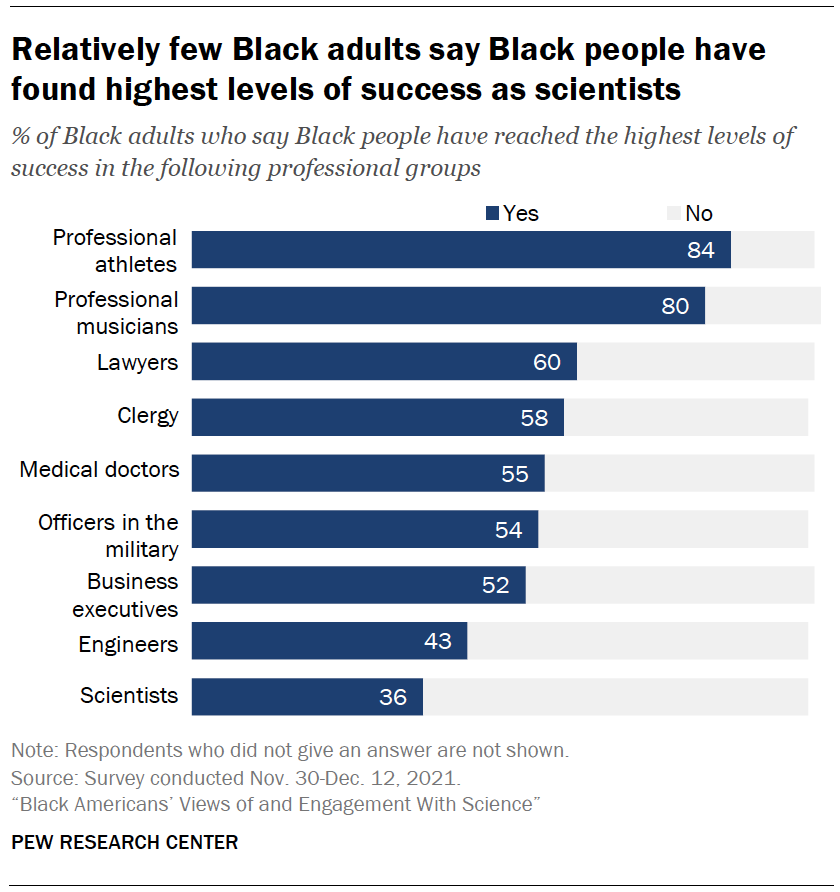
Relatively few Black adults believe that Black people have reached the highest levels of success as scientists (36%) or engineers (43%); a 55% majority say Black people have reached this level of success as medical doctors.

By contrast, large majorities of Black adults say Black people have reached the highest levels of success as professional athletes (84%) and musicians (80%). Six-in-ten say they have done this as lawyers and 58% say they have done this in the clergy.

Asked more directly to evaluate how welcoming these groups are to Black people in these jobs, just 20% of Black Americans say that scientists as a professional group are very welcoming of Black people. About four-in-ten (42%) say they are somewhat welcoming while 36% of Black Americans view scientists as not too or not at all welcoming to Black people in these jobs.

Perceptions of engineers are quite similar, with 23% saying this group is very welcoming to Black people in these jobs. Medical doctors fare only slightly better; 28% see them as very welcoming to Black people in their field.

STEM professions are not alone in this sense of being seen as no more than “somewhat” welcoming to Black professionals. Still, scientists and engineers received among the lowest ratings for openness to Black people across the nine professional groups included in the survey.

The survey findings also call attention to how visible Black achievement in STEM professional roles could potentially attract more young Black people to training programs in these fields.

Chart shows 54% of Black adults see a spur to more young Black people in STEM from more role models, high achievers

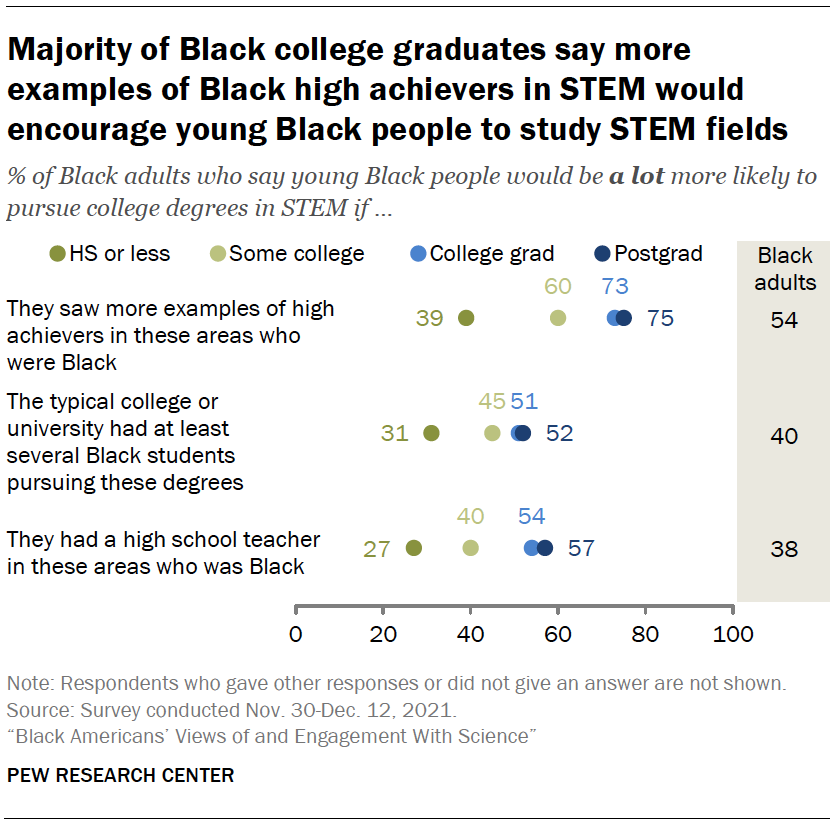
A 54% majority says young Black people would be a lot more likely to pursue college degrees in STEM if there were more examples of high achievers in these areas who were Black; another 27% say this would help a little.

Black adults with a postgraduate (75%) or a college degree (73%) are especially likely to think that more examples of Black achievement in STEM would make young Black people a lot more likely to pursue degrees in these fields.

Smaller shares see other potential factors considered in the survey as critical. Although, majorities of Black Americans say that having a cohort of Black students pursuing degrees in these subjects at the typical university would help at least a little to attract more young Black people to these programs. A similar share say the same about having a Black high school teacher in STEM subjects. Views on this factor were about the same among the roughly half of Black Americans who report having this experience and the half who did not.
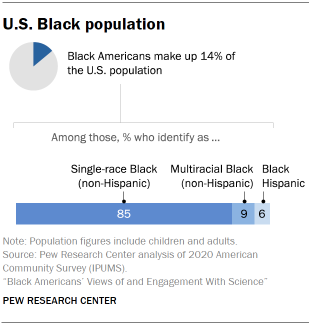
Chart shows Black Americans make up 14% of the U.S. population

Analysis of the survey focuses on Black Americans, including those who identify as single-race Black, multiracial Black, and Black Hispanic.1

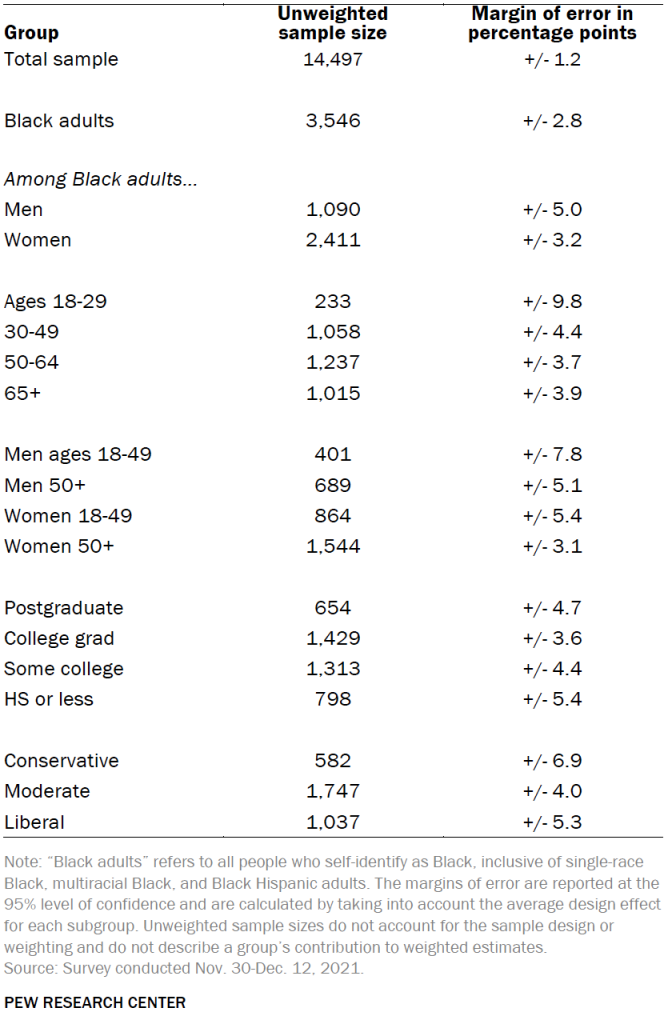
The survey was conducted Nov. 30 to Dec. 12, 2021, and included 3,546 Black adults; findings based on all Black adults surveyed have a margin of error of plus or minus 2.8 percentage points.

Previous Center findings highlight instances where views about science and scientists among Black adults are less positive than those of other racial and ethnic groups. A separate survey conducted in November 2021 finds about half of Black Americans (52%) say that science has had a mostly positive effect on society, compared with greater shares among White (68%) and Hispanic (62%) Americans. Among Black adults, 43% say that science has had an equal mix of positive and negative effects, and just 5% say the effect of science has been mostly negative.

This study aimed to better understand such differences. The survey casts a wide net across the key ways in which people experience and connect with science. The approach was informed by a panel of advisers with expertise on Black and Hispanic views and experiences in American society broadly, and in connection with science, health and STEM education.

The questions asked in the survey were also informed by a set of six focus groups conducted virtually in July 2021 among Black adults that elicited views about the COVID-19 pandemic and experiences and beliefs about the health and medical care systems, as well as people’s interests in science topics and their past experiences with STEM schooling.

Subsequent reports will provide an in-depth look at the views and experiences of Hispanic Americans and a broader look at public opinion among the general U.S. population.

Many Black Americans express trust in scientists and medical scientists; majorities also see potential for research misconduct, have concerns about researcher accountability

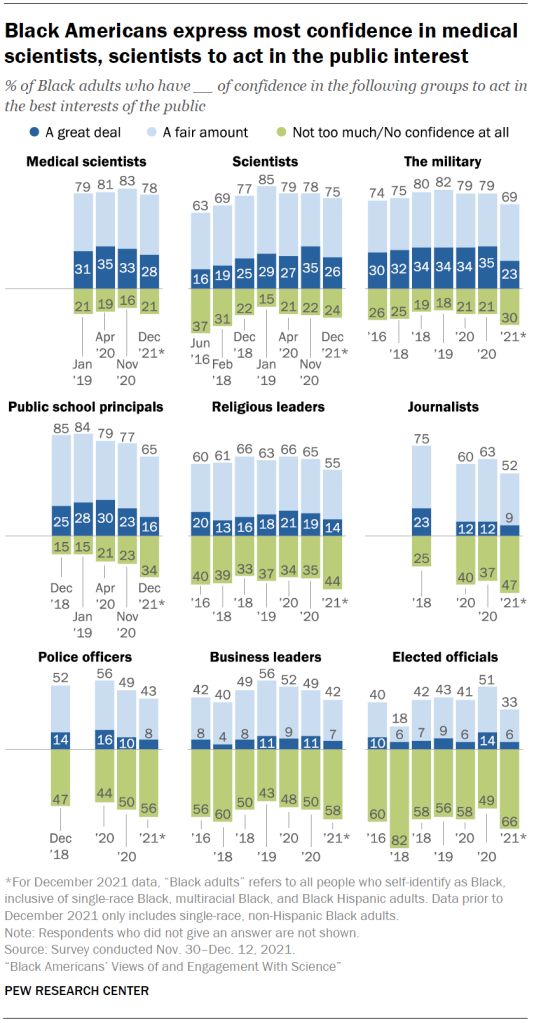
Most Black adults say they have either a great deal (28%) or a fair amount (50%) of confidence in medical scientists to act in the public’s best interests. About two-in-ten (21%) say they have not too much or no confidence in medical scientists.

Black Americans’ trust in medical scientists, as well as that for scientists, fell over the past year, as it also did among the general public. Even so, Black Americans’ trust in medical scientists is greater than that for other major groups and institutions including the military, K-12 public school principals and religious leaders.

As people think about different facets of trustworthiness, a majority of Black Americans lean toward trusting medical researchers’ competence, their care for the public’s interests, and the information they provide about their research. A third of Black Americans say that medical researchers do a good job all or most of the time and another 46% say this occurs some of the time. Roughly two-in-ten (18%) say this happens only a little or none of the time.

At the same time, notable shares of Black adults express doubt about how often medical researchers admit and take responsibility for their mistakes. Just one-in-ten Black adults say that medical research scientists do this all or most of the time; 47% say this occurs at least some of the time. Half say this happens only a little or none of the time. Over the last few years, Black adults have become less confident that medical researchers admit mistakes and take responsibility for them; the share who say this happens at least some of the time is down 19 points since 2019.2

In the new Center survey, 55% of Black adults describe misconduct by medical research scientists as a moderate or very big problem – a share that continues to be a bit higher than that of U.S. adults overall.

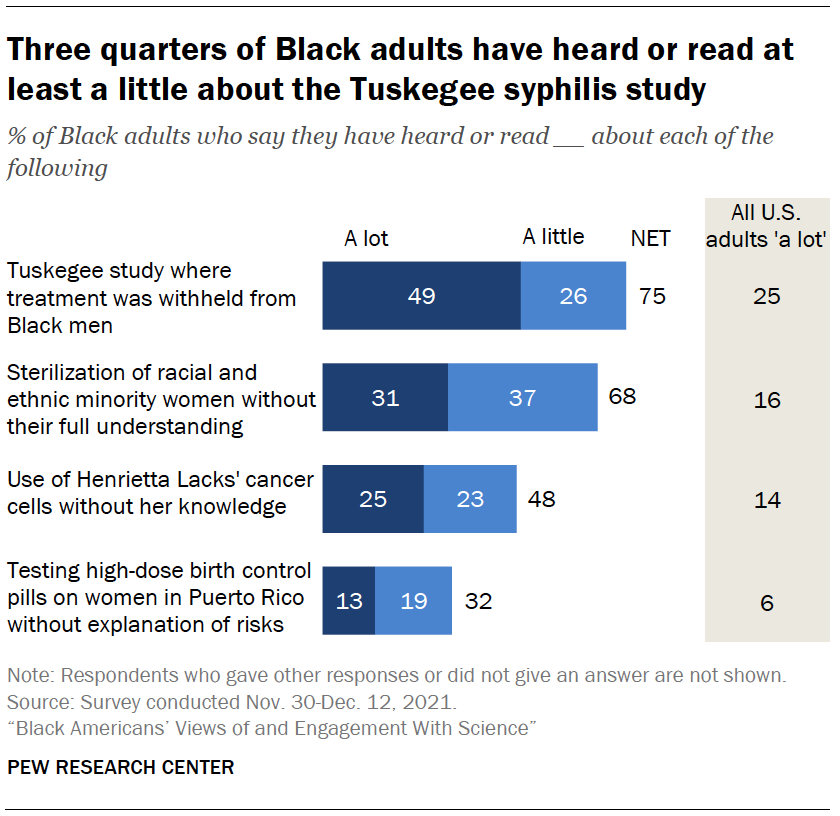
The legacy of egregious medical misconduct in the U.S. Public Health Service Syphilis Study at Tuskegee, commonly known as the Tuskegee syphilis study, continues to resonate widely among Black Americans. Three-quarters of Black Americans say they have heard a lot (49%) or a little (26%) about the federal government’s study on syphilis, which withheld treatment from Black men, leading to preventable deaths and a worsening of symptoms among those study participants.

Older Black adults have the highest level of familiarity the Tuskegee syphilis study, but a majority of those under age 30 say they know at least a little about the study.

Awareness of the Tuskegee study is far lower among U.S. adults overall: A quarter say they know a lot about the study, while another 32% say they know at least a little about this study.

Chart shows majorities of Black Americans are familiar with misconduct in the Tuskegee study, have concerns about ongoing potential for serious cases of research misconduct

Black Americans have a cautious outlook toward medical research going forward. About six-in-ten (61%) believe that serious cases of misconduct in medical research are just as likely today as they have been in the past. A smaller share (35%) says there are procedures in place today to prevent serious cases of research misconduct. Black Americans’ views on these issues are virtually identical to those of the general population.

The Center survey was conducted more than two years into a pandemic which had disproportionate health effects on Black Americans. As stark evidence, the most recent estimates from the U.S. Census Bureau projects life expectancy at 71.8 years for Black Americans, the lowest since 2000 and below the estimates for other racial and ethnic groups.

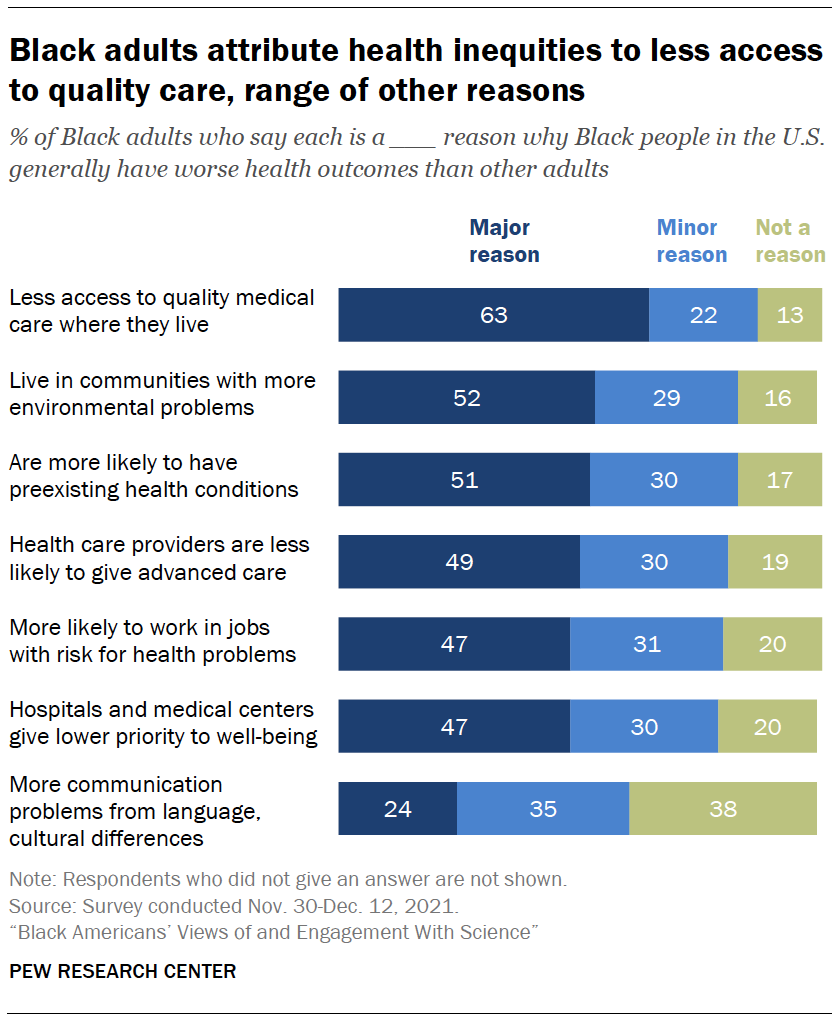
When asked to consider potential factors responsible for differences in health outcomes for Black people, 63% of Black adults view less access to quality medical care in the area they live to be a major reason why Black people in the U.S. generally have worse health outcomes than other adults.

Majorities also view a range of other factors as playing at least a minor role, including more environmental problems in communities where Black people live, a greater likelihood of preexisting health conditions among Black people, and health care providers being less likely to give Black people the most advanced care.

In their own clinical care experiences, 61% of Black adults give their health care provider positive marks – either excellent or very good – for the care they’ve received most recently.

Still, 55% of Black adults say they’ve had at least one of several negative experiences with health care providers in the past, such as feeling they had to speak up to get the proper care or that the pain they were experiencing was not being taken seriously.

In this regard, Black Americans’ experiences with medical care are similar to those of all U.S. adults, 58% of whom say they have had at least one of these negative experiences with health care providers in the past.
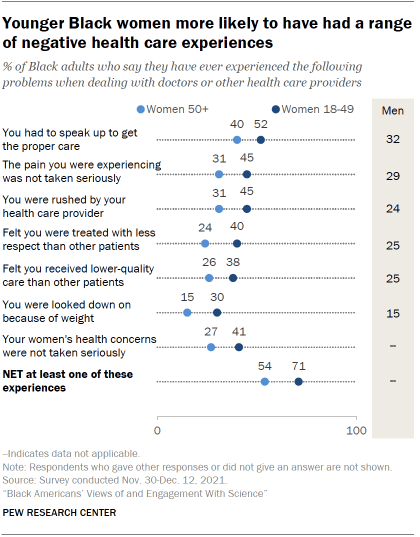
Chart shows younger Black women more likely to have had a range of negative health care experiences

The views and experiences of younger Black women, ages 18 to 49, stand out in a number of ways. This group is particularly likely to report having at least one of seven kinds of negative experiences with routine health care in the past (71% say this).

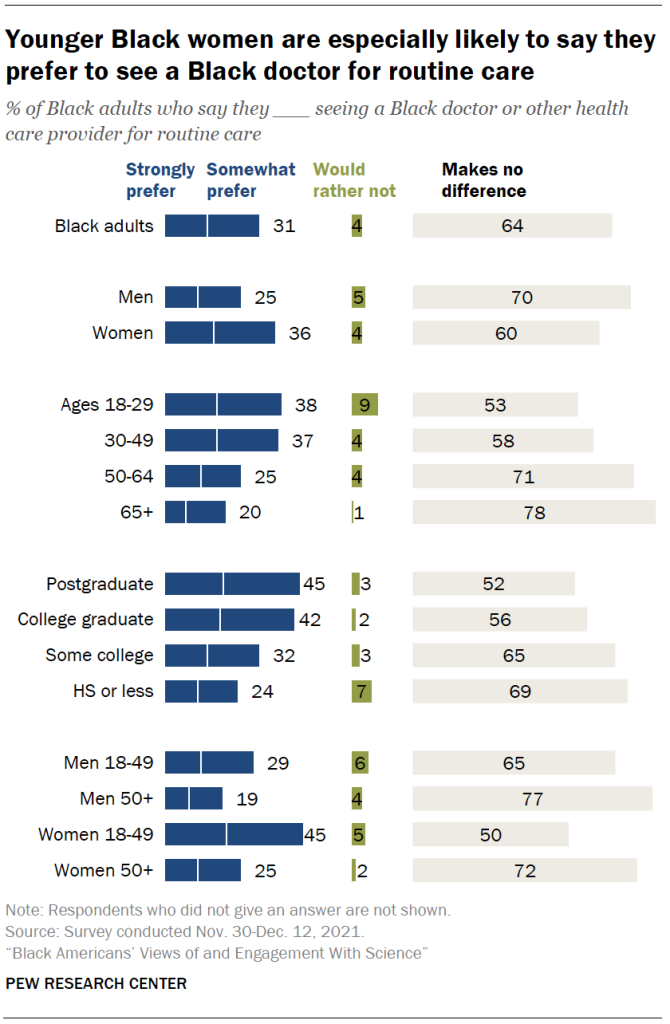
They are also more likely than other Black adults to say they would prefer to see a Black health care provider for routine care: 45% say this, while 50% say it makes no difference to them.

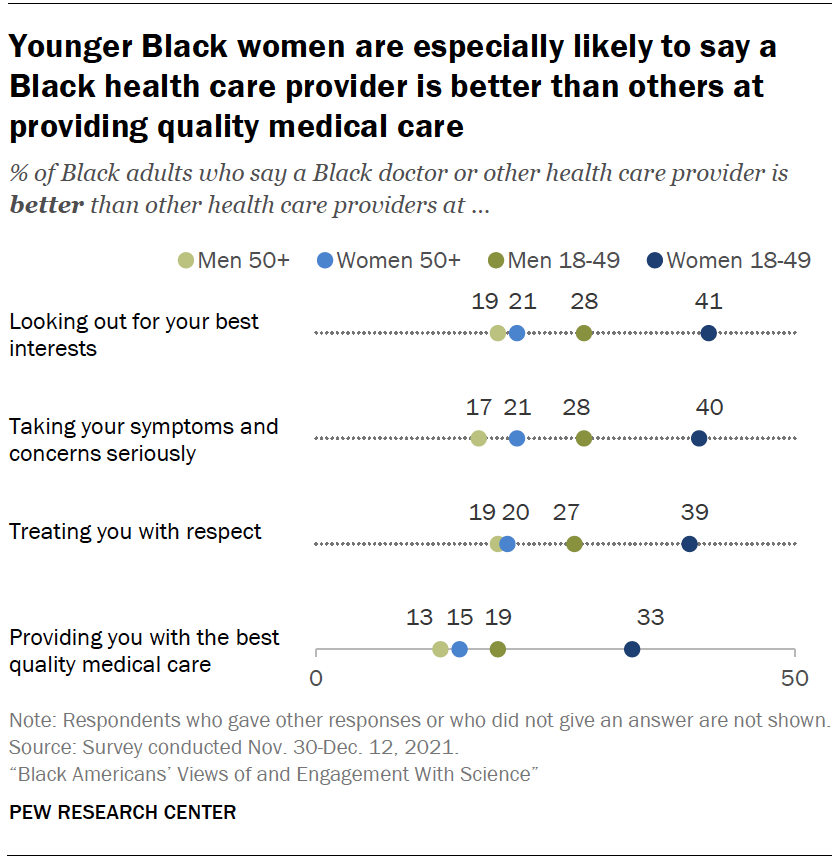
And larger shares of younger Black women say that Black health care providers are generally better than others at looking out for their best interests (41%), taking their symptoms seriously (40%) and treating them with respect (39%).

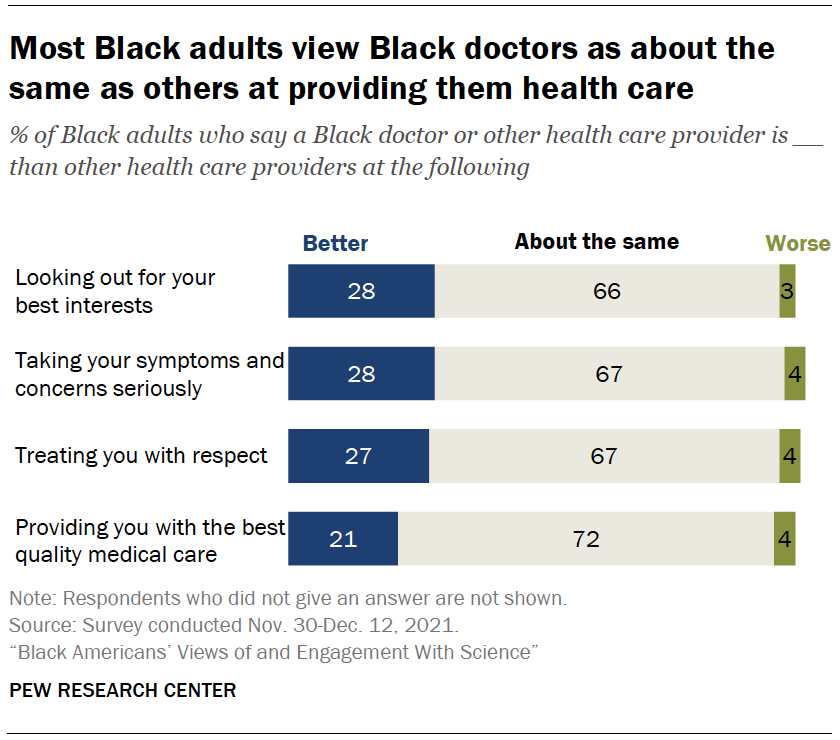
Majorities of older Black women and Black men across age groups say it makes no difference whether they see a Black doctor for routine care. No more than three-in-ten in each of these groups consider Black health care providers better than other providers at looking out for their interests, taking their symptoms seriously or treating them with respect. Majorities view Black healthcare professionals as about the same as others at providing key aspects of medical care.

The coronavirus outbreak and COVID-19 vaccine news has engaged many Black adults; a majority saw or heard about events related to the outbreak in their local area

Chart shows majorities of Black Americans have engaged with COVID-19 information

Amid the coronavirus pandemic and concerns about the omicron variant, a majority of Black Americans (58%) said in December 2021 that they heard about at least one public event or activity related to the outbreak or COVID-19 vaccines in their local community. Roughly half (49%) said they talked about related news at least a few times a week. Among those on social media, 57% said they had seen coronavirus-related content in the past few weeks.

The findings suggest a relatively engaged Black American public. Figures among all U.S. adults are roughly similar, although an even larger share of all U.S. adults on social media said they had seen coronavirus-related content in the past few weeks (68% compared with 57% of Black social media users).

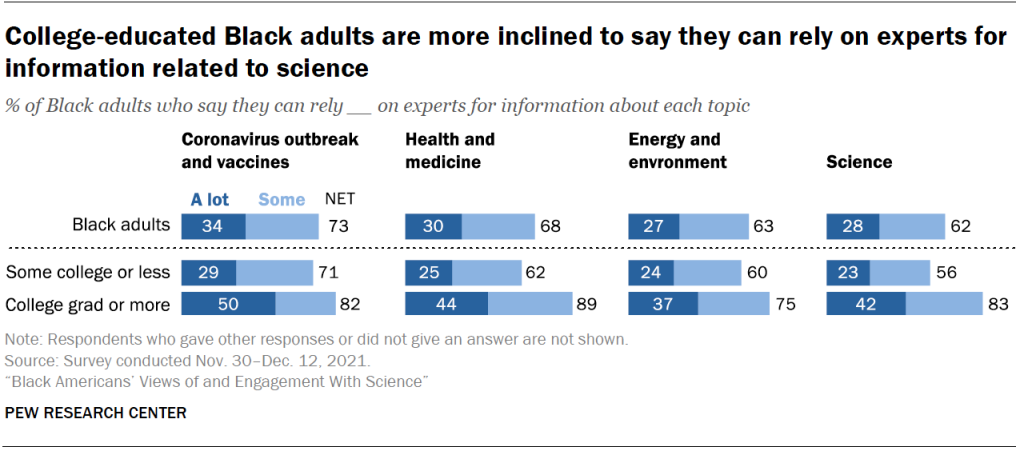
About seven-in-ten Black Americans say they can rely on information from experts on the coronavirus outbreak and vaccines either a lot (34%) or some (39%).

A majority (57%) also say they can rely on information from close family and friends about this at least some. About half of Black adults say this about information from journalists (52%) or news media that focus on Black audiences (51%).

Fewer say they can rely at least some on information about the coronavirus from other groups. Among Black internet users, roughly a quarter say they can rely at least some on information related to the outbreak and COVID-19 vaccines from online groups with shared interests that they are part of, and just 3% say they can rely on information from such groups a lot.

Black adults’ recollections of their own experiences in STEM education present a mixed picture of encouragement and acceptance, especially for those in STEM jobs today

Black adults remain underrepresented in the STEM workforce, with little sign that the educational pipeline will offer near-term improvements.

The survey asked those with a high school diploma or more education to consider their most recent experiences with classwork in a science, technology, engineering or math subject as one way to gauge the degree to which people encounter potential encouragements or discouragements in the educational system. Across the set of six questions, larger shares of Black Americans recalled at least one of three positive experiences than any of three negative ones.

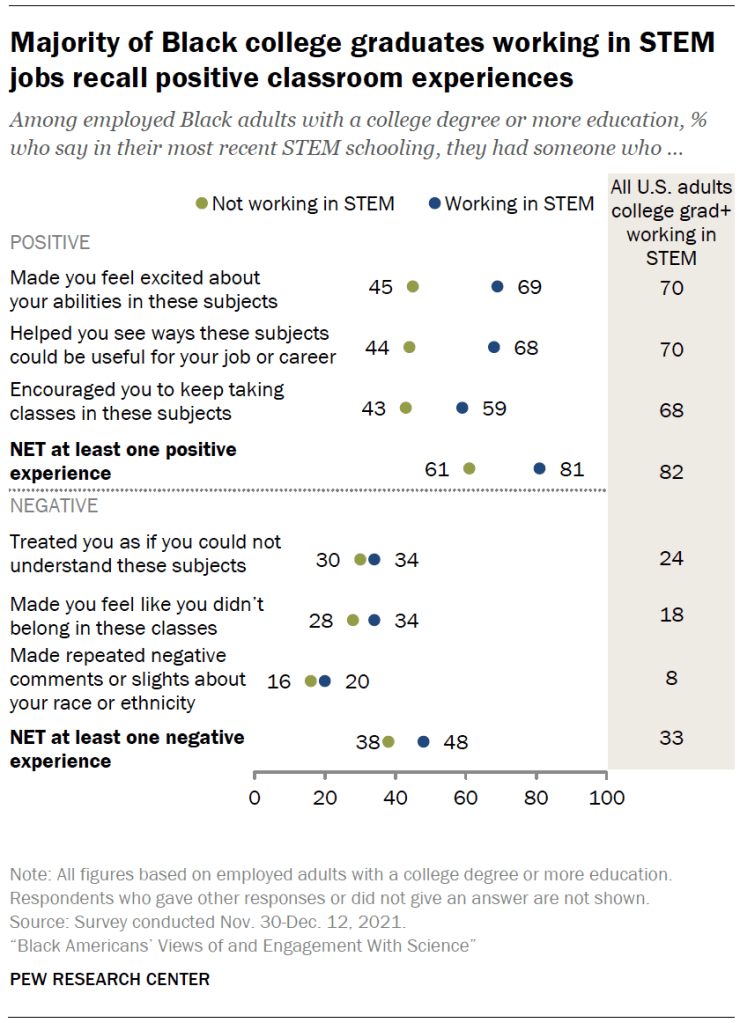
Looking at Black adults working in STEM jobs today with a college or postgraduate degree – a group that is more likely to have taken high-level classes in STEM – 81% say they recall at least one of three positive experiences in their classes. About seven-in-ten (69%) say someone made them feel excited about their abilities in these areas, 68% say someone helped them see ways that these subjects could be useful in their job or career and 59% say someone specifically encouraged them to keep taking classes in these subjects.

A smaller majority of Black college graduates working in non-STEM jobs (61%) recall at least one of these three positive experiences.

Among all U.S. adults with a college degree or more education, those working in STEM jobs are about equally likely to say they have had at least one of these three positive experiences. This group is somewhat more likely to say that someone encouraged them to keep taking STEM classes, however (68% vs. 59% among Black college graduates working in STEM).

Black college graduates working in STEM are more likely than all STEM workers – regardless of their racial or ethnic background – to recall some kind of mistreatment in their most recent STEM schooling (48% vs. 33%). Roughly a third of Black college graduates in a STEM job say that someone treated them as if they could not understand these subjects or made them feel as if they didn’t belong in these classes (34% each). Two-in-ten say that someone made repeated negative comments or slights about their race or ethnicity. The survey cannot speak to whether such experiences originated from interactions with teachers, counselors, students or other contextual aspects of these experiences.

Chart shows large majority of Black college graduates working in STEM jobs can recall a positive experience in STEM classes from their most recent school experience

These findings are in line with a 2017 Center survey which found 62% of Black STEM workers saying they had experienced at least one of eight forms of racial or ethnic discrimination in the workplace. This was greater than the shares of Black workers in non-STEM jobs (50%) and greater than the shares of Asian (44%), Hispanic (42%) and White STEM workers (13%) who said the same.

CORRECTION (Jan. 12, 2024): Chapter 3 of a previous version of this report included an incorrect percentage because one survey question was asked only of women. Among Black adults, 55% say they have ever had at least one of six negative experiences with doctors or other health care providers.
1. Black Americans’ views of education and professional opportunities in science, technology, engineering and math

More than 40 years ago, Shirley Malcom and her colleagues at the American Association for the Advancement of Science (AAAS) called wide attention to challenges for Black Americans, especially for Black women, working in science with a ground-breaking conference and report discussing minority women scientists’ experiences and recommendations for increasing representation in science.3

The new survey calls attention to some of the potential encouragements and discouragements that Black adults see – and report having experienced firsthand – when it comes to perceptions of Black achievement and education in STEM. The findings also point to Black adults’ beliefs about the factors that would do the most to increase representation in STEM fields.

Center analysis of government data shows that Black Americans continue to be underrepresented in STEM jobs. There has been little progress in the share of Black graduates from collegiate or higher-level STEM training programs over the past decade.

Asked what would help attract young Black people to pursue STEM degrees, a majority of Black Americans think it would help a lot if people saw more examples of high achievers in these areas who were Black. About three-quarters of those with a college degree or more education think this would help a lot.

Underscoring issues of representation, relatively few Black adults view STEM professional groups as very welcoming toward Black people in their ranks. While Black adults express some doubt about the openness of multiple professions to Black people, ratings for scientists and engineers are among the lowest across the nine professional groups in the survey. Those for medical doctors fare only slightly better.

Science and engineering also rank low on the list of areas where Black adults see prominent examples of Black achievement. Compared with other professional groups such as clergy and military officers, fewer say that Black people have reached the highest levels of success among scientists and engineers.

Compared with other professions, fewer Black adults see people of their race at highest levels of success in science, engineering

Chart shows relatively few Black adults say Black people have found highest levels of success as scientists

To measure perceptions of Black achievement, the Center survey asked respondents if they thought Black people had reached the highest levels of success in each of nine professional groups.4 At the top of these ratings were professional athletes and musicians; scientists and engineers were ranked lowest.

Overall, 84% of Black adults say Black people have achieved the highest levels of success among professional athletes and 80% say this about Black professional musicians. Majorities of Black adults say Black people have reached the highest levels of success in law (68%) and as religious leaders (58%).

Medical doctors are rated in the middle of these nine professional groups, with 55% of Black adults saying that Black people have reached the highest levels of success in medicine. In contrast, scientists and engineers are rated lowest among this set; 36% say Black people have reached the highest levels of success in science and 43% say this about engineers. Majorities say this is not the case.

Views of Black achievement in these STEM professions are similar among older and younger Black adults. Across levels of educational attainment, those with a high school diploma or less are somewhat more likely to say Black people have reached the highest levels of success in science and engineering than Black adults with more education. Black men are more likely than Black women to say Black scientists have reached the highest levels of success (44% vs. 31%). However, there are no gender differences in views of engineers.

The relative lack of visible examples of Black achievement in science and the allied fields of technology, engineering and math is one factor that could deter Black people from deciding to pursue STEM education and careers.

As one focus group participant phrased it in response to a broad question of “What are your thoughts about jobs in science? In technology?”:

“It’s definitely biased toward men, for sure, and it’s also biased toward specifically White men, for sure. … I know I have plenty of friends who have great ideas who are really smart, but they don’t pursue science because they don’t think that they’ll be able to get ahead in the field because it’s all dependent. Right now, everyone at the top is like old White men who will never retire.” – Black woman, age 25-39

Black Americans rate scientists, engineers comparatively low as professional groups that are welcoming of Black people among their ranks

Chart shows scientists, engineering professions rated among the lowest for openness to Black people in these jobs

Black adults view scientists and engineers as among the least welcoming of Black colleagues across nine professional groups evaluated in the survey.

The groups most highly rated on this quality: professional athletes, followed by professional musicians. About six-in-ten Black adults say that professional athletes are very welcoming of Black people in these jobs, while 24% say they are somewhat welcoming and 12% see them as not too or not at all welcoming. A 58% majority of Black adults say that professional musicians are very welcoming of Black people in these jobs.

While trailing behind evaluations of professional athletes and musicians, clergy rank relatively high among these groups: 38% of Black adults say clergy are very welcoming to Black people in their profession while another 39% say they are somewhat welcoming.

Other professional groups are seen as considerably less welcoming. Just 17% of Black Americans see business executives as very welcoming to Black people in these jobs; 45% consider business executives as generally not too or not at all welcoming to Black people in these jobs.

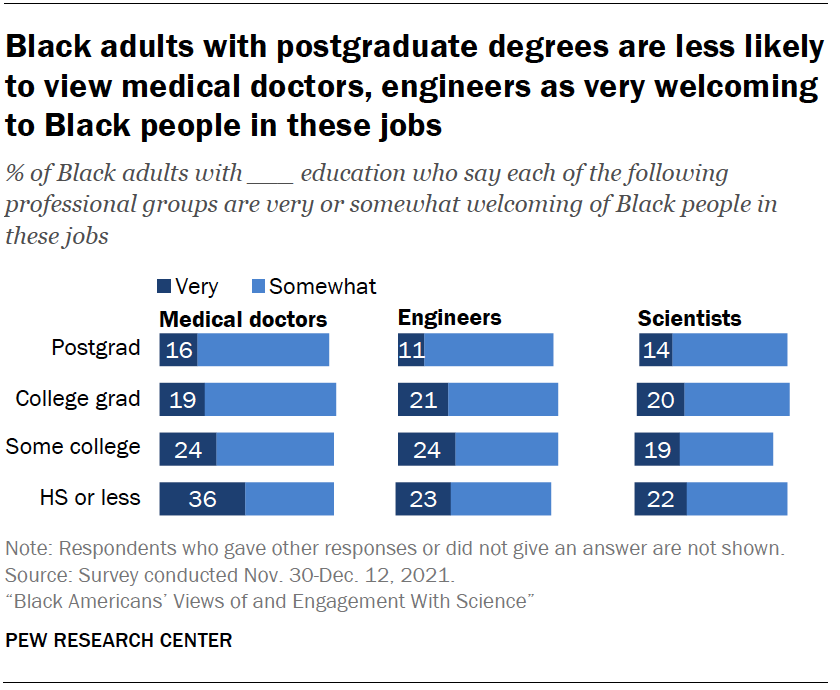
Chart shows Black adults with postgraduate degrees are less likely to view medical doctors, engineers as very welcoming to Black people in these jobs

Two-in-ten say that scientists are very welcoming of Black people in these jobs, and 23% say this about engineers. Medical doctors fare only slightly better: 28% of Black adults say this group is very welcoming to Black people in medical jobs. At least four-in-ten say each of these three professional groups is somewhat welcoming to Black people in these jobs. Roughly a third say that scientists (36%) are not too or not at all welcoming to Black people in the profession; 33% say this about engineers and 25% say this about medical doctors.

Black Americans with a postgraduate degree are less inclined to see medical doctors and engineers as very welcoming to Black colleagues. Overall, just 16% of Black adults with a postgraduate degree say that medical doctors are very welcoming to Black people, compared with 36% of Black adults with a high school degree or less education.

There’s a similar pattern by education in views of the openness of engineers to Black people.

A majority of Black high school graduates recall a positive experience in STEM classes, but sizable shares also recall mistreatment

Personal experiences in the educational system are among the factors that can influence the decision to pursue – or potentially avoid – STEM degrees and jobs. On balance, Black adults with a high school degree or more education recall positive experiences more frequently than negative ones when asked to think about their most recent STEM schooling. Still, about four-in-ten Black adults with at least a high school degree (39%) say they have had at least one of the following negative experiences: being treated as if they couldn’t understand the subject matter, made to feel like they don’t belong, or receiving repeated negative comments about their race.

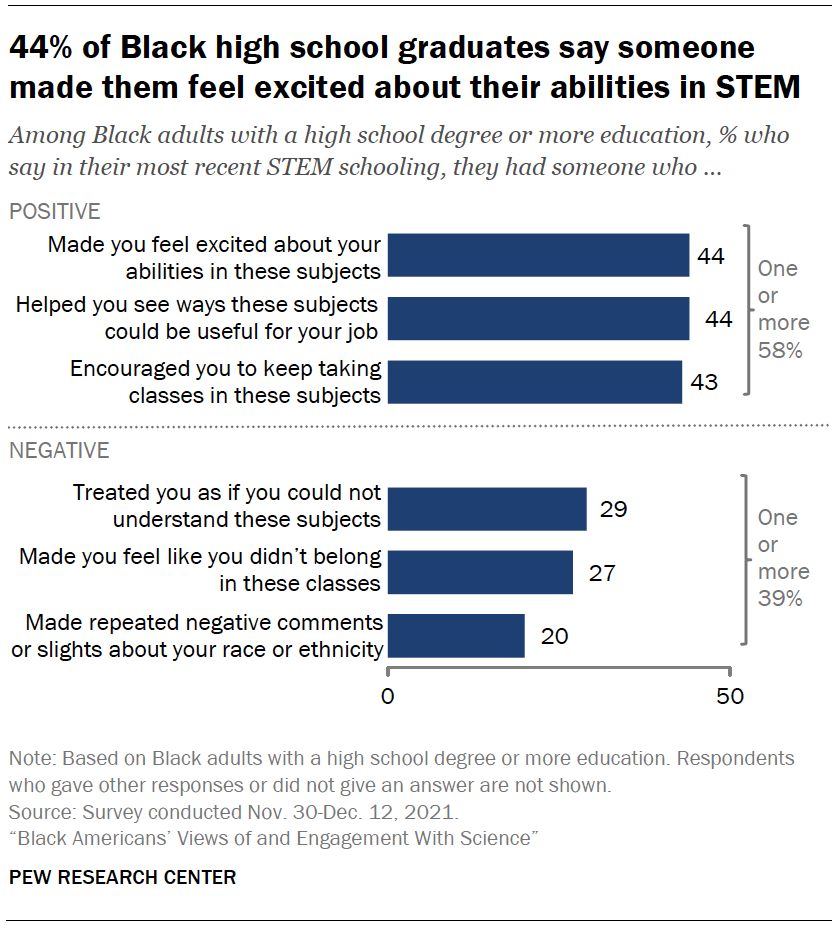
Chart shows 44% of Black high school graduates say someone made them feel excited about their abilities in STEM

The survey asked those with a high school degree or more education about their experiences with STEM schooling. Most high schools require at least some science or math classes in order to graduate, although requirements for college and postgraduate degree programs are quite varied.

Among Black adults who have a high school degree or more education, slightly more than four-in-ten say that, in their most recent STEM schooling, someone made them feel excited about their abilities in these subjects (44%), helped them see how these subjects could be useful for their job (44%) or encouraged them to keep taking classes in these areas (43%).

At the same time, smaller, though still sizable shares, recall mistreatment or microaggressions. About three-in-ten Black adults with a high school degree or more education say they had someone treat them as if they could not understand STEM subjects (29%) or who made them feel they did not belong in STEM classes (27%). Two-in-ten among this group say that someone made repeated negative comments or slights about their race or ethnicity in their most recent STEM schooling.

While these attitudes offer a window into lasting memories from STEM educational experiences, the survey questions do not capture the full context of experiences with teachers, counselors, fellow students and others in these settings. And the findings do not speak to the frequency – whether isolated or repeated in nature – of positive and negative experiences in STEM education.

U.S. adults who have graduated from high school also report a mix of positive and negative experiences in STEM classes. Among high school graduates, similar shares of Black adults (58%) and U.S. adults (59%) say they had at least one of these three positive experiences in their STEM schooling. A third of all high school graduates say they had at least one of these negative experiences.

Black adults working in a STEM-related job are especially likely to say they have experienced both encouragement and mistreatment in their STEM schooling

Chart shows majority of Black college graduates working in STEM jobs recall positive classroom experiences

Black college graduates who are currently working in STEM jobs stand out from college graduates in other occupations when it comes to their educational experiences.5

Overall, 69% of Black college graduates working in a STEM job say that someone made them feel excited about their abilities in STEM subjects and 68% say someone helped them see the relevance of these fields for their job or career, in their most recent school experiences. Roughly six-in-ten (59%) say that someone encouraged them to keep taking more classes in these subjects. Taken together, 81% of Black college graduates working in STEM fields say they had at least one of these positive experiences.

By comparison, Black college graduates working in other kinds of jobs are far less likely to recall positive experiences in STEM classes.

The share of Black STEM workers with a college degree or more education who recall a positive experience in their most recent STEM schooling is about the same as the share of all college graduates working in STEM who say this (81% vs. 82%). However, a larger majority of college-graduate STEM workers in the general population say that someone encouraged them to keep taking classes in these subjects (68% compared with 58% of Black STEM workers).

A sizable share of Black college graduates in the workforce today recall some kind of mistreatment or microaggression in their STEM schooling, as well. Among those working in a STEM job, 34% say that someone treated them as if they could not understand a STEM subject and the same share (34%) says someone made them feel they didn’t belong in these classes. Somewhat fewer among this group (20%) say someone made repeated negative comments or slights about their race or ethnicity. About half of Black college graduates working in STEM (48%) say they had at least one of these negative experiences in their most recent school experience.

Notably, among STEM workers with a college degree, a larger share of Black adults (48%) than U.S. adults overall (33%) say they had at least one of these three negative experiences during their STEM education.

These findings are suggestive of potential deterrents Black adults may face in pursuing training in science or allied fields. Ebony O. McGee, a scholar focused on diversity in STEM higher education, finds that Black people pursuing a higher degree and career in science or another STEM field face an array of obstacles such as stereotyping and implicit biases.

The patterns here are also in line with a 2017 Center survey which included a large sample of STEM workers. In that survey, Black STEM workers were particularly likely to report race-related slights or other inequities on the job. In all, 62% of Black STEM workers said they had experienced at least one of eight specific forms of discrimination because of their race or ethnicity. This is greater than the shares of Black workers in non-STEM jobs (50%) who reported the same, and far greater than the shares of STEM workers of other racial and ethnic backgrounds who said they experienced this.

In the new survey, levels of educational attainment are also associated with Black people’s recollections of positive and negative experiences with STEM schooling. See Appendix for more details.

Though not necessarily a causal effect, Black representation among a person’s high school teachers is associated with more positive experiences with STEM schooling.

Among Black adults with a high school degree or more education, 49% say they had at least one same-race high school teacher in a science, technology, engineering or math class. Those who did are more likely to recall positive experiences in their STEM schooling. For example, 52% of those who had a Black high school STEM teacher say that they have had someone encourage them to keep taking STEM classes, compared with 34% of those who did not have a STEM high school teacher who was Black. Both groups are about equally likely to report negative experiences in STEM schooling. See Appendix for more details.

One focus group participant talked about his responses to having a Black STEM teacher this way:

“In high school, my biology and my chemistry teachers were Black. They were Black women and they were excited about science and they [instilled] that excitement in me.” – Black man, age 40-65

Another participant felt she missed out without a Black role model in her high school STEM classes:

“In the entirety of my science and history classes (because I was pre-med and I did all my science classes), over all of that stuff, I never had a Black professor. I never saw anyone in that position. So I was like, what am I doing here? I think there’s a lack of representation … that kind of furthers the whole unwelcome atmosphere too.” – Black woman, age 25-39

Half or more Black Americans see mentors as especially influential to how many young people pursue STEM degrees

Chart shows half of Black adults see lack of access to quality education, lack of mentors as major reasons young people don’t pursue STEM degrees

Black Americans see a variety of factors behind the limited number of young people pursuing STEM college degrees.

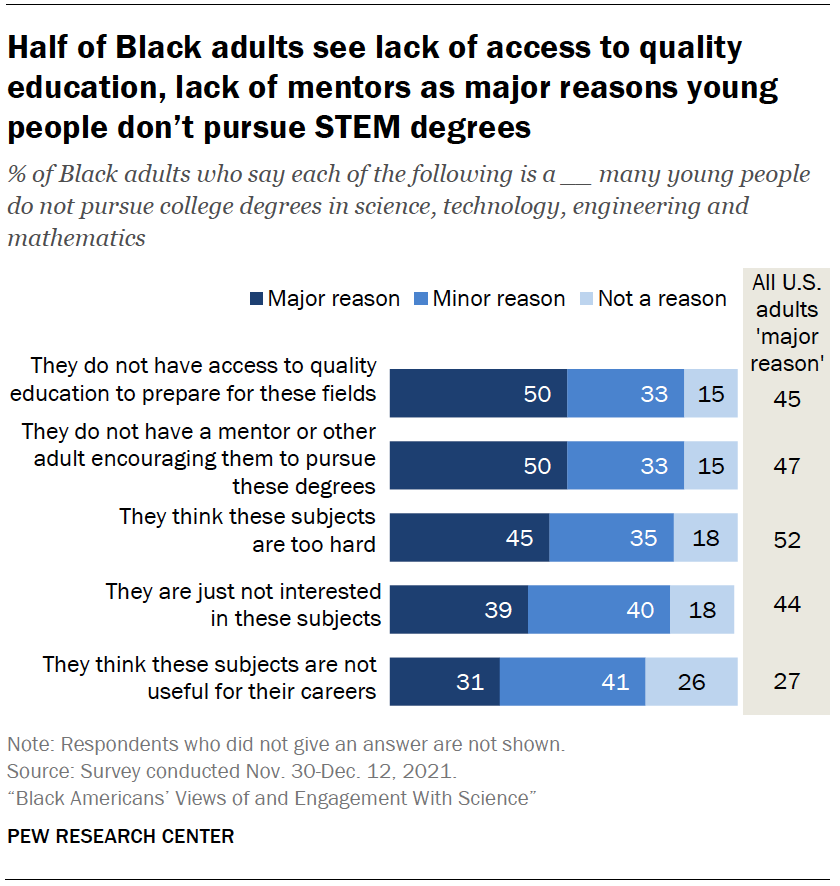
Half of Black adults say the lack of a mentor or other adult encouraging young people to pursue these fields is a major deterrent, while a third consider this a minor reason why more young people don’t pursue college degrees in STEM.

The same share (50%) says lack of access to quality education is also a major reason that more young people do not pursue STEM degrees. (Note that these questions reference young people, generally, without specifying their race or ethnicity.)

In addition, 45% of Black adults say a major difficulty comes from young people thinking that STEM subjects are too hard and 39% say disinterest in these subjects is a major reason behind STEM enrollment figures for young adults.

About three-in-ten Black adults (31%) think young people not seeing the usefulness of these subjects for their careers is a major reason many young adults don’t pursue college-level STEM degrees; another 41% say this is a minor reason.

Views among Black adults on these questions are generally similar to those of the overall U.S. population. However, all U.S. adults place somewhat greater emphasis on the difficulty of the subject matter as a major reason for why more young people do not pursue STEM college degrees.

Chart shows Black adults with higher levels of education more likely to see lack of mentors as a reason young people may not pursue STEM

Black, along with Hispanic, students have long been underrepresented in STEM degree programs, compared with the share earning degrees in other fields. According to recent data from the U.S. Department of Education, Black students earned no more than 9% of the STEM degrees awarded in 2018 across the bachelor’s, master’s and doctoral levels – figures that have changed little since 2010.

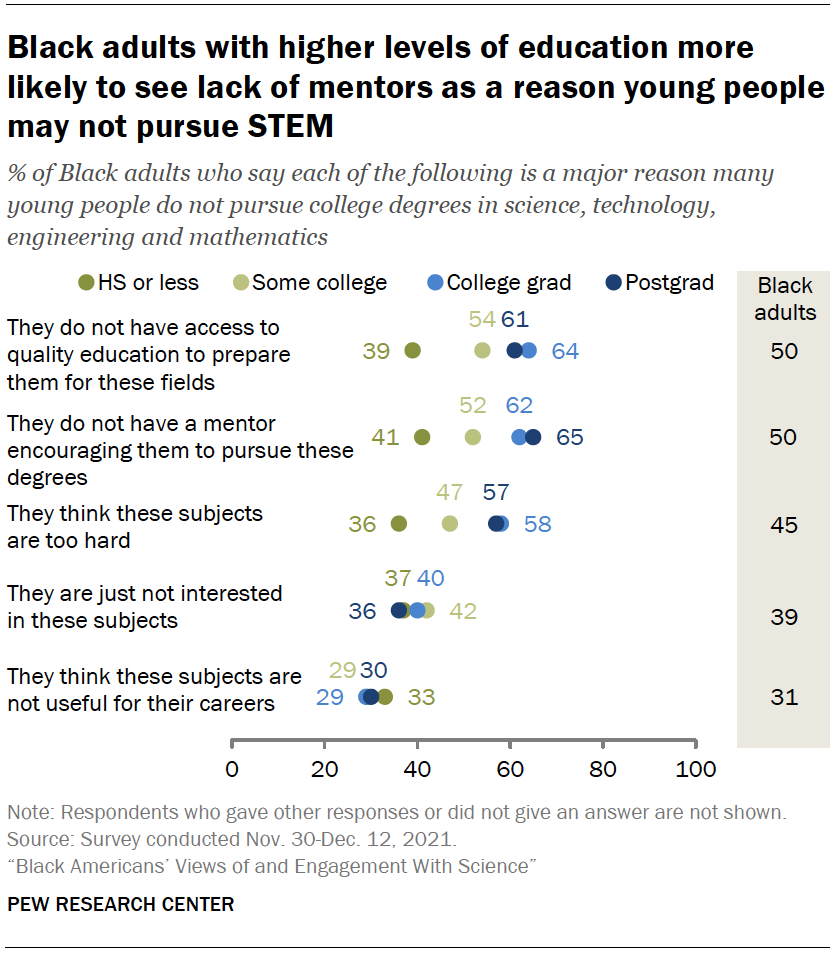
Black adults with higher levels of education are particularly likely to point to the absence of a mentor and the inaccessibility of quality education as major reasons more people don’t pursue STEM college degrees.

Majorities of Black adults with a postgraduate (65%) or college (62%) degree say the lack of a mentor or other adult encouraging young people is a major reason behind this pattern.

About six-in-ten Black adults with a postgraduate degree (61%) and 64% of those with a college degree say that the lack of access to quality education is a major reason more young people do not pursue STEM degrees in college.

A majority of Black Americans think more young Black people would pursue STEM studies in college if they saw examples of high achievers in these areas who are Black

The Center survey also asked about views on specific factors that could encourage more young Black people to pursue STEM college degrees.

A 54% majority of Black Americans say that more visible examples of high achievers in these fields who are Black would make young Black people a lot more likely to pursue college degrees in STEM, while 27% say this would help a little and 16% say this would not make a difference.

Chart shows majority of Black college graduates say more examples of Black high achievers in STEM would encourage young Black people to study STEM fields

Four-in-ten Black Americans think having more representation among students in STEM programs would make young Black people a lot more likely to pursue college degrees in STEM. A similar share (38%) says young Black people would be a lot more likely to pursue college degrees in STEM fields if they had a high school teacher in these subjects who was Black. (This view was about equally common among those who had and did not have a Black high school teacher in a STEM class themselves.)

The importance of visible examples, which some people equate with mentors or role models, also came to mind in focus group discussions on this topic. One focus group participant, in talking about teens, explained:

“They need examples. They need mentors. They need people in those fields to essentially walk them through. I always tell my youth, it’s easy to do something when you’ve seen it.” – Black man, age 25-39

Black adults with higher levels of education are especially likely to see all three of these options as factors that would help attract more young Black students to STEM.

For example, 75% of Black adults with a postgraduate degree and 73% of those with a college degree say that seeing more examples of high achievers in STEM fields who are Black would help a lot to attract more young Black people to these fields. By comparison, 60% of Black adults with some college education say this would help a lot and 39% of those with no more than a high school diploma say this.

There are similar patterns by education when it comes to the impact of having a same-race high school teacher in STEM classes and the typical college or university having at least several Black students in STEM degree programs.

Though relatively smaller shares of Black adults with a high school diploma or less education see any of these options as helping a lot to attract more young Black people to STEM degree programs, majorities say that each would help at least a little.

2. Black Americans’ trust in medical scientists and views about the potential for researcher misconduct

For the most part, Black Americans express positive views of medical researchers. About eight-in-ten have at least a fair amount of confidence in medical scientists to act in the public’s interests. And, on balance, Black Americans express trust in medical researchers’ competence to do a good job.

Still, there are ongoing concerns about the potential for research misconduct and accountability. Most Black Americans are familiar with the legacy of past research abuses. Three-quarters of Black Americans know at least a little about the Tuskegee syphilis study, a study conducted by the federal government in which treatment was withheld from Black men.

And a majority of Black adults (61%) say that research misconduct is just as likely to occur today as it was in the past; far fewer (35%) say there are procedures in place today that will prevent serious cases of misconduct.

Most Black Americans are also skeptical of medical researchers when it comes to issues of openness and accountability. Small shares say that medical researchers regularly face serious consequences for research misdeeds or admit and take responsibility for mistakes when they occur.

Familiarity with the work of medical researchers is a major factor shaping Black adults’ views of medical researchers: Those who say they know more about what they do tend to be more positive in their assessments of these researchers.

Large majorities of Black adults have at least some trust in medical scientists or scientists, generally

Chart shows Black Americans express most confidence in medical scientists, scientists to act in the public interest

Black Americans have largely positive ratings of medical scientists and scientists, compared with other prominent groups and institutions in society.

About eight-in-ten Black Americans (78%) have at least a fair amount of confidence in medical scientists to act in the public’s interests, including 28% who say they have a great deal of confidence in them.

Ratings of scientists are similar; 26% have the strongest level of trust and three-quarters have at least some trust in scientists. (Half of the survey respondents were asked to rate their confidence in medical scientists, while half were asked about scientists.)

Black Americans express less confidence in other groups: 69% say they have at least a fair amount of confidence in the military and 65% say this about K-12 public school principals.

Slightly more than half of Black adults (55%) have at least a fair amount of confidence in religious leaders to act in the public’s interests, while 44% say they have not too much or no confidence in them. Black Christians are about twice as likely as religiously unaffiliated Black adults to express positive ratings of religious leaders (66% vs. 32%).

Ratings of business leaders and police officers are among the lowest of the nine groups included in the survey. About four-in-ten Black adults (43%) have at least a fair amount of confidence in police officers to act in the public’s best interests, while a 56% majority has not too much or no confidence in them. The balance of confidence in views of business leaders is similar (42% have at least a fair amount of confidence, while 58% have not too much or no confidence at all).

Black adults’ trust in many of these nine groups and institutions declined in the last year, mirroring similar declines among the general public. For example, Black adults’ trust in K-12 public school principals has fallen 12 percentage points and trust in journalists is down 11 points.

Confidence in scientists and medical scientists also declined since November 2020. The share of Black adults with a great deal of confidence in scientists dropped from 35% to 26% (nine points); confidence in medical scientists dipped slightly from 33% to 28%.6

While trust in medical scientists has fallen across most demographic groups, the decline among White adults has been especially pronounced. As a result, there is now little difference between how White, Black and Hispanic adults see medical scientists. This is a shift from previous Pew Research Center surveys, where White adults were more likely than Black adults to express high levels of confidence in medical scientists.

Older Black adults express more trust in scientists to act in the public’s interests

Older Black adults express higher levels of confidence in scientists to act in the public’s best interests than do younger Black adults.

Chart shows older Black adults are more likely to have strong confidence in scientists to act in public’s interests

Most Black adults ages 65 and older (87%) have at least a fair amount of confidence in scientists, including 37% who have a great deal of confidence in them.

Younger Black adults rate scientists less favorably. Roughly seven-in-ten Black adults ages 18 to 49 (69%) have at least a fair amount of confidence in scientists, while 29% say they have not too much or no confidence in scientists to act in the public’s interests.

Black men and those who describe their political ideology as liberal are more inclined to rate scientists positively.7 Black college graduates are modestly more likely to have positive assessments of scientists compared with those with some college or less education.

There are similar patterns by age, gender, ideology and education in ratings of medical scientists.

Black Americans generally hold positive views of medical researchers’ competence, skeptical of whether they own up to mistakes

Chart shows Black adults rate medical researchers’ competence more positively than their accountability

People’s trust in scientists and other groups are often thought to vary across dimensions of their behavior. The survey included ratings of trust in medical research scientists when it comes to competence, caring for others’ interests, and the trustworthiness of the information they provide about research findings. It asked separately about issues of scientific integrity as a way to assess potential areas of mistrust toward medical researchers.

The survey finds a third of Black Americans say that medical research scientists do a good job conducting research all or most of the time, while another 46% say they do this some of the time. Just 18% say medical researchers do a good job only a little of the time or never.

Black Americans’ trust in medical researchers’ competence is on par with a 2019 Center survey.

The latest survey also finds Black Americans hold more positive than negative views of medical researchers when it comes to their care for the public interest and the trustworthiness of information they provide. Roughly a quarter of Black Americans (26%) say that medical researchers care about the public’s best interests all or most of the time; a 71% majority says they do so at least some of the time. The share who says medical researchers do this all or most of the time is down 7 points from 2019.

Similarly, 22% of Black Americans say that medical researchers provide fair and accurate information about their research all or most of the time and 73% say this occurs at least some of the time.

Black Americans express more concern around issues of scientific integrity, as does the U.S. public as a whole. For instance, only 12% of Black adults say medical researchers are transparent about potential conflicts of interest with industry groups all or most of the time, while another four-in-ten say this occurs some of the time. The share of Black adults who say medical researchers are transparent about potential conflicts of interest at least some of the time is down from 68% who said this in 2019.

Just one-in-ten Black adults say that medical research scientists admit and take responsibility for their mistakes all or most of the time; 47% say this occurs at least some of the time. This stands in contrast to 2019 when 66% of Black adults said medical researchers did this at least some of the time.

To the extent that medical research scientists are involved in research misconduct, most Black adults are skeptical that institutions would hold such researchers accountable for their misdeeds, as are most in the general U.S. public. In all, 43% of Black adults say medical research scientists face serious consequences at least some of the time if they engage in research misconduct, down from 59% in 2019.8

As shown below, a 55% majority of Black Americans consider research misconduct among this group to be a very big or moderately big problem. Those figures were roughly the same in 2019. Then, as now, Black Americans were more likely than U.S. adults overall to consider medical research misconduct to be at least a moderately big problem.

Greater familiarity with the work of medical researchers is associated with more positive views of them

Chart shows Black adults who are more familiar with what medical researchers do see them in a more positive light

The work of medical research scientists is not always front-of-mind for most people. The Center survey provided a brief description of what medical research scientists do, stating: “Medical research scientists conduct research to investigate human diseases, and test methods to prevent and treat them.”

In response, 12% of Black adults say they know a lot of about the work of medical research scientists, while a 58% majority says they know a little about it and another 28% say they know nothing at all about this.

The share of Black adults who are most familiar with medical researchers are markedly more trusting of them to do a good job, care about people’s best interests and provide fair and accurate information about their research findings. For example, 51% of this group says that medical research scientists do a good job conducting research all or most of the time.

Those who say they know a lot about medical research scientists also tend to express less skepticism of medical researchers on issues of scientific integrity compared with other Black adults, although these differences are relatively modest.

Trust in medical research scientists along these dimensions of competence, caring for the public, and trustworthiness of information also tends to be stronger among Black adults ages 65 and older, as well as among those who describe their political views as liberal. But concerns about issues of scientific integrity are shared to about the same degree across age groups and political ideology. See the Appendix for details.

75% of Black adults have heard about the Tuskegee study; a majority are skeptical that research procedures today will prevent serious misconduct

Discussions of Black Americans’ trust and mistrust in the medical research community often point to the legacy of past abuses, particularly the Tuskegee syphilis study, conducted by the U.S. Public Health Service at Tuskegee, in which syphilis treatment was withheld from Black men in the study, resulting in preventable deaths and a worsening of symptoms among study participants. The study began in 1932 and did not end until 1972, after the details of the study were publicized in the media.

Participants in all six focus groups with Black adults conducted by Pew Research Center in July 2021 referred to past research mistreatment in discussions of trust in the medical community, and most groups brought up the Tuskegee syphilis study. Some participants pointed to the lasting wariness in the Black community from this and other abuses when thinking about contemporary issues such as some Black Americans expressing initial hesitancy around getting a coronavirus vaccine.

“I have one word that informs my thought process on why there’s resistance in my community [to the coronavirus vaccines]. It’s Tuskegee.” – Black man, age 40-65

“As far as African Americans or Blacks, it’s more like we’ve been experimented on since we first were forcibly here on this land. So for us, it’s more like, ‘You know what? Let’s kind of wait and see what actually happens [with the coronavirus vaccines]. Let’s see the precautions.’” – Black woman, age 25-39

Other focus group participants mentioned a sense that such misdeeds had not been fully acknowledged, seeing that as a first step toward building more trust between medical researchers and Black Americans. And several participants pointed to an ongoing sense that medical doctors and researchers do not fully understand – or devote equal resources to – symptoms and illnesses that disproportionately affect Black people.

“Honesty, I think acknowledging that [the medical field] was built on these kinds of biases against people, and working on changing it to where you understand Black bodies … because how we treat blood, how blood pressure is treated and Black people are treated is different than White people.” – Black woman, age 25-39

“With Tuskegee, even now, any of the history of gynecology, you assume that Black people don’t feel as much pain, you don’t take their issues seriously. And going back to that Tuskegee, it was not that long ago. It was only 48 years or so ago. So it’s hard to erase that, and even now the bias that the medical community has, you can’t exactly fix that with, ‘Oh, okay. You need to get a vaccine or this, that, and the other.’ It really takes acknowledging the previous wrongdoings. Also, the [Henrietta] Lacks cells, all of that stuff makes it hard for people, African-Americans to actually trust it.” – Black woman, age 25-39

“But scientifically, I just don’t feel like there are enough doctors who have been looking out for our people historically, here, for me to trust their opinions.” – Black man, age 25-39

Chart shows three quarters of Black adults have heard or read at least a little about the Tuskegee syphilis study

The Center survey also asked people about their familiarity with the Tuskegee syphilis study, as well as several other cases that involved racial and ethnic minority groups and raised ethical questions or were later found to violate ethical codes of conduct.

Three quarters of Black adults say they have heard or read a lot (49%) or a little (26%) about the Tuskegee study. About a quarter (24%) say they have heard nothing at all about this study.

The share of Black adults familiar with the Tuskegee study is far greater than among the U.S. adult population, generally.

About two-thirds of Black adults (68%) also say they have heard or read at least a little about medical doctors who sterilized women in racial and ethnic minority groups without their full understanding of what was being done.

About half of Black adults (48%) say they have heard or read at least a little about the case of Henrietta Lacks, an African American woman whose cancer cells were used by medical researchers, without her or her family’s knowledge or consent.

Chart shows older Black adults more likely to say they have heard or read a lot about the Tuskegee syphilis study

One controversial study is comparatively less familiar to survey respondents. About a third of Black adults (32%) say they have heard at least a little about medical testing done in Puerto Rico using high-dose birth control pills without a full explanation of the study and its risks.

Older Black adults are particularly likely to say they are familiar with the Tuskegee study. About two-thirds of Black adults ages 65 and older (65%) say they have heard or read a lot about this study.

Still, a majority of Black adults ages 18 to 29 say they have heard either a lot (35%) or a little (24%) about the study.

Black Americans with higher levels of education are also more likely to say they have heard something about the Tuskegee study. And 71% of those with a postgraduate degree say they have heard a lot about this.

About six-in-ten Black adults are skeptical that past research abuses are unlikely to occur again because of changes to research procedures

Chart shows majority of Black adults say medical research misconduct is just as likely to occur today as in the past

In response to the Tuskegee syphilis study and others, the federal government established a set of principles and regulations in 1979 to govern research conducted by the federal government and research by organizations that receive government funding.

Even so, 61% of Black adults say that research misconduct is just as likely to happen today as it has been in the past, while far fewer (35%) say that procedures in place today prevent serious cases of research misconduct.

The view that research misconduct is just as likely to occur today as in the past is widely shared across gender, age, education and political ideology.

Concerns about the potential for research misconduct is widely shared among all Americans; 60% of U.S. adults say that research misconduct is just as likely to happen today as in the past, while 38% say that procedures in place today prevent serious cases of research misconduct.

55% of Black adults consider medical research misconduct to be at least a moderately big problem today

Chart shows 55% of Black adults say that research misconduct is at least a moderately big problem

Asked more generally about research misconduct, 55% of Black adults say that medical research misconduct is a very big (19%) or moderately big problem (36%). About four-in-ten (42%) consider it to be no more than a small problem.

Views on this are comparable to those in a previous 2019 Center survey. In both years, Black adults were more likely than the general U.S. public to consider research misconduct at least a moderately big problem. (In the new survey, 48% of U.S. adults say research misconduct by medical research scientists is at least a moderately big problem, the same share as in 2019.)

Younger Black Americans are a bit more likely to consider research misconduct a problem: 58% of those under age 50 say this is at least a moderately big problem compared with 51% among those ages 50 and older.

Black adults with lower levels of education express more concern about this issue than those with a college degree or higher education. Roughly six-in-ten Black adults with some college or less education (57%) say research misconduct is at least a moderately big problem today; 49% of those with a college or postgraduate education say this. See more details in the Appendix.

3. Black Americans’ views about health disparities, experiences with health care

CORRECTION (Jan. 12, 2024): Chapter 3 of a previous version of this report included an incorrect percentage because one survey question was asked only of women. Among Black adults, 55% say they have ever had at least one of six negative experiences with doctors or other health care providers.
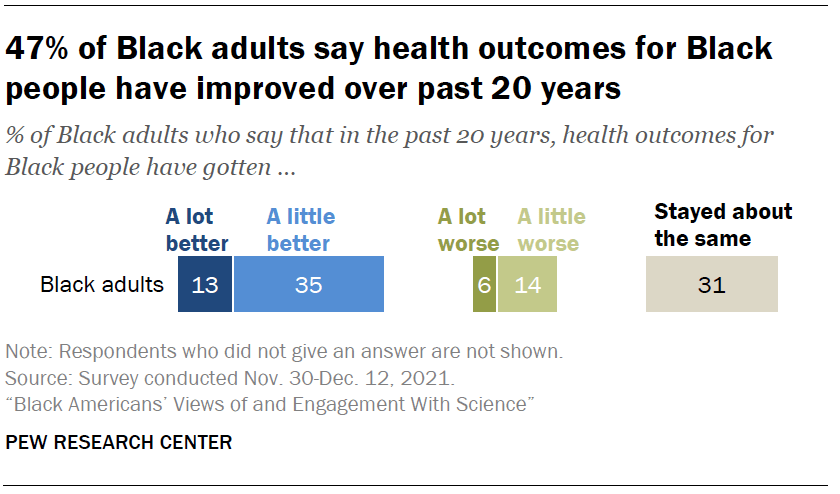
Black Americans offer a mixed assessment of the progress that has been made improving health outcomes for Black people: 47% say health outcomes for Black people have gotten better over the past 20 years, while 31% say they’ve stayed about the same and 20% think they’ve gotten worse.

Less access to quality medical care is the top reason Black Americans see contributing to generally worse health outcomes for Black people in the U.S. Large shares also see other factors as playing a role, including environmental quality problems in Black communities, and hospitals and medical centers giving lower priority to the well-being of Black people.

Asked about their own health care experiences, most Black Americans have positive assessments of the quality of care they’ve received most recently. However, a majority (55%) say they’ve had at least one of six negative experiences, including having to speak up to get the proper care and being treated with less respect than other patients. (A seventh issue asked about applied only to women.)

By and large, Black Americans do not express a widespread preference to see a Black health care provider for routine care: 64% say this makes no difference to them, though 31% say they would prefer to see a Black health care provider for care.

The experiences of younger Black women in the medical system stand out in the survey. A large majority of Black women ages 18 to 49 report having had at least one of seven negative health care experiences included in the survey. They are also more likely than other Black adults to say they would prefer a Black health care provider for routine care and to say a Black doctor or other health care provider would do a better job than medical professionals of other races and ethnicities at providing them with quality medical care.

Beliefs about key factors in health disparities for Black Americans

There are long-standing differences in health outcomes for Black people. Disproportionate mortalities from COVID-19 have heightened disparities between Black and other racial and ethnic populations in the U.S. The most recent estimates from the U.S. Census bureau projects life expectancy at 71.8 years for non-Hispanic Black Americans, the lowest since 2000 and below that estimated for other racial and ethnic groups. The White, non-Hispanic population experienced a smaller decline and, as a result, the gap between expected lifespans for Black and White Americans has widened in the past few years.

Experts have pointed to a number of contributing factors to disparities in health outcomes for Black Americans. The Center survey asked Black Americans for their own views about the reasons behind these disparities and their sense of whether there has been progress over time.

Chart shows Black adults attribute health inequities to less access to quality care, range of other reasons

A majority of Black adults say less access to quality medical care where they live is a major reason why Black people in the U.S. generally have worse health outcomes than other adults. About two-in-ten (22%) say this is a minor reason, while just 13% say it is not a reason.

Black adults see a range of other factors – including environmental problems and less-advanced care from health care providers – as contributing to worse health outcomes for Black adults, though somewhat smaller shares cite these as major reasons than point to access issues.

About half (51%) say a major reason why Black people generally have worse health outcomes than others is because they are more likely to have preexisting health conditions. Issues with home and work environments also are seen as playing a role: 52% say a major reason why Black people have worse health outcomes than others is because they live in communities with more environmental problems that cause health issues; 47% say a major reason is that Black people are more likely to work in jobs that put them at risk for health problems.

Chart shows majorities of Black adults with higher levels of education see range of factors contributing to worse health outcomes for Black people

The health care system is also seen as contributing to the problem: 49% say a major reason why Black people generally have worse health outcomes is because health care providers are less likely to give Black people the most advanced medical care. A roughly equal share (47%) says hospitals and medical centers giving lower priority to their well-being is a major reason for differing health outcomes.

A smaller share (24%) views communication problems from language or cultural differences as a major reason why Black people generally have worse health outcomes than other adults in the U.S.

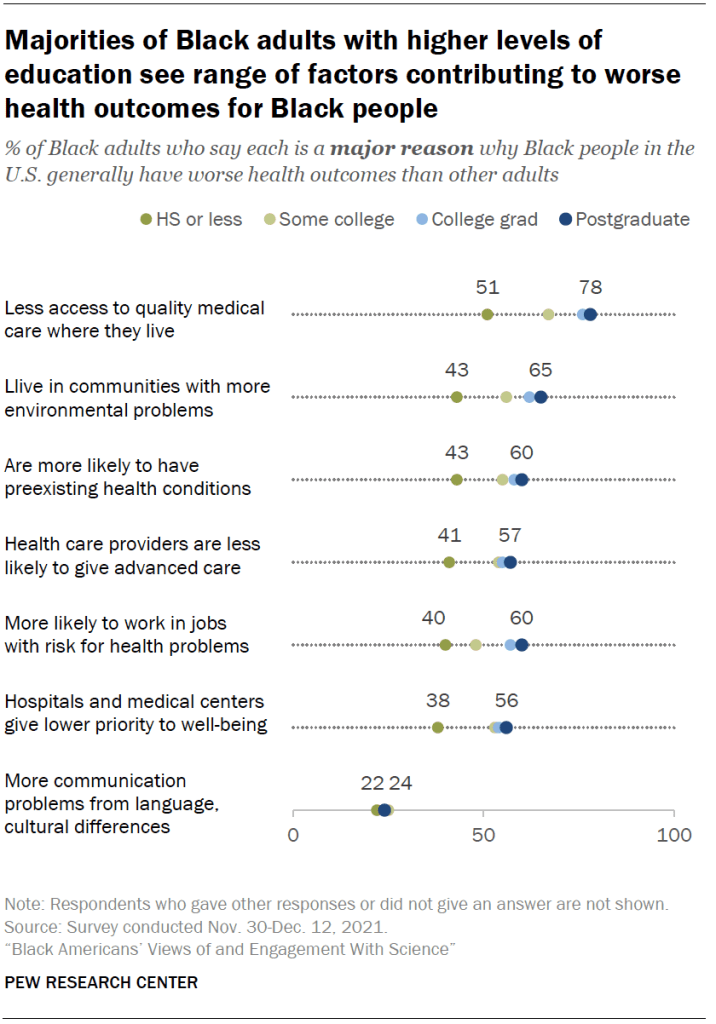
Black adults with higher levels of education are more likely than those with lower levels of education to point to a variety of factors as major reasons for worse health outcomes among Black people.

For instance, large majorities of Black postgraduates (78%) and college graduates (76%) say less access to quality medical care is a major reason Black people have worse health outcomes than other adults in the U.S., compared with 67% of those with some college experience and 51% of Black adults with a high school diploma or less education.

There are also differences in views by age. A majority of Black adults ages 50 and older (58%) say that being more likely to have preexisting health conditions is a major reason why Black people have worse health outcomes than others. Fewer of those under age 50 (46%) see this as a major reason.

Conversely, younger Black adults are more likely than older adults to cite actions from hospitals and medical centers: 50% of those under age 50 say hospitals and medical centers giving lower priority to their well-being is a major reason why Black people have worse health outcomes; 43% of Black adults 50 and older say the same.

Chart shows 47% of Black adults say health outcomes for Black people have improved over past 20 years

Overall, 47% think health outcomes for Black people have gotten a lot or a little better over the last 20 years. Still, 31% say they have stayed about the same and 20% think they have gotten a lot or a little worse.

For the most part, Black adults’ views on this question are fairly similar across characteristics such as age, gender and levels of educational attainment.

A majority of Black Americans give positive ratings of their recent health care, but can also point to negative experiences in the past

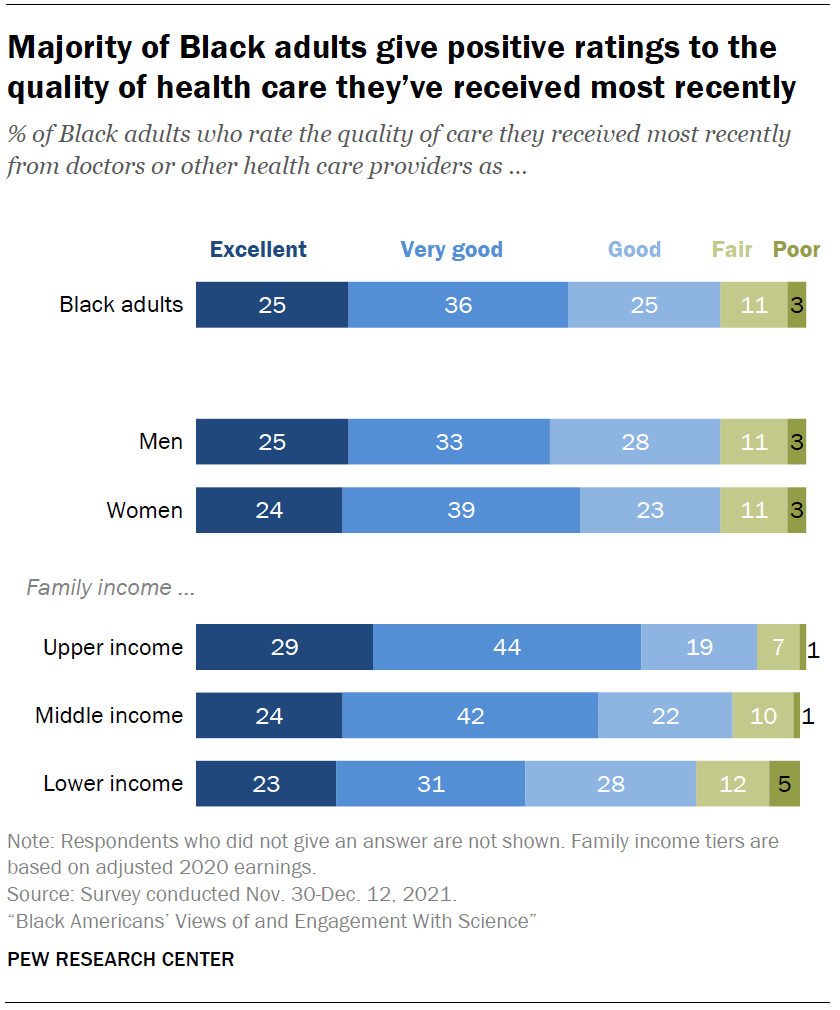
Chart shows majority of Black adults give positive ratings to the quality of health care they’ve received most recently

Black adults have generally positive impressions of their most recent experience with health care. A majority (61%) rate the quality of care they’ve received from doctors or other health care providers recently as excellent (25%) or very good (36%). A quarter describe the quality as good, while just 11% say it was fair and only 3% describe the quality of care they’ve received most recently as poor. These ratings are nearly identical to those of all U.S. adults.

Those with higher incomes report more positive recent experiences with doctors and other health care providers than do those with lower incomes.

When it comes to cost, 51% of Black adults describe the out-of-pocket cost of their most recent medical care as ‘about what is fair.’ About a quarter (27%) say they paid more than what’s fair, while 19% say they paid less than what’s fair. For more details, see the Appendix.

A majority of Black adults report at least one negative interaction with doctors and other health care providers at some point in the past

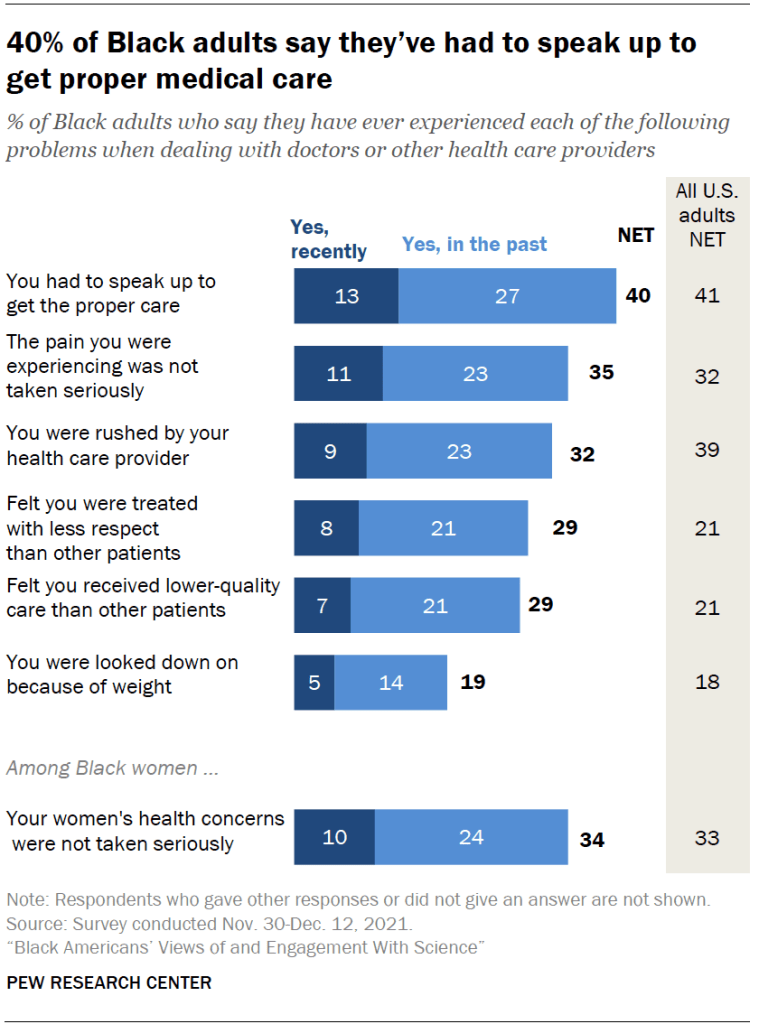
Chart shows 40% of Black adults say they’ve had to speak up to get proper medical care

While Black adults generally offer positive ratings of the quality of care they’ve received most recently, a majority (55%) say they’ve had at least one of six negative experiences with doctors or other health care providers at some point in their lives. (A seventh issue asked about applied only to women.)

Overall, 40% of Black adults say they have had to speak up to get the proper care either recently (13%) or in the past (27%). This is the most frequently cited negative experience with medical care across the items included in the survey.

One focus group respondent described their experience this way:

“I had a situation where I had to go through about two different doctors until I was able to get the results that I was requesting, because they did not believe that the issues that I had were valid, or that they were as serious as I made them out to be. It’s kind of been an ongoing thing, so I’m always leery when I’m talking to physicians. I don’t trust them just because they are doctors. I know they have the Hippocratic Oath, but it feels like it’s a little different when they deal with African American patients. And I don’t care if it’s an African American physician or White physicians.” – Black woman, 25-39

When it comes to treatments for pain, 35% of Black adults say they’ve felt the pain they were experiencing was not taken seriously either recently (11%) or in past interactions (23%) with doctors and other health care providers.

About three-in-ten Black adults (32%) say they’ve felt rushed by their health care provider and 29% say they’ve felt they were treated with less respect than other patients, either recently or in past experiences with doctors and other health care providers. Similarly, 29% say they’ve felt they’ve received lower quality medical care at some point; 70% of Black adults say this has not happened to them.

Relatively fewer (19%) say they’ve been looked down on because of their weight or eating habits; 79% say this hasn’t happened to them.

Among Black women, 34% say their women’s health concerns or symptoms were not taken seriously in interactions with doctors and other health care providers.

Black adults at all family income levels are about equally likely to report having at least one of these experiences.

The frequency of negative experiences with the health care system are mostly similar between Black adults and all U.S. adults. However, greater shares of Black adults than all U.S. adults say they’ve felt they’ve received lower-quality care (29% vs. 21% of all U.S. adults) or been treated with less respect than other patients (29% vs. 21%). And fewer Black adults say they were rushed by a health care provider (32% vs. 39% of all U.S. adults).

Black women, especially younger Black women, stand out for the frequency with which they report having had negative health care experiences. Taken together, 63% of Black women say they’ve experienced at least one of the seven negative health care experiences measured in the survey. Among Black men, 46% say they’ve had at least one of six negative experiences with doctors or other health care providers. Black women were asked one more item than men, but the gap between men and women on the six experiences in common is almost identical (62% vs. 46%).
In their own words: Focus group participants on difficulties getting treatment for pain management

There are long-standing concerns about racial biases in pain management. A study in 2020 of emergency room patients experiencing acute appendicitis found wide racial disparities in pain management for both children and adults. The growing use of artificial intelligence algorithms to determine a patient’s need for pain management is raising new questions about how to address systematic bias in pain management treatments.

Here are a few of the comments from focus group participants about getting treatment for pain.

“Well, my husband’s condition (trigeminal neuralgia), it requires a narcotic. And before we got [to current health care provider] for so long, a lot of people just assumed that he was a junkie, like he was just coming in and trying to get pain medication and they wanted to put him on this rotation that just didn’t work, wanted him to take this Tylenol. And it was so frustrating.” – Black woman, age 25-39

“My mom, and I can’t think of it specifically, she has complained to me about being at the hospital and feeling as though they were treating her like she was a drug addict. When they would have to give her pain medication, or she would need something for pain – having her fill out forms, only allotting a certain amount, or cutting it, when her pain is … she goes through pain more times a day, they’ll cut it to less. Less than what she needs to get through the day and not be in pain.” – Black man, age 25-39

“At what point are you going to educate your nurses, your doctors, your ER team that, ‘Hey, this is the protocol when we have sickle cell’? Now, the ironic thing is, when she was going to the children’s hospital, they did have a sickle cell protocol and their treatment of their kids was a little bit different. Most of the time, … 85% of the time … because they were kids, they took their word for it. But when they transitioned over to the adult care, it’s terrible. It’s terrible with the pain, it’s terrible with pain management.” – Black woman, age 40-65

“I was in pain, like in my abdomen. Come to find out I had a fibroid. But I went to the emergency room. ‘Oh, no. You’re fine.’ Something like, ‘Your insurance won’t cover this emergency visit’ or something. ‘Just go to Walgreens and get some Tylenol.’ And I’m like, ’I’m in severe pain. Like I have abdominal pain.’ I ended up going to my doctor, the one I eventually found. He ended up getting me an ultrasound. We did blood work. It was just totally different.” – Black woman, age 25-39

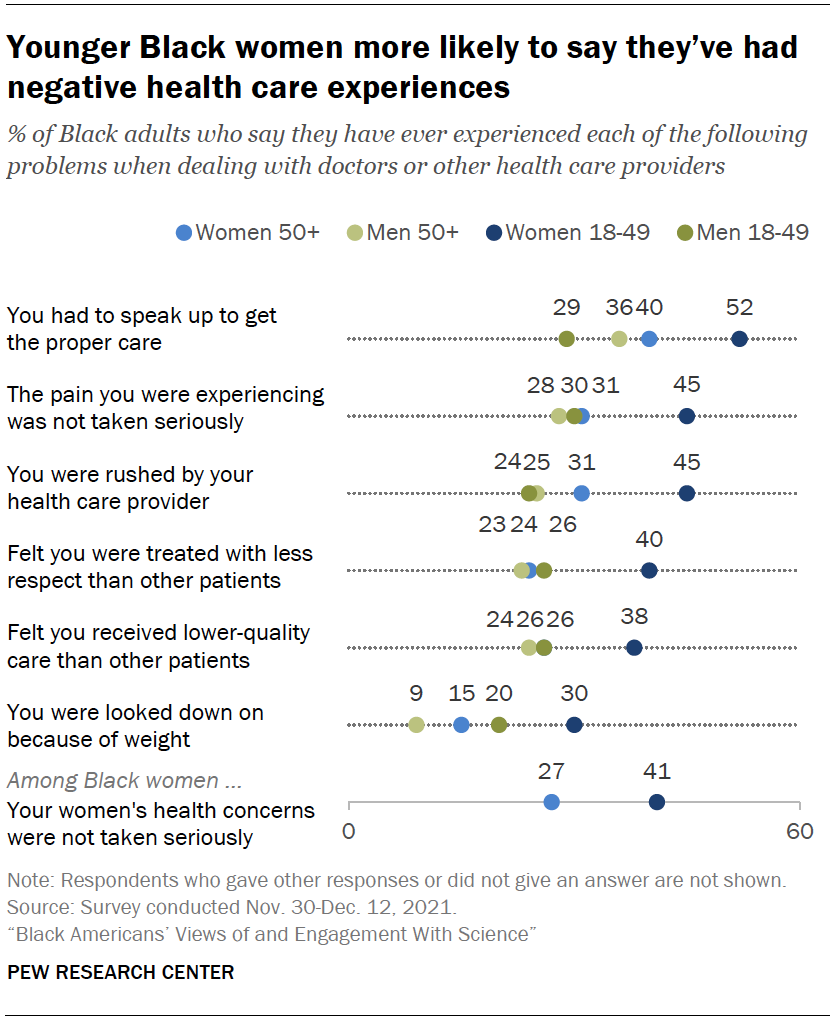
A large majority of younger Black women ages 18 to 49 report negative interactions with health care providers: 71% say they’ve had at least one negative experience in the past. By comparison, a smaller share of Black women ages 50 and older say this (54%).

Chart shows younger Black women more likely to say they’ve had negative health care experiences

Among Black men, differences by age are more modest than among women, and the pattern runs in the opposite direction: 51% of men ages 50 and older report experiencing at least one of six negative experiences with health care providers, compared with a somewhat smaller share of men ages 18 to 49 (43%).

The experiences of younger Black women stand out across each individual item on health care interactions. For instance, 52% of younger Black women say they’ve had to speak up to get the proper care, compared with 40% of older women, 36% of older men and 29% of younger men.

Among U.S. adults, women ages 18 to 49 are also more likely than older women or than men to say they have had at least one of these negative experiences in a health care visit.

31% of Black adults say they would prefer to see a Black health care provider; a majority have no preference

The share of Black adults working in health-related jobs is roughly equal to their share in the overall workforce, although just 5% of physicians and surgeons are Black. The new survey asked people for their preferences and thoughts about what, if any, difference it makes to have a health care provider who shares their racial background.

Chart shows younger Black women are especially likely to say they prefer to see a Black doctor for routine care

Overall, 31% of Black adults say they would strongly (14%) or somewhat prefer (17%) to see a Black doctor or other health care provider for routine medical care. About two-thirds (64%) say it makes no difference to them, and just 4% say they’d rather not do so for routine care.

Younger Black women stand out from their elders and from Black men in their preferences for seeing a Black health care provider.

Among Black women, a much greater share of those ages 18 to 49 than those 50 and older say they’d prefer to see a Black health care provider for routine care (45% vs. 25%). A majority of older Black women (72%) say it wouldn’t make a difference to them.

There’s a similar pattern in views among Black men, though the gap between younger and older Black men is not as large as among Black women: 29% of Black men ages 18 to 49 would prefer to see a Black health care provider for routine care, compared with 19% of Black men ages 50 and older.

There’s hardly any difference in views on this question between those who have seen a Black doctor or health care provider in the past and those who have not. Among the roughly two-thirds of Black adults who say they’ve seen a Black health care provider for routine care in the past, 32% say they would prefer to see a Black health care provider; among those who have not seen a Black health care provider previously, 30% express this view. See the Appendix for details.

Younger Black women are more likely to see benefits for the quality of medical care from health care treatment with same-race providers

When it comes to key aspects of medical care, majorities of Black adults view a Black doctor and other health care providers as about the same as providers who do not share their race or ethnicity at meeting their needs.

Chart shows most Black adults view Black doctors as about the same as others at providing them health care

For instance, 72% of Black adults think a Black health care provider is about the same as other health professionals when it comes to the quality of medical care they provide; 21% think a Black health care provider is better than others at this, while just 4% say worse.

Roughly two-thirds view a Black health care provider as about the same as others when it comes to taking their symptoms and concerns seriously, treating them with respect, and looking out for their best interests. Roughly three-in-ten see a Black doctor or health care professional as better than other providers for each of these elements of care.

Among the 31% of Black Americans who say they would prefer to see a Black health care provider for routine matters, majorities think a Black health care provider is better than others at looking out for their best interests (64%), taking their symptoms seriously (64%), treating them with respect (60%) and providing the best quality medical care (53%).

It is unclear whether personal experience lies behind these beliefs. Black adults who have seen a Black health care provider in the past hold similar views on this as those who have not. See Appendix for more details.

Younger Black women are more inclined than older women and men to see an advantage from routine care with a Black health care provider. Still, the majority viewpoint across groups – including among younger Black women – is that a Black health care provider is about the same as others at providing key aspects of care.

Chart shows younger Black women are especially likely to say a Black health care provider is better than others at providing quality medical care

About four-in-ten Black women ages 18 to 49 (41%) say a Black health care provider is better than others at looking out for their best interests, compared with 53% who say they are about the same as other health care providers.

Smaller shares of Black women ages 50 and older (21%), Black men 18 to 49 (28%) and Black men ages 50 and older (19%) view a Black health care provider as better than others at looking out for their best interests. Majorities say they are about the same as others at this.

Age and gender patterns among Black adults are similar across the other aspects of care included in the survey.

When it comes to education, Black adults with higher levels of education tend to be more likely to view a Black doctor or health care provider as better than others when it comes to these key aspects of care. But as with patterns by age and gender, the majority view across levels of educational attainment remains that a Black health care provider is about the same as other healthcare professionals at providing routine health and medical care. See the Appendix for details.

4. Black Americans’ engagement with news and information on COVID-19 and other science-related topics

One way people engage with science is through the news and information they encounter in daily life, through conversations, the news media, interactions on social media, or by attending events. The coronavirus outbreak and development of COVID-19 vaccines is a pressing reminder that adults often learn about emerging scientific developments through informal avenues.

To better understand how people engage with news and information about science, the survey asked about four specific areas: news and information about the coronavirus outbreak and vaccines; health and medical issues; energy and environmental issues; and science news and information generally. Each survey respondent was randomly assigned to one of these four topics. (For more, see “When Americans think about science, what do they have in mind?”).

There is a good deal of commonality in how people react to information about these science topics. About half or more Black adults say they find it reassuring to see knowledge in these areas being constantly updated. At the same, similar shares say they have found it difficult to know what to think about these issues because there is so much conflicting information.

Across science topics, majorities of Black adults say that it is frustrating to see so much political disagreement in these areas. For instance, nearly seven-in-ten (68%) say this regarding news and information about the coronavirus outbreak and vaccines.

When it comes to who they rely on for information, experts in these fields top the list for Black adults. However, the survey also highlights the prominent role that friends and family play in sharing information: Majorities of Black adults say they rely on friends and family for information on the coronavirus and vaccines, as well as for health and medicine issues. Roughly half also say they rely a lot or some on friends and family for information about energy and the environment, and for information on science generally.

About half of Black Americans say they’ve talked about the coronavirus outbreak multiple times a week

Underscoring the unique nature of the coronavirus outbreak and its wide-ranging impact on American life, 49% of Black adults said in December 2021, when the survey was fielded, that they discussed news about the coronavirus outbreak and vaccines with other people nearly every day or a few times a week. About a quarter (23%) said they did this a few times a month and 28% said they talked about the pandemic and COVID-19 vaccines with others less often than that.

On social media, a 57% majority of social media users say they have seen information related to the coronavirus outbreak and vaccines on these platforms. A much smaller share of social media users (21%) say they follow an account or page that is focused on information about the coronavirus outbreak.

Chart shows engagement with news and information varies across science-related topic areas

Coming across information – rather than actively seeking it out – is the predominant way Black Americans encounter coronavirus information: 70% say they generally see news about the outbreak because they happen to come across it, while 27% say they are generally seeking out such news.

Compared with the coronavirus outbreak, Black adults are less likely to say they have talked about the other science-related topic areas of health and medicine (34%), energy and environmental issues (22%) and science (19%) multiple times a week.

The overall share of Black adults who say they have talked about science news at least a few times a week is about the same as that reported in a 2017 Center survey, as is the share of social media users who say they follow a page or organization that is focused on science.9

Black adults with higher levels of education are more likely to talk about these topics. A 57% majority of Black college graduates say they talked with others about the coronavirus outbreak and vaccines at least a few times a week, compared with 46% of those who have some college or less education.

Black men and women are about equally likely to say they talk about science news frequently. Among social media users, however, more men (38%) than women (21%) say they follow a page or account that is focused on science.

In the overall U.S. adult population, the share saying they have talked about each of these four topics is roughly similar to that among Black adults. And similar shares of social media users in the general population say they follow an account or page that is focused on the coronavirus outbreak and vaccines, health and medical issues, energy and environmental issues, or science.

Black Americans report mix of positive and negative reactions to science news, express frustration over political disagreements

Black Americans report varied reactions to the science-related news they encounter. Some 57% of Black adults say it is reassuring to see that knowledge about the coronavirus outbreak and COVID-19 vaccines is always being updated, but nearly as many (52%) say it is difficult to know what to think because there is so much conflicting information about the pandemic and vaccines.

Chart shows Black Americans report a mix of reactions to science-related news

News about health and medical issues, energy and environmental issues and science news, generally, garnered a similar mix of reactions. About half or more Black adults say they have reacted to news on these topics with a feeling of reassurance and similar shares say they have reacted to news in these areas with confusion because of so much conflicting information.

Majorities of Black adults also say they have reacted to news about these topic areas with frustration from so much political disagreement over the coronavirus outbreak and COVID-19 vaccines (68%), health and medical issues (63%), energy and environmental issues (57%), or science news, generally (58%).

Overall, 44% of Black Americans also say they have been amazed by developments related to the coronavirus outbreak and vaccines. About half say this about health and medical news (48%) and 50% say this about science, generally.

The overall U.S. population also expresses a range of sentiments about science-related news. Compared with Black adults, even larger shares of the general population find it frustrating there is so much disagreement about the coronavirus outbreak and vaccines (83%), health and medical issues (76%), energy and environmental issues (74%) and science issues, generally (76%).

Majorities of Black adults say they can rely on experts for science-related information; many also turn to friends and family

When asked who they can rely on for information on science-related topics, Black adults are most likely to say experts, as are U.S. adults overall. Majorities of Black adults say they can rely on information from experts a lot or some about the coronavirus outbreak and vaccines (73%), health and medical issues (68%), energy and environmental issues (63%) and science news (62%).

Chart shows majorities of Black adults say they can rely on experts for information on science-related topics

Many Black adults also say they can rely on close friends and family for information on these topics. Slightly more than half say they can rely at least some on close friends and family for information on the coronavirus outbreak and vaccines (57%) and health and medical topics (57%). Slightly smaller shares can rely on friends and family for information on energy and environmental issues (51%) and science news (46%).

About half say they can rely at least some on journalists’ information about the coronavirus (52%), energy and environmental issues (52%), health and medical issues (47%) and science news (46%).

Black adults are about as likely to say they rely on news media that focus on Black audiences for science-related information as they are to rely on journalists generally. For instance, 51% say they can rely a lot or some on news media that focus on Black audiences for information about the coronavirus outbreak and COVID-19 vaccines, compared with about the same share (52%) who say this about journalists.

Fewer than half of Black adults say they can rely on religious leaders for information on science-related topics. Information from neighbors and others in their local community are rated similarly.

About four-in-ten Black adult internet users (38%) say they can rely at least some on people in online groups with shared interests for information about science news. A smaller share of Black social media users (29%) say they can rely on information from personalities they follow on social media for science news information.

Black adults with higher levels of education are more inclined to say they can rely on experts in these areas for information. Some 83% of Black adults with a college degree or more education say they can rely on experts for science news at least some. In comparison, 56% of Black adults with some college or less education say the same about science news information from experts.

There is a similar tendency among the overall U.S. adult population: Those with a college degree or more education are more likely than those with lower levels of education to say they can rely on experts a lot for information in each of these science-related areas.

Chart shows college-educated Black adults are more inclined to say they can rely on experts for information related to science

Amid the pandemic, a majority of Black Americans say there were public events related to the COVID-19 outbreak in their community; other science-related events are less common

Chart shows a majority of Black adults say there have been public events about the coronavirus in their community

A common theme in focus group participants’ thoughts about how to increase engagement with science centered around the importance of science-related organizations reaching out to Black communities, demonstrating an interest in more science engagement among Black Americans.

One participant responding to a question about how to increase trust in science among Black Americans said,

“You would have to introduce science into those communities, honestly. Make it normal to be in those type of communities. Because I feel like we don’t know as much in our communities about science and the advancements of science because we don’t have the sources really.” – Black woman, age 25-39

Another participant talked about the importance of outreach for Black Americans to be more involved in science, saying:

“Introduce it more. I think they should introduce it more to the community. Show them how important it is … Getting deeper in the schools, getting deeper to parents. Kids need to wash their hands, stuff like that. Science is an important thing. Science is basically everything that we need.” – Black man, age 25-39

The Center survey asked respondents whether they heard or read about science-related events, talks or activities in their local community over the past year. Overall, a 58% majority of Black adults said they had heard about at least one or two events in their area related to the coronavirus outbreak and vaccines. A third of Black adults (33%) said they had heard of at least one or two local events related to science, generally, while 63% had not.

The shares of U.S. adults who say there have been activities in their communities related to the coronavirus outbreak and COVID-19 vaccines, health and medical issues, energy and environmental issues, or general science issues are roughly similar to the shares of Black adults who say the same.

Two-thirds of Black Americans have at least some interest in following science news, though only about a fifth say they are very interested

Chart shows a majority of Black adults are at least somewhat interested in science news

Science news is one among several topics that interest Black Americans: 66% say they are at least somewhat interested in it. This is on par with Black adults’ reported interest in news about government and politics (64%) and business and finance (62%).

Roughly a fifth of Black adults (22%) say they are very interested in science news. This is roughly the same share as found in a 2017 Center survey and modestly lower than that for the U.S. population as a whole.10

Chart shows men and older Black adults express more interest in following science news

Black men are a bit more likely than women to have an interest in science news; 25% of men and 20% of women say they are very interested. And a slightly larger share of women than men say they are not too or not at all interested in science news.

Black adults ages 18 to 29 are less likely to have an interest in science news. Just 14% of this group are very interested in science news, compared with 29% of Black adults ages 65 and older.

Black people working in a STEM-related job are among the most likely to say they are interested in following science news; 27% of this group are very interested. This compares with 19% of those working in other kinds of jobs and 23% of Black Americans who are not employed.

Acknowledgments

This report is made possible by The Pew Charitable Trusts, which received support from the Chan Zuckerberg Initiative. It is a collaborative effort based on the input and analysis of the following individuals. Find related reports online at: pewresearch.org/pewresearch-org/science.

Primary research team       

Cary Funk, Director, Science and Society Research  
Alec Tyson, Associate Director, Science and Society Research
Brian Kennedy, Senior Researcher
Alison Spencer, Research Assistant   
Emily Saks, Research Assistant

Editorial and graphic design          

Rebecca Leppert, Editorial Assistant
Margaret Porteus, Information Graphics Designer

Communications and web publishing      

Haley Nolan, Communications Associate
Reem Nadeem, Associate Digital Producer

Advisers        

The Pew Research Center is extremely grateful to a group of advisers who helped inform the development of the research study and provided guidance throughout each phase of the research. These include several Pew Research Center staff with primary responsibility for Center research related to race and ethnicity, as well as others around the nation who shared their time and expertise with the Center. Pew Research Center remains solely responsible for all aspects of the research, including any errors associated with its products and findings.

The advisory group includes:

  • Ms. Monica Anderson, Associate Director, Internet and Technology Research, Pew Research Center
  • Dr. Shetay Ashford-Hanserd, Associate Professor, Department of Organization, Workforce, and Leadership Studies, Texas State University
  • Dr. Lawrence D. Bobo, Dean of Social Science and W. E. B. Du Bois Professor of the Social Sciences, Social Science Division, Harvard University
  • Dr. Eduardo Bonilla-Silva, James B. Duke Distinguished Professor of Sociology, Duke University
  • Dr. Kiana Cox, Research Associate, Race and Ethnicity Research, Pew Research Center
  • Mr. Samuel E. Dyson, Civic Science Fellow 2020-2021, Science in Society Funder Collaborative
  • Dr. Marla A. Franco, Assistant Vice Provost, Hispanic Serving Institution Initiatives, Office of the Provost, University of Arizona
  • Dr. Evelynn M. Hammonds, Barbara Gutmann Rosenkrantz Professor of the History of Science and Professor of African and African American Studies, Harvard University
  • Dr. Mark Hugo Lopez, Director, Race and Ethnicity Research, Pew Research Center
  • Dr. Daniel E. Martínez, Associate Professor, School of Sociology, University of Arizona
  • Dr. Besheer Mohamed, Senior Researcher, Religion Research, Pew Research Center
  • Dr. Neil Ruiz, Associate Director, Race and Ethnicity Research, Pew Research Center
  • Dr. Ruth Enid Zambrana, Professor, Department of Women’s Studies and Director of the Consortium on Race, Gender and Ethnicity, University of Maryland

The Center also offers special thanks to Lisa Gaines McDonald of Research Explorers, Inc. and Martha Garma Zipper of MGZ Research. Lisa McDonald oversaw the focus group study and served as a moderator for group discussions with Black Americans; Martha Zipper was the moderator for focus groups with Hispanic participants, including those whose primary language was Spanish. They provided an invaluable overview of insights from these discussions for the advisory group and staff of the Center.

Methodology

The American Trends Panel survey methodology

Overview

The American Trends Panel (ATP), created by Pew Research Center, is a nationally representative panel of randomly selected U.S. adults. Panelists participate via self-administered web surveys. Panelists who do not have internet access at home are provided with a tablet and wireless internet connection. Interviews are conducted in both English and Spanish. The panel is being managed by Ipsos.

Data in this report is drawn from the panel wave conducted from Nov. 30 to Dec. 12, 2021. A total of 14,497 panelists responded out of 22,612 who were sampled, for a response rate of 65%. This includes 9,964 respondents from the ATP and an oversample of 4,533 Black or Hispanic Americans from Ipsos’ KnowledgePanel. The cumulative response rate accounting for nonresponse to the recruitment surveys and attrition is 2%. The break-off rate among panelists who logged on to the survey and completed at least one item is 3%. The margin of sampling error for the full sample of 14,497 respondents is plus or minus 1.2 percentage points.

Panel recruitment

Table shows American Trends Panel recruitment surveys

The ATP was created in 2014, with the first cohort of panelists invited to join the panel at the end of a large, national, landline and cellphone random-digit-dial survey that was conducted in both English and Spanish. Two additional recruitments were conducted using the same method in 2015 and 2017, respectively. Across these three surveys, a total of 19,718 adults were invited to join the ATP, of whom 9,942 (50%) agreed to participate.

In August 2018, the ATP switched from telephone to address-based recruitment. Invitations were sent to a stratified, random sample of households selected from the U.S. Postal Service’s Delivery Sequence File. Sampled households receive mailings asking a randomly selected adult to complete a survey online. A question at the end of the survey asks if the respondent is willing to join the ATP. Starting in 2020 another stage was added to the recruitment. Households that do not respond to the online survey are sent a paper version of the questionnaire, $5 and a postage-paid return envelope. A subset of the adults returning the paper version of the survey are invited to join the ATP. This subset of adults receive a follow-up mailing with a $10 pre-incentive and invitation to join the ATP.

Across the four address-based recruitments, a total of 19,822 adults were invited to join the ATP, of whom 17,472 agreed to join the panel and completed an initial profile survey. In each household, the adult with the next birthday was asked to go online to complete a survey, at the end of which they were invited to join the panel. Of the 27,414 individuals who have ever joined the ATP, 11,704 remained active panelists and continued to receive survey invitations at the time this survey was conducted.

The U.S. Postal Service’s Delivery Sequence File has been estimated to cover as much as 98% of the population, although some studies suggest that the coverage could be in the low 90% range.11 The American Trends Panel never uses breakout routers or chains that direct respondents to additional surveys.

About the Ipsos KnowledgePanel

The Ipsos KnowledgePanel (KP) is an online probability-based panel representative of the U.S. adult population. Households without internet connection are provided with a web-enabled device and free internet service. KnowledgePanel’s recruitment process was originally based on a national RDD sampling methodology. In 2009, the panel switched to using an ABS methodology. Additional information about the recruitment, sampling and weighting procedures for the Ipsos KnowledgePanel are available here.

Sample design

The overall target population for this survey was non-institutionalized persons ages 18 and older, living in the U.S., including Alaska and Hawaii. It featured a stratified random sample from the ATP in which panelists were assigned to the first matching stratum in the following order: tablet households, foreign-born Hispanics, U.S.-born Hispanics, people not registered to vote, people with a high school education or less, foreign-born Asian Americans, people ages 18 to 34, non-Hispanic Black adults, people who use the internet weekly or less, non-volunteers and a final stratum comprised of any remaining panelists not assigned to any of the above. Panelists recruited Sept. 16 to Nov. 1, 2021, were selected with certainty. The remaining strata were sampled at rates designed to ensure that the share of respondents in each stratum is proportional to its share of the U.S. adult population to the greatest extent possible. Respondent weights are adjusted to account for differential probabilities of selection as described in the Weighting section below.

The ATP was supplemented with an oversample from the KnowledgePanel, in which all panelists who had previously identified as Black or African American, or Hispanic (including those who identify as Hispanic or Black in combination with another race) were included in the sample.

Questionnaire development and testing

The questionnaire was developed by Pew Research Center in consultation with Ipsos. The web program was rigorously tested on both PC and mobile devices by the Ipsos project management team and Center researchers. The Ipsos project management team also populated test data that was analyzed in SPSS to ensure the logic and randomizations were working as intended before launching the survey.

Incentives

All respondents were offered a post-paid incentive for their participation. Respondents could choose to receive the post-paid incentive in the form of a check or a gift code to Amazon.com or could choose to decline the incentive. Incentive amounts ranged from $5 to $20 depending on whether the respondent belongs to a part of the population that is harder or easier to reach. Differential incentive amounts were designed to increase panel survey participation among groups that traditionally have low survey response propensities.

Ipsos operates an ongoing modest incentive program for KnowledgePanel to encourage participation and create member loyalty. The incentive program includes special raffles and sweepstakes with both cash rewards and other prizes to be won. Typically, panel members are assigned no more than one survey per week. On average, panel members complete two to three surveys per month with durations of 10 to 15 minutes per survey. An additional incentive is usually provided for longer surveys.

Data collection protocol

The data collection field period for this survey was Nov. 30-Dec. 12, 2021. Postcard notifications were mailed to all ATP panelists with a known residential address on Nov. 30, 2021. 

Invitations were sent out in two separate launches: soft launch and full launch. Sixty ATP panelists and 526 KP panelists were included in the soft launch, which began with an initial invitation sent on Nov. 30, 2021. The ATP panelists chosen for the initial soft launch were known responders who had completed previous ATP surveys within one day of receiving their invitation. All remaining English- and Spanish-speaking panelists were included in the full launch and were sent an invitation on Dec. 1, 2021.

All panelists with an email address received an email invitation and up to four email reminders if they did not respond to the survey. All ATP panelists that consented to SMS messages received an SMS invitation and up to four SMS reminders.

Table shows invitation and reminder dates

Data quality checks

To ensure high-quality data, the Center’s researchers performed data quality checks to identify any respondents showing clear patterns of satisficing. This includes checking for very high rates of leaving questions blank, as well as always selecting the first or last answer presented. As a result of this checking, five ATP and three KP respondents were removed from the survey dataset prior to weighting and analysis.

Weighting

Table shows weighting dimensions

The data was weighted in a multistep process that accounts for multiple stages of sampling and nonresponse that occur at different points in the survey process. First, each panelist begins with a base weight that reflects their probability of selection for their initial recruitment survey. These weights were then adjusted to account for each panelist’s probability of being sampled to participate in this wave.

Next, respondents were placed into groups defined by the cross-classification of panel (ATP vs. KnowledgePanel), Black identification and Hispanic identification. Within each group, the weights for each respondent were scaled to be proportional to that group’s effective sample size. The groups were then recombined and the weights were poststratified so that the weighted proportions of non-Hispanic Black, Hispanic Black and other Hispanic adults matched that of the U.S. adult population.

The weights were then further calibrated to align with the population benchmarks identified in the accompanying table and trimmed at the 1st and 99th percentiles to reduce the loss in precision stemming from variance in the weights. In a final step, the trimmed weights were again poststratified to ensure that the weighted proportion of non-Hispanic Black, Hispanic Black and other Hispanic adults matched that of the U.S. adult population. Sampling errors and test of statistical significance take into account the effect of weighting.

Some of the population benchmarks used for weighting come from surveys conducted prior to the coronavirus outbreak that began in February 2020. However, the weighting variables for ATP members recruited in 2021 were measured at the time they were recruited to the panel. Likewise, the profile variables for existing panelists were updated from panel surveys conducted in July or August 2021. For KnowledgePanel respondents, many of the weighting variables were measured on this wave.

This does not pose a problem for most of the variables used in the weighting, which are quite stable at both the population and individual levels. However, volunteerism may have changed over the intervening period in ways that make their 2021 measurements incompatible with the available (pre-pandemic) benchmarks. To address this, volunteerism is weighted to an estimated benchmark that attempts to account for possible changes in behavior.

The weighting parameter is estimated using the volunteerism profile variable that was measured on the full American Trends Panel in 2021 but weighted using the profile variable that was measured in 2020. For all other weighting dimensions, the more recent panelist measurements were used. For ATP panelists recruited in 2021, the 2020 volunteerism measure was imputed using data from existing panelists with similar characteristics.

The following table shows the unweighted sample sizes and the error attributable to sampling that would be expected at the 95% level of confidence for different groups in the survey.

Table shows unweighted sample sizes and error attributable to sampling expected at the 95% level of confidence

Sample sizes and sampling errors for other subgroups are available upon request. In addition to sampling error, one should bear in mind that question wording and practical difficulties in conducting surveys can introduce error or bias into the findings of opinion polls.

Dispositions and response rates

Table shows dispositions
Table shows response rates

Adjusting income and defining income tiers

To create upper-, middle- and lower-income tiers, respondents’ 2020 family incomes were adjusted for differences in purchasing power by geographic region and household size. “Middle-income” adults live in families with annual incomes that are two-thirds to double the median family income in the panel (after incomes have been adjusted for the local cost of living and household size). The middle-income range for the American Trends Panel is about $42,000 to $125,900 annually for an average family of three. Lower-income families have incomes less than roughly $42,000, and upper-income families have incomes greater than roughly $125,900 (all figures expressed in 2020 dollars).

Based on these adjustments, 30% of respondents are lower income, 47% are middle income and 18% fall into the upper-income tier. An additional 6% did not offer a response to the income question or the household size question.

For more information about how the income tiers were determined, please see here.

Focus groups

Table shows focus groups with Black and Hispanic Americans

Pew Research Center completed a series of focus groups from July 13-22, 2021. Six groups were conducted with Black Americans and another six groups were conducted with Hispanic Americans. The focus groups were coordinated by Research Explorers. Those with Black Americans were moderated by Lisa Gaines McDonald of Research Explorers, Inc. Those with Hispanic Americans were moderated by Martha Garma Zipper of MGZ Research.
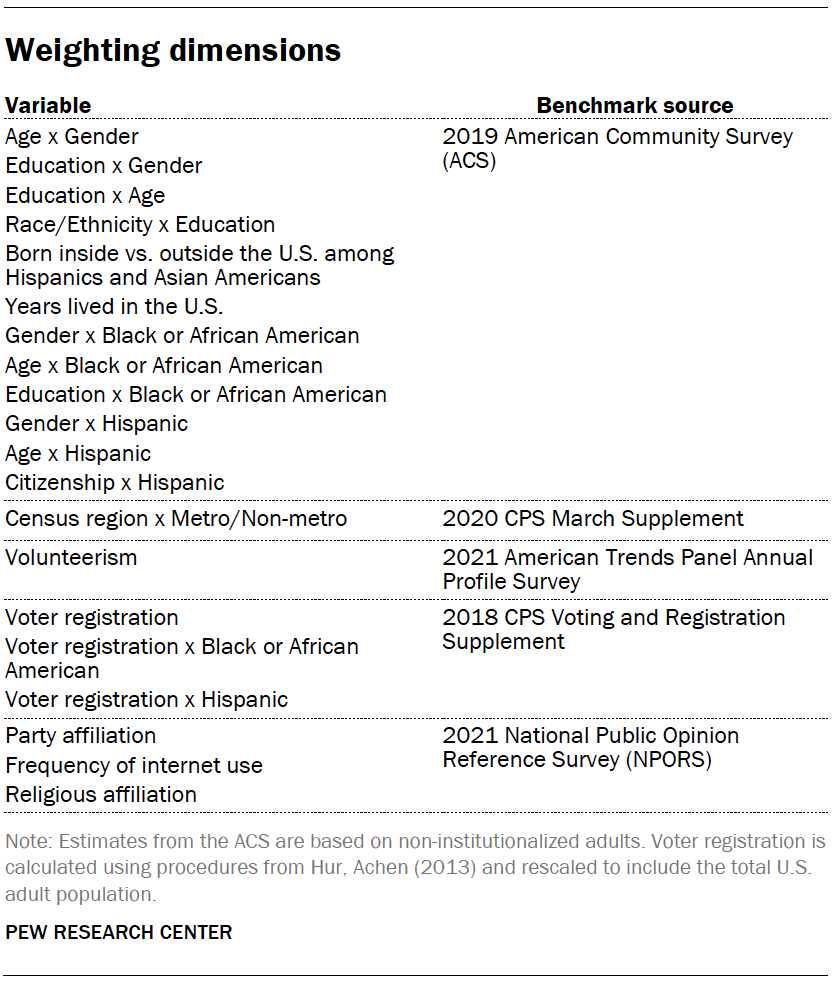
Each group discussion was held online for 90 minutes and included three to six men and women; there were a total of 28 Black American and 29 Hispanic American participants.

Each group was designed to include younger and older age groups and people with higher and lower levels of education. Those with higher education levels included any who had a four-year college degree or a master’s degree. Those with lower education levels included those with a two-year associate’s degree or less education. Those currently working in professional roles in a STEM occupation were not eligible to participate.
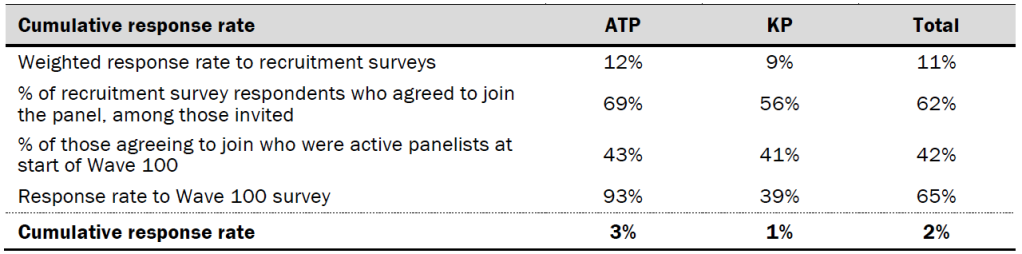
Groups with Black Americans included those living in the metropolitan areas of Atlanta, GA; Chicago, IL; Charlotte, NC; and Houston, TX. Groups with Hispanic Americans were conducted in English or in Spanish with those living in the metropolitan areas of Chicago, IL; Houston, TX; Phoenix, AZ; and Los Angeles, CA. The focus group design is shown in the table.

The moderator guide is included here. Discussions covered a wide range of topics including:

  • Experiences during the coronavirus pandemic and views of scientific advice for ways to protect public health and stop the spread of the virus;
  • Experiences in medical and health care settings for treatment of minor health issues and, separately, for treatment of serious health issues;
  • Involvement with other aspects of science in daily life and ways people think about science;
  • Encounters with science in high school or after high school, including college and perceptions of jobs in science;
  • Media and social media sources for information related to science;
  • Perceptions of the effects of science on society; and
  • Recommendations on what needs to happen for Black and Hispanic Americans to have more confidence in the science community.

Appendix: Detailed charts and tables

Table shows Black Americans who had a same-race high school teacher in STEM more likely to say someone encouraged them, helped show relevance of STEM for their career
Chart shows older Black adults have more positive views of medical researchers’ competence, caring than younger Black adults
Chart shows most Black Americans are skeptical that medical researchers admit their mistakes all or most of time
Chart shows 55% of Black adults say research misconduct is at least a moderately big problem
Chart shows Black adults’ views of recent health care costs
Chart shows Black adults with higher levels of education are more likely to view a Black health care provider as better than others at looking out for their best interests
Chart shows Black adults’ views of Black doctors across aspects of medical care