
Pew Research Center

FOR RELEASE SEPTEMBER 29, 2020

Science and Scientists Held in High Esteem Across Global Publics

Yet there is ambivalence in many publics over developments in AI, workplace automation, food science

BY Cary Funk, Alec Tyson, Brian Kennedy and Courtney Johnson

FOR MEDIA OR OTHER INQUIRIES:

Communications Department
202.419.4372
www.pewresearch.org

RECOMMENDED CITATION

Pew Research Center, September 2020, "Science and Scientists Held in High Esteem Across Global Publics"

About Pew Research Center

Pew Research Center is a nonpartisan, nonadvocacy fact tank that informs the public about the issues, attitudes and trends shaping the world. It does not take policy positions. The Center conducts public opinion polling, demographic research, computational social science research and other data-driven research. It studies politics and policy; news habits and media; the internet and technology; religion; race and ethnicity; international affairs; social, demographic and economic trends; science; research methodology and data science; and immigration and migration. Pew Research Center is a subsidiary of The Pew Charitable Trusts, its primary funder.

© Pew Research Center 2026

Table of contents

  • About Pew Research Center
  • Science and Scientists Held in High Esteem Across Global Publics
  • 1. Scientists are among the most trusted groups in society, though many value practical experience over expertise
  • 2. On the eve of the pandemic, most of these publics saw their medical treatments in a positive light
  • 3. Concern over climate and the environment predominates among these publics
  • 4. Publics express a mix of views on AI, childhood vaccines, food and space issues
  • Acknowledgments
  • Methodology
  • Appendix A: Detailed charts and tables
  • Appendix B: Classifying political parties as populist

Science and Scientists Held in High Esteem Across Global Publics

Yet there is ambivalence in many publics over developments in AI, workplace automation, food science

How we did this

This report examines cross-national perceptions of science and its place in society along with attitudes on a number of science-related issues.

Data in this report come from a survey conducted across 20 publics from October 2019 to March 2020 across Europe, Russia, the Americas and the Asia-Pacific region. The surveys were conducted by face-to-face interviews in Russia, Poland, the Czech Republic, India and Brazil. In all other places, the surveys were conducted by telephone. All surveys were conducted with representative samples of adults ages 18 and older in each survey public.

Here are the questions used for the report, along with responses, and the survey methodology.

As publics around the world look to scientists and the research and development process to bring new treatments and preventive strategies for the novel coronavirus, a new international survey finds scientists and their research are widely viewed in a positive light across global publics, and large majorities believe government investments in scientific research yield benefits for society.
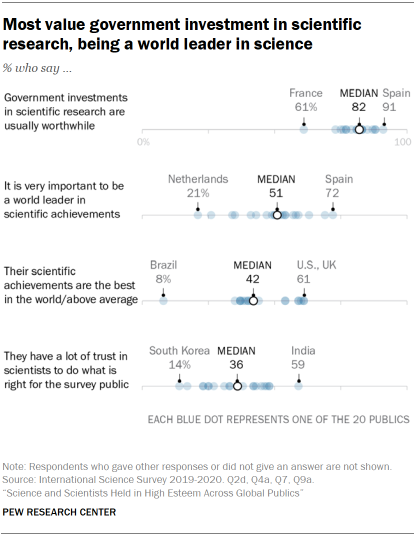
Chart shows most value government investment in scientific research, being a world leader in science

Still, the wide-ranging survey, conducted before the COVID-19 outbreak reached pandemic proportions, reveals ambivalence about certain scientific developments – in areas such as artificial intelligence and genetically modified foods – often exists alongside high trust for scientists generally and positive views in other areas such as space exploration.

Public concerns around climate change and environmental degradation remain widespread. In most publics, majorities view climate change as a very serious problem, say their government is not doing enough to address it and point to a host of environmental concerns at home, including air and water quality and pollution.

With renewed attention to the importance of public acceptance of vaccines, the new survey finds majorities in most publics tend to view childhood vaccines, such as those for measles, mumps and rubella, as relatively safe and effective. Yet sizable minorities across global publics hold doubts about this keystone tool of modern medicine.
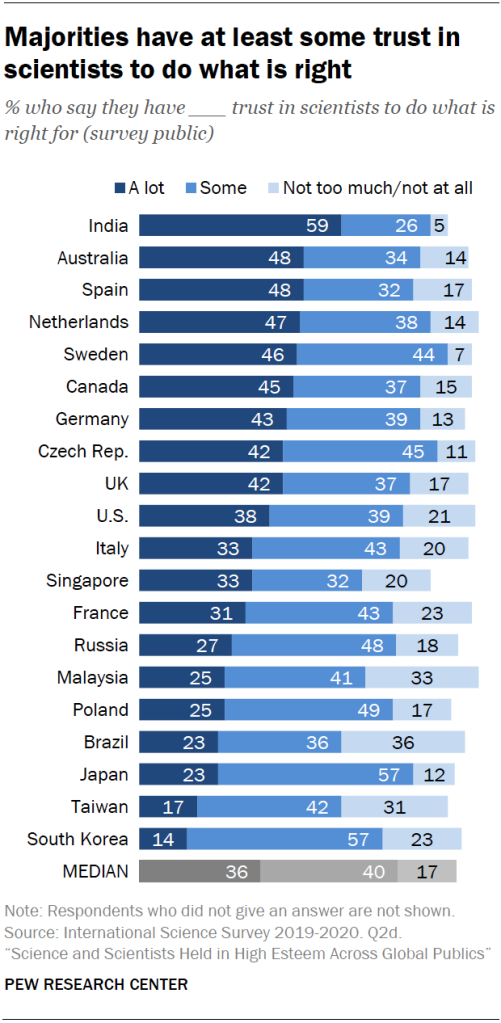
Chart shows majorities have at least some trust in scientists to do what is right

The international survey, fielded in publics across Europe, the Asia-Pacific region, and in the United States, Canada, Brazil and Russia finds broad agreement about the value of scientific research. A median of 82% consider government investment in scientific research worthwhile, and majorities across places view it as important to be a leader in scientific achievements.

The Center survey sheds light on how publics see the place of science in society amid the changing global landscape for scientific research and innovation. The U.S. had the largest share of global spending on research and development in the past, but recent years have seen greater investments by Taiwan, South Korea and mainland China. China is expected to equal or exceed the U.S. in global R&D investments in the coming years, according to data collected by the Organization for Economic Cooperation and Development.1

Scientists as a group are highly regarded, compared with other prominent groups and institutions in society. In all publics, majorities have at least some trust in scientists to do what is right. A median of 36% have “a lot” of trust in scientists, the same share who say this about the military, and much higher than the shares who say this about business leaders, the national government and the news media.

Still, an appreciation for practical experience, more so than expertise, in general, runs deep across publics. A median of 66% say it’s better to rely on people with practical experience to solve pressing problems, while a median of 28% say it’s better to rely on people who are considered experts about the problems, even if they don’t have much practical experience.

The publics’ assessments of their own achievements in science do not always measure up to their aspirations: A median of 42% say their scientific achievements are above average or the best in the world. However, the shares holding this view ranges from 8% in Brazil to 61% each in the U.S. and United Kingdom.

And in many places, the public sees room for improvement when it comes to education at the university or primary and secondary school levels in science, technology, engineering and mathematics (STEM). A median of 42% rate university STEM education in their survey public as above average or the best in the world, and a smaller median of 30% give high marks to their science, technology, engineering and math education at the primary and secondary school level.

These are among the chief findings from the survey conducted among 20 publics with sizable or growing investments in scientific and technological development from across Europe (the Czech Republic, France, Germany, Italy, the Netherlands, Poland, Spain, Sweden and the United Kingdom), the Asia-Pacific region (Australia, India, Japan, Malaysia, Singapore, South Korea and Taiwan) as well as Russia, the United States, Canada and Brazil.

Public trust in scientists is often higher for those on the left than the right of the political spectrum

While there is generally a positive tilt toward public trust in scientists, trust often varies with ideology. In general, those on the left express more trust in scientists than those on the right.

Such differences are especially pronounced in the U.S., where fully 62% of those on the left have a lot of trust in scientists, compared with two-in-ten of those on the right. (The gap is similar factoring in party identification; 67% of liberal Democrats in the U.S. say they have a lot of trust in scientists, compared with 17% of conservative Republicans.)
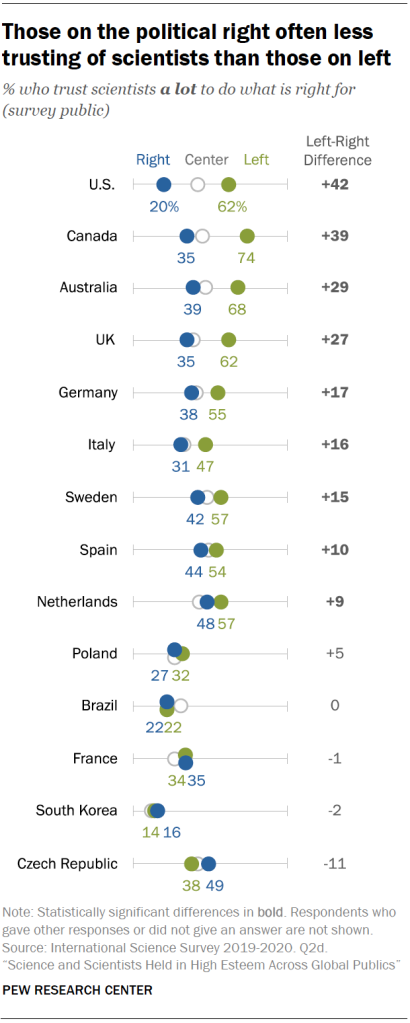
Chart shows those on the political right often less trusting of scientists than those on left

Left-right divides are also present in a number of other places. In Canada, for instance, 74% of those who place themselves on the left say they have a lot of trust in scientists to do what is right, compared with 35% of Canadians with right-leaning political views.

In the UK, there’s a 27 percentage point difference between the shares of those on the left and right who have a lot of trust in scientists. Germany (by 17 points), Sweden (15 points) and Spain (10 points) are among the other places where those on the left are more trusting of scientists than those on the right.

Consistent with this ideological pattern, those with favorable views of right-wing populist parties in Europe tend to express lower levels of trust in scientists than those with unfavorable views of these parties.

However, differences by political ideology do not strongly extend to other views of scientists or experts. For instance, there are generally modest or no left-right differences in views of whether scientists tend to make judgments based solely on the facts or are just as likely to be biased as other people. And in most places, there’s general agreement across the political spectrum that, when it comes to solving pressing problems, it is better to rely on people with practical experience than on people with expertise. A median of two-thirds say it is better to rely on people with practical experience, while a median of 28% say it is better to rely on people with expertise, even if they don’t have practical experience.

Amid rising concern about global climate change, most see at least some impact from climate change where they live and say their government is doing too little to address it

International concern about climate change has increased over the past several years, with growing shares viewing climate change as a major threat. In addition, large majorities in the current survey express worry over climate change and describe it as a serious problem.

A median of seven-in-ten across the set of 20 publics say climate change is having at least some effect on their local community. And in some places – Italy, Spain and Brazil – about half or more see a great deal of impact from climate change in their community. Government action on climate change is widely seen as lacking: Majorities across most of surveyed publics believe their government is doing too little to address climate change (20-public median of 58%).
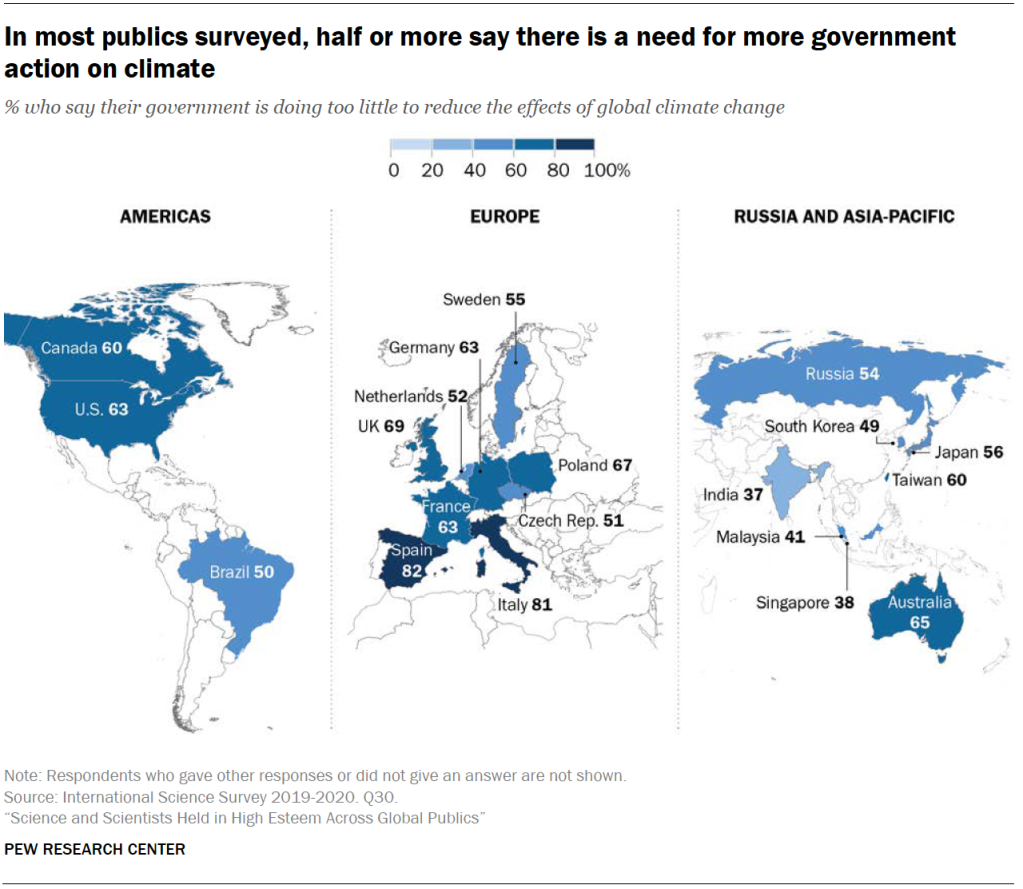
Chart shows in most publics surveyed, half or more say there is a need for more government action on climate

Across the 20 publics surveyed, environmental concerns extend beyond the issue of climate change: Large majorities rate a host of environmental issues as big problems, including air and water pollution, overburdened landfills, deforestation and the loss of plant and animal species. In general terms, environmental concerns trump economic considerations: When asked to choose, a median of 71% said environmental protection should be the greater priority even if it caused slower economic growth and loss of jobs; a much smaller median of 25% said creating jobs should be the priority (the survey was conducted before the coronavirus pandemic and resultant economic strains took hold in many of these publics).

Chart shows most prioritize environmental protection, increasing renewable energy

Consistent with environmental worries, majorities across all 20 publics say the more important energy priority should be increasing production of renewable energy such as wind and solar sources over increasing production of oil, natural gas and coal (median of 86% to 10%). Views about specific energy sources underscore this pattern with strong majorities in favor of expanding the use of wind, solar and hydropower sources and much less support, by comparison, for energy sources such as oil or coal. Views on expanding natural gas fall somewhere in between.

Public views about climate, environment and energy issues are strongly linked with political ideology. For example, those who place themselves on the political left are more inclined to see climate change as a serious problem and to think their government is doing too little to address it than those on the right; these differences are particularly wide in the U.S., Australia, Sweden, Canada, the UK and the Netherlands.

There is little consensus across regions in views of artificial intelligence, automation in the workplace

Chart shows public views of AI’s impact on society are often mixed

Public views of artificial intelligence, described for survey respondents as computer systems designed to imitate human behaviors, are generally viewed positively by publics in the Asia-Pacific region. A median of two-thirds in the Asia-Pacific say that AI has been a good thing for society, while a median of 20% say it has been a bad thing. Elsewhere public views are mixed. In Europe a median of 47% say the development of AI has been good for society. Roughly half view AI positively in Brazil (53%), Russia (52%), the U.S. (47%) and Canada (46%).

Opinions about the impact of robotics to automate jobs also are mixed. A median of 48% say such automation has mostly been a good thing, while 42% say it has been a bad thing. As with views of AI, assessments of job automation are generally more positive in the Asia-Pacific region (median of 61% say it’s been a good thing). Fewer in Europe (a median of 48%) share this positive view. Those in France (35%), Spain (37%) and Brazil (29%) are among the least likely to say robots and automation in the workplace has been a good thing for society. In the U.S., slightly more say this type of automation has been bad than good for the country (50% vs. 41%).

Across places surveyed, those with higher levels of education and who have taken more science courses in their schooling are especially likely to consider AI and workplace automation as a positive development for society. Views tend to be less positive among those with lower levels of education.

Many publics give positive marks for handling the coronavirus outbreak

The coronavirus pandemic altered the lives of people around the world. Governments applied a myriad of approaches in response to the outbreak, and the scope of the health crisis varied widely.

A separate Pew Research Center survey conducted June to August of 2020 in 14 countries found a median of 73% think their country has done a good job handling the novel coronavirus. Strong majorities in Denmark, Germany, Canada, Australia, the Netherlands and South Korea hold this view as do at least seven-in-ten in Italy and Sweden. In Japan 55% give their country positive marks. In the UK, U.S. and Spain, ratings are more divided, with wide differences of opinion across political or ideological groups about their country’s handling of the outbreak.

More think their country has done a bad job handling the outbreak in places with higher counts of coronavirus-related fatalities. Similarly, the share who say their country is more divided than before the outbreak is strongly related to the number of cases and deaths from the disease. The U.S. stands out on this measure with 77% of Americans saying the outbreak has further divided the nation.

Among the reports’ other major findings:

  • Many see childhood vaccines as bringing high preventive health benefits but some doubts about safety and effectiveness remain. A majority of adults in 17 of the 20 publics rate the preventive health benefits from childhood vaccines – such as the measles, mumps and rubella vaccine – to be high. But there are only a handful of publics – Sweden, Spain and Australia – where about eight-in-ten or more are convinced of the high preventive health benefits. Smaller majorities take this view in other places, including Italy, the Netherlands and Singapore. And while most places consider the risk of side effects from childhood vaccines to be low, half or more in Japan, Malaysia, Russia, South Korea, France and Singapore consider the risk to be medium or high. Those who identify on the political right, or who have a favorable view of a right-wing populist party in Europe, are less likely to see the preventive health benefits of such vaccines as high or the risk of side effects to be low or none. These differences are particularly large in the Netherlands, UK and France.
  • There are widespread concerns about the safety of genetically modified foods in many of these publics. Larger shares believe foods with genetically modified (GM) ingredients are unsafe to eat than say they are safe (20-public median of 48% vs. 13%). Though familiarity with GM foods is not always high: A median of 37% say they don’t know enough about such foods to say. Health risks also are seen in produce grown with pesticides and food and drinks with artificial preservatives. Women are more likely than men to express safety concerns about all three food groups.
  • Many give science news coverage positive marks but cite lack of public understanding as a problem for science coverage. Overall, a median of 68% say the news media do a very or somewhat good job covering science; 28% say they generally do a bad job. Publics generally agree about one issue with the news, however: Majorities across 18 of the 20 publics say that limited public understanding is a problem for coverage of scientific research. Far fewer consider media oversimplifying findings or researchers overstating their findings to be a problem for coverage of research.

1. Scientists are among the most trusted groups in society, though many value practical experience over expertise

Across the 20 places surveyed, there is relatively high trust in the military and scientists to do what is right for the public; trust tends to be lower in the national government, news media and business leaders, by comparison. Education and political ideology often play a role in people’s assessments of scientists, with highly educated people and those on the political left tending to express more trust in scientists than those with lower levels of education and those on the political right.

While political ideology, including views of right-wing populist parties, is often correlated with trust in scientists, it has only a modest connection with general views about whether scientists’ judgments are based solely on the facts or as likely to be biased as those of other people. In general terms, about half to three-quarters across all of these publics think it is better to rely on people with practical experience to solve pressing problems in society than to rely on those with expertise. Public skepticism of relying on experts, generally, is widely shared across those on the right and left.

Public trust in the news media is considerably lower than that for scientists in most places surveyed. However, majorities in 18 of the 20 survey publics give the media positive marks for their science news coverage. Further, majorities in most of these publics agree on at least one problem about the news: The general public doesn’t know enough about science to really understand coverage of scientific research.

Public trust in scientists rivaled that in the military at the onset of the pandemic

Majorities across publics say they have either a lot of trust or some trust in scientists to do what is right for the public. A 20-public median of 36% express the strongest level of trust in scientists to do what is right. Relatively few across most survey publics say they have not too much or no trust in scientists to do what’s right.

Overall, views of the military are similarly positive. In nearly all places, majorities have at least some trust in the military to do what is right for the public, and a median of 36% have a lot of trust (the same median as for trust in scientists).

However, the relative standing of trust in the military and scientists varies from place to place. In eight of the places surveyed, the military is more trusted than scientists, including in India, the U.S. and Russia. By contrast, in six publics – all in Europe, including the Netherlands, Sweden and Germany – greater shares have a lot of trust in scientists than in the military to do what is right. In five publics, no one group is trusted more than another, and trust in the military and scientists tends to be about the same. For example, 46% of Australians say they trust the military a lot, while 48% have a lot of trust in scientists.

Singaporeans stand out for comparatively high trust in their national government to do what is right for the country: 54% have a lot of trust in the national government, and the same share has a lot of trust in the military. By comparison, a third in Singapore have a lot of trust in scientists. (The language used to describe the national government varied modestly across survey publics; see topline for more details.)

In the large majority of publics surveyed, trust in the national government, news media and business leaders tends to be lower than that for the military and for scientists. Medians of roughly one-in-ten have a lot of trust in each of these groups and institutions to do what is right. And, the share with a negative view of each group is often sizable. For example, the share who report not too much or no trust in the news media to do what is right on behalf of the public is as high as 75% in France and 69% in South Korea.

Chart shows relatively high trust in the military, scientists across surveyed publics

In a majority of surveyed publics, people with more education are more trusting of scientists than those with less education

In 14 of the 20 publics, people with more education express higher levels of trust in scientists than those with less education. For example, 54% of Canadians with at least some postsecondary education have a lot of confidence in scientists compared with 33% of Canadians with a secondary education or below, a difference of 21 percentage points. There are differences in trust in scientists by education levels in a number of other places, including the UK, Brazil, Germany, the U.S. and Sweden.

In some places, trust in scientists is also higher among people who have taken three or more science courses as part of their postsecondary education than among those with less postsecondary science training. This is the case in the UK, the Netherlands, Australia, the U.S. and Taiwan. However, science training is not uniformly related to higher trust in scientists; in most places surveyed, there is no significant relationship between the two. See details in Appendix A.

Age can also play a role in views of scientists. Adults younger than the median age report higher levels of trust in scientists to do what is right than those older than the median age in eight of the publics surveyed. Overall, the magnitude of these gaps is relatively modest. For instance, in the UK, 47% of those younger than the median age trust scientists a lot to do what is right compared with 37% of people older than the median age.  See details in Appendix A.

Levels of trust in scientists and the military differ by political ideology

The growth of right-wing populist movements in many European nations, along with anti-establishment rhetoric, has heighted concern about the degree to which the general public values expertise. Views of experts have been a flashpoint in political conversations in places around the world, including the U.S. and UK. British conservative politician Michael Gove said during debates around the economic impact of leaving the European Union that “people in this country have had enough of experts,” and in the U.S. President Donald Trump has often expressed a low opinion of experts.

The Center’s survey finds differences by political ideology in views of scientists, as well as the military, with those who place themselves on the left of a scale of political ideology often expressing more trust in scientists – and less trust in the military – than those on the right.

There are especially large differences in trust in scientists and the military by political ideology in all four English-speaking countries surveyed (the U.S., Canada, Australia and the UK). Majorities of those who identify themselves as left-leaning in these places say they have a lot of trust in scientists to do what is right for the public, while fewer than half say this about the military. For example, 62% of those on the left in the UK have a lot of trust in scientists, while just 32% say this about the military. The pattern is the reverse among those on the political right. In the U.S., for instance, 75% of those on the right express the highest level of trust in the military, compared with 20% who have a lot of trust in scientists.

Trust in scientists also is higher on the left than the right in Germany, Italy, Sweden, Spain and the Netherlands. People who consider their ideological views to be on the right are more inclined to trust the military to do what is right, although the size of the difference varies across these countries. (People’s political ideology was asked in 14 of the 20 publics surveyed, primarily in Europe and the Americas.)

Chart shows left-leaning adults tend to trust scientists more than those on the right; those leaning right often express higher levels of trust in the military

In the U.S., political ideology is closely tied to party identification. Analysis of partisanship and ideology shows very large differences between liberal Democrats and conservative Republicans in the levels of trust they express in scientists and the military.

Two-thirds of liberal Democrats have a lot of trust in scientists to do what is right for the country, compared with just 17% of conservative Republicans. By contrast, a broad majority of conservative Republicans (83%) have a lot of trust in the military to do what is right for the county, compared with 32% of liberal Democrats.

Chart shows in the U.S., there are wide political differences in trust in military and scientists

Publics skeptical that they should rely more on ‘experts’ to solve problems

Across publics, there is skepticism about relying on experts to solve important problems over those with practical experience in the problem area. In all 20 publics, fewer than half think they should rely more on people who are considered experts in the area – even if they don’t have much practical experience – to solve pressing problems (median of 28%). In all places, larger shares say they should rely more on people with practical experience, even if they aren’t considered experts (median of 66%).

When it comes to the decision making of scientists, a median of 55% think that scientists make judgments based solely on the facts, compared with a median of 41% who say they are just as likely to be biased as other people.

While there are often wide differences between those on the left and the right in overall trust in scientists, there are generally smaller gaps in assessments of whether scientists make decisions based on the facts and whether publics should rely more on people considered experts to solve problems.

For instance, in the UK, those on the left are 27 points more likely than those on the right to say they have a lot of trust in scientists to do what is right. However, there are quite modest differences between the shares of those on the left and right who say scientists make judgments based solely on the facts (61% and 59%, respectively) and say that the public should rely more on experts to solve problems (37% and 32%).

Where ideological differences in these two views exist, those on the left are more likely than those on the right to say that scientists make judgments on the facts and that the public should rely more on people who are considered experts. There are notable differences by ideology on these two questions in the U.S., Canada and Australia – three places where those on the left and right also express different levels of overall trust in scientists. In Australia, for instance, about two-thirds of those on the left (68%) think scientists make judgments based solely on the facts. By contrast, those on the right are about as likely to say scientists’ judgments are as likely to be biased as other people’s as to say they make judgments solely on the facts. Left-leaning Australians are also more inclined to rely on experts to solve problems; 45% of Australians on the left say the government should rely more on people who are considered experts to solve the nation’s most pressing problems compared with just 20% of those on the right.

Chart shows in many places, modest differences by ideology in views of scientists’ judgments, value of experts

Favorable views of right-wing populist parties also tend to align with lower trust in scientists, higher trust in the military

In most places, the relationship between trust in scientists and the military and attitudes toward right-wing populist parties mirrors that seen with political ideology. People in Europe with a favorable view of right-wing populist parties tend to report lower levels of trust in scientists – and higher levels of trust in the military – than those who view these parties unfavorably. Notably, differences are less pronounced between those with favorable and unfavorable views of right-wing populist parties when it comes to whether scientists base their decisions primarily on the facts and whether the public should rely more on experts to address pressing problems. (Supporters of European populist parties stand out across a number of issues. See Center analyses from 2019 for an overview.)

Chart shows those with favorable views of right-wing populist parties are often less trusting of scientists, more trusting of the military

Majorities say the media do a good job covering science but say the public often doesn’t know enough to understand news on scientific research

Chart shows science news coverage generally seen in a positive light

While relatively few people have strong trust in the media to do what is right, majorities across most of these publics give the news media positive marks for their science news coverage. Around two-thirds or more say the news media do a very or somewhat good job covering science topics, while far fewer say the media do a bad job covering science (20-public median of 68% vs. 28%).

Malaysians are the most positive about journalists’ coverage, with 85% saying they do a good job covering science stories. About eight-in-ten in Singapore (80%) and South Korea (77%) also say the news media do a good job covering science. Ratings of the news media are lowest in the U.S. and Spain, where roughly half say the media do a good job with their science coverage.

Chart shows older adults are often more likely to say the media do a good job covering science news

Older adults tend to be more positive than younger adults about science media coverage. A larger share of older than younger adults say the news media do a very or somewhat good job covering science-related stories in 12 of the publics surveyed. For instance, about three-quarters of older Swedes (76%) say the news media do a good job covering science, compared with 56% of younger Swedes.

People with more education are more critical of science news coverage in nine of these publics. For example, 59% of Italians with a postsecondary education or higher say the media do a good job covering science, compared with 71% of those with less education.

In most publics, political ideology – and support for right-wing populist parties – is not related to views of science media coverage. However, past Pew Research Center research has found people in a number of Western European countries who hold populist views are often less likely to trust the news media generally.

More see public understanding of science as a problem for news coverage than they do issues stemming from the media or from researchers

Asked to consider three potential problems for news coverage of scientific research, the public edict was clear. Majorities across 18 of 20 publics consider limited public understanding of science to be a problem for media coverage of scientific research (a median of 74% say this).

In general, fewer see other areas as potential problems for science news coverage. A 20-public median of 49% say the news media oversimplifying research findings is a problem in coverage. Places where a high share see oversimplification as a problem in science news coverage include Taiwan (80%), Spain (66%) and South Korea (65%).

Publics are not especially likely to blame researchers themselves for problems with science news coverage: A 20-public median of 44% say it’s a problem for science news coverage that researchers overstate the implications of their findings. Majorities in only two publics – Taiwan (85%) and South Korea (69%) – see this as a problem.

Respondents who said at least two of these three issues were problems for scientific reporting were asked a follow-up question about what they see as the biggest problem with science coverage. A lack of public understanding was most frequently seen as the biggest problem of this set: A median of 52% across publics said this. Far smaller shares said the biggest problem for coverage was media oversimplifying research findings (median of 16%) or that researchers overstate the implications of their findings (median of 13%).

Chart shows majorities say the public doesn’t know enough about science to understand research findings covered in the news

People across levels of educational attainment tend to see lack of public understanding as a problem for media coverage of science. However, in nine of 20 places surveyed, those with higher levels of education are more likely to say this than those with lower levels of education. Differences by education are especially pronounced in Brazil (a difference of 25 percentage points) followed by Malaysia (an 18-point difference). People’s views about whether media oversimplification of research findings is a problem also tend to vary by education. In 11 publics, people with higher levels of education are more likely to say news media oversimplification of research findings is a problem. For details, see Appendix A.

2. On the eve of the pandemic, most of these publics saw their medical treatments in a positive light

Looking across the 20 publics surveyed, majorities considered their medical treatments to rank above those of other publics globally. Views of medical treatments were often seen more favorably than achievements in other areas, including science, technology, STEM education, politics and the economy. In the U.S., however, 61% said their scientific achievements were at least above average, while more – 55% – said the same about their medical treatments. And in India, similarly sized majorities saw their country as above average or the best in the world across a number of areas. (The survey was conducted before the coronavirus outbreak reached pandemic proportions.)

Large majorities saw value from government investment in scientific research, saying that such investment is usually worthwhile for society over time. Majorities also generally considered it at least somewhat important to be a world leader in scientific research. But the share who considered their scientific achievements at least above average often lagged behind the share saying it was very important to be a world leader in science.

Many see their medical treatments in a favorable light; fewer say the same about STEM education for primary and secondary school students

Across the 20 publics, a median of 59% say their medical treatments are at least above average, with some of the highest ratings in the Asia-Pacific region. In South Korea and Taiwan, for example, 80% say their medical treatments are at least above average. By contrast, only 6% in Brazil and 13% in Poland think their medical treatments are the best in the world or above average.

Medians of 45% and 42% say their technological and scientific achievements are at least above average, respectively. Perceptions of areas of relative strength vary by public. In the UK, the U.S. and Japan, majorities give positive ratings to both their technological and scientific achievements. In South Korea and Singapore, majorities think their technological achievements are at least above average, but fewer than half say the same about scientific achievements. In Australia the opposite pattern occurs, with a smaller share giving their technological than scientific achievements high marks.

When it comes to education in science, technology, engineering and math (STEM), a median of 42% see their publics’ university STEM training as above average or the best in the world. Ratings are far lower when it comes to STEM education at the primary and secondary school levels: Across the 20 publics surveyed, a median of 30% view the STEM education at these levels as at least above average.

Singaporeans stand out for their strongly positive ratings of their STEM education: 65% rate their STEM education in primary and secondary schools as at least above average. The city-state consistently ranks at or near the top in math and science on the Programme for International Student Assessment (PISA) of 15-year-olds. Singapore is also one of only a handful in which a majority (68%) rates their university STEM education as at least above average, along with the UK (60%), the Netherlands (56%) and India (56%).

Across all areas of achievement, ratings are particularly low in Brazil. Just 10% or fewer consider their medical treatments, technological or scientific achievements and STEM education to be at least above average. A majority of Brazilians (63%) consider their medical treatments to be below average; 41% say the same about the country’s scientific achievements. Brazilians’ views of the political and economic system are also quite negative. Fewer than one-in-ten say their country is the best in the world or above average in these areas; majorities say each is below average compared with other nations.

Chart shows prior to the pandemic, many saw medical treatments as a source of achievement

Those with more education tend to see their STEM-related achievements in a more favorable light

Across the 20 publics, those with more education often rank their medical treatments, university STEM education and scientific achievements more highly than those with less education. For example, 72% of Germans with a postsecondary education or more think the country’s medical treatments are at least above average compared with 57% of those with less education. Germans with more education are also more inclined than those with less education to say their university STEM education (47% vs. 27%) and scientific achievements (50% vs. 38%) are the best in the world or above average.

Malaysia stands out as the only survey public in which the pattern is reverse. Malaysians with at least a postsecondary education are less likely than others to see the country’s university STEM education or scientific achievements in a favorable light. Malaysians with a postsecondary education also tend to give lower marks to the country’s technological achievements as well as to its political system and economy.

While higher levels of education are often associated with more positive views of STEM-related achievements, postsecondary science training itself is not consistently tied to differences in these assessments. For instance, among those with a postsecondary education in Japan, 75% of those who took three or more science courses say their medical treatments are above average or the best in the world, compared with about as many (76%) who took zero to two science courses.

The absence of a relationship between postsecondary science training and ratings of medical treatments, scientific achievements and university STEM education is seen across many survey publics. However, Sweden, France and the Netherlands are exceptions to this general pattern. In these places, those who have at least a postsecondary education and who have completed three or more college-level science courses are more positive about the quality of their country’s medical treatments, university-level STEM education and scientific achievements than postsecondary graduates with less science training.

Chart shows adults with more education often hold more positive views of medical treatments, university STEM education, scientific achievements than those with less education

In many places, men are more likely than women to highly rank their countries’ accomplishments across a range of STEM-related areas, particularly in Europe. For example, in the Netherlands, men are more likely than women to say their country is at least above average in university STEM education (20 percentage point difference), medical treatments (by 18 points) and scientific achievements (18 points). There are similar differences between men and women in the ratings of medical treatments, university STEM education and scientific achievements in France, Italy, Germany and the UK. See details in Appendix A.

Majorities see government investments in scientific research as valuable; half or more think being a world leader in science is important

Chart shows large majorities say government investment in science is worthwhile

Overall, there is broad agreement among these 20 publics that government investment in scientific research is worthwhile. Large majorities in most publics surveyed say that government investment in scientific research aimed at advancing knowledge is usually worthwhile for society over time. Across all places surveyed, a median of 82% say this.

Further, majorities in all publics agree that being a world leader in scientific achievement is at least somewhat important. The share who view this as very important varies by public. A 20-public median of 51% place the highest level of importance on being a science world leader.

Assessments of where each public stands in its scientific achievements often lag behind the shares who aspire to be a world leader in science.

Chart shows in many places, public more likely to say it’s very important to be a world leader in science than to view own achievements as above average

For example, 72% of Spaniards consider it very important to be a world leader in scientific achievement, but just 35% believe their country’s scientific achievements are the best in the world or above average.

In a few places, the opposite pattern occurs. Among the Dutch, for instance, just 21% say it is very important to be a science world leader, while more than twice as many (54%) consider the nation to be at least above average in its scientific achievements.

People with higher levels of education are more likely than those with lower levels of education to think government investments in scientific research are worthwhile. There is a significant difference in views by level of education in 18 of the 20 publics surveyed.

In eight of 20 publics, people with more education are more likely than those with less education to say it is very important to be a world leader in scientific achievements.

Among those with higher levels of education, there is little difference in views on these two questions between those who have taken three or more science courses and those with less science training. See details in Appendix A.

3. Concern over climate and the environment predominates among these publics

There is a common concern across most of the surveyed publics around environmental protection. A median of seven-in-ten report that climate change is having at least some effect in the area where they live. About half or more consider climate change to be a very serious problem; public concern about climate change is up since 2015 in places where a previous Pew Research Center survey is available. And, while there is some variation, majorities across most of these publics believe their national government is doing too little to address climate change.

When respondents were asked to choose between protecting the environment and job creation, the balance of opinion landed squarely on the side of environmental protection. (This survey was conducted before the coronavirus pandemic and resultant economic strains in many of these publics.)

Further, as people think about energy issues, many more would prioritize expanding renewable energy production over that for fossil fuel energies. Views about specific energy sources underscore this pattern, with strong majorities in favor of expanding the use of wind, solar and hydropower sources and much less support, by comparison, for energy sources such as oil or coal.

People’s views on climate, environment and energy issues tend to align with their political ideology. Those who place themselves on the left are more inclined to see climate change as a serious problem and to think their government is doing too little to address it. Left-leaning adults are especially inclined to prioritize protecting the environment or creating new jobs and to think it more important to increase renewable energy production over that for fossil fuels.

There is also a tendency for environmental and energy priorities to vary with age. In particular, a larger share of younger adults than older ones across most of these publics prioritize protecting the environment even it means harm to economic development.

Majorities see at least some effects of climate change where they live; a median of 58% say government action to address climate change is insufficient

A median of 70% across the 20 publics surveyed say they are experiencing a great deal or some effects of climate change in the area where they live. Italians and Spaniards stand out. More than eight-in-ten Italians (86%) say climate change is affecting the area where they live at least some, including 55% who think climate change is having a great deal of influence. A similar share of Spaniards say climate change is affecting their local area at least some (84%, including 53% who say climate change is affecting where they live a great deal).

Those in two northern European nations, the UK and Sweden, are far less likely to say they are experiencing the effects of climate change. In Sweden, for example, 55% say they experience a great deal (16%) or some (39%) effects of climate change where they live.

Overall, majorities across most of these publics believe their national government is doing too little to address climate change. A 20-public median of 58% say their national government is doing too little, compared with a median of 27% who say their government is doing about the right amount and a median of just 6% who say it is doing too much to reduce the effects of climate change.

Those in Spain and Italy again stand out. About eight-in-ten Spaniards (82%) and Italians (81%) say their government is doing too little on climate change. Only 14% in both Spain and Italy say their government is doing the right amount. Six-in-ten or more in other places, including the UK (69%), Poland (67%), France (63%), Germany (63%), the U.S. (63%), Canada (60%) and Taiwan (60%), say their government is doing too little.

Places where fewer than half see a need for more government action on climate change include Malaysia, Singapore and India. In Singapore, more say their government is doing the right amount (45%) to address climate change than say it is doing too little (38%). In Malaysia, similar shares say their government is doing too little (41%) and say it is doing the right amount (39%) now. And, in India, 37% say the government is doing too little, while 15% say it is doing the right amount and 32% say it doing too much to address climate change.

Chart shows majorities in most publics surveyed see climate change as a very serious problem and think their government is doing too little to address it
Increasing shares see climate change as a very serious problem since 2015
Chart shows rising shares see climate change as a very serious problem

Climate change is considered a very serious problem by a majority of adults across most of these publics (20-public median of 57%). There is variation in the degree of concern about climate change, however. Large majorities – seven-in-ten or more – in Taiwan (80%), Italy (75%), France (74%), Spain (73%), South Korea (71%) and Japan (70%) see climate change as a very serious problem. By contrast, only about half in Australia (53%), Poland (53%), U.S. (53%), Malaysia (52%), Netherlands (52%) and Czech Republic (49%) say climate change is a very serious problem.

A 2015 Center survey found the U.S. and China stand apart from other nations for their relatively low levels of concern about climate change. In the new survey, too, Americans stand out for having a higher share who say that climate change is not too serious or not a problem (25%).

Concern about climate change is rising across many publics; the share saying climate change is a very serious problem rose in 12 of 15 publics where a comparison is available. In five European countries – Italy, France, Spain, the UK and Poland – the percentage of those who think climate change is a very serious problem has grown by about 20 or more percentage points over roughly five years. For example, in the UK, about two-thirds (65%) now say climate change is a very serious problem, compared with roughly four-in-ten (41%) in 2015. Marked increases in the share saying climate change is a very serious problem also occur in South Korea and Japan (up 23 and 25 percentage points, respectively).

These findings are consistent with past Pew Research Center surveys using different question wording, which showed that global perceptions of climate change as a threat increased between 2013 and 2018. In the U.S., public concern about climate change has also gone up over time; however, concern has risen primarily among Democrats and not Republicans.

People’s views about climate change are strongly linked to political ideology

Global perspectives on climate are strongly aligned with people’s ideological leanings; those on the left are more inclined than those on the right to see climate change as a serious problem and to think their government is doing too little to address it.

Ideological divides in the U.S. are larger than in any other public surveyed. Wide differences among Americans are also seen when comparing conservative Republicans with liberal Democrats. Political differences have been a hallmark of Americans’ views on climate. But other publics also have wide ideological divides over climate matters, consistent with past Center findings.

Australians on the left are more than twice as likely as Australians on the right to say climate change is a very serious problem (79% vs. 36%). Similarly, Canadians on the left are 38 percentage points more likely than Canadians on the right to say climate change is a very serious problem (82% vs. 44%). And in five European countries (Sweden, UK, Germany, Netherlands and Poland), those on the left are 20 or more points more likely than those on the right to say climate change is a very serious problem.

Views on climate change are widely shared among older and younger adults. There is a modest tendency for younger adults (at or under the median age) to say climate change is a very serious problem compared with older adults in a handful of places, including Australia, Canada, UK, the U.S. and others.

Chart shows large ideological gaps across many publics in views on climate change

Supporters of right-wing populist parties show less concern about climate change

In Europe, those who hold favorable views of right-wing populist parties generally see climate change as a less serious problem. For example, about one-third (32%) of supporters of Sweden Democrats (SD) say climate change is a very serious problem. In comparison, roughly seven-in-ten (69%) of Swedes who do not support SD say climate change is a very serious problem. Similarly, supporters of right-wing populist parties have drastically different views about how much their government is doing on climate change. In the UK, 49% of those who support the Brexit Party think the government is doing too little on climate, compared with 78% of those who do not support the party.

Chart shows supporters of right-wing populist parties in Europe generally less likely to think their government is doing too little on climate change

Large majorities see environmental problems where they live; a median of 71% would prioritize environmental protection over job creation

In most of these survey publics, large majorities classify a range of environmental issues as a big problem where they live. Majorities in 18 out of 20 survey publics see pollution of rivers, lakes and oceans as a big problem (20-public median of 78%). Nearly all in Spain (96%) and about nine-in-ten in Brazil, Italy, France and Russia say this. Swedes and Singaporeans are less concerned about water pollution, by comparison. In Sweden, for example, 54% say this is a big problem, 29% say it is a moderate problem and 16% say it is either a small problem or not problem.

There is a similarly high level of concern about the amount of garbage, waste and landfills. Around nine-in-ten say this is a big problem in Spain, Brazil and Italy. Across 17 of the 20 publics, two-thirds or more consider this is a big problem. The Dutch (43%) and Swedes (32%) have lower levels of concern about this issue.

Public concern about other environmental issues is also high, including air pollution (20-public median of 76% say this is a big problem), the loss of forests (74% median) and extinction of plant and animal species (67% median).

Swedes are less likely to consider each of these issues to be a big problem where they live. In Sweden, roughly a third see landfill waste, air pollution and loss of forests as a big problem – the lowest percentage among survey publics for these three items.

Chart shows most see each of a range of environmental problems where they live
Chart shows majorities prioritize protecting the environment over job creation across all survey publics

If asked to choose, majorities across all of these publics say they would prioritize protecting the environment even if it causes slower economic growth. A median of 71% would prioritize environmental protection, while a quarter would prioritize job creation.

Public priorities on environmental protections have risen over time. In 18 of the 19 survey publics with a comparable survey trend, the share who would prioritize protecting the environment went up since 2005/2006.

The exception is Canada, where 69% would prioritize protecting the environment, about the same as said this in a 2006 World Values Survey. (All trend comparisons to surveys conducted by the World Values Survey or the Asian Barometer Survey. Note that these surveys used different ways of contacting survey respondents over time and such differences in survey mode can influence findings.) (See Appendix A for details.)

Chart shows two-thirds in China said environmental protection should have priority over creating jobs as of 2018

In China, a World Values Survey from 2018 showed a similar balance of opinion: 68% would prioritize protecting the environment, while 26% would prioritize creating jobs. The 2014 Asia Barometer survey found a similar pattern.

Public priorities related to the environment are strongly aligned with political ideology. People who think of their political views as on the left are much more likely than those on the right to prioritize environmental protection over job creation. Ideological differences are particularly wide in the U.S., Canada, Australia and the Netherlands (differences of at least 30 percentage points). This pattern is in line with wide differences by ideology on a range of climate, environment and energy issues. (Ideological self-placement is asked in 14 of the 20 publics; it is not asked in many of the Asian publics.)

There are also differences by age across 12 of the 20 survey publics, with younger adults more likely than older adults to say that protecting the environment should be given priority. The difference is largest in the Netherlands (16 points) and the U.S. (15 points). In Spain, Brazil and Australia, there is a 13-point gap. See details in Appendix A.

Most adults across these publics would prioritize renewable energy sources over fossil fuel production

Chart shows strong support for prioritizing energy from renewables over fossil fuels

The United Nations’ sustainability goals on climate emphasize a need to “decarbonize” all aspects of the economy. The Center survey finds majorities across all 20 publics surveyed support the idea of prioritizing renewable energy production over that from oil, natural gas and coal sources.

Across the 20 publics, a median of 86% would prioritize renewable energy production, from sources such as wind and solar, while a median of just 10% would prioritize fossil fuel production. In Spain and Sweden, there is near consensus over prioritizing renewable energy production (96% each). In Malaysia (67%) and India (66%), about two-thirds say the same.

As with beliefs about climate change, people on the left are more likely to prioritize renewable energy production than those on the right. See details in Appendix A.

When asked for their views about each of seven energy sources, a similar portrait emerges. Strong majorities support expanding solar power (20-public median 93%), wind power (median 87%) and hydropower (median 85%).

Views on other energy sources are mixed. Support for expanding the use of natural gas ranges from a high of 88% in South Korea to a low of 38% in the Netherlands. Demand for natural gas has increased around the world over the last decade, in part from an interest in its lower carbon footprint. Across the 20 survey publics, a median of 69% support expanding the use of natural gas.

Public support for expanding the use of oil or coal is considerably lower. Medians of 39% and 24%, respectively, favor expanding reliance on oil and expanding the use of coal. Majorities in Russia and Malaysia support expanding the use of both energy sources, however. The two countries are major producers of fossil fuels. Russia is the world’s largest producer of crude oil and third-largest exporter of coal. Malaysia is the second-largest oil and natural gas producer in Southeast Asia.

Public opinion on nuclear power is quite varied. In Sweden, the Czech Republic and India, about half the public favors expanding nuclear power. In Japan, where the 2011 Fukushima Daiichi accident led the government to drastically decrease reliance on nuclear power, 24% favor expanding nuclear power and 68% oppose it. The accident also led to reappraisals of nuclear energy production in other countries, including Germany (21% favor expanding), Italy (21%) and Spain (16%), which, along with Japan, are among the publics with the lowest support for expanding nuclear power.

Men tend to be more supportive of nuclear power than women. Swedish men are 31 percentage points more likely than Swedish women to favor expanding nuclear power, for example. Differences between men and women are also sizable in Australia (31 points), the Netherlands (30 points), Canada (27 points) and the U.S. (27 points). Gender differences on nuclear power are consistent with those in past surveys on this topic, including a 2008 Eurobarometer survey, which found men were more supportive of energy production from nuclear power stations across Europe.

As with views about climate and the environment, people’s views about energy issues also tend to vary with their ideology. Across many of the publics, where ideology ratings are available, those on the left express are less likely than those on the right to favor expanding fossil fuel energy sources.

Chart shows most publics surveyed support expanding renewable energy sources and natural gas, fewer support expanding oil and coal

4. Publics express a mix of views on AI, childhood vaccines, food and space issues

Public attitudes about science-related issues are as varied as the science itself. People’s views about the effect of their government’s space program on society are generally positive, with many more saying it has mostly been a good than a bad thing for society. Public sentiment about developments in artificial intelligence (AI) is mixed; majorities in most of the Asia-Pacific publics surveyed see AI as having a positive effect on society, while views in places such as the Netherlands, the UK, Canada and the U.S. are closely divided on this issue. There are similar divides over the societal impact from workplace automation using robotics.

Beliefs about the preventive health benefits from childhood vaccines, such as those for the measles, mumps and rubella, run the gamut from 84% saying they are high in Sweden to 49% saying the same in Russia. A median of 55% across the 20 publics rate the risk of side effects from childhood vaccines as low or none, 29% say the risks are medium and 12% say they are high.

Majorities across these publics turn a cautious eye to foods grown or produced with techniques informed by science. Larger shares consider fruits and vegetables grown with pesticides to be unsafe more than safe to eat. The same pattern is found in views about food and drinks that contain artificial preservatives and beliefs about foods with genetically engineered ingredients, colloquially known as GMOs.

There is no single background characteristic that connects with how people view these issues. Education and science training are strongly related to beliefs about the preventive health benefits of childhood vaccines and the potential health risk from eating foods with GM ingredients. (Those with more education or more science training in secondary or postsecondary schooling are more convinced that childhood vaccines bring high preventive health benefits and are more likely to think GM foods are safe to eat.) But education is only a modest factor in other science-related beliefs.

There are consistent gender differences on food issues, with women more likely than men to see each of the three food types considered in the survey as unsafe. Women are also less likely than men to think AI and job automation have been a good thing for society. On other science-related issues, however, there are no or only modest differences by gender.

Political differences are quite wide in people’s views about climate, environment and energy issues. Ideology and support for right-wing populist parties are also a factor in people’s beliefs about childhood vaccines. But political identification is not a prominent factor in people’s views on other science-related issues such as AI or GM foods.

Publics often express mixed views on the impact of artificial intelligence and job automation

Across the 20 publics surveyed, a median of 53% say the development of artificial intelligence (AI) has mostly been a good thing for society, while a median of one-third (33%) say it has mostly been a bad thing; the remaining share volunteer that it’s been both, neither or say they don’t know.

Public opinion on AI varies among the places surveyed. Majorities in eight publics say artificial intelligence, described in the survey as computer systems designed to imitate human behaviors, has been a good thing. This includes about two-thirds or more in five of the six Asian publics surveyed, including Singapore (72%), South Korea (69%), India (67%), Taiwan (66%) and Japan (65%).

Chart shows majorities in most Asian publics surveyed see AI as a good thing for society

Publics surveyed outside of Asia tend to be more divided over the effects of AI for society, especially in the Netherlands, the UK, Canada and the U.S. In the Netherlands, for instance, about half (48%) think AI has been a good thing, while 46% say it has been bad for society. People in France are particularly skeptical: Just 37% say the development of artificial intelligence is a good thing for society.

Ambivalence in some European countries about the development of AI echoes findings from a November 2019 Eurobarometer survey, which found Europeans overwhelmingly want to be informed when digital services or applications use artificial intelligence. In addition, about four-in-ten Europeans said they were concerned about the potential uses of AI leading to “situations where it is unclear who is responsible,” such as traffic accidents caused by autonomous vehicles. About a third were worried that the use of artificial intelligence could lead to more discrimination or to situations where there is nobody to complain to when problems occur. On the positive side, the Eurobarometer survey found half of Europeans thought AI could be used to improve medical care.

The Pew Research Center survey finds that publics offer mixed views about the use of robots to automate jobs. Across the 20 publics, a median of 48% say such automation has mostly been a good thing, while 42% say it has been a bad thing.

Majorities in four Asian publics see automation as good for society – Japan (68%), Taiwan (62%), South Korea (62%) and Singapore (61%) – as do about two-thirds (66%) in Sweden. Brazilians are the least likely to see this as a positive for society (29%), with nearly two-thirds (64%) saying the use of robots to automate human jobs has mostly been a bad thing for society.

A 2018 survey by the Center found people in both developed and emerging economies were concerned about job automation and its potential to displace workers and exacerbate the gap between rich and poor. Brazilians, for instance, overwhelmingly said using robots and computers to do work currently done by humans would make it harder for people to find jobs (83%) and make inequality worse (80%).

Men, more educated people often feel more positively about AI and robotics in the workplace

In most publics, men feel more positively about AI than women do. In Japan, for instance, about three-quarters of men (73%) say artificial intelligence is a good thing, compared with 56% of women, a gap of 17 percentage points. A similarly sized gender gap is seen in South Korea, where more men than women (77% vs. 61%) say the effects of AI have been mostly positive.

Education also plays a role in views of AI. People with more education – those with a secondary education or more in Brazil and India or a postsecondary education or more in other survey publics – are generally more positive in their assessment of AI. In Australia, for example, 59% of people with higher levels of education think AI has mostly had a good impact on society, compared with 42% of those with less education. (Note, however, that within the more educated group, there is little difference between people who took three or more science courses and those who took fewer. Science training itself is not strongly associated with views on AI.)

Age is also sometimes a factor in views of AI. In 10 publics, younger people (those who are at or younger than the median age in the survey public sample) are more likely than older adults to say the development of artificial intelligence has been good. In Malaysia, the pattern is reversed, with older adults seeing AI more positively than younger adults (57% vs. 49%, respectively).

Chart shows men, younger adults, those with more education are often more likely to see artificial intelligence as a positive thing for society


Chart shows men more likely to see job automation as a good thing

View about how AI has impacted society are similar across ideology groups in most publics surveyed.

As with views about AI, the Center survey finds men are more likely than women to say the use of robots to automate jobs has been a good thing in most publics surveyed. In the Netherlands, for instance, 62% of men say automation has been mostly good for society, compared with 41% of women. There are similarly wide gender divides on this issue in the U.S. (52% of men vs. 31% of women) and Germany (58% vs. 38%).

People with higher levels of education and those with more science training are more likely to think automation is a positive for society. For example, a majority of Italians with postsecondary education or higher (65%) say using robots to automate jobs is a good thing, while only 38% of those with less education say the same.

Chart shows higher levels of education and science training tied to more positive views of workplace automation

Among those with higher levels of education, people who took three or more science courses tend to see automation as more positive than those who took fewer science courses. This pattern exists in 13 of the 20 publics surveyed. In Germany, for instance, about three-quarters of those with postsecondary education or above who took three or more science courses (73%) say automation is a good thing for society, compared with 56% of those who took fewer science courses.

In most places, age and ideology are not strongly related to views of automation. Similarly, in the European countries surveyed, people with a favorable view of a right-wing populist party in their country generally hold similar views about the effect of robotics in the workplace as do others in the survey public.

While many see childhood vaccines as bringing high preventive health benefits, in some places sizable shares are not fully convinced

Chart shows in most places surveyed, majorities see preventive health benefits in childhood vaccines

Across publics, majorities generally hold favorable views of the preventive health benefits from childhood vaccines, such as the measles, mumps and rubella vaccine (MMR), and tend to consider the risk of side effects as low. Still, there is considerable range in how widely these views are held across publics.

Public health experts often point to vaccines as one of the most important tools available to curb the spread of infectious disease. But their effectiveness depends on widespread access and “uptake” of vaccines on a recommended schedule specific to each disease.

Outbreaks of the measles in the U.S. and elsewhere were linked with lower rates of immunization for the disease in recent years. And concerns about vaccine hesitancy as well as communities espousing “anti-vax” views have grown in the U.S. and elsewhere.

A majority of adults in 17 of the 20 publics surveyed rate the preventive health benefits from childhood vaccines to be high. But there are only a handful of publics – Sweden, Spain and Australia – where about eight-in-ten or more are convinced of the high preventive health benefits. The shares who take this view are closer to six-in-ten in several places, including Italy, the Netherlands and Singapore. Russia (49%), France (52%) and India (55%) are among survey publics least likely to rate the preventive health benefits of vaccines as high.

Concerns about the risk of side effects from childhood vaccines also vary across publics, though they tend to be low in most places. For instance, in Sweden, Australia, Italy and Canada, nearly seven-in-ten say there is no or only a low risk of side effects from childhood vaccines. Somewhat smaller majorities say this in other places, including the U.S. (60%) and the Czech Republic (59%). In some publics, people are more skeptical. Half of Japanese adults say the risk of side effects is medium and 11% view it as high (31% say there is no or low risk). About half or more also consider the risk of side effects to be medium or high in Malaysia, Russia, South Korea, France and Singapore.

These patterns are broadly consistent with 2018 Wellcome Global Monitor data that found lower shares convinced that vaccines are safe in Japan, South Korea, France, Russia and Taiwan.

People with more education are often more convinced that childhood vaccines bring health benefits with little risk

Chart shows those with higher levels of education often see more benefits, less risks with childhood vaccines

People with more education tend to rate the preventive health benefits of childhood vaccines higher – and the risk of side effects as lower – than those with less education. This pattern occurs in most of the 20 publics surveyed.

In some places, science training is also related to beliefs about childhood vaccines. In six publics, those with higher levels of education who have also completed at least three science courses are more convinced than those with higher levels of education but few science courses that childhood vaccines bring high preventive health benefits. A similar pattern holds in eight publics for views that the risk of side effects from childhood vaccines are low or nonexistent.

Those with right-leaning political views and favorable ratings of right-wing populist parties are sometimes less convinced about benefits of childhood vaccines

In some publics, ideology and views of right-wing populist parties are related to beliefs about childhood vaccines. Those who place themselves on the right in terms of political ideology are less likely than those on the left to say that the benefits of childhood vaccines are high in Australia, Italy, the UK, Germany, Canada and the U.S. Similarly, in six of 14 publics where political ideology was measured, those on the ideological right are less likely than those on the left to rate the risk of side effects as low or none. See Appendix A for details.

In seven of the nine European nations surveyed, people who view their country’s right-wing populist party (or parties) favorably are less likely to say childhood vaccines have high preventive health benefits. For instance, 47% of Dutch adults who view the Party for Freedom (PVV) favorably say these vaccines are highly beneficial, compared with 67% of people who hold unfavorable views of PVV.

Similarly, in European publics, those with favorable views of right-wing populist parties are generally less likely than those with unfavorable views to say the risk of vaccine side effects are low or nonexistent.

Chart shows those with favorable views of right-wing populist parties in Europe are often less likely to see benefits of childhood vaccines, more likely to see risks

Many see foods with genetically modified ingredients, artificial preservatives or grown using pesticides as unsafe

In many publics around the world, people tend to turn a cautious eye to the safety of eating foods that contain genetically modified ingredients or artificial preservatives or, in the case of produce, have been grown with pesticides.

Modern developments in the cultivation and production of food have come under scrutiny from health advocates, particularly among those who believe organic and less processed foods are better for one’s health. A 2016 report from the National Academies of Sciences, Engineering and Medicine highlighted consensus among scientific experts in the U.S. that GM foods were safe. In 2019, an expert panel in Japan came to the same conclusion.

Crops or foods with genetically engineered ingredients, commonly referred to as genetically modified organisms or GMOs, face a complex and varying regulatory market around the world. Many European countries, such as France and Germany, have banned growing GM crops. The European Union also has some of the most stringent labelling requirements in the world. Japan and some other Asian publics, such as South Korea, also restrict commercially grown GM crops and require labeling of such foods. The U.S. and Brazil generally have more favorable regulations for GM crops and are among the world’s largest producers of such crops.

Across most of the publics surveyed, larger shares believe foods with GM ingredients are unsafe to eat than say they are safe (20-public median of 48% to 13%). A substantial share in some publics report that they don’t know enough about such foods to say (20-public median of 37%). Russians are particularly likely to think that GM foods are unsafe to eat (70%). Just 9% of Russians say such foods are safe and 18% don’t know enough to say either way. Australians are evenly divided with 31% each saying such foods are safe and saying such foods are unsafe. In places where GM foods are more restricted, the share saying they don’t know enough to say tends to be higher. For example, about half of the public in Japan (51%) and the Netherlands (50%) don’t have an opinion on this issue.

Public skepticism is also strong when it comes to judgments about the safety of produce grown with pesticides and food and drinks that contain artificial preservatives. For both types of foods, a median of 53% say they are unsafe to eat, with far fewer saying that each type of food is safe.

In Russia and Poland, two-thirds of the public or more consider each of the three food types to be generally unsafe to eat. Italy and India have majorities who consider each of these three types to be unsafe.

Chart shows a median of roughly half in these publics consider genetically modified foods unsafe

Women often more likely than men to see a health risk from consuming foods with GMOs, pesticides and artificial preservatives

Women are more likely than men to consider foods with genetically modified ingredients unsafe to eat. This pattern occurs in 12 out of 20 places surveyed. Similarly, in most of these places, more women than men say that both fruits and vegetables grown with pesticides and food and drinks with artificial preservatives are unsafe.

Gender differences in the U.S. are among the largest across these publics for all three types of foods. A 2019 U.S. survey by the Center also found women more likely than men to say that GM foods are worse for health than conventionally grown foods (58% vs. 42%).

In many of these publics, people with more education, and specifically those who have also taken at least three science courses during their secondary or tertiary schooling, are more likely to see these foods as safe to eat. Education and science training differences in views about GM foods are particularly wide. For example, in the Netherlands, 27% of those with at least some postsecondary education who completed two or fewer science courses consider GM foods to be safe, while half (50%) of those who completed at least three science courses say the same. (See details in Appendix A.)

Chart shows women more inclined than men to see GMOs, pesticides and preservatives as unsafe to eat

Space programs are generally seen as having a positive impact on society

Chart shows majorities in most publics surveyed see their government’s space program as a good thing for society

Majorities in most publics see their government’s space exploration program as a good thing for society. Among the 20 publics surveyed, a median of 72% say their government’s space exploration program has mostly been a good thing for society. This includes about eight-in-ten or more in South Korea (85%), Japan (84%), the U.S. (83%), Malaysia (83%) and Russia (79%). (See Topline for the space programs included in the survey.)

In Europe, opinion about the European Space Agency (ESA) – an intergovernmental organization with 22 member states – also tilts to the positive. Majorities in Italy (73%), Germany (71%), the Netherlands (68%), the UK (68%), Spain (65%) and France (64%) say the program has mostly been a good thing for society. In Sweden (53%), the Czech Republic (52%) and Poland (48%), about half of adults feel this way about the ESA.

Men are often more positive than women about the impact of their space program on society. The gender gaps are largest in Italy, where 81% of men vs. 66% of women see their country’s space program as a good thing for society, and Brazil (62% vs. 48%, respectively). Only in Malaysia are women (86%) slightly more likely than men (81%) to say the space exploration program has been a good thing.

Chart shows men are often more likely than women to say their government’s space program has been good for society

In 11 of the 20 survey publics, people with more education are more likely to see their government’s space exploration program as a “good thing” for society. In Poland, for example, a majority of those with postsecondary education or higher (63%) say their space program has been good for society, compared with 42% of people with less education. The gap between more and less educated people is similarly large in Brazil (65% vs. 46%, respectively) and the Czech Republic (67% vs. 49%).

Chart shows in some survey publics, people with more education are more supportive of their government’s space program

Having completed science courses, however, is not a major factor in people’s views of space exploration programs. In addition, there are no differences in views – or only modest ones – by age or political ideology in assessments of space exploration programs.

Acknowledgments

This report is made possible by The Pew Charitable Trusts. It is a collaborative effort based on the input and analysis of the following individuals. Find related reports online at pewresearch.org/pewresearch-org/science.

Primary research team

Cary Funk, Director, Science and Society Research Alec Tyson, Associate Director, Science and Society Research Brian Kennedy, Senior Researcher Courtney Johnson, Research Associate Janell Fetterolf, Research Associate Cary Lynne Thigpen, Research Assistant         Alison Spencer, Research Assistant

International methods research team

Patrick Moynihan, Associate Director, International Research Methods Martha McRoy, Research Methodologist Stacy Pancratz, Research Methodologist Alexandra Castillo, Research Methodologist

Editorial and graphic design

David Kent, Copy Editor Margaret Porteus, Information Graphics Designer Peter Bell, Design Director

Communications and web publishing

Haley Nolan, Communications Associate Kelsey Beveridge, Communications Associate Anna Schiller, Senior Communications Manager Reem Nadeem, Associate Digital Producer

We are especially grateful for guidance on the development and analysis reported here from Hee-Je Bak, professor of sociology and director of the center for science, technology and society at Kyung Hee University; H.O. Dijstelbloem, professor of philosophy at University of Amsterdam and Researcher and Project Leader at the Scientific Council for Government Policy (WRR); Mitsunobu Kano, professor of pharmaceutical sciences at Okayama University; Tetsuro Kobayashi, associate professor of media and communications, City University of Hong Kong; Günter Stock, professor of physiology, executive chair of the Einstein Foundation Berlin, Giulio Di Toro, professor of structural geology at University of Padua; Ajay Verghese, assistant professor of political science at Middlebury College.

While the analysis for this report was guided by our consultations with these advisers, Pew Research Center is solely responsible for the interpretation and reporting of the data.

Methodology

About Pew Research Center’s International Science Survey 2019–2020

Results for the survey are based on telephone and face-to-face interviews conducted under the direction of Kantar Public UK, Kantar Public Korea, Langer Research Associates and Abt Associates. The results are based on national samples, unless otherwise noted. More details about our international survey methodology and country-specific sample designs are available here.

For details on the classification of European political parties see Appendix B.

Appendix A: Detailed charts and tables

Chart shows younger adults tend to have more trust in scientists in some of these places
Chart shows more educated adults often more likely to say public doesn’t know enough to understand science news
Chart shows in many European countries, men are more likely than women to rate their medical treatments, university STEM education and scientific achievements highly
Chart shows those with more education highly supportive of government investment in scientific research
Chart shows public priorities on environmental protection have gone up over the past 15 years in most publics
Chart shows those on the ideological left generally more likely than those on the right to prioritize protecting the environment
Chart shows younger people are often more likely to prioritize protecting the environment over job creation
Chart shows in some publics, stronger support for increasing renewable energy production on the ideological left
Chart shows those on political left tend to see more benefits, less risk, from childhood vaccines
Chart shows adults with more education often more likely to see these foods as generally safe than those with less education

Appendix B: Classifying political parties as populist

Although experts generally agree that populist political leaders or parties display high levels of anti-elitism, definitions of populism vary. We use three measures to classify populist parties: anti-elite ratings from the 2019 Chapel Hill Expert Survey (CHES), Norris’ Global Party Survey and The PopuList. We define a party as populist when at least two of these three measures classify it as such.

CHES, which was conducted from February to May 2020, asked 421 political scientists specializing in political parties and European integration to evaluate the 2019 positions of 277 European political parties across all European Union member states. CHES results are regularly used by academics to classify parties with regard to their left-right ideological leanings, their key party platform positions and their degree of populism, among other things.

We measure anti-elitism using an average of two variables in the CHES data. First, we used “PEOPLE_VS_ELITE,” which asked the experts to measure the parties with regard to their position on direct vs. representative democracy, where 0 means that the parties support elected officeholders making the most important decisions and 10 means that “the people,” not politicians, should make the most important decisions. Second, we used “ANTIELITE_SALIENCE,” which is a measure of the salience of anti-establishment and anti-elite rhetoric for that particular party, with 0 meaning not at all salient and 10 meaning extremely salient. The average of these two measures is shown in the table below as “anti-elitism.” In all countries, we consider parties that score above a 7.0 as “populist.”

The Global Party Survey, which was conducted from November to December 2019, asked 1,861 experts on political parties, public opinion, elections and legislative behavior to evaluate the ideological values, issue position and populist rhetoric of parties in countries on which they are an expert, classifying a total of 1,051 parties in 163 countries. We used “TYPE_POPULISM,” which categorizes populist rhetoric by parties. We added only “strongly populist” parties using this measure. In Italy, experts were asked to categorize the Center-Right coalition instead of individual parties within the coalition. The coalition includes Lega and Forza Italia. For both parties, we have used the coalition rating of “strongly populist.”

The PopuList is an ongoing project to classify European political parties as populist, far right, far left and/or euroskeptic. The project specifically looks at parties that “obtained at least 2% of the vote in at least one national parliamentary election since 1998.” It is based on collaboration between academic experts and journalists. The PopuList classifies parties that emphasize the will of the people against the elite as populist.2

The Brexit Party in the UK is only classified as populist on one measure but is still included for analysis in the report. It is not included in the PopuList and does not meet our anti-elite CHES threshold of 7.0, but is considered a right-wing populist party by the Global Party Survey and other experts.

Classifying parties as left, right or center

We can further classify these traditional and populist parties into three groups: left, right and center. When classifying parties based on ideology, we relied on the variable “LRGEN” in the CHES dataset, which asked experts to rate the positions of each party in terms of its overall ideological stance, with 0 meaning extreme left, 5 meaning center and 10 meaning extreme right. We define left parties as those that score below 4.5 and right parties as those above 5.5. Center parties have ratings between 4.5 and 5.5.

Chart shows European populist party classifications