Pew Research Center

FOR RELEASE JUNE 16, 2025

47% of U.S. Adults Have a Personal or Family Connection to Catholicism

A closer look at Catholic life in the U.S.

BY Patricia Tevington and Gregory A. Smith

FOR MEDIA OR OTHER INQUIRIES:

Communications Department
202.419.4372
www.pewresearch.org

RECOMMENDED CITATION

Pew Research Center, June 2025, "47% of U.S. Adults Have a Personal or Family Connection to Catholicism"

About Pew Research Center

Pew Research Center is a nonpartisan, nonadvocacy fact tank that informs the public about the issues, attitudes and trends shaping the world. It does not take policy positions. The Center conducts public opinion polling, demographic research, computational social science research and other data-driven research. It studies politics and policy; news habits and media; the internet and technology; religion; race and ethnicity; international affairs; social, demographic and economic trends; science; research methodology and data science; and immigration and migration. Pew Research Center is a subsidiary of The Pew Charitable Trusts, its primary funder.

© Pew Research Center 2026

Table of contents

  • About Pew Research Center
  • 47% of U.S. Adults Have a Personal or Family Connection to Catholicism
  • 1. Essentials of Catholic identity
  • 2. Catholic practices and devotions
  • 3. Catholic parish life, culture and community
  • 4. Profile of Hispanic Catholics in the U.S.
  • 5. Profile of U.S. converts to Catholicism
  • 6. Views of sexual abuse and misconduct in the Catholic Church
  • 7. Catholic connections
  • Acknowledgments
  • Methodology

47% of U.S. Adults Have a Personal or Family Connection to Catholicism

A closer look at Catholic life in the U.S.

How we did this

Pew Research Center conducted this study to estimate how many Americans have connections with Catholicism, to measure religious beliefs and practices among U.S. Catholics, and to explore what Catholics consider essential to their Catholic identity.

We analyzed two surveys: the 2023-24 U.S. Religious Landscape Study (RLS) and a smaller, but more recent, survey of U.S. adults conducted Feb. 3-9, 2025, which included many questions designed specifically for Catholics.

This report relies mostly on the 2025 survey, which was conducted among a sample of 9,544 U.S. adults, including 1,787 Catholics. All the respondents were members of the Center’s American Trends Panel (ATP), a group of people who have agreed to take surveys regularly and who were recruited through national, random sampling of residential addresses. This kind of recruitment gives nearly all U.S. adults a chance of selection. ATP surveys are conducted either online or by telephone with a live interviewer. The survey data is weighted to be representative of the U.S. adult population by gender, race, ethnicity, partisan affiliation, education, and other factors. Read more about the ATP’s Methodology.

In addition to the 1,787 respondents who self-identify as Catholic, the 2025 survey included 782 interviews with people who are not Catholic (by religion) but who consider themselves culturally Catholic, 836 respondents who are former Catholics, and 878 people who have other Catholic connections (i.e., they have a Catholic parent or spouse/partner, or they say “yes” when asked if they ever attend Catholic Mass).

Here are the questions from the 2025 survey used in this report, the topline and the survey methodology.

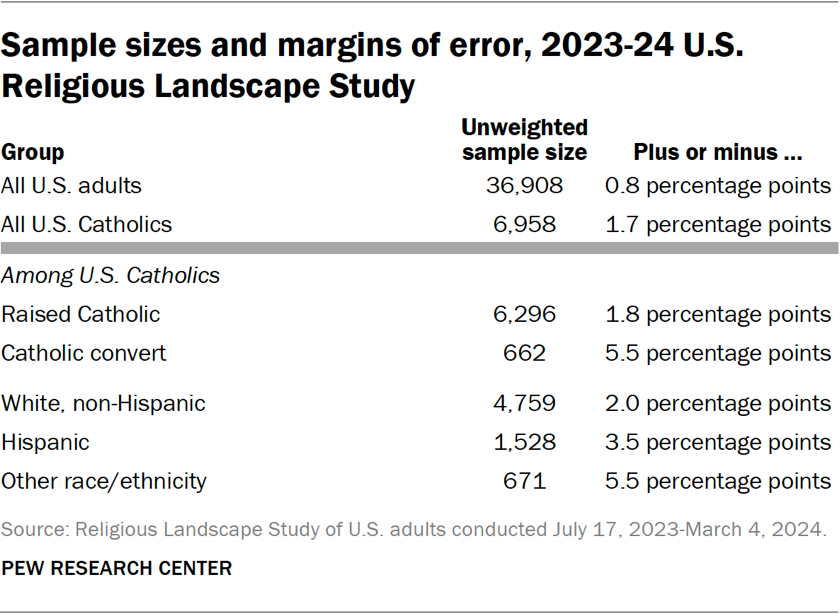
For some estimates, this report relies on the 2023-24 RLS, an extremely large survey with 36,908 respondents, including 6,958 Catholics. The RLS asked a few of the same questions as the 2025 survey (for example, about religious attendance, political party identification and demographic characteristics such as age and race). Because of the much larger sample and greater statistical precision available in the RLS, we have relied on RLS data when analyzing responses by Catholics to questions that appeared in both the RLS and the 2025 survey.

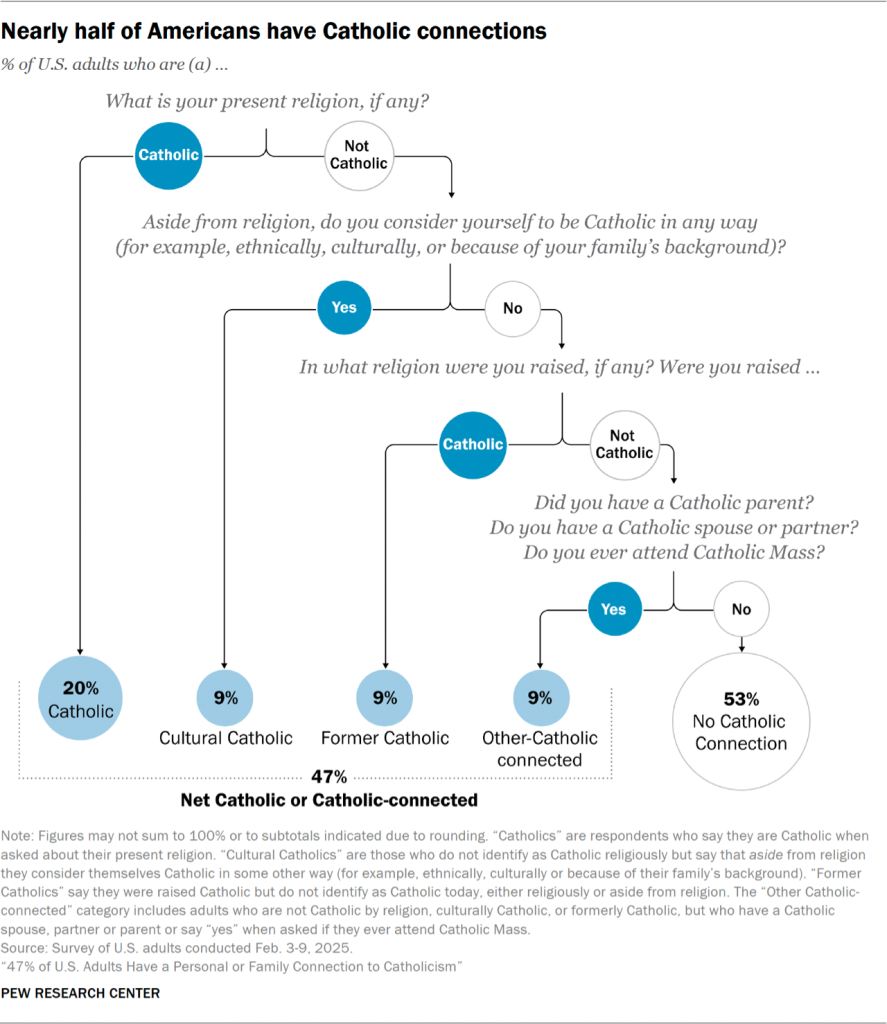
Catholicism’s roots in the United States run deep. Nearly half of U.S. adults (47%) claim some connection to the Catholic faith. A new Pew Research Center survey finds that:

  • 20% of U.S. adults are Catholics: They say they are Catholic when asked about their present religion.
  • 9% of U.S adults are “cultural Catholics”: They don’t identify with Catholicism religiously, but they say “yes” when asked whether “aside from religion” they consider themselves Catholic in any way (for example, ethnically, culturally, or because of their family background).
  • 9% are former Catholics: They neither identify as Catholic religiously nor consider themselves culturally Catholic, but they say they were raised in the Catholic faith.
  • 9% are connected to Catholicism in other ways: They are not Catholic, culturally Catholic or formerly Catholic, but they have a Catholic parent, spouse or partner or they say “yes” when asked if they ever attend Catholic Mass.1
Terminology

Throughout this report, when we use the term Catholic, we are referring to U.S. adults who say they are Catholic when asked about their religion.

We use the following terms when referring to people who are not Catholic by religion, but are connected to the faith in other ways:

Cultural Catholics say they consider themselves Catholic “aside from religion” (e.g., ethnically, culturally, or because of their family background).

Former Catholics were raised Catholic but no longer identify as Catholic, religiously or culturally.

People who are connected to Catholicism in other ways are not Catholic by religion or culture, nor are they former Catholics. But they report having a Catholic parent, spouse or partner, or say yes when asked if they ever attend Mass.

Among the 20% of U.S. adults who are Catholic, some are deeply observant. For example:

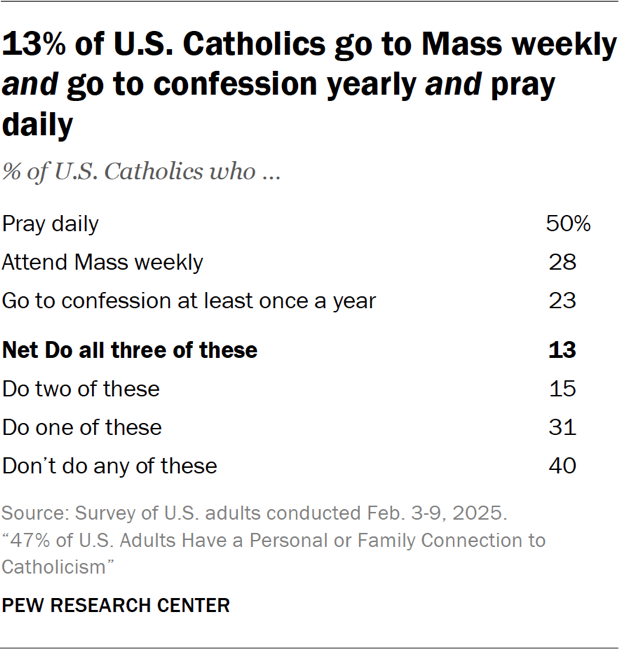
  • 50% say they pray daily.
  • 28% attend Mass at least weekly.
  • 23% go to confession with a Catholic priest at least once a year.

Altogether, 13% of American Catholics say they do all three of these things.
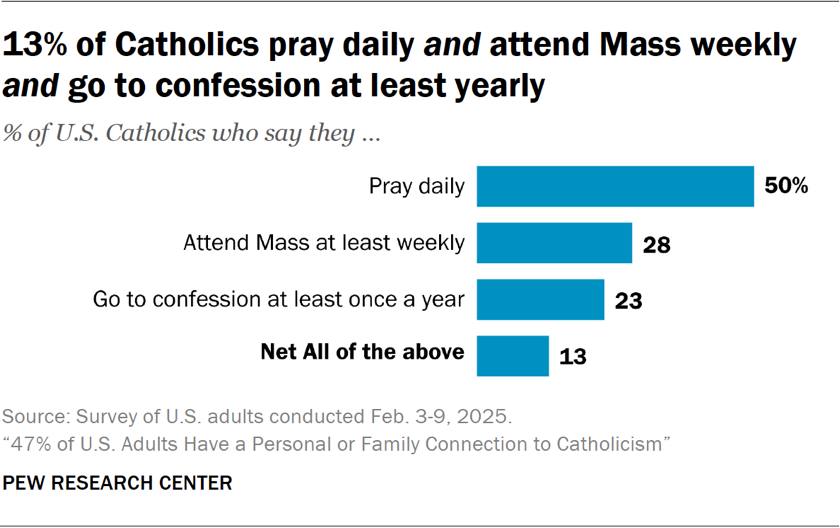
Bar chart showing 13% of Catholics pray daily and attend Mass weekly and go to confession at least yearly

On the other hand, many U.S. Catholics are relatively nonobservant. For instance:

  • 22% seldom or never pray.
  • 40% seldom or never attend Mass.
  • 47% never go to confession with a Catholic priest.

In total, 13% of U.S. Catholics by religion seldom or never pray and seldom or never attend Mass and never go to confession.
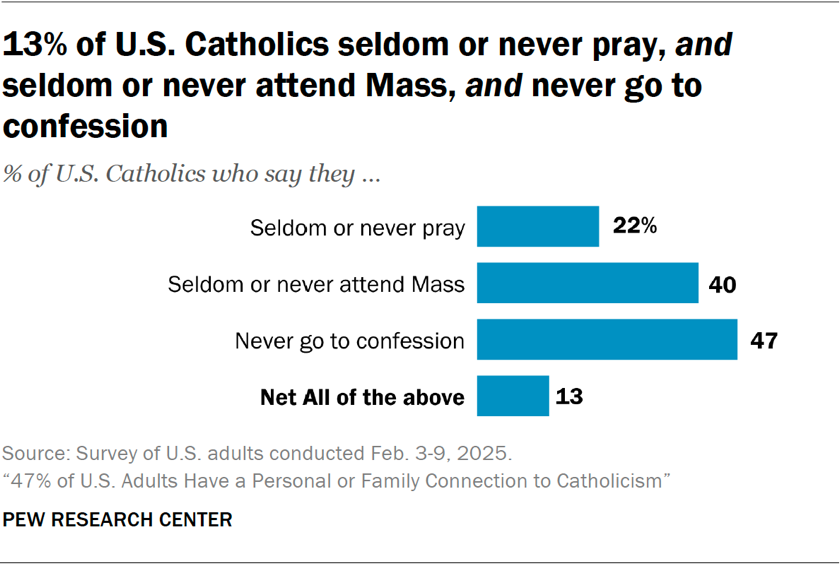
Bar chart showing 13% of U.S. Catholics seldom or never pray, and seldom or never attend Mass, and never go to confession

The largest share of Catholics (74%) fall somewhere in the middle of this spectrum of observance. They may pray. They may attend Mass. They may go to confession. But they don’t regularly do all three (pray daily, attend Mass weekly and go to confession annually).2

These are among the key findings of a Pew Research Center survey conducted Feb. 3-9, 2025, among a nationally representative sample of 9,544 U.S. adults, including 1,787 Catholics. The survey was designed to explore Catholic life in the United States. It was completed prior to the hospitalization of Pope Francis on Feb. 14 and his death in April, and well before the conclave that elected his successor, Pope Leo XIV.

Throughout this report, “Catholics” refers to U.S. adults who say they are Catholic when asked about their present religion, regardless of their level of observance. The terms “cultural Catholic,” “former Catholic” and “other connections to Catholicism” refer to people who do not consider Catholicism to be their religion but who have other connections to Catholic life.

The Center previously released two reports based on the same survey, one focusing on U.S. Catholics’ opinions about Francis and another on what Catholics say they want from the church.

The rest of this Overview covers:

  • Essentials of Catholic identity
  • Catholic parish life
  • Converts to Catholicism
  • Hispanic Catholics
  • ‘Cultural Catholics’
  • Leaving Catholicism
  • Other key findings

Essentials of Catholic identity

The survey asked American Catholics what “being Catholic” means to them. It offered 14 items and asked respondents to say whether each one is an “essential,” an “important but not essential,” or “not an important” part of what being Catholic means to them.
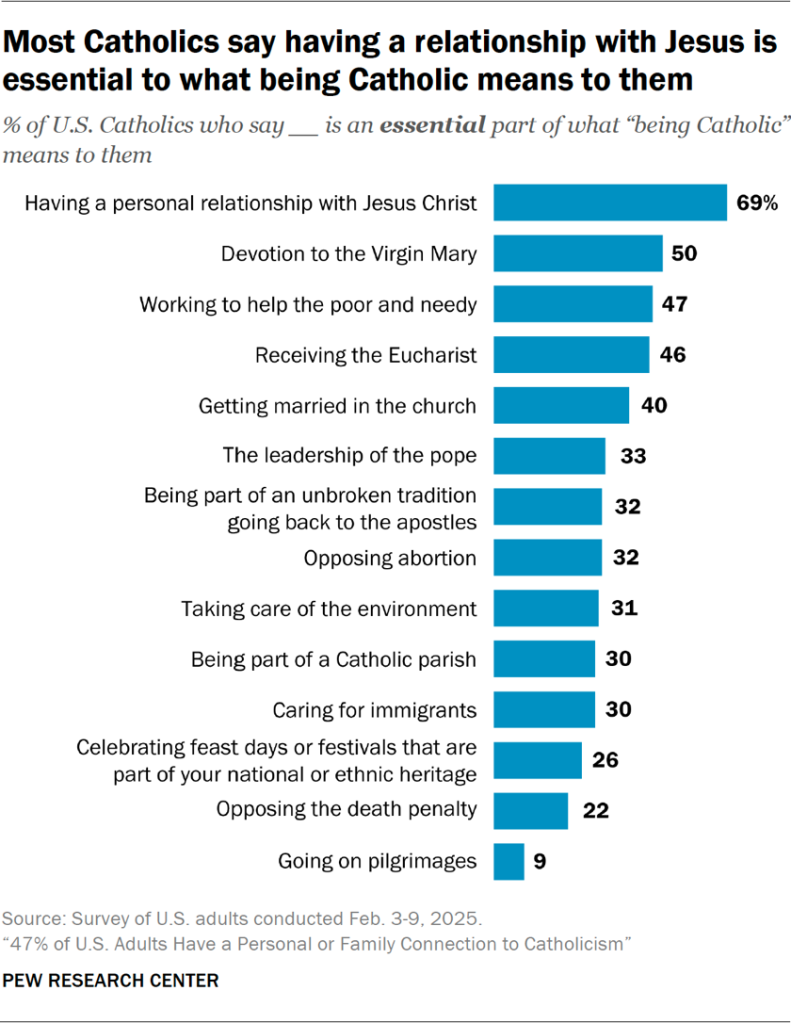
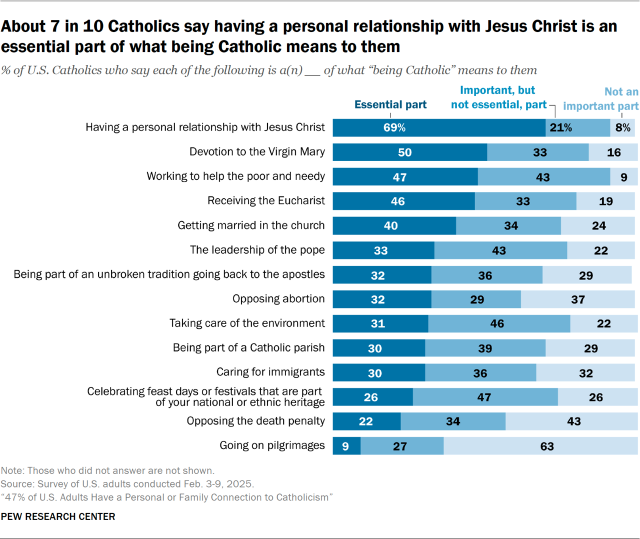
Bar chart showing most Catholics say having a relationship with Jesus is essential to what being Catholic means to them

In response, the item most commonly selected as essential was “having a personal relationship with Jesus Christ.”

Overall, 69% of U.S. Catholics say having a personal relationship with Jesus is an essential part of what being Catholic means to them, while 21% say it is important but not essential, and 8% say it’s not an important part of their Catholic identity.

Other frequently selected essential items are:

  • Devotion to the Virgin Mary (50% of Catholics say this is an essential part of what being Catholic means to them)
  • Working to help the poor and needy (47%)
  • Receiving the Eucharist (46%)

Differences by Mass attendance

On many questions, the survey finds large differences between Catholics who attend Mass at least once a week and those who don’t.

Roughly three-in-ten Catholics say they attend Mass weekly. Compared with Catholics who go less frequently, they are more likely to express support for the church’s teachings on a variety of issues, more involved in their parishes, and more likely to say they participate in a variety of distinctively Catholic practices, such as praying the rosary or practicing devotions to Mary or the saints.

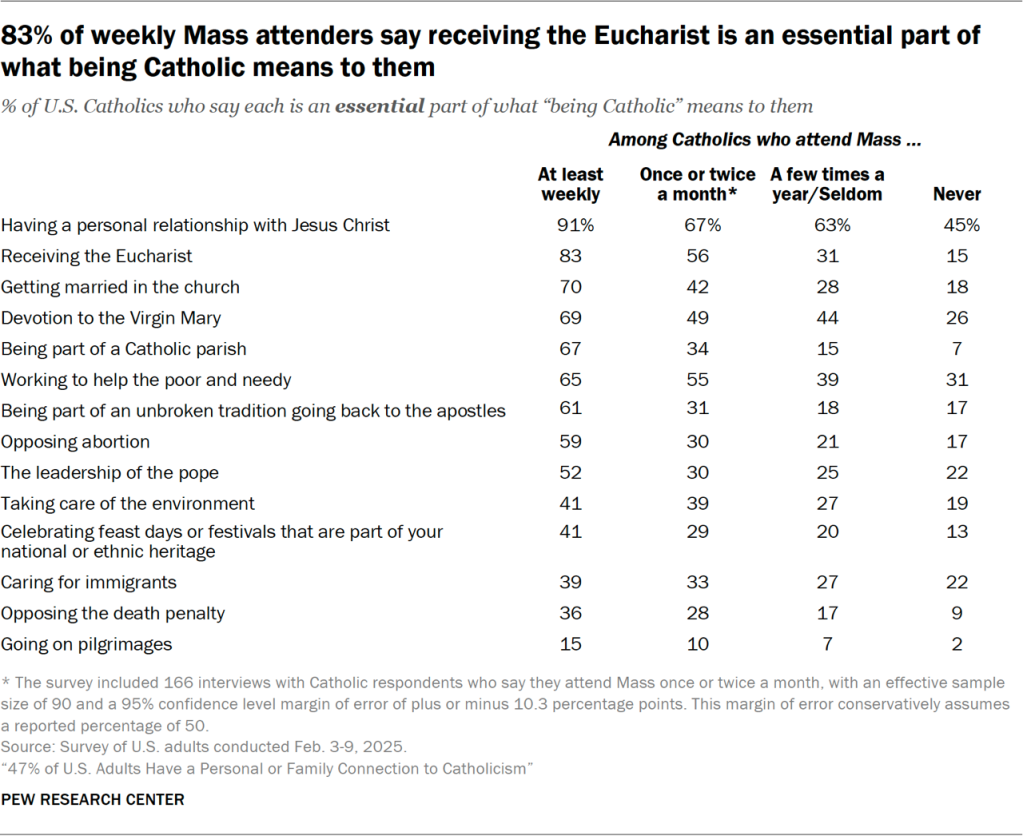
Additionally, Catholics who attend Mass weekly are more likely than those who go less often to affirm that all 14 items offered in the survey are essential to their Catholic identity. For instance, 91% of weekly Mass-attending Catholics say having a personal relationship with Jesus Christ is essential to what being Catholic means to them, compared with 60% of Catholics who attend Mass less often. And 83% of weekly Mass attenders say that receiving the Eucharist is essential, compared with 32% of Catholics who attend Mass less often.
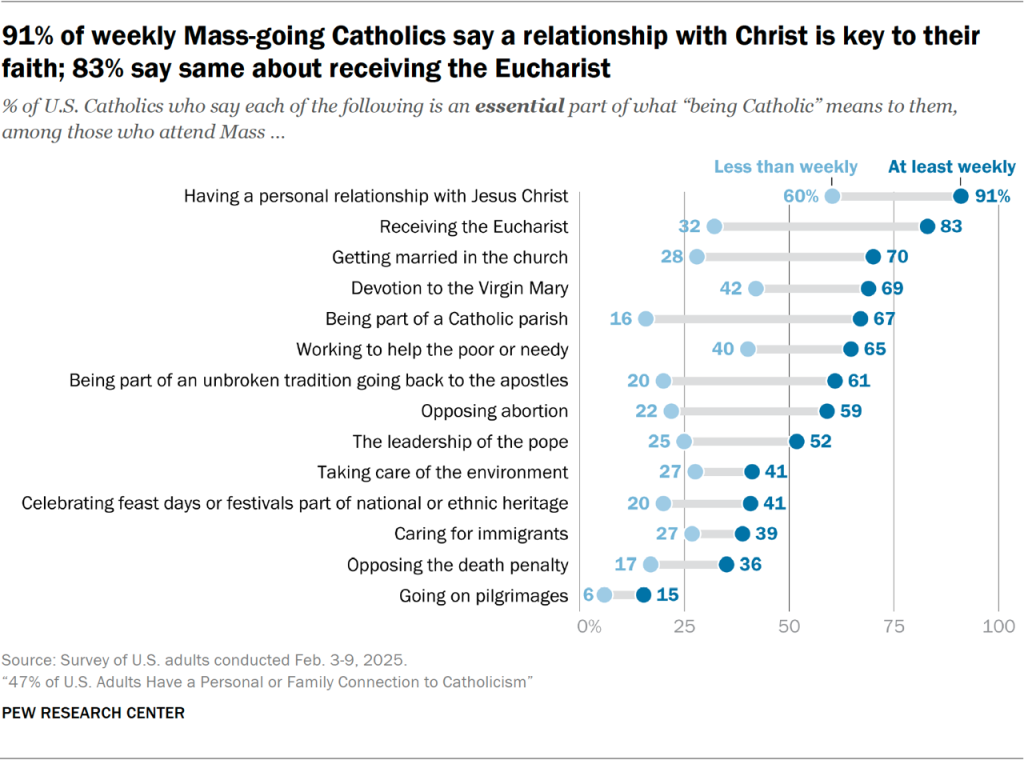
Chart showing 91% of weekly Mass-going Catholics say a relationship with Christ is key to their faith; 83% say same about receiving the Eucharist

Catholic parish life

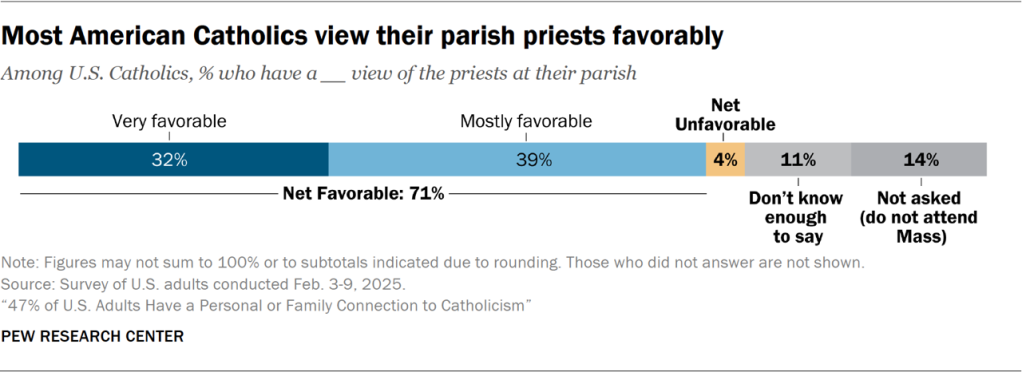
A large majority of U.S. Catholics express favorable views of their parish priests. Overall, 71% view their priests favorably, compared with 4% who view them unfavorably. About one-in-ten Catholics say they “don’t know enough” to express an opinion about their parish priests, and 14% were not asked the question because they said they don’t go to Mass.
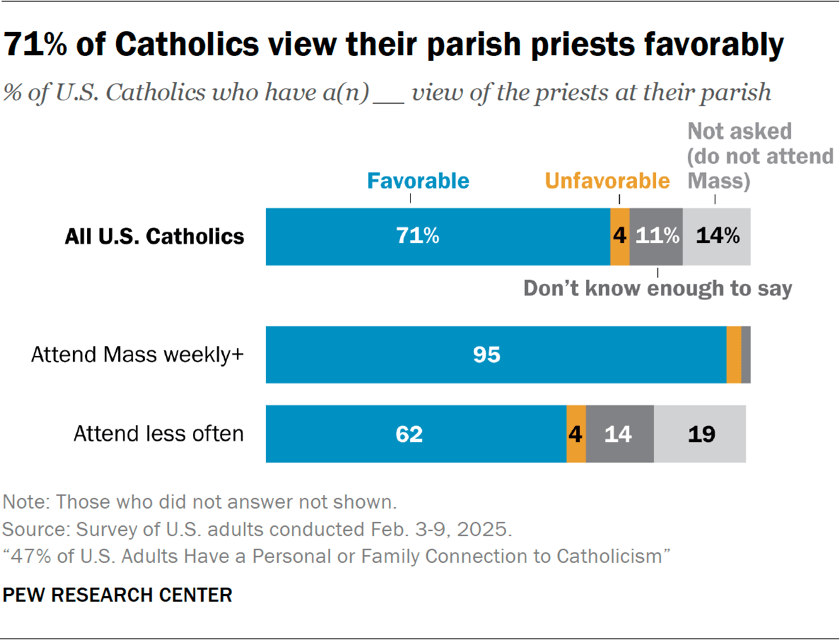
Bar chart showing 71% of Catholics view their parish priests favorably

Among Catholics who attend Mass weekly, 95% express a favorable view of their parish priests.

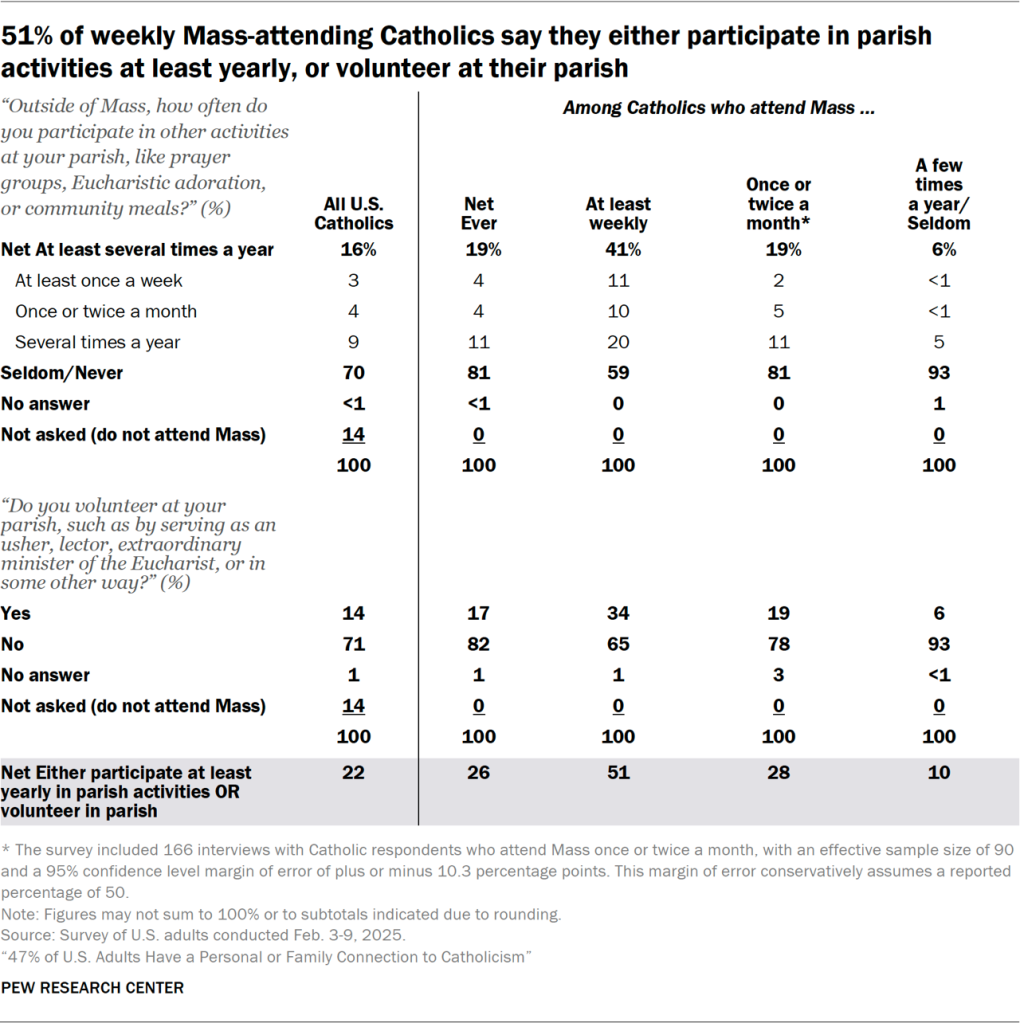
About half of weekly Mass attenders say they participate at least yearly in parish activities outside of Mass (such as prayer groups, Eucharistic adoration or community meals) or that they volunteer at their parish (for example, as an usher, lector or extraordinary minister of the Eucharist).
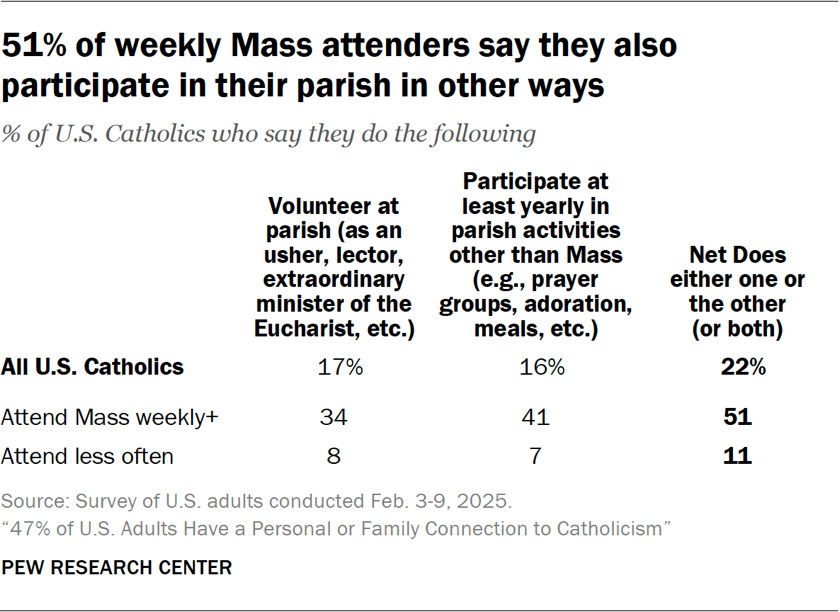
Table showing 51% of weekly Mass attenders say they also participate in their parish in other ways

Converts to Catholicism

Overall, 1.5% of U.S. adults are converts to Catholicism. That is, they say they are Catholics when asked about their present religion, but – when asked in a separate question about the religion in which they were raised – they say they were not raised Catholic.3

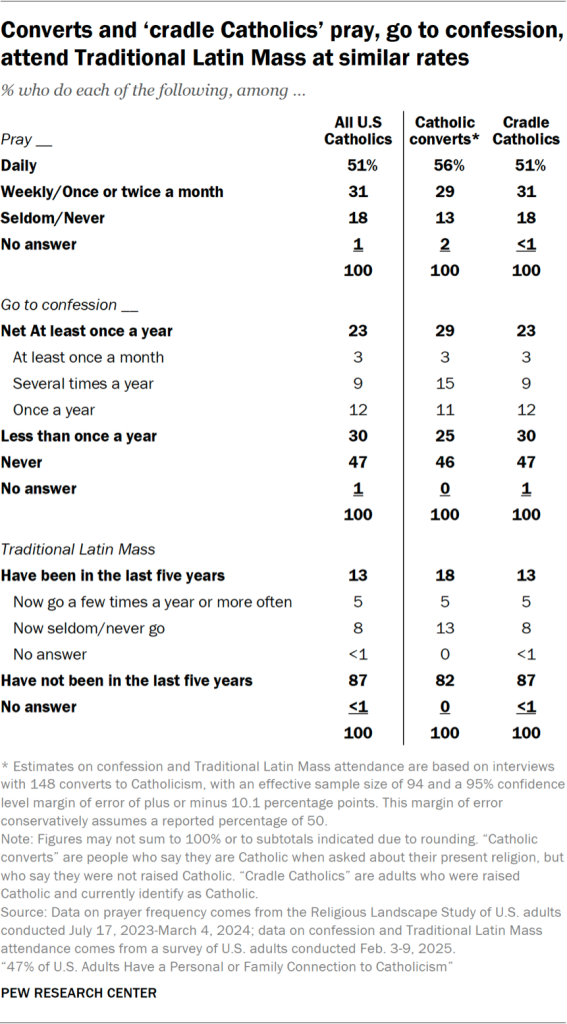
Catholic converts tend to be at least as religiously active as “cradle Catholics” (by which we mean adults who were raised Catholic and currently identify as Catholic). In some ways, converts to the faith exhibit higher rates of religiousness than cradle Catholics do.

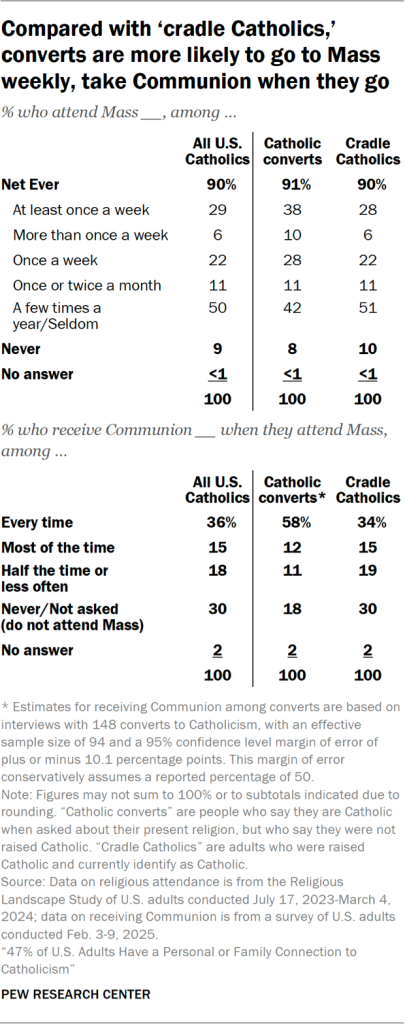
For instance, the share who say they attend Mass at least weekly is 10 percentage points higher among converts than among cradle Catholics (38% vs. 28%). Converts also are far more likely than cradle Catholics to say they receive Communion every time when they attend Mass (58% vs. 34%).
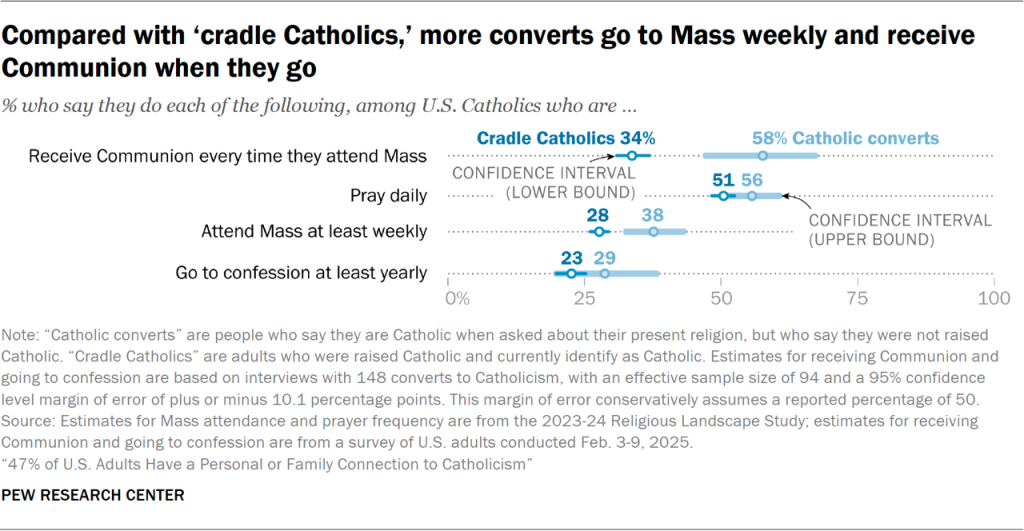
Chart showing that compared with ‘cradle Catholics,’ more converts go to Mass weekly and receive Communion when they go

On the other hand, the shares of converts saying they pray every day and go to confession at least once a year is about the same as among cradle Catholics.

The survey asked converts to Catholicism to explain, in their own words, the main reason why they became Catholics. The most commonly offered reason is marriage: 49% of converts say they became Catholic because of a spouse or partner, and/or to get married in the church.

(The 2025 survey included 148 interviews with converts to Catholicism, and results based on this relatively small sample of converts have a correspondingly large margin of error: plus or minus 10.1 percentage points.)
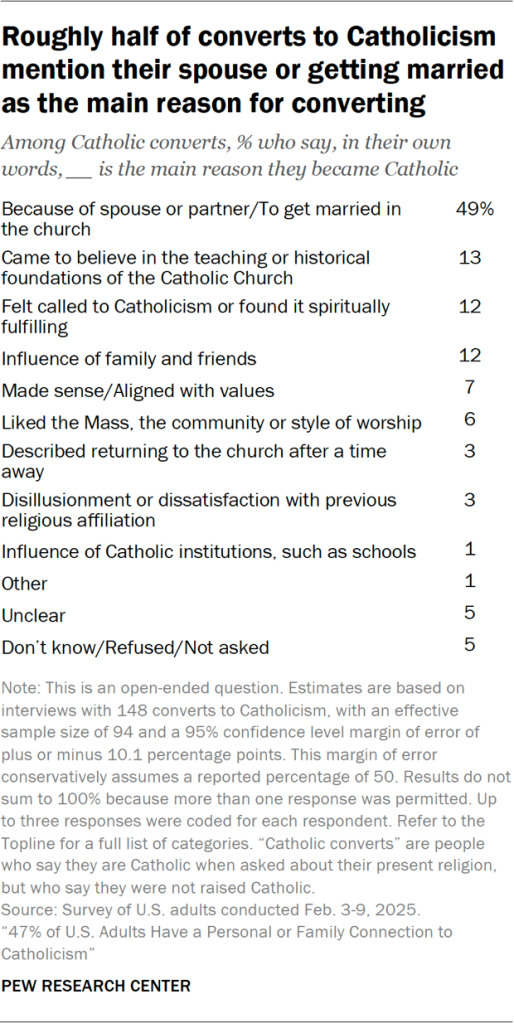
Table showing roughly half of converts to Catholicism mention their spouse or getting married as the main reason for converting

Catholic connections among Hispanics

The survey shows that Hispanic Catholics participate in a variety of devotional practices at above-average rates. For instance,

  • 56% of Hispanic Catholics wear or carry religious items at least monthly.
  • 46% participate in devotions to the Virgin Mary or other saints at least monthly.
  • 37% pray the rosary at least monthly.
  • 26% light candles or incense for spiritual or religious reasons at least monthly.
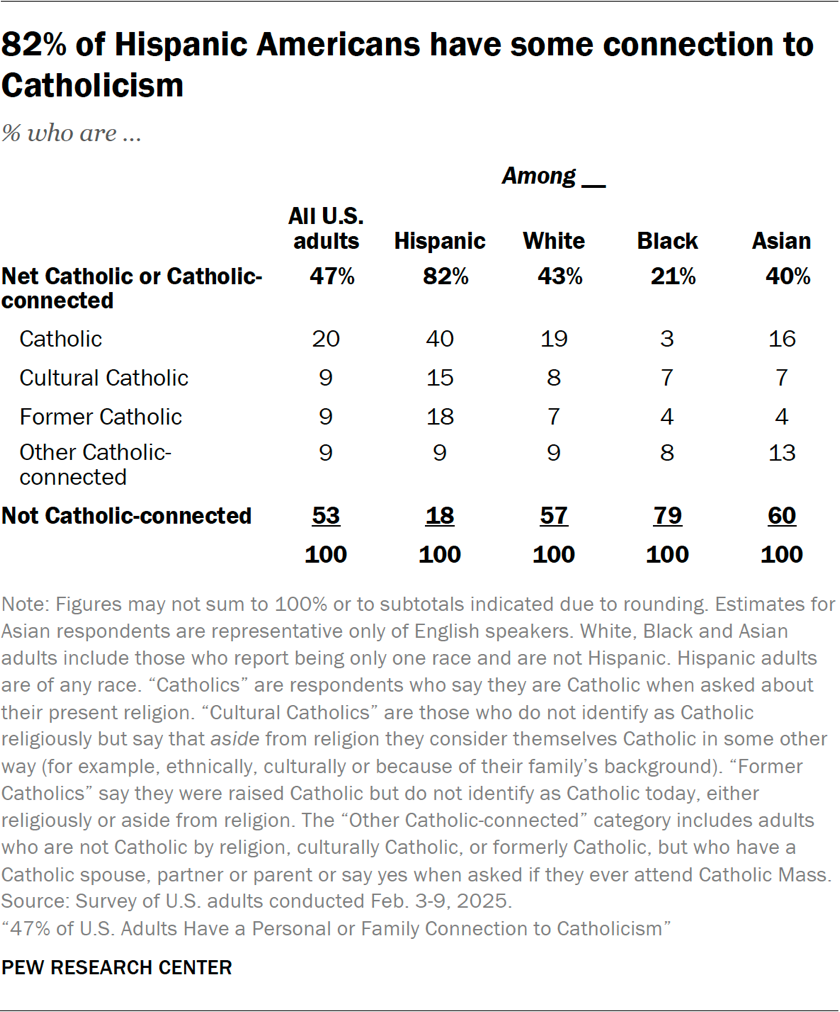
Table showing 82% of Hispanic Americans have some connection to Catholicism

Close ties to Catholicism are more common among Hispanics than among other racial and ethnic groups. In the 2025 survey, fully 40% of Hispanic respondents are Catholic by religion. That number has been declining in recent years, but it is still at least double the shares of White, Black and Asian Americans who are Catholic.

An additional 15% of Hispanics are “cultural Catholics.” They do not say they are Catholic when asked about their religion; instead, they identify religiously with something other than Catholicism or with no religion. But they say “yes” when asked whether they think of themselves as Catholic “aside from religion” (e.g., ethnically, culturally, or because of their family background). Overall, 12% of U.S. Hispanics are “cultural Catholics” who were raised Catholic or had a Catholic parent.

Roughly one-in-five Hispanics  are “former Catholics” (18%). They say they were raised Catholic, but they do not identify as Catholic today, either religiously or aside from religion.

Finally, 9% of Hispanics have other Catholic connections. They don’t describe themselves as cultural or former Catholics, but they do have a Catholic parent, spouse or partner, or they say “yes” when asked if they ever attend Mass.

For more information on the beliefs and practices of Hispanic Catholics, refer to Chapter 4. For additional information about the demographics of Hispanic Catholics, refer to “10 facts about U.S. Catholics.”

Cultural Catholics

Among the 9% of U.S. adults categorized as cultural Catholics – people who do not identify as Catholic religiously but who say “yes” when asked whether they think of themselves as Catholic aside from religion – relatively few indicate that they practice the faith. Indeed, among cultural Catholics:

  • 83% say they seldom or never attend Mass.
  • 81% say they never go to confession.

Additionally, 85% say they seldom or never practice devotion to the Virgin Mary or to a favored saint. And an identical share say they seldom or never pray the rosary.

This raises the question – in what sense are cultural Catholics actually Catholic? To help provide an answer, the survey asked cultural Catholics, “In your own words, could you please describe in what way you consider yourself Catholic?”
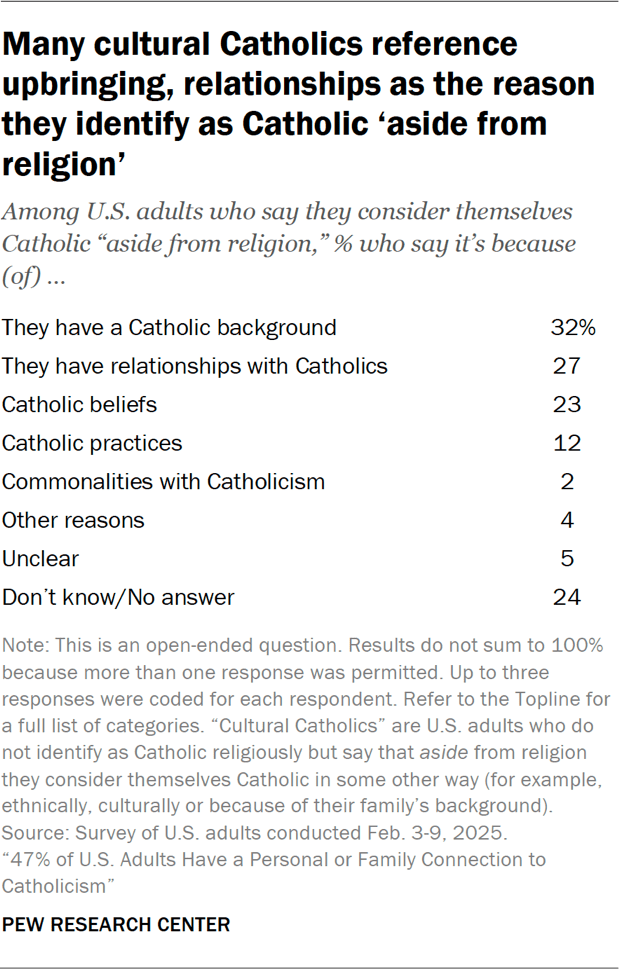
Table showing 82% of Hispanic Americans have some connection to Catholicism

The most common type of answer referred to having some Catholic background, such as having been raised Catholic, having an ethnic connection to Catholicism, or having attended Catholic schools. About one-third of respondents (32%) said this.

Cultural Catholics also cite various other types of family or social relationships with Catholics (such as having Catholic friends or extended family members) as the reason they identify as Catholic aside from religion (27% say this).

Many (23%) also mention Catholic beliefs, teachings or values they like or share. About one-in-ten (12%) mention participating in Catholic practices, such as celebrating holidays.

Leaving Catholicism

Many people who were raised Catholic leave the faith as adults. Indeed, 43% of all U.S. adults who were raised as Catholics no longer identify, religiously, as Catholic today (though some of them still identify as Catholic aside from religion).

The new survey asked people who have left the faith the following question: “Just in your own words, what is the main reason you are no longer Catholic?”

Respondents offer a wide variety of answers, the most common of which relate to disagreements with the church’s teachings. Overall, 18% of U.S. adults who have left Catholicism say that they changed their beliefs or that their values no longer align with the church’s values.

An additional 10% say that although they were raised in the faith, they were never very committed to Catholicism.

Another 9% of U.S. adults who have left Catholicism say they stopped believing in God or in religion more broadly. And 8% cite scandals in the church as the main reason for leaving.

For more on why some people choose to leave the Catholic Church, refer to Chapter 7.

Other key findings

The survey also asked about other topics, including Eucharistic practices, the importance of receiving the anointing of the sick (one of the sacraments “involved in the last rites”), the Traditional Latin Mass, sex abuse scandals in the church, and more. Key findings include:

  • 82% of Catholics who go to Mass weekly say they receive Communion every time or most of the time they go.
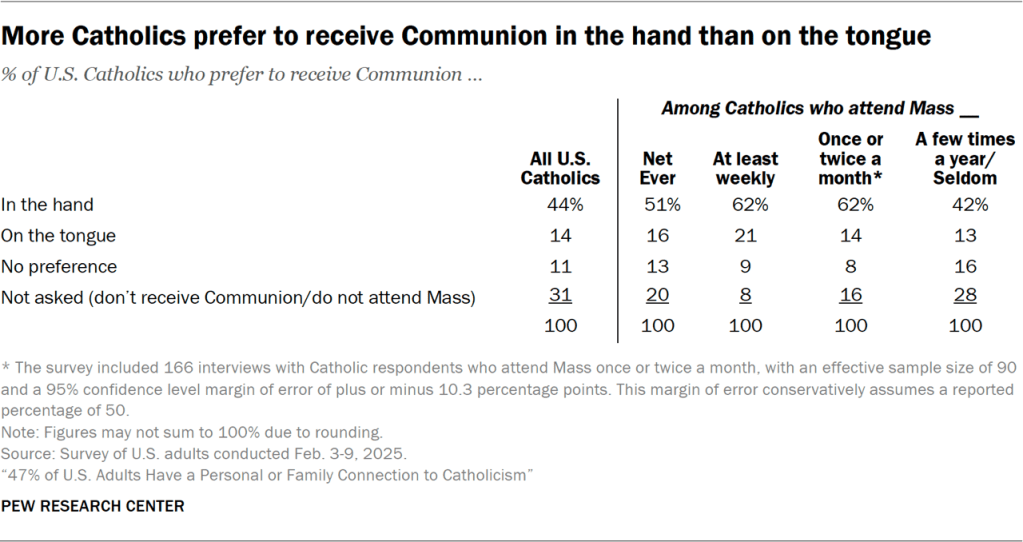
  • 62% of weekly Mass attenders say they prefer to receive Communion in the hand, while 21% prefer to receive on the tongue; the remainder either have no preference or say they don’t receive Communion (and thus were not asked about their preferences).
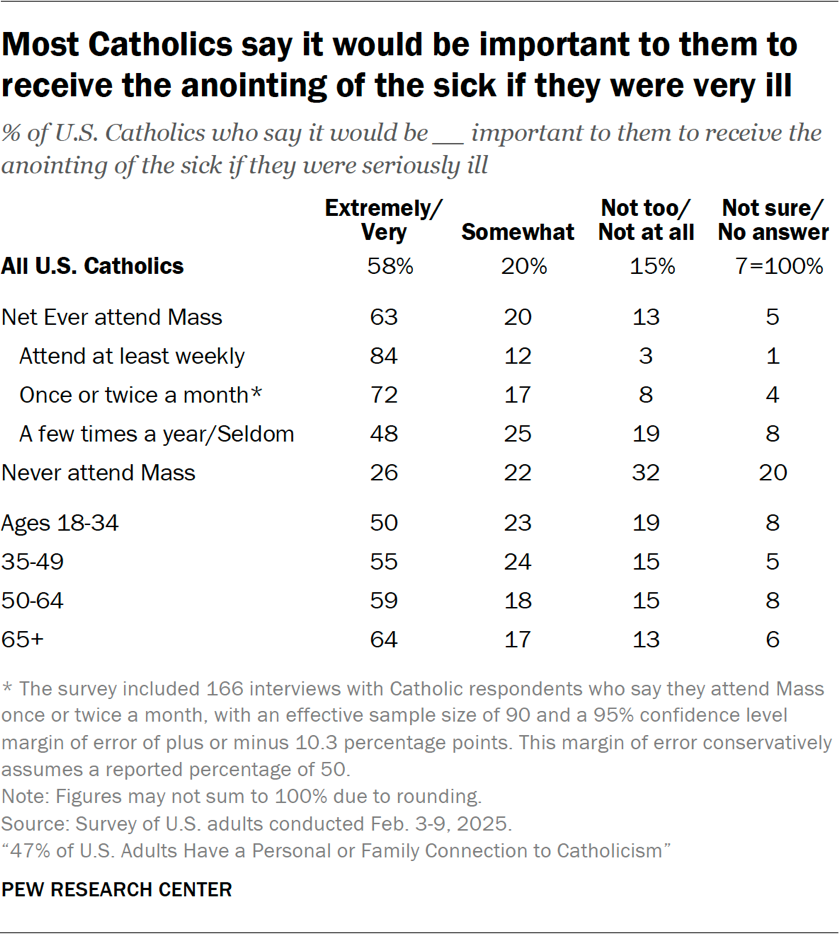
  • 58% of Catholics say it would be extremely or very important to them to receive the anointing of the sick if they were seriously ill.
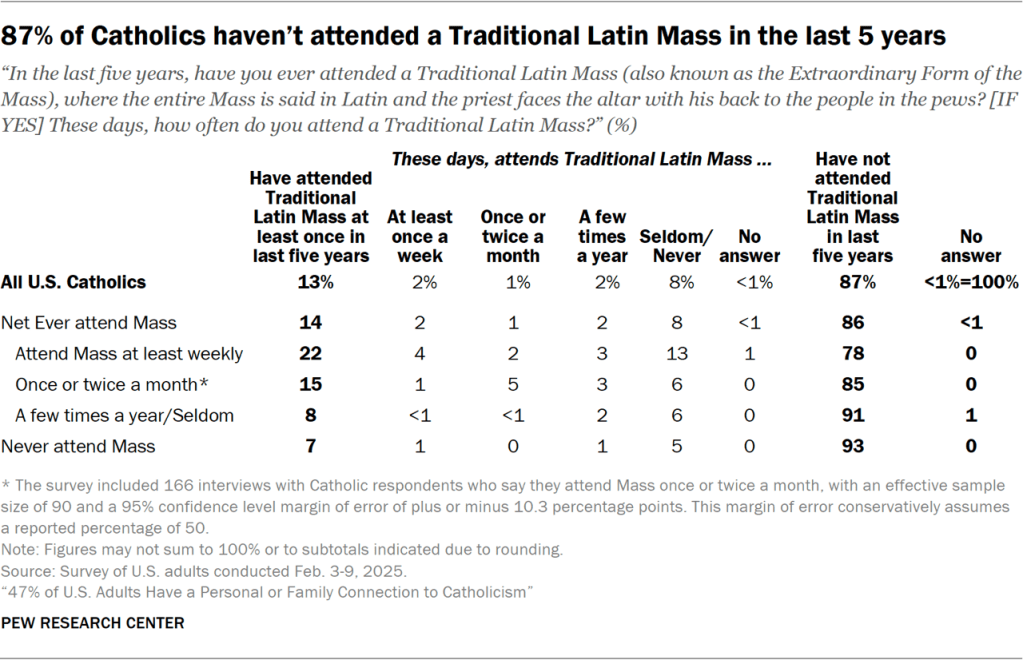
  • 13% of Catholics say they have attended a Traditional Latin Mass (TLM) at least once in the last five years, including 2% who say they attend a TLM weekly today.
  • 42% of U.S. Catholics say it would bother them either a lot (13%) or a little (29%) if they had a grown child who was not a practicing Catholic; 58% of U.S. Catholics say this would not bother them at all.
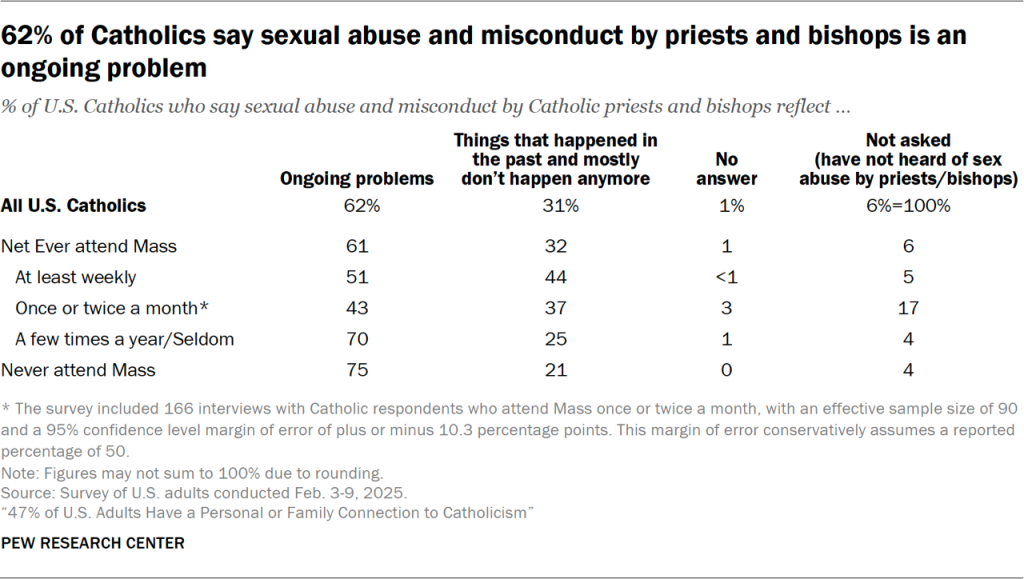
  • 62% of U.S. Catholics say that reports of sexual abuse and misconduct by priests and bishops reflect “ongoing problems” rather than “things that happened in the past and mostly don’t happen anymore.”
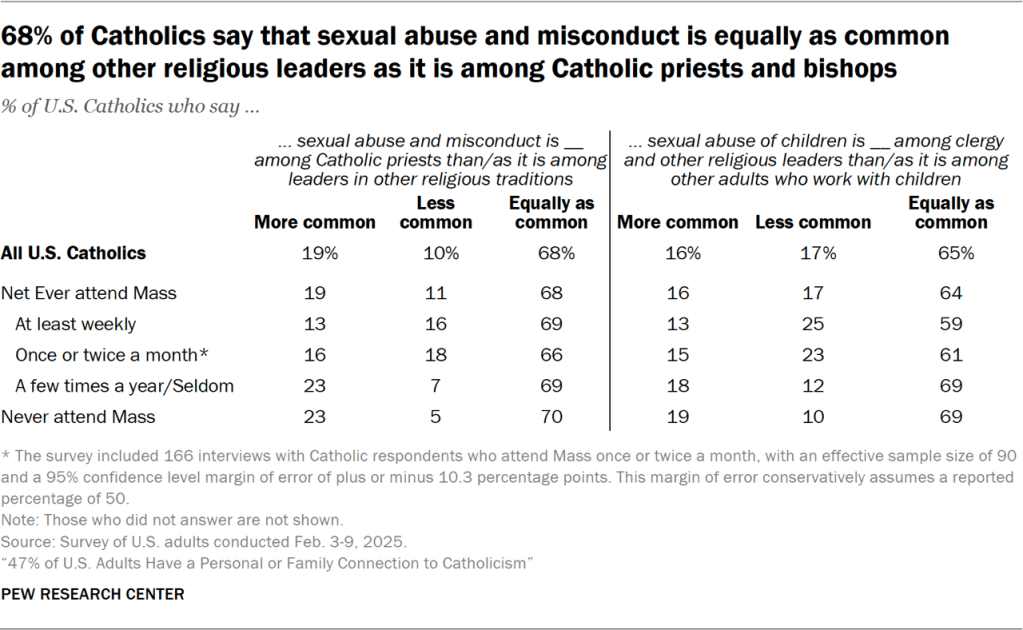
  • At the same time, 68% of U.S. Catholics say sexual abuse and misconduct are no more common among Catholic priests and bishops than among leaders in other religious traditions.

For more, jump to the following chapters:

  • Chapter 1 – Essentials of Catholic identity
  • Chapter 2 – Catholic practices and devotions
  • Chapter 3 – Catholic parish life, culture and community
  • Chapter 4 – Profile of Hispanic Catholics in the U.S.
  • Chapter 5 – Profile of U.S. converts to Catholicism
  • Chapter 6 – Views of sexual abuse and misconduct in the Catholic Church
  • Chapter 7 – Catholic connections
1. Essentials of Catholic identity

How we define Catholics in this chapter

This chapter exclusively explores views and experiences among U.S. Catholics (i.e., the 20% of U.S. adults who say they are Catholic when asked about their present religion).

Many Americans who are not Catholic are still connected to the faith in other ways. Read more about these “cultural Catholics,” former Catholics, and people with other Catholic connections (i.e., those who have  a Catholic parent, spouse or partner, or say “yes” when asked if they ever attend Catholic Mass) in Chapter 7 and the Overview.
To find out what U.S. Catholics see as the core elements of their own religion, we presented respondents with 14 items and asked them to say whether each one is an “essential,” an “important but not essential,” or “not an important” part of what “being Catholic means to you.”

Respondents had the option to describe more than one item as essential – or to say that none of the items are essential – to what being Catholic means to them. They also had a chance, at the end of this section of the survey, to mention anything else they view as essential to their Catholic identity.

Bar chart showing about 7 in 10 Catholics say having a personal relationship with Jesus Christ is an essential part of what being Catholic means to them

(Pew Research Center previously has asked similar questions of a wide variety of religious groups, including in surveys of Jewish Americans in 2020 and 2013; a 2017 survey of Muslims; a 2015 survey of Catholics; a 2012 survey of members of the Church of Jesus Christ of Latter-day Saints, who are widely known as Mormons; and a 2016 survey of the general U.S. public.4)

In the present survey, about seven-in-ten U.S. Catholics say that “having a personal relationship with Jesus Christ” is an essential part of being Catholic for them.

Meanwhile, about half say that devotion to the Virgin Mary (50%), working to help the poor and needy (47%) and receiving the Eucharist (46%) are essential to their Catholic identity.

Some other beliefs and practices are viewed as essential by roughly a third of U.S. Catholics. Between 30% and 33% say the leadership of the pope, being part of an unbroken tradition going back to the apostles, opposing abortion, taking care of the environment, being part of a Catholic parish, and caring for immigrants are essential to what being Catholic means to them.

Answers to these questions tend to vary according to how often Catholics go to Mass. Those who attend weekly are generally more inclined than other Catholics to say that the 14 items we asked about are essential to their Catholic identity. For example, 83% of weekly Mass-attending Catholics say that receiving the Eucharist is essential, compared with 56% of Catholics who attend Mass once or twice a month, 31% who attend a few times a year or less often, and 15% who say they never attend Mass.

There are also differences between Hispanic Catholics and White Catholics on these questions. For example, compared with White Catholics, far more Hispanic Catholics say a personal relationship with Jesus, devotion to the Virgin Mary, caring for immigrants, and celebrating national or ethnic feast days are essential parts of what being Catholic means to them. (The survey sample did not include enough Black or Asian Catholics to allow their answers to be analyzed and reported separately.)

After presenting respondents with all 14 items, the survey asked whether there is anything else that is essential to what being Catholic means to them, inviting them to elaborate in their own words.

Most respondents (70%) did not volunteer any additional answers. Among those who gave additional answers, some of the more common responses were:

  • Being kind to others (5% of all Catholics volunteered this as an essential component of what being Catholic means to them)
  • Following the teachings of Jesus and/or the Bible (4%)
  • Being ethical/moral (4%)
  • Believing in God or Jesus (3%)

While the analysis in this chapter focuses mostly on what Catholics say is essential to their Catholic identity, the survey also gave respondents the option to say that various beliefs and practices are important but not essential to what being Catholic means to them.

When the essential and important but not essential categories are combined, it becomes clear that a majority of Catholics view 13 of the 14 items listed in the survey as either essential or important. The lone exception is “going on pilgrimages,” which roughly a third of U.S. Catholic adults view as essential (9%) or important but not essential (27%) to their Catholic identity.

For details on how subgroups of Catholics answered these questions, refer to the detailed tables.

For additional information on what Hispanic Catholics see as essential to being Catholic, jump to the relevant section in Chapter 4.

Read on about essentials of Catholic identity by:

  • Mass attendance
  • Party identification

Essentials of Catholic identity by Mass attendance

Weekly Mass attenders are generally more likely than Catholics who attend less frequently to say the items we asked about are essential to being Catholic for them.5

For example, 91% of Catholics who go to Mass at least weekly say that having a personal relationship with Jesus Christ is essential to what being Catholic means to them, compared with 67% of Catholics who go to Mass monthly and 63% of Catholics who go to Mass a few times a year or less often. Among Catholics who never go to Mass, 45% say having a personal relationship with Jesus is essential to their Catholic identity.

Table showing 83% of weekly Mass attenders say receiving the Eucharist is an essential part of what being Catholic means to them

And 83% of weekly attenders say receiving the Eucharist is essential to their Catholic identity, compared with 56% of Catholics who go to Mass once or twice a month and less than half of Catholics who go to church a few times a year or less often.6

Essentials of Catholic identity by party identification

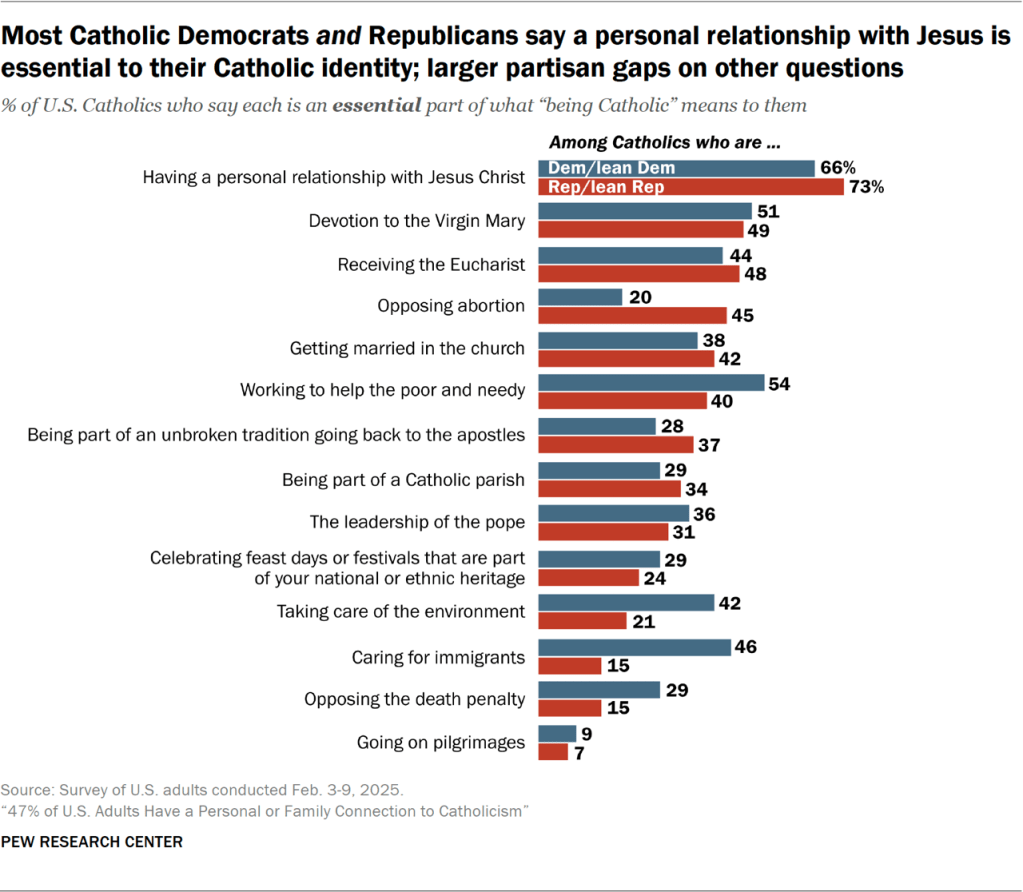
Catholic Democrats and independents who lean Democratic are more likely than Catholic Republicans and Republican leaners to view the following items as essential to their Catholic identity:

  • Working to help the poor and needy (54% among Catholic Democrats vs. 40% among Catholic Republicans)
  • Caring for immigrants (46% vs. 15%)
  • Taking care of the environment (42% vs. 21%)
  • Opposing the death penalty (29% vs. 15%)
Bar chart showing most Catholic Democrats and Republicans say a personal relationship with Jesus is essential to their Catholic identity; larger partisan gaps on other questions

Meanwhile, Catholic Republicans and Republican leaners (45%) are more likely than Catholic Democrats and Democratic leaners (20%) to say that opposing abortion is essential to what being Catholic means to them.

Majorities of Catholics in both parties say that having a personal relationship with Jesus Christ is essential to being Catholic for them, though Catholic Republicans are slightly more likely than Catholic Democrats to say this (73% vs. 66%).

2. Catholic practices and devotions

How we define Catholics in this chapter

This chapter exclusively explores views and experiences among U.S. Catholics (i.e., the 20% of U.S. adults who say they are Catholic when asked about their present religion).

Many Americans who are not Catholic are still connected to the faith in other ways. Read more about these “cultural Catholics,” former Catholics, and people with other Catholic connections (i.e., those who have  a Catholic parent, spouse or partner, or say “yes” when asked if they ever attend Catholic Mass) in Chapter 7 and the Overview.
There is a wide spectrum of religious observance among U.S. Catholics. Some are quite devout by a variety of traditional measures:

  • 50% of U.S. Catholic adults in our 2025 survey say they pray daily.
  • 28% say they go to Mass weekly.7
  • 23% say they go to confession at least once a year.8
Table showing 13% of U.S. Catholics go to Mass weekly and go to confession yearly and pray daily

In total, 13% of U.S. Catholics say they engage in all three of these practices. An additional 15% say they do two of them.

Meanwhile, 31% say they do just one of these things. And 40% don’t do any of them – they do not go to Mass each week, do not go to confession at least once a year, and do not pray every day.

Read on for additional information about Catholic practices such as:

  • Receiving Communion at Mass
  • Confession
  • Wearing religious symbols, devotions and other practices
  • Traditional Latin Mass
  • Anointing of the sick

Going to Mass and receiving Communion

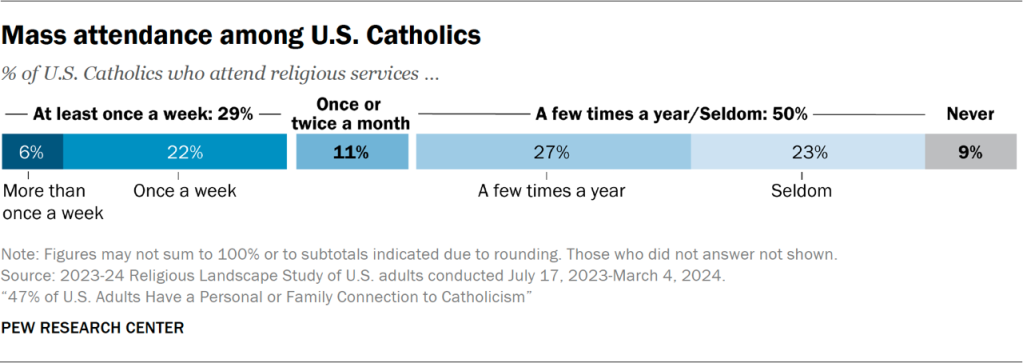
Overall, about three-in-ten U.S. Catholics say they go to religious services at least once a week, according to Pew Research Center’s 2023-24 U.S. Religious Landscape Study (RLS). An additional 11% say they attend Mass once or twice a month.9 And roughly six-in-ten U.S. Catholics say they go to Mass a few times a year or less often (50%) or not at all (9%). (For details on how rates of Mass attendance vary across subgroups based on data from the RLS, refer to the accompanying detailed tables.10)

Bar chart showing mass attendance among U.S. Catholics

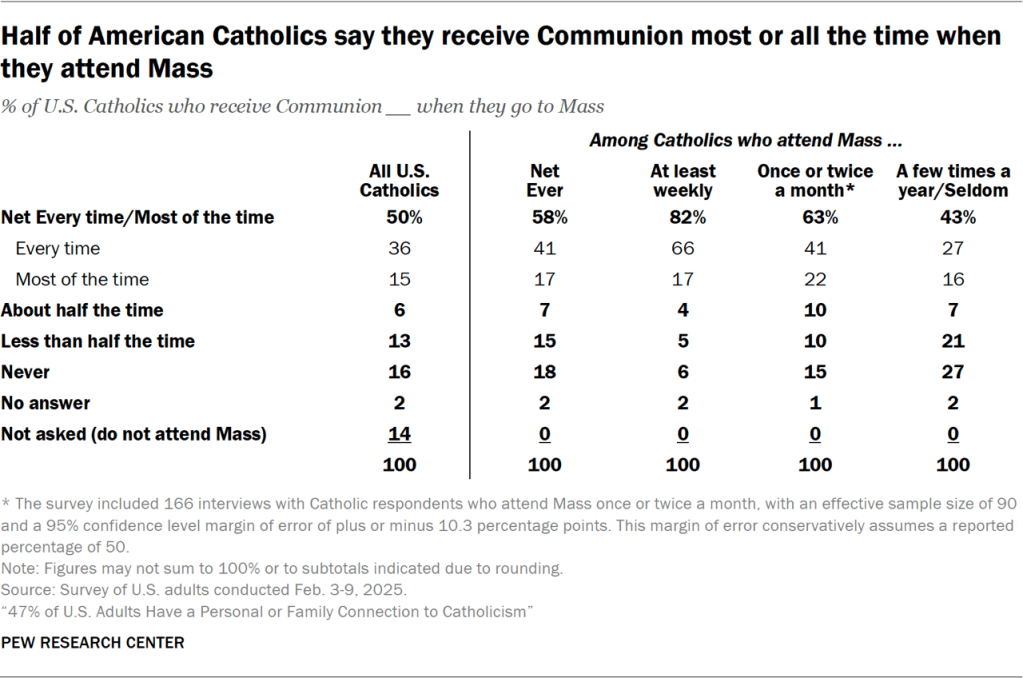
The Center’s Feb. 3-9, 2025, survey finds that half of U.S. Catholics say they receive Communion every time (36%) or most of the time (15%) they attend Mass. Roughly one-in-five say they receive Communion about half the time (6%) or less than half the time (13%). An additional 16% say they never receive Communion when they go to Mass, and 14% of Catholics in the survey say they never attend Mass in the first place (and thus were not asked how often they receive Communion).

Table showing half of American Catholics say they receive Communion most or all the time when they attend Mass

Roughly eight-in-ten weekly Mass attenders receive Communion all or most of the times they go (82%). Lower shares of less frequent attenders say they receive Communion all or most of the time. Still, even among those who go to Mass a few times a year or less often, 43% say they typically receive Communion when they go.

Catholics typically have the option at Mass to receive Communion either in their hand, or placed directly onto their tongue. More Catholics say they prefer to receive Communion in the hand (44%) than on the tongue (14%). An additional 11% say they have no preference. The remainder either don’t receive Communion or don’t attend Mass (and thus were not asked this question).

Table showing more Catholics prefer to receive Communion in the hand than on the tongue

Confession

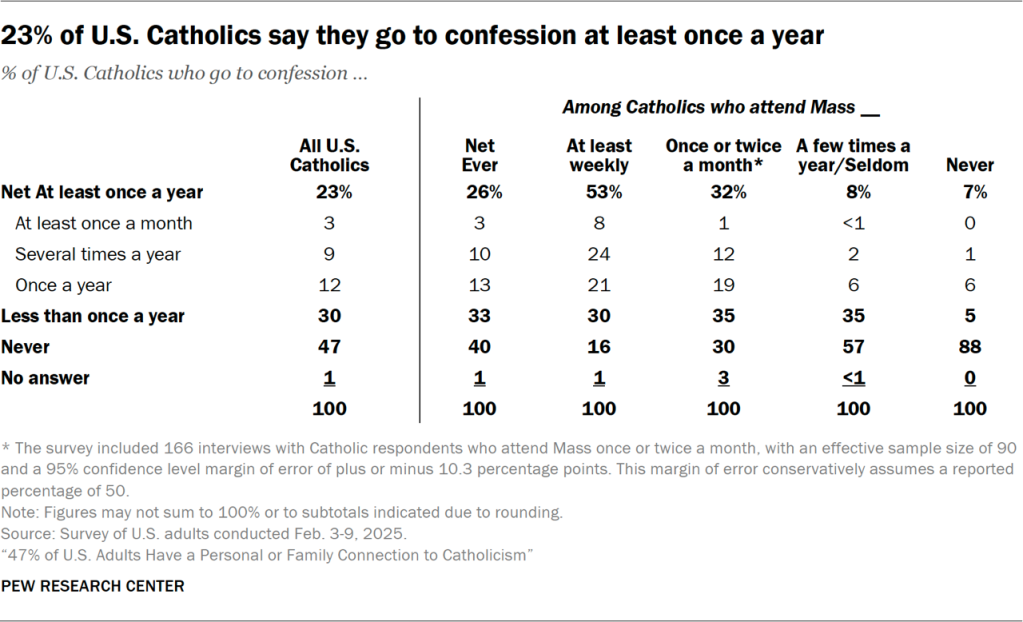
Overall, 23% of U.S. Catholics say they go to confession at least once a year, while 30% say they go less often. About half of Catholics (47%) say they never go to confession.

Catholics who go to Mass weekly also tend to go to confession more frequently than those who don’t attend weekly Mass; 53% of weekly attenders say they go to confession at least once a year.

Table showing 23% of U.S. Catholics say they go to confession at least once a year

Wearing religious symbols, devotions and other practices

The survey asked Catholics how often they engage in practices such as wearing or carrying religious items; practicing devotions to Mary or a favorite saint; praying the rosary; reading the Bible; and lighting candles or incense for spiritual or religious reasons.

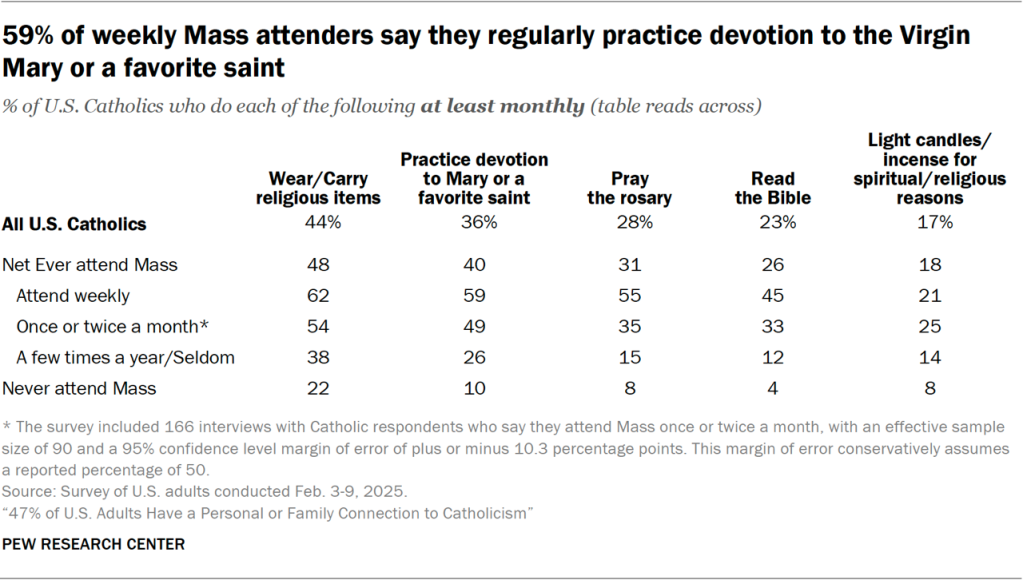
The most common of these practices is wearing or carrying religious items, which 44% of Catholics do monthly. Meanwhile, 36% say they practice devotion to Mary or a favorite saint that often. The least common of these practices is lighting candles or incense for spiritual reasons, which 17% of Catholics say they do monthly.

Table showing 59% of weekly Mass attenders say they regularly practice devotion to the Virgin Mary or a favorite saint

Weekly Mass attenders are generally more inclined than Catholics overall to engage in these practices. For example, around six-in-ten Catholics who attend Mass at least once a week (62%) say they regularly wear or carry religious items with them, compared with 44% of Catholics overall. Meanwhile, 59% of weekly attenders say they practice devotion to Mary or a favorite saint, compared with 36% of Catholics overall.

The survey also finds that several of these practices are far more common among Hispanic Catholics than White Catholics. For example:

  • 56% of Hispanic Catholics say they wear or carry religious items with them at least monthly, compared with 39% of White Catholics.
  • 46% of Hispanic Catholics practice devotions to the Virgin Mary or a favorite saint at least monthly, compared with 31% of White Catholics.
  • 37% of Hispanic Catholics pray the rosary at least monthly, versus 22% of White Catholics.
  • 26% of Hispanic Catholics say they light candles or incense for spiritual or religious reasons at least monthly, compared with 11% among White Catholics.

Refer to Chapter 4 for additional details about the distinctiveness of religious practices among Hispanic Catholics.

Traditional Latin Mass

Overall, 13% of U.S. Catholics (including 22% of those who attend weekly Mass) say they have attended a Traditional Latin Mass (TLM) at least once in the last five years. To help avoid confusion and ensure respondents understood what we meant by “Traditional Latin Mass,” the survey described it as a Mass where “the entire Mass is said in Latin and where the priest faces the altar with his back to the people in the pews.”

People who say they have attended at least one TLM in recent years were then asked how often they attend one “these days.” Very few Catholics report regularly attending a TLM today.11 Overall, 2% of Catholics say they do this at least weekly, 1% do so once or twice a month, and 2% do so a few times a year. An additional 8% say they either seldom or never attend a TLM “these days,” while 87% of U.S. Catholics have not attended one at any point in the last five years.

Table showing 87% of Catholics haven’t attended a Traditional Latin Mass in the last 5 years

Anointing of the sick

Most Catholics, including 84% of those who attend Mass at least once a week, say it would be “extremely important” or “very important” to them to receive the sacrament of the anointing of the sick if they were seriously ill.

Table showing most Catholics say it would be important to them to receive the anointing of the sick if they were very ill

The importance Catholics attach to this sacrament seems to rise with age. Among Catholics who are ages 65 and older, 64% say it would be extremely or very important to them to receive this element of what is commonly known as last rites, compared with 50% among Catholics ages 18 to 34.

3. Catholic parish life, culture and community

How we define Catholics in this chapter

This chapter exclusively explores views and experiences among U.S. Catholics (i.e., the 20% of U.S. adults who say they are Catholic when asked about their present religion).

Many Americans who are not Catholic are still connected to the faith in other ways. Read more about these “cultural Catholics,” former Catholics, and people with other Catholic connections (i.e., those who have  a Catholic parent, spouse or partner, or say “yes” when asked if they ever attend Catholic Mass) in Chapter 7 and the Overview.
The survey asked Catholics about various aspects of their parish and experiences at their church.

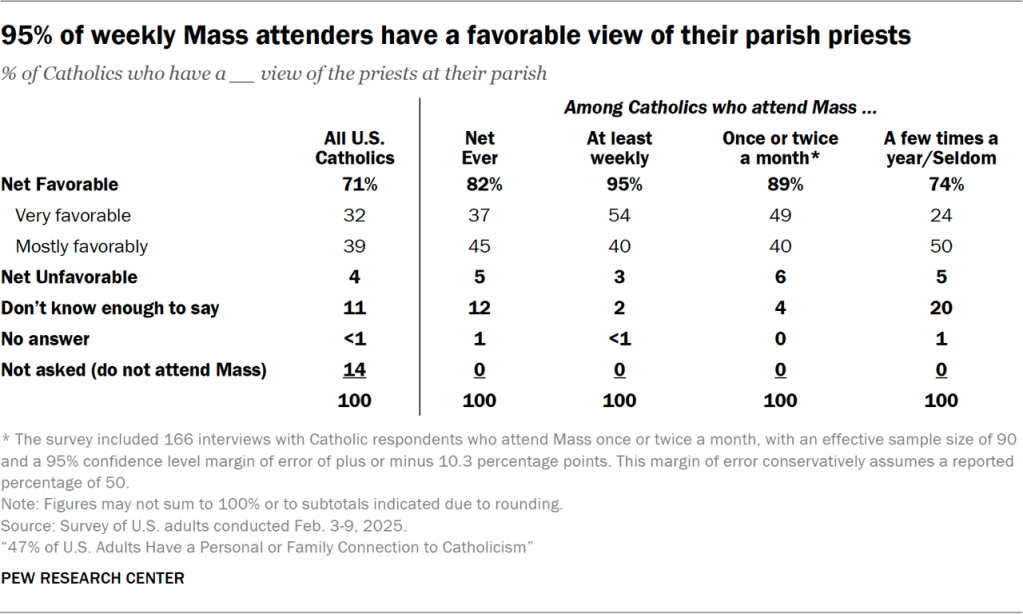
About seven-in-ten Catholics (71%) express favorable views of their parish priests, including 32% who express a very favorable opinion of their priests and 39% who express a mostly favorable view. Just 4% of U.S. Catholics say they have an unfavorable impression of their parish priests.

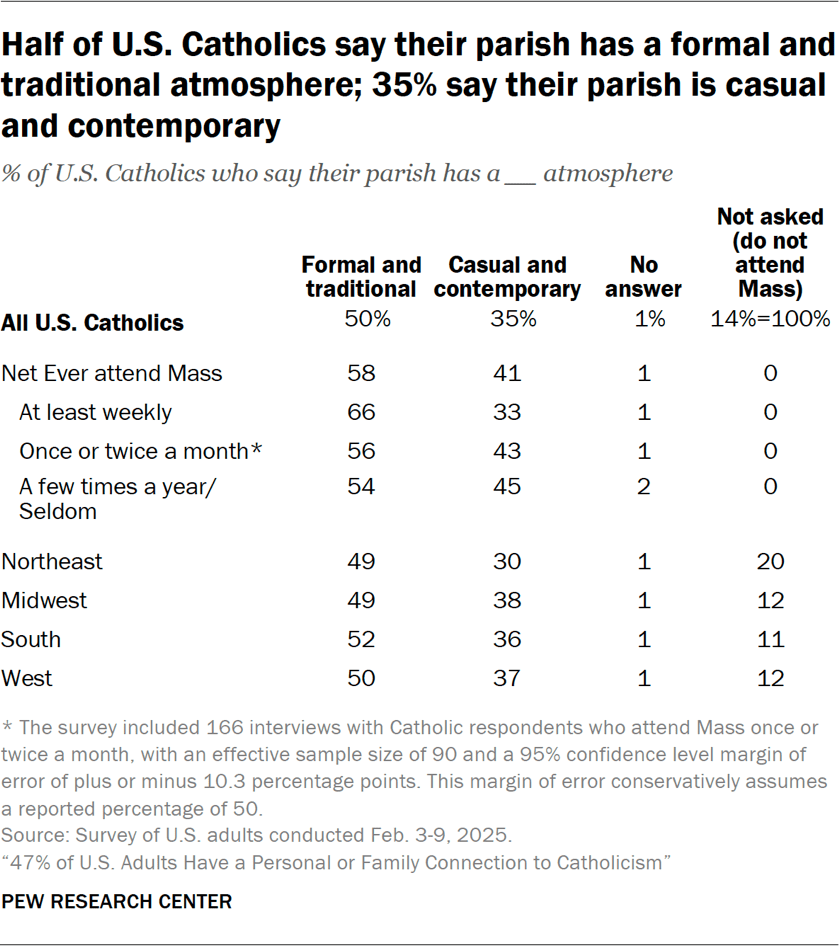
When asked to describe the atmosphere at their parish, half of U.S. Catholics say their church is formal and traditional, while 35% say it is casual and contemporary.

Bar chart showing most American Catholics view their parish priests favorably

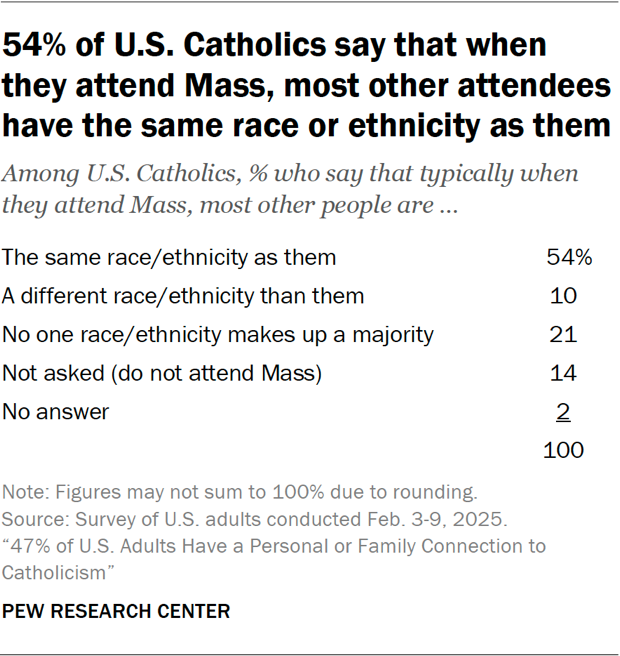
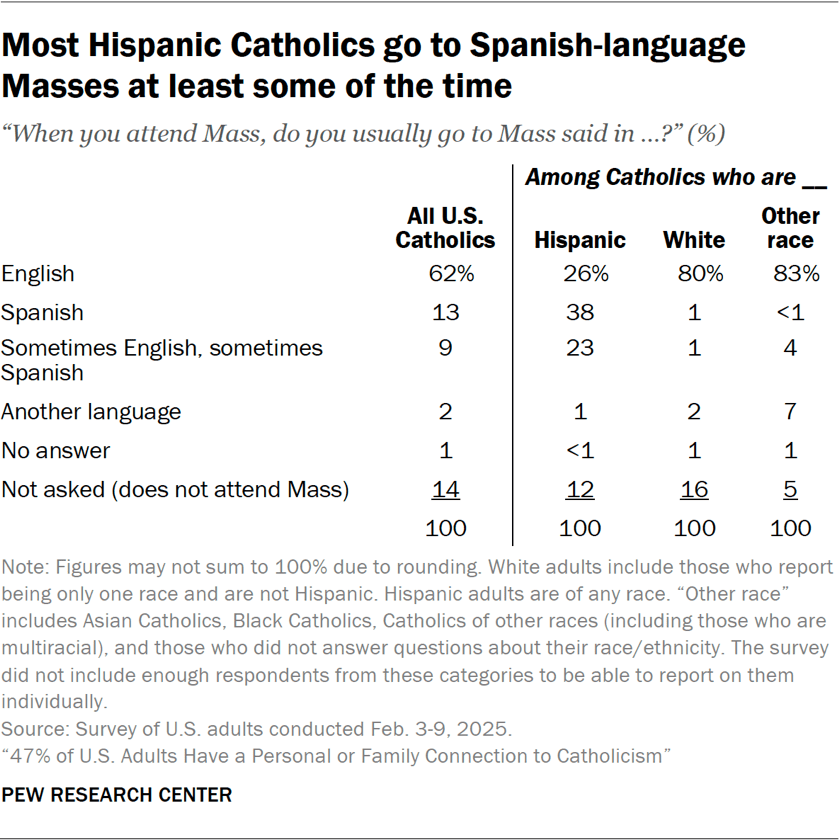
Roughly half of U.S. Catholics (54%) say that when they go to Mass, they are surrounded by people who mostly share their race or ethnicity. The vast majority of White Catholics say they typically go to a Mass conducted in English, while most Hispanic Catholics say they go to a Mass in Spanish at least some of the time.

Table showing 54% of U.S. Catholics say that when they attend Mass, most other attendees have the same race or ethnicity as them

Overall, about one-fifth of U.S. Catholics say they are involved in their parish in some way in addition to attending Mass. This includes 14% who say they volunteer at their parish, and 16% who say they participate at least yearly in parish activities outside of Mass.

Read on for more information about:

  • Views of local parish priests
  • Race, language and where Catholics go to Mass
  • Involvement in Catholic parishes
  • Parish atmosphere and growth
  • Awareness of National Eucharistic Congress, Synod on Synodality

Catholics’ views of their parish priests

Overall, 71% of all U.S. Catholics (including 82% who ever attend Mass) say they have a positive view of their parish’s priest or priests. This figure rises to 95% among Catholics who attend Mass at least once a week. Just 3% of weekly Mass-attending Catholics say they have an unfavorable view of their parish priests.

To put these numbers in some perspective, the survey also found that 80% of weekly Mass-attending Catholics had a favorable view of Pope Francis, while 18% viewed him unfavorably. (The survey was conducted Feb. 3-9, 2025, prior to Francis’ most recent hospitalization and death.)

Table showing 95% of weekly Mass attenders have a favorable view of their parish priests

Race, language and where Catholics go to Mass

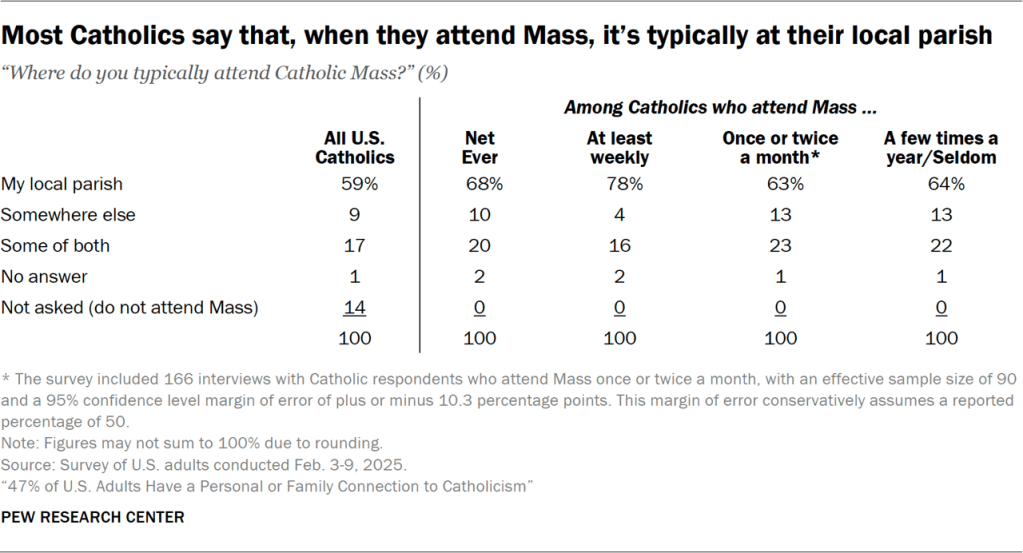
Most Catholics who ever attend Mass say they typically go to their local parish (68%), while 10% say they mostly go somewhere other than their local parish. Two-in-ten say they do some of both. 

Table showing most Catholics say that, when they attend Mass, it’s typically at their local parish

Racial, ethnic composition of Catholic parishes

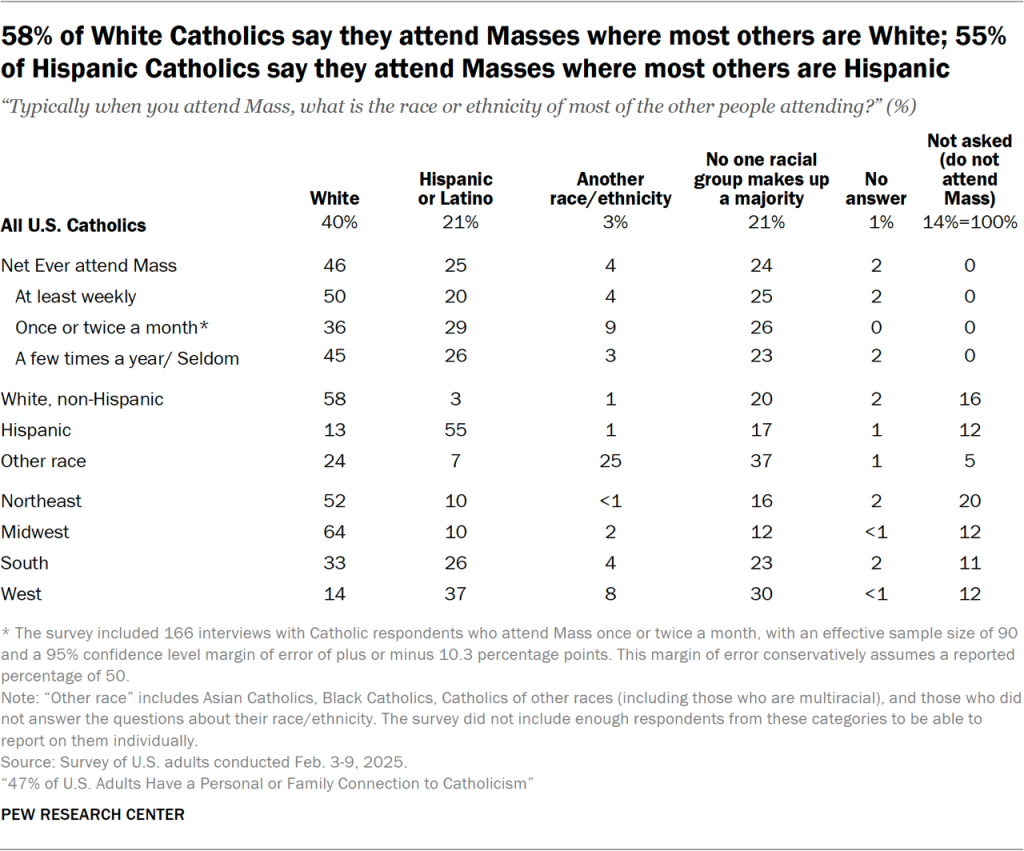
When asked to describe the racial and ethnic composition of the parish they attend, 58% of White Catholics say most other people at the Masses they attend are also White. And 55% of Hispanic Catholics say that when they attend Mass, most of the other people in the pews are also Hispanic.

Table showing 58% of White Catholics say they attend Masses where most others are White; 55% of Hispanic Catholics say they attend Masses where most others are Hispanic

The racial and ethnic composition of Catholic parishes also varies a lot by region. Nearly two-thirds of Catholics in the Midwest (64%) and 52% of Catholics in the Northeast say most of their fellow parishioners at Mass are White. By comparison, just 33% of Catholics in the South and 14% of those in the West say, when they go to Mass, most of the people there are White.

Languages spoken at Mass

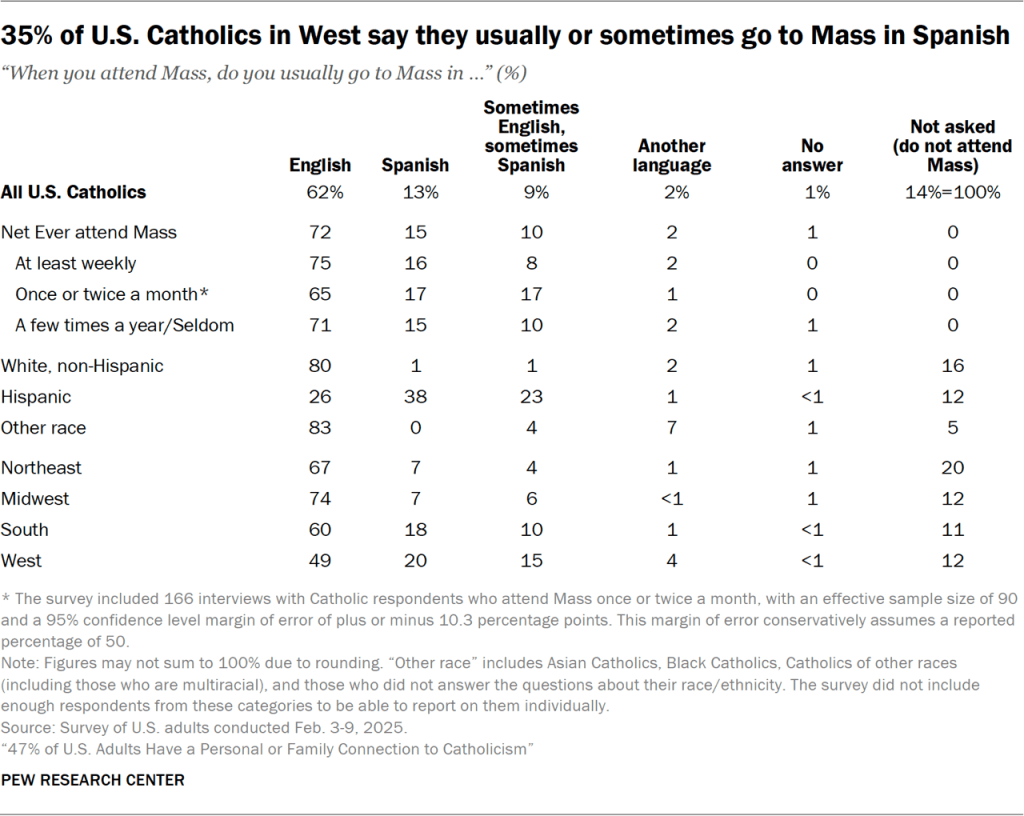
The survey also finds that most Hispanic Catholics usually (38%) or sometimes (23%) go to Mass in Spanish. Attending Spanish Masses is more common in the West and South than among Catholics in the Northeast and Midwest.

This reflects regional patterns in the racial and ethnic composition of U.S. Catholics. Hispanics account for 45% of Catholics in the South and 58% of Catholics in the West, but they make up just 20% of the Catholic population in the Northeast and 15% of the Catholic population in the Midwest.

Table showing 35% of U.S. Catholics in West say they usually or sometimes go to Mass in Spanish

Involvement in Catholic parishes

Overall, 14% of Catholics say they volunteer at their parish, such as by serving as an usher, lector, extraordinary minister of the Eucharist, or in another capacity. And 16% say they participate in parish activities other than Mass – like Eucharistic adoration, prayer groups or community meals – at least several times a year.

In total, 22% of U.S. Catholics say they do one or the other (volunteer or participate in activities other than Mass) or both at their parish.

And among Catholics who attend Mass weekly, 51% say they also either volunteer at their church or participate in activities other than Mass.

Table showing 51% of weekly Mass-attending Catholics say they either participate in parish activities at least yearly, or volunteer at their parish

Parish atmosphere and growth

U.S. Catholics are more likely to describe the atmosphere at their parish as formal and traditional (50%) than casual and contemporary (35%). This pattern is similar in all the regions of the country.

Table showing half of U.S. Catholics say their parish has a formal and traditional atmosphere; 35% say their parish is casual and contemporary

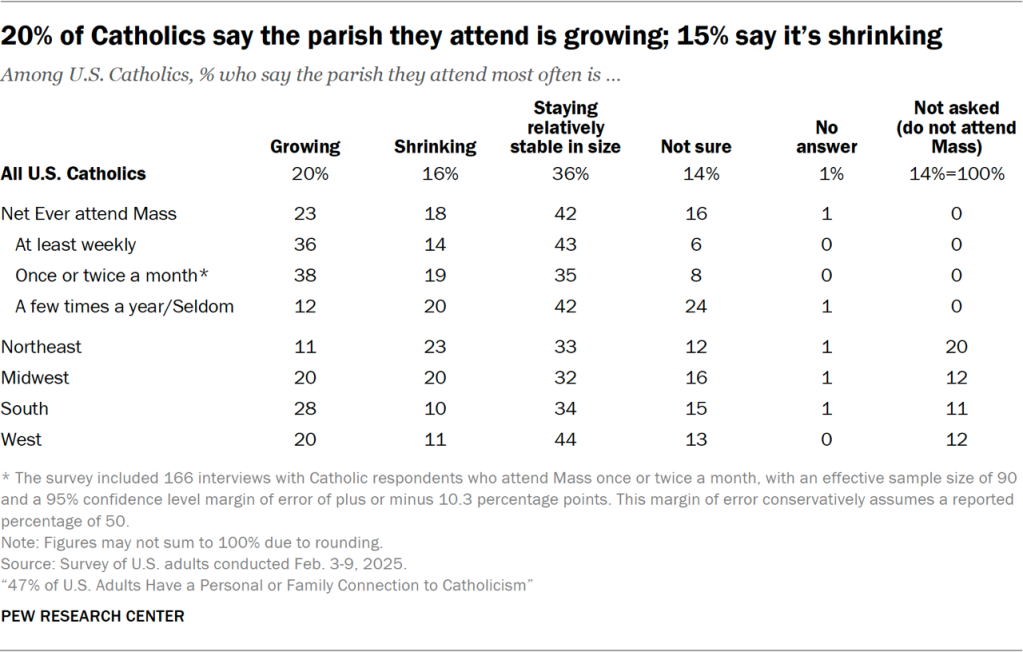
However, there are larger regional differences on the survey’s question about whether parishes are experiencing growth or decline. The share of Catholics who say their parish is growing is higher in the South than in other regions of the country.

Table showing 20% of Catholics say the parish they attend is growing; 15% say it’s shrinking

Meanwhile, the share of Catholics in the Northeast and Midwest who say their parish is shrinking is higher than the share of Catholics who say this in the South or West.

Awareness of National Eucharistic Congress, Synod on Synodality

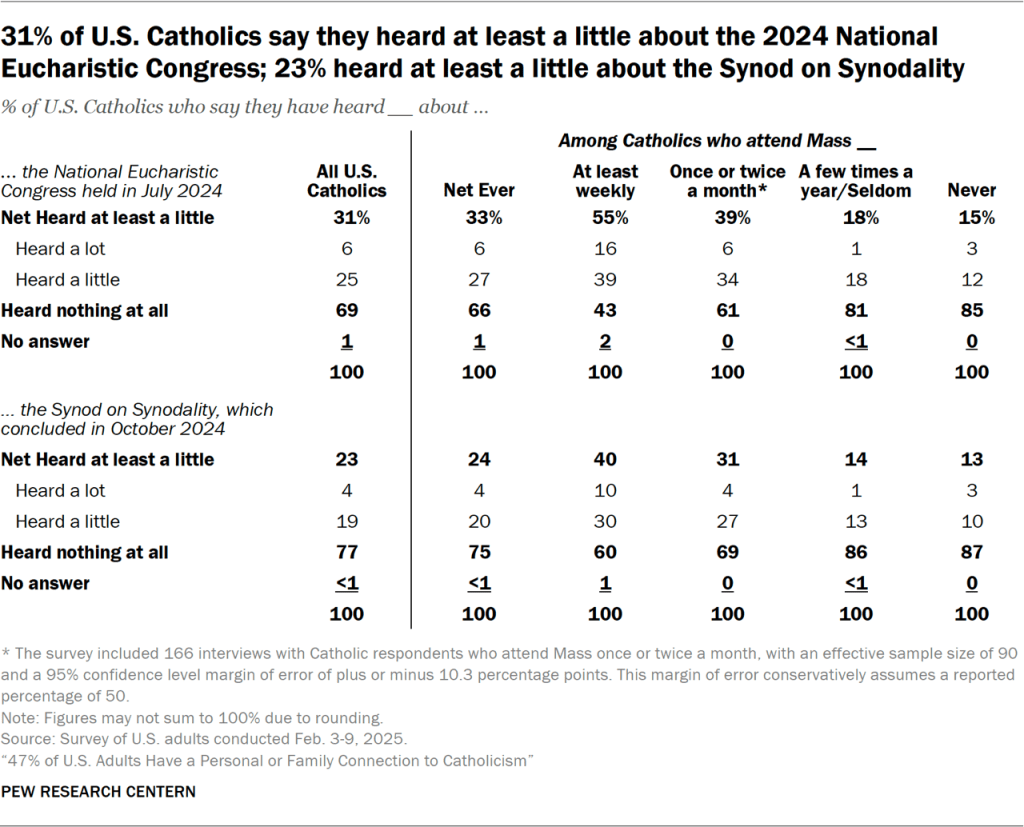
Roughly three-in-ten U.S. Catholics say they have heard at least a little about the 2024 National Eucharistic Congress, which was “the U.S. Conference of Catholic Bishops’ (USCCB) initiative to renew the Catholic Church through the Eucharist.” And 23% say they’ve heard at least a little about the church’s recent Synod on Synodality, which included events in dioceses around the world and concluded in 2024.

Awareness of these recent events is higher among weekly Mass-attending Catholics than among Catholics who don’t go to Mass regularly. Still, even among Catholics who go to Mass weekly, 43% say they haven’t heard anything about the National Eucharistic Congress and 60% say they have heard nothing at all about the Synod on Synodality.

Table showing 31% of U.S. Catholics say they heard at least a little about the 2024 National Eucharistic Congress; 23% heard at least a little about the Synod on Synodality

4. Profile of Hispanic Catholics in the U.S.

How we define Catholics in this chapter

This chapter exclusively explores views and experiences among U.S. Catholics (i.e., the 20% of U.S. adults who say they are Catholic when asked about their present religion).

Many Americans who are not Catholic are still connected to the faith in other ways. Read more about these “cultural Catholics,” former Catholics, and people with other Catholic connections (i.e., those who have  a Catholic parent, spouse or partner, or say “yes” when asked if they ever attend Catholic Mass) in Chapter 7 and the Overview.
The share of U.S. Catholic adults who are Hispanic is growing.12 Today, 36% of all Catholic adults in the United States are Hispanic, up from 29% in 2007.13

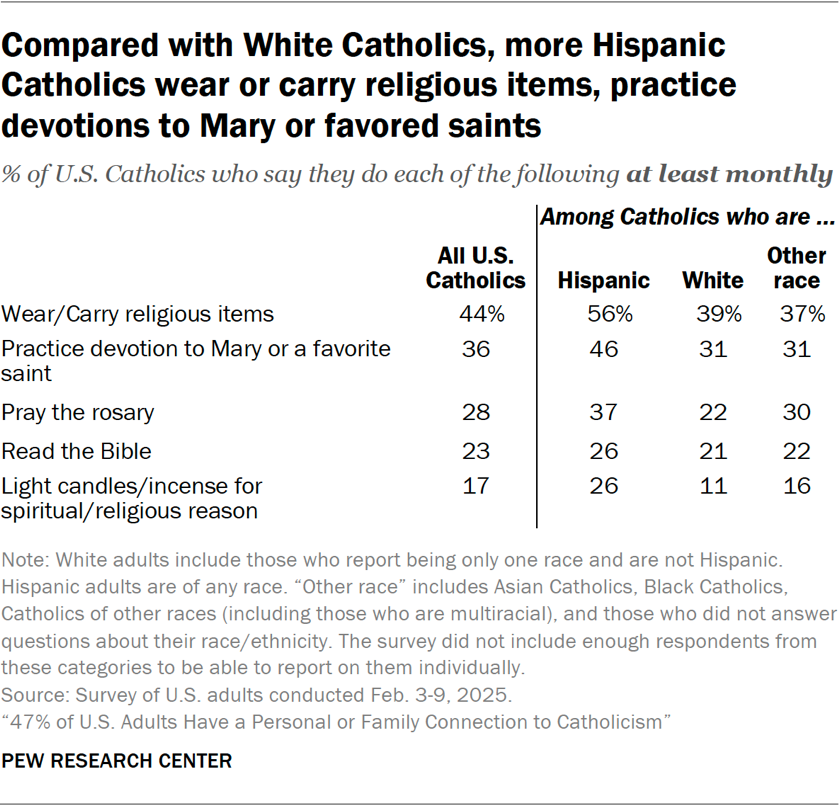
Hispanic Catholics are a distinctive part of American Catholic religious life in numerous ways. They are more likely than White Catholics to say they participate in a variety of Catholic devotional practices. For example, compared with White Catholics in the U.S., Hispanic Catholics are more likely to:

  • Regularly wear or carry religious items with them (56% vs. 39%)
  • Practice devotions to the Virgin Mary or a favorite saint (46% vs. 31%)
  • Pray the rosary (37% vs. 22%)
  • Regularly light candles or incense for spiritual or religious reasons (26% vs. 11%)

Also, not surprisingly, Hispanic Catholics are far more likely than White Catholics to say they usually go to a Mass conducted in Spanish.

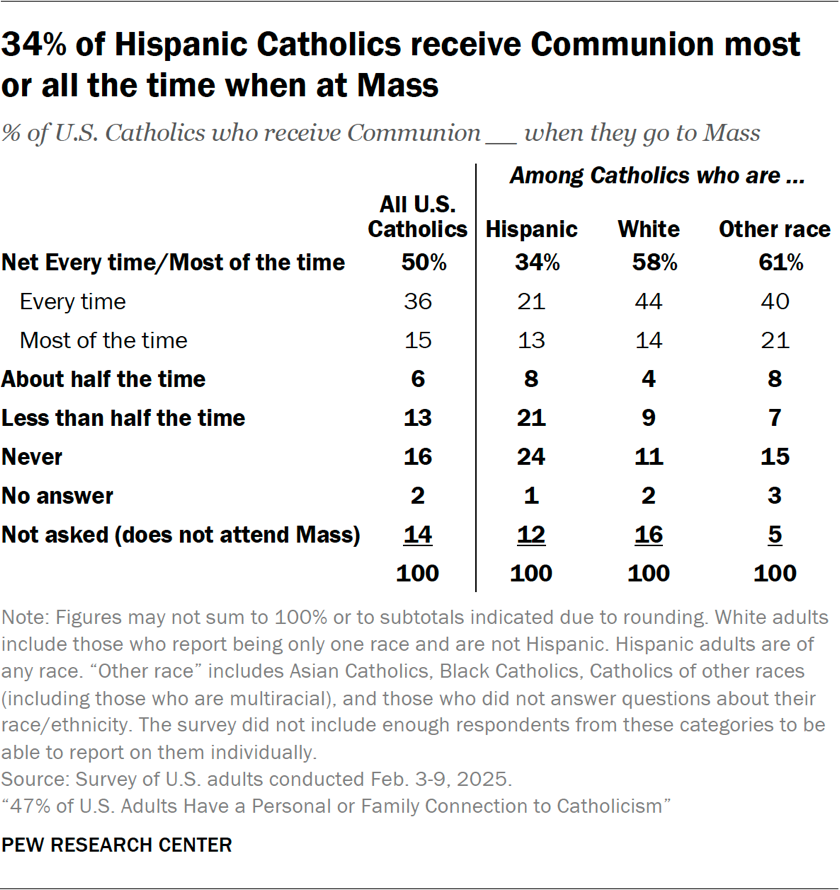
The share of Catholics who say they attend Mass at least weekly is similar among Hispanic and White Catholics. But the share of Catholics who say they receive Communion at least most of the time they attend Mass is lower among Hispanic Catholics than among White Catholics.

Hispanic Catholics also have a distinctive social and demographic profile. For instance, eight-in-ten Hispanic Catholics were born outside the U.S. (58%) or are the children of immigrants (22%). Most Hispanic Catholics live in the West (41%) or the South (37%). And Hispanic Catholics are more likely to say they are Democrats or lean toward the Democratic Party than to say they are Republicans or Republican leaners.

By contrast, most White Catholics were born in the U.S. to U.S.-born parents, live in the Northeast or the Midwest, and are Republicans or lean Republican. (For additional information about how Hispanic Catholics compare with other U.S. Catholics with respect to age, immigration, region, party identification and education, refer to “10 facts about U.S. Catholics.”)

Read on for more about Hispanic Catholics’ beliefs and practices related to:

  • Mass attendance, Communion and confession
  • Religious devotions
  • Essentials of Catholic identity
  • Spanish Mass

Mass attendance, Communion and confession among Hispanic Catholics

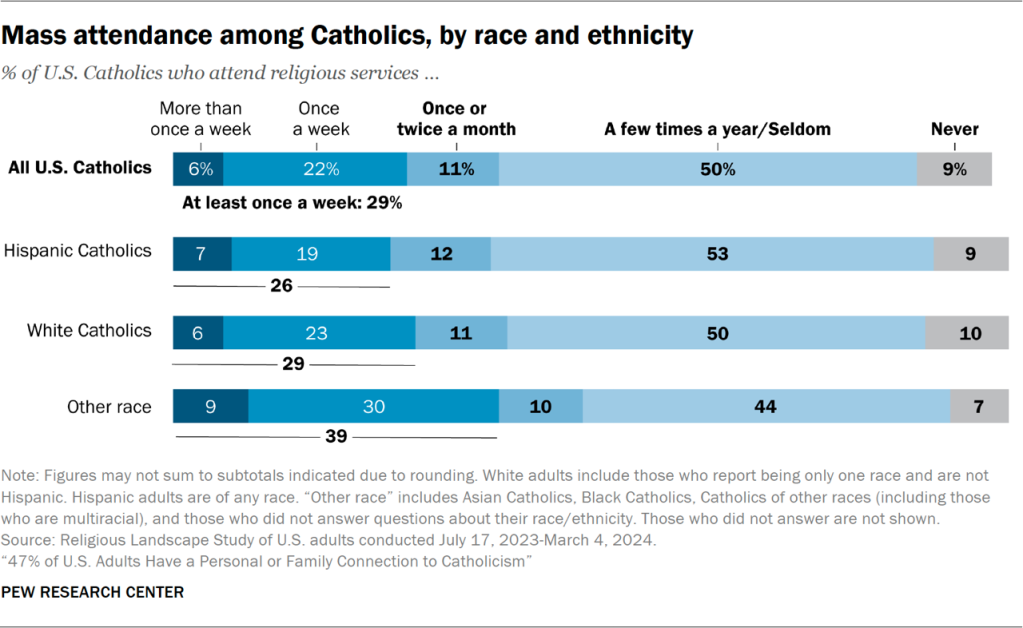
About a quarter of Hispanic Catholics say they attend religious services at least once a week (26%), according to the 2023-24 U.S. Religious Landscape Study – on par with the share of White Catholics who say this. An additional 12% say they go to Mass once or twice a month, while 53% go a few times a year or “seldom.” One-in-ten Hispanic Catholics say they never go to church.

Bar chart showing mass attendance among Catholics, by race and ethnicity

Receiving Communion at Mass

Compared with other Catholics, fewer Hispanic Catholics in the Feb. 3-9, 2025, survey say they receive Communion most or all of the time when they attend Mass. About a third of Hispanic Catholics say they receive Communion every time (21%) or most of the time (13%).

Table showing 34% of Hispanic Catholics receive Communion most or all the time when at Mass

Going to confession

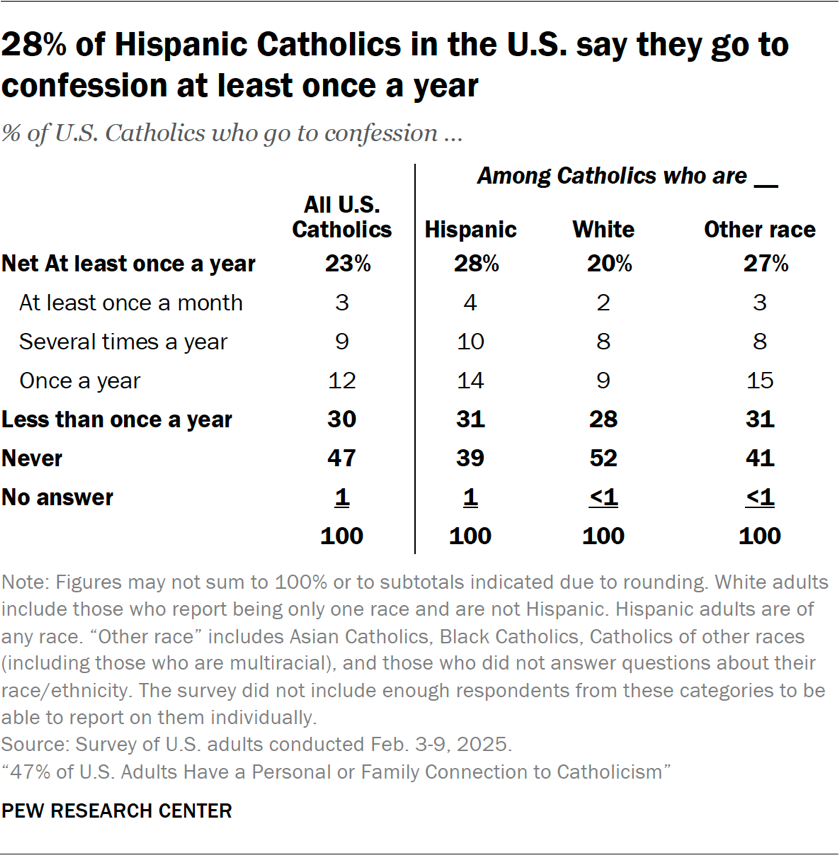
Hispanic Catholics are slightly more likely than White Catholics to say they go to confession at least once a year. Overall, 28% of Hispanic Catholics say they go to confession at least once a year, compared with 20% of White Catholics.

Table showing 28% of Hispanic Catholics in the U.S. say they go to confession at least once a year

Religious devotions among Hispanic Catholics

Overall, 56% of Hispanic Catholics say they wear or carry religious items with them at least monthly. About half say they practice devotions to the Virgin Mary or a favorite saint at least monthly, and 37% say they pray the rosary monthly.

Table showing that compared with White Catholics, more Hispanic Catholics wear or carry religious items, practice devotions to Mary or favored saints

In addition, about a quarter of Hispanic Catholics say they light candles or incense for religious or spiritual reasons at least once a month. Hispanic Catholics report doing all these things at higher rates than White Catholics do.

When it comes to reading the Bible, 26% of Hispanic Catholics say they do this at least monthly, and 21% of White Catholics say the same.

Essentials of Catholic identity among Hispanics

To explore what “being Catholic” means to U.S. Catholics, the survey gave respondents a list of items and asked them to say whether each is an “essential,” an “important but not essential,” or “not an important” part of what being Catholic means to them. Respondents could say that more than one item is essential, and they also could indicate that none of the items is essential.

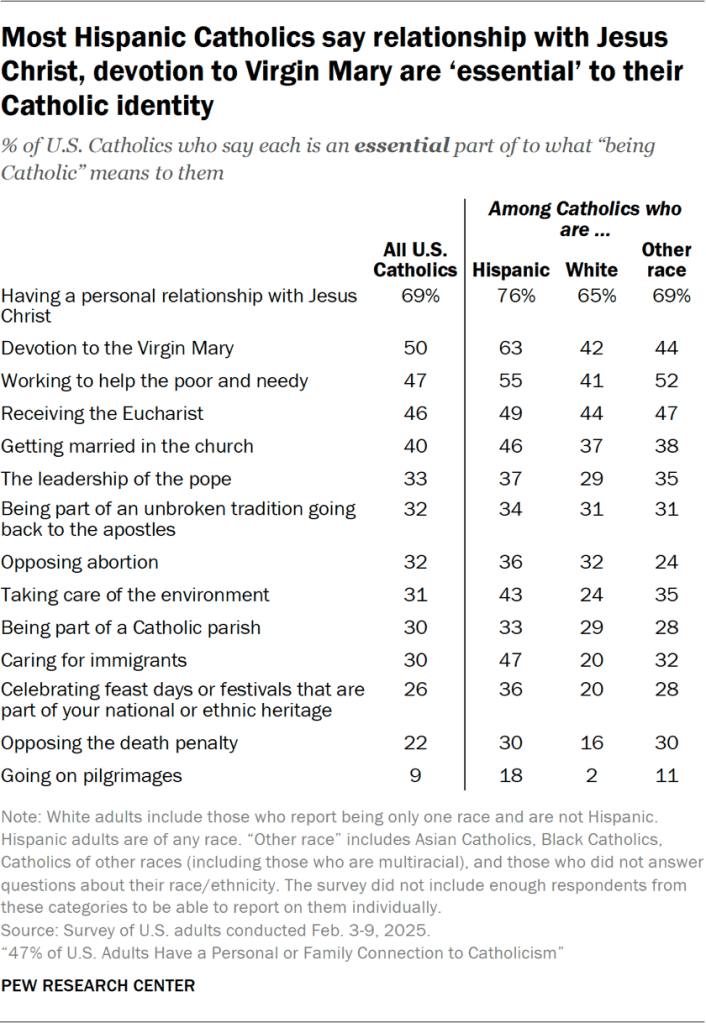
Table showing most Hispanic Catholics say relationship with Jesus Christ, devotion to Virgin Mary are ‘essential’ to their Catholic identity

Compared with White Catholics, Hispanic Catholics were more likely to cite many of the items as essential to their Catholic identity. For example, the share of Hispanics who say “having a personal relationship with Jesus Christ” is essential to what being Catholic means to them is 11 percentage points higher than among White Catholics (76% vs. 65%). And the share of Hispanics who say “devotion to the Virgin Mary” is essential to their Catholic faith is 21 points higher than among White Catholics (63% vs. 42%).

Hispanic Catholics also are far more inclined than White Catholics to say that essential elements of their Catholic identity include caring for immigrants (47% vs. 20%), taking care of the environment (43% vs. 24%), celebrating feast days that are part of their national or ethnic heritage (36% vs. 20%), going on pilgrimages (18% vs. 2%), working to help the poor and needy (55% vs. 41%), and opposing the death penalty (30% vs. 16%).

For more on what U.S. Catholics (of all races and ethnicities) say being Catholic means to them, and for breaks by Mass attendance and political party, refer to Chapter 1 of this report.

Mass in Spanish

Roughly four-in-ten Hispanic Catholics say that when they go to Mass, they usually go to one said in Spanish. About a quarter say they typically go to English Masses, and 23% say they sometimes go to English Masses and sometimes go to Spanish Masses.

Table showing most Hispanic Catholics go to Spanish-language Masses at least some of the time

By comparison, just 1% of White Catholics say they typically go to Spanish Mass; another 1% say they sometimes go to Mass said in Spanish.

5. Profile of U.S. converts to Catholicism

How we define Catholics in this chapter

This chapter exclusively explores views and experiences among U.S. Catholics (i.e., the 20% of U.S. adults who say they are Catholic when asked about their present religion).

Many Americans who are not Catholic are still connected to the faith in other ways. Read more about these “cultural Catholics,” former Catholics, and people with other Catholic connections (i.e., those who have  a Catholic parent, spouse or partner, or say “yes” when asked if they ever attend Catholic Mass) in Chapter 7 and the Overview.
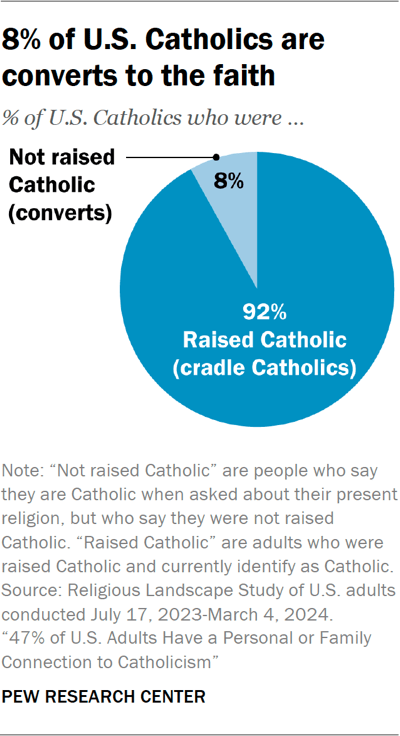
In the U.S., 92% of Catholics are “cradle Catholics” – people who say they were raised Catholic and also say they are Catholic when asked about their religion today. The remaining 8% are converts to Catholicism – people who say their religion is Catholicism today but that they were not brought up Catholic.14 Overall, 1.5% of all U.S. adults are converts to Catholicism.

Pie chart showing 8% of U.S. Catholics are converts to the faith

On average, converts to the faith attend Mass weekly at somewhat higher rates than cradle Catholics. Higher shares of converts than cradle Catholics also say they receive Communion every time they attend Mass.

But the percentages of Catholics who say they pray daily and go to confession at least once a year are similar among converts and cradle Catholics. And the share of converts who say they have attended a Traditional Latin Mass in the last five years is not much different from the share of cradle Catholics who say this (18% and 13%, respectively).

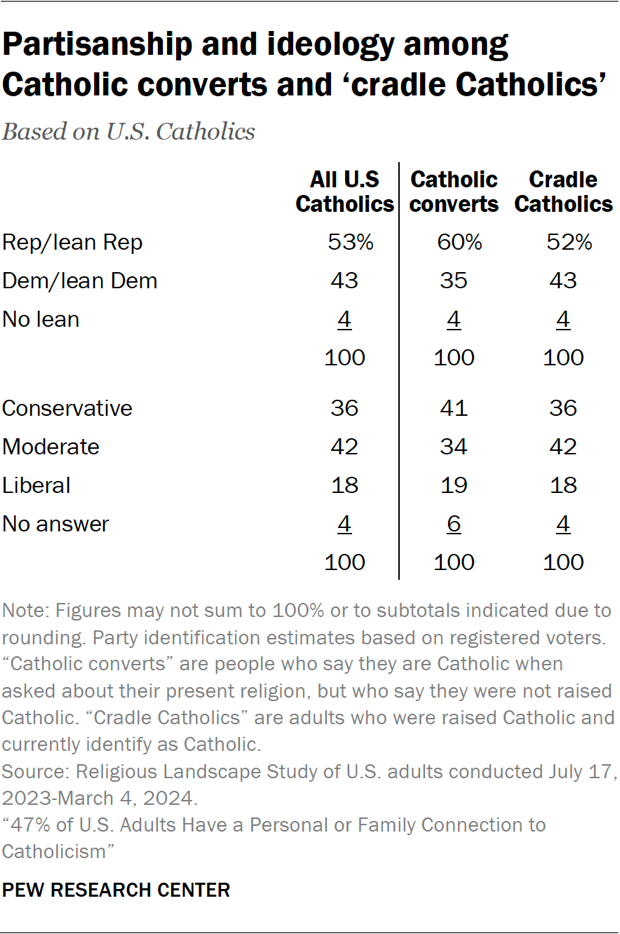
Politically, converts are somewhat more Republican than cradle Catholics and are about as likely to describe themselves as conservatives, ideologically.

When asked why they became Catholic, the most common response offered by converts is because of a spouse, or to get married in the church. Others say becoming Catholic aligned with their values or that Catholicism made sense to them.

The rest of this chapter looks at deeper comparisons of Catholic converts with cradle Catholics. Our analysis includes results from both the 2023-24 Religious Landscape Study (RLS) and Pew Research Center’s survey of Catholics conducted Feb. 3-9, 2025. The RLS has a larger sample size than the 2025 survey, and so on questions where we have data from both, we use the RLS. That said, the 2025 survey includes a number of questions about Catholicism that were not asked as part of the RLS.

Converts to Catholicism represent a small group in the broader U.S. public (1.5% of U.S. adults), and so both the RLS and the 2025 survey have relatively modest samples of members of this group. The RLS includes 662 interviews with converts to Catholicism, and results based on this group have a margin of error of plus or minus 5.5 percentage points. The 2025 survey of Catholics includes 148 interviews with converts to Catholicism, and results based on this group have a margin of error of plus or minus 10.1 percentage points.

Read about the following on Catholic converts:

  • Religious practices
  • Demographics
  • Political composition
  • Why they joined the church

Religious practices among converts to Catholicism

About four-in-ten converts to Catholicism (38%) say they attend Mass at least once a week, which is somewhat higher than the share of cradle Catholics who say this (28%).  Converts also are more likely than cradle Catholics to say they receive Communion every time they go to Mass (58% vs. 34%).

Table showing that compared with ‘cradle Catholics,’ converts are more likely to go to Mass weekly, take Communion when they go

However, the shares of converts and cradle Catholics who say they pray every day are similar. (The gap between the 56% of converts who say this and the 51% of cradle Catholics is not statistically significant.)

Table showing converts and ‘cradle Catholics’ pray, go to confession, attend Traditional Latin Mass at similar rates

And there is little evidence that attending the Traditional Latin Mass (TLM) is more common among converts than among cradle Catholics. Among converts, 18% say they have attended a TLM at least once in the last five years, which is similar to the 13% of cradle Catholics who say the same. (The difference is not statistically significant.) Large majorities of both groups say they have not been to a TLM in the last five years.

Converts and cradle Catholics also report going to confession at similar rates. Large majorities in both groups say they go to confession less than once a year or not at all.

Demographics of converts to Catholicism

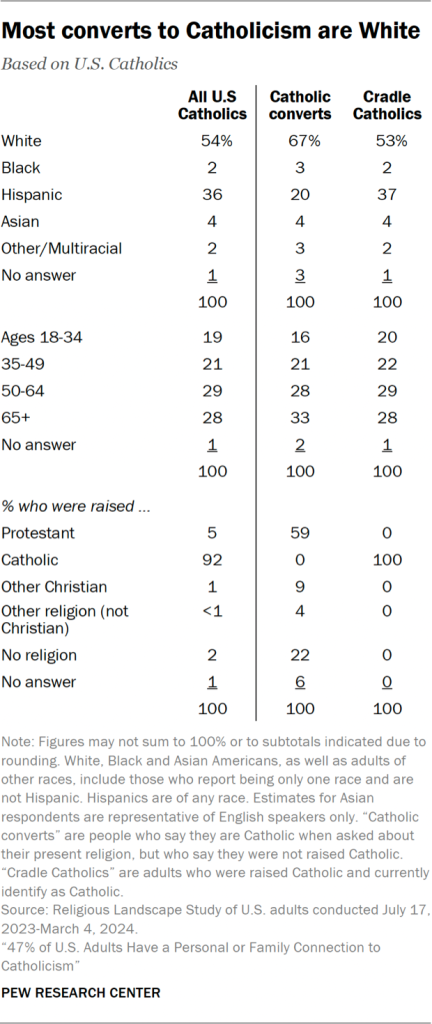
Roughly two-thirds of converts to Catholicism in the United States are White (67%) and 20% are Hispanic. By comparison, the population of cradle Catholics in the U.S. includes a smaller share of White people (53%) and more Hispanics (37%).

About six-in-ten converts to Catholicism were raised as Protestants (59%), while 22% were raised with no religion.15 The remainder were raised in other religions or declined to answer the question about their childhood religion.

Table showing most converts to Catholicism are White

Politics of converts to Catholicism

Among Catholic registered voters, converts to Catholicism are a bit more likely than “cradle Catholics” to describe themselves as Republicans or to lean toward the Republican Party (60% vs. 52%)

There is little difference between the share of Catholic converts and cradle Catholics who describe their political views as conservative. (The difference between the 41% of converts who are conservative and the 36% of cradle Catholics is not statistically significant.)

Table showing partisanship and ideology among Catholic converts and ‘cradle Catholics’

Why converts joined the church

To better understand why they joined the Catholic Church, Catholic converts were asked an open-ended question: “Just in your own words, what is the main reason you became Catholic?”

Table showing roughly half of converts to Catholicism mention their spouse or getting married as the main reason for converting

By far the most common response was that the decision was driven by their spouse or partner being Catholic. Nearly half of responses (49%) referenced this as a reason, saying things like, “married into a Catholic family” or “I married a Catholic and became Catholic after that time.”

Other common responses converts give for having joined the church include:

  • Coming to believe in church teachings or in the church’s historical foundation (13%)
  • Feeling called to Catholicism, or finding it spiritually fulfilling (12%)
  • The influence of relatives and friends (12%)

6. Views of sexual abuse and misconduct in the Catholic Church

How we define Catholics in this chapter

This chapter exclusively explores views and experiences among U.S. Catholics (i.e., the 20% of U.S. adults who say they are Catholic when asked about their present religion).

Many Americans who are not Catholic are still connected to the faith in other ways. Read more about these “cultural Catholics,” former Catholics, and people with other Catholic connections (i.e., those who have  a Catholic parent, spouse or partner, or say “yes” when asked if they ever attend Catholic Mass) in Chapter 7 and the Overview.
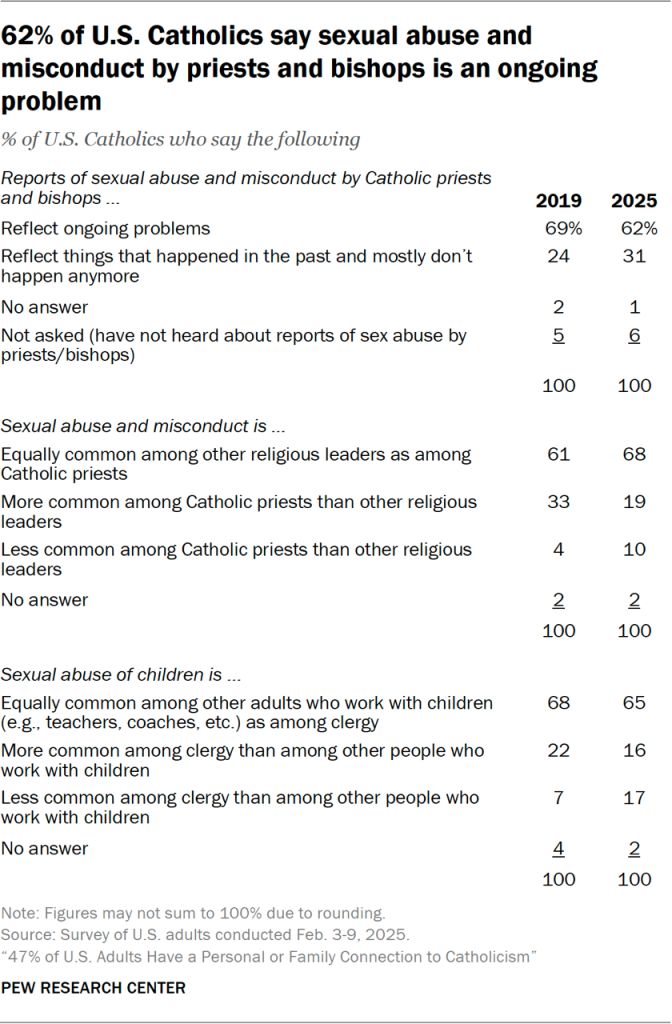
More than two decades after the clergy sex abuse scandal gained national attention in 2002, most U.S. Catholics think sexual abuse and misconduct by Catholic priests and bishops is an ongoing problem in the church.

In our February 2025 survey, 62% of U.S. Catholics say clergy sex abuse is an ongoing problem, while 31% say these reports “reflect things that happened in the past and mostly don’t happen anymore.”

Table showing 62% of U.S. Catholics say sexual abuse and misconduct by priests and bishops is an ongoing problem

While most view it as an ongoing problem, most also think the problem is not unique to Catholic clergy.

Indeed, about two-thirds of Catholics surveyed (68%) say sexual abuse and misconduct is equally as common among other religious leaders as it is among Catholic priests and bishops. Far fewer (19%) think it is more of a problem among Catholic clergy than among other religious leaders.

Since 2019, the share of Catholics who say they think sexual misconduct by clergy is an ongoing problem has declined from 69% to 62%. And the share who say they think clergy misconduct in other religions is equally as common as in the Catholic Church has increased from 61% to 68%.

Read on for more about Catholics’ attitudes toward sexual abuse and misconduct in the church, including:

  • How much they’ve heard about it
  • Views on whether it is an ongoing problem
  • Views on whether it’s as common among other religious leaders

How much Catholics have heard about clergy sexual abuse and misconduct

The vast majority of Catholics (94%) have heard at least a little about sexual abuse and misconduct by Catholic priests and bishops. This includes 57% who say they have heard a lot about the topic and 37% who say they have heard a little about it.

Among U.S. adults as a whole, 93% say they have heard about sexual abuse and misconduct by Catholic clergy, including 55% who have heard a lot about this.

Table showing 94% of U.S. Catholics have heard at least a little about sexual abuse and misconduct by Catholic priests and bishops

Views on whether clergy sexual abuse is an ongoing problem

About six-in-ten Catholics say that sexual abuse and misconduct by Catholic priests and bishops is an ongoing problem, while roughly three-in-ten say this is something that happened in the past and mostly doesn’t happen anymore.

Among Catholics who attend Mass weekly, 51% say sexual abuse and misconduct by priests and bishops is an ongoing problem, while 44% say it is something that happened in the past. By contrast, 70% 0f Catholics who attend Mass a few times a year or less often say the problem is ongoing.

(Catholics who say they attend Mass once or twice a month are more likely than other Catholics to say they haven’t heard anything at all about the issue; the survey did not ask respondents who said they were unaware of the issue whether they think it is ongoing.)

Table showing 62% of Catholics say sexual abuse and misconduct by priests and bishops is an ongoing problem

Views on whether sexual abuse and misconduct among Catholic clergy is unique

Most Catholics (68%) say that sexual abuse and misconduct by leaders is equally as common among other religious groups as in the Catholic Church. A similar share (65%) say this kind of abuse is just as common among other people who work with children (like teachers and coaches) as it is among religious leaders.

Catholics who attend Mass at least weekly are a bit more inclined than Catholics who attend a few times a year or less often to say they think sexual abuse of children is rarer among religious leaders than among other people who work with children. Still, majorities of Catholics at every level of Mass attendance say they think sexual abuse is equally common in the Catholic Church as in other religions, and equally common among clergy as among lay people who work with children.

Table showing 68% of Catholics say that sexual abuse and misconduct is equally as common among other religious leaders as it is among Catholic priests and bishops

7. Catholic connections
Terminology

Throughout this report, when we use the term Catholic we are referring to U.S. adults who say they are Catholic when asked about their religion.

We use the following terms when referring to people who are not Catholic by religion, but are connected to the faith in other ways:

Cultural Catholics say they consider themselves Catholic “aside from religion” (e.g., ethnically, culturally, or because of their family background).

Former Catholics were raised in the faith tradition but no longer identify as Catholic, religiously or culturally.

People who are connected to Catholicism in other ways are not Catholic by religion or culture, nor are they former Catholics. But they report having a Catholic parent, spouse or partner, or say yes when asked if they ever attend Mass.

In the United States, there are almost as many “cultural Catholics” and former Catholics, combined, as there are people who identify religiously as Catholic. In our Feb. 3-9, 2025, survey, 20% of U.S. adults are Catholic by religion, meaning they say they are Catholic when asked about their religion. Throughout this report, we refer to this group simply as “Catholic.”

Meanwhile, 18% of U.S. adults are not Catholics by religion, but they are either cultural Catholics (9%) or former Catholics (9%). By “cultural Catholics,” we mean people who say in the survey that they are Catholic “aside from religion,” for example, ethnically, culturally, or because of their family background, but who do not say they are Catholic when asked directly about their religion. We define “former Catholics” as people who were raised Catholic but who don’t identify as Catholic today, either religiously or “aside from religion.”

Additionally, another 9% of U.S. adults are connected to Catholicism in other ways. These are people who don’t fit into the Catholic, cultural Catholic or former Catholic categories, but who have a Catholic parent, spouse or partner, or say “yes” when asked whether they ever attend Catholic Mass.

About half of both cultural Catholics and former Catholics are religious “nones,” meaning they describe themselves as atheist, agnostic or “nothing in particular” when asked about their present religion. The remainder of people in these groups identify with a religion other than Catholicism (mostly with other Christian groups).

Chart showing nearly half of Americans have Catholic connections
The rest of this chapter provides more information about:

  • ‘Cultural Catholics’ and former Catholics
  • Why ‘cultural Catholics’ say they identify as Catholic ‘aside from religion’
  • Other Catholic connections
  • Reasons people give for leaving the Catholic Church

Cultural Catholics and former Catholics

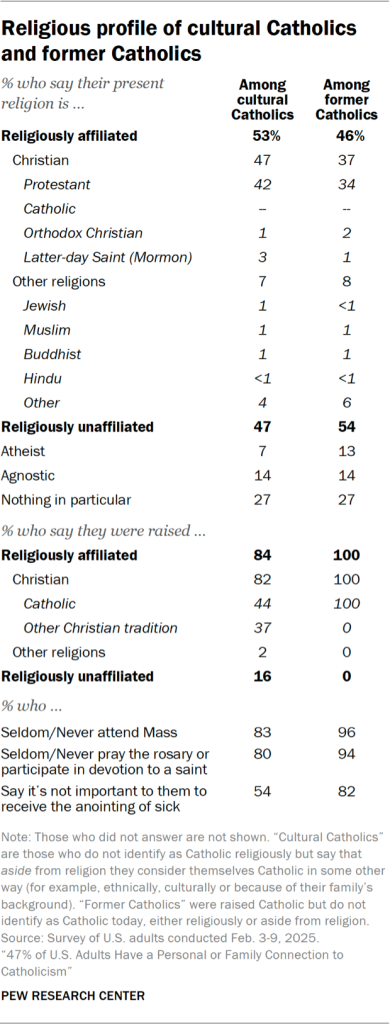
Today, 53% of “cultural Catholics” identify with religions other than Catholicism, including 47% who are part of other Christian traditions and 7% who identify with non-Christian religions. The remainder of cultural Catholics (47%) are religiously unaffiliated.

Table showing the religious profile of cultural Catholics and former Catholics

Looking at former Catholics, 46% identify with religions other than Catholicism, including 37% who are in other Christian traditions and 8% who identify with other (non-Christian) religions. About half of former Catholics (54%) are religiously unaffiliated.

How they were raised

Among cultural Catholics, 44% say they were raised Catholic, while 37% were raised in other Christian traditions and 16% were raised religiously unaffiliated.

By definition, 100% of former Catholics were raised Catholic.

Their religious practices today

The vast majorities of cultural Catholics and former Catholics are not involved in Catholic practices today. Indeed, 83% of cultural Catholics and 96% of former Catholics say they seldom or never attend Catholic Mass. Eight-in-ten cultural Catholics and 94% of former Catholics say they seldom or never pray the rosary or participate in devotions to Mary or other saints.

Furthermore, 82% of former Catholics say it would be “not too important” or “not at all important” to them to receive the anointing of the sick if they were seriously ill. This figure is somewhat lower among cultural Catholics (54%). Among cultural Catholics, 8% say receiving the anointing of the sick would be “extremely” or “very” important to them, while 18% say it would be “somewhat” important and 19% say they are not sure.

Why do cultural Catholics say they identify as Catholic ‘aside from religion’?

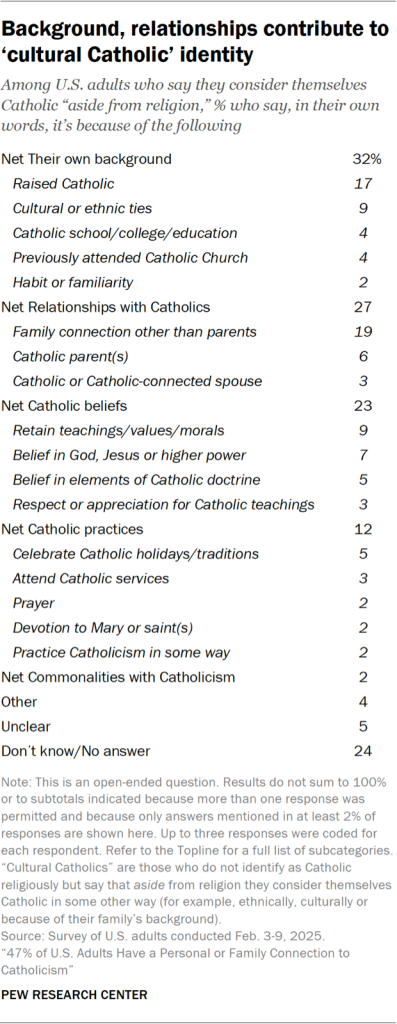
The survey asked cultural Catholics to describe, in their own words, in what way they consider themselves Catholic. The most common type of response describes having some sort of Catholic background (32%), such as having been raised Catholic, having cultural or ethnic ties to Catholicism, or having attended Catholic school.

Table showing that background and relationships contribute to the ‘cultural Catholic’ identity

Many cultural Catholics also describe relationships with Catholics (27%) as contributing to why they consider themselves Catholics. For instance, these respondents point to having Catholic parents, extended family members, friends or spouses.

Additionally, 23% of cultural Catholics mention beliefs that connect them to Catholicism, such as belief in God or elements of Catholic teaching. And 12% mention practices related to Catholicism, such as celebrating holidays, attending Mass or prayer.

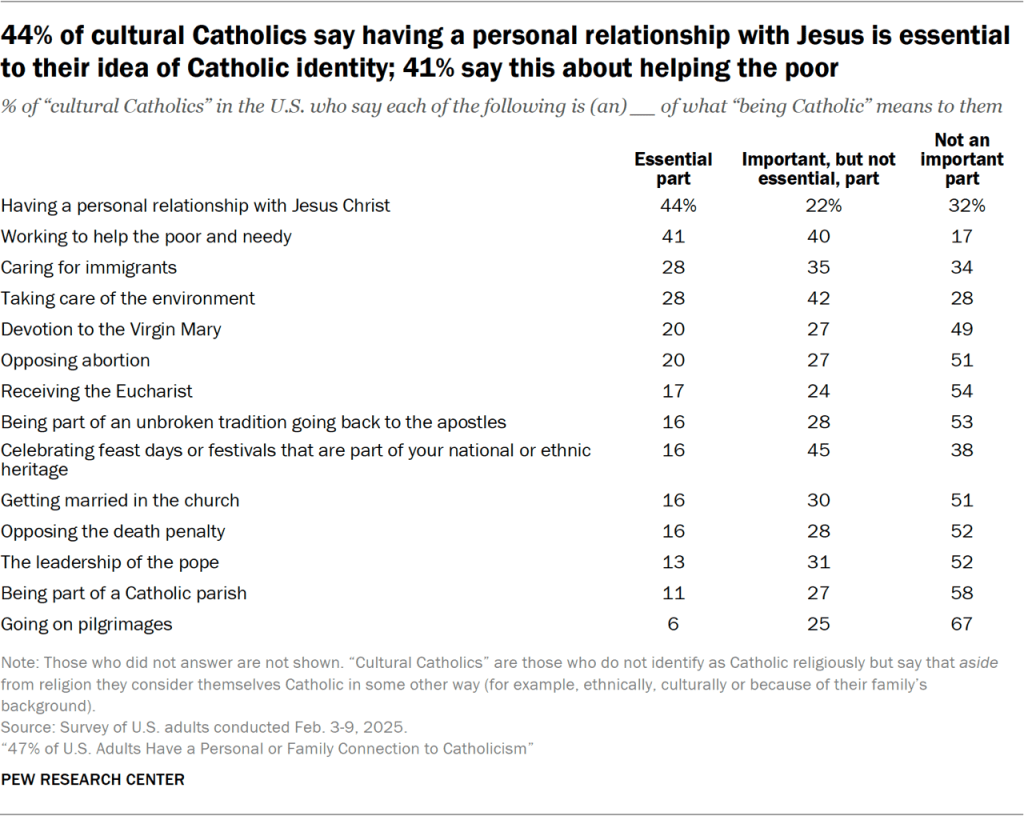
The survey also asked cultural Catholics whether each of a series of beliefs, practices and other traits are “essential” to what being Catholic means to them, “important but not essential,” or “not an important part” of what being Catholic means to them.

Overall, 44% say having a personal relationship with Jesus Christ is essential to what being Catholic means to them, and 41% say the same about “working to help the poor and needy.” Roughly three-in-ten (28%) say caring for immigrants is “essential” to their Catholic identity, and an identical share mention “taking care of the environment.”

Compared with Catholics by religion, smaller shares of cultural Catholics say most of the items asked about in the survey are essential to what being Catholic means to them. (For a description of how people who identify religiously as Catholic answered this question, jump to Chapter 1.)

Table showing 44% of cultural Catholics say having a personal relationship with Jesus is essential to their idea of Catholic identity, and 41% say this about helping the poor

Other Catholic connections
Overall, the survey finds that 9% of U.S. adults are connected to Catholicism in ways other than being Catholic by religion, culturally Catholic, or formerly Catholic. To put it another way, people in this group do not fit into any of those three categories but they do have a Catholic parent, spouse or partner or they say “yes” when asked whether they ever attend Catholic Mass.

More than half (57%) of the people in this group have a Catholic parent. Roughly one-third say “yes” when asked whether they ever attend Catholic Mass. And 25% have a Catholic spouse or partner.

In total, 13% of people in this group have more than one of these kinds of connections to the faith.
Reasons people give for leaving the Catholic Church

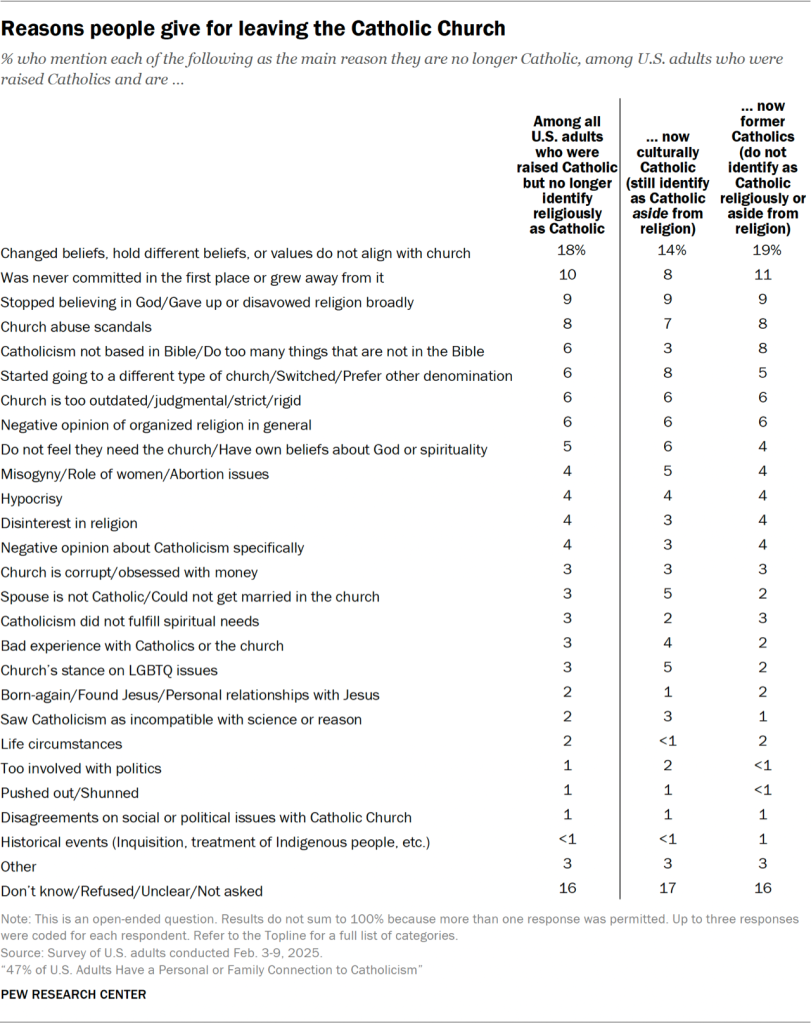
Overall, 13% of all adults in the U.S. population say they were raised Catholic but that they no longer religiously identify as Catholic. The survey asked people in this group an open-ended question: “What is the main reason you are no longer Catholic?”

Overall, 18% of the people answering this question cite changed beliefs as the main reason they left Catholicism or say they hold different beliefs than the church. An additional 10% say they were never particularly committed to the church to begin with, and/or that they grew away from it. Another 9% say they stopped believing in God or left religion altogether, and 8% mention abuse scandals in the church as the key factor.

Table showing the reasons people give for leaving the Catholic Church

Acknowledgments

Pew Research Center is a subsidiary of The Pew Charitable Trusts, its primary funder. This report is a collaborative effort based on the input and analysis of the following individuals. Find related reports online at pewresearch.org/religion.

Primary researchers

Patricia Tevington, Research Associate
Gregory A. Smith, Senior Associate Director, Religion Research

Research team

Alan Cooperman, Director, Religion Research
Becka A. Alper, Senior Researcher
Besheer Mohamed, Senior Researcher
Chip Rotolo, Research Associate
Justin Nortey, Research Analyst
Asta Kallo, Research Assistant

Methods team

Ashley Amaya, Associate Director, Survey Methods
Andrew Mercer, Senior Research Methodologist
Courtney Kennedy, Vice President, Methods and Innovation
Dorene Asare-Marfo, Panel Manager
Dana Popky, Associate Panel Manager
Anna Brown, Research Methodologist
Arnold Lau, Research Methodologist 

Editorial and graphic design

Jeff Diamant, Senior Writer/Editor
Rebecca Leppert, Copy Editor
Bill Webster, Senior Information Graphics Designer

Communications and web publishing

Justine Coleman, Associate Digital Producer
Hannah Taber, Communications Manager
Maya Pottiger, Communications Associate
Others at Pew Research Center who contributed to this report include Neha Sahgal, Vice President of Research, and Mark Hugo Lopez, Director of Race and Ethnicity Research.

In addition, Pew Research Center is grateful to expert advisers who provided valuable input on the questionnaire for this project: Tricia Bruce, Affiliated Research Scholar at the University of Southern California’s Institute for Advanced Catholic Studies; Maureen Day, Research Affiliate at the Center for Religion and Civic Culture at the University of Southern California; Michele Dillon, Professor of Sociology at the University of New Hampshire; David Gibson, Director of the Center on Religion and Culture at Fordham University; Mark Gray, Director of CARA Catholic Polls (CCP) at the Center for Applied Research in the Apostolate; Hosffman Ospino, Professor of Hispanic Ministry and Religious Education at Boston College; Tia Noelle Pratt, Assistant Vice President for Mission Engagement and Strategic Initiatives at Villanova University; and Stephen P. White, Executive Director of The Catholic Project at The Catholic University of America and Fellow in the Catholic Studies Program at the Ethics and Public Policy Center.

Methodology

The American Trends Panel survey methodology

Overview

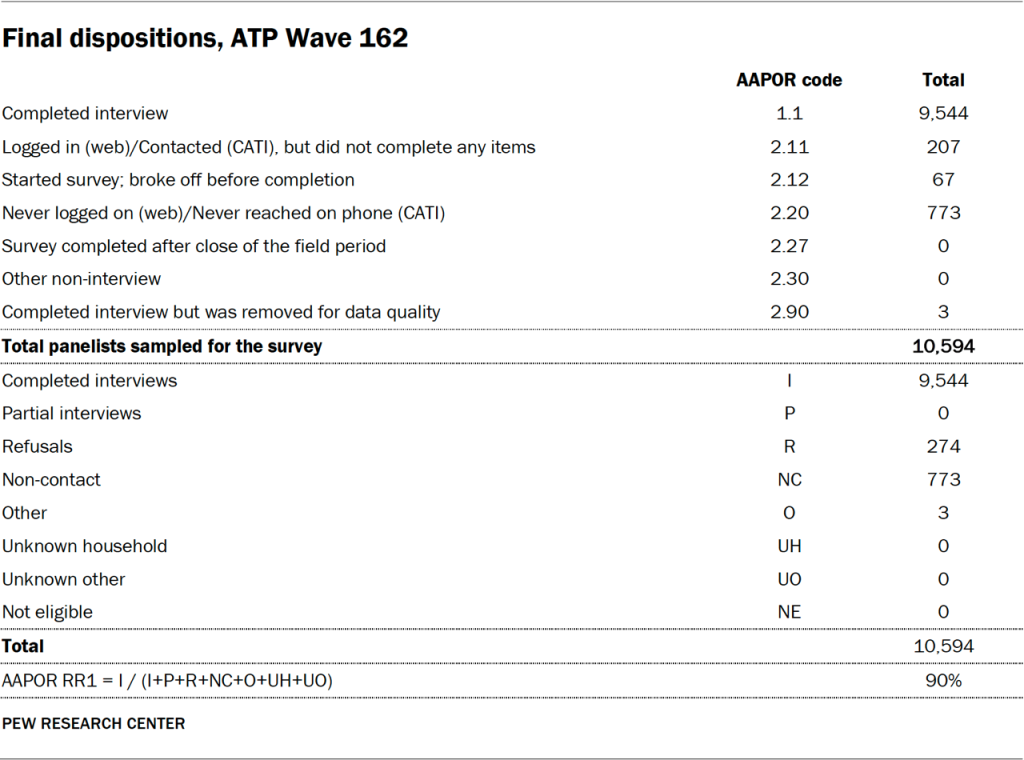
Most of the data in this report comes from Wave 162 of the American Trends Panel (ATP), Pew Research Center’s nationally representative panel of randomly selected U.S. adults. The survey was conducted from Feb. 3 to 9, 2025. A total of 9,544 panelists (including 1,787 Catholics) responded out of 10,594 who were sampled, for a survey-level response rate of 90%.

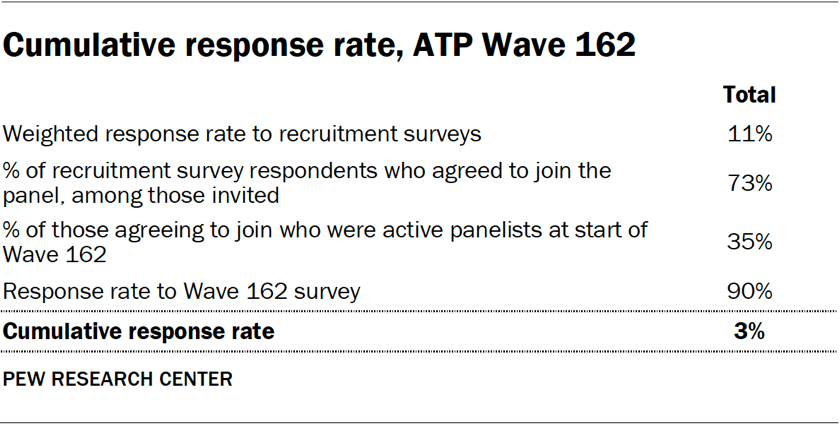
The cumulative response rate accounting for nonresponse to the recruitment surveys and attrition is 3%. The break-off rate among panelists who logged on to the survey and completed at least one item is 1%. The margin of sampling error for the full sample of 9,544 respondents is plus or minus 1.3 percentage points; the margin of sampling error for the sample of 1,787 Catholic respondents is plus or minus 3.1 percentage points.

SSRS conducted the survey for Pew Research Center via online (n=9,273) and live telephone (n=271) interviewing. Interviews were conducted in both English and Spanish.

To learn more about the ATP, read “About the American Trends Panel.”

Panel recruitment

Since 2018, the ATP has used address-based sampling (ABS) for recruitment. A study cover letter and a pre-incentive are mailed to a stratified, random sample of households selected from the U.S. Postal Service’s Computerized Delivery Sequence File. This Postal Service file has been estimated to cover 90% to 98% of the population.16 Within each sampled household, the adult with the next birthday is selected to participate. Other details of the ABS recruitment protocol have changed over time but are available upon request.17 Prior to 2018, the ATP was recruited using landline and cellphone random-digit-dial surveys administered in English and Spanish.

A national sample of U.S. adults has been recruited to the ATP approximately once per year since 2014. In some years, the recruitment has included additional efforts (known as an “oversample”) to improve the accuracy of data for underrepresented groups. For example, Hispanic adults, Black adults and Asian adults were oversampled in 2019, 2022 and 2023, respectively.

Sample design

The overall target population for this survey was noninstitutionalized persons ages 18 and older living in the United States. All active panel members were invited to participate in this wave.
Questionnaire development and testing

The questionnaire was developed by Pew Research Center in consultation with SSRS. The web program used for online respondents was rigorously tested on both PC and mobile devices by the SSRS project team and Pew Research Center researchers. The SSRS project team also populated test data that was analyzed in SPSS to ensure the logic and randomizations were working as intended before launching the survey.

Incentives

All respondents were offered a post-paid incentive for their participation. Respondents could choose to receive the post-paid incentive in the form of a check or gift code to Amazon.com, Target.com or Walmart.com. Incentive amounts ranged from $5 to $20 depending on whether the respondent belongs to a part of the population that is harder or easier to reach. Differential incentive amounts were designed to increase panel survey participation among groups that traditionally have low survey response propensities.

Data collection protocol

The data collection field period for this survey was Feb. 3 to 9, 2025. Surveys were conducted via self-administered web survey or by live telephone interviewing. 

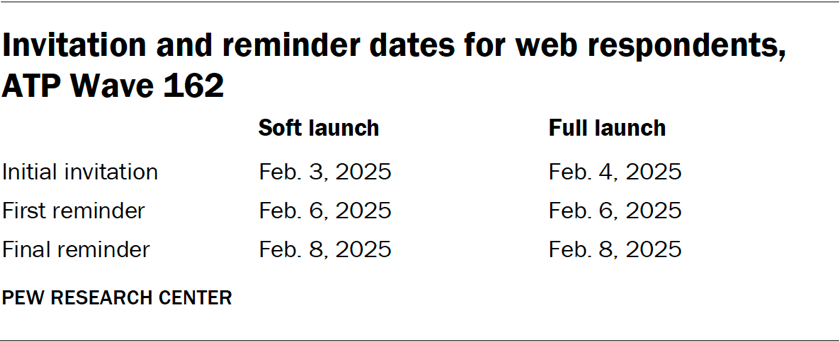
For panelists who take surveys online: Postcard notifications were mailed to a subset on Feb. 3.18 Survey invitations were sent out in two separate launches: soft launch and full launch. Sixty panelists were included in the soft launch, which began with an initial invitation sent on Feb. 3. All remaining English- and Spanish-speaking sampled online panelists were included in the full launch and were sent an invitation on Feb. 4.

Table showing the invitation and reminder dates for web respondents in ATP Wave 162

Panelists participating online were sent an email invitation and up to two email reminders if they did not respond to the survey. ATP panelists who consented to SMS messages were sent an SMS invitation with a link to the survey and up to two SMS reminders.

For panelists who take surveys over the phone with a live interviewer: Prenotification postcards were mailed on Jan. 31. Soft launch took place on Feb. 3 and involved dialing until a total of 15 interviews had been completed. All remaining English- and Spanish-speaking sampled phone panelists’ numbers were dialed throughout the remaining field period. Panelists who take surveys via phone can receive up to six calls from trained SSRS interviewers.

Data quality checks

To ensure high-quality data, Center researchers performed data quality checks to identify any respondents showing patterns of satisficing. This includes checking for whether respondents left questions blank at very high rates or always selected the first or last answer presented. As a result of this checking, three ATP respondents were removed from the survey dataset prior to weighting and analysis.

Weighting

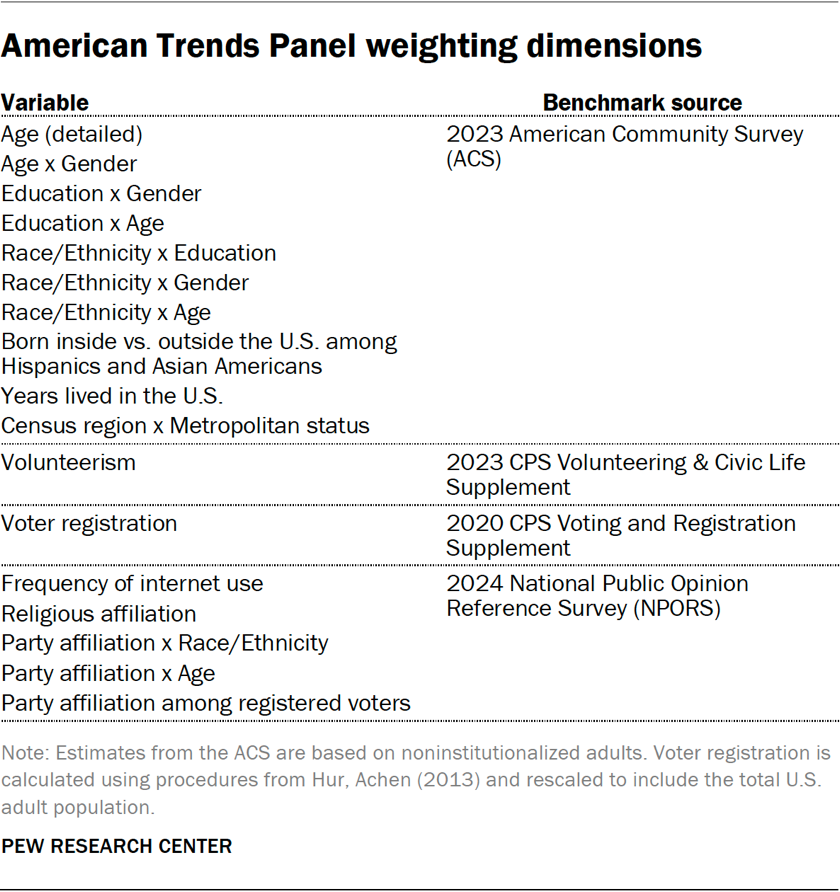
The ATP data is weighted in a process that accounts for multiple stages of sampling and nonresponse that occur at different points in the panel survey process. First, each panelist begins with a base weight that reflects their probability of recruitment into the panel. These weights are then calibrated to align with the population benchmarks in the accompanying table to correct for nonresponse to recruitment surveys and panel attrition. If only a subsample of panelists was invited to participate in the wave, this weight is adjusted to account for any differential probabilities of selection.

Table showing American Trends Panel weighting dimensions

Among the panelists who completed the survey, this weight is then calibrated again to align with the population benchmarks identified in the accompanying table and trimmed at the 1st and 99th percentiles to reduce the loss in precision stemming from variance in the weights. Sampling errors and tests of statistical significance take into account the effect of weighting.

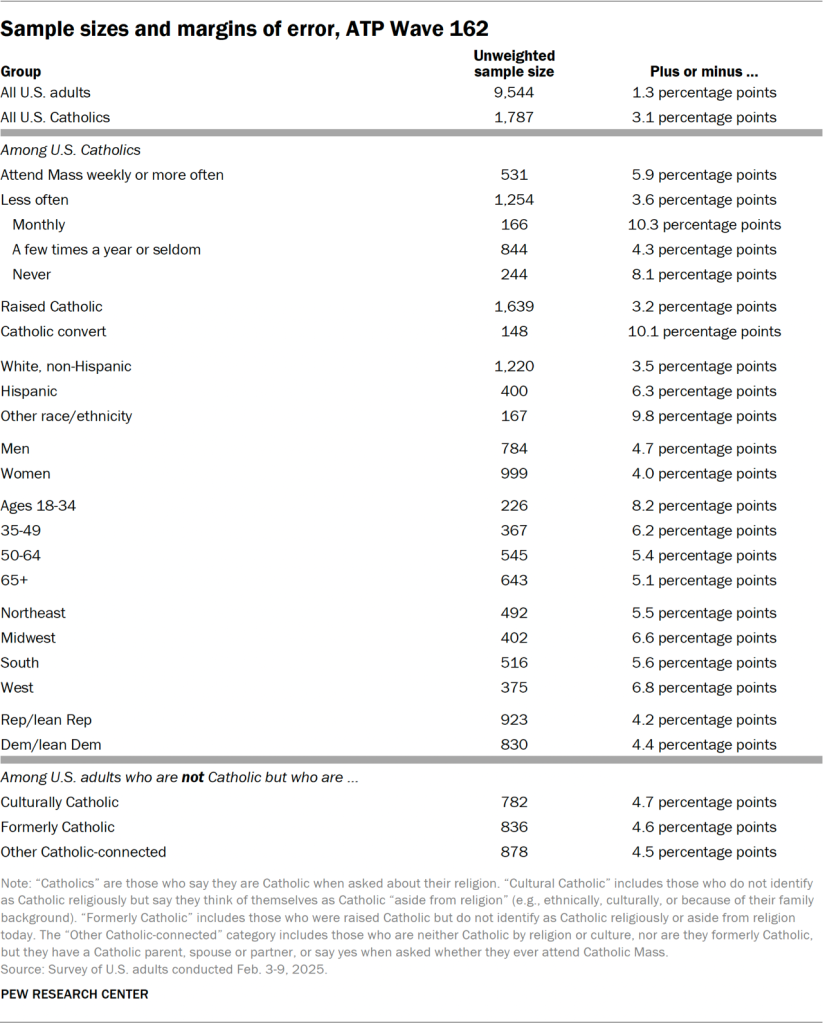
The table below shows the unweighted sample sizes and the error attributable to sampling that would be expected at the 95% level of confidence for different groups in the Feb. 3-9, 2025, survey.

Table showing the sample sizes and margins of error in ATP Wave 162

Sample sizes and sampling errors for other subgroups are available upon request. In addition to sampling error, one should bear in mind that question wording and practical difficulties in conducting surveys can introduce error or bias into the findings of opinion polls.

Dispositions and response rates

Table showing the final dispositions in ATP Wave 162
Table showing the cumulative response rate in ATP Wave 162

The U.S. Religious Landscape Study Methodology

Some of the data in this report comes from Pew Research Center’s 2023-24 U.S. Religious Landscape Study (RLS). The RLS was conducted in English and Spanish from July 17, 2023, to March 4, 2024, among a nationally representative sample of 36,908 U.S. adults. Complete details about how the RLS was conducted are available in the study’s Methodology.

Table showing the sample sizes and margins of error in the 2023-24 U.S. Religious Landscape Study

The accompanying table shows the unweighted sample sizes and the error attributable to sampling that would be expected at the 95% level of confidence for different groups in the RLS.

In addition to sampling error, one should bear in mind that question wording and practical difficulties in conducting surveys can introduce error or bias into the findings of opinion polls.