Pew Research Center

FOR RELEASE MAY 6, 2025

Believing in Spirits and Life After Death Is Common Around the World

Younger people are just as likely as older people to hold some spiritual beliefs

BY Jonathan Evans, Kirsten Lesage, William Miner, Kelsey Jo Starr and Manolo Corichi

FOR MEDIA OR OTHER INQUIRIES:

Communications Department
202.419.4372
www.pewresearch.org

RECOMMENDED CITATION

Pew Research Center, May 2025, "Believing in Spirits and Life After Death Is Common Around the World"

About Pew Research Center

Pew Research Center is a nonpartisan, nonadvocacy fact tank that informs the public about the issues, attitudes and trends shaping the world. It does not take policy positions. The Center conducts public opinion polling, demographic research, computational social science research and other data-driven research. It studies politics and policy; news habits and media; the internet and technology; religion; race and ethnicity; international affairs; social, demographic and economic trends; science; research methodology and data science; and immigration and migration. Pew Research Center is a subsidiary of The Pew Charitable Trusts, its primary funder.

© Pew Research Center 2026

Table of contents

  • About Pew Research Center
  • Believing in Spirits and Life After Death Is Common Around the World
  • 1. God, spirits and the natural world
  • 2. Beliefs about the afterlife
  • 3. Spells, curses and ways to see the future
  • 4. Spiritual and religious practices
  • 5. Religious importance and religious affiliation
  • Acknowledgments
  • Methodology

Believing in Spirits and Life After Death Is Common Around the World

Younger people are just as likely as older people to hold some spiritual beliefs

How we did this

Pew Research Center conducted this survey to measure the prevalence of a variety of religious and spiritual beliefs and practices around the world. The survey included some questions grounded in the Christian, Jewish and Muslim traditions, as well as some questions with roots in Buddhism, Hinduism and other Asian faiths. We wanted to see how widely such beliefs and practices are shared by people in different regions and different religious groups, including those who don’t affiliate with any religion.

Map showing the countries included in the "Believing in Spirits and Life After Death Is Common Around the World" report

This report is based on surveys conducted in 36 countries on six continents. The countries have a wide array of religious traditions. Some have Christian, Muslim or Jewish majorities, while others have Hindu or Buddhist majorities. A few are quite religiously mixed, and some have large shares of people who are religiously unaffiliated.

Outside the United States, this report draws on nationally representative surveys of 41,503 adults conducted from Jan. 5 to May 22, 2024. All surveys were conducted over the phone with adults in Canada, France, Germany, Greece, Italy, Japan, Malaysia, the Netherlands, Singapore, South Korea, Spain, Sweden and the United Kingdom. Surveys were conducted face-to-face in Argentina, Bangladesh, Brazil, Chile, Colombia, Ghana, Hungary, India, Indonesia, Israel, Kenya, Mexico, Nigeria, Peru, the Philippines, Poland, South Africa, Sri Lanka, Thailand, Tunisia and Turkey. In Australia, we used a mixed-mode, probability-based online panel.

For the U.S., data comes from respondents contacted in three separate survey waves in 2023 or 2024:

  1. 11,201 respondents were surveyed from July 31 to Aug. 6, 2023, via Pew Research Center’s American Trends Panel (ATP), an online survey panel recruited through national random sampling of residential addresses, which gives nearly all U.S. adults a chance of selection. Read more about the ATP’s methodology.
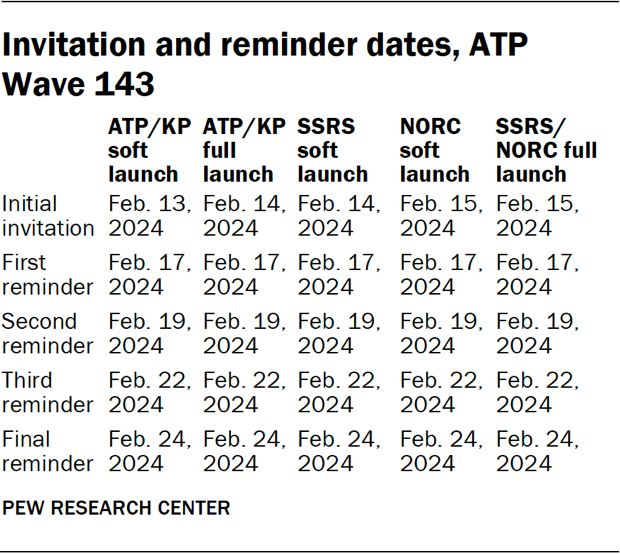
  2. 12,693 respondents were surveyed from Feb. 13 to 25, 2024. Most of the respondents (10,642) in this survey are members of the ATP, and nearly all these panelists also participated in the ATP survey that concluded in Aug. 2023. The remaining U.S. respondents (2,051) in this wave are members of three other panels: the Ipsos KnowledgePanel, the NORC Amerispeak Panel and the SSRS Opinion Panel. All three are national survey panels recruited through random sampling (not “opt-in” polls). We used these additional panels to ensure that the survey would have enough Jewish and Muslim respondents to be able to report on their views.
  3. In addition, U.S. data for a few questions comes from 36,908 respondents surveyed from July 17, 2023, to March 4, 2024, as part of the Center’s latest Religious Landscape Study (RLS). This survey was conducted mainly online and on paper, while 3% opted to complete the interview on the telephone. The RLS was made possible by The Pew Charitable Trusts, which received support from the Lilly Endowment Inc., Templeton Religion Trust, The Arthur Vining Davis Foundations and the M.J. Murdock Charitable Trust.

This report was produced by Pew Research Center as part of the Pew-Templeton Global Religious Futures project, which analyzes religious change and its impact on societies around the world. Funding for the Global Religious Futures project comes from The Pew Charitable Trusts and the John Templeton Foundation (grant 63095). This publication does not necessarily reflect the views of the John Templeton Foundation.

Here are the questions and responses used for this report (including information about the U.S. source used for each question), along with the survey methodology.

Belief in life after death is widespread around the globe, as is the belief that spirits can reside in animals and in parts of nature such as mountains, rivers or trees, according to a Pew Research Center survey of three dozen countries with a wide range of religious traditions.
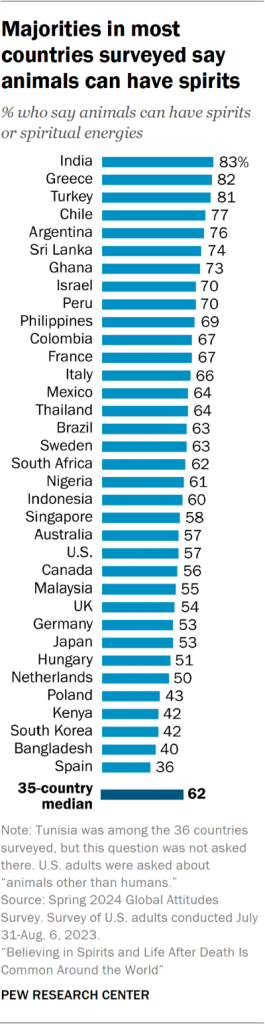
Bar chart showing the majorities in most countries surveyed say animals can have spirits

Moreover, the new survey shows that younger adults are at least as likely as older adults to hold these spiritual beliefs – unlike belief in God, which tends to be more common among older people, globally.

Over the last two decades, we’ve conducted surveys about religion and spirituality in more than 100 countries and territories. But in this survey, for the first time, we asked more than 50,000 people across six continents about some beliefs and practices that we previously had explored only in Asia or the United States.

This allows us to draw a fuller picture of spirituality around the world. Some of the concepts we asked about have roots in specific religious traditions – such as Judaism, Christianity and Islam, Hinduism and Buddhism, or Asian folk religions. Others are associated with less formal religious traditions that some people might label “New Age.”

We find that adults around the world – often across religious and geographic boundaries – share many of the beliefs and practices we asked about.

For example, majorities of adults in most countries surveyed say that animals can have spirits or spiritual energies. This includes 83% of adults in India, which has a Hindu majority. It also includes 81% in Muslim-majority Turkey, 76% in Christian-majority Argentina and 70% in Israel, the world’s only country with a Jewish majority.
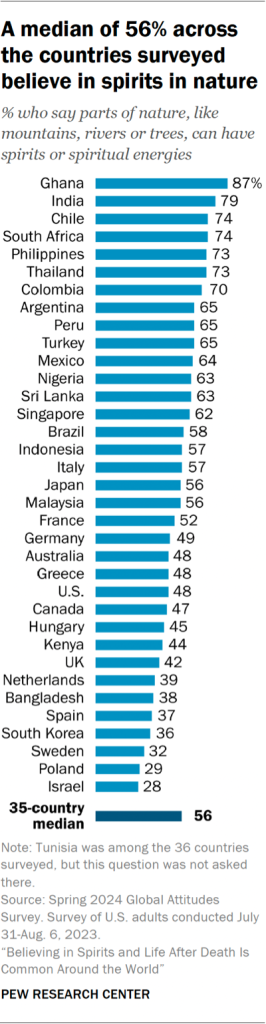
Bar chart showing a median of 56% across the countries surveyed believe in spirits in nature

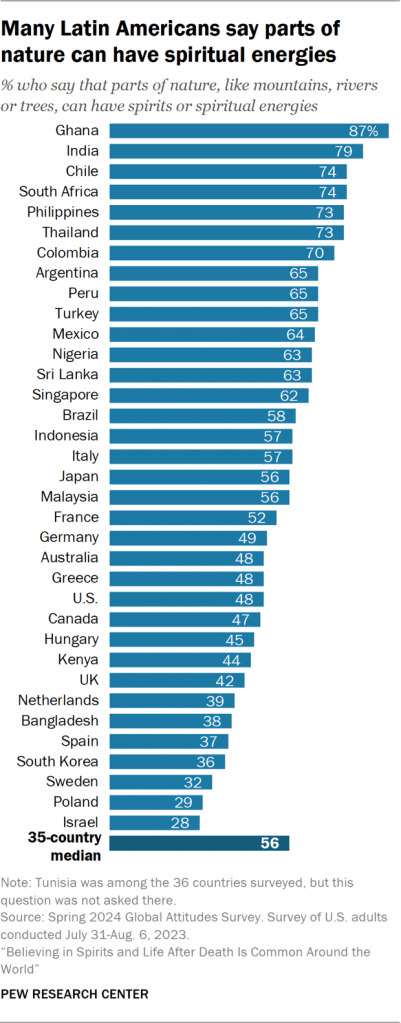
Many people around the world also believe that parts of nature (such as mountains, rivers or trees) can have spirits or spiritual energies. This belief is voiced by nearly three-quarters of adults in Christian-majority Chile (74%) and Buddhist-majority Thailand (73%), and by 57% in Muslim-majority Indonesia.

The U.S. falls somewhere in the middle of the countries surveyed on these questions: 57% of U.S. adults believe that animals can have spirits, while 48% say the same about mountains, rivers or trees. (Around six-in-ten U.S. adults identify as Christian, and about three-in-ten are religiously unaffiliated.)

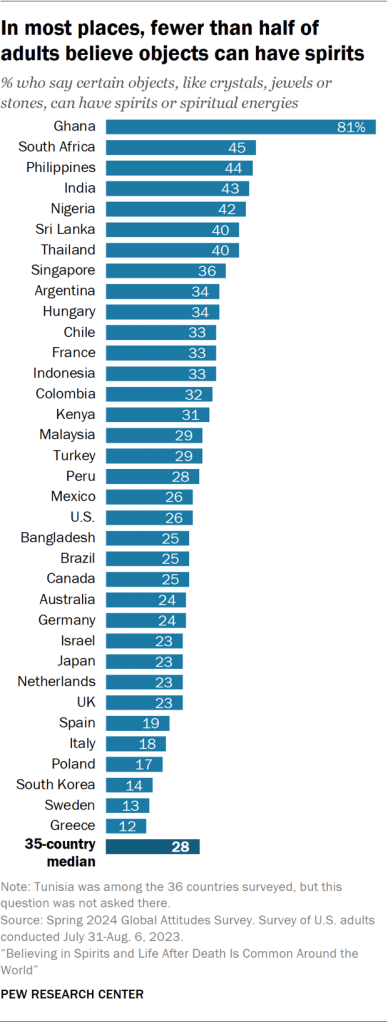
In general, people around the world are much less likely to say that certain objects (such as crystals, jewels or stones) can have spiritual energies.

In some countries where large segments of the population do not identify with any religion, belief in spiritual forces nevertheless is fairly common. In Japan, for example, 53% of adults say that animals can have spirits, and 56% say that parts of nature can have spiritual energies – even though more than half of Japanese adults are religiously unaffiliated.

Related: Spirituality and Religion: How Does the U.S. Compare With Other Countries?

Age differences

Previous Pew Research Center studies have shown that in many countries, older adults tend to be more religious than younger adults. This pattern has been observed around the world in traditional measures of religious identity and commitment, such as how many adults identify with a religion, attend religious services, consider religion to be very important in their lives and pray frequently.
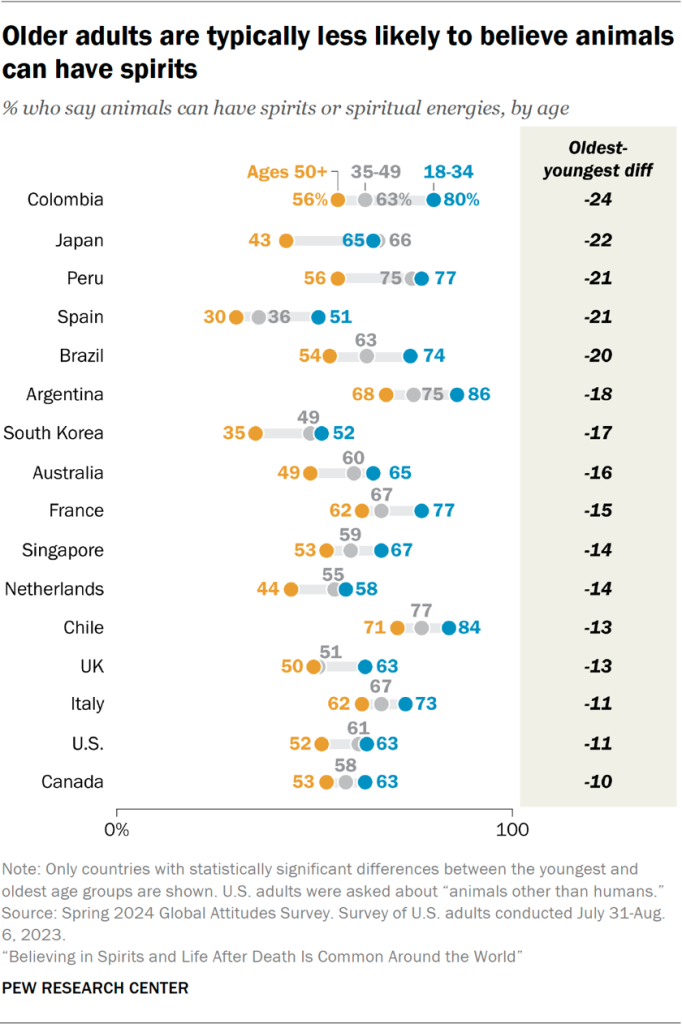
Chart showing older adults are typically less likely to believe animals can have spirits

But in addition to those standard questions, this survey includes a wider set of questions about spiritual topics, including beliefs about spirits and spiritual energies, life after death and the power of ancestral spirits. On some of these newer questions, we find much smaller differences between younger and older respondents.

Indeed, on a couple of questions, the youngest adults (ages 18 to 34) seem to be more likely than the oldest adults (ages 50 and older) to believe in spiritual ideas.

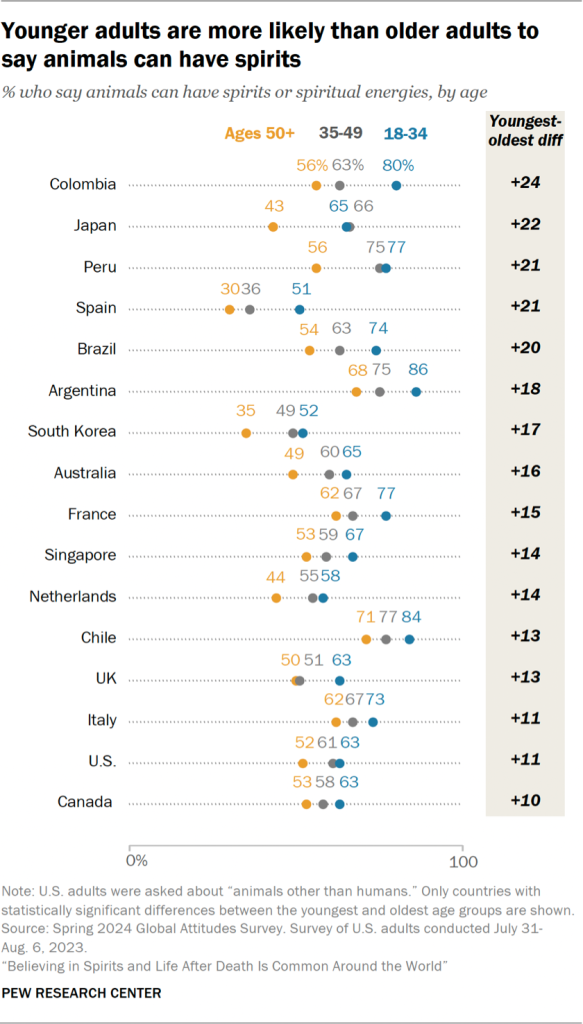
For example, in about half of the countries surveyed, the belief that animals can have spirits is more common among the youngest adults than among the oldest age group. And in no countries are the oldest adults significantly more likely than the youngest adults to hold this belief.
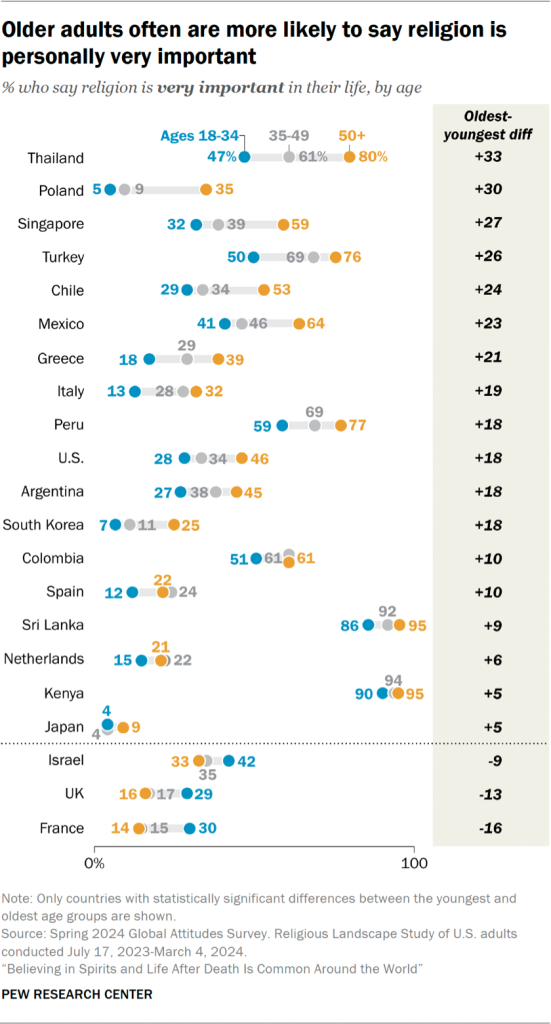
Chart showing older adults often are more likely to say religion is personally very important

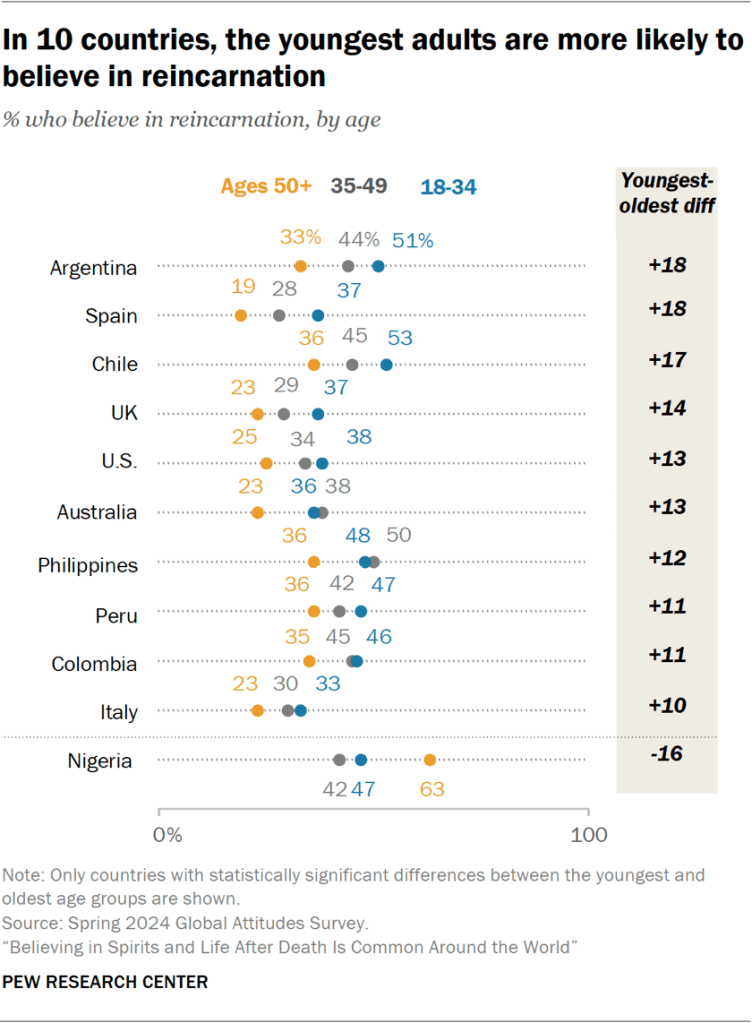
Likewise, in 10 countries, the youngest adults are more likely than the oldest to say they believe in reincarnation, defined for survey respondents as the belief that “people will be reborn in this world again and again.” In most other countries, there are no significant age differences. Nigeria is the only place surveyed where the oldest adults are more likely than the youngest adults to believe in reincarnation (63% vs. 47%).

As in past surveys, we still find that older adults generally are more religious than younger adults when asked about topics like belief in God, attending religious services and the personal importance of religion.

For example, while eight-in-ten people ages 50 and older in Thailand say religion is very important in their lives, only about half of Thai adults under 35 say the same.

Older versus newer questions

We have asked some of the questions in this survey many times, in many places, over the past two decades. These questions are well-suited for measuring formal, organized religions – particularly Abrahamic faiths (i.e., Judaism, Christianity and Islam).

  • What is your current religion?
  • How important is religion in your life?
  • How often do you pray?
  • How often do you attend religious services?
  • Do you believe in God?
  • Do you fast for certain periods during holy times?

The somewhat newer questions in this survey are part of our efforts to explore a wider range of beliefs and practices. These questions largely arise from recent research we’ve conducted on spiritual beliefs, experiences and activities in the United States, as well as from studies we’ve published on religion and spirituality in India, China, South and Southeast Asia and East Asia. 

  • Do you think there is life after death?
  • Do you believe that each of the following – parts of nature, such as mountains, rivers or trees; certain objects, such as crystals, jewels or stones; and animals – can have spirits or spiritual energies?
  • Do you believe that spells, curses or other magic can influence people’s lives?
  • Do you believe that the spirits of ancestors can help or harm you?
  • Do you believe in reincarnation – that people will be reborn in this world again and again?
  • Do you wear religious items or symbols, or carry them with you?
  • Do you consult a fortune teller, horoscope or other way to see the future?
  • Do you light incense or candles for spiritual or religious reasons?
  • Do you think there is something spiritual beyond the natural world, even if we cannot see it, or is the natural world all there is?

(For the exact wording of questions in this survey, refer to the report’s Topline.

Life after death

Bar chart showing older adults often are more likely to say religion is personally very important

In many previous surveys in the U.S. and some other parts of the world, we have posed questions about a specific vision of the afterlife, asking people whether they believe in heaven and, separately, whether they believe in hell. In this survey, to better allow comparisons across regions and religious traditions, we asked simply about “life after death.”

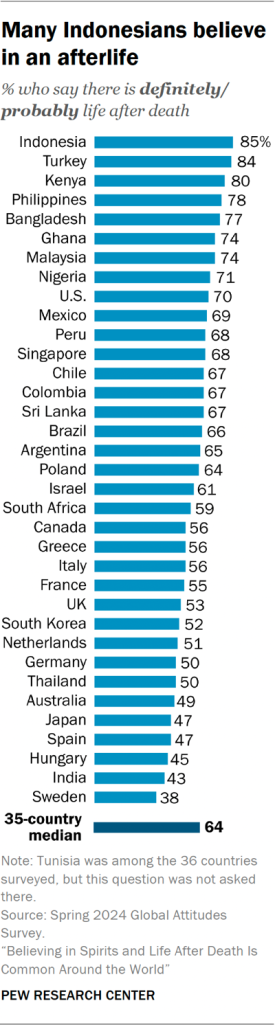
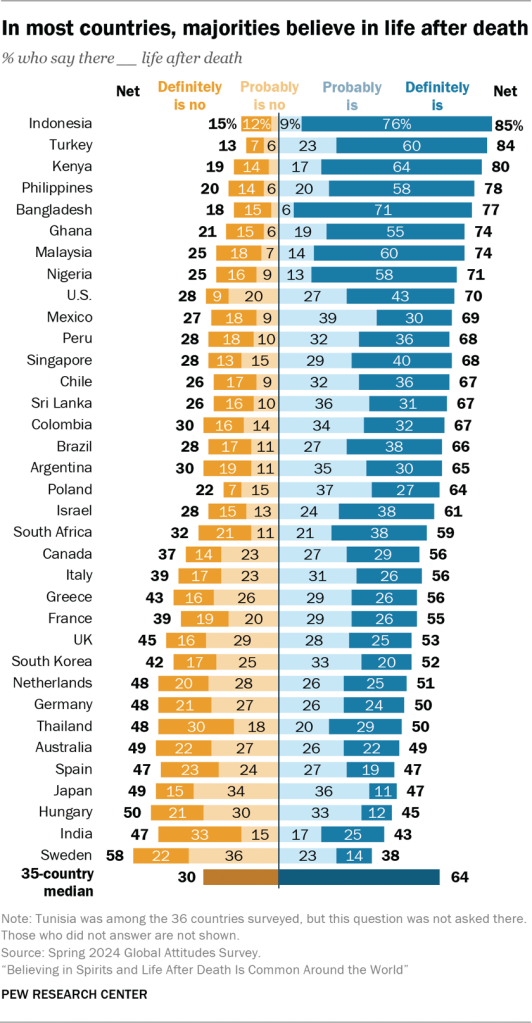
In most of the countries surveyed, a majority of adults say there is definitely or probably life after death. For example, 85% of adults in Muslim-majority Indonesia say this, as do 80% of adults in Christian-majority Kenya. And across the six Latin American countries surveyed, about two-thirds of adults believe there is an afterlife.

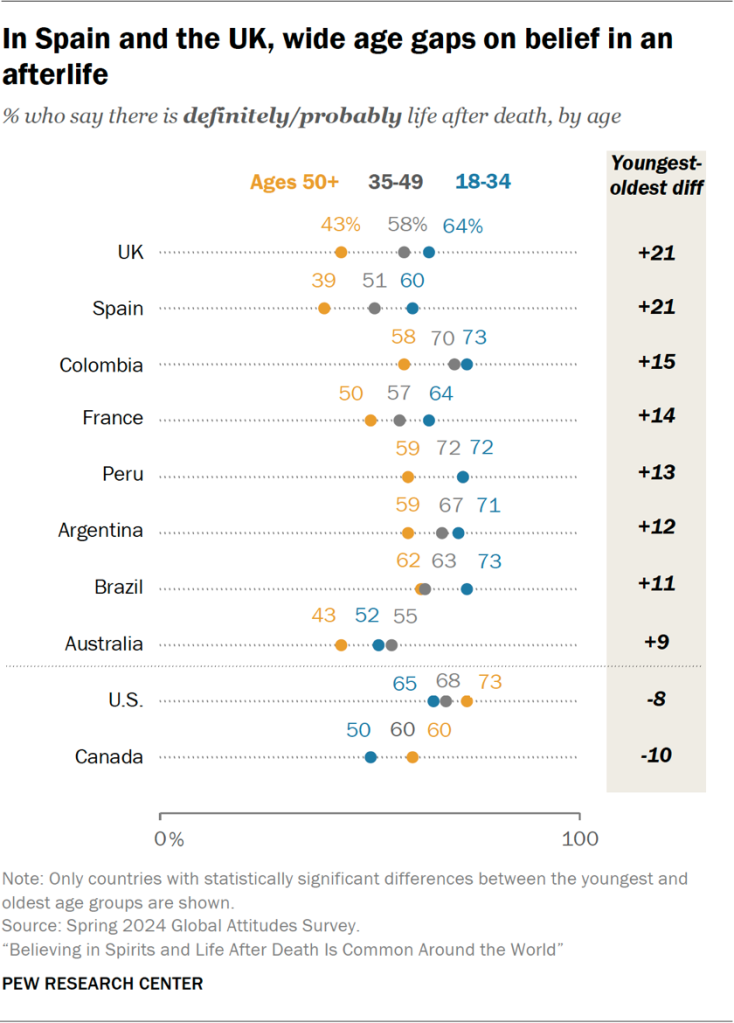
In a few countries, adults ages 18 to 34 are more likely than adults ages 50 and older to say there is an afterlife. But in the U.S. and Canada, the oldest adults are slightly more likely than the youngest adults to believe in life after death.

In the U.S., 70% of adults say there is definitely or probably life after death. (By comparison, 67% of Americans report believing in heaven, and 55% say they believe in hell, our 2023-24 U.S. Religious Landscape Study found.)

Comparing results across a spectrum of measures

In many of the countries surveyed, substantial shares of adults say religion is very important in their lives. This is especially true for countries in South and Southeast Asia, sub-Saharan Africa and Latin America, and less so for Western Europe. The U.S. is roughly in the middle of the pack, with 38% of Americans saying religion is very important in their lives.
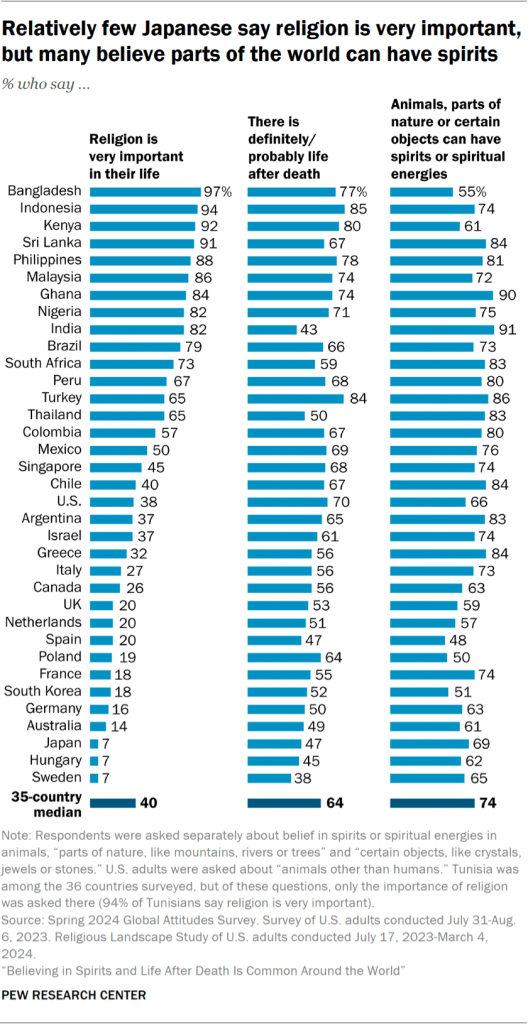
Bar chart showing relatively few Japanese say religion is very important, but many believe parts of the world can have spirits

Large percentages of people in most of the countries surveyed also express belief in life after death and say that animals, parts of nature (such as mountains, rivers or trees) or physical objects (such as crystals, jewels or stones) can have spirits.

While there is no clear and widely accepted dividing line between religion and spirituality, these questions show that even in countries where comparatively few people view religion as very important, many do hold beliefs in spirits and/or life after death.1

For example, relatively few Swedish adults (7%) say religion is very important to them. But more Swedes (38%) believe there is definitely or probably life after death, and nearly two-thirds believe in spirits in animals, parts of nature or objects.

On the other hand, India is among the countries where a high proportion of adults (82%) describe religion as very important in their lives. The vast majority (91%) also say that animals, parts of nature or objects can have spirits or spiritual energies. Indians (43%) are less likely than people in many of the other countries surveyed to believe in an afterlife, but about half of Indian adults (48%) believe in reincarnation.

Overall, the survey shows that some measures of religion and spirituality are strongly related to each other around the world. For example, people who say religion is very important in their lives often are more likely than others to fast during holy times, to pray daily, and to believe that spells, curses or other magic can influence people’s lives.

But the importance of religion is not strongly associated with some other measures, such as the belief that animals can have spiritual energies and the belief in reincarnation.

For more on how different measures of spirituality and religiousness relate to each other, read “How newer measures compare with long-standing measures of religiousness” later in this Overview.

These are among the key findings from surveys of more than 50,000 adults conducted by Pew Research Center in 36 countries. Surveys outside the U.S. were conducted from January through May 2024. Survey data for the U.S. comes from two waves of the Center’s American Trends Panel conducted in summer 2023 and February 2024, as well as from the most recent U.S. Religious Landscape Study (conducted July 2023 through March 2024). Globally, interviews were conducted in several dozen languages. For more information on how the data was collected in each country, read the Methodology.

The rest of this Overview covers:

  • Economic connections to beliefs and practices
  • Differences by religious group
  • How newer measures compare with long-standing measures of religiousness

This report also includes:

  • Chapter 1: God, spirits and the natural world
  • Chapter 2: Beliefs about the afterlife
  • Chapter 3: Spells, curses and ways to see the future
  • Chapter 4: Spiritual and religious practices
  • Chapter 5: Religious importance and religious affiliation

Economic connections to beliefs and practices

Scholars have long studied the relationship between economic development and religion, with “secularization theory” broadly positing that as societies become more economically and technologically advanced, religion and religious values become less important in people’s lives.

This theory continues to be debated, but international survey data has demonstrated a general pattern in which people in wealthier countries tend to pray less often and view belief in God as less important for morality, while people in less economically advanced countries tend to describe religion as more important in their lives.

This economic pattern continues to hold for traditional measures of religiousness (such as importance of religion, daily prayer and belief in God) in the three dozen countries analyzed in this report.

However, levels of national income are much less clearly correlated with some of the newer questions in the survey about religious and spiritual beliefs – such as belief in the power of ancestral spirits and the existence of “something spiritual beyond the natural world.”

Importance of religion

The share of people in each country who say religion is very important in their lives broadly follows what secularization theory would predict. Wealthier countries – those with higher per capita gross domestic product (GDP) – tend to have lower shares of adults who say religion is very important in their lives, with a fairly strong correlation.
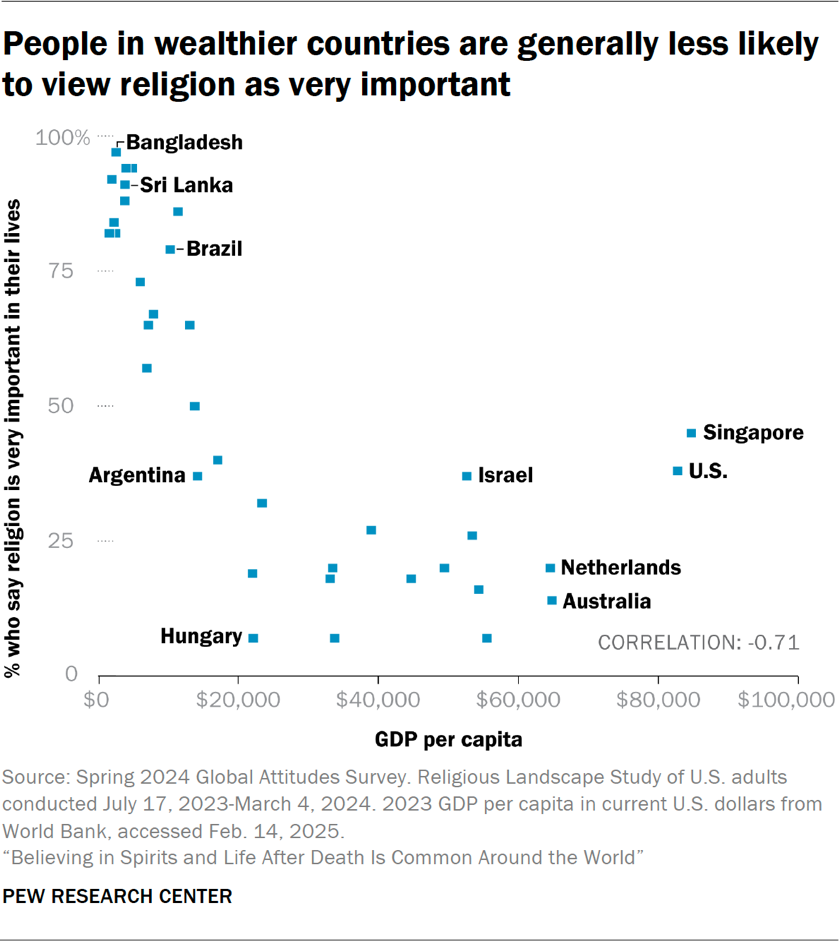
Dot chart showing people in wealthier countries are generally less likely to view religion as very important

In 11 countries, around eight-in-ten or more adults say religion is very important to them, and all these countries have relatively low GDPs per capita. They include Buddhist-, Christian-, Hindu- and Muslim-majority societies.

Conversely, in 11 countries, only two-in-ten adults or fewer say religion is very important in their lives, and all 11 are relatively wealthy countries (measured by GDP per capita). They include places with strong ties to Buddhism and Christianity, though most currently have large percentages of religiously unaffiliated adults.

Two high-income countries stand out on this measure. Singapore and the U.S. have the highest per capita GDPs of the countries surveyed, yet they fall in the middle on the question about religion’s personal importance, with 45% of Singaporeans and 38% of Americans saying religion is very important in their lives.

The correlation between economic advancement and religiousness also holds for several other measures, including religious service attendance; belief in God; and the belief that spells, curses or other magic can influence people’s lives. On these questions, wealthier countries tend to be the least religious, while less advanced economies are generally the most religious.

Belief that ancestors can affect the living

But the connection between economics and spirituality is not always so strong. For example, the correlation is much weaker on a question about whether ancestral spirits can help or harm the living.
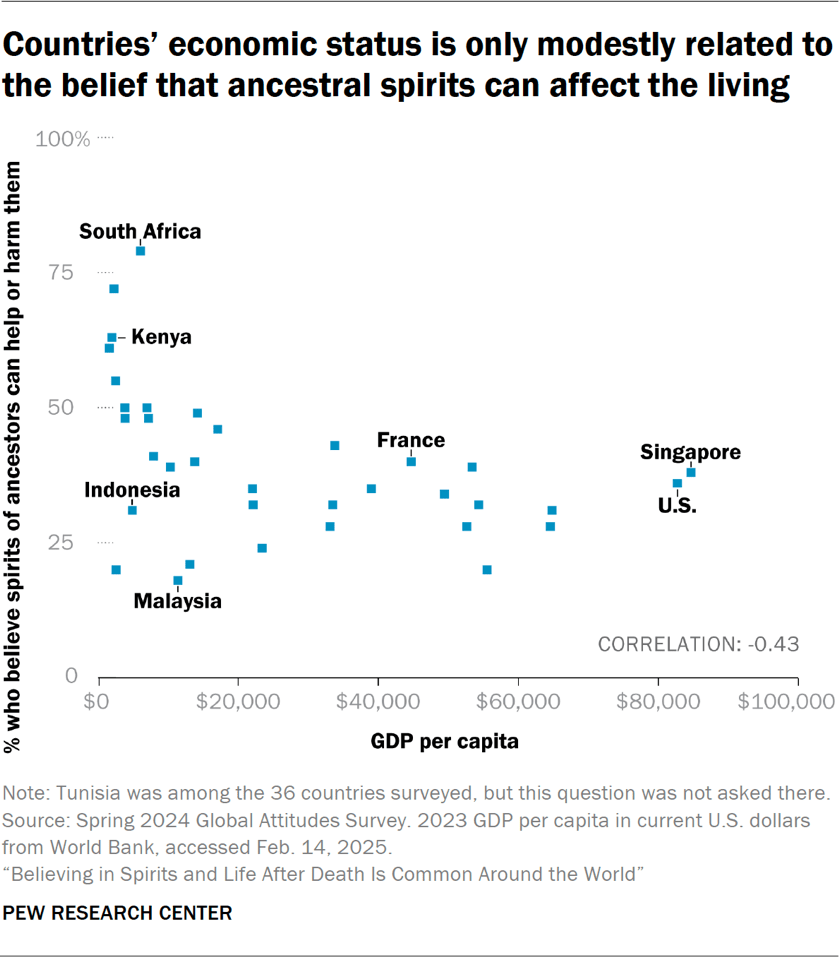
Dot chart showing countries’ economic status is only modestly related to the belief that ancestral spirits can affect the living

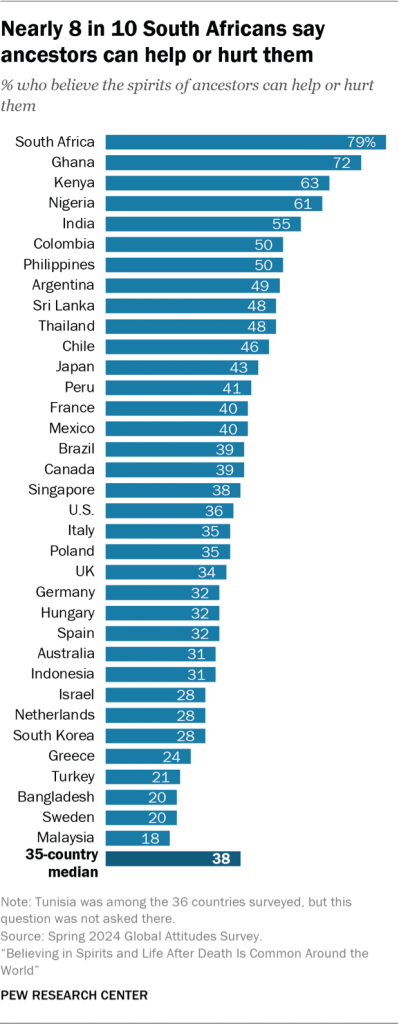
Some of the less economically developed countries we surveyed have the highest shares of people who believe that the spirits of ancestors can intervene in our lives. Kenya (63%) and South Africa (79%) fall in that category.

Economics is not the only factor at play – the religious makeup of a country also has a role. For instance, the Muslim-majority countries of Bangladesh, Indonesia, Malaysia and Turkey also are among the less wealthy countries in our survey, yet people in those countries are among the least likely to say ancestors can interact with the living in these ways.

Something spiritual beyond the natural world

One measure of spirituality has basically no relationship with a country’s level of economic development: Living in a wealthier country is generally not correlated with either higher or lower shares of adults who say “there is something spiritual beyond the natural world, even if we cannot see it” rather than selecting the alternative response that “the natural world is all there is.”
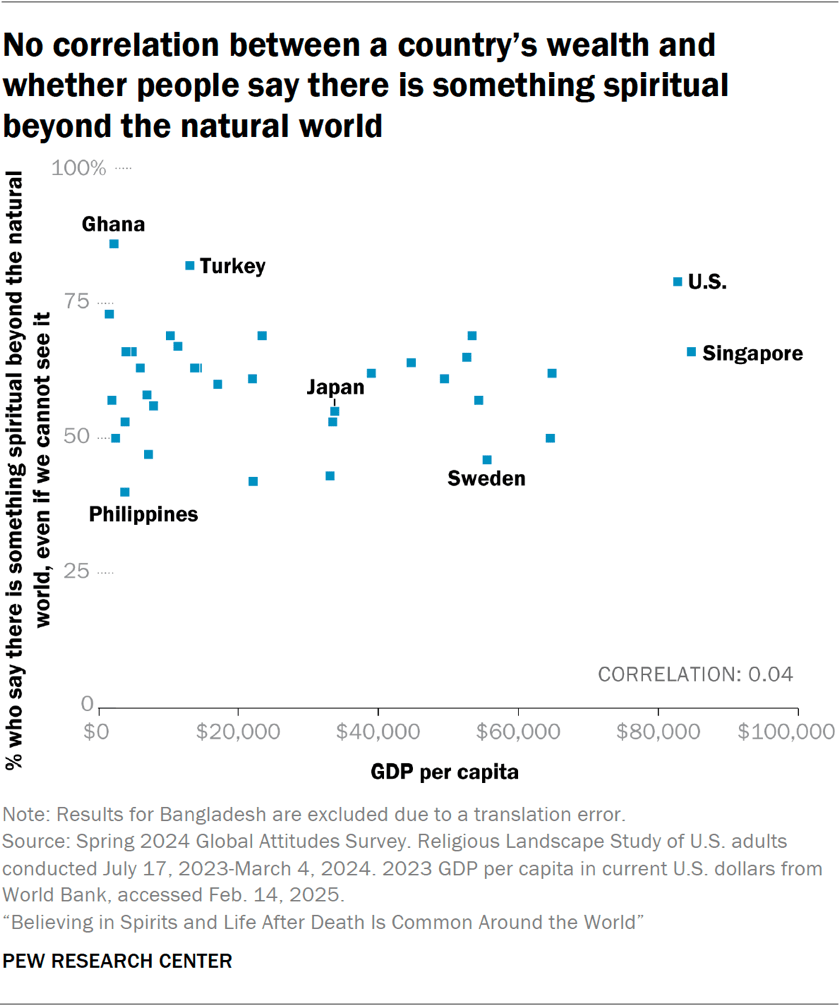
Dot chart showing that there's no correlation between a country’s wealth and whether people say there is something spiritual beyond the natural world

The U.S. and Sweden, for instance, each have among the highest per capita GDPs in this survey. Yet a majority of U.S. adults (79%) say there is something spiritual beyond the natural world, while Swedish adults (46%) are among the least likely to say this.

Likewise, the countries with the lowest per capita GDPs represent a wide range of views on whether there is something spiritual beyond the natural world – from 86% in Ghana to 40% in the Philippines.

Differences by religious group

While levels of economic development seem to be connected to some aspects of spirituality and religion, we also see significant patterns based on religious identity. The nuances of these patterns vary depending on the specific measure. But in general, people who are religiously unaffiliated – i.e., those who describe themselves as atheist, agnostic or “nothing in particular” and are sometimes referred to as religious “nones” – tend to be less religious than people who affiliate with a religion within each country.
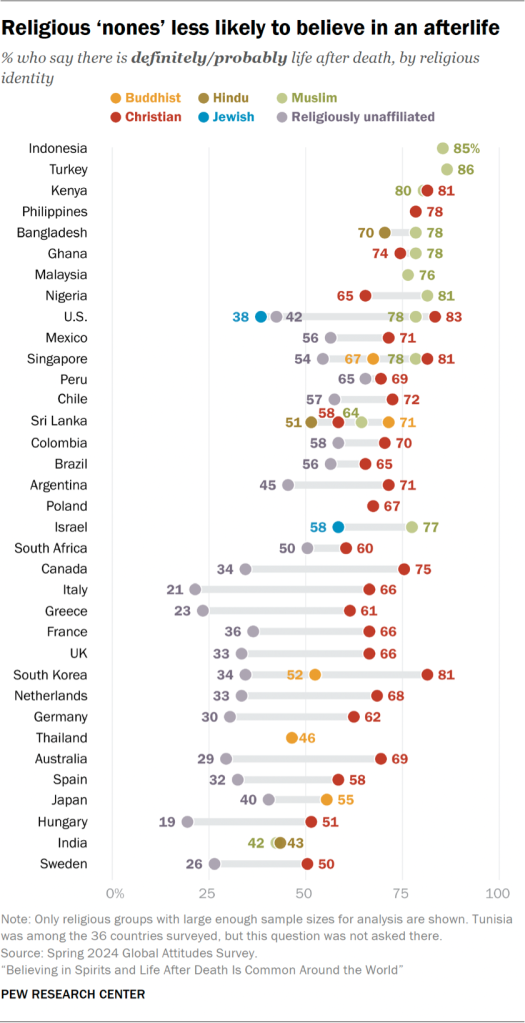
Chart showing religious ‘nones’ less likely to believe in an afterlife

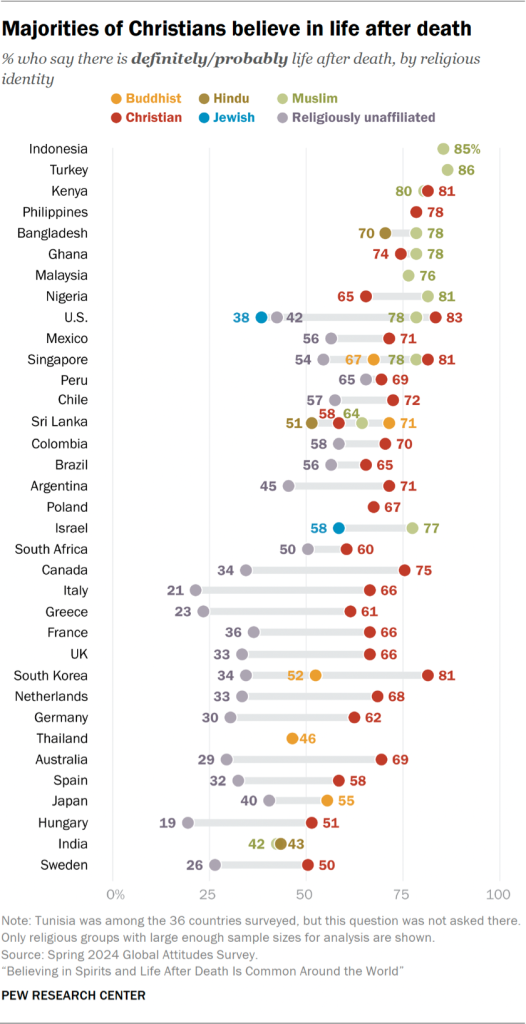
For example, in Germany, Christians are twice as likely as adults with no religion to say there is definitely or probably life after death (62% vs. 30%). And in nearly every country with enough Muslims to analyze separately, a majority of Muslims says there is life after death. Only in India do fewer than half of Muslims (42%) believe in an afterlife.

Meanwhile, Jewish adults in the U.S. and Israel (the only countries in the survey with sufficient samples of Jews to analyze) are much less likely than Muslims in the same two countries to believe in an afterlife.

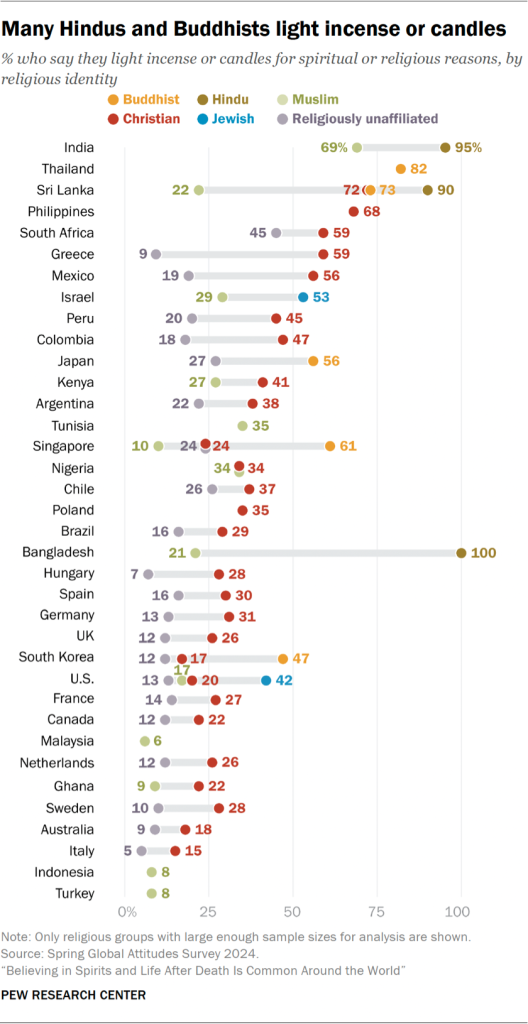
A different pattern emerges when comparing the shares of people who say they light incense or candles for spiritual or religious reasons. In Israel and the U.S., Jews are the most likely religious group to follow this practice. Muslims in both countries are much less likely to say they light candles or incense for religious or spiritual reasons.
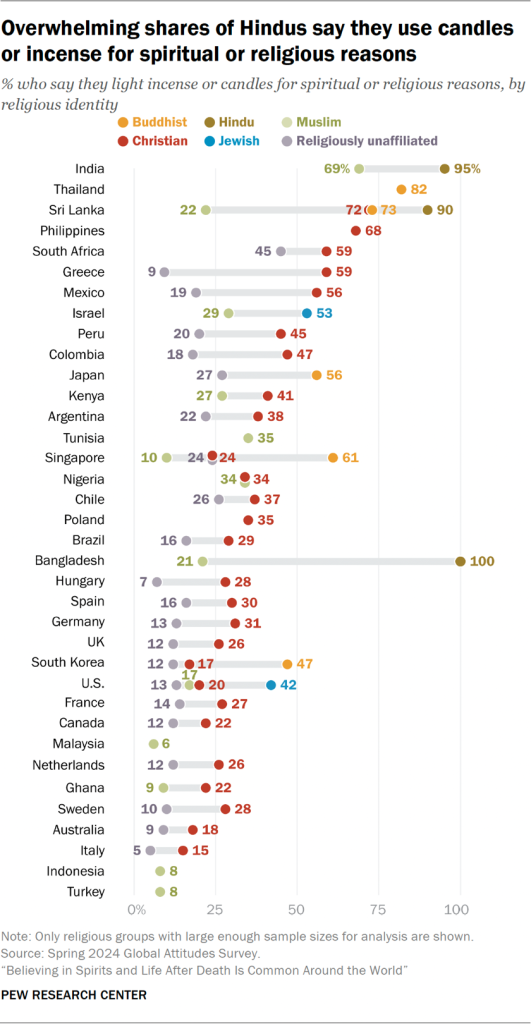
Chart showing overwhelming shares of Hindus say they use candles or incense for spiritual or religious reasons

Across the other 34 countries surveyed, though, Hindus and Buddhists tend to be the most likely to light incense or candles for spiritual or religious reasons. In India, for instance, nearly all Hindus follow this practice, while about two-thirds of Muslims do so.

And in countries with sufficient sample sizes to analyze Hindus and Buddhists separately, those two groups are consistently the most likely to say they believe in reincarnation – a mainstream teaching in both religions.

To read how people in different religious groups answered specific survey questions, go to the chapters on God and spirits, the afterlife, spells and ways to see the future, spiritual and religious practices, and the importance of religion in one’s life.

How newer measures compare with long-standing measures of religiousness

For decades, researchers have relied on some core measures of religious identity, beliefs and practices to assess the religiousness of individuals and societies, by asking questions such as:

  • What is your current religion?
  • How important is religion in your life?
  • How often do you pray?
  • How often do you attend religious services?
  • Do you believe in God?
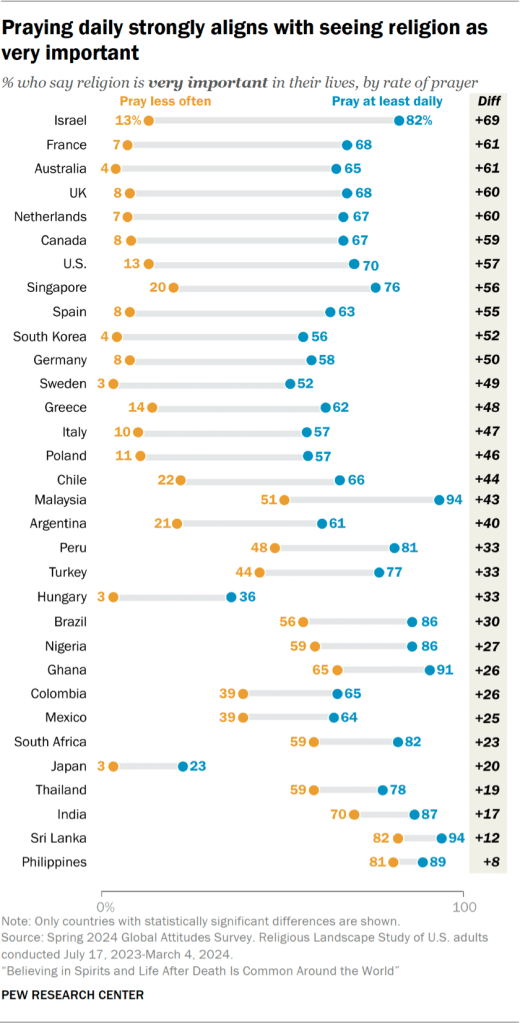
Chart showing praying daily strongly aligns with seeing religion as very important

These measures are strongly associated with each other. In other words, if a person prays daily, that individual is significantly more likely than adults who pray less often to consider religion to be very important.

In Argentina, for example, 61% of adults who pray daily say that religion is very important in their lives, compared with 21% of Argentines who pray less often. Meanwhile, in Japan, 23% of those who pray daily say that religion is very important, while just 3% of Japanese adults who pray less often say religion is very important in their lives.
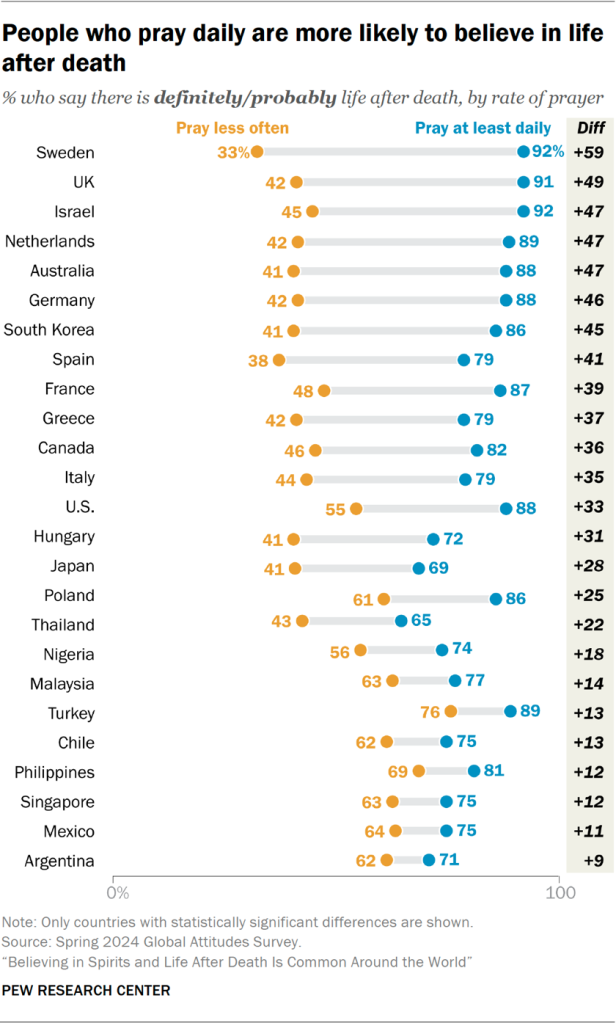
Chart showing people who pray daily are more likely to believe in life after death

But what happens when we compare these long-standing measures of religiousness with the newer questions included in this survey?

The results depend on the measures used.

In general, there is a strong association between standard measures of religious commitment and whether people believe in life after death.

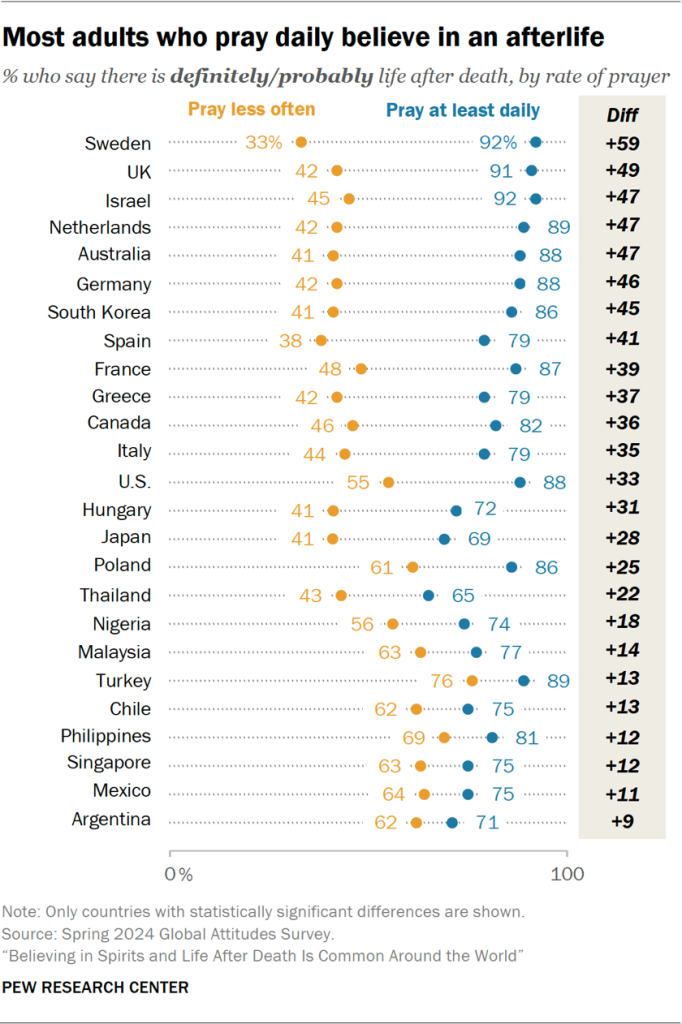
In Israel, for example, adults who pray daily are twice as likely as those who pray less often to believe there is life after death (92% vs. 45%).

But on some other measures, there is only a weak alignment – or even none at all.
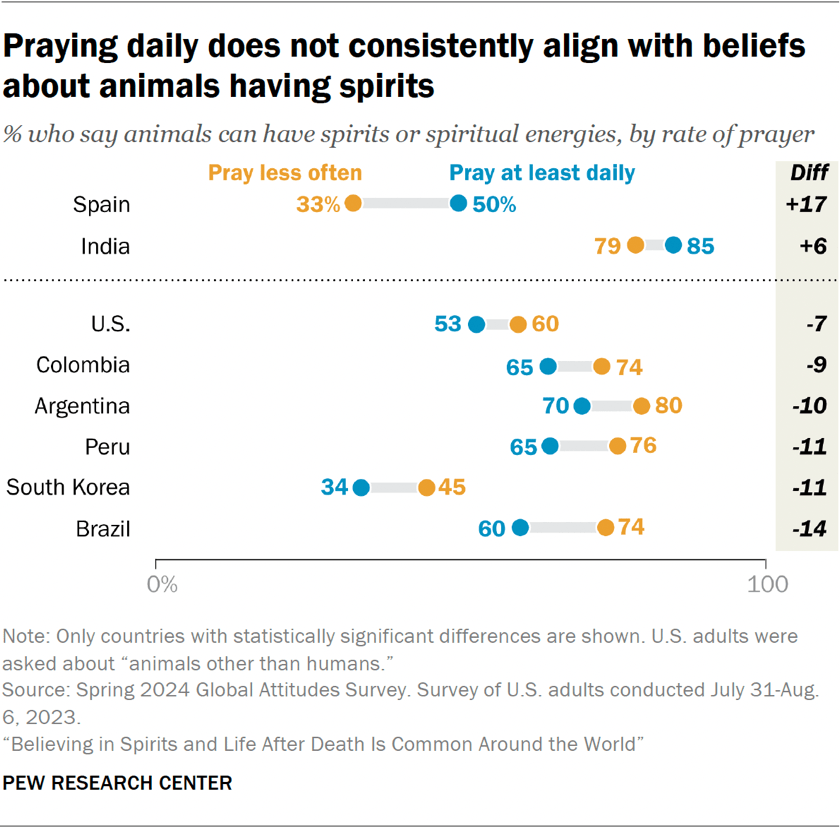
Chart showing praying daily does not consistently align with beliefs about animals having spirits

For instance, in most countries, adults who pray daily do not significantly differ from those who pray less often in their inclination to believe that animals have spirits, or in the likelihood that they consult a fortune teller or use other ways to see the future. This may reflect the fact that these beliefs and practices are less orthodox or central to the dominant faith traditions in many countries.

CORRECTION (May 14, 2025): A previous version of the chart “Praying daily does not consistently align with beliefs about animals having spirits” misstated the difference in responses to the question by rate of prayer in India. The chart has been replaced. This change does not substantively affect the findings of this report.
1. God, spirits and the natural world

In most of the three dozen countries surveyed, large majorities say they believe in God.2 Smaller majorities of adults in most countries also say that “there is something spiritual beyond the natural world, even if we cannot see it.” Similarly, half or more adults in most places surveyed believe that animals “can have spirits or spiritual energies.”

Many people also say that parts of nature can have spiritual energies, while far fewer globally say that certain objects (such as crystals, jewels or stones) can have spirits.

Our survey also finds that:

  • In general, vast majorities of Hindus, Muslims and Christians believe in God.
  • Within each country surveyed, Christians are generally the religious group most likely to believe in something spiritual beyond the natural world.
  • Most Hindus believe that animals and parts of nature can have spiritual energies.
  • Adults with less education are more likely than others to believe in God. But those with less education are less likely to say there is something spiritual beyond the natural world.
  • People who pray daily are more likely than those who pray less often to believe in God and, separately, to say there is something spiritual beyond the natural world.
  • Women – particularly those in European and other high-income countries – are somewhat more likely to hold the beliefs discussed in this chapter. For instance, women are more likely than men to say they believe in God and that parts of nature can have spiritual energies.

Jump to more on beliefs in: God | Spirits in animals | Spirits in nature |
Spirits in objects | Spiritual presence beyond the natural world

Belief in God

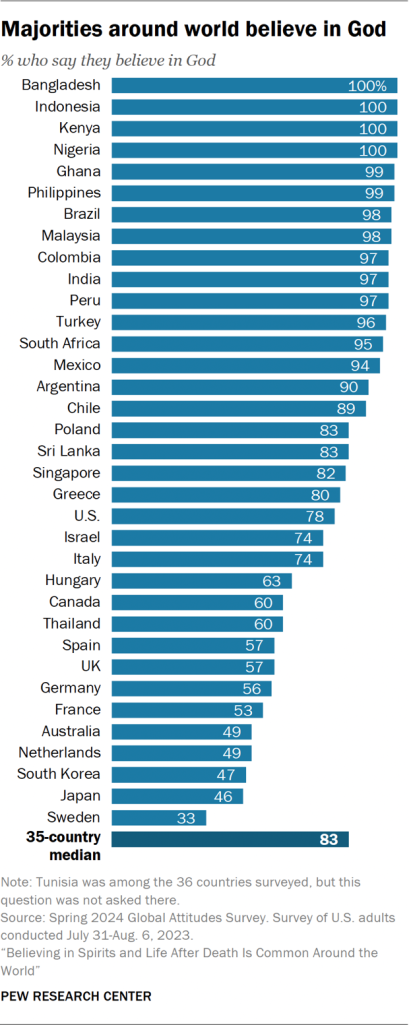
Across the countries surveyed, most people say they believe in God. Indeed, a median of 83% across the 35 countries analyzed say this.

Belief in God is particularly common in sub-Saharan Africa and Latin America, where around nine-in-ten or more adults in each country say they believe in God. Additionally, virtually all adults in Bangladesh (100%), Indonesia (100%), the Philippines (99%), Malaysia (98%), India (97%) and Turkey (96%) share this belief.

East Asia and Europe tend to have much smaller shares of adults who say they believe in God. For example, just around half of Dutch adults say this.

Bar chart showing majorities around world believe in God

Views by religion

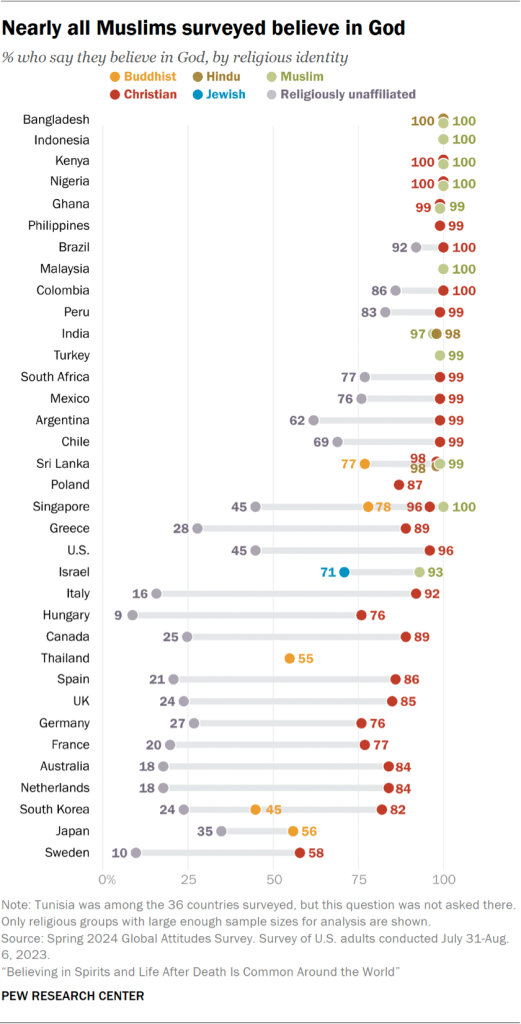
Belief in God is particularly high among Muslims and Hindus. Across the countries with enough Muslims and Hindus to analyze, almost all adults in each group say they believe in God.

Chart showing nearly all Muslims surveyed believe in God

Large shares of Christians in most countries also say they believe in God. However, in Sweden, a relatively small majority of Christians (58%) believe in God.

And while large majorities of Buddhists in Singapore (78%) and Sri Lanka (77%) express a belief in God, fewer than half of South Korean Buddhists do so (45%).

Across the countries surveyed, the religiously unaffiliated – people who identify as atheist, agnostic or “nothing in particular”– are consistently the least likely to say they believe in God. Still, majorities of the unaffiliated in Latin America and South Africa believe in God. This includes 92% of Brazil’s religiously unaffiliated population.

Views by age

In general, adults ages 50 and older are more likely than those under 35 to say they believe in God. This divide is largest in Hungary and Italy.

In Hungary, a clear majority of the oldest adults (72%) believe in God, compared with fewer than half of adults under 35 (44%).

Meanwhile, in the U.S., 85% of adults ages 50 and older say they believe in God, while 66% of adults under 35 express the same belief.

Chart showing belief in God is more prevalent among older adults

Views by education

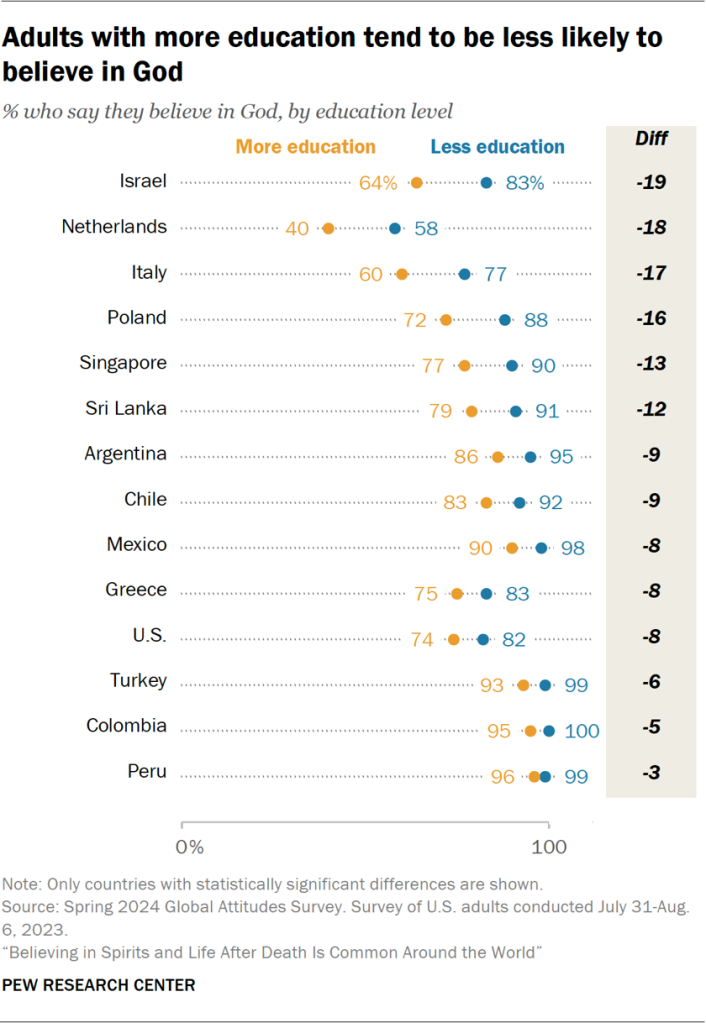
In more than a dozen countries, adults with higher levels of education are less likely than other adults to believe in God.

For example, 64% of Israelis with a postsecondary education say they believe in God, compared with 83% of Israeli adults who have no more than a secondary education (the equivalent of high school in the United States).

Chart showing adults with more education tend to be less likely to believe in God

Spirits in animals

Most adults surveyed believe that animals can have spirits or spiritual energies, with a 35-country median of 62%.

This includes roughly eight-in-ten adults in India (83%), Greece (82%) and Turkey (81%).

Only in a handful of countries do fewer than half of adults say animals can have spirits or spiritual energies: Poland (43%), Kenya (42%), South Korea (42%), Bangladesh (40%) and Spain (36%).

Bar chart showing many believe animals can have spirits

Views by religion

In general, similar shares of religiously unaffiliated adults (also known as religious “nones”) and Christians in each country say that animals can have spirits. In Greece, for instance, about eight-in-ten adults – among both Christians and the unaffiliated population – say this. And in the United Kingdom, about half in each group believes that animals can have spiritual energies.

Chart showing many religious ‘nones’ say animals can have spirits

But in a handful of countries, the religiously unaffiliated are more likely than Christians to say that animals can have spiritual energies. For example, 85% of Chileans who do not identify with any religion say this, compared with 73% of Chilean Christians.

Muslims in different countries vary widely on this question, from a high of 88% of Israeli Muslims who say animals can have spirits to a low of 37% of Bangladeshi Muslims who share this view.

In all three countries with enough Hindus to analyze separately – Bangladesh, India and Sri Lanka – a large majority of Hindus say that animals can have spirits or spiritual energies.

Views by age

In general, the youngest adults are more likely than the oldest to say animals can have spirits. In Peru, about three-quarters of adults ages 18 to 34 (77%) say this, compared with only a slim majority of adults ages 50 and older (56%).

This division across age groups is the opposite of the pattern that exists on belief in God, where the oldest age group is more likely to believe than the youngest.

For a broader discussion about how age interacts with measures of spirituality and religion, read the Overview of this report.
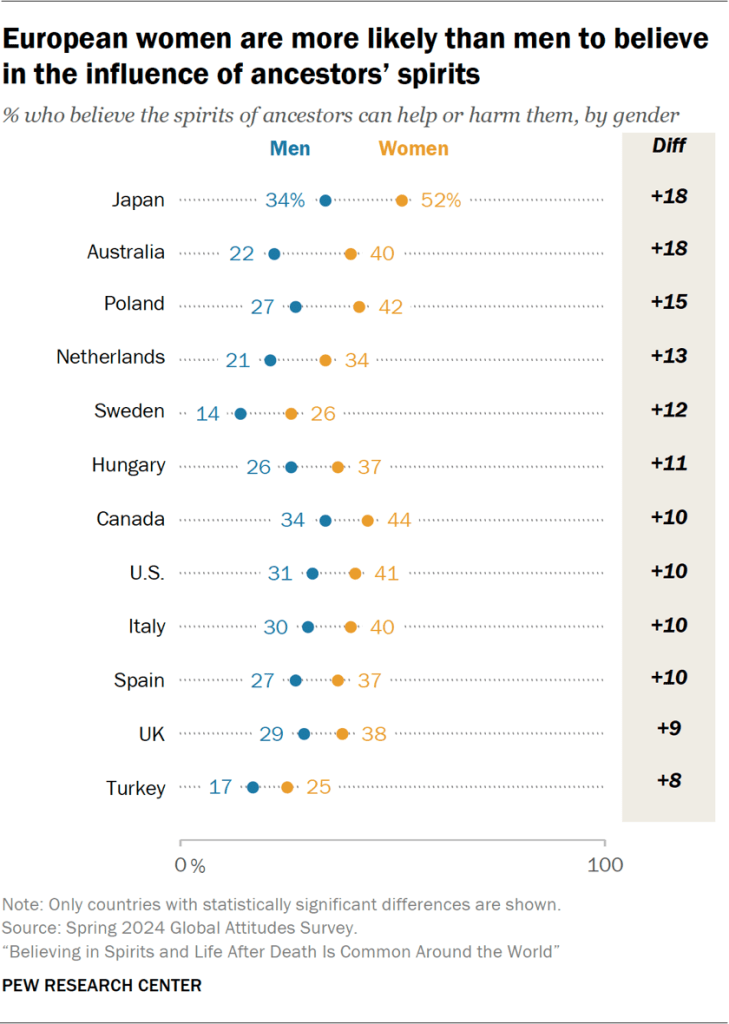
Chart showing younger adults are more likely than older adults to say animals can have spirits

Spirits in nature

In about half of the countries surveyed, most respondents say that parts of nature (such as mountains, rivers or trees) can have spirits or spiritual energies.

This belief is particularly common in Southeast Asia and Latin America. For instance, 73% of Filipino adults say parts of nature can have spiritual energies, as do 70% of Colombians.

Views are more split in sub-Saharan Africa and South Asia. On the one hand, the vast majority of adults in Ghana (87%) and India (79%) believe that spirits can inhabit mountains, rivers or trees. On the other hand, fewer than half of adults in Kenya (44%) and Bangladesh (38%) express the same belief.

In a few countries, only about three-in-ten adults say that parts of nature can have spiritual energies: Sweden (32%), Poland (29%) and Israel (28%).

Bar chart showing many Latin Americans say parts of nature can have spiritual energies

Views by religion

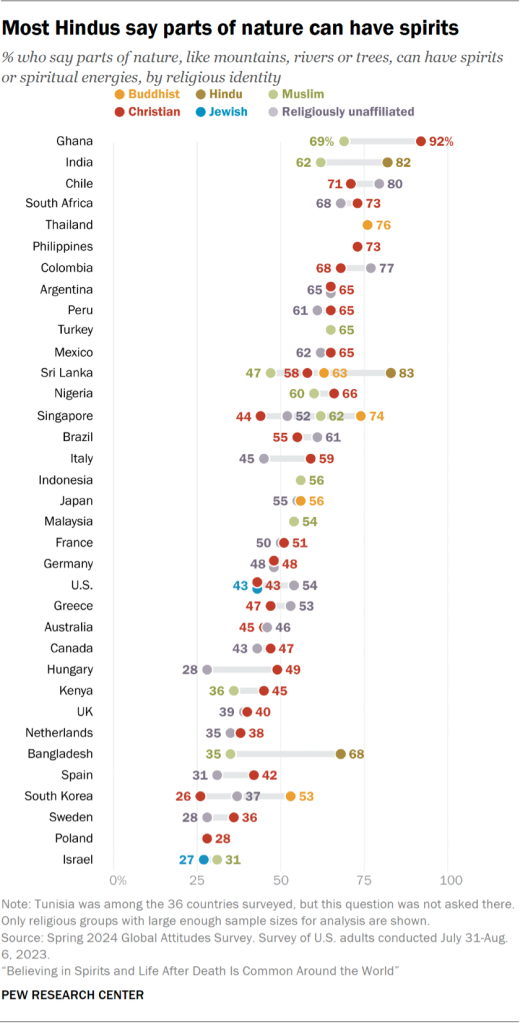
Hindus are the most likely to believe that parts of nature can have spirits. Half or more of Buddhists in all five countries with enough Buddhists to analyze (Japan, Singapore, South Korea, Sri Lanka and Thailand) also say this.

As with the belief that animals can have spirits, Christians and religiously unaffiliated populations in many countries voice similar attitudes about spiritual energies in nature. In Argentina, 65% of both Christians and religiously unaffiliated adults say parts of nature such as mountains, rivers and trees can have spirits.

In Israel, similar shares of Muslim (31%) and Jewish (27%) adults believe parts of nature can have spirits.

Chart showing most Hindus say parts of nature can have spirits

Views by gender

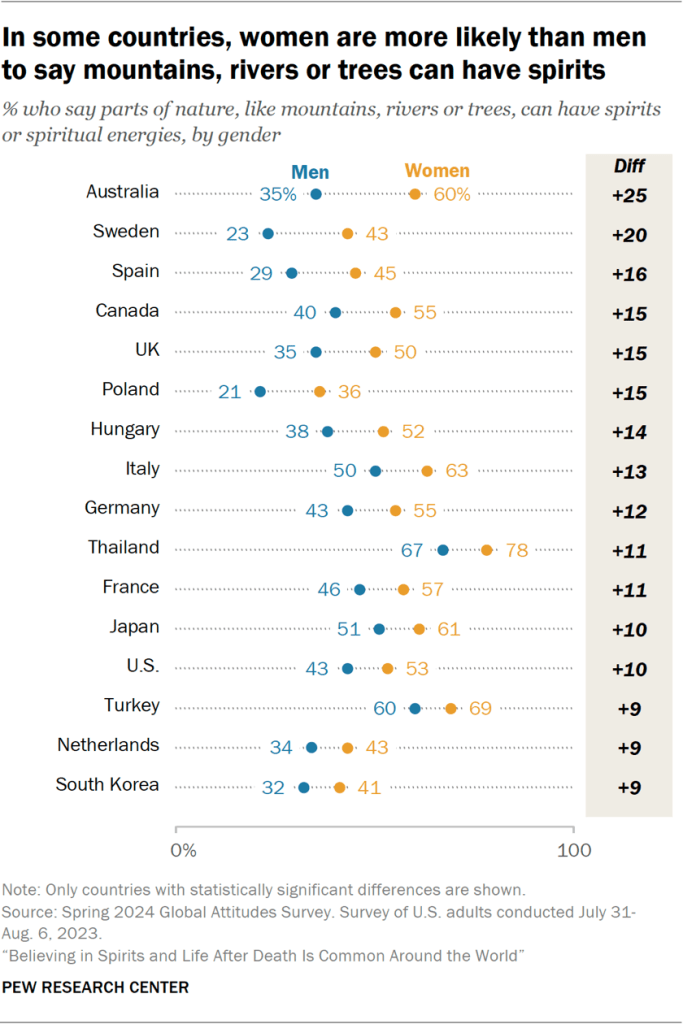
In some high-income countries, particularly in Europe, women are more likely than men to say that parts of nature can have spirits. For example, half of women in the UK say this, compared with around a third of men.

The gender gap is greatest in Australia, where 60% of women and 35% of men say parts of nature can have spiritual energies.

Among the middle-income countries surveyed, only Thailand and Turkey have a gender gap on this question.

Chart showing that in some countries, women are more likely than men to say mountains, rivers or trees can have spirits

Spirits in objects

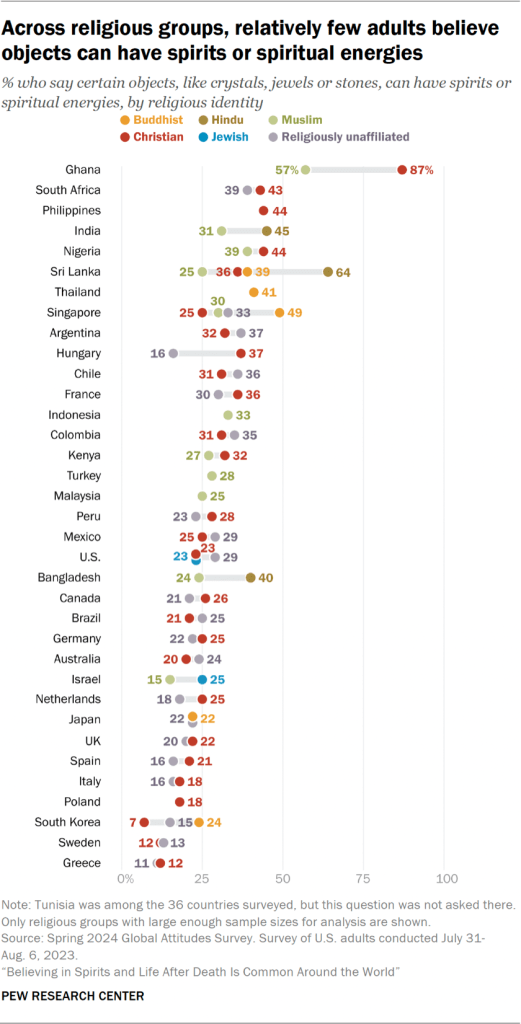
The belief that certain objects (such as crystals, jewels or stones) can have spirits or spiritual energies is far less common than the belief that animals or parts of nature can have spirits.
 
In nearly every country surveyed, fewer than half of adults say that such objects can have spirits.

People in Europe and East Asia are generally the least likely to say certain objects can have spiritual energies.

Chart showing that in most places, fewer than half of adults believe objects can have spirits

Views by religion

Within each country, respondents in different religious groups are often quite similar in their beliefs about objects having spirits. In Japan, for instance, equal shares of Buddhists and religiously unaffiliated adults say certain objects can have spiritual energies (22% each).

Still, in the three countries with large enough shares of Hindus to analyze separately, Hindus are the most likely to say there can be spiritual energies in objects such as crystals, jewels or stones. For instance, a majority of Sri Lankan Hindus (64%) say this, compared with about four-in-ten or fewer Sri Lankan Buddhists (39%), Christians (36%) and Muslims (25%).

Chart showing that across religious groups, relatively few adults believe objects can have spirits or spiritual energies

Spiritual presence beyond the natural world

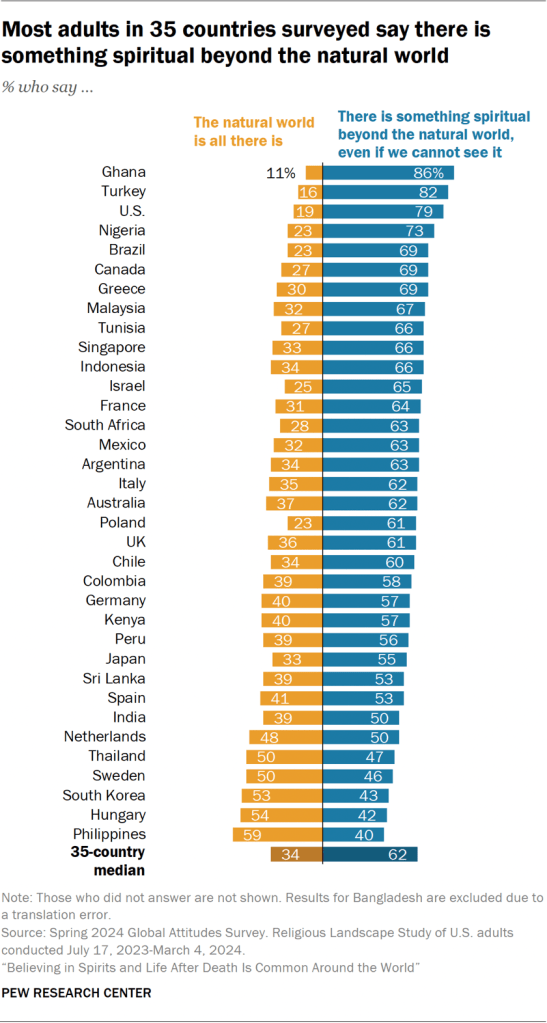
Across most countries surveyed, the view that “there is something spiritual beyond the natural world, even if we cannot see it” is far more common than the view that “the natural world is all there is.”

Vast majorities of adults in Ghana (86%), Turkey (82%) and the U.S. (79%) say there is something spiritual beyond this world.

In just a few countries, respondents are more likely to take the contrasting view – that the natural world is all there is. The Philippines is the only country where a clear majority take this position (59%).

Bar chart showing most adults in 35 countries surveyed say there is something spiritual beyond the natural world

Views by religion

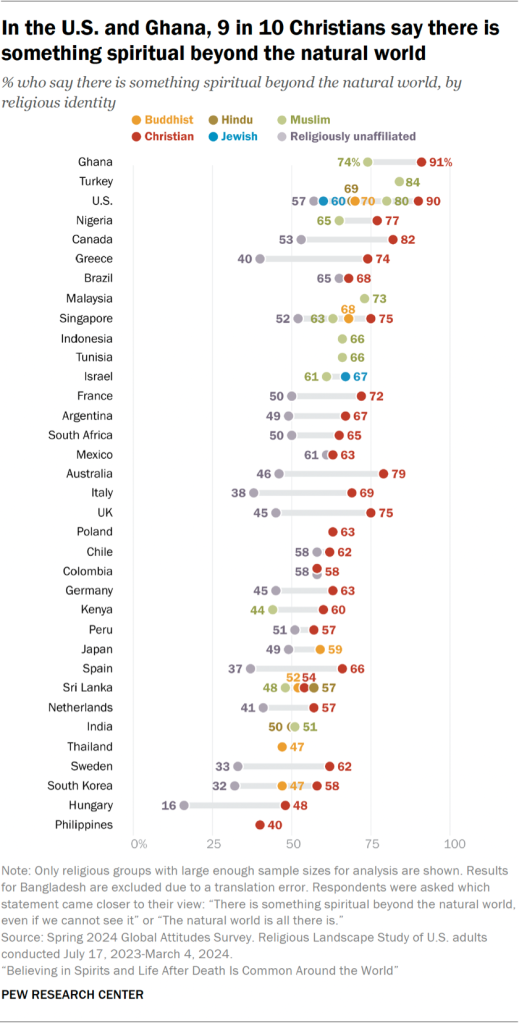
In general, Christians are more likely than other religious groups to say there is something spiritual beyond the natural world.

Chart showing that in the U.S. and Ghana, 9 in 10 Christians say there is something spiritual beyond the natural world

For example, Christians in Canada are more likely than religiously unaffiliated adults there to say this (82% vs. 53%).

Religiously unaffiliated people tend to be the least likely to say there is something spiritual beyond the natural world. Nevertheless, around half or more of the unaffiliated in 12 countries believe there is something spiritual beyond the natural world. This includes majorities of the unaffiliated populations in Brazil (65%), Mexico (61%), Chile (58%), Colombia (58%) and the U.S. (57%).

Clear – and even large – majorities of Muslims in most countries with sufficient sample sizes for analysis say that there is something spiritual beyond the natural world. However, fewer than half of Muslims in Kenya (44%) hold this belief.

Among Hindus, belief in something spiritual beyond the natural world ranges from 69% in the U.S. to 50% in India. Among Buddhists, it ranges from as high as 70% in the U.S. to as low as 47% in both South Korea and Thailand.

Views by rate of prayer

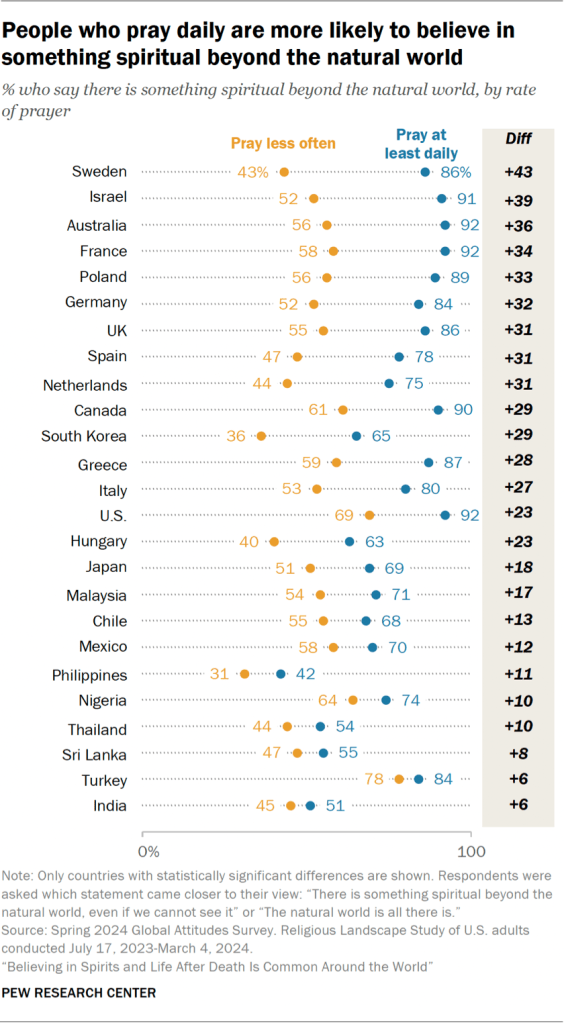
In most of the countries surveyed, adults who pray daily are more likely than those who pray less often to believe there is something spiritual beyond the natural world.

Chart showing people who pray daily are more likely to believe in something spiritual beyond the natural world

For instance, 91% of Israelis who pray at least once a day say there is something spiritual beyond the natural world, compared with 52% of Israelis who pray less often.

This divide is particularly large across Europe: France, Germany, the Netherlands, Poland, Spain, Sweden and the UK all have differences of at least 30 percentage points on this question between those who pray daily and those who pray less often.

There is a similar divide for belief in God: In nearly all countries surveyed, people who pray daily are considerably more likely than other adults to believe in God. This strong pattern does not appear in responses to the other questions discussed in this chapter.

Views by education

Adults with more education are more likely to believe in something spiritual beyond the natural world. (This is the opposite of the pattern observed on the question about belief in God.)

Chart showing higher levels of education are tied to more belief in something spiritual beyond the natural world

For example, 73% of Chileans who have completed postsecondary education say there is something spiritual beyond the natural world, while 54% of Chileans with less education say the same.

Israel is a notable exception to this pattern. Israeli adults with a postsecondary education, for instance, are less likely than those without as much education to say there is something spiritual beyond the natural world (56% vs. 73%).

2. Beliefs about the afterlife

Across the countries surveyed, many adults say there definitely or probably is life after death. People are generally less likely to say that the spirits of ancestors can help or hurt them. And a relatively small percentage of adults in most countries believe in reincarnation.

Beliefs on these aspects of life after death vary across regions:

  • Adults in Latin America and sub-Saharan Africa are among the most likely to say there is life after death. They are also, in many cases, more likely than people surveyed elsewhere around the globe to believe in reincarnation and to believe that ancestral spirits can influence their lives.
  • Europeans are consistently among the least likely to hold these beliefs.

Views on the afterlife also vary by religion:

  • Most Christians believe there is life after death. And, in many countries, Christians are more likely than religiously unaffiliated people to say the spirits of ancestors can help or harm them.
  • Large shares of Muslims believe in life after death, but in several countries, Muslims are less likely than people in other religious communities to believe in reincarnation or in the influence of ancestral spirits.
  • Buddhists and Hindus are consistently more likely than other religious groups in their countries to believe in reincarnation.

Women are somewhat more likely than men to believe in these three concepts, a gender divide that is most pronounced in European countries.

Jump to more on beliefs in: Life after death | Ancestral spirits | Reincarnation

Belief in life after death

In nearly every country surveyed, half or more of adults say there is definitely or probably life after death. This ranges from 85% of Indonesians to 38% of Swedes.

Bar chart showing that in most countries, majorities believe in life after death

(The survey did not define “life after death” for respondents.)

Large majorities in several sub-Saharan African countries say there is life after death. In all six Latin American countries surveyed, roughly two-thirds of adults hold this view.

In most European countries surveyed, smaller shares express a belief in life after death, including just under half of adults in both Spain and Hungary.

In the Asia-Pacific region, responses on this topic vary more widely. While Indians and Japanese are among the least likely to say there is life after death, about three-quarters of Filipinos and Bangladeshis say this.

In the United States, 70% of adults say there is life after death.

Views by religion

Large shares of Muslims across the world say there is definitely or probably life after death. This is the case in all countries that have sufficiently large samples of Muslims to analyze – except in India, where only 42% of Muslims believe in life after death.

Chart showing majorities of Christians believe in life after death

In nearly all the countries with enough Christians to analyze, around six-in-ten or more say there is life after death, including 78% of Filipino Christians and 81% of Kenyan Christians who say this.

Buddhists’ views on life after death vary, with about half of Buddhists in Thailand and South Korea saying there is life after death, compared with two-thirds or more in Singapore and Sri Lanka.

Religiously unaffiliated people typically are less likely than other adults to believe in life after death, though levels of belief vary greatly by region. Around one-third or fewer of unaffiliated adults in Europe say there is life after death, but in Latin America, Singapore and South Africa, half or more of unaffiliated adults believe in an afterlife. Indeed, nearly two-thirds of the unaffiliated in Peru say there is definitely or probably life after death.

In the U.S., 42% of religiously unaffiliated adults say they believe in life after death.

Views by rate of prayer

In most countries surveyed, people who pray at least daily are more likely than those who pray less often to say there is life after death.

For example, 69% of Japanese who pray daily say there is definitely or probably life after death, compared with 41% of other Japanese who take this position. And in Spain, 79% of adults who pray daily say there is life after death, while 38% of Spanish adults who pray less often say this.

Chart showing most adults who pray daily believe in an afterlife

Views by education

Belief in life after death does not consistently align with education levels.

Bar chart showing that in some countries, adults with more education are more likely to say there is life after death

In some of the 35 surveyed countries, people with higher levels of education are more likely than other adults to say there is life after death. This is true in eight countries and is most common in Latin America.

In Colombia, for example, 73% of adults who have completed a secondary education say there is definitely or probably life after death. Among Colombian adults with less education, 58% express that view.

On the other hand, in the U.S., the Netherlands and Israel, adults with more education are less likely to say there is life after death.

In the remaining countries, there is no clear association between education levels and belief in life after death.

Views by age

Chart showing that in Spain and the UK, wide age gaps on belief in an afterlife

In a handful of countries, adults under 35 are more likely than those ages 50 and older to say there is life after death. For example, in the United Kingdom, 64% of younger adults believe there is definitely or probably life after death, compared with 43% of older adults who believe this.

Only in Canada and the U.S. is the opposite true. Older Canadians are more likely than the youngest adults to say there is life after death (60% vs. 50%). And older Americans are slightly more likely than younger Americans to say the same (73% vs. 65%).

Can the spirits of ancestors help or hurt people?

In most countries surveyed, fewer than half of adults believe that the spirits of ancestors can help or harm them, with a median of 38% across 35 countries expressing this view.

Bar chart showing nearly 8 in 10 South Africans say ancestors can help or hurt them

Belief in the power of ancestral spirits is most common in the four African countries surveyed, particularly in South Africa (79%) and Ghana (72%).

Across the Asia-Pacific region, smaller shares of adults believe that ancestral spirits can help or harm them. In Bangladesh and Malaysia, only about two-in-ten adults say this. But 55% of Indians and 50% of Filipinos believe that such familial spirits can impact their lives.

In European countries, fewer than half of adults believe they can be helped or harmed by ancestral spirits, ranging from 40% in France to 20% in Sweden who say this.

Adults in Latin America are generally more likely than Europeans to believe that their ancestors’ spirits can affect their lives, including 50% of Colombians who express this view. 

In the U.S., 36% of Americans say they believe the spirits of ancestors can help or harm them. In a previous Center survey, 34% of Americans said that in the past 12 months they had felt the presence of a family member who is dead.

Views by religion

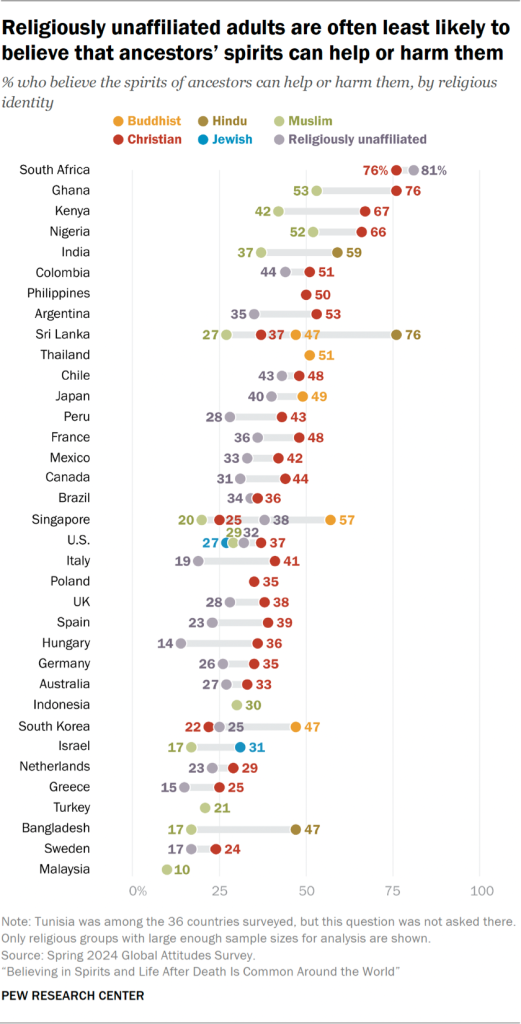
Muslims are among the least likely to say that the spirits of ancestors can help or harm them. For example, just 17% of Muslims in Bangladesh believe this, compared with 47% of Bangladeshi Hindus. And in Israel, 17% of Muslims believe that the spirts of ancestors can influence their lives, compared with 31% of Jewish Israelis.

Likewise, adults who are religiously unaffiliated are generally less likely to believe that the spirits of ancestors can help or harm them. In Italy, for example, Christians are about twice as likely as the unaffiliated to say the spirits of ancestors can influence their lives (41% vs. 19%).

However, in Singapore, the religiously unaffiliated are more likely than Christians to believe the spirits of ancestors can help or harm them (38% vs. 25%).

Chart showing religiously unaffiliated adults are often least likely to believe that ancestors’ spirits can help or harm them

Views by gender

In several countries, women are more likely than men to believe that the spirits of ancestors can help or harm them. In Japan, for instance, 52% of women believe this, compared with 34% of Japanese men.

The gender gap emerges most consistently in European countries. For example, 42% of Polish women say ancestral spirits can influence them, compared with 27% of Polish men.

Chart showing European women are more likely than men to believe in the influence of ancestors’ spirits

Belief in reincarnation

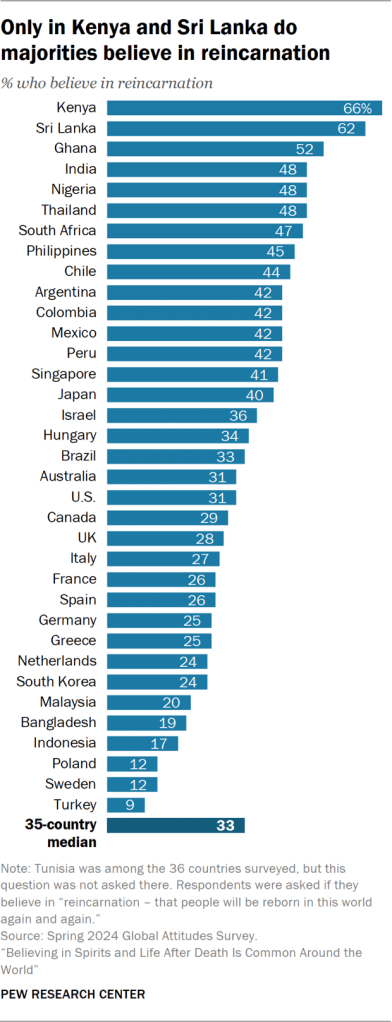
A median of 33% of adults across the 35 countries surveyed believe in reincarnation, defined in the survey as the belief “that people will be reborn in this world again and again.” Adults in sub-Saharan Africa, parts of the Asia-Pacific region and Latin America are especially likely to believe in reincarnation.

For example, in India, Nigeria and Thailand, 48% of adults say they believe in reincarnation. In Chile, 44% do.

Fewer people in European countries say they believe in reincarnation, including 12% in both Poland and Sweden.

Likewise, no more than two-in-ten adults in Bangladesh, Indonesia, Malaysia and Turkey believe in reincarnation.

On this question, the U.S. is roughly in the middle of the countries surveyed, with 31% of Americans saying they believe in reincarnation.

Bar chart showing only in Kenya and Sri Lanka do majorities believe in reincarnation

Views by religion

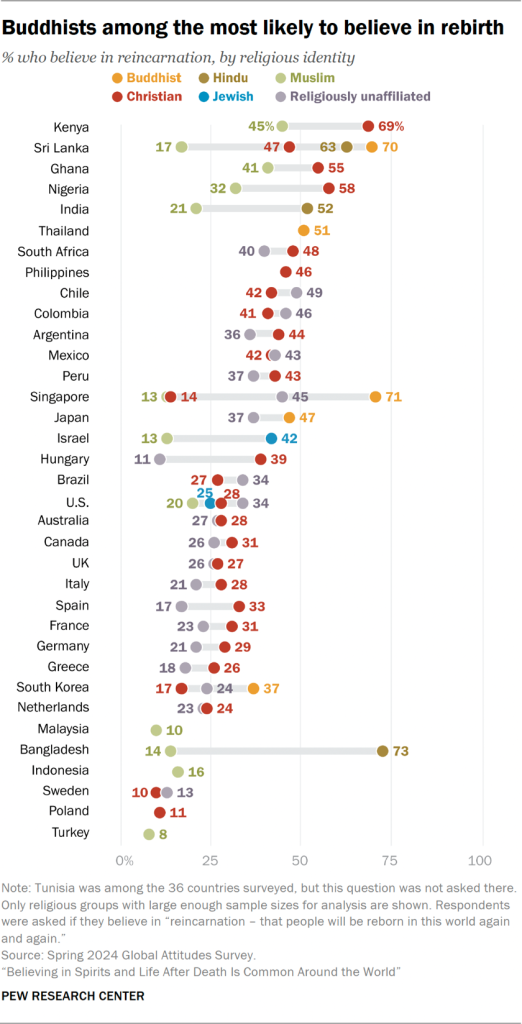
Reincarnation is a mainstream teaching in Buddhism and Hinduism. In places with enough Buddhists or Hindus to analyze, they are consistently more likely than other religious groups to believe in reincarnation.

Meanwhile, Muslims tend to be among the religious groups that are least likely to say they believe in reincarnation.

For example, in Sri Lanka, 70% of Buddhists and 63% of Hindus believe in reincarnation, compared with 47% of Christians and 17% of Muslims. And in India, about half of Hindus believe in reincarnation, compared with 21% of Muslims.

More than half of Christians in Kenya, Nigeria and Ghana say they believe in reincarnation. Elsewhere, smaller shares of Christians hold this belief, including just 10% of Christians in Sweden and 27% in Brazil.

Chart showing Buddhists among the most likely to believe in rebirth

Views by age

The youngest adults in 10 countries analyzed are more likely than adults ages 50 and older to believe in reincarnation.

Chart showing that in 10 countries, the youngest adults are more likely to believe in reincarnation

For instance, in Argentina, about half of adults under 35 express a belief in reincarnation, while one-third of adults ages 50 and older say the same.

In Nigeria, the pattern is reversed. Older Nigerians are more likely than their youngest compatriots to believe in reincarnation (63% vs. 47%).

3. Spells, curses and ways to see the future

Many adults around the world believe that spells, curses or other magic can influence people’s lives. Survey respondents in sub-Saharan African countries and in Colombia are especially likely to hold this belief: Seven-in-ten or more adults in those places express belief in spells. But fewer than half of adults surveyed in Europe, North America, East Asia and Australia hold this view.

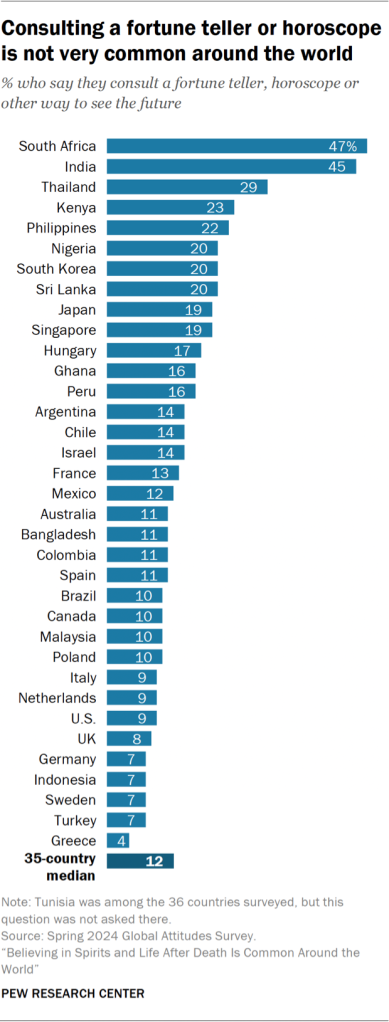
On the other hand, when it comes to trying to see the future – like consulting a fortune teller or horoscope – fewer than a quarter of adults in nearly all 35 countries surveyed say they engage in these practices. South Africa (47%) and India (45%) have the highest shares of adults who say they consult a fortune teller or horoscope to see the future.

The survey also finds that:

  • Christians are much more likely than religiously unaffiliated adults to believe that spells and curses can affect people’s lives.
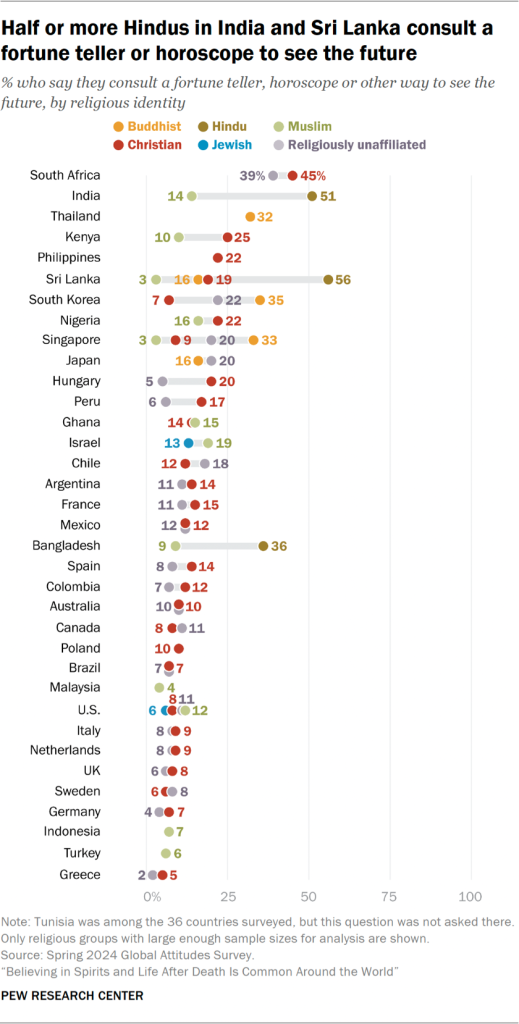
  • Many Hindus, especially in India and Sri Lanka, consult fortune tellers or horoscopes to see the future.
  • In many countries, those who pray daily are more likely than others to believe in spells and curses. By contrast, adults who pray at least daily are not particularly different from other adults when it comes to trying to see the future.
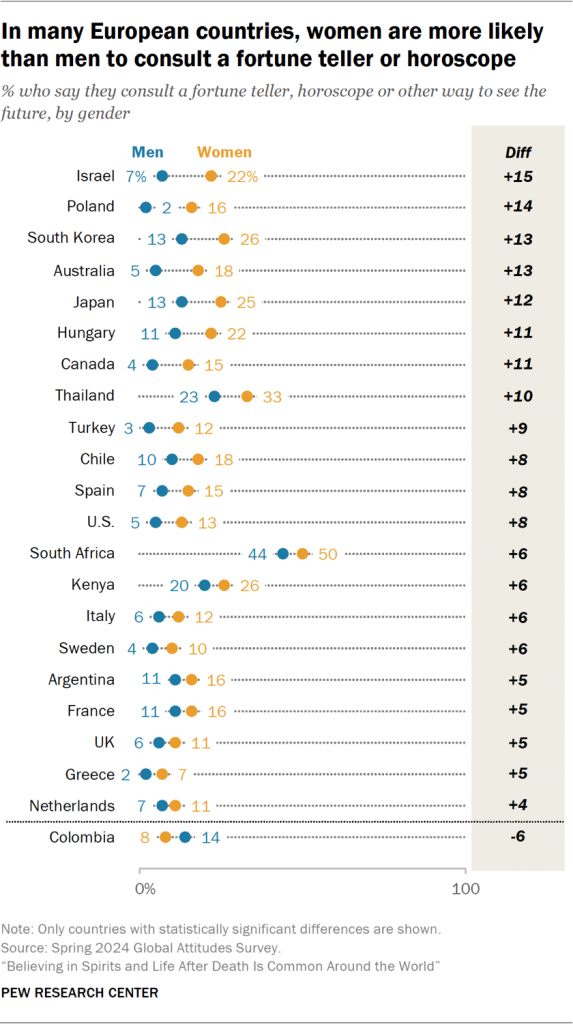
  • Women are more likely than men to believe in the power of spells and to use a fortune teller or horoscope to see the future.

Jump to more on: Beliefs in spells, curses and magic | Consulting fortune tellers and horoscopes

Belief in spells, curses or other magic

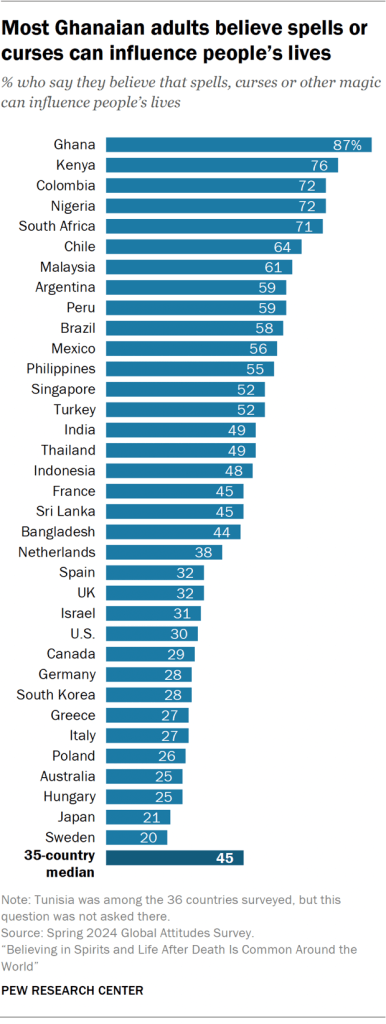
Bar chart showing most Ghanaian adults believe spells or curses can influence people’s lives

Across 35 countries surveyed, the share of adults who believe that spells, curses or other magic can influence people’s lives varies widely.

This belief is broadly held in all four African countries surveyed, by seven-in-ten or more adults in each place. Of all the countries surveyed, Ghana (87%) has the largest share of adults who believe in the power of spells or curses.

More than half of all adults in the Latin American countries included in the survey also express this belief – ranging from 72% in Colombia to 56% in Mexico.

Substantial shares of adults in South and Southeast Asia also say spells, curses or other magic can influence people’s lives.

However, in North America, Australia, East Asia and most of Europe, one-third or fewer of adults hold this view. In the United States, 30% believe spells, curses or other magic can influence people’s lives. In Sweden and Japan, about one-fifth do.

Views by religion

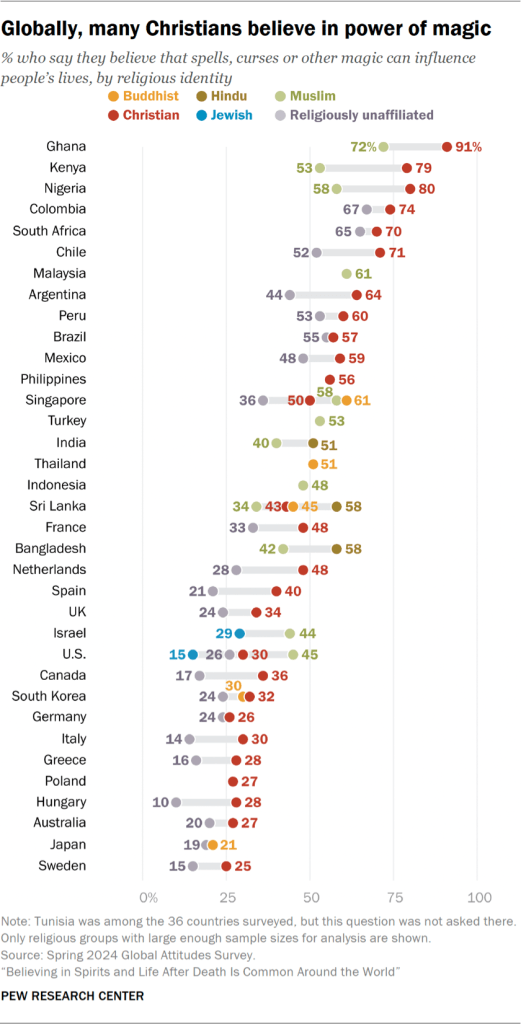
Chart showing that globally, many Christians believe in power of magic

Christians generally are more likely than religiously unaffiliated adults to say they believe that spells, curses or other magic can influence people’s lives. In Singapore, for instance, 50% of Christians hold this belief, compared with 36% of unaffiliated adults.

Half or more of Hindus surveyed in Bangladesh (58%), Sri Lanka (58%) and India (51%) believe spells or curses can influence people’s lives.

Within religions, there are some geographic variations on this question.

For example, Israeli Jews are almost twice as likely as Jewish Americans to believe that spells, curses or other magic can influence people’s lives (29% vs. 15%). Among Buddhists, those living in South and Southeast Asia are more likely than those living in East Asia to express this belief.

Views by rate of prayer

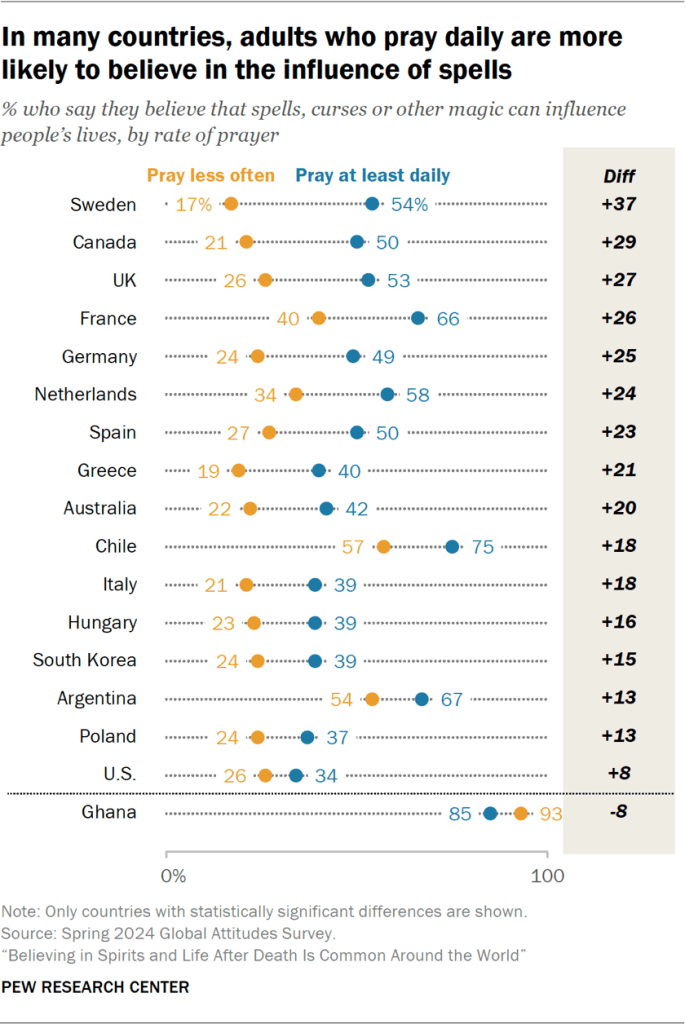
Respondents who pray daily are more likely than those who pray less often to say they believe in spells, curses or other magic influencing people’s lives. This is particularly true in Europe. For instance, in Germany, 49% of adults who pray at least daily believe that spells, curses or other magic can influence people’s lives, while 24% of adults who pray less often take the same view.

In Ghana, however, the opposite is true: Adults who pray daily are slightly less likely than others to hold this belief (85% vs. 93%).

Chart showing that in many countries, adults who pray daily are more likely to believe in the influence of spells

Consulting a fortune teller or horoscope to see the future

In most countries surveyed, fewer than a quarter of adults say they consult a fortune teller, horoscope or other way to see the future.

In Europe, this ranges from 17% of Hungarians to just 4% of Greeks. In the Americas, it ranges from 16% in Peru to 9% in the U.S.

India and South Africa stand out from the other countries surveyed, with 47% of South Africans and 45% of Indians saying they use such methods to try to see the future.

Bar chart showing consulting a fortune teller or horoscope is not very common around the world

Views by religion

Hindus are among the most likely to consult a fortune teller or horoscope to see the future, including half or more in India and Sri Lanka (51% and 56%, respectively). In Bangladesh, 36% of Hindus also engage in these practices – far more than the share of Bangladeshi Muslims who do so (9%).

While around a third of Buddhists in Singapore, South Korea and Thailand use fortune tellers or horoscopes to see the future, just 16% of Buddhists in Sri Lanka and Japan do so.

In general, similar shares of Christians and the religiously unaffiliated in each country use fortune tellers or other ways to see the future. For instance, 10% of both Christians and unaffiliated adults in Australia say they engage in these practices.

Chart showing half or more Hindus in India and Sri Lanka consult a fortune teller or horoscope to see the future

Views by gender

In most countries surveyed – including nearly every European country – women are more likely than men to use a fortune teller, horoscope or other way to see the future. For instance, in Poland, 16% of women do this, while just 2% of men say the same.

Chart showing that in many European countries, women are more likely than men to consult a fortune teller or horoscope

And in Japan, 25% of women use methods to see the future, compared with 13% of men.

However, the pattern is reversed in Colombia: Men are slightly more likely than women to consult fortune tellers and horoscopes to see their futures (14% vs. 8%).

4. Spiritual and religious practices

Spiritual and religious practices vary around the world. Some activities, such as prayer, are widespread across many societies. Other practices, such as fasting and lighting incense or candles, are common in some places and rare in others.

Within countries, some religious groups are particularly likely to engage in the practices we asked about. For example, in places with enough Muslims to report on, Muslims often are much more inclined than others to say they fast during holy periods.
Religiously unaffiliated people – those who say they are atheist, agnostic or have no religion in particular – engage in religious and spiritual practices at lower rates than other adults. For example, relatively few unaffiliated adults say they attend worship services at least monthly.

In many countries surveyed, women are more likely than men to participate in religious and spiritual activities. In Italy, for example, roughly twice as many women as men report praying daily. But this gender gap is not universal: In Israel, men are more likely than women both to pray daily and to attend religious services.

Generally, adults who pray at least once a day tend to be more likely than other adults to do other spiritual things, including lighting incense (for spiritual reasons) or wearing religious symbols.

Jump to more on: Prayer | Religious service attendance | Fasting |
Lighting incense, candles | Wearing religious symbols

Prayer

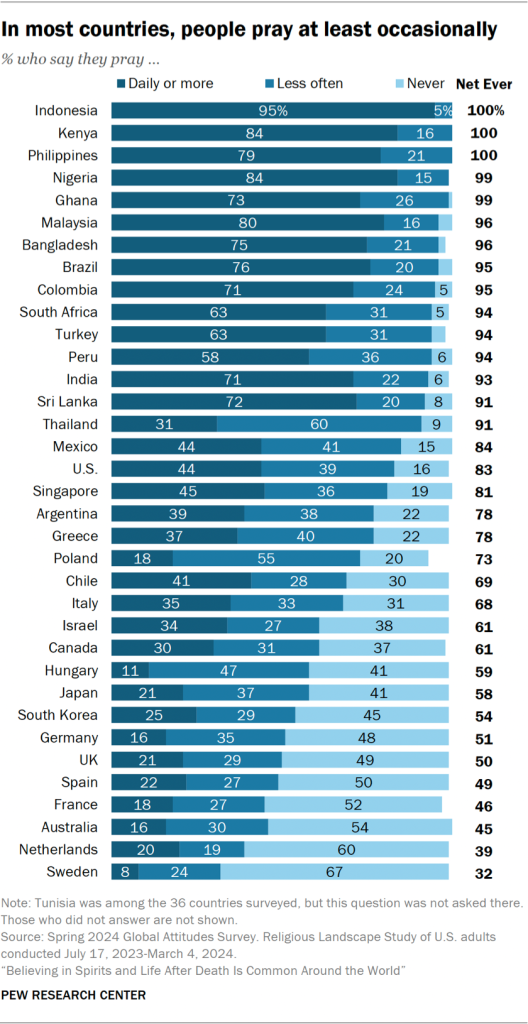
Bar chart showing that in most countries, people pray at least occasionally

In 14 of the 35 countries surveyed, a majority of adults say they pray at least once a day. This includes 95% of Indonesians.

Other countries in South and Southeast Asia also have majorities who pray daily, as do Turkey, places in sub-Saharan Africa and parts of Latin America.

Meanwhile, in six European countries, as well as in Australia, about half or more of adults say they never pray. Swedes are the least likely among those surveyed to pray: Two-thirds of Swedish adults say they never pray.

The United States falls somewhere in the middle of the countries surveyed: 44% of U.S. adults say they pray daily, while 16% never pray.

Views by religion

In nearly every country with enough Muslims to analyze, Muslims are more likely than members of other religious groups to pray daily.

Chart showing a wide variety of daily prayer among Christians

For example, 92% of Sri Lankan Muslims pray at least once a day, compared with 76% of Christians in that country and 69% of both Buddhists and Hindus.

Bangladesh is the only country where this pattern does not hold – Hindus in Bangladesh are more likely than Muslims to pray at least daily (87% vs. 73%).

In some countries, Buddhists and Jews are among the least likely to pray daily. For example, a quarter of Singaporean Buddhists pray daily, compared with 61% of Singapore’s Christians and 84% of its Muslims.

But the religiously unaffiliated are consistently the least likely to pray daily. For instance, in South Africa, 35% of unaffiliated adults say they pray daily, compared with 69% of South African Christians.

Views by age

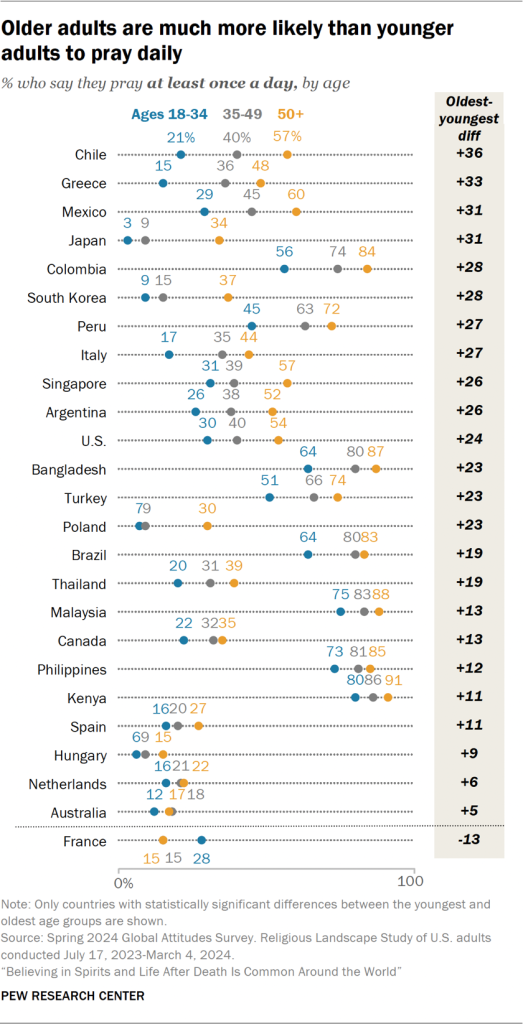
Adults ages 50 and older are consistently more likely than the youngest adults surveyed (ages 18 to 34) to pray daily. That’s the pattern across many regions – from Europe and the Americas to Southeast Asia and East Asia.

For example, the oldest adults in Mexico are about twice as likely as the youngest adults there to pray at least daily (60% vs. 29%). Likewise, in Thailand, 39% of adults ages 50 and older say they pray daily, compared with 20% of the youngest adults.

One exception is France, where adults ages 18 to 34 are more likely than the oldest adults to pray daily (28% vs. 15%).

Chart showing older adults are much more likely than younger adults to pray daily

Views by gender

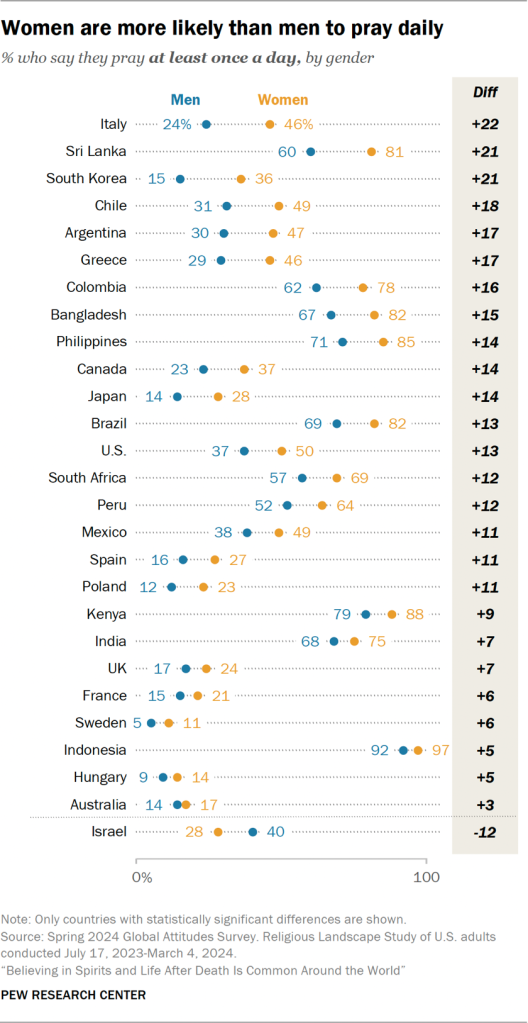
Like past research that generally shows women to be more religious or spiritual than men, the new survey finds that women are significantly more likely than men to say that they pray at least once a day in nearly all 35 countries surveyed.

For example, half of women in the U.S. say they pray daily, compared with 37% of men.

The only exception is Israel, where men are somewhat more likely than women to pray at least once a day (40% vs. 28%).

Chart showing women are more likely than men to pray daily

Salah among Muslims

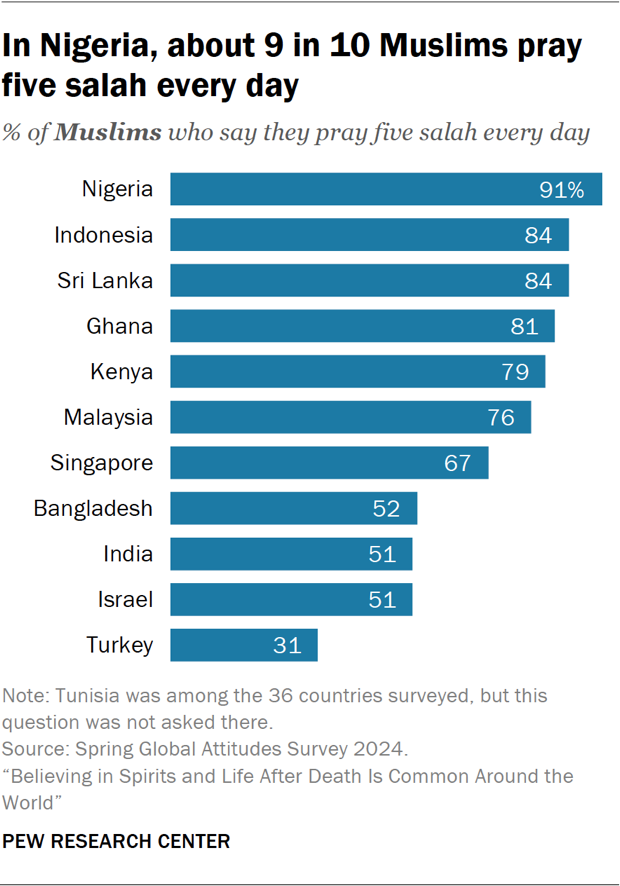
In 11 countries with significant Muslim populations, Muslims who say that they pray several times a day were also asked if they pray five salah every day. (This question was not asked in the U.S. this time, though we asked it in a 2017 U.S. survey.)

In general, most Muslims say they pray five salah, including 91% in Nigeria and 84% in Indonesia and Sri Lanka.

Turkey is the only country surveyed where a minority of Muslims (31%) pray five salah every day.

Bar chart showing that in Nigeria, about 9 in 10 Muslims pray five salah every day

Attending religious services

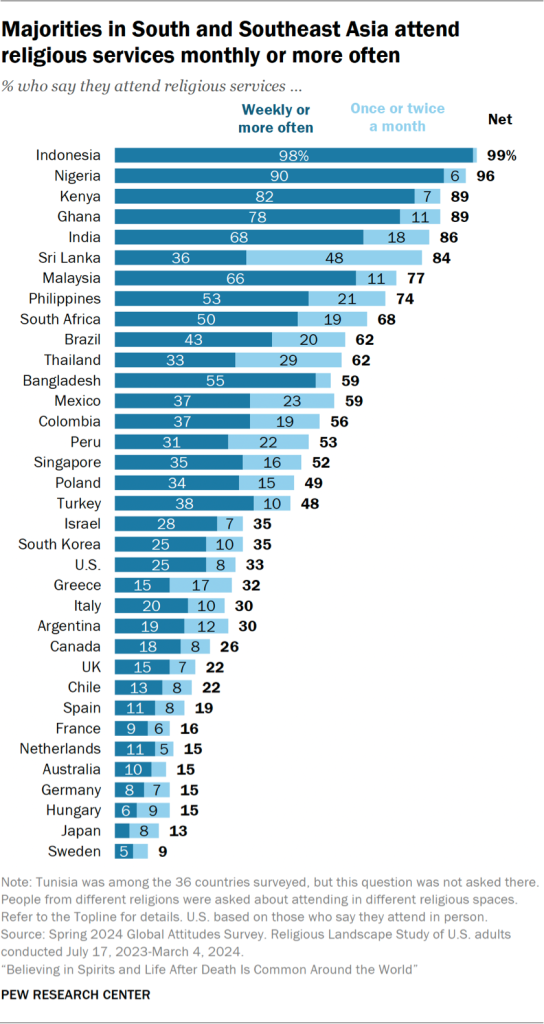
In 18 of the countries surveyed, around half or more of adults say they attend a religious service or go to a house of worship once a month or more often. This includes nearly all adults in Indonesia (99%) and Nigeria (96%).

Bar chart showing majorities in South and Southeast Asia attend religious services monthly or more often

(People from different religions were asked about attending in different religious spaces. For example, Christian respondents were asked about going to church, while Hindus were asked about going to a temple. Refer to the Topline for details.)

Adults in East Asia are much less likely than those in South and Southeast Asia to be frequent attenders. For example, 13% of Japanese go to a temple or attend religious services at least once a month, while 86% of Indians do the same.

In general, most adults in sub-Saharan Africa frequent a house of worship monthly. By contrast, about one-third or fewer of European adults report being regular attenders. An exception is Poland, where about half of adults (49%) report attending religious services at least monthly.

Views by religion

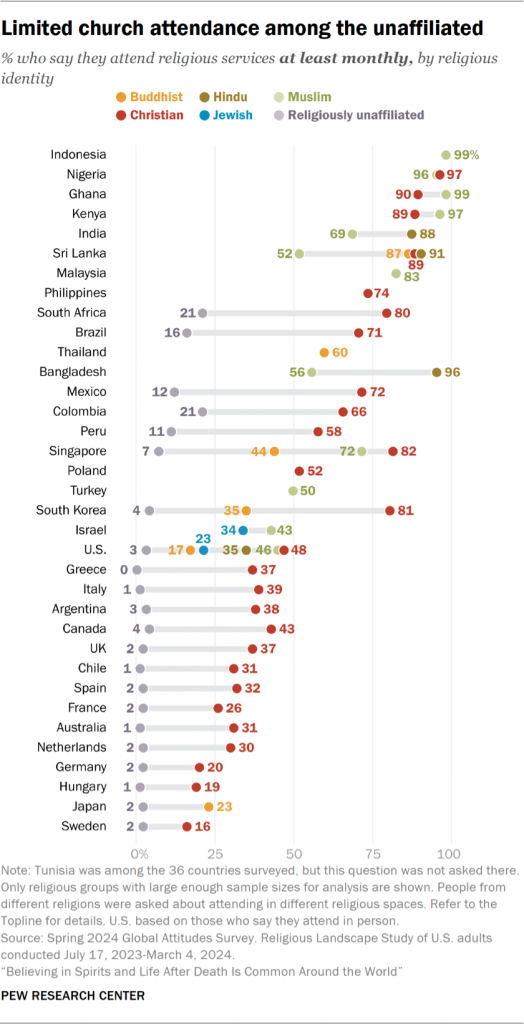
Religiously unaffiliated respondents are much less likely than people who are religiously affiliated to attend services and houses of worship monthly or more often.

Chart showing limited church attendance among the unaffiliated

For example, 21% of unaffiliated South Africans say they attend religious services at least monthly, compared with 80% of Christians.

In three of the four countries with enough Hindus to analyze – Bangladesh, India and Sri Lanka – overwhelming majorities say they got to a temple once a month or more often.

However, attendance rates within religious groups vary considerably depending on where people live. Among Christians in Western Europe, for example, fewer than half report being regular church attenders. In Asia, about three-quarters or more of Christians say they attend church at least monthly.

Views by gender

Chart showing that in Bangladesh, men are much more likely than women to attend a mosque or other house of worship

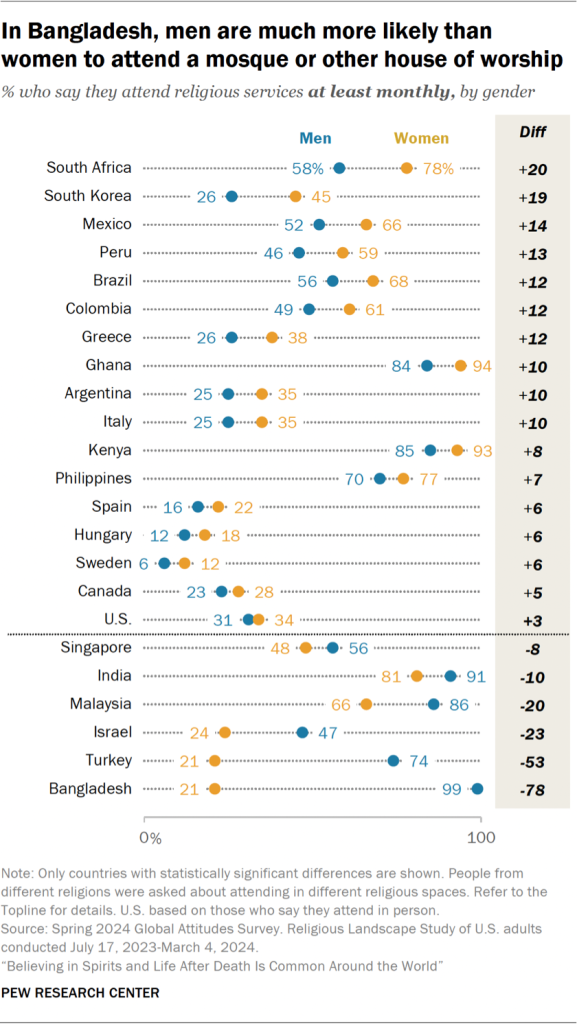
In general, women are more likely than men to attend temples, churches and other houses of worship. In both Argentina and Italy, for instance, about one-third of women say they attend religious services monthly, while a quarter of men say the same.

Yet, in a handful of the 35 countries surveyed, men are more likely than women to attend religious services – sometimes with a very large divide.

In Turkey, the gender gap between men and women is 53 percentage points. In Bangladesh, the gap is 78 points.

A previous Center report similarly found that in predominantly Christian nations, women are more likely than men to attend religious services. Yet in predominantly Muslim countries and in Israel, men attend more often than women.

Views by rate of prayer

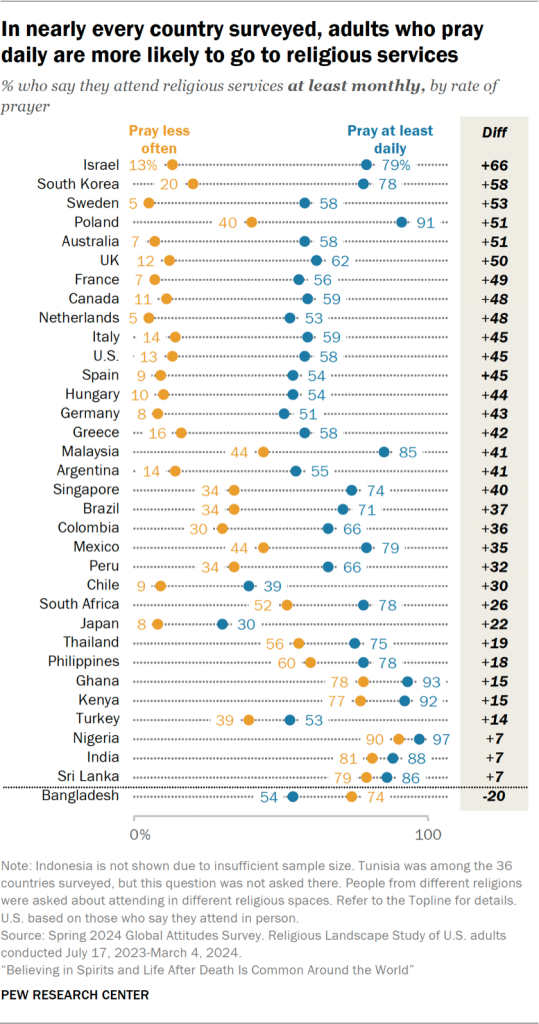
Almost universally in the countries surveyed, people who say they pray daily are more likely than other adults to report that they attend religious services or houses of worship at least monthly.

Chart showing that in nearly every country surveyed, adults who pray daily are more likely to go to religious services

In Poland, for instance, 91% of those who pray daily say they attend religious services monthly or more often, while 40% of Poles who pray less often say they attend church at least once a month.

This pattern exists across a range of societies, from Jewish-majority Israel to Muslim-majority Malaysia, Christian-majority Mexico, and Buddhist-majority Thailand.

The only country surveyed where people who pray daily are less likely to attend worship services is Bangladesh. Some of this unique pattern is driven by Bangladeshi women being somewhat more likely than men to pray. Yet Bangladeshi men are 78 points more likely than women to go to a mosque or other religious services.

Fasting

Many religions have at least one holy period each year – such as Christian Lent or Muslim Ramadan – during which followers are expected to fast by abstaining from food, drink or various other activities.

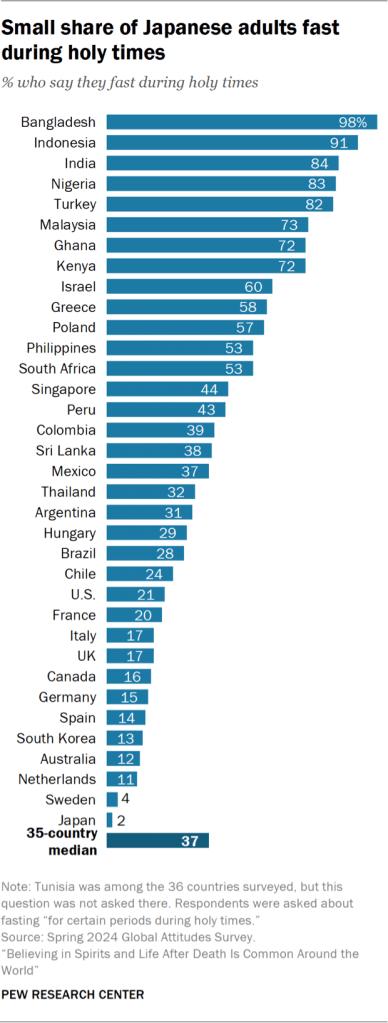
Across the countries surveyed, the share who say they fast during holy times varies widely. Western Europeans and East Asians are generally less likely than those in other parts of Europe or Asia to fast.

For example, only 11% of Dutch and 4% of Swedes fast, while majorities of Greeks (58%) and Poles (57%) do.

In Japan, relatively few respondents say they fast for certain periods during holy times (2%), while in Bangladesh, nearly all (98%) do.

Bar chart showing small share of Japanese adults fast during holy times

Views by religion

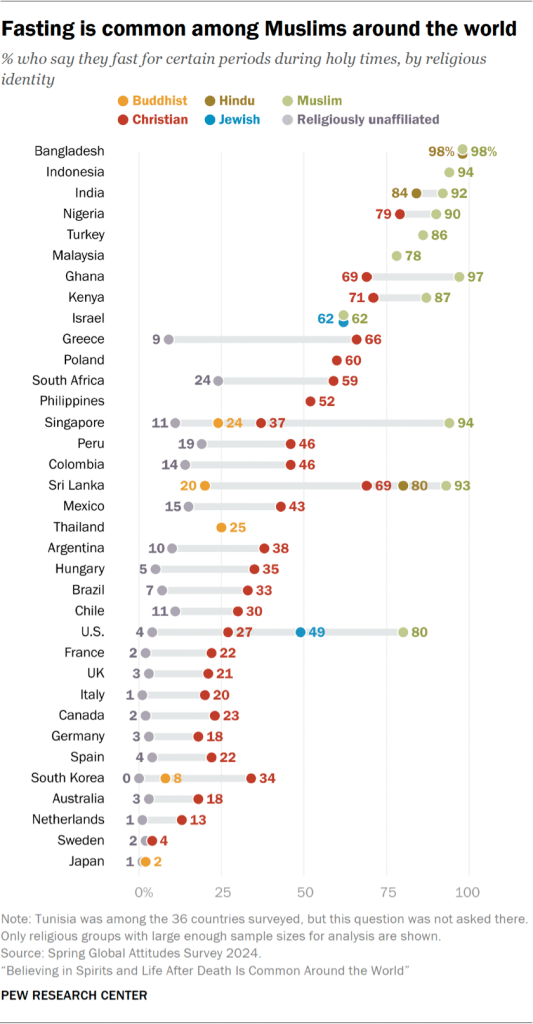
Muslims and Hindus are generally the most likely to say they fast.

Chart showing fasting is common among Muslims around the world

For example, in Indonesia and Ghana, nearly all Muslims fast during holy times. And in all countries with enough surveyed Muslims to analyze, majorities of Muslims say they fast.

Additionally, in all three countries with large enough samples of Hindus – Bangladesh, India and Sri Lanka – at least eight-in-ten Hindus fast.

In Israel, 62% of Jews say they fast during holy periods.

Christian fasting rates vary considerably from country to country, ranging from 79% in Nigeria to 13% in the Netherlands.

Views by age

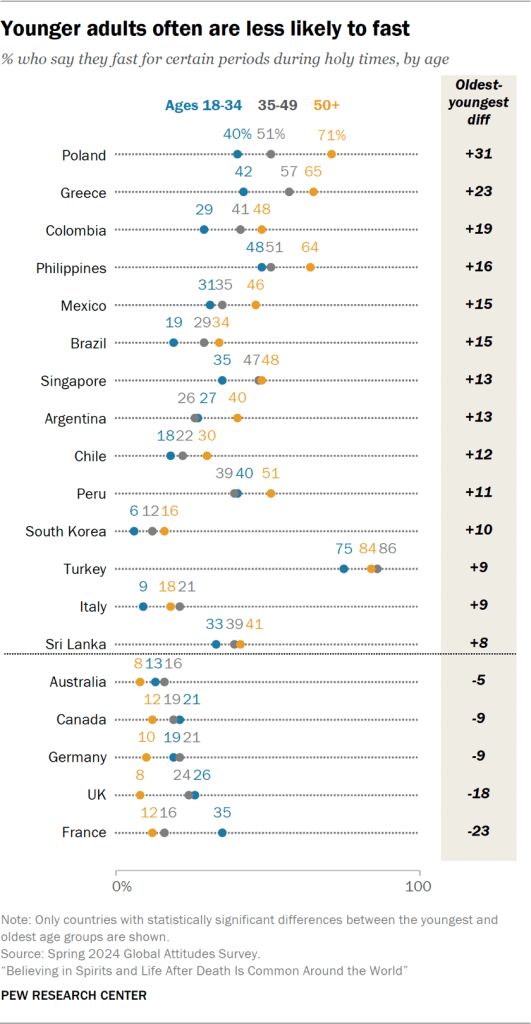
In more than a dozen of the 35 countries surveyed, adults ages 50 and older are more likely than adults ages 18 to 34 to fast during holy times.

Almost half of the oldest Colombian adults, for instance, say they fast for certain periods during holy times. By contrast, 29% of the youngest adults surveyed say this.

However, in five countries – Australia, Canada, France, Germany and the United Kingdom – younger adults are more likely than older adults to fast.

Chart showing younger adults often are less likely to fast

Lighting incense and candles

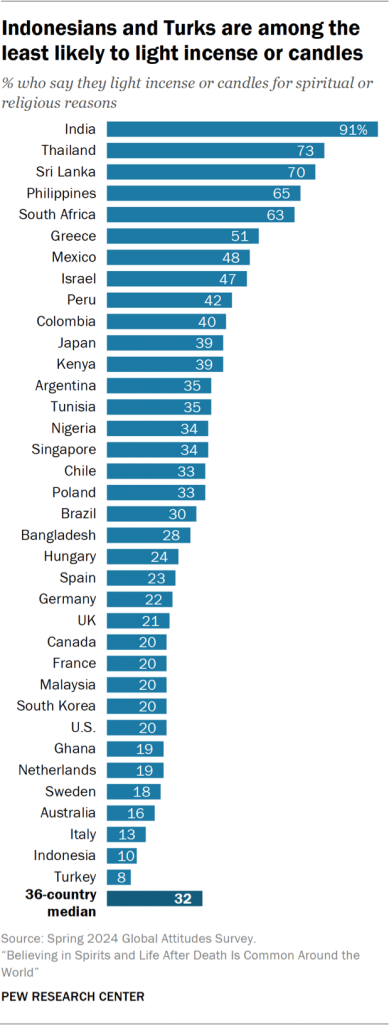
Fewer than half of adults in most countries surveyed say they light incense or candles for spiritual or religious reasons.

Only in five countries do a majority of the public say they light candles or incense: India (91%), Thailand (73%), Sri Lanka (70%) the Philippines (65%) and South Africa (63%).

Conversely, about one-quarter of adults in Hungary and Spain engage in this practice. Two-in-ten Canadians and Americans light candles or incense for spiritual reasons.

People in Indonesia (10%) and Turkey (8%) are among the least likely to light incense or candles for these purposes.

Bar chart showing Indonesians and Turks are among the least likely to light incense or candles

Views by religion

Large majorities of Hindus say they light incense or candles for spiritual or religious reasons, including 100% in Bangladesh and 95% in India.

Chart showing many Hindus and Buddhists light incense or candles

In most countries with sufficient sample size to analyze the Buddhist population, many Buddhists also light candles or incense.

Christians around the world vary widely in their religious use of incense and candles, ranging from 72% in Sri Lanka to 15% in Italy.

In nearly all surveyed countries with enough Muslims to analyze, fewer than half of Muslims say they follow this practice. However, 69% of Indian Muslims light incense or candles for spiritual or religious reasons.

Around half of Jewish Israelis (53%), as well as 42% of Jewish Americans, light candles for religious or spiritual reasons. These are the only two countries with sufficiently large samples of Jews to analyze their attitudes and behaviors.

Views by education

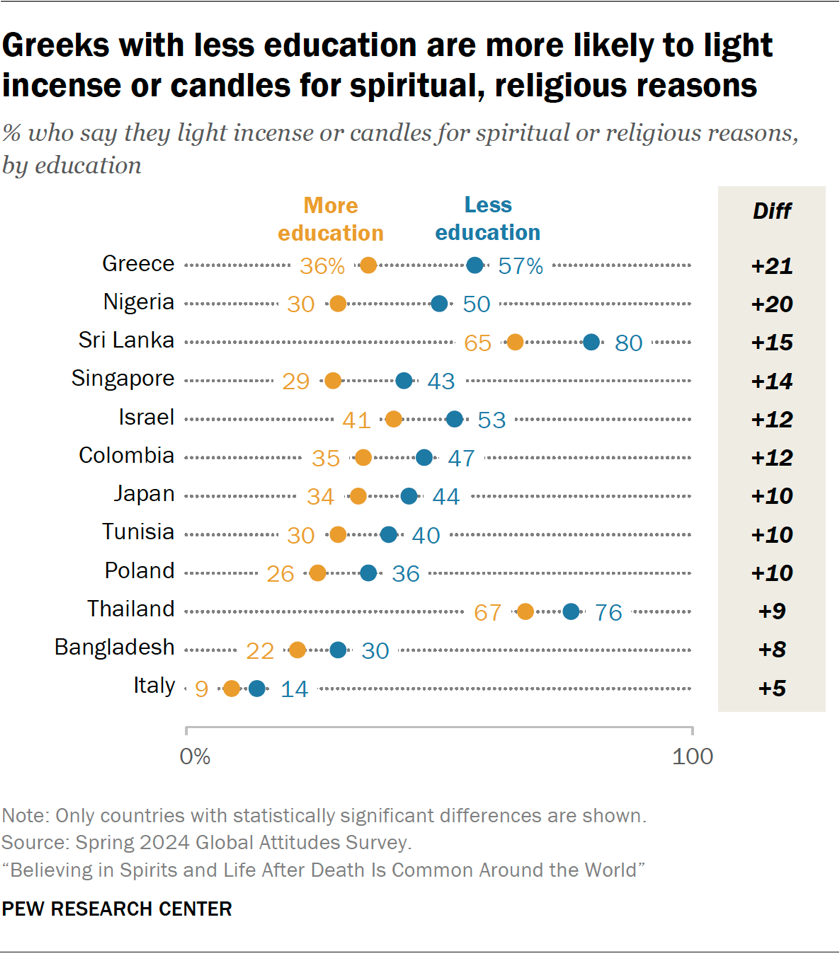
In some countries, adults who have less education are more likely than others to say that they light incense or candles.

Chart showing Greeks with less education are more likely to light incense or candles for spiritual, religious reasons

For example, a majority of Greek adults who have lower levels of education (57%) say they light either candles or incense, while about one-third of Greeks with higher levels of education (36%) say that they follow this practice.

And in Nigeria, half of adults who have lower levels of education light incense or candles for spiritual or religious reasons, while three-in-ten of those with higher levels of education say they do this.

(To compare educational groups across countries, we standardize education levels based on the United Nations’ International Standard Classification of Education. In Greece, adults with lower levels of education have completed secondary school or less. In Nigeria, adults with lower levels of education have not completed secondary school.)

Wearing religious symbols

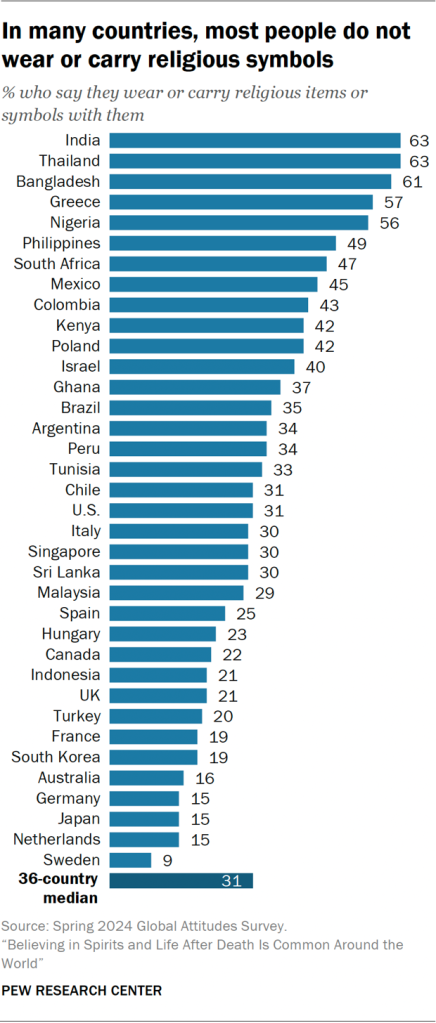
Bar chart showing that in many countries, most people do not wear or carry religious symbols

Religions often have symbols some followers choose to wear or carry with them, such as a Jewish Star of David or a Hindu tilak.

However, in only a handful of the surveyed countries do a majority say they wear or carry religious symbols or items with them.

This practice is most common in the South and Southeast Asian countries of Bangladesh, India and Thailand. Yet in several neighboring countries – Malaysia, Singapore and Sri Lanka – adults are much less likely to wear or carry religious symbols.

A similar divide is seen in Europe. Though most Europeans do not wear religious symbols, Greek adults are among the most likely in this survey to say they do so.

Views by religion

Fewer than one-quarter of religiously unaffiliated adults in every country surveyed say that they wear or carry symbols.

Meanwhile, majorities of Hindus in Bangladesh (93%), India (66%) and Sri Lanka (59%) wear or carry religious items or symbols.

And about four-in-ten Jewish adults in both Israel (42%) and the U.S. (38%) say that they do this.

Within some other religious groups, responses to this question vary widely by location. For example, 70% of Buddhists in Thailand wear or carry a religious symbol, compared with about one-in-five Buddhists in Sri Lanka (22%) and Japan (20%) who do the same.

Chart showing majorities of Hindus wear or carry religious symbols

Views by gender

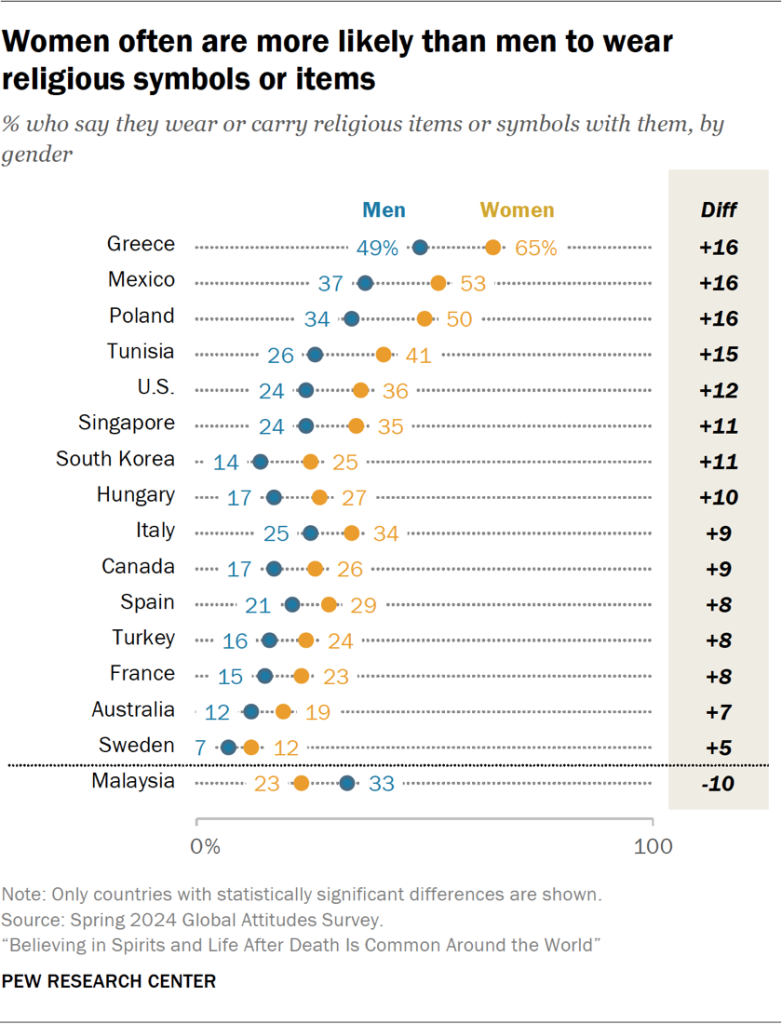
In many of the high-income countries surveyed, women are more likely than men to wear or carry religious items. In the U.S., for instance, 36% of women say they do this, compared with 24% of men.

Chart showing women often are more likely than men to wear religious symbols or items

This gender divide is also present in the middle-income countries of Mexico, Tunisia and Turkey.

Malaysian men, however, are more likely than Malaysian women to wear or carry religious items or symbols with them (33% vs. 23%).

5. Religious importance and religious affiliation

“How important is religion in your life?” and “What is your current religion?” are two survey questions that have long been used to measure religiousness in individuals and societies.

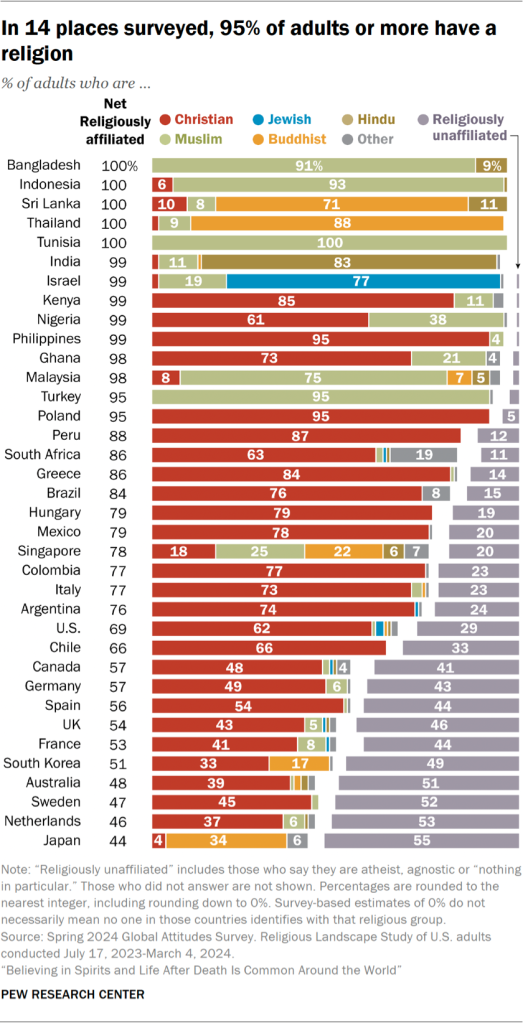
By these benchmarks, the world’s most religious countries are mostly in the Middle East, South and Southeast Asia, sub-Saharan Africa and Latin America. For example, about nine-in-ten adults in Kenya and Sri Lanka say religion is very important in their lives, and virtually all adults in both places identify with a religion.

Meanwhile, societies in Europe, East Asia, Australia and Canada tend to show lower levels of religiousness. In Japan, for instance, fewer than half of adults (44%) identify with a religion, and just 7% say religion is very important to them.

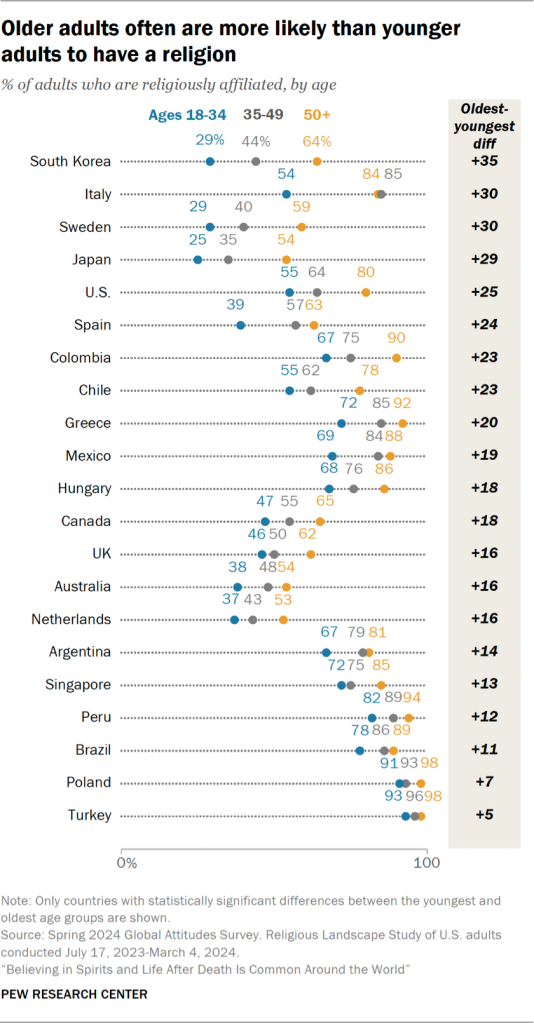
In general, younger adults (people ages 18 to 34) are less likely than the oldest adults we surveyed (ages 50 and older) to say religion is very important in their lives. Likewise, younger adults are less likely to identify with any religion.

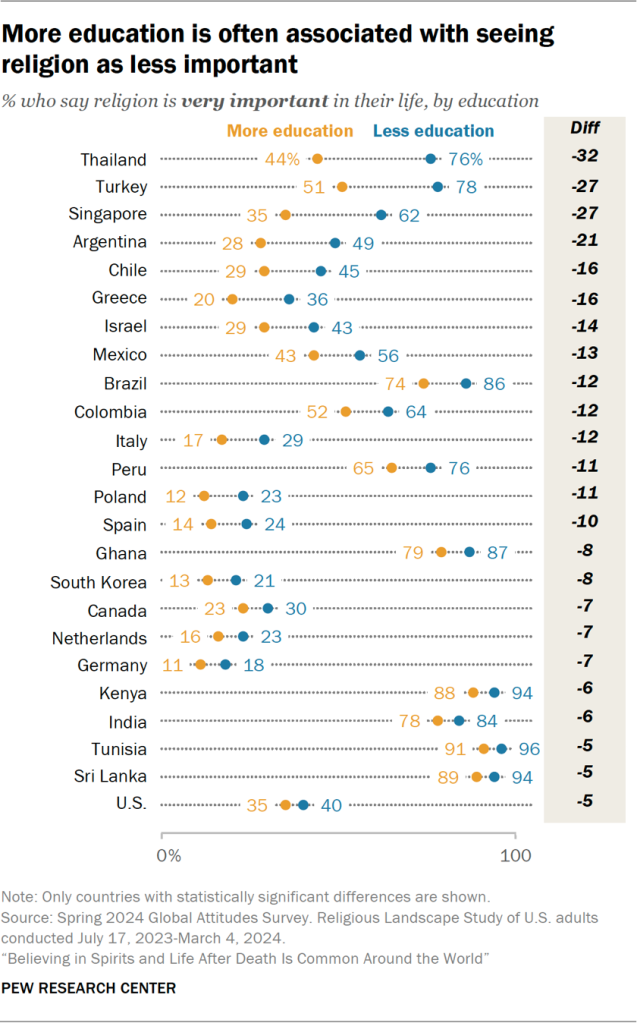
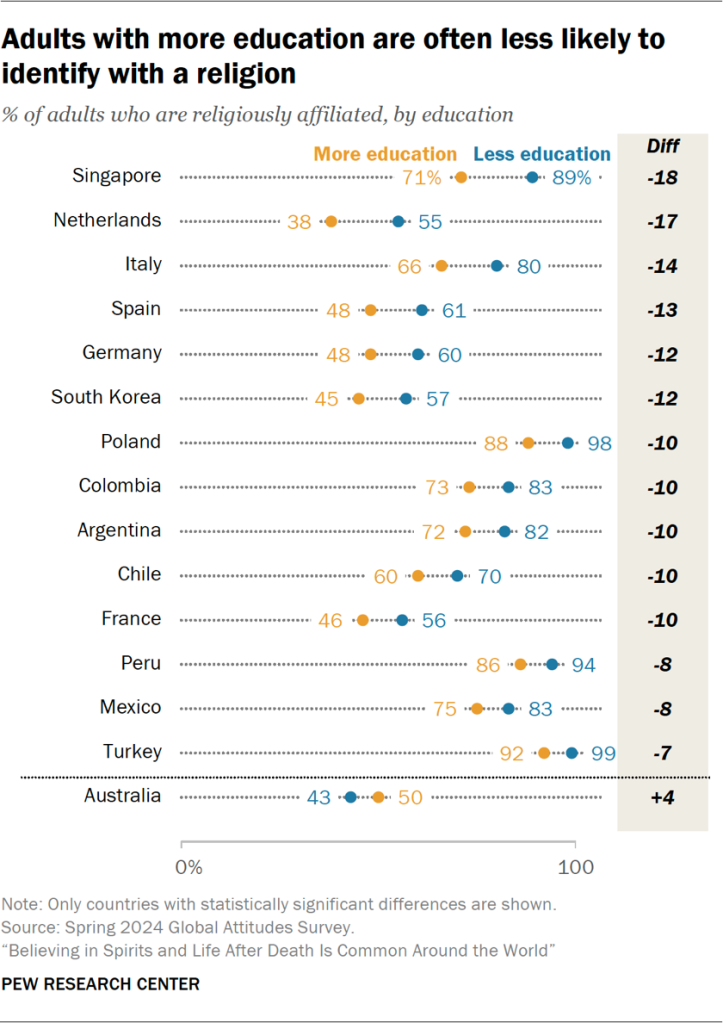
In many of the places we surveyed, people with less education are more likely than others to say that religion is very important in their lives and to identify with a religion.

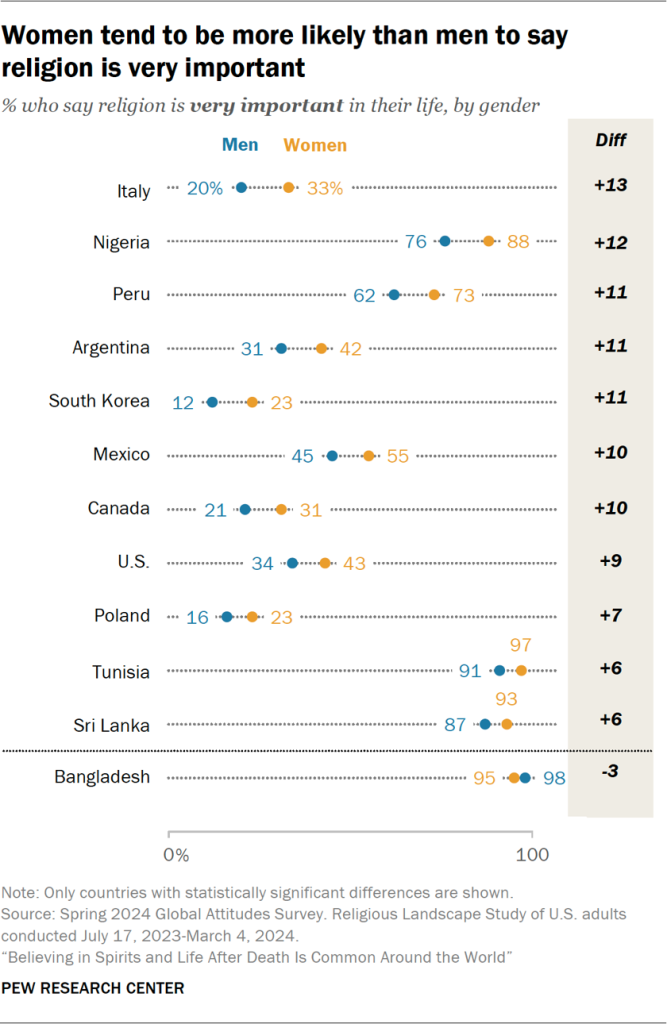
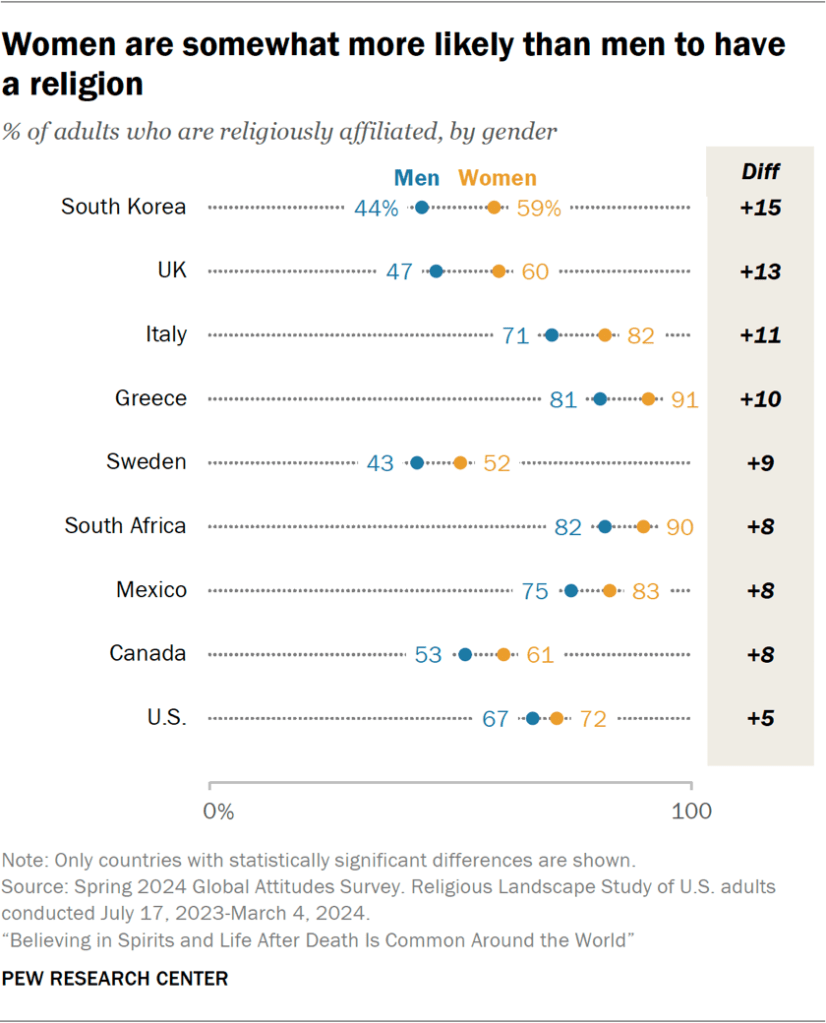
There also is a gender gap on these questions in some countries, with women more likely than men to say religion is very important to them personally. In some places, women also are more likely than men to be religiously affiliated.

Jump to more on: Personal importance of religion | Religious affiliation

How important is religion in your life?

Bar chart showing fewer Europeans say religion is important to them

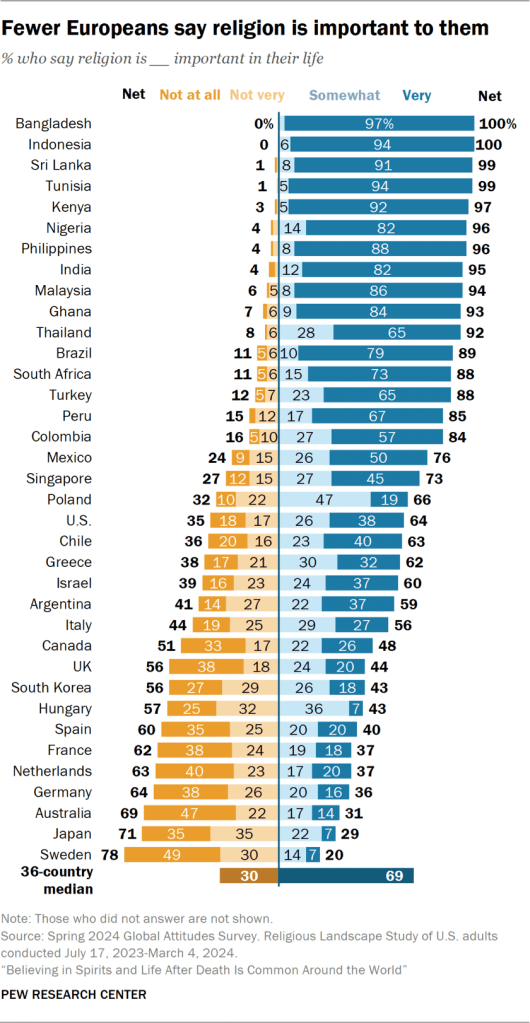
In a dozen of the 36 countries surveyed, about three-quarters or more of adults say religion is very important in their lives. People who live in South and Southeast Asia, as well as in Africa, are among the most likely to feel this way. In Bangladesh, for example, nearly everyone we surveyed (97%) said religion is very important to them.

At the same time, there also are roughly a dozen countries where only about one-quarter or fewer of adults say religion is very important in their lives. Many of these countries are in Europe and East Asia. For example, just 18% of French and South Korean adults ascribe a lot of personal importance to religion.

The United States, Israel and Argentina fall roughly in the middle of the countries surveyed: 38% of Americans say religion is very important in their lives, as do 37% of both Israelis and Argentinians.

Views by religion

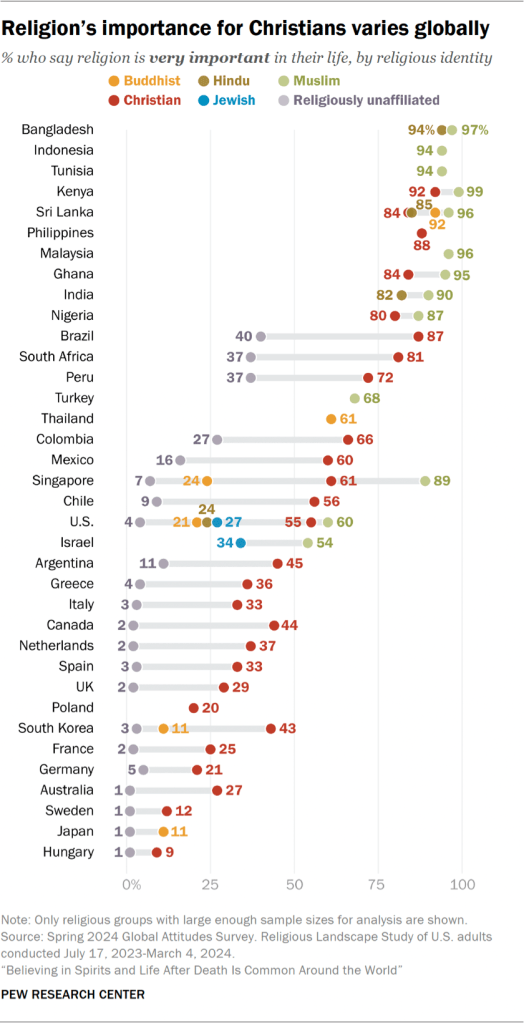
Muslims are consistently among the most likely to say religion is very important in their lives. In every country with a sample of Muslims large enough to analyze separately, at least half of Muslims say religion is very important to them. In many of these places, nine-in-ten or more Muslims express that sentiment.

Chart showing religion’s importance for Christians varies globally

Large shares of Hindus also tend to say religion is personally very important. In India, for instance, 82% of Hindus say this. However, Hindu Americans (24%) are much less likely than Hindus living in India, Bangladesh and Sri Lanka to place a lot of importance on religion. These are the only countries with enough Hindu respondents to break out their views separately.

In general, the share of Christians who say religion is very important in their lives also ranges widely around the world. In a few countries, the vast majority of Christians say religion is very important in their lives; this includes Christians in Kenya (92%), the Philippines (88%) and Brazil (87%). Much smaller majorities feel the same in Chile (56%) and the U.S. (55%). And in Sweden (12%) and Hungary (9%), relatively few Christians view religion as personally very important.

Religiously unaffiliated adults – people who describe themselves as atheist, agnostic or “nothing in particular” when asked about their religion – are consistently the least likely in each country to say religion is very important in their lives. In most places, 5% or fewer of the religiously unaffiliated population feels this way. For example, in Italy, only 3% of unaffiliated adults say this.

Still, in four countries – Brazil, Colombia, Peru and South Africa – at least a quarter of religiously unaffiliated adults say religion is personally very important to them.

Views by gender

In general, women are somewhat more likely than men to say that religion is very important in their lives.

Chart showing women tend to be more likely than men to say religion is very important

For example, one-third of Italian women see religion as personally very important, compared with 20% of Italian men.

And, in Sri Lanka, women are slightly more likely than men to hold this view (93% vs. 87%).

Bangladesh is the only country in the survey where men are more likely than women to say religion is very important in their lives (98% vs. 95%).

This general pattern echoes our previous research on the gender gap in religion around the world.

Views by education

In most countries surveyed, people who have more education are less likely than other adults to say religion is very important to them.

In Greece, for example, 20% of adults who have completed schooling beyond a secondary education say religion is very important in their lives. Meanwhile, 36% of Greeks with less schooling feel this way about religion.

(Secondary education is equivalent to high school in the U.S.)

Chart showing more education is often associated with seeing religion as less important

Religious affiliation

In nearly every country surveyed, having a religion is more common than not having one.

Bar chart showing that in 14 places surveyed, 95% of adults or more have a religion

And in 14 countries, religious affiliation is almost universal, with 95% or more of adults saying they identify with a religion.

These countries tend to have clear religious majorities. For instance, most people in Bangladesh identify as Muslims, most in Sri Lanka identify as Buddhists, and most Indians are Hindus. Likewise, nearly eight-in-ten Israelis are Jewish, and almost all Filipinos are Christian.

Countries with high affiliation rates are concentrated in South and Southeast Asia, Africa and the Middle East.

On the other hand, countries with substantial shares of religiously unaffiliated people are mostly in Europe, East Asia and the Americas.

In countries with large unaffiliated populations, Christians often make up the largest affiliated group.

However, there are some exceptions. In Singapore, a quarter of adults are Muslim, and nearly a quarter are Buddhist. Buddhists also make up significant portions of the Japanese and South Korean populations. And in South Africa, nearly one-in-five adults fall in the “other religions” category, including many who follow traditional African and ancestral religions, such as Zulu or San beliefs.3

For more on religious identity in the U.S., read “Decline of Christianity in the U.S. Has Slowed, May Have Leveled Off.”

For information on how people’s religious identities have changed within their lifetimes, including how people who have switched out of Christianity have boosted the ranks of the religiously unaffiliated in many countries, read “Around the World, Many People Are Leaving Their Childhood Religions.”

Differences in affiliation by education

In quite a few of the countries surveyed, adults who have more education are less likely to be religiously affiliated.

Chart showing adults with more education are often less likely to identify with a religion

In Italy, for instance, 66% of adults with schooling beyond a secondary education have a religion, compared with 80% of adults with a secondary education or less.

Only in Australia do we see the opposite: People with more education are slightly more likely than others to have a religion.

The negative relationship between education and religious affiliation mostly exists in countries where Christianity has historically been the majority religion. However, Singapore, South Korea and Turkey also show this pattern.

Differences in affiliation by age

In nearly two dozen of the surveyed countries, older adults (ages 50 and older) are at least somewhat more likely than the youngest adults (ages 18 to 34) to identify with a religion.

Just over half of older Japanese have a religion, for example, but only one-quarter of Japanese adults under 35 have one.

And in the U.S., 80% of older Americans are religiously affiliated, while 55% of the youngest U.S. adults identify with a religion.

Chart showing older adults often are more likely than younger adults to have a religion

Differences in affiliation by gender

In nine of the countries surveyed, women are more likely than men to be religiously affiliated. For instance, a majority of South Korean women have a religion (59%), compared with 44% of men in the country.

Chart showing women are somewhat more likely than men to have a religion

Women in the U.S. also are slightly more likely than men to say they have a religion (72% vs. 67%).

Acknowledgments

This analysis was produced by Pew Research Center as part of the Pew-Templeton Global Religious Futures project, which analyzes religious change and its impact on societies around the world. Funding for the Global Religious Futures project comes from The Pew Charitable Trusts and the John Templeton Foundation (grant 63095). This publication does not necessarily reflect the views of the John Templeton Foundation.

Some U.S. data in this report is from the 2023-24 Religious Landscape Study (RLS). The RLS was made possible by The Pew Charitable Trusts, which received support from the Lilly Endowment Inc., Templeton Religion Trust, The Arthur Vining Davis Foundations and the M.J. Murdock Charitable Trust. 

This report is a collaborative effort based on the input and analysis of the following individuals:

Primary research team

Jonathan Evans, Senior Researcher
Kirsten Lesage, Research Associate
William Miner, Research Analyst
Kelsey Jo Starr, Research Analyst
Manolo Corichi, Research Analyst

Research team

Becka A. Alper, Senior Researcher
Laura Clancy, Research Analyst
Alan Cooperman, Director, Religion Research
Sneha Gubbala, Research Analyst
Moira Fagan, Research Associate
Janell Fetterolf, Senior Researcher
Sofia Hernandez Ramones, Research Assistant
Christine Huang, Research Associate
Asta Kallo, Research Assistant
Jordan Lippert, Research Analyst
Besheer Mohamed, Senior Researcher
Justin Nortey, Research Analyst
Jacob Poushter, Associate Director, Global Attitudes Research
Andrew Prozorovsky, Research Assistant
Chip Rotolo, Research Associate
Laura Silver, Associate Director, Global Attitudes Research
Maria Smerkovich, Research Associate
Gregory A. Smith, Senior Associate Director, Religion Research
Patricia Tevington, Research Associate
Richard Wike, Director, Global Attitudes Research

Methods team

Ashley Amaya, Associate Director, Survey Methods
Dorene Asare-Marfo, Senior Panel Manager
Anna Brown, Research Methodologist
Courtney Kennedy, Vice President, Methods and Innovation
Arnold Lau, Research Methodologist
Carolyn Lau, International Research Methodologist
Andrew Mercer, Principal Methodologist
Patrick Moynihan, Associate Director, International Research Methods
Georgina Pizzolitto, Research Methodologist
Dana Popky, Associate Panel Manager
Sofi Sinozich, International Research Methodologist

Editorial and graphic design

Peter Bell, Associate Director, Design and Production
Dalia Fahmy, Senior Writer/Editor
Rebecca Leppert, Copy Editor
Bill Webster, Senior Information Graphics Designer

Communications and web publishing

Chris Baronavski, Lead Engineer, Editorial Content
Kelly Browning, User Experience Manager
Justine Coleman, Associate Digital Producer
Shannon Greenwood, Digital Production Manager
Maya Pottiger, Communications Associate
Hannah Taber, Communications Manager

Others at the Center who contributed to this report include Conrad Hackett and Samirah Majumdar.

We appreciate the following individuals for advising us on strategic outreach: Eugenia Mitchelstein, Associate Professor of Communication at Universidad de San Andrés (Argentina); Naziru Mikail Abubakar, Executive Director and Editor-in-Chief at the Daily Trust (Nigeria); Sebastián Lacunza, Columnist at elDiarioAR.com (Argentina); Anton Harber, Executive Director at the Campaign for Free Expression and Founder of the Mail & Guardian (South Africa); Admire Mare, Associate Professor and Head of the Department of Communication and Media Studies, University of Johannesburg (South Africa); and Monicah Waceke Ndungu, Chief Operating Officer, Nation Media Group (Kenya).

Methodology

About Pew Research Center’s Spring 2024 Global Attitudes Survey

Results for the survey are based on telephone, face-to-face and online interviews conducted under the direction of Gallup, Langer Research Associates, Social Research Centre and Verian. The results are based on national samples, unless otherwise noted. Here are more details about our international survey methodology and country-specific sample designs.

The American Trends Panel survey methodology

Results for the United States are based in part on surveys conducted on Pew Research Center’s American Trends Panel (ATP), a nationally representative panel of randomly selected U.S. adults. Panelists participate via self-administered web surveys. Panelists who did not have internet access at home were provided with a tablet and wireless internet connection. Interviews were conducted in both English and Spanish. The panel was managed by Ipsos.

Data in this report is drawn primarily from ATP Wave 143, conducted from Feb. 13 to 25, 2024. A total of 12,693 panelists responded out of 14,762 who were sampled, for a response rate of 89% (AAPOR RR3). The survey includes an oversample of 2,051 Jewish and Muslim Americans from Ipsos’ KnowledgePanel, SSRS’s Opinion Panel and NORC at the University of Chicago’s AmeriSpeak Panel. These oversampled groups are weighted to reflect their correct proportions in the population. The cumulative response rate accounting for nonresponse to the recruitment surveys and attrition is 4%. The break-off rate among panelists who logged on to the survey and completed at least one item is less than 1%. The margin of sampling error for the full sample of 12,693 respondents is plus or minus 1.5 percentage points.

Additional survey questions were asked on ATP Wave 132, conducted from July 31 to Aug. 6, 2023, among 11,201 panelists. Here is the methodology for Wave 132.

Further survey questions were asked on the Religious Landscape Study (RLS), a national cross-sectional survey conducted for Pew Research Center by NORC at the University of Chicago. It was conducted mainly online and on paper from July 17, 2023, to March 4, 2024, among a nationally representative sample of 36,908 adults. Here is the methodology for the RLS.

For information about which survey questions were asked on which U.S. survey, refer to the Topline.

ATP Panel recruitment

The ATP was created in 2014, with the first cohort of panelists invited to join the panel at the end of a large, national, landline and cellphone random-digit-dial survey that was conducted in both English and Spanish. Two additional recruitments were conducted using the same method in 2015 and 2017, respectively. Across these three surveys, a total of 19,718 adults were invited to join the ATP, of whom 9,942 (50%) agreed to participate.

Table showing the American Trends Panel recruitment surveys

In August 2018, the ATP switched from telephone to address-based sampling (ABS) recruitment. A study cover letter and a pre-incentive are mailed to a stratified, random sample of households selected from the U.S. Postal Service’s Delivery Sequence File. This Postal Service file has been estimated to cover as much as 98% of the population, although some studies suggest that the coverage could be in the low 90% range.4 Within each sampled household, the adult with the next birthday is asked to participate. Other details of the ABS recruitment protocol have changed over time but are available upon request.5

We have recruited a national sample of U.S. adults to the ATP approximately once per year since 2014. In some years, the recruitment has included additional efforts (known as an “oversample”) to boost sample size with underrepresented groups. For example, Hispanic, Black and Asian adults were oversampled in 2019, 2022 and 2023, respectively.

Across the six address-based recruitments, a total of 23,862 adults were invited to join the ATP, of whom 20,917 agreed to join the panel and completed an initial profile survey. Of the 30,859 individuals who have ever joined the ATP, 11,920 remained active panelists and continued to receive survey invitations at the time this survey was conducted.

The American Trends Panel never uses breakout routers or chains that direct respondents to additional surveys.

Sample design

The overall target population for ATP Wave 143 was noninstitutionalized persons ages 18 and older living in the U.S., including Alaska and Hawaii. All active panel members who completed the ATP wave which fielded from July 31 to Aug. 6, 2023 (ATP W132), or panelists who previously identified as Jewish or Muslim, were invited to participate in this wave.

The ATP was supplemented with an oversample of self-identified Jewish and Muslim American panelists from three other probability panels: Ipsos’ KnowledgePanel, SSRS’s Opinion Panel, and NORC at the University of Chicago’s AmeriSpeak panel. All panelists who met the selection criteria were selected with certainty.

Questionnaire development and testing

The questionnaire was developed by Pew Research Center in consultation with Ipsos, SSRS and NORC. The survey for ATP and KP panelists was programmed by Ipsos, while the survey for SSRS and NORC panelists was programmed by SSRS. A small number of SSRS panelists took their survey over the phone with an interviewer. Both web programs were rigorously tested on both PC and mobile devices by the Ipsos, SSRS and NORC project management teams and Pew Research Center researchers. The Ipsos project management team also populated test data that was analyzed in SPSS to ensure the logic and randomizations were working as intended before launching the survey.

Incentives

All ATP respondents were offered a post-paid incentive for their participation. Respondents could choose to receive the post-paid incentive in the form of a check or a gift code to Amazon.com or could choose to decline the incentive. Incentive amounts ranged from $5 to $20 depending on whether the respondent belongs to a part of the population that is harder or easier to reach. Differential incentive amounts were designed to increase panel survey participation among groups that traditionally have low survey response propensities.

Respondents from the Ipsos KnowledgePanel, SSRS Opinion Panel and AmeriSpeak were offered the cash equivalent of $10 for completing this survey.

Data collection protocol

The data collection field period for this survey was Feb. 13 to 25, 2024. Postcard notifications were mailed to a subset of ATP panelists with a known residential address on Feb. 12.6

Invitations were sent out in separate launches. Sixty ATP panelists and 300 KP panelists were included in the soft launch, which began with an initial invitation sent on Feb. 13. The ATP and KP panelists chosen for the soft launch were known responders who had completed previous surveys within one day of receiving their invitation. All remaining ATP and KP sampled panelists were included in the full launch and were sent an invitation on Feb. 14.

Table showing the invitation and reminder dates in ATP Wave 143

Overall, 129 SSRS panelists were included in the SSRS soft launch, which began with an initial invitation on Feb. 14. And 110 NORC panelists were included in the NORC soft launch, which began with an initial invitation on Feb. 15. All remaining SSRS and NORC sampled panelists were included together in the full launch and were sent an invitation on Feb. 15.

All panelists with an email address received an email invitation and up to four email reminders if they did not respond to the survey. All ATP panelists who consented to SMS messages received an SMS invitation and up to four SMS reminders.

Data quality checks

To ensure high-quality data, the Center’s researchers performed data quality checks to identify any respondents showing clear patterns of satisficing. This includes checking whether respondents left questions blank at very high rates or always selected the first or last answer presented. As a result of this checking, six ATP respondents were removed from the survey dataset prior to weighting and analysis.

Weighting

The data was weighted in a multistep process that accounts for multiple stages of sampling and nonresponse that occur at different points in the survey process. First, each panelist begins with a base weight that reflects their probability of inclusion in the panel to which they belong. Separately for each of the four panels (ATP, KP, SSRS, NORC), the base weights for Muslim and Jewish respondents were scaled to be proportional to the group’s effective sample size. These weights were then combined and calibrated so that the overall proportions of Jewish and Muslim respondents respectively match the National Public Opinion Reference Survey (NPORS) benchmark.

Table showing the American Trends Panel weighting dimensions

This weight is then calibrated again to align with the full set of population benchmarks identified in the accompanying table (which also includes the NPORS benchmarks for the shares of Jewish and Muslim adults). To reduce the loss in precision stemming from variance in the weights, the weights were trimmed separately among Jewish, Muslim, Hispanic, non-Hispanic Black and non-Hispanic Asian respondents at the 98th percentile, and among all other respondents at the 99.5th percentile. Sampling errors and tests of statistical significance take into account the effect of weighting.

The following table shows the unweighted sample sizes and the error attributable to sampling that would be expected at the 95% level of confidence for different groups in the survey.

Table showing the sample sizes and margins of error in ATP Wave 143

For questions asked on ATP Wave 143, this analysis reports the opinions of 6,712 U.S. Christians – slightly more than the 6,634 included in the previous analysis of U.S. data. This analysis also reports the opinions of 3,207 religiously unaffiliated adults in the U.S. – slightly more than the 3,205 included in the previous analysis. The sample size differences are attributable to small differences in the backcoding of religious identity questions across the two studies.

Sample sizes and sampling errors for other subgroups are available upon request. In addition to sampling error, one should bear in mind that question wording and practical difficulties in conducting surveys can introduce error or bias into the findings of opinion polls.

Dispositions and response rates

Table showing the final dispositions in ATP Wave 143
Table showing the cumulative response rate as of ATP Wave 143

Analysis

We analyzed respondents’ attitudes based on their religious identification, how often they pray, their educational attainment and whether they live in high- or middle-income countries.

Religious identification

In each country surveyed, people were asked about their current religious identification. We then analyzed religious groups with sufficiently large sample sizes to be reliable. Respondents of other religious backgrounds were still included in the surveys, even if we were not able to analyze their religious group separately. In the U.S., for example, both ATP surveys (Waves 132 and 143) included Buddhists and Hindus, even though there were not enough respondents from these smaller groups to report on their answers separately. In the RLS, however, the survey’s larger sample size allows for separate analyses of Buddhists and Hindus, as well as Christians, Jews, Muslims and the religiously unaffiliated.

Rates of prayer

Throughout this report, we compare adults who pray daily or more often with those who pray less often. In these comparisons, the category of adults who pray less often includes those who say they never pray.

Education

To compare educational groups across countries, we standardized education levels based on the United Nations’ International Standard Classification of Education (ISCED).

High- and middle-income countries

We classified the countries in this report as being either high or middle income on the basis of categories from the World Bank that rely on per capita gross national income. This is a classification we have used in multiple other Pew Research Center analyses, including when looking at global views of China, satisfaction with democracy, globalization and national identity.