Pew Research Center

FOR RELEASE APRIL 30, 2025

Most U.S. Catholics Say They Want the Church To Be ‘More Inclusive’

But there are large divides between Catholics who attend Mass weekly, and those who don’t, in what they want from the church

BY Patricia Tevington and Gregory A. Smith

FOR MEDIA OR OTHER INQUIRIES:

Communications Department
202.419.4372
www.pewresearch.org

RECOMMENDED CITATION

Pew Research Center, April 2025, "Most U.S. Catholics Say They Want the Church To Be ‘More Inclusive’"

About Pew Research Center

Pew Research Center is a nonpartisan, nonadvocacy fact tank that informs the public about the issues, attitudes and trends shaping the world. It does not take policy positions. The Center conducts public opinion polling, demographic research, computational social science research and other data-driven research. It studies politics and policy; news habits and media; the internet and technology; religion; race and ethnicity; international affairs; social, demographic and economic trends; science; research methodology and data science; and immigration and migration. Pew Research Center is a subsidiary of The Pew Charitable Trusts, its primary funder.

© Pew Research Center 2026

Table of contents

  • About Pew Research Center
  • Most U.S. Catholics Say They Want the Church To Be ‘More Inclusive’
  • Acknowledgments
  • Methodology

Most U.S. Catholics Say They Want the Church To Be ‘More Inclusive’

But there are large divides between Catholics who attend Mass weekly, and those who don’t, in what they want from the church

How we did this

Pew Research Center conducted this survey to better understand how U.S. Catholics view the Catholic Church.

For this report, we surveyed 1,787 Catholic respondents from Feb. 3 to 9, 2025. All of the respondents were members of the American Trends Panel, a group of people recruited through national, random sampling of residential addresses who have agreed to take surveys regularly. This kind of recruitment gives nearly all U.S. adults a chance of selection. Surveys are conducted either online or by telephone with a live interviewer. The survey is weighted to be representative of the U.S. adult population by gender, race, ethnicity, partisan affiliation, education, and other factors. Read more about the ATP’s Methodology.

Here are the questions used for this report , along with responses, and the survey methodology.

With the death of Pope Francis, the College of Cardinals is expected to gather May 7 to choose the next head of the Catholic Church. A Pew Research Center survey conducted in early February – before the pope’s hospitalization on Feb. 14 – finds that majorities of U.S. Catholics express views that differ from church teachings on issues such as birth control, marriage and the priesthood. For example:

  • 84% of U.S. Catholics say the church should allow Catholics to use birth control.
  • 83% say the church should allow couples to use in vitro fertilization (IVF) to get pregnant.
  • 68% say the church should allow women to become deacons.
  • 63% say the church should allow priests to get married.
  • 59% say the church should ordain women as priests.
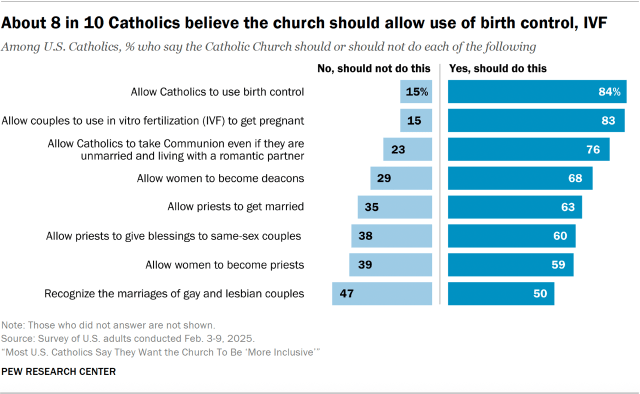
Bar chart showing about 8 in 10 Catholics believe the church should allow use of birth control, IVF
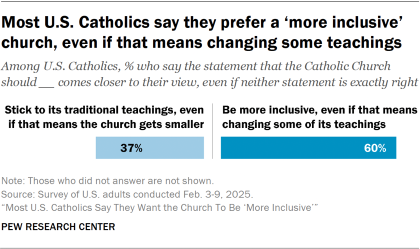
Most U.S. Catholics say they prefer a ‘more inclusive’ church, even if that means changing some teachings

When asked to choose which of two contrasting statements comes closer to their view, 60% of U.S. Catholics say the church “should be more inclusive, even if that means changing some of its teachings,” while 37% say the church “should stick to its traditional teachings, even if that means the church gets smaller.”

How we worded these questions

We used simple, common phrases in the survey questions about some steps that Catholics would – or would not – like to see the church take. Our goal was to make the questions easy to understand for as many respondents as possible. In some cases, the wording of the questions involved a trade-off between broad understandability and theological nuance.

For example, one question asks whether the church should “allow priests to get married.” This would not, strictly speaking, be a change in doctrine. The Catholic Church already allows married priests under certain circumstances, such as if a man was married before being ordained in an Eastern Catholic Church. Technically, the church considers the rule of celibacy for priests to be a “discipline” rather than a doctrine. Nonetheless, allowing parish priests to get married and continue in their duties would represent a big change in the everyday life of the church in the United States. 

Similarly, another question asks whether the church should allow unmarried Catholics who “are living with a romantic partner” to receive Communion. Actually, Catholicism has no rule against unmarried people living together. The church’s teaching is that sexual activity outside of marriage is a grave sin, and that anyone “conscious of a grave sin” should not take Communion unless they have been to confession.

Yet another example concerns contraception. The survey asks whether the church should allow Catholics to “use birth control.” But the church does not object to married couples using natural methods (i.e., abstaining from sex during fertile periods) to “space the births of their children.” Rather, the objection is to using methods that prevent the sexual act from resulting in conception, including “condoms, hormonal birth control pills and sterilization.”

On all these topics, there are large differences between the responses of Catholics who go to church at least once a week and those who do not.1 Those who say they go weekly are:
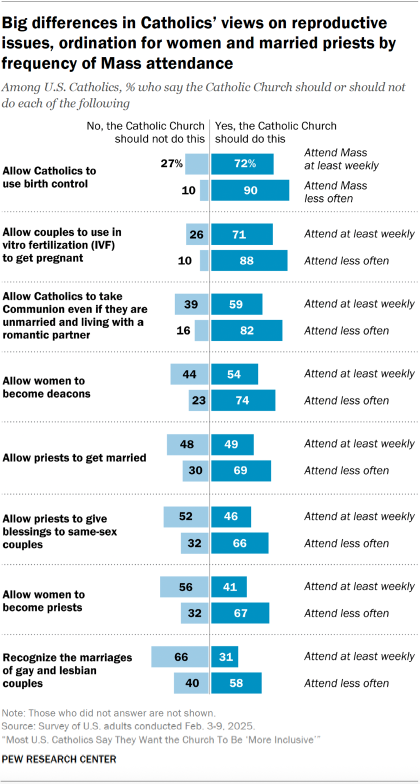
Big differences in Catholics’ views on reproductive issues, ordination for women and married priests by frequency of Mass attendance
  • 20 percentage points less likely to favor allowing women to serve as deacons (54% vs. 74%)
  • 20 points less likely to favor allowing priests to get married (49% vs. 69%)
  • 18 points less likely to favor allowing Catholics to use birth control (72% vs. 90%)
  • 17 points less likely to favor allowing couples to use IVF (71% vs. 88%)

Slightly more than half of Catholics who attend Mass weekly (56%) say the church should not allow women to become priests, while 66% say the church should not recognize the marriages of gay and lesbian couples.

53% of U.S. Catholics who attend Mass weekly say the church should stick to its traditional teachings, even if that means it gets smaller

Additionally, Catholics who attend Mass weekly are 22 points more likely than Catholics who don’t go to Mass weekly to say they think the church should stick to its traditional teachings, even if that means the church gets smaller.

(Among the U.S. Catholic population overall, roughly three-in-ten say they attend Mass at least once a week, while the remainder say they go less often or not at all. For more information about the religious and demographic characteristics of U.S. Catholics, read “10 facts about U.S. Catholics.”)

Still, most weekly Mass attenders say the church should allow Catholics to use birth control (72%) and IVF (71%). A majority (59%) also says the church should permit people to receive Communion even if they are unmarried and living with a romantic partner. And about half favor ordaining women as deacons, allowing priests to marry, and permitting priests to give blessings to same-sex couples.
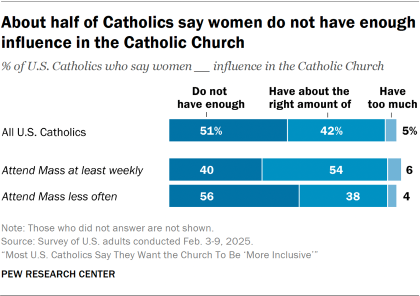
About half of Catholics say women do not have enough influence in the Catholic Church

When asked about the influence of women in the church, 51% of U.S. Catholics say women “do not have enough” influence, while 42% say women currently have “about the right amount” of influence. Far fewer (5%) say women have “too much” influence.

The survey also finds:

  • Women are somewhat more likely than men to want a “more inclusive” church, and to say women don’t have enough influence in the church.
  • Catholic Republicans and independents who lean Republican tend to take more traditional stances than Catholic Democrats and Democratic leaners on the survey’s questions about ordaining women, allowing priests to get married, allowing Catholics to use birth control and IVF, and other questions.

This is one of a series of reports on a Pew Research Center survey conducted Feb. 3-9, 2025, among a nationally representative sample of 1,787 Catholic adults. The survey was completed prior to Pope Francis’ Feb. 14 hospitalization and his death in April.

An earlier report focused on U.S. Catholics’ opinions about Francis and his two immediate predecessors, Benedict XVI and St. John Paul II. Future reports will explore various kinds of connections to Catholicism among U.S. adults and delve into American Catholics’ involvement in parish life.

For more on views of Pope Francis, read “Pope Francis and public opinion: Key findings from our surveys.”

For more on how U.S. Catholics have answered some of these questions in past surveys, jump to this report’s section on trends.

Views on inclusivity in the church
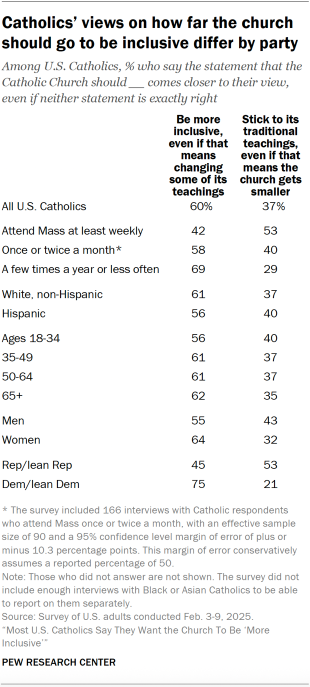
Catholics’ views on how far the church should go to be inclusive differ by party

When asked which of two broad statements about the church’s direction comes closer to their view, 64% of Catholic women say the Catholic Church should be “more inclusive, even if that means changing some of its teachings,” while 32% say the church should “stick to its traditional teachings, even if that means the church gets smaller.” Among Catholic men, 55% say they prefer a more inclusive church and 43% say the church should stick to its traditional teachings.

There is a stark partisan divide on this question. Three-quarters of Catholics who are Democrats or lean Democratic prefer a more inclusive church, even if that means changing some teachings. Among Catholics who are Republicans or GOP leaners, slightly less than half (45%) say the church should be more inclusive.

(According to the 2023-24 Religious Landscape Study, about half of Catholics who are registered voters – 53% – identify with or lean toward the Republican Party, while 43% affiliate with the Democratic Party. For more, refer to “10 facts about U.S. Catholics.”)

There are no significant differences by age or between White and Hispanic Catholics on this topic.

Views about birth control and IVF
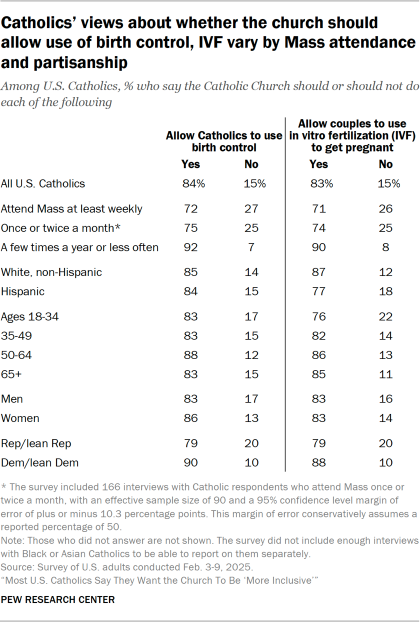
Catholics’ views about whether the church should allow use of birth control, IVF vary by Mass attendance and partisanship

Overall, 84% of U.S. Catholics say the church should allow Catholics to use birth control, and 83% say the church should permit couples to use in vitro fertilization (IVF) to get pregnant.

Support for these ideas is lower among Catholics who attend Mass weekly and among Catholic Republicans than it is among Catholics who attend Mass less often and among Catholic Democrats.

Still, majorities in every Catholic subgroup we analyzed say they think the church should allow Catholics to use birth control and IVF.

Views about Communion for unmarried cohabiting couples, blessings for same-sex couples, recognizing marriages of gay and lesbian couples
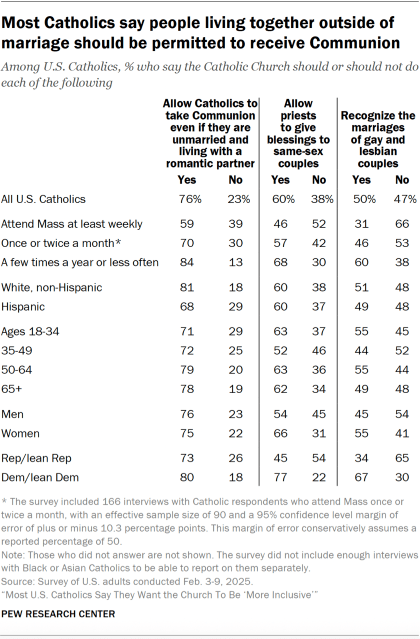
Most Catholics say people living together outside of marriage should be permitted to receive Communion

About three-quarters of U.S. Catholics (76%) say the church should allow Catholics to take Communion even if they are unmarried and living with a romantic partner. Support for this idea is lower among Catholic Republicans than Catholic Democrats, and lower among Catholics who attend Mass weekly than among those who attend less often. Still, majorities in all these groups say the church should allow people living with a romantic partner to receive Communion.

Six-in-ten Catholics say the church should allow priests to bless same-sex couples. And half of Catholics say the church should recognize marriages of gay and lesbian couples.

But most Catholics who attend Mass weekly oppose having the church recognize marriages of gay and lesbian couples, as do most Catholics who are Republicans or GOP leaners. By contrast, most Catholics who attend Mass a few times a year or less often say the church should recognize the marriages of gay and lesbian couples, as do most Catholic Democrats.

Views about marriage and gender in the priesthood and the diaconate
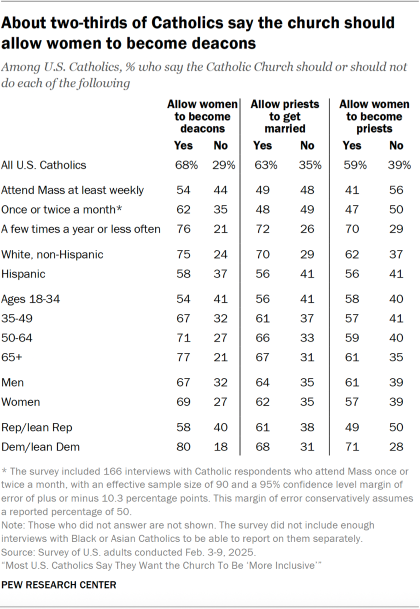
About two-thirds of Catholics say the church should allow women to become deacons

Most U.S. Catholics say the church should allow women to become deacons (68%), should allow priests to marry (63%), and should allow women to become priests (59%).

But Catholics who attend Mass weekly are less likely than Catholics overall to express these views. For example, 54% of Catholics who attend Mass weekly say the church should allow women to become deacons and 41% say the church should allow women to become priests.

Related: Under Pope Francis, the College of Cardinals became less European

Trends in views about birth control, the priesthood and sexuality

Pew Research Center has asked some of the questions analyzed in this report in previous surveys.

The percentage of U.S. Catholics who say the church should allow Catholics to use birth control is about the same now as it was in early 2024 and somewhat higher than when we asked these questions roughly a decade ago. A similar pattern emerges on the question of whether the church should allow Catholics to take Communion even if they are unmarried and living with a partner.
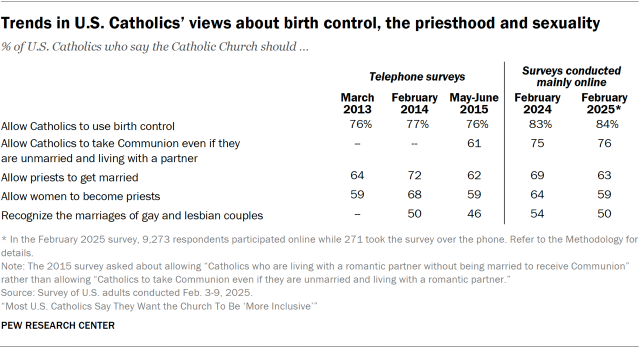
Trends in U.S. Catholics’ views about birth control, the priesthood and sexuality

On the other hand, the percentages of Catholics who support letting priests get married, letting women become priests, and recognizing the marriages of gay and lesbian couples have dipped slightly since the same questions were last asked in 2024, and are roughly on par with readings from about a decade ago.2

Views of women’s influence in the church
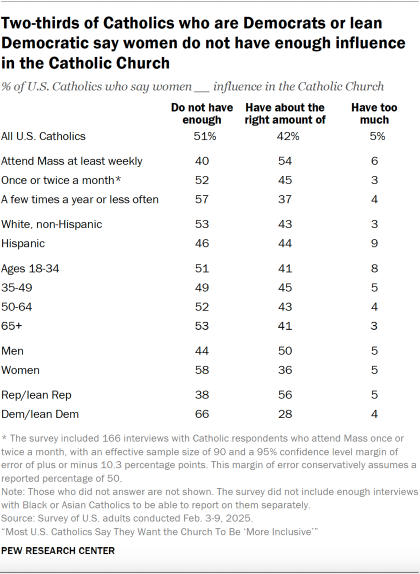
Two-thirds of Catholics who are Democrats or lean Democratic say women do not have enough influence in the Catholic Church

About half of U.S. Catholics (51%) say women do not have enough influence in the Catholic Church, while about four-in-ten (42%) say women have about the right amount of influence. A small share – just 5% – say women have too much influence in the church.

Among Catholics who attend Mass weekly, the most common response to this question is that women have about the right amount of influence in the Catholic Church. By contrast, most Catholics who attend Mass a few times a year or less often say women do not have enough influence.

About six-in-ten Catholic women (58%) feel that women do not have enough influence in the church, compared with 44% of Catholic men who express this view.

Looking at partisan breakdowns, two-thirds of Catholic Democrats say that women do not have enough influence in the church, compared with 38% of Republican Catholics.
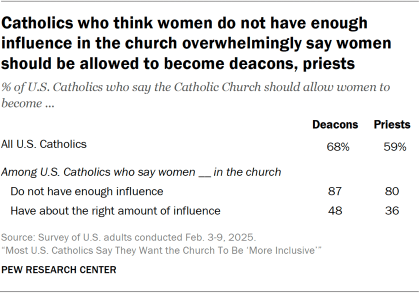
Catholics who think women do not have enough influence in the church overwhelmingly say women should be allowed to become deacons, priests

Among Catholics who feel that women don’t have enough influence in the church, 87% say the church should allow women to be deacons and 80% want to allow women to be priests.

Among Catholics who think that women currently have about the right amount of influence, far fewer say the church should allow women to become priests (36%) or deacons (48%).
Acknowledgments

Pew Research Center is a subsidiary of The Pew Charitable Trusts, its primary funder. This report is a collaborative effort based on the input and analysis of the following individuals. Find related reports online at pewresearch.org/religion.

Primary researchers

Patricia Tevington, Research Associate
Gregory A. Smith, Senior Associate Director, Religion Research

Research team

Alan Cooperman, Director, Religion Research 
Becka A. Alper, Senior Researcher
Besheer Mohamed, Senior Researcher
Chip Rotolo, Research Associate
Justin Nortey, Research Analyst
Asta Kallo, Research Assistant

Methods team          

Ashley Amaya, Associate Director, Survey Methods
Andrew Mercer, Senior Research Methodologist
Courtney Kennedy, Vice President, Methods and Innovation
Dorene Asare-Marfo, Panel Manager
Dana Popky, Associate Panel Manager
Anna Brown, Research Methodologist
Arnold Lau, Research Methodologist                         

Editorial and graphic design

Jeff Diamant, Senior Writer/Editor
Rebecca Leppert, Copy Editor
Bill Webster, Senior Information Graphics Designer

Communications and web publishing

Shannon Greenwood, Digital Production Manager
Justine Coleman, Associate Digital Producer
Hannah Taber, Communications Manager
Anna Schiller, Associate Director, Strategic Communications

In addition, Pew Research Center is grateful to expert advisers who provided valuable input on the questionnaire for this project: Tricia Bruce, Director of the Springtide Research Institute; Maureen Day, Research Affiliate at the Center for Religion and Civic Culture at the University of Southern California; Michele Dillon, Professor of Sociology at the University of New Hampshire; David Gibson, Director of the Center on Religion and Culture at Fordham University; Mark Gray, Director of CARA Catholic Polls at the Center for Applied Research in the Apostolate; Hosffman Ospino, Professor of Hispanic Ministry and Religious Education at Boston College; Tia Noelle Pratt, Assistant Vice President for Mission Engagement and Strategic Initiatives at Villanova University; and Stephen White, Executive Director of The Catholic Project at The Catholic University of America and Fellow at the Catholic Studies Program at the Ethics and Public Policy Center.

Methodology

The American Trends Panel survey methodology

Overview

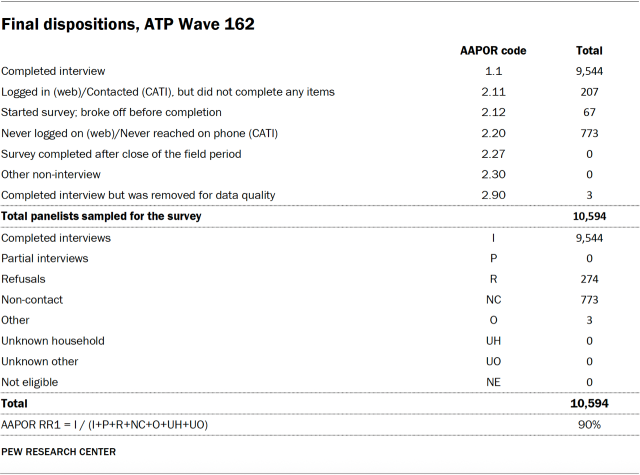
Data in this report comes from Wave 162 of the American Trends Panel (ATP), Pew Research Center’s nationally representative panel of randomly selected U.S. adults. The survey was conducted from Feb. 3 to 9, 2025. A total of 9,544 panelists (including 1,787 Catholics) responded out of 10,594 who were sampled, for a survey-level response rate of 90%.

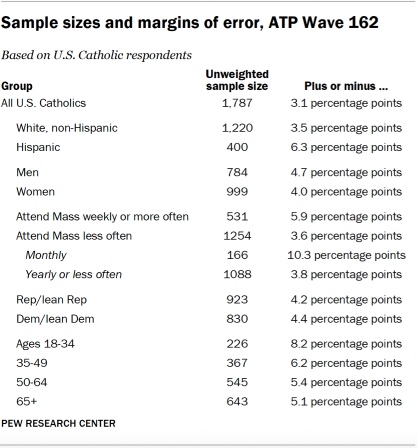
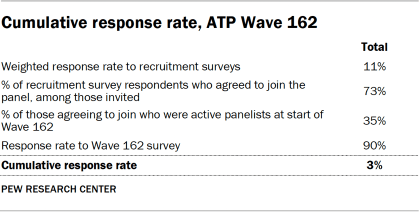
The cumulative response rate accounting for nonresponse to the recruitment surveys and attrition is 3%. The break-off rate among panelists who logged on to the survey and completed at least one item is 1%. The margin of sampling error for the sample of 1,787 Catholic respondents is plus or minus 3.1 percentage points.

SSRS conducted the survey for Pew Research Center via online (n=9,273) and live telephone (n=271) interviewing. Interviews were conducted in both English and Spanish.

To learn more about the ATP, read “About the American Trends Panel.”

Panel recruitment

Since 2018, the ATP has used address-based sampling (ABS) for recruitment. A study cover letter and a pre-incentive are mailed to a stratified, random sample of households selected from the U.S. Postal Service’s Computerized Delivery Sequence File. This Postal Service file has been estimated to cover 90% to 98% of the population.3 Within each sampled household, the adult with the next birthday is selected to participate. Other details of the ABS recruitment protocol have changed over time but are available upon request.4 Prior to 2018, the ATP was recruited using landline and cellphone random-digit-dial surveys administered in English and Spanish.

A national sample of U.S. adults has been recruited to the ATP approximately once per year since 2014. In some years, the recruitment has included additional efforts (known as an “oversample”) to improve the accuracy of data for underrepresented groups. For example, Hispanic adults, Black adults and Asian adults were oversampled in 2019, 2022 and 2023, respectively.

Sample design

The overall target population for this survey was noninstitutionalized persons ages 18 and older living in the United States. All active panel members were invited to participate in this wave.

Questionnaire development and testing

The questionnaire was developed by Pew Research Center in consultation with SSRS. The web program used for online respondents was rigorously tested on both PC and mobile devices by the SSRS project team and Pew Research Center researchers. The SSRS project team also populated test data that was analyzed in SPSS to ensure the logic and randomizations were working as intended before launching the survey.

Incentives

All respondents were offered a post-paid incentive for their participation. Respondents could choose to receive the post-paid incentive in the form of a check or gift code to Amazon.com, Target.com or Walmart.com. Incentive amounts ranged from $5 to $20 depending on whether the respondent belongs to a part of the population that is harder or easier to reach. Differential incentive amounts were designed to increase panel survey participation among groups that traditionally have low survey response propensities.

Data collection protocol

The data collection field period for this survey was Feb. 3 to 9, 2025. Surveys were conducted via self-administered web survey or by live telephone interviewing. 

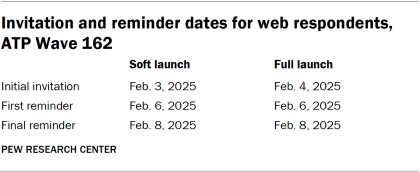
For panelists who take surveys online: Postcard notifications were mailed to a subset on Feb. 3.5 Survey invitations were sent out in two separate launches: soft launch and full launch. Sixty panelists were included in the soft launch, which began with an initial invitation sent on Feb. 3. All remaining English- and Spanish-speaking sampled online panelists were included in the full launch and were sent an invitation on Feb. 4.

Catholics who think women do not have enough influence in the church overwhelmingly say women should be allowed to become deacons, priests

Panelists participating online were sent an email invitation and up to two email reminders if they did not respond to the survey. ATP panelists who consented to SMS messages were sent an SMS invitation with a link to the survey and up to two SMS reminders.

For panelists who take surveys over the phone with a live interviewer: Prenotification postcards were mailed on Jan. 31. Soft launch took place on Feb. 3 and involved dialing until a total of 15 interviews had been completed. All remaining English- and Spanish-speaking sampled phone panelists’ numbers were dialed throughout the remaining field period. Panelists who take surveys via phone can receive up to six calls from trained SSRS interviewers.

Data quality checks

To ensure high-quality data, Center researchers performed data quality checks to identify any respondents showing patterns of satisficing. This includes checking for whether respondents left questions blank at very high rates or always selected the first or last answer presented. As a result of this checking, three ATP respondents were removed from the survey dataset prior to weighting and analysis.

Weighting

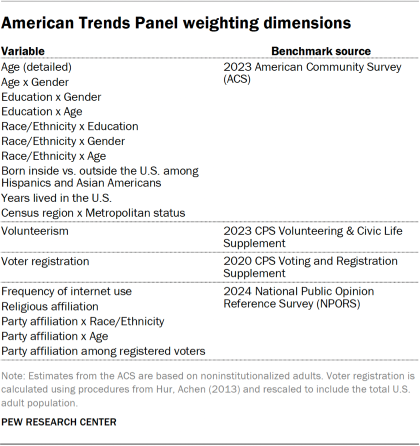
The ATP data is weighted in a process that accounts for multiple stages of sampling and nonresponse that occur at different points in the panel survey process. First, each panelist begins with a base weight that reflects their probability of recruitment into the panel. These weights are then calibrated to align with the population benchmarks in the accompanying table to correct for nonresponse to recruitment surveys and panel attrition. If only a subsample of panelists was invited to participate in the wave, this weight is adjusted to account for any differential probabilities of selection.

Among the panelists who completed the survey, this weight is then calibrated again to align with the population benchmarks identified in the accompanying table and trimmed at the 1st and 99th percentiles to reduce the loss in precision stemming from variance in the weights. Sampling errors and tests of statistical significance take into account the effect of weighting.

American Trends Panel weighting dimensions

The following table shows the unweighted sample sizes and the error attributable to sampling that would be expected at the 95% level of confidence for different groups in the survey.

Sample sizes and margins of error, ATP Wave 162

Sample sizes and sampling errors for other subgroups are available upon request. In addition to sampling error, one should bear in mind that question wording and practical difficulties in conducting surveys can introduce error or bias into the findings of opinion polls.

Dispositions and response rates

Final dispositions, ATP Wave 162
Cumulative response rate, ATP Wave 162