Pew Research Center

FOR RELEASE DECEMBER 7, 2023

Spirituality Among Americans

7 in 10 U.S. adults describe themselves as spiritual in some way, including 22% who are spiritual but not religious

BY Becka A. Alper, Chip Rotolo, Patricia Tevington, Justin Nortey and Asta Kallo

FOR MEDIA OR OTHER INQUIRIES:

Communications Department
202.419.4372
www.pewresearch.org

RECOMMENDED CITATION

Pew Research Center, December 2023, "Spirituality Among Americans"

About Pew Research Center

Pew Research Center is a nonpartisan, nonadvocacy fact tank that informs the public about the issues, attitudes and trends shaping the world. It does not take policy positions. The Center conducts public opinion polling, demographic research, computational social science research and other data-driven research. It studies politics and policy; news habits and media; the internet and technology; religion; race and ethnicity; international affairs; social, demographic and economic trends; science; research methodology and data science; and immigration and migration. Pew Research Center is a subsidiary of The Pew Charitable Trusts, its primary funder.

© Pew Research Center 2026

Table of contents

  • About Pew Research Center
  • Spirituality Among Americans
  • 1. Measuring spirituality
  • 2. Spiritual beliefs
  • 3. Spiritual practices
  • 4. Spiritual experiences
  • 5. Who are ‘spiritual but not religious’ Americans?
  • Acknowledgments
  • Methodology

Spirituality Among Americans

7 in 10 U.S. adults describe themselves as spiritual in some way, including 22% who are spiritual but not religious

How we did this

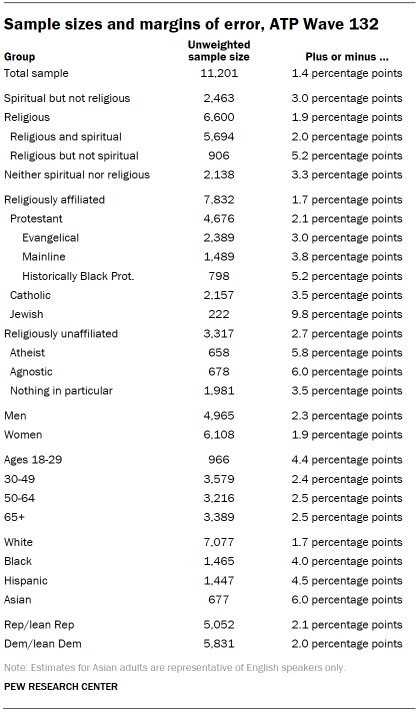
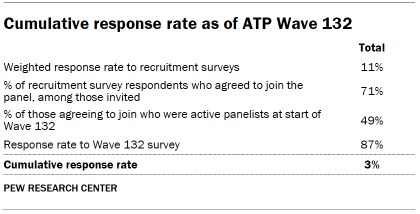
Pew Research Center conducted this survey to explore what spirituality means to Americans and to see whether various beliefs, practices and experiences that people may think of as spiritual are common. For this report, we surveyed 11,201 respondents from July 31 to Aug. 6, 2023. All respondents to the survey are part of Pew Research Center’s American Trends Panel (ATP), an online survey panel recruited through national random sampling of residential addresses, which gives nearly all U.S. adults a chance of selection. The survey is weighted to be representative of the U.S. adult population by gender, race, ethnicity, partisan affiliation, education, religious affiliation and other categories.

For more, refer to the ATP’s Methodology and the Methodology for this report. Read the questions used in this report.

In recent decades, Americans have become less likely to identify with an organized religion. Yet a new Pew Research Center survey shows that belief in spirits or a spiritual realm beyond this world is widespread, even among those who don’t consider themselves religious. The survey finds that: 

  • 83% of all U.S. adults believe people have a soul or spirit in addition to their physical body.
  • 81% say there is something spiritual beyond the natural world, even if we cannot see it.
  • 74% say there are some things that science cannot possibly explain.
  • 45% say they have had a sudden feeling of connection with something from beyond this world.
  • 38% say they have had a strong feeling that someone who has passed away was communicating with them from beyond this world.
  • 30% say they have personally encountered a spirit or unseen spiritual force.

Overall, 70% of U.S. adults can be considered “spiritual” in some way, because they think of themselves as spiritual people or say spirituality is very important in their lives.

Chart shows most Americans believe people have a soul or spirit

These are among the key findings of a new Pew Research Center survey of American spirituality, conducted July 31-Aug. 6, 2023, among a nationally representative sample of 11,201 members of our American Trends Panel.

This report covers the following topics:

  • Measuring spirituality
  • Spiritual beliefs
  • Spiritual practices
  • Spiritual experiences
  • Who are ‘spiritual but not religious’ Americans?

Is spirituality increasing?

Because this is the first time Pew Research Center has asked many of these questions about beliefs, practices and experiences that may be viewed as spiritual, we do not know whether they are more – or less – common today than they were in the past.

Previous research has found a decline in traditional religious beliefs and practices. That includes a drop in the shares of U.S. adults who say they believe in God with absolute certainty, attend religious services regularly, pray daily and consider religion to be very important in their lives.

Some news articles have speculated that young Americans may be turning away from organized religion and replacing it with their own mix of spiritual elements drawn from many sources, including Asian religions and Native American traditions, as well as New Age beliefs about crystals, tarot cards and the like. Media coverage has often focused, in particular, on people who describe themselves as “spiritual but not religious.”

While Pew Research Center surveys have documented a decline since 2007 in the percentage of Americans who identify as Christian, the evidence that “religion” is being replaced by “spirituality” is much weaker, partly because of the difficulty of defining and separating those concepts.

This survey is intended to help fill the gap. We plan to use our new questions about spiritual beliefs, practices and experiences as a baseline, re-asking them periodically to see which measures are rising, which are falling and which are stable. And rather than imposing a definition of spirituality, we will let survey respondents tell us what it means to them and how they practice it.

What is spirituality?

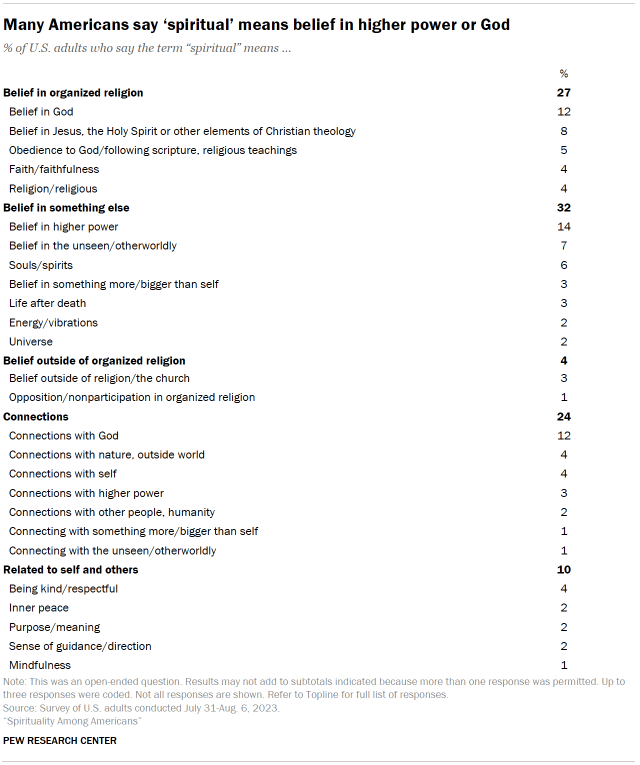
In an effort to understand what Americans have in mind when they talk about spirituality, the survey asked respondents to explain, in their own words, what “spiritual” means to them. Fully 27% define “spiritual” by mentioning beliefs or faiths associated with organized religion, such as belief in God (12%); Jesus, the Holy Spirit or elements of Christian theology (8%); or obedience to religious teachings (5%).  

Many also say the word “spiritual” is about connections (24%), frequently with God but also, in some cases, with one’s inner self. One-in-ten Americans say the term relates to understanding themselves or guiding their own behavior, including being kind or respectful (4%), finding inner peace (2%), purpose or meaning (2%) or a sense of guidance and direction (2%).

These open-ended responses illustrate the difficulty of separating “spirituality” from “religion” and suggest that for many Americans, there is no clear dividing line.

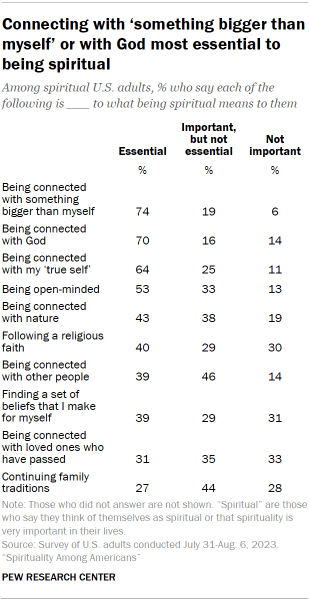
To further explore the meaning of spirituality and its overlap with religion, the survey presented “spiritual” Americans (i.e., those who consider themselves spiritual or who say spirituality is very important in their lives) with a list of items and asked them to say which ones are “essential” to what being spiritual means to them. They could select as many items as they wished.

Chart shows Most spiritual Americans say being connected with ‘something bigger than myself’ is essential to being spiritual

Overall, the top three answers – out of 10 possible items – were “being connected with something bigger than myself” (74%), “being connected with God” (70%) and “being connected with my true self” (64%). 

Smaller but still substantial shares of respondents (roughly four-in-ten or more) chose items such as “being open-minded,” “being connected with nature,” “following a religious faith,” “finding a set of beliefs that I make for myself” and “being connected with other people.”

For more discussion of what Americans mean by spirituality, jump to Chapter 1.

Americans’ beliefs about spirits and the afterlife

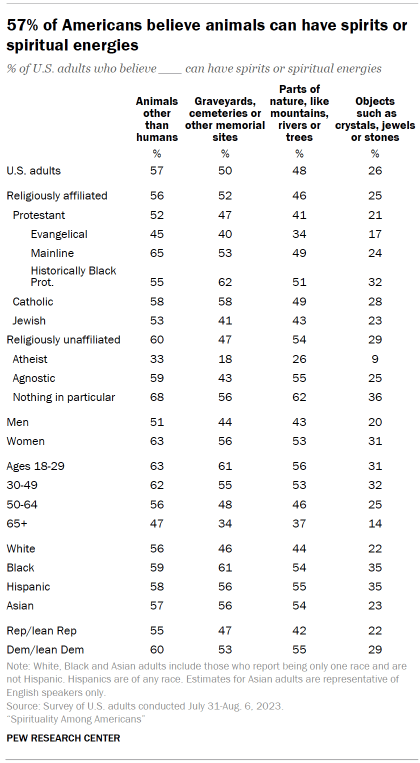
An overwhelming majority of U.S. adults (83%) say they believe that people have a soul or spirit in addition to their physical body. A smaller majority (57%) believes that animals other than humans can have their own spirits or spiritual energies.

Half of Americans believe that spirits can inhabit burial places, such as graveyards, cemeteries or other memorial sites. And a similar share (48%) says that parts of the natural landscape – such as mountains, rivers or trees – can have spirits or spiritual energies.

About a quarter of U.S. adults believe that spirits or spiritual energy can reside in certain objects, such as crystals, jewels or stones (26%).
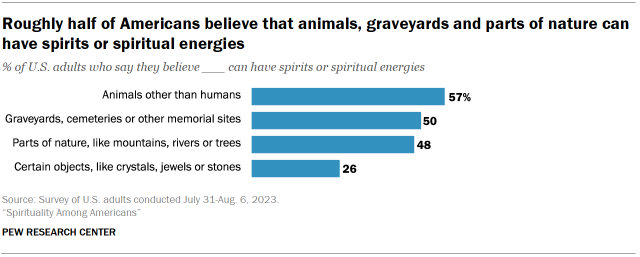
Chart shows roughly half of Americans believe that animals, graveyards and parts of nature can have spirits or spiritual energies

What do Americans believe about life after death?

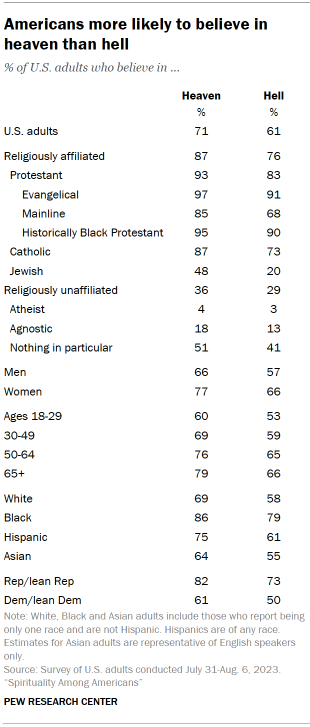
The survey finds that 71% of Americans believe in heaven, while somewhat fewer – 61% – believe in hell and 60% believe in both. These numbers have held steady in recent years.1 But there is less consensus about whether the dead have various powers, such as the ability to follow what is happening in this world and to watch out for loved ones who are alive.

We explored these beliefs for the first time by asking whether it is “definitely true,” “probably true,” “probably not true” or “definitely not true” that people who have already died can do a variety of things. (Respondents also were able to say they were “not sure.”)

More than half of U.S. adults (57%) believe that in the afterlife, people definitely or probably can reunite with loved ones who also have died.
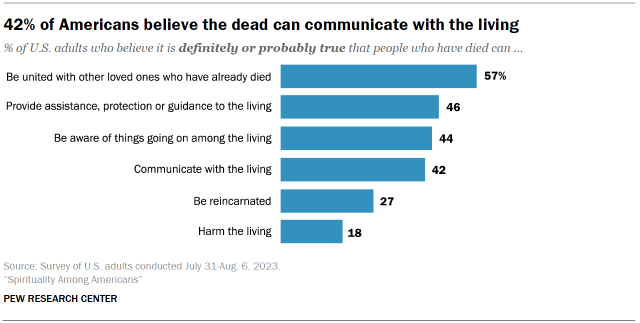
Chart shows 42% of Americans believe the dead can communicate with the living

About four-in-ten or more Americans say that dead people definitely or probably can assist, protect or guide the living (46%), be aware of what’s going on among the living (44%) or communicate with people who are still living (42%). Overall, U.S. adults are more than twice as likely to say that the dead can help the living (46%) as they are to say that the dead can harm the living (18%).

About a quarter of U.S. adults believe it is definitely or probably true that the dead can be reincarnated (27%), defined in the survey as being “reborn again and again in this world.”2

Spiritual experiences and practices

Some kinds of spiritual experiences seem to be relatively common. For example, 46% of U.S. adults say that at least once or twice a month they feel a deep sense of wonder about the universe. A similar share (44%) say they feel a deep sense of spiritual peace and well-being that often.
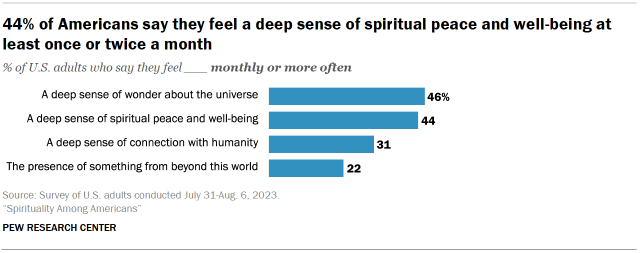
Chart shows 44% of Americans say they feel a deep sense of spiritual peace and well-being at least once or twice a month

Feeling a deep sense of connection with humanity and feeling “the presence of something from beyond this world” are less common. Still, about one-fifth of Americans or more say they have such feelings at least once or twice a month.

To gauge experiences that may be relatively rare, we asked respondents whether they have ever had specific otherworldly experiences.

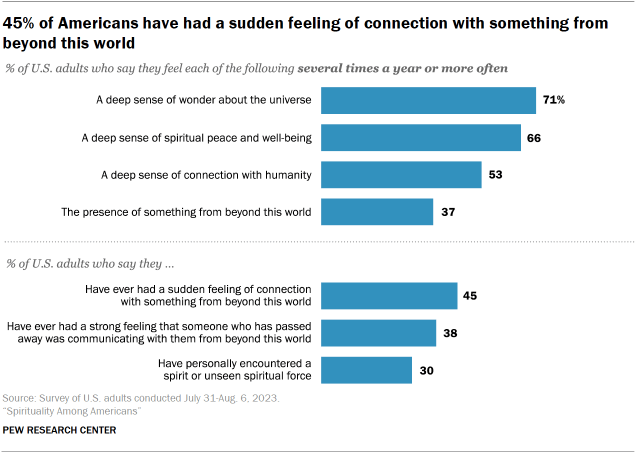
Fully 45% say they have had a sudden feeling of connection with something from beyond this world, and 38% say they’ve had a strong feeling that someone who previously passed away was communicating with them from beyond this world. Three-in-ten say they believe in spirits or unseen spiritual forces and also say they have personally encountered one.
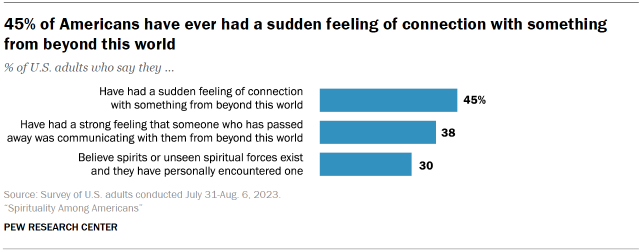
Chart shows 45% of Americans have ever had a sudden feeling of connection with something from beyond this world

How do Americans practice spirituality?

To measure some common spiritual practices, we asked survey respondents how often they pursue five activities: looking inward or centering themselves, meditating, doing yoga, exercising and spending time in nature.

Whether these activities are spiritual depends, of course, on one’s definition of spirituality. As previously noted, many Americans explain the meaning of “spiritual” by talking about various kinds of connections – such as with God or something bigger than themselves, with their innermost selves, with loved ones who have died or with all humanity.

With that understanding of spirituality in mind, we asked survey respondents to select the most important reason why they engage in each of these activities: Is it to “feel connected” with something bigger than themselves, with their “true self” or with other people? Is it to get health benefits, including relaxation? To have fun and enjoy the experience? Or for other reasons? 

A total of 77% of U.S. adults say they spend time in nature at least a few times a month, and 26% say they do so mainly to feel connected, such as with something bigger than themselves (18%) or with their “true self” (6%). Half of Americans say they spend time in nature mainly for health benefits, to enjoy themselves or for other reasons.

By comparison, fewer Americans (64%) say they look inward or center themselves at least a few times each month. But a relatively large share – 44% of all U.S. adults – say they look inward or center themselves mainly to feel connected, including 27% who do it mainly to feel connected with their “true self.”

Roughly four-in-ten Americans meditate at least a few times a month (38%), including 22% of U.S. adults who meditate mainly to connect with their “true self” (11%) or with something bigger than themselves (10%).
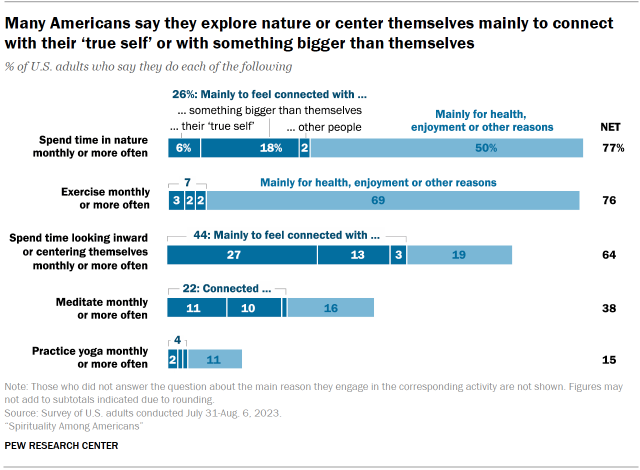
Chart shows Many Americans say they explore nature or center themselves mainly to connect with their ‘true self’ or with something bigger than themselves

How many Americans gather in spiritual communities?

Americans are more likely to report gathering in religious communities than meeting in spiritual groups. Fully 39% of U.S. adults say they are involved in a religious community, such as a church or religious congregation, while 14% say they are involved in “a spiritual community, such as a group that helps [them] find a connection with something bigger than [themselves], nature or other people.”

Moreover, most people who are involved in a spiritual community are also involved in a religious one: 10% of U.S. adults say they are involved in both kinds of groups, while just 4% of all U.S. adults say they are involved in a spiritual community and not a religious one.

What kinds of things do Americans have for spiritual reasons?
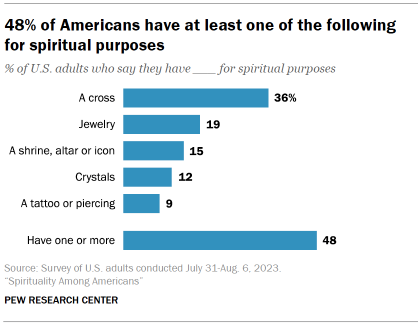
Chart shows 48% of Americans have at least one of the following for spiritual purposes

More than one-third of U.S. adults say they have a cross for spiritual purposes, and 19% say they have some jewelry (which could also be a cross) that serves a spiritual purpose.

Also, 15% of Americans say they maintain a shrine, altar or icon in their home; 12% possess crystals for spiritual purposes; and 9% have a tattoo or piercing for a spiritual purpose.

How many Americans are spiritual?
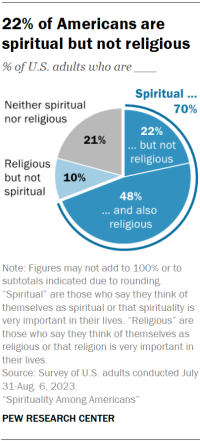
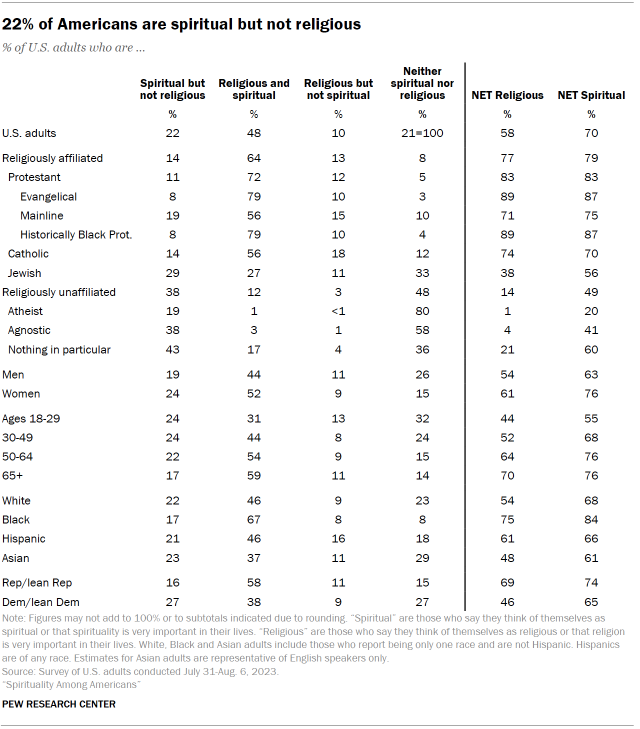
Chart shows 22% of Americans are spiritual but not religious

Seven-in-ten U.S. adults think of themselves as spiritual or say that spirituality is very important in their lives. To be sure, most of these people also consider themselves religious or say that religion is very important in their lives. There is enough overlap between what people mean by “spirituality” and what they have in mind by “religion” that nearly half of U.S. adults indicate they are both religious and spiritual.

Still, 22% of U.S. adults fall into the category of spiritual but not religious. The new survey offers a rich portrait of this group, showing what beliefs they hold, how they practice their spirituality, and how they tend to differ from U.S. adults who embrace the “religious” label.

What do ‘spiritual but not religious’ people believe?

The survey finds that on many questions, “spiritual but not religious” Americans – SBNRs, for short – are no more spiritual, on average, than U.S. adults who are both religious and spiritual. For example, large majorities in both groups say they believe “people have a soul or spirit in addition to their physical body.” Smaller majorities of both groups believe in the existence of “spirits or unseen spiritual forces.”
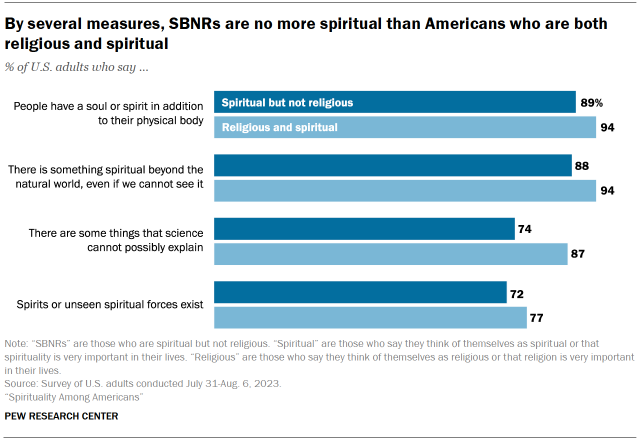
Chart shows by several measures, SBNRs are no more spiritual than Americans who are both religious and spiritual

But SBNRs are more likely to see spiritual forces at work in nature. For example, 71% of SBNRs believe that spirits or spiritual energies can be found in parts of nature like mountains, rivers or trees. Far fewer adults who are both religious and spiritual (46%) share this belief. Also, most SBNRs say that being connected with nature is “essential” to what being spiritual means to them (59%), an outlook that is less common among Americans who describe themselves as both religious and spiritual (35%).
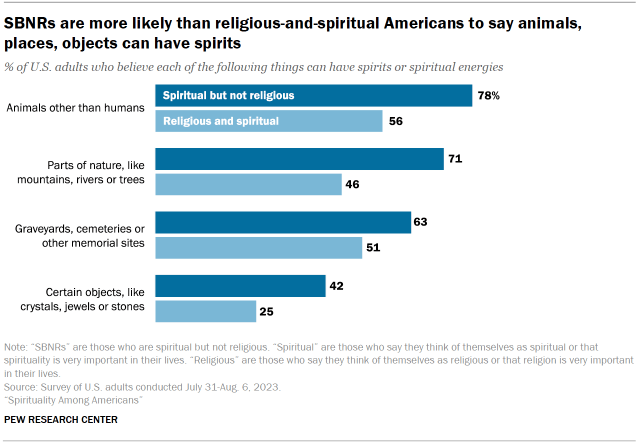
Chart shows SBNRs are more likely than religious-and-spiritual Americans to say animals, places, objects can have spirits

SBNRs are much less likely than Americans who are both religious and spiritual to believe in the God of the Bible (20% vs. 84%). On the other hand, they are much more likely to say they believe there is “some other higher power or spiritual force in the universe” (73% vs. 15%).

Spiritual but not religious Americans express more negative views of organized religion than religious-and-spiritual adults do. For example, 42% of SBNRs say religion causes division and intolerance, while just 12% of religious-and-spiritual adults take that position. And 13% of SBNRs say that the statement “religion encourages people to do the right thing and treat other people well,” describes their views a “great deal” compared with 57% of Americans who are both religious and spiritual.

Very few SBNRs attend religious worship services. Just 2% say they attend weekly or more often, compared with 40% of adults who are both religious and spiritual. SBNRs are also less likely than religious-and-spiritual Americans to say they are involved in a spiritual community that is extremely or very important to them (5% vs. 14%).

But SBNRs are somewhat more likely than religious-and-spiritual U.S. adults to spend time “looking inward or centering” themselves: 78% of SBNRs say they do this at least a few times each month, as do 67% of adults who are both religious and spiritual.

And, although they don’t consider themselves religious or say religion is very important in their lives, many SBNRs do claim a religious affiliation. When asked about their present religion, 45% say they are affiliated with a religion – including 21% who identify as Protestant and 12% who identify as Catholic – while 54% say they are religiously unaffiliated (i.e., atheist, agnostic or “nothing in particular”).

For more information on spiritual but not religious Americans, including their political leanings and their age, education, gender and other demographic characteristics, go to Chapter 5.
1. Measuring spirituality

How does one go about counting the number of spiritual people in the United States? And how do Americans define spirituality? In preparation for this survey, we reviewed the academic literature on spirituality and consulted with scholars who have published on the topic. It quickly became clear that there is no single, widely accepted definition of spirituality.

Some experts view spirituality as a broad realm and see organized religions as a small part of it.3 Others view religion and spirituality as overlapping circles, often with religious traditions being the bigger circle in American life.4 Some define spirituality as beliefs or experiences connected with the supernatural: “something beyond” humans or beyond the material world. Others think spirituality also can be about looking inward into the depths of the self, or about feeling connected with other humans, other creatures or nature.

One common perception is that the label of “religious” has been tarnished by scandals, while the label of “spiritual” carries mostly positive associations. As a result, it’s possible that declining numbers of Americans may describe themselves as religious and rising numbers may call themselves spiritual, even if their underlying beliefs and practices haven’t really changed. This means it is important to measure the way people label themselves separately from what they believe, what they have experienced, and how they practice whatever they consider to be religion and/or spirituality.

For all these reasons, we did not begin this research project with preconceived definitions of spirituality or religion. Rather, we took a practical or functional approach, posing a series of questions to a nationally representative sample of U.S. adults:

  • Do you think of yourself as spiritual? (Yes or No)
  • Do you think of yourself as religious? (Yes or No)
  • How important is spirituality in your life? (Very, Somewhat, Not too, or Not at all important)
  • How important is religion in your life? (Very, Somewhat, Not too, or Not at all important)

We also posed a follow-up question to those who think of themselves as spiritual or who say spirituality is very important to them, presenting a list of 10 possible aspects of spirituality and asking them to say which ones are essential to them.

And, we asked all the survey respondents, no matter how they labeled themselves, to tell us in their own words what “spiritual” means to them.

This chapter details how our sample of more than 11,000 U.S. adults answered that set of questions and how we categorized them, depending on their answers, into four groups:

  • Religious and spiritual (48% of U.S. adults)
  • Spiritual but not religious (22%)
  • Religious but not spiritual (10%)
  • Neither spiritual nor religious (21%)

Other chapters look, separately, at how the respondents answer many other questions about their beliefs, practices and experiences.

This approach allows us to compare the beliefs, practices and experiences of people in each of our four categories and, especially, to look for the distinguishing characteristics of Americans who are in the spiritual but not religious (SBNR) category, which is summarized briefly in the Overview of this report and detailed in the final chapter.

Who says they are spiritual or religious?

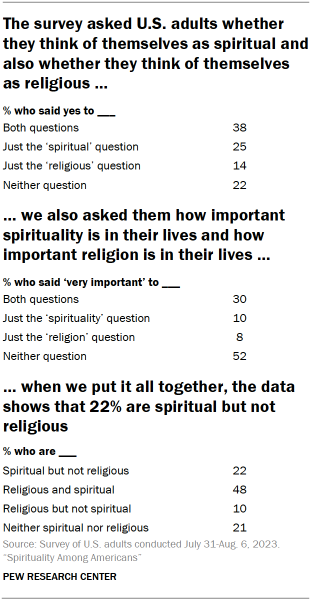
Table shows the survey asked U.S. adults whether they think of themselves as spiritual and also whether they think of themselves as religious; we also asked them how important spirituality is in their lives and how important religion is in their lives; when we put it all together, the data shows that 22% are spiritual but not religious

The survey asked whether Americans think of themselves as spiritual and, separately, whether they think of themselves as religious. Among Americans overall:

  • 64% think of themselves as spiritual, and 53% think of themselves as religious.
  • 38% think of themselves as both religious and spiritual.
  • 25% think of themselves as spiritual but not religious, and 14% consider themselves religious but not spiritual.

U.S. adults were also asked how important spirituality is in their lives and, separately, how important religion is in their lives.

  • 40% say spirituality is very important in their lives, and 38% say that religion is very important.
  • 30% of Americans say that both spirituality and religion are very important in their lives.
  • 10% say spirituality is very important in their lives but religion is not, and 8% say religion is very important but spirituality is not.

Putting these all together, 70% of Americans think of themselves as spiritual or say that spirituality is very important in their lives. And 58% think of themselves as religious or say that religion is very important in their lives. In total:

  • 22% of Americans are spiritual but not religious (SBNR).
  • 48% are religious and spiritual.
  • 10% are religious but not spiritual.
  • 21% are neither spiritual nor religious.

How religious affiliation fits into this picture

Most Americans who are affiliated with a religion are both religious and spiritual (64%). This includes 79% each of evangelical Protestants and members of the historically Black Protestant tradition, as well as 56% each of mainline Protestants and Catholics.

Of the U.S. religious groups that are large enough to be analyzed separately in this report, Jews are the most likely to be spiritual but not religious (29%) and the least likely to be both religious and spiritual (27%).5

The survey included respondents of many other religious backgrounds, including members of the Church of Jesus Christ of Latter-day Saints (widely known as Mormons), Muslims, Hindus and Buddhists. But there are not enough respondents from these smaller groups to report on their answers separately.

About half of religiously unaffiliated adults – those who answer a question about their religion by saying they are atheist, agnostic or “nothing in particular” – are neither spiritual nor religious (48%), including 80% of atheists and 58% of agnostics.

Table shows 22% of Americans are spiritual but not religious

Essential elements of spirituality

Table shows Connecting with ‘something bigger than myself’ or with God most essential to being spiritual

To further gauge how Americans think about spirituality, the survey asked those who are spiritual whether each of 10 items is “essential,” “important but not essential,” or “not important” to what being spiritual means to them.

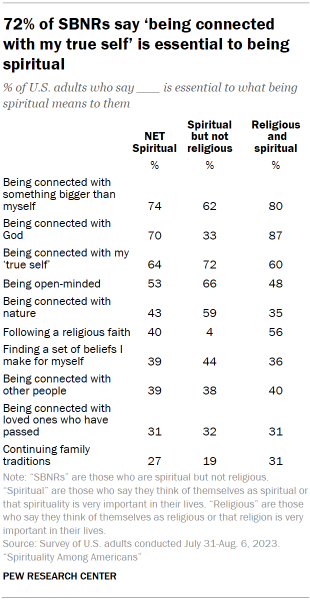
Most spiritual Americans say “being connected with something bigger than myself” (74%) is essential to what being spiritual means to them, along with “being connected with God” (70%) and “being connected with my true self” (64%).

Many also say “being open-minded” (53%), “being connected with nature” (43%), “following a religious faith” (40%), “being connected with other people” (39%) or “finding a set of beliefs that I make for myself” (39%) are essential to being spiritual.

Fewer spiritual Americans say “being connected with loved ones who have passed” (31%) or “continuing family traditions” (27%) are essential to what being spiritual means to them.

What do people in different religious groups think is essential to being spiritual?

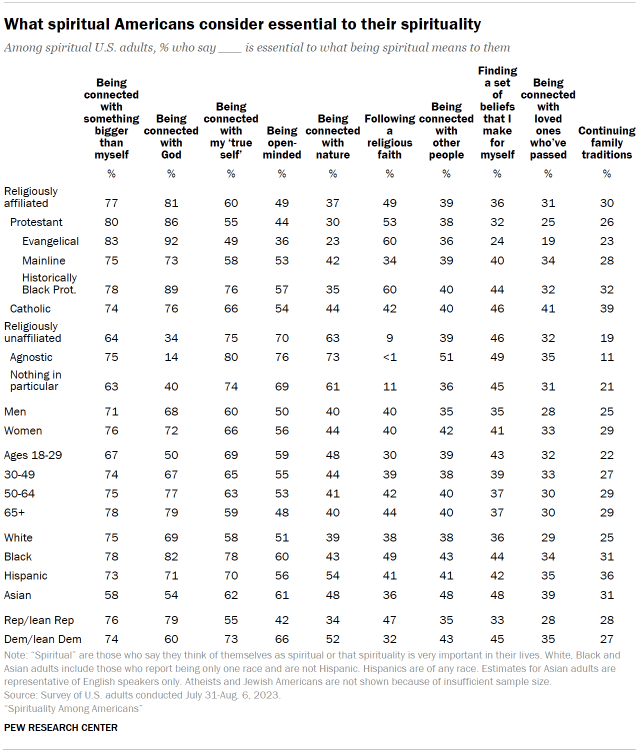
Evangelical Protestants and members of the historically Black Protestant tradition who describe themselves as spiritual (either by saying that they think of themselves as spiritual or that spirituality is very important in their lives) stand out for a tendency to say that “being connected with God” is essential to what being spiritual means to them. Fully 92% of evangelicals and 89% of members of historically Black Protestant churches who are spiritual take this position. They are also the most likely of the large religious groups analyzed to say that “following a religious faith” is essential.

Compared with spiritual adults who are affiliated with a religion, unaffiliated spiritual adults are more likely to say that “being open-minded” (70%) and “being connected with nature” (63%) are essential to what being spiritual means to them.

Across the board, spiritual Americans in most of the demographic groups included in this analysis say that “being connected with something bigger than myself” is essential to what being spiritual means to them.

The survey also asked spiritual adults whether there is anything else (other than the 10 listed items) they consider essential to what spirituality means to them. Respondents could answer this open-ended question however they wished. Among the more common answers were being kind or respectful (9%); believing in Jesus, the Holy Spirit or other elements of Christian theology (5%); and following religious teachings or scripture (4%).

(For more details, go to the Topline.)

Table shows what spiritual Americans consider essential to their spirituality

What does ‘spiritual’ mean?

In addition to asking spiritual respondents what they view as essential to being spiritual, we also asked all surveyed respondents to describe, in their own words, what the term “spiritual” means to them. We categorized their responses based on the types of beliefs, experiences or other concepts they mentioned.

Fully 27% give descriptions tied to organized religion. For example, they cite belief in God (12%), or belief in Jesus, the Holy Spirit or other elements of Christian theology (8%). On the other hand, 4% say explicitly that spirituality is separate from or outside of organized religion – including opposition to, or nonparticipation in, organized religion (1%).

About one-third of respondents (32%) offer responses that mention beliefs in what we categorized as “something else,” such as belief in a higher power (14%) or belief in the unseen or otherworldly (7%). 

About one-quarter of Americans, when asked to describe the term “spiritual” in their own words, mention connections (24%), such as with God (12%), nature (4%) or with themselves (4%).

One-in-ten Americans say the term relates to understanding themselves or guiding their own behavior, including efforts to be kind or respectful (4%), finding inner peace (2%), purpose and meaning (2%) or a sense of guidance and direction (2%).

Table shows Many Americans say ‘spiritual’ means belief in higher power or God

In their own words, how some respondents described what ‘spiritual’ means to them

Here are a few of the thousands of answers we got to this open-ended question, lightly edited for spelling and grammar:

“Being one with your soul, emotions, feelings, actions.”

“It means having a relationship with God and a belief system that includes a responsibility to do what is right.”

“Connecting with the creator who is the source of my existence. Providing strength, guidance, hope and peace. The word of God provides direction for my life.”

“I believe that God is, in part, a spirit, and that each of us (humans) has a spirit. God is the Holy Spirit, and I have given my life – all of it (spirit, mind, body) – to Him. To live spiritually is walking in the knowledge and conviction of that previous statement and personally living in accordance with the Bible in how it instructs.”

“Not adhering to any particular religion, but acknowledging higher powers that exist above all that is.”

“Believing in something larger and more creative than science.”

“I believe there is a God who is a higher power to all that exists. I don’t have to attend a church to feel that God is everywhere and in the beauty of everything.”

“I believe that there is a force bigger than me just not necessarily a god or deity.”

“Spiritual means to discover your own self by deep meditation and contemplation. Love everyone, hate none.”

“That [I] respect the Earth and life of the planet. Live intentionally as possible, with care.”

“One with the universe!”

“I associate spiritual with religious. Something that takes me outside of my everyday life. Both a chance to have moments of reflection and solace and continue generational customs and practices.”

“[B]eing spiritual means to tune in with your inner self and your soul and reflect on what you believe controls things. To think about and believe whatever you feel exists that’s bigger than us and whether or not it has a grand plan for us and our world.”

“The belief that a supreme being is the creator and ultimate controller of the universe, and that humans’ existence in this realm is transient.”

“To me, spiritual means to be in touch with nature, see the beauty in everything, feel the love of Mother Nature, to know that there is something out there that is greater than me, that loves me, that looks out for me. I find that mostly in nature – the sun, the moon, trees, flowers, wild bunnies running through my yard, the deer standing stoically as if posing for me to enjoy their beauty. In addition, I try to follow the teaching of Jesus, because he had some pretty good advice.”

2. Spiritual beliefs

Americans hold a wide range of beliefs about spirits and related matters. Some views that may be considered spiritual – such as belief in God or another “higher power” – are very common across all major demographic groups, including among many religiously unaffiliated Americans.

Some other beliefs – such as in the possibility of reincarnation, or in spiritual energy within crystals and stones – are much less common.

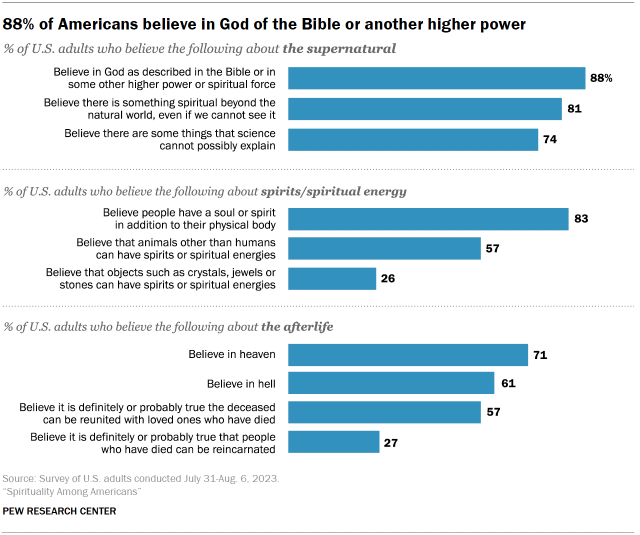
About nine-in-ten U.S. adults believe in God or another higher power, including 54% who say they believe in “God as described in the Bible” and 34% who say they don’t believe in the biblical depiction of God but do believe there is “some other higher power or spiritual force in the universe.”

More than eight-in-ten Americans believe that people have a soul or spirit (83%) and 81% say there is something spiritual beyond the natural world, even if we cannot see it. 

In addition, majorities of U.S. adults believe in heaven (71%) and hell (61%), and more than half say that it is “probably” or “definitely” true that the deceased can be reunited with loved ones who have already died. (Far fewer say this is “probably not” or “definitely not” true.)

Chart shows 88% of Americans believe in God of the Bible or another higher power

This chapter goes into depth on these topics and also presents Americans’ views on related questions such as:

  • What is the nature of spirits, and do (nonhuman) animals have spirits? Can places like cemeteries and parts of nature like mountains have spirits or spiritual energies?
  • What happens after people die? Do their spirits remain in contact with the living world? Can they help or harm the living?

Belief that people have a soul or spirit

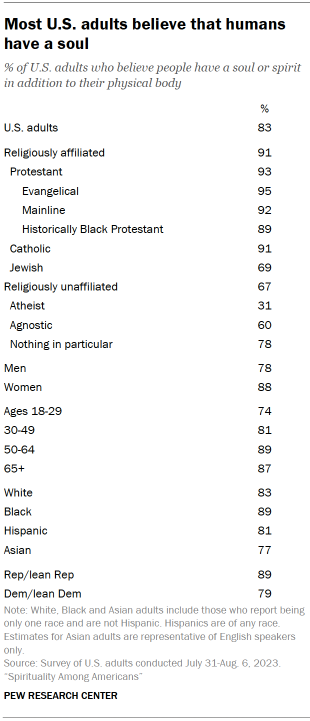
Table shows most U.S. adults believe that humans have a soul

Most Americans (83%) believe that people have a soul or spirit in addition to their physical body. Overwhelming majorities of Protestants (93%) and Catholics (91%) express this belief, as do smaller majorities of Jews (69%) and the religiously unaffiliated (67%).

Older Americans are more likely to believe people have a soul or spirit. Among U.S. adults ages 50 and older, 88% hold this belief, compared with 81% of those ages 30 to 49 and 74% of adults under 30.

This belief is somewhat more common among women than men, and also more prevalent among Republicans and independents who lean toward the Republican Party than among Democrats and Democratic leaners.

Belief in God or a higher power

Americans overwhelmingly believe in God or some other higher power.

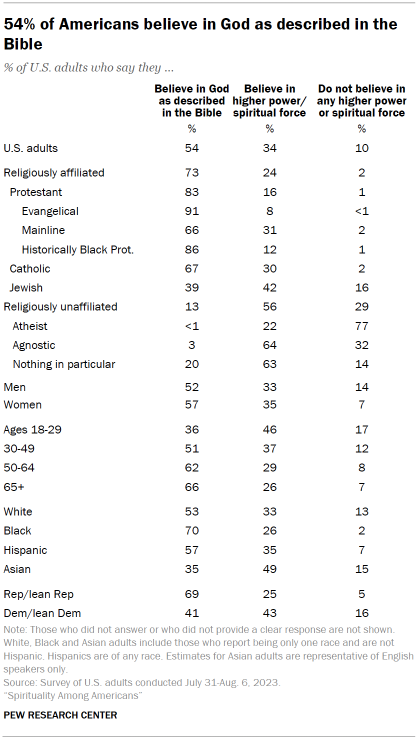
More than half of U.S. adults (54%) say they believe in “God as described in the Bible,” while about one-third (34%) say they do not believe in God as described in the Bible but do believe there is some other higher power or spiritual force in the universe.

One-in-ten U.S. adults do not believe there is any higher power or spiritual force in the universe.

Americans who identify with a religion are more likely to say they believe in the God of the Bible than to say they believe in some other higher power or spiritual force (73% vs. 24%).

Large majorities of evangelicals (91%) and members of the historically Black Protestant tradition (86%) say they believe in God as described in the Bible, as do two-thirds of Catholics and mainline Protestants. 

Similar shares of agnostics (64%) and those who describe their religion as “nothing in particular” (63%) believe in a higher power or spiritual force.

Table shows 54% of Americans believe in God as described in the Bible

Most self-identified atheists do not believe there is any God, higher power or spiritual force (77%). But 22% of U.S. adults who describe themselves as atheists say they believe there is some “higher power or spiritual force” in the universe.

U.S. adults ages 30 and older are more likely to say they believe in God as described in the Bible, while those under 30 are more likely to believe in some other higher power or spiritual force.

Seven-in-ten Black Americans believe in God as described in the Bible, as do 57% of Hispanic Americans and 53% of White Americans. A minority of Asian Americans (35%) believe in God as described in the Bible. While a majority of Republicans and GOP leaners believe in God as described in the Bible (69%), Democrats and Democratic leaners are more divided: 41% believe in the God of the Bible, 43% believe in another higher power or spiritual force and 16% do not believe in either.

Belief in other spirits or unseen forces

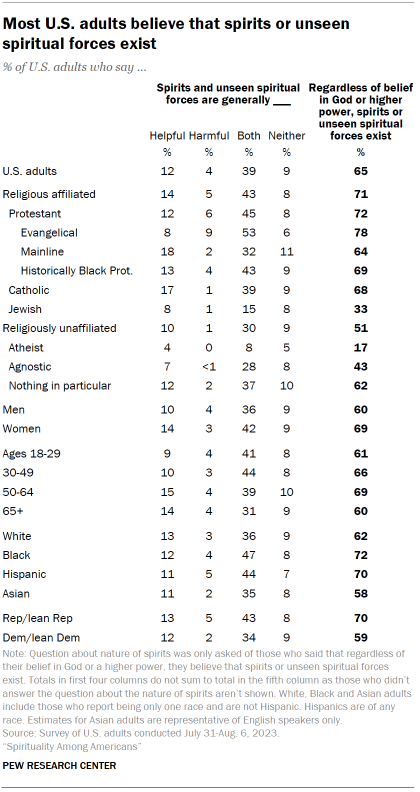
We also asked respondents: “Regardless of whether you believe in God or a higher power in the universe, do you believe that other spirits or unseen spiritual forces exist?” Nearly two-thirds of Americans (65%) say they believe in spirits or unseen spiritual forces, while 14% say they do not. Around one-fifth are unsure.

Table shows most U.S. adults believe that spirits or unseen spiritual forces exist

Protestants (72%) and Catholics (68%) are much more likely than Jewish Americans (33%) to believe in spirits or spiritual forces.

Among religious “nones” – those who answer a survey question about their religion by saying they are atheist, agnostic or “nothing in particular” – about half believe in spirits or unseen spiritual forces. Americans whose religious identity is “nothing in particular” (62%) are far more likely than self-identified agnostics (43%) and atheists (17%) to say they believe in spirits or spiritual forces.

Black (72%) and Hispanic Americans (70%) are more likely than White (62%) and Asian (58%) adults to believe in spirits or spiritual forces. Republicans and Republican-leaning independents (70%) are somewhat more likely than Democrats and Democratic leaners (59%) to believe in these things.

We also asked respondents who believe in spirits about their views on the nature of those spirits. About one-in-ten of all U.S. adults believe that spirits generally are helpful, while 4% say they generally are harmful.

A plurality of U.S. adults (39%) say that spirits can be both helpful and harmful. About one-in-ten Americans say that spirits are neither helpful nor harmful.

Belief beyond science and the natural world

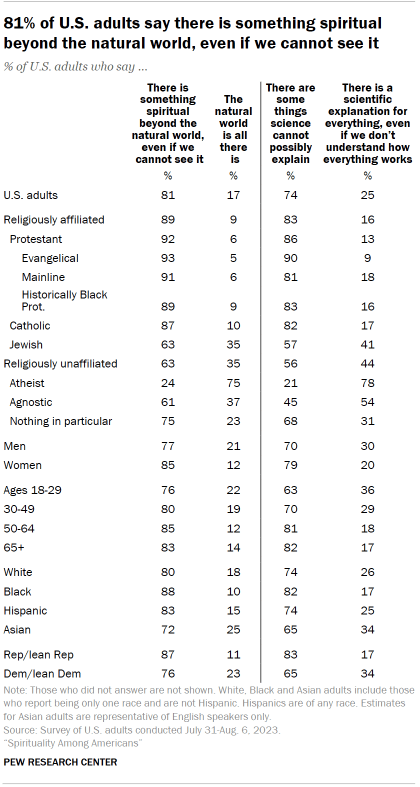
Table shows 81% of U.S. adults say there is something spiritual beyond the natural world, even if we cannot see it

When asked which comes closer to their views – even if neither is exactly right – 81% of U.S. adults take the position that “there is something spiritual beyond the natural world, even if we cannot see it.” Far fewer (17%) say “the natural world is all there is.”

Large shares of Protestants (92%) and Catholics (87%) say there is something spiritual beyond the natural world, while smaller majorities of Jews and religiously unaffiliated adults say the same (63% each).

Self-described atheists are the only religious or nonreligious group with a majority saying that the natural world is all there is (75%).

About three-quarters of Americans say there are some things that science cannot possibly explain, while one-quarter say there is a scientific explanation for everything, even if we don’t understand how everything works.

Protestants (86%) and Catholics (82%) are especially likely to say there are some things that science cannot possibly explain, while fewer Jews (57%) and people who describe their religion as “nothing in particular” (68%) hold this view. About half of agnostics and 78% of atheists say there is a scientific explanation for everything.

Where do spirits and spiritual energies reside?

Table shows 57% of Americans believe animals can have spirits or spiritual energies

In addition to asking whether humans have a soul or spirit, the survey explored Americans’ views on whether certain places, objects or parts of the natural landscape can have spirits.
 
Respondents were asked whether each of the following can have “spirits or spiritual energies”: parts of nature like mountains, rivers or trees; certain objects like crystals, jewels or stones; animals other than humans; and graveyards, cemeteries or other memorial sites.

Most U.S. adults believe that animals other than humans can have spirits or spiritual energies (57%).

Slightly fewer say that graveyards, cemeteries or other memorial sites (50%) and parts of nature like mountains, rivers or trees (48%) can have spirits. And about a quarter of Americans say objects such as crystals, jewels or stones can have spiritual energies (26%).

The belief that animals other than humans can have spirits or spiritual energies is held by half or more members of almost every religious and nonreligious group analyzed in this survey, save for two exceptions: evangelical Protestants (45%) and atheists (33%).

On many questions in the survey – such as belief in God and belief in heaven and hell – evangelicals and atheists are at opposite ends of the spectrum of public opinion. But on the question of whether (nonhuman) animals have spirits, they tend to express the same view: No. Taking into account how these groups answered a separate question about whether people have a soul or spirit, it appears that many evangelicals believe that only humans have spirits, while most atheists believe that neither humans nor animals have spirits.

Members of the historically Black Protestant tradition (62%) and Catholics (58%) are among those most likely to believe that graveyards and cemeteries can have spiritual energies.

The belief that parts of nature, such as mountains, rivers or trees, can have spirits or spiritual energies is somewhat more common among “nones” – especially among those who say their religion is “nothing in particular” – than among the religiously affiliated.  Those who identify as “nothing in particular” are also among the most likely to believe that objects like crystals and jewels can have spirits.

Beliefs about the afterlife

Table shows Americans more likely to believe in heaven than hell

What do Americans believe about life after death? The survey asked respondents about the existence of heaven and hell and also probed what they think people who have died are capable of doing.

Heaven and hell

Seven-in-ten Americans believe in heaven (71%), and six-in-ten believe in hell (61%).

Overwhelming majorities of evangelical Protestants and members of historically Black Protestant churches believe in both heaven and hell, while smaller majorities of mainline Protestants and Catholics hold these beliefs.

Jews are far more likely to believe in heaven (48%) than in hell (20%). The vast majority of religiously unaffiliated Americans do not believe in either, with few atheists who believe in heaven (4%) or hell (3%).

About eight-in-ten Republicans and adults who lean toward the Republican Party believe in heaven, compared with about six-in-ten Democrats and Democratic leaners. Nearly three-quarters of Republicans believe in hell, while half of Democrats say the same.

Black Americans are more likely than other large racial and ethnic groups in the survey to believe in heaven and hell.

Pew Research Center has asked about belief in heaven and hell before, including in a 2021 survey on human suffering, which we conducted during the COVID-19 pandemic. At the time, 73% of U.S. adults said they believe in heaven, and 62% said they believe in hell. Our 2007 and 2014 Religious Landscape Studies showed a similar pattern, although those surveys used somewhat different wording and were conducted by telephone – and therefore are not directly comparable to more recent ones. For more detail on surveys that have asked about heaven and hell since 2017, refer to the Topline.

What are the dead capable of?

We asked respondents whether they believe it is “definitely true,” “probably true,” “probably not true,” or “definitely not true” that people who have died can do various things, such as be aware of what is happening among people who are still alive and help (or harm) them. We also asked whether the dead can communicate with the living, whether they can reunite with loved ones in the afterlife, and whether they can be reborn in this world.

In this list of six options, the most common belief is that the dead can be reunited with loved ones, which 57% of U.S. adults say is “definitely” or “probably” true. Fewer Americans believe it is true that the dead can assist, protect or give guidance to the living (46%), be aware of things that are going on with the living (44%) or communicate with them (42%).

(About four-in-ten Americans also say they have ever had a strong feeling that someone who has passed away was trying to communicate with them. For a discussion of this question, jump to Chapter 4.)

About one-quarter of adults say it is definitely or probably true that the dead can be reincarnated (i.e., reborn again and again in this world). The least common of these beliefs is that the dead can harm people who are still living: 18% of Americans say this is true.

Catholics and members of historically Black Protestant churches are among the most likely to believe it is definitely or probably true that people who have died can be reunited with others beyond this world, provide assistance to the living, be aware of things going on among those who are still living or communicate with them. Those who say their religion is “nothing in particular” are among the most likely to believe it is true that people can be reincarnated (39%) or harm people who are still living (25%).

Higher shares of women than men say it is probably true that the dead can interact with the human world, such as being aware of things going on among the living, communicating with the living, and assisting or harming the living. Women are also more likely than men to say they believe that the dead can be reincarnated and that the dead can be reunited with loved ones in the afterlife.

Table shows women are more likely than men to believe that the dead can interact with the living in various ways

Previously, in August 2023, Pew Research Center published a short report focused on Americans’ views about communicating with the dead. Based on a survey conducted in spring 2023, we found that 53% of U.S. adults said they had ever been visited by a dead family member in a dream or in any other form, and that substantial shares said they’d had other types of interactions with dead relatives in the past 12 months, such as telling a dead relative about their life.

3. Spiritual practices

Asking about people’s activities, habits and rituals is one way to explore how abstract concepts such as spirituality and religion show up in everyday life.

Chart shows Americans pursue a range of activities to foster connection

In this survey, we asked respondents to tell us whether they pursue a variety of activities – such as meditating and spending time in nature – for reasons that might be considered spiritual, such as to make a connection with something bigger than themselves or to connect with their “true self.”

We also asked whether they possess a range of things – such as a cross, a home altar or crystals – for spiritual purposes. And we asked whether they are involved in religious and spiritual communities and, if so, how important those involvements are to them.

We found that:

  • 14% of Americans say they are involved in a spiritual community, including 8% who say they’re involved in a spiritual community and that it’s extremely or very important to them.
  • 36% have a cross for spiritual reasons. Fewer say they possess jewelry (19%), crystals (12%) or a tattoo or piercing (9%) for spiritual purposes. Religiously unaffiliated Americans are more likely than religiously affiliated adults to own crystals for spiritual purposes.
  • 64% of U.S. adults say they spend time each month looking inward or centering themselves. Most of them – 44% of all U.S. adults – say they do this primarily to feel connected with their “true self,” with something bigger than themselves or with other people.

This chapter explores these questions in more detail. For the related topic of spiritual experiences, jump to Chapter 4.

Spiritual and religious communities

Table shows more Americans are involved in a religious community than a spiritual one

About four-in-ten U.S. adults say they are involved in a religious community, such as a church or religious congregation. This includes 54% of religiously affiliated Americans.

By comparison, relatively few Americans say they belong to a spiritual community, such as a group that helps them find a connection with something bigger than themselves, with nature or with other people (14%).

Most of these people – 10% of all U.S. adults – say they are involved in both a religious community and a spiritual community. Indeed, it is possible that some respondents are describing the same community as both religious and spiritual.

Just 4% of U.S. adults say they are involved in a spiritual community and not also in a religious community.

U.S. adults who are affiliated with a religion are much more likely than religiously unaffiliated Americans (sometimes called “nones”) to be involved in a religious community (54% vs. 7%). The same is true of spiritual communities, though the gap is much narrower: 17% of religiously affiliated adults say they are part of a spiritual community, compared with 8% of “nones.”

Table shows 15% of members of historically Black Protestant churches say being involved in a spiritual community is extremely or very important to them

And among U.S. adults who are involved in a spiritual community, those who have a religion are more likely than those who are religiously unaffiliated to say that being part of such a community is either extremely or very important to them.

Among religiously affiliated adults, 11% are involved with a spiritual community and say this is extremely or very important to them. The comparable figure among religious “nones” is 3%.

Having things for spiritual purposes

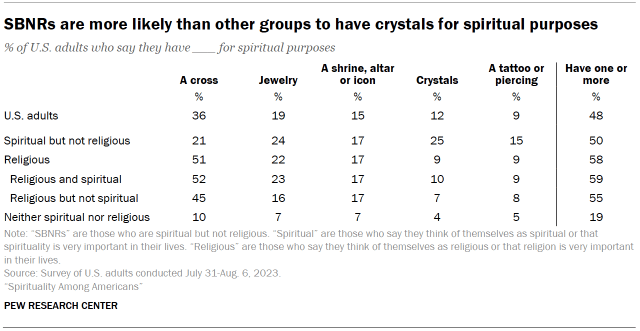
Many Americans say they have one of the following items for spiritual purposes: a cross (36%), jewelry (19%), a shrine, altar or icon in their home (15%), crystals (12%) or a tattoo or piercing (9%).

Catholics are especially likely to own a cross: 72% say they have a cross for spiritual purposes, compared with 42% of Protestants.

Meanwhile, 18% of U.S. adults who describe their religious identity as “nothing in particular” say they have a cross for spiritual purposes, as do very small shares of agnostics (6%), Jews (6%) and atheists (1%).6

Table shows roughly 7 in 10 U.S. Catholics own a cross for spiritual purposes

Catholics are also more likely than others to have a shrine, altar or icon in their homes (33%), or to have jewelry for spiritual purposes (30%).

There are also some differences by race and ethnicity. About half of Hispanic Americans (47%) say they have a cross for spiritual purposes, compared with fewer Black (38%), White (33%) or Asian Americans (26%).

Asian Americans (33%) are more likely than Hispanic (25%), Black (14%) or White (11%) Americans to have a shrine, altar or icon for spiritual purposes. Similarly, a recent Center survey designed specifically to collect data on Asian Americans, conducted in 2022-2023 in five Asian languages as well as English, found that 36% of Asian Americans have a shrine, altar or religious symbol that they use for worship in their home. This includes 63% of Asian American Buddhists and 79% of Asian American Hindus.

Another recent Center survey, conducted in July 2023, found that 32% of U.S. adults say they have a tattoo, including 22% who have more than one. The July survey did not ask whether the tattoos have a spiritual purpose. But it found that among Americans who have tattoos, 69% said one reason they have a tattoo is to “remember or honor someone or something,” while 47% said they have a tattoo to “make a statement about what I believe.” The July survey also found that 41% of religiously unaffiliated adults have at least one tattoo, compared with 29% of those affiliated with a religion.

Activities that create connection

In this survey, we offered respondents a list of five activities and asked them how often they engage in each one. The activities were: spending time looking inward or centering yourself, spending time in nature, exercising, meditating, and practicing yoga.

We then asked people who engage in an activity at least a few times per month to choose the most important reason they do it. The options were: “To feel connected with something bigger than myself,” “To get health benefits, including relaxation,” “To feel connected with other people,” “To feel connected with my true self,” “To have fun and enjoy the experience” and “For a different reason” (which they were then asked to specify).

Looking inward

Table shows 27% of U.S. adults look inward monthly mainly to connect with their ‘true self’

More than four-in-ten U.S. adults say they spend time looking inward or centering themselves at least a few times a month mainly to feel some sort of connection – most commonly, with their “true self” (27%).

An additional 13% say the most important reason they look inward or center themselves is to connect with something bigger than themselves.

About one-in-five adults say they look inward regularly for health, enjoyment or other reasons.

Time in nature

Table shows 18% of U.S. adults regularly spend time in nature mainly to connect with something bigger than themselves

Roughly one-in-five American adults (18%) say they spend time in nature a few times a month or more mainly to feel connected with something bigger than themselves.

Smaller shares say they do this to feel connected with their “true self” (6%) or to other people (2%).

Half of U.S. adults say they spend time in nature a few times a month or more mainly for health, enjoyment or other reasons.

Exercise

Table shows relatively few U.S. adults regularly exercise mainly for connection

A large majority of U.S. adults who engage in exercise at least monthly cite health, enjoyment or other reasons as their main motivation (69%). Just 7% of adults say they engage in exercise monthly to feel some sort of connection.

Meditation

Table shows 22% of Americans meditate regularly mainly to foster some sort of connection

About a fifth of U.S. adults (22%) say they meditate at least a few times a month with the primary goal of feeling some sort of connection.

Similar shares say they seek connection with their “true self” (11%) or with something bigger than themselves (10%). An additional 16% of American adults say they meditate regularly for health, enjoyment or other reasons.

Yoga

Table shows Americans do yoga mainly for health and enjoyment, less for connection

An overwhelming majority of U.S. adults (84%) say they seldom or never practice yoga. About one-in-ten say they do yoga at least a few times a month mainly for health, enjoyment or other reasons. Another 4% of U.S. adults say they practice yoga at least monthly primarily to feel connected with their “true self,” with something bigger than themselves or with other people.

4. Spiritual experiences

Large majorities of Americans say they feel a deep sense of wonder about the universe (71%) or a deep sense of spiritual peace and well-being (66%) several times a year or more often.

Other types of spiritual experience are less common, yet still experienced by many Americans.

Almost half of U.S. adults (45%) report ever having had a sudden feeling of connection with something from beyond this world, while three-in-ten say they have personally encountered a spirit or unseen spiritual force.

This chapter explores these topics in greater detail.

Chart shows 45% of Americans have had a sudden feeling of connection with something from beyond this world

Regular experiences of wonder or connection

Wonder about the universe

Among all U.S. adults, 71% say they feel a deep sense of wonder about the universe at least several times a year, including 46% who have this feeling monthly or more often.

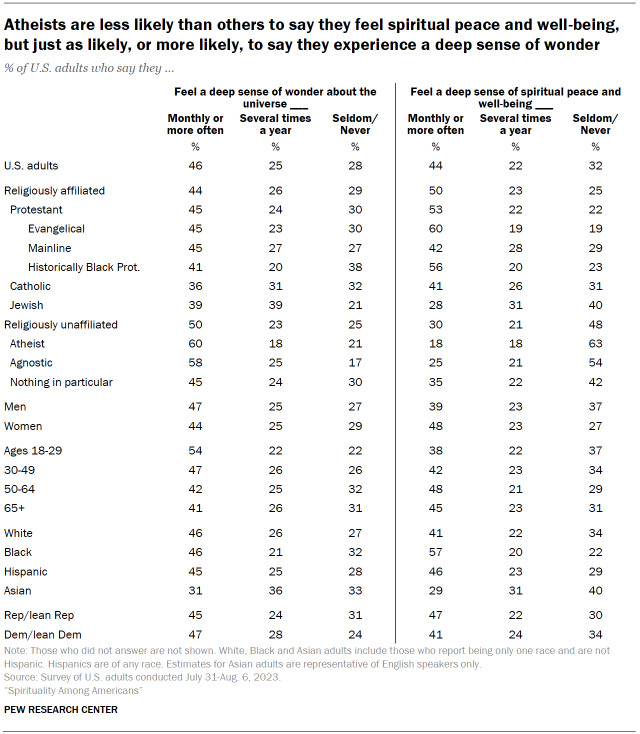
Atheists (60%) and agnostics (58%) are more likely than members of other religious groups in this analysis to say they feel a deep sense of wonder about the universe monthly or more often, as are adults under 50 compared with those who are older.

Asian adults (31%) are less likely than those who are White (46%), Black (46%) or Hispanic (45%) to feel a deep sense of wonder about the universe monthly or more often.

Spiritual peace and well-being

Two-thirds of U.S. adults say they feel a deep sense of spiritual peace and well-being at least several times a year, including 44% who have this feeling monthly or more often.

Jews (28%) and the religiously unaffiliated (30%) are less likely than Catholics (41%) and Protestants (53%) to say they feel a deep sense of spiritual peace and well-being monthly or more often. Evangelical Protestants and those in the historically Black Protestant tradition are the most likely of the religious and nonreligious groups analyzed in this report to say they feel this (60% and 56%, respectively).

Atheists are the least likely of all the religious and nonreligious groups in this analysis to say they regularly feel a deep sense of spiritual peace and well-being. In fact, most atheists – 63% – say they seldom or never feel a deep sense of spiritual peace and well-being.

Nearly six-in-ten Black adults (57%) say they feel a deep sense of spiritual peace and well-being monthly or more often, which is greater than the share of Hispanic (46%), White (41%) or Asian (29%) adults who say the same.

Additionally, women are more likely than men to say they feel this sense of spiritual peace at least monthly (48% vs. 39%).

Table shows Atheists are less likely than others to say they feel spiritual peace and well-being, but just as likely, or more likely, to say they experience a deep sense of wonder

Pew Research Center previously asked these questions about experiences of wonder and peace in our 2007 and 2014 Religious Landscape Studies. However, those surveys were conducted by telephone, and so it is not clear whether those earlier results can be directly compared with the new estimates (which come from a self-administered online survey).

Sense of connection with humanity

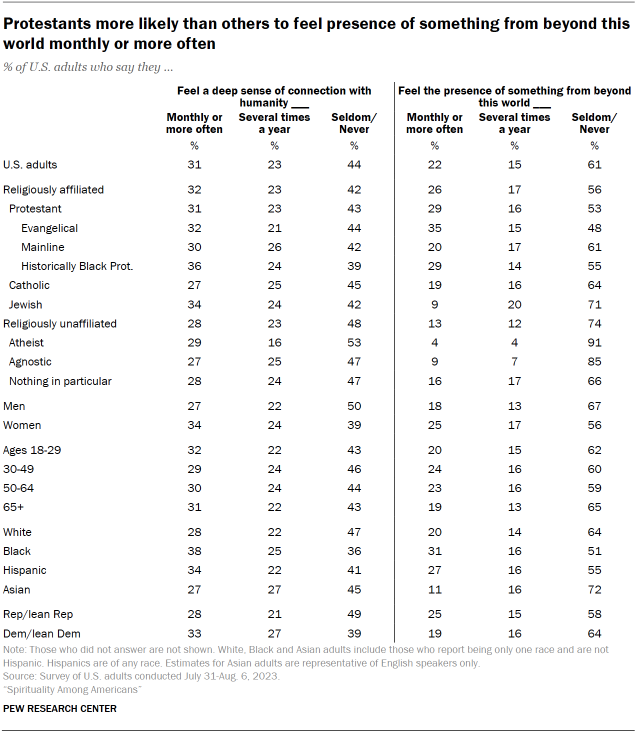
Roughly three-in-ten U.S. adults (31%) say they feel a deep sense of connection with humanity monthly or more often. Demographic differences on this question are relatively modest, though Black adults (38%) are more likely than White adults (28%) or Asian Americans (27%) to say they feel a deep sense of connection with their fellow humans monthly or more often.

Feeling the presence of something from beyond

One-in-five Americans (22%) say they feel the presence of something from beyond this world at least monthly. That includes about three-in-ten Protestants (29%) and smaller shares of Catholics (19%), religiously unaffiliated adults (13%) and Jews (9%).

Additionally, adults who are Black (31%) or Hispanic (27%) are more likely than those who are White (20%) or Asian (11%) to say they feel the presence of something from beyond this world monthly or more often.

Table shows Protestants more likely than others to feel presence of something from beyond this world monthly or more often

Sudden encounters with the spiritual realm

In addition to asking respondents about repeated or frequent experiences of spirituality, we also asked if they have ever had certain kinds of encounters.

Sudden connection with the beyond

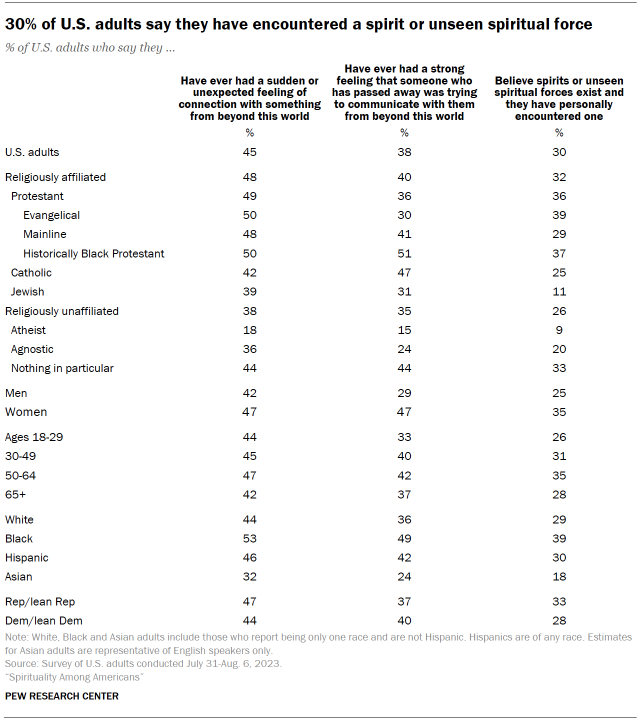
Many U.S. adults (45%) say they have ever had a sudden or unexpected feeling of connection with something from beyond this world, including 49% of Protestants who say this.

Catholics, Jewish Americans and religiously unaffiliated adults look similar on this question, with roughly four-in-ten in each group saying they have had such an experience.

Personal encounters with spirits

Fewer U.S. adults say they have ever personally encountered a spirit or unseen spiritual force: 30% of Americans say they’ve had such an encounter, though roughly two-thirds believe in the existence of spirits or unseen spiritual forces. For a discussion of spiritual beliefs, turn to Chapter 2.

Of the country’s large religious groups, Protestants (36%) are the most likely to say they have personally encountered a spirit or unseen spiritual force, while smaller shares of the religiously unaffiliated (26%), Catholics (25%) and Jews (11%) say the same.

Around one-third of women (35%) report having personally encountered a spirit or unseen spiritual force, compared with one-quarter of men.

And 39% of Black Americans have encountered a spirit or unseen spiritual force, compared with 30% of Hispanic adults, 29% of White Americans and 18% of Asian Americans.

Communication from the deceased

About four-in-ten Americans say they have ever had a strong feeling that someone who has passed away was trying to communicate with them. That includes 51% of adults in the historically Black Protestant tradition and 47% of Catholics.

Smaller shares of Jews (31%) and evangelical Protestants (30%) say they have ever had a strong feeling that a dead person was trying to communicate with them. Among the religiously unaffiliated, 35% say this.

Table shows 30% of U.S. adults say they have encountered a spirit or unseen spiritual force

Among the religiously unaffiliated, 44% of those who say their religion is “nothing in particular” say they have had a strong feeling that someone who has passed away was communicating with them, compared with 24% of agnostics and 15% of atheists.

And women are much more likely than men to have had a strong feeling that a deceased person was trying to communicate with them (47% vs. 29%).

A recent Pew Research Center survey conducted in spring 2023 found that 53% of U.S. adults said they had ever been visited by a dead family member in a dream or other form. That survey also found that in the past 12 months, 34% had felt the presence of a dead relative and 15% said dead family members communicated with them.

A different Center survey, conducted in September 2021, explored what Americans think heaven and hell are like. It found that among U.S. adults who believe in heaven, 25% think it is definitely or probably true that the deceased are able to have relationships with people who are still living on Earth.

Turn to Chapter 2 for a discussion of Americans’ views about the deceased and their abilities.

5. Who are ‘spiritual but not religious’ Americans?
This chapter focuses on three groups of U.S. adults, based on their answers to the following four questions: Do you think of yourself as spiritual? Do you think of yourself as religious? How important is spirituality in your life? How important is religion in your life?
The three groups are:

  • 22% of Americans who are categorized as spiritual but not religious (SBNR) because they say they think of themselves as spiritual or they consider spirituality very important in their lives, but they neither think of themselves as religious nor say religion is very important in their lives.
  • 58% of Americans who fall into an overall or “NET” Religious category because they say they think of themselves as religious or they consider religion very important in their lives. This group can be subdivided into U.S. adults who are both religious and spiritual (48%) and those who are religious but not spiritual (10%)
  • 21% of Americans who are categorized as neither spiritual nor religious because they don’t think of themselves as spiritual, don’t think of themselves as religious, don’t consider spirituality very important in their lives and don’t consider religion very important in their lives.

Most of the comparisons in this chapter are between the SBNR and the NET Religious categories. Compared with religious Americans, SBNRs tend to be younger, more likely to identify as Democrats or Democratic-leaning independents and less likely to affiliate with a religion.

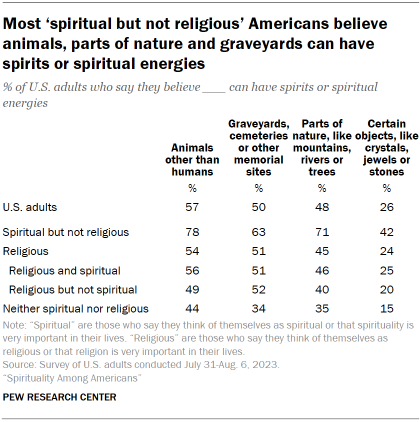
SBNRs also differ from religious Americans on some key measures of belief and practice analyzed in this report. For example, SBNRs are far more likely than religious adults to say they believe that spirits or spiritual energies can be contained in animals other than humans (78% vs. 54%) or in parts of nature like mountains, rivers or trees (71% vs. 45%).

On the other hand, SBNRs are less likely than religious adults to believe in God as described in the Bible (20% vs. 82%), pray daily (21% vs. 64%) or attend religious services at least once a week (2% vs. 36%.)

Chart shows: Vast majority of SBNRs and religious Americans say people have a soul; but SBNRs are less likely to believe loved ones are reunited after death; and more likely to believe that parts of nature have spirits or spiritual energy

Still, SBNRs hold many beliefs in common with religious Americans. For example, most people in both groups believe that there is something spiritual beyond the natural world, even if we cannot see it (88% of SBNRs and 92% of the religious) and that human beings have a soul or spirit in addition to their physical body (89% and 92%, respectively).

This chapter discusses these findings in more detail and shows how SBNR Americans and religious Americans differ on some measures presented in previous chapters.

Demographic characteristics

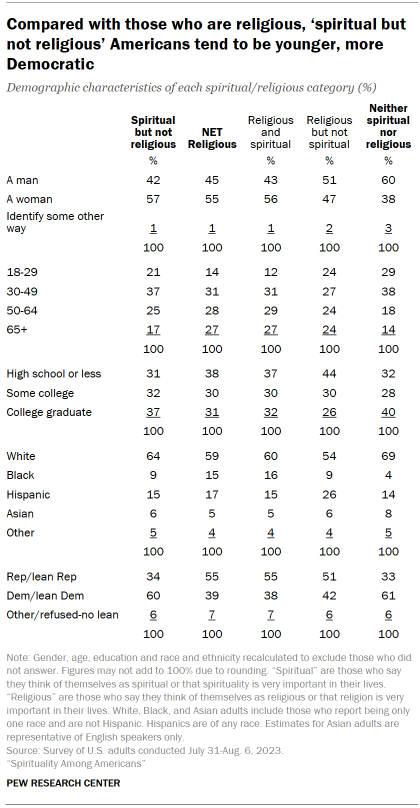
Table shows Compared with those who are religious, ‘spiritual but not religious’ Americans tend to be younger, more Democratic

Compared with religious adults, SBNRs are relatively young (58% of adult SBNRs are under age 50, compared with 45% of religious Americans) and more likely to identify as Democrats or Democratic-leaning independents (60% vs. 39%).

SBNRs and religious Americans are similar in their gender composition, with women accounting for a slight majority in each group.

Demographically, Americans who are neither spiritual nor religious stand out for being comprised predominantly of men (60%).

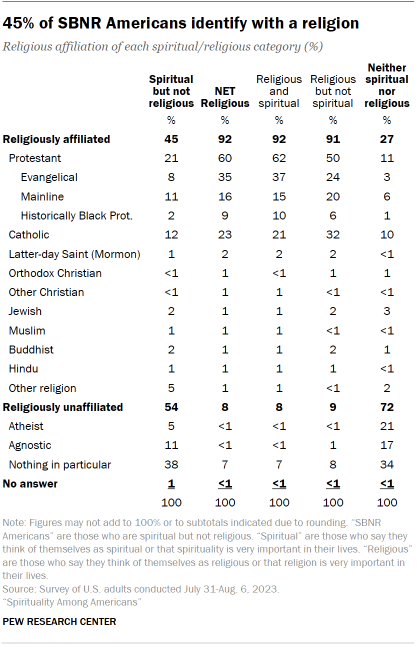
When it comes to religious identification, SBNR Americans are divided between affiliating with a religion (45%) and not affiliating with one (54%).

Table shows 45% of SBNR Americans identify with a religion

By contrast, the vast majority of religious Americans identify with a religion (92%), while most adults who are neither spiritual nor religious are religiously unaffiliated (72%).

The most common response that SBNR Americans give when asked to select a religious identity is “nothing in particular” (38%). About one-fifth of SBNRs identify as Protestant, and 12% identify as Catholic.

Spiritual beliefs and practices

Some spiritual beliefs are widely shared by SBNRs and religious U.S. adults. For example, large shares of both SBNRs (89%) and religious Americans (92%) say they believe people have a soul or spirit in addition to their physical body. Most people in both groups also say that there is something spiritual beyond the natural world, even if we cannot see it (88% and 92%) and that spirits or unseen spiritual forces exist (72% and 74%).

However, SBNRs are somewhat less likely than religious Americans to say there are some things that science cannot possibly explain (74% vs. 85%).

Table shows 9 in 10 SBNRs believe people have a soul or spirit in addition to their body

Beliefs on where spirits reside

Table shows most ‘spiritual but not religious’ Americans believe animals, parts of nature and graveyards can have spirits or spiritual energies

SBNRs are far less likely than religious Americans to believe in God as described in the Bible (20% vs. 82%). Instead, they are much more likely to say they believe there is “some other higher power or spiritual force in the universe” (73% vs. 16%).

Also, SBNR Americans are more likely than religious Americans to say that animals, memorial sites, parts of nature or certain objects can have spirits or spiritual energies.

For example, 78% of SBNR Americans say that spirits or spiritual energies can reside in animals other than humans, compared with 54% of religious adults. And 71% of SBNR adults say spirits can reside in parts of nature like mountains, rivers or trees, compared with 45% of religious adults who hold this view.  

Fewer SBNRs say that objects like crystals, jewels or stones can have spirits or spiritual energies (42%). But that share is still larger than among religious Americans (24%).

Beliefs about the afterlife

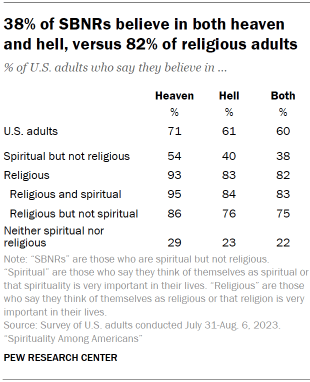
Table shows 38% of SBNRs believe in both heaven and hell, versus 82% of religious adults

SBNR Americans are much less likely than religious Americans to say they believe in heaven (54% vs. 93%) or hell (40% vs. 83%). But SBNRs are much more likely than Americans who are neither spiritual nor religious to believe in heaven and hell.

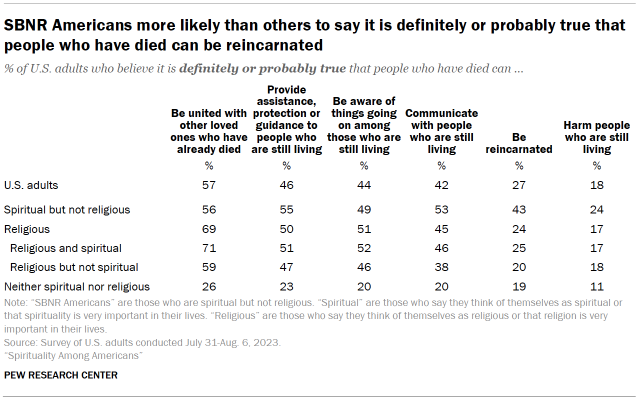
SBNRs also stand out for their beliefs about reincarnation: 43% say it is definitely or probably true that people who have died can be reborn again in this world, compared with 24% of religious Americans who express the same view.

And there are some differences on other questions about the afterlife. For example, SBNRs are less likely than religious Americans to say that after people die, they definitely or probably can be reunited with loved ones who have already died (56% vs. 69%.)

But both SBNRs and religious Americans are much more likely than those who are neither spiritual nor religious to say that people who have died can be aware of things going on among the living, can communicate with the living and can help or harm the living.

Table shows SBNR Americans more likely than others to say it is definitely or probably true that people who have died can be reincarnated

Spiritual practices

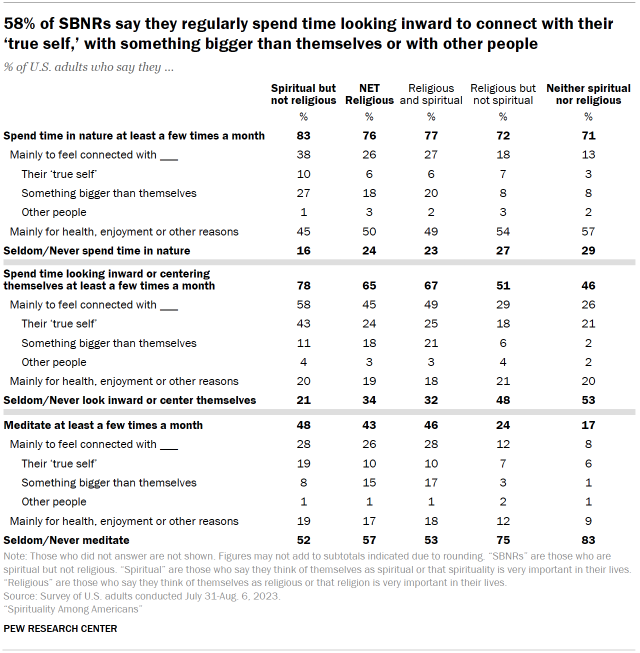
Nearly six-in-ten “spiritual but not religious” Americans (58%) say they spend time looking inward or centering themselves at least a few times a month mainly for connection, including 43% who do so primarily to connect with their “true self.” Fewer religious Americans and those who are neither spiritual nor religious say the same.

Table shows 58% of SBNRs say they regularly spend time looking inward to connect with their ‘true self,’ with something bigger than themselves or with other people

SBNRs are also more likely than religious Americans and those who are neither spiritual nor religious to report that they spend time in nature at least a few times a month for connection, especially in order to connect with something bigger than themselves.

But SBNRs are as likely as religious-and-spiritual Americans to say they meditate at least a few times a month primarily to foster connections (28% each).

The new survey also asked whether people have a variety of things for spiritual purposes. SBNRs are notably less likely than religious Americans to say they have a cross (21% vs. 51%). But SBNRs are much more likely to say they own crystals (25% vs. 9%) and somewhat more likely to have a tattoo or piercing for spiritual purposes (15% vs. 9%). SBNRs and religious Americans are about equally likely to have a shrine, altar or icon in their home or to have jewelry for spiritual purposes.

Table shows SBNRs are more likely than other groups to have crystals for spiritual purposes

Involvement in communities

The survey asked respondents whether they are involved in three kinds of communities: a religious community “such as a church or religious congregation”; a spiritual community “such as a group that helps you find a connection with something bigger than yourself, nature or other people”; or a “nonreligious volunteer or community service group.” Respondents could indicate they belong to all, some or none of these kinds of communities.

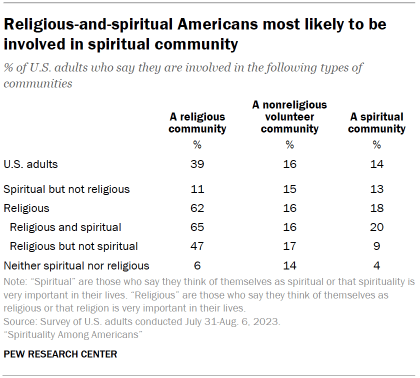
Table shows religious-and-spiritual Americans most likely to be involved in spiritual community

SBNRs are much less likely than religious Americans to say they are involved in a religious community (11% vs. 62%). They are also slightly less likely to be involved in a spiritual community (13% vs. 18%), though that difference masks a split within the religious category: Americans who are both religious and spiritual are much more likely than those who are religious but not spiritual to say they are involved in a spiritual community (20% vs. 9%).

Meanwhile, the survey finds no significant difference between SBNRs and religious Americans, overall, in their propensity to be involved in a nonreligious volunteer or community service group.

Spiritual experiences

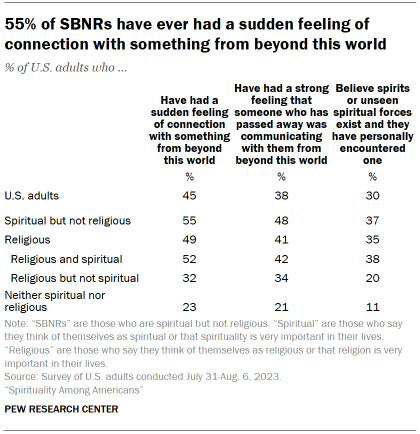
Table shows 55% of SBNRs have ever had a sudden feeling of connection with something from beyond this world

SBNRs are more likely than religious Americans (and U.S. adults as a whole) to have had a strong feeling that someone who has passed away was communicating with them from beyond this world: 48% of SBNRs say they have ever had such an experience, compared with 41% of religious Americans and 21% of U.S. adults who are neither spiritual nor religious.

SBNRs are also slightly more likely than religious Americans to say they have ever had a sudden feeling of connection with “something from beyond this world” (55% vs. 49%), but there is a substantial divide within the religious category: 52% of Americans who are both religious and spiritual say they have had such an experience, compared with 32% of those who are religious but not spiritual.

Table shows 56% of ‘spiritual but not religious’ Americans feel a deep sense of wonder about the universe at least monthly

The same patterns hold when comparing SBNRs with religious Americans on some other questions about experiences that might be considered spiritual. SBNRs are more likely than religious Americans (and much more likely than those who are religious but not spiritual) to say they feel a deep sense of wonder about the universe once a month or more often.

On the other hand, SBNRs are somewhat less likely than religious Americans (and much less likely than those who are both religious and spiritual) to say they feel a deep sense of spiritual peace and well-being at least monthly.

(Chapter 4 shows the percentage of U.S. adults who report having these experiences at least a few times a year, rather than monthly or more often.)

Change in personal spirituality over time

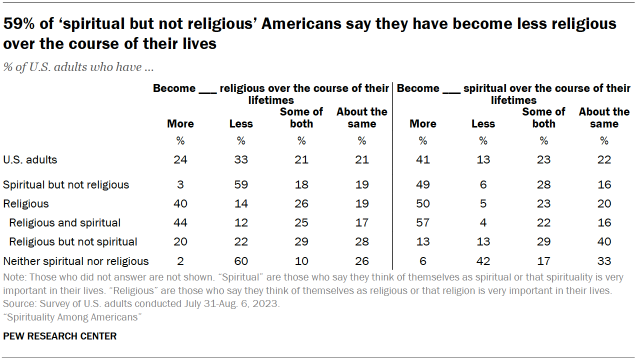
Most SBNRs say they have become less religious over the course of their lifetimes (59%). At the same time, 49% say they have become more spiritual over the years and 28% say their spirituality has fluctuated, sometimes increasing and other times decreasing.

By contrast, religious Americans are more likely to say that during their lifetimes, they have become more religious (40%) than to say they have become less religious (14%). Many religious Americans say they have either stayed about the same religiously (19%) or gone back and forth, sometimes becoming more religious and sometimes less (26%).

And religious Americans are just as likely as SBNRs to say they have become more spiritual over their lifetimes: 50% of religious Americans and 49% of SBNRs say this about themselves, while much smaller shares of both groups say they have become less spiritual (5% of religious Americans, 6% of SBNRs).

Table shows 59% of ‘spiritual but not religious’ Americans say they have become less religious over the course of their lives

Religion and society

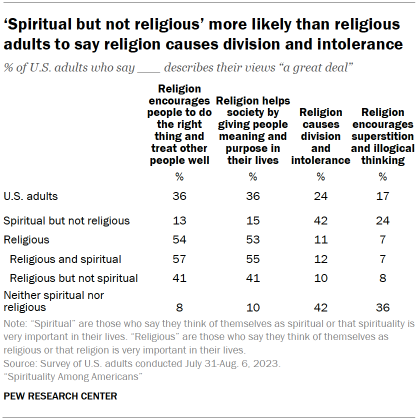
Spiritual but not religious Americans, along with those who are neither spiritual nor religious, are more critical than religious adults of religion’s impact on society. On balance, 38% of SBNRs say religion does more harm than good, while just 7% of religious Americans share this view.

Table shows ‘Spiritual but not religious’ more likely than religious adults to say religion causes division and intolerance

SBNRs are also more likely than religious Americans to say that the statement “religion causes division and intolerance” describes their views a great deal (42% vs. 11%).

And SBNR Americans are less likely than religious adults to take the position that “religion encourages people to do the right thing and treat people well” (13% vs. 54%) and that “religion helps society by giving people meaning and purpose in their lives” (15% vs. 53%).

What does ‘spiritual’ mean?

This survey also asked respondents to say, in their own words, what the term “spiritual” means to them. We categorized their responses based on the types of beliefs, experiences or other concepts they mentioned.

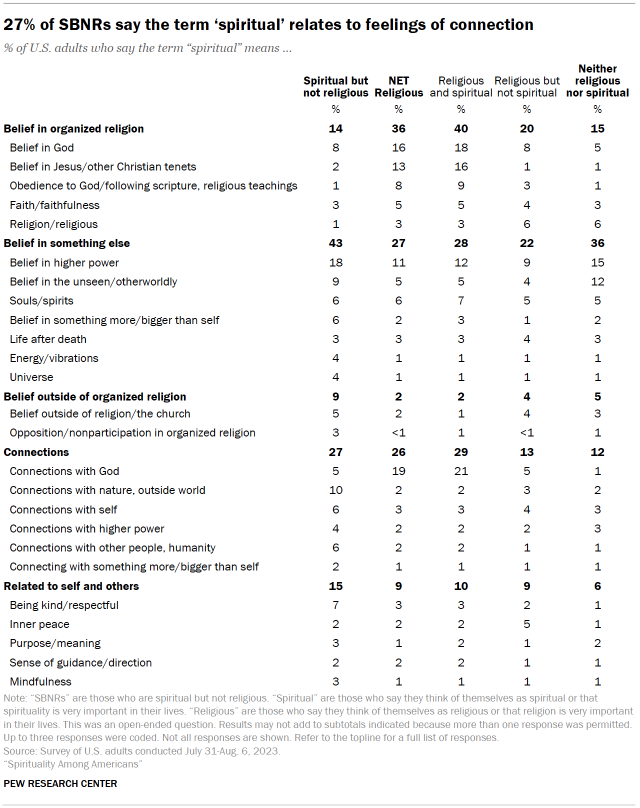
  • 14% of SBNRs give descriptions tied to organized religion, compared with 36% of religious adults.
  • About one-in-ten SBNRs relate spirituality to things outside of organized religion, compared with 2% of religious Americans.
  • 43% of SBNRs offer responses that mention beliefs in what we categorized as “something else,” such as belief in a higher power (18%) or belief in the unseen or otherworldly (9%). Among religious adults, 27% relate spirituality to beliefs in “something else.”
  • A sizable share of SBNRs (27%) also explain the term “spiritual” by referring to connections, such as with God, nature, their inner self or humanity in general. And 15% say “spiritual” relates to understanding themselves or guiding their own behavior, such as being kind or respectful.
Table shows 27% of SBNRs say the term ‘spiritual’ relates to feelings of connection

Essential elements of spirituality

Table shows 72% of SBNRs say ‘being connected with my true self’ is essential to being spiritual

To further gauge how Americans think about spirituality, the survey asked those who are spiritual whether each of 10 items are “essential,” “important, but not essential,” or “not an important part” to what being spiritual means to them. And a follow-up question asked whether there is anything else they consider essential to what being spiritual means to them (refer to the Topline for responses).

Most Americans who are spiritual but not religious say that “being connected with my true self” is essential to being spiritual (72%). Majorities also say “being open-minded” (66%), “being connected with something bigger than myself” (62%) and “being connected with nature” (59%) are essential.

Religious-and-spiritual Americans, on the other hand, are most likely to say “being connected with God” is essential to being spiritual.

Acknowledgments

Pew Research Center is a subsidiary of The Pew Charitable Trusts, its primary funder. This survey and related research on religion and spirituality in the United States was funded by The Pew Charitable Trusts with support from the Lilly Endowment Inc., Templeton Religion Trust, The Arthur Vining Davis Foundations and the M.J. Murdock Charitable Trust.

This report is a collaborative effort based on the input and analysis of the following individuals. Find related reports online at pewresearch.org/pewresearch-org/religion.

Primary Researcher

Becka A. Alper, Senior Researcher               

Research Team

Alan Cooperman, Director, Religion Research             
Gregory A. Smith, Associate Director, Religion Research
Besheer Mohamed, Senior Researcher
Michael Rotolo, Research Associate     
Patricia Tevington, Research Associate
Justin Nortey, Research Analyst      
Asta Kallo, Research Assistant

Methods Team         

Andrew Mercer, Senior Research Methodologist
Dorene Asare-Marfo, Panel Manager          
Dana Popky, Associate Panel Manager
Anna Brown, Research Methodologist
Arnold Lau, Research Methodologist                       

Editorial and Graphic Design

Dalia Fahmy, Senior Writer/Editor
Rebecca Leppert, Copy Editor
Bill Webster, Senior Information Graphics Designer

Communications and Web Publishing

Achsah Callahan, Communications Manager
Reem Nadeem, Digital Producer    
Anna Schiller, Associate Director, Communications
Stacy Rosenberg, Director, Digital Strategy

In addition, Pew Research Center is grateful to a panel of expert advisers who provided valuable advice on this project: Nancy T. Ammerman, professor emerita of sociology of religion at Boston University; Ryan Cragun, professor of sociology at The University of Tampa; Penny Edgell, professor of sociology at the University of Minnesota; Jacqui Frost, assistant professor of sociology at Purdue University; John C. Green, director emeritus of The Ray C. Bliss Institute of Applied Politics and distinguished professor emeritus of political science at The University of Akron; Jaime Kucinskas, chair and associate professor of sociology at Hamilton College; and Brian Steensland, department chair and professor of sociology at Indiana University-Purdue University Indianapolis (IUPUI).

Methodology

The American Trends Panel survey methodology

Overview

The American Trends Panel (ATP), created by Pew Research Center, is a nationally representative panel of randomly selected U.S. adults. Panelists participate via self-administered web surveys. Panelists who do not have internet access at home are provided with a tablet and wireless internet connection. Interviews are conducted in both English and Spanish. The panel is being managed by Ipsos.

Data in this report is drawn from ATP Wave 132, conducted from July 31 to Aug. 6, 2023. A total of 11,201 panelists responded out of 12,932 who were sampled, for a response rate of 87%. The cumulative response rate accounting for nonresponse to the recruitment surveys and attrition is 3%. The break-off rate among panelists who logged on to the survey and completed at least one item is 1%. The margin of sampling error for the full sample of 11,201 respondents is plus or minus 1.4 percentage points.

Panel recruitment

Table shows American Trends Panel recruitment surveys

The ATP was created in 2014, with the first cohort of panelists invited to join the panel at the end of a large, national, landline and cellphone random-digit-dial survey that was conducted in both English and Spanish. Two additional recruitments were conducted using the same method in 2015 and 2017, respectively. Across these three surveys, a total of 19,718 adults were invited to join the ATP, of whom 9,942 (50%) agreed to participate.

In August 2018, the ATP switched from telephone to address-based sampling (ABS) recruitment. A study cover letter and a pre-incentive are mailed to a stratified, random sample of households selected from the U.S. Postal Service’s Delivery Sequence File. This Postal Service file has been estimated to cover as much as 98% of the population, although some studies suggest that the coverage could be in the low 90% range.7 Within each sampled household, the adult with the next birthday is asked to participate. Other details of the ABS recruitment protocol have changed over time but are available upon request.8

We have recruited a national sample of U.S. adults to the ATP approximately once per year since 2014. In some years, the recruitment has included additional effort (known as an “oversample”) to boost sample size with under-represented groups. For example, Hispanic adults, Black adults, and Asian adults were oversampled in 2019, 2022 and 2023, respectively.

Across the six address-based recruitments, a total of 23,862 adults were invited to join the ATP, of whom 20,917 agreed to join the panel and completed an initial profile survey. Of the 30,859 individuals who have ever joined the ATP, 12,932 remained active panelists and continued to receive survey invitations at the time this survey was conducted.

The American Trends Panel never uses breakout routers or chains that direct respondents to additional surveys.

Sample design

The overall target population for this survey was noninstitutionalized persons ages 18 and older living in the U.S., including Alaska and Hawaii. All active panel members were invited to participate in this wave.

Questionnaire development and testing

The questionnaire was developed by Pew Research Center in consultation with Ipsos. The web program was rigorously tested on both PC and mobile devices by the Ipsos project management team and Pew Research Center researchers. The Ipsos project management team also populated test data that was analyzed in SPSS to ensure the logic and randomizations were working as intended before launching the survey.

Incentives

All respondents were offered a post-paid incentive for their participation. Respondents could choose to receive the post-paid incentive in the form of a check or a gift code to Amazon.com or could choose to decline the incentive. Incentive amounts ranged from $5 to $20 depending on whether the respondent belongs to a part of the population that is harder or easier to reach. Differential incentive amounts were designed to increase panel survey participation among groups that traditionally have low survey response propensities.

Data collection protocol

The data collection field period for this survey was July 31-Aug. 6, 2023. Postcard notifications were mailed to all ATP panelists with a known residential address on July 31. 

Invitations were sent out in two separate launches: soft launch and full launch. Sixty panelists were included in the soft launch, which began with an initial invitation sent on July 31. The ATP panelists chosen for the initial soft launch were known responders who had completed previous ATP surveys within one day of receiving their invitation. All remaining English- and Spanish-speaking sampled panelists were included in the full launch and were sent an invitation on Aug. 1.

All panelists with an email address received an email invitation and up to two email reminders if they did not respond to the survey. All ATP panelists who consented to SMS messages received an SMS invitation and up to two SMS reminders.

Table shows Invitation and reminder dates, ATP Wave 132

Data quality checks

To ensure high-quality data, the Center’s researchers performed data quality checks to identify any respondents showing clear patterns of satisficing. This includes checking for very high rates of leaving questions blank, as well as always selecting the first or last answer presented. As a result of this checking, one ATP respondent was removed from the survey dataset prior to weighting and analysis.

Weighting

Table shows American Trends Panel weighting dimensions

The ATP data is weighted in a multistep process that accounts for multiple stages of sampling and nonresponse that occur at different points in the survey process. First, each panelist begins with a base weight that reflects their probability of selection for their initial recruitment survey. These weights are then rescaled and adjusted to account for changes in the design of ATP recruitment surveys from year to year.

Finally, the weights are calibrated to align with the population benchmarks in the accompanying table to correct for nonresponse to recruitment surveys and panel attrition. If only a subsample of panelists was invited to participate in the wave, this weight is adjusted to account for any differential probabilities of selection.

Among the panelists who completed the survey, this weight is then calibrated again to align with the population benchmarks identified in the accompanying table and trimmed at the 1st and 99th percentiles to reduce the loss in precision stemming from variance in the weights. Sampling errors and tests of statistical significance take into account the effect of weighting.

The following table shows the unweighted sample sizes and the error attributable to sampling that would be expected at the 95% level of confidence for different groups in the survey.

Table shows Sample sizes and margins of error, ATP Wave 132

Sample sizes and sampling errors for other subgroups are available upon request. In addition to sampling error, one should bear in mind that question wording and practical difficulties in conducting surveys can introduce error or bias into the findings of opinion polls.

Dispositions and response rates

Table shows Final dispositions, ATP Wave 132
Table shows cumulative response rate as of ATP Wave 132

Defining spiritual and religious categories

The report analyzes four main groups: people who are spiritual but not religious (22%); people who are religious and spiritual (48%); people who are religious but not spiritual (10%); and people who are neither spiritual nor religious (21%). These groups are created based on their answers to four questions:

  • Do you think of yourself as spiritual? (Yes or No)
  • Do you think of yourself as religious? (Yes or No)
  • How important is spirituality in your life? (Very, somewhat, not too, or not at all important)
  • How important is religion in your life? (Very, Somewhat, Not too, or Not at all important)

Anyone who says they think of themselves as spiritual or who says spirituality is very important in their life counts as spiritual. Likewise, anyone who says they think of themselves as religious or who says that religion is very important in their life counts as religious.

This method is one of several possible ways to create these categories. For example, one could create a four-way grouping using only the self-ID questions (Do you think of yourself as spiritual? Do you think of yourself as religious?). Doing so would result in a somewhat larger spiritual but not religious group (25%), a somewhat larger religious but not spiritual group (14%), and a somewhat smaller religious and spiritual group (38%). The category of people who are neither spiritual nor religious would be similar in size (22%).

Similarly, one could create a four-way grouping using only the salience questions (How important is spirituality in your life? How important is religion in your life?). Doing so would result in a smaller spiritual but not religious group (10%), a smaller religious and spiritual group (30%), and a larger group of people who are neither spiritual nor religious (52%). The category of people who are religious but not spiritual would be a slightly smaller size (8%).

We also grappled with the question of how to categorize people who say spirituality or religion is “somewhat” important in their life. For example, if a respondent says they do not think of themself as spiritual, and says that spirituality is “somewhat” important in their life, should they count as spiritual? We ultimately decided to leave people on this level of the spectrum out of the spiritual category. In other words, saying spirituality is “somewhat” important, by itself, does not suffice for a respondent to be categorized as spiritual. However, those who say spirituality is “somewhat” important in their life and describe themselves as spiritual do cross the threshold into spiritual category. The same rule is applied to those whom we counted as religious.

Of course, some researchers might advocate for a different kind of definition altogether. For instance, they might define categories based on certain spiritual or religious beliefs or practices.

We settled on our definitions of who counts as spiritual and/or religious for two main reasons: face validity and empirical coherence. First, there are respondents who say they do not think of themselves as spiritual (or religious) but, nonetheless, say that spirituality (or religion) is “very important” in their lives. Regardless of how they think of themselves, they are indicating that spirituality (or religion) is a salient part of their lives, and therefore we think – as a matter of face validity – they should be counted as spiritual (or religious, as the case may be).

Second, in our judgment, this approach produces more cohesive and logically consistent groups. For example, defining groups based solely on the self-ID questions would produce a spiritual but not religious group that is more traditionally religious on a number of related measures: the respondents in this group would be more likely to affiliate with a religion (52% vs. 45%), to believe in God as described in the Bible (29% vs. 20%) and to say they pray daily (30% vs. 21%) than respondents in a spiritual but not religious group using our definition, which combines self-ID (how respondents say they think of themselves) with a measure of salience (how important they say spirituality and religion are in their lives). To state the obvious, it is more consistent for a group that is “not religious” to be lower on measures of traditional religiosity.

As with all Center surveys, the dataset will soon be made freely available to the public, and researchers will be able to use it to redefine these categories or create new ones as they see fit.

© Pew Research Center, 2023