Pew Research Center

FOR RELEASE NOVEMBER 17, 2022

How Religion Intersects With Americans’ Views on the Environment

Responsibility for the Earth is part of many U.S. Christians’ beliefs, but so is skepticism about climate change

BY Becka A. Alper

FOR MEDIA OR OTHER INQUIRIES:

Communications Department
202.419.4372
www.pewresearch.org

RECOMMENDED CITATION

Pew Research Center, November 2022, "How Religion Intersects With Americans’ Views on the Environment"

About Pew Research Center

Pew Research Center is a nonpartisan, nonadvocacy fact tank that informs the public about the issues, attitudes and trends shaping the world. It does not take policy positions. The Center conducts public opinion polling, demographic research, computational social science research and other data-driven research. It studies politics and policy; news habits and media; the internet and technology; religion; race and ethnicity; international affairs; social, demographic and economic trends; science; research methodology and data science; and immigration and migration. Pew Research Center is a subsidiary of The Pew Charitable Trusts, its primary funder.

© Pew Research Center 2026

Table of contents

  • About Pew Research Center
  • How Religion Intersects With Americans’ Views on the Environment
  • Sidebar: Involvement by religious groups in debates over climate change
  • 1. Religious beliefs about Earth and the environment
  • 2. Environmentalism in U.S. religious congregations
  • 3. Environmentalism, individual actions and the morality of energy use
  • 4. Religious groups’ views on climate change
  • Acknowledgments
  • Methodology
  • Appendix: Does mentioning religious leaders’ support for environmental protection influence respondents’ answers to survey questions about it?

How Religion Intersects With Americans’ Views on the Environment

Responsibility for the Earth is part of many U.S. Christians’ beliefs, but so is skepticism about climate change

How we did this

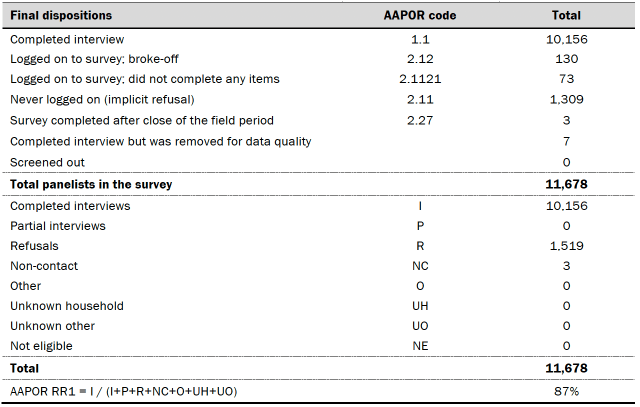
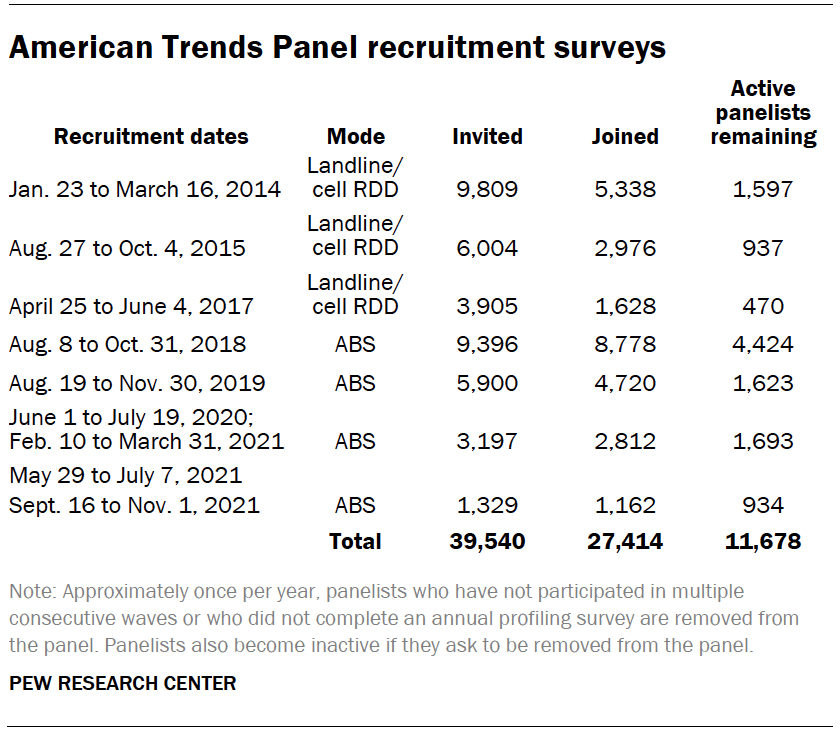
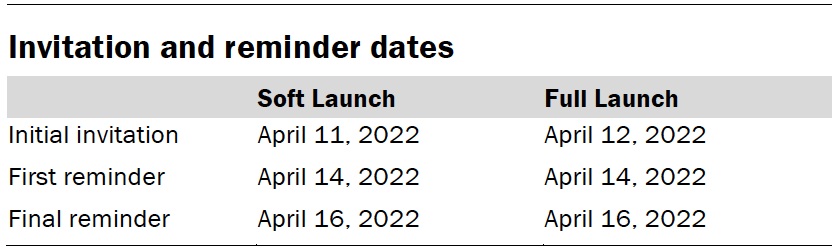
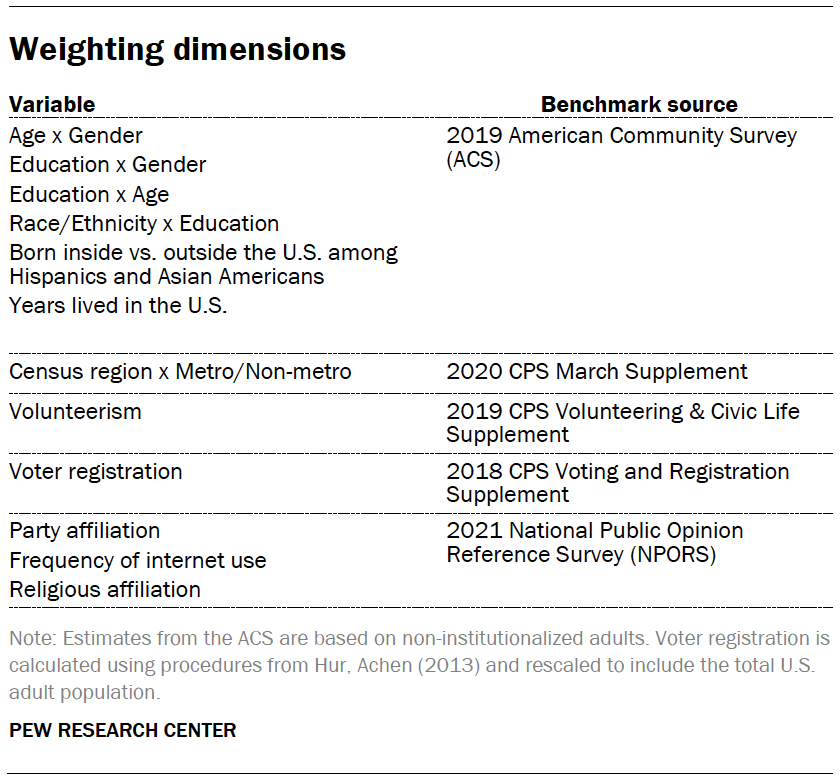
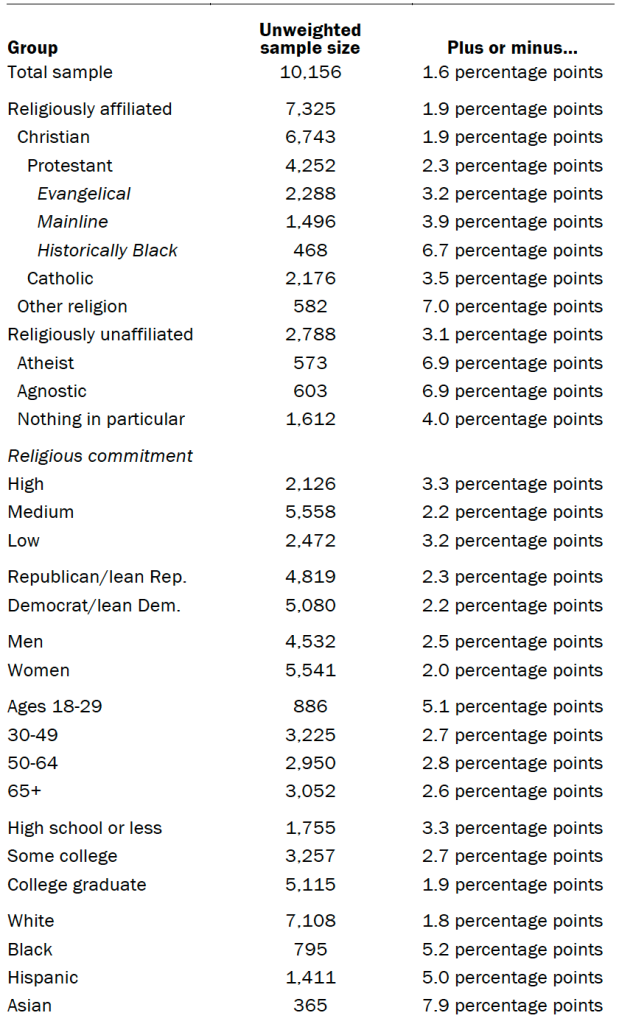
Pew Research Center conducted this survey to explore the relationship between Americans’ religious beliefs and their views about the environment. For this report, we surveyed 10,156 U.S. adults from April 11-17, 2022. All respondents to the survey are part of Pew Research Center’s American Trends Panel (ATP), an online survey panel that is recruited through national random sampling of residential addresses. This way nearly all U.S. adults have a chance of selection. The survey is weighted to be representative of the U.S. adult population by gender, race, ethnicity, partisan affiliation, education, religious affiliation and other categories. For more, see the ATP’s methodology and the methodology for this report.

The questions used in this report can be found here.

Most U.S. adults – including a solid majority of Christians and large numbers of people who identify with other religious traditions – consider the Earth sacred and believe God gave humans a duty to care for it, according to a new Pew Research Center survey.
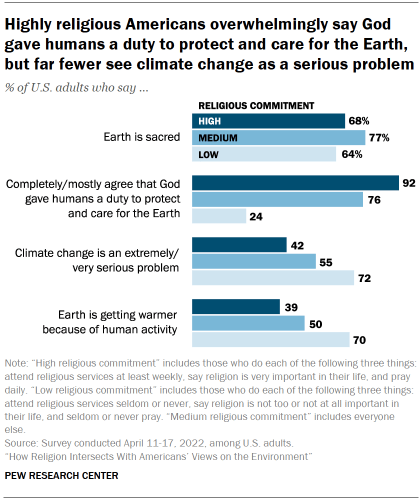
Chart shows highly religious Americans overwhelmingly say God gave humans a duty to protect and care for the Earth, but far fewer see climate change as a serious problem

But the survey also finds that highly religious Americans (those who say they pray each day, regularly attend religious services and consider religion very important in their lives) are far less likely than other U.S. adults to express concern about warming temperatures around the globe.

The survey reveals several reasons why religious Americans tend to be less concerned about climate change. First and foremost is politics: The main driver of U.S. public opinion about the climate is political party, not religion. Highly religious Americans are more inclined than others to identify with or lean toward the Republican Party, and Republicans tend to be much less likely than Democrats to believe that human activity (such as burning fossil fuels) is warming the Earth or to consider climate change a serious problem.

Religious Americans who express little or no concern about climate change also give a variety of other explanations for their views, including that there are much bigger problems in the world today, that God is in control of the climate, and that they do not believe the climate actually is changing. In addition, many religious Americans voice concerns about the potential consequences of environmental regulations, such as a loss of individual freedoms, fewer jobs or higher energy prices.

Finally, climate change does not seem to be a topic discussed much in religious congregations, either from the pulpit or in the pews. And few Americans view efforts to conserve energy and limit carbon emissions as moral issues.
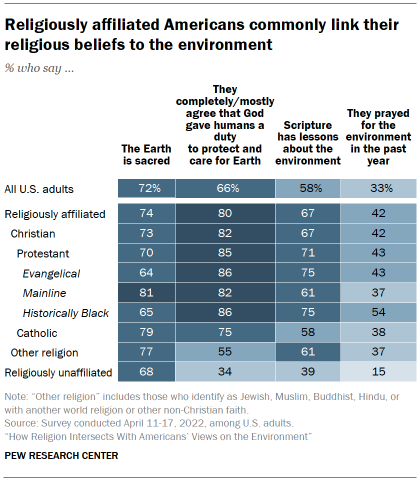
Chart shows religiously affiliated Americans commonly link their religious beliefs to the environment

The new survey, conducted April 11-17, 2022, finds that about three-quarters of religiously affiliated Americans say the Earth is sacred. An even greater share (80%) express a sense of stewardship – completely or mostly agreeing with the idea that “God gave humans a duty to protect and care for the Earth, including the plants and animals.” Two-thirds of U.S. adults who identify with a religious group say their faith’s holy scriptures contain lessons about the environment, and about four-in-ten (42%) say they have prayed for the environment in the past year.

These views are common across a variety of religious traditions. For example, three-quarters of both evangelical Protestants and members of historically Black Protestant churches say the Bible contains lessons about the environment. Upward of eight-in-ten members of those two groups say God gave humans a duty to protect and care for the Earth. And about eight-in-ten U.S. Catholics and mainline Protestants, as well as 77% of members of non-Christian religions, say the Earth is sacred.

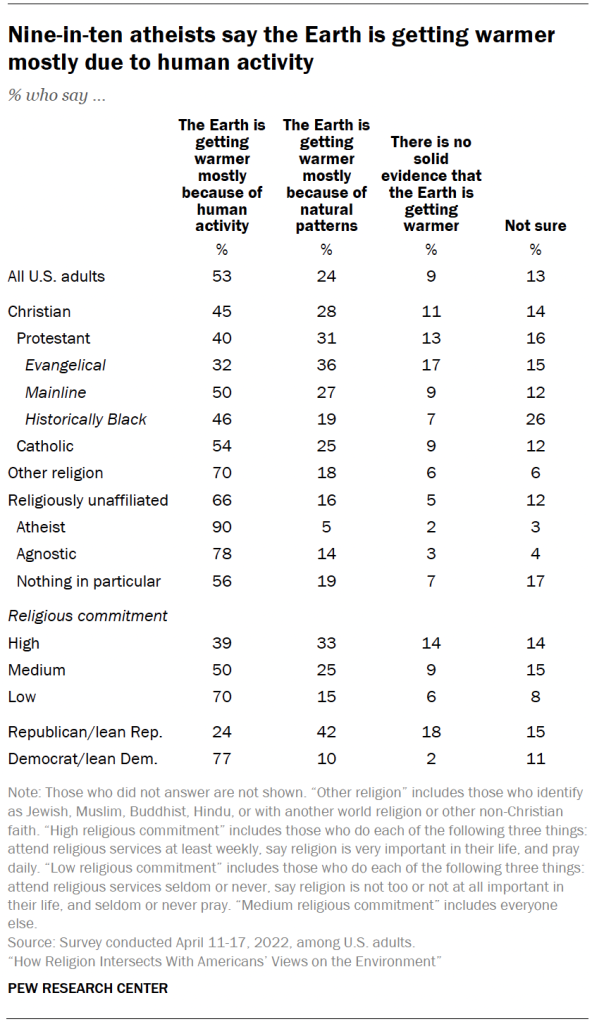
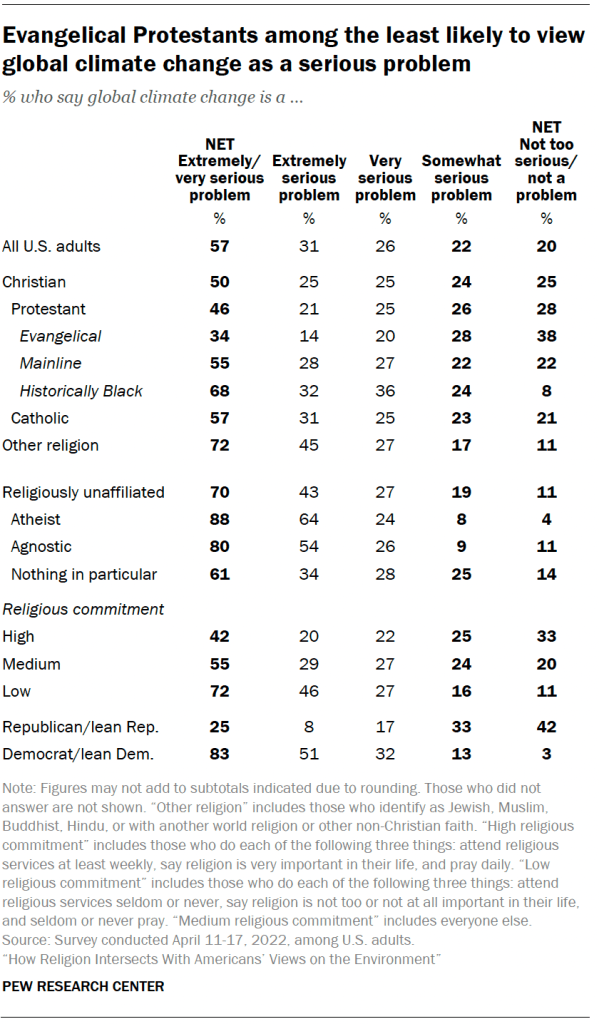
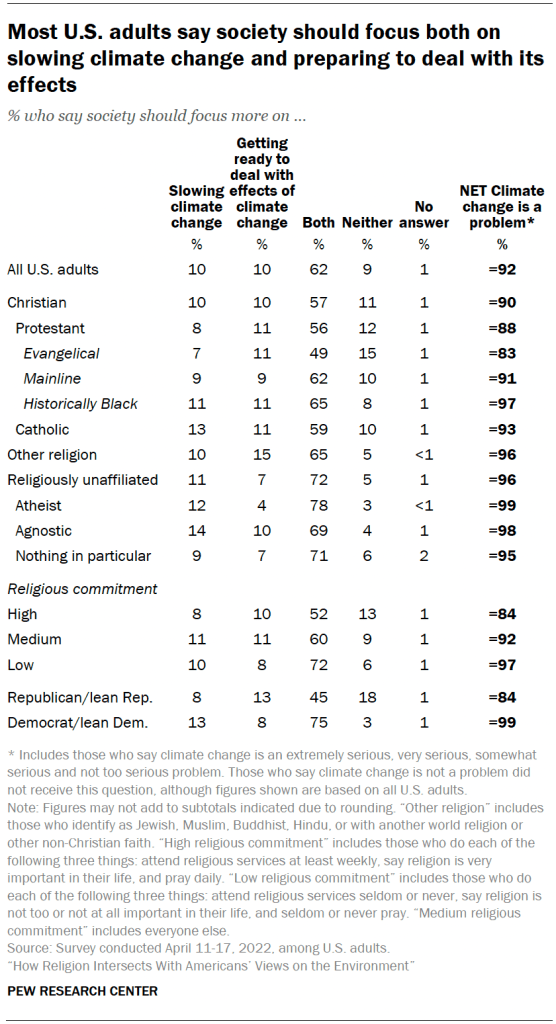
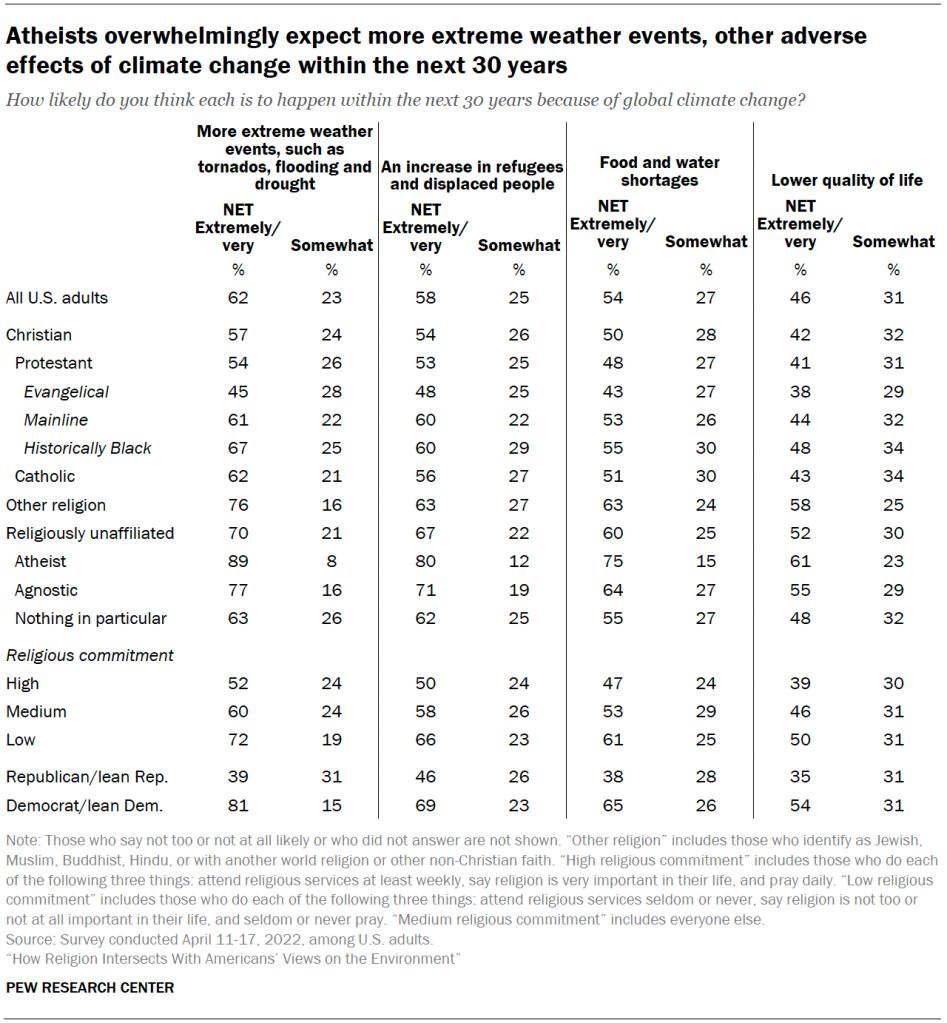
But Christians, and religiously affiliated Americans more broadly, are not as united in their views about climate change. While majorities of all the large U.S. Christian subgroups say they think global climate change is at least a somewhat serious problem, there are substantial differences in the shares who consider it an extremely or very serious problem – ranging from 68% of adults who identify with the historically Black Protestant tradition to 34% of evangelical Protestants. And half or fewer people surveyed in all major Protestant traditions say the Earth is getting warmer mostly because of human activity, including 32% of evangelicals.

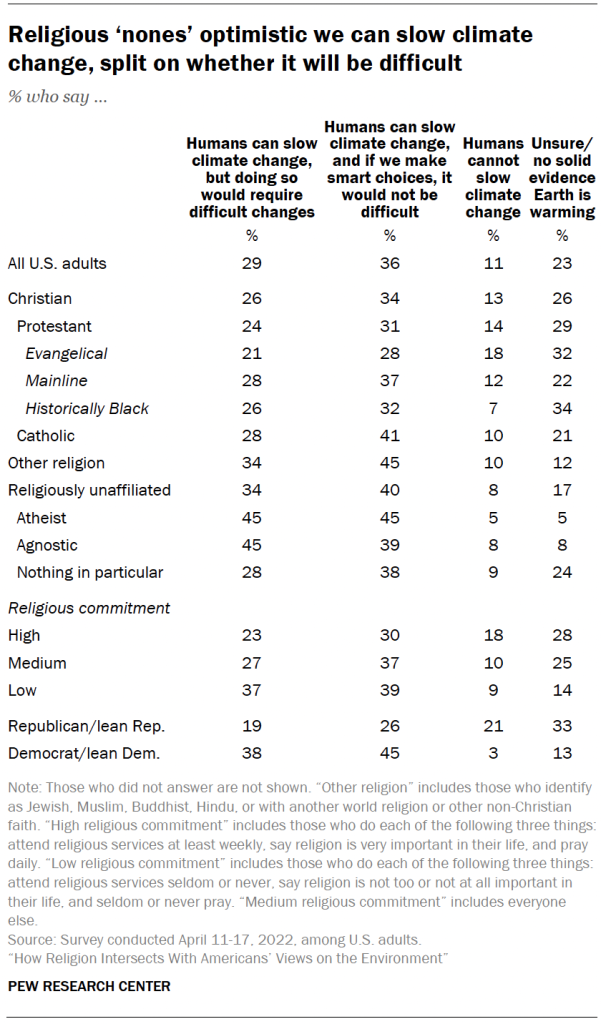
On average, people who are less religious tend to be more concerned about the consequences of global warming. For example, religiously unaffiliated adults – those who describe themselves as atheists, agnostics or “nothing in particular” – are much more likely to say climate change is an extremely or very serious problem (70%) than are religiously affiliated Americans as a whole (52%). And people who have a low level of religious commitment are much more likely than those with a medium or high level of religious commitment to be concerned about climate change.1 Most highly religious Americans see climate change as at least a somewhat serious problem, but fewer than half (42%) say it is an extremely or very serious problem, compared with 72% of the least religious adults.

Religious “nones” and Americans with low levels of religious commitment also are far more likely than their more religious counterparts to say the Earth is getting warmer mostly because of human activity, such as burning fossil fuels. For instance, 70% of people in the low religious commitment category say the Earth is warming due to human behavior, compared with 39% of highly religious Americans. Religiously affiliated adults and those who are highly religious are more likely than those who are religiously unaffiliated or have lower levels of religious commitment to say that the Earth is getting warmer mostly due to natural patterns, or that there is no solid evidence the Earth is warming – though the latter is a less common viewpoint.
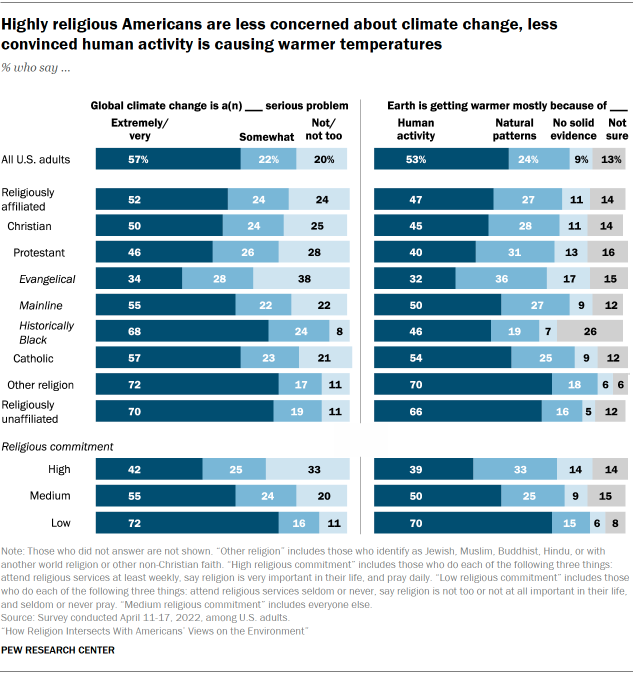
Chart shows highly religious Americans are less concerned about climate change, less convinced human activity is causing warmer temperatures

These patterns raise the question: If many religiously affiliated Americans, including most Christians, see a connection between care for the environment and their religious beliefs, then why are they less likely to be concerned about climate change than people with no religion?
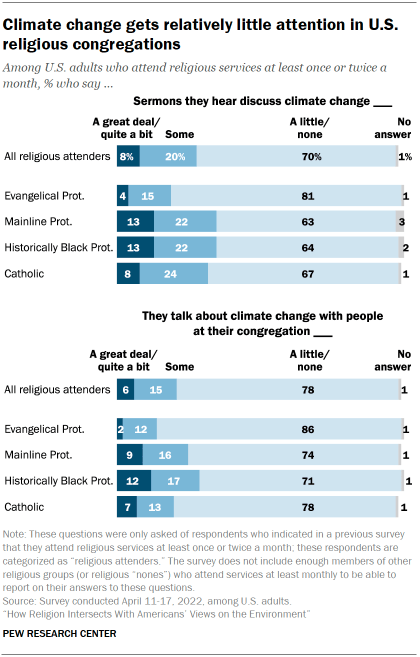
Chart shows climate change gets relatively little attention in U.S. religious congregations

There is no single, definitive answer to this question, but the new Center survey offers some clues. For one, climate change does not seem to be a major area of focus in U.S. congregations. Among all U.S. adults who say they attend religious services at least once or twice a month, just 8% say they hear a great deal or quite a bit about climate change in sermons. Another one-in-five say they hear some discussion of the topic from the pulpit, but seven-in-ten say they hear little or nothing about it. Similarly, just 6% of U.S. congregants say they talk about climate change with other people at their congregation a great deal or quite a bit.

Answers to these questions are strongly correlated with views toward climate change. For example, among all religious service attenders who say they hear at least some about the topic in sermons, 68% consider climate change an extremely or very serious problem, compared with 38% among attenders who say they hear little or nothing about it in sermons. And 61% of the former group believe the Earth is warming mostly due to human activity, versus 37% among the latter group. This does not necessarily prove that sermons are persuading people to change their views on this topic. It could also be that people seek out houses of worship where the clergy and fellow congregants generally share their views, or that they are more likely to recall sermons on topics that matter to them. But, for whatever reasons, there is a connection between religious attenders’ views on climate change and how much they remember hearing about the issue in their places of worship.

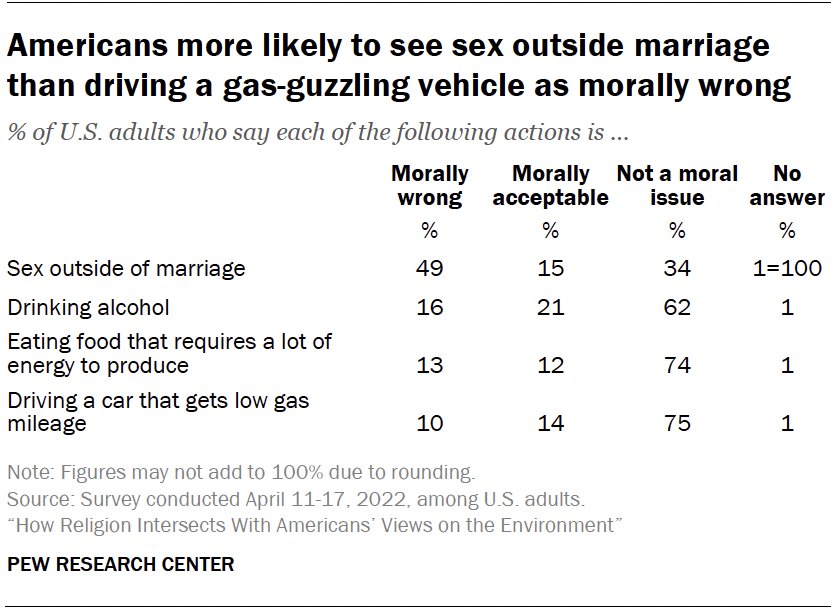
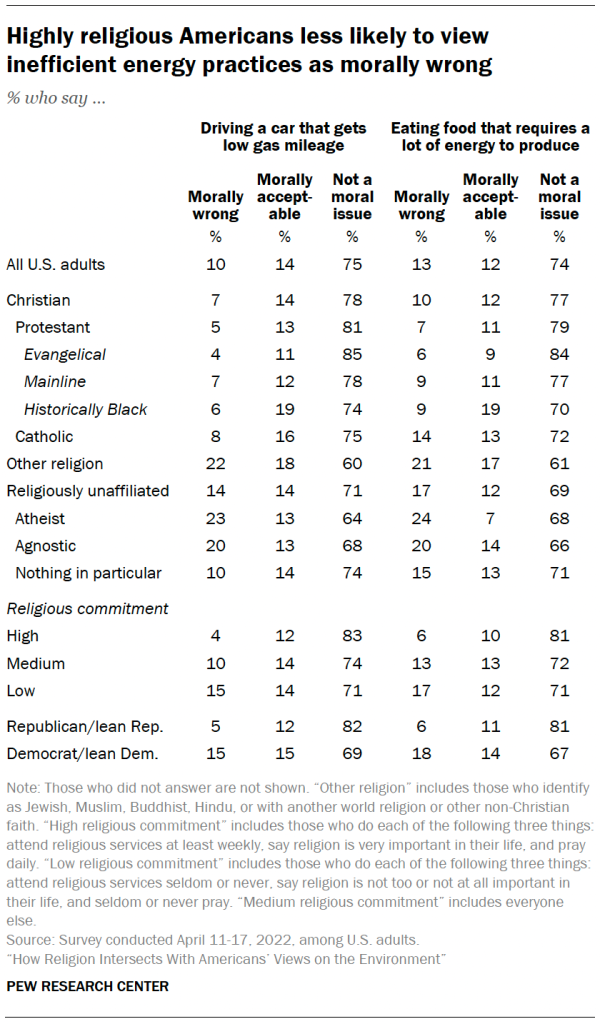
Americans, regardless of religious affiliation, also do not seem to view efforts to reduce carbon emissions in moral terms. When asked whether driving a car that gets poor gas mileage is morally wrong, morally acceptable or not a moral issue, 10% of U.S. adults – including 8% of those with a religious affiliation – say it is morally wrong. There are similar results on a question about eating food that requires a lot of energy to produce: 13% of U.S. adults say this is morally wrong.

People who identify with religions other than Christianity are modestly more likely to say these activities are morally wrong (22% and 21%, respectively), but still, most do not.
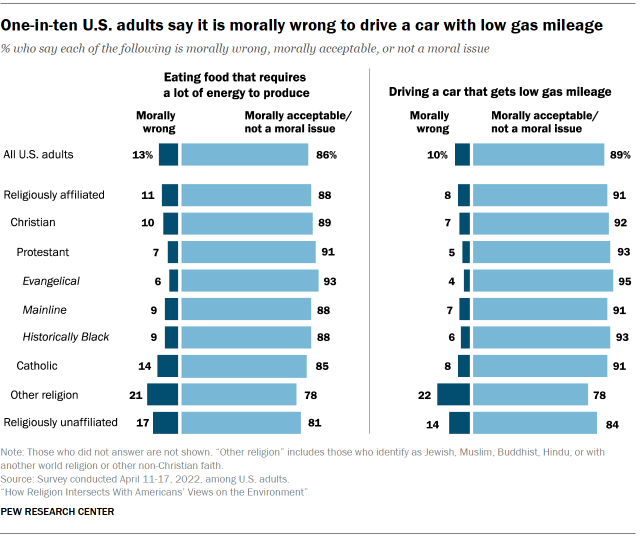
Chart shows one-in-ten U.S. adults say it is morally wrong to drive a car with low gas mileage

The survey also asked people who say climate change is not too serious a problem or not a problem at all a few follow-up questions designed to learn more about their views. Many people in this category say that “there are much bigger problems in the world today,” that “God is in control of the climate,” or that “climate change will not have a big impact on most people.”

For example, a third of all evangelical Protestants say climate change is not a serious problem because there are much bigger problems in the world (34%). Nearly as many say it’s not a problem because God is in control of the climate (29%). Both of these explanations are more common than the belief that climate change is not happening, which 15% of all evangelicals say is their position. (Respondents could cite more than one reason for their views. The percentages in this paragraph are based on all evangelical Protestants surveyed, not just the 38% who say climate change is not too serious a problem or not a problem.)
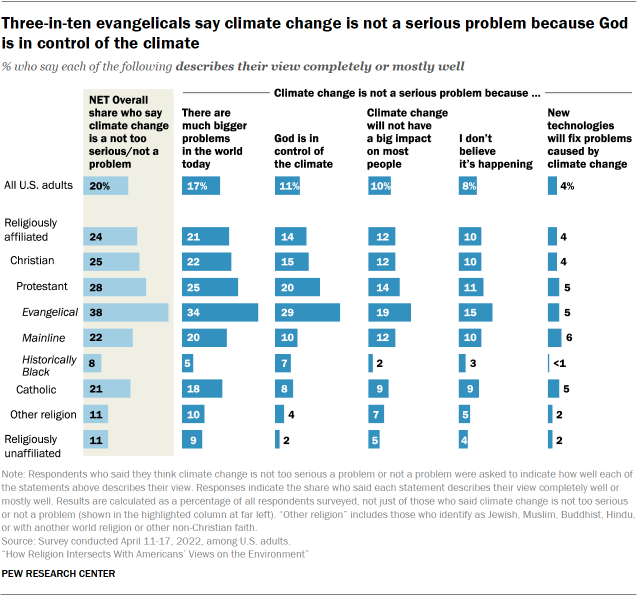
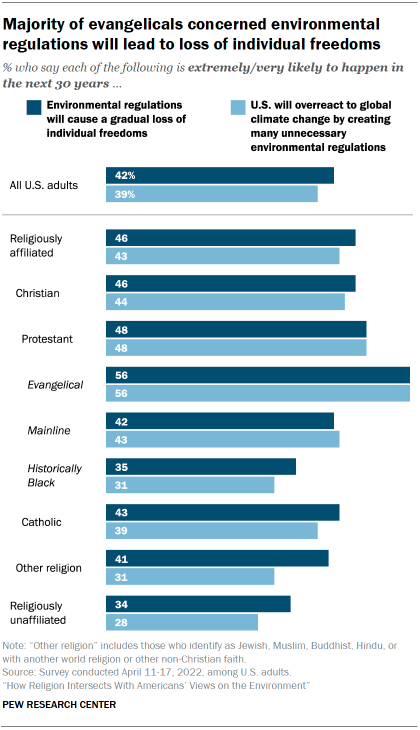
Chart shows Three-in-ten evangelicals say climate change is not a serious problem because God is in control of the climate
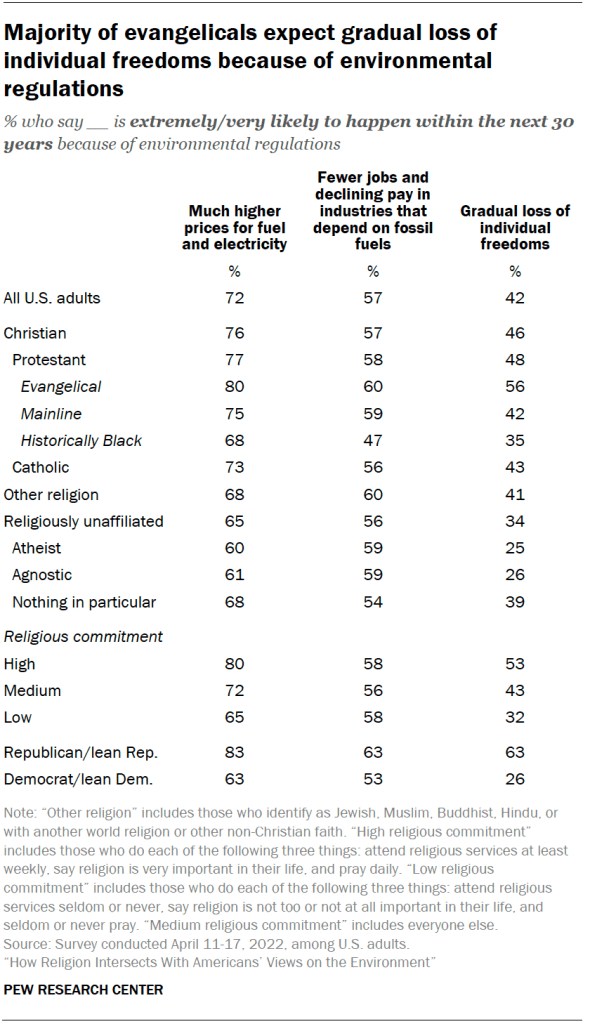
Chart shows Majority of evangelicals concerned environmental regulations will lead to loss of individual freedoms

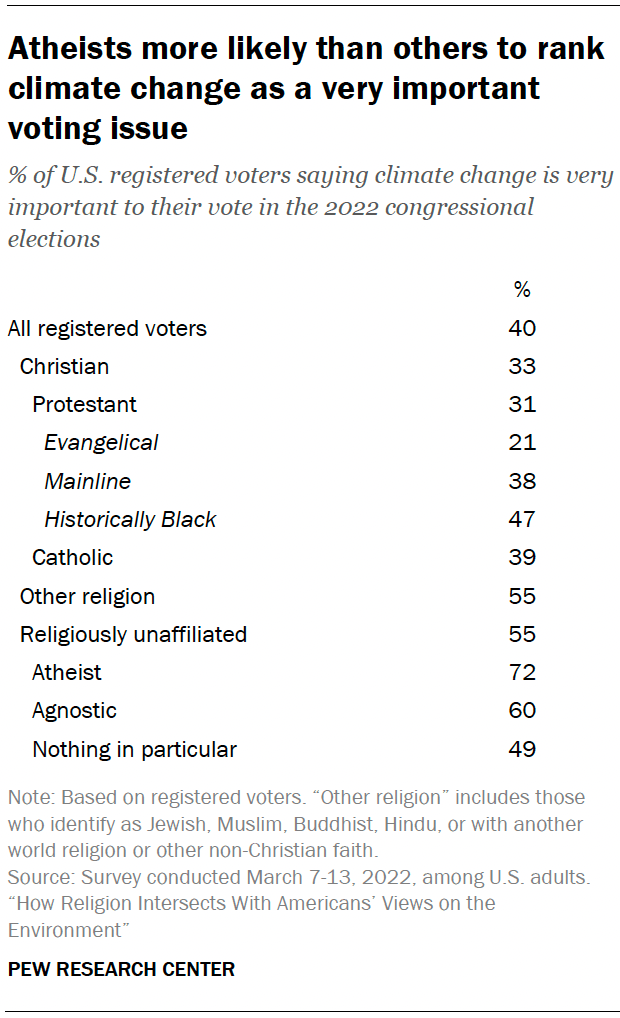
The potential impact of government regulations is another factor that may contribute to religious Americans’ views on climate change. Compared with religious “nones” (28%), more Christians (44%) – and especially evangelical Protestants (56%) – say that in the next 30 years it is extremely or very likely that the U.S. will overreact to global climate change by creating many unnecessary environmental regulations. And religiously affiliated adults also are more likely than the unaffiliated to anticipate a gradual loss of individual freedoms in the coming decades because of environmental regulations.

There are similar patterns on a question about the impact that environmental regulations could have on the economy. About half of Americans who affiliate with a religion say that stricter environmental laws and regulations cost too many jobs and hurt the economy. Evangelical Protestants are especially likely to hold this view; indeed, they are the only major U.S. religious group in which a majority take this position (66%). At the opposite end of the spectrum, two-thirds of religious “nones” say stricter environmental laws and regulations are worth the cost (68%).

All these opinions are strongly tied to political partisanship, which emerges as a crucial factor in explaining views toward the environment and climate change. Democrats and independents who lean toward the Democratic Party are far more likely than Republicans and GOP leaners to say that global climate change is an extremely or very serious problem (83% vs. 25%) – a huge gap that underlies much of the apparent differences in views among religious groups.

For example, among evangelical Protestants who identify as Republicans or lean toward the Republican Party, just 17% say climate change is an extremely or very serious problem, only slightly lower than Republicans overall (25%). But among evangelical Protestants who identify as Democrats or lean toward the Democratic Party, 78% say climate change is an extremely or very serious problem, mirroring the 83% of all Democrats who share that view.

There is a similar pattern among religious “nones.” The vast majority of religiously unaffiliated adults who identify as Democrats or lean Democratic say climate change is an extremely or very serious problem (86%). But Republicans who do not identify with any religion (34%) look more similar to Republicans overall (25%) on this issue.

As with views about the seriousness of climate change, opinions about whether the Earth is warming and the cause of it vary by party across religious groups. Roughly three-quarters of Democrats (77%) say the Earth is getting warmer mostly because of human activity such as burning fossil fuels, three times the share of Republicans who say this (24%). And within each of the major Christian traditions, as well as among Americans who do not identify with a religion, Republicans are consistently much less likely than Democrats in the same religious group to say the Earth’s warming is mostly caused by humans.
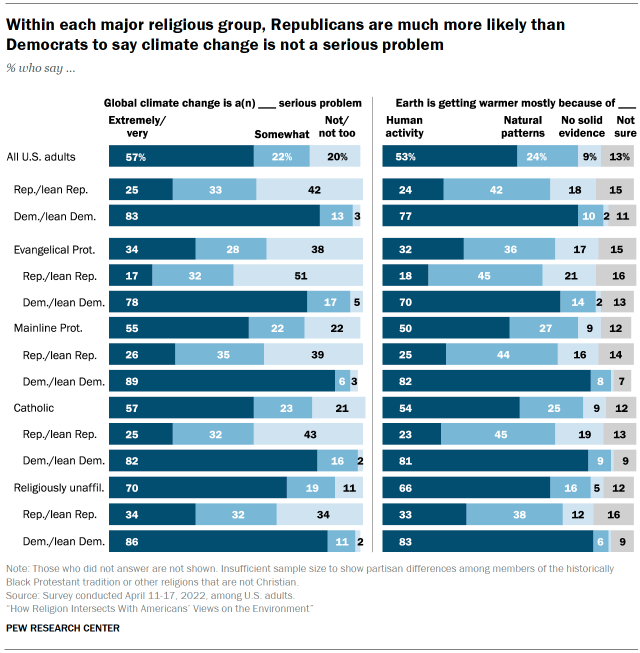
Chart shows Within each major religious group, Republicans are much more likely than Democrats to say climate change is not a serious problem
Table shows The connection among partisanship, religion and views about climate change, all else equal

Another, more complex way to compare the impact of these factors on views toward climate change is to conduct a statistical analysis that controls for a variety of demographic factors – age, gender, education, race and ethnicity, and income – as well as political party and religion.2 Holding other factors (including religion) constant, what does the survey data indicate is the likelihood that a person who identifies with each of the country’s two main political parties would say that climate change is an extremely or very serious problem? And if political party and other factors are held constant, what’s the probability that someone in each of the country’s major religious groups would take the same position on climate change?

This analysis of what statisticians call “marginal effects” shows that Republicans are far less likely than Democrats – by a marginal difference of 54 percentage points – to consider climate change an extremely or very serious problem even after controlling for other factors. When political party identification and demographic characteristics are held constant, the marginal effects of religious affiliation and commitment on public opinion about climate change are much more muted – although still statistically significant in some cases. For instance, when controlling for political party, age, etc., evangelical Protestants are 5 points less likely than religiously unaffiliated respondents to say that global climate change is a serious problem, and those with high religious commitment are 10 points less likely than those with low religious commitment to hold this view.

These are among the main findings of a new Pew Research Center survey, conducted among 10,156 adults on the Center’s American Trends Panel. The survey included Americans of many different religious backgrounds – and all are included in those described as having high, medium or low religious commitment – but this report is unable to analyze the views of non-Christian religions separately due to sample size limitations. Instead, wherever possible, the tables and charts throughout the report include an umbrella category of Americans who identify with all “other religions.” This group includes people of many faiths, such as Jews, Muslims, Buddhists and Hindus, who together make up about 6% of the U.S. adult population. Survey researchers often are reluctant to combine them into a single, umbrella category out of concern for differences in their religious beliefs, demographic characteristics and viewpoints on many issues. But on questions about the environment and climate change, the views of respondents in the “other religions” category appear to be similar enough to justify showing them together, adding a non-Christian perspective to the report.

The rest of this overview includes other key findings from the survey, including Americans’ beliefs about the “end times,” attitudes toward past and future generations, views about stewardship and dominionism, and congregations’ focus on the environment.

8% of all Americans are both highly religious and very concerned about climate change

While highly religious Americans are less concerned than the overall public about climate change, there is a subset of religious people who are deeply concerned about the issue. Among U.S. adults who display a high level of religious commitment, 42% say climate change is an extremely or very serious problem; this group makes up 8% of all U.S. adults. Adults who are highly religious and not as concerned about climate change make up a slightly larger share (11%).

At the other end of the spectrum, about one-in-five Americans (18%) exhibit low levels of religious commitment and also express concern about climate change. Fewer (7%) are both low in religious observance and unconcerned about climate change.

The remainder display medium levels of religious commitment, including some who are concerned about climate change (32%) and some who are not (25%).
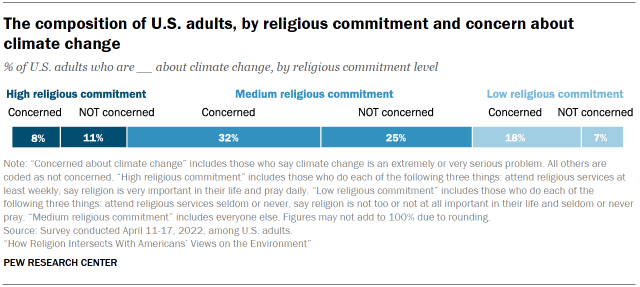
Chart shows The composition of U.S. adults, by religious commitment and concern about climate change

Who is both highly religious and concerned about climate change? This group consists of people who identify with many different religious traditions, including members of the evangelical Protestant tradition (32%), Catholics (19%), members of historically Black Protestant churches (16%) and mainline Protestants (12%). Another 15% identify with other Christian groups, such as Orthodox Christianity or the Church of Jesus Christ of Latter-day Saints, and 4% identify with Judaism, Islam, Hinduism, Buddhism and other non-Christian religions.

By comparison, 58% of Americans who are highly religious and not very concerned about climate change belong to the evangelical Protestant tradition, while one-in-five are Catholic (18%). Smaller shares identify with other Protestant traditions, other Christian groups, and other (non-Christian) religions.

The differences among these groups illustrate, once again, the role of politics in views toward climate change. Six-in-ten of those who are both highly religious and concerned about climate change identify as Democratic or lean toward the Democratic Party (59%). The highly religious and not very concerned, on the other hand, predominantly identify with or lean toward the GOP (83%).

Highly religious people who are concerned about climate change also are racially and ethnically diverse: 47% are White, 27% are Black, 18% are Hispanic, and smaller shares are Asian (5%) or another race/multiple races (3%).

Meanwhile, the highly religious and not very concerned about climate change are predominantly White (79%), with smaller shares identifying as Black (9%), Hispanic (7%), Asian (2%), or another race or multiple races (3%). These patterns overlap with similar racial gaps between Democrats and Republicans.

Other demographic differences, including by age, between those who are highly religious and concerned about climate change compared with those who are highly religious and not concerned are relatively modest.
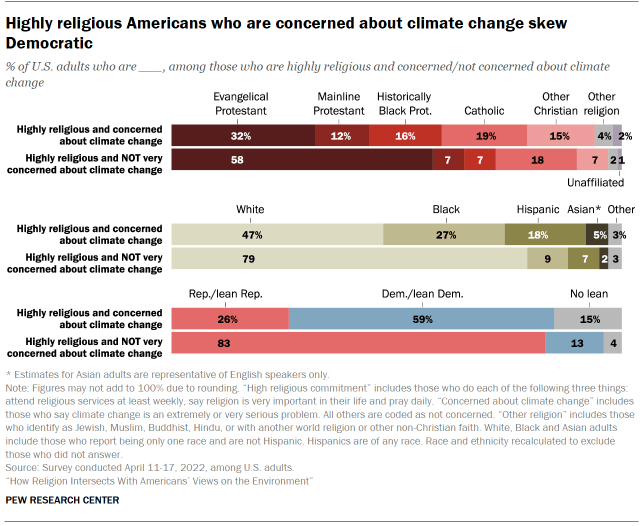
Chart shows Highly religious Americans who are concerned about climate change skew Democratic

End-times beliefs and concern about climate change

Americans’ attitudes about climate change are sometimes said to be linked to beliefs about the apocalypse or “end times.” As the theory goes, people who believe humanity is living in its last days may be less concerned about the dangers of climate change than those who do not think the world is soon coming to an end.

To test this proposition, the survey asked several questions about end-times beliefs. Most Americans (58%) reject the idea that humanity is in its last days, but roughly four-in-ten (39%) – including nearly half of Christians (47%) – say “yes” when asked whether they believe “we are living in the end times.” This includes 14% who express what can be thought of as a “premillennialist” point of view: They say (in follow-up questions) they believe Jesus will return to Earth someday and that the world will deteriorate until that time.3 A quarter of U.S. adults believe we are living in the end times but do not express this premillennialist perspective.

Roughly three-quarters of adherents of the historically Black Protestant tradition (76%) and 63% of evangelical Protestants say they believe humanity is living in the end times, as do two-thirds of all adults with high levels of religious commitment. By contrast, most Catholics, mainline Protestants, members of other (non-Christian) religions, and religiously unaffiliated Americans say “no” when asked whether the Earth is in its last days, as do majorities of those with medium and low levels of religious commitment.

Chart shows Nearly four-in-ten U.S. adults believe ‘we are living in the end times’

The survey finds a modest relationship between end-times beliefs and concerns about climate change. Those who believe humanity is living in the end times are less likely than those who do not believe this to say they think climate change is an extremely or very serious problem (51% vs. 62%), with end-times believers who hold a premillennialist perspective expressing the lowest levels of concern about climate change (40%). Still, even in this latter group, two-thirds say climate change is at least a somewhat serious problem.
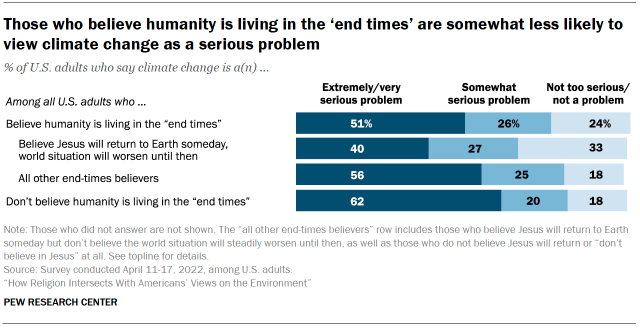
Chart shows Those who believe humanity is living in the ‘end times’ are somewhat less likely to view climate change as a serious problem

Meanwhile, U.S. adults who are more open to changing their lifestyle for future generations’ sake are more likely than others to say that climate change is a serious problem. Among Americans who say the statement “I would be willing to make sacrifices in the way I live today if I knew it would help future generations” completely or mostly describes their views, seven-in-ten say climate change is an extremely or very serious problem. Compared with this group, those who subscribe to the view that “I want to live the best life I can right now and not worry too much about the future” are less likely to say they consider climate change a serious problem (57%).

Chart shows Americans who think about future generations view climate change as a very serious problem

Most Americans (57%) express willingness to make sacrifices in the way they live if they knew it would help future generations, including 60% of religiously unaffiliated adults and about half of evangelical and mainline Protestants (52% each). Fewer U.S. adults (39%) say they want to live the best life they can right now and not worry too much about the future. Roughly similar shares of adults across religious groups share this view, though members of historically Black Protestant churches are the most likely to say they want to live their best lives now (56%).

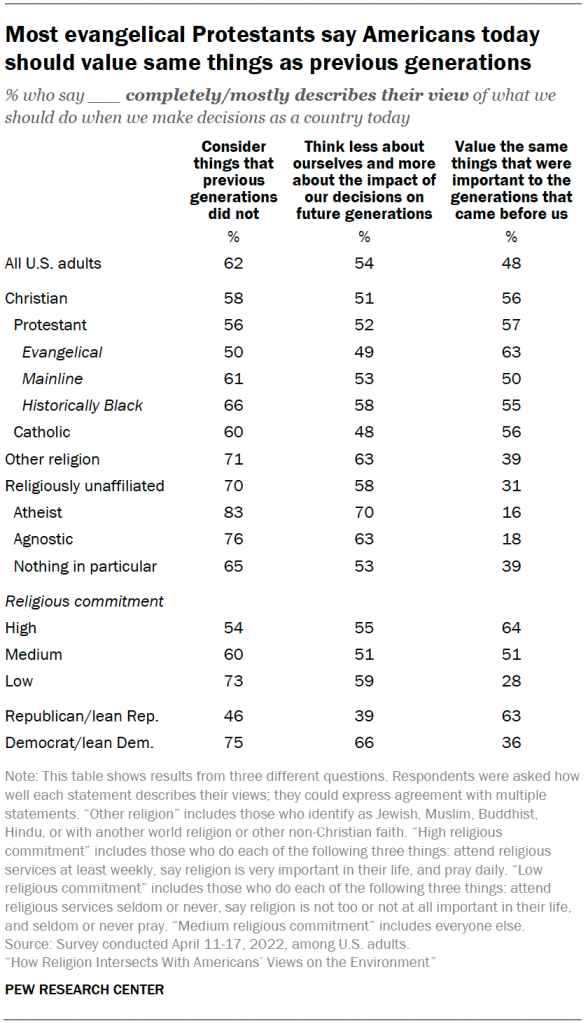
Similarly, when it comes to thinking about “how we, as a country, should make decisions,” Americans who favor considering things that previous generations did not think about are more likely to express concern about climate change. Those who say we should value things that were important to previous generations are less likely to consider climate change a serious problem.

About six-in-ten Americans (62%) say “we should consider things that previous generations did not think about.” Seven-in-ten religious “nones” and members of non-Christian religions say this statement completely or mostly describes their view, along with two-thirds of adults in the historically Black Protestant tradition and six-in-ten Catholics and mainline Protestants. Evangelical Protestants are the least likely to say this statement completely or mostly describes their view (50%).

Evangelical Protestants are more likely to say, on a separate question, that when we make decisions as a country, we should “value the same things that were important to the generations that came before us” (63%). Religious “nones” are the least likely to say this describes their view at least mostly (31%).
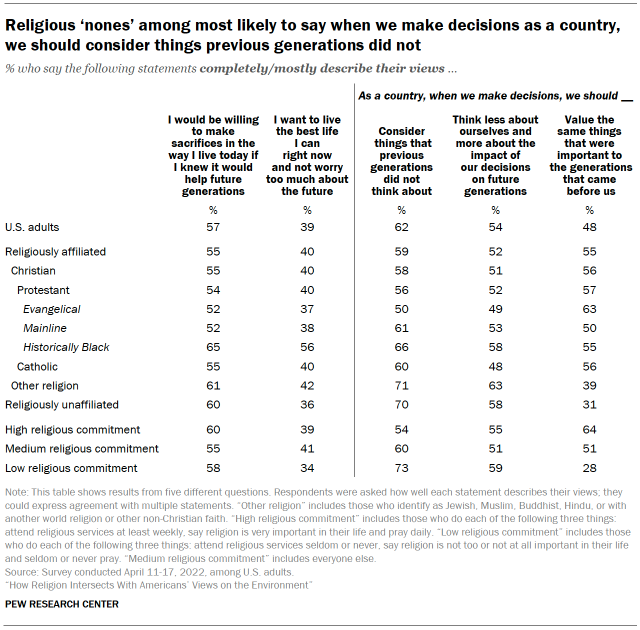
Chart shows Religious ‘nones’ among most likely to say when we make decisions as a country, we should consider things previous generations did not

Six-in-ten religiously affiliated adults hold both stewardship and dominionist views about the environment
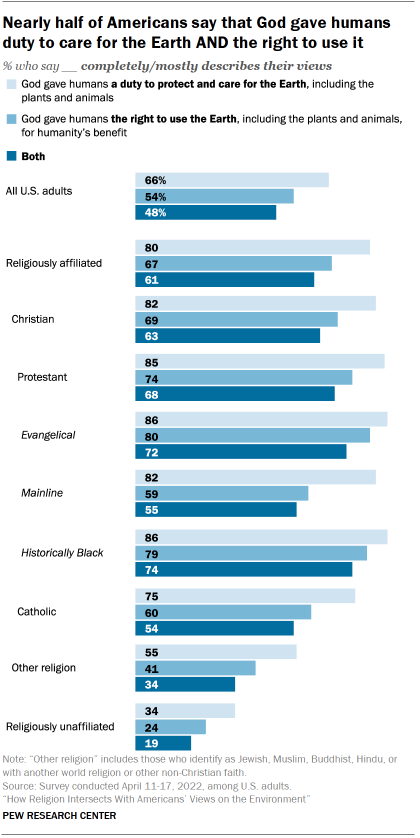
Chart shows Nearly half of Americans say that God gave humans duty to care for the Earth AND the right to use it

Most religiously affiliated adults say their holy scripture, such as the Bible, Torah, Quran, or other text, contains lessons about the environment. Two possible lessons that resonate with many Americans are stewardship, the idea that “God gave humans a duty to protect and care for the Earth, including the plants and animals,” and dominionism, which includes the thought that “God gave humans the right to use the Earth, including the plants and animals, for humanity’s benefit.”

Upward of half (54%) of all Americans (including two-thirds of religiously affiliated adults) say this description of dominionism mostly or entirely reflects their opinions. This is most commonly expressed by evangelical Protestants (80%) and adults who belong to the historically Black Protestant tradition (79%), while roughly six-in-ten Catholics (60%) and mainline Protestants (59%) feel this way. 

Meanwhile, two-thirds of all U.S. adults – including 80% of those who identify with a religion – say the notion of stewardship, as described by the survey, completely or mostly reflects their views. This perspective is more common among Protestants (85%) than among Catholics (75%) or people who belong to other religions (55%).

All respondents who say that holy scripture has lessons about the environment were asked to describe, in their own words, what they think those lessons are. Within this group, people are far more likely to mention stewardship or people’s need to protect and care for the environment (29%) than they are to say that their religious text mentions that humans have dominion over Earth or that God put man in charge of creation (3%).

Still, many people do not see stewardship and dominionism as contradictory: Combined, nearly half of Americans say both of these perspectives completely or mostly describe their views (48%). At least seven-in-ten members of historically Black (74%) and evangelical Protestant churches (72%) say they hold views reflecting both stewardship and dominionism.
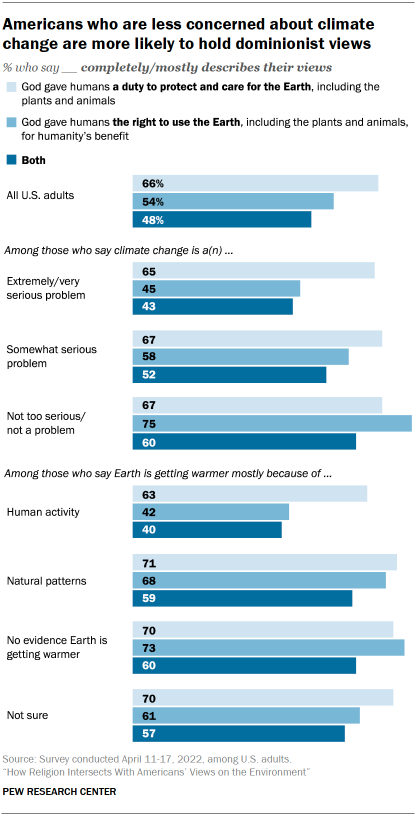
Chart shows Americans who are less concerned about climate change are more likely to hold dominionist views

Americans who are very concerned about climate change (65%) are as likely as those who are less concerned (67%) to say the stewardship perspective completely or mostly describes their views. But when it comes to dominionism, those who are most concerned about climate change are far less likely to hold this viewpoint: 45% of those who say climate change is an extremely or very serious problem say the perspective that God gave humans the right to use the Earth for humanity’s benefit completely or mostly describes their views, compared with three-quarters of those who say climate change is not too serious or not a problem at all.

There is a similar pattern when it comes to whether the Earth is getting warmer and the reasons behind it. Majorities of Americans say God gave humans a duty to protect and care for the Earth, regardless of whether they think the Earth is getting warmer and why. But far fewer Americans who say the Earth is getting warmer mostly because of human activity also say the statement reflecting a dominionist perspective completely or mostly describes their thinking (42%). About seven-in-ten U.S. adults who say the Earth is getting warmer mostly because of “natural patterns” (68%), or who say there is no evidence that the Earth is warming (73%), take a dominionist stance.

Most Americans try to do things in their daily lives to protect the environment, but the religiously affiliated are less likely to be civically involved in activities addressing climate change

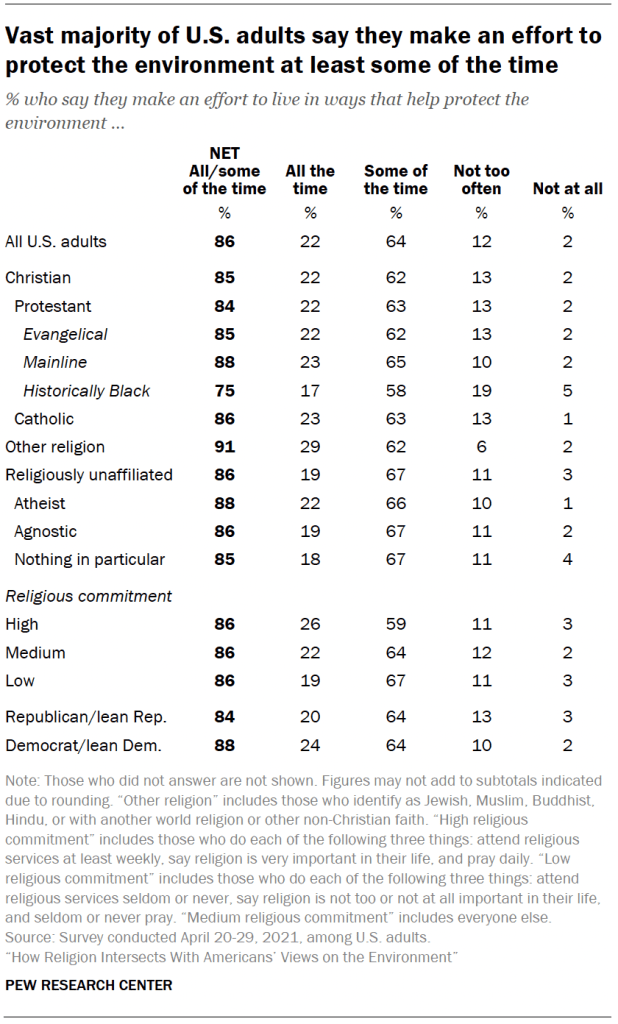
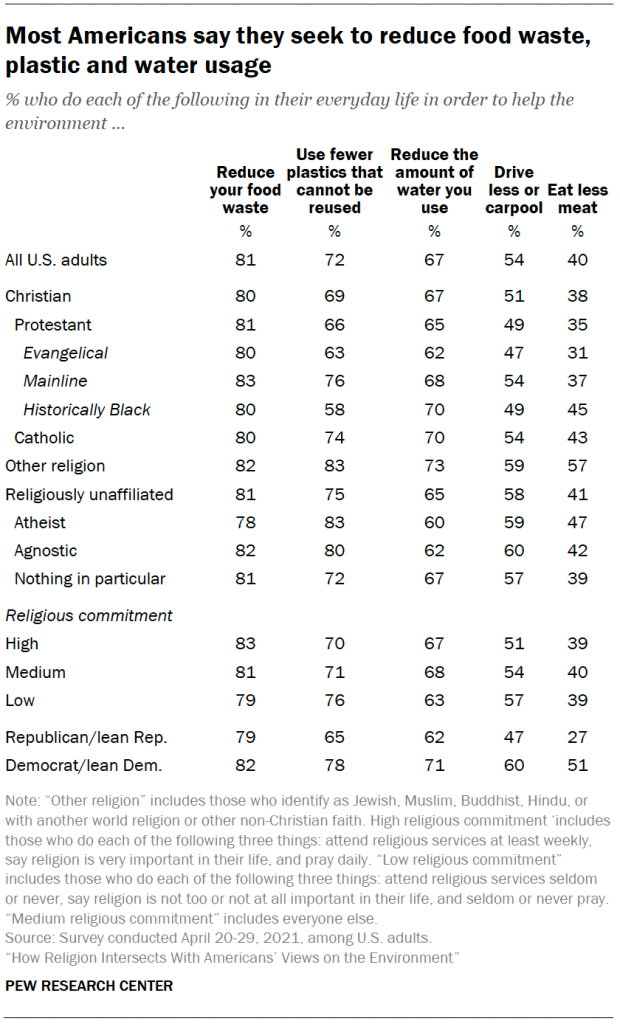
Americans do a range of things in their daily lives to help protect the environment. A Center survey conducted in April 2021 found that eight-in-ten Americans (81%) say they make efforts to reduce their daily food waste to help the environment, and seven-in-ten report using fewer plastics that cannot be reused (72%). Two-thirds say they aim to reduce their daily water usage, and upward of half drive less or carpool (54%). The least popular activity of those mentioned on the survey is eating less meat to protect the environment; 40% of Americans make this effort. All told, 46% of U.S. adults say they do at least four of these five activities to help protect the environment.
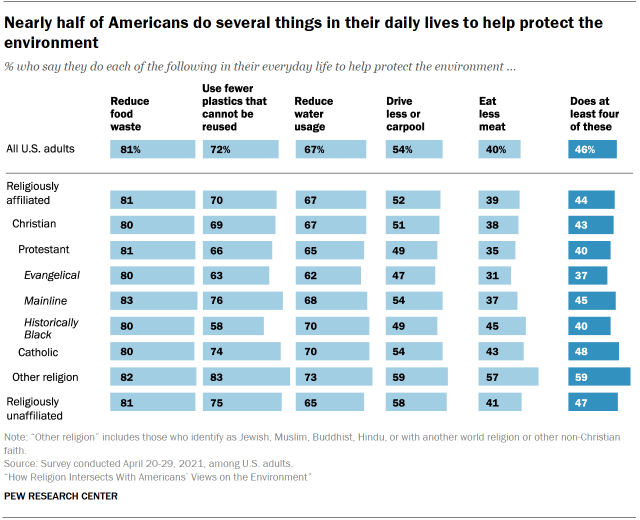
Chart shows Nearly half of Americans do several things in their daily lives to help protect the environment

These activities tend to be reported by similar shares of Americans across religious traditions and among the religiously unaffiliated, save for eating less meat. More than half of Americans (57%) who identify with non-Christian religions say they eat less meat to help the environment, compared with fewer than half of Christians and religious “nones.” Evangelicals are the least likely to say they eat less meat to help protect the environment (31%). Members of non-Christian religions also are the most likely to say they use less plastic to help the environment (83%).

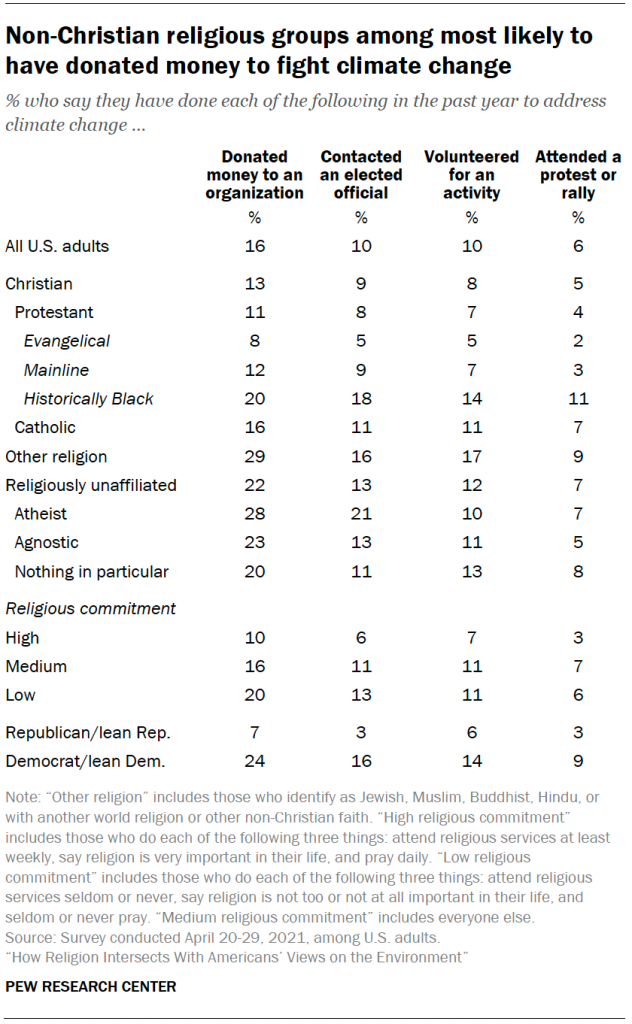
When it comes to participating in activities that help address climate change, a quarter of Americans say they have done at least one of the following activities in the past 12 months (prior to when these questions were asked in April 2021): donated money to an organization focused on addressing climate change; contacted an elected official to urge them to address climate change; volunteered for an activity focused on addressing climate change; or attended a protest or rally to show support for addressing climate change.

Religiously unaffiliated adults (31%) are more likely than those who are affiliated with a religion (22%) to report having performed any of these activities in the name of climate change, although members of non-Christian religions are most likely to have done at least one of these things (41%). There also is variance across Christian traditions, with members of the historically Black Protestant tradition (28%) more likely than evangelicals (13%) to engage in these activities.
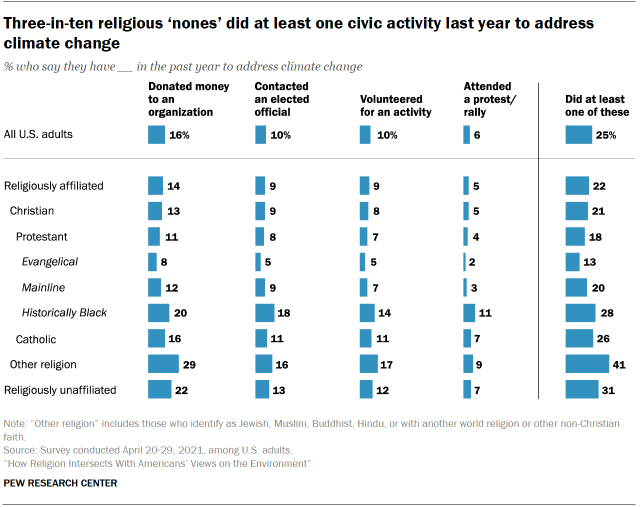
Three-in-ten religious ‘nones’ did at least one civic activity last year to address climate change

Other findings from the new survey include:

  • U.S. congregations appear to be more likely to focus on other – perhaps more personal – ways of helping the community, rather than cleaning up public places or protecting the environment. Among all U.S. adults who attend religious services at least once or twice a month, a large majority (85%) say their congregation has a group that helps people who need food, clothing or shelter, and just over half (55%) say their house of worship helps people with alcohol or drug problems. Fewer (41%) say their congregation has a group dedicated to helping clean up public places or protecting the environment, and just 17% say they are personally involved in that group.
Chart shows Four-in-ten regular religious attenders say their congregation has a group that helps protect the environment
  • Among U.S. adults who attend religious services at least monthly, 46% say their congregation has recycling bins, 43% say their house of worship takes steps to be more energy efficient and 8% say it uses solar power.
  • Fully seven-in-ten Americans say they find meaning in nature (71%), including 38% who find a great deal of meaning from spending time outdoors. There is relatively little variation by religious affiliation on this question. For example, 74% of mainline Protestants, 71% of Catholics and religious “nones,” and 70% of evangelical Protestants say they draw meaning from nature and the outdoors. But members of historically Black Protestant churches, who are among the most concerned about climate change, are the least likely to derive at least quite a bit of meaning from spending time outside (56%).
Sidebar: Involvement by religious groups in debates over climate change

Clergy and religious organizations have participated for decades in the environmental movement, contributing sermons on the sanctity of the Earth, sharing papal warnings about climate change, lobbying on behalf of renewable energy, and issuing interfaith declarations about preserving the planet for future generations. These efforts have helped introduce the language of morality and sin into debates that often revolve around science, money and partisan politics.

U.S. religious involvement in modern environmental issues dates back at least half a century. The National Council of Churches urged clergy to preach about the environment in their Sunday services prior to the first Earth Day, which was held in 1970.4 Also in 1970, the National Association of Evangelicals (NAE) publicly supported conservation, declaring that “those who thoughtlessly destroy a God-ordained balance of nature are guilty of sin against God’s creation.” The following year, the NAE pledged cooperation with “any responsible effort to solve critical environmental problems” and called on members to do the same, “even at the cost of personal discomfort or inconvenience.” And Pope Paul VI spoke of the effect of “human activity” on nature, saying humanity “is suddenly becoming aware that by an ill-considered exploitation of nature he [mankind] risks destroying it and becoming in his turn the victim of this degradation.”

Still, many religious leaders and groups sat out the environmental movement during most of the 1970s – a time when the movement’s main priorities tended to be pollution and population control, not climate change.5 In fact, some environmentalists in that period cast religion as responsible for a lack of human concern for the planet. On that first Earth Day in 1970, a handbook prepared for thousands of teach-ins contained an essay from Science magazine arguing that Christianity, especially in its Western forms, was the most human-centric religion in the world and played a major role in ecological problems. The author, UCLA historian Lynn White Jr., wrote that the biblical creation story, in establishing human dominance over other creatures, had conditioned people to undervalue non-humans. “[W]e shall continue to have a worsening ecological crisis until we reject the Christian axiom that nature has no reason for existence save to serve man,” White wrote.

But, since the mid- to late-1980s, religious leaders and organizations increasingly have been involved in the environmental movement, especially activism relating to climate change. What follows is a brief account of the history of this involvement, informed by academic scholarship and news coverage on the topic, as well as nearly two dozen interviews with leaders of religious organizations and experts on the subject.

Popes and patriarchs

Since the 1980s, popes and ecumenical patriarchs have brought the Roman Catholic and Orthodox Christian churches into the environmental movement, most prominently through encyclicals warning about the need to protect the Earth. While doing this, they have brought the Bible and morality into discussions of pollution, biodiversity, overpopulation and climate change.

In 1985, St. John Paul II, who served as pope from 1978 to 2005, linked environmentalism to the will of God and the creation story in the Book of Genesis. In a speech in Kenya, he cited numerous environmental threats – including deforestation, pollution, soil erosion and acid rain – and said, “The church’s commitment to the conservation and improvement of our environment is linked to a command of God. In the very first pages of the Bible, we read how God created all things and then entrusted them to the care of human beings who were themselves created in his image.” And in 1990, on World Peace Day, he highlighted the emerging “new ecological awareness.” Faced with “widespread destruction of the environment,” he said, “people everywhere are coming to understand that we cannot continue to use the goods of the earth as we have in the past. … Industrial waste, the burning of fossil fuels, unrestricted deforestation, the use of certain types of herbicides, coolants and propellants: All of these are known to harm the atmosphere and environment.”

The next pope, Benedict XVI, also took up the issue repeatedly during his papacy, which lasted from 2005 to 2013. At World Peace Day in 2010, Benedict expounded on a theme that arises frequently in religious debates over environmentalism – the passage in Genesis in which God gives humanity “dominion” over other creatures. People “misunderstood the meaning of God’s command and exploited creation out of a desire to exercise absolute domination over it,” Benedict said. “But the true meaning of God’s original command, as the Book of Genesis clearly shows, was not a simple conferral of authority, but rather a summons to responsibility.”

Francis, who has been pope since 2013, devoted an encyclical to climate change in 2015. Titled “Laudato Si” (or, in English, “Praised Be,”) and subtitled “On Care For Our Common Home,” it noted “a very solid scientific consensus” that climate change is real and “one of the principal challenges facing humanity in our day.” While predicting that the brunt of climate change would especially hurt the poor, Francis warned that “if present trends continue, this century may well witness extraordinary climate change and an unprecedented destruction of ecosystems, with serious consequences for all of us.”

Environmentalism also has been a stated priority of Eastern Orthodox Christianity. In 1989, Demetrius, then the ecumenical patriarch of Constantinople (a key leader among Orthodox churches), released an encyclical letter proclaiming Sept. 1 as the day Orthodox Christians should pray for the planet. Lamenting the extent of pollution and the extinction of various species, the patriarch warned that “man cannot infinitely and at his pleasure exploit the natural sources of energy. The price of his arrogance will be his self-destruction, if the present situation continues.” (In 2015, Pope Francis also declared Sept. 1 as an annual World Day of Prayer for the Care of Creation, citing the ecumenical patriarch as inspiration.)

Demetrius’s successor, Bartholomew, who still holds the position, has become known as “the Green Patriarch” for his environmental efforts. In 1997, he declared that polluting the air and water and causing change to the earth’s climate are “sins.”6 He has urged all people to pray for forgiveness “for our contribution – smaller or greater – to the disfigurement and destruction of creation.” And he has expressed the hope that “various ecological initiatives developed by the Ecumenical Patriarchate would result in the parallel creation of ‘green parishes’ and ‘green priests’ throughout the world.”7 In 2008, Time magazine named him among the world’s most influential people, citing his insistence that “ecological questions are essentially spiritual ones.”8

Religious organizations in the U.S.

In 1990, nearly three dozen Nobel laureates signed a letter urging religious leaders around the world to take environmental issues seriously. One partial outgrowth was the creation of the National Religious Partnership for the Environment (NRPE), founded in the U.S. in 1993. The NRPE helped coordinate efforts to address climate issues by the U.S. Conference of Catholic Bishops and three other groups: the Evangelical Environmental Network (EEN), the National Council of Churches of Christ, and the Jewish Council for Public Affairs.

One of the first things the groups did was send tens of thousands of educational “environmental kits” to congregations around the country. They also dispatched speakers to churches and advised pastors on how to address the issue, which was new to many Christians, said Cassandra Carmichael, executive director of the NRPE. Since then, the groups have continued to lobby politicians about national and regional environmental legislation, raise money for environmental causes, and run their own projects. For example, the EEN raised money in the mid-1990s to preserve the Endangered Species Act, and in 2002 it ran an advertising campaign titled “What would Jesus drive?” urging Americans to buy smaller, more fuel-efficient cars.

Another organization, Interfaith Power and Light (IPL), was founded in 2000 by the Rev. Canon Sally Bingham, an advocate for environmental issues who became an Episcopal priest hoping to spread awareness of environmentalism in faith circles.9 The group, based in California, quickly spread to other states and expanded to include clergy from other religions including other Christian denominations, Judaism, Buddhism, Hinduism, Islam and Baha’i. IPL lobbies for local, state and national environmental issues, manages projects to increase awareness of these issues, and sends speakers to congregations to talk about the topic. Among other issues, the group lobbied for landmark California legislation regulating emissions in 2002. Fran Pavley, then a California assemblywoman who authored the legislation, said in an interview that when the law was up for a vote, Bingham. arranged for a pastor to contact a legislator who was wavering. Pavley said the discussion with the pastor led the legislator to cast one of the deciding votes in favor of the law.

During much of this period, there was increasing debate in prominent U.S.-based evangelical periodicals over whether evangelicals should embrace environmental issues, according to a study in the Journal for the Scientific Study of Religion. Some advocates promoted the idea of discussing environmentalism in religious terms, using phrases such as “creation care” and “environmental stewardship” that would stand out from scientific language commonly used by secular environment groups.10

In 2006, the then-head of the EEN, the Rev. Jim Ball, and the NAE’s chief lobbyist at the time, the Rev. Richard Cizik, helped coordinate the Evangelical Climate Initiative (ECI), an effort to garner support from evangelicals and policymakers on environmental issues. It included a publicity campaign around an open letter signed by 86 evangelical Christian leaders, including such prominent pastors as the Rev. Rick Warren. The statement, titled “Climate Change: An Evangelical Call to Action,” made four main points. It said that “human-induced climate change is real”; the poor would be most severely affected by it; Christian moral convictions “demand our response to the climate change problem”; and legislators should pass laws requiring reductions in carbon dioxide emissions through “market-based mechanisms such as a cap-and-trade program.” The initiative included full-page ads in The New York Times and Christianity Today.

Over time, many of these efforts have drawn criticism from some conservative Christian observers. The Rev. Pat Robertson of the Christian Broadcasting Network charged that the “What would Jesus drive?” campaign by the EEN had bordered on blasphemy for “linking Jesus to an anti-SUV campaign.” And among the most prominent critics of environmentalism from a religious perspective were Christian leaders associated with the Cornwall Alliance for the Stewardship of Creation (formerly The Interfaith Stewardship Alliance), whose “Declaration of Environmental Stewardship” in 2000 asserted that environmentalists have “exaggerated” risks and favored policies that would impede economic development. Theologically, the Cornwall Alliance argued that the goals of environmentalists contradicted God’s desire in the Book of Genesis that humans should multiply and exercise dominion over the Earth.

In 2006, the group allied with 22 conservative evangelical leaders, including James Dobson of Focus on the Family and Charles (“Chuck”) Colson of Prison Fellowship Ministries, to urge the NAE to avoid endorsing the ECI. In their letter, they pressed the NAE to remain neutral in debates over climate change, arguing that “there should be room for Bible-believing evangelicals to disagree about the cause, severity and solutions to the global warming issue.”11 In the aftermath, the Rev. Cizik removed his signature from the letter, despite being one of the ECI’s main organizers. (Two years later, Cizik resigned under pressure from the NAE after he publicly supported the ECI, implied he had voted for President Barack Obama and expressed support for civil unions for same-sex couples.12)

Recent actions

In 2010, some 4,200 evangelical leaders from around the world met in South Africa as part of the Lausanne Movement, a network started by the Rev. Billy Graham in the 1970s. They endorsed a document called The Cape Town Commitment, which included, among its global priorities, the need for world leaders to address climate change and poverty simultaneously, on the grounds that climate change “will disproportionately affect those in poorer countries, for it is there that climate extreme will be most severe and where there is little capability to adapt to them.”

Still, several of the religious leaders interviewed for this brief history expressed fatigue or disappointment with the slew of statements, initiatives and declarations by prominent clergy regarding climate change, saying they had learned from the fallout over the ECI that such statements do not indicate widespread support by ordinary people in the pews. More recently, they said, they have focused more directly on trying to change the views of members of individual houses of worship or to use social media to reach religious audiences directly.

In the first decade of the 2000s, “we went after the ‘grasstops’ – the big leaders – without building enough grassroots support to make it as effective as it could have been and should have been,” said the Rev. Mitch Hescox, president and chief executive officer of the Evangelical Environmental Network. “We [adopted] the strategy of going after the top first and hoping it would trickle down. But in the evangelical world, there’s no real hierarchy. Even though there’s an NAE, there’s still local church control, and we didn’t have enough local pastors and church people to really be engaged with the issue,” he said.

Several of those interviewed said that their groups’ grassroots efforts have gone on for decades and have succeeded in adding a religious component to how many people think about environmental issues. Cassandra Carmichael of the NRPE said that when her organization started sending speakers to houses of worship in the 1990s, “people in the pews were asking questions like, ‘… Why are you talking about the environment and faith together?’” That has changed, she said. “I don’t get that anymore. I think the concept of environmental stewardship is much more grounded in congregants’ minds now than it was [back] then.”

Joelle Novey, director of an affiliate of Interfaith Power & Light that covers the District of Columbia, Maryland and Northern Virginia, said her team of four staffers is “in grassroots relationships with congregations all over this region. … I’ve spoken almost every weekend for years and years now.” She says that while those who invite IPL to houses of worship generally are already sympathetic to the group’s agenda, the congregations as a whole tend to be more politically mixed, and that many congregants have never before encountered someone with her message in a church.

“Too many people have come to see belief in climate science as a political team issue,” Novey said. “But what’s so beautiful about this is, the time slot I speak on a Sunday is the same slot where the previous Sunday they talked about feeding the hungry or the next week about caring for elders. So I can frame climate as a moral issue.”

Interacting with government officials about environmental policies and rules remains a high priority for these groups. For example, the IPL affiliate of D.C., Maryland and Northern Virginia has joined with other environmental groups to inform the D.C. Council about gas leaks measured across the city, hoping the Council will switch the city’s energy source from natural gas to renewable electricity, Novey said. And the NRPE has worked with Black clergy to solicit more than 5,000 public comments about the impact of heavy-duty trucks in communities, Carmichael said. “If we can clean up and make those trucks all electric so they’re not polluting, then the community that benefits the most from that cleanup is the Black community,” she said. “It showcases that there is considerable interest and passion in speaking out from a place of faith regarding environmental concerns.”

The Jewish group “Dayenu: A Jewish Call to Climate Action,” which formed in 2020, lobbied Jewish members of Congress to pass the Inflation Reduction Act of 2022, urging them to include money that would address climate change ($369 billion wound up being included in the bill). The group’s talking points made it into the Congressional Record courtesy of Sen. Ben Cardin (D-Md.), who is Jewish. Citing a representative of Dayenu, Cardin noted that the Senate’s consideration of the Inflation Reduction Act began on Tisha B’Av, a Jewish day of collective mourning, but that “this day of despair is also the day that new hope and the potential of a rebuilt, reimagined, redeemed world is born. These investments in clean energy and transportation can help us emerge from climate-fueled disasters to a more hopeful, clean energy future for generations to come.”

Other Jewish groups also have worked over the years to spread environmental awareness among Jews, including “Shomrei Adamah” (Keepers of the Earth), which closed in 1996, and “Hazon: The Jewish Lab for Sustainability.” Among Muslims, the Islamic Society of North America in 2014 formed a “Green Masjid Task Group” – now the ISNA Green Initiative – to raise awareness about environmental issues and to encourage environmentally friendly practices at mosques and Islamic schools. In addition, the group “Green the Church” focuses similar efforts at predominantly Black churches, and the Unitarian Universalist Association accredits Unitarian Universalist congregations as “Green Sanctuaries” if they qualify.

Actions also continue at the global level. In October 2021, prior to the 26th United Nations Climate Change Conference (COP26) in Scotland, an interfaith group of 40 religious leaders including Pope Francis, Ecumenical Patriarch Bartholomew, the Archbishop of Canterbury, and Muslim, Jewish, Hindu and Buddhist leaders called for wealthy nations to reduce their carbon emissions and help poorer countries do the same. “Future generations will never forgive us if we miss the opportunity to protect our common home,” the statement read. “We have inherited a garden, we must not leave a desert to our children.” The Dalai Lama, who co-authored a book on the subject, contributed his own message to COP26: “Global warming is an urgent reality. None of us is able to change the past. But we are all in a position to contribute to a better future.”

Elsewhere around the world, GreenFaith, an interfaith organization founded in 1992, has organized protests to raise awareness on issues including rising sea levels and environmental damage from the use of fossil fuels. And Muslim leaders, scholars and teachers from 20 countries issued the “Islamic Declaration on Climate Change” in 2015, calling for “well-off nations and oil-producing states” to lead efforts to phase out greenhouse gas emissions.

It can be hard to measure the impact on lay people of all these religion-related calls to action, declarations, books and encyclicals. Stephen Ellingson, author of a book on religious environmentalist groups, said he suspects that “the only people who read the official statements of the religious denominations are people who go to annual meetings, staffers, and someone who has an ax to grind. If you asked a rank-and-file Methodist or Presbyterian what’s the official position on the environment for your denominations, they’d probably say, ‘I don’t know.’”

Still, Joelle Novey contends that the grassroots efforts of these organizations have made a difference. “The framing of climate change as a moral issue has won the day,” she said, citing language used by Cardin, House Speaker Nancy Pelosi and Rep. Alexandria Ocasio-Cortez. “… And for millions of other folks who attend houses of worship in the U.S. today, messages around ‘Creation care’ and ‘bal tashchit’ [not wasting], or the equivalent, have become mainstream core messages of their faith communities,” Novey said. “I don’t think that would’ve been true when those people’s parents were going to church.”

1. Religious beliefs about Earth and the environment

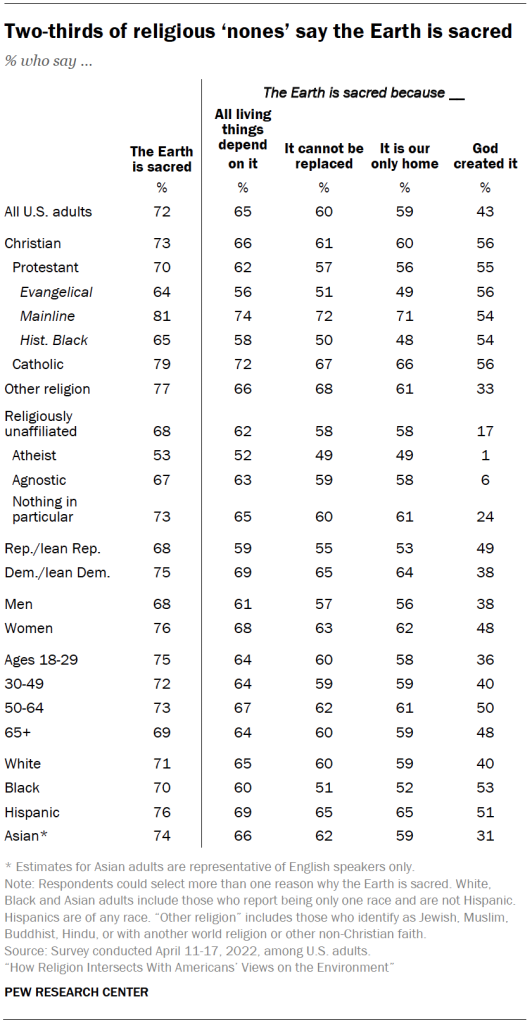
Many Americans view the Earth in religious terms in at least some way. For example, seven-in-ten say the Earth is sacred, including 43% who say this is the case because God created it. Even among religiously unaffiliated Americans, two-thirds say the Earth is sacred, although they are much more likely to attribute this to the fact that all living things depend on it or that it is irreplaceable than to the view that God created it.

Six-in-ten Americans say that holy scripture contains lessons about the environment (58%), and they appear to hold nuanced views about what some of those lessons are. While two-thirds (66%) say God gave humans a duty to protect and care for the Earth, including the plants and animals, a smaller majority (54%) say God gave humans the right to use the Earth, including the plants and animals, for humanity’s benefit – and nearly half (48%) hold both these views.

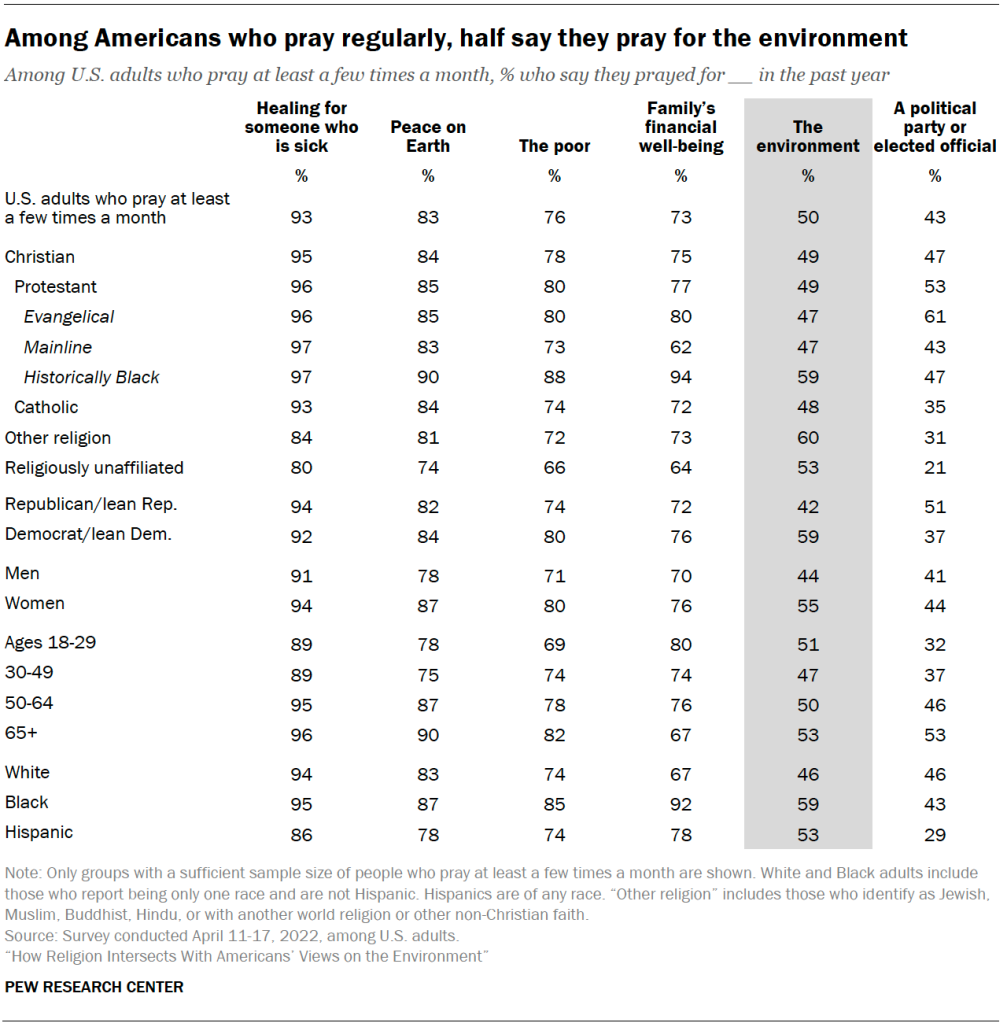
When it comes to what Americans most often pray for, the environment ranks lower than some other topics. Americans who pray at least monthly are more likely to say that, in the past year, they have prayed for the healing of someone who is sick, for peace on Earth, for the poor or their family’s financial well-being than they are to say they prayed for the environment. Still, about half of all Americans who pray regularly say they have prayed for the environment in the past year.

Christians are divided on whether we are living in the “end times” – a belief that could have implications for environmental attitudes, because if the world as we know it is soon coming to an end, it may seem unnecessary to worry much about climate change or pollution. Three-quarters of U.S. Christians say they believe Jesus will return to Earth one day, but far fewer (14%) believe it will be within their lifetimes.

Most Americans say the Earth is sacred, is our only home and that God gave humans a duty to protect and care for it

Chart shows Two-thirds of religious ‘nones’ say the Earth is sacred

About seven-in-ten Americans (72%) say the Earth is sacred. This view is especially common among mainline Protestants (81%) and Catholics (79%), but it is by no means limited to people who identify with a religion. About two-thirds of religiously unaffiliated Americans also say the Earth is sacred, including 67% of agnostics and 53% of atheists.

Indeed, in follow-up questions, many people give reasons for viewing the Earth as sacred that are not overtly religious. Majorities of U.S. adults say that the ideas that the planet is sacred because “all living things depend on it” (65%), because “it cannot be replaced” (60%) and because “it is our only home” (59%) describe their views completely or mostly well. Fewer Americans overall (43%) say that the Earth is sacred because “God created it,” but this view is held by more than half of both Protestants (55%) and Catholics (56%).

Even though Republicans tend to be more religious on average, Democrats and independents who lean toward the Democratic Party are slightly more likely than Republicans and GOP leaners to say the Earth is sacred (75% vs. 68%). And women are slightly more likely than men to express this view (76% vs. 68%).

While Democrats are more likely than Republicans to say the Earth is sacred because all living things depend on it, it cannot be replaced, and it is our only home, Republicans are more likely than Democrats to say the Earth is sacred because God created it (49% vs. 38%). Older Americans also are more likely than younger Americans to attribute the Earth’s sacredness to God’s role in creating it.

Most Americans believe holy scripture contains lessons about the environment

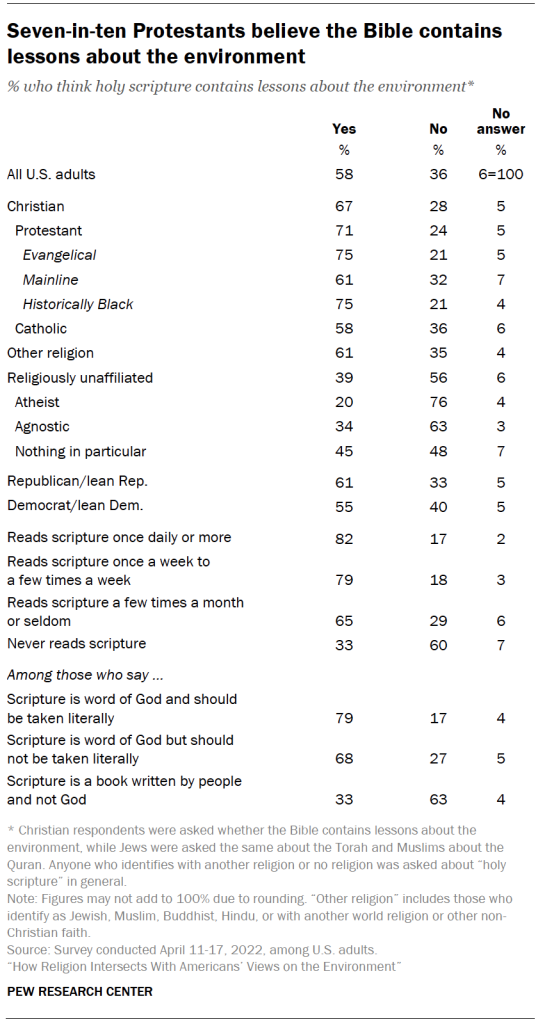
Chart shows Seven-in-ten Protestants believe the Bible contains lessons about the environment

The survey asked respondents whether they think holy scripture contains lessons about the environment. For example, Christian respondents were asked whether the Bible contains these lessons, while Jews were asked the same about the Torah and Muslims were asked about the Quran. Anyone who identifies with another religion or no religion was asked about “holy scripture” in general. Overall, nearly six-in-ten U.S. adults (58%) believe the Bible or another holy book speaks to this issue, while 36% do not; the remainder decline to answer.

The view that the Bible contains lessons about the environment is shared by most adults in all of the country’s major Christian traditions, as well as by most people who identify with other (non-Christian) religions. Three-quarters of Protestants in the historically Black and evangelical traditions think the Bible has messages about the environment; smaller majorities of mainline Protestants (61%) and Catholics (58%) also say this. Religiously unaffiliated Americans are less likely to believe that holy scripture contains lessons about the environment: Majorities of atheists (76%) and agnostics (63%), along with about half of those who describe their religion as “nothing in particular,” say holy scripture does not offer any lessons about the environment.

Americans who read holy scripture more frequently are more likely to think that the Bible or another holy book contain lessons about the environment. Among adults who say they read scripture at least weekly, about eight-in-ten say these texts contain lessons about the environment. In contrast, most respondents who never read scripture say there are no messages about the environment contained within it.

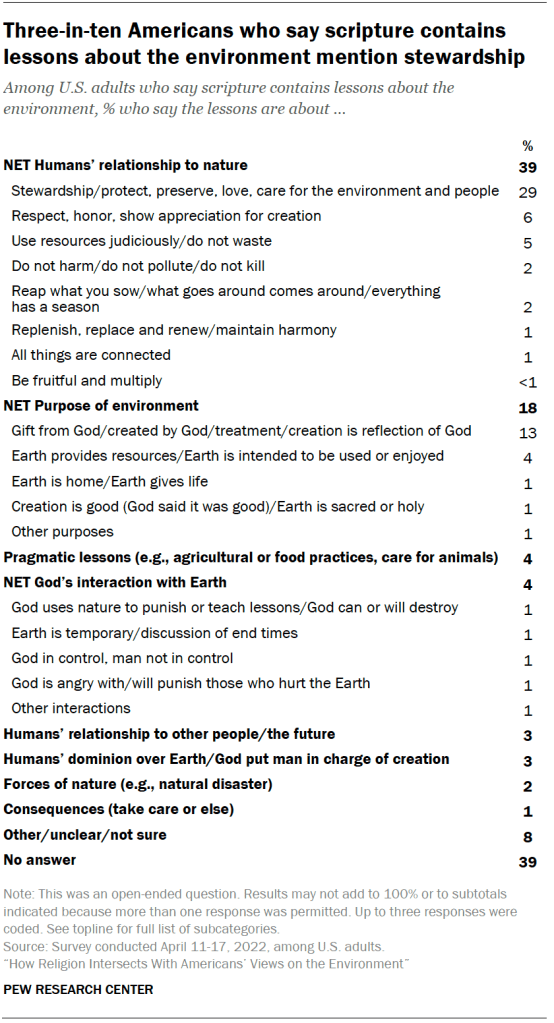
Chart shows Three-in-ten Americans who say scripture contains lessons about the environment mention stewardship

Among U.S. adults who believe the Bible is the word of God and is intended to be taken literally word for word, nearly eight-in-ten (79%) say that holy scripture contains lessons about the environment, compared with a third among those who believe holy scripture is written by people.

Those who said that holy scripture has lessons about the environment were asked to describe, in their own words, what they think those lessons are. The most common response was related to stewardship, including preserving, loving or caring for the environment and people (29%). Many also said that the lessons include the Earth being a gift from God or that creation is a gift from God (13%). Fewer mentioned pragmatic lessons such as agricultural or animal care (4%), how God interacts with the Earth (4%) or humans’ relationship to other people on the planet and the future (3%). And 3% mention dominionism or God putting man in charge of creation.

Stewardship versus dominionism: What do Americans believe?

The survey asked U.S. adults who say they believe in God or a higher power two questions aimed at measuring views about God’s intentions for humans’ role on Earth. One question offered a brief summary of the theology of stewardship, the notion that God gave humans a responsibility to protect and care for the Earth. The other question focused on the theology of dominionism, the idea that God gave humans the right to use the Earth and its resources.

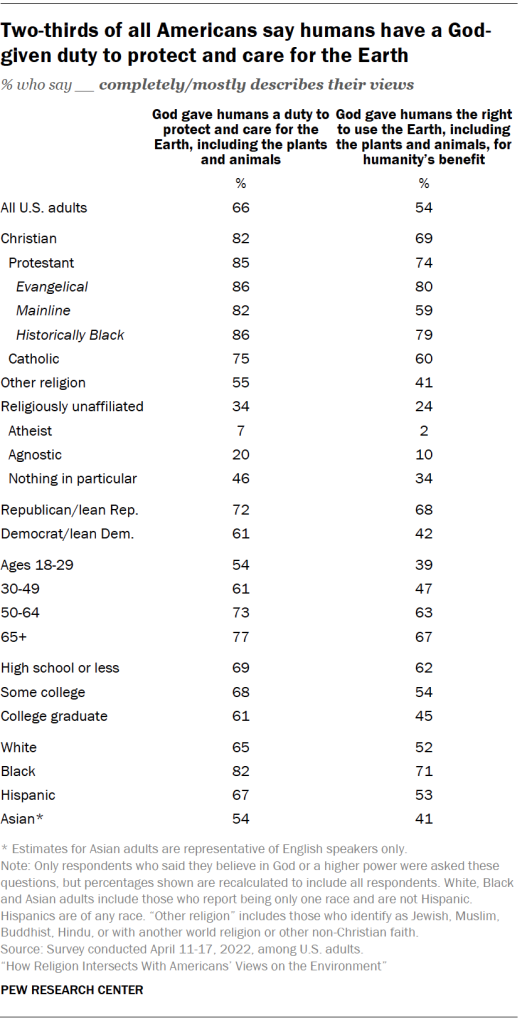
Chart shows Two-thirds of all Americans say humans have a God-given duty to protect and care for the Earth

Two-thirds of all U.S. adults say the statement describing stewardship (“God gave humans a duty to protect and care for the Earth, including the plants and animals”) completely or mostly reflects their own views. A somewhat smaller majority (54%) say the same for the statement about dominionism (“God gave humans the right to use the Earth, including the plants and animals, for humanity’s benefit”). Christians are more likely than members of other (non-Christian) faiths to hold both views.

Republicans are more likely than Democrats to say God gave humans a duty to protect and care for the Earth (72% vs. 61%), as well as to say God gave humans the right to use the Earth for humanity’s benefit (68% vs. 42%). However, these differences partially reflect the fact that Democrats are less likely than Republicans to believe in God or a higher power, and thus less likely to have received these questions at all.

When considering only those who believe in God or a higher power, Republicans still are much more likely than Democrats to say God gave humans the right to use the Earth for humanity’s benefit (72% vs. 49%), but only slightly more likely to say God gave humans a duty to protect and care for the Earth (76% vs. 71%).

Older Americans, Black Americans and adults without a college degree also are especially likely to affirm the concepts of stewardship and dominionism.

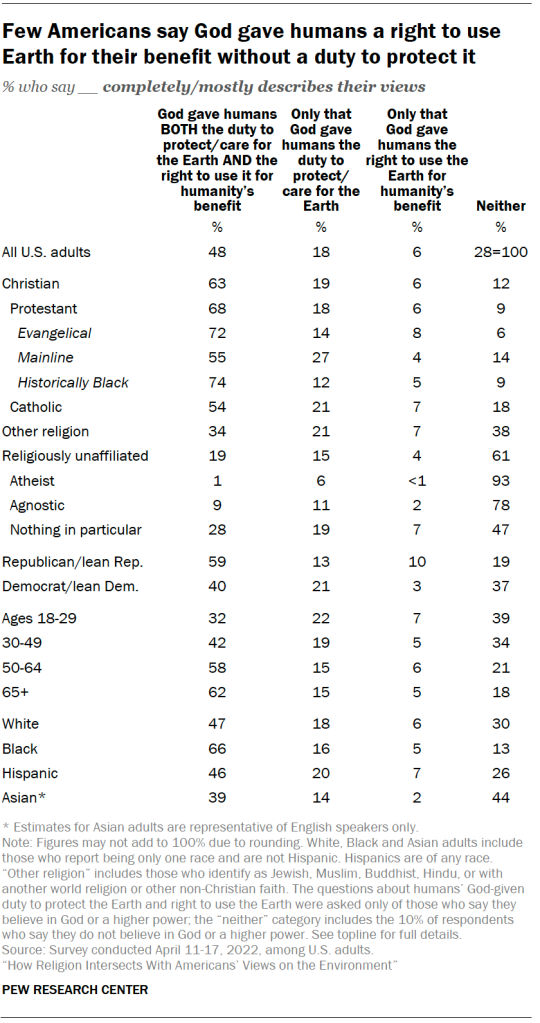
Chart shows Few Americans say God gave humans a right to use Earth for their benefit without a duty to protect it

Americans broadly do not see a tension between these two concepts. Nearly half of the public (48%) affirms that both statements completely or mostly describe their views: that God intended for humans to protect and care for the Earth, while also intending for humans to use the Earth for their own benefit.

About one-in-five Americans (18%) affirm only that humans have the duty to protect and care for the Earth (but not benefit from it), while even fewer (6%) affirm only that humans have a right to use the Earth for their benefit (and not protect and care for it). The remainder – roughly three-in-ten U.S. adults (28%) – say that neither of these statements describes their views well, including the 10% of Americans who say they do not believe in God or a higher power and, hence, were not asked these theological questions.

Nearly three-quarters of members of historically Black Protestant churches (74%) and evangelical Protestants (72%) affirm both humans’ God-given duty to protect the Earth and their right to use it. While majorities of mainline Protestants (55%) and Catholics (54%) share these views, they are more likely than other Christians to affirm only that humans have the duty to protect and care for the Earth and not the right to use the planet for humanity’s benefit.

Republicans (59%) are more likely than Democrats (40%) to affirm both stewardship and dominionism, as well as to say that humans have only the right to use the Earth and not the duty to care for it (10% vs. 3%). On the other hand, about one-in-five Democrats (21%) affirm only humans’ God-given duty to protect the Earth, compared with a smaller share of Republicans (13%). A greater share of Democrats also fall into the “neither” category – rejecting both statements – which reflects lower levels of belief in God or a higher power, overall.

Many Christians say human beings are more important than other living things

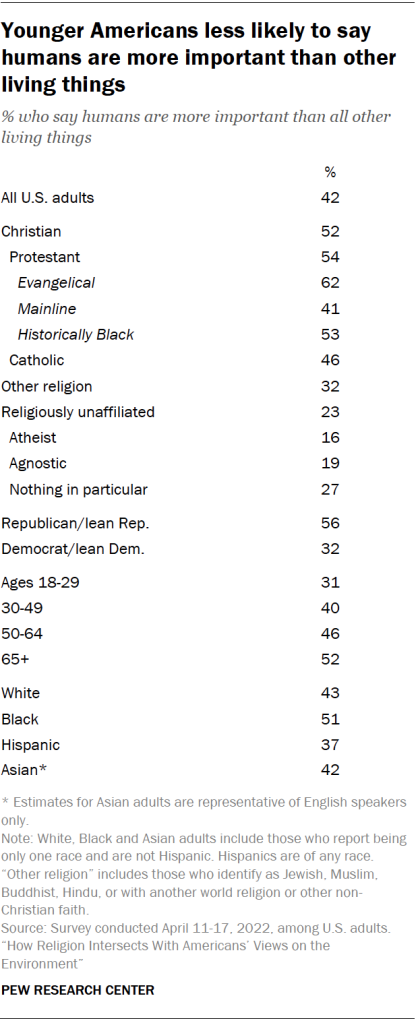
Chart shows Younger Americans less likely to say humans are more important than other living things

About four-in-ten Americans (42%) say humans are more important than all other living things. This opinion appears to be strongly correlated with religious affiliation: While a solid majority of evangelical Protestants (62%) say humans are more important than other living things, far fewer members of non-Christian religions (32%) and religious “nones” (23%) take this position.

A slim majority of Republicans (56%) say humans are more important than other living things, compared with about a third of Democrats (32%).

Older Americans are more likely than younger adults to say humans are more important than other living things. Black Americans also are more likely than White (non-Hispanic), Hispanic, and Asian Americans to say humans are more important.

Americans who pray regularly are less likely to pray for the environment than for other matters

The survey asked respondents who pray at least monthly to indicate if they have prayed for any of the following in the past year: healing for someone who is sick; peace on Earth; the poor; their family’s financial well-being; a political party or elected official; and the environment.

The most common prayer intention is for someone who is sick: 93% of Americans who pray at least monthly say they have prayed for this. About eight-in-ten praying adults report that they pray for peace on Earth (83%). And about three-quarters also indicate that they have prayed for the poor (76%) or for their family’s financial well-being (73%).

Among Americans who pray at least monthly, half say they have prayed for the environment in the past year (50%) – lower than all other items except praying for a political party or elected official (43%). While there is little variation across Christian traditions in the share who pray for the environment, members of other (non-Christian) faiths are somewhat more likely than Christians to do this, and Democrats who pray regularly are more likely than their Republican counterparts to say they include the environment in their prayers (59% vs. 42%).

Chart shows Among Americans who pray regularly, half say they pray for the environment

Most Protestants in evangelical and historically Black churches believe we are in the ‘end times’

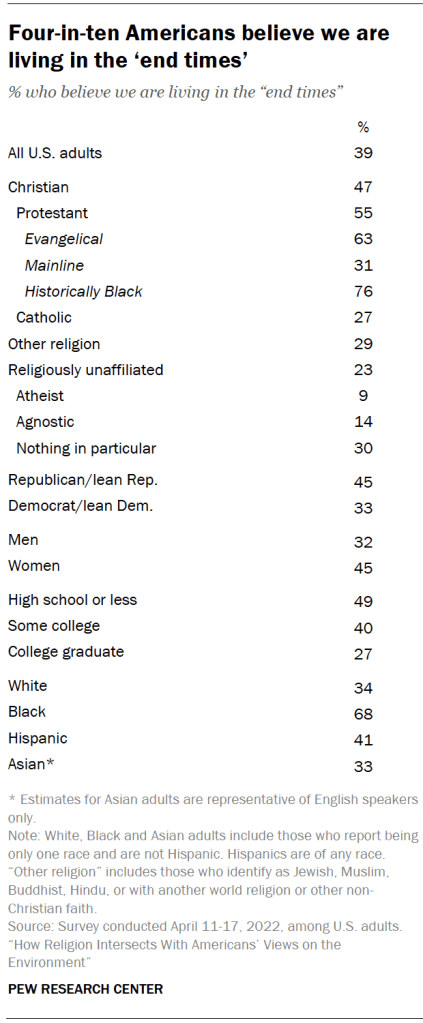
Chart shows four-in-ten Americans believe we are living in the ‘end times’

Some scholars have theorized that public attitudes toward the environment may be tied, at least in part, to beliefs about the “end times” – such as the belief that the end of the world and the arrival of a messiah (or the “second coming” of Jesus) is imminent. For example, if one believes that the world is about to end, protecting the environment for the long term may not seem as important.

About four-in-ten Americans (39%) believe we are living in the end times, including a slim majority of Protestants (55%). However, this differs substantially by specific tradition. Three-quarters of Protestants who belong to historically Black churches believe this (76%), as do 63% of evangelical Protestants. By comparison, about three-in-ten mainline Protestants (31%) and members of non-Christian religions (29%) and roughly a quarter of Catholics (27%) believe we are in living in the end times.

Belief that we are living in humanity’s final days is not limited only to Christians. For instance, among religious “nones,” 23% believe that we are living in the end times, including 9% of atheists. Among all Americans who believe we are living in the end times, 77% believe that Jesus will return, but 15% do not believe he will return and 6% do not believe in Jesus at all.

Most Black Americans (68%) believe we are living in the final days, but this is not the case for Hispanic (41%), White (34%) or Asian (33%) adults.

Most Christians believe Jesus will return to Earth, fewer say it will happen during their lifetime

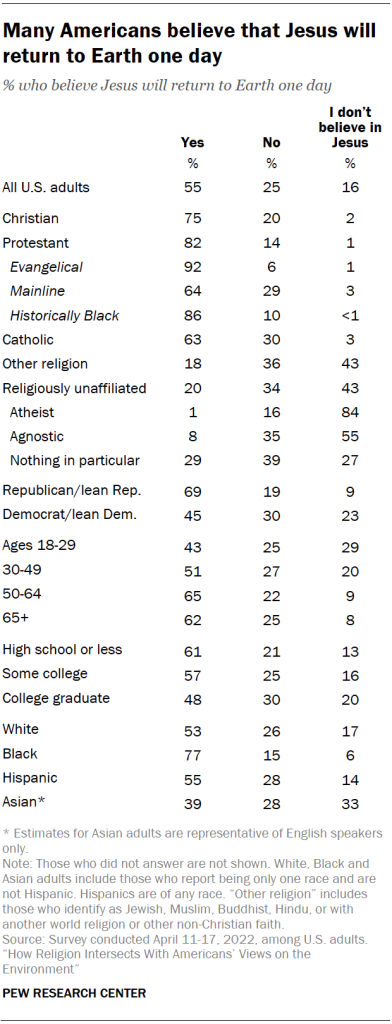
In Christian theology, beliefs about the end of the world often include expectations that Jesus will return to Earth. Asked if they believe Jesus will return to Earth one day, a slim majority of Americans (55%) say “yes,” while a quarter do not believe Jesus will return. An additional 16% say they don’t believe in Jesus.

Chart shows Many Americans believe that Jesus will return to Earth one day

Most adults in all the major U.S. Protestant traditions, as well as most Catholics, believe that Jesus will return to Earth, although there are notable differences in the percentages who say this. For instance, 92% of evangelical Protestants hold this belief, compared with 63% of Catholics.

Republicans and older adults are more likely than Democrats and younger adults, respectively, to believe that Jesus will return to Earth.

Most Black adults (77%) say they believe Jesus will return to Earth someday, while fewer Hispanic (55%), non-Hispanic White (53%) and Asian (39%) adults believe this.

The survey also asked all respondents who believe Jesus will return how certain they are that this will happen during their lifetime, with response options ranging from “definitely yes” to “probably yes,” “not sure,” “probably no,” and “definitely no.”

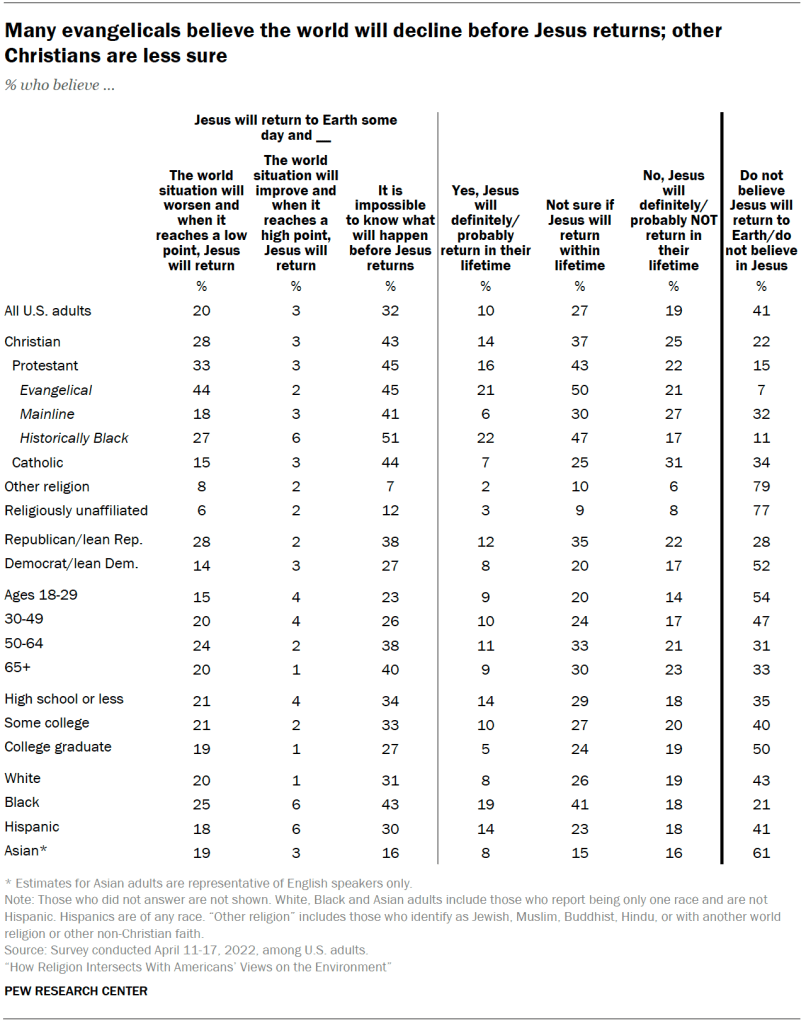
One-in-ten Americans believe Jesus will return to Earth and say that it will definitely or probably happen during their lifetime. This proportion is greater among evangelical Protestants (21%) and members of the historically Black Protestant tradition (22%) and smaller among Catholics (7%) and mainline Protestants (6%).
The share of Black (19%) and Hispanic (14%) Americans who believe Jesus will return and think it is likely to happen during their lifetime is greater than the corresponding share of White (non-Hispanic) Americans (8%).
Some theological positions assert that Jesus’ return is dependent on a progressive worsening of the world’s situation (also known as “premillennialism”), while others believe that Jesus’ return will be preceded by a high point of peace and prosperity (“postmillennialism”).
One-in-five Americans (20%) hold premillennial beliefs on the topic of Jesus’ return, while a smaller share (3%) say they agree with a postmillennial position. A third of Americans say that Jesus will return but it is impossible to know the circumstances under which this will happen (32%).
Evangelicals are divided in their beliefs about the end times, with 44% subscribing to a premillennial position and a nearly identical share (45%) saying Jesus will return but that it is impossible to know the circumstances surrounding it. Fewer Protestants in the historically Black (27%) and mainline (18%) traditions, as well as Catholics (15%), hold the view that Jesus’ return will be preceded by a worsening of the world’s situation. Instead, more members of historically Black churches (51%), Catholics (44%) and mainline Protestants (41%) voice the opinion that Jesus will return but it is impossible to know what will happen beforehand.

Chart shows Many evangelicals believe the world will decline before Jesus returns; other Christians are less sure

2. Environmentalism in U.S. religious congregations

CORRECTION (May 23, 2024): A previous version of this report listed an incorrect figure for Hispanic Americans who regularly attend religious services and say they have heard at least a little about climate change in sermons. This has been updated and does not substantively affect the findings of this report. 

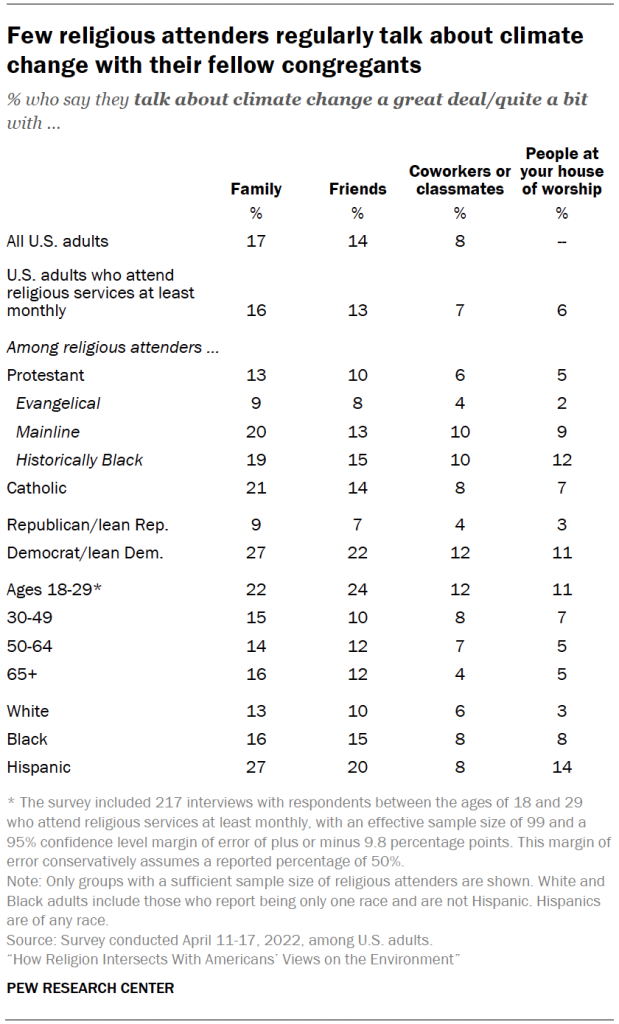
While many Americans tie their views of the environment to their faith, climate change does not appear to be a major topic of conversation in U.S. congregations. Nearly half of all U.S. adults who attend religious services at least monthly (47%) say they never hear about climate change in sermons, while 44% say the topic is discussed some or a little bit. Just 8% of all U.S. congregants say the sermons at their house of worship mention climate change a great deal or quite a bit, and a similar share (6%) say they talk to their fellow congregants about the issue with such frequency.

Regular attenders at religious services say that when sermons raise the issue of climate change, the theme they hear most often is that they have a duty to care for God’s creation.

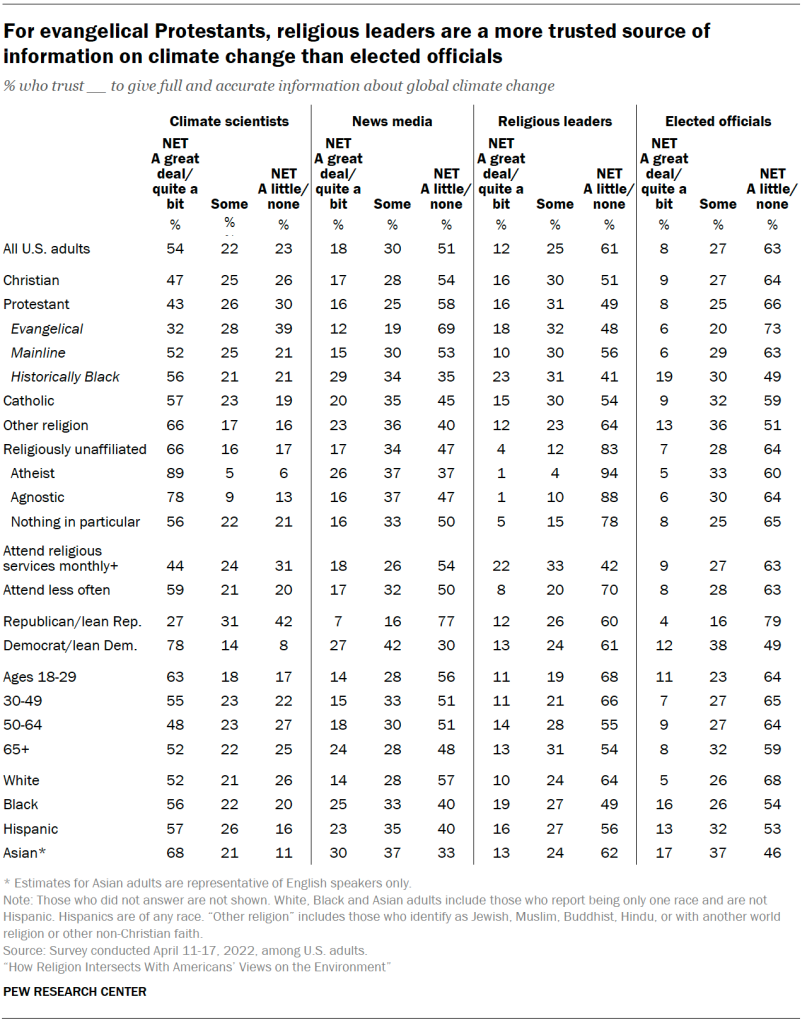
While relatively few U.S. congregants say they have high levels of trust in religious leaders to give accurate information about climate change, many say they have at least some trust in clergy – and evangelical Protestants express more confidence in clergy than in politicians to provide information on this issue.

Regular attenders at religious services are more likely to say their congregation has a group that helps people who need food, clothing and shelter, or a group that helps people with alcohol and drug problems, than a group that helps clean up public places or protect the environment. And while many congregants say their congregation has recycling bins (46%) or takes steps to be more energy efficient (43%), far fewer say their house of worship uses solar panels for energy (8%).

Climate change is not frequently discussed in sermons

Chart shows Nearly half of religious attenders never hear about climate change in sermons

The survey asked U.S. adults who attend religious services at least once or twice a month how often discussion of climate change comes up in sermons at their congregation or place of worship. Nearly half of all regular service attenders (47%) report never hearing about climate change in sermons, while 44% say the topic is discussed some or a little, and 8% report that sermons mention climate change a great deal or quite a bit.

About six-in-ten mainline Protestants (62%) and Catholics (58%) who attend religious services say they have heard at least a little discussion about climate change in sermons. The issue has been a focus for leaders in these traditions, including Pope Francis, as well as Episcopalians, Lutherans and Methodists. On the other hand, a majority of evangelical Protestant congregants (60%) say they have not heard climate change discussed in sermons at all.

Hispanic Americans who regularly attend religious services (76%) are far more likely to say they have heard at least a little about climate change in sermons than are Black (55%) or White (44%) Americans who say they attend a church or other house of worship at least monthly.

Two-thirds of Democratic and Democratic-leaning religious attenders report that climate change has been discussed in sermons at their place of worship (67%), compared with about four-in-ten Republicans and independents who lean Republican (40%). Young adults who attend religious services also are more likely than their elders to say that it is discussed at least a little in sermons at their houses of worship.

When climate change does come up during sermons, what are the broader messages about the topic? Regular service attenders who say they have heard any sermons discussing climate change were asked a few follow-up questions about the gist of those sermons. Of four possible messages asked about in the survey, the most common is that people have a duty to care for God’s creation. A third of all regular attenders (34%) say sermons that address climate change are always or often on this theme. Fewer say they hear messages of support for actions to limit the effects of climate change (16%); concern that policies aimed at reducing global climate change give too much power to the government (11%); or the view that we don’t need to worry about climate change (8%).

Evangelical Protestants, who are least likely to say they hear about climate change in sermons, also are the least likely Christian subgroup to say they hear messages about needing to limit the effects of climate change (8%). By comparison, roughly a quarter of Catholics (23%) and one-in-five Protestants in the historically Black (19%) and mainline (19%) traditions say sermons about climate change at their congregations often or always reflect this message.

Similarly, Democrats and Democratic-leaning regular attenders are more likely to hear about a duty to care for creation (47%) than are Republican or Republican-leaning U.S. congregants who attend religious services at least monthly (24%).

Across all the major U.S. Christian traditions, no more than about one-in-eight regular attenders at religious services say they hear sermons at their congregations that often or always express the concern that policies to reduce climate change give too much power to the government. Likewise, relatively few regular service attenders, as a whole, say they often hear sermons telling them not to worry about climate change.

Chart shows a third of regular religious service attenders have heard a sermon about climate change that expressed a duty to care for God’s creation

Evangelical Protestants trust clergy members more than media or politicians for information about climate change

The survey asked all respondents to rate how much they trust four groups of people to provide full and accurate information about climate change: elected officials, climate scientists, the news media and religious leaders. Overall, Americans express the most trust in climate scientists: 54% of U.S. adults say they trust climate scientists a great deal or quite a bit to give accurate information about global climate change. By comparison, smaller shares of U.S. adults say they trust the news media (18%), religious leaders (12%) and elected officials (8%) a great deal or quite a bit as sources of information on this topic.

But more than a third of U.S. adults express at least some trust in clergy on climate change, including around half of evangelical Protestants and members of the historically Black Protestant tradition. Evangelical Protestants are more likely to trust religious leaders than to trust elected officials or the news media for information on climate change.

On the whole, Americans who attend religious services at least once or twice a month are much more likely than those who attend less frequently to trust religious leaders to give accurate information on climate change, and less likely to trust climate scientists – although both groups express higher levels of trust in climate scientists than religious leaders.

Chart shows For evangelical Protestants, religious leaders are a more trusted source of information on climate change than elected officials

Like the public overall, religious attenders do not talk about climate change often

Chart shows Few religious attenders regularly talk about climate change with their fellow congregants

Similar to the share of U.S. congregants who say they have heard a great deal or quite a bit about climate change in sermons at their house of worship (8%), relatively few religious attenders say they frequently talk about the issue with people at their house of worship (6%). Discussing climate change with fellow congregants is more common among Democrats (11%) than Republicans (3%). The same is true for Hispanic adults (14%) who are regular religious attenders relative to White adults (3%) who report that they attend religious services at least monthly.

U.S. congregants as a whole are modestly more likely to discuss climate change at least quite a bit with family (16%) or friends (13%), but still, large majorities do not. The figures are similar for U.S. adults overall (17% and 14%, respectively), suggesting that climate change is not a frequent topic of conversation for most people around the country.

Perhaps not surprisingly given the infrequency of discussions about the topic, nearly half of regular attenders at religious services (48%) say they are unsure if they generally agree or disagree with their fellow congregants about climate change. About one-in-five (22%) say they generally agree with other people at their house of worship, and a similar share (24%) say they sometimes agree and sometimes disagree. Just 4% say they generally disagree about climate change with other people in their congregation.

Fewer regular attenders say they do not know the position their friends (26%), classmates or coworkers (20%), and family members (18%) take on climate change. Regular attenders are most likely to agree with family members (41%), while 32% say they generally agree with their friends on climate change, and 17% agree with their coworkers or classmates. Fewer than one-in-ten regular attenders disagree with family (7%), friends (5%), or coworkers or classmates (4%).

Regular worship attenders less likely to say their congregation has a program focused on the environment than on helping people in need

Among U.S. adults who attend religious services at least monthly, the vast majority say their congregations host programs that serve people who need food, clothing or shelter (85%). Upward of half (55%) say their places of worship also provide assistance to persons struggling with alcohol or drug addictions. Somewhat fewer regular religious attenders (41%) say their congregation hosts a program that helps clean up public places or protect the environment. And 17% of regular attenders say they, personally, are involved in such programs.

Similar shares of attenders across major Christian traditions – including both Republicans and Democrats – say their congregations have programs that clean up public spaces or protect the environment.

Chart shows According to U.S. congregants, houses of worship more likely to have programs to help people in need than to help the environment
Chart shows Recycling and taking steps to be more energy efficient are relatively common among congregations

The survey also asked U.S. congregants if their houses of worship have recycling bins in or around their buildings, have taken steps to become more energy efficient, or use solar power as a source of energy.

Nearly half of regular worship attenders (46%) say their congregations have recycling bins, and a similar share (43%) say their places of worship are taking steps to be more energy efficient. In both cases, mainline Protestants are more likely than other Christians to say their congregations take these steps.

Americans ages 65 and older who attend services at least monthly are more likely than younger religious attenders to report that their congregations are making efforts to become more energy efficient (54% vs. 28%).

Regular religious attenders are less likely to say their congregations use solar power as a source of energy (8%), though this is a slightly more commonly reported practice among regular attenders who live in the West (13%) than the South (6%) or Midwest (4%).

3. Environmentalism, individual actions and the morality of energy use

Nature and the environment play a big role in American life. A solid majority of U.S. adults across the religious spectrum say that being outdoors and experiencing nature are sources of meaning in their lives, and most people say they have taken part in an outdoor activity such as hiking or visiting a nature spot in the past year.

Most Americans across religious and nonreligious groups also say they make efforts in daily life to help the environment, such as reducing their food waste, using fewer plastics that cannot be reused and reducing the amount of water they use. And most say that taking personal steps to conserve energy is at least somewhat important to them, both to save money and to help protect the environment.

Far fewer U.S. adults – especially in some Christian groups – say they partake in civic activities to combat climate change, such as donating money, volunteering, or contacting elected officials. And relatively few Americans – including both those who are highly religious and those who are not – see individuals’ choices around energy consumption in moral terms. For example, only about one-in-ten U.S. adults say driving a car that gets low gas mileage is morally wrong.

The rest of this chapter discusses these and other questions in greater detail.

Being outdoors and experiencing nature is a top source of meaning and fulfillment among U.S. adults

The survey asked the public about several potential sources of meaning and fulfillment in their lives, and most Americans (71%) say being outdoors and experiencing nature gives them a great deal or quite a bit of meaning and fulfillment. Of six potential sources of meaning asked about in the survey, spending time with family is the only one that provides as much meaning to a greater share of U.S. adults (83%). Being outdoors and experiencing nature is valued by more people than spending time with friends (66%), religious faith (47%), volunteer work (33%) or meditating (30%).

Two-thirds or more across religious groups say they value being outdoors, with one exception. Members of historically Black Protestant churches are significantly less likely than other religious groups to find meaning and fulfillment in being outdoors and experiencing nature, although a majority (56%) still say nature provides at least quite a bit of meaning and fulfillment.

Americans who get a great deal or quite a bit of meaning from spending time in nature are more likely than those who get less fulfillment to say they are concerned about climate change or that the Earth’s warming is caused by human activity.

Chart shows Seven-in-ten Americans say being outdoors in nature is meaningful and fulfilling

About two-thirds of Americans (64%) say they have hiked within the past year. A slim majority (55%) say they have visited a nature spot, such as a waterfall or mountaintop. Half of the public says they have grown vegetables or other plants within the past year. And about one-in-five say they have been camping (21%) or hunting or fishing (20%).

For the most part, there is only modest variation across religious groups when it comes to the shares who partake in these activities, although members of historically Black Protestant churches tend to be less likely to do so.

Republicans and independents who lean toward the GOP are about twice as likely as Democrats and Democratic leaners to say they have been hunting or fishing (30% vs. 13%). Republicans also are more likely than Democrats to say they have grown vegetables or other plants within the past year (54% vs. 47%).

There is little difference between Americans who partake in many outdoor activities and those who do not in terms of their levels of concern about climate change or the share who say the Earth’s warming is caused by human activity.

Chart shows most Americans have hiked outdoors within the past year

Personal action and climate change

Chart shows Vast majority of U.S. adults say they make an effort to protect the environment at least some of the time

A large majority of U.S. adults say they make at least some effort to live in ways that help protect the environment, including 64% who say they do this some of the time and an additional 22% who say they do this all the time, according to a separate but related Pew Research Center survey conducted in April 2021. Smaller shares say they do this not too often (12%) or not at all (2%). Americans across political and religious lines all overwhelmingly say they try to help the environment at least sometimes.

Greater differences emerge on some specific actions people can take to help the environment. Overall, four-in-ten U.S. adults say they eat less meat to help protect the environment, but members of non-Christian religions (57%) are much more likely than Christians (38%) and religious “nones” (41%) to say they do this. Democrats also are more likely than Republicans to say they limit their meat consumption for environmental reasons (51% vs. 27%).

Chart shows Most Americans say they seek to reduce food waste, plastic and water usage

When it comes to other, more common efforts to protect the environment, such as reducing food waste, using fewer plastics that cannot be reused and reducing water usage, differences across groups are smaller – though still visible in some cases. For example, atheists (83%), agnostics (80%) and members of non-Christian religions (83%) are the most likely to say they have been reducing the amount of nonreusable plastics they use. About three-quarters of Catholics (74%) and mainline Protestants (76%) also report making this effort, while slightly smaller majorities of Protestants in the evangelical (63%) and historically Black (58%) Protestant traditions say the same. Also, Democrats are more likely than Republicans to say they try to use fewer nonreusable plastics.

Chart shows Historically Black Protestant church members among most likely to say it’s important to conserve energy

Half of all U.S. adults say it is either extremely or very important to them to make personal efforts to conserve energy by taking steps such as limiting electricity use at home, driving less, or reducing their use of air conditioning. An additional 37% of Americans say this is somewhat important, while just 13% say it is not too or not at all important to them.

There is little difference between highly religious Americans and those with lower levels of religious commitment on this question. But there is some variation across religious groups, with members of historically Black Protestant churches among the most likely to say that making this effort is extremely or very important (68%) and evangelical Protestants among the least likely to say they feel that way (41%).

Relatedly, Democrats are much more likely than Republicans to say taking personal steps to conserve energy is of high importance to them (61% vs. 35%).

Chart shows Majority of U.S. adults conserve energy both to save money and help environment

These differences extend to the reasons why individuals say they make an effort to conserve energy. Evangelical Protestants are among the most likely to say that they make this effort solely to save money (33%) rather than to protect the environment (4%), or for both reasons (43%). Majorities in all other religious groups analyzed, on the other hand, say they try to conserve energy either to protect the environment or for both reasons.

The differences by political party are especially stark: About three-quarters of Democrats say they try to conserve energy either to protect the environment (9%) or both to protect the environment and to save money (67%), compared with fewer than half of Republicans who report conserving energy for these reasons (3% and 40%, respectively). About a third of Republicans (35%) say they try to conserve energy just to save money, and an additional 22% say it is not important to them to try to conserve energy.

Chart shows Non-Christian religious groups among most likely to have donated money to fight climate change

Fewer Americans overall say they participate in civic activities to fight climate change, according to the April 2021 survey. For example, one-in-six say they have donated money to an organization focused on addressing climate change in the past year. One-in-ten U.S. adults say they have contacted an elected official to urge action to address the issue, and an identical share say they have volunteered for an activity to combat climate change. And 6% say they have attended a protest or rally dedicated to addressing climate change.

There are some gaps on these questions according to religious affiliation. Atheists (28%) and agnostics (23%), as well as members of other (non-Christian) religious groups (29%), are more likely than Christians to say they donated money to an organization focused on addressing climate change in the past year. This is at least partly reflective of the fact that non-Christians tend to identify with or lean toward the Democratic Party, and Democrats are more likely than Republicans to report making such donations. Similarly, highly religious Americans are somewhat less likely to have participated in each of these civic activities to fight climate change.

Relatively few Americans say it is morally wrong to eat food that requires a lot of energy to produce or to drive a car that gets low gas mileage

Chart shows Americans more likely to see sex outside marriage than driving a gas-guzzling vehicle as morally wrong

While many Americans say it is important to conserve energy, far fewer appear to see this in moral terms. The survey asked two questions about this topic: whether driving a car that gets low gas mileage and eating food that requires a lot of energy to produce are morally acceptable, morally wrong or not moral issues.

About three-quarters of Americans say these things are not moral issues. One-in-ten say driving a car that gets low gas mileage is morally wrong, while 14% say it is morally acceptable. The figures are similar for eating food that requires a lot of energy to produce (13% morally wrong, 12% morally acceptable).

By comparison, U.S. adults are much more likely to say that having sex outside of marriage is morally wrong (49%).

Chart shows Highly religious Americans less likely to view inefficient energy practices as morally wrong

Some groups are modestly more likely to see individual actions about energy usage in moral terms. For instance, members of non-Christian religions (22%), as well as atheists (23%) and agnostics (20%), are more inclined than Christians (7%) to say driving a car with poor gas mileage is morally wrong, though majorities of all these groups say it is not a moral issue. The same pattern applies to the question about eating food that takes a lot of energy to produce.

Similarly, while Democrats and independents who lean toward the Democratic Party are three times as likely as Republicans and GOP leaners to say that consuming food that takes a lot of energy to produce is morally wrong (18% vs. 6%), two-thirds of Democrats say it is not a moral issue.

4. Religious groups’ views on climate change

Most Americans say the Earth is getting warmer, including a narrow majority (53%) who say it is mostly because of human activity, such as burning fossil fuels. Most also view global climate change as an extremely or very serious problem. Assessing potential consequences, 62% foresee rising numbers of extreme weather events, and 58% think an increase in refugees and displaced people is likely within the next 30 years because of global climate change. In addition, 54% expect food and water shortages, and 46% expect climate change to impact the quality of life.

There is a consistent pattern by religious group on these and other questions about climate change. In general, evangelical Protestants tend to be the most likely of all major U.S. religious groups to express skeptical views. For instance, about a third of evangelical Protestants say the Earth is getting warmer mostly due to human activity (32%), while similar shares say the Earth is getting warmer mostly due to natural patterns (36%) or that they are unsure or not convinced the Earth is getting warmer (32%). Meanwhile, members of non-Christian religions and people who do not identify with any religion – particularly self-described atheists and agnostics – consistently express the highest levels of concern about climate change. Other Christian subgroups, such as Catholics, generally fall somewhere in between.

These patterns are heavily influenced by politics. Evangelical Protestants largely identify with the GOP, and Republicans are less likely than the overall public to say the Earth’s warming is mostly caused by human activity. Evangelicals and Republicans also are less inclined than the general public to see climate change as a serious problem, as well as to say various negative consequences are likely to occur in the coming decades because of global warming. Meanwhile, atheists and adults who identify with other, non-Christian religions are mostly Democrats, who tend to be much more alarmed about climate change and supportive of government actions to combat it.

Those who do not think climate change is a serious problem offer several reasons for their views. Among the five options provided in the survey, two of the most commonly cited reasons are that there are much bigger problems in the world today and that God is in control of the climate.

Another possible reason evangelical Protestants stand out in their views on the climate is that they are the most likely of the major U.S. religious groups to say that when Americans make decisions as a country, we should value the same things that were important to generations that came before us (63%). By contrast, majorities of other groups agree with the notion that we should consider things that previous generations did not think about; half of evangelicals say the same.

This chapter explores these and other questions about climate change by religion.

Is the Earth warming, and is it a serious problem?

Chart shows nine-in-ten atheists say the Earth is getting warmer mostly due to human activity

About three-quarters of Americans say the Earth is getting warmer, including 53% who say it is mostly because of human activity, such as burning fossil fuels, and 24% who say it is mostly due to natural patterns in the Earth’s environment. About one-in-ten Americans (9%) say there is no solid evidence that the Earth is getting warmer, and 13% say they are not sure.

Nine-in-ten atheists say the Earth is getting warmer mostly due to human activity, as do 78% of agnostics. Evangelical Protestants are the least likely to express this view (32%).

Americans with lower levels of religious commitment (70%) are much more likely than those with medium (50%) or high (39%) levels of religious commitment to say the Earth is getting warmer mostly because of human activity.

Democrats are about three times as likely as Republicans to say the Earth is getting warmer mostly due to human activity (77% vs. 24%). A plurality of Republicans (42%) say the Earth is getting warmer mostly due to natural patterns, compared with one-in-ten Democrats who say this. And roughly one-in-five Republicans (18%) say there is no solid evidence that the Earth is getting warmer, compared with only 2% of Democrats.

Chart shows Evangelical Protestants among the least likely to view global climate change as a serious problem

A majority of Americans (57%) view global climate change as an extremely or very serious problem. About one-in-five see it as a somewhat serious problem (22%), while a similar share say it is not too serious or not a problem at all (20%).

Most members of non-Christian religions (72%), religious “nones” (70%) and members of historically Black Protestant churches (68%) view global climate change as an extremely or very serious problem, and majorities of Catholics (57%) and mainline Protestants (55%) share these views. Evangelical Protestants, meanwhile, are the least likely to view global climate change as extremely or very serious (34%) and the most likely to say it is not a serious problem (38%).

Regardless of religious identity, about seven-in-ten U.S. adults with low levels of religious commitment say climate change is at least a very serious problem, including a plurality who say it is an extremely serious problem (46%). People with high levels of religious commitment are the least likely to say global climate change is extremely or very serious and the most likely to say it is not a serious problem.

Republicans and Democrats strongly differ in their views about the seriousness of global climate change. The vast majority of Democrats (83%) view global climate change as an extremely or very serious problem, while only a quarter of Republicans share this view.

The 20% of Americans who say global climate change is not a serious problem were asked why they think this is the case.

Of the options offered, the most common reason (cited by 17% of all U.S. adults, including 86% of those who think climate change is not a serious problem) is that “there are much bigger problems in the world today.” About one-in-ten Americans say climate change is not serious because “God is in control of the climate” (11% of U.S. adults, 53% of those who say climate change is not serious) or that “climate change will not have a big impact on most people” (10% of U.S. adults, 48% of those who say climate change isn’t serious). Another 8% of all U.S. adults say they “don’t believe climate change is happening,” and 4% say climate change is not a serious problem because “new technologies will fix any problems caused by climate change.”

About four-in-ten Republicans (38%) say climate change is not serious because there are much bigger problems in the world today, compared with only 2% of Democrats who say this. And nearly a quarter of all Republicans (23%) say climate change is not a serious problem because God is in control of the climate, compared with 2% of Democrats.

Among religious groups, evangelical Protestants are the most likely to say climate change is not a serious problem for most of these reasons, including that there are much bigger problems in the world today (34% of all evangelicals) and that God is in control of the climate (29%). Likewise, across all religious identities, highly religious Americans are more likely than those with lower levels of religious commitment to say climate change is not a serious problem, especially because there are bigger problems in the world (30%) or because God is in control of the climate (27%).

Chart shows One-in-five Protestants say climate change is not a serious problem because God is in control of the climate

Views toward the future

Chart shows Religious ‘nones’ optimistic we can slow climate change, split on whether it will be difficult

There also are disagreements on the effect that humans can have on slowing the future pace of climate change. Most atheists (90%) and agnostics (84%) say humans can slow global climate change, though they are somewhat divided over whether it will require making difficult changes, or whether it will not be too difficult as long as people make smart choices.

The most common view in most other religious groups is that humans can slow climate change, and that if we make smart choices, it would not be too difficult. One-in-ten U.S. adults (11%) say humans cannot slow climate change, with evangelical Protestants more likely than people in any other religious category to express this belief (18%). Republicans, the party with which most evangelicals identify, are significantly more likely than Democrats to say that climate change cannot be stopped (21% vs. 3%).

A majority of U.S. adults – including most people across a variety of religious groups – say society should focus both on slowing the progression of climate change and getting ready to deal with its effects, rather than just one or the other.

Chart shows Most U.S. adults say society should focus both on slowing climate change and preparing to deal with its effects

Evangelical Protestants are the group least likely to say that either or both of these efforts should be a priority, which is in line with their status as the group most inclined to say that neither should be a priority (15%) or that climate change is not a problem (17%). Still, about two-thirds of evangelicals say society should focus on slowing climate change (7%), getting ready to deal with the effects of climate change (11%), or both (49%).

Chart shows Most evangelical Protestants say Americans today should value same things as previous generations

When asked whether we should value the same things that were important to the generations that came before us, Protestants (57%) – particularly evangelicals (63%) – as well as Catholics (56%) are much more likely than the religiously unaffiliated (31%) to say this completely or mostly describes their view. In fact, highly religious Americans in general, regardless of their religious affiliation, are much more inclined toward this perspective.

Conversely, the religiously unaffiliated (70%) are more likely than Protestants (56%) or Catholics (60%) to completely or mostly endorse the idea that as a country, we should consider things that previous generations did not think about. On this question, atheists (83%) and agnostics (76%) are the groups most likely to express this view, while evangelical Protestants (50%) are least likely to do so.

A similar pattern by religious affiliation applies to a question about whether we should think less about ourselves and more about the impact of our decisions on future generations, a frame that is often applied to the discussion around climate change. Seven-in-ten atheists say this completely or mostly describes their perspective, as do smaller majorities of agnostics (63%), members of non-Christian religions (63%) and Americans who belong to historically Black Protestant churches (58%). Roughly half of people in other Christian subgroups share this view. On this question, however, there is no clear pattern across different categories of religious commitment.

Most Americans expect negative consequences from climate change and environmental regulations within the next 30 years

The survey asked Americans how likely four potential outcomes are to happen within the next 30 years because of global climate change: more extreme weather events (such as tornadoes, flooding and droughts), an increase in refugees and displaced people, food and water shortages, and a lower quality of living. Most Americans think more extreme weather events (62%) and an increase in refugees and displaced people (58%) are extremely or very likely to happen, while 54% expect food and water shortages and 46% expect climate change to impact their quality of life.

The possibility of extreme weather events is the question on which the public is most sharply divided. About three-quarters of Americans who identify with non-Christian faiths (76%), seven-in-ten religious “nones” (70%) and two-thirds of members of historically Black Protestant churches (67%) think more extreme weather events are highly likely, compared with 45% of evangelical Protestants. Relatedly, Democrats are about twice as likely as Republicans to express this view (81% vs. 39%).

There are similar, although sometimes more muted, patterns on other potential consequences of climate change. But on all four of these questions, self-described atheists are more likely than members of most other religious identity categories to see these outcomes as very likely, as are those with low levels of religious commitment compared with highly religious Americans.

When including the shares who say these effects of climate change are somewhat likely, large majorities of Americans across all religious affiliation and commitment groups analyzed think all these outcomes are plausible.

Chart shows Atheists overwhelmingly expect more extreme weather events, other adverse effects of climate change within the next 30 years
Chart shows Christians about twice as likely as atheists, agnostics to think the U.S. will overreact to climate change by creating unnecessary environmental regulations

The survey also asked respondents for their expectations related to the country’s response to climate change – or lack thereof. About four-in-ten (39%) say it is extremely or very likely that the U.S. will overreact to climate change by creating many unnecessary environmental regulations, while about a quarter (24%) think this is somewhat likely and 36% say it is not too or not at all likely.

Evangelical Protestants are twice as likely as religiously unaffiliated adults to say the U.S. is extremely or very likely to overreact with unnecessary environmental regulations (56% vs. 28%). Republicans are more than three times as likely as Democrats to say this (64% vs. 18%).

Americans generally are less inclined to think the U.S. will lose its standing in the world for failing to take global climate change seriously (27% extremely or very likely), with atheists and agnostics most likely to hold this view (44% each).

Chart shows Majority of evangelicals expect gradual loss of individual freedoms because of environmental regulations

Most Americans (72%) expect much higher prices for fuel and electricity within the next 30 years due to environmental regulations. A smaller majority (57%) say that, for the same reason, it is extremely or very likely there will be fewer jobs and declining pay in industries that depend on fossil fuels. Fewer (42%) expect a gradual loss of individual freedoms within the next 30 years due to environmental regulations – although this is the majority view among evangelical Protestants (56%) and Republicans (63%).

Majorities of both major political parties and all religious groups analyzed anticipate much higher prices for fuel and electricity. And differences by religion on the question about jobs and pay are relatively modest.

Chart shows Atheists more likely than others to rank climate change as a very important voting issue

Climate change was a much more important voting issue leading up to the recent midterm elections for voters with no religion than for Christians. More than half of registered voters who are religious “nones” (55%) said in a March 2022 survey that climate change would be very important to their vote in the 2022 congressional elections, including seven-in-ten atheists (72%). Fewer Catholic (39%) and Protestant (31%) registered voters said it was a very important issue.

For more information on the issues voters considered very important closer to Election Day 2022, see the Center’s latest report on the topic.

Acknowledgments

This report was made possible by The Pew Charitable Trusts, which received support from the Arthur Vining Davis Foundations.

It was a collaborative effort based on the input and analysis of the following individuals. Find related reports online at pewresearch.org/pewresearch-org/religion.

Research Team        

Becka A. Alper, Senior Researcher   
Alan Cooperman, Director, Religion Research
Gregory A. Smith, Associate Director, Religion Research   
Besheer Mohamed, Senior Researcher
Michael Rotolo, Research Associate
Patricia Tevington, Research Associate
Justin Nortey, Research Analyst  
Joshua Alvarado, Research Assistant

Methods Team         

Courtney Kennedy, Vice President, Methods and Innovation
Andrew Mercer, Senior Research Methodologist
Scott Keeter, Senior Survey Advisor
Ashley Amaya, Senior Survey Research Methodologist      
Dorene Asare-Marfo, Panel Manager          
Dana Mildred Popky, Associate Panel Manager
Arnold Lau, Research Methodologist

Editorial and Graphic Design

Michael Lipka, Editorial Manager   
Jeff Diamant, Senior Writer/Editor
David Kent, Senior Copy Editor
Rebecca Leppert, Editorial Assistant          
Bill Webster, Senior Information Graphics Designer

Communications and Web Publishing

Stacy Rosenberg, Associate Director, Digital         
Reem Nadeem, Associate Digital Producer
Anna Schiller, Senior Communications Manager   
Kelsey Beveridge, Communications Associate
Achsah Callahan, Communications Manager

In addition, the Center would like to thank the following people for sharing their topical expertise (several of them are quoted in this report): Jose Aguto, executive director, Catholic Climate Covenant; Phil Aroneanu, chief strategy officer, Dayenu: A Jewish Call to Climate Action; David Barr, visiting assistant professor of religion, Berry College in Mount Berry, Georgia; Karyn Bigelow, co-executive director, Creation Justice Ministries; the Rev. Canon Sally Bingham, founder and president emerita, Interfaith Power and Light; Cassandra Carmichael, executive director, National Religious Partnership for the Environment; the Rev. Richard Cizik, president, New Evangelical Partnership for the Common Good; Stephen Ellingson, professor of sociology, Hamilton College in Clinton, New York; Nana Firman, co-founder, Global Muslim Climate Network, and senior ambassador, GreenFaith; Anna M. Gade, Vilas Distinguished Achievement Professor, the Nelson Institute for Environmental Studies at the University of Wisconsin-Madison; Tori Goebel, national organizer and spokesperson, Young Evangelicals for Climate Action; Walter Grazer, former manager, Environmental Justice Program at the U.S. Conference of Catholic Bishops; David Gushee, Distinguished University Professor of Christian Ethics, Mercer University in Atlanta and Macon, Georgia; the Rev. Mitch Hescox, president and chief executive officer, the Evangelical Environmental Network; Bob Inglis, executive director, republicEN; Russell Johnson, assistant director, undergraduate religious studies program, the University of Chicago; Sergei Kapral, protodeacon, Holy Resurrection Orthodox Cathedral in Wilkes-Barre, Pennsylvania, and treasurer, Creation Justice Ministries; Jonathan Merritt, author of “Green Like God: Unlocking the Divine Plan for Our Planet”; Dan Misleh, founder, Catholic Climate Covenant; Joelle Novey, director, Interfaith Power & Light (DC.MD.NoVA); Fran Pavley, former chair, California Senate Natural Resources and Water Committee; Adam Rome, professor of environment and sustainability, the University at Buffalo; Rabbi Daniel Swartz, Temple Hesed in Scranton, Pennsylvania, and executive director, Coalition on the Environment and Jewish Life; Bron Taylor, professor of religion and nature, environmental and social ethics, and environmental movements and politics, the University of Florida; Robin Veldman, associate professor of religious studies, Texas A&M University; Katharine K. Wilkinson, author of “Between God & Green: How Evangelicals are Cultivating a Middle Ground on Climate Change”; and Jennifer Wiseman, director emeritus, the AAAS Dialogue on Science, Ethics, and Religion (DoSER) program, and senior astrophysicist, the Goddard Space Flight Center.

Methodology

The American Trends Panel survey methodology

Overview

The American Trends Panel (ATP), created by Pew Research Center, is a nationally representative panel of randomly selected U.S. adults. Panelists participate via self-administered web surveys. Panelists who do not have internet access at home are provided with a tablet and wireless internet connection. Interviews are conducted in both English and Spanish. The panel is being managed by Ipsos.

Data in this report is drawn mainly from the panel wave conducted from April 11-17, 2022. A total of 10,156 panelists responded out of 11,678 who were sampled, for a response rate of 87%. The cumulative response rate accounting for nonresponse to the recruitment surveys and attrition is 3%. The break-off rate among panelists who logged on to the survey and completed at least one item is 1%. The margin of sampling error for the full sample of 10,156 respondents is plus or minus 1.6 percentage points. Some of the analysis in this report draws on other Pew Research Center surveys, including those conducted April 20-29, 2021, and March 7-13, 2022.

Panel recruitment

Table shows American Trends Panel recruitment surveys

The ATP was created in 2014, with the first cohort of panelists invited to join the panel at the end of a large, national, landline and cellphone random-digit-dial survey that was conducted in both English and Spanish. Two additional recruitments were conducted using the same method in 2015 and 2017, respectively. Across these three surveys, a total of 19,718 adults were invited to join the ATP, of whom 9,942 (50%) agreed to participate.

In August 2018, the ATP switched from telephone to address-based recruitment. Invitations were sent to a stratified, random sample of households selected from the U.S. Postal Service’s Delivery Sequence File. Sampled households receive mailings asking a randomly selected adult to complete a survey online. A question at the end of the survey asks if the respondent is willing to join the ATP. Starting in 2020 another stage was added to the recruitment. Households that do not respond to the online survey are sent a paper version of the questionnaire, $5 and a postage-paid return envelope. A subset of the adults returning the paper version of the survey are invited to join the ATP. This subset of adults receive a follow-up mailing with a $10 pre-incentive and invitation to join the ATP.

Across the four address-based recruitments, a total of 19,822 adults were invited to join the ATP, of whom 17,472 agreed to join the panel and completed an initial profile survey. In each household, the adult with the next birthday was asked to go online to complete a survey, at the end of which they were invited to join the panel. Of the 27,414 individuals who have ever joined the ATP, 11,678 remained active panelists and continued to receive survey invitations at the time this survey was conducted.

The U.S. Postal Service’s Delivery Sequence File has been estimated to cover as much as 98% of the population, although some studies suggest that the coverage could be in the low 90% range.13 The American Trends Panel never uses breakout routers or chains that direct respondents to additional surveys.

Sample design

The overall target population for this survey was noninstitutionalized persons ages 18 and older, living in the U.S., including Alaska and Hawaii.

Questionnaire development and testing

The questionnaire was developed by Pew Research Center in consultation with Ipsos. The web program was rigorously tested on both PC and mobile devices by the Ipsos project management team and Pew Research Center researchers. The Ipsos project management team also populated test data that was analyzed in SPSS to ensure the logic and randomizations were working as intended before launching the survey.

Incentives

All respondents were offered a post-paid incentive for their participation. Respondents could choose to receive the post-paid incentive in the form of a check or a gift code to Amazon.com or could choose to decline the incentive. Incentive amounts ranged from $5 to $20 depending on whether the respondent belongs to a part of the population that is harder or easier to reach. Differential incentive amounts were designed to increase panel survey participation among groups that traditionally have low survey response propensities.

Data collection protocol

The data collection field period for this survey was April 11-17, 2022. Postcard notifications were mailed to all ATP panelists with a known residential address on April 11, 2022. 

Invitations were sent out in two separate launches: Soft Launch and Full Launch. Sixty panelists were included in the Soft Launch, which began with an initial invitation sent on April 11, 2022. The ATP panelists chosen for the initial Soft Launch were known responders who had completed previous ATP surveys within one day of receiving their invitation. All remaining English- and Spanish-speaking panelists were included in the Full Launch and were sent an invitation on April 12, 2022.

All panelists with an email address received an email invitation and up to two email reminders if they did not respond to the survey. All ATP panelists that consented to SMS messages received an SMS invitation and up to two SMS reminders.

Table shows invitation and reminder dates

Data quality checks

To ensure high-quality data, the Center’s researchers performed data quality checks to identify any respondents showing clear patterns of satisficing. This includes checking for very high rates of leaving questions blank, as well as always selecting the first or last answer presented. As a result of this checking, seven ATP respondents were removed from the survey dataset prior to weighting and analysis.

Weighting

Table shows Weighting dimensions

The ATP data is weighted in a multistep process that accounts for multiple stages of sampling and nonresponse that occur at different points in the survey process. First, each panelist begins with a base weight that reflects their probability of selection for their initial recruitment survey. The base weights for panelists recruited in different years are scaled to be proportionate to the effective sample size for all active panelists in their cohort and then calibrated to align with the population benchmarks in the accompanying table to correct for nonresponse to recruitment surveys and panel attrition. If only a subsample of panelists was invited to participate in the wave, this weight is adjusted to account for any differential probabilities of selection.

Among the panelists who completed the survey, this weight is then calibrated again to align with the population benchmarks identified in the accompanying table and trimmed at the 1st and 99th percentiles to reduce the loss in precision stemming from variance in the weights. Sampling errors and tests of statistical significance take into account the effect of weighting.

Some of the population benchmarks used for weighting come from surveys conducted prior to the coronavirus outbreak that began in February 2020. However, the weighting variables for panelists recruited in 2021 were measured at the time they were recruited to the panel. Likewise, the profile variables for existing panelists were updated from panel surveys conducted in July or August 2021.

This does not pose a problem for most of the variables used in the weighting, which are quite stable at both the population and individual levels. However, volunteerism may have changed over the intervening period in ways that made their 2021 measurements incompatible with the available (pre-pandemic) benchmarks. To address this, volunteerism is weighted using the profile variables that were measured in 2020. For all other weighting dimensions, the more recent panelist measurements from 2021 are used.

For panelists recruited in 2021, plausible values were imputed using the 2020 volunteerism values from existing panelists with similar characteristics. This ensures that any patterns of change that were observed in the existing panelists were also reflected in the new recruits when the weighting was performed.

The following table shows the unweighted sample sizes and the error attributable to sampling that would be expected at the 95% level of confidence for different groups in the survey.

Table shows unweighted sample sizes

Sample sizes and sampling errors for other subgroups are available upon request. In addition to sampling error, one should bear in mind that question wording and practical difficulties in conducting surveys can introduce error or bias into the findings of opinion polls.

Dispositions and response rates

Table shows dispositions
Table shows Response rates

© Pew Research Center, 2022

Appendix: Does mentioning religious leaders’ support for environmental protection influence respondents’ answers to survey questions about it?

Pew Research Center conducted an experiment to better understand how religious leaders’ messages might influence their followers’ views on the environment. Using a sample of more than 3,000 U.S. adults that was separate from the main survey, the experiment posed two questions.

A third of the respondents were shown the following:

As you may know, many religious leaders – including Pope Francis, leaders in the National Association of Evangelicals, and leaders in the National Council of Churches – have said that humanity has a moral and religious obligation to reduce the amount of harm we are causing to the environment.

How much harm do you think humans are causing to the environment?

1              A great deal of harm
2              Quite a bit of harm
3              Some harm
4              A little harm
5              No harm at all

(Shown on next page):

How much should people be willing to sacrifice today in order to maintain a healthy environment for future generations?

1          A great deal
2          Quite a bit
3          Some
4          A little
5          Nothing at all

Another third of respondents were shown the same two questions, but with the following prompt at the beginning:

As you may know, scientists who study environmental issues have called on people around the world to reduce the amount of harm we are causing to the environment.

Table shows Statements about religious leaders, scientists before question about environment have little effect on results overall

The remaining third of respondents were shown the same two questions, but without any introductory text.

Conducting the experiment in this way allows comparisons of whether each statement has an influence on how respondents answer questions about the environment. The results indicate that reading either statement immediately before these questions does not have much impact on the answers.

For example, people who received the statement about religious leaders were 1 percentage point less likely than people who did not get a preface to the question to say humans are causing a great deal or quite a bit of harm to the environment, a difference that is not statistically significant. Likewise, those who got the statement about scientists were 3 points more likely than those who did not receive a preface to say humans are causing at least “quite a bit” of harm to the environment – again, not a statistically significant difference.

These statements do seem to move the needle for members of some religious groups. Catholics who received either the prompt about religious leaders or the one about scientists were more likely than those who did not receive any prompt to say humans are causing harm to the environment.

Chart shows No significant differences in views on protecting the environment for future generations depending on framing around scientists, religious leaders

The prompt appears to have had the opposite impact on White evangelical Protestants.14 Evangelicals who received the prompt about religious leaders were 10 percentage points less likely than those who did not receive a prompt to say humans are causing harm to the environment. Given the limited sample size, this 10-point difference is not significantly different at the 95% confidence level (Pew Research Center’s typical threshold for determining statistical significance). It is, however, significant at the 85% confidence level.

Across the board, neither of the prompts significantly affected responses to the second question, about the extent to which people should be willing to sacrifice to maintain a healthy environment for future generations. And overall, the experiment suggests that these statements have minimal, if any, effect on how respondents answered these questions.