Pew Research Center

FOR RELEASE MARCH 2, 2022

How Indians View Gender Roles in Families and Society

Indians accept women as political leaders, but many favor traditional gender roles in family life

BY Jonathan Evans, Neha Sahgal, Ariana Monique Salazar, Kelsey Jo Starr and Manolo Corichi

FOR MEDIA OR OTHER INQUIRIES:

Communications Department
202.419.4372
www.pewresearch.org

RECOMMENDED CITATION

Pew Research Center, March 2022, "How Indians View Gender Roles in Families and Society"

About Pew Research Center

Pew Research Center is a nonpartisan, nonadvocacy fact tank that informs the public about the issues, attitudes and trends shaping the world. It does not take policy positions. The Center conducts public opinion polling, demographic research, computational social science research and other data-driven research. It studies politics and policy; news habits and media; the internet and technology; religion; race and ethnicity; international affairs; social, demographic and economic trends; science; research methodology and data science; and immigration and migration. Pew Research Center is a subsidiary of The Pew Charitable Trusts, its primary funder.

© Pew Research Center 2026

Table of contents

  • About Pew Research Center
  • How Indians View Gender Roles in Families and Society
  • 1. Views on women’s place in society
  • 2. Son preference and abortion
  • 3. Gender roles in the family
  • Acknowledgments
  • Methodology

How Indians View Gender Roles in Families and Society

Indians accept women as political leaders, but many favor traditional gender roles in family life

How we did this

This study is part of Pew Research Center’s most comprehensive, in-depth exploration of India to date. For this report, we surveyed 29,999 Indian adults (including 22,975 Hindus, 3,336 Muslims, 1,782 Sikhs, 1,011 Christians, 719 Buddhists, 109 Jains and 67 respondents who belong to another religion or are religiously unaffiliated). Many findings from the survey in India were previously published in “Religion in India: Tolerance and Segregation,” which looked in detail at religious and national identity, religious beliefs and practices, and attitudes among religious communities. The survey also included several questions on gender roles in Indian society, but these questions were not analyzed in the previous report and are now being published for the first time. Interviews for this nationally representative survey were conducted face-to-face under the direction of RTI International from Nov. 17, 2019, to March 23, 2020.

To improve respondent comprehension of survey questions and to ensure all questions were culturally appropriate, the Center followed a multiphase questionnaire development process that included expert review, focus groups, cognitive interviews, a pretest and a regional pilot survey before the national survey. The questionnaire was developed in English and translated into 16 languages, independently verified by professional linguists with native proficiency in regional dialects.

Respondents were selected using a probability-based sample design that would allow for robust analysis of all major religious groups in India – Hindus, Muslims, Christians, Sikhs, Buddhists and Jains – as well as all major regional zones. Data was weighted to account for the different probabilities of selection among respondents, and to align with demographic benchmarks for the Indian adult population from the 2011 census. The survey is calculated to have covered 98% of Indians ages 18 and older and had an 86% national response rate.

For more information, see the Methodology  for this report. The questions used in this analysis can be found here.

More than half a century ago, India was one of the first countries in the world to elect a woman as prime minister, and the country currently has several highly influential women politicians, including Sonia Gandhi, the head of one of the major national parties. Today, most Indians say that “women and men make equally good political leaders,” and more than one-in-ten feel that women generally make better political leaders than men, according to a recent Pew Research Center survey of nearly 30,000 adults throughout India. Only a quarter of Indian adults take the position that men make better political leaders than women.

A chart showing most Indians see women and men as equally good political leaders

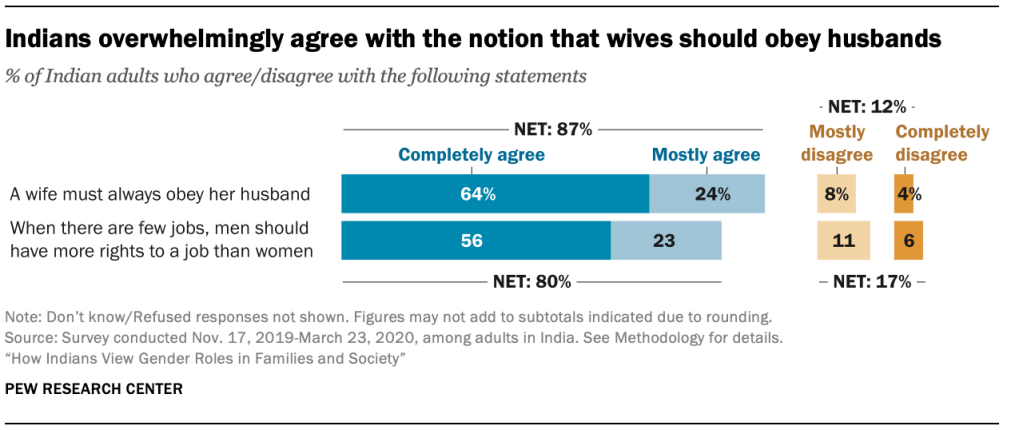
Yet, in domestic settings, Indians tend to say men should have more prominent roles than women. About nine-in-ten Indians agree with the notion that a wife must always obey her husband, including nearly two-thirds who completely agree with this sentiment. Indian women are only slightly less likely than Indian men to say they completely agree that wives should always obey their husbands (61% vs. 67%), according to the survey, which was conducted between late 2019 and early 2020 (mostly before the COVID-19 pandemic).
Indians overwhelmingly agree with the notion that wives should obey husbands

Many Indians express egalitarian views toward some gender roles in the home. For instance, 62% of adults say both men and women should be responsible for taking care of children. But traditional gender norms still hold sway among large segments of the population: Roughly a third of adults (34%) feel that child care should be handled primarily by women.

Similarly, a slim majority (54%) says that both men and women in families should be responsible for earning money, but many Indians (43%) see this as mainly the obligation of men. And Indian adults overwhelmingly say that when jobs are in short supply, men should have greater rights to employment than women, reflecting the continued prominence of men in the economic sphere. Eight-in-ten agree with this sentiment, including a majority (56%) who completely agree.
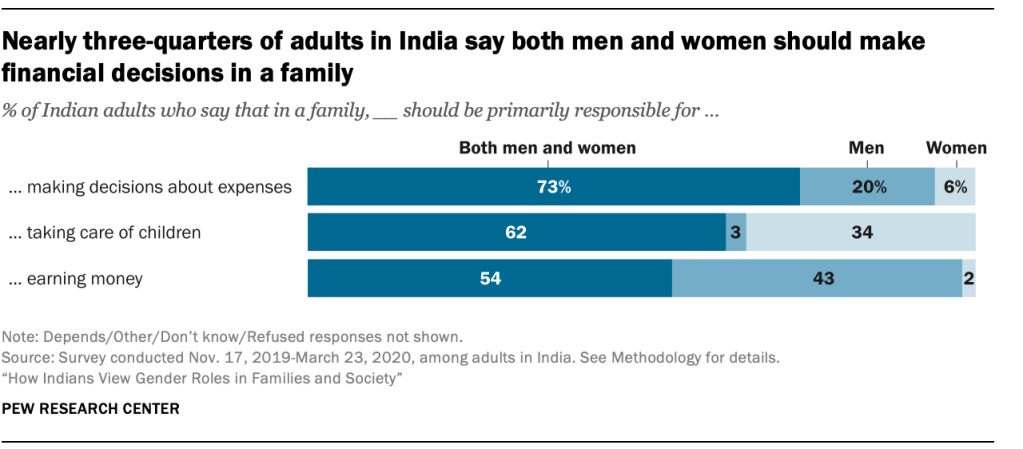
Nearly three-quarters of adults in India say both men and women should make financial decisions in a family

Indians value having both sons and daughters: Nearly all Indians say it is very important for a family to have at least one son (94%) and, separately, to have at least one daughter (90%). And most Indians say that both sons and daughters should have equal rights to inheritance from parents (64%) and have the responsibility to care for parents as they age (58%). But survey respondents are far more likely to say that sons, rather than daughters, should have greater rights and responsibilities in these areas. For example, while about four-in-ten Indian adults say that sons should have the primary responsibility to care for aging parents, just 2% say the same about daughters.

Related India research

This is one in a series of Pew Research Center reports on India based on a survey of 29,999 Indian adults conducted Nov. 17, 2019, to March 23, 2020, as well as demographic data from the Indian Census and other government sources. Other reports can be found here:

  • Religion in India: Tolerance and Segregation
  • Religious Composition of India
  • India’s Sex Ratio at Birth Begins To Normalize

Moreover, most Indians (63%) see sons – not daughters – as being primarily responsible for parents’ last rites and burial rituals. Religious funeral practices for loved ones are widely seen as very important, and at least according to Hindu tradition, sons must perform last rites for a parent to ensure freedom for the soul in the afterlife. Recently, women – including actress Mandira Bedi and the daughters of India’s former Chief of Defense Staff – have publicly challenged these norms by lighting family members’ funeral pyres.
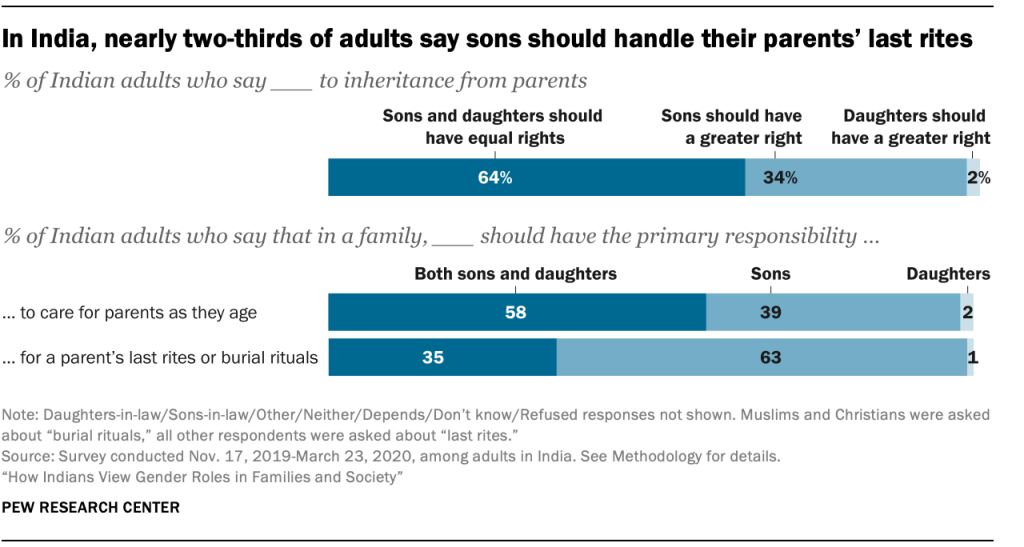
In India, nearly two-thirds of adults say sons should handle their parents’ last rites

These norms are part of a wider phenomenon in Indian society where, for a variety of historical, social, religious and economic reasons, families tend to place higher value on sons rather than daughters – a custom broadly referred to as “son preference.” Adult sons traditionally live with their parents and provide financial support to the family. Meanwhile, when daughters marry, their families may pay a dowry, an illegal practice that still features in some marriages, and daughters often live with their husband’s parents and fulfill obligations toward their in-laws. In recent years, Indian society has paid increased attention to improving the status of daughters – the government’s Beti Bachao, Beti Padhao (“Save the girl child, Educate the girl child”) program, for example, seeks to prevent sex-selective practices during pregnancy and to ensure educational opportunities for girls by conducting public awareness media campaigns, among other policies.

Son preference and the increased availability of ultrasounds in recent decades have contributed to the selective abortion of female fetuses across India, despite the illegality of the practice. And for many years, India has had one of the most skewed sex ratios at birth in the world. For example, according to the 2011 census, there were 111 boys born for every 100 girls born in India, though recent data suggests the gap may be narrowing.1

Many Indians see sex-selective abortion as acceptable in at least some circumstances: Four-in-ten Indians say it is either “completely acceptable” or “somewhat acceptable” to “get a checkup using modern methods to balance the number of girls and boys in the family,” a euphemism to connote sex-selective abortion.2 A similar share (42%) says balancing the number of girls and boys in a family via modern methods is completely unacceptable, while roughly one-in-ten describe the practice as “somewhat” unacceptable.
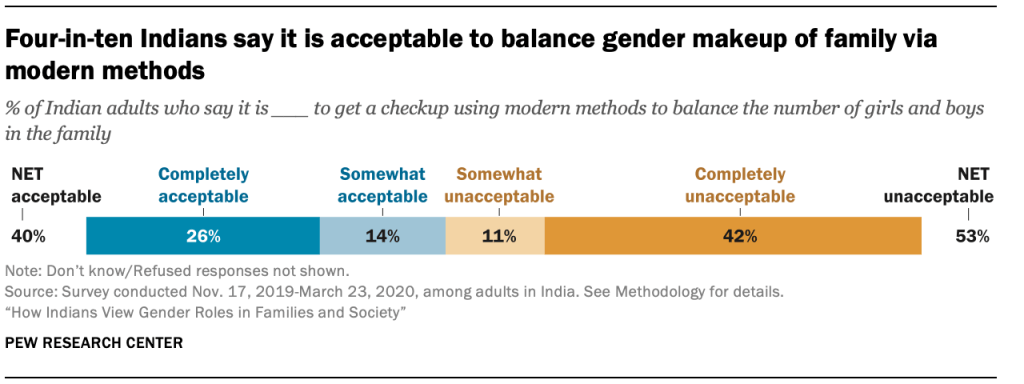
Four-in-ten Indians say it is acceptable to balance gender makeup of family via modern methods

On this question and all others included in this report, differences in opinion between men and women and across age groups are modest. In other words, Indian women typically are not much more likely than Indian men to express egalitarian views on son preference and gender roles (see “In India, men a little more likely than women to have conservative views on gender”), and the same is true of young Indian adults (ages 18 to 34) relative to their elders.

This is the second report based on a Pew Research Center survey conducted face-to-face nationally among 29,999 Indian adults. Many findings from the survey were previously published in “Religion in India: Tolerance and Segregation,” which looked in detail at religious and national identity, religious beliefs and practices, and attitudes among religious communities. The survey also included several questions on gender roles in Indian society, but these questions were not analyzed in the previous report and are now being published for the first time. (Another recent Pew Research Center report, “Religious Composition of India,” used Indian census data to examine how India’s religious makeup has changed since independence.)

Local interviewers administered the survey between Nov. 17, 2019, and March 23, 2020, in 17 languages. The survey covered all states and union territories of India, with the exceptions of Manipur and Sikkim – where the rapidly-developing COVID-19 situation prevented fieldwork from starting in the spring of 2020 – and the remote territories of the Andaman & Nicobar Islands and Lakshadweep; these areas are home to about a quarter of 1% of the Indian population. The union territory of Jammu and Kashmir was covered by the survey, though no fieldwork was conducted in the Kashmir region itself due to security concerns.

This study, funded by The Pew Charitable Trusts and the John Templeton Foundation, is part of a larger effort by Pew Research Center to understand religious change and its impact on societies around the world. The Center previously has conducted religion-focused surveys across sub-Saharan Africa; the Middle East-North Africa region and many other countries with large Muslim populations; Latin America; Israel; Central and Eastern Europe; Western Europe; and the United States.

The rest of this Overview covers perceptions of gender discrimination; how Indian attitudes on gender compare globally; the strong influence of education and religion in gender attitudes; the minimal differences in gender attitudes between Indian men and women, and among adults of different ages; and regional and state-level variation in how gender roles are viewed.

Indians perceive more discrimination against women than religious minorities, but most say women do not face ‘a lot of discrimination’

About a quarter of Indians say women in the country face a lot of discrimination

Almost a quarter of Indians (23%) say there is “a lot of discrimination” against women in their country, slightly more than the shares who say some religious groups or lower castes face a lot of discrimination. This means that the vast majority of Indian adults do not see a lot of discrimination against any of these groups.

About one-in-six Indian women (16%) said that they had personally felt discriminated against because they are a woman in the last 12 months before the 2019-2020 survey – comparable to the shares of women who said they have recently felt discriminated against due to their religion (16%) or their caste (14%). Similar shares of Indian men said they had faced recent gender (14%), religious (17%) or caste (15%) discrimination.

But far more adults see violence against women as a major national issue. As described in a previous Pew Research Center report, three-quarters of Indians say violence against women is a “very big problem” – greater than the share who say communal violence is a very big problem (65%), and similar to the shares who say this about crime and corruption (76% each). Police cases registered as “crimes against women” nearly doubled between 2010 and 2019, and rapes and murders of women have led to massive protests across India.

The survey asked respondents which of two options is more important to improve the safety of women in their community: teaching boys to respect all women or teaching girls to behave appropriately. Roughly half of Indians say teaching boys to respect women is more important, while about a quarter of Indians say teaching girls to behave appropriately is the better way to improve women’s safety. An additional quarter of Indian adults don’t take a clear position between those two options, instead voicing that some combination of the two approaches is necessary, that improved law and order through policing will improve the situation or that women are already safe. Women are slightly more likely than men to say that teaching boys to respect all women is the more important way to improve safety (53% vs. 48%).
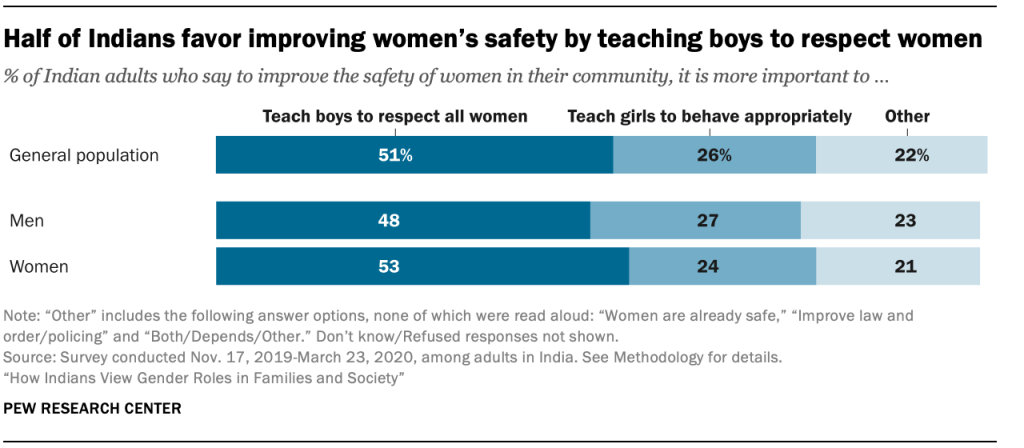
Half of Indians favor improving women’s safety by teaching boys to respect women

How India’s gender attitudes compare globally

Pew Research Center has asked a couple of the questions on this survey in many countries around the world, allowing a glimpse of where Indians fit globally when it comes to public opinion on these issues.

Across 47 countries and territories, a global median of 70% say it is very important for women to have the same rights as men, according to data from two recent waves of the Center’s Global Attitudes survey. This is similar to the share of Indians who feel gender equality is very important (72%).3

Indians are less likely than people in North America (92% median), Western Europe (90%) and Latin America (82%) to place high importance on women and men having the same rights. But they are more likely than those living in sub-Saharan Africa (48% median) and the Middle East-North Africa region (44%) to say this. Adults in Central and Eastern Europe (69% median) are roughly similar to Indians on this question.

Within South Asia, Indians are somewhat more likely than Pakistanis to say it is very important for men and women to have equal rights (72% vs. 64%).
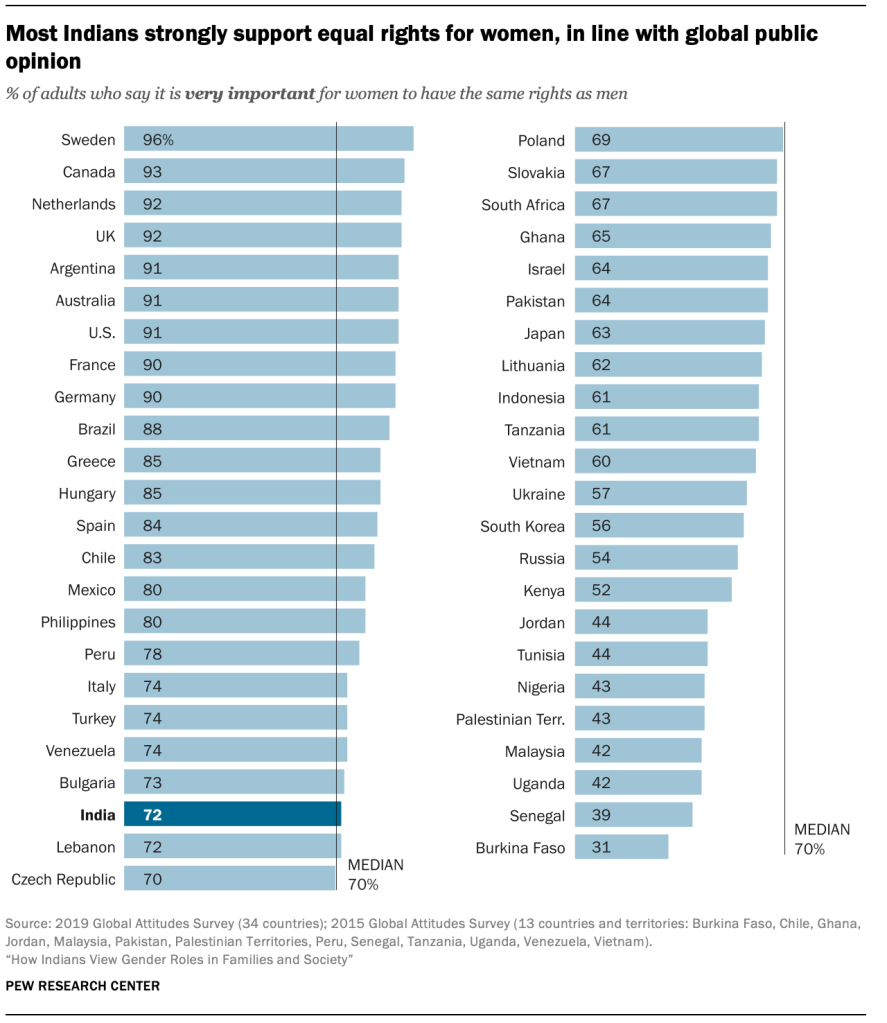
Most Indians strongly support equal rights for women, in line with global public opinion

Despite broadly aligning with global public opinion on equal rights for women, Indians tend to be more conservative than people in most other countries surveyed when it comes to gender dynamics in the home and in the economy.

For instance, across 61 countries surveyed from 2013 to 2019, a median of 17% completely agree with the statement “When jobs are scarce, men should have more rights to a job than women,” but roughly three times as many Indians say the same (55%).4 In fact, only one surveyed country – Tunisia (64%) – has a higher share who completely agree with the notion that men should have greater rights to jobs in times of high unemployment.

On this measure, Indians are substantially more traditional than people from North America (4% median), Western Europe (7%), Central and Eastern Europe (14%) and Latin America (20%).

Indians among most likely to completely agree that men should sometimes receive job preference
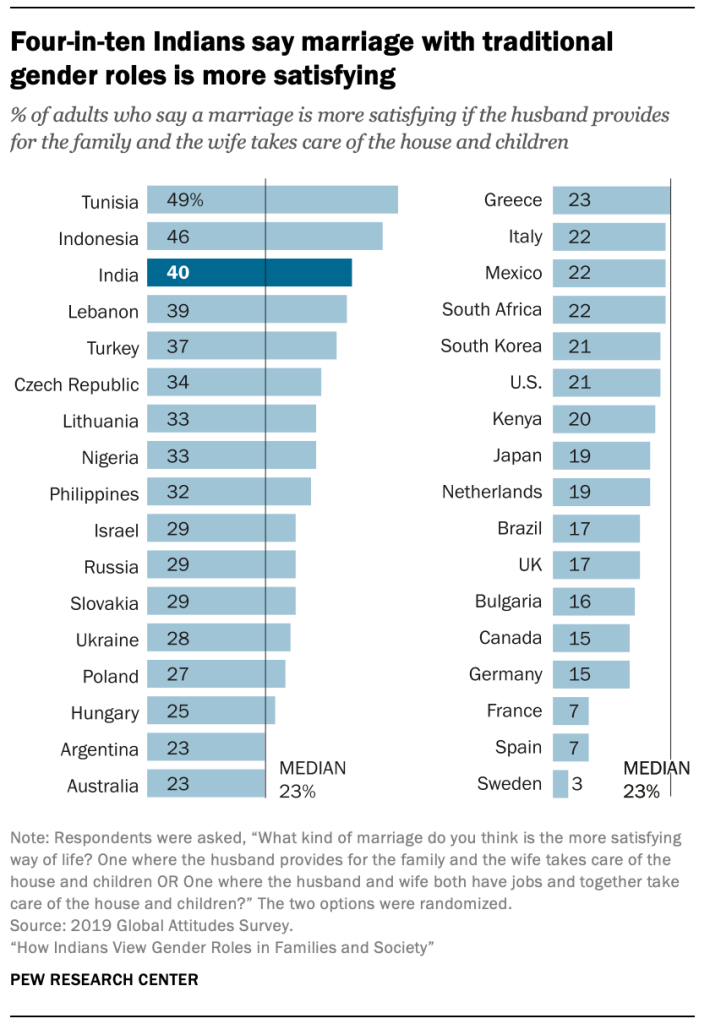
Four-in-ten Indians say marriage with traditional gender roles is more satisfying

These attitudes, combined with a scarcity of jobs, may be one reason why India has one of the lowest female labor force participation rates in the world (21% vs. 53% global median), according to 2019 United Nations (UN) data. India’s male labor force participation rate is much higher (76%), and this within-country discrepancy contributes to India’s low ranking on the UN Gender Inequality Index (123rd out of 162 ranked countries).

The 2019 Global Attitudes survey in 34 countries also asked a question about gender roles that was not on the 2019-2020 India survey: “Which kind of marriage is more satisfying, one where the husband provides for the family and the wife takes care of the house and children, or one where the husband and wife both have jobs and together take care of the house and children?”

Indians are among the most likely to say the husband should provide for the family while the wife focuses on the home: Four-in-ten Indians prefer this traditional family dynamic, compared with a global median of 23%.

Indians with a college degree are less likely to hold traditional views on gender roles

Indian adults with a college degree are less likely than those without a college education to support conservative gender norms. For example, about a quarter of college-educated Indians (24%) say women in a family should be primarily responsible for taking care of children, while roughly a third of Indians with less formal education (35%) say child care responsibility should rest with women.
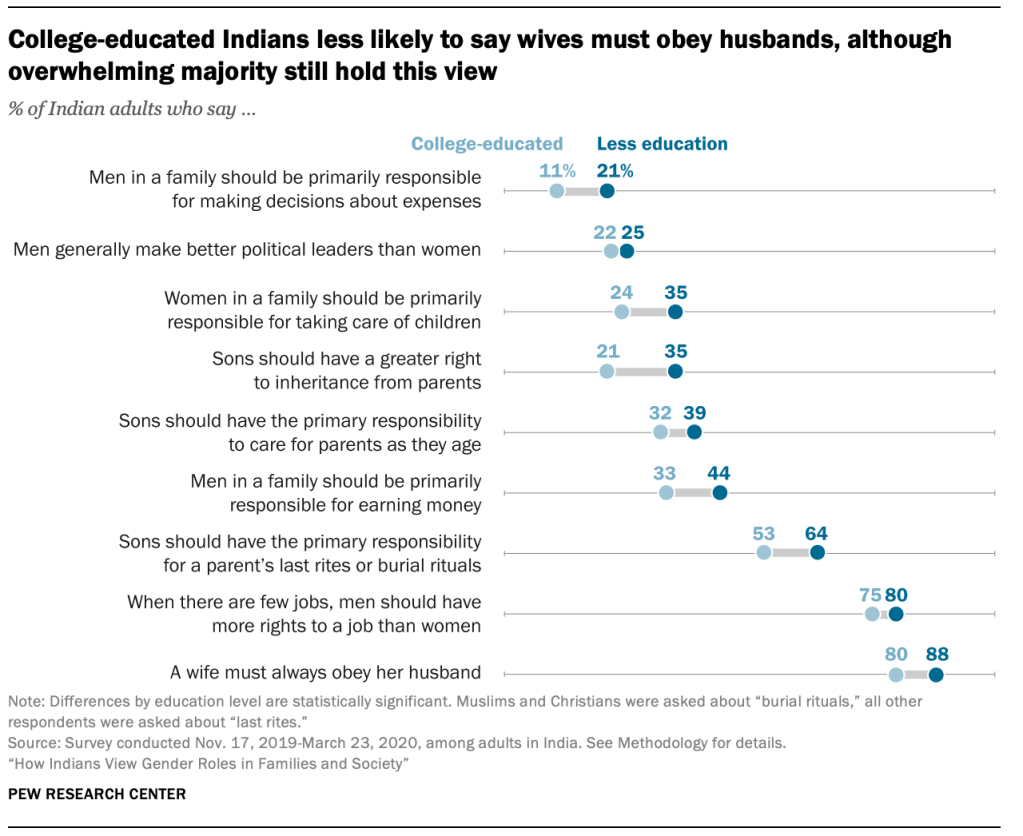
College-educated Indians less likely to say wives must obey husbands, although overwhelming majority still hold this view

However, even Indians who have completed college sometimes do overwhelmingly endorse traditional views on gender-related issues. For instance, large majorities among those with a college degree (80%) and those with less education (88%) agree with the notion that wives must always obey their husbands.

Muslims more likely than other Indians to say men should provide a family’s income

India’s main religious groups have widely divergent opinions about gender roles in the family. For example, while nearly three-quarters of Indian Muslims (74%) say that sons should have the primary responsibility for a parent’s burial rituals, just 29% of Sikhs say that sons alone should handle last rites. Across several aspects of family life, this pattern repeats: Muslims are the most likely, and Sikhs are the least likely, to support traditional gender roles.
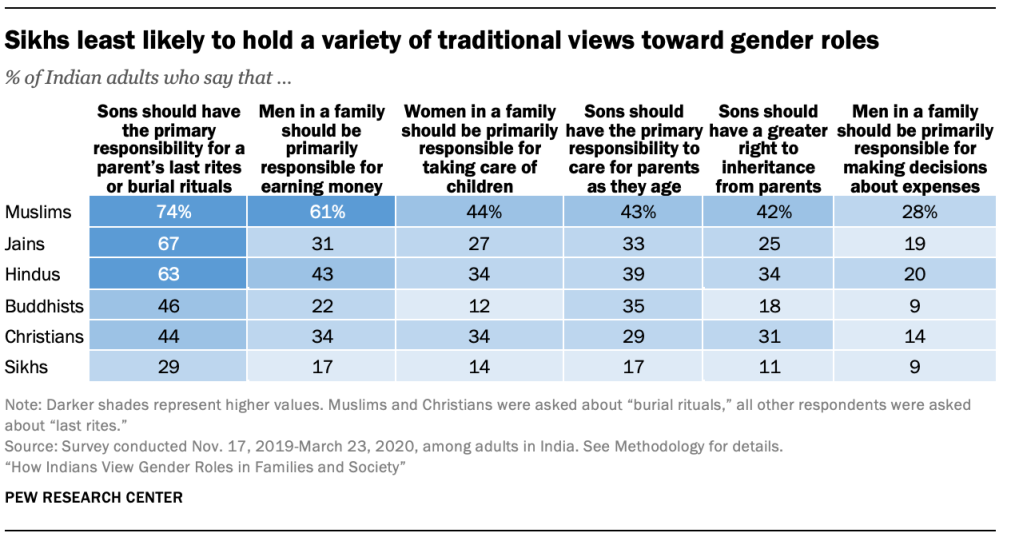
Sikhs least likely to hold a variety of traditional views toward gender roles

Muslims are somewhat less likely than Sikhs to have a college education (5% vs. 9%), based on the 2011 census, and as noted previously, Indians without a college degree are more likely to hold conservative gender attitudes. But even when considering education, Muslims are far more likely than Sikhs to support traditional gender roles in the family. For instance, about a third of college-educated Muslims (32%) say women should be primarily responsible for taking care of children, while only about one-in-ten college-educated Sikhs (9%) share this view.

The overwhelming majority of India’s Sikh community lives in the state of Punjab (India’s only majority-Sikh state), and people in Punjab consistently express less preference for traditional gender roles within the home – a pattern that is not just driven by Sikhs in the state. Indeed, Punjabi Hindus are much less likely than Hindus nationally to express traditional views on some gender roles. For example, while 34% of Indian Hindus overall say women should be primarily responsible for taking care of children, just 13% of Punjabi Hindus say this – similar to the 14% of Indian Sikhs who take this position. (See “Southern states not necessarily more egalitarian than Hindi Belt states in gender attitudes” for more on state and regional differences across India.)

For many years, Punjab has had one of the most skewed sex ratios across Indian states. According to the 2011 census, for every 119 boys born in Punjab, 100 girls were born. However, more recent data suggests the skew may be decreasing. In the most recently conducted National Family Health Survey (NFHS), there were 111 boys born in Punjab for every 100 girls. 5

In India, men a little more likely than women to have conservative views on gender

Across a variety of measures, Indian men are more likely than women – but only slightly – to take a traditional view of gender roles. For instance, 82% of men say that when there are few jobs, men should have more rights to jobs, compared with 77% of women who share this perspective.
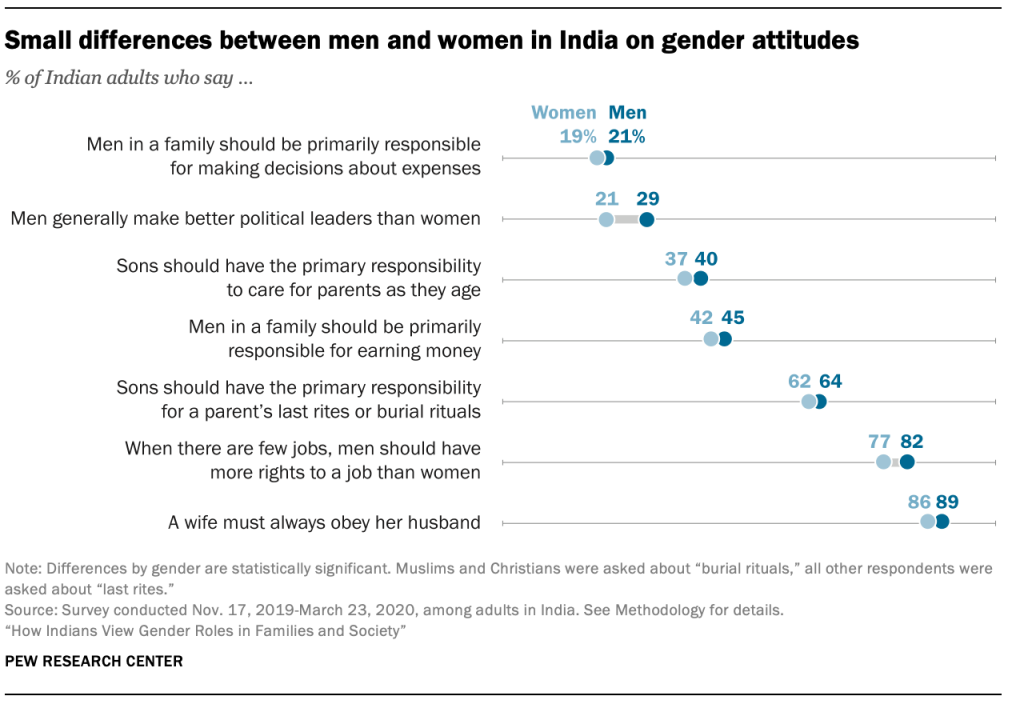
Small differences between men and women in India on gender attitudes

Similarly, older Indians (ages 35 and older) are marginally more likely than younger adults to hold traditional views on gender roles. While 45% of Indians ages 35 and older say that men in a family should be primarily responsible for earning money, 42% of those ages 18 to 34 agree.
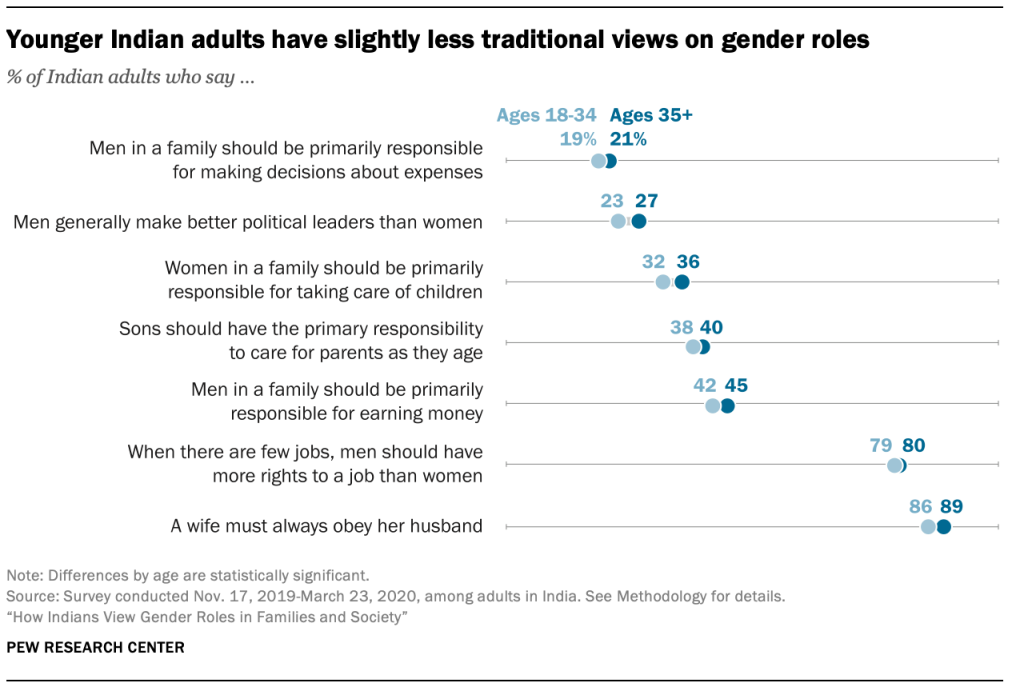
Younger Indian adults have slightly less traditional views on gender roles

Even when looking at attitudes only among Indian women, the differences between younger and older adults are minimal, with older women slightly more likely than younger women (ages 18 to 34) to hold conservative views on gender roles. For example, 37% of older Indian women (ages 35 and older) think women in a family should be primarily responsible for caring for children, while a third of younger Indian women take this position.

Vast majority of Indian women, young and old, agree wives should obey husbands

Sidebar: India’s changing gender norms

The general consistency across age groups could suggest that Indian attitudes on family gender roles may not be changing very much over time. But a long-running survey shows that attitudes and behaviors on gender roles appear to have become more egalitarian since the end of the 20th century, with perhaps the biggest changes in the early 2000s.

India’s National Family Health Survey (NFHS) has been conducted five times, with the first happening roughly three decades ago. Typically, women ages 15 to 49 and men ages 15 to 54 in selected households are eligible to be interviewed.6 By comparison, all Indian adults (ages 18 and older) were eligible to be included in the Pew Research Center survey. Differences in sampling and question wording make it difficult to compare the two surveys directly. Still, NFHS surveys are useful in analyzing data over time.

Between the survey’s second (1998-99) and third (2005-06) rounds of data collection, several measures showed a move away from traditional attitudes. For example, while 31% of married women under age 50 who were earning money in 1998 and 1999 said that their husband was mainly deciding how to use the money the wife earned, that number halved (15%) by 2005 and 2006.

Between the survey’s third (2005-06) and fourth (2015-16) rounds, changes have been more modest, though still with a slight tendency toward less conservative views. Over that decade, for instance, the share of married men under age 50 who said husbands should have the greater say in deciding about visits to a wife’s family or relatives declined slightly, from 26% to 21%.7

Generally, Indian men becoming less likely to be main decision-makers about family issues

Southern states not necessarily more egalitarian than Hindi Belt states in gender attitudes

Women in India’s Southern states generally have better socioeconomic outcomes, on average, than those in other parts of the country, particularly when compared with states in the Northern Hindi Belt. For instance, Southern women tend to be more highly educated and to live longer. This North-South divide is commonly discussed in academic literature.

But Southern attitudes toward gender roles are not necessarily more egalitarian. While Indians in the South are less likely than those in the Hindi Belt to say, for example, that a wife must always obey her husband (75% vs. 94%), Southern adults are more likely to say that men in families should be responsible for making decisions about expenses (25% vs. 13%) and that women should be primarily responsible for taking care of children (44% vs. 30%).

Southern Indians more likely than those in the Hindi Belt to favor some traditional gender roles, but less likely to say wives should obey husbands
People in Uttar Pradesh, Karnataka overwhelmingly say sons should handle parents’ funeral rituals

These regional analyses, though, mask significant variation within regions. In the South, people in Karnataka and Andhra Pradesh often express more traditional views than those in Kerala: 81% of Karnataka’s residents and 60% in Andhra Pradesh think sons should be responsible for a parent’s last rites, while just 30% of Keralites say the same. Meanwhile, attitudes toward gender roles in Tamil Nadu and Telangana tend to vary quite a lot based on the issue; for example, Tamilians are among the least likely to say that a wife must always obey her husband, but the state also has the highest share of people who say women should be primarily responsible for taking care of children.

The Hindi Belt also has large variations between states on gender roles. For example, Uttar Pradesh is often among the most conservative states, while the National Capital Territory of Delhi is consistently at the other end of spectrum. For complete state-level details on these questions, see Chapter 3.

How regions of India are defined for this report

Previous reporting from this survey largely used membership in India’s six zonal councils to define regions. In this report, however, it makes more sense to analyze at the state level due to wide variations among states within the same zone.

This report does, though, describe differences between two commonly discussed regions: the Hindi Belt and the South. While different definitions exist, a broad definition of the Hindi Belt includes the following 11 states and union territories, located in the Northern part of the country: Bihar, Chandigarh, Chhattisgarh, Delhi, Haryana, Himachal Pradesh, Jharkhand, Madhya Pradesh, Rajasthan, Uttar Pradesh and Uttarakhand.

The South includes the following six states and union territories: Andhra Pradesh, Karnataka, Kerala, Puducherry, Tamil Nadu and Telangana.

Sidebar: National Family Health Surveys also show big variation within regions

Even though the surveys include different questions and have different sample compositions, NFHS surveys broadly show similar patterns to the Center’s recent survey: Southern attitudes and behaviors often are comparable to, or even more traditional than, those in the Hindi Belt, and states within both regions are diverse in how traditional gender roles are considered.

For example, in the most recently released NFHS data, about a third of men in Southern states (34%) say husbands should have a greater say than wives when making major household purchases, compared with roughly a quarter in Hindi Belt states (27%).8

On this topic, within-region variation is stark in the Hindi Belt. While 37% of residents in Chandigarh think husbands should have more say than wives in major purchases, just 13% in Himachal Pradesh offer this opinion.9
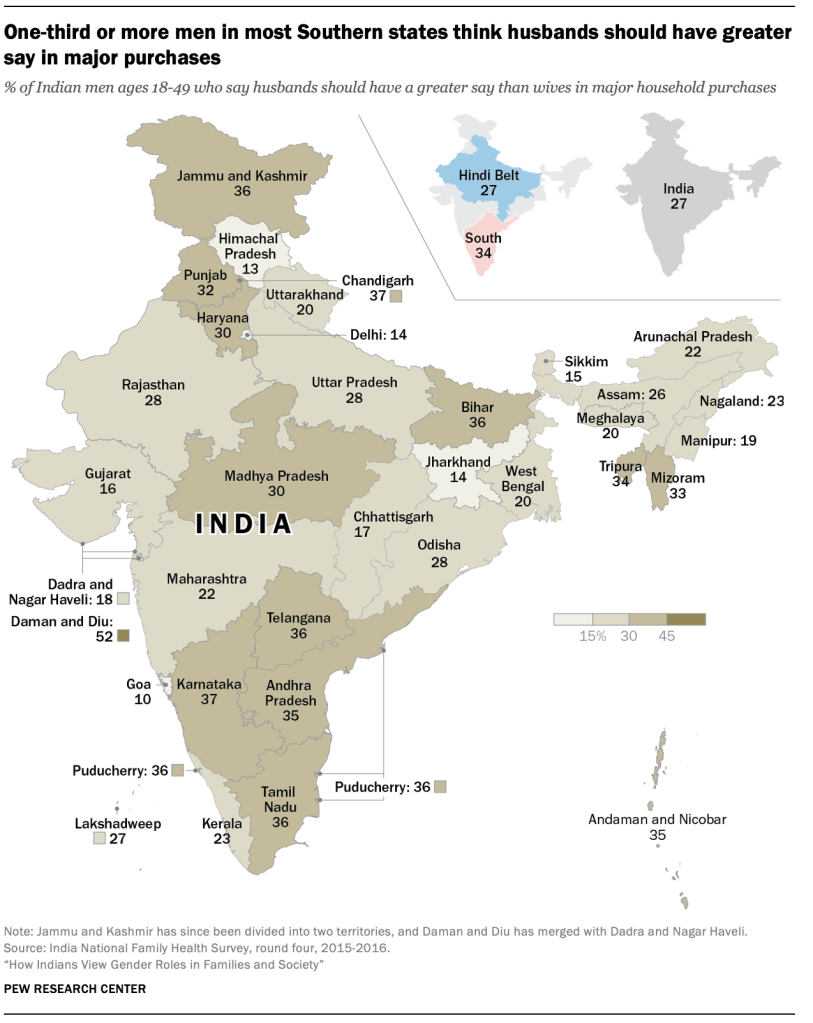
One-third or more men in most Southern states think husbands should have greater say in major purchases

1. Views on women’s place in society

About a quarter of Indians (23%) say there is “a lot of discrimination” against women in their country. And 16% of Indian women reported that they personally had faced discrimination because of their gender in the 12 months before the 2019-2020 survey.

In addition, three-quarters of adults see violence against women as a very big problem in Indian society. To improve women’s safety, about half of Indian adults (51%) say it is more important to teach boys to “respect all women” than to teach girls to “behave appropriately.” But roughly a quarter of Indians (26%) take the opposite position, effectively placing the onus for violence against women on women themselves.

On the whole, however, Indians seem to share an egalitarian vision of women’s place in society. Eight-in-ten people surveyed – including 81% of Hindus and 76% of Muslims – say it is very important for women to have the same rights as men. Indians also broadly accept women as political leaders, with a majority saying that women and men make equally good political leaders (55%) or that women generally make better leaders than men do (14%).

Yet these views exist alongside a preference for traditional economic roles. Indians generally agree that when there are few jobs available, men should have more rights to a job than women (80%), including 56% who completely agree with this statement. Majorities of both men and women share this view, though men are somewhat more inclined to take this position.

Most Indian women do not perceive widespread discrimination against women in India

A quarter of Indians say there is a lot of gender discrimination

Roughly a quarter of Indians (23%) say there is “a lot of discrimination” against women in India today. (Respondents were given two options; they could either say there is a lot of discrimination against women, or there is not a lot of discrimination.) Christians are the religious community most likely to perceive widespread discrimination against women in India (30%).

Indian women are only slightly more likely than Indian men to say there is a lot of discrimination against women in the country (24% vs. 22%, respectively). In general, views on gender discrimination do not differ much – if at all – between respondents of different ages or education levels.

While most Indians do not perceive a lot of gender discrimination in their country, Indians are modestly more likely to say there is a lot of discrimination against women than to say the same about discrimination against religious groups or lower castes.

Indians in different regions have very different perceptions of how much discrimination women face. In general, respondents in the South are more likely than those in the Hindi Belt to feel there is a lot of discrimination against women in India today. For example, in the Southern states of Telangana and Tamil Nadu, more than a third of adults say there is a lot of discrimination against women (44% and 39%, respectively). By contrast, in the Hindi Belt states of Himachal Pradesh and Uttar Pradesh, only 6% of respondents say this is the case. As Pew Research Center previously has reported, South Indians also are more likely than Indians in the Hindi Belt to perceive a lot of discrimination against Scheduled Castes and Scheduled Tribes.

Southern Indians more likely to see discrimination against women

The Northeastern state of Assam stands out, with 52% of respondents reporting widespread gender discrimination. This mirrors the broader pattern of respondents in the Northeast being among the most likely to say there is a lot of discrimination in India against people from various religious groups and from lower castes. But in general, the majority of Indians in most states and union territories say there is not a lot of discrimination against women.

Most Indian women say they have not recently experienced gender discrimination

Fewer than one-in-five Indian women (16%) said they had personally felt discriminated against in the 12 months before the 2019-2020 survey because of their gender. And women were only slightly more likely than men to say they had experienced gender discrimination in the past year (16% vs. 14%, respectively).

Christians – despite being the most likely religious group to say there is a lot of discrimination against women in India – had the lowest rate of women personally reporting discrimination because of their gender (9%).

Older and younger women report facing similar levels of gender discrimination

Across India, women in different age groups and with different levels of education reported experiences with gender discrimination at roughly similar rates. However, women who had faced recent financial difficulties (those who said they had not been able to afford food, housing or medical care for themselves or their families in the last year) were twice as likely as those who had not recently faced such financial difficulties to report that they personally had experienced gender discrimination in the past year (22% vs. 11%).

Survey respondents’ personal experiences with gender discrimination also varied across the country. On the upper bound, women in Jammu and Kashmir and in Assam reported the highest levels of personal gender discrimination in the past year (35% and 32%, respectively), while women from Gujarat and Andhra Pradesh were among the least likely to say they personally had faced discrimination because of their gender (7% and 6%, respectively).

Indians favor teaching boys respect as a way to improve women’s safety

Amidst India’s ongoing problem with violence against women, the survey asked respondents whether, to improve the safety of women in their community, it is more important to teach boys to respect all women or to teach girls to behave appropriately.

Women in Jammu and Kashmir, Assam overall more likely to report recent gender discrimination
Roughly half of Indians prefer to improve safety of women by teaching boys to respect all women
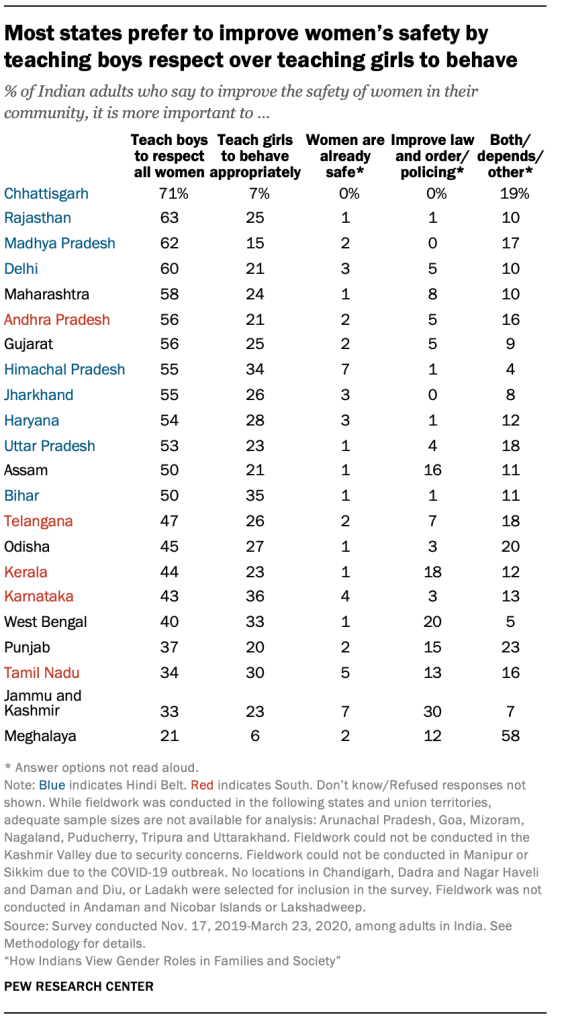
Most states prefer to improve women’s safety by teaching boys respect over teaching girls to behave

About half of Indians (51%) say it is more important to teach boys to respect all women, while roughly a quarter (26%) say it is more important to teach girls to behave appropriately. Others offer a variety of additional responses, such as that teaching both things is important or that it depends on the situation (13%); that improving law and order or policing is the most important way to protect women’s safety (7%); or that women are already safe (2%). A very small share (2%) did not offer a response to the question.

Women are somewhat more likely than men to say that teaching boys to respect all women is the most important way to improve women’s safety (53% vs. 48%).

Within all of India’s major religious communities, the most common response is “to teach boys to respect all women.” However, while Christians and Sikhs are somewhat less likely than other groups to say this, they are more likely than people in other religious groups to say that both kinds of teaching are important or that the right approach depends on the situation.

While opinion does not vary substantially among Indians of different ages or educational backgrounds, a sizeable gap does emerge around religious commitment. Indians who say religion is very important in their lives are more likely than others to say that teaching boys to respect all women is crucial to improving the safety of women (52% vs. 43%).

Opinions on the best way to improve women’s safety vary considerably across India. For instance, 63% of Rajasthan residents say it is more important to teach boys to respect all women, compared with 40% of people in West Bengal.

In the South, people in neighboring states have differing views. Only about a third of Tamil Nadu residents would prioritize teaching boys to respect all women (34%), compared with over half of Andhra Pradesh locals (56%).

Most Indians say it is very important that women have same rights as men

Indians overwhelmingly say they value gender equality

Most Indian adults (80%) say that, in general, it is very important for women to have the same rights as men, with solid majorities of all major religious groups sharing this view. Buddhists are especially likely to say gender equality is very important (91%), while Muslims and Christians are somewhat less likely than members of India’s other major religious communities to express this sentiment (76% and 70%, respectively).

Nationally, women, younger Indians (ages 18 to 34), and college graduates are slightly more likely than others to say it is very important for women to have the same rights as men.

Overall, Indians with high levels of religious commitment – i.e., those who say religion is very important in their lives – are more likely than other Indians to believe that gender equality is very important (83% vs. 65%). And those with a favorable view of the ruling Bharatiya Janata Party (BJP) are modestly more likely than others to endorse equal rights for women (83% vs. 76%).

Broadly, Indians in the South are somewhat less likely than those elsewhere to say it is very important for women to have the same rights as men. For example, while 80% of Indian adults overall think gender equality is very important, smaller shares in Kerala (72%), Telangana (71%) and Andhra Pradesh (66%) take this position. Still, large majorities across Indian states and union territories share this sentiment.

Most Indians believe women to be equally good political leaders as men

India has a long history of women holding political power, from the 1966 election of Indira Gandhi, one of the world’s first woman prime ministers, to other well-known figures, such as Jayalalitha, Mamata Banerjee and Sushma Swaraj.

Majorities across Indian states and territories want equal rights for women
Younger Indians, college graduates somewhat more likely to say women, men make equally good leaders

The survey results reflect this comfort with women in politics. Overall, a small majority of respondents express the opinion that, in general, women and men make equally good political leaders (55%). Some Indians (14%) even say women tend to make better political leaders than men. Only a quarter of Indians say that men generally make better political leaders than women.

Modest differences by gender exist. Men are more likely than women to believe men are superior politicians (29% vs. 21%, respectively), while women are slightly more likely to favor the abilities of women leaders (16% vs. 13%).

Younger Indian adults (ages 18 to 34) and college graduates are somewhat more likely than their elders and those with less formal education to say women and men make equally good political leaders.

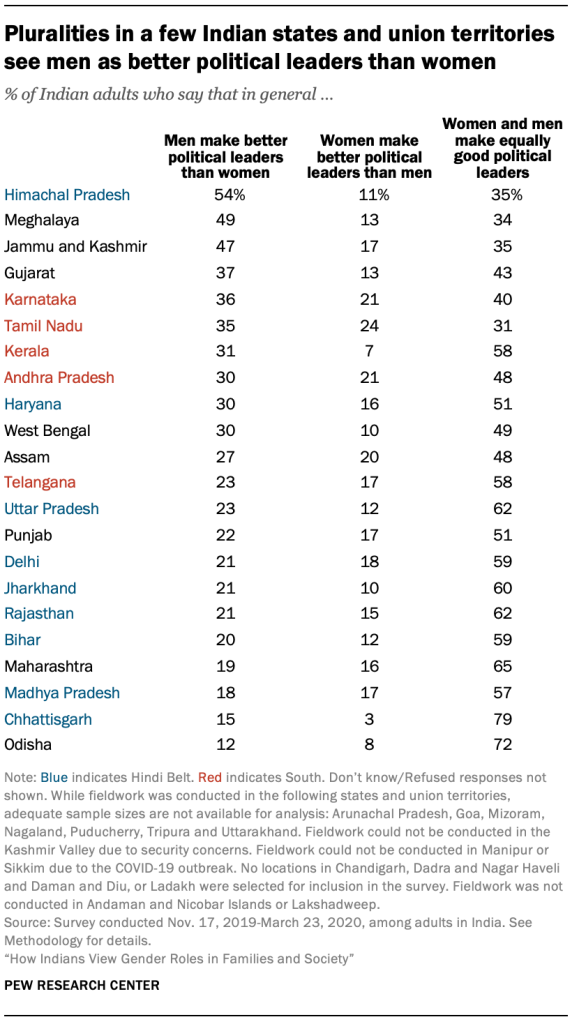
Pluralities in a few Indian states and union territories see men as better political leaders than women

Views on gender and political leadership differ substantially across Indian states. In a handful of states, about a third or more of the population says that men generally make better political leaders than women, including a slim majority in Himachal Pradesh (54%).

By contrast, only about one-in-eight adults in the East Indian state of Odisha (12%) say men make better political leaders. In Odisha and several other states, solid majorities say women and men make equally good political leaders.

In a few states – including the three Southern states of Andhra Pradesh, Karnataka and Tamil Nadu – roughly one-in-five or more people surveyed say women generally make better political leaders than men.

Most men and women think men should be given hiring preference when there are few jobs

Majority of Indians say men should have more rights than women to scarce jobs

While a majority of Indians express openness to women political leaders and endorse equal rights for women, the vast majority of the population (80%) agrees with the idea that “when there are few jobs, men should have more rights to a job than women,” including 56% who completely agree with that statement. Most Indian women as well as men express total agreement with this statement, though men are somewhat more likely to do so (59% of men vs. 54% of women).

Although the survey was conducted before the COVID-19 pandemic, this question may have become even more relevant because women in India have disproportionately suffered from long-term job losses amidst the pandemic’s economic fallout.

Opinion varies by religious group. Nearly two-thirds of Muslims (64%) completely agree that men should get preference for jobs over women, compared with roughly a third of Christians (34%) who take the same view.

Highly religious Indians are especially likely to fully agree that limited jobs should go to men: Six-in-ten Indians who consider religion very important in their lives say this, compared with about four-in-ten Indians for whom religion is less important (38%).

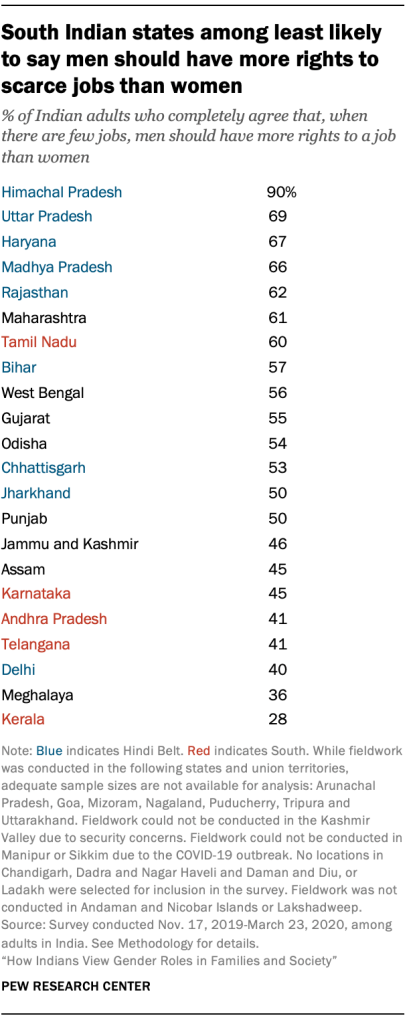
South Indian states among least likely to say men should have more rights to scarce jobs than women

College graduates are somewhat less inclined than others to completely agree that men should have more rights to a job when employment opportunities are scarce (49% vs. 57%).

People in some Southern states are among the least likely to completely agree that men should have more rights to limited jobs than women. Fewer than half of respondents in Karnataka (45%), Andhra Pradesh (41%), Telangana (41%) and Kerala (28%) hold this view.

At the same time, a majority of residents in the Southern state of Tamil Nadu (60%) fully agree that when there are few jobs, men should be given preference in hiring. This view also is prevalent in most Hindi Belt states, such as Uttar Pradesh (69%), Haryana (67%) and Madhya Pradesh (66%). And in Himachal Pradesh, nine-in-ten respondents express total agreement with this notion.

2. Son preference and abortion

Historically, in Indian society, sons have been expected to take care of their aging parents, and men have been the main beneficiaries of inheritance. Meanwhile, married women often live with and support their in-laws. In line with these and other traditions, families have tended to place higher value on – and provide more support to – their sonsthan their daughters, a set of attitudes and practices known as “son preference.”

Today, nearly all Indian adults say it is either very important or somewhat important for a family to have at least one son, but an identical share (99%) also separately say it is important to have a daughter. Indians are only slightly more likely to say that it is very important to have a son than to have a daughter (94% vs. 90%).

However, one enduring manifestation of son preference has been the practice of sex-selective abortions – using ultrasound or other tests to learn the sex of a fetus and terminating the pregnancy if the fetus is female. While the Indian government has enacted measures meant to curtail this practice, the survey finds that a substantial minority of Indians (40%) say it is completely acceptable or somewhat acceptable “to get a checkup using modern methods to balance the number of girls and boys in the family.” On the other hand, roughly half of adults (53%) – including most Muslims (58%), Jains (54%) and Hindus (53%) – say that this practice is either “somewhat unacceptable” or “completely unacceptable.” (The indirect phrasing of the question, while perhaps unfamiliar to people outside of India, was carefully tested by survey researchers in India in order to convey the concept of sex-selective abortion to respondents without being offensive.)

A majority of Indian adults (55%) also say that abortion in general should be illegal in all or most cases, even though the medical procedure was legalized in the 1970s and continues to be legally available in India today. Indians’ views on abortion are correlated with their views on sex-selective abortion: Those who oppose abortion overall are more likely to see sex-selective abortion as unacceptable.

Nearly all Indians say it is important for a family to have both a son and a daughter

Slightly more Indians say it is very important for a family to have at least one son than at least one daughter

Indians nearly universally say it is at least somewhat important for families to have at least one son (99%) and, separately, at least one daughter (99%). This includes at least nine-in-ten who say it is very important to have a son (94%) and a daughter (90%).

Muslims are somewhat more likely to say it is very important to have a son than a daughter (95% vs. 86%, respectively). This gap is smaller for Hindus (94% vs. 91%) and nonexistent for Sikhs (95% each).

Adults who say religion is very important in their lives are more likely than others to say it is very important to have both sons and daughters. For instance, 95% of Indians who say religion is very important in their lives think it is very important to have at least one son, compared with 86% of Indians who place less importance on religion. Indians who say religion is very important also are somewhat more likely than others to have any children, regardless of gender (76% vs. 69%).

Residents in some states are significantly more likely to place importance on having a son than a daughter. These states are scattered across India. For example, in both the Eastern state of West Bengal and in the Southern state of Telangana, noticeably larger shares say it is very important for a family to have a son (93% and 90%, respectively) than to have a daughter (80% and 77%).

In West Bengal, Telangana, more Indians value having sons than daughters

Four-in-ten Indians say it is acceptable ‘to balance the number of boys and girls in a family’

Son preference in India has affected both individual families and society at large. Indeed, India’s sex ratio at birth has long been skewed, with significantly more boys than girls born each year than would be expected under natural conditions. This imbalance increased along with the rise of ultrasound technology, which made it easier for some Indians to selectively abort female fetuses; in other cases, female babies have been killed after birth.

Over time, the Indian government has taken different approaches to try to prevent sex-selective abortions, such as the Pre-Conception and Pre-Natal Diagnostic Techniques Act of 1994 (amended in 2003), which banned testing for the sex of the fetus. According to the 2011 census, there were 111 boys born for every 100 girls born in India, but recent data suggests the gap may be narrowing.10

Given the sensitivity around this topic – and the fact that it is illegal in India for medical providers to tell parents the sex of a fetus – the survey could not directly ask respondents if they thought sex-selective abortion should be legal or illegal. Instead, a euphemism was used. The survey asked Indians how acceptable or unacceptable it is to “get a checkup using modern methods to balance the number of girls and boys in a family.”

Fully 40% of Indian adults say this practice is at least “somewhat” acceptable, including roughly a quarter (26%) who say it is completely acceptable. Meanwhile, about half of adults say sex-selective abortion is somewhat unacceptable (11%) or completely unacceptable (42%). Men and women have virtually identical views on this topic, and differences by religion on this question are generally modest.

Adults who say abortion in general should be legal in all or most cases (see “Most Indians say abortion should not be legal”) are substantially more likely than other Indians to say that sex-selective abortion is at least somewhat acceptable. Moreover, Indians who have had difficulty purchasing food, medicine or housing for their family in the past year are more likely than those who did not have these financial difficulties to say the practice can be acceptable. At the same time, adults from General Category castes are slightly more inclined than those from lower castes to see sex-selective abortion as acceptable (43% vs. 39%).

Slim majority of Indians say sex-selective abortion is unacceptable
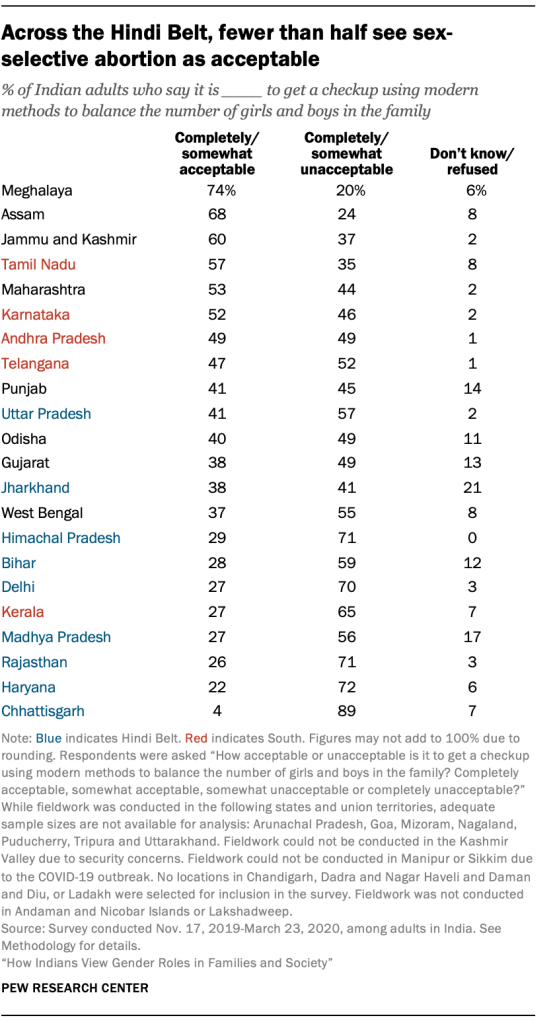
Across the Hindi Belt, fewer than half see sex-selective abortion as acceptable

Looking at this question at the state level, at least one-in-five people in nearly every state say sex-selective abortion is acceptable. Chhattisgarh stands out as an exception; just 4% of Indians there say the practice is somewhat or completely acceptable. Meanwhile, a few states – including Meghalaya (74%), Assam (68%) and Tamil Nadu (57%) – have clear majorities who say sex-selective abortion is at least somewhat acceptable.

In some states, a relatively high proportion of survey respondents say they do not know or decline to answer the question, including roughly one-in-five in Jharkhand (21%) and 17% in Madhya Pradesh.

In several states in the country’s Hindi Belt, relatively few people say the practice of sex-selective abortion is acceptable, while majorities consider it unacceptable. Despite these opinions, some of these states, such as Haryana, have had highly skewed gender ratios, suggesting the widespread prevalence of sex-selective abortion in the region. For example, the 2011 census found a ratio of 121 boys born per 100 girls born in Haryana.11

More recently, however, there is some evidence that the sex ratios in these states have become more balanced. In the 2019-2021 National Family Health Survey (NFHS), data showed that Haryana’s sex ratio at birth had become less skewed, at 112 boys to 100 girls. In neighboring Punjab – which is not part of the Hindi Belt but has also had a highly skewed sex ratio – the most recent NFHS survey once again showed considerable change: In the 2011 census, there were 119 boys for every 100 girls born in the state, but in 2019-2021, Punjab’s sex ratio at birth was somewhat closer to normal, at 111 boys per 100 girls. These trends suggest that the practice of sex-selective abortion may be in decline, perhaps as a result of laws banning the practice and greater awareness generated by public education campaigns. Data from India’s next census (scheduled to be conducted in 2022) is expected to provide a more definitive picture.

Most Indians say abortion should not be legal

Most Indians oppose legal abortion

In 1971, India legalized abortion for women through the first 12 weeks of pregnancy – and, in some circumstances, up to 20 weeks. Since then, legal abortion access has expanded several times, most recently in a 2021 law allowing abortions in some cases through 24 weeks of pregnancy.12

Despite this, the survey finds that most Indian adults do not believe abortion should generally be legal. Indeed, a slim majority (55%) say abortion should be illegal in all or most cases, including 36% who say it should be illegal in allcases. Just 38% of Indians say it should be legal in all or most cases.

At least half of adults surveyed in most of India’s major religious groups say abortion should be illegal in all or most cases. However, Buddhists are more likely than members of other religious communities to say abortion should be legal in all or most cases (51%), including 36% who say it should be legal in all cases.

Indians in Southern states less opposed to legal abortion

Adults who say religion is very important in their lives are more likely than those for whom religion is less important to say abortion should be illegal (56% vs. 47%). Additionally, nearly six-in-ten Indians who say they voted for the ruling Bharatiya Janata Party (BJP) in the 2019 national election (59%) say abortion should be illegal, while roughly half of Indians who voted for the opposition Indian National Congress party say the same (52%).

In most Indian states, half of adults or more say abortion generally should be illegal, but Indians who live in the South of the country are less likely to take this view. For example, fewer than half of respondents say abortion should be illegal in all or most cases in Andhra Pradesh (46%), Telangana (39%), Kerala (35%), Karnataka (31%) and Tamil Nadu (31%).

Overall, opposition to abortion is higher among Indians who live in Hindi Belt states, like Haryana (90%) and Rajasthan (76%), than in other parts of the country.

However, significant differences sometimes exist between neighboring states. For example, a majority of Indians in the Hindi Belt state of Bihar say abortion should be illegal in all or most cases (61%), compared with roughly four-in-ten in bordering Jharkhand (43%).

3. Gender roles in the family

While most Indians say that men and women should share some family responsibilities, many still support traditional, patriarchal values. For example, a slim majority of Indians (54%) say that both the men and the women in a family should be responsible for earning money. But 43% instead take the view that men should be the primary earners. Moreover, nearly two-thirds of Indians (64%) – including 61% of women – express complete agreement with the idea that a wife always is obligated to obey her husband.

Indian attitudes about gender roles within family settings vary widely across religious groups. In general, Sikhs and Buddhists are the most likely to support an equal distribution of family responsibilities, while Muslims are often the least egalitarian in their attitudes. For example, a large majority of Sikhs say both men and women should earn money in a family (80%) and that both sons and daughters should tend to their parents’ funeral rituals (69%). But Muslims are much less likely to view these as shared responsibilities (37% and 24%, respectively); most Indian Muslims say these roles should fall to men and sons.

Younger Indian adults typically are no less traditional than their elders in their views on family gender roles, and these attitudes do not vary much between men and women. For instance, 33% of Indian women (along with 34% of men) say that sons should have greater rights than daughters to inherit from parents. But college graduates often are more likely than other Indians to support gender equality in the family. College-educated Muslims, for example, are much more inclined than Muslims with less education to say that sons and daughters should have equal inheritance rights (83% vs. 55%).

Gender attitudes also differ greatly depending on where people live within India. For example, survey respondents in the country’s Southern region generally are less likely than those living in the country’s Hindi Belt to say that a wife always must obey her husband. But Indians in Southern states don’t necessarily go so far as to support egalitarian gender roles in a family – in fact, people in the South are less likely than those in the Hindi Belt to say responsibilities like caring for children or earning money should be shared between men and women.

These broad regional differences often are accompanied by large variations between bordering states. For instance, people in two Southern states, Karnataka and Kerala, have widely different views about family roles. Karnataka residents, for example, are more than twice as likely as people in Kerala to say sons should have the primary responsibility to care for their parents as they age (60% vs. 25%) – part of a broader pattern in which Karnataka consistently stands out as having conservative attitudes on gender roles, while Kerala typically is much less traditional.

Indians tend to say men and women should share family responsibilities

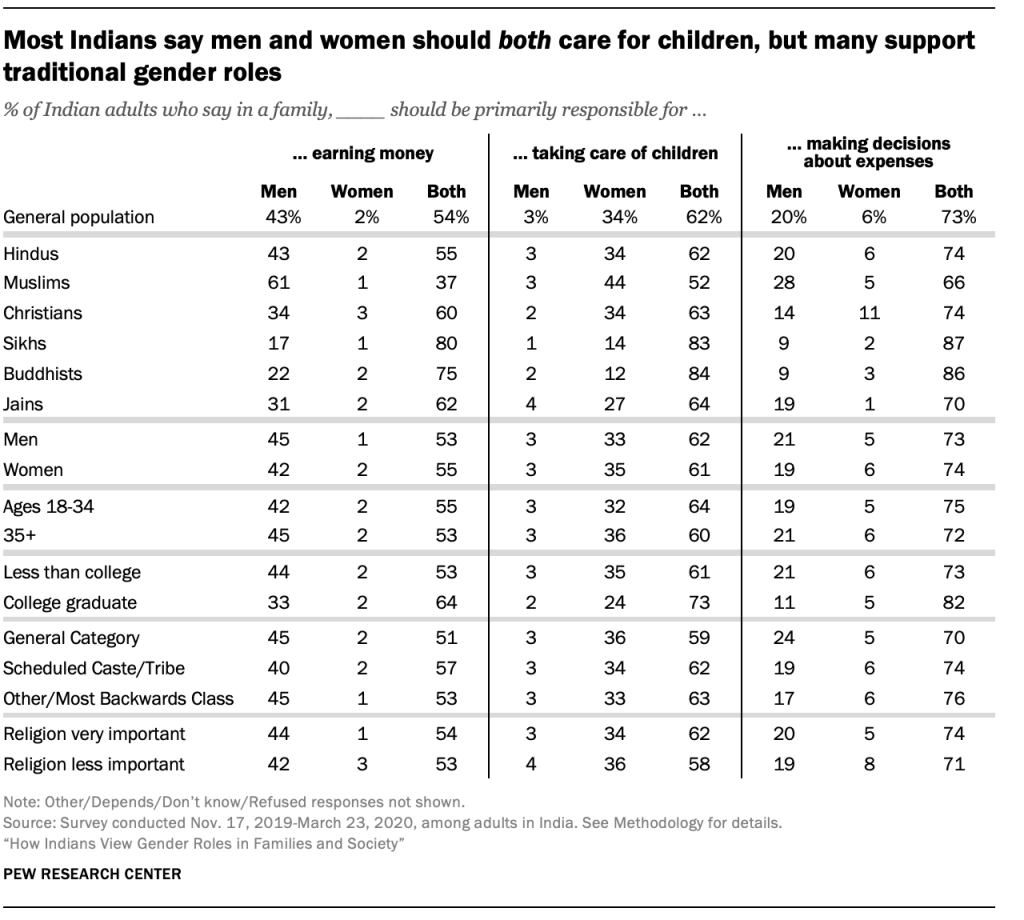
Most Indians say that both women and men should be responsible for earning money (54%), caring for children (62%) and making family financial decisions (73%). Still, substantial minorities have traditional views when it comes to family responsibilities, saying men should be the primary money earners in a family (43%) and women should be the primary caregivers for children (34%). And one-in-five adults say men should be the primary decision-makers about family expenses.

Most Indians say men and women should both care for children, but many support traditional gender roles

Some religious groups are more traditional than others when it comes to gender roles in a family. For example, Muslims are more inclined to say men should be the primary earners in a family and make family financial decisions, while women should mainly be responsible for the children. Sikhs and Buddhists, meanwhile, are the most likely to say men and women should share equally in these family responsibilities.

Education also makes a big difference in how Indians think family responsibilities should be distributed. College graduates are more likely than other Indians to say men and women should share family duties. For example, roughly three-quarters of college graduates say both men and women in a family should care for children (73%), compared with about six-in-ten among all other Indians (61%).

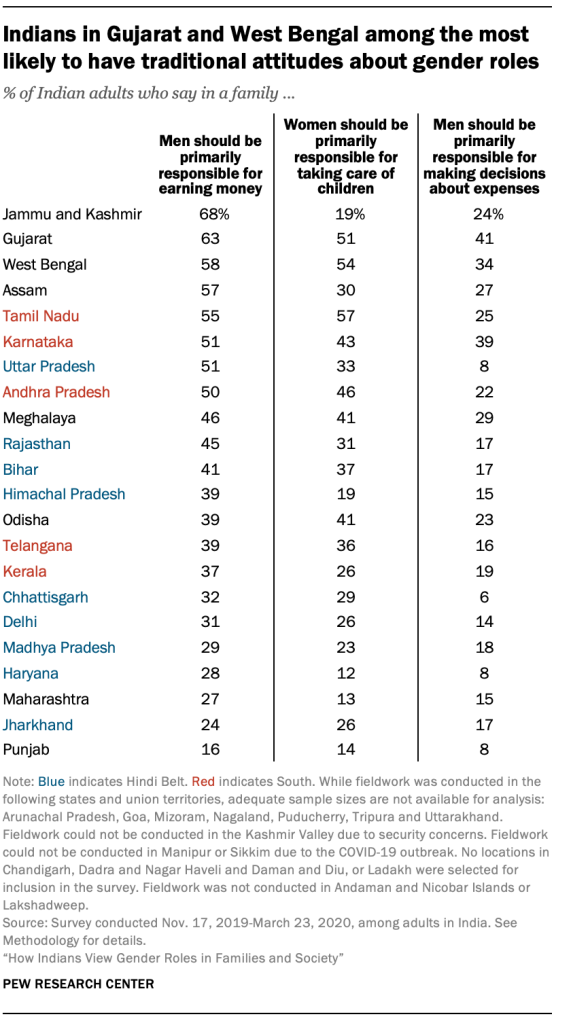
Indians in Gujarat and West Bengal among the most likely to have traditional attitudes about gender roles

Indian attitudes about family gender roles greatly depend on where people live. Generally, Southern Indians are more likely than Indians living in the country’s Hindi Belt – defined as 11 states and union territories including Jharkhand, Haryana, Madhya Pradesh, Delhi and Chhattisgarh – to have traditional attitudes about family responsibilities. For instance, people in the Southern state of Tamil Nadu are more than twice as likely as people in Jharkhand to say men should earn money in a family (55% vs. 24%) and women should care for children (57% vs. 26%).

Attitudes on these issues also vary greatly within certain regions of the country. Among Southern states, for example, Kerala and Telangana stand out as having less conservative views on gender than some of their neighbors. For instance, one-in-five people or fewer in Kerala (19%) and Telangana (16%) say men should make family financial decisions, compared with roughly four-in-ten in Karnataka (39%).

Vast majority of Indians agree that a wife must always obey her husband

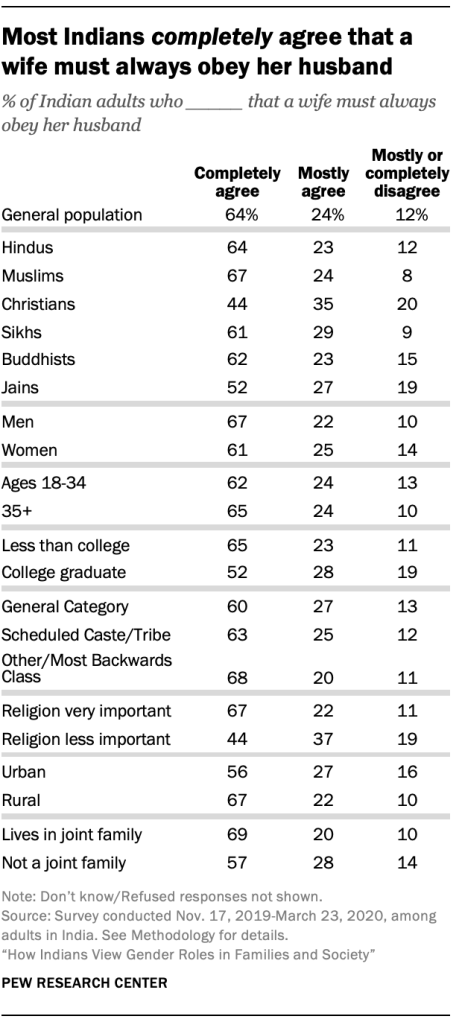
Most Indians completely agree that a wife must always obey her husband

Even though most Indians think men and women should share in family responsibilities, nearly nine-in-ten Indians (87%) completely or mostly agree with the notion that “a wife must always obey her husband.” This includes a majority of Indians (64%) who completely agree with this sentiment.

About six-in-ten or more Sikhs (61%), Buddhists (62%), Hindus (64%) and Muslims (67%) express complete agreement that a wife should be subservient, although fewer Jains (52%) and Christians (44%) feel this way.

Women are only modestly less likely than men to say that wives should obey their husbands in all situations, and most women agree completely with this sentiment (61% vs. 67% among men).

Indians without a college education, those from Other Backwards Classes and those who live in rural areas are more inclined than other Indians to completely agree that wives must be obedient. For example, most Indians without a college degree (65%) completely agree that a wife must always obey her husband, compared with roughly half of college graduates who say the same (52%). Religious commitment also factors into this traditional attitude about marriage: People who say religion is very important in their lives are much more likely than other Indians to completely agree that a wife should obey her husband (67% vs. 44%).

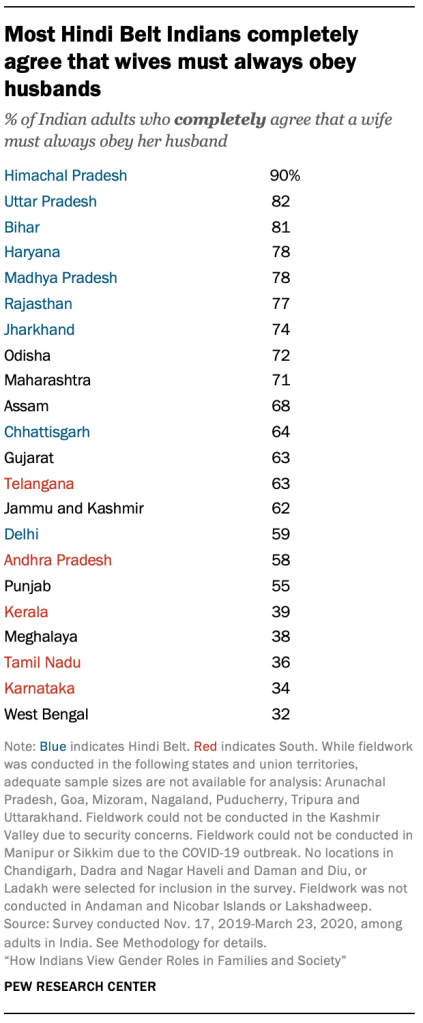
Most Hindi Belt Indians completely agree that wives must always obey husbands

Indians who currently live in a joint family – single households that include extended family members, such as when three generations of grandparents, parents and children live under the same roof – also are more likely than others to express complete agreement with the idea that wives should obey their husbands in all situations (69% vs. 57%).

Even though people in the Southern states of India are more inclined than people in the Hindi Belt to support traditional family responsibilities, they generally are less likely to see wives as obligated to obey their husbands. Roughly a third in Tamil Nadu (36%) and Karnataka (34%) completely agree that a wife should always obey her husband, compared with vast majorities in Hindi Belt states such as Himachal Pradesh (90%), Uttar Pradesh (82%) and Bihar (81%).

Many Indians say sons should have prominent place in caring for elderly parents

Majority of Indians say sons and daughters should care for aging parents together, but many say the responsibility falls more on sons

Respecting elders is a core value in India, and most Indians (58%) say that both sons and daughters should be responsible for caring for parents as they age. But four-in-ten Indian adults (39%) say this responsibility should fall primarily to sons, while very few (2%) think daughters should be mainly responsible.

Across India’s major religious groups, most people say both sons and daughters should care for parents as they age, including the vast majority of Sikhs (80%). But Muslims generally are less inclined than others to say children of both genders should share the responsibility to care for aging parents (54%), while many Muslims (43%) say sons should carry the bulk of responsibility for elderly parents.

Attitudes about who should tend to aging parents do not vary much by caste, except in some religious groups. Among Hindus, for example, caste isn’t correlated with attitudes on whether sons or daughters should care for aging parents. But Christians from higher castes are more likely than Christians from lower castes to say both sons and daughters should care for parents in their elderly years (75% vs. 61%).

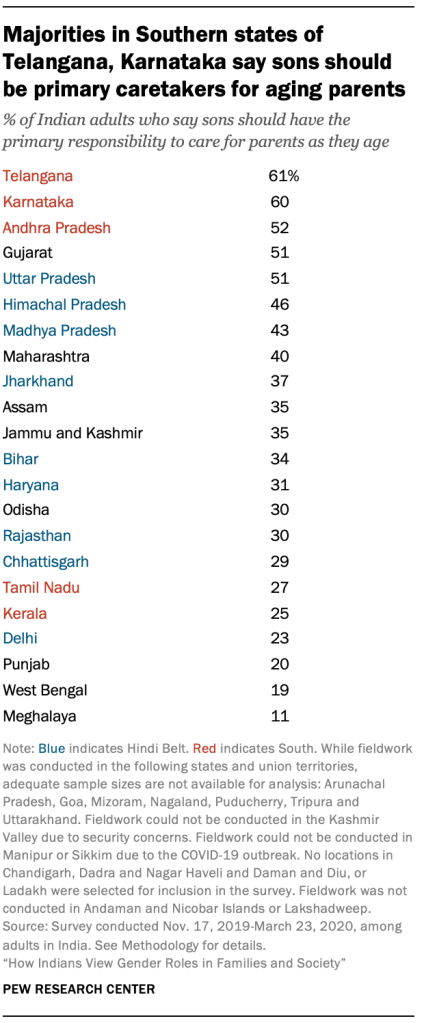
While most Indians say both sons and daughters should care for their aging parents, this is a minority opinion in several, mostly Southern, states. Instead, majorities in Telangana (61%) and Karnataka (60%) say sons should tend to their parents’ needs, with far fewer in these states saying that sons and daughters should share the responsibility.

Majorities in Southern states of Telangana, Karnataka say sons should be primary caretakers for aging parents

But much smaller shares in neighboring Southern states favor sons taking on the bulk of the responsibility for elderly parents. Only about a quarter of Indians in Kerala (25%) and Tamil Nadu (27%) say sons primarily should care for their aging parents.

Majority of Indians say sons should be responsible for parents’ last rites

Most Hindus, Muslims and Jains in India say sons should be responsible for parents’ last rites or burial rituals

One area where most Indians do not see room for gender equality involves the last rites or burial rituals for deceased parents. Nearly two-thirds of Indians (63%) say sons should have primary responsibility over parents’ last rites or burial rituals, although attitudes differ significantly on this across religious groups.

Most Muslims (74%), Jains (67%) and Hindus (63%) say sons should be primarily responsible for last rites or burial rituals, but far fewer Sikhs (29%), Christians (44%) and Buddhists (46%) expect this from sons. Instead, Sikhs, Christians and Buddhists are more likely to say that both sons and daughters should be responsible for their parents’ last rites. (Very few Indians, regardless of religion, say daughters should be primarily responsible for funeral rituals.)

Indians without a college degree are more likely than college graduates to say sons should primarily tend to parents’ last rites or burial rituals (64% vs. 53%). Indians from Other Backwards Classes (69%) also are more inclined than those in other castes to say this (60% among General Category, Scheduled Caste and Scheduled Tribe members).

Relatively few in Punjab and Kerala say sons should have primary responsibility for their parents’ last rites

Those who say religion is very important in their lives are considerably more likely than other Indians to say sons alone should be responsible for funeral rituals (65% vs. 49%). And this is true even among Sikhs, who are less inclined in general to support the view that sons bear primary responsibility for funeral rites. For instance, highly religious Sikhs are nearly twice as likely as those who say religion is not very important in their lives to say sons should shoulder the responsibility for their parents’ last rites (31% vs. 17%).

In India, politics also are linked with views on this question. Those who express a favorable view of the ruling Bharatiya Janata Party (BJP) are somewhat more likely than other Indians to say sons should be primarily responsible for their parents’ last rites and burial rituals (67% vs. 60%).

Attitudes on this issue also vary greatly by state. The vast majority of people in Uttar Pradesh (84%) and Gujarat (80%), for example, say sons should be responsible, while about three-in-ten in Sikh-majority Punjab (29%) agree.

Southern states are especially varied in their views. About eight-in-ten people in the Southern state of Karnataka (81%) say sons should tend to their parents’ funeral rituals, while just three-in-ten in Kerala take this stance.

Most Indians say both sons and daughters should have equal rights to inheritance

About a third of Indians say sons should have greater rights to inherit from parents

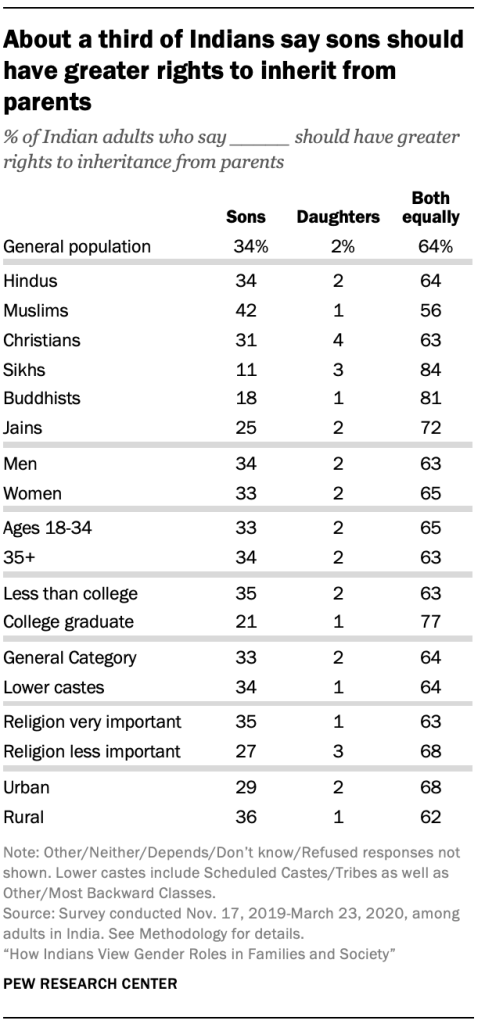
Nearly two-thirds of Indians (64%) say sons and daughters should have equal inheritance rights from parents, including majorities across all religious groups.

But some religious groups are more egalitarian than others when it comes to inheritance. Sikhs (84%) and Buddhists (81%), for example, are more likely than Hindus (64%), Christians (63%) and Muslims (56%) to say sons and daughters should have equal inheritance rights. About a third of Hindus (34%) and an even larger share of Muslims (42%) say that sons should have greater rights to inheritance.

Across groups, college graduates are more likely than Indians with less education to say sons and daughters should have equal rights to inheritance from their parents (77% vs. 63%). The gap is especially pronounced among Muslims – the vast majority of college-educated Muslims (83%) say sons and daughters should have equal inheritance rights, while just a slim majority of less-educated Muslims (55%) support equal inheritance rights for both genders.

Indians in some Southern states more likely than others to say sons should have greater rights to inheritance

While women and men nationally are about equally likely to say sons and daughters should have equal rights of inheritance (65% vs. 63%, respectively), this opinion is a bit more common among Muslim women than Muslim men (60% vs. 53%). Still, among Indian women overall, a third say that sons should have greater rights to inheritance, compared with just 2% who say the same about daughters.

Once again, Indians in different states vary considerably in their support for sons having greater rights to inheritance from their parents – from roughly six-in-ten in Telangana (62%) to one-in-ten in Chhattisgarh (10%).

Sikh-majority Punjab ranks among the states with the smallest shares of Indians who say inheritance rights should belong disproportionately to sons. But while there is a gap of 22 percentage points between Sikhs and Hindus at the national level on this question, similarly small shares of Punjabi Hindus (15%) and Punjabi Sikhs (11%) say sons should have greater rights to inheritance from parents.

Acknowledgments

This report was produced by Pew Research Center as part of the Pew-Templeton Global Religious Futures project, which analyzes religious change and its impact on societies around the world. Funding for the Global Religious Futures project comes from The Pew Charitable Trusts and the John Templeton Foundation.

This report is a collaborative effort based on the input and analysis of the following individuals:

Research Team

Neha Sahgal, Associate Director of Research Alan Cooperman, Director of Religion Research Jonathan Evans, Research Associate Ariana Monique Salazar, Research Analyst Kelsey Jo Starr, Research Analyst Manolo Corichi, Research Assistant

Methods Team

Patrick Moynihan, Associate Director of International Research Methods Alexandra Castillo, Research Methodologist Clark Letterman, Senior Survey Manager

Editorial and Graphic Design

Michael Lipka, Editorial Manager Rebecca Leppert, Editorial Assistant David Kent, Senior Copy Editor Bill Webster, Senior Information Graphics Designer Jeff Diamant, Senior Writer/Editor

Communications and Web Publishing

Stacy Rosenberg, Associate Director of Digital Anna Schiller, Senior Communications Manager Travis Mitchell, Digital Producer

Others at Pew Research Center who contributed to this report include Michael Dimock, James Bell, Claudia Deane, Gregory A. Smith, Conrad Hackett, Anne Fengyan Shi, Besheer Mohamed, Stephanie Kramer, Jacob Poushter, Samirah Majumdar, Laura Silver, Neil G. Ruiz, Rakesh Kochhar, Russell Maltempo, Richard Wike, Becka A. Alper, Mark Hugo Lopez, Kiana Cox, Dalia Fahmy, Cary Funk and Gracie Martinez.

Former Pew Research Center staff who contributed to this report include Scott Gardner, Stacy Pancratz, Martha McRoy, Omkar Joshi, Mark Wang, Aleksandra Sandstrom, Katayoun Kishi, Katie Simmons, Bruce Stokes, Steve Schwarzer, Danielle Cuddington, Courtney Nelson and Clara Huergo.

The Center is grateful to a panel of expert advisers who provided guidance at all stages of this report: Hilal Ahmed, associate professor at the Center for the Study of Developing Societies; Sriya Iyer, professor of economics and fellow of St. Catharine’s College at the University of Cambridge; Devesh Kapur, Starr Foundation Professor of South Asian studies at Johns Hopkins University School of Advanced International Studies; Ravinder Kaur, professor of sociology and social anthropology at the Indian Institute of Technology Delhi; Ajay Verghese, assistant professor of political science at Middlebury College; and Rina Verma Williams, associate professor of political science at the University of Cincinnati. We appreciate Siddhartha Dubey, professor of journalism at Ashoka University, for advising us on strategic outreach in India.

Fieldwork for the survey was conducted under the direction of RTI International.

While the analysis for this report was guided by our consultations with the advisers, Pew Research Center is solely responsible for the interpretation and reporting of the data.

Methodology

Between Nov. 17, 2019, and March 23, 2020, Pew Research Center completed 29,999 face-to-face interviews with non-institutionalized adults ages 18 and older living in 26 states and three union territories across India. The sample includes interviews with 22,975 Hindus, 3,336 Muslims, 1,782 Sikhs, 1,011 Christians, 719 Buddhists and 109 Jains. An additional 67 respondents belong to other religions or are religiously unaffiliated. Six groups were targeted for oversampling as part of the survey design: Muslims, Christians, Sikhs, Buddhists, Jains and those living in the Northeast region.

Interviews were conducted under the direction of RTI International. Data collection used computer-assisted personal interviews (CAPI) after random selection of households. Sampling was conducted through a probability-based, stratified multistage clustered random design that used composite measures of size (cMOS) to increase diversity in religious representation. National population and religious composition data are available from the 2011 census of India.

The questionnaire was designed by Pew Research Center staff in consultation with subject-matter experts and project advisers. The questionnaire was developed in English and translated into 16 languages, independently verified by professional linguists with native proficiency in regional dialects, and pretested in various phases prior to fieldwork.

Throughout fieldwork, survey performance was assessed by comparing regional results for key demographic variables (including reported religion) with region-specific population statistics available through the census. Data is weighted to account for different probabilities of selection among respondents as well as through an iterative procedure to more closely align the samples with official state and national population figures for gender, age, urbanicity, region and education. The reported margins of sampling error and the statistical tests of significance used in the analysis account for the design effects due to weighting and sample design.

Questionnaire design

Languages used to conduct interviews

The questionnaire covers multiple topics, including religious identity, belief and practice; social cohesion, national identity and politics; gender and the family; and demographic characteristics.13 To improve respondent comprehension of survey questions and to ensure all questions were culturally appropriate, the Center followed a multiphase questionnaire development process that included focus groups, cognitive interviews, a pretest and a pilot survey before the national survey. An in-country institutional review board (IRB) also approved the questionnaire, including the consent language, to protect the rights and privacy of Indian respondents.

The question wording and approach to various topics were refined between each phase of the research process. Throughout questionnaire development, academic experts and other advisers were consulted to further improve the questionnaire.

Twenty-two focus groups were conducted to explore and identify key topics related to religion, diversity, nationalism and gender. Focus groups were conducted under the direction of Ipsos MORI and Quipper Research. They were held in five states – Arunachal Pradesh, Gujarat, Maharashtra, Tamil Nadu and Uttar Pradesh.

Fifty-six cognitive interviews were conducted to test survey questions for general comprehension, problematic phrasing or concepts, and sensitivity concerns. Cognitive interviews were conducted under the direction of Ipsos MORI. They were held in 10 states – Andhra Pradesh, Assam, Gujarat, Karnataka, Kerala, Maharashtra, Odisha, Rajasthan, Tamil Nadu and West Bengal.

The fully translated and independently verified questionnaire was then pretested (n=100) across all 16 local languages used in the final survey. The pretest was conducted in six states and union territories – Andhra Pradesh, Assam, Delhi, Maharashtra, Tamil Nadu and West Bengal.

Finally, a pilot survey (n=2,045) was administered to test all survey processes, including interviewer training, questionnaire sensitivity and data quality checks. Pilot survey states were Karnataka, Tamil Nadu, Uttar Pradesh and West Bengal.

Sample design and weighting

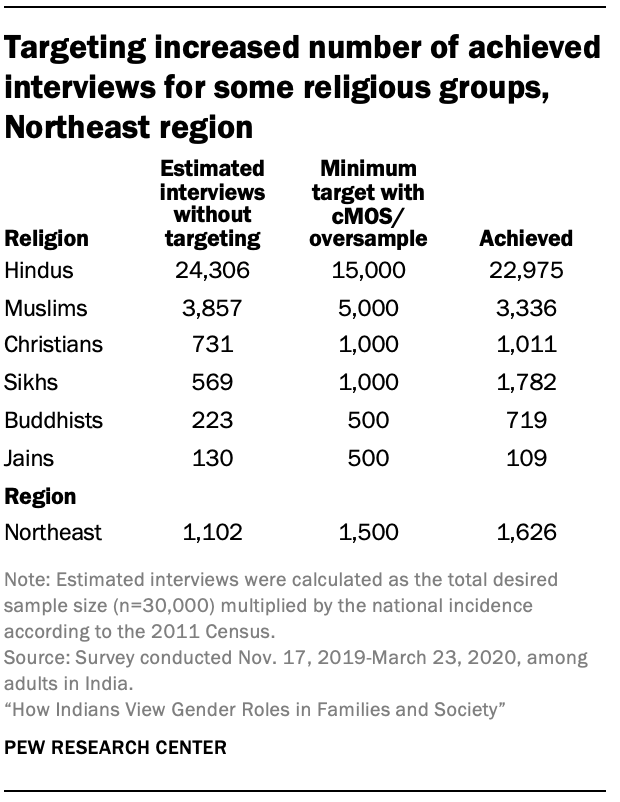
The survey sample was designed to be nationally representative of the Indian population and was selected using a stratified, multistage cluster method. The sample was also designed to allow for robust analysis of all major religious groups – Hindus, Muslims, Christians, Sikhs, Buddhists and Jains – as well as all major regional zones.14 To bolster representation of religious groups with lower prevalence in the country, the sample design uses a composite measure of size (cMOS) to increase the probability of selecting primary and secondary sampling units with those religious populations. To ensure adequate sample for stand-alone analyses of the Northeast, the least populated of the zones, the region’s strata are allocated more sample than proportional to population size.

Sample design

Strata design begins with states and union territories (UTs) as defined by the 2011 census. The smallest groups are then collapsed together, resulting in a total of 30 strata covering 33 states and UTs as defined by the 2011 census.15 All sampling units have official statuses and known boundaries defined by the 2011 census. The primary sampling units (PSUs) are clusters of districts, grouped to have approximately 10 or more secondary sampling units (SSUs); the SSUs are primarily subdistricts but also include some large metropolitan areas; and the tertiary sampling units (TSUs) are 2011 census enumeration blocks (CEBs) in urban areas and villages in rural areas. The number of PSUs sampled per stratum is proportional to the composite measure of size for a total of 138 PSUs. Six SSUs are sampled from each PSU and four TSUs are sampled from each SSU, with some exceptions. The sample draw for the national study was conducted in June 2019, five months prior to the start of fieldwork.

Twelve households within each TSU were selected via a random-route procedure – a process in which field staff count residential dwellings from a random starting point as they walk the street and select every nth dwelling for an interview, where n is adjusted for the size of the area for random route. Within a household, interviewers list all adults (18+ years) and the CAPI device selects one adult at random for the interview. At every address, up to four visits to the household are made to complete an interview. Attempts to contact selected households and respondents are carried out on different days of the week and times of day (with a few exceptions where security and remoteness call for a one-day approach).

Composite measure of size (cMOS)

Targeting increased number of achieved interviews for some religious groups, Northeast region

If the sample had been selected using a typical approach for general population surveys (e.g., probability proportional to population size), there likely would not have been enough respondents from some religious groups of interest for separate analysis and reporting. Instead, the design sought to increase the chance of selecting less-prevalent religious groups by using a cMOS for sampling PSUs and SSUs. Constructed using the 2011 census data on religious compositions of districts and subdistricts, the cMOS calculations assign more value to PSUs and SSUs with greater shares of Muslims, Christians, Sikhs, Buddhists or Jains relative to the national figures. PSUs and SSUs are both selected using a systematic probability proportional to composite size method, resulting in areas with low-incidence religious populations having greater chances of selection. For example, Mansahi and Sameli, two subdistricts in the Eastern state of Bihar, have approximately the same population size (84,257 and 84,486, respectively), but Mansahi’s population as of the 2011 census was 44% Muslim while Sameli’s was 9% Muslim. In a general population design, these two subdistricts would have about equal chances of selection. But in this study, Mansahi has a greater chance using our cMOS, since Mansahi is home to a large share of a lower-incidence religious group. The cMOS method improved the odds of a religiously diverse sample but did not guarantee it, as demonstrated by the shortfall that remains for Muslims and Jains. Prior to systematic selection, the frame is sorted geographically to help disperse the sample within strata and sampling units.

No religious composition data is available at the TSU level, so TSUs are selected with probability proportional to their population size. A systematic selection approach and implicit stratification by urbanicity are used to help diversify the sample to cover both urban and rural areas.

Weighting

The data is weighted in a multistep process. As a result of using the cMOS, the unweighted sample has more respondents belonging to certain religious groups than would normally occur in a nationally representative sample. Varying probabilities of selection are addressed through statistical adjustments, or weighting, and areas with higher sampling rates are represented in proper proportion to areas with lower sampling rates.

Unweighted vs. weighted sample size for religious groups, Northeast region

Weights are also adjusted in an iterative proportional fitting poststratification process, commonly referred to as raking, so that the weighted sample distribution more closely aligns with 2011 census population figures. This calibration process is conducted for age by gender, education and urbanicity separately for each of the 28 strata where fieldwork was completed and using stratum-specific population parameters.

The weights for each stratum are then scaled to correct for the oversampling of some regions and states and the corresponding undersampling of larger regions and states. This ensures that all states and subsequent regions are represented in their proper proportion in the weighted estimates included in this report. Finally, the distribution of the raked weights is examined separately for each regional zone, and customized weight trimming (i.e., setting weight ceiling and floor figures) is performed at the zonal level to prevent individual interviews from having too much influence on the final results.

In the end, the oversampled religious groups and the higher number of respondents in the Northeast do not represent a disproportionate share of the final, weighted sample that is used for analysis.

Coverage and exclusions

Survey coverage is calculated to be 98% of the Indian population. Exclusions, listed below, amounted to about 2% of the national population of India.

Exclusions known prior to sampling:

  • Union territories of Andaman & Nicobar Islands and Lakshadweep due to remoteness
  • Subdistricts that posed a security risk to field staff
  • Subdistricts with no reliable population figures from the 2011 census
  • Ministry of Defense military cantonment board areas due to inaccessibility
  • TSUs with fewer than 25 households due to remoteness.

Exclusions after sampling (see “Significant events during fieldwork” for more information):

  • Kashmir districts due to continued shutdown of the Kashmir Valley during fieldwork
  • Sikkim and Manipur states due to COVID-19.
Design effects and margins of sampling error

Precision of estimates

Each item in a survey has its own margin of sampling error (MOSE). The multistage sampling process used in this survey – districts or district groups, subdistricts, villages or census enumeration blocks, households, and eligible individuals within households – means that survey responses are not independent of each other as they would be if we had taken a simple random sample of the Indian population. This clustering of respondents has the effect of increasing the MOSE estimates relative to a simple random sample of the same size. Additionally, this clustering means that every question has a different margin of error depending on how similar respondents in the same village or region are to one another for the item in question. Some estimates (e.g., self-identification as a vegetarian) have a relatively small MOSE, while other estimates (e.g., knowledge of other religions’ practices) have a larger margin of error.16

In addition to clustering, the MOSE is affected by stratified sampling and weighting. Analyses to determine statistical significance for this report were performed using Stata statistical software that accounts for all of these complex design features for tests of statistical significance and measures of sampling error.

We have reported the median MOSE as a rule of thumb when assessing significant differences. In order to reach one MOSE overall and for each subgroup, a median MOSE is produced from 155 individual ones. One should also bear in mind that question wording and practical difficulties in conducting surveys can introduce error or bias into survey results that is not captured by the MOSE.

For results, one can say with 95% confidence that the error attributable to collecting data from some, rather than all, adults within the population is plus or minus the MOSE. This means that in 95 out of 100 samples of the same size and type, the results obtained would vary by no more than plus or minus the MOSE for the population in question.

Response rates

The contact rate for the survey was 97% for the country overall.17 The overall cooperation rate for this project was 89%.18The overall response rate for this survey is 86%.19

Significant events during fieldwork

During the fieldwork period between November 2019 and March 2020, fieldwork teams dealt with a number of events that posed challenges to entering certain areas of study and securing interviews with selected households and respondents.

Due to access and safety concerns, planned fieldwork in Kashmir Valley was canceled and the 480 interviews expected to take place there were reallocated to other Muslim-majority areas of the country, including in Jammu, Haryana and West Bengal.

Starting in December 2019, protests broke out in several regions against the country’s new citizenship law that would expedite citizenship for followers of certain religions, excluding, most notably, Muslims. Fieldwork in West Bengal was paused due to the unrest and teams slowly rolled out in the area again starting in January 2020. Delhi field teams were also delayed in their work due to security issues and curfews in study areas.

In March 2020, international concerns for the spread of COVID-19 emerged. Given the safety threat to the field teams, interviews stopped on March 23, 2020, resulting in 39 total villages and census enumeration blocks (1.3% of sample) left incomplete, including the entirety of work in Sikkim and Manipur states.

The Kashmir reallocation and incomplete sampling areas resulted in adjustments to survey weights. Probabilities of selection, cMOS and population parameters were recalculated to exclude Kashmir, Sikkim and Manipur.