About Three-in-Ten U.S. Adults Are Now Religiously Unaffiliated
Self-identified Christians make up 63% of U.S. population in 2021, down from 75% a decade ago
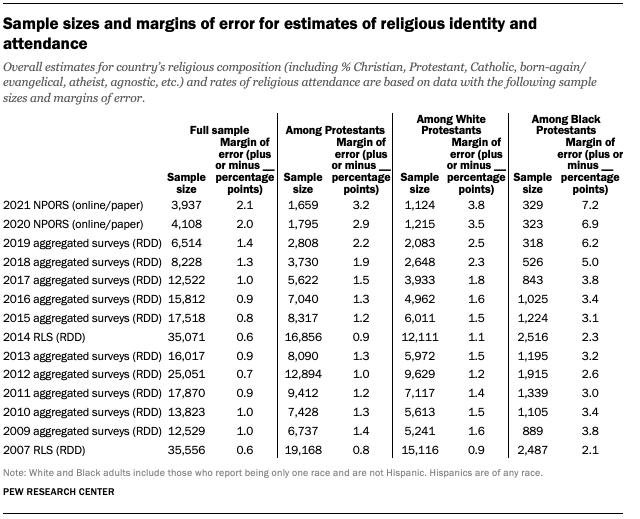
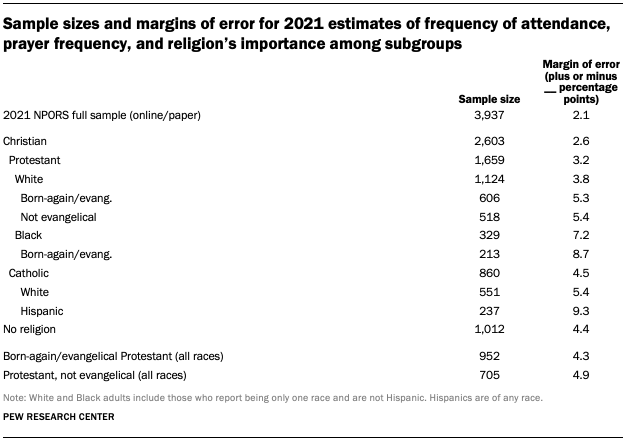
Pew Research Center conducted this analysis as part of a continuing effort to track changes in the U.S. religious landscape, including shifts in Americans’ religious affiliation and observance. To do this, researchers looked at a variety of surveys conducted by the Center since 2007.
The most recent data is from the Center’s 2020 and 2021 National Public Opinion Reference Surveys (NPORS). These surveys were conducted online and by mail among a nationally representative group of respondents recruited using address-based sampling, which ensures that nearly all U.S. adults have a chance of selection. This year’s study was conducted from May 29 to Aug. 25, 2021.
Estimates from 2007 and 2014 come from Pew Research Center’s Religious Landscape Studies, which surveyed roughly 35,000 U.S. adults via telephone each year. All other estimates from 2019 and earlier come from other random-digit-dial telephone surveys, mostly the Center’s political surveys. All data is weighted to be representative of the U.S. adult population by gender, race, ethnicity, age, education and other categories.
For more, see the methodology, which includes the questions used in this report.

Note: For the latest data on religious “nones” in the U.S., read our 2024 report.
The secularizing shifts evident in American society so far in the 21st century show no signs of slowing. The latest Pew Research Center survey of the religious composition of the United States finds the religiously unaffiliated share of the public is 6 percentage points higher than it was five years ago and 10 points higher than a decade ago.
Christians continue to make up a majority of the U.S. populace, but their share of the adult population is 12 points lower in 2021 than it was in 2011. In addition, the share of U.S. adults who say they pray on a daily basis has been trending downward, as has the share who say religion is “very important” in their lives.
Currently, about three-in-ten U.S. adults (29%) are religious “nones” – people who describe themselves as atheists, agnostics or “nothing in particular” when asked about their religious identity. Self-identified Christians of all varieties (including Protestants, Catholics, members of the Church of Jesus Christ of Latter-day Saints, and Orthodox Christians) make up 63% of the adult population. Christians now outnumber religious “nones” by a ratio of a little more than two-to-one. In 2007, when the Center began asking its current question about religious identity, Christians outnumbered “nones” by almost five-to-one (78% vs. 16%).

The recent declines within Christianity are concentrated among Protestants. Today, 40% of U.S. adults are Protestants, a group that is broadly defined to include nondenominational Christians and people who describe themselves as “just Christian” along with Baptists, Methodists, Lutherans, Presbyterians and members of many other denominational families. The Protestant share of the population is down 4 percentage points over the last five years and has dropped 10 points in 10 years.
By comparison, the Catholic share of the population, which had ticked downward between 2007 and 2014, has held relatively steady in recent years. As of 2021, 21% of U.S. adults describe themselves as Catholic, identical to the Catholic share of the population in 2014.
Within Protestantism, evangelicals continue to outnumber those who are not evangelical. Currently, 60% of Protestants say “yes” when asked whether they think of themselves as a “born-again or evangelical Christian,” while 40% say “no” or decline to answer the question.
This pattern exists among both White and Black Protestants. Among White Protestants, 58% now say “yes” when asked whether they think of themselves as born-again or evangelical Christians, compared with 42% who say “no” (or decline to answer the question). Among Black Protestants, evangelicals outnumber non-evangelicals by two-to-one (66% vs. 33%).
Overall, both evangelical and non-evangelical Protestants have seen their shares of the population decline as the percentage of U.S. adults who identity with Protestantism has dropped. Today, 24% of U.S. adults describe themselves as born-again or evangelical Protestants, down 6 percentage points since 2007. During the same period, there also has been a 6-point decline in the share of adults who are Protestant but not born-again or evangelical (from 22% to 16%).

These are among the key findings of the latest National Public Opinion Reference Survey (NPORS), conducted by Pew Research Center from May 29 to Aug. 25, 2021. NPORS is an annual survey (first done in 2020) conducted online and on paper (by mail) among a nationally representative group of respondents selected using address-based sampling from the U.S. Postal Service’s delivery sequence file. The Center uses NPORS to produce benchmark estimates for several characteristics of the U.S. population, including Americans’ political and religious affiliations. Readers interested in additional details about NPORS can find them in the May 2021 report “How Pew Research Center Uses Its National Public Opinion Reference Survey (NPORS).”

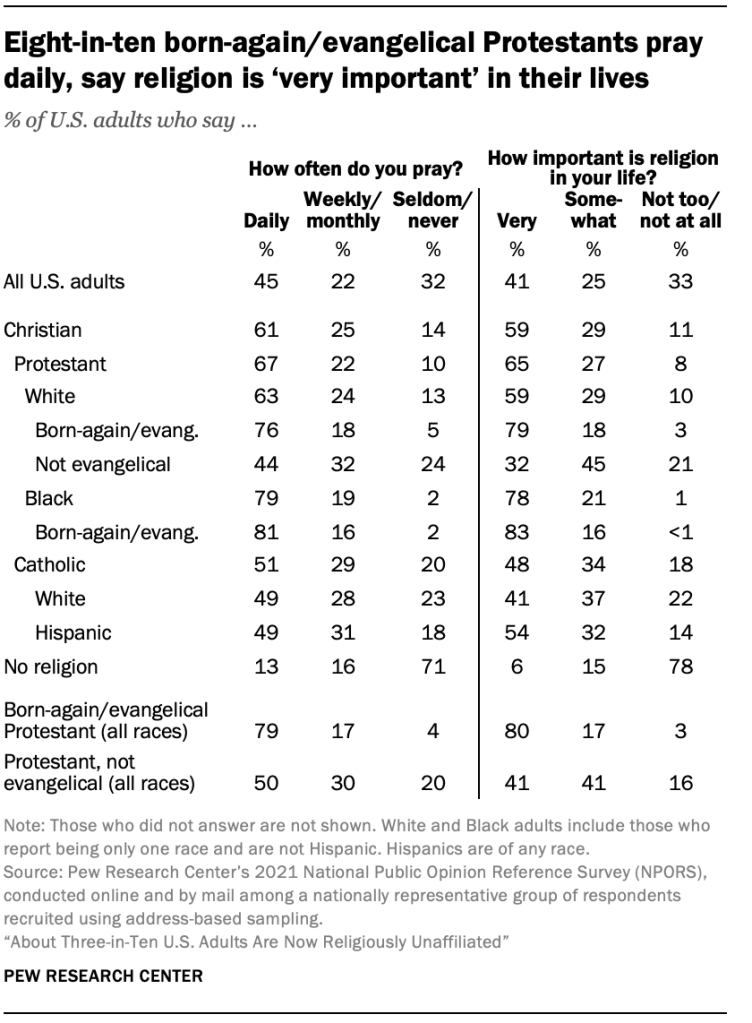
The 2021 NPORS also asked respondents how often they pray and how important religion is in their lives. Today, fewer than half of U.S. adults (45%) say they pray on a daily basis. By contrast, nearly six-in-ten (58%) reported praying daily in the 2007 Religious Landscape Study, as did 55% in the 2014 Landscape Study. Roughly one-third of U.S. adults (32%) now say they seldom or never pray, up from 18% who said this in 2007.

The long-term trend in the share of U.S. adults who say religion is an important part of their lives is a bit more difficult to measure precisely. Whereas indicators of religious identity and frequency of prayer produced by self-administered surveys (like the NPORS) can be directly compared with estimates produced by interviewer-administered surveys (like the Center’s earlier telephone surveys), self-administered surveys may produce slightly lower estimates of religion’s importance compared with interviewer-administered surveys. (For additional discussion of whether and how religious measures from telephone surveys can be compared with those from self-administered surveys, see “Measuring Religion in Pew Research Center’s American Trends Panel.”)
Still, the available data indicates that Americans are growing less religious by this measure, too. Random-digit-dial (RDD) telephone surveys conducted in 2017 and 2019 found fewer U.S. adults saying religion is “very important” in their lives compared with previous telephone polls. And the 2021 NPORS finds that 41% of U.S. adults now say religion is “very important” in their lives, 4 points lower than the 2020 NPORS and substantially lower than all of the Center’s earlier RDD readings on this question.
This analysis compares results from surveys conducted using different “modes” of data collection. Estimates from 2009-2019 are based on random-digit-dial (RDD) telephone surveys, an interviewer-administered mode in which a live person asks questions over the phone. Estimates from 2020 and 2021 are based on surveys conducted online and by mail among respondents recruited via address-based sampling, a self-administered mode in which the respondent answers questions in writing, either on paper or online.
Previous studies indicate that Pew Research Center’s estimates of religious identity and prayer frequency derived from self-administered surveys can be directly compared with estimates from interviewer-administered surveys. The case is a bit less clear with respect to estimates of religion’s importance; self-administered surveys may produce slightly lower estimates of the share of people who say religion is an important part of their lives. Big reductions in the share of Americans who say religion is very important to them can be interpreted as indicators of continuing decline in the country’s religiosity, though direct comparisons should be interpreted with caution.
On the other hand, estimates of religious attendance derived from self-administered surveys are not comparable with those produced by phone surveys. Self-administered surveys produce far lower estimates of the share of regular religious attenders than RDD surveys. Consequently, this report includes estimates of religious attendance only from the Center’s recent self-administered surveys, without making comparisons to earlier RDD estimates.
For more details on comparing religion measures in interviewer-administered and self-administered surveys, see the Center’s 2021 report, “Measuring Religion in Pew Research Center’s American Trends Panel.”
Other key findings from the 2021 NPORS include:
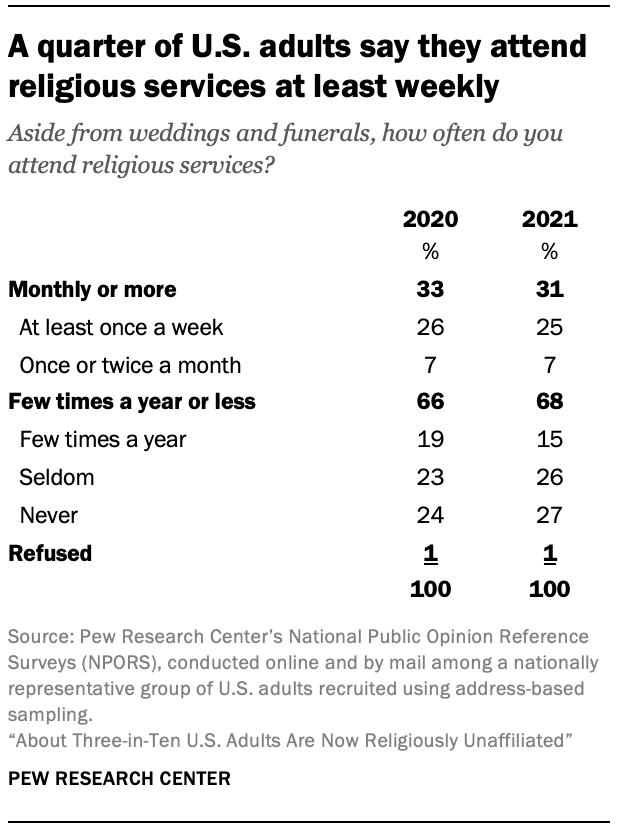

- Roughly three-in-ten adults in the new survey (31%) say they attend religious services at least once or twice a month, including 25% who say they attend at least once a week and 7% who attend once or twice a month. These figures are similar to 2020, when 33% reported attending religious services at least once or twice a month.1 (Unlike the data about religious identity, frequency of prayer and importance of religion, estimates of religious attendance from the NPORS – which is conducted online and on paper – are not comparable with estimates from the Center’s earlier telephone polling. For a detailed analysis of how NPORS results can be compared with data from telephone surveys, see the Center’s January 2021 report “Measuring Religion in Pew Research Center’s American Trends Panel.”)
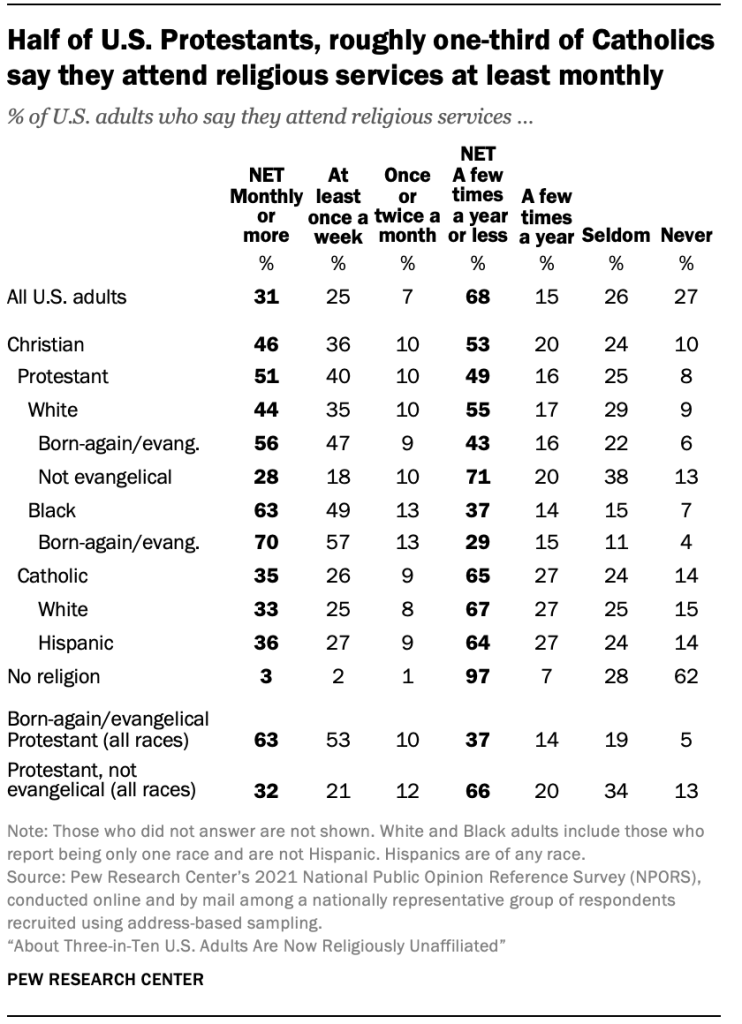
- More than six-in-ten Black Protestants (63%) say they attend religious services at least once or twice a month, with monthly attendance peaking at 70% among Black evangelical Protestants. Fully 56% of White evangelical Protestants also say they attend religious services at least once a month. Regular religious attendance is much less common among U.S. Catholics (35% of whom say they attend monthly or more often) and White Protestants who are not born-again/evangelical (28%). And frequent religious attendance is almost unheard of among religious “nones,” 97% of whom say they attend a few times a year or less. (Although the NPORS includes respondents from many religious backgrounds, including Jews, Muslims, Hindus, Buddhists and others, the sample did not have enough interviews with members of these religious groups to report separately on their religious practices. However, Pew Research Center has conducted several surveys designed specifically to describe the attributes of these and other relatively small religious communities in the United States; see, for example, “Jewish Americans in 2020” and “U.S. Muslims Concerned About their Place in Society, But Continue to Believe in the American Dream.”)
- Eight-in-ten self-described born-again/evangelical Protestants (79%) say they pray every day, including 76% of White evangelicals and 81% of Black evangelicals. Similarly large shares of born-again/evangelical Protestants say religion is “very important” in their lives. By comparison, far fewer Protestants who are not born-again/evangelical and Catholics say they pray daily and that religion is very important in their lives. Most religious “nones” say they seldom or never pray (71%) and that religion is not too or not at all important in their lives (78%).
- In addition to the 63% of U.S. adults who identify as Christians, the 2021 NPORS finds that 6% of adults identify with non-Christian faiths. This includes 1% who describe themselves as Jewish, 1% who are Muslim, 1% who are Buddhist, 1% who are Hindu and 2% who identify with a wide variety of other faiths. (While 1% of NPORS respondents identify with Judaism as a religion, a larger and more comprehensive Pew Research Center survey of U.S. Jews conducted in 2020 estimates that 1.7% of U.S. adults identify as Jewish by religion.)
- All the subgroups that together make up the religious “nones” have grown over time. In the 2021 NPORS, 4% of respondents describe themselves as atheists (up from 2% in 2011), and 5% describe themselves as agnostics (up from 3% a decade ago). One-in-five U.S. adults (20%) now describe their religion as “nothing in particular,” up from 14% who said this 10 years ago.