Pew Research Center

FOR RELEASE JUNE 29, 2021

Religion in India: Tolerance and Segregation

Indians say it is important to respect all religions, but major religious groups see little in common and want to live separately

BY Neha Sahgal, Jonathan Evans, Ariana Monique Salazar, Kelsey Jo Starr and Manolo Corichi

FOR MEDIA OR OTHER INQUIRIES:

Communications Department
202.419.4372
www.pewresearch.org

RECOMMENDED CITATION

Pew Research Center, June 2021, "Religion in India: Tolerance and Segregation"

About Pew Research Center

Pew Research Center is a nonpartisan, nonadvocacy fact tank that informs the public about the issues, attitudes and trends shaping the world. It does not take policy positions. The Center conducts public opinion polling, demographic research, computational social science research and other data-driven research. It studies politics and policy; news habits and media; the internet and technology; religion; race and ethnicity; international affairs; social, demographic and economic trends; science; research methodology and data science; and immigration and migration. Pew Research Center is a subsidiary of The Pew Charitable Trusts, its primary funder.

© Pew Research Center 2026

Table of contents

  • About Pew Research Center
  • Religion in India: Tolerance and Segregation
  • 1. Religious freedom, discrimination and communal relations
  • 2. Diversity and pluralism
  • 3. Religious segregation
  • 4. Attitudes about caste
  • 5. Religious identity
  • 6. Nationalism and politics
  • 7. Religious practices
  • 8. Religion, family and children
  • 9. Religious clothing and personal appearance
  • 10. Religion and food
  • 11. Religious beliefs
  • 12. Beliefs about God
  • Acknowledgments
  • Appendix A: Methodology
  • Appendix B: Index of religious segregation

Religion in India: Tolerance and Segregation

Indians say it is important to respect all religions, but major religious groups see little in common and want to live separately

How we did this

This study is Pew Research Center’s most comprehensive, in-depth exploration of India to date. For this report, we surveyed 29,999 Indian adults (including 22,975 who identify as Hindu, 3,336 who identify as Muslim, 1,782 who identify as Sikh, 1,011 who identify as Christian, 719 who identify as Buddhist, 109 who identify as Jain and 67 who identify as belonging to another religion or as religiously unaffiliated). Interviews for this nationally representative survey were conducted face-to-face under the direction of RTI International from Nov. 17, 2019, to March 23, 2020.

To improve respondent comprehension of survey questions and to ensure all questions were culturally appropriate, Pew Research Center followed a multi-phase questionnaire development process that included expert review, focus groups, cognitive interviews, a pretest and a regional pilot survey before the national survey. The questionnaire was developed in English and translated into 16 languages, independently verified by professional linguists with native proficiency in regional dialects.

Respondents were selected using a probability-based sample design that would allow for robust analysis of all major religious groups in India – Hindus, Muslims, Christians, Sikhs, Buddhists and Jains – as well as all major regional zones. Data was weighted to account for the different probabilities of selection among respondents and to align with demographic benchmarks for the Indian adult population from the 2011 census. The survey is calculated to have covered 98% of Indians ages 18 and older and had an 86% national response rate.

For more information, see the Methodology for this report. The questions used in this analysis can be found here.

India is majority Hindu, but religious minorities have sizable populations

More than 70 years after India became free from colonial rule, Indians generally feel their country has lived up to one of its post-independence ideals: a society where followers of many religions can live and practice freely.

India’s massive population is diverse as well as devout. Not only do most of the world’s Hindus, Jains and Sikhs live in India, but it also is home to one of the world’s largest Muslim populations and to millions of Christians and Buddhists.

A major new Pew Research Center survey of religion across India, based on nearly 30,000 face-to-face interviews of adults conducted in 17 languages between late 2019 and early 2020 (before the COVID-19 pandemic), finds that Indians of all these religious backgrounds overwhelmingly say they are very free to practice their faiths.

Related India research

This is one in a series of Pew Research Center reports on India based on a survey of 29,999 Indian adults conducted Nov. 17, 2019, to March 23, 2020, as well as demographic data from the Indian Census and other government sources. Other reports can be found here:

  • How Indians View Gender Roles in Families and Society
  • Religious Composition of India
  • India’s Sex Ratio at Birth Begins To Normalize

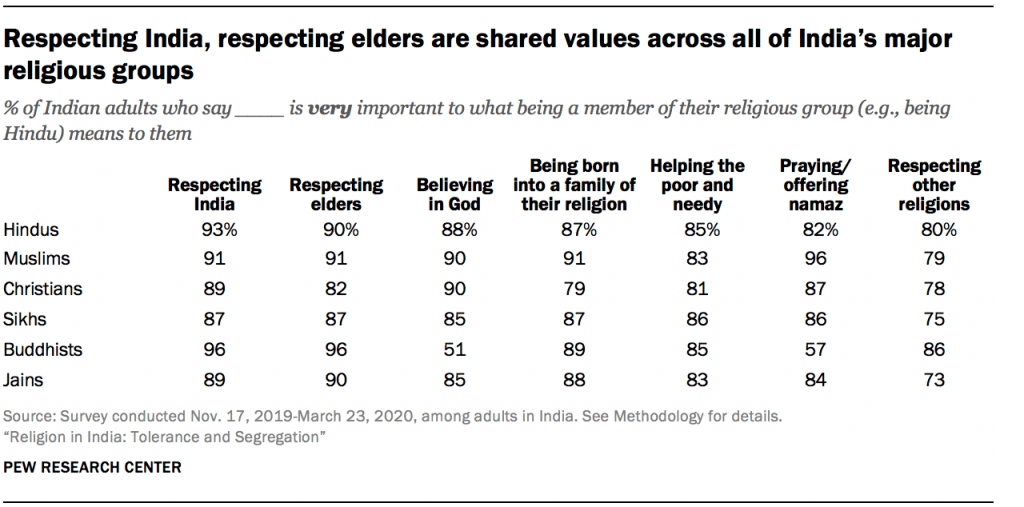
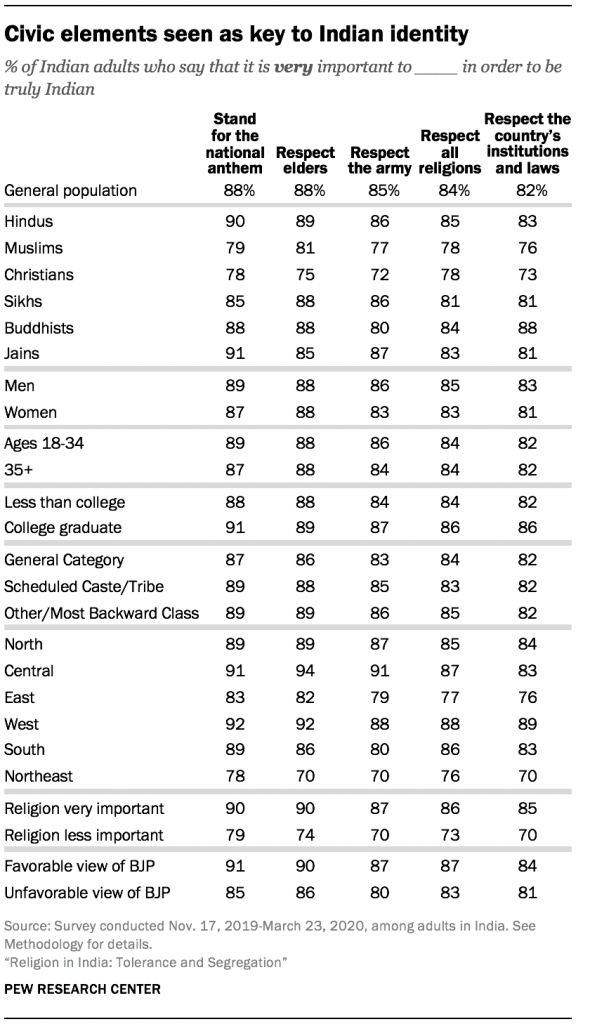
Indians see religious tolerance as a central part of who they are as a nation. Across the major religious groups, most people say it is very important to respect all religions to be “truly Indian.” And tolerance is a religious as well as civic value: Indians are united in the view that respecting other religions is a very important part of what it means to be a member of their own religious community.

Indians feel they have religious freedom, see respecting all religions as a core value

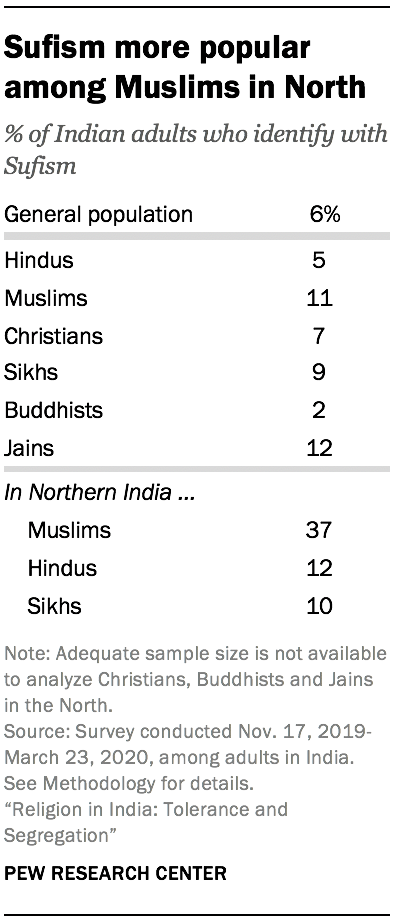
These shared values are accompanied by a number of beliefs that cross religious lines. Not only do a majority of Hindus in India (77%) believe in karma, but an identical percentage of Muslims do, too. A third of Christians in India (32%) – together with 81% of Hindus – say they believe in the purifying power of the Ganges River, a central belief in Hinduism. In Northern India, 12% of Hindus and 10% of Sikhs, along with 37% of Muslims, identity with Sufism, a mystical tradition most closely associated with Islam. And the vast majority of Indians of all major religious backgrounds say that respecting elders is very important to their faith.

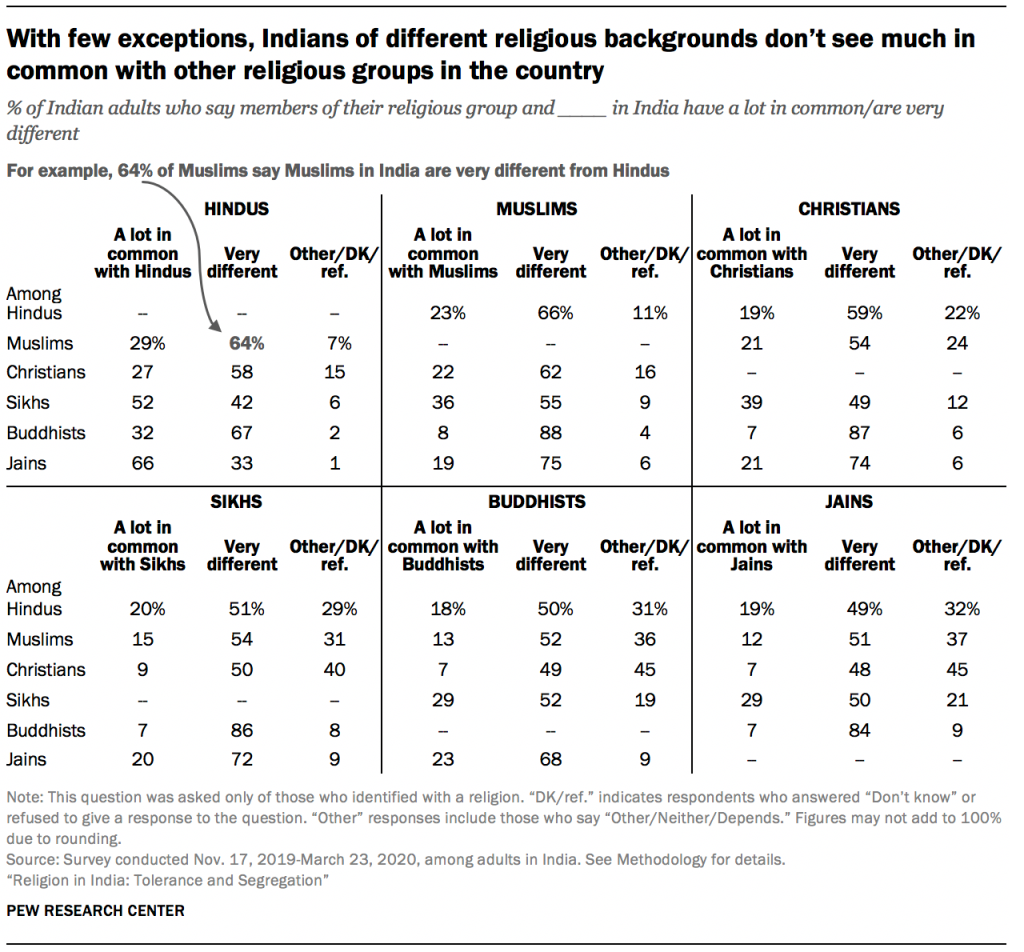
Yet, despite sharing certain values and religious beliefs – as well as living in the same country, under the same constitution – members of India’s major religious communities often don’t feel they have much in common with one another. The majority of Hindus see themselves as very different from Muslims (66%), and most Muslims return the sentiment, saying they are very different from Hindus (64%). There are a few exceptions: Two-thirds of Jains and about half of Sikhs say they have a lot in common with Hindus. But generally, people in India’s major religious communities tend to see themselves as very different from others.

India’s religious groups generally see themselves as very different from each other

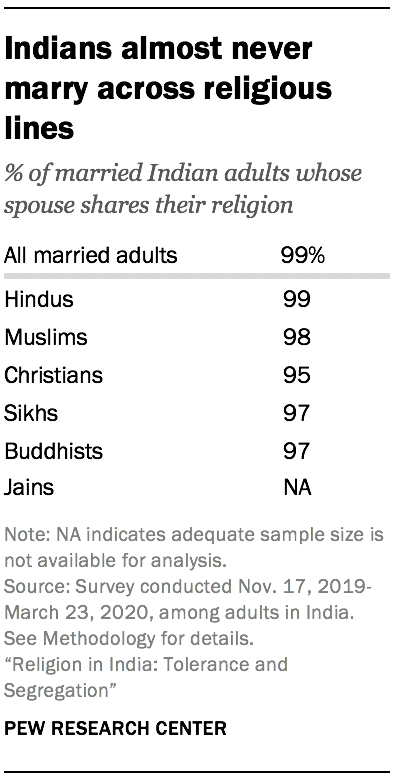
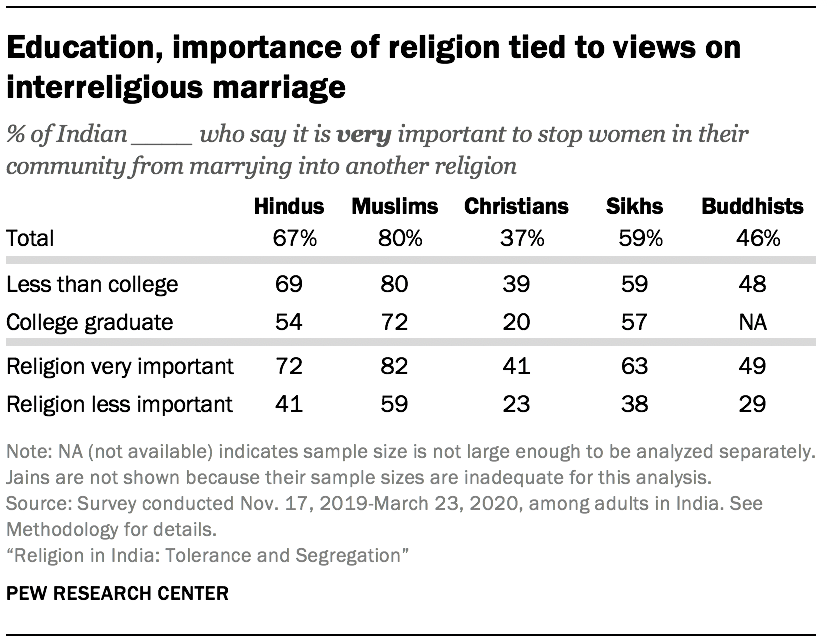
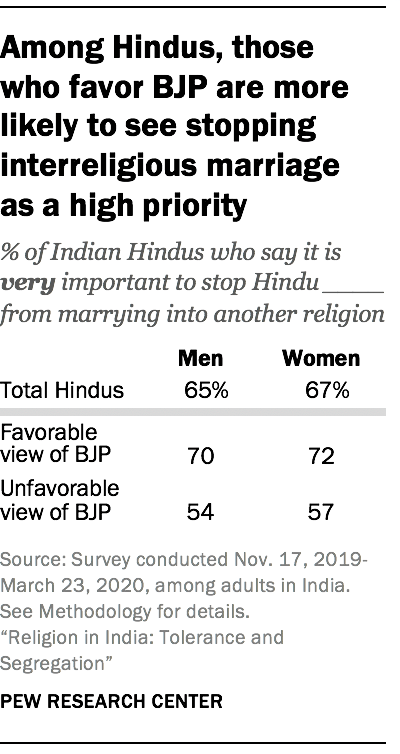
This perception of difference is reflected in traditions and habits that maintain the separation of India’s religious groups. For example, marriages across religious lines – and, relatedly, religious conversions – are exceedingly rare (see Chapter 3). Many Indians, across a range of religious groups, say it is very important to stop people in their community from marrying into other religious groups. Roughly two-thirds of Hindus in India want to prevent interreligious marriages of Hindu women (67%) or Hindu men (65%). Even larger shares of Muslims feel similarly: 80% say it is very important to stop Muslim women from marrying outside their religion, and 76% say it is very important to stop Muslim men from doing so.

Stopping religious intermarriage is a high priority for Hindus, Muslims and others in India

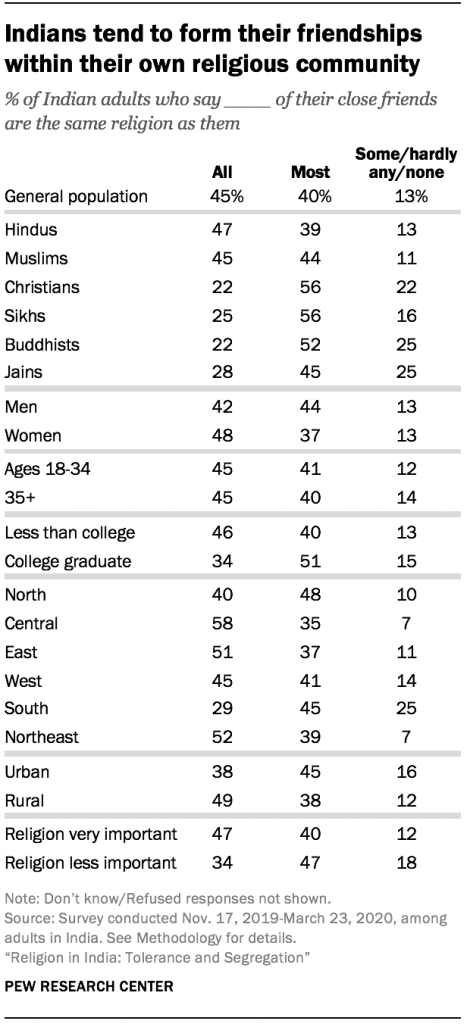
Moreover, Indians generally stick to their own religious group when it comes to their friends. Hindus overwhelmingly say that most or all of their close friends are also Hindu. Of course, Hindus make up the majority of the population, and as a result of sheer numbers, may be more likely to interact with fellow Hindus than with people of other religions. But even among Sikhs and Jains, who each form a sliver of the national population, a large majority say their friends come mainly or entirely from their small religious community.

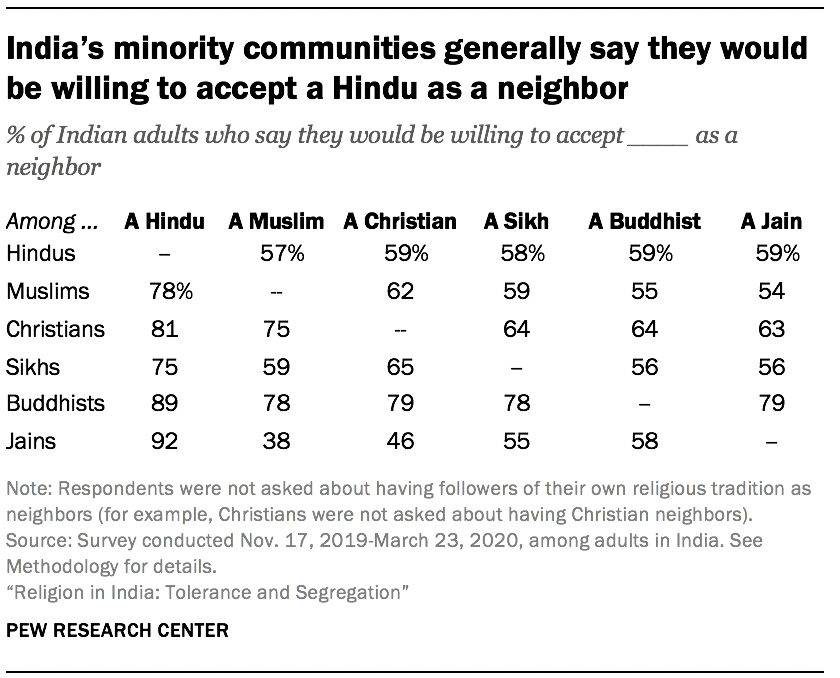
Fewer Indians go so far as to say that their neighborhoods should consist only of people from their own religious group. Still, many would prefer to keep people of certain religions out of their residential areas or villages. For example, many Hindus (45%) say they are fine with having neighbors of all other religions – be they Muslim, Christian, Sikh, Buddhist or Jain – but an identical share (45%) say they would not be willing to accept followers of at least one of these groups, including more than one-in-three Hindus (36%) who do not want a Muslim as a neighbor. Among Jains, a majority (61%) say they are unwilling to have neighbors from at least one of these groups, including 54% who would not accept a Muslim neighbor, although nearly all Jains (92%) say they would be willing to accept a Hindu neighbor.

Substantial minorities would not accept followers of other religions as neighbors

Indians, then, simultaneously express enthusiasm for religious tolerance and a consistent preference for keeping their religious communities in segregated spheres – they live together separately. These two sentiments may seem paradoxical, but for many Indians they are not.

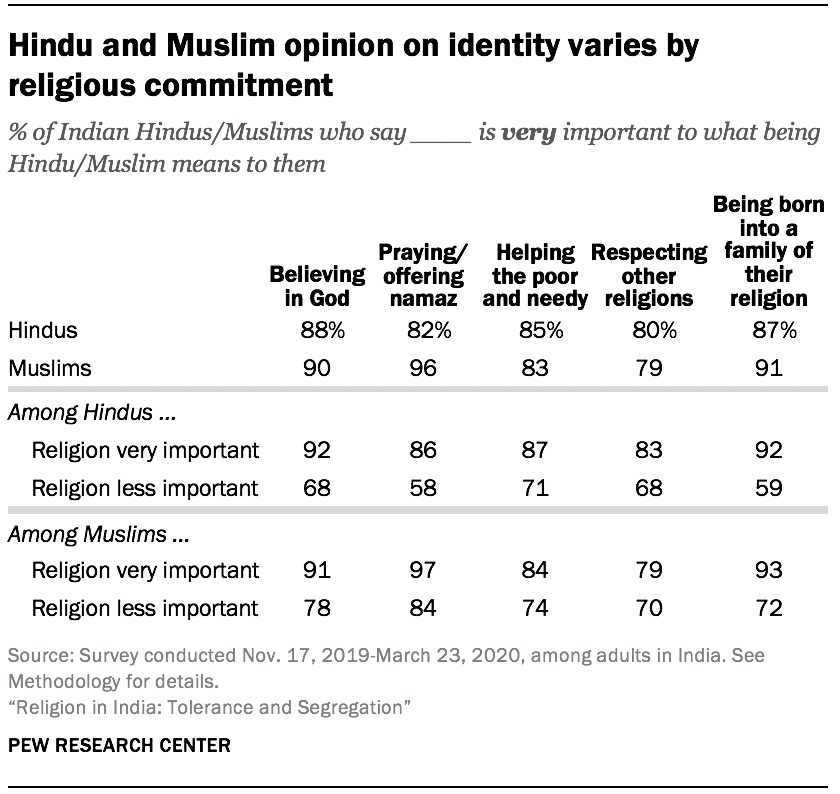
Indeed, many take both positions, saying it is important to be tolerant of others and expressing a desire to limit personal connections across religious lines. Indians who favor a religiously segregated society also overwhelmingly emphasize religious tolerance as a core value. For example, among Hindus who say it is very important to stop the interreligious marriage of Hindu women, 82% also say that respecting other religions is very important to what it means to be Hindu. This figure is nearly identical to the 85% who strongly value religious tolerance among those who are not at all concerned with stopping interreligious marriage.

In other words, Indians’ concept of religious tolerance does not necessarily involve the mixing of religious communities. While people in some countries may aspire to create a “melting pot” of different religious identities, many Indians seem to prefer a country more like a patchwork fabric, with clear lines between groups.

The dimensions of Hindu nationalism in India

Most Hindus in India say being Hindu, being able to speak Hindi are very important to be ‘truly’ Indian

One of these religious fault lines – the relationship between India’s Hindu majority and the country’s smaller religious communities – has particular relevance in public life, especially in recent years under the ruling Bharatiya Janata Party (BJP). Led by Prime Minister Narendra Modi, the BJP is often described as promoting a Hindu nationalist ideology.

The survey finds that Hindus tend to see their religious identity and Indian national identity as closely intertwined: Nearly two-thirds of Hindus (64%) say it is very important to be Hindu to be “truly” Indian.

Support for BJP higher among Hindu voters who link being Hindu, speaking Hindi with Indian identity

Most Hindus (59%) also link Indian identity with being able to speak Hindi – one of dozens of languages that are widely spoken in India. And these two dimensions of national identity – being able to speak Hindi and being a Hindu – are closely connected. Among Hindus who say it is very important to be Hindu to be truly Indian, fully 80% also say it is very important to speak Hindi to be truly Indian.

The BJP’s appeal is greater among Hindus who closely associate their religious identity and the Hindi language with being “truly Indian.” In the 2019 national elections, 60% of Hindu voters who think it is very important to be Hindu and to speak Hindi to be truly Indian cast their vote for the BJP, compared with only a third among Hindu voters who feel less strongly about both these aspects of national identity.

Overall, among those who voted in the 2019 elections, three-in-ten Hindus take all three positions: saying it is very important to be Hindu to be truly Indian; saying the same about speaking Hindi; and casting their ballot for the BJP.

These views are considerably more common among Hindus in the largely Hindi-speaking Northern and Central regions of the country, where roughly half of all Hindu voters fall into this category, compared with just 5% in the South.

Among Hindus, large regional divides on views of national identity and politics
How regions of India are defined in this report
Among Hindu voters in India, religious nationalism is accompanied by heightened desire for religious segregation, greater religious observance

Whether Hindus who meet all three of these criteria qualify as “Hindu nationalists” may be debated, but they do express a heightened desire for maintaining clear lines between Hindus and other religious groups when it comes to whom they marry, who their friends are and whom they live among. For example, among Hindu BJP voters who link national identity with both religion and language, 83% say it is very important to stop Hindu women from marrying into another religion, compared with 61% among other Hindu voters.

This group also tends to be more religiously observant: 95% say religion is very important in their lives, and roughly three-quarters say they pray daily (73%). By comparison, among other Hindu voters, a smaller majority (80%) say religion is very important in their lives, and about half (53%) pray daily.

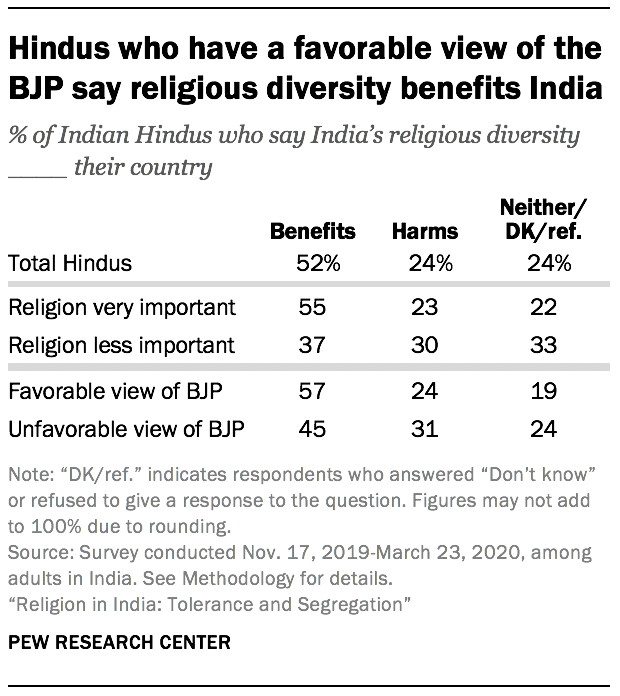
Even though Hindu BJP voters who link national identity with religion and language are more inclined to support a religiously segregated India, they also are more likely than other Hindu voters to express positive opinions about India’s religious diversity. Nearly two-thirds (65%) of this group – Hindus who say that being a Hindu and being able to speak Hindi are very important to be truly Indian and who voted for the BJP in 2019 – say religious diversity benefits India, compared with about half (47%) of other Hindu voters.

Hindus who see Hindu and Indian identity as closely tied express positive views about diversity

This finding suggests that for many Hindus, there is no contradiction between valuing religious diversity (at least in principle) and feeling that Hindus are somehow more authentically Indian than fellow citizens who follow other religions.

Among Indians overall, there is no overwhelming consensus on the benefits of religious diversity. On balance, more Indians see diversity as a benefit than view it as a liability for their country: Roughly half (53%) of Indian adults say India’s religious diversity benefits the country, while about a quarter (24%) see diversity as harmful, with similar figures among both Hindus and Muslims. But 24% of Indians do not take a clear position either way – they say diversity neither benefits nor harms the country, or they decline to answer the question. (See Chapter 2 for a discussion of attitudes toward diversity.)

India’s Muslims express pride in being Indian while identifying communal tensions, desiring segregation

Vast majority of India’s Muslims say Indian culture is superior

India’s Muslim community, the second-largest religious group in the country, historically has had a complicated relationship with the Hindu majority. The two communities generally have lived peacefully side by side for centuries, but their shared history also is checkered by civil unrest and violence. Most recently, while the survey was being conducted, demonstrations broke out in parts of New Delhi and elsewhere over the government’s new citizenship law, which creates an expedited path to citizenship for immigrants from some neighboring countries – but not Muslims.

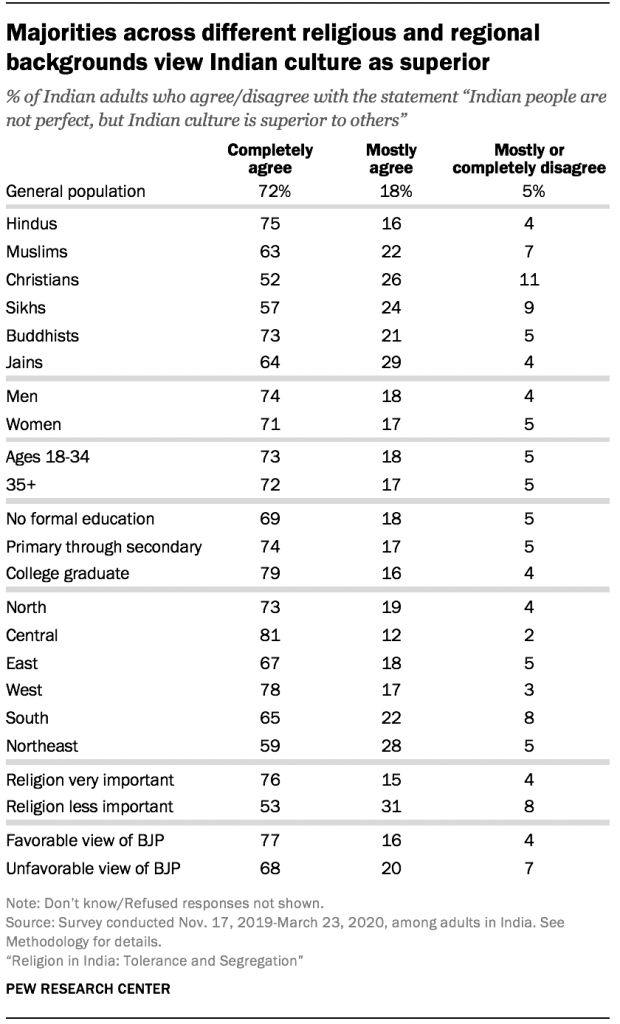
Today, India’s Muslims almost unanimously say they are very proud to be Indian (95%), and they express great enthusiasm for Indian culture: 85% agree with the statement that “Indian people are not perfect, but Indian culture is superior to others.”

Overall, one-in-five Muslims say they have personally faced religious discrimination recently, but views vary by region

Relatively few Muslims say their community faces “a lot” of discrimination in India (24%). In fact, the share of Muslims who see widespread discrimination against their community is similar to the share of Hindus who say Hindus face widespread religious discrimination in India (21%). (See Chapter 1 for a discussion of attitudes on religious discrimination.)

But personal experiences with discrimination among Muslims vary quite a bit regionally. Among Muslims in the North, 40% say they personally have faced religious discrimination in the last 12 months – much higher levels than reported in most other regions.

In addition, most Muslims across the country (65%), along with an identical share of Hindus (65%), see communal violence as a very big national problem. (See Chapter 1 for a discussion of Indians’ attitudes toward national problems.)

Muslims in India support having access to their own religious courts

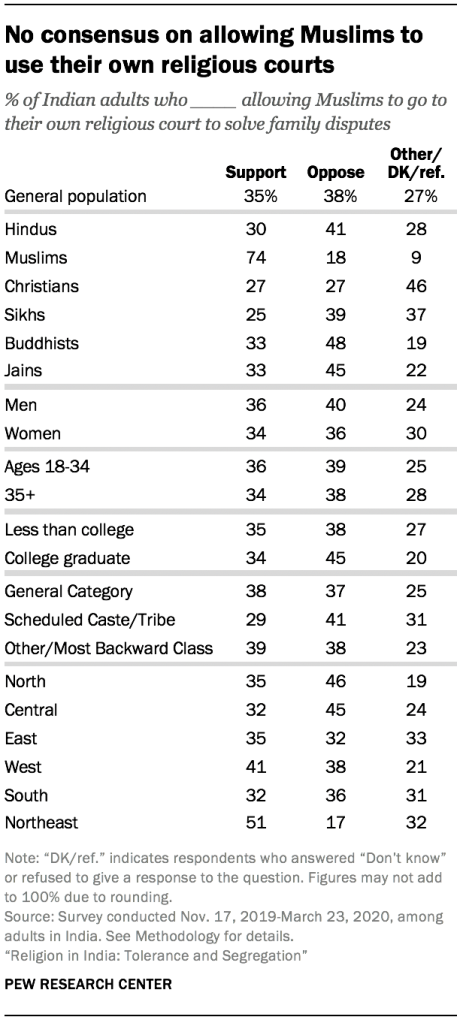
Like Hindus, Muslims prefer to live religiously segregated lives – not just when it comes to marriage and friendships, but also in some elements of public life. In particular, three-quarters of Muslims in India (74%) support having access to the existing system of Islamic courts, which handle family disputes (such as inheritance or divorce cases), in addition to the secular court system.

Muslims’ desire for religious segregation does not preclude tolerance of other groups – again similar to the pattern seen among Hindus. Indeed, a majority of Muslims who favor separate religious courts for their community say religious diversity benefits India (59%), compared with somewhat fewer of those who oppose religious courts for Muslims (50%).

Sidebar: Islamic courts in India

Since 1937, India’s Muslims have had the option of resolving family and inheritance-related cases in officially recognized Islamic courts, known as dar-ul-qaza. These courts are overseen by religious magistrates known as qazi and operate under Shariah principles. For example, while the rules of inheritance for most Indians are governed by the Indian Succession Act of 1925 and the Hindu Succession Act of 1956 (amended in 2005), Islamic inheritance practices differ in some ways, including who can be considered an heir and how much of the deceased person’s property they can inherit. India’s inheritance laws also take into account the differing traditions of other religious communities, such as Hindus and Christians, but their cases are handled in secular courts. Only the Muslim community has the option of having cases tried by a separate system of family courts. The decisions of the religious courts, however, are not legally binding, and the parties involved have the option of taking their case to secular courts if they are not satisfied with the decision of the religious court.

As of 2021, there are roughly 70 dar-ul-qaza in India. Most are in the states of Maharashtra and Uttar Pradesh. Goa is the only state that does not recognize rulings by these courts, enforcing its own uniform civil code instead. Dar-ul-qaza are overseen by the All India Muslim Personal Law Board.

While these courts can grant divorces among Muslims, they are prohibited from approving divorces initiated through the practice known as triple talaq, in which a Muslim man instantly divorces his wife by saying the Arabic/Urdu word “talaq” (meaning “divorce”) three times. This practice was deemed unconstitutional by the Indian Supreme Court in 2017 and formally outlawed by the Lok Sabha, the lower house of India’s Parliament, in 2019.1

Recent debates have emerged around Islamic courts. Some Indians have expressed concern that the rise of dar-ul-qaza could undermine the Indian judiciary, because a subset of the population is not bound to the same laws as everyone else. Others have argued that the rulings of Islamic courts are particularly unfair to women, although the prohibition of triple talaq may temper some of these criticisms. In its 2019 political manifesto, the BJP proclaimed a desire to create a national Uniform Civil Code, saying it would increase gender equality.

Some Indian commentators have voiced opposition to Islamic courts along with more broadly negative sentiments against Muslims, describing the rising numbers of dar-ul-qaza as the “Talibanization” of India, for example.

On the other hand, Muslim scholars have defended the dar-ul-qaza, saying they expedite justice because family disputes that would otherwise clog India’s courts can be handled separately, allowing the secular courts to focus their attention on other concerns.

Since 2018, the Hindu nationalist party Hindu Mahasabha (which does not hold any seats in Parliament) has tried to set up Hindu religious courts, known as Hindutva courts, aiming to play a role similar to dar-ul-qaza, only for the majority Hindu community. None of these courts have been recognized by the Indian government, and their rulings are not considered legally binding.

Muslims, Hindus diverge over legacy of Partition

The seminal event in the modern history of Hindu-Muslim relations in the region was the partition of the subcontinent into Hindu-majority India and Muslim-majority Pakistan at the end of the British colonial period in 1947. Partition remains one of the largest movements of people across borders in recorded history, and in both countries the carving of new borders was accompanied by violence, rioting and looting.

More Muslims than Hindus in India see partition of the subcontinent as a bad thing for communal relations

More than seven decades later, the predominant view among Indian Muslims is that the partition of the subcontinent was “a bad thing” for Hindu-Muslim relations. Nearly half of Muslims say Partition hurt communal relations with Hindus (48%), while fewer say it was a good thing for Hindu-Muslim relations (30%). Among Muslims who prefer more religious segregation – that is, who say they would not accept a person of a different faith as a neighbor – an even higher share (60%) say Partition was a bad thing for Hindu-Muslim relations.

Sikhs, whose homeland of Punjab was split by Partition, are even more likely than Muslims to say Partition was a bad thing for Hindu-Muslim relations: Two-thirds of Sikhs (66%) take this position. And Sikhs ages 60 and older, whose parents most likely lived through Partition, are more inclined than younger Sikhs to say the partition of the country was bad for communal relations (74% vs. 64%).

While Sikhs and Muslims are more likely to say Partition was a bad thing than a good thing, Hindus lean in the opposite direction: 43% of Hindus say Partition was beneficial for Hindu-Muslim relations, while 37% see it as a bad thing.

Context for the survey

Interviews were conducted after the conclusion of the 2019 national parliamentary elections and after the revocation of Jammu and Kashmir’s special status under the Indian Constitution. In December 2019, protests against the country’s new citizenship law broke out in several regions.

Fieldwork could not be conducted in the Kashmir Valley and a few districts elsewhere due to security concerns. These locations include some heavily Muslim areas, which is part of the reason why Muslims make up 11% of the survey’s total sample, while India’s adult population is roughly 13% Muslim, according to the most recent census data that is publicly available, from 2011. In addition, it is possible that in some other parts of the country, interreligious tensions over the new citizenship law may have slightly depressed participation in the survey by potential Muslim respondents.

Nevertheless, the survey’s estimates of religious beliefs, behaviors and attitudes can be reported with a high degree of confidence for India’s total population, because the number of people living in the excluded areas (Manipur, Sikkim, the Kashmir Valley and a few other districts) is not large enough to affect the overall results at the national level. About 98% of India’s total population had a chance of being selected for this survey.

Greater caution is warranted when looking at India’s Muslims separately, as a distinct population. The survey cannot speak to the experiences and views of Kashmiri Muslims. Still, the survey does represent the beliefs, behaviors and attitudes of around 95% of India’s overall Muslim population.

These are among the key findings of a Pew Research Center survey conducted face-to-face nationally among 29,999 Indian adults. Local interviewers administered the survey between Nov. 17, 2019, and March 23, 2020, in 17 languages. The survey covered all states and union territories of India, with the exceptions of Manipur and Sikkim, where the rapidly developing COVID-19 situation prevented fieldwork from starting in the spring of 2020, and the remote territories of the Andaman and Nicobar Islands and Lakshadweep; these areas are home to about a quarter of 1% of the Indian population. The union territory of Jammu and Kashmir was covered by the survey, though no fieldwork was conducted in the Kashmir region itself due to security concerns.

This study, funded by The Pew Charitable Trusts and the John Templeton Foundation, is part of a larger effort by Pew Research Center to understand religious change and its impact on societies around the world. The Center previously has conducted religion-focused surveys across sub-Saharan Africa; the Middle East-North Africa region and many other countries with large Muslim populations; Latin America; Israel; Central and Eastern Europe; Western Europe; and the United States.

The rest of this Overview covers attitudes on five broad topics: caste and discrimination; religious conversion; religious observances and beliefs; how people define their religious identity, including what kind of behavior is considered acceptable to be a Hindu or a Muslim; and the connection between economic development and religious observance.

Caste is another dividing line in Indian society, and not just among Hindus

Religion is not the only fault line in Indian society. In some regions of the country, significant shares of people perceive widespread, caste-based discrimination.

The caste system is an ancient social hierarchy based on occupation and economic status. People are born into a particular caste and tend to keep many aspects of their social life within its boundaries, including whom they marry. Even though the system’s origins are in historical Hindu writings, today Indians nearly universally identify with a caste, regardless of whether they are Hindu, Muslim, Christian, Sikh, Buddhist or Jain.

Overall, the majority of Indian adults say they are a member of a Scheduled Caste (SC) – often referred to as Dalits (25%) – Scheduled Tribe (ST) (9%) or Other Backward Class (OBC) (35%).2
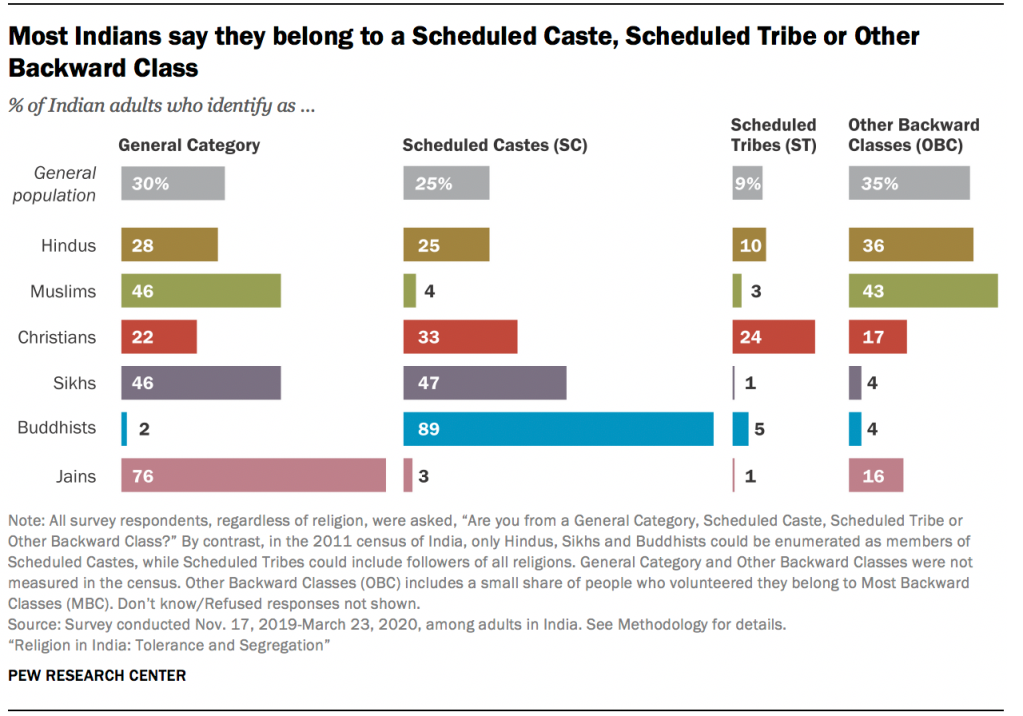
Most Indians say they belong to a Scheduled Caste, Scheduled Tribe or Other Backward Class

Buddhists in India nearly universally identify themselves in these categories, including 89% who are Dalits (sometimes referred to by the pejorative term “untouchables”).

Members of SC/ST/OBC groups traditionally formed the lower social and economic rungs of Indian society, and historically they have faced discrimination and unequal economic opportunities. The practice of untouchability in India ostracizes members of many of these communities, especially Dalits, although the Indian Constitution prohibits caste-based discrimination, including untouchability, and in recent decades the government has enacted economic advancement policies like reserved seats in universities and government jobs for Dalits, Scheduled Tribes and OBC communities.

Roughly 30% of Indians do not belong to these protected groups and are classified as “General Category.” This includes higher castes such as Brahmins (4%), traditionally the priestly caste. Indeed, each broad category includes several sub-castes – sometimes hundreds – with their own social and economic hierarchies.

Three-quarters of Jains (76%) identify with General Category castes, as do 46% of both Muslims and Sikhs.

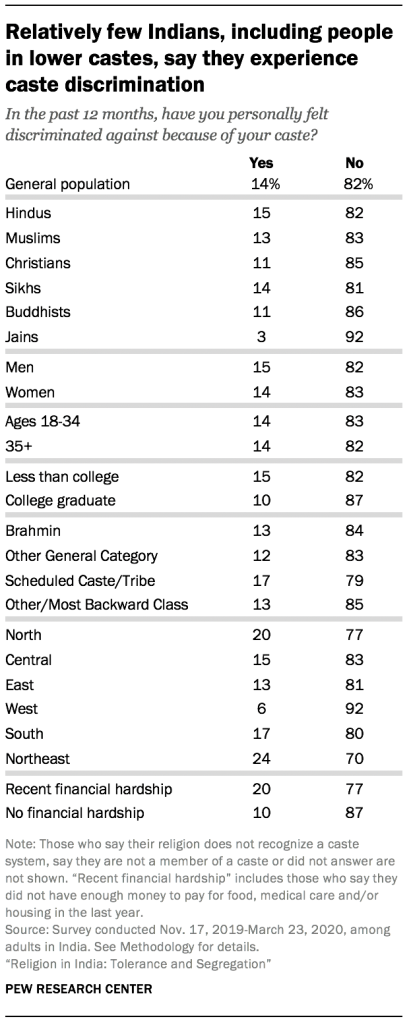
Caste-based discrimination, as well as the government’s efforts to compensate for past discrimination, are politically charged topics in India. But the survey finds that most Indians do not perceive widespread caste-based discrimination. Just one-in-five Indians say there is a lot of discrimination against members of SCs, while 19% say there is a lot of discrimination against STs and somewhat fewer (16%) see high levels of discrimination against OBCs. Members of Scheduled Castes and Scheduled Tribes are slightly more likely than others to perceive widespread discrimination against their two groups. Still, large majorities of people in these categories do not think they face a lot of discrimination.

Relatively few in India see widespread caste discrimination; perceptions vary by region
In the South and Northeast, many Dalits say they have faced caste discrimination

These attitudes vary by region, however. Among Southern Indians, for example, 30% see widespread discrimination against Dalits, compared with 13% in the Central part of the country. And among the Dalit community in the South, even more (43%) say their community faces a lot of discrimination, compared with 27% among Southern Indians in the General Category who say the Dalit community faces widespread discrimination in India.

A higher share of Dalits in the South and Northeast than elsewhere in the country say they, personally, have faced discrimination in the last 12 months because of their caste: 30% of Dalits in the South say this, as do 38% in the Northeast.

Although caste discrimination may not be perceived as widespread nationally, caste remains a potent factor in Indian society. Most Indians from other castes say they would be willing to have someone belonging to a Scheduled Caste as a neighbor (72%). But a similarly large majority of Indians overall (70%) say that most or all of their close friends share their caste. And Indians tend to object to marriages across caste lines, much as they object to interreligious marriages.3

Most Indians say it is very important to stop people from marrying outside their caste

Overall, 64% of Indians say it is very important to stop women in their community from marrying into other castes, and about the same share (62%) say it is very important to stop men in their community from marrying into other castes. These figures vary only modestly across members of different castes. For example, nearly identical shares of Dalits and members of General Category castes say stopping inter-caste marriages is very important.

Majorities of Hindus, Muslims, Sikhs and Jains consider stopping inter-caste marriage of both men and women a high priority. By comparison, fewer Buddhists and Christians say it is very important to stop such marriages – although for majorities of both groups, stopping people from marrying outside their caste is at least “somewhat” important.

People surveyed in India’s South and Northeast see greater caste discrimination in their communities, and they also raise fewer objections to inter-caste marriages than do Indians overall. Meanwhile, college-educated Indians are less likely than those with less education to say stopping inter-caste marriages is a high priority. But, even within the most highly educated group, roughly half say preventing such marriages is very important. (See Chapter 4 for more analysis of Indians’ views on caste.)

Religious conversion in India

Religious groups show little change in size due to conversion

In recent years, conversion of people belonging to lower castes (including Dalits) away from Hinduism – a traditionally non-proselytizing religion – to proselytizing religions, especially Christianity, has been a contentious political issue in India. As of early 2021, nine states have enacted laws against proselytism, and some previous surveys have shown that half of Indians support legal bans on religious conversions.4

This survey, though, finds that religious switching, or conversion, has a minimal impact on the overall size of India’s religious groups. For example, according to the survey, 82% of Indians say they were raised Hindu, and a nearly identical share say they are currently Hindu, showing no net losses for the group through conversion to other religions. Other groups display similar levels of stability.

Changes in India’s religious landscape over time are largely a result of differences in fertility rates among religious groups, not conversion.

Respondents were asked two separate questions to measure religious switching: “What is your present religion, if any?” and, later in the survey, “In what religion were you raised, if any?” Overall, 98% of respondents give the same answer to both these questions.

Hindus gain as many people as they lose through religious switching

An overall pattern of stability in the share of religious groups is accompanied by little net gain from movement into, or out of, most religious groups. Among Hindus, for instance, any conversion out of the group is matched by conversion into the group: 0.7% of respondents say they were raised Hindu but now identify as something else, and although Hindu texts and traditions do not agree on any formal process for conversion into the religion, roughly the same share (0.8%) say they were not raised Hindu but now identify as Hindu.5 Most of these new followers of Hinduism are married to Hindus.

Similarly, 0.3% of respondents have left Islam since childhood, matched by an identical share who say they were raised in other religions (or had no childhood religion) and have since become Muslim.

For Christians, however, there are some net gains from conversion: 0.4% of survey respondents are former Hindus who now identify as Christian, while 0.1% are former Christians.

Three-quarters of India’s Hindu converts to Christianity (74%) are concentrated in the Southern part of the country – the region with the largest Christian population. As a result, the Christian population of the South shows a slight increase within the lifetime of survey respondents: 6% of Southern Indians say they were raised Christian, while 7% say they are currently Christian.

Some Christian converts (16%) reside in the East as well (the states of Bihar, Jharkhand, Odisha and West Bengal); about two-thirds of all Christians in the East (64%) belong to Scheduled Tribes.

Nationally, the vast majority of former Hindus who are now Christian belong to Scheduled Castes (48%), Scheduled Tribes (14%) or Other Backward Classes (26%). And former Hindus are much more likely than the Indian population overall to say there is a lot of discrimination against lower castes in India. For example, nearly half of converts to Christianity (47%) say there is a lot of discrimination against Scheduled Castes in India, compared with 20% of the overall population who perceive this level of discrimination against Scheduled Castes. Still, relatively few converts say they, personally, have faced discrimination due to their caste in the last 12 months (12%).

Vast majority of Hindu converts to Christianity in India are concentrated in South

Religion very important across India’s religious groups

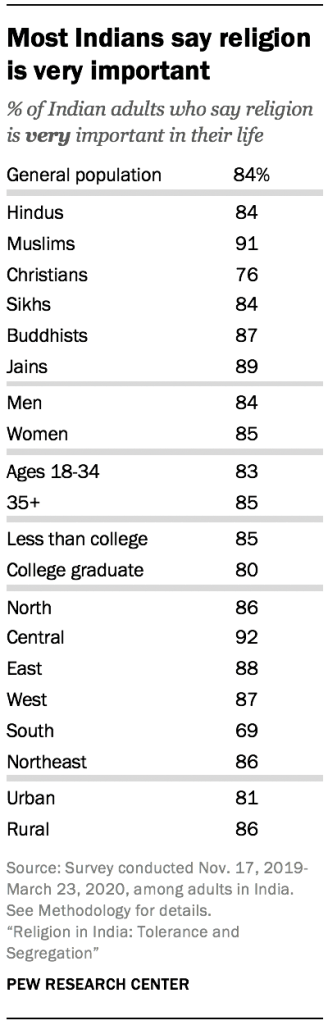
Though their specific practices and beliefs may vary, all of India’s major religious communities are highly observant by standard measures. For instance, the vast majority of Indians, across all major faiths, say that religion is very important in their lives. And at least three-quarters of each major religion’s followers say they know a great deal about their own religion and its practices. For example, 81% of Indian Buddhists claim a great deal of knowledge about the Buddhist religion and its practices.

Most Indians have a strong connection to their religion

Indian Muslims are slightly more likely than Hindus to consider religion very important in their lives (91% vs. 84%). Muslims also are modestly more likely than Hindus to say they know a great deal about their own religion (84% vs. 75%).

Significant portions of each religious group also pray daily, with Christians among the most likely to do so (77%) – even though Christians are the least likely of the six groups to say religion is very important in their lives (76%). Most Hindus and Jains also pray daily (59% and 73%, respectively) and say they perform puja daily (57% and 81%), either at home or at a temple.6

Generally, younger and older Indians, those with different educational backgrounds, and men and women are similar in their levels of religious observance. South Indians are the least likely to say religion is very important in their lives (69%), and the South is the only region where fewer than half of people report praying daily (37%). While Hindus, Muslims and Christians in the South are all less likely than their counterparts elsewhere in India to say religion is very important to them, the lower rate of prayer in the South is driven mainly by Hindus: Three-in-ten Southern Hindus report that they pray daily (30%), compared with roughly two-thirds (68%) of Hindus in the rest of the country (see “People in the South differ from rest of the country in their views of religion, national identity” below for further discussion of religious differences in Southern India).

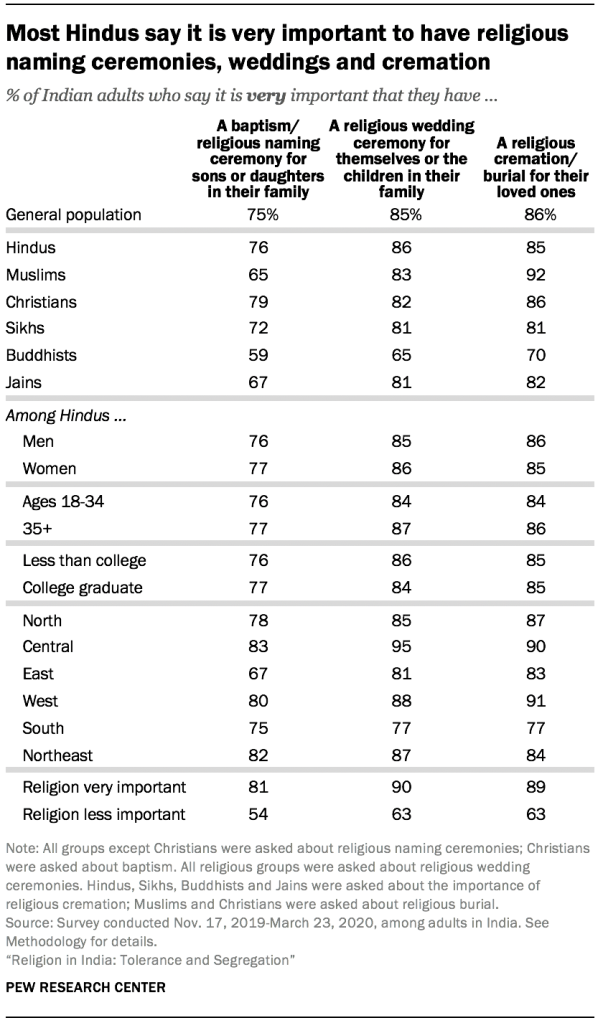
The survey also asked about three rites of passage: religious ceremonies for birth (or infancy), marriage and death. Members of all of India’s major religious communities tend to see these rites as highly important. For example, the vast majority of Muslims (92%), Christians (86%) and Hindus (85%) say it is very important to have a religious burial or cremation for their loved ones.

Indians say life’s milestones should be marked by religious ceremonies

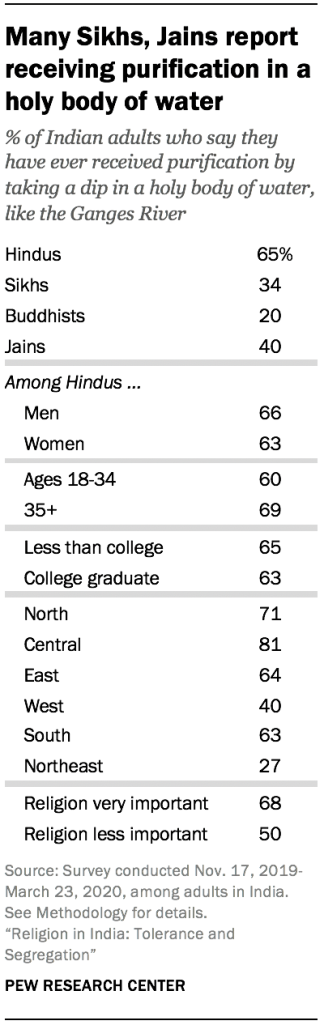
The survey also asked about practices specific to particular religions, such as whether people have received purification by bathing in holy bodies of water, like the Ganges River, a rite closely associated with Hinduism. About two-thirds of Hindus have done this (65%). Most Hindus also have holy basil (the tulsi plant) in their homes, as do most Jains (72% and 62%, respectively). And about three-quarters of Sikhs follow the Sikh practice of keeping their hair long (76%).

For more on religious practices across India’s religious groups, see Chapter 7.

Near-universal belief in God, but wide variation in how God is perceived

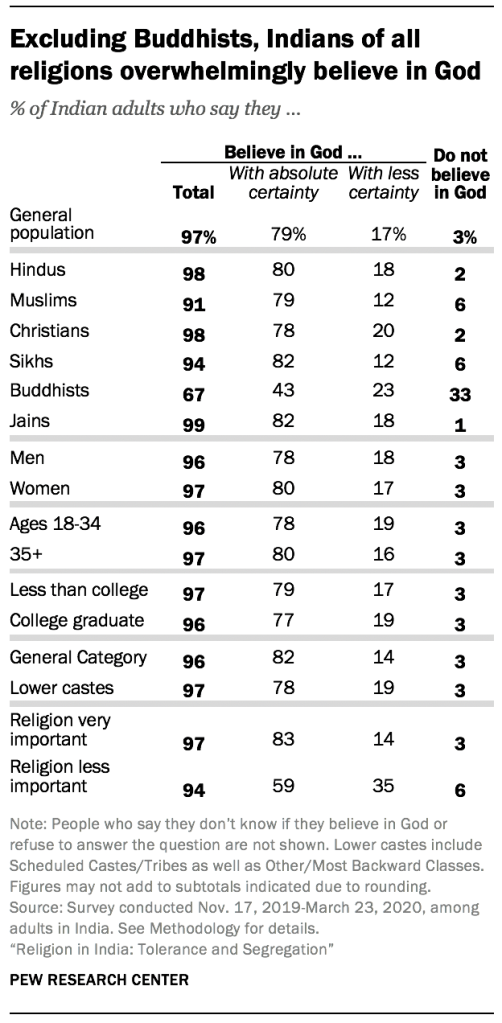
Nearly all Indians say they believe in God (97%), and roughly 80% of people in most religious groups say they are absolutely certain that God exists. The main exception is Buddhists, one-third of whom say they do not believe in God. Still, among Buddhists who do think there is a God, most say they are absolutely certain in this belief.

One-third of Indian Buddhists do not believe in God

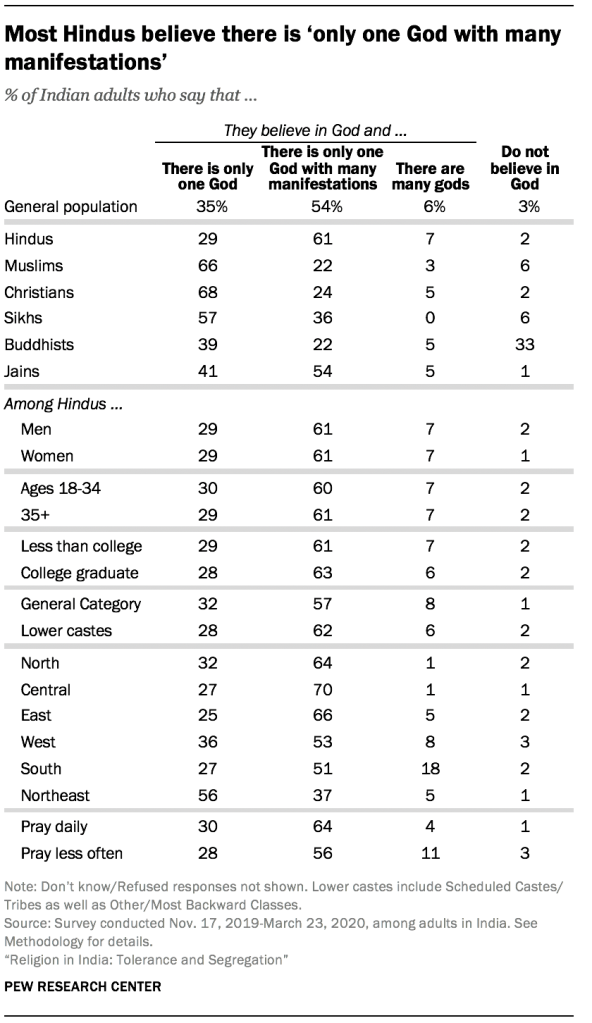
While belief in God is close to universal in India, the survey finds a wide range of views about the type of deity or deities that Indians believe in. The prevailing view is that there is one God “with many manifestations” (54%). But about one-third of the public says simply: “There is only one God” (35%). Far fewer say there are many gods (6%).

Even though Hinduism is sometimes referred to as a polytheistic religion, very few Hindus (7%) take the position that there are multiple gods. Instead, the most common position among Hindus (as well as among Jains) is that there is “only one God with many manifestations” (61% among Hindus and 54% among Jains).

In India, most Hindus and some members of other groups say there is one God with many manifestations

Among Hindus, those who say religion is very important in their lives are more likely than other Hindus to believe in one God with many manifestations (63% vs. 50%) and less likely to say there are many gods (6% vs. 12%).

By contrast, majorities of Muslims, Christians and Sikhs say there is only one God. And among Buddhists, the most common response is also a belief in one God. Among all these groups, however, about one-in-five or more say God has many manifestations, a position closer to their Hindu compatriots’ concept of God.

Most Hindus feel close to multiple gods, but Shiva, Hanuman and Ganesha are most popular

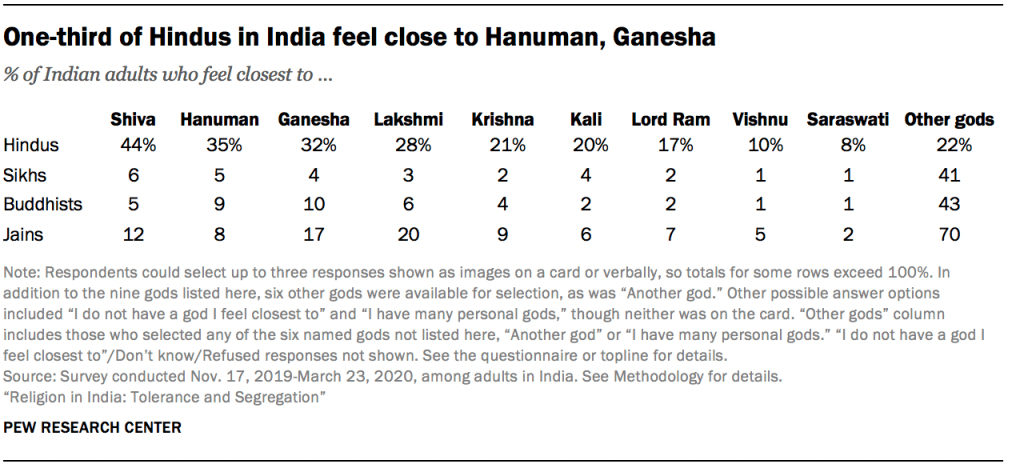
Traditionally, many Hindus have a “personal god,” or ishta devata: A particular god or goddess with whom they feel a personal connection. The survey asked all Indian Hindus who say they believe in God which god they feel closest to – showing them 15 images of gods on a card as possible options – and the vast majority of Hindus selected more than one god or indicated that they have many personal gods (84%).7 This is true not only among Hindus who say they believe in many gods (90%) or in one God with many manifestations (87%), but also among those who say there is only one God (82%).

The god that Hindus most commonly feel close to is Shiva (44%). In addition, about one-third of Hindus feel close to Hanuman or Ganesha (35% and 32%, respectively).

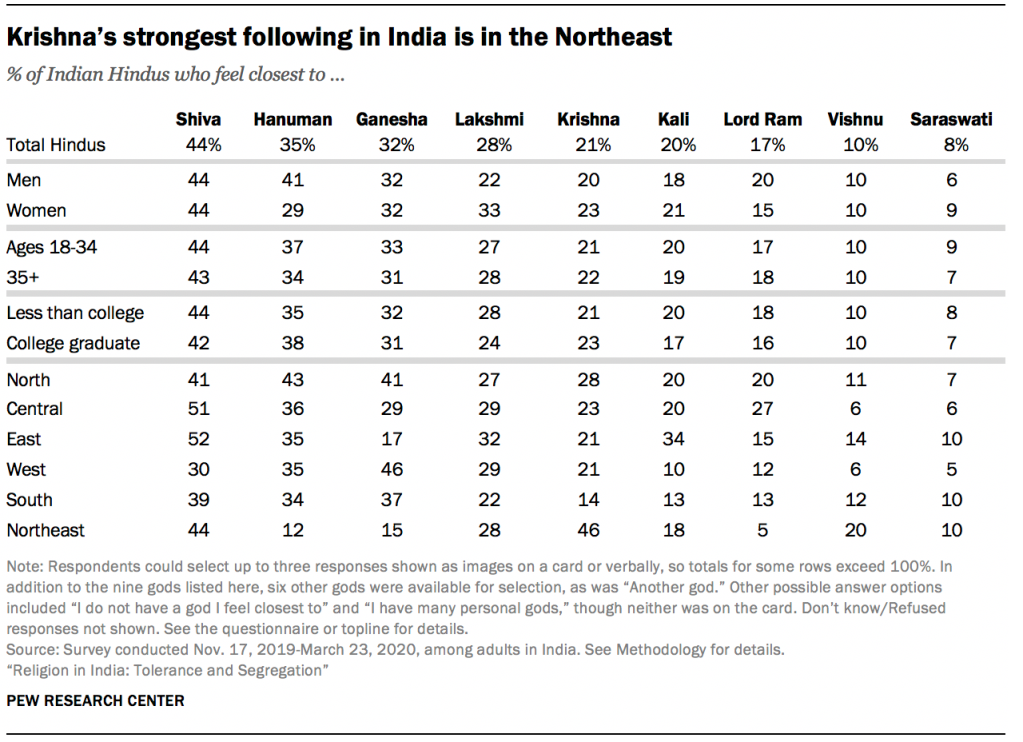
There is great regional variation in how close India’s Hindus feel to some gods. For example, 46% of Hindus in India’s West feel close to Ganesha, but only 15% feel this way in the Northeast. And 46% of Hindus in the Northeast feel close to Krishna, while just 14% in the South say the same.

Feelings of closeness for Lord Ram are especially strong in the Central region (27%), which includes what Hindus claim is his ancient birthplace, Ayodhya. The location in Ayodhya where many Hindus believe Ram was born has been a source of controversy: Hindu mobs demolished a mosque on the site in 1992, claiming that a Hindu temple originally existed there. In 2019, the Indian Supreme Court ruled that the demolished mosque had been built on top of a preexisting non-Islamic structure and that the land should be given to Hindus to build a temple, with another location in the area given to the Muslim community to build a new mosque. (For additional findings on belief in God, see Chapter 12.)

More Hindus feel close to Shiva than any other deity

Sidebar: Despite economic advancement, few signs that importance of religion is declining

Indians show high levels of religious observance across socioeconomic levels

A prominent theory in the social sciences hypothesizes that as countries advance economically, their populations tend to become less religious, often leading to wider social change. Known as “secularization theory,” it particularly reflects the experience of Western European countries from the end of World War II to the present.

Despite rapid economic growth, India’s population so far shows few, if any, signs of losing its religion. For instance, both the Indian census and the new survey find virtually no growth in the minuscule share of people who claim no religious identity. And religion is prominent in the lives of Indians regardless of their socioeconomic status. Generally, across the country, there is little difference in personal religious observance between urban and rural residents or between those who are college educated versus those who are not. Overwhelming shares among all these groups say that religion is very important in their lives, that they pray regularly and that they believe in God.

Overwhelming shares say religion was very important to their family growing up and is to them personally now

Nearly all religious groups show the same patterns. The biggest exception is Christians, among whom those with higher education and those who reside in urban areas show somewhat lower levels of observance. For example, among Christians who have a college degree, 59% say religion is very important in their life, compared with 78% among those who have less education.

The survey does show a slight decline in the perceived importance of religion during the lifetime of respondents, though the vast majority of Indians indicate that religion remains central to their lives, and this is true among both younger and older adults.

Nearly nine-in-ten Indian adults say religion was very important to their family when they were growing up (88%), while a slightly lower share say religion is very important to them now (84%). The pattern is identical when looking only at India’s majority Hindu population. Among Muslims in India, the same shares say religion was very important to their family growing up and is very important to them now (91% each).

The states of Southern India (Andhra Pradesh, Karnataka, Kerala, Puducherry, Tamil Nadu and Telangana) show the biggest downward trend in the perceived importance of religion over respondents’ lifetimes: 76% of Indians who live in the South say religion was very important to their family growing up, compared with 69% who say religion is personally very important to them now. Slight declines in the importance of religion, by this measure, also are seen in the Western part of the country (Goa, Gujarat and Maharashtra) and in the North, although large majorities in all regions of the country say religion is very important in their lives today.

Across India’s religious groups, widespread sharing of beliefs, practices, values

Respecting elders a key shared religious, national value in India

Despite a strong desire for religious segregation, India’s religious groups share patriotic feelings, cultural values and some religious beliefs. For instance, overwhelming shares across India’s religious communities say they are very proud to be Indian, and most agree that Indian culture is superior to others.

Similarly, Indians of different religious backgrounds hold elders in high respect. For instance, nine-in-ten or more Hindus, Muslims, Buddhists and Jains say that respecting elders is very important to what being a member of their religious group means to them (e.g., for Hindus, it’s a very important part of their Hindu identity). Christians and Sikhs also overwhelmingly share this sentiment. And among all people surveyed in all six groups, three-quarters or more say that respecting elders is very important to being truly Indian.

Within all six religious groups, eight-in-ten or more also say that helping the poor and needy is a crucial part of their religious identity.

Beyond cultural parallels, many people mix traditions from multiple religions into their practices: As a result of living side by side for generations, India’s minority groups often engage in practices that are more closely associated with Hindu traditions than their own. For instance, many Muslim, Sikh and Christian women in India say they wear a bindi (a forehead marking, often worn by married women), even though putting on a bindi has Hindu origins.

Similarly, many people embrace beliefs not traditionally associated with their faith: Muslims in India are just as likely as Hindus to say they believe in karma (77% each), and 54% of Indian Christians share this view.8 Nearly three-in-ten Muslims and Christians say they believe in reincarnation (27% and 29%, respectively). While these may seem like theological contradictions, for many Indians, calling oneself a Muslim or a Christian does not preclude believing in karma or reincarnation – beliefs that do not have a traditional, doctrinal basis in Islam or Christianity.

Some religious beliefs and practices shared across religious groups in India
Indians of many religions celebrate Diwali

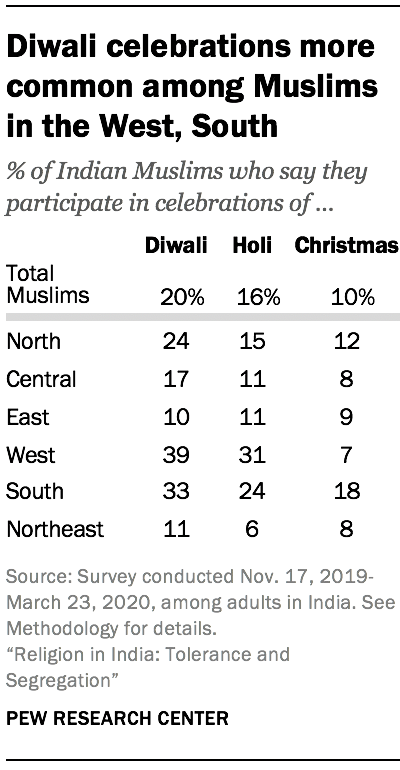
Most Muslims and Christians say they don’t participate in celebrations of Diwali, the Indian festival of lights that is traditionally celebrated by Hindus, Sikhs, Jains and Buddhists. But substantial minorities of Christians (31%) and Muslims (20%) report that they do celebrate Diwali. Celebrating Diwali is especially common among Muslims in the West, where 39% say they participate in the festival, and in the South (33%).

Not only do some followers of all these religions participate in a celebration (Diwali) that consumes most of the country once a year, but some members of the majority Hindu community celebrate Muslim and Christian festivals, too: 7% of Indian Hindus say they celebrate the Muslim festival of Eid, and 17% celebrate Christmas.

Religious identity in India: Hindus divided on whether belief in God is required to be a Hindu, but most say eating beef is disqualifying

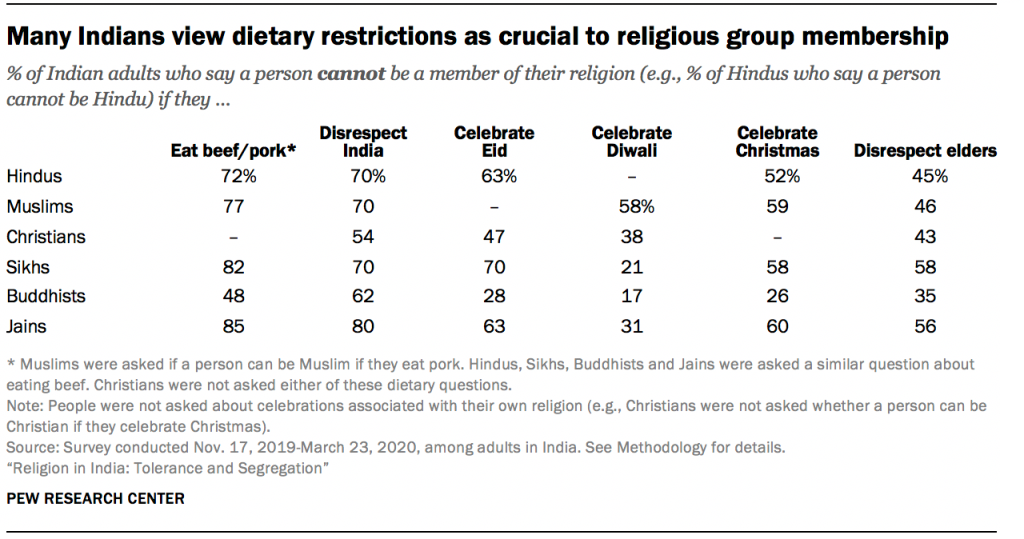
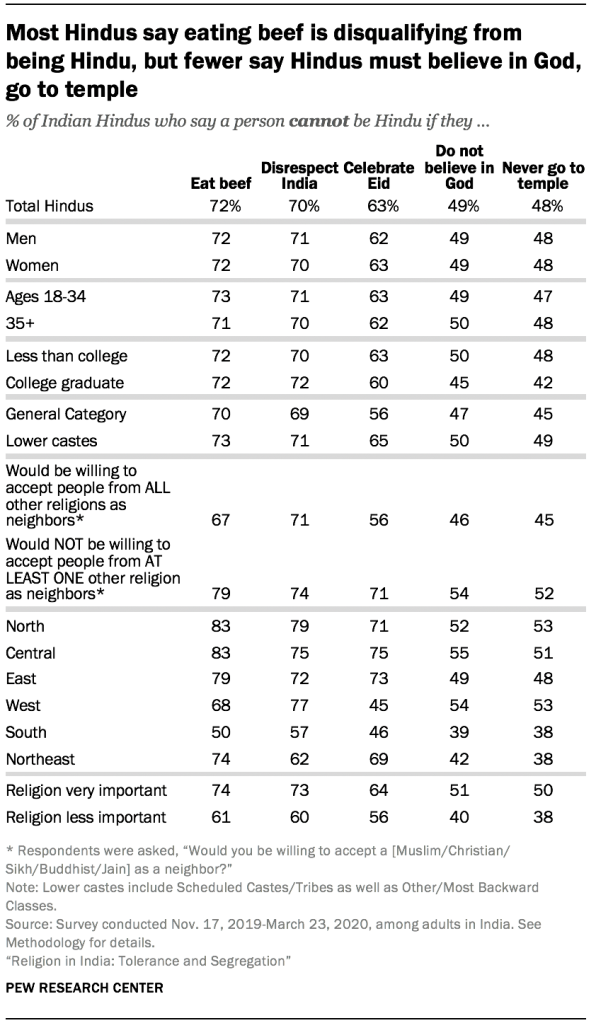
While there is some mixing of religious celebrations and traditions within India’s diverse population, many Hindus do not approve of this. In fact, while 17% of the nation’s Hindus say they participate in Christmas celebrations, about half of Hindus (52%) say that doing so disqualifies a person from being Hindu (compared with 35% who say a person canbe Hindu if they celebrate Christmas). An even greater share of Hindus (63%) say a person cannot be Hindu if they celebrate the Islamic festival of Eid – a view that is more widely held in Northern, Central, Eastern and Northeastern India than the South or West.

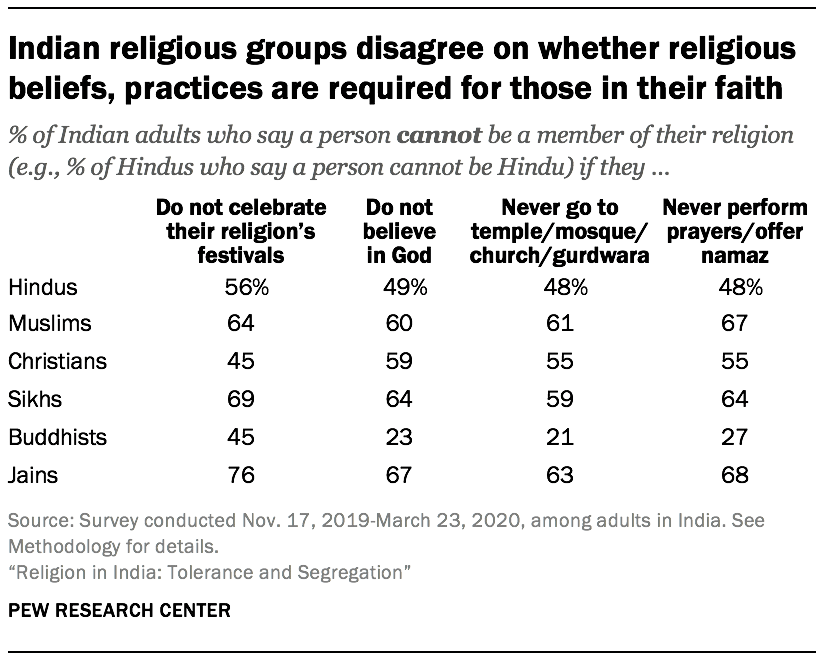
Hindus are divided on whether beliefs and practices such as believing in God, praying and going to the temple are necessary to be a Hindu. But one behavior that a clear majority of Indian Hindus feel is incompatible with Hinduism is eating beef: 72% of Hindus in India say a person who eats beef cannot be a Hindu. That is even higher than the percentages of Hindus who say a person cannot be Hindu if they reject belief in God (49%), never go to a temple (48%) or never perform prayers (48%).

India’s Hindus mostly say a person cannot be Hindu if they eat beef, celebrate Eid
In India, Hindus’ views toward beef consumption linked with attitudes toward segregation, nationalism

Attitudes toward beef appear to be part of a regional and cultural divide among Hindus: Southern Indian Hindus are considerably less likely than others to disqualify beef eaters from being Hindu (50% vs. 83% in the Northern and Central parts of the country). And, at least in part, Hindus’ views on beef and Hindu identity are linked with a preference for religious segregation and elements of Hindu nationalism. For example, Hindus who take a strong position against eating beef are more likely than others to say they would not accept followers of other religions as their neighbors (49% vs. 30%) and to say it is very important to be Hindu to be truly Indian (68% vs. 51%).

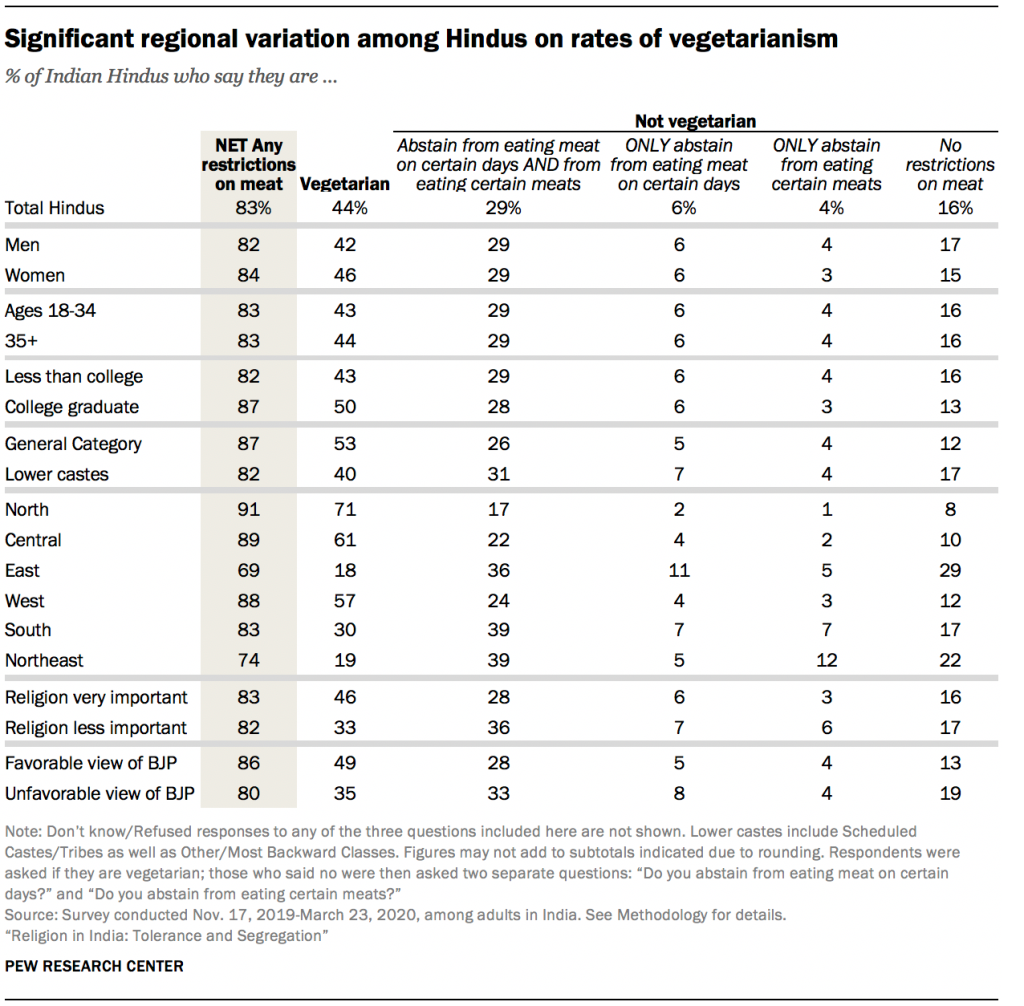
Relatedly, 44% of Hindus say they are vegetarians, and an additional 33% say they abstain from eating certain meats. Hindus traditionally view cows as sacred, and laws pertaining to cow slaughter have been a recent flashpoint in India. At the same time, Hindus are not alone in linking beef consumption with religious identity: 82% of Sikhs and 85% of Jains surveyed say that a person who eats beef cannot be a member of their religious groups, either. A majority of Sikhs (59%) and fully 92% of Jains say they are vegetarians, including 67% of Jains who do not eat root vegetables.9 (For more data on religion and dietary habits, see Chapter 10.)

Sidebar: People in the South differ from rest of the country in their views of religion, national identity

The survey consistently finds that people in the South (the states of Andhra Pradesh, Karnataka, Kerala, Tamil Nadu and Telangana, and the union territory of Puducherry) differ from Indians elsewhere in the country in their views on religion, politics and identity.

For example, by a variety of measures, people in the South are somewhat less religious than those in other regions – 69% say religion is very important in their lives, versus 92% in the Central part of the country. And 37% say they pray every day, compared with more than half of Indians in other regions. People in the South also are less segregated by religion or caste – whether that involves their friendship circles, the kind of neighbors they prefer or how they feel about intermarriage. (See Chapter 3.)

Hindu nationalist sentiments also appear to have less of a foothold in the South. Among Hindus, those in the South (42%) are far less likely than those in Central states (83%) or the North (69%) to say being Hindu is very important to be truly Indian. And in the 2019 parliamentary elections, the BJP’s lowest vote share came in the South. In the survey, just 19% of Hindus in the region say they voted for the BJP, compared with roughly two-thirds in the Northern (68%) and Central (65%) parts of the country who say they voted for the ruling party.

Culturally and politically, people in the South have pushed back against the BJP’s restrictions on cow slaughter and efforts to nationalize the Hindi language. These factors may contribute to the BJP’s lower popularity in the South, where more people prefer regional parties or the Indian National Congress party.

These differences in attitudes and practices exist in a wider context of economic disparities between the South and other regions of the country. Over time, Southern states have seen stronger economic growth than the Northern and Central parts of the country. And women and people belonging to lower castes in the South have fared better economically than their counterparts elsewhere in the country. Even though three-in-ten people in the South say there is widespread caste discrimination in India, the region also has a history of anti-caste movements. Indeed, one author has attributed the economic growth of the South largely to the flattening of caste hierarchies.

Indian Muslims more likely to say eating pork is incompatible with Islam than not believing in God

Muslim identity in India

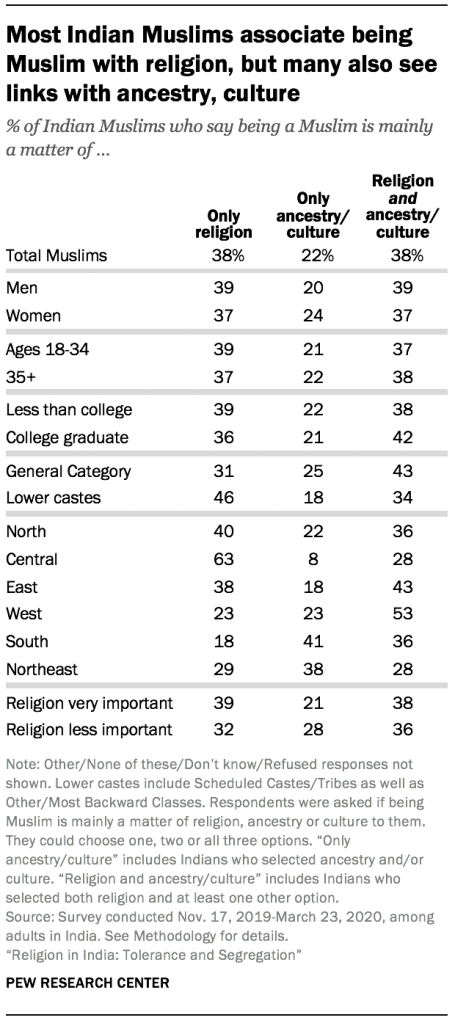
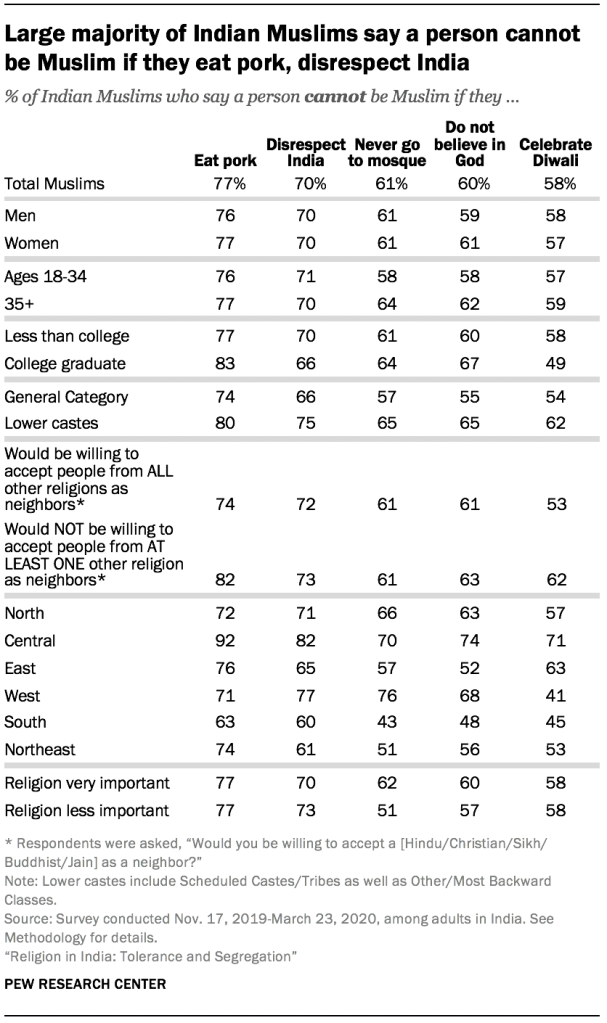
Most Muslims in India say a person cannot be Muslim if they never pray or attend a mosque. Similarly, about six-in-ten say that celebrating Diwali or Christmas is incompatible with being a member of the Muslim community. At the same time, a substantial minority express a degree of open-mindedness on who can be a Muslim, with fully one-third (34%) saying a person can be Muslim even if they don’t believe in God. (The survey finds that 6% of self-described Muslims in India say they do not believe in God; see “Near-universal belief in God, but wide variation in how God is perceived” above.)

Like Hindus, Muslims have dietary restrictions that resonate as powerful markers of identity. Three-quarters of Indian Muslims (77%) say that a person cannot be Muslim if they eat pork, which is even higher than the share who say a person cannot be Muslim if they do not believe in God (60%) or never attend mosque (61%).
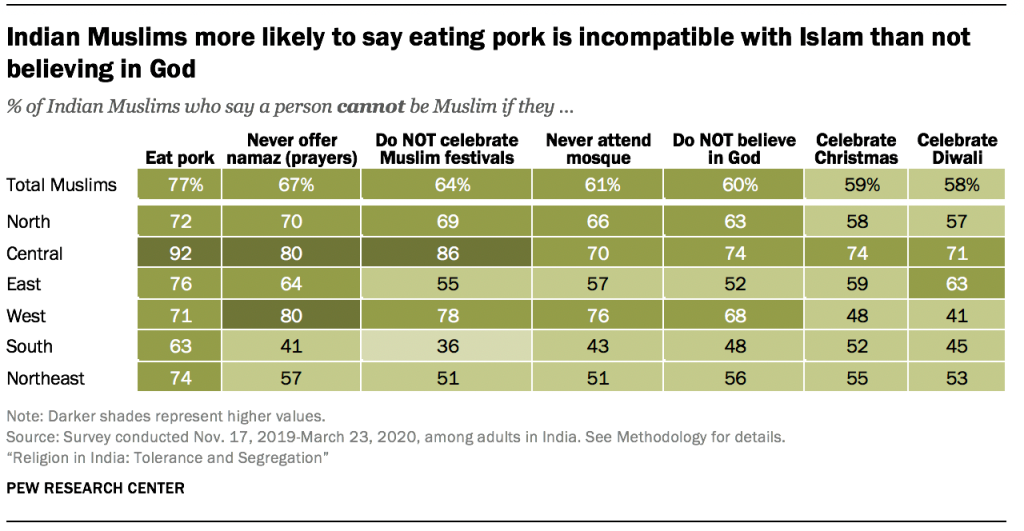
Indian Muslims more likely to say eating pork is incompatible with Islam than not believing in God

Indian Muslims also report high levels of religious commitment by a host of conventional measures: 91% say religion is very important in their lives, two-thirds (66%) say they pray at least once a day, and seven-in-ten say they attend mosque at least once a week – with even higher attendance among Muslim men (93%).

By all these measures, Indian Muslims are broadly comparable to Muslims in the neighboring Muslim-majority countries of Pakistan and Bangladesh, according to a Pew Research Center survey conducted in those countries in late 2011 and early 2012. In Pakistan, for example, 94% of Muslims said religion is very important in their lives, while 81% of Bangladeshi Muslims said the same. Muslims in India are somewhat more likely than those elsewhere in South Asia to say they regularly worship at a mosque (70% in India vs. 59% in Pakistan and 53% in Bangladesh), with the difference mainly driven by the share of women who attend.

Indian Muslims are as religious as Muslims in neighboring countries, but fewer say there is just one correct way to interpret Islam

At the same time, Muslims in India are slightly less likely to say there is “only one true” interpretation of Islam (72% in Pakistan, 69% in Bangladesh, 63% in India), as opposed to multiple interpretations.

When it comes to their religious beliefs, Indian Muslims in some ways resemble Indian Hindus more than they resemble Muslims in neighboring countries. For example, Muslims in Pakistan and Bangladesh almost universally say they believe in heaven and angels, but Indian Muslims seem more skeptical: 58% say they believe in heaven and 53% express belief in angels. Among Indian Hindus, similarly, 56% believe in heaven and 49% believe in angels.

Overall, Indian Muslims’ level of belief in heaven, angels resembles Indian Hindus more than other Muslims in South Asia

Majority of Muslim women in India oppose ‘triple talaq’ (Islamic divorce)

Most Indian Muslims oppose triple talaq

Many Indian Muslims historically have followed the Hanafi school of thought, which for centuries allowed men to divorce their wives by saying “talaq” (which translates as “divorce” in Arabic and Urdu) three times. Traditionally, there was supposed to be a waiting period and attempts at reconciliation in between each use of the word, and it was deeply frowned upon (though technically permissible) for a man to pronounce “talaq” three times quickly in a row. India’s Supreme Court ruled triple talaq unconstitutional in 2017, and it was banned by legislation in 2019.

Most Indian Muslims (56%) say Muslim men should not be allowed to divorce this way. Still, 37% of Indian Muslims say they support triple talaq, with Muslim men (42%) more likely than Muslim women (32%) to take this position. A majority of Muslim women (61%) oppose triple talaq.

Highly religious Muslims – i.e., those who say religion is very important in their lives – also are more likely than other Muslims to say Muslim men should be able to divorce their wives simply by saying “talaq” three times (39% vs. 26%).

Triple talaq seems to have the most support among Muslims in the Southern and Northeastern regions of India, where half or more of Muslims say it should be legal (58% and 50%, respectively), although 12% of Muslims in the South and 16% in the Northeast do not take a position on the issue either way.

Sikhs are proud to be Punjabi and Indian

Sikhism is one of four major religions – along with Hinduism, Buddhism and Jainism – that originated on the Indian subcontinent. The Sikh religion emerged in Punjab in the 15th century, when Guru Nanak, who is revered as the founder of Sikhism, became the first in a succession of 10 gurus (teachers) in the religion.

Today, India’s Sikhs remain concentrated in the state of Punjab. One feature of the Sikh religion is a distinctive sense of community, also known as “Khalsa” (which translates as “ones who are pure”). Observant Sikhs differentiate themselves from others in several ways, including keeping their hair uncut. Today, about three-quarters of Sikh men and women in India say they keep their hair long (76%), and two-thirds say it is very important to them that children in their families also keep their hair long (67%). (For more analysis of Sikhs’ views on passing religious traditions on to their children, see Chapter 8.)

Vast majority of Sikh adults in India say they keep their hair long

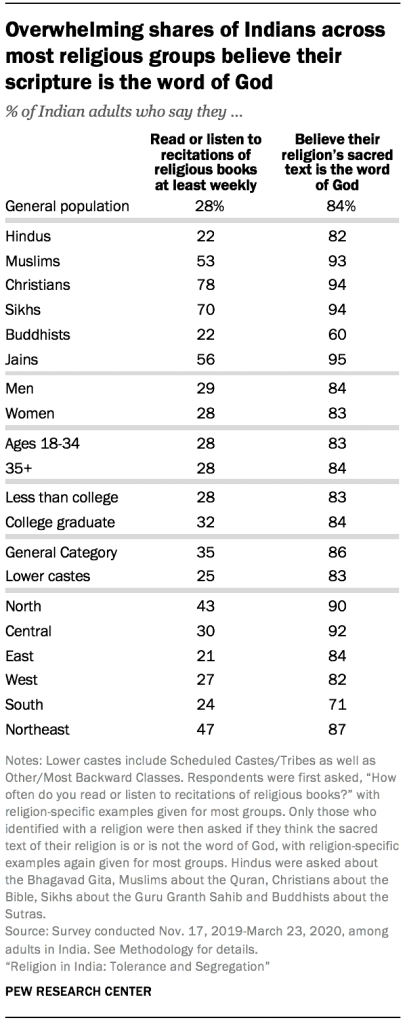
Sikhs are more likely than Indian adults overall to say they attend religious services every day – 40% of Sikhs say they go to the gurdwara (Sikh house of worship) daily. By comparison, 14% of Hindus say they go to a Hindu temple every day. Moreover, the vast majority of Sikhs (94%) regard their holy book, the Guru Granth Sahib, as the word of God, and many (37%) say they read it, or listen to recitations of it, every day.

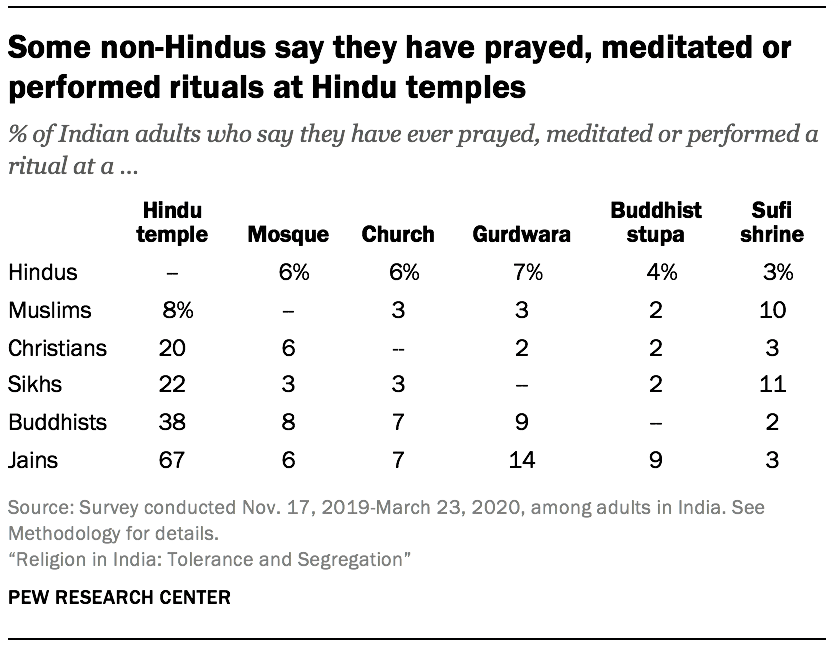
Sikhs in India also incorporate other religious traditions into their practice. Some Sikhs (9%) say they follow Sufi orders, which are linked with Islam, and about half (52%) say they have a lot in common with Hindus. Roughly one-in-five Indian Sikhs say they have prayed, meditated or performed a ritual at a Hindu temple.

Sikh-Hindu relations were marked by violence in the 1970s and 1980s, when demands for a separate Sikh state covering the Punjab regions in both India and Pakistan (also known as the Khalistan movement) reached their apex. In 1984, Prime Minister Indira Gandhi was assassinated by her Sikh bodyguards as revenge for Indian paramilitary forces storming the Sikh Golden Temple in pursuit of Sikh militants. Anti-Sikh riots ensued in Northern India, especially in the state of Punjab.

India’s Sikhs are nearly universally proud of their national, state identities

According to the Indian census, the vast majority of Sikhs in India (77%) still live in Punjab, where Sikhs make up 58% of the adult population. And 93% of Punjabi Sikhs say they are very proud to live in the state.

Sikhs also are overwhelmingly proud of their Indian identity. A near-universal share of Sikhs say they are very proud to be Indian (95%), and the vast majority (70%) say a person who disrespects India cannot be a Sikh. And like India’s other religious groups, most Sikhs do not see evidence of widespread discrimination against their community – just 14% say Sikhs face a lot of discrimination in India, and 18% say they personally have faced religious discrimination in the last year.

At the same time, Sikhs are more likely than other religious communities to see communal violence as a very big problem in the country. Nearly eight-in-ten Sikhs (78%) rate communal violence as a major issue, compared with 65% of Hindus and Muslims.

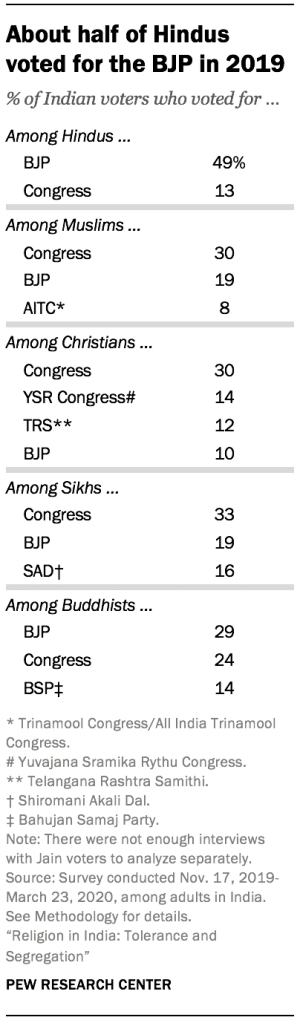
The BJP has attempted to financially compensate Sikhs for some of the violence that occurred in 1984 after Indira Gandhi’s assassination, but relatively few Sikh voters (19%) report having voted for the BJP in the 2019 parliamentary elections. The survey finds that 33% of Sikhs preferred the Indian National Congress Party – Gandhi’s party.
1. Religious freedom, discrimination and communal relations

Indians generally see high levels of religious freedom in their country. Overwhelming majorities of people in each major religious group, as well as in the overall public, say they are “very free” to practice their religion. Smaller shares, though still majorities within each religious community, say people of other religions also are very free to practice their religion. Relatively few Indians – including members of religious minority communities – perceive religious discrimination as widespread.

At the same time, perceptions of discrimination vary a great deal by region. For example, Muslims in the Central region of the country are generally less likely than Muslims elsewhere to say there is a lot of religious discrimination in India. And Muslims in the North and Northeast are much more likely than Muslims in other regions to report that they, personally, have experienced recent discrimination.

Indians also widely consider communal violence to be an issue of national concern (along with other problems, such as unemployment and corruption). Most people across different religious backgrounds, education levels and age groups say communal violence is a very big problem in India.

The partition of the Indian subcontinent in 1947 remains a subject of disagreement. Overall, the survey finds mixed views on whether the establishment of Hindu-majority India and Muslim-majority Pakistan alleviated communal tensions or stoked them. On balance, Muslims tend to see Partition as a “bad thing” for Hindu-Muslim relations, while Hindus lean slightly toward viewing it as a “good thing.”

Most Indians say they and others are very free to practice their religion

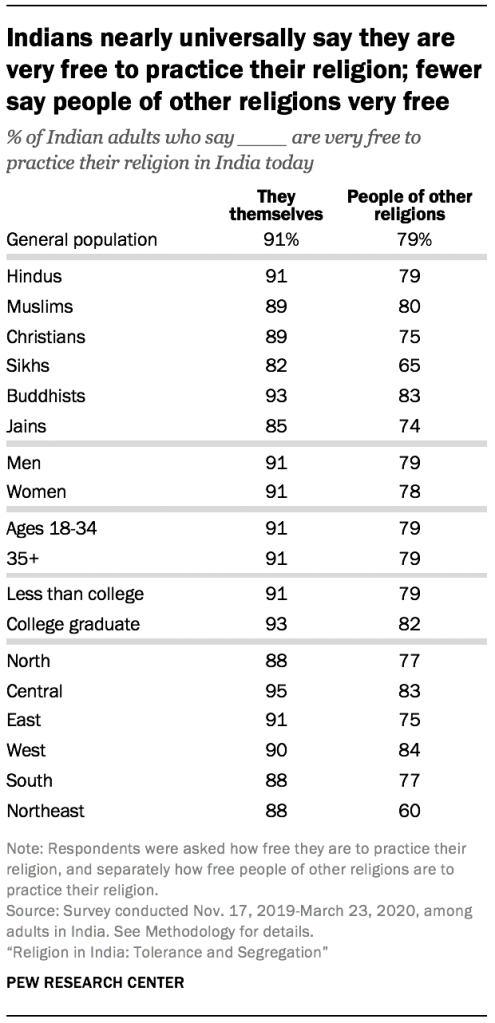
Indians nearly universally say they are very free to practice their religion; fewer say people of other religions very free

The vast majority of Indians say they are very free today to practice their religion (91%), and all of India’s major religious groups share this sentiment: Roughly nine-in-ten Buddhists (93%), Hindus (91%), Muslims (89%) and Christians (89%) say they are very free to practice their religion, as do 85% of Jains and 82% of Sikhs.

Broadly speaking, Indians are more likely to view themselves as having a high degree of religious freedom than to say that people of other religions are very free to practice their faiths. Still, 79% of the overall public – and about two-thirds or more of the members of each of the country’s major religious communities – say that people belonging to other religions are very free to practice their faiths in India today.

Generally, these attitudes do not vary substantially among Indians of different ages, educational backgrounds or geographic regions. Indians in the Northeast are somewhat less likely than those elsewhere to see widespread religious freedom for people of other faiths – yet even in the Northeast, a solid majority (60%) say there is a high level of religious freedom for other religious communities in India.

Most people do not see evidence of widespread religious discrimination in India

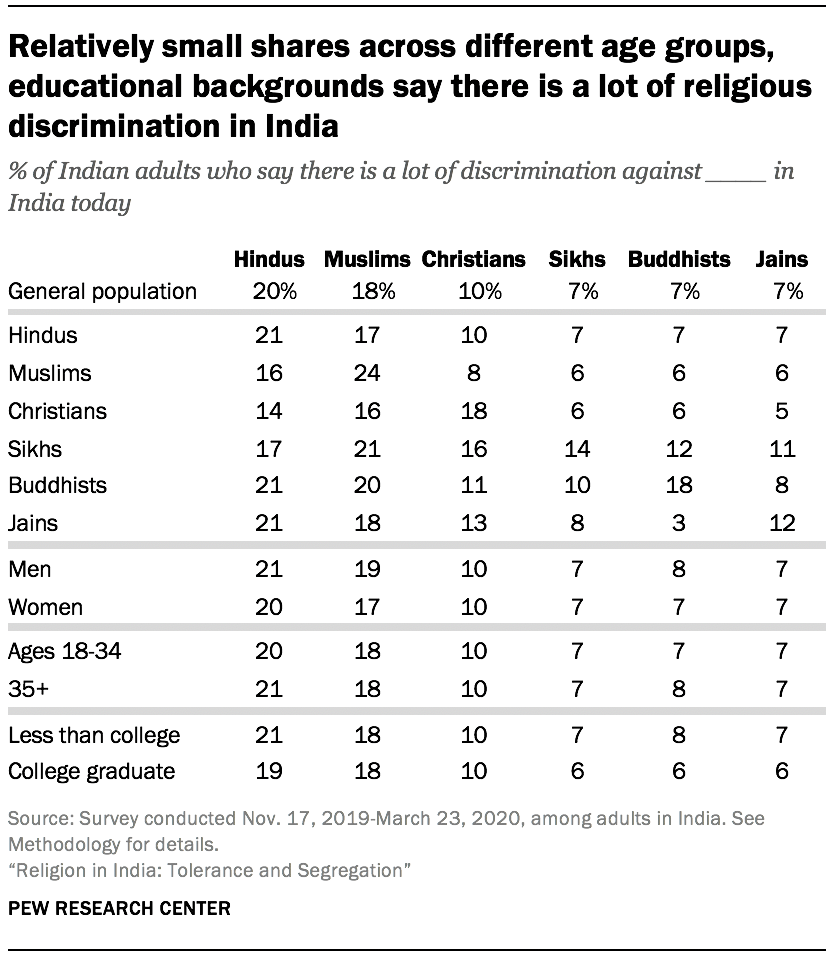
Relatively small shares across different age groups, educational backgrounds say there is a lot of religious discrimination in India

Most people in India do not see a lot of religious discrimination against any of the country’s six major religious groups. In general, Hindus, Muslims and Christians are slightly more likely to say there is a lot of discrimination against their own religious community than to say there is a lot of discrimination against people of other faiths. Still, no more than about one-quarter of the followers of any of the country’s major faiths say they face widespread discrimination.

Generally, Indians’ opinions about religious discrimination do not vary substantially by gender, age or educational background. For example, among college graduates, 19% say there is a lot of discrimination against Hindus, compared with 21% among adults with less education.

Within religious groups as well, people of different ages, as well as both men and women, tend to have similar opinions on religious discrimination.

Regional variations in Muslims’ perception of discrimination

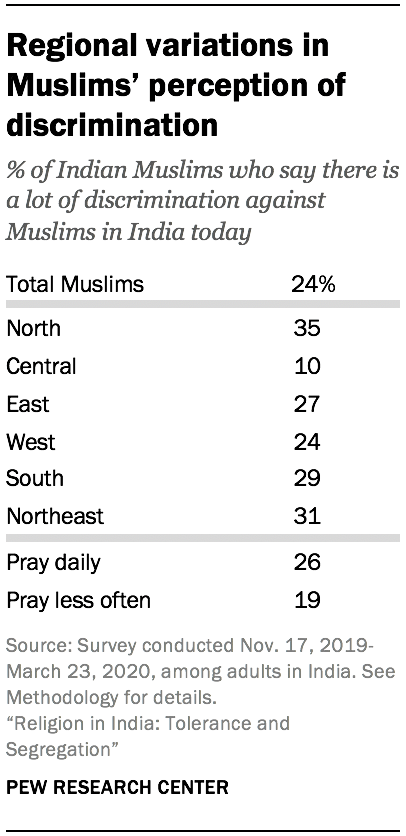
However, there are large regional variations in perceptions of religious discrimination. For example, among Muslims who live in the Central part of the country, just one-in-ten say there is widespread discrimination against Muslims in India, compared with about one-third of those who live in the North (35%) and Northeast (31%). (For more information on measures of religious discrimination in the Northeast, see “In Northeast India, people perceive more religious discrimination” below.)

Among Muslims, perceptions of discrimination against their community can vary somewhat based on their level of religious observance. For instance, about a quarter of Muslims across the country who pray daily say there is a lot of discrimination against Muslims (26%), compared with 19% of Muslims nationwide who pray less often. This difference by observance is pronounced in the North, where 39% of Muslims who pray every day say there is a lot of discrimination against Muslims in India, roughly twice the share among those in the same region who pray less often (20%).

Most Indians report no recent discrimination based on their religion

Religious minorities generally no more likely than Hindus to report recent discrimination

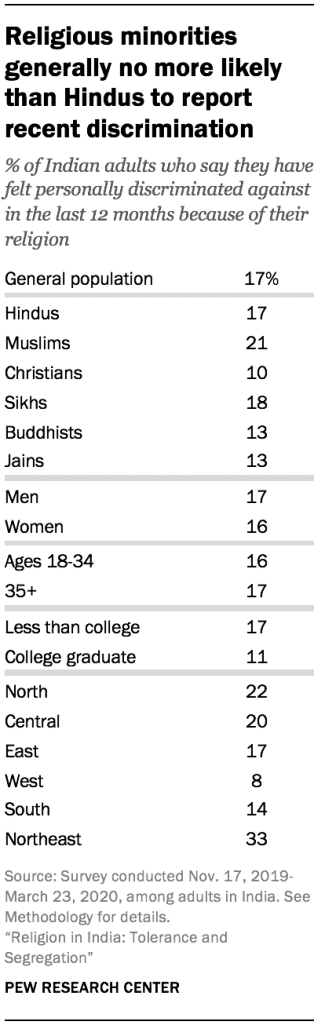
The survey also asked respondents about their personal experiences with discrimination. In all, 17% of Indians report facing recent discrimination based on their religion. Roughly one-in-five Muslims (21%) and 17% of Hindus say that in the last 12 months they themselves have faced discrimination because of their religion, as do 18% of Sikhs. By contrast, Christians are less likely to say they have felt discriminated against because of their religion (10%), and similar shares of Buddhists and Jains (13% each) fall into this category.

Nationally, men and women and people belonging to different age groups do not differ significantly from each other in their experiences with religious discrimination. People who have a college degree, however, are somewhat less likely than those with less formal schooling to say they have experienced religious discrimination in the past year.

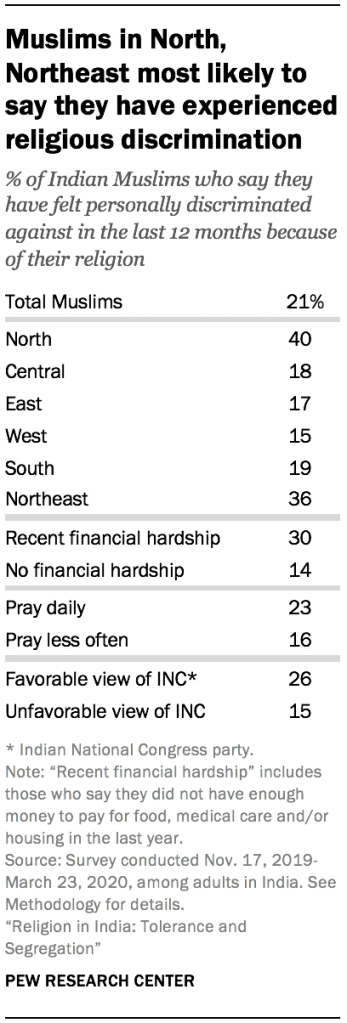
Within religious groups, experiences with discrimination vary based on region of residence and other factors. Among Muslims, for instance, 40% of those living in Northern India and 36% in the Northeast say they have faced recent religious discrimination, compared with no more than one-in-five in the Southern, Central, Eastern and Western regions.

Muslims in North, Northeast most likely to say they have experienced religious discrimination

Experiences with religious discrimination also are more common among Muslims who are more religious and those who report recent financial hardship (that is, they have not been able to afford food, housing or medical care for themselves or their families in the last year).

Muslims who have a favorable view of the Indian National Congress party (INC) are more likely than Muslims with an unfavorable view of the party to say they have experienced religious discrimination (26% vs. 15%). Among Northern Muslims, those who have a favorable view of the INC are much more likely than those who don’t approve of the INC to say they have experienced discrimination (45% vs. 23%). (Muslims in the country, and especially Muslims in the North, tend to say they voted for the Congress party in the 2019 election. See Chapter 6.)

Hindus with less education and those who have recently experienced poverty also are more likely to say they have experienced religious discrimination.

In Northeast India, people perceive more religious discrimination

Less than 5% of India’s population lives in the eight isolated states of the country’s Northeastern region. This region broadly lags behind the country in economic development indicators. And this small segment of the population has a linguistic and religious makeup that differs drastically from the rest of the country.

According to the 2011 census of India, Hindus are still the majority religious group (58%), but they are less prevalent in the Northeast than elsewhere (81% nationally). The smaller proportion of Hindus there is offset by the highest shares of Christians (16% vs. 2% nationally) and Muslims (22% vs. 13% nationally) in any region. And based on the survey, the region also has a higher share of Scheduled Tribes than any other region in the country (25% vs. 9% nationally), and half of Scheduled Tribe members in the Northeast are Christians.

Highest perceptions of discrimination in the Northeast

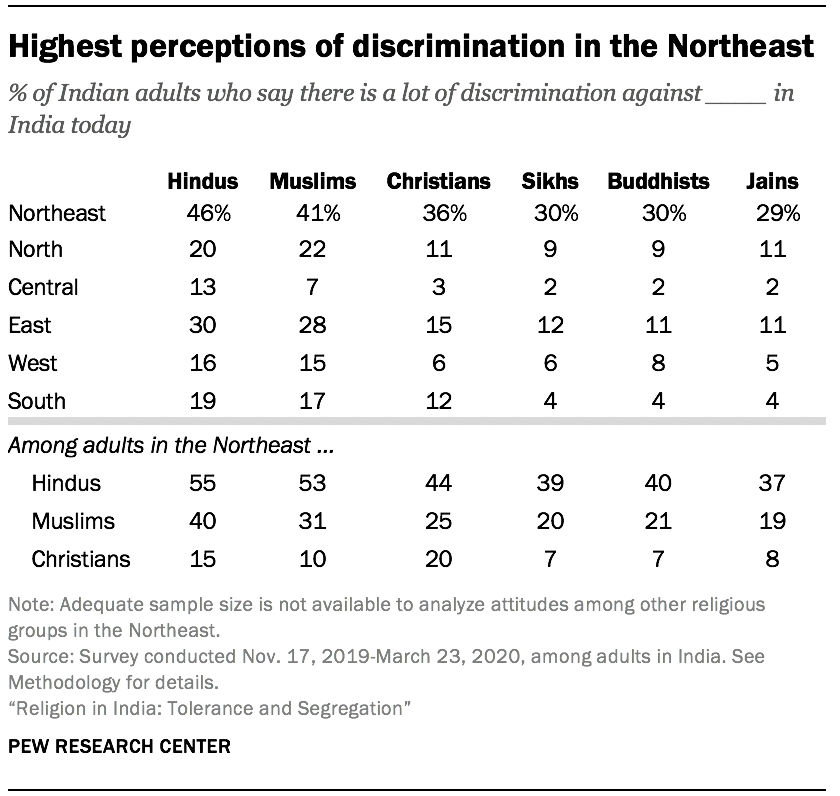
Indians in the Northeast are more likely than those elsewhere to perceive high levels of religious discrimination. For example, roughly four-in-ten in the region say there is a lot of discrimination against Muslims in India, about twice the share of North Indians who say the same thing (41% vs. 22%).

Much of the Northeast’s perception of high religious discrimination is driven by Hindus in the region. A slim majority of Northeastern Hindus (55%) say there is widespread discrimination against Hindus in India, while almost as many (53%) say Muslims face a lot of discrimination. Substantial shares of Hindus in the Northeast say other religious communities also face such mistreatment.

The region’s other religious communities are less likely to say there is religious discrimination in India. For example, while 44% of Northeastern Hindus say Christians face a lot of discrimination, only one-in-five Christians in the Northeast perceive this level of discrimination against their own group. By contrast, at the national level, Christians are more likely than Hindus to see a lot of discrimination against Christians (18% vs. 10%).

People in the Northeast also are more likely to report experiencing religious discrimination. While 17% of individuals nationally say they personally have felt religious discrimination in the last 12 months, one-third of those surveyed in the Northeast say they have had such an experience. Northeastern Hindus, in particular, are much more likely than Hindus elsewhere to report recent religious discrimination (37% vs. 17% nationally).

Most Indians see communal violence as a very big problem in the country

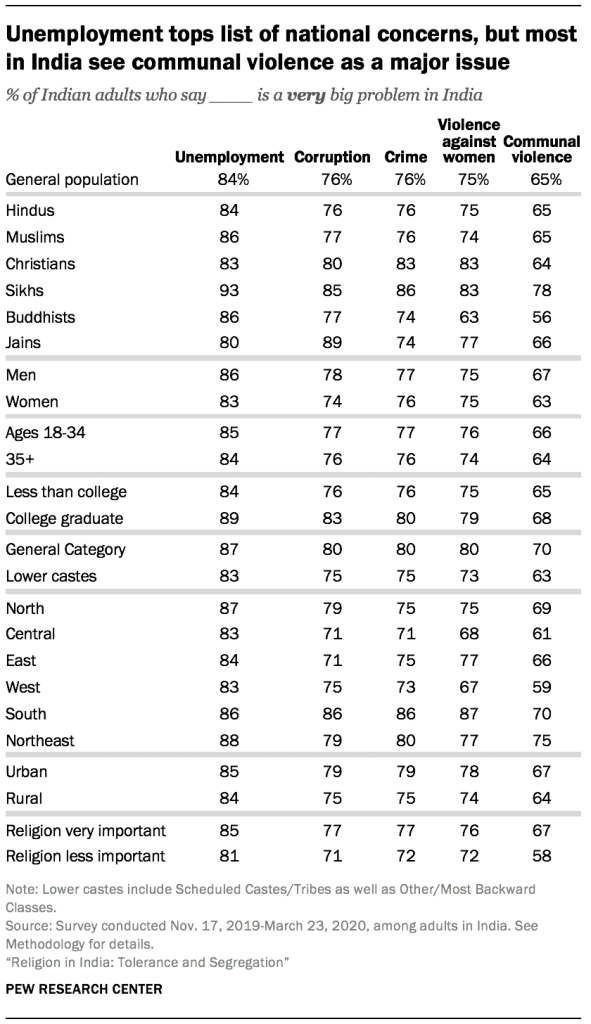
Unemployment tops list of national concerns, but most in India see communal violence as a major issue

Most Indians (65%) say communal violence – a term broadly used to describe violence between religious groups – is a “very big problem” in their country (the term was not defined for respondents). This includes identical shares of Hindus and Muslims (65% each) who say this.

But even larger majorities identify several other national problems. Unemployment tops the list of national concerns, with 84% of Indians saying this is a very big problem. And roughly three-quarters of Indian adults see corruption (76%), crime (76%) and violence against women (75%) as very big national issues. (The survey was designed and mostly conducted before the World Health Organization declared the COVID-19 outbreak a pandemic.)

Indians across nearly every religious group, caste category and region consistently rank unemployment as the top national concern. Buddhists, who overwhelmingly belong to disadvantaged castes, widely rank unemployment as a major concern (86%), while just a slim majority see communal violence as a very big problem (56%).

Sikhs are more likely than other major religious groups in India to say communal violence is a major issue (78%). This concern is especially pronounced among college-educated Sikhs (87%).

Among Hindus, those who are more religious are more likely to see communal violence as a major issue: Fully 67% of Hindus who say religion is very important in their lives consider communal violence a major issue, compared with 58% among those who say religion is less important to them.

Indians in different regions of the country also differ in their concern about communal violence: Three-quarters of Indians in the Northeast say communal violence is a very big problem, compared with 59% in the West. Concerns about communal violence are widespread in the national capital of Delhi, where 78% of people say this is a major issue. During fieldwork for this study, major protests broke out in New Delhi (and elsewhere) following the BJP-led government’s passing of a new bill, which creates an expedited path to citizenship for immigrants from some neighboring countries – but not Muslims.

Indians divided on the legacy of Partition for Hindu-Muslim relations

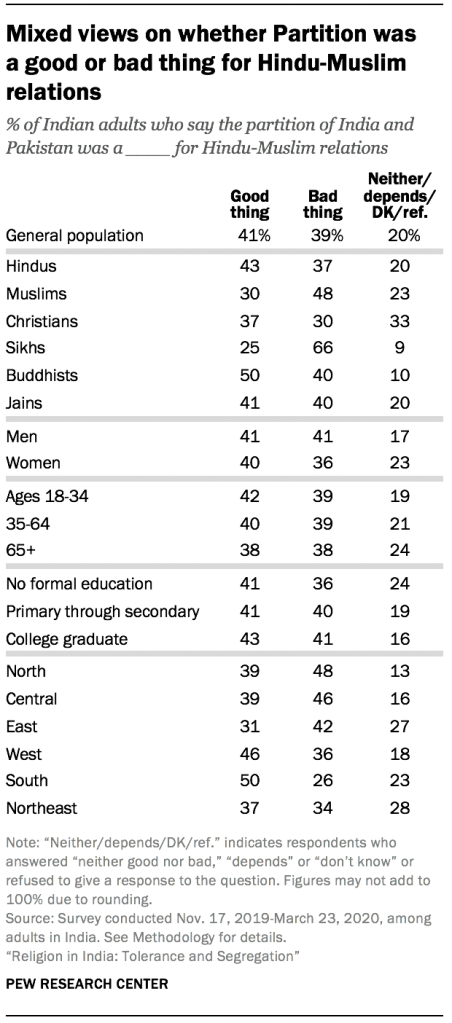
Mixed views on whether Partition was a good or bad thing for Hindu-Muslim relations

The end of Britain’s colonial rule in India, in 1947, was accompanied by the separation of Hindu-majority India from Muslim-majority Pakistan and massive migration in both directions. Nearly three-quarters of a century later, Indians are divided over the legacy of Partition.

About four-in-ten (41%) say the partition of India and Pakistan was a good thing for Hindu-Muslim relations, while a similar share (39%) say it was a bad thing. The rest of the population (20%) does not provide a clear answer, saying Partition was neither a good thing nor a bad thing, that it depends, or that they don’t know or cannot answer the question. There are no clear patterns by age, gender, education or party preference on opinions on this question.

Among Muslims, the predominant view is that Partition was a bad thing (48%) for Hindu-Muslim relations. Fewer see it as a good thing (30%). Hindus are more likely than Muslims to say Partition was a good thing for Hindu-Muslim relations (43%) and less likely to say it was a bad thing (37%).

Of the country’s six major religious groups, Sikhs have the most negative view of the role Partition played in Hindu-Muslim relations: Nearly two-thirds (66%) say it was a bad thing.

Most Indian Sikhs live in Punjab, along the border with Pakistan. The broader Northern region (especially Punjab) was strongly impacted by the partition of the subcontinent, and Northern Indians as a whole lean toward the position that Partition was a bad thing for Hindu-Muslim relations (48%) rather than a good thing (39%).

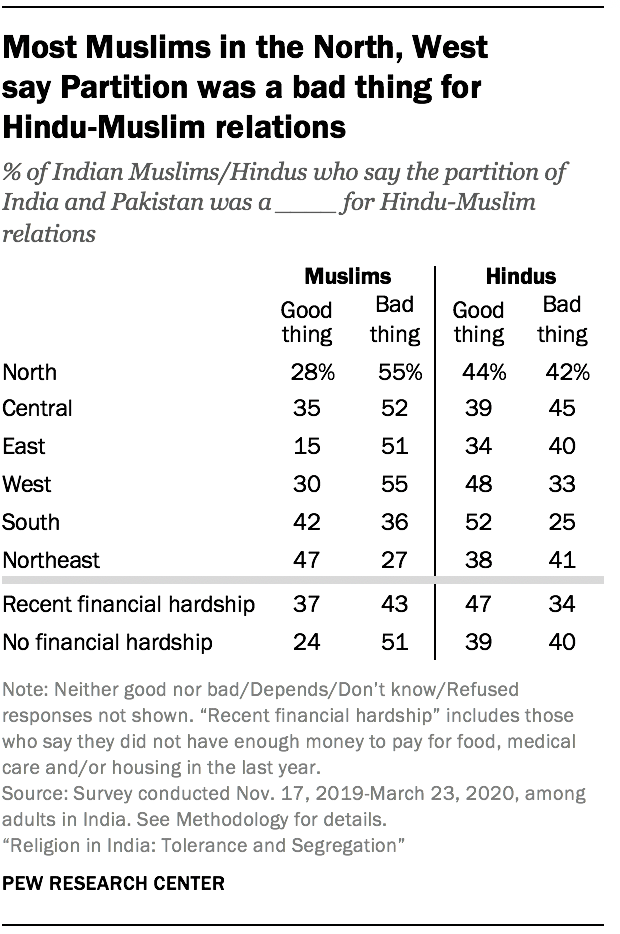
Most Muslims in the North, West say Partition was a bad thing for Hindu-Muslim relations

The South is the furthest region from the borders affected by Partition, and Southern Indians are about twice as likely to say that Partition was good as to say that it was bad for Hindu-Muslim relations (50% vs. 26%).

Attitudes toward Partition also vary considerably by region within specific religious groups. Among Muslims in the North and West, most say Partition was a bad thing for Hindu-Muslim relations (55% of Muslims in both regions). In the Eastern and Central parts of the country as well, Muslim public opinion leans toward the view that Partition was a bad thing for communal relations. By contrast, Muslims in the South and Northeast tend to see Partition as good for Hindu-Muslim relations.

Among Hindus, meanwhile, those in the North are closely divided on the issue, with 44% saying Partition was a good thing and 42% saying it was a bad thing. But in the West and South, Hindus tend to see Partition as a good thing for communal relations.

Poorer Hindus – that is, those who say they have been unable to afford basic necessities like food, housing and medical care in the last year – tend to say Partition was a good thing. But opinions are more divided among Hindus who have not recently experienced poverty (39% say it was a good thing, while 40% say it was a bad thing). Muslims who have not experienced recent financial hardship, however, are especially likely to see Partition as a bad thing: Roughly half (51%) say Partition was a bad thing for Hindu-Muslim relations, while only about a quarter (24%) see it as a good thing.

2. Diversity and pluralism

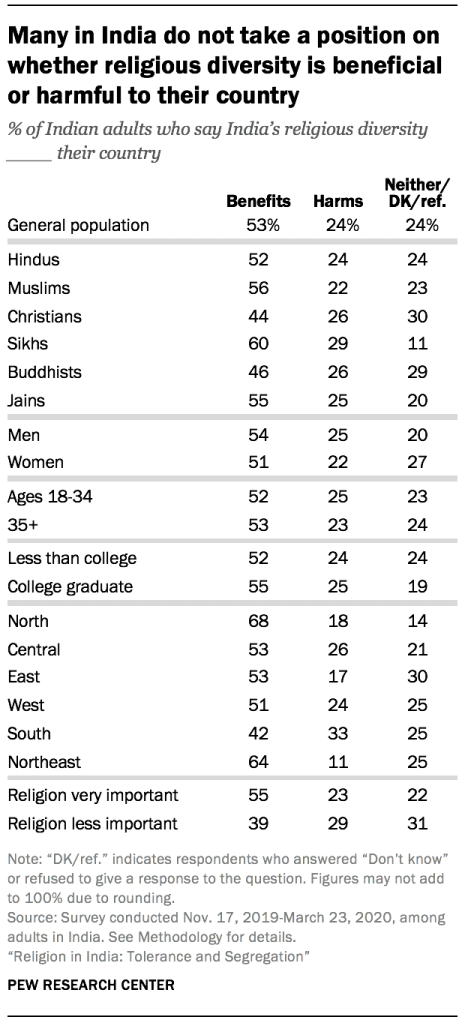
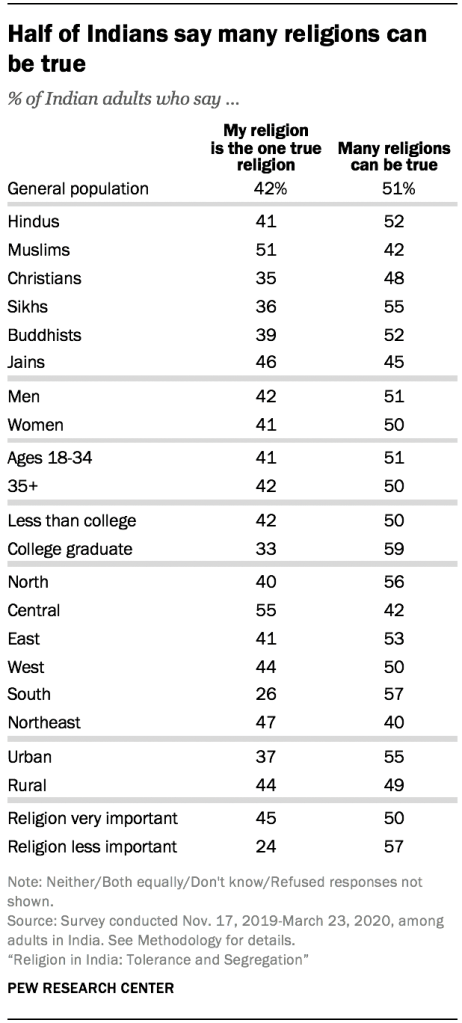
Indians are much more likely to view their country’s religious diversity as an asset than as a liability. About half of Indians (53%) say religious diversity benefits the country, while 24% say it is harmful. The remainder (24%) don’t take a position either way.

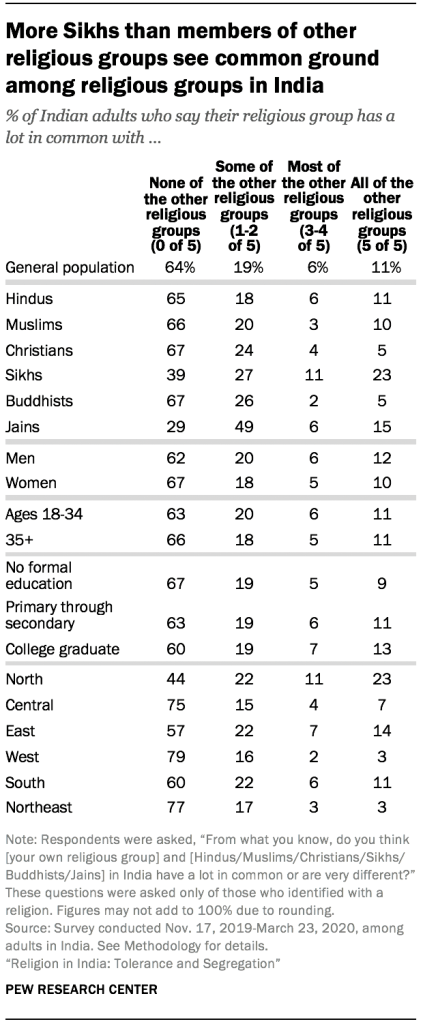
At the same time, Indians of different religious backgrounds don’t see much in common with each other. For example, most Muslims say members of their religious community are very different from Hindus or Sikhs, and vice versa – most Hindus and Sikhs see themselves as very different from Muslims. With few exceptions, India’s major religious groups perceive more differences than similarities between their communities.

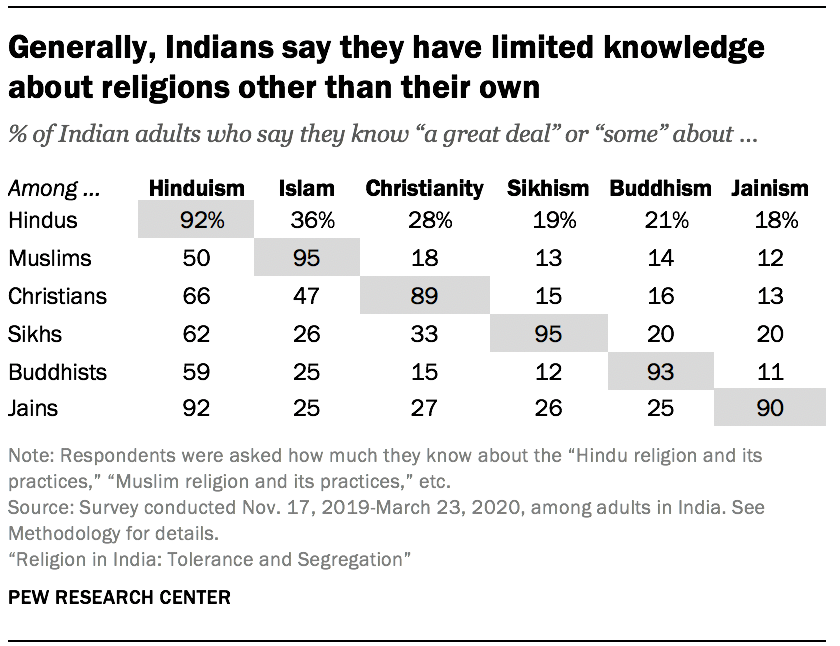
By their own admission, Indians also don’t know much about religions other than their own. While many Muslims, Christians, Sikhs, Jains and Buddhists say they know at least something about the Hindu religion, fewer Hindus claim any knowledge about India’s minority religions – even those, like Jainism or Sikhism, with some theological similarities to Hinduism.

India’s religiously diverse population is, therefore, composed of religious communities who are not too familiar with each other’s beliefs and practices, and who don’t see much common ground among them. Yet, many Indians take a pluralistic, rather than exclusivist, attitude toward religious beliefs. The predominant opinion among Indian adults overall, as well as within most of the country’s major religious groups, is that “many religions can be true,” rather than that theirs is “the one true religion.”

Many Indians also practice religion in a pluralistic way. For example, a substantial minority of Muslims, especially in some regions of the country, say they celebrate the festivals of Diwali and Holi, which are more commonly celebrated by Hindus, Sikhs, Buddhists and Jains. Many Christians also say they celebrate Diwali and Holi, while some Hindus celebrate Christmas. In addition, some members of India’s religious minority groups say they have prayed, meditated or performed a ritual at a Hindu temple. And, for their part, one-in-five Hindus in the North say they have worshipped at a gurdwara (a Sikh house of worship), and some in the South say they have prayed at a church. (See Chapter 7 and Chapter 11 for additional analyses of shared beliefs and practices across religious groups.)

More Indians say religious diversity benefits their country than say it is harmful

Many in India do not take a position on whether religious diversity is beneficial or harmful to their country

Home to more than nine-in-ten of the world’s Hindus, India also has one of the largest Muslim populations in the world, as well as millions of Sikhs, Jains, Buddhists and Christians.

Indians tend to see this religious diversity as benefiting their country. Roughly half say diversity benefits India (53%), while about one-quarter say diversity harms the country (24%). Generally, Indians of different ages, educational backgrounds and regions of residence tend to agree that diversity benefits the country.

However, a sizable minority (24%) does not take a clear position on the question, saying that diversity “neither benefits nor harms the country,” that they don’t know, or declining to answer the question.

Majorities of Sikhs (60%), Muslims (56%) and Jains (55%) say religious diversity benefits India. Meanwhile, fewer than half of Buddhists (46%) and Christians (44%) take this position; about three-in-ten in both groups do not provide a clear answer either way.

The most religious Indians – that is, those who say religion is very important to their lives – are more likely than those who are less religious to say religious diversity is beneficial to the country (55% vs. 39%).

Hindus who have a favorable view of the BJP say religious diversity benefits India

This difference between more and less religious people is largest among Hindus. Among Hindus who say religion is very important in their lives, most feel that diversity benefits the country (55%). But Hindus who say religion is less important in their lives are more evenly divided in their opinions: 37% say diversity benefits the country, 30% say diversity harms the country, and 33% don’t take a position either way.

Among Hindus, a majority of those who have a favorable opinion of the ruling Bharatiya Janata Party (BJP) say religious diversity benefits the country (57%), compared with 45% among those who have an unfavorable opinion of the BJP.

Within the Indian population as a whole, attitudes about religious diversity also vary by region: Majorities in the North (68%) and Northeast (64%) think diversity benefits the country. The South is somewhat less positive: Southerners generally are less likely than those in other regions to say diversity benefits the country.

Hindus in the South are relatively unenthusiastic about the benefits of religious diversity: 42% say diversity benefits the country. And while roughly half of Southern Muslims (48%) say India’s diversity helps the country, in the North (68%) and Northeast (75%), higher shares of Muslims see India’s religious diversity as an asset.

Most Buddhists, Muslims and Christians see members of their own religion as very different from Hindus

Even though Indians tend to value their country’s religious diversity, India’s religious communities generally don’t see much in common with one another. Across religious groups, large shares say that, based on what they know, members of their religious group are “very different” from followers of other religions. In fact, only 36% of all Indian adults say their group has “a lot in common” with even one of the five other major groups mentioned in the survey; the remainder (64%) either say they are very different from, or do not give a definite answer about, all five other groups.

For example, majorities among Indian Buddhists (67%), Muslims (64%) and Christians (58%) say they are very different from Hindus. Jains and Sikhs, on the other hand, tend to take the view that they have a lot in common with Hindus – 66% of Jains and 52% of Sikhs say this, the only two cases in which majorities or pluralities of one group say they have “a lot” in common with another group.

Most people in India’s non-Muslim religious groups don’t see much in common between the Muslim community and their own. Most Hindus (66%) say their group is very different from Muslims, as do nearly nine-in-ten Buddhists (88%). Sikhs are the most likely to say they have a lot in common with Muslims – 36% of Sikhs say this. Still, the majority view among Sikhs is that they are very different from Muslims (55%).

With few exceptions, Indians of different religious backgrounds don’t see much in common with other religious groups in the country
More Sikhs than members of other religious groups see common ground among religious groups in India

Generally, Sikhs are more inclined than others to say they have a lot in common with all groups asked about in the survey. Nearly a quarter of Sikhs (23%) say they have a lot in common with all other religious groups, compared with just 11% of Hindus who see common ground with all five groups.

While many Sikhs see common ground with other groups, members of those groups generally are less likely to say they have a lot in common with Sikhs. For instance, 52% of Sikhs say they have a lot in common with Hindus, while just 20% of Hindus say the same about Sikhs. Members of some of these groups may be less familiar with the relatively small Sikh population that is also concentrated in the state of Punjab; about three-in-ten Hindus and Muslims and four-in-ten Christians say they “don’t know” or otherwise decline to answer the question about how much they have in common with Sikhs.

People in the North of India are more likely than those in other regions to say their religious group has a lot in common with other groups. This pattern holds true across multiple religious groups. People in the Western, Central and Northeastern regions, meanwhile, generally are less likely to see commonalities among religious groups.

Indians are highly knowledgeable about their own religion, less so about other religions

Generally, Indians say they have limited knowledge about religions other than their own

Most Indians say they know a lot about their own religion. And very high shares in each religious group say they know at least some about their own faith. For example, 92% of Hindus say they know “a great deal” or “some” about the Hindu religion and its practices, and nearly all Sikhs (95%) say the same about Sikhism.

Considerably fewer people say they know a great deal – or even some – about other religions. For example, roughly a third of India’s Hindus (36%) say they know at least something about Islam, and even fewer say they know something about Christianity (28%). About one-in-five Hindus say they have at least some knowledge about Buddhism (21%), Sikhism (19%) or Jainism (18%), despite theological similarities between Hinduism and these three religions. Most Hindus say they know “not very much” or “nothing at all” about each of the other faiths.

Of course, the vast majority of Indians are Hindu, and it stands to reason that non-Hindus living in India would have at least some knowledge about Hinduism. Half of Muslims and most Jains (92%), Christians (66%), Sikhs (62%) and Buddhists (59%) say they know at least something about the Hindu religion and its practices.

Yet Christians, Sikhs, Jains, Buddhists and Muslims generally know less about one another’s religions. For example, just 26% of Sikhs say they know at least “some” about Islam, and only 13% of Muslims say they know something about the Sikh religion and its practices.

One exception is how much Christians know about Islam. Nearly half of Christians (47%) say they know either a lot or some about Islam. Far fewer Muslims (18%) say the same about Christianity.

More Muslims in the South of the country than elsewhere say they know about other religions. For example, about half of Muslims in the South (53%) say they have at least some knowledge of Christianity, compared with 18% of Muslims nationally. And a large majority of Southern Muslims (76%) say they know at least something about Hinduism, including (27%) who say they know a lot about the country’s majority religion. By comparison, half of Muslims nationally indicate they know at least something about Hinduism, and just 9% say they know a lot about the religion.

Among Hindus, those who are college educated are more likely to claim at least some knowledge about other religions. Hindus who live in the North of India are more likely than Hindus overall to say they know at least something about Sikhism (44% vs. 19% nationally), perhaps because many Sikhs are concentrated in the Northern state of Punjab. And Hindus from the South are much more likely than those elsewhere to say they have some knowledge of Islam (54% vs. 36% nationally) and Christianity (56% vs. 28% nationally).

Indians lean toward seeing truth in many religions

Half of Indians say many religions can be true

When asked which statement comes closest to their opinion – “My religion is the one true religion” or “Many religions can be true” – a sizable minority (42%) say theirs is the one true religion, while somewhat more (51%) take the view that many religions can be true.10

The predominant view among Hindus, Christians, Sikhs and Buddhists is that there are many true religions. Muslims have the largest share who take the position that theirs is the one true religion (51%). Jains are about evenly divided on this question.

Gender and age make little difference in whether people believe their religion is the only true one. There is, however, a link between education and views on this question: College-educated Indians are more likely than others to say many religions can be true (59% vs. 50%). Also, people living in urban areas of the country are slightly more inclined to take this position than rural Indians (55% vs. 49%).

Generally, Indians who are more religiously observant are much more likely to take the view that theirs is the one true religion. Among Indians who say religion is very important in their lives, 45% say only their religion is true, compared with a quarter (24%) of Indians who say religion is less important in their lives. This pattern holds among both Hindus and Muslims; for example, 53% of Muslims who say religion is very important in their lives see Islam as the one true religion, compared with 35% among those who consider religion less important.

Most Hindus in the North and South say many religions can be true; fewer Muslims agree

There are some partisan differences among Hindus on this question: Those who have a favorable view of the BJP are more likely than other Hindus to say Hinduism is the one true religion (45% vs. 32%).

Regionally, majorities of Indian adults in the North, East and South say many religions can be true. By contrast, those in the Central region are generally more likely to say their religion is the one true faith (55%).

Among Hindus in the North, a majority (57%) say many religions can be true. But among Northern Muslims, about the same share take the opposite view: 58% say Islam is the one true religion.

Substantial shares of Buddhists, Sikhs say they have worshipped at religious venues other than their own

In an effort to understand whether Indians of various religious backgrounds mix religious practices, the survey asked people if they have ever prayed, meditated or performed a ritual in a house of worship other than the one associated with their own religion. For example, Sikhs were asked if they have ever prayed, meditated or performed a ritual at a mosque, church, Hindu temple, Buddhist stupa or Sufi shrine. (For more discussion of religious beliefs and practices that many Indians have in common, see Chapter 7 and Chapter 11.)

Some non-Hindus say they have prayed, meditated or performed rituals at Hindu temples

The vast majority of Indians say they have not worshipped in religious sites belonging to other religions. But some have done so, especially in Hindu temples. For example, 38% of Buddhists say they have worshipped at a Hindu temple, as have about one-in-five Sikhs (22%) and Christians (20%). By comparison, fewer Muslims (8%) report having done so.

The distinction between Hindu and Jain temples is often ambiguous, so it stands to reason that a majority of Jains (67%) say they have worshipped at a Hindu temple. Some Jains (14%) also have prayed at a Sikh gurdwara.

About one-in-ten Sikhs (11%) and Muslims (10%) say they have prayed, meditated or performed a ritual at a Sufi shrine; Sufism tends to be most closely associated with a particular interpretation of Islam, although people of many faiths in India identify with Sufism (see Chapter 5 for details).

One-in-five Hindus in the North say they have prayed, meditated or performed a ritual at a Sikh gurdwara

Relatively small shares of Hindus say they have worshipped at sites associated with other faiths. But there is some regional variation in the shares of Hindus who have worshipped at non-Hindu venues. Most strikingly, in the North, fully one-in-five Hindus say they have worshipped at a gurdwara. Indian Sikhs are concentrated in the North, in the state of Punjab, which also is the home of the famous gurdwara known as the Golden Temple.

In the South, where many of India’s Christians are concentrated, about one-in-ten Hindus (12%) say they have prayed at a church, and roughly the same share (11%) say they have performed a ritual at a mosque.

Substantial minorities of Indians have worshipped at venues belonging to other religions

However, substantial minorities say they have worshipped at one or more venues belonging to another religion. For example, nearly one-in-five Hindus (17%) say they have prayed, meditated or performed a ritual at one or more of the five non-Hindu types of houses of worship asked about in the survey. Among Sikhs, 31% say they have worshipped at a church, mosque, Hindu temple, Sufi shrine or Buddhist stupa (or at more than one of these places). And among Buddhists, more than four-in-ten (44%) report having such an experience.

Among Muslims, 18% say they have prayed at a house of worship other than a mosque, including those who have worshipped at a Sufi shrine. (Sufi shrines are most closely associated with Islam, though there is also anti-Sufi sentiment among some Muslims in parts of the world.) Excluding Sufi shrines, one-in-ten Muslims in India have worshipped at a church, Hindu temple, Sikh gurdwara or Buddhist stupa.

Overall, men and college-educated Indians are slightly more likely to say they have prayed, meditated or performed a ritual at one or more venues associated with another religion. For example, 10% of college-educated Hindus have prayed at a church, compared with 6% of those who have less education.

One-in-five Muslims in India participate in celebrations of Diwali

One-in-five Indian Muslims, three-in-ten Christians say they celebrate Diwali

Indians celebrate myriad festivals and national holidays, each with its own rituals and traditions. The survey asked Indians of all religious backgrounds whether they participate in celebrating one national holiday (Independence Day), a few religious festivals associated with various groups (Diwali, Holi, Christmas and Eid), and the Western holiday of Valentine’s Day, which recently has gained some popularity in India.

As expected, most people celebrate festivals associated with their own religious tradition. Near-universal shares of Hindus (95%), Sikhs (90%) and Jains (98%) say they celebrate Diwali, as do about eight-in-ten Buddhists (79%). Muslims overwhelmingly say they participate in celebrations of Eid (93%), and virtually all Christians (97%) celebrate Christmas. In addition, the vast majority of Indians (87%), regardless of their religious background, commemorate the day India declared its independence from British rule, celebrated on Aug. 15.

But many Indians also celebrate festivals that are not traditionally associated with their respective religions. For example, substantial shares of Muslims (20%) and Christians (31%) in India say they participate in Diwali celebrations. Also, notable shares of both those religious communities (16% of Muslims and 25% of Christians) say they participate in celebrating Holi, the spring festival of color that is observed by most Hindus, Sikhs, Buddhists and Jains.

Fewer Hindus (and other non-Muslims) celebrate the Muslim holiday of Eid. Among Hindus, 7% say they participate in celebrations of Eid, as do 11% of Christians. But celebrations of Christmas are relatively popular among non-Christians in India: Nearly one-in-five Hindus, Sikhs and Jains say they participate in Christmas festivities.

Diwali celebrations more common among Muslims in the West, South

Hindus who are less religious are more likely to say they participate in celebrations of Christmas. These celebrations also are more common among Hindus in the South and among Hindus with a college education. For example, 23% of Hindus in the South say they celebrate Christmas, compared with about half as many in the Northeast (11%), even though both regions have a strong Christian presence. Christmas also is more commonly celebrated by urban than rural Hindus (23% vs. 14%).

Muslims vary regionally when it comes to celebrating Diwali and Holi. Among Muslims in the North, nearly a quarter (24%) say they celebrate Diwali, and 15% participate in Holi festivities. In Western India, even larger shares of Muslims say they participate in Diwali (39%) and Holi (31%) celebrations.

Valentine’s Day more commonly celebrated by college-educated, urban Indians; partisanship makes little difference

Moreover, fully one-in-five Indian adults (21%) say they celebrate Valentine’s Day. Though it is historically associated with Western Christianity, Indian Christians celebrate Valentine’s Day (27%) at about the same rate that they celebrate Diwali (31%) or Holi (25%). Christians also are about as likely as Sikhs (26%) to celebrate Valentine’s Day.

Nationally, marking Valentine’s Day tends to be more popular among young adults (35% among those ages 18 to 25), those who have a college education (40%) and those who live in urban areas (27%). It also is more commonly celebrated by people who do not consider religion very important in their lives (27%, vs. 20% among those who see religion as very important).

Even though some Hindu groups have criticized Valentine’s Day as foreign to Indian culture and inappropriate for a socially conservative society, participation in the holiday is not politically divided. People who have a favorable opinion of the ruling party are no less likely than those who have an unfavorable view of the BJP to say they celebrate Valentine’s Day (21% and 20%, respectively).

3. Religious segregation

Indians live religiously segregated lives. Most form friendship circles within their own religious community and marry someone of the same faith; interreligious marriages are very uncommon. Indeed, a majority of Indians say it is very important to stop both women and men in their community from marrying outside their religion.

Generally, Indians do not object to members of other religious groups living in their village or neighborhood. Still, a substantial share of Indian adults say they would be unwilling to accept members of certain other religions as neighbors.

These kinds of preferences for living separate lives vary by religion. While large shares of Hindus and Muslims say all their close friends share their religion, Christians and Buddhists tend to have slightly more mixed social circles and to attach less importance to stopping interreligious marriage.

Geography is also a factor. People in the South of India tend to be more religiously integrated and less opposed to interreligious marriages. For example, Hindus who live in the South are more likely than Hindus in other regions to say they would accept a Muslim or a Christian as a neighbor. The Central region of the country, by contrast, stands out as highly religiously segregated.

Views on religious segregation also are related to levels of education. In general, Indians with a college degree are more inclined to accept people of other faiths as neighbors, and less opposed to religious intermarriage, than are Indians who have less education.

Among Hindus in particular, attitudes toward interreligious marriages and neighborhoods are closely tied to views on politics and national identity. Hindus who strongly favor religious segregation – those who say that all their close friends are Hindus, that it is very important to stop Hindus from marrying outside the faith and that they would not accept people of some other faiths as neighbors – are much more likely than other Hindus to take the position that it is very important to be a Hindu to be “truly” Indian. They are also more likely to have voted for the Bharatiya Janata Party (BJP) in the 2019 parliamentary elections.

Members of both large and small religious groups mostly keep friendships within religious lines

Indians tend to form their friendships within their own religious community

In India, a person’s religion is typically also the religion of that person’s close friends. A large majority of Indian adults say that either “all” (45%) or “most” (40%) of their close friends have the same religion they do. Relatively few adults (13%) have a more mixed friendship circle, saying that “some,” “hardly any” or “none” of their friends share their faith.

Nearly half of Hindus (47%) say all of their close friends share their religious identity, and an additional 39% say most of their friends are fellow Hindus. But the country’s religious minorities also have friendship circles consisting largely of people of their own religion. For example, the vast majority of Muslims (88%) say all or most of their friends are Muslim.

People belonging to smaller religious groups are less likely than Hindus and Muslims to say all their friends are of the same religion. Still, Christians, Sikhs, Buddhists and Jains also tend to form friendships mostly within their group. For example, among Jains – who make up less than 0.5% of India’s population – 72% say their close friends are entirely (28%) or mostly (45%) other Jains.

Generally, Indians who have a college degree and those who live in urban areas are more likely than others to have a mixed circle of friends. Religious observance is a factor as well: People who are more observant are more inclined to be friends only with people who share their religion. For example, among Indians who say religion is very important in their lives, nearly half (47%) say all their friends share their religion, compared with about a third (34%) who say this among those who are less religious.

Men are somewhat more likely than women to have a religiously mixed friendship circle. But age makes little difference: Within the population as a whole, as well as within the major religious groups, younger adults are about as likely as older people to say all their close friends share their same religion.

Regionally, people in the South are less likely than those in other regions to say all their close friends share their religion (29%). Among Hindus in the South, 31% say all their close friends are also Hindu, compared with 47% of Hindus nationally who say their friendship circle is exclusively Hindu. An even lower share of Muslims in the region (19%) say all their friends are Muslims, while 45% of Muslims across the country say all their close friends are fellow Muslims.

Most Indians are willing to accept members of other religious communities as neighbors, but many express reservations

India’s minority communities generally say they would be willing to accept a Hindu as a neighbor

Majorities in India say, hypothetically, that they would be willing to accept members of other religious groups as neighbors.

For instance, large majorities of Muslims (78%) and members of other religious minority communities say they would be willing to live near a Hindu – which may be unsurprising given that Hindus make up a large majority of India’s population.

Among Hindus, most say they would be willing to live near a member of a religious minority, such as a Muslim (57%), a Christian (59%) or a Jain (59%). But many Hindus express reservations about such an arrangement. For example, 36% of Hindus say they would not be willing to live near a Muslim, and 31% say they would not want a Christian living in their neighborhood. Jains are even more likely to express such views: 54% would not accept a Muslim as a neighbor, and 47% say the same about Christians.

By contrast, Buddhists are most likely to voice acceptance of other religious groups. Roughly eight-in-ten Buddhists in India say they would be willing to accept a Muslim, Christian, Sikh or Jain as a neighbor, and even more (89%) say they would accept a Hindu.

In a few cases, considerable shares of people decline to answer these questions, possibly because of a lack of familiarity with particular religious groups. For example, 18% of Hindus in Southern India do not answer whether they would be willing to accept a Sikh as a neighbor, perhaps because Sikhs are largely concentrated in the North. Similarly, substantial shares of Muslims in several regions are unsure or don’t clearly say whether they would be willing to live next to a Jain; India’s Jains are most heavily concentrated in the West.

College-educated Hindus express greater willingness to accept a person of a different religion as a neighbor

Generally, people who have more education are more likely to say they would accept people of other religions as neighbors. For example, 63% of Hindus with a college degree say they would be willing to accept a Muslim in their neighborhood, compared with 56% of those with less education. Among Hindus, those who live in urban areas of the country also express higher levels of tolerance in this respect.

Hindus who are more religiously observant tend to be somewhat less willing to accept a Muslim or a Christian in their neighborhoods. Among those who say religion is very important in their lives, 56% say they would be willing to accept a Muslim as a neighbor, compared with 62% of those who consider religion less important to them.

Politically, Hindus who voted for the BJP in the 2019 elections tend to be less willing to accept some religious minorities in their village or residential area. About half of Hindus who voted for the BJP say they would be willing to accept a Muslim (51%) or a Christian (53%) as neighbors, compared with higher shares of those who voted for other parties (64% and 67%, respectively). But there is little difference by partisanship among Hindus when it comes to whether they would be willing to accept a Sikh, Buddhist or Jain as a neighbor.

Hindus also vary regionally in their attitudes on accepting religious minorities. Hindus in the Central region tend to be less willing to accept a Muslim (46%) or a Christian (45%) as a neighbor. Meanwhile, far larger shares of Hindus in the South say they would be willing to have Muslims (75%) or Christians (77%) living nearby.

In Northeast India, skepticism about accepting neighbors of other religions

In general, Indians in the remote Northeastern region are less likely than people elsewhere to express a willingness to accept members of other faiths. For instance, about one-in-three Hindus in Northeastern India say they would be willing to live near a Muslim (34%) or a Christian (31%), compared with majorities of Hindus nationally who say they would be willing to live near a member of either religious group. Among Muslims and Christians in the region, about half or fewer express willingness to live near a Hindu, or near each other. For example, roughly one-third (36%) of Muslims in the Northeast say they would accept a Christian neighbor, and 25% of Christians would accept a Muslim neighbor.

Notable shares in the Northeast also report that they “don’t know” or otherwise refused to answer the question, possibly due to unfamiliarity with some groups. For example, roughly one-in-five or more Muslims and Christians opt out of answering the question about Sikhs and Jains – groups that make up only a tiny share of the region’s population. For more on religious divisions in Northeastern India, see Chapter 1.

Indians generally marry within same religion

Indians almost never marry across religious lines

Very few Indians say they are married to someone who currently follows a different religion than their own. Indeed, nearly all married people (99%) report that their spouse shares their religion. This includes nearly universal shares of Hindus (99%), Muslims (98%), Christians (95%), Sikhs and Buddhists (97% each). (The survey did not include enough interviews with married Jains to report on the religion of their spouses.)

The survey also asked respondents whether their spouse was raised in their current religion, or whether their spouse was raised in a different religion and converted. Overall, the vast majority of people say their spouse currently has the same religion in which he or she was raised. Less than 1% of all Indian marriages are with spouses who were raised in a different religion (but may have since converted). (For a more detailed discussion of religious conversion, see “Religious conversion in India” in the report overview.)

Most Hindus, Muslims, Sikhs and Jains strongly support stopping interreligious marriage

Most Indians say it is very important to stop interreligious marriage

Not only are interreligious marriages rare in India, but in recent years, some couples marrying outside their communities have experienced severe consequences, including being ostracized and even killed by family members.

The survey asked Indians how important it is to stop men and women in their community from marrying into another religion. Overwhelming shares of Indians say it is at least “somewhat” important to stop people from entering into interreligious marriages, and most say it is “very” important to stop such marriages. (For an analysis of attitudes on stopping inter-caste marriage, see Chapter 4.)

The Indian public prioritizes stopping the interreligious marriage of women and men at nearly equal rates. About two-thirds of Indians (65%) say it is very important to stop men from marrying into another religion, while roughly the same share (67%) say stopping interreligious marriage of women is a high priority.11

Most Hindus, Muslims, Sikhs and Jains say it is very important to stop men and women in their community from marrying outside their religion. But considerably fewer Christians and Buddhists feel this way. Among Christians, 37% say it is very important to stop the interreligious marriage of women, and 35% say the same about men. Among Buddhists, 46% say stopping the interreligious marriage of women is a high priority, and 44% say this for men.

Highly religious Indians are especially likely to prioritize stopping interreligious marriage. For example, among adults who say religion is very important in their lives, a majority (70%) give high priority to stopping the interreligious marriage of men, compared with 39% of those who say religion is less important to them.

Education, importance of religion tied to views on interreligious marriage

Nearly all religious groups show this gap in opinion. Among Muslims, for example, 82% of those who consider religion to be very important in their lives say stopping women in their community from marrying into other religions is very important, compared with 59% of Muslims for whom religion is less important.

In addition, Indians with lower levels of education are much more likely than college-educated Indians to prioritize stopping interreligious marriage. Among those who do not have a college education, roughly two-thirds (69%) say stopping the interreligious marriage of women is very important, compared with 54% among those with a college degree. This pattern is consistent across most religious groups.

Men and women are generally about equally likely to favor preventing people of both sexes from marrying outside of their religion. For example, 67% of men say it is very important to stop women in their community from marrying outside of their religion, while 68% of women express the same position.

However, attitudes about religious intermarriage vary greatly depending on where people live in the country. Rural Indians are more likely than those who live in urban environments to say it is very important to stop both men and women from marrying outside of their religion.

And Indians who live in the Central region of the country are more inclined than people in other regions to say it is very important to stop people from marrying outside of their religion. Among Hindus in the Central region, for instance, 82% say stopping the interreligious marriage of Hindu women is very important, compared with 67% of Hindus nationally. Among Muslims in the region, nearly all (96%) see it as crucial to stop Muslim women from marrying outside the faith, versus 80% of Muslims nationally.

Among Hindus, those who favor BJP are more likely to see stopping interreligious marriage as a high priority

Southerners are much less likely to prioritize stopping interreligious marriage. Among both Hindus and Muslims, fewer people in the South than in other regions say it is very important to stop the interreligious marriage of men or women in their community.

Among Hindus, those who have a favorable view of the BJP are more likely than those who see the BJP unfavorably to prioritize stopping the interreligious marriage of men or women. A large majority (70%) of those who have a favorable view of the BJP say stopping Hindu men from intermarrying is very important, compared with just over half of those who have an unfavorable view of the ruling party (54%). Hindus show a similar gap in opinion by partisanship when it comes to interreligious marriage of Hindu women.

An index of religious segregation in India

Substantial shares among Hindus, Muslims and Jains score at higher end of religious segregation index

How people form friendship circles, the importance they place on stopping interreligious marriages and their views on who they are willing to accept in their neighborhood can be combined into an index of religious segregation that ranges from 0 to 6.

The higher the score on the scale, the more the respondent prefers religious segregation. For instance, people who say all their friends belong to the same religion, that they consider it very important to stop interreligious marriage, and that they would object to having people of every other religion as a neighbor would score the highest on the scale (6).

Those who have a religiously mixed friend circle, don’t think it is important to stop interreligious marriage and don’t object to having people of any other religion as neighbors would score at the lowest level (0). In between is a spectrum of preferences about the extent to which people prefer to live religiously segregated lives. (For more details on how the scale is constructed, see Appendix B.)

Few Indians score at the extreme ends of the scale, either scoring 0 (the lowest level of preference for religious segregation) or scoring 6 (the highest level of preference for religious segregation). For example, just 2% of Hindus score 0 and 13% score 6, which is comparable to the shares of Muslims who receive these scores on the index.

But half or more of Hindus (55%), Muslims (51%) and Jains (51%) rank toward the high end of the religious segregation scale, with a score of 4 or higher. Christians, Buddhists and Sikhs, meanwhile, tend to score lower, with majorities among all three groups at 3 or below.

Among Hindus, attitudes toward religious segregation closely tied to views on national identity, voting

Among Hindus, attitudes toward religious segregation are highly correlated with their views on religious and national identity. As Hindus’ score on the religious segregation index rises, so does their likelihood of saying it is very important to be Hindu to be “truly” Indian. And those who prefer to live more segregated lives also are more likely to say that it is very important to be able to speak Hindi to be truly Indian, as well as that a person who eats beef cannot be Hindu.

Hindus who score high on the scale report having voted for the BJP at higher rates in the 2019 election, too.

Geographically, among Hindus, the Central region has the highest concentration of people who score a full 6 on the scale (23%). By comparison, just 4% of Hindus in the South score at the top of the scale.

4. Attitudes about caste

The caste system has existed in some form in India for at least 3,000 years. It is a social hierarchy passed down through families, and it can dictate the professions a person can work in as well as aspects of their social lives, including whom they can marry. While the caste system originally was for Hindus, nearly all Indians today identify with a caste, regardless of their religion.

The survey finds that three-in-ten Indians (30%) identify themselves as members of General Category castes, a broad grouping at the top of India’s caste system that includes numerous hierarchies and sub-hierarchies. The highest caste within the General Category is Brahmin, historically the priests and other religious leaders who also served as educators. Just 4% of Indians today identify as Brahmin.

Most Indians say they are outside this General Category group, describing themselves as members of Scheduled Castes (often known as Dalits, or historically by the pejorative term “untouchables”), Scheduled Tribes or Other Backward Classes (including a small percentage who say they are part of Most Backward Classes).

Hindus mirror the general public in their caste composition. Meanwhile, an overwhelming majority of Buddhists say they are Dalits, while about three-quarters of Jains identify as members of General Category castes. Muslims and Sikhs – like Jains – are more likely than Hindus to belong to General Category castes. And about a quarter of Christians belong to Scheduled Tribes, a far larger share than among any other religious community.

Caste segregation remains prevalent in India. For example, a substantial share of Brahmins say they would not be willing to accept a person who belongs to a Scheduled Caste as a neighbor. But most Indians do not feel there is a lot of caste discrimination in the country, and two-thirds of those who identify with Scheduled Castes or Tribes say there is not widespread discrimination against their respective groups. This feeling may reflect personal experience: 82% of Indians say they have not personally faced discrimination based on their caste in the year prior to taking the survey.

Still, Indians conduct their social lives largely within caste hierarchies. A majority of Indians say that their close friends are mostly members of their own caste, including roughly one-quarter (24%) who say all their close friends are from their caste. And most people say it is very important to stop both men and women in their community from marrying into other castes, although this view varies widely by region. For example, roughly eight-in-ten Indians in the Central region (82%) say it is very important to stop inter-caste marriages for men, compared with just 35% in the South who feel strongly about stopping such marriages.

India’s religious groups vary in their caste composition

Most Indians (68%) identify themselves as members of lower castes, including 34% who are members of either Scheduled Castes (SCs) or Scheduled Tribes (STs) and 35% who are members of Other Backward Classes (OBCs) or Most Backward Classes. Three-in-ten Indians identify themselves as belonging to General Category castes, including 4% who say they are Brahmin, traditionally the priestly caste.12

Hindu caste distribution roughly mirrors that of the population overall, but other religions differ considerably. For example, a majority of Jains (76%) are members of General Category castes, while nearly nine-in-ten Buddhists (89%) are Dalits. Muslims disproportionately identify with non-Brahmin General Castes (46%) or Other/Most Backward Classes (43%).

Caste classification is in part based on economic hierarchy, which continues today to some extent. Highly educated Indians are more likely than those with less education to be in the General Category, while those with no education are most likely to identify as OBC.

But financial hardship isn’t strongly correlated with caste identification. Respondents who say they were unable to afford food, housing or medical care at some point in the last year are only slightly more likely than others to say they are Scheduled Caste/Tribe (37% vs. 31%), and slightly less likely to say they are from General Category castes (27% vs. 33%).

The Central region of India stands out from other regions for having significantly more Indians who are members of Other Backward Classes or Most Backward Classes (51%) and the fewest from the General Category (17%). Within the Central region, a majority of the population in the state of Uttar Pradesh (57%) identifies as belonging to Other or Most Backward Classes.

Most Indians say they are members of a Scheduled Caste, Scheduled Tribe or Other Backward Class; Jains are a notable exception

Indians in lower castes largely do not perceive widespread discrimination against their groups

Majority of Indians do not see widespread discrimination against Scheduled Castes and Tribes

When asked if there is or is not “a lot of discrimination” against Scheduled Castes, Scheduled Tribes and Other Backward Classes in India, most people say there isn’t a lot of caste discrimination. Fewer than one-quarter of Indians say they see evidence of widespread discrimination against Scheduled Castes (20%), Scheduled Tribes (19%) or Other Backward Classes (16%).

Generally, people belonging to lower castes share the perception that there isn’t widespread caste discrimination in India. For instance, just 13% of those who identify with OBCs say there is a lot of discrimination against Backward Classes. Members of Scheduled Castes and Tribes are slightly more likely than members of other castes to say there is a lot of caste discrimination against their groups – but, still, only about a quarter take this position.

Christians are more likely than other religious groups to say there is a lot of discrimination against Scheduled Castes and Scheduled Tribes in India: About three-in-ten Christians say each group faces widespread discrimination, compared with about one-in-five or fewer among Hindus and other groups.

At least three-in-ten Indians in the Northeast and the South say there is a lot of discrimination against Scheduled Castes, although similar shares in the Northeast decline to answer these questions. Just 13% in the Central region say Scheduled Castes face widespread discrimination, and 7% say the same about OBCs.

Highly religious Indians – that is, those who say religion is very important in their lives – tend to see less evidence of discrimination against Scheduled Castes and Tribes. Meanwhile, those who have experienced recent financial hardship are more inclined to see widespread caste discrimination.

Most Indians do not have recent experience with caste discrimination

Relatively few Indians, including people in lower castes, say they experience caste discrimination

Not only do most Indians say that lower castes do not experience a lot of discrimination, but a strong majority (82%) say they have not personally felt caste discrimination in the past 12 months. While members of Scheduled Castes and Tribes are slightly more likely than members of other castes to say they have personally faced caste-based discrimination, fewer than one-in-five (17%) say they have experienced this in the last 12 months.

But caste-based discrimination is more commonly reported in some parts of the country. In the Northeast, for example, 38% of respondents who belong to Scheduled Castes say they have experienced discrimination because of their caste in the last 12 months, compared with 14% among members of Scheduled Castes in Eastern India.

Jains, the vast majority of whom are members of General Category castes, are less likely than other religious groups to say they have personally faced caste discrimination (3%). Meanwhile, Indians who indicate they have faced recent financial hardship are more likely than those who have not faced such hardship to report caste discrimination in the last year (20% vs. 10%).

Most Indians OK with Scheduled Caste neighbors

Large shares of Indians who do not belong to Scheduled Castes/Tribes would accept a Dalit neighbor

The vast majority of Indian adults say they would be willing to accept members of Scheduled Castes as neighbors. (This question was asked only of people who did not identify as members of Scheduled Castes or Scheduled Tribes.)

Among those who received the question, large majorities of Christians (83%) and Sikhs (77%) say they would accept Dalit neighbors. But a substantial portion of Jains, most of whom identify as belonging to General Category castes, feel differently; about four-in-ten Jains (41%) say that they would not be willing to accept Dalits as neighbors. (Because more than nine-in-ten Buddhists say they are members of Scheduled Castes or Scheduled Tribes, not enough Buddhists were asked this question to allow for separate analysis of their answers.)

About three-in-ten Brahmins (29%) say they would not be willing to accept members of Scheduled Castes as neighbors.

In most regions, at least two-thirds of people express willingness to accept Scheduled Caste neighbors. The Northeast, however, stands out, with roughly equal shares saying they would (41%) or would not (39%) be willing to accept Dalits as neighbors, although this region also has the highest share of respondents – 20% – who gave an unclear answer or declined to answer the question.

Indians who live in urban areas (78%) are more likely than rural Indians (69%) to say they would be willing to accept Scheduled Caste neighbors. And Indians with more education also are more likely to accept Dalit neighbors. Fully 77% of those with a college degree say they would be fine with neighbors from Scheduled Castes, while 68% of Indians with no formal education say the same.

Politically, those who have a favorable opinion of the BJP are somewhat less likely than those who have an unfavorable opinion of India’s ruling party to say they would accept Dalits as neighbors, although there is widespread acceptance across both groups (71% vs. 77%).

Indians generally do not have many close friends in different castes

Seven-in-ten Indians say all or most of their close friends share their caste

Indians may be comfortable living in the same neighborhoods as people of different castes, but they tend to make close friends within their own caste. About one-quarter (24%) of Indians say all their close friends belong to their caste, and 46% say most of their friends are from their caste.

About three-quarters of Muslims and Sikhs say that all or most of their friends share their caste (76% and 74%, respectively). Christians and Buddhists – who disproportionately belong to lower castes – tend to have somewhat more mixed friend circles. Nearly four-in-ten Buddhists (39%) and a third of Christians (34%) say “some,” “hardly any” or “none” of their close friends share their caste background.

Members of OBCs are also somewhat more likely than other castes to have a mixed friend circle. About one-third of OBCs (32%) say no more than “some” of their friends are members of their caste, compared with roughly one-quarter of all other castes who say this.

Women, Indian adults without a college education and those who say religion is very important in their lives are more likely to say that all their close friends are of the same caste as them. And, regionally, 45% of Indians in the Northeast say all their friends are part of their caste, while in the South, fewer than one-in-five (17%) say the same.

Large shares of Indians say men, women should be stopped from marrying outside of their caste

Most Indians say it is crucial to stop inter-caste marriages

As another measure of caste segregation, the survey asked respondents whether it is very important, somewhat important, not too important or not at all important to stop men and women in their community from marrying into another caste. Generally, Indians feel it is equally important to stop both men and women from marrying outside of their caste. Strong majorities of Indians say it is at least “somewhat” important to stop men (79%) and women (80%) from marrying into another caste, including at least six-in-ten who say it is “very” important to stop this from happening regardless of gender (62% for men and 64% for women).

Majorities of all the major caste groups say it is very important to prevent inter-caste marriages. Differences by religion are starker. While majorities of Hindus (64%) and Muslims (74%) say it is very important to prevent women from marrying across caste lines, fewer than half of Christians and Buddhists take that position.

Among Indians overall, those who say religion is very important in their lives are significantly more likely to feel it is necessary to stop members of their community from marrying into different castes. Two-thirds of Indian adults who say religion is very important to them (68%) also say it is very important to stop women from marrying into another caste; by contrast, among those who say religion is less important in their lives, 39% express the same view.

Regionally, in the Central part of the country, at least eight-in-ten adults say it is very important to stop both men and women from marrying members of different castes. By contrast, fewer people in the South (just over one-third) say stopping inter-caste marriage is a high priority. And those who live in rural areas of India are significantly more likely than urban dwellers to say it is very important to stop these marriages.

Older Indians and those without a college degree are more likely to oppose inter-caste marriage. And respondents with a favorable view of the BJP also are much more likely than others to oppose such marriages. For example, among Hindus, 69% of those who have a favorable view of BJP say it is very important to stop women in their community from marrying across caste lines, compared with 54% among those who have an unfavorable view of the party.

CORRECTION (August 2021): A previous version of this chapter contained an incorrect figure. The share of Indians who identify themselves as members of lower castes is 68%, not 69%.

5. Religious identity

The vast majority of Indians identify with six major religious groups: Hindus, Muslims, Christians, Sikhs, Buddhists and Jains. In this report, respondents are often categorized accordingly, based on their answers to a question about their religious identity. But the survey also finds that for most members of these six groups, these identities are not only about religion.
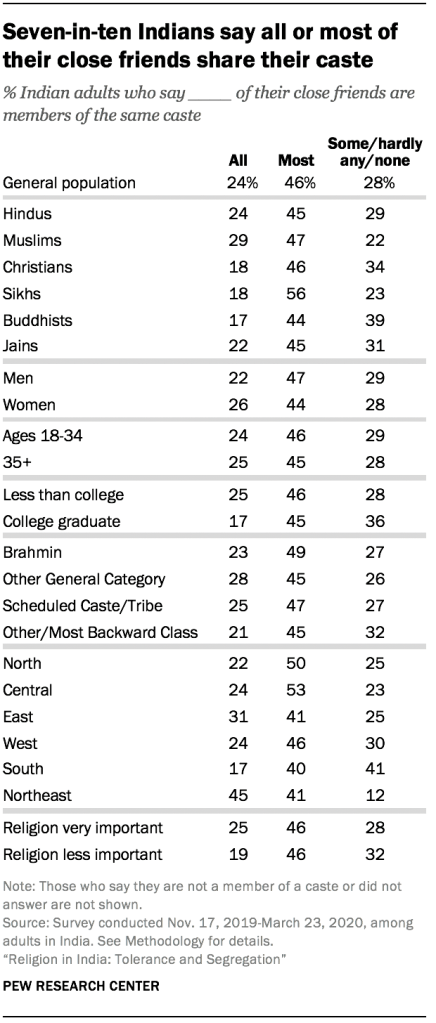
Indeed, Indians are split over whether being a member of their religious group (e.g., being Sikh or being Muslim) is mainly a matter of religion, mainly a matter of culture or ancestry, or some combination of religion and culture/ancestry. There is no clear consensus on this in any of the six religious groups. Among Hindus in India, for example, there is no single understanding of what it means to be a Hindu.
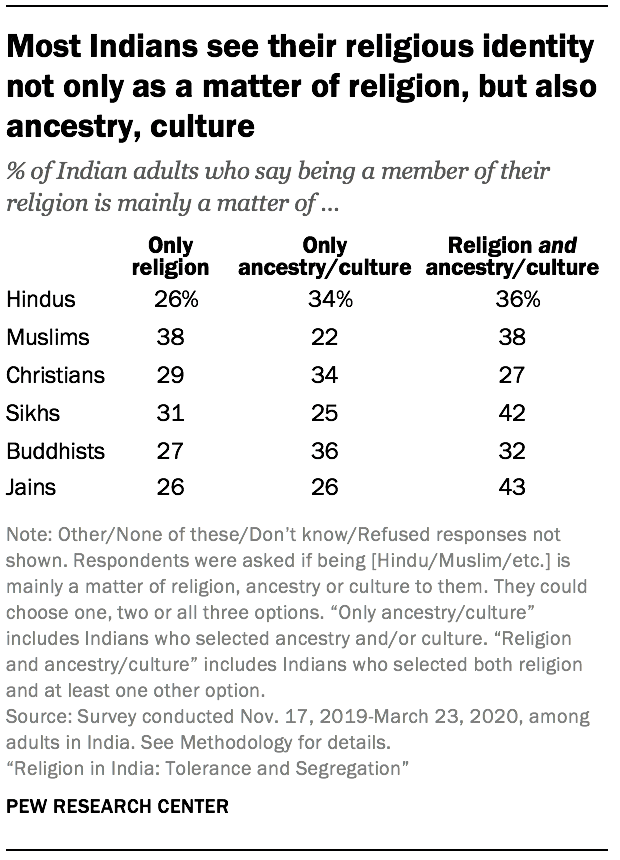
On the other hand, there is substantial agreement on some beliefs, practices and attributes that are very important to Indians’ religious identities. For instance, overwhelming shares across groups see both secular behaviors – such as respecting elders, helping the poor and needy, and respecting India – and more overtly religious attributes, such as believing in God and praying, as crucial to what being a member of their group means to them. Indian Buddhists are the lone exception on some of these measures, with far fewer saying belief in God and prayer are central to being Buddhist.

The survey also approached the concept of religious identity and belonging from the other direction: In addition to what is very important to being Christian or Jain, for example, what is disqualifying for members of each group? A strong majority of followers say that people who do not abide by dietary restrictions prohibiting the consumption of beef (for Hindus, Sikhs and Jains) or pork (for Muslims) cannot be members of their community. But when it comes to whether a person can claim their religious identity even if they do not engage in the traditional religious practices of communal worship or prayer, there is less agreement.

The remainder of this chapter looks at these questions in greater detail. It also examines Indians’ identification with subgroups or sects within each of the six major religions, as well as with Sufism.

Most Indians say being a member of their religious group is not only about religion

Most Indians see their religious identity not only as a matter of religion, but also ancestry, culture

Nearly all Indian adults identify with a religious group, but for most of them – regardless of which group they are a part of – this identity is not just about religion.

Respondents were asked whether being a member of their religious group (e.g., being Hindu, Christian or Sikh) is mainly a matter of religion, ancestry or culture – or some combination of the three.

Overall, only around a quarter of Indian Hindus (26%) say being Hindu is only a matter of religion. A somewhat greater share (34%) believe it is solely a matter of ancestry and/or culture, and a similar portion (36%) believe Hinduism is a matter of religion and ancestry/culture.

Hindus’ views on religious identity vary by region

Muslims in India are more likely than Hindus to say their identity is only a matter of religion (38%) and less likely to view being Muslim exclusively as a matter of ancestry and/or culture (22%). Like Hindus, however, many say being Muslim is a combination of these things (38%).

Overall, Christians, Sikhs, Buddhists and Jains are split on this question, with no more than about three-in-ten in any of these groups linking their identity solely with religion. For instance, among Jains, 26% say being Jain is only about religion; an identical share say it is only about ancestry and/or culture, and a plurality (43%) say it is some mixture of religion and ancestry/culture.

Among Indian Hindus, there are regional differences in views toward Hindu identity. Hindus in the South (12%) are less likely than others to say being Hindu is exclusively a matter of religion, while those in Eastern (38%) and Central (32%) India are most likely to link Hinduism solely with religion.
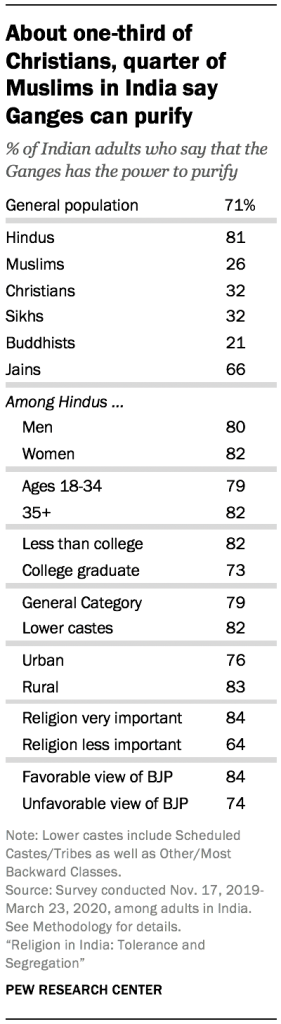
Still, across all regions, most Hindus say that to them, being Hindu is wrapped up with ancestry and/or culture in addition to (or instead of) religion. And in the South, roughly half (53%) say being Hindu is only a matter of ancestry and/or culture – and not mainly a matter of religion.

Most Indian Muslims associate being Muslim with religion, but many also see links with ancestry, culture

Overall, Hindus with higher religious commitment are slightly more likely to connect their religious identity exclusively with religion. Hindus who say religion is very important in their lives are more likely than others to say that being Hindu is a matter only of religion (27% vs. 20%).

Indian Muslims also express differing views on what it means to be Muslim depending on where they live. A majority of Muslims in the Central region (63%) say that to them, being Muslim is a matter only of religion, while significantly smaller shares of Muslims express this view in the rest of the country. In Southern India, for example, just 18% say being Muslim is a matter of religion alone, while the vast majority say their Muslim identity is tied up with ancestry and/or culture.

Muslims in lower castes are more likely to associate Muslim identity only with religion.

Common ground across major religious groups on what is essential to religious identity

The survey asked Indian adults how important each of seven attributes or behaviors is to their religious identity. Overall, Indians across all major religions generally say these seven traits are very important to what it means to them to be Hindu, Muslim, Christian, Sikh, Buddhist or Jain.

For example, roughly eight-in-ten or more in all six groups say respecting elders, respecting India, helping the poor and needy, and being born into a family of their religion (e.g., being born into a Muslim family or being born into a Christian family) are all very important to their religious identity. And about seven-in-ten or more say respecting other religions is crucial to being a member of their own religious group, whether they are Hindu (80%), Muslim (79%) or something else.

Indeed, India’s two largest religious groups look very similar on most of these questions: Hindus and Muslims agree that believing in God (88% and 90%, respectively), helping the poor and needy (85% and 83%) and respecting India (93% and 91%) are very important to their religious identity. The largest difference emerges in the groups’ views on praying or offering namaz; Muslims are more likely than Hindus to say prayer is very important to being a member of their group (96% vs. 82%), although overwhelming shares of both religious groups view prayer as important.

Respecting India, respecting elders are shared values across all of India’s major religious groups

Buddhists in India stand out as much less likely to tie prayer – and also belief in God – to their Buddhist identity, reflecting the relatively low importance of these beliefs and practices in the Buddhist religion. While about eight-in-ten or more in each of India’s other major religious groups say believing in God and praying are very important to what it means to be a member of their religious group, far fewer Buddhists (51%) say believing in God is crucial to what being Buddhist means to them, and 57% say the same about praying.

These large differences between Buddhists and members of other religions do not exist across other behaviors or traits. If anything, Buddhists are slightly more likely than other groups to say that respecting elders, respecting India and respecting other religions are very important to being Buddhist.

Hindu and Muslim opinion on identity varies by religious commitment

Among Hindus and Muslims, there are large differences on some of these questions based on differing levels of religious commitment. Generally, Hindu and Muslim adults who say religion is very important in their lives are more likely than other adults to say these seven traits are very important to their religious identity. For example, strongly committed Muslims are more likely than other Muslims to say believing in God is very important to being Muslim (91% vs. 78%). And while 92% of highly religious Hindus say being born into a Hindu family is crucial to what being Hindu means to them, fewer Hindus who are less religious (59%) feel the same way.

Hindu and Muslim attitudes on these questions generally do not differ very much by demographic characteristics such as gender, age, education or caste.

India’s religious groups vary on what disqualifies someone from their religion

In addition to asking what is important to their religious identity, the survey also asked Indians what would disqualify someone from being a member of their religious community.

Indian religious groups disagree on whether religious beliefs, practices are required for those in their faith

There is a range of opinions across India’s religious groups over whether someone can be a member of their religion if they do not partake in certain religious beliefs and practices. For example, about two-thirds of Jains (68%), Muslims (67%) and Sikhs (64%) say a person who never prays cannot be a member of their religious community. Meanwhile, a slim majority of Christians (55%), about half of Hindus (48%) and roughly a quarter of Buddhists (27%) say never praying would disqualify a person from their religion. Patterns are broadly similar when it comes to whether a person who does not believe in God, never goes to their house of worship or does not celebrate their religion’s festivals can be a member of each community.

Within several religious groups, followers are more united in disapproval of behaviors that violate their religions’ dietary laws or traditions. Most Hindus (72%), Sikhs (82%) and Jains (85%) say a person who eats beef cannot be a member of their group, while a similarly large majority of Muslims (77%) say a person cannot be Muslim if they eat pork.

Many Indians also say that celebrating holidays associated with other religions is disqualifying. For example, 63% of Hindus and Jains say a person cannot be a member of their group if that person celebrates the Islamic festival of Eid, and 70% of Sikhs view Eid celebrations as incompatible with Sikhism. About six-in-ten Muslims say a person cannot be Muslim if they celebrate Christmas (59%) or Diwali (58%). On the other hand, relatively few Sikhs (21%) and Buddhists (17%) view Diwali celebrations as disqualifying someone from their group.

Across many of these items, Buddhists again prove an exception. They are generally the most willing to accept someone as a fellow Buddhist under a variety of circumstances. For instance, a majority of Buddhists say a person can be Buddhist if they do not believe in God, do not pray and do not go to a temple, and that it’s also acceptable to celebrate the festivals of other religions. “Disrespecting India” is the only attribute mentioned in the survey that a majority of Buddhists (62%) see as incompatible with Buddhism. Roughly seven-in-ten Hindus, Muslims and Sikhs and eight-in-ten Jains also say that someone who disrespects India cannot be a member of their faiths.

While large majorities of all six major religious groups in India view respecting elders as very important to their religious identity (see “Common ground across major religious groups on what is essential to religious identity” above), smaller shares say a person who disrespects elders should be excluded from their group.

Many Indians view dietary restrictions as crucial to religious group membership

Hindus say eating beef, disrespecting India, celebrating Eid incompatible with being Hindu

Most Hindus say eating beef is disqualifying from being Hindu, but fewer say Hindus must believe in God, go to temple

While Hindus are roughly split over whether a person can be Hindu if they do not believe in God, never go to temple or never pray, there is more consensus that eating beef, disrespecting India or celebrating Eid disqualify someone from being Hindu.

There are wide regional differences among Hindus when it comes to views toward certain behaviors and their links with Hindu identity. For instance, Hindus in the West and South are less likely than those elsewhere to view eating beef or celebrating Eid as incompatible with being Hindu.

Differences also arise around religious commitment. Hindus who say religion is very important in their lives are more likely than other Hindus to say several of these behaviors are disqualifying.

Further, Hindus who are willing to accept followers of all other religions in their neighborhoods are less likely than others to say some of these behaviors disqualify a person from being a Hindu.

For instance, among Hindus who are willing to accept neighbors of all other major religions, 67% say a person cannot be Hindu if they eat beef, compared with 79% who say this among Hindus who are unwilling to accept a neighbor from at least one other religious group.

Muslims place stronger emphasis than Hindus on religious practices for identity

Large majority of Indian Muslims say a person cannot be Muslim if they eat pork, disrespect India

Muslims are generally more adamant than Hindus about the importance of religious belief and practice to Muslim identity. Most Muslims say a person cannot be Muslim if they do not believe in God (60%), never offer namaz (67%) or never go to mosque (61%). Yet they agree with Hindus on the importance of observing dietary restrictions and celebrating festivals to religious identity: Fully three-quarters of Muslims (77%) say someone who eats pork cannot be considered a Muslim, while about six-in-ten feel the same way about those who celebrate Diwali or Christmas.

Muslims who say religion is very important in their lives and those who say it is less important are equally likely to say eating pork is disqualifying in their religion (77% each). On the other hand, highly committed Muslims are more likely than others to say that someone who never goes to mosque cannot be Muslim (62% vs. 51%). There also are some variations on these questions by region: For instance, Muslims in Central India are especially inclined to say a person who eats pork cannot be Muslim (92%).

Many Hindus, Muslims, Buddhists do not identify with a sect

Religious sects in India

The survey also asked respondents if they identify with a particular sect or denomination within their religion. For example, Hindus were asked if they identify as Vaishnavite, Shaivite, Shakta, some other sect or no sect in particular. The vast majority of Hindus say they either don’t know their sect (51%) or that they don’t identify with any sect (20%). The survey finds low levels of sect identity both among Hindus who say religion is very important in their lives and among those who consider religion less important, indicating the generally low salience of these sects to Hindus’ religious lives today.

Sect identity is more common among other religious groups in India. For example, the predominant sect among Indian Muslims is Sunni Islam (55%), while 6% of Indian Muslims identify as Shia. Still, roughly a third of Indian Muslims say either that they have no sect (14%) or they don’t know their Muslim sect (22%). Indeed, previous Pew Research Center surveys have found that substantial shares of Muslims in many countries do not provide a specific sect identity.

Many Buddhists in India also do not identify with a Buddhist order, saying instead they don’t know their order (35%) or have “no order in particular” (13%). Most of the remainder identify with the Navayana Buddhist order: Roughly half of Indian Buddhists (48%) are Navayana, or “new vehicle,” Buddhists. Navayana is a Buddhist order native to India and inspired by the writings of one of India’s founding fathers, B.R. Ambedkar. Ambedkar was born a Hindu Dalit (the lowest rung of the socioeconomic hierarchy) and later converted to Buddhism. Today, nearly all of India’s Buddhists belong to Scheduled Castes, Scheduled Tribes or other lower classes (see Chapter 4).

Most Sikhs, Christians and Jains in India identify with particular sects, denominations or traditions. Among Christians, Catholicism is the predominant denomination (37%), but many Protestant denominations, including Baptists (13%), have a presence in India as well.

Sufism has at least some followers in every major Indian religious group

Sufism more popular among Muslims in North

Nationally, relatively few Indians (6%) identify as Sufi, a mystical branch of Islam. But the survey makes clear that for many people, Sufi identity exists alongside another religious identity, and Sufi orders have at least some presence among members of every major religious group in India. For instance, 5% of Hindus, 11% of Muslims and 9% of Sikhs surveyed identify with Sufism, which came to India many centuries ago and subsequently incorporated elements of Hinduism.13

Sufis emphasize a connection with God through saints, often referred to as pirs. Sufi orders tend to follow a specific Sufi pir – for example, the Chistiyya Sufi order follows the ascetic, poet and philosopher Moinuddin Chishty, while the Qadriyya order is based on the writings and poetry of Abdul Qadir Gilani. Today, Indians of different religious backgrounds visit the tombs of Sufi pirs to offer their respects, and Sufi poetry and music play a role not only in religious life but also in Indian popular culture.

Overall, Sufism is more popular in Northern India, where the movement has deep historical roots, than in other parts of the country. Among Muslims in the North (Chandigarh, Delhi, Haryana, Himachal Pradesh, Jammu and Kashmir, Ladakh, Punjab and Rajasthan), 37% identify as Sufi, including 7% who identify with the Chistiyya order and 12% who identity with the Qadriyya order. Among Hindus in the North, 12% identify as Sufi (including 6% with the Chistiyya order), as do 10% of Sikhs in the region.

6. Nationalism and politics

Indians nearly universally take great pride in their country. Fully 96% of Indian adults say they are very proud to be Indian, and similarly large percentages say they are very proud to be from their state and to be a member of their religious community.

While nearly everyone is proud to be Indian, there is somewhat less consensus on whether Indian culture stands out above all others. A majority of Indians (72%) completely agree with the statement that “Indian people are not perfect, but Indian culture is superior to others.” But while an especially large share of Indians in the Central region (81%) completely agree that Indian culture is superior, only a slim majority say this in the Northeast (59%).

There also are a range of views on what it means to be “truly Indian.” For instance, Indians widely agree that respecting India’s institutions and laws and respecting elders are very important to being truly Indian. But there is less unanimity about whether language and religion are tied up with Indian identity. In a country with 22 official languages and dozens of others, a slim majority (56%) say being able to speak Hindi is very important to being truly Indian. And a similar share of Indian adults (57%), including 64% of Hindus, say being Hindu is very important to being truly Indian.

India’s religious groups and supporters of the country’s different political parties disagree on questions of national identity. While 64% of Hindus say being a Hindu is very important to being truly Indian, far fewer Muslims (27%) stress Hinduism’s importance to being Indian. Politically, Indians with a favorable view of the Bharatiya Janata Party (BJP) are also much more likely than other Indians to say being Hindu is very important to Indian identity (65% vs. 45%). (See “An index of religious segregation in India” in Chapter 3 for additional analysis of the connection between national identity, voting patterns and religious segregation.)

Some attitudes about national identity are closely tied to religious observance. Nearly three-quarters of Indians who say religion is very important in their lives (74%), for example, say that having Indian ancestry is very important to being truly Indian, while only half of those who say religion is less important consider ancestry a central part of national identity.

Although India’s Constitution declares the country a democratic republic – and India is often called the world’s largest democracy – Indians express mixed attitudes when asked whether “a democratic government” or “a leader with a strong hand” would be better suited to solve the country’s problems. Slightly fewer than half of Indians surveyed (46%) indicate a preference for democracy, while a nearly identical share (48%) would prefer a leader with a strong hand. Support for democracy versus a strong leader varies considerably by region. People in the Central part of the country are the least likely to lean toward democracy (33%), while support for a democratic form of government (instead of a leader with a strong hand) is considerably higher in the Northeast (61%), South (53%) and North (51%).

The survey also asked about two policy issues concerning Muslims in India: triple talaq and allowing Muslims to use their own religious courts. Muslims tend to support having their own religious courts (74% in favor), but most oppose Muslim men being allowed to divorce by saying “talaq” three times (56%).

Across India, high levels of pride in country, state and religion

Indians very proud of their country

Across the nation, nearly all Indian adults say that they are very proud not only to be Indian, but also to be residents of their respective states. This pattern is consistent across different religions, regions and age groups.

Survey respondents also were asked how proud they are to be a member of their particular religion (e.g., Sikhs were asked how proud they are to be Sikh). Again, roughly nine-in-ten or more among all major religions say they are very proud to be a member of their religious group.

Indians who say religion is very important in their lives are slightly more likely than others to be very proud of their national, state and religious identities, although these views are widespread regardless of how religious people are.

People in the South of the country are somewhat less likely than those in other regions to say they are very proud of their religious identity. For example, among Hindus in the South, 89% say they are very proud to be Hindu, compared with 98% in the Central region. Among Muslims in the South as well, fewer people than elsewhere say they are very proud to be Muslim (88% vs. 96% nationally).

To some extent, Indians’ pride in their religious identities is tied to their views on keeping their own religious community separate from others. Those who say it is important to stop interreligious marriages of men and women are somewhat more likely to say that they are very proud of their religious identity.14 Among Hindus, for example, 97% of those who say it is very important to stop the interreligious marriage of Hindu women also say they are very proud to be Hindu, compared with 90% among those who don’t see stopping interreligious marriage as a top priority. Muslims show a similar pattern: Those who want to stop Muslims from marrying outside of Islam are more likely to say that they are very proud to be Muslim, although large majorities are very proud to be Muslim regardless of their stance on religious intermarriage.

Large majorities say Indian culture is superior to others

Majorities across different religious and regional backgrounds view Indian culture as superior

For another perspective on national pride, the survey also asked respondents if they completely agree, mostly agree, mostly disagree or completely disagree with the statement “Indian people are not perfect, but Indian culture is superior to others.”

An overwhelming majority of Indians agree with the statement (90%), including 72% who completely agree. Three-quarters of Hindus and roughly the same share of Buddhists (73%) completely agree that Indian culture is superior to others. Among other religious minority groups, somewhat fewer people share this sentiment – about half of Christians (52%) completely agree Indian culture is superior, as do 63% of Muslims and 57% of Sikhs.

Those who say religion is very important in their lives are particularly likely to say Indian culture is superior. Among Hindus, for example, a large majority of those who say religion is very important also completely agree that Indian culture is superior (79%), compared with just over half (54%) of those who consider religion less important in their lives. A similar pattern is seen among Muslims (64% vs. 48%).

Regionally, in the Central part of the country, 81% completely agree that Indian culture is superior, while about six-in-ten in the Northeast (59%) share the sentiment.

As education level increases, so does agreement with the statement. Among college graduates, for example, 79% completely agree that Indian culture is superior to others, compared with 69% of those without a formal education.

Politically, Indians who express a favorable view of the BJP also are more likely than those with an unfavorable view of India’s ruling party to completely agree that Indian culture is superior (77% vs. 68%).

What constitutes ‘true’ Indian identity?

Civic elements seen as key to Indian identity

The survey also asked respondents how important a series of items are to being “truly Indian.” This series included both civic measures (respecting the country’s institutions and laws, knowing the history of India’s freedom struggle, supporting the national cricket team, respecting all religions, respecting elders, respecting the army and standing for the national anthem) and more nativist measures (Indian ancestry, speaking Hindi and being a Hindu).15

On the whole, Indians emphasize civic aspects of national identity over nativist ones. For example, while nearly nine-in-ten Indians (88%) say respecting elders is very important to being truly Indian – with little variation by religion, region, caste or age – only a slim majority (56%) say being able to speak Hindi is crucial.

Religious groups differ on whether ability to speak Hindi, being Hindu are important to be ‘truly Indian’

At the same time, even though Indians live in a diverse multireligious and multilingual society, majorities link Indian identity with a particular religion and language, as well as with ancestry. A large majority (70%) say it is important to have Indian ancestry to be truly Indian. And 57% of Indian adults say it is very important to be Hindu to be truly Indian.

While most Hindus (64%) say it is very important to be Hindu to be truly Indian, considerably smaller shares of people in other religious communities link the Hindu religion with national identity. Still, 27% of Muslims and 20% of Christians say being Hindu is very important to being truly Indian.

Muslims who have lower levels of education are more likely to say it is important to be Hindu to be truly Indian. This view is also more common among Muslims who are religiously segregated. For example, among those who say all their friends are Muslim, 34% say it is very important to be Hindu to be truly Indian, compared with 22% among other Muslims.

Indians in the Central region are the most likely to link Hindu identity with Indian identity (78%), while Indians in the Northeast and South are the least likely to say that being Hindu is very important to being truly Indian (33% and 39%, respectively). Regional patterns also exist among Muslims: 40% of Muslims in the Central region say it is very important to be Hindu to be truly Indian, compared with 17% in the East.

Indians’ views on the importance of speaking Hindi to national identity also vary by region. In regions where more Indians speak Hindi, more people view the language as intrinsic to national identity. Fully 85% of those in the Central region – where more than 99% of respondents list Hindi among the languages they speak – say that speaking Hindi is very important to being truly Indian, while only 27% of those in Southern India (a region where just 14% report speaking Hindi) take the same view.16 This regional pattern is once again true for both Hindus and Muslims.

Adults with lower levels of formal education are somewhat more likely than their college-educated counterparts to link being able to speak Hindi and being Hindu with true Indian identity. Relatedly, members of Other Backward Classes (including a small share of people who volunteered “Most Backward Class”) also are more likely than members of either General Categories or Scheduled Castes and Scheduled Tribes to say speaking Hindi and being Hindu are very important to Indian identity. And Hindus who are more supportive of keeping religious groups segregated from each other – i.e., who support stopping Hindu men and women from marrying non-Hindus – are more likely to express these nativist views of national identity.

When it comes to politics, Hindus who have a favorable view of the BJP are more likely than those with unfavorable views of the ruling party to link being Hindu and speaking Hindi with national identity. For example, a majority of Hindus who have positive views of the BJP (66%) say speaking Hindi is very important to being truly Indian, compared with about half of those who have an unfavorable view of the ruling party (48%).

Half or more among all religious groups surveyed say having Indian ancestry is important to being truly Indian. Still, this attitude is most common among Hindus (72%), especially those who live in the Northern (82%) and Central (81%) parts of the country. Once again, Southern Hindus are less likely than Hindus in most other places to say having Indian ancestry is very important to being truly Indian (59%).

A slim majority of Indian adults (56%) say it is very important to support India’s cricket team to be truly Indian. Majorities of Hindus (58%) and Jains (62%) support this view, but among other religious groups, the share who see a strong link between sports and national identity stands generally lower: Half of Muslims say it is very important to support the country’s cricket team to be truly Indian.

Across all measures, nativist or otherwise, respondents who say religion is very important in their lives are more likely to say that all of these aspects are important to being truly Indian. For example, 90% of those who say religion is very important in their lives say it is crucial to respect elders to be truly Indian, compared with 74% among those who consider religion less important in their lives.

Large gaps between religious groups in 2019 election voting patterns

About half of Hindus voted for the BJP in 2019

In the spring of 2019, India held a national election for its lower house of Parliament, the Lok Sabha. About two-thirds (67%) of the eligible population voted in the election, ultimately giving the BJP a majority of seats in the Lok Sabha.

This survey asked respondents whom they voted for in 2019. While a plurality (44%) say they voted for the winning party, responses vary significantly by religious group. Nearly half of Hindu voters (49%) say they voted for the BJP, compared with significantly fewer people among minority religious groups with a large enough sample size of voters to analyze.

Indeed, the survey indicates that Indian National Congress (INC) – one of the main opposition parties to the BJP – was the top choice among Muslim (30%), Christian (30%) and Sikh (33%) voters in 2019. Buddhist voters were more evenly split, with 29% supporting the BJP and 24% supporting Congress. While the survey did not include enough Jain voters to report how they voted in this election, Jains appear to strongly embrace India’s ruling party: In response to a separate question, fully 70% of Jains say they feel closest to the BJP, regardless of whether they voted in the last election.

One-in-five Muslims (19%) did vote for the BJP, despite the party sometimes being described as promoting a Hindu nationalist agenda in its policies.17 Muslim voters who supported the BJP in the last election differ in multiple ways from those who did not. For example, Muslims without a college degree are more likely than college graduates to say they voted for the BJP, while the opposite pattern is true for Muslims who voted for the INC. Religious observance is also a significant factor: Muslim voters who say religion is very important in their lives are more likely to have voted for the BJP than voters who say religion is less important (19% vs. 12%). Regionally, about four-in-ten Muslim voters in the Northeast (39%) say they voted BJP, compared with one-quarter or fewer in all other regions.

India has a multiparty system. According to official statistics, there are seven national parties, more than 50 state or regional parties, and over 2,000 other unlisted political parties. Many voters in minority religions opted to vote for parties other than the BJP or Congress, the two largest national parties. For example, fully 14% of Buddhists say they voted for the Bahujan Samaj Party (BSP), a national party focused primarily on the welfare of lower castes and minority religions (89% of Buddhists are members of Scheduled Castes). Support for regional parties also is tied to religion. For example, 16% of Sikhs say they voted for Shiromani Akali Dal (SAD) in 2019. SAD is a regional party representing Punjabi interests; according to the census, 77% of India’s Sikhs live in Punjab.

No consensus on whether democracy or strong leader best suited to lead India

Indians split on views of democracy

Despite decades of elections and being lauded as the world’s most populous democratic republic, support for democracy (as opposed to a more authoritarian form of government) is far from unanimous in India.

The survey asked which would be better suited to solve the country’s problems: a “democratic form of government” or a “leader with a strong hand.” Of course, it is possible for a leader who rules with a strong hand to be democratically elected, but by forcing a choice between these two options, the question sought to capture respondents’ preferences for what type of government is best, on balance.

Slightly fewer than half of Indians say that the country should rely on a democratic form of government to solve the country’s problems (46%). The other half say that it would be better for the country to have a leader with a strong hand (48%).

Pew Research Center’s survey is not the only one that finds ambivalence among Indians about the efficacy of democracy. A 2019 survey conducted by the Centre for the Study of Developing Societies (CSDS) asked Indian adults whether they agree or disagree that “The country should be governed by a strong leader who does not have to bother about winning elections.” Roughly six-in-ten Indians agreed with the statement. (See “What other surveys on religion, democracy and pluralism in India show” below for a discussion of this and other CSDS findings.)

This ambivalence toward democracy exists to some degree among all the country’s religious groups. In the Pew Research Center survey, among Hindus, Muslims, Christians and Jains, there is no clear majority position on this question. Only among Buddhists (57%) and Sikhs (54%) do more than half of adults express a preference for a democratic form of government.

Regional differences are more stark. Fully six-in-ten Indians in the Central region say that a leader with a strong hand is best suited to solving India’s problems, compared with only one-third who prefer a democratic form of government. The opposite is true in the Northeast, where about six-in-ten adults prefer democracy (61%). There also is a modest gap between urban and rural regions, with half of urban residents (50%) preferring democracy, compared with 44% of adults in rural districts.

Indian adults with a college degree are more likely than those with less education to prefer a democratic form of government (51% vs. 45%). And Indians who belong to General Category castes (51%) are more likely than those who belong to Scheduled Castes/Scheduled Tribes (44%) or Other Backward Classes (43%) to favor democracy.

The 2019 Indian general election included more voters than any other election in human history. Despite this level of democratic participation, roughly half of those who report that they voted in the election say they would prefer a leader with a strong hand (48%) over a democratic form of government (46%). BJP voters are slightly more likely than those who voted for the opposition Indian National Congress party to say they see a leader with a strong hand as more suited to solve the country’s problems (53% vs. 47%).

Sidebar: What other surveys on religion, democracy and pluralism in India show

While this study is the first large-scale, nationally representative survey of India performed by Pew Research Center, other surveys in India have asked similar questions. One of the largest is the National Election Study conducted by the Centre for the Study of Developing Societies (CSDS) through its research wing, Lokniti. This survey has been conducted alongside every Lok Sabha election since 1996, and the most recent round included about 24,000 respondents in the post-election poll. Due to differences in question wording and sampling, data from Pew Research Center’s survey and that of CSDS should not be directly compared. But looking at the CSDS studies in conjunction with Pew Research Center’s survey shows broadly similar findings on issues around religion and nationalism.

High levels of support for religious pluralism

Previous work conducted by CSDS shows that support for religious pluralism has remained high over time. In 2009, more than 80% of Indians agreed with the statement “Citizens of India should promote harmonious relationship between all religions.” The 2019 National Election Study by CSDS also demonstrates a high level of support for religious pluralism. Roughly three-quarters of Indians in the CSDS study (76%) say that “India belongs to citizens of all religions equally, not just Hindus,” while just 15% say “India primarily belongs to only Hindus.” Meanwhile, 2019 Pew Research Center data shows that 84% of Indians believe respecting all religions is very important to being truly Indian. (See “What constitutes ‘true’ Indian identity?” above for more details.)

Declining support for democracy

The CSDS National Election Studies show that, over time, Indians have become less supportive of democracy. In 2009, about four-in-ten Indians agreed with the statement “The country should be governed by a strong leader who does not have to bother about winning elections.” A decade later, more than six-in-ten Indians say they would prefer a strong leader who does not have to worry about elections.

Strong preference for religious segregation

In addition to the National Election Study, CSDS, in collaboration with Azim Premji University, measured public opinion around communal relations in 2018. The survey interviewed roughly 24,000 Indians from 12 states, and the findings highlight a preference for public policies that maintain the separation of religious groups: Hindus and Sikhs in the states surveyed say people who engage in religious conversion should be punished by the government. Members of other minority religions are less supportive than Hindus and Sikhs of policies that would punish proselytizing. Similarly, Pew Research Center’s survey shows an inclination for religious segregation; for example, roughly two-thirds of Indians say it is very important to stop men and women in their religious community from marrying into another religion. (See Chapter 3 for more details.)

Majorities support politicians being involved in religious matters

Hindus, Muslims most likely to favor political involvement in religious affairs

A majority of Indians say that politicians should have at least “some” influence in religious matters (62%), including roughly three-in-ten (29%) who say politicians should have “a large” influence. Meanwhile, 31% of all Indian adults say politicians should generally stay out of religious affairs, including 17% who think politicians should have no influence at all.

Majorities of both Hindus (64%) and Muslims (59%) – India’s two largest religious groups – say politicians should have at least some influence in religious matters, while on balance, Sikhs and Buddhists tend to prefer little or no political influence in religious affairs.

Generally, men and women, Indians of different age groups and those living in different parts of the country lean toward the position that politicians should have at least some influence in religious matters. Indians who have a favorable view of the BJP are slightly more likely than other Indians to say politicians should have some or a large influence in religious matters (66% vs. 60%).

Among Hindus, those who say religion is very important in their lives are somewhat more likely than other Hindus to say that politicians should have at least some influence in religious matters (65% vs. 59%).

Indian Muslims favor their own religious courts; other religious groups less supportive

No consensus on allowing Muslims to use their own religious courts

Alongside the civil court system, Muslims in India have the option of settling family disputes such as inheritance issues in courts that follow Islamic legal principles (for more information, see “Islamic courts in India” in the report overview). But whether or not Muslims should be allowed to go to their own religious courts remains a hotly debated topic.

Indians on the whole express mixed opinions on this issue, with similar proportions of the public supporting (35%) and opposing (38%) the use of these courts. Roughly a quarter of Indians (27%) do not take a position, perhaps reflecting the low salience of this issue for many people.

However, a clear majority of Muslims (74%) say they should be allowed to have their own courts to resolve family and property disputes. Hindus, on the other hand, are more likely to oppose (41%) rather than support (30%) religious courts for Muslims; the same pattern holds among Sikhs, Buddhists and Jains, although substantial shares of all non-Muslim groups do not express an opinion on this subject.

Majority of Muslims support having access to their own religious courts

There is far less opposition to Islamic courts in Northeastern India than in any other region.

Muslims across different regions, castes and educational backgrounds consistently support religious courts for their group. Muslim men (76%) are slightly more likely than Muslim women (71%) to support religious courts.

Most Indians do not support allowing triple talaq for Muslims

For the first seven decades after Indian independence, it was legal for Muslim men to instantly divorce their wives by saying “talaq” (“divorce” in Urdu and Arabic) three times – commonly referred to as “triple talaq” (for more information, see “Islamic courts in India” in the report overview). The Supreme Court ruled triple talaq unconstitutional in 2017, and in 2019, after much public debate, India’s Parliament passed the Muslim Women (Protection of Rights of Marriage) Bill, which banned the practice.

A clear majority of Indians as a whole (68%) – including seven-in-ten or more Hindus, Sikhs, Buddhists and Jains – say that Muslim men should not be allowed to divorce their wives using triple talaq. Just 14% say triple talaq should be allowed, while 18% do not answer the question, perhaps reflecting some unfamiliarity with the practice – especially among Christians.

Slim majority of Muslims oppose triple talaq

Among Muslims, too, a majority (56%) oppose allowing Muslim men to divorce their wives by saying “talaq” three times. Still, 37% of Muslims favor the practice, which is considerably higher than in any other religious group surveyed.

Muslim opinions of triple talaq differ based on several factors. For example, Muslim men are more likely than women to approve of the practice (42% vs. 32%). And Muslims in General Category castes (43%) are more likely than members of Scheduled Castes/Scheduled Tribes (29%) and Other Backward Classes (33%) to say triple talaq should be allowed. Relatedly, Muslims with college degrees also are more supportive of triple talaq than are Muslims with less education (46% vs. 37%).

Religious observance also plays a significant role. Muslims who say religion is very important in their lives are more likely to support triple talaq than those who say religion is less important (39% vs. 26%). And Muslim men who attend religious services at least once a week also are more likely than other men to support the practice (44% vs. 27%).

Muslim men more likely than women to support triple talaq

Muslims in the South (58%) and Northeast (50%) are more likely than those in other regions of India to say Muslim men should be allowed to divorce their wives by triple talaq. Conversely, at least two-thirds of Muslims in the Western (71%), Central (70%) and Northern (67%) regions of the country do not support the practice.


7. Religious practices

By several standard measures, Indians are highly religious. A majority of Indian adults pray daily (60%), more than two-thirds visit a house of worship at least monthly (71%), and an overwhelming share say religion is very important in their lives (84%). Previous Pew Research Center surveys show much less importance given to religion in several other regions of the world, including Western Europe, Central and Eastern Europe, Israel, Latin America and the United States. Only in sub-Saharan Africa and some regions with large Muslim populations do similar or higher shares of the public say religion is very important to them.

For many Indians, the high importance of religion is reflected in religious practices centered at home. Roughly eight-in-ten Indian adults (81%) have an altar, shrine or religious symbol in their home for worship, and a similar share (78%) say they have invited a religious leader to conduct religious rites at their home. These home-based religious practices are widely followed among both Hindus and members of smaller religious communities.

Some other religious and spiritual practices, though, are much less common. For instance, while yoga is strongly promoted by the Indian government as a core Indian practice, 62% of Indians report never practicing yoga. Scripture reading is also not as common: Most Indian adults (58%) say they read or listen to recitation of scripture either on a yearly basis or less often than that, including about one-in-five (22%) who say they never do this.

Buddhists are the least likely group to engage in many of these religious practices. And Southern Indians are often less observant than other Indians by these measures.

Several of the religious practices covered in the survey are common among Hindus regardless of demographic background or political preference. But among Hindus, nationalist attitudes and support for the Bharatiya Janata Party (BJP) are connected with somewhat higher levels of religious practice. For example, those who say it is very important to be Hindu to be truly Indian are more likely than other Hindus to meditate at least weekly (55% vs. 35%). And Hindus who have a favorable view of the BJP are more likely than those who have an unfavorable view of the party to say they have received purification by taking a dip in a holy body of water, such as the Ganges River (68% vs. 58%).

Southern Indians least likely to say religion is very important in their life

Most Indians say religion is very important

Indians overwhelmingly say that religion is very important in their lives (84%), including majorities in each of the country’s major religious groups. Christians are the least likely religious community to feel religion plays a very important role in their personal lives, but still, fully three-quarters (76%) say this is the case. And most others, both among Christians and the population as a whole, say religion is “somewhat” important to them; just 3% of Indian adults say religion is “not too” or “not at all” important in their lives.

Roughly nine-in-ten Indians in the country’s Central region (92%) say religion is very important to them, while far fewer Southern Indians (69%) feel this way. And rural Indians are somewhat more likely than those who live in cities to place great importance on religion (86% vs. 81%).

College graduates are modestly less likely than other Indians to say religion has high importance in their life (80% vs. 85%).

Indians regularly visit their houses of worship

The survey, conducted before the Indian government began imposing lockdowns in response to the COVID-19 outbreak, asked Indians how frequently they visit religious sites or houses of worship. Hindus, Buddhists and Jains were asked about visiting temples; Muslims about visiting mosques for namaz; Sikhs about visiting gurdwaras; and all other respondents, including Christians, about attending religious services. Most Indians (71%) say they visit these religious sites at least once a month. (The survey also asked people if they have prayed, meditated or performed a ritual at houses of worship outside of their own religious group; see Chapter 2.)

Most Indians visit temples or other houses of worship at least monthly

Large majorities in every major religious community – with the exception of Buddhists – say they visit a house of worship at least monthly. And majorities in nearly all these groups even do so on a weekly basis. For example, 87% of Jains go to a temple at least monthly, including 70% who visit the temple at least once a week.

Fewer than half of India’s Buddhists (44%) visit temples at least monthly. And Buddhists are also among the most likely to report never visiting their house of worship (16%). A similar share of Muslims (20%) say they never go to a mosque for namaz, but this is almost entirely driven by Muslim women – fully 41% of whom report never visiting a mosque, compared with just 1% of Muslim men.

Among Indians overall, however, gender, age and education have little connection to how often people report attending their house of worship. But members of General Category castes are more likely than Indians from lower castes to visit their religion’s sites at least monthly (77% vs. 68%).

Visiting a temple, mosque, gurdwara or religious service also is more common among Indians who are more religious in other ways. For example, Indians who say they pray daily are more likely than other Indians to visit religious sites at least monthly (77% vs. 62%).

Most Indians give to charitable causes

Overwhelming shares of Indians give money to houses of worship

While most Indians visit a house of worship monthly or more often, even larger shares report donating money to these venues. Nearly nine-in-ten Indians (89%), including nearly identical shares across most religious groups, say they give money to a house of worship associated with their religion. Even among Buddhists, who have the lowest rate of monthly temple attendance (44%), three-quarters of adults say they give money to temples.

Indians also overwhelmingly give to other charities. About eight-in-ten Indian adults (78%) say they give money to charitable causes other than their house of worship.

Among Muslims, those with a college education are more inclined than less-educated Muslims to give money to charitable causes aside from the mosque (87% vs. 73%).

Among Indians as a whole, higher levels of religious observance are connected with giving money not only to a house of worship, but also to other charities. For example, 80% of Indians who say religion is very important to their lives donate money to charities other than their house of worship, compared with 68% among those for whom religion is less important.

Majorities of Hindus, Muslims, Christians and Jains in India pray daily

Daily prayer common across India’s major religious groups

Six-in-ten Indians say they pray daily, including 18% of Indians who say they pray several times a day.18

But prayer practices vary widely in India. Large majorities of Christians (77%) and Jains (73%), for example, pray at least once a day, while far fewer Sikhs (45%) and Buddhists (38%) do so.

Nationally, women are more inclined than men to pray daily (64% vs. 56%). And adults ages 35 and older are slightly more likely to offer daily prayers or namaz than are younger adults (62% vs. 57%). People of different education levels, however, pray daily at similar rates.

The frequency of prayer differs considerably by region – from 37% in the South saying they pray daily to about three-quarters in the Central region (74%). The low rate of daily prayer in the South is driven by the region’s Hindus: Southern Muslims and Christians pray at similar rates to their national counterparts, but Southern Hindus are much less likely to pray daily than Hindus nationally (30% vs. 59%).

Nearly four-in-ten Muslims in India pray five times a day

Indians who say religion is very important in their lives are more likely than others to pray daily (63% vs. 45%).

Among Sikhs and Buddhists – the groups least likely to pray daily – prayer is more common among those who recently faced financial hardship. For example, Buddhists who recently struggled to pay for the basic necessities of food, medical care or housing are more likely than other Buddhists to pray daily (48% vs. 32%).

About four-in-ten Muslims (38%) say they pray all five namaz daily; this figure is similar across different age groups, education levels and castes. And while Indian women nationally pray daily at higher rates than men, Muslim men (37%) are just as likely as women (38%) to pray all five namaz.

More Indians practice puja at home than at temple

Most Jains, Hindus and Buddhists in India perform puja regularly

Puja is a practice that often involves prayer and giving offerings to deities. The survey asked Hindus, Sikhs, Buddhists and Jains how frequently they perform this ritual at home and at a temple. Majorities of Jains (83%), Hindus (76%) and Buddhists (58%) practice puja at home at least once a week. In fact, the vast majority of Jains (79%) say they perform puja at home daily.

Across religious groups, people perform puja at home more often than they do at a temple. For example, while about three-in-four Hindus (76%) practice puja at home weekly, roughly half (53%) do so at a temple each week.

Sikhs are less likely than other groups to report performing puja at least weekly at home (40%) or at a temple (21%).

Among Hindus, women are much more likely than men to perform puja in their home at least weekly (84% vs. 68%). But the shares of Hindu women and men who perform puja at temples are more similar (55% and 51%, respectively).

Hindus in the Eastern region of India are generally less likely than Hindus elsewhere to practice puja at home or at temple on a weekly basis. And lower-caste Hindus are less inclined than General Category Hindus to perform puja.

Most Hindus do not read or listen to religious books frequently

Overwhelming shares of Indians across most religious groups believe their scripture is the word of God

The survey asked Indians how often they read or listen to recitations of religious books. For most of the religious communities, an example of a religious text was included in the question: Hindus were asked about the Bhagavad Gita, Muslims about the Quran, Christians about the Bible, Sikhs about the Guru Granth Sahib and Buddhists about the Sutras. (Jains were not given an example of a specific text.)

While large majorities of Christians (78%) and Sikhs (70%) say they read scriptures at least weekly, and over half of Jains (56%) and Muslims (53%) do this as well, fewer Hindus and Buddhists (22% each) read or listen to religious books with such regularity.

Among Hindus, reading or listening to recitations of religious books at least weekly is more common among people belonging to upper castes (29%) than among people who belong to lower castes (19%). Highly educated Hindus are also somewhat more likely than their less-educated peers to read or listen to recitations of religious texts.

In every community, though, the majority believes their religion’s sacred text is the word of God. And in each case, the share who say their religious texts are the word of God is substantially higher than the share who read or listen to these texts at least weekly. For example, 82% of Hindus say the Bhagavad Gita is the word of God; 22% read it every week.

Southern Indians are the least likely to say their sacred text is the word of God (71%), with Hindus driving this pattern. Two-thirds of Southern Hindus say the Bhagavad Gita is the word of God (67%), compared with 82% of all Indian Hindus. But nearly all Muslims (94%) and Christians (96%) in the South say their sacred text is the word of God, just like Muslims (93%) and Christians (94%) nationally.

Most Indians have an altar or shrine in their home for worship

Most Hindus, Jains have holy basil at home

Puja is not the only home-based religious practice for many Indians. The survey also asked if Indians have an altar, shrine or religious symbol in their home for worship; if they ever invite religious leaders (e.g., a pundit, an imam, a priest or pastor, or a monk) to perform religious rites at their home; and if they have holy basil at home.

The vast majority of Indians (81%) say they have religious symbols in their home for worship, and a comparable share (78%) say they ever invite religious leaders into their home to conduct religious rites.

Overall, Hindus and Jains are the most likely to have altars, shrines or religious objects in their homes. This is especially true for holy basil (the tulsi plant), which is considered sacred in India – majorities of Hindus (72%) and Jains (62%) have tulsi at home, compared with about three-in-ten or fewer in other groups. Large majorities in all religious communities have invited a religious leader to their home for religious rituals.

Among Hindus, college graduates are more likely than other Hindus to have holy basil (80% vs. 71%). And college-educated Christians are much more likely than Christians with less education to keep an altar, shrine or religious symbol at home (77% vs. 62%).

Where people live also is linked with household practices. Southern Indians are less likely than Indians in other regions to invite religious leaders to their homes. Yet Indians in the Northeast are the least likely to have altars, shrines or religious symbols at home for worship.

Among Hindus, people in General Category castes are slightly more likely than lower-caste Hindus to have holy basil at home (77% vs. 70%).

Religious pilgrimages common across most religious groups in India

Muslims in India least likely to have made a religious pilgrimage

In India, most adults (56%) say they have made a religious pilgrimage, and this is true across most religious groups. The majority of Muslims, however, say they have not made a pilgrimage (62%).

Throughout the country, older adults are more likely than those ages 18 to 34 to have made a pilgrimage (61% vs. 49%). And those in the Northern (61%) and Central (65%) regions are generally more likely to have taken a pilgrimage. Meanwhile, the vast majority of Northeastern Indians have never taken one (81%).

Most Indians who say they pray daily have been on a pilgrimage (60%), compared with about half of Indians who pray less often (48%).

Among Muslims, those who recently have faced financial hardship (i.e., were unable to pay for food, medicine or housing in the last year) are slightly more likely than other Muslims to have made a pilgrimage (41% vs. 34%). And lower-caste Muslims also are more likely than General Category Muslims to have done this (42% vs. 33%).

Most Hindus say they have received purification from a holy body of water

Many Sikhs, Jains report receiving purification in a holy body of water

Nearly two-thirds of Hindus say they have received purification by taking a dip in a holy body of water, such as the Ganges River (65%). Far fewer Jains (40%), Sikhs (34%) and Buddhists (20%) say they have ever been purified in a holy body of water. (Muslims and Christians did not receive this question.)

Older Hindus (ages 35 and older) are more likely than younger Hindu adults to have received purification in a holy body of water (69% vs. 60%).

Strong majorities of Hindus in the Eastern (64%), Northern (71%) and Central (81%) regions – through which the Ganges flows – say they have taken a dip in a holy body of water. But even in the South, most Hindus (63%) have received purification in this way.

Hindus who say religion is very important in their lives are significantly more likely than other Hindus to have taken a dip in a holy body of water (68% vs. 50%).

Roughly half of Indian adults meditate at least weekly

About half of Indian adults (48%) report meditating once a week or more, including nearly a third (32%) who do so daily. Most Sikhs (57%) and Jains (61%) say they practice meditation at least once a week, as do 52% of Muslims and 47% of Hindus. Fewer Christians (34%) and Buddhists (35%) meditate weekly.

Large regional variation in Indians’ meditation habits

Indians who pray daily are more than twice as likely as other Indians to meditate at least once a week (62% vs. 26%).

Indians in different regions are drastically different in their meditation habits. About three-quarters of Indians in the Central region (76%) report that they meditate at least once a week, including a majority who meditate daily (61%). By contrast, only 19% of South Indians meditate at least weekly.

Only about a third of Indians ever practice yoga

India is the birthplace of yoga, but most Indians do not practice it. About a third of Indians (35%) say they everpractice yoga, with just 13% doing so weekly or more often. Meanwhile, roughly six-in-ten (62%) – including an identical share of Hindus – say they never do yoga.

Most Indians, including most Hindus, do not practice yoga

Jains are more likely than members of India’s other major religious groups to practice yoga (61%), though many Sikhs (50%) do so as well. About a quarter of Jains and Sikhs say they do yoga at least weekly.

In India, those who do yoga tend to be relatively young, highly educated and disproportionately men. For instance, a majority of college-educated Indians (56%) practice yoga, compared with only a third of those with less education. And people in North India are more likely than Indians in other regions to ever practice yoga.

Indians who pray daily are slightly more inclined than other Indians to participate in yoga (38% vs. 30%). But on the whole, Indians who say religion is very important in their lives are not more likely than other Indians to do yoga. In fact, among Sikhs, those who say religion is very important are less likely than other Sikhs to ever practice yoga.

Nearly three-quarters of Christians sing devotionally

The survey also asked Indians whether they dance or sing devotionally. A slim majority of Indians (54%) say they sing devotionally, and about a quarter (27%) report dancing as a devotional practice.

Majorities of Christians (74%), Hindus (57%) and Jains (56%) say they sing devotionally.

Majority of Indians worship through singing, some dance devotionally

On balance, older adults (ages 35 and older) are a little more likely than younger adults to say they sing devotionally. But older Indians are somewhat less likely than younger adults to dance devotionally (25% vs. 29%). College-educated Indians also are more likely to dance than those with less education (32% vs. 26%).

South Indians are less inclined than those in other regions to sing devotionally. Lower singing rates in the South are driven by Hindus; Southern Muslims and Christians sing devotionally at similar or higher rates compared with Muslims and Christians nationally.

Most Muslims and few Jains say they have participated in or witnessed animal sacrifice for religious purposes

Muslims more likely than others to have witnessed animal sacrifices
Most Hindus in South India have witnessed or participated in religious animal sacrifices

While a majority of Indian Muslims (58%) say they have participated in or witnessed animal sacrifices for religious purposes, fewer than half of respondents in all of the country’s other major religious communities have ever taken part in such practices. And among Jains, whose religion teaches that no harm should be done to any life form, just 7% of adults have witnessed or participated in animal sacrifices.

A majority (65%) of Muslim men in India have witnessed an animal sacrifice for religious purposes (which could include the slaughter of a lamb or a goat for the Eid holiday, for example), compared with half of Muslim women (50%). Older Muslims, that is, those over the age of 34, are somewhat more likely than younger Muslims to have participated in or witnessed this ritual (61% vs. 55%). The practice is much less common among Muslims in the Northeast (24%) than elsewhere.

Hindus differ significantly by region on whether they have ever participated in or witnessed an animal sacrifice. Southern Hindus are the most likely to have ever participated in or witnessed animal sacrifices (65%), while those in the North are generally less likely to have engaged in this practice (25%).

Less-educated and poorer Hindus – those who report recently struggling to pay for necessities like shelter, health care or food – are more likely than other Hindus to have participated in or witnessed animal sacrifices.

Many Sikhs and Muslims follow a guru, pir or baba

The survey asked Indians if they follow a guru, pir or baba – spiritual guides or teachers common in most of India’s major religious groups. Sikhs and Muslims are the most likely to say they follow a guru, pir or baba (57% and 53%, respectively). By contrast, majorities of Hindus (56%), Jains (58%), Buddhists (77%) and Christians (83%) say they do not follow these types of spiritual teachers.

Four-in-ten Hindus in India follow a spiritual teacher

More than half of Indians in the Central (55%) and Northern (54%) regions follow a spiritual teacher, but far fewer in the West (30%) and South (23%) say they do this. And rural Indians are more likely than urban Indians to follow a guru, pir or baba (45% vs. 35%).

Hindus who pray daily are more likely than others to follow a guru, pir or baba (47% vs. 33%). However, among Sikhs, those who pray daily are less likely than other Sikhs to follow a spiritual teacher (51% vs. 62%).

Most Indians schedule key life events based on auspicious dates

Almost nine-in-ten Hindus plan important events based on auspicious dates or times

Respondents were asked if they fix important dates – such as for a wedding – based on auspicious times or dates. Majorities in most religious groups responded that they do, including the vast majority of Hindus (87%) and Jains (85%). Among Buddhists, far fewer (47%) say the same.

Planning for major life events in this way is very common among both men and women, Indians who are highly educated and those who are not, and older and younger Indian adults. Those who say religion is very important in their lives are somewhat more likely than others to fix dates based on auspicious times or dates (85% vs. 76%).

About half of Indians watch religious programs weekly

Roughly half of Indian adults (48%) say they watch religious programs or serials at least weekly. This is slightly lower than the share who watch other serials with this frequency (53%). Meanwhile, a clear majority of Indians (62%) watch the news at least weekly.

Sikhs (63%) and Jains (57%) are somewhat more likely than followers of other religions to watch religious programming on a weekly basis. Jains also are the most likely community to watch the news or other serial programming.

Indians watch the news more often than other programming

Most Indians in General Category castes (56%) watch religious programming at least weekly, compared with fewer in lower castes (45%). Among Christians, however, members of lower castes and those who have faced financial trouble are more likely than other Christians to watch religious programming weekly. For example, 49% of lower-caste Christians watch religious programming weekly, while about half as many General Category Christians report doing this (25%).

In general, college-educated Indians, younger adults (ages 18 to 34) and those who live in urban areas are slightly more inclined than other Indians to watch religious programs weekly.

While Indian women are more likely than men to watch religious programs or other serials at least weekly, men are much more likely than women to watch news programs.

Indians who pray daily tend to report higher viewership of not just religious programs and serials, but also other serials and the news. For example, 57% of Indians who pray daily watch other serial programs weekly, while 47% of other Indians do this.

For Hindus, nationalism associated with greater religious observance

Religious observances described throughout this chapter are common among Hindus regardless of partisanship and other political views. However, Hindus who have a favorable view of the BJP and those who express elements of Hindu nationalist sentiment tend to be more religiously observant.

Hindus who link religious, national identity are more observant

For instance, Hindus with a favorable view of the BJP are somewhat more likely than those who do not favor the party to have invited a religious leader to their home to conduct religious rites (80% vs. 73%). Hindus who see a strong connection between their religious and national identities also are more likely to participate in religious activities. For example, Hindus who say it is very important to be Hindu to be truly Indian are much more likely than other Hindus to say they meditate weekly or more often (55% vs. 35%).

Similarly, Hindus who place an emphasis on the Hindi language’s role in Indian identity and those who view Indian culture as superior are much more inclined to engage in a range of religious practices.

8. Religion, family and children

Indians value marking important life events through religious ceremonies. Across all major religious groups, most people say it is very important to have a religious naming ceremony (or baptism) for their children, a religious wedding ceremony for themselves or their children, and a religious cremation (or burial) for their loved ones.

Most parents of children under the age of 18 say religion has a role in their children’s upbringing. Indian parents generally say their children visit houses of worship (whether temples, mosques, gurdwaras or churches), and most say their children pray. For example, two-thirds of both Hindu and Muslim parents say their children pray.

But the survey also suggests that formal religious education is not a central part of how religious tradition is passed on to children in India, at least not for most religious groups. Fewer than half of Indian parents say their children receive religious instruction outside the home, suggesting that religious traditions and beliefs are mostly passed down within families.

Sikhs are an exception to this pattern: About three-quarters of Sikhs (74%) say their children receive religious education outside the home, which is higher than any other religious group in India. Sikhs also are especially likely to say their children are engaged in their religious traditions. Nine-in-ten Sikh parents say their children go to the gurdwara (90%), compared with 74% of Indian parents overall who say their children go to a house of worship. And a majority of Sikh parents (70%) say their children read Sikh scripture, compared with one-third of all Indian parents (34%) who say their children read holy texts associated with their religious tradition.

Sikhs also value passing on a uniquely Sikh tradition to their community’s children – keeping their hair uncut. A majority of Sikhs (76%), including both men and women, say they keep their own hair long (see Chapter 9), and 67% say it is very important that children in their family keep their hair long. Even among Sikhs who don’t follow the practice of keeping their own hair long, nearly half (49%) say it is very important that children in the family keep their hair long, indicating the close association of this tradition with Sikh culture.

Indians value marking lifecycle events with religious rituals

Most Hindus say it is very important to have religious naming ceremonies, weddings and cremation

The survey asked respondents how important it is to them to have religious ceremonies for lifecycle events – specifically, a religious naming ceremony or baptism for their family’s children, a religious wedding for themselves or for the children in their family, and a religious cremation or burial for loved ones. Most Indians in all six major religious groups consider it very important to perform each of these three ceremonies.

Among Hindus, three-quarters or more say it is very important to have a religious naming ceremony (76%), a religious wedding (86%) and a religious cremation (85%). Sikhs answer similarly, as do Christians (Christians were asked about baptism and a religious burial). Muslims are slightly less likely than Hindus to say a religious naming ceremony is very important (65%), but a near-universal share value a religious burial (92%).

Buddhists are less likely to place high priority on these ceremonies, but still, most Buddhists say it is very important to have a religious naming ceremony (59%), religious wedding (65%) and religious cremation (70%) for their loved ones.

Hindus across different genders, age groups, education levels and regions generally agree on the importance of these ceremonies. But Hindus who say religion is very important in their lives are more likely than other Hindus to say these ceremonies are very important to them.

Most Indian parents say they are raising their children in a religion

Most Indian parents say their children are observant, although scripture reading is less common

Virtually all Indian parents (or legal guardians) of minor children are bringing up children in a religious tradition; bringing up children with no religion is exceedingly rare in India.

Given that interreligious marriage is very uncommon in India (see Chapter 3), it stands to reason that Indian parents nearly universally say they are bringing up their children in the same religion as their own (99%).

In addition, a majority of Indian parents say their children visit a house of worship associated with their faith (74%) and that their children pray (67%). Sikh parents are especially likely to say their children go to the gurdwara (90%). (Fieldwork for this survey was completed before the country’s first major lockdown due to COVID-19.)

A smaller share of Indian parents say their children read scripture (34%). Sikhs are, again, more likely than members of other religious groups to say their children do this (70%). Among Hindu parents, those who live in extended family households (joint families) are more likely than those who live in nuclear families to say their children read scripture (38% vs. 23%).19

Fewer Buddhist parents than parents in other religious groups say their children ever go to temple (44%), pray (47%) or read scripture (14%).

Overall, younger and more highly educated parents are less likely than older and less-educated parents to say their children do religious activities. For example, among Hindus, 76% of those without a college education say their children go to temple, compared with 61% among those with a college degree.

Fewer than half of Indian parents say their children receive religious instruction outside the home

Sikhs most likely to say their children receive religious instruction outside the home

Even though most parents of minor children say their children pray and visit houses of worship, fewer say their children receive religious instruction outside the home, suggesting that in India, children learn about religion primarily at home.

Overall, 43% of Indian parents say their children ever receive religious instruction outside the home. A slightly smaller share explicitly say their children do not receive such instruction (38%); some parents responded that the question does not apply to them or that their children are too young (16%).

Sikhs are the most likely of the religious groups surveyed to say their children receive religious instruction outside the home (74%). Meanwhile, about half of Muslim (49%) and Christian (53%) parents say their children take religious classes. Roughly four-in-ten Hindu parents (41%) say their children receive formal instruction in religion, while fewer Buddhist parents (15%) say this.

Younger parents (under age 35) and those who are highly educated are less likely to say their children receive religious instruction outside the home. For example, roughly one-third of college-educated Hindu parents (32%) send their children to formal classes in religion, compared with 42% of those who have less education.

Hindu parents who say religion is very important to their lives and who pray daily are more likely than less religious Hindus to send their children for formal instruction in religion. But this pattern is less sharp among other religious groups, suggesting that formal instruction in religion may not be an important indicator of religious commitment for families of different religious backgrounds. For example, 15% of highly religious Buddhists and 12% of less religious Buddhists say their children receive religious instruction outside the home.

Parents in the West (23%) and South (34%) of India are generally less likely to send their children for formal religious instruction than parents in the Northern (52%), Central (53%) and Eastern (48%) regions. A majority of Muslim parents in the Northern (63%) and Central (60%) parts of the country say their children receive formal religious education. Meanwhile, among Christians, two-thirds of parents in the Northeast (68%) send their children for religious instruction.

Vast majority of Sikhs say it is very important that their children keep their hair long

General Category Sikhs and those who voted for BJP more likely to place high value on keeping children’s hair long

Most Sikhs in India (76%) keep their hair long, a practice closely associated with Sikh religion and culture. When asked how important it is for the children in their family to keep their hair long, two-thirds of Sikhs (67%) say it is very important.

Sikhs across different demographic backgrounds generally say it is very important that children in their family keep their hair uncut. More religious Sikhs are more likely to say this is crucial: For example, among those who pray daily, three-in-four Sikhs place high value on the tradition. Still, 62% of those who pray less often also say it is very important that children in the family keep their hair long, indicating the strong association of this tradition with Sikh identity beyond religious observance.

Similarly, Sikhs who themselves keep their hair long are more likely than Sikhs who cut their hair to say it is very important that children in their family follow the same Sikh tradition. Still, even among Sikhs who cut their own hair, nearly half (49%) say it is very important that children keep their hair long.

Sikh attitudes on passing this tradition down to children also are linked to politics. Specifically, Sikhs who say they voted for the Bharatiya Janata Party (BJP) in the 2019 parliamentary elections are much more likely than those who voted for the Indian National Congress (INC) to say Sikh children should keep their hair uncut (81% vs. 56%). Among those who voted for Shiromani Akali Dal, a Sikh party, 65% say it is very important that children in their family keep their hair uncut.20

Caste also is linked with attitudes on this issue. Fully 76% of General Category Sikhs say it is very important to keep children’s hair long, compared with 59% of those belonging to lower castes.

9. Religious clothing and personal appearance

Definitions of terms in this chapter

Bindi: A decorative mark on the forehead, worn by Hindu women (and members of some other religious groups), traditionally believed to be venerating an energy center of the human body or representing “the third eye,” but also worn as an adornment or a sign of marriage.

Burqa: A loose-fitting garment worn by some Muslim women that covers the whole body, including the face and head.

Hijab: A head scarf, worn by some Muslim women, which leaves the face exposed.

Janeu: A white thread worn traditionally by Brahmin men across the torso after a boyhood rite of passage ceremony.

Kara: A metal bracelet traditionally worn by Sikh men and women as a symbol of their faith.

Kirpan: A metal dagger or sword carried by Sikhs as a symbol of their commitment to justice, compassion and service to humanity.

Niqab: A garment worn by some Muslim women that covers both the face and neck but leaves the eyes exposed.

Tilak: A mark on the forehead typically worn by Hindu men (and some members of other religious groups) as a sign of piety.

In addition to religious activities like praying, visiting houses of worship or having a home altar, many Indians also display their religious observance through attire, including the use of special clothing, jewelry, and other aspects of their personal appearance such as beards.

Half of Hindus (52%) and Muslims (50%) and a majority of Christians (61%), for instance, say they generally wear a religious pendant. And most Sikh men and women wear a traditional metal bracelet, known as a kara, and follow the distinctive Sikh practice of keeping their hair long.

Many of these practices are gender-specific. The vast majority of Muslim men say they wear a skullcap (84%), and most also have a beard (64%). Similarly, Sikh men largely have beards (83%) and wear turbans (69%).

Among women, wearing a head covering outside the home is a common practice among Muslims (89%), Sikhs (86%) and Hindus (59%). The practice of covering the head outside the home is less widespread among Buddhist (30%) and Christian (21%) women. Nearly two-thirds of Muslim women in India (64%) say they wear a burqa. A burqa is a covering for the whole body, including the face and head, but interviewers did not define the term for the respondents, leaving the exact definition up to their own understanding.

Overwhelming majorities of Hindu (84%) and Buddhist (78%) women say they wear a bindi, a forehead marking, and at least some Muslim (18%), Christian (22%) and Sikh (29%) women also say they do this, even though the practice is not typically considered part of these religious groups’ traditions. Meanwhile, a slim majority of Hindu men wear a tilak (53%), another type of forehead marking often made in red.21

In general, Indians with higher religious observance are more likely to follow these practices related to clothing and appearance. For example, Hindu men who say religion is very important in their lives are more likely than other Hindu men to wear a tilak (56% vs. 42%).

Religious appearances also differ by region: Hindu women in the South are significantly less likely than Hindu women nationally to say they cover their heads outside of the home (22% vs. 59%). And wearing a hijab (a garment that covers the hair only) is more common among Southern Indian Muslim women than Muslim women elsewhere in the country: About one-in-four Muslim women in the South (23%) say they wear a hijab, compared with single-digit percentages elsewhere in the country.

Hindu respondents in the Northeastern region are generally the least likely to follow customary appearance practices. Hindu women in the Northeast are significantly less likely than Hindu women nationally to wear a bindi (59% vs. 84%), or to cover their head (29% vs. 59%). The same pattern applies to men: Hindu men in the region are less likely than Hindu men elsewhere to wear a tilak (21% in Northeast, 53% nationally).

Among Hindus, caste is also an important marker of religious clothing. Brahmin (priestly caste) men are more inclined than others to say they wear a tilak (76%, compared with 53% among Hindu men overall) and a janeu, a sacred white thread worn around the chest, usually after an initiation ceremony (56% vs. 18%).

Half or more of Hindus, Muslims and Christians wear religious pendants

Half of Hindus wear a religious pendant

The survey asked whether respondents generally wear a religious pendant, such as an amulet, cross, image or symbol of God. Around half of all Indian adults (51%) say they generally wear a religious pendant. Responses vary by religious group; for example, roughly half of Hindus (52%) and Muslims (50%) wear them, compared with much smaller shares of Jains (24%) and Buddhists (17%). Christians are the most likely to say they wear religious pendants (61%).

Hindus who say religion is very important in their personal lives are slightly more likely than other Hindus to say they wear a religious pendant (54% vs. 46%). And Hindus in urban areas are a bit less likely than rural Hindus to say they do this (48% vs. 54%).

Regionally, a minority of Hindus in the West (40%) and Northeast (34%) say they generally wear a religious pendant, compared with 52% of Hindus nationally.

Most Hindu, Muslim and Sikh women cover their heads outside the home

Vast majorities of Hindu (84%) and Buddhist (78%) women say they generally wear a bindi – a decorative mark worn on the part of the forehead traditionally believed to be the location of “the third eye,” but also worn as an adornment or a sign of marriage. (The survey did not include enough interviews with Jain women to separately analyze their practices, but Jain women are known to wear bindis as well.) Smaller shares of Muslim (18%), Christian (22%) and Sikh (29%) women also say they wear a bindi.

Most Hindu and Buddhist women wear a bindi

Hindu women of different age groups, education levels and degrees of religious commitment are all highly likely to wear a bindi, but Hindu women in the Northeast are significantly less likely to wear a bindi than those elsewhere in India. Among Muslims, meanwhile, women who live in the Eastern region are more likely than those in other parts of India to say they wear a bindi (31% vs. 18% nationally).

A majority of Indian women overall also say they keep the practice of covering their head outside their home, including especially high shares of Muslim (89%) and Sikh women (86%) who do this. A smaller majority of Hindu women (59%) cover their heads. The practice is less common among Christians (21%) and Buddhists (30%).

Younger Hindu women (ages 18 to 34) are less likely than their elders to cover their heads (55% vs. 63%). Among Hindus, the practice of covering the head also is closely associated with socioeconomic status: Hindu women with college degrees are significantly less likely than others to wear a head covering in public (38% vs. 61%). A majority of rural women (66%) say they keep the practice, compared with 45% among urban Hindu women. Similarly, lower-caste women are more likely than those belonging to General Category castes to say they cover their heads (62% vs. 51%).

Hindu women in the Northeast (29%) and South (22%) are least inclined to wear a head covering, while Hindu women in the Northern (82%) and Central (84%) regions are the most likely to cover their heads.

Nearly two-thirds of Muslim women in India say they wear a burqa

Muslim women who say they cover their heads were further asked what type of head covering they generally use – hijab, niqab or burqa. (The terms were not defined for respondents.) A majority of all Muslim women in India (64%) say they generally wear a burqa, which covers the entire face. Smaller shares say they wear a niqab (12%) or a hijab (8%).

Muslim women who have faced recent financial hardship (i.e., did not have enough money to pay for food, medicine or housing in the last year) are less likely than other women to wear a burqa (57% vs. 69%) and more likely to wear a niqab (17% vs. 8%).

The South differs from the rest of India in that Muslim women there are more likely to wear a hijab (23%) and less likely to weak a niqab (1%) than those in several other regions. For example, in the Western region, 15% wear a niqab and just 4% say they wear a hijab.

Slim majority of Hindu men say they wear a tilak, fewer wear a janeu

Among Hindu men, Brahmins more likely to wear tilak, janeu

The survey asked Hindu, Sikh and Buddhist men if they generally wear a tilak – a mark on the forehead typically worn as a sign of piety. Men in these three religious groups also were asked if they wear a janeu, a white thread worn traditionally by Brahmin men across the torso after a boyhood rite of passage ceremony.

Just over half of Hindu men wear a tilak (53%), while smaller shares of Buddhists (17%) and Sikhs (7%) say they do this. Hindu men are less likely to say they generally wear a janeu (18%). And very few Sikhs (7%) or Buddhists (3%) say they wear a janeu.

Within the Hindu community, Brahmin men are much more inclined than those in other castes (including other General Category castes) to say they wear a tilak (76%) or a janeu (56%). (Both practices are historically associated with the priestly caste.) Wearing a janeu, however, is significantly less common among younger Brahmin men – that is, under the age of 35 – than older Brahmins (45% vs. 65%).

Among Hindu men overall, those living in Northeastern India (21%) are significantly less likely than those living elsewhere to wear a tilak, while those in the Northern region wear the tilak at the highest rate (66%). Meanwhile, Hindus in the South (33%) and East (23%) are the most likely to wear a janeu, with those in the West (6%) least likely.

Hindu men who say religion is very important in their lives are significantly more likely than other Hindu men to say they wear a tilak (56% vs. 42%), although this gap does not exist for the janeu.

Eight-in-ten Muslim men in India wear a skullcap

Vast majority of Muslim men in India wear a skullcap

The overwhelming majority of Indian Muslim men (84%) say they generally wear a skullcap, a head covering often but not exclusively worn during daily prayers.

Muslim men who say religion is very important in their lives are significantly more likely than other Muslims to wear a skullcap (86% vs. 67%).

Skullcap usage varies by region, with Muslim men in the Northeast (36%) significantly less likely than men elsewhere to wear a skullcap. Nine-in-ten or more in the Eastern, Western and Central regions of India say they wear a skullcap.

Majority of Sikh men wear a turban

Most Sikhs keep their hair long, but younger Sikhs less likely to do so

The survey asked Sikh respondents if they follow some of the traditional displays of devotion prescribed in Sikhism: wearing a metal bracelet (kara), keeping their hair long, and for men, wearing a turban and carrying a metal dagger (kirpan). These practices have been used historically to create a distinct Sikh identity and community.

Large majorities of Sikh adults say they wear a kara (84%) and keep their hair long (76%). Sikh men are slightly more likely than Sikh women to wear a kara (88% vs. 81%), while women are more inclined than men to keep their hair long (93% vs. 61%).

Among Sikh men, most respondents say they wear a turban (69%), although fewer say they generally carry a kirpan (29%). Sikh men who say they pray daily are more likely to carry a kirpan than those who pray less often (36% vs. 24%).

Older Sikhs (ages 35 and older) keep their hair long at slightly higher rates than younger Sikh adults (81% vs. 70%). Similarly, older Sikh men are considerably more likely than younger men to wear a turban (79% vs. 58%).

Muslim and Sikh men generally keep beards

In India, eight-in-ten Sikh men and nearly two-thirds of Muslim men have beards

The survey asked interviewers to record if a male respondent has a beard. Among Muslim and Sikh men in India, majorities have beards, (64% and 83%, respectively). For many Sikh men, having a beard is seen as a religious obligation, and beards are also traditional in several Islamic schools of thought. Fewer Buddhist (51%), Christian (48%) and Hindu men (42%) have beards.

Muslim men ages 35 and older are considerably more likely to have a beard than younger men (80% vs. 48%). Similarly, older Sikh men are more likely than their younger counterparts to have a beard (92% vs. 72%).

While half of Muslim men or more in all regions have a beard, roughly three-quarters in the West and South keep a beard (76% and 75%, respectively).

Muslim men who pray daily are significantly more likely than other Muslim men to have a beard (71% vs. 52%). But among Sikhs, religious observance matters less in whether or not men keep a beard.

10. Religion and food

Several of India’s most widely practiced religions include strict dietary laws. For instance, Islamic teachings have guidelines for halal eating, forbidding the consumption of pork and other products. Many Jains avoid not only meat but also root vegetables to avoid destroying the entire plant, which is seen as a form of violence in Jain theology. And restrictions on beef consumption and cow slaughter, linked with the Hindu concept of cows as sacred animals, have become a politically charged topic in India.

The survey finds that about four-in-ten Indian adults say they are vegetarian. And many others restrict meat in their diet in some way, either by abstaining from eating certain meats, by abstaining from eating meat on certain days, or both. Altogether, about eight-in-ten Indian adults limit their meat consumption in some manner, including majorities in all major religious groups. Jains (97%) are the most likely to restrict meat in their diet, while Muslims (67%) and Christians (66%) are the least likely.

Many Hindus and Jains also say they won’t eat food in places where the rules around diet are different from what they personally follow. For example, 51% of Hindus and an even larger share of Jains (72%) say they would never eat food in the home of someone whose religion has different rules about food than theirs. Buddhists (37%), Muslims (33%) and Christians (28%) are much less likely to say they would avoid eating food in these circumstances.

Hindu dietary restrictions are closely tied to religious observance in India. For example, highly religious Hindus are more likely to say they are vegetarians. And eating habits also differ by region. For example, a majority of Hindus in the Western (57%), Central (61%) and Northern (71%) regions say they are vegetarians, but far fewer in the East (18%), Northeast (19%) and South (30%) follow a vegetarian diet. And vegetarian Hindus in the South are more likely to say they would eat in the home of a non-vegetarian neighbor or friend (67%) than are vegetarian Hindus nationally (39%).

Most Indians are not vegetarians, but majorities do follow at least some restrictions on meat in their diet

The majority of Indians do not describe themselves as vegetarians: When asked if they are vegetarian, 61% of Indians say “no.” (While there are many ways to define “vegetarian” in India, the survey left the definition of vegetarian up to the respondent.)

Nearly four-in-ten adults in India (39%) say they do follow a vegetarian diet, including 44% of Hindus. Most Sikhs (59%) identify as vegetarians, as do an overwhelming majority of Jains (92%). Muslims (8%), Christians (10%) and Buddhists (25%) are less likely to say they are vegetarians.

In addition to those who say they are vegetarian, many other Indians abstain from eating meat in some manner. About four-in-ten Indians (42%) say they are not vegetarian but that they abstain from eating meat on certain days and/orabstain from eating certain meats, including three-in-ten who follow both of these restrictions. Altogether, 81% of Indians limit their meat consumption in some way – either they are vegetarians, or they avoid certain meats and/or avoid meat on certain days.

Majorities in all of India’s religious groups follow at least some restrictions on meat in their diet

Majorities among all of India’s major religious groups say they follow at least one of these restrictions on meat in their diet. Jains nearly universally abstain from meat either fully or partially (97%). Christians and Muslims are the least likely to abide by such dietary restrictions; still, about two-thirds among these groups abstain from meat in some way, including 53% of Muslims and 46% of Christians who abstain from eating certain meats. Among Hindus, 83% say they are either vegetarians or have restrictions on what kinds of meat they eat or when.

The survey also finds that most Hindus say a person cannot be Hindu if they eat beef, and most Muslims say a person cannot be Muslim if they eat pork (see Chapter 5).

Hindus with higher levels of religious observance are more likely to be vegetarians. Among those who say religion is very important in their lives, 46% say they are vegetarians, compared with 33% among Hindus who say religion is less important to them. A similar pattern holds with partisanship: Hindus who express a favorable view of the Bharatiya Janata Party (BJP) are more likely than others to be vegetarians (49% vs. 35%). Meanwhile, Hindu members of Scheduled Castes, Scheduled Tribes and other lower castes are less likely than General Category Hindus to say they are vegetarians (40% vs. 53%).

There is also significant regional variation among Hindus on this question: The majority of Hindus in Northern (71%), Central (61%) and Western (57%) India say they are vegetarians, while this is much rarer in the East (18%), Northeast (19%) and South (30%). Even in the regions where fewer Hindus are vegetarians, however, many do follow at least some restrictions on meat in their diet. For example, 39% of Hindus in the South say they don’t eat meat on certain days and don’t eat certain meats, while another 14% abide by just one of these two limitations.

Significant regional variation among Hindus on rates of vegetarianism

One-in-five Hindus abstain from eating root vegetables

Two-thirds of Jains abstain from eating root vegetables

The survey asked all those who identify as vegetarians whether or not they eat root vegetables, such as garlic and onion. Jain religious teachings recommend against eating root vegetables, since pulling out a plant’s roots destroys the plant.

Indeed, a majority of Indian Jains (67%) say they abstain from eating root vegetables. Jains are far more likely than any other religious group to do this, but even among Hindus (21%) and Sikhs (18%), roughly one-in-five say they do not eat root vegetables. Hindu vegetarians are about evenly divided between those who eat root vegetables and those who do not.

Among Hindus, those who say religion is very important in their lives are slightly more likely than others to say they abstain from eating root vegetables (22% vs. 17%). And Hindus in the Northern (35%) and Central (29%) regions are more likely than Hindus elsewhere to avoid root vegetables.

The survey did not include enough interviews with Jain respondents to conduct a deeper analysis of their dietary practices.

Fewer than half of vegetarian Hindus willing to eat in non-vegetarian settings

Muslim, Christian, Buddhist vegetarians most flexible about where they will eat

Most vegetarians in India say they would not eat food in non-vegetarian settings, though these views vary widely by religious group.

Fewer than half of Hindu vegetarians say they would ever eat food in a restaurant that serves both vegetarian and non-vegetarian food (36%) or in the home of a friend or neighbor who is non-vegetarian (39%). And much smaller shares of Jain vegetarians share these sentiments: 8% say they would eat at a restaurant that serves non-vegetarian food, and 11% say they would eat at the home of a friend who is not a vegetarian. About three-in-ten Sikh vegetarians would eat in such situations.

By contrast, most Muslim, Christian and Buddhist vegetarians say they would eat in these non-vegetarian settings. For example, roughly three-in-four vegetarian Christians (77%) say they would eat at the home of a friend or neighbor who is non-vegetarian.

Among Hindus, vegetarians in the South are most likely to express willingness to eat in a non-vegetarian restaurant or home – around two-thirds say they would eat at a restaurant that serves meat (64%) or in the home of someone who is not vegetarian (67%). By comparison, fewer than half of Hindu vegetarians in most other regions feel similarly.

Among Hindu vegetarians, men are slightly more likely than women to say they would eat in non-vegetarian settings.

Indians evenly split about willingness to eat meals with hosts who have different religious rules about food

Only about a quarter of Jains willing to eat at home of people with different religious rules about food

Given that different religions in India have different dietary rules, the survey asked Indian adults whether they would ever eat food in the home of someone – or at a function hosted by people – whose religion has different rules about food than their own.

Overall, Indians are evenly split on whether they would be willing to eat in each setting. Just under half of India’s Hindus say they would eat in a home (46%) or at a function (47%) where the host’s religion has different rules about food than Hinduism, and nearly identical shares of Sikhs say they would be willing to eat in the home of (45%), or at an event hosted by (47%), people whose religion has different dietary rules than Sikhism.

Only about one-quarter of Jains indicate they would be willing to eat food in these situations. By contrast, roughly six-in-ten or more Christians, Muslims and Buddhists would be willing to eat at a home or a function hosted by people with different rules about food.

Only in the South do a majority of Hindus say they would be willing to eat either in the home of (66%), or at an event hosted by (67%), people whose dietary rules differ from their own.

Majority of Indians say they fast

Most Hindus, Muslims say they fast

Fasting is an important religious observance in India. Religious festivals in India are often accompanied by fasting, and many people also observe religious fasts on certain days of the week and to mark important events in their life. Most Indian adults say they fast, including nearly eight-in-ten or more Hindus (79%), Jains (84%) and Muslims (85%). Smaller majorities of Christians and Buddhists respond similarly (64% and 61%, respectively), while Sikhs have the lowest rate of fasting (28%).

Among Hindus, those of different ages, education levels and caste classifications say they fast at similarly high rates. Hindu women, though, are significantly more likely than Hindu men to say they fast (87% vs. 70%). And Hindus who say religion is very important in their lives are more likely than other Hindus to say they fast (81% vs. 65%).

Hindus living in the Southern (68%) and Northeastern (64%) regions are less inclined toward fasting than Hindus living in the rest of the country.

The vast majority of Muslims across different educational backgrounds, age groups and regions say they fast. (Fasting during Ramadan is one of the Five Pillars of Islam.) But Muslims in the Northeast are somewhat less likely than Muslims elsewhere to say they fast (65% vs. 85% nationally).

11. Religious beliefs

India is home to a wide range of religious traditions, which is evident in the blend of beliefs held by its people – some of which cross religious lines.

For instance, not only do most Hindus and Jains believe the Ganges River has the power to purify – a belief with roots in Hindu scripture – but substantial minorities of Indian Christians and Muslims believe this as well. And Muslims are just as likely as Hindus (77% each) to believe in the concept of karma, which is not inherent to Islam. Meanwhile, a majority of Hindus, Muslims and Christians all believe in some form of heaven.

At the same time, some beliefs that may seem mainstream for a certain group are not held by most members of that group. Although many people might consider reincarnation a core teaching in several religions native to South Asia, in no religious community does a majority express belief in reincarnation. Just 40% of Hindus, 23% of Jains and 18% of both Buddhists and Sikhs in India say they believe in reincarnation. Similarly, although miracles are central to the story of Jesus in Christian scripture, only about half of India’s Christians (48%) say they believe in miracles.

On a variety of religious beliefs measured by the survey, there are consistent patterns. In general, men, younger adults (ages 18 to 34) and those who have a college education are less likely to hold these beliefs. For instance, while a minority of men say they believe in the evil eye – the idea that certain people can cast curses or spells that cause bad things to happen to others – most Indian women believe this (44% vs. 55%). And college-educated Hindus are less likely than other Hindus to believe the Ganges has the power to purify (73% vs. 82%).

Politics plays a role as well. Hindu supporters of the Bharatiya Janata Party (BJP) are more likely than Hindus who have an unfavorable view of the party to express devotion to various tenets of their religion. For example, Hindus who hold a favorable view of the BJP are more likely than other Hindus to say they believe in reincarnation, karma and the purifying power of the Ganges.

In addition, members of Scheduled Castes, Scheduled Tribes and other lower castes are more likely than members of General Category castes to hold a variety of religious beliefs, with a particularly notable gap among Christians (see “Lower-caste Christians much more likely than General Category Christians to hold both Christian and non-Christian beliefs” below). And those who have faced a financial hardship in the previous year – that is, those who did not have enough money to pay for food, medical care or housing – are more often believers than other Indians.

The rest of this chapter looks in more detail at individual religious beliefs, including what types of treatments people trust for their and their family’s health problems. For information about the nuances of Indians’ belief in God, including whether God can be manifest in people, see Chapter 12.

More Hindus say there are multiple ways to interpret Hinduism than say there is only one true way

Most Indian Muslims say there is only one true way to interpret Islam

The survey asked respondents whether there is “only one true way” or “more than one true way” to interpret the teachings of their religion.

Most of India’s Muslims (63%) say there is only one true way of interpreting Islam, while fewer (28%) feel there are multiple ways of interpreting their religion. Christians also lean toward the view that there is one true way to interpret their faith.

Hindus are the sole religious group in India whose followers are more likely to say there are multiple ways of interpreting their religion (47%) than that there is only one correct interpretation (38%).

At least one-in-ten Indians in all religions do not offer a clear answer to this question. For example, among Sikhs, 44% say there is only one true way to interpret Sikh teachings, 35% say there are multiple ways, and roughly one-in-five do not take either position (21%).

Hindus differ regionally in their views on this theological question. In the South, a majority of Hindus (56%) say there are multiple ways to interpret the teachings of the religion. By comparison, Hindus in the Northern and Central parts of the country are more evenly divided: 44% of Hindus in the North say there is only one true way to interpret the teachings of Hinduism, and a nearly identical share (45%) say there can be multiple understandings of the religion.

Hindu college graduates are somewhat less inclined than other Hindus to say there is only one true interpretation of Hinduism (31% vs. 39%). And Hindus who say religion is very important in their lives are significantly more likely than others to express this view (41% vs. 23%). Similarly, Sikhs who say religion is very important also are more likely to say there is only one true interpretation of Sikh teachings (46% vs. 30%).

Among Hindus, partisanship makes a difference as well. A majority of those who have an unfavorable view of the BJP (54%) say there are multiple ways to interpret Hinduism, while those with a favorable view of the party are more evenly divided on the question: 43% say there is only one true interpretation of the religion, compared with 46% who see multiple understandings.

Majorities of Muslims across different regions say there is only one true way to interpret Islam. And older Muslims (i.e., those ages 35 and older) are slightly more likely than younger Muslim adults to see a singular interpretation of their religion (65% vs. 60%). Muslim men are also slightly more inclined than women to say that there is only one true interpretation of Islam (65% vs. 60%). Among Christians, the gender pattern is reversed: Christian men are less likely than Christian women to say Christianity has only one true interpretation (49% vs. 56%).

Most Indians across different religious groups believe in karma

Equal shares of Hindus, Muslims believe in karma

Most Indians of all religions surveyed believe in karma, the idea that people will reap the benefits of their good deeds, and pay the price for their bad deeds, often in their next life. This includes roughly three-quarters of Hindus (77%), Muslims (77%) and Jains (75%) who share this belief.

Indian adults of different ages and educational backgrounds generally believe in karma. The one exception to the widespread belief in karma is the Southern region: About half of Southern Indians say they believe in karma (51%), compared with much higher percentages in other parts of the country (72% or more). This regional pattern holds true for Hindus as well as Muslims.

Among Hindus, those who have a favorable view of the BJP are slightly more likely than those who have an unfavorable view of the party to believe in karma (79% vs. 70%). And among Indians overall and Hindus specifically, those who pray daily are more inclined to believe in karma. But the opposite is true among Muslims: Those who pray daily are less likely than other Muslims to believe in karma (75% vs. 83%).

Most Hindus, Jains believe in Ganges’ power to purify

About one-third of Christians, quarter of Muslims in India say Ganges can purify

The Ganges River originates in the Himalayan mountains, crosses the Northern, Central and Eastern parts of India, and has special significance in Hinduism. Indeed, the vast majority of Indian Hindus (81%) say that the Ganges has the power to purify, and most Jains (66%) share this view. This belief is considerably less common among other religious groups in India, but, still, about one-third of Christians (32%) and Sikhs (32%) and roughly a quarter of Muslims (26%) feel that the Ganges has the power to purify.

Large majorities of Hindus across all regions of India believe that the Ganges River can purify. Hindus in the Central region, which includes some of the Ganges’ most sacred cities, such as Varanasi, are especially inclined to hold this belief (90%). Rural Hindus also are somewhat more likely than those who live in urban locations to believe the Ganges can purify (83% vs. 76%), while college-educated Hindus are somewhat less inclined than other Hindus to believe in the Ganges’ purifying properties (73% vs. 82%).

Hindus who have a favorable opinion of the BJP are more likely than Hindus who have an unfavorable view of the party to believe the Ganges can purify (84% vs. 74%). Similarly, among Muslims, BJP supporters are more likely than BJP detractors to say the Ganges purifies (34% vs. 24%). And while just under half of Christian BJP supporters say the Ganges purifies (46%), fewer than one-quarter of Christians who view the ruling party unfavorably believe this (21%).

Belief in reincarnation is not widespread in India

Roughly a quarter of Muslims believe in reincarnation

Reincarnation is a mainstream teaching in Hinduism, Sikhism, Buddhism and Jainism. But fewer than half of Indians in each of these groups say they believe in reincarnation.22 For example, 40% of India’s Hindus believe in reincarnation. And Christians (29%) and Muslims (27%) are more likely than Sikhs (18%) to hold this belief.

Personal religious observance makes little difference: 38% of both Indians who pray daily and those who pray less often believe in reincarnation. Among Hindus, those who say religion is very important in their personal lives are only slightly more likely than other Hindus to hold this belief (41% vs. 37%).

Older Indians are a bit more inclined than younger Indians to believe in reincarnation: 40% of Indians ages 35 and older believe in reincarnation, compared with 35% of those 18 to 34. Conversely, older Buddhists are less likely than younger Buddhists to believe in reincarnation (13% vs. 22%).

College-educated Indians are slightly less likely than others to say they believe in reincarnation (32% vs. 38%). While people in different caste categories do not vary much in their belief in reincarnation, there are bigger differences within the Christian community (see “Lower-caste Christians much more likely than General Category Christians to hold both Christian and non-Christian beliefs” below).

Among Hindus, those who favor the BJP are somewhat more likely than those who hold an unfavorable view of India’s ruling party to believe in reincarnation (42% vs. 34%). Muslim supporters of the BJP also are slightly more likely than other Muslims to hold this belief (29% vs. 22%).

More Hindus and Jains than Sikhs believe in moksha (liberation from the cycle of rebirth)

More Jains, Hindus believe in moksha than kaivalya

Different religions or traditions teach that people can escape reincarnation’s cycle of rebirth through various means. Achieving this liberation is often referred to as moksha, or the related concept of kaivalya. The survey asked Hindus, Sikhs and Jains if they believe in moksha and kaivalya; Buddhists were asked if they believe in nirvana, a term more often used in Buddhist teachings to refer to the state of liberation from the cycle of rebirth (see below).

Nearly half of Hindus (47%) and a majority of Jains (56%) say they believe in moksha. And among both groups, much larger shares believe in moksha than kaivalya. Sikhs are the least likely of the three groups to believe in both moksha (17%) and kaivalya (5%).

The concept of kaivalya is more closely associated with Jain teachings. And the survey finds that nearly a quarter of Jains (23%) believe in the concept. Jains also are the most likely to answer the question at all when asked about their belief in kaivalya, suggesting a higher level of familiarity with the term. Only about one-in-ten Jains do not answer this question (11%), compared with about three-in-ten Hindus (31%) and Sikhs (28%).

Older Hindus are somewhat more likely than younger Hindus to believe in moksha and kaivalya. For example, nearly half of older Hindus (ages 35 and older) believe in moksha, while closer to four-in-ten younger Hindu adults (ages 18 to 34) hold this belief (49% vs. 43%).

Nearly four-in-ten Buddhists believe in nirvana

About four-in-ten Indian Buddhists believe in nirvana (39%).

Buddhist women are significantly more likely than men to believe in nirvana (45% vs. 34%). And Buddhists with a favorable view of the BJP are more inclined than other Buddhists to say they believe (46% vs. 31%).

Most Hindus, Muslims, Christians believe in heaven

Most Indians say they believe in heaven (55%), though teachings about heaven vary widely across India’s religions. Some religions teach that heaven is the final destination for those who have lived a good life, others teach that it is a temporary home between rebirths, and still others teach that heaven is a state of being that people can aspire to experience during this life.

Nearly two-thirds of Christians believe in heaven

Majorities of Christians (64%), Muslims (58%) and Hindus (56%) believe in heaven. Among other religious groups, belief in heaven is less common, particularly among Buddhists (24%).

As with many other religious beliefs, those with more education are less likely to believe in heaven: 47% of Indians with a college degree say they believe in heaven, compared with 56% of those with less education.

Among the Muslim community, members of Scheduled Castes, Scheduled Tribes and other lower castes are significantly more likely than General Category Muslims to believe in heaven (63% vs. 51%).

Belief in angels more prevalent than belief in demons

About half of Indians (49%) believe in angels or benevolent spirits. This includes roughly two-thirds of Christians (68%), about half of Muslims (53%) and Hindus (49%), and far fewer among Jains (25%), Buddhists (24%) and Sikhs (17%).

Across religious groups, Indians are generally less likely to believe in demons or evil spirits (37%). For instance, just four-in-ten Christians (41%) say they believe in demons, far lower than the share who believe in angels.

Christians most likely to believe in angels

Indian women are slightly more likely than men to believe in both angels and demons. And among Buddhists, women are twice as likely as men to believe in angels (32% vs. 16%).

A majority of Indians who have recently faced financial hardship believe in angels, compared with fewer than half of those who have not faced such challenges in the past year (56% vs. 43%). And Indians who pray daily are more likely than others to believe in angels or benevolent spirits (52% vs. 44%); this contrast is especially strong within the Christian community (71% vs. 57%). At the same time, Muslims who pray daily are slightly less likely than other Muslims to believe in demons or evil spirits (43% vs. 50%).

Nearly half of Indian Christians believe in miracles

Roughly four-in-ten Indians (41%), including nearly half of Christians (48%), say they believe in miracles. Among Hindus and Muslims, about four-in-ten hold this belief (42% and 38%, respectively). Similar to belief in angels and demons, far fewer Sikhs (20%), Jains (15%) and Buddhists (14%) believe in miracles.

Across India, women are slightly more likely than men to profess belief in miracles (43% vs. 39%), with gender differences particularly pronounced among Christians (53% vs. 43%).

Relatively few Sikhs, Buddhists, Jains believe in miracles

Different caste groups generally believe in miracles at similar rates. Among Muslims, however, members of Scheduled Castes, Scheduled Tribes and other lower castes are significantly more likely than other Muslims to believe in miracles (42% vs. 32%).

Hindus with a favorable view of the BJP are more likely than other Hindus to believe in miracles (45% vs. 34%).

Most Muslims in India believe in Judgment Day

About half of India’s Christians believe in Judgment Day

Often considered a core doctrine of both Islam and Christianity, Judgment Day refers to an end-of-time belief that the dead shall rise and be judged for their life’s works. A majority of Indian Muslims (71%) say they believe in Judgment Day, as do about half of Christians (49%).

Across a wide range of personal characteristics, including age group, education level and gender, majorities of Muslims believe in Judgment Day. And the Northeast is the only region where fewer than half of Muslims believe in Judgment Day (46%).

Among Christians, women are more likely than men to believe in Judgment Day (53% vs. 44%). And Christians who say religion is very important in their lives are more likely than other Christians to say they hold this end-times belief (52% vs. 40%).

Most Indians believe in fate, fewer believe in astrology

Indians generally (70%) say they believe in fate, the idea that events in one’s life are largely predestined. Majorities of Hindus (73%), Muslims (63%) and Sikhs (59%) say they believe in fate.

Hindus more likely than other religious groups to believe in fate, astrology

Fewer Indians believe in astrology (44%), or the idea that the position of the planets and the stars can influence events in people’s lives. (Still, 83% of Indians say they fix important dates based on auspicious dates or times. See Chapter 7.)

Hindus are the most likely of India’s six major religious groups to say they believe in both fate (73%) and astrology (49%).

Both beliefs are more common among those who are older. For example, roughly two-thirds of Indians ages 18 to 25 (65%) believe in fate, compared with nearly three-quarters of those ages 35 and older (73%).

The Northeast is the only region where fewer than half believe in fate (40%), and Western Indians are the least likely to believe in astrology (32%).

Many Hindus and Muslims say magic, witchcraft or sorcery can influence people’s lives

Many Indians say people’s lives can be influenced through the evil eye (49%) or through magic, witchcraft and sorcery (39%).

About half of both Hindus and Muslims (51% each) say they believe in the evil eye – the notion that certain people can cast curses or spells that cause bad things to happen to others. And roughly four-in-ten among both Hindus (40%) and Muslims (43%) say that magic, sorcery or witchcraft can influence people’s lives. Among other religious groups, these beliefs are less common. For example, 27% of Sikhs say they believe in the evil eye, and 15% say they believe in the influence of magic, witchcraft or sorcery.

Most Indian women believe in evil eye

Women are more likely than men to hold both beliefs: A majority of Indian women say they believe in the evil eye, compared with fewer than half of men (55% vs. 44%). And those with less education are much more likely than other Indians to say they believe in both magic and the evil eye. For example, just under half of those who did not receive any formal education believe in magic’s influence on people’s lives, but fewer than a third of college graduates share this view (46% vs. 29%).

Members of General Category castes are less likely than Indians in Scheduled Castes, Scheduled Tribes and other lower castes to say they believe that magic can influence people’s lives (33% vs. 42%). Caste differences are particularly pronounced among Christians (see “Lower-caste Christians much more likely than General Category Christians to hold both Christian and non-Christian beliefs” below for full analysis).

Roughly half of Indians trust religious ritual to treat health problems

Indians far more likely to trust medical science than ayurveda, homeopathy, religious ritual to treat health problems

The survey asked the Indian public how much they trust different types of treatments for their own health or their family’s health – medical science, ayurveda or home remedies, homeopathy, or religious rituals.

Nearly all Indians (94%) trust medical science at least to some degree, including 81% who say they trust medical science “a lot.” A majority of Indians (60%) also trust ayurvedic treatments. Meanwhile, roughly half say they trust homeopathy or religious rituals at least somewhat (47% each) to treat their or their family’s health problems.

An overwhelming 98% of Buddhists trust medical science, but they are much less inclined than members of other religious communities to trust religious ritual to treat health problems (22%).

As might be expected, Indians who say religion is very important or who pray daily tend to trust religious ritual more than other Indians. But these highly religious individuals are also more likely than other Indians to trust the other forms of treatment.

Similarly, people who invite religious leaders to their home to conduct religious rites are more likely than other Indians to trust religious rituals and other treatments to manage their family members’ health problems.

Indians in North and Northeast most trusting of religious ritual to treat health problems

Members of Scheduled Castes, Scheduled Tribes and other lower castes are slightly more likely than those in General Category castes to trust religious rituals to treat health conditions (48% vs. 44%). And Indians who have received less education are more likely than college-educated adults to trust religious rituals (47% vs. 39%).

Trust in religious rituals also varies widely by region. While majorities in the North (57%) and Northeast (64%) trust religious ritual to some degree, only about one-third of Indians in the West say they trust religious rituals to treat health problems (31%).

Those who have faced financial hardship in the last year are more inclined than other Indians to trust religious ritual for health care needs (52% vs. 42%).

Lower-caste Christians much more likely than General Category Christians to hold both Christian and non-Christian beliefs

Members of Scheduled Castes, Scheduled Tribes and other lower castes are more likely than others to hold a variety of religious beliefs. For example, about half of lower-caste Indians believe in angels or benevolent spirits (52%), while roughly four-in-ten of those in General Category castes share this belief (41%).

Lower-caste Hindus, Christians more likely to believe in demons, magic

This pattern certainly applies to the Hindu majority. For instance, 43% of lower-caste Hindus believe that magic, sorcery or witchcraft can influence people’s lives, compared with 33% of General Category Hindus.

But the belief gap between lower and upper castes is considerably larger among Christians – and this applies to beliefs that are typically associated with Christianity as well as with those that are not.

For example, a majority of Christian members of Scheduled Castes, Scheduled Tribes and other lower castes say they believe in karma (58%), compared with 44% among upper-caste Christians – a gap of 14 percentage points. And about half (51%) of lower-caste Christians believe in demons or evil spirits, while just 12% of upper-caste Christians do. In both cases, these gaps in belief are much less pronounced among Hindus.

The vast majority of Christians in India identify with either Scheduled Castes (33%), Scheduled Tribes (24%) or Other Backward Classes (17%); see Chapter 4 for details.

12. Beliefs about God

Nearly all Indians believe in God, with most saying they are absolutely certain in this belief. But the nature of the deities Indians believe in varies. While the majority of Hindus (61%) and Jains (54%) say there is “only one God with many manifestations,” most Muslims (66%), Christians (68%) and Sikhs (57%) say there is “only one God.” Meanwhile, fully one-third of Buddhists do not believe in God at all.

Many Indians – particularly Hindus – believe that God can be manifest in people, including in people in lower castes. Far fewer believe God can manifest in people who have done bad things in their lives.

When given the opportunity to select the deity they feel closest to, Hindus most commonly select Shiva (44%), often referred to as the god of destruction. Roughly similar shares of Hindus feel close to Shiva, regardless of whether they believe there is just one God (42%), there is one God with many manifestations (46%) or there are many gods (46%).

Broadly speaking, Indians who have had financial difficulties in the previous year (i.e., had trouble paying for food, medical care or housing) are similar to other Indians in how they interact with and believe in God – even when the actions or beliefs touch on financial matters. For example, Indians who have faced financial hardship are about as likely to ever ask God for prosperity (94%) as they are to ask for good health (93%) or forgiveness (92%) – and these shares are nearly identical for those who have not faced financial troubles. Hindus who have faced financial hardship are also just as likely as other Hindus to feel close to Lakshmi, the goddess of wealth, fortune and success (28% vs. 27%).

Nearly all Indians believe in God

Excluding Buddhists, Indians of all religions overwhelmingly believe in God

Belief in God is nearly universal in India (97%), and roughly eight-in-ten Indians (79%) say they believe in God with absolute certainty. Majorities among all major religious groups believe in God. However, one-third of Buddhists do not believe in God at all, and fewer than half of Buddhists believe with absolute certainty (43%).

While similar shares of Indian men and women believe in God with absolute certainty (78% and 80%, respectively), Muslim men are slightly more likely than Muslim women to believe with certainty (81% vs. 76%).

Hindus across India’s various regions believe in God at roughly similar rates. But Muslims in the East are less likely than Muslims elsewhere to believe in God with total certainty (67% vs. 79% nationally).

As with many other aspects of religious belief, Hindus who have a favorable view of the Bharatiya Janata Party (BJP) appear somewhat more devout by this measure: They are slightly more likely than those with an unfavorable view of the ruling party to believe in God with absolute certainty (81% vs. 74%).

But unlike most other religious beliefs, Indians from General Category castes are slightly more religious in this way. General Category Indians are slightly more likely than lower-caste Indians to believe in God with certainty (82% vs. 78%), especially among Christians (85% vs. 76%).

Few Indians believe ‘there are many gods’

Most Hindus believe there is ‘only one God with many manifestations’

While belief in God is nearly universal in India, the kind of God(s) that Indians believe in varies. Majorities or pluralities of Muslims (66%), Christians (68%), Sikhs (57%) and Buddhists (39%) say “there is only one God.” By contrast, most Hindus (61%) and Jains (54%) say that there is “only one God with many manifestations.”

In all of India’s major religious communities, much smaller shares believe that “there are many gods,” including just 7% of Hindus who choose this option from the three possible responses provided.

In most regions, at least half of Hindus believe in one God with many manifestations, but in the Northeast, most Hindus believe in one God alone (56%). And Hindus in the South are somewhat more likely than those in other regions to say there are many gods (18% vs. 7% nationally).

Similarly, Southern Muslims (10%) and Christians (8%) are more likely than Muslims and Christians elsewhere in India to say there are many gods.

Many Hindus feel close to Shiva

The survey asked Hindus, Sikhs, Buddhists and Jains who say they believe in God which god they feel closest to, seeking to measure the concept of ishta devata (“personal god”). Respondents were shown 15 images of gods on a card as possible options (though they could also name other deities), and they could select up to three gods.23

Hindus most commonly feel close to Shiva (44%). In Hindu temples, Shiva is represented both through his male form as well as a symbol, known as a lingam. In Hindu philosophy, Shiva’s role in destruction does not necessarily have a negative connotation. In fact, destruction is considered central to creation as it may pave the way for beneficial change.

In addition, roughly one-third of Hindus feel close to Hanuman (35%), the god who symbolizes strength and loyalty, or Ganesha (32%), the remover of obstacles who is especially revered before starting new projects. Among Jains, the most popular responses are Lakshmi (20%) and Ganesha (17%), although six-in-ten Jains (59%) say there is “another god” not named by the survey to whom they feel closest.

Among Sikhs and Buddhists, no single god is chosen by more than one-in-ten respondents (although about three-in-ten in each group choose the “another god” option). An additional 29% of Sikhs decline to answer the question, and one-third of Buddhists do not believe in God and thus did not receive this question.

One-third of Hindus in India feel close to Hanuman, Ganesha

While Shiva is the most common deity Hindus feel close to nationally, a significantly smaller share of Hindus in India’s West feel this connection (30%). In the West, instead, the most common deity Hindus feel close to is Ganesha (46%).

In the Northeast, fully 46% of Hindus say they feel closest to Krishna, often depicted as a lover and prankster, whose dialogue with a prince during battle is the basis for the Bhagavad Gita. Krishna is more popular in the Northeast than in any other region. And Hanuman and Lord Ram, the god of chivalry and virtue and hero of the epic Ramayana, find far less affinity among Hindus in the Northeast than they do elsewhere.

Noticeable shares of Hindus in the South feel close to several deities who have hardly any Hindu followers elsewhere in the country: Murugan (14% of South Hindus), Ayyappa (13%) and Meenakshi (7%).

Krishna’s strongest following in India is in the Northeast

Hindu men are far more likely than Hindu women to feel close to Hanuman (41% vs. 29%). Meanwhile, Hindu women are more likely than men to say they are closest to the goddess Lakshmi (33% vs. 22%).

Many Indians believe God can be manifested in other people

Hindus more likely than others to say God can be manifested in nature, animals, people

Most Indians say that God can be manifested in nature, such as mountains, rivers and trees (69%). Additionally, a majority say God can be manifested in animals (62%) and the same share say God can appear in people. Hindus are much more likely than those in other religious communities to believe that each of these manifestations is possible.

About three-quarters of Hindus say that God can be manifested in nature (76%) – the most common manifestation Hindus say is possible. By contrast, Muslims and Christians are more likely to believe that God can be manifested in people (44% and 46%, respectively) than in nature or animals.

Indians who have a favorable view of the BJP are significantly more likely than Indians who disapprove of the ruling party to think God can manifest in any of these ways. For instance, while two-thirds of BJP supporters say God can be manifested in animals, roughly half of BJP detractors (52%) share this belief.

Indians’ beliefs on how God can be manifested tie into where they live. Urban Indians are less likely than rural Indians to say God can be manifested in nature, animals and people. And Southern Indians are the least likely to say that God can be manifested in people.

Half of Indians believe God can be manifested in lower-caste people

Indians less likely to say God can be manifested in people who have done bad things

Survey respondents who said God can be manifested in people were then asked if God can be manifested in people who belong to a lower caste or, separately, who have done bad things in their life. Just over half of Indians say God can be manifested in people who belong to a lower caste (53%). Fewer people say God can be manifested in people who have done bad things in their life (30%).

People who belong to Scheduled Castes and Tribes and other lower castes are more likely than those in General Category castes to say God can be manifested in a person who is of a lower caste (56% vs. 48%). But there are no significant differences in responses by caste on whether God can be manifested in people who have done bad deeds.

Hindus are more likely than members of other religious groups to say that God can manifest in lower-caste people and in people who have done bad things, in part because Hindus are more inclined than people from other religious communities to say God can be manifested in people at all.

Indians almost universally ask God for good health, prosperity, forgiveness

Financial hardship has minimal impact on asking God for prosperity

Indians who expressed a belief in God were also asked if they ever ask God to give them or their families several things: good health, prosperity and forgiveness. At least nine-in-ten Indians ask God for each. Buddhists are the least likely to ever ask God for these things, but much of this is because one-third of Buddhists say they do not believe in God; the vast majority of Buddhists who do believe in God ask God for good health, prosperity and forgiveness.

Indian adults who say religion is very important in their lives are more likely than others to ask God for good health (93% vs. 85%), with similar patterns in asking for prosperity or forgiveness. However, among Christians, those who say religion is very important are slightly less likely than other Christians to ask God for good health (92% vs. 96%).

The vast majority of Indians who have faced financial difficulties in the past year say they ask God for prosperity (94%) as well as good health (93%) and forgiveness (92%). But Indians who recently faced financial hardship are only slightly more likely than other Indians to ask God for each of these things, including prosperity (94% and 92%, respectively).

While Indians with different levels of education also are about equally likely to ask God for good health, prosperity and forgiveness, college-educated Christians are somewhat more inclined than other Christians to ever ask God for forgiveness (98% vs. 90%), a pattern also seen among Sikhs (95% vs. 86%).

Acknowledgments

This report was produced by Pew Research Center as part of the Pew-Templeton Global Religious Futures project, which analyzes religious change and its impact on societies around the world. Funding for the Global Religious Futures project comes from The Pew Charitable Trusts and the John Templeton Foundation.

This report is a collaborative effort based on the input and analysis of the following individuals:

Research Team

Neha Sahgal, Associate Director of Research
Alan Cooperman, Director of Religion Research
Jonathan Evans, Research Associate
Ariana Monique Salazar, Research Analyst
Kelsey Jo Starr, Research Analyst
Manolo Corichi, Research Assistant

Methods Team

Patrick Moynihan, Associate Director of International Research Methods
Martha McRoy, Research Methodologist
Alexandra Castillo, Research Methodologist
Clark Letterman, Senior Survey Manager

Editorial and Graphic Design

Michael Lipka, Editorial Manager
David Kent, Senior Copy Editor
Bill Webster, Senior Information Graphics Designer
Jeff Diamant, Senior Writer/Editor

Communications and Web Publishing

Stacy Rosenberg, Associate Director of Digital
Anna Schiller, Senior Communications Manager
Travis Mitchell, Digital Producer

Others at Pew Research Center who contributed to this report include Michael Dimock, James Bell, Claudia Deane, Gregory A. Smith, Conrad Hackett, Anne Fengyan Shi, Besheer Mohamed, Stephanie Kramer, Jacob Poushter, Samirah Majumdar, Laura Silver, Neil G. Ruiz, Rakesh Kochhar, Russell Maltempo, Richard Wike, Becka A. Alper, Mark Hugo Lopez, Kiana Cox, Dalia Fahmy, Cary Funk and Gracie Martinez.

Former Pew Research Center staff who contributed to this report include Scott Gardner, Stacy Pancratz, Omkar Joshi, Mark Wang, Aleksandra Sandstrom, Katayoun Kishi, Katie Simmons, Bruce Stokes, Steve Schwarzer, Danielle Cuddington, Courtney Nelson and Clara Huergo.

Pew Research Center is grateful to a panel of expert advisers who gave advice on all stages of this report: Hilal Ahmed, associate professor at the Center for the Study of Developing Societies; Sriya Iyer, university reader in economics and fellow of St. Catharine’s College at the University of Cambridge; Devesh Kapur, Starr Foundation Professor of South Asian studies at Johns Hopkins University School of Advanced International Studies; Ravinder Kaur, professor of sociology and social anthropology at the Indian Institute of Technology Delhi; Ajay Verghese, assistant professor of political science at Middlebury College; and Rina Verma Williams, associate professor of political science at the University of Cincinnati. We appreciate Siddhartha Dubey, professor of journalism at Ashoka University, for advising us on strategic outreach in India. We are also grateful to the many other subject-matter experts who answered our questions about religious practices and beliefs, as well as national and religious identities in India.

Fieldwork for the survey was conducted under the direction of RTI International.

While the analysis for this report was guided by our consultations with the advisers, Pew Research Center is solely responsible for the interpretation and reporting of the data.

Appendix A: Methodology

Between Nov. 17, 2019, and March 23, 2020, Pew Research Center completed 29,999 face-to-face interviews with non-institutionalized adults ages 18 and older living in 26 states and three union territories across India. The sample includes interviews with 22,975 Hindus, 3,336 Muslims, 1,782 Sikhs, 1,011 Christians, 719 Buddhists and 109 Jains. An additional 67 respondents belong to other religions or are religiously unaffiliated. Six groups were targeted for oversampling as part of the survey design: Muslims, Christians, Sikhs, Buddhists, Jains and those living in the Northeast region.

Interviews were conducted under the direction of RTI International. Data collection used computer-assisted personal interviews (CAPI) after random selection of households. Sampling was conducted through a probability-based, stratified multistage clustered random design that used composite measures of size (cMOS) to increase diversity in religious representation. National population and religious composition data are available from the 2011 census of India.

The questionnaire was designed by Pew Research Center staff in consultation with subject-matter experts and advisers to the project. The questionnaire was developed in English and translated into 16 languages, independently verified by professional linguists with native proficiency in regional dialects, and pretested in various phases prior to fieldwork.

Throughout fieldwork, survey performance was assessed by comparing regional results for key demographic variables (including reported religion) with region-specific population statistics available through the census. Data are weighted to account for different probabilities of selection among respondents as well as through an iterative procedure to more closely align the samples with official state and national population figures for gender, age, urbanicity, region and education. The reported margins of sampling error and the statistical tests of significance used in the analysis account for the design effects due to weighting and sample design.

Questionnaire design

Languages used to conduct interviews

The questionnaire covers multiple topics, including religious identity, belief and practice; social cohesion, national identity and politics; gender and the family; and demographic characteristics.24 To improve respondent comprehension of survey questions and to ensure all questions were culturally appropriate, Pew Research Center followed a multiphase questionnaire development process that included focus groups, cognitive interviews, a pretest and a pilot survey before the national survey. An in-country institutional review board (IRB) also approved the questionnaire, including the consent language, to protect the rights and privacy of Indian respondents.

The question wording and approach to various topics were refined between each phase of the research process. Throughout questionnaire development, academic experts and other advisers were consulted to further improve the questionnaire.

Twenty-two focus groups were conducted to explore and identify key topics related to religion, diversity, nationalism and gender. Focus groups were conducted under the direction of Ipsos MORI and Quipper Research. They were held in five states – Arunachal Pradesh, Gujarat, Maharashtra, Tamil Nadu and Uttar Pradesh.

Fifty-six cognitive interviews were conducted to test survey questions for general comprehension, problematic phrasing or concepts, and to pinpoint sensitivity concerns. Cognitive interviews were conducted under the direction of Ipsos MORI. They were held in 10 states – Andhra Pradesh, Assam, Gujarat, Karnataka, Kerala, Maharashtra, Odisha, Rajasthan, Tamil Nadu and West Bengal.

The fully translated and independently verified questionnaire was then pretested (n=100) across all 16 local languages used in the final survey. The pretest was conducted in six states and union territories – Andhra Pradesh, Assam, Delhi, Maharashtra, Tamil Nadu and West Bengal.

Finally, a pilot survey (n=2,045) was administered to test all survey processes, including interviewer training, questionnaire sensitivity and data quality checks. Pilot survey states were Karnataka, Tamil Nadu, Uttar Pradesh and West Bengal.

In addition to a CAPI instrument, the questionnaire included two show cards. One show card displayed 23 political party symbols and was used to administer questions on party preference and voting behavior. The other show card displayed 15 images of gods and goddesses and was used to administer the question on ishta devata (personal deities). For all questions that used a show card, respondents could select a political party or deity by either selecting an image or saying the associated name.

Sample design and weighting

The survey sample was designed to be nationally representative of the Indian population and was selected using a stratified, multistage cluster method. The sample is also designed to allow for robust analysis of all major religious groups – Hindus, Muslims, Christians, Sikhs, Buddhists and Jains – as well as all major regional zones.25 To bolster representation of religious groups with lower prevalence in the country, the sample design uses a composite measure of size (cMOS) to increase the probability of selecting primary and secondary sampling units with those religious populations. To ensure adequate sample for stand-alone analyses of the Northeast, the least populated of the zones, the region’s strata are allocated more sample than proportional to population size.

Sample design

Strata design begins with states and union territories (UTs) as defined by the 2011 census. The smallest groups are then collapsed together, resulting in a total of 30 strata covering 33 states and UTs as defined by the 2011 census.26 All sampling units have official statuses and known boundaries defined by the 2011 census. The primary sampling units (PSUs) are clusters of districts, grouped to have approximately 10 or more secondary sampling units (SSUs); the SSUs are primarily subdistricts but also include some large metropolitan areas; and the tertiary sampling units (TSUs) are 2011 census enumeration blocks (CEBs) in urban areas and villages in rural areas. The number of PSUs sampled per stratum is proportional to the composite measure of size for a total of 138 PSUs. Six SSUs are sampled from each PSU and four TSUs are sampled from each SSU, with some exceptions. The sample draw for the national study was conducted in June 2019, five months prior to the start of fieldwork.

Twelve households within each TSU are selected via a random-route procedure – a process in which field staff count residential dwellings from a random starting point as they walk the street and select every nth dwelling for an interview, where n is adjusted for the size of the area for random route. Within a household, interviewers list all adults (18+ years) and the CAPI device selects one adult at random for the interview. At every address, up to four visits to the household are made to complete an interview. Attempts to contact selected households and respondents are carried out on different days of the week and times of day (with a few exceptions where security and remoteness call for a one-day approach).

Composite measure of size (cMOS)

Targeting increased number of achieved interviews for some religious groups, Northeast region

If the sample had been selected using a typical approach for general population surveys (e.g., probability proportional to population size), there likely would not have been enough respondents from some religious groups of interest for separate analysis and reporting. Instead, the design sought to increase the chance of selecting less-prevalent religious groups by using a cMOS for sampling PSUs and SSUs. Constructed using the 2011 census data on religious compositions of districts and subdistricts, the cMOS calculations assign more value to PSUs and SSUs with greater shares of Muslims, Christians, Sikhs, Buddhists or Jains relative to the national figures. PSUs and SSUs are both selected using a systematic probability proportional to composite size method, resulting in areas with low-incidence religious populations having greater chances of selection. For example, Mansahi and Sameli, two subdistricts in the eastern state of Bihar, have approximately the same population size (84,257 and 84,486, respectively), but Mansahi’s population as of the 2011 census was 44% Muslim while Sameli’s was 9% Muslim. In a general population design, these two subdistricts would have about equal chances of selection. But in this study, Mansahi has a greater chance using our cMOS, since Mansahi is home to a large share of a lower-incidence religious group. The cMOS method improved the odds of a religiously diverse sample but did not guarantee it, as demonstrated by the shortfall that remains for Muslims and Jains. Prior to systematic selection, the frame is sorted geographically to help disperse the sample within strata and sampling units.

No religious composition data is available at the TSU level, so TSUs are selected with probability proportional to their population size. A systematic selection approach and implicit stratification by urbanicity are used to help diversify the sample to cover both urban and rural areas.

Weighting

The data are weighted in a multistep process. As a result of using the cMOS, the unweighted sample has more respondents belonging to certain religious groups than would normally occur in a nationally representative sample. Varying probabilities of selection are addressed through statistical adjustments, or weighting, and areas with higher sampling rates are represented in proper proportion to areas with lower sampling rates.

Weights are also adjusted in an iterative proportional fitting poststratification process, commonly referred to as raking, so that the weighted sample distribution more closely aligns with 2011 census population figures. This calibration process is conducted for age by gender, education and urbanicity separately for each of the 28 strata where fieldwork was completed and using stratum-specific population parameters.

The weights for each stratum are then scaled to correct for the oversampling of some regions and states and the corresponding undersampling of larger regions and states. This ensures that all states and subsequent regions are represented in their proper proportion in the weighted estimates included in this report. Finally, the distribution of the raked weights is examined separately for each regional zone, and customized weight trimming (i.e., setting weight ceiling and floor figures) is performed at the zonal level to prevent individual interviews from having too much influence on the final results.

In the end, the oversampled religious groups and the higher number of respondents in the Northeast do not represent a disproportionate share of the final, weighted sample that is used for analysis.

Coverage and exclusions

Survey coverage is calculated to be 98% of the Indian population. Exclusions, listed below, amounted to about 2% of the national population of India.

Exclusions known prior to sampling:

  • Union territories of Andaman & Nicobar Islands and Lakshadweep due to remoteness
  • Subdistricts that posed a security risk to field staff
  • Subdistricts with no reliable population figures from the 2011 census
  • Ministry of Defense military cantonment board areas due to inaccessibility
  • TSUs with fewer than 25 households due to remoteness.

Exclusions after sampling (see “Significant events during fieldwork” below for more information):

  • Kashmir districts due to continued shutdown of the Kashmir Valley during fieldwork
  • Sikkim and Manipur states due to COVID-19.

Precision of estimates

Design effects and margins of sampling error

Each item in a survey has its own margin of sampling error (MOSE). The multistage sampling process used in this survey – districts or district groups, subdistricts, villages or census enumeration blocks, households, and eligible individuals within households – means that survey responses are not independent of each other as they would be if we had taken a simple random sample of the Indian population. This clustering of respondents has the effect of increasing the MOSE estimates relative to a simple random sample of the same size. Additionally, this clustering means that every question has a different margin of error depending on how similar respondents in the same village or region are to one another for the item in question. Some estimates (e.g., self-identification as a vegetarian) have a relatively small MOSE, while other estimates (e.g., knowledge of other religions’ practices) have a larger margin of error.

In addition to clustering, the MOSE is affected by stratified sampling and weighting. Analyses to determine statistical significance for this report were performed using Stata statistical software that accounts for all of these complex design features for tests of statistical significance and measures of sampling error.

We have reported the median MOSE as a rule of thumb when assessing significant differences. In order to reach one MOSE overall and for each subgroup, a median MOSE is produced from 155 individual ones. One should also bear in mind that question wording and practical difficulties in conducting surveys can introduce error or bias into survey results that is not captured by the MOSE.

For results, one can say with 95% confidence that the error attributable to collecting data from some, rather than all, adults within the population is plus or minus the MOSE. This means that in 95 out of 100 samples of the same size and type, the results obtained would vary by no more than plus or minus the MOSE for the population in question.

Response rates

Contact, cooperation, response rates

The contact rate for the survey was around 97% for the country overall and for both urban and rural areas.27 Most regions had a contact rate around 97%, except for the Central region, which had a contact rate of 90%.

The overall cooperation rate for this project was 89%, and the cooperation rates were roughly the same for urban and rural areas.28 The cooperation rates range from 83% in the South to 93% in the West.

The overall response rate for this survey is 86%.29 The response rates vary somewhat by region and urbanicity but are generally between 80% and 90%.

Significant events during fieldwork

During the fieldwork period between November 2019 and March 2020, fieldwork teams dealt with a number of events that posed challenges to entering certain areas of study and securing interviews with selected households and respondents.

Due to access and safety concerns, planned fieldwork in Kashmir Valley was canceled and the 480 interviews expected to take place there were reallocated to other Muslim-majority areas of the country, including in Jammu, Haryana and West Bengal.

Starting in December 2019, protests broke out in several regions against the country’s new citizenship law that would expedite citizenship for followers of certain religions, excluding, most notably, Muslims. Fieldwork in West Bengal was paused due to the unrest and teams slowly rolled out in the area again starting from January 2020. Delhi field teams were also delayed in their work due to security issues and curfews in study areas.

In March 2020, international concerns for the spread of COVID-19 emerged. Given the safety threat to the field teams, interviews stopped on March 23, 2020, resulting in 39 total villages and census enumeration blocks (1.3% of sample) left incomplete, including the entirety of work in Sikkim and Manipur states.

The Kashmir reallocation and incomplete sampling areas resulted in adjustments to survey weights. Probabilities of selection, cMOS and population parameters were recalculated to exclude Kashmir, Sikkim and Manipur.

Appendix B: Index of religious segregation

This study includes three sets of questions that can be used to measure the extent to which people prefer to keep their lives religiously segregated from others: the religious composition of respondents’ friend circle; how important, if at all, they feel it is to stop interreligious marriage of men and women; and whether they would be willing to have people of other religions as neighbors.

These three sets of questions are highly correlated with each other (Cronbach’s alpha is higher than 0.7 for all six religious groups) and can reliably be combined into an index of religious segregation.31

The study displays the results of the index ranging from 0 (no preference for religious segregation) to 6 (highest preference for religious segregation). The higher the score on the index, the higher the respondent’s preference for religious segregation.

The individual components of the scale are as follows:

  1. Composition of the respondents’ friend circle: How many of your close friends are (respondent’s religion)? (e.g., If respondent is Hindu: are Hindu? If respondent is Muslim: are Muslim?, etc.). All of them, Most of them, Some of them, Hardly any of them, None of them.
  2. Views on stopping interreligious marriage:How important is it to stop women in your community from marrying into another religion? Very important, Somewhat important, Not too important, Not at all important.
    1. How important is it to stop men in your community from marrying into another religion? Very important, Somewhat important, Not too important, Not at all important.

(The two separate questions on interreligious marriage of men and women are highly correlated with each other and can be reliably combined into one variable.)

  1. Willingness to accept people of other religions as neighbors: Would you be willing to accept (a Hindu/Muslim/Christian/Sikh/Buddhist/Jain) as a neighbor? Yes, No. (Respondents were not asked if they would be willing to accept members of their own religious group as neighbors, but they were asked about all other groups.)

Respondents could also volunteer a range of nonresponses such as they “don’t know” or that “it depends on the situation,” or refuse to answer the question. See questionnaire for full question wording and response options.

Each set of questions was coded as follows:

  1. Composition of the respondents’ friend circle:
    1. All friends belong to the same religion (2)
    2. Most friends belong to the same religion (1)
    3. Some/Hardly any/No friends belong to the same religion/Don’t know/Refused (0)
  1. Views on stopping interreligious marriage:
    1. Of women
      1. Very important to stop (2)
      2. Somewhat important (1)
  • Not too important/Not at all important/Depends on the situation/Don’t know/ Refused (0)
  1. Of men
    1. Very important to stop (2)
    2. Somewhat important (1)
  • Not too important/Not at all important/Depends on the situation/Don’t know/ Refused (0)

The separate scores were then added to a total score ranging from 0 to 4, and recoded as follows: (0=0) (1,2=1) (3,4=2).

  1. Willingness to accept people of other religions as neighbors:
    1. For each religious group asked about:
      1. No, not willing to accept as a neighbor (1)

Yes/Other/Both/Neither/Depends/Don’t know/Refused (0).32

  1. Each person was asked about five religious groups (not including their own) resulting in a total score ranging from 0 to 5. The total score was then recoded as follows: (0=0) (1,2=1) (3,4,5=2).