Pew Research Center

FOR RELEASE FEBRUARY 16, 2021

Faith Among Black Americans

Most Black worshippers attend predominantly Black congregations and see a role for religion in fighting racial injustice, but generational patterns are changing

BY Besheer Mohamed, Kiana Cox, Jeff Diamant and Claire Gecewicz

FOR MEDIA OR OTHER INQUIRIES:

Communications Department
202.419.4372
www.pewresearch.org

RECOMMENDED CITATION

Pew Research Center, February 2021, "Faith Among Black Americans"

About Pew Research Center

Pew Research Center is a nonpartisan, nonadvocacy fact tank that informs the public about the issues, attitudes and trends shaping the world. It does not take policy positions. The Center conducts public opinion polling, demographic research, computational social science research and other data-driven research. It studies politics and policy; news habits and media; the internet and technology; religion; race and ethnicity; international affairs; social, demographic and economic trends; science; research methodology and data science; and immigration and migration. Pew Research Center is a subsidiary of The Pew Charitable Trusts, its primary funder.

© Pew Research Center 2026

Table of contents

  • About Pew Research Center
  • Faith Among Black Americans
  • 1. Focus groups: A look at how Black Americans talk about ‘Black churches’
  • 2. Religious affiliation and congregations
  • 3. Religious beliefs among Black Americans
  • 4. Religious practices
  • 5. Churches and religion in Black American life
  • 6. Race in the religious lives of Black Americans
  • 7. Gender, sexuality and religion
  • 8. Religion and politics
  • 9. Interviews with Black pastors
  • 10. A brief overview of Black religious history in the U.S.
  • Acknowledgments
  • Appendix A: Survey methodology
  • Appendix B: Focus groups methodology

Faith Among Black Americans

Most Black worshippers attend predominantly Black congregations and see a role for religion in fighting racial injustice, but generational patterns are changing

How we did this

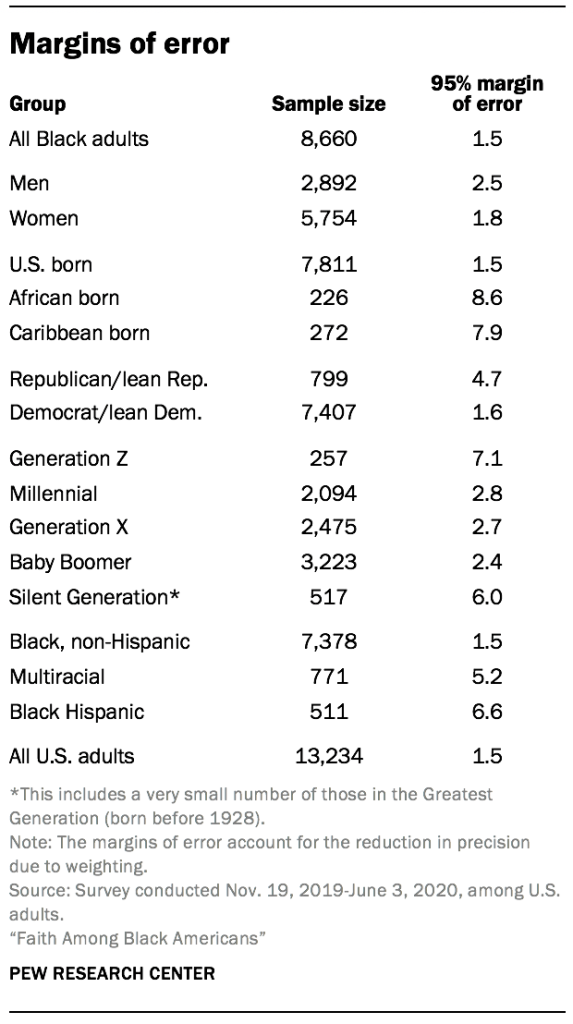
This study is Pew Research Center’s most comprehensive, in-depth attempt to explore religion among Black Americans. Its centerpiece is a nationally representative survey of 8,660 Black adults (ages 18 and older), featuring questions designed to examine Black religious experiences. The sample consists of a wide range of adults who identify as Black or African American, including some who identify as both Black and Hispanic or Black and another race (such as Black and White, or Black and Asian).

The Center recruited such a large sample in order to examine the diversity of the U.S. Black population. For example, this study is able to compare the views and experiences of U.S.-born Black Americans with those of Black immigrants from Africa or the Caribbean. It can compare Black adults born before 1946 (the Silent Generation and a very small number of those in the Greatest Generation) with Black adults born after 1996 (Generation Z). Because the study focuses on faith among Black Americans, it also examines Protestants who attend Black churches, Protestants who attend churches where the majority is White or another race, Protestants who attend multiracial churches, Black Catholics, Black members of non-Christian faiths and Black Americans who are religiously unaffiliated (identifying as atheist, agnostic or nothing in particular).

The survey was complemented by guided, small-group discussions with Black adults of various ages and religious leanings, as well as in-depth interviews with Black clergy. These gave Black religious leaders, lay believers and nonbelievers an opportunity to describe their religious experiences in their own words.

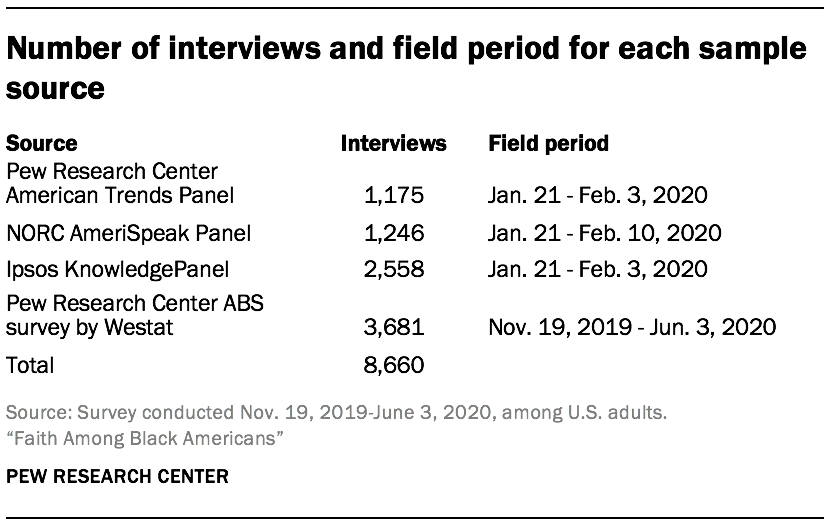
Survey respondents were recruited from four nationally representative sources: Pew Research Center’s American Trends Panel (conducted online), NORC’s AmeriSpeak panel (conducted online or by phone), Ipsos’ KnowledgePanel (conducted online) and a national cross-sectional survey by Pew Research Center (conducted online and by mail). Responses were collected from Nov. 19, 2019, to June 3, 2020, but most respondents completed the survey between Jan. 21 and Feb. 10, 2020. For more information, see the Methodology for this report. The exact wording of the questions used in this analysis can be found here.

Terminology

Throughout this report, Black churches and congregations are defined as those where the respondent said that all or most attendees are Black and the senior religious leaders are Black. White or other race churches and congregations are those where the respondent said that either most attendees are White; most attendees are Asian; most attendees are Hispanic; or most attendees are of a different (non-Black) race, and the same is true of the senior religious leaders. Multiracial churches and congregations are primarily those where the respondent said that no single race comprises a majority of attendees – regardless of the race of the religious leaders. This category also includes smaller numbers of congregations where the majority of the congregation is not Black, but senior religious leaders are Black; congregations where all or most attendees are Black but the senior religious leaders are not; and congregations where the senior religious leadership is multiracial – regardless of the race of the congregation.

In tables and text that analyze survey findings on Black Protestants and Catholics, the category “other Christians” refers to a group composed mostly of Jehovah’s Witnesses, but also Orthodox Christians, members of the Church of Jesus Christ of Latter-day Saints (also known as Mormons) and other groups. In the category “non-Christian faiths” the largest single group is Muslims, but this category also includes people who describe themselves as “spiritual but not religious,” as well as Buddhists, Jews and adherents of traditional African or Afro-Caribbean religions.

In tables and text that analyze survey findings by generation, members of Generation Z are respondents who were born from 1997 to 2002, Millennials from 1981 to 1996, members of Generation X from 1965 to 1980, Baby Boomers from 1946 to 1964, and members of the Silent Generation prior to 1946 (in this report, the Silent Generation category includes a very small number of those in the Greatest Generation, who were born before 1928).

“Black, non-Hispanic” respondents are those who identify as single-race Black and say they have no Hispanic background. “Black Hispanic” respondents are those who are Black and also say they do have Hispanic background. “Multiracial” respondents are those who indicate two or more racial backgrounds (one of which is Black) and say they have no Hispanic background.

“African-born” respondents were born in sub-Saharan Africa, while “Caribbean-born” respondents were born in the West Indies. In this report, “immigrant” refers to people who were not U.S. citizens at birth – in other words, those born outside the U.S., Puerto Rico or other U.S. territories to parents who were not U.S. citizens.

Religion has long figured prominently in the lives of Black Americans. When segregation was the law of the land, Black churches – and later, mosques – served as important spaces for racial solidarity and civic activity, and faith more broadly was a source of hope and inspiration.

Most Black Americans who attend religious services go to Black congregations

Today, most Black adults say they rely on prayer to help make major decisions, and view opposing racism as essential to their religious faith. Also, predominantly Black places of worship continue to have a considerable presence in the lives of Black Americans: Fully 60% of Black adults who go to religious services – whether every week or just a few times a year – say they attend religious services at places where most or all of the other attendees, as well as the senior clergy, are also Black, according to a major new Pew Research Center survey. Far fewer attend houses of worship with multiracial congregations or clergy (25%) or congregations that are predominantly White or another race or ethnicity, such as Hispanic or Asian (13%).

Younger Black adults less likely to attend predominantly Black congregations

But these patterns appear to be changing. The survey of more than 8,600 Black adults (ages 18 and older) across the United States finds that young Black adults are less religious and less engaged in Black churches than older generations. Black Millennials and members of Generation Z are less likely to rely on prayer, less likely to have grown up in Black churches and less likely to say religion is an important part of their lives. Fewer attend religious services, and those who do attend are less likely to go to a predominantly Black congregation.

For example, roughly half of Black Gen Zers (born after 1996) who go to a church or other house of worship say their congregation and clergy are mostly Black, compared with two-thirds of Black Baby Boomers and members of the Silent Generation who say this.

Protestantism has long dominated the Black American religious landscape, and still does. The survey shows that two-thirds of Black Americans (66%) are Protestant, 6% are Catholic and 3% identify with other Christian faiths – mostly Jehovah’s Witnesses. Another 3% belong to non-Christian faiths, the most common of which is Islam.1

Most Black Protestants go to Black churches

But about one-in-five Black Americans (21%) are not affiliated with any religion and instead identify as atheist, agnostic or “nothing in particular,” and this phenomenon is increasing by generation: Roughly three-in-ten Black Gen Zers (28%) and Millennials (33%) in the survey are religiously unaffiliated, compared with just 11% of Baby Boomers and 5% of those in the Silent Generation.

Defining Black congregations

To help analyze survey data, this report splits Black Protestants’ places of worship into three categories – (1) Black congregations, (2) White or other race congregations, (3) and multiracial congregations – based on the respondent’s description of their congregation and clergy.

Black churches/congregations are those where the respondent said that all or most attendees are Black and the senior religious leaders are Black.

White or other race churches/
congregations
are those where the respondent said that most attendees are White, most are Asian, most are Hispanic, or most are of a different (non-Black) race, AND most or all of the senior religious leaders are of the same non-Black race as one another.

Multiracial churches/congregations are primarily those where the respondent said that no single race makes up a majority of attendees. This category also includes smaller numbers of congregations where the majority of the congregation is not Black, but senior religious leader(s) are Black; congregations where all or most attendees are Black, but the senior religious leaders are not; and congregations where the senior religious leadership is multiracial, regardless of the race of the congregation.

Black Protestants are particularly likely to worship in congregations where most of the laypeople, as well as the senior clergy, are Black. Two-thirds of Black Protestant churchgoers say they attend this type of congregation. By contrast, majorities of Black Catholics and Black adults of other faiths say their congregations and religious leaders are multiracial, mostly White, or mostly some other race.

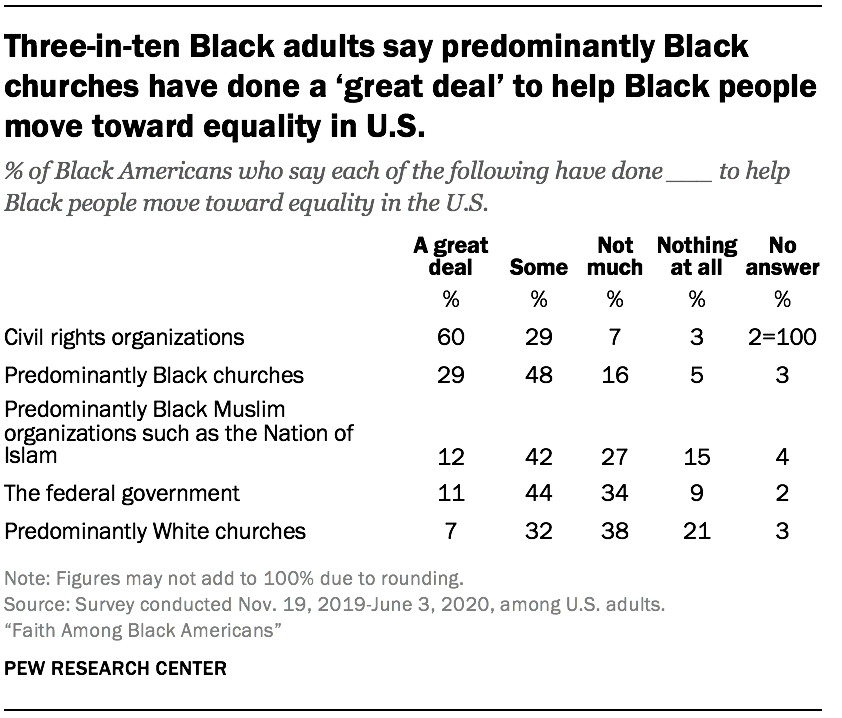
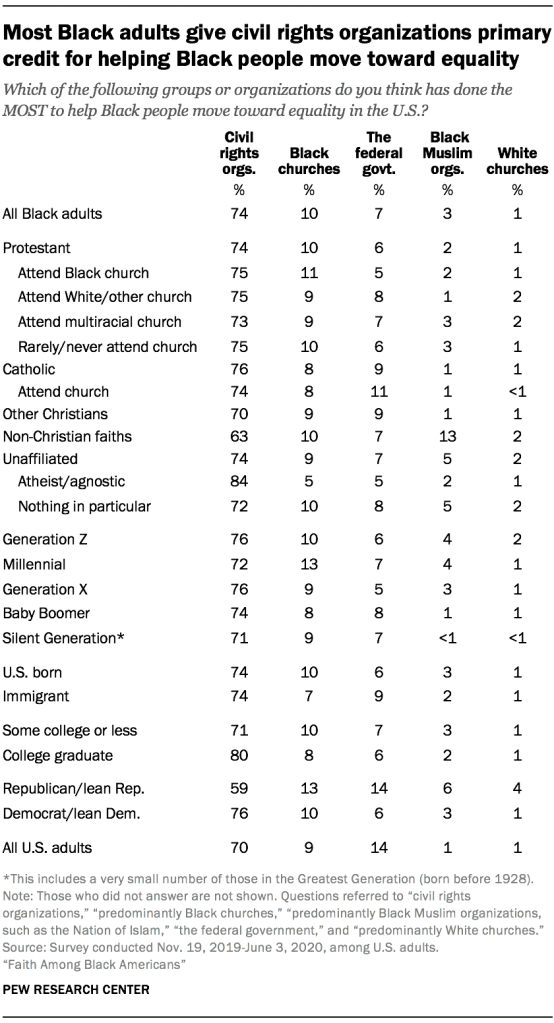
Nonetheless, there is a broad consensus among Black Americans of all faiths that predominantly Black churches have played a valuable role in the struggle for racial equality in U.S. society. Roughly three-quarters of Black adults surveyed say that Black churches have played at least “some” role in helping Black people move toward equality – including three-in-ten who say Black churches have done “a great deal” – while roughly half say Black Muslim organizations such as the Nation of Islam have contributed at least some in this regard. (See Chapter 10 for more on the history of religion among Black Americans.)

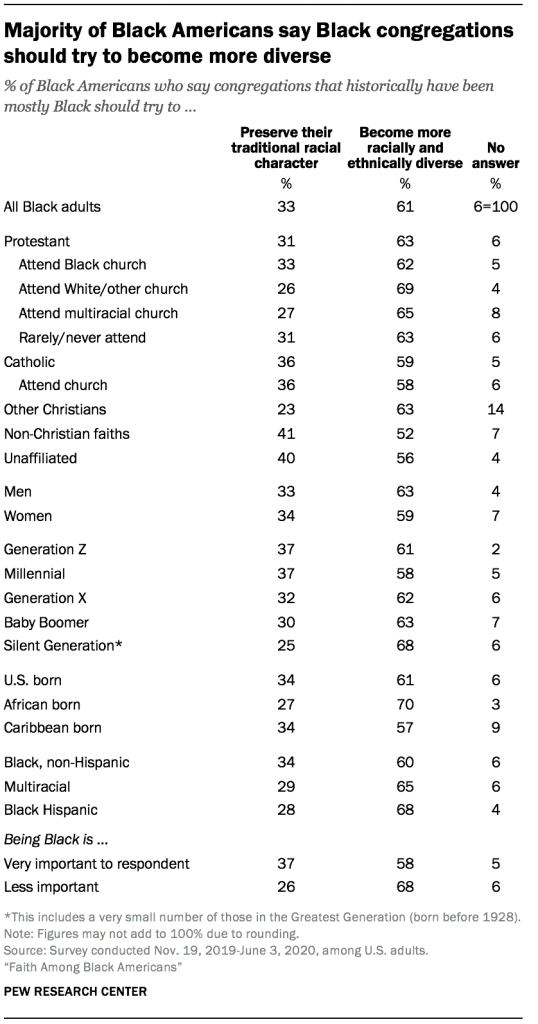
That so many Black Americans worship in Black congregations – and value their role in seeking equal rights – suggests that preserving them as institutions might be a high priority. Yet just a third (33%) of Black Americans say historically Black congregations should preserve their traditional racial character. Most (61%) say these congregations should become more racially and ethnically diverse. This is the majority view among those who attend Black congregations as well as those who do not.

Race of their congregation not a high priority for most Black Americans

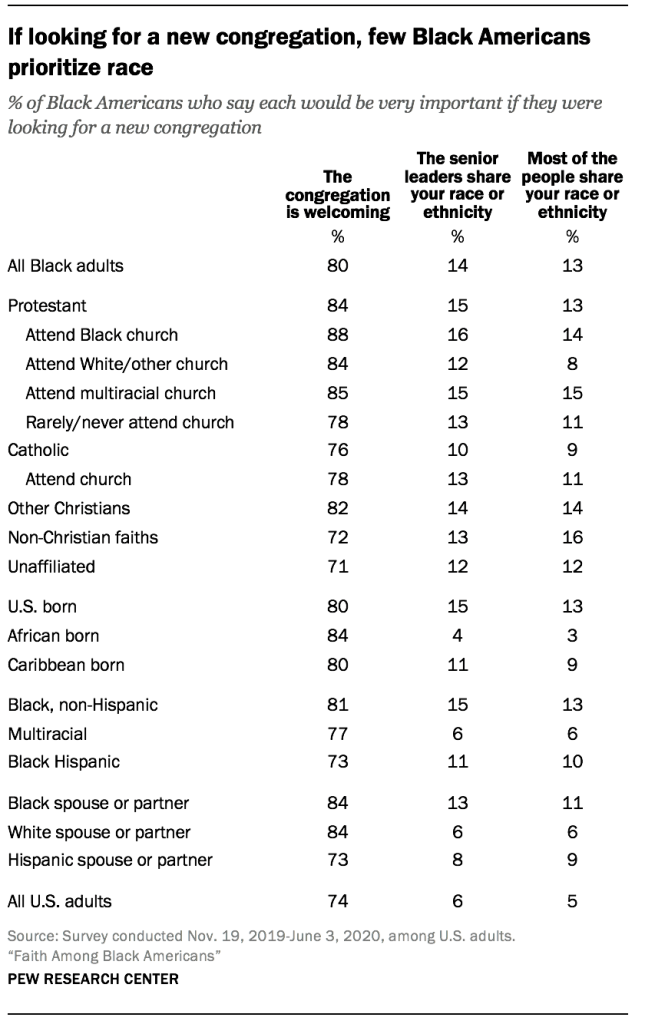
Furthermore, while 34% of Black Americans say that if they were looking for a new congregation, it would be “very important” or “somewhat important” for them to find a congregation where most other attendees shared their race, most (63%) say this would be either “not too important” or “not at all important.” Higher priorities include finding a congregation that is welcoming and that offers inspiring sermons. Again, this pattern holds regardless of whether respondents currently attend a predominantly Black congregation.

Almost half of those who go to Black Protestant churches say they have heard sermons on racism

If most Black Americans say these congregations should diversify and the race of other attendees isn’t a top priority to them, what leads so many Black Americans to attend predominantly Black congregations?2 The survey indicates that Black congregations are distinctive in numerous ways beyond just their racial makeup. Sermons are a prime example: Black Americans who attend Black Protestant churches are more likely to say they hear messages from the pulpit about certain topics – such as race relations and criminal justice reform – than are Black Protestant churchgoers who attend multiracial, White or other race churches. And Protestants who go to Black congregations are somewhat less likely than others to have recently heard a sermon, lecture or group discussion about abortion.

Half of all Black churchgoers say services include speaking in tongues

Black churches also have a distinctive atmosphere for worship. Protestants who worship in predominantly Black churches are more likely than other Black Americans to say their congregations feature worshippers calling out “amen” or other expressions of approval (known as call and response). They also are more likely to feature expressive forms of worship that include spontaneous dancing, jumping or shouting. And 54% of Protestants in Black congregations say the services they attend feature speaking or praying in tongues, a practice associated with Pentecostalism.

Taken as a whole, about half of congregants who attend Black Protestant churches report that the services they attend feature all three of these practices at least some of the time, compared with roughly a quarter of Black Protestants in White or other race churches and 18% of Black Catholics.

These are among the key findings of a survey of 8,660 Black Americans, conducted from Nov. 19, 2019, to June 3, 2020.3 While previous surveys on religion have included small or medium-sized samples of Black respondents, and other surveys with larger samples have asked questions about religion as one of multiple topics, this is Pew Research Center’s first large-scale, nationally representative survey designed primarily to help understand distinctive aspects of Black Americans’ religious lives. For more information on how the survey was conducted, see the Methodology.

This report is the first in a series of Pew Research Center studies focused on describing the rich diversity of Black people in the United States. The survey included not only single-race, U.S.-born African Americans but also Americans who identify as both Black and some other race or Black and Hispanic, as well as Black people who live in the U.S. but were born outside of the country.

Many findings in this survey highlight the distinctiveness and vibrancy of Black congregations, demonstrating that the collective entity some observers and participants have called “the Black Church” is alive and well in America today.4 But there also are some signs of decline, such as the gap between the shares of young adults and those in older generations who attend predominantly Black houses of worship. This gap is a result of two distinct pressures.

Younger Black Americans less connected to Black churches than older generations

First, younger Black Americans, like younger Americans more generally, are less religious than their elders. Black Millennials (49%) and members of Generation Z (46%) are about twice as likely as Black members of the Silent Generation (26%) to say they seldom or never attend religious services at any congregation. Second, among Black adults who do attend religious services, the youngest adults are less apt to attend Black congregations than the oldest adults. Among Black Gen Zers who attend religious services at least yearly, about half (just 29% of all Black Gen Zers) say they go to a Black congregation. By contrast, among Black Americans in the Silent Generation who attend religious services at least yearly, fully two-thirds (which is 49% of all Black Americans in the Silent Generation cohort) attend Black congregations.

Young Black Americans are less likely to have grown up in a majority-Black congregation

Additional findings suggest that, over the long term, fewer Black families with children have been going to Black congregations. While nearly nine-in-ten members of the Silent Generation (87%) say they grew up attending religious services at a congregation where most or all other attendees were Black, a smaller majority (64%) of Generation Zers say this about their more recent childhoods.

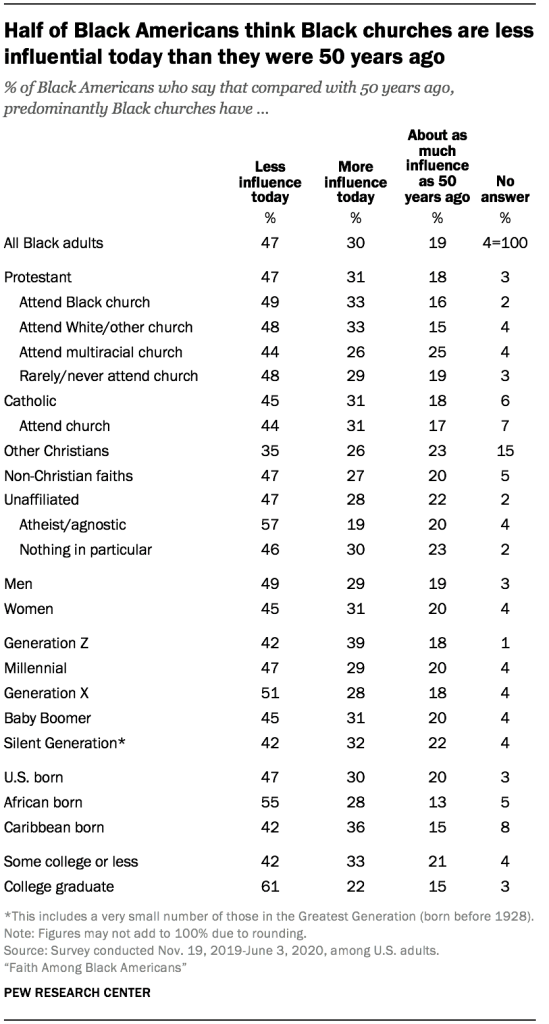
When asked to assess the influence of predominantly Black churches in their communities, nearly half of Black adults (47%) say that Black churches are less influential today than they were 50 years ago. Three-in-ten say they are more influential, and about one-in-five say they hold the same amount of sway.

Black Americans more religious than the U.S. public overall

Black Americans more religious than U.S. public overall

In conjunction with this study, researchers also asked some of the same questions of 4,574 Americans who do notidentify as Black or African American. The findings show that Black Americans are more religious than the American public as a whole on a range of measures of religious commitment. For example, they are more likely to say they believe in God or a higher power, and to report that they attend religious services regularly. They also are more likely to say religion is “very important” in their lives and to be affiliated with a religion, and to believe prayers to ancestors have protective power and that evil spirits can cause problems in a person’s life.

In addition to being more religious by these measures, Black Americans’ views on other topics involving religion or religious groups differ from those of the general population. For example, Black Americans are more likely than Americans overall to view opposition to racism as essential to what it means to be a religiously faithful or moral person.5 And they are more likely to credit predominantly Black Muslim organizations, such as the Nation of Islam, with a role in helping Black people move toward equality in the U.S.

Black Protestants stand out from Protestant churchgoers of other races. Black Protestants are far more likely to go to a church that has highly expressive worship that includes shouts of “amen,” spontaneous dancing, jumping or shouting, and speaking in tongues. And they are less likely than U.S. Protestants overall to report hearing sermons on abortion, but more likely to say they have heard sermons about race relations or criminal justice reform. (While most respondents participated in this survey in early 2020 – prior to May 2020, when a Minneapolis police officer killed George Floyd, sparking nationwide protests – more recent polling from July 2020 supports this pattern, showing Black Protestants to be far more likely than Protestants of other races to have recently heard sermons supporting the Black Lives Matter movement.)

Religiously unaffiliated Black Americans

Among Black Americans, 3% identify as atheist or agnostic

As is true within the general U.S. population, the share of people who do not identify with any religion is increasing among Black Americans. This religiously unaffiliated category (sometimes called religious “nones”) includes those who describe themselves as atheist, agnostic or “nothing in particular” when asked about their religion. Most Black religious “nones” (18% of all Black Americans) identify as “nothing in particular,” while far fewer describe themselves as agnostic (2%) or atheist (1%). The survey finds, furthermore, that many Black religious “nones” hold favorable views about Black churches and show numerous signs of religious or spiritual engagement.

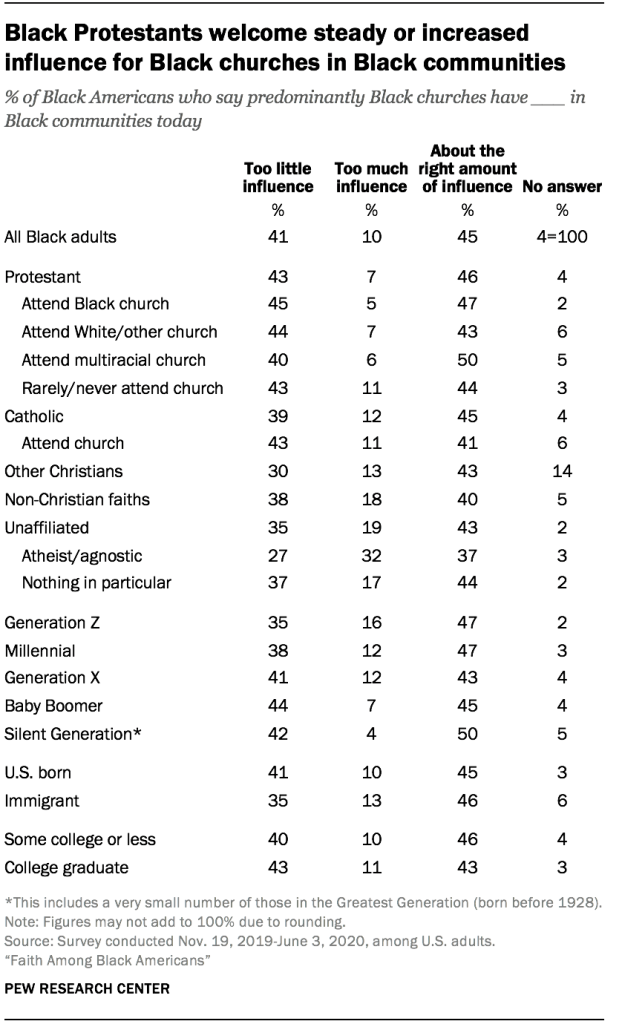
For example, most religiously unaffiliated Black Americans credit Black churches with helping Black Americans move toward equality. This is true whether they identify as “nothing in particular” (66%) or as atheist or agnostic (also 66%). (Because so few Black Americans identify as atheist or agnostic, the two groups are analyzed together throughout this report.) In addition, most Black religious “nones” say that predominantly Black churches today have either “too little” influence in Black communities (35%) or “about the right amount of influence” (43%). Just one-in-five (19%) say predominantly Black churches have “too much influence.”

Slim majority of religiously unaffiliated Black adults pray at least monthly

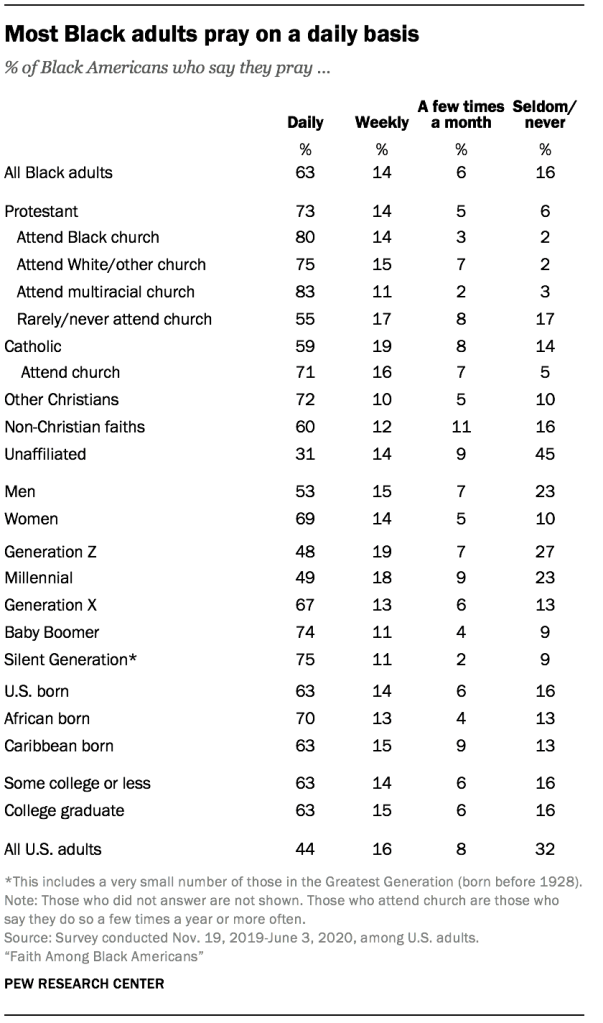
Several religious beliefs and practices are common among Black “nones.” Nine-in-ten say they believe in God or a higher power.6 Just over half report praying at least a few times a month. Similar shares say they rely, at least a little, on prayer and personal religious reflection when making major life decisions, and that they believe evil spirits can cause problems in a person’s life. About half of Black religious “nones” say they believe in reincarnation, and a little more than a third believe that prayers to ancestors can protect them from harm.

By these measures, religiously unaffiliated Black adults are a lot more religious than unaffiliated adults in the U.S. general population. For example, they are more likely to believe in God or a higher power (90% vs. 72%) and to pray at least a few times a month (54% vs. 28%).

Religion and gender

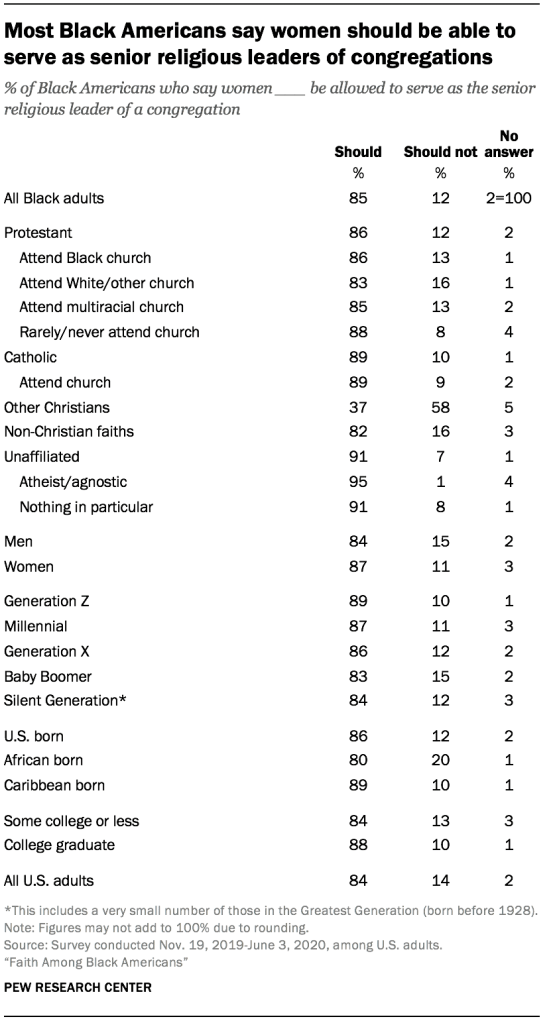
Women make up a small minority of religious leaders at Black Protestant churches, according to the National Congregations Study, and media accounts suggest it is uncommon for women to be named to lead large Black congregations.7 Yet the survey shows that the vast majority of Black Americans – women (87%) and men (84%) alike – say women should be allowed to serve as senior religious leaders of congregations.

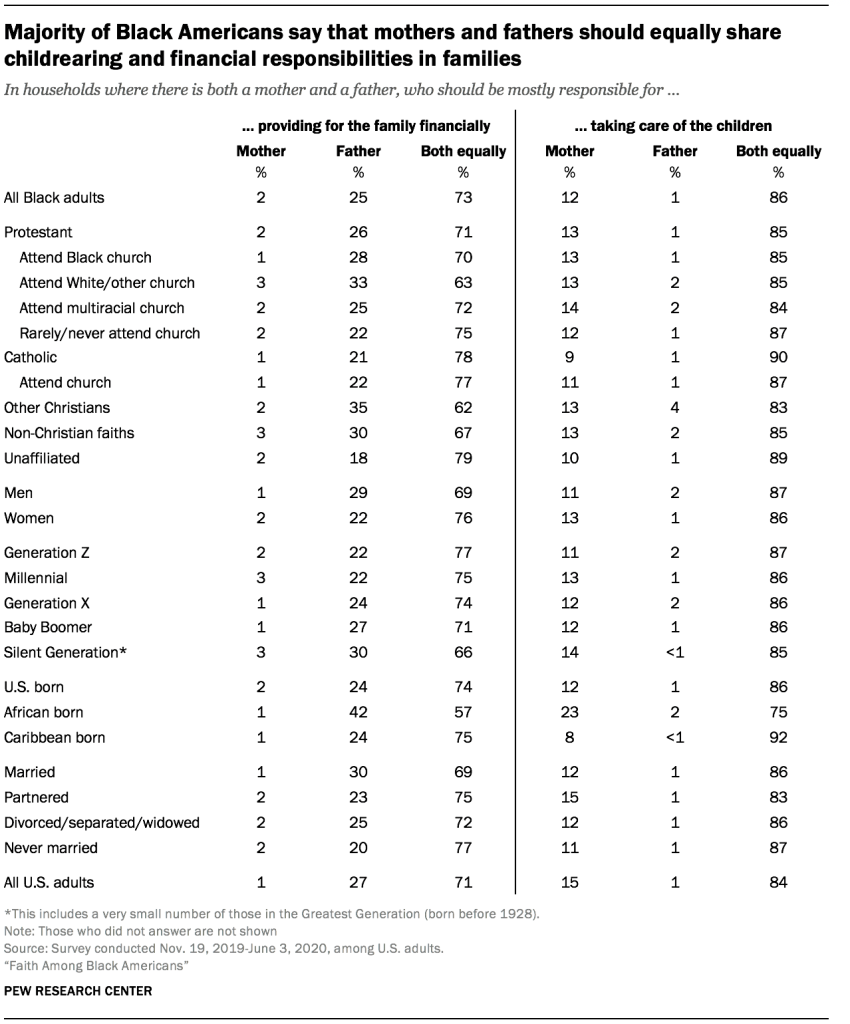
Black Americans also typically express egalitarian views on other issues relating to gender norms. For example, among men and women and across religious groups, most say they believe that mothers and fathers who live in the same household should share parenting and financial responsibilities equally.

In addition, Black Americans are almost as likely to say opposing sexism is essential to what it means to be a faithful or moral person as they are to say the same about opposing racism – and, again, men and women are equally likely to report this view.

Congregations emphasize men’s financial responsibilities more than women’s

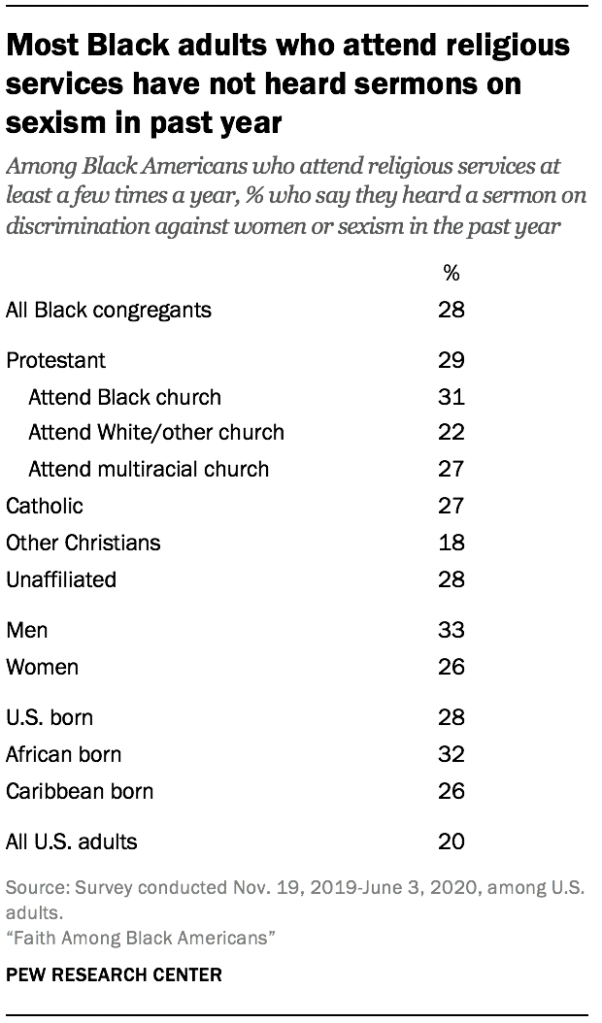
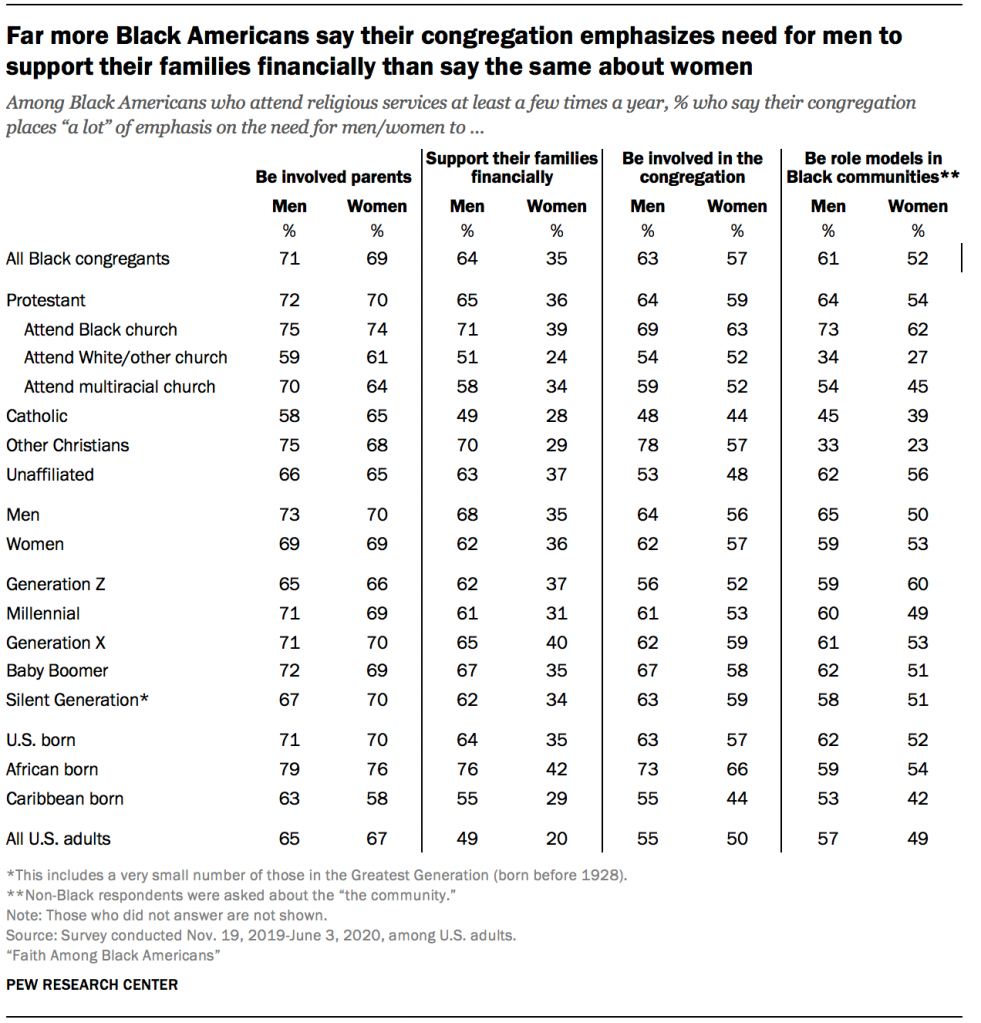
However, other survey findings suggest that the culture at many Black congregations emphasizes men’s experiences and leadership more than women’s. Black Americans are much less likely to have heard sermons, lectures or group discussions about discrimination against women or sexism than about racial discrimination. In addition, Black Americans are much more likely to say their congregations strongly emphasize that men should financially support their families and be role models in Black communities than to say that they emphasize these same things for women. In fact, of the four roles asked about in the survey, the only one that congregants say is emphasized equally for men and women is being an involved parent.

Though gender is a key focus throughout the report, Chapter 7 looks specifically at the intersection of gender, sexuality and religion in more detail.

African and Caribbean immigrants

One advantage of surveying a large sample of Black Americans is that it is possible to analyze the views of the growing share of Black Americans who are immigrants to the U.S.

Immigrants from sub-Saharan Africa make up 5% of the Black adult population, and they stand out in the survey findings in numerous ways for more active religious behavior and more conservative social views.8

African immigrants are more likely to be affiliated with a religion, less likely to be Protestant than U.S.-born Black Americans

Only 6% of all African immigrants are religiously unaffiliated, far fewer than the share of U.S.-born Black adults who are unaffiliated. African immigrants are less likely to identify as Protestant than are U.S.-born Black Americans, and more likely to identify as Catholic or with non-Christian faiths. African immigrants also are more likely than other Black Americans to say religion is very important in their lives, to report that they attend religious services regularly, and to believe that people of faith have a religious duty to convert nonbelievers.
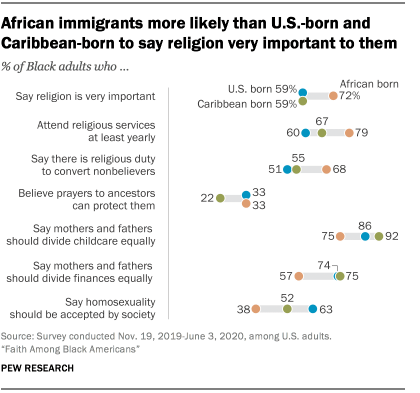
African immigrants more likely than U.S.-born and Caribbean-born to say religion very important to them

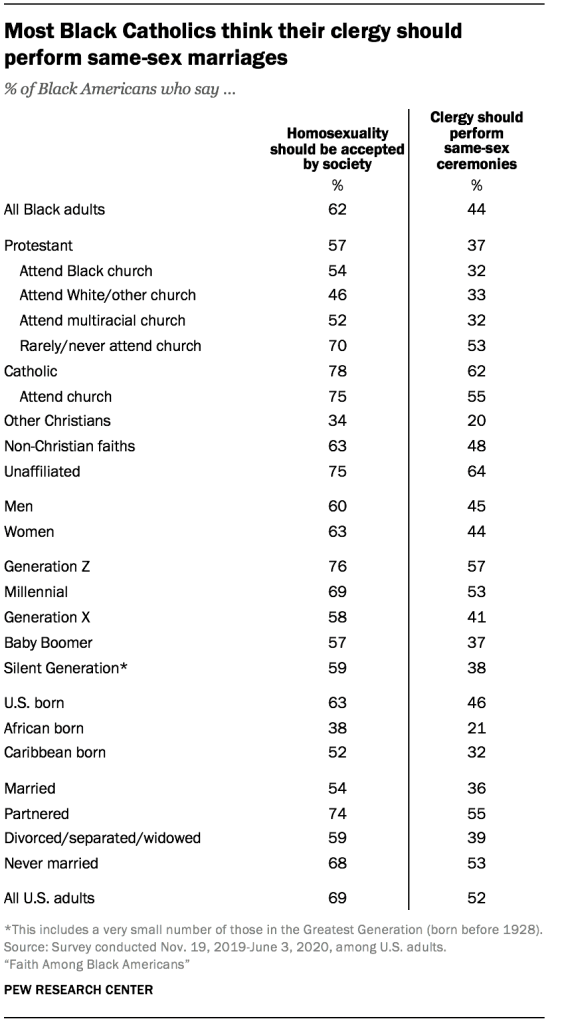
African immigrants also tend to be more supportive of traditional gender norms than U.S.-born Black adults. For example, they are more likely to say that mothers should be most responsible for taking care of children and that fathers should be most responsible for providing for the family financially – though the prevailing opinion is still that both parents should be equally responsible for both functions. In addition, African immigrants are much less likely to say that homosexuality should be accepted by society.

A slightly larger share of Black adults were born in the Caribbean (6%). Like African immigrants, Black Americans from the Caribbean are more likely than U.S.-born Black adults to be Catholic, though they are about equally likely to be religiously unaffiliated. Caribbean-born immigrants are no more likely than U.S.-born Black Americans to say religion is very important in their lives or that they have a religious duty to convert nonbelievers.

Political partisanship

Black Republicans and Democrats equally religious

Most Black Americans (84%) are Democrats or lean toward the Democratic Party. Just 10% say they are Republicans or lean Republican.

In several ways, the religious lives of Black Democrats and Republicans are similar. They are about equally likely to identify with a religion, to say religion is very important in their lives and to attend religious services at least once a week. The lack of a partisan divide on these measures of religious commitment contrasts with patterns seen among White Americans; White Republicans tend to be more religious than White Democrats.

Though they have similar rates of attendance, there are some differences between Black Democrats and Black Republicans when it comes to the types of congregations they attend. Fewer than half of Black Republicans who attend religious services go to a Black congregation (43%), compared with 64% of Black Democrats. And Black Republicans are more likely than Black Democrats to go to congregations where most attendees are White (22% vs. 11%).

In addition, as in the larger public, Black Democrats are more likely than Republicans to say that abortion should be legal and that homosexuality should be accepted by society. And among Black Christians, Democrats are more likely than Republicans to say that opposing racism and racial discrimination, as well as opposing sexism or discrimination against women, are essential to what being a Christian means to them – though more than half of all Black Christians in both parties say these are essential.

Roadmap to the report

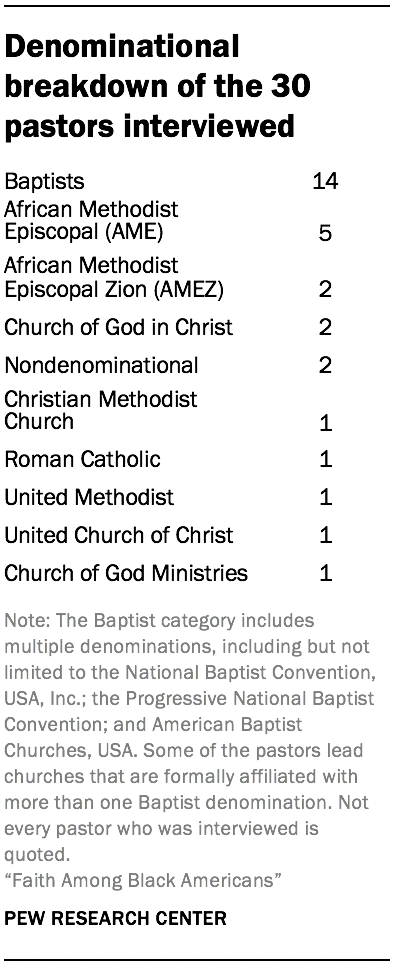
The remainder of this report explores these and other findings in more detail. Chapter 1 describes six focus group discussions and highlights some of the reasons Black Americans value Black congregations. Chapter 2 examines the religious affiliations of Black Americans in more detail. Chapter 3 explores some common Christian beliefs as well as other forms of spirituality among Black Americans. Chapter 4 reports how frequently Black Americans engage in a range of religious and spiritual practices. Chapter 5 examines the impact that religion and church have on the everyday lives of Black Americans. Chapter 6 looks more closely at the role race plays in the religious experience of Black Americans. Chapter 7 analyzes views on gender and sexuality and how they are related to religion. Chapter 8 describes how political preferences, engagement and views on social and political topics vary across different types of congregations. Chapter 9 summarizes interviews with 30 Black Protestant clergy from around the country about issues affecting their churches. And Chapter 10 offers a brief overview of Black religious history in the United States, with an emphasis on efforts by religious groups to deal with racism and its effects.
1. Focus groups: A look at how Black Americans talk about ‘Black churches’

The survey finds that most Black Americans who attend religious services go to congregations where most of the other attendees and the senior clergy are Black. At the same time, most Black Americans also indicate, in their answers to other questions in the survey, that they value diversity in their religious congregations. Even among those who regularly attend Black congregations, a majority say that historically Black congregations should try to diversify rather than preserve their traditional racial character.

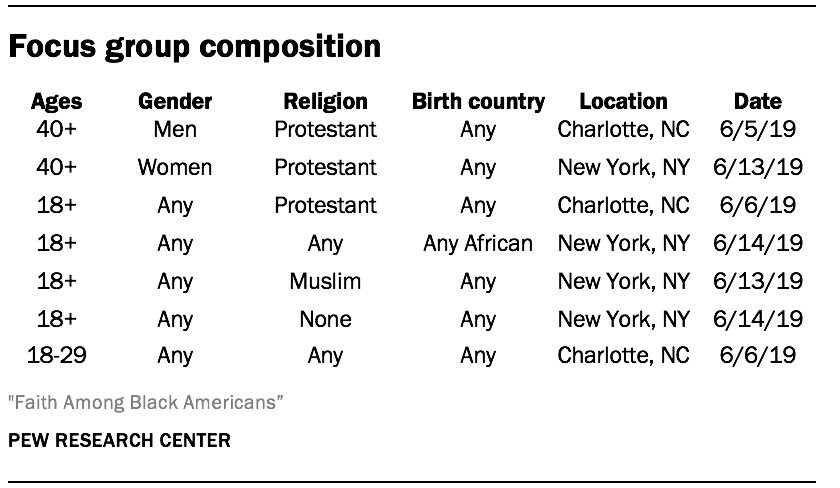
In a series of structured, small group conversations (focus groups) that Pew Research Center facilitated, Black Americans discussed what often draws them to majority-Black congregations, while at the same time expressing a desire for religious spaces that are open and racially inclusive. These conversations highlighted several elements of the Black congregational experience that are particularly important to focus group participants, including the comfort associated with familiar styles of worship and music, sermons that are relevant to the distinctive struggles of Black Americans, and avoidance of the discrimination and discomfort that some of them have felt in non-Black religious spaces.

Of the six focus groups discussed below, three were limited by design to Black Protestants who regularly attend religious services, mostly in majority-Black churches. But even in the other three focus groups – comprised primarily of Muslims, adults under 30, and African immigrants – most participants had some at least some experience with, and often strong views on, Black congregations.

The quotations below are verbatim, but the names of the focus group participants have been changed to protect their confidentiality.

When asked why they go to their congregation, or how they would choose a new one, even participants who belong to historically Black Protestant denominations did not always describe their church’s racial composition as central.

Some explicitly mentioned the race of other attendees as a priority. For example, Rodney currently attends a Black church, and when asked how he would approach looking for a new place of worship, he expressed some preference for another Black church: “I probably would look more towards a Black church, but I would visit, I would visit a couple before making my decision.”

Morgan was more decisive in her preference for a Black church, saying, “One thing about Charlotte I did notice – I drove past the same Filipino churches, Mexican churches. There’s so many different churches, and I’m not going into one of those. Because … it’s not going to be my spirit and what I’m looking for.”

Natasha, who also currently attends a Black church, was even more direct, saying: “I’m not looking for no White people.” 

But others were less focused on the race of the congregation. For example, Reginald attends religious services at a majority-Black church. He said that if he were to change congregations, he probably would end up attending another predominantly Black church – not because he views the race of other attendees as a priority, but just because of where he lives: “I definitely would look for nondenominational. … It has nothing to do with race. Sometimes you can’t help but go to the church in your community.”

Other participants also said they did not view it as a priority to be in a church where most or all other attendees are Black. They said they cared more about diversity in a prospective new church.

 “I want diversity. … Diversity means to me, just everybody.”

– Alfred

“I’m going to go to either [a Black or non-Black church] and see where the spirit is at.”

– Philip

When talking about predominantly Black congregations, participants highlighted at least four ways in which they saw them as valuable: (1) as a place to address the distinctive needs and concerns of Black Americans; (2) as a provider of familiar rituals, worship styles and music; (3) as a shelter from discrimination and a place to feel at home; (4) and as a link to the history and struggles of Black Americans.

Across the focus groups, some discussants contended that predominantly Black churches and mosques serve the needs of Black people better than churches and mosques with other racial or ethnic compositions. For example, Lynda, who regularly attends a church where most attendees are Black, put it this way: “We are still human, but we still do things differently.” Carmen then expressed general agreement, saying predominantly Black churches are better for Black people “because I think they know our struggle.”

Dee cited the musical portions of services at her predominantly Black church as something that makes her more comfortable than she would be at churches that are multiracial or predominantly White. “When it comes to music, it’s about our struggle. … If you think about it, Blacks have – and African Americans, or whatever – have struggled more than Caucasians, so we bring it out in expressions of music. We sing hard. We sing powerful.”

Morgan made similar points about music and Black Americans’ struggle. For her, two parts of the Black congregational experience are especially important: sermons on topics that relate to her daily difficulties and the praise and worship music that lifts her up. “Every time I’m going through something … either the pastor’s preaching on it, or here comes that song that feeds my spirit and may help me to continue to have a better rest of the week,” she said.

Music plays at least two roles in their congregations, according to focus group participants. It is a source of emotional comfort and encouragement, and it also provides an element of familiarity and continuity, tying generations together. Jayla talked about it in this way: “I would be looking for music. I love a church with good, good music. A good choir, good singers. Music moves me.”

And Monica put it this way:

“I like the fact that, in the church where I go, they are bringing back the old-time religion. … The old-time religion is the music from years ago, because that’s what hit the heart. … They’ve been singing some of the contemporary gospel, but we’ve also put in the old-time gospel because that’s what hit the heart with our grandparents and our parents back in the day, and that’s what I like. They involve the children with that. The children are learning the way we were years ago and bringing it into the way we are now.”

But music is not the only source of familiarity that discussants raised in connection with Black congregations. A Muslim man, Dawud, said he recently moved to a new community and attends a mosque where the presence of other Black people around him as he prays is comforting: “I really like the [mosque] because mostly it’s like the people that I came up with … so I’m comfortable there.”

Some participants also mentioned the reverse sentiment – feeling unwelcome, or even discriminated against, in congregations where other races are the majority. Some Muslim participants, for example, said that Muslims who are Black are often treated disrespectfully and seen as less than fully Muslim at mosques where people of Arab or South Asian descent are in the majority. Fatou, an immigrant from Africa, put it this way:

“From my perspective, it [the mosque] is not a safe place to go for me, especially where I go to worship in my neighborhood. Because they’re not, like I say, they’re not my people. They are from other countries. … They don’t want to be next to you. … So sometimes I’m like, ‘Let me stay home.’”

Tanisha, a U.S.-born convert to Islam, made a similar point:

“Just because we don’t come from Muslim countries, it doesn’t make us any less Muslim than those people that were born in Muslim countries. And sometimes I feel like that’s the way we are looked at, that we are American Muslims and it’s not as good. We’re not good enough. Sometimes, that’s the way I feel when I’m around people from those countries.” 

Regardless of their own preferences for where to worship, focus group participants often talked about Black congregations in a positive way because of their historical role in advocating for Black communities, including during the civil rights movement. Nikita, who attends a predominantly Black Protestant church, said she first heard the term “Black Church” while watching a television documentary.

“I heard the phrase ‘Black Church,’ and it was actually a documentary that I was watching, and it was related to the whole civil rights era. … It was the only institution where the folks who look like us could come together and really strategize a plan that would effect change. So I tuned in on the part where four little girls were bombed, and then that’s when I heard that phrase from the announcer saying four little girls were bombed at ‘the Black Church.’ So when I hear that [phrase], it kind of brings me back to that.”

On hearing Nikita’s recollection, Clarice also began to speak positively about “the Black Church”:

“The Black Church that we know, based on the documentaries that I also seen, was the gathering place for our strategizing and organizing. … That’s why the church was so important to Blacks, because we could go in there and we could talk politics. We could go in there and we could talk finance. … That was the sacred space, the safe space, that people of color could go.”  

But some focus group participants, including members of majority-Black churches, expressed reservations about the term “Black church.”

Clarice said she attends religious services at a church where most participants are Black, but said that she would not consider her church a “Black church,” because she believes the racial composition of churches is incidental. “I think churches were congregated based on location, and it had everything to do with where you lived, and churches were … innate to the community, just like the store or post office … where you lived dictated the type of membership you had.” Like some other participants, she also pointed out that majority-Black churches are not the only ones where she has heard music that moved her. “The Word is for anyone, right? I’m curious to know how you necessarily define a ‘Black church.’ [Because] I know White churches that sing good gospel, too. I was in Japan – they got one of the baddest gospel choirs I have ever heard … and they run riffs just like any other person I know,” she said.

Some focus group participants who do not attend predominantly Black churches also expressed reservations about them.

“I don’t believe in ‘Black church.’ I believe in the church. Like, Black church is … a racial thing. I don’t believe in Black church. I mean, Black people live in this community, maybe there’s a church in that community, … but it’s still the church, not a Black church.”

– Reginald

“I wanted to just say this, that I know that my pastor does not evoke the Word limited to a race of people. We have multiculturalism in the church overall.”

– Yvette

More broadly, some participants expressed discomfort with describing congregations as “Black,” regardless of the race of the members, the race of the leadership, the style of worship or the denominational affiliation. They suggested that the word could, incorrectly, imply that non-Black people are neither welcome nor would be well served in those congregations.

Michael, for example, attends a house of worship affiliated with the AME Zion Church, a historically Black Protestant denomination. But, he said, “I’m not going to say that we’re ‘a Black church.’ It’s predominantly Black. But when you said that to me, that’s kind of like you saying that we go to ‘a Black church.’ But in God’s eye, he don’t care what color you are, as long as you go.” 

Dee, who previously in the conversation had championed the value of Black churches for Black Americans, also pushed back against the idea that race is central to what they offer or that they should be defined by race. “At the end of the day … we’re all still human,” she said.

Monica, who had also spoken about the importance of majority-Black churches to her and to Black Americans more broadly, added: “Church has no color to me, because anyone’s invited to come there, whether they’re Black, whether they’re Chinese, Spanish or whatever. It just so happens that the majority of the ones that come are of Black origin. That’s about it.”

Destiny said she also attends a majority-Black congregation, but she emphasized that it is completely open to people of other races.

“Mostly Blacks attend, but it’s a mixture of Blacks, Hispanics, Mexicans. Whoever wants to hear the Word, we don’t turn them away. You’re more than welcome. We open the doors – come in! We just want you to want to hear the Word, to want to change your life. So when it comes to judging people like, ‘Oh, well, you’re not Black, so you can’t come here’ – no, we cannot do that.”

The ambivalence expressed in the focus groups over what to think about Black churches calls to mind a famous interview on Meet the Press with the Rev. Dr. Martin Luther King Jr. in 1960. When the interviewer asked how many White people were members of his church, King replied: none. The interviewer challenged that as a contradiction to the spirit of integration. Here’s how King responded:

“I think it is one of the tragedies of our nation, one of the shameful tragedies, that 11 o’clock on Sunday morning is one of the most segregated hours, if not the most segregated hours, in Christian America. I definitely think the Christian church should be integrated, and any church that stands against integration and that has a segregated body is standing against the spirit and the teachings of Jesus Christ, and it fails to be a true witness.” 

That’s the best-known part of his answer. But shortly after that, King made an important but less well-known point. “My church is not a segregating church,” he said. “It’s segregated, but not segregating. It would welcome White members.”

In the focus groups, convened nearly six decades after King’s interview, many participants who go to Black congregations made the same distinction: Their churches are effectively segregated, but they are not deliberately segregating. They are open to – and widely desire – greater diversity in their congregations.

2. Religious affiliation and congregations

Most Black Americans identify as Protestant. And unlike Black Americans in other faith traditions, the majority of Black Protestant churchgoers attend religious services at a house of worship where both the leadership and most other congregants are Black.

Defining Black congregations

To help analyze survey data, this report splits Black Protestants’ places of worship into three categories – (1) Black congregations, (2) White or other race congregations, (3) and multiracial congregations – based on the respondent’s description of their congregation and clergy.

Black churches/congregations are those where the respondent said that all or most attendees are Black and the senior religious leaders are Black.

White or other race churches/ congregations are those where the respondent said that most attendees are White, most are Asian, most are Hispanic, or most are of a different (non-Black) race, AND most or all of the senior religious leaders are of the same non-Black race as one another.

Multiracial churches/congregations are primarily those where the respondent said that no single race makes up a majority of attendees. This category also includes smaller numbers of congregations where the majority of the congregation is not Black, but senior religious leader(s) are Black; congregations where all or most attendees are Black, but the senior religious leaders are not; and congregations where the senior religious leadership is multiracial, regardless of the race of the congregation.

Black Protestant churches are distinctive from other types of congregations (such as Protestant churches where the leadership and membership are mostly or exclusively White or some other race, Catholic churches and congregations in other faiths) in a variety of ways beyond their racial makeup. These include their style of worship, the topics discussed by clergy and the length of religious services. This is true both for Black Americans who attend churches associated with historically Black Protestant denominations and those who attend other predominantly Black churches.

In small-group discussions that were conducted as part of this study, Black Americans suggest that these distinctive characteristics may be more important than the churches’ racial makeup itself for explaining the continued appeal of these congregations. (For more on these small-group discussions, see Chapter 1.)

That said, younger Black adults are much less engaged in Black churches than are older generations. Millennials and members of Generation Z are more likely to be religiously unaffiliated, and they are less likely than those in older cohorts to have grown up attending a Black church. And even young adults who do attend religious services are less likely to do so at a Black church than are older Black Americans.

Most Black Protestants attend Black churches

Young Black adults less Protestant than their elders

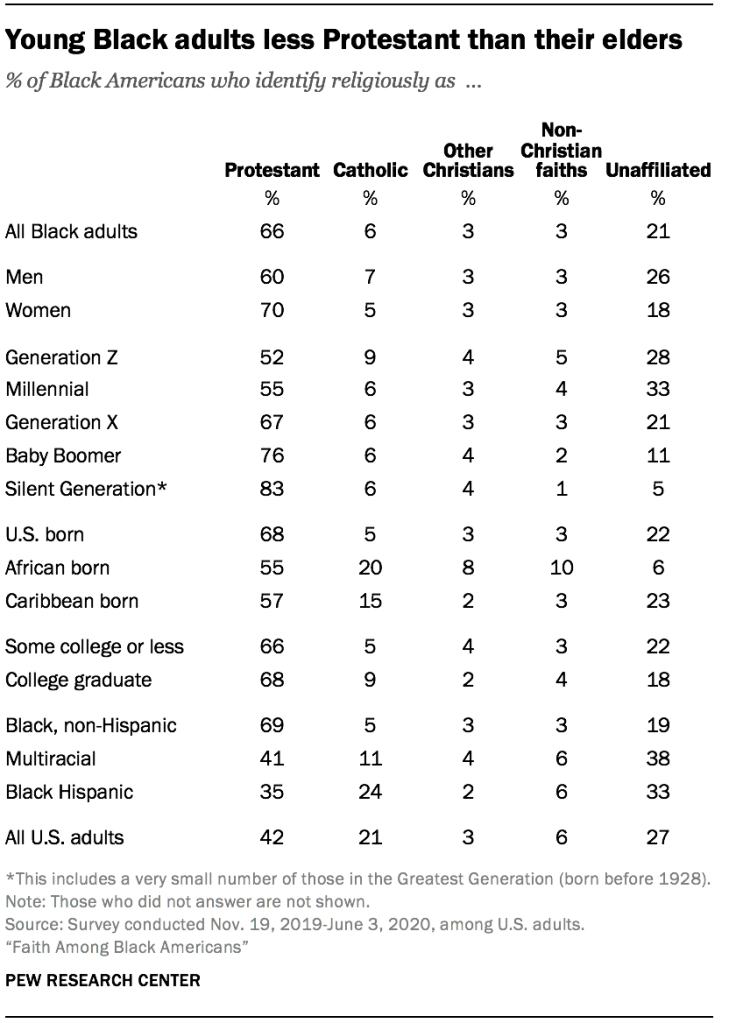
Among Black Americans, Protestant Christianity is by far the most common religious affiliation. Fully two-thirds of all Black adults (66%) describe themselves as Protestant. Catholics, the next largest religious group, account for only about 6% of all Black adults.

Members of other Christian faiths account for about 3% of all Black Americans. The largest of these by far is Jehovah’s Witnesses, although this category also includes Orthodox Christians, members of the Church of Jesus Christ of Latter-day Saints (also known as Mormons) and other groups.

Members of non-Christian faiths account for an additional 3% of Black adults. Muslims are the largest non-Christian religious group among Black Americans, though this category also includes some people who describe themselves as “spiritual but not religious,” as well as smaller numbers from other religious groups (such as Buddhists or adherents of traditional African or Afro-Caribbean religions).

Finally, about one-in-five Black adults (21%) are not affiliated with any religion, describing themselves as atheist, agnostic or “nothing in particular.” The vast majority of religiously unaffiliated Black Americans (18% of all Black adults) say they have no particular religion; just 3% of Black adults identify as atheist or agnostic.

The survey did not reach enough Black Christians from non-Protestant or non-Catholic groups (such as Jehovah’s Witnesses) or from non-Christian groups (such as Muslims) to allow for separate analysis of their opinions.9 These respondents are instead collectively analyzed as “other Christians” and “non-Christian faiths,” respectively. And atheists and agnostics are analyzed throughout this report as a single group, because the survey did not interview enough individuals who identify as such to analyze them separately.

Black adults are more likely than U.S. adults overall to be Protestant and less likely to be Catholic or religiously unaffiliated. Previous research suggests that Black Americans are somewhat more likely to be Jehovah’s Witnesses or Muslims than the public overall.

But the survey finds that younger Black adults are much less likely to be Protestant than older generations. Only about half of adults in Generation Z (those born after 1996) identify as Protestant, compared with three-quarters of Baby Boomers. And younger Black adults are more likely than older cohorts to be religiously unaffiliated.

The survey also finds that U.S.-born Black Americans are more likely to be Protestant than are Black immigrants, who identify as Catholic at higher rates. And immigrants from Africa are more likely than Black adults born in the U.S. to identify with other Christian groups and non-Christian faiths, while relatively few immigrants from Africa say they are religiously unaffiliated (6%).

In addition to the 3% of Black Americans who identify with non-Christian religions, there are some who say that, aside from religion, they feel a tie to these faiths – for example ethnically, culturally or because of their family’s background. Because more Black Americans identify with Islam than with any other non-Christian faith, the survey asked non-Muslim respondents if they consider themselves Muslim “aside from religion.” About as many Black Americans said they consider themselves Muslim “aside from religion” as identify as Muslim religiously, though both groups are too small for this survey to estimate their size.

When asked in what way they consider themselves Muslim aside from religion, respondents mentioned a range of beliefs and practices. For example, one respondent who identified as Baptist also said, “We all are connected to the Nation of Islam; for Blacks our religion is Islam but coming to America during slavery we were taught to believe in Christ to obey our masters.” Another, who identified religiously as “nothing in particular,” said she considered herself Muslim aside from religion due to her “abstaining from pork products, recognizing Allah, and the savior Elijah Muhammad.” Others mentioned specific Islamic practices such as fasting during Ramadan or avoiding pork, or more broadly said they “practice some of their rituals and share some of their beliefs.”

In addition to beliefs and practices, some respondents who identify as Muslim aside from religion spoke about their family or upbringing, saying that they were “raised Muslim,” have Muslim parents or “identify with my Muslim roots.”

Finally, some Black Americans said they consider themselves Muslims for other reasons. One respondent, who identifies religiously as Catholic, said Islam allows her to feel “connected to the MotherLand-Africa.” Others noted seeing strong similarities between their own religion and Islam; in the words of one respondent, “a lot of things in the Bible are the same things in the Quran. I strongly believe in my Lord Jesus Christ.”

Most Black Protestant churchgoers attend a Black church

The survey finds that just over one-third (36%) of all Black adults in the United States attend religious services at a house of worship where both the clergy and most or all of the congregation is Black. Far fewer (8%) attend religious services at a congregation in which both the clergy and most of the congregants are White or some other race or ethnicity. And about 15% go to what might be described as a multiracial congregation, generally one where no single racial or ethnic group makes up a majority of the attendees.

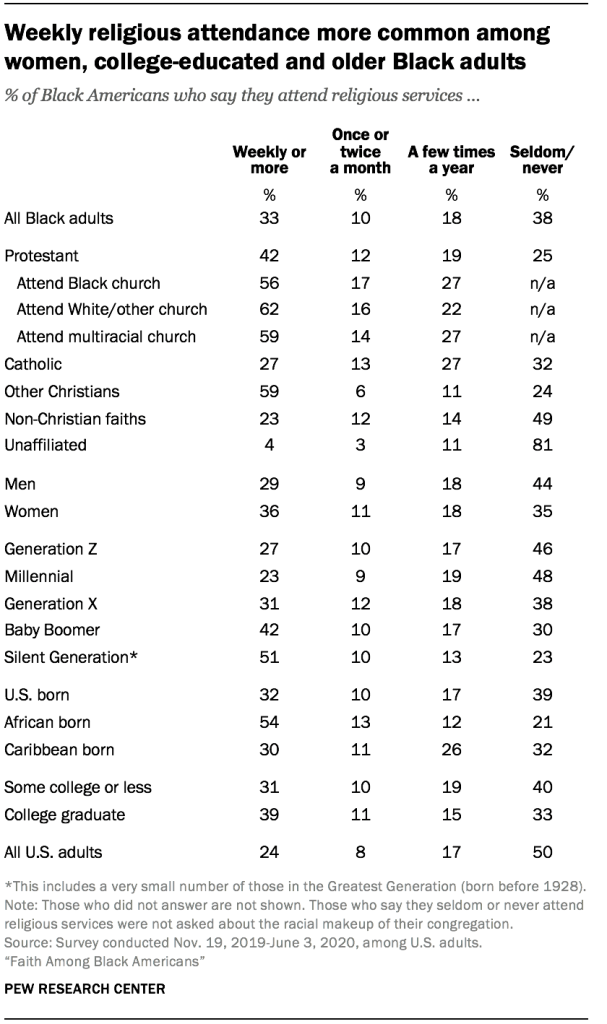
About four-in-ten Black Americans (39%) say they seldom or never attend religious services.

Protestants are the group most likely to attend a Black congregation. About half of all Black Protestants – and roughly two-thirds of those who attend religious services – say their congregation has mostly Black attendees and religious leaders. By contrast, only 8% of Black Protestants say they attend religious services at a congregation where leadership and members are mostly White or some other race.

Black Catholics have a different experience with race at church: Only about one-in-ten Black Catholics (12%) say they go to a Black church. More either go to a church with congregants who are mostly White or some other race (28%) or to a multiracial church (27%).

Among other Christians (such as Jehovah’s Witnesses), meanwhile, a plurality (41%) go to multiracial churches.

Younger adults are less likely to go to Black congregations than are older Black Americans; roughly three-in-ten Millennials and members of Generation Z say they do. Indeed, young Black adults are less likely to attend religious services at all (similar to young Americans of all races and ethnicities) and they also are somewhat more likely to attend religious services at White or other race congregations.

Sidebar: How large are historically Black Protestant denominations?

At least 23% of Black Protestants identify with historically Black denominations

How many Black Protestants identify with one of the nation’s eight historically Black Protestant denominations that make up the Conference of National Black Churches?10 Answering this question definitively is more difficult than it may seem, because not all Protestants identify with a particular denomination. When asked about their religious affiliation, many respondents describe themselves as “just Baptist” or “just Methodist,” for example, without specifying any particular Baptist or Methodist denomination. Still other respondents identify with a congregation (e.g., First Baptist Church), without making clear which denomination their congregation is associated with. Additionally complicating matters, many congregations are not associated with any denomination, and still others are associated with more than one denomination. In Pew Research Center’s 2014 Religious Landscape survey, 38% of all U.S. Protestants described their denominational identity in ambiguous, vague or otherwise difficult to categorize ways.

In the current survey, 23% of Black Protestants identify with one of the eight historically Black Protestant denominations that make up the Conference of National Black Churches. This includes 9% who identify with the National Baptist Convention, USA (or simply with the “National Baptist Convention”), 6% who identify with the Church of God in Christ (COGIC), 3% who identify with the African Methodist Episcopal Church, and 2% who identify with the National Baptist Convention of America. The Progressive National Baptist Convention, African Methodist Episcopal Zion Church, and Christian Methodist Episcopal Church are each the denominational homes for 1% of Black Protestants in the survey; fewer than 1% of Black Protestants surveyed identify as Full Gospel Baptists.

These figures should be interpreted as floors rather than as definitive estimates of the size of these denominations. In other words, at least 23% of Black Protestants identify with historically Black denominations. There are surely additional adherents of these denominations among those respondents who describe their affiliations in different ways. Nearly one-in-three Protestants (32%) answer the questions about denominational affiliation in a vague way or ambiguous way. This includes those who describe themselves as just Baptist without giving any further information (7%) or as just Pentecostal (2%), for example. Some of these respondents may be associated with one of the four historically Black Baptist denominations or with COGIC, even though they did not describe themselves as such when prompted. It also includes those who identify with other Black churches or with churches that are difficult to classify in the absence of clarifying information, including 10% who describe themselves as “independent Baptists” and 1% who identify as “Missionary Baptists,” to provide a couple of prominent examples. And 15% of Black Protestants describe themselves as nondenominational. Many of them surely belong to truly nondenominational churches, but some may simply be unaware of their congregation’s denominational ties, especially if those ties are not emphasized by the congregation’s leaders.

Meanwhile, three-in-ten Black Protestants identify specifically with evangelical or mainline Protestant denominations – that is, ones that are not historically Black.

As children, three-quarters of Black adults attended a religious congregation that was mostly or entirely made up of Black congregants

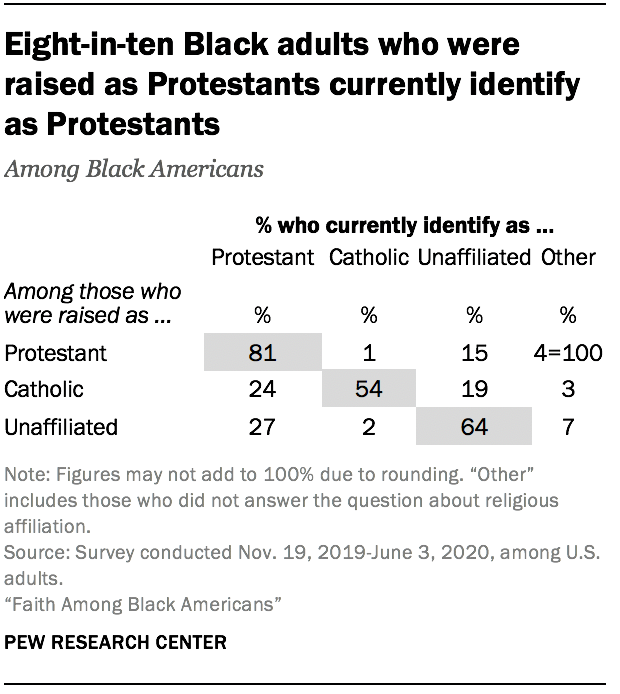
Eight-in-ten Black adults who were raised as Protestants currently identify as Protestants

Overall, nearly three-quarters (73%) of Black adults have the same religious identity that they did as a child. Eight-in-ten Black adults who were raised as Protestants currently identify with a Protestant faith today. About half of Black adults who were raised Catholic identify in the same way today (54%); the remainder are mostly Protestant (24%) or religiously unaffiliated (19%).

Meanwhile, among Black adults who were raised without a religious affiliation, roughly two-thirds (64%) remain religiously unaffiliated today, while 27% have become Protestants.

The Protestant retention rate among Black Americans (81%) is higher than it is for Protestants in the general public: Among U.S. adults overall who were raised as Protestants, 70% currently identify as Protestants. By contrast, Black Americans who were raised Catholic are somewhat less likely than Americans overall who were raised Catholic to remain Catholic as adults (54% vs. 61%).

Young Black Americans are less likely to have grown up in a majority-Black church

A large majority (76%) of Black adults say they grew up attending religious services at predominantly Black congregations, while much smaller shares attended primarily White congregations (7%), congregations with no racial or ethnic majority (7%), or congregations where some other race or ethnicity made up the majority (3%). Only 5% of Black adults say they did not attend religious services at all growing up.11

Adults who identify racially only as Black and do not also identify with another race or as Hispanic are much more likely (80%) than multiracial Black adults (39%) or those who identify as Black and Hispanic (25%) to say their childhood congregation had mostly Black attendees. Roughly a quarter of Americans who identify as both Black and another race say they attended a primarily White church as a child (27%), and another 15% say they attended a congregation with no racial or ethnic majority. Among Black Hispanics, 33% attended a predominantly Hispanic congregation as a child.

Older Black adults are more likely than their younger counterparts to have attended a congregation as a child where most attendees were Black. And Black Americans who ascribe a higher level of importance to their racial identity are more likely than others to say they attended that type of congregation growing up.

Racial makeup of congregations linked to distinctive experiences

Black Christians report hearing different types of sermons depending on the type of church where they attend religious services.

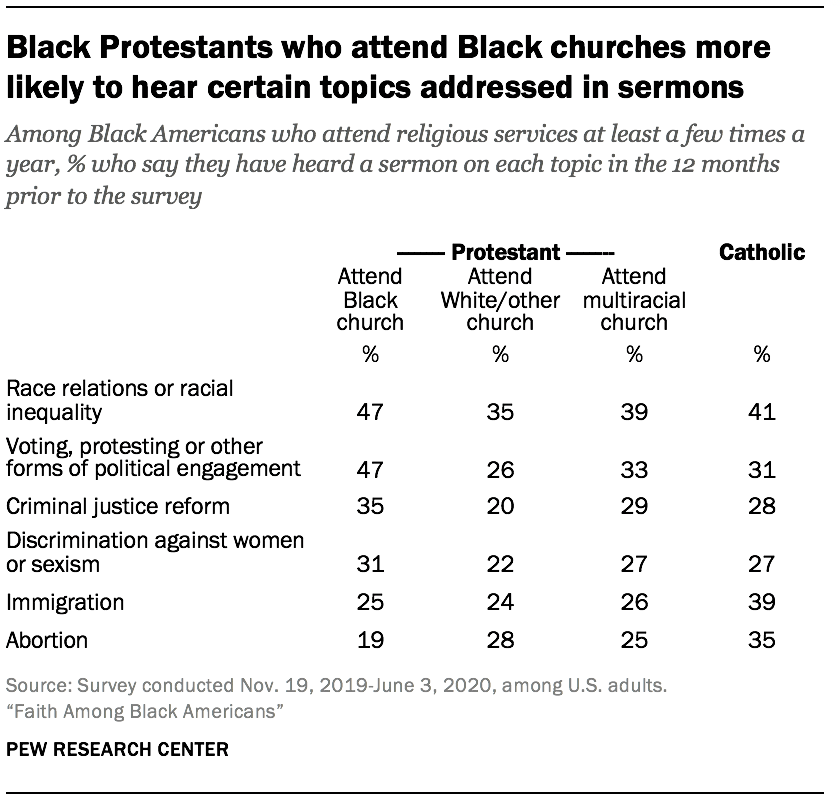
Black Protestants who attend Black churches more likely to hear certain topics addressed in sermons

Nearly half of Black Protestants who attend Black churches say they heard a sermon about race relations or racial inequality (47%) in the 12 months prior to the survey. An identical share say they heard sermons about voting, protesting or other forms of political engagement. And about a third say they heard sermons about criminal justice reform (35%).

Black Protestants who attend Black churches are more likely than Protestants who go to other types of churches to report hearing sermons about each of these three topics. At the same time, they are no more likely to say they have heard sermons about immigration, and they are less likely to have heard sermons about abortion.

Churchgoing Black Catholics, meanwhile, are more likely than Protestants (regardless of what kind of church they attend) to hear sermons about immigration (39% vs. 25%) and abortion (35% vs. 21%).

Not only is the content of sermons different, but the style of religious services also varies substantially across congregations.

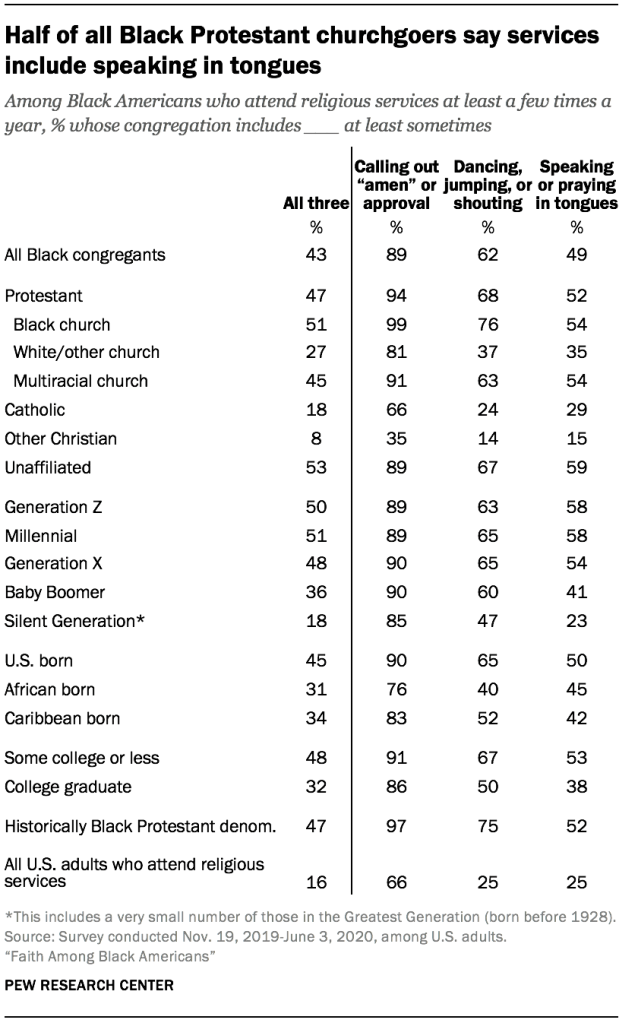
The overwhelming majority of Black Protestant churchgoers (94%) say their services include people calling out “amen” or other expressions of approval (sometimes referred to as call and response) at least sometimes. This experience at religious services is virtually universal for those who attend predominantly Black churches (99%) and very common among those who attend multiracial churches (91%). Protestants who go to a church that is mostly White or another race (81%) and churchgoing Black Catholics (66%) are less likely to say their religious services include this practice, and most members of other Christian faiths say this rarely or never happens in their congregations.

Half of all Black Protestant churchgoers say services include speaking in tongues

Two-thirds of Black Protestants who attend religious services say that they see adults dancing, jumping or shouting spontaneously during the service at least sometimes. This is much less common among Black Catholics (24%) or other Christians (14%). Again, among Protestants, those who go to Black churches are more likely to say this sort of spontaneous physical expression happens at least sometimes (76%), while most Black Protestants in White or other race churches say dancing, jumping or shouting are rarely or never present in their congregations. These practices are much less common in the congregations attended by African immigrants than in those attended by U.S.-born Black Americans.

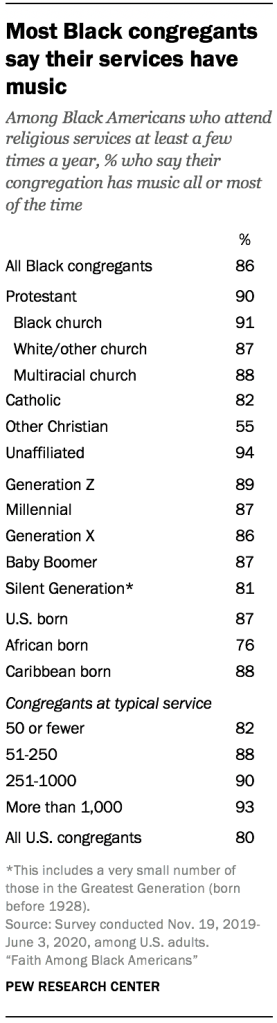
Most Black congregants say their services have music

Speaking or praying in tongues – also known as glossolalia – is less common than the other practices asked about for Black Americans who attend religious services. But, like the others, it is more often found in Protestant than Catholic congregations. This practice also is most common in the congregations attended by young people: Among Black adults who attend religious services at least a few times a year, more of those in Generation Z (58%) and the Millennial generation (58%) say that their religious services include speaking in tongues, compared with fewer Baby Boomers (41%) and adults in the oldest cohorts (23% of those in the Silent Generation and older) who say this.

The pattern among Black Americans who identify with one of the eight historically Black Protestant denominations in the Conferences of National Black Churches is much the same as that seen in the broader group of Black Protestants who go to a Black church: Nearly all say their services sometimes include “call and response,” three-quarters say that they see adults dancing, jumping or shouting spontaneously, and about half say speaking in tongues happens at least sometimes. In the larger U.S. public, each of these three practices is less common. While two-thirds of U.S. religious congregants overall say they sometimes see people calling out “amen” or other expressions of approval in services (66%), just a quarter say the same about jumping and shouting or speaking in tongues. And just 16% say the services they attend most often include all three of these practices, compared with 43% among Black congregants who say this.

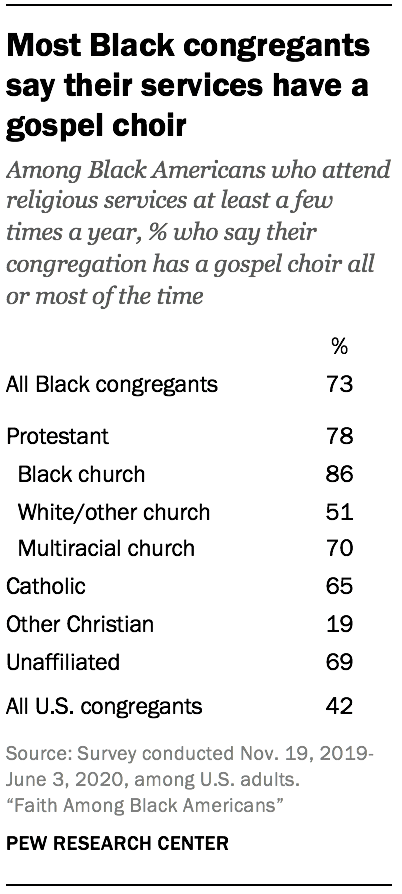
Most Black congregants say their services have a gospel choir

The vast majority of Black Americans who attend religious services at least a few times a year also say that their congregation includes music or musical instruments all (73%) or most (14%) of the time. Far fewer Black congregants say they attend religious services that only sometimes include music (7%) or that they rarely or never do (6%).

Catholics are just slightly less likely than Protestants to say their services have music. Other Black Christians are considerably less likely to say this about their services (55%).

The survey also included a question asking Black Americans who attend religious services at least a few times a year how often their services include a gospel choir. As with music more broadly, most Black congregants say this happens all (59%) or most (15%) of the time. Far fewer say they attend religious services that only sometimes (10%), rarely (4%) or never (11%) include a gospel choir. Though the survey asked specifically about a gospel choir, it is possible that at least some respondents understood the question in broader terms – for example, as any kind of Christian choir.

Most Black Americans value being in a welcoming congregation over denominational affiliation, race of other attendees

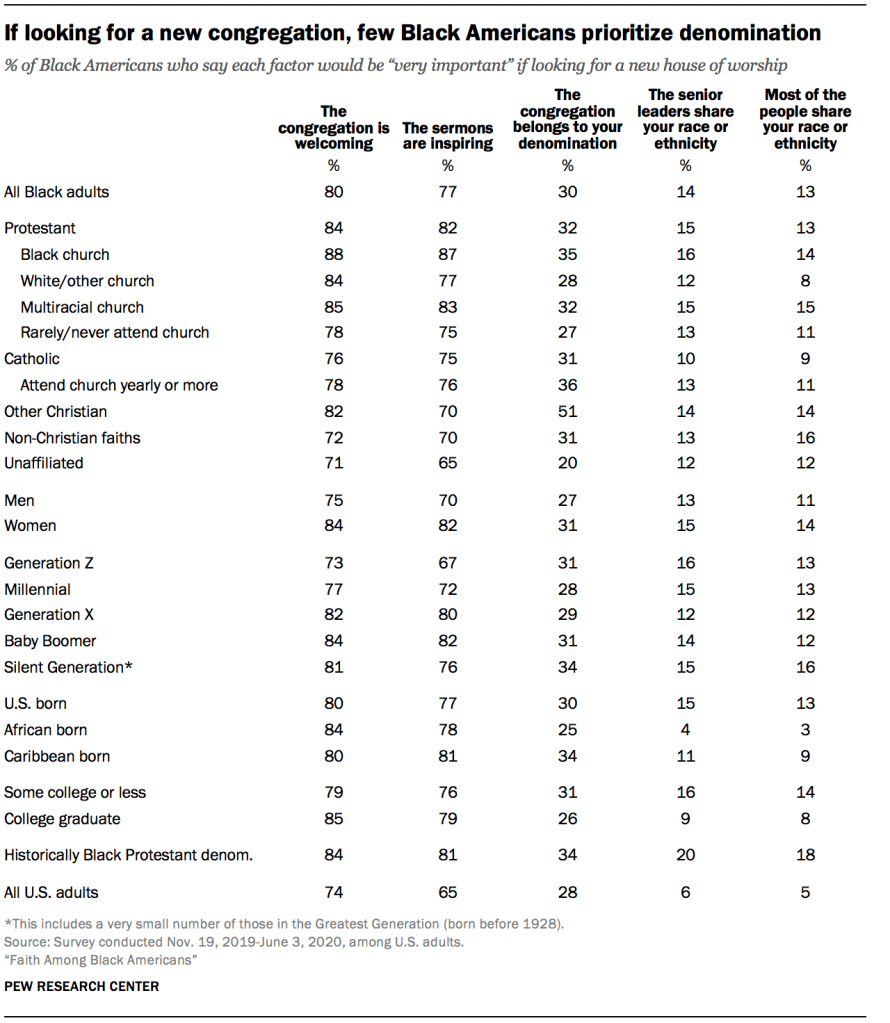
When asked what sorts of characteristics they would value if they found themselves looking for a new congregation, large majorities of Black Americans say they would prioritize finding a congregation with a welcoming atmosphere and inspiring sermons. Eight-in-ten say that if they were looking for a new house of worship, finding a welcoming congregation would be a “very important” factor in their choice, and a similar share (77%) say the same about finding a congregation with inspiring sermons.

Far fewer Black Americans say the congregation’s denominational affiliation would factor prominently in their choice. Just three-in-ten (30%) say finding a house of worship that belongs to their denomination would be a “very important” factor in their choice; 31% of Black Americans say finding a congregation associated with their denomination would be “somewhat important” in making their decision, while 36% say this would be “not too important” or “not at all important” to them.

Still lower shares say it would be “very important” to find a congregation where senior leaders share their race or ethnicity (14%) or where most other members share their race or ethnicity (13%). Indeed, most Black Americans say that the race of the senior religious leaders and the other congregants would be of little consequence in deciding on a new congregation. More than six-in-ten (63%) say it would be “not too important” or “not at all important” to find a house of worship where the senior leaders share their race, and an identical share (63%) say the same about finding a congregation where most other members share their race.

There are a few differences across social and demographic subgroups of Black Americans on these questions. Black women, for example, are somewhat more likely than Black men to attach a lot of importance to a welcoming atmosphere and inspiring sermons. However, the overall pattern of responses is the same across all subgroups analyzed in the survey; there are far more people in every group who value welcoming congregations and inspiring sermons than who prioritize a congregation’s denominational affiliation or racial composition.

If looking for a new congregation, few Black Americans prioritize denomination

Black Protestant attenders, on average, go to longer services with smaller congregations

On average, Protestants who go to Black churches travel a bit farther than those who go to churches with congregants and leaders who are primarily White or another race. And when they get there, they stay longer.

Black Protestant churches tend to have longer services than Catholic churches

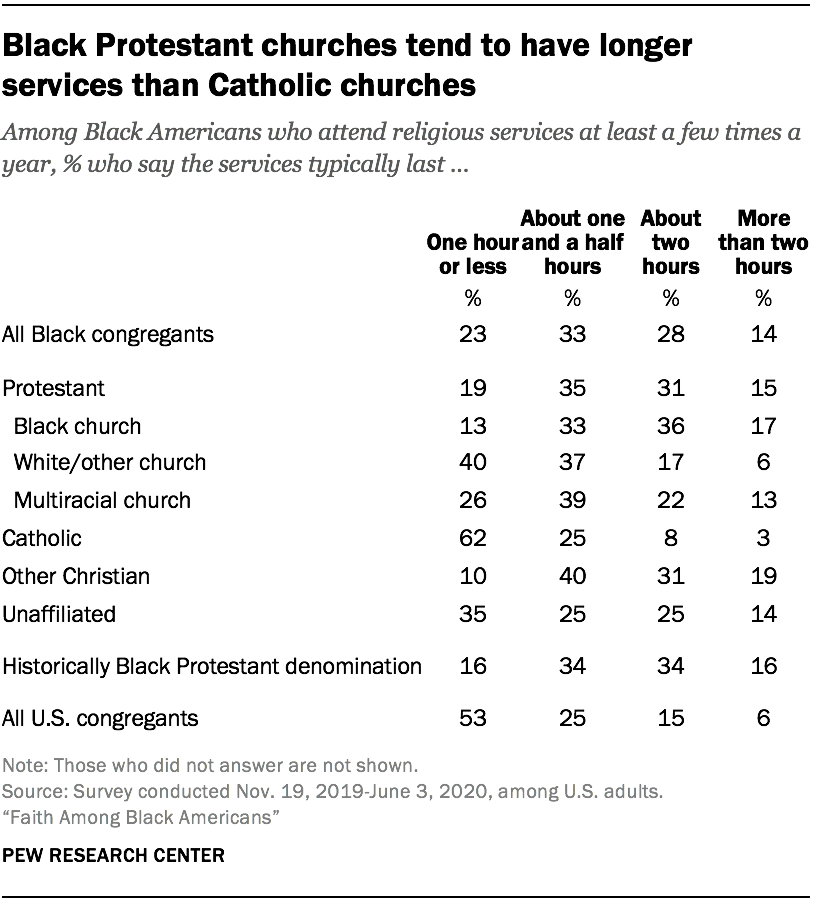
Among Black adults who say they go to religious services a few times a year or more often, 23% say the services they typically attend last one hour or less – well below the 53% of U.S. congregants overall whose services are as brief. Most Black attenders say their services are roughly an hour and a half (33%) or two hours (28%), while an additional 14% say the services they attend most frequently last more than two hours.

Black adults who regularly attend Catholic churches tend to have shorter services than those in Protestant churches. Fully six-in-ten Black Catholics (62%) say the Mass they normally attend lasts an hour or less, versus 19% of Protestants who say the same about their services. And among Protestants, those who attend a congregation that is mostly or entirely Black tend to report longer services: About half of Black Protestants who attend Black churches (53%) say their services typically last two hours or more, compared with just 23% of those in White or other race congregations who say this.

While most religiously unaffiliated Black Americans seldom or never attend religious services, those who do tend to go to shorter services than Black adults overall. About one-third of unaffiliated Black adults who attend religious services (35%) say their services last one hour or less, compared with 23% of all Black Americans who attend religious services.

Black Americans in bigger congregations travel longer to get to them

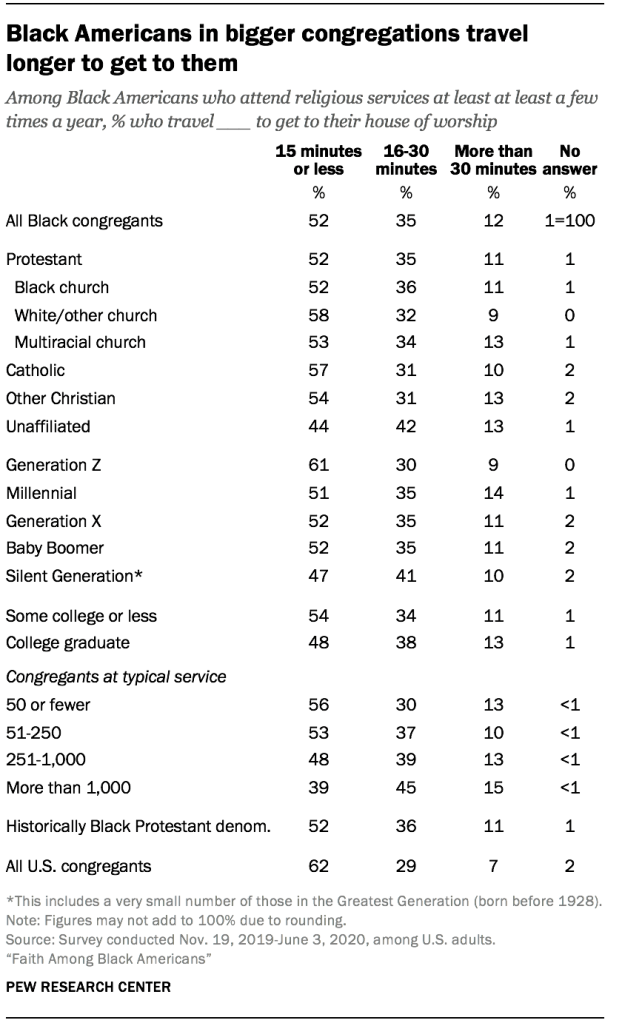
About half of Black attenders (52%) say their congregations are relatively close to home (a 15-minute trip or less). About a third spend between 16 and 30 minutes in transit to get to their house of worship, and 12% take more than half an hour getting to services.

Black attenders, on average, report spending more time traveling to religious services than do U.S. congregants overall, most of whom take 15 minutes or less to get there (62%).

Those who typically go to services with 1,000 people or fewer in attendance tend to live closer to their houses of worship than members of very large congregations. Half or more of Black adults who go to services at congregations of these relatively smaller sizes travel about 15 minutes or less to get there, compared with 39% of those who attend services with more than 1,000 people in attendance.

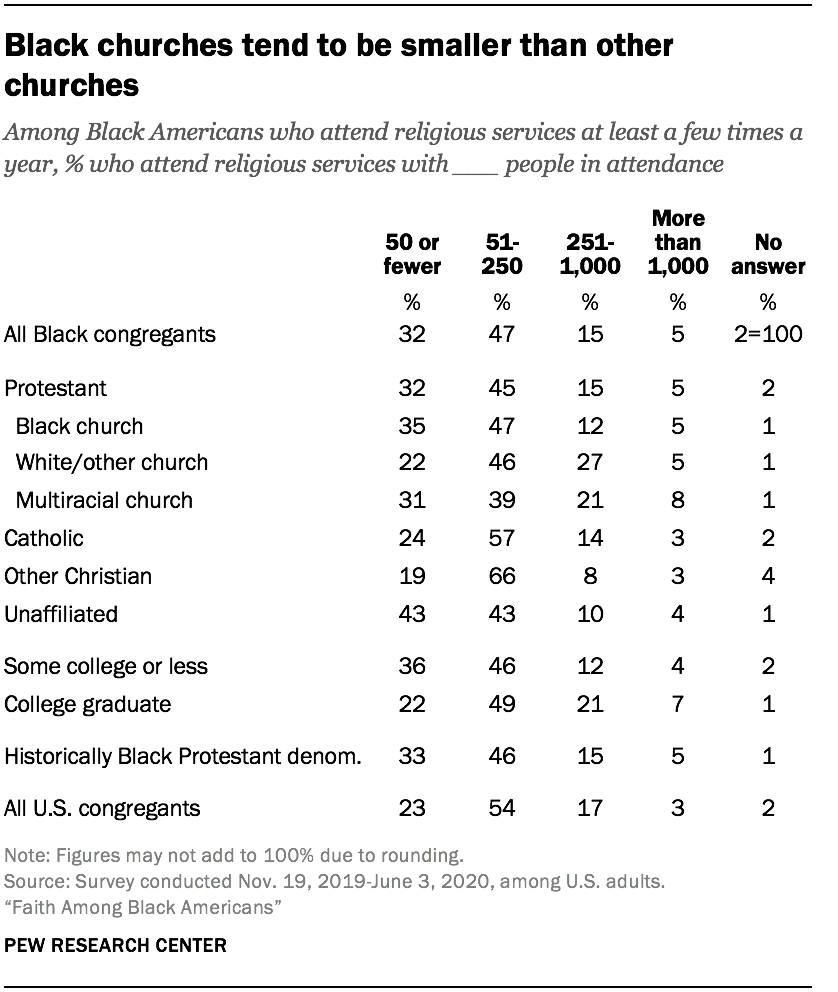
The survey finds that relatively few Black Americans attend very large churches, and that Black congregants are somewhat more inclined than U.S. religious attenders overall to worship in smaller groups.12

Black churches tend to be smaller than other churches

Indeed, about a third of Black attenders (32%) say the religious service they typically attend has 50 or fewer people in attendance (compared with 23% who say this in the general public). An additional 47% of Black congregants say there are between 51 and 250 people in attendance – the most common response. Fewer (15%) say the service they usually attend has between 251 and 1,000 people there, and just 5% say more than 1,000 people attend their service.13

Black Protestants are more likely than Catholics to attend small churches: One-third of Protestants say that 50 people or fewer go to the services they normally attend, compared with one-quarter of Catholics who say the same. And among Protestants, those who attend Black churches tend to report smaller congregations than those who go to White or other race churches. About one-in-five religiously unaffiliated Black Americans attend religious services a few times a year; those who do are more likely than Black congregants overall to go to a congregation with 50 or fewer people.

On all of these questions the pattern among Black Americans who identify with one of the major historically Black Protestant denominations is much the same as that seen in the broader group of Black Protestants who go to Black churches.

3. Religious beliefs among Black Americans

Most Black Americans identify as Christian, and many are highly religious by traditional measures of belief. For instance, belief in the divine is close to universal among Black Americans, the vast majority of whom say they believe in God or a higher power (97%). And most, when asked about the nature of the divinity they believe in, say it is “God as described in the Bible” (or, if they identify with a non-Christian religion, the holy scripture of that faith).

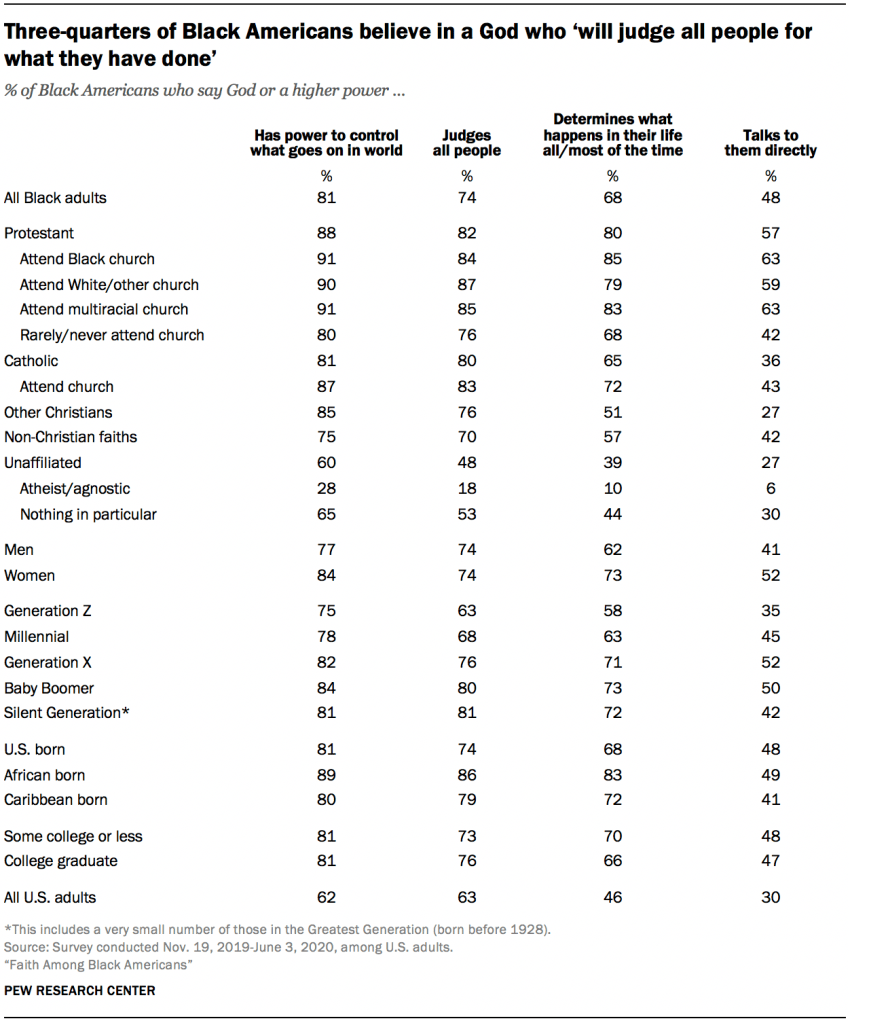
What do people envision when they think about God? Given that respondents may have had different things in mind, the survey also asked about several specific attributes people may associate with God. The findings show that majorities of Black Americans believe in a God with a presence in earthly affairs. Most Black adults – including many who are religiously unaffiliated – say they believe God has the power to determine what happens in the world and that God will judge people for their actions.

Black Americans are somewhat divided over whether belief in God is a prerequisite for morality. Just over half (54%) say believing in God is necessary for a person to be moral and to have good values, while a slightly lower share (44%) say it is not. And Black Protestants are more likely than Black Catholics to say belief in God is necessary for someone to be a good person.

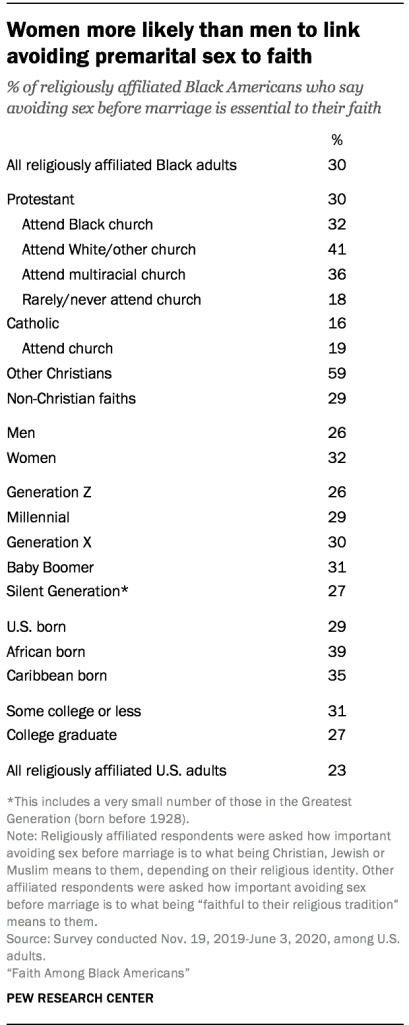
Black women are more likely than men to say belief in God is required to be a moral person, to believe that God determines what happens in their lives, and to say religion is very important in their lives. And older Black adults are more likely than younger adults to hold these views.

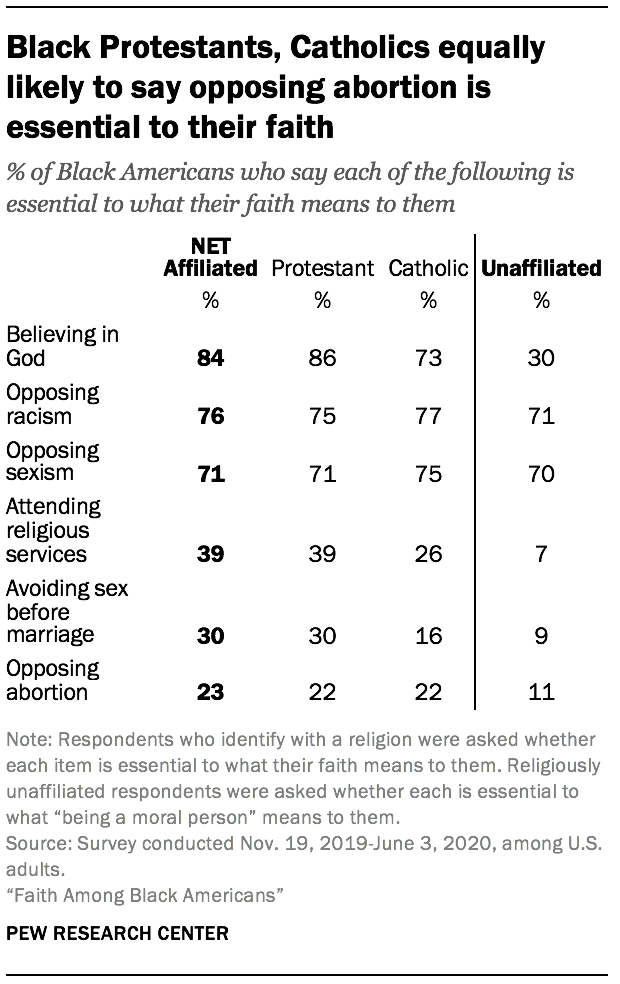
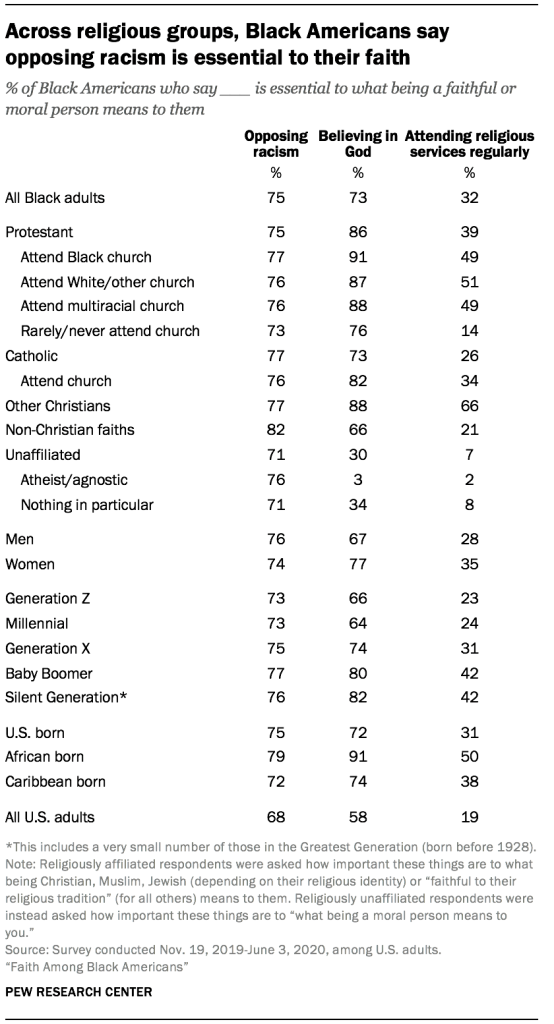
Regardless of age or gender, most Black Americans who are affiliated with a religion see opposing racism and opposing sexism as essential to their religious identity, while far fewer say the same about attending religious services or opposing abortion.

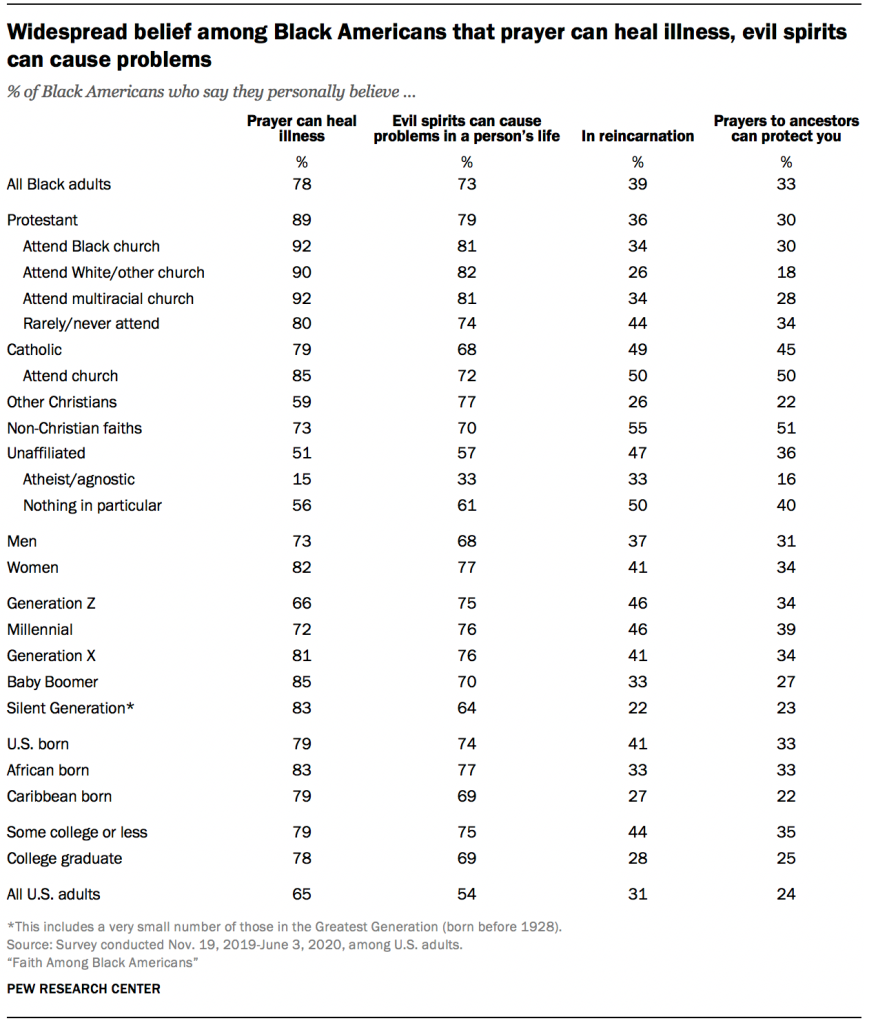
This chapter also explores the views of Black Americans on other spiritual beliefs, including the power of prayer, evil spirits, reincarnation and praying to ancestors.

Most Black Americans say religion is very important to them

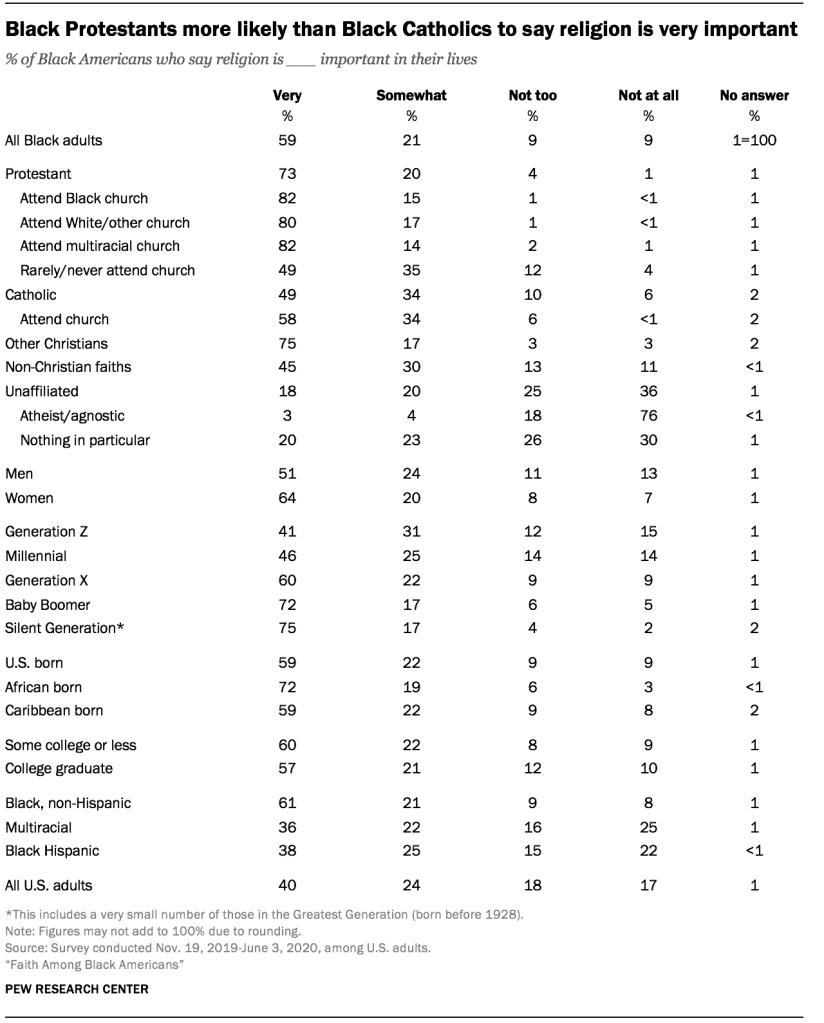
About six-in-ten Black adults (59%) say religion is very important in their lives. Another 21% say it is somewhat important, while smaller shares say it is not too (9%) or not at all (9%) important in their lives.

Among those who identify with a religion, Protestants (73%) are more likely than Catholics (49%) to say religion is very important to them. And eight-in-ten Protestants who attend religious services at least a few times a year say this, regardless of the racial composition of their congregation.

Far fewer religiously unaffiliated Black Americans – that is, those who identify as atheist, agnostic or “nothing in particular” – say religion is very important in their lives (18%), although nearly four-in-ten say religion is at least somewhat important to them.

Black women (64%) are more likely than Black men (51%) to say religion is very important in their lives, while older Black adults are more likely to say this than younger Black adults – both patterns that also are present in the U.S. public as a whole. And single-race Black Americans are more likely to feel religion is very important than are multiracial or Hispanic Black Americans.

Black adults with and without college degrees are about equally likely to say religion is very important to them.

Black Protestants more likely than Black Catholics to say religion is very important

Black adults more likely than U.S. adults overall to believe in God of the Bible

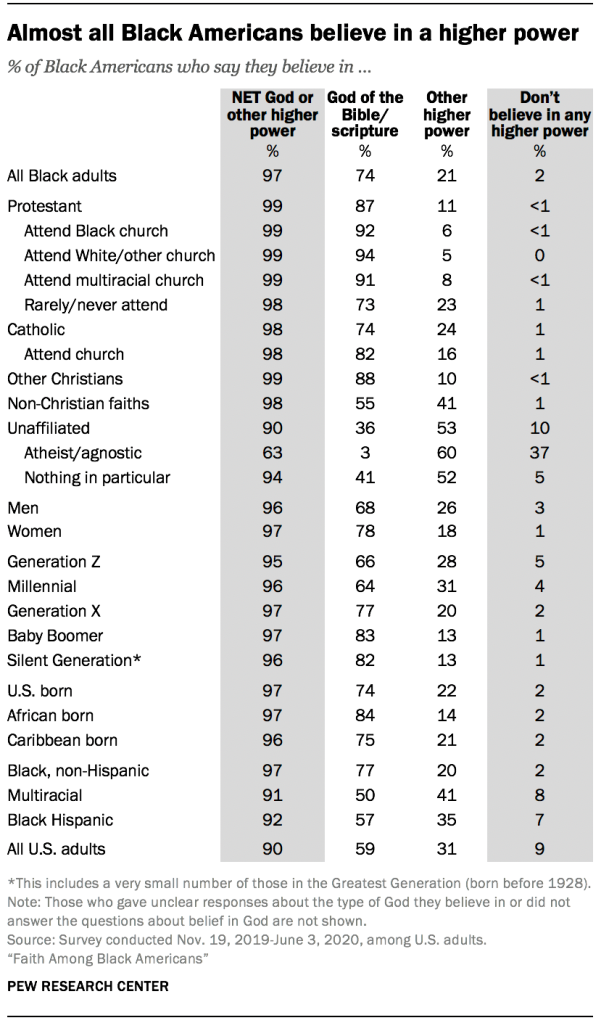
Almost all Black Americans believe in a higher power

Almost all Black Americans (97%) say they believe in God or a higher power. When asked to specify further, three-quarters (74%) say they believe in God as described in their religion’s holy scripture (such as the Bible for Christians or the Quran for Muslims). An additional 21% say they do not believe in God as described in scripture, but that they do believe in some other kind of higher power or spiritual force. Only 2% report not believing in any kind of higher power at all.

Among Christians, Black Protestants (87%) are more likely than Black Catholics (74%) to believe in the God of the Bible. Roughly nine-in-ten churchgoing Black Protestants believe this, regardless of the racial composition of their church.

While the vast majority (90%) of religiously unaffiliated Black Americans say they believe in God or a higher power, more of them say they believe in a spiritual power that is not the God of the Bible than say they believe in the God of the Bible (53% vs. 36%).

Black women are more likely than Black men (78% vs. 68%) to say they believe in the biblical God, and Black adults in the two youngest generations in the survey (Generation Z and Millennial) are less likely to say they believe in the God of Bible than those in older generations. But even among these younger adults, overwhelming majorities say they believe in some kind of higher power.

In addition, Black adults who identify racially as Black alone (77%) are more likely to believe in the God of the Bible (or some other holy scripture) than those who identify as Black and some other race (50%) or as Black and Hispanic (57%).

Most Black adults say the Bible is the word of God, but no consensus over whether it should be understood literally

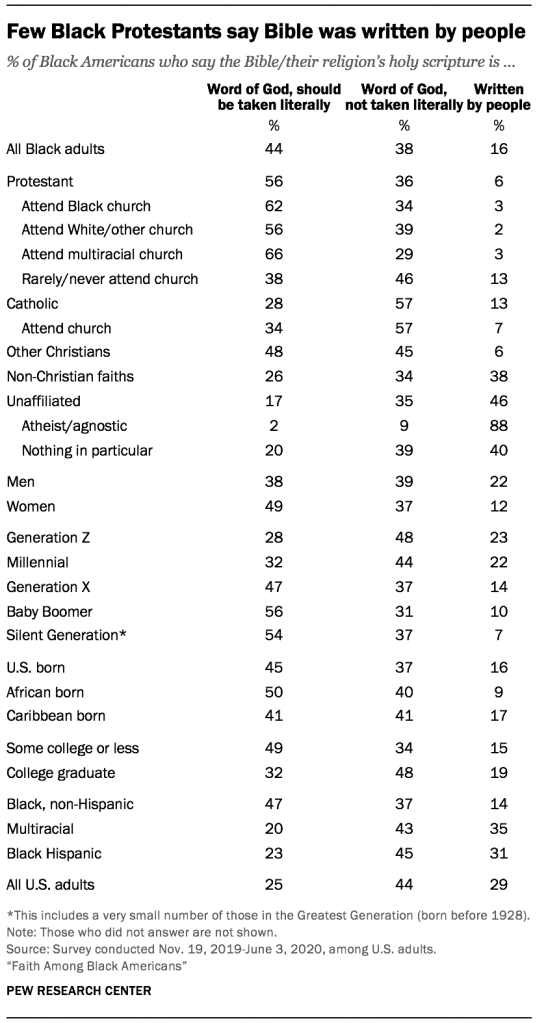
Few Black Protestants say Bible was written by people

The majority of Black Americans believe their religion’s holy scripture (Christians were asked about the Bible and Muslims were asked about the Quran, for example) is the word of God.14 But there is no consensus on whether the text should be taken literally: Just over four-in-ten Black Americans (44%) say that the Bible or their religion’s holy scripture is the word of God and should be taken “literally, word for word,” and a somewhat smaller share (38%) say that while holy scripture is the word of God, “not everything in it should be taken literally, word for word.” And 16% of Black adults say that scripture was “written by people and is not the word of God.”

Among Black Christians, Catholics (28%) are less likely than Protestants (56%) to say they take the Bible literally, word for word. And among Black Catholics, 57% say the Bible is the word of God but that it should not be taken literally. Meanwhile, only about a quarter of Black adults who identify with non-Christian faiths (26%) say their respective holy scriptures should be taken literally.

Black college graduates are less likely than Black Americans who don’t have a college degree to say their religion’s sacred scripture should be taken literally (32% vs. 49%). And Black women and older Black adults are more likely to take this view than are Black men and younger Black Americans, respectively.

Compared with U.S. adults overall, Black Americans are more likely to say the Bible or their religion’s holy scripture is the word of God and should be taken literally, and they are less likely to say that scripture was written by people.

Widespread belief by Black adults in a God that engages with the world

When they think about God or some other higher power, clear majorities of Black Americans think of a powerful entity with a presence in earthly affairs. Most say they believe in a God who “has the power to direct or change everything that goes on in the world” (81%), who “will judge all people on what they have done” (74%), and who “directly determines what happens in your life” all (44%) or most (24%) of the time. Around half of Black Americans say that God or the higher power they believe in talks to them directly (48%).

Nine-in-ten churchgoing Black Protestants (regardless of the racial makeup of their churches) and a similar share of churchgoing Black Catholics believe that God can direct or change world events. Even most religiously unaffiliated Black Americans – including roughly two-thirds of those who describe their present religion as “nothing in particular” – believe in a God with this power.

There also is widespread agreement among Black Americans, across religious affiliations, that God or a higher power judges all people, though young adults are much less likely than older respondents to believe this. And while 57% of Black Protestants say they believe God talks to them directly, this is a minority view among Black Catholics and the religiously unaffiliated.

Black college graduates and those with less education are about equally likely to hold each of these four beliefs about God. African immigrants are more likely than U.S.-born Black adults to believe that God is guiding their life, judges all people and controls world events.

Three-quarters of Black Americans believe in a God who ‘will judge all people for what they have done’

Just over half of Black Americans say belief in God is necessary for morality

Black Americans more likely than U.S. adults overall to say belief in God is required to be moral

Among Black Americans, 54% say that belief in God is required in order for a person “to be moral and have good values.” Fewer (44%) say belief in God is not necessary to be moral and have good values.

Across congregation types, Black Protestants who attend religious services at least a few times a year are more likely to say belief in God is necessary to be moral than to say it is not necessary. By comparison, Catholics who attend religious services are evenly divided on this question. Black Protestants who rarely or never attend religious services also are split.

For Black Americans who are unaffiliated with a religion or who identify with a non-Christian faith, the balance of opinion swings the other direction, with majorities in both groups saying it is not necessary to believe in God to be a moral person. And Black adults with a college degree are more likely than those with less education to take this position.

Large majorities of Black Americans believe in the power of prayer and evil spirits

The survey also asked about spiritual views, finding that majorities of Black Americans believe prayer can heal physical illness and injury (78%) and that evil spirits can cause problems in people’s lives (73%). Fewer believe in reincarnation (that people will be reborn again and again in this world, 39%) and that prayers to ancestors can protect them from bad things happening (33%).

Black Protestants are more likely than Black Catholics to believe prayer can heal and evil spirits can cause harm, while Catholics are more likely to believe in reincarnation and that prayers to ancestors can protect them. Among Black Protestants, those who go to Black churches or multiracial congregations are more likely than those who attend White or other churches to believe in reincarnation and that prayers to ancestors can protect them.

Religiously unaffiliated Black adults are less likely than those who identify with a religion to believe in the healing power of prayer and in the power of evil spirits, though around half or more of “nones” express these beliefs. And Black “nones” are more likely than Black Protestants to believe in reincarnation, and slightly more likely to believe that prayers to ancestors can protect them.

While Black Americans in the two youngest generations (Millennial and Generation Z) are generally less likely than those in older generations (Baby Boomer and older) to express many of the religious beliefs asked about in this survey, they are more likely than older adults to believe in reincarnation and that prayers to ancestors can protect them. And while offering prayers to ancestors is often viewed as a traditional African religious practice, African immigrants are no more likely than U.S.-born Black Americans to believe it can protect them from bad things happening (33% each).15

Widespread belief among Black Americans that prayer can heal illness, evil spirits can cause problems

Majorities of Black Protestants and Catholics say opposing racism and sexism are essential to their faith

Black Protestants, Catholics equally likely to say opposing abortion is essential to their faith

The survey also asked Black Americans who identify with a religion to evaluate six different beliefs and practices and to say whether each is an “essential” part of their religious identity, an “important, but not essential” part, or not an important part.

Black Americans who identify with a religion are most likely to say belief in God is essential to what their faith means to them (84%), while large majorities say the same about opposing racism (76%) and sexism (71%). Fewer say it is paramount to their faith to attend religious services (39%), avoid sex before marriage (30%) or oppose abortion (23%).

This pattern of responses holds across Black Protestant groups, regardless of the racial composition of their church or how often they attend. Black Catholics, on the other hand, are no more likely to say belief in God is essential to their faith (73%) than they are to say the same about opposing racism (77%) and sexism (75%).

Respondents who are religiously unaffiliated were asked a slightly different question – whether they connect these six beliefs and practices with “being a moral person.” Three-in-ten religiously unaffiliated Black Americans see belief in God as essential to what being a moral person means to them. And about one-in-ten say it’s essential to attend religious services (7%), avoid premarital sex (9%) and oppose abortion (11%) to be a moral person. Seven-in-ten, though, say they view both opposing racism and sexism as moral imperatives, close to the shares of Protestants and Catholics who see these as essential to their faith.

Half of Black Americans say it’s a religious duty to convert nonbelievers

Most Black Protestants see a duty to convert others

Black Americans are about evenly divided on whether people of faith have a duty to convert nonbelievers, with 51% saying that religious people have this duty and 46% saying they do not.

The view that religious people do have the duty to proselytize is more common among Protestants than among Catholics. About six-in-ten Protestants (including nearly seven-in-ten churchgoing Protestants) say that people of faith have a duty to convert nonbelievers. Among Catholics, only about a third (and 43% of churchgoing Catholics) say this.

Roughly half or fewer of Black Americans in younger generations (Generation Z, Millennials and Generation X) see a duty to convert nonbelievers, compared with about six-in-ten among Baby Boomers and older generations.

Among Black Americans who believe their religion’s holy scripture is the literal word of God, about three-quarters (73%) believe they have a duty to convert nonbelievers, compared with 42% of those who believe their religion’s holy scripture is the word of God but should not be taken literally and only 14% of those who believe holy scripture was written by people and is not the word of God.

4. Religious practices

Most Black adults engage in traditional religious practices, such as attending religious services and praying. A majority (61%) say they go to religious services at least a few times a year, including one-third who report that they typically go each week. Frequent prayer is even more common, with 63% saying they pray outside of religious services on a daily basis. Fewer (38%) say they read scripture outside of religious services several times per week, although by all three of these measures Black Americans are more religious than U.S. adults overall.

Even when the survey was conducted, mostly before the coronavirus pandemic caused many churches to stop holding in-person services, three-in-ten Black Americans said they tuned into religious services online, on TV or on the radio on a weekly basis. A subsequent survey in July 2020, in the midst of the outbreak, showed that about three-quarters of Black Americans who had previously reported attending in-person services at least monthly had recently tuned in to virtual services.

This chapter also explores what leadership roles, if any, Black adults play in their congregations, how often they participate in prayer groups or scripture study groups, and the frequency with which they engage in spiritual practices such as praying at a home altar or shrine, burning candles or incense for religious or spiritual reasons, or consulting fortune-tellers, such as a diviner or reader.

Women and older Black adults tend to engage in many of these religious activities at higher rates than men and younger Black adults, respectively. And on the whole, by many of the standard measures of religious practice measured in the survey, Black Protestants appear to be more religious than Black Catholics, as do African immigrants when compared with U.S.-born Black Americans.

One-third of Black adults say they attend religious services weekly; slightly more say they rarely or never attend

Weekly religious attendance more common among women, college-educated and older Black adults

One-third of Black adults say they go to religious services at least once a week (33%). An additional 28% say they attend either once or twice a month (10%) or a few times a year (18%). And 38% say they seldom or never attend services.

Black Protestants attend services more frequently than Black Catholics, but not more than other Christians. Four-in-ten Protestants (42%) say they attend church on a weekly basis, compared with roughly a quarter of Catholics (27%). However, among Black Americans who identify with other Christian religions – most of whom are Jehovah’s Witnesses – 59% attend at least once a week. Among religiously unaffiliated Black adults, just 4% say they attend religious services weekly, while fully eight-in-ten (81%) say they seldom or never attend religious services.

Frequent attendance at religious services is much more common among older Black adults than among younger ones, consistent with the pattern among U.S. adults overall. For example, 51% of Black adults in the Silent Generation or older say they attend religious services weekly, compared with about one-quarter of Millennials (23%) and Generation Z (27%).

African immigrants (54%) are much more likely to attend religious services weekly than are immigrants from the Caribbean (30%) or U.S.-born Black adults (32%). In addition, women and college-educated Black adults are more likely than men and those without a college degree, respectively, to attend on a weekly basis, though these differences are more modest.

Most respondents took the survey prior to the coronavirus outbreak that closed many congregations or limited their attendance.

Personal prayer is common among Black adults, even among Protestants who rarely attend church

Most Black adults pray on a daily basis

Most Black adults regularly engage in personal prayer, with 63% saying they pray at least once a day, while 14% pray on a weekly basis. Another 6% say they pray a few times a month, while 16% of Black adults say they seldom or never pray.

Most Black adults who identify with a religion pray daily, whether they are Protestants (73%), Catholics (59%), Christians of other traditions (72%), or members of non-Christian faiths (60%). Even among Black Americans with no religious affiliation, three-in-ten (31%) report praying daily, and 45% pray at least weekly.

Among Black Protestants, frequent prayer is common even among those who rarely go to church: Among Protestants who say they seldom or never attend religious services, 55% say they pray every day, and just 17% say they rarely or never pray.

About four-in-ten Black adults meditate, read scripture regularly

One-in-four Black adults meditate daily

Roughly four-in-in ten Black adults say they meditate at least weekly, including one-quarter who say they do this daily (24%) and 15% who meditate weekly. Another 9% say they meditate a few times a month, while fully half seldom or never meditate.

Four-in-ten or more churchgoing Black Protestants and Catholics meditate on a daily or weekly basis. By comparison, somewhat fewer Protestants who rarely or never attend religious services (26%) or religious “nones” (29%) meditate this often.

As with prayer, those in Generation X and older are more likely than Millennials and members of Generation Z to meditate at least weekly.

Black adults are more likely to engage in meditation than U.S. adults overall. While four-in-ten Black adults meditate at least weekly, roughly one-quarter of U.S. adults say they meditate that often (27%).

Regular scripture reading more common among Black Protestants than Catholics

About four-in-ten Black adults read scripture outside of religious services several times a week or more often, while 15% read scripture about once a week or a few times a month and 46% seldom or never do this.

Black Protestants who rarely or never attend church are less likely than other Protestants to say they read scripture regularly.

About half of Black Baby Boomers (48%) and those in the Silent Generation (51%) read scripture outside of religious services several times each week, compared with four-in-ten members of Generation X (39%), three-in-ten Millennials (29%) and just one-in-five in Generation Z (21%).

A larger share of women than men read scripture multiple times per week (43% vs. 31%). And African immigrants are more likely to regularly read scripture than U.S.-born or Caribbean-born Black Americans.

At the same time, Black adults are more likely to read scripture on a regular basis than the U.S. public overall. While 38% of Black adults read scripture multiple times per week, 23% of U.S. adults do the same. And nearly two-thirds of U.S. adults seldom or never read scripture outside of religious services, compared with 46% of Black adults.

Most Black adults never burn candles for spiritual reasons, consult a diviner

One-in-five Black adults pray at a home altar or shrine at least a few times a month

The survey also asked respondents about a variety of other personal religious practices, including praying at an altar or shrine; burning candles, incense or sage for spiritual or religious reasons; and consulting a diviner or reader. Overall, 15% of Black Americans surveyed say they pray at a home altar or shrine more than once a week, while 8% burn candles, incense or sage for spiritual or religious reasons as often, and 8% also say they consult a diviner or reader several times a week. Most Black adults say they never participate in each of these three activities.

Black Catholics (20%) are more likely than Black Protestants (11%) to say they burn candles, incense or sage for spiritual or religious reasons at least a few times a month. This could reflect participation in the Catholic devotional practice of burning candles in churches or at certain times of the year (such as Advent). And, though more religious by many measures, African immigrants are about as likely as U.S.-born Black Americans to consult a diviner or reader.

Black Protestants more likely than Black Catholics to attend prayer groups, scripture study, religious classes

Around three-in-ten Black Protestants go to prayer groups, scripture study or religious education weekly

About a fifth of Black adults (22%) say they participate in prayer groups, scripture study programs or religious education programs at least once a week. Another 14% say they do so monthly or a few times a year, while the majority (62%) say they seldom or never partake in such religious activities.

Black Protestants (28%) are more likely to take part in these activities on a weekly basis than Catholics (12%), although an even higher share of people in other Christian groups (such as Jehovah’s Witnesses) do this (48%).

African immigrants are more likely than U.S.-born or Caribbean-born Black adults to say they participate in prayer or scripture groups, mirroring patterns on some other measures of religious engagement.  

Three-in-ten Black Protestants who attend Black churches say they play a leadership role

One-quarter of Black attenders play a leadership role in their congregation

The survey asked Black adults who attend religious services at least a few times a year if they personally play any formal or informal leadership role in their congregation. About one-quarter say they do have a leadership role in their congregation, whether as deacons, ushers, members of the clergy or other roles.

Among Black churchgoers, Protestants are more likely than Catholics to say they play a leadership role at their church (27% vs. 10%). And among Protestants, members of Black churches are more likely to say they have a leadership role than are congregants in Protestant churches with other racial compositions.

Older Black adults are more likely than younger ones to be leaders in their congregations. About four-in-ten in the Silent or older generations say they have a leadership role at their congregation, compared with three-in-ten Baby Boomers (29%) and one-in-five in younger generations.

Though women are more likely than men to attend religious services or participate in prayer groups, they are equally likely to say they play a leadership role in their congregation.

Black adults play wide variety of roles at their congregations

Holding a leadership role in a congregation is slightly more common among Black adults who attend religious services at least a few times a year than it is among all U.S. adults who attend that often (24% vs. 18%).

The Black adults who play a leadership role in their congregation were asked to describe, in their own words, what that role is. Their responses ranged from more formal roles, such as a pastor or deacon, to more informal roles, such as serving as a mentor or a general volunteer.

The most common types of responses include a pastoral assistant, such as a deacon (16%); an usher, greeter or member of the welcoming committee (13%); a worship leader or member of the choir or praise team (12%); and a religious educator, such as a teacher at Sunday school or vacation Bible school (11%).

Others mention roles such as a pastor (7%), leader in youth ministry (6%), prayer leader (2%), or leader in women’s (1%) or men’s (1%) ministry.

Before the COVID-19 outbreak, three-in-ten Black adults listened to sermons online, on TV or on the radio on a weekly basis

Four-in-ten Black Protestants watch religious services online, on TV, or listen on the radio at least weekly

In addition to asking about in-person attendance at religious services, personal prayer practices and participation in scripture study, the survey also asked respondents how often they watch or listen to religious services online, on TV or on the radio. The survey, which was conducted mostly before the COVID-19 outbreak intensified in the U.S. in March 2020, found that about three-in-ten Black adults report doing so at least once a week (31%), while 22% do this on a monthly or yearly basis and nearly half (47%) say they seldom or never participate in virtual services.

A higher share of Black Protestants (39%) than Catholics (24%) watch or listen to sermons virtually on a weekly basis. And among those who attend in-person religious services at least once or twice a month, about half of Protestants (53%) also watch or listen to virtual services weekly, as do somewhat fewer Catholics (37%). By comparison, 16% of Black adults who attend in person a few times a year or less often regularly consume sermons virtually.

Due to the survey’s timing (it was mostly conducted prior to the coronavirus outbreak), most respondents answered these questions before houses of worship cancelled or restricted attendance at in-person services due to the virus. A subsequent Pew Research Center survey, conducted in July 2020, asked respondents whether they had been watching services online or on TV in the midst of the outbreak. In that survey, 77% of Black of adults who, prior to the outbreak, said they typically attend religious services at least monthly also said that they had watched religious services online or on TV in the month before the July survey was conducted. This compares to 72% of all U.S. adults who attend religious services at least monthly who were tuning into virtual religious services during the pandemic.

5. Churches and religion in Black American life

Black churches have historically taken on numerous civic roles in Black communities, stretching back as far as the antebellum period. And many, though not a majority, were involved in the civil rights movement of the 1950s and 1960s.16 In fact, most Black Americans say that predominantly Black churches have helped Black people move toward equality in the U.S., though they give more credit to civil rights organizations.

At the same time, Black Americans also tend to think these churches have declined in influence over the years. When asked to compare the influence of predominantly Black churches today to that of 50 years ago, nearly half of Black adults (47%) say predominantly Black churches are less influential today. Three-in-ten say they are more influential now than 50 years ago, and about one-in-five say they hold the same amount of sway as back then.

Many Black Americans think Black churches should have a greater role today than they do: About four-in-ten Black adults say predominantly Black churches today have “too little influence” in Black communities, compared with just one-in-ten who say they have “too much influence.” Nearly half (45%) say Black churches have “about the right amount of influence” in Black communities.

Most Black Christians feel that the most important roles for churches are to offer a sense of community, spiritual comfort and moral guidance. They are less likely to say it is essential that houses of worship engage in activities like offering help with finances, teaching job skills, providing a sense of racial affirmation or addressing political topics, though many Black Americans also say that these things are important.

This chapter also looks at where Black Americans turn for guidance when making major life decisions, including the shares who turn to religious leaders and to prayer.

Most Black Americans credit civil rights organizations, predominantly Black churches for helping Black people move toward equality; fewer cite government, White churches

Three-in-ten Black adults say predominantly Black churches have done a ‘great deal’ to help Black people move toward equality in U.S.

Asked to assess the impact of five different types of groups in helping Black people move toward equality in the United States, roughly nine-in-ten Black Americans say civil rights organizations have done either “a great deal” (60%) or “some” (29%) in this regard. Around three-quarters say predominantly Black churches have done at least some to help Black people move toward equality, although far fewer (29%) give Black churches a great deal of credit in this area than say they have done “some” (48%).

Roughly half of Black Americans say predominantly Black Muslim organizations such as the Nation of Islam (of which Malcolm X was once a member) and the federal government have had at least some impact on Black people’s pursuit of equality. Predominantly White churches stand out as the only institution of the five that a majority of Black Americans say has done either “not much” (38%) or “nothing at all” (21%) to help Black people move toward equality.

About eight-in-ten Black Protestants (81%) and Catholics (82%) say that predominantly Black churches have done at least some to help Black people move toward equality. Smaller majorities of Black Americans in other faith groups and those who are religiously unaffiliated say this about predominantly Black churches.

Black partisans differ over some groups’ roles in moving Black people toward equality

Black adults who identify with non-Christian religions – many of whom are Muslim – are more likely than other Black Americans to credit predominantly Black Muslim organizations such as the Nation of Islam with helping Black people move toward equality. This group is about equally likely to say Black Muslim organizations (69%) and predominantly Black churches (72%) have provided at least some help in the fight for equality.

There are some differences on these questions by political party. Black Republicans and those who lean toward the Republican Party are somewhat less likely than Black Democrats and Democratic leaners to say that civil rights organizations, predominantly Black churches and Black Muslim groups have done at least some to help Black people move toward equality. And Black Republicans are more likely than Black Democrats to say predominantly White churches have helped Black people move toward equality.

The views of Black adults are generally in line with those of the U.S. public overall on the role of civil rights organizations and Black churches. However, Black adults are less likely than the general public to credit the federal government for helping Black people move toward equality (55% vs. 67%), and more likely to credit predominantly Black Muslim organizations (54% vs. 41%).

Most Black adults give civil rights organizations primary credit for helping Black people move toward equality

After asking respondents to evaluate each of these institutions individually, the survey then had them pick the one that “has done the most” to help Black people move toward equality. Three-quarters of respondents name civil rights organizations (74%). Far fewer say predominantly Black churches (10%), the federal government (7%), predominantly Black Muslim organizations (3%) or predominantly White churches (1%) have done the most to help Black people move toward equality in the United States.

Black Americans who are college graduates are more likely to credit civil rights organizations than are those with less education (80% vs. 71%). Other demographic patterns, while less pronounced, are similar to those seen when the organizations are asked about separately.

More Black Americans say predominantly Black churches today have ‘too little’ influence rather than ‘too much’

Black Protestants welcome steady or increased influence for Black churches in Black communities

From running community programs to hosting civil rights meetings, many predominantly Black churches have long been deeply involved in their communities. But 41% of Black adults say these churches have “too little influence” in Black communities today, while far fewer (10%) say they have “too much influence.” Many (45%) say they have “about the right amount of influence.”

Opinions on this question are generally similar across most religious groups analyzed, including among Black Protestants regardless of the racial composition of their congregations, and among those who seldom or never attend religious services. Even Black people who say they have no particular religion are more likely to say predominantly Black churches have too little influence (37%) than to say they have too much (17%). However, unlike other groups, Black Americans who identify as atheist or agnostic are about as likely to say Black churches have too much influence (32%) as to say they have too little (27%).

There are also modest differences across age cohorts. Younger Black adults (those in Generation Z and the Millennial generation) are more likely than their elders to say predominantly Black churches have too much influence, and less likely to say they have too little influence.

Half of Black Americans think Black churches are less influential today than they were 50 years ago

When asked how much influence predominantly Black churches have today compared with 50 years ago, nearly half of Black adults (47%) say that Black churches have less influence today. Fewer (30%) say predominantly Black churches have more influence today, while about one-in-five (19%) say they have about the same amount of influence.

There is little difference in the response patterns for this question across religious groups. Even among Black Americans who identify as atheist or agnostic, a clear majority (57%) say that Black churches have less influence today. And Black Americans tend to answer this question similarly regardless of whether they were alive 50 years ago, although the youngest adults are an exception, with roughly equal shares in Generation Z saying Black churches have less influence today (42%) and more influence (39%) compared with 50 years ago.

Black college graduates are much more likely than Black people without a college degree to say Black churches have declined in influence over the past 50 years (61% vs. 42%).

Seven-in-ten Black adults say it is ‘essential’ for houses of worship to offer spiritual comfort, a sense of community or fellowship

Black Protestants and Catholics hold mostly similar opinions about the key functions of churches

The survey also asked respondents about the importance of seven different functions offered by houses of worship. Spiritual comfort (72%) and a sense of community or fellowship (71%) top the list, with about seven-in-ten Black adults saying it is essential that houses of worship offer these services.

A somewhat smaller majority (66%) say it is essential for houses of worship to offer moral guidance, and 55% say it is essential for congregations to help the needy with bills, housing and food. Roughly four-in-ten (44%) say this about teaching practical job and life skills, while a similar share (43%) say it is essential for houses of worship to offer a sense of racial affirmation or pride.

The lowest-ranking priority among those asked about is related to politics. One-quarter of Black adults say it is essential that churches and other places of worship offer sermons that address political topics, such as immigration and race relations, an additional 38% say this is an “important, but not essential” thing for houses of worship to offer.

Among religious groups, Protestants and Catholics generally express the same priorities as Black adults as a whole. These groups rank spiritual comfort and a sense of community among the most important things their churches can offer and place far less priority on political sermons. And among Protestants, there are no significant differences on these questions among those who attend mainly Black churches, multiracial churches or White or other churches.

Religiously unaffiliated Black adults are far less likely to attend religious services, but 58% say it is essential for houses of worship to offer a sense of community or fellowship, and about half cite the importance of helping the needy (53%) and offering spiritual comfort (52%).

Three-in-ten Black adults have turned to a church for help with bills, housing or food

Nearly half of Black adults with low incomes have turned to a religious organization for help with key expenses

One measure of the reach of religious institutions in Black communities is that about three-in-ten Black Americans (29%) have turned to a church or other religious congregation for help with bills, housing or food at some point in their lives.

Black adults with household incomes of less than $30,000 are much more likely than those with higher incomes to have turned to a church for help with expenses. More than four-in-ten Black adults who earn less than $30,000 annually (45%) say they have turned to a religious organization for help with bills, housing or food, compared with 21% of those with household incomes in the $30,000 to $74,999 range and 9% of those who earn at least $75,000.

Black Protestants – regardless of whether they attend religious services – are more likely than Black Catholics and the religiously unaffiliated to say they have turned to a religious congregation for help with key expenses. And Black women and U.S.-born Black adults are more likely to have turned to a religious congregation for assistance than are Black men and Black immigrants, respectively.

Black adults are more likely than the U.S. population overall to say they have turned to a religious congregation for help with food or key expenses (29% vs. 17%). This gap persists even when looking only at people with household incomes of less than $30,000 a year.

While the main survey of Black Americans was mostly conducted in the months immediately prior to the recession due to the coronavirus outbreak, a Pew Research Center survey conducted in July 2020 asked U.S. adults if they had sought out financial help as a result of the outbreak. In that survey, 13% of Black adults said they had turned to a religious organization for help with housing, bills or food as a result of the coronavirus outbreak, while 16% had turned to a nonreligious charitable organization and 29% had turned to family or friends for help with these expenses.

When making major decisions, Black Americans more likely to rely on their own research and religious reflection than on professionals and clergy

Most Black adults rely on research and prayer ‘a lot’ when making big decisions

How do Black Americans approach major life decisions? The survey suggests they are much more likely to turn inward than they are to rely on advice from other people, including religious leaders.

Nearly three-quarters of Black adults (72%) say they rely on their own research “a lot,” and more than half (56%) say they turn to prayer and personal religious reflection. Far fewer Black adults rely “a lot” on advice from professionals (27%) or religious leaders (18%).

Black Americans more likely than U.S. adults overall to turn to prayer when making major life decisions

Those who say religion is very important in their lives rely on prayer and personal reflection slightly more than on research (77% vs. 71%). And churchgoing Black Protestants are about as likely to say they rely a lot on prayer and personal religious reflection for major decisions as they are to say they use their own research, regardless of the racial makeup of the church. Protestants who don’t attend religious services are much less likely to rely on prayer.

Similarly, churchgoing Black Catholics are about as likely to rely on prayer as on their own research, though among Black Catholics overall, reliance on prayer and personal religious reflection is less common. While churchgoing Black Protestants are about as likely to rely on advice from religious leaders as from professionals and experts, churchgoing Catholics rely much less on advice from religious leaders.

Black adults are slightly less likely than the U.S. general population to rely “a lot” on personal research (72% vs. 79%) and about as likely to rely on advice from experts (27% vs. 28%) in their decision-making. However, Black adults are more likely than Americans in general to rely heavily on prayer and personal religious reflection (56% vs. 36%) or on religious leaders (18% vs. 11%).

6. Race in the religious lives of Black Americans

Race shapes Black Americans’ personal and religious lives. Nearly seven-in-ten say that being Black is very important to how they think about their own identity. Likewise, across religious groups, roughly three-quarters say that opposing racism is an essential part of their faith, and seven-in-ten religiously unaffiliated adults say this is essential to being a moral person. And, as discussed in Chapter 2, nearly half of Black Americans who attended religious services in the 12 months prior to the survey report that they have heard sermons on race or racial inequality at their houses of worship.

Though race shapes Black Americans’ identities and religious lives in many ways, fewer than half say it is essential for houses of worship to offer a sense of racial pride or affirmation. And a third of Black Americans say that historically Black congregations should try to preserve their traditional racial character; most say that historically Black congregations should try to become more racially and ethnically diverse. Additionally, if they were to seek out a new house of worship, only about one-in-seven Black Americans say that it would be very important for most other attendees or senior religious leaders to be Black. These patterns also hold among Black Protestants who currently attend Black churches.

The survey also finds that Black Americans report experiencing racial discrimination outside of religious contexts much more than in religious settings. And across religious groups, most Black Americans believe that racial discrimination is the main reason that Black people cannot get ahead in society.

The rest of this chapter looks more closely at how race and religion intersect in Black Americans’ lives.

Race, identity and religion

Two-thirds of Black Americans say that being Black is a very important part of how they think about themselves. Black Protestants (70%) are somewhat more likely than Catholics (60%) and the religiously unaffiliated (62%) to say that being Black is a very important part of their personal identity, though majorities in all three groups say this.

Among Protestants, three-quarters of those who attend Black churches (76%) say that being Black is very important to how they think of themselves, as do 65% of those who go to multiracial churches and 56% of those who attend White or other race churches.

Majority of Black Americans say that being Black is very important to how they think of themselves
Across religious groups, Black Americans say opposing racism is essential to their faith

Religiously affiliated respondents were asked whether opposing racism is essential to their faith, and large majorities of Protestants, Catholics, other Christians and members of non-Christian faiths say that it is. Across religious groups, far fewer Black Americans say attending religious services is essential. (See Chapter 3 for more details about what respondents see as central to their faith or sense of morality.)

About seven-in-ten religiously unaffiliated Black Americans, meanwhile, say that opposing racism is essential to what being a moral person means to them (71%).

The importance of race in congregations

About four-in-ten Black Americans say that it is essential for congregations to offer a sense of racial affirmation

About four-in-ten Black Americans (43%) say that it is essential for houses of worship to offer “a sense of racial affirmation or pride” – lower than the shares who say it is essential for congregations to offer spiritual comfort (72%), a sense of community (71%), and help for the needy with bills, housing and food (55%). (See Chapter 5 for more details about what respondents think is essential for churches or other places of worship to offer.)

Roughly equal shares of Black Protestants (46%) and Catholics (47%) say it is essential that houses of worship offer a sense of racial affirmation. Among Protestants, there are only modest differences on this question between those who attend Black churches (49%) and White or other race churches (41%).

Black Americans who also identify with another race are less likely than single-race non-Hispanic Black adults to say that it is essential for congregations to provide a sense of racial affirmation. And half of those who say being Black is very important to how they think of themselves say it is essential for congregations to provide this, compared with 29% of those who say being Black is less central to their personal identity. Meanwhile, about half of Black Baby Boomers (49%) and those in older generations (51%) say that it is essential that houses of worship offer a sense of racial pride, higher than each of the younger generations.

Fewer Black Americans (24%) say it is essential that houses of worship offer sermons on political topics like immigration and race relations. At the same time, Black Americans are more likely than U.S. adults overall (13%) to express this view, as well as to say racial affirmation from houses of worship is essential to them (26% of U.S. adults overall say this).

Black congregations and diversity

Majority of Black Americans say Black congregations should try to become more diverse

While race is important to Black Americans’ personal identities and faith, large numbers of Black Americans are open to the prospect of diversification within historically Black congregations. About six-in-ten Black Americans say that historically Black congregations should try to “become more racially and ethnically diverse,” while one-third say historically Black congregations should try to “preserve their traditional racial character.”

Protestants and Catholics have similar views on this issue. And among Black Protestants, those who attend White or other race churches are only a little more likely than those who attend Black churches to say that Black congregations should diversify (69% vs. 62%).

Black adults who were born in Africa (70%) are more likely to hold this view than those born in the United States (61%) or the Caribbean (57%). Black Americans who have White spouses also are more inclined to say historically Black congregations should diversify (73%) compared with those who have Black (62%) or Hispanic (61%) spouses. Those who identify as Black alone (60%) are somewhat less likely than those who identify as Black and Hispanic (68%) to say that historically Black congregations should diversify.

Age also factors into whether Black Americans think historically Black congregations should diversify, with Gen Zers and Millennials more likely than those in the Silent Generation to say that Black churches should try to preserve their traditional racial character.

Looking for a new congregation

If looking for a new congregation, few Black Americans prioritize race

When asked what sorts of things they would prioritize if they were to find themselves looking for a new congregation, 14% of Black Americans say it would be “very important” to them to find a house of worship with Black senior religious leaders, and a similar share (13%) say it would be “very important” to find a congregation where most attendees are Black. While about one-in-five say each of these factors is “somewhat important,” most Black Americans say these factors are either “not too important” or “not at all important.” By comparison, eight-in-ten Black Americans say it would be very important that the congregation be welcoming, and 77% say the same about the congregation having inspiring sermons. (See Chapter 2 for more details about how Black Americans evaluate each of these factors.)

Black Protestants are modestly more inclined than Black Catholics to say that if they were looking for a new congregation, it would be important to them that most attendees and religious leaders be Black. Still, relatively small shares of Protestants who attend different types of congregations would prioritize the race of attendees and religious leaders if they were searching for a new church.

Adults who identify solely as Black and those who are Black and Hispanic are a bit more likely than those who are multiracial to say it would be very important to find a congregation where most senior religious leaders are Black.

Black Americans who were born in the United States and the Caribbean are more likely than immigrants from Africa to say that it would be important that a new congregation have Black senior religious leaders and Black attendees. And Black Americans with Black spouses or partners are more likely than those with White spouses or partners to say this.

Across all of these groups, however, no more than about one-in-seven say it would be very important to them to find a new congregation where most attendees or the senior religious leaders are Black.

Black Americans are slightly more likely than U.S. adults overall to say they would prioritize finding a house of worship where most other attendees (13% vs. 5%) and senior religious leaders (14% vs. 6%) share their race.

Racial discrimination in religious settings and society

Roughly one-in-six Black Americans (16%) say that they experienced at least one form of racial discrimination in religious settings in the 12 months prior to the survey. The survey asked whether people have had others act as if they are better than them (11%), or if they have been treated suspiciously (7%), called racist names or insulted (6%), or snubbed in social settings (5%) because of their race.

Among Black adults who have experienced discrimination in a religious setting, three-in-ten say this has happened only in a congregation that is not their own, 23% say it has happened only in their own house of worship, and 31% say it has happened both in their own house of worship and in other religious settings; 16% did not answer the question. Because this question was only asked of the roughly one-in-six Black Americans who say they experienced discrimination in a religious setting in the past year, the sample size is too small to determine whether Black Americans who go to certain types of congregations are more likely to have had these experiences in their own congregation or in ones they are visiting.

Protestants (15%), Catholics (16%) and the religiously unaffiliated (15%) are about equally likely to have experienced discrimination in religious settings. However, Black Protestants who attend White or other race churches (21%) are slightly more likely than those who attend Black churches (15%) to have experienced this.

Members of non-Christian faiths are more likely than most other groups to report instances of discrimination in a religious setting in the 12 months prior to the survey (29%). This group is largely Muslim, but also includes Black Americans who are “spiritual but not religious,” and a variety of other faiths. About a quarter of these Black Americans say that people in houses of worship have acted as if they were better than them (22%), while roughly one-in-ten say that people have treated them suspiciously (12%), called them racist names (12%), or left them out of social activities (9%).

Black Americans’ experiences of racial discrimination in religious settings also differ modestly by generation. Those in the oldest generations in the study (Silent Generation and older) are less likely than others to say they have experienced racial discrimination in religious settings (9%). About one-in-five Generation Zers (22%) and Millennials (17%) report that they have experienced this, as do 15% of Generation Xers and 16% of Baby Boomers.

Black Americans are far more likely to say they experienced at least one of the types of discrimination asked about in the survey in nonreligious settings than in religious ones. Nearly half of Black Americans (46%) say that in the past year, people acted as if they were better than them, treated them suspiciously, called them racist names or insulted them, or snubbed them in nonreligious settings.

About one-in-six Black Americans say they have experienced discrimination in a religious setting over the past year

Racial discrimination as a barrier to advancement

Majority of Black Americans say that racial discrimination is why Black people can’t get ahead, with little variation by religion

The majority of Black Americans (70%) believe that racial discrimination is the main reason that many Black people cannot get ahead in society. About a quarter (26%) say that Black people who cannot get ahead are mostly responsible for their own condition. By contrast, U.S. adults overall are slightly more inclined to say that Black people who can’t get ahead are mostly responsible for their own condition than they are to say that racial discrimination is why Black people can’t get ahead (52% vs. 45%).

7. Gender, sexuality and religion

Roughly seven-in-ten Black Christians say that opposing sexism is essential to their faith, as do a similar share of those who belong to other religions. And most Black Americans say that women should be able to serve as senior religious leaders of congregations. However, much smaller shares say they have actually heard recent sermons on sexism at their houses of worship. They are more likely to hear messages on racial inequality, criminal justice reform, voting and protesting.

Black Americans generally express egalitarian views about gender norms in families and communities. They believe that mothers and fathers who live in the same household should share parenting and financial responsibilities. However, Black Americans are more likely to attend congregations where men’s financial role in the family and involvement in the community is emphasized more than women’s. Majorities say their congregations strongly emphasize that men should financially support their families and should also be involved parents, role models in Black communities, and active congregants. Smaller shares say their congregations stress these same roles for women, with the exception of parenting.

On issues related to sexuality, Black Americans tend to be somewhat more conservative than the larger American public. Roughly six-in-ten Black Americans say that homosexuality should be accepted in society, compared with seven-in-ten in the larger public. And half of Black Americans say religious leaders should not perform same-sex marriage ceremonies, a slightly higher share than in the larger public. Additionally, three-in-ten religiously affiliated Black adults say avoiding sex before marriage is essential to their faith, while an additional 44% say it is “important, but not essential.”

On some of these questions, Black Protestants express more conservative views than Black Catholics. Protestants are much less likely than Catholics to say that homosexuality should be accepted by society, for example, and also less inclined to feel that clergy should perform same-sex marriage ceremonies. The survey also finds that immigrants from Africa often express more traditionalist views on gender than those born in the U.S. or the Caribbean. For instance, African immigrants are more likely than U.S.-born Black Americans and those born in the Caribbean to say that fathers should be the primary breadwinners in families and that mothers should take the lead in child-rearing, though majorities still say that child-rearing responsibilities should be shared equally.

The rest of this chapter explores how gender, sexuality and religion intersect in Black Americans’ views on family and community.

Opposing sexism is essential to Black Americans’ faith, sense of morality

Most religiously affiliated Black Americans say opposing sexism is essential to their faith

Most Black Americans who are affiliated with a religious group say that opposing sexism or discrimination against women is essential to what it means to be faithful to their religious tradition. Similar shares of Catholics (75%), Protestants (71%), other Christians (73%) and members of non-Christian faiths (73%) say this. Among Black Americans who do not identify with a religious group, 70% say that opposing sexism is essential to what “being a moral person” means to them. Another 19% of Black Americans say opposing sexism is “important, but not essential” to their faith or sense of morality, while 7% say it is not important.

For Black Protestants, opposing sexism is less essential than believing in God. However, they are much more likely to say opposing sexism is essential to their faith (71%) than to say the same about attending religious services (39%), avoiding premarital sex (30%) or opposing abortion (22%). (For more details about what respondents see as essential to their faith, see Chapter 3.)

Similar shares of religiously affiliated Black women and men say that opposing sexism is essential to their faith. Furthermore, majorities across all generations express this view.

Most Black adults who attend religious services have not heard sermons on sexism in past year

Although opposing sexism is essential to the majority of Black Americans’ faith or sense of morality, only about three-in-ten of those who attend religious services at least a few times a year (28%) say they heard a sermon, lecture or group discussion about that topic in the year prior to the survey. They are more likely to hear sermons about racial inequality (42%) and various forms of political engagement, such as voting and protesting (39%).

Similar shares of Protestants (29%) and Catholics (27%) say they have heard sermons about discrimination against women. And among the relatively few religiously unaffiliated Black Americans who attend religious services, a similar share (28%) say they have heard these types of sermons. Among Protestants, those who attend Black churches (31%) are slightly more likely to hear sermons on sexism than those who attend White or other race churches (22%).

The share of men who report hearing these kinds of sermons (33%) is slightly higher than the share of women who say this (26%).

Women as senior leaders of congregations

Most Black Americans say women should be able to serve as senior religious leaders of congregations

A large majority of Black Americans (85%) say that women should be able to serve as the senior religious leader of a congregation. Large majorities of Protestants (86%) and Catholics (89%) support this view, as do 87% of women and 84% of men.

Among the groups analyzed in this survey, the largest exception to this pattern is Christians who identify with a tradition other than Protestantism or Catholicism. Within this group (which is mostly Jehovah’s Witnesses), 58% say women should not be able lead congregations.

Sharing childcare and financial responsibilities in families

Black Americans generally express egalitarian views about gender norms in their families and communities. The majority say that mothers and fathers should be equally responsible for family finances in households where both are present (73%), while a quarter say that fathers should take the lead.

A somewhat larger share of Black “nones” (79%) and Catholics (78%) than Protestants (71%) support equally shared financial responsibilities for mothers and fathers. And Protestants who attend multiracial congregations (72%) or Black churches (70%) are slightly more likely than those in White or other congregations (63%) to say that mothers and fathers should equally share the financial burden for the family.

Black adults who were born in the Caribbean (75%) or the United States (74%) are more inclined to support shared financial responsibilities than those born in Africa (57%). Among African immigrants, four-in-ten (42%) say fathers should be the main breadwinners.

Black women (76%) are somewhat more likely than Black men (69%) to say mothers and fathers should share financial responsibilities equally. Meanwhile, Black Americans who have never been married (77%) are more likely to believe in splitting financial responsibilities than those who are currently married (69%). About three-quarters of Black adults in Gen X or younger generations take this stance on family finances, compared with a smaller share among members of the Silent Generation (66%).

An even larger majority of Black Americans believe that mothers and fathers should split childcare responsibilities in households where both parents are present (86%), similar to the share of U.S. adults overall who believe this (84%). Most demographic groups share this view, with few differences among them. African-born Black Americans again stand out; about a quarter (23%) say mothers should be mostly responsible for childcare.

Majority of Black Americans say that mothers and fathers should equally share childrearing and financial responsibilities in families

Black Americans more likely to say their congregations place emphasis on men’s financial responsibilities than they do on women’s

The survey asked Black Americans who attend religious services at least a few times a year whether their congregations strongly emphasize that men and women should be involved parents, support their families financially, be involved in their congregations and be role models in Black communities. For most of the topics, eight-in-ten or more Black attenders say their congregation places either “a lot” or “some” emphasis on these topics for both men and women, while fewer say their congregations place “not much” emphasis or “none at all” on these topics. However, respondents are more likely to say their congregations emphasize some topics “a lot” for men than for women.

About seven-in-ten Black congregants report hearing “a lot” of emphasis on the need for both men (71%) and women (69%) to be involved parents. But when it comes to being involved in congregations and being role models in Black communities, somewhat fewer hear these messages emphasized for women. For instance, 61% of Black congregants say their houses of worship strongly emphasize the need for men to be good role models, and 52% hear this emphasized for women.

There is an especially large gap on the issue of financial support within families: Only about a third of Black adults who attend religious services (35%) say that their congregations stress that women should support their families financially, compared with 64% who say their congregations emphasize this for men.

To varying degrees, higher shares of Protestants than Catholics say their congregations emphasize most of these roles for both men and women. Likewise, Protestants who attend Black churches are more likely to say their congregations strongly emphasize these roles for both men and women than are those who attend churches with other racial compositions.

In general, Black congregants are more likely than U.S. religious service attenders overall to hear these types of messages in their house of worship, although there are some similar patterns in both groups. For example, among all U.S. congregants, 49% say they their places of worship emphasize that men should financially support their families, compared with just 20% who hear this message about women.

Far more Black Americans say their congregation emphasizes need for men to support their families financially than say the same about women

Same-sex marriage and homosexuality

Most Black Catholics think their clergy should perform same-sex marriages

About six-in-ten Black Americans express the view that homosexuality should be accepted by society (62%), while 32% say it should be discouraged.

Black Protestants (57%) are much less likely than Catholics (78%) and the religiously unaffiliated (75%) to favor acceptance of homosexuality. Among Protestants, those who attend Black churches (54%) are slightly more accepting of homosexuality than are those who attend White or other race churches (46%). Black Americans who are atheist or agnostic, meanwhile, are the most inclined to say that homosexuality should be accepted (92%).

When it comes to ethnicity, those who identify as Black only (60%) are less likely than those who identify as multiracial (77%) or Black and Hispanic (72%) to say that homosexuality should be accepted in society. And Black adults born in the United States (63%) or the Caribbean (52%) are more likely than those born in Africa (38%) to share this view.

Younger Black Americans are more accepting of homosexuality than their elders, with adults who are a part of Generation Z (those ages 18 to 23) more likely than each older generation to agree with this stance. This is in line with previous research showing that, among U.S. adults overall, young people are consistently more accepting of homosexuality than older people.

While the majority of Black Americans say homosexuality should be accepted by society, fewer than half (44%) say their religious leaders should perform wedding ceremonies for same-sex couples – lower than the comparable share in the general public (52%). About half of Black adults (51%) say their clergy should not officiate such marriages. Again, Protestants (37%) are much less likely than Catholics (62%) and the religiously unaffiliated (64%) to say that religious leaders should preside over same-sex weddings.

Response patterns by age, race and ethnicity, and country of birth on this question mirror those seen on the question about society’s acceptance of homosexuality. In other words, older Black Americans, those who identify as Black only, and those born in Africa and the Caribbean all are less likely than others to say their clergy should officiate same-sex weddings.

Indeed, the study finds that attitudes on these two questions (whether homosexuality should be accepted or discouraged by society, and whether clergy should perform same-sex marriage ceremonies) are linked. Most Black Americans think either that homosexuality should be accepted and that same-sex wedding ceremonies should be performed by clergy (41%), or that homosexuality should be discouraged and same-sex wedding ceremonies should not be conducted by clergy (29%). However, one-in-five Black adults (18%) say they think homosexuality should be accepted by society and that clergy should not preside at same-sex wedding ceremonies.

Very few (2%) take the view that homosexuality should be discouraged but that clergy should perform same-sex marriage ceremonies, while 9% refuse to answer one or both questions.

Three-in-ten Black Protestants link avoiding premarital sex to faith

Women more likely than men to link avoiding premarital sex to faith

Three-in-ten Black Americans who are affiliated with a religious group say that avoiding sex before marriage is essential to what it means to be faithful to their religious tradition, while an additional 44% say it is “important, but not essential.” The share of Black Protestants who say avoiding premarital sex is essential to their faith (30%) is higher than that of Black Catholics (16%). Among religiously unaffiliated Black Americans, meanwhile, just 9% say that avoiding premarital sex is essential to what “being a moral person” means to them, while three-in-ten say avoiding sex before marriage is “important, but not essential” to their sense of morality (29%).

(For more details on what Black Americans see as essential to their faith, see Chapter 3.)

Religiously affiliated Black adults who attend religious services at least weekly (46%) are more likely to say avoiding premarital sex is essential to their faith than those who attend once or twice a month or a few times a year (21%) or seldom or never (16%). And religiously affiliated Black women and African immigrants are more likely to say this than Black men and U.S.-born adults.

Overall, Black Americans are more likely than the general population to say avoiding premarital sex is essential to their faith or sense of morality (30% vs. 23%).

8. Religion and politics

Overall, Black Americans are more likely than the larger U.S. public to both say it is important for sermons to touch on political topics, and to hear sermons that actually do. And Black Americans differ from White adults in the United States in that there’s little link between their party identification and their levels of religious commitment; among White adults, Republicans are more likely than Democrats to attend religious services weekly. No similar gap exists among Black Americans.

Black adults from all religious backgrounds are strongly Democratic. Among not only Protestants and Catholics, but also religiously unaffiliated Black Americans, eight-in-ten or more identify with or lean toward the Democratic Party. In addition, across all three groups, there is broad agreement that the U.S. criminal justice system is in need of serious reform and that immigrants strengthen American society.

On other topics, such as abortion, there is more disagreement across Black American religious groups. Fully eight-in-ten religiously unaffiliated Black Americans say abortion should be legal in all or most cases, compared with about seven-in-ten churchgoing Black Catholics, about two-thirds of Black Protestants who attend Black churches, and about half of Black Protestants who attend White or other race churches.

The survey also finds that Black Protestants and Catholics are more politically and civically engaged, by some measures, than those who are religiously unaffiliated. For example, roughly a third of Black Protestants and Catholics say they volunteered in their communities in the 12 months prior to the survey, compared with about a quarter of Black “nones.”

The rest of this chapter explores these topics in more detail.

Black adults tend to think offering sermons on political topics is an important role for houses of worship

One-in-four Black adults say it is essential for houses of worship to offer sermons on political topics

About one-in-four Black Americans say it is essential that houses of worship offer sermons that cover political topics like immigration and race relations. This is far smaller than the shares of Black Americans who see other roles, such as offering spiritual comfort, fellowship, moral guidance, skills training or help with bills, as essential (see Chapter 5 for a comparison). However, most Black adults (62%) say it is at least important, if not essential, for houses of worship to offer sermons on political topics like immigration and race relations. By contrast, 16% say it is not important for houses of worship to offer sermons on political topics, and one-in-five say houses of worship should not offer these types of sermons at all (19%).

Roughly equal shares of Black Protestants (24%), Catholics (26%) and religiously unaffiliated adults (23%) say offering political sermons is essential for houses of worship.

One-quarter of Black adults who identify with or lean toward the Democratic Party say it is essential that places of worship offer political sermons, as do 23% of Black Republicans and Republican leaners. Democrats are somewhat more likely than Republicans to say this is “important, but not essential” for places of worship (39% vs. 33%), while a slightly higher share of Republicans than Democrats say it is not important for houses of worship to offer political sermons or that they should do not this at all.

Black adults are more inclined than U.S. adults overall to say it is essential for houses of worship to offer sermons on political topics (24% vs. 13%). And roughly one-third of all Americans (35%) think religious congregations should not offer this type of sermon at all, compared with fewer Black adults (19%) who say this.

Among Black Americans who attend religious services at least yearly, about one-third have heard sermons on criminal justice reform

Roughly four-in-ten Black churchgoers heard a sermon about voting or other forms of political engagement in previous year

About four-in-ten Black adults who attend religious services at least a few times a year say they heard sermons about voting, protesting or other forms of political engagement in the 12 months prior to the survey. Three-in-ten say they heard sermons about criminal justice reform (31%), while about a quarter (26%) heard sermons on immigration and 22% heard sermons on abortion.

Protestants are more likely than Catholics to report having heard sermons about voting and other forms of political engagement in the 12 months prior to the survey (41% vs. 31%). This is an especially common focus of sermons heard by Protestants who attend Black churches, 47% of whom say they heard such messages. By contrast, much higher shares of Black Catholics than Protestants say they heard homilies that deal with immigration or abortion.

Roughly one-third of Black Protestants who attend a Black church (35%) say they heard sermons about criminal justice reform in the year prior to the survey, as do about three-in-ten Black Catholics (28%) and Protestants who attend a multiracial congregation (29%). Among Black Protestants who attend a White or other race church, fewer (20%) say they heard sermons on this topic in the previous year.

While there are few demographic differences on these questions, Black Democrats are more likely than Republicans to report hearing sermons on political engagement (41% vs. 33%), but less likely to say they have heard sermons on abortion (21% vs. 33%) in the 12 months prior to the survey.

Black adults who attend religious services at least yearly are significantly more likely than attenders in the U.S. general population to say they heard sermons about voting, protesting and other forms of civic engagement.

While most respondents took the survey before the summer 2020 Black Lives Matter protests that were sparked when a Minneapolis police officer killed George Floyd, a July 2020 Pew Research Center survey found that among Black Americans who had attended religious services in person or watched services online or on TV in the month prior to the survey, two-thirds (67%) had heard sermons in support of the recent Black Lives Matter protests, compared with just one-third of White congregants who said the same (32%).

Civic engagement among Black Americans

Black Protestants, Catholics each more likely than ‘nones’ to have volunteered in past year

The survey asked respondents if they had participated in four different civic activities in the 12 months prior to the survey: volunteering, attending public hearings or local neighborhood or city council meetings, contacting elected officials, and organizing or participating in rallies or protests.

About one-third of Black Americans say they volunteered in the 12 months prior to the survey (32%). One-in-five Black adults (21%) say they attended a public hearing or other public meeting, and a similar share (18%) say they contacted an elected official. Fewer than one-in-ten say they organized or participated in rallies or protests (7%), although the survey was conducted prior to the Black Lives Matter protests that followed the killing of George Floyd in May 2020.17

Black Protestants and Catholics are equally likely to say they volunteered (34%), but volunteering is less common among religiously unaffiliated adults (23%). Among Black Protestants, 24% say they attended a public hearing or other neighborhood meeting in the 12 months prior the survey, as do 19% of Catholics and 15% of religious “nones.”

Among Protestants, both volunteering and attending community meetings are more common among those who attend church at least a few times a year than among those who seldom or never attend church. And Black Protestants who attend a White or other race church are more likely to say they volunteered in the past year than those who attend a Black church or a multiracial church.

Black Americans engage in most of these civic activities at roughly the same level as the U.S. general population, although Black adults are slightly less likely than U.S. adults overall to say they contacted an elected official in the 12 months prior to the survey (18% vs. 25%).

Black Protestants in White or other race churches more likely to identify as Republican

Across religious groups, large majorities of Black Americans prefer the Democratic Party to the GOP

Black Americans are a strongly Democratic group. More than eight-in-ten Black adults (84%) identify with or lean toward the Democratic Party, while just 10% identify with or lean toward the Republican Party. Another 5% do not identify with or lean toward either political party (or did not answer the question). The survey was conducted in early 2020, prior to the presidential election, though Black Americans have long been a staunchly Democratic group.

At least eight-in-ten Black Protestant, Catholic and religiously unaffiliated adults identify as Democrats. Black Protestants who attend a White or other race church (20%) are somewhat more likely than those attending Black (7%) or multiracial (12%) churches to identify as Republicans or lean toward the GOP, though the clear majority in this group also prefers the Democratic Party (74%).

While those who identify with other Christian faiths (mostly Jehovah’s Witnesses) are more likely to lean toward the Democratic Party than the Republican Party (58% vs. 10%), a sizable share leans toward neither party (32%), which may reflect the fact that Jehovah’s Witnesses are taught to remain politically neutral for religious reasons.

The survey finds no link between Black Americans’ levels of religious commitment and their partisanship. Roughly eight-in-ten Black adults who attend religious services weekly identify with the Democratic Party (81%), as do 84% of those who seldom or never attend religious services. This is in sharp contrast to White Americans, among whom there is a strong connection between religiousness and partisanship. Support for the Republican Party is nearly 30 points higher among White adults who attend religious services weekly (73%) than it is among those who seldom or never attend religious services (46%).

Large majority of Black adults think criminal justice system needs major changes or needs to be completely rebuilt

Nearly nine-in-ten Black adults think criminal justice system needs major changes or to be rebuilt entirely

Very few Black adults say they are satisfied with the U.S. criminal justice system. Nearly nine-in-ten say the criminal justice system either needs major changes (53%) or needs to be completely rebuilt (36%). Only 2% of Black adults say the criminal justice system does not need any changes, and 9% say it needs minor changes.

Black religious “nones” (41%) and Protestants (35%) are more likely than Black Catholics (25%) to say the criminal justice system needs a complete overhaul, but all of these groups agree that significant changes are needed. Among Black Protestants, those who attend a White or other race church are less likely than those who go to Black or multiracial churches (and those who rarely or never attend church) to say the criminal justice system needs to be completely rebuilt.

Among Black Americans in Gen Z, 38% say the criminal justice system needs to be completely rebuilt, compared with 30% of Baby Boomers and 24% of those in the Silent Generation. That said, majorities across all age cohorts agree that significant change is needed.

Like Black Americans, most U.S. adults in the general population think the country’s criminal justice system needs significant reform. However, Black Americans are about twice as likely as the public overall to say the criminal justice system needs to be completely rebuilt (36% vs. 18%).

Black adults more likely than U.S. public as a whole to say immigrants strengthen America

Eight-in-ten Black adults, including majorities across religious groups, think immigrants strengthen U.S.

Black adults tend to believe that immigrants strengthen U.S. society. About eight-in-ten (79%) say that immigrants “strengthen our country because of their hard work and talents,” while far fewer (18%) say immigrants “are a burden on the U.S. because they take our jobs, housing and health care.”

A slightly larger share of Black Catholics (86%) than Protestants (78%) or religiously unaffiliated adults (78%) say immigrants strengthen the U.S., but majorities of all religious groups – including other Christians (74%) and members of non-Christian faiths (78%) – share this view.

The largest differences on views toward immigration are between U.S.-born Black adults, among whom 77% believe immigrants strengthen the country, and Black Americans born in Africa or Caribbean (95% and 96%, respectively).

Black Americans are somewhat more likely than the U.S. general public as a whole to say immigrants benefit society, though the balance of opinion among Americans overall is in the same direction. Two-thirds of U.S. adults think immigrants strengthen society because of their hard work and talents, while 30% say immigrants are a burden.

Abortion

Nearly seven-in-ten Black Americans say that abortion should be legal in all or most cases. A smaller share, about three-in-ten, say that abortion should be mostly or entirely illegal.

Majority of Black Americans believe abortion should be legal in all or most cases

Opposition to abortion is somewhat higher among Black Christians than among the religiously unaffiliated. About three-in-ten Protestants and Catholics say that abortion should be illegal in all or most circumstances, compared with 18% of the religiously unaffiliated who say this. And Black Protestants who attend White or other race churches are somewhat more opposed to abortion than those who attend Black churches.

Among Black adults who identify with a religion, those who say opposing abortion is an essential part of their faith are less likely to support legal abortion than those who do not place such high importance on this issue, though religious duty to oppose abortion does not necessarily translate into a belief that abortion should be illegal. For instance, seven-in-ten of those who say opposing abortion is “essential” to their faith say that abortion should be illegal in all (35%) or most (35%) cases, while 28% say it should be legal in all or most cases. Among those who say opposing abortion is “important, but not essential” to their religious identity, most say it should be legal in all (19%) or most (48%) cases.

Sidebar: Trying to measure the effects of sermons

Black adults who heard a sermon about abortion more likely to think it should be illegal

Do sermons affect people in the pews? Do they change minds? Do they lead listeners to action?

It’s hard to know for sure, but the survey finds that for Black adults, listening to sermons on certain topics at religious services is associated with differing views on those topics, or with varying levels of engagement in some types of civic activity.

For instance, Black attenders who say they heard a sermon about abortion in the 12 months prior to the survey are more likely to say they oppose abortion than those who did not hear sermons on the topic. They also are more likely to oppose abortion than adults who rarely or never attend religious services. (The survey did not ask if the sermons were in support of, or in opposition to, legal abortion, only if they had heard a “sermon, lecture or group discussion” that dealt with abortion at their church or house or worship in the previous 12 months.)

Similarly, Black adults who attend services and heard a sermon about the importance of voting and other forms of civic engagement are somewhat more inclined than those who did not hear sermons on these topics, or who rarely or never attend services, to say that they are registered to vote, that they contacted elected officials, or that they attended public hearings or community meetings in the 12 months prior to the survey.

The survey finds less of a link between hearing sermons on the criminal justice system and immigration and the views of Black respondents on these topics.

Of course, the survey cannot determine the causal direction of these findings. It could be that hearing a sermon about a social or political issue changes some respondents’ opinions and behaviors. Conversely, respondents who consider these topics to be important could be seeking out places of worship that offer sermons on these issues, or that align with their existing social and political views.18

9. Interviews with Black pastors

Black pastors hold a storied place in American history. During the eras of slavery and racial segregation, they played pivotal roles in Black communal efforts to “uplift the race” (a phrase commonly used in the 19th and 20th centuries). This often included organizing job training, after-school mentoring, insurance collectives, athletic clubs and other community service programs through their churches in addition to leading protests against racial discrimination. The achievements of the Rev. Dr. Martin Luther King Jr. and other clergy during the civil rights movement rank among the most celebrated efforts in this realm.

Indeed, King’s successes are so well known that they may have fostered a misperception that all Black clergy were bold civil rights activists. In reality, many Black clergy did not support King’s approach during his lifetime. (See Chapter 10 for more on Black American religious history.) Still, it is clearly the case that King and a number of other Black pastors played central roles in the civil rights protests of the 1950s and 1960s, and that they are remembered today for their personal courage and effective leadership. Perhaps partly as a result, the new survey finds that a plurality of Black Americans (47%) believe that predominantly Black churches are less influential now than they were 50 years ago.

Pew Research Center sought the views of current Black clergy on this perceived decline in influence, along with other issues raised by the survey, through in-depth interviews conducted as a supplement to the survey of more than 8,600 Black Americans. Researchers at the Center spoke with 30 Black Christian clergy, most of them in senior leadership roles in congregations across the country. Although they are not representative of the opinions of all Black clergy, the interviews gave some close observers of American religious life an opportunity to discuss their experiences at greater length and in a more conversational format than the nationally representative survey.

Most of the interviews were conducted before COVID-19 closed or limited the capacities of houses of worship and prior to the protests that broke out when a Minneapolis police officer killed George Floyd. Those topics did arise in some of the later interviews and in some follow-up interviews.

Though there was a standard set of initial questions, pastors were permitted to veer from the script in the natural flow of conversations. Their answers can be summarized in four main themes:

Denominational breakdown of the 30 pastors interviewed
  1. The pastors express great pride in the history of the Black Church, both in its historically central place in many Black communities and in the historical role of pastors as leaders in Black communities.
  2. The pastors generally agree that their influence, and that of their churches, in their local communities has declined in recent decades. They offered a variety of reasons, including less social activism by Black clergy, growing secularism and the consequent fraying of ties between young adults and churches, gentrification of urban neighborhoods and the departure of many congregants to less densely settled suburbs, and scandals that they feel have tainted the reputations of clergy of all races.
  3. Many of the pastors have changed key elements of their church services, seeking to attract young adults without alienating older congregants. This has affected the average length of services, dress codes, the kind of music played at services, preaching styles, and other aspects of worship. (In addition, the coronavirus has led to more participation in virtual services for younger and older adults alike.)
  4. The pastors generally are optimistic that the Black Church will survive the institutional challenges it faces, saying no other institution has risen to take on its historic role. In addition, some think that polarization of national politics in recent years has led Black people who previously worshipped at multiracial churches to decide they belong in predominantly Black churches.

Most of the clergy interviewed belong to historically Black Protestant denominations. Unlike other Christian denominations that have Black people in them, these historically Black Protestant denominations have central leaderships that are composed almost entirely of African Americans and typically promote social agendas focusing on Black populations. Because there also are Black priests and ministers in the Roman Catholic Church and other Protestant denominations, some clergy in those groups were also interviewed. The rest of this chapter summarizes the conversations that took place.

1. Pastors express great pride in the history of the Black Church

The pastors spoke proudly of “the Black Church,” generally using that term to refer to predominantly Black churches in the collective sense: thousands of churches across the country, led by Black pastors in historically Black Protestant denominations, that have long fought for Black Americans’ well-being, both spiritually and in the physical world.19

In the past, many of the pastors said, predominantly Black churches were “one-stop shopping” for Black communities – places where, in addition to worship, Black people could have rich social lives shielded from the degradations of racism that pervaded the wider society.

“For many years, Black culture was centered around the church,” said Bishop Talbert W. Swan II, senior pastor of Spring of Hope Church of God in Christ in Springfield, Massachusetts. “And I think that’s something that is very unique about the Black Church and Black religion that is not necessarily true for all other communities.”

Another pastor, the Rev. Christine A. Smith, senior pastor of Restoration Ministries of Greater Cleveland, Inc., a Baptist church in Euclid, Ohio, put it this way: “Historically, [for African Americans,] the Black Church has been the only institution that we have controlled consistently. It has been the only institution where, consistently, we’ve had a platform and we can make our voices heard strongly. … It has been a point of solace, of empowerment, of education, of camaraderie, of fellowship, and networking and opportunity.”

One widely cited role of predominantly Black churches was to provide opportunities for Black people to hold leadership roles at a time when such positions were largely unavailable elsewhere in society – and at the top of the church hierarchy was the pastor.

“In the Black Church, the pastor was the hero, the moral leader … the freest, because they didn’t work for companies in society,” said the Rev. William N. Heard, senior pastor of Kaighn Avenue Baptist Church in Camden, New Jersey. “They worked for ‘the Church,’ so they were the freest voice.”

Laypeople could also take on significant roles at church, roles that lent them stature, said the Rev. Sandra Reed, senior pastor of St. Mark AME Zion Church in Newtown, Pennsylvania: “Church was everything to the African American because it was a place where anybody could be somebody. Church became that place where Mr. Smith wasn’t just Mr. Smith, he was ‘Mr. Smith the trustee.’ … It wasn’t just, ‘I have a position,’ it was ‘I have a position with power,’ because Mr. Smith could do something that he could never have done anywhere else before. When he walked in a bank, the bank knew that was Mr. Smith, the trustee from the AME Zion Church.”

Several pastors cited the emotional, energizing experiences of worship services at predominantly Black churches as another benefit they gave to their communities. They cited the “call and response” style of sermon, in which congregants shout praise (“Amen!”) and encouragement (“You tell it, preacher!”) to pastors during their sermons, and what’s called the “whooping” (pronounced “hooping”) style of preaching, in which pastors’ voices take on distinct cadences in celebration of Jesus.20 In their interviews, some of the pastors tied the atmosphere at these services to the healing role they said their churches have played as gathering places for an oppressed population to express emotion, often through shouting or crying during services.

“How does an oppressed people express their oppression?” asked the Rev. Phil Manuel Turner, senior pastor of Bethany Baptist Church in Syracuse, New York. “You’re going to see an outsized expression. Our services serve as a grounds where people can openly cry and openly express a breakthrough. They are more exuberant. … Where else can you express how hard things have been? Where else can you have an outburst without people assuming you’re insane?”

Some of the clergy interviewed in this chapter lead predominantly Black churches in denominations that are not historically Black, such as the Roman Catholic Church, the United Methodist Church, or the United Church of Christ. These pastors said their churches do have numerous Black religious traditions, such as calling out “amen” during services or having ushers wear white. At the same time, their priorities as clergy tend to reflect those of their denominations, which are less centered around the experiences of Black Americans than is typical for historically Black Protestant denominations.

The Rev. Desmond Drummer, pastor of Most Blessed Sacrament Catholic Church in South Fulton, Georgia, said, “We are firmly in the tradition of the proverbial ‘Black Church,’ because people who are descendants of slaves are in our church.” On the other hand, he said, “Black clergy at a Catholic church are never presumed to be committed exclusively to the Black population alone, or the pan-African population alone. And that shapes the way we engage the world.”

Sidebar: Pastors say women face obstacles in becoming senior pastors at Black churches, though most Black Americans say they should be allowed to lead

It is rare for women to be the senior pastor at predominantly Black churches, especially large ones, according to the clergy interviewed for this chapter. While women commonly manage church committees and take on other important roles, only a small minority of senior pastors at predominantly Black churches are women, they said.

“We do have some very successful African American pastors who are pastoring larger congregations, but those women are the exception, not the rule,” said the Rev. Christine A. Smith, senior pastor of Restoration Ministries of Greater Cleveland, Inc., a Baptist church in Euclid, Ohio.

Seven of the 30 pastors interviewed in this chapter were women. They said that within Black Christian communities, women often struggle for acceptance as church leaders. “We are a culture that has historically put more value in the men’s voice,” said the Rev. Dr. Erika D. Crawford, who is both senior pastor at Mount Zion AME Church in Dover, Delaware, and president of the AME’s Commission on Women in Ministry. “People still see men as leaders and women as followers.”

That said, in our nationally representative survey of Black Americans, the vast majority of respondents (86%) say they believe women should be allowed to serve as the senior religious leader of a congregation, while 12% say they should not. Large majorities of both Black men (84%) and Black women (87%) say they approve of women as senior religious leaders.

Still, it is rare for women to be hired to lead churches with more than a few dozen parishioners, said the Rev. Crawford. “I have seen women overlooked for promotions. I have seen women removed from pulpits in churches for things that men do all the time. I have seen women who are qualified and prepared not get appointments.”

In 2019 to 2020, Black women comprised about half of Black enrollment for master’s degrees at seminaries in the United States, up from around a third in 1989 and 1990, according to data provided by the Association of Theological Schools.

Of the major historically Black Protestant denominations, the AME Zion Church was the first to ordain women, in 1894. Two other Black Methodist denominations, the AME Church and the Christian Methodist Episcopal Church, followed suit in 1948 and 1954, respectively. Baptist denominations have traditionally ordained fewer women (and they are harder to track through time because of the independent nature of Baptist churches). The Church of God in Christ does not ordain women as pastors. Outside these historically Black Protestant denominations, women can be pastors in the United Methodist Church, the Episcopal Church, and several other mainline Protestant denominations.

2. The pastors feel their influence has declined in recent decades

A commonly expressed view during the interviews was that Black pastors’ influence in African American communities has been declining since the civil rights movement.

To explain this, the pastors offered a variety of reasons, among them: declining social activism by Black clergy, growing secularism in society, the increasing gentrification of urban areas and scandals that have implicated clergy across racial and religious boundaries.

Less emphasis on social justice

Several of the pastors we interviewed said there is less social and political activism in their ranks than was the case decades ago, at least in part because it has proven harder since the civil rights movement for Black pastors to stake out positions in common.

“The pressures of the society are not as overt as they were,” said Dr. W. Franklyn Richardson, senior pastor of Grace Baptist Church in Mount Vernon, New York, “and the church’s response to an overt oppression is different than the current situation – where we still have racism, but it is more systemic and less overt than it historically has been.”

Still, many of those interviewed said that Black pastors as a group have not vigilantly stayed on the frontlines of the latest struggles against racism. While many Black pastors have supported protests related to the killing of George Floyd, for example, they have not been at the forefront of these protests, the pastors said.

“When you look at Black Lives Matter, this is the first time that there has been any political uprising and the church isn’t spearheading it,” said the Rev. Harvey L. Vaughn III, senior pastor of Bethel AME Church in San Diego, California. “This is a new thing. The church was not ready for that. … A lot of church people just criticized it: ‘These young people don’t move the way we used to.’”

He continued, “When you look at the violence being perpetuated against Black people, traditionally the Black Church has stood up and spoken out.” In this interview, conducted prior to the killing of George Floyd, he said, “we’ve had a lot of incidents where police officers have beaten or killed unarmed Black people, and the church has been silent.”

They had never given up protesting completely. But Black pastors are showing up to rallies and marches less often than they used to, many of the pastors said.

“It’s not [as common] as it once was,” said Dr. Benjamin Hinton, senior pastor of Tabernacle Baptist Church in Gastonia, North Carolina. “After the civil rights and integration movement there hasn’t really been as much, and I can speak of this community, there’s not a heavy political involvement, not as much as it should be or as much as it was in the past.”

The Rev. Dr. Cheryl J. Sanders, senior pastor of Third Street Church of God in Washington, D.C., said that “in the ’60s, you had maybe a high-water mark of political and social influence of religious leaders with the civil rights movement. We still have people like William Barber who is still essentially carrying out the same agenda as Martin Luther King Jr. in a very public way. I don’t want to overstate the decline of the Black minister, but the civil rights movement had a certain kind of face to it. The vanguard was religious leaders, and that has changed.”21

While they acknowledge being less activist than their predecessors, many of the pastors say they remain deeply immersed in community activities. Most of the pastors interviewed cited their involvement in at least one of the following: working to reduce homelessness, feeding the hungry, registering voters or having their church buy land to develop for affordable housing.

Dr. Patrick D. Clayborn, senior pastor of Bethel AME Church in Baltimore, Maryland, said, “In terms of engagement, we haven’t marched in protests” as much as previous generations of Black pastors, “but we have been doing things like voter registration, things like having political forums where we invite candidates running for office, feeding the hungry. We have a soup kitchen and feeding program; we serviced 100 people yesterday. … We are trying to meet needs and speak to certain issues, and make sure we are activating people at least to take the power to the ballot.”

(In a follow-up interview in October 2020, he said he thought the killing of George Floyd earlier in the year, combined with societal inequities associated with COVID-19, had led to “an increase in churches … taking a more vocal stance” advocating for Black communities. Other pastors who were recontacted offered similar views.)

Some pastors said their weekly sermons are their main method to address problems in society. The Rev. Simeon Spencer, senior pastor of Union Baptist Church in Trenton, New Jersey, said, “Am I out in the street protesting all the time? Not all the time, but I do go. I can tell you what – there’s not a single Sunday that my preaching is not in some way a form of protest against anything that I believe to be injustice.”

Several worried that too many Black pastors have devoted themselves and their churches more to the “prosperity gospel,” which links strong faith to financial success and good health, than to the traditional “prophetic role” – that is, alerting society to injustices that angered God, in the style of biblical prophets.

“Prior to the ’80s, the role of the pastor was more prophetic,” said Dr. James C. Perkins, senior pastor of Greater Christ Baptist Church in Detroit, Michigan. “The church would speak out on political issues, issues of economic justice and injustice, racism and so forth. And I think now there’s much more emphasis on prosperity than there is on prophetic ministry. Unfortunately, that’s just the way it is.”

(In a follow-up interview in September 2020, Perkins speculated that the pastors who preached the prosperity gospel are less likely to do so due to the COVID-19 pandemic. “Their message doesn’t seem to resonate with the real-life experiences that we’re having right now,” he said.)

The demands of maintaining membership in an age of declining affiliation are another reason there is less activism by clergy, according to one of the pastors interviewed.

“Because church membership is declining, we’ve put a lot of emphasis on membership, and you can’t do all things well at the same time,” said the Rev. Sandra Reed of St. Mark AME Zion Church in Newtown, Pennsylvania. “So I think we’re not as bold and courageous as we used to be. I have to say, I’m somewhat ashamed of that, because the AME Zion Church is known as the Freedom Church that was at the forefront of addressing all the ills of America, and we sort of lost that. I am trying hard to teach the young ministers coming behind me the importance of making sure they are the voice that the world can hear.”

Growing secularism resulting in low levels of attachment to churches by young adults

Another reason their influence has declined, several pastors said, is because Americans of all racial backgrounds are collectively less religious than they used to be, based on measures such as affiliation and attendance at religious services.

“I think the great change of America is, we’ve become a secular society,” said Dr. Richardson of Mount Vernon, New York.22 “A lot of people have dismissed religion to a large degree.”

Dr. Warren H. Stewart Sr., senior pastor of First Institutional Baptist Church in Phoenix, Arizona, said, “I saw it happening to the White mainline churches 30 or 40 years ago. I saw it and never thought it could happen to the Black Church, because the Black Church has been a leader in civil rights, human rights, etc. But it’s hitting all of us.”

One pastor, citing declining religious affiliation, shared his observation that fewer young parents are instilling churchgoing habits in their children, perhaps because the parents themselves never had those habits when they were children.

Dr. Hinton of Gastonia, North Carolina, said he has noticed that over the years, youth recreational groups have increasingly scheduled their activities for Sundays. He sees proof of this through his windshield on his Sunday morning drive to church.

“I ride by baseball parks, and the park is filled before 8 o’clock,” he said. “Here are these hundreds of people at the baseball field … so these kids are not in church. You got more people at one of these things than in a church.”

To him, it means that too many parents “are not putting a demand on their household, a mandate on their families, that ‘we are going to church,’ or ‘church is a priority, church is a must.’”

Gentrification in U.S. cities

Increased gentrification in urban areas was commonly cited as another challenge to the standing of Black pastors. Many of the pastors interviewed said it has led to higher property values and rents that force lower-income residents – including members of predominantly Black churches – to move away. While some congregants who have moved to the suburbs still drive back to the cities for religious services, others join suburban churches. And the higher property values lead more and more predominantly Black churches to sell their old buildings and decamp to the suburbs, where their new buildings are less central to their communities than they were in their prior, urban neighborhoods.

As for churches that remain in the cities, the higher property values make it impossible for churches to buy parking lots, the pastors said, which means congregants who commute on Sundays often struggle to park on busy city streets.

“The issue is parking,” said the Rev. Sandra Reed of St. Mark AME Zion Church in Pennsylvania. “If you have an older generation of members, they’re not going to walk to park their car and walk to church and walk back to their car. What do you do when you can’t park in front of your church, and you’re 60 or 70 years old?”

She continued, “One of my colleagues, at an AME church, had a beautiful church in center city Philadelphia. She sold it because her members were driving around the block for 15, 20 minutes looking for a parking space and couldn’t find it and went home.”

Scandals

Yet another reason they are less influential now, many of the 30 pastors we interviewed said, is because a slew of clergy scandals hurt the collective reputations of men and women of the cloth.

The Rev. Christine A. Smith of Restoration Ministries of Greater Cleveland, Inc., in Euclid, Ohio, said this is true regardless of a pastor’s denomination or race.

“When you look at what happened in the Catholic Church with the scandal with the priests, and some of the things that have happened recently, not just African American pastors, but megachurches’ pastors, or saying the Lord tells them to buy a $55 million jet, these are the kinds of things that undermine people’s faith in the church,” she said. “There was a time when the church was such a major authority in the hearts and minds of people, but these things have chipped away at that to some degree.”

Dr. Hinton said he has thought a lot recently about how the public view of pastors has declined in this regard.

“I think there has been a shift, if you will, in some communities, in some circles,” he said. “It’s nothing like it was. Pastors were highly reverent, highly respected, and I think with all the various scandals and the moral lapses and shifts in our community, it has tainted the image, the respect, the roles. … They think that all we want is the money or the self-image.”

3. Pastors have changed key components of their church services

With their congregations graying, the pastors expressed their long-felt need to bring younger adults into their churches. Making them welcome, though, comes with its challenges. Many described walking a fine line to make young adults feel welcome without driving away the older congregants who tend to be their most devoted members.

For the Rev. Dr. Erika D. Crawford, senior pastor at Mount Zion AME Church in Dover, Delaware, that balance includes ensuring that two people under 50 are always on the board. The average age of her congregants is 70, and she said she reminds them that “if you don’t get in a significant amount of people who are under 50 years old, in 10 or 20 years everyone here will be dead and there will be no church.”

The problem that needs to be managed, she and the other pastors said, is that young adults tend to have different preferences than older congregants. Where this plays out most often is in the tenor of worship services: how long they last, what people wear, what music is played and the pastor’s preaching style.

Shorter services

Several of the pastors said young Black adults prefer shorter services than are often typical at predominantly Black churches, both because they have shorter attention spans and because they want to do other things on their Sundays.

“We used to have two Sunday services, 8 and 11,” said Dr. Benjamin Hinton of Tabernacle Baptist Church in Gastonia, North Carolina. “Now we have just a 9:30 service, and then they’re free. … I try to get them out by 11:30, instead of 1 o’clock. They can go to restaurants, beat the line and at least feel like they have a full afternoon for family, fun or recreation.”

Another pastor, Dr. Warren H. Stewart of First Institutional Baptist Church in Phoenix, Arizona, said that in a nod to young people’s sensibilities, he shortened one of his two Sunday services. “We know the younger generation doesn’t want to stay at services too long,” he said, “so we cut the time from two hours to 75 minutes.”

Some pastors said that to dramatically shorten their services would upset their congregants.

“If I got up and preached 10 minutes,” said Dr. Clyde Posley Jr., senior pastor of Antioch Missionary Baptist Church in Indianapolis, Indiana, “my congregation would think I wasn’t feeling well.”

(In the survey, 53% of Black Protestants who attend Black churches at least a few times a year say the services typically last two hours or more.)

Casual dress

Younger adults, as a group, prefer dressing casually to wearing their Sunday best to services, the pastors said. Some said they have relaxed the dress code for at least some worship services offered by their churches.

Dr. Hinton of Gastonia, North Carolina, said he has adjusted his church’s dress code for most Sundays – except the first of the month, when formal dress is still expected – to meet his younger congregants’ preferences.

“Even myself, brought up in the church tradition – always suit and tie on Sunday – there are Sundays now that I’ll preach without a tie, in a casual shirt,” he said. “I’ll preach with my shirttail out – that was something that, in the Baptist church, you didn’t go to church with your shirttail out. One Sunday I wore my shirttail out with my cowboy boots and my jeans. I was comfortable. That was a total image shift from the traditional church.”

The Rev. Sandra Reed of St. Mark AME Zion Church in Pennsylvania, said that after consulting with younger congregants, she decided that her church should add a casual, shorter service to its weekend schedule. “You can come in a 5 o’clock [Saturday evening service] and be home by 6,” she said. “And you can come in in your shorts and your flip-flops. When you leave the mall, the market and the movie, you can come on by.”

Music

Musical preferences during church services form another generational fault line cited by the pastors. They say younger adults tend to prefer what is called “praise and worship” music – gospel music performed in a contemporary style by a small group of singers and musicians – in contrast to older adults, who tend to prefer traditional hymns sung by a choir.

“A lot of churches have shifted away from hymns in traditional devotional services,” said Dr. Hinton. “In this area, in a lot of churches they’re used to singing traditional hymns. But we have different generations. We try to include the hymns but we also include praise and worship [music]. That’s one of the things that has shifted.”

Churches that have not tweaked or substantively changed their music programs are struggling more than churches that have, he said. “We’ve had to tweak ours to reach a changing generation. Can’t just be singing the old hymns. There has to be some upbeat, has to be some life, has to be some modernity.”

Preaching

The pastors said their younger congregants tend to prefer a tamer style of preaching than has been traditional in many predominantly Black churches. Some said they have altered their services to reflect young adults’ preferences for what they called a “teaching style” of preaching, as opposed to the more emotional type of preaching (including “call and response” and “whooping,” referred to earlier) that have deep roots in predominantly Black churches.

“The Millennials are moving away from emotionalism to foundational teaching,” said Dr. Vernon G. Robinson, a former congregational pastor who now holds the position of presiding elder of the Batesville District of the Mississippi Conference of the AME Zion Church. “They want to understand exactly what the word of God means and how can it be applied to their life. They’re not as interested in the theatrics of worship. The ‘call and response’ type of thing is not enough for them.”

Dr. Posley of Indianapolis, Indiana, said that to appeal to younger adults’ sensibilities, he was adding a service that reflected this, as well as younger people’s musical preferences. “I’m going to present a different style,” he said. “I’m going to teach rather than preach. I’m going to have a guest each week. The Millennials will be able to interrupt the teaching and ask questions. I’m making the music more contemporary. The service will be shorter – from 90 minutes [down] to an hour.”

Virtual services

Prior to the pandemic, many pastors said they viewed online broadcasts of services mainly as a benefit for older congregants who could not make it to church in person. But as churches began bolstering their online options in 2020 after closing their sanctuaries due to the coronavirus, younger and older congregants alike have gotten more used to logging on, the pastors said.

Dr. Hinton said he has heard from younger and older congregants alike saying they watched a service online while “doing their walk around the park or working out at home, or on the deck.”

“Some younger people have gotten comfortable with having not to get up as early, not having to put on church clothes,” said the Dr. James C. Perkins of Greater Christ Baptist Church in Detroit, Michigan. “They may continue to access the services via livestream [after the pandemic]. We’ll have to wait and see what happens.”

LGBT inclusion

Several of the pastors said their younger congregants are generally more accepting of homosexuality than their older congregants, and that they walk a fine line between preaching acceptance of gay people, on the one hand, and opposing same-sex marriage, on the other. (The 2020 survey shows that young Black adults are more likely than older ones to say society should be accepting of homosexuality and that clergy should perform marriage ceremonies for same-sex couples.)

Dr. W. Franklyn Richardson of Grace Baptist Church in Mount Vernon, New York, said he senses that younger Black adults are “less theological” and “less doctrinal” than their elders on issues concerning homosexuality. He and other pastors say this can cause tension in churches associated with historically Black Protestant denominations such as the National Baptist Convention USA, Inc.; the AME Church; and the Church of God in Christ, which formally oppose same-sex marriages or prohibit their pastors from officiating at them.

For pastors, “dealing with the roles of LGBT people in the church is a conundrum,” Richardson said. “On the one hand, the Black Church is an advocate of civil rights and people’s rights. On the other hand, the Black Church is a strict interpreter of scripture.”

Black churches, he said, “have traditionally had an understanding of what marriage is, that does not make it an option between a man and a man, and a woman and a woman.”

Some clergy said they wished the atmosphere in Black churches was more accepting.

“The Black Church, though we get racism very well, we don’t get sexism and heterosexism as readily,” said the Rev. Traci C. Blackmon, associate general minister of Justice and Local Church Ministries for the United Church of Christ and formerly senior pastor of Christ the King United Church of Christ in Florissant, Missouri, a predominantly Black church. “And [while] this younger generation is more accepting of diverse expressions of sexuality, that is not necessarily the reputation of the Black Church. So we have a ways to go with making a place for everybody at God’s table.”

Dr. Patrick D. Clayborn of Bethel AME Church in Baltimore, Maryland, said, “I have on occasion made statements around equality, and that there should not be any judgment or bias.” He continued, “It’s not for us to judge and we shouldn’t be in anyone’s bedroom. I don’t necessarily delve deeply into it. I kind of stick with the idea of not hating, not condemning someone to hell, not trying to condemn someone’s life and not trying to be someone else’s God, but love that person as you’d want to be loved and let them make choices themselves. We can love them without needing to cast judgment.”

4. The pastors generally believe the Black Church will survive the challenges it faces

Given all the challenges they discussed, we asked the pastors if they thought predominantly Black churches would remain viable institutions a few decades from now. Many expressed confidence that Black religious congregations willremain an important part of Black communities, even if in diminished form, due to the continued presence of racism in the United States.

“The Black Church is in a weakened state, but I think it will still be there in 20 to 30 years,” said Dr. Warren H. Stewart of First Institutional Baptist Church in Phoenix, Arizona. “There are some who believe that the Black Church has served its purpose, but I don’t believe it. As long as there is racism, there will be a need for the Black Church. … Even though we don’t have the influence, particularly among the young, it’s still the most respected voice in the Black community.”

Another pastor, the Rev. Simeon Spencer of Union Baptist Church in Trenton, New Jersey, hit on a similar theme. He said, “As long as the country continues to, on the one hand, say: ‘There’s no such thing as race and we’re all one,’ but on the other hand effectively live as if that is not the case, as if it does matter, then we will always seek out a faith-based place to express who we are. Black people will always need somewhere that will speak specifically to their spiritual heritage and their experience in this country.”

Bishop Talbert W. Swan II of Spring of Hope Church of God in Christ in Springfield, Massachusetts, pointed to anecdotal evidence that a rise in racism and racist rhetoric over the last several years has led many Black adults to leave their multiracial churches for predominantly Black ones.

“I do see, over the last three or four years, a shifting in terms of Millennials questioning the leaderships in evangelical and other charismatic churches that have White leadership who are not speaking to the issues of systemic racism that are affecting our society today,” he said. “There are some of that demographic that are leaving those churches because they’re disillusioned with the fact that those leaders either avoid altogether or don’t speak adequately to those issues with their congregations.”

Still, some of the pastors, looking beyond 20 or 30 years, said they could foresee the possibility of further decline or even the demise of predominately Black churches, due to growing secularism or a future with less racism. And they could be OK with that.

“I think the Black Church will dissipate as the need for it does,” said Dr. Franklyn Richardson of Grace Baptist Church in Mount Vernon, New York. “If the society becomes more holistic, where people are included, the Black Church will become less and less necessary, therefore it will become diminished. It will be just ‘the church.’ … If you get to a place where society is holistic and diversity is celebrated, and people are not cowed by racism, there will be an opportunity for the church in America to be a holistic institution.”

Dr. Clyde Posley Jr. of Antioch Baptist Church in Indianapolis, Indiana, said he hopes that day will come. “I don’t think there should be a Black Church,” he said. “There isn’t a Black heaven and a White heaven. … A proper church will one day eschew the label of Black Church and be a universal church.”


10. A brief overview of Black religious history in the U.S.

Two-thirds of Black Americans are Protestant, like about four-in-ten Americans overall. The relationship between Black Americans and Protestantism is unusual due to the history of slavery and segregation, which spawned the creation of several Black-led denominations that allowed Black Americans to worship freely. Mostly founded prior to 1900, these historically Black Protestant denominations also supported colleges and helped Black communities in other ways.

At the same time, Protestantism alone does not define the Black religious experience in the United States. Before enslaved people in America began converting to Protestantism in sizable numbers during the 1700s, they commonly followed traditional West African religions or Islam. Catholicism, too, has long had a presence among Black Americans, including in Maryland, Kentucky and Louisiana during the slavery era. And in the early 1900s, Islam began attracting thousands of Black Americans with the message that Christianity, like America writ large, had failed to offer them equality.

What follows is a brief account of Black religious history in the United States, with an emphasis on efforts by religious groups to deal with racism and its effects.
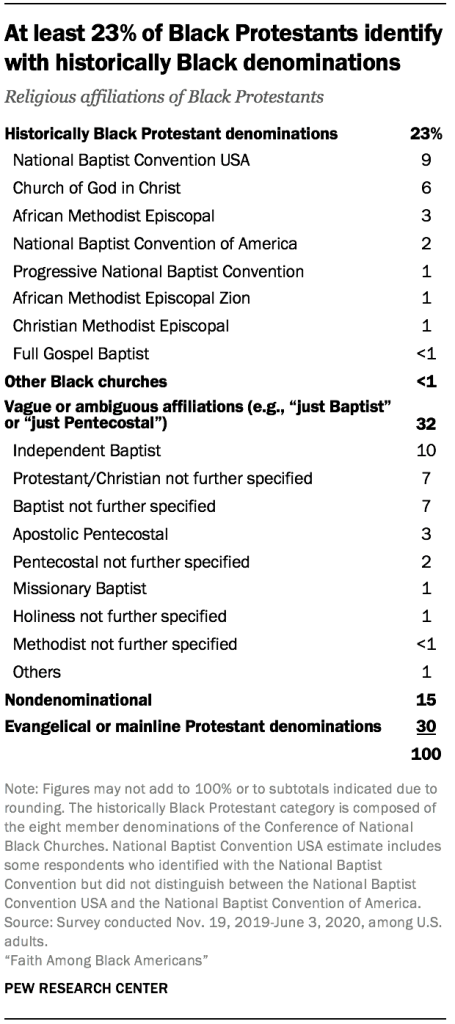
Antebellum slavery and religion

When they were first captured and taken to America, some enslaved Black people were Christian. More were Muslims. But the largest number, by far, were followers of traditional religions common in West Africa at the time. Many of these African belief systems included a supreme, distant god who created the world and a pantheon of lower gods and ancestor spirits who were active in daily life.

This religious heritage also included the use of herbal medicine and charms, applied by specialists known as conjurers, who were believed to be able to heal disease, harm an enemy or make someone fall in love. Historians say access to a conjurer gave enslaved people a sense of empowerment and control over their lives, while allowing for a worldview that distinguished them from slaveholders and connected them to Africa.23

Major historically Black Protestant denominations and when they were founded:

1. African Methodist Episcopal (AME) Church, 1816

2. African Methodist Episcopal Zion (AME Zion) Church, 1821

3. Christian Methodist Episcopal  (CME) Church, 1870

4. National Baptist Convention, USA, Inc., 1880

5. Church of God in Christ (COGIC), 1897

6. National Baptist Convention of America International, Inc., 1915

7. Progressive National Baptist Convention, Inc., 1961

8. Full Gospel Baptist Church Fellowship International, 1994

Note: Some individual churches associated with these denominations predate the founding of the denominations themselves.

Interactions between enslaved people and Christian missionaries (and other evangelists) led to the spread of Christianity among Black Americans. Many slaveowners initially resisted these evangelistic efforts partially out of concern that if enslaved people became Christians, they would see themselves as their owners’ equals. By 1706, this fear by slaveowners had spurred legislation in at least six colonies declaring that an enslaved person’s baptism did not entail their freedom. In addition, many enslaved people who did become Christians had to deal with restrictions by masters who forbade them from attending church or prayer meetings. To get around these restrictions, and for alternatives to sermons by White clergy asking them to obey their owners, many Christian enslaved people held secret services with distinctive styles of praying, singing and worship. These services were typically held in their cabins or in nearby woods, gullies, ravines and thickets.24

Historians say the biblical story of the Israelites’ escape from Egypt provided a good deal of inspiration to the enslaved people. This was reflected in coded lyrics to some of their religious songs, or spirituals. In “Go Down, Moses,” for example, the lyrics plead with the Hebrew prophet to “tell old Pharaoh, let my people go.” Frederick Douglass wrote that when he was a child, before he had escaped slavery, “a keen observer might have detected in our repeated singing of ‘O Canaan, sweet Canaan, I am bound for the land of Canaan,’ something more than a hope of reaching heaven. We meant to reach the north, and the north was our Canaan.”25

Growth of Protestantism and historically Black Protestant denominations

The first Black Protestant denomination, the African Methodist Episcopal (AME) Church, was founded in the early 1800s by Richard Allen, who had bought his freedom from slavery. Allen had become a Methodist preacher in the 1780s, but in 1787, he and others left the predominantly White church after being pulled from their knees in prayer for being in a section of the church where Black worshippers were not allowed. Three decades later, he and representatives from five other congregations founded the AME denomination. A similar chain of events in New York led to the creation of the AME Zion Church in 1821.

Toward the end of the Civil War, and in the decades immediately afterward, Black Protestant denominations cemented their place more deeply in the U.S. religious landscape. Especially after emancipation, the AME and AME Zion churches sent large numbers of missionaries to the South, leading many Black Christians to leave mostly White churches and join predominantly Black ones. The AME Church grew from 20,000 members just before the start of the Civil War to 400,000 in 1884, while the AME Zion Church’s membership jumped from 4,600 at the start of the war to 300,000 in 1884.26 Other major denominations that came into existence during this period were the Christian Methodist Episcopal Church (1870) and the National Baptist Convention (1880).27 Overall, the U.S. Census Bureau counted nearly 2.7 million “negro communicants” at Christian churches in 1890, reporting at least a fourfold increase in Black Christians over the previous three decades. It also found that Black people in 1890 were more likely than White people to be members of a Christian congregation (36% vs. 33%).28

Another type of Protestant Christianity, Pentecostalism, developed followings in the United States around the turn of the 20th century. The largest Black Pentecostal denomination, the Church of God in Christ (COGIC), formed in 1897 and gained steam after a revival in Los Angeles, California – known as the Azusa Street Revival – began in 1906. The revival, led by a Black preacher, the Rev. William J. Seymour, is credited by scholars with spurring the growth of Pentecostalism in the United States and subsequently around the world.

Catholicism, too, grew among Black Americans in the early-to-mid-20th century during what is known as the Great Migration, when millions of Black Americans moved from rural Southern communities into cities across the country. Parochial schools, often viewed as an attractive alternative to public schools, were one way many Black families came into contact with Catholicism.29

Scholars say predominantly Black churches of the 19th and 20th centuries played important roles in Black society outside the sphere of religion. In a period when discrimination barred Black people from access to various public amenities, many Black churches offered job-training programs, insurance cooperatives, circulating libraries and athletic clubs.30 They were among the only places Black people could take public or semi-public leadership positions. Men gained prominence as pastors, while women often led church committees and organizations that provided social services locally or advocated for causes.31 Women were barred from preaching until 1884, when the AME Church allowed them to become licensed preachers.32 However, the denomination would not ordain women until the mid-20th century. (The AME Zion Church began ordaining women in 1894.) In 1900, to address gender inequality within the National Baptist Convention, Nannie Helen Burroughs and other Baptist women founded the Woman’s Convention.33

New religious movements

The turn of the century and the early 1900s saw the founding of small, non-Christian Black religious organizations that urged Black people to view themselves as “Asiatic,” “Moorish” or as descendants of ancient Israelites, and that used religion to nurture identities “outside of society’s racial hierarchies,” in the words of religion professor Kambiz GhaneaBassiri.34 They often contended that Christianity, the most widespread American religion, had failed Black people. Many of these movements drew upon narratives of Islam as an African religion. While they never attracted more than small portions of the Black population, some of these organizations had a lasting influence in Black communities.

The Nation of Islam, which became the most prominent of these groups, was founded in 1930 in Detroit by a man known as Wallace D. Fard. It taught that Black people were the “original” and superior race and that White people were “devils” resulting from an experiment designed by a Black scientist. Elijah Muhammad, who led the group from the mid-1930s until his death in 1975, preached the need for financial and economic independence for Black people and Black communities. He taught that separation of the races was the logical response to racism from White people, and he told NOI members they should not vote in U.S. elections or serve in the armed forces.35

Other groups included the Moorish Science Temple of America (MSTA) and the Ahmadiyya movement, the latter of which was founded in India but had a missionary in the U.S. who proselytized in Black communities. Noble Drew Ali, the founding prophet of the MSTA, taught his Black members that they were “not Negroes” but were “Moorish American,” an identity meant to link Black Americans to the Muslims of Northwest Africa, known as Moors, who ruled much of the Iberian Peninsula centuries earlier. Then there was the “Back-to-Africa” movement of Marcus Garvey. While not a religious movement, its leader, Garvey, urged Black people to move to Africa to form “a government, a nation of our own, strong enough to lend protection to the members of our race scattered all over the world.”36

Black clergy and the civil rights movement

In 1957, a small group of Black civil rights leaders formed the Southern Christian Leadership Conference (SCLC), with the initial goal of using nonviolent activities to coordinate protests across the South. The group’s president was the Rev. Dr. Martin Luther King Jr., who in 1955 had led a boycott of the bus system in Montgomery, Alabama.

In speaking against racism and discrimination, King used both political and religious discourse. His celebrated speech at the March on Washington for Jobs and Freedom, delivered on Aug. 28, 1963, referred to language in the Declaration of Independence (“I have a dream that one day this nation will rise up and live out the true meaning of its creed: ‘We hold these truths to be self-evident, that all men are created equal,’”) and in the Book of Isaiah (“I have a dream that one day every valley shall be exalted, every hill and mountain shall be made low, the rough places will be made plain, and the crooked places will be made straight, and the glory of the Lord shall be revealed, and all flesh shall see it together.”).

King’s prominence notwithstanding, scholars note that many Black Christian clergy did not support his approach. Some feared violence, while others preferred a more legalistic approach over King’s “direct-action” tactics. An example of the divide surfaced in 1960 and 1961, when King and others unsuccessfully tried to dislodge the National Baptist Convention USA’s sitting president, the Rev. Joseph H. Jackson, who had not supported King’s tactics. King and his supporters ultimately left to found a new denomination, the Progressive National Baptist Convention, which fully supported the civil rights movement. Remarking on the level of support for this activism, the historian Barbara Dianne Savage wrote that “Black churches, their members, and their ministers were crucial to what the [civil rights] movement achieved, but it never involved more than a small minority of Black religious people.”37 Similar observations – or criticisms – that too few Black clergy advocated for Black people’s rights predated the civil rights movement; for example, in the first decade of the 20th century, the journalist and activist Ida B. Wells lamented that no church in Chicago, including her own, would let her use church space to hold a public meeting about a lynching.38

After 1965

How did the fight for desegregation that arose in the civil rights movement affect the Black religious landscape? Are Black people more likely since the civil rights movement to attend multiracial congregations or congregations where other races are the majority, and less likely to attend predominantly Black places of worship? This is hard to know for sure. The 2020 survey found that 60% of Black Americans who go to religious services at least yearly do so in predominantly Black congregations, while 39% go to congregations with other racial compositions. It suggests that over the long term, fewer Black families with children are attending Black congregations. Among the oldest adults in the study (those in the Silent Generation and older), 83% of adults say that they went to a predominantly Black congregation when they were children, compared with fewer adults in the youngest generation (Generation Z) who say this (64)%.39

In the years following the civil rights movement, some Black theologians began urging clergy to view racial justice as essential to Christian morality. Proponents of a religious philosophy known as Black liberation theology argued that God and Christianity are mainly concerned with eradicating poverty and bringing about freedom for Black populations and other oppressed peoples. “God is not color-blind in the black-white struggle, but has made an unqualified identification with blacks,” wrote the Rev. Dr. James H. Cone, a prominent scholar of Black liberation theology.40 It is hard to know how many Black clergy adopted these views over time, though theologians estimated in 2008 that a quarter of Black pastors, at most, view their theology as liberationist.41

In 1975, the Nation of Islam changed its religious teachings and political outlook after the death of its leader, Elijah Muhammad.42 His successor, his son Wallace Mohammed, urged members to increase their participation in mainstream U.S. society – in contrast to his father’s call for separation. That said, after Wallace Mohammed changed the Nation of Islam’s name and distanced the group from his father’s teachings, Minister Louis Farrakhan, a prominent NOI member, founded a reconstituted Nation of Islam in 1978 that espoused Elijah Muhammad’s message. (Most members of the group, however, stayed with Wallace Mohammed.)

The second half of the 20th century saw a decline in the number of Catholic schools, and with it a decrease in the number of Black converts to Catholicism.43 During the same period, Black clergy and religious sisters in newly founded organizations such as the National Black Catholic Clergy Caucus and the National Black Sisters Conference increasingly pressed the U.S. bishops to address Black Catholics’ concerns on issues such as inclusion, liturgy and music in parishes.44 Milestones included the first African American bishop being named to lead a diocese in the U.S. in 1977, the first Black archbishop in the U.S. being named in 1988, and the first Black cardinal in the U.S., Wilton Gregory, being named in 2020. The U.S. Conference of Catholic Bishops says there are 3 million Black Catholics in the United States, comprising about 4% of the national Catholic population, while Black priests make up around 1% of all U.S. priests.45 According to the 2020 Pew Research Center survey, 6% of all Black Americans are Catholic.

In the 21st century, many of the historically Black Protestant denominations that formed in the 1800s and 1900s have retained sizable followings. When the National Council of Churches last published a Yearbook of American and Canadian Churches in 2012, six of the eight denominations from the Conference of National Black Churches made its list of the 25 largest Christian denominations in the United States: the Church of God in Christ; the National Baptist Convention, USA, Inc.; the National Baptist Convention of America, Inc.; the African Methodist Episcopal (AME) Church; the African Methodist Episcopal Zion (AME Zion) Church; and the Progressive National Baptist Convention.46

Megachurches, typically defined as churches with at least 2,000 weekly attendees, also are part of the 21st-century Black religious landscape. According to multiple studies, there are an estimated 120 to 150 megachurches in the United States where most attendees are Black, many of which date to the late 1800s.47 Some pastors of these megachurches (and some pastors of other mostly Black churches) have faced criticism for their emphasis on what is called the “prosperity gospel,” the idea that material wealth is a sign of God’s favor.48 The researcher Scott Thumma, who studies megachurches, distinguished between inner-city megachurches, which he says tend to be activist, and suburban megachurches, which he says tend to emphasize the prosperity gospel.49

Increased immigration from Africa has also affected the Black religious landscape in the United States, as African immigrants by some measures tend to be more religiously active than U.S.-born Black adults. In 2009, there were 1.9 million African immigrants who self-identified as Black, up from roughly 10,000 in 1970.50 Approximately a dozen Christian denominations that originated in Africa have congregations in the United States, including the Presbyterian Church of Ghana and the Nigerian-based Church of the Lord.51 The survey findings show that African immigrants are more likely than U.S.-born Black adults to attend religious services weekly (54% vs. 32%), to say religion is very important to them (72% vs. 59%), and to say people of faith have a duty to convert nonbelievers (68% vs. 51%). They also appear to be more socially conservative. For example, they are more likely than U.S.-born Black Americans to say that a father should provide financially for a family and that a mother should take primary responsibility for raising children. And they are less likely to say homosexuality should be accepted by society.52
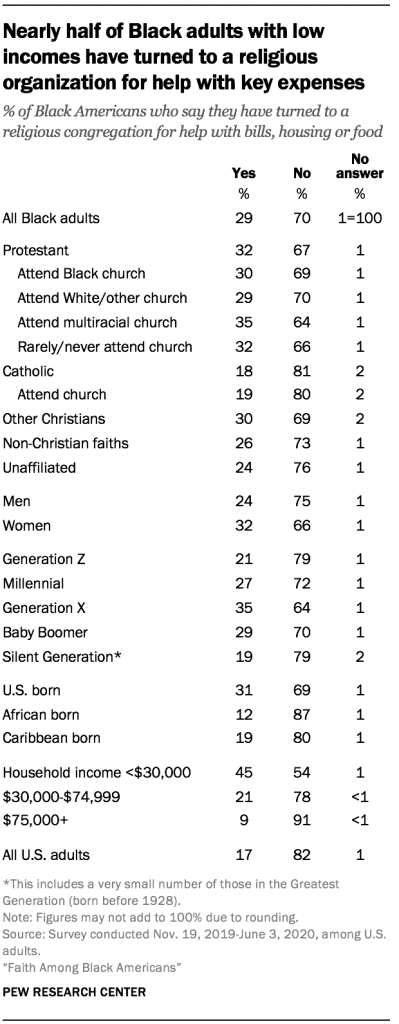
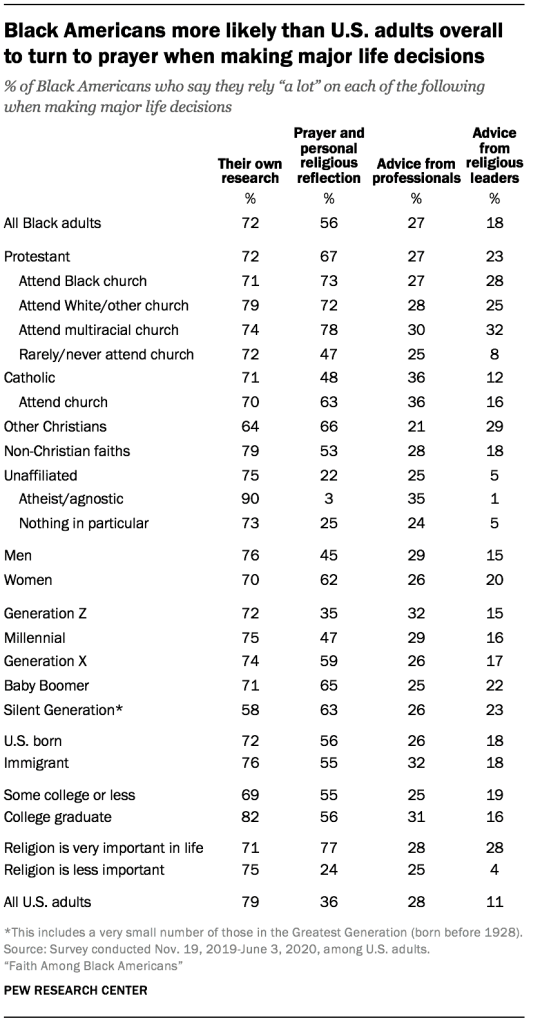
While by numerous measures of religious commitment Black Americans are more religious than the general population, like other Americans they have become more likely to identify as religiously unaffiliated – that is, as atheist, agnostic or “nothing in particular.” Still, Black Americans are less likely than U.S. adults overall to be religiously unaffiliated (21% vs. 27%).

Acknowledgments

This report is a collaborative effort based on the input and analysis of the following individuals. Find related reports online at pewresearch.org/pewresearch-org/religion.

Primary Researchers

Besheer Mohamed, Senior Researcher
Kiana Cox, Research Associate         

Research Team        

Alan Cooperman, Director of Religion Research
Gregory A. Smith, Associate Director of Research
Becka A. Alper, Senior Researcher
Elizabeth Podrebarac Sciupac, Senior Researcher
Claire Gecewicz, Research Associate
Justin Nortey, Research Assistant    

Methods Team         

Courtney Kennedy, Director of Survey Research
Andrew Mercer, Senior Research Methodologist
Nick Bertoni, Senior Panel Manager
Nick Hatley, Research Analyst
Arnold Lau, Research Analyst

Editorial and Graphic Design

Michael Lipka, Editorial Manager
Jeff Diamant, Senior Writer/Editor
Aleksandra Sandstrom, Senior Copy Editor
Bill Webster, Senior Information Graphics Designer

Communications and Web Publishing

Stacy Rosenberg, Associate Director, Digital
Travis Mitchell, Digital Producer
Anna Schiller, Senior Communications Manager
Kelsey Beveridge, Communications Associate

Others at Pew Research Center who contributed to this report include Claudia Deane, vice president of research; Mark Hugo Lopez, director of global migration and demography research; Neil G. Ruiz, associate director of global migration and demography research; Carroll Doherty, director of political research; Jocelyn Kiley, associate director of research; Juliana Menasce Horowitz, associate director of research; and Christine Tamir, research analyst. In addition, former Pew Research Center Senior Writer/Editor David Masci contributed to the clergy interviews and former Research Assistant Jynnah Radford contributed to the focus groups.

Pew Research Center is grateful to a panel of expert advisers who gave advice on all stages of this report: R. Khari Brown, associate professor of sociology at Wayne State University; Ryon J. Cobb, assistant professor of sociology at the University of Georgia; Yolanda Pierce, professor and dean at Howard University School of Divinity; Tia Noelle Pratt, president and director of research at TNPratt & Associates, LLC; Dr. W. Franklyn Richardson, chairman of the Conference of National Black Churches; Josef Sorett, professor of religion and African American and African diaspora studies and chair of the religion department at Columbia University; and Eric Williams, curator of religion for the Smithsonian National Museum of African American History and Culture.

In addition the Center would like to thank the following scholars for their feedback: Edward E. Curtis IV, religious studies professor and Millennium Chair of the Liberal Arts at Indiana University-Purdue University Indianapolis; Tracey Hucks, provost and dean of the faculty at Colgate University, who provided guidance on the questionnaire; Mandisa L. Thomas, founder and president of Black Nonbelievers Inc.; Cheryl Townsend Gilkes, John D. and Catherine T. MacArthur Professor of African-American Studies and Sociology and director of the African American studies program at Colby College; and Richard N. Pitt, associate professor of sociology at University of California San Diego.

In addition, 30 Christian clergy shared observations on numerous issues involving religion and Black Americans in in-depth interviews. (Most of them are quoted in Chapter 9 of this report.) Those who were interviewed are Bishop Ronald Alexander of Divine Purpose Church in Arlington, Tennessee; the Rev. Dr. Selwyn Q. Bachus of Salem Baptist Church in Omaha, Nebraska; the Rev. Traci C. Blackmon, associate general minister of Justice & Local Church Ministries for the United Church of Christ; the Rev. Dr. Dray Bland, of Watson Grove Missionary Baptist Church in Nashville, Tennessee; the Rev. Dr. Amos C. Brown of Third Baptist Church of San Francisco in San Francisco, California; Dr. Patrick D. Clayborn of Bethel AME Church in Baltimore, Maryland; the Rev. Dr. Erika D. Crawford of Mount Zion AME Church in Dover, Delaware; the Rev. Desmond Drummer of Most Blessed Sacrament Catholic Church in South Fulton, Georgia; the Rev. William N. Heard of Kaighn Avenue Baptist Church in Camden, New Jersey; Dr. Benjamin Hinton of Tabernacle Baptist Church in Gastonia, North Carolina; Pastor Dana Jackson of Black Bottom House of Prayer in Orlando, Florida; Bishop Reginald T. Jackson of the AME Church’s sixth episcopal district; Rev. Dr. Robert Jeffrey Sr., of New Hope Missionary Baptist Church in Seattle, Washington; the Rev. James A. Keeton Jr., of Morris Brown AME Church in Charleston, South Carolina; Pastor Damon Lynch Jr., of New Jerusalem Baptist Church in Cincinnati, Ohio; Dr. James C. Perkins of Greater Christ Baptist Church in Detroit, Michigan; Dr. Clyde Posley Jr. of Antioch Baptist Church in Indianapolis, Indiana; the Rev. Sandra Reed of St. Mark AME Zion Church in Newtown, Pennsylvania; Dr. W. Franklyn Richardson of Grace Baptist Church in Mount Vernon, New York; Pastor Alan S. Robinson of Abundant Life Church of God in Christ in Atlanta, Georgia; the Rev. Dr. Vernon G. Robinson, presiding elder of the Batesville District of the South Mississippi Conference of the AME Zion Church; the Rev. Dr. Cheryl J. Sanders of Third Street Church of God in Washington, D.C.; the Rev. Dr. Laurel E. Scott of the New York Annual Conference of the United Methodist Church; the Rev. Christine A. Smith of Restoration Ministries of Greater Cleveland, Inc., in Euclid, Ohio; the Rev. Simeon Spencer of Union Baptist Church in Trenton, New Jersey; Dr. Warren H. Stewart of First Institutional Baptist Church in Phoenix, Arizona; Bishop Talbert W. Swan II of Spring of Hope Church of God in Christ in Springfield, Massachusetts; the Rev. Phil Manuel Turner of Bethany Baptist Church in Syracuse, New York; the Rev. Harvey L. Vaughn III of Bethel AME Church in San Diego, California; Bishop Henry M. Williamson Sr. of the Christian Methodist Church’s first episcopal district.

Appendix A: Survey methodology

Black Americans constitute a population that is multicultural, regionally distinctive and often underrepresented in surveys. While most national public opinion surveys allow researchers to study attitudes among all Black adults (treated as one group), deeper analysis tends to be limited. Sample sizes often are too small to support reliable estimates for young Black adults as well as older ones, those not attending college as well as those with degrees, Black Republicans as well as Black Democrats, and so on. Moreover, as surveys are increasingly conducted online, many exclude people without reliable internet service. This can be particularly damaging for research on older populations or those with lower incomes.

Margins of error

With this study, Pew Research Center sought to overcome these limitations and uncover new insights about the religious beliefs and practices of Black adults. Researchers surveyed a total 8,660 Black adults using a combination of four, high-quality, probability-based samples. The study also featured multiple response modes: online, a paper version or live telephone. The modes that were offered varied by sample as detailed below. The combined analytic sample supports reliable analysis even of hard-to-reach segments within the Black American population. An additional 4,574 interviews were conducted with adults who are not Black to facilitate comparison with the full, U.S. adult population.

Responses were collected from Nov. 19, 2019, to June 3, 2020, but most respondents completed the survey between Jan. 21, 2020, and Feb. 10, 2020. All self-identified Black or African American adults were eligible, including those who identify as Black and another race, or Black and Hispanic. The survey is weighted to be representative of the U.S. Black adult population by sex, ethnicity, partisan affiliation, education and other categories. The survey was conducted in English and Spanish. After accounting for the reduction in precision from weighting, the margin of sampling error on the 8,660 completed interviews with Black adults is +/-1.5 percentage points at the 95% level of confidence. This appendix describes how the study was designed and executed.

Number of interviews and field period for each sample source

Sample design

One of Pew Research Center’s goals in this study was to interview a sample of Black Americans large enough to study the diversity of views within this group. To achieve this large, nationally representative sample, the study leveraged four sources. Three are probability-based survey panels, and one was a custom address-based sampling (ABS) survey conducted for Pew Research Center.

The study includes samples from three survey panels because these are an efficient way to interview national, random samples of Black adults who have already agreed to take surveys on an ongoing basis. By contrast, the strength of the ABS survey is not efficiency but precision. Unlike survey panels, which are designed for general population polling, the ABS survey was purpose- built to interview not just Black Americans but harder-to-reach segments within the larger group. This meant focusing extra resources in areas with sizable foreign-born Black populations.

While each sample was recruited using somewhat different methods, they shared three important features: a common questionnaire; a common population of inference, which is Black Americans ages 18 and older living in the 50 U.S. states or District of Columbia; and probability-based random sampling. By carefully tracking the chance that each respondent had of being selected, it was possible to combine the samples in a way that preserved proper representation of the entire population. A description of each sample source is provided below. The subsequent weighting section describes the steps used to combine the samples.

The American Trends Panel sample

The American Trends Panel (ATP), created by Pew Research Center, is a nationally representative panel of randomly selected U.S. adults. Panelists participate via self-administered web surveys. The panel is being managed by Ipsos. Panelists who do not have internet access at home are provided with a tablet and wireless internet connection. The ATP was created in 2014, and initially recruited via landline and cellphone random-digit-dial (RDD) telephone sampling. In August 2018, the ATP switched from telephone to address-based recruitment. Invitations are sent to a random, stratified address-based sample (ABS) of households selected from the U.S. Postal Service’s Computerized Delivery Sequence File (CDSF). The CDSF has been estimated to cover as much as 98% of the population, although some studies suggest that the coverage could be in the low 90% range.53

In each sample household, the adult with the next birthday is asked to go online to complete a survey, at the end of which they are invited to join the panel. Of the 23,440 individuals who had ever joined the ATP, 15,463 remained active panelists and continued to receive survey invitations at the time this survey was conducted. Additional information about the sample design and recruitment procedures for the ATP is available here. Data in this report is drawn from the panel survey conducted Jan. 21 to Feb. 3, 2020. The survey featured a stratified random sample of active ATP members in which Black panelists were sampled with certainty. The remaining panelists were subsampled at rates designed to achieve a target sample size of 5,500 total interviews. A total of 5,499 ATP members ultimately completed the survey, of whom 1,175 were Black. While not the primary focus of this report, the 4,324 non-Black respondents are combined with Black respondents from all four sources in the weighting to enable comparisons with the full U.S. adult population.

The NORC AmeriSpeak Panel sample

Funded and operated by NORC at the University of Chicago, AmeriSpeak® is a probability-based panel designed to be representative of the U.S. household population. Households are sampled from the NORC National Frame and address-based sample. The NORC National Frame provides sample coverage for over 97% of U.S. households. To provide sample coverage for states where the National Frame is not operative, a secondary source is address-based sampling.

AmeriSpeak recruitment is a two-stage process: initial recruitment using less-expensive methods and then nonresponse follow-up using personal interviewers. For the initial recruitment, sample units are invited to join AmeriSpeak online by visiting the panel website AmeriSpeak.org or by telephone (inbound/outbound supported). English and Spanish language are supported for both online and telephone recruitment. Panel invitations are communicated via a pre-notification postcard, a USPS recruitment package, two follow-up post cards and contact by NORC’s telephone research center for sample units matched to a telephone number.

The second-stage nonresponse follow-up targets a stratified random subsample of the nonresponders from the initial recruitment. Units sampled for the nonresponse follow-up are sent by FedEx a new recruitment package with an enhanced incentive offer. NORC field interviewers then make personal, face-to-face visits to the respondents’ homes to encourage participation. NORC field interviewers administer the recruitment survey in person or else encourage the respondents to register at AmeriSpeak.org or call the toll-free AmeriSpeak telephone number to register. Additional information about the sample design and recruitment procedures for the AmeriSpeak panel are available here.

Data in this report is drawn from the panel survey of 1,246 Black adults conducted Jan. 21 to Feb. 10, 2020. For this study, all households containing an individual who identified as Black (including Black Hispanics and those who are multiracial) were selected from the panel. If a panel household had one more than one active adult panel member, only one adult in the household was eligible for selection (random within-household sampling).

The Ipsos KnowledgePanel sample

The Ipsos KnowledgePanel is an online probability-based panel representative of the U.S. adult population. Households without internet connection are provided with a web-enabled device and free internet service. KnowledgePanel’s recruitment process was originally based on a national RDD sampling methodology.  In 2009, the panel switched to using an ABS methodology via the CDSF.

Samples from the CDSF are selected using disproportionate stratified sampling. Adults from sampled households are invited to join KnowledgePanel through a series of mailings, including an initial invitation letter, a reminder postcard and a subsequent follow-up letter. Given that a subset of physical addresses can be matched to corresponding landline telephone numbers, about five weeks after the initial mailing, telephone refusal-conversion calls are made to nonresponding households for which a telephone number is matched. Additional information about the sample design and recruitment procedures for the Ipsos KnowledgePanel are available here.

The KnowledgePanel sample in this study consisted of members who self-identified as Black, including, but not limited to identifying as Black and Hispanic or multiracial where one of the races is Black. Ipsos fielded this sample jointly with the American Trends Panel sample, which they also administer, from Jan. 21 to Feb. 3, 2020. In total, 2,558 Black adults from KnowledgePanel completed the survey.

The Pew Research Center ABS survey

The final sample source was a national cross-sectional, ABS survey conducted for Pew Research Center by Westat. This survey was fielded Nov. 19, 2019, through June 3, 2020, resulted in 3,681 completed interviews with Black adults.54 This was a large, two-stage screening survey designed to identify individuals who were eligible for either the survey of Black Americans that is the focus of this report or a separate survey of Jewish Americans (not yet published). The small number of respondents who were eligible for both surveys were randomly assigned to one or the other and their survey weights were adjusted accordingly. This was done primarily for efficiency since both populations make up a relatively small share of the total U.S. adult population and obtaining a sufficient sample size for either group requires screening a much larger number of adults.

The survey had a complex sample design constructed to maximize efficiency in reaching Black and Jewish adults while also supporting reliable, national estimates separately for these two populations. This sample design is discussed in detail here (and at greater length than the panel samples) because these details are not available elsewhere online.

The study used a stratified, systematic sample of U.S. residential mailing addresses. The ABS frame originates from the CDSF updated every month. That frame is maintained by Marketing Systems Group (MSG). MSG geocodes their entire ABS frame, so block, block group and census tract characteristics from the decennial census and the American Community Survey (ACS) can be appended to addresses and used for sampling and data collection purposes. The stratification of the sampling frame and the assignment of differential sampling rates to the strata were a critical design component because of the rareness of the eligible populations. Because the Jewish population was much rarer than the Black population, the stratification mainly identified areas with high concentrations of Jewish adults.

The first source for identifying areas with a higher density of Jewish adults was a file made available to Pew Research Center by the American Jewish Population Project (AJPP) at Brandeis University. The U.S. government does not collect data that classifies people by religion, so the AJPP data is the best source available. The AJPP provided pre-release data for this purpose (Pre-Release Estimates, July 2019). The available tables were at the county or county-group level and had estimates of both the total number of adults and the proportion of adults who identified themselves as Jewish by religion for each county-group. Based on the distribution of the proportion of Jewish adults by religion in the county-groups, Westat partitioned the county-groups into two classes based on estimated Jewish density (high and low).

The next step was to stratify the areas within the county-groups in the high-density class. Pew Research Center provided data from surveys conducted in 2013 or later that contained the respondent’s religious affiliation, ZIP code and sampling weights. Westat used that data to estimate the proportion of Jewish adults at the ZIP code level. Unfortunately, the Census Bureau does not report population counts at the ZIP code level. Instead, the Census Bureau reports counts at the ZIP Code Tabulation Areas (ZCTAs) level. Westat implemented a crosswalk between ZCTA and ZIP codes and then produced estimates of the proportion of Jewish adults at the ZCTA level within county-groups for those county-groups in the high-density class.

Since the sample sizes in the ZCTAs from the Pew Research Center surveys were often very small, zero or missing, the estimates of the percentage of Jewish adults in the ZCTA were not precise. As a result, each county-group in the High-density class was partitioned into just two pieces within the county-group. The first part included all ZCTAs with the highest estimated percentage of Jews by religion in the county-group, and the other having the remainder ZCTAs. Westat assigned all high-density ZCTAs to stratum 1. The lower-density ZCTAs were placed in stratum 2. The county-groups or individual counties in the low-density class were placed in stratum 3.

Sample allocation and Black American incidence by stratum in the Pew Research Center ABS survey

The last step in the stratification divided each stratum into three substrata. For the higher density strata (1, 2), the substratum boundaries were determined using the squared root of the ZCTA-level estimate of the number of Jewish adults. In the lowest density stratum (3), the substratum boundaries were based on the estimated of the number of Jewish adults in the county-group.

Westat divided the sample of drawn addresses into two replicate subsamples. At the beginning of data collection, Westat only mailed to the first replicate of addresses. About two months later, Westat began mailing the second replicate of addresses. This approach allowed researchers to evaluate the performance of the data collection protocol and apply adjustments before the second replicate was fielded. From the first replicate, it was clear that the response rate to the screening interview was lower than projected, and it would result in too few completed interviews with Black and Jewish respondents. To address the shortfall, Westat supplemented the sample with additional addresses and made small changes to the study materials.

One of the changes implemented between replicates was to the procedure used to randomly select one adult from each sample household. In the first replicate each sampled address was randomly assigned to one of four groups referred to as YM, OM, YF, or OF. In group YM, the youngest male adult is sampled (if there are no males, the youngest female is sampled). Group OM samples the oldest male (or oldest female if no males present). YF and OF are the analogous groups for sampling women by age. After the first replicate fell short of yield projections, a simpler selection procedure was used; the adult in the household with the next birthday was instructed to complete the survey. The next-birthday method was also used for the last two screener recruitment mailings for the first replicate.

Once the adult completed the screening interview on the web, the adult was identified as either being eligible for the Black adult survey, for the Jewish adult survey, or neither. Eligible adults identified in the web survey were immediately asked to continue with the extended questionnaire. For households that returned paper screener questionnaires, eligible adults were mailed the appropriate survey paper questionnaires.

Westat’s initial expectation was that the design would yield more than the targeted number of interviews with Black adults. Consequently, the protocol initially subsampled eligible Black adults in each stratum at rates chosen to reduce the design effect. However, once it became apparent that the screener response rate was lower than expected, the subsampling was removed from the protocol and the extended interview was administered to all eligible Black adults. Eligible Black adults who had previously completed the screener but were not selected were recontacted and asked to complete the Black adult survey.

Pretesting

The ATP and KnowledgePanel fielding featured a soft launch with an initial batch of 300 panelists. Pew Research Center and Ipsos staff performed quality checks on the soft launch data, but no changes were made prior to the release of the remaining sample. In the AmeriSpeak sample, a small sample of panelists were invited for a pretest. In total, NORC collected 23 pretest interviews. The initial data from the pretest was reviewed by NORC and delivered to Pew Research Center. Prior to the full survey launch, NORC made small logic changes to two questions as well as minor edits to text. No pretest was conducted for the Pew Research Center ABS survey due to the absence of empaneled adults and constraints in the study schedule.

Data collection

The survey was administered in English and Spanish in all four samples. In the ATP and KnowledgePanel samples, all interviewing was conducted online. Households without home internet at the time of recruitment were provided with devices and data plans to enable online response. In the AmeriSpeak sample, 83% of interviews were conducted online while 17% were conducted using live telephone interviewers. In the Pew Research Center ABS survey, 66% of interviews with Black adults were completed online while 34% were completed via mail.

To encourage study cooperation, Ipsos mailed an advance postcard to all sampled ATP panelists. ATP panelists were invited via email to take the survey, and they were later sent up to four email reminders. For those who have provided express consent to receive SMS messages, Ipsos sent the survey invitation (HTML link) via SMS message and later sent up to four SMS message reminders. ATP respondents received $5 to $20 for their participation, depending on whether they have hard-to-reach characteristics.

For the KnowledgePanel sample, Ipsos sent the survey invitation via email, plus up to four additional email reminders. KnowledgePanel respondents received a post-payment under the incentive structure for their panel.

To encourage cooperation in the AmeriSpeak sample, NORC sent up to five email reminders to sampled web-mode panelists. To administer the phone survey, NORC dialed the sampled phone-mode panelists throughout the field period. In addition, starting on Jan. 24, 2020, a subset of AmeriSpeak web-mode panelists were also called to encourage response. These web panelists could complete the survey via phone if convenient. AmeriSpeak panel respondents received an incentive equivalent to between $5 and $10 in cash, depending on their age and completion date.

For the Pew Research Center ABS survey, the data collection protocol was much more extensive because the respondents did not belong to a survey panel but instead needed to be recruited for the first time. To maximize response, the study used a sequential mode protocol in which sampled households were first directed to respond online and later mailed a paper version of the questionnaire. Moreover, the measurement process featured two stages: a screening questionnaire for all sampled adults followed by an extended questionnaire for those eligible.

The first mailing for the Pew Research Center ABS survey was a letter introducing the study and providing the information necessary (URL and unique PIN) for online response. A pre-incentive of $2 was included. This and remaining screener recruitment letters focused on the screener survey, without mentioning the possibility of eligibility for longer surveys and associated promised incentive, since most people would only be asked to complete the short screening survey.

Next, Westat sent a postcard reminder, followed by a reminder letter to nonrespondents. Westat later sent nonrespondents a paper version screening survey, which was a four-page booklet (one folded 11×17 paper) and a postage-paid return envelope in addition to the cover letter. If no response was obtained from those four mailings, no further contact was made. Black Americans completing the screening survey in either mode received a $10 post-paid incentive for completing the extended survey.

If an eligible respondent completed the screener online but did not complete the extended interview, Westat sent them a reminder letter. This was performed on a rolling basis when it had been at least one week since the web breakoff. Names were not collected until the end of the web survey, so these letters were addressed to “Recent Participant,” but the content of the letter referenced the reported age and sex of the participant when available, so that the same participant would continue the survey.

If an eligible respondent completed a paper screener, Westat mailed them the appropriate extended survey and a postage-paid return envelope. This was sent weekly as completed paper screeners arrived. The paper screeners asked for a “first name or initials in case we have any questions about your survey,” and Westat addressed the extended mailings using this information. The content of the letter also referenced the reported age and sex of the participant when available. Westat followed these paper mailings with a reminder postcard. Later Westat sent a final paper version via FedEx to eligible adults who had not completed the extended interview online or by paper.

Weighting

The data in this study is weighted both to produce accurate estimates for the adult Black population in the U.S. and to allow comparison to the full, U.S. adult population (including both Black and non-Black adults). To do this, data from the four samples was combined into a single dataset and weighted to match the demographic profile of the noninstitutionalized U.S. adult population.

This was done in three stages. First, a sample-specific weight was created for each sample that accounts for each source’s unique design features. Next, the weights associated with each of the four samples were integrated and rescaled to create a harmonized base-weight for the combined sample. Finally, the combined base-weight was calibrated so that the demographic profile of both Black and non-Black respondents aligned with benchmarks from the Census Bureau and other sources.

Sample-specific weights

Sample-specific weights were created separately for each of the three online panels according to each panel’s standard procedure. Although they vary in the particulars, each panel follows a similar process that begins with weights that reflect each panelist’s initial probability of selection into the panel recruitment survey. Then, the entire pool of active panelists is calibrated to U.S. population benchmarks in order to correct for nonresponse to the recruitment survey and panel attrition. The specifics of the calibration targets vary between the three panels. Finally, the weights for those panelists sampled for the particular survey are further adjusted to account for any differential probability of selection between panelists for this particular survey. These weights did not include any additional adjustment for nonresponse because that step is to be performed on the final, combined sample. Additional details about the weighting protocols for the KnowledgePanel, AmeriSpeak and ATP are available.

The sample-specific weight for the ABS sample created by Westat accounted for the complex sample design and nonresponse to the first-stage screening survey. First, each household was weighted inversely proportional to its probability of selection from the ABS frame. This weight was then adjusted to account for the fact that some portion of the nonresponding households would have been ineligible. Next, a household-level nonresponse adjustment was performed by poststratifying the responding households to cells based on the sampling strata and other variables available on the sampling frame.

The household weight was then multiplied by the number of adults in the household (capped at three) to account for the fact that individuals in households with more eligible adults have a lower chance of being selected as the respondent than those in households with fewer adults. This person-level weight was then raked to U.S. adult population benchmarks from the 2014-2018 American Community Survey five-year file, resulting in a general population weight for all adults who completed the screener.

This screener weight, which accounts for differential probabilities of selection and nonresponse to the first-stage screener, was used as the sample-specific weight for the ABS respondents to the survey on religion among Black Americans. A final adjustment was made to the weights for those who had also been eligible the survey of American Jews. For those who were eligible for both surveys, a final adjustment was made to account for the subsampling that allocated 80% of such respondents to the Jewish survey.

Sample integration

To create a single, integrated dataset, the samples were combined, and each respondent was placed into one of three groups based on differences in each sample’s eligibility criteria. The first group consisted of adults who identified as Black (including Black Hispanics and multiracial Black adults). Adults in this category were eligible to participate in all four of the samples. The second group was comprised of respondents who did not identify as Black but did identify as Afro-Latino. Members of this group were only present in the general population ATP sample and the ABS sample for which they had included in the eligibility criteria. There were no such respondents from KnowledgePanel or AmeriSpeak since only panelists who had previously identified as Black were invited to participate. The third group consisted of respondents who were neither Black nor Afro-Latino and consisted entirely of respondents from the ATP.

Within each group, the weights for each sample’s respondents were scaled to sum to their effective sample size. This determined the relative contribution of each sample source within the groups. The final step in integrating the samples and their associated weights involved rescaling the combined weights for each category proportional to its share of the full U.S. adult population. Because there is no official benchmark, the size of the Afro-Latino population was estimated from the weighted distribution on the Pew Research Center ABS survey screener.

Calibration to benchmarks

Using this harmonized base weight, researchers raked the sample to the population benchmark targets listed in the table below. This raked weight was trimmed at the 5th and 95th percentiles to reduce the loss of precision stemming from variance in the weights.

Raking dimensions and benchmark sources

Response rates

Study response rate

Overall response rate

This study features several different samples, which complicates the computation of an overall response rate. Following AAPOR Standard Definitions, researchers computed the overall response rate for this study in several steps: (1) compute the proportion of the total number of completed interviews coming from each sample, (2) for each sample, multiply that proportion by the cumulative response rate, (3) sum the factors from the previous step.55 The overall response rate for this study was 6.7%.

Response rates for each sample

Everyone selected in the online panel samples was eligible for the survey, and the survey-level response rates report what share of them completed the survey. In the ATP, a total of 8,057 panelists responded out of 12,442 who were sampled, for a survey-level response rate of 65%. This includes 5,499 from the ATP and an oversample of 2,558 Black respondents sampled from the Ipsos KnowledgePanel. This does not include four panelists who were removed from the data due to extremely high rates of refusal or straight-lining. The cumulative response rate accounting for nonresponse to the recruitment surveys and attrition is 3.3%. The break-off rate among panelists who logged onto the survey and completed at least one item is 2.7%. For the AmeriSpeak sample, the survey-level response rate was 22%. The weighted AAPOR 3 response rate to the recruitment is 24%, and the weighted household panel retention rate is 86%, yielding a weighted cumulative response rate of 4.5%.

A fulsome accounting of the Pew Research Center ABS survey requires more information because respondents were being recruited for the first time. Westat assigned all sampled cases a result code for their participation in the screener, and then they assigned a result for the extended Black American questionnaire for those who were eligible. Two of the dispositions warrant some discussion. One is the category “4.313 No such address.” This category is for addresses that were returned by the postal service as not being deliverable. This status indicates the address, which was on the USPS Delivery Sequence file at the time of sampling, currently is not occupied or no longer exists. The second category is “4.90 Other.” This category contains 1,231 addresses that were never mailed because they were for addresses that had a drop count of greater than four. Drop points are addresses with multiple households that share the same address. The information available in the ABS frame on drop points is limited to the number of drop points at the address, without information on the type of households at the drop point, or how they should be labeled for mailing purposes. In the Pew Research Center ABS survey, all drop points were eligible for sampling, but only those with drop point counts of 4 or less were mailed. Westat treated drop point counts of five or more as out of scope, and no mailing was done for those addresses.

AAPOR disposition codes for the Pew Research Center ABS survey

Westat used the disposition results to compute response rates consistent with AAPOR definitions. The response rates are weighted to account for the differential sampling in this survey. The weight is the inverse of the probability of selecting the address.56 The response rate to the Pew Research Center ABS survey screening interview was 20.1%.57 The response rate to the extended Black American interview, 70.9%, is the number of Black adults completing the questionnaire over the total sampled for that extended questionnaire. The overall response rate is the product of the screener response rate and the conditional response rate for the extended questionnaire. The overall response rate for the Black American sample in the Pew Research Center ABS survey was 14.2% (20.1% x 70.9%).

Acknowledgments

Many individuals contributed to the data collection for this study. In particular, Pew Research Center is grateful to Wendy Mansfield, Mike Picco, and Karen Melia from Ipsos; Hanna Popick, Eric Jodts, Mike Brick, and Ismael Flores Cervantes from Westat; and Katie Simmons from NORC.

Appendix B: Focus groups methodology

In advance of the nationwide survey of Black Americans, Pew Research Center conducted a series of seven focus groups to better understand how Black Americans talk and think about religion, race and houses of worship.

Each focus group consisted of six to 10 adults who came together for a 90-minute discussion led by a professional moderator who used a guide developed by Pew Research Center. The intent was for the groups to explore a range of topics including:

  • What is distinctive about Black churches?
  • How important is race when choosing a congregation?
  • How important are denominational boundaries when deciding where to go to church?
  • How do Black Americans understand the “evangelical” and “Pentecostal” labels?
  • How do Black Americans think about syncretistic practices?
Focus group composition

The groups were organized according to where the participants lived, their age, their gender, their religious affiliation, how often they go to religious services (if at all), the racial composition of their house of worship, and their country of origin.

C&C Market Research recruited the participants using guidelines designed by Pew Research Center. All participants were paid for their time.

The findings on how participants feel about the distinctiveness and role of Black churches were included as Chapter 1 of the report. However, all of the findings from the focus groups were used to refine the wording of questions asked in the 8,660-person survey.