Pew Research Center

FOR RELEASE AUGUST 29, 2018

The Religious Typology

A new way to categorize Americans by religion
FOR MEDIA OR OTHER INQUIRIES:

Communications Department
202.419.4372
www.pewresearch.org

RECOMMENDED CITATION

Pew Research Center, August 2018, "The Religious Typology"

About Pew Research Center

Pew Research Center is a nonpartisan, nonadvocacy fact tank that informs the public about the issues, attitudes and trends shaping the world. It does not take policy positions. The Center conducts public opinion polling, demographic research, computational social science research and other data-driven research. It studies politics and policy; news habits and media; the internet and technology; religion; race and ethnicity; international affairs; social, demographic and economic trends; science; research methodology and data science; and immigration and migration. Pew Research Center is a subsidiary of The Pew Charitable Trusts, its primary funder.

© Pew Research Center 2026

Table of contents

  • About Pew Research Center
  • The Religious Typology
  • Appendix A: About the religious typology
  • Appendix B: Methodology
  • Acknowledgments
  • 1. Religious and spiritual practices and beliefs
  • 2. Attitudes toward organized religion
  • 3. Sources of meaning and community involvement
  • 4. Politics and policy
  • 5. The demographic characteristics of religious typology groups

The Religious Typology

A new way to categorize Americans by religion

Most U.S. adults identify with a particular religious denomination or group. They describe themselves as Catholic, Baptist, Methodist, Jewish, Mormon or Muslim– to name just a few of the hundreds of identities or affiliations that people give in surveys. Others describe themselves as atheist, agnostic or say they have no particular religious affiliation. These are the conventional categories into which Americans sort themselves. But a new Pew Research Center analysis looks at beliefs and behaviors that cut across many denominations – important traits that unite people of different faiths, or that divide people who have the same religious affiliation – producing a new and revealing classification, or typology, of religion in America.

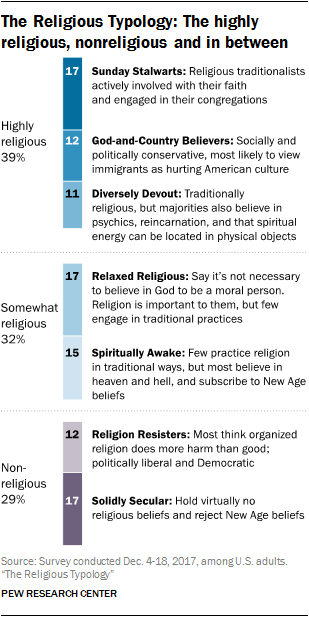
The new typology sorts Americans into seven groups based on the religious and spiritual beliefs they share, how actively they practice their faith, the value they place on their religion, and the other sources of meaning and fulfillment in their lives.

Race, ethnicity, age, education and political opinions were not among the characteristics used to create the groups. Yet some of the groups have strong partisan leanings or distinctive demographic profiles, illuminating the intrinsic connections between religion, race and politics in America.

Sunday Stalwarts are the most religious group. Not only do they actively practice their faith, but they also are deeply involved in their religious congregations. God-and-Country Believers are less active in church groups or other religious organizations, but, like Sunday Stalwarts, they hold many traditional religious beliefs and tilt right on social and political issues. They are the most likely of any group to see immigrants as a threat. Racial and ethnic minorities make up a relatively large share of the Diversely Devout, who are diverse not only demographically, but also in their beliefs. It is the only group in which solid majorities say they believe in God “as described in the Bible” as well as in psychics, reincarnation and spiritual energy located in physical things.

About the names …

The names of the typology groups try to convey distinguishing characteristics in just a few words. Of course, no name this brief can perfectly describe a group, and some license was taken in choosing them. For example, “Sunday Stalwarts” includes some highly religious people (such as Jews, Muslims and Seventh-day Adventists) who do not observe the Sabbath on Sunday. However, nine-in-ten respondents who fall into this group identify with Christian churches that generally hold services on Sunday.

Similarly, the broader group categories – highly religious, somewhat religious and nonreligious – are meant to convey general characteristics about the subgroups they comprise. For example, while God-and-Country Believers and the Diversely Devout are less likely than Sunday Stalwarts to participate in weekly worship, they are all categorized as highly religious due to similar beliefs, prayer habits, and ways they view and interact with God, among other factors.

At the opposite end of the spectrum, the Solidly Secular are the least religious of the seven groups. These relatively affluent, highly educated U.S. adults – mostly white and male – tend to describe themselves as neither religious nor spiritual and to reject all New Age beliefs as well as belief in the God of the Bible.1 In fact, many do not believe in a higher power at all. Religion Resisters, on the other hand, largely do believe in some higher power or spiritual force (but not the God of the Bible), and many have some New Age beliefs and consider themselves spiritual but not religious. At the same time, members of this group express strongly negative views of organized religion, saying that churches have too much influence in politics and that, overall, religion does more harm than good. Both of these nonreligious typology groups are generally liberal and Democratic in their political views.

The middle two groups straddle the border between the highly religious and the nonreligious. Seven-in-ten Relaxed Religious Americans say they believe in the God of the Bible, and four-in-ten pray daily. But relatively few attend religious services or read scripture, and they almost unanimously say it is not necessary to believe in God to be a moral person. All Spiritually Awake Americans hold at least some New Age beliefs (views rejected by most of the Relaxed Religious) and believe in God or some higher power, though many do not believe in the biblical God and relatively few attend religious services on a weekly basis.

Although traditional religious affiliation categories were not used as a determining factor in making the typology groups, it is nonetheless illuminating to look at each group’s religious composition. While there are clear patterns across the groups, no typology group is uniform in its religious affiliation. This shows that members of widely disparate religious traditions sometimes have a lot in common: Sunday Stalwarts, for instance, are largely Protestant, but also include Catholics, Mormons, Jehovah’s Witnesses, Jews, Muslims, Hindus and others.

Among the highly religious typology groups, the religious identity profiles of Sunday Stalwarts and God-and-Country Believers are very similar. Majorities in each group are Protestant, and evangelical Protestantism constitutes the single largest religious tradition in both groups. Compared with Sunday Stalwarts, God-and-Country Believers include more Catholics (24% vs. 13%) and religiously unaffiliated Americans (8% vs. 1%), and somewhat fewer Mormons (less than 1% vs. 5%).

Compared with the other two highly religious groups, the Diversely Devout include fewer Protestants and more unaffiliated people, often called “nones.” (“Nones” is an umbrella category composed of U.S. adults who identify, religiously, as atheist, agnostic or “nothing in particular.” All of the “nones” among the Diversely Devout, however, are people who describe their current religion as “nothing in particular.”)

A majority of the Solidly Secular (76%) and Religion Resisters (71%) are unaffiliated, including one-in-five in each group who describe themselves as agnostic. Religion Resisters are more likely than the Solidly Secular to describe their religion as “nothing in particular” (45% vs. 23%), while the Solidly Secular are more likely than Religion Resisters to describe themselves as atheists (31% vs. 6%).

Like the highly religious groups, the somewhat religious groups are mostly composed of Christians. There are more evangelicals among the Relaxed Religious than among the Spiritually Awake (25% vs. 16%), and more religious “nones” among the Spiritually Awake than among the Relaxed Religious (30% vs. 17%).

A section at the end of this overview analyzes these groups from the opposite direction, looking at the share of each religious tradition belonging to each typology group (e.g., the share of U.S. Jews who are Sunday Stalwarts, God-and-Country Believers, etc.).

Highly and somewhat religious groups are mostly Christian, nonreligious are mostly unaffiliated

Among the other striking patterns in the typology:


  • Only the Sunday Stalwarts make a weekly habit of attending religious services, reading scripture

    Outside of the Sunday Stalwarts, relatively few Americans – even those who otherwise hold strong religious beliefs – frequently attend religious services or read scripture. About eight-in-ten Sunday Stalwarts attend religious services at least once a week – three times greater than the share of frequent attenders among God-and-Country Believers, and roughly seven times larger than the proportion of the Diversely Devout who are as observant. A similar pattern exists among the groups in the share who regularly read the Bible or other holy scriptures.

  • The Solidly Secular are the only group that includes sizable numbers who say they do not believe in God or any kind of higher power. Even among the Religion Resisters, who generally view religious institutions with great skepticism, the vast majority believe in some higher power or spiritual force (though not necessarily in the biblical depiction of God). By contrast, across all five groups that are either highly religious or somewhat religious, there is broad agreement that God exists and has characteristics such as being all-loving, all-knowing and all-powerful. Large majorities in these five groups also say they talk to God.
  • Even among the most traditionally religious groups, some people hold New Age beliefs

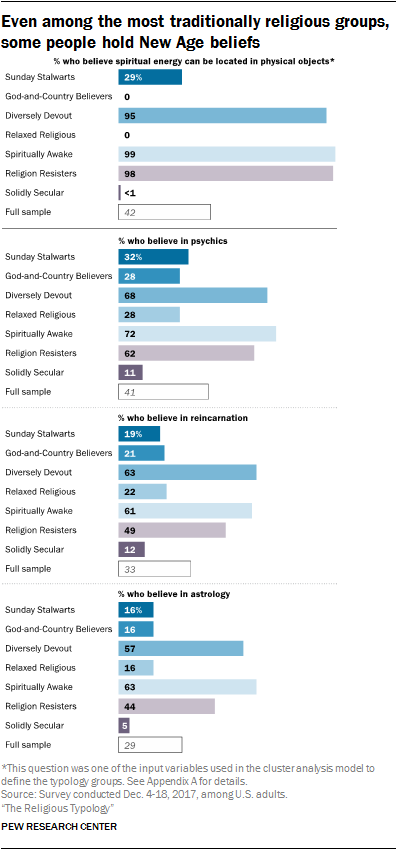
    New Age beliefs are common, even among Americans who are highly religious in traditional ways. For example, about three-in-ten Sunday Stalwarts believe in psychics, and a similar share say that spiritual energy can be located in physical objects such as mountains, trees and crystals. Smaller shares believe in reincarnation and astrology. Overall, half of Sunday Stalwarts and God-and-Country Believers and nearly all of the Diversely Devout affirm at least one of these four New Age beliefs. One of these items was among the characteristics used to create the groups, and it helps define the boundaries of the two somewhat religious typology groups, as well as the two nonreligious groups: Nearly all of the Spiritually Awake and Religion Resisters believe there is spiritual energy in physical objects, while virtually none of the Relaxed Religious or the Solidly Secular do.

  • Americans draw meaning and fulfillment from many different sources – not only from their families, friends and careers, but also from being in the great outdoors, taking care of pets, listening to music and reading. Still, about two-thirds of Sunday Stalwarts say their religious faith is the single most important source of meaning in their lives. While roughly half or more in the two other highly religious groups also say they draw a great deal of meaning from their faith, far fewer say it is the most important source. Family time ranks as the top source of meaning in life for most of the groups.
  • Although no political measures were used to create the typology, arraying the groups from most to least religious also effectively sorts Americans by party identification and political ideology. Republicans make up a majority of Sunday Stalwarts and God-and-Country Believers, while even larger majorities of Democrats comprise the two nonreligious groups. Similarly, self-described conservatives prevail among the two most religious groups, while, by comparison, the two nonreligious groups lean left.
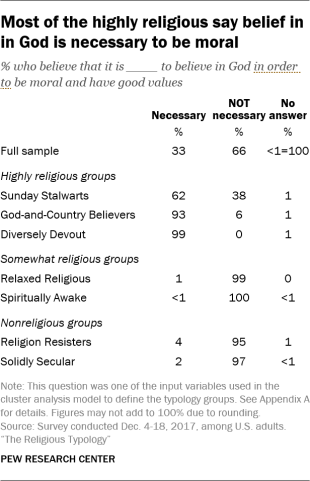
  • Can you be moral without believing in God? For more than 2,000 years, that question has sparked an energetic debate among religious thinkers.2 And just as the question has divided scholars and philosophers, it is a key determinant of the seven typology groups, marking the border separating the highly religious from the other groups. For the three highly religious groups (Sunday Stalwarts, God-and-Country Believers and the Diversely Devout), the answer is clear: Belief in God is a prerequisite for being a good person. By contrast, overwhelming majorities in the somewhat religious and nonreligious groups are united in the opposite view: It is not necessary for a person to believe in God to be moral and have good values.

Why a religious typology? And how were the groups defined?

What is cluster analysis?

The typology groups were created using cluster analysis, a statistical technique that identified homogeneous groups of respondents based on their answers to 16 questions about their religious and spiritual beliefs and practices, the value they place on their religion, and the other sources of meaning and fulfillment in their lives.

In some ways, cluster analysis is as much art as science. The groups that emerge will depend on both the number of groups that researchers specify and the questions that they choose to include in the analysis. What’s more, there is no “correct” cluster solution or any single criteria for deciding which solution is best. Researchers must weigh a number of factors: whether it’s clear why people are grouped together, whether the groups are different enough from each other to be analytically useful, and whether the groups are consistent with what researchers already know about the subject.

In preparing this report, researchers tested several possible solutions – ranging from five to eight groups – and experimented with including larger and smaller numbers of questions.

Researchers ultimately settled on the 16-question, seven-category cluster solution summarized in this report because it has several strengths. First, the solution divides respondents into a relatively small number of groups that are distinct from one another, large enough to permit statistical analysis, and substantively meaningful. Second, all the survey questions that went into the algorithm are measures of religious or spiritual characteristics, making this truly a religious typology.

Pew Research Center’s religious typology is not meant to replace conventional religious affiliations, but rather to offer a new and complementary lens with which to glean new insights into religion and public life in the U.S.

In most surveys about religion, including those conducted by Pew Research Center, researchers analyze the data by dividing the respondents into commonly understood categories, such as Catholics, Jews and Muslims.

This report takes the opposite approach: Instead of comparing the views of pre-defined groups with one another, researchers used a statistical technique called cluster analysis to identify cohesive groups of people with similar religious and spiritual characteristics, regardless of their religious affiliation.3 (To see where you fit, take our religious typology quiz.)

Specifically, 16 questions from the survey covering a variety of religious and spiritual domains were combined in a statistical model to define the seven typology groups (see table below for a list of the questions). The model did not include any demographic questions or Pew Research Center’s standard question about religious affiliation, meaning that the religious tradition – or lack thereof – with which respondents identify did not affect their placement in a typology group. Though only 16 questions were used to create the groups, many additional questions were asked of the survey respondents and are included in this report.

The survey was conducted online Dec. 4 to 18, 2017, among 4,729 members of the Pew Research Center’s American Trends Panel, a nationally representative panel of randomly selected U.S. adults (18 and older) recruited from landline and cellphone random-digit-dial surveys. See Methodology for more details.

Questions used to define cluster groups

Group profiles: The highly religious

The typology identifies three distinctive groups of highly religious Americans, united by a traditional view of God “as described in the Bible,” and by the shared conviction that organized religion is generally a force for good in American life. Nine-in-ten or more among Sunday Stalwarts, God-and-Country Believers and Diversely Devout say religion is important in their lives, and overwhelming majorities in these groups describe themselves as religious people.

These religious Americans worship a God that they describe as all-powerful, all-knowing and all-loving. Rather than a distant presence or abstract entity, they see God as an active force in their lives. The vast majority say they have talked to God and that God has protected or rewarded them, while roughly eight-in-ten in each group say God determines all or most of what happens in their lives. Large majorities agree that God will judge all people on what they have done.

On a practical level, members of these three groups find their religion to be a source of comfort and clarity in their day-to-day lives. Most say they rely on their religious beliefs to cope with life’s difficulties and to help them do what is right, even when it’s hard. Their religious faith also helps them in their family and social relationships, and majorities in each group say religion helps them in their job or career. And in an increasingly polarized country, most respondents in these three groups say churches and other religious organizations bring people together and strengthen morality in society.

Three most religious groups share traditional religious beliefs, active relationship with God

Despite these commonly held beliefs, these three groups differ from one another in some ways, including how engaged they are with their congregations and communities, the degree to which they hold religion to be central to their lives, and their acceptance of New Age beliefs.

For instance, the clustering algorithm clearly differentiates the Sunday Stalwarts from other highly religious groups because of their involvement in their congregations. Indeed, virtually all Sunday Stalwarts say they are active in church groups or other religious organizations. And fully eight-in-ten say they attend religious services on a weekly basis.

In addition, four-in-ten say they read the Bible or their religion’s sacred text at least once a day, roughly three times the rate of either of the other two highly religious groups. And about two-thirds of all Sunday Stalwarts say religion is the single most important source of meaning in their life; no more than four-in-ten members of any other group value their faith so highly. Sunday Stalwarts also pray more often and are more likely to describe themselves as very spiritual and very religious.

Their involvement with others extends beyond their congregations to their local communities. Sunday Stalwarts are twice as likely as any other group to say they are active in a charitable or volunteer organization and are similarly more engaged in youth organizations (such as the PTA or Scouts), book clubs or study groups. And they are the most likely of any group to say they “always” vote in local elections.

In a different way, politics and policy also separate God-and-Country Believers from all other groups. They are the only group that leans more toward approval than disapproval of Donald Trump’s performance as president. And fully two-thirds say immigrants are a threat to American values and customs, the largest share of any group.

God-and-Country Believers and Sunday Stalwarts are the only groups in which majorities identify as Republican (59% for both groups) and about half describe themselves as politically conservative (55% and 53%, respectively).

Church attendance, New Age beliefs and views on social issues differentiate the three most religious groups

But in other ways related to their religious practices and beliefs, the predominantly middle-aged and female God-and-Country Believers more closely resemble the Diversely Devout than they do Sunday Stalwarts. God-and-Country Believers (20%) and the Diversely Devout (25%) are much less likely than Sunday Stalwarts (43%) to describe themselves as “very religious” (though about six-in-ten in both groups say they are “somewhat” religious). Similarly, about one-in-seven in each group say they read the Bible at least once a day (vs. 43% of Sunday Stalwarts). And both God-and-Country Believers and the Diversely Devout are defined in part by their absolutism on the question of God and morality, with nine-in-ten or more saying it is necessary to believe in God to live a moral life and have good values. Fewer Sunday Stalwarts (62%) take this position.

On many measures of religious practice and belief, God-and-Country Believers fall squarely between the two other highly religious groups. About four-in-ten say religion is the single most important source of meaning in their lives, well below Sunday Stalwarts but above the Diversely Devout. And 72% say they pray daily; by contrast, 84% of all Sunday Stalwarts and 58% of the Diversely Devout say they pray as often.

Their New Age beliefs and their demographic profile set the Diversely Devout apart from other highly religious Americans. While substantial majorities value religion and consider themselves to be religious, they are the only highly religious group in which majorities also embrace a variety of New Age beliefs. They are about twice as likely to believe in psychics as either the Sunday Stalwarts or God-and-Country Believers (68% vs. 32% and 28%, respectively) and three times more likely to believe in astrology or reincarnation. And the belief that spiritual energy can be located in physical objects like mountains, trees or crystals was included in the cluster model and is one of the defining characteristics of this group – 95% of the Diversely Devout say they believe this, compared with 29% of Sunday Stalwarts and none of the God-and-Country Believers.

Politically, the Diversely Devout are the most likely of the highly religious groups to identify as Democrats (49%) and the least likely to say they are politically conservative (39%). They also are the least likely to be registered to vote. And they tend to be more liberal than other highly religious Americans on social issues. They are less likely than Sunday Stalwarts or God-and-Country Believers to say homosexual behavior is morally wrong or that the country has made enough changes to give black people equal rights with whites.

Sunday Stalwarts, God-and-Country Believers tilt female, white, older, Republican

Demographic differences also set the Diversely Devout apart from other religious Americans. While 43% are white, nearly half are Hispanic or black, and about one-in-ten come from another racial or ethnic background, making it the only religious typology group without a white majority.

Making ends meet is a struggle for many of the Diversely Devout. Most people in this group have household incomes of less than $30,000 – the highest share of any group – and half are at least somewhat dissatisfied with their current financial situation. About four-in-ten live in a household that received food stamp benefits in the previous year, double the proportion in the next-highest group.

Group profiles: The nonreligious

At the opposite end of the spectrum from the three highly religious groups are the Religion Resisters and the Solidly Secular. Overwhelming majorities of these groups seldom or never attend religious services, rarely (if ever) pray, and reject belief in the God of the Bible – instead believing in another higher power or spiritual force, or in no higher power at all. Most do not identify with a religious denomination, and nearly all say it is not necessary to believe in God to be a moral person and have good values.

In terms of politics, too, these groups are the polar opposite of Sunday Stalwarts and God-and-Country Believers: Both Religion Resisters and the Solidly Secular are overwhelmingly Democratic. They are the most likely of any of the groups to describe themselves as political liberals and the least likely to say they are conservative. These political leanings are reflected in their policy preferences. Large majorities of both groups believe humans are the main cause of global warming and that immigrants strengthen American society. Overwhelming shares disapprove of the job that Donald Trump is doing as president. And relatively few in either group have a moral objection to abortion or homosexual behavior.

Demographically, they are somewhat younger and more highly educated than most other groups; 45% of the Solidly Secular and 40% of Religion Resisters have college degrees.

At the same time, Religion Resisters and the Solidly Secular exhibit stark differences from one another in the extent to which they embrace spiritual and New Age beliefs. They also diverge over the role organized religious institutions and churches play in society. And they look different in some ways demographically, including their gender makeup and household income.

Least religious groups reject traditional religious beliefs, share liberal views on social issues

By a substantial margin, Solidly Seculars are the least religious and spiritual of the seven groups. About three-quarters say they are neither religious nor spiritual, more than double the next-largest proportion in any other group. They are the least likely of any of the groups to say that spiritual practices such as meditation give meaning and fulfillment to their lives. And this broad rejection of the religious and spiritual extends to the supernatural: They are the least likely of any of the groups to say they hold New Age beliefs.

So what do Solidly Seculars believe? When it comes to God, the answer for about half is “nothing.” Not only do roughly half identify as atheist (31%) or agnostic (22%), but a similar share (52%) say they do not believe in God or a higher power or spiritual force of any kind. To underscore how different Solidly Seculars are from the rest of the public in this regard, the next-largest share of any other group that rejects belief in God or a higher power is 7%, among Religion Resisters.

Indeed, most Religion Resisters believe in a higher power or spiritual force – albeit one that does not resemble the God of the Bible (87%). And one of the defining characteristics of the Religion Resisters is that they almost unanimously (98%) say spiritual energy can be located in physical objects; hardly any of the Solidly Secular believe this. In addition, about six-in-ten Religion Resisters (62%) believe in psychics, and half believe in reincarnation. Fully two-thirds describe themselves as “spiritual but not religious,” a much larger proportion than in any other group.

Not only do most Religion Resisters eschew religion as a part of their identity, but about two-thirds say churches and religious organizations do more harm than good in society (64%). By contrast, fewer than half of Solidly Seculars and no more than 16% of the five more-religious groups say the same. In addition, about six-in-ten Religion Resisters (58%) say religious institutions “push people apart,” and fully eight-in-ten (82%) believe churches are too influential in politics.

Politically, this group is heavily Democratic and liberal on several issues; for example, fully seven-in-ten say the country has not gone far enough to give women equal rights with men. It contains the largest share of those who disapprove of the way President Donald Trump is handing his job as president (84%). And even though they find fault with the current president, about three-quarters say they want the government to do more to solve the country’s problems.

Degree of spirituality, views on religious institutions divide two nonreligious groups
Differences in gender, income and racial composition separate two least religious groups

Religion Resisters are more likely than Solidly Seculars to derive personal meaning from a number of sources. For example, nearly two-thirds say that being outdoors in nature provides them with a great deal of meaning and fulfillment, a view shared by fewer than half of Solidly Seculars. Spending time with family, listening to music, caring for pets and reading are among the other areas where Religion Resisters find more meaning.

Demographically, Solidly Seculars stand out from every other typology group in several ways. They are the most affluent of the seven groups – 46% have household incomes of $75,000 or more – and the only group in which a clear majority is male (65%). Non-Hispanic whites dominate: Nearly eight-in-ten Solidly Seculars are white, the largest proportion of any group, while only 2% are black, the smallest share of the groups.

Group profiles: The somewhat religious

While they express some religious and spiritual beliefs, very few of the Relaxed Religious or the Spiritually Awake consider religion the most important thing in their lives. On a number of key measures of belief and practice, these two groups more closely resemble each other than they do any of the three highly religious or two nonreligious groups.

For example, about four-in-ten Relaxed Religious and Spiritually Awake Americans pray daily, at least three times as many as those in the two nonreligious groups, but significantly fewer than the three highly religious groups. Roughly a third in both groups (35% each) say they attend religious services on a monthly or yearly basis (but not more often or less often). And pluralities among both the Relaxed Religious and the Spiritually Awake say religion is “somewhat” important to them (43% and 46%, respectively), while a quarter or fewer say it is “very” important.

In some ways, these two groups also have similar views about God and spirituality: Nearly all believe in heaven, identical shares in each group say God or another higher power is all-knowing (85% each) and all-powerful (66% each), and overwhelming majorities say they talk to God or another higher power. Neither group, however, views belief in God as a prerequisite for being a good person; in fact, one of the clustering algorithm’s defining characteristics for these groups is that nearly universal shares in each say it is not necessary to believe in God to be moral and have good values, in sharp contrast with the highly religious typology groups.

Somewhat religious Americans share similar beliefs about the Bible

These also are the only groups in which majorities believe that the Bible (or other holy scripture) is the word of God but should not be taken literally. By contrast, the highly religious groups tend to see the Bible or other scripture as the literal word of God, while the nonreligious groups largely say the Bible was written by people. In addition, relatively few members of either the Relaxed Religious or the Spiritually Awake say they read the Bible with any regularity.

But in other ways, the Relaxed Religious and the Spiritually Awake have different views about God. While virtually all people in both groups express belief in God or a higher power, most Relaxed Religious believe in God as described in the Bible (68%), while the Spiritually Awake are divided between those who believe in a biblical God (50%) and those who envision some other higher power or spiritual force (49%).

Belief in New Age concepts even more sharply distinguishes the two somewhat religious groups. From astrology to reincarnation to belief in psychics, New Age beliefs are embraced by substantial majorities of the Spiritually Awake, but rejected by most Relaxed Religious Americans. Nearly all of the Spiritually Awake (99%) believe that spiritual energy can be located in physical objects, a belief shared by no one in the Relaxed Religious group – again reflecting the key role of this question in creating the cluster groups.

Similarly, about two-thirds of the Spiritually Awake say that spiritual practices like meditation add “a great deal” or “some” meaning and fulfillment to their lives; fewer (roughly four-in-ten) Relaxed Religious Americans agree. Spiritually Awake Americans also are nearly three times more likely than those in the Relaxed Religious group to describe themselves as “very spiritual” (33% vs. 12%).

Somewhat religious groups hold divergent views on New Age beliefs and the value of meditation

While the Spiritually Awake have more of an affinity for New Age beliefs, the Relaxed Religious are somewhat more positive in their attitudes toward organized religious institutions. For instance, about half of the Relaxed Religious (51%) say they have mostly positive views of churches and other religious organizations, compared with 38% of the Spiritually Awake. The Relaxed Religious also are more likely to say churches strengthen morality in society and bring people together, and less likely to say religious institutions have too much influence in politics.

Compared with the Spiritually Awake, the Relaxed Religious are more likely to be men and Republicans. In other ways, both the Relaxed Religious and Spiritually Awake closely mirror each other and U.S. adults overall in terms of their demographics, including their racial and ethnic composition, age and household income.

Spiritually Awake are more likely to be women, less likely to be Republicans

Religious affiliation and typology groups

While this overview previously looked at the shares of each typology group that fall into each major religious tradition, this section flips the lens, instead reporting the percentage of members of each religious tradition who fall into a particular typology group.

For example, fully nine-in-ten U.S. Christians fall into one of the five highly religious or somewhat religious groups, with 55% in the three most religious groups – the Sunday Stalwarts, God-and-Country Believers and Diversely Devout.

No single typology group constitutes a majority of any Christian tradition. Evangelical Protestants are more likely to fall into the Sunday Stalwarts category (36%) than into any other typology group. Mainline Protestants, Catholics and members of the historically black Protestant tradition, meanwhile, are even more spread across several religious typology groups, showing a range of religious beliefs and behaviors within these traditions. For example, no more than a quarter of Catholics are in any single typology group.

Jewish Americans are the only religious group with substantial contingents at each end of the typology. About one-in-five U.S. Jews are Sunday Stalwarts (21%), while 28% are Solidly Secular. Still others are Religion Resisters (17%) or Relaxed Religious (14%).4

Most religiously unaffiliated Americans – a group that includes those who identify as atheist, agnostic or “nothing in particular” – are either Solidly Secular (40%) or Religion Resisters (27%). Self-identified atheists are overwhelmingly Solidly Seculars (86%), as are about half of agnostics (53%). The composition of those who say their religion is “nothing in particular” is more mixed, with considerable percentages falling into the Religion Resisters (28%), Spiritually Awake (21%) and Solidly Secular (20%) categories.

Most U.S. Christians fall into highly and somewhat religious typology categories; religious ‘nones’ largely fit in the nonreligious typology groups

Roadmap to this report

The remainder of this report compares and contrasts the seven groups in more detail. The first chapter examines their religious participation and beliefs, including beliefs about God. The second chapter describes each group’s views of churches and religious organizations, while Chapter 3 identifies where each group finds meaning and fulfillment in their lives. Chapter 4 highlights their political and policy differences and similarities, and Chapter 5 presents a demographic profile of the seven typology groups.

Appendix A: About the religious typology

The religious typology divides the public into seven groups based on their answers to 16 questions that measure their religious and spiritual beliefs, their engagement with their faith, and the religious and nonreligious sources of meaning and fulfillment in their lives. The typology groups are created using cluster analysis, a statistical technique that identifies homogeneous groups of respondents based on their answers to the 16 questions used in the analysis.

The tables on the following pages show the distribution of responses on each variable used to build the clusters. Each of these variables was rescaled so that their values ranged from 0 to 1. This ensures that the clustering algorithm treats all variables as equally important. For variables with only two response options, the values were coded as 0 and 1. For questions whose response options form an ordered scale, the highest value was set to 1, and the lowest to 0. The remaining answer choices were distributed evenly between 0 and 1. For example, the question measuring views of the impact of churches and religious organizations on society has three categories: “They do more harm than good,” “They do more good than harm,” and “They don’t make much difference.” For this analysis, these were recoded as o, 1 and 0.5, respectively.

The type of cluster analysis used in this study is called K-means clustering. In K-means clustering, the researcher first decides how many clusters should be created. The algorithm assigns each individual to a single cluster group, where each cluster is constructed to contain individuals who are similar to each other but dissimilar to members of the remaining clusters.11

Cluster analysis is not an exact process. Different cluster solutions are possible using the same data depending on model specifications and even the order in which the cases appear in the dataset. To address the sensitivity of cluster analysis to the order in which cases are entered, each cluster model was run several thousand times with different randomly selected start points. Then the results were compared to identify the solution that produced the set of groups that were both homogeneous internally and different from one another with respect to the 16 clustering variables. In technical terms, the solution for each model with the lowest sum of squared error of the clusters was chosen (e.g., the cluster solution with the lowest within-cluster variance).

Because the survey data were weighted to account for unequal probabilities of selection, and to correct for nonresponse, 1,000 datasets were created by randomly resampling respondents from the full set of completed interviews with probability proportionate to their weights. This effectively undoes the weighting and makes it possible to treat each dataset as a simple random sample. A cluster solution was found for each of these datasets using the procedure described above. A statistical procedure was then used to identify a final set of clusters that best summarize the patterns found across all 1,000 datasets.12

Models with different numbers of clusters and clustering variables were examined, and the results evaluated for their effectiveness in producing cohesive groups that were sufficiently distinct from one another, large enough in size to be analytically practical, and substantively meaningful. While each model differed somewhat from the others, all of them shared certain key features; for example, each contained at least one group of individuals who were highly religious and actively practiced their faith and one that was traditionally religious but far less engaged.

Models that produced five, six, seven and eight clusters were evaluated in depth. The seven-cluster model was found to be strongest from a statistical point of view (most consistently sorting people into the same groups over the course of 1,000 replications of the model, each of which was run on a random sample of respondents in the dataset), most persuasive from a substantive point of view, and representative of the general patterns seen across the various cluster solutions.

Questions used to define cluster groups: Religious engagement
Questions used to define cluster groups: Spiritual and religious identity
Questions used to define cluster groups: Religious beliefs
Questions used to define cluster groups: Religious beliefs, continued
Questions used to define cluster groups: Sources of meaning
Questions used to define cluster groups: Impact of religion

Appendix B: Methodology

The American Trends Panel (ATP), created by Pew Research Center, is a nationally representative panel of randomly selected U.S. adults recruited from landline and cellphone random-digit-dial surveys. Panelists participate via monthly self-administered web surveys. Panelists who do not have internet access are provided with a tablet and wireless internet connection.

Most of the data in this report are drawn from the panel wave conducted Dec. 4 to 18, 2017, among 4,729 respondents. The margin of sampling error for the full sample of 4,729 respondents is plus or minus 2.3 percentage points. At the time this wave was conducted, the panel was managed by Abt Associates.

Members of the American Trends Panel were recruited from several large, national landline and cellphone random-digit-dial surveys conducted in English and Spanish. At the end of each survey, respondents were invited to join the panel. The first group of panelists was recruited from the 2014 Political Polarization and Typology Survey, conducted Jan. 23 to March 16, 2014. Of the 10,013 adults interviewed, 9,809 were invited to take part in the panel and a total of 5,338 agreed to participate.13 The second group of panelists was recruited from the 2015 Pew Research Center Survey on Government, conducted Aug. 27 to Oct. 4, 2015. Of the 6,004 adults interviewed, all were invited to join the panel, and 2,976 agreed to participate.14 The third group of panelists was recruited from a survey conducted April 25 to June 4, 2017. Of the 5,012 adults interviewed in the survey or pretest, 3,905 were invited to take part in the panel and a total of 1,628 agreed to participate.15

The ATP data were weighted in a multistep process that begins with a base weight incorporating the respondents’ original survey selection probability and the fact that in 2014 some panelists were subsampled for invitation to the panel. Next, an adjustment was made for the fact that the propensity to join the panel and remain an active panelist varied across different groups in the sample. The final step in the weighting uses an iterative technique that aligns the sample to population benchmarks on a number of dimensions. Gender, age, education, race, Hispanic origin and region parameters come from the U.S. Census Bureau’s 2016 American Community Survey. The county-level population density parameter (deciles) comes from the 2010 U.S. decennial census. The telephone service benchmark comes from the July-December 2016 National Health Interview Survey and is projected to 2017. The volunteerism benchmark comes from the 2015 Current Population Survey Volunteer Supplement. The party affiliation benchmark is the average of the three most recent Pew Research Center general public telephone surveys. The internet access benchmark comes from the 2017 ATP Panel Refresh Survey. Respondents who did not previously have internet access are treated as not having internet access for weighting purposes. Sampling errors and statistical tests of significance take into account the effect of weighting. Interviews are conducted in both English and Spanish, but the Hispanic sample in the American Trends Panel is predominantly U.S. born and English speaking.

The following table shows the unweighted sample sizes and the error attributable to sampling that would be expected at the 95% level of confidence for the full sample and for the seven typology groups.

Sample sizes and sampling errors for other subgroups are available upon request.

The December 2017 wave had a response rate of 86% (4,729 responses among 5,510 individuals in the panel). Taking account of the combined, weighted response rate for the recruitment surveys (10%) and attrition from panel members who were removed at their request or for inactivity, the cumulative response rate for the wave is 2.4%.16

In addition, selected questions asked of respondents in other waves of the American Trends Panel were analyzed in this report. Methodology reports for those waves may be found by following the links below. Results from waves other than the Dec. 4 to 18 panel wave are clearly indicated as such whenever they are referenced in this report.

The methods report for the Aug. 8 to 21, 2017, wave can be found here. The following table shows the unweighted sample sizes and the error attributable to sampling that would be expected at the 95% level of confidence for the full sample and for the seven typology groups.

The methods report for the Sept. 14-28, 2017, wave can be found here. The following table shows the unweighted sample sizes and the error attributable to sampling that would be expected at the 95% level of confidence for the full sample and for the seven typology groups.

The methods report for the Jan. 29 to Feb. 13, 2018, wave can be found here. The following table shows the unweighted sample sizes and the error attributable to sampling that would be expected at the 95% level of confidence for the full sample and for the seven typology groups.

In addition to sampling error, one should bear in mind that question wording and practical difficulties in conducting surveys can introduce error or bias into the findings of opinion polls.


© Pew Research Center, 2018

Acknowledgments

This report is a collaborative effort based on the input and analysis of the following individuals. Find related reports online at pewresearch.org/pewresearch-org/religion.

Research Team

Becka A. Alper, Research Associate Rich Morin, Senior Editor Gregory A. Smith, Associate Director of Research Alan Cooperman, Director of Religion Research Besheer Mohamed, Senior Researcher Philip Schwadel, Senior Researcher Kiana Cox, Research Associate Katayoun Kishi, Research Associate Elizabeth Podrebarac Sciupac, Research Associate Claire Gecewicz, Research Analyst

Research Methods

Courtney Kennedy, Director of Survey Research Nick Bertoni, Panel Manager Andrew Mercer, Senior Research Methodologist Arnold Lau, Research Analyst         

Editorial and Graphic Design

Michael Lipka, Editorial Manager Aleksandra Sandstrom, Copy Editor Bill Webster, Information Graphics Designer       

Communications and Web Publishing

Stacy Rosenberg, Associate Director, Digital Chris Baronavski, Senior Developer Travis Mitchell, Digital Producer Anna Schiller, Communications Manager                         

Others at Pew Research Center who provided research guidance include Claudia Deane, vice president of research; Jocelyn Kiley, associate director of research; and Brad Jones, research associate.

Doug Steinley, professor of psychology at the University of Missouri; and Brian Steensland, professor of sociology at Indiana University-Purdue University Indianapolis, also provided valuable advice.

1. Religious and spiritual practices and beliefs

The religious beliefs and practices of Americans differ greatly across religious typology groups. At one end of the spectrum are the Sunday Stalwarts. Overwhelming majorities of these devout and religiously traditional Americans say they attend church regularly, pray on a daily basis and place high importance on religion in their lives.

God-and-Country Believers and the Diversely Devout also are highly religious by many measures. At least nine-in-ten people in these groups say religion is “very” or “somewhat” important in their lives, and roughly six-in-ten or more also say they pray every day. But compared with Sunday Stalwarts, far fewer God-and-Country Believers and Diversely Devout are regular churchgoers: Just 27% of God-and-Country Believers and only 12% of the Diversely Devout say they attend religious services at least once per week.

At the other end of the religious spectrum are Religion Resisters and the Solidly Secular. Both groups almost entirely refrain from attending religious services and participating in personal prayer, and overwhelming majorities say they do not consider themselves religious and that religion is not important in their lives.

The Relaxed Religious and the Spiritually Awake tend to fall between the three highly religious groups and the two nonreligious groups on these measures. For instance, about two-thirds of the Relaxed Religious and six-in-ten of the Spiritually Awake say religion is at least somewhat important in their lives. But Americans in these groups tend not to participate in religious practices with much frequency.

In many ways, the public’s beliefs about God also follow predictable patterns. Overwhelming majorities in the three highly religious typology groups say they believe in God as described in the Bible. Fewer in the somewhat religious groups believe in the biblical God, though nearly everyone in these groups believes in a higher power of some kind. And nonbelievers – those who say they do not believe in any higher power at all – are concentrated among the Solidly Secular.

The survey also finds clear and consistent differences in views about the nature of God between the highly and somewhat religious groups, on one hand, and the nonreligious groups on the other. Simply put, those in the highly religious and somewhat religious typology groups express much higher levels of belief in an active, powerful deity who is involved in the daily lives of humans.

Questions about New Age beliefs, by contrast, elicit a different pattern of responses. Here, people in one highly religious group (the Diversely Devout), one somewhat religious group (the Spiritually Awake), and one nonreligious group (Religion Resisters) express high levels of belief in the presence of spiritual energy in physical objects like mountains, trees and crystals, as well as belief in psychics, reincarnation and astrology. These beliefs are much less common among the other typology groups.

Importance of religion varies widely across religious typology groups

Two-thirds of Religion Resisters identify as spiritual but not religious

Nearly half of all U.S. adults, including roughly three-quarters or more of Sunday Stalwarts (87%), God-and-Country Believers (80%) and the Diversely Devout (77%), consider themselves to be at least somewhat religious and at least somewhat spiritual.5

One-quarter of Americans (24%) say they are spiritual but not religious. This includes about two-thirds of Religion Resisters, a much larger share than among any other typology group. An additional one-quarter of U.S. adults, including 77% of the Solidly Secular, describe themselves as neither spiritual nor religious. Very few Americans, just 4% overall, describe themselves as religious but not spiritual.

The three highly religious typology groups all place considerable importance on religion. For example, nearly all Sunday Stalwarts say religion is “very” (88%) or “somewhat” important (10%) in their lives. God-and-Country Believers also overwhelmingly say religion is at least somewhat important to them (95%), including 67% who say religion is very important in their lives. And while the Diversely Devout are somewhat less likely to say religion is very important to them (51%), fully nine-in-ten (90%) say religion is at least somewhat important in their lives.

Vast majorities of Religion Resisters, Solidly Seculars say religion is not important in their lives

While the Relaxed Religious and Spiritually Awake do not place as much importance on religion as do the three highly religious typology groups, religion is at least somewhat important to most members of these groups. By contrast, the vast majority of Religion Resisters (89%) and the Solidly Secular (93%) express that religion is “not too” or “not at all” important in their lives.

Half of Sunday Stalwarts say religion is the single most important thing in their lives

Those who said religion is “very important” to them (35% of all respondents) received a follow-up question that asked which of two statements best describes them – “My religion is the single most important thing in my life,” or “Although my religious beliefs are important, there are other things in my life that are equally important or more important.” In response, nearly half of those who received the question (16% of all respondents) say religion is the most important thing in their lives, while a slightly higher share (19% of U.S. adults) say religion is very important to them, but not necessarily the most important thing in life.

About half of all Sunday Stalwarts regard religion as the single most important thing in their lives. God-and-Country Believers are more divided: About three-in-ten say religion is the most important thing, while roughly a third say other things are equally or more important, and the remaining third do not consider religion to be very important to them. Members of the Diversely Devout are less likely to say religion is the most important thing (18%) than they are to say that other things in life hold equal or higher importance compared with religion (33%), while about half do not regard religion as a very important part of their lives.

For Sunday Stalwarts, high levels of participation in traditional religious practices

Eight-in-ten Sunday Stalwarts attend religious services weekly; among all other groups, no more than about a quarter say the same

Sunday Stalwarts attend religious services more often than any other group. About eight-in-ten (82%) say they attend religious services at least once a week, which far surpasses the share in even the two other highly religious groups. Only about one-in-four God-and-Country Believers and 12% of the Diversely Devout say they attend services weekly.6

Nearly nine-in-ten Religion Resisters and Solidly Seculars say they seldom or never attend religious services.

The Relaxed Religious and Spiritually Awake are much more varied in their attendance habits. Relatively few Americans in these two groups say they attend religious services on a weekly basis. But about one-third in each group say they attend religious services once or twice a month or a few times a year. About half of the Relaxed Religious and 56% of the Spiritually Awake say they seldom or never attend religious services.

When it comes to more private religious practice, Sunday Stalwarts again stand out as the most devout. More than eight-in-ten Sunday Stalwarts (84%) say they pray every day. Seven-in-ten God-and-Country Believers (72%) also pray on a daily basis, as do about six-in-ten of the Diversely Devout (58%).

Large majorities of Religion Resisters, Solidly Secular seldom or never pray

Most members of the Relaxed Religious and Spiritually Awake say they pray at least once a week, although people in these categories are less likely than those in the three highly religious typology groups to say they pray on a daily basis. Meanwhile, large majorities of the Solidly Secular (87%) and Religion Resisters (74%) say they seldom or never pray.

Three-quarters of Sunday Stalwarts read scripture weekly

Sunday Stalwarts are the only typology group in which most people (73%) say they read scripture at least once a week. This is a much higher share than the other two highly religious groups: Just one-third of God-and-Country Believers and about a quarter of the Diversely Devout (27%) say they read scripture on a weekly basis.

Even smaller shares of Relaxed Religious (11%), Spiritually Awake (9%) and Solidly Secular Americans (3%) read scripture on a weekly basis. And virtually no Religion Resisters say they read scripture weekly.

Four-in-ten Sunday Stalwarts consume religious media at least once a week

Sunday Stalwarts also consume religious media more than any other religious typology group, with four-in-ten saying they watch or listen to religious programming at least once a week. About a quarter of God-and-Country Believers and the Diversely Devout also watch or listen to religious media at least once a week. By comparison, much smaller shares of all other groups say they regularly consume religious media.

Highly religious typology groups believe in God ‘as described in the Bible’

The vast majority of people in the three highly religious groups say they believe in God “as described in the Bible,” including 94% of Sunday Stalwarts, 92% of God-and-Country Believers and 87% of the Diversely Devout.7

Like the three highly religious groups, those in the somewhat religious typology groups also overwhelmingly believe in a deity. They are less united, however, in expressing belief in God as described in the Bible. Many of those in the Relaxed Religious category (28%) and an even larger share of the Spiritually Awake (49%) say they do not believe in God as described in the Bible, but do believe in a higher power of some kind.

Very few Americans in the two nonreligious typology groups say they believe in God as described in the Bible (3% among Religion Resisters, 1% among the Solidly Secular). But these two groups sharply diverge when it comes to belief in some other higher power or spiritual force. Roughly nine-in-ten Religion Resisters (87%) say they believe in a non-biblical God or higher power, while about half of the Solidly Secular (52%) do not believe in any higher power or spiritual force.

Large majorities in most groups believe in God or a higher power
Majorities of Religion Resisters, Solidly Seculars say scripture was written by people, not word of God

There are similar patterns across the typology categories on questions about the Bible. Roughly nine-in-ten or more of the Diversely Devout, God-and-Country Believers and Sunday Stalwarts say their holy scripture is the word of God.8 Somewhat smaller majorities of the Relaxed Religious (82%) and the Spiritually Awake (73%) share this belief. By contrast, large majorities of Religion Resisters and the Solidly Secular say holy scripture was written by people and is not the word of God.

While they mostly agree that holy scripture is the word of God, the highly religious and somewhat religious groups differ in their views about whether scripture should be interpreted literally. Roughly half of Sunday Stalwarts (54%), God-and-Country Believers (57%) and the Diversely Devout (54%) say the holy scripture should be taken literally, word for word. By contrast, just one-in-ten among the Relaxed Religious and the Spiritually Awake share this perspective, while many more in these groups see holy scripture as something that should not be taken literally.

The survey also asked about God’s level of involvement in people’s lives. Large majorities of those in the highly religious typology groups (77% of Sunday Stalwarts, 79% of God-and-Country Believers and 79% of the Diversely Devout) say that God or the higher power in the universe determines what happens in their lives all or most of the time. Those in the Relaxed Religious and Spiritually Awake categories are less convinced that God dictates what happens to them most or all of the time, though majorities in these two groups agree that God determines what happens to them at least some of the time. Finally, among Religion Resisters and the Solidly Secular, most people believe God or another higher power in the universe rarely or never intervenes in their lives (or they don’t believe in God at all).

Major differences in beliefs about God’s involvement in people’s lives
Many say they talk to God, but groups diverge over whether God talks back

About eight-in-ten or more in the highly religious and somewhat religious groups say they talk to God, compared with 54% of Religion Resisters and 17% of the Solidly Secular. But there are substantial gaps between the highly religious and somewhat religious typology categories on the question of whether God talks back to them. At least four-in-ten Sunday Stalwarts (54%), God-and-Country Believers (40%) and Diversely Devout Americans (44%) say God talks to them, compared with roughly half as many among the Relaxed Religious (21%) and Spiritually Awake (24%) and even smaller shares among the nonreligious groups – including just 2% of the Solidly Secular who say God talks to them.

Most of the highly religious say belief in in God is necessary to be moral

The question of whether a person needs to believe in God to be moral and have good values was among those used to help create the typology groups – and provided clear distinctions across most of the groups. Nearly all of those who were sorted into the Diversely Devout (99%) say belief in God is necessary for morality, and 93% of God-and-Country Believers share this view. A slimmer majority of Sunday Stalwarts (62%) say a person needs to believe in God in order to be moral and have good values.

By contrast, nearly all of those who were sorted into the somewhat religious or nonreligious groups are united in the opposite view, saying it is not necessary for a person to believe in God to be moral and have good values.

Beliefs about the nature of God and the afterlife divide religious from nonreligious

On questions about the nature of God, there is a different dividing line among the seven typology groups: The three highly religious and two somewhat religious groups generally are united in expressing belief in an active, engaged God, while the two nonreligious groups do not see God or another higher power as a particularly active or powerful player in the world (if they believe in God at all).

Except for Religion Resisters and Solidly Secular, large majorities believe God is all-knowing, all-powerful, and loves all people

Among all five of the highly religious and somewhat religious groups, about eight-in-ten or more say they believe God or another higher power in the universe is all-knowing. Roughly two-thirds or more in all five of these groups say God is all-powerful. And overwhelming majorities in these five groups say God loves all people. Six-in-ten or more people in each of these groups say they believe God possesses all three of these attributes (omniscience, omnipotence and a love for all people).

By contrast, fewer than half of Religion Resisters and Solidly Seculars think that God is omniscient or omnipotent. And although 57% of Religion Resisters think God loves all people, just 20% of the Solidly Secular express this view.9

Similarly, large majorities among Sunday Stalwarts, God-and-Country Believers, the Diversely Devout, the Relaxed Religious and the Spiritually Awake say they have been protected or rewarded by God or another higher power. By comparison, smaller shares of Religion Resisters express these beliefs, and relatively few Solidly Secular Americans say they have ever been the beneficiary of God’s protection or rewards.

Highly and somewhat religious typology groups widely say God has protected, rewarded them

Fewer people say they have been punished by God than say they have been rewarded or protected by a deity. But here again, those in the highly religious and somewhat religious groups are more likely to say they have incurred God’s punishment than are Religion Resisters or the Solidly Secular.

Eight-in-ten or more among Sunday Stalwarts (87%), God-and-Country Believers (88%) and the Diversely Devout (80%) believe God or a higher power will ultimately judge all people on what they have done. And majorities of the Relaxed Religious (73%) and the Spiritually Awake (68%) say the same.

At the other end of the spectrum, only about one-in-five Religion Resisters (22%) say they believe God or another higher power will judge all people. And among the Solidly Secular, just 12% share this view.

Highly and somewhat religious groups believe God will judge everyone
Stark divide between religious and nonreligious typology groups when it comes to belief in heaven and hell

In their beliefs about the afterlife as well, more unites rather than divides the three highly religious and the two somewhat religious typology groups. There is near-unanimous belief in heaven among Sunday Stalwarts (97%), God-and-Country Believers (96%), the Diversely Devout (94%), the Relaxed Religious (95%), and the Spiritually Awake (98%). The survey finds lower levels of belief in hell than in heaven, but large majorities of all five of these groups also say they believe in hell.

By contrast, far fewer Religion Resisters and Solidly Seculars say they believe in heaven (12% and 4%, respectively) or hell (5% and 2%).

New Age beliefs most common among Diversely Devout, Spiritually Awake, Religion Resisters

Belief in spiritual energy in physical objects is key dividing line between certain groups

While the five highly religious and somewhat religious groups are more similar than different in their beliefs about the nature of God and the afterlife, the survey finds a very different pattern in response to questions about supernatural New Age beliefs that are not traditionally associated with Christianity. Three of the typology groups – one from the highly religious category (the Diversely Devout), one from the somewhat religious category (the Spiritually Awake), and one from the nonreligious category (Religion Resisters) – stand out with particularly high levels of these alternative beliefs.

Indeed, 95% of the Diversely Devout say they believe spiritual energy is located in physical objects, such as mountains, trees and crystals. God-and-Country Believers are similar to the Diversely Devout in some other ways, but no one in this category shares this belief about spiritual energy.

There are similar contrasts on this question – which was used to help create the typology groups – between the two somewhat religious groups. Virtually all of the Spiritually Awake (99%) believe spiritual energy can be found in physical objects, compared with none of the Relaxed Religious (0%). Likewise, among the nonreligious, 98% of Religion Resisters believe spiritual energy is located in the physical world, while few of the Solidly Secular share this belief (<1%).

The divergences are not quite as stark when it comes to belief in psychics, reincarnation and astrology, which were not included in the cluster model. But still, on all three of these questions, the Diversely Devout, the Spiritually Awake and the Religion Resisters stand out for their relatively high levels of belief in these supernatural phenomena.

2. Attitudes toward organized religion

The highly religious typology groups – Sunday Stalwarts, God-and-Country Believers and the Diversely Devout – tend to have positive views of churches and other religious institutions. Majorities in each of these groups say that religious organizations strengthen morality, bring people together and do more good than harm.

By contrast, the nonreligious groups – the Solidly Secular and especially the Religion Resisters – are far less positive about the role organized religion plays in society. A majority in each group says that churches have too much influence in politics, and substantial shares say religion pushes people apart and does more harm than good.

Among both the Relaxed Religious and the Spiritually Awake, half or more say churches do more good than harm for American society, while far fewer see churches as primarily harmful. But on many measures, the Relaxed Religious are somewhat warmer toward religious institutions than are the Spiritually Awake.

Highly religious groups most likely to have positive views of religious organizations

Overall, 45% of U.S. adults say they have a mostly positive view of churches and religious organizations. Fewer (23%) say their views toward these institutions are mostly negative, and about a third (32%) view churches in a neutral light. But the balance of opinion varies widely across the religious typology groups.

Among nonreligious typology groups, half or more hold ‘mostly negative’ views of organized religion

Clear majorities of the highly religious groups view religious organizations in a mostly positive manner. Sunday Stalwarts in particular stand out: 78% say their views of churches are mostly positive, compared with 66% of God-and-Country Believers and 61% of the Diversely Devout.

About half of the Relaxed Religious (51%) also say they have a mostly positive view of churches and religious organizations, while 37% say their views of such organizations are neither positive nor negative. Among the Spiritually Awake, 45% say their views toward religious organizations are neutral, while 38% view these institutions positively.

Among the nonreligious groups, nearly six-in-ten Religion Resisters (57%) and about half of the Solidly Secular (52%) hold mostly negative views of religious institutions. About a third in each group say they view these organizations in a neutral manner, while far fewer have positive feelings toward religious groups.

Most in highly religious groups say churches strengthen morality in society

The survey also asked a few questions about specific roles religious institutions may play in society, including their impact on the country’s moral fabric, their involvement in politics and their role in uniting or dividing people.

Majorities among the highly religious typology groups – ranging from 69% among the Diversely Devout to 88% of Sunday Stalwarts – say churches and religious organizations strengthen morality in society.

The balance of opinion among the Relaxed Religious also leans toward the view that churches strengthen morality (56%). The Spiritually Awake, meanwhile, are evenly divided between those who say religious institutions strengthen morality (43%) and those who say religion doesn’t make much of a difference with regard to society’s moral fabric (44%).

Religion Resisters are more than twice as likely to say that religious organizations weaken rather than strengthen morality in society (38% vs. 14%), with an additional 47% saying they don’t make much difference. A similar share of the Solidly Secular (50%) say churches don’t really impact the level of morality in society, but the remainder are more closely divided between those who say religious institutions strengthen (22%) and weaken (28%) morality.

Religion Resisters and Solidly Secular especially likely to say churches have too much political influence

Four-in-ten U.S. adults say churches and other religious organizations have too much influence in politics. A quarter say these groups do not have enough influence, while a third say religious institutions have about the right amount of influence in the political sphere.

Large majorities of Religion Resisters (82%) and the Solidly Secular (75%) say religious organizations have too much political clout. Others in these groups (14% and 20%, respectively) say that churches’ current level of religious influence in politics is where it should be, while very few say religious institutions should have more political influence.

At the other end of the spectrum, just one-in-five or fewer among the highly religious typology groups say churches have too much political influence, while about four-in-ten or more say religious organizations do not have enough influence in politics.

Most in the highly religious typology groups say religious institutions are uniting

About half of American adults (49%) say churches and religious organizations mostly bring people together, while a quarter (23%) say they largely push people apart. Another 27% say religious institutions neither unite nor divide people.

Sunday Stalwarts are especially likely to say churches play a positive role in bringing people together (82% vs. 5% who say religious institutions mainly push people apart). Clear majorities of God-and-Country Believers (69%) and the Diversely Devout (61%) also credit religious organizations with bringing people together.

By contrast, Religion Resisters are the most likely of the typology groups to say religious institutions are primarily divisive. A majority in this category (58%) say churches mostly push people apart, compared with just 14% who say religious institutions mostly bring people together – the lowest of any group.

Slim majority of Americans say that overall, churches do more good than harm, but the nonreligious typology groups are not convinced

A slim majority of U.S. adults (55%) say that, on the whole, churches and religious organizations do more good than harm in society, while 21% say they do more harm than good and 23% say they have a neutral impact.

Half or more of those in the highly religious and somewhat religious typology groups say that religious institutions do more good than harm, and the remainder in each of these cohorts is more likely to say that churches don’t make much of a difference in American society than to say that churches do more harm than good.

On the other hand, nearly two-thirds of Religion Resisters (64%) express the view that churches do more harm than good. A plurality of the Solidly Secular (43%) also say that religious institutions do more harm than good in American society, although about three-in-ten in this category (29%) take the opposite perspective (saying organized religion does more good than harm in the U.S.) and 27% say religious organizations do not make much difference one way or the other.


3. Sources of meaning and community involvement

For every religious typology group, spending time with family ranks among the most meaningful aspects of life. But people also find fulfillment in many other places, including their careers, hobbies, friends, pets and religious faith. And the typology groups differ on these questions in a variety of ways.

For example, the highly religious typology groups are much more likely than others to say they draw a great deal of meaning from their religious faith; in fact, a clear majority of Sunday Stalwarts say religion is the most important source of meaning in their lives. Religion Resisters, meanwhile, are more likely than most other groups to say being outdoors and listening to music are fulfilling for them. And the Solidly Secular are less likely to find fulfillment in many of the 15 possible sources offered by the survey, even though nearly all have nothing to do with religion.

The groups generally agree that they look “a lot” to practical experience and common sense when making decisions about what is right and wrong. But again, there are differences in other areas: The highly religious typology groups are much more likely than others to turn to religious teachings for guidance about right and wrong, while some other groups are more likely to say they consider philosophy and reason or scientific information when making these decisions.

Majorities of the highly religious groups also say their religious beliefs help them at least somewhat in coping with difficult times and doing the right thing, as well as in their interpersonal relationships (family and otherwise) and career pursuits.

Most members of each typology group say it is at least somewhat important to belong to a community of people who share their values and beliefs, but the highly religious groups are especially likely to hold this view – including roughly nine-in-ten Sunday Stalwarts. The Sunday Stalwarts also are more likely than other groups to say they are engaged in the community through participation in various kinds of groups and activities, such as belonging to a charity or volunteer organization.

Family among most meaningful aspects of life for all typology groups

Sunday Stalwarts overwhelmingly say their religious faith provides them with a great deal of meaning and fulfillment, and a large majority say the same about spending time with family. Lower down the list, activities like spending time with friends (48%), reading (44%), being outdoors and experiencing nature (42%), and spiritual practices such as meditation (41%) provide some Sunday Stalwarts with a great deal of meaning.

Like Sunday Stalwarts, most God-and-Country Believers and Diversely Devout draw a great deal of meaning and fulfillment from spending time with their family. And two-thirds of God-and-Country Believers (67%) derive a great deal of meaning from their religious faith. But compared with the other highly religious typology groups, the Diversely Devout are less likely to say their religious faith provides a great deal of meaning in their lives (53%) and more likely to say this about spending time outdoors and experiencing nature (59%), listening to music (55%), and caring for pets (52%).

Faith and family mean a lot to most Sunday Stalwarts, God-and-Country Believers
Spending time with family provides a great deal of meaning for Relaxed Religious, Spiritually Awake

Spending time with family is the top source of meaning for both of the somewhat religious typology groups, with similar shares of both the Spiritually Awake (74%) and the Relaxed Religious (70%) saying that family time provides “a great deal” of meaning and fulfillment.

No other item provides a great deal of meaning for a majority of the Relaxed Religious. Other sources of meaning near the top of the list for this group include spending time with friends (45%), caring for pets (44%), being outdoors and experiencing nature (36%) or listening to music (36%). The Spiritually Awake, meanwhile, are even more likely than the Relaxed Religious to gain a lot of meaning and fulfillment from being outdoors (58%), caring for pets (56%) and listening to music (51%).

Solidly Secular less likely to find ‘a great deal’ of meaning in a variety of sources

Majorities of Religion Resisters say being outdoors and experiencing nature (64%), spending time with family (59%) or listening to music (58%) provides them with a great deal of meaning and fulfillment. Spending time with friends, caring for pets or animals and reading also provide a great deal of meaning to roughly half of Religion Resisters.

The things that top Religion Resisters’ list as sources of meaning and fulfillment also rank near the top for the Solidly Secular. But compared with Religion Resisters – and the other typology groups – somewhat smaller shares of the Solidly Secular derive a great deal of meaning from several of these sources, including spending time with family (59% among Religion Resisters vs. 49% among Solidly Secular), being outdoors (64% vs. 42%), caring for pets (53% vs. 41%), and listening to music (58% vs. 41%).

And while hardly any adults sorted into these two groups derive fulfillment from religious faith, about one-in-five Religion Resisters find a great deal of meaning in spiritual practices like meditation, compared with just 2% of the Solidly Secular.

Most respondents named more than one thing that provides “a great deal” of meaning in their lives, and they were asked a follow-up question: Which item provides the most meaning and fulfillment in their lives?

Two-thirds of Sunday Stalwarts say their religious faith is most important source of meaning in their lives

The top choice among nearly every group is spending time with family, with two notable exceptions. Though a majority of Sunday Stalwarts say family time provides them with a great deal of meaning, two-thirds say their religious faith gives them the most meaning. And God-and-Country Believers are as likely to say their faith provides them with the most meaning (38%) as they are to say that spending time with family provides the most meaning and fulfillment in their lives (37%).

Where do people turn for guidance when making decisions?

Across typology groups, most rely on practical experience, common sense in decision-making

In addition to sources of meaning in their lives, respondents were asked whether each of four potential sources of guidance – religious teachings and beliefs, philosophy and reason, practical experience and common sense, or scientific information – help them make decisions about right and wrong “a lot,” “some,” “not much” or “not at all.” In response, three-quarters of Americans overall say they look “a lot” to practical experience and common sense.

When making decisions about right and wrong, majorities in all of the typology groups turn to practical experience and common sense for guidance. But many people in the highly religious groups also look “a lot” to religious teachings and beliefs, including three-quarters of Sunday Stalwarts and two-thirds of God-and-Country Believers.

Religion Resisters are the only group in which at least half (51%) say they rely “a lot” on philosophy and reason for such matters, and the Solidly Secular are the only group in which upward of half (55%) look to scientific information for guidance on matters of right and wrong.

Two-thirds of Sunday Stalwarts, half of God-and-Country Believers rely mainly on religion to make decisions about right and wrong

When asked, in a follow-up question, which source they look to the most for guidance about right and wrong, fully half of U.S. adults say they rely mainly on practical experience and common sense.10 One-in-four rely primarily on religious teachings and beliefs (23%), while 7% look mostly to philosophy and reason, 6% look to scientific information, and 14% indicate that they do not rely a lot on any of these potential sources of guidance for deciding between right and wrong.

Sunday Stalwarts and God-and-Country Believers are the only typology groups in which those who look primarily to religion for guidance about right and wrong outnumber those who look mainly to practical experience and common sense. In all other groups, half or more rely mainly on practical experience and common sense for guidance about right and wrong.

Highly religious typology groups find religious beliefs helpful in various aspects of their lives

Many Americans cite religious beliefs, broadly, as a key source of meaning and guidance in their lives. But in what specific ways is religion helpful to people – or not? The survey sought to answer that question by asking U.S. adults who identify with a religious group whether their religious beliefs are helpful in five different aspects of their life.

Overall, most U.S. adults find religion at least somewhat helpful in coping with difficult times in life and in doing what’s right. About half say religion helps “a lot” or “some” in their family relationships, and in their relationships with friends and neighbors. And more than four-in-ten Americans (44%) say religion helps in the way they do their job or pursue their career.

The highly religious typology groups – Sunday Stalwarts, God-and-Country Believers and the Diversely Devout – are the most likely to say their religious beliefs help them in each of these instances. Sunday Stalwarts in particular stand out: Virtually all say religion helps them at least somewhat in doing what’s right (98%) and coping with difficult times (97%), as well as in relationships with family and others (96% each), and a large majority (87%) say religion helps them in their career. Among God-and-Country Believers, too, roughly three-quarters or more credit religion with helping them in all of these areas. And about six-in-ten or more Diversely Devout Americans say the same.

Additionally, many of the Relaxed Religious and Spiritually Awake also say religion helps in these areas – particularly with difficult times and tough decisions. These somewhat religious groups, however, tend to be less likely than the highly religious groups to say their beliefs help “a lot” in each of the five realms.

Among the nonreligious, very few say religion helps in these ways. This partly reflects the fact that these questions were asked only of those who are affiliated with a religion. Roughly three-quarters of each of the nonreligious groups – Religion Resisters and the Solidly Secular – do not identify with a religious group, and therefore did not receive the questions on how religious beliefs help them in their day-to-day lives. But even looking only at those who are affiliated with a religion, Americans in the nonreligious typology groups are less likely than those in other groups to say religion helps them a lot in these various ways.

Majorities in highly religious groups say religion helps in their day-to-day lives

Most Americans say it is important to belong to a group with shared values

Highly religious groups more likely to say it is important to belong to a like-minded community

About seven-in-ten Americans say it is at least somewhat important to them to belong to a community of people who share their values and beliefs, including 24% who say this is very important and 47% who say it is somewhat important to them. Majorities in all of the religious typology groups share this perspective, but it is especially common among the highly religious groups.

Indeed, the vast majority of Sunday Stalwarts (89%) say belonging to a community that shares their beliefs is at least somewhat important to them, including roughly half (48%) who say it is very important. About eight-in-ten God-and-Country Believers (83%) and Diversely Devout (77%) say belonging to a like-minded community is at least somewhat important. Smaller majorities of those in other typology groups say it is important for them to belong to a community of people who share their values and beliefs.

Sunday Stalwarts are most engaged in variety of groups and activities

All Sunday Stalwarts are active in a church group or other kind of religious or spiritual organization. Indeed, involvement in a religious organization is one of the variables used in the cluster analysis, and their unanimity on this question is one of the things that defines the Sunday Stalwarts as a group.

But Sunday Stalwarts also are among the most active in many other activities the survey explored. Four-in-ten say they participate in a charitable or volunteer organization – double the share of U.S. adults overall. And about one-in-five or more say they are part of a book club or study group, a community group or neighborhood association, or a parent or youth organization such as the PTA, Scouts or youth sports. Sunday Stalwarts are more likely than the general public to be involved in each of these activities.

All Sunday Stalwarts, few others are active in church groups

By virtue of their uniform involvement in a church group, fully 100% of Sunday Stalwarts indicate they are active in at least one of the 10 organizations or activities mentioned in the survey. Even when religious organizations are removed from the equation, however, three-quarters of Sunday Stalwarts (75%) are active in the community in some way. By comparison, no more than about six-in-ten in any other typology group are involved with some type of organization.

4. Politics and policy

Sunday Stalwarts and God-and-Country Believers tend to be Republicans, while Religion Resisters, the Solidly Secular and the Spiritually Awake are generally Democrats. The other two groups are somewhat more mixed in their partisanship. These patterns also are reflected in differences among the typology groups on a variety of political and social issues.

When it comes to views of President Donald Trump, the nonreligious typology groups are strong in their disapproval of the job he is doing as president. Sunday Stalwarts, meanwhile, are about evenly divided between those who approve and disapprove of Trump, and God-and-Country Believers are the only group in which the balance of opinion leans more toward approval than disapproval of Trump’s performance as president. God-and-Country Believers also are much more inclined than other typology groups to view immigrants as a threat to the country’s values.

Sunday Stalwarts stand out for being more likely than other typology groups to vote in local elections. At the same time, Sunday Stalwarts are no more likely than other groups to be civically engaged in some other ways, including by donating money to a candidate or volunteering for a campaign.

The nonreligious groups (Religion Resisters and the Solidly Secular) are more likely than most other groups to have a negative view of the federal government. They also generally say the government should do more to solve the country’s problems (as opposed to leaving it up to businesses and individuals to solve the country’s problems). The survey shows, furthermore, that clear majorities of both nonreligious typology groups say human activity is causing global warming, and that the country should do more to achieve racial equality. In addition, Religion Resisters are the most likely to say the country has not gone far enough in giving women equal rights with men.

The survey also asked about a few personal actions and behaviors – having an abortion, engaging in homosexual behavior and drinking alcohol – that may be seen through a moral lens. While most Sunday Stalwarts and God-and-Country Believers see abortion and homosexuality as morally wrong, substantial shares of most other groups say these are not moral issues at all.

Sunday Stalwarts and God-and-Country Believers are more likely to be Republicans, while nonreligious groups are firmly Democratic

Sunday Stalwarts and God-and-Country Believers most likely to identify as Republican and conservative

Six-in-ten Sunday Stalwarts and God-and-Country Believers (59% each) identify with or lean toward the Republican Party, compared with 41% of the general public. Among all the religious typology groups, these two are the most likely to identify with the GOP.

Ideologically, these two groups are also the most likely to identify as politically conservative. In total, about half of Sunday Stalwarts and God-and-Country Believers say they are conservative (53% and 55%, respectively), while roughly three-in-ten say they are moderate (31% and 30%) and fewer identify as liberal (14% and 15%).

Religion Resisters and the Solidly Secular, meanwhile, are overwhelmingly Democratic in their orientation – with seven-in-ten or more in both groups identifying with or leaning toward the Democratic Party. These groups are the most likely to describe themselves as political liberals and the least likely to say they are conservative.

God-and-Country Believers are most approving of Trump’s job performance

Religion Resisters resoundingly disapprove of Trump’s job performance

God-and-Country Believers are the only religious typology group in which people tend to approve of the way Donald Trump is handling his job as president, with 58% approving and 41% disapproving. Sunday Stalwarts are roughly evenly divided: 50% approve of Trump’s job performance, while a similar share (48%) disapprove.

The nonreligious groups are particularly critical of Trump: Just 15% of Religion Resisters and 26% of the Solidly Secular approve of the president’s performance.

Sunday Stalwarts are the most likely to vote in local elections, but they are not more politically engaged in other ways

Sunday Stalwarts are the most likely of any group to cast a ballot in local elections, with nearly three-quarters saying they always (46%) or sometimes (27%) vote. Meanwhile, the Diversely Devout are much less likely than any other group to always or sometimes vote in local elections, with only 45% saying they vote that often.

Sunday Stalwarts also are somewhat more likely than most other typology groups to say they have attended government meetings in their community in the past five years. But they are not more likely than most other groups to have attended a political rally, worked or volunteered for a candidate, contacted an elected official, contributed money to a candidate, or publicly expressed support for a political campaign on social media in recent years.

Majority of Sunday Stalwarts vote in local elections

Nonreligious groups take more liberal views on government and society

By and large, on a number of questions about specific issues involving government and society, the differences among the typology groups mirror their partisan alignments.

For example, the nonreligious groups tend to express liberal views on these issues, such as that the government should do more to solve problems, and that the country needs to continue making changes to give black people equal rights with whites. There is a notable gap between the nonreligious groups on the question of whether the country needs to do more to give women equal rights with men. While a clear majority of Religion Resisters (72%) say there is more work to be done in this area, only about half (54%) of the Solidly Secular – who are 65% male – take this position.

Sunday Stalwarts, God-and-Country Believers and, to a lesser extent, the Relaxed Religious are much less likely to take these positions or to affirm that the Earth is getting warmer because of human activity, such as burning fossil fuels. And God-and-Country Believers are the least likely of any group – even compared with Sunday Stalwarts – to say the growing number of newcomers from other countries strengthens American society. Fully two-thirds in this group take the opposite view, saying instead that immigrants threaten traditional American customs and values.

Typology groups’ views on specific issues largely mirror their partisan differences

Highly religious groups more likely than others to morally oppose abortion, homosexual behavior and drinking alcohol

About half of the general public (48%) says having an abortion is morally wrong. Smaller shares say the same about homosexual behavior (34%) and drinking alcohol (13%). Compared with other typology groups, the highly religious groups are especially likely to oppose all three of these actions or behaviors on moral grounds.

Indeed, strong majorities of Sunday Stalwarts (82%), God-and-Country Believers (75%) and the Diversely Devout (68%) believe that having an abortion is morally wrong. By comparison, only 15% of Religion Resisters and 18% of the Solidly Secular agree. The somewhat religious typology groups fall in between.

Both of the nonreligious groups are more likely than other typology groups to say having an abortion is morally acceptable, and substantial shares of both groups (53% of Religion Resisters and 39% of the Solidly Secular) say that abortion is not a moral issue at all.

When it comes to homosexual behavior, Sunday Stalwarts and God-and-Country Believers are the most likely to say it is morally wrong (72% and 68%, respectively). Four-in-ten members of the Diversely Devout also say homosexual behavior is morally wrong, although six-in-ten say either that it is not a moral issue (38%) or that it is morally acceptable (22%). Large majorities of the four other typology groups agree that homosexual behavior is either morally acceptable or not a moral issue.

Meanwhile, large majorities in all seven groups say drinking alcohol is either morally acceptable or not a moral issue. Again, however, the highly religious groups are somewhat more likely than others to say it is morally wrong, with roughly a quarter of God-and-Country Believers (26%), Sunday Stalwarts (25%) and Diversely Devout (22%) taking this position.

Religion Resisters tend to say abortion, homosexual behavior and drinking alcohol are not moral issues

5. The demographic characteristics of religious typology groups

Although demographic indicators – including race and ethnicity, age, gender, and education – were not used as factors to create the typology groups, there are clear patterns across the seven groups.

The religious typology groups roughly move from oldest to youngest when going from the most to least religious. Sunday Stalwarts and God-and-Country Believers tend to be somewhat older, while Religion Resisters and Solidly Seculars are younger; the remaining three groups fall in between.

Solidly Seculars are the only group made up mostly of men. Sunday Stalwarts, meanwhile, are the only typology group in which a majority are married. And the Diversely Devout are the only one that is not majority white.

Religion Resisters and the Solidly Secular have the highest levels of education, when compared with most groups. Sunday Stalwarts and the Spiritually Awake have slightly lower levels of educational attainment. And the Diversely Devout and God-and-Country Believers have the least amount of education – just one-in-ten members of each group have completed college. And while nearly half of Solidly Seculars have household incomes of $75,000 a year or more, a majority of the Diversely Devout earn less than $30,000. In terms of income, the five other groups fit in between these two.

Age

One-third of Sunday Stalwarts are over 65; among nonreligious groups, three-in-ten adults are under 30

Members of the highly religious typology groups tend to be older than those in the nonreligious groups. For example, one-third of adults who are Sunday Stalwarts are ages 65 and older. And they, along with God-and-Country Believers, have a median age of 54.

Religion Resisters and Solidly Seculars, on the other hand, are much younger; three-in-ten adults in these groups are under 30, and nearly seven-in-ten are under 50. In their age composition, the Relaxed Religious and Spiritually Awake are closer to the general public overall.

Gender

Women make up a majority of Sunday Stalwarts, God-and-Country Believers and the Spiritually Awake. (Indeed, women are more likely than men to be highly religious in many places around the world, particularly in Christian contexts.) By comparison, the Diversely Devout, Relaxed Religious and Religion Resisters are more evenly divided between men and women.

Solidly Seculars are the only majority-male group

Meanwhile, about two-thirds of the Solidly Secular are men. This is in line with previous Pew Research Center studies that have found a clear majority of self-identified atheists in the U.S. are men.

Marital status

Sunday Stalwarts are the only group in which a majority of members are married (57%), while God-and-Country Believers and the Relaxed Religious are about evenly split between those who are married and unmarried. Roughly two-thirds of the Diversely Devout (68%) and Religion Resisters (65%) are not married.

Sunday Stalwarts are the only majority-married group

Race and ethnicity

The Diversely Devout is the only group that does not have a white majority: Three-in-ten are Hispanic, roughly one-in-five are black, and about one-in-ten are another nonwhite race or ethnicity (or mixed race). By comparison, 60% or more of those in each of the other religious typology groups are white.

Eight-in-ten Solidly Secular Americans are white

Among all of the typology groups, the Solidly Secular has the highest share of white members (79%).

Education and income

The nonreligious typology groups tend to be the most highly educated, with about four-in-ten people in both the Religion Resisters (40%) and the Solidly Secular (45%) holding a college degree.

Nonreligious groups are highly educated
Nearly half of Solidly Seculars earn more than $75,000, most Diversely Devout earn less than $30,000 annually

The Diversely Devout and God-and-Country Believers have the lowest levels of educational attainment, with about six-in-ten in each group saying they have a high school degree or less education.

Income often is closely correlated with educational attainment, and the Solidly Secular earn the highest household income, with nearly half (46%) saying their income is $75,000 or more. One-third of Religion Resisters and the Relaxed Religious also live in households where the annual income exceeds $75,000.

About one-quarter of Sunday Stalwarts, God-and-Country Believers and the Spiritually Awake report household incomes of $75,000 or more, while just one-in-ten of the Diversely Devout say the same.

Geographic region

Half of God-and-Country Believers live in the South

People from each typology group can be found all around the country. But fully half of God-and-Country Believers live in the South, as do 44% of Sunday Stalwarts and 43% of the Diversely Devout.

Three-in-ten Religion Resisters and Spiritually Awake Americans live in the West, compared with only about two-in-ten among the highly religious typology groups.

In their geographic distribution, the Relaxed Religious closely resemble the U.S. general public.