Global Uptick in Government Restrictions on Religion in 2016
Nationalist parties and organizations played an increasing role in harassment of religious minorities, especially in Europe
About Pew Research Center
Pew Research Center is a nonpartisan, nonadvocacy fact tank that informs the public about the issues, attitudes and trends shaping the world. It does not take policy positions. The Center conducts public opinion polling, demographic research, computational social science research and other data-driven research. It studies politics and policy; news habits and media; the internet and technology; religion; race and ethnicity; international affairs; social, demographic and economic trends; science; research methodology and data science; and immigration and migration. Pew Research Center is a subsidiary of The Pew Charitable Trusts, its primary funder.
Global Uptick in Government Restrictions on Religion in 2016
Nationalist parties and organizations played an increasing role in harassment of religious minorities, especially in Europe
Restrictions on religion around the world continued to climb in 2016, according to Pew Research Center’s ninth annual study of global restrictions on religion. This marks the second year in a row of increases in the overall level of restrictions imposed either by governments or by private actors (groups and individuals) in the 198 countries examined in the study.
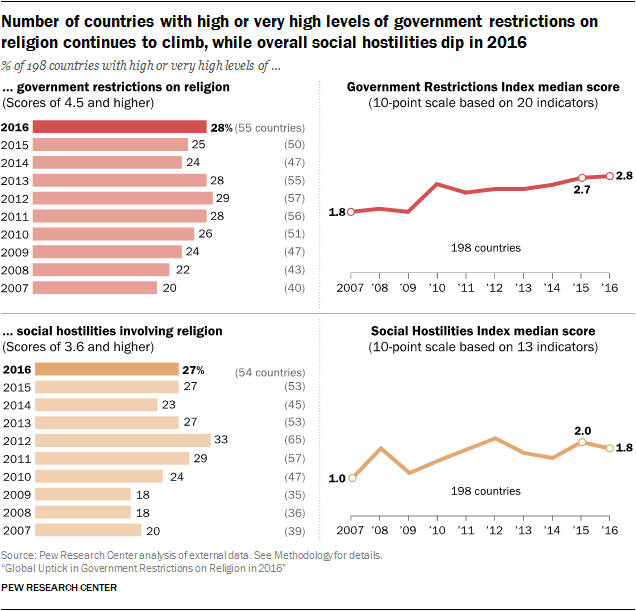
The share of countries with “high” or “very high” levels of government restrictions – that is, laws, policies and actions by officials that restrict religious beliefs and practices – rose from 25% in 2015 to 28% in 2016. This is the largest percentage of countries to have high or very high levels of government restrictions since 2013, and falls just below the 10-year peak of 29% in 2012.
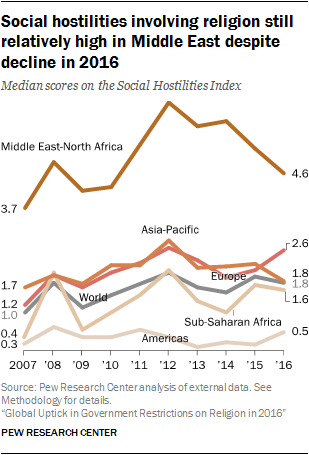
Meanwhile, the share of countries with “high” or “very high” levels of social hostilities involving religion – that is, acts of religious hostility by private individuals, organizations or groups in society – remained stable in 2016 at 27%. Like government restrictions, social hostilities also peaked in 2012, particularly in the Middle East-North Africa region, which was still feeling the effects of the 2011 Arab Spring uprisings. The number of countries with high or very high levels of social hostilities declined in 2013 and has remained at about the same level since, but it is higher than it was during the baseline year of this study (2007).
In total in 2016, 83 countries (42%) had high or very high levels of overall restrictions on religion – whether resulting from government actions or from hostile acts by private individuals, organizations and social groups – up from 80 (40%) in 2015 and 58 (29%) in 2007.1
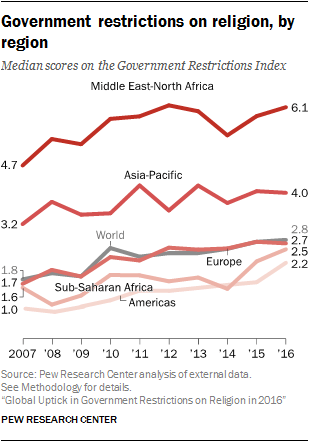
At the same time, most countries in the world continued to have low to moderate levels of religious restrictions. Looking separately at the global median scores on the Government Restrictions Index (a 10-point scale based on 20 indicators of government restrictions on religion) and the Social Hostilities Index (a 10-point scale based on 13 measures of social hostilities involving religion) offers a mixed picture of how religious restrictions are changing. In 2016, the global median score on the Government Restrictions Index ticked upward, from 2.7 to 2.8, while the median score on the Social Hostilities Index fell slightly, from 2.0 to 1.8.
In many countries, restrictions on religion resulted from actions taken by government officials, social groups or individuals espousing nationalist positions. Typically, these nationalist groups or individuals were seeking to curtail immigration of religious and ethnic minorities, or were calling for efforts to suppress or even eliminate a particular religious group, in the name of defending a dominant ethnic or religious group they described as threatened or under attack. In the Netherlands, for instance, Geert Wilders’ Freedom Party announced an election platform in 2016 that called for the “de-Islamization” of the country, including barring asylum seekers from Islamic countries, prohibiting Muslim women from wearing headscarves in public, closing all mosques and banning the Quran.2 In another case, the Czech group Block Against Islam (which opposes allowing Muslim refugees into the country and calls for restrictions on the Muslim community) organized about 20 anti-Islam rallies around the country during the year.3
More broadly, 2016 saw an uptick in nationalist activities around the globe that are reflected in elements of both the Government Restrictions Index (GRI) and the Social Hostilities Index (SHI).4
Nationalist political parties aim rhetoric at religious groups
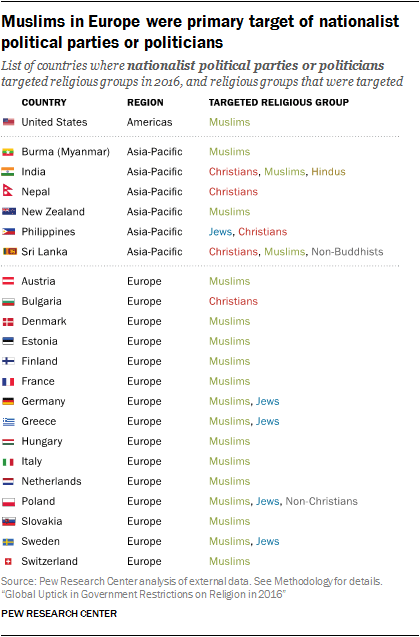
Government actors – whether political parties or individual public officials – at times used nationalist, and often anti-immigrant or anti-minority, rhetoric to target religious groups in their countries in 2016. About one-in-ten (11%) countries had government actors that used this type of rhetoric.5 This marks an uptick from 2015, when 6% of cases involved political parties or officials that espoused nationalist views.6
This phenomenon was especially common in Europe. About a third of European countries (33%) had nationalist parties that made political statements against religious minorities, an increase from 20% of countries in 2015.7 In France, for example, Marine Le Pen, leader of the National Front, promised to continue the ban on religious clothing and symbols in public places specifically to “fight the advance of political Islam.”8
In the Asia-Pacific region, nationalist political parties targeting religious groups were found in a smaller share of countries (12%), including Burma (Myanmar), India and New Zealand. For example, Winston Peters, leader of the New Zealand First Party, said in June 2016 that certain countries “treat their women like cattle,” and he suggested that all immigrants should be screened for unacceptable attitudes before being permitted to enter the country.9 Some media reports said he specifically referred to Muslim immigrants, which he denied.10
Overall, Muslims were the most common target of harassment by nationalist political parties or officials in 2016, typically in the form of derogatory statements or adverse policies. This was the case in Denmark, where the Danish People’s Party (DPP) backed a measure passed by the city council in Randers that made “traditional” meals – including pork products – mandatory in public institutions, including schools. Martin Henriksen, a spokesperson for the DPP, said the bill would preserve Danish culture and that the party was “fighting against Islamic rules and misguided considerations dictating what Danish children should eat.” The bill was opposed by members of the Muslim community because they saw it as stigmatizing; Muslims traditionally do not eat pork.11
In the United States, Muslims were the targets of derogatory rhetoric and proposed discrimination. In July, Republican presidential nominee Donald J. Trump criticized the parents of a Muslim soldier who was killed in Iraq, saying the soldier’s mother was not “allowed” to speak at the Democratic National Convention, despite being on stage with her husband, implying that this was a result of her religion.12 Later in the year, President-elect Trump appeared to stand by plans for a temporary ban on Muslim immigration to the United States and a proposed requirement that U.S. Muslims register in a database.13
Nationalist parties also singled out Jews, Christians and members of other minority faiths. In Bulgaria, Jehovah’s Witnesses reported an ongoing campaign against their religion by two nationalist parties, the National Front for the Salvation of Bulgaria and the Internal Macedonian Revolutionary Organization, which together form the Patriotic Front political alliance in the country’s legislature.14 And, in Sweden, representatives of the Sweden Democrats Party made anti-Semitic and anti-Muslim remarks on multiple occasions during the year.15
Nationalist organizations targeted religious minorities as well
Nationalist ideologies were not limited to governments. The number of countries where nongovernmental nationalist organizations (as opposed to governmental actors, such as officeholders or political parties with a role in government) targeted religious groups also increased in 2016.
One of the 13 measures that comprise the Social Hostilities Index is whether any organized group or groups “sought to dominate public life with their perspective on religion” at the expense of other religious groups. Like the other SHI measures, the answer to this question has been coded annually for each country, based on the same set of publicly available sources (for more details, see the Methodology and SHI Question 7 in Appendix D).
In 2016, the study found 77 countries where organized groups sought to dominate public life at the expense of certain religions, up from 72 countries in 2015. Not all of these groups were nationalist or espoused positions against immigrants and religious minorities, but the number of groups that did espouse these positions also rose, from 27 countries in 2015 to 32 in 2016.
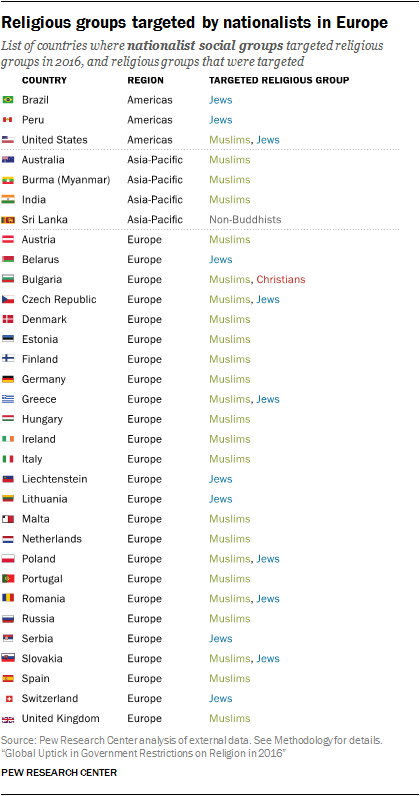
The majority of social groups displaying this kind of nationalist or anti-immigrant and anti-minority activity – 25 out of the 32 – were in European countries, including the United Kingdom, Ireland and Hungary. A few additional countries with these types of groups were in the Asia-Pacific region, including Sri Lanka, India and Australia.
In Australia, for example, nationalist groups and local residents opposed the building of a mosque in southeast Melbourne; eventually a local council denied approval for its construction. Additionally, in May and July 2016, police made arrests in Melbourne after violence broke out between religious freedom advocates and opponents of Islam at competing protests.16
This type of activity was common among countries in this category: Religious minorities were often the targets of demonstrations, derogatory public comments or violent acts by nationalist groups. In all 32 countries where nationalist groups sought to dominate public life in 2016, they targeted religious minorities, such as Muslims, Jews, minority Christian churches or members of other faiths.
In European countries, Muslims were targeted most frequently. Muslims were the focus of nationalist groups in 20 of the 25 European countries where these types of groups were active. Following the terrorist attacks in Brussels in March 2016, for example, the Spanish nationalist group Madrid Social Home hung signs near a major mosque in Madrid reading “Today Brussels, tomorrow Madrid?” and posted “Mosques out of Europe” on Twitter.17
But while Muslims were the primary target of nationalist movements across the globe, Jews, Christians (including Jehovah’s Witnesses) and others were targeted as well. For example, in 2016 nationalist groups aimed activities against religious groups in three countries in the Americas – Brazil, Peru and the United States – and Jews were a target in all three; in addition, Muslims also were targeted in the U.S.
Neo-Nazis continued to use anti-Semitic language and engage in online harassment of Jewish journalists in the U.S.18 And the Andean National Socialist Movement of Peru continued to deny that the Holocaust occurred, sell anti-Semitic literature and DVDs, and call for the expulsion of the Jewish community from Peru.19
Nationalist groups and parties gain standing in 2016
Nationalism was certainly not a novel ideology in 2016; nationalist political parties and organizations have been active around the world for centuries. But some nationalist political parties did gain more support in various ways in 2016. In addition to Rodrigo Duterte’s election in the Philippines, support in the polls for Marine Le Pen of the National Front party increased leading up to the 2017 French presidential election (which Le Pen ultimately lost in a runoff to Emmanuel Macron). And the Alternative for Germany party, a German far-right nationalist party, some branches of which have called for a ban on the construction and operation of mosques, won a significant number of seats in three state parliament elections in 2016 (before gaining seats in the national parliament in 2017).20
Nationalist organizations in society at large were also not a new phenomenon in most of the countries where they were active in 2016, but some spread their operations to new locales during the year. For instance, Patriotic Europeans Against the Islamization of the West established an Irish branch in 2016 – a move that was met with protests by groups describing themselves as opposing racism and supporting immigrants.21 And a Finland-based group called Soldiers of Odin spread in 2016 to multiple cities in Finland and some neighboring countries, including Estonia, organizing marches against “Islamist intruders” and vowing to set up volunteer street patrols to counter crime by migrants.22
In India, some Hindu nationalists formed “cow protection” groups that viewed cow slaughter and eating beef as an affront to Hindu deities that represent motherhood. These groups have existed in prior years in India, but they increased their activities in 2016. Members of these groups violently confronted consumers of beef or those they believed may have been involved in slaughtering beef, in many instances harassing and in some cases beating or killing their targets.23
About this report
This is the ninth in a series of reports by Pew Research Center analyzing the extent to which governments and societies around the world impinge on religious beliefs and practices. The studies are part of the Pew-Templeton Global Religious Futures project, which analyzes religious change and its impact on societies around the world. The project is jointly funded by The Pew Charitable Trusts and the John Templeton Foundation.
To measure global restrictions on religion in 2016 – the most recent year for which data are available – the study ranks 198 countries and territories by their levels of government restrictions on religion and social hostilities involving religion. The new study is based on the same 10-point indexes used in the previous studies.
The Government Restrictions Index measures government laws, policies and actions that restrict religious beliefs and practices. The GRI comprises 20 measures of restrictions, including efforts by government to ban particular faiths, prohibit conversion, limit preaching or give preferential treatment to one or more religious groups.
The Social Hostilities Index measures acts of religious hostility by private individuals, organizations or groups in society. This includes religion-related armed conflict or terrorism, mob or sectarian violence, harassment over attire for religious reasons, or other religion-related intimidation or abuse. The SHI includes 13 measures of social hostilities.
To track these indicators of government restrictions and social hostilities, researchers combed through more than a dozen publicly available, widely cited sources of information, including the U.S. State Department’s annual reports on international religious freedom and annual reports from the U.S. Commission on International Religious Freedom, as well as reports from a variety of European and UN bodies and several independent, nongovernmental organizations. (See Methodology for more details on sources used in the study.)
Religious restrictions vary by region, religious group
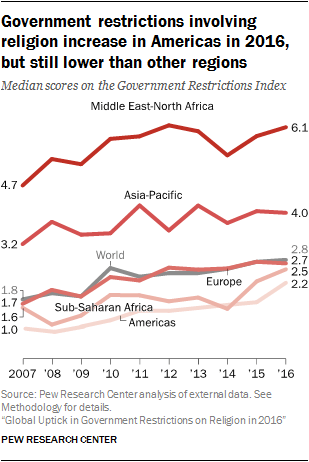
The Middle East-North Africa region continued to have the highest median level of government restrictions on religion in 2016, although the Americas had the sharpest increase in its median score, rising from 1.7 in 2015 to 2.2 in 2016. The rise in the Americas’ median score was partly due to incidents in which worship or proselytizing were restricted. For example, in Paraguay, police forcibly evicted the Ava Guarani indigenous community from their ancestral lands, demolishing homes, schools and places of worship.24 And in Mexico, Jehovah’s Witnesses were prohibited from proselytizing by the municipal authority in San Jorge Nuchita.25
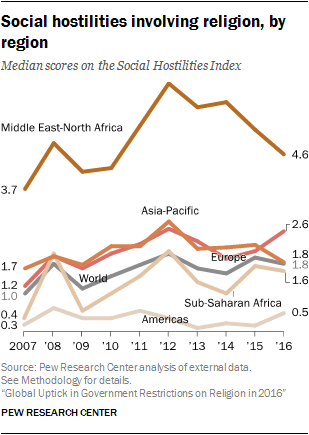
Meanwhile, Europe and the Americas were the only regions to experience increases in median levels of social hostilities involving religion, with Europe seeing the sharpest increase. The Middle East-North Africa region continued to experience a decline in its median score, although it remained the region with the highest levels of social hostilities.
When combining measures of government restrictions and social hostilities, more than four-in-ten countries (42%) had high or very high levels of overall religious restrictions in 2016. Since some of these countries are among the world’s most populous (such as China and India), this means that a large share of the world’s population in 2016 – 83% – lived in countries with high or very high religious restrictions (up from 79% in 2015). It is important to note, however, that these restrictions and hostilities do not necessarily affect the religious groups and citizens of these countries equally, as certain groups or individuals – especially religious minorities – may be targeted more frequently by these policies and actions than others. Thus, the actual proportion of the world’s population that is affected by high levels of religious restrictions may be considerably lower than 85%.
The analysis also finds that among the world’s 25 most populous countries, Egypt, Russia, India, Indonesia and Turkey had the highest overall levels of government restrictions and social hostilities in 2016. China had the highest score on the Government Restrictions Index, while India had the highest score on the Social Hostilities Index.
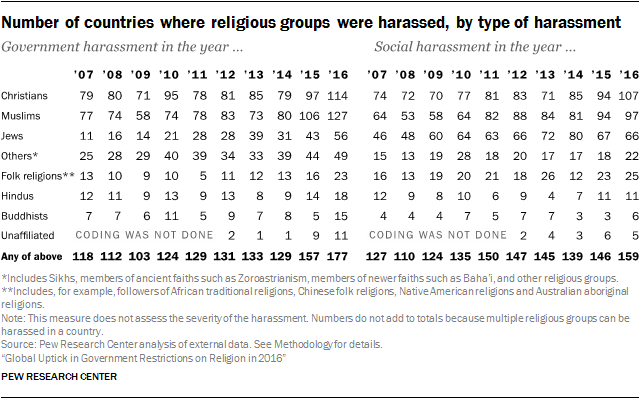
Looking at religious groups, harassment of members of the world’s two largest groups – Christians and Muslims – by governments and social groups continued to be widespread around the world, with both experiencing sharp increases in the number of countries where they were harassed in 2016. There was also a jump in the number of countries where Jews were harassed in 2016 following a small decrease in 2015.
1. Number of countries with ‘very high’ government restrictions on religion at highest level since 2007
Countries with the most extensive government restrictions on religion
Most countries around the world have some form of restrictions on religion – whether it is through laws that limit actions like public preaching or conversion, or actions that can include detaining, displacing or assaulting members of religious groups.
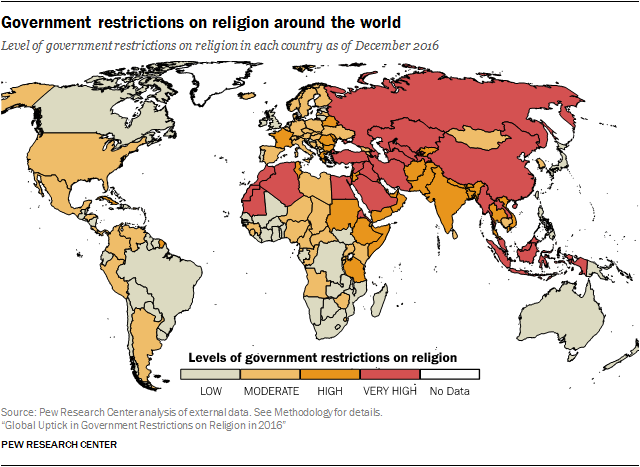
A subset of countries, however, has particularly high levels of government restrictions on religion. Twenty-five of the 198 countries in this study had “very high” levels of government restrictions on religion in 2016, up from 23 countries in 2015 and just 16 in 2014.26 This marks the biggest number of countries to fall in this top category since Pew Research Center began analyzing restrictions on religion in 2007.
Three countries and territories – Laos, Burma (Myanmar) and Western Sahara – moved into the “very high” category in 2016, while one country – Vietnam – dropped from the “very high” to the “high” restrictions category. Burma’s score was affected by ongoing government actions taken against the Rohingya Muslim minority, described by the United Nations as “crimes against humanity.”27 In response to deadly attacks in October and November, Burmese military and police forces conducted “security operations” that allegedly resulted in extrajudicial killings, rapes, beatings and mass arrests in northern Rakhine State. The operations resulted in the displacement of approximately 93,000 civilians, according to the United Nations.28
Vietnam’s slightly lower government restrictions score (from a 6.6 in 2015 to a 6.5 in 2016) was due in part to the Vietnamese government no longer requiring religious affiliation to be listed on identification cards. Previously, individuals who wished to change their religious affiliation had to go through a cumbersome process and were, in some cases, prevented from doing so by local authorities.29 For a complete list of all countries in each category, see the Government Restrictions Index table in Appendix A.30
Countries with the most extensive social hostilities involving religion
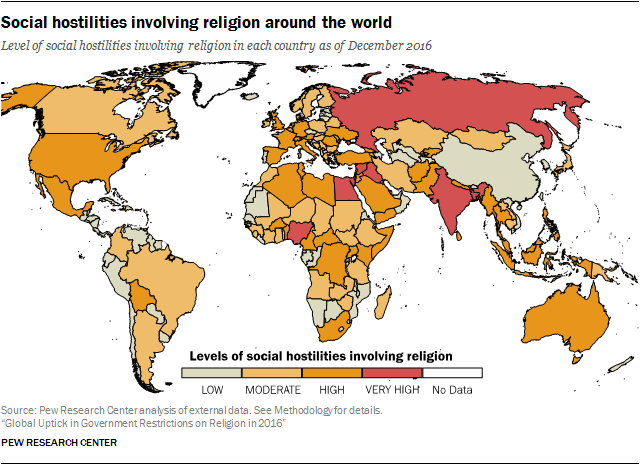
In contrast to the increase in countries with very high government restrictions on religion, fewer countries fell into the highest category of social hostilities in 2016. Nine countries had “very high” levels of social hostilities involving religion in 2016, a slight decrease from 11 in 2015. These social hostilities included actions like social groups harassing members of a certain religion, as well as organized groups attempting to dominate public life with their perspective on religion (for more on this latter type of activity, see Overview).31
Bangladesh was the only country to join this category, due in part to an increase in assaults and killings of members of religious groups by social groups or individuals. In multiple instances in 2016 – continuing a pattern from previous years – people who had expressed atheist views or were accused of offending Islam on the internet were killed or threatened.32 Meanwhile, Afghanistan, Pakistan and Yemen all fell out of the “very high” category of social hostilities involving religion. While these countries all continued to experience religion-related violence at high levels, small changes in reported incidents from year to year, as well as methodological adjustments, accounted for movement across categories.33 In Afghanistan, for instance, the Taliban still targeted religious minorities and other civilians, but sources did not report major incidents of mob violence, which had occurred in 2015.34 Pakistan saw a small decrease (0.4 points) in its social hostilities score due to a reduction in the number of displacements caused by religion-related conflict and terrorism.35
The total number of countries with “moderate” levels of social hostilities was unchanged from 2015 to 2016. Similarly, the “low” and “high” categories were also mostly stable in size, although some countries did move into and out of each of these categories.
For example, Benin jumped from the “low” to “high” in social hostilities in 2016. In contrast with the previous year, sources reported conflicts between Voodoo practitioners and the Catholic Church in 2016; in May, for instance, a Catholic prayer center was vandalized by a group of Voodoo followers who accused the local chaplain of angering their deity and counteracting their rituals.36
For a complete list of all countries in each category, see the Social Hostilities Index table in Appendix B.37
Changes in government restrictions on religion
Tracking the countries that enter or exit the “very high” category of religious restrictions is useful for observing changes from year to year, but sometimes countries can have substantial changes in scores that do not necessarily cause them to move into or out of the highest category. For this reason, Pew Research Center analyzes the magnitude of changes across all countries and categories to provide greater insight into how government actions and policies can have an especially large impact on religious restrictions each year.
Overall, between 2015 and 2016, regardless of the size of the change, more than twice as many countries had increases as had decreases in their Government Restrictions Index (GRI) scores (105 countries vs. 51 countries).
Gambia was the only country to experience a large change (2.0 points or more) on the Government Restrictions Index (GRI) in 2016. Its score increased to 3.8 from 1.7 in 2015 (bumping it from the “low” to the “moderate” category), due in part to restrictions on public preaching and religious dress. In February, the government-sponsored Supreme Islamic Council said it would ensure that Islamic scholars adhere to the acceptable principles of Islam by screening and certifying all of those who wanted to preach on local media.38 In addition, early in 2016, President Yahya Jammeh issued an executive decree that required female government employees to wear headscarves to work. The decree was rescinded a week later after criticism from opposition parties and the media.39 Still, this decree followed a presidential announcement by Jammeh in late 2015 declaring Gambia an Islamic state – a claim he reiterated in July 2016.
Sixteen countries experienced modest changes (1.0 to 1.9 points) in their GRI scores, and among those, far more saw increases in scores (14 countries) than decreases (Albania and Equatorial Guinea). In Albania, the decrease was due in part to the resolution of a 2014 case that involved a Muslim girl barred from attending a public school because she started wearing a headscarf. The action was ruled as discriminatory.40
Among the 14 countries with modest increases, Ethiopia and the Maldives had some of the largest jumps in GRI scores. In Ethiopia, the government declared a six-month state of emergency in October 2016, limiting religious freedoms.41 And in the Maldives, a new “Anti-Defamation and Freedom of Expression” law stipulated that religious preaching or teaching of Islam must be in accordance with the 1994 Religious Unity Act, which criminalizes statements or actions that disrupt religious unity.42
Most countries experienced only small changes (less than 1.0 point) in their GRI scores. Of the 198 countries analyzed, 49 (25%) had a small decrease and 90 (45%) had a small increase. An additional 42 countries had no change at all.
Changes in social hostilities involving religion
In 2016, four countries experienced large increases (2.0 points or more) in their SHI scores, while just two – Niger and the Republic of the Congo – saw large decreases in their scores. In Niger, cooperation between Christian and Muslim communities reportedly improved after violent protests in 2015.43 And in the Republic of the Congo, Muslim leaders said they had not received reports of harassment against the Muslim community, as opposed to in 2015, when authorities arrested several people attempting to vandalize a mosque.44
Benin, Mexico, Sierra Leone and Ukraine had large increases in their scores. In Sierra Leone, there were several documented incidents of what religious leaders called “aggressive proselytization,” raising concerns that Christian and Muslim fundamentalist groups would threaten religious harmony in the country.45 And in Ukraine, in addition to ongoing tensions between the Ukrainian Orthodox Church-Moscow Patriarchate and the Ukrainian Orthodox Church-Kyiv Patriarchate, Russian-backed separatists in the eastern part of the country seized houses of worship for Jehovah’s Witnesses as well as a Seventh-day Adventist church.46
Thirty-seven countries had modest changes (1.0 to 1.9 points) in their SHI scores, with 24 experiencing a modest increase and 13 a modest decrease. Timor-Leste, for example, saw a modest decrease in social hostilities as there were no reported incidents of mob violence. The prior year, a group led by a Catholic priest destroyed a church being constructed by a Protestant group 47
Similar to the changes in the GRI index, most countries experienced only small changes in their SHI scores. Among the 109 countries that had small changes, about half (53 countries) had a decrease while the other half (56 countries) experienced an increase.
Changes in overall restrictions on religion
Analyzing changes in government restrictions on religion and social hostilities involving religion together provides a picture of the overall condition of religious restrictions in a country, whether perpetrated by government actors or social groups and individuals.
Far more countries experienced increases in overall scores rather than decreases in 2016. Among the 112 countries with an increased score, three-quarters (75%) had only small increases. About one-in-five (21%) saw modest increases in scores, while 4% had large increases in overall restrictions on religion.
Nearly a third of countries (64 countries) experienced decreases in overall restrictions on religion. Most of them (83%) had small decreases in scores, while 16% had modest decreases and only one country – Niger – had a large decrease in overall restrictions on religion.
Twenty-two countries had no change in their overall score between 2015 and 2016.
2. Harassment of religious groups hits highest point since 2007
The analysis of 2016 sources found reports of religiously motivated harassment – whether perpetrated by governments or social groups – in the vast majority of the world’s countries (187, up from 169 in 2015). This marks the biggest number of countries where harassment was observed against religious groups since Pew Research Center began analyzing restrictions on religion in 2007.
Harassment of members of religious groups takes many forms, including physical assaults, arrests and detentions, desecration of holy sites, and discrimination against religious groups in employment, education and housing. Harassment and intimidation also include things like verbal assaults on members of one religious group by other groups or individuals.
Christians and Muslims have typically been harassed in the largest number of countries around the world. These two groups are the largest religious groups in the world and have substantial populations in more countries than other smaller and less geographically dispersed religious groups.
In 2016, Christians were harassed in 144 countries, up from 128 countries the year before. In Fiji, for example, the Methodist Church was criticized by the prime minister for allowing opposition political leaders to act as lay preachers.48 Likewise, Muslims were harassed in an increased number of countries in 2016 (142, up from 125), including in 41 out of 45 European countries. In Switzerland, a canton’s ban on burqas, niqabs and other face coverings in public entered into force, and on July 1, police detained a Muslim woman for wearing a niqab.49
Jews continued to be harassed in the third-largest number of countries, which is particularly notable due to their small population size (Jewish people make up just 0.2% of the world’s population). In 2016, the number of countries where Jews were harassed increased to 87, reversing the decline that occurred in 2015. In Uruguay, for example, a Jewish man was stabbed to death by an assailant claiming to follow Allah’s orders, and Jewish organizations said anti-Semitic attitudes were still present in parts of Uruguayan society.50
Hindus and Buddhists both saw increases in the number of countries where they were harassed in 2016. Hindus were harassed in 23 countries (up from 18 in 2015), while Buddhists were harassed in 17 countries (up from seven). These are both the highest figures since coding began in 2007. In Indonesia, 12 Buddhist temples were looted or burned down by a mob after a Buddhist woman asked a mosque to lower its loudspeaker volume.51
Religiously unaffiliated people – including atheists, agnostics and those who do not identify with any religion – were harassed in 14 countries in 2016, the same number as in 2015. In some of these cases, the religiously unaffiliated were prosecuted under the country’s blasphemy laws. In Russia, for example, an atheist blogger was charged under the blasphemy law for comments on his blog denying the existence of God and for describing the Bible as “a collection of Jewish fairy tales.”52
Government versus social harassment of groups
Not all religious groups are targeted equally by governments and social groups. At times, a group may be the victim of government harassment while not facing any harassment by social groups, or vice versa. For example, since 2007, Jews have consistently been harassed by social groups or individuals in more countries than they have been harassed by governments (66 vs. 56 in 2016). Christians, on the other hand, are harassed in more countries by governments (114 countries) than by social groups (107 countries). In Singapore, for example, the government has maintained a ban on Jehovah’s Witnesses since 1972, because the group objects to national service, reciting the national pledge or singing the national anthem. The government views these objections as running counter to public order and welfare. While Jehovah’s Witnesses generally are allowed to worship and practice their faith in private, they are not allowed to hold public meetings or publish their literature.53
Members of world religions other than the groups analyzed in this report were harassed by governments in 49 countries, and by social groups or individuals in 22 countries around the world. Some of these groups, which include (but are not limited to) Sikhs, Zoroastrians, Scientologists, Baha’i and Rastafarians, are banned in certain countries; for example, Baha’i are banned in Brunei.54 And in Pakistan, Sikh leaders reported that Sikh women had difficulty obtaining inheritances, accessing health services or voting due to legal uncertainties around registering marriages for Sikhs. 55
Christians were most likely to face harassment in the Asia-Pacific region, whether from government forces or social groups. Three-in-ten countries where Christians were harassed by governments were in the Asia-Pacific region, while a similar share – 27% – of countries where they were harassed by social groups were also located in the region. In Uzbekistan, for example, authorities raided the private homes of Protestant Christians, seized religious literature and imposed fines.56 And in Nepal, local communities in the Kathmandu Valley opposed burials by perceived “outsiders,” making it difficult for Protestant churches to access land they had bought years earlier.57
Muslims, on the other hand, were most likely to face harassment by both governments and social groups in Europe. Of the countries where Muslims were harassed by governments, 28% were in Europe, while an even bigger share of the countries where Muslims were harassed by social groups (35 of 97, or 36%) were in Europe. In Estonia and Lithuania, for example, local media and nongovernmental organizations reported more incidents involving anti-Muslim sentiments in 2016 than the previous year.58
3. Americas the only region with a rise in both government restrictions and social hostilities involving religion in 2016
Government restrictions by region
In 2016, the global median level of government restrictions on religion increased slightly to 2.8 from 2.7 in 2015. The median score rose in three out of five regions (the Americas, sub-Saharan Africa and the Middle East-North Africa region) and remained about the same in two regions (Asia-Pacific and Europe). While the Americas experienced the largest increase in its median score, it still had the lowest median score among all regions.
The Middle East and North Africa continued to have the highest median level of government restrictions, with the median score for the region’s 20 countries (6.1) more than double the global median (2.8). The region’s 0.2-point increase between 2015 and 2016 was due in part to more governments displaying hostility toward minority or non-approved religious groups (from 11 countries in 2015 to 15 in 2016) and failing to protect religious groups from discrimination and abuse (up from nine to 12).
Following an increase the year before, the median level of government restrictions for the 50 countries in the Asia-Pacific region remained roughly unchanged in 2016 (4.0).59 Still, an increasing number of countries experienced government harassment of religious groups in the region, whether on a limited or widespread basis. In Fiji, for example, an opposition parliament member was suspended for two years for questioning the leadership of Muslims who held high-level positions in the government, including the person who serves as the country’s attorney general and minister of finance.60
The median score for Europe’s 45 countries also remained roughly unchanged in 2016, staying at 2.7.61 Continuing the trend from the previous year, government harassment and intimidation of religious groups increased from 38 to 42 European countries in 2016. But in contrast with the previous year, the number of governments in Europe that used violence against minority religious groups declined from 10 countries to five. Similarly, government use of force against religious groups in general – whether in the form of property damage, detentions, displacements, assaults or killings – declined somewhat in 2016, from 24 to 21 countries.
France, however, stood out among European countries for having the most incidents of government use of force against religious groups. In particular, French authorities conducted nearly 4,000 warrantless raids and placed 400 people under house arrest – targeting mostly Muslims – during a period of emergency law from November 2015 to July 2016 in response to terrorist attacks in 2015. 62
Sub-Saharan Africa experienced a 0.3-point increase in its median government restrictions score. The slight increase was due in part to restrictions on the wearing of religious symbols and clothing for both women and men in six additional countries.63 In Uganda, for instance, Muslim staff at a public high school claimed the Christian head teacher did not allow female students to wear the hijab.64 Meanwhile, in Malawi, Rastafarian children were prohibited from attending public school due to a requirement that children to shave their heads in order to attend.65
The Americas experienced the largest increase (0.5 points) in its median score, although this was a small change; the Americas still had the lowest levels of government restrictions of any region.
Out of the 35 countries in the Americas, 26 saw increases in government restrictions scores in 2016. More governments interfered in worship, harassed religious groups (including minority or non-approved religious groups) and failed to protect some religious groups from discrimination or abuse. For example, in Ecuador, Honduras and Mexico, Jehovah’s Witnesses were at times prevented from building worship halls, proselytizing and distributing religious material.66 And in Cuba, large-scale detentions continued to increase. In February 2016, 200 members of the Emmanuel Church of the Apostolic Movement in the Santiago de Cuba region were detained, the church was destroyed and church property was confiscated. That same year, three other Apostolic Movement houses of worship were destroyed by the Cuban government.67
Social hostilities by region
In 2016, the global median level of social hostilities decreased slightly by 0.2 points. But while scores decreased in three regions – the Asia-Pacific region, the Middle East-North Africa region and sub-Saharan Africa – they increased in Europe and the Americas.
The Middle East-North Africa region had the largest decrease in its median social hostility score (a drop of 0.6 points). But despite a general decline in its median score since 2014, the Middle East and North Africa still had the highest median level of social hostilities (4.6) and was more than double the global median (1.8) in 2016. Out of the 20 countries in the region, nine had increases in hostilities, nine had decreases and two had no change in their scores from 2015 to 2016. Tunisia had an especially large decrease in its score on the Social Hostilities Index (3.6 in 2016 vs. 5.3 in 2015). In previous years, there had been more reported cases of Salafists attacking religious groups that did not adhere to their interpretations of Islam, including incidents targeting Sufi shrines and Shiite events.68
Europe, meanwhile, had the second-highest median social hostilities score (2.6) and the largest increase in score (0.5 points) among the five regions. There were tensions between religious groups in seven additional countries in 2016. In Austria, for example, the Austrian Jewish Community reported rising fears of anti-Semitic incidents perpetrated by Muslim refugees. 69 In addition, eight European countries experienced increased activity by organized groups attempting to dominate public life with their perspective on religion, mainly targeting Muslims. In Portugal, for example, the National Renewal Party organized a protest against the “Islamic invasion” and left two pigs’ heads near the site of a future mosque.70 (Some of these groups were categorized as nationalist groups; for more details on rising levels of nationalism in Europe, see the Overview of this report.)
The Asia-Pacific region’s median SHI score (1.8) declined slightly in 2016 and was about the same as the global median. The decrease was due in part to fewer reported cases of religious groups being assaulted or displaced for religious activities that were offensive to the majority faith (29 countries in 2015 vs. 24 in 2016). Although the median social hostilities score for the region decreased somewhat, there were still pockets with high levels of hostilities. In India, Sikhs were often harassed by Hindu nationalists for traditional beliefs and practices, including wearing Sikh dress and carrying religious items like the kirpan (a type of ceremonial sword).71
In sub-Saharan Africa, the median level of social hostilities had a very slight decrease of 0.1 points since 2015, with fewer incidents of mob violence reported in 2016.
In contrast, the Americas experienced a small increase in its median score, but remained the lowest-scoring region in social hostilities, with a median score of just 0.5 out of 10. The slight increase was due to more incidents of organized groups dominating public life with their views on religion, groups and individuals using violence or the threat of violence to enforce religious norms, and religious groups being assaulted or displaced for religious activities that were offensive to the majority faith. For example, Mexico had a rise in score that was due in part to hostilities between Catholic villagers and Protestants, gang violence against religious leaders who spoke out against gangs, and discrimination by indigenous communities toward members of a minority faith.72
4. Among the 25 most populous countries, Egypt, Russia, India, Indonesia and Turkey had the highest overall restrictions on religion in 2016
About three-quarters of the world’s people (more than 5 billion) live in the 25 most populous countries in the world. Examining the religious restrictions in these countries can show how government restrictions and social hostilities impact large portions of the world’s population – although not all who reside in these countries are affected equally, as religious minorities are often the disproportionate targets of these restrictions.
Among the 25 most populous nations in the world, Egypt, Russia, India, Indonesia and Turkey had the highest overall government restrictions and social hostilities in 2016. Egypt has consistently ranked among this group since Pew Research Center began studying restrictions on religion in 2007. The countries with the lowest overall scores, meanwhile, were Japan, Brazil, the Philippines, the Democratic Republic of the Congo and the United States; Japan, Brazil and the Philippines have typically been fixtures on this list.
Looking at just government restrictions in 2016, China, Iran, Indonesia, Russia and Egypt had the highest levels, with all countries falling in the “very high” category of restrictions. Japan, the Philippines, Brazil, the Democratic Republic of the Congo and the United Kingdom had the lowest levels of government restrictions among the biggest countries in 2016, and all five countries fell into the “low” category of restrictions.
The highest levels of social hostilities perpetrated by groups or individuals among the 25 most populous countries were in India, Nigeria, Egypt, Bangladesh and Russia, with all of these falling in the “very high” category of hostilities. Only Bangladesh moved into this group of five in 2016; India and Nigeria have both ranked among the top five every year since 2008. Meanwhile, Vietnam, China, Japan, Ethiopia and Tanzania had the lowest scores on the Social Hostilities Index (SHI), with “low” to “moderate” levels.
At times, a country’s level of government restrictions can mirror its level of social hostilities. Egypt and Russia, for example, had some of the highest levels of both government restrictions and social hostilities involving religion in 2016, and Japan had low scores on both measures.
But this type of correlation is not always the case. Sometimes, countries with the highest levels of government restrictions can have some of the lowest levels of social hostilities – or vice versa.
China, for example, had the highest Government Restrictions Index score of any country in 2016, yet had “low” levels of social hostilities.
In terms of changes to GRI scores, none of the 25 most populous countries had large changes (more than 2.0 points). Only Tanzania and Ethiopia had modest increases in their scores (between 1.0 and 1.9 points), with both shifting from “moderate” to “high” levels of government restrictions in 2016. In Ethiopia, the increase was due to arrests of anti-government protesters charged under an anti-terrorism law, as well as a six-month state of emergency that limited religious freedoms.73
Six countries had modest increases in SHI scores: Bangladesh, Germany, the Democratic Republic of the Congo, Egypt, Brazil and India. In the Democratic Republic of the Congo, for example, Jehovah’s Witnesses were attacked on multiple occasions for not participating in traditional rituals, and two mosques were burned down after a Muslim man killed a Christian woman in a financial dispute.74
Vietnam and China experienced modest declines (a decrease between 1.0 and 1.9 points) in their SHI scores due to fewer reported incidents of societal harassment of religious groups.
Methodology
This is the ninth time Pew Research Center has measured restrictions on religion around the globe.75 This report, which includes data for the year ending Dec. 31, 2016, generally follows the same methodology as previous reports.
Pew Research Center uses two 10-point indexes – the Government Restrictions Index (GRI) and the Social Hostilities Index (SHI) – to rate 198 countries and self-governing territories on their levels of restrictions.76 This report analyzes changes in restrictions on an annual basis, focusing on the period from 2015 to 2016.
The study categorizes the direction and degree of change in each country’s scores in two ways, numerically and by percentile. First, countries are grouped into categories depending on the size of the numeric change in their scores from year to year on the two indexes: changes of 2 points or more in either direction, changes of at least 1 point but less than 2 points, changes of less than 1 point, or no change at all. (See chart at right.)
Changes in overall levels of restrictions are calculated for each country by comparing its scores on both indexes (the GRI and the SHI) from year to year. When a country’s scores on the GRI and the SHI changed in the same direction (both increased or both decreased), the greater amount of change determines the category. For instance, if the country’s GRI score increased by 0.8 and its SHI score increased by 1.5, the country was put into the overall “1.0-1.9 increase” category. When a country’s score increased on one index but decreased on the other, the difference between the amounts of change determines the grouping. For example, if the country’s GRI score increased by 2.0 and its SHI score decreased by 1.5, the country went into the overall “0.1-0.9 increase” category. When a country’s score on one index stayed the same, the amount of change on the other index was used to assign the category.
Second, this report categorizes the levels of government restrictions and social hostilities in each country by percentiles. As the benchmark, it uses the results from the baseline year of the study (the year ending in mid-2007). Scores in the top 5% on each index in mid-2007 were categorized as “very high.” The next highest 15% of scores were categorized as “high,” and the following 20% were categorized as “moderate.” The bottom 60% of scores were categorized as “low.” See the table to the right for the index score thresholds as determined from the mid-2007 data. These thresholds are applied to all subsequent years of data.
Overview of procedures
The methodology used by Pew Research Center to assess and compare restrictions on religion was developed by former Pew Research Center senior researcher and director of cross-national data Brian J. Grim in consultation with other Pew Research Center staff members, building on a methodology that Grim and Professor Roger Finke developed while at Penn State University’s Association of Religion Data Archives.77 The goal was to devise quantifiable, objective and transparent measures of the extent to which governments and societal groups impinge on the practice of religion. The findings were used to rate countries and self-governing territories on two indexes that are reproducible and can be periodically updated.
This research goes beyond previous efforts to assess restrictions on religion in several ways. First, Pew Research Center coded (categorized and counted) data from more than a dozen published cross-national sources, providing a high degree of confidence in the findings. Pew Research Center coders looked to the sources for only specific, well-documented facts, not opinions or commentary.
Second, Pew Research Center staff used extensive data-verification checks that reflect generally accepted best practices for such studies, such as double-blind coding (coders do not see each other’s ratings), inter-rater reliability assessments (checking for consistency among coders) and carefully monitored protocols to reconcile discrepancies among coders.
Third, the coding took into account whether the perpetrators of religion-related violence were government or private actors. The coding also identified how widespread and intensive the restrictions were in each country.
Fourth, one of the most valuable contributions of the indexes and the questions used to construct them (see the section on the coding instrument below) is their ability to chart change over time.
Countries and territories
The 198 countries and self-administering territories covered by the study contain more than 99.5% of the world’s population. They include 192 of the 193 member states of the United Nations as of 2016 plus six self-administering territories – Kosovo, Hong Kong, Macau, the Palestinian territories, Taiwan and Western Sahara.78 Reporting on these territories does not imply any position on what their international political status should be, only recognition that the de facto situations in these territories require separate analysis.
Although the 198 countries and territories vary widely in size, population, wealth, ethnic diversity, religious makeup and form of government, the study does not attempt to adjust for such differences. Poor countries are not scored differently on the indexes than wealthy ones. Countries with diverse ethnic and religious populations are not “expected” to have more social hostilities than countries with more homogeneous populations. And democracies are not assessed more leniently or harshly than authoritarian regimes.
Information sources
In the latest year of the study, Pew Research Center identified 20 widely available, frequently cited sources of information on government restrictions and social hostilities involving religion around the world. This study includes four sources that were not used in the baseline report on religious restrictions. (See below for more details on the new information sources.)
The primary sources, which are listed below, include reports from U.S. government agencies, several independent, nongovernmental organizations and a variety of European and United Nations bodies. Although most of these organizations are based in Western countries, many of them depend on local staff to collect information across the globe. As previously noted, Pew Research Center did not use the commentaries, opinions or normative judgments of the sources; the sources were combed only for factual information on specific policies and actions.
Primary sources for 2016
Country constitutions
U.S. State Department annual reports on International Religious Freedom
U.S. Commission on International Religious Freedom annual reports
UN Special Rapporteur on Freedom of Religion or Belief reports
Human Rights First reports in first and second years of coding; Freedom House reports in subsequent years of coding
Human Rights Watch topical reports
International Crisis Group country reports
United Kingdom Foreign & Commonwealth Office annual report on human rights
Council of the European Union annual report on human rights
START Global Terrorism Database at the University of Maryland
European Network Against Racism Shadow Reports
United Nations High Commissioner for Refugees reports
U.S. State Department annual Country Reports on Terrorism
Anti-Defamation League reports
U.S. State Department Country Reports on Human Rights Practices
Uppsala University’s Uppsala Conflict Data Program, Armed Conflict Database
Human Rights Without Frontiers “Freedom of Religion or Belief” newsletters
Amnesty International Country Profiles
United Nations High Commissioner for Refugees Population Statistics Database
Internal Displacement Monitoring Centre Global Internal Displacement Database
U.S. government reports with information on the situation in the United States
U.S. Department of Justice “Religious Freedom in Focus” newsletters and reports
FBI Hate Crime Reports
As noted, this study includes four sources that were not included in Pew Research Center’s first report on global restrictions on religion: Freedom House reports; Uppsala University’s Armed Conflict Database; the “Freedom of Religion or Belief” newsletters of Human Rights Without Frontiers; and the Global Terrorism Database.
The Freedom House reports have replaced Human Rights First reports, which have not been updated since mid-2008. The Uppsala Armed Conflict Database provides information on the number of people affected by religion-related armed conflicts, supplementing other sources. The Human Rights Without Frontiers “Freedom of Religion or Belief” newsletters have replaced the Hudson Institute publication “Religious Freedom in the World” (by Paul Marshall), which has not been updated since its release in 2008. Human Rights Without Frontiers is a nongovernmental organization based in Brussels that has affiliated offices throughout the world.
Since 2013, Pew Research Center has used data from the Global Terrorism Database, maintained by the University of Maryland’s National Consortium for Terrorism and Responses to Terrorism (START), along with the International Crisis Group’s country reports, Uppsala University’s Armed Conflict Database and the State Department’s annual Country Reports on Terrorism, for information on religion-related terrorism. (One source used in earlier reports, the U.S. government’s Worldwide Incident Tracking System, or WITS, is no longer available online.) Prior to 2013, the report relied only on the International Crisis Group reports, the Uppsala database and the State Department reports for information on religion-related terrorism. The Global Terrorism Database is one of the most comprehensive sources on terrorism around the world and is the source for the U.S. State Department’s Country Reports on Terrorism. The addition of this source thus provides greater context and information on terrorism without biasing the reporting through the addition of information that was not previously available.
While some of the increases in religious restrictions noted in this study could reflect the use of more up-to-date and/or better information sources, Pew Research Center staff monitor the impact of source information variability each year and have found no evidence of overall informational bias. (For additional discussion, see the “Potential Biases” section in 2014’s report, “Religious Hostilities Reach Six-Year High.”)
The coding instrument
As explained in more detail below, Pew Research Center staff developed a battery of questions similar to a survey questionnaire. Coders consulted the primary sources in order to answer the questions separately for each country. While the State Department’s annual reports on International Religious Freedom generally contained the most comprehensive information, the other sources provided additional factual detail that was used to settle ambiguities, resolve contradictions and help in the proper scoring of each question.
The questionnaire, or coding instrument, generated a set of numerical measures on restrictions in each country. It also made it possible to see how government restrictions intersect with broader social tensions and incidents of violence or intimidation by private actors. The coding instrument with the list of questions used for this report is shown in the summary of results.
The coding process required the coders to check all the sources for each country. Coders determined whether each source provided information critical to assigning a score; had supporting information but did not result in new facts; or had no available information on that particular country. Multiple sources of information were available for all countries and self-administering territories with populations greater than 1 million. Most of the countries and territories analyzed by Pew Research Center were multi-sourced; only small (predominantly island) countries had a single source, namely the State Department reports.
Coding the United States presented a special problem since it is not included in the State Department’s annual reports on International Religious Freedom. Accordingly, Pew Research Center coders also looked at reports from the U.S. Department of Justice and the FBI on violations of religious freedom in the United States, in addition to consulting all the primary sources, including reports by the United Nations, Human Rights Watch, Freedom House, the International Crisis Group and the UK Foreign & Commonwealth Office, many of which contain data on the United States.
The coding process
Pew Research Center employed strict training and rigorous coding protocols to make its coding as objective and reproducible as possible. Coders worked directly under an experienced researcher’s supervision, with additional direction and support provided by other Pew Research Center researchers. The coders underwent an intensive training period that included a thorough overview of the research objectives, information sources and methodology.
Countries were double-blind coded by two coders (coders did not see each other’s ratings), and the initial ratings were entered into an electronic document (coding instrument) including details on each incident. The coders began by filling out the coding instrument for each country using the information source that had the most comprehensive information. The protocol for each coder was to answer every question on which information was available in the initial source. Once a coder had completed that process, he or she then turned to the other sources. As new information was found, this was also coded and the source duly noted. Whenever ambiguities or contradictions arose, the source providing the most detailed, clearly documented evidence was used.
After two coders had separately completed the coding instrument for a particular country, their scores were compared by a research associate. Areas of discrepancy were discussed at length with the coders and were reconciled in order to arrive at a single score on each question for each country. The data for each country were then combined into a master file, and the answers and substantiating evidence were entered into a database.
After data collection for all countries was completed, Pew Research Center coders and researchers compared the scores from calendar year 2016 with those from the previous year, ending Dec. 31, 2015. They identified scores that had changed and analyzed the substantiating evidence for each year to make sure the change was substantive and not the result of coder error. Throughout this process, the coding instrument itself was continually monitored for possible defects. The questions were designed to be precise, comprehensive and objective so that, based on the same data and definitions, the coding could be reliably reproduced by others with the same results. At the same time, Pew Research Center has attempted to minimize changes to the coding instrument as much as is possible to ensure all changes between years are the result of actual changes in restrictions and hostilities, not changes in methodology.
Pew Research Center staff generally found few cases in which one source contradicted another. When contradictions did arise – such as when sources provided differing estimates of the number of people displaced due to religion-related violence – the source that cited the most specific documentation was used. The coders were instructed to disregard broad, unsubstantiated generalizations regarding abuses and to focus on reports that contained clear, precise documentation and factual details, such as names, dates and places where incidents occurred.
Pew Research Center staff compared coders’ scores for all questions for each of the 198 countries and territories included in the study, computing the degree to which the scores matched. The inter-rater reliability score across all variables was 0.7. Scores at or above 0.7 are generally considered good.
The data-verification procedures went beyond the inter-rater reliability statistics. They also involved comparing the answers on the main measures for each country with other closely related questions in the data set. This provided a practical way to test the internal reliability of the data.
In previous years, Pew Research Center staff also checked the reliability of the coded data by comparing them with similar, though more limited, religious restrictions data sets. In particular, published government and social regulation of religion index scores are available from the Association of Religion Data Archives (for three years of data) and the Hudson Institute (for one year of data), which makes them ideal measures for cross-validation. The review process found very few significant discrepancies in the coded data; changes were made only if warranted by a further review of the primary sources.
Restriction of religion indexes
The Government Restrictions Index is based on 20 indicators of ways that national and local governments restrict religion, including through coercion and force. The Social Hostilities Index is based on 13 indicators of ways in which private individuals and social groups infringe on religious beliefs and practices, including religiously biased crimes, mob violence and efforts to stop particular religious groups from growing or operating. The study also counted the number and types of documented incidents of religion-related violence, including terrorism and armed conflict.
Government Restrictions Index
Coding multiple indicators makes it possible to construct a Government Restrictions Index of sufficient gradation to allow for meaningful cross-national comparisons. An additional advantage of using multiple indicators is that it helps mitigate the effects of measurement error in any one variable, providing greater confidence in the overall measure.
Pew Research Center coded 20 indicators of government restrictions on religion (see the summary of results). These 20 items were added together to create the GRI. In two cases, these items represent an aggregation of several closely related questions: Measures of five types of physical abuses are combined into a single variable (GRI Q.19), and seven questions measuring aspects of government favoritism are combined into an overall favoritism scale (GRI Q.20 is a summary variable showing whether a country received the maximum score on one or more of the seven questions).
The GRI is a fine-grained measure created by adding the 20 items on a 0-to-10 metric, with zero indicating very low levels of government restrictions on religion and 10 indicating very high levels of restrictions. The 20 questions that form the GRI are coded in a standard scale from zero to 1 point, while gradations among the answers allowed for partial points to be given for lesser degrees of the particular government restriction being measured. The overall value of the index was calculated and proportionally adjusted – so that it had a maximum value of 10 and a possible range of zero to 10 – by dividing the sum of the variables by two.
A test of whether the 20 items were statistically reliable as a single index produced a scale reliability coefficient of 0.91 for calendar year 2016. Since coefficients of 0.7 or higher are generally considered acceptable, it was statistically appropriate to combine these 20 items into a single index.
Social Hostilities Index
In addition to government restrictions, violence and intimidation in societies also can limit religious beliefs and practices. Accordingly, Pew Research Center staff tracked more than a dozen indicators of social impediments on religion. Once again, coding multiple indicators made it possible to construct an index that shows gradations of severity or intensity and allows for comparisons among countries. The summary of results contains the 13 items used by Pew Research Center staff to create the Social Hostilities Index.
The SHI was constructed by adding together the 13 indicators based on a 0-to-10 metric, with zero indicating very low impediments to religious beliefs and practices and 10 indicating very high impediments. The various questions that form the index are coded in a standard scale from zero to 1 point, while gradations among the answers allow for partial points to be given for lesser degrees of the particular hostilities being measured. The indicators were added together and set to have a possible range of zero to 10 by dividing the sum of the variables by 1.3.
As with the Government Restrictions Index, various types of violence and intimidation were combined. A test of whether these 13 items were statistically reliable as a single index produced a scale reliability coefficient of 0.89. Since coefficients of 0.7 or higher are generally considered acceptable, it was statistically appropriate to combine these items into a single index.
How examples are coded
Examples of each type of government restriction or social hostility are generally counted in a single measure on the GRI or SHI. For instance, a restriction on proselytizing (sharing one’s faith with the intent of persuading another to join the faith) is not also counted as a restriction on conversion (an individual changing their religion). In some situations, however, an individual restriction or hostility may be part of a broader set of restrictions or hostilities. For instance, a mob attack by members of one religious group on an individual of another religion may be an isolated event and counted just under question SHI Q.2: Was there mob violence related to religion? However, if such an attack triggers repeated attacks between religious groups, it also might be an indication of sectarian or communal violence, which by definition involves two or more religious groups facing off in repeated clashes. In such a case, the mob attack also would be counted under question SHI Q.3: Were there acts of sectarian or communal violence between religious groups? (See the summary of results.)
Effects of consolidating to a new database
For the first few years of this study, information on the number, types and locations of incidents of government force and social violence toward religious groups as well as deference to religious authorities in matters of law were coded at the province level. (See example of data coding on pages 45-48 of the December 2009 baseline report.) Each year, the province numbers were summed and put into separate country-level files. Following the publication of the August 2011 report, Pew Research Center staff created a database that integrated all province- and country-level data on religious restrictions. During this process, Pew Research Center staff reviewed any discrepancies between province files and the sums that had been transferred to the country files and made appropriate corrections. The adjustments made were relatively minor and had small effects on index scores for countries, on average less than 0.005 points on the 10-point indexes. Consolidating the data into a database also entailed a review of the data on harassment of religious groups. In particular, instances of harassment from the year ending in mid-2007 were stored as open-ended questions, and in a few cases they were recoded to match the categories used in subsequent years.
Beginning with data covering 2012, Pew Research Center stopped collecting data at the province level; all data are coded at the country level.
Changing time period of analysis
This is the sixth time Pew Research Center has analyzed restrictions on religion in a calendar year. Previous reports analyzed 12-month periods from July 1-June 30 (e.g., July 1, 2009-June 30, 2010). The shift to calendar years was made, in part, because most of the primary sources used in this study are based on calendar years.
Because of the shift in time frame, previous studies did not report directly on incidents that occurred during the period from July 1-Dec. 31, 2010. While this misses some incidents that occurred during the second half of 2010, events that had an ongoing impact – such as a change to a country’s constitution or the outbreak of a religion-related war – were captured by the coding. Researchers for the study carefully reviewed the situation in each country and territory during this six-month period and made sure that restrictions with an ongoing impact were not overlooked.
Religion-related terrorism and armed conflict
Terrorism and war can have huge direct and indirect effects on religious groups, including destroying religious sites, displacing whole communities and inflaming sectarian passions. Accordingly, Pew Research Center tallied the number, location and consequences of religion-related terrorism and armed conflict around the world, as reported in the same primary sources used to document other forms of intimidation and violence. However, war and terrorism are sufficiently complex that it is not always possible to determine the degree to which they are religiously motivated or state sponsored. Out of an abundance of caution, this study does not include them in the Government Restrictions Index. They are factored instead into the index of social hostilities involving religion, which includes one question specifically about religion-related terrorism and one question specifically about religion-related war or armed conflict. In addition, other measures in both indexes are likely to pick up spillover effects of war and terrorism on the level of religious tensions in society. For example, hate crimes, mob violence and sectarian fighting that occur in the aftermath of a terrorist attack or in the context of a religion-related war would be counted in the Social Hostilities Index, and laws or policies that clearly discriminate against a particular religious group would be registered on the Government Restrictions Index.
For the purposes of this study, the term “religion-related terrorism” is defined as premeditated, politically motivated violence perpetrated against noncombatants by subnational groups or clandestine agents that have some identifiable religious ideology or religious motivation. It also includes acts carried out by groups that have a nonreligious identity but affect religious personnel, such as clergy. Readers should note that it is the political character and motivation of the groups, not the type of violence, that is at issue here. For instance, a bombing would not be classified as religion-related terrorism if there was no clearly discernible religious ideology or bias behind it unless it was directed at religious personnel. Religion-related war or armed conflict is defined as armed conflict (a conflict that involves sustained casualties over time or more than 1,000 battle deaths) in which religious rhetoric is commonly used to justify the use of force, or in which one or more of the combatants primarily identifies itself or the opposing side by religion.
Changes to Somalia’s coding
Starting with data covering 2013, researchers changed the way they coded government restrictions in Somalia. In previous years of the study, researchers had coded actions by the al-Shabaab rebel group as government restrictions, largely because the group effectively controlled large swathes of Somali territory. The extent of al-Shabaab control over Somali territory decreased in calendar year 2013, so researchers did not code their actions as government restrictions but rather as social hostilities. Researchers continued to follow this policy when coding data for 2016.
Crimea coding
Starting with data covering 2015, researchers coded incidents occurring in Crimea as part of Russia’s GRI and SHI score. This is to reflect Russia’s de facto control over Crimea, and is not intended as a Pew Research Center position on the de jure status of the territory, which the United Nations recognizes as part of Ukraine.79
Changes to Yemen’s coding
Starting with data covering 2016, researchers changed the way they coded social hostilities in Yemen. In previous years of the study, researchers had coded actions by Houthi rebels as social hostilities. In 2016, however, Houthis formed their own government and had control of territory that is home to more than half of Yemen’s population.80 For this reason, researchers coded actions by the Houthi in 2016 as government restrictions rather than social hostilities.
Displacement coding
Starting with data covering 2016, researchers changed the way they coded displacement caused by religion-related conflict or terrorism. Previously, researchers would record displacement figures that were reported in any sources. During the coding period covering 2015, researchers continued to code displacement figures in this way but also recorded displacement figures from the United Nations High Commissioner for Refugees as well as the Internal Displacement Monitoring Centre in order to compare the results. Researchers found that the figures from the UNHCR and IDMC more closely matched United Nations estimates for new displacements in the calendar year than did the previous method of capturing displacements, which tended to overestimate the number of new displacements in a coding year because the figures often included the total number of displaced people from a country and not necessarily the newly displaced. Therefore, beginning with the data covering 2016, researchers exclusively used UNHCR and IDMC figures to more conservatively estimate the number of new displacements in the coding year. These sources were used to code displacement only in countries with active religion-related conflict or terrorism in order to avoid including displacements from other types of conflicts or terrorism.
Country constitution audit
Researchers conducted an audit of country constitutions for all previous years of coding (2007-2014). While the vast majority of country constitutions were correctly coded as to whether they included religious freedom provisions, there were a few countries where the coding was amended. These included Mexico, Costa Rica, Fiji, Iran, Jamaica, the Dominican Republic, Uruguay, Cameroon, Kenya and Mozambique. These amendments resulted in minimal changes in these countries’ overall GRI scores and did not alter overall trends represented in previous reports. Two countries – Mexico and Costa Rica – had score changes that pushed them from one category to another in 2014. Mexico’s 2014 GRI score decreased from “high” to “moderate”, while Costa Rica’s 2014 GRI score increased from “low” to “moderate.”
Potential biases
As noted earlier, the primary sources indicate that the North Korean government is among the most repressive in the world, including toward religion. But because independent observers lack regular access to North Korea, the sources are unable to provide the kind of specific, timely information that forms the basis of this report. Therefore, North Korea is not included on either index.
This raises two important issues concerning potential information bias in the sources. The first is whether other countries that limit outsiders’ access and that may seek to obscure or distort their record on religious restrictions were adequately covered by the sources. Countries with relatively limited access have multiple primary sources of information that Pew Research Center used for its coding. Each is also covered by other secondary quantitative data sets on religious restrictions that have used a similar coding scheme, including earlier years of coded State Department report data produced by Grim at Penn State’s Association of Religion Data Archives (ARDA) project (four data sets); independent coding by experts at the Hudson Institute’s Center for Religious Liberty using indexes also available from ARDA (one data set); and content analysis of country constitutions conducted by the Becket Fund for Religious Liberty (one data set). Pew Research Center staff used these for cross-validation. Thus, contrary to what one might expect, even most countries that limit access to information tend to receive fairly extensive coverage by groups that monitor religious restrictions.
The second key question – the flipside of the first – is whether countries that provide freer access to information receive worse scores simply because more information is available on them. As described more fully in the methodology in the baseline report, Pew Research Center staff compared the length of State Department reports on freer-access countries with those of less-free-access countries. The comparison found that the median number of words was approximately three times as large for the limited-access countries as for the open-access countries. This suggests that problems in freer-access countries are generally not overreported in the State Department reports.
Only when it comes to religion-related violence and intimidation in society do the sources report more problems in the freer-access countries than in the limited-access ones. However, the Social Hostilities Index includes several measures – such as SHI Q.8 (“Did religious groups themselves attempt to prevent other religious groups from being able to operate?”) and SHI Q.11 (“Were women harassed for violating religious dress codes?”) – that are less susceptible to such reporting bias because they capture general social trends or attitudes as well as specific incidents. With these limitations in mind, it appears that the coded information on social hostilities is a fair gauge of the situation in the vast majority of countries and a valuable complement to the information on government restrictions.
Data on social impediments to religious practice can more confidently be used to make comparisons among countries with sufficient openness, which includes more than nine-in-ten countries covered in the coding. An analysis by Grim and Richard Wike, Pew Research Center’s director of global attitudes research, tested the reliability of the State Department reports on social impediments to religious practice by comparing public opinion data with data coded from the reports in previous years by Grim and experts at Penn State. They concluded that “the understanding of social religious intolerance embodied in the State Department reports is comparable with the results of population surveys and individual expert opinion.”81
Coding harassment of specific religious groups
As in previous reports, this study provides a summary of the number of countries where specific religious groups faced government or social harassment. This is essentially a cross-tabulation of GRI.Q.11 (“Was there harassment or intimidation of religious groups by any level of government?”) and the first type of religious hatred or bias measured in SHI.Q.1.a. (“Did individuals face harassment or intimidation motivated by religious hatred or bias?”). For the purposes of this study, the definition of harassment includes any mention in the primary sources of an offense against an individual or group based on religious identity. Such offenses may range from physical attacks and direct coercion to more subtle forms of discrimination. But prejudicial opinions or attitudes, in and of themselves, do not constitute harassment unless they are acted upon in a palpable way.
As noted above, this study provides data on the number of countries in which different religious groups are harassed or intimidated. But the study does not assess either the severity or the frequency of the harassment in each country. Therefore, the results should not be interpreted as gauging which religious group faces the most harassment or persecution around the world.
Acknowledgments
This report was produced by Pew Research Center as part of the Pew-Templeton Global Religious Futures project, which analyzes religious change and its impact on societies around the world. Funding for the Global Religious Futures project comes from The Pew Charitable Trusts and the John Templeton Foundation.
This report is a collaborative effort based on the input and analysis of the following individuals:
Primary Researcher
Katayoun Kishi, Research Associate ��
Research Team
Alan Cooperman, Director of Religion ResearchSamirah Majumdar, Research Analyst
Juan Carlos Esparza Ochoa, Data Manager
Coders
Natalie Bloy, Margaret S. Hagen, Daniel Levin, Kate Randazzo and Madison H. Raubaugh
Editorial and Graphic Design
Michael Lipka, Senior Editor
Aleksandra Sandstrom, Copy Editor
Bill Webster, Information Graphics Designer
Communications and Web Publishing
Stacy Rosenberg, Associate Director, Digital
Travis Mitchell, Digital Producer
Anna Schiller, Communications Manager
Jessica Pumphrey, Communications Associate
James Bell, vice president of global strategy at Pew Research Center, also provided research guidance.