Pew Research Center

FOR RELEASE MAY 29, 2018

Being Christian in Western Europe

The majority of Europe’s Christians are non-practicing, but they differ from religiously unaffiliated people in their views on God, attitudes toward Muslims and immigrants, and opinions about religion’s role in society
FOR MEDIA OR OTHER INQUIRIES:

Communications Department
202.419.4372
www.pewresearch.org

RECOMMENDED CITATION

Pew Research Center, May 2018, "Being Christian in Western Europe"

About Pew Research Center

Pew Research Center is a nonpartisan, nonadvocacy fact tank that informs the public about the issues, attitudes and trends shaping the world. It does not take policy positions. The Center conducts public opinion polling, demographic research, computational social science research and other data-driven research. It studies politics and policy; news habits and media; the internet and technology; religion; race and ethnicity; international affairs; social, demographic and economic trends; science; research methodology and data science; and immigration and migration. Pew Research Center is a subsidiary of The Pew Charitable Trusts, its primary funder.

© Pew Research Center 2026

Table of contents

  • About Pew Research Center
  • Being Christian in Western Europe
  • 1. Nationalism, immigration and minorities
  • 2. Religious identity
  • 3. Religious practice and belief
  • 4. Beliefs about God
  • 5. Attitudes toward spirituality and religion
  • 6. Religion and society
  • Acknowledgments
  • Appendix B: Methodology

Being Christian in Western Europe

The majority of Europe’s Christians are non-practicing, but they differ from religiously unaffiliated people in their views on God, attitudes toward Muslims and immigrants, and opinions about religion’s role in society

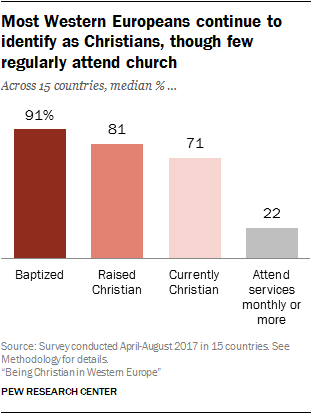
Most Western Europeans continue to identify as Christians, though few regularly attend church

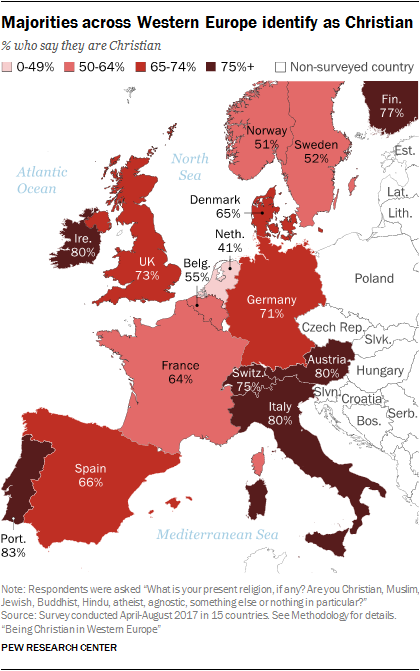
Western Europe, where Protestant Christianity originated and Catholicism has been based for most of its history, has become one of the world’s most secular regions. Although the vast majority of adults say they were baptized, today many do not describe themselves as Christians. Some say they gradually drifted away from religion, stopped believing in religious teachings, or were alienated by scandals or church positions on social issues, according to a major new Pew Research Center survey of religious beliefs and practices in Western Europe.

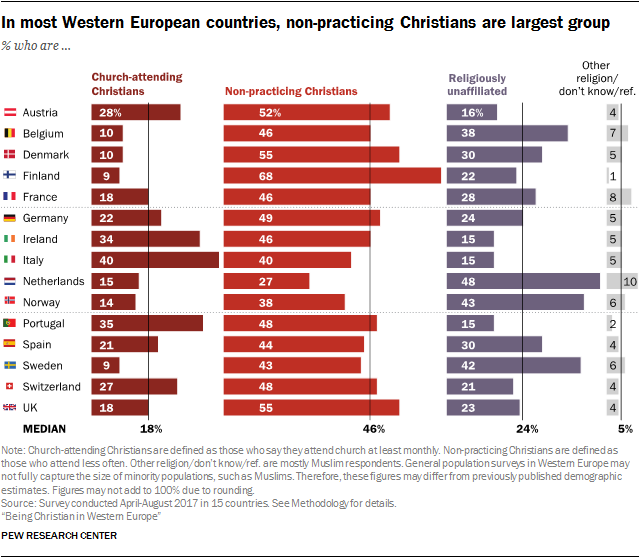
Yet most adults surveyed still do consider themselves Christians, even if they seldom go to church. Indeed, the survey shows that non-practicing Christians (defined, for the purposes of this report, as people who identify as Christians, but attend church services no more than a few times per year) make up the biggest share of the population across the region. In every country except Italy, they are more numerous than church-attending Christians (those who go to religious services at least once a month). In the United Kingdom, for example, there are roughly three times as many non-practicing Christians (55%) as there are church-attending Christians (18%) defined this way.
In most Western European countries, non-practicing Christians are largest group
Majorities across Western Europe identify as Christian

Non-practicing Christians also outnumber the religiously unaffiliated population (people who identify as atheist, agnostic or “nothing in particular,” sometimes called the “nones”) in most of the countries surveyed.1 And, even after a recent surge in immigration from the Middle East and North Africa, there are many more non-practicing Christians in Western Europe than people of all other religions combined (Muslims, Jews, Hindus, Buddhists, etc.).

These figures raise some obvious questions: What is the meaning of Christian identity in Western Europe today? And how different are non-practicing Christians from religiously unaffiliated Europeans – many of whom also come from Christian backgrounds?

The Pew Research Center study – which involved more than 24,000 telephone  interviews with randomly selected adults, including nearly 12,000 non-practicing Christians – finds that Christian identity remains a meaningful marker in Western Europe, even among those who seldom go to church. It is not just a “nominal” identity devoid of practical importance. On the contrary, the religious, political and cultural views of non-practicing Christians often differ from those of church-attending Christians and religiously unaffiliated adults. For example:

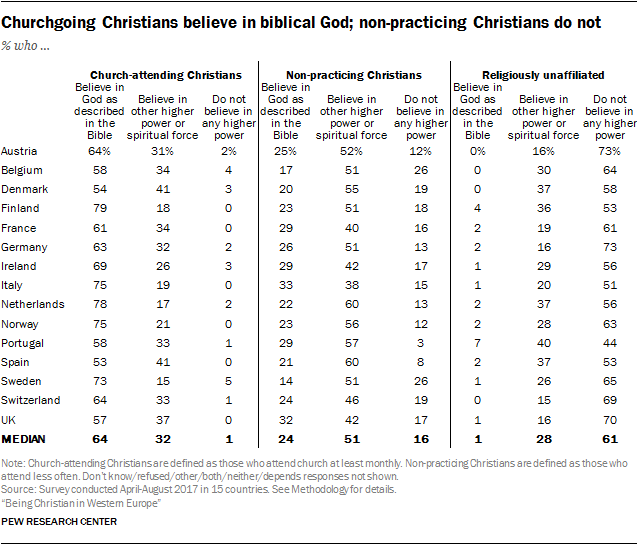
  • Although many non-practicing Christians say they do not believe in God “as described in the Bible,” they do tend to believe in some other higher power or spiritual force. By contrast, most church-attending Christians say they believe in the biblical depiction of God. And a clear majority of religiously unaffiliated adults do not believe in any type of higher power or spiritual force in the universe.
  • Non-practicing Christians tend to express more positive than negative views toward churches and religious organizations, saying they serve society by helping the poor and bringing communities together. Their attitudes toward religious institutions are not quite as favorable as those of church-attending Christians, but they are more likely than religiously unaffiliated Europeans to say churches and other religious organizations contribute positively to society.
  • Christian identity in Western Europe is associated with higher levels of negative sentiment toward immigrants and religious minorities. On balance, self-identified Christians – whether they attend church or not – are more likely than religiously unaffiliated people to express negative views of immigrants, as well as of Muslims and Jews.
  • Non-practicing Christians are less likely than church-attending Christians to express nationalist views. Still, they are more likely than “nones” to say that their culture is superior to others and that it is necessary to have the country’s ancestry to share the national identity (e.g., one must have Spanish family background to be truly Spanish).
  • The vast majority of non-practicing Christians, like the vast majority of the unaffiliated in Western Europe, favor legal abortion and same-sex marriage. Church-attending Christians are more conservative on these issues, though even among churchgoing Christians, there is substantial support – and in several countries, majority support – for legal abortion and same-sex marriage.
  • Nearly all churchgoing Christians who are parents or guardians of minor children (those under 18) say they are raising those children in the Christian faith. Among non-practicing Christians, somewhat fewer – though still the overwhelming majority – say they are bringing up their children as Christians. By contrast, religiously unaffiliated parents generally are raising their children with no religion.
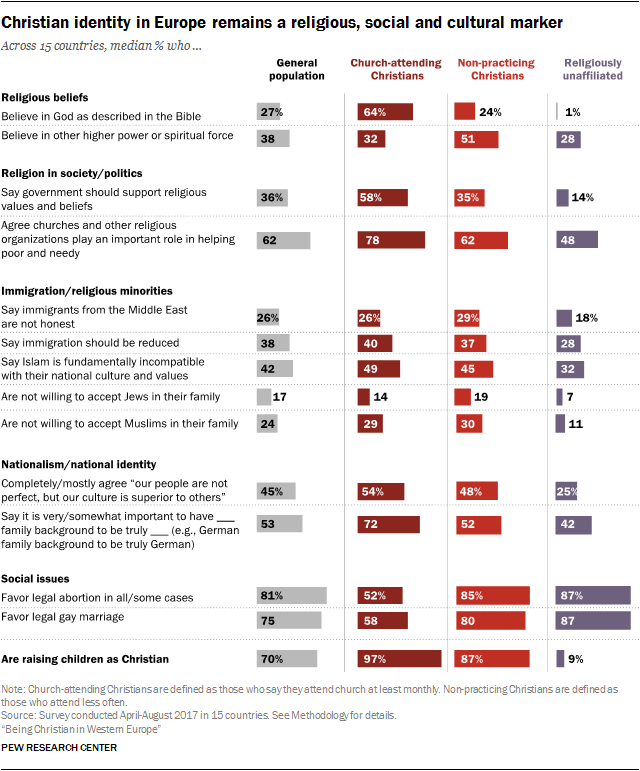
Christian identity in Europe remains a religious, social and cultural marker

Religious identity and practice are not the only factors behind Europeans’ beliefs and opinions on these issues. For instance, highly educated Europeans are generally more accepting of immigrants and religious minorities, and religiously unaffiliated adults tend to have more years of schooling than non-practicing Christians. But even after statistical techniques are used to control for differences in education, age, gender and political ideology, the survey shows that churchgoing Christians, non-practicing Christians and unaffiliated Europeans express different religious, cultural and social attitudes. (See below in this overview and Chapter 1.)

These are among the key findings of a new Pew Research Center survey of 24,599 randomly selected adults across 15 countries in Western Europe. Interviews were conducted on mobile and landline telephones from April to August, 2017, in 12 languages. The survey examines not just traditional Christian religious beliefs and behaviors, opinions about the role of religious institutions in society, and views on national identity, immigrants and religious minorities, but also Europeans’ attitudes toward Eastern and New Age spiritual ideas and practices. And the second half of this Overview more closely examines the beliefs and other characteristics of the religiously unaffiliated population in the region.

While the vast majority of Western Europeans identify as either Christian or religiously unaffiliated, the survey also includes interviews with people of other (non-Christian) religions as well as with some who decline to answer questions about their religious identity. But, in most countries, the survey’s sample sizes do not allow for a detailed analysis of the attitudes of people in this group. Furthermore, this category is composed largely of Muslim respondents, and general population surveys may underrepresent Muslims and other small religious groups in Europe because these minority populations often are distributed differently throughout the country than is the general population; additionally, some members of these groups (especially recent immigrants) do not speak the national language well enough to participate in a survey. As a result, this report does not attempt to characterize the views of religious minorities such as Muslims, Jews, Buddhists or Hindus in Western Europe.

What is a median?

On many questions throughout this report, median percentages are reported to help readers see overall patterns. The median is the middle number in a list of figures sorted in ascending or descending order. In a survey of 15 countries, the median result is the eighth on a list of country-level findings ranked in order.

Non-practicing Christians widely believe in God or another higher power
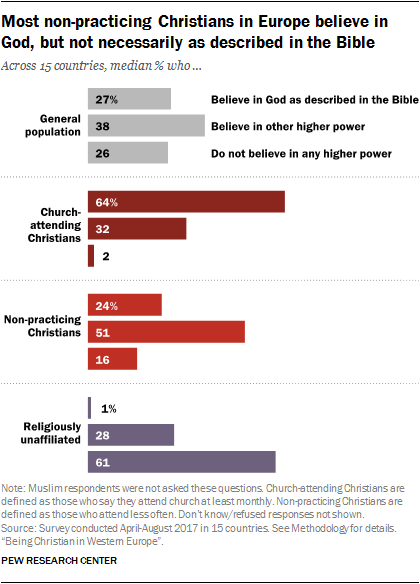
Most non-practicing Christians in Europe believe in God, but not necessarily as described in the Bible

Most non-practicing Christians in Europe believe in God. But their concept of God differs considerably from the way that churchgoing Christians tend to conceive of God. While most church-attending Christians say they believe in God “as described in the Bible,” non-practicing Christians are more apt to say that they do not believe in the biblical depiction of God, but that they believe in some other higher power or spiritual force in the universe.

For instance, in Catholic-majority Spain, only about one-in-five non-practicing Christians (21%) believe in God “as described in the Bible,” while six-in-ten say they believe in some other higher power or spiritual force.

Non-practicing Christians and “nones” also diverge sharply on this question; most unaffiliated people in Western Europe do not believe in God or a higher power or spiritual force of any kind. (See below for more details on belief in God among religiously unaffiliated adults.)

Similar patterns – in which Christians tend to hold spiritual beliefs while “nones” do not – prevail on a variety of other beliefs, such as the possibility of life after death and the notion that humans have souls apart from their physical bodies. Majorities of non-practicing Christians and church-attending Christians believe in these ideas. Most religiously unaffiliated adults, on the other hand, reject belief in an afterlife, and many do not believe they have a soul.

Indeed, many religiously unaffiliated adults eschew spirituality and religion entirely. Majorities agree with the statements, “There are no spiritual forces in the universe, only the laws of nature” and “Science makes religion unnecessary in my life.” These positions are held by smaller shares of church-attending Christians and non-practicing Christians, though in most countries roughly a quarter or more of non-practicing Christians say science makes religion unnecessary to them. (For a detailed statistical analysis combining multiple questions into scales of religious commitment and spirituality, see Chapters 3 and 5.)
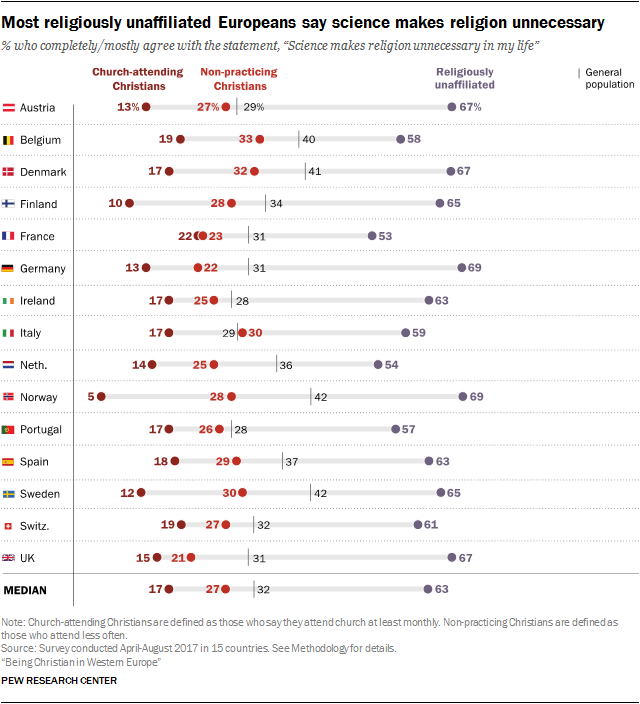
Most religiously unaffiliated Europeans say science makes religion unnecessary

Views on relationship between government and religion

Generally speaking, Western Europeans do not look favorably on entanglements between their governments and religion. Indeed, the predominant view in all 15 countries surveyed is that religion should be kept separate from government policies (median of 60%), as opposed to the position that government policies should support religious values and beliefs in their country (36%).

Non-practicing Christians tend to say religion should be kept out of government policy. Still, substantial minorities (median of 35%) of non-practicing Christians think the government should support religious values and beliefs in their country – and they are much more likely than religiously unaffiliated adults to take this position. For example, in the United Kingdom, 40% of non-practicing Christians say the government should support religious values and beliefs, compared with 18% of “nones.”

In every country surveyed, church-attending Christians are much more likely than non-practicing Christians to favor government support for religious values. In Austria, for example, a majority (64%) of churchgoing Christians take this position, compared with 38% of non-practicing Christians.
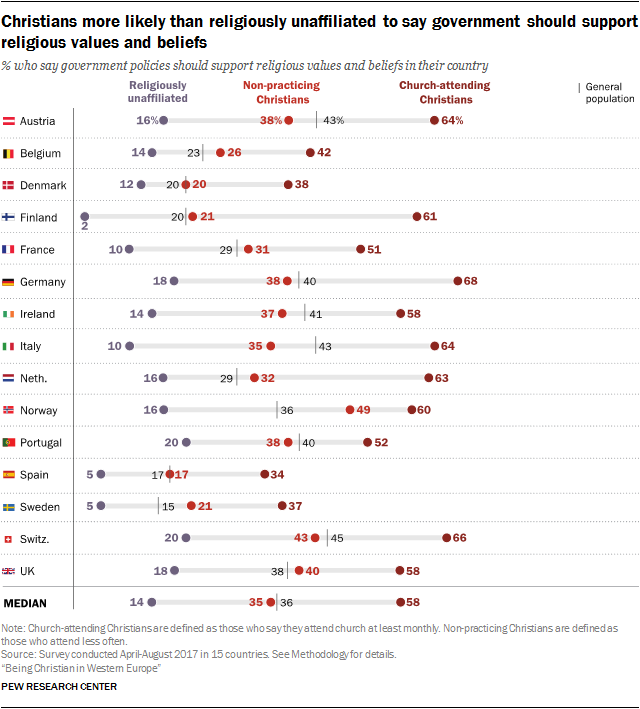
Christians more likely than religiously unaffiliated to say government should support religious values and beliefs

The survey also gauged views on religious institutions, asking whether respondents agree with three positive statements about churches and other religious organizations – that they “protect and strengthen morality in society,” “bring people together and strengthen community bonds,” and “play an important role in helping the poor and needy.” Three similar questions asked whether they agree with negative assessments of religious institutions – that churches and other religious organizations “are too involved with politics,” “focus too much on rules,” and “are too concerned with money and power.”

Once again, there are marked differences of opinion on these questions among Western Europeans across categories of religious identity and practice. Throughout the region, non-practicing Christians are more likely than religiously unaffiliated adults to voice positive opinions of religious institutions. For example, in Germany, a majority of non-practicing Christians (62%) agree that churches and other religious organizations play an important role in helping the poor and needy, compared with fewer than half (41%) of “nones.”

Church-attending Christians hold especially positive opinions about the role of religious organizations in society. For example, nearly three-in-four churchgoing Christians in Belgium (73%), Germany (73%) and Italy (74%) agree that churches and other religious institutions play an important role in helping the poor and needy. (For more analysis of results on these questions, see Chapter 6.)
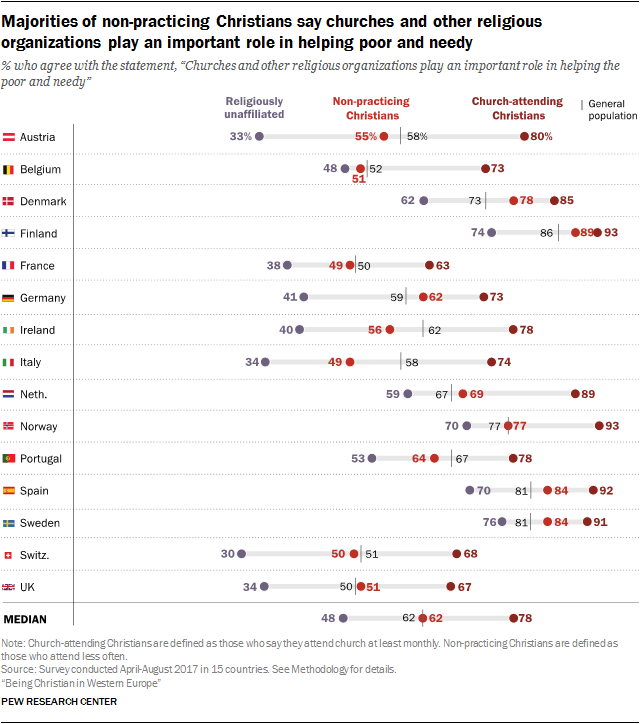
Majorities of non-practicing Christians say churches and other religious organizations play an important role in helping poor and needy

Both non-practicing and churchgoing Christians are more likely than the unaffiliated to hold negative views of immigrants, Muslims and Jews

The survey, which was conducted following a surge of immigration to Europe from Muslim-majority countries, asked many questions about national identity, religious pluralism and immigration.

Most Western Europeans say they are willing to accept Muslims and Jews in their neighborhoods and in their families, and most reject negative statements about these groups. And, on balance, more respondents say immigrants are honest and hardworking than say the opposite.

But a clear pattern emerges: Both church-attending and non-practicing Christians are more likely than religiously unaffiliated adults in Western Europe to voice anti-immigrant and anti-minority views.

For example, in the UK, 45% of church-attending Christians say Islam is fundamentally incompatible with British values and culture, as do roughly the same share of non-practicing Christians (47%). But among religiously unaffiliated adults, fewer (30%) say Islam is fundamentally incompatible with their country’s values. There is a similar pattern across the region on whether there should be restrictions on Muslim women’s dress, with Christians more likely than “nones” to say Muslim women should not be allowed to wear any religious clothing.

Although current debates on multiculturalism in Europe often focus on Islam and Muslims, there also are long-standing Jewish communities in many Western European countries. The survey finds Christians at all levels of religious observance are more likely than religiously unaffiliated adults to say they would not be willing to accept Jews in their family, and, on balance, they are somewhat more likely to agree with highly negative statements about Jews, such as, “Jews always pursue their own interests, and not the interest of the country they live in.” (For further analysis of these questions, see Chapter 1.)
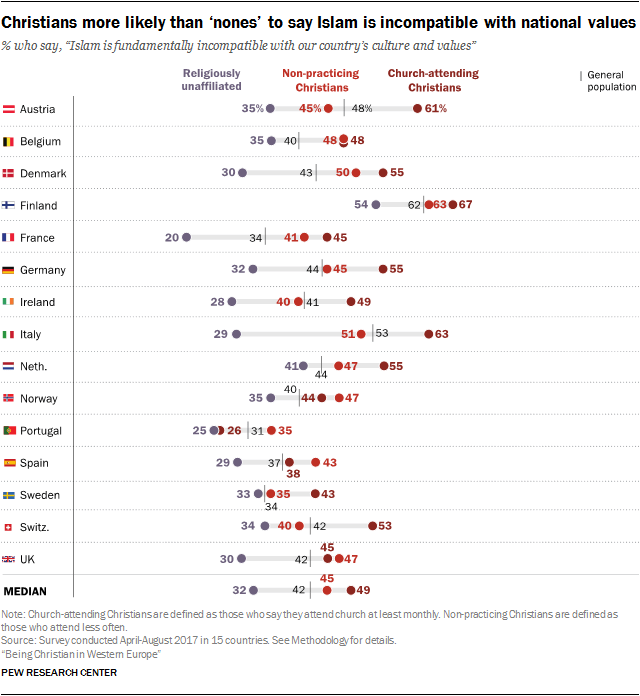
Christians more likely than ‘nones’ to say Islam is incompatible with national values % who say, “Islam is fundamentally incompatible with our country’s culture and values”

When it comes to immigration, Christians – both churchgoing and non-practicing – are more likely than “nones” in Europe to say immigrants from the Middle East and Africa are not honest or hardworking, and to favor reducing immigration from current levels.2 For example, 35% of churchgoing Christians and 36% of non-practicing Christians in France say immigration to their country should be reduced, compared with 21% of “nones” who take this position.

There are, however, exceptions to this general pattern. In a few places, church-attending Christians are more accepting of immigration and less likely to say immigration should be reduced. In Finland, for example, just one-in-five churchgoing Christians favor reducing immigration (19%), compared with larger shares among religiously unaffiliated adults (33%) and non-practicing Christians (37%).

But overall, anti-immigrant, anti-Muslim and anti-Jewish opinions are more common among Christians, at all levels of practice, than they are among Western Europeans with no religious affiliation. This is not to say that most Christians hold these views: On the contrary, by most measures and in most countries surveyed, only minorities of Christians voice negative opinions about immigrants and religious minorities.

There also are other factors beyond religious identity that are closely connected with views on immigration and religious minorities. For example, higher education and personally knowing someone who is Muslim tend to go hand in hand with more openness to immigration and religious minorities. And identifying with the political right is strongly linked to anti-immigration stances.

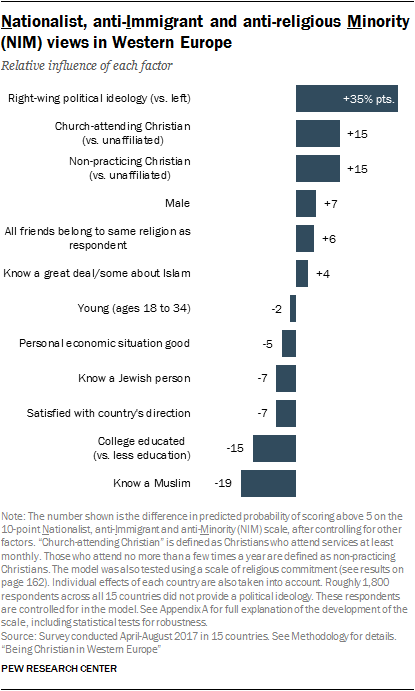
Still, even after using statistical techniques to control for a wide variety of factors (age, education, gender, political ideology, personally knowing a Muslim or a Jewish person, personal assessments of economic well-being, satisfaction with the country’s general direction, etc.), Western Europeans who identify as Christian are more likely than those who have no religious affiliation to express negative feelings about immigrants and religious minorities.

Non-practicing Christians more likely than unaffiliated to favor reducing immigration levels

Are Christian identity and Muslim immigration linked? The broader debate in Europe

Pew Research Center’s survey of Western Europe was conducted in the spring and summer of 2017, following the two highest years of asylum applications on record. Some scholars and commentators have asserted that the influx of refugees, including many from Muslim-majority countries, is spurring a revival of Christian identity. Rogers Brubaker, a professor of sociology at UCLA, calls this a reactive Christianity in which highly secular Europeans are looking at new immigrants and saying, in effect: “If ‘they’ are Muslim, then in some sense ‘we’ must be Christian.”

The survey – a kind of snapshot in time – cannot prove that Christian identity is now growing in Western Europe after decades of secularization. Nor can it prove (or disprove) the assertion that if Christian identity is growing, immigration of non-Christians is the reason.

But the survey can help answer the question: What is the nature of Christian identity in Western Europe today, particularly among the large population that identifies as Christian but does not regularly go to church? As explained in greater detail throughout this report, the findings suggest that the answer is partly a matter of religious beliefs, partly a matter of attitudes toward the role of religion in society, and partly a matter of views on national identity, immigrants and religious minorities.

This confluence of factors may not surprise close observers of European politics. Olivier Roy, a French political scientist who studies both Islam and secularization, writes that, “If the Christian identity of Europe has become an issue, it is precisely because Christianity as faith and practices faded away in favor of a cultural marker which is more and more turning into a neo-ethnic marker (‘true’ Europeans versus ‘migrants’).”

Some commentators have expressed strong misgivings about the promotion of “cultural” Christian identity in Europe, seeing it as driven largely by fear and misunderstanding. In the “present context of high levels of fear of and hostility to Muslims,” writes Tariq Modood, professor of sociology, politics and public policy at the University of Bristol in the UK, efforts to develop cultural Christianity as an “ideology to oppose Islam” are both a challenge to pluralism and equality, and “a risk to democracy.”

Others see a potential revival of Christianity in Western Europe as a bulwark against extremism. While calling himself an “incurable atheist,” the British historian Niall Ferguson said in a 2006 interview that “organised Christianity, both in terms of observance and in terms of faith, sail[ed] off a cliff in Europe sometime in the 1970s, 1980s,” leaving European societies without “religious resistance” to radical ideas. “In a secular society where nobody believes in anything terribly much except the next shopping spree, it’s really quite easy to recruit people to radical, monotheistic positions,” Ferguson said.

But not everyone agrees on immigration’s impact. British author and lecturer Ronan McCrea contends that Muslim migration is making Europe more secular, not less. “Previously, many of those who are not particularly religious were content to describe themselves as Christian on cultural grounds,” he writes. “But as religion and national identity have gradually begun to separate, religious identity becomes more a question of ideology and belief than membership of a national community. This has encouraged those who are not true believers to move from a nominal Christian identity to a more clearly non-religious one.”

In Western Europe, religion strongly associated with nationalist sentiment

Overall levels of nationalism vary considerably across the region.3 For example, solid majorities in some countries (such as Italy and Portugal) and fewer than half in others (such as Sweden and Denmark) say that it is important to have ancestors from their country to truly share the national identity (e.g., to have Danish ancestry to be truly Danish).

Within countries, non-practicing Christians are less likely than churchgoing Christians to say that ancestry is key to national identity. And religiously unaffiliated people are less likely than both churchgoing and non-practicing Christians to say this.

For example, in France, nearly three-quarters of church-attending Christians (72%) say it is important to have French ancestry to be “truly French.” Among non-practicing Christians, 52% take this position, but this is still higher than the 43% of religiously unaffiliated French adults who say having French family background is important in order to be truly French.
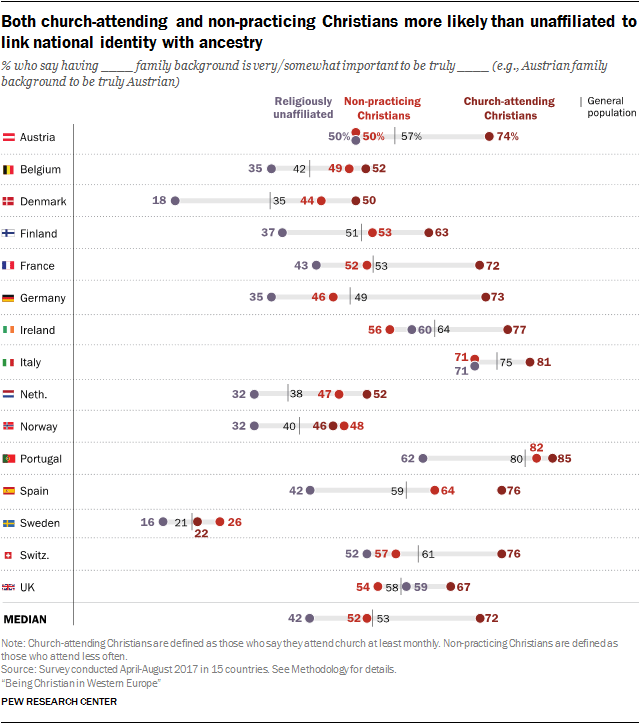
Both church-attending and non-practicing Christians more likely than unaffiliated to link national identity with ancestry

Both non-practicing and churchgoing Christians are more likely than “nones” to agree with the statement, “Our people are not perfect, but our culture is superior to others.” And additional statistical analysis shows that this holds true even after controlling for age, gender, education, political ideology and other factors.
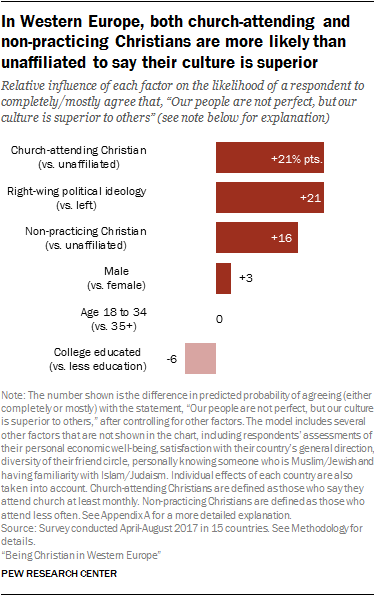
In Western Europe, both church-attending and non-practicing Christians are more likely than unaffiliated to say their culture is superior

In other words, Christians as a whole in Western Europe tend to express higher levels of nationalist sentiment. This overall pattern is not driven by nationalist feelings solely among highly religious Christians or solely among non-practicing Christians. Rather, at all levels of religious observance, these views are more common among Christians than among religiously unaffiliated people in Europe.

Altogether, the survey asked more than 20 questions about possible elements of nationalism, feelings of cultural superiority, attitudes toward Jews and Muslims, views on immigrants from various regions of the world, and overall levels of immigration. Many of these views are highly correlated with each other. (For example, people who express negative attitudes toward Muslims and Jews are also more likely to express negative attitudes toward immigrants, and vice versa.) As a result, researchers were able to combine 22 individual questions into a scale measuring the prevalence of nationalist, anti-immigrant and anti-minority sentiments in each country and to conduct additional statistical analysis of the factors associated with these sentiments in Western Europe today. For details of this analysis, see Chapter 1.

Same-sex marriage, abortion widely accepted by non-practicing Christians

Vast majorities of non-practicing Christians and religiously unaffiliated adults across Western Europe favor legal abortion and same-sex marriage. In some countries, there is not much difference on these questions between the attitudes of Christians who rarely attend church and adults who do not affiliate with any religion.

In every country surveyed, on the other hand, church-attending Christians are considerably more conservative than both non-practicing Christians and religiously unaffiliated adults on questions about abortion and same-sex marriage.

Education has a strong influence on attitudes on both issues: College-educated respondents are considerably more likely than those with less education to favor legal abortion and same-sex marriage. On balance, women are more likely than men to favor legal gay marriage, but their attitudes are largely similar on abortion.
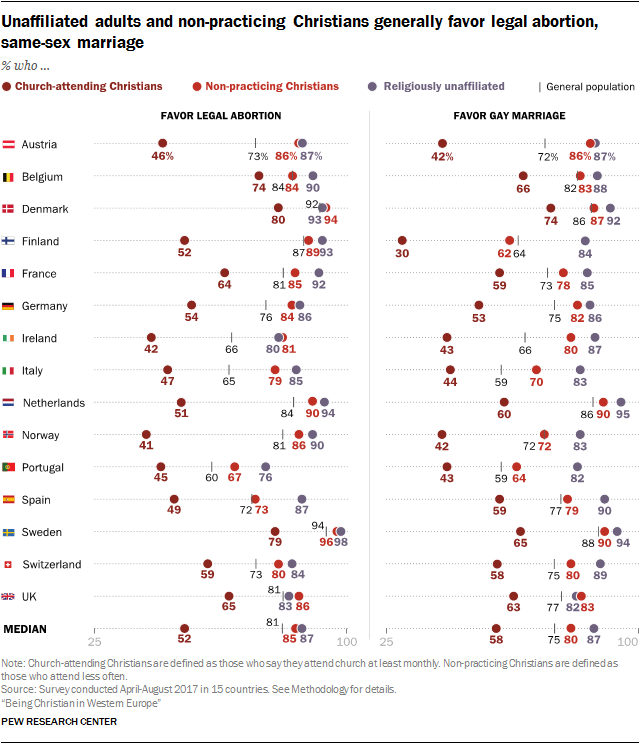
Unaffiliated adults and non-practicing Christians generally favor legal abortion, same-sex marriage

Summing up: On what issues do non-practicing Christians resemble ‘nones’? And on what measures are they similar to church-attending Christians?

While the religious, political and cultural views of non-practicing Christians in Western Europe are frequently distinct from those of church-attending Christians and religiously unaffiliated adults (“nones”), on some issues non-practicing Christians resemble churchgoing Christians, and on others they largely align with “nones.”

Religious beliefs and attitudes toward religious institutions are two areas of broad similarity between non-practicing Christians and church-attending Christians. Most non-practicing Christians say they believe in God or some higher power, and many think that churches and other religious organizations make positive contributions to society. In these respects, their perspective is similar to that of churchgoing Christians.

On the other hand, abortion, gay marriage and the role of religion in government are three areas where the attitudes of non-practicing Christians broadly resemble those of religiously unaffiliated people (“nones”). Solid majorities of both non-practicing Christians and “nones” say they think that abortion should be legal in all or most cases and that gays and lesbians should be allowed to marry legally. In addition, most non-practicing Christians, along with the vast majority of “nones,” say religion should be kept out of government policies.

When asked whether it is important to have been born in their country, or to have family background there, to truly share the national identity (e.g., important to have Spanish ancestry to be truly Spanish), non-practicing Christians generally are somewhere in between the religiously unaffiliated population and church-attending Christians, who are most inclined to link birthplace and ancestry with national identity.

Many in all three groups reject negative statements about immigrants and religious minorities. But non-practicing Christians and church-attending Christians are generally more likely than “nones” to favor lower levels of immigration, to express negative views toward immigrants from the Middle East and sub-Saharan Africa, and to agree with negative statements about Muslims and Jews such as, “In their hearts, Muslims want to impose their religious law on everyone else” in their country or “Jews always pursue their own interests and not the interest of the country they live in.”(For further analysis of these questions, see Chapter 1.)

Overall, the study shows a strong association between Christian identity and nationalist attitudes, as well as views of religious minorities and immigration, and a weaker association between religious commitment and these views. This finding holds regardless of whether religious commitment among Christians is measured through church attendance alone, or using a scale that combines attendance with three other measures: belief in God, frequency of prayer and importance of religion in a person’s life. (See Chapter 3 for a detailed analysis of the scale of religious commitment.)

Religious observance and attitudes toward minorities among Catholics and Protestants in Western Europe
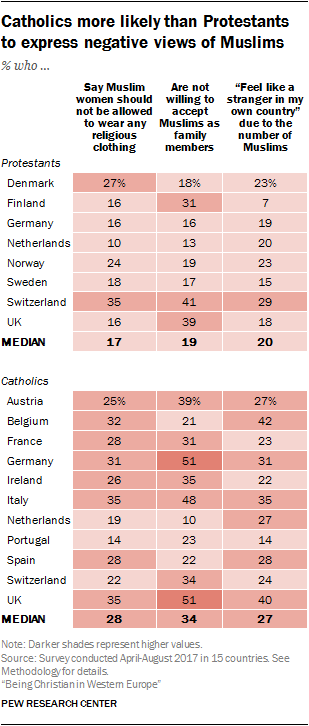
Catholics more likely than Protestants to express negative views of Muslims

Although people in some predominantly Catholic countries in Europe, including Portugal and Italy, are more religiously observant than others in the region, Catholics and Protestants overall in Western Europe display similar overall levels of observance.

But Catholics and Protestants in the region differ in their attitudes toward religious minorities. For example, Catholics are more likely than Protestants to hold negative views of Muslims: Catholics are more likely than Protestants to say they would not be willing to accept Muslims as family members, that Muslim women in their country should not be allowed to wear any religious clothing, and that they agree with the statement, “Due to the number of Muslims here, I feel like a stranger in my own country.”

Differences between Catholics and Protestants on these issues can be difficult to disentangle from historical and geographic patterns in Western Europe, where Catholic-majority countries are primarily concentrated in the south, while the north is more heavily Protestant. But in a handful of countries with substantial populations of both Catholics and Protestants – including the United Kingdom and Germany – more Catholics than Protestants hold negative attitudes toward Muslims. For example, in the UK, 35% of Catholics and 16% of Protestants say Muslim women in their country should not be allowed to wear any religious clothing. In Switzerland, however, the opposite is true; 35% of Swiss Protestants express this view, compared with 22% of Catholics.

Context of the survey

The survey was conducted in mid-2017, after immigration emerged as a front-and-center issue in national elections in several Western European countries and as populist, anti-immigration parties questioned the place of Muslims and other religious and ethnic minorities in Germany, France, the United Kingdom and elsewhere.

Muslims now make up an estimated 4.9% of the population of the European Union (plus Norway and Switzerland) and somewhat higher shares in some of Western Europe’s most populous countries, such as France (an estimated 8.8%), the UK (6.3%) and Germany (6.1%). These figures are projected to continue to increase in coming decades, even if there is no more immigration to Europe.

The survey asked not only about attitudes toward Muslims and Jews, but also about Catholics’ and Protestants’ views of one another. The findings about Protestant-Catholic relations were previously released before the commemoration of the 500th anniversary of the start of the Protestant Reformation in Germany.4

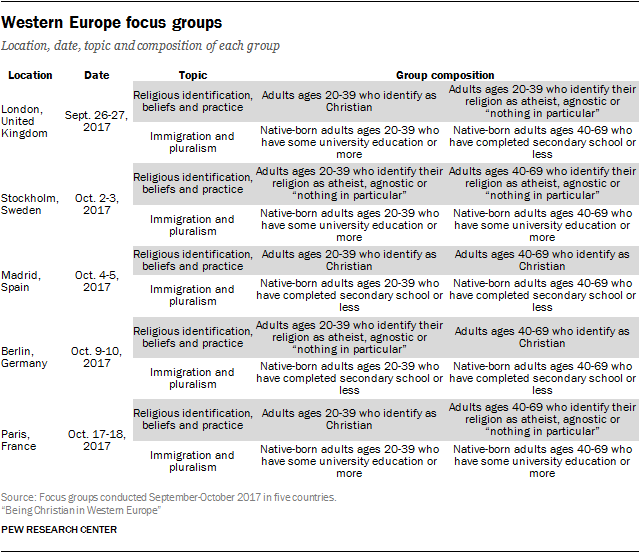
This report also includes material from 20 focus groups convened by Pew Research Center in the months following the survey’s completion in five of the countries surveyed. The focus groups in France, Germany, Spain, Sweden and the United Kingdom provided an opportunity for participants to discuss their feelings about pluralism, immigration, secularism and other topics in more detail than survey respondents typically can give when responding to a questionnaire. Some conclusions from focus groups are included in illustrative sidebars throughout the report.

This study, funded by The Pew Charitable Trusts and the John Templeton Foundation, is part of a larger effort by Pew Research Center to understand religious change and its impact on societies around the world. The Center previously has conducted religion-focused surveys across sub-Saharan Africa; the Middle East-North Africa region and many other countries with large Muslim populations; Latin America; Israel; Central and Eastern Europe; and the United States.

The rest of this Overview examines what it means to be a “none” in Western Europe, including the extent of religious switching from Christianity to the ranks of the religiously unaffiliated and the reasons “nones” give for leaving their childhood faith. It also looks at their beliefs about religion and spirituality, including a closer look at the attitudes of religiously unaffiliated adults who say they do believe there is a God or some other higher power or spiritual force in the universe.

Europe’s changing religious landscape: Declines for Christians, gains for unaffiliated
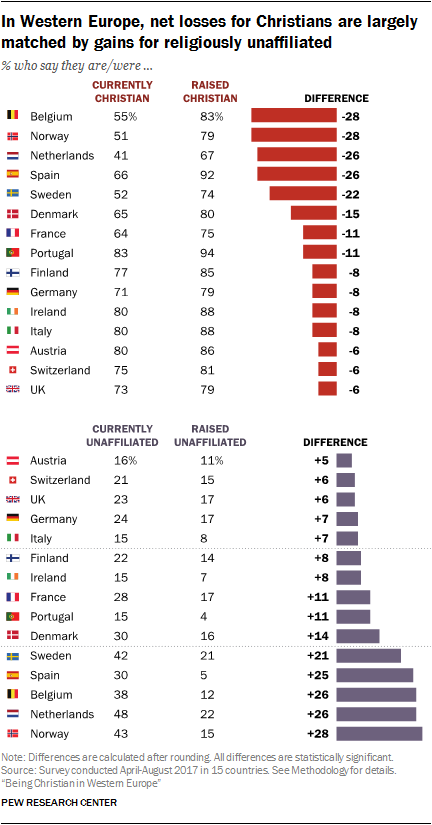
In Western Europe, net losses for Christians are largely matched by gains for religiously unaffiliated

Most people in Western Europe describe themselves as Christians. But the percentage of Christians appears to have declined, especially in some countries. And the net losses for Christianity have been accompanied by net growth in the numbers of religiously unaffiliated people.

Across the region, fewer people say they are Christian now than say they were raised as Christians. The opposite is true of religiously unaffiliated adults – many more people currently are religiously unaffiliated than the share who were raised with no religion (i.e., as atheist, agnostic or “nothing in particular”). For example, 5% of adults in Spain say they were raised with no religion, while 30% now fit this category, a difference of 25 percentage points. The religiously unaffiliated have seen similarly large gains in Belgium, the Netherlands, Norway and Sweden.

Sidebar: Religious identity in Western Europe over time

Several countries in Western Europe have been collecting census data on religion for decades, and these data (from Austria, Finland, Ireland, the Netherlands, Portugal and Switzerland) indicate that the percentage of the population that identifies as Christian has fallen substantially since the 1960s, while the share of the population that does not identify with any religion has risen.5

More recent data collected by the European Social Survey (ESS) since 2002 show a continuation of the long-term trend in some countries. Christianity has experienced relatively rapid declines in Belgium, Finland, Ireland, the Netherlands, Portugal and Spain. But in the nine other countries included in the Pew Research Center survey, the ESS finds the share of Christians has either been relatively stable or has declined only modestly, suggesting that the rate of secularization varies considerably from country to country and may have slowed or leveled off in some places in recent years.

Due to major differences in question wording, the ESS estimates of the percentage of Christians in each country differ considerably from Pew Research Center estimates. The ESS asks what is known as a “two-step” question about religious identity: Respondents first are asked, “Do you consider yourself as belonging to any particular religion or denomination?” People who say “Yes” are then asked, “Which one? Roman Catholic, Protestant, Eastern Orthodox, other Christian denomination, Jewish, Islamic, Eastern religions or other non-Christian religions.” Pew Research Center surveys ask a “one-step” question, “What is your present religion, if any? Are you Christian, Muslim, Jewish, Buddhist, Hindu, atheist, agnostic, something else or nothing in particular?”

Using the ESS question wording and two-step approach consistently yields lower shares of religiously affiliated respondents (including Christians) in Western Europe. For example, in the Netherlands, 31% of respondents identify with a Christian denomination in the 2014 ESS, while in the Pew Research Center survey, 41% identify as Christian. Presumably, this is because some respondents who are relatively low in religious practice or belief would answer the first question posed by ESS by saying they have no religion, while the same respondents would identify as Christian, Muslim, Jewish, etc., if presented with a list of religions and asked to choose among them. The impact of these differences in question wording and format may vary considerably from country to country.
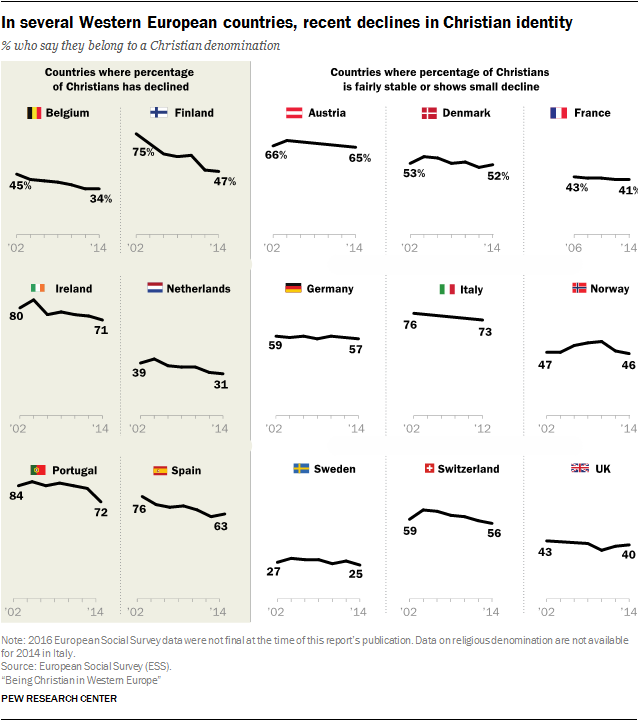
In several Western European countries, recent declines in Christian identity

Who are Western Europe’s religiously unaffiliated?

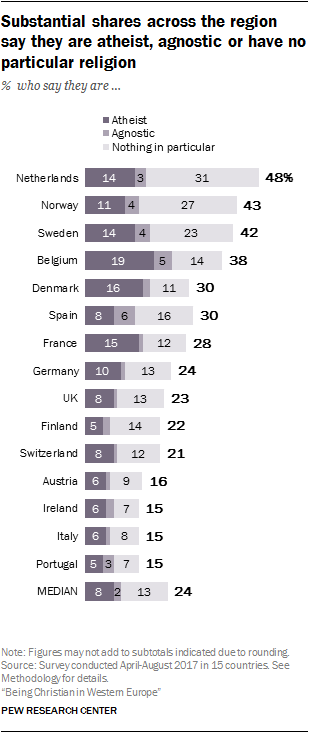
While Christians (taken as a whole) are by far the largest religious group in Western Europe, a substantial minority of the population in every country is religiously unaffiliated – also sometimes called “nones,” a category that includes people who identify as atheist, agnostic or “nothing in particular.” The unaffiliated portion of the adult population ranges from as high as 48% in the Netherlands to 15% in Ireland, Italy and Portugal.
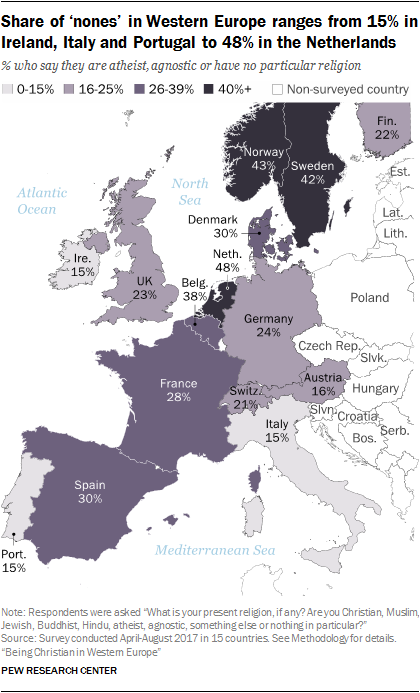
Share of ‘nones’ in Western Europe ranges from 15% in Ireland, Italy and Portugal to 48% in the Netherlands
Substantial shares across the region say they are atheist, agnostic or have no particular religion

Demographically, “nones” in Western Europe are relatively young and highly educated, as well as disproportionately male.

Within the unaffiliated category, those who describe their religious identity as “nothing in particular” make up the biggest group (relative to atheists and agnostics) in most countries. For instance, fully three-in-ten Dutch adults (31%) describe their religious identity in this way, compared with 14% who are self-described atheists and 3% who consider themselves agnostics.

But in some other places, such as Belgium, Denmark and France, atheists are at least as numerous as those in the “nothing in particular” category. Agnostics, by comparison, have a smaller presence throughout Western Europe.

A majority of “nones” in most countries surveyed say they were baptized, and many of them also say they were raised as Christians. Overall, more religiously unaffiliated adults in Europe say they were raised Christian (median of 60%) than say they were raised with no religious affiliation (median of 39%).
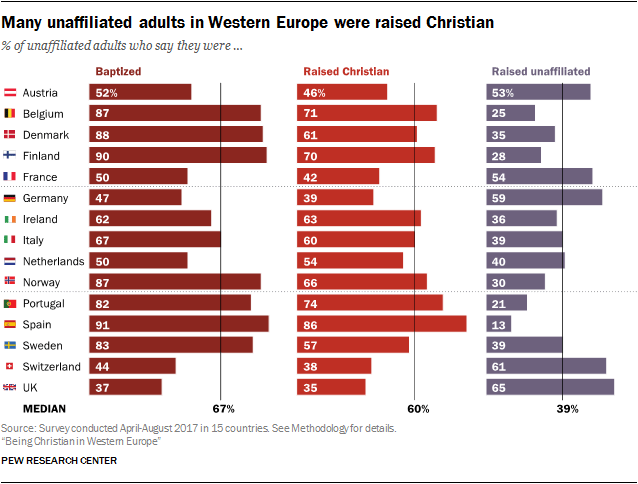
Many unaffiliated adults in Western Europe were raised Christian

However, these figures vary widely from country to country. For example, the vast majority of unaffiliated adults in Spain (86%) and Portugal (74%) say they were raised as Christians. In the UK, by contrast, roughly two-thirds (65%) of adults who currently have no religious affiliation say they were raised that way.

What has led Europeans to shed their religious identity?

Most Western Europeans who stopped identifying with a religion ‘gradually drifted away,’ among other reasons

For religiously unaffiliated adults who were raised as Christians (or in another religion), the survey posed a series of questions asking about potential reasons they left religion behind.6 Respondents could select multiple reasons as important factors why they stopped identifying with their childhood religion.

In every country surveyed, most “nones” who were raised in a religious group say they “gradually drifted away from religion,” suggesting that no one particular event or single specific reason prompted this change.7 Many also say that they disagreed with church positions on social issues like homosexuality and abortion, or that they stopped believing in religious teachings. Majorities in several countries, such as Spain (74%) and Italy (60%), also cite “scandals involving religious institutions and leaders” as an important reason they stopped identifying as Christian (or with another religious group).

Smaller numbers give other reasons, such as that their spiritual needs were not being met, their childhood religion failed them when they were in need, or they married someone outside their religious group.

For more detail on patterns of religious switching in Western Europe and the reasons people give for their choices, see Chapter 2.

Religiously unaffiliated Europeans tend to express different attitudes toward Muslims depending on how they were raised
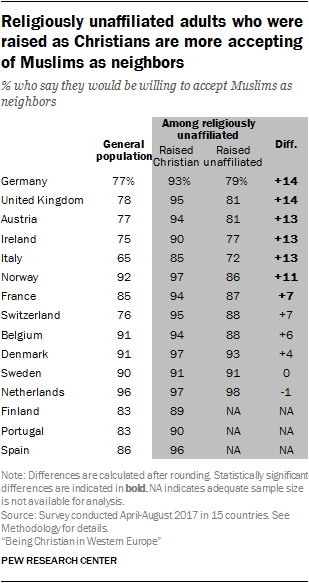
Religiously unaffiliated adults who were raised as Christians are more accepting of Muslims as neighbors

People who have left Christianity in favor of no religious identity may have multiple reasons for doing so. But their attitudes, overall, are more positive toward religious minorities than are the views of either Christians overall or “nones” who say they were raised with no religious identity.

On balance, those who were raised Christian and are now religiously unaffiliated are less likely than those who were always unaffiliated to say Islam is fundamentally incompatible with their national culture and values, or to take the position that Muslim women in their country should not be allowed to wear religious clothing.

They also are more likely to express acceptance of Muslims. For example, in several countries, higher shares of “nones” who were raised Christian than those who were raised unaffiliated say they would be willing to accept Muslims as neighbors.

Definitive reasons for this pattern are beyond the scope of the data in this study. But it is possible that some Western Europeans may have given up their religious identity, at least in part, because it was associated with more conservative views on a variety of issues, such as multiculturalism, sexual norms and gender roles. It also may be that their attitudes toward immigrants shifted along with the change in their religious identity. Or, it could be that some other, unknown factor (political, economic, demographic, etc.) underlies both their switching from Christian to unaffiliated and their views of immigrants and religious minorities.

Most unaffiliated Europeans do not believe in a higher power, but a substantial minority hold some spiritual beliefs

Regardless of how they were raised, “nones” across Western Europe seldom partake in traditional religious practices. Few, if any, religiously unaffiliated adults say they attend religious services at least monthly, pray daily, or say religion is “very” or even “somewhat” important in their lives.

Most “nones” in Western Europe also affirm they are truly nonbelievers: Not only do majorities in all countries surveyed say they do not believe in God, but most also clarify (in a follow-up question) that they do not believe in any higher power or spiritual force.
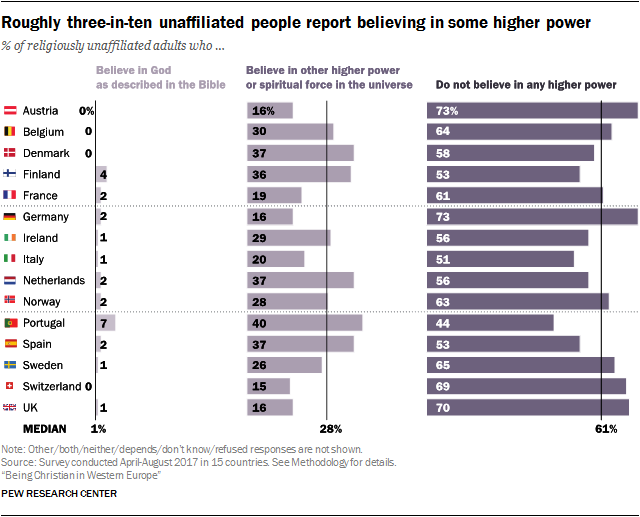
Roughly three-in-ten unaffiliated people report believing in some higher power

Still, substantial shares of “nones” in all 15 countries surveyed, ranging from 15% in Switzerland to 47% in Portugal, express belief in God or some other spiritual force in the universe. Even though few – if any – of these religiously unaffiliated believers say they attend church monthly or pray daily, they express attitudes toward spirituality that are different from those of most other “nones.”

For example, religiously unaffiliated believers – the subset of “nones” who say they believe in God or some other higher power or spiritual force – are especially likely to believe they have a soul as well as a physical body, including roughly eight-in-ten in the Netherlands and Norway. Among the larger group of “nones” who do not believe in any higher power, belief in a soul is much less common.
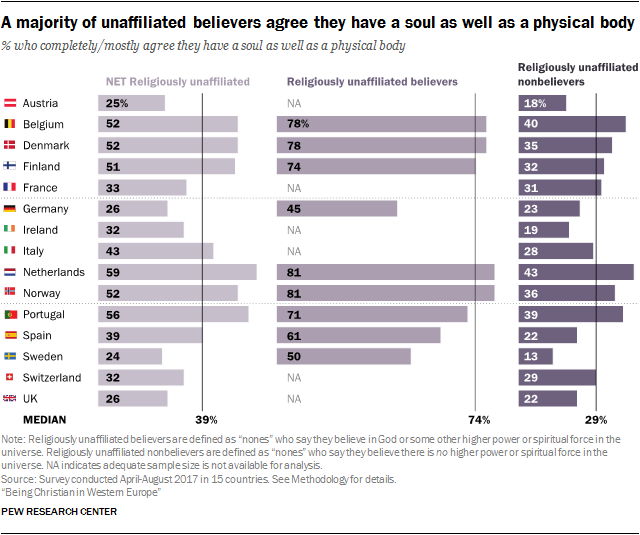
A majority of unaffiliated believers agree they have a soul as well as a physical body

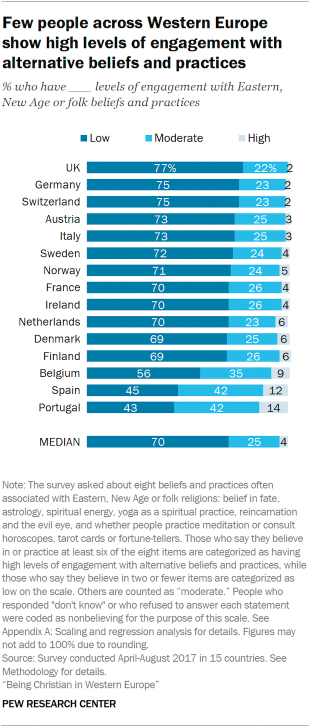
The survey also posed questions about the concepts of fate and reincarnation, and about astrology, fortune tellers, meditation, yoga (as a spiritual practice, not just as exercise), the “evil eye” and belief in “spiritual energy located in physical things, such as mountains, trees or crystals.” Most Western European “nones” do not hold or engage in these beliefs and practices, which are often associated with Eastern, New Age or folk religions. But religiously unaffiliated respondents who believe in a higher power or spiritual force are more likely than those who do not to hold these beliefs.

While many “nones” in Europe express skeptical or negative views about the value of religion, religiously unaffiliated believers are considerably less likely than nonbelievers to hold anti-religious attitudes. For example, in Belgium, 43% of believing “nones” agree that science makes religion unnecessary, compared with 69% of unaffiliated nonbelievers. And in Germany, 35% of unaffiliated believers say that religion causes more harm than good, compared with 55% of nonbelieving “nones.”

Most unaffiliated adults say science makes religion unnecessary in their life

Western Europeans are less religious than Americans

The vast majority of adults in the United States, like the majority of Western Europeans, continue to identify as Christian (71%). But on both sides of the Atlantic, growing numbers of people say they are religiously unaffiliated (i.e., atheist, agnostic or “nothing in particular”). About a quarter of Americans (23%, as of 2014) fit this description, comparable to the shares of “nones” in the UK (23%) and Germany (24%).

Yet Americans, overall, are considerably more religious than Western Europeans. Half of Americans (53%) say religion is “very important” in their lives, compared with a median of just 11% of adults across Western Europe. Among Christians, the gap is even bigger – two-thirds of U.S. Christians (68%) say religion is very important to them, compared with a median of 14% of Christians in the 15 countries surveyed across Western Europe. But even American “nones” are more religious than their European counterparts. While one-in-eight unaffiliated U.S. adults (13%) say religion is very important in their lives, hardly any Western European “nones” (median of 1%) share that sentiment.

Similar patterns are seen on belief in God, attendance at religious services and prayer. In fact, by some of these standard measures of religious commitment, American “nones” are as religious as — or even more religious than — Christians in several European countries, including France, Germany and the UK.
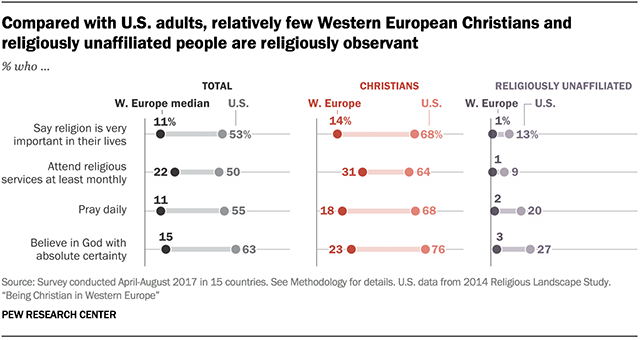
Compared with U.S. adults, relatively few Western European Christians and religiously unaffiliated people are religiously observant

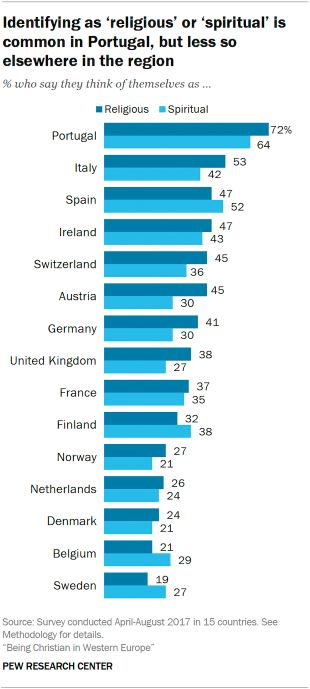
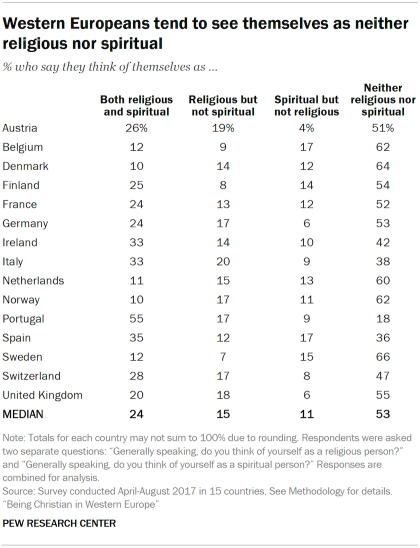
Additionally, the survey asked respondents whether they consider themselves religious and, separately, whether they consider themselves spiritual. These two questions, combined, result in four categories: those who describe themselves as both religious and spiritual, spiritual but not religious, religious but not spiritual, and neither religious nor spiritual.

The largest group across Western Europe (a median of 53%) is “neither religious nor spiritual.” In almost every country surveyed, roughly four-in-ten or more adults, including majorities in several countries, say they are neither religious nor spiritual. The biggest exception is Portugal, where more than half of adults (55%) say they are both religious and spiritual.

Smaller shares of populations in most countries say they are spiritual but not religious, or religious but not spiritual.

The religious makeup of Western Europe by this measure is significantly different from that of the United States. The largest group in the U.S. is both religious and spiritual (48%), compared with a median of 24% across Western Europe. Americans are also considerably more likely than Western Europeans to say they think of themselves as spiritual but not religious; 27% of Americans say this, compared with a median of 11% of Western Europeans surveyed.

Very few religiously unaffiliated adults – 2% to 4% in almost every Western European country surveyed – say they consider themselves to be religious people. While somewhat larger shares (median of 19%) consider themselves spiritual, this is still much lower than in the United States, where about half of “nones” describe themselves as spiritual (including 45% who say they are spiritual but not religious).

In contrast with U.S., Western Europeans tend to describe themselves as neither spiritual nor religious

A previously published analysis of data from 15 European countries used an older version of survey weights. Since then, Pew Research Center has improved the survey weights for greater accuracy leading to slight differences in some numbers between the two publications. The substantive findings of the previous publication are not affected by the revised weights. Please contact the Center for questions regarding weighting adjustments.
1. Nationalism, immigration and minorities

Europe’s religious landscape is changing: The Christian share of the population is declining while the religiously unaffiliated population is increasing. In addition, Muslim populations in Western European countries continue to grow in both absolute and percentage terms due to immigration, relatively high fertility rates, and a relatively young population. Jewish populations, meanwhile, appear to be declining.

Against this backdrop, the survey sought to gauge public opinion on Muslims and Jews, immigrants and immigration, and nationalism and national identity. Beyond exploring overall public perceptions of these issues, the survey also provides opportunities for statistical analysis to help illuminate some of the social, political and cultural factors associated with views on pluralism and multiculturalism.

Overall, most people across the region express positive and accepting views of religious minorities, saying that they are willing to accept Muslims and Jews in their neighborhoods and in their families. Majorities of the population in each of the 15 countries surveyed do not agree with negative statements about Muslims and Jews, such as, “In their hearts, Muslims want to impose their religious law on everyone else,” and “Jews always pursue their own interest and not the interest of the country they live in.”

Still, undercurrents of discomfort with multiculturalism are evident in Western European societies. For example, across the region, people express mixed views on whether Islam is compatible with their country’s values and culture. Most Europeans support at least some restrictions on religious dress for Muslim women. And public opinion is divided on whether it is important to be born in a given country, and to have ancestry in that country, to truly share the national identity (e.g., to be born in France to be truly French, or to have a Dutch family background to be truly Dutch).

Attitudes on nationalism, immigration and religious minorities are closely connected with one another. For example, those who say Islam is incompatible with their country’s values and culture are also more likely to favor restricting immigration. And those who express negative views of Muslims are also more likely to express negative views of Jews. These associations allowed researchers to combine 22 individual questions probing these views into a 10-point scale of Nationalist, anti-Immigration and anti-Minority views (NIM). The higher an individual scores on the scale, the higher their nationalist, anti-immigrant and anti-minority sentiment.

Generally, most Western Europeans tend to score on the lower half of the NIM scale (less than 5 points out of the possible 10). But there are wide variations by country: Italians are especially likely to score above 5, while Swedes score lower, on average, than people in any other country surveyed.

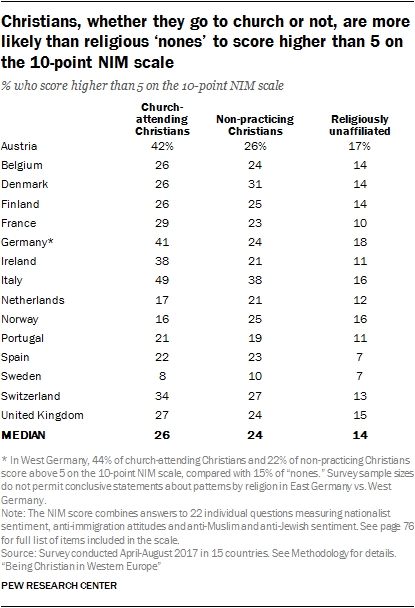
Other than what country people live in, various factors are associated with relatively high NIM scores. Researchers conducted advanced statistical analysis of the scale, considering the effects of age, gender, religion, education and several other factors one by one, holding all others constant. The results show that both church-attending and non-practicing Christians are more likely than religiously unaffiliated adults to score high on the NIM. That is, Christian identity – irrespective of level of religious observance – is associated with higher levels of nationalist, anti-immigration and anti-religious minority sentiment.

But religion is not the only factor associated with NIM scores: College-educated people and those who personally know a Muslim score significantly lower on the NIM, relative to those with less education and those who are not personally acquainted with a Muslim. Conversely, those who profess right-wing political ideology score significantly higher than those who lean left.

This chapter walks individually through survey results on more than 20 questions pertaining to the themes of nationalism, immigration and attitudes toward religious minorities, presenting descriptive findings at the national level. Question wording and response options are explained for each question. The chapter then goes on to discuss the results of the NIM scale and the factors associated with scoring high on the NIM.

Nationalism

Western Europeans take pride in both their national identity and European identity

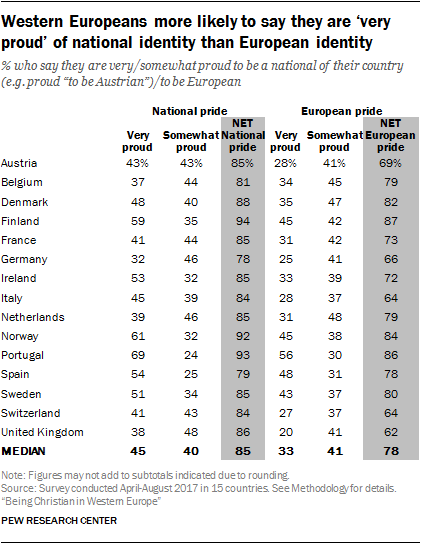
Western Europeans more likely to say they are ‘very proud’ of national identity than European identity

The survey asked people how proud they are of three possible elements of their identity: their national identity, their European identity and their religion. Respondents could select “very proud,” “somewhat proud,” “not very proud” or “not proud at all.”

National pride is widespread in Western Europe, with large majorities in every country saying they are either “very” or “somewhat” proud of their nationality (e.g. proud “to be Austrian,” proud “to be Belgian”). This includes at least nine-in-ten respondents in Finland (94%), Portugal (93%) and Norway (92%) who express national pride in this way. Germans are less likely than people in most other countries to say they are very proud to be a national of their country (32%), but most (78%) say they are at least somewhat proud to be German.

While most Western Europeans also express pride in a shared regional identity, more respondents express high levels of pride in their nationality than in being “European.”

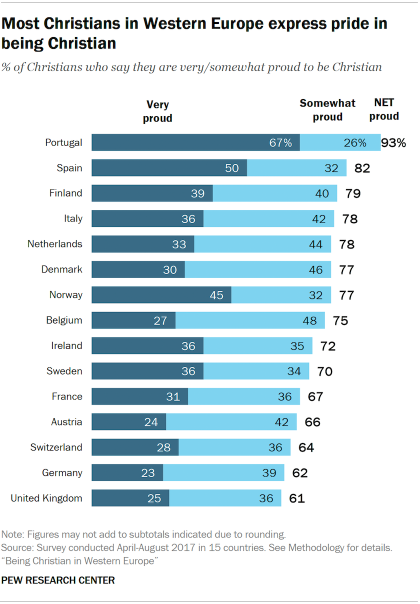
Majorities of Christians in every country surveyed say they are at least somewhat proud of being Christian. This includes vast majorities of Christians in the Iberian states of Portugal (93%) and Spain (82%), which also have among the highest shares saying they are very proud to be Christian (67% and 50%, respectively). By contrast, about a quarter of Christians say they are very proud of their religious affiliation in Belgium (27%), Austria (24%), the UK (25%) and Germany (23%).

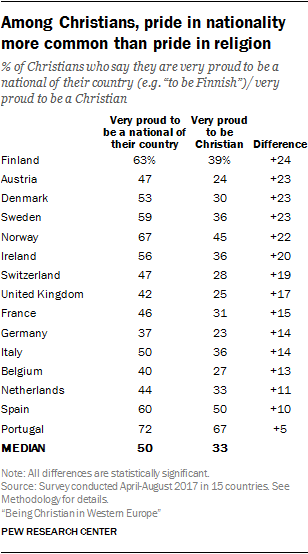
Among Christians, pride in nationality more common than pride in religion

In general across the region, Christians are more likely to express high levels of national than religious pride. For example, in Ireland, a slim majority of Christians (56%) say they are very proud to be Irish, compared with 36% who are very proud to be Christian.

The survey also asked respondents who identify as atheist or agnostic whether they are proud of their religious identity; roughly half or more in nearly every country surveyed say they are at least somewhat proud to be atheist or agnostic, including two-thirds or more in Portugal (79%) and Spain (68%). (People who said they have no particular religion were not asked this question.)

What does it take to be one of us?

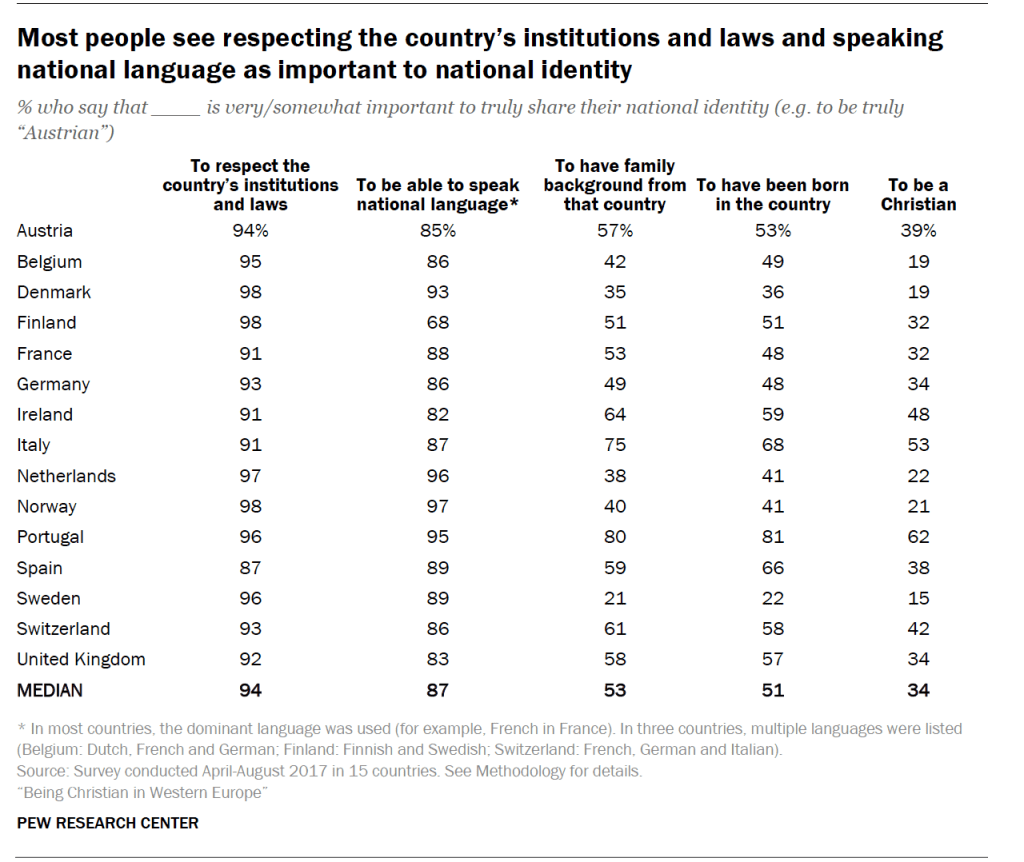
Most Western Europeans emphasize civic elements of their national identity over nativist elements. Overwhelming majorities in every country surveyed say that speaking the national language and respecting their country’s laws are important to truly share the national identity of their country (e.g., it is very important or somewhat important to speak German to be truly German, or to respect the laws of Switzerland to be truly Swiss). By comparison, fewer people take the view that one must have family background in the country, or have been born in the country, to truly share the national identity. Even fewer say one must be Christian to be truly a national of the country (e.g., it is very important or somewhat important to be Christian to be truly French).

Still, roughly half or more in most countries say one must have ancestry in the country, or that one must be born in the country, to truly share the national identity. In Portugal, at least eight-in-ten adults say one must be born in the country (81%) and share its ancestry (80%) to be truly Portuguese.

Most people see respecting the country’s institutions and laws and speaking national language as important to national identity

Western Europeans divided over whether their culture is superior to others

In many countries, people are split on whether their culture is superior to others

Beyond measuring national pride, the survey also sought to measure nationalist sentiment by asking people whether they completely agree, mostly agree, mostly disagree or completely disagree with the following statement: “Our people are not perfect, but our culture is superior to others.”

Overall, there is no regional consensus on this question. Norway is the only country where a majority of respondents completely or mostly agree that their culture is superior. Conversely, majorities in five nations disagree with this idea, including three-quarters in both Spain and Belgium. Elsewhere, there is a relatively even split between people who agree and disagree with the statement.

Pew Research Center also asked this question in Central and Eastern Europe, where somewhat larger percentages tend to express feelings of cultural superiority, particularly in Greece (89%), Georgia (85%) and Armenia (84%).

Views on immigration

Many Europeans favor the current level of immigration

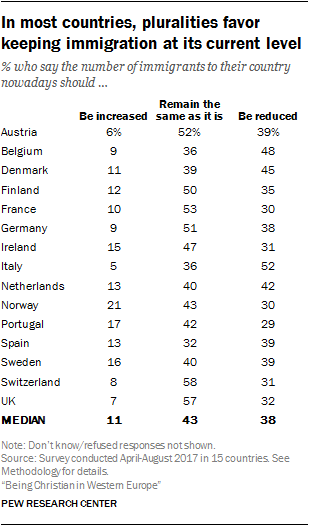
Table showing that in most countries, pluralities favor keeping immigration at its current level

Western Europeans are much more likely to say that the number of immigrants coming to their country should be reduced than to say immigration levels should be increased (median of 38% vs. 11%).

At the same time, there is a lot of public support for maintaining current levels of immigration. This is the view of a clear majority of adults surveyed in Switzerland (58%) and the UK (57%), as well as roughly half in France (53%), Austria (52%), Germany (51%), Finland (50%) and Ireland (47%).8

Indeed, in most of the 15 countries surveyed, if one adds the people who favor an increase in immigration to those who favor maintaining the current level, then together they outnumber the share of the public that wants to reduce immigration.

A notable exception is Italy, which received an estimated 720,000 migrants between mid-2010 and mid-2016 (the fourth highest total in the region, surpassed only by the UK, Germany and France). More Italians say immigration should be reduced (52%) than say it should be maintained at its current level (36%) or increased (5%). In Belgium, Denmark and Spain, there also is somewhat more public support for reducing immigration than for maintaining current levels. And attitudes on the issue are closely divided in Sweden and the Netherlands.

On balance, immigrants from Eastern Europe viewed more positively than those from Middle East or Africa

Western Europeans more likely to say that immigrants from Eastern Europe are hardworking

The survey gauged views of immigrants from three different parts of the world by asking respondents whether they associate two positive attributes with each group: working hard and being honest. Across the region, people are more likely to hold these positive views of immigrants from Eastern European countries (like Poland) than those from African countries (like Nigeria) or Middle Eastern countries (like Syria).

Indeed, majorities in nearly every country say Eastern European immigrants in general are hardworking. This includes at least three-quarters in Norway (82%), the Netherlands (78%) and the United Kingdom (77%). By contrast, in fewer than half the countries surveyed do majorities say Middle Eastern or African immigrants are hardworking.

Substantial shares across the region decline to answer these questions. This is especially true in Portugal and Spain, where a quarter of respondents or more say they “don’t know” or decline to answer the questions about immigrants’ work ethic. In most countries, nonresponse is especially common on questions about Middle Eastern and African immigrants.

Still, in several countries, at least three-in-ten say immigrants from outside Europe are not hardworking. About four-in-ten Danish adults take this position about immigrants from the Middle East (41%) and Africa (44%).

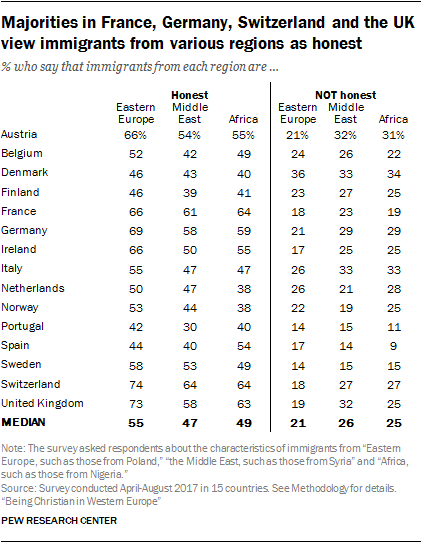
Majorities in France, Germany, Switzerland and the UK view immigrants from various regions as honest

Similarly, in most countries surveyed, immigrants from Eastern Europe are more likely than Middle Eastern or African immigrants to be viewed as honest. In Italy, for instance, more than half of the public (55%) says Eastern European immigrants are honest, compared with 47% who say the same about immigrants from both the Middle East and Africa. Fully a third of Italians express the opinion that Middle Eastern and African immigrants are not honest.

Spain is an exception to this pattern; Spanish respondents are more likely to say African immigrants are honest or hardworking compared with those from Eastern Europe or the Middle East.

Again, many respondents decline to answer these questions. In fact, a majority of Portuguese adults (56%) did not offer an answer about whether Middle Eastern immigrants are honest.

Attitudes toward religious minorities

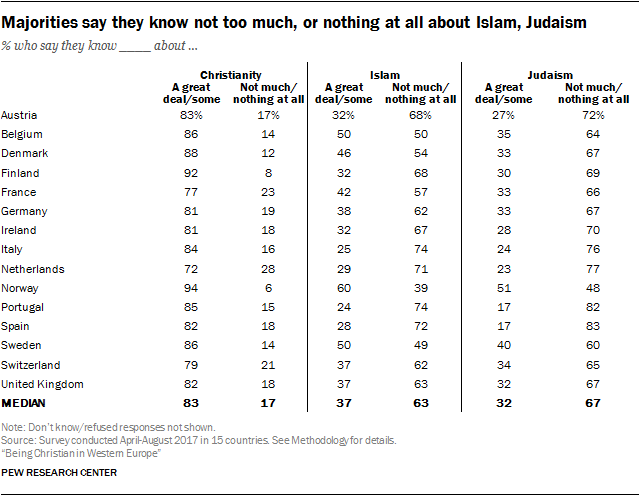
Western Europeans say they know little about Islam, Judaism

Vast majorities in every country surveyed say they know either “some” or a “great deal” about the Christian religion and its practices, including majorities of adults in Norway (62%) and Ireland (56%) who say they know a “great deal” about Christianity.

But in most countries, people tend to say they know “not too much” or “nothing at all” about the Muslim religion and its practices (median of 63%), or the Jewish religion and its practices (median of 67%).

Majorities say they know not too much, or nothing at all about Islam, Judaism

Western Europeans less likely to say they know Jews than Muslims

Majorities in nearly every country say they personally know atheists and Muslims, but fewer know Jews

Although relatively few respondents say they know much about the Islamic religion, far more say they personally know someone who is Muslim. About half or more in every country surveyed say they know a Muslim, with the exceptions of Finland and Portugal.

Throughout the region, fewer Western Europeans say they personally know someone who is Jewish. This finding aligns with the fact that Muslim populations in Europe continue to rapidly rise while Jewish populations in the region have long been falling.

The survey also asked whether respondents personally know an atheist; most people in nearly every country surveyed report that they do.

Roughly half of adults in Norway say they have a religiously diverse friendship circle

Majorities say most of their close friends share their religious identity

While many Western Europeans say they know someone who has a different religion, they generally report that their close friendship circles consist largely of people who have the same religious identity that they do.

Majorities in all but three countries say all or most of their close friends share their religion (or, like them, identify as religiously unaffiliated). In Italy, roughly three-in-four people (74%) say their friends generally share their religion. And in Austria, Finland, Portugal and Ireland, where 75% or more of adults identify as Christian, at least two-thirds say all or most of their close friends share their religious identity.

People report more religiously diverse friendship circles in Norway, where about half of respondents (52%) say “some,” “hardly any” or “none” of their close friends share their religious identity.

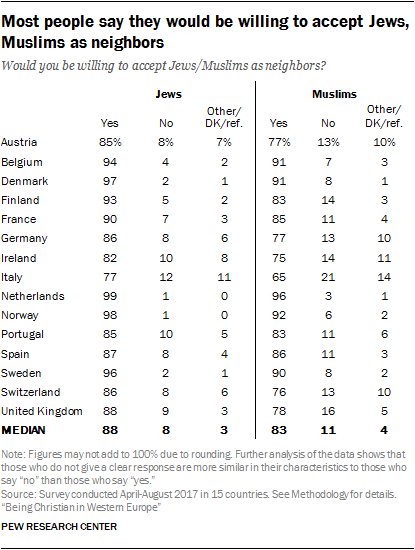
Vast majorities would accept Muslims as neighbors; fewer as family members

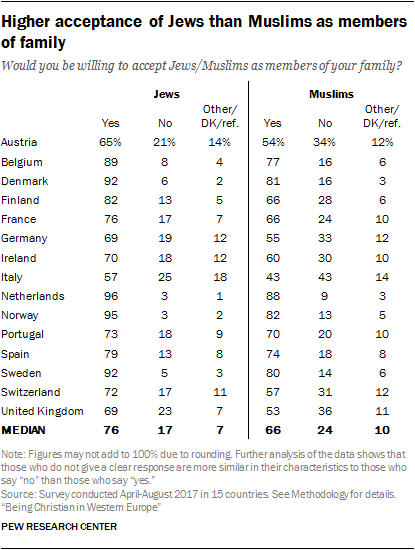
Higher acceptance of Jews than Muslims as members of family

To measure openness toward members of minority religious groups, the survey asked respondents a series of hypothetical questions: Would they be willing to accept Jews and Muslims as neighbors, or as members of their family?

Majorities in every country surveyed say they would be willing to accept Jews as relatives, while overwhelming majorities say that they would be OK with having Jewish neighbors. Majorities in most countries also say they would be willing to accept Muslims as neighbors or family members.

Most people say they would be willing to accept Jews, Muslims as neighbors

But, on balance, Europeans appear to be somewhat less accepting of Muslims than of Jews. For example, about seven-in-ten British adults (69%) say they would be willing to accept Jews as relatives, while fewer (53%) say this about Muslims. And nearly nine-in-ten respondents in the UK (88%) would accept Jews as neighbors, 10 percentage points higher than the share who say they would accept Muslims as neighbors (78%).

In several countries, significant shares do not express willingness to accept Jews and Muslims in their neighborhoods or families. That is, they either say they would be unwilling to accept these groups in their communities or families, or they decline to answer the question. For example, just under half (46%) of Austrians say they would be unwilling (34%) or do not know whether they would be willing (12%) to accept Muslims as members of their family. Roughly a third of Austrians (35%) say they would be unwilling (21%) or do not know whether they would be willing (14%) to accept Jews in their family.

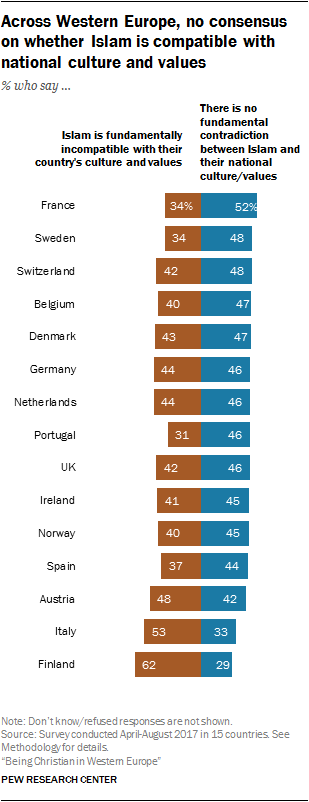
Western Europeans divided over whether Islam is compatible with national values

Across Western Europe, no consensus on whether Islam is compatible with national culture and values
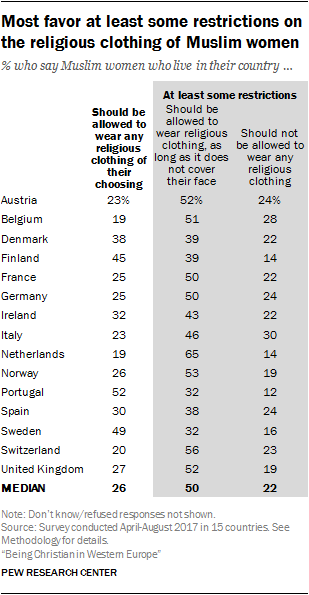
Most favor at least some restrictions on the religious clothing of Muslim women

While most Western Europeans express willingness to accept Muslims as neighbors or family members, they are more divided on whether Islam fits with their national values and culture.

The survey asked respondents to choose which of two statements comes closer to their own views: “Islam is fundamentally incompatible with [their country’s] culture and values,” or “There is no fundamental contradiction between Islam and [their country’s] culture and values.” Across the region, there is no clear consensus on this question. In Finland and Italy, the prevailing view is that there is a fundamental contradiction between Islam and the national culture and values. Elsewhere, opinions are more evenly split or lean toward the position that Islam is compatible with national values.

Western Europeans support restrictions on Muslim women’s face coverings

A hotly debated question in some parts of Europe is whether Muslim women should be prohibited from wearing various kinds of religious clothing. Respondents were asked which of three options they favor: “Muslim women who live in [country] should be allowed to wear any religious clothing of their choosing,” “Muslim women who live in [country] should be allowed to wear religious clothing, as long as it does not cover their face,” or “Muslim women who live in [country] should not be allowed to wear any religious clothing.”

Most Western Europeans favor restricting the religious clothing worn by Muslim women in their country, especially clothing that covers a woman’s face. Half or more of adults in eight of the 15 countries surveyed favor restricting face coverings, such as niqabs and burqas. And an additional one-in-five or more in most countries favor prohibiting all religious clothing for Muslim women. Combined, majorities in 12 out of 15 countries favor at least some restrictions on Muslim religious dress.

In France, where debates on religious attire in beach towns have been highly publicized and politically charged, 22% of respondents favor restrictions on all religious clothing for Muslim women, while half say that just face coverings should be restricted. On the other hand, roughly half of the public in Portugal (52%) and Sweden (49%) say Muslim women should be allowed to wear whatever religious clothing they want.

Few say large shares of Muslims in their country support violent extremist groups

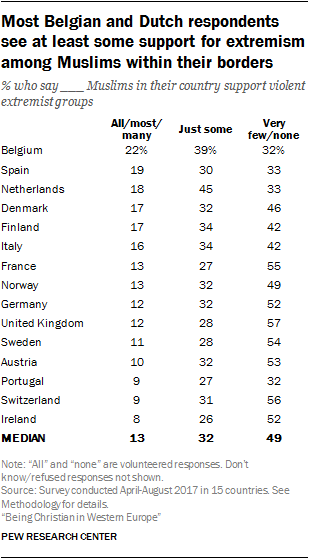
Most Belgian and Dutch respondents see at least some support for extremism among Muslims within their borders

In several of the countries surveyed, including the UK, France and Belgium, extremists have carried out attacks in the name of Islam in recent years. However, relatively few Western Europeans think there is widespread support among Muslims in their country for violent extremist groups.

The survey asked respondents to estimate how many Muslims in their country support violent extremist groups: “most,” “many,” “just some” or “very few.” The most common answer is that “very few” or no Muslims support violent extremist groups: A median of 49% of adults across the region choose this option (or volunteer that no Muslims support extremism), including 57% in the UK and 56% in Switzerland. Belgian (32%) and Dutch (33%) respondents are less likely to take this position; most say at least “some” Muslims in their country support violent extremist groups (61% and 63%, respectively).

In some countries, significant shares decline to answer the question. In Portugal, 32% of respondents say that they do not know or refuse to answer the question, as do 18% of respondents in Spain.

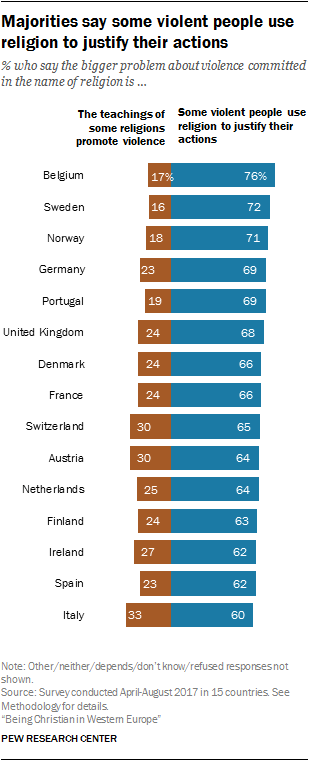
Majorities say some violent people use religion to justify their actions

At least one-in-five people in most countries say the teachings of some religions promote violence

The survey was conducted from April to August, 2017, a few months after the Berlin Christmas Market terror attack on Dec. 20, 2016. Interviews were already underway in the UK when the Manchester concert terror attack took place in May 2017.

In light of these and other events, the survey asked respondents to choose which of two statements they consider to be the bigger problem with regard to violence committed in the name of religion: “The teachings of some religions promote violence,” or “Some violent people use religion to justify their actions.” Majorities in every country say the bigger problem is that some violent people use religion to justify their actions.

At the same time, roughly one-in-five or more respondents in most countries say the bigger problem is that the teachings of some religions promote violence. A third of respondents in Italy and three-in-ten in Austria and Switzerland take this position.

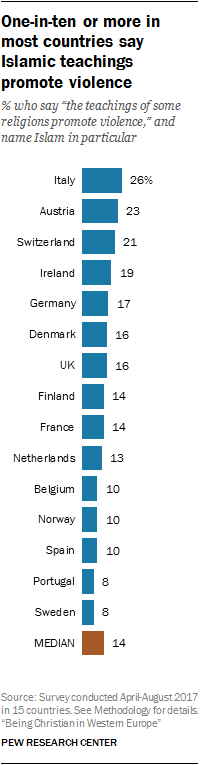
One-in-ten or more in most countries say Islamic teachings promote violence

Those who said that the teachings of some religions promote violence were asked an open-ended follow-up question: “Which religion or religions in particular have teachings that promote violence?” The most common answer is Islam. Among all respondents, roughly one-in-five or more say this in Italy (26%), Austria (23%), Switzerland (21%) and Ireland (19%). Far fewer Western Europeans mention Christianity or other religions, or say that the teachings of all religions promote violence.

In France, which experienced several terror attacks committed in the name of Islam in the year leading up to the survey, 14% say Islamic teachings promote violence, as do 16% in the UK, where in light of the concert bombing in Manchester, terror threat levels were raised to “critical” while the survey was in the field.

Most disagree with negative statements about Muslims

To further examine Western Europeans’ attitudes toward Islam and Muslims, the survey asked the extent to which people agree or disagree with the following statement: “In their hearts, Muslims want to impose their religious law on everyone else” in the country. Majorities in almost every Western European country surveyed completely or mostly disagree with this statement.

Still, a median of 30% across the countries surveyed say they either completely or mostly agree with it, including 41% in Belgium and 40% in Spain. One-in-five Spaniards and Danes completely agree that Muslims want to impose religious law on everyone else in their countries.

At least one-in-five in all countries say Muslims want to impose religious law

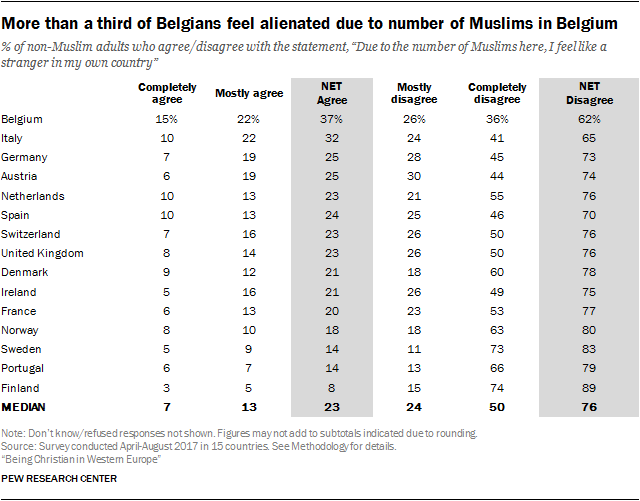
The survey also asked non-Muslim respondents the extent to which they agree or disagree with the following statement: “Due to the number of Muslims here, I feel like a stranger in my own country.” In every country surveyed, large majorities disagree with this statement, including 80% or more in Norway, Sweden and Finland.

In most countries, about one-in-five or more adults agree with the statement, although no more than one-in-ten completely agree. The only exception is Belgium, where 15% completely agree and an additional 22% mostly agree. In Italy, 32% of respondents say they feel like a stranger in their country due to the number of Muslims, and, in Germany, which has received a large number of refugees from predominantly Muslim countries in recent years, 25% express this view.

More than a third of Belgians feel alienated due to number of Muslims in Belgium

Negative stereotypes about Jews widely rejected

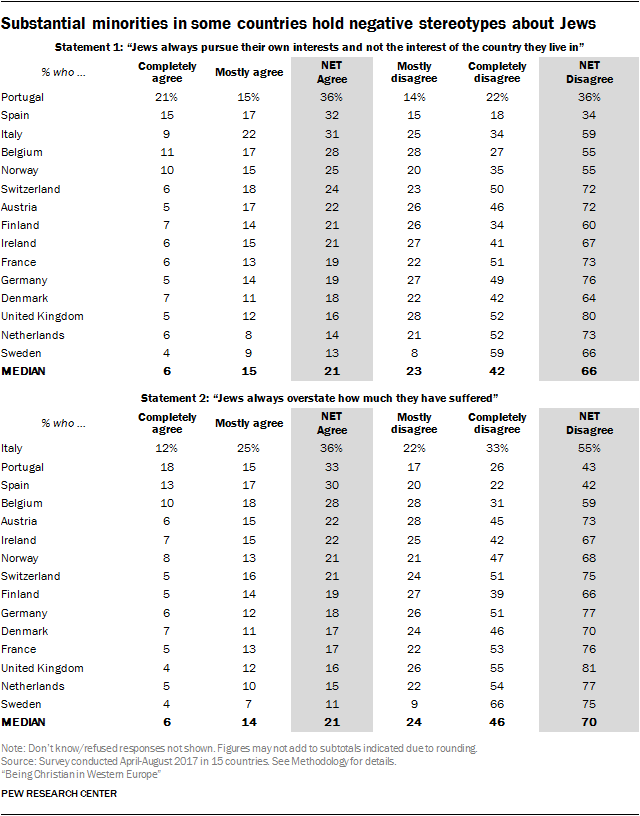
To gauge levels of anti-Jewish sentiment in public opinion in Western Europe, the survey asked respondents whether they completely agree, mostly agree, mostly disagree or completely disagree with two strongly worded negative statements: “Jews always pursue their own interest and not the interest of the country they live in,” and “Jews always overstate how much they have suffered.”

Majorities across the region disagree with both of these statements, including about three-quarters or more in France, Germany, the Netherlands and the UK. Still, about 30% or more in Belgium, Italy, Portugal and Spain completely or mostly agree with each of these statements.

Many respondents decline to answer these questions. In approximately half the countries surveyed, at least one-in-ten people either refuse to say whether they agree or disagree with the statements or say they do not know; these percentages are highest in Spain and Portugal.

Measuring Islamophobia and anti-Semitism

The survey included a few questions in which respondents were asked whether they completely agree, mostly agree, mostly disagree or completely disagree with strongly worded negative statements about Muslims and Jews. These should be interpreted with caution: They were not designed to measure Islamophobia or anti-Semitism in a robust or comprehensive way, but rather to capture some expressed sentiments about these minority groups. Some respondents may harbor negative feelings about Muslims and Jews but not express them to a survey interviewer; others may express hostile feelings in a survey but not have the opportunity or inclination to act in a hostile way. (The survey did not attempt to measure hostile actions or behaviors against religious and ethnic minorities.) Also, the questions about Muslims and Jews were not constructed to parallel each other, so comparisons between the levels of expressed negative sentiment toward the two groups should be made very cautiously, if at all.

Substantial minorities in some countries hold negative stereotypes about Jews

Scale of Nationalist, anti-Immigrant, anti-religious Minority sentiment

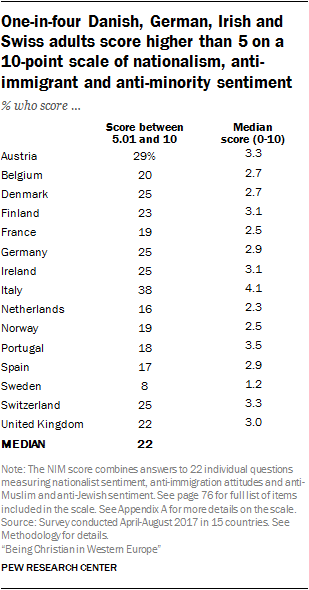
One-in-four Danish, German, Irish and Swiss adults score higher than 5 on a 10-point scale of nationalism, anti-immigrant and anti-minority sentiment

Overall, attitudes on nationalism, immigration and religious minorities are closely associated with one another. For example, people who express negative views of Muslims also generally favor reducing immigration. And people who voice negative views of Muslims are also more likely to voice negative views of Jews.9

These correlations made it possible for researchers to combine 22 individual questions on these topics into a scale. The higher the score on the scale – on which scores from zero to 10 are possible – the more likely a respondent is to express Nationalist, anti-Immigrant and anti-religious Minority views (NIM). Because the number of questions about each topic varies, each question was weighted so the three topics covered have equal impacts on the scale.10

The NIM scale illuminates country-level variations. Swedes are the least likely to express nationalist, anti-immigrant and anti-minority views (8% score higher than 5). Italians, meanwhile, score relatively high on the scale: Nearly four-in-ten (38%) score above 5, a larger share than in any other country surveyed. Median scores in the 13 other countries fall in between Sweden’s median (1.2) and Italy’s (4.1).

What goes into the Nationalist, anti-Immigrant and anti-Minority (NIM) scale

The following questions were combined into a scale such that questions on each of the three topics (nationalism, immigration and religious minorities) contributed equally to the scale. Scores increase by the amount noted below if a respondent says …

Nationalism (each worth 1.11 points)

  1. It is very/somewhat important to have been born in [COUNTRY] to be truly [NATIONALITY] (e.g., to have been born in France to be truly French).
  2. It is very/somewhat important to have [NATIONALITY] family background to be truly [NATIONALITY] (e.g., to have French family background to be truly French).
  3. I completely/mostly agree that, “Our people are not perfect, but our culture is superior to others.”

Immigration (each worth 0.48 points)

  1. The number of immigrants to [COUNTRY] should be reduced.
  2. Immigrants from Eastern Europe, such as those from Poland, are not hardworking
  3. Immigrants from the Middle East, such as those from Syria, are not hardworking
  4. Immigrants from Africa, such as those from Nigeria, are not hardworking
  5. Immigrants from Eastern Europe, such as those from Poland, are not honest
  6. Immigrants from the Middle East, such as those from Syria, are not honest
  7. Immigrants from Africa, such as those from Nigeria, are not honest

Religious minorities (each worth 0.28 points)

  1. I am not willing, or don’t know (or declined to answer) if I’m willing, to accept Muslims as neighbors.
  2. I am not willing, or don’t know (or declined to answer) if I’m willing, to accept Muslims as family members.
  3. I am not willing, or don’t know (or declined to answer) if I’m willing, to accept Jews as neighbors.
  4. I am not willing, or don’t know (or declined to answer) if I’m willing, to accept Jews as family members.
  5. I completely/mostly agree that, “In their hearts, Muslims want to impose their religious law on everyone else in [COUNTRY].”
  6. I completely/mostly agree that, “Due to the number of Muslims here, I feel like a stranger in my own country.”
  7. I completely/mostly agree that, “Jews always overstate how much they have suffered.”
  8. I completely/mostly agree that, “Jews always pursue their own interests and not the interest of the country they live in.”
  9. Islam has teachings that promote violence.
  10. All/most/many Muslims in the country support violent extremist groups
  11. Muslim women who live in the country should not be allowed to wear any religious clothing.
  12. Islam is fundamentally incompatible with the country’s culture and values.
Christians, whether they go to church or not, are more likely than religious ‘nones’ to score higher than 5 on the 10-point NIM scale

The scale provides an opportunity to analyze which attributes are most closely associated with a person’s likelihood of expressing nationalist opinions and negative views of religious minorities and immigrants. Overall, Christians (both church-attending and non-practicing) are more likely than religiously unaffiliated people to score higher than 5 on the NIM scale. For example, in the UK, 27% of churchgoing Christians and 24% of non-practicing Christians score higher than 5 on the NIM scale, compared with 15% of “nones.”

But many factors could be correlated with holding nationalist, anti-immigration and anti-minority views. Controlling for a variety of variables – such as age, gender, education, political ideology, personal economic situation, religious affiliation, religious observance, and more – researchers conducted statistical analysis of the survey data to determine which characteristics stand out above the others.

Independent of other factors, Western Europeans who identify as Christian (whether churchgoing or not) score higher on the NIM scale than those who have no religious affiliation. Put more simply: Christian identity, on its own, is associated with higher levels of nationalism and negative views of religious minorities and immigrants.11

This is not to say that most Christians in Europe oppose immigration or want to keep Muslims and Jews out of their neighborhoods. In all 15 countries surveyed, fewer than half of all Christians score higher than 5 on the scale. The results also do not imply that Christian theology or religious teachings necessarily lead to anti-immigrant, anti-Muslim or anti-Jewish positions; on the contrary, many churches have been active in resettling refugees from the Middle East and elsewhere. Theoretically, the causal connection could go in either direction (or in both directions): It could be that holding anti-immigrant positions may lead a person to embrace Europe’s historically dominant religious identity, rather than that identifying with Europe’s historically dominant religious group leads a person to take anti-minority positions. The survey data show a statistical correlation – not a clear relationship of cause and effect.

Nationalist, anti-Immigrant and anti-religious Minority (NIM) views in Western Europe

Moreover, religious identity is far from the only characteristic associated with where respondents stand on these questions. The analysis also finds that personal familiarity with Muslims or Jews is associated with lower NIM scores. That is, people who say they personally know a Muslim tend to have lower scores on the scale (i.e., to be more accepting of immigrants and minorities, and to be less nationalistic). To a lesser extent, the same pattern holds for those who personally know a Jewish person, although significantly more people in Europe today say they are personally acquainted with Muslims than with Jews.

Political ideology also is tied very closely to NIM scores.12 People who describe their political views as being more toward the right wing in their country are much more likely to score high on the scale, compared with those who classify themselves as left-leaning. Education, too, is a strong factor: Adults with college degrees are considerably more likely than those with less education to score low on the NIM scale.

The relationship between age and NIM scores is weaker. While younger people tend to score lower on the NIM, statistical analysis suggests that this has to do less with their age and more with other, related factors such as ideology, religion and familiarity with Muslims. For example, younger people are considerably more likely than older people to say they personally know a Muslim. They are also more likely than older adults to say they are religiously unaffiliated. Both factors are closely associated with lower NIM scores.

Many intangible factors can influence how respondents choose to answer questions on sensitive topics like nationalism, immigration and the place of minorities in European society, including the general proclivity of people to frame their views in a manner than is socially acceptable. Nonetheless, the survey reveals several measurable attributes that are correlated with these views. All in all, Christian affiliation and right-wing political ideology are closely associated with higher levels of nationalist, anti-immigration and anti-minority views, while college education and personal familiarity with Muslims are associated with lower levels of nationalist, anti-immigrant and anti-minority sentiment.

Measuring religious commitment

In many places in this report, religious commitment is measured primarily by attendance at religious services: Christians who attend church at least monthly are categorized as churchgoing Christians, while those who attend no more than a few times a year are categorized as non-practicing Christians. Many scholars consider attendance at religious services a standard measure of religious observance, especially for Christians. But church attendance is not the only way to measure Christian religious commitment. An alternative approach, also used in this report, combines four separate measures of religious commitment into an index: how important a person considers religion in their lives, how often they attend religious services, how often they pray and whether they believe in God with absolute certainty. Christian respondents are classified as high, medium or low in their religious commitment based on their scores on the index.

If one replaces “churchgoing Christians” and “non-practicing Christians” with this more complex scale (high, medium and low levels of religious commitment), the NIM regression models continue to find significant differences between Christians (at all levels of religious commitment) and religiously unaffiliated adults in the region. For the results of this regression model, see Appendix A.

2. Religious identity

Most people in Western Europe identify as Christians. But across the region, fewer people say they are currently Christian than say they were baptized or raised as Christians.

In every country, net losses for Christians are accompanied by net gains for the share of adults who say they have no religion. College-educated people, younger adults and men are more likely than others to say they are now religiously unaffiliated after having been raised Christian.

Those who were raised in a religion and now identify as unaffiliated cite several factors as important in their decision to leave their faith. Most say they “gradually drifted away from religion.” Majorities also report disagreeing with religious positions on social issues, like homosexuality and abortion, as a reason they no longer identify with a religion. And at least half of respondents in several countries, especially in predominantly Catholic ones, cite church scandals.

Most Western Europeans identify as Christian

Across the countries surveyed, most adults identify as Christian, including eight-in-ten or more in Portugal (83%), Austria (80%), Ireland (80%) and Italy (80%). By contrast, the Netherlands has the lowest share of Christians in the region (41%).

Religiously unaffiliated adults — that is, those who do not identify with a religion, but describe themselves instead as “nothing in particular,” agnostic or atheist – are a sizable population in the region. Still, of the countries surveyed, only in the Netherlands do religiously unaffiliated adults outnumber Christians (48% vs. 41%).

Five hundred years after the start of the Protestant Reformation, most countries in the region are still either predominantly Catholic or predominantly Protestant. Generally, the Protestant countries have higher shares of unaffiliated adults than do Catholic countries in the region. For example, in Ireland, Italy and Portugal (all predominantly Catholic), just 15% of adults are religiously unaffiliated, compared with 23% in the UK and 30% in Denmark (both predominantly Protestant).

Younger adults (those between the ages of 18 and 34), men and college graduates are more likely to self-identify as religiously unaffiliated, while older respondents (age 35 and up), women and those with less than a college education are more likely to identify as Christian.

Decline in share of Christians is accompanied by gains for religiously unaffiliated

Even though majorities across the region identify as Christian, in every country surveyed, Christianity has experienced net losses as a result of religious switching. The vast majority of Western European adults say they were raised Christian, but significantly fewer in every country currently identify as Christian. The decreases in Christian identity are mirrored by increases in the shares who report having no religion.

Christians have seen the most substantial net losses in Belgium, the Netherlands, Norway, Spain and Sweden. For example, there is a difference of 28 percentage points between the share of Norwegians who were raised Christian (79%) and the share who are currently Christian (51%), matching the 28-point gap between those who were raised unaffiliated (15%) and the current unaffiliated share (43%).

In several countries, the share of religiously unaffiliated adults has more than doubled within the lifetime of the survey respondents. For instance, in Belgium, 12% of adults were raised unaffiliated and 38% report having no religion today. By comparison, the rise in the share of religiously unaffiliated adults has been more modest in Austria, Switzerland and the United Kingdom.
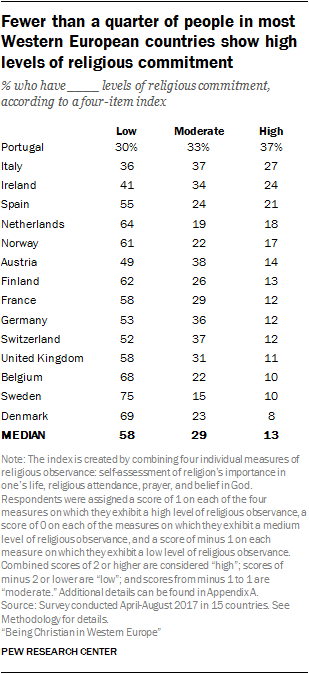
Overall, large majorities of those raised Christian still identify as Christian today, but Christians have relatively low retention rates (the share of all people raised as Christian who are still Christian) in Belgium (65%), Sweden (65%), Norway (62%) and the Netherlands (57%). The overwhelming majority of those who have left Christianity now identify as religiously unaffiliated.

Similarly, the vast majority of those raised religiously unaffiliated stay religiously unaffiliated, but significant minorities in some countries now identify as Christian or with some other religion, or give an ambiguous response about their current religion. In France, for example, 88% of those raised religiously unaffiliated are still religiously unaffiliated today, while 8% say they are now Christian and 4% say they now identify with another religion or do not provide a definitive response about their current religion.

Among those who are currently unaffiliated, majorities in most Western European countries say they were raised as Christians. For example, 86% of current “nones” in Spain are former Christians, as are seven-in-ten or more in Portugal (74%), Belgium (71%) and Finland (70%).

Former Christians who are now religiously unaffiliated are significantly younger and more highly educated than current Christians. For example, in Switzerland, adults who have left Christianity are considerably more likely to be younger than 35 (52% among former Christians vs. 19% among current Christians) and to have a college education (57% vs. 37%).

Large shares of Western Europeans –including many unaffiliated adults – report having been baptized

Generally, the share of people who say they were baptized is higher than the share of people who say they were raised as Christians. Across the region, the vast majority of adults (median of 91%) report having been baptized, including nearly all Christians in several countries.

Even among religiously unaffiliated adults in the region, half or more in most places report having been baptized, including roughly nine-in-ten in Spain (91%), Finland (90%) and Denmark (88%).

Why did unaffiliated people turn away from religion?

The survey asked people who were raised in a religion but are now unaffiliated whether each of seven possible factors was an important reason for the change. Respondents could choose as many reasons as apply. The most common reason, cited by majorities across the region, is that they “gradually drifted away from religion.” In addition, roughly half or more in most countries say they stopped believing in the teachings of their childhood religion, or that they disagreed with their religion’s positions on social issues like homosexuality and abortion.

Large shares (regional median of 53%) also cite scandals involving religious institutions and leaders as an important reason they no longer identify with a religion. This position is especially common in Catholic-majority countries such as Spain (74%), Italy (60%) and Portugal (60%).

Smaller shares say that they stopped identifying with a religion because their spiritual needs were not being met (median of 26%), or that religion failed them when they were in need (median of 21%). Even fewer say marrying someone who did not share their childhood faith (median of 8%) was an important reason for shedding their religious identity.

Sidebar: Europeans’ relationships with religion change over time

Focus groups in five countries explored how individuals’ religious identities, beliefs and practices have changed throughout their lives. Groups composed entirely of Christians or entirely of religiously unaffiliated adults shared stories about the role of religion during their childhoods. Many focus group participants considered themselves active Christians when they were young; they attended church regularly, prayed and held traditional religious beliefs. Several people in the groups said that when they reached their teenage and young adult years, they reduced their religious activity. Some turned completely away from organized religion. Focus group participants offered different explanations for how and why this shift occurred. A few participants pointed to particular moments when they lost faith and abandoned Christianity. Others said the attachment to Christianity faded gradually as they got older, with no particular turning point. Some mentioned specific disagreements with Christian teachings or disillusionments with church leaders and institutions, including recent scandals.

“My mum is Christian and her family are very sort of Protestant. My dad’s an atheist, so mum had more influence on the childhood. So we grew up relatively Christian just going to church at Easter, Christmas, that kind of thing. … When I was probably like 10, 11, it was just the kind of thing where I was in between atheism and Christianity. But my mum got cancer when I was about 12, and then I sort of like, on my own, just became quite religious. I had three sisters and none of them did it or anything. Dad was still an atheist; my mum didn’t really change her opinions. But I became sort of quite like praying all the time. I listened to a lot of country music, which I found really comforting so they would talk about God and stuff in it, and it was kind of like my turn towards religion in the struggle. And then, because she was cured a couple of years later, I was like, ‘Oh my God, it worked, God’s there for me.’ But then it was my interest in politics and stuff, and my exposure to lots of the more negative sides of Christianity in terms of social anachronistic ideas and stuff – so like opinions about gay marriage, or opinions about like sex before marriage and stuff. So when I was about 16, 17, I sort of thought, ‘Actually, I’m not too sure I agree with this institution.’… Now I’d probably say I’m agnostic.” – 20-year-old agnostic woman, United Kingdom

“We mostly celebrated Christmas. We didn’t really celebrate Easter or anything. No one in my family was religious in that way. No one talked about it. But in school there were the church’s children hours, and I went to those when I was younger … and the children’s choir in church. I started toward getting confirmed. But I stopped that because I didn’t think it was my thing when I got there – those meetings they had once a week. It felt a lot like they were imposing a lot on us about how to believe and about God, but I felt that I don’t believe this. I couldn’t stand and say something, or pray and write to God. For me it was really ‘No thank you,’ so I backed away and that’s the first time I realized – that’s when I felt that I don’t believe this.”
– 26-year-old atheist woman, Sweden

“Of course, while I was attending confirmation classes, I had to show up [for church]. Otherwise, I would have jeopardized the whole confirmation, and this, of course, pressured me in an unpleasant way. … And after that it decreased and, frankly, when I was in college I enjoyed sleeping in on Sundays. Like I have said before, the parish is just around the corner from me, less than half a kilometer away, and I started to go to church again more often 10 years ago, when my father died. And the pastor who gave the eulogy for him and hosted his funeral, was really, downright good, him being an acquaintance of my parents, so he just got to the heart of things in his Berlin bluntness. Seriously, that guy, he was no windbag, let me tell you! So he got to the heart of things and was everything but a talker and he was really easy to listen to. … Unfortunately, [he] retired in 2011. After that, I went one more time and did not like it at all. With services, it completely depends on who is standing up front, and they spoiled it for me, going to church and attending services. And this pastor who is now retired, he was really good and you just could go once every three or four weeks and listen to him, and during that time I also really enjoyed this sense of community.”
– 46-year-old Christian man, Germany

“Maybe halfway through primary school I started questioning it. And when the first death occurred in my family, I said ‘No, that is not it, this is not how it works.’ And then I was done with the whole thing.” – 29-year-old “nothing in particular” woman, Germany

“My parents are Protestant. When I was a kid, my mum used to take us with her to church. She tried to instill things in me about that. But I never got hooked. I never really followed. I went because she wanted me to go. In the end, I tried to avoid it – to avoid it totally. She tried to get me in it, but I refused to stay in it and follow everything that went with it because I wasn’t attracted by it. Later, we had a death in the family, which led me to be offended by faith. So, I ended up feeling hatred because of it. When we were younger, we used to have times of prayer in the family. But it didn’t continue. It all stopped. My parents, yes, they are really involved in it. But my sisters and I don’t talk about it at all. We each have our own beliefs, our own ritual … each one individually.” – 36-year-old Christian man, France

Focus group participants commonly described their early interactions with Christianity in terms of going to church, praying and being brought up with particular religious beliefs and identities, (e.g., Catholic, Lutheran, Church of England). Many practiced along with their families. Some described religious aspects of their youth as something that was imposed on them, calling them a “chore,” “tradition” or “obligation.” However, some in the focus groups said they have embraced these practices in adulthood; they now attend church services, pray occasionally or hold some religious beliefs. They gave a variety of reasons for these changes, such as wanting to teach Christian values to their children. Others started attending church to be part of a community or sing in a choir. Some participants say they have resumed aspects of Christianity, like praying on a regular basis, without adopting other traditional beliefs and practices.

While many of those who have left Christianity say they drifted away gradually, those who have returned to Christianity almost invariably pointed to a particular event, person or other circumstance that prompted them to come back to their childhood religion. And although participants talked about inconsistencies or contradictions in their religious practices – such as praying to God without believing there is a God – the group discussions typically revolved around an implicit assumption that Christians are supposed to attend church services, pray, believe in God, and mark key life passages (births, weddings, deaths) with religious ceremonies. Even as they talked freely about breaking these expectations – by seldom going to church, for example – the focus groups continually returned to the implicit paradigm, with each participant discussing the ways in which he or she adheres to or departs from it.

“I was baptized Catholic, but my family aren’t religious so I don’t really know why that happened. I was always sent to Church of England schools, we had to go to chapel, we had to pray, but my parents always told me not to actually get involved in religion. They don’t like the idea of what it does to people. And when I was about 10 years old, I pretty much thought about it, realized that I didn’t have much belief. But as I got older … I [pray] more so when I want someone else to be OK. So even though I don’t have a set religion, if someone said to me, do I believe in God, I wouldn’t say, “yes,” but as I’m older I prob ably pray more now than I ever would before – if I want a family member to be OK, if I want something to go well for someone else. It’s more just a way of reassuring myself, even though I don’t know if it actually has any use.”
– 20-year-old agnostic man, United Kingdom

“One day I was smoking some weed … and this band came over … and I was 16. And my friends were talking to them and I was like, ‘Oh, I’m going to talk to them.’ And then they started talking about God and stuff and I just sat at the back and listened and then they invited us to this gig night where you didn’t need any ID. So we brought along our bottles of White Lightning and then my friend who was really rebellious, way more rebellious than me, said she was going back to church and it was just in my head. And things kept popping up and kept popping up, and I was like 17 so I was really shy and really scared. And I made this pact: I was like, ‘OK if this and this happens, I’ll go back, I’ll go there.’ I’d never been, really. And then those things happened so I was like, ‘OK, I’m going to go.’ And I just quite liked the singing so I went back again. And then some people were like, ‘Oh, hi! We saw you…’ and started texting me, and I just kept going.”
– 29-year-old Christian woman, United Kingdom

“I received Holy Communion, was confirmed, and was a catechist administering communion to younger children until I was about 22 years old. Suddenly at that moment, the figure of God disappeared for me. Because of life’s circumstances – not necessarily bad ones, just your day to day – at that time, there was no room [for God] in my plans. … A couple of years ago, my partner and I considered getting married and in the last few months [before the wedding], he brought up the idea of getting married in a church. I told him I had no problem since I came from that culture and those beliefs. So we started preparation classes for marriage. I regained my faith thanks to a priest, who is a friend to me nowadays, because of what he talked about: the way of sharing things. He is modern, he knows how to speak to people who believe in religion, but who also believe in science. And thanks to him, I have been married for a month now.”
– 33-year-old Christian woman, Spain

“My parents did not have much to do with church, and I came to sing in a choir through a friend and learned how to play a few musical instruments and attended church every now and then. But since we never talked about it at home, I just experienced this with my friend a little bit – like how they did mealtime prayers and when we had sleepovers there, they prayed before bedtime. I missed that a little bit at home, but it just wasn’t a part of life there and as far as I was concerned that was OK. I realized when I had children and also through school and nurseries, that something is missing. And I started reading the Children’s Bible to my kids, but not in such a way as to force it on them, but to see how they would react to it and if they would wish for more, and that is what actually happened. By my children’s request – two boys – we attended children’s services regularly every week. One of them was absolutely thrilled. The other one went, ‘Well, let’s see’ – and that was it. And both of them have been christened, confirmed and the older one actually just got married in a church. And that was important to me – for them, because it was something I had missed, something I only experienced through a friend, and so it was important to me for the kids.”
– 53-year-old Christian woman, Germany

“I think it was at the age of 18, something like that. I believe difficulties in finding work and all that, relationship problems, too, maybe a need to confide, but not wanting to confide in friends … because they may not have given me the right advice. I don’t know, something clicked in me to go to church and to confide. It is true that later so many things happened in my life, and the more I confided [in God] the more things started to look up, and that is when I understood that there was truly a God and that it feels good to confide.”
– 35-year-old Christian woman, France

For details on the focus groups, including locations and composition, see Methodology.

Religious identity in the family

The survey asked respondents about the religion of their spouse or partner. The overwhelming majority of Christian adults who are married or living with a partner have a Christian spouse or partner (median of 94%), and most unaffiliated adults who are in such a relationship have an unaffiliated partner (65%).

In addition, respondents who are the parents or legal guardians of children under 18 in their household were asked how they are raising their child or children with regard to religion. Large majorities of Christian parents, both church-attending and non-practicing, say they are raising their children Christian, although nearly a third (31%) of non-practicing Christian parents in Sweden and 19% in Belgium say they are raising their children with no religion.13

Religiously unaffiliated parents, meanwhile, are mostly raising their children without a religion, although 26% of unaffiliated parents in Spain say they are raising their children Christian.

3. Religious practice and belief

Relatively few adults in Western Europe participate in religious activities. For example, across the 15 countries surveyed, a median of 22% say they attend religious services at least once a month. By comparison, regular religious service attendance is much more common in some other parts of the world with large Christian populations, including Africa, Latin America and the United States, and it is somewhat more common in Central and Eastern Europe.

The survey also asked about several other religious practices, including praying, sharing religious beliefs with others and donating money to religious organizations. These practices are also relatively rare across Western Europe.

Despite these low levels of religious practice, most people in the region say they believe in God (58% median), although few say they believe in God with absolute certainty (15% median). Elsewhere around the world, considerably higher shares say they believe in God with absolute certainty, including in sub-Saharan Africa (median of 89%), the United States (63%) and Central and Eastern Europe (median of 40%).

To provide a fuller picture of religious commitment across the region, researchers analyzed four standard measures of religious belief and practice together as an index: frequency of attendance at religious services, frequency of prayer, degree of importance of religion in the respondent’s life and belief in God.

On this index, Portugal is the most religiously observant country in Western Europe, with more than a third of Portuguese adults (37%) showing high levels of religious commitment. Some other predominantly Catholic countries, including Italy (27%), Ireland (24%) and Spain (21%), also have relatively large shares of highly observant people. At the other end of the spectrum, just 8% of adults in predominantly Protestant Denmark are highly religious, and three-quarters of Swedes show low levels of religious commitment.

Overall, women and people ages 55 and older are more likely than men and younger adults to display high levels of religious commitment.

Few people in Western Europe attend religious services on a regular basis

Attending religious services ‘seldom’ or ‘never’ is the norm in Western Europe

Roughly half or more people in most of the countries surveyed say they seldom or never attend religious services (median of 58%), while relatively few attend services at least monthly (22% median). Even in Italy, which has the highest share of people who attend at least monthly (43%) in the region, a substantial share seldom or never attend services (39%).

People in Western European countries are far less likely than people in several other parts of the world to attend religious services regularly. In sub-Saharan Africa, for example, a regional median of 83% attend services monthly or more, and in Latin America, the corresponding figure is 64%. In the United States, 50% of adults say they attend services monthly or more. And in Central and Eastern Europe, a median of 32% attend religious services at least monthly.

Western Europeans tend to say religion is not important in their lives

Fully seven-in-ten in Denmark, Sweden say religion is not important to them

In most countries surveyed, majorities or pluralities say religion is either “not too” or “not at all” important in their lives (median of 54%). Large majorities say this in Denmark (72%) and Sweden (72%), as do roughly six-in-ten or more adults in Belgium (64%), Finland (62%) and the UK (60%).

Fewer people say religion is either “very” or “somewhat” important in their lives (median of 46%), including a median of just 11% of adults who say religion is very important to them.

Still, in three countries – Ireland, Italy and Portugal — respondents are significantly more likely to say religion is very or somewhat important in their personal lives than to say it is not too or not at all important. The share of adults who say religion is at least somewhat important to them is especially high in Portugal (72%).

Most people in Western Europe say they seldom or never pray

A median of just one-in-ten people (11%) across the 15 Western European countries surveyed say they pray daily, while nearly four times as many – a median of 40% – say they never pray. In several countries, at least half of adults say they never pray, including majorities in Sweden and Denmark (62% each).

Fewer than one-in-ten in UK say they pray daily

Rates of daily prayer in the region are very low compared with several other regions surveyed by Pew Research Center – including Central and Eastern Europe, where a median of 27% across 18 countries pray daily. In the U.S., a slim majority of adults (55%) say they pray daily, and rates of daily prayer are even higher in Latin America (median of 67%) and sub-Saharan Africa (median of 77%).

Belief in God varies widely across the region

Majority of Christians believe in God, but few do among the unaffiliated

People in Western European countries are more likely to express a belief in God than they are to regularly engage in traditional religious practices – majorities in 10 of the 15 countries surveyed say they believe in God. Yet there are wide variations from country to country: In Portugal, 83% of people believe in God, compared with 36% of adults in Sweden.14

Sweden is one of three countries surveyed (along with Belgium and the Netherlands) where nonbelief is significantly more common than belief among the general population, while Norwegian and Danish adults are roughly split between believers and nonbelievers. (See Chapter 4 for an analysis of questions that further probed views about the nature of God or another higher power or spiritual force.)

Large majorities of Christians across the region are believers (median of 79%), but belief in God is far from universal among Western European Christians. For example, roughly three-in-ten or more Christians in Sweden, Belgium, Denmark and Finland say they do not believe in God.

Religiously unaffiliated adults, meanwhile, are overwhelmingly nonbelievers: Just 4% of unaffiliated British and German people, for instance, say they believe in God. (See Overview of this report for a more detailed discussion of belief in God among “nones.”)

People in Portugal far more likely than those in any other country to say they are certain about their belief in God
In Western Europe, belief in God with absolute certainty is relatively uncommon

The survey also asked those who said they believe in God how certain they are about their belief. Relatively few people across Western European countries are “absolutely” certain of God’s existence: A median of 15% across the region express this view, compared with twice as many (median of 30%) who say they are only “fairly” certain. By comparison, a median of 36% of Western Europeans say they do not believe in God at all.

Only in Portugal does a plurality of the overall population (44%) express belief in God with absolute certainty. In Germany, just 10% of adults say they believe in God and are absolutely certain, while nearly four times as many (37%) say they are fairly certain that God exists and a similar share (36%) do not believe in God.

Across Western Europe, people tend to score low on an index of religious commitment

Fewer than a quarter of people in most Western European countries show high levels of religious commitment

Four standard measures of religious observance – worship attendance, prayer, belief in God and importance of religion in one’s life – were combined into an overall index of religious commitment. Using this index, researchers categorized respondents into three groups: high, moderate and low levels of religious commitment.

To be counted as showing a high level of religious commitment, a respondent had to report at least two of four highly observant behaviors or beliefs – attending religious services at least monthly, praying at least daily, believing in God with absolute certainty or saying that religion is very important to them.15 Those in the low commitment group, on the other hand, said at least two of the following: They seldom or never attend religious services, seldom or never pray, do not believe in God, or consider religion “not too” or “not at all” important in their life.

People with other combinations of responses – for example, those who say they attend religious services once or twice a year, pray once or twice a month, believe in God and are fairly certain, and consider religion somewhat important to them, or those who show mixed levels of observance across the measures (such as praying daily and attending religious services monthly but saying religion is not important in their lives and that they don’t believe in God) –were categorized as having a moderate level of religious commitment.

Overall, relatively few people across the region score high on the index (median of 13%), while most Western Europeans score low (median of 58%). The remainder (median of 29%) fall somewhere in the middle.

People ages 55 and older are significantly more likely than both 18- to 34-year-olds and 35- to 54-year-olds to show high levels of religious commitment. And in Western Europe, as in many other parts of the world where Christians predominate, women generally are more religious than men. For example, 22% of women in Norway score high on the index, compared with 12% of men.

While the countries with the largest shares of highly religious people in the region have Catholic majorities (Portugal, Italy, Ireland and Spain), Catholics and Protestants overall show similar levels of religious commitment. A median of 14% among both Catholics and Protestants across the countries surveyed (with large enough sample sizes for either group) score high on the index.

Even among Christians, high levels of religious commitment are relatively rare
Most Christians in Western Europe display moderate or low levels of religious commitment

In every country surveyed, Christians are more likely than religiously unaffiliated people to exhibit a high degree of religious observance; still, relatively few Christians score high on the index of religious commitment (median of 16%). For example, in Austria, 39% of Christians display low levels of religious commitment, while a plurality (46%) are moderately religious, and far fewer (15%) show high levels of observance.

In no country surveyed are a majority of Christians highly religious on the index, although substantial shares of Christians show high levels of engagement in Portugal (43%), the Netherlands (35%), Italy (31%) and Spain (31%).

Relatively few Europeans give money to religious organizations, fast or share their faith

Religious practices such as giving money to church, fasting are the exception rather than the norm in Western Europe

The survey also asked about several other traditional religious practices, including wearing religious clothing or symbols, fasting during holy times and sharing one’s religious beliefs with others. Few people across the region engage in these practices (regional medians of 17%, 12% and 8%, respectively).

Voluntarily giving money to one’s church, mosque, synagogue or temple is somewhat more common: A median of 24% in the region say they donate to a house of worship. Still, in no country does even half of the population donate money to a religious organization.

In general, Christians are more likely than religiously unaffiliated adults to engage in these practices, but even among Christians, these practices are far from the norm. For example, only in two countries, Norway and the Netherlands, do majorities of Christians voluntarily give money to their churches (61% and 58%, respectively). And in Italy, the historic heartland of Catholicism, fewer than half of Christians (40%) typically wear or carry religious symbols or garments with them.

Across the region, more women than men donate money to a religious institution and wear religious clothing or symbols. And those without a college education are more likely to wear religious symbols than are college graduates.

Overall, young adults (ages 18 to 34) are less likely than older people to say they give money to religious organizations. But when it comes to fasting, wearing religious symbols or persuading others to adopt their religious beliefs, there is no clear pattern of differences between these age groups.

Across the region overall, Catholics are more engaged with some of these practices than are Protestants. For example, Catholics are more likely than Protestants to wear religious symbols (medians of 27% among Catholics and 15% among Protestants across the region) and fast during holy times (15% and 6%, respectively). But Protestants are somewhat more likely than Catholics to give money to their churches (34% median, compared with 27% among Catholics).

4. Beliefs about God

Most people in Western Europe say they believe in God. But in Europe today, believing in God does not necessarily mean belief in the God of the Bible.

Indeed, even though all 15 countries surveyed are historically Christian, and nearly all of them still have Christian majorities, fewer respondents say they believe in God “as described in the Bible” than say they believe in “some other higher power or spiritual force.” And substantial numbers of people surveyed across the region do not believe there is any higher power or spiritual force in the universe.

Belief in a biblical God is much more common among church-attending Christians than it is among non-practicing Christians (those who attend church no more than a few times a year). While most non-practicing Christians say they do believe in God or some other higher power, most say they do not believe in God as described in the Bible. And among religiously unaffiliated people in Western Europe, the prevailing view is that there is no higher power of any kind.

The survey questions that mention the Bible do not specify particular verses, editions or translations, leaving that up to the understanding of respondents. But it is clear from other questions in the survey that people who say they believe in God as described in the Bible generally envision a deity who is all-knowing and all-powerful, and who loves all people and, ultimately, will judge all people. By contrast, respondents who say they believe in some other “higher power or spiritual force” – but not the God of the Bible – are much less likely to envision a deity with these characteristics.

Similarly, Christians who attend religious services at least monthly are much more likely than other Christians to say that God has personally rewarded or punished them, or that they regularly communicate with God. And those who believe in a biblical God are considerably more likely than others to say they have these kinds of interactions with the divine.

Belief in the biblical God is a minority view in Western Europe

Most people believe in a higher power, but often not God as described in the Bible

After asking respondents whether they believe in God or not, the survey asked further questions to better understand what belief in God (or lack thereof) means to people.16 Based on their responses to follow-up questions, researchers categorized respondents into one of three groups: 1) those who believe in God as described in the Bible; 2) those who do not believe in God as described in the Bible, but do believe there is some other higher power or spiritual force in the universe; and 3) those who do not believe in God or any higher power.17

The prevailing belief in Western Europe is in a higher power or spiritual force that is not the God of the Bible; in 11 of the 15 countries surveyed, pluralities of respondents choose this option. For instance, in Germany, 28% of adults believe in God as described in the Bible, while 38% believe in some other higher power or spiritual force. An additional 26% of Germans do not believe in any higher power, and 8% say they do not know or decline to answer.

People in predominantly Catholic countries – especially Italy (46%), Ireland (39%) and Portugal (36%) – tend to have higher levels of belief in a biblical God than people in predominantly Protestant countries. But, still, belief in the God of the Bible is lower in all of these countries than in the United States, where most adults (56%) say they believe in God as described in the Bible.

In every Western European country surveyed, at least half of churchgoing Christians believe in God as described in the Bible, while those who are non-practicing tend to believe in some other higher power or spiritual force.

Churchgoing Christians believe in biblical God; non-practicing Christians do not

Religiously unaffiliated people generally say they do not believe in God or any higher power in the universe. Still, in several countries, considerable shares among the unaffiliated say they believe in some kind of spiritual force. (See Overview of this report for additional analysis of the opinions of “nones” who are believers.)

Adults ages 35 and over are more likely than younger adults to say they believe in either the biblical God or in another kind of higher power. And on balance, women are more likely than men to believe in God as described in the Bible. For instance, 42% of Portuguese women believe in a biblical God, compared with 29% of Portuguese men.

Those with less than a college education are more likely than college graduates to believe in a biblical God. For example, in the United Kingdom, 32% of adults who have not completed college believe in God as described in the Bible, compared with 23% of college graduates.

Relatively few believe that God is all-knowing and all-powerful

Western Europeans more likely to see God as all-loving than all-powerful, all-knowing

The survey also asked respondents who believe in God or a higher power about three traits that are often associated with the divine in Christianity: being all-loving, all-knowing and all-powerful. Overall, the view that God or another higher power has these characteristics is a minority belief in most countries across Western Europe. A median of just 14% across the region believe God has all three attributes.

Consistent with their higher levels of religious observance overall, Portuguese adults are the most likely in the region to believe that God has all three traits.

Of these three characteristics, the most widely believed is that God “loves all people regardless of their faults.” For example, in Denmark, roughly half (53%) of adults say they believe in an all-loving God, compared with 23% of Danes who say God “knows everything that goes on in the world” and 13% who say God “has the power to direct or change everything that goes on in the world.”

Young adults (under 35) and college graduates are less likely than older adults and people with less education to believe that God possesses these traits. For instance, 16% of college-educated Spaniards say God is all-powerful, while 28% of those who have less education believe this.

Fewer than half of non-practicing Christians believe in an all-knowing or all-powerful God

Churchgoing Christians are more likely than non-practicing Christians to ascribe these traits to God or another higher power. And non-practicing Christians are more likely than religiously unaffiliated people in Western Europe to say God has these characteristics.

Indeed, few “nones” associate these traits with God, in large part because relatively few believe in a higher power to begin with. For example, just 6% of religiously unaffiliated adults in France say God is all-powerful. But in some countries, substantial shares of “nones” say they believe in an all-loving God or higher power, including about one-in-five in Denmark (23%), Finland (22%) and the Netherlands (21%).

Few in region say God will judge people for their deeds

Most churchgoing Christians say God will judge all

In most countries surveyed, fewer than a third of adults believe God will judge all people on their deeds (median of 27%). But individuals in several predominantly Catholic countries, including Portugal (53%) and Italy (46%), are more likely than others in the region to hold this belief.

Churchgoing Christians are much more likely than those who are non-practicing to think God will act as judge. And very few religiously unaffiliated people believe in a God or higher power that will judge all people for their deeds.

Throughout the region, younger adults (ages 18 to 34) and college graduates are less likely than individuals who are older and have less education to say God will judge all people.

Generally, Western Europeans are considerably more likely to believe in an all-loving God or higher power than a judgmental one (medians of 46% vs. 27%).

Western Europeans are more likely to say God has rewarded them than punished them

More belief in personal reward than punishment from God

Consistent with a general sense that God or a higher power is more likely to love than to judge, Western Europeans are more likely to say God has ever personally rewarded them than to say God has punished them because of their behavior. In Spain, for example, 41% of adults believe God has rewarded them, while just 18% believe they have been punished by God.

Churchgoing Christians are more likely than non-practicing Christians or “nones” to say they have been either rewarded or punished by God or a higher power. (Very few “nones” in the region say they have had these experiences.)

Older Western Europeans (those 35 years old and above) generally are more likely than younger adults to say God has rewarded them. Norway is an exception to this pattern; 17% of older Norwegians say God has rewarded them, compared with 26% of adults under 35. In Belgium, Denmark and the Netherlands, older and younger adults have similar views.

Differing conceptions of God or a higher power

Participants in focus groups in five Western European countries shared descriptions and characteristics that they associate with God or a higher power. The focus groups were composed either entirely of Christians or entirely of religiously unaffiliated people. This conversation began with a word association exercise where everyone was asked to either draw or write what comes to mind when hearing the word “God.” In both kinds of focus groups, many participants talked about their idea of a supreme being or higher power. But their descriptions varied and were split mostly on religious lines. Christian participants generally used the word “God” or a male pronoun and spoke about characteristics often associated with God in the Bible – a powerful deity who is all-knowing and all-seeing – while many religiously unaffiliated adults said they do not believe in God at all. However, these patterns were not unanimous; a few Christians expressed doubts about God or described the deity in a more abstract manner, while several religiously unaffiliated adults mentioned belief in either a biblical God or a more abstract power, such as a source of balance in the universe or a force connecting all living things.

“Accepting, peaceful and forgiving … I think that’s what I take from the Bible, and I think that’s what he asks of us. So I’m assuming, it’d be a bit arrogant if he wasn’t like that himself, wouldn’t it? So I think that would be his characteristics.” – 39-year-old Christian man, United Kingdom

“Sees everything, knows everything and is ancient. That is how I picture God, just sitting there and looking down on us all day long and seeing everything and knowing everything.” – 28-year-old “nothing in particular” woman, Germany

“To me, when someone talks about God, I have the image of Jesus Christ – the image of Jesus Christ with his beard that is taught to us as children in catechesis. When I have seen God, I have seen what he has taught us. The first image that comes to mind is that.” – 50-year-old Christian woman, Spain

“Every time I picture God, I think of this massive person with this huge great beard.” – 34-year-old Christian man, United Kingdom

“I would say a patriarch too, who watches over all his sheep. It’s what we were taught.” – 25-year-old Christian man, France

“Higher power, and by that I mean something along the lines of ‘energy.’ And more like a guardian angel. … To me, God is also not just one, but several. When I pray, I rather pray to my guardian angels that surround me, rather than praying directly to God.”
– 53-year-old Christian woman, Germany

“[The] characteristics of God are moss on a crisp Sunday morning in a park under your feet and there’s nobody else around; it’s gorgeous.”
– 35-year-old “nothing in particular” man, United Kingdom

“For me it is kindness. Goodness in the broadest sense of the word: good. And then, as I’m very fond of the family, I think it’s a superfather. … He’s there when you need it, he will forgive you for what you do wrong, will let you be free if you want to, and is never going to reprimand you at all. He will explain, and nothing more.” – 67-year-old Christian man, Spain

“It’s the concept of a panoramic view. He is above everybody.” – 34-year-old Christian man, France

“So for the drawing of God, I didn’t really know how to draw it because I guess my idea would be that God is outside matter, space and time, so it’s not a physical thing, like people were saying, so I just did a squiggle. But what are the qualities?  I said it’s uncertain and we can’t really know much about it because it’s beyond our kind of understanding.”
– 20-year-old agnostic man, United Kingdom

“[I wrote] ‘Him or her in heaven!’ Very stylistic picture, not strictly traditional, a little Whoopi Goldberg, if you are going to picture God.”
– 30-year-old agnostic man, Sweden

While many could give a description of God or a higher power, a lot of the religiously unaffiliated participants and even some Christians provided reasons they do not think that such a being, or force, exists. They said the existence of a biblical version of God or a higher power conflicts with their belief in logic, reason and science.

“I’m very science- [and] evidence-based. … I don’t necessarily think all Christians genuinely believe that there is a man sitting in the clouds in the sky that created the planet. I think it’s that sense of willing, of wanting to believe in something bigger, as opposed to it being a being. Because I think a lot of the Christians that I would speak to don’t necessarily talk about God as a creator.”
– 32-year-old “nothing in particular” woman, United Kingdom

“I think that man created this concept of God.” – 57-year-old “nothing in particular” man, France

“Of course, people should be able to believe in what they want, and then it is up to them if it is spiritual, or if it is God, or whatever. But for me, it just doesn’t exist. For me it’s not logical — in my head it’s just not logical. I haven’t experienced anything, maybe if I would experience something, then I would say it, but not quite. But one can always change.” – 26-year-old atheist woman, Sweden

“I quite like science. I just can’t believe there’s one – or more than one – god at the moment that has created everything in the universe, based on science today.” – 30-year-old atheist man, United Kingdom

“I’d really love to believe, as I see how much it helps many people. I can see the help it can bring. Unfortunately, it never did so for me. And, for me, God is just a story.” – 32-year-old Christian woman, France

For details on the focus groups, including locations and composition, see Methodology.

Few in the region say God communicates with them daily

Relatively high share in Portugal say God communicates with them daily

The survey also asked people who believe in God (or some other higher power) whether that higher power talks to or communicates with them. In several countries across the region, at least a quarter of adults say God or some higher power communicates with them somewhat regularly.

In Switzerland, for example, 38% say God communicates with them monthly or more. Among those who believe in God, fewer say God seldom (13%) or never (15%) communicates with them. (An additional 27% of Swiss adults do not believe in God or any other higher power.)

In other countries, such as Belgium, Denmark and Sweden, lower shares say they have monthly communications with God or a higher power. And across most of the region, very few people say God communicates with them on a daily basis, although in Portugal, more than a quarter of adults (28%) say this.

Majorities of church-attending Christians say God communicates with them

Churchgoing Christians are much more likely than non-practicing Christians or “nones” to say God communicates with them on at least a monthly basis. For example, a majority (72%) of Swiss Christians who attend religious services at least monthly say God talks to them monthly or more, but just 36% of Christians who attend less frequently say this, as do just 3% of religiously unaffiliated Swiss.

Women are more likely than men to say God communicates with them regularly. For example, 25% of women in Norway say this, compared with 12% of men. And adults ages 35 and over also are more likely than younger adults to say God talks to them.

People who believe in a biblical God generally say God is all-loving, all-knowing and judging

Believers in a biblical God more likely to see God as all-powerful, all-knowing, and involved in their life

Overall, an image of an omnipotent and omniscient God is more commonly held by people who believe in a biblical description of God than by those who say they believe in some other kind of higher power or spiritual force. A regional median of 54% of those who believe in God as described in the Bible say God is all-powerful, compared with a median of 27% among those who express belief in some other higher power. A similar pattern is seen on the questions about whether God is omniscient (medians of 72% vs. 38%), loves all people (86% vs. 58%) or will judge all people (59% vs. 31%).

Believers in a biblical God are also more likely to say they have had personal interactions with God. Those who believe in God as described in the Bible are more likely than other believers to say God has rewarded them (52% vs. 32% medians) or regularly communicates with them (78% vs. 55%).

5. Attitudes toward spirituality and religion

Spirituality and religion can be defined in many different ways, and the distinction between the two concepts often is muddy. For the purposes of this analysis, spirituality refers to beliefs or feelings about supernatural phenomena, such as life after death, the existence of a soul apart from the human body, and the presence of spiritual energy in physical things such as mountains, trees or crystals.

People may have these kinds of beliefs about supernatural phenomena or participate in spiritual practices even if they do not consider themselves to belong to (or actively practice) a religion. Indeed, some people may reject religion – with its strong connotations of structure, tradition and organization – while still embracing spiritual beliefs. In the United States, for example, nearly half of adults (48%) describe themselves as both religious and spiritual, but a substantial – and rising – share of the public (27% in 2017, up from 19% in 2012) call themselves spiritual but not religious.

In Western Europe, by contrast, many people describe themselves as neither religious nor spiritual. Across the 15 countries surveyed, a median of 53% place themselves in this category. Far fewer Europeans consider themselves both religious and spiritual, spiritual but not religious, or religious but not spiritual.

The survey shows, moreover, that these self-descriptions generally match the way Europeans answer other questions about their beliefs, practices and attitudes. For example, people who describe themselves as both religious and spiritual (median of 24%) generally affirm that they believe in God, they have a soul as well as a physical body, and religion helps them choose between right and wrong. They also are largely inclined to disagree with statements such as, “There are NO spiritual forces in the universe” and “Overall, religion does more harm than good.”

Europeans who describe themselves as spiritual but not religious (median of 11%) tend to say they believe there is some higher power or spiritual force in the universe, but not a God as described in the Bible. They are just as likely as self-described “religious” people to believe they have a soul, but much less likely to say that religion helps them choose right from wrong. And while they tend to reject the statement that “There are NO spiritual forces in the universe,” many of them (median of 43%) agree that “Overall, religion does more harm than good.”

Europeans who call themselves religious but not spiritual (median of 15%) generally are inclined to say they believe in the God of the Bible, they have a soul, and religion helps them choose right over wrong. Most disagree that “There are NO spiritual forces in the universe,” and they overwhelmingly reject the idea that “Overall, religion does more harm than good.”

Finally, Europeans who consider themselves neither religious nor spiritual (median of 53%) – the largest group across the region – are much more likely than people in the other three categories to say they do not believe in any God or other higher power. They are also the least likely to say they have a soul (though a substantial minority do believe in a soul). They generally reject the statement that religion helps them choose between right and wrong, and agree that “There are NO spiritual forces in the universe.” Their views differ from country to country on whether religion does more harm than good.

On the whole, Western Europeans have mixed views on religion and spirituality. When multiple questions about the impact of religion on individuals and society are combined into a scale, there is no consensus among people across the region on whether religion has a positive, negative or mixed influence. Public opinion in the Scandinavian countries of Sweden, Denmark and Norway is comparatively negative toward religion, while respondents in Portugal, Italy, Austria and Ireland hold much more positive views of religion’s value for individuals and society.

Similarly, when multiple questions about spiritual concepts are combined into a scale, the overall picture also is mixed, with about half of the public embracing spiritual beliefs in Austria, Italy and Ireland (some of the same countries where attitudes toward religion are most positive) and far fewer respondents affirming spiritual views in such countries as Sweden and Belgium.

Europeans who identify as Christians tend to embrace spiritual beliefs and to view religion’s role in their lives and societies positively, while religiously unaffiliated Europeans tend to lean in the opposite direction.

The survey also asked about a variety of beliefs and practices that are often associated with Eastern, New Age or folk religions. These include belief in yoga (as a spiritual practice, not just as exercise); belief in spiritual energy located in physical things such as mountains, trees or crystals; belief in the “evil eye” (that certain people can cast spells that cause harm); belief in fate, reincarnation and astrology; the practice of meditation; and the use of horoscopes, tarot cards or fortune tellers.

In many Western European countries, a substantial minority of adults say they hold these beliefs or engage in these practices. For example, a median of 34% say they believe in fate (that is, the course of their lives is largely or wholly preordained). A median of 23% believe in astrology (that is, the position of the stars and planets can affect people’s lives). And a median of 20% believe in reincarnation (that is, that people will be reborn in this world again and again), while a median of 19% say they meditate. Such beliefs and practices are particularly common among Europeans who describe themselves as spiritual but not religious.

Minorities across the region describe themselves as religious, spiritual

The survey asked respondents two separate but related questions: Do you think of yourself as a religious person? And do you think of yourself as a spiritual person? In most countries, fewer than half of respondents say they are religious, and fewer than half say they are spiritual.

Only in Portugal do solid majorities describe themselves as religious (72%) and spiritual (64%). Roughly half of adults in Italy (53%), Ireland (47%) and Spain (47%) say they think of themselves as religious. And, in Spain, a similar share of adults (52%) also say they are spiritual.

Based on their responses to these two questions, Europeans can be sorted into four categories: 1) those who consider themselves both religious and spiritual; 2) those who consider themselves religious but not spiritual; 3) those who say they are spiritual but not religious; and 4) those who say they are neither religious nor spiritual.

Table showing western Europeans tend to see themselves as neither religious nor spiritual

Of these four categories, “neither religious nor spiritual” is the largest in most Western European countries. A median of 53% across the 15 countries surveyed consider themselves neither religious nor spiritual, including clear majorities in Sweden (66%), Denmark (64%), Belgium (62%), Norway (62%) and the Netherlands (60%). On balance, “neither religious nor spiritual” is a smaller category in predominantly Catholic countries, such as Ireland (42%) and Italy (38%).

Overall, fewer Western Europeans say they are both religious and spiritual (median of 24%), or pick one of these categories but not the other – either religious but not spiritual (15%) or spiritual but not religious (11%). By comparison, many more U.S. adults describe themselves as both religious and spiritual (48%) or as spiritual but not religious (27%). (For more comparisons with the U.S., see this sidebar in the Overview of this report.)

People who say they are religious or spiritual (or both) generally believe in God or a higher power, while those who are neither religious nor spiritual tend to reject belief in God or a higher power altogether.

The prevailing view among those who describe themselves as religious – either religious and spiritual, or religious but not spiritual – is that God exists “as described in the Bible” (medians of 51% and 56%, respectively). By contrast, a median of 64% of those who are spiritual but not religious say they believe in some other higher power or spiritual force, though not in the God of the Bible. Europeans who are neither religious nor spiritual tend to reject belief in any higher power or spiritual force (median of 44%).

Overall, most Christians in the region describe themselves as religious or spiritual in some way, but there are significant differences depending on levels of religious commitment. A majority of Christians with low levels of observance say they are neither religious nor spiritual (median of 71%). But among those with moderate or high levels of religious commitment, far fewer fall into this category (28% and 6%, respectively).18

Highly committed Christians generally say that they are either both religious and spiritual (median of 54%) or that they are religious but not spiritual (median of 33%).

Among religiously unaffiliated adults, those who say they believe in God or some other higher power are considerably more likely than those who do not to consider themselves spiritual but not religious (medians of 34% vs. 7%), although majorities among both groups say they are neither religious nor spiritual (59% and 91%, respectively).

On balance, women and those over the age of 34 are more likely than men and younger adults to say they are both religious and spiritual. And college-educated respondents are more likely than those with less education to identify as spiritual but not religious.

Spiritual concepts embraced by some, rejected by others in Western Europe

In a region where the labels “spiritual” and “religious” are rejected by much of the population, the survey sought to dig deeper into feelings on these topics, asking respondents the extent to which they agree or disagree with a series of statements – four about spiritual concepts and four about the value of religion to individuals and society.

Two statements about spirituality were framed affirmatively – “I have a soul as well as a physical body,” and “I feel a connection to something that cannot be seen or measured scientifically.” And two were framed negatively, giving respondents the opportunity to agree with statements rejecting spiritual concepts: “There are NO spiritual forces in the universe, only the laws of nature,” and, “When people die, that is the end; there is NO life after death.” A similar approach was used to probe feelings about religion (see below).

Majorities in most countries agree with the idea that they have a soul, including seven-in-ten or more in Portugal (80%), Finland (73%) and Norway (70%). Sweden and the UK are exceptions; roughly four-in-ten Swedes (39%) and about half of British respondents (49%) say they believe they have a soul. Smaller, but still substantial shares across the region (median of 46%) feel a connection to something that cannot be seen or measured scientifically.

At the same time, negative statements about spirituality also find some resonance in the region. A median of 48% – including most Belgians (61%) – say there are no spiritual forces in the universe, only the laws of nature. And a median of 40% say there is no afterlife.

Respondents who describe themselves as either religious or spiritual (or as both) are more likely than those who identify as neither religious nor spiritual to embrace the spiritual ideas tested in the survey.

In almost every country, majorities of those who say they are religious, spiritual or both say they have a soul. In Austria, for example, 89% of those who say they are both religious and spiritual believe in the soul. Among Austrians who say they are spiritual but not religious, 68% believe in the soul. And among those who say they are religious but not spiritual, 76% say they have a soul.

Europeans who identify as neither religious nor spiritual tend to express skeptical or negative attitudes toward spirituality. For example, majorities in this group agree with the proposition that there are “no spiritual forces in the universe, only the laws of nature,” and many also say there is no life after death. Nevertheless, substantial shares of people who describe themselves as neither religious nor spiritual – including majorities of respondents in this category in Finland (60%), Portugal (60%), Denmark (58%), Norway (58%), Belgium (57%) and the Netherlands (57%) – say they believe they have a soul.

These four questions can be combined into a scale to more comprehensively measure overall levels of spiritual beliefs in Western Europe.19 The results indicate varying sentiments toward spirituality in the region.

Many people across the region embrace spiritual concepts such as the soul, an afterlife and connections that cannot be seen or measured scientifically; pluralities in 10 of the 15 countries surveyed lean in this direction, including roughly half of adults in Austria (52%), Italy (51%) and Ireland (49%).

But substantial shares of adults across the region largely reject such beliefs or feelings about supernatural phenomena, including nearly half of Swedes (47%). And many others express mixed views – either embracing some spiritual concepts while rejecting others, or repeatedly saying they are unsure.

Christians across the region tend to embrace the spiritual ideas tested in the survey. But those with high or moderate levels of religious commitment are much more likely than those with low levels of commitment to do so.

Religiously unaffiliated adults, on the other hand, reject spiritual ideas. But the subset of religiously unaffiliated adults who believe in God or a higher power are considerably more likely to embrace other spiritual beliefs than are religiously unaffiliated people who do not believe in any higher power or spiritual force in the universe.

Adults ages 35 and older are more likely than younger adults to embrace spiritual ideas. For example, about half (51%) of those ages 35 and older in Switzerland score at the high end of the four-question spirituality scale, compared with about a quarter (26%) of Swiss adults under 35. Belgium is one exception to this pattern, where older people are less likely than younger adults to embrace spiritual concepts.

In several countries, Europeans with a college or university degree are more likely than those with less education to embrace spiritual ideas. For example, in France, 53% of college graduates largely affirm spiritual concepts, compared with 38% of those who have less education. This is the case even though highly educated Europeans are generally less positive in their views toward the value of religion for individuals and society. (See below.)

On balance, women are more likely than men to embrace spiritual ideas. In Sweden, for example, 35% of women score at the high end of the spirituality scale, compared with 22% of men.

Mixed views on religion’s value in personal life, society

Using a similar approach to measure overall attitudes toward religion, the survey finds no clear consensus across Western Europe about the personal and social value of religion. In eight countries, attitudes toward religion are, on balance, more positive than negative. But attitudes toward religion lean negative in four countries and are divided in three countries.

The survey asked respondents whether they agree with two positive statements about religion and two negative ones. More Western Europeans disagree than agree with the two positive statements – “Religion helps me choose between right and wrong” and “Religion gives meaning and purpose to my life.” But respondents across the region also are more likely to disagree than to agree with the two negative statements – “Overall, religion causes more harm than good” and “Science makes religion unnecessary in my life.”

In most countries, fewer than half of people surveyed (median of 44%) say that religion helps them choose right over wrong. And similar shares in most countries (median of 39%) say religion gives meaning to their lives. On balance, even smaller percentages agree with the negative statements about religion – that it causes more harm than good (median of 33%) and that science makes it unnecessary (median of 32%).

Only in Portugal and Italy do more than half of adults say religion helps them discern right from wrong and provides meaning and purpose. Meanwhile, at the other end of the spectrum, roughly half of adults in Sweden (50%), Norway (48%) and Denmark (47%) agree that religion causes more harm than good.

Respondents who say they are religious (either religious but not spiritual, or both religious and spiritual) generally express positive attitudes toward religion. They overwhelmingly agree that religion gives them meaning, purpose and moral guidance, and they are considerably less likely to agree with the survey’s negative statements about religion.

Those who say they are neither religious nor spiritual, meanwhile, are more likely to agree with negative rather than positive statements about religion. Indeed, relatively few say religion has value for them personally. But, still, negative views about religion are not dominant: In no country do a majority of adults in this category say religion causes more harm than good, overall (median of 43%).

People who say they are spiritual but not religious present a mixed picture. They tend to disagree that religion causes more harm than good, or that science makes religion unnecessary. But at the same time, they also disagree that religion gives their life meaning or helps them choose between right and wrong.

As with the battery of questions about spiritual beliefs, the four questions about religion were combined into a scale to gauge overall attitudes in Western Europe.20

In about half the countries surveyed, people are more likely to hold positive views of religion than negative ones. A majority of adults in Portugal (59%), for example, express mainly positive views on the religion scale, compared with 17% who voice largely negative views. Views about religion are also more positive than negative in Italy, Austria and Ireland, to name a few examples.

On the other hand, in several countries – especially Sweden and Denmark – people tend to express negative attitudes toward religion. Roughly half of adults in Sweden (50%) and Denmark (47%) have highly negative scores on the religion scale, while far fewer in both countries express highly positive views of religion.

Generally, Christians across the region tend to hold positive views of religion’s impact on their lives or in society overall. But even among Christians, roughly a third of people in Sweden (35%) and Denmark (35%) hold more negative than positive attitudes on the scale. This at least partly reflects differences by level of observance: Majorities of highly committed and moderately committed Christians express positive attitudes about religion, but those with low levels of commitment tend to voice mixed or negative views.

Religiously unaffiliated Europeans generally hold negative views of religion, but among this group, those who believe in God or a higher power are more likely than those who do not to have positive attitudes toward religion (medians of 15% vs. 2%). Even among religiously unaffiliated believers, roughly half or more in nearly every country score on the negative end of the scale.

Across many countries, women, older adults and those with less than a college education are more likely than men, adults under 35 and college graduates to have positive views of religion. In Spain, for example, college graduates tend to have negative attitudes toward religion (41% mostly negative vs. 28% mostly positive), while people with less education tend to lean toward positive attitudes (29% negative vs. 41% positive).

Eastern, New Age beliefs and practices more common among ‘spiritual but not religious’

The survey also explored the extent to which Western Europeans hold beliefs and engage in practices often associated with Eastern, New Age or folk religions. These include whether they believe in fate, astrology, spiritual energy, yoga as a spiritual practice, reincarnation, and the evil eye, as well as whether they meditate or consult horoscopes, tarot cards or fortune tellers.

Most people surveyed say they do not hold these beliefs or follow these practices. But there is considerable variation across the region: People on the Iberian Peninsula have relatively high levels of engagement with some of these beliefs, while the beliefs are much less common in Scandinavia. For example, roughly half of adults in Portugal (48%) and a third in Spain (33%) believe in the “evil eye” (the idea that certain people can cast curses or spells that cause bad things to happen to someone), compared with 9% each in Denmark and Sweden.

Of the eight items tested, belief in fate – the idea that the course of your life is largely or wholly preordained – is most common across the region. Majorities of adults in Portugal (60%) and Spain (59%) say they believe in fate, as well as roughly half in Belgium (49%) and a median of about one-third (34%) across the 15 countries surveyed.

A smaller, but still substantial, share of Western Europeans believe in yoga as a spiritual practice (regional median of 26%). This belief is especially prevalent in Sweden (40%), Portugal (39%) and Finland (38%).

A median of 20% across the region say they believe in reincarnation – that people will be reborn in this world again and again. But relatively few adults across the countries surveyed say they consult the horoscope, tarot cards or see a fortune teller (median of 13%).

Previous Pew Research Center surveys have asked about some of these same beliefs and practices in other parts of the world. Generally speaking, they are less common in Western Europe than elsewhere. For example, a median of 16% of respondents in Western European countries say they believe in the evil eye, compared with a median of 48% in Central and Eastern Europe as well as  medians of 46% in Latin America and 39% in sub-Saharan Africa.

Adults who say that they are spiritual but not religious are more likely than others in Western Europe to say they engage in these beliefs and practices. By contrast, respondents who describe themselves as neither religious nor spiritual are least likely to engage in most of these beliefs and practices.

These eight measures were combined into an overall scale of alternative (i.e., Eastern, New Age or folk) beliefs and practices. Those who say they believe in or practice at least six of the eight items are categorized as having high levels of engagement with alternative beliefs and practices, while those who affirm two or fewer items are coded as relatively low on the scale. Others are categorized as moderate.21

Throughout Western Europe, very few respondents display high levels of these alternative beliefs and practices. Majorities in nearly every country say they observe two or fewer of the eight items tested, including roughly three-quarters in the United Kingdom (77%), Germany (75%) and Switzerland (75%). In fact, substantial shares of respondents in several countries say that they do not engage in any of these beliefs and practices: In Italy (40%) and Austria (35%), for example, more than a third of adults say they do not engage in any of the Eastern, New Age or folk beliefs and practices mentioned in the survey.

Consistent with their overall low levels of religious belief and practice, European men show lower levels of engagement with these alternative beliefs and practices than do women. For example, just over half of men (54%) in Spain score low on the scale, compared with 37% of Spanish women. And the shares of men in Denmark (39%) and Norway (40%) who do not observe any of these beliefs and practices are larger than the comparable shares of women (25% and 23%, respectively).

The picture is more mixed when it comes to differences by education. In several countries, adults with less than a college degree are more likely than college-educated adults to believe in fate, astrology or the evil eye, and more likely to say they consult horoscopes or tarot cards. But the reverse is true for meditation and yoga: College-educated respondents are more likely than their less-well-educated peers to say they meditate or believe in yoga as a spiritual practice.

Age patterns also vary. For example, in Belgium, young adults (under 35) are more engaged with alternative beliefs and practices than their elders, while in Switzerland and the UK, younger people score lower on the same scale.

In most places, Christians score low on the scale of alternative beliefs and practices, and there are no consistent differences among Christians depending on their levels of religious commitment.

Religiously unaffiliated Europeans show even lower levels of engagement with Eastern, New Age or folk beliefs and practices than do Christians. But the subset of  “nones” who believe in God or a higher power are more likely than unaffiliated people who do not believe in any higher power – and more likely than Christians – to engage in alternative beliefs and practices.

6. Religion and society

Overall, fewer than half of respondents across Western Europe regularly take part in civic activities, such as participating in a performing arts group, charitable organization, church or religious group, sports club or any other community group or association. Across many of these activities, there is a clear link between religious observance and civic participation: Highly observant Christians are more likely than either Christians with lower levels of observance or religiously unaffiliated adults to participate not only in religious groups but also in charitable or volunteer organizations and other community groups. This suggests that active participation in a religious community, not just religious identity or belief alone, may be associated with higher rates of civic participation.22

But, although highly committed Christians are generally more civically engaged than other Europeans, they are not more engaged in every kind of activity. When it comes to sports clubs or recreation groups, religiously unaffiliated adults and Christians with lower levels of religious commitment are more likely than highly committed Christians to participate.

Still, religious observance is tied to overall civic engagement, and many Western Europeans also see churches and religious institutions as having positive impacts on society. Majorities across the region say that religious institutions bring people together, strengthen community bonds and play an important role in helping the poor and needy.

Fewer, although still considerable shares, also agree with a series of negative statements about religious institutions. For example, in Portugal – the most religious country surveyed, by several measures – majorities say churches and other religious institutions focus too much on rules (74%) and are too concerned with money and power (66%).

In addition, Western Europeans generally favor keeping religion separate from government. Christians who show low levels of religious commitment are more supportive of separation of church and state than are highly observant Christians. But even compared with Christians who show low levels of religious commitment, religiously unaffiliated adults are especially likely to say religion should be kept separate from government policy.

There is less of a divide between “nones” and Christians with low levels of commitment when it comes to attitudes on gay marriage and abortion. Both religiously unaffiliated adults and Christians with low levels of religious observance overwhelmingly favor legal gay marriage and abortion. Highly observant Christians, meanwhile, are less likely to take these positions.

Most people say they do not spend time participating in civic groups

Roughly a quarter of adults in Belgium, Denmark, Finland, Ireland, Norway, Sweden involved with community groups

Generally, most Western Europeans say they have not spent an hour or more of their time in the past month participating in a civic organization such as a political party, religious group, charitable organization or community group, although roughly a quarter of adults in Portugal (27%) and Ireland

Many Western Europeans participate in sports or recreation clubs

(24%), and about one-in-five in the Netherlands (21%) say they have spent at least an hour of their time volunteering with a religious organization.

In some countries, sizable minorities say they participate in a community organization or neighborhood association. This includes about a quarter of adults in Finland (26%), Norway (25%), Denmark (24%), Sweden (24%), Belgium (23%) and Ireland (23%). There are similar levels of participation in other kinds of charitable organizations: About three-in-ten Dutch adults (29%) reported doing this in the past month at the time the survey was conducted.

Volunteering with a political party is less common: In nearly every country surveyed, roughly one-in-ten or fewer report spending an hour or more of their time in the past month working with a political party.

In addition to asking about volunteering with civic or charitable organizations, the survey also asked people if they had spent an hour or more of their time in the past month participating in recreational groups such as a sports club for themselves or their children, a performance or arts group (such as a choir or theater group), a literary discussion or study group (such as a book club), or a youth group (such as Scouts).

Of these activities, sports or recreational clubs appear to be the most popular. About a third or more of adults surveyed in most countries report that they recently participated in a sports or recreation club, including a majority of respondents in the Netherlands (56%). By contrast, medians of about one-in-ten people participate in performance or arts groups or in literary, discussion, or study groups. Even fewer adults participate in youth groups.

On the whole, highly observant Christians are more likely than less observant Christians and “nones” to be civically engaged. For example, highly committed Christians are more likely than others to be involved not only in religious groups, but also in charitable or volunteer organizations as well as community groups.

But highly committed Christians are less likely than unaffiliated respondents to participate in sports teams or recreational clubs, suggesting that for some nonreligious people in Europe, sports clubs could replace religious groups as a form of community engagement.23 For example, in the UK, 22% of highly committed Christians say they are part of a sports or recreational club, compared with 39% of “nones.”

On balance, highly committed Christians are about as likely as “nones” or Christians with lower levels of commitment to be involved with literary discussion groups, such as book clubs.

Adults under 35 are less likely than older people to be involved in civic groups such as community or charitable organizations, but they are more likely to say they have spent an hour or more of their time with a sports club. And higher shares of college graduates than of adults with less education say they are involved in performing arts, community, sports, volunteer or literary discussion groups.

But even after controlling for age, gender and education, highly committed Christians are significantly more likely than those with lower levels of commitment and religiously unaffiliated adults to be involved in a wide range of community organizations. Conversely, religiously unaffiliated adults and Christians with low levels of commitment are more likely than highly committed Christians to be involved in sports clubs, even when holding other demographic factors constant.

Measuring religious commitment

In this chapter, religious commitment is measured on a scale combining four different measures: How important a person considers religion in their lives, how often they attend religious services, how often they pray and whether they believe in God. Christian respondents are classified as high, medium or low in their religious commitment based on their scores on the scale. See Chapter 3 or Appendix A for additional details on the scale.

Substituting the commitment scale with a simpler measure that uses attendance at religious services to classify Christians into churchgoing (that is, those who attend church at least monthly) and non-practicing (those who attend church no more than a few times a year) does not change the overall patterns described in this chapter.

Highly committed Christians more likely than ‘nones’ to volunteer with community groups, but more ‘nones’ engaged in sports clubs

Many in Western Europe say churches have positive impacts on society

Most Western Europeans see churches and other religious institutions as having a positive role in their societies. Solid majorities in most countries agree that churches and other religious organizations “play an important role in helping the poor and needy” and that they “bring people together and strengthen community bonds.” And in several countries surveyed, roughly half or more of respondents say they agree churches and other religious organizations “protect and strengthen morality in society.”

The survey also asked whether people agree with three negative statements about churches and other religious institutions. On balance, more respondents agree with the positive statements than with the negative ones. For example, fewer than half of Germans say churches focus too much on rules (42%), are too concerned with money and power (39%), or are too involved with politics (34%).

Looked at another way, a median of 46% of Western Europeans agree with more of the positive statements about organized religion, compared with a median of 29% who agree with more of the negative statements. Others (median of 24%) agree with equal numbers of positive and negative statements about organized religion.

Only in Belgium is the share of people with a predominantly negative view of religious institutions (44%) larger than the share with a mainly positive opinion (33%). In France, these two figures are roughly equal (37% mostly positive, 35% mostly negative).

On the whole, people over 35 are generally more likely than younger adults to take positive views of religious institutions. The Netherlands is an exception to this pattern: Older Dutch people are less likely than young Dutch adults to have positive views of religious institutions.

Among Western Europeans, opinions about religious institutions follow a consistent pattern based on religious identity and observance. Highly committed Christians are most likely to express positive views of religious institutions, while “nones” are least likely to do so. Christians who display low and moderate levels of religious observance fall between these two extremes.

To give one example, more than eight-in-ten Austrian Christians with high levels of religious commitment agree with more positive than negative statements about religious institutions (84%). Among moderately observant Christians in Austria, 64% share this view. But fewer than half of low-observance Christians (39%) express more positive than negative views of churches, as do just 15% of “nones” in Austria.

The role of Christianity and churches in Europe

While survey results show that Western Europeans tend to express positive views of churches and other religious organizations, focus groups in five countries revealed further insights into how adults think about the ways religious institutions and the broader society should interact.

Both sets of focus groups – those composed entirely of Christians and those made up entirely of religiously unaffiliated adults — acknowledged their societies’ Christian roots in a generally positive way. Participants in both kinds of groups felt that Christianity, while not perfect, provides a foundation of basic values and ethics that is valuable. Participants said Christianity can give children a moral framework as they mature, helping them become good citizens. (According to the survey, roughly half of Western Europeans feel that the religious institutions in their country protect and strengthen morality in society.)

“I think I’d agree completely that [the UK] does seem socially to be pretty secular, but I guess historically and institutionally it’s Church of England, Christianity.”
– 27-year-old atheist woman, United Kingdom 

“[Our country] is Christian. I see it as a Christian ground. If we look at everything from the justice system, the law book to the practice within health care … it is all built on Christian values. … When I read magazines and talk to people, I still assume a Christian ground.”
– 39-year old atheist man, Sweden 

“I think [going to church] provides a good moral compass. It does teach you right and wrong. … You take that throughout your life. I learnt quite a lot, I took quite a lot from Sunday school. … When you go at a young age, I think it does make a big difference.”
– 39-year-old Christian man, United Kingdom 

“Maybe I made a mistake not to get [my children] baptized. I notice today that they lack the roots of our civilization. They don’t have the culture they should have, because they did not follow this course. Not that it is baptism that gives it, but it’s among other things religious education gives to children. This Bible, and especially the Old Testament, is extremely rich and brings all the roots of our civilization, and it is upon that that our societies were built. … I hope that they will find [this] out when they are adults.”
– 57-year-old “nothing in particular” man, France 

“Although there are many people that may say they don’t believe, they do learn about [religion]. In the end, religion instils values that get passed on to individuals. And I believe that in the end, whether they believe or not, have been educated in religion or not, the values are very similar.”
– 31-year old Christian man, Spain 

At the same time, the focus group discussions on Christianity’s role in society were not all positive; many participants said they disliked Christian rules or teachings that they feel have not changed with the times, such as opposition to same-sex marriage. About half of Western European adults in the survey echoed this sentiment, saying that churches and other religious institutions “focus too much on rules.”

Some adults in the focus groups discussed concerns with church teachings on abortion, gender roles and homosexuality. They said church positions on such social issues directly contradict both national attitudes and their personal sentiments on abortion and gay marriage. And despite many seeing religion as a useful moral framework, focus group participants (both Christians and “nones”) tended to want religion and government to remain separate, echoing the survey’s findings.

“I was born and raised a Catholic. … I probably lost faith when [my parents] told me they lost a child before he was christened and he wasn’t allowed a Catholic burial – completely refused from the church. So I thought that was just disgusting, so I kind of lost faith.”
– 30-year-old atheist man, United Kingdom 

“You know, I think this does not fit with their philosophy: love thy neighbor, tolerance. And then they just contradict themselves like it’s nothing. I mean, to discriminate gays while telling people to love thy neighbor and to be tolerant, that just doesn’t go together, in my opinion. And that is why I thought to myself that I will not support this. That is just really phony.”
– 31-year old atheist woman, Germany

“I would say that [Christianity] supports heteronormativity in society. Above all there is a pretty outdated view of women and so on. Those are things that also inhibit the development of society.”
– 36-year old “nothing in particular” man, Sweden 

“Whether the president is Catholic is not necessarily important, as long as his political agenda doesn’t favor Catholics.” – 24-year-old Christian man, France

For details on the focus groups, including locations and composition, see Methodology.

Most Western Europeans say government policies should be kept separate from religion

There is a clear consensus across most of the countries surveyed that religion should be kept separate from government policies. Still, substantial shares in several countries take the opposite view – that government policies should support religious values and beliefs in their country – including more than four-in-ten people surveyed in Switzerland (45%), Austria (43%) and Italy (43%).

People in predominantly Protestant countries are more likely than those in Catholic countries to favor separation of religion and government. A median of 76% in Protestant-majority countries say this, compared with a median of 56% in Catholic-majority countries.

Young adults (under 35) and college graduates are more likely than older people and those with less education to say religion and government should be kept separate. And men are more likely than women to say this, although majorities among both genders favor separation of church and state.

Western European “nones” are more likely than Christians, regardless of how observant they are, to favor separation of church and state. But among Christians, those with low levels of commitment are more likely than highly committed Christians to say religion and government should be kept separate.

Further statistical analysis shows that even after accounting for age, gender, education and political ideology, “nones” are more likely than low-observance Christians to favor keeping religion separate from government policy.

Western Europeans overwhelmingly favor legal gay marriage

Western Europeans’ preference for keeping religion and government policies separate is also reflected in their overwhelming support for legal abortion and same-sex marriage, even though these positions conflict with those of the Roman Catholic Church and some other Christian churches.

Support for same-sex marriage is highest in Sweden (88%), Denmark (86%) and the Netherlands (86%) – the first country to legalize same-sex marriage, in 2001.

Western Europeans are generally more likely than Americans to favor gay marriage, though American attitudes on the issue have shifted considerably in recent years. Currently, 62% of Americans favor legal gay marriage, compared with a median of 75% across Western Europe.

Still, some pockets of opposition remain in Western Europe. In Italy, for example, 38% of respondents oppose legal gay marriage, the highest share in the region taking that position. (Italy and Switzerland are the only countries surveyed where same-sex marriage has not been legalized, although both countries allow civil unions.24) And in several other countries, including Switzerland, roughly a quarter of the public says gays and lesbians should not be allowed to marry legally.

Christians overall are somewhat less likely than religiously unaffiliated adults to favor allowing gays and lesbians to marry legally. However, even among Christians, large majorities across Western Europe favor legal gay marriage.

Highly committed Christians are much less likely than Christians with lower levels of observance to favor allowing gays and lesbians to legally marry. But there is little difference between “nones” and Christians with low levels of observance in the shares who say they either favor or strongly favor allowing gays and lesbians to legally marry.

That said, religiously unaffiliated adults are more likely than Christians with low levels of observance to say they strongly favor same-sex marriage.

Adults under 35, women and people with a college education are more likely than older people, men and those with lower levels of education to favor legal same-sex marriage.

Western European adults overwhelmingly favor legal abortion

Majorities in every Western European country surveyed take liberal positions on abortion, saying they support legal abortion in all or most cases. (This also matches most abortion laws in the region.) This includes nearly nine-in-ten or more in Sweden (94%), Denmark (92%) and Finland (87%).

Western Europeans support legal abortion at considerably higher rates than do Americans. As of 2017, a slim majority of Americans (57%) say they favor legal abortion in all or most cases. By comparison, a median of 81% across Western Europe take this position.

Christians are somewhat less likely than “nones” to favor legal abortion. But even among Christians, a median of 75% across the 15 countries surveyed say abortion should be legal in all or most cases (compared with a median of 87% among religiously unaffiliated adults).

Differences among Christians on this question emerge when looking at religious commitment: Highly observant Christians are considerably less supportive of legal abortion than are less observant Christians.

“Nones” and Christians with low levels of observance have similar views on whether abortion should be legal, although religiously unaffiliated adults are more likely than Christians with low commitment to say abortion should be legal in all cases.

In addition, college graduates are more likely than others to support legal abortion. Adults under the age of 35 also are more likely than their elders to support legal abortion.

Women and men, for the most part, express similar levels of support for legal abortion – except in Norway and Portugal, where men are more likely to support it. One possible explanation for the fact that women are not more likely than men to favor legal abortion is that women tend to show higher levels of religious observance, which goes hand in hand with more opposition to abortion.

Acknowledgments

This report was produced by Pew Research Center as part of the Pew-Templeton Global Religious Futures project, which analyzes religious change and its impact on societies around the world. Funding for the Global Religious Futures project comes from The Pew Charitable Trusts and the John Templeton Foundation.

This report is a collaborative effort based on the input and analysis of the following individuals:     

Research Team

Neha Sahgal, Associate Director of Research
Alan Cooperman, Director of Religion Research
Scott Gardner, Senior Researcher
Ariana Monique Salazar, Research Analyst
Jonathan Evans, Research Analyst  
Kelsey Jo Starr, Research Assistant             

Methodology Team

Patrick Moynihan, Associate Director, International Research Methods
Danielle Cuddington, Research Analyst
Martha McRoy, Research Methodologist
Courtney Nelson, Research Assistant

Editorial and Graphic Design

Michael Lipka, Senior Editor
Jeff Diamant, Senior Writer/Editor
Aleksandra Sandstrom, Copy Editor
Bill Webster, Information Graphics Designer

Communications and Web Publishing

Stacy Rosenberg, Associate Director, Digital
Travis Mitchell, Digital Producer
Anna Schiller, Communications Manager
Jessica Pumphrey, Communications Associate       

Others at Pew Research Center who provided research guidance include Michael Dimock, James Bell, Claudia Deane, Gregory A. Smith, Conrad Hackett, Phillip Connor, Anna Dean, Besheer Mohamed, Katayoun Kishi and Stephanie Kramer. Former Pew Research Center staff who contributed to this report include Steve Schwarzer, Gijs van Houten and Angelina E. Theodorou.

Pew Research Center received valuable advice on the questions reported in this survey from: David Voas, professor of social science at University College London; Matthias Koenig, professor in the Institute of Sociology at Georg-August-Universität Göttingen; Patrick Simon, senior researcher at the Institut National d’Études Demographiques; Linda Woodhead, professor in the Politics, Philosophy and Religion department at Lancaster University; Naika Foroutan, professor of social sciences at the Humboldt-Universität zu Berlin; Tuomas Martikainen, director of the Migration Institute of Finland; and Nasar Meer, professor of race, identity and citizenship at the University of Edinburgh.

While the analysis for this report was guided by our consultations with the advisers, Pew Research Center is solely responsible for the interpretation and reporting of the data.


Appendix B: Methodology

Pew Research Center conducted surveys among 24,599 adults (ages 18 and older) across 15 countries in Western Europe. Interviewing was carried out under the direction of GfK Belgium by telephone (both cellphones and landlines) from April to August 2017. The questionnaire administered by survey interviewers was designed by Pew Research Center staff in consultation with subject matter experts and advisers to the project. The wording of several questions was subjected to cognitive testing, and the full survey questionnaire was pretested in all countries prior to fieldwork.

The surveys are nationally representative, with samples of about 1,500 or more respondents in each country, allowing researchers to analyze the opinions of respondents by age, gender, education and religious affiliation (Christian or religiously unaffiliated). A combination of landline and cellphone random-digit-dial samples was used. Respondents in the landline sample were randomly selected by asking for the adult who has the next birthday. Interviews in the cell sample were conducted with the person who answered the phone, if that person was an adult 18 years of age or older.

The combined landline and cellphone sample are weighted using an iterative technique that matches age, gender, education and regional population distributions to parameters from the latest census data available for the adult population in each country. In the absence of census data, large government surveys were used as benchmarks. The weighting procedure accounts for the fact that respondents who have both a landline and a cellphone have a greater probability of being included in the combined sample and adjusts for household size among respondents with a landline phone. The margins of error reported and statistical tests of significance are adjusted to account for the survey’s design effect, a measure of how much efficiency is lost from the weighting procedures.

The study, funded by The Pew Charitable Trusts and the John Templeton Foundation, is part of a larger effort by Pew Research Center to understand religious change and its impact on societies around the world. The Center previously has conducted religion-focused surveys across sub-Saharan Africa; the Middle East-North Africa region and many other countries with large Muslim populations; Latin America and the Caribbean; Israel; Central and Eastern Europe; and the United States.

More details about the project’s methodology, including country-specific sample designs for this study, are available here.

General information on international survey research at Pew Research Center is available here.

Focus groups

In addition to the multi-country survey, Pew Research Center commissioned Ipsos MORI to conduct a series of focus groups in five Western European countries. Each focus group consisted of eight adults coming together for approximately two hours for a discussion led by a professional moderator. Participants were recruited, by telephone, from a variety of sources: re-contact questions at the end of pre-existing surveys, purchased sample lists and people who have opted in to be on vendor recruitment lists.

Potential participants were asked questions on topics such as their religious identification, religious practices, views on diversity and social circles, and then were chosen so that each focus group included a broad mix of backgrounds and opinions. People who work in journalism, public relations or market research and those who have participated in a prior market research study in the last year were excluded from recruitment.

Within each group’s selected demographic composition, participants were balanced in terms of gender, age and education. In each group, no more than two people were economically inactive – that is, they were unemployed, students or retired.

Four focus groups were conducted in each location, with two focus groups on topics related to immigration and pluralism and two focus groups on topics related to religious identification, beliefs and practices. The countries were selected for their geographic diversity as well as their varied experiences with immigrants and refugees. The discussion in each group lasted approximately two hours. All participants were offered a financial incentive for participation and to cover out-of-pocket expenses.

Participation in the focus groups was voluntary. Complying with ICC/ESOMAR Code of Conduct and all applicable local laws, all information gathered from adults who took part in the focus groups was anonymized so it is not possible to identify them. During the recruitment stage and in advance of the groups, each participant voluntarily confirmed his or her willingness to take part in a focus group project, after having been informed of all aspects of the research that are relevant to their decision to participate. This included the general topics of discussion, the companies involved in the research, the confidentiality of participants’ information and identities, how any data they provide will be used, and explicit notification that their answers would be recorded and transcribed for research purposes. All participants were reassured prior to the groups that they could withdraw from the research process at any time without penalty or loss of the incentive payment.

Western Europe focus groups