Pew Research Center

FOR RELEASE NOVEMBER 8, 2017

Orthodox Christianity in the 21st Century

Concentrated in Europe, Orthodox Christians have declined as a percentage of the global population, but Ethiopian community is highly observant and growing
FOR MEDIA OR OTHER INQUIRIES:

Communications Department
202.419.4372
www.pewresearch.org

RECOMMENDED CITATION

Pew Research Center, November 2017, "Orthodox Christianity in the 21st Century"

About Pew Research Center

Pew Research Center is a nonpartisan, nonadvocacy fact tank that informs the public about the issues, attitudes and trends shaping the world. It does not take policy positions. The Center conducts public opinion polling, demographic research, computational social science research and other data-driven research. It studies politics and policy; news habits and media; the internet and technology; religion; race and ethnicity; international affairs; social, demographic and economic trends; science; research methodology and data science; and immigration and migration. Pew Research Center is a subsidiary of The Pew Charitable Trusts, its primary funder.

© Pew Research Center 2026

Table of contents

  • About Pew Research Center
  • Orthodox Christianity in the 21st Century
  • 1. Orthodox Christianity’s geographic center remains in Central and Eastern Europe
  • 2. Orthodox Christians are highly religious in Ethiopia, much less so in former Soviet Union
  • 3. Orthodox Christians support key church policies, are lukewarm toward reconciling with Roman Catholic Church
  • 4. Orthodox take socially conservative views on gender issues, homosexuality
  • Acknowledgments
  • Methodology

Orthodox Christianity in the 21st Century

Concentrated in Europe, Orthodox Christians have declined as a percentage of the global population, but Ethiopian community is highly observant and growing

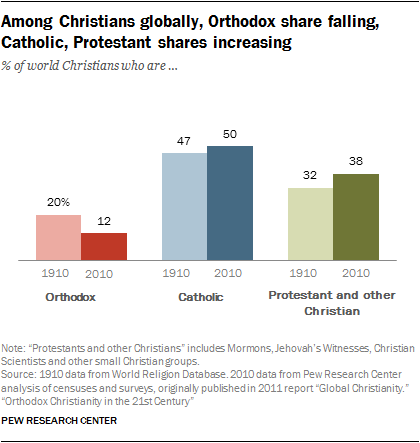
Among Christians globally, Orthodox share falling, Catholic, Protestant shares increasing

Over the last century, the Orthodox Christian population around the world has more than doubled and now stands at nearly 260 million. In Russia alone, it has surpassed 100 million, a sharp resurgence after the fall of the Soviet Union.

Yet despite these increases in absolute numbers, Orthodox Christians have been declining as a share of the overall Christian population – and the global population – due to far faster growth among Protestants, Catholics and non-Christians. Today, just 12% of Christians around the world are Orthodox, compared with an estimated 20% a century ago. And 4% of the total global population is Orthodox, compared with an estimated 7% in 1910.

The geographic distribution of Orthodoxy also differs from the other major Christian traditions in the 21st century. In 1910 – shortly before the watershed events of World War I, the Bolshevik revolution in Russia and the breakup of several European empires – all three major branches of Christianity (Orthodoxy, Catholicism and Protestantism) were predominantly concentrated in Europe. Since then, Catholics and Protestants have expanded enormously outside the continent, while Orthodoxy remains largely centered in Europe. Today, nearly four-in-five Orthodox Christians (77%) live in Europe, a relatively modest change from a century ago (91%). By contrast, only about one-quarter of Catholics (24%) and one-in-eight Protestants (12%) now live in Europe, down from an estimated 65% and 52%, respectively, in 1910.1

Orthodoxy’s falling share of the global Christian population is connected with demographic trends in Europe, which has lower overall fertility rates and an older population than developing regions of the world, such as sub-Saharan Africa, Latin America and South Asia. Europe’s population has long been shrinking as a share of the world’s total population, and, in coming decades, it is projected to decline in absolute numbers as well.

A century ago, all three major branches of Christianity were concentrated in Europe. That is still the case for Orthodox Christians, but not Protestants and Catholics % of each group living in each region, 1910 and 2010


Historically, the presence of what is now called Orthodox Christianity in the Slavic portions of Eastern Europe dates to the ninth century, when, according to church tradition, missionaries from the Byzantine Empire’s capital in Constantinople (now Istanbul, Turkey) spread the faith deeper into Europe. Orthodoxy came first to Bulgaria, Serbia and Moravia (which is now part of the Czech Republic), and then, beginning in the 10th century, to Russia. Following the Great Schism between the Eastern (Orthodox) churches and the Western (Catholic) church in 1054, Orthodox missionary activity expanded across the Russian Empire from the 1300s through the 1800s.2

While Orthodoxy spread across the Eurasian landmass, Protestant and Catholic missionaries from Western Europe went overseas, crossing the Mediterranean and the Atlantic. The Portuguese, Spanish, Dutch and British empires, among others, carried Western Christianity (Catholicism and Protestantism) to sub-Saharan Africa, East Asia and the Americas – regions that in the 20th century experienced much faster population growth than Europe. On the whole, Orthodox missionary activity outside Eurasia was less pronounced, although Orthodox churches retained footholds through the centuries in the Middle East, and Orthodox missionaries won some converts in such far-flung places as India, Japan, East Africa and North America.3

Today, the largest Orthodox Christian population outside of Eastern Europe is in Ethiopia. The centuries-old Ethiopian Orthodox Tewahedo Church has an estimated 36 million adherents, nearly 14% of the world’s total Orthodox population. This East African outpost of Orthodoxy reflects two broad trends. First, its Orthodox Christian population has grown much faster than Europe’s over the past 100 years. And, second, Orthodox Christians in Ethiopia are more religiously observant, by several common measures, than Orthodox Christians in Europe. This is in line with a broader pattern in which Europeans are, on average, less religiously committed than people in Latin America and sub-Saharan Africa, according to Pew Research Center surveys. (This is true not just of Christians in Europe but also of Europe’s Muslims, who are less religiously observant, as a whole, than Muslims elsewhere in the world.)
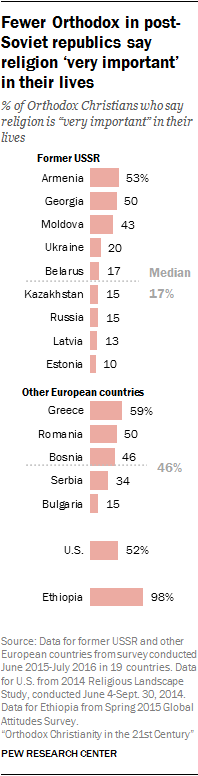
Fewer Orthodox in post-Soviet republics say religion ‘very important’ in their lives


Orthodox Christians in the former Soviet Union generally report the lowest levels of observance among those of their faith, perhaps reflecting the legacy of Soviet repression of religion. In Russia, for example, just 6% of Orthodox Christian adults say they attend church at least weekly, 15% say religion is “very important” in their lives, and 18% say they pray daily. Other former Soviet republics display similarly low levels of religious observance. Together, these countries are home to a majority of the world’s Orthodox Christians.

In sharp contrast, Orthodox Christians in Ethiopia report considerably higher religious observance, on par with other Christians (including Catholics and Protestants) across sub-Saharan Africa. Nearly all Ethiopian Orthodox Christians say religion is very important to them, while roughly three-quarters report attending church weekly or more often (78%) and about two-thirds say they pray daily (65%). (For more information on Ethiopia’s Orthodox Tewahedo Church, see this sidebar.)

Orthodox Christians living in Europe outside the former Soviet Union show somewhat higher levels of religious observance than those in the former Soviet republics, but they are still far less observant than Ethiopia’s Orthodox community. In Bosnia, for example, 46% of Orthodox Christians say religion is very important in their lives, while 10% say they attend church weekly or more often, and 28% report that they pray daily.

Orthodox Christians in the United States, who make up roughly 0.5% of the overall U.S. population and include many immigrants, display moderate levels of religious observance, lower than in Ethiopia but higher than most European countries, at least by some measures. About half (52%) of Orthodox Christian adults in the United States say religion is very important to them, roughly one-in-three (31%) report that they attend church weekly or more, and a slim majority say they pray daily (57%).

In addition to their shared history and liturgical traditions, what do these disparate communities have in common today?
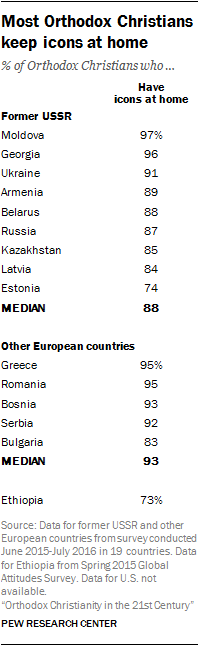
Most Orthodox Christians keep icons at home

One nearly universal practice among Orthodox Christians is the veneration of religious icons. Most Orthodox Christians around the world say they keep icons or other holy figures in their homes.

In fact, having icons is among the few indicators of religiosity on which Central and Eastern European Orthodox Christians surpass Orthodox Ethiopians in surveys. Across 14 countries in the former Soviet Union and elsewhere in Europe with large Orthodox populations, the median share of Orthodox Christians who say they have icons at home is 90%, while in Ethiopia, the share is 73%.

Orthodox Christians around the world also are linked by a married, all-male priesthood; church structures headed by numerous national patriarchs and archbishops; recognition of divorce; and moral conservatism on issues such as homosexuality and same-sex marriage.

These are among the key findings of a new Pew Research Center study of Orthodox Christianity around the world. The data in this report come from a variety of surveys and other sources. Data on the religious beliefs and practices of Orthodox Christians in nine countries across the former Soviet Union and five other countries in Europe, including Greece, are from surveys conducted by Pew Research Center in 2015-2016. In addition, the Center has recent data on many (though not all) of the same survey questions among Orthodox Christians in Ethiopia and the United States. Together, these surveys cover a total of 16 countries, collectively representing about 90% of the estimated global Orthodox population. In addition, population estimates are available for all countries based on information gathered for the 2011 Pew Research Center report “Global Christianity” and the 2015 report “The Future of World Religions: Population Growth Projections, 2010-2050.”

Wide support among Orthodox for the church’s teachings on priesthood, divorce
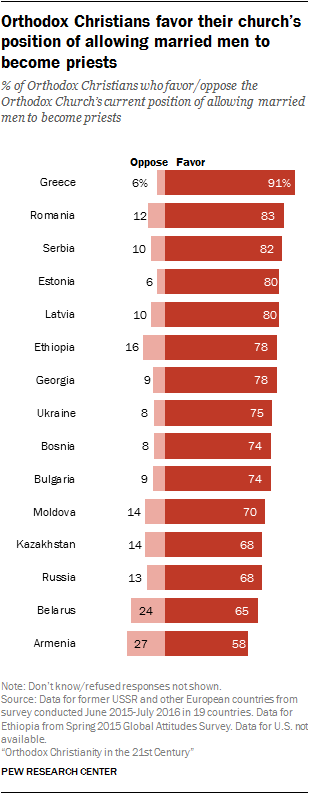
 

While they vary widely in their levels of religious observance, Orthodox Christians around the world are largely united in their affirmation of some distinctive church policies and teachings.

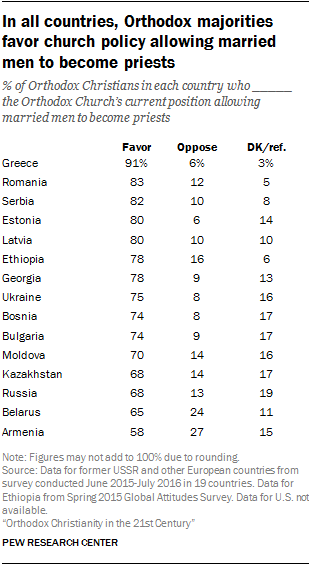
Today, majorities of Orthodox Christians in every country surveyed say they favor their church’s current practice of allowing married men to become priests, which contrasts with the Catholic Church’s general requirement of celibacy for priests. (Lay Catholics in some countries prefer allowing married priests; in the United States, for example, 62% of Catholics say the Catholic Church should allow priests to get married.)

Similarly, most Orthodox Christians also say they support the church’s stance on recognizing divorce, which also differs from Catholicism’s position.
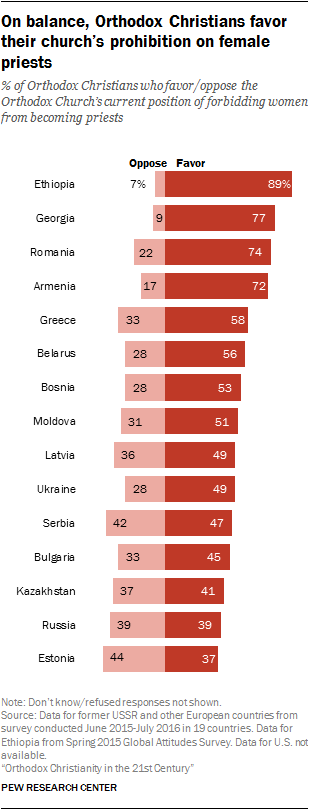
On balance, Orthodox Christians favor their church’s prohibition on female priests


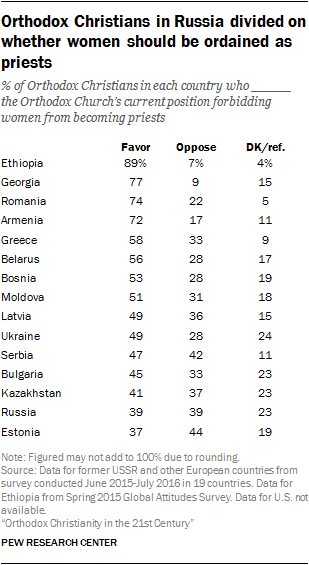
Orthodox Christians also broadly favor a number of church positions that happen to align with those of the Catholic Church, such as the prohibition on women’s ordination. In fact, there appears to be more agreement with this position within Orthodoxy than within Catholicism, where majorities in some places say women should be able to become priests. For example, in Brazil, which has the world’s largest Catholic population, most Catholics say the Catholic Church should allow female ordination (78%). Similarly, in the United States, 59% of Catholics say the Catholic Church should allow women priests.

Orthodox opinion is closely divided on the issue of female ordination in Russia and some other countries, but in no country surveyed do a majority of Orthodox Christians support ordaining women as priests. (In Russia and some other countries, roughly a fifth or more of respondents do not express an opinion on women’s ordination.)

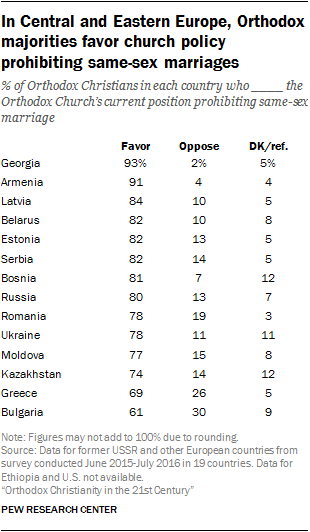
Orthodox Christians also are broadly united against the idea of the church performing same-sex marriages (see Chapter 3).
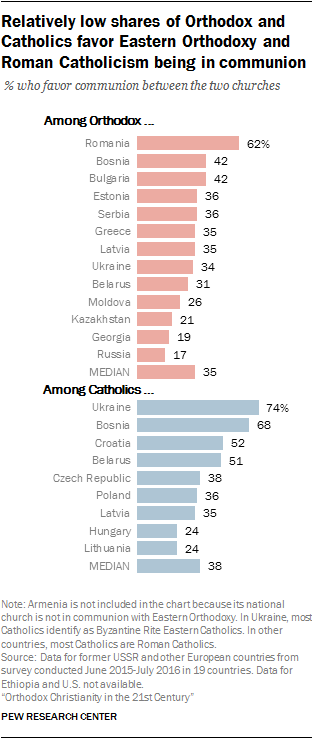
Relatively low shares of Orthodox and Catholics favor Eastern Orthodoxy and Roman Catholicism being in communion

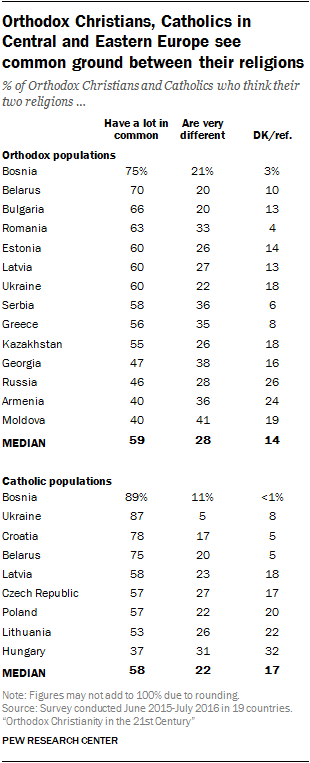
Overall, Orthodox Christians see plenty of common ground between their own faith and Catholicism. When asked if Orthodoxy and Roman Catholicism “have a lot in common” or “are very different,” most Orthodox Christians across Central and Eastern Europe respond that the two faiths have a lot in common. For their part, Catholics in the region also tend to see the two traditions as more similar than different.

But this perceived kinship only goes so far; there is limited support among Orthodox Christians for “being in communion again” with Roman Catholics. Formal schism owing to theological and political disputes has divided Eastern Orthodoxy from Roman Catholicism since the year 1054; while some clerics on both sides have tried for half a century to foster reconciliation, the view that the churches should reunite is a minority position across most of Central and Eastern Europe.4

In Russia, just one-in-six Orthodox Christians (17%) say they want Eastern Orthodoxy to be in communion with the Roman Catholic Church, the lowest level of support for reconciliation found in any of the national Orthodox populations surveyed. Only in one country, Romania, do a majority of respondents (62%) express support for reunification of the Eastern and Western churches. Across the region, many Orthodox Christians decline to answer this question, perhaps reflecting a lack of familiarity with the issue or uncertainty about what communion between the two churches would entail.

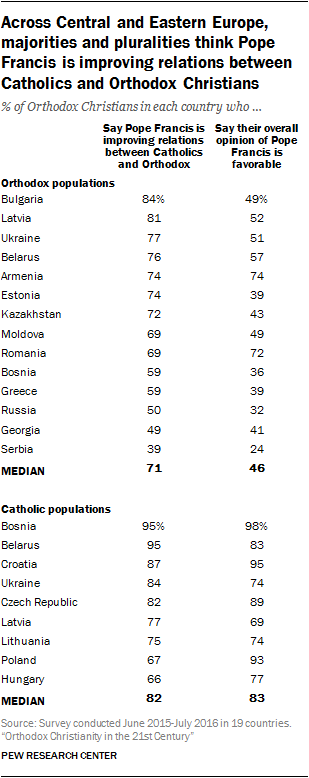
This pattern may be linked to a wariness of papal authority by Orthodox Christians. While most Orthodox Christians across Central and Eastern Europe say Pope Francis is improving relations between Catholics and Orthodox Christians, far fewer express a positive opinion of Francis overall. Views on this topic also may be bound up with geopolitical tensions between Eastern and Western Europe. Orthodox Christians in Central and Eastern Europe tend to orient themselves, both politically and religiously, toward Russia, while Catholics in the region generally look toward the West.

Overall, in Central and Eastern Europe, Orthodox support for reconciliation with Catholicism is about as high as Catholic support for it. But in countries with substantial shares of both Orthodox Christians and Catholics, Catholics tend to be more supportive of a return to communion with Eastern Orthodoxy. For example, in Bosnia, a majority of Catholics (68%) favor communion, compared with a minority (42%) of Orthodox Christians. A similar pattern is seen in Ukraine and Belarus.

Sidebar: Eastern Orthodoxy vs. Oriental Orthodoxy

Not only are there important theological and doctrinal differences among Orthodox Christians, Catholics and Protestants, but there also are differences within Orthodoxy, which conventionally is divided into two major branches: Eastern Orthodoxy, most of whose adherents live in Central and Eastern Europe, and Oriental Orthodoxy, most of whose adherents live in Africa.

One theological difference has to do with the nature of Jesus and how to articulate Jesus’s divinity – part of a theological field of study called Christology. Eastern Orthodoxy, as well as Catholicism and Protestantism, teach that Christ is one person in two natures: both fully divine and fully human, accepting the language from an early Christian gathering called the Council of Chalcedon, held in 451. But Oriental Orthodoxy, which is considered “non-Chalcedonian,” teaches that Christ’s divine and human natures are unified, not separated.5

Oriental Orthodoxy has separate self-governing jurisdictions in Ethiopia, Egypt, Eritrea, India, Armenia and Syria, and it accounts for roughly 20% of the worldwide Orthodox population. Eastern Orthodoxy is split into 15 jurisdictions heavily centered in Central and Eastern Europe, accounting for the remaining 80% of Orthodox Christians.6

Data on the beliefs, practices and attitudes of Orthodox Christians in Europe and the former Soviet Union come from surveys conducted between June 2015 and July 2016 through face-to-face interviews in 19 countries, including 14 for which samples of Orthodox Christians were large enough for analysis. Findings from these surveys were released in a major Pew Research Center report in May 2017, but additional analysis (including results from Kazakhstan, which were not included in the initial report) is included throughout this report.

Orthodox Christians in Ethiopia were polled as part of Pew Research Center’s 2015 Global Attitudes survey, as well as a 2008 survey on religious beliefs and practices of Christians and Muslims in sub-Saharan Africa; Orthodox Christians in the U.S. were surveyed as part of Pew Research Center’s 2014 U.S. Religious Landscape Study. Since the methodology and the mode of the U.S. study are different from surveys conducted in other countries, comparisons between them are made cautiously. In addition, due to differences in questionnaire content, data are not available from all countries for every question analyzed in this report.

The largest Orthodox populations that were not surveyed are in Egypt, Eritrea, India, Macedonia and Germany. Despite the lack of survey data on Orthodox Christians in these countries, they are included in the population estimates in this report.

Although Orthodox Christians comprise roughly 2% of the Middle East’s population, logistical concerns make it difficult to survey these groups. Egypt has the Middle East’s largest Orthodox population (an estimated 4 million Egyptians, or 5% of the population), mainly members of the Coptic Orthodox Church. Additional data on the demographic characteristics of Middle Eastern Orthodox Christians, including their declining shares over time, can be found in Chapter 1.

Historical population estimates for 1910 are based on Pew Research Center analysis of data from the World Christian Database, which was compiled by The Center for the Study of Global Christianity at the Gordon-Conwell Theological Seminary. The estimates from 1910 provide a vantage point on worldwide Orthodoxy at an important historical moment, preceded by an especially active period for Orthodox missionaries across the Russian Empire and shortly before war and political upheaval threw most Orthodox populations into tumult.7 By the end of the 1920s, the Russian, Ottoman, German and Austro-Hungarian empires had all ceased to exist – replaced by new, self-governing nations, as well as, in some cases, self-governing national Orthodox churches. Meanwhile, the Russian Revolution of 1917 ushered in communist governments that persecuted Christians and other religious groups for the length of the Soviet era.

This report, funded by The Pew Charitable Trusts and the John Templeton Foundation, is part of a larger effort by Pew Research Center to understand religious change and its impact on societies around the world. The Center previously has conducted religion-focused surveys across sub-Saharan Africa; the Middle East-North Africa region and many other countries with large Muslim populations; Latin America and the Caribbean; Israel; and the United States.

Other key findings in this report include:

  • Orthodox Christians in Central and Eastern Europe widely favor protecting the natural environment for future generations, even if this reduces economic growth. In part, this view may be a reflection of the environmentalist stance of Patriarch Bartholomew of Constantinople, who is considered a theological authority in Eastern Orthodoxy. But environmentalism seems to be a widespread value across the Central and Eastern European region as a whole. Indeed, a majority of Catholics in the region also say the natural environment should be protected, even if this reduces economic growth. (For more details, see Chapter 4.)
  • Most Orthodox-majority countries in Central and Eastern Europe – including Armenia, Bulgaria, Georgia, Greece, Romania, Russia, Serbia and Ukraine – have national patriarchs who are regarded as preeminent religious figures in their home countries. In all but Armenia and Greece, pluralities or majorities see the national patriarchs as the highest authority of Orthodoxy. For example, in Bulgaria, 59% of Orthodox Christians say they recognize their national patriarch as the highest authority of the church, although 8% also point to Patriarch Bartholomew of Constantinople, who is known as the ecumenical patriarch across Eastern Orthodoxy. Patriarch Kirill of Russia also is highly regarded among Orthodox Christians in the region – even outside Russian borders – a trend that is in line with Orthodox Christians’ overall affinity for Russia. (For Orthodox Christians’ views on patriarchs, see Chapter 3.)
  • U.S. Orthodox Christians are much more accepting of homosexuality than are Orthodox Christians in Central and Eastern Europe and Ethiopia. About half of U.S. Orthodox Christians (54%) said same-sex marriage should be legal in a 2014 survey, similar to the share of Americans overall who took that position in that year (53%). By comparison, the vast majority of Orthodox Christians across Central and Eastern Europe are opposed to same-sex marriage. (For Orthodox Christians’ views on social issues, see Chapter 4.)
  • Overwhelming majorities of Orthodox Christians in Central and Eastern Europe say they have been baptized, even though many came of age during Soviet times. (For more on religious practices of Orthodox Christians, see Chapter 2.)

Correction: The chart “Relatively low shares of Orthodox and Catholics favor Eastern Orthodoxy and Roman Catholicism being in communion” has been updated to correct the share of Catholics in Bosnia saying the two churches should be in communion.  

Correction: The chart “A century ago, all three major branches of Christianity were concentrated in Europe. That is still the case for Orthodox Christians, but not Protestants and Catholics” has been updated to correct the share of Orthodox living in Asia-Pacific in 2010.

The share of Orthodox living in Central and Eastern Europe has been corrected in Chapter 1.
1. Orthodox Christianity’s geographic center remains in Central and Eastern Europe

While the worldwide population of all non-Orthodox Christians has virtually quadrupled since 1910, the Orthodox population has merely doubled, from approximately 124 million to 260 million. And as the geographical center of the overall Christian population has shifted since 1910 from its centuries-old European base into developing nations in the Southern Hemisphere, most Orthodox Christians (roughly 200 million, or 76%) still live in Central and Eastern Europe (including Greece and the Balkans).

Indeed, nearly four-in-ten of the world’s Orthodox Christians live in a single country – Russia. During the Soviet era, millions of Russian Orthodox Christians moved to other parts of the Soviet Union, including Kazakhstan, Ukraine and the Baltic States, and many remain there today. Ukraine has both a substantial Russian Orthodox population and many members of its own self-governing Ukrainian Orthodox Church, with an estimated 35 million Orthodox Christians in total.

Ethiopia has a similarly large Orthodox population (36 million); its Orthodox Tewahedo Church claims lineage back to Christianity’s earliest centuries. Due to rapid population growth, Africa also has experienced a more recent increase in both the number and share of Orthodox Christians. In sub-Saharan Africa, the Orthodox population has risen more than tenfold over the last century, from an estimated 3.5 million in 1910 to 40 million in 2010. Sub-Saharan Africa, including a substantial Orthodox population in Eritrea as well as Ethiopia, now accounts for 15% of the Orthodox Christian population worldwide, up from 3% in 1910.

Meanwhile, there also are substantial populations of Orthodox Christians in the Middle East-North Africa region, mostly in Egypt (an estimated 4 million in 2010), with smaller numbers in Lebanon, Syria and Israel.

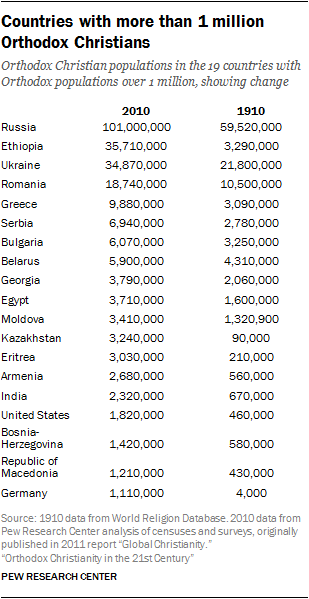
In all, 19 countries around the world have at least a million Orthodox Christians, including Romania (19 million) and Greece (10 million). Fourteen countries worldwide have Orthodox majorities, and all of them except Eritrea and Cyprus are in Europe. (In this report, Russia is classified as a European country.)

Most of the world’s 260 million Orthodox Christians live in Central and Eastern Europe

The doubling of the worldwide Orthodox Christian population to about 260 million has not kept pace with the growth rates of the global population – or of other Christian populations, which collectively have nearly quadrupled in size from 490 million in 1910 to 1.9 billion in 2010. (The total Christian population, including Orthodox, Catholics, Protestants and others, has risen from 614 million to 2.2 billion during that period.)

Central and Eastern Europe remains the main base for Orthodox Christians, and is home to more than three-quarters (76%) of them. An additional 15% live in sub-Saharan Africa, 4% live in the Asia-Pacific region, 2% live in the Middle East and North Africa, and about 1% live in Western Europe. Nearly 1% live in North America, while even fewer live in Latin America. This geographic distribution distinguishes Orthodox populations from the other major Christian groups, which are far more evenly distributed around the world.

Still, the share of Orthodox Christians living outside Central and Eastern Europe has increased somewhat, to 23% in 2010 from 9% a century ago. In 1910, only 11 million Orthodox Christians – out of a global Orthodox population of 124 million – were living outside the region. Now, there are 60 million Orthodox Christians living outside Central and Eastern Europe, out of a global Orthodox population of 260 million.

While the current share of Orthodox Christians living in Europe overall (77%) does represent a decline since 1910, when 91% of Orthodox Christians were living there, the share of the total Christian population living in Europe has decreased much more sharply, from 66% in 1910 to 26% in 2010. Indeed, nearly half (48%) of the broader Christian population now lives in Latin America and Africa, up from 14% in 1910.

One non-European part of the world that has experienced significant Orthodox population growth is sub-Saharan Africa, where the 15% share of the global Orthodox population is up from 3% in 1910. Most of the 40 million Orthodox Christians in this region live in Ethiopia (36 million) or Eritrea (3 million). At the same time, Orthodox Christians remain a small minority of sub-Saharan Africa’s Christians, most of whom are Catholics or Protestants.

Russia, Ethiopia and Ukraine have largest national Orthodox populations

Countries with more than 1 million Orthodox Christians

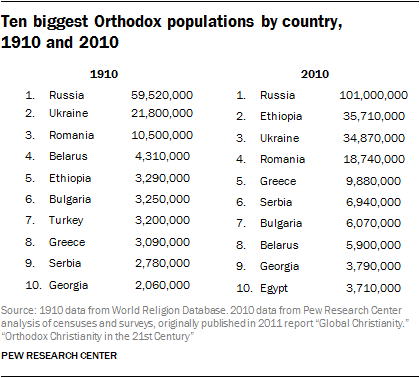
In 1910, Russia’s Orthodox population was 60 million, but the number of Russians identifying as Orthodox dropped steeply during the Soviet era (to 39 million in 1970), when the Communist government was repressing religious worship and promoting atheism.8 Since the fall of the USSR, though, the number of Orthodox Christians in Russia has rebounded sharply, to more than 100 million.9

Results from a Pew Research Center survey conducted in 2015 suggest that the end of communism played a role in the rise of religion in this part of the world; more than half (53%) of Russians who say they were raised without religion but are now Orthodox cite an increasing societal acceptance as a major reason for their shift.

The second-largest Orthodox population in the world is found in Ethiopia, where Orthodox numbers have risen tenfold since the early 20th century, from 3.3 million in 1910 to 36 million in 2010. The overall population of Ethiopia has risen nearly tenfold during that timespan, from 9 million in 1910 to 83 million in 2010.

Ukraine’s Orthodox population (35 million) is nearly as big as Ethiopia’s. In all, 19 countries have Orthodox populations of 1 million or more.

Ten biggest Orthodox populations by country, 1910 and 2010

Of the 10 countries with the largest Orthodox populations in 2010, eight are located in Central and Eastern Europe. In the two separate years for which data are available – 1910 and 2010 – the countries with the 10 largest Orthodox populations have remained mostly the same, with populations of the same nine countries ranking in the top 10 both times. Two additional countries each made the list once: Turkey in 1910 and Egypt in 2010.

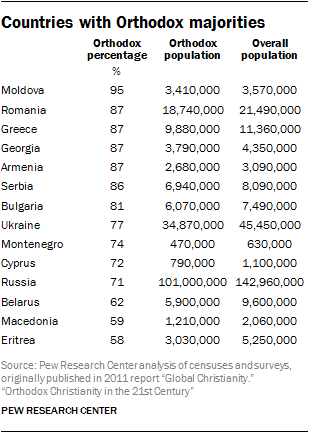
Countries with Orthodox majorities

There are 14 Orthodox-majority countries in the world, and all are located in Europe except for Eritrea, which is in sub-Saharan Africa, and Cyprus, which is categorized in the Asia-Pacific region in this report. (Ethiopia’s 36 million Orthodox Christians are not a majority; they comprise about 43% of Ethiopia’s population.)

The country with the highest percentage of Orthodox Christians is Moldova (95%). In Russia, the largest of the Orthodox-majority countries, about seven-in-ten people (71%) are Orthodox. The smallest country with an Orthodox majority is Montenegro (which has a total population of 630,000), where 74% of the population is Orthodox.10


Orthodox diasporas have developed in Americas and Western Europe

Over the last century, several sizable diaspora communities of Orthodox Christians have developed in the Americas and Western Europe, areas that, a century ago, had only small Orthodox populations.

There are seven countries in Western Europe that had fewer than 10,000 Orthodox Christians in 1910 but now have Orthodox populations over 100,000. The largest of these are Germany, which had just a few thousand Orthodox Christians in 1910 and now has 1.1 million, and Spain, which had no Orthodox community to speak of in 1910 and now has 900,000 Orthodox Christians.

In the Americas, there are three countries with over 100,000 Orthodox Christians that had fewer than 20,000 a century ago: Canada, Mexico and Brazil. The United States, which has 1.8 million Orthodox Christians, already had 460,000 in 1910.

Orthodoxy in the United States

The presence of Orthodox Christians within the present boundaries of the United States dates to 1794, when a small group of Russian missionaries arrived in Kodiak, Alaska, to proselytize its inhabitants. This missionary work continued during the 1800s, but the bulk of Orthodoxy’s growth in the United States owes to late 19th- and early 20th-century immigration from countries across Central and Eastern Europe.11 By 1910 nearly half a million Orthodox Christians lived in the United States, and in 2010 the figure was approximately 1.8 million – about half of 1% of the U.S. population.

The Orthodox presence in the U.S. is a fragmented one. The population’s splintered state across more than 21 denominations reflects varied ethnic ties to countries around the world with their own self-governing Orthodox patriarchates.12 Nearly half (49%) of U.S. Orthodox Christians identify as Greek Orthodox, 16% as Russian Orthodox, 3% as Armenian Orthodox, 3% as Ethiopian Orthodox and 2% as Coptic/Egyptian Orthodox. In addition, 10% identify with the Orthodox Church in America, a self-governing denomination based in the United States that, despite its Russian and Greek roots, has many parishes that are predominantly Albanian, Bulgarian and Romanian. Another 8% of Orthodox Christians in the U.S. say they are Orthodox without specifying further (6%) or are ambiguous about their affiliation (2%).13

In all, nearly two-thirds (64%) of U.S. Orthodox Christians are either immigrants (40%) or the children of immigrants (23%), the highest such share of any Christian denomination in the United States.14 Other than the U.S., some of the most common birthplaces for U.S. Orthodox Christians are Russia (5% of the total U.S. Orthodox population), Ethiopia (4%), Romania (4%) and Greece (3%).

By common measures of religiosity, Orthodox Christians in the United States are somewhat less likely than most other American Christian groups to say religion is very important in their lives (52%) and to say they attend church at least once a week (31%). By comparison, 68% of U.S. Christians overall say religion is very important to them and 47% say they are weekly churchgoers.

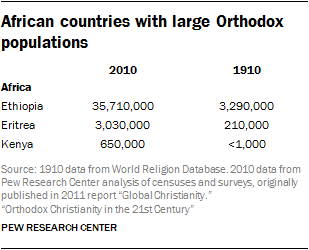
African countries with large Orthodox populations

It is Africa, though, that has seen the largest Orthodox population growth outside of Central and Eastern Europe. Ethiopia, where the Orthodox population has increased over the last century from 3 million to 36 million, is not part of an Orthodox diaspora; its Orthodox history dates to the fourth century of Christianity, more than half a millennium before Christianity developed a substantial following in Russia. The growth in Ethiopia’s Orthodox population over the last century, as well as in neighboring Eritrea, owes largely to natural population growth in the countries. Orthodox Christianity in Kenya, on the other hand, developed during the early to mid-20th century through the assistance of missionaries and became affiliated with the Eastern Orthodox Patriarchate of Alexandria and All Africa in the 1960s.15

2. Orthodox Christians are highly religious in Ethiopia, much less so in former Soviet Union

Orthodox Christians around the world display widely varying levels of religious observance. For example, while just 6% of Orthodox Christians in Russia say they attend church on a weekly basis, a large majority of Orthodox Christians in Ethiopia (78%) say they do this.

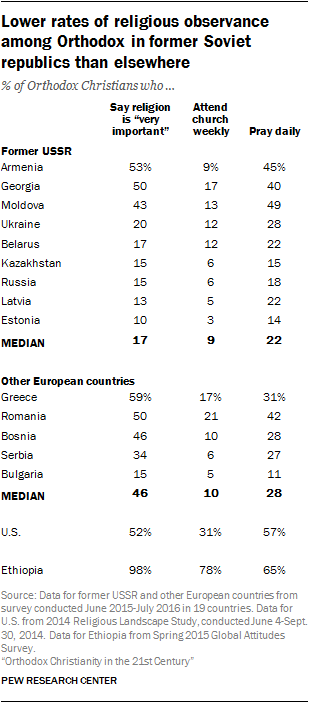
Indeed, by several standard measures of religious observance, Orthodox Christians living in countries that were part of the erstwhile USSR are less religiously observant than those living elsewhere. A median of 17% of Orthodox adults across the countries surveyed that were part of the former Soviet Union say religion is “very important” in their lives, compared with 46% in other surveyed countries in Europe (Greece, Bosnia, Bulgaria, Romania and Serbia), 52% in the U.S. and 98% in Ethiopia.

Lower religious observance among Orthodox Christians living in former Soviet countries may be connected to the suppression of religion under the Communist regime. But religion is far from irrelevant in the former Soviet republics surveyed: While few Orthodox Christians in this part of the world frequently attend church, majorities say they believe in God, and at least half in most countries believe in heaven, hell and miracles. And Orthodox Christians in these former Soviet republics are just as likely, if not more so, than Orthodox Christians elsewhere to say they believe in fate and the existence of a soul.

Many Orthodox Christians living in the former USSR also express religious or spiritual beliefs that are not traditionally associated with Christian teachings. For example, at least half of Orthodox Christians in most former Soviet Republics say they believe in the “evil eye” (i.e., that certain people can cast curses or spells that cause bad things to happen to someone). Fewer Orthodox Christians in Ethiopia (35%) hold this belief, even though belief in the evil eye is considerably higher elsewhere in sub-Saharan Africa.

A near-universal proportion of Ethiopian Orthodox Christians say religion is ‘very important’ in their lives

Lower rates of religious observance among Orthodox in former Soviet republics than elsewhere

Ethiopian Orthodox Christians are considerably more religiously observant than Orthodox Christians living in Europe and those living in the United States. The majority of Orthodox Christians in Ethiopia say they attend church weekly (78%) and pray daily (65%), and nearly all (98%) say religion is “very important” in their lives.

Levels of religious observance are especially low among Orthodox Christians in the former Soviet republics surveyed, where the shares saying they attend church weekly range from 3% in Estonia to 17% in Georgia. Similarly, in five other European countries surveyed with significant Orthodox populations, fewer than a quarter of Orthodox Christians in each country surveyed say they are weekly churchgoers, although people in these countries  are, on average, far more likely than those in the former USSR to say religion is “very important” in their lives.

Among those surveyed, American Orthodox Christians show moderate levels of religious observance. A slim majority say they pray daily (57%), while about half say religion is very important to them personally (52%). Roughly one-in-three (31%) Orthodox Christians in the U.S. say they attend church weekly – a higher level than in any European country surveyed, but much lower than the attendance rate among Orthodox Christians in Ethiopia.

Orthodoxy in Ethiopia

Ethiopia has the world’s second-largest Orthodox population – approximately 36 million people — and a Christian history that dates to the fourth century. Church historians say that during the early 300s, a Christian traveler from Tyre (located within the present boundaries of Lebanon) named Frumentius was taken captive in the Kingdom of Aksum, located in northern Ethiopia and Eritrea. After his release, he helped spread Christianity in the region and was later named the first Bishop of Aksum by the Patriarch of Alexandria (located in Egypt). Today’s Orthodox community in Ethiopia traces its religious roots to Frumentius’ period. 16

Survey results indicate that Orthodox Ethiopians, who now constitute 14% of the global Orthodox population, are much more religiously observant than are Orthodox Christians in Central and Eastern Europe and the United States. For example, 78% of Orthodox Ethiopians say they attend church at least weekly, compared with a median of 10% of Orthodox Christians in the European countries surveyed and 31% of Orthodox Christians in the United States. And 98% of Orthodox Ethiopians say religion is “very important” to them, compared with 52% in the United States and a median of 28% of Orthodox Christians in Europe who say this.

The Orthodox Church in Ethiopia is part of the “Oriental” branch of the tradition, in communion with five other Oriental Orthodox churches (Egypt, India, Armenia, Syria and Eritrea). One distinguishing factor of Ethiopian Orthodoxy is its usage of practices rooted in Judaism. For example, Orthodox Ethiopians observe the Jewish Sabbath, circumcise their sons at eight days old, and follow Jewish dietary laws. In addition, a text celebrated by Orthodox Ethiopians draws an historical connection to King Solomon of Israel, who is believed to have fathered a son with Queen Makeda of Ethiopia (the Queen of Sheba). This son, Menelik I, became an emperor of Ethiopia about 3,000 years ago and is said to have taken the Ark of the Covenant from Jerusalem to Ethiopia, where many Orthodox Ethiopians believe it still resides.17

Majority of U.S. Orthodox Christians are absolutely certain of their belief in God

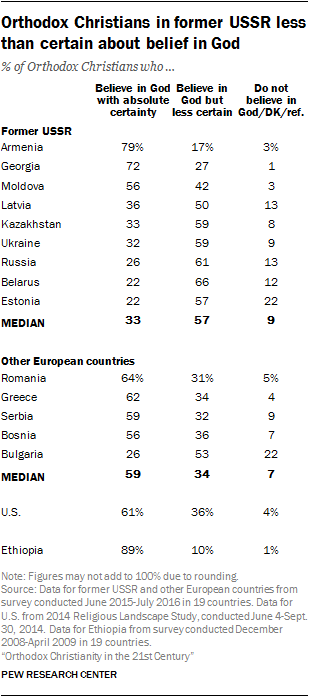
Orthodox Christians in former USSR less than certain about belief in God

The vast majority of Orthodox Christians around the world believe in God, but many are less than certain about this belief.

Overall, Orthodox Christians living in former Soviet republics are considerably less likely than those living in other countries surveyed to say they are absolutely certain about their belief in God. Majorities say this in Armenia (79%), Georgia (72%) and Moldova (56%), but fewer Orthodox Christians express this certainty elsewhere, including just 26% in Russia.

Meanwhile, majorities of Orthodox Christians in Ethiopia, the U.S., Romania, Greece, Serbia and Bosnia say they are absolutely certain that God exists. Ethiopian Orthodox Christians are more likely than others surveyed to say they believe in God with absolute certainty: Nearly nine-in-ten (89%) say this.

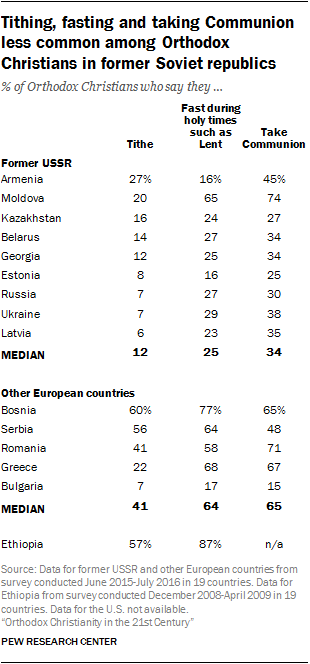
Most Ethiopian Orthodox Christians say they tithe, fast during Lent

Tithing, fasting and taking Communion less common among Orthodox Christians in former Soviet republics

Tithing, receiving Communion and fasting during holy periods such as Lent are common practices among Orthodox Christians in countries outside the former USSR. Although fasting during Lent is less common in Bulgaria, majorities in Bosnia (77%), Greece (68%), Serbia (64%) and Romania (58%) say they fast during Lent, as do 87% of Ethiopian Orthodox Christians. By comparison, in the former Soviet republics surveyed, only in Moldova do a majority (65%) of Orthodox Christians report that they fast during Lent.

In no former Soviet country do a majority of Orthodox Christians report tithing – that is, giving a set percentage of their income to charity or to the church. Tithing is a more common practice among Orthodox Christians in Bosnia (60%), Ethiopia (57%) and Serbia (56%). Once again, Bulgaria stands out on the low end; only 7% of Orthodox Christians there say they tithe.

Nearly all Orthodox Christians in Europe have been baptized

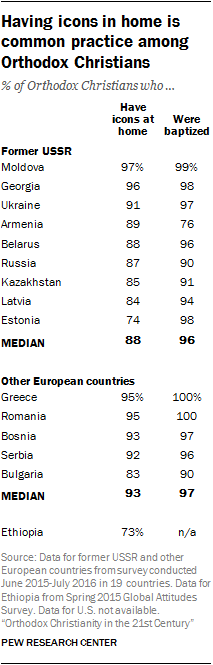
Having icons in home is common practice among Orthodox Christians

Two religious practices that are very common among Orthodox Christians regardless of where they live are baptism and keeping religious icons in their home. The vast majority of Orthodox Christians in the countries surveyed say they have icons of holy figures, including nine-in-ten or more in Greece (95%), Romania (95%), Bosnia (93%) and Serbia (92%). And despite their low levels of overall religious observance, majorities of Orthodox Christians living in all former Soviet republics surveyed say they have icons in their homes.

Even though religious practices were largely suppressed during the Soviet era, the vast majority of Orthodox Christians living in the former USSR say they were baptized. Baptism is nearly universal among Orthodox Christians in Greece, Romania and a few other European countries.

Large majority of Orthodox Christians in Europe say they light candles in churches

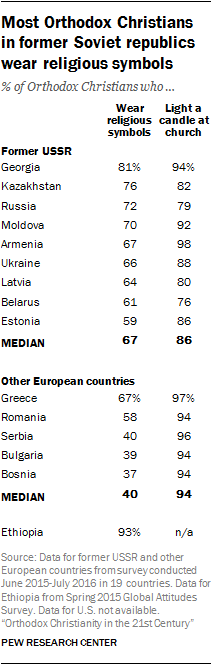
Most Orthodox Christians in former Soviet republics wear religious symbols

The vast majority of Orthodox Christians in every European country surveyed say they light a candle when they visit a church, and, in most countries, majorities say they wear religious symbols.

Wearing religious symbols (for example, a cross) is more widespread in countries of the former Soviet Union than elsewhere. In every country surveyed in the former Soviet Union, most Orthodox Christians say they wear religious symbols. By comparison, in European countries that were not part of the Soviet Union, majorities in Greece (67%) and Romania (58%) say they wear religious symbols, but the practice is less common in Serbia (40%), Bulgaria (39%) and Bosnia (37%).


Belief in heaven, hell, miracles common among Orthodox

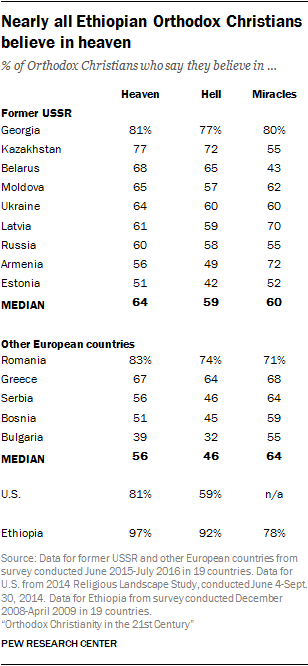
Most Orthodox Christians around the world say they believe in heaven, hell and miracles. While these beliefs are especially widespread in Ethiopia, even in the countries of the former Soviet Union, beliefs in heaven, hell or miracles are common.

Overall, Orthodox Christians in the former Soviet republics surveyed are slightly more likely than those in other European countries to say they believe in heaven, and considerably more likely to say they believe in hell.

And in the U.S., majorities of Orthodox Christians say they believe in heaven and in hell, although there is a particularly large gap between the share who say they believe in heaven and those who say they believe in hell (81% and 59%, respectively).

Nearly all Ethiopian Orthodox Christians believe in heaven

Widespread belief in fate and the soul among Orthodox Christians

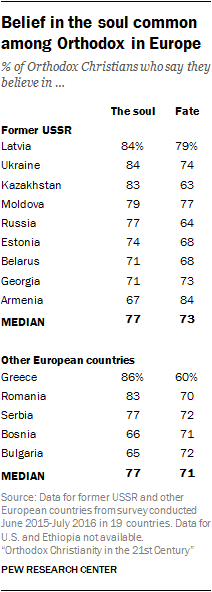
Belief in the soul common among Orthodox in Europe

Among the countries surveyed, majorities of Orthodox Christians say they believe in fate – that is, that circumstances in one’s life are largely predetermined.

Similarly, across Europe, majorities of Orthodox Christians say they believe in the existence of the soul. Orthodox Christians in former Soviet republics are just as likely as those living in other European countries to believe souls exist.

Many Orthodox Christians believe in evil eye, magic

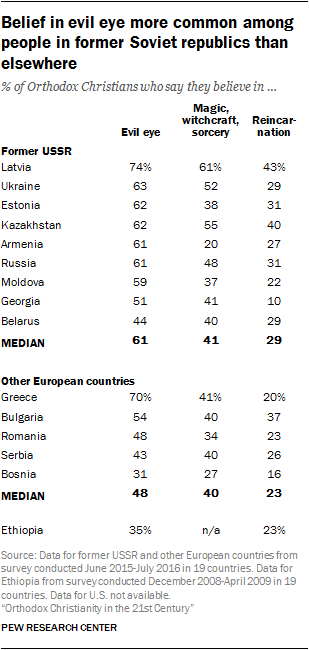
The survey in Central and Eastern Europe, and the survey in Ethiopia included a few questions about religious or spiritual beliefs that are not directly associated with Christianity, and the results show that many Orthodox Christians adhere to these beliefs. Majorities in about half the countries surveyed say they believe in the “evil eye” (i.e., that certain people can cast curses or spells that cause bad things to happen to someone), and more than a third in most countries say they believe in magic, witchcraft or sorcery.

Fewer Orthodox Christians believe in reincarnation, a concept more associated with Hinduism, Buddhism and other Eastern religions. Still, in most countries, at least one-in-five Orthodox Christians say they believe in reincarnation.

Belief in the evil eye is especially common among Orthodox Christians living in the former USSR. Across these countries, a median of 61% say they believe in it. In other European countries surveyed, belief in the evil eye is relatively high in Greece (70%), but lower elsewhere.

In Ethiopia, just about a third (35%) of Orthodox Christians say they believe in the evil eye – a lower level than among Orthodox Christians in Europe and among Christians elsewhere in Africa.

Belief in evil eye more common among people in former Soviet republics than elsewhere

Minorities of Orthodox Christians in Europe say theirs is the one true faith

Majority of Orthodox Christians in Ethiopia take exclusivist views of religion

Most Orthodox Christians in Ethiopia say theirs is the one true faith leading to eternal life in heaven, and that only a single way exists to correctly interpret their religion’s teachings. But among Orthodox Christians elsewhere, these views of religion are less common.

Generally, Orthodox Christians in the former Soviet republics surveyed are somewhat less likely than other Orthodox Europeans to hold exclusivist views. In most of these countries, well under half say that only their religion leads to eternal life in heaven, or that there is only one correct way to understand their religion. By comparison, in Romania, nearly half take these views (47% each).

3. Orthodox Christians support key church policies, are lukewarm toward reconciling with Roman Catholic Church

A host of disputes – ranging from theological to political – have divided Orthodoxy from Catholicism for nearly 1,000 years. But while some leaders on both sides have tried to resolve them, fewer than four-in-ten Orthodox Christians in the vast majority of countries surveyed say they favor their church reconciling with the Roman Catholic Church.

At the same time, Orthodox majorities in most countries say their religion and Catholicism have a lot in common, and Orthodox majorities across most of Central and Eastern Europe say Pope Francis has helped improve Orthodox-Catholic relations. Regarding Pope Francis in general, however, Orthodox opinion is mixed; half or fewer of Orthodox respondents in most countries surveyed say they view him favorably, including just 32% in Russia.

On two of the issues where Eastern Orthodox and Roman Catholic teachings diverge – whether to allow married clergy and whether to permit divorce – most Orthodox Christians favor their official church stances permitting divorce and allowing married men to be ordained as priests. Orthodox Christians also tend to support their church’s stances barring same-sex marriage and prohibiting the ordination of women as priests, issues on which their church aligns with Catholic positions. On balance, Orthodox women are as likely as men to oppose the ordination of women to the priesthood.

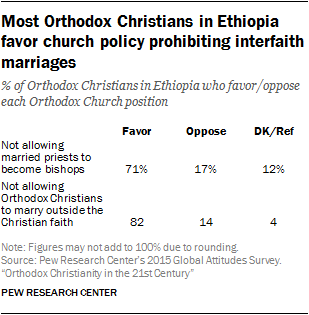
Orthodox Christians in Ethiopia were asked two additional questions. The results show that most respondents favor church policies that prevent married men from becoming bishops and forbid the Orthodox Church from marrying couples unless both spouses are Christian.

Orthodox Christians ambivalent about communion with Roman Catholic Church

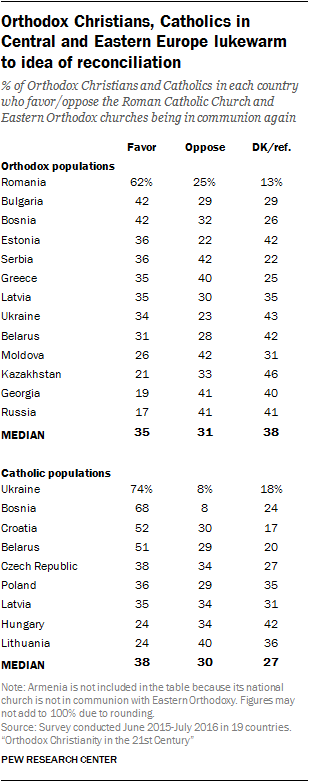
Orthodox Christians, Catholics in Central and Eastern Europe lukewarm to idea of reconciliation

Neither Orthodox Christians nor Catholics widely favor communion between their two churches, which have been in an official state of schism since the year 1054. In 12 of the 13 Central and Eastern European countries surveyed with sizable Eastern Orthodox populations, fewer than half of Orthodox Christians say they favor the Eastern Orthodox and Roman Catholic churches being in communion again. Only in Romania do a majority (62%) of Orthodox Christians support reunification, and only in Ukraine (74%) and Bosnia (68%) do most Catholics take this position. In many of these countries, about a third or more of Orthodox and Catholic respondents say they don’t know or can’t answer the question, perhaps reflecting a lack of understanding of the historical split.

In Russia, which has the largest Orthodox population in the world, just 17% of Orthodox Christians support communion with Catholicism.

Overall, Orthodox Christians and Catholics in Central and Eastern Europe offer similar responses to this question. But in the countries surveyed with sizable Eastern Orthodox and Roman Catholic populations, Orthodox Christians are often much less likely than their Catholic compatriots to support communion between the two churches. For example, in Bosnia, 42% of Orthodox Christians favor communion, compared with 68% of Catholics. Significant gaps also exist in Ukraine (34% of Orthodox vs. 74% of Catholics) and Belarus (31% vs. 51%).

Orthodox, Catholics about equally likely to view their religions as similar

Orthodox Christians, Catholics in Central and Eastern Europe see common ground between their religions

While relatively few favor a hypothetical communion between their churches, Orthodox Christians and Catholics generally say their religions have a lot in common. Majorities in 10 of the 14 Orthodox populations surveyed say this, as do majorities in seven of the nine Catholic populations.

Proximity to people of the other faith often seems to be a factor; respondents from these two traditions are especially likely to say their denominations have a lot in common if they live in countries with sizable populations of both. In Bosnia, for example, 75% of Orthodox Christians and 89% of Catholics say their religions have a lot in common. In Belarus, 70% of Orthodox Christians say this, as do 75% of Catholics.

Ukrainian Catholics are among the most likely in the region to say Catholicism has a lot in common with Orthodox Christianity. In part, this may be because most Ukrainian Catholics identify as Byzantine Rite Catholics and not Roman Catholics.

Many Orthodox say Pope Francis is helping Catholic-Orthodox relations, but fewer view him favorably

Across Central and Eastern Europe, majorities and pluralities think Pope Francis is improving relations between Catholics and Orthodox Christians

In 1965, Patriarch Athenagoras of Constantinople and Pope Paul VI agreed to rescind the mutual excommunications issued by their churches 911 years prior, in 1054. And today, majorities of Orthodox Christians in most countries surveyed say they believe Pope Francis – who has issued joint declarations with both Patriarch Bartholomew of Constantinople and Patriarch Kirill of Moscow – has been improving relations between Catholicism and Orthodoxy.

More than two-thirds of Orthodox Christians in Bulgaria, Ukraine and several other countries say Pope Francis has been improving relations. In Russia, however, only half take this view.

Much lower Orthodox shares report positive opinions of Pope Francis in general. Across the region, a median of just under half (46%) of Orthodox Christians view Francis favorably, including about a third (32%) in Russia. That is not to say that all others view him unfavorably; a median of just 9% of Orthodox Christians across these countries take this position, while a median of 45% say they have not formed an opinion or otherwise decline to answer.

Catholics, meanwhile, are largely united in their approval of the pope. Majorities of all nine Catholic populations surveyed also say Pope Francis has been improving their church’s relationship with Orthodoxy.

Orthodox more likely to view Moscow patriarch as highest religious authority than ecumenical patriarch of Constantinople

Stronger support for patrairch of Moscow than patriarch of Constantinople in Central and Eastern Europe

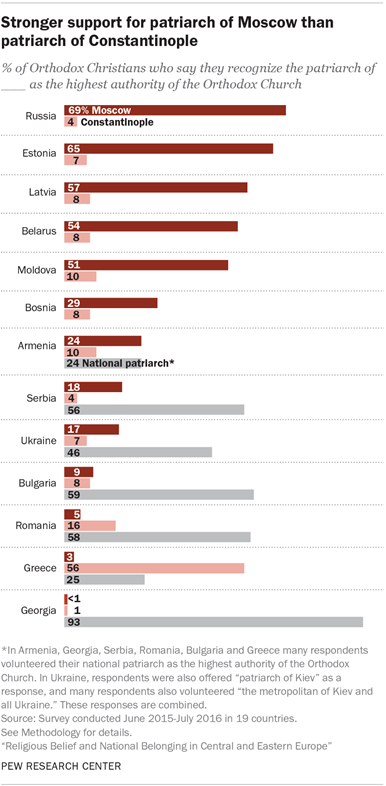
Orthodox Christians are more likely to invest religious authority in the patriarch of Moscow than in the ecumenical patriarch of Constantinople, even though the latter is traditionally known as the “first among equals” among Eastern Orthodox leaders.18

In every Orthodox-majority country surveyed that lacks a self-governing national Orthodox church, Orthodox Christians are much more likely to say they recognize the patriarch of Moscow (currently Kirill) as the highest authority in Orthodoxy than to say this about the patriarch of Constantinople (currently Bartholomew).

In the countries surveyed that do have a self-governing national Orthodox church, Orthodox respondents are generally more likely to view their own national Orthodox patriarch as the highest authority within Orthodoxy. At the same time, others in some of these countries are more likely to say they view the Moscow patriarch this way (rather than the ecumenical patriarch of Constantinople). Greece is an exception; a majority of Orthodox Greeks view the ecumenical patriarch as the highest Orthodox authority.

Russia, the largest Orthodox country

In 1988, the Soviet Union marked the 1,000th anniversary of the historical event known for bringing what is now known as Orthodox Christianity to Russia and its environs – a mass baptism believed to have occurred in 988 in the Dnieper River in Kiev, which was overseen by Vladimir the Great, ruler of the region then known as Kievan Rus and himself a convert to Orthodoxy.19

Back then, Constantinople was the center of the Orthodox world. But in 1453, the Muslim-led Ottoman Empire conquered the city, and, in the ensuing centuries, Russia’s leaders would come to view themselves as inheritors of the mantle of Orthodox leadership. Moscow, in the words of some observers, had become the “Third Rome,” or leader of the Christian world, following Rome itself and then Constantinople, which was called the “second Rome.”20

Russia’s leadership role in the Orthodox world changed during the Communist era, when Soviet authorities worked to enact atheism across the USSR, putting religious institutions in the country on the defensive. From 1910 to 1970, the Orthodox population in Russia fell by a third, from 60 million to 39 million. Soviet Premier Nikita Khrushchev even envisioned a day when just a single Orthodox priest would remain in the country.21 But since the end of the Soviet era, Russia’s Orthodox population has rebounded, more than doubling to 101 million. Now, roughly seven-in-ten Russians (71%) identify as Orthodox, up from 37% in 1991.22

Even in 1970, Russia’s Orthodox population was the world’s largest, and now it is almost three times bigger than the next-largest national Orthodox populations, Ethiopia’s (36 million) and Ukraine’s (35 million). One indicator of religious influence from Russia is that while the patriarch of Constantinople commands the title of “first among equals” among Orthodox religious leaders, more Orthodox Christians in Central and Eastern Europe view the patriarch of Moscow as the highest Orthodox authority, even outside of Russia. (See survey results here.)

At the same time, Orthodox Christians in Russia rank among the least religious in Central and Eastern Europe by several measures. For example, just 6% of Orthodox Christians in Russia say they attend church weekly, 15% say religion is “very important” to them, 18% report praying daily and 26% believe in God with absolute certainty.

Wide support among Orthodox Christians for church position that allows divorce

In most countries, Orthodox majorities support church policy allowing Orthodox Christians to divorce

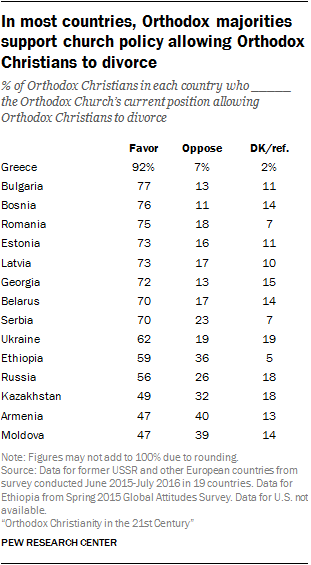
Orthodoxy and Roman Catholicism have different positions on some controversial issues. For example, Orthodoxy typically allows divorce and remarriage, while Catholicism forbids it.23 And while Orthodoxy allows married men to become priests, the Catholic Church generally does not.24

Most Orthodox Christians support their church’s positions on these issues. Indeed, majorities of Orthodox Christians in 12 of the 15 countries surveyed say they support the church position allowing Orthodox Christians to divorce. This position is most common in Greece, where about nine-in-ten Orthodox Christians (92%) support it.

Majorities of Orthodox support church position letting married men be priests

In all countries, Orthodox majorities favor church policy allowing married men to become priests

Orthodox majorities in every country surveyed with a substantial Orthodox population say they approve of their church’s policy on permitting married men to become priests. This position – which runs counter to a general Catholic prohibition of married priests – is again most accepted in Greece, where 91% of Orthodox respondents support it. This view is least widespread in Armenia, though even there it is still supported by a majority (58%) of Orthodox Christians.25

Ethiopian Orthodox Christians also generally agree that married men should be allowed to become priests; 78% favor the policy permitting it.

In most countries, Orthodox majorities or pluralities support church policy on women not becoming priests

Orthodox Christians in Russia divided on whether women should be ordained as priests

While some Orthodox jurisdictions allow women to be ordained to the position of deaconess – which entails a variety of official church duties – and others are considering allowing this, Orthodoxy is aligned with Catholicism in forbidding women’s ordination as priests.26

Orthodox majorities or pluralities in many countries support this prohibition, including as many as 89% in Ethiopia and 77% in Georgia. But in a few places, Orthodox Christians are divided. This includes Russia, where 39% favor the current policy and an equal share oppose it, instead saying that women should be ordained as priests. Nearly a quarter of Orthodox Christians in Russia do not take a position on this issue.

On balance, Orthodox women support this prohibition as often as men do. In Ethiopia, for example, 89% of women and men alike favor it, while in Romania it is favored by 74% of both men and women. In Ukraine, 49% of both men and women say women should not be ordained as priests.

Orthodox ban on same-sex marriage has overwhelming support

In Central and Eastern Europe, Orthodox majorities favor church policy prohibiting same-sex marriages

The Orthodox Church, like the Roman Catholic Church, does not sanction same-sex marriages. This prohibition is supported by roughly six-in-ten or more Orthodox Christians in every Central and Eastern European country surveyed, including Georgia (93%), Armenia (91%) and Latvia (84%). In Russia, 80% of Orthodox Christians support it.

In most countries surveyed, younger adults favor this policy as much as older people do. A major exception is in Greece, where roughly half (52%) of those ages 18 to 29 support the policy, compared with 78% of those ages 50 and over.

While in some parts of the world, levels of religiosity are strongly tied to views on same-sex marriage, this does not seem to be a major factor among Orthodox Christians. With few exceptions, people who say religion is very important to them are about equally likely to support these church positions as are people who say religion is less important in their lives.

(For more on Orthodox views toward homosexuality and other social issues, see Chapter 4.)

Orthodox Christians in Ethiopia oppose married priests becoming bishops

Most Orthodox Christians in Ethiopia favor church policy prohibiting interfaith marriages

In Ethiopia, which has the second-largest Orthodox population in the world, Pew Research Center asked two additional questions about specific church policies relating to marriage. Majorities here, too, overwhelmingly agree with these positions.

About seven-in-ten Orthodox Ethiopians (71%) agree with the church position that bars married priests from becoming bishops. (In Orthodoxy, men who are already married are allowed to be ordained as Orthodox priests, but they are not allowed to become bishops.)

An even larger majority (82%) of Orthodox Ethiopians favor Orthodoxy’s prohibition on letting couples marry in an Orthodox church unless both spouses are Christians.

4. Orthodox take socially conservative views on gender issues, homosexuality

On environmentalism and homosexuality, Orthodox Christians are largely united in their views. Most Eastern Orthodox Christians – whose spiritual leader, Ecumenical Patriarch Bartholomew, has been called the “Green Patriarch” – favor environmental protection, even at the expense of economic growth. And the vast majority of Orthodox Christians say homosexuality should be discouraged by society, though those in Greece and the U.S. are exceptions to this broad pattern.

On other issues, Orthodox Christians are divided. When it comes to whether abortion should be legal, for instance, there are mixed views in many countries surveyed, with those in former Soviet republics expressing more opposition to legal abortion than those elsewhere.

Orthodox Christians in Ethiopia are especially conservative on social issues. In answers to a series of questions on the morality of specific behaviors, Ethiopian Orthodox Christians are more likely than Orthodox Christians in most other countries surveyed to express moral opposition to abortion, divorce and drinking alcohol.

This chapter explores Orthodox Christians’ views on a range of social and political issues, including human evolution and gender roles and norms. While not all questions asked of Orthodox Christians in Central and Eastern Europe (where the vast majority of Orthodox Christians live) were also asked of their co-religionists in the U.S. and Ethiopia, the chapter includes cross-regional comparisons whenever possible.

Orthodox Christians largely reject homosexuality and oppose same-sex marriage

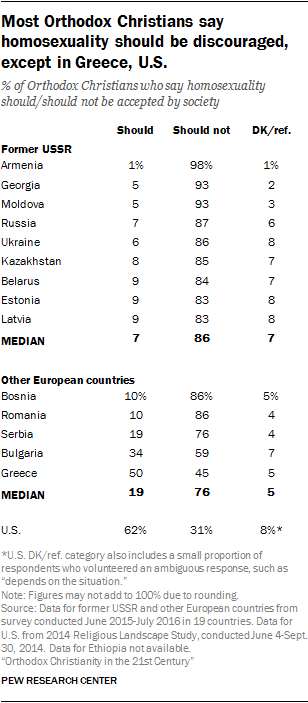
Most Orthodox Christians say homosexuality should be discouraged, except in Greece, U.S.

The vast majority of Orthodox Christians across Eastern Europe say homosexuality should not be accepted by society. This includes virtually all in Armenia (98%), and more than eight-in-ten in Russia (87%) and Ukraine (86%), which have the region’s largest Orthodox populations. Overall, Orthodox Christians in former Soviet republics are less accepting of homosexuality than are those elsewhere in Eastern Europe.

Two exceptions to Orthodox Christians’ overall rejection of homosexuality are in Greece and the United States. Fully half of Orthodox Christians in Greece say society should accept homosexuality, as do a clear majority (62%) of Orthodox Christians in the United States.

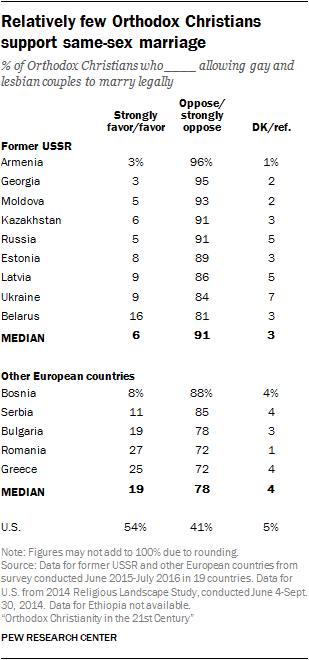
Relatively few Orthodox Christians support same-sex marriage

Similarly, very few Orthodox Christians in Eastern Europe say same-sex marriage should be legal. Even in Greece, where half of Orthodox Christians say society should accept homosexuality, only a quarter (25%) say gay and lesbian couples should be able to marry legally.

Same-sex marriage is not currently legal in any Eastern European country (although Greece and Estonia allow same-sex domestic partnerships or civil unions), and no Orthodox church sanctions same-sex weddings.

The United States, however, allows same-sex marriage nationwide. There, Orthodox Christians are more accepting of the practice; more than half (54% as of 2014) favor allowing gay and lesbian couples to marry legally, almost mirroring the share of American adults overall who took this position in 2014 (53%).

Mixed views among Orthodox Christians over abortion as a legal issue

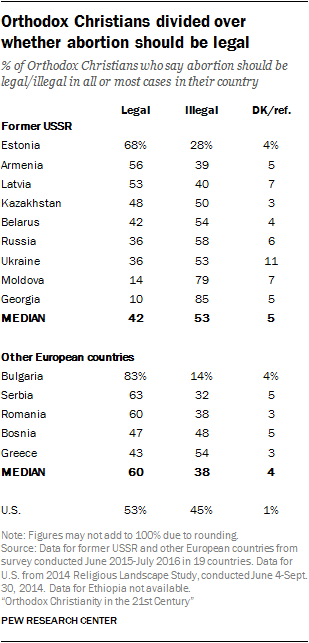
Orthodox Christians divided over whether abortion should be legal

Compared with homosexuality, there is less of a consensus among Orthodox Christians about whether abortion should be legal. In some countries, such as Bulgaria and Estonia, solid majorities of Orthodox Christians say abortion should be legal in all or most cases. But in Georgia and Moldova, majorities of Orthodox Christians take the opposite position: that abortion should be illegal in all or most cases. In Russia, too, most Orthodox Christians (58%) say abortion should be mostly or entirely illegal.

Abortion is currently legal in many situations in Russia, across most of Eastern Europe and in the United States.

As is true for homosexuality and same-sex marriage, Orthodox Christians in former Soviet republics are somewhat more conservative on the legality of abortion than are other Orthodox Christians in Eastern Europe. A median of 42% of Orthodox Christians in the nine post-Soviet states surveyed say abortion should be legal in all or most cases, compared with a median of 60% in the five other European countries surveyed.

Orthodox Christians see homosexual behavior, prostitution as morally wrong

While more recent surveys did not ask Orthodox Ethiopians about homosexuality, same-sex marriage or abortion, a 2008 Pew Research Center survey did ask this group about the morality of “homosexual behavior,” of “having an abortion,” and other behaviors. (It is possible opinions could have shifted since this survey was conducted.)

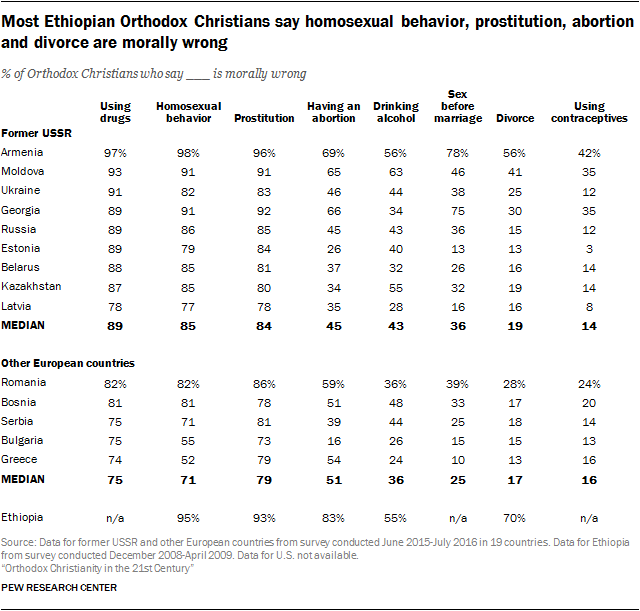
Most Ethiopian Orthodox Christians say homosexual behavior, prostitution, abortion and divorce are morally wrong


In 2008, nearly all Orthodox Christians in Ethiopia (95%) said “homosexual behavior” is morally wrong, while the vast majority (83%) also said this about having an abortion. Orthodox Christians in Ethiopia also tended to see prostitution (93%), divorce (70%) and drinking alcohol (55%) as morally wrong.

Orthodox Christians in Ethiopia are more likely than those in most Eastern European countries to raise moral objections to several of these behaviors, although Orthodox Christians in Eastern Europe – both in former Soviet republics and elsewhere – also widely see homosexual behavior and prostitution as morally wrong. U.S. Orthodox Christians were not asked about the morality of these behaviors.

Protecting environment more important than economic growth, Orthodox Christians say

Most Orthodox Christians favor environmental regulations

Patriarch Bartholomew I of Constantinople, considered by some to be the spiritual leader of the world’s Eastern Orthodox Christians, has been called the “Green Patriarch” for his environmental activism.

Most Orthodox Christians share the view that the environment should be protected even at the expense of economic growth. Orthodox majorities in every Eastern European country surveyed agree with the statement, “We should protect our natural environment for future generations, even if this reduces economic growth.” In Russia, Orthodox Christians are more likely than the religiously unaffiliated to take this position (77% vs. 60%), although there are not always significant differences between Orthodox Christians and members of other religious groups within countries.

Orthodox Christians in post-Soviet states and those in other European countries have largely similar views on this topic. Orthodox Christians in the U.S. were asked a somewhat different question, but, again, most (66%) say that stricter environmental laws and regulations are worth the cost.

Orthodox Christians tend to believe in human evolution

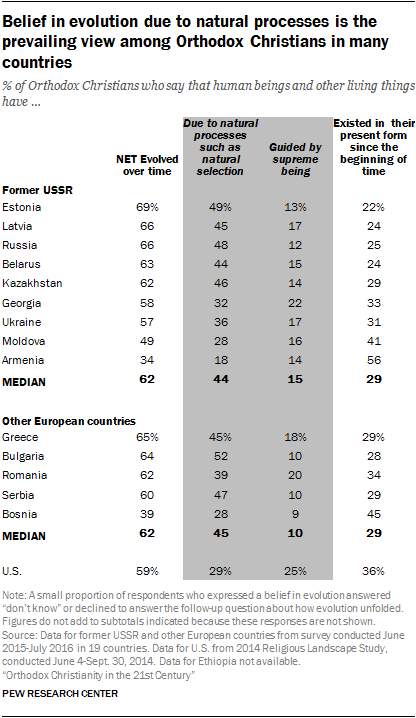
Belief in evolution due to natural processes is the prevailing view among Orthodox Christians in many countries

Most Orthodox Christians believe that humans and other living things have evolved over time, although considerable shares in many countries reject the theory of evolution, saying instead that humans and other organisms have existed in their present form since the beginning of time.

Majorities of Orthodox Christians in most Eastern European countries surveyed say humans have evolved over time, and among those who take this view, the prevailing opinion is that evolution occurred due to natural processes such as natural selection (rather than being guided by a supreme being).

In the U.S., about six-in-ten Orthodox Christians (59%) believe in evolution, although they are more evenly divided between those who favor evolution due to natural selection (29%) and those who say evolution was guided by a supreme being (25%). About a third of U.S. Orthodox Christians (36%) reject evolution, similar to the share of Americans overall who say this (34%).

Many Orthodox Christians in Europe say women have a responsibility to society to bear children, although fewer favor traditional gender roles in marriage

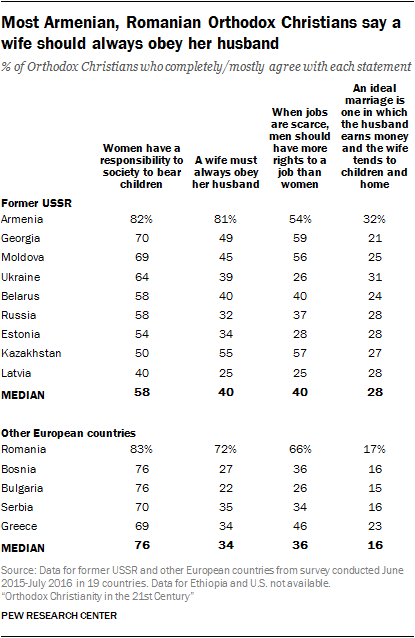
Most Armenian, Romanian Orthodox Christians say a wife should always obey her husband

Across Eastern Europe, most Orthodox Christians say that women have a responsibility to society to bear children, although Orthodox Christians in the former Soviet republics are somewhat less likely than those in other European countries to hold this view.

Fewer Orthodox Christians in the region – although still substantial shares in most countries – say that a wife must always obey her husband, or that when jobs are scarce, men should have more rights to a job than women. And still fewer say that an ideal marriage is one in which the husband earns money and the wife tends to the children and the home.

Overall, Orthodox Christians in Romania tend to have more traditional views on gender roles than do Orthodox Christians elsewhere in Eastern Europe: Roughly two-thirds or more say that women owe it to society to bear children, that wives should obey husbands and that men should have more rights to a job than women in times of high unemployment.

Although U.S. Orthodox Christians were not asked these questions, most (70%) say, in response to a different question, that having more women in the workforce has been a positive change for American society.

On balance, Orthodox women are more supportive of women’s rights than are Orthodox men. In most countries, women are less likely than men to agree that a wife is obligated to obey her husband. And in several countries, women are less likely than men to agree that men have greater employment rights than women, especially when jobs are scarce.

But women are not always more supportive of liberal positions regarding gender roles. In the majority of countries surveyed, women are about as likely as men to agree that they have a social responsibility to bear children. They also are as likely as men to agree that a traditional marriage, where women are primarily in charge of household tasks while men earn money, is ideal.


Acknowledgments

This report was produced by Pew Research Center as part of the Pew-Templeton Global Religious Future project, which analyzes religious change and its impact on societies around the world. Funding for the Global Religious Futures project comes from The Pew Charitable Trusts and the John Templeton Foundation.

This report is a collaborative effort based on the input and analysis of the following individuals:

Primary Researchers

Neha Sahgal, Associate Director of Research Alan Cooperman, Director of Religion Research

 Research Team

Scott Gardner, Senior Researcher Katie Simmons, Associate Director of Research Steve Schwarzer, Senior Research Methodologist Ariana Monique Salazar, Research Analyst Jonathan Evans, Research Analyst     Kelsey Jo Starr, Research Assistant Danielle Cuddington, Research Analyst Conrad Hackett, Associate Director of Research Anne Fengyan Shi, Senior Researcher Stephanie Kramer, Research Associate Juan Carlos Esparza Ochoa, Data Manager    Claire Gecewicz, Research Analyst                             

Editorial and Graphic Design

Michael Lipka, Senior Editor Jeff Diamant, Senior Writer/Editor Aleksandra Sandstrom, Copy Editor Bill Webster, Information Graphics Designer

 Communications and Web Publishing

Stacy Rosenberg, Associate Director of Digital Travis Mitchell, Digital Producer Anna Schiller, Communications Manager Jessica Pumphrey, Communications Associate

Others at Pew Research Center who provided research guidance include Michael Dimock, James Bell, Claudia Deane and Gregory A. Smith.

Former Pew Research Center staff members who worked on this study were Jill Carle, Juan Carlos Donoso, Fatima Ghani, Sandra Stencel, Angelina E. Theodorou and Gijs van Houten.

Pew Research Center received valuable advice on the questionnaire for this project from a panel of expert advisers: George E. Demacopoulos, professor of theology and co-director of the Orthodox Christian Studies Center at Fordham University; Kathleen A. Frankovic, election and polling consultant; Lucien N. Leustean, reader in politics and international relations at Aston University; Irina Papkova, research fellow at the Berkley Center for Religion, Peace, and World Affairs at Georgetown University; Victor Roudometof, associate professor of sociology at the University of Cyprus; and Catherine Wanner, professor of history, anthropology and religious studies at The Pennsylvania State University.

Additional guidance for this report came from: Peter F. Crossing, data analyst at the Center for the Study of Global Christianity at Gordon-Conwell Theological Seminary; George E. Demacopoulos, professor of theology and co-director of the Orthodox Christian Studies Center at Fordham University; Fr. Daniel Findikyan, professor of liturgical studies at St. Nersess Armenian Seminary; Francis Githieya, assistant professor of theology and religion at Saint Leo University; Jörg Haustein, senior lecturer in religions in Africa at the University of London; Todd M. Johnson, director at the Center for the Study of Global Christianity at Gordon-Conwell Theological Seminary; Alexei Krindatch, research coordinator at the Assembly of Orthodox Bishops of the United States of America; Ralph Lee, research associate at the Centre of World Christianity at the University of London; Fr. Simeon Odabashian, diocesan vicar for the Armenian Church’s Eastern Diocese of America; the Rev. Ronald Roberson, associate director of the staff of the Secretariat of Ecumenical and Interreligious Affairs at the U.S. Conference of Catholic Bishops; Fr. Luke A. Veronis, director for the Missions Institute of Orthodox Christianity at Hellenic College Holy Cross Greek Orthodox School of Theology; and Gina A. Zurlo, assistant director at the Center for the Study of Global Christianity at Gordon-Conwell Theological Seminary.

Fieldwork for the survey was carried out by Ipsos MORI in Greece, Serbia, Romania, Bulgaria, Poland, Croatia, Lithuania, Hungary, Estonia, Bosnia and the Czech Republic; the Institute for Comparative Social Research Ltd. (CESSI) in Kazakhstan, Moldova, Georgia, Ukraine, Belarus, Russia and Latvia; the Georgian Opinion Research Business International (GORBI) in Armenia; Abt SRBI, Social Science Research Solutions (SSRS) and Princeton Survey Research Associates International (PSRAI) and in the U.S. PSRAI also carried out fieldwork in Ethiopia.

While the analysis for this report was guided by our consultations with the advisers, Pew Research Center is solely responsible for the interpretation and reporting of the data.

Methodology

This report brings together analysis of survey and demographic data from various previously published Pew Research Center reports. It also includes new analysis of the religious beliefs and practices of Orthodox Christians in Ethiopia and historical data on the distribution of Orthodox Christians, Catholics and Protestants around the world.

Attitudinal data was collected through nationally representative surveys conducted in various countries. Demographic data is compiled through analyses of censuses, large surveys and other sources.

Survey methodology

The report combines data from several Pew Research Center surveys. Short summaries of the methodologies used in each survey, along with links to the related reports and detailed methodologies, can be found below.

“Religious Belief and National Belonging in Central and Eastern Europe”

Data for Armenia, Belarus, Bosnia, Bulgaria, Croatia, the Czech Republic, Estonia, Georgia, Greece, Hungary, Kazakhstan, Latvia, Lithuania, Moldova, Poland, Romania, Russia, Serbia and Ukraine are from a survey in Central and Eastern Europe conducted via face-to-face interviews under the direction of three research partners – Ipsos MORI, Institute for Comparative Social Research (CESSI) and Georgian Opinion Research Business International (GORBI). (Kazakhstan was not analyzed as part of the initial report, but is analyzed throughout this report.)

The survey, conducted between June 2015 and July 2016, is based on samples of noninstitutionalized adults ages 18 and older. In some instances, samples exclude minor segments of the population due to accessibility problems, security concerns, very low population figures in rural areas or costs. All samples are based on multistage cluster designs, which typically entailed proportional stratification by region and locality size or urbanity, selection of primary sampling units (PSUs) proportional to population size, and random selection of secondary and tertiary sampling points within PSUs.

Interview teams were assigned to designated random routes at the block or street level and followed predetermined skip patterns when contacting households. Within households, interviewers randomly selected a respondent by using a Kish grid (a random selection from a detailed list of all household members) or by selecting the adult with the next or most recent birthday. For each country, the data were weighted to account for different probabilities of selection among respondents. Where appropriate, data also were weighted through an iterative procedure to more closely align the samples with official population figures for gender, age, education, urbanity and region.

Detailed methodology: https://alpha.pewresearch.org/pewresearch-org/religion/2017/05/10/appendix-a-methodology-8/

U.S. Religious Landscape Study

Data for the U.S. are from the 2014 Religious Landscape Study – a nationally representative telephone survey conducted June 4 to Sept. 30, 2014, among a sample of 35,071 U.S. adults. Sampling was conducted through random-digit dialing, with approximately 60% of the interviews conducted with respondents reached on cellphones (n=21,160) and 40% on landlines (n=13,911). Interviewing was conducted in English and Spanish. The survey is estimated to cover 97% of the noninstitutionalized U.S. adult population; 3% of U.S. adults are not reachable by telephone or do not speak English or Spanish well enough to participate in the survey. Data collection was divided equally among three research firms – Abt SRBI, Princeton Survey Research Associates International (PSRAI) and Social Science Research Solutions (SSRS).

The weighting of the data ensures that all states are represented in their proper proportion in the national weighted estimates. The data were weighted to account for different probabilities of selection among respondents. The data were also weighted to demographic benchmarks for the population covered by the survey. Most of the demographic weighting parameters came from the Census Bureau’s 2012 American Community Survey (ACS) one-year estimates, which was the most current data source available at the time the data were weighted.

Detailed methodology: https://alpha.pewresearch.org/pewresearch-org/religion/2015/05/12/appendix-a-methodology-3/

Pew Research Center’s 2015 Global Attitudes Survey

Most of the data for Ethiopia are from Pew Research Center’s 2015 Global Attitudes Survey, conducted under the direction of PSRAI. Face-to-face interviews were conducted March 25 to April 17, 2015, with a nationally representative sample of adults ages 18 and older. The survey used a multistage area probability sample design with the PSUs stratified by region and urbanity. Individuals within households were selected using a Kish grid. The data were weighted by age and education.

Detailed methodology: https://alpha.pewresearch.org/pewresearch-org/methodology/international-survey-research/international-methodology/global-attitudes-survey/ethiopia/2015

“Tolerance and Tension: Islam and Christianity in Sub-Saharan Africa”

Some other data for Ethiopia are from Pew Research Center’s previously released survey report that analyzed religion in sub-Saharan Africa. Results for the survey are based on face-to-face interviews with adults ages 18 and older conducted under the direction of PSRAI. The sample was designed as a stratified random sample of all nine ethnically based states and two self-governing administrative areas of the country, proportional to population size and urban/rural population. The fieldwork was conducted from Jan. 22 to Feb. 1, 2009, and was designed to be nationally representative of the adult population.

Detailed methodology: https://alpha.pewresearch.org/pewresearch-org/wp-content/uploads/sites/7/2010/04/sub-saharan-africa-appendix-c.pdf

Methodology for demographic estimates

The demographic estimates in this report draw upon religious demography research conducted by Pew Research Center over nearly a decade, involving analysis of more than 2,500 data sources, including censuses, demographic surveys, general population surveys and other studies.

Estimates of the size of Christian traditions in 1910 are based on Pew Research Center analysis of data from the World Christian Database (WCD) of the Center for the Study of Global Christianity at Gordon-Conwell Theological Seminary. WCD estimates take into account anthropological and ethnographic studies, statistical reports from religious groups, and data from censuses and surveys. The WCD enumerates many categories of Christians, which researchers at Pew Research Center have aggregated into the categories of Catholic, Orthodox, and Protestant and other Christians.

Estimates of the 2010 worldwide population of Orthodox Christians were based on data from Pew Research Center’s 2011 report “Global Christianity – A Report on the Size and Distribution of the World’s Christian Population” and the 2015 report “The Future of World Religions: Population Growth Projections, 2010-2050.”

The 2011 study of global Christianity produced estimates of the size and share of the Catholic, Protestant, Orthodox and other Christian populations at the country, regional and global levels for the year 2010 (see Methodology).27 The 2015 report used data unavailable in 2011 (including results from the 2010 wave of global censuses) and updated estimates of the size and share of Christian populations (as well as other major religious groups) in each country in 2010, projecting these populations through to the year 2050 (see Methodology). The 2015 report does not provide detail on the size or characteristics of subgroups of Christians (e.g., Orthodox Christians) or of subgroups among other major religions because the detailed demographic characteristics (structure of religious populations by age and sex, age-specific fertility rates, patterns of religious switching and patterns of migration between countries) that the report is based upon were generally unavailable for religious subgroups in most countries.

To generate the 2010 Orthodox population estimates used in this report, the country-level shares of Orthodox Christians among all Christians reported in “Global Christianity” were multiplied by the updated size of each country’s Christian population reported in “The Future of World Religions.”

The primary sources used for each country are listed in an appendix of each report cited above.