Pew Research Center

FOR RELEASE JULY 26, 2017

U.S. Muslims Concerned About Their Place in Society, but Continue to Believe in the American Dream

Findings from Pew Research Center’s 2017 survey of U.S. Muslims

FOR MEDIA OR OTHER INQUIRIES:

Communications Department
202.419.4372
www.pewresearch.org

RECOMMENDED CITATION

Pew Research Center, July 2017, "U.S. Muslims Concerned About Their Place in Society, but Continue to Believe in the American Dream"

About Pew Research Center

Pew Research Center is a nonpartisan, nonadvocacy fact tank that informs the public about the issues, attitudes and trends shaping the world. It does not take policy positions. The Center conducts public opinion polling, demographic research, computational social science research and other data-driven research. It studies politics and policy; news habits and media; the internet and technology; religion; race and ethnicity; international affairs; social, demographic and economic trends; science; research methodology and data science; and immigration and migration. Pew Research Center is a subsidiary of The Pew Charitable Trusts, its primary funder.

© Pew Research Center 2026

Table of contents

  • About Pew Research Center
  • U.S. Muslims Concerned About Their Place in Society, but Continue to Believe in the American Dream
  • 1. Demographic portrait of Muslim Americans
  • 2. Identity, assimilation and community
  • 3. The Muslim American experience in the Trump era
  • 4. Political and social views
  • 5. Terrorism and concerns about extremism
  • 6. Religious beliefs and practices
  • 7. How the U.S. general public views Muslims and Islam
  • Acknowledgements
  • Appendix A: Glossary
  • Appendix B: Survey methodology

U.S. Muslims Concerned About Their Place in Society, but Continue to Believe in the American Dream

Findings from Pew Research Center’s 2017 survey of U.S. Muslims

The early days of Donald Trump’s presidency have been an anxious time for many Muslim Americans, according to a new Pew Research Center survey. Overall, Muslims in the United States perceive a lot of discrimination against their religious group, are leery of Trump and think their fellow Americans do not see Islam as part of mainstream U.S. society.

At the same time, however, Muslim Americans express a persistent streak of optimism and positive feelings. Overwhelmingly, they say they are proud to be Americans, believe that hard work generally brings success in this country and are satisfied with the way things are going in their own lives – even if they are not satisfied with the direction of the country as a whole.
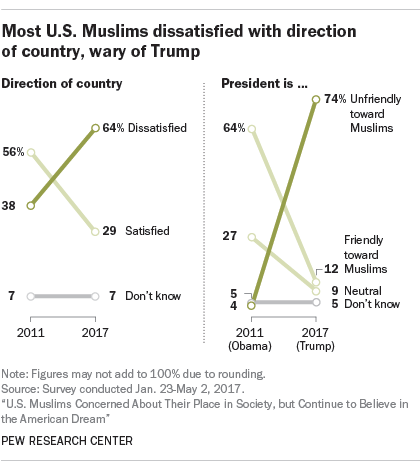
Indeed, nearly two-thirds of Muslim Americans say they are dissatisfied with the way things are going in the U.S. today. And about three-quarters say Donald Trump is unfriendly toward Muslims in America. On both of these counts, Muslim opinion has undergone a stark reversal since 2011, when Barack Obama was president, at which point most Muslims thought the country was headed in the right direction and viewed the president as friendly toward them.

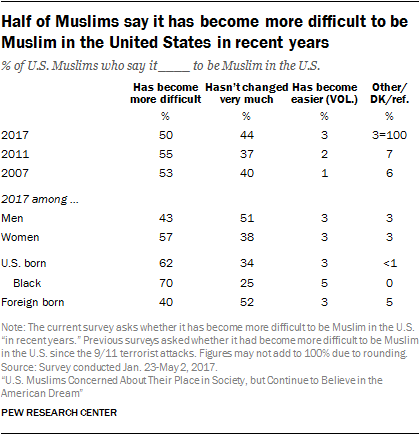
In addition, half of Muslim Americans say it has become harder to be Muslim in the U.S. in recent years. And 48% say they have experienced at least one incident of discrimination in the past 12 months.

But alongside these reports of discrimination, a similar – and growing – share (49%) of Muslim Americans say someone has expressed support for them because of their religion in the past year. And 55% think Americans in general are friendly toward U.S. Muslims, compared with just 14% who say they are unfriendly.

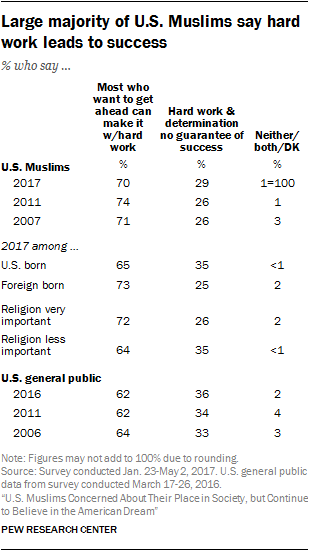
Despite the concerns and perceived challenges they face, 89% of Muslims say they are both proud to be American and proud to be Muslim. Fully eight-in-ten say they are satisfied with the way things are going in their lives. And a large majority of U.S. Muslims continue to profess faith in the American dream, with 70% saying that most people who want to get ahead can make it in America if they are willing to work hard.

These are among the key findings of Pew Research Center’s new survey of U.S. Muslims, conducted Jan. 23 to May 2, 2017, on landlines and cellphones, among a representative sample of 1,001 Muslim adults living in the United States. This is the third time Pew Research Center has conducted a comprehensive survey of U.S. Muslims. The Center’s initial survey of Muslim Americans was conducted in 2007; the second survey took place in 2011.

The new survey asked U.S. Muslims about a wide variety of topics, including religious beliefs and practices, social values, views on extremism and political preferences. While the survey finds that a majority disapprove of the way Trump is handling his job, this is not the first time the community has looked askance at a Republican in the White House. Indeed, Muslim Americans are no more disapproving of Trump today than they were of George W. Bush’s performance in office during his second term a decade ago.

And while Muslims say they face a variety of challenges and obstacles in the U.S., this too is nothing new. The share of U.S. Muslims who say it is getting harder to be a Muslim in America has hovered around 50% over the past 10 years. Over the same period, half or more of Muslims have consistently said that U.S. media coverage of Muslims is unfair.

The Muslim population in the U.S. is growing and highly diverse, made up largely of immigrants and the children of immigrants from all across the world. Indeed, respondents in the survey hail from at least 75 nations – although the vast majority are now U.S. citizens. As a group, Muslims are younger and more racially diverse than the general population.

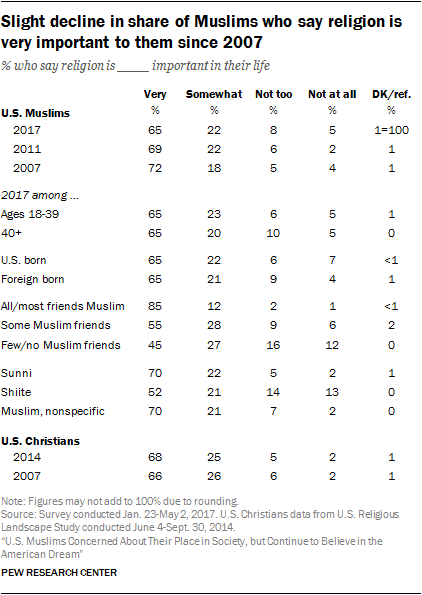
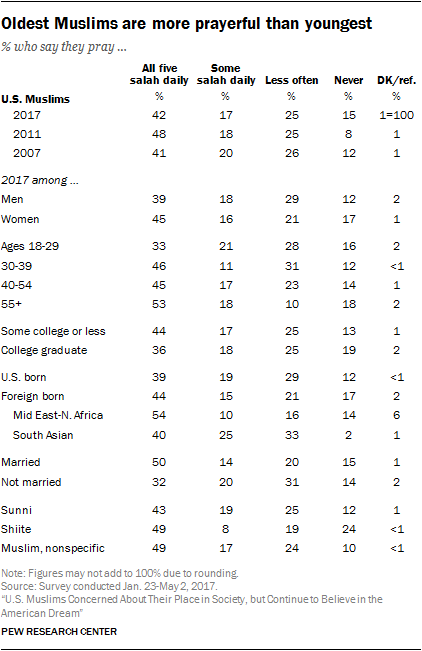
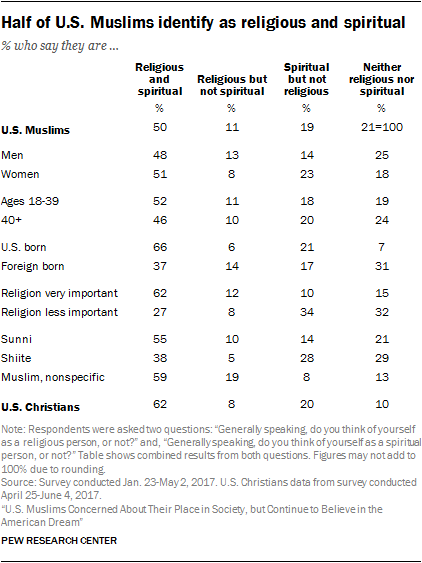
Muslims also are quite varied in their religious allegiances and observances. Slightly more than half of U.S. Muslims are Sunnis (55%), but significant minorities identify as Shiite (16%) or as “just Muslim” (14%). Most Muslims say religion is very important in their lives (65%), and about four-in-ten (42%) say they pray five times a day. But many others say religion is less important to them and that they are not so consistent in performing salah, the ritual prayers that constitute one of the Five Pillars of Islam and traditionally are performed five times each day.

The survey also shows that Muslims largely share the general public’s concerns about religious extremism. Indeed, if anything, Muslims may be more concerned than non-Muslims about extremism in the name of Islam. Yet most Muslims say there is little support for extremism within the U.S. Muslim community, and few say they think violence against civilians can be justified in pursuit of religious, political or social causes.

Muslims concerned about extremism, both globally and in U.S.

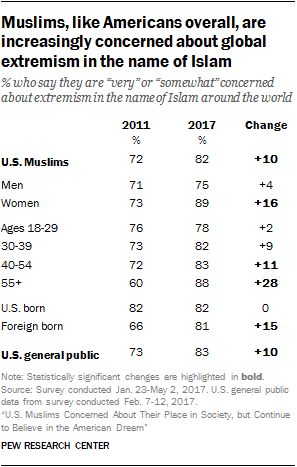
Overall, eight-in-ten Muslims (82%) say they are either very concerned (66%) or somewhat concerned (16%) about extremism in the name of Islam around the world. This is similar to the percentage of the U.S. general public that shares these concerns (83%), although Muslims are more likely than U.S. adults overall to say they are very concerned about extremism in the name of Islam around the world (66% vs. 49%).

About seven-in-ten Muslims – and a similar share of Americans overall – are concerned about extremism in the name of Islam in the U.S., including roughly half of U.S. Muslims (49%) who say they are very concerned about domestic extremism.

Among both Muslims and the larger U.S. public, concern about extremism around the world is higher now than it was in 2011 (see Chapter 5 for details on trends over time).

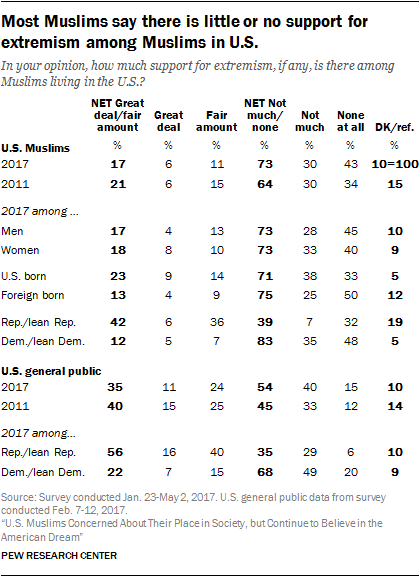
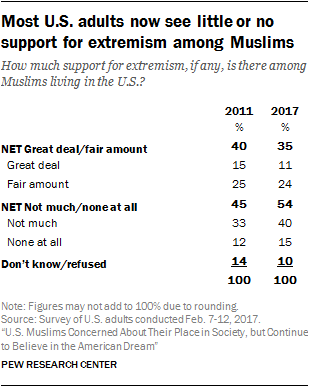
While concern about extremism has risen, there is little change in perceptions of how much support for extremism exists among Muslims in the United States. Nearly three-quarters of U.S. Muslims (73%) say there is little or no support for extremism among American Muslims, while about one-in-six say there is either a “fair amount” (11%) or a “great deal” (6%) of support for extremism within the U.S. Muslim community.

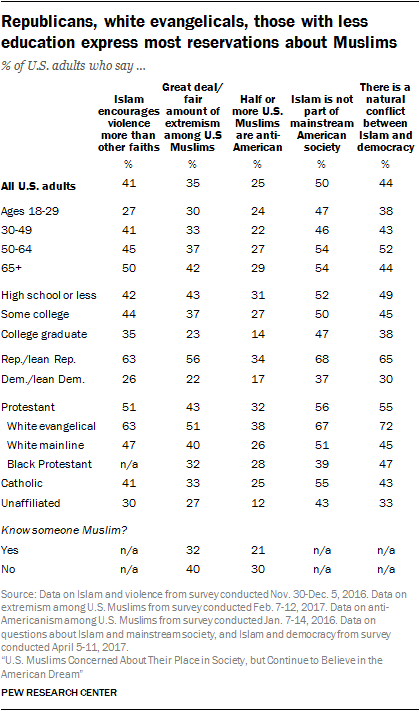
The overall American public is more divided on this question. While 54% of U.S. adults say there is little or no support for extremism among Muslim Americans, roughly a third (35%) say there is at least a “fair amount” of backing for extremism among U.S. Muslims, including 11% who think there is a “great deal.” (For more information about how the U.S. public views Muslims and Islam, see Chapter 7.)

When is killing civilians seen as justifiable?

To better understand what some people had in mind when answering this question about targeting and killing civilians for political, social or religious reasons, Pew Research Center staff called back a small number of respondents and conducted non-scientific follow-up interviews. Many respondents – both Muslims and non-Muslims – who said violence against civilians can sometimes or often be justified said they had in mind situations other than terrorism, such as military action or self-defense. For more details on this question, see Chapter 5.

When asked whether targeting and killing civilians can be justified to further a political, social or religious cause, 84% of U.S. Muslims say such tactics can rarely (8%) or never (76%) be justified, while 12% say such violence can sometimes (7%) or often (5%) be justified.

This question was designed to be asked of the general public as well. Compared with the U.S. public as a whole, Muslims are more likely to say targeting and killing civilians for political, social or religious reasons is never justifiable (76% vs. 59%). Roughly equal shares of Muslims (5%) and Americans as a whole (3%) say such tactics are often justified (the difference between these numbers is not statistically significant).1

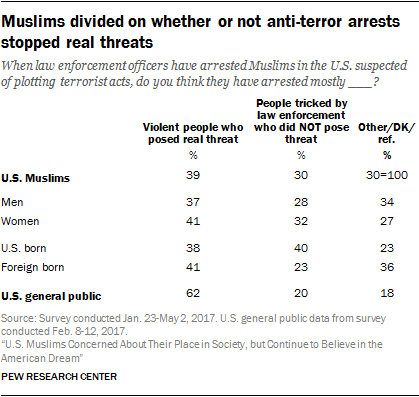
While U.S. Muslims are concerned about extremism and overwhelmingly opposed to the use of violence against civilians, they also are somewhat mistrustful of law enforcement officials and skeptical of the integrity of government sting operations. About four-in-ten U.S. Muslims (39%) believe most Muslims who have been arrested in the U.S. on suspicion of plotting terrorist acts posed a real threat. But three-in-ten (30%) say law enforcement officers have arrested mostly people who were tricked and did not pose a real threat. And an additional three-in-ten volunteer that “it depends” or offer another response or no response. Views on this topic among the general public are less divided: A majority of U.S. adults (62%) say officers in sting operations have mostly arrested people who posed a real threat to others.

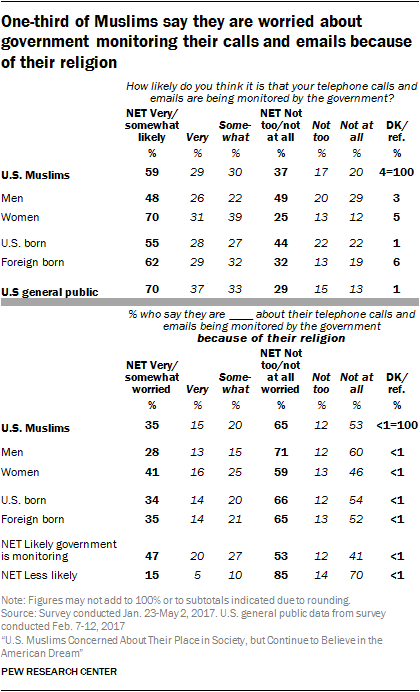
Meanwhile, about a third of Muslim Americans say they are either very worried (15%) or somewhat worried (20%) that the government monitors their phone calls and emails because of their religion. However, on a different question – which does not mention religion – Muslims actually are less likely than Americans overall to think the government is monitoring them: About six-in-ten Muslims (59%) say it is either very likely or somewhat likely that the government monitors their communications, compared with 70% of the general public.

Roughly half of Muslims say they have experienced recent discrimination
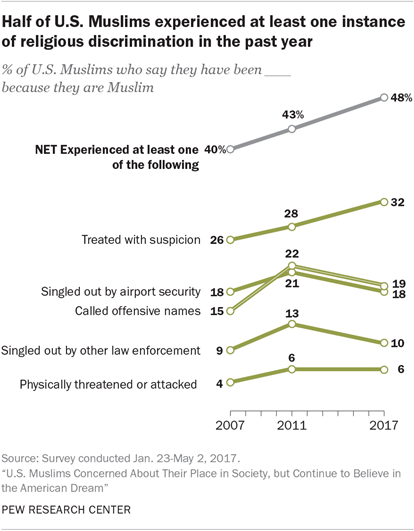
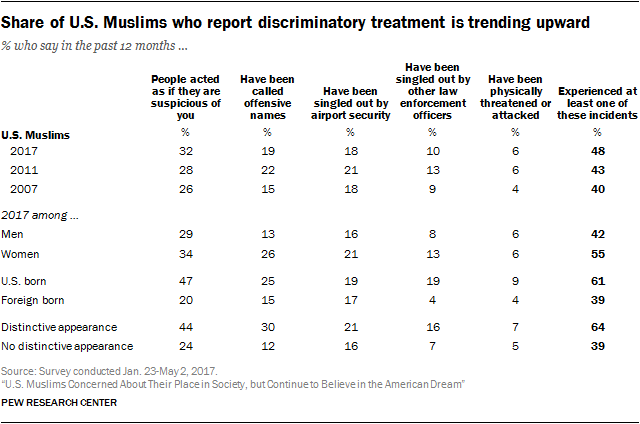
In addition to gauging broad concerns about discrimination, the survey also asked Muslims whether they personally have experienced a few specific kinds of discrimination within the past year. The share of U.S. Muslims who say they have faced at least one of these types of discrimination has risen modestly in recent years.

About a third of Muslims, for example, say they have been treated with suspicion over the past 12 months because of their religion. Nearly one-in-five say they have been called offensive names or singled out by airport security, while one-in-ten say they have been singled out by other law enforcement officials. And 6% say they have even been physically threatened or attacked.

In total, nearly half of Muslims (48%) say they have experienced at least one of these types of discrimination over the past year, which is up slightly from 2011 (43%) and 2007 (40%). In addition, nearly one-in-five U.S. Muslims (18%) say they have seen anti-Muslim graffiti in their local community in the last 12 months.
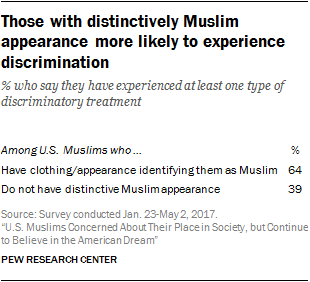
Experiences with discriminatory treatment are especially common among those whose appearance identifies them as Muslim. Overall, about four-in-ten Muslims (38%) – including half of Muslim women (49%) – say that on a typical day, there is something distinctive about their appearance, voice or clothing that people might associate with Muslims. Of those whose appearance is identifiably Muslim, nearly two-thirds (64%) say they have experienced at least one of the specific types of discrimination asked about in the survey. Among Muslims who say they do not have a distinctively Muslim appearance, fewer report these types of experiences (39%).

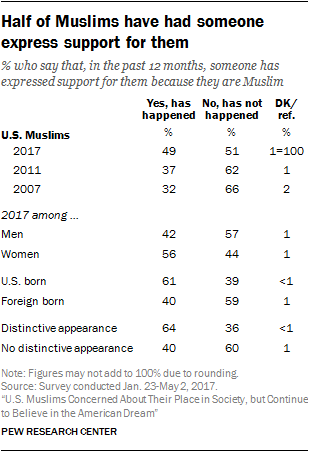
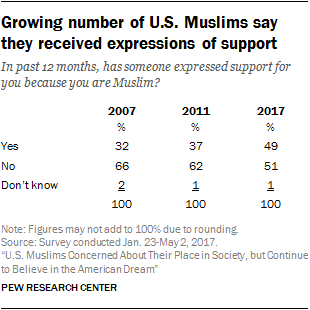
While roughly half of Muslims say they have experienced a specific instance of discrimination over the past year, a similar share (49%) say someone has expressed support for them because they are Muslim in the past 12 months. The percentage of U.S. Muslims who report this type of experience is up significantly since 2011 (37%) and 2007 (32%).
In their own words: What Muslims said about discrimination and support

Pew Research Center staff called back some of the Muslim American respondents in this survey to get additional thoughts on some of the topics covered. Here is a sampling of what they said about their experiences with discrimination and the expressions of support they have received:

“I have definitely experienced both [discrimination and support]. I’ve had people make comments and of course they’ll give me weird looks and things like that. But I’ve definitely heard people [make] rude comments straight to my face. I’ve also had people say really nice things about my hijab, or say it’s beautiful or say they think my religion is beautiful.” – Muslim woman under 30

“There was a time where I used to wear a veil that covered my face, the niqab, and I take public transportation, and when I was on a bus someone claimed I was a terrorist. I did not know what to do because no one ever called me that. The person was sitting near me, and I remember getting off the bus. No one came to my defense and I did not expect anyone to come to my defense. If you cover your face, people assume you are dangerous. I don’t wear the niqab anymore. … I heard a woman took a bus and she wore niqab and got attacked. People were worried for my safety, and I did not want to take a chance. I wear the hijab [covering the hair, but not face] now. This happened a year ago and after that I stopped wearing a niqab. Now, I get questions a lot, but people are not afraid. [When wearing the niqab], people assumed I was not born here and don’t speak English. Even wearing hijab I get that. But with hijab, there is curiosity but not discrimination.” – Muslim woman under 30

“I have lived in this country for 15 years and have never had a bad experience because of my religion or faith.” – Muslim woman over 60

“I have never experienced discrimination in a direct or targeted way. Things have been very good. But sometimes I see someone looking at me funny because of my accent and the way I look, and it makes me a little uncomfortable. But I have a lot of support. Everyone I work with supports me, so I have many people who can help.” – Muslim man under 30

“I have a lot of friends, and just community members, who are very open – who are glad to have this kind of diversity in their community, where there aren’t a lot of Muslims at all. I’m probably the only Muslim they know or they’ll ever know. And they’re glad for that, and they like to give support and be there.” – Muslim man under 30

“Occasionally [my daughter] would say kids make fun of her. Or the kids would ask, ‘Are you bald under hijab?’ ‘Why don’t you show your hair?’ … [While attending a parade], a couple from [the South] engaged my daughter, and my wife was sitting on one bench and my other daughter and I were sitting on another. And she started asking her, ‘Does your dad make you wear this?’ And my daughter was prepared to respond and said, ‘Nope. This is my choice. He supports me. It’s not required. My mom doesn’t wear it. But I wear it because I choose to wear it.’ I think those types of experiences are something she goes through, and I think we basically reassure her every time that we get an opportunity: ‘This is what you’ve chosen to do. Now you have chosen to express yourself, and we stand by you 100%. This is America and everyone is free to choose to live the way they choose.’” – Muslim father

Muslims leery of Trump
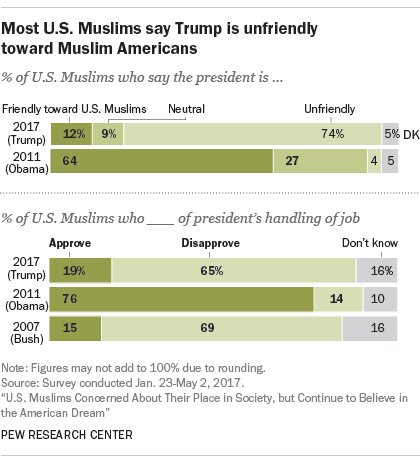
The relationship between Donald Trump and the U.S. Muslim community has received a lot of media coverage, especially following Trump’s statement during the campaign that he would seek a “total and complete shutdown of Muslims entering the United States” and his executive order blocking travel from six Muslim-majority countries. 2

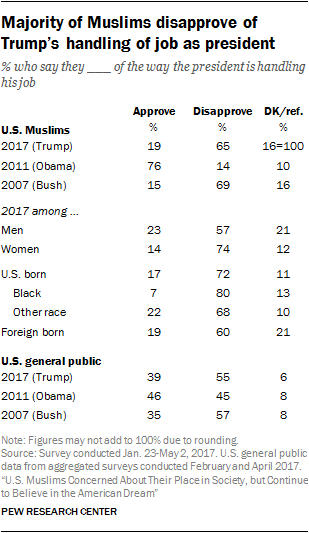
About three-quarters of Muslim Americans (74%) say the nation’s new chief executive is unfriendly toward their group, while two-thirds (65%) say they disapprove of the way Trump is handling his job as president. U.S. Muslim opinion on the sitting president has turned dramatically since 2011, when Muslims expressed much more positive views of Barack Obama.

In 2007, near the end of his second term, George W. Bush received approval ratings from U.S. Muslims that were about as low as Trump’s today. Respondents in that survey were not asked whether they thought Bush was friendly toward Muslim Americans.

In the new survey, respondents were asked whether Trump makes them feel four emotions – two positive (hope and happiness) and two negative (worry and anger). Fully two-thirds of Muslim Americans (68%) say the president makes them feel worried, and 45% say he makes them feel angry. Far fewer say the president makes them feel hopeful (26%) or happy (17%).

Muslim Americans are less likely than the public as a whole to say Trump makes them feel hopeful (26% vs. 40%) or happy (17% vs. 30%), but about as likely to say Trump makes them feel worried or angry.

Muslims proud to be American, but say they face significant challenges in U.S. society
Most Muslims proud to be Muslim and proud to be American

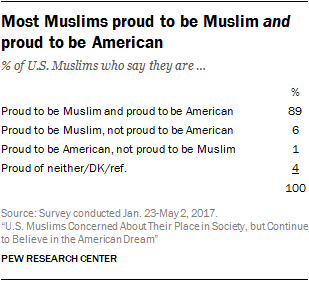
U.S. Muslims express pride in their religious and national identities alike. Fully 97% agree with the statement, “I am proud to be Muslim.” Nearly as many (92%) say they agree with the statement, “I am proud to be an American.” In total, 89% agree with both statements, saying they are proud to be Muslim and proud to be American. Just 6% say they are proud to be Muslim and not proud to be American, and 1% say they are proud to be American and not proud to be Muslim.

Half say it is getting tougher to be Muslim in the U.S.

At the same time, many Muslims say they face a variety of significant challenges in making their way in American society. Fully half say that it has become more difficult to be Muslim in the U.S. in recent years, and an additional 44% say the difficulty or ease of being Muslim has not changed very much. Just 3% volunteer that it has become easier to be Muslim in America.

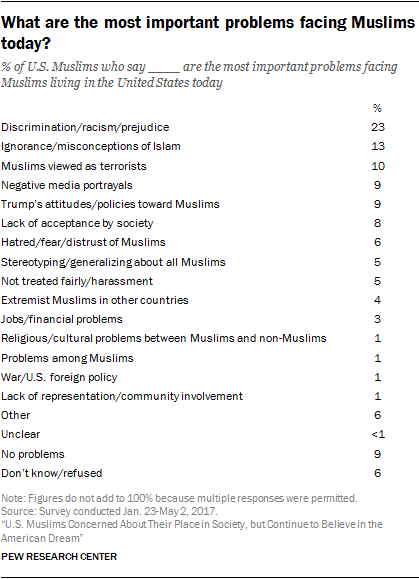
Muslims who say it has become more difficult to be Muslim in the U.S. in recent years were asked to describe, in their own words, the main reasons for this. The most common responses include statements about Muslim extremists in other countries, misconceptions and stereotyping about Islam among the U.S. public, and Trump’s attitudes and policies toward Muslims. (For full details, see here.)
Most Muslim Americans say U.S. media covers Islam unfairly

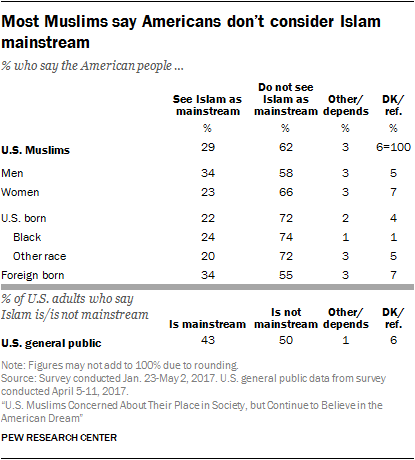
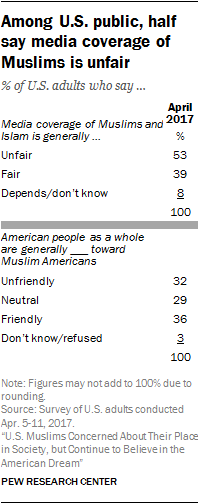
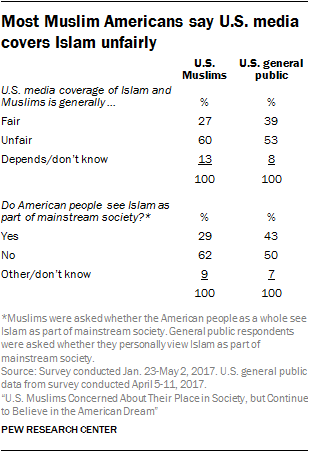
Most Muslims (60%) also perceive media coverage of Muslims and Islam as unfair, and a similar share (62%) think the American people as a whole do not see Islam as part of mainstream American society. These views are largely echoed by U.S. adults overall, many of whom agree that media coverage of Muslims is unfair and say they personally do not see Islam as part of mainstream society.

But tension is not the only thing that defines the relationship between Muslims and the rest of the U.S. population. Six-in-ten U.S. Muslims say they have a lot in common with most Americans. And Muslims are much more likely to say the American people, in general, are friendly toward Muslims in the country (55%) than to view Americans as a whole as unfriendly (14%). (Three-in-ten say Americans are generally neutral toward Muslims.) Moreover, U.S. Muslims have become slightly more likely to view the American public as friendly toward them since 2011, when 48% took this position.

Muslim women more concerned than men about their place in society
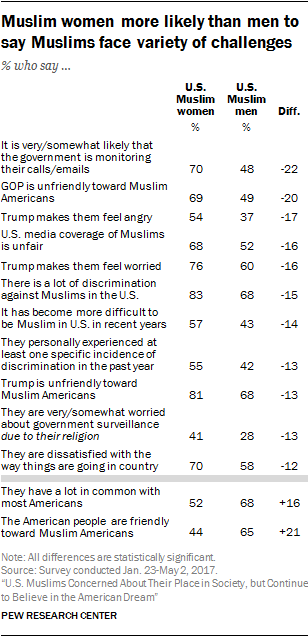
Muslim women more likely than men to say Muslims face variety of challenges

The survey finds a consistent gender gap on several questions about what it is like to be a Muslim in America, showing that Muslim women have a higher level of concern than Muslim men about the place of Muslims in U.S. society.

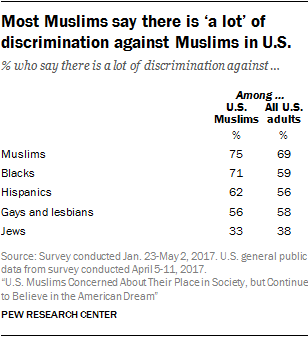
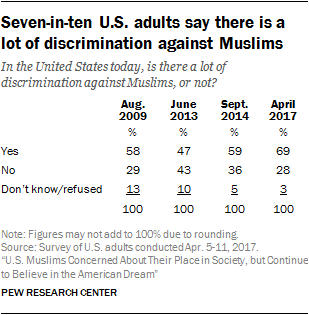
For example, more Muslim women than men say that there is a lot of discrimination against Muslims in the U.S. today, that they have personally experienced discrimination and that it has become more difficult to be Muslim in the U.S. in recent years.

In addition, more Muslim women than men say Donald Trump makes them angry or worried, and more women than men say both Trump and the Republican Party are unfriendly toward Muslim Americans.

Muslim women are more likely than Muslim men to say that they are dissatisfied with the way things are going in the country and that media coverage of Muslims is unfair. Meanwhile, more Muslim men than women say that they have a lot in common with most Americans and that the American people in general are friendly toward Muslim Americans.

In their own words: What Muslims said about their place in America

Pew Research Center staff called back some of the Muslim American respondents in this survey to get additional thoughts on some of the topics covered. Here is a sampling of what they said about what it is like to be a Muslim in the United States in 2017:

[survey]

“I don’t really feel like I have a lot in common with most Americans. It depends on their upbringing, their race, everything like that. I think that we have a lot of different ideals, and we believe a lot of different things. … So I do feel a lot different, a sense of not fitting in as much.” – Muslim woman under 30

“What I have in common with most Americans is a dedication to this country. We also have in common our shared humanity. … We’re all struggling to earn, pay our taxes and raise our kids. More and more, I’m finding it hard to find common ground with people who don’t understand minority communities. The minorities are becoming the majority, and I know that’s hard for some people. I feel sympathy for them; empathy as well. But they need to accept this new reality.” – Muslim woman in her 40s

“There is so much attention drawn to people being Muslim and symbols of Islam, hijab being one of them. We have to take extra caution scanning our surroundings – know where we are, who is around and what kind of thoughts they might hold for Islam, about Islam or against Islam. Especially when the Muslim ban was introduced the first time around, I literally felt like the persecution had started. Because we had read the history of Europe and what happened to the Jewish people in Germany. These little steps lead to bigger issues later on. So, we really felt like we were threatened. And, fortunately, the justice system stopped implementation. And later on people stopped talking about it, and after a while it seemed like things might be getting better.” – Immigrant Muslim man

“I see some immigrants – and not just Muslims, they could be Latinos too – who don’t adapt well to their new country and don’t want to be part of American society. They stick with others like themselves because they’re afraid and feel strange here. But that’s not me. I am completely American, and I feel at home here. When I first came here, I went to high school and that helped me to become more fully American and to adapt to the culture. I feel like I have a lot in common with the people I meet and know here, and I feel completely comfortable here. When you arrive in America as an immigrant, you have to let your past go, or else you won’t be able to become a part of your new country.” – Muslim man under 30

“I’d say it’s been increasingly difficult, really. You almost get that post-9/11 atmosphere in the United States because of the suppression, really, of minorities and minorities’ thoughts and voices. People like the alt-right or ultraconservative Trump supporters now have a larger voice that was suppressed just years ago, and now they’re really allowed to make heard what they think about Muslims and minorities in general. So it’s a lot of tensions have been rising and fears that we’re going backward.” – Muslim man under 30

Muslim demographics: A diverse and young population

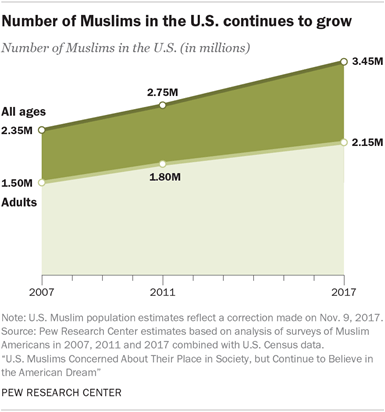
Muslims represent a relatively small but rapidly growing portion of the U.S. religious landscape. Pew Research Center estimates that there are 3.45 million Muslims of all ages living in the U.S. – up from about 2.75 million in 2011 and 2.35 million in 2007. This means Muslims currently make up roughly 1.1% of the U.S. population. 3 (For more information about how many Muslims live in the U.S. and about how Pew Research Center calculates these figures, see Chapter 1.)

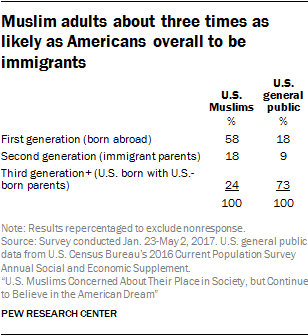
Muslim Americans are largely an immigrant population: Roughly six-in-ten U.S. Muslims ages 18 and over (58%) were born outside the U.S., with origins spread throughout the world. The most common region of origin for Muslim immigrants is South Asia, where one-in-five U.S. Muslims were born, including 9% who were born in Pakistan. An additional 13% of U.S. Muslims were born elsewhere in the Asia-Pacific region (including Iran), 14% in the Middle East or North Africa, and 5% in sub-Saharan Africa.

Most U.S. Muslim adults are immigrants

Due in no small part to their wide range of geographic origins, U.S. Muslims are a racially and ethnically diverse population. No single racial group forms a majority, with about four-in-ten Muslim adults (41%) identifying as white (including Arabs and people of Middle Eastern ancestry), 28% identifying as Asian (including people of Pakistani or Indian descent) and one-in-five identifying as black or African American.

Majority of U.S. Muslim adults are under 40

The data also show that Muslim Americans are a very young group. Most Muslim adults (60%) are under the age of 40. By comparison, just 38% of the U.S. adult population as a whole is younger than 40.

Three-in-ten Muslims (31%) are college graduates, which is on par with the share of U.S. adults as a whole who have completed college. But Muslim immigrants are, on average, more highly educated than both U.S.-born Muslims and the U.S. public as a whole. (For more on the demographics of the U.S. Muslim population, see Chapter 1.)

Muslims say their faith is not only about beliefs and rituals

The diversity of Muslims in the U.S. extends to religious beliefs and practices as well. While nearly all Muslims say they are proud to be Muslim, they are not of one mind about what is essential to being Muslim, and their levels of religious practice vary widely.

Most U.S. Muslims (64%) say there is more than one true way to interpret Islam. They also are more likely to say traditional understandings of Islam need to be reinterpreted in light of modern contexts (52%) than to say traditional understandings are all that is needed (38%).

Muslims also were asked whether each of eight actions and behaviors is an “essential” part of what being Muslim means to them, an “important but not essential” part or “not an important” part. Fully 85% of Muslims say believing in God is essential to what being Muslim means to them, more than say the same about any other item in the survey. And nearly three-quarters say “loving the Prophet Muhammad” is essential to what being Muslim means to them.
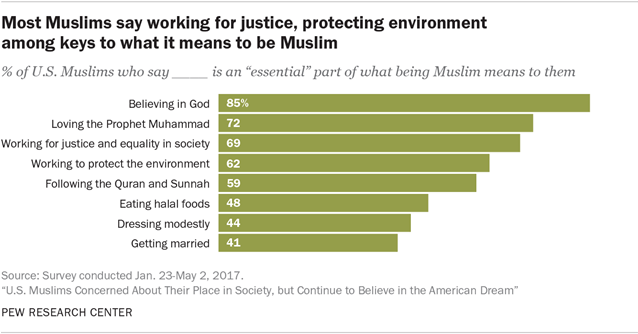
Most Muslims say working for justice, protecting the environment among keys to what it means to be Muslim

Yet many U.S. Muslims say that for them, personally, being Muslim is about more than these core religious beliefs. Roughly seven-in-ten, for instance, say “working for justice and equality in society” is an essential part of their Muslim identity, and 62% say the same about “working to protect the environment” – which is higher than the share of U.S. Christians who said protecting the environment is essential to their Christian identity in response to a similar question (22%).
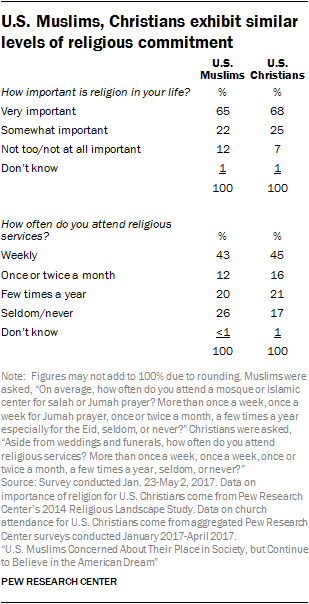
U.S. Muslims, Christians exhibit similar levels of religious commitment

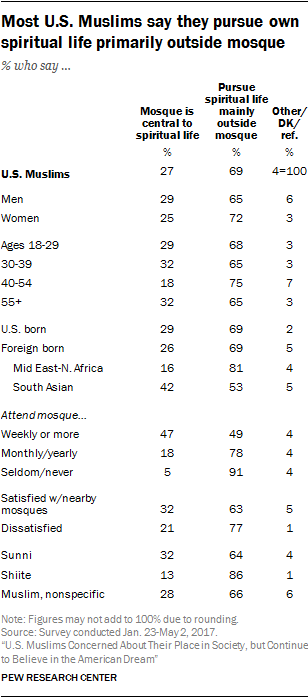
In other ways, though, U.S. Muslims look similar to U.S. Christians – on average, the two groups show roughly equal levels of religious commitment. About two-thirds of U.S. Muslims (65%), for instance, say religion is very important in their lives, as do 68% of Christians, according to Pew Research Center’s 2014 Religious Landscape Study. And 43% of Muslim Americans say they attend a mosque on a weekly basis, on par with the 45% of U.S. Christians who have described themselves as weekly churchgoers in recent surveys. Another 12% of U.S. Muslims say they go to a mosque monthly, and one-in-five (20%) say they go to a mosque a few times a year, especially for important Muslim holidays such as Eids.4 (For more information on Eid and other terms, see the glossary.)

The survey also shows that eight-in-ten Muslim Americans say they fast during the Islamic holy month of Ramadan. And roughly four-in-ten Muslims (42%) say they pray all five salah daily, with another 17% saying they make some of the five salah each day. (Salah is a form of ritual prayer or observance performed throughout the day, and praying salah is one of the Five Pillars of Islam. For more information, see the glossary.)

Social values: Growing acceptance of homosexuality
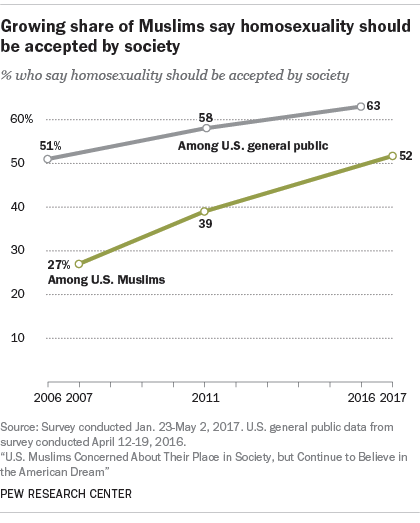
Growing share of Muslims say homosexuality should be accepted by society

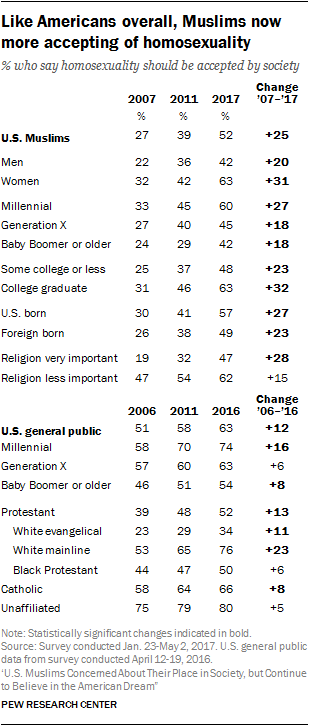
American Muslims, like the U.S. public as a whole, have become much more accepting of homosexuality in recent years. In the first Pew Research Center survey of Muslims, in 2007, far more Muslims said homosexuality should be discouraged by society (61%) than said it should be accepted (27%). By 2011, Muslims were roughly evenly split on this question. Today, Muslims who say homosexuality should be accepted by society clearly outnumber those who say it should be discouraged (52% vs. 33%).

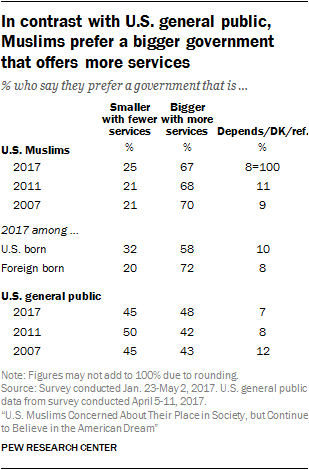
While Muslims remain somewhat more conservative than the general public on views toward homosexuality, they are more ideologically liberal than U.S. adults overall when it comes to immigration and the size of government. About eight-in-ten U.S. Muslims believe that immigrants strengthen the country with their hard work and talent (79%), which is perhaps not surprising, given that most Muslims are themselves immigrants. And two-thirds of Muslim Americans (67%) say they prefer a larger government that provides more services over a smaller government that provides fewer services.
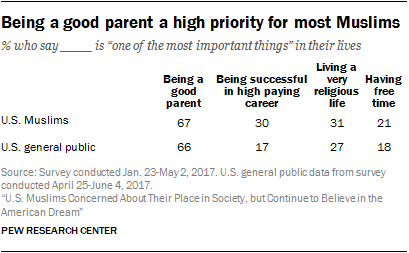
Being a good parent a high priority for most Muslims

On some other issues, the views of U.S. Muslims mirror those of the larger public. Like Americans overall, most Muslims rank being a good parent as “one of the most important things” in their lives, and they tend to rate having a successful career and living a very religious life as at least somewhat important but not necessarily among the most important things in life.

Political preferences: Muslims are strongly Democratic
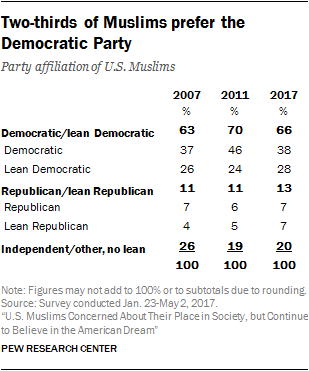
Two-thirds of Muslims prefer the Democratic Party

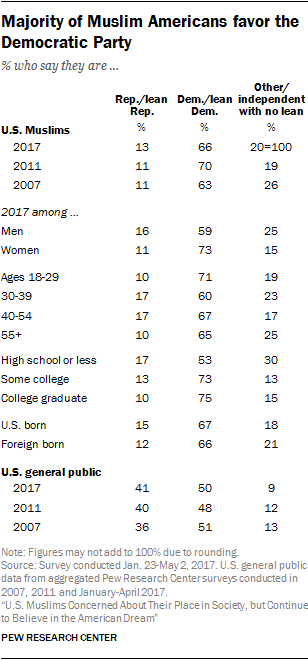
Two-thirds of U.S. Muslims either identify as Democrats or lean toward the Democratic Party; far fewer (13%) identify as Republican or lean toward the GOP. Muslims favored the Democratic Party over the GOP by comparable margins in both previous Pew Research Center surveys.

Muslims reliably Democratic in presidential elections

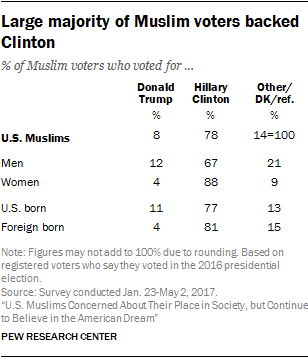
When asked how they voted in last year’s presidential election, three-quarters of Muslim voters (78%) say they backed Hillary Clinton, 8% say they voted for Trump, and 14% say they voted for another candidate or decline to say how they voted. Clinton’s 70-point margin of victory over Trump among Muslims falls short of Barack Obama’s margin over John McCain; in the 2011 survey, 92% of U.S. Muslim voters said they cast ballots for Obama in 2008, compared with just 4% who reported voting for McCain. In 2007, 71% of U.S. Muslims said they voted for John Kerry in 2004, compared with 14% who voted for George W. Bush.
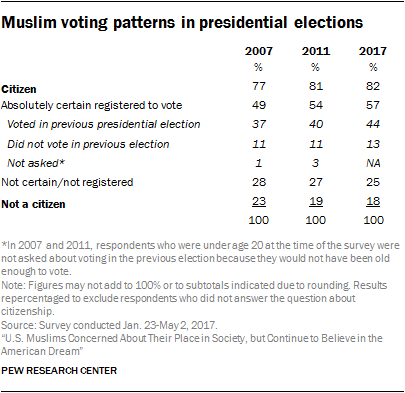
Muslim voting patterns in presidential elections

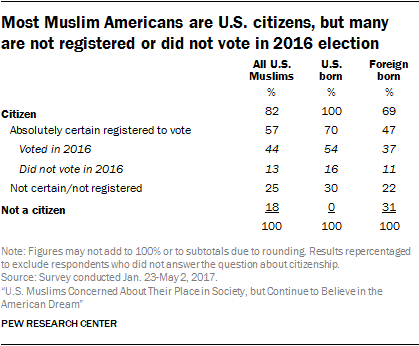
Overall, 44% of U.S. Muslims say they voted in the 2016 election.5 Nearly one-in-five Muslim adults living in the U.S. (18%) are not U.S. citizens, and thus not eligible to vote. In addition, one-in-four Muslims are citizens but are not registered to vote (25%), and 13% of Muslims are registered voters who stayed home on Election Day.6

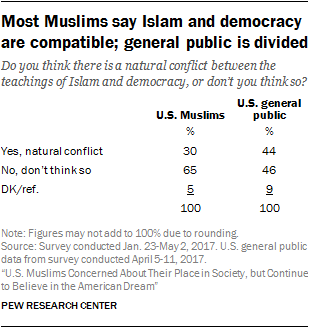
Two-thirds of Muslims (65%) say they do not think there is a natural conflict between the teachings of Islam and democracy, while three-in-ten say there is an inherent conflict between Islam and democracy.

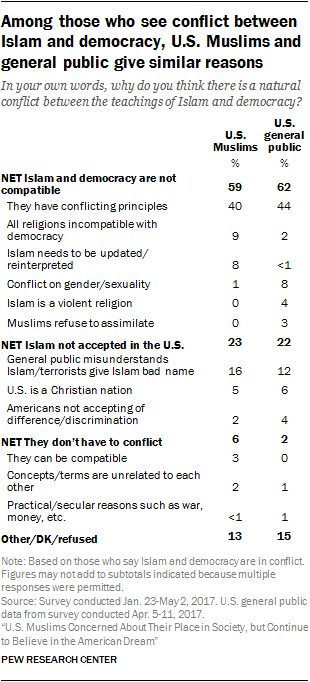
Those who say there is a conflict were asked to explain, in their own words, why they think Islam and democracy clash. Some say that Islam and democracy have fundamentally incompatible principles and values (40% of those who say there is a conflict), others say the apparent conflict is because non-Muslims don’t understand Islam or because terrorists give Islam a bad name (16%), and still others say democracy is incompatible with all religion (9%). (For more details on responses to these questions, see Chapter 4.)
 

1. Demographic portrait of Muslim Americans

Muslim Americans are a diverse and growing population, currently estimated at 3.45 million people of all ages, including 2.15 million adults (see below for an explanation of this estimate). The U.S. Muslim community is made up heavily of immigrants and the children of immigrants from around the world. On average, Muslim Americans are considerably younger than the overall U.S. population. 7

In their educational attainment levels, Muslims closely resemble the general public. About three-in-ten (31%) U.S. Muslims are college graduates, including 11% who have a postgraduate degree. On average, Muslim immigrants are more highly educated than U.S.-born Muslims.

Financially, Muslims are about as likely as Americans in general to have a household income over $100,000. At the same time, they are more likely than Americans in general to have an income under $30,000. The survey also finds that Muslims are three times as likely as other Americans to be without a job and looking for work.

The rest of this chapter provides a detailed examination of the demographic characteristics of the U.S. Muslim population.

Three-quarters of U.S. Muslims are immigrants or the children of immigrants

Nearly six-in-ten U.S. Muslims adults (58%) are first-generation Americans, having been born in another country. An additional 18% are second-generation Americans – people who were born in the U.S. and who have at least one parent who was an immigrant. About a quarter (24%) of U.S. Muslims are U.S. natives with U.S.-born parents (i.e., they are from families who have been in the U.S. for three generations or longer), which is the case for nearly three-quarters of U.S. adults overall (73%).

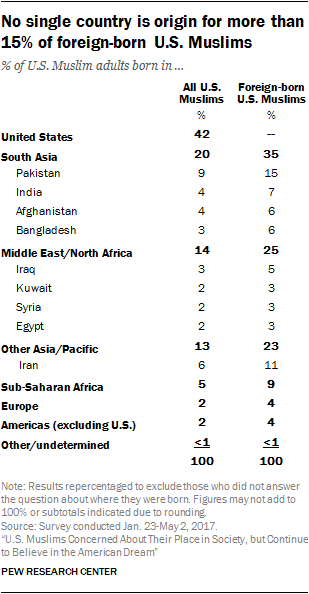
Among U.S. Muslim adults who were born abroad, more come from South Asia (35%) than any other region. An additional 23% were born in other parts of the Asia-Pacific region (such as Iran, Indonesia, etc.); 25% come from the Middle East-North Africa region, 9% come from sub-Saharan Africa, 4% were born in Europe and 4% come from elsewhere in the Americas.

No single country accounts for more than 15% of adult Muslim immigrants to the United States (15% are from Pakistan).8 The countries with the next-highest totals are Iran (11% of Muslim immigrants), India (7%), Afghanistan (6%), Bangladesh (6%), Iraq (5%), Kuwait (3%), Syria (3%) and Egypt (3%).

The geographic origins of Muslim immigrants in the United States do not precisely mirror the global distribution of Muslims (though most U.S. Muslim immigrants are from Asia, which is also home to most of the world’s Muslims). For more details about the geographic distribution of the worldwide Muslim population, see Pew Research Center’s April 2017 report “The Changing Global Religious Landscape.”

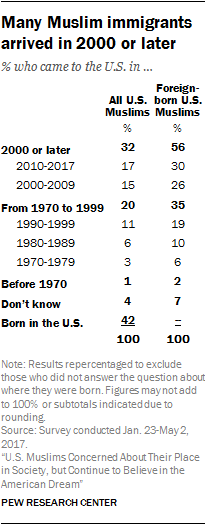
Three-in-ten Muslim immigrants have arrived in the U.S. since 2010. An additional 26% arrived between 2000 and 2009, and roughly one-in-five (19%) Muslim immigrants arrived in the 1990s. One-in-ten immigrated in the 1980s, 6% arrived in the 1970s and just 2% of Muslim immigrants say they arrived in the U.S. before 1970.

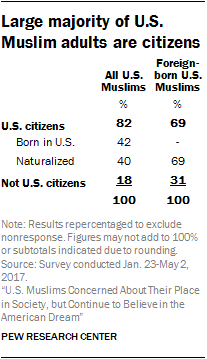
The survey also finds that the vast majority of Muslims living in the U.S. (82%) are American citizens, including 42% who were born in the U.S. and 40% who were born abroad but who have naturalized. The remainder are not U.S. citizens (18%).

Looked at another way, 69% of all foreign-born U.S. Muslim adults have become naturalized U.S. citizens.

Muslim Americans are racially and ethnically diverse

No racial or ethnic group makes up a majority of Muslim American adults. A plurality (41%) are white, a category that includes those who describe their race as Arab, Middle Eastern, Persian/Iranian or in a variety of other ways (see sidebar on white racial classifications). About three-in-ten are Asian (28%), including those from South Asia, and one-fifth are black (20%).9 Fewer are Hispanic (8%), and an additional 3% identify with another race or with multiple races.

Muslim immigrants are much more likely than U.S.-born Muslims to describe their race as Asian (41% vs. 10%). And U.S.-born Muslims are more likely than immigrant Muslims to be black (32% vs. 11%). In fact, fully half of Muslims whose families have been in the U.S. for at least three generations are black (51%).

Four-in-ten Muslim American adults are white

Racial classifications and Muslim Americans

This survey uses the following set of racial and ethnic classifications: white, black, Asian, Hispanic, multiracial and other. These classifications are based largely on current Census Bureau categories, as is generally true of Pew Research Center work. However, it is sometimes difficult for respondents to select from the Census Bureau’s options. For example, immigrants and the children of immigrants from the Middle East-North Africa region and from Iran have no explicit option to identify as Arab, Persian, Kurdish, etc., or to identify with a particular place of origin (e.g., Egypt, Palestine, Morocco) in place of a racial category. In the census, respondents who specify a country or region of origin in the Middle East-North Africa region instead of a specific racial category generally are counted as white; historically, the U.S. government has classified people as white if they have “origins in any of the original peoples of Europe, the Middle East or North Africa.”10

This may soon change. In recent years, advocacy groups for Arab Americans and others have argued that being classified as white does not reflect the self identity of Americans from the Middle East or North Africa.11 In response, the U.S. Census Bureau is considering a new “MENA” category for people from the Middle East and North Africa for possible use in the 2020 census and census surveys.12

At present, however, Pew Research Center generally uses the census classifications because they allow comparisons with the general public both for statistical analysis and, in some cases, for weighting of survey data to achieve nationally representative samples. (For more detail on weighting procedures, see the Methodology.) In this survey, nearly nine-in-ten immigrants from the Middle East-North Africa region (87%) are counted as white, including those who volunteered their race as “Arab” or “Middle Eastern,” those who identified with a specific country instead of a race, and those who explicitly identified themselves as white. In total, U.S. Muslim respondents were more likely to be counted as white (41%) than any other listed race option.

The historic connections between Arabs and “whiteness,” in the American context, date to the early 20th century, when being white – or, more precisely, being classified as white by the U.S. government – was important for immigrants who wanted to become citizens.13 Scholars of Arab American history highlight the significance of a 1915 U.S. appellate court ruling that granted citizenship to a Syrian man on the grounds that he was white.14 The court decisions allowed many Arab immigrants from West Asia to avoid being racially classified as Asian, which would have hurt their chances at immigration or naturalization.15

A closer look at U.S.-born black Muslims

American-born black Muslims stand out from other U.S. Muslims in several ways, according to the survey: Fully two-thirds are converts to Islam, compared with just one-in-seven among all other U.S. Muslims. And while they are about as likely as other Muslims to say they are proud to be American, U.S.-born black Muslims are less likely than other U.S.-born Muslims to say they have a lot in common with most Americans, and they are more likely than all other U.S. Muslims to say natural conflict exists between the teachings of Islam and democracy.

In addition, American-born black Muslims are more likely than other U.S. Muslims to say it has become harder in recent years to be Muslim in the United States. Nearly all American-born black Muslims (96%) say there is a lot of discrimination against Muslims in America, almost identical to the share who say there is a lot of discrimination against black people in the U.S. (94%).

African American Muslims have long played a notable role in U.S. Muslim society. However, as immigrant populations from Muslim-majority countries in the Middle East and Asia have grown, African American Muslims have decreased as a share of the U.S. Muslim population.16 The new survey finds that American-born black people account for about 13% of the adult Muslim community.17 And among Muslims whose families have been in the U.S. for at least three generations, fully half are black. Another 6% of all adult Muslims identify as black, but were born outside the U.S., generally in sub-Saharan Africa.

Perhaps the best-known group of black Muslims in the U.S. is the Nation of Islam, which at one point counted Malcolm X and Muhammad Ali as high-profile members. But in the Pew Research Center survey, just 3% of all U.S.-born black Muslims say they identify with the Nation of Islam. The vast majority of U.S.-born black Muslims say they are either Sunni Muslims (45%), or they identify with no particular Islamic denomination or they did not answer the question (43%).

Muslim American population is much younger than U.S. adults overall

Muslim Americans: A young population

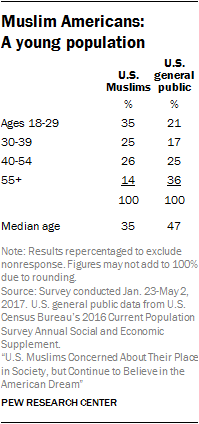
The American Muslim adult population is considerably younger than the overall U.S. adult population. About a third (35%) of Muslim American adults are between 18 and 29 years old, which is a far higher percentage than the share of the general population that falls in that age bracket (21%).

Similarly, adults ages 18 to 39 make up 60% of the Muslim American adult population, compared with 38% of the U.S. adult population as a whole. Meanwhile, at the other end of the age spectrum, adults ages 55 and over make up just 14% of Muslim Americans, while people in this older age bracket comprise 36% of the overall U.S. adult population.

Another way to compare how old or young a group is within a broader population is to calculate its median age, which for Muslim adults in the U.S. is 35. In the U.S. population as a whole, the median age of adults is 47.

About half of Muslim Americans are married

Seven-in-ten Muslim immigrants are married

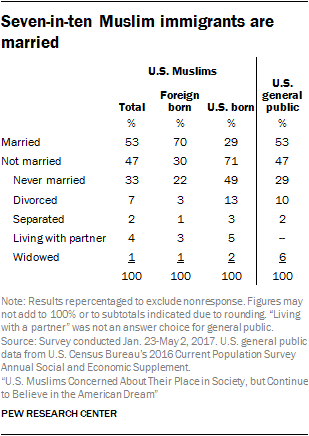
Roughly half (53%) of Muslim adults in the U.S. are married. A third (33%) have never been married, while 8% are divorced or separated, 4% are unmarried but living with a partner, and 1% are widowed. Foreign-born Muslims are much more likely to be married than are Muslims who were born in the U.S. (70% vs. 29%).

The vast majority of U.S. Muslims who are married have a spouse who is also Muslim. For details, see here.

The share of Muslim American adults who are married is identical to the share of U.S. adults overall who are married (53%), even though Muslims are younger than the U.S. general public.

Muslim Americans have 2.4 children, on average

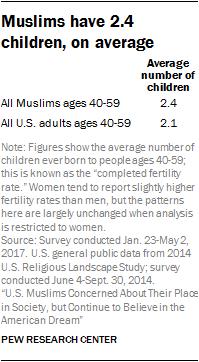
The survey results indicate that among adults ages 40 to 59, Muslim Americans report having an average of 2.4 children over the course of their lives. Americans overall average 2.1 children.18 This is in line with previous Pew Research Center research suggesting that, worldwide, Muslims have higher fertility rates than any other major religious group.

Muslims have 2.4 children, on average

Muslims have similar levels of education to Americans overall, but report lower incomes

Immigrant Muslims more likely than other Muslims to have college degrees

About three-in-ten U.S. Muslims (31%) have college or postgraduate degrees, equivalent to the share among U.S. adults as a whole (31%). Foreign-born Muslims are more likely to have at least a college degree (38%) than are Muslims born in the U.S. (21%), perhaps reflecting immigration policies that give preference to highly educated immigrants.

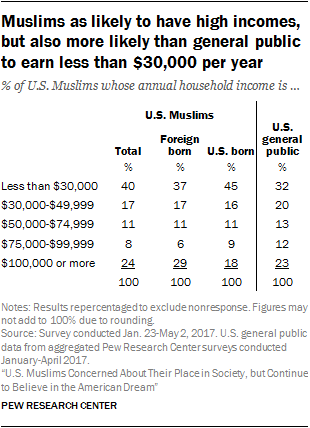
Similarly, U.S. Muslims are about as likely as Americans overall to report household incomes of $100,000 or higher (24% of Muslims and 23% of Americans in general). But they also are more likely to be at the other end of the income scale: 40% of Muslim Americans report household incomes under $30,000, compared with 32% of the U.S. population as a whole. Muslims are also less likely than the general public to fall into the middle range, between $30,000 and $99,999 – 35% of Muslims report household income in this range, compared with 45% of all Americans.

Muslims as likely to have high incomes, but also more likely than general public to earn less than $30,000 per year

The share of Muslims who report owning a home (37%) is considerably lower than among all U.S. adults (57%).

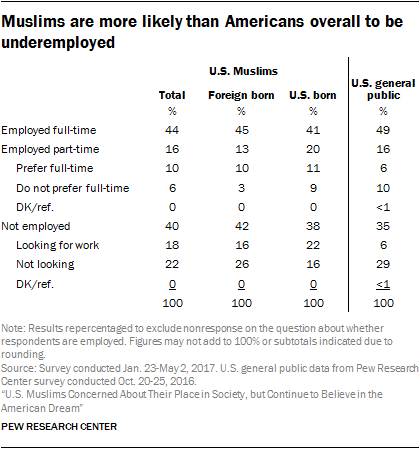
Fewer than half of Muslim adults say they are employed full time (44%). Overall, 29% of Muslims are underemployed, in that they are either employed part time but would prefer full-time work (10%), or they are not employed but they are looking for work (18%). By comparison, 12% of U.S. adults overall are underemployed in these ways, according to a 2016 Pew Research Center survey.

Muslims are more likely than Americans overall to be underemployed
Muslims about as likely as general public to rate their financial situation as ‘excellent’ or ‘good’

Still, Muslims are about as satisfied with their finances as are U.S. adults as whole. Asked to rate their personal financial situation, 43% of Muslims say they are in either “good” or “excellent” financial shape, while 56% say they are in “only fair” or “poor” shape financially. Among the general public, 46% rate their financial situation as good or excellent, while 53% say it is only fair or poor.

Most Muslims live in households with other people who are all Muslim

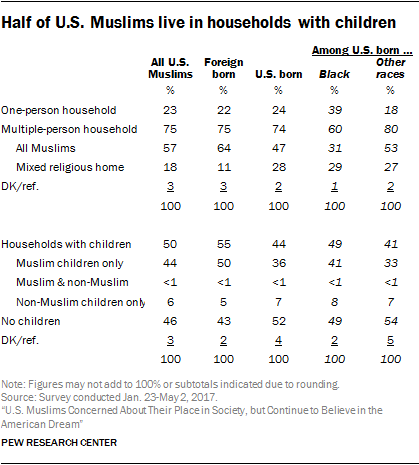
Half of U.S. Muslims live in households with children

The most common living situation among Muslim Americans – especially immigrants – is a multi-person household in which everyone is Muslim. More than half of Muslims (57%) live this way. An additional 18% of Muslims live in a home with non-Muslims (such as a non-Muslim spouse), while 23% live alone.

Half of Muslim Americans live in a household with minor children, and usually those children are Muslim. But 6% of all U.S. Muslims live in households with children who are not Muslim.

How many Muslims are there in the United States? And how do we know?

There are no U.S. government statistics on the number of Muslim Americans. For that matter, there are no official figures on the size of any religious group in the U.S., because the Census Bureau does not collect information on the religious identification of residents. With surveys like this one, however, demographers can calculate a rough estimate of the number of Muslims who currently reside in the country.

Number of Muslims in the U.S. continues to grow

Based on these calculations, Pew Research Center estimates that there are currently 3.45 million Muslims in the U.S., including 2.15 million adults and 1.35 million children. Muslims account for roughly 1.1% of the total U.S. population (including both adults and children), as well as approximately 0.9% of the U.S. adult population.19

Moreover, the U.S. Muslim population has been growing rapidly, albeit from a relatively low base. When the Center first conducted a study of U.S. Muslims in 2007, researchers estimated that there were 2.35 million Muslims of all ages (including 1.5 million adults). By 2011, the number of Muslims had grown to 2.75 million (including 1.8 million adults). Since then, the Muslim population has continued to grow at a rate of roughly 100,000 people per year, driven both by natural increases due to fertility and by migration of Muslims to the U.S.

These estimates are derived through a multistep process that combines information from the survey on the prevalence of Muslims among immigrants and other demographic groups with official Census Bureau statistics on the total number of people in the U.S. who fall into these groups.

In the first step of this process, every country in the world is sorted into one of five categories (very high, high, medium, low or very low) based on the percentage of U.S. immigrants from that country who identify as Muslim. For instance, a large majority of the survey respondents who were born in Pakistan say they are Muslims, and therefore Pakistan is included in the “very high” category; the survey indicates that, on average, about two-thirds of U.S. adults from the “very high” countries are Muslim. The “high” category includes countries such as Afghanistan, Egypt and Jordan, among others; altogether, roughly one-third of respondents born in these countries are Muslim. At the other end of the spectrum, none of the survey respondents who were born in Mexico say they are Muslim, and thus Mexico is included among countries in the “very low” category; the survey indicates that, on average, just one-half of one percent (0.5%) of U.S. residents who were born in the “very low” countries are Muslim.

In the second step of the process, these survey-based estimates are combined with official Census Bureau information about the country of birth of all U.S. residents.20 Census data show, for instance, that there are currently about 300,000 households in which either the head of the household or the spouse is an immigrant from one of the countries in the “very high” category. Combining the survey finding that, on average, 68% of immigrants from countries in the “very high” category are Muslims with the Census Bureau data yields an estimate that there are roughly 200,000 U.S. households headed by Muslims born in countries in the “very high” category; these households include about 400,000 Muslim adults and 225,000 Muslim children.21

In the third step of the process, this procedure was repeated for immigrants from countries in each of the other categories (high, medium, low, very low), as well as for households in which either the head or spouse is a U.S.-born adult with at least one foreign-born parent.

Finally, U.S.-born adults whose parents were also born in the United States were subdivided by age and race (e.g., blacks under age 40, blacks ages 40 and older, etc.), and the process was repeated again for each of these groups. For example, the survey estimates that Muslims account for 2.1% of all black adults under age 40 whose families have been in the U.S. for three generations or longer. Census data indicate that there are about 4.65 million households headed by African Americans under age 40. Combining this figure with the survey data produces an estimated 100,000 households where the head or spouse is a third-generation (or higher) African-American Muslim under 40; these households include about 125,000 Muslim adults and 125,000 Muslim children.22

After obtaining estimates of the number of Muslims in each subgroup of the population – including immigrants categorized by country of origin and the U.S.-born categorized by age and race – the figures were summed to generate an estimate of the overall size of the Muslim population.

This detailed approach to estimating the size of the Muslim population has several advantages. Perhaps most importantly, research shows that it is easier to reach and survey U.S.-born adults than it is to reach and survey immigrants, especially immigrants who may face a language barrier. Using official statistics from the Census Bureau in the way described above helps ensure that Muslims are not undercounted simply because they were born in countries like Bangladesh or Somalia (for example) and may, therefore, be difficult to reach.

Of course, the approach outlined above is not the only possible method for estimating the size of the U.S. Muslim population. One alternative is to estimate the percentage of Muslims in the overall U.S. population directly from the results of a survey, without combining the survey data with census figures. Estimates based directly on survey incidence rates tend to be very similar to the estimates described above. For example, Pew Research Center’s 2014 Religious Landscape Study found that Muslims accounted for 0.9% of the U.S. adult population in that year. Aggregated political surveys conducted by Pew Research Center since the beginning of 2016 find that 1.1% of U.S. adults are Muslims. And, over the last decade, estimates of the Muslim share of the population produced by the General Social Survey (GSS) have ranged from 0.4% to 1.1%.23

The estimate that there are now 3.45 million Muslims in the United States is also consistent with demographic projections outlined in Pew Research Center’s report “The Future of World Religions: Population Growth Projections, 2010-2050.” In that report, demographers compiled data from nearly every country in the world on the current size of religious groups, the age structure and fertility rates of those groups, their rates of religious switching and migration, and related information to produce country-by-country projections of the future growth trajectories of religious groups from 2010 to the year 2050. Those analyses projected that the number of U.S. Muslims (of all ages) would reach 3.3 million by 2015 and 3.85 million by 2020.

Still another way to estimate the size of the Muslim population was employed by Ihsan Bagby in his study “The American Mosque 2011,” which was based on an extensive survey conducted among leaders of a large sample of mosques around the country.24 In that study, estimates of the average number of people associated with a mosque were combined with information on the total number of mosques in the United States to produce an estimate that there are 2.6 million mosque-connected U.S. Muslims (i.e., Muslims who attend mosque at least once or twice a year for Eid prayers). In the current Pew Research Center study, 74% of U.S. Muslims say they attend mosque a few times a year, especially for Eid prayer; when combined with the Center’s demographic estimate that there are 3.45 million Muslims of all ages in the U.S., this suggests that there are 2.6 million mosque-connected U.S. Muslims, a figure very similar to the estimate from “The American Mosque 2011.”25

2. Identity, assimilation and community

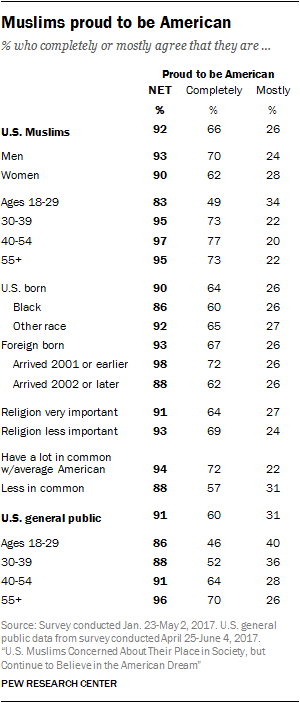
Muslim Americans overwhelmingly embrace both the “Muslim” and “American” parts of their identity. For instance, the vast majority of U.S. Muslims say they are proud to be American (92%), while nearly all say they are proud to be Muslim (97%). Indeed, about nine-in-ten (89%) say they are proud to be both Muslim and American.

Muslim Americans also see themselves as integrated into American society in other important ways. Four-in-five say they are satisfied with the way things are going in their lives in America, and six-in-ten say they have “a lot” in common with most Americans. In addition, a declining share of U.S. Muslims say that “all” or “most” of their close friends are also Muslim.

Yet, in other ways, many Muslims feel they stand out in America. For example, about four-in-ten say there is something distinctive about their appearance, voice or clothing that people might associate with being Muslim. This includes most women who regularly wear hijab, but also one-in-four women who do not wear hijab regularly and about a quarter of men who also say there is something distinctively Muslim about their appearance. In addition, three-quarters of Muslim Americans say they feel a strong sense of belonging to the global ummah, or Muslim community, and 80% say they feel a strong tie to Muslim communities in the U.S. – though follow-up interviews highlight the ambiguity of these concepts, even for Muslims who say this.

This chapter also explores other aspects of identity, including what Muslims see as essential to their religious identity and key values and goals in life more broadly.

Most U.S. Muslims proud to be American, satisfied with life

Muslims proud to be American

Nine-in-ten U.S. Muslims agree either completely (66%) or mostly (26%) with the statement, “I am proud to be American.” Only a handful of U.S. Muslims disagree with this statement either completely (4%) or mostly (2%).

Muslim immigrants are at least as likely as U.S.-born Muslims to express pride in being American. At the same time, immigrants who have been in the U.S. for longer are somewhat more likely than recent immigrants to say they are proud to be American.

Muslim adults younger than 30 are less likely than older Muslims to say they are proud to be American. The same pattern is evident among the population as a whole.

Among Muslims, pride in being American does not vary significantly based on the importance of religion in their lives. On the other hand, Muslims who say they have a lot in common with most Americans are considerably more likely than those who have less in common to completely agree that they are proud to be American (72% vs. 57%).

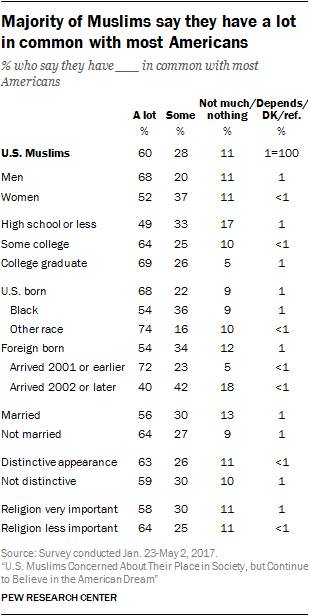
When asked how much they have in common with “most Americans,” six-in-ten U.S. Muslims (60%) say they have “a lot” in common. Another 28% say they have “some” in common, and about one-in-ten say they have “not much” (8%) or “nothing at all” (3%) in common with most Americans.

Majority of Muslims say they have a lot in common with most Americans

More Muslim men than women (68% vs. 52%) say they have a lot in common with most Americans. And about seven-in-ten Muslim college graduates say they have a lot in common with the average American, compared with only about half of those who have a high school degree or less.

U.S.-born Muslims (68%) are more likely than immigrants (54%) to say they have a lot in common with most Americans, but within these groups there also are important differences. For example, a much smaller share of recent immigrants say they have a lot in common (40%) compared with those who have been in the U.S. longer (72%).

Muslims who say there is something distinctive about their appearance that indicates their Muslim identity are no less likely than those who say there is nothing distinctive about their appearance to say they have a lot in common with most Americans.

Most Muslims satisfied with way things are going in their lives

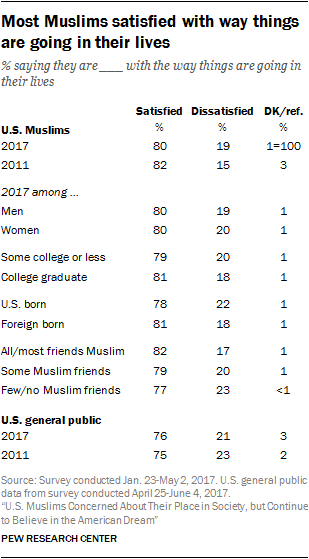
Four out of five U.S. Muslims (80%) say they are satisfied with the way things are going in their lives. In fact, Muslims remain about as satisfied with their lives as they were in 2011 (82%). Satisfaction among Muslim Americans is similar to feelings among those in the larger U.S. public.

Life satisfaction is relatively consistent among Muslim men and women, Muslims of varying levels of education, and immigrant and U.S.-born Muslims.

Muslims today less likely to say most of their friends are Muslim

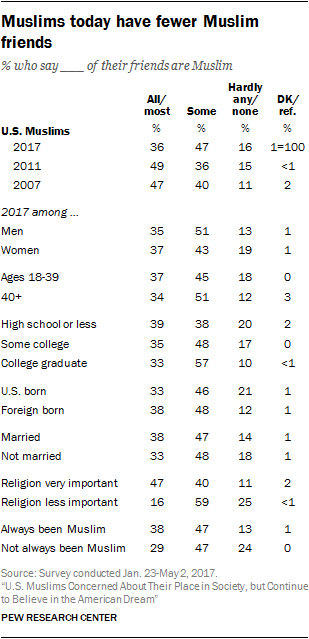
Muslims today have fewer Muslim friends

About one-in-three U.S. Muslims say all (5%) or most (31%) of their close friends are Muslim. About half (47%) say some of their friends are Muslim, and roughly one-in-six say hardly any of their friends are Muslim (15%) or that they have no Muslim friends (1%).

A smaller share of Muslims today say that all or most of their friends are Muslim compared with 2011 or 2007, when about half of U.S. Muslims said this.

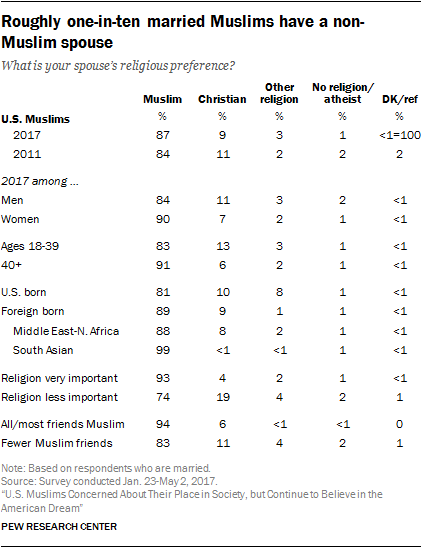
Muslims who say religion is very important to them are much more likely to say that all or most of their friends are Muslim than are those who say religion is less important. As in years past, most married U.S. Muslims have a spouse who is also Muslim (87%). Just 9% have a Christian spouse, 1% are married to someone who has no religious affiliation and 3% are married to someone of another faith. These figures are little changed since 2011.

While differences in question wording make direct comparisons difficult, surveys generally find that those in other religious groups also have a tendency to marry within their faith. Pew Research Center’s 2014 U.S. Religious Landscape Study, for example, found that 90% of married Christians are wedded to another Christian. And a 2013 Pew Research Center survey of U.S. Jews found that 64% of Jews are married to a Jewish spouse.26

Roughly one-in-ten married Muslims have a non-Muslim spouse

Married Muslims who say religion is very important in their lives are far more likely to have a Muslim spouse than those who say religion is less important (93% vs. 74%). And U.S. Muslims whose close friends are mostly or all Muslims are more likely than those with fewer Muslim friends to have a Muslim spouse (94% vs. 83%).

In their own words: What Muslims said about their friends and family

Pew Research Center staff called back some of the Muslim American respondents in this survey to get additional thoughts on some of the topics covered. Here is a sampling of what they said about their Muslim and non-Muslim friends and family: “I don’t have many Muslim friends here in the U.S. simply because I don’t really practice my religion. I don’t go to mosque or many places where I can meet groups of Muslims. So my friendship relationships are mainly with coworkers or things like that. So that’s why I don’t have many Muslim friends. … Ninety-nine percent of people, once they know I am Muslim, they assume my wife had to convert to Islam or that she’s Muslim. And that’s not the case. My wife is not a Muslim; she didn’t convert. That’s an interesting thing – when everyone knows I’m Muslim, they assume she’s Muslim and start acting based on that until I tell them she is not.” – Immigrant Muslim man “I don’t have Muslim friends. I’m originally from Egypt. There’s no Egyptian people around me, and I don’t get along with other nationalities. I don’t have friends at all.” – Muslim man over 60 “I have like a mixture of both Muslim and non-Muslim friends of all different races. I grew up around diversity, and I don’t have anything against non-Muslims. I have non-Muslim friends and coworkers and classmates and everything like that. I pretty much interact with all races and religions.” – Muslim woman under 30

“I actually do have a lot of Muslim friends, but have a lot of non-Muslim friends too. I would say it’s about two-thirds Muslim to one-third non-Muslim. A lot of my Muslim friends I made later in life. That’s because, when I was younger, it was harder to find Muslims I could be friends with. I found it difficult to socialize with Muslims who were socially very liberal. I found it very difficult because I was raised in a very conservative, religious household and that colored how I saw the world. … My dad served four years in the U.S. Air Force and that helped us better socialize with the public and accept our role here in America. And that eventually helped me make more Muslim friends. No matter where they stood on social issues, I could embrace them as friends because they were committed to being in this country as Muslims. … My non-Muslim friends saw me for myself and didn’t see or define me by my religious identity. I wear the hijab, but I have an outgoing personality. So they told me that while they may have judged me at first by my appearance, within five seconds they saw me for who I was.” – Muslim woman in her 40s “I have friends who are Muslim and friends who aren’t Muslim. I’m not sure if I have more Muslim friends or more non-Muslim friends because I don’t think about it. … Religion is just not a big issue for me. So, I don’t care if someone is Christian, Jewish or Muslim or whatever. For me it’s about what’s inside the person. I look for people who match my personality. If I like you, I don’t care about your religion. It’s you I’m interested in.” – Muslim man under 30

[mosque]

Some say they can be recognized as Muslim by appearance

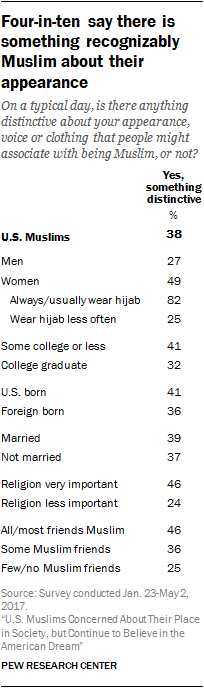
Four-in-ten say there is something recognizably Muslim about their appearance

About four-in-ten Muslim Americans say that on a typical day, there is something distinctive about their appearance, voice or clothing that other people might associate with being Muslim. Not only do the vast majority of women who report regularly wearing hijab say this (82%), but about a quarter of Muslim men (27%) and a similar share of Muslim women who wear hijab less often (25%) also say their everyday appearance effectively identifies them as Muslim.

Muslim women who say they are very religious are far more likely to say there is something distinctively Muslim about their appearance than are women who say religion is less important (63% vs. 16%); among men, however, there is no significant difference on this question by religious salience.

In addition, more Muslims in predominantly Muslim friendship circles say there is something distinctive about their appearance compared with those who have few or no Muslim friends.

Nearly all U.S. Muslims are proud to be Muslim, most feel connected to the Muslim community

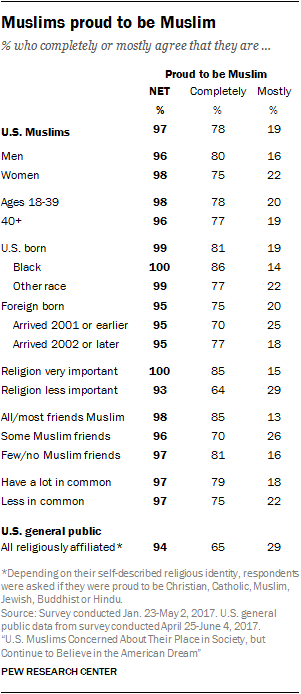
Pride in being Muslim is nearly universal among U.S. Muslims, 97% of whom “completely” or “mostly” agree that they are proud to be Muslim. By comparison, 94% of all religiously affiliated Americans say they are proud to be a member of their faith (e.g., proud to be Christian), although Muslim Americans are more likely than religiously affiliated Americans overall to completely agree that they are proud of their religious identity (78% vs. 65%).

Muslims proud to be Muslim

U.S. Muslims who say religion is very important in their lives are especially likely to completely agree that they are proud to be Muslim (85%); among those who say religion is less important, about two-thirds (64%) completely agree that they are proud of their Muslim identity.

Most U.S. Muslims also feel a sense of belonging to Muslim communities both in the U.S. and around the world.

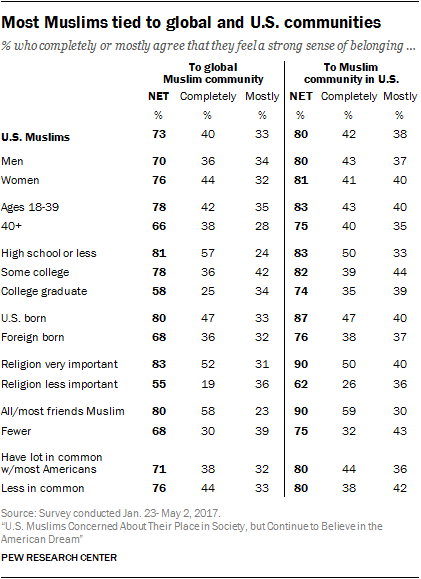
Nearly three-quarters of Muslim Americans completely (40%) or mostly (33%) agree that they feel a strong sense of belonging to the global Muslim community, or ummah. This view is more common among U.S.-born Muslims than among Muslim immigrants (80% vs. 68%).

Muslims who say religion is very important in their lives are far more likely than those who say religion is less important to say they feel a strong sense of belonging to the Muslim ummah (83% vs. 55%).

Muslims in the U.S. feel modestly more connected to the Muslim community in the U.S. than they do to the global Muslim community. Eight-in-ten completely (42%) or mostly (38%) agree that they feel a strong sense of belonging to the Muslim community in the United States. As with ties to the global Muslim ummah, U.S.-born Muslims, highly religious Muslims and those with many Muslim friends are especially likely to say they feel a connection to the Muslim community in the United States. How much U.S. Muslims feel they have in common with most Americans has little to do with how connected they feel to the Muslim community.

Most Muslims tied to global and U.S. communities

In their own words: What Muslims said about their sense of belonging to the global Muslim ummah and the U.S. Muslim community

Pew Research Center staff called back some of the Muslim American respondents in this survey to get additional thoughts on some of the topics covered. Here is a sampling of what they said about their sense of belonging to the global Muslim ummah and the U.S. Muslim community: “I guess I’m connected to the Muslim ummah, in terms of I belong to the same faith. So if you think about the billions of Muslims out there, I belong to that ummah – whatever that means. … If there is starvation in Somalia I’ll find a way to donate. But I don’t know if I’m that connected with the ummah. You get swallowed up in your life.” – Immigrant Muslim man

[to the Muslim community where I live]

“After 60 years of life, I sympathize with anybody in the world who has problems. It does not matter if they’re Christian, Jewish, Hindu or Muslim or whoever. When I see war and people who are dying or paying their life for something, whether Muslim or not, I feel connected to them.” – Muslim man over 60

“When I’ve traveled overseas … one of things I notice most is that I had more information and knowledge about my religion than my cousins and other family members who lived in a Muslim-majority country, Pakistan. I noticed that I felt more comfortable being Muslim than they did. … When you have freedom of religion and don’t allow it into the political life of a country – then you are free to explore religion, pursue and embrace it or leave it, as you see fit. That’s a beautiful thing to me.” – Muslim woman in her 40s

[The reason for this is a]

In their personal lives, Muslims prize being good parents – much like other Americans

Being a good parent one of the most important things to most Muslims

The survey asked Muslim Americans about the importance of four specific life goals: being a good parent, living a very religious life, being successful in a high-paying career and having free time. Muslims largely mirror the U.S. general public in the sense that being a good parent is more important than any of the other goals asked about in the survey.

The vast majority of Muslim Americans say being a good parent is either “one of the most important things” in their lives (67%) or is “very important, but not one of the most important things” (25%). Very few say being a good parent is “somewhat important” (2%) or “not important” (5%). A similar pattern exists among the larger U.S. public, with fully two-thirds (66%) saying that being a good parent is one of the most important things in their lives and 23% saying it is very important but not one of the most important things.

An especially high share of Muslims with children under 18 currently living at home say being a good parent is one of the most important things (78%), but even among those without minor children at home, more than half (57%) say this as well.

While most Muslims (65%) say religion is very important in their lives, only about half as many (31%) say “living a very religious life” is “one of the most important things” in their life. Three-in-ten Muslims also say that being successful in a high-paying career is one of the most important goals in their life – higher than the comparable share of U.S. adults overall who say this (30% vs. 17%).

Career success is most important among young Muslims and recent immigrants. The importance of a high-paying career is also related to education and household income: About one-in-three respondents with a household income of less than $30,000 say being successful in a high-paying career is one of the most important things in life (35%), compared with just 18% of those with a household income over $100,000.

Having free time is the least important of the four life goals asked about in the survey. One-in-five Muslims say having free time to relax and do what they want is one of the most important things to them, similar to the share of Americans overall who say this.

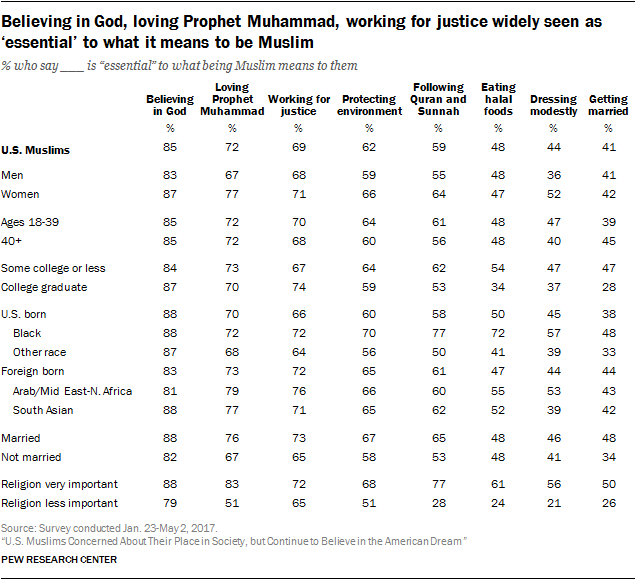
Essentials of being Muslim: Believing in God and loving the Prophet Muhammad, but also working for justice, protecting environment

The survey included a series of questions that asked Muslims whether several beliefs or behaviors are important or essential to what being Muslim means to them, personally. A large majority of Muslims (85%) say believing in God is essential to what being Muslim means to them, while 10% say believing in God is important but not essential to their Muslim identity. Very few (4%) say believing in God is not an important part of what being Muslim means to them.

A 2014 Pew Research Center survey found that U.S. Christians are similarly united in stating that belief in God is essential (86%) or important (10%) to what being Christian means to them.

Believing in God, loving Prophet Muhammad, working for justice widely seen as ‘essential’ to what it means to be Muslim

After belief in God, Muslims place somewhat less emphasis on loving the Prophet Muhammad: Nearly three-quarters (72%) say loving Muhammad is essential to what it means to be Muslim, and another 20% say it is important but not essential.

About seven-in-ten Muslims (69%) say working for justice and equality in society is essential to what it means to be Muslim, and nearly as many (62%) say the same about protecting the environment. By comparison, a majority of U.S. Jews (60%) also say that working for justice and equality is essential to their Jewish identity. And far fewer U.S. Christians (22%) say protecting the environment is essential to what being Christian means to them.

About six-in-ten Muslim Americans (59%) say following the Quran and Sunnah is essential to what being Muslim means to them. Muslims are much more likely to say this than U.S. Jews are to say that observing Jewish law is essential to their Jewish identity (23%). Among Muslims, this view is concentrated among those who say religion is very important to them (77%), while far fewer Muslims who say religion is less important in their lives say following the Quran and Sunnah is essential to their Muslim identity (28%).

Believing in God, loving Prophet Muhammad, working for justice widely seen as ‘essential’ to what it means to be Muslim

Muslims are similarly divided about the importance of eating halal food (see glossary for a definition of halal). Overall, about half of Muslims (48%) say eating halal food is essential to what being Muslim means to them. This view is expressed by roughly six-in-ten Muslims who say religion is very important in their everyday life (61%), but only about a quarter of Muslims who say religion is less important (24%).

Dressing modestly is seen as essential by 44% of Muslims. Here again, this view is most common among the most religious Muslims. The survey also finds that 52% of Muslim women say dressing modestly is essential to what being Muslim means to them, compared with just 36% of Muslim men who say this is essential to their Muslim identity.

Four-in-ten U.S. Muslims say getting married is essential to what being Muslim means to them. There is little difference between men and women on this issue, but married respondents are more likely than those who are not married to say marriage is essential to what being Muslim means to them. In addition, relatively few college-educated Muslims (28%) say getting married is essential.

In addition to these eight items, respondents were asked if there was anything else that they personally see as essential to what it means to be Muslim. About one-in-ten mentioned the “golden rule” (13%) or specific ritual practices (11%), such as the daily salah (prayers), as essential aspects of being Muslim. And others mentioned being tolerant (7%), being a good person (6%) and either being peaceful or promoting peace (5%).


3. The Muslim American experience in the Trump era

U.S. Muslims clearly express concerns and worries about the future of the country and their place in American society in the wake of Donald Trump’s election as president. Most Muslims are dissatisfied with the direction the country is going, which is a reversal of opinion from 2011. Majorities of U.S. Muslims view the Republican Party and Trump as unfriendly toward Muslim Americans. And most Muslims say anti-Muslim discrimination is prevalent in American society. These worries and concerns are most pronounced among Muslim women and among those born in the United States.

But there are also signs of optimism among the Muslim community. Even though three-quarters of Muslims say they face a lot of discrimination, there has been an uptick in the share who say someone has expressed support for them because they are Muslim. And about half of Muslims say the American people, as a whole, are friendly toward Muslim Americans.

This chapter also examines opinions about government monitoring of phone calls and emails, treatment of the Muslim community by media outlets and attitudes about the acceptance of Muslims and Islam into mainstream American society.

Trump sparks worry, viewed as unfriendly by Muslim Americans

The survey asked Muslim Americans if Donald Trump spurred in them any of four different emotions: worry, anger, hope and happiness. Far more Muslims express negative emotions associated with Trump than positive ones.

A majority (68%) of U.S. Muslims say Trump makes them feel worried, and fully 45% say Trump makes them feel angry. On the other hand, some do say Trump makes them feel hopeful (26%) or happy (17%). Trump evokes similar levels of worry (60%) and anger (39%) among the general public as he does among Muslims, although Americans overall are more likely than Muslims to say Trump makes them feel hopeful (40%) or happy (30%).

Muslim women express much more worry and anger about Trump than do Muslim men. Indeed, fully three-quarters of Muslim women (76%) say Trump worries them, compared with 60% of Muslim men. And while 54% of Muslim women say Trump makes them feel angry, just 37% of Muslim men agree. (For more on gender differences in opinion among U.S. Muslims, see the Overview.)

Among the two-thirds of Muslims who identify with or lean toward the Democratic Party, most say Trump makes them feel worried (76%) and angry (57%), while just 19% say he makes them feel hopeful and 13% say he makes them feel happy. Among the 13% of Muslims who identify with or lean toward the GOP, by contrast, far fewer say Trump makes them feel worried or angry, and most (58%) say he makes them feel hopeful.

About three-quarters of U.S. Muslims say Donald Trump is unfriendly toward Muslim Americans, with 12% describing the new president as friendly toward Muslim Americans and 9% saying he is neutral. The data also show that about six-in-ten (59%) say the Republican Party as a whole is unfriendly toward Muslim Americans, up from 48% who expressed this view in 2011.

Muslim women are especially likely to express skepticism of Trump and the GOP’s attitude toward Muslims. Fully eight-in-ten Muslim women say Trump is unfriendly toward Muslims (compared with 68% of men), and about seven-in-ten Muslim women (69%) view the GOP as unfriendly toward Muslims (compared with 49% of Muslim men). The data also show that on these questions, wariness of Trump and the GOP is higher among U.S.-born Muslims than among immigrants.

In their own words: What Muslims said about Trump

Pew Research Center staff called back some of the Muslim American respondents in this survey to get additional thoughts on some of the topics covered. Here is a sampling of what they said about President Donald Trump: “In terms of the challenges we’re dealing with as a people, humanity … leadership has a role to play. … When I contrast our president with some of the leaders out there and some of the leaders we’ve had, whether Democrats or Republican – it doesn’t matter. There’s a lack of leadership. And the tone he uses to refer to people – Muslims, blacks, Mexicans, Jews. The tone he uses is divisive. It’s poor leadership.” – Muslim man

“Donald Trump is a racist, OK? I’m a black woman. He’s not for the blacks, he’s not for the poor. He’s for himself, is what I believe.” – Muslim woman in 30s

“In his Saudi Arabia meeting, he said that Muslims are one of the greatest faiths in the world. While I do appreciate that, what he said a year ago was different.” – Muslim man under 30

“A lot of us Muslims, we don’t feel safe here anymore. Trump is kind of painting a bad picture for Muslims.” – Muslim woman under 30

“I believe Mr. Donald Trump is a very good president and he can do a lot to the economy because he spent his life as a businessman and engineer, but for politics, he did kind of strong decisions that tended to be unfair, like when he said that seven Muslim countries are not supposed to enter the United States and stuff like this. You can’t treat all the people with the same guilt. Get the people who caused the trouble and prosecute them. It makes you look not that great to the whole world.” – Muslim man over 60

“I am not even sure how I feel. I wish he would just shut up. I thought he would be for the better good of the country. Is it him? Is it the media? I will say I was always Republican and never voted any other way and now I am saying, ‘What is going on?’ I am the first to say we should be careful who to let in the country, but there is a more diplomatic way to do it. For an educated man he is not making educated decisions. And I have family from outside this country. My husband is from Iran. So do I think we should be careful with Iran. My husband has been here since 1985. … I don’t think it is wrong for the government to be careful, but a lot of innocent people are being hurt by this. There are family members I might not be able to see again. They would come every year and now I cannot see them. I believe in protecting our country but the way he is going about it is not the best way.” – Muslim woman in 40s

“I had more of a feeling there might be change. I said they should give him a chance. So far I don’t want to say he did a bad job. I like his vibe. He gets things done. But the health care bill is not so good. It is supposed to be about taking care of the poor and elderly and that is what the bill does not cover. I feel indifferent. I am neither poor nor elderly. It is not a good thing. My opinion of him is the same.” – Muslim man under 30

U.S. Muslims express much more positive views about Democrats’ attitudes toward the Muslim community. About four-in-ten (43%) say the Democratic Party is friendly toward Muslim Americans, and an additional 35% say the party is neutral toward Muslims. Just 13% say the Democratic Party is unfriendly toward Muslims.

Muslims ages 40 and older and those who were born outside the U.S. are especially likely to see the Democratic Party as friendly toward Muslims.

Overall, three-in-ten U.S. Muslims say they are satisfied with the way things are going in the country today, while 64% say they are dissatisfied. This is a substantial shift from 2011, when the balance of opinion leaned in the opposite direction.

The change in perspective appears to be bound up, at least in part, with the outcome of the 2016 presidential election. Among Muslims who approve of Trump’s job performance (19% of U.S. Muslims surveyed), three-quarters say they are happy with the direction of the country (76%). But among the much larger group of Muslims who disapprove of Trump’s handling of his job as president, just 12% are satisfied with the way things are going in the country, while 85% are dissatisfied.

Muslims feel they face unfair media coverage, discrimination

Most Muslim Americans (60%) say coverage of Islam and Muslims by American news organizations is unfair, while just 27% say the coverage has been fair. The view that the media is biased against Islam and Muslims is especially prevalent among women, among whom 68% express this opinion (compared with 52% of Muslim men). And U.S.-born Muslims are more likely than their foreign-born counterparts to say the way the media treats Islam and Muslims is unfair (74% vs. 49%).

Most Muslims say Americans don’t consider Islam mainstream

The data show, furthermore, that six-in-ten U.S. Muslims (62%) say the American people do not see Islam as part of mainstream American society. And, indeed, a plurality of U.S. adults (50%) say they do not see Islam as part of mainstream American society (for more details on how Americans as a whole view Muslims and Islam, see Chapter 7).

Just three-in-ten U.S. Muslims say the American people see Islam as mainstream; this view is most pronounced among Muslim men and Muslims born outside the U.S.

Most Muslims say there is ‘a lot’ of discrimination against Muslims in U.S.

When asked directly, three-quarters of U.S. Muslims say there is “a lot” of discrimination against Muslims in the U.S. – modestly higher than the 69% of U.S. adults overall who take this position. As is the case for the public overall, Muslims are considerably more likely to say there is a lot of anti-Muslim discrimination (75%) than they are to say there is a lot of discrimination against Hispanics (62%), gays and lesbians (56%), or Jews (33%). Muslims are, however, more likely than the general public to say black people face a lot of discrimination: 71% say this, compared with 59% of U.S. adults.

Muslim women are more likely than men to say there is a lot of discrimination against Muslims (83% vs. 68%). And nine-in-ten Muslims born in the United States – including 96% of U.S.-born black Muslims – say there is a lot of discrimination against Muslims in the U.S., compared with 65% of foreign-born Muslims.

What are the most important problems facing Muslims today?

Muslim Americans also were asked to describe, in their own words, the most important problem facing Muslims today. The responses most often center on discrimination, persecution, and misconceptions about Islam and Muslims by the rest of U.S. society.

About one-quarter of U.S. Muslims, for instance, volunteer that discrimination, racism or prejudice is the most important problem facing Muslim Americans. Another 13% cite ignorance and misconceptions about Islam as the most important problem. And others say that all Muslims being viewed as terrorists, negative media portrayals of Muslims or Trump’s attitudes and policies toward Muslims are the most important problems facing their community today.

Half of U.S. Muslims say they faced discriminatory treatment in past year

In addition to general questions about discrimination against their community, respondents were asked about their experiences in the past year with five specific forms of discrimination, as well as whether they have seen anti-Muslim graffiti in their communities. One-third (32%) of Muslims say people have acted suspicious of them because they are Muslim. About one-in-five have been called offensive names (19%) or been singled out by airport security (18%). In addition, 10% say they have been singled out by other law enforcement officers, and 6% say they have been physically threatened or attacked. All told, 48% of Muslims say they have experienced at least one of these five types of incidents over the past year, up slightly over the last decade.27

Share of U.S. Muslims who report discriminatory treatment is trending upward

Women are more likely than men to report having experienced one of these events. This is connected to the fact that Muslims who say there is something distinctive about their appearance that could identify them as Muslim are much more likely than Muslims without a distinctly Muslim appearance to have faced one of these types of discrimination. (Women are more likely than men to say there is something distinctive about their appearance – such as a hijab – that others might recognize as Muslim.)

The survey also finds that about one-in-five Muslims (18%) say they have seen anti-Muslim graffiti in their local communities.

Most Muslims think their communications are monitored by government, but figure is even higher among general public

One-third of Muslims say they are worried about government monitoring their calls and emails because of their religion

About six-in-ten U.S. Muslims (59%) say it is “very likely” (29%) or “somewhat likely” (30%) that their calls and emails are being monitored by the government. Muslims are less likely than the general public to think their communications are being monitored: 70% of the population as a whole thinks this type of surveillance is either very (37%) or somewhat (33%) likely. (This question did not mention religion as a reason for potential government surveillance.)

Among Muslim Americans, women are more likely than men (70% vs. 48%) to think their communications are at least somewhat likely to be subject to government monitoring.

Muslims were also asked a related question about how worried they are about being surveilled by the government because of their religion. While most Muslims think it is possible that their calls and emails are being monitored in general, fewer express much worry about this happening for religious reasons. Overall, about a third of Muslim adults say they are “very” (15%) or “somewhat” (20%) worried that their phone calls and emails are being monitored by the government because of their religion. About two-thirds of Muslim Americans are “not too” (12%) or “not at all” (53%) worried.

Life in the U.S.: Getting harder for many, but with significant bright spots

Half of Muslims say it has become more difficult to be Muslim in the United States in recent years

Overall, half of U.S. Muslims say it has become more difficult to be Muslim in America in recent years, 44% say it hasn’t changed very much, and 3% volunteer that it has become easier to be Muslim. In 2011 and 2007, similar shares said that it had become more difficult to be Muslim.28

The survey finds that more Muslim women than men say it is getting harder to be a Muslim in the U.S. (57% vs. 43%). And U.S.-born Muslims are more likely than immigrants to express this view (62% vs. 40%).

What is the main reason it has become more difficult to be Muslim?

The survey asked respondents who said it has become more difficult to be Muslim in recent years to share, in their own words, the main reason this is the case. The most common responses (volunteered by 24% of those who say it has become more difficult to be Muslim in the U.S.) centered on extremist Muslims in other countries. For example, one respondent said that Islam has been “hijacked by people called ISIS who I don’t believe are Muslim because they don’t practice what Islam says.” And another respondent said that “terrorist attacks toward American people make a lot of Americans nervous about having Muslims on American soil.”

An additional 17% cited negative portrayals of Muslims in the media, including movies and television shows. And similar shares mentioned stereotyping of Muslims (15%) and Donald Trump’s attitudes and policies toward Muslims (13%) as the main reasons it has recently become more difficult to be Muslim in the U.S.

Relatively few U.S. Muslims say American people are unfriendly toward Muslim Americans

But while Muslims say they face a number of challenges and express a variety of concerns about life in the U.S., the picture they paint of their experiences is also colored with multiple bright spots. For example, 55% of U.S. Muslims say the American people, as a whole, are friendly toward Muslims, and an additional three-in-ten say the American people are neutral toward Muslims. Just 14% say Americans are unfriendly toward U.S. Muslims.

The view that the public, as a whole, is friendly toward Muslims has become somewhat more widely held since 2011, and it is especially common among foreign-born Muslims, among whom 73% say the American people are friendly toward Muslims. Similarly, seven-in-ten Muslims ages 55 and over and about two-thirds of Muslim men say the same.

The general public is less likely than Muslims to say the American people are friendly toward Muslims; just 36% of U.S. adults overall say this.

Half of Muslims have had someone express support for them

In addition, about half of U.S. Muslims (49%) say that, in the past year, someone has expressed support for them because they are Muslim. In 2011 and 2007, fewer Muslims said that someone had expressed support for them because they are Muslim.

And while Muslim women, U.S.-born Muslims and those who have something distinctively Muslim about their appearance are especially likely to say they have experienced discriminatory treatment in recent months, these Muslim subgroups also report receiving expressions of support at higher rates.

4. Political and social views

The political profile of Muslim Americans is much the same today as it was when Pew Research Center first comprehensively surveyed this population a decade ago: Muslims constitute a strongly Democratic constituency. Three-quarters of Muslim voters say they cast a ballot for Hillary Clinton in the 2016 presidential election, and two-thirds of U.S. Muslims overall say they disapprove of the way Donald Trump is handling his job as president.

Most Muslims continue to hold the view that immigrants strengthen the U.S. because of their hard work and talents. And two-thirds say they would prefer to have a larger government that provides more services over a smaller government that provides fewer services.

There has, however, been one notable change in the social and political views of U.S. Muslims: They have become much more accepting of homosexuality over the past decade, matching a similar shift that has occurred among the public overall. Indeed, the share of Muslim Americans who say homosexuality should be accepted by society has nearly doubled since 2007.

Partisanship and ideology: U.S. Muslims are a strongly Democratic constituency

Majority of Muslim Americans favor the Democratic Party

Fully two-thirds of U.S. Muslims identify with or lean toward the Democratic Party (66%). Far fewer say they are Republican or lean Republican (13%), while one-in-five say they prefer another party or are political independents and do not lean toward either major party. Muslim Americans’ partisan composition is little changed over the last decade, and they remain much more strongly Democratic than the public as a whole.

Muslims from a wide variety of social and demographic backgrounds express a preference for the Democratic Party over the GOP. Muslim adults of all ages, for example, heavily favor the Democratic Party. And attachment to the Democratic Party is strong among U.S.-born and foreign-born Muslims alike (67% and 66%, respectively).

Muslim women are somewhat more likely than Muslim men to affiliate with the Democratic Party (73% vs. 59%).

Three-in-ten U.S. Muslims describe themselves as politically liberal

Just as they are much less Republican than the public as a whole, Muslims also are far less likely than other Americans to describe themselves as ideological conservatives. Just one-in-five Muslims (21%) describe their political views as “very conservative” or “conservative,” compared with 36% in the public overall who describe themselves this way. Muslims are not significantly more likely than all Americans to identify as liberal (30% vs. 28%); however, a greater share of Muslims describe themselves as politically moderate (39% vs. 32% of all U.S. adults).

About four-in-ten Muslims say they voted in 2016

Most Muslim Americans are U.S. citizens, but many are not registered or did not vote in 2016 election

Roughly eight-in-ten Muslim Americans – including 69% of those born outside the United States – say they are U.S. citizens. And about two-thirds of citizens (57% of all U.S. Muslims) say they are absolutely certain that they are currently registered to vote.29

Overall, 44% of U.S. Muslims say they voted in the 2016 election, including 54% of U.S.-born Muslims and 37% of those born outside the U.S.30

Large majority of Muslim voters backed Clinton

Muslims who voted in the 2016 presidential election overwhelmingly say they voted for Hillary Clinton over Donald Trump (78% vs. 8%). Support for Clinton was especially strong among Muslim women voters (88%).

Most Muslims disapprove of Trump’s job performance

Majority of Muslims disapprove of Trump’s handling of job as president

About two-in-ten U.S. Muslims overall (19%) say they approve of the way Trump is handling his job as president. Far more (65%) disapprove, and 16% express no opinion. Trump gets much lower marks from Muslims than Barack Obama did in 2011 (when 76% of Muslims approved of Obama’s performance) and roughly the same approval rating that George W. Bush received from Muslim Americans in 2007 (15%).

Trump’s approval ratings are particularly low among U.S.-born black Muslims: Just 7% in this group approve of his job performance.

Most Muslims say Islam and democracy are compatible

Most Muslims say Islam and democracy are compatible; general public is divided

The U.S. public is split over whether Islam is compatible with democracy. More than four-in-ten Americans (44%) say they think there is a natural conflict between the teachings of Islam and democracy, while a similar share say there is no conflict (46%). But most U.S. Muslims (65%) say there is no conflict between Islam and democracy, while three-in-ten say there is a conflict.

Among those who see conflict between Islam and democracy, U.S. Muslims and general public give similar reasons

The survey asked respondents who said there is a natural conflict between Islam and democracy to explain, in their own words, why they see such a conflict. The most common response among both Muslims and the general public cited some basic incompatibility or tension, with many saying that Islam and democracy have conflicting principles. For example, one Muslim respondent said, “there is possibly a bit of a barrier between the two,” while another said there is a “difference of morals.”

Among those who see a conflict between Islam and democracy, about a quarter of Muslims (23%) and a similar share of all U.S. adults (22%) say Islam is not accepted in the U.S., which includes some in both groups who say non-Muslims do not have a sufficient understanding of Islam.

Some respondents who initially answered that they see a conflict between Islam and democracy (6%) went on to say, in answer to the follow-up question, that the two do not have to conflict. For example, one respondent said: “Religion and democracy are two different things. Religion teaches you different things than democracy.”

Muslim Americans increasingly accepting of homosexuality

Like Americans overall, Muslims now more accepting of homosexuality

U.S. Muslims hold more conservative views than the general public about homosexuality. But, like the population at large, Muslims have become noticeably more accepting of homosexuality over the last 10 years.

Today, about half of U.S. Muslims say homosexuality should be accepted by society (52%), while 33% say homosexuality should be discouraged. By comparison, in 2011, 39% of Muslims said homosexuality should be accepted; in 2007, just 27% held this view.

Just as in the general population, there is a strong generational component to Muslim Americans’ views about homosexuality. Young Muslims are more accepting of homosexuality than are older Muslims, with six-in-ten Muslim Millennials saying they think homosexuality should be accepted by society. But acceptance of homosexuality has increased among all generational cohorts; Muslims from the Baby Boom generation and older cohorts are today 18 percentage points more likely to accept homosexuality than they were in 2007.

Indeed, acceptance of homosexuality has increased among many Muslim demographic groups analyzed. Women are more accepting than men, but both groups are much more accepting of homosexuality today than they were a decade ago. U.S.-born and foreign-born Muslims have both become more accepting of homosexuality over time. And Muslims who say religion is “very important” in their lives have become 28 points more accepting over the last decade.

Muslim Americans view immigrants as a boon to the U.S.

Vast majority of Muslim Americans say immigrants strengthen the U.S.

Nearly eight-in-ten U.S. Muslims – many of them immigrants themselves – say immigrants “strengthen the U.S. because of their hard work and talents” (79%). Just 16% agree with the statement that immigrants “are a burden on the U.S. because they take our jobs, housing and health care.” These views have held relatively steady over the last decade.

The view that immigrants strengthen American society is especially common among Muslim immigrants, 85% of whom take this position. But a solid majority of U.S.-born Muslims, including 78% of the second-generation children of immigrants, and 63% of those whose families have been in the U.S. for three generations or more, also say immigrants strengthen American society. The views of the latter group are in line with the opinions of U.S. adults overall: In 2016, 63% of American adults said immigrants strengthen America.

Most U.S. Muslims express faith in the American dream

Large majority of U.S. Muslims say hard work leads to success

U.S. Muslims today are as optimistic about a central component of the “American dream” —the idea that people can get ahead through hard work – as they were a decade ago. Seven-in-ten Muslims endorse the idea that most people can get ahead if they are willing to work hard (70%), while three-in-ten (29%) say hard work is no guarantee of success. U.S. Muslims are somewhat more likely than the public as a whole to say that most people who work hard can thrive.

Majority of Muslims prefer a bigger government offering more services

In contrast with U.S. general public, Muslims prefer a bigger government that offers more services

Most Muslim Americans continue to say they prefer a bigger government with more services over a smaller one with fewer services. Currently, 67% say they favor a larger government, while a quarter prefer a smaller one. Similar shares of Muslims said they preferred a bigger government in 2011 and 2007.

Preference for a larger government is especially strong among Muslim immigrants (72%). By comparison, among Muslims who were born in the U.S., 58% say they would prefer a bigger government, while 32% would rather have a smaller government.

Among the general public, views are more evenly divided. Nearly half of U.S. adults (48%) prefer a bigger government, while a similar share (45%) favor a smaller government.

5. Terrorism and concerns about extremism

Since 2011, U.S. Muslims have become more concerned about extremism in the name of Islam around the world. At the same time, most believe there is little support for extremism within their own community, even as the general public disagrees.

Indeed, Muslims are conflicted about the arrests of Muslims in the U.S. who are suspected of plotting terrorist acts. Some believe these arrests have captured violent people who posed a real threat, but a considerable share think the arrests have picked up people who were tricked by law enforcement into plotting a violent act and never posed a real threat.

Muslims, like Americans overall, are increasingly concerned about global extremism in the name of Islam

This chapter also compares the views of Muslims with those of the general public about whether killing civilians for political, social or religious causes can be justified. Large majorities of both groups reject the targeting and killing of civilians for these reasons.

Concerns grow over extremism in the name of Islam

Since 2011, Muslim Americans have become increasingly concerned about extremism in the name of Islam around the world, as have those in the U.S. public as a whole. Currently, 82% of Muslims say they are either “very” (66%) or “somewhat” (16%) concerned about extremism in the name of Islam around the world, up from 72% in 2011. (In 2007, 77% of Muslims said they were very or somewhat concerned.)

Among the U.S. public as a whole, a similar share (83%) say they are at least somewhat concerned about extremism in the name of Islam around the world, although Muslims are more likely than Americans overall to say they are very concerned about extremism in the name of Islam around the world (49% of U.S. adults say this).

The increased concern about global extremism is especially pronounced among Muslim women, older Muslims and Muslim immigrants. Currently, almost nine-in-ten Muslim women (89%) say they are at least somewhat concerned about extremism in the name of Islam around the world, up 16 percentage points since 2011. Among Muslims ages 55 and older, 88% express concern about global extremism in the name of Islam (including 82% who are very concerned), up 28 points since 2011. And among foreign-born Muslims, the share expressing concern about this issue has jumped 15 points over the last six years (from 66% to 81%).

Muslim Americans, general public equally concerned about extremism in the name of Islam in U.S.

Muslims are somewhat less concerned about extremism in the name of Islam in the U.S. than they are about extremism in the name of Islam around the world, which is also the case for the U.S. public overall. Still, most Muslims (71%) are at least somewhat concerned about extremism in the name of Islam in the U.S., including roughly half (49%) who are very concerned.

Again, women are somewhat more concerned than men about extremism in the U.S., but U.S.-born and foreign-born Muslims express similar levels of concern.

Muslims see little support for extremism in the Muslim American community

Despite their concerns about extremism in the name of Islam in the U.S., about three-quarters of Muslim Americans say there is either little or no support for extremism within the American Muslim community, including 30% who say there is “not much” support for extremism and 43% who say there is “none at all.” Just 17% say there is either a “great deal” (6%) or a “fair amount” (11%) of support for extremism. A bigger share of the U.S. public overall (35%) believes there is at least a fair amount of support for extremism among Muslims living in the U.S.

Most Muslims say there is little or no support for extremism among Muslims in U.S.

In the general public, Republicans and those who lean toward the GOP are much more likely than Democrats and Democratic leaners to say there is significant support for extremism among Muslims in the U.S., and the same pattern is seen within the U.S. Muslim community. Among the 13% of Muslims who identify with or lean toward the GOP, four-in-ten (42%) say there is a great deal or a fair amount of extremism among American Muslims, compared with just 12% of Muslim Democrats and 22% of Democrats overall who say this.

Concerns about entrapment of Muslims as part of anti-terror efforts

Muslims divided on whether or not anti-terror arrests stopped real threats

American Muslims are conflicted about the arrests of Muslims in the U.S. suspected of plotting terrorist acts. While four-in-ten Muslims think law enforcement officials in these cases mostly arrest violent people who pose a real threat (39%), three-in-ten think they mostly arrest people who are tricked by law enforcement and who do not pose a real threat (30%). Another 30% volunteer that “it depends” or offer another response or no opinion.31 Compared with Muslims, the general public is much less ambivalent: 62% of U.S. adults say those arrested are violent people, while 20% say authorities mostly arrest people who are tricked by law enforcement and do not pose a real threat.

Muslim Americans even more likely than general public to say targeting and killing civilians is never justified

In an attempt to gauge views about violence against civilians – not only among Muslims, but also among Americans overall – Pew Research Center asked a new question in this survey. The survey asked whether “targeting and killing civilians can be justified in order to further a political, social or religious cause.”

Although both Muslim Americans and the U.S. public as a whole overwhelmingly reject violence against civilians, Muslims are more likely to say such actions can never be justified. Three-quarters of U.S. Muslims (76%) say this, compared with 59% of the general public. Similar shares of Muslims (12%) and all U.S. adults (14%) say targeting and killing civilians can “often” or “sometimes” be justified.

Muslims say killing civilians for political, social or religious reasons is not justifiable

Muslims who say religion is very important in their lives and those who say religion is less important to them express similar views on this question.

In their own words: What Muslims said about extremism and violence

[violence against civilians]

[has]

[anybody]

“Never. I see the world from my own moral and religious standpoint: If you have a beef with someone, the only way you can justify taking to arms is if you’re attacked first. And then, according to Muslim law, I’m only talking about governments … to defend their population or their borders. My faith is a completely a nonviolent faith. I don’t support the use of IEDs or of warfare by shadow fighters who are not part of a government. As an American, I have a huge problem with anyone choosing to take up arms against our country. At the same time, I’m critical of our government. The way we use drones casts an ugly glow over our foreign policy. It doesn’t make things better or foster togetherness.” – Muslim woman in her 40s

“Our religion teaches us never to kill or to hurt others. Islam teaches us peace, not violence. … I just want to say that all Muslims are not bad people. Some might be psychos are something like that. But people need to know that real Islam is against violence. … Real Muslims are not violent or bad.” – Muslim woman over 60

This new, more general question about violence against civilians was designed to be asked of all U.S. adults, to help put findings about Muslims into context. In previous surveys of Muslim Americans, Pew Research Center asked Muslims whether targeting and killing civilians could be justified in defense of Islam, which made comparisons with non-Muslims impossible.

The new question finds that among the general public, Americans with a high school degree or less education are somewhat more likely than those with more education to say there are circumstances in which violence against civilians can be justified. In addition, Republicans and those who lean toward the GOP are more likely than Democrats to say such tactics are sometimes or often justifiable.

[World War II]

Although the survey question was intended to probe the morality of targeting innocent people to advance a cause – as suicide bombers and other terrorists often do – some respondents may have interpreted it more broadly. For instance, one man in his 80s said that violence against civilians is acceptable “just in self-defense.” And another man in his 50s said: “If I’m walking along and I’m peaceful, and somebody wants to hurt me or my family because of their political, religious, social views, by all means I think … our law enforcement has every right to put them down.”

Few in U.S. say it can be justifiable to target and kill civilians

6. Religious beliefs and practices

While Americans overall have become somewhat less religious in recent years, measures of various beliefs and practices have been relatively stable among those who identify with a religion (e.g., Protestants, Catholics). The current survey shows a similar pattern among U.S. Muslims. About four-in-ten Muslims say they attend religious services at least weekly, and a similar share say they perform five daily prayers (salah). These numbers have changed little since 2007. In addition, about four-in-ten Muslim women say they always wear hijab in public, almost identical to the share who said this in previous surveys.

If there is one measure that shows a modest decline in religious observance among U.S. Muslims over the past decade, it is in the share who say religion is very important in their lives: 65% now say this, compared with 69% in 2011 and 72% in 2007.

Eight-in-ten U.S. Muslims say they fast during the Islamic holy month of Ramadan, and most are satisfied with the quality of mosques available to them – though few see the mosque as central to their spiritual life.

Beyond these measures of religious practice, many Muslim Americans see room for multiple and more contemporary interpretations of their faith. A majority of U.S. Muslims say there is more than one true way to interpret Islam, and about half say traditional understandings of the faith need to be reinterpreted to address current issues.

This chapter discusses those topics and more on the way Muslim Americans view themselves, through both a religious and a spiritual lens, as well as the ways in which they practice and observe their faith.

Two-thirds of Muslims say religion very important to them, six-in-ten pray daily

Slight decline in share of Muslims who say religion is very important to them since 2007

A majority of U.S. Muslims (65%) say religion is “very important” to them. About one-in-five (22%) say religion is “somewhat important” in their lives, while fewer say religion is “not too” (8%) or “not at all” (5%) important. These figures are similar to the level of importance U.S. Christians place on religion (in 2014, 68% said religion is very important).

Sunni Muslims place more importance on religion (70% very important) than do Shiites (52%). And U.S. Muslims whose friends are all or mostly Muslim place more importance on religion than do those with fewer Muslim friends.

Younger and older Muslims attach similar levels of importance to religion, and there are no differences between immigrant Muslims and U.S.-born Muslims on the importance of religion.

Oldest Muslims are more prayerful than youngest

Six-in-ten Muslim Americans report praying at least some of the five salah every day, with 42% saying they pray all five daily, and 17% praying some salah each day. A quarter (25%) say they pray less often, and 15% say they never pray. These findings are broadly in line with those from 2011 and 2007.

College graduates are somewhat less likely than those with lower levels of education to say they pray all five salah daily: 36% say they do this, compared with 44% of those without college degrees. The survey also finds that older Muslims are more likely to pray all five salah every day than are younger Muslims: Just a third of U.S. Muslims ages 18 to 29 (33%) say they complete this practice daily, compared with 53% of Muslims ages 55 and older.

Many Muslims attend mosque weekly, but most say they pursue spiritual life mainly outside the mosque

Four-in-ten Muslims say they attend mosque weekly

Four-in-ten American Muslims attend a mosque or Islamic center at least weekly, including 18% who say they attend more than once a week and 25% who say they attend once a week for Jumah prayer (Friday congregational prayer). About a third (32%) say they attend once or twice a month or a few times a year, and a quarter (26%) say they seldom or never attend.

Levels of attendance at religious services among U.S. Muslims are comparable to those of Christians. According to the 2014 Religious Landscape Study, nearly half of U.S. Christians say they attend worship services weekly or more (47%), another 36% attend monthly or yearly, and 17% seldom or never attend.

Majority of U.S. Muslims satisfied with quality of mosques nearby

Among Muslims, those who are highly educated attend mosque with less frequency than others, and the same is true of unmarried Muslims compared with those who are married. In addition, Shiite Muslims are far less likely than Sunnis to say they attend on a weekly basis.

Most U.S. Muslims say they pursue own spiritual life primarily outside mosque

Younger Muslims and older Muslims report attending mosque at roughly similar rates, as do U.S.-born and foreign-born Muslims. But more Muslim men than women say they attend mosque regularly; this may reflect a traditional understanding among many Muslims that regular mosque attendance is expected of men but not required of women.

Roughly three-quarters of American Muslims say they are satisfied with the quality of mosques available to them (73%), while 17% are dissatisfied and just 3% say there are no mosques nearby. There has been virtually no change on this question since 2007.

Most Muslims are satisfied with the quality of mosques regardless of gender, age, education, nativity or race/ethnicity. Some groups, such as immigrants from South Asian countries, stand out as being especially satisfied (92%), while Shiite Muslims stand out for their relatively low rates of satisfaction with the mosques near where they live (49% satisfied).

While a majority of U.S. Muslims are satisfied with the mosques in their area, just a quarter (27%) say the mosque is central to their spiritual life. By contrast, about seven-in-ten (69%) say they pursue their spiritual life primarily outside the mosque.

Even among U.S. Muslims who attend mosque at least weekly, views are divided: 47% say the mosque is central to their spiritual lives, while 49% say they pursue their spiritual life primarily outside the mosque.

Four-in-ten Muslim women always or usually wear hijab; eight-in-ten Muslims fast during Ramadan

Similar shares of U.S. Muslim women say they always wear hijab in public, never wear hijab

The percentage of U.S. Muslim women who say they wear the hijab all the time in public has remained steady over the past decade: About four-in-ten say they always wear the headcover or hijab in public (38%) or that they do so most of the time (5%). Just 15% say they wear hijab some of the time, and 42% say they never wear it.

Muslim women who have not completed college are more likely than college graduates to wear the hijab in public all the time (44% vs. 24%).

Half of American Muslim women who say religion is very important in their lives say they wear the hijab all the time (52%). By contrast, just 8% of women who say religion is not very important always cover their head.

Eight-in-ten U.S. Muslims say they fast during Ramadan

Another common religious practice for Muslims is fasting during the holy month of Ramadan. Eight-in-ten Muslim Americans say they fast, while one-in-five do not. Fasting is common across all demographic groups analyzed in the survey.

Most U.S. Muslims are Sunnis

Muslim immigrants especially likely to identify as Sunni

Slightly more than half of Muslim Americans identify with the Sunni branch of Islam (55%), while 16% identify as Shiite, 4% identify with other groups (such as Ahmadiyya or the Nation of Islam), and 14% do not specify a tradition.32 An additional 10% declined to answer the question. These results are consistent with data on Muslims around the world in that Muslims are more likely to identify with Sunni Islam than any other branch. (For more information on these groups, see the glossary.)

Muslims born outside the U.S. are more likely than U.S.-born Muslims to identify as Sunni (61% vs. 47%). Compared with immigrants, U.S.-born Muslims are more likely to identify as just Muslim.

Most Muslims open to multiple ways of interpreting Islam

Most U.S. Muslims say there is more than one true way to interpret Islam

Roughly two-thirds of U.S. Muslims say there is more than one true way to interpret the teachings of Islam (64%), while 31% say there is only one true way to interpret the teachings of the faith. Changes in opinions on this question have been modest since the past two iterations of this survey.

Among U.S. Christians, the balance is similar: 60% say there is more than one true way to interpret the teachings of Christianity, while 34% say there is just one true way to interpret their faith.

While majorities in most Muslim subgroups say there are multiple interpretations of Islam, U.S.-born black Muslims are evenly divided, with 50% saying there is only one true way to interpret Islam and 49% saying there are multiple ways.

On the other hand, the view that there are multiple valid ways to interpret Islam is especially common among those who have a college degree (75%) and those who say religion is not very important in their lives (72%). It is also much more common among Shiite Muslims (87%) than among Sunnis (59%).

Muslim men and women, as well as older and younger Muslims, express similar views on this question.

A separate question asked whether the traditional understandings of Islam need to be reinterpreted to address modern issues, or whether the traditional understandings of the religion are all that is needed. Fully half of U.S. Muslims (52%) say Islam’s teachings need to be reinterpreted, while 38% say this is not necessary.

Half of U.S. Muslims say traditional understandings of Islam need new interpretation

Again, the view that Islam needs to be reinterpreted to address today’s issues is especially common among Muslims with college degrees and those who say religion is not very important in their lives: Majorities of both groups take this position. By contrast, among Muslims who say that religion is very important in their lives, roughly equal shares say there is room for reinterpreting Islam (43%) and that traditional understandings are all that is needed (46%).

The survey also finds that Shiite Muslims are more likely than Sunnis to say that reinterpretation of traditional understandings of Islam is needed. And among Muslim immigrants, those from South Asia are more likely than those from the Middle East and North Africa to say traditional understandings of Islam need to be reinterpreted for modern times.

In their own words: What Muslims said about interpreting Islam

Pew Research Center staff called back some of the Muslim American respondents in this survey to get additional thoughts on some of the topics covered. Here is a sampling of what they said about how to interpret Islam:

“When people take the Quran absolutely literally, this is when we have problems. There are multiple layers, and you can’t just read it and say ‘this is what I should do.’ This is what ISIS does. They read one quote from the Quran and then they go and kill people. … You are not supposed to take it literally. My friend said he did not know that. It changed his mind. There are two interpretations – literal and tafsir [interpretation of the Quran by scholars].” – Muslim man under 30

“There are obviously people who interpret [Islam] strictly, and there is also loose interpretations and more toward modern-day issues, and that is where the problem arises – with the different ways Islam can be taken. I think the more modern approach is better: faith and no violence.” – Muslim man under 30

“I’m not a scholar and haven’t studied. My understanding of Islam is just what I hear, and I could be misinformed. I can tell you about how I view the world as a Muslim and it is a very liberal way and – I’m afraid to use say the word modern – it’s a way in which I feel it incorporates the features of the society I’m in. … There are things you are exposed to here [in the West] that would be different if you grew up in a more strict culture. And I don’t know if that framework is driven by … the local culture and value system versus what you would experience here. When I was … in Africa, there were things I saw, and they were more culture than the [religion]. For example, female genital mutilation, for example. It’s practiced in Africa but not here. So for me, I’m liberal in that mindset. What drives that? Is that Quran that drives that? Or the cultural practice in that area? Because it’s something I’m opposed to.” – Immigrant Muslim man

“There’s only one way. The way is to the Sunnah of our dear beloved Prophet Muhammad, may peace and blessings be upon him. There are 77 sects of Muslims and only one goes to Jannah [paradise]. It’s cut and it’s delivered. There’s no way around it. We do not add; we do not take away.” – Muslim woman in 30s

“We have different situations now than we did before in the past. So maybe they could be reinterpreted a little bit, like with Islamic extremists who are taking it too far. Jihad was a very long time ago when the non-Muslims were battling the Muslims and stuff like that. But we don’t have that anymore. So the fact that people are still doing this as extremists, it’s definitely terrible. I definitely think people should reinterpret it.” – Muslim woman under 30

“I think there is more than one true way to interpret Islam, and that’s what makes the beauty of it. … People might interpret quite literally, without taking into context; they may look at just the Quran. While others – in fact the majority – they look at both the Quran and the sayings, or the Hadith, of the prophet. There’s also the schools of thought, and there’s differences in what the scholars throughout the centuries in time have believed, so people interpret it based off of their school of thought as well.” – Muslim man under 30

Half of Muslims say they are both religious and spiritual

Half of U.S. Muslims identify as religious and spiritual

When asked if they consider themselves “spiritual,” roughly two-thirds of U.S. Muslims (68%) say they do. In a separate question, slightly fewer (60%) say they consider themselves “religious.” Many Muslims do not see religion and spirituality in conflict: Half answer both questions affirmatively, saying they consider themselves both religious and spiritual (50%). One-in-five (19%) identify as spiritual but not religious, 11% say they are religious but not spiritual, and 21% say they are neither spiritual nor religious.

By comparison, U.S. Christians (62%) are somewhat more likely than Muslims (50%) to say they are both religious and spiritual, but the two groups are about equally likely to identify as spiritual but not religious (20% of U.S. Christians, compared with 19% of U.S. Muslims). Muslims are roughly twice as likely as Christians to identify as neither religious nor spiritual.

Muslims born in the U.S. are far more likely than immigrants to identify as both religious and spiritual (66% vs. 37%). By comparison, Muslim immigrants eschew both the religious and spiritual labels at a much higher rate than do U.S.-born Muslims (31% vs. 7%).

Importance of religion in one’s life also plays a role in this identity. About six-in-ten of those who say religion is very important in their lives also say they are both religious and spiritual. By comparison, those who say religion is less important in their lives are about evenly split between saying they are both religious and spiritual (27%), neither religious nor spiritual (32%), or spiritual but not religious (34%).

One-in-five Muslims are converts

U.S.-born Muslims more likely to be converts to the faith

Roughly eight-in-ten U.S. Muslims (78%) say they have always been Muslim, while 21% converted to Islam. These figures have been relatively stable since 2007.

Switching to Islam from another faith is much more common among U.S.-born Muslims than immigrants. Among Muslim immigrants surveyed, nearly all (95%) have always been Muslim. By contrast, only about half (54%) of Muslims born in the U.S. say this. Fully two-thirds of American-born black Muslims say they have not always been Muslim.

Muslim Americans who have primarily Muslim friend networks are also especially likely to be have always been Muslim (83%) compared with those who have few or no Muslim friends (63%).

Among U.S. Muslims who converted into the faith, about half previously identified as Protestant (53%), one-in-five as Catholic, 19% as religiously unaffiliated, 4% as Orthodox Christian, and another 4% with other religions, such as Judaism or Buddhism.

Majority of Muslim converts switched before age 30

Muslim converts tend to say they were on the younger side when they converted to Islam. About one-in-four converts (26%) say they switched between the ages of 10 and 19. And roughly half (49%) did so during their 20s. By contrast, 18% say they changed religions in their 30s, and just 4% say they switched at age 40 or older.

Main reasons for converting to Islam include preference for Muslim teachings and reading religious texts

Those who said they converted to Islam were asked to explain, in their own words, why they became Muslim. Converts give a variety of reasons for changing faiths. Roughly one-in-four (24%) say they prefer the beliefs and teachings of Islam or find more meaning in Islam than in their previous faith, and one-in-five say reading religious texts and studying the faith were the main reasons for their conversion. About one-in-ten say they wanted to belong to a community (10%), were introduced to the faith by a friend or public leader (9%), converted due to marriage (9%), converted for other family reasons (8%), or were exploring their personal spirituality (8%).

7. How the U.S. general public views Muslims and Islam

In general, Americans continue to express mixed views of both Muslims and Islam. But on some measures, opinions about Muslims and Islam have become more positive in recent years.

Americans feeling warmer toward variety of religious groups

More Americans express “warmer” feelings toward Muslims on a thermometer scale than they have in the past, while there has been a decline in the share who say Islam is more likely than other religions to encourage violence among its followers. In addition, most say there is little or no support for extremism among U.S. Muslims. And a large – and growing – majority of the public says that Muslims in the United States face a lot of discrimination, while roughly half of U.S. adults say media coverage of Muslims is unfair.

Still, overall opinion on many questions about Muslims remains divided – and deeply fractured along partisan lines. Indeed, Americans – especially Republicans and those who lean toward the GOP – view Muslims far less positively than they view members of most other major religious groups. Half of U.S. adults say Islam is not part of mainstream American society. And the U.S. public is split over whether there is a “natural conflict” between Islam and democracy.

In recent years, warmer feelings toward Muslims

In a January 2017 survey, Pew Research Center asked respondents to rate Muslims on a “feeling thermometer” ranging from 0 to 100, where 0 degrees indicates the coldest, most negative feelings and 100 degrees indicates the warmest, most positive feelings. On average, Americans gave Muslims a thermometer rating of 48 degrees, which was 8 degrees warmer than in 2014, when the Center first posed the question.

In addition to asking about Muslims, the survey asked respondents to assign feeling thermometer ratings to a variety of other religious groups, and it found that the public has grown warmer toward most religious groups in recent years. It also showed that Muslims, along with atheists, continue to be rated more negatively than a variety of other religious groups, including Jews, Catholics, mainline Protestants, evangelical Christians, Buddhists, Hindus and Mormons.

Still, the uptick in positive feelings toward Muslims is notable, especially because other questions in different Pew Research Center surveys also suggest that the public’s view of Muslims has improved in recent years.

Share of Americans linking Islam with violence has edged lower recently

For example, in December 2016, 49% of Americans said Islam is not more likely than other religions to encourage violence among its followers, while 41% said it is more likely to encourage violence. The share who associate Islam with violence has declined 9 percentage points – from 50% – since September 2014.

Views about the link between Islam and violence have fluctuated in the 15 years since Pew Research Center first asked about it. In March of 2002, just six months after the 9/11 terrorist attacks, 51% of Americans said Islam does not encourage violence more than other faiths, while 25% said it does.

Responses to this question have become substantially more divided along partisan lines. When it was first asked in 2002, just 11 points separated Republicans and Democrats. By December 2016, the partisan gap had grown to 44 points: 70% of Republicans say Islam is more likely than other religions to encourage violence, compared with 26% of Democrats who say the same.

Most U.S. adults now see little or no support for extremism among Muslims

Meanwhile, the share of U.S. adults who think there is little or no support for extremism among U.S. Muslims has increased by 9 points since 2011 (from 45% to 54%). The public was evenly divided on this question in 2011 (with 45% saying that, among Muslims, there was “not too much” support for extremism or “none at all,” while 40% said there was a “great deal” or a “fair amount” of support for extremism). Today, those who believe there is little or no support for extremism in the Muslim American community outnumber those who say there are a substantial number of Muslims who support extremism in the U.S. (54% vs. 35%).

Despite these changes in views on Muslims and Islam, there are clear indications that many Americans have reservations about the role of Islam in society. For example, a January 2016 Pew Research Center survey found that one-quarter of U.S. adults (25%) think half or more of Muslims in the U.S. are “anti-American,” while an additional 24% say they think “some” Muslims are anti-American.

Half of U.S. adults say Islam is not part of mainstream society

More recently, an April 2017 poll finds that more Americans say Islam is not a part of “mainstream American society” (50%) than say that it is (43%). And about as many think there is a natural conflict between Islam and democracy (44%) as say there is no such conflict (46%).

When asked to describe, in their own words, the reasons why they think there is a natural conflict between Islam and democracy, many Americans (44% of those who see such a conflict) say there is a basic incompatibility or tension between the tenets of Islam and the principles of democracy. One respondent, for example, said, “There is no democracy in Islam.”

Some others (12% of those who see a conflict) say the conflict arises from some misunderstanding, such as that the general public does not understand Islam or that terrorists give Islam a bad name. For example, one respondent explained: “A lot of people do not understand Islam. They think it is ISIS, and that is not true.”

Still others (8% of those who see a conflict) say Islam’s teachings about gender and sexuality are inconsistent with democracy. For instance, one respondent said, “Islam is not for freedom of women.” (For full results on this question, including analysis of Muslims’ views on whether there is a natural conflict between Islam and democracy, see Chapter 4.)
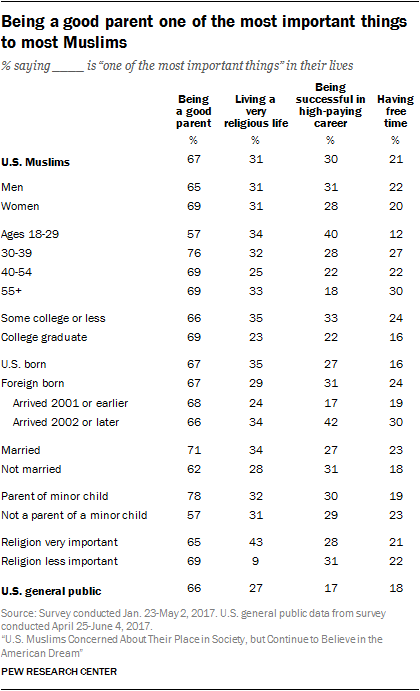
Republicans, white evangelicals express greatest reservations about Muslims, Islam

Republicans, white evangelicals, those with less education express most reservations about Muslims

Republicans and those who lean toward the GOP tend to hold much more negative views about Muslims and Islam than do Democrats and those who lean toward the Democratic Party. For instance, two-thirds of Republicans (68%) say Islam is not part of mainstream American society, while just 37% of Democrats express this view. And Republicans are twice as likely as Democrats to say there is a natural conflict between Islam and democracy (65% vs. 30%).

Surveys also show that white evangelical Protestants tend to express more reservations about Muslims and Islam than do those in other religious groups. For example, nearly three-quarters of white evangelicals say there is a natural conflict between Islam and democracy, while roughly half or fewer of those in other major religious groups express this view.

Older Americans and those with relatively low levels of educational attainment also tend to be more negative than others in their views about Muslims and Islam, though not necessarily on all five measures analyzed here.

Americans who personally know someone who is Muslim (55% of all non-Muslim U.S. adults) express somewhat more positive views of Muslims and Islam than do those who say they do not personally know someone who is Muslim.

Many in U.S. say Muslims face big challenges in American society

Seven-in-ten U.S. adults say there is a lot of discrimination against Muslims

Many Americans believe Muslims face a number of significant challenges in making their way in American society. For example, among the public as a whole, roughly seven-in-ten now say there is “a lot” of discrimination against Muslims in the United States. This marks an all-time high since Pew Research Center began asking this question in 2009.

More say Muslims face a lot of discrimination than say same about blacks, gays and lesbians, Hispanics

Indeed, in the Center’s April 2017 survey (when this question was most recently asked), the share of Americans who say Muslims face a lot of discrimination (69%) exceeded the share who say there is a lot of discrimination against blacks (59%), gays and lesbians (58%), and Hispanics (56%), which has not been the case in years past. As in years past, far fewer Americans say Catholics (17%), evangelical Christians (29%) or Jews (38%) face a lot of discrimination.

Among U.S. public, half say media coverage of Muslims is unfair

Recent polling also shows that fully half of U.S. adults think coverage of Islam and Muslims by American news organizations is generally unfair (53%), compared with 39% who think the media is fair to Muslims and Islam. And just one-third of Americans (36%) think that the overall public is generally friendly toward Muslim Americans; 32% say the American people are generally unfriendly toward Muslims, while 29% say the public is neutral.

Acknowledgements

This report is a collaborative effort based on the input and analysis of the following individuals. Find related reports online at pewresearch.org/pewresearch-org/religion.

Primary Researchers

Besheer Mohamed, Senior Researcher Gregory A. Smith, Associate Director of Research

Research Team

Alan Cooperman, Director of Religion Research Jessica Hamar Martínez, Senior Researcher Elizabeth Podrebarac Sciupac, Research Associate Becka A. Alper, Research Associate Claire Gecewicz, Research Analyst  Katayoun Kishi, Research Associate Conrad Hackett, Associate Director, Research Neha Sahgal, Associate Director, Research Anne Fengyan Shi, Senior Researcher Jeffrey Passel, Senior Demographer Phillip Connor, Senior Researcher Scott Gardner, Senior Researcher Stephanie Kramer, Research Associate Jonathan Evans, Research Analyst Samirah Majumdar, Research Analyst Ariana Monique Salazar, Research Analyst Kelsey Jo Starr, Research Assistant Juan Carlos Esparza Ochoa, Data Manager

Methodology Team               

Courtney Kennedy, Director, Survey Research Andrew Mercer, Senior Methodologist Nick Bertoni, Panel Manager Nicholas Hatley, Research Analyst

Editorial and Graphic Design

Michael Lipka, Senior Editor Jeff Diamant, Senior Writer/Editor David Masci, Senior Writer/Editor Geneive Abdo, Senior Writer/Editor Aleksandra Sandstrom, Copy Editor     Diana Yoo, Associate Director, Design Bill Webster, Information Graphics Designer

Communications and Web Publishing

Stacy Rosenberg, Associate Director, Digital Travis Mitchell, Digital Producer Shannon Greenwood, Associate Digital Producer Anna Schiller, Communications Manager 

Others at Pew Research Center who gave valuable feedback on this report include Michael Dimock, president; James Bell, vice president of global strategy; Claudia Deane, vice president of research; Carroll Doherty, director of political research; and Jocelyn Kiley, associate director of research.

Pew Research Center received valuable advice on all phases of this project from a panel of expert advisers: Ihsan Bagby, associate professor in the department of Islamic studies at the University of Kentucky; Edward E. Curtis IV, Millennium Chair of the Liberal Arts and professor of Religious Studies at Indiana University-Purdue University Indianapolis; Zareena Grewal, associate professor of American studies and religious studies at Yale University; Amaney A. Jamal, Edwards S. Sanford Professor of Politics at Princeton University and director of the Mamdouha S. Bobst Center for Peace and Justice; Imam Mohamed Magid, executive imam of All Dulles Area Muslim Society (ADAMS) Center; Dalia Mogahed, director of research at the Institute for Social Policy and Understanding in Washington, D.C.; and Farid Senzai, associate professor in the department of political science at Santa Clara University. In addition, Clara Huergo, Pew Research Center administrative coordinator, helped organize logistics for the advisory panel.

While the analysis for this report was guided by our consultation with the advisers, Pew Research Center is solely responsible for the interpretation and reporting of the data.

Appendix A: Glossary

Note: All terms defined as they relate to Muslims and Islam.

Allah – Arabic word for God.

Eid – The most holy days in Islam. For example, Eid al-Fitr is the festival that marks the end of the holy month of Ramadan. (Also see Ramadan.)
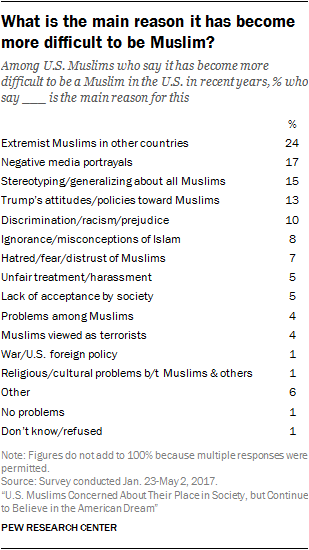
Five Pillars of Islam – The basic tenets of Islam.

  1. Profession of faith, or shahada.
  2. Praying, or salah.
  3. Giving of alms, or zakat.
  4. Fasting, or sawm, during the holy month of Ramadan.
  5. Pilgrimage to Mecca, or hajj.

Halal – Sanctioned by Islamic law. In this survey, the word halal refers primarily to foods, and especially to religiously required methods for slaughtering animals.

Hijab – A head scarf worn by many Muslim women. Other common types of coverings include burqa (which covers the entire face and body), niqab (which covers the whole face except for the eyes) and chador (which wraps around the head and upper body but leaves the face exposed).
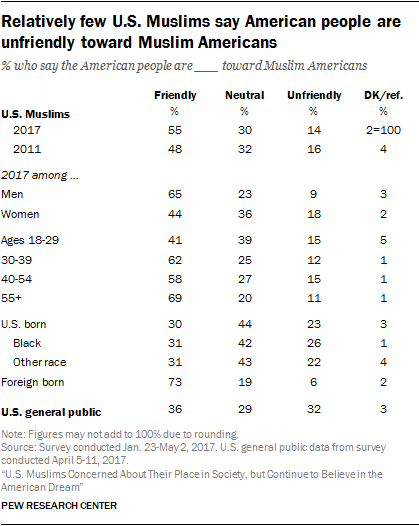
Jumah – Friday congregational prayer usually held in a mosque. (Also see mosque.)

Mosque – A place of worship for Muslims.

Nation of Islam – One of the groups that some Muslim respondents named when they were asked, “Are you Shia, Sunni or another tradition?” The Nation of Islam is a small religious group primarily composed of African American Muslims in the United States. Many Muslims consider the Nation of Islam’s beliefs heretical, in large part because the movement teaches that its founder was the embodiment of God, and that 20th-century leader Elijah Muhammad was a prophet, in contrast with the Sunni and Shia belief that Muhammad (who died in 632) was the last prophet. (Also see Sunni and Shia.)

Prophet Muhammad – Prophet of Islam believed by Muslims to have received the divine revelation of the Quran in the early 600s.

Quran – The central religious text of Islam. Also commonly spelled “Koran.”

Ramadan – Throughout the Islamic holy month of Ramadan, physically fit Muslim adults traditionally abstain from food, drink, smoking and sexual activity from dawn to dusk.

Salah – Ritual prayers that constitute one of the Five Pillars of Islam and traditionally are performed five times each day.

Shia – One of the two major branches of Islam, the other of which is Sunni. The schism began with a dispute over the rightful succession of leadership after the death of the Prophet Muhammad in 632. Followers of Shia Islam are called Shias or Shiites. (Also see Prophet Muhammad.)

Sunnah – Arabic for “habits” or “practices.” In this report, the Sunnah refers to the teachings of the Prophet Muhammad. In addition to following the Quran, many Muslims try to follow these practices.

Sunni – One of the two major branches of Islam, the other of which is Shia. Following the death of the Prophet Muhammad in 632, a dispute over the succession of leadership led to the schism that persists to this day. Followers of Sunni Islam are called Sunnis. (Also see Prophet Muhammad.)

Ummah – The worldwide Muslim community.

Appendix B: Survey methodology

Muslim Americans constitute a population that is rare, dispersed and diverse. It includes many recent immigrants from multiple countries with different native languages who may have difficulty completing a public opinion survey in English. The intense attention paid to Muslims in the aftermath of terrorist attacks in the U.S. and abroad, as well as the Trump administration’s efforts to temporarily restrict travel from a number of Muslim-majority countries, may have made some more reluctant to cooperate with a survey request from an unknown caller. Collectively, these characteristics present significant challenges to anyone wishing to survey this population.

Margins of error

Despite the challenges, Pew Research Center was able to complete interviews with 1,001 Muslim American adults 18 years old and older. Interviews were conducted by telephone between Jan. 23 and May 2, 2017, by the research firm Abt Associates. To help overcome the challenges described above, the survey was offered in Arabic, Farsi, and Urdu in addition to English, and the questionnaire was specially designed to build rapport between respondents and interviewers before delving into more sensitive content.

The foundation of the survey was a scientific sampling design in which every residential phone number in the U.S. had a known probability of being selected for the study. After taking into account the complex sample design, the average margin of sampling error on the 1,001 completed interviews with Muslims is +/- 5.8 percentage points at the 95% level of confidence.33 This section describes how the study was designed and executed.

Sample design

Stratification

One of Pew Research Center’s goals in this study was to interview a sample of at least 1,000 American Muslims. In random-digit dial (RDD) surveys of the English-speaking U.S. population, roughly 1% of respondents typically identify as Muslim in response to a question about their religious identity. This means that if the Center had relied exclusively on national RDD sampling techniques, it would have had to interview and screen roughly 100,000 people in order to identify and recruit a sample of 1,000 Muslims. Such an approach is impractical. Instead, researchers used existing data on the Muslim American community and on telephone users more generally to design a sampling plan that reached and interviewed a nationally representative sample of Muslim Americans more efficiently than a simple RDD approach would have done.34

The first step in designing the sampling plan involved using several sources of data to estimate the share of the population that is Muslim for each county (or county equivalent) in the U.S. One key resource in this effort was the Pew Research Center database of more than 150,000 telephone interviews conducted between 2011 and 2016. Another resource was data from the American Community Survey (ACS), which is an annual survey conducted by the U.S. Census Bureau. The Census Bureau does not collect information about religion, but the ACS does include measures of ancestry, national origin for immigrants, and languages spoken. These measures were used to analyze the geographic distribution of adults who are from (or whose ancestors are from) countries with significant or majority Muslim populations, or who speak languages commonly spoken by Muslims.

The other data sources used to create county-level estimates were the 2010 Religious Congregations and Membership Study, county-level counts of flagged likely Muslim telephone numbers provided by Survey Sampling International, and a dataset of county-level official statistics (e.g., educational attainment, housing stress, economic activity) archived by the Inter-university Consortium for Political and Social Research. Survey designers at Abt Associates used a statistical approach known as small-area estimation to take these various data and estimate the density of Muslims in each county.

The next step was sorting all of the counties in the U.S. into six different groups, or geographic strata, based on the estimated incidence of Muslims. Eight counties were placed in the “very high” geographic stratum. These eight counties are home to just 2% of all U.S. adults (according to Census data), but to 13% of all U.S. Muslim adults (according to Pew Research Center surveys conducted since 2011), and Muslims account for nearly 5% of the population in these counties.35 The second highest density stratum, the “high” stratum, consists of 25 counties that are home to just 4% of all U.S. adults but to 14% of all U.S. Muslims; Muslims account for nearly 3% of the population in these counties.

At the other end of the spectrum, the lowest density geographic stratum includes 785 primarily rural counties which are home to 21% of all U.S. adults, but just 4% of all U.S. Muslims and where Muslims account for just 0.1% of the overall population. These counties were excluded from the geographic strata, though the study includes partial coverage of Muslims living in this stratum through the use of flagged sample (described below) and because some people (including some Muslims) have phone numbers associated with one of the higher strata but actually reside in the lowest density stratum.

In addition to sorting the country into six geographic strata based on the density of the Muslim population in a given area, the study made use of a seventh stratum of phone numbers that have been flagged by third-party data vendors as likely to belong to a Muslim. In early 2017, 2.3 million out of the roughly 500 million possible cellphone numbers in the U.S. had this flag, as did nearly 400,000 of the roughly 300 million possible landline numbers in the U.S.

Geographic stratification

The flags are based on consumer information gathered from a variety of sources. Muslim flags were assigned to the cellphone frame using Ethnic Technologies’ algorithm, which is based on first names, middle names, surnames, prefixes, suffixes and geographic location. For the landline frame, Muslim flags were assigned using a proprietary SSI algorithm based on first, middle and last names, and geographic location. Relative to the random samples of telephone numbers in various counties, the numbers in the flagged strata are much more efficient for reaching Muslim adults. While the flags are far from perfect – only about three-in-ten adults reached via a flagged number self-identified as Muslim – the interviewing hours needed per Muslim interview within the flagged strata are a tiny fraction of the hours required to complete a Muslim interview when dialing numbers in the other strata.

The Muslims reached via the flagged stratum do not, in themselves, constitute a nationally representative sample of Muslim Americans. For example, Muslims with flagged telephone numbers are somewhat better educated, more likely to be foreign born, more likely to be Asian by race (and less likely to be black), and more likely to be lifelong Muslims (as opposed to converts) when compared with Muslim Americans as a whole.

However, because the study employed a probability-based design, proper weighting (described below) corrects for these issues. For example, the chance that a given Muslim with a flagged number was selected for this study was roughly 11 times greater than the chance of selection for a Muslim with an unflagged phone number in the very low density stratum. To correct for this, Muslim respondents were weighted according to the inverse of their chance of selection. For example, in the weighted dataset, each respondent from the very low density stratum is weighted up to represent about 11,191 Muslims while each respondent from the flagged stratum is weighted to represent only about 985 Muslims. In other words, each interview from the very low density stratum has about 11,191/985=11 times more influence on the survey estimates than each interview from the flagged stratum (to correct for the fact that their chance of selection was 11 times lower).

In the same manner, weighting adjusts for the oversampling of geographic strata with higher Muslim incidence and undersampling of geographic strata with lower Muslim incidences (as detailed in the next section). This approach to sampling – developing a stratification plan, oversampling high density strata, and then making statistical adjustments so that the various strata are represented in their proper proportions in weighted estimates – is very common in survey research involving rare populations. For example, it has been used in the U.S. Department of Veterans’ National Survey of Veterans and UCLA’s California Health Interview Survey.

Sample allocation and deduplication

Once the strata were defined at the county level and through the use of the flags as described above, the next step in the sampling process involved employing an optimization algorithm to allocate the interviewing across the six geographic strata and the flagged stratum. The algorithm maximized the expected precision of the survey (specifically the effective sample size) factoring in the different Muslim incidence levels in various strata, as well as the loss in precision stemming from weighting adjustments.

At this point, a sample of cellphone numbers was drawn from within each geographic stratum (except the lowest density stratum). The numbers were drawn from the list of all residential cellphone numbers in the United States. These numbers were then compared to the entire set of cellphone numbers from the flagged stratum. Any numbers that appeared in both a geographic stratum and the flagged stratum were removed from the former, and were available to be sampled only as part of the flagged stratum.

This process was then repeated for landline numbers, except that no telephone numbers were drawn that were associated with the low, very low, or lowest strata within the landline frame. The decision to refrain from dialing landline numbers in these strata was based on the extremely low rate at which interviews done on landlines in these areas have yielded interviews with Muslim respondents. In recent Pew Research Center surveys, for instance, just one in 1,323 respondents interviewed on a landline in the lowest stratum has been Muslim.

The strength of this research design was that it yielded a probability sample. That is, each adult in the U.S. had a known probability of being included in the study. The fact that some persons had a greater chance of being included than others (e.g., because they live in places where there are more Muslims) is taken into account in the statistical adjustment described below. In total, 40,987 screening interviews were completed as part of this study. Of these, 1,001 respondents identified themselves as Muslim and completed the full interview.

Overall, the estimated coverage rate for Muslim Americans provided by the study, accounting for the excluded strata, is over 90%.

Number of interviews in each frame, stratum

Weighting

Overview

Several stages of statistical adjustment (weighting) were needed to account for the study’s complex sample design. The dataset in which the weights were created included all of the adults screened for the study who completed the demographics module. This included all of the 1,001 Muslim respondents and 20,102 adults who screened out as non-Muslim but were subsampled (at a 50% rate) to complete the demographics module.

The first part of the weighting featured a series of adjustments to correct for the fact that the chance of selection into the study differed across U.S. adults. For example, adults who had both a landline and cellphone, who live in one of the oversampled geographies, or have a phone number flagged as servicing a Muslim household were overrepresented in the unweighted data. The weighting corrects for these features, as detailed below.

The virtue of retaining the 20,000+ non-Muslims in the weighting is that it made it possible to complete the next step in the weighting process: aligning the survey sample to the demographic profile of all U.S. adults. The Census Bureau publishes highly accurate data for all noninstitutionalized U.S. adults. No such data are available for the Muslim American population. Aligning the “all adult” sample to demographic benchmarks helps to address the fact that different subgroups tend to participate in surveys at different rates (i.e., differential nonresponse). This way, the weighted sample of all adults (Muslims and non-Muslims) is representative of the U.S. with respect to variables such as age, gender, education, region, race and ethnicity.

Prior to analysis, two additional steps were taken. The non-Muslim cases were dropped from the dataset, leaving just the 1,001 Muslim interviews. Then replicate weights were created so that appropriate standard errors and significance tests could be computed. The remainder of this section describes in detail how the weight was computed.

Base weighting

As discussed above, the sample design featured 10 strata – four strata in the landline frame and six strata in the cellphone frame. The first weighting adjustment corrected for the fact that telephone numbers in some strata were sampled at a relatively high rate (oversampled) and telephone numbers in other strata were sampled at a relatively low rate (undersampled). Specifically, if Nh is the total count of telephone numbers on the sampling frame in stratum h and nh is the count of numbers sampled from that stratum, then the first weighting adjustment was computed as

The next adjustment corrects for the fact that the response rate was higher in some strata and lower in other strata. Specifically, if Sh is the count of phone numbers sampled in stratum h that yielded a completed screener interview, Eh is the count of sampled phone numbers in stratum h that were known to be eligible for screening (e.g., working and residential), and Êh is the count of sampled phone numbers in stratum h for which eligibility was unknown but are estimated36 to be eligible for screening, then the second weighting adjustment was computed as

The next adjustment corrected for the fact that the non-Muslims in the dataset represent only half of all of the non-Muslim adults screened. To avoid unnecessary data collection, only 50% of the non-Muslims (n=20,102) were administered the demographics module. To correct for that subsampling, the third weighting adjustment (w3) multiplies the weights for the non-Muslim cases by 2 and does nothing to the weights for the Muslim cases (multiplication by 1).37

The fourth weight adjustment concerned only landline cases. It adjusted for the fact that landline respondents who live in a household with multiple adults were less likely to be interviewed than landline respondents who live alone. For example, if a household with a landline sampled for this study had four adults living in it, then all four adults were eligible for the survey, but we only interviewed one of them, meaning that three were not selected. By contrast, when we called a landline number used by someone who lives alone, that person was selected every time. In order to avoid underrepresenting people who live in multi-adult households, the fourth adjustment multiplied the weight for landline cases by the number of adults living in the household (Ai).

As per standard survey practice, this adjustment was capped so that highly unusual cases (e.g., a respondent living in a 15-person household) are not overly influential in the survey estimates. The cap was four adults for non-Muslim cases and five adults for Muslim cases, reflecting the fact that prior studies have shown that Muslim Americans tend to have larger households than non-Muslim Americans. For cellphone cases, this adjustment was set to 1, which means it made no change to the weight value. When cellphone numbers were dialed, the person answering the phone was automatically selected for the survey, provided that they were 18 years old or older.

The next step was to account for the overlap between the landline and cellphone sampling frames. Adults with both a residential landline and a cellphone (“dual service”) could potentially have been selected for the survey in both frames. In other words, they had a higher chance of being selected for the survey than adults with just a landline or just a cellphone. To correct for that, the weighting adjusts down dual users so that they are not overrepresented in the survey. The specific approach used in this survey, composite estimation,38 combines the interviews with dual users from the landline sample and the interviews with dual users from the cellphone sample using a weighted average. The two groups of dual users were weighted equally, a common specification to reduce the variance of the weighted estimates.

The adjustments detailed above were applied to create the full base weight, which was used as the input weight for the raking procedure.

Raking adjustment for differential nonresponse and noncoverage

The sample of non-Muslims and Muslims was then balanced to control totals for the noninstitutionalized U.S. adult population using a process called raking. The sample was balanced to match national population parameters for sex × region of birth, sex × age, sex × education, age × education, census region of residence, race/ethnicity, race/ethnicity × census region of residence, race/ethnicity × education, and telephone usage. The region of birth variable contained seven categories: U.S. (native born), Americas (excluding the U.S.), South Asia, other Asia/Pacific, Europe, Middle East/North Africa, and sub-Saharan Africa.

In typical public opinion polls of 1,000 U.S. adults, it is not possible to adjust the sample to such a detailed target for birth region because several of the adjustment cells would be empty due to their extremely low incidence (e.g., less than 1% of adults living in the U.S. were born in sub-Saharan Africa). For this study, the very large screener sample size and the oversampling of urban areas with relatively high shares of immigrant populations allowed adjustment on this dimension so that the weighted sample of screened adults was representative in terms of where they were born.

The population targets were computed from several sources. The telephone usage parameter was a projection based on June-December 2016 estimates from the National Health Interview Survey (NHIS) conducted by the Centers for Disease Control and Prevention. The sex × region of birth target was computed from the 2011-2015 American Community Survey five-year public use microdata sample (PUMS). The other raking targets were computed from the 2015 American Community Survey. After this calibration was performed, all the non-Muslim cases were dropped from the analysis. A light trim was applied to the weights of the Muslim cases so as to constrain the variance of the weights. Weight values larger than the 99.8th percentile were capped (winsorized) at the 99.8th percentile. All of the weights were then re-scaled so that the sum of the weights was unchanged. Analysis of Muslim Americans in the body of the report uses this trimmed weight, with the exception of the estimate of the population total. The untrimmed weight in the full screener dataset of Muslims and non-Muslims, in combination with data from the Current Population Survey, was used to produce the estimated population total.

Variance estimation

Due to the complex design of the Muslim American study, formulas commonly used in RDD surveys to estimate margins of error (standard errors) are inappropriate. Such formulas would understate the true variability in the estimates. Accordingly, analyses in this report used a repeated replication technique, specifically jackknife repeated replication (JRR), to calculate the standard errors. Repeated replication techniques estimate the variance of a survey statistic based on the variance between subsample estimates of that statistic. The subsamples (replicates) were created using the same sample design, but deleting a portion of the sample, and then weighting each subsample up to the population total. A total of 100 replicates were created. A statistical software package designed for complex survey data, Stata, was used to calculate all of the standard errors and test statistics in the study.

Questionnaire design

As with the 2007 and 2011 surveys of Muslim Americans, the goal of the study was to provide a broad description of the characteristics and attitudes of the Muslim American population. Thus, the questionnaire needed to cover a wide range of topics but be short enough that respondents would be willing to complete the interview.

Much of the content was drawn from the 2007 and 2011 surveys so that any changes in attitudes could be tracked. New questions also were taken from other Pew Research Center U.S. surveys to provide comparisons with the U.S. public. And some questions were developed specifically for this new survey.

One issue confronted in the questionnaire design was the possibility that members of this population are reluctant to reveal their religious identification because of concerns about stereotyping and prejudice. Both the 2007 and 2011 surveys show that many U.S. Muslims believe they are targeted by the government for surveillance and some also report personal experiences with discrimination and hostility. Several features of the questionnaire were tailored to deal with these concerns.

The initial questions were chosen to be of a general nature in order to establish rapport with respondents, asking about presidential approval, satisfaction with the way things are going in the country, satisfaction with their personal lives and financial situations, homeownership, and educational attainment. After these items, respondents were asked about their religious identity, choosing from a list that included Christian, Jewish, Muslim, Hindu, Buddhist or “something else.” Respondents who identified as Muslim proceeded to the substantive portion of the questionnaire. Those identifying with a religion other than Islam (or with no religion) were randomly assigned to receive a short set of demographic questions to be used for weighting or to have the interview discontinued.

Respondents who declined to answer the question about their religion when first asked were directed to a module of questions about their life goals, about their views on a few social and political topics, about their views of President Trump, and about discrimination against various groups in American society before being asked again about their religious identity. This approach was adopted in the hopes that the intervening questions between the first asking about religion and the second asking would help develop a good rapport between the respondent and the interviewer and thus increase the likelihood that a Muslim respondent who was initially reluctant to self-identify as Muslim would ultimately do so. Overall, 970 of the Muslims in the survey identified as Muslim when first asked about their religion, and 31 did so when asked about their religion for the second time.

At this point in the interview, respondents were told: “Just to give you a little more background, Pew Research Center conducts surveys of many religious groups, including Christians, Jews, Hindus and many others. Earlier, you mentioned that you are Muslim. We have some questions about the views and experiences of Muslims in the U.S. that I think you will find interesting. As a token of our appreciation for your time, we can send you $50 at the completion of the survey.”39

The logic for revealing the principal research focus of the study – a practice not common in survey research – was that respondents would quickly discover that the study was focused on Muslims and Islam, and that there would be a greater chance of establishing trust and rapport by revealing the intent of the study before asking questions specific to experiences as a Muslim or about the Islamic faith.

Overall, 71% of respondents identified in the screening interview as Muslim eventually completed the survey. This completion rate is somewhat lower than average for other Pew Research Center surveys, where completion rates of 80% to 85% are more common. But given that the mean survey length was 33 minutes (13 minutes longer than the typical survey conducted by the Center), a breakoff rate that was somewhat higher than normal was not unexpected. The 71% completion rate does not include respondents who dropped off during the short screener interview prior to answering the religion question.

Pilot test and pretest

In the summer of 2016, Pew Research Center conducted a pilot test of telephone numbers (both cellphones and landlines) in the flagged strata. The pilot test consisted of administering a very short questionnaire to 200 respondents in each frame (cellphone and landline) and was designed to determine what share of numbers in the flagged strata belong to a Muslim respondent.

Two pretests of the full questionnaire were conducted, one in December 2016 (among 30 Muslim respondents in the flagged stratum) and another in January 2017 (among 28 Muslim respondents in the flagged stratum). Changes were made to the questionnaire and interviewer training procedures based on the results of the pretests.

Survey administration

The administration of this survey posed several challenges. For example, the volume of interviewing was very large. The survey firm, Abt Associates, conducted the interviewing over a 14-week timeframe. A total of 40,987 households were screened. This was achieved by deploying 652 interviewers.

Because the U.S. Muslim population includes many immigrants who have arrived in the U.S. relatively recently, the survey was translated and conducted in three languages (in addition to English) identified as among the most commonly spoken among Muslim immigrants to the U.S. — Arabic, Farsi and Urdu. Translation of the questionnaire was accomplished via a three-step process including translation by a professional translator under the direction of Abt Associates, an independent review by a second translator retained by Pew Research Center, and the reconciling of concerns and discrepancies in collaboration with the bilingual interviewers. A total of 953 interviews were conducted with Muslims in English, 30 in Arabic, eight in Farsi and 10 in Urdu.

Multilingual interviewers on staff were utilized for the project. Additional multilingual interviewers were recruited, tested by an accredited vendor on their language proficiency, then evaluated and scored before being interviewed and hired by Abt Associates. All non-English interviewers first go through the standard Abt Associates initial training process that all interviewers go through. Bilingual interviewers with more proficiency and interviewing experience were given supervisory roles; they worked with the interviewers in their language to monitor surveys, assist in training and debrief.

An incentive of $50 was offered to respondents near the beginning of the survey, after it was determined that the respondent identified as Muslim in a response to a question about religious affiliation. The decision to offer an incentive was based on two principal considerations. First, the survey entailed a substantial time commitment for respondents. Second, incentives have been repeatedly shown to increase response rates, a critical consideration in studies of rare populations where substantial effort is devoted to locating qualified respondents.40 The use of incentives has been shown to be particularly helpful in improving participation among reluctant respondents. Most respondents (78%) asked to receive the incentive payment.

To mitigate potential gender biases in the composition of the sample, the interviewing protocols for landline households attempted to match male interviewers with male respondents and female interviewers with female respondents. This practice is common among survey researchers conducting face-to-face interviews in majority Muslim nations. Interviewer-respondent gender matching was not implemented, however, when calling cellphone numbers, because cellphones are predominantly used as a personal (rather than household) device.

The screening effort yielded a response rate of 8.1% for the geographic cell strata, 7.5% for the geographic landline strata, 13.8% for the flagged cell stratum, and 8.7% for the flagged landline stratum, using the Response Rate 3 definition devised by the American Association for Public Opinion Research (AAPOR). Detailed AAPOR sample disposition reports are provided at the end of this section.

Surveys of the U.S. general public

In addition to summarizing the findings of the survey of Muslim Americans, this report contains previously unreleased questions from several surveys conducted among the U.S. general public. These include a telephone survey conducted April 25 to June 4, 2017, among a national sample of 5,002 adults ages 18 and older who live in all 50 U.S. states and the District of Columbia (1,250 respondents were interviewed on a landline telephone and 3,752 were interviewed on a cellphone, including 2,284 who had no landline telephone). The survey was conducted by interviewers at Abt Associates. A combination of landline and cellphone random-digit dial samples were used; both samples were provided by Survey Sampling International. Interviews were conducted in English and Spanish. Respondents in the landline sample were selected by randomly asking for the youngest adult male or female who is now at home. Interviews in the cell sample were conducted with the person who answered the phone, if that person was 18 years of age or older.

The combined landline and cellphone sample was weighted using an iterative technique that matches gender, age, education, race, Hispanic origin and nativity, and region to parameters from the 2015 Census Bureau’s American Community Survey and population density to parameters from the decennial census. The sample also is weighted to match current patterns of telephone status (landline only, cellphone only, or both landline and cellphone), based on extrapolations from the 2016 National Health Interview Survey. The weighting procedure also accounts for the fact that respondents with both landline and cellphones have a greater probability of being included in the combined sample and adjusts for household size among respondents with a landline phone. The margin of error at the 95% level of confidence for results based on the full sample from this survey is +/- 1.5 percentage points. Sample sizes and sampling errors for subgroups are available upon request. The margins of error reported and statistical tests of significance are adjusted to account for the survey’s design effect, a measure of how much efficiency is lost from the weighting procedures.

Along with the survey conducted April 25 to June 4, 2017, other general public findings published for the first time in this report include data from surveys conducted April 5 to 11, 2017, and February 7 to 12, 2017. Information about the methods used to conduct those surveys is included in Pew Research Center reports “Public Dissatisfaction With Washington Weighs on the GOP” and “In First Month, Views of Trump Are Already Strongly Felt, Deeply Polarized.” For detailed information about Pew Research Center’s general public survey methodology, see https://alpha.pewresearch.org/pewresearch-org/methodology/u-s-survey-research/

Pew Research Center undertakes all polling activity, including calls to mobile telephone numbers, in compliance with the Telephone Consumer Protection Act and other applicable laws.

Pew Research Center is a nonprofit, tax-exempt 501(c)(3) organization and a subsidiary of The Pew Charitable Trusts, its primary funder.

Dispositions for the cellphone sample
Outcome rates for the cellphone sample
Dispositions for the landline sample
Outcome rates for the landline sample