Pew Research Center

FOR RELEASE MAY 10, 2017

Religious Belief and National Belonging in Central and Eastern Europe

National and religious identities converge in a region once dominated by atheist regimes

FOR MEDIA OR OTHER INQUIRIES:

Communications Department
202.419.4372
www.pewresearch.org

RECOMMENDED CITATION

Pew Research Center, May 2017, "Religious Belief and National Belonging in Central and Eastern Europe"

About Pew Research Center

Pew Research Center is a nonpartisan, nonadvocacy fact tank that informs the public about the issues, attitudes and trends shaping the world. It does not take policy positions. The Center conducts public opinion polling, demographic research, computational social science research and other data-driven research. It studies politics and policy; news habits and media; the internet and technology; religion; race and ethnicity; international affairs; social, demographic and economic trends; science; research methodology and data science; and immigration and migration. Pew Research Center is a subsidiary of The Pew Charitable Trusts, its primary funder.

© Pew Research Center 2026

Table of contents

  • About Pew Research Center
  • Religious Belief and National Belonging in Central and Eastern Europe
  • 1. Religious affiliation
  • 2. Religious commitment and practices
  • 3. Religious beliefs
  • 4. Views on religion and politics
  • 5. Social views and morality
  • 6. Science and religion
  • 7. Views on role of Russia in the region, and the Soviet Union
  • 8. Democracy, nationalism and pluralism
  • 9. Views on economic issues
  • Acknowledgments
  • Appendix A: Methodology

Religious Belief and National Belonging in Central and Eastern Europe

National and religious identities converge in a region once dominated by atheist regimes

Język polski       Pусский

Religious landscape of Central and Eastern Europe

Roughly a quarter of a century after the fall of the Iron Curtain and subsequent collapse of the Soviet Union, a major new Pew Research Center survey finds that religion has reasserted itself as an important part of individual and national identity in many of the Central and Eastern European countries where communist regimes once repressed religious worship and promoted atheism.

Today, solid majorities of adults across much of the region say they believe in God, and most identify with a religion. Orthodox Christianity and Roman Catholicism are the most prevalent religious affiliations, much as they were more than 100 years ago in the twilight years of the Russian and Austro-Hungarian empires.

Around the world, different ways of being religious

Believing. Behaving. Belonging.

Three words, three distinct ways in which people connect (or don’t) to religion: Do they believe in a higher power? Do they pray and perform rituals? Do they feel part of a congregation, spiritual community or religious group?

Research suggests that many people around the world engage with religion in at least one of these ways, but not necessarily all three.

Christians in Western Europe, for example, have been described as “believing without belonging,” a phrase coined by sociologist Grace Davie in her 1994 religious profile of Great Britain, where, she noted, widespread belief in God coexists with largely empty churches and low participation in religious institutions.1

In East Asia, there is a different paradigm, one that might be called “behaving without believing or belonging.” According to a major ethnography conducted last decade, for example, many people in China neither believe in a higher power nor identify with any particular religious faith, yet nevertheless go to Buddhist or Confucian temples to make offerings and partake in religious rituals.2

Many Central and Eastern Europeans, on the other hand, might be described as “believing and belonging, without behaving.” While Pew Research Center’s survey shows that majorities of adults across the region believe in God and identify with Orthodox Christianity, conventional measures of Christian religious behavior – such as levels of daily prayer and weekly worship attendance – are relatively low.

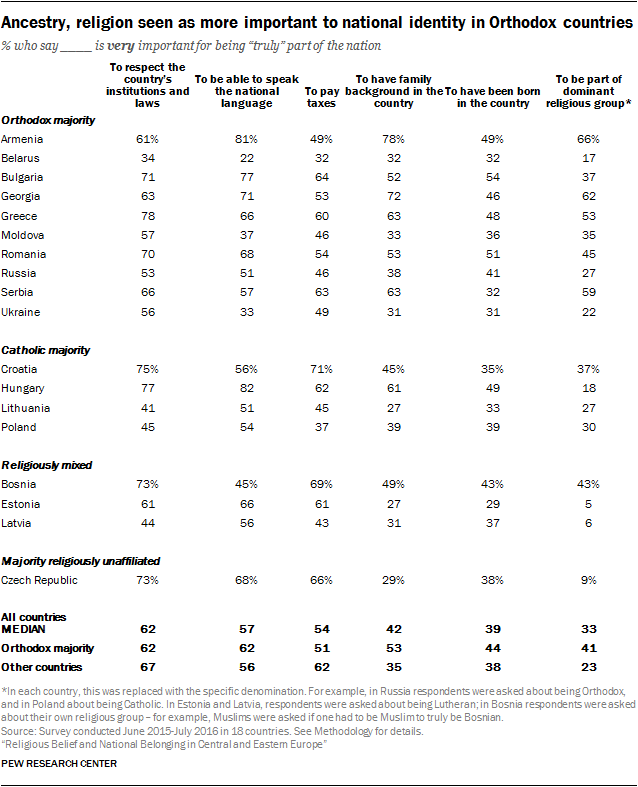
In many Central and Eastern European countries, religion and national identity are closely entwined. This is true in former communist states, such as the Russian Federation and Poland, where majorities say that being Orthodox or Catholic is important to being “truly Russian” or “truly Polish.” It is also the case in Greece, where the church played a central role in Greece’s successful struggle for independence from the Ottoman Empire and where today three-quarters of the public (76%) says that being Orthodox is important to being “truly Greek.”

Many people in the region embrace religion as an element of national belonging even though they are not highly observant. Relatively few Orthodox or Catholic adults in Central and Eastern Europe say they regularly attend worship services, pray often or consider religion central to their lives. For example, a median of just 10% of Orthodox Christians across the region say they go to church on a weekly basis.

Indeed, compared with many populations Pew Research Center previously has surveyed – from the United States to Latin America to sub-Saharan Africa to Muslims in the Middle East and North Africa – Central and Eastern Europeans display relatively low levels of religious observance.
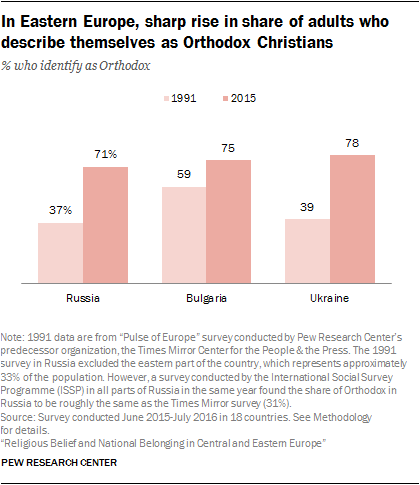
In Eastern Europe, sharp rise in share of adults who describe themselves as Orthodox Christians

Nonetheless, the comeback of religion in a region once dominated by atheist regimes is striking – particularly in some historically Orthodox countries, where levels of religious affiliation have risen substantially in recent decades.
Whether the return to religion in Orthodox-majority countries began before the fall of the Berlin Wall in 1989 remains an open question. Reliable, verifiable data about religious beliefs and practices in the region’s then-communist regimes is difficult, if not impossible, to find.3 But Pew Research Center’s predecessor organization did ask about religion when it surveyed several countries in the region in 1991, during the waning months of the USSR. In Russia, Ukraine and Bulgaria, far more people said they were religiously unaffiliated in 1991 than describe themselves that way in the new survey. In all three countries, the share of the population that identifies with Orthodox Christianity is up significantly since the collapse of the Soviet Union.4

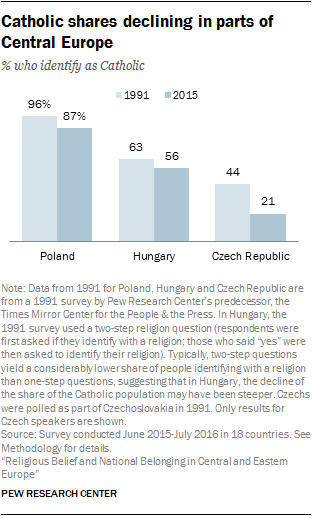
Catholic shares declining in parts of Central Europe

Catholicism in Central and Eastern Europe, meanwhile, has not experienced the same upsurge as Orthodox Christianity. In part, this may be because much of the population in countries such as Poland and Hungary retained a Catholic identity during the communist era, leaving less of a religious vacuum to be filled when the USSR fell.
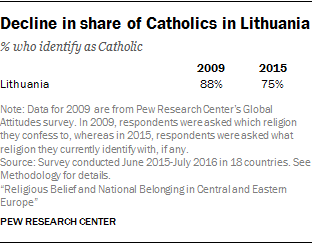
Decline in share of Catholics in Lithuania

To the extent that there has been measurable religious change in recent decades in Central and Eastern European countries with large Catholic populations, it has been in the direction of greater secularization. The most dramatic shift in this regard has occurred in the Czech Republic, where the share of the public identifying as Catholic dropped from 44% in 1991 to 21% in the current survey. Today, the Czech Republic is one of the most secular countries in Europe, with nearly three-quarters of adults (72%) describing their religion as atheist, agnostic or “nothing in particular.”
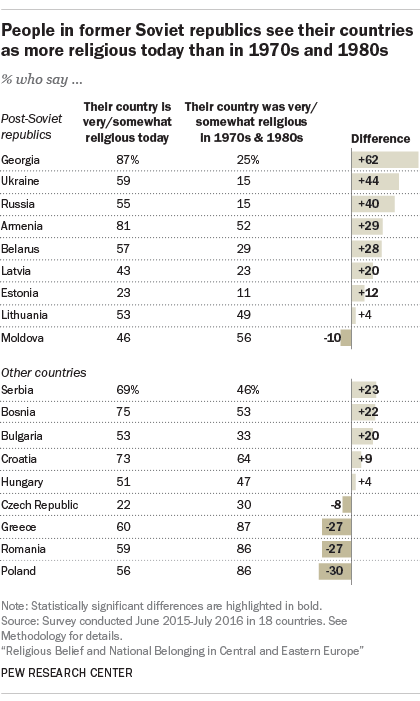
People in former Soviet republics see their countries are more religious today than in 1970s and 1980s

The differing trends in predominantly Orthodox and Catholic countries may be, at least in part, a reflection of political geography. The Orthodox countries in the region are further toward the east, and many were part of the Soviet Union. The Catholic countries are further toward the west, and only Lithuania was part of the USSR.

This political divide is seen in responses to two separate survey questions: How religious do you think your country was in the 1970s and 1980s (when all but Greece among the surveyed countries were ruled by communist regimes), and how religious is it today? With few exceptions, in former Soviet republics the more common view is that those countries are more religious now than a few decades ago. Only 15% of Russians, for example, say their country was either “very religious” (3%) or “somewhat religious” (12%) in the 1970s and 1980s, while 55% say Russia is either very (8%) or somewhat (47%) religious today.

There is more variation in the answers to these questions in countries that were beyond the borders of the former USSR. In contrast with most of the former Soviet republics, respondents in Poland, Romania and Greece say their countries have become considerably less religious in recent decades.

Relatively low shares of Orthodox across Central and Eastern Europe attend church weekly

But these perceptions do not tell the entire story. Despite declining shares in some countries, Catholics in Central and Eastern Europe generally are more religiously observant than Orthodox Christians in the region, at least by conventional measures. For instance, 45% of Catholics in Poland say they attend worship services at least weekly – more than double the share of Orthodox Christians in any country surveyed who say they go to church that often.

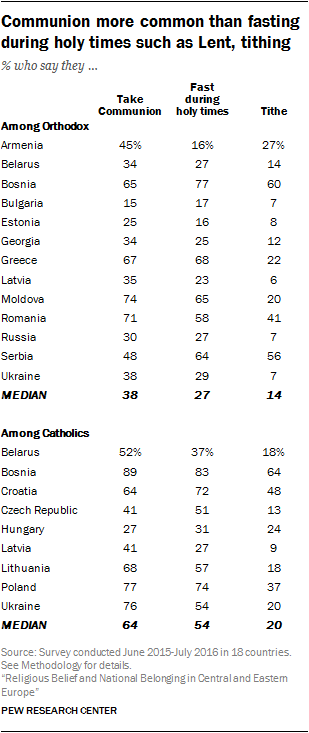
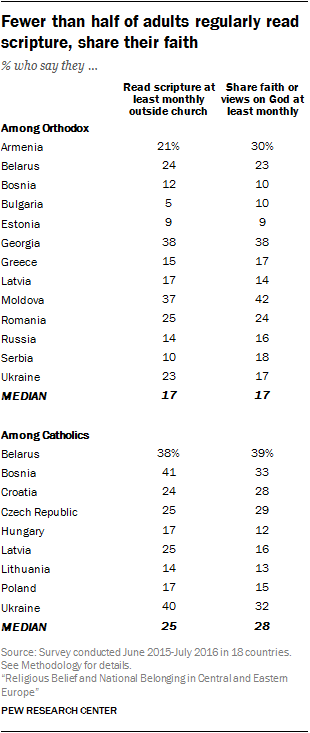
In addition, Catholics in Central and Eastern Europe are much more likely than Orthodox Christians to say they engage in religious practices such as taking communion and fasting during Lent. Catholics also are somewhat more likely than Orthodox Christians to say they frequently share their views on God with others, and to say they read or listen to scripture outside of religious services.5
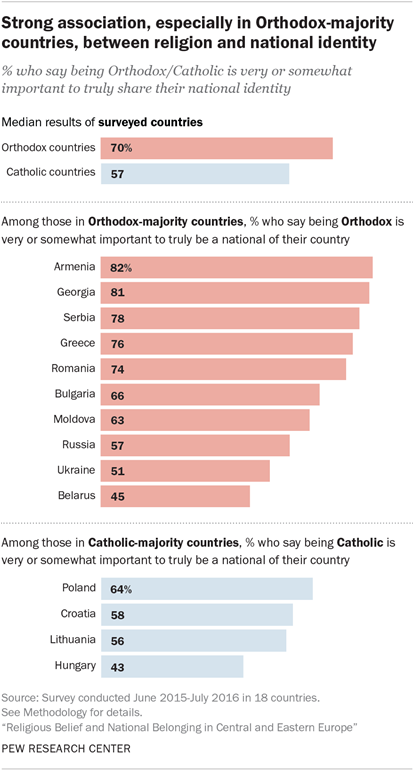
Strong association, especially in Orthodox-majority countries, between religion and national identity

Although Catholics overall are more religiously observant than Orthodox Christians in the region, however, the association between religious identity and national identity is stronger in Orthodox-majority countries than in Catholic ones.

Across the countries where Orthodox Christians make up a majority, a median of 70% say it is important to be Orthodox to truly share the national identity of their country (e.g., that one must be Russian Orthodox to be “truly Russian,” or Greek Orthodox to be “truly Greek”). By comparison, a median of 57% in the four Catholic-majority countries say this about being Catholic. (Fewer people in Western Europe – for example, 23% in France and 30% in Germany – say being Christian is very or somewhat important to their national identity.)

These nationalist sentiments are especially common among members of the majority religious group in each country. But, in some cases, even members of religious minority groups take this position. For example, about a quarter of both Muslims and religiously unaffiliated people in Russia say it is important to be Russian Orthodox in order to be “truly Russian.”
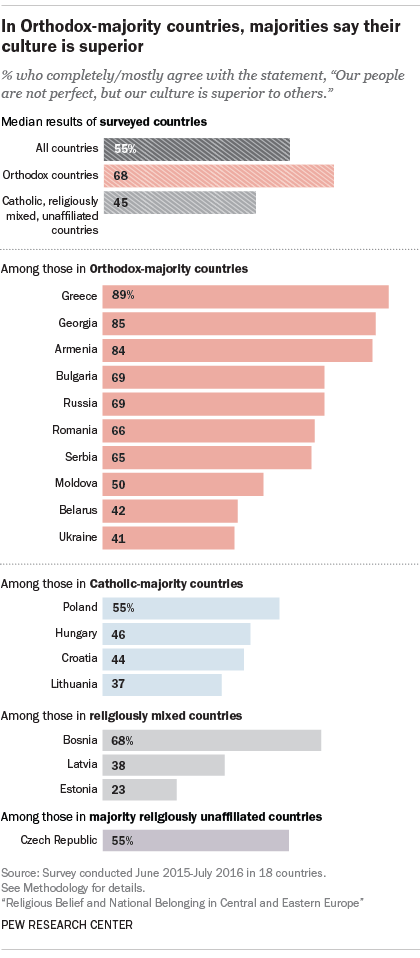
In Orthodox-majority countries, majorities say their culture is superior

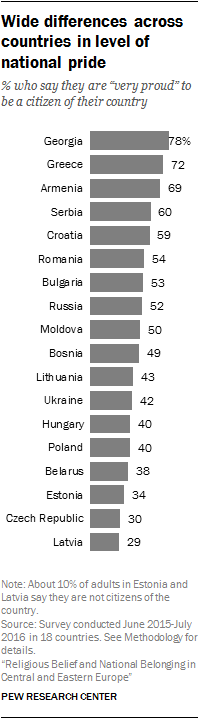
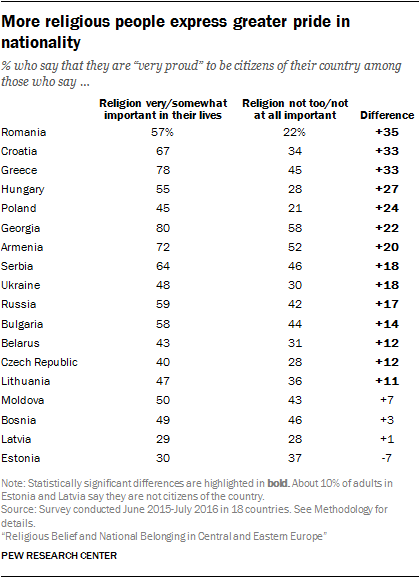
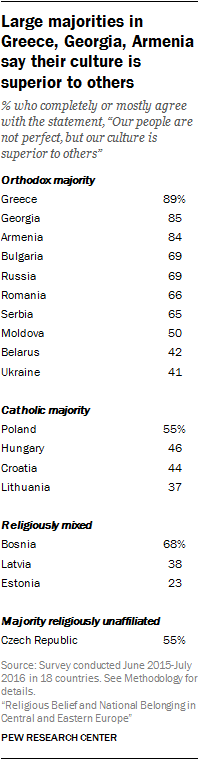
In addition, people living in predominantly Orthodox countries are more inclined than others in the region to say their culture “is superior to others” and to describe themselves as “very proud” of their national identity.

Many of the predominantly Orthodox countries surveyed have centuries-old national churches, such as the Greek Orthodox Church, Russian Orthodox Church and Armenian Apostolic Church, and there is popular support for these institutions to play a large role in public life.6 Across all the Orthodox-majority countries surveyed, a median of 56% favor state funding for their national churches. And a median of 42% say their governments should promote religious values and beliefs. In Catholic-majority countries, there is greater support for separation of religion from the state, with a median of just 41% who back state funding of churches and 28% in favor of governments promoting religious values and beliefs.

The political – and sometimes religious – map of Central and Eastern Europe has been redrawn numerous times over the centuries. Russia, whether as a synonym for the czarist empire or the USSR, has played a pivotal role in defining the political and cultural boundaries of the region.
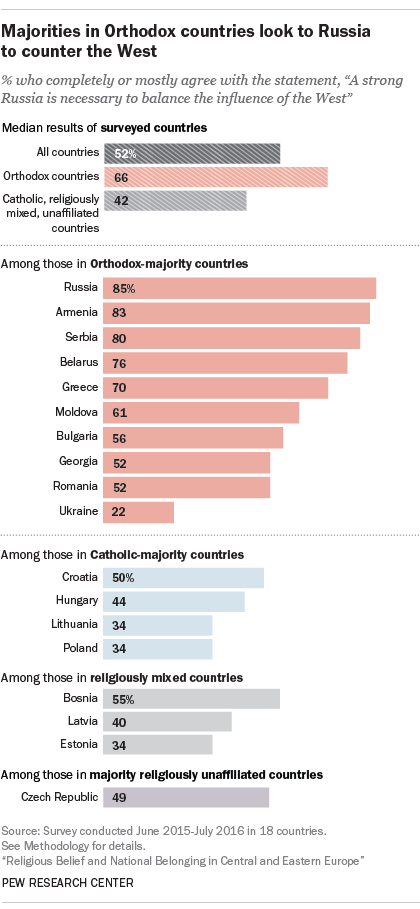
Majorities in Orthodox countries look to Russia to counter the West

Today, many Orthodox Christians – and not only Russian Orthodox Christians – express pro-Russia views. Most see Russia as an important buffer against the influence of the West, and many say Russia has a special obligation to protect not only ethnic Russians, but also Orthodox Christians in other countries.7 In Catholic-majority and religiously mixed countries across the region, there is much less public support for a strong Russia as a counterweight to the West and a protector of either ethnic Russians or Orthodox Christians outside Russia’s borders.

In many ways, then, the return of religion since the fall of the Berlin Wall and the breakup of the Soviet Union has played out differently in the predominantly Orthodox countries of Eastern Europe than it has among the heavily Catholic or mixed-religious populations further to the West. In the Orthodox countries, there has been an upsurge of religious identity, but levels of religious practice are comparatively low. And Orthodox identity is tightly bound up with national identity, feelings of pride and cultural superiority, support for linkages between national churches and governments, and views of Russia as a bulwark against the West.

Meanwhile, in such historically Catholic countries as Poland, Hungary, Lithuania and the Czech Republic, there has not been a marked rise in religious identification since the fall of the USSR; on the contrary, the share of adults in these countries who identify as Catholic has declined. But levels of church attendance and other measures of religious observance in the region’s Catholic-majority countries are generally higher than in their Orthodox neighbors (although still low in comparison with many other parts of the world). The link between religious identity and national identity is present across the region but somewhat weaker in the Catholic-majority countries. And politically, the Catholic countries tend to look West rather than East: Far more people in Poland, Hungary, Lithuania and Croatia say it is in their country’s interest to work closely with the U.S. and other Western powers than take the position that a strong Russia is necessary to balance the West.

What is a median?

On some questions throughout this report, median percentages are reported to help readers see overall patterns. The median is the middle number in a list of figures sorted in ascending or descending order. In a survey of 18 countries, the median result is the average of the ninth and 10th on a list of country-level findings ranked in order.

In addition to looking at medians based on all of the survey’s respondents across 18 countries, this report sometimes refers to the median among a specific subset of respondents and/or countries. For example, in 13 countries, the number of Orthodox Christians surveyed is large enough to be analyzed and broken out separately. The regional median for Orthodox Christians is the seventh-highest result when the findings solely among Orthodox respondents in those 13 countries are listed from highest to lowest.

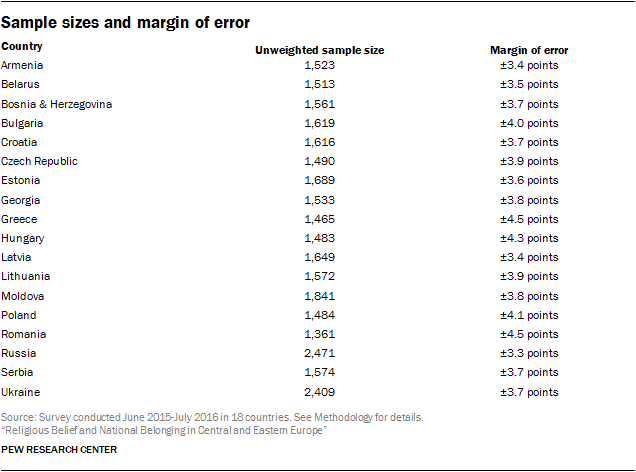
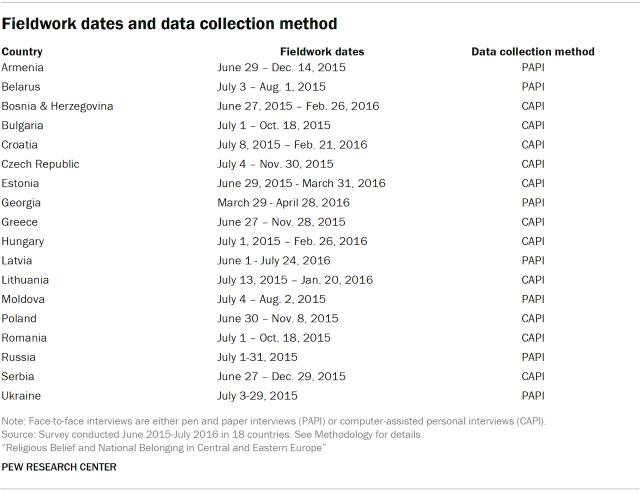
These are among the key findings of the Pew Research Center survey, which was conducted from June 2015 to July 2016 through face-to-face interviews in 17 languages with more than 25,000 adults ages 18 and older in 18 countries. The study, funded by The Pew Charitable Trusts and the John Templeton Foundation, is part of a larger effort by Pew Research Center to understand religious change and its impact on societies around the world. The Center previously has conducted religion-focused surveys across sub-Saharan Africa; the Middle East-North Africa region and many other countries with large Muslim populations; Latin America and the Caribbean; Israel; and the United States.

While there is no consensus over the exact boundaries of Central and Eastern Europe, the new survey spans a vast area running eastward from the Czech Republic and Poland to Russia, Georgia and Armenia, and southward from the Baltic States to the Balkans and Greece. (See related map.) Over the centuries, nationhood, politics and religion have converged and diverged in the region as empires have risen and crumbled and independence has been lost and regained.

Most of the countries surveyed were once ruled by communist regimes, either aligned or not aligned with Moscow. But Greece remained outside the Iron Curtain and became allied with Western Europe after World War II. In this respect, Greece offers a useful point of comparison with other Orthodox-majority countries in the region. It is both of the West and of the East. For example, Greeks report relatively low levels of religious practice, while expressing strong feelings of cultural superiority and national pride – similar to respondents in other Orthodox-majority countries surveyed. But Greeks also differ: For instance, they are more supportive of democracy and less socially conservative than neighbors in majority-Orthodox countries.

Central and Eastern Europe includes a few Muslim-majority countries. Pew Research Center previously surveyed them as part of a study of Muslims around the world. For more on these countries, see the related sidebar.

The survey does not include several Christian-majority countries in Central and Eastern Europe: Macedonia, Montenegro and Cyprus, which have Orthodox majorities, and Slovakia and Slovenia, which are predominantly Catholic.

In addition to asking questions about religious identity, beliefs and practices and national identity, the survey probed respondents’ views on social issues, democracy, the economy, religious and ethnic pluralism and more.

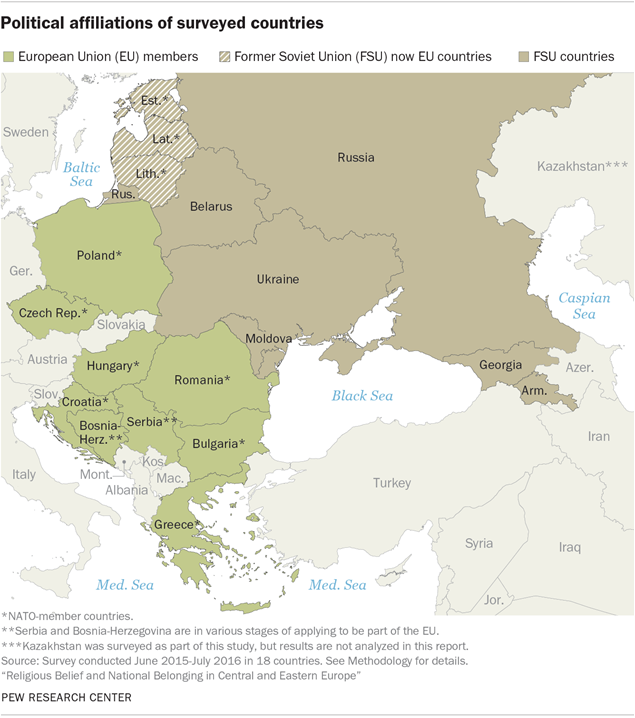
Religious majorities in Central and Eastern Europe
Political affiliations of surveyed countries

Orthodox Christians make up majority in the region

Religious landscape of Central and Eastern Europe

Overall, an estimated 57% of people living in the region surveyed identify as Orthodox. 8 This includes large majorities in 10 countries, including Russia, Ukraine, Greece, Romania and several others. Orthodox Christians also form significant minorities in Bosnia (35%), Latvia (31%) and Estonia (25%).

Catholics make up about 18% of the region’s population, including majorities of adults in Poland, Croatia, Lithuania and Hungary.

The next largest group, at 14% of the region’s population, is the religiously unaffiliated – people who identify as atheist, agnostic or “nothing in particular.” The religiously unaffiliated make up a solid majority (72%) of adults in the Czech Republic and a plurality (45%) in Estonia.

Protestants are a smaller presence in the region, though in some countries they are sizable minorities. In Estonia and Latvia, for example, roughly one-in-five adults identify as Lutheran. And 13% of Hungarians identify with the Presbyterian/Reformed Church.

What other surveys have shown about religion in Central and Eastern Europe
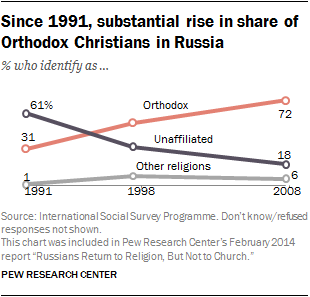
Since 1991, substantial rise in share of Orthodox Christians in Russia

Since the early 1990s, several survey organizations have sought to measure religious affiliation in parts of Central and Eastern Europe, among them the International Social Survey Program (ISSP), New Russia Barometer, New Europe Barometer, New Baltic Barometer and the Center for the Study of Public Policy at the University of Strathclyde. Some of these polls also have asked about belief in God and frequency of church attendance.

While most of these surveys cover Russia, data showing trends over time in other Orthodox countries since the 1990s are scarce. And because of major differences in question wording, as well as widely differing methodological approaches to sampling minority populations, the surveys arrive at varying estimates of the size of different religious groups, including Orthodox Christians, Catholics, Muslims and people with no religious affiliation.9 On the whole, though, they point to a sharp revival of religious identity in Russia beginning in the early 1990s, after the fall of the Soviet Union. For example, ISSP surveys conducted in Russia in 1991, 1998 and 2008 show the share of Orthodox Christians more than doubling from 31% to 72%, while at the same time, the share of religiously unaffiliated adults declined from a majority in 1991 (61%) to 18% in 2008.

Some of the more recent surveys suggest that this Orthodox revival has slowed or leveled off in the last decade or so. For example, European Social Survey (ESS) polls show a relatively stable share of Orthodox Christians in Russia, Bulgaria and Ukraine since about 2006, as illustrated in the accompanying chart, and Pew Research Center polls show a similar trend.
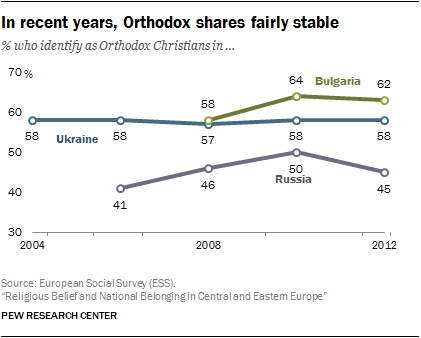
In recent years, Orthodox shares fairly stable

At the same time, surveys indicate that the shares of adults engaging in religious practices have remained largely stable since the fall of the Soviet Union. In Russia, according to New Russia Barometer surveys, approximately as many religiously affiliated adults said they attended church monthly in 2007 (12%) as in 1993 (11%).

In Catholic-majority countries, church attendance rates may even have declined, according to some surveys. For instance, in New Baltic Barometer surveys conducted in Lithuania, 25% of adults said they attended church at least once a month in 2004, down from 35% in 1993.

Few people attend church, but most believe in God
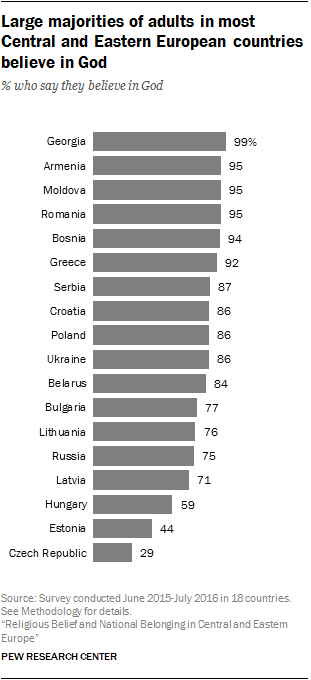
Large majorities of adults in most Central and Eastern European countries believe in God

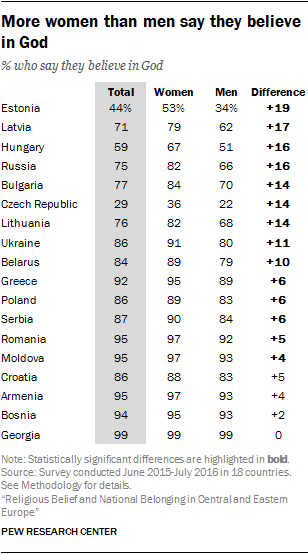
Even though relatively few people in many countries across Central and Eastern Europe say they attend church weekly, a median of 86% across the 18 countries surveyed say they believe in God. This includes more than nine-in-ten in Georgia (99%), Armenia (95%), Moldova (95%), Romania (95%) and Bosnia (94%). The Czech Republic and Estonia are the two biggest exceptions to this pattern; in both places, fewer than half (29% and 44%, respectively) say they believe in God.

Overall, people in Central and Eastern Europe are somewhat less likely to say they believe in God than adults previously surveyed in Africa and Latin America, among whom belief is almost universal. Still, across this region – with its unique history of state-supported atheism and separation of religion from public life – it is striking that the vast majority of adults express belief in God.

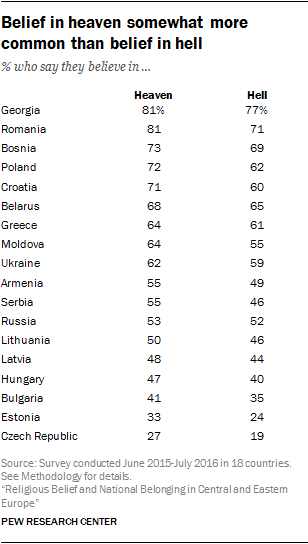
Lower percentages across Central and Eastern Europe – though still majorities in about half the countries – believe in heaven (median of 59%) and hell (median of 54%). Across the countries surveyed, Catholics tend to express higher levels of belief in heaven and hell than do Orthodox Christians.

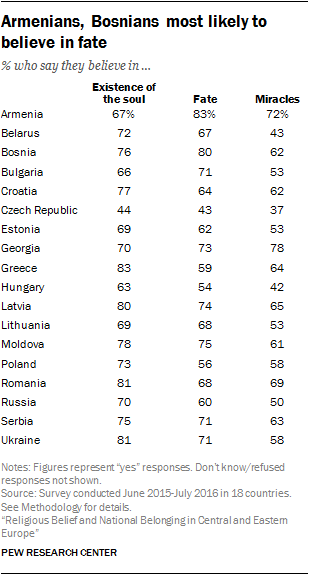
Belief in fate (i.e., that the course of one’s life is largely or wholly preordained) and the existence of the soul also are fairly common – at least half of adults express these beliefs in nearly every country surveyed. Even among people who do not identify with a religion, substantial shares say they believe in fate and the soul. In the Czech Republic, where just three-in-ten people (29%) say they believe in God, higher shares express belief in fate (43%) and the existence of the soul (44%).

Religion in the Czech Republic, Central and Eastern Europe’s most secular country

The Czech Republic stands out in this report as the only country surveyed where most adults are religiously unaffiliated. When asked about their religion, 72% of Czech respondents identify as atheist, agnostic or “nothing in particular,” and roughly two-thirds (66%) say they do not believe in God. Given that other countries in Central and Eastern Europe emerged from communist rule with much higher levels of religious affiliation, this raises the question: Why aren’t Czechs more religious?

For clues, scholars have looked to the past, identifying a pattern of Czech distaste for the pressures emanating from religious and secular authorities. This goes back as far as 1415, when followers of Jan Hus, a priest in Bohemia (now part of the Czech Republic), separated from the Roman Catholic Church after Hus was burned at the stake for heresy.

Throughout the 15th century, in a precursor of sorts to the Protestant Reformation, these so-called “Hussites” gained enough influence that the vast majority of the Czech population no longer identified as Catholic.10 But after the Thirty Years’ War (1618 to 1648), this break from Catholicism reversed itself when the Catholic Austro-Hungarian Empire fiercely repressed the Hussites and other Protestants and forcibly re-Catholicized the area. While the region would become overwhelmingly Catholic, historians argue that the repression of this period reverberates to the present day in the collective Czech memory, casting the Catholic Church as an overly privileged partner of foreign occupiers.

Anticlericalism surged in the years of Czech independence after World War I, with the country’s Catholic population declining by an estimated 1.5 million people, half of whom did not join another denomination.11 After World War II, the Soviet-influenced regime, which was officially atheist, furthered this disaffiliation.

Openness to religion briefly spiked after the fall of communism, though evidence suggests this may have been mostly a political statement against the communist regime, and since the early 1990s, the share of Czechs who say they have a religious affiliation has declined.12

Relatively few people in the region pray daily
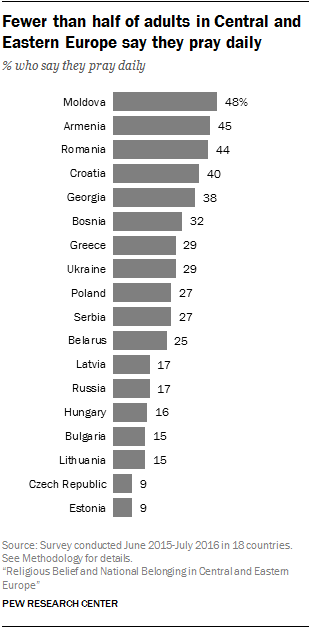
Fewer than half of adults in Central and Eastern Europe say they pray daily

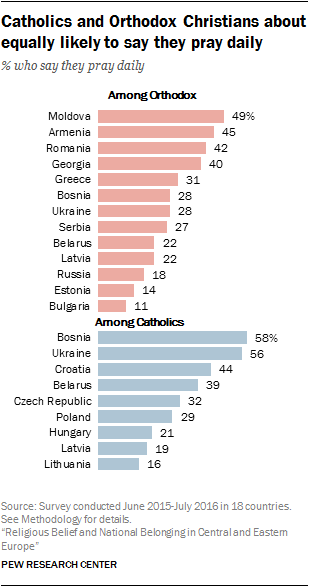
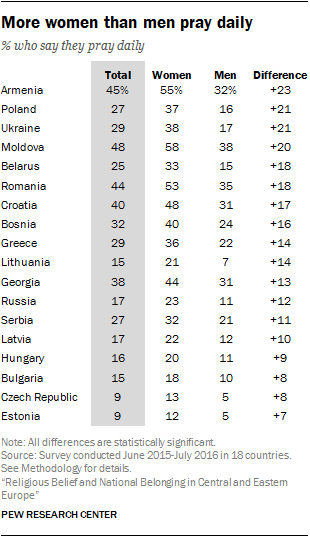
Despite the high levels of belief in God throughout most of the region, daily prayer is not the norm in Central and Eastern Europe. For instance, just 17% of Russians and 27% of both Poles and Serbians say they pray at least once a day. By comparison, more than half of U.S. adults (55%) say they pray every day.

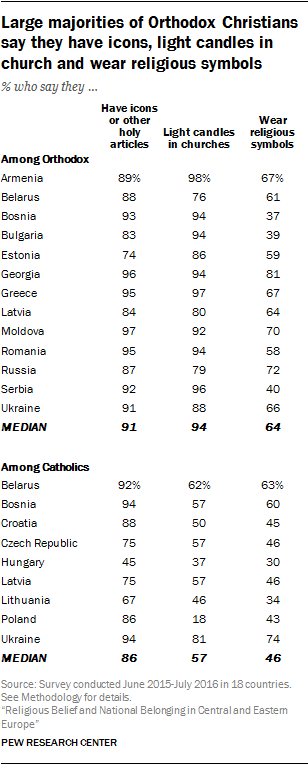
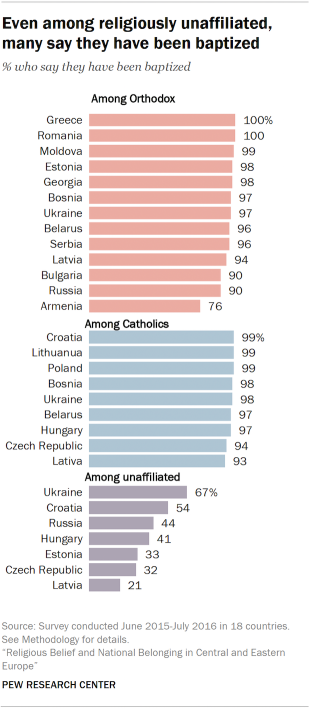
People in the region are much more likely to take part in other religious practices, such as having icons or other holy figures in their homes or wearing religious symbols (such as a cross). And very high shares of both Catholics and Orthodox Christians in virtually every country surveyed say they have been baptized.

For more on religious practices, see Chapter 2.

Conservative views on sexuality and gender

Opposition to homosexuality throughout the region
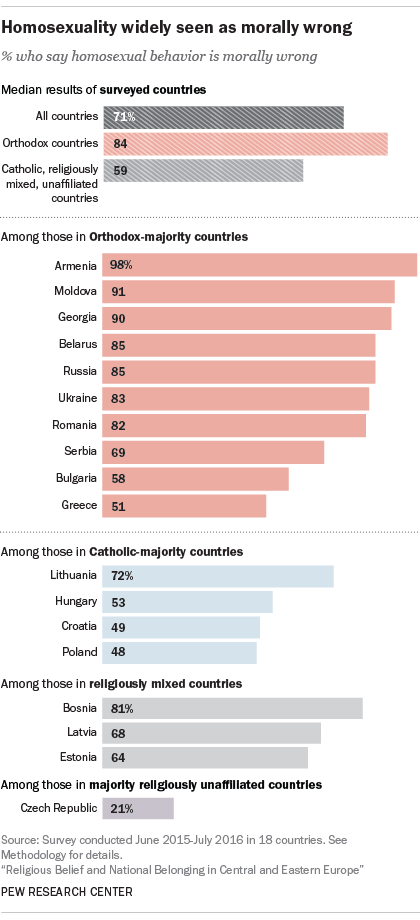
Homosexuality widely seen as morally wrong

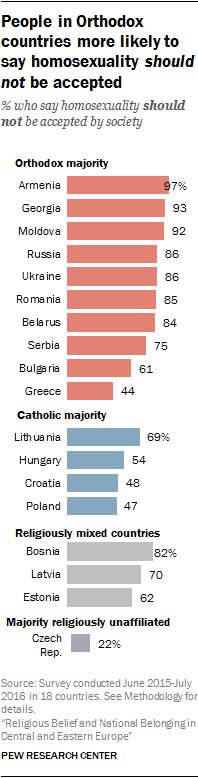
In the U.S. and many other countries, people who are more religious generally have more conservative views on social issues such as homosexuality and abortion. While this pattern is also seen within individual countries in Central and Eastern Europe, the most religious countries in the region (by conventional measures such as overall rates of church attendance) are not necessarily the most socially conservative.

For example, although levels of church attendance and prayer are relatively low in Orthodox-majority Russia, 85% of Russians overall say homosexual behavior is morally wrong. Even among religiously unaffiliated Russians, three-quarters say homosexuality is morally wrong and 79% say society should not accept it.

By contrast, in Catholic-majority Poland, where the population as a whole is more religiously observant, only about half of adults (48%) say homosexuality is morally wrong. Roughly four-in-ten Catholic Poles (41%) say society should accept homosexuality.

This pattern, in which Orthodox countries are more socially conservative even though they may be less religious, is seen throughout the region.

Young adults somewhat more liberal on homosexuality, same-sex marriage
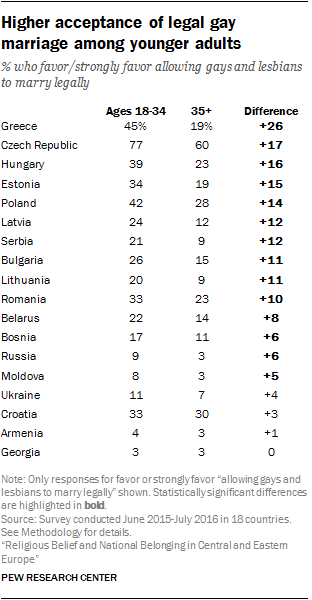
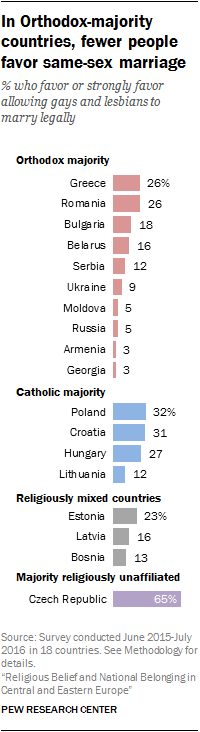
Higher acceptance of legal gay marriage among younger adults

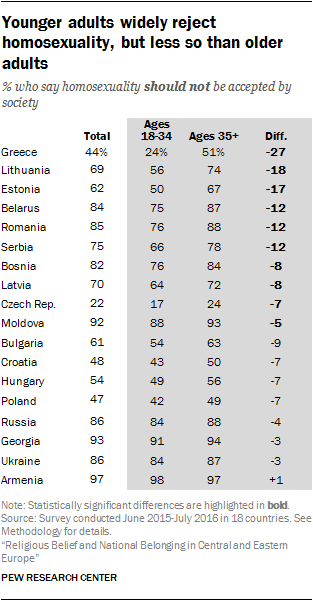
Across the region, younger people (that is, adults under 35) are less opposed to homosexuality and more inclined than their elders to favor legal gay marriage.

But even among younger people, the prevailing view is that homosexuality is morally wrong, and relatively few young adults (except in the Czech Republic) favor gay marriage. In some countries, there is little or no difference between the views of younger and older adults on these issues. For example, in Ukraine, younger people are about as likely as their elders to favor legal gay marriage (11% vs. 7%).

Many in Orthodox countries associate women with traditional roles

People in Orthodox-majority countries are more likely than those elsewhere in the region to hold traditional views of gender roles – such as women having a social responsibility to bear children and wives being obligated to obey their husbands.

In Orthodox-majority countries, more people express traditional views of gender norms in marriage

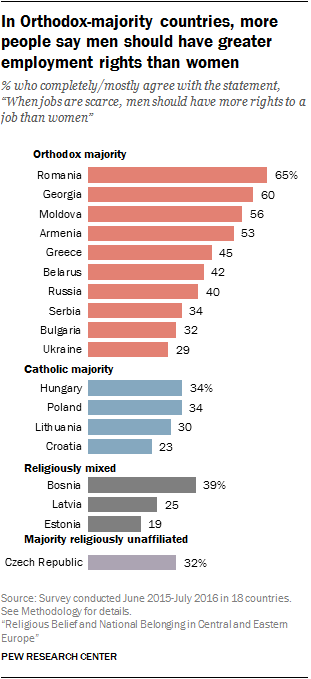
Along these same lines, roughly four-in-ten or more adults in most Orthodox-majority countries say that when unemployment is high, men should have more rights to a job. In the eight non-Orthodox countries surveyed, the share that holds this view ranges from 19% in Estonia to 39% in Bosnia.

Russia’s regional influence

Many see Moscow patriarch as highest authority of Orthodoxy

Many Orthodox Christians across the region look toward Russian religious leadership. While there is no central authority in Orthodox Christianity akin to the pope in Catholicism, Patriarch Bartholomew I of Constantinople is often referred to as the “first among equals” (in Latin, “primus inter pares”) in his spiritual leadership of the Greek Orthodox and other Orthodox Christians around the world.13 But Greece is the only country surveyed where a majority of Orthodox Christians say they view the patriarch of Constantinople as the highest authority in Orthodoxy.

Stronger support for patriarch of Moscow than patriarch of Constantinople

Substantial shares of Orthodox Christians – even outside Russia – see the patriarch of Moscow (currently Kirill) as the highest authority in the Orthodox Church, including roughly half or more not only in Estonia and Latvia, where about three-in-four Orthodox Christians identify as ethnic Russians, but also in Belarus and Moldova, where the vast majority of Orthodox Christians are not ethnic Russians.

In countries such as Armenia, Serbia and Ukraine, many people regard the national patriarchs as the main religious authorities. But even in these three nations, roughly one-in-six or more Orthodox Christians say the patriarch of Moscow is the highest authority in Orthodoxy – despite the fact that the overwhelming majority of Orthodox Christians in these countries do not self-identify as ethnic Russians or with the Russian Orthodox Church.

Should Russia protect Orthodox Christians outside its borders?
In Orthodox-majority countries, widespread support for Russia protecting Orthodox Christians

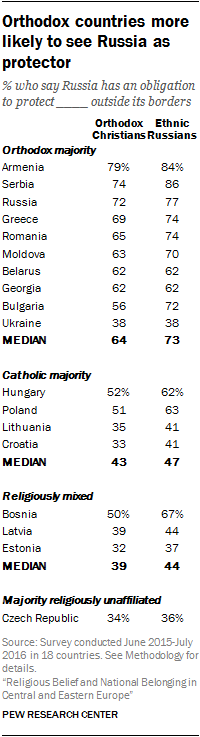
In addition to having the largest Orthodox Christian population in the world (more than 100 million), Russia plays central cultural and geopolitical roles in the region. In all but one Orthodox-majority country surveyed, most adults agree with the notion that Russia has an obligation to protect Orthodox Christians outside its borders.

The lone exception is Ukraine, which lost effective control over Crimea to Russia in 2014 and is still engaged in a conflict with pro-Russian separatists in the eastern part of the country. Yet, even outside the territories in conflict, more than a third of Ukrainian adults (38%) say Russia has an obligation to protect Orthodox Christians in other countries. (For a more detailed explanation of ethnic and religious divides in Ukraine, see the sidebar later in this chapter.)

Russians generally accept this role; 72% of Russians agree that their country has an obligation to protect Orthodox Christians in other countries. But this sense of national responsibility or bond with Orthodox Christians outside Russia’s borders does not necessarily extend to a personal level. Just 44% of Orthodox Christians in Russia say they feel a strong bond with other Orthodox Christians around the world, and 54% say they personally feel a special responsibility to support other Orthodox Christians.

Ethnic Russians say Russia has an obligation to protect them
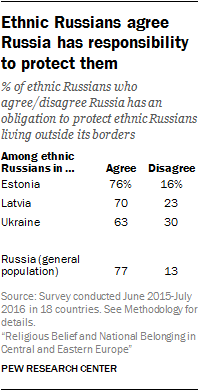
Ethnic Russians agree Russia has responsibility to protect them

The survey also asked respondents whether Russia has an obligation to protect ethnic Russians living outside its borders. 14

Several former Soviet republics have ethnic Russian minority populations. For example, 31% of adults surveyed in Latvia describe themselves as ethnically Russian, as do 25% in Estonia and 8% of those surveyed in Ukraine.15 Most ethnic Russians in these countries identify as Orthodox Christians. And in all three of these countries, clear majorities of ethnic Russians agree that Russia has a responsibility to protect them.

Russians generally accept this responsibility, with 77% agreeing that Russia has an obligation to protect ethnic Russians living in other countries.
In the other Orthodox-majority countries surveyed, no more than 6% of all respondents identify as ethnic Russians. But still, in some of these places, solid majorities agree Russia has an obligation to protect people of Russian ethnicity living outside its borders, including 86% in Serbia and 62% in Georgia. Once again, fewer Ukrainians (38%) agree with this view.
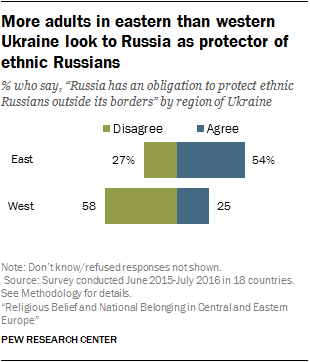
More adults in eastern than western Ukraine look to Russia as protector of ethnic Russians

Ukraine divided between east and west

The survey results highlight an east-west divide within Ukraine. In the new survey, about seven-in-ten adults (69%) in western Ukraine say it is in their country’s interest to work closely with the United States and other Western powers, compared with 53% in eastern Ukraine. And adults in the western region are less likely than easterners to see a conflict between Ukraine’s “traditional values” and those of the West.

Eastern Ukrainians, meanwhile, are more likely to favor a strong Russia on the world stage. Eastern Ukrainians are more likely than Ukrainians in the western part of the country to agree that “a strong Russia is necessary to balance the influence of the West” (29% vs. 17%). And more than half of adults (54%) in eastern Ukraine say Russia has an obligation to protect ethnic Russians outside its borders, while just a quarter of adults in western Ukraine say this

The survey also finds significant religious differences between residents of the two parts of the country. For example, people living in western Ukraine are more likely than those in the east to attend church on a weekly basis, to say religion is very important in their lives and to believe in God. In addition, nearly all Catholics in Ukraine live in the western part of the country, and western Ukraine has a somewhat higher concentration of Orthodox Christians who identify with the Kiev patriarchate than does eastern Ukraine. Even accounting for these religious differences, statistical analysis of the survey results suggests that where Ukrainians live (east or west) is a strong determinant of their attitudes toward Russia and the West – stronger than their religious affiliation, ethnicity, age, gender or level of education.

A similar political divide was found by Pew Research Center in a 2015 poll in Ukraine, which revealed that 56% of Ukrainians living in the country’s western region blamed Russia for the violence in eastern Ukraine, compared with only 33% of those living in the east.

Because of the security situation in eastern Ukraine, both the 2015 poll and the current poll exclude the contested regions of Luhansk, Donetsk and Crimea. The surveys cover approximately 80% of Ukraine’s total population, allowing for an analysis of east-west differences.
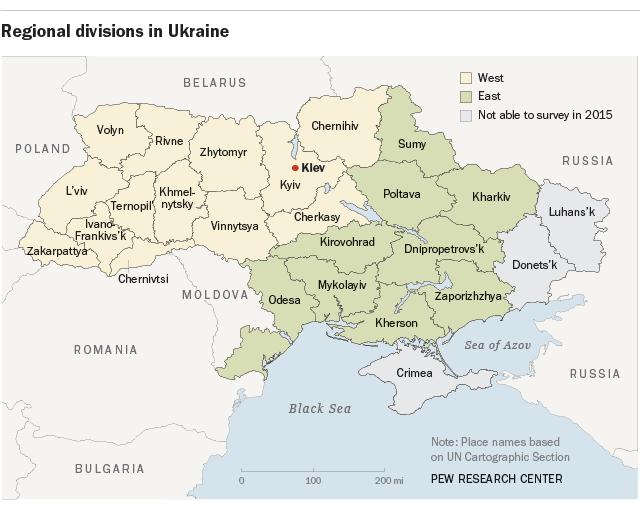
Regional divisions in Ukraine
Most people across the region say it is in their country’s interest to work with the U.S. and the West
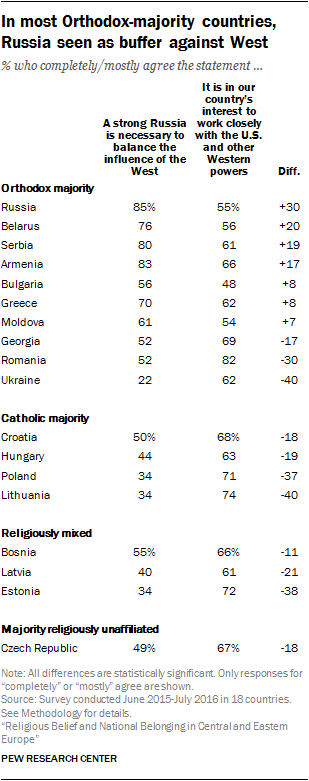
In most Orthodox-majority countries, Russia seen as buffer against West

People in Orthodox-majority countries tend to see Russia as an important buffer against the West, with most in these nations (with the notable exception of Ukraine) saying that “a strong Russia is necessary to balance the influence of the West.” Even in Greece, a country that is part of the European Union, 70% agree a strong Russia is needed to balance the West.

This sentiment is shared by considerably fewer people in Catholic and religiously mixed countries in the region.

At the same time, majorities in most countries surveyed – Orthodox and non-Orthodox – also say it is in their country’s interest to work closely with the U.S. and other Western powers.

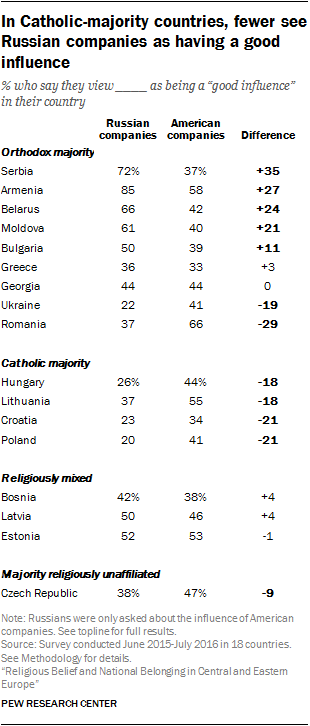
People in Orthodox-majority countries tend to look more favorably toward Russian economic influence in the region. Larger shares of the public in Orthodox countries than elsewhere say Russian companies are having a good influence over the way things are going in their country. And across roughly half the Orthodox countries surveyed, smaller shares say American companies have a good influence within their borders than say the same about Russian companies. Only in two Orthodox countries (Ukraine and Romania) do more adults give positive assessments of American companies than of Russian ones.

In Estonia and Latvia, most self-identified ethnic Russians agree that a strong Russia is necessary to balance the influence of the West (71% and 64%, respectively). By contrast, among the rest of the populations in those countries, large shares hold the opposite point of view: In Estonia, 70% of respondents who identify with other ethnicities disagree that a strong Russia is needed to balance the influence of the West, as do 51% of Latvians belonging to other ethnicities. (Just 29% of Latvians who are not ethnic Russians agree a strong Russia is necessary to balance the influence of the West, while 20% do not take a clear position on the issue.) In Ukraine, ethnic Russians are about twice as likely as ethnic Ukrainians to say a strong Russia is necessary to counter the West, although ethnic Russians are closely divided on the issue (42% agree vs. 41% disagree).

Ukraine also is the only country surveyed where ethnic Russians are about equally likely to say American companies and Russian companies are having a good influence in their country. In Estonia and Latvia, ethnic Russians are far more likely to rate favorably the influence of Russian than American companies.

Culture clash with West
Support for Russia as buffer against West more widespread among those who see value conflict with Western countries

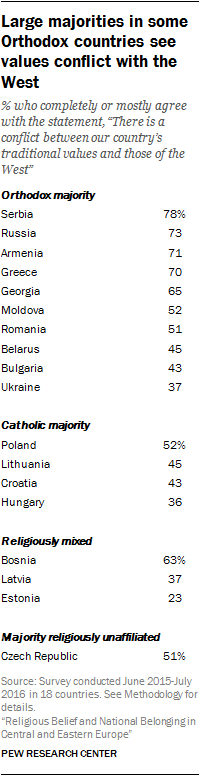
In part, the desire for a strong Russia may owe to a perceived values gap with the West. Across the region, people in Orthodox-majority countries are more likely than those in Catholic-majority countries to agree with the statement, “There is a conflict between our country’s traditional values and those of the West.” And respondents who agree with that statement also are more likely than those who disagree to say a strong Russia is necessary to balance the influence of the West.16

Many in former Soviet republics regret the Soviet Union’s demise
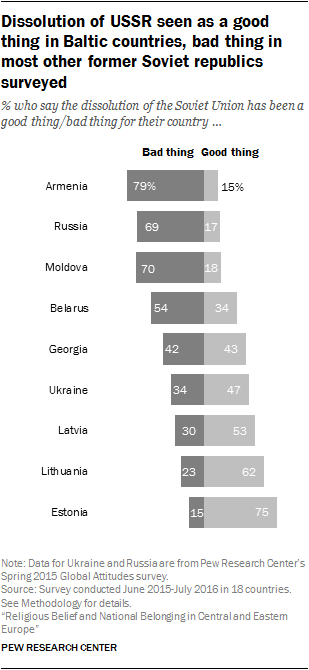
Dissolution of USSR seen as a good thing in Baltic countries, bad thing in most other former Soviet republics surveyed

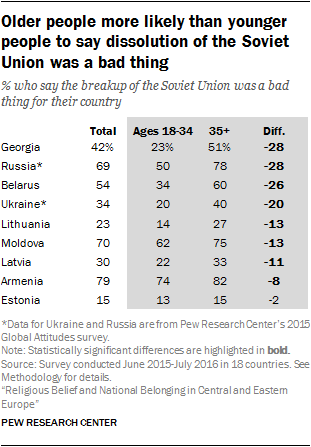
In former Soviet republics outside the Baltics, there is a robust strain of nostalgia for the USSR. In Moldova and Armenia, for example, majorities say the dissolution of the Soviet Union in 1991 was bad for their country. Even in Ukraine, where an armed conflict with pro-Russian separatists continues, about one-third (34%) of the public feels this way.

By contrast, in the Baltic countries of Estonia, Latvia and Lithuania the more widespread view is that the USSR’s dissolution was a good thing. (This question was asked only in countries that were once a part of the Soviet Union.)

In nearly every country, adults over the age of 5o (i.e., those who came of age during the Soviet era) are more likely than younger adults to say the dissolution of the Soviet Union has been a bad thing for their country. Ethnicity makes a difference as well: Ethnic Russians in Ukraine, Latvia and Estonia are more likely than people of other ethnicities in these countries to say the dissolution of the Soviet Union was a bad thing. In Latvia, for example, 53% of ethnic Russians say the dissolution of the Soviet Union was a bad thing, compared with 20% of all other Latvians.

Nostalgia for the Soviet era also may be reflected in people’s views of two political leaders – Josef Stalin (who ruled from 1924 to 1953) and Mikhail Gorbachev (general secretary of the Communist Party from 1985 to 1991). Neither man is viewed positively across the region as a whole. But in several former Soviet republics, including Russia and his native Georgia, more people view Stalin favorably than view Gorbachev favorably. Meanwhile, Gorbachev receives more favorable ratings than Stalin does in the Baltic countries, as well as in Poland, Hungary, Croatia and the Czech Republic.
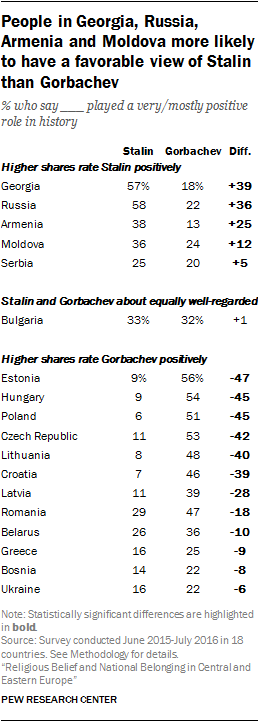
People in Georgia, Russia, Armenia and Moldova more likely to have a favorable view of Stalin than Gorbachev

Many express doubts about democracy as best form of government

Following the fall of the Iron Curtain and collapse of the USSR, Western models of democratic government and market economies quickly spread across Central and Eastern Europe. Elsewhere, Pew Research Center has documented the wide range of public reactions to political and economic change between 1991 and 2009. Just as in that study, the new survey finds many people across the region harbor doubts about democracy.

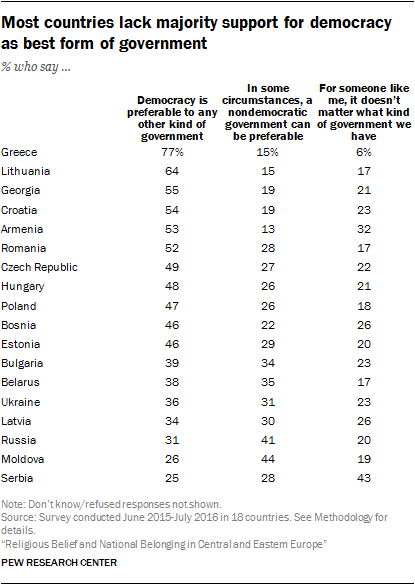
While the prevailing view in 11 of the 18 countries surveyed is that democracy is preferable to any other form of government, only in two countries – Greece (77%) and Lithuania (64%) – do clear majorities say this.

In many countries across Central and Eastern Europe, substantial shares of the public – including roughly one-third or more of adults in Bulgaria, Belarus, Russia and Moldova – take the position that under some circumstances, a nondemocratic government is preferable.

This survey question offered a third option as a response: “For someone like me, it doesn’t matter what kind of government we have.” Considerable shares of respondents in many countries also take this position, including a plurality in Serbia (43%), about a third in Armenia (32%) and one-in-five Russians (20%).
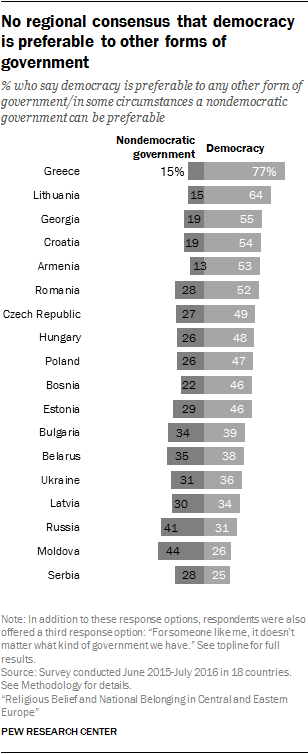
No regional consensus that democracy is preferable to other forms of government

In Orthodox countries, more people support a role for the church in public life
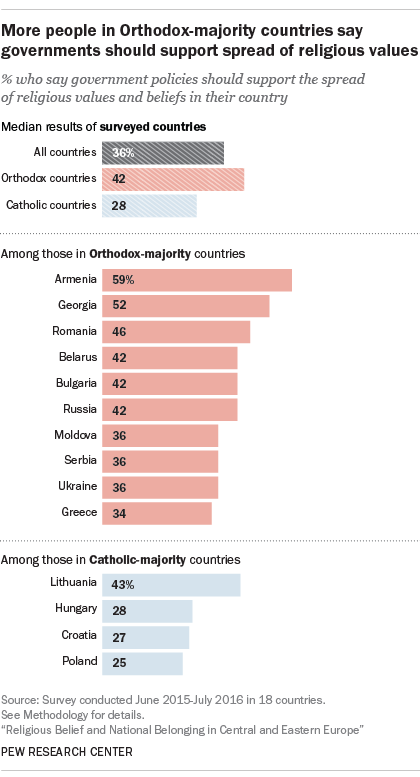
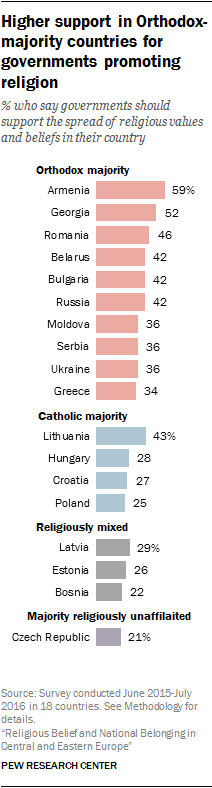
More people in Orthodox-majority countries say governments should support spread of religious values

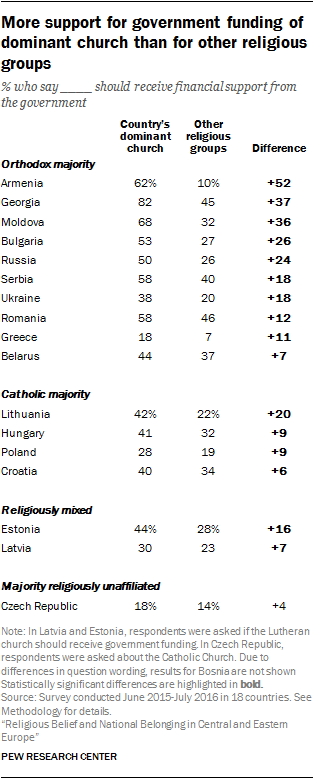
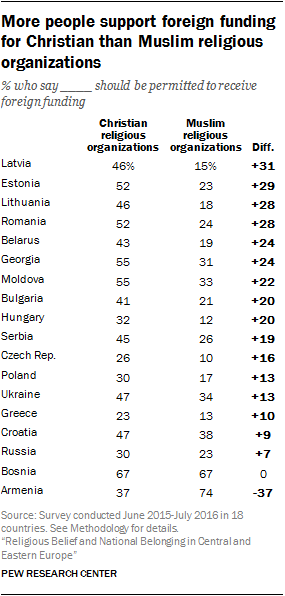
People in Orthodox-majority countries are more inclined than those elsewhere in the region to say their governments should support the spread of religious values and beliefs in the country and that governments should provide funding for their dominant, national churches.

Roughly a third or more in Orthodox countries say their governments should support the spread of religious values and beliefs in their countries, including a majority in Armenia (59%) and roughly half in Georgia (52%). Support for government efforts to spread religious values is considerably lower in most Catholic countries – in Poland, Croatia and Hungary, majorities instead take the position that religion should be kept separate from government policies.

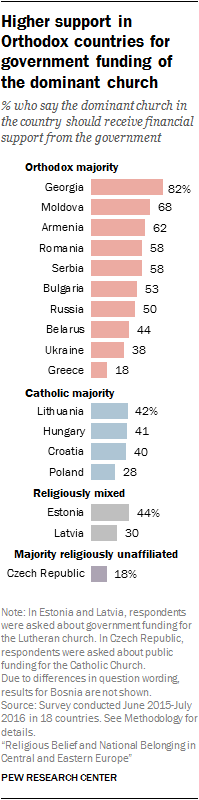
In addition, even though relatively few people in Orthodox-majority countries in the region say they personally attend church on a weekly basis, many more say their national Orthodox Church should receive government funding. In Russia, for example, 50% say the Russian Orthodox Church should receive government funding, even though just 7% of Russians say they attend services on a weekly basis. Similarly, 58% of Serbians say the Serbian Orthodox Church should receive funds from their government, while again, 7% say they go to religious services weekly.

In Orthodox-majority countries, higher support for public funding of the church

By comparison, 28% of Poles and about four-in-ten adults in Croatia, Lithuania and Hungary support government funding of the Catholic Church in these Catholic-majority countries.

Across several Orthodox- and Catholic-majority countries, people who do not identify with the predominant religion (whether Orthodoxy or Catholicism) are less likely than others to support the government spread of religious values as well as public funding for the church. For example, in Hungary, just 19% of religiously unaffiliated adults say the government should fund the Catholic Church, compared with about half of Catholics (51%).

But, in some cases, people in religious minority groups are nearly as likely as those in the majority to say the government should financially support the dominant church. In Russia, for instance, 50% of Muslims – compared to 56% of Orthodox Christians – say the Russian Orthodox Church should receive funding from the state.

Views on diverse vs. homogeneous societies

Mixed opinions on whether a diverse or homogeneous society is better
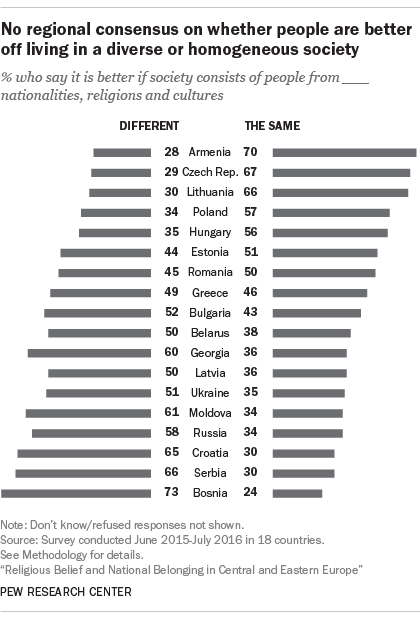
No regional consensus on whether people are better off living in a diverse or homogeneous society

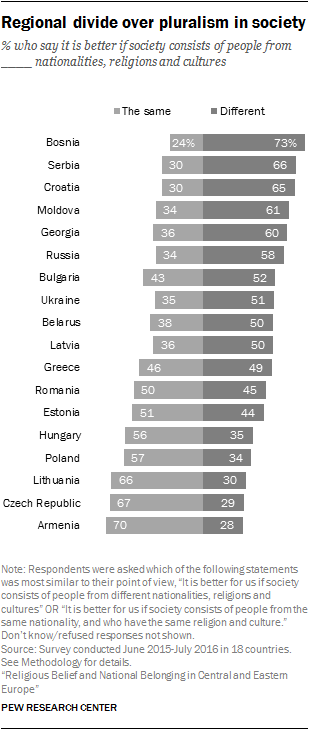
The survey also probed views on religious and ethnic diversity. Respondents were asked to choose between two statements: “It is better for us if society consists of people from different nationalities, religions and cultures” or “It is better for us if society consists of people from the same nationality, and who have the same religion and culture.”

Answers vary significantly across the region, with large majorities in countries that were part of the former Yugoslavia (Bosnia, Serbia and Croatia), which went through ethnic and religious wars in the 1990s, saying that a multicultural society is preferable.

Muslims tend to be more likely than Orthodox Christians and Catholics in the region to favor a multicultural society.

Varying levels of acceptance among Catholics, Orthodox and other groups

In addition to measuring broad attitudes toward diversity and pluralism, the survey also explored opinions about a number of specific religious and ethnic groups in the region. For example, how do the two largest religious groups in the region – Orthodox Christians and Catholics – view each other?

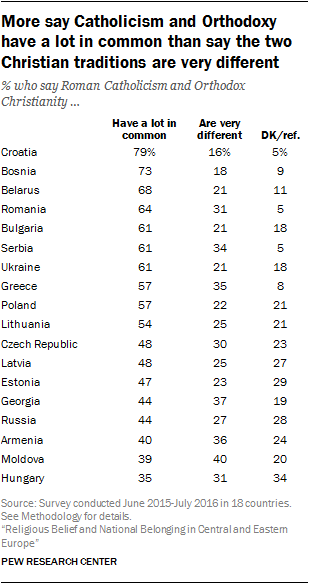
To begin with, many members of both Christian traditions say that Roman Catholicism and Eastern Orthodoxy have a lot in common. But the Orthodox-Catholic schism is nearly 1,000 years old (it is conventionally dated to 1054, following a period of growing estrangement between the Eastern patriarchates and the Latin Church of Rome). And some modern Orthodox leaders have condemned the idea of reuniting with the Roman Catholic Church, expressing fears that liberal Western values would supplant traditional Orthodox ones.

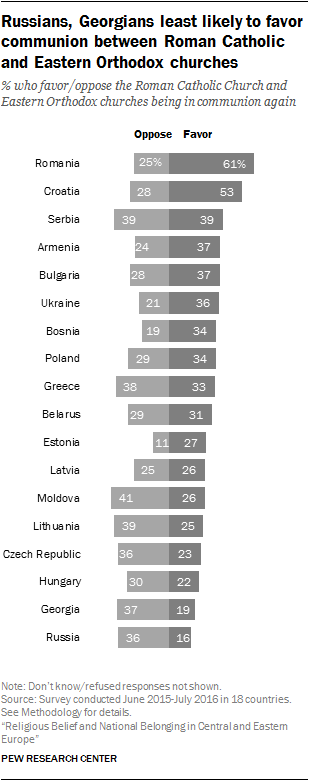
Today, few Orthodox Christians in the region say the two churches should be in communion again, including as few as 17% in Russia and 19% in Georgia who favor reuniting with the Catholic Church.

In countries that have significant Catholic and Orthodox populations, Catholics are, on balance, more likely to favor communion between the two churches. In Ukraine, for example, about three-quarters (74%) of Catholics favor reunification of Roman Catholicism and Eastern Orthodoxy, a view held by only about one-third (34%) of the country’s Orthodox population. (See the related sidebar for an explanation of Ukraine’s religious and ethnic divides.)
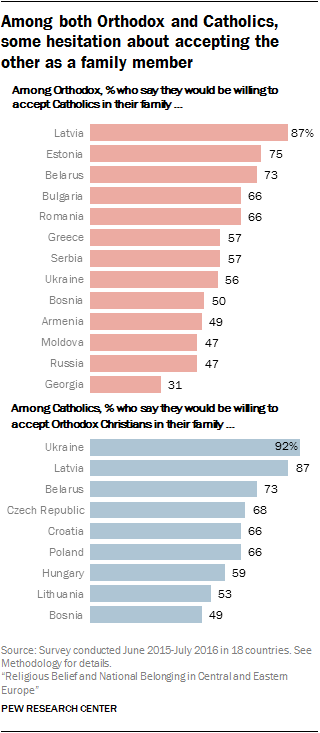
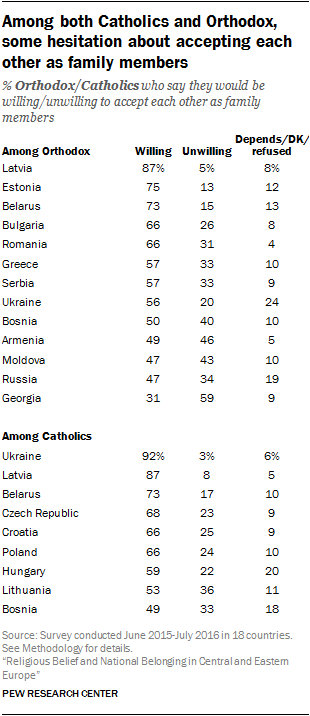
Among both Orthodox and Catholics, some hesitation about accepting the other as a family member

In some cases, the estrangement between the two Christian traditions runs deeper. The survey asked Orthodox Christians and Catholics whether they would be willing to accept each other as fellow citizens of their country, as neighbors or as family members. In most countries, the vast majority of both groups say they would accept each other as citizens and as neighbors. But the survey reveals at least some hesitation on the part of both Orthodox Christians and Catholics to accept the other as family members, with Catholics somewhat more accepting of Orthodox Christians than vice versa. In Ukraine, where Catholics are a minority, there is a particularly large gap on this issue – 92% of Catholics say they would accept Orthodox Christians as family members, while far fewer Orthodox Christians (56%) in Ukraine say they would accept Catholics into their family.
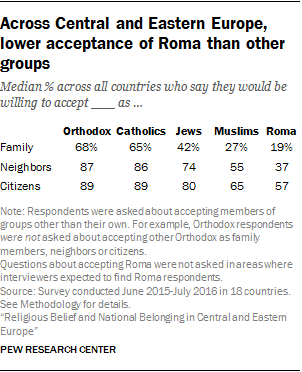
Across Central and Eastern Europe, lower acceptance of Roma than other groups

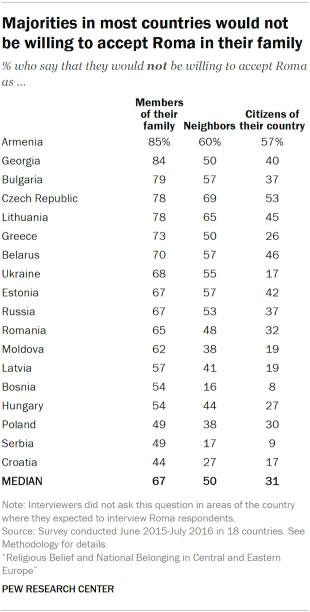
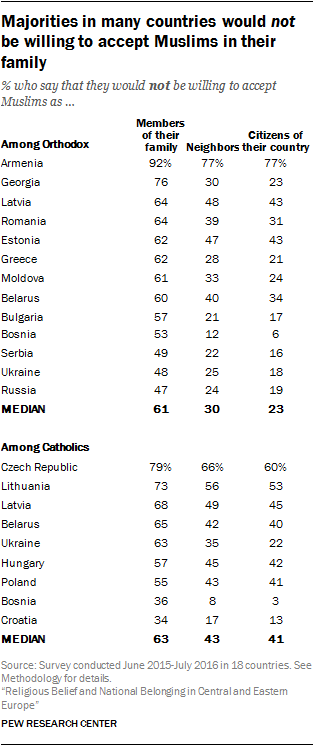
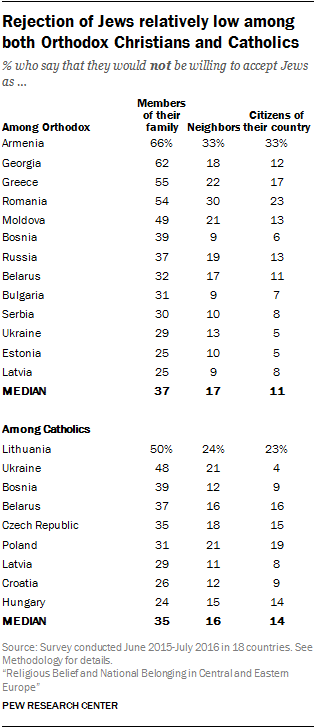
The survey also posed similar questions about three other religious or ethnic groups. Respondents were asked whether they would be willing to accept Jews, Muslims and Roma as citizens of their country, neighbors and family. The results of this battery of “social distance” questions suggest that there is less acceptance, in general, of these minorities in Central and Eastern Europe.

Roma (also known as Romani or Gypsies, a term some consider pejorative) face the lowest overall levels of acceptance. Across all 18 countries surveyed, a median of 57% of respondents say they would be willing to accept Roma as fellow citizens. Even lower shares say they would be willing to accept Roma as neighbors (a median of 37%) or family members (median of 19%). There is little or no difference between Catholics and Orthodox Christians when it comes to views of Roma.

On balance, acceptance of Jews is higher than of Muslims. But there are some differences in the attitudes of the major Christian groups toward these minorities. Overall, Catholics appear more willing than Orthodox Christians to accept Jews as family members.

On the other hand, Orthodox Christians are generally more inclined than Catholics across the region to accept Muslims as fellow citizens and neighbors. This may reflect, at least in part, the sizable Muslim populations in some countries that also have large Orthodox populations. Orthodox-majority Russia has approximately 14 million Muslims, the largest Muslim population in the region (in total number), and Bosnia has substantial populations of both Muslims and Orthodox Christians, but fewer Catholics.
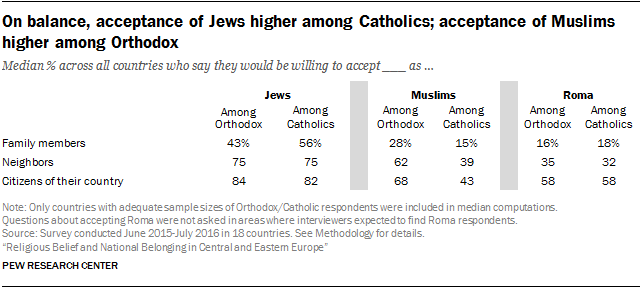
On balance, acceptance of Jews higher among Catholics; acceptance of Muslims higher among Orthodox

People in Georgia and Armenia consistently show low levels of acceptance of all three groups as family members compared with other countries in the region. Roughly a quarter in Georgia and Armenia say they would be willing to accept Jews as family members. Acceptance of Muslims is even lower in these countries – 16% of Georgian Orthodox Christians say they would be willing to accept a Muslim family member, even though about one-in-ten Georgians (9%) are Muslim, and just 5% of Armenian Orthodox Christians say they would be willing to accept a Muslim in their family.

About one-in-ten people in Georgia and Armenia say they would be willing to accept Roma in their family, compared with, for example, 30% in Moldova and 18% in Russia.

Muslims in the former Soviet bloc

Pew Research Center previously polled Muslims in the former Soviet republics of Azerbaijan, Kazakhstan, Kyrgyzstan, Russia, Tajikistan and Uzbekistan, as well as in the Balkan countries of Albania, Bosnia and Kosovo, as part of a 2012 survey of Muslims in 40 countries around the world. Bosnia and Kazakhstan also were included in the 2016 survey.17

The 2012 survey found relatively low levels of religious belief and practice among Muslims in the former Soviet bloc countries compared with Muslims elsewhere around the world.

No more than half of Muslims surveyed in Russia, the Balkans and in Central Asia say religion is very important in their lives, compared with the vast majorities of Muslims living in the Middle East, South Asia, Southeast Asia and Africa. Following the same pattern, fewer Muslims in most countries of the former Soviet bloc than elsewhere say they practice core tenets of their faith, such as fasting during the holy month of Ramadan, or giving zakat (a portion of their accumulated wealth to the needy). And considerably fewer in most countries favor making sharia the official law of the land in their countries.

The current survey has large enough sample sizes of Muslims for analysis in Bosnia, Bulgaria, Georgia, Kazakhstan and Russia. Muslims in Kazakhstan and Russia largely show levels of religious belief and observance similar to those highlighted in the 2012 report. A lack of survey data dating back to the early 1990s on the attitudes of Muslim publics makes it difficult to determine the extent to which these populations have experienced religious revival since the fall of the Soviet Union.

Compared with the Christian populations in Russia, Kazakhstan and Bulgaria, Muslims are generally more religiously observant; higher shares among Muslims than Christians in these countries say religion is “very important” in their lives, report daily prayer and say they attend religious services at least weekly. But in Georgia, where religious observance is higher among the general population than elsewhere in the region, Muslims are about as likely as Christians to say they attend services weekly or consider religion “very important.” In fact, Muslims in Georgia are less likely than Christians to say they pray daily.

In religiously mixed Bosnia, Muslims are more observant than the country’s Orthodox and Catholic populations, and a higher share of Muslims say religion is “very important” in their lives in 2015 than in 2012.

1. Religious affiliation

Orthodoxy is the dominant religion in Central and Eastern Europe, and the majority religion in 10 of the 18 countries surveyed. Overall, nearly six-in-ten people in the region (57%) identify with this Christian tradition. Moldova and Greece have the highest Orthodox proportions in their populations, while Russia and Ukraine – the two largest countries surveyed in terms of overall population – have the largest Orthodox populations in absolute numbers.

The region also has sizable populations of Catholics and Muslims and notable shares of Lutherans in some countries. The Czech Republic is the only country surveyed in which a majority of adults say they are religiously unaffiliated (i.e., they describe their religion as atheist, agnostic or “nothing in particular”).

The survey asked Christian respondents whether they view their religious identity primarily as a matter of personal faith, a matter of family tradition or a matter of national culture. Responses vary across different countries, but generally, the shares emphasizing ancestral and cultural aspects of their religious identity are similar to or larger than the shares who stress the personal faith aspect. Overall, Orthodox Christians are more likely than Catholics to say their religious identity is primarily about national culture.

Large majorities of religiously affiliated adults in each country surveyed say they take pride in their religious identity. Fewer, though close to half in most countries, say they feel strong bonds with fellow members of their religious group around the world. Smaller percentages say religion is very important in their personal lives.

Respondents in former Soviet republics are more likely to say religion is important to them now than to say it mattered to their families when they were children; in other countries surveyed, on balance, more people say religion was important to them growing up than say it is important to them now. Similarly, when asked about religion on a national level, in most countries that were part of the officially atheist USSR, higher shares say their country is at least somewhat religious now than say it was as religious in the 1970s and 1980s.

Most adults in the countries surveyed say they were raised in the religion with which they currently identify (or with no religion, if they are now unaffiliated). To the extent that people have changed religions, or have joined a religion after being raised without one, they have tended to become Orthodox. In Belarus, Russia and Ukraine, many adults now say they are Orthodox after having been raised with no religion – a change likely connected to the fall of the Soviet Union – while far fewer have become religious “nones” after being raised Orthodox.

On the other hand, in the Czech Republic, and to a lesser extent in Poland, there has been a shift away from Catholicism. Net losses for Catholics in the Czech Republic have meant net gains for the ranks of the religiously unaffiliated.

A highly varied religious landscape

Central and Eastern Europe is home to three-quarters of the world’s Orthodox population.18 Orthodox Christians make up 57% of the region’s population, and form religious majorities among adults in 10 of the countries included in this survey.19 Russia and Ukraine have the largest populations of Orthodox Christians in absolute terms – approximately 100 million and 35 million, respectively. Moldova (92%), Greece (90%), Georgia (89%), Armenia (89%) and Romania (86%) have the highest percentages of Orthodox Christians in their adult populations.

Still, the region’s religious landscape is diverse. Four of the 18 countries surveyed have Catholic majorities: Poland (87% Catholic), Croatia (84%), Lithuania (75%) and Hungary (56%). In these countries, relatively few adults identify as Orthodox.

In one country, the Czech Republic, a majority of the adult population (72%) claims no religious affiliation – the highest share, by far, of any country surveyed. Roughly one-in-five Czechs (21%) are Catholic. (For more details, see sidebar on religion in the Czech Republic in this report’s Overview.)

Three countries – Bosnia, Estonia and Latvia – are so religiously diverse that no single group forms a clear majority. All three have sizable Orthodox minorities (35% in Bosnia, 25% in Estonia and 31% in Latvia). Latvia and Estonia also have substantial populations of Lutherans and religiously unaffiliated people; in fact, a plurality of Estonians (45%) are religious “nones.” Nearly a quarter of Latvians (23%) are Catholic. And, in Bosnia, about half of adults (52%) are Muslim and 8% are Catholic.

Most Central and Eastern European countries have Orthodox majorities

In most countries, small shares are religiously unaffiliated

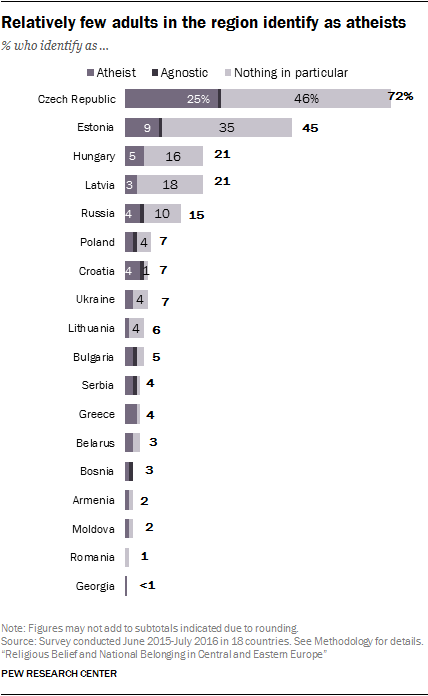
Relatively few adults in the region identify as atheists

By many standard measures, this region is less religious than others surveyed by Pew Research Center. (See Chapter 3 for a discussion of religious beliefs and comparisons with other regions.) Still, the wide reach of religion is evident in the relatively low share of respondents across the region who do not identify with a religion at all. In most countries surveyed, fewer than one-in-ten adults identify as religiously unaffiliated (that is, as atheist, agnostic or “nothing in particular”).

The two major exceptions are the Czech Republic and Estonia, where religious “nones” make up 72% and 45% of surveyed adults, respectively. In the Czech Republic, 46% of adults say they have no particular religion, while a quarter (25%) identify as atheists. In Estonia, 35% say they have no particular religion and 9% say they are atheists. Fewer in either country describe themselves as agnostics.

Only in a handful of other countries surveyed does the share of religiously unaffiliated people reach double digits. In Russia, 15% say they are unaffiliated – a big decrease from the waning days of the Soviet Union a few decades ago, when a majority of Russians said this about themselves (see Overview).

Those who are unaffiliated seem content to stay that way. In countries with sufficient sample sizes, large majorities of religious “nones” say they are not looking for a religion.

The lasting effects of tension within the Estonian and Latvian Lutheran churches

Most Central and Eastern Europeans identify with either the Orthodox or Catholic churches. However, historically, sizable Lutheran populations have been present in Estonia and Latvia (including 79% and 55%, respectively, in 1939); today, roughly one-in-five adults in each country identify as Lutheran (20% and 19%, respectively).20

That said, the arrival of Lutheranism in the Baltic region was anything but smooth. By the mid-1500s, much of the local German nobility had converted the peasant class from Catholicism or Orthodoxy to Lutheranism. These nobles maintained influence in the area until the 20th century. While many Latvians and Estonians remained Lutheran during the interwar years of independence, some still associated Lutheranism with the German upper classes, and centuries of foreign influence encumbered the relationship between the Lutheran churches and most of the population.21

During the Soviet era, other factors contributed to the tension. First, in both countries the Lutheran churches typically capitulated to Soviet demands, which included banning religious instruction. Furthermore, ties between Estonian Lutheran leadership and the KGB (the former Russian secret police and intelligence agency) were later revealed.22 And as the push for independence grew in the late 1980s and early 1990s, church leaders were replaced due to internal opposition to the leaders’ Soviet ties.

Some of this history may be reflected in the new survey’s results. Centuries of foreign domination within the church may contribute to Latvia and Estonia having the lowest percentages of respondents saying that membership in the national church (in both cases, the Lutheran church) is very or somewhat important to being truly Latvian or Estonian (11% and 15%, respectively).

In addition, survey respondents in Estonia and Latvia are among the least likely of the 18 countries surveyed to say religion is very important in their lives (6% and 10%, respectively). These shares are substantially lower than the regional median of 26%.

Family tradition and national culture important aspects of religious identity for both Catholics and Orthodox

‘Personal faith’ just one reason people identify as Orthodox, Catholic

The survey asked Christian respondents to choose whether, for them personally, their religious identity (Orthodox, Catholic, Lutheran, etc.) is mainly a matter of personal faith, family tradition or national culture. (Respondents could volunteer more than one response.)

With few exceptions, Orthodox and Catholic respondents are about as likely or more likely to say their religious identity is primarily about national culture or family tradition as they are to say it is about personal faith. For example, in Belarus, more than half (55%) of Orthodox Christians say that being Orthodox, to them, personally, is mainly about family tradition (37%) or about national culture (16%), while about a third (34%) say it is mainly about personal faith. And Catholics in Belarus are about as likely to say being Catholic is mainly about personal faith (40%) as they are to say it is about family tradition or national culture (42%).

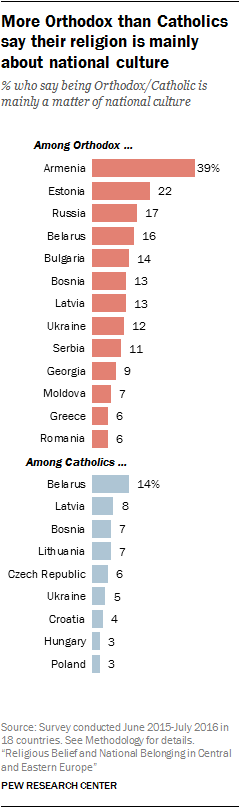
More Orthodox than Catholics say their religion is mainly about national culture

Generally, people who are more religious – that is, who pray daily or say religion is very important in their life – are more likely than others to say being Catholic or Orthodox is mainly a matter of personal faith.

Overall, the “national culture” option is chosen more frequently by Orthodox Christians than by Catholics. For example, 39% of Orthodox Christians in Armenia, 22% in Estonia, 17% in Russia and 16% in Belarus say that to them, being Orthodox is mainly a matter of national culture. By contrast, around one-in-ten or fewer Catholics across the region, including just 3% in Poland and Hungary, say being Catholic is mainly a matter of national culture.

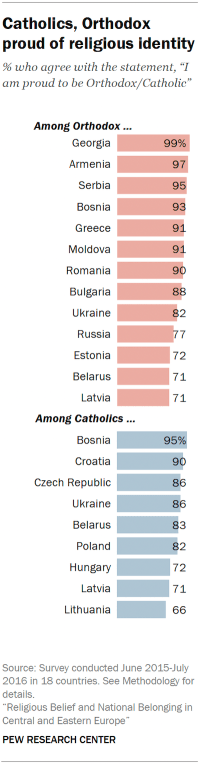
Vast majority of both Orthodox and Catholics say they are proud of their religious identity

Religious identity is a source of pride for the vast majority of Orthodox Christians and Catholics surveyed in the region.

About nine-in-ten Orthodox Christians in Romania, Moldova, Greece, Bosnia and Serbia say they are proud to be Orthodox, and this sentiment is nearly universal in Georgia and Armenia. It is lower, though still widespread, in the countries with the two largest Orthodox populations: Russia (77%) and Ukraine (82%).

Catholic pride is expressed at similar levels, and by large majorities, in every country surveyed with a substantial Catholic population. Nine-in-ten or more Catholic adults in Bosnia and Croatia say they are proud to be Catholic, as do at least eight-in-ten in the Czech Republic, Ukraine, Belarus and Poland.

Overall, people who pray daily, attend church weekly or say religion is very important in their lives are more likely than others to say they take pride in their religious identity. And, on balance, women are more likely than men to express pride in their religion.

Many Catholics, Orthodox Christians feel connected to co-religionists around the world

The survey also asked people if they feel special bonds to other members of their religious tradition around the world. Overall, Catholics across the region are about as likely as Orthodox Christians to say they feel this type of special bond. But in countries with sizable shares of both Catholic and Orthodox populations, Catholics are generally more likely to say they feel a bond with other Catholics than Orthodox Christians are to say they feel a special bond with other members of their branch of Christianity. In Ukraine, for example, 59% of Catholics say they feel a special bond with Catholics around the world, while just 47% of Orthodox Christians in Ukraine report feeling such a bond with other Orthodox Christians.

Orthodox Christians in former Soviet republics surveyed are less likely than those elsewhere to express that they feel this kinship. For instance, only 44% of Orthodox Christians in Russia say they feel a special bond with other Orthodox Christians around the world, compared with about three-quarters in Bosnia and Serbia (both of which were outside the USSR’s borders).

Both Catholics, Orthodox feel religious bond across borders

Overall, Catholic adults ages 35 and older are more likely than younger adults to say they feel a bond with Catholics elsewhere. And among both Catholics and Orthodox Christians, people who are more religious are more likely to say they feel a bond with other members of their religious group around the world.

The survey also asked if Catholic and Orthodox adults have a special responsibility to support fellow followers of their traditions around the world. Overall, majorities or pluralities of Orthodox Christians in most countries agree they feel such a sense of responsibility. The pattern is more mixed among Catholic populations – in about half the countries where adequate sample sizes of Catholics are available for analysis, majorities or pluralities agree with this view, while in other countries, fewer Catholics take this position.

Once again, religious people – those who pray daily, attend church weekly or say religion is very important in their personal lives – are more likely than others to say they have an obligation to support co-religionists around the world.

Muslims express pride, connectedness and responsibility

While Christianity is the region’s dominant religion, four of the 18 countries surveyed have enough Muslim respondents to allow for separate analysis.

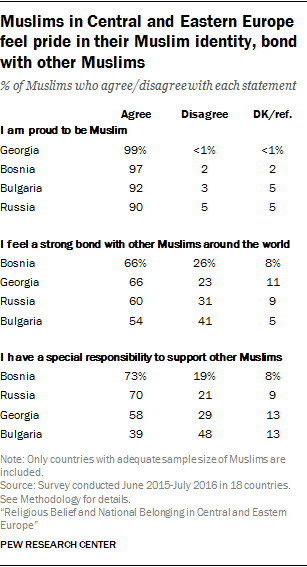
In each of these countries, overwhelming majorities of Muslim adults say they are proud to be Muslim, ranging from 90% in Russia to 99% in Georgia. At least half say they feel strongly connected to other Muslims around the world. And majorities in Bosnia, Russia and Georgia say they feel a special responsibility to support other Muslims.

Muslims in Central and Eastern Europe feel pride in their Muslim identity, bond with other Muslims

Fewer than half in most countries say religion ‘very important’

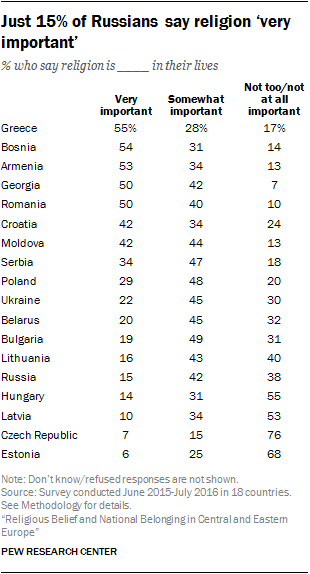
While many people across different religious groups in the region take pride in their religious identity and feel connected to others with their religious background, smaller shares say religion is “very important” to them, personally. In half the countries surveyed, fewer than a third of adults say religion is very important in their personal lives. Only in Greece, Bosnia, Armenia, Georgia and Romania do roughly half of respondents say religion is very important to them. People are least likely to say this in Estonia (6%) and the Czech Republic (7%).

(For survey results on attendance at religious services, daily prayer and various other religious practices, see Chapter 2.)

Just 15% of Russians say religion ‘very important’

Overall, Catholics and Orthodox Christians in the region are about equally likely to rate religion as very important in their daily lives, although in most countries with substantial Catholic and Orthodox populations, it is Catholics who are more likely to say this. In Belarus, for example, 30% of Catholics say religion is very important to them, compared with 17% of Orthodox Christians.

Among the four countries surveyed with substantial Muslim populations, only in Bosnia (59%) do a majority of Muslims say religion is very important in their lives.

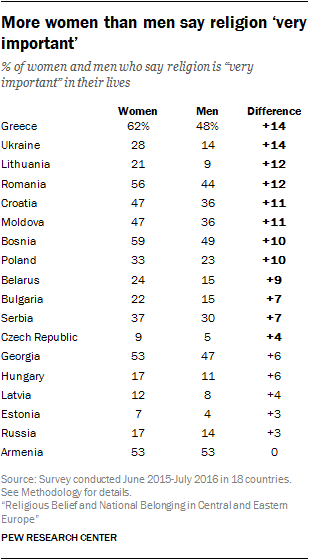
In most countries surveyed, women are more likely than men to say religion is very important to them. In Greece, for example, 62% of women say this, compared with 48% of men. A 14-point gap also exists in Ukraine, where 28% of women and 14% of men say religion is very important in their lives.

Respondents without college degrees also are more likely than those with more education to say religion is very important to them.

More women than men say religion ‘very important’

In former Soviet republics, people tend to say religion is more important to them now than it was growing up

In addition to asking respondents about how important religion is to them now, the survey also asked how important it was to their families when they were growing up.

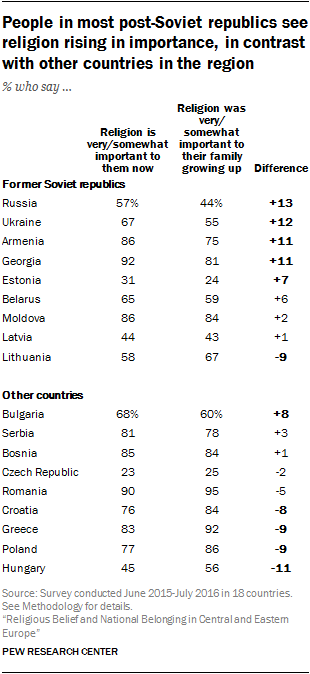
On balance, in former Soviet republics, people are more likely to say religion is important in their lives now than to say it was important growing up. In Russia, for example, 57% say religion is either very important or somewhat important in their lives now, compared with 44% who say that was true during their childhoods.

These findings are in line with answers to a related set of questions: Respondents from former Soviet republics tend to say their country is more religious today than it was during the 1970s and 1980s. (See Overview for more information.)

People in most post-Soviet republics see religion rising in importance, in contrast with other countries in the region

In a few countries surveyed that were not Soviet republics – Hungary, Poland, Greece and Croatia – religion appears to have become less important to current adults since childhood. In other countries, there is little difference between the share who say religion is important to them now and the share who say it was important to their family when they were children.

Overall, in all four Catholic-majority countries included in the survey – Poland, Hungary, Croatia and Lithuania – religion seems to have become less important to respondents during the course of their lives. For example, in Lithuania, 58% say religion is either very important or somewhat important in their lives today, compared with 67% who say it was very or somewhat important to their family when they were growing up.

Few adults across the region say they have switched religious traditions

Relatively few adults in Central and Eastern Europe say they have switched their religion from the one they were raised in.

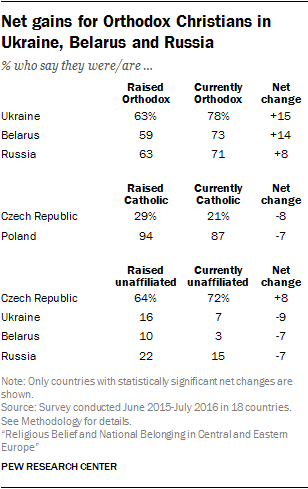
Net gains for Orthodox Christians in Ukraine, Belarus and Russia

To the extent that there is self-reported religious switching, it has largely bolstered Orthodox populations. In Ukraine, Belarus and Russia, for example, more people currently identify as Orthodox than say they were raised Orthodox. These net gains for Orthodoxy have meant net losses for populations of the religiously unaffiliated; in Russia, 22% of adults say they were not raised in any religion as children, compared with just 15% who say they now consider themselves religiously unaffiliated.

In the Czech Republic, which has the highest unaffiliated share of any country surveyed, the percentage of religiously unaffiliated adults has risen within the lifetime of the survey’s respondents – 64% say they were raised unaffiliated, while 72% are religiously unaffiliated today. The net gains for religiously unaffiliated adults have entailed net losses for Czech Catholics – 29% of Czechs say they were raised Catholic, while 21% are currently Catholic.

Catholics also have experienced a slight loss in Poland: 94% of Polish adults say they were raised Catholic, while 87% currently identify as Catholic. But it is less clear whether, as a result, religiously unaffiliated adults have seen net gains in Poland – 5% of Polish adults say they were raised religiously unaffiliated, or give an unclear response, or refuse to answer the question about how they were raised; 12% of adults say they are currently unaffiliated, give an unclear response, or refuse to answer the question about their current religious identity.

Russians, Ukrainians say religion has become more acceptable in their societies
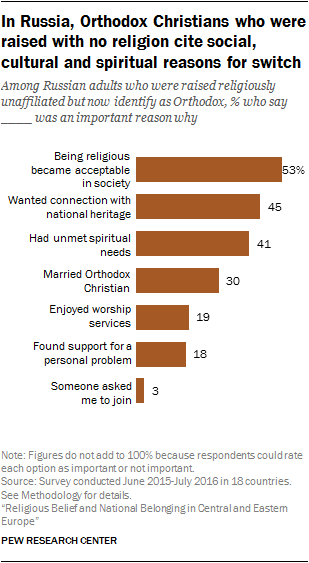
In Russia, Orthodox Christians who were raised with no religion cite social, cultural and spiritual reasons for switch

In two countries (Ukraine and Russia) there were adequate sample sizes of adults who currently identify as Orthodox but who say they were raised unaffiliated, allowing for inquiry into why they began identifying with a religion. Respondents were asked about seven potential reasons for their decision to start identifying as Orthodox.

The most commonly cited reason in both countries (by 69% of these respondents in Ukraine and 53% in Russia) was a feeling that religion had become more acceptable in society. This sentiment reflects a change from the Soviet era, when many religious practices were suppressed by the state. Another important reason for beginning to identify as Orthodox, cited by more than four-in-ten of these respondents (48% in Ukraine and 45% in Russia), was to feel a stronger connection to their national heritage.

In Ukraine, a majority (60%) cited marriage to an Orthodox Christian as an important reason they began identifying with Orthodoxy, but this was the case for only 30% in Russia.

Only one country, the Czech Republic, had an adequate sample size of people who say they were raised in a religious group and became unaffiliated as adults.23 The most frequently cited reason for this shift is a gradual drifting away from religion (mentioned by 82% of Czechs who have shed their religious affiliation). Other common reasons for Czechs leaving behind their religious identity are loss of confidence in religious authorities (49%) and no longer believing in religious teachings (45%).

Most parents raising their children with the same religious identity as their own

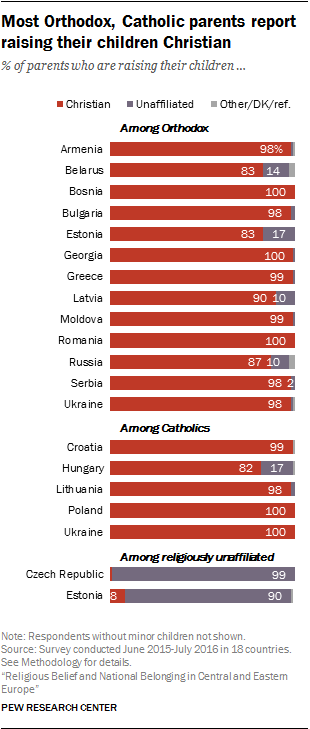
Most Orthodox, Catholic parents report raising their children Christian

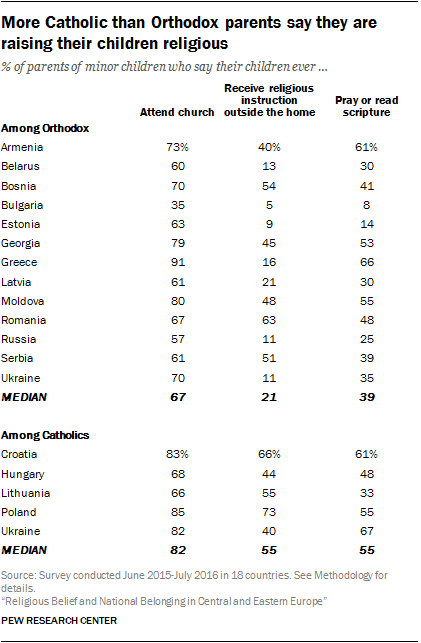
The survey asked parents of minor children (under 18 years old) how they are raising their children, religiously. Across all countries in the survey, large majorities of parents report that they are raising their children with a religious identity that matches their own.

Among Catholic and Orthodox parents, more than three-in-four say they are raising their children Christian. Roughly nine-in-ten or more Muslim parents say they are raising their children as Muslims, while a similar proportion of religiously unaffiliated parents say they are raising their children without a religion.

(For details on what religious practices parents are implementing into their children’s upbringing, see Chapter 2.)

2. Religious commitment and practices
By two standard measures of religious observance – how often people pray and how often they attend religious services – Central and Eastern Europeans, on the whole, show modest levels of religious commitment. In none of the countries surveyed do a majority of respondents say they pray daily or attend worship services weekly. In some other regions of the world, such as Latin America, these regular religious practices are far more widespread.
But this does not mean religion is irrelevant to the lives of people in Central and Eastern Europe. Majorities in several countries surveyed say they take Communion and fast to observe holidays or holy periods such as Lent. Catholic respondents are more likely than Orthodox ones to say they do these things, just as they are more likely to say they attend church regularly.

In addition, a few other customs are widespread across the region, including lighting a candle when visiting a church, keeping icons or other holy figures in the home, and wearing a cross or other religious symbols. Orthodox Christians are more likely than Catholics to do these things, though majorities of both groups in nearly all countries surveyed say they have icons or other holy figures in their homes.

Baptism also is common. Nearly all Christian adults in most countries surveyed, and even sizable shares of religiously unaffiliated people in the region, say they have been baptized.

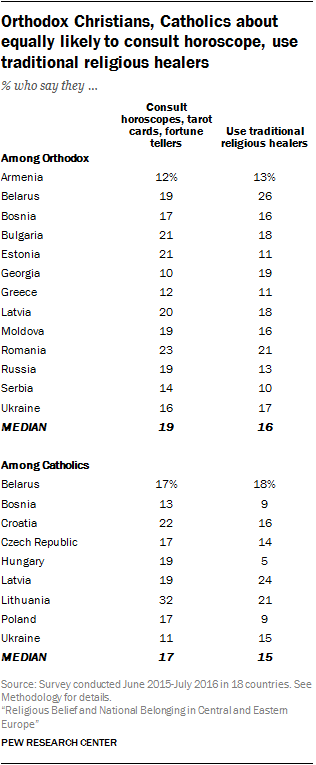
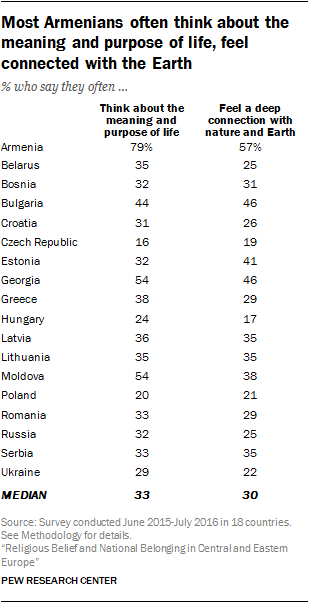
The rest of this chapter explores data on religious practices in the region in more detail, including the religious upbringing of children; whether adults consult traditional religious healers, tarot cards or horoscopes; and the frequency with which people in Central and Eastern Europe say they think about the meaning and purpose of life.

Substantial shares say they seldom or never attend religious services

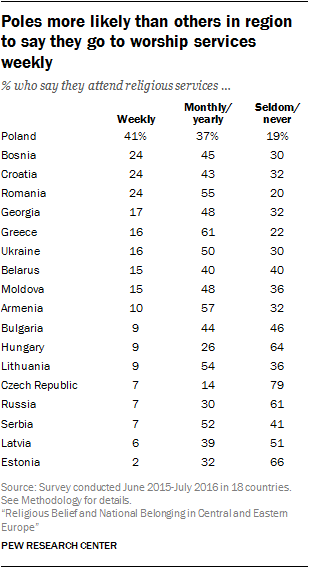
Poles more likely than others in region to say they go to worship services weekly

In the vast majority of countries surveyed, no more than a quarter of respondents say they attend services weekly or more often; in nine of these 18 countries, roughly one-in-ten or fewer say this. Poland is the one standout; 41% of Polish adults say they attend church at least weekly.

Overall, Catholics are much more likely than Orthodox Christians to regularly attend church. This pattern holds across most of the countries that have large numbers of adherents of both Christian traditions, including Belarus, Bosnia and Ukraine. In Ukraine, for example, 43% of Catholics say they attend church at least once a week, compared with 12% of Orthodox Christians.

In three of the four countries where enough Muslims were surveyed to permit analysis, Muslims are more likely to go to mosque weekly than Christians are to attend church that often. Still, the percentages of Muslims who are weekly attendees are relatively low compared with Muslims in many other parts of the world (see related sidebar).

Higher shares report daily prayer than weekly attendance

Catholics and Orthodox Christians about equally likely to say they pray daily

Daily prayer is more common than weekly church attendance in the region. Still, in most countries surveyed, fewer than a third of adults say they pray daily, and four-in-ten or more say they pray monthly or less often.

Across the region, Catholics and Orthodox Christians report praying at similar rates. But in three of the four countries with sizable populations of both Catholics and Orthodox Christians, Catholics report praying more often than do Orthodox Christians. For example, in Bosnia, 58% of Catholics say they pray at least once a day, compared with 28% of Orthodox Christians.

Muslim respondents were asked whether they pray all five salah – Islamic prayers – daily. The duty to make these five prayers each day is one of the five Pillars of Islam and is traditionally viewed as obligatory for Muslims.

More women than men pray daily

The percentage of Muslims in Central and Eastern Europe who say they pray all five salah every day is considerably lower than among Muslims in several other parts of the world. In Russia, for example, 23% of Muslims say they pray all five salah daily, while in Bosnia 20% say this. Elsewhere in the region, even smaller shares of Muslims report praying all five salah. By comparison, majorities of Muslims in most countries across sub-Saharan Africa, the Middle East-North Africa region, and South and Southeast Asia say they make all five prayers daily.

Across the region, women are more likely than men to say they pray daily. This finding is in line with survey results among Christians elsewhere around the world that indicate higher levels of religious observance among women than among men.

Catholics more likely than Orthodox Christians to take Communion, fast during Lent

Communion more common than fasting during holy times such as Lent, tithing % who say they …

Christian practices such as taking Communion and fasting during holy times such as Lent are more common among Catholics than among Orthodox Christians in Central and Eastern Europe. Compared with these practices, fewer Orthodox Christians and Catholics say they tithe (that is, give a share of their income to charity or the church).

On balance, across the region, taking Communion is the most common of these three rituals for members of both religious traditions. Medians of 64% of Catholics and 38% of Orthodox Christians in the region say they sometimes or often take Communion, compared with 54% and 27%, respectively, who fast during Lent. Tithing is less widespread; a quarter or fewer of Catholics and Orthodox Christians in most countries say they tithe.

Across the region, women are more likely than men to say they fast or take Communion. There are minimal differences between men and women when it comes to tithing.

Among the four countries with significant Muslim populations, only in Bosnia (66%) and Russia (55%) do majorities or pluralities of adults report fasting during the Muslim holy month of Ramadan. About half of Muslims in Georgia (48%) and 36% in Bulgaria say they fast during Ramadan. Most Muslims in Bosnia (72%) and Georgia (61%) say they give zakat – that is, an annual donation of a portion of their wealth to the needy – while fewer in Russia (45%) and Bulgaria (26%) give zakat.

Catholics more likely than Orthodox Christians to share faith, read scripture

Fewer than half of adults regularly read scripture, share their faith

In most countries surveyed, majorities say they seldom or never read or listen to scripture outside of religious services. Even in Poland, where roughly four-in-ten adults (41%) say they attend religious services at least once a week, just 17% say they read scripture outside of church at least once a month.

Similarly, fewer than half of adults in all countries surveyed say they frequently share their faith or views on God with others. (In Russia, where 16% of adults say they share their faith at least once a month, doing so in public may be a violation of a 2016 law against proselytization.)

Catholics are somewhat more likely than Orthodox Christians to say they read scripture and share their faith at least monthly. Women also are more likely than men to share their faith with others and read scripture outside of church.

Most Orthodox Christians and Catholics say they have icons or other holy figures in their homes

Large majorities of Orthodox Christians say they have icons, light candles in church and wear religious symbols

Majorities of respondents across most countries surveyed say they have icons or other holy figures in their homes, and that they light a candle when they visit a church. And in several countries, most people report wearing or carrying religious symbols (for example, a necklace with a cross).24

Having icons (religious images), is especially common in the region. Orthodox Christians and Catholics are about equally likely to say they have icons or other holy figures in their home; in nearly every country surveyed, at least seven-in-ten from both groups say they have these religious articles.

But Orthodox Christians are much more likely than Catholics in the region to say that they light a candle when they visit a church and that they wear religious symbols. Across the countries surveyed, a median of 94% of Orthodox Christians say they light a candle at church, compared with a median of 57% of Catholics. And medians of 64% of Orthodox Christians and 46% of Catholics in Central and Eastern Europe say they wear a cross or other religious symbols.

Religiously unaffiliated adults are less likely than Catholics and Orthodox Christians to have icons, light candles in churches or wear religious symbols. But some religious “nones” do partake in these religious practices; for example, about a third of religiously unaffiliated adults in both Russia and Ukraine say they have icons or other holy figures in their home. And about one-in-ten religious “nones” in the Czech Republic (10%) and Russia (14%) say they wear religious symbols.

Overwhelming majority of Christians in the region say they have been baptized

Bar chart showing even among religiously unaffiliated, many say they have been baptized

Baptism is perhaps the most widespread religious practice in the region. In nearly every country surveyed, large majorities of Christian adults – including roughly similar shares of both Catholics and Orthodox Christians – say they have been baptized.

Even among religiously unaffiliated adults, significant portions of adults report they have been baptized. For example, two-thirds of unaffiliated adults in Ukraine (67%) and just over half in Croatia (54%) say this.

In several countries – especially those with large unaffiliated populations, such as the Czech Republic, Estonia, Hungary and Latvia – adults ages 50 and older are more likely than younger people to have been baptized.

Relatively few Orthodox parents send children to religious schools

More Catholic than Orthodox parents say they are raising their children religious

While most parents of minor children say they are raising those children in the same religious tradition as their own (see Chapter 1), not all religiously affiliated parents incorporate religious activities into their children’s upbringing.

For example, while most Orthodox parents in every country surveyed except Bulgaria say their children attend religious services at least sometimes, fewer Orthodox parents say their children pray or read scripture or receive religious instruction outside the home.

In Russia and Ukraine – the two most populous countries surveyed – just 11% of Orthodox Christians say their children ever receive religious instruction outside the home.25

Overall, Catholic parents are more likely than Orthodox ones to say their children ever attend church, pray or receive religious instruction outside the home.

On balance, fewer than a quarter of Catholics, Orthodox consult horoscopes or use traditional healers

Orthodox Christians, Catholics about equally likely to consult horoscope, use traditional religious healers

The survey also asked respondents about some behaviors that, while not always associated with Christianity or other Abrahamic religions, are connected with spirituality in some way. Across Central and Eastern Europe, between 10% and one-third of both Orthodox Christians and Catholics report that they consult horoscopes, tarot cards or fortune tellers. And roughly similar shares say they use traditional religious healers when they or their relatives are sick.

Catholics and Orthodox Christians are about equally likely to engage in these practices. In Ukraine, for example, 17% of Orthodox Christians report using traditional religious healers, as do 15% of Catholics.

While religiously unaffiliated adults are less likely than Catholics or Orthodox Christians to say they use traditional religious healers, the three groups are about equally likely across the region to say they consult horoscopes or use fortune tellers.

In the four countries with significant Muslim populations, large majorities of Muslims also say they do not partake in these behaviors, while about a quarter or fewer do. In Russia, for example, 25% of Muslims say they use traditional healers, while 12% say they consult horoscopes, tarot cards or fortune tellers.

In nearly all countries surveyed, women are more likely than men to consult horoscopes. In Hungary, for example, women are more than twice as likely as men to do this. But women and men are about equally likely to say they or their families use traditional religious healers.

Fewer than half in most countries say they often feel connection with Earth, nature

Most Armenians often think about the meaning and purpose of life, feel connected with the Earth

In an effort to gauge the extent to which people reflect on spiritual issues, the survey asked respondents how frequently, if at all, they think about the meaning and purpose of life, and how often they feel a deep connection with nature and the Earth. A median of 33% of adults across the 18 countries surveyed say they often think about the meaning of life, while a median of 30% report often feeling a deep connection with nature.

Czech and Hungarian respondents are among the least likely to say they reflect in this manner, with nearly half or more in both countries saying they rarely or never reflect on the meaning and purpose of life or feel a deep connection with nature and the Earth.

Across the countries surveyed, Orthodox Christians, Catholics and Muslims are about equally likely to say they often think about the meaning and purpose of life and feel a connection with nature and the Earth. Religiously unaffiliated respondents are generally less likely to report having these experiences. In the Czech Republic, for example, 38% of Catholics say they often feel a connection to nature, while just 12% of people with no religious affiliation say they often feel such a connection.

Adults who say religion is very important to them are considerably more likely than others to say they often think about the meaning and purpose of life, and that they often feel a deep connection with nature and the Earth.

3. Religious beliefs

The vast majority of Central and Eastern Europeans express belief in God. More than eight-in-ten adults in most of the 18 countries surveyed say they believe in God, including majorities in seven countries who say they are “absolutely certain” in their belief. While people across the region are somewhat less likely to express belief in God than are residents of Latin America and sub-Saharan Africa, the gap is strikingly small between these two highly religious regions and a part of the world that was recently under the influence of the officially atheistic Soviet Union.

In many Central and Eastern European countries, majorities also say they believe in heaven, hell, miracles, fate and the existence of the soul. Moreover, the prevailing opinion among respondents in most countries is that their holy book (whether the Bible, Quran or Torah) is the word of God, though responses are more mixed on whether its language should be taken literally, word for word.

Most religiously affiliated respondents in the region do not take exclusivist views of their religion. Fewer than half of Orthodox Christians or Catholics in most countries surveyed say their religion is the one true faith that leads to eternal life in heaven.

On balance, Catholics are more likely than Orthodox Christians to say they believe in heaven and hell, beliefs commonly associated with Christianity. But Orthodox Christians are more likely than Catholics to believe in the evil eye and magic, sorcery or witchcraft, phenomena not typically linked with Christianity.

Overall, women in Central and Eastern Europe tend to display higher levels of religious belief than men by several measures. And religiously affiliated adults with less education are more likely than those with a college degree to say that their religion is the one true faith leading to eternal life in heaven.

Belief in God widespread, but many are less than certain

More women than men say they believe in God

Across the 18 Central and Eastern European countries included in the current survey, the median share of people who say they believe in God is 86%, similar to the 89% of people in the U.S. who say they believe in “God or a universal spirit.” Belief in God is even more widespread in sub-Saharan Africa and Latin America, which have median shares of 98% and 99%, respectively.

Still, large majorities of adults in nearly every country surveyed in Central and Eastern Europe say they believe in God, including more than nine-in-ten in the Orthodox-majority countries of Georgia, Armenia, Moldova and Romania.

Estonia and the Czech Republic, meanwhile, fall at the other end of the spectrum – just 44% of Estonians and 29% of Czechs say they believe in God. In both of these countries, substantial shares of adults (45% in Estonia and 72% in the Czech Republic) describe their religious identity as atheist, agnostic or “nothing in particular.”

Across the region, Orthodox Christians are about as likely as Catholics to say they believe in God. Religiously unaffiliated adults are less likely to believe in God, yet in some countries a substantial portion of religious “nones” do express this belief. In Latvia and Croatia, for example, roughly one-in-five religiously unaffiliated adults (22% in both countries) say they believe in God.

Women are more likely than men to say they believe in God. In Estonia, for example, roughly half (53%) of women say they believe in God, compared with about a third of men (34%).

Not all of those who say they believe in God are sure about it. In more than half of the countries surveyed, respondents who say they believe in God are more likely, when asked a follow-up question, to say they are “fairly certain,” “not too certain” or “not at all certain” about this than to say they are “absolutely certain.” For example, 25% of all Russian adults say they are absolutely certain that God exists, compared with 38% who are fairly certain and 10% who believe in God but are not certain.

While most believe in God, fewer are absolutely certain

Across the 18 countries surveyed, the median share of those who say they believe in God with absolute certainty is 40%, compared with a corresponding rate of 89% in sub-Saharan Africa. In the U.S., 63% of adults say they are absolutely certain in their belief in God.

Among the Central and Eastern European countries surveyed, Armenia (79%) and Georgia (73%) have the highest percentages of adults who are certain about God’s existence. In Estonia and the Czech Republic, on the other hand, just 13% of adults say they are “absolutely certain” about their belief in God; two-thirds of Czechs (66%) do not believe in God at all.

Catholics more likely than Orthodox Christians to believe in heaven and hell

Belief in heaven somewhat more common than belief in hell

Fewer adults throughout the region say they believe in heaven and hell than say they believe in God. Still, roughly half or more across most countries surveyed say they believe in heaven. On balance, Central and Eastern Europeans are less likely to say they believe in hell than heaven. (A similar pattern – that is, more widespread belief in heaven than in hell – also exists in the U.S.)

Overall, across the region, Catholics are more likely than Orthodox Christians to believe in heaven or hell. Across the countries surveyed, the median shares of Catholics who believe in heaven and hell are 78% and 66%, respectively. For Orthodox Christians, the corresponding figures are 61% and 58%.

Far fewer religiously unaffiliated people believe in heaven and hell. For example, about one-in-ten religious “nones” in Russia believe in heaven (11%) and hell (12%), compared with 60% among Orthodox Christians in Russia who believe in heaven and 58% who believe in hell.

Majorities in most of the region believe in miracles, fate and existence of the soul

Armenians, Bosnians most likely to believe in fate

Belief in fate and the existence of the soul are quite common in the countries surveyed. Overall, somewhat fewer adults say they believe in miracles, but, still, in most of the countries surveyed, roughly half or more say they believe in miracles.

Even many religiously unaffiliated adults express belief in these supernatural phenomena. In Latvia, for example, 60% of unaffiliated adults say they believe in fate (i.e., that the course of one’s life is largely or wholly preordained), while 54% say they believe in miracles and 62% believe in the existence of the soul. And in the Czech Republic, 32% of religious “nones” believe in fate, while 27% believe in miracles and 30% in the existence of the soul.

Belief in miracles is less widespread in these countries than in some other regions where Pew Research Center has asked this question. Across the 18 countries surveyed in Central and Eastern Europe, the median share of adults who say they believe in miracles is 60%, which is lower than the corresponding figures in Latin America (91%), sub-Saharan Africa (74%) and the U.S. (79% as of 2007).26

As is true for many other aspects of religious belief, women across the region are more likely than men to believe in the existence of the soul, miracles and fate. Orthodox Christians and Catholics are about equally likely to say they believe in these things.

Differing views on whether Bible is the word of God, should be taken literally

Majorities or pluralities of adults in most Central and Eastern European countries say Bible or other holy book is the word of God

The survey asked respondents whether they believe their religion’s holy book is the word of God or was written by men (and is not the word of God). Majorities of respondents in half of the 18 countries surveyed believe their holy book, whether the Bible (for Christians), the Quran (for Muslims) or the Torah (for Jews), is the word of God, including roughly seven-in-ten or more in Georgia, Romania, Moldova and Bosnia.27

Most people in the Czech Republic (65%) and Estonia (58%) take the opposite position, saying the Bible was written by men. And Serbians, Bulgarians, Lithuanians, Hungarians and Latvians are about evenly split on this question. Overall, the median share of adults across the countries surveyed who say their holy book is the word of God is 53%, lower than the share of people in sub-Saharan Africa (97%), Latin America (86%) and the U.S. (60%) who say their holy book is the word of God.

Women are more likely than men to believe that scripture is the word of God. People without a college education also are more likely to say this.

Only in Moldova does a majority say Bible should be taken literally

Believers in divine authorship, however, are not of one mind about how to interpret their holy books. Some believe scripture should be taken literally, word for word; others say that not everything should be taken literally.

Generally, people living in Orthodox-majority countries are more likely than those living in Catholic-majority countries to say the Bible should be understood literally, word for word. Fewer than a quarter say this in each of the Catholic countries surveyed: Poland (22%), Croatia (21%), Hungary (21%) and Lithuania (12%).

Muslim respondents are more likely to say the Quran should be taken literally than Christians are to say the same about the Bible. In Bosnia, for example, 63% of Muslims feel this way, compared with 41% of Catholics and 23% of Orthodox Christians.

Range of views on religious exclusivism

Only in a handful of countries do most adults believe theirs is the one true faith leading to eternal life in heaven

Two questions gauged the prevalence of religious exclusivism in the region. Respondents who are affiliated with a religion were asked which of the following statements more closely matches their view: “Mine is the one true faith leading to eternal life in heaven,” or “Many religions can lead to eternal life in heaven.”

In just three countries – Georgia (77%), Armenia (73%) and Moldova (58%) – do majorities of affiliated adults convey the view that their religion is the one true path to heaven. A median of 35% of religiously affiliated adults in the region take this position, similar to the 27% of religiously affiliated U.S. adults who say theirs is the one true faith.

Affiliated respondents were also asked if they believe that “only one true way” exists to interpret their own religion’s teachings, or whether multiple interpretations exist. Again, in only three countries – Armenia (67%), Georgia (66%) and Bosnia (64%) – do majorities take the view that there is only one correct interpretation.

Older respondents (that is, those ages 50 or older) and those with less than a college education are more likely than others to express the idea that their particular religion is the only pathway to heaven.

While women in the region express higher levels of religious belief on other questions, they do not necessarily hold more exclusivist views about religion. In the vast majority of countries surveyed, women and men generally answer these questions in similar ways.

Belief in evil eye common in some countries

Two-thirds of Greeks, Latvians say they believe in the evil eye

The survey also finds that many respondents across the region hold beliefs not typically associated with Abrahamic religions, such as that people are reincarnated; that magic, sorcery or witchcraft can influence people’s lives; and the that certain people can cast curses or spells that cause bad things to happen to someone (i.e. the “evil eye”).

In several of the 18 countries surveyed, majorities say they believe in the evil eye, with Greeks and Latvians (66% each) most likely to express this view. The median share of Central and Eastern Europeans who believe in the evil eye is 48%. By comparison, medians of 46% in Latin America and 39% in sub-Saharan Africa, two regions where indigenous religions have had a broad impact on the respective cultures, believe in the evil eye.

In almost every country in the new survey fewer respondents say they believe in witchcraft or reincarnation. Still, considerable shares across the region express these beliefs, including 44% in Russia who believe in magic, witchcraft or sorcery, and 36% in Bulgaria who say they believe in reincarnation – a concept more closely associated with Eastern religions such as Hinduism and Buddhism than with Christianity.

More women than men believe in the evil eye, witchcraft and reincarnation. And on balance, adults under 50 are more likely than their elders to say they believe in reincarnation. For example, in Latvia, 46% of adults under 50 say they believe in reincarnation, compared with 31% of those 50 and over.

Overall, more Orthodox Christians than Catholics say they believe in the evil eye and sorcery, though across the region there are generally few significant differences between Catholics and Orthodox Christians when it comes to views of reincarnation.

4. Views on religion and politics

People in Central and Eastern Europe generally see churches and other religious institutions – now back in the public sphere after being largely hidden during the Soviet era – as making positive contributions to society. Respondents in the region tend to say that churches play beneficial roles in their countries by strengthening social bonds and helping the poor.

At the same time, considerable shares in many countries – including majorities in some – also say religious institutions are overly focused on money and power, excessively focused on rules and too involved with politics. Indeed, majorities in most countries surveyed prefer that religion be kept separate from government policies and say religious leaders should have little or no influence in political matters (even if they perceive these same religious leaders as having at least some political influence).

Adults in Orthodox-majority countries are more comfortable with state support for religion than are people in Catholic-majority or religiously mixed nations surveyed. In Georgia and Armenia, for example, the prevailing view is that government should promote religious beliefs and values.

People in Orthodox countries also are more likely than others in the region to favor state funding for the main religious denomination in their country – in many cases the national Orthodox church, such as the Serbian Orthodox Church. But fewer than half in most cases support government funding for other religious groups or say Muslim religious organizations should be permitted to receive foreign funding.

Views of religious institutions in the region more positive than negative – but not everywhere

To gauge views of religious institutions in general, the survey asked respondents whether they agree or disagree with a series of six statements – three that proposed potential positive attributes of religious institutions and three that offered negative ones. On balance, adults across the region are more likely to agree with the positive statements. In most of the countries surveyed, roughly half or more say religious institutions strengthen morality in society, bring people together and strengthen social bonds, and play an important role helping the poor and needy.

But considerable shares – and in some cases majorities – across the region also say religious institutions focus too much on money and power, focus too much on rules or are overly involved with politics. In Poland, for example, majorities say all three of these things are the case, with on balance, higher shares of Poles agreeing with these negative views of religious institutions than positive views. In fact, Poles are about as likely as or more likely than Czechs to take negative views of religious institutions, even though the vast majority of Poles are Catholic, while most Czechs are religiously unaffiliated. And in Bosnia and Croatia, the views that religious institutions are too concerned with money and power (66% and 69%, respectively) and too involved with politics (71% and 72%) are far more common than the perceptions that they strengthen morality in society, strengthen social bonds or help the poor.

In most countries, roughly half or more say religious institutions strengthen morality, social bonds
People in Orthodox countries tend to say religious institutions strengthen morality

The view that religious institutions strengthen morality in society is more common in Orthodox-majority countries than elsewhere in the region. Majorities say this in seven of the 10 Orthodox countries surveyed, including the vast majority in Georgia (80%).

By comparison, this position is less common in Catholic-majority countries.

Adults who attend religious services at least weekly and those who say religion is at least somewhat important in their lives are more likely than those who are less religiously observant to have positive views of religious institutions.

More religiously unaffiliated adults express negative views of religious institutions, but many also see positive contributions

Religiously unaffiliated adults, on the other hand, are more likely to express negative views of religious institutions. In all seven countries with adequate sample sizes of unaffiliated adults, fewer than half say religious institutions strengthen morality in society, while considerably more say religious institutions are overly concerned with money, power and rules.

And yet, substantial proportions of religiously unaffiliated adults (sometimes referred to as religious “nones”) express some positive views of religious institutions. For example, in Estonia, most religious “nones” (62%) say religious institutions play an important role in helping the poor and needy. And roughly a quarter or more of unaffiliated adults in all seven countries say religious institutions strengthen social bonds.

Most say religion should be kept separate from government policies

Majorities favor separation of church and state, but substantial minorities disagree

In most of the countries surveyed, majorities or pluralities say “religion should be kept separate from government policies,” rather than taking the opposing view that “government policies should support the spread of religious values and beliefs.” Sentiment favoring the separation of religion and government is strongest in Bosnia, a religiously mixed country that endured a war in the 1990s fought along religious and ethnic lines, and the Czech Republic, which has a religiously unaffiliated majority.

Still, in every country surveyed, roughly one-in-five or more respondents say governments should promote religious values, including a majority in Armenia (59%) and roughly half in Georgia (52%).

People in Orthodox-majority countries are particularly likely to favor government support for the spread of religious values. About a third or more favor this in every Orthodox-majority country surveyed. By contrast, in Catholic-majority, religiously unaffiliated or religiously mixed countries, support for government promotion of religious values and beliefs generally is lower.

Religiously unaffiliated respondents and those with low levels of religious observance are more likely to favor separation of religion and government. People with a college education also are especially likely to take this position.

Higher support in Orthodox-majority countries for governments promoting religion

Many see religious leaders as having at least some influence in politics, but majorities say this should not be the case

Three-quarters of Poles say religious leaders have at least some influence in politics

Respondents were asked about the role currently played by religious leaders in political matters: Do they have a large influence, some influence, not too much influence or no influence at all? Majorities or pluralities of adults in most countries surveyed say these leaders have at least some influence in the politics of their country. This includes roughly three-in-ten or more in Bosnia, Croatia and Poland who say religious leaders in their country have a large influence in political matters.

Even in the majority-unaffiliated Czech Republic, most people say religious leaders have at least some influence on politics.

Two Catholic-majority countries, Poland and Croatia, have among the highest shares of people saying religious leaders have at least some influence on politics in their country (75% and 71%, respectively).

In most countries, majorities want little or no political influence by religious leaders

A parallel question, in which respondents were asked how much influence religious leaders should have in politics (and were given the same four response options), finds that in most of the countries where religious leaders are widely seen as having political influence, majorities oppose that influence.

In Poland, Bosnia, Croatia and Greece, where about two-thirds or more say religious leaders are influential in politics, roughly two-thirds or more would prefer for these leaders to have either “not too much influence” in political matters or “no influence at all.” For example, in Bosnia, 72% say religious leaders have at least some influence in politics in their country, while 82% say they should not have so much influence.

Overall, majorities in 14 of the 18 countries surveyed believe religious leaders should have little or no influence in political affairs. Armenia is the only country where most respondents (56%) say religious leaders should have either a “large influence” (21%) or “some influence” (35%) in politics.

Religiously observant adults (that is, those who say religion is very important in their lives, pray daily or attend religious services weekly) are more likely than others to say religious leaders should have an influence on political matters. And overall, religiously unaffiliated respondents are less likely than Muslims, Catholics or Orthodox Christians to take this position.

Substantial support for government funding for a country’s main church or religious institution

In each country, respondents were asked whether the dominant church or religious institution in their country should receive financial support from the government. For instance, Russians were asked whether the Russian Orthodox Church should receive public funding, while Hungarians were asked the same about the Roman Catholic Church in Hungary. (In Bosnia, respondents were asked about public funding for regional churches; results are not analyzed here because the question was not directly comparable to what was asked in other countries. See topline for full results.)

Higher support in Orthodox countries for government funding of the dominant church

Half or more of adults in seven of the 17 countries analyzed, and substantial proportions of adults elsewhere, say the dominant church in their country should receive financial support from the government.

Adults in Orthodox-majority countries are particularly inclined to express support for this type of government funding. In most Orthodox countries, higher shares say the government should support the national Orthodox church than say it should not. For example, in Russia, 50% support public funding of the Russian Orthodox Church, compared with 38% who oppose it.

On the other hand, in the Catholic-majority countries of Lithuania, Hungary, Croatia and Poland, fewer than half of respondents say the Catholic Church should receive public funds.

Across the region, those who say religion is at least somewhat important in their lives are significantly more likely than others to favor public funding of their country’s dominant church. A similar pattern emerges when comparing those who pray daily or attend church weekly with those who do so less often.

Women are more likely than men to say that churches should receive financial support from the government, and respondents without a college degree are more likely than college graduates to say this.

Less support for public funding of other religious groups

Should religious groups other than a country’s dominant denomination receive funding from the government? In nearly every country surveyed, fewer people favor public funding for other religious groups than favor government financial support for the dominant church.

More support for government funding of dominant church than for other religious groups

In Orthodox-majority countries, the share of adults who support public funding of other religious groups tends to be considerably lower than the share supporting government funding of the national Orthodox church. In Russia, for example, 50% say they support public funding for the Russian Orthodox Church, compared with 26% who favor public funding for other religious organizations.

By comparison, in most other countries surveyed, there is a smaller gap between the shares of people who support government funding for the Catholic or Lutheran churches and those who favor public funding for other religious groups.

Overall, low support for foreign funding of religious groups – especially Muslims

More people support foreign funding for Christian than Muslim religious organizations

In most countries, fewer than half of respondents say foreign funding of religious organizations – whether Muslim or Christian – should be permitted. But more people in the predominantly Christian region say Christian religious organizations in their country should be permitted to receive foreign funding than say the same about Muslim organizations.

Muslims in the region are more likely than others to say foreign funding for Muslim religious organizations should be permitted. That said, in the four countries where sample sizes of Muslims are large enough for analysis, Muslims are about as likely to support allowing foreign funds for Christian religious organizations as they are for Muslim ones.

Armenia is the one country surveyed where the share supporting foreign funding for Muslim organizations far exceeds the share that supports foreign funding for Christian organizations (74% vs. 37%). One theory explaining Armenians’ broad support for allowing Muslim organizations to receive foreign funding is that many Armenians know about (and accept) Iranian funding of the recent restoration of the Blue Mosque of Yerevan. Armenia and neighboring Iran have close political and cultural ties, and the mosque is primarily used by Iranians visiting or living in Yerevan, Armenia’s capital.28


5. Social views and morality

Many adults in Central and Eastern Europe hold traditional viewpoints on social issues. Majorities oppose same-sex marriage and say homosexuality should not be accepted by society. And while abortion is legal in nearly every country included in the survey (Poland is an exception), public opinion about whether abortion should be legal is mixed, with women and men about equally supportive of legal abortion in most countries.

On balance, younger adults (ages 18 to 34) are more likely than others to accept homosexuality and same-sex marriage. Still, even in this cohort, majorities in most countries say homosexuality should not be accepted by society. College-educated respondents also are more likely than others to say society should accept homosexuality.

In Orthodox-majority countries, views on sexual and gender norms are more traditional and conservative than in Catholic-majority or religiously mixed countries. Adults in Orthodox countries are more likely than those elsewhere to reject homosexuality and to oppose same-sex marriage and legal abortion. Higher shares in Orthodox countries also favor traditional roles for women in marriage and society; many say that women have a social responsibility to bear children, that men should have greater rights to jobs when jobs are scarce and that wives must always obey their husbands.

On balance, men are more likely than women to hold traditional views on gender roles. For example, men are more likely than women to say a wife must always obey her husband. At the same time, in most countries men are about as likely as women to say they prefer a marriage in which both partners work and share household responsibilities.

The survey also asked whether several behaviors are morally acceptable, morally wrong or not a moral issue. Use of drugs, prostitution and homosexual behavior are widely seen as morally wrong across the region, while views are more mixed on abortion, drinking alcohol or having premarital sex. Fewer respondents view divorce or using contraception as morally wrong.

Homosexuality widely rejected

Younger adults widely reject homosexuality, but less so than older adults

In most countries across Central and Eastern Europe, the dominant view is that homosexuality should not be accepted by society. In 13 of the 18 countries surveyed, majorities – including nearly all Armenians (97%) and two-thirds or more of the public in 10 other nations – take this stance. The Czech Republic has by far the lowest share of adults in the region who say society should reject homosexuality (22%).

In 10 of the 18 countries surveyed, younger adults (ages 18 to 34) are significantly less likely than older ones to say society should reject homosexuality. Still, even among these young adults, majorities in most countries say homosexuality should not be accepted by society.

Similarly, in most countries, respondents with a college education are less likely than others to say homosexuality should be rejected by society. But again, on balance, college-educated respondents say society should reject homosexuality.

In several countries, men are more likely than women to say homosexuality should be rejected by society.

People in Orthodox countries more likely to say homosexuality should not be accepted

Overall, rejection of homosexuality is more widespread in Orthodox-majority countries than elsewhere in the region. In eight of the 10 Orthodox countries surveyed, large majorities say society should not accept homosexuality.

Views on whether homosexuality should be accepted by society are more evenly split in Catholic-majority countries. In Hungary, for example, 54% say homosexuality should be rejected, as do 48% in Croatia and 47% in Poland. Lithuania is the only Catholic-majority country surveyed where a clear majority (69%) takes this position.

Limited support for legalization of same-sex marriage

The widespread idea that society should not accept homosexuality is accompanied by low levels of support for the legalization of same-sex marriage in the region. In none of the 18 countries are same-sex couples legally allowed to marry, and many have amended their constitutions to restrict marriage to unions of one man and one woman.

Only in the Czech Republic, which has allowed registered partnerships for same-sex couples since 2006, do most adults (65%) favor allowing gay and lesbian couples to marry legally. Four other countries surveyed – Croatia, Estonia, Greece and Hungary – also allow same-sex domestic partnerships or civil unions, but in these countries, no more than about a third of adults favor full same-sex marriage. Support for legalization of same-sex marriage is especially low in Russia (5%) and other Orthodox-majority former Soviet republics such as Armenia (3%), Georgia (3%), Moldova (5%) and Ukraine (9%).

In Orthodox-majority countries, fewer people favor same-sex marriage

Compared with others surveyed, Orthodox-majority countries typically have lower levels of support for legal same-sex marriage; in most Orthodox countries, fewer than one-in-five adults favor same-sex marriage.

Broadly speaking, age is a factor when it comes to views toward same-sex marriage. In most of the countries surveyed, younger adults (those under 35) are considerably more likely than their elders to favor legalized same-sex marriage (see Overview for exact figures). Greece shows the largest gap of this kind, with the level of support among younger adults (45%) more than double that among older people (19%). But, in a few countries, such as Armenia, Georgia, Moldova and Russia, there is very little support for same-sex marriage among adults of any age.

Education levels also affect support for same-sex marriage. On balance, people with college education are more likely than others to favor same-sex marriage. Still, except for the Czech Republic, in none of the countries surveyed do a majority of college-educated adults favor allowing gay and lesbian couples to marry legally.

Support for legalization of same-sex marriage is somewhat higher among religiously unaffiliated people compared with those who have a religious affiliation, but still, only in the Czech Republic (71%) and Croatia (61%) do a majority of unaffiliated adults favor same-sex marriage. And in Russia, just 8% of religious “nones” support gay marriage.

Table showing just 8% of religiously unaffiliated Russians favor legal same-sex marriage

In countries with large enough samples of both Catholics and Orthodox Christians to analyze separately, there are generally only modest differences, if any, between the two groups. For instance, in Bosnia, 8% of Orthodox Christians and 7% of Catholics favor allowing same-sex marriage.

Mixed support for legal abortion

While abortion is legal on request in nearly all 18 countries surveyed (with the exception of Poland), public opinion is mixed on the issue. In fact, in just eight of the countries surveyed do clear majorities express support for legal abortion.

Support for legal abortion lower in Orthodox-majority countries

In 13 of the 18 countries surveyed, women and men are about equally likely to support legal abortion. Only in five countries – Armenia, Georgia, Latvia, Lithuania and Serbia – are women significantly more likely than men to say abortion should be legal in all or most cases.

Overall, adults in Orthodox-majority countries are less likely than those elsewhere to support legal abortion. Across the 10 Orthodox countries surveyed, the median share of people supporting legal abortion in all or most cases is 44%, compared with 58% across the other eight nations. Support is especially low in Georgia and Moldova, where just 10% and 14%, respectively, say abortion should be allowed in all or most cases – even though abortion is legal in both countries. On the other hand, in Poland, where there are legal restrictions on abortion, 41% say women should be able to have an abortion in all or most cases.

College-educated and younger respondents (ages 18 to 49) are more likely than others to favor legal abortion in all or most cases.

Besides country of residence, religion tied to views on legal abortion, gay marriage

While views on abortion and same-sex marriage are closely connected to the country a respondent lives in, opinions also are tied to a respondent’s religious observance and religious identity. Even after controlling for gender, age, education and respondents’ country of residence, those who say religion is “very important” in their lives are more likely than others to oppose same-sex marriage and legal abortion. And overall, religiously unaffiliated respondents are more likely to favor both of these things when holding other factors constant.

Statistical analysis also shows that age affects views on legal gay marriage, but matters less when it comes to views on abortion. Younger adults (ages 18 to 49) are more likely than their elders to favor legal gay marriage, even after accounting for gender, education and religion, but they are about equally likely to support legal abortion.

Traditional views on gender roles more common in Orthodox-majority nations

Large majorities in Orthodox countries say women have a social responsibility to bear children

Majorities of adults in 12 of the 18 countries surveyed agree with the statement, “Women have a responsibility to society to bear children.”

On balance, women are significantly more likely than men to disagree with the statement, although in just five of the 18 nations do majorities of women disagree that women have a societal responsibility to bear children.

As with many other social issues, older adults (ages 35 and older) and those without college degrees are more likely to take the traditional position – in this case, that women have a responsibility to society to bear children.

Adults in Orthodox-majority countries also are generally more likely than those elsewhere in the region to take the traditional stance; indeed, majorities in all 10 Orthodox countries surveyed, including about eight-in-ten in Armenia and Romania, say women have a societal responsibility to bear children.

Populations in other countries are considerably less likely to agree with this idea. Of the eight non-Orthodox countries included in this survey, only in two – Hungary and Bosnia – do majorities say women have a societal obligation to bear children.

The two countries where people are most likely to disagree with this sentiment are the Czech Republic (56%) and Latvia (57%).

Many adults say men should have greater employment rights than women
In Orthodox-majority countries, more people say men should have greater employment rights than women

Majorities or pluralities in most countries across Central and Eastern Europe disagree with the statement, “When jobs are scarce, men should have more rights to a job than women.” Still, considerable minorities in several countries – and majorities in a few – either completely agree or mostly agree that when jobs are scarce, men should have more rights to a job than women.

On balance, men are more likely to agree with this statement, as are adults with less than a college education. In a few countries, adults under 35 are less likely than older people to say men should have greater employment rights than women, but in the vast majority of countries surveyed there are no statistically significant differences by age on this question.

Respondents in Orthodox-majority countries are more likely than those elsewhere to favor these employment rights for men – including about half or more who say this in Armenia, Georgia, Moldova and Romania.

In Orthodox-majority countries, roughly three-in-ten or more agree that a wife must obey her husband
Higher shares in Orthodox countries than elsewhere say wives should obey husbands

In general, people in Central and Eastern Europe tend to disagree with the statement, “A wife must always obey her husband.” But respondents in Orthodox-majority countries are more likely than people elsewhere to agree that wives must obey their husbands – especially in Armenia (where 82% agree) and Romania (72%).

In countries without an Orthodox majority, this position is less accepted. In Estonia, for example, just 18% accept this view. And in all four of the Catholic-majority countries surveyed (Croatia, Hungary, Lithuania and Poland), large majorities oppose the idea that a wife must always obey her husband.

Women are significantly less likely than men to agree that wives must always obey their husbands. And college-educated adults also are less likely than those with less education to agree with the statement.

The survey also finds that nationalist sentiment is tied to conservative social views. People who agree that their culture is superior to others, or that there is a conflict between their country’s traditional values and those of the West, are more likely to say a wife is obligated to obey her husband.

Majorities across all countries surveyed prefer a marriage where partners share work and household responsibilities

All respondents (not just those who are married) were asked which of three types of marriages they think is ideal: one where the husband and wife both work and earn money and both look after the household and children, one where the wife works and the husband looks after the household and children, or one where the husband works and the wife looks after the household and children.

Most say an ideal marriage has both parents working, both parents looking after children and household

Clear majorities in all countries surveyed favor a marriage in which both spouses work and share household responsibilities. Preference for this type of marriage ranges from a low of 65% in Ukraine to a high of eight-in-ten or more in Croatia, Lithuania and several other countries.

In most countries, college-educated adults are more likely than others to favor a marriage with shared responsibilities. That said, majorities of people without a college degree in every country surveyed also favor this type of arrangement.

Generally, women are more likely than men to say they prefer a marriage in which both spouses work and share household tasks, but in more than half the countries, there are no significant differences between the attitudes of men and women on this issue. Similarly, in a few countries, younger adults (ages 18 to 34) are more likely than older adults to favor a marriage with shared responsibilities. But, again, in most countries there are no significant differences by age.

Across the region, Orthodox Christians are about as likely as Catholics and religious “nones” to say they prefer a marriage with shared responsibilities. But Muslim adults are less likely than others to favor this arrangement. Still, about half or more of Muslims in every country with a Muslim population large enough for analysis say the ideal marriage is one in which both spouses work and share household responsibilities and child-rearing.

Nationalism goes hand in hand with conservative views on gender norms and homosexuality

Table showing those who say their culture is superior more likely than others to agree men should get employment priority

High levels of social conservatism in Central and Eastern Europe appear to go hand in hand with widespread nationalist sentiments.

The survey finds that those who completely or mostly agree that their culture is superior to others are more likely to take conservative positions on gender norms and sexuality. For example, those who see their culture as superior are more likely to agree that men should be given employment preference over women when jobs are scarce. They also are more likely than others to say homosexual behavior is morally wrong.

Statistical analysis of the data shows that nationalist sentiment is more closely associated with views on employment preference for men than is religious observance. And when it comes to several other gender issues, including wives’ obligation to obey their husbands or women’s responsibility to bear children, nationalist sentiment is about as closely associated with views on these issues as religious observance.

While nationalist sentiment also is strongly associated with views toward homosexuality, religious observance is an even more salient factor.

Drugs, prostitution widely seen as morally wrong; divorce, contraception less so

Respondents were asked whether various behaviors are morally acceptable, morally wrong or “not a moral issue.” Majorities in most countries surveyed believe that drug use, prostitution and homosexual behavior are morally wrong, while fewer adults say this about abortion, drinking alcohol, premarital sex, divorce or using contraceptives.

Strong moral opposition toward using drugs, prostitution

Younger adults (ages 18 to 34) are less likely than their elders to say many of the behaviors mentioned in the survey are morally objectionable. And college-educated adults are less likely to have moral reservations about many of these behaviors than are those with less education. There are fewer consistent differences in the opinions of men and women on these issues, yet women are less likely than men to say that drinking alcohol or prostitution are morally acceptable.

Overall, respondents in Orthodox-majority countries are more likely than those elsewhere to take traditional or conservative stances on sexual norms – that is, to morally oppose contraceptive use, abortion, premarital sex and homosexuality. Roughly half or more in every Orthodox-majority country say homosexuality is morally wrong, including overwhelming majorities in Armenia (98%), Moldova (91%) and Georgia (90%). In Poland, meanwhile, just 48% feel this way, and in the Czech Republic, just 21%.

In general, religiously unaffiliated respondents are less likely than others to find these behaviors morally wrong, while Muslim respondents are especially likely to find them immoral. For instance, in Russia, 18% of religious “nones” say premarital sex is morally wrong, compared with 36% of Orthodox Christians and 64% of Muslims who say the same.

Across Central and Eastern Europe, most say you can be moral without believing in God

Czechs most likely to say belief in God is not necessary to be a moral person

Survey respondents were asked whether it is necessary to believe in God to be moral and have good values. Majorities of adults in most of the Central and Eastern European countries surveyed say people can be moral and have good values even if they don’t believe in God.

This view is most common in the Czech Republic, where 66% of respondents say they do not believe in God and 87% say it is not necessary to believe in God to have good values. But even in some countries where belief in God is far more widespread, such as Greece and Bosnia, majorities say it is not necessary to believe in God to be moral and have good values.

The only countries where majorities take the opposite view – that belief in God is necessary to be moral and have good values – are the Orthodox-majority countries of Armenia, Georgia, Moldova and Romania. In each of these countries, more than nine-in-ten adults express belief in God.

People who say religion is very important in their lives are much more likely than others to link personal morality to a belief in God. And Muslims, on balance, are more likely than members of other religious groups to take this view.

On the other hand, religiously unaffiliated adults are less likely than others to say belief in God is necessary to be moral. Similarly, college-educated adults are much less likely than those with a secondary education or less to say it is necessary.

6. Science and religion

Most people across Central and Eastern Europe say they believe in evolution – that is, that humans and other living things have evolved to their present state over long periods – rather than that humans have existed in their current form since the beginning of time. And those who believe in evolution are more likely to say that it occurred through natural processes that favored organisms with beneficial traits, rather than under the guidance of a supreme being.

Still, while most people believe in evolution, there is no regional consensus on the broader question of whether scientific and religious worldviews are at odds with one another. In nearly half of the countries surveyed, most respondents see science and religion as generally in conflict, while in the other countries opinion is either closely divided or most people say they don’t see a conflict between the two.

Most say humans and other living things have evolved over time

Majorities or pluralities in most countries believe in evolution

In most of the countries surveyed, majorities say humans and other living things have “evolved over time,” as opposed to having existed in their present state since the beginning of time.

Acceptance of the scientific theory of evolution is most common in the Czech Republic (83%) and Estonia (74%), which have large populations of religiously unaffiliated people. Acceptance also is widespread in Hungary, Latvia, Greece and Russia.

People are least likely to believe in evolution in Armenia and Bosnia, where roughly half or more say humans and other organisms have existed in their current forms since the beginning of time.

Overall, religious “nones” are more likely than those who are affiliated with a religious group to believe in evolution. And people who say religion is very important in their lives are more likely than others to reject evolution.

More people say evolution driven by natural processes rather than guided by a supreme being

Across the region, Orthodox Christians and Catholics are about equally likely to say humans and other living things have evolved over time. And belief in evolution is generally about as common in Orthodox-majority countries as in other countries.

Younger people (ages 18 to 34) and those with college degrees are significantly more likely to believe in evolution than older people and those with less formal education.

Respondents who say they believe in evolution were asked a follow-up question: Do you believe evolution was guided by a supreme being, or do you instead believe that living beings evolved through natural processes such as natural selection? In almost every country surveyed, people who believe in evolution are much more likely to say natural selection was the driving force.

By comparison, fully a quarter of Americans (25%) say humans have evolved under the guidance of a supreme being, just slightly lower than the share who believe in evolution due to natural processes (33%). About a third of U.S. adults say they do not believe in evolution.

At least a third in most countries say science and religion are generally in conflict

No regional consensus on whether science and religion are in conflict

There is no consensus in the countries surveyed on the question of whether science and religion are generally in conflict. In nine of the 18 countries surveyed, at least half of respondents say there is a conflict between science and religion.

Generally, respondents in Orthodox-majority countries are less likely than people in Catholic-majority nations to say religion and science are in conflict. Across the 10 Orthodox countries surveyed, the median share saying there is such a conflict is 44%, compared with 56% in the four Catholic-majority countries.

In the Baltic countries, relatively few people say science and religion are in conflict, including 34% in Latvia and 35% in Lithuania.

In some places, such as the United States, highly religious people are less likely than others to say there is a conflict between religion and science. While this is true in a few countries in Central and Eastern Europe (Poland, Ukraine, Hungary and Bosnia), in other countries surveyed there are no significant differences between the views of highly religious and less religious respondents on this issue.

Few say science will eventually explain everything

Most say science will never be able to explain everything

Most people in the region see limits to the reach of scientific explanations. When asked to choose between two statements – that science will eventually “provide an explanation for everything,” or that science “will never be able to explain everything” – clear majorities choose the latter statement in almost every country surveyed.

Overall, Catholics are less likely than Orthodox Christians or religiously unaffiliated adults to say science will one day provide explanations for everything. No more than a third of Catholics say this in any country surveyed. In contrast, religiously unaffiliated adults are more likely to express faith in science’s reach. For example, more than half of religiously unaffiliated adults in Ukraine (65%) and Russia (55%) say science will eventually provide an explanation for everything.

7. Views on role of Russia in the region, and the Soviet Union

In most Central and Eastern European countries, there is solid public support for “a strong Russia” to be a counterweight against “the influence of the West.” This sentiment is most evident among Orthodox Christians, who share a religious affiliation with most Russians, and among people who believe their country’s values conflict with Western ones. It is less common in countries that have tense relationships with Moscow. Indeed, Ukraine and Georgia (which have experienced recent armed conflicts with Russia or pro-Russian separatists, including an ongoing clash in eastern Ukraine) are exceptions to the broad pattern of pro-Russian sentiment found in other Orthodox-majority countries.29

While many people in the region see the need for Russia to play a strong geopolitical role, this does not necessarily mean that the West is seen in a purely adversarial light. Majorities in 15 of the 18 countries surveyed say they think their nations should “work closely” with the United States and other Western powers. That said, in most countries where Orthodoxy is dominant, American companies are viewed less favorably, on the whole, than Russian companies. And in NATO member states in the region, including Hungary, the Czech Republic and Bulgaria, the U.S. is not seen as a wholly reliable ally; many people in these countries are skeptical that the United States military would come to their aid in the event of serious conflict with Russia.30

In former Soviet republics, views are mixed about whether the USSR’s breakup was a positive or negative development. And while people in most of the countries surveyed see Mikhail Gorbachev’s historical legacy as more positive than Josef Stalin’s, only in a few of the 18 nations do as many as half the respondents rate Gorbachev’s place in history positively.

Majorities in most Orthodox-majority countries say they view Russia as a protector of Orthodox Christians around the world. And Orthodox Christians are generally more likely to view the patriarch of Moscow as the highest authority of the Orthodox church than the patriarch of Constantinople, despite the latter’s traditional status among church leaders as “first among equals.”

Broad support for Russia in most Orthodox countries

Orthodox-majority countries more likely to favor a strong Russia

A quarter century after the end of the Soviet era, support for an assertive Russia is widespread across Central and Eastern Europe. Majorities or pluralities in 12 of the 18 countries surveyed express agreement with the statement, “A strong Russia is necessary to balance the influence of the West.” These feelings are especially widespread where Orthodoxy is the majority religion; roughly half or more of adults “completely” or “mostly” agree that a strong Russia is necessary in each Orthodox-majority country surveyed, with the exception of Ukraine.

Support for Russia is lowest in some of the places where relationships with Moscow have been particularly contentious, including Poland, Ukraine and the Baltic States. Even in these countries, however, religious disparities persist. In Ukraine, where just 22% of those surveyed say a strong Russia is necessary to balance the West, the share of Orthodox Christians who express this sentiment is double that of Catholics (23% vs. 11%). And Orthodox minorities in Bosnia, Estonia and Latvia are much more likely than their countries’ general populations to say a strong Russia is necessary. (In Latvia and Estonia, most Orthodox Christians identify as ethnic Russians.)

Pro-Russia feelings are not necessarily accompanied by hostility toward the West. Even in Orthodox-majority countries, the prevailing public sentiment is that it is in the country’s interest to “work closely with the U.S. and other Western powers.” In the Catholic-majority and religiously mixed countries surveyed, meanwhile, respondents are consistently more likely to agree that it is in their country’s best interest to work with the U.S. and the West than they are to say a strong Russia is necessary to balance the West.

To help identify factors most strongly correlated with the view that a strong Russia is necessary to balance the influence of the West, Pew Research Center conducted a regression analysis of the survey’s results. This statistical analysis finds that two factors in particular are closely associated with this position: Orthodox Christian affiliation, and the view that a conflict exists between the values of the respondent’s country and Western ones.31

More people in Orthodox-majority countries than elsewhere see positive influence of Russian companies

In Catholic-majority countries, fewer see Russian companies as having a good influence

People in Orthodox-majority countries also are more likely than those in Catholic-majority countries to say Russian companies are a “good influence” in their country. And in most Orthodox-majority countries, people give equal or higher ratings to Russian companies compared with American companies. In Catholic-majority countries, on the other hand, American companies consistently receive better ratings than Russian ones.

Views about American companies also are related to the age of respondents; in most countries surveyed, adults under 35 are more likely than their elders to say that U.S.-based businesses have a positive impact in their nation.

Russian respondents were asked not only about the influence of American companies in their country, but also about the influence of Western nongovernmental organizations. In both cases, the prevailing view among Russians is that these entities are a bad influence in their country.

Compared with Russian or American businesses, Chinese companies are generally less well-regarded in the region. But in most former Soviet republics surveyed, including Russia, more people give Chinese companies a good rating than a bad rating. In most of the countries that were not part of the Soviet Union, the prevailing view is that Chinese companies are a bad influence in their countries.

Some former Soviet republics lean toward Russia, others toward European Union

Large differences in former Soviet republics on ties with Russia and EU

In the former Soviet republics, opinions vary over whether their countries should ally more closely with the European Union or with Russia. (Russians themselves were not asked this question.) And many people say they prefer having strong ties with both Russia and the European Union. Notably, in the Baltic States, pluralities take this view.

In only two countries do clear majorities choose one side over the other; most Armenians favor stronger ties with Russia, while most Ukrainians support stronger ties with the EU.

Nearly half of Ukrainians see Russia as major military threat

Most in former Soviet republics do not see Russian military as a major threat

Some Western politicians have expressed concern over possible Russian expansion in the region, and some residents of the former Soviet republics included in the survey share this concern. In Ukraine, which lost effective control over Crimea to Russia in 2014 (and is still engaged in a conflict with pro-Russian separatists in the eastern part of Ukraine), 47% see Russia as a “major” military threat, while 34% say Russia is a “minor” military threat and just 13% say it is “not a threat” at all. And in Georgia, which endured a military conflict with Russia in 2008, most of the population calls Russia either a major (35%) or minor (46%) military threat, while just 14% says it is not a threat at all.

In some countries, religious and ethnic differences appear to factor into these views. In the Baltic states of Estonia and Latvia, where wariness of Russia as a military threat is relatively high, Orthodox Christians and ethnic Russians are considerably less likely than others to view Russia that way.32

Half of Russians blame Western countries for Ukraine conflict

Mixed views on who deserves the most blame for recent conflict in eastern Ukraine

The ways in which blame is assigned for the recent violence in eastern Ukraine largely mirrors other patterns in views toward Russia. To the extent that they blame a party involved in the conflict, people in Georgia, Ukraine, Estonia, Latvia and Lithuania – among whom majorities see Russia as a military threat – lay primary responsibility on Russia or pro-Russian separatists in Ukraine. Populations in Moldova, Armenia, Belarus and Russia, meanwhile, tend to blame the pro-Western Ukrainian government and Western countries.

At the same time, many people in the region do not take a clear position on who is to blame for the Ukraine conflict, saying either that several different parties are to blame or that they do not know.

NATO members in the region not convinced U.S. would offer military support against Russia

Skepticism over U.S. military commitment to NATO countries in Central and Eastern Europe

Nine countries in the survey were once part of the “Eastern Bloc” aligned with the Soviet Union, but are now members of the North Atlantic Treaty Organization (NATO), a collective defense arrangement that includes the United States. The survey reveals widespread skepticism in these countries, as well as in Greece (a NATO member that was not part of the Eastern Bloc), over the military commitment of the U.S. to defend them in the event of a serious conflict with Russia. Only in Estonia and Romania are majorities confident that the U.S. would use force to defend their country in the event of a serious conflict with Russia; many people in the NATO member states say they do not know or do not express an opinion on this question.

In Hungary and Bulgaria, pluralities say they think the U.S. would not use force to defend their country in the event of a serious conflict with Russia.

Soviet era and its leaders inspire mixed feelings

In a few former Soviet republics where people tend to express positive views of Russia, majorities also say they see the 1991 breakup of the USSR as a “bad thing.” Ethnic Russians and older people are more likely than others to feel this way.

Older people more likely than younger people to say dissolution of the Soviet Union was a bad thing

In Armenia, Moldova, Russia and Belarus, at least half view the USSR’s dissolution in 1991 as a bad thing for their countries. This sentiment is most widespread in Armenia, where nearly eight-in-ten of those surveyed feel this way.

In Estonia, Latvia and Ukraine, where majorities or pluralities say the USSR’s breakup was a good thing, ethnic Russian minorities are less likely than other ethnic groups to say this.

Across nearly all former Soviet republics surveyed, age factors into people’s views. Adults ages 35 and older are more likely to view the USSR’s breakup as a bad thing for their country, while those ages 18 to 34– who were either small children or not yet born when the USSR fell – are less likely to see it this way.

Stalin seen more positively than Gorbachev in Russia

Opinions about two significant Soviet leaders, Josef Stalin (who was in power from 1924 to 1953) and Mikhail Gorbachev (who was general secretary of the Communist Party from 1985 to 1991), offer another window into how people view the USSR. Stalin has been blamed by historians for brutal policies that caused millions of deaths, while Gorbachev presided over the final years of the Soviet Union, a period of great economic turmoil.

Neither man receives positive ratings across the region. But while Gorbachev receives higher marks in 12 of the 18 countries surveyed, Stalin’s reputation fares much better in Russia. In fact, a majority of Russians (58%) say they have a “very positive” or “mostly positive” view of Stalin’s historical legacy, compared with just 22% who say the same about Gorbachev. There is a similar pattern in Georgia, Stalin’s birthplace.33

Views of Stalin are much more negative in most of the region’s Catholic and religiously mixed countries, and in countries that were never part of the Soviet Union. For example, only 6% of Poles express a positive view of Stalin.

Even in some Orthodox-majority countries that were once Soviet republics, however, there is widespread negativity toward Stalin. In Armenia, Moldova and Belarus, for example, more people give negative than positive assessments of his legacy in history. And Stalin’s legacy is seen especially negatively in Ukraine, which suffered a massive famine in the 1930s in which millions died. Seven-in-ten Ukrainians say their view of Stalin is very or mostly negative.

Gorbachev, while lionized by some in the West for policies that contributed to the end of the Cold War and the breakup of the Soviet Union, is unpopular in much of Central and Eastern Europe. Only in a few countries do as many as half or more of adults say he has played a positive role in history.

In Russia, adults under the age of 50 (that is, those who were born after 1965) are more likely than older people to have a positive view of Gorbachev. A quarter (25%) of those ages 18 to 49 say Gorbachev played a very positive or mostly positive role in history, compared with 17% among Russians ages 50 and older. (Most people in this older group had come of age before Gorbachev came to power.)

Russia’s role in the region

Orthodox countries more likely to see Russia as protector

By overwhelming margins, Orthodox populations across Central and Eastern Europe say they view Russia as a protector. In every Orthodox-majority country surveyed except Ukraine, most people completely or mostly agree with the statement, “Russia has an obligation to protect Orthodox Christians outside its borders.” This sentiment is strongest in Armenia, Russia and Serbia, especially among Orthodox respondents.

Fewer people in Catholic-majority and religiously mixed countries say Russia has an obligation to protect Orthodox Christians outside its borders.

The survey also asked respondents whether they agree that Russia “has an obligation to protect ethnic Russians outside its borders.” (Russian politicians have cited a desire to protect ethnic Russians in former Soviet republics and in areas such as Crimea, which Ukraine lost control of in 2014.)

Majorities agree with this statement in every Orthodox-majority country other than Ukraine. As in Ukraine, fewer than half of all respondents in Estonia and Latvia agree that Russia should protect ethnic Russians in other countries, even though majorities among sizable ethnic Russian minorities in all three of these countries agree Russia has an obligation to protect their rights. (See the Overview for more details.)

Many ethnic Russians have maintained family ties across national boundaries since the end of the Soviet era, when their official ties to Russia ceased to exist. In former Soviet republics with large ethnic Russian populations (other than Russia itself), at least four-in-ten ethnic Russians say they have relatives in other former Soviet republics with whom they had communicated in the 12 months prior to the survey. Within Russia, roughly a third of respondents (32%) say they have relatives in other former Soviet republics with whom they have spoken or visited in that period.

Orthodox Christians look to patriarch of Moscow or local church leaders

Many Orthodox Christians in Central and Eastern Europe look to Moscow for religious guidance. In every Orthodox-majority country that lacks its own autocephalous (self-governing) national church, Orthodox Christians are more inclined to view the patriarch of Moscow than the patriarch of Constantinople as the Orthodox Church’s highest authority – in most cases by margins of at least five-to-one – even though the patriarch of Constantinople (currently Bartholomew I) is often said to be “first among equals” among Orthodox patriarchs around the world.34

Meanwhile, in most countries with their own autocephalous churches, majorities or pluralities see these national church leaders as the highest Orthodox authority. Only in Greece do Orthodox adults tend to see the patriarch of Constantinople as the main authority. Considerable proportions of Orthodox Christians across the countries surveyed say they do not know or cannot answer the question.


8. Democracy, nationalism and pluralism

More than two decades after the fall of the Soviet Union and the arrival of free elections in much of Central and Eastern Europe, the level of support for democracy across the region is mixed, especially in comparison with other regions previously surveyed by Pew Research Center. In sub-Saharan Africa and Latin America, for example, support for democracy is more widespread.

In more than half of the 18 countries surveyed in Central and Eastern Europe, majorities or pluralities say they prefer democracy over any other form of government. But in Russia and Moldova, pluralities say a nondemocratic government can sometimes be preferable. And throughout the region, considerable shares say, “for someone like me, it doesn’t matter what kind of government we have.”

While support for democracy as the best form of government varies widely in Orthodox-majority countries in the region, ranging from 77% in Greece to 25% in Serbia, respondents in other countries more consistently express a preference for democratic government.

Adults in Orthodox-majority countries tend to express higher levels of national pride and are more likely to say their culture is superior to others. Indeed, for many Orthodox Christians, religion and national identity appear to go hand in hand; people in Orthodox-majority countries are more likely than those elsewhere to say one must be a member of the dominant religious group in order to “truly” share their national identity. For example, the vast majority of Russians say it is important to be Orthodox to be “truly Russian.”

There is no clear consensus in this part of the world about the desirability of ethnic and religious diversity. In Russia and about half a dozen other countries, majorities say “it is better for us if society consists of people from different nationalities, religions and cultures.” But in several other nations, including Poland, the Czech Republic and Armenia, the dominant view is that “it is better for us if society consists of people from the same nationality, and who have the same religion and culture.”

The survey finds that Orthodox Christians are more likely than Catholics to say they would be willing to accept Muslims as citizens of their country or as neighbors. However, Orthodox Christians express less willingness than Catholics to accept Jews as members of their family. And, overall, Orthodox Christians are less inclined to say they would accept a Catholic into their family than Catholics in the region are to say the same about an Orthodox Christian.

Both Jews and Muslims are more broadly accepted than Roma, an ethnic minority that has long faced high levels of societal and governmental discrimination in the region. Many people across Central and Eastern Europe say they would be unwilling to accept Roma not just as family members, but also as neighbors or fellow citizens of their country.

Generally, across the region, those who say their culture is superior to others and those who prefer society to be ethnically and religiously homogeneous also are less willing to accept religious and ethnic minorities as relatives, neighbors or fellow citizens of their country. Indeed, statistical analysis of the data shows these two factors – a belief in the superiority of one’s culture and the desire for cultural homogeneity – to be highly correlated with attitudes toward religious and ethnic minorities. In addition, people with less education also are generally less accepting of religious and ethnic minorities. And, even after controlling for other factors, Orthodox respondents are more accepting than Catholics are of Muslim minorities. By comparison, age, gender and level of religious observance are weaker predictors of attitudes on this topic.

Mixed support for democracy in Orthodox-majority countries

Most countries lack majority support for democracy as best form of government

Support for democracy as the best form of government is far from unanimous across Central and Eastern Europe. Greece, often called the birthplace of democracy, is the only country where more than two-thirds of respondents (77%) say democracy is preferable to any other kind of government.

Attitudes are very different in Russia and Moldova, where pluralities of about four-in-ten or more say a nondemocratic government can be preferable to democracy in some circumstances, while about a third or fewer say democracy is always preferable. In most countries surveyed, roughly one-in-five or more adults say the form of government does not matter for someone like them; fully 43% of Serbians take this position.

Overall, support for democracy is less consistent in Orthodox-majority countries in the region than elsewhere. For example, support for democracy is higher in non-Orthodox countries, such as Lithuania, Croatia, the Czech Republic, Hungary and Poland, compared with the predominantly Orthodox countries of Bulgaria, Belarus, Ukraine, Russia, Moldova and Serbia.

Respondents with less than a college education are less likely than others to favor democracy and more likely to say it doesn’t matter to them what kind of government their country has. But overall, support for democracy varies little depending on respondents’ age, gender or level of religious observance.

Across Central and Eastern Europe, low levels of social trust

Low levels of social trust tied to mixed support for democracy in the region

The survey also sought to determine how much trust respondents feel toward other people, asking a question that has been included in public opinion research around the world for decades: “Generally speaking, would you say that most people can be trusted, or that you can’t be too careful in dealing with people?”35

In many countries, higher levels of support for democracy among those who say most people can be trusted

About half or more of adults in every Central and Eastern European country surveyed choose the latter option – that “you can’t be too careful in dealing with people,” rather than taking the position that most people can be trusted.

At least in part, the high level of distrust of others seems reflected in respondents’ skepticism about democracy. On balance, those who say that “most people can be trusted” are more likely to support democracy than are those who say “you can’t be too careful in dealing with people.”36 For example, in the Czech Republic, Estonia and Poland, majorities among those choosing the former option support democracy, but democracy is favored by fewer than half of those who say that caution is warranted in dealing with other people.

Statistical analysis finds that even after controlling for age, gender, education, religious observance and religious affiliation (whether Orthodox, Catholic, etc.), levels of support for democracy in Central and Eastern Europe are closely linked to trust in others.

Fewer than half say they volunteer, donate money to charity

Low levels of civic participation

A third of adults or fewer in every country surveyed say they did volunteer work to help those in need during the preceding year. Bulgaria is the country with the highest share of people who have done volunteer work during this period (33%). Somewhat higher shares say they have donated money to charity in the previous 12 months, including more than half in Bosnia and Georgia (55% each).

Overall, people who say religion is very or somewhat important in their daily lives are more likely than others to say they have donated money to charity or done volunteer work in the previous 12 months.

Most people agree that voting gives them a voice

Despite some public skepticism about democracy, the notion that voting gives people a voice in government is widely embraced across the region. Majorities in most of the countries surveyed agree with the statement, “Voting gives people like me some say about how the government runs things.”

This sentiment is strongest in Romania, where 86% of respondents agree. Even among people who express ambivalence about democracy more generally, majorities in most countries say voting gives them a voice in the government. For example, among Serbians who say the form of government does not matter to them personally, 68% still say voting gives them a say.

More Ukrainians disagree than agree that voting gives them a say in the government

Confidence that voting provides a voice in government is much lower in the two most populous countries surveyed – Russia (53%) and Ukraine (42%). Even so, on balance, people in Orthodox-majority countries are about as likely as those elsewhere in the region to agree that voting gives them some say in how the government runs things.

Religious commitment makes a difference, though: Respondents who say religion is at least somewhat important in their lives see more value in voting than do people for whom religion is less important. In Russia, for example, a majority (59%) of those who say religion is very or somewhat important in their lives agree that voting gives them a say in how the government runs things, compared with 44% of those who say religion is not too or not at all important to them.

There could be many different reasons for this connection. One possibility is that this is part of a greater link between religious observance and civic engagement, such as volunteering or giving money to charity (see previous section of this chapter). This could also be related to the fact that religious people are more likely to express feelings of national pride (see see previous section of this chapter).

Respondents who are more religious have more confidence in efficacy of voting

National pride more widespread in Orthodox countries

Wide differences across countries in level of national pride

In an attempt to measure nationalist sentiment, the survey asked respondents a series of questions about national pride, cultural superiority and various aspects of national identity.

Majorities of adults in every Central and Eastern European nation surveyed say they are “very” or “somewhat” proud to be citizens of their country. But generally, respondents in Orthodox-majority countries are more likely than people elsewhere to say they are very proud of their nationality. In most Orthodox countries surveyed, about half or more of respondents say they are very proud to be a citizen of their country. Elsewhere in the region, only in Croatia (59%) do most people express the same level of national pride.

On balance, older people are more likely than younger ones to say they are very proud to be citizens of their country. In Poland, for example, 44% of respondents ages 35 and older say this, compared with 31% of younger adults.

In most countries, people who say religion is important to them are more likely than others to voice strong pride in national citizenship. This pattern is most apparent in Greece, Croatia and Romania; 57% of Romanians who say religion is very or somewhat important to them also say they are very proud to be Romanian citizens, compared with just 22% of Romanian adults who say religion is not important in their lives.

More religious people express greater pride in nationality
Large majorities in Greece, Georgia, Armenia say their culture is superior to others

Majorities in most Orthodox countries say their culture is superior to others

Another gauge of nationalist sentiment is the extent to which adults view their national customs and achievements as superior to those of other countries. To measure this, the survey asked people how much they agree with the following statement: “Our people are not perfect, but our culture is superior to others.” Respondents in Orthodox-majority countries generally are more likely than others to say they feel this way.

In 10 of the 18 Central and Eastern European countries surveyed, over half of respondents completely or mostly agree with the statement. Seven of those 10 countries have Orthodox majorities, with levels of agreement strongest in Greece (89%), Georgia (85%) and Armenia (84%). Among Catholic-majority and religiously mixed countries, only in Bosnia (68%) do as many as six-in-ten adults say their culture is superior to others.

Again, highly religious respondents are more likely than their less religious compatriots to express nationalist views. In Armenia, for example, 87% of those who rate religion as at least somewhat important in their lives say Armenian culture is superior, compared with 65% of those who say religion is less important. In addition, respondents without a college degree are more likely than those who have a college education to say their culture is superior.

People in Orthodox-majority countries more likely to see values conflict with the West

Large majorities in some Orthodox countries see values conflict with the West

In 10 of the 18 countries surveyed across the region, roughly half or more of respondents completely or mostly agree with the statement “There is a conflict between our country’s traditional values and those of the West.”

Similar to feelings of cultural superiority, people in Orthodox-majority countries are more likely than those elsewhere in Central and Eastern Europe to perceive a values conflict with the West. Nearly two-thirds of adults or more say this in the Orthodox-majority countries of Serbia (78%), Russia (73%), Armenia (71%), Greece (70%) and Georgia (65%). Across all Orthodox countries surveyed, a median of 59% agree there is a clash between their own traditional values and those of the West, compared with a median of 44% in other countries surveyed.

Most say respect for country’s institutions and laws is very important to ‘truly’ share national identity; fewer cite religion and family background requirements

In most countries, at least half of respondents believe that to “truly” share their national identity, it is very important to respect national institutions and laws, to speak the national language and to pay taxes. Smaller – but still sizable – numbers of respondents say that to be “truly Greek,” “truly Russian,” etc., it is essential to have a shared ancestry or family background, to have been born in the country and to belong to its historically predominant religious group.

Overall, people in Orthodox-majority countries are more likely than those elsewhere in the region to view their country’s dominant religion as an essential component of national identity. In Serbia, for example, 59% of people say it is very important to be Orthodox to be truly Serbian. By comparison, in the four Catholic-majority countries surveyed, about four-in-ten or fewer say one must be Catholic to be truly Croatian, Hungarian, etc.

In the same vein, people in Orthodox countries are more likely than those in other countries to say ancestry is very important for determining who truly belongs to their country. In most Orthodox countries surveyed, roughly half or more – including 78% in Armenia – rate family background as a very important factor to establish true membership in the country. Elsewhere, lower shares say sharing the country’s ancestry is very important, including 27% in Estonia and Lithuania.

Belarus stands out for having relatively small shares who say that each of the six factors mentioned in the survey is very important to truly share Belarusian identity.37

Ancestry, religion seen as more important to national identity in Orthodox countries

People in Catholic-majority countries more likely to favor living in homogeneous societies

Regional divide over pluralism in society

Views across the region vary about whether it is better if society consists of people from different nationalities, religions and cultures, or whether it is preferable for compatriots to have the same background. In Bosnia, Croatia and Serbia, which endured wars in the 1990s fought largely along ethnic and religious lines, most people say it is better to live in a multicultural society. But majorities in other places – including two-thirds or more in Armenia, the Czech Republic and Lithuania – prefer a more culturally and religiously homogeneous society.

Catholics are more likely than Orthodox Christians to say it is better if society consists of people of the same religious, national and cultural background. This is an exception to the broader pattern seen throughout the survey in which Orthodox Christians show more nationalistic tendencies than Catholics, such as a greater inclination to view their culture as superior to others. In part, this may be a reflection of the fact that Orthodox-majority countries like Russia and Georgia, where most respondents prefer a plural society, have significant Muslim minority populations, while Bosnia has a Muslim plurality and a large Orthodox minority.

In addition, Muslim minorities in the region are considerably more likely than members of other religious groups to prefer a religiously and culturally diverse society. In Bulgaria, for example, fully 72% of Muslims say they prefer a pluralistic society, a view held by 46% of Orthodox Christians in the country.

Respondents with a college education are more likely than others to prefer living in a pluralistic society. But there are no consistent differences in views on this question by gender or age.

Prevailing view in region is that Orthodoxy and Catholicism have a lot in common

In addition to trying to measure support for pluralism in principle, the survey included several questions about respondents’ attitudes toward different religious and ethnic groups, including different branches of Christianity.

More say Catholicism and Orthodoxy have a lot in common than say the two Christian traditions are very different

Nearly a millennium after the historic schism between Eastern Orthodoxy and Roman Catholicism, which occurred in 1054, Central and Eastern Europeans are more likely to view the two churches as having a lot in common than to view them as very different from one another. Fewer than a third of respondents in most countries say these two branches of Christianity are very different.

Overall, across the region, Catholic and Orthodox respondents have largely similar views on this question. But in two countries that have substantial Orthodox populations and Catholic minorities (Ukraine and Bosnia), higher shares of Catholics than Orthodox Christians say the two traditions have a lot in common.

In most countries surveyed, considerable shares declined to answer this question, perhaps in some cases due to unfamiliarity with one or both of the Christian traditions or with the historic differences in their beliefs. In Hungary, where there are very few Orthodox Christians, 34% fall into this category. And, in Russia, where there are few Catholics, 28% could not or would not answer the question.

Little support for Roman Catholic Church and Eastern Orthodox churches being in communion

Russians, Georgians least likely to favor communion between Roman Catholic and Eastern Orthodox churches

Even though many people in the region say Roman Catholicism and Eastern Orthodoxy have a lot in common, fewer say the Roman Catholic Church and Eastern Orthodox churches should be in communion again.

In nearly every country, well under half of adults favor reunification of these two branches of Christianity. In most countries, roughly a third or more either say they don’t know if Catholics and Orthodox Christians should reunify or refuse to answer the question, perhaps in part reflecting a lack of knowledge about the historical schism or displaying its relatively low level of relevance to daily life today.

In most countries with substantial Orthodox and Catholic populations, Catholics are considerably more likely to favor communion between their two churches. For example, in Ukraine, 74% of Catholics favor the two churches being in communion again, compared with 34% of Orthodox Christians.

Support for the Roman Catholic and Eastern Orthodox churches reuniting is rare in Russia (16%), where 48% did not provide an answer to the question.

Orthodox express greater hesitation than Catholics about accepting the other as family

Among both Catholics and Orthodox, some hesitation about accepting each other as family members

Theological and historical differences aside, Orthodox Christians and Catholics throughout the region are overwhelmingly willing to accept one another as neighbors and as fellow citizens of their countries. But the survey reveals limits to this mutual good will. In most countries, roughly one-in-five or more among both Orthodox Christians and Catholics say they would be unwilling to accept people from the other church as family members, with Orthodox Christians generally less willing to accept Catholics as relatives than the other way around.

In fact, a majority of Orthodox Christians in Georgia (59%) say they would not accept Catholics as family members; the same is true of about a third of Orthodox Christians in Greece, Russia and Serbia. About a third or fewer of Catholics in most countries surveyed say they would be unwilling to accept Orthodox Christians in their family, and only 3% of Ukrainian Catholics say this.

Roma widely rejected

Table showing majorities in most countries would not be willing to accept Roma in their family

The survey also explored sentiment toward a few smaller religious and ethnic groups in the region – Roma, Muslims and Jews. In general, respondents are less willing to accept people from these three groups as family members, neighbors or fellow citizens than they are to accept Catholics or Orthodox Christians.

Roma are, overall, the least accepted of the groups. Majorities in most of the 18 countries surveyed are unwilling to accept Roma as relatives, and roughly half or more of respondents in 10 countries say that they would not accept Roma as neighbors. Across the region, a median of 31% say they would be unwilling to accept Roma even as fellow citizens. Rejection of Roma is particularly widespread in Armenia, where a majority is not willing to accept Roma as citizens of their country.

Feelings toward Roma are similar among both Orthodox Christians and Catholics across the region.

Who are the Roma?

The Roma, an ethnic group believed to have originated in the Indian subcontinent more than a millennium ago, probably number in the millions across Europe, though precise figures are unavailable.38 Also called Sinti, Kale or Gypsies (a term some embrace but others find offensive), they historically are associated with a nomadic culture, though most now live in settled communities.39

Unlike many other ethnic “diaspora” minorities, Roma lack communal awareness of a historic homeland or unique religious tradition, according to the British linguist Yaron Matras, editor of the journal Romani Studies. Matras has written that Roma are “a nation without a territory, without a state, without a written history, without a particular religion of their own, and without a social framework that is regulated through formal clergy or institutions of worship.”40

Indeed, while many Roma take on the dominant religions of their countries, they have long lived on the margins of European societies and as targets of government suspicion or repression. Even after the Holocaust, in which they were among the victimized groups, European countries have passed laws aiming at their assimilation or deportation. Matras’ 2015 book “The Romani Gypsies” chronicles many of these laws. In the 1950s, for example, the Bulgarian government forbade Roma from traveling and forced unemployed Roma into state employment. Hungary made them carry black ID cards, different from the red ones given to other Hungarian citizens. In the 1960s, Czechoslovakia pressured nomadic Roma to settle and assimilate, destroying Roma settlements and moving their residents to other regions of the country.41

Since the fall of the Soviet Union, and as membership in the European Union has expanded to countries like Bulgaria and Romania, Roma populations are believed to have risen in the West. In part, this may be because Roma have been able to move to Western European countries through the EU’s freedom-of-movement provisions.42

Catholics less willing than Orthodox Christians to accept Muslims as neighbors or citizens of their country

Majorities in many countries would not be willing to accept Muslims in their family

Across Central and Eastern Europe, somewhat fewer people reject Muslims as family members than reject Roma, although majorities of both Catholics and Orthodox Christians (medians of 63% and 61%, respectively) say they would be unwilling to accept Muslims as family members.Regionally, more Catholics than Orthodox Christians say they would not accept Muslims as neighbors or as fellow citizens.

There are relatively low levels of rejection of Muslims among Christians in countries that were part of the 1990s Yugoslav wars. In Bosnia, for example, just 8% of Catholics and 12% of Orthodox Christians say they would be unwilling to accept Muslims as neighbors.

Relatively few reject Jews as neighbors, fellow citizens

Rejection of Jews relatively low among both Orthodox Christians and Catholics

Jews are more accepted in the region than Muslims and Roma. Still, roughly half or more of adults surveyed in several countries say they would be unwilling to accept Jews as family members.

Overall, Orthodox Christians are about as likely as Catholics to say they would be unwilling to accept Jews as family members, neighbors or citizens.

Level of education, nationalism tied to views of minority groups

People who feel their culture is superior are less likely to say they would accept Jews as family members

Views of ethnic and religious minorities (Roma, Muslims and Jews) are closely tied to respondents’ feelings about nationalism and their education levels.

Overall, people with more education are more likely than others to say they would be willing to accept Roma, Muslims or Jews as relatives, neighbors or fellow citizens. For example, in the Czech Republic, a majority (62%) of those with a college education say they would be willing to accept Jews as family members, compared with 49% among those with less education.

Respondents’ views of ethnic and religious minorities also are linked to their feelings of cultural superiority. Across the region, people who say their country’s culture is superior to others are less likely to say they would be willing to accept ethnic and religious minorities as relatives, neighbors or fellow citizens. The difference in opinion between the two groups is especially large in Greece, where 31% of those who completely or mostly agree that their culture is superior say they would be willing to accept Jews as family members, compared with 70% among those who disagree that Greek culture is superior to others.

9. Views on economic issues

Amid widespread economic dissatisfaction, people across Central and Eastern Europe generally expect their governments to provide a safety net for the needs of the poor.

Most adults throughout the region say their country’s current economic situation is “very” or “somewhat” bad, and similar shares say they are generally unhappy with the state of affairs in their country. Many cite unemployment and the gap between the rich and the poor as pressing national concerns.

Overwhelming majorities across every country surveyed say the government should provide for the poor. At the same time, however, majorities in most of the 18 countries surveyed – all of which had communist or socialist governments at some point during the 20th century – say most people are better off in a free-market economy.

Despite widely perceived economic woes in the region, the prevailing opinion in all of the countries surveyed is that people should protect the environment for future generations, even at the expense of economic growth.

Opinions on economic issues are largely similar across Orthodox-majority, Catholic-majority and religiously mixed countries.

Near universal support for government aid for the poor

Most in region favor free market, but government aid for the poor draws even more support

While nearly all of the countries surveyed were either part of the communist Soviet Union or in the USSR’s sphere of influence just a few decades ago, majorities across most of the region say most people are better off in a free-market economic system, even though some people are rich and others are poor. This is the view of six-in-ten adults in Russia and roughly three-quarters in Estonia (77%) and Romania (74%).

In a few countries, such as Moldova and Ukraine, only about half of respondents or fewer say most people are better off in a free market.

While free markets are clearly the preferred economic system across the region, overwhelming majorities also say governments should take care of very poor people who can’t take care of themselves. More than eight-in-ten in every country surveyed, including near unanimous shares in Georgia, Greece, Serbia and Armenia say this.

Widespread gloom about economy and country’s direction

Majorities say their country’s economic situation is bad

In nearly all countries surveyed, majorities describe their country’s economic situation as either “very” bad or “somewhat” bad. Ukrainians and Greeks nearly universally give their economies a bad rating (96% and 95%, respectively).43

In just one country surveyed – the Czech Republic – do somewhat more people describe their country’s economy as good (53%) than bad (46%).

In most countries, people are dissatisfied with life in their country

This economic gloom is accompanied by widespread dissatisfaction with the general state of affairs in the countries surveyed. Across most of the region, majorities say they are dissatisfied with the way things are going in their country today – including 94% who say this in Ukraine.

Russians, on the other hand, are divided on this question: 46% say they are satisfied with the way things are going in Russia, while an identical share are dissatisfied.

Most oppose harming environment to use natural resources for economic growth

Majorities support environmental protection over economic growth

Nonetheless, majorities of adults in all 18 countries surveyed say the natural environment should be protected for future generations, even if doing so comes at the expense of economic growth. Support for environmental protections ranges from 60% in Latvia and Poland to 84% in Serbia.

Across the region, majorities express concern about economic issues

Consistent with their views on the economy, majorities in most countries rate economic issues as the most pressing concerns facing their nation. The survey asked respondents whether six potential issues pose “a very big problem,” “a moderately big problem,” “a small problem” or “not a problem at all;” the two issues most likely to be called “a very big problem” are economic issues – unemployment and the gap in wealth between the rich and the poor.

Overall, substantial majorities across most countries surveyed view unemployment as a very big problem, including roughly nine-in-ten or more respondents in Armenia (93%), Georgia (93%), Bosnia (92%), Greece (92%), Serbia (91%) and Croatia (90%). These countries also have some of the region’s highest unemployment rates.

In most countries surveyed, at least half say the gap between the rich and poor is a very big problem in their country. This concern is especially acute in the former Yugoslav nations of Bosnia (77%) and Croatia (66%). By contrast, fewer than half in Russia (46%) and only about a quarter in Estonia (27%) and Belarus (24%) say the gap in wealth is a very big problem.

While majorities across the region side with protecting the environment over using natural resources for economic growth, fewer people see pollution of the natural environment as a major problem in their country.

Majorities in a few countries say a decline of moral values in society is a very big problem in their nations, with Bosnians (67%) and Serbs (67%) expressing the most concern over this. People ages 35 and older generally are more likely than younger adults to say this. In Greece, for example, 50% of those ages 35 and older say declining moral values is a very big problem in their country, compared with 36% of those ages 18 to 34.

Relatively few people across the region identify conflict between religious or ethnic groups as a very big problem. In no country surveyed does a majority of respondents say religious or ethnic conflict is a major problem. In fact, as few as 3% of Latvians and Estonians say conflict between religious groups is a pressing issue, while only 13% of Russians and 7% of Ukrainians say this. In Bosnia, an especially diverse country which suffered through civil war in the 1990s, 33% of respondents say conflict between religious groups is a very big problem in their nation, while 30% say the same about conflict among ethnic groups.

No more than a third of Belarusians see any of these issues as very big problems in their country. Belarus is also among the only countries in the region where more people say they are satisfied with the way things are going (47%) than say they are dissatisfied (41%).

In most countries, widespread concern about unemployment
Younger people less likely to see gap between rich and poor as major problem

Overall, adults under the age of 50 are less likely than those ages 50 and older to view the gap between the rich and the poor as a very big problem in their countries. For example, in Russia, 39% of adults under 50 say this, compared with 55% among those ages 50 and older.

This pattern is linked with another one: Across several nations (Armenia, Belarus, Georgia, Latvia, Russia and Ukraine), younger adults hold more favorable views of free-market economies than do their elders.

Acknowledgments

This report was produced by Pew Research Center as part of the Pew-Templeton Global Religious Future project, which analyzes religious change and its impact on societies around the world. Funding for the Global Religious Futures project comes from The Pew Charitable Trusts and the John Templeton Foundation.

This report is a collaborative effort based on the input and analysis of the following individuals:

Primary Researchers

Neha Sahgal, Associate Director of Research
Alan Cooperman, Director of Religion Research

Research Team

Scott Gardner, Senior Researcher
Katie Simmons, Associate Director of Research
Steve Schwarzer, Research Methodologist
Ariana Monique Salazar, Research Analyst
Jonathan Evans, Research Analyst  
Kelsey Jo Starr, Research Assistant
Danielle Cuddington, Research Analyst
Janell Fetterolf, Research Associate
Dorothy Manevich, Research Assistant
Juan Carlos Esparza Ochoa, Data Manager
Anne Fengyan Shi, Research Associate

Editorial and Graphic Design

Michael Lipka, Senior Editor
Jeff Diamant, Senior Writer/Editor
Aleksandra Sandstrom, Copy Editor
Bill Webster, Information Graphics Designer
Diana Yoo, Art Director

 Communications and Web Publishing

Stacy Rosenberg, Senior Digital Manager
Travis Mitchell, Digital Producer
Stefan S. Cornibert, Communications Associate
Anna Schiller, Communications Manager                    

Others at Pew Research Center who provided research guidance include Michael Dimock, James Bell, Claudia Deane, Gregory A. Smith, Conrad Hackett and Jacob Poushter.

Former Pew Research Center staff members who worked on this study were Jill Carle, Juan Carlos Donoso, Fatima Ghani, Sandra Stencel, Angelina E. Theodorou and Gijs van Houten.

Pew Research Center received valuable advice on all phases of this project from a panel of expert advisers: George E. Demacopoulos, professor of theology and co-director of the Orthodox Christian Studies Center at Fordham University; Kathleen A. Frankovic, election and polling consultant; Lucian N. Leustean, reader in politics and international relations at Aston University; Irina Papkova, research fellow at the Berkley Center for Religion, Peace, and World Affairs at Georgetown University; Victor Roudometof, associate professor of sociology at the University of Cyprus; and Catherine Wanner, professor of history, anthropology and religious studies at The Pennsylvania State University.

Fieldwork for the survey was carried out by Ipsos MORI in Greece, Serbia, Romania, Bulgaria, Poland, Croatia, Lithuania, Hungary, Estonia, Bosnia and the Czech Republic; the Institute for Comparative Social Research Ltd. (CESSI) in Moldova, Georgia, Ukraine, Belarus, Russia and Latvia; and the Georgian Opinion Research Business International (GORBI) in Armenia.

While the analysis for this report was guided by our consultations with the advisers, Pew Research Center is solely responsible for the interpretation and reporting of the data.

Appendix A: Methodology

The survey in Central and Eastern Europe was conducted via face-to-face interviews under the direction of three research partners – Ipsos MORI, Institute for Comparative Social Research (CESSI) and Georgian Opinion Research Business International (GORBI). Each research partner covered a subset of countries. Ipsos was responsible for Bosnia and Herzegovina, Bulgaria, Croatia, the Czech Republic, Estonia, Greece, Hungary, Lithuania, Poland, Romania and Serbia. CESSI was responsible for Belarus, Georgia, Latvia, Moldova, Russia and Ukraine. GORBI was responsible for Armenia.

The survey is based on samples of noninstitutionalized adults ages 18 and older. In some instances, samples exclude minor segments of the population due to accessibility problems, security concerns, very low population figures in rural areas or costs. An oversample was conducted in several countries to boost the sample size for some smaller subgroups. Oversamples were conducted in Estonia and Latvia among Orthodox Christians, in Russia among Muslims, in Ukraine in four oblasts (administrative divisions) and in Moldova in the Gagauzia region.

In all countries, the surveys were administered face to face at the respondent’s residence. All samples are based on multistage cluster designs, which typically entailed proportional stratification by region and locality size or urbanity, selection of primary sampling units (PSUs) proportional to population size, and random selection of secondary and tertiary sampling points within PSUs. Interview teams were assigned to designated random routes at the block or street level and followed predetermined skip patterns when contacting households. Within households, interviewers randomly selected a respondent by using a Kish grid (a random selection from a detailed list of all household members) or by selecting the adult with the next or most recent birthday.

Because of the sensitive political environment in some countries, certain areas were excluded at the sampling design stage. Those regions are: Abkhazia and South Ossetia in Georgia, as well as Crimea, Donetsk and Luhansk in Ukraine.

The questionnaire administered by survey interviewers was designed by Pew Research Center staff in consultation with subject matter experts and advisers to the project. The questionnaire was translated into 16 different languages, with some countries using two languages for larger subpopulations. The list of translations used for fieldwork in each country can be found in the table. Once the translations were received, they were independently verified by professional linguists and pretested prior to fieldwork.

Languages for fieldwork

Following fieldwork, survey performance for each country was assessed by comparing the results for key demographic variables with reliable, national-level population statistics. For each country, the data were weighted to account for different probabilities of selection among respondents. Where appropriate, data also were weighted through an iterative procedure to more closely align the samples with official population figures for gender, age, education, urbanity and region. Weighting in Poland took into account the size of locality; weighting in Russia took into account religion. The reported sampling errors and the statistical tests of significance used in the analysis take into account the effects of weighting and specific sample designs.

The table below shows the total, unweighted sample size and associated margin of sampling error for each country. For results based on the total sample in the countries surveyed, one can say with 95% confidence that the error attributable to collecting data from some, rather than all, adults living in a country is plus or minus the margin of error. This means that in 95 out of 100 samples of the same size and type, the results obtained would vary by no more than plus or minus the margin of error for the country in question.

It should be noted that practical difficulties in conducting multinational surveys can introduce potential error or bias into the findings. Question wording, in addition to sampling error, can also have an impact on the findings of opinion polls.

Sample sizes and margin of error
Table showing fieldwork dates and data collection method