Pew Research Center

FOR RELEASE DECEMBER 13, 2016

Religion and Education Around the World

Large gaps in education levels persist, but all faiths are making gains – particularly among women

FOR MEDIA OR OTHER INQUIRIES:

Communications Department
202.419.4372
www.pewresearch.org

RECOMMENDED CITATION

Pew Research Center, December 2016, "Religion and Education Around the World"

About Pew Research Center

Pew Research Center is a nonpartisan, nonadvocacy fact tank that informs the public about the issues, attitudes and trends shaping the world. It does not take policy positions. The Center conducts public opinion polling, demographic research, computational social science research and other data-driven research. It studies politics and policy; news habits and media; the internet and technology; religion; race and ethnicity; international affairs; social, demographic and economic trends; science; research methodology and data science; and immigration and migration. Pew Research Center is a subsidiary of The Pew Charitable Trusts, its primary funder.

© Pew Research Center 2026

Table of contents

  • About Pew Research Center
  • Religion and Education Around the World
  • 1. Muslim educational attainment
  • 2. Christian educational attainment
  • 3. Educational attainment among the religiously unaffiliated
  • 4. Buddhist educational attainment
  • 5. Hindu educational attainment
  • 6. Jewish educational attainment
  • 7. How religion may affect educational attainment: scholarly theories and historical background
  • Acknowledgments
  • Appendix A: Methodology
  • Appendix B: Data sources by country

Religion and Education Around the World

Large gaps in education levels persist, but all faiths are making gains – particularly among women

Jews are more highly educated than any other major religious group around the world, while Muslims and Hindus tend to have the fewest years of formal schooling, according to a Pew Research Center global demographic study that shows wide disparities in average educational levels among religious groups.

These gaps in educational attainment are partly a function of where religious groups are concentrated throughout the world. For instance, the vast majority of the world’s Jews live in the United States and Israel – two economically developed countries with high levels of education overall. And low levels of attainment among Hindus reflect the fact that 98% of Hindu adults live in the developing countries of India, Nepal and Bangladesh.

But there also are important differences in educational attainment among religious groups living in the same region, and even the same country. In sub-Saharan Africa, for example, Christians generally have higher average levels of education than Muslims. Some social scientists have attributed this gap primarily to historical factors, including missionary activity during colonial times. (For more on theories about religion’s impact on educational attainment, see Chapter 7.)

Drawing on census and survey data from 151 countries, the study also finds large gender gaps in educational attainment within some major world religions. For example, Muslim women around the globe have an average of 4.9 years of schooling, compared with 6.4 years among Muslim men. And formal education is especially low among Hindu women, who have 4.2 years of schooling on average, compared with 6.9 years among Hindu men.

Yet many of these disparities appear to be decreasing over time, as the religious groups with the lowest average levels of education – Muslims and Hindus – have made the biggest educational gains in recent generations, and as the gender gaps within some religions have diminished, according to Pew Research Center’s analysis.

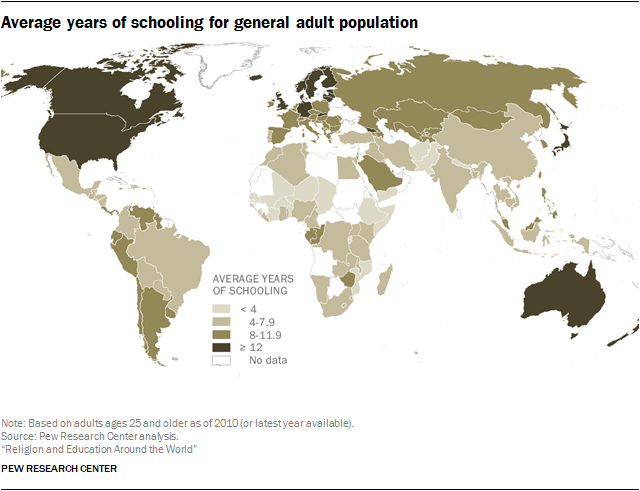
At present, Jewish adults (ages 25 and older) have a global average of 13 years of formal schooling, compared with approximately nine years among Christians, eight years among Buddhists and six years among Muslims and Hindus. Religiously unaffiliated adults – those who describe their religion as atheist, agnostic or “nothing in particular” – have spent an average of nine years in school, a little less than Christian adults worldwide.1

But the number of years of schooling received by the average adult in all the religious groups studied has been rising in recent decades, with the greatest overall gains made by the groups that had lagged furthest behind.

For instance, the youngest Hindu adults in the study (those born between 1976 and 1985) have spent an average of 7.1 years in school, nearly double the amount of schooling received by the oldest Hindus in the study (those born between 1936 and 1955). The youngest Muslims have made similar gains, receiving approximately three more years of schooling, on average, than their counterparts born a few decades earlier, as have the youngest Buddhists, who acquired 2.5 more years of schooling.

Over the same time frame, by contrast, Christians gained an average of just one more year of schooling, and Jews recorded an average gain of less than half a year of additional schooling.

Meanwhile, the youngest generation of religiously unaffiliated adults – sometimes called religious “nones” – in the study has gained so much ground (2.9 more years of schooling than the oldest generation of religious “nones” analyzed) that it has surpassed Christians in average number of years of schooling worldwide (10.3 years among the youngest unaffiliated adults vs. 9.9 years among the youngest Christians).

Gender gaps also are narrowing somewhat. In the oldest generation, across all the major religious groups, men received more years of schooling, on average, than women. But the youngest generations of Christian, Buddhist and unaffiliated women have achieved parity with their male counterparts in average years of schooling. And among the youngest Jewish adults, Jewish women have spent nearly one more year in school, on average, than Jewish men.

These are among the key findings of Pew Research Center’s new demographic study. A prior study by researchers at an Austrian institute, the Wittgenstein Centre for Demography and Human Capital, looked at differences in educational attainment by age and gender.2 The new study is the first comprehensive examination of differences in educational levels by religion. Wittgenstein Centre researchers Michaela Potančoková and Marcin Stonawski collaborated with Pew Research Center researchers to compile and standardize this data.

Religions vary in educational attainment

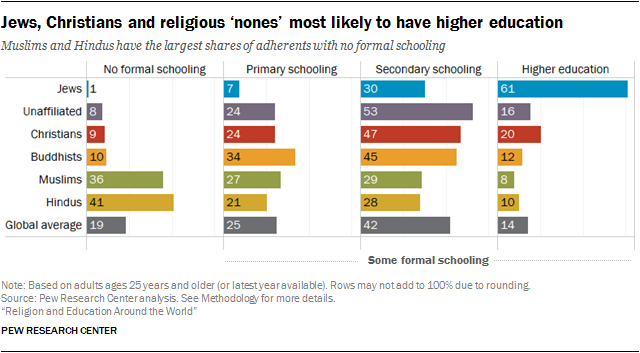
About one-in-five adults globally – but twice as many Muslims and Hindus – have received no schooling at all

Despite recent gains by young adults, formal schooling is neither universal nor equal around the world. The global norm is barely more than a primary education – an average of about eight years of formal schooling for men and seven years for women.

At the high end of the spectrum, 14% of adults ages 25 and older (including 15% of men and 13% of women) have a university degree or some other kind of higher education, such as advanced vocational training after high school. But an even larger percentage – about one-in-five adults (19%) worldwide, or more than 680 million people – have no formal schooling at all.

Education levels vary a great deal by religion. About four-in-ten Hindus (41%) and more than one-third of Muslims (36%) in the study have no formal schooling. In other religious groups, the shares without any schooling range from 10% of Buddhists to 1% of Jews, while a majority of Jewish adults (61%) have post-secondary degrees.3
Hindus and Muslims have made big advances in educational attainment

The study finds the religious groups with the lowest levels of education are also the ones that have made the biggest gains in educational attainment in recent decades.

Over three recent generations, the share of Hindus with at least some formal schooling rose by 28 percentage points, from 43% among the oldest Hindus in the study to 71% among the youngest. Muslims, meanwhile, registered a 25-point increase, from 46% among the oldest Muslims to 72% among the youngest.

Christians, Buddhists and religious “nones” have made more modest gains in basic education, but they started from a higher base. Among the oldest generation in the study, large majorities of these three religious groups received at least some formal education; among the youngest Christians, Buddhists and religious “nones,” more than nine-in-ten have received at least some schooling.

The share of Jews with at least some schooling has remained virtually universal across generations at 99%.

Declining gender gaps in formal education

In this study, more women than men have no formal education: As of 2010, an estimated 432 million women (23% of all women ages 25 and older) and 250 million men (14% of all men) lacked any formal education.

In some religious groups, the gender gaps in acquiring any formal education are particularly large. For example, just over half of Hindu women (53%) have received no formal schooling, compared with 29% of Hindu men, a difference of 24 percentage points. Among Muslims worldwide, 43% of women and 30% of men have no formal schooling, a 13-point gap. In other religions, the gender differences in the shares with no formal schooling are smaller, ranging from 9 points among the religiously unaffiliated to just 1 point among Jews.

But Hindus have substantially narrowed the gender gap in primary schooling, as shares of Hindu women with no formal schooling decreased across the three generations studied. Among the oldest Hindus, 72% of women and 41% of men have no formal schooling. But among the youngest Hindus in the study, the gender gap is smaller, as 38% of women and 20% of men have no formal schooling.

Muslims also have reduced the gender gap across generations by 11 percentage points. But in the youngest generation, a 10-point difference remains: 33% of Muslim women and 23% of Muslim men have no formal schooling. Among religiously unaffiliated adults and Buddhists worldwide, meanwhile, the gender gap in the shares with no formal schooling has virtually disappeared.

Reversal of some gender gaps in higher education

Worldwide, among all adults in the study, slightly more men than women hold post-secondary degrees (15% vs. 13%). But across generations, women have been outpacing men in reaching higher levels of education. As a result, in the youngest generation, the share of women with post-secondary degrees is comparable to the share of men (17% each).

In the youngest generation of three faith groups – Jews, Christians and the religiously unaffiliated – the gender gap in higher education has actually reversed. The biggest reversal has happened among Jews. Among the oldest generation of Jews, more men (66%) than women (59%) hold post-secondary degrees. But among the youngest Jewish adults worldwide, 69% of women and 57% of men have such degrees. In other words, a 7-point gender gap in the oldest generation (with more men than women holding advanced degrees) is now a 12-point gender gap in the other direction, with more women than men in the youngest generation of Jews holding degrees. (See Chapter 6 for details.)

Christians and religiously unaffiliated people have experienced similar – although not as dramatic – reversals of the gender gap in post-secondary education. Among Christians, the gender gap among those in the oldest adult cohort – 21% of men with higher education vs. 17% of women – has flipped among the youngest so that more women than men now hold degrees (25% of women vs. 20% of men). Similarly, among religiously unaffiliated people, the 3-point gender gap in the oldest generation (with more men than women having higher education) is now a 3-point gap in the other direction in the youngest generation, with more women than men earning post-secondary degrees.

Meanwhile, the gender gap in higher education has narrowed for Buddhists (by 5 points) and Muslims (by 3 points). Among the youngest generations in those groups, roughly equal shares of women and men hold higher degrees – 19% each among Buddhists and 11% and 9% among Muslim men and women, respectively. The gender gap in post-secondary education among Hindus has held steady across generations. In the youngest cohort of Hindus, more men than women still have post-secondary degrees (17% of men vs. 11% of women).

Both religion and region matter for educational attainment

Within the world’s major religious groups, there are often large variations in educational attainment depending on the country or region of the world in which adherents live. Muslims in Europe, for example, have more years of schooling, on average, than Muslims in the Middle East. This is because education levels are affected by many factors other than religion, including socioeconomic conditions, government resources and migration policies, the presence or absence of armed conflict and the prevalence of child labor and marriage.

At the same time, this study finds that even under the same regional or national conditions, there often are differences in education attainment among those within religious groups. Here are some findings from this report that illustrate both the diversity within the same religious group across different regions of the world, and the diversity within the same region among religious groups:

  • There is a large and pervasive gap in educational attainment between Muslims and Christians in sub-Saharan Africa. By all attainment measures, Muslim adults in the region – both women and men – are far less educated than their Christian counterparts. For instance, Muslims are more than twice as likely as Christians in sub-Saharan Africa to have no formal schooling (65% vs. 30%). Moreover, despite growth in the share of adults with any formal schooling in recent decades, the Muslim-Christian attainment gap has widened across generations, largely because Muslims have not kept pace with educational gains made by Christians. (See Chapter 1 for more on the Muslim-Christian gap in sub-Saharan Africa, and Chapter 7 for a discussion of possible explanations.)
  • Also in sub-Saharan Africa, the Muslim gender gap in education has remained largely unchanged across generations – and even widened slightly by some measures of attainment analyzed in this study. Although the youngest Muslim women in this region are making educational gains compared with their elders, they are making them at a slightly slower rate than their male peers. This pattern differs from some other regions, where Muslim women are generally making educational gains at a faster pace than Muslim men, thus narrowing the gender gap. (See Chapter 1 for details.)
  • Christians have remained fairly stable at the global level in their overall educational attainment over three generations. But their attainment varies considerably by region. As the largest of the world’s major religious groups (numbering about 2.2 billion overall, including children, as of 2010), Christians also are the most widely dispersed faith group, with hundreds of millions of adherents in sub-Saharan Africa, the Asia-Pacific, Europe, North America and Latin America and the Caribbean. Christians in Europe and North America tend to be much more highly educated than those in sub-Saharan Africa, for instance, although African Christians are making rapid educational gains across generations. (See Chapter 2 for more detail on educational attainment among Christians.)
  • Jews also have remained stable in their already high levels of educational attainment over recent generations. But Jews, unlike Christians, are a much smaller and more localized population, with a large majority of all Jews worldwide living in just two countries – Israel and the United States – where educational attainment is relatively high overall. (Chapter 6 explores data on Jews in more detail.)
  • At the global level, religiously unaffiliated adults have 1.3 more years of schooling, on average, than religiously affiliated adults (8.8 versus 7.5). One possible reason for this is that unaffiliated people are disproportionately concentrated in countries with relatively high overall levels of educational attainment, while the religiously affiliated are more dispersed across countries with both high and low levels of attainment. However, the unaffiliated are not consistently better educated than their religiously affiliated compatriots when looked at country by country. In the 76 countries with data available on the youngest generation of unaffiliated adults (born 1976-1985), they have a similar number of years of schooling as their religiously affiliated peers in 33 countries; they are less educated in 27 countries, and they are more highly educated than the affiliated in 16 countries. (See sidebar in Chapter 3 for more details on the unaffiliated and secularization theory.)
  • Hindus in India, who make up a large majority of the country’s population (and more than 90% of the world’s Hindus), have relatively low levels of educational attainment – a nationwide average of 5.5 years of schooling. While they are more highly educated than Muslims in India (14% of the country’s population), they lag behind Christians (2.5% of India’s population). By contrast, fully 87% of Hindus living in North America hold post-secondary degrees – a higher share than any other major religious group in the region. (See Chapter 5 on Hindu educational attainment.)
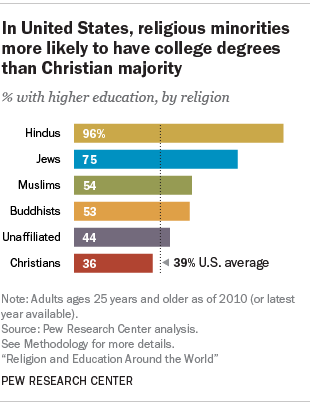
  • Religious minorities often have more education, on average, than a country’s majority religious group, particularly when the minority group is largely foreign born and comes from a distant country. In these cases, immigrants often were explicitly selected under immigration policies that favor highly skilled applicants. In addition, it is often the well-educated who manage to overcome the financial and logistical challenges faced by those who wish to leave their homeland for a new, far-off country. For instance, in the U.S., where Christians make up the majority of the adult population, Hindus and Muslims are much more likely than Christians to have post-secondary degrees. And unlike Christians, large majorities of Hindus and Muslims were born outside the United States (87% of Hindus and 64% of Muslims compared with 14% of Christians, according to a 2014 Pew Research Center survey). 4

A note about this analysis

This report looks at average educational levels among adherents of five major world religions – Christianity, Islam, Hinduism, Buddhism and Judaism – as well as among the religiously unaffiliated.

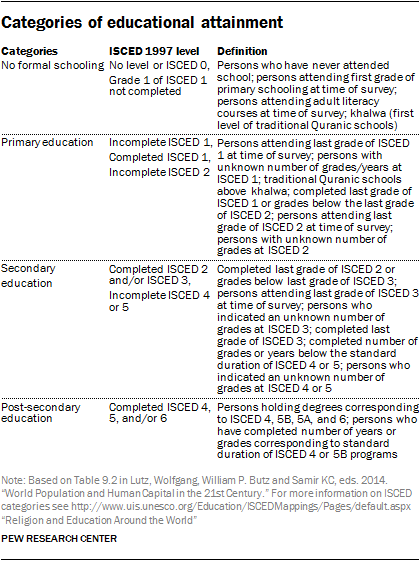
Educational systems vary enormously around the world; this report does not attempt to analyze differences in educational quality, but focuses primarily on educational attainment in terms of number of years of schooling. It distinguishes among four broad levels of educational attainment: no formal schooling (less than one year of primary school), primary education (completion of at least one grade of primary school), some secondary education (but no degree beyond high school) and post-secondary education (completion of some kind of college, university or vocational degree beyond high school, also referred to in this report as “higher education”). For comparability across countries, these educational categories are based on the International Standard Classification of Education (ISCED 1997; see Methodology for more details).

To measure changes over recent generations, the report looks at three birth cohorts: the “oldest” (born 1936-1955), “middle” (born 1956-1975) and “youngest” (born 1976-1985). These generations roughly correspond, respectively, to people ages 55 to 74, 35 to 54 and 25 to 34 as of 2010, the most recent year for which detailed census data are available in many countries. Whenever this report refers to “adults,” it means people who were 25 or older in 2010 (or, in some cases, the most recent year for which data are available).

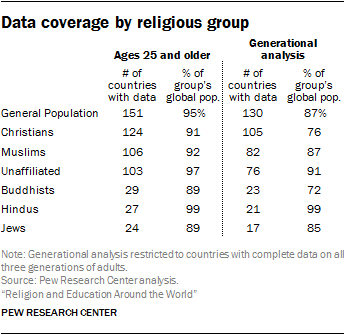
The report presents figures at the global and regional levels but also includes select country-level data as illustrations of larger trends. It includes data from 151 countries, collectively representing 95% of the 3.6 billion people around the world who were 25 or older in 2010. Analyses of change across generations include data from 130 countries with available data on all three birth cohorts, representing 87% of the world’s population in 2010 ages 25 to 74.

The approach in this report is primarily descriptive: It lays out the differences in educational levels among religious groups without attempting to explain the reasons for those differences. Chapter 7 outlines some of the ways that social scientists think religion may influence educational attainment.

In this study, the world is divided into six regions. It includes data from 35 countries in the Asia-Pacific region; 36 countries in Europe, including Russia; 30 countries in Latin America and the Caribbean, including Central America and Mexico; 12 countries in the Middle East-North Africa region; Canada and the United States in North America; and 36 countries in sub-Saharan Africa.

1. Muslim educational attainment

Among the world’s major religious groups, Muslims have made some of the greatest gains in educational achievement in recent decades. The share of Muslim adults (ages 25 and older) with at least some formal schooling has risen by 25 percentage points in the past three generations, from fewer than half (46%) among the oldest group included in the study to seven-in-ten (72%) among the youngest. The Muslim gender gap in educational attainment worldwide also has narrowed.

Nearly four-in-ten (36%) Muslim adults, however, still have no formal schooling at all. That includes 43% of all Muslim women and 30% Muslim men. At the other end of the spectrum, 8% of Muslim adults – including 10% of Muslim men and 6% of Muslim women – have a post-secondary education.

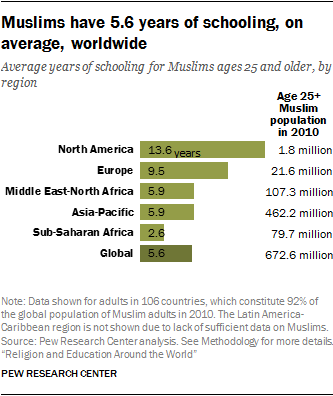
There were a total of 1.6 billion Muslims of all ages in 2010. Educational attainment among the world’s more than 670 million Muslim adults varies widely depending on where they live, revealing a picture of high achievement in some countries and regions and a pattern of educational disadvantage in others. Globally, Muslim adults have an average of 5.6 years of schooling. But, regionally, the average ranges from 13.6 years among Muslims in North America (a population projected to increase from 3 million to 10 million people by 2050) to just 2.6 years in sub-Saharan Africa (where the number of Muslims of all ages is expected to expand from 248 million in 2010 to 670 million by mid-century).5

In sub-Saharan Africa, roughly two-thirds of Muslim adults (65%) have no formal schooling. The same is true for roughly four-in-ten Muslim adults in the Middle East-North Africa region (42%) and three-in-ten in Asia-Pacific region (32%). By comparison, nearly all Muslim adults living in North America and 95% of those in Europe have at least some formal education.

Sidebar: Education levels vary among Muslims in Europe

Muslims in Europe, whose total numbers are projected to increase from 43 million in 2010 to more than 70 million in 2050, display a wide variation in average years of schooling, according to data from 24 European countries.6

In some European countries (Lithuania, Slovakia, Estonia, the Czech Republic, Hungary, the United Kingdom and Ireland), Muslims have about 12 years of schooling or more, on average. In others, Muslims tend to have less education, ranging from an average of 10.8 years of schooling in Georgia to a continentwide low of 5.8 years in Spain.

In most of these countries, Muslims have less education than non-Muslims. The biggest gap is in Germany, where Muslims, on average, have 4.2 fewer years of schooling than non-Muslims (9.5 years vs. 13.7 years, respectively). Many of these countries have experienced large inflows of Muslim refugees or guest workers in recent decades. While the data in this report are from 2010, the surge of Muslim refugees to Europe in 2015 and 2016 from countries such as Syria, Iraq and Afghanistan may have increased the number of Muslims with fewer years of schooling than non-Muslims in several European countries.

In countries with relatively high education levels among Muslims, such as the United Kingdom and Ireland, Muslim communities often have been shaped by immigration policies favorable to highly educated migrants. For example, Ireland’s economic boom of the late 1990s drew highly skilled Pakistani and African migrants and refugees. Partly as a result of this, Muslims in Ireland have an average of 11.8 years of schooling – one more year, on average, than non-Muslims in that country.

In five of 19 European countries with available data on changes across generations, the Muslim educational disadvantage is larger among the youngest generation, compared with the oldest, partly because educational gains among Muslims have lagged behind those of non-Muslims. This is particularly apparent in Spain and Portugal. While Spain’s non-Muslim population gained roughly four years of schooling, on average, across recent generations, Muslims made virtually no overall gain across generations, which widened the gap between Muslims and non-Muslims from roughly one year among the oldest cohort to about a five-year difference among the youngest. Similarly, in Portugal, non-Muslims gained more than six years of formal education across cohorts, but Muslims gained roughly three years.

By contrast, Muslims in Germany have made rapid progress over recent generations. Among the oldest generation of Germans in the study, Muslims lag behind non-Muslims by more than seven years of schooling, on average (5.9 years vs. 13.4 years). But while Germany’s non-Muslim population gained about one year of schooling across recent generations, Muslims gained more than six additional years. As a result, the gap between Muslims and non-Muslims in Germany among the youngest generation is only about two years of schooling, on average (12.5 years vs. 14.5 years).

Muslim women around the world lag behind Muslim men in average years of schooling by a year and a half (4.9 years vs. 6.4 years). The gap is particularly large in the Middle East-North Africa region, where Muslim men have an average of 6.9 years of schooling and women have 4.9 years. These Muslim gender gaps are larger than the gaps for non-Muslims: Globally, non-Muslim men average 8.7 years of schooling, compared with 7.7 years for women, and in the Middle East-North Africa region, non-Muslim men have half a year of schooling more than non-Muslim women.

More than four-in-ten (43%) Muslim women worldwide have no formal schooling, compared with 30% of Muslim men. And in attainment of higher education, Muslim men lead women; 10% of Muslim men have post-secondary degrees, compared with 6% of Muslim women.

Younger Muslims generally more educated than older Muslims

From a generational perspective, Muslims have made substantial gains in educational attainment. Over the three generations in this study, they have gained an average of 3.1 more years of schooling: The youngest Muslims have, on average, 6.7 years of schooling, as compared with the oldest, who have 3.5 years of schooling.

The largest gains in average years of schooling have been in the Middle East and North Africa. In that region, Muslims have gained 4.5 years of schooling across generations, from an average of 3.2 years among the oldest Muslims to 7.6 years among the youngest.

Over the same time period, the share of Muslims with no formal schooling has decreased considerably, from 54% in the oldest generation of Muslims in the study to 28% in the youngest.

Again, the largest decreases in the share of Muslims with no formal schooling were in the Middle East and North Africa, where 67% of the oldest Muslims lack any formal schooling, compared with 26% of the youngest. Nearly all Muslims in North America and Europe have at least some formal schooling.7 The share of Muslims in sub-Saharan Africa with no formal schooling dropped by 22 percentage points, but a majority of the youngest Muslims in that region (57%) still lack even a primary education.

The share of Muslims with a post-secondary education has grown in recent generations, albeit more modestly, rising from 4% of the oldest Muslims in the study to 10% of the youngest. The largest increases occurred among Muslims in the Middle East-North Africa region (9 points), North America (8 points) and Europe (7 points).

Sidebar: In sub-Saharan Africa, Muslim gender gap in education remains as Muslim-Christian attainment gap has grown

Muslims in sub-Saharan Africa, who make up 30% of the region’s population, have the largest share with no formal schooling (65%) among Muslims anywhere in the world.

In addition, the gender gap in education among Muslims in sub-Saharan Africa has remained mostly unchanged across generations, and the share of all Muslims with no formal schooling in the region is higher than the share of Christians with no formal schooling.

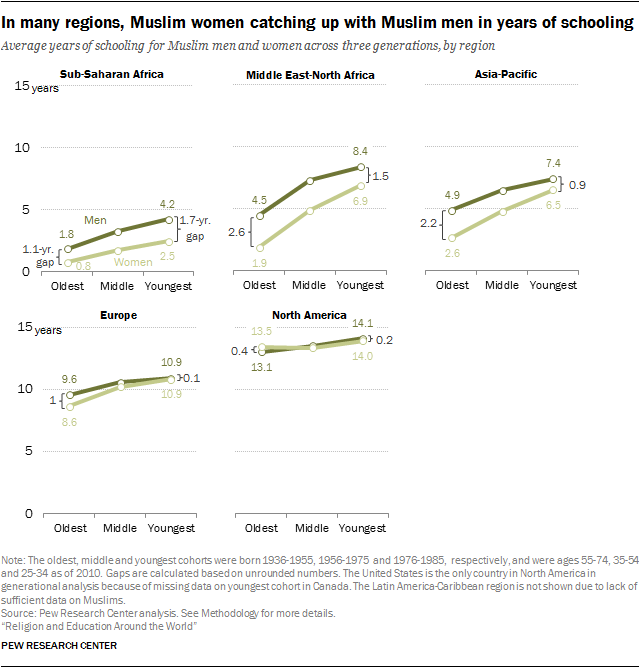
The gender gap among Muslims has held steady and even widened slightly on some measures of attainment. For instance, the gap in the share of Muslims with no formal schooling has continued across generations even as more women complete some formal schooling (see chart). Muslim men in the oldest generation in the study average about one more year of schooling than Muslim women, but in the youngest generation of Muslim adults ages 25 and older in sub-Saharan Africa, men average 1.7 more years of schooling than women. The gender gap in higher education also remains across generation, although very few Muslim men or women in the region have college degrees.

This means that although the youngest Muslim women in sub-Saharan Africa are making educational gains, they are not making them at the same rate as their male peers. This pattern differs from other regions of the world, where Muslim women are generally making educational gains at a faster pace than Muslim men. In all other regions except North America, Muslim women have gained more years of education, on average, than Muslim men across the three generations in the study.8And in all regions but sub-Saharan Africa, the share of Muslim women with no formal schooling decreased sharply compared with the share of Muslim men with no formal schooling.

Meanwhile, the educational disparities between Muslims and Christians in sub-Saharan Africa have grown in recent generations, largely because Muslims have not kept pace with educational gains made by Christians (who make up 63% of the region’s population). The oldest Muslims in the region have 2.4 fewer years of schooling, on average, than the oldest Christians. But among the youngest group, that gap has grown to 3.6 years.

In addition, despite growth in the share of Muslims with some formal schooling, the Muslim-Christian gap by that measure also has expanded across generations. Among the oldest generation, 79% of Muslims and 51% of Christians in sub-Saharan Africa have no formal schooling – a 29-percentage-point difference. But among those in the youngest generation, the Muslim-Christian gap has grown to 36 points, with 57% of Muslims and 23% of Christians in the region lacking any formal education.

The Muslim gender gap in the share with no formal schooling, which has widened across generations, also presents a contrast to the diminishing Christian gender gap by this measure. While the Muslim gap has grown by a few percentage points, the Christian gender gap has shrunk by 18 points (see chart).

The Muslim-Christian education gap is seen within many individual countries in the region. In 18 out of 27 sub-Saharan African countries with substantial Muslim and Christian populations, Muslims are more likely than their Christian compatriots to have no formal schooling by at least 10 percentage points (see chart below).9 In Nigeria, for example, where Christians and Muslims each make up about half of the population, roughly six-in-ten Muslim adults (61%) have no formal schooling, compared with about a quarter of Christian adults (26%).

By contrast, in a handful of countries (South Africa, Rwanda, Madagascar and Burundi), Muslims are more likely than Christians to have at least some basic education. In all of these cases, however, Muslims are a small religious minority, making up 3% or less of the national population. For a discussion of the possible reasons behind Muslim-Christian attainment differences in sub-Saharan Africa, see Chapter 7.

Gender differences remain despite substantial gains for women across generations

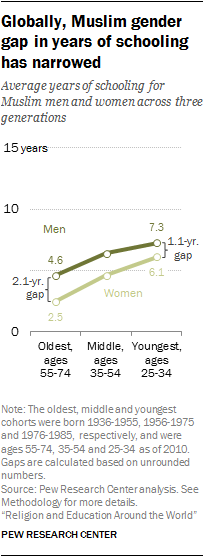
Globally, recent generations have seen a narrowing of the Muslim gender gap in educational attainment as women have made bigger gains than men by most measures of attainment. For example, Muslim women have had a larger increase in average years of schooling than men, going from 2.5 years of education among the oldest Muslim women, to 6.1 years among the youngest, a gain of 3.6 years. By contrast, Muslim men gained 2.7 years of schooling, on average, between the oldest and youngest generations included in this analysis.

In the Asia-Pacific region – home to more Muslims than any other region – the gender gap in average years of schooling for Muslims has narrowed slightly among the youngest generation. Among those born between 1976 and 1985, Muslim men in the Asia-Pacific region have an average of 7.4 years of formal schooling, while Muslim women average 6.5 years. A similar pattern is found among Muslims in the Middle East and North Africa.

In higher education, the gender gap among Muslims has narrowed by 3 percentage points over generations. Not only that, but in some countries, the gender gap has reversed among the youngest Muslims – meaning that young Muslim women are now more likely than young Muslim men to have post-secondary degrees.

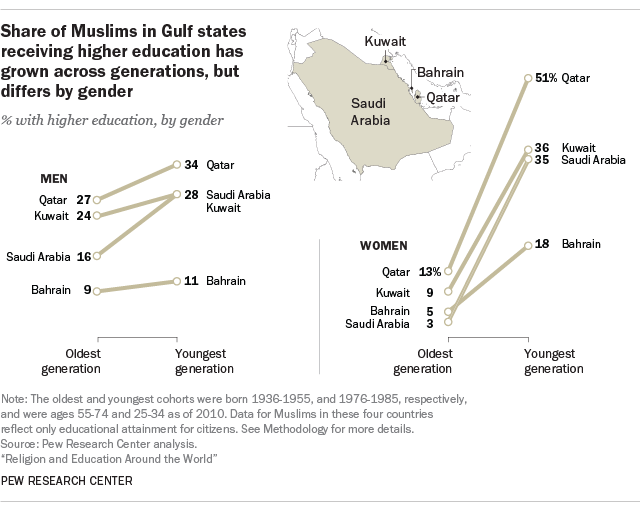
The gender gap in higher education has flipped in several Muslim-majority countries, including Algeria, Bahrain, Kuwait, Saudi Arabia, Tunisia, the Palestinian territories and Qatar (in the Middle East-North Africa region), as well as Iran, Indonesia and Malaysia (in the Asia-Pacific region). Indeed, in Qatar, the youngest women are more likely than the youngest men to have post-secondary degrees by 17 percentage points.

Sidebar: Youngest Gulf Muslim women surge ahead in higher education

The youngest Muslim women in the Gulf Cooperation Council nations have made such large strides in higher education across recent generations that they now are more likely than men to hold post-secondary degrees, according to data from Bahrain, Kuwait, Saudi Arabia and Qatar.

About one-third of the youngest Gulf women (34%) have higher education, a rise of 30 percentage points from the 4% of women in the oldest generation who have post-secondary degrees. These gains far surpass those made by Muslim women elsewhere in the world, among whom the share with higher education has risen by just 7 points across three generations.

Men’s gains in these Gulf states have not been as large. Roughly a quarter of the youngest men (27%) have post-secondary degrees, an 11-point increase over the oldest cohort. Among Muslim men elsewhere in the world, 11% in the youngest generation have higher education, a 4-point increase over the oldest group.

Gains by men in the Gulf states also have not been as consistent across borders as those by women. While the youngest Saudi men are more likely than the oldest Saudi men to have post-secondary degrees (28% vs. 16%, respectively), gains are smaller among the youngest Bahraini men (11%), compared with the oldest group (9%).

2. Christian educational attainment

Christians are one of the world’s most highly educated religious groups: The vast majority of Christian adults ages 25 and older (91%) have at least some formal schooling, and one-in-five have post-secondary degrees.

Gender differences in educational attainment among Christians have narrowed in recent generations, largely because of gains made by Christian women. Although Christian women are still slightly more likely than Christian men to have no formal schooling, roughly equal shares of Christian men and women have a post-secondary education. In fact, in the youngest cohort analyzed in the study, Christian women are now somewhat more likely than men to have received higher education. And in some countries, Christian men have experienced declines in post-secondary education across recent generations. For instance, in the United States, the country with the world’s largest Christian population, 34% of the youngest Christian men in the study (those born 1976 to 1985) have post-secondary degrees, compared with 37% of the oldest Christian men (born 1936 to 1955).

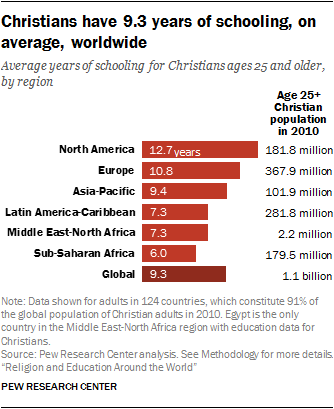
Christians – who make up the world’s largest religious group at 2.2 billion people, including more than a billion adults 25 and older in 2010 – are more geographically dispersed than adherents of other major religions, and they show a wide variation in educational attainment across different regions. Globally, Christians have spent 9.3 years in school, on average. But regionally, this average ranges from 12.7 years in North America (where the Christian population is projected to increase slightly from 267 million in 2010 to 287 million in 2050) to 6.0 years in sub-Saharan Africa (where Christians of all ages are expected to grow rapidly from 517 million in 2010 to 1.1 billion by mid-century).

There also are wide variations across regions in the shares of Christians with higher education. In North America, 38% of Christians have post-secondary degrees, as do almost a quarter in three other regions (Middle East-North Africa, Europe and Asia-Pacific). In sub-Saharan Africa, the share with post-secondary schooling is 6%, while the share of non-Christians in that region with a higher education is 3%.

In North America and Europe, Christians universally (98% or more) have at least some formal schooling, as do nine-in-ten or more Christians in the Latin America-Caribbean and Asia-Pacific regions. In sub-Saharan Africa, however, about three-in-ten Christians (30%) have received no formal education.10

The gender gap in educational attainment among Christians is relatively modest. While Christian men around the world have 9.5 years of schooling, on average, Christian women have received 9.1 years. Similar shares of both Christian men and women have at least some formal schooling (90% of Christian women and 93% of Christian men) and post-secondary degrees (20% of Christian women and 21% of Christian men).

These gender gaps are wider, however, in certain parts of the world. In sub-Saharan Africa, for example, Christian women have 1.8 fewer years of schooling, on average, than Christian men. But in North America and Latin America, there is virtually no gender gap in educational attainment for Christians.

Small gains in education across generations

Christians have made relatively modest gains in overall levels of education across the three generations studied, and most of these gains appear to have occurred between the oldest generation in the study (born 1936 to 1955) and the middle generation (born 1956 to 1975). There have been no substantial gains between this middle generation and the youngest group of Christians in the study (born 1976 to 1985).

For example, after an increase of almost a full year of schooling between the oldest and middle age cohorts (from an average of 8.9 years of schooling to 9.8 years), Christians in the youngest cohort have not made similar gains, averaging 9.9 years of schooling. Additionally, the share of Christians with at least some formal schooling is comparable for the middle and youngest cohorts (92% and 93%, respectively). And the share of Christians with post-secondary degrees has held steady at 23% between these two generations.

One reason for this global pattern in Christians’ educational attainment is the geographic shift in the Christian population. Historically, Europe and North America have been home to a majority of the world’s Christians; as of 2010, some 59% of those in the oldest generation of Christians live in these two regions. But only 36% of the youngest Christians live in these two regions. Indeed, Christians outside Europe and North America are projected to account for increasingly larger shares of the global Christian population. And because educational attainment in other regions is lower than that of Christians in Europe and North America, the global average for all Christians is tugged downward. According to analysis of available data, if the regional distribution of Christians hypothetically had stayed the same across generations, the global average of years of schooling for Christians would have been one full year higher.

Globally, the share of Christians with no formal schooling has declined by 4 percentage points across generations, from 12% in the oldest generation to 8% in the youngest. Christians in sub-Saharan Africa and the Middle East and North Africa, however, saw much larger decreases in the same time period: a 28-point decline and a 27-point drop, respectively.11

Sidebar: Christian educational diversity in sub-Saharan Africa

Christians in sub-Saharan Africa are projected to increase from 24% of the global Christian population in 2010 to 38% by 2050. Overall, 30% have no formal education, which is one of the highest shares of Christians with no schooling in any region in the world.12 At the other end of the spectrum, about a third (35%) have at least some secondary schooling.13

But there is considerable diversity in Christian educational attainment throughout the region. In Nigeria, for example, three-quarters (74%) of the Christian population – the largest in Africa – has some formal education and 46% have at least secondary schooling. Christians in Kenya are even more educated. Almost nine-in-ten (89%) have some formal schooling and 55% have secondary schooling or more. Next door to Kenya in Ethiopia, however, Christians are much less educated. Fewer than one-third (30%) have any formal schooling, and relatively few Ethiopian Christians (8%) have secondary schooling.

There also are substantial gender gaps in education among Christians in sub-Saharan Africa, especially relative to Christians in other regions of the world. Some two-thirds of Christian women in the region (64%) have any formal schooling, compared with 78% of Christian men. And the largest gender gap in average years of schooling among Christians in any region is in sub-Saharan Africa, where women have an average of 5.1 years of education and men average 7.0 years.14

But Christian women in sub-Saharan Africa are making bigger strides than men across generations, especially when it comes to gaining some basic schooling. The share of Christian women in the region with at least some formal education increased by 36 percentage points (36% to 72%) between the oldest and youngest generations in the study, while the comparable increase for Christian men was 18 percentage points (65% to 83%).

Christian women’s gains across generations have narrowed, and sometimes reversed, gender gaps in education

Across the three generations in the study, Christian women have made greater gains than Christian men in many indicators of educational attainment. These gains have nearly erased the global gender gap among Christians, and, in some regions and countries, led to a gender gap reversal – in the youngest generation, women have more education, on average, than men.

For instance, in average years of schooling, Christian women worldwide rose from 8.6 years of schooling to 9.8 years between the oldest and youngest cohorts, while men gained less than a year of schooling across generations (9.4 years to 10.0 years).

In four regions of the world, the youngest Christian women have at least as many years of schooling, on average, as the youngest Christian men. In North America, Christian women born between 1976 and 1985 have an average of 13.2 years of schooling, compared with 12.8 years for their male peers. In Europe, the youngest Christian women average 12.6 years of schooling, compared with 12.0 for Christian men.15 And in the Asia-Pacific and Latin America-Caribbean regions, the youngest Christian men and women average virtually the same number of years of schooling.

Larger gains among women also help explain a slight narrowing of the global Christian gender gap in some basic schooling. The share of the youngest Christian women with at least some formal schooling rose to 91%, compared with 94% among the youngest Christian men. In three regions – North America, Europe and Latin America and the Caribbean – the gender gap by this measure has disappeared among the youngest generation of Christians.

The gender gap reversal for Christians is especially apparent when it comes to higher education. Worldwide, the youngest Christian women are 5 percentage points more likely than the youngest Christian men to have post-secondary degrees.

The reversal is due not only to women’s gains but also to generational stagnation in the share of Christian men with post-secondary degrees. About one-in-five of the oldest Christian men around the world have post-secondary degrees (21%), as do 20% of the youngest Christian men. At the same time, the share of Christian women with higher education has risen from 17% among the oldest generation to 25% among the youngest.

Stagnation in higher education attainment among Christian men is especially notable in the United States, where the share with post-secondary degrees has decreased slightly from 37% in the oldest generation to 34% in the youngest. This change, combined with women’s gains, means that in the youngest generation of U.S. Christians, women are more likely than men – by 10 percentage points – to have a post-secondary education.

Christian men are not alone in seeing a decline in the share with higher education: The same pattern is also seen in the youngest generation of Jewish men. Moreover, for Jews and the religiously unaffiliated, the global gender gap in higher education also has reversed, so that the youngest Jewish and unaffiliated women are more likely than the youngest Jewish and unaffiliated men to have higher education.

Sidebar: Europe’s gender reversal in higher education

Christians are at the forefront of a global trend that also is occurring among Jews and unaffiliated people: the reversal of the historical gender gap in higher education. In the youngest generations of these three religious groups, women are more likely than men to have post-secondary degrees. For Christians, this is particularly apparent in Europe.

Across the continent, 43% of the youngest Christian women have post-secondary degrees, a 25-percentage-point increase from the 17% with higher education in the oldest generation of Christian women. By contrast, the share of Christian men with higher education grew by 7 percentage points, from 22% in the oldest generation to 30% in the youngest. As a result, the youngest Christian women are more likely than the youngest Christian men – by 13 percentage points – to have higher education.

By comparison, 36% of the youngest non-Christian women have post-secondary degrees, a 10-point gain over the 26% with higher education among the oldest non-Christian women (mostly religiously unaffiliated people and Muslims). The youngest non-Christian women also are more likely than the youngest non-Christian men to have higher education, but only by 3 points.

The largest reversals in the European Christian gender gap in higher education have occurred in Norway, France, Germany, Montenegro, Belgium and Iceland. Among the oldest cohorts in Norway, France and Belgium, Christian women are less likely than Christian men to have a post-secondary education by 4 percentage points or more, but in the youngest cohort, they are more likely by at least 15 points to have such a degree. And in Montenegro, Christian women in the oldest cohort are behind men by 13 percentage points by this measure, but the youngest are ahead by 9 points. Kosovo is the only European country with available data where the youngest Christian women still lag slightly behind men in the share with higher education. Besides Europe, the youngest Christian women also are more likely than the youngest Christian men to have post-secondary degrees in North America, Asia and the Latin America-Caribbean region.

3. Educational attainment among the religiously unaffiliated

People without a religious affiliation – including atheists, agnostics and those who describe their religion as “nothing in particular” – are among the most educated of the world’s major religious groups. Globally, the vast majority (92%) of unaffiliated adults ages 25 and older have at least some basic education, nearly seven-in-ten (68%) have at least some secondary schooling and 16% have post-secondary degrees.

In nearly all regions of the world, with the exception of sub-Saharan Africa, the youngest generation of unaffiliated men are less likely than the youngest women to have post-secondary degrees.16 This is especially notable in North America, where 38% of the youngest unaffiliated men and 56% of the youngest unaffiliated women have higher education, compared with 45% of men and 48% of women in the oldest generation.17

While religiously unaffiliated people, sometimes called religious “nones,” are grouped together for analytical purposes in this report, in some cases, there are important differences within this group (see sidebar later in this chapter).

Educational attainment among the world’s more than 725 million religious “nones,” who are projected to decline as a share of the global population in the coming decades, varies from region to region. Around the world, “nones” have 8.8 years of schooling, on average. But that average ranges from a high of 13.2 years in North America to a low of 4.6 years in sub-Saharan Africa.18

The Asia-Pacific region is home to a majority (76%) of the world’s unaffiliated population – about 858.5 million people – and most of them (700.7 million) live in China. Just under two-thirds of all unaffiliated adults ages 25 and older in this region (64%) have at least a secondary education, but in the youngest generation in this study, that figure jumps to 89%.

Sidebar: Does more education lead to less religion?

Some scholars have hypothesized that as education levels increase, many people will shed religious identity and turn to science or other nonreligious sources for answers to life’s most important questions.19 If this secularization theory is accurate, one might expect that countries with higher levels of education would have larger shares of people who do not identify with a religion, and that, on average, religiously unaffiliated people (sometimes called religious “nones”) would have higher levels of education than those who identify with a religion.

This study provides mixed evidence; there is some global data that seems to support secularization theory, but at the country level, the pattern is murky.

At the global level, religiously unaffiliated adults are more highly educated than affiliated adults (as measured by average years of schooling). On average, religiously unaffiliated adults have 1.3 more years of schooling than religiously affiliated adults (8.8 years vs. 7.5 years).

Why do religious “nones” have an educational advantage when viewed at the global level? One reason is that they are disproportionately concentrated in countries with relatively high overall levels of educational attainment. Large shares of the global unaffiliated population reside in highly educated countries such as Japan, South Korea, the United States and the nations of Western Europe. By contrast, relatively few religiously unaffiliated adults live in sub-Saharan Africa, which is the region with the lowest overall level of educational attainment. The global population of religiously affiliated adults shows a different pattern: It is more spread out across countries that have all levels of educational attainment.

Individual countries with high educational attainment also tend to have relatively large shares of religiously unaffiliated adults compared with countries with lower attainment. There are countries that break this pattern, however, and have relatively small shares of unaffiliated adults despite high educational attainment (for example, Georgia and Israel). And China is also a clear outlier: Although educational attainment is relatively modest (7.4 years of schooling, on average), more than half of Chinese adults do not identify with a religious group.

Indeed, when affiliated and unaffiliated adults are compared within countries, religious “nones” do not consistently have an educational advantage, especially among those in the youngest generation.20 There are 76 countries in this study with data on the youngest generation (born 1976 to 1985) of religiously unaffiliated adults. In 32 of those countries, religious “nones” in this generation have a similar number of years of schooling as their religiously affiliated peers (a difference of less than half a year of schooling). In 28 countries, the unaffiliated are less educated than the affiliated by at least half a year of schooling. And in 16 countries, the youngest “nones” are more highly educated than their religiously affiliated compatriots by at least half a year.

In countries where the religiously unaffiliated make up a large share of the population – that is, 20% or more – differences in educational attainment between the youngest cohorts of unaffiliated and affiliated people are often small. For instance, there is a difference of less than half a year of schooling between the two groups in the United States, the United Kingdom, Germany, France, Australia, New Zealand, China, South Korea, Japan and the Czech Republic.

In some countries, there are important educational differences within unaffiliated populations. Although data on the educational attainment of self-described atheists, who make up one category of religious “nones” (along with agnostics and people who describe their religion as “nothing in particular”), was not available for most countries in this report, analysis of survey data collected by Pew Research Center finds that atheists in the United States and France are significantly more likely than adults who say their religion is “nothing in particular” to have post-secondary degrees. But in Germany, Spain, United Kingdom, Australia, Uruguay and China, differences in post-secondary attainment between atheists and adults with no particular religion are not statistically significant.

Gender differences in educational attainment among the unaffiliated are modest at the global level, except in terms of basic schooling: Women are more likely than men to have no formal schooling (13% vs. 4%). When it comes to average years of schooling, however, unaffiliated women lag behind unaffiliated men by less than one year (8.3 years vs. 9.2 years), and they are about as likely as men to have post-secondary degrees (15% vs. 16%). In the youngest generation, unaffiliated women are more likely than unaffiliated men to have higher education (25% vs. 22%) – a pattern seen in all regions except sub-Saharan Africa.

By other measures of educational attainment as well, there are little to no gender differences in most regions. In Europe, unaffiliated men and women both average 12.0 years of schooling, and in North America, women and men have a similar number of years of schooling (13.4 years vs. 13.1 years). In Latin America, 54% of unaffiliated men and 57% of unaffiliated women have at least some secondary education. There is less gender equality in sub-Saharan Africa, where more unaffiliated men (27%) than women (17%) have at least some secondary education.

Generational changes among the unaffiliated vary, with greatest gains in Asia-Pacific

The youngest generation of unaffiliated adults have more years of education, on average, than the oldest generation. Worldwide, they have gained 2.9 more years of schooling, on average, between the oldest generation (born 1936 to 1955), which has an average of 7.4 years of schooling, and the youngest (born 1976 to 1985), which has 10.3 years, on average.

These global increases have been driven mainly by gains in the Asia-Pacific region, which saw the largest growth in average years of schooling among the unaffiliated of any region – a gain of 3.4 years, on average, across the three generations studied.

Globally, the share of religious “nones” with no formal schooling has shrunk from 15% in the oldest generation to 2% in the youngest. In other words, nearly all (98%) religious “nones” in the youngest cohort have at least some formal schooling.

Unaffiliated adults in sub-Saharan Africa saw the largest decline (26 points) in the share with no formal schooling across generations, from 67% in the oldest to 41% in the youngest. There also are notable generational differences in Latin America and the Caribbean and the Asia-Pacific region (16 points in both regions).

Religiously unaffiliated adults worldwide also have seen increases in higher education, as the share with post-secondary degrees doubled from 12% in the oldest cohort to 24% in the youngest.

The largest increase has been in the Asia-Pacific region, where the share with higher education rose by 13 points – to 20% – across generations. Still, the youngest generation of unaffiliated adults in the Asia-Pacific region are only about half as likely as their peers in Europe and North America to have post-secondary degrees (20% in Asia-Pacific compared with 39% in Europe and 45% in North America).


Sidebar: Educational change in China and the rest of Asia and the Pacific

China’s 700.7 million religious “nones” make up the largest unaffiliated population in the world – and 82% of the Asia-Pacific region’s unaffiliated population.

Because of this, China’s patterns of educational attainment have an overwhelming impact on the data when measuring attainment levels across the region. But the educational patterns among religious “nones” in China are very different from those in other countries in the Asia-Pacific region, so it is illuminating to look at them separately. Most notably, while China’s unaffiliated have made big gains in secondary schooling, the rest of Asia-Pacific’s religious “nones” have made gains in higher education.

Most unaffiliated Chinese adults (56%) have some secondary schooling (but no higher education), compared with 41% of the unaffiliated in other parts of the Asia-Pacific region. However, when it comes to higher education, China’s “nones” are three times less likely to have post-secondary degrees than are religious “nones” elsewhere in the region (8% vs. 24%).21

A majority of adults in the youngest generation of “nones” in the Asia-Pacific region (outside of China) have post-secondary degrees (54%). In fact, five of the seven countries and territories where the unaffiliated made the greatest gains in higher education in recent generations are in Asia: Singapore, South Korea, Japan, Hong Kong and Taiwan.22 For example, people in the youngest generation of religious “nones” in South Korea are roughly five times more likely than those in the oldest generation to have a post-secondary education (54% vs. 10%).

Some of these gains can be tied directly to the rapidly increasing educational attainment of unaffiliated women. For example, in Japan, the share of unaffiliated women with higher education rose from 16% in the oldest generation to 59% in the youngest, a 43-point increase. (The share of unaffiliated Japanese men with post-secondary degrees rose from 27% to 53%, a 26-point rise.) And in South Korea, the share of unaffiliated women with higher education rose 53 percentage points (from 4% to 57%).

As a result of the strong gains made by unaffiliated women, the gender gap in higher education among the unaffiliated has reversed in Japan, South Korea, Mongolia and Hong Kong, so that women in the youngest generation are more likely than their male counterparts to have post-secondary degrees.

In Singapore, unaffiliated women saw the largest gain in higher education across generations – 61 points, from 26% in the oldest generation to 86% in the youngest generation. This dramatic increase in higher education among women substantially narrowed the gender gap in the youngest generation (88% of men vs. 86% of women have post-secondary degrees).

Gender differences shrink across generations as unaffiliated women advance

Across the three generations in this study, unaffiliated women have made more rapid gains than unaffiliated men at all levels of educational attainment. As a result, unaffiliated women in the youngest generation have closed the gap with men in average years of schooling and are more likely than men to have higher education.

For example, unaffiliated women have gained 3.8 more years of schooling, on average, between the oldest and youngest generations. The oldest unaffiliated women have an average of 6.6 years of schooling, while the youngest have an average of 10.4 years. At the same time, unaffiliated men gained 2.2 more years of schooling – from 8.1 years of schooling for the oldest to 10.3 for the youngest.

Unaffiliated women in the Asia-Pacific region made the largest gains in average years of schooling – 4.3 years – of any region. (Unaffiliated men in Asia-Pacific gained 2.6 years.)


When it comes to higher education, unaffiliated women have made gains at a faster rate than men, increasing the share of those with post-secondary degrees from 10% in the study’s oldest generation to 25% in the youngest generation. At the same time, the share of unaffiliated men with post-secondary degrees went from 13% to 22%.

As a result, the unaffiliated gender gap in higher education has reversed in four regions of the world, as women in the youngest generation have become more likely than the youngest men to have post-secondary degrees. This is not the case in sub-Saharan Africa, where very few men and women have higher education.23

In the United States, the only country in North America with available data on the youngest religious “nones,” unaffiliated women have become far more likely than their male counterparts to have higher education; a majority of unaffiliated women in the youngest generation in the study (56%) have post-secondary degrees, compared with 38% of their male counterparts.

The U.S. is among the countries where the share of unaffiliated men with college degrees has declined across generations. Nearly half (45%) of the oldest unaffiliated men in the U.S. have post-secondary degrees, compared with 38% of the youngest. A similar trend is seen in Germany.24

4. Buddhist educational attainment

Buddhists are roughly on par with global averages in their levels of educational attainment. They have 7.9 years of schooling, on average, compared with the global average of 7.7 years for all groups, and 12% have earned post-secondary degrees, compared with 14% of all adults globally. An above-average share of Buddhist adults ages 25 and older (90%) have received at least some basic schooling, compared with a global average of 81% for all groups.

Buddhist women have made notably strong educational gains in recent generations, helping to close the gender gap in primary schooling as well as higher education. Among the youngest generation of Buddhists, men and women have nearly identical educational profiles across all measures of attainment.

The overwhelming majority of the world’s 488 million Buddhists of all ages live in the Asia-Pacific region (99%), and 50% of all Buddhists live in China.25 But even within this region, Buddhists display considerable diversity in their educational attainment. In Japan and Singapore, a third or more of Buddhist adults have higher education. But in Thailand, India and China, Buddhist educational attainment is much lower, with roughly one-in-ten or fewer Buddhist adults holding post-secondary degrees. (For more on the varying educational attainment of Buddhists in Asia-Pacific, see sidebar later in this chapter.)

In countries outside the Asia-Pacific region, where Buddhists are a religious minority, they often are more highly educated than the non-Buddhist population of those countries. In the United States, for example, Buddhists have an average of 13.4 years of schooling and more than half (53%) have post-secondary degrees, compared with an average of 12.9 years of schooling and 39% with higher education among non-Buddhists. And in the United Kingdom, Buddhists are more likely than the rest of the population to have higher education by 20 percentage points (52% vs. 32%).

About 10% of Buddhist adults worldwide have no formal education. This includes 11% of Buddhists in China, but only 1% of those living in North America.

When it comes to higher education, there is even greater regional variation among Buddhists. In the Asia-Pacific region, 11% of adult Buddhists have post-secondary degrees. Elsewhere, higher education is more common, with 30% of Buddhists in Latin America and the Caribbean and 52% in North America holding post-secondary degrees.

Buddhist men around the world have, on average, about one more year of schooling than women (8.5 years vs. 7.4 years). This is in line with the global gender gap for non-Buddhists (8.3 years vs. 7.2 years). Buddhist women are twice as likely as Buddhist men to have no formal education (13% vs. 6%), but women lag behind men in higher education by a smaller margin (10% vs. 13%). The educational gender gap among Buddhists is somewhat smaller in the Americas than it is in Asia.

Young Buddhists are more highly educated than older generations

Buddhists have made gains in educational attainment across the three generations in this study. Globally, they have gained an average of 2.5 more years of schooling, with the youngest Buddhists (born 1976 to 1985) averaging 9.7 years of schooling, compared with 7.2 years among the oldest Buddhists (born 1936 to 1955). Buddhists in Latin American and the Caribbean made even larger gains (3.3 more years of schooling) across generations. In North America, Buddhist attainment increased by 1.4 years, from 13.0 years of schooling, on average, among the oldest, to 14.4 years among the youngest.26


The share of Buddhists with no formal schooling decreased by 11 percentage points, from 15% in the oldest generation to 4% in the youngest. The largest decrease was in the Asia-Pacific region (11 points). In North America, virtually all Buddhists in each of the three generations analyzed have at least some basic schooling.

Compared with the oldest generation, more than twice as many Buddhists in the youngest generation hold post-secondary degrees (19% vs. 8%). The gains have been especially large in North America, where the share of Buddhists with post-secondary degrees has increased by 25 percentage points across the three generations, from 44% of the oldest Buddhists to 69% of the youngest.

Gender equality in educational attainment among young Buddhists

Across generations, gender gaps in Buddhist educational attainment have shrunk as Buddhist women have made larger gains than Buddhist men. In the oldest generation, Buddhist women lag behind their male counterparts by an average of 2.2 years of schooling. Among those in the middle generation, and continuing among the youngest, Buddhist women have caught up to men and largely closed the gender gap in average years of schooling. Globally, the youngest Buddhist women have an average of 9.6 years of schooling, while the youngest Buddhist men average 9.8 years.

The gender gap in average years of schooling has reversed among Buddhists in Latin America and the Caribbean, where the youngest Buddhist women have half a year more of schooling than the youngest Buddhist men. By contrast, compared with the oldest generation, the gender gap in average years of schooling among Buddhists has widened slightly in North America, where Buddhist men in the youngest generation have 0.6 more years of schooling, on average, than the youngest Buddhist women.

Globally, the gender gap also has closed when it comes to basic schooling. While nearly all Buddhist men in the oldest generation received some formal education (94%), about three-quarters of the oldest women did (77%). This gap has narrowed to 2 points across generations, as 97% of the youngest Buddhist men and 95% of the youngest Buddhist women have at least some formal education.

These generational changes in the gender gap by this measure have been largest in the Asia-Pacific region, and particularly in China. Three-in-ten of the oldest Buddhist women in China (30%) have no formal schooling, compared with just 7% of the oldest Buddhist men. But among those in China’s youngest generation, nearly all Buddhist men and women have received at least some formal schooling (99% of men and 98% of women).

The Buddhist gender gap in higher education also has closed across generations at the global level. Buddhist women in the oldest generation in the study are less likely than Buddhist men to have post-secondary degrees (6% of women vs. 11% of men), but in the youngest generation, women are now as likely as men to have higher education (19% each). In Latin America and the Caribbean, the Buddhist gender gap in higher education has reversed: While Buddhist men in the oldest generation are 8 percentage points more likely than Buddhist women to have a post-secondary education, Buddhist women in the youngest generation are 5 percentage points more likely than men to have higher education.

In North America, the oldest and middle generations of Buddhist men lag behind their female peers somewhat when it comes to higher education. But the youngest Buddhist men in North America are more likely than the youngest Buddhist women (by 4 percentage points) to have post-secondary degrees.

Sidebar: Buddhist diversity in higher education in Asia and the Pacific

The Asia-Pacific region is home to 99% of the world’s Buddhists. But within the region, Buddhists have a wide range of educational attainment across countries, particularly when it comes to higher education.

In one group of countries – including China, Nepal, India, Bangladesh, Thailand, Cambodia and Vietnam – roughly one-in-ten or fewer Buddhists have post-secondary degrees, while slightly larger shares in Malaysia and Indonesia have higher education (12% each).

But in several other countries, including South Korea, Japan, Taiwan, Singapore, Australia, New Zealand and Mongolia, higher education is much more common among Buddhists, ranging from 24% in South Korea with post-secondary degrees to 44% in New Zealand. In Japan, which is home to nearly 46 million Buddhists (9.4% of the global Buddhist population), one-third of Buddhists have post-secondary degrees.

These country-level differences reflect relatively recent changes. Buddhists in the youngest generation typically have higher levels of education than those in the oldest generation, and this net change is by and large greater in higher achieving countries than in lower achieving countries. For instance, 79% of the youngest Buddhists in Singapore have higher education, compared with 13% in the oldest generation in the study (a 66-point increase). Buddhists in Japan, Taiwan, South Korea and Australia also made gains of at least 25 points across these generations; in each of these countries, more than half in the youngest generation have post-secondary degrees.

By contrast, Buddhists in other Asia-Pacific countries have experienced more modest growth in higher education. In Cambodia, home to more than 13 million Buddhists, the share of Buddhists with post-secondary degrees has increased from 1% among the oldest generation to just 3% among the youngest. And in China, 11% of Buddhists in the youngest generation have higher education, compared with 2% in the oldest generation.

Buddhists in Indonesia and Malaysia have made larger gains, but not as large as those in the higher-achieving countries (see chart).

5. Hindu educational attainment

Hindus have made substantial educational gains in recent decades. Hindu adults (ages 25 and older) in the youngest generation analyzed in the study, for example, have an average of 3.4 more years of schooling than those in the oldest generation.

However, Hindus still have the lowest level of educational attainment of any major religious group in this study. Globally, they average 5.6 years of schooling, and 41% of Hindus have no formal education of any kind. One-in-ten have post-secondary degrees.

In addition, despite large gains by Hindu women across generations, Hindus still have the largest educational gender gap of any religious group. On average, Hindu men have 2.7 more years of schooling than Hindu women, and just over half of Hindu women (53%) have no formal schooling, compared with 29% of Hindu men. Even in the youngest generation of adults in the study, Hindu women are considerably more likely than Hindu men to have received no formal education (38% vs. 20%).

The vast majority of the world’s Hindus live in India (94%) or in the bordering countries of Nepal (2.3%) and Bangladesh (1.2%). In these three countries, Hindus tend to have low levels of education; in India, Hindus average 5.5 years of schooling, while in Nepal and Bangladesh they average 3.9 and 4.6 years, respectively.

However, in countries outside the Asia-Pacific region, where Hindus are a small religious minority, they are much more highly educated – and often are the most highly educated religious group in a particular country. For instance, Hindus in the United States have 15.7 years of schooling, on average – a full year more than the next most highly educated U.S. religious group (Jews), and nearly three years more than the average American adult (12.9 years). Hindus in Europe also are highly educated, averaging 13.9 years of schooling.

In Hindu-majority India, 59% of Hindus have at least some formal schooling. By contrast, nearly all Hindus in North America, Europe and the Latin America-Caribbean region have received at least some schooling. In addition, in sub-Saharan Africa, 93% of Hindus have at least some formal schooling – far higher than the share of non-Hindus in sub-Saharan Africa with some education (59%).

Similarly, levels of higher education among Hindus vary widely around the world. One-in-ten Hindus in the Asia-Pacific region have post-secondary degrees (including 10% in India and 6% in the region’s other countries). But in North America and Europe, majorities of Hindus (87% and 57%, respectively) have a post-secondary education.

The educational gender gap among Hindus is larger than that of any other religious group. Worldwide, Hindu men have an average of 6.9 years of schooling, compared with 4.2 years for Hindu women. Just over half of Hindu women (53%) have no formal education, compared with 29% of Hindu men. The gender gap in higher education is narrower, but Hindu men are still nearly twice as likely as women to have post-secondary degrees (13% vs. 7%).

Outside the Asia-Pacific region, however, gender gaps among Hindus are narrower. In Latin America and the Caribbean, for example, Hindu men and women have nearly the same number of years of schooling, on average, and similar shares have higher education. And in North America, Hindu men average less than a year more schooling than women, while large majorities of both men and women have a post-secondary education (92% and 80%, respectively). In Europe, the pattern is similar to that seen in North America.

Hindus make gains in educational attainment across generations, but still trail other groups

Hindus, starting from a relatively low base, have made some of the most rapid educational gains of any religious group. Across the three generations in this study, Hindus have gained an average of nearly 3.4 additional years of schooling. The largest increase has taken place among Hindus in sub-Saharan Africa, where the youngest generation in the study has 10.2 years of schooling, on average, compared with 5.6 years of schooling for the oldest generation.

Hindu adults worldwide also have made large gains in the share that have some formal schooling – especially in the Asia-Pacific region, where the overwhelming majority of Hindus live. The share of Hindus in this region with no formal education has dropped dramatically, from 57% in the oldest generation (born 1936 to 1955) to 29% in the youngest (born 1976 to 1985). In all other regions, nearly universal shares of those in the youngest generation of Hindus have at least some basic education.

The share of Hindus with post-secondary degrees has increased steadily across generations at the global level, from 6% in the oldest generation to 14% in the youngest. In Europe, higher education among Hindus has expanded at a much faster pace, increasing by more than 30 percentage points across generations (from 41% among the oldest to 74% among the youngest). In the United States, more than 95% of Hindus in all three generations have post-secondary degrees.

Sidebar: In India, religious differences in acquiring formal education have narrowed but remain large

India is home to 94% of the world’s Hindus, who make up nearly 80% of the country’s population. The second most populous country in the world, India is rich in religious diversity, with large minority populations of Muslims, Christians and Buddhists. In fact, by 2050, India is projected to have the biggest Muslim population – some 311 million – of any country.

Educational attainment has been increasing rapidly for all religious groups in India in recent decades. But there are notable differences among the groups, especially in the share of those who have some formal education. Around six-in-ten Hindu and Buddhist adults (ages 25 and older) in India have at least some formal schooling, compared with half of Muslims and 85% of Christians.

These educational differences have narrowed across generations as Hindus, Buddhists and Muslims make more rapid progress than Christians. For example, in the oldest generation in the study, there was a 37-point difference between Christians and Hindus in the shares with at least some formal schooling (80% among Christians vs. 43% among Hindus); among the youngest generation, that gap has shrunk to just 18 points (89% vs. 71%).

However, the gap between India’s two largest religious groups, Hindus and Muslims, in the share of those who have some formal schooling has widened slightly across generations. Among those in the oldest generation, 43% of Hindus and 36% of Muslims have at least some formal schooling, a gap of 7 percentage points. But in the youngest generation, that gap has grown to 11 percentage points as Hindus have made more rapid gains than Muslims. Among the youngest Hindus in the study, 71% have at least some formal schooling, compared with 60% of the youngest Muslims.

The widening of the Hindu-Muslim education gap is primarily a result of differences in men’s attainment. The gap between the share of Hindu and Muslim men with at least some basic education grew from 9 points in the oldest generation (59% vs. 50%) to 14 points in the youngest (80% vs. 66%). But among women, the Hindu-Muslim gap was 6 percentage points in the youngest and oldest cohorts.

Hindu women are gaining on men in attainment, but large gender gaps persist

Hindu women have made larger generational gains than men by most measures of educational attainment. The youngest Hindu women in the study have nearly four more years of schooling than the oldest Hindu women (5.9 years vs. 2.1 years, on average). In the same time period, Hindu men gained three years of schooling. As a result, the gender gap in average years of schooling decreased from 3.1 years to 2.2 years across generations.

Still, even among those in the youngest generation, Hindus continue to have the largest gender gap in average years of schooling of any major religious group.

Outside the Asia-Pacific region, however, Hindu women have reached parity with men in average years of schooling. In Europe, the gender gap shrank from 1.5 years among the oldest generation of Hindus to virtually no gap among the youngest. And in sub-Saharan Africa, the oldest Hindu women lag behind men by an average of 3.4 years of schooling, but the youngest Hindu women are more educated than their male peers by nearly half a year, on average.

The share of Hindu women with at least some formal education has increased dramatically across generations. Among the oldest generation, fewer than three-in-ten Hindu women have any schooling (28%). But among the youngest generation, the share with at least some formal education has more than doubled to 62%. Despite these gains, the gender gap remains substantial among the youngest Hindus; men in this age cohort are considerably more likely than women to have at least some basic education (80% vs. 62%). Effectively, this means that in the youngest generation of Hindu women, there are 31 million who have no formal education – which is 13 million more women than men in the same cohort.

Among Hindus globally, there has been little change in the gender gap in higher education across generations. The share of Hindu men with post-secondary degrees increased from 9% among the oldest generation to 17% among the youngest, while the share of women with degrees increased from 3% to 11%.

Outside the Asia-Pacific region, however, gains by the youngest Hindu women have closed the gender gap in higher education in nearly every region. In Latin America and the Caribbean, for instance, the youngest Hindu women are more likely than men to have post-secondary degrees by 5 percentage points.

6. Jewish educational attainment

With an average of 13.4 years of schooling, Jews are the most highly educated of the world’s major religious groups. Nearly all Jewish adults ages 25 and older around the world (99%) have at least some primary education, and a majority (61%) has post-secondary degrees.

This high level of education has been the case for several decades, meaning that Jewish educational gains across recent generations have been modest. The youngest cohort of Jews analyzed in the study has, on average, just 0.4 more years of schooling than the oldest cohort, while the share with higher education has increased by only 1 percentage point across the three generations in the study. In fact, the share of Jewish men with post-secondary degrees actually has declined globally, driven by trends in the United States.27

About eight-in-ten of the world’s Jews live in Israel or the U.S.28 In Israel, Jewish adults have an average of 12.0 years of schooling, while in the U.S. they average 14.7 years. Jews living outside these two countries also tend to be highly educated and, in most cases, have greater levels of attainment than their non-Jewish compatriots.

In Brazil, home to roughly 110,000 Jews in 2010, Jews average 12.5 years of schooling – nearly twice as many as non-Jewish Brazilians (6.8 years). And in South Africa, the only sub-Saharan African country with education data on Jews, members of that group average 12.0 years of schooling and 29% have post-secondary degrees, compared with an average of 7.2 years of schooling and 3% with higher education among non-Jewish South Africans.29

Nearly all Jews around the world have at least some formal schooling, and there is relatively little variation across countries on this measure of attainment. Even in Portugal, which has one of the least-educated Jewish populations (with an average of 9.0 years of schooling), 92% of Jews have some formal schooling and 58% have at least a secondary education.

There are greater discrepancies among Jews in different regions when it comes to higher education. Just under half of all Israeli Jews (46%) and three-quarters of North American Jews have post-secondary degrees. But in South Africa, fewer than three-in-ten Jewish adults (29%) have obtained this level of higher education.

Jews have a great deal of gender equality in educational attainment. Globally, Jewish men and women each have 13.4 years of schooling, on average, and 61% of both men and women have post-secondary degrees. In the youngest generation of Jews, women have a year more of schooling, on average, than men, and women are more likely than men (by 12 percentage points) to have higher education.30

Across regions, gender differences in attainment vary, but they tend to be small. In North America, Jewish women have slightly less education, on average, than Jewish men, while in Israel, Jewish women are slightly more educated than Jewish men.

Jewish educational attainment fairly stable in recent decades

Across generations in this study, Jews have seen slight gains in their already-high educational attainment. Worldwide, the youngest generation of Jews in the study (those born between 1976 and 1985) have 0.4 more years of schooling than the oldest generation (born 1936-55). The largest increase has taken place in Europe, where the youngest Jews have 14.8 years of schooling, on average, compared with 12.5 years of schooling for the oldest generation.

Sidebar: Education gap between Israeli Jews and Muslims is large but narrowing

Differences in educational attainment between Jews and Muslims in Israel are substantial. In the oldest generation in the study, Israeli Jews have an average of 11.6 years of schooling – roughly six years more than Israeli Muslims, who have, on average, 5.7 years of schooling.

But among the youngest generations, the educational attainment gap between Jews and Muslims has narrowed due to large gains among Muslims. Across three generations, Israeli Muslims gained nearly four additional years of schooling, on average (from 5.7 years to 9.5 years), compared with an increase of 1.5 years among Israeli Jews (11.6 years to 13.1 years). The result is a 3.7-year difference in average years of schooling between Jews and Muslims in the youngest generation.

An increase in formal schooling among Muslim women in Israel is a major factor in narrowing the gap. The share of Muslim women with no formal schooling dropped from 23% among those in the oldest generation to 4% in the youngest. (Most Muslim men and nearly all Jewish men and women in the oldest generation have at least some formal schooling.)

Israeli Jews remain far more likely than Israeli Muslims to earn post-secondary degrees, and the gap persists across generations even as higher education has increased in both groups. Among the oldest generations, 46% of Jews and 9% of Muslims have higher education – a 37-point difference. In the youngest generations, 56% of Jews and 22% of Muslims have post-secondary degrees – still a 34-point difference.

The share of Jews worldwide who have no formal schooling has decreased from 1.5% among the oldest generation to 0.5% among the youngest. The largest declines were in the Latin America-Caribbean region and in Israel (3- and 2-percentage point declines, respectively). In every region of the world, 99% of Jews in the youngest cohort in the study have at least some formal schooling.

Globally, the share of Jews with post-secondary degrees has increased by 1 percentage point across the three generations in the study, from 62% among the oldest to 63% among the youngest. But gains have been more substantial in some regions. In Europe, the share of Jews with higher education has increased by 23 percentage points across these generations, from 42% to 65%. And in Israel, the youngest generation is 10 percentage points more likely than the oldest to have a post-secondary education (56% vs. 46%).

Young Jewish women have surpassed men in educational attainment

Globally, the youngest Jewish women ages 25 and older are more highly educated than their male peers due to larger gains among women than men in nearly every region of the world. Jewish women have gained one more year of schooling, on average, across the three generations in the study; the oldest cohort has an average of 13.2 years of schooling, and the youngest has 14.2 years. Men’s attainment, meanwhile, has remained relatively stable across generations (the oldest Jewish men have 13.6 years of schooling while the youngest have 13.4 years). As a result, the youngest Jewish women now have nearly a full year more of schooling (0.8 years, on average) than the youngest Jewish men.

In Israel, Jewish men and women in the oldest generation in the study had the same average levels of education. But in the youngest generation, women average a full year more of schooling. The youngest Jewish women in Europe and North America also have surpassed their male peers in this regard.

Generational changes in the Jewish gender gap are even greater in higher education. Nearly seven-in-ten of the youngest Jewish women worldwide (69%) have post-secondary degrees, up from about six-in-ten (59%) in the oldest cohort. But Jewish men have moved in the opposite direction; the share with higher education has declined across generations by 9 percentage points, from 66% in the oldest generation to 57% in the youngest. The combination of these two trends has reversed the Jewish gender gap in higher education. Whereas Jewish men are more likely to have post-secondary degrees in the oldest cohort (by 7 percentage points), Jewish women in the youngest cohort are more likely than men to have higher education – by 12 points.

The drop in the global share of Jewish men with higher education is primarily due to trends in the United States, home to 41% of the world’s total Jewish population of all ages (as of 2010). The share of Jewish men in the United States with post-secondary degrees has declined from 81% in the oldest generation to 65% in the youngest, a 17-point decrease. A number of factors are behind this decline (for more, see the sidebar below).

The gender gap in higher education also has reversed in Israel, where Jewish women have made more rapid gains than Jewish men. Among the oldest cohort of Israeli Jewish men and women, equal shares (46% each) hold post-secondary degrees. But in the youngest cohort, 50% of Jewish men and 61% of women have higher education.

Sidebar: Behind the decline in higher education among Jewish men in the United States

Although Jews are one of the most highly educated religious groups in the United States, the youngest Jewish men are less likely than the oldest Jewish men to have post-secondary degrees. The decline is substantial: Eight-in-ten Jewish men in the oldest generation (81%) have post-secondary degrees, compared with about two-thirds (65%) in the youngest generation in the study – a 17-point decrease.

Men with no religious affiliation in the United States also saw a decrease in higher educational attainment across these generations (8-point decline). And the share of Christian men with higher education decreased slightly from 37% to 34% between the oldest and youngest generations. But the decrease among Jews in the share with higher education has been more pronounced.

There are two contributing factors to the decline in U.S. Jewish men’s educational attainment. First, a larger share of U.S. Jews among the youngest generation in this study identify as Orthodox – a group that tends to be less educated than other U.S. Jews – compared with the oldest. Among the oldest generation (born 1936 to 1955), 7% of Jewish men identify as Orthodox, compared with 33% among the youngest generation (born 1976 to 1985). In addition, fewer of the youngest Orthodox Jewish men are earning post-secondary degrees: 77% of the oldest Orthodox Jewish men have higher education, compared with 37% of the youngest.

This analysis only includes, as Jews, people who identify religiously as Jewish. A previous Pew Research Center study found that a substantial share of U.S. Jews more broadly defined (about one-in-five) describe their religious identity as atheist, agnostic or “nothing in particular,” but nonetheless say they consider themselves Jewish in other ways. These “Jews of no religion,” who tend to be highly educated, are considered as religiously unaffiliated for the purposes of this study.

7. How religion may affect educational attainment: scholarly theories and historical background

Religion and education, two of humankind’s most ancient endeavors, have long had a close relationship. Historians and social scientists have written about this relationship and about how the two may influence each other.

This chapter presents a broad overview of scholarly research into the ways religion can affect educational achievement. It is not an exhaustive survey of the academic literature, but instead a brief summary of some explanations proposed to account for attainment differences among religious groups. Religion is certainly not the only reason for this variance; many other factors may play an equal or greater role, including economic, geographic, cultural factors and political conditions within a country or region.

The chapter begins with an historical look at ways in which scholars suggest that various religions have influenced education, especially the spread of literacy among laypeople. This section also explores how historical patterns sometimes help explain contemporary patterns in educational attainment. Next, this chapter considers hypotheses about how the cultural norms and doctrines of a religious group may affect educational attainment. It concludes with a look at some leading theories for the stark differences in educational attainment between Christians and Muslims living in sub-Saharan Africa.

Looking to the past

Contemporary access to schooling – a solid pathway to educational attainment – depends on a country’s educational infrastructure. In many instances, the foundations of that infrastructure are based on facilities originally built by religious leaders and organizations to promote learning and spread the faith.

In India, the most learned men (and sometimes women) of ancient times were residents of Buddhist and Hindu monasteries. In the Middle East and Europe, Christian monks built libraries and, in the days before printing presses, preserved important earlier writings produced in Latin, Greek and Arabic. In many cases, these religious monasteries evolved into universities.

Other universities, particularly in the United States and Europe, were built by Christian denominations to educate their clergy and lay followers. Most of these institutions have since become secular in orientation, but their presence may help explain why populations in the U.S. and Europe are highly educated.

Apart from their roles in creating educational infrastructure, religious groups were foundational in fostering societal attitudes toward education.

Islam

There is considerable debate among scholars over the degree to which Islam has encouraged or discouraged secular education over the centuries. Some experts note that the first word of the Quran as it was revealed to Prophet Muhammad is “Iqra!” which means “Read!” or “Recite!”; they say Muslims are urged to pursue knowledge in order to better understand God’s revealed word. Early Muslims made innovative intellectual contributions in such fields as mathematics, astronomy, philosophy, medicine and poetry. They established schools, often at mosques, known as katatib and madrasas.31 Islamic rulers built libraries and educational complexes, such as Baghdad’s House of Wisdom and Cairo’s Al-Azhar University, to nurture advanced scholarship. Under Muslim rule, southern Spain was a center of higher learning, producing such figures as the renowned Muslim philosopher Averroes.32

But other scholars contend that these educational attainments, and the regard that Muslims had for intellectual inquiry in realms outside religion, were gradually attenuated by a complex mix of social and political events over several centuries. These events included foreign invasions, first by the Mongols, who destroyed the House of Wisdom in 1258, and then by Christians, who pushed Muslims out of Spain in 1492. Some scholars argue that the educational decline began earlier, in the 11th and 12th centuries, and was rooted in institutional changes. In particular, contends Harvard University Associate Professor of Economics Eric Chaney, the decline was caused by an increase in the political power of religious leaders who prioritized Islamic religious learning over scientific education.33 Their growing influence helped bring about a crucial shift in the Islamic approach to learning: It became dominated by the idea that divine revelation is superior to other types of knowledge, and that religious education should consist of learning only what Islamic scholars had said and written in the past.34

In the view of some historians, this shift severely constricted intellectual inquiry in the Muslim world as the natural sciences, critical questioning and art were downplayed.35 Education became primarily the study of established, traditional religious and legal canons. This change also tightened religious scholars’ control over the education of Muslims in Africa and the Middle East – a hold that was not broken until colonial governments and Christian missionaries introduced Western-style educational institutions.36

Some scholars argue that the decline in secular learning and the narrowing of intellectual inquiry among Muslims have been exaggerated, or did not take place. Columbia University history professor George Saliba writes: “In particular, the decline of Islamic science, which was supposed to have been caused by the religious environment … does not seem to have taken place in reality. On the contrary, if we only look at the surviving scientific documents, we can clearly delineate a very flourishing activity in almost every scientific discipline” after the 12th century.37

Nowadays, Islamic religious leaders and religious schools still have great influence on education in some Muslim-majority countries, but they compete with government and private schools offering secular topics.

Christianity

In the view of some scholars, the 16th-century Protestant Reformation was a driving force for public education in Europe. Protestant reformers promoted literacy because of their contention that everyone needed to read the Bible, which they viewed as the essential authority on doctrinal matters. Driven by this theological conviction, religious leaders urged the building of schools and the translation of the Bible into local languages – and Reformation leader Martin Luther set the example by translating the Bible into German.

[which was]

In more recent times, religion was a prime motivator in establishing U.S. schools run by faith groups – including Quakers, Protestants and Catholics – that educated generations of immigrant families.38

Historically, however, Christianity and science often have come into conflict with each other, as illustrated by the 17th century clash between astronomer Galileo Galilei and the Roman Catholic Church, as well as the condemnation by prominent religious leaders of Charles Darwin’s 1859 theory of human evolution. The Scopes Monkey trial in 1925 further highlighted the rift between science and some branches of Christianity over the theory of evolution, a contentious relationship that endures even today.39

In sub-Saharan Africa, meanwhile, scholars describe how religious missionaries during colonial times were the prime movers in constructing educational facilities and influencing local attitudes toward education. These missionary activities, the scholars conclude, have had a long-lasting positive impact on access to schooling and educational attainment levels in the region.

Research by Baylor University sociologist Robert D. Woodberry, for instance, suggests that Protestant missionaries in Africa “had a unique role in spreading mass education” because of the importance they placed on ordinary people’s ability to read scripture. As a result, they established schools to promote literacy wherever they went and translated the Bible into indigenous languages.40

Harvard University economics professor Nathan Nunn, who contends that education was “the main reward used by missionaries to lure Africans into the Christian sphere,” says that in addition to establishing schools, “missionaries may have altered people’s views about the importance of education.”41

Woodberry and Nunn conclude, however, that Protestant and Catholic missionaries had differing results. Except where they were in direct competition with Protestant missionaries, Catholic missionaries concentrated on educating African elites rather than the masses, Woodberry observes. And Nunn notes that Protestant missionaries placed greater stress than Catholics on educating women. As a result, Protestants had more long-term impact on the education of sub-Saharan African women.42

Buddhism

Scholars of Buddhism note that Siddhartha Gautama, the religion’s founder, often is called “teacher” because of his emphasis on “the miracle of instruction.” He considered learning essential for attaining the Buddhist goal of enlightenment.43

“In many ways, Buddhism is particularly dedicated to education because unlike many other religions it contends that a human being can attain his or her own enlightenment (‘salvation’) without divine intervention,” writes Stephen T. Asma, a professor of philosophy at Columbia College Chicago.

Buddhism is “also extremely empirical in its approach, suggesting that followers try the experiment of dharma (i.e., Buddha’s Four Noble Truths) for themselves to see if it improves their inner freedom,” Asma notes, adding: “Because the philosophy of Buddhism takes this pragmatic approach favoring education and experiment, Buddhism has little to no formal disagreement with science (as evidenced by the Dalai Lama’s ongoing collaboration with neuroscientists).”

This theoretical openness to scientific knowledge, however, did not always play out at the practical level within Buddhist communities, Asma contends. “Powerful Buddhist monasteries, especially in China and Tibet, frequently resisted modernization (including science) for fear of foreign influence and threats to entrenched Buddhist power structures,” he writes.44

Despite this tension between theory and practice, Buddhism has been a major influence on the educational systems of many places, especially India, Sri Lanka, Thailand, Myanmar, Cambodia, Laos and Tibet. From around the fifth century onward, Buddhist monasteries emerged as centers of education, not just for monks but also for laymen. Several monasteries became so large and complex that they are considered prototypes of today’s universities. In India, the most famous of these educational centers – Nalanda, in what is now Bihar state – is said to have had 10,000 students from many different countries, and offered courses in what then constituted philosophy, politics, economics, law, agriculture, astronomy, medicine and literature.45

[were]

Hinduism

For Hindus, education vanquishes a fundamental source of human suffering, which is ignorance, says Anantanand Rambachan, a professor of religion at St. Olaf College. As a result, education has been highly valued in Hinduism since the religion’s inception in ancient times. Hindu scriptures urge adherents to seek knowledge through dialogue and questioning, and to respect their teachers. “Learning is the foundational stage in the Hindu scheme of what constitutes a good and a meaningful life,” Rambachan says. Since ignorance is regarded as a source of human suffering, he adds, “the solution to the problem of ignorance is knowledge or learning.”

The Hindu esteem for education is reflected in different ways. To start with, the most authoritative Hindu scriptures are the Vedas, a word that comes from the Sanskrit root word vd, which means knowledge, Rambachan says.

University of Florida religion professor Vasudha Narayanan says Hindus regard two types of knowledge as necessary and worthwhile. The first, vidya, is everyday knowledge that equips one to earn a decent and dignified life. The second, jnana, is knowledge or wisdom that brings awareness of the divine. This is achieved by reading and meditating on Hindu scriptures.

Historically, the caste system in India was a huge barrier to the spread of mass literacy and education. Formal education was reserved for elite populations. But in the seventh and eighth centuries, the vernacular language of Tamil began to be used for religious devotion in southern India, which led to greater access to all kinds of knowledge for a wider group of people. “That is when you start having men and women of different castes composing poems of praise for God, poems that are still recited in temple liturgy today,” Narayanan says.

Later, in the 18th and 19th centuries, both secular and religious education came to be seen by Hindus as a universal right, and it gradually began to be extended to all members of the faith. Still, today, the vast majority of Hindus (98%) live in developing countries – mainly India, Nepal and Bangladesh – that have struggled to raise educational standards in the face of widespread poverty and expanding populations, which helps explain why Hindus have relatively low educational attainment compared with other major religious groups.

Judaism

High levels of Jewish educational attainment may be rooted in ancient religious norms, according to some recent scholarship. The Torah encourages parents to educate their children. This prescription was not mandatory, however, until the first century.

Sometime around 65 C.E., Jewish high priest Joshua ben Gamla issued a religious decree that every Jewish father should send his young sons to primary school to learn to read in order to study the Torah. A few years later, in the year 70, the Roman army destroyed the Second Temple following a Jewish revolt. Temple rituals had been a pillar of Jewish religious life. To replace them, Jewish religious leaders emphasized the need for studying the Torah in synagogues. They also gave increased importance to the earlier religious decree on educating sons, making it a compulsory religious duty for all Jewish fathers. Over the next few centuries, a formal school system attached to synagogues was established.

These developments signaled “a profound transformation” of Judaism, according to economic historians Maristella Botticini of Bocconi University and Zvi Eckstein of the Interdisciplinary Center Herzliya. Judaism became, they write, “a religion whose main norm required every Jewish man to read and to study the Torah in Hebrew and to send his sons from the age of 6 or 7 to primary school or synagogue to learn to do so. … Throughout the first millennium, no people other than the Jews had a norm requiring fathers to educate their sons.”46

This religious obligation meant that male Jews, to a greater degree than their contemporaries, were literate, which gave them an advantage in commerce and trade. Jewish scholarship was enhanced in the early Middle Ages, beginning in the late sixth century, by the emergence of Talmudic academies of Sura and Pumbedita in what is now Iraq. In the late Middle Ages, centers of Jewish learning, including the study of science and medicine, emerged in what is today northern Spain and southern France.

Until the early 19th century, however, most education of Jewish boys was primarily religious. That began to change with the Haskalah, the Jewish Enlightenment movement initiated by East and Central European Jews.

This intellectual movement sought to blend secular humanism with the Jewish faith and to encourage openness to secular scholarship among Jews. It revived Hebrew as a language of poetry and literature, which reflected the reformers’ appreciation of their Jewish religious heritage. At the same time, they were strong proponents of reforming Jewish education by including secular subjects, such as European literature and the natural sciences. This educational project often brought the reformists into conflict with more orthodox Jewish religious leaders.47

Contemporary religious norms and doctrines, including teachings on gender

Scholars also have explored how religions’ cultural norms and doctrines may affect educational attainment by determining which subjects are taught in schools, how much emphasis is placed on religious knowledge versus secular education, and if there is gender parity in educational attainment.48

There has been considerable research on ways in which religious teachings on gender roles may be linked to women’s educational attainment. Some scholars have noted that from the Reformation onward, Protestant groups encouraged educating women, with effects that still resonate today. “Martin Luther urged each town to have a girls’ school so that girls would learn to read the Gospel, evoking a surge of building girls’ schools in Protestant areas,” write economic professors Sascha O. Becker, of the University of Warwick, and Ludger Woessmann, of the University of Munich. Looking at 1970 data for European countries, the two conclude that countries with higher shares of Protestants were “clearly associated” with greater parity between men and women in years of education.49

Woodberry and Nunn, experts on missionary activity in sub-Saharan Africa, both highlight the Protestant missionaries’ insistence that girls and women be educated. In the missionaries’ view, “everyone needed access to ‘God’s word’ – not just elites,” writes Woodberry. “Therefore, everyone needed to read, including women and the poor.”50

By contrast, cultural and religious norms in Muslim societies often hinder women’s education. Lake Forest College political scientist Fatima Z. Rahman examines how family laws in Muslim-majority countries can affect women’s higher education. She finds that when a country’s family laws closely conform to a strict version of sharia, or Islamic law, the share of women in higher education is smaller. This is not the case when family laws are based on more general Islamic precepts. The stricter laws “impose a limit on physical mobility which is typically required for pursuing higher education or a career,” Rahman concludes.51 There are signs that this could be changing, however, as women make gains in higher education in some conservative Muslim countries in the Gulf Cooperation Council – including Saudi Arabia.

Some academic studies have probed ways a particular religion’s attitude toward secular knowledge – whether it is seen as a necessity for spiritual growth or as a distraction from achieving personal salvation – can affect the pursuit of formal education. In this regard, sociologists Darren E. Sherkat, of Southern Illinois University Carbondale, and Alfred Darnell, a visiting lecturer at Washington University in St. Louis, find that “fundamentalist beliefs and conservative Protestant affiliation both have significant and substantial negative influences on educational attainment.” Young followers of fundamentalist religious leaders, they add, “will likely limit their educational pursuits.” They suggest that Christians who regard the Bible as inerrant – that is, as the error-free word of God – are less likely to enroll in college preparatory classes and “have significantly lower educational aspirations than other respondents.”52

While Darnell and Sherkat focus their research on Christians in the United States, their observations about how religious attitudes toward secular knowledge may affect attainment offer possible insights into attainment patterns seen in other religions and other parts of the world.

Some scholars, however, hypothesize that higher levels of religious observance and engagement produce greater educational attainment. They posit that religious involvement enhances an individual’s social capital in the form of family and peer networks, which promote educational success. University of Texas sociologists Chandra Muller and Christopher G. Ellison, in a study of U.S. teenagers, find that there is “a positive influence of religious involvement on several key academic outcomes,” such as obtaining a high school diploma.53 Similarly, in her study of women raised as conservative Protestants, University of Illinois economics professor Evelyn L. Lehrer observes that those who frequently attended religious services during adolescence completed one more year of schooling than their less observant peers.54

Strong social capital also is proposed by Paul Burstein, a sociologist at the University of Washington, as a topic needing further research to explain the high educational attainment of Jews. Research focused on the social capital approach, Burstein argues, provides “a framework for showing how Jewish religious beliefs and practices, and the organizations created to sustain them, help Jews acquire skills and resources useful in the pursuit of secular education and economic success.”55

Burstein argues that previous studies looking at “beliefs or behaviors that are specifically Jewish,” or at Jewish “marginality” – either from traditional Judaism or Western society in general – have not offered complete explanations for Jewish educational success.

While this chapter looks at the impact of religion on education, there are also theories on education’s impact on religion – perhaps most notably, that high educational attainment could potentially lead to a shedding of religious identity. If this is true, one might expect higher percentages of religiously unaffiliated people in parts of the world with high educational attainment. A sidebar in Chapter 3 explores data relating to this question, finding mixed results.56

The puzzle of sub-Saharan Africa’s attainment gap

As noted earlier in this report, the difference between Christian and Muslim educational attainment in sub-Saharan Africa is among the largest intraregional gaps in the world. The region’s rapid projected population growth – both Christians and Muslims in sub-Saharan Africa are expected to double in number by 2050 – suggests that determining the reasons for the attainment gap will only grow in importance.57

Some scholars suggest that the source of the Christian-Muslim attainment gap is rooted in the location of Christian missionary activity during colonial times. Missionary-built educational facilities were often located in what became heavily Christian areas rather than predominantly Muslim locales.58 For example, while school establishment was widespread as a result of missionary activity in many regions under British colonial rule, in northern Nigeria, which is now overwhelmingly Muslim, British colonial administrators discouraged missionary activity, including development of missionary schools. Historic differences between colonial policy and missionary activity in northern and southern Nigeria are likely an important factor in the present-day Christian-Muslim education gap in Nigeria.59

Some Muslims, in any case, feared that missionary schools would attempt to convert their children to Christianity.60

As a result, Christians gained an educational edge over Muslims that lasted decades. Writes Nunn: “The presence of Christian missionaries, particularly Protestant missionaries, has been shown to be strongly correlated with increased educational attainment and the effects appear to persist for many generations.”61

In his study of Christian versus Muslim primary school enrollment, Holger Daun, an expert in educational policy at Stockholm University, argues that religion counts as much as economic factors in determining attainment. He finds no definitive explanation for the gap, but posits that one factor may be that religious schools set up by local Islamic leaders are viewed as an alternative to government schools. Some of the Islamic schools follow the curricula of state schools, while others teach only religious subjects.62

Melina Platas, an assistant professor of political science at New York University-Abu Dhabi, argues that the Christian-Muslim attainment gap, particularly in Muslim-majority areas, is only partly explained by poverty and access to schools. Surveys she conducted in Malawi found that Muslims and Christians express similar demands for formal education and do not perceive a trade-off between religious and formal schooling that would affect educational attainment.63

She offers two alternative explanations for further research. One, she writes, is that parents with low levels of education are less able to help their children attend and succeed in school “even if they have similar expectations for the economic returns of schooling as more educated parents.” This intergenerational pattern may be stronger in Muslim-majority areas, where many parents have low educational attainment.

Platas suggests that a second possible explanation, particularly for Muslim-majority areas, is that some Muslims may believe that secular government schools are Christian-oriented. As during the colonial period, therefore, they may fear that attending these schools poses a threat to their religious identity and to the practice of their faith.64

Sociologist Nicolette D. Manglos-Weber of Kansas State University offers a similar insight based on her research in 17 sub-Saharan African countries, finding that “religious identity shapes the odds of completing primary school.”

“At both national and local levels,” she writes, “there is an association between Christian groups and the state, which potentially discourages those of other religions from seeing state-sponsored schools as legitimate.”

As a result, Muslims may not favor state-sponsored schooling for their children to the same degree that Christians do, preferring instead to send them to Islamic religious schools. Muslim participation is even lower in countries that have mandatory teaching of religion in government primary schools, Manglos-Weber adds. She characterizes the perceived lack of legitimacy as a “legacy of the historical links between Christian missionization and the colonial project.”65

[I]

In sum, scholars are still exploring the reasons behind differences in educational attainment between Muslims and Christians in sub-Saharan Africa. The gaps appear to be partly a result of historical developments, especially Christian missionary activity and colonial policy. A host of contemporary economic, social, cultural and religious factors may also play a role.

Acknowledgments

This report was produced by Pew Research Center as part of the Pew-Templeton Global Religious Futures project, which analyzes religious change and its impact on societies around the world. Funding for the Global Religious Futures project comes from The Pew Charitable Trusts and the John Templeton Foundation.

This report is a collaborative effort based on the input and analysis of the following individuals.

Primary Researchers

Conrad Hackett, Associate Director of Research and Senior Demographer David McClendon, Research Associate Michaela Potančoková, Research Scholar, International Institute for Applied Systems Analysis – Wittgenstein Centre for Demography and Global Human Capital (IIASA, VID/OEAW, WU) Marcin Stonawski, Project Leader, Religion-Education-Demography Project, International Institute for Applied Systems Analysis (IIASA); Researcher, Department of Sociology and Human Geography, University of Oslo

Collaborating Researcher

Vegard Skirbekk, Professor, Columbia Aging Center, Columbia University; Senior Researcher, Norwegian Institute of Public Health

 Research Team

Alan Cooperman, Director of Religion Research Caryle Murphy, Senior Writer/Editor Stephanie Kramer, Research Associate Anne Fengyan Shi, Research Associate Landon Schnabel, Research Associate Juan Carlos Esparza Ochoa, Data Manager  Rachel Bacon, Summer Intern Kyle Taylor, Research Assistant Claire Gecewicz, Research Assistant Becka A. Alper, Research Associate Elizabeth Podrebarac Sciupac, Research Associate

Editorial and Graphic Design

Sandra Stencel, Associate Director, Editorial Michael Lipka, Senior Editor Diana Yoo, Art Director Bill Webster, Information Graphics Designer Aleksandra Sandstrom, Copy Editor                             

 Communications and Web Publishing

Stacy Rosenberg, Digital Project Manager Travis Mitchell, Digital Producer Anna Schiller, Communications Manager Danielle Alberti, Web Developer Stefan S. Cornibert, Communications Associate Andrea Caumont, Social Media Editor

Others at Pew Research Center who gave valuable feedback on this report include Vice President Claudia Deane, Senior Researcher Besheer Mohamed, Senior Researcher Richard Fry, Senior Researcher Jacob Poushter and Research Associate Phillip Connor.

Pew Research Center received helpful advice and feedback on this report from Melina Platas, New York University Abu Dhabi Assistant Professor of Political Science; Robert Woodberry, Research Associate Professor, Baylor University Institute for Studies of Religion; Nicolette Manglos-Weber, Assistant Professor of Sociology, Kansas State University; Robert Launay, Professor of Anthropology, Northwestern University; Steven M. Cohen, Research Professor of Jewish Social Policy at Hebrew Union College-Jewish Institute of Religion; and Phil Zuckerman, Professor of Sociology and Secular Studies at Pitzer College.

While the analysis was guided by our consultations with the advisers, Pew Research Center is solely responsible for the interpretation and reporting of the data.

Appendix A: Methodology

This appendix describes the statistical methods used to measure educational attainment by religion, including average years of schooling. It then provides an overview of the data sources used in the report. (A full list of data sources used for each country can be found in Appendix B.) The appendix continues with a discussion of how religious schools were classified in this report, and a description of some challenges associated with measuring change in educational attainment across generations. Estimation and weighting procedures also are discussed. Finally, a list of countries included in each region is included at the end of this appendix.

Measuring educational attainment

This report measures educational attainment but it does not measure quality of education. It uses four broad levels of educational attainment: (1) no formal schooling (less than one year of primary school), (2) primary education (completion of at least one grade of primary school), (3) some secondary education (no degree beyond high school) and (4) post-secondary education (earning some kind of college, university or vocational degree beyond high school) also referred to in this report as “higher education.”

These four categories of attainment are based on UNESCO’s International Standard Classification of Education (ISCED), 1997 revision. ISCED attempts to make education statistics comparable across countries by matching country-specific mappings of educational attainment categories – including vocational or technical degrees as well as apprenticeship programs – to their standardized international equivalents. This process adjusts for differences in national educational systems around the world. ISCED educational categories are closely related to gradations in national educational programs but also take into account additional criteria such as starting age, duration of schooling, and entrance requirements.71

This study focuses on shares of population with no formal schooling and post-secondary education as measures of educational attainment. A third measure used is average years of schooling, which has the advantage of expressing the level of educational attainment in the population in a single number. For this reason, it is a widely used measure in cross-country comparisons of educational attainment. Average years of schooling (or mean years of schooling, MYS) is calculated as the weighted average of the number of years of school completed by adults who are at least 25 years old.

To compute MYS, one has to know how many years a person spent in school when graduating from a given level. The computation is complicated by two issues: First, educational systems change over time, so the standard durations of schooling change across cohorts depending on when they studied and graduated; second, students with the same level who graduated from different schools (for example, vocational schools or apprenticeship trainings) needed different number of grades to graduate. To account for these factors, this report relied on prior work by researchers at the Wittgenstein Centre for Demography and Global Human Capital (WIC). In their work estimating current and future levels of educational attainment around the world, WIC researchers developed a series of procedures to account for country-specific educational systems as well as changes in these systems over time.7273 Following this example, we use standard duration of schooling corresponding to the ISCED 1997 A levels in country-specific mappings, and apply cohort-specific duration to account for changes of education systems over time.

MYS can be computed from the data organized into educational levels, or from detailed information of level, type of school completed and number of years or grades completed at a given level. When individual-level data on both level and grades were available, they were used to calculate average years of schooling for each religious group and for each of the three age cohorts examined in this study. This option was available in 53 countries.

When individual-level data on years of schooling were unavailable, we used data organized into educational levels to estimate MYS. We used data organized into six education categories74 (instead of the four presented in the report) to estimate MYS by procedures developed at WIC. We applied standard durations of schooling corresponding to ISCED 1997 A levels, and simple models to compute average years of primary schooling for those with incomplete primary schooling.75 The standard durations as well as average years of schooling at a given level were identical across religious groups. We assume that average duration of post-secondary studies was four years, which accounts for the shorter duration of associate and technical degree programs (typically two years) as well as the much longer duration of master’s and Ph.D. programs.

Data

Data on educational attainment in 151 countries were collected from a variety of sources.76 For 74 countries, censuses that measured both religion and education were used as the main data source. In most cases, the censuses were conducted around 2010. If no census was carried out during this period, a census from an earlier period, around the year 2000, was used. For many pre-2010 census countries, estimates of the educational attainment of the youngest generation (born 1976-1985) could not be calculated because most cohort members had not reached age 25 (for more detail on generational analysis, see below). Countries with census data typically have estimates of educational attainment for a wider range of religious groups than surveys, which have smaller sample sizes. However, in most of the remaining countries, including China, the United States and France, religion is not measured in the census, so additional sources must be used.

For 57 countries, the best recent nationally representative survey was used as the primary data source. Only surveys from well-established and reliable sources were used, for example the Demographic and Health Survey (DHS), Multiple Indicator Cluster Survey (MICS), Latinobarometer, European Social Survey (ESS), International Social Survey Program (ISSP) and surveys done by a national statistics office or well-known university. For a full list of data sources used for each country, see Data Sources by Country.

In some cases, data from different years of the same survey (e.g., Latinobarómetro 2000-2010) were merged in order to have large enough sample sizes to make reliable estimates of educational attainment by religion and birth cohort. In most instances, survey data yielded estimates of education by religion for major religious groups in a country. When religious groups were too small to make reliable estimates, different data sources were used or combined to generate estimates or an indirect method of estimation was applied.

For an additional 20 countries, data on educational attainment by religion was not available, but at least 95% of the total population identified with one religious group (based on Pew Research Center’s 2015 report “The Future of World Religions: Population Growth Projections, 2010-2050”). In these instances, values available for the general population, often from censuses, were applied to the majority religious group. Many of these country-level estimates are based on 2010 educational attainment estimates taken from population projections by age, sex and education carried out by researchers at the WIC.77

Finally, among these 20 countries, the data for Muslims in Bahrain, Kuwait, Saudi Arabia and Qatar reflect only educational attainment for citizens of these Gulf countries. Educational attainment of citizens is used as a proxy for Muslim attainment because citizens overwhelmingly identify as Muslim. Although these countries also have large non-citizen populations, including Muslims and non-Muslims, breakdowns of educational attainment by religion of the non-citizen populations are not available.

Religious schools and ‘formal schooling’

Education in religious schools that conform to state or government educational standards and requirements and teach both secular and religious subjects generally is categorized as “formal schooling” in this study. This category includes, for example, education received in Quaker and Catholic schools, home schooling in the United States and education in some modern Islamic schools (madrasas). Quranic schools that are integrated into the national education system and follow an official curriculum of secular subjects, as well as religious education, also are categorized as “formal schooling” for this study.78

Religious schools that do not offer a secular curriculum, however, are, in principle, not counted as “formal schooling” in this study.79 They include Christian Sunday schools and Quranic schools that focus only on Islamic religious education. In sub-Saharan Africa, some Quranic schools focus on training students to recite the Quran in Arabic, which often is not their native language. Students of these schools often do not acquire basic literacy and numeracy skills. People whose only education is in the first level of traditional Quranic schools (khalwa) are included in the “no formal education” category.

Jewish education in religious schools (such as a yeshiva) that do not grant degrees (most do not) is not included in the counts in this report. Since yeshiva education is primarily undertaken by men, if it were included in these estimates, the average years of schooling for Jewish men would rise relative to Jewish women and the overall average years of schooling for Jews would also increase.80

Measuring religious affiliation

Estimates of the size and share of religious groups in every country as of 2010 come from Pew Research Center’s 2015 report, “The Future of World Religions: Population Growth Projections, 2010-2050.” That report has extensive detail and documentation on how religious groups were classified and counted.

This report relies on the same methodology to measure religious affiliation. That is, respondents in every census or survey used were asked to self-identify with a religion. This measure of affiliation is sociological rather than theological. That is, it includes people who hold beliefs that may be viewed as unorthodox or heretical by others who claim the same religion. It also includes people who do not regularly practice the behaviors prescribed by their religion, such as those who seldom pray or attend worship services.

Respondents were grouped into six major religious categories: Christians, Muslims, Hindus, Buddhists, Jews and the religiously unaffiliated, a category that includes those who identify as atheist, agnostic, or having no religion in particular. This study did not includes respondents who identified as members of folk religions (such as African traditional religions, Chinese folk religions, and Native American and Australian aboriginal religions) and other small religious groups (such as Sikhism, Taoism, Jainism, Shintoism, and the Baha’i faith) due to small sample size and inconsistent measurement across countries.

Generational analysis

This report presents estimates of educational attainment for the overall adult population ages 25 and older, as well as for three different generations of the adult population. The oldest generation includes adults born between 1936 and 1955 (ages 55 to 74 in 2010); the middle generation born between 1956 and 1975 (ages 35 to 54 in 2010), and the youngest generation born between 1976 and 1985 (ages 25 to 34 in 2010).

The rationale for estimating educational attainment among adults at least 25 years old is that at this age, most adults are likely to have reached their highest level of educational attainment. In some countries, measuring educational attainment among younger adults ages 18 to 24, for instance, could be potentially misleading because many in this age cohort are still in school.

The 151 countries in this study include 95% of the global population of adults 25 and older, as of 2010. For religious groups, the countries with available data represent at least 89% (for Buddhists and Jews) and as much as 99% (for Hindus) of their global population. This study has generational data for 130 countries, representing 87% of the world’s population age 25-74 in 2010. For religious groups, the countries with available generational data represent at least 72% (for Buddhists) and as much as 99% (for Hindus) of their global population.

Comparing older and younger generations of adults provides an important look at how a religious group’s educational attainment has changed in recent decades. However, this generational analysis of educational change should be interpreted with some caution. Many countries have immigration policies that privilege younger, highly educated immigrants. As a result, the youngest generations in this study may include a larger share of new immigrants. Migration of highly skilled immigrants could also result in lower estimates of attainment among those left behind in sending countries (i.e., “brain drain”).

In addition, educational attainment affects mortality in that more highly educated adults typically live longer than less-educated adults in many countries. This could make the oldest generation in this report (ages 55 to 74 in 2010), appear more highly educated than if their attainment was measured thirty years ago when they were younger and the less-educated members of the cohort were still alive. (Members of the study’s oldest generation were between the ages of 25 and 44 in 1980.) For this reason, estimates of the educational changes described across generations are likely to be conservative estimates.

In countries for which the main source of data was a survey, the number of survey respondents was often too small to calculate reliable estimates of educational attainment among minority religious groups for each generation. In addition, estimates for some countries are based on census data collected prior to 2010, which meant that some members of the youngest generation (born 1976 to 1985) were younger than age 25 at the time of data collection. Because substantial shares of adults younger than 25 were still enrolled in school in many countries, only data on generational members who were at least 25 years old were used to create estimates for the youngest generation in countries with pre-2010 data. For example, in Iran, where the main source of data was the 2006 census, the youngest generation in this study only includes adults born between 1976 and 1981 (ages 25 to 30 in 2006). For a few additional countries with data collected prior to 2003, educational estimates of the youngest cohort were not calculated because too few respondents were ages 25 and older.

A different procedure was used to calculate educational attainment of the youngest cohort in Israel. In contrast to their peers in the United States and Europe, most men and women in Israel graduate from college at much older ages. This is due to a combination of factors, including mandatory military service for most young adults following secondary school. Therefore, estimates of secondary schooling in Israel’s youngest cohort are based on adults ages 30 to 34 in Israel’s 2008 census.81

The analysis of generational change at the global, regional, and country levels relied on data only from those countries for which complete data on all three generations was available – 130 countries in total.

Estimation and weighting procedures

Estimates of educational attainment are reported only for groups with a sufficient number of respondents. When census data were available for fewer than 250 respondents in a group, those values are included in regional and global averages but not reported at the country level. For example, census data were available for 241 Jews in Aruba. While these values are not reported in the data table or online sortable tables because they are below this threshold, they are included in the Jewish population-weighted measure of average Jewish attainment for the Latin America and Caribbean region as well as global Jewish values. For census data, cohort analysis is reported only for group in which the sample size consisted of at least 750 respondents, including respondents in the youngest cohort. Countries without data for the youngest cohort are excluded from all cohort analyses.

For countries whose main data source was a survey, an additional procedure was employed to create population estimates of educational attainment by religion. Highly educated people are often overrepresented on surveys because they are more willing to answer a survey. In addition, because surveys include margins of error, estimates of the educational or religious composition of the population from a given survey can differ substantially from more accurate estimates derived from a census. But in many countries, the United States, for example, the census asks about educational attainment but not religious affiliation. In these cases, estimates of education by religion derived from surveys were adjusted so that the educational attainment for the total population (all religions combined) matched the best available estimate (typically a census), and the country’s religious composition (all education categories combined) matched Pew Research Center’s 2010 population estimates.

Global and regional estimates of educational attainment by religion were calculated by weighting each country’s data by the size of the respective population. In nearly all cases, the size of religious groups (by gender and generation) came from Pew Research Center’s 2015 report, “The Future of World Religions: Population Growth Projections, 2010-2050.” Different population weights were used in a handful of countries. In Czech Republic, large shares of the population did not declare their religious affiliation and/or educational attainment on the census. For this reason, estimates in both countries were weighted according to the number of people who provided both their religious affiliation and educational attainment. In Bahrain, Kuwait, Saudi Arabia and Qatar, educational attainment estimates for Muslims are weighted by the size of the citizen population because it was not possible to estimate educational difference by religion among the non-citizen populations of these countries.

A note on regions

This report groups 151 countries and territories with available education and religion data into six major regions: Asia and the Pacific, Europe, Latin America and the Caribbean, the Middle East and North Africa, North America, and sub-Saharan Africa.

The 35 countries and territories in the Asia and the Pacific region are: Afghanistan, Armenia, Australia, Azerbaijan, Bangladesh, Cambodia, China, Federated States of Micronesia, Fiji, Hong Kong, India, Indonesia, Iran, Japan, Kazakhstan, Kyrgyzstan, Malaysia, Maldives, Mongolia, Nepal, New Zealand, Pakistan, Philippines, Samoa, Singapore, South Korea, Taiwan, Tajikistan, Thailand, Timor-Leste, Tonga, Turkey, Uzbekistan, Vanuatu and Vietnam.

The 36 countries and territories in Europe are: Albania, Austria, Belgium, Bulgaria, Croatia, Czech Republic, Denmark, Estonia, Finland, France, Georgia, Germany, Greece, Hungary, Iceland, Ireland, Italy, Kosovo, Latvia, Lithuania, Malta, Moldova, Montenegro, Netherlands, Norway, Poland, Portugal, Romania, Russia, Serbia, Slovakia, Slovenia, Spain, Sweden, Switzerland and United Kingdom.

The 30 countries and territories in Latin America and the Caribbean are: Argentina, Aruba, Bahamas, Belize, Bolivia, Brazil, Chile, Colombia, Costa Rica, Dominican Republic, Ecuador, El Salvador, Guadeloupe, Guatemala, Guyana, Haiti, Honduras, Jamaica, Martinique, Mexico, Nicaragua, Panama, Paraguay, Peru, Puerto Rico, St. Lucia, St. Vincent and the Grenadines, Trinidad and Tobago, Uruguay and Venezuela.

The 12 countries and territories in the Middle East and North Africa are: Algeria, Bahrain, Egypt, Iraq, Israel, Kuwait, Morocco, Palestinian territories, Qatar, Saudi Arabia, Tunisia and Yemen.

The 2 countries and territories in North America are: United States and Canada.

The 36 countries and territories in sub-Saharan Africa include Benin, Burkina Faso, Burundi, Cameroon, Cape Verde, Chad, Comoros, Democratic Republic of the Congo, Ethiopia, Gabon, Gambia, Ghana, Ivory Coast, Kenya, Lesotho, Liberia, Madagascar, Malawi, Mali, Mauritius, Mozambique, Namibia, Niger, Nigeria, Republic of the Congo, Rwanda, Senegal, Sierra Leone, Somalia, South Africa, Swaziland, Tanzania, Togo, Uganda, Zambia and Zimbabwe.

Appendix B: Data sources by country

The list of general sources below provides bibliographic information for data sources used to inform estimates of educational attainment by religion. Most data were acquired directly from the organizations that collected them, but, in some cases, data were obtained from data archives. The list of archives from which data were obtained appears after the general sources. The subsequent list of sources by country provides abbreviated bibliographical information identifying the primary sources used to estimate differences in educational attainment by religion in 151 countries. As described in the Methodology, some adjustments to these initial estimates have been made to ensure measures of educational attainment are consistent with the highest quality country level estimates of attainment levels in the general population.

This report is based on information collected from 131 countries about differences in educational attainment by religion. For an additional 16 countries in which at least 95% of the total population identifies with one religious group (based on Pew Research Center’s 2015 report “The Future of World Religions: Population Growth Projections, 2010-2050”), values available for the general population are used to describe educational attainment in the group constituting the overwhelming majority of the population. In these cases, country level estimates are based on 2010 educational attainment estimates taken from population projections by age, sex and education carried out by researchers at the Wittgenstein Centre for Demography and Global Human Capital (WIC).82 Finally, data for Muslims in Bahrain, Kuwait, Saudi Arabia and Qatar reflect only educational attainment for citizens of these Gulf countries. Educational attainment of citizens is used as a proxy for Muslim attainment because citizens overwhelmingly identify as Muslim. Although these countries also have large non-citizen populations, including Muslims and non-Muslims, breakdowns of educational attainment by religion of the non-citizen populations are not available.

At the Wittgenstein Centre for Demography and Global Human Capital, researchers Michaela Potančoková and Marcin Stonawski compiled and standardized education data from these sources, in collaboration with Pew Research Center researchers.

General sources

Asian Barometer. The Institute of Political Science, Academia Sinica and the Institute for Advanced Studies of Humanities and Social Sciences, National Taiwan University. http://www.asianbarometer.org/.

Demographic and Health Surveys. MEASURE DHS. Administered by Macro International. http://www.dhsprogram.com/.

European Social Survey. Led by Centre for Comparative Social Surveys, City University. http://www.europeansocialsurvey.org/.

European Values Study. Administered by the European Values Study Foundation at Tilburg University. http://www.europeanvaluesstudy.eu/.

Generations & Gender Programme: Survey Instruments. United Nations. http://www.unece.org/pau/ggp/welcome.html.

International Social Survey Program. ISSP Research Group, GESIS Data Archive, Cologne. http://www.gesis.org/en/issp/issp-home/.

Latinobarómetro. Administered by the Corporación Latinobarómetro. http://www.latinobarometro.org/.

Multiple Indicators Cluster Survey. United Nations Children’s Fund. http://www.childinfo.org/mics.html.

Reproductive Health Survey. Administered by the Global Health Data Exchange (GHDx) at the University of Washington. http://www.healthdata.org/about/ghdx/.

The Future of World Religions: Population Growth Projections, 2010-2050. Pew Research Center. https://alpha.pewresearch.org/pewresearch-org/religion/2015/04/02/religious-projections-2010-2050/

Wittgenstein Centre Human Capital Projections. The World Population Program of the International Institute for Applied Systems Analysis (IIASA), the Vienna Institute of Demography of the Austrian Academy of Sciences (VID/ÖAW), the Demography Group and the Research Institute on Human Capital and Development of the Vienna University of Economics and Business (WU). http://www.wittgensteincentre.org/en/index.htm.

Data archives

Association of Religion Data Archives (ARDA). Pennsylvania State University. http://www.thearda.com/.

Economic and Social Data Service (ESDS). http://www.esds.ac.uk/.

Integrated Public Use Microdata Series, International (IPUMS). Minnesota Population Center, University of Minnesota. https://international.ipums.org/international/.

ZACAT Data Archive for the Social Sciences. GESIS – Leibniz Institute for the Social Sciences. http://zacat.gesis.org/webview/.

Redatam Informa. Centro Latinoamericano y Caribeno de Demografia (CELADE/CEPAL), Santiago de Chile. http://www.cepal.org/cgi-bin/getprod.asp?xml=/redatam/noticias/paginas/5/14185/P14185.xml&xsl=/redatam/tpl/p18f.xsl&base=/redatam/tpl/top-bottom.xsl%20.

Data sources by country

Afghanistan: Multiple Indicator Cluster Survey 2010-2011

Albania: Census 2011

Algeria: Wittgenstein Centre Human Capital Projections 2010* (based on Algeria Family Health Survey 2002-2003)

Argentina: Latinobarómetro 2000-2010

Armenia: Census 2011

Aruba: Census 2010

Australia: Census 2011

Austria: Census 2001

Azerbaijan: Census 2009

Bahamas: Census 2010

Bahrain: Census 2010

Bangladesh: Census 2011

Belgium: European Social Survey 2008-2012

Belize: Census 2010

Benin: Demographic and Health Survey 2011-2012

Bolivia: Latinobarómetro 2000-2010

Brazil: Census 2010

Bulgaria: Census 2001/Census 2011

Burkina Faso: Census 2006

Burundi: Demographic and Health Survey 2010-2011

Cambodia: Census 2008

Cameroon: Census 2005

Canada: Census 2001

Cape Verde: Reproductive Health Survey 1998

Chad: Demographic and Health Survey 2004

Chile: Census 2002

China: Spiritual Life Study of Chinese Residents 2007

Colombia: Latinobarómetro 2000-2010

Comoros: Demographic and Health Survey 2012

Costa Rica: Latinobarómetro 2000-2010

Croatia: Census 2011

Czech Republic: Census 2011

Democratic Republic of the Congo: Demographic and Health Survey 2013-2014

Denmark: European Social Survey 2008-2012

Dominican Republic: Latinobarómetro 2000-2010

Ecuador: Latinobarómetro 2000-2010

Egypt: Census 2006

El Salvador: Latinobarómetro 2000-2010

Estonia: Census 2011

Ethiopia: Census 2007

Federated States of Micronesia: Census 2010

Fiji: Census 2007

Finland: Population Register 2010

France: Generations and Gender Survey 2005

Gabon: Demographic and Health Survey 2012

Gambia: Wittgenstein Centre Human Capital Projections 2010* (based on Multiple Indicator Cluster Survey 2000)

Georgia: Generations and Gender Survey 2006

Germany: Generations and Gender Survey 2005/Generations and Gender Survey Germany-Turkish subsample 2006

Ghana: Census 2010

Greece: European Social Survey 2008-2010

Guadeloupe: Wittgenstein Centre Human Capital Projections 2010* (based on Census 2008)

Guatemala: Latinobarómetro 2000-2010

Guyana: Census 2002

Haiti: Census 2003

Honduras: Latinobarómetro 2000-2010

Hong Kong: Asian Barometer Survey 2001-2012

Hungary: Census 2011

Iceland: Wittgenstein Centre Human Capital Projections 2010* (based on Labour Force Survey 2010)

India: India Human Development Survey-II 2011-2012

Indonesia: Census 2010

Iran: Census 2006

Iraq: Multiple Indicator Cluster Surveys 2011

Ireland: Census 2011

Israel: Census 2008

Italy: European Values Study 2008 2009

Ivory Coast: Demographic and Health Survey 2011-2012

Jamaica: Census 2001

Japan: Japanese General Social Survey 2006-2010

Kazakhstan: Global Islam Survey 2011-2012

Kenya: Demographic and Health Survey 2008-2009

Kosovo: Census 2011

Kuwait: Census 2011

Kyrgyzstan: Global Islam Survey 2011-2012

Latvia: International Social Survey Programme 2008-2012

Lesotho: Demographic and Health Survey 2009

Liberia: Census 2008

Lithuania: Census 2011

Madagascar: Demographic and Health Survey 2008-2009

Malawi: Census 2008

Malaysia: Census 2010

Maldives: Wittgenstein Centre Human Capital Projections 2010* (based on Census 2006)

Mali: Census 2009

Malta: Wittgenstein Centre Human Capital Projections 2010* (based on Labour Force Survey 2010)

Martinique: Wittgenstein Centre Human Capital Projections 2010* (based on Census 2008)

Mauritius: Census 2011

Mexico: Census 2010

Moldova: Wittgenstein Centre Human Capital Projections 2010* (based on Census 2004)

Mongolia: Census 2010

Montenegro: Census 2011

Morocco: Wittgenstein Centre Human Capital Projections 2010* (based on Census 2004)

Mozambique: Demographic and Health Survey 2011

Namibia: Demographic and Health Survey 2013

Nepal: Census 2011

Netherlands: Generations and Gender Survey 2002-2004

New Zealand: Census 2013

Nicaragua: Census 2005

Niger: Wittgenstein Centre Human Capital Projections 2010* (based on Demographic and Health Survey 2006)

Nigeria: General household Survey 2010/ Demographic and Health Survey 2013

Norway: Generations and Gender Survey Norway 2007-2008

Pakistan: Wittgenstein Centre Human Capital Projections 2010* (based on Census 1998)

Palestinian territories: Census 2007 (Data for the West Bank only)

Panama: Latinobarómetro 2000-2010

Paraguay: Latinobarómetro 2000-2010

Peru: Census 2007

Philippines: Census 2000

Poland: European Social Survey 2008-2012

Portugal: Census 2011

Puerto Rico: Wittgenstein Centre Human Capital Projections 2010* (based on Census 2000)

Qatar: Census 2010

Republic of the Congo: Demographic and Health Survey 2011-2012

Romania: Census 2002

Russia: Generations and Gender Survey Russia 2004

Rwanda: Census 2002

Samoa: Census 2011

Saudi Arabia: Census 2004 (sample restricted to Saudi citizens only)**

Senegal: Demographic and Health Survey 2010-2011

Serbia: Census 2011

Sierra Leone: Census 2004

Singapore: Census 2010

Slovakia: Census 2011

Slovenia: Census 2002

Somalia: Wittgenstein Centre Human Capital Projections 2010* (based on Multiple Indicator Cluster Survey 2006)

South Africa: Census 2001

South Korea: Census 2005

Spain: Census 2011/ Barómetro autonómico II 2010

St. Lucia: Census 2010

St. Vincent and the Grenadines: Census 2001

Swaziland: Demographic and Health Survey 2006-2007

Sweden: Generations and Gender Survey 2012-2013

Switzerland: Census 2000

Taiwan: Asian Barometer Survey 2001, 2006, 2010

Tajikistan: Wittgenstein Centre Human Capital Projections 2010* (based on Living Standards Measurement Survey 2009)

Tanzania: Demographic and Health Survey 2004-2005

Thailand: Census 2000

Timor-Leste: Census 2010

Togo: Demographic and Health Survey 2013-2014

Tonga: Census 2011

Trinidad and Tobago: Census 2011

Tunisia: Wittgenstein Centre Human Capital Projections 2010* (based on National Survey on Population and Employment 2010)

Turkey: Wittgenstein Centre Human Capital Projections 2010* (based on Census 2000)

Uganda: Census 2002

United Kingdom: Census 2011

United States: Religious Landscape Study, 2014/ Jewish Americans Survey, 2013/ Muslim Americans Survey, 2011/ Asian Americans Survey, 2012

Uruguay: Extended National Survey of Homes (ENHA) 2006

Uzbekistan: Life in Transition II 2010

Vanuatu: Census 2009

Venezuela: Latinobarómetro 2000-2010

Vietnam: Census 1999

Yemen: Yemen National Social Protection and Monitoring Survey 2012-2013

Zambia: Census 2010

Zimbabwe: Demographic and Health Survey 2010-2011

* Data on educational attainment by religion was not available, but at least 95% of the total population identified with one religious group (based on Pew Research Center’s 2015 report The Future of World Religions: Population Growth Projections, 2010-2050). The data on education for the total population comes from population projections carried out by researchers at WIC.83

For more details see: http://www.oeaw.ac.at/fileadmin/subsites/Institute/VID/dataexplorer/index.html

** Data on educational attainment by religion was not available. Although the total Saudi population is estimated to be 93% Muslim, the Saudi citizen population is expected to be more than 95% Muslim. Educational attainment calculated for Saudi citizen population only.