
Pew Research Center

FOR RELEASE JULY 13, 2016

Evangelicals Rally to Trump, Religious ‘Nones’ Back Clinton

Declining share of U.S. public says it is important for president to have strong religious beliefs

FOR MEDIA OR OTHER INQUIRIES:

Communications Department
202.419.4372
www.pewresearch.org

RECOMMENDED CITATION

Pew Research Center, July 2016, "Evangelicals Rally to Trump, Religious ‘Nones’ Back Clinton"

About Pew Research Center

Pew Research Center is a nonpartisan, nonadvocacy fact tank that informs the public about the issues, attitudes and trends shaping the world. It does not take policy positions. The Center conducts public opinion polling, demographic research, computational social science research and other data-driven research. It studies politics and policy; news habits and media; the internet and technology; religion; race and ethnicity; international affairs; social, demographic and economic trends; science; research methodology and data science; and immigration and migration. Pew Research Center is a subsidiary of The Pew Charitable Trusts, its primary funder.

© Pew Research Center 2026

Table of contents

  • About Pew Research Center
  • Evangelicals Rally to Trump, Religious ‘Nones’ Back Clinton
  • 1. Religion and the 2016 campaign
  • 2. Religion in public life
  • Acknowledgments
  • Methodology

Evangelicals Rally to Trump, Religious ‘Nones’ Back Clinton

Declining share of U.S. public says it is important for president to have strong religious beliefs

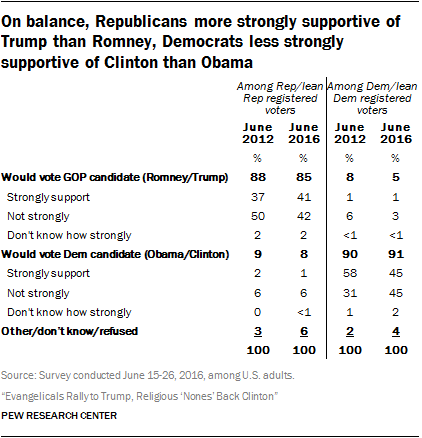
Evangelical voters are rallying strongly in favor of Republican presidential candidate Donald Trump. Indeed, the latest Pew Research Center survey finds that despite the professed wariness toward Trump among many high-profile evangelical Christian leaders, evangelicals as a whole are, if anything, even more strongly supportive of Trump than they were of Mitt Romney at a similar point in the 2012 campaign. At that time, nearly three-quarters of white evangelical Protestant registered voters said they planned to vote for Romney, including one-quarter who “strongly” supported him.1 Now, fully 78% of white evangelical voters say they would vote for Trump if the election were held today, including about a third who “strongly” back his campaign.

Meanwhile, religiously unaffiliated voters – those who describe their religion as “atheist,” “agnostic” or “nothing in particular” – are lining up behind Hillary Clinton over Trump, much as they supported Barack Obama over Romney in 2012. Two-thirds of religiously unaffiliated registered voters say they would vote for Clinton if the election were held today, just as two-thirds intended to vote for Obama at a similar point in the 2012 campaign.2 Religious “nones” are, however, somewhat less enthusiastic about Clinton’s candidacy (26% now strongly support her) than they were about Obama in June 2012 (37%).
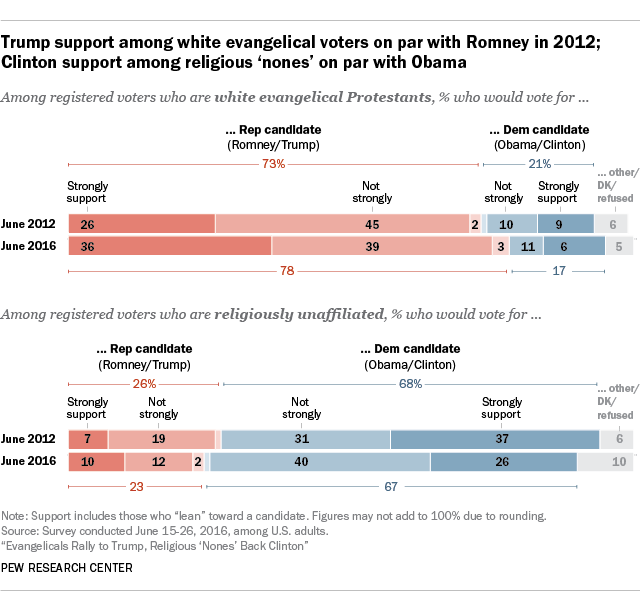
Trump support among white evangelical voters on par with Romney in 2012; Clinton support among religious 'nones' on par with Obama

Considering both groups are quite large, the votes of white evangelical Protestants and religious “nones” could be important to the outcome of the 2016 election. White evangelical Protestants make up one-fifth of all registered voters in the U.S. and roughly one-third of all voters who say they identify with or lean toward the Republican Party. Religious “nones,” who have been growing rapidly as a share of the U.S. population, now constitute one-fifth of all registered voters and more than a quarter of Democratic and Democratic-leaning registered voters.3
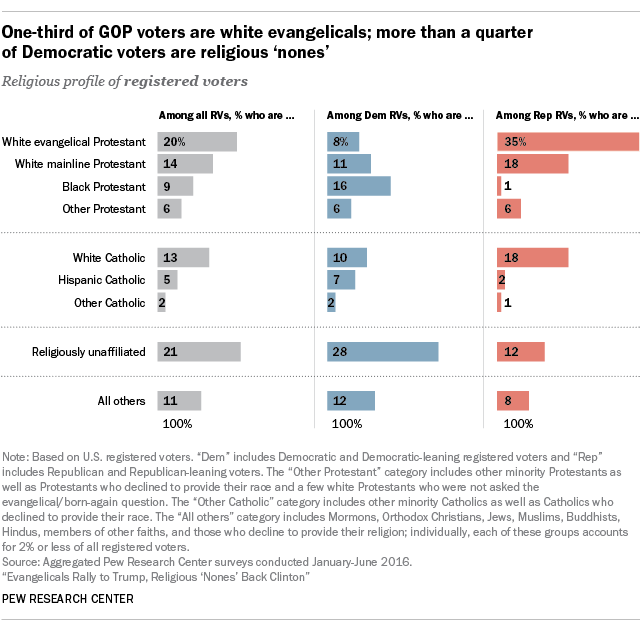
One-third of GOP voters are white evangelicals; more than a quarter of Democratic voters are religious 'nones'

Both groups, furthermore, have leaned firmly toward one side or the other in recent elections. Nearly eight-in-ten white evangelical voters ultimately cast ballots for Romney over Obama in 2012, according to exit polls, despite some questions about whether Romney’s Mormon identity would raise concerns among evangelicals. Seven-in-ten religious “nones” voted for Obama.

During the current campaign, however, there has been ample reason to wonder whether white evangelicals’ strong support for Republicans and the affinity for Democrats among religious “nones” might waver. Many evangelical leaders, for instance, have suggested that supporting Trump for president is incompatible with evangelical principles and beliefs (though some have since reconsidered and are now supporting Trump). And in the current survey, 55% of white evangelical voters say they are dissatisfied with the choice of presidential candidates.
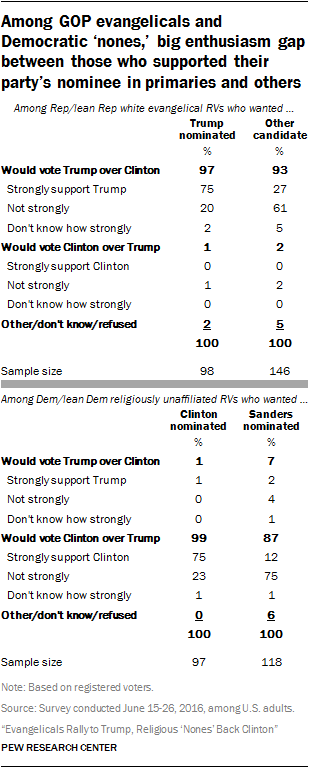
Among GOP evangelicals and Democratic ‘nones,’ big enthusiasm gap between those who supported their party’s nominee in primaries and others

The survey also confirms that white evangelical Republicans who supported someone other than Trump during the primaries are much less strongly supportive of him in the general election than are evangelical Republicans who wanted to see Trump get their party’s nomination. But big majorities of both groups – including 93% of Republican and Republican-leaning white evangelical Protestant voters who wanted someone other than Trump to get the GOP nomination – say that if they had to choose today, they would vote for Trump over Clinton.

On the Democratic side, religious “nones” were among the strongest supporters of Bernie Sanders during the primaries, and some observers have wondered whether Sanders’ supporters would support Clinton during the general election. But here again, even among religious “nones” who supported Sanders over Clinton, nearly nine-in-ten (87%) say they would prefer Clinton over Trump if they had to make that choice today.

While many evangelical voters say they “strongly” support Trump over Clinton, this does not necessarily mean Trump is their ideal choice for president or that they are convinced he shares their religious convictions. In the current survey, 42% of white evangelicals say it will be difficult to choose between Trump and Clinton because neither one would make a good president. And a January Pew Research Center poll found that 44% of white evangelical Republicans view Trump as “not too” or “not at all” religious.

But even if many evangelicals do not think he shares their religious commitment, most do think that Trump understands the needs of people like them. Indeed, fully six-in-ten white evangelical voters (61%) say they think Trump understands their needs “very” or “fairly” well, while just 24% say this about Clinton.

Evangelicals also overwhelmingly prefer Trump to Clinton when it comes to handling a wide variety of specific issues, from gun policy to the economy, terrorism, immigration and abortion.
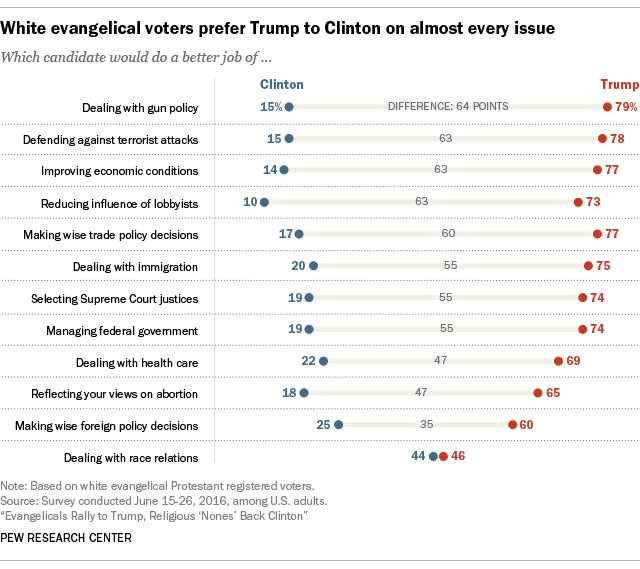
White evangelical voters prefer Trump to Clinton on almost every issue

At the same time, the survey also shows that evangelicals’ support for Trump is driven at least as much by opposition to Clinton as it is by confidence in Trump. Indeed, white evangelicals who say they would choose Trump mainly as a vote against Clinton outnumber those who say their choice is mainly one for Trump by a 45% to 30% margin.

This is not the first time evangelicals have rallied to a Republican candidate’s side mainly as a matter of opposition to the Democratic candidate rather than as a vote of confidence for the GOP nominee. In June 2012, for instance, 44% of white evangelical voters said they would vote for Romney mainly as a vote against Obama, while just 23% said they would support the GOP candidate mainly as a vote for Romney.
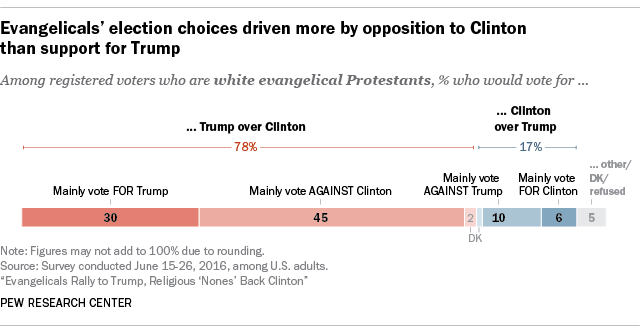
Evangelicals' election choices driven more by opposition to Clinton than support for Trump
On balance, Republicans more strongly supportive of Trump than Romney, Democrats less strongly supportive of Clinton than Obama

The strong support for Trump seen among white evangelical voters and the weaker support (relative to 2012) for Clinton among religious “nones” reflect broader trends among Republicans and Democrats. On balance, Republican voters as a whole support Trump somewhat more strongly than they did Romney at a similar point in the 2012 campaign, while Democrats’ support for Clinton is more lukewarm than it was for Obama in 2012. Despite these shifts, however, among registered voters overall, the survey finds that in a two-way contest between Clinton and Trump, Clinton leads by a 51% to 42% margin.

The survey also shows that large numbers of both Clinton and Trump supporters view their choice as more of a vote against the opposition candidate rather than an expression of support for their candidate. Furthermore, overall satisfaction with the choice of candidates is at its lowest point since 1992, with roughly four-in-ten voters (41%) saying the choice between Clinton and Trump is a tough one because neither would make a good president.

The latest survey by the Pew Research Center was conducted on cellphones and landlines from June 15-26 among 2,245 adults, including 1,655 registered voters. The survey’s overall findings about the state of the 2016 presidential race were previously released in the Pew Research Center’s July 7 report “2016 Campaign: Strong Interest, Widespread Dissatisfaction.” This new report provides a detailed look at the religious dynamics of the 2016 campaign, and it also includes new data on views about religion’s role in American public life.

Like religious ‘nones,’ black Protestants strongly favor Clinton

With 1,655 interviews among registered voters, the new survey makes it possible to examine the current political preferences of members of the nation’s largest religious groups.4

It shows that like religious “nones,” black Protestants are firmly in Clinton’s corner. Catholics also lean toward Clinton, though they are sharply divided along racial and ethnic lines; Hispanic Catholics overwhelmingly favor Clinton over Trump, while white Catholics are evenly divided between those who prefer Trump and those who favor Clinton. Half of white mainline Protestants prefer Trump (50%), while about four-in-ten (39%) favor Clinton.

Support for Clinton among black Protestants and Hispanic Catholics mirror the preference for the Democratic candidate among blacks and Hispanics overall.

The survey also shows that a declining share of Americans say they want a president with firm religious convictions. Today, just 62% of U.S. adults say it is important to them that the president have strong religious beliefs, down from 67% in 2012 and 72% in 2008. This change may partly reflect a coming to terms on the part of Republicans who have nominated a presidential candidate who is widely viewed as not particularly religious. Indeed, the share of Republicans who say it is important to have a president who has strong religious beliefs has ticked down 4 percentage points since the 2012 campaign.

But this decline among Republicans predates the nomination of Trump, having dropped 8 percentage points since 2008. And it mirrors changes among Democrats as well; while a larger share of Republicans (74%) than Democrats (53%) say it is important that a president have strong religious beliefs, declining shares of both groups hold this view.
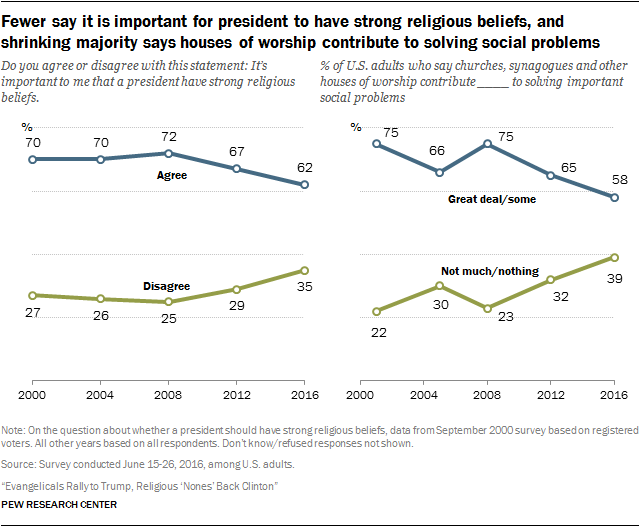
Fewer say it is important for president to have strong religious beliefs, and shrinking majority says houses of worship contribute to solving social problems

This shift also reflects changes in the religious composition of the country. Compared with those who identify with a religion, the religiously unaffiliated segment of the population is both less desirous of a pious president and growing very rapidly. The growth of the religious “nones” also has contributed to a decline in the share of Americans who say they think churches and other houses of worship contribute significantly to solving important social problems.

Far fewer “nones” (38%) than Protestants (65%) or Catholics (63%) say churches and other houses of worship contribute “a great deal” or “some” to solving important social problems. Nonetheless, all of these groups have seen declines in the shares who hold this view in recent years.

Other key findings from the survey include:

  • Similar levels of support for Trump among both evangelicals who attend church regularly and those who do not

    White evangelical Protestants who say they attend religious services regularly are just as strongly supportive of Donald Trump as are evangelicals who attend religious services less often. Fully three-quarters of both groups say they would vote for Trump over Clinton if the election were today, and roughly a third in each group describe themselves as strong Trump supporters.

  • Across a variety of religious groups, fewer people say they are satisfied with this year’s presidential candidates as compared with 2012. Interest in and engagement with the campaign, however, is up among many religious groups, with increased shares saying it “really matters” who wins the election and that they have been following news about the candidates. The growing dissatisfaction with the candidates and increased interest in the campaign among most major religious groups reflect trends observed among the public as a whole.
  • About half of white evangelical Protestant voters (52%) say the issue of abortion will be “very important” in deciding who to vote for in the 2016 election, as do 46% of Catholics. By contrast, 37% of religious “nones” and 31% of white mainline Protestants say abortion will factor prominently in their voting decision. But even among white evangelicals and Catholics, more consider issues like the economy, terrorism, foreign policy and immigration to be very important than say the same about abortion.
  • About as many religious “nones” say they would support Clinton mainly as a choice for her (30%) as say they would choose Clinton mainly as a matter of opposition to Trump (36%). In 2012, by contrast, religious “nones” saw their votes much more as reflections of support for Obama (50%) than as opposition to Romney (13%).
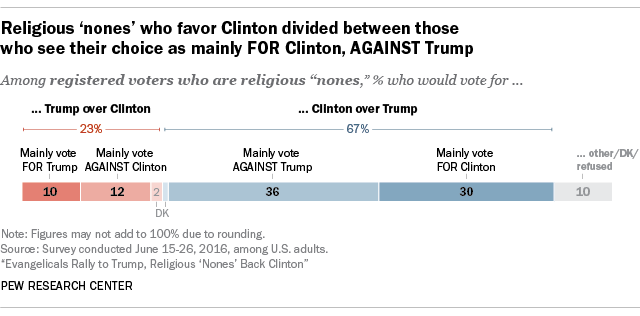
Religious 'nones' who favor Clinton divided between those who see their choice as mainly FOR Clinton, AGAINST Trump
  • The public is divided over whether churches and other houses of worship should express their views on day-to-day social and political questions (47%) or keep out of political matters (49%). But there is a strong consensus that church endorsements of political candidates is crossing the line. Fully two-thirds of Americans say churches and other houses of worship should not come out in favor of one candidate over another during political elections, while 29% say churches should get directly involved in electoral politics in this way. Views on both of these questions have changed little in recent years.
  • Nearly half of white evangelical Protestants (46%) say it has recently become more difficult to be an evangelical Christian in American society. And white evangelicals who say it has become harder to be an evangelical in the U.S. are somewhat more supportive of Trump than are evangelicals who do not think they have it tougher today than in the recent past (84% vs. 72%).
  • Compared with evangelicals, fewer Catholics and religious “nones” say things have gotten tougher for them in recent years. About one-in-five Catholics (18%) say it has become more difficult to be a Catholic in the U.S., which is unchanged since 2014. And 7% of religious “nones” say it has gotten harder to be a person with no religion, also little changed in recent years.


1. Religion and the 2016 campaign

Religious contours of 2016 campaign mostly match 2012

Religious contours of 2016 campaign mostly match 2012

For the most part, the voting intentions of people in major religious groups closely resemble those seen in polling conducted at a similar point in the 2012 campaign. Roughly eight-in-ten white evangelical Protestant voters (78%) say they would support Trump if the election were held today, just as 73% indicated they would vote for Romney in June 2012. And Trump enjoys about the same level of support among white mainline Protestant voters as Romney did four years ago.

At the other end of the spectrum, roughly nine-in-ten black Protestants who are registered to vote say they would vote for Clinton if the election were held today (89%), as would two-thirds of those with no religious affiliation.

Currently, Clinton also holds a 17-point advantage among Catholic registered voters, driven largely by overwhelming support for Clinton among Latino Catholics. By contrast, at a similar point in the 2012 campaign, Catholics were closely divided between support for Obama (49%) and Romney (47%). Exit polls conducted on Election Day in 2012 found that Catholics ultimately split their votes between Obama (50%) and Romney (48%).

Romney had sizable edge among weekly churchgoers, who are more evenly divided in 2016

The survey finds a notable shift in the voting intentions of regular churchgoers. Currently, voters who say they attend religious services at least once a week are split almost evenly; 49% say they would vote for Trump and 45% say they would vote for Clinton. At a similar point in the 2012 campaign, Romney held a 15-point advantage among weekly churchgoers. And exit polls conducted on Election Day showed that Romney ultimately beat Obama by 20 points among voters who attend religious services weekly.

The shift in preferences among weekly churchgoers is driven largely by Catholics. Today, Clinton has a 19-point advantage among Catholic voters who say they attend Mass weekly, whereas Obama did not hold a lead at all among this group in June 2012.

White evangelicals who say they attend church at least weekly support Trump at about the same rate they supported Romney four years ago. (The survey included too few interviews with members of other religious groups to subdivide them by frequency of religious attendance.)

Clinton currently holds a 16-point edge among voters who say they attend religious services less than once a week, which is identical to the lead Obama held among this group at a similar point in 2012. But within this category, white evangelical voters appear to have swung even more strongly toward the GOP candidate since 2012 (76% now support Trump vs. 62% who supported Romney). Among Catholics who attend Mass less than once a week, 56% support Clinton today; 51% supported Obama in June 2012.

While the voting intentions of most religious groups resemble those seen in the last presidential campaign, there are some notable differences in the level of enthusiasm religious groups express about the current crop of candidates. On the Republican side, white evangelical Protestant voters are, if anything, more strongly supportive of Trump than they were of Romney at a similar point in the 2012 campaign. Today, 36% of white evangelicals describe themselves as strong Trump supporters, whereas just 26% described themselves as strong Romney supporters in June 2012.

On the Democratic side, both black Protestants and religious “nones” are noticeably less enthusiastic about Clinton than they were about Obama in 2012. For instance, 55% of black Protestants describe themselves as strong Clinton supporters, compared with fully eight-in-ten (81%) who described themselves as strong Obama backers four years ago.

Evangelical voters more enthusiastic about Trump than they were about Romney; black Protestants and religious ‘nones’ less thrilled with Clinton than Obama

Across religious groups, many dissatisfied with candidates, but interest in campaign is up

Satisfaction with candidates down among nearly all religious groups

Across the board, members of nearly all major religious groups express less satisfaction with this year’s presidential candidates as compared with 2012. Fully two-thirds of religious “nones” say they are “not too” or “not at all” satisfied with the choice between Clinton and Trump, as do six-in-ten white mainline Protestants (61%) and white Catholics (59%). In 2012, by contrast, half or more of these groups said they were “very” or “fairly” satisfied with that year’s presidential candidates.

Voter discontent with the 2016 presidential candidates is also evident in the large share of Americans who see their choice mainly as a vote against their opponent rather than in support of their favored candidate. Overall, roughly half of registered voters say they are voting mainly against a candidate (26% choose Clinton mainly as a vote against Trump, 23% choose Trump mainly as a vote against Clinton). At a similar point in 2012, only about a third saw their choice mainly as a vote against the opposing candidate.

Voters motivated more by opposition to other party’s candidate than by support for own party’s nominee
Among most religious groups, engagement in campaign up sharply

Even as satisfaction with the choice of candidates has declined, engagement with the campaign has spiked significantly across many religious groups. Roughly three-quarters of all religious groups now say it “really matters” who wins the election, compared with about two-thirds or fewer who expressed this view in 2012. The share who say they have thought about the election “quite a lot” is up 10 points or more across many religious groups. And eight-in-ten or more in nearly every religious group say they have followed news about the candidates at least “fairly” closely; the only exception is Hispanic Catholics, among whom two-thirds say they have followed news about the candidates “very” or “fairly” closely.

Religious groups agree: Economy, terrorism are key election concerns

There is broad consensus across major religious groups about which issues are “very important” in deciding who to vote for in the presidential election (even if they may disagree about which candidate is best suited to handle these issues). There are, however, a few modest differences in the political priorities of the country’s major religious groups. White evangelical voters, for instance, are more likely than white mainline Protestants and religious “nones” to say that immigration or abortion will be “very important” in deciding who to vote for in this year’s presidential election. The environment is of more concern to Catholics and religiously unaffiliated voters than it is to white evangelicals. And the treatment of racial and ethnic minorities is a higher priority for religious “nones” than it is for other groups.5

Economy, terrorism top election concerns

2. Religion in public life

Declining share says it is important for president to have strong religious beliefs

Smaller majority says it is important that president have strong religious beliefs

The share of Americans who think it is important that a president have strong religious beliefs has been steadily declining over the past two election cycles and has reached a new low in Pew Research Center polling. In 2008, 72% said this was an important characteristic. That share dipped slightly in 2012 to 67%, and now 62% say that having strong religious beliefs is an important presidential trait. Meanwhile, the corresponding share of those who disagree that it is important for a president to have strong religious beliefs has been steadily growing and currently stands at 35%.

Both Republicans and Democrats now less likely to say it is important that president be religious

Republicans and those who lean toward the GOP remain more likely than Democrats and those who lean Democratic to say it is important for the president to have strong religious beliefs. But this view is waning among both groups. The data suggest, furthermore, that changing Republican views are not merely a response to their party’s selection of a candidate who is widely viewed as not particularly religious. Nearly half of Republicans and those who lean toward the GOP described Trump as “not too” or “not at all” religious in a January poll, but the share of Republicans who say the president should have strong religious beliefs had already begun to tick downward between 2008 and 2012.

Among religious groups, white evangelicals and black Protestants remain most committed to the idea that the president should have strong religious beliefs. At the other end of the spectrum, the growing segment of religious “nones” are, not surprisingly, least inclined to say they want a president who is strongly religious.

Fewer than half of young adults – those ages 18 to 29 – say they want a president who has strong religious beliefs, which is far less than the share of older adults who express this view. But they are not the only age group becoming less likely to desire a religious president over time. For example, in 2008, 72% of Americans ages 30-49 said it was important to have a religious president, compared with 60% among this age group today.

Fewer now say houses of worship key in solving social problems

Shrinking majority say churches, synagogues contribute to solving important social problems

While most U.S. adults continue to say that churches, synagogues and other houses of worship contribute “a great deal” (19%) or “some” (38%) to solving important social problems, the share expressing this view has declined sharply in recent years, from 65% in 2012 and 75% as recently as 2008.

The decline in the view that churches and other houses of worship contribute to solving social problems is broad-based. White evangelicals remain among the most convinced that churches help solve social problems and religious “nones” remain least convinced this is the case. But both groups – and all other major religious groups – are less inclined to express this view today than in the recent past. Similarly, the survey shows that regular churchgoers and infrequent attenders, young adults and their older counterparts, and Republicans and Democrats have all become less convinced over the years that houses of worship play a major role in solving key social problems.

Fewer Protestants and ‘nones’ say houses of worship contribute to solving social problems

Many want churches to express views on social/political matters, but most oppose explicit candidate endorsements

Nearly half say churches should express views on politics, but far fewer want candidate endorsements

Nearly half of U.S. adults (47%) say churches and other houses of worship should express their views on social and political matters. But just 29% say churches should come out in favor of one candidate over another during elections. Views on both of these questions have been relatively stable in recent years.

Most black Protestants, white evangelicals say churches should express views on social/political matters, but fewer want direct endorsement of candidates

Roughly two-thirds of white evangelicals and black Protestants say churches should express their views on social and political matters, but just one-third of religious “nones” agree.

There is also a significant gap between regular churchgoers and others on this question. Six-in-ten Americans who attend religious services at least weekly think houses of worship should express their views on social and political topics, but just four-in-ten of those who attend religious services less often express this view. The data also show that Republicans and those who lean toward the GOP are more likely than Democrats to favor churches speaking out about politics.

There is also variation among religious and political groups in attitudes about whether churches should explicitly endorse political candidates. But the balance of opinion in nearly all major religious groups and in both political parties leans in the same direction on this question – against church endorsements of candidates.

About four-in-ten evangelicals say it has become more difficult to be an evangelical Christian in recent years

Roughly four-in-ten Protestants who describe themselves as born-again or evangelical Christians say it has become more difficult in recent years to be an evangelical Christian in the U.S. (41%), up from a third (34%) who held this view in 2014. This perspective is more common among white evangelicals (46%) than among non-white evangelical Protestants (31%), though the share of non-white evangelicals who say it has gotten tougher to be an evangelical has ticked up 9 percentage points since 2014.

Increasing share of evangelicals say it is becoming harder to be evangelical Christian in the U.S.

Compared with evangelicals, far fewer Catholics (18%) and religious “nones” (7%) believe things have become more difficult for their own groups in U.S. society. Indeed, among religious “nones,” there are about four times as many people who say it has become easier to be a nonreligious person in the U.S. (29%) as there are who say it has become more difficult (7%).

‘Nones’ who say it has become easier to be nonreligious in U.S. outnumber those who say it has become harder
Roughly one-in-five U.S. adults think of themselves as a minority because of their religious beliefs

Overall, about one-in-five U.S. adults (19%) consider themselves to be a minority because of their religious beliefs, little changed from the 21% of Americans who said the same in 2014.

White evangelicals are more likely than most other major Christian groups to believe they are a minority because of their religious beliefs, with roughly a quarter (27%) expressing this view. Fewer black Protestants (18%), Catholics (16%) and mainline Protestants (10%) say the same. Hispanic Catholics are more likely than white Catholics to say this is the case (22% vs. 9%).

Only 13% of religious “nones” say they think of themselves as a minority based on their religious beliefs.

There were not enough interviews with Jews, Muslims, Buddhists, Hindus and members of other religious groups to analyze their responses separately.

Acknowledgments

This report is a collaborative effort based on the input and analysis of the following individuals:

Research Team

Gregory A. Smith, Associate Director of Research Alan Cooperman, Director of Religion Research Jessica Hamar Martínez, Senior Researcher Besheer Mohamed, Senior Researcher Becka A. Alper, Research Associate Elizabeth Podrebarac Sciupac, Research Associate Claire Gecewicz, Research Assistant          

Editorial and Graphic Design

Sandra Stencel, Associate Director of Editorial Michael Lipka, Senior Editor Aleksandra Sandstrom, Copy Editor Bill Webster, Information Graphics Designer

Communications and Web Publishing

Stacy Rosenberg, Digital Project Manager Travis Mitchell, Digital Producer Anna Schiller, Communications Manager Stefan S. Cornibert, Communications Associate

Methodology

The analysis in this report is based on telephone interviews conducted June 15-26, 2016, among a national sample of 2,245 adults, 18 years of age or older, living in all 50 U.S. states and the District of Columbia (559 respondents were interviewed on a landline telephone and 1,686 were interviewed on a cellphone, including 1,067 who had no landline telephone). The survey was conducted under the direction of Abt SRBI. Interviews were conducted in English and Spanish. For detailed information about our survey methodology, see https://alpha.pewresearch.org/pewresearch-org/methodology/u-s-survey-research/.

A combination of landline and cellphone random-digit dial samples were used; samples were provided by Survey Sampling International.

The first sample was a random-digit dial (RDD) landline sample; a total of 500 interviews were completed using this RDD landline sample. The second sample was a RDD cell sample; a total of 1,500 interviews were completed using this RDD cell sample. Respondents in the landline sample were selected by randomly asking for the youngest adult male or female who is now at home. Interviews in the cell sample were conducted with the person who answered the phone, if that person was an adult 18 years of age or older.

Additional samples from both the landline and cellular RDD frames were drawn to achieve an oversample of Hispanics. The selection of these oversamples was similar to the other RDD samples, with the exception that respondents were screened to determine if they were of Hispanic, Latino or Spanish origin; if not, then the interview was terminated. Hispanic respondents in the landline sample were selected by randomly asking for the youngest Hispanic adult male or female now at home. A total of 543 Hispanic respondents were interviewed, 245 in the oversample (59 were interviewed on a landline telephone, and 186 were interviewed on a cellphone), and 298 in the main RDD sample (45 were interviewed on a landline telephone and 253 were interviewed on a cellphone).

The combined landline and cellphone samples are weighted using an iterative technique that matches gender, age, education, race, Hispanic origin and nativity and region to parameters from the 2014 Census Bureau’s American Community Survey and population density to parameters from the Decennial Census. The weighting procedure accounts for the additional interviews with Hispanic respondents. The sample also is weighted to match current patterns of telephone status (landline only, cellphone only, or both landline and cellphone), based on extrapolations from the 2015 National Health Interview Survey. The weighting procedure also accounts for the fact that respondents with both landline and cellphones have a greater probability of being included in the combined sample and adjusts for household size among respondents interviewed on a landline phone (Hispanic household size among the Hispanic oversample landline respondents). The margins of error reported and statistical tests of significance are adjusted to account for the survey’s design effect, a measure of how much efficiency is lost from the weighting procedures.

The following table shows the unweighted sample sizes and the error attributable to sampling that would be expected at the 95% level of confidence for different groups in the survey:

PF_2016.07.13_religionpolitics meth

Sample sizes and sampling errors for other subgroups are available upon request.

In addition to sampling error, one should bear in mind that question wording and practical difficulties in conducting surveys can introduce error or bias into the findings of opinion polls.

Pew Research Center undertakes all polling activity, including calls to mobile telephone numbers, in compliance with the Telephone Consumer Protection Act and other applicable laws.

Pew Research Center is a nonprofit, tax-exempt 501(c)(3) organization and a subsidiary of The Pew Charitable Trusts, its primary funder.