Pew Research Center

FOR RELEASE MARCH 8, 2016

Israel’s Religiously Divided Society

Deep gulfs among Jews, as well as between Jews and Arabs, over political values and religion’s role in public life

FOR MEDIA OR OTHER INQUIRIES:

Communications Department
202.419.4372
www.pewresearch.org

RECOMMENDED CITATION

Pew Research Center, March 2016, "Israel’s Religiously Divided Society"

About Pew Research Center

Pew Research Center is a nonpartisan, nonadvocacy fact tank that informs the public about the issues, attitudes and trends shaping the world. It does not take policy positions. The Center conducts public opinion polling, demographic research, computational social science research and other data-driven research. It studies politics and policy; news habits and media; the internet and technology; religion; race and ethnicity; international affairs; social, demographic and economic trends; science; research methodology and data science; and immigration and migration. Pew Research Center is a subsidiary of The Pew Charitable Trusts, its primary funder.

© Pew Research Center 2026

Table of contents

  • About Pew Research Center
  • Israel’s Religiously Divided Society
  • 1. Comparisons between Jews in Israel and the U.S.
  • 2. Religious affiliation and conversion
  • 3. Identity
  • 4. Religious commitment
  • 5. Jewish beliefs and practices
  • 6. Muslim and Christian beliefs and practices
  • 7. Education, values and science
  • 8. Views of the Jewish state and the diaspora
  • 9. The peace process, settlements and U.S. support
  • 10. Religion, politics and public life
  • 11. Intergroup marriage and friendship
  • 12. Anti-Semitism and discrimination
  • Acknowledgments
  • Methodology

Israel’s Religiously Divided Society

Deep gulfs among Jews, as well as between Jews and Arabs, over political values and religion’s role in public life

keysArabicHebrewCS6_arabic
keysArabicHebrewCS6_hebrew
Israel's diverse religious landscape

Nearly 70 years after the establishment of the modern State of Israel, its Jewish population remains united behind the idea that Israel is a homeland for the Jewish people and a necessary refuge from rising anti-Semitism around the globe. But alongside these sources of unity, a major new survey by Pew Research Center also finds deep divisions in Israeli society – not only between Israeli Jews and the country’s Arab minority, but also among the religious subgroups that make up Israeli Jewry.

Nearly all Israeli Jews identify with one of four categories: Haredi (commonly translated as “ultra-Orthodox”), Dati (“religious”), Masorti (“traditional”) or Hiloni (“secular”).

Although they live in the same small country and share many traditions, highly religious and secular Jews inhabit largely separate social worlds, with relatively few close friends and little intermarriage outside their own groups. In fact, the survey finds that secular Jews in Israel are more uncomfortable with the notion that a child of theirs might someday marry an ultra-Orthodox Jew than they are with the prospect of their child marrying a Christian. (See Chapter 11 for more information.)

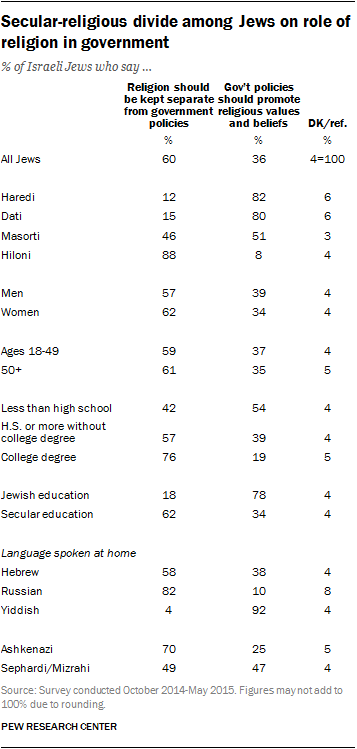
Moreover, these divisions are reflected in starkly contrasting positions on many public policy questions, including marriage, divorce, religious conversion, military conscription, gender segregation and public transportation. Overwhelmingly, Haredi and Dati Jews (both generally considered Orthodox) express the view that Israel’s government should promote religious beliefs and values, while secular Jews strongly favor separation of religion from government policy.

Israeli Jews see democracy as compatible with Jewish state but are divided on whether democratic princes or religious law should take priority

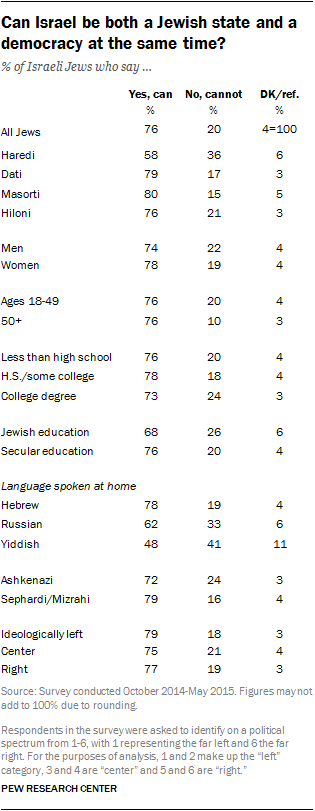
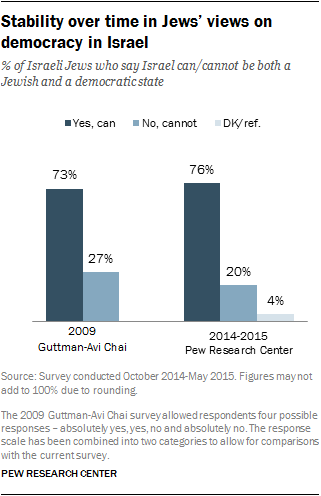
Most Jews across the religious spectrum agree in principle that Israel can be both a democracy and a Jewish state. But they are at odds about what should happen, in practice, if democratic decision-making collides with Jewish law (halakha). The vast majority of secular Jews say democratic principles should take precedence over religious law, while a similarly large share of ultra-Orthodox Jews say religious law should take priority.

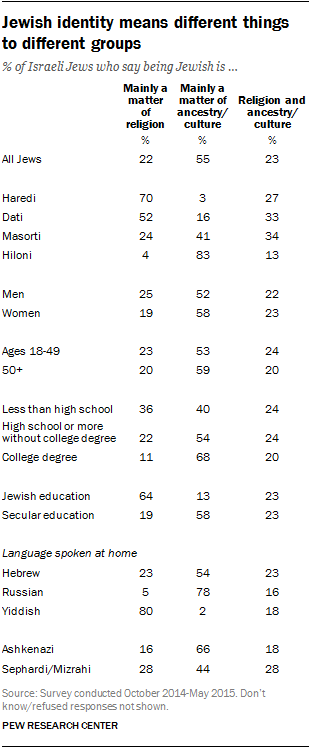
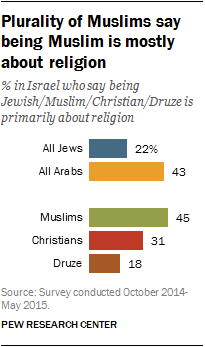
Even more fundamentally, these groups disagree on what Jewish identity is mainly about: Most of the ultra-Orthodox say “being Jewish” is mainly a matter of religion, while secular Jews tend to say it is mainly a matter of ancestry and/or culture.

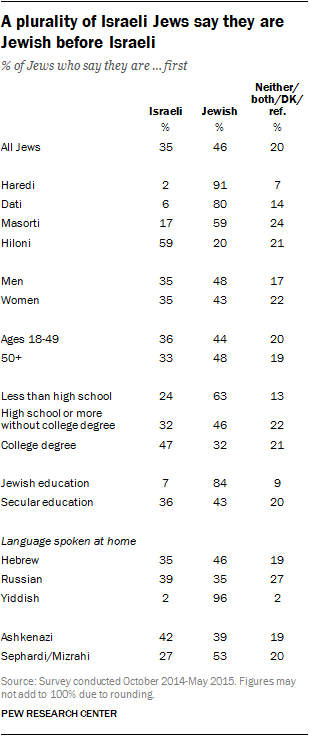
To be sure, Jewish identity in Israel is complex, spanning notions of religion, ethnicity, nationality and family. When asked, “What is your present religion, if any?” virtually all Israeli Jews say they are Jewish – and almost none say they have no religion – even though roughly half describe themselves as secular and one-in-five do not believe in God. For some, Jewish identity also is bound up with Israeli national pride. Most secular Jews in Israel say they see themselves as Israeli first and Jewish second, while most Orthodox Jews (Haredim and Datiim) say they see themselves as Jewish first and then Israeli.

The survey also looks at differences among Israeli Jews based on age, gender, education, ethnicity (Ashkenazi or Sephardi/Mizrahi) and other demographic factors. For example, Sephardim/Mizrahim are generally more religiously observant than Ashkenazim, and men are somewhat more likely than women to say halakha should take precedence over democratic principles. But in many respects, these demographic differences are dwarfed by the major gulfs seen among the four religious subgroups that make up Israeli Jewry.


Self-categorization of Jews in Israel

Nearly all Israeli Jews interviewed in this survey self-identify as Haredi, Dati, Masorti or Hiloni. Here’s a brief description of what the survey shows about these categories.

Haredi (9% of Jews, 8% of all Israeli adults)
Though often translated as “ultra-Orthodox,” the Hebrew word Haredi literally means trembling or fearing God. The survey shows that Jews who describe themselves as Haredim are generally highly observant of Jewish religious law (halakha), and they express a strong preference for a state in which religious law would take precedence over democratic principles.

Dati (13% of Jews, 10% of all Israeli adults)
Literally meaning religious, Dati is sometimes translated as “modern Orthodox.” The survey finds that most Datiim are traditionally observant (keeping kosher and observing the Sabbath, for example). But they are more integrated into Israel’s overall society than Haredim, and Dati men are much more likely than Haredi men to have served in the Israeli military.

Masorti (29% of Jews, 23% of all Israeli adults)
Translated as “traditional,” Masortim occupy a broad middle ground between Orthodoxy and secularism, and they report widely varying levels of observance. In terms of their religious beliefs and practices, Masortim are the most diverse of these four self-defined types of Jews.

Hiloni (49% of Jews, 40% of all Israeli adults)
Though nominally “secular,” many Hilonim observe some religious traditions, such as keeping kosher and fasting on Yom Kippur. But they generally oppose the Orthodox rabbinate’s control over marriage and divorce, and they say democratic principles should take precedence over religious law.

While most Israelis are Jewish, a growing share (currently about one-in-five adults) belong to other groups. Most non-Jewish residents of Israel are ethnically Arab and identify, religiously, as Muslims, Christians or Druze.1

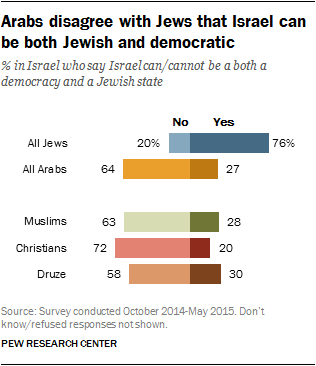
Most Arabs say Israel cannot be both a democracy and Jewish state

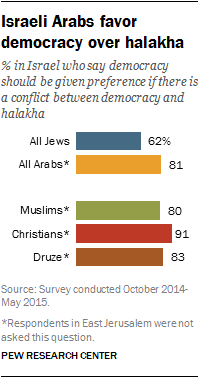
The survey shows that Israeli Arabs generally do not think Israel can be a Jewish state and a democracy at the same time. This view is expressed by majorities of Muslims, Christians and Druze. And overwhelmingly, all three of these groups say that if there is a conflict between Jewish law and democracy, democracy should take precedence.

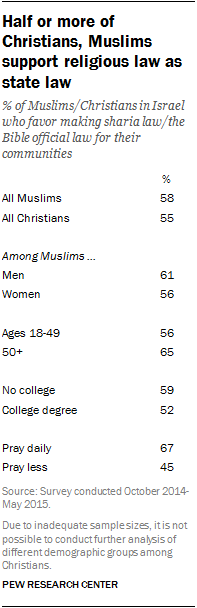
But this does not mean most Arabs in Israel are committed secularists. In fact, many Muslims and Christians support the application of their own religious law to their communities. Fully 58% of Muslims favor enshrining sharia as official law for Muslims in Israel, and 55% of Christians favor making the Bible the law of the land for Christians.

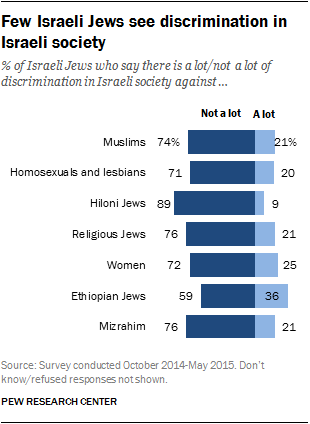
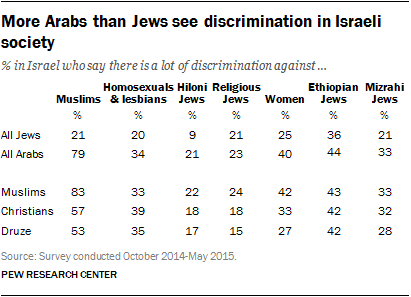
Roughly eight-in-ten Israeli Arabs (79%) say there is a lot of discrimination in Israeli society against Muslims, who are by far the biggest of the religious minorities. On this issue, Jews take the opposite view; the vast majority (74%) say they do not see much discrimination against Muslims in Israel.

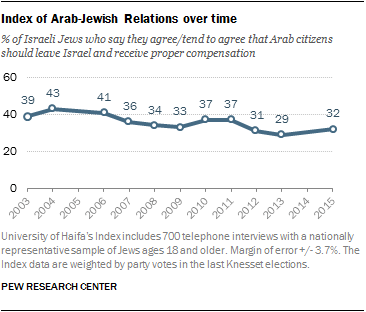
At the same time, Jewish public opinion is divided on whether Israel can serve as a homeland for Jews while also accommodating the country’s Arab minority. Nearly half of Israeli Jews say Arabs should be expelled or transferred from Israel, including roughly one-in-five Jewish adults who strongly agree with this position.

Mutual doubts about sincerity of leaders in the peace process

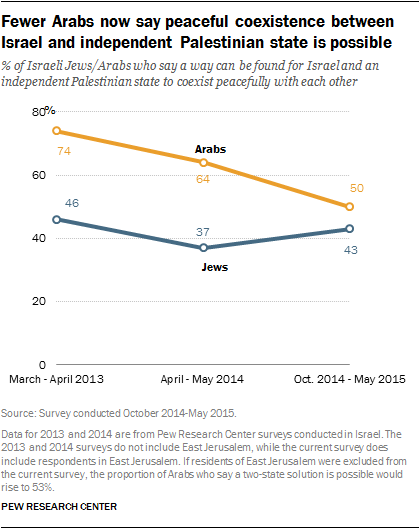
The divisions between Jews and Arabs are also reflected in their views on the peace process. In recent years, Arabs in Israel have become increasingly doubtful that a way can be found for Israel and an independent Palestinian state to coexist peacefully. As recently as 2013, roughly three-quarters of Israeli Arabs (74%) said a peaceful two-state solution was possible. As of early 2015, 50% say such an outcome is possible.

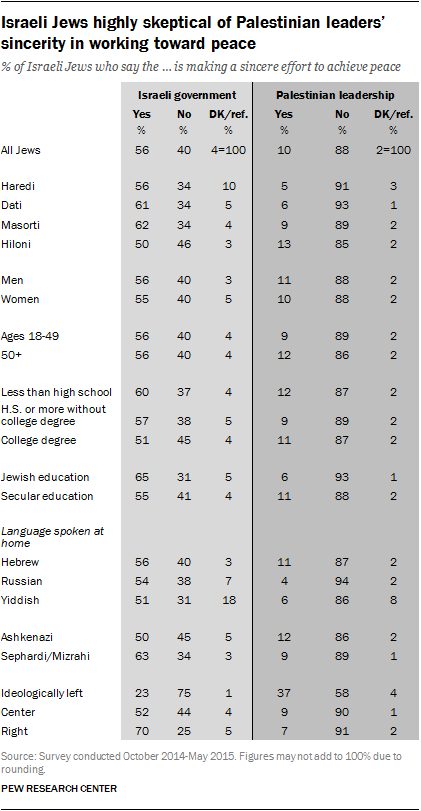
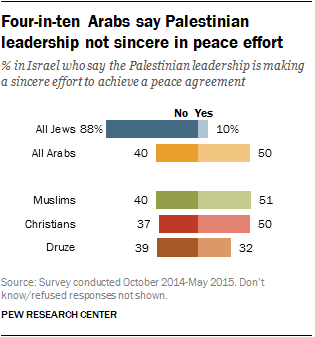
Israeli Arabs are highly skeptical about the sincerity of the Israeli government in seeking a peace agreement, while Israeli Jews are equally skeptical about the sincerity of Palestinian leaders. But there is plenty of distrust to go around: Fully 40% of Israeli Jews say their own government is not making a sincere effort toward peace, and an equal share of Israeli Arabs say the same about Palestinian leaders.

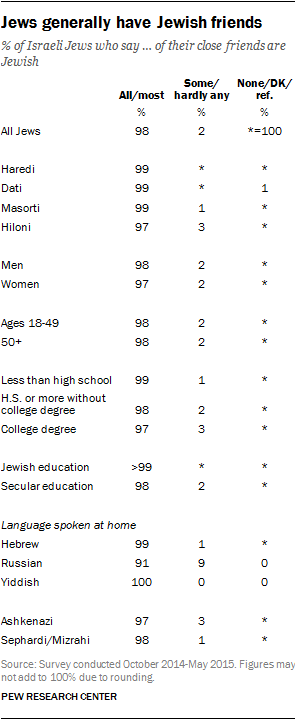
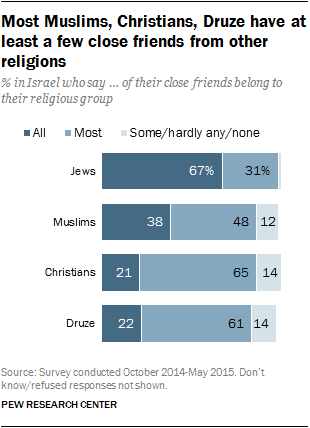
Israel’s major religious groups also are isolated from one another socially. The vast majority of Jews (98%), Muslims (85%), Christians (86%) and Druze (83%) say all or most of their close friends belong to their own religious community.

Jews are more likely than Arabs to say all their friends belong to their religious group. To some extent, this may reflect the fact that the majority of Israel’s population is Jewish. Two-thirds of Israeli Jews (67%) say all of their friends are Jewish. By comparison, 38% of Muslims, 21% of Christians and 22% of Druze say all their friends share their religion.

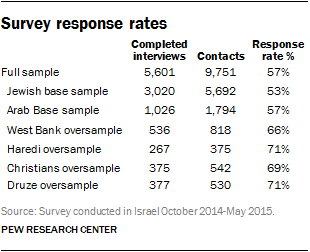
These are some of the key findings of Pew Research Center’s comprehensive survey of religion in Israel, which was conducted through face-to-face interviews in Hebrew, Arabic and Russian among 5,601 Israeli adults (ages 18 and older) from October 2014 through May 2015. The survey uses the Israeli Central Bureau of Statistics’ definition of the Israeli population, which includes Jews living in the West Bank as well as Arab residents of East Jerusalem. See survey methodology for more details.


Who is included in the survey?

The survey includes interviews with citizens and residents living within the boundaries of Israel, as defined in the 2008 census conducted by Israel’s Central Bureau of Statistics. Jews were surveyed in all six census districts (Jerusalem, North, Haifa, Center, Tel Aviv and South) and in the West Bank.

Jewish residents of all areas categorized as “Judea and Samaria” (West Bank) by the Central Bureau of Statistics were eligible to be included in the sample. Some examples of West Bank communities where interviews were conducted include Beit Arye, Elkana, Ma’ale Adumim and Giv’at Ze’ev.

All Arab citizens of Israel were eligible to be included in the sample. In addition, the survey includes interviews with Arab residents of East Jerusalem.

Arab residents of Gaza and the West Bank outside of East Jerusalem were not included in the survey. The Palestinian population has been previously surveyed by the Pew Research Center as recently as 2015.

For additional details about the sample, including a map of the areas covered, see survey methodology.

The survey includes oversamples (i.e., additional interviews, over and above the number that would occur in a purely random sample) of five groups – Christians, Druze, Haredi Jews, Arabs living in East Jerusalem and Israeli settlers in the West Bank – in order to be able to analyze the views of people in these relatively small groups. However, the oversamples are statistically adjusted in the survey’s final results so that Christians, Druze, Haredim, Arabs in East Jerusalem and Israeli settlers are represented in proportion to their actual share of the Israeli adult population.

The survey probes Israelis’ religious identification, beliefs and practices; views on democracy and religion’s role in public life; moral values and life goals; perceptions about discrimination; views on intermarriage; and attitudes toward politics and the peace process.

Using data from Pew Research Center’s 2013 study “A Portrait of Jewish Americans,” the report also makes comparisons between Jews in Israel and Jews in the United States. There are deep connections between the world’s two largest Jewish populations, but also some key differences. For instance, Israeli Jews overall are more religiously observant than U.S. Jews. Politically, American Jews are more optimistic about the possibility of a peaceful two-state solution and more negative about Jewish settlements in the West Bank than are Israeli Jews. U.S.-Israeli comparisons are discussed in detail in Chapter 1.


How religious groups are defined

The 2015 Pew Research Center survey of Israel includes interviews with 3,789 Jews, 871 Muslims, 468 Christians and 439 Druze. An additional 34 respondents belong to other religions or are religiously unaffiliated.

Respondents are analyzed as part of these religious groups based on their response to the following question: “What is your present religion, if any? Are you Jewish, Muslim, Christian, Druze, another religion or no religion?”

All respondents classified as Muslims, Christians and Druze in this study identified themselves as such in response to the religious identity question. The vast majority of Jews (3,725) also said they are Jewish when asked about their religion. In addition, 64 respondents who identified as having “no religion” said, in response to a subsequent question, that they consider themselves Jewish aside from religion and had a Jewish upbringing (they were either raised Jewish in some way or had at least one Jewish parent). These respondents, who make up roughly 2% of the total Jewish sample, are classified as Jewish in this survey.

This approach parallels the methods used to define Jews in Pew Research Center’s 2013 survey of U.S. Jews, which included interviews with 3,475 Jewish respondents. But unlike in Israel, where the vast majority of Jews identified as Jewish by religion, in the U.S. survey roughly one-in-five Jews said they have no religion but that they consider themselves Jewish aside from religion and had a Jewish parent or upbringing.

Together, the current study and the previously published survey of Jewish Americans provide an in-depth look at the religious beliefs, values, and social and political views of an estimated 80% of the world’s Jewish population. These studies, funded by The Pew Charitable Trusts and the Neubauer Family Foundation, are part of a larger effort by Pew Research Center to understand religious change and its impact on societies around the world.

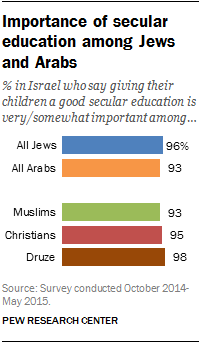
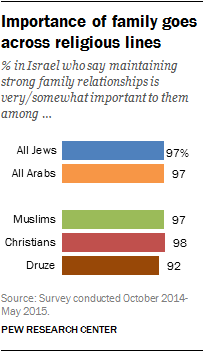
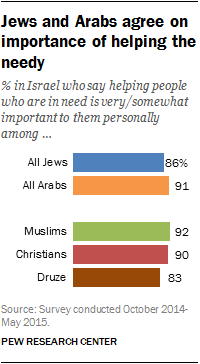
The rest of this Overview explores some sources of both unity and division in Israeli society, as revealed by the survey. While the major subgroups of Israeli Jews are united in their support of Israel as a Jewish homeland, they are deeply at odds over the role that religion should play in their country’s public life. And although Jews, Muslims, Christians and Druze in Israel share many life goals – placing great emphasis on maintaining strong families and obtaining a good education for their children, for example – they live religiously balkanized lives.

Israeli Jews united on need for Jewish homeland

Nearly unanimous share agree all Jews should have the right to citizenship in Israel

Israel is no longer a predominantly immigrant society; at present, roughly three-quarters of Israeli adults are natives, and just one-quarter were born abroad. Yet with virtual unanimity, Israeli Jews of every kind – native-born and immigrant, young and old, secular and highly religious – agree that all Jews everywhere should have the right to make “aliyah,” or move to Israel and receive immediate citizenship.2

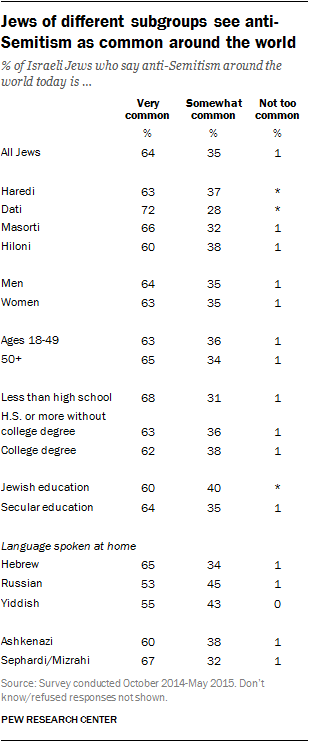
This overwhelming support for Jewish immigration may be linked, in part, to perceptions about anti-Semitism. Fully three-quarters of Israeli Jews (76%) think that anti-Semitism is both common and increasing around the world, and roughly nine-in-ten (91%) say that a Jewish state is necessary for the long-term survival of the Jewish people.

Most Jews say Israel necessary for long-term survival of the Jewish people

Most Israeli Jews (79%) say Jews deserve preferential treatment in Israel. But they do not see an inherent contradiction between a Jewish homeland and a functioning democracy. Asked whether Israel can be both a Jewish state and a democratic one, majorities of all four Jewish subgroups say “yes.” However, Haredim are less certain than other Israeli Jews that democracy is compatible with Jewish statehood. While a slim majority of Haredim surveyed (58%) say Israel can be both a Jewish state and a democracy, about one-third (36%) say it cannot.

This may be because many Haredim believe that religious law (halakha) should trump democratic decision-making. To test this, the survey posed a hypothetical question: “And if there is a contradiction between halakha and democratic principles, should the State of Israel give preference to democratic principles or halakha?” In such a situation, 89% of Haredim say halakha should be given preference, and only 3% of Haredi respondents would defer to democratic ideals. By contrast, among Hilonim, an equally lopsided share (89%) say the state should give preference to democratic principles; just 1% of secular Jewish respondents would yield to halakha.

Most Jews say Israel should give preferential treatment to Jews

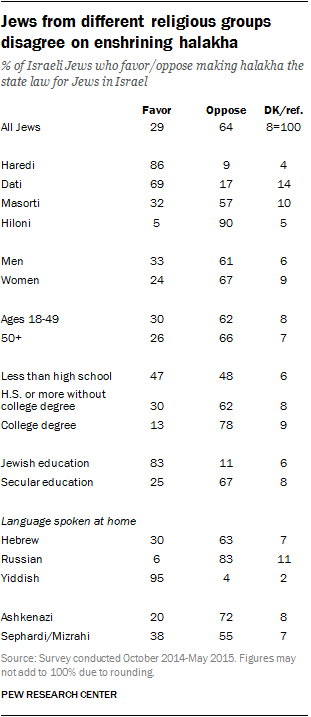
When asked whether halakha should be made the official law of the land for Jews in Israel, majorities of Haredim (86%) and Datiim (69%) say they would favor this change. By contrast, most Masortim (57%) and an overwhelming majority of Hilonim (90%) oppose making halakha the law of the land for Jews in Israel.

The disagreements over what it means to live in a Jewish state are not merely hypothetical. The survey asks about numerous concrete policy issues in Israel – including marriage, divorce, conversion, military conscription, transportation, public prayer and gender segregation – and finds deep divides.

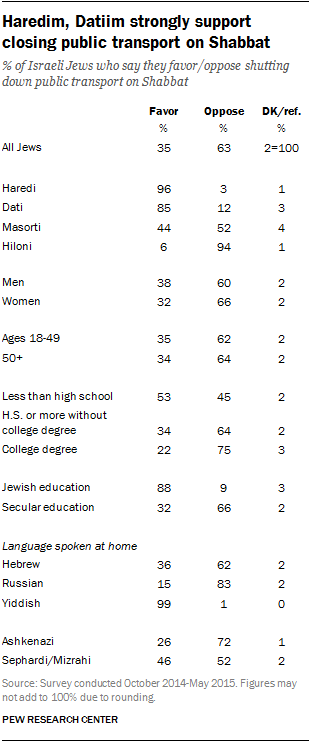
For example, the vast majority of Haredim and Datiim say public transportation should be shut down throughout the entire country on the Jewish Sabbath, while the vast majority of Hilonim (94%) oppose shutting down all public transport in observance of the Sabbath. Masortim are more evenly divided between those who favor shutting down public transport across the entire country on the Sabbath (44%) and those who want to keep buses, trains or other public transportation running in at least some areas (52%).

Large divide among Jews on whether halakha should be state law

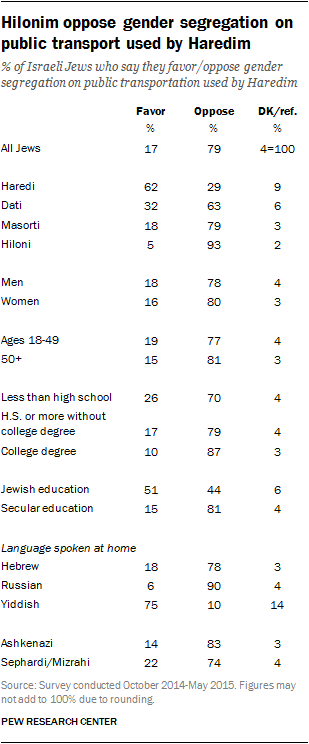
The public intermingling of men and women is another point of disagreement. A solid majority of Haredim (62%) favor gender segregation on public transportation, such as buses and trains, used by members of the Haredi community. Among Hilonim, meanwhile, just 5% favor this policy. The vast majority of Hilonim (93%) are opposed to enforcing gender segregation on any public transport, even when it is used by Haredim.

There is also debate on issues concerning family law. Israel does not allow civil marriage, and Jewish marriages conducted in Israel must be sanctioned by Orthodox rabbis. (For more details on marriage and divorce in Israel, see Chapter 11.) Haredim strongly oppose allowing non-Orthodox rabbis to conduct marriages in Israel, while a majority of Hilonim favor changing the current law to allow Reform and Conservative rabbis to conduct weddings.

Jewish groups disagree on key public policy issues

Israeli Jews divided on the status of Arabs

Majorities of Haredim, Datim agree Arabs should be expelled

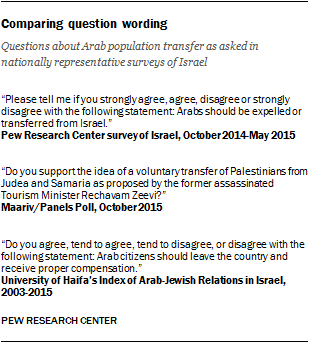
Israeli Jews are divided on the question of whether Arabs should be allowed to live in the Jewish state. The survey asked Jews whether they strongly agree, agree, disagree or strongly disagree with the statement that “Arabs should be expelled or transferred from Israel.” Roughly half of Israeli Jews strongly agree (21%) or agree (27%), while a similar share disagree (29%) or strongly disagree (17%).3

Datiim are especially likely to favor the expulsion of Arabs. Roughly seven-in-ten (71%) say Arabs should be transferred.

Hilonim lean in the other direction: Most (58%) disagree and say Arabs should not be expelled from Israel, including 25% who strongly disagree. But even among these self-described secular Israeli Jews, about one-third (36%) favor the expulsion of Arabs from the country.

Where Jews place themselves on the political spectrum – on the left, in the center or on the right – is strongly correlated with their views on the expulsion of Arabs. Among the 8% of Jews who say they lean left, an overwhelming majority either disagree (25%) or strongly disagree (61%) that Arabs should be expelled. By contrast, roughly seven-in-ten of those on the political right agree (35%) or strongly agree (36%) that Arabs should be expelled or transferred.4

More details on this question can be found in Chapter 8.

Politically, Datiim lean toward the right; most Hilonim see themselves in the center

The spectrum of religious observance in Israel – on which Haredim are generally the most religious and Hilonim the least – does not always line up perfectly with Israel’s political spectrum. On some issues, including those pertaining to religion in public life, there is a clear overlap: Haredim are furthest to the right and Hilonim are furthest to the left, with Datiim and Masortim in between.

Israeli Jews largely identify their political ideology with center or right

But on other political issues, including those related to the Israeli-Palestinian conflict and the expulsion of Arabs from Israel, smaller shares of Haredim than of Datiim take right-leaning positions. These differences may partly reflect the ambivalence some Haredi Jews have felt about the State of Israel ever since its establishment; some Haredi leaders opposed the formal creation of a Jewish state before the arrival of the Messiah. In addition, some Haredi leaders have, at various points in Israel’s history, advocated for centrist or left-leaning positions, such as opposing Jewish settlements in the West Bank and supporting the possibility of giving up land in a peace agreement with the Palestinians. And in pragmatic Israeli politics, the chief concern of Haredi political parties has often been the economic well-being and support of their community, while Datiim are often more ideologically motivated with respect to Israel’s security.5

Overall, more Datiim place themselves on the political right (56%) than in the center (41%). Haredim, on the other hand, are about equally likely to place themselves in the ideological center (52%) and the right (47%); the same is true of Masortim. Most Hilonim (62%) identify as political centrists. Hilonim are more likely than members of the other Jewish subgroups to place themselves on the left side of the spectrum – but, still, only 14% do so.

The survey also asked respondents what political party they identify with, if any. Within each Jewish subgroup, no single political party constitutes a majority. But at the time the survey was fielded (October 2014 to May 2015), Haredim generally supported parties that represent the interests of their community, including the Shas party and Yahadut Hatorah (United Torah Judaism).

Among Masortim and Hilonim, the most common party affiliation was Likud, the largely secular, center-right party that currently leads the ruling coalition government in Israel (Prime Minister Benjamin Netanyahu’s party). Among Hilonim, there was also some support for the center-left Avoda party (Labor), the leading opposition party to the current government; Yisrael Beytenu, a largely secular right-leaning party that draws support from many Russian immigrants; and Yesh Atid, a secular party representing mostly middle class interests.

Datiim were about equally likely to identify with Habayit Hayehudi (Jewish Home) – a right-leaning, religious Zionist and pro-settlement party – and the Shas party (a religious party that traditionally supports Mizrahi interests). Both Jewish Home and Shas are currently part of Likud’s governing coalition.

Among Arabs, there was significant support for the United Arab List, Hadash and Balad, three of the parties that have allied as the Joint List as part of the opposition to the current government.

In 2014-2015, roughly three-in-ten Jews felt closest to Netanyahu's Likud party

Some Jews see their Jewish identity as religious, others as cultural or ethnic

The large differences among the various Jewish groups on the kind of Jewish state they envision may be tied to fundamentally different understandings of Jewish identity.

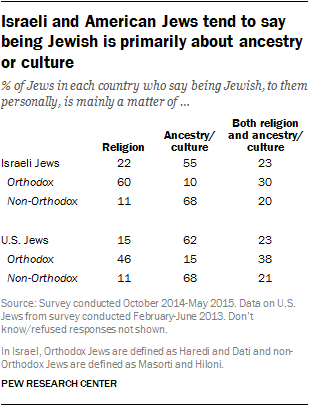
Seven-in-ten Haredim (70%) and roughly half of Datiim (52%) say being Jewish is mainly a matter of religion, while 3% of Haredim and 16% of Datiim say being Jewish is mainly a matter of ancestry and/or culture. Among Hilonim, by contrast, only 4% see being Jewish as primarily a matter of religion, while 83% say Jewish identity is mainly a matter of ancestry and/or culture. However, at least some members of all of these groups see their Jewish identity as bound up with both religion and ancestry/culture.

(For more on Jewish identity in Israel, including a sidebar on different types of Jewish ethnic identity, see Chapter 3.)

Haredim see being Jewish as a matter of religion; Hilonim see it as a matter of culture and/or identity
Most Hilonim see themselves as 'Israeli first'; most Haredim say 'Jewish first'

The survey also asked Israeli Jews whether they see themselves as Jewish first or Israeli first. About nine-in-ten Haredim (91%), eight-in-ten Datiim (80%) and roughly six-in-ten Masortim (59%) consider themselves Jewish first, while about six-in-ten Hilonim (59%) take the opposite position, saying they see themselves as Israeli first. Among Masortim and Hilonim, about one-in-five do not take either position.

Most Haredim do not see themselves as 'Zionists'

Many, but not all, Israeli Jews also identify with Zionism. Historically, the term “Zionist” usually referred to a supporter of the establishment of the State of Israel as a national homeland for the Jewish people. Today in Israel, however, “Zionist” may have additional shades of meaning, perhaps roughly equivalent to nationalist, patriotic or idealistic. Rather than trying to define the word, the survey simply asked Jewish respondents how accurately it describes them, personally.

Overall, majorities of Datiim, Masortim and Hilonim say “Zionist” describes them either very accurately or somewhat accurately. But most Haredim say the term describes them either “not too” (24%) or “not at all” (38%) accurately.6 Once again, Haredi Jews’ reluctance to describe themselves as Zionists may reflect their historical ambivalence toward the Jewish state. Among Haredim who identify as Zionists, 85% say Israel is necessary for the long-term survival of the Jewish people; by contrast, among Haredim who do not describe themselves as Zionists, just 55% agree.

Wide variation in religious observance among Israeli Jews

Across numerous measures of religious belief and practice, Haredim are consistently the most religiously observant Jewish group in Israeli society, while Hilonim are consistently the most secular. Datiim closely resemble Haredim in some ways, although they report somewhat lower levels of daily prayer and synagogue attendance. Masortim include some people who are highly observant as well as some who are not, but on several standard measures of religious observance, Masortim tend to show medium levels of religious observance.

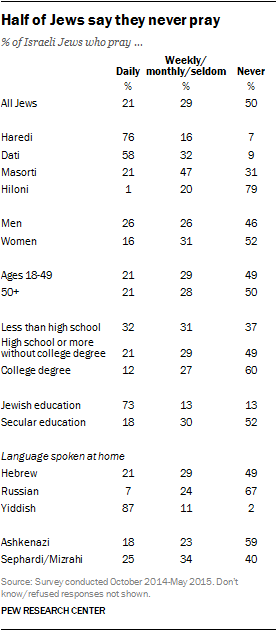
For example, about three-quarters of Haredim say they pray at least once a day (76%), as do most Datiim (58%). By comparison, just 1% of Hilonim say they pray daily, and 79% never pray. Self-described Masortim display less uniformity in their prayer habits: About one-in-five say they pray daily (21%), 15% say they pray at least weekly, about one-third say they pray monthly or seldom (32%), and about three-in-ten Masortim (31%) say they never pray.

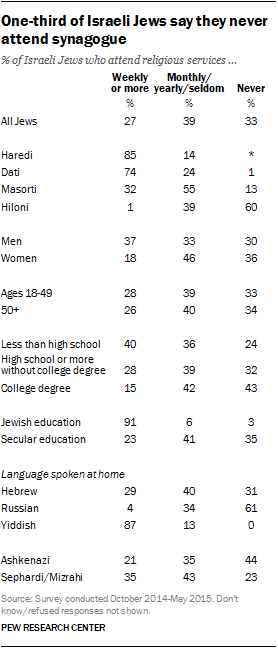
Similarly, majorities among both Haredim (85%) and Datiim (74%) say they attend religious services on a weekly basis, while among Hilonim, relatively few (1%) do this and 60% say they never attend synagogue. Again, Masortim display a range of worship attendance habits.

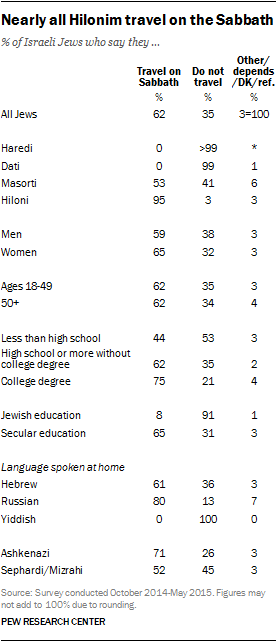
These major differences in religious commitment among the four Jewish subgroups also are reflected in many specific Jewish religious practices. For example, very few – if any – Haredim or Datiim say they travel by car, bus or train on the Jewish Sabbath (from Friday evening to Saturday evening). By comparison, travel on the Sabbath is nearly universal among Hilonim (95%). On this question, Masortim are closely divided, with a slightly higher share saying they travel on the Sabbath (53%) than saying they do not (41%).

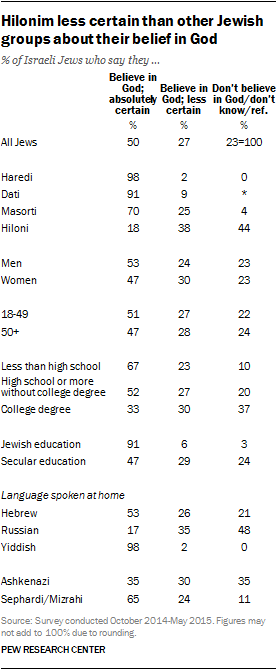
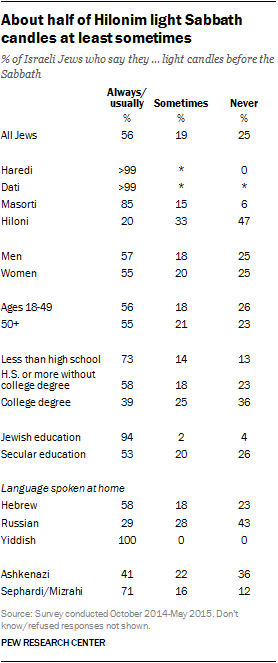
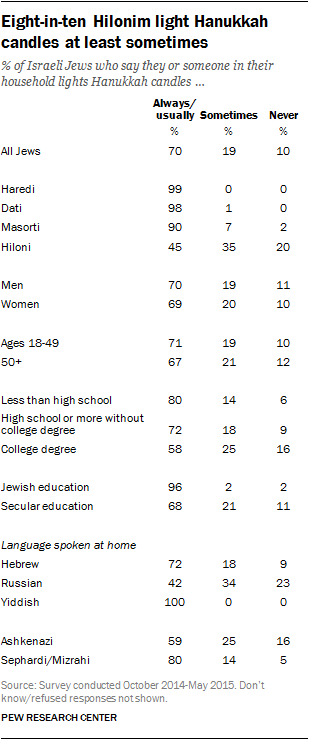
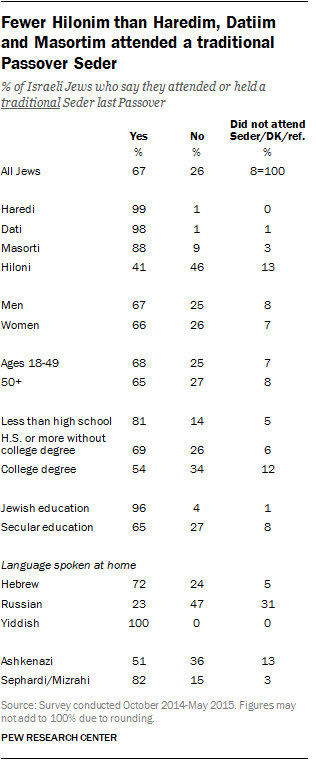
Secular Jews’ understanding of their Jewish identity as primarily a matter of ancestry or culture is reflected in their beliefs and practices. Not only do few Hilonim say they attend synagogue on a weekly basis or pray with regularity, but many (40%) also say they do not believe in God. However, substantial proportions of Hilonim practice what could be seen as cultural aspects of their religion. For example, 87% of Hilonim say they hosted or attended a Seder last Passover, and about half (53%) say they at least sometimes light candles before the start of the Sabbath.

Large differences in religious observance among Jews of different backgrounds
No significant differences in religious observance among older and younger Jews


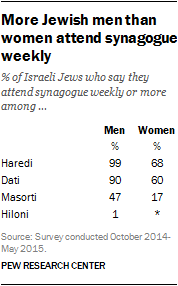
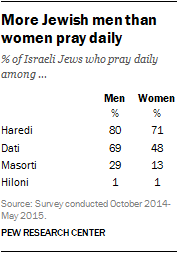
By some measures, Jewish men in Israel are more religiously observant than Jewish women. Among Haredim, Datiim and Masortim in particular, men are more likely than women to report that they pray several times a day and attend synagogue weekly. In part, this reflects the fact that Jewish law (halakha) requires daily prayer in a prayer quorum (minyan) for men and not for women, and halakha makes similar exemptions for women regarding many other mandated rituals. But the survey also finds that among Masortim, men are more likely than women to say religion is “very important” in their lives, and more Masorti men than women refrain from travel on the Jewish day of rest.

Among both highly religious and secular Jews, there are few differences in religious observance between older and younger Israeli adults.

Chapter 4 looks at measures of religious commitment in Israel in more detail.

Overall, Arabs in Israel are more religious than Jews

More Arabs than Jews say religion 'very important'

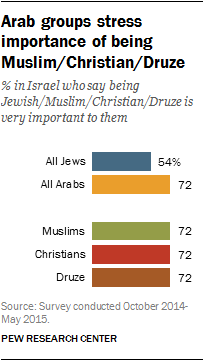
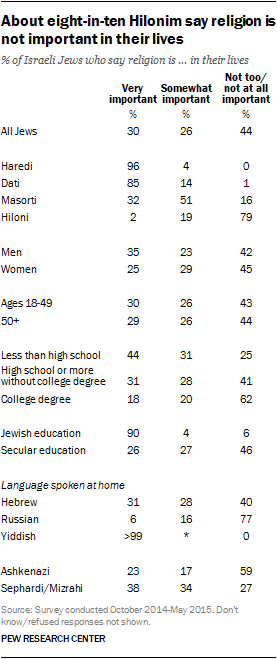
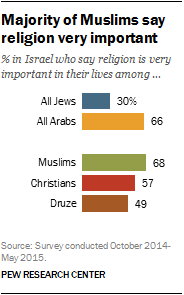
Arabs in Israel – especially Muslims – are more religiously observant than Jews as a whole. Fully two-thirds of Israeli Arabs say religion is very important in their lives, compared with just 30% of Jews. Israeli Muslims (68%), Christians (57%) and Druze (49%) all are more likely than Jews to say religion is very important to them, personally. In addition, more Arabs than Jews report that they pray daily and participate in weekly worship services.

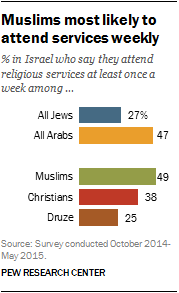
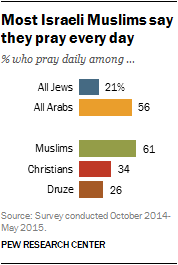
Generally, Muslims in Israel are the most religiously observant of the four major religious groups. For example, a majority of Muslims say they pray daily (61%), compared with 34% of Christians, 26% of Druze and 21% of Jews. And while 25% of Druze, 27% of Jews and 38% of Christians say they attend religious services at least weekly, roughly half of Israeli Muslims (49%) report that they go to a mosque on at least a weekly basis.

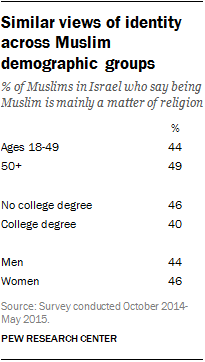
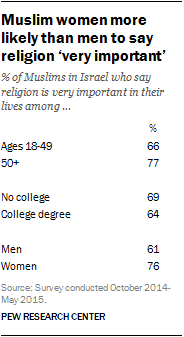
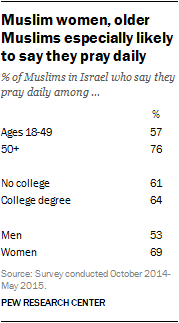
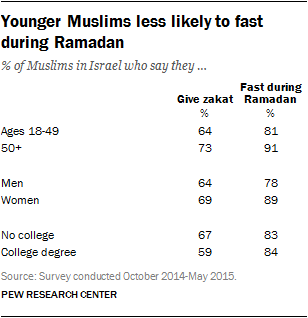
Among Muslims in Israel, adults between the ages of 18 and 49 are generally less observant than their elders. For example, those under 50 are less likely than older Muslims to say they pray daily or attend mosque weekly. This is not the case among Jews; as previously noted, there are few, if any, significant differences in religious observance between younger and older Israeli Jewish adults.

Data collected by the Israeli Social Survey on religious observance among all non-Jews in Israel – Muslims, Christians and Druze combined – show a net uptick in the proportion of adults who say they are “very religious” or “religious,” from 51% in 2002 to 56% in 2013. Over the same 11-year period, there has been a slight net decline in the proportion of non-Jewish adults who say they are “not so religious” or “not religious,” from 49% to 44%.

(Trends over time in religious observance among Israeli Jews are discussed in a sidebar at the end of this Overview.)

Few friendships and marriages in Israel cross religious lines

Few Haredim, Hilonim have close friends from outside their group

Jews and Arabs of different religious backgrounds are separated by more than just their religiosity and political opinions. The survey finds that these groups are also relatively isolated from one another socially.

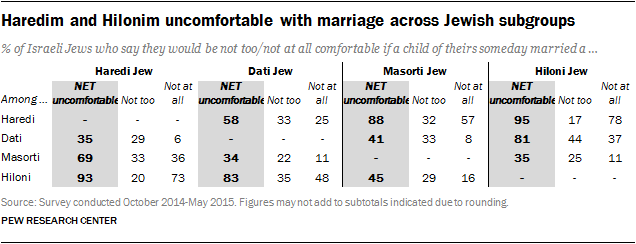
This is even true within Israeli Jewry. Particularly among Haredim and Hilonim, few adults say they have many close friends from outside their own community, and intermarriage is rare. In addition, the vast majority of Haredim say they would not be comfortable if one of their children were, someday, to marry a Hiloni Jew – and vice versa.

Masortim are the one Jewish group that is more likely than others to have close friends from a variety of other Jewish groups. Only about half of Masortim (48%) say that all or most of their close friends are also Masortim; by comparison, among Haredim and Hilonim, roughly nine-in-ten adults say all or most of their close friends belong to the same Jewish subgroup. Among Datiim, 72% say all or most of their close friends are Datiim.

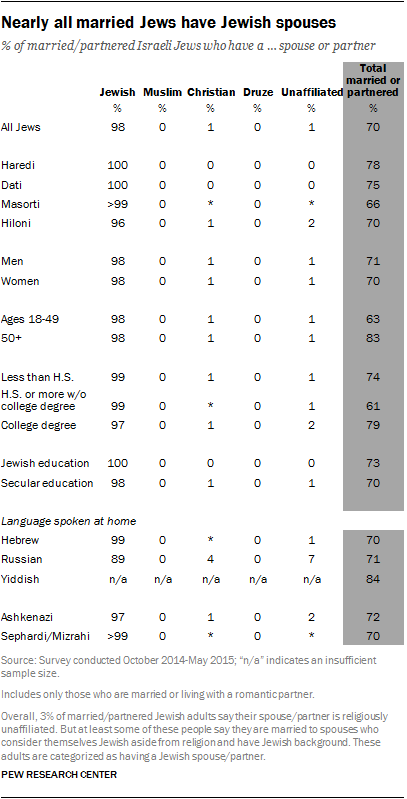
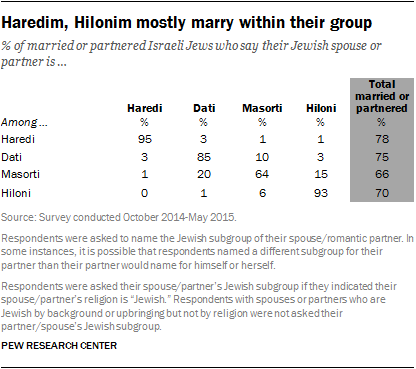
Similarly, 95% of married Haredim say their spouse is also Haredi, while 93% of Hilonim who have a spouse or partner say that person is Hiloni. Datiim also are very likely to have a spouse who is Dati (85%). As with friendships, Masortim are most likely to have a marriage that crosses Jewish subgroups; 64% are married to another Masorti Jew, but roughly one-third are married to a Jew they describe as either Dati (20%) or Hiloni (15%).

The vast majority of Haredim and Hilonim also are uncomfortable with the idea of future intermarriage between their two communities. About nine-in-ten Hilonim say they would be “not too” comfortable (20%) or “not at all” comfortable (73%) if their child someday married a Haredi Jew, while nearly all Haredi respondents (95%) say they would be “not too” comfortable (17%) or “not at all” comfortable” (78%) if their child were to someday marry a secular Jew. Haredim are also generally uncomfortable with the idea of their children taking a Masorti spouse (88% say they would be uncomfortable with this) or a Dati spouse (58%).

On this hypothetical question, the divisions are less stark when it comes to some other groups that are adjacent to one another on the religious spectrum. Only a minority of Masortim say they would be uncomfortable with their child marrying either a Dati or Hiloni Jew. Similarly, minorities of Datiim indicate they are uncomfortable with the idea of their child having a spouse who is Haredi or Masorti.

Hilonim are generally uncomfortable about the idea of intermarriage with Orthodox Jews – including both Haredim and Datiim. But fewer than half of Hilonim (45%) say they would be uncomfortable with the idea of their child having a spouse who is Masorti.

Haredim and Hilonim strongly opposed to intermarriage with each other

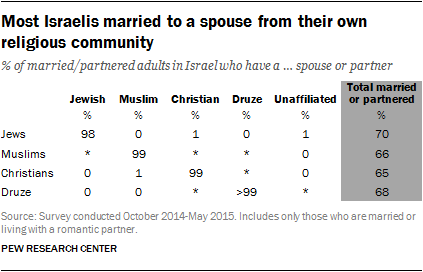
Religious intermarriages cannot be performed in Israel (although civil marriages that take place in other countries are legally recognized in Israel).7 This is reflected in the rarity of marriages between members of different religious communities in the country. Nearly all Israelis in the survey who are married or living with a partner say their spouse or partner shares their religion. Relatively few married Muslim, Christian and Druze residents (1%) say their spouse has a different religion, and only 2% of married Jews say they have a spouse who belongs to a non-Jewish religion or is religiously unaffiliated.

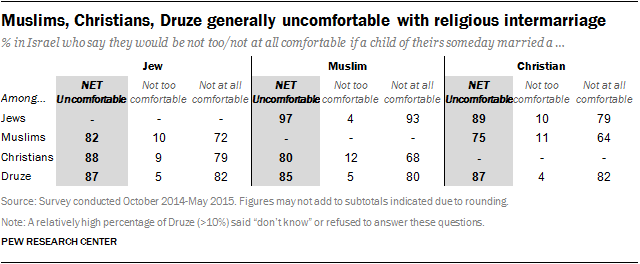
Not only is intermarriage rare in Israel, nearly all Israeli Jews and Arabs included in the survey say they would prefer their children to marry within their own religious circle. Among Jews, 97% say they would not be comfortable with their child someday marrying a Muslim, and 89% say this about their child ever marrying a Christian. Similarly, 82% of Muslims, 88% of Christians and 87% of Druze say they would be uncomfortable with the idea of their child marrying a Jew.

Among Arabs, there is also uneasiness with marriage between religious groups. Three-quarters of Muslims say they are not too or not at all comfortable with the idea of intermarriage with a Christian. Similarly, most Christians (80%) say they would be uncomfortable with their child marrying a Muslim. Druze are about equally opposed to the idea of one of their children marrying a Jew (87% uncomfortable), a Muslim (85%) or a Christian (87%).

Muslims, Christians, Druze, Jews frown upon intermarriage between their communities

Arabs see more discrimination in Israeli society

Vast majority of Arabs see 'a lot' of discrimination against Muslims

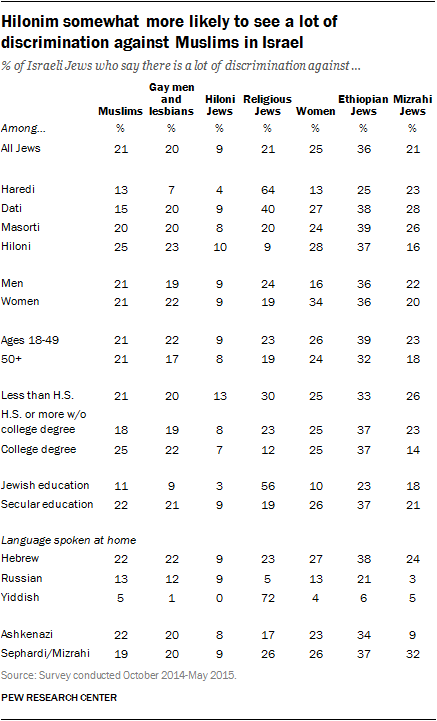
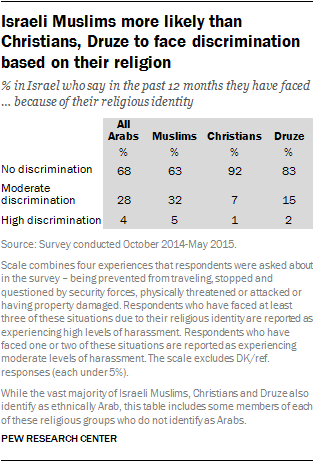
Social divisions within Israeli society may be connected to perceptions of discrimination. Roughly eight-in-ten Arabs (79%) say there is a lot of discrimination against Muslims in Israel today, while just 21% of Israeli Jews share this view.

Roughly one-third of Muslims report having experienced at least one incident of discrimination in the past 12 months

Arabs also are more inclined than Jews to perceive Israeli society as discriminatory toward a variety of other social groups. For example, 40% of Arabs say there is a lot of discrimination against women in Israel today, compared with 25% of Jews who perceive a lot of discrimination against women. And just 9% of Jews say there is a lot of discrimination against secular Jews in Israel, compared with 21% of Arabs who say secular Jews face a lot of discrimination.

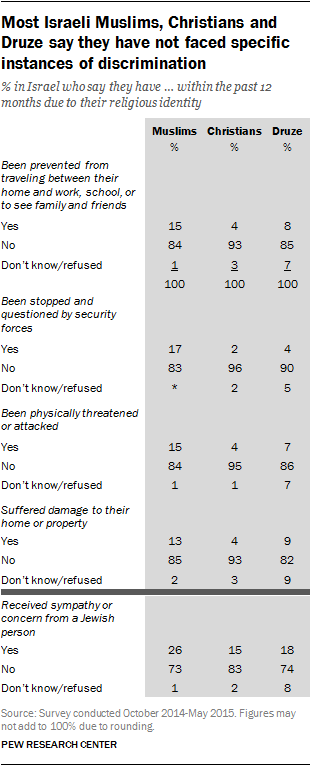
The survey also asked about personal experiences with discrimination. About one-in-six Muslims say they have been questioned by security officials (17%), prevented from traveling (15%) or physically threatened or attacked (15%) because of their religion in the past 12 months, while 13% say they have suffered property damage. All told, 37% of Muslims say they have suffered at least one of these forms of discrimination because of their religious identity in the past year.8

The survey also asked about positive interactions. About a quarter of Israeli Muslims (26%) say a Jewish person has expressed concern or sympathy toward them in the past year because of their religious identity. And 15% of Christians and 18% of Druze say a Jewish person has expressed sympathy toward them in the last 12 months.

Views on discrimination in Israel, as well as Jews’ views on anti-Semitism around the world, are discussed in detail in Chapter 12.

More Arabs than Jews – by a declining margin – optimistic about two-state solution

Fewer Arabs over time say peaceful coexistence between Israel and independent Palestinian state is possible

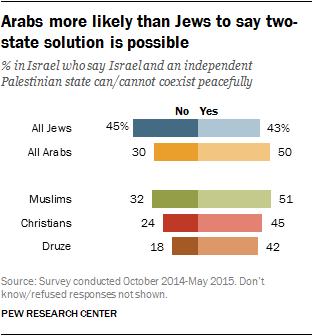
Many Arab citizens or residents of Israel appear to be losing hope that a way can be found for Israel and an independent Palestinian state to coexist peacefully. In Pew Research Center polling, the percentage of Israeli Arabs who say a peaceful, two-state solution is possible has dropped by 24 points in just two years, from 74% in 2013 to 50% in the latest survey, which was conducted in late 2014 and early 2015 (i.e., even before the wave of stabbings and other violence in Israel and the West Bank in late 2015). The new poll finds that about three-in-ten Israeli Arabs (30%) think a peaceful two-state solution is not possible, while 20% say they do not know or do not take a position either way.

As of the time of the survey, Israeli Jews were less optimistic than Israeli Arabs about the possibility of a two-state solution. Israeli Jewish public opinion had become more negative after the breakdown of peace negotiations in April 2014, then rebounded somewhat in 2015. The percentage of Israeli Jews who say a way can be found for Israel and an independent Palestinian state to coexist in peace has risen slightly from 37% in 2014 to 43% in the new survey. Opinion on this topic may continue to change as events unfold in the region.

Most Jews on the political right skeptical about two-state solution

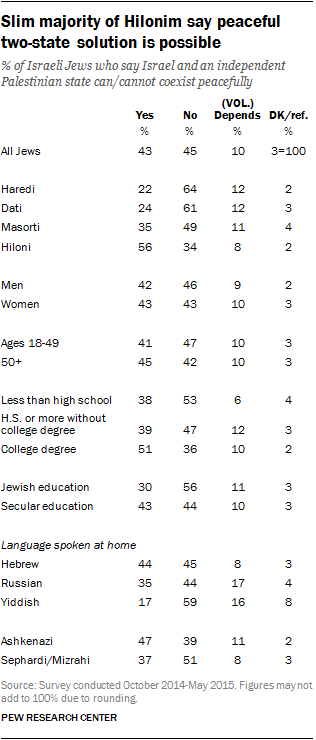
Among Jews, a slim majority of Hilonim (56%) say Israel and an independent Palestinian state can peacefully coexist. But among other groups, the prevailing view is that a peaceful two-state solution is not possible.

Further statistical analysis finds that after controlling for religious identity (Haredi, Dati, Masorti, Hiloni) and other demographic factors such as age, gender and level of education, Israeli Jews’ opinions on the feasibility of a two-state solution are most closely tied to their political ideology.

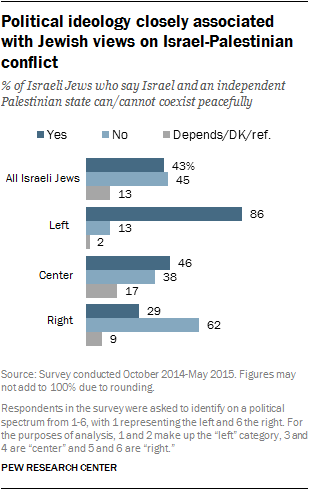
Among the small proportion of Jews who say they are on the left side of the ideological spectrum, 86% think a way can be found for Israel and an independent Palestinian state to coexist peacefully together, compared with 29% of those on the political right and 46% of those in the center.

Plurality of Jews say West Bank settlements help secure Israel

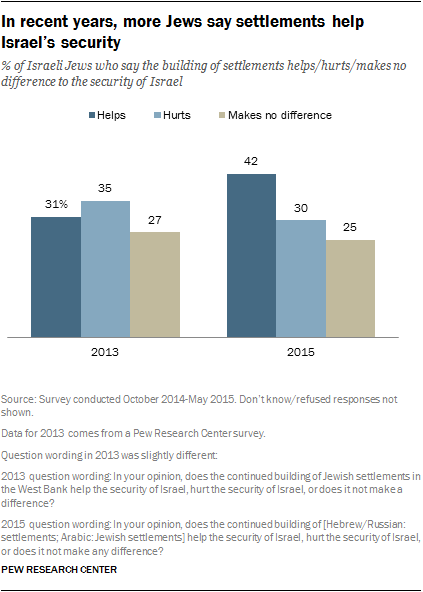
More Jews say settlements help than hurt Israel's security

Israeli Jews express a wide range of views on the construction of Jewish settlements – especially in the West Bank – which continue to generate controversy internationally, including recent moves by the European Union to label goods produced in the settlements. Currently about 4% of Israeli Jews live in the West Bank (not including East Jerusalem).

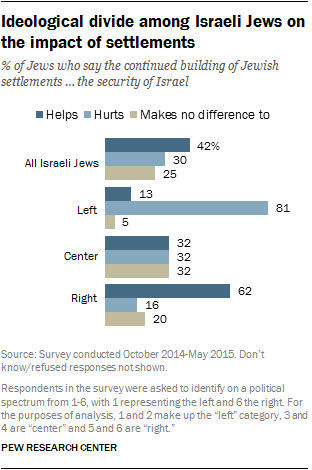
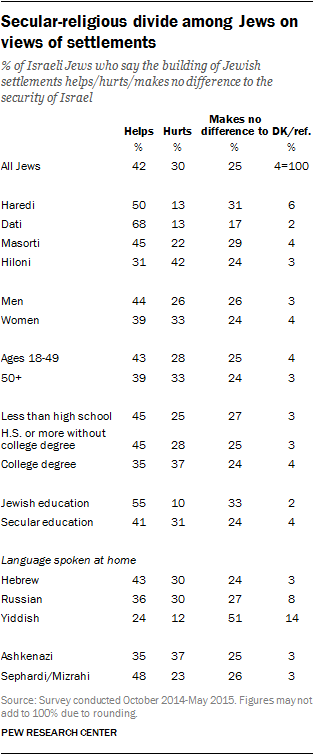
A plurality of all Israeli Jews surveyed (42%) say the continued building of settlements helps the security of Israel, while three-in-ten (30%) disagree, saying the settlements hurt Israel’s security. A quarter of Israeli Jews (25%) say the settlements do not make a difference one way or another with respect to Israel’s security.

Datiim are more likely than the other major Jewish subgroups in Israel to favor the settlements; about two-thirds (68%) of Datiim say settlements help Israel’s security, and only 13% say they hurt the country’s security. Fully half of Haredim and 45% of Masortim agree that the settlements help Israel’s security, while fewer (13% of Haredim and 22% of Masortim) say they hurt.

But Hilonim lean in the other direction: About four-in-ten Hilonim (42%) say settlements in the West Bank hurt Israel’s security, while 31% say they help, and the rest think they do not make much difference or do not take a position either way.

Israeli Jews’ opinions about settlements are strongly tied to their political ideology. Only 13% of those on the left side of the ideological spectrum say the building of settlements helps the security of Israel. Among those on the right, by comparison, 62% say the continued building of settlements helps the security of the country.

Israeli Jews who place themselves in the center of the ideological spectrum are evenly divided when it comes to this issue. The same proportion of political centrists (32%) take each of the three possible stances: that settlements help the security of Israel, hurt the country’s security or make no difference one way or another.

A majority of Israeli Arabs (63%) say that settlements hurt Israel’s security, including most Muslims (61%), Christians (79%) and Druze (66%).

For more details on this and other topics pertaining to the peace process, see Chapter 9.

Settlers less optimistic about peace process than Jews who live elsewhere

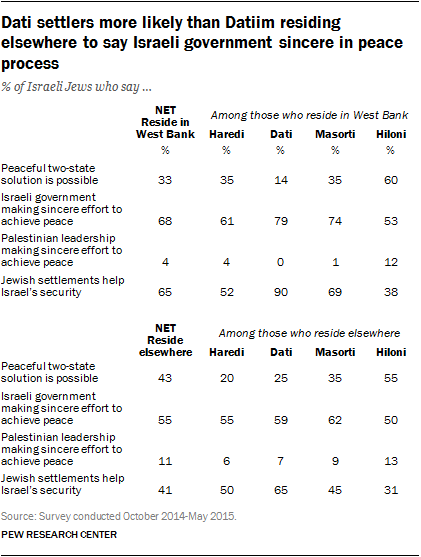
In this report, the 4% of Jewish respondents (3% of all Israelis) who reside in the West Bank – often broadly called “settlers” – are included in analysis of Israeli Jews overall.9 But the survey also includes enough interviews with settlers to allow comparisons between their views and those of other Israeli Jews.10

Most residents of West Bank say Israeli government sincere in its effort toward peace

Overall, West Bank residents are far more religious than other Jews. A solid majority of Jewish respondents who live in the West Bank (63%) are Orthodox, including 26% who identify as Haredim and 36% who identify as Datiim. By comparison, 9% of Jews who live in other regions are Haredim and 12% are Datiim. Consequently, settlers are far less likely than Jews living elsewhere in Israel to identify as Masortim or Hilonim.

These religious differences are evident when it comes to views about Israel. Fully 85% of settlers, including a nearly universal proportion of Haredi and Dati settlers (>99%), say God gave Israel to the Jewish people, while a much smaller majority of other Israeli Jews (60%) express this view.

There is a similarly large gap between settlers and other Jews when it comes to the impact of the settlements themselves. Roughly two-thirds of settlers (65%) say Jewish settlements help Israel’s security; 41% of other Israeli Jews say the same. (For comparisons by Jewish subgroup between the views of settlers and Jews overall, see Chapters 8 and 9.)

Overall, residents of the West Bank are less optimistic than Jews who reside elsewhere that a way can be found for Israel and an independent Palestinian state to peacefully coexist (33% vs. 43%). At the same time, settlers are more likely than other Israeli Jews (68% vs. 55%) to say the Israeli government is making a sincere effort to reach a peace agreement. Fewer settlers than other Jews say the Palestinian leadership is sincere in its efforts toward peace, although relatively few Jews, regardless of location, see Palestinian leaders as sincere in this regard.

While settlers have somewhat different views on the peace process than other Israeli Jews, they generally take similar positions on questions concerning the rights of Jews and Arabs in Israel. For example, nearly universal shares of both groups say Jews around the world should have the right to move to Israel and gain citizenship. And roughly half of both groups agree that Arabs should be expelled or transferred from Israel, although settlers are somewhat more likely than other Jews to strongly agree with this statement (27% vs. 20%).

Orthodox settlers more likely than non-Orthodox to say Arabs should be expelled

Overwhelming majorities among both West Bank settlers (85%) and other Israeli Jews (79%) agree or strongly agree that Jews deserve preferential treatment in Israel; again, more settlers than Jews living elsewhere strongly agree with this view (57% vs. 47%).

Among settlers, those who are Orthodox (Haredim and Datiim combined) are considerably less optimistic than are non-Orthodox (Masorti and Hiloni) settlers about the prospects for a peaceful two-state solution (23% vs. 50%).

Roughly one-third of Masortim and Hilonim who reside in the West Bank (35%) agree that Arabs should be expelled or transferred from Israel, compared with 65% of Haredi and Dati settlers who take this view.

Other key findings of the 2015 Pew Research Center survey include …

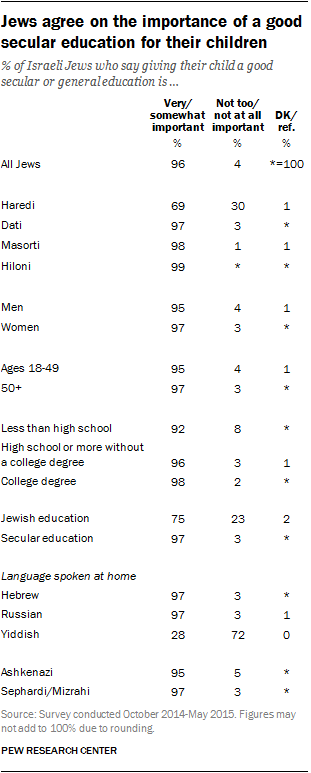
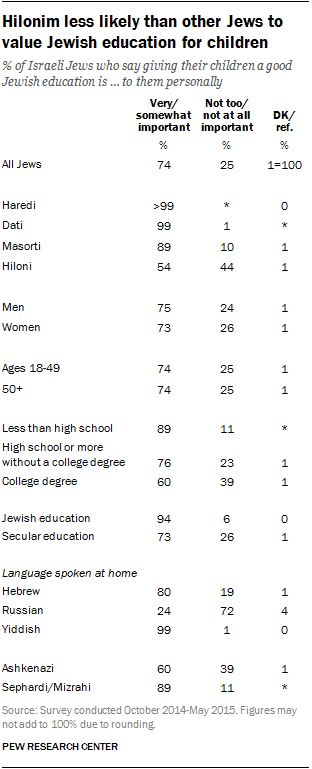
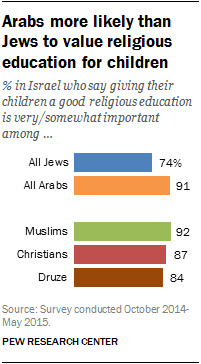
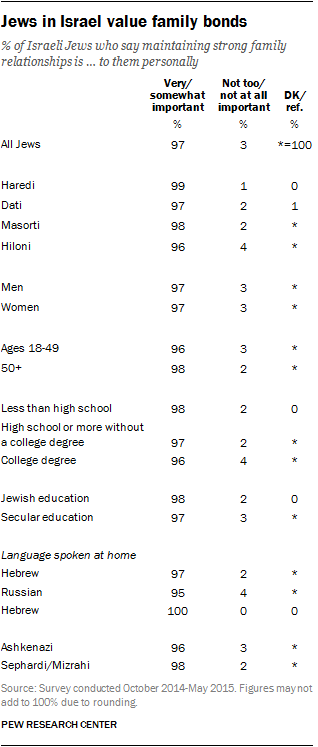
  • Most members of all the main religious groups in Israel place great importance on family, education and career. But even within these areas of general agreement, there are some substantial differences. For example, while virtually all Hilonim (99%) say that giving their children a good general/secular education is important to them, a much smaller majority of Haredim (69%) say the same. And the opposite is true when it comes to giving children a good religious education: Nearly all Haredi respondents (>99%) say this is either “very important” or “somewhat important” to them; about half of Hilonim (54%) agree.
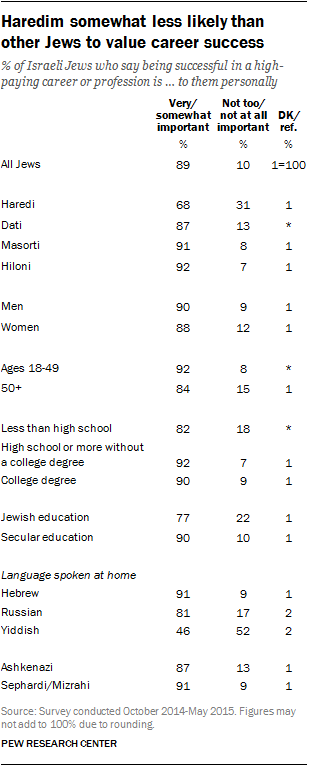
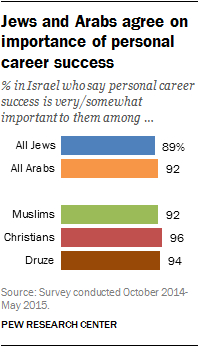
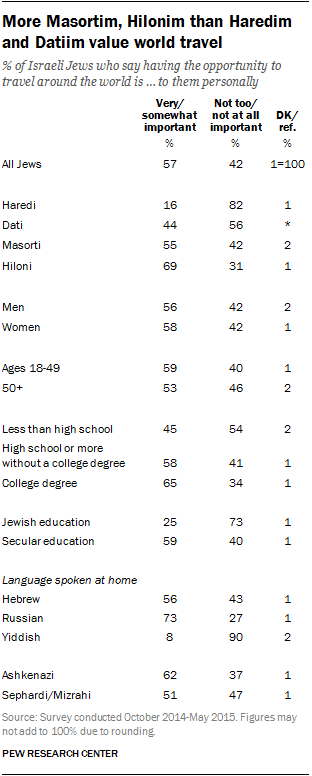
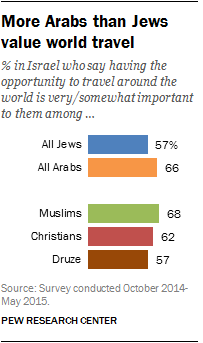
  • Haredim are less likely than other Jews in Israel – as well as other religious groups – to value a high-paying career or the opportunity to travel around the world. Only about two-thirds of Haredim (68%) say being successful in a high-paying career is important to them, compared with roughly nine-in-ten Datiim, Masortim and Hilonim – as well as nine-in-ten Muslims, Christians and Druze. Relatively few Haredim (16%) say it is important to them to travel the world, while roughly seven-in-ten secular Jews in Israel (69%) say they value such opportunities.
  • The survey asked respondents to say, in their own words, what they see as the single biggest long-term problem facing Israel. About four-in-ten Israeli Jews cite economic issues (inequality, rising housing costs, etc.), and a roughly equal number name various security-related issues (violence and terrorism, the threat from Iran, etc.) as the biggest problem. Arabs, meanwhile, are more likely to mention economic issues than any other type of response. In 2013, U.S. Jews were also asked to name the biggest long-term challenge facing Israel, and almost none (1%) mentioned economic problems, while two-thirds cited various security issues as the biggest long-term problem facing Israel.
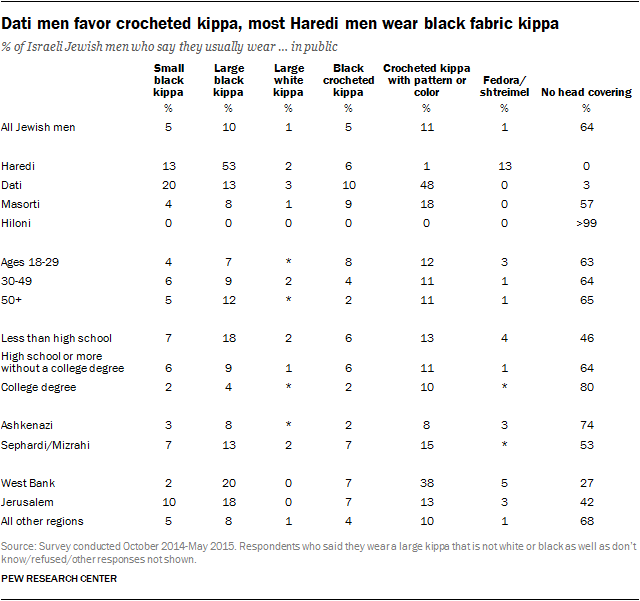
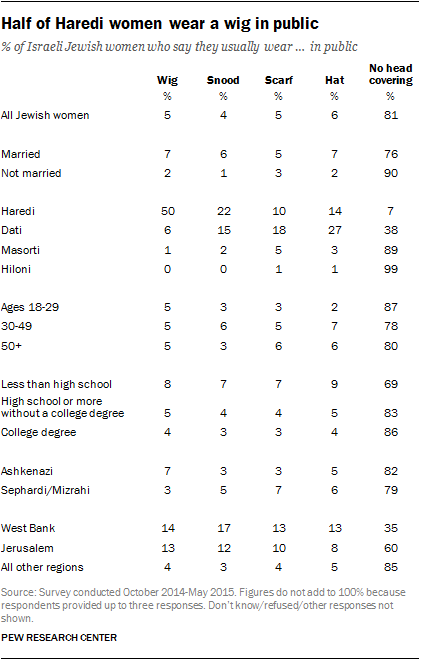
  • About one-third of Jewish men say they wear a kippa or other type of head covering in public. The type of kippa varies by Israeli subgroup, with Haredi men more likely to wear a black fabric kippa and Dati men more likely to wear a crocheted kippa (often with a pattern or color). One-in-five Israeli Jewish women also say they wear a head covering in public (either a wig, snood, scarf or hat).
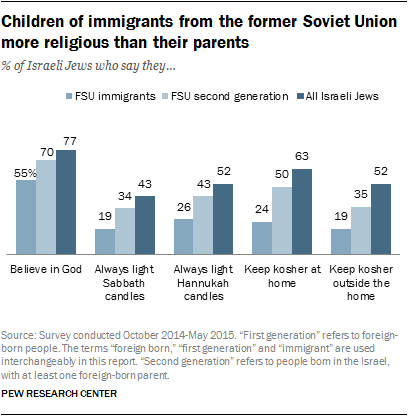
  • After the fall of the Soviet Union, an influx of Jews from former Soviet republics arrived in Israel during the 1990s, forming a large cohort that was notably less religiously observant than Israeli Jews overall. Many of these immigrants now have children who were born in Israel, and there are signs that members of this second generation – that is, Israeli Jews with at least one parent who was born in the former Soviet Union – are more religious than their parents (although still not as religious as Israeli Jews overall). For example, 70% of these second-generation immigrants say they believe in God, which is higher than the 55% of first-generation former Soviet immigrants who express belief in God.
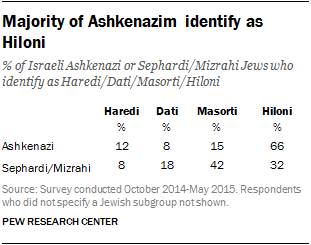
  • Israeli Jews are roughly evenly divided between two types of ethnic identity: Ashkenazi Jews (with ancestral roots in Central and Eastern Europe) and Sephardi or Mizrahi Jews (with roots mostly in Spain, elsewhere around the Mediterranean or the Middle East). Haredim and Hilonim are more likely to identify as Ashkenazi Jews, while Datiim and Masortim are more likely to identify as Sephardi/Mizrahi Jews.
  • While Muslims living in Israel, overall, are more religious than Israeli Jews, they are less religious than Muslims living in many other countries in the region. For example, about two-thirds of Muslims in Israel (68%) say religion is very important in their lives – higher than the comparable share of Lebanese Muslims (59%), but lower than the share of Muslims in Jordan (85%), the Palestinian territories (85%) and Iraq (82%) who say this.
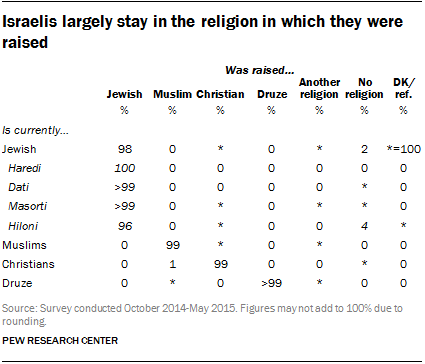
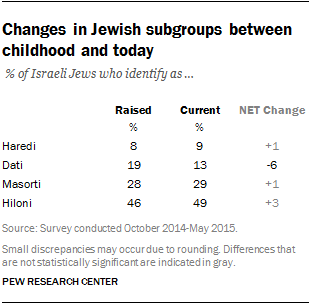
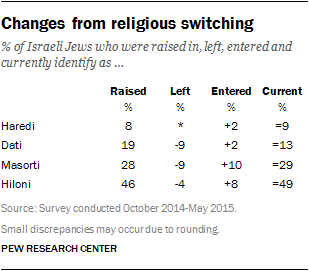
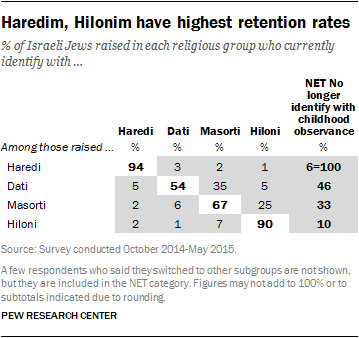
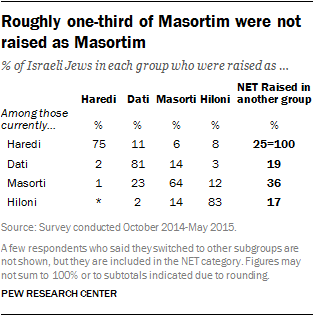
  • There is very little religious switching (conversion) between the main religious groups in Israel. Jews, Muslims, Christians and Druze almost universally continue to identify in adulthood with the religion in which they were raised as children. But within Israeli Jewry, there has been some movement among the four major subgroups. While about nine-in-ten Israeli Jews who were raised Haredi (94%) or Hiloni (90%) still identify with those categories, only about half of those who were raised Dati still identify as Datiim (54%), and two-thirds of those raised Masorti still identify as Masortim (67%). Overall, the switching tends to be in a more secular direction. (For more details, see Chapter 2.)

How religion in Israel is changing over time

While this is Pew Research Center’s first comprehensive study of religion in Israel, data collected through the Israeli census, the Israeli Social Survey, the Guttman Center for Surveys and Pew Research Center’s previous polls in Israel suggest that the Israeli religious landscape has been changing over time in at least three important ways:

• The share of Jews in the total population has been declining, while the share of Muslims in the population gradually has been rising.
• Among Jews, the share who are Orthodox has been slowly rising, largely as a result of high fertility rates among Haredim.
• Surveys conducted over time indicate a modest decline in recent years in the share of Israeli Jews who report moderate levels of religious observance. The reported decline of what might be called the “religious middle” suggests that Israeli society may be becoming more religiously polarized.

Long term, Muslims rising as share of Israel’s population
Change over time in Israel's religious landscape


According to Israeli census data, the country’s religious landscape has been gradually changing, with a falling share of the population identifying as Jews and a rising share identifying as Muslim or choosing not to identify with any of the four main religious groups (Jews, Muslims, Christians and Druze).

In 1949, shortly after the establishment of the state, the first Israeli census found that 86% of the total population was Jewish, 9% was Muslim, 3% was Christian, and 1% was Druze. As of 2014, the Muslim proportion of the population has doubled to 18%, while the Jewish proportion has declined 11 percentage points, to 75%. The Christian share of Israel’s population also has declined, falling from 3% to 2%, while Druze have risen from 1% to 2%.

At the same time, a growing share of Israelis (4% in 2014) do not identify with any of these religious groups and are classified as “other” by the census. This includes some non-Jewish family members of Jews who have immigrated to Israel from the former Soviet Union, other Israelis who do not identify with any religion, members of the Baha’i faith and a smattering of smaller religious groups in Israel.

Orthodox slowly growing as share of Israeli Jews
Jewish categories over time

While the majority of Jewish adults in Israel do not identify as Orthodox, the Orthodox share of the population has been increasing over time. Data collected by the Israeli Social Survey (ISS) between 2002 and 2013 show the proportion of Jews ages 20 and older who are Orthodox rose from 16% to 19% over that period, while the non-Orthodox share fell from 84% to 80%. The Hiloni share has held roughly steady, while Masortim, who often show moderate levels of religious observance, have experienced the greatest net loss.11

Haredim have significantly more children than other Jews

Among Jewish groups, Haredim have experienced the biggest gain over time. In the 2013 ISS, 9% of Israeli Jewish adults identified as Haredi, up from 6% a little more than a decade earlier.

Hilonim make up a bigger share of older Jews than of younger Jews

One factor in this rise is family size. The current Pew Research Center survey asked respondents how many children they have ever had; among Jewish men and women ages 40 and older, 28% of Haredim say they have at least seven children. By comparison, few Datiim (5%), Masortim (2%) and Hilonim (<1%) report having that many children.12

As a result of differences in fertility rates, Hilonim form a smaller share of Jewish adults under 30 years of age (44%) than they do of Jews ages 50 and older (52%). Among Jews between the ages of 18 and 29, 12% are Haredi, compared with 8% among those ages 50 and older.

Signs of religious polarization
Recent decline in share of Jews who say they observe 'some' of the religious tradition

Previous polls conducted by Pew Research Center, the Guttman Center for Surveys at the Israel Democracy Institute and the former Guttman Institute indicate a decline in recent years in the share of Israeli Jews who report moderate levels of religious observance.

Comparing the results of the current survey with previous research by the Guttman Center and the former Guttman Institute shows that the share of Israeli Jews who say they follow some of the Jewish tradition has fallen to about one-third (34%), down from four-in-ten or more in Guttman surveys conducted between 1991 and 2009. The decline of the middle has been accompanied by a recent rise in the proportion of respondents who say they follow none of the Jewish tradition, while respondents who say they follow all or most of the tradition is essentially unchanged since 2009.

A similar trend is seen on a question about religion’s importance in people’s lives. Since 2007, when the question was last asked in a Pew Research Center survey, the share of Israeli Jews who say religion is “somewhat important” in their lives has decreased from 36% to 26%, while the proportion who say religion is “very important” in their lives has increased from 24% to 30%. The share who say religion is “not too important” or “not at all important” in their lives also has increased somewhat, from 38% in 2007 to 44% in the new survey.
1. Comparisons between Jews in Israel and the U.S.

The United States and Israel combined are home to an estimated 80% of the world’s Jews. The new survey of Israelis, together with Pew Research Center’s 2013 survey of U.S. Jews, can be used to compare the world’s two largest Jewish populations.

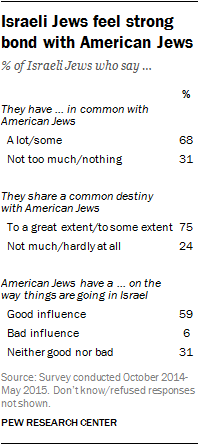
Jews in the U.S. and Israel have deep connections. Majorities of Israeli Jews feel they share a common destiny with U.S. Jews and have either “a lot of” or “some” things in common with U.S. Jews. And most think that, overall, American Jews have a good influence on Israeli affairs. For their part, most U.S. Jews say they are either very or somewhat emotionally attached to Israel and that caring about Israel is essential or important to what being Jewish means to them. More than a third of Israeli Jews have traveled to the U.S., and a similar share of American Jews have been to Israel.

At the same time, however, Jews from the United States and Israel have differing perspectives on a range of political issues concerning the State of Israel and the peace process. While Israeli Jews are skeptical that Israel and an independent Palestinian state can peacefully coexist, most American Jews are optimistic that a two-state solution is possible. On the controversial issue of the continued building of Jewish settlements in the West Bank, the prevailing view among Israeli Jews is that settlements help the security of Israel. By contrast, American Jews are more likely to say the settlements hurt Israel’s own security.

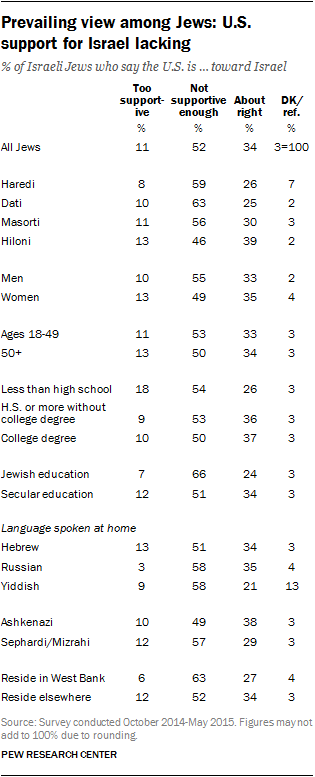
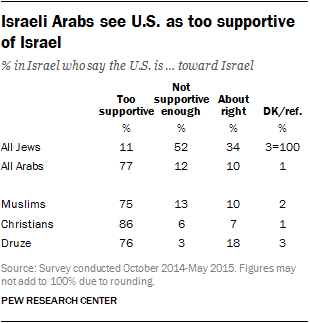
The two communities also differ over the U.S. government’s level of support for Israel. The most common view among Israeli Jews is that the U.S. is not supportive enough of Israel, while the most common opinion among American Jews is that the level of U.S. support for Israel is about right.

Most Israeli Jews describe their ideology as in the center (55%) or on the right (37%) within the Israeli political spectrum. Just 8% of Israeli Jews say they lean left. American Jews, meanwhile, generally describe their ideology as liberal (49%) or moderate (29%) on the American political spectrum, while about one-in-five (19%) say they are politically conservative.

These two political spectrums (liberal/moderate/conservative in the U.S. and left/center/right in Israel) represent different constellations of views on political, economic and social issues in each country. Nevertheless, in both Israel and the U.S., religious Jews tend to lean more to the right, while more secular Jews are centrist or liberal.

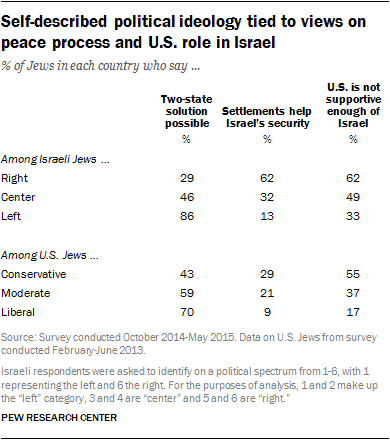
When it comes to opinions about the peace process, settlements and U.S. support for Israel, both Israeli Jews and American Jews express a wide range of views. But on the whole, Israeli Jews are more deeply divided along ideological lines than are American Jews. One way to see the magnitude of these ideological differences in each society is the gap in opinions between Jews on each end of the political spectrum. For example, among American Jews, 43% of those who describe their political opinions as conservative say a peaceful two-state solution is possible, compared with 70% of those who say they are liberal – a gap of 27 percentage points. Among Israeli Jews, 29% of those on the political right say a peaceful two-state solution is possible, compared with 86% on the left – a 57-point gulf.

While they follow the same ancient religious tradition, U.S. Jews and Israeli Jews also differ in their relationship with Judaism as a religion. Virtually all Israeli Jews say they are Jewish when asked about their religion, even though nearly half of them also identify as secular Jews and one-in-five do not believe in God. But fully 22% of American Jews – including about one-third of those in the Millennial generation (adults born in 1981 or later) – do not identify as Jewish on the basis of religion. Instead, they say they have no religion but they have Jewish parents and consider themselves Jewish in other ways, such as by ancestry or culture.

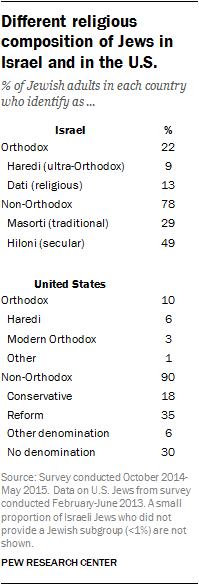
Many American Jews identify with Jewish denominations that do not have a major presence in Israel, such as the Conservative and Reform movements. And Orthodox Jews make up a bigger share of adults among Israeli Jews than American Jews (22% of Israeli Jewish adults are Orthodox, compared with 10% of American Jews).

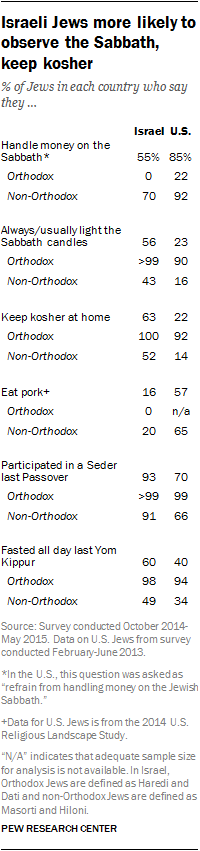
Overall, Jews in Israel are more religiously observant than Jews in the United States. In part, these differences reflect the higher share of Israeli Jews who are Orthodox. But even among the non-Orthodox, American Jews are less religious by several measures of observance, such as frequency of synagogue attendance, certainty of belief in God and rates of keeping kosher at home or attending a Seder. For example, nearly two-thirds of Israeli Jews say they keep kosher at home, compared with about a quarter of Jewish Americans.

This chapter takes a deeper look at connections and similarities between Israeli Jews and U.S. Jews as well as some areas of divergence between the two groups, beginning with religious differences between the two communities.

Israeli Jews more observant than U.S. Jews

Share of Jews who are Orthodox is twice as large in Israel as in the U.S.
Different religious composition of Jews in Israel and in the U.S.

Although they share the same religion, Israeli Jews and U.S. Jews often do not practice Judaism the same way. Israeli Jews themselves range from very religious to secular, but they are, on average, more religiously observant than American Jews.

One driver of the religiosity gap between Israeli Jews and U.S. Jews is the fact that Orthodox Jews make up about one-in-five Jews in Israel (22%) but only one-in-ten Jewish adults in the United States (10%). In both countries, Orthodox Jews tend to be far more religiously observant than other Jews.

In this report, Israeli Jews are categorized into four main subgroups – Haredi (often translated as “ultra-Orthodox”), Dati (“religious”), Masorti (“traditional”) and Hiloni (“secular”). Nearly all Israeli Jews self-identify with one of these four identity categories. Both Haredim and Datiim are classified as Orthodox in this report. (For more details on Orthodox Jews in the U.S., see “A Portrait of American Orthodox Jews.”)

In the U.S., meanwhile, Jews commonly identify with more formal, institutionalized movements, often called “Jewish denominations” or “streams” of Judaism. About half of U.S. Jews identify with either the Conservative (18%) or Reform (35%) movements, and roughly 6% belong to smaller streams, such as the Reconstructionist and Jewish Renewal movements. An additional 30% of U.S. Jews do not identify with any particular stream or denomination of Judaism.

For this reason, it is perhaps best to compare Orthodox U.S. Jews to Orthodox Israeli Jews and, separately, to compare all non-Orthodox Jews in the two countries.

In both Israel and the U.S., Haredim are analogous groups. Haredim in both countries tend to live in tight communities and to divide themselves into numerous small groups, including many different Hasidic sects as well as Yeshivish (also known as Lithuanian Orthodox) communities. And in both countries, Haredim tend to view their strict adherence to the Torah’s commandments as largely incompatible with secular society.

To some extent, Datiim in Israel are analogous to Modern Orthodox Jews in America. But Masortim and Hilonim do not have direct equivalents in the U.S., even though the term “Masorti” is the official name of the Conservative Jewish movement in Israel.

Conservative and Reform movements do not have a major presence in Israel

To explore the overlap (or lack thereof) between American Jewish denominations and Israeli Jewish identity, the survey asked Jews in Israel about common streams within Judaism around the world. Acknowledging that some of these streams may not be familiar to them, the survey asked respondents, using the transliterated English terms, whether they identify with any of these streams – Orthodox, Conservative, Reform or no particular stream. (See survey topline results for full question wording.)

Fully half of Israeli Jews say the international stream of Judaism they identify with is Orthodox. In addition to the vast majority of Haredim and Datiim, roughly two-thirds of Masortim and about one-in-five Hilonim say they identify with the Orthodox stream, even though Masortim and Hilonim are commonly considered non-Orthodox groups. In some cases, their identification with Orthodox Judaism may have less to do with their personal religious beliefs or practices and more to do with a recognition of Orthodoxy as the oldest and most traditional kind of Judaism, or perhaps with Orthodox rabbis’ key role in Israeli public life.13 The second most common choice among Israeli Jews is “no particular stream” (41%). Relatively few Israeli Jews identify with either Conservative (2%) or Reform (3%) Judaism.

Israeli Jews more likely than U.S. Jews to observe Jewish rituals and practices
Israeli Jews are more observant than U.S. Jews

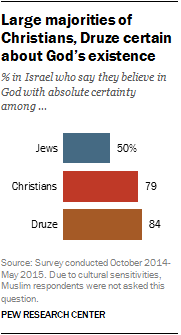
Overall, Israeli Jews display more religious involvement than U.S. Jews on several measures. Roughly a quarter (27%) say they attend religious services at least weekly, more than double the share of American Jews who say the same (11%). Israeli Jews also are somewhat more likely than U.S. Jews to say religion is very important in their lives (30% vs. 26%), and considerably more likely to say they believe in God with absolute certainty (50% vs. 34%) and that they believe God gave Israel to the Jewish people (61% vs. 40%).

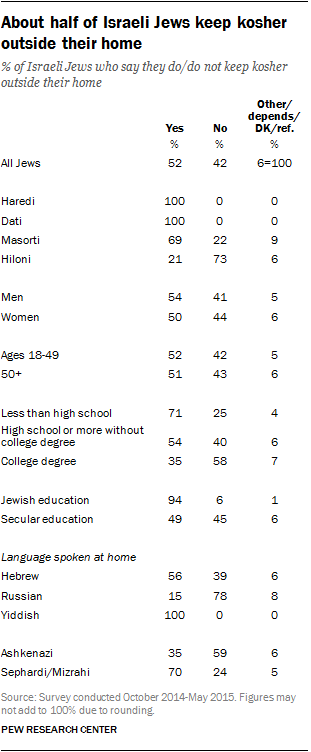
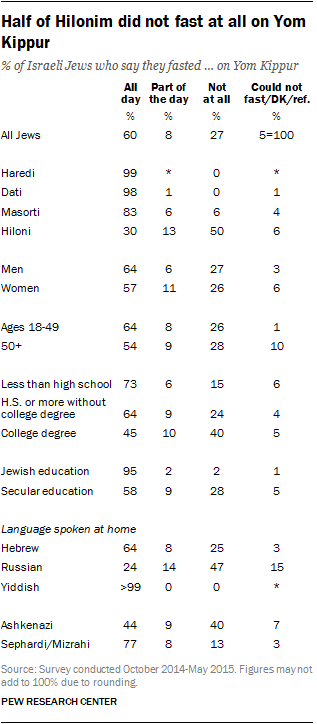
Additionally, Jews in Israel report more frequent participation in specific Jewish practices than do Jews in the U.S. For example, 56% of Israeli Jews say someone in their home always or usually lights Sabbath candles on Friday night, compared with 23% of U.S. Jews who say the same. Roughly six-in-ten Jews in Israel (63%) say they keep kosher in their home, nearly three times the share of American Jews who do this (22%). Israeli Jews also are more likely than U.S. Jews to say they hosted or attended a Seder for Passover (93% vs. 70%) and fasted all day on Yom Kippur (60% vs. 40%) in the last year.

While the larger share of Orthodox Jews in Israel accounts for some of these differences, it does not always fully explain the gaps. By some measures, Orthodox Jews in Israel are even more religious than U.S. Orthodox Jews, and non-Orthodox Israelis show higher levels of religious engagement than their U.S. counterparts.

Israeli Jews more likely to observe the Sabbath, keep kosher

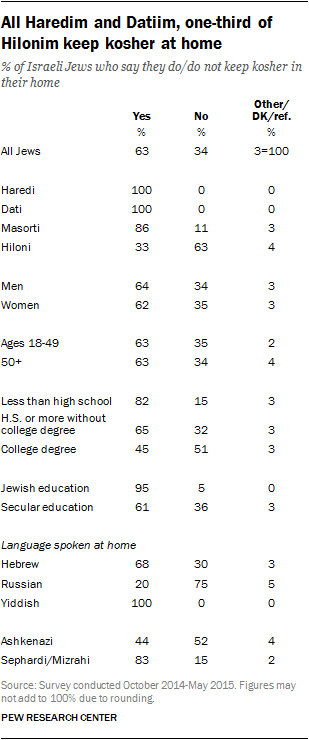
Even self-identified secular Jews in Israel (Hilonim) have higher rates of observance of certain Jewish beliefs and practices than do U.S. Jews overall. For instance, a third of Hilonim (33%) say they keep kosher in their home, while 22% of U.S. Jews overall do this (including just 7% of Reform Jews). And 87% of Hilonim say they attended a Seder last Passover, higher than the share of all U.S. Jews who observed this ritual (70%).

One possible explanation for the differences in levels of religious practice across the two countries is that Jewish observance is more ingrained in daily life in Israel than it is in the U.S. For example, many Israeli businesses close early on Friday afternoon before the start of the Sabbath, kosher food is more widely available in Israel, and major Jewish holidays are generally Israeli national holidays (whereas American Jews may have to miss normal business or school days to observe Jewish holidays).

But when it comes to standard measures of religious commitment, almost no Hilonim (2%) say religion is very important in their lives, and a majority say they never go to synagogue (60%). Virtually all Jewish subgroups in the U.S. are more religious than Hilonim by these measures.

In fact, the strongly secular habits of many Israeli Jews add a layer of nuance to the comparison with U.S. Jews, who by some measures are more likely to display a moderate level of religious observance. While Israeli Jews overall are more likely than U.S. Jews to attend religious services weekly, they also are more likely to say they never attend synagogue (33% vs. 22%). Roughly a third of American Jews (35%) say they attend synagogue “a few times a year, such as for High Holidays,” far higher than the comparable figure for Israeli Jews (14%).

There are also some demographic differences between Israeli and American Jews. While Israeli Jewish men overall show higher measures of religious commitment than women, the opposite is true among U.S. Jews by some measures. For example, among Israeli Jews, men are more likely than women to say religion is very important in their lives (35% vs. 25%), but among U.S. Jews, women are more likely to say this (29% vs. 22%).

U.S. Jews are older, more educated than Israeli Jews

Higher levels of educational attainment among American Jews

U.S. Jews, who have a median age of 50 (among adults), are somewhat older than Israeli Jews (median age of 43).

But perhaps the more striking demographic difference between the two groups is that, overall, American Jews have considerably more formal education than their counterparts in Israel. This reflects the fact that American Jews are a small minority (roughly 2% of the total U.S. population) at the high end of the U.S. educational spectrum, while in Israel, Jews make up roughly 80% of the total adult population and are more evenly distributed across the spectrum of educational attainment.

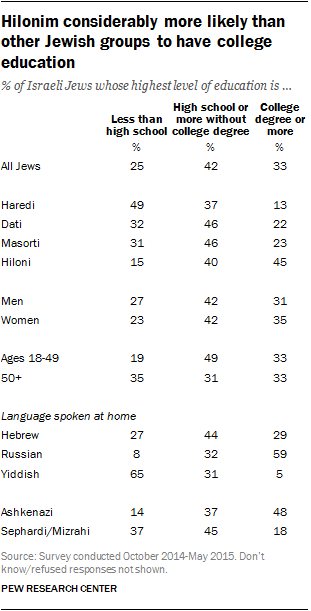
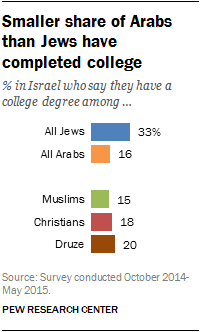
A majority of American Jews (58%) have a college degree, including 28% who have a postgraduate degree. Among Israeli Jews, a third of adults have finished college (33%) and roughly one-in-ten (12%) have a postgraduate degree. Israeli Jews’ rates of attainment are roughly similar to U.S. adults overall, 29% of whom have finished college (including 10% who have a postgraduate degree).

While very few American Jewish adults (2%) have not finished high school, fully a quarter of Israeli Jewish adults say they did not complete high school.

Close connections between Jews in U.S. and Israel

Israeli Jews feel strong bond with American Jews

Despite the differences in affiliation and other demographic characteristics between Israeli and American Jews, strong bonds between the two communities are readily apparent. A sizable minority of Jewish Americans (43%) say they have traveled to Israel, comparable to the share of Israeli Jews who have made the lengthy trip to the United States (39%).

Even many U.S. Jews who have not traveled to Israel feel an emotional attachment to the Jewish state. About seven-in-ten Jews in the U.S. say they are either very (30%) or somewhat (39%) attached to Israel, while more than eight-in-ten say caring about Israel is either an essential (43%) or important (44%) part of what being Jewish means to them personally.

The connection is also felt in the opposite direction. About two-thirds of Israeli Jews (68%) say they have at least some things in common with U.S. Jews, including 26% who say they have “a lot” in common with Jewish Americans. Three-quarters of Jews in Israel (75%) feel they share a common destiny with U.S. Jews in at least some way, including 28% who say they feel this way “to a great extent.” And 69% say a “thriving diaspora” is necessary for the long-term survival of the Jewish people (although even more – 91% – say a Jewish state is necessary for the long-term survival of the Jews).

Moreover, Israeli Jews are far more likely to say U.S. Jews have a good influence on the way things are going in Israel (59%) than to say U.S. Jews are having a bad influence (6%). About three-in-ten Israeli Jews say Jews in the U.S. have neither a good nor bad influence on Israeli affairs.

Vast majority of American and Israeli Jews proud to be Jewish, feel connected to the Jewish people

In the United States, younger Jews express lower levels of emotional attachment to Israel than do older Jews. Among Jews in Israel, however, the new survey finds few, if any, significant differences by age in attitudes toward U.S. Jews.

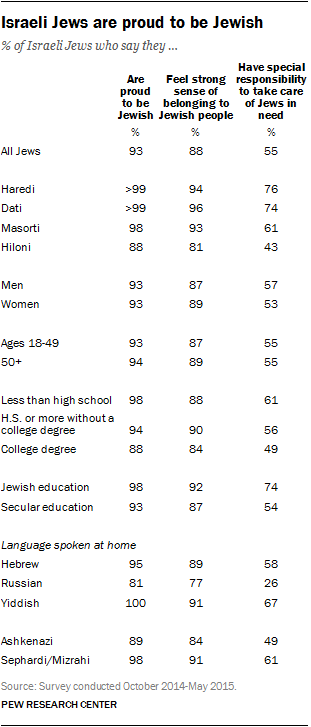
Israeli and American Jews also feel similar connections to the Jewish people more broadly defined. More than nine-in-ten in both groups say they are proud to be Jewish. Three-quarters or more of Jews in both countries say they feel a strong sense of belonging to the Jewish people (88% in Israel, 75% in the U.S.). And more than half of Jews in Israel (55%) and a solid majority in the United States (63%) say they feel a special responsibility to care for fellow Jews in need around the world.

Different perspectives on the peace process, settlements and U.S. support for Israel

Israeli Jews vs. U.S. Jews on the peace process, settlements and U.S. support for Israel

Despite their connections and shared attachment to the Jewish state, Israeli Jews and U.S. Jews have very different perspectives on some controversial political issues in Israel.

American Jews, at the time of the 2013 survey, were more optimistic about the prospects for a two-state solution than were Israelis when they were polled in 2014-15.14 Most U.S. Jews (61%) said in 2013 that they believe a way can be found for Israel and an independent Palestinian state to coexist peacefully. Fewer Israeli Jews (43%) take this view, while 45% say a two-state solution is not possible and 10% volunteer that it depends on the situation.

U.S. Jews and Israeli Jews also differ on the impact of Jewish settlements in the West Bank. While a plurality of Jews in Israel (42%) say the continued building of these settlements helps the security of Israel, only 17% of U.S. Jews agree with this view. By contrast, in the U.S., a plurality of Jews (44%) say the settlements hurt Israel’s own security interests; fewer Israeli Jews (30%) take this position.

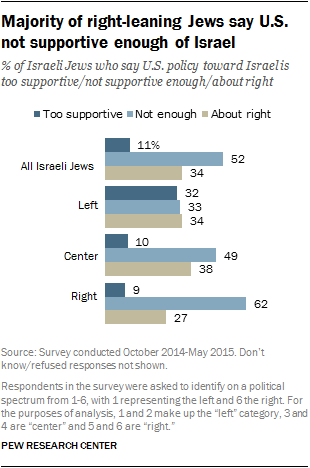
About half of Israeli Jews (52%) feel their country should be getting more support from the U.S. government, while roughly a third (34%) say the amount of support the U.S. gives Israel is about right. Among Jewish Americans, these figures are flipped: Roughly three-in-ten (31%) say the U.S. does not support Israel enough, while more than half (54%) say U.S. support for Israel is about right (as of 2013).

Self-described political ideology tied to views on peace process and U.S. role in Israel

On all of these questions, Israeli Jews’ views vary widely based on political ideology. The large segment of Israeli Jews on the political right are far more likely than the smaller number on the left to say a two-state solution is not possible and that settlements help Israel’s security.

Self-described politically liberal and conservative American Jews also offer differing opinions on the two-state solution and the impact of settlements on Israel’s security. But on these two questions, the difference in opinion between Jews on either end of the political spectrum in the U.S. is smaller than the ideological divide on these issues in Israel.

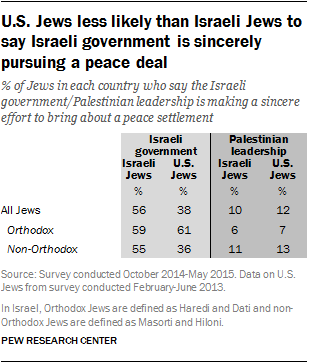
U.S. Jews less likely than Israeli Jews to say Israeli government is sincerely pursuing a peace deal

While American Jews are more optimistic than Israeli Jews about the possibility of a two-state solution, they are considerably less likely than Israeli Jews to say the Israeli government – controlled by a center-right/right-wing coalition for the last several years – is making a sincere effort to achieve peace with the Palestinians (38% vs. 56%). Like Israeli Jews, relatively few American Jews (12%) say the Palestinian leadership is making a sincere effort to achieve peace.

Orthodox Jews in both countries are about equally likely to say the Israeli government is making a sincere effort to bring about a peace settlement. But non-Orthodox Jews in Israel are considerably more likely than their American counterparts to say the Israeli government genuinely seeks a peace settlement (55% vs. 36%).

Once again, in both countries, Jews on either end of the ideological spectrum offer differing opinions on the sincerity of both parties in the peace process (i.e., Jews on the left are less likely than those on the right to say the Israeli government is sincerely pursuing peace and more likely to say Palestinian leaders are sincere). But the ideological divide between left- and right-leaning Jews in Israel is deeper than the divide between liberal and conservative American Jews. Among Israeli Jews on the left, 23% say the Israeli government is making a sincere effort to achieve peace, compared with 70% of those on the right (a 47-point gap). There is a 31-point gap between liberal (27%) and conservative (58%) U.S. Jews on this question.

U.S. Jews widely cite security as Israel's biggest problem

When it comes to these political issues, one key demographic difference between Jews in the two countries involves age. Younger American Jews (that is, those between the ages of 18 and 29) are more likely than their elders to take a more liberal stance on political issues involving Israel – e.g., more likely to say that a two-state solution is possible and that the U.S. is too supportive of Israel. However, there are few significant differences by age among Israeli Jews.

Perhaps one of the strongest indications that Israeli Jews and U.S. Jews have different perspectives on life in Israel is the question of the biggest long-term problem facing Israel. In response to an open-ended question, roughly equal shares of Israeli Jews cite economic issues (39%) and security (38%) as the biggest long-term problems facing their country. But among U.S. Jews, very few (1%) mention the economy as the biggest long-term problem facing Israel, while fully two-thirds of Jewish Americans cite security (66%). Similar shares in both countries – about one-in-six – say social, religious or political issues are the biggest problem Israel faces.

U.S. Jews have more social connections with members of other religions

Jews in U.S. far more likely to have non-Jewish friends, spouses

American Jews are much more likely than Israeli Jews to have close friendships with people of other faiths, and intermarriage is also comparatively common among non-Orthodox U.S. Jews. This no doubt reflects the fact that Jews make up only about 2% of all U.S. adults – a far different religious environment than in Israel, where Jewish adults make up roughly 80% of the population. But it may also speak to the integration of Jews into the proverbial melting pot of American society.

Among U.S. Jews who are married, 44% say they have a spouse who is not Jewish. Just 2% of Israeli Jews who are married have a spouse who is a member of another religious group or religiously unaffiliated.15

American Orthodox Jews, however, look more like their Israeli counterparts. Very few married Orthodox Jews in the U.S. (2%) say they are married to a non-Jew. Similarly, no Haredi or Dati Jews surveyed in Israel are in a religious intermarriage. Among non-Orthodox American Jews, half of those who are married say they have a non-Jewish spouse. By contrast, very few non-Orthodox Israeli Jews in a marriage (2%) say they have a spouse who is not Jewish.

U.S. Jews also are much more likely to have friendships with non-Jews: 98% of Israeli Jews say all or most of their close friends are Jewish, while only about a third of U.S. Jews (32%) say the same. Roughly two-thirds of Jewish Americans say just “some” or “hardly any” of their close friends are Jewish.

Even among Orthodox Jews in the United States, friendships at least sometimes extend beyond the Jewish community; 84% of American Orthodox Jews say all or most of their friends are Jewish, but 15% say at least some of their friends are not Jewish. By comparison, virtually all Israeli Orthodox Jews (99%) say all or most of their friends are Jewish.

Jewish Americans are more likely than other religious minority groups in the U.S. to have close friends from outside their religious group. Previous Pew Research Center surveys have found that a majority of U.S. Mormons (57%) and roughly half of American Muslims (48%) say all or most of their friends share their faith.

Differing ideas on what is essential to Jewish identity

U.S. Jews more likely to see ethics, justice as essential to being Jewish

Religious practices, political views and social circles are not the only ways in which Jews in Israel differ from Jews in the U.S. Indeed, American Jews express different views from Israeli Jews about what it means to be Jewish.

Both surveys asked respondents about a series of possible “essentials” of personal Jewish identity. While most Israeli Jews and U.S. Jews say remembering the Holocaust is essential to what being Jewish means to them, personally, there are bigger gaps on several other questions.

In general, more American Jews are inclined to see personal and social responsibility as essential to their Jewish identity. For instance, U.S. Jews are more likely than Israeli Jews to say leading an ethical and moral life is essential to their Jewish identity (69% vs. 47%); the same is true of working for justice and equality (56% vs. 27%). Jewish Americans also are more likely than their Israeli counterparts to emphasize intellectual curiosity (49% vs. 16%) and a good sense of humor (42% vs. 9%) with respect to their Jewish identity.

Israeli Jews, by contrast, are more likely than U.S. Jews to see observing Jewish law as an indispensable part of what being Jewish means to them (35% vs. 19%).

In addition to the eight specific items mentioned in the survey (remembering the Holocaust, observing Jewish law, etc.), respondents in both countries were asked if there is anything else that is essential to what “being Jewish” means to them, personally. This open-ended question, which respondents were asked to answer in their own words, drew a relatively small number of responses in the U.S. survey – most American Jews (62%) did not describe any further attributes of their Jewish identity.

By contrast, nearly all Israeli Jews offered at least one additional essential element of their Jewish identity, and many offered more than one. The vast majority of Israeli Jews emphasize being connected with Jewish history, culture and community as central to their Jewish identity (93%). Specifically, 32% of Jews say having a sense of belonging to the Jewish community is essential to their Jewish identity. Roughly one-in-five Jews also mention having knowledge about one’s history and roots as being central to their Jewish identity.

A majority of Israeli Jews also cite being connected with one’s family (73%) as central to their Jewish identity. This includes roughly half (53%) who say passing on Jewish traditions to children is essential to what being Jewish means to them.

This large difference in open-ended responses between U.S. Jews and Israeli Jews may stem from several factors. Because of the difference in the social and political context between the United States and Israel, Israeli Jews may have been culturally predisposed to talk at greater length than Americans about their Jewish identity. Also, the Israel survey was conducted in person, which may have encouraged respondents to be more engaged with this open-ended question than the American respondents, who were interviewed on the phone. (For a full evaluation of how the mode of survey administration could have influenced the results of the study, see the methodology.)

Further, the questions about Jewish identity that preceded the open-ended question were originally designed for American Jews and used in the Israel survey to allow for comparisons between the two groups. Israeli Jews may have felt dissatisfied with the choices offered to them in the closed-ended questions, which led to more extensive responses in the open-ended question.

Israeli and American Jews share similar views on what disqualifies a person from being Jewish

While U.S. and Israeli Jews may not always agree on what is essential to their Jewish identity, they generally concur on what does or does not disqualify a person from being Jewish. Both U.S. and Israeli Jews generally agree that someone can be Jewish even if he or she is strongly critical of the Jewish state (89% of U.S. Jews and 87% of Israeli Jews say this), works on the Sabbath (94% in U.S., 87% in Israel) or does not believe in God (68% in U.S., 71% in Israel).

Both groups are far less likely to say someone can be Jewish if that person believes Jesus was the Messiah (34% in U.S., 18% in Israel).

Regardless of Orthodox or non-Orthodox background, Jews in both countries take the same side on whether a person can be Jewish if he or she believes Jesus was the Messiah, works on the Sabbath or is strongly critical of the State of Israel. But when it comes to the question of whether a person can be Jewish if they do not believe in God, a much lower share of Orthodox than non-Orthodox Jews in Israel say this (48% vs. 78%). In the United States, majorities of both Orthodox (57%) and non-Orthodox (69%) Jews agree that a person can be Jewish even if he or she does not believe in God.

Israeli and American Jews tend to say being Jewish is primarily about ancestry or culture

Among Jews in both the U.S. and in Israel, half or more (62% and 55%, respectively) describe their Jewish identity as primarily a matter of culture or ancestry.

Israeli Jews are somewhat more likely than American Jews to say being Jewish is mainly a matter of religion (22% vs. 15%). This gap is driven primarily by differences between Orthodox Jews in both countries; 60% of Haredim and Datiim in Israel say their Jewish identity is primarily about religion, compared with 46% of American Orthodox Jews who say the same, although considerable shares of both groups say being Jewish is a matter of both religion and ancestry/culture.

Overall, nearly a quarter of Jews in both countries (23% each) say their Jewish identity is a matter of religion and ancestry/culture.

2. Religious affiliation and conversion

The vast majority of Israeli respondents in this survey identify as Jews (81%), including 40% who identify as Hiloni, 23% as Masorti, 10% as Dati and 8% as Haredi.

The sample also includes Muslims (14%), Christians (2%) and Druze (2%). Few Israelis analyzed in this study say they have no religion (1%).

After accounting for oversamples of Christians, Druze, Jews who identify as Haredi and Jews who live in the West Bank, the religious distribution of the survey’s respondents closely resembles the religious distribution of the adult population published in the 2014 Statistical Abstract by Israel’s Central Bureau of Statistics.

Readers should bear in mind that because of relatively high birthrates among Muslims who live in Israel, the proportion of Jews is slightly higher among adults than it is among children. The reverse is true for Muslims, who make up a higher share of children than they do of adults in Israel.

Slight discrepancies between survey proportions and census proportions also may result from the definition of religious groups used in the survey. For example, this report treats a small number of Israelis as Jewish even though they describe themselves, religiously, as atheist, agnostic or nothing in particular because they have at least one Jewish parent or were raised Jewish and consider themselves Jewish aside from religion. This parallels the definition of “who is a Jew” that was used in Pew Research Center’s 2013 survey of Jews in the United States. (See the sidebar on “How religious groups are defined” in the Overview of this report.)
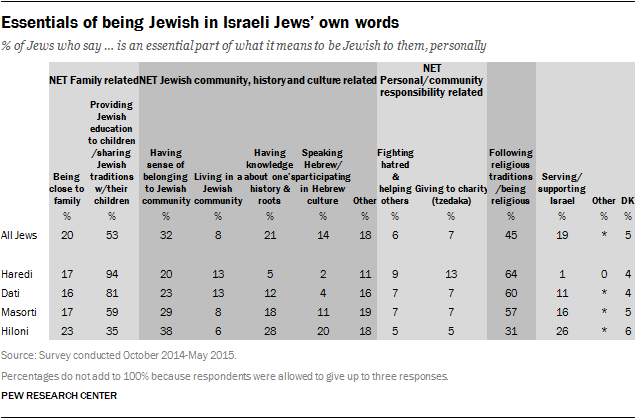
Roughly half of Jews identify as Hiloni (secular)

Breakdown of Jews in Israel

Roughly one-in-five Israeli Jews (22%) identify with groups that are commonly considered Orthodox: Haredim (9%) and Datiim (13%).

Fully three-quarters of Israeli Jews (78%) identify as Masortim (29%) and Hilonim (49%).

Among Jews, these four groups display a broad spectrum of religious observance. Haredim and Hilonim form the bookends of the spectrum: Those who identify themselves as Haredim show the highest levels of religious observance, while Hilonim are, on the whole, the least observant.

Datiim also adhere closely to Jewish law, although on several standard measures of religious observance and practice, they are somewhat less religiously committed than Haredim. Masortim often display moderate levels of religious belief and practice. (See Chapter 4: Religious Commitment, and Chapter 5: Jewish Beliefs and Practices.)

Virtually no conversion across religions in Israel

Israelis largely stay in the religion in which they were raised

Nearly universally, adults in Israel who identify as Jews were raised Jewish. Fully 98% of Israelis who currently identify as Jewish were raised Jewish.

Religious conversion also is uncommon among Israeli Muslims, Christians and Druze. Nearly all respondents who currently identify as Muslim, Christian or Druze say they were raised within those religious traditions.

Net loss for Datiim through switching to other Jewish subgroups

Changes in Jewish subgroups between childhood and today

The survey shows a slight net loss for Datiim between the share who were raised Dati and the share who currently identify as Dati. Fully 19% of Jews were raised Dati, while 13% currently identify as Dati – a loss of 6 percentage points.

Changes from religious switching

But among other Jewish subgroups, there are no significant differences between the shares who were raised Haredi, Masorti or Hiloni and the shares who currently identify with these groups. For example, 8% of adults were raised Haredim, while about as many (9%) currently identify as Haredim.

This overall picture of stability masks substantial movement among Jewish subgroups. For example, while the proportion of Jewish adults raised Masorti is roughly the same as the proportion that is currently Masorti, 9% of Jewish adults say they were raised Masorti and are no longer in the group, while 10% of adults were raised in another group and now identify as Masortim.

Similarly, while the proportion of Hilonim has remained relatively stable during survey respondents’ lifetimes, 4% of Israeli Jewish adults were raised as Hilonim and no longer identify as such, while twice as many (8%) now identify as Hilonim after having been raised in a different subgroup.

About one-in-ten Jewish adults (9%) were raised Datiim and are no longer Datiim, while approximately 2% now consider themselves Datiim after being raised in another group.

Compared with the other three groups, there has been relatively little switching out of the Haredi community.

Jews raised as Haredi or Hiloni usually stay

Haredim, Hilonim have highest retention rates

Overall, the two poles of Israeli Judaism – Hilonim and Haredim – experience the highest retention rates. The vast majority of those raised Haredim are still Haredim (94%), and nine-in-ten Jews raised Hilonim are still Hilonim.

The movement among Jewish subgroups in Israel is generally in the direction of lower observance. For example, while 54% of those raised as Datiim still identify as Datiim, most of the rest are now either Masortim (35%) or Hilonim (5%) – groups that are generally less observant than Datiim. And while two-thirds of those raised Masorti are still Masorti, most of those who have switched now identify as Hilonim (25% of all those raised Masorti).

Fewer Jews switch to groups with a higher level of observance than the one in which they were raised.

About one-in-five current Masortim were raised as Datiim

Roughly one-third of Masortim were not raised as Masortim

The flip side of examining retention rates is to consider which groups are most heavily made up of people who have switched into the group.

Jews who identify as Masortim have the highest share of switchers. Roughly one-third of Jews who currently identify as Masortim were not raised as Masortim (36%), including 23% who are former Datiim and 12% who are former Hilonim.

A quarter of current Haredim were raised in another Jewish subgroup, including 11% who were raised as Datiim and others who were raised as Masortim (6%) or Hilonim (8%).

Datiim and Hilonim are composed of 19% and 17% of switchers, respectively. Among each group, 14% of adults were raised Masorti.

3. Identity

Overwhelmingly, Jews in Israel feel a strong sense of belonging to the Jewish people and are proud to be Jewish. Fully 93% of Jews say they are proud of their Jewish identity and 88% say they feel a strong sense of belonging to the Jewish people.

Even across the religious-secular divide that characterizes many aspects of Israeli Jewish society, majorities of Israeli Jews feel pride and a sense of belonging with the Jewish people. Nearly all Haredim interviewed in this survey say they are proud to be Jewish, as do 88% of Hilonim. Similarly, 94% of Haredim say they have a strong sense of belonging to the Jewish people, as do 81% of Hilonim.

But Jews in Israel differ considerably from one another in how they understand their Jewish identity. A majority of Haredim (70%) say being Jewish is mainly a matter of religion, while just 3% say being Jewish is mostly a matter of culture or ancestry. Hilonim have a very different concept of Jewish identity: 83% say being Jewish is mainly about ancestry or culture, while just 4% say their Jewish identity is mainly about religion.

Overall, 22% of Jews say being Jewish is primarily about religion, while more than half (55%) say being Jewish is essentially about ancestry and/or culture. By comparison, about twice as many Muslims in Israel say being a Muslim is mainly about religion (45%). But the differing perspectives about identity are not unique to Jews; while Muslims are more likely than Jews to say their identity is primarily a matter of religion, about three-in-ten Muslims (29%) say being Muslim is primarily a matter of ancestry or culture. Similarly, about a third of Israeli Christians (34%) and Druze (33%) say their Christian/Druze identity is mainly about ancestry/culture.

The survey asked Israeli Jews what elements are essential to their Jewish identity – both from a list of eight possible responses and in their own words. Most Israeli Jews say remembering the Holocaust is essential to what being Jewish means to them, personally. And when asked to explain the essential elements of their Jewish identity in their own words, 53% of Israeli Jews say providing a Jewish education to children or sharing Jewish traditions with children is essential to their Jewish identity.

Nine-in-ten Jews say 'being Jewish' is at least somewhat important to them

Pluralities of Jews say ‘being Jewish’ is very important to them

Overall, just over half of Israeli Jews (54%) say being Jewish is “very important” to them. Roughly a third (36%) say being Jewish is “somewhat” important, and 10% say being Jewish is “not too” or “not at all” important in their lives.

The share of Jews who say being Jewish is very important to them is considerably higher than the share of Jews who say religion is very important in their lives (54% vs. 30%). (For more on this latter question, see Chapter 4.)

There are striking differences in how Jews belonging to different religious subgroups see the importance of being Jewish in their lives. Hilonim stand out from other groups in the relative lack of importance they place on being Jewish. Only about a quarter of Hiloni adults say being Jewish is very important to them (28%), while most (53%) say it is somewhat important and 18% say it is not too or not at all important.

At the other end of the spectrum, virtually all Haredim (97%) say being Jewish is very important to them.

Arab groups stress importance of being Muslim/Christian/Druze

Datiim resemble Haredim on this issue; 92% of Dati adults say being Jewish is very important in their lives. Roughly two-thirds of Masortim (68%) say being Jewish is very important in their lives, while about three-in-ten (29%) say it is somewhat important.

Israeli Arab groups are more likely to say they greatly value their Muslim/Christian/Druze identity (72% each) than their Jewish countrymen are to say “being Jewish” is very important to them (54%).

Among Muslims, as among Israeli Jews, there are no significant differences by age or gender on the importance of religious identity. And there are no statistically significant differences in the views of Muslims with different levels of educational attainment.

Ashkenazi, Mizrahi or Sephardi? Jewish ethnic identity in Israel

Israeli Jews are nearly evenly split between two Jewish ethnic identity groups – the Ashkenazim (45%) and the Sephardim or Mizrahim (48%). These two ethnic groups retain some distinct religious practices and cultural traditions associated with their ancestral roots. The chief rabbinate in Israel consists of two rabbis – one who is Ashkenazi and the other Sephardi.

Majority of Ashkenazim identify as Hiloni

The Ashkenazim (from the Hebrew term for Germany, Ashkenaz) trace their roots mainly to central and eastern Europe. (Indeed, a quarter of Israeli Ashkenazim say they speak primarily Russian at home.) Sephardim and Mizhrahim vary widely in their ancestral origin – from Spain’s Iberian Peninsula to the Middle East and Central Asia. Mizrahi (from Mizrah, meaning eastern in Hebrew) often is used interchangeably with Sephardi (or Sfaradit, meaning Spanish in Hebrew). Sephardim and Mizrahim have similar religious traditions and practices, distinct from those of the Ashkenazim. Sephardim typically trace their roots to ancestors who lived in Spain until they were expelled during the Spanish Inquisition. The Sephardim then migrated eastward and lived largely among the Mizrahim in the Middle East and North Africa.

Sephardi and Mizrahi Jews are, on average, more religiously observant than their Ashkenazi counterparts. Fully two-thirds of Ashkenazim identify as secular (Hiloni) Jews, compared with about three-in-ten of Sephardim/Mizrahim (32%). A plurality of Sephardim/Mizrahim (42%) identify as Masortim.

Over the course of Israel’s modern history, the Sephardi/Mizrahi community has experienced problems with discrimination and marginalization.16 This survey finds, however, that a majority of Sephardi/Mizrahi Jews say there is not currently a lot of discrimination against Mizrahim in Israeli society (32% say there is a lot, 64% say there is not). However, it should be noted that Sephardim/Mizrahim are significantly more likely than Ashkenazim to say that Mizrahim face a lot of discrimination (32% vs. 9%).

Overall, the survey finds Ashkenazim in Israel are more likely than Sephardim/Mizrahim to give priority to their Israeli identity over their Jewish identity. Fully 42% of Ashkenazim say they are Israeli first and Jewish second, compared with 27% of Sephardim/Mizrahim who say this. While Ashkenazim are closely divided among those who say they are Israeli first and those who say they are Jewish first, among Sephardim/Mizrahim, the prevailing view is that they are Jewish first (53%).

More say they are Jewish first, then Israeli

A plurality of Israeli Jews say they are Jewish before Israeli

When asked whether they would describe themselves as Jewish first or Israeli first, a plurality of Israeli Jews (46%) say they are Jewish first. Roughly a third (35%) say they are Israeli first, while 20% do not give a clear answer either way.17

Hilonim stand out from other Jewish subgroups on this question. A majority of Hilonim (59%) say they are Israeli first, while among other groups, fewer than one-in-four describe themselves as Israeli before Jewish. Among Haredim, roughly nine-in-ten (91%) say they are Jewish first, while only 2% say they are Israeli first.

Non-Jews in Israel were not asked whether they identify more strongly with their religious identity or their Israeli identity.

Israeli Jews say being Jewish is primarily about ancestry or culture

Jewish identity means different things to different groups

Most Jews in Israel (55%) say being Jewish, to them, is mostly about ancestry or culture. Roughly one-in-five (22%) say being Jewish is mainly about religion, while roughly the same proportion (23%) say being Jewish is about a combination of religion and ancestry/culture.

But there are wide differences in how Israeli Jews belonging to different religious subgroups understand this aspect of their Jewish identity.

A majority of Haredim (70%) say being Jewish is mainly about religion, while 3% say their Jewish identity is mainly about their ancestry or culture. Among Hilonim, by comparison, just 4% say their personal Jewish identity is mainly about religion, while an overwhelming majority (83%) say being Jewish is mainly about ancestry or culture.

Among Datiim, roughly half (52%) say their Jewish identity is mainly about religion, while 16% name ancestry or culture. Meanwhile, roughly four-in-ten Masortim (41%) say their Jewish identity is primarily about ancestry or culture, while about a quarter (24%) say being Jewish is mostly about religion.

About three-in-ten Datiim, Masortim and Haredim see their Jewish identity as tied up in religion as well as ancestry and/or culture.

Plurality of Muslims say being Muslim is mostly about religion

Arabs in Israel have multiple potential identities – including Arab, Palestinian and Israeli – in addition to their religious identities. When asked about the essence of Muslim identity, a plurality of Muslims in Israel (45%) say being Muslim is primarily a matter of religion to them, personally. But there are some divisions among Muslims about the essence of their identity. Fully 30% of Muslims say being a Muslim is mainly about ancestry or culture, and about one-in-five say Muslim identity is tied up in religion and ancestry/culture.

Among Muslims, there are no significant differences in views of Muslim identity between younger and older respondents, men and women and those who are college-educated versus those with less education.

Similar views of identity across Muslim demographic groups

The nature of Christian identity varies among Christians as well. Christians in Israel are about evenly divided among those who say their identity is mainly a matter of religion (31%), those who say being Christian is mainly about ancestry and/or culture (34%) and those who say their identity is characterized by a combination of religion and ancestry/culture (34%).

Among Druze, 18% say being Druze is primarily a matter of religion. A third of Druze say that to them, personally, being Druze is essentially about ancestry or culture, while nearly half of Druze adults (47%) say their identity is tied up in a combination of these elements.

Jews feel pride, connectedness and responsibility in Jewish community

Israeli Jews are proud to be Jewish

Across different age groups and educational, ethnic and religious backgrounds, the vast majority of Jews in Israel agree that they are proud to be Jewish and have a strong sense of belonging to the Jewish people. And more than half of Jews in Israel (55%) say they have a special responsibility to take care of Jews in need around the world.

Fully 93% of Israeli Jews say they are proud to be Jewish. Haredi and Dati Jews almost universally say this (>99%), as do virtually all Masorti Jews (98%). Somewhat fewer Hilonim say this – however, 88% still say they are proud of this aspect of their identity.

Similarly, while Russian-speaking Jews are somewhat less likely than Hebrew- or Yiddish- speaking Jews to express pride in being Jewish, majorities among all three groups say they are proud to be Jewish.

Overwhelmingly, Israeli Jews have a strong sense of belonging to the Jewish people. Fully 88% of Jews in Israel – including majorities in all four major religious subgroups – say they feel closely connected to the Jewish people.

Compared with pride and connectedness, fewer Israeli Jews (55%) say they feel a special responsibility to take care of Jews in need around the world. On this question, there are larger gaps between religious and secular Jews. Roughly three-quarters of Haredim (76%) and Datiim (74%) say they have a special responsibility to take care of Jews in need, but fewer than half of Hilonim (43%) feel this responsibility.

Muslims, Christians, Druze are all proud of their identity

In Israel, Muslims, Christians and Druze are about as likely as Jews to say they are proud of their identity. About nine-in-ten Arabs (94%) say their identity as a Muslim, Christian or Druze is a matter of pride for them. But Arabs are slightly more likely than Jews to say they have a special responsibility to help fellow members of their religious group who are in need around the world.

Overall, Muslims are somewhat less likely to say they have a strong sense of belonging to the Muslim community than Jews are to say they have a strong sense of belonging to the Jewish people (73% vs. 88%).18 Christians and Druze, meanwhile, are about as likely as Jews to say they feel a sense of belonging to their broadly defined group.

Little consensus among Israeli Jews about what is essential to Jewish identity

The survey asked Jews in Israel whether each of eight attributes and behaviors is essential, important but not essential, or not important to what being Jewish means to them, personally.

Overall, a majority of Israeli Jews (65%) say remembering the Holocaust is essential to their Jewish identity. Nearly half (47%) say living an ethical or moral life is essential to being Jewish, while roughly one-third say observing halakha (35%), living in Israel (33%) or working for justice and equality in society (27%) are essential to being Jewish. Smaller shares of Jews say eating traditional Jewish foods (18%), being intellectually curious (16%) or having a good sense of humor (9%) are essential aspects of their Jewish identity.

There are some important differences in the views of Jews belonging to different religious subgroups on the essential aspects of Jewish identity. Religiously observant Jews are more likely than less religious Jews to say living a moral and ethical life is essential to being Jewish. For example, a majority of Haredim (69%) say ethical living is essential to being Jewish, compared with 37% of Hilonim.

There is an even bigger gap when it comes to whether observing Jewish law, or halakha, is central to Jewish identity. An overwhelming proportion of Haredim (92%) and three-quarters of Datiim (75%) say observing halakha is essential to being Jewish, compared with fewer than half of Masortim (42%) and just 9% of Hilonim.

Perhaps as a reflection of their emphasis on religious rather than cultural, historical or ancestral aspects of being Jewish, Haredim are less likely than other groups to say that remembering the Holocaust is an essential part of what being Jewish means to them. Half of Haredim in Israel (50%) say this, compared with roughly two-thirds of Datiim, Masortim and Hilonim. Even among Yiddish-speaking Jews – virtually all of whom are Haredim whose roots are generally in Europe – just 27% say that remembering the Holocaust is essential to their Jewish identity.

“Living in Israel” was among the possible “essentials” of Jewish identity mentioned in the survey. About a quarter of Hilonim (23%) and a third of Haredim (35%) say it is essential to what being Jewish means to them, compared with about four-in-ten among Masortim (42%) and about half of Datiim (54%).
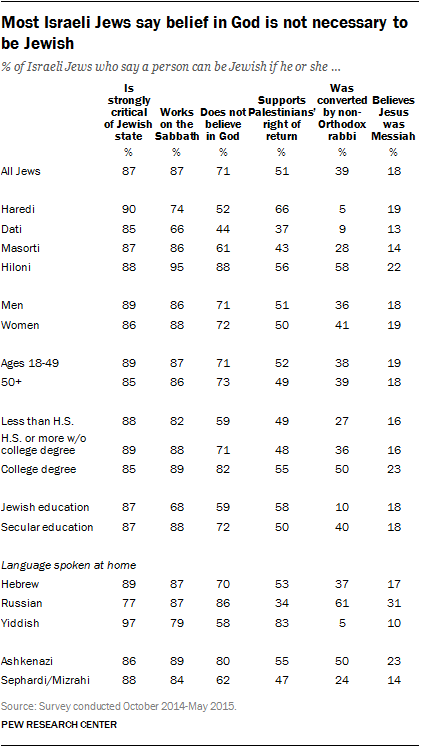
Most Israeli Jews say remembering the Holocaust is essential to being Jewish

The survey also asked Jews whether there are any components of Jewish identity that were not previously mentioned, yet that are essential to them. Respondents were asked to explain, in their own words, up to three additional elements of their Jewish identity. The answers show that Jews in Israel tend to view community, history and traditions as central to their Jewish identity, and many emphasize the need to pass on these traditions to future generations.

Specifically, a majority of Israeli Jews (73%) describe strong family bonds as central to their Jewish identity. This includes roughly half (53%) who say passing on Jewish traditions to their children is essential to what being Jewish means to them. In addition, 32% of Jews say having a sense of belonging to the Jewish community is essential to their Jewish identity, and roughly one-in-five (21%) mention having knowledge about one’s history and roots.

More than four-in-ten Jews (45%) also say following religious traditions or being religious is essential. Fewer (19%) say the same about serving or supporting Israel, with Haredim especially unlikely to say this (1%).

Essentials of being Jewish in Israeli Jews' own words

Jews say people can be Jewish even if they work on Sabbath

Most Israeli Jews say belief in God is not necessary to be Jewish

In addition to asking about qualities that are essential to Jewish identity, the survey also asked Jews in Israel what might disqualify someone from being Jewish.

Large majorities of Jews in Israel across different religious and cultural backgrounds agree that a person can be Jewish even if he or she works on the Sabbath or is strongly critical of the Jewish state.

There is somewhat more disagreement among Jews of different religious backgrounds on whether a person can be Jewish if he or she does not believe in God. Majorities of Hilonim (88%) and Masortim (61%) say not believing in God is compatible with being Jewish, but fewer Haredim (52%) and Datiim (44%) agree with this view.

About half of Israeli Jews say a person can be Jewish even if he/she supports Palestinians’ right of return to the land of Israel (51%), while 40% say supporting Palestinians’ right of return disqualifies a person from being Jewish. On this question, there are stark differences between the two most highly observant Jewish subgroups. Two-thirds of Haredim say a person can be Jewish despite holding this particular political view, while only about half as many Datiim (37%) say a person who supports Palestinians’ right of return can be Jewish.

Roughly four-in-ten Israeli Jews (39%) say a person can be Jewish if they were converted by a non-Orthodox rabbi, although there are major differences among Jewish subgroups on this question. Most Hilonim (58%) say a person can be Jewish in this situation, but only 28% of Masortim, 9% of Datiim and 5% of Haredim agree.

Israeli Jews generally think that a person cannot be Jewish if he/she believes Jesus was the Messiah. About one-in-five Hilonim (22%) and Haredim (19%) and one-in-ten Datiim (13%) and Masortim (14%) say someone who believes in Jesus can still be Jewish.

Muslims, Christians say belief in God is essential to being Muslim or Christian

Most Muslims say a person can be Muslim without praying, fasting

In stark contrast with Jews, few Muslims (11%) or Christians (14%) say that one can deny the existence of God and still be a Muslim or Christian.

In the Islamic tradition, Muhammad is considered the final prophet; few Muslims in Israel (12%) say one can believe that there were prophets after Muhammad and still be a Muslim.

By contrast, most Muslims (58%) and Christians (80%) say a person can accept Israel as a Jewish state and still be a member of their respective religious group.
The survey also asked Muslims and Christians if not supporting the political view that Palestinians who became refugees during and after the 1948 war have the right to return to and own property in Israel (commonly known as Palestinians’ right to return) disqualifies people from being Muslim or Christian.

Majorities say a person can be Muslim (58%) or Christian (79%) even if that person does not support Palestinians’ right of return. (This question was asked in the opposite way for Jews, 51% of whom say a person can be Jewish even if they do support Palestinians’ right of return.)

Overall, most Muslims and Christians say that not practicing certain aspects of their faith does not disqualify people from being members of their religion. For Muslims, nearly two-thirds say a person can be Muslim even if he or she does not pray several times a day (65%) or fast during Ramadan (63%). And similar shares of Christians say people can be Christian even if they never go to church (65%) or do not evangelize (66%).

Israeli Muslims divided over whether some groups qualify as Muslims

About half of Israeli Muslims consider Shia to be Muslims

The survey also asked self-identified Muslim respondents whether they consider members of certain groups to be Muslim.

The vast majority of Israeli Muslims are Sunni, and nearly all surveyed Muslims (98%) say they consider Sunnis to be Muslim. By comparison, about half of Muslims in Israel say Shias (53%), Sufis (47%) and Ahmadiyyas (46%) are Muslims.

In Israel, Druze citizens have a different status from Muslims in some ways. For example, Druze are subject to the military draft and serve in the Israeli armed forces, while Muslims are exempt from serving but may volunteer. But 16% of Muslims say they consider Druze to be Muslims. (For more about Druze history and beliefs, see this sidebar.)

Some of these groups are unfamiliar to many Muslims in Israel. For example, 20% of Muslims declined to give an opinion about Sufis, saying they had never heard about the group. (Sufis tend to be concentrated in South Asia, Africa and some countries in the Middle East.) And 15% of Israeli Muslims say they are not familiar with Ahmadiyyas, a group that has a small presence in some parts of Israel and is generally well integrated into the Israeli Arab community.

When it comes to acceptance of these groups as Muslims, opinions among self-identified Muslims vary little by age, education and gender.

4. Religious commitment

Israeli Jews vary enormously in their religious observance, with major differences tied inherently to the four major Jewish identity groups. The share who say they go to religious services at a synagogue at least once a week, for example, ranges from nearly all Orthodox Jewish men (Haredi and Dati) and majorities of Orthodox women to very few secular (Hiloni) men and practically no Hiloni women.

Overall, Jews are less religious than members of Israel’s other major faith communities – Muslims, Christians and Druze – by most comparable measures. For instance, fully 68% of Israeli Muslims say religion holds a very important place in their lives, followed by 57% of Christians, 49% of Druze and 30% of Jews.

This overall picture – in which Israel’s minority faith groups are, on average, more religious than Israeli Jews – is more complex than it seems. One factor is gender: Generally speaking, women display higher levels of religious commitment than men among Muslims in Israel. (Even though men attend mosque at higher rates than women, more women say they pray frequently and say religion is very important in their lives.) But among Jews, the opposite is true: Men, on average, display higher levels of observance than women.

In part, this may be because of differences in religious requirements for men and women according to Jewish law (e.g., men are expected to pray and attend synagogue more often than women). But men also are more likely than women to say that, overall, religion is very important to them. These differences are particularly pronounced among Haredim and Datiim but are also prevalent among Masortim.

Another major difference in demographic patterns between Jews and Muslims is age. While Jews belonging to younger and older age groups vary little in their overall religious commitment, younger Muslims tend to be less observant than older Muslims. For example, Muslims between the ages of 18 and 49 are less likely than those ages 50 and older to attend mosque weekly or pray daily.

One-third of Israeli Jews say they never attend synagogue

Most Haredim, Datiim attend synagogue weekly, while most Hilonim never attend

Roughly a quarter of Israeli Jews say they attend synagogue on a weekly basis (27%), while 39% say they attend on a monthly, yearly or infrequent basis. A third of Jews in Israel (33%) say they never go to synagogue.

Regular synagogue attendance is one of the fundamental behavioral differences between Jewish subgroups in Israel. While the vast majority of Haredim (85%) attend religious services weekly, almost no Hilonim (1%) do. And while a majority of Hilonim (60%) say they never go to synagogue, virtually no Haredi respondents say this.

Weekly synagogue attendance is also the norm among Datiim; 74% say they attend synagogue weekly. Compared with other Jewish subgroups, Masortim are less uniform in their synagogue attendance. A plurality (55%) say they attend synagogue monthly, yearly or seldom, while about a third (32%) say they attend weekly. About one-in-ten Masorti Jews (13%) say they never attend synagogue.

More Jewish men than women attend synagogue weekly

Self-reported rates of weekly synagogue attendance are very low (4%) among Jews who primarily speak Russian at home. A majority of Jews who speak Russian at home say they never attend synagogue (61%).

Jewish men overall are considerably more likely than women to say they go to synagogue on a weekly basis (37% vs. 18%). This gender difference is seen among Haredi, Dati and Masorti men and women; few Hiloni men or women report attending synagogue weekly or more.

Israeli Jews are less likely than Arabs in Israel to participate in weekly worship services. Among Arabs, nearly half of adults (47%) say they attend services weekly.

Muslims most likely to attend services weekly

This gap is largely driven by Israeli Muslims, 49% of whom report attending mosque at least weekly. In fact, among Muslims, about a quarter of adults (27%) report attending mosque more than once per week. Among Israeli Jews, 16% of adults say they go to synagogue more than once a week.

Among Muslims – as among Jews – worship attendance is more common among men than women. In part, this is because in both traditions, worship service attendance is more incumbent upon men than it is among women. About six-in-ten Muslim men (61%) report attending mosque on at least a weekly basis, compared with 36% of Muslim women.

While Jews differ very little by age when it comes to synagogue attendance, among Muslims, older adults are more likely than younger people to attend weekly worship services.

Older Muslims more likely to attend mosque weekly
About eight-in-ten Hilonim say religion is not important in their lives

Plurality of Israeli Jews say religion is not important to them

As with synagogue attendance, the importance of religion in the lives of Israeli Jews varies enormously by subgroup.

Haredim nearly universally say religion is very important in their lives. Hilonim are at the opposite end of the spectrum, with just 2% reporting that religion is very important to them and about eight-in-ten (79%) saying it is either “not too” or “not at all” important.

A strong majority of Datiim (85%) say religion has a very important place in their lives. And Masortim again occupy the religious middle; 51% say religion is “somewhat” important in their lives, while about one-third (32%) say religion is very important to them and roughly one-in-six (16%) say religion is not too or not at all important to them, personally.

Overall, Jewish men are somewhat more likely than Jewish women to say religion is very important in their lives (35% vs. 25%). This difference is largely a result of a large gap between Masorti men and women. Masorti men are nearly twice as likely as Masorti women to say religion has high importance in their lives (41% vs. 23%). Within the other Jewish subgroups, men and women are about equally likely to say religion is very important in their lives.

Majority of Muslims say religion is very important

Religion is generally more important to Israeli Jews who have lower levels of formal education; most Jews with a college degree (62%) say religion is not too or not at all important to them.

In Israel, Arabs are more than twice as likely as Jews to say religion is very important in their lives. Roughly two-thirds of Arabs (66%) say religion has high importance in their lives, compared with 30% of Jews. Arabs are far less likely than Jews to say religion is not too important or not at all important to them, personally; just 5% of Arabs say this, compared with 44% of Jews.

Muslims are especially likely to say religion is very important to them (68%). But Israeli Christians (57%) and Druze (49%) also are more likely than Jews as a whole to place high importance on religion.

Among Jews, men are more likely than women to say religion is very important in their lives. But among Muslims, the opposite is true; 76% of Muslim women in Israel say religion has high importance in their lives, compared with 61% of men.

Muslim women more likely than men to say religion 'very important'

Roughly three-quarters of Haredim pray daily, while similar share of Hilonim never pray

Half of Jews say they never pray

As with synagogue attendance and importance of religion, prayer habits differ substantially among religious subgroups of Jews in Israel.

The majority of Haredim (76%) say they pray every day, while relatively few (7%) say they never pray. The vast majority of Hilonim, meanwhile, say they never pray (79%), while just 1% pray daily.

A slim majority of Datiim (58%) pray once a day or more. Masortim have more varied prayer habits. A plurality of Masortim (47%) say they pray on a weekly, monthly or infrequent basis. An additional 21% pray on a daily basis, while 31% say they never pray.

As on other measures of religious observance, these patterns extend to other demographic groups in Israeli society. For instance, Israeli Jews who primarily speak Yiddish are especially likely to pray often, while Russian-speaking Jews are unlikely to do so. Similarly, prayer is far more common among Israeli Jews who received their highest education from a religious institution than it is among those who received their highest training from a secular institution. There also are gaps among Jews with different levels of formal education overall; college graduates are less likely than others to report praying daily.

More Jewish men than women pray daily

Older and younger Israeli Jews pray at about the same rates.

In Judaism, daily prayer is more incumbent upon men than women. Perhaps for this reason, Jewish men across different subgroups in Israel generally are more likely than Jewish women to say they pray daily.

The gender gap on prayer is especially pronounced among Datiim. Roughly seven-in-ten Dati men (69%) say they pray daily, compared with about half of Dati women (48%). But there also are differences between men and women among Haredim (80% of Haredi men pray daily vs. 71% of women) and Masortim (29% vs. 13%).

Most Israeli Muslims say they pray every day

A slim majority of Israeli Arabs (56%) say they pray on a daily basis, compared with 21% of Israeli Jews who say the same.

This gap is largely due to high rates of prayer among Muslims. About six-in-ten Muslims in Israel (61%) say they pray at least once a day, including 52% who pray all five prayers. Among Christians, the rate of daily prayer (34%) is lower than among Muslims but higher than among Jews. Israeli Druze are about as likely as Jews to pray every day (26% vs. 21%).

Unlike the Jewish community, where there are few differences by age when it comes to rates of daily prayer, older Muslims are more likely than younger adults to say they pray daily. The vast majority of Muslims ages 50 or older (76%) pray every day, compared with 57% of Muslim adults under 50.

Muslims also differ from Jews when it comes to patterns in prayer by gender. Among Jews, more men than women say they pray every day, while among Muslims, more women than men report praying on a daily basis (69% vs. 53%).

Muslim women, older Muslims especially likely to say they pray daily

Half of Israeli Jews are absolutely certain of God’s existence

Half of Israeli Jews (50%) say they believe in God with absolute certainty. As with other standard measures of religious observance, belief in God varies considerably by Jewish subgroup, ethnic background, primary language and education level and type.

Hilonim less certain than other Jewish groups about their belief in God

Hilonim, who make up 49% of Israeli Jews, stand apart from Haredim, Datiim and Masortim on this issue. While majorities in other groups are convinced of God’s existence – including overwhelming majorities of Haredim (98%) and Datiim (91%) – among Hilonim, only about one-in-five (18%) say they believe in God with absolute certainty. More than a third of Hilonim (38%) say they believe in God but are less than absolutely certain, while 44% say they do not believe in God or they do not know if God exists.

About nine-in-ten Israeli Jews who received their highest education from a religious institution (91%) say they are absolutely certain God exists, while about half of those who received their highest training from a secular institution (47%) share this view. Jews also vary considerably by linguistic background; just 17% of Russian-speaking Jews are absolutely convinced of God’s existence. By contrast, Yiddish speakers are nearly universally certain about God’s existence (98%). Hebrew speakers fall somewhere in between, with 53% convinced that God exists.

There also is a considerable gap on this question by ethnicity. Sephardi and Mizrahi Jews are more likely than Ashkenazim to say they are absolutely certain of God’s existence (65% vs. 35%), while Ashkenazi Jews are much more likely to say they do not believe in God or do not know if they believe in God (35% vs. 11%).

Large majorities of Christians, Druze certain about God's existence

Across Israel, belief in God is higher among Christians and Druze than among Jews. Nearly all Druze (99%) believe in God, including 84% who are absolutely certain of their belief. Among Christians, 94% believe in God, including 79% who say they are absolutely certain.

Due to cultural sensitivity over the very idea that God’s existence potentially could be denied, Muslims were not asked this question. Instead, Muslims were asked if they believe in the shahada, a declaration of faith in one God (Allah) and his Prophet Muhammad. Like Muslims elsewhere around the world, Israeli Muslims nearly universally say they believe in Allah and his Prophet Muhammad (97%). Muslims across different age, gender and education groups are about equally likely to affirm the shahada.

5. Jewish beliefs and practices

The differences in religious commitment among subgroups of Israeli Jews are reflected in their religious beliefs and practices, including observance of the Sabbath. For example, virtually all Haredim surveyed say they avoid handling money or riding in a car, train or bus on the Sabbath. Hilonim are much less likely to observe these customs.

Divisions between secular and religious Jews also are seen in many other Jewish beliefs and practices. For example, almost all Haredim – but just three-in-ten Hilonim – say they fasted all day last Yom Kippur.

While Hilonim in Israel consistently show lower levels of adherence to Jewish customs and traditions, the survey finds substantial proportions of Hilonim practice some aspects of Judaism, whether for cultural or religious reasons. For example, a large majority of Hilonim say they held or attended a Seder last Passover. Roughly half say they light candles before the start of the Sabbath at least some of the time, including one-in-five who say they usually or always do this. And about one-third of Hilonim say they keep kosher in their home.

Differences in religious observance by gender are also apparent. Overall, Israeli Jewish women are less observant of certain aspects of Jewish traditions than are men. For example, fewer women abstain from traveling on the Sabbath. And fewer women than men say they frequently read religious texts – a pattern seen among Haredim and Datiim as well as among Masortim.

Russian-speaking Jews in Israel stand out for relatively low levels of observance of Jewish beliefs and practices. A majority of Russian speakers say they personally handle money on the Sabbath, for example, and roughly half say they eat pork.

Wide differences in observance of the Sabbath

Haredim and Datiim refrain from handling money on the Sabbath
Most Hilonim say they handle money on Sabbath

For observant Jews, handling money is among the activities and behaviors traditionally forbidden on Shabbat (the Jewish Sabbath, which takes place each week from sundown Friday to sundown Saturday). Religious Jews also generally avoid traveling by car, bus or train, operating devices powered by batteries or electricity, igniting or extinguishing a flame, writing, ripping or tearing paper and many other activities prohibited by Jewish law on the day of rest.

More than half of Israeli Jews say they personally handle money on Shabbat (55%), while 41% say they avoid doing so.

No Haredim and Datiim in the survey say they handle money on the Sabbath, but the vast majority (88%) of Hilonim do. Masortim are more divided on this question.

Among Masortim, observance of this tradition is somewhat more common among men than women. Most Masorti men (58%) say they refrain from handling money on the Sabbath, compared with a somewhat smaller share of Masorti women (48%). There are no significant differences between men and women within the other Jewish subgroups.

Among Jews who received their highest level of education from a religious institution, observance of this Sabbath prohibition is nearly universal. By contrast, among those who completed their education at a secular institution, 58% say they handle money on the Sabbath.

Russian-speaking Jews and Jews of Ashkenazi ancestry are more likely than other Jewish subgroups to say they handle money on Shabbat, a pattern also seen in other areas of religious practice.

Most Israeli Jews – but not Haredim and Datiim – travel by car, bus or train on the Sabbath
Nearly all Hilonim travel on the Sabbath

A majority of Jews in Israel say they ride in a car, bus or train on Shabbat (62%), but about a third (35%) say they refrain from traveling on the Jewish holy day.

No Orthodox Jews surveyed travel on the Sabbath, while the vast majority of Hilonim (95%) say they do travel by car, bus or train on the Jewish day of rest.

Masortim are somewhat more apt to say they travel on the Sabbath (53%) than to avoid such activity (41%), while 6% say it depends on the situation.

Women are somewhat more likely than men to say they travel on Shabbat (65% vs. 59%). This gap stems largely from Masortim; women in this group are considerably more likely than men to say they travel on the Sabbath (61% vs. 46%).

Israeli Jews with a college degree are considerably more likely to say they travel on Shabbat than are Jews with less education. And a majority of Jews who earned their highest degree from a secular institution say they travel on the Sabbath (65%), compared with just 8% of those who received their highest education at a religious institution.

About half of Hilonim light Sabbath candles at least sometimes

As with other aspects of religious observance, Ashkenazim are somewhat less observant by this measure than are Sephardi and Mizrahi Jews.

Slim majority of Israeli Jews always or usually light Sabbath candles

A slim majority of Israeli Jews (56%) say they, or someone in their household, either always or usually lights candles to mark the coming of the Sabbath on Friday evenings. But as with most other measures of religious beliefs and practices, when it comes to lighting Sabbath candles, there are many differences among religious and demographic subgroups.

Lighting candles shortly before Shabbat is a nearly universal practice among Datiim and Haredim. By comparison, one-in-five Hilonim say they always or usually observe this Sabbath ritual in their home, while nearly half of Hilonim (47%) say they never do this.

Jews who speak Hebrew at home are about twice as likely as Russian speakers to regularly observe this ritual (58% vs. 29%). Among those who speak Yiddish at home, every respondent in this survey says that someone in his or her household always or usually lights Sabbath candles.

Comparing religious observance among Jews from the former Soviet Union and their children

Children of immigrants from the former Soviet Union more religious than their parents

First- and second-generation immigrants from the former Soviet Union (FSU) make up roughly one-fifth of Jewish respondents in the Pew Research Center survey; 14% are immigrants and 5% are children of at least one immigrant parent. Overall, Jews who immigrated to Israel from the former Soviet Union are less religious than Israeli Jews as a whole.

But the survey also finds that second-generation FSU Israelis are considerably more religiously observant than their parents’ generation. When it comes to Jewish subgroups, for example, 60% of those in the second generation say they are Hiloni, compared with 81% of first-generation immigrants. While 4% of first-generation immigrants say they are Haredi, among the second generation, this proportion has climbed to 14%.

Children of FSU immigrants also are much more likely than their parents to believe in God (70% vs. 55%). On this question, second-generation FSU immigrants are closer to Israeli Jews overall, 77% of whom say they believe in God.

Similarly, when it comes to Jewish religious practices such as lighting Sabbath candles, keeping kosher, holding or attending a traditional Seder and studying the Torah, children of FSU immigrants are considerably more active than the first generation. For example, children of FSU immigrants are about twice as likely as their parents to keep kosher, both in their home (50% vs. 24%) and outside their home (35% vs. 19%). And while about four-in-ten first-generation immigrants from the former Soviet Union (42%) say they eat pork, only 17% of second-generation FSU immigrants say they personally do so.

Most Israeli Jews keep kosher in their home and avoid eating pork

All Haredim and Datiim, one-third of Hilonim keep kosher at home
About half of Israeli Jews keep kosher outside their home

Jewish dietary laws, known as kashrut, include several common practices. For example, Jews observing these laws do not eat meat and dairy products together in the same meal, and they do not eat certain types of animal products (including pork and shellfish).

Roughly six-in-ten Israeli Jews say they keep kosher in their home. This practice is virtually universal among Haredim and Datiim and very common among Masortim (86%), but it is less common among Hilonim. A third of Hilonim (33%) say they keep kosher at home, while most (63%) do not.

The secular-religious divide on keeping kosher is also reflected in differences between Jews who received secular or religious instruction. Jews who received their highest level of education from a religious institution are considerably more likely than Jews who earned their highest degree from a secular school to say they keep kosher at home (95% vs. 61%).

There are no significant differences between men and women or between older and younger adults when it comes to keeping kosher at home. Jews with less formal education, however, are more likely than others to keep kosher in their home. Among ethnic and linguistic groups, Sephardi and Mizrahi Jews and Yiddish-speaking Jews are especially likely to report keeping kosher.

Fewer Israelis say they keep kosher outside their home (52%) than in their home (63%).

All Haredim and Datiim, and most Masortim (69%), in the survey say they observe kosher laws outside their home. Among Hilonim, however, only about one-in-five do so.

As with keeping kosher in the home, there are familiar patterns by ethnicity and education level and type in following Jewish dietary guidelines outside the home. For example, Jews with Sephardi or Mizrahi ancestry are much more likely than Ashkenazi Jews to say they keep kosher outside their home (70% vs. 35%).

Overall, relatively few Israeli Jews (16%) say they eat pork. An overwhelming majority (82%) do not consume bacon or other pork products, which are not kosher. Even a solid majority of Hilonim (67%) say they refrain from consuming pork.

Russian-speaking Jews are more likely than Israeli Jews overall to eat pork. Roughly equal shares of Jews who speak Russian at home say they eat pork (47%) and refrain from eating pork (49%). No Yiddish speakers interviewed in this survey say they eat pork, and just 12% of Hebrew-speaking Jews in Israel say they, personally, consume pork.

Ashkenazi Jews – one-quarter of whom speak Russian at home – are more likely than Sephardi or Mizrahi Jews to say they eat pork (28% vs. 4%).

Two-thirds of Hilonim do not eat pork

Most Israeli Jews light Hanukkah candles

Eight-in-ten Hilonim light Hannukkah candles at least sometimes

A majority of Jews in Israel (70%) say they always or usually light candles on Hanukkah – the eight-day festival of lights that commemorates the Maccabees’ rededication of the Temple in 165 B.C.E. after its desecration by the Seleucid Greeks. Roughly one-in-five (19%) say they sometimes light Hanukkah candles, while relatively few (10%) never practice this ritual.

Lighting candles for Hanukkah is less common among Hilonim than among other Israeli Jews. Still, even among this nominally secular group, 45% say they always or usually light candles during Hanukkah, and an additional 35% say they sometimes do.

Patterns by primary language, ethnicity and education level and type are similar to other measures of Jewish religious observance. There are no differences by age and gender when it comes to frequency of lighting Hanukkah candles among Israeli Jews.

Attending a Passover Seder among most popular Jewish rituals in Israel

Majorities of Jews belonging to different religious and cultural backgrounds go to Seder

Passover Seders – festive meals with special foods that involve the retelling of the story of ancient Jews’ exodus from slavery in Egypt – are widely popular among Israeli Jews. Roughly nine-in-ten (93%) Jews in Israel say they attended or held a Seder last Passover.

Seder attendance was all but universal among Haredim, Datiim and Masortim; the vast majority of Hilonim (87%) also participated in a Seder.

Even among comparatively less observant Russian-speaking Jews in Israel, seven-in-ten (70%) say they attended or held a Seder last Passover. Nearly nine-in-ten or more among virtually all other demographic groups also did this.

Israeli Jews also were asked if they attended a traditional Seder last Passover. Two-thirds (67%) say they attended a traditional Seder, while about a quarter (26%) say the Seder they attended was not traditional.

Hilonim stand out from other Jews on attendance at a nontraditional Seder; 41% of Hilonim say they attended a traditional Seder, while 46% say the Seder they attended was not traditional. Virtually all Haredim and Datiim and the vast majority of Masortim say they attended a traditional Seder.

Only about a quarter of Russian-speaking Jews (23%) say they attended a traditional Seder last year, while a considerably higher share (47%) attended a nontraditional Passover meal. The vast majority of Sephardi, Mizrahi and Ashkenazi Jews say they attended a Seder of some kind last Passover, but Sephardim and Mizrahim are considerably more likely than Ashkenazim to say the Seder they attended was traditional in nature (82% vs. 51%).

Israeli Jews with lower levels of education – and those who received their highest training from a religious rather than a secular institution– are more likely than others to attend a traditional Seder.

Fewer Hilonim than Haredim, Datiim and Masortim attended a traditional Passover Seder

Most Israeli Jews fasted all day last Yom Kippur

Half of Hilonim did not fast at all on Yom Kippur

Observant Jews who are physically able generally go without food and drink on Yom Kippur – the annual Jewish Day of Atonement and the holiest day on the Jewish calendar, which occurs shortly after Rosh Hashanah (the Jewish New Year). Most Jews in Israel (60%) say they fasted all day last Yom Kippur, while about a quarter did not fast at all and a small proportion (5%) say they were unable to fast for health reasons or did not answer the question.

Among Hilonim, half say they did not fast at all last Yom Kippur, compared with three-in-ten who report fasting all day and roughly one-in-ten (13%) who fasted part of the day.

Fasting during Yom Kippur is nearly universal among Haredim and Datiim. The vast majority of Masortim (83%) also say they fasted all day last Yom Kippur.

Russian-speaking Jews in Israel are more likely than others to say they did not fast at all on Yom Kippur (47%); an additional 15% say they could not fast due to health reasons or did not answer the question.

A majority of Sephardi/Mizrahi Jews say they fasted all day on Yom Kippur (77%), compared with 44% of Ashkenazi Jews.

About six-in-ten Israeli Jews never read religious texts

Haredim especially likely to often study Torah or Gemara

Compared with several other Jewish rituals, fewer Israeli Jews say they read religious texts on a regular basis. Roughly one-in-five Jews (21%) say they read the Torah (the five books of Moses) or Gemara (a religious text with rabbinical analysis and commentary) on a daily or weekly basis, while an additional one-in-five (19%) read these texts on a monthly or yearly basis. A majority of Israeli Jews (59%) say they never read Jewish religious texts.

When it comes to reading religious texts, the difference between Orthodox and non-Orthodox Jews in Israel is large. About three-quarters of Haredim (76%) and a slim majority of Datiim (57%) say they read religious texts on at least a weekly basis, compared with one-in-five Masortim (21%) and very few Hilonim (1%).

Perhaps the largest divide on this issue is connected to the type of education one received. Among Jews who received their highest education from a religious school, 86% say they read religious texts at least weekly, compared with 17% of those who received their highest training from a secular institution.

Men are more likely than women to say they study the Torah or Gemara on a daily or weekly basis (30% vs. 12%). This gender difference is particularly pronounced among Haredim. Roughly eight-in-ten Haredi men (79%) say they read religious texts daily, compared with 27% of Haredi women. Although differences by gender are less pronounced within other groups, Dati and Masorti men also are more likely than women to say they regularly read religious texts.

About one-third of Jewish men, one-in-five Jewish women wear a head covering of some kind in public

A majority of Israeli Jewish men (64%) – including virtually all Hiloni men (more than 99%) – say they usually do not wear any head covering in public. However, wearing head coverings, and especially particular kinds of head coverings, is far more common among men of some demographic and cultural backgrounds.

Nearly all Haredi and Dati men say they wear head coverings in public. Among Haredim, roughly half of men (53%) say they wear a large kippa made of black fabric in public, while an additional 13% wear a small black kippa. Some Haredi men also wear a hat, such as a fedora or shtreimel (a fur hat sometimes worn by Hasidic Jews). For Datiim, a crocheted kippa is most common; 48% of Dati men say they usually wear a colored or patterned crocheted kippa, while an additional 10% wear a black crocheted kippa.

Dati men favor crocheted kippa, most Haredi men wear black fabric kippa

A slim majority of Masorti men (57%) say they do not wear any head covering in public, although many wear a crocheted kippa, whether colored or patterned (18%) or black (9%).

Certain head coverings are more common in particular regions of Israel, in large part because of the religious composition of residents. For instance, residents of the West Bank and Jerusalem are considerably more likely than other Israeli Jewish men to say they wear traditional Jewish head coverings in public. And on the West Bank, roughly four-in-ten Jewish men (38%) say they wear a crocheted kippa with patterns or colors.

Half of Haredi women wear a wig in public

The vast majority of Israeli Jewish women say they do not wear traditional head coverings (81%). Head coverings are much more common among married (25%) than unmarried (9%) women, reflecting Jewish tradition.

Nearly all Hiloni women (99%) and 89% of Masorti women say they do not wear head coverings in public. Overall, about half of Haredi women (married and unmarried) say they wear a wig, while 22% say they wear a snood (which holds the hair in yarn or cloth). Still others wear a hat (14%) or a scarf (10%) over their head. Among Dati women, a smaller share (6%) wear a wig, but most say they wear a head covering of some kind, such as a snood (15%), scarf (18%) or hat (27%).

Virtually all married Haredi women (99%) and most married Dati women (71%) wear some kind of head covering.

Israeli Jews vary widely in overall observance of Jewish tradition

Half of Hilonim say they do not observe any of the Jewish tradition

About four-in-ten Israeli Jews say they observe all or most of the Jewish religious tradition (39%). About a third say they follow some of the tradition (34%), while about a quarter (26%) say they don’t observe any of the Jewish tradition at all.

Nearly all Haredim and Datiim say they observe all or most of the Jewish religious tradition. Meanwhile, very few Hilonim (3%) say they follow all or most of the tradition. Hilonim are about evenly divided between those who follow some Jewish tradition (47%) and none at all (50%).

Masortim hold the middle ground between secular and religious Jews. A slim majority of Masortim (57%) say they observe all or most of the Jewish tradition, while 38% say they observe some of the tradition. Relatively few Masortim (4%) say they observe no Jewish tradition at all.

Among both Orthodox and non-Orthodox Jews, younger adults are about as likely as older Jews to say they observe all or most of the Jewish tradition. Men are somewhat more likely than women to say they observe all traditions (24% vs. 17%), but about as likely to say they observe most traditions (18% vs. 20%).

There are sizable differences in observance by level of education. Jews who have less formal education are more likely than their peers with high school or college degrees to say they observe all or most of the religious tradition. In part, this difference may reflect the fact that Haredim are disproportionally represented among Jews with less than a high school education. Fully 19% of those with less than high school education are Haredi, compared with 9% in the Jewish adult population overall. (See Chapter 7 for more on educational differences among Jewish subgroups.)

6. Muslim and Christian beliefs and practices

Overall, most Muslims in Israel say they adhere to core tenets of their faith. For example, more than three-quarters of Muslims (83%) say they fast during the holy month of Ramadan, and roughly two-thirds say they give zakat (an annual donation of a percentage of one’s wealth to the needy or to a mosque).

Christians in Israel also are generally observant of their faith. For example, a large majority say they have received the annual sacrament of holy oil – a ritual closely associated with Orthodox Christianity but also practiced by most Catholics in Israel.

The survey did not ask Druze respondents specific questions about their religion beyond their affiliation and overall observance. In general, Druze are known to be reluctant to talk about their religious beliefs and practices. There are several reasons for this: In order to learn more about their community’s spiritual beliefs, Druze have to undergo a formal initiation process that involves several different stages of study. Many Druze may not have undergone initiation and may therefore lack detailed knowledge about their faith. And because of a history of religious persecution, Druze may be reluctant to speak about religion generally. For more background on Druze, see the sidebar later in this chapter.

Most Israeli Muslims fast during Ramadan, give zakat

Majorities of Muslims fast during Ramadan and give zakat
Younger Muslims less likely to fast during Ramadan

The survey asked Israeli Muslims whether they give zakat – i.e., donate a percentage of their income to a mosque or to charity – and whether they fast during the holy month of Ramadan. These are two of the Five Pillars of Islam and, hence, are useful indicators of religious observance.19

Majorities of younger and older Muslims, men and women and those with different levels of education say they engage in these practices. But Muslim women in Israel are somewhat more likely than Muslim men to say they fast during Ramadan (89% vs. 78%). And younger Muslim adults (ages 18 to 49) are less likely than their elders to fast (81% vs. 91%).

Most Orthodox, Catholic Christians in Israel have been anointed with holy oil

Most of Israel's Catholics and Orthodox Christians have icons of saints at home

Like Muslims, the vast majority of Christians in Israel observe at least a few key aspects of their faith.

The overwhelming majority of Christians in Israel (94%) say they have been baptized. Majorities also say they have icons of saints or other holy figures in their home (81%) and that they have been anointed with holy oil (83%) – a ritual performed annually or in case of illness.

Tithing – that is, giving a set percentage of one’s income to their church – is less common among Christians. Overall, 39% of Christians in Israel say they tithe.

Christians see the Bible as literal word of God

Orthodox Christians and Catholics – the two most prominent Christian subgroups in Israel – are about equally likely to engage in these rituals. For example, 37% of Orthodox Christians and 34% of Catholics say they tithe. And even though receiving the sacrament of holy oil is most closely associated with Orthodox Christianity, most Catholics in Israel (86%) also say they have participated in this practice.

A majority of Israeli Christians (89%), including most Orthodox Christians and Catholics, say the Bible is the word of God. This includes 65% who say the Bible should be taken literally, word for word.

Most Israeli Catholics seldom or never go to confession

Catholics also were asked how often they go to confession. Roughly three-in-ten Israeli Catholics say they go to confession at least once or twice a year. But a majority (68%) say they seldom or never go to confession.

Similar shares of Muslims, Christians anticipating Jesus’ return

Many Muslims and Christians say Jesus will return to Earth during their lifetime

The survey asked Muslims and Christians if they believe Jesus will return to Earth during their lifetimes. Although Muhammad is regarded as the final prophet in Islam, Muslims also consider Jesus a prophet, and 32% of Muslims in Israel say they believe Jesus will return to Earth during their lifetimes. A bigger share (49%) say they do not believe this will happen, while 18% say they don’t know or do not have an opinion on the issue.

Christians are divided among those who say Jesus will return during their lifetimes (32%), those who disagree with this view (37%) and those who do not have a clear opinion either way (31%).

Most Muslims say Islam is the one true faith leading to eternal life

More Muslims than Christians say theirs is the one true faith leading to eternal life

The survey asked Muslim and Christian respondents which of the following statements is closer to their view: “My religion is the one true faith leading to eternal life,” or “Many religions can lead to eternal life.”

Overall, Muslims in Israel are more likely than Christians to say theirs is the one true faith leading to eternal life in heaven. A majority of Muslims say this (57%), while one-third (33%) say many religions can lead to eternal life.

By comparison, Israeli Christians are about evenly divided between those who see their faith as the one true religion (43%) and those who believe many faiths can lead to eternal life (48%).

Orthodox Christians are about as likely as Catholics to say theirs is the one true faith leading to eternal life in heaven; roughly four-in-ten adults in both denominations take this view.

Who are the Druze?

Roughly 131,400 Israeli citizens belong to an ethnoreligious group called the Druze.20 Originally founded by a Shia Muslim mystic in the 11th century, the Druze have grown to a close-knit community of more than a million followers, largely concentrated in Syria, Lebanon, Jordan and Israel. There also is a significant diaspora community in the U.S., Latin America and elsewhere.

In Israel, Druze men serve in the military and Druze are active in public life.21 Most Druze in Israel live in the northern regions of the Galilee, Carmel and the Golan Heights.

The Druze are monotheistic and place heavy emphasis on philosophy and spiritual purity. Several years after the founding of the Druze tradition, and after a series of conflicts with the Fatimid Caliphate in Egypt, the Druze tradition was officially closed off to outsiders and proselytism was prohibited. Since that ban, the Druze population has continued to exist solely based on the continuation of its previous generations. Because Druze do not allow conversion or intermarriage, today they form a distinct ethnic as well as religious group.

There are two main spiritual “levels” for the Druze: the uninitiated and the initiated (or al-Uqqal, meaning the “knowers”). Initiation is a voluntary process through which a select group of Druze go through several stages of learning about the spiritual beliefs and practices of their community. Leaders of the Druze community (e.g., judges in religious courts and representatives on religious councils) are primarily from al-Uqqal and are known as ajawid, or religious leaders.

Druze houses of prayer are called khalwaat. However, there are no set holy days, regular liturgy or obligations for pilgrimage, as Druze are supposed to be connected with God at all times. Druze also believe in reincarnation of the soul. Followers who attain a high level of spiritual purity are said to experience tajalli, an encounter with the divine.

Other tenets of the faith include truthfulness, fellowship, abandoning false beliefs, purification, accepting the unity of God and submitting to the will of God. There are also dietary and health guidelines; for example, Druze are not permitted to eat pork, drink alcohol or smoke tobacco.

The Druze believe in several “mentors” and “prophets,” including Jethro of Midian (the father-in-law of Moses), Moses, Jesus, John the Baptist and the Prophet Muhammad. Several philosophers and other influential people are also held in high regard by the Druze, including Socrates, Plato, Aristotle and Alexander the Great.

7. Education, values and science

Although they have differing perspectives on many political issues, members of Israel’s major religious groups – Jews, Muslims, Christians and Druze – place great importance on a few core values, including family relationships, education, career success and helping the needy.

Israeli Jews across the religious spectrum say these values are important to them. Although they have varying levels of education themselves, overwhelming majorities of Jews across a range of demographic groups say giving their children a good education, whether secular or religious, is important to them. Similarly, Jews of different backgrounds agree about the importance of maintaining strong family bonds, helping the needy and having a successful career.

When it comes to these values, Israeli Arabs and Jews have similar perspectives. Majorities of Muslims, Christians and Druze in Israel say maintaining family bonds is important, as are career success, education and helping the less fortunate members of society.

The survey also asked about issues related to science, finding considerable differences among Israeli Jewish groups when it comes to views about human evolution and the relationship between religion and science. For instance, most Hilonim say there is conflict between religion and science, while most Haredim and Datiim say there is not. This fits a pattern also found in the United States, where less religious people are more likely to perceive religion to be in conflict with science.

Overall, a somewhat higher share of Israeli Jews say humans and other living things have evolved over time than say they have existed in their present form since the beginning of time (53% vs. 43%). However, the wide secular-religious gulfs that characterize many aspects of Israeli society also are apparent on this question. Just 3% of Haredim believe in evolution, compared with an overwhelming majority of Hilonim (83%).

In Israel, belief in evolution is lower among Arabs than among Jews. Most Arabs say human beings and other living things have existed in their present form since the beginning of time – a view that is shared by majorities of Muslims, Christians and Druze.

Wide differences in educational attainment among Jewish subgroups

Hilonim considerably more likely than other Jewish groups to have college education

Levels of education among Jews in Israel vary considerably by subgroup, language and ethnicity.

On average, Hilonim are more highly educated than members of other Jewish subgroups in Israel. Fully 45% of Hiloni adults hold a college degree, compared with 13% of Haredim, 22% of Datiim and 23% of Masortim.

Haredim are less likely than other Jewish groups to have completed a high school education. About half of Haredi adults (49%) did not complete high school, compared with roughly one-in-three Datiim and Masortim and just 15% of Hilonim.

Levels of educational attainment also vary considerably by linguistic background. A majority of Jews who speak primarily Russian at home (59%) say they have a college degree. By contrast, few Yiddish speakers say they have a college degree (5%), while most of those who speak Yiddish have not completed high school (65%). The Hebrew-speaking majority holds the middle ground; roughly three-in-ten Hebrew speakers (29%) say they have a college degree.

In general, Ashkenazi Jews have considerably more education than Sephardi and Mizrahi Jews. About half of Ashkenazim (48%) have a college degree, compared with 18% of Sephardim/Mizrahim.

Religious education more common among Haredim

Gender matters less than other factors when it comes to educational attainment among Jews. On average, Jewish women in Israel are at least as well educated as Jewish men; about one-third of both women (35%) and men (31%) have a college degree.

The vast majority of Israeli Jews (94%) completed their highest level of education from a secular institution, but religious education is common among some segments of society.

Haredim are particularly likely to have received their highest level of education from a religious institution (kolel or yeshiva). Nearly four-in-ten Haredim say they attained religious education below the high school level (29%) or graduated from a yeshiva or other religious high school (9%). By comparison, few Masortim (1%) and Hilonim (1%) say their highest education was from a religious institution.

Jews who speak Yiddish at home (virtually all of whom are Haredim) are considerably more likely than Hebrew or Russian speakers to have received their highest training from a religious institution.

Owing largely to gender differences in religious education among Haredim, Jewish men overall are more likely than Jewish women to have received religious schooling (10% vs. 2%). Among Haredim, men are far more likely than women to have received their highest level of education from a religious institution (61% vs. 10%). The same is true, although to a lesser extent, among Datiim (20% vs. 4%). Among non-Orthodox Jews, nearly all women and men say they attended secular schools.

Smaller share of Arabs than Jews have completed college

Overall, Israeli Jews are considerably better educated than Israeli Arabs. Fully 33% of Jews have a college degree, roughly twice the share of Arabs who say they have completed college (16%). Similar shares of Muslims, Christians and Druze say they have a college degree.

The survey did not offer Muslims, Christians and Druze religious schooling as a separate response category of educational attainment. As a result, the survey is unable to analyze how many Muslims, Christians and Druze in Israel have received religious education.

Israel’s major religious groups hold similar values and life goals

Jews agree on the importance of a good secular education for their children

The survey asked respondents about the importance of a variety of possible life goals, including giving children a good secular education, giving children a good religious education, having strong family relationships, having personal career success, having the opportunity to travel the world and helping those in need.

The disparate groups in Israeli society all tend to place similarly high priority on family relationships, education, community responsibility and career success. But there is more disagreement among different Jewish subgroups, as well as between Jews and Arabs, about the importance of international travel.

Secular and religious education both held in high regard

The vast majority of Israeli Jews say it is either very important (75%) or somewhat important (21%) for their children to have a good secular education.22

Despite having varying levels of personal educational attainment, majorities of Israeli Jews across nearly all religious, ethnic and cultural groups say giving their children a good secular education is important.

Importance of secular education among Jews and Arabs

Haredi Jews, however, stand out from other religious subgroups: While most Haredim (69%) say it is important to give their children a good secular education, fully three-in-ten say it is not important. By contrast, nearly all Datiim (97%), Masortim (98%) and Hilonim (99%) say a secular education is at least somewhat important.

Jews who received their highest education from a religious institution are somewhat more skeptical of the value of a good secular education than are Jews who received their highest training from a secular institution. Still, most Israeli Jews who received a religious education (75%) say a secular education is at least somewhat important for children.

Hilonim less likely than other Jews to value Jewish education for children

Israeli Arabs are about as likely as Jews to say giving their children a good secular education is very or somewhat important; overwhelming proportions of both groups express this view (93% and 96%, respectively). And the vast majority of Muslims, Christians and Druze all say giving children a good secular education is at least somewhat important.

Among Muslims, overwhelming proportions of men and women, those across different age groups and those with different levels of personal educational attainment say a good secular education is important for children.

In addition to a secular education, most Jews in Israel (74%) also value giving their children a good religious education.

Hilonim stand out for placing less importance on Jewish education. But even among Hilonim, roughly half (54%) say giving their children a good religious education is very or somewhat important. By comparison, virtually all Haredim and Datiim and 89% of Masortim say a good Jewish education is important for their children.

Jews who say they primarily speak Russian at home value religious education less than other groups. Only about one-quarter of Russian-speaking Israeli Jews (24%) say they value giving their children a good Jewish education; the majority view among this group is that a Jewish education is not too important or not at all important for their children (72%).

Arabs more likely than Jews to value religious education for children

About nine-in-ten Sephardi or Mizrahi Jews (89%) say Jewish education is important. Among Ashkenazim, however, a smaller percentage – though still a majority (60%) – share this view.

Majorities of Jews across different age groups and education levels value a good religious education for their children, but those who have a college degree are less likely than those who are not as well educated to say a religious education is important for their children.

Overall, Israeli Arabs are more likely than Jews to say giving their children a good religious education is at least somewhat important (91% vs. 74%).

Muslims in particular value a good religious education for their children (92%). Christians and Druze also are more likely than Jews to say a good religious education is important for their children, although by smaller margins.

Haredim somewhat less likely than other Jews to value career success

Large majorities of Muslims across different age and education groups say they value giving their children a good religious education. And Muslim women are about as likely as Muslim men to say they value giving their children a good religious education.

Majorities say personal career success important

Majorities of Jews across all religious subgroups say personal career success is important to them, including at least eight-in-ten Datiim (87%), Masortim (91%) and Hilonim (92%). Relatively speaking, Haredim are somewhat less likely to say being successful in a high-paying career or profession is at least somewhat important to them. Still, about two-thirds of Haredim (68%) say it is important.

Three-in-ten Haredim (31%) say a high-paying successful career is not important to them personally. By contrast, fewer Datiim (13%), Masortim (8%) and Hilonim (7%) share this view.

One group that seems to value career success less is Yiddish-speaking Jews. Among Yiddish speakers, public opinion is roughly evenly divided between those who say personal career success is important (46%) and those who say it is not (52%). Among Hebrew and Russian speakers, by comparison, large majorities say being successful in a high-paying career or profession is important.

Jews and Arabs agree on importance of personal career success

Across different age, gender and education groups, majorities of Jews say career success is important to them. Younger Jewish adults in Israel – that is, those between the ages of 18 and 49 – are somewhat more likely than their elders (ages 50 and older) to say they value personal career success (92% vs. 84%). And those with at least a high school education are more likely than those with less education to say this (92% vs. 82%).

Israeli Jews and Arabs are about equally likely to value personal career success. Similar shares of Jews (89%), Muslims (92%), Christians (96%) and Druze (94%) say being successful in a high-paying career or profession is important to them.

Majorities of Muslims across different age, gender and education groups say personal career success is important to them.

Family relationships universally valued
Jews in Israel value family bonds
Importance of family goes across religious lines

Nearly universally, Jews in Israel say maintaining strong family relationships is very important or somewhat important to them. More than nine-in-ten Jews across different religious and ethnic backgrounds agree that maintaining strong family relationships is important to them, personally. For example, 99% of Haredim and 96% of Hilonim say maintaining family relationships is important, as do 96% of Ashkenazi Jews and 98% of Sephardi/Mizrahi Jews.

Israeli Arabs are just as likely as Jews to say maintaining strong family relationships is very or somewhat important to them. Similar shares of Muslims (97%), Christians (98%) and Druze (92%) share this view.

Overwhelming majorities of Muslims across different demographic groups say maintaining strong family relationships is important to them.

Majorities value community responsibility

Large majorities of Jews across different backgrounds say helping those in need is very important or somewhat important to them.

Most Israeli Jews say helping those in need is important
Jews and Arabs agree on importance of helping the needy

Roughly nine-in-ten or more Haredim (97%), Datiim (92%) and Masortim (91%) say helping those in need is important to them personally. A somewhat smaller share (but still a large majority) of Hilonim (80%) say they personally value helping the needy.

Israeli Arabs are slightly more likely than Jews to say helping the needy is important to them.

Large majorities among Muslims (92%), Christians (90%) and Druze (83%) say they personally value helping those in need.

As is the case with Jews, majorities of Muslims across different age, gender and education groups say helping others who are in need is important to them.

World travel more important to some Jewish groups than others
More Masortim, Hilonim than Haredim and Datiim value world travel
More Arabs than Jews value world travel

The share of Israeli Jews who say world travel is at least somewhat important to them is higher than the share who say the opportunity to travel is not too or not at all important to them (57% vs. 42%).

While Jews of different religious backgrounds agree on many of the other values mentioned in the survey, they have very different perspectives on the importance of world travel. Traveling the world is not important to the vast majority of Haredim (82%). But for Hilonim, roughly seven-in-ten (69%) say it is at least somewhat important to them to have the opportunity to travel the world.

A slim majority of Datiim (56%) say world travel is not important, while among Masortim, public opinion leans in the opposite direction (55% say traveling the world is important to them).

Younger Muslims more likely to believe in evolution

On this issue, there are no significant differences between Jewish men and women. But younger adults (those under age 50) are slightly more likely than older Israeli Jews to say having the opportunity to travel the world is important to them (59% vs. 53%). And those who have a college degree (65%) are more likely than those with a high school education (58%) or less than a high school education (45%) to value world travel.

Overall, Israeli Arabs are more likely than Jews to say having the opportunity to travel around the world is at least somewhat important to them (66% vs. 57%). Majorities of Muslims (68%), Christians (62%) and Druze (57%) say they value international travel.

Younger Muslim adults are considerably more likely than older Muslims to say they value world travel. Among Muslims ages 18-49, 73% say having the opportunity to travel the world is very or somewhat important to them, compared with 52% of older Muslims.

More secular than religious Jews see conflict between religion and science

Hilonim more likely than Haredim to say science and religion are in conflict

A majority of Israeli Jews (58%) say science and religion are in conflict with each other, while 37% say there is no conflict between religion and science.

Generally, secular Jews are more likely than religious Jews to say religion and science are in conflict with each other. Roughly three-quarters of Hilonim (73%) see a conflict between religion and science, a significantly higher share than among Haredim (33%), Datiim (39%) and Masortim (50%).

There are no major differences by age, gender or ethnicity among Israeli Jews when it comes to views about a potential conflict between science and religion. But highly educated Jews – those with a college degree – are more likely than those with a high school education or less to say science and religion are in conflict.

Israeli Jews are slightly more likely than Arabs to see conflict between religion and science (58% vs. 52%). Muslims, Christians and Druze share similar opinions on this question.

Muslims across different age groups are about equally likely to see tension between religion and science. There also are no statistically significant differences by level of education or gender among Muslims on this question.

Jews somewhat more likely than Arabs to say religion and science are in conflict

Wide gulfs among Jewish groups on views of evolution

About half of Israeli Jews (53%) say they believe humans and other living things have evolved over time, while a slightly smaller share (43%) reject evolution, saying instead that humans and other living things have existed in their present form since the beginning of time.

About half of Israeli Jews believe in evolution

Among the four Jewish subgroups, only a majority of Hilonim (83%) say they believe in evolution. By contrast, Haredim almost universally believe humans have existed in their present form since the beginning of time (96%).

More Jews than Arabs believe in evolution

Among Datiim as well, a large majority say humans and other living things have existed in their present form since the beginning of time (85%). A smaller majority of Masortim (58%) take this view, while roughly a third (35%) say humans have evolved over time.

Jews’ views on this issue also vary considerably by ethnicity and education. A majority of Ashkenazi Jews believe in evolution (66%), compared with 39% of Sephardi/Mizrahi Jews. And Jews with a college degree are considerably more likely than Jews with less education to say they believe in evolution.

Israeli Arabs are more likely to say humans and other living things have existed in their present form since the beginning of time than to express a belief in evolution (57% vs. 37%).

Younger Muslims more likely to value world travel

Fewer Druze than Muslims and Christians say humans and other living things have evolved over time, but 12% of Druze declined to answer the question.

Belief in evolution is higher among younger Muslims. Among Muslims ages 18-49, 41% say they believe in evolution, compared with 27% of those ages 50 and older.

Among Jews, views on evolution vary considerably based on education. But Muslims who have a college degree are no more likely than those who did not complete college to believe in evolution. Muslim men and women are also about equally likely to say they believe in evolution.

8. Views of the Jewish state and the diaspora

Israeli Jews across the religious spectrum strongly support the idea of Israel as a Jewish state and a homeland for Jewish people around the world. Overall, majorities of Jews say Israel was given to the Jewish people by God and that a Jewish state is necessary for the long-term survival of the Jewish people. Nearly unanimously, Jews support their diaspora population’s right to move to Israel and receive citizenship, and most agree that Jews deserve preferential treatment in Israel.

But Israeli Jews are divided when it comes to the status of the country’s Arab minority; roughly half say Arabs should be expelled or transferred from Israel, while the other half disagree.

In addition, many Jews in Israel think the Jewish state faces other important, long-term challenges. When asked to explain in their own words the nature of Israel’s most important problem, about equal proportions of Israeli Jews name security-related problems and economic problems. (American Jews take a very different view of Israel’s long-term challenges; most American Jews name security-related issues as Israel’s biggest problem, while very few point to economic issues.)

While Israeli Jews value Israel as a Jewish state, they also see the Jewish diaspora as important. Nearly seven-in-ten say a thriving Jewish diaspora is necessary for the long-term survival of the Jewish people. And even though American Jews take a different view of Israel’s long-term challenges and diverge from Israeli Jews in their religious observance and political views, Israeli Jews value their connections with American Jews. For example, Israeli Jews generally agree that Jews in Israel and those in the U.S. share a common destiny to at least some extent. And roughly six-in-ten say Jews in the U.S. have a good influence over how things are going in Israel.

Majority of Israeli Jews say Israel given to the Jewish people by God

Was Israel given to the Jews by God?

Roughly six-in-ten Israeli Jews (61%) say God gave Israel to the Jewish people, while 12% say this is not literally true. The remainder – those who say they do not believe in God or do not know if they believe in God – were not asked this question (27%).

In part because they are more likely to believe in God, more observant Israeli Jews are more likely than their less-observant peers to say God gave the land of Israel to the Jewish people. Nearly all Haredim and Datiim say God gave Israel to the Jewish people. Among Masortim as well, the vast majority (85%) say God gave the land of Israel to the Jewish people. Far fewer secular Hilonim (31%) hold this view; half of Hilonim do not believe in God.

Fewer than half of Jews of Ashkenazi ancestry (46%) believe God gave Israel to the Jews, compared with nearly eight-in-ten Sephardim/Mizrahim (78%). And those who speak Russian at home (30%) are far less likely to believe this than are Hebrew-speaking Jews (65%), in part because many Russian-speaking Israeli Jews do not believe in God (54%). All Yiddish-speaking Jews in the survey believe God gave Israel to the Jewish people.

Not surprisingly, Christians and Druze in Israel are less likely than Jews to believe God gave Israel to the Jewish people. But even among these groups, nearly one-in-five say God gave Israel to the Jews (19% and 17%, respectively).

Due to political sensitivities, Muslims in Israel were not asked this question.

Haredim less likely than other Jews to describe themselves as ‘Zionist’

Most Israeli Jews say they are Zionists

Most Jews in Israel say “Zionist” – a term referring to someone who supports the establishment and protection of a state for the Jewish people in Israel – describes them “very” (30%) or “somewhat” (44%) accurately.

But this is not uniformly true across Jewish identity categories. Only a third of Haredim (33%) say the term Zionist describes them accurately – perhaps reflecting the ambivalence some Haredim have long felt about the formation of a Jewish state before the arrival of the Messiah. Datiim are more likely than any other group to say the term Zionist describes them “very accurately” (43%), and an additional 42% say it describes them “somewhat accurately.”

Both Yiddish- and Russian-speaking Jews in Israel, although at different ends of the spectrum of religious observance, are less likely than Hebrew-speaking Jews to say the term Zionist captures their identity.

Jews who describe their political ideology as “left” or “right” are about equally likely to say the term Zionist describes them at least somewhat accurately. Overall, 34% of left-leaning Israeli Jews say the term Zionist describes them very accurately, compared with 37% of those on the political right.

Jews support Israel as a Jewish homeland

Jews support right to aliyah, preferential treatment of Jews in Israel

All Jews around the world currently have the right to move to Israel and gain citizenship, enshrined in Israel’s Law of Return, which was enacted in 1950 (two years after Israel became a state). (For more details on aliyah, see the sidebar below.)

Virtually all Israeli Jews (98%) agree that it is the birthright of all Jews around the world to make aliyah to Israel. This view is all but unanimous across a variety of religious and demographic groups. In fact, 87% of Israeli Jews strongly agree that all Jews have the right to make aliyah.

Most Israeli Jews (79%) also say Jews deserve preferential treatment in Israel. This view is especially common among Haredim (97%) and Datiim (96%); roughly seven-in-ten in each group strongly agree with this position.

Hilonim are somewhat less likely to say Jews deserve preferential treatment in Israel; still, about seven-in-ten (69%) agree with this view, compared with 29% who disagree.

Jews on the political left stand out for the relatively small share who say Jews deserve preferential treatment in Israel (38%).

(The survey question asked about preferential treatment in general and did not specify what kind of preference Jews should receive.)

Aliyah: Immigration to Israel

Aliyah, meaning ascent in Hebrew, is a term commonly used to describe Jewish immigration to Israel. From the late 1800s until 1939, there were five major waves of immigration to the land that would later become the State of Israel. These waves had distinct ethnic, socioeconomic and historical characteristics, from the largely Russian and Romanian wave that formed the first aliyah (1882-1903) to the fifth aliyah – also known as the German Aliyah – which took place in the period leading up to World War II (1929-1939).23 ). Immigrants to Israel prior to the establishment of the State of Israel were collectively known as the yishuv, or settlement. Although the naming of aliyah cohorts largely ended in 1939, the use of the word aliyah to describe Jewish immigration to the land of Israel continued.

There have been several points in Israel’s modern history when waves of immigrants arrived from particular countries or regions. For example, between 1949 and 1950, in what came to be known as kanfey nesharim, or Operation On Eagles’ Wings, the State of Israel airlifted nearly 50,000 Yemeni Jews to Israel. Similarly, the State of Israel conducted two airlifts in Ethiopia – Operation Moses in the mid-1980s and Operation Solomon in 1991. (The survey did not include enough interviews with either Yemeni Jews or Ethiopian Jews to analyze those groups separately.)

A large wave of immigration from the former Soviet Union began in 1989. In the early 1990s, nearly 800,000 immigrants arrived in Israel from the former Soviet Union (FSU).24 ). In this survey, about three-quarters of Jewish respondents from the former Soviet Union made aliyah between 1990 and 1999. An additional 15% of FSU Jews say they made aliyah from 2000 to 2014, while a similar share (12%) say they made aliyah prior to 1990. Most immigrants from the former Soviet Union (73%) say they continue to primarily speak Russian at home. For more information about immigration from the former Soviet Union, see this sidebar in chapter 5.

Jewish public opinion divided on the status of Arabs in Israel

Nearly half of Israeli Jews say Arabs should be expelled

Israeli Jews are divided on the question of whether Arabs should be allowed to live in the Jewish state. Nearly half (48%) say Arabs should be removed from Israel, while a similar share (46%) disagree with the statement “Arabs should be expelled or transferred from Israel.”

Datiim are especially likely to favor the expulsion of Arabs. Fully 71% say Arabs should be transferred, while about a quarter (26%) disagree.

Hilonim lean in the other direction: Most (58%) disagree that Arabs should be expelled, including 25% who strongly disagree (see expanded table below). But even among secular Jews in Israel, more than one-third (36%) favor Arabs’ expulsion from the country.

Ethnicity plays a role in views on this issue as well. Sephardim/Mizrahim are more likely than Ashkenazim to favor the expulsion of Arabs from Israel (56% vs. 40%).

While religious identity influences Israeli Jews’ views on the expulsion of Arabs, the survey finds that even after taking this and other demographic factors into account, Jews’ views on the expulsion of Arabs are most strongly correlated with their political ideology.

Transfer of Arab population in Israel: Results from other surveys
Comparing question wording

There is no pending proposal in the Israeli Cabinet or legislation in the Knesset to expel Arabs either from Israel or from the West Bank. However, some Israeli political figures have raised the possibility of an expulsion or voluntary “transfer” of the Arab population, and at least two other recent surveys have included questions about variations on this idea.

The University of Haifa’s Index of Arab-Jewish Relations in Israel has asked, “Do you agree, tend to agree, tend to disagree, or disagree with the following statement: Arab citizens should leave the country and receive proper compensation.” (Emphasis added.) This question has been asked 11 times since 2003, with only modest fluctuations in opinion. The most recent survey, conducted in 2015, finds that 32% of Israeli Jews agree or tend to agree with the statement, while 64% disagree or tend to disagree.

Index of Arab-Jewish relations over time

In addition, an October 2015 poll conducted by the Maariv newspaper asked Israeli Jews whether they “support the idea of a voluntary transfer of Palestinians from Judea and Samaria,” also known as the Israeli-occupied West Bank. (Emphasis added.) It finds that a majority (58%) of Jews favor this idea, while 26% oppose it.

Substantial differences in question wording may explain the variation in responses to these questions. Pew Research Center’s question asks about the transfer of “Arabs” and does not specify whether these are Arab citizens or not. By contrast, the Index of Arab-Jewish Relations question specifically refers to Arab “citizens.”

Additionally, Pew Research Center’s question asks if Arabs “should be expelled or transferred from Israel.” The Index of Arab-Jewish Relations does not include the words “transfer” or “expel” but rather asks if Arab citizens “should leave the country and receive proper compensation.” The Maariv poll specifies that the transfer of Arabs from “Judea and Samaria” (i.e., the Israeli-occupied West Bank, and not Israel proper) would be “voluntary.”

Detailed table: How Israeli Jews feel about Arabs' status in Israel

The further to the left Israeli Jews place themselves on the political spectrum, the more likely they are to oppose the expulsion of Arabs from Israel. An overwhelming majority of Israeli Jews on the left either disagree (25%) or strongly disagree (61%) that Arabs should be expelled from Israel. By contrast, roughly seven-in-ten of those on the right agree (35%) or strongly agree (36%) that Arabs should be transferred.

Political left, right disagree over Arabs' transfer

Settlers about as likely as Jews living elsewhere to say Arabs should be transferred or expelled

Jewish residents of the West Bank are more likely than Jews living elsewhere to say God gave the land of Israel to the Jewish people (85% vs. 60%).

Settlers more likely than other Jews to say Israel given to Jewish people by God

In part, this difference is a reflection of the fact that a majority of Jews living in the West Bank (63%) are Orthodox (Haredi or Dati), compared with 20% of Jews living elsewhere.

But overall, settlers share largely similar views to Jews living elsewhere on the rights of Jews and Arabs in the Jewish state. For example, near-universal proportions of Haredim, Datiim, Masortim and Hilonim living in the West Bank say Jews around the world have the right to make aliyah to Israel, compared with similar proportions among these subgroups living elsewhere in Israel.

Roughly half of settlers (54%) think Arabs should be transferred or expelled from Israel, as do 47% of Jews who live elsewhere. On this issue, Hilonim living in the West Bank (22%) are somewhat less likely than Hilonim living elsewhere (36%) to say Jews should be expelled or transferred from Israel. Among other Jewish subgroups, there are no statistically significant differences in opinion on this issue between Jews living in the West Bank and Jews residing elsewhere.

Jews divided on whether Israeli Jews should be obligated to remain in Israel

Division over whether Jews have an obligation to stay in Israel

While Israeli Jews all but unanimously support the idea that all Jews around the world should have the option to move to Israel, they are divided on the question of whether Jews already in Israel should feel an obligation to stay there. More than four-in-ten (46%) say Jews in Israel should remain in Israel, “even if it means giving up the good life elsewhere.” But a similar share (47%) take the opposite stance, saying Jews in Israel should “feel free to pursue the good life anywhere in the world,” even outside of Israel.

In general, members of the more religiously observant Jewish identity categories are more likely to see Israeli Jews as having an obligation to live in – and stay in – Israel. Three-quarters of Datiim say this, as do two-thirds of Haredim and 55% of Masortim. Hilonim lean in the other direction: Roughly six-in-ten (63%) say Jews in Israel should feel free to pursue the good life anywhere.

Younger adults are somewhat more likely than older Israeli Jews to say Jews in Israel should feel free to move abroad. Half of adults under age 50 say this (50%), compared with 42% of those ages 50 and older. And highly educated Jews are more likely than those with less education to say Israeli Jews should feel free to leave Israel to pursue economic opportunities elsewhere.

The Jewish state and the diaspora

Israeli Jews say Jewish state, strong diaspora both necessary for long-term survival of Jewish people

Jews were asked, in two separate questions, whether a Jewish state and a thriving Jewish diaspora are each necessary for the long-term survival of the Jewish people. Although more say a Jewish state is necessary (91%), a solid majority (69%) also say a strong Jewish diaspora is vital to the long-term survival of Jews.

Haredim are less likely than other Jews to say a Jewish state is necessary for the long-term survival of the Jewish people, perhaps in part because of some Haredi Jews’ opposition to the formal creation of a Jewish state before the arrival of the Messiah. Nevertheless, about two-thirds of Haredim (65%) say a Jewish state is necessary.

Yiddish-speaking Jews, however, stand out on this question. Only 29% of the Yiddish-speaking Israeli Jews surveyed – all of whom are Haredi – say a Jewish state is necessary for the long-term survival of Jews. Far more (64%) say a thriving Jewish diaspora is necessary.

Overall, Haredim are closer to other Jewish subgroups on the question of whether a thriving diaspora is necessary for the long-term survival of the Jewish people. Majorities across the religious spectrum say it is necessary.

Israeli Jews most concerned about Israel’s economy, security

All Israeli respondents in the survey were asked to name, in their own words, what they see as the single most important long-term problem facing Israel. The two most commonly cited types of issues are those related to security threats, violence or terrorism (38%) and economic problems (39%). An additional 14% describe other social, religious or political problems, such as racism, discrimination or religious divisions.

Haredim are more likely than other groups to say Israel’s biggest long-term problem is socio-political in nature, and less likely to name security threats and terrorism as the country’s biggest issue. But roughly three-in-ten or more respondents in all four major Jewish identity groups point to economic issues as their country’s most challenging long-term problem.

Among Israeli Jews, there are only modest differences by age, education level and gender on this question, although Jews with less than a high school education are more concerned about economic problems (47%) than security threats (31%).

Security threats, economic problems seen as Israel's biggest challenges
Ideology and Jews' views on long-term problems
More Israeli Arabs name economic problems than security as Israel's biggest challenge

Israeli Jews who place themselves on the political right are considerably more likely than those on the left to identify security threats, violence and terrorism as the country’s biggest long-term problem (44% vs. 25%). Nearly half of left-leaning Israeli Jews (47%) say economic problems are the primary issue.

Relatively few Israeli Jews overall (3%) see international support and relations with other countries as Israel’s biggest long-term problem. But roughly one-in-ten on the political left (11%) say this is the foremost problem.

Arabs are more likely to name economic problems (42%) than security issues (30%) as the biggest long-term problem facing Israel. One-in-five Israeli Arabs (20%) point toward social, religious or political problems as the biggest challenge facing the country.

Pluralities of Muslims, Christians and Druze – roughly four-in-ten among each religious group – name economic problems as the biggest issue facing Israel.

Common ground, common destiny with American Jews

Most Israeli Jews see at least some common ground with U.S. Jews

Israel and the United States are home to by far the world’s two largest Jewish populations. About two-thirds of Israeli Jews say they have either “a lot” (26%) or “some things” (42%) in common with Jews in the United States. Overall, 31% of Israeli Jews say they have “not too much” (23%) or “nothing” (7%) in common with American Jews.

Despite the fact that by a variety of standard measures of religious observance, American Jews are less religious than Israeli Jews, Haredim in Israel are somewhat more likely than other Jewish subgroups to see common ground between themselves and Jews in the U.S. (It is possible Israeli Haredim are thinking of Haredim in the U.S., who make up about 6% of U.S. Jews, when making this comparison.) Roughly eight-in-ten Haredim (81%) say they have either a lot in common (36%) or some things in common (45%) with Jewish Americans. By comparison, 69% of Datiim, 64% of Masortim and 67% of Hilonim say they have at least some things in common with American Jews.

More Israeli Jews who have visited U.S. see common ground with American Jews

Overall, Israeli Jews who have visited the U.S. are somewhat more likely than those who have never been to America to say they have at least some things in common with American Jews (74% vs. 64%).

The differences in opinion between those who have visited the U.S. and those who have not are particularly large among Orthodox Jews (Haredim and Datiim). For example, roughly nine-in-ten Haredim who have visited the United States (92%) say they have at least some things in common with U.S. Jews, while 76% of Haredim who have never visited the U.S. share this view.

Israeli Jews see common destiny with American Jews

Israeli Jews are largely united by the idea that they share a common destiny with Jews in the United States. Three-quarters of Israeli Jews share this view, including 28% who say U.S. Jews and Israeli Jews share a common destiny “to a great extent” and 47% who see such a common destiny “to some extent.” Roughly a quarter say U.S. Jews and Israeli Jews share a common destiny either “not much” (19%) or “hardly at all” (4%).25

Again, Haredim are more likely than other Israeli Jews to see this shared future for American and Israeli Jews. Fully 88% of Haredim in Israel say Jews in Israel and Jews in the U.S. share a common destiny, including 43% who say this destiny is shared “to a great extent.” Roughly seven-in-ten or more Datiim, Masortim and Hilonim see a common destiny between U.S. Jews and Israeli Jews.

Overall, Israeli Jews who have visited the U.S. are about as likely as those who have not to say they share a common destiny with American Jews.

Majorities across Jewish subgroups see American Jews’ influence in Israel as positive

Israeli Jews see American Jews as having a 'good influence' in Israel

A majority of Israeli Jews (59%) think that, overall, U.S. Jews have a good influence on the way things are going in Israel. Relatively few (6%) say U.S. Jews have a bad influence. Roughly three-in-ten Israeli Jews (31%) say the influence of American Jews in Israel is neither good nor bad.

There are relatively few differences across Jewish subgroups on this question. At least half of Haredim, Datiim, Masortim and Hilonim say American Jews have a good influence, while about one-in-ten or fewer say the influence from U.S. Jews in Israel is negative.

There also are relatively few differences among Jewish demographic groups on the question of whether U.S. Jews have a good or bad influence in Israel. Majorities of younger and older Israeli Jews, Jews with different levels and types of education, men and women, and Ashkenazi and Sephardi/Mizrahi Jews say U.S. Jews have a positive influence on Israel’s affairs.

Left-leaning Jews are somewhat more likely than those in the center or on the right to say U.S. Jews have a bad influence in Israel (18%). Still, more than half of left-leaning Israeli Jews (54%) see American Jews’ influence as positive.

Visiting the U.S. does not impact views of American Jews' influence in Israel

Overall, Jews who have visited or lived in the United States are no more or less likely than others to say American Jews have a positive influence in Israel. Haredim who have visited the United States, however, are considerably more likely than Haredim who have not visited the U.S. to see the influence of American Jews in Israel as positive. Among Haredim who have visited the U.S., 71% say U.S. Jews have a good influence in Israel; by comparison, 54% of Haredim who have never visited the U.S. share this view.

Israeli Arabs split between those who see U.S. Jews' influence as good and bad

Israeli Arabs are considerably more likely than Jews to say American Jews have a bad influence on the way things are going in Israel. Roughly a third of Arabs (35%) say this, compared with just 6% of Jews. Still, 39% of Israeli Arabs say American Jews have a good influence over the way things are going in Israel.

Muslims and Christians have similar views on this question, and Muslims are somewhat more likely than Druze to say American Jews are having a bad influence on the way things are going in Israel.

Muslims across different demographic groups (age, gender, education) are about equally likely to evaluate American Jews’ overall influence in Israel as negative.

9. The peace process, settlements and U.S. support

Jews in Israel are divided on whether it is possible for an independent Palestinian state and Israel to coexist peacefully with each other. Roughly four-in-ten Israeli Jews say a way can be found for two states to coexist, while a similar share say this is not possible.

Jewish opinion on this topic has been relatively stable in recent years, but Arabs in Israel have been growing less optimistic about the viability of a two-state solution. While half of Israeli Arabs still say it is possible for an independent Palestinian state and Israel to coexist peacefully, that figure has declined considerably, from 74% in 2013 to 50% in 2015.

On both sides, there is deep skepticism about the sincerity of political leaders in reaching a peace agreement. Jews doubt the sincerity of the Palestinian leadership, and Arabs generally are not convinced the Israeli government is truly committed to the peace process. But the mistrust goes even further: Four-in-ten Jews say the Israeli government is not being sincere in pursuing an agreement, and a similar share of Arabs say the Palestinian leadership is not being sincere in this regard.

Haredim, Datiim, Masortim and Hilonim express different views on the peace process, but the survey finds these views are more strongly correlated with Jews’ self-described political ideology. Those who say they are on the ideological right are considerably less likely than those on the left or in the center to say a peaceful two-state solution is possible. Jews on the right also are considerably more likely than others to say the Israeli government is making a sincere effort toward a peace settlement.

One of the more controversial issues in the peace process has been the status of Jewish settlements in the West Bank. A plurality of Israeli Jews say these settlements help the security of Israel, but there is a political divide on this issue as well. The relatively small proportion of Jews (8%) who put themselves on the left side of the political spectrum overwhelmingly say settlements hurt Israel’s security, while those on the political right (37% of Israeli Jews) are just as apt to say settlements help Israel’s security or do not make a difference either way. Jews in the ideological center are split; equal shares say settlements help, hurt or do not affect Israel’s security. Meanwhile, most Israeli Arabs say settlement-building hurts Israel’s security.

The divide between Jews and Arabs on the peace process extends to views about U.S. support for Israel. Israeli Jews tend to evaluate the level of U.S. support for Israel as insufficient; about half say the U.S. does not support Israel enough. Israeli Arabs have a much different perspective: A strong majority say the U.S. is too supportive of Israel.

Political ideology in Israel

The Israeli media and general public commonly use the terms “left” and “right” to describe political ideology in Israel. These labels mainly refer to stances on the peace process and foreign policy. The ruling Likud party is often referred to as a center-right party.

To measure political ideology in Israel, the survey asked respondents the following question:

Some people talk about politics in terms of left, center and right. On a left-right scale from 1 to 6, with 1 indicating extreme left and 6 indicating extreme right, where would you place yourself?

Overall, 96% of Israeli Jews were able to identify their political ideology by using the scale, while 4% of adults declined or were unable to provide an answer. For the purposes of analysis in this report, respondents who selected 1 or 2 make up the “left” category. Those who selected 3 or 4 make up the “center” category, and respondents who selected 5 or 6 make up the “right.”

Using this method, more than half of all Israeli Jews (55%) identify themselves as in the center of the ideological spectrum, roughly a third (37%) place themselves on the right end of the scale, and the remaining 8% identify with the left.

Jewish opinion divided on viability of two-state solution

Jewish opinion divided on viability of two-state solution

Jews are divided over whether a way can be found for Israel and an independent Palestinian state to coexist peacefully. Roughly four-in-ten Jews (43%) say this is possible, while a similar proportion (45%) say peaceful coexistence is not possible. Roughly one-in-ten (13%) do not give a firm answer either way.

There is a large ideological divide among Jews when it comes to views on this issue. Jews who place themselves on the left side of the ideological spectrum are about three times as likely as those on the right to say Israel and an independent Palestinian state can coexist in peace (86% vs. 29%).

Those who say their political ideology is in the center – more than half of all Israeli Jews (55%) – fall in between. Within this group, 46% say a way can be found for Israel and an independent Palestinian state to coexist, while 38% disagree, and 17% do not take a clear position on the issue.

Slim majority of Hilonim say peaceful two-state solution is possible

After taking religious identity (i.e., whether Jews identify as Haredi, Dati, Masorti or Hiloni), religious observance and other demographic factors such as gender and age into account, statistical analysis shows that Israeli Jews’ opinions on this issue are most closely tied to their political ideology. (For more information on how political ideology was measured in this survey, see above sidebar.)

Religion, however, has an influence on views of a possible two-state future as well. Hilonim stand out from members of other Jewish subgroups in their views on this issue. A slim majority of Hilonim (56%) say peaceful coexistence between Israel and an independent Palestinian state is possible. By comparison, far fewer among Masortim (35%), Datiim (24%) and Haredim (22%) say such a situation could happen.

In addition to secular Jews, those who are better educated also are especially likely to say a way can be found for Israel and an independent Palestinian state to coexist. Roughly half of Israeli Jews with a college degree (51%) say a peaceful two-state future is possible. By comparison, among those who have a high school education or less, the prevailing view is that peaceful coexistence between Israel and a Palestinian state is not possible.

Arabs more likely than Jews to say two-state solution is possible

Israeli Arabs are somewhat more likely than Israeli Jews to say a way can be found for Israel and an independent Palestinian state to coexist peacefully (50% vs. 43%). Fully 51% of Muslims, 45% of Christians and 42% of Druze say a way can be found for a peaceful two-state future to occur.

Among Muslims, younger and older cohorts, adults with different levels of education and men and women are about equally likely to say a peaceful two-state solution is possible.

Trends over time in Israeli views on the two-state solution

As part of a broader series of international surveys, Pew Research Center has previously asked Israelis whether Israel and an independent Palestinian state can coexist peacefully. Over the last three years, there has been a sharp decline in the share of Israeli Arabs who say such a future is possible.

Fewer Arabs now say peaceful coexistence between Israel and independent Palestinian state is possible

In 2013, roughly three-quarters of Arabs (74%) said a way can be found for Israel and an independent Palestinian state to coexist. After the breakdown of the peace process in early 2014, roughly six-in-ten (64%) saw the possibility for a two-state future. And following the Israel-Gaza conflict later in 2014, just half of Arabs in the new survey say Israel and a Palestinian state can peacefully coexist.

Among Jews, in 2013, 46% saw a two-state solution as possible. In the aftermath of the breakdown of the peace process in 2014, fewer Jews (37%) held this view. Despite the Gaza war, there was a slight uptick later in 2014 and early 2015 in the share of Jews who say Israel and an independent Palestinian state can peacefully coexist (43%). The impact of Israel’s subsequent elections and renewed violence is unknown.

Trends over time in views of a two-state solution: Results from other surveys
Views on the two-state solution among Jews and Arabs: Results from other suveys

Since 2003, a nationally representative survey conducted annually by University of Haifa sociology professor Sammy Smooha has asked Jewish and Arab respondents whether they agree that “two states for two peoples” is a principle for settling the conflict between Israel and the Palestinians.

The surveys show that, between 2003 and 2015, Israeli Arabs have become increasingly skeptical about the idea of a two-state solution to the conflict. Among Jews, public opinion on the issue was largely stable until 2012. But since then, there has been a decline in the proportion of Jews who see the two-state solution as a viable framework to bring peace to the region.

Overall, the share of Arabs who say that “two states for two peoples” is a principle for settling the conflict has fallen from 89% in 2003 to 71% in 2015. Among Jews, the comparable figure has dropped from 71% to 60%.

Unlike the current survey, the University of Haifa survey did not ask respondents whether they think a peaceful two-state solution is possible. Still, in both surveys, the rising pessimism among Arabs is notable.

In June 2011 and April 2012, the Peace Index survey carried out by Tel Aviv University and the Israel Democracy Institute asked respondents the extent to which they believe that in the next 10 years there is a real chance to resolve the Israeli-Palestinian conflict based on the principle of two states for two peoples.

Data from this survey also show rising pessimism among Arabs. In 2011, 46% of Israeli Arabs and 43% of Israeli Jews said they strongly or moderately agree there is a real chance to end the conflict within the next 10 years with a two-state solution. A year later, the proportion of Arabs who said they strongly or moderately agree that such an outcome is possible decreased to 38%, but the comparable share among Jews remained largely unchanged (40%).

More recently, in December 2015, the Peace Index survey asked respondents the chances that a two-state solution will be implemented in the next 10 years. Among Jews, just 11% say the chances are very high or moderately high. Among Arabs, a similar share (15%) say the chance of implementing a two-state solution in the next 10 years is very or moderately high.

Slim majority of Jews say Israeli government’s peace efforts are sincere

Israeli Jews highly skeptical of Palestinian leaders' sincerity in working toward peace

Overall, a slim majority of Israeli Jews (56%) say the current Israeli government is making a sincere effort to bring about a peace settlement with the Palestinians, but a substantial minority (40%) say their government is not sincere in this effort. Israeli Jews are more united in their views of the Palestinian leadership: A large majority (88%) say Palestinian leaders are not sincerely pursuing a peace settlement.

Jewish views on the sincerity of the Israeli government in pursuing a peace agreement are strongly tied to political ideology. A large majority of Jews who identify with the political right (70%) believe their government is genuinely seeking a peace settlement with the Palestinians, compared with just 23% of those on the left. A large majority of left-leaning Jews (75%) say the Israeli government’s efforts to achieve a peace settlement are not sincere.

Those in the center of the ideological spectrum are divided; 52% say the Israeli government is sincere in its efforts, while 44% disagree.

Jews on the political left are far more likely than others to say Palestinian leaders are sincerely seeking peace (37% vs. 9% among centrists and 7% among right-leaning Jews). While a majority of left-leaning Jews say Palestinian leaders are not sincere in this effort (58%), it is striking that Israeli Jews on the left are more likely to see the Palestinian leadership as genuine in its pursuit of peace than say the same about the Israeli government (37% vs. 23%).

Compared with political ideology, Israeli Jews’ religious identity is a far less prominent factor when it comes to views on the sincerity of both parties in achieving a peace settlement. Datiim (61%) and Masortim (62%) are somewhat more likely than Hilonim (50%) to say their government’s efforts to make peace with the Palestinians are sincere. The opinions of Haredim fall in between, with a slim majority (56%) saying the Israeli government is sincere.

Hilonim are somewhat more likely than others to say the Palestinian leadership is making a sincere effort to bring about a peace settlement with Israel, but still, only about one-in-ten (13%) express this view.

Most Arabs say Israeli government is not genuinely pursuing peace

Israeli Arabs are considerably less likely than Jews to say the current Israeli government is making a sincere effort to bring about a peace settlement with the Palestinians (20% vs. 56%). Most Arabs (72%) say this is not the case.

Majorities of Muslims (72%) and Christians (80%) in Israel say the Israeli government is not sincerely pursuing a peace deal. Druze are less likely to take this stance (49%); nevertheless, only 27% of Druze say Israel’s government is sincere. Druze are considerably more likely than other religious groups to take no position on this issue (24%).

Four-in-ten Arabs say Palestinian leadership not sincere in peace effort

Overall, Arabs are far more convinced than Jews that the Palestinian leadership is genuine in its efforts to bring about a peace settlement with Israel (50% vs. 10%). But even among Arabs, 40% say the Palestinian leadership is not making a sincere effort to bring peace to the region.

About half of Israeli Muslims (51%) and Christians (50%) say the Palestinian leadership’s efforts to make peace with the State of Israel are sincere. Druze are, again, less likely to offer an opinion.

Generally, Muslim men and women, as well as those across different education levels and age groups, agree that the Israeli government’s efforts toward achieving peace are not sincere. Similarly, Muslims belonging to different demographic groups are about equally likely to see the Palestinian leadership’s efforts as sincere.

On balance, Jews see settlements as helpful to Israel’s security

The building of Jewish settlements in the West Bank has been a highly controversial issue amid efforts to reach a peace settlement. Many foreign governments and a United Nations panel consider these settlements illegal under international law codified in the Fourth Geneva Convention; Israel’s government disputes this interpretation.

Ideological divide among Israeli Jews on the impact of settlements

A plurality of Israeli Jews (42%) say the settlements help the security of Israel, compared with 30% who say the settlements actually hurt Israel’s security and 25% who say building settlements does not make a difference either way.

Israeli Jews’ opinions about settlements are strongly tied to their political ideology. Only 13% of those on the left side of the ideological spectrum say the building of settlements helps the security of Israel. Among those on the right, 62% say the continued building of settlements helps the security of the country.

Secular-religious divide among Jews on views of settlements

Israeli Jews who place themselves in the center of the ideological spectrum are evenly divided. Roughly three-in-ten political centrists take each of the three possible stances: that settlements help the security of Israel, hurt the country’s security or make no difference one way or another.

Although political ideology is most strongly correlated with views on Jewish settlements, religious identity also is tied to opinions on this issue. Dati Jews stand out from members of other subgroups for their strong support of settlements; 68% say the settlements help Israel’s security. Haredim (50%), Masortim (45%) and especially Hilonim (31%) are less likely to say this. In fact, more Hilonim say settlements hurt (42%) rather than help (31%) Israel’s security.

Most Israeli Arabs (63%) – including majorities of Muslims, Christians and Druze – say the continued building of Jewish settlements hurts the security of Israel. But roughly a quarter of Israeli Arabs (26%) hold the opposite opinion. Israeli Muslims (29%) are more likely than Christians (15%) or Druze (8%) to say settlements help the security of Israel.

There are no statistically significant differences on views of settlements among Muslims belonging to different age cohorts, those with different levels of educational achievement and men and women.

Most Arabs say settlements hurt Israel's security

Settlers less optimistic about two-state solution

Overall, Jews who reside in the West Bank are less optimistic than Jews who reside elsewhere that a way can be found for Israel and an independent Palestinian state to coexist (33% vs. 43%).

Perhaps unsurprisingly, Jewish residents of the West Bank have a positive evaluation of the impact of settlements on Israel’s security. Nearly two-thirds of settlers (65%) say the settlements help Israel’s security. By comparison, 41% of Jews who live outside the West Bank say settlements help the security of Israel.

Dati settlers more likely than Datiim residing elsewhere to say Israeli government sincere in peace process

Among settlers, Jews who identify as Datiim are considerably less optimistic about the prospects of a two-state solution than are Datiim who reside elsewhere. Just 14% of Dati settlers say a two-state solution is possible, compared with 25% of Datiim residing elsewhere.

In addition, Datiim who reside in the West Bank are considerably more likely than Datiim who live elsewhere to say the Israeli government’s efforts toward peace are sincere (79% vs. 59%). And an overwhelming majority of Dati settlers (90%) say Jewish settlements help the security of Israel, compared with roughly two-thirds of Datiim residing elsewhere who agree (65%).

Trends over time in Israeli Jews’ views on settlements
In recent years, more Jews say settlements help Israel's security

Israeli Jews’ opinions on settlements have changed somewhat in recent years. A survey conducted by Pew Research Center in Israel in 2013 found that Israeli Jews were generally divided on the issue. Roughly three-in-ten respondents (31%) said settlements help the security of Israel, while 35% said settlements hurt the security of their country, and 27% felt settlements make no difference.

Two years later, the new survey shows more Israeli Jews see settlements as beneficial. Roughly four-in-ten (42%, up from 31%) now say the building of settlements helps the security of their country.

Half of Israeli Jews say U.S. is not supportive enough of Israel

Majority of right-leaning Jews say U.S. not supportive enough of Israel

The survey asked Israelis whether the amount of support given to Israel by the United States is too much, not enough or about the right amount. The prevailing view among Israeli Jews is that U.S. policy is not supportive enough of Israel, with about half (52%) expressing this view. Roughly a third of Jews (34%) say U.S. support of Israel is about right, and relatively few (11%) say the U.S. is too supportive of Israel.

As on views of the peace process and settlements, Israeli Jews’ opinions on U.S. support for Israel are strongly tied to their self-described political ideology. Those on the right (62%) are considerably more likely than those on the left (33%) or in the center (49%) to say the U.S. is not supportive enough of Israel.

Prevailing view among Jews: U.S. support for Israel lacking

Jews who identify themselves politically as left-leaning (8% of Israeli Jews) are divided in their views on U.S. support for Israel. Roughly even numbers say the U.S. is too supportive of Israel (32%), not supportive enough (33%) and about right in its level of support for Israel (34%).

Israeli Jews’ views on American support for Israel are not as strongly correlated with religious identity. The survey shows majorities across three of the four main Jewish subgroups in Israel (Haredim, Datiim and Masortim) say the U.S. is not supportive enough of Israel. Members of the more secular Hilonim are modestly less likely than other groups to say the U.S. does not support Israel enough (46%).

A majority of Israeli Jews who live in the West Bank (63%) say the U.S. is not supportive enough of their country, compared with 52% who live outside the West Bank.

Israeli Arabs are considerably less likely than Jews to say U.S. support for Israel is insufficient (12% vs. 52%). In fact, a big majority of Israeli Arabs say the U.S. is too supportive of Israel (77%).

Overall, just 13% of Israeli Muslims, 6% of Christians and 3% of Druze believe the U.S. is not supportive enough of Israel. The vast majority of people in each of these groups say the U.S. supports Israel too much. About three-quarters of Muslims (75%) and Druze (76%) and 86% of Christians say the U.S. is too supportive of Israel.

Israeli Arabs see U.S. as too supportive of Israel

10. Religion, politics and public life

Israeli law defines the country as a Jewish and a democratic state, and there is widespread agreement among Israeli Jews that their country’s Jewish identity is compatible with democratic principles. About three-in-four Jews – including majorities of all four Jewish identity groups – say the country can be both a Jewish and a democratic state.

But there are wide gulfs among Jews on what it means to live in a Jewish state and the role religion should play in public life. For example, most Haredi adults say if there is a contradiction between Jewish law (halakha) and democracy, halakha should take precedence. The vast majority of Hilonim, by comparison, say democracy should take priority over halakha if there is a contradiction between the two.

Haredim consistently favor regulating public life in accordance with Jewish beliefs and practices, while Hilonim are consistently opposed to this. For example, the vast majority of Haredim are opposed to having public transport operate on Shabbat, while Hilonim heavily favor running public transportation on the Jewish day of rest.

Arabs in Israel generally think the principles of democracy and those of a Jewish state are incompatible. Majorities of Muslims, Christians and Druze in Israel say Israel cannot be both a democracy and a Jewish state. And if there is a contradiction between the principles of democracy and those of Jewish law, large majorities of these groups say democracy should be favored.

Jews say Israel can be both a democracy and a Jewish state

Can Israel be both a Jewish state and a democracy at the same time?

A majority of Israeli Jews (76%) say Israel can be both a democracy and a Jewish state, although one-in-five say Israel’s status as a Jewish state is incompatible with democracy.

Haredim are less likely than other Jewish groups to say Israel can be both a democracy and a Jewish state. Nevertheless, a majority of Haredi adults (58%) say democracy and the Jewish character of Israel are compatible. By comparison, 79% of Datiim, 80% of Masortim and 76% of Hilonim say this.

Comparing the results of the current survey to a similar question asked in the 2009 Guttman-Avi Chai survey shows stability over time in Israeli Jews’ views on the compatibility between democracy and the Jewish state. About three-in-four Jews in 2009 (73%) said Israel can be both a democracy and a Jewish state, roughly the same proportion who take this position today (76%). Roughly one-quarter of Jews continue to say democracy and the Jewish state are not compatible (or do not take a clear position on the issue).

The 2009 Guttman survey used slightly different question wording – “In your opinion, can Israel be both a Jewish state that observes halakha and a democratic state?” The current survey does not make a reference to observing halakha in the question wording. (For full question wording, see the topline questionnaire.)

Stability over time in Jews' views on democracy in Israel

Arabs disagree sharply with Jews on whether Israel can be both a democracy and a Jewish state. A majority of Arabs in Israel (64%) – including most Muslims, Christians and Druze – say Israel’s Jewish character is incompatible with the principles of democracy.

Arabs disagree with Jews that Israel can be both Jewish and democratic
Secular and religious Jews disagree on whether democracy should be favored over halakha

While most Israeli Jews say their country can be Jewish and democratic simultaneously, the survey also asked whether Jewish law or democratic principles should take precedence in the event of a hypothetical conflict between the two. A majority of Israeli Jews (62%) say the State of Israel should give preference to democracy in such a scenario, while roughly a quarter (24%) say Jewish law should take priority and 13% say it depends on the situation or volunteer another response.

But there are major differences on this question among Jews from different religious identity groups. Very few Haredim (3%) and just 11% of Datiim say democracy should be given preference over halakha. Meanwhile, about nine-in-ten Hilonim (89%) say democracy should be the priority. On this question, Masortim fall in the middle of the spectrum; 56% favor democracy and 23% favor halakha, while 17% say “it depends” or give another response.

Russian-speaking Jews heavily favor democracy over halakha (74% vs. 5%), but nearly all Yiddish-speaking Jews in Israel say halakha should take precedence over democratic principles if there is a conflict.

Israeli Arabs favor democracy over halakha

Israeli Jews with a college degree are more likely than those with less education to say the State of Israel should give preference to democracy over halakha in the case of a conflict between the two. And those who received their highest formal schooling from a secular institution are far more likely than those with a religious education to say this.

Arabs in Israel are more likely than Jews to say democracy should be given preference over Jewish law in the event of a hypothetical contradiction between the two (81% vs. 62%). Among Arabs, just 9% say Jewish law should be given priority, while about the same proportion do not provide a clear answer to this question.

Large majorities of Muslims, Christians and Druze in Israel say the state should give priority to democracy over Jewish law.

Most Jews say religion should be kept separate from government

Six-in-ten Israeli Jews say religion should be kept separate from government policies, while roughly a third (36%) say government policies should promote religious beliefs and values in Israel.

Secular-religious divide among Jews on role of religion in government

An overwhelming majority of Hilonim (88%) prefer religion and government to remain separate. But similarly large shares of Haredim (82%) and Datiim (80%) say government policies should promote religious values and beliefs. Masortim are about evenly split, with similar shares taking each position.

Israeli Jews with a college degree are more likely than those with less education to say religion and government should be kept separate. And those with a secular education are far more likely than those who received their highest formal education from a religious institution to say this (62% vs. 18%).

Majority of Jews oppose making halakha state law for Jews in Israel

A majority of Israeli Jews oppose making halakha the law of the land for Jews in Israel (64%), while roughly three-in-ten (29%) say Jewish law should be the official law of the land for Jews in their country.

Jews from different religious groups disagree on enshrining halakha
Half or more of Christians, Muslims support religious law as state law

Similar to other issues relating to religion in public life, there is a major secular-religious divide on this issue. Among Haredim, 86% favor making halakha the state law for Jews in Israel. Meanwhile, nine-in-ten Hilonim (90%) oppose this. Datiim are more in line with Haredim on this issue; 69% say they favor making halakha the official law for Jews in Israel, while most Masortim (57%) oppose this.

Somewhat more Jewish men (33%) than women (24%) in Israel favor making Jewish religious law the state law for Jews. The differences between men and women on this issue largely stem from a gender gap among Masortim; 38% of Masorti men favor halakha as state law, compared with 26% of Masorti women. No significant differences are seen between the views of men and women within other Jewish subgroups.

Muslims were asked whether they favor making sharia law the official law for Muslims in Israel, while Christians were asked if they favor making the Bible the official law of the land for Christians in the country. A slim majority of Muslims (58%) and 55% of Christians favor making religious law the official law for their communities.

Among Muslims, adults who pray at least once a day are more likely than those who pray less often to say they favor making sharia law the official law for Muslims in Israel (67% vs. 45%). This pattern is consistent with Muslims in other countries, according to previous Pew Research Center surveys that asked about support for sharia among Muslims worldwide.

Views on religion and public life

Shutting down public transport on Shabbat

Consistent with their overall views on religion and government, a majority of Jews oppose shutting down public transport on Shabbat (63%), while roughly a third (35%) say they favor shutting down public transport in the entire country during Shabbat.26

Haredim, Datiim strongly support closing public transport on Shabbat

An overwhelming share of Haredim (96%) are in favor of shutting down public transport in observance of the Sabbath, while about the same proportion of Hilonim (94%) disagree.

The vast majority of Datiim (85%) support shutting down public transport during Shabbat. Masortim are divided on the issue, with 44% saying they favor shutting down public transport and 52% saying they oppose it.

Masorti men are more likely than Masorti women to favor shutting down public transport on Shabbat (49% vs. 38%). Older Masortim (ages 50 and older) also are somewhat more likely than younger Masortim to favor this policy (50% vs. 40%).

Divided views on allowing women to pray out loud at the Kotel
Allowing women to pray at the Western Wall

In Judaism, the Kotel, or Western Wall, is regarded as the holiest place where Jews are legally allowed to pray; Jews are not permitted to pray at the adjacent Temple Mount, which is now the site of the al-Aqsa Mosque. The Temple Mount, in Jerusalem’s Old City, was the ancient site of the First and Second Jewish Temples. Current regulations prevent women from reading Torah out loud at the Kotel, but the Israeli Cabinet recently approved plans for a mixed-gender prayer site at the Western Wall, which would be separate from the main Orthodox prayer site.

At the time the survey was conducted, Israeli Jews were about evenly divided between those who favor (45%) and oppose (47%) allowing women to pray out loud at the Kotel. Haredim are generally opposed to allowing women to pray out loud at the Western Wall (81%). By comparison, 55% of Hilonim favor allowing women to pray at the Kotel, compared with 35% who are opposed. Two-thirds of Datiim oppose allowing women to pray at the Kotel, while Masortim are closely divided on this issue (44% favor, 48% oppose).

Gender and opposition to women praying at the Western Wall

Israeli Jewish men are more likely than women to say they oppose allowing women to pray at the Kotel (53% vs. 42%). This difference is particularly pronounced among Datiim and Masortim: Among Dati men, about three-quarters (76%) say they oppose women praying at the Western Wall, compared with a slim majority of women (57%). Among Masortim, about half of men (55%) are opposed to women praying out loud at the Kotel, compared with 41% of women.

Most Jews favor drafting Haredi men into military

While military service is mandatory for all Jewish Israeli citizens, there are a few exemptions – including the Tal law, which has historically allowed full-time yeshiva students to defer their service. The vast majority of full-time yeshiva students are Haredi men, which effectively means that many Haredi men have been exempt from military service. A 2014 law would have changed that, but that law has been effectively reversed by the new Israeli government.

Haredim opposed to extending military draft to their community

The survey asked respondents if Haredi men should be drafted into the military. Overall, roughly seven-in-ten Jews (72%) favor drafting Haredi men. This includes nine-in-ten Hilonim and seven-in-ten Masortim.

Haredim, unsurprisingly, stand out from other Jewish subgroups for their strong opposition to applying the military draft to men in their community; 83% of Haredim oppose this. Datiim are more divided; about half (54%) say Haredi men should be drafted into the military, while four-in-ten (41%) disagree.

Slightly more Jewish men (26%) than women (2o%) oppose a military draft for Haredi men – a pattern that largely stems from differences in opinion between Masorti men and women. Masorti men are more likely than women to oppose drafting Haredi men (30% vs. 19%).

Jews oppose enforcing gender segregation on public transport used by Haredim

Generally, most Jews in Israel (79%) are opposed to enforcing gender segregation on public transport used by Haredi passengers.

Hilonim oppose gender segregation on public transport used by Haredim

Once again, Haredim stand out from other Jewish groups in their views on this issue; a majority of Haredim (62%) say they favor separating men and women on the public buses and trains used by members of their community. Majorities of Datiim (63%), Masortim (79%) and especially Hilonim (93%) oppose gender segregation on public transportation, even if it is used by Haredim.

Three-quarters or more of both Jewish women (80%) and men (78%) oppose gender segregation on public transportation, as do similar shares of older (ages 50 and up) and younger adults. And within each of the four major Jewish identity groups, there are no significant differences on this issue between men and women and Jews of different ages.

More than half of Jews oppose allowing Conservative and Reform rabbis to conduct marriages

Currently, only Orthodox rabbis are allowed to conduct marriages in Israel. More than half of all Israeli Jews (54%) favor the status quo, meaning they oppose extending this privilege to Conservative and Reform rabbis. But four-in-ten Israeli Jews support a change to this policy, saying non-Orthodox rabbis should be allowed to officiate marriages in the country. (See the sidebar below for more details on marriage and divorce in Israel.)

Hilonim favor allowing Conservative and Reform rabbis to conduct marriages

Few Israeli Jews identify with the Conservative or Reform movements. But Hilonim stand out from other groups for their support of Conservative and Reform rabbis being able to conduct marriages in Israel. Nearly two-thirds of Hilonim (65%) say they favor this, compared with very few Haredim (2%) and Datiim (7%).

Despite the fact that Masortim are sometimes compared with Conservative Jews in the U.S. (and “Masorti” is the Hebrew name of the Conservative movement in Israel), just 24% of Masortim favor allowing Conservative and Reform rabbis to officiate marriages in Israel.

Jewish women are somewhat more likely than men to support allowing Conservative and Reform rabbis to conduct marriages (43% vs. 36%). This gap is driven largely by Masorti women, who are twice as likely as Masorti men to say they favor this change (32% vs. 16%).

Marriage and divorce in Israel

In Israel, marriage and divorce are officially conducted only within religious courts and according to religious law. This applies to all residents in the country – whether they are Jewish, Muslim, Christian or Druze. For Christians, there are several recognized ecclesiastical courts that are used by members of specific Christian denominations.27 No civil marriages are conducted in Israel, although civil marriages conducted in other countries are recognized.

All marriages between Jews in Israel are conducted by Orthodox rabbis according to halakhic law, as specified by the Chief Rabbinate of Israel.28 This applies to all Israeli Jewish groups – Haredi, Dati, Masorti and Hiloni.

Interreligious marriages generally are prohibited in Israeli religious courts.29 Consequently, most interreligious marriages are conducted in civil courts outside the country. Marrying outside Israel also is common among some Jewish couples if one of the partners is not considered halakhically Jewish (for example, if only his/her father was Jewish).

When it comes to divorce, couples married within Israel who wish to end their marriage must return to the religious courts.30 According to halakhic law, divorce within Judaism requires what is called a gett, or bill of divorce that a husband gives to his wife. The gett originates from the Book of Deuteronomy within the Torah:

A man takes a wife and possesses her. She fails to please him because he finds something obnoxious about her, and he writes her a bill of divorcement, hands it to her and sends her away from his house. (Deuteronomy 24:1)31

A gett is a court procedure where a beit din – a court of three rabbis – is present, along with the couple and two witnesses. An official scribe of the court writes the gett in front of the court and the couple. Then the husband hands the document to his wife – thereby formally dissolving the marriage.

Under some interpretations of Jewish law, the wife’s consent also is required – but only after the husband initiates the request for divorce. Under current law in Israel, a Jewish wife may not initiate a divorce.32

Most Jews say consent of both parties should not be requirement for divorce

Most Haredim say husband's consent should be required for divorce

In Israel, a woman in a Jewish marriage must have her husband’s consent to obtain a divorce. A husband may or may not require his wife’s consent to end their marriage. (See above sidebar on marriage and divorce in Israel.)

About seven-in-ten Israeli Jews (69%) say a wife should have the right to divorce her husband without his consent. However, there are differences of opinion among Jews belonging to different subgroups.

Majorities of non-Orthodox Jews, including 65% of Masortim and 84% of Hilonim, say a wife should have the right to divorce her husband even if he does not approve.

Among Orthodox Jews, most Haredim (59%) say a wife should not have the right to divorce her husband unless he consents. And views among Datiim are mixed; 49% favor allowing a wife to end her marriage without her husband’s consent, while 43% oppose this.

Majorities of both Jewish men and women say a wife should have the right to divorce her husband without his consent, although women are more apt than men to say this (75% vs. 62%). This pattern holds across different categories of Jewish religious identity. For example, 34% of Haredi women say a wife should have the right to divorce without her husband’s consent, compared with 22% of Haredi men.

More Jewish women than men say consent of husband should not be required for divorce

Depending on the Jewish school of thought, a husband may or may not need his wife’s consent to end their Jewish marriage. Overall, roughly seven-in-ten Jews (69%) say a wife’s consent should not be required for a husband to get a divorce – virtually identical to the share saying a husband’s consent should not be necessary for a wife to end her marriage.

Again, there are divides on this issue between Jews belonging to different subgroups, although they are not as large as the differences on the previous question.

Although most Haredim say a wife must have her husband’s consent to seek a divorce, they do not necessarily feel the same way about whether a husband needs his wife’s consent. About half of Haredim in Israel (51%) say a husband should be able to end his marriage without his wife’s consent, while one-third say a wife’s consent should be necessary for divorce.

Roughly half of Haredim say a husband should be able to divorce without his wife's consent

Datiim look similar to Haredim on this question; roughly half (53%) agree that a husband should not need his wife’s consent to get a divorce, while 37% take the opposite view, saying that a wife’s consent should be necessary.

More Arabs than Jews say both spouses' consent should be required for divorce

Among Masortim (62%) and Hilonim (80%), the majority view is that a husband should have the right to divorce his wife without her consent, just as they say a wife should have the right to divorce her husband without his consent.

About two-thirds of both Jewish men (69%) and women (68%) say a wife’s consent should not be necessary for a husband to get a divorce.

Arabs in Israel were also asked about the rights of wives and husbands to divorce without their spouse’s consent. Generally, Arabs are more likely than Jews to see the consent of both spouses as a prerequisite for divorce.

Overall, Arabs are about equally likely to say a wife must have a husband’s consent to get divorced (48%) and that a husband must have a wife’s consent to divorce (53%).

Muslim women are more likely than Muslim men to say a wife’s consent should be required for a husband to end his marriage (60% vs. 46%).

11. Intergroup marriage and friendship

Members of Israel’s major religious groups tend to be isolated from one another socially. When it comes to friendships as well as family relationships, Jews, Muslims, Christians and Druze often stay within their own religious communities. For example, 98% of Jews say most or all of their close friends are Jewish, and 85% of Muslims say most or all of their close friends are Muslim.

Israeli Christians and Druze, both small minorities of Israel’s population, are somewhat more likely to form close friendships with people outside their own religious community; only about one-in-five in each group say all of their close friends are from within their own religious group. Still, majorities of Christians and Druze say most of their friends share their religion.

Even within Israeli Jewry, different subgroups (Haredim, Datiim, Masortim and Hilonim) tend to be isolated from each other – in some cases starkly. Particularly among Haredim and Hilonim, the ultra-Orthodox and secular groups at opposite ends of the religious spectrum, relatively few adults say they have many close friends from outside their respective communities. And the two groups are strongly opposed to intermarriage between their communities; 93% of Hilonim say they would not be comfortable if a child of theirs someday married a Haredi Jew, and 95% of Haredim say they would not be comfortable if a child of theirs were to marry a secular Jew.

Intermarriage uncommon in Israel

Nearly all married Jews have Jewish spouses

Religious intermarriage is exceedingly rare among Jews in Israel. Only about 2% of Jews who are married or living with a romantic partner say they have a spouse or partner who belongs to a non-Jewish faith or is religiously unaffiliated.

Religious intermarriages are not conducted in Israel, but marriages between members of different faiths conducted in other countries are recognized in Israel. (For more on this topic, see a sidebar on marriage and divorce in Israel in Chapter 10.)

Nearly all married Jews across different age groups and ethnic and religious backgrounds say they have a Jewish spouse.

Jews who speak primarily Russian at home are more likely than others to have a non-Jewish spouse. Roughly one-in-ten married or partnered Russian-speaking Jews (11%) say they have a non-Jewish spouse, including 7% who have a religiously unaffiliated spouse and 4% who are married to a Christian.

Religious intermarriage also is very uncommon among Muslims, Christians and Druze in Israel; among respondents from these groups who are married or living with a partner, 1% or fewer say they have a spouse or partner from outside their respective religious group.

Most Israelis married to a spouse from their own religious community

Intermarriages uncommon across Jewish groups

The vast majority of Jews in Israel who are married or living with a partner (84%) have a spouse or partner belonging to their own Jewish subgroup.

Haredim, Hilonim mostly marry within their group

Among Haredim and Hilonim, in particular, relatively few adults are married to spouses who identify with a different Jewish group. About nine-in-ten married Haredi Jews (95%) say their spouse is Haredi, and 93% of married or cohabiting Hilonim have a Hiloni spouse/partner.

Marriage across Jewish groups is somewhat more common among Masortim and Datiim. Roughly one-third of married or cohabiting Masortim (36%) say their partner is from another Jewish group, including 20% who are married to a Dati spouse and 15% who have a Hiloni spouse/partner. About one-in-five Datiim say their spouse or partner belongs to another Jewish subgroup, including 10% who are married to a Masorti spouse.

Jews uncomfortable with their child marrying a Muslim, Christian

Across different cultural, ethnic and demographic groups, Jews are nearly universally uncomfortable with the idea of their child someday marrying a Muslim (97%). A somewhat smaller – but still very large – proportion of Jews (89%) feel the same way about a hypothetical intermarriage with a Christian.

This difference is driven by Hilonim, who are slightly less opposed to intermarriage with a Christian compared with other Jewish groups. Eight-in-ten Hilonim (80%) say they would be uncomfortable with a Christian marrying into their family, while virtually all Haredim, Datiim and Masortim say this. An overwhelming majority of Hilonim (96%) say they are uncomfortable with the idea of a child marrying a Muslim.

Israeli Jews who speak primarily Russian at home are less likely than those who speak Hebrew to oppose their child marrying a Christian (65% vs. 92%), but they are just as likely as Hebrew speakers to be uncomfortable with a Muslim marrying into their family (96% vs. 97%).

More Jews uncomfortable with child marrying a Muslim than a Christian

Large majorities of Muslims, Christians and Druze say they are opposed to their child someday marrying outside their religious community, regardless of the hypothetical spouse’s religion.

About eight-in-ten Muslims (82%) say they are not too or not at all comfortable with the idea of intermarriage with a Jew. When it comes to intermarriage with a Christian, a somewhat smaller share of Muslims (75%) say they are uncomfortable with the idea.

Roughly nine-in-ten Christians (88%) say they would be not too comfortable (9%) or not at all comfortable (79%) with their child marrying a Jew, and eight-in-ten (80%) say they would be uncomfortable if a Muslim married into the family.

Druze are about equally uncomfortable with the prospect of a child of theirs marrying a Jew (87%), Muslim (85%) or Christian (87%). The survey did not ask other groups how they feel about their child someday marrying a Druze spouse.

Muslims, Christians, Druze generally uncomfortable with religious intermarriage

Vast majority of Haredim, Hilonim opposed to intermarriage between their communities

Not only do Israeli Jews feel uncomfortable with the idea of their child marrying a Muslim or a Christian, but they generally express discomfort with the idea of their child someday marrying a Jew from outside their own religious subgroup. For instance, an overwhelming majority of Haredim (95%) say they would be not too (17%) or not at all (78%) comfortable if a child of theirs someday married a Hiloni Jew. Likewise, roughly nine-in-ten Hilonim say they would be uncomfortable if their child someday married a Haredi Jew.

As noted in the Overview of this report, Hilonim are more uncomfortable with the notion that a child of theirs might marry a Haredi Jew than they are with the idea of their child marrying a Christian. Fully 80% of Hilonim say they would be either not at all comfortable (63%) or not too comfortable (17%) if their child married a Christian. But 93% of Hilonim say they would be either not at all comfortable (73%) or not too comfortable (20%) with their child marrying a Haredi Jew.

Generally, Jews express lower levels of discomfort with the idea of their children marrying into a community that is closer to their own in terms of religious belief and practice. At least relative to marrying a Hiloni Jew, fewer Haredim say they would be uncomfortable with their child marrying a Dati Jew. Nevertheless, a majority of Haredim (58%) would be uncomfortable with this scenario.

Many Datiim are open to the idea of their child someday marrying a Haredi or Masorti Jew; minorities of Datiim say they would be uncomfortable with such occurrences (35% and 41%, respectively). But roughly eight-in-ten Datiim (81%) express discomfort with a Hiloni Jew marrying into the family.

Haredim and Hilonim uncomfortable with marriage across Jewish subgroups

Among Masortim, a majority (69%) are uncomfortable with intermarriage with Haredim, but fewer express discomfort with their child someday marrying a Dati (34%) or Hiloni (35%) Jew.

Hilonim are generally opposed to the idea of their child marrying an Orthodox Jew of any kind, but fewer (45%) say they are uncomfortable with a child of theirs someday marrying a Masorti Jew.

Close friendships uncommon across religious lines

Jews generally have Jewish friends

Jewish respondents nearly universally say their close friends also are Jewish (98%), including 67% who say all of their friends are Jewish and 31% who say most of their friends are Jewish.

Virtually all Haredim (99%), Datiim (99%), Masortim (99%) and Hilonim (97%) say all or most of their friends are Jewish. This pattern is consistent among Jews belonging to different age groups and those with higher and lower levels of education.

Jews are significantly more likely than Israel’s minority groups to say all their close friends belong to their own community. Two-thirds of Jews say this, compared with 38% of Muslims and roughly one-in-five Christians and Druze. In fact, among Muslims, Christians and Druze, roughly one-in-ten adults say only some or hardly any of their close friends are from their own religious community. This may partly reflect the fact that Muslims, Christians and Druze form significantly smaller communities in Israel.

Still, like Jews, large majorities of Muslims (85%), Christians (86%) and Druze (83%) say at least most of their close friends share their religion.33

Most Muslims, Christians, Druze have at least a few close friends from other religions

Relatively few Jews have many close friends from other Jewish groups

Few Haredim or Hilonim say they have many friends from outside their religious group. Roughly nine-in-ten Haredim (89%) say all or most of their close friends are also Haredi Jews; likewise, 90% of Hilonim say all or most of their friends are secular.

Vast majority of Haredim, Hilonim have most close friendships within their own circle

Friendships across religious backgrounds are somewhat more common for Datiim and Masortim. Three-in-ten Datiim (30%) say all or most of their friends are Masortim, while about one-in-five Masorti Jews (18%) say all or most of their close friendships are with Datiim. Another 36% of Masortim say all or most of their close friends are Hilonim; only about half of Masortim (48%) say all or most of their friends are also Masortim.

Masorti men are four times as likely as Masorti women (28% vs. 7%) to say all or most of their close friendships are with Datiim.

12. Anti-Semitism and discrimination

Israeli Jews all but universally say anti-Semitism is at least somewhat common around the world today, including nearly two-thirds who say it is very common. And roughly three-quarters say anti-Semitism is not only common but on the rise globally, while virtually no Israeli Jews say it is decreasing. Majorities of Jews across different groups have similar perspectives on these questions.

Relatively few Jews, however, see evidence of widespread discrimination in their own society based on gender, religion, ethnicity or sexual orientation. About one-in-five Israeli Jews say there is a lot of discrimination against Muslims in their society, while a quarter say there is evidence of widespread discrimination against women. A somewhat larger share (36%) say there is a lot of discrimination against Ethiopian Jews.

Arabs describe far more discrimination in Israeli society than do Jews. The vast majority of Arabs say there is a lot of discrimination against Muslims in Israel. Arabs also are more likely than Jews to say they see discrimination against many other groups, including women, Ethiopian Jews and gays and lesbians.

When it comes to the experiences of religious minorities in Israel, Muslims are more likely than Christians or Druze to say they have faced discrimination because of their religious identity. Fully 37% of Muslims say that, in the past 12 months, they have faced at least one of four difficult situations mentioned in the survey – being prevented from traveling between work and home, being stopped and questioned by security forces, being physically beaten or attacked or experiencing damage to their home or property – because of their religion.

Yet about a quarter of Israeli Muslims also say that in the past year a Jewish person has expressed concern or sympathy toward them because of their religion.

Majority of Jews say anti-Semitism is very common around the world

Jews of different subgroups see anti-Semitism as common around the world

Nearly all Israeli Jews included in this survey say anti-Semitism is very common (64%) or somewhat common (35%) around the world today. Very few say anti-Semitism is not too common.

Hilonim are somewhat less likely (60%) than Datiim (72%) and Masortim (66%) to say anti-Semitism is very common around the world, but views on anti-Semitism are largely similar across different Jewish demographic groups. Roughly six-in-ten or more men and women, older and younger Israeli Jews, and Jews with varying levels of education say anti-Semitism is very common globally.

The survey also asked respondents whether anti-Semitism is increasing or decreasing around the world today.

Roughly three-in-four Israeli Jews (76%) say not only is anti-Semitism common around the world, but it is increasing. Very few (1%) say anti-Semitism is on the wane. About one-in-five (22%) say anti-Semitism is common but steady (or do not take a position on trends in anti-Semitism).

Substantial majorities of Haredim (79%), Datiim (79%), Masortim (75%) and Hilonim (75%) say anti-Semitism is already widespread and becoming even more common. There also are no significant differences in the opinions of Jews of different ages and educational backgrounds when it comes to whether anti-Semitism is increasing.

Most Israeli Jews say anti-Semitism is widespread and increasing

Roughly one-third of Jews say Ethiopian Jews face a lot of discrimination in Israel

Few Israeli Jews see discrimination in Israeli society

Most Israeli Jews do not see evidence of widespread discrimination against a number of groups in their society. For example, 21% of Israeli Jews say that in their society there is a lot of discrimination against Muslims, while about three-quarters (74%) say there is not a lot of discrimination against Muslims in Israel.

Similarly, 25% of Israeli Jews say there is a lot of discrimination against women in their society, while 72% say there is not.

Somewhat more Jews (36%) see Ethiopian Jews as facing a lot of discrimination in Israeli society, but most Israeli Jews (59%) say there is not a lot of discrimination against Ethiopian Jews.

Hilonim are somewhat more likely than Haredim to see a lot of discrimination against Muslims in their society (25% vs. 13%).

Haredim also are less likely to see discrimination against some other groups. For instance, 7% of Haredim say there is a lot of discrimination against gay men and lesbians in Israel, compared with roughly one-in-five who say this among Datiim, Masortim and Hilonim. Similarly, 13% of Haredim say there is a lot of discrimination against women, compared with about a quarter who say the same among all other Jewish subgroups.

Overall, women are about twice as likely as men to say there is a lot of discrimination against women in Israeli society today (34% vs. 16%).

Most Haredim (64%) and four-in-ten Datiim say there is a lot of discrimination against religious Jews in Israeli society, far greater than the shares of Masortim (20%) and Hilonim (9%) who say the same. Hilonim are somewhat more likely than Haredim to see discrimination against their own group in Israeli society (10% vs. 4%).

Hilonim somewhat more likely to see a lot of discrimination against Muslims in Israel

The survey also asked Arabs whether there is a lot of discrimination against these various groups in Israeli society.

Arabs are considerably more likely than Jews to see discrimination in Israeli society against nearly all of these groups. For example, 79% of Arabs say there is a lot of discrimination against Muslims in Israeli society, compared with 21% of Jews who say this. Arabs also are more likely than Jews to see discrimination against gays and lesbians (34% vs. 20%), women (40% vs. 25%) and even some Jewish groups, such as Hiloni Jews (21% vs. 9%) and Mizrahi Jews of Middle Eastern and North African descent (33% vs. 21%).

More Arabs than Jews see discrimination in Israeli society

More Muslims (83%) than Christians (57%) and Druze (53%) say there is a lot of discrimination against Muslims in Israel. Muslims are also considerably more likely (42%) than Druze (27%) to say there is discrimination against women in the country. Otherwise, there are at most modest differences among Israel’s religious minorities on these questions.

Younger Muslims are more likely than their elders to see a lot of discrimination in Israeli society. For instance, 37% of Muslims ages 18 to 49 see a lot of discrimination against gay men and lesbians in their society, compared with 20% among Muslims ages 50 and older.

About a quarter of Muslims say a Jewish person has expressed sympathy recently

Most Israeli Muslims, Christians and Druze say they have not faced specific instances of discrimination

The survey asked Muslim, Christian and Druze respondents about difficult experiences or harassment they may have faced because of their religious identity within the past year.34

Overall, Muslims are more likely than Christians or Druze to say they have faced these forms of discrimination recently. About one-in-six Muslims say they have faced travel restrictions (15%), been questioned by security forces (17%) or faced physical threats or attacks (15%). And 13% say they have suffered property damage within the past year because of their religious identity.

On the other hand, about a quarter of Israeli Muslims (26%) say a Jewish person expressed concern or sympathy toward them in the past year due to their religious identity. Somewhat smaller shares of Israeli Christians (15%) and Druze (18%) say a Jewish person has expressed sympathy toward them in the past 12 months.

Israeli Muslims more likely than Christians, Druze to face discrimination based on their religion

Combining all four of these specific types of discrimination or harassment into a scale provides a sense of how common these experiences are in Israel.

While relatively few Muslims, Christians and Druze say they have faced high levels of discrimination – that is, they have experienced at least three of the four situations mentioned in the survey in the past 12 months – about three-in-ten Muslims (32%) say they have faced one or two of these situations. Muslims are more likely than Christians (7%) or Druze (15%) to say they have experienced one or two types of discrimination in the past year.

Muslim men are somewhat more likely than Muslim women to say they have experienced at least one specific type of discrimination in the past 12 months.

Acknowledgments

This study was made possible by The Pew Charitable Trusts, which received support for the survey from the Neubauer Family Foundation. This report is a collaborative effort based on the input and analysis of the following individuals:

Primary Researchers

Neha Sahgal, Senior Researcher
Alan Cooperman, Director of Religion Research

Research Team

Angelina E. Theodorou, Research Analyst
Katie Simmons, Associate Director, Research       
Kelsey Jo Starr, Research Assistant
Steve Schwarzer, Research Methodologist
Besheer Mohamed, Senior Researcher    
Becka A. Alper, Research Associate
Elizabeth Podrebarac Sciupac, Research Associate     
Claire Gecewicz, Research Assistant
Dennis R. Quinn, Research Assistant
Renee Stepler, Research Assistant             

Editorial and Graphic Design

Sandra Stencel, Associate Director, Editorial
Caryle Murphy, Senior Writer/Editor
Michael Lipka, Editor
Aleksandra Sandstrom, Copy Editor
Bill Webster, Information Graphics Designer
Diana Yoo, Art Director

Communications and Web Publishing

Stacy Rosenberg, Digital Project Manager
Travis Mitchell, Digital Producer
Anna Schiller, Communications Manager
Stefan S. Cornibert, Communications Associate

Others at Pew Research Center who provided research guidance include Michael Dimock, James Bell, Claudia Deane, Gregory A. Smith and Jacob Poushter.

The Pew Research Center received valuable advice on all phases of this project from a panel of expert advisers: Eliezer Ben-Rafael, professor emeritus of sociology and anthropology at Tel Aviv University; Steven M. Cohen, research professor of Jewish social policy at Hebrew Union College-Jewish Institute of Religion; Sergio DellaPergola, Shlomo Argov Professor Emeritus of Israel-Diaspora Relations at the Hebrew University of Jerusalem; Menachem Friedman, professor emeritus in the Department of Sociology and Anthropology at Bar-Ilan University; Tamar Hermann, professor in the Department of Sociology, Political Science and Communication at the Open University of Israel and senior fellow at the Israel Democracy Institute; Shlomit Levy, Harman Institute of Contemporary Jewry at the Hebrew University of Jerusalem; Sammy Smooha, professor emeritus in the Department of Sociology and Anthropology at the University of Haifa; Shibley Telhami, Anwar Sadat Professor for Peace and Development at the University of Maryland, College Park; and Mina Tzemach, Center for Evaluation of Health Promotion Interventions at the University of Haifa.

The Pew Research Center also received very helpful comments on aspects of the survey questionnaire and portions of this report from Owen Alterman, research fellow at the Institute for National Security Studies; Alexander Henley, American Druze Foundation Post-Doctoral Fellow at the Center for Contemporary Arab Studies at Georgetown University; and Eric M. Uslaner, professor of government and politics at the University of Maryland, College Park.

Fieldwork for the survey was carried out by Public Opinion and Marketing Research of Israel (PORI), under the direction of Itzik Rozenblum and Nirit Avnimelech.

While the analysis for this report was guided by our consultations with the advisers, Pew Research Center is solely responsible for the interpretation and reporting of the data.

Methodology

Between Oct. 14, 2014, and May 21, 2015, Pew Research Center completed 5,601 face-to-face interviews with non-institutionalized adults ages 18 and older living in Israel. The sample includes interviews with 3,789 Jews, 871 Muslims, 468 Christians and 439 Druze. An additional 34 respondents belong to other religions or are religiously unaffiliated. Five groups were oversampled as part of the survey design: Jews living in the West Bank, Haredim, Christian Arabs, Arabs living in East Jerusalem and Druze.

Interviews were conducted under the direction of Public Opinion and Marketing Research of Israel (PORI). Surveys were administered through face-to-face, paper and pencil interviews conducted at the respondent’s place of residence. Sampling was conducted through a multi-stage stratified area probability sampling design based on national population data available through the Israel’s Central Bureau of Statistics’ 2008 census.

The questionnaire was designed by Pew Research Center staff in consultation with subject matter experts and advisers to the project. The questionnaire was translated into Hebrew, Russian and Arabic, independently verified by professional linguists conversant in regional dialects and pretested prior to fieldwork.

Following fieldwork, survey performance was assessed by comparing the results for key demographic variables with population statistics available through the census. Data were weighted to account for different probabilities of selection among respondents. Where appropriate, data also were weighted through an iterative procedure to more closely align the samples with official population figures for gender, age and education. The reported margins of sampling error and the statistical tests of significance used in the analysis take into account the design effects due to weighting and sample design.

In addition to sampling error and other practical difficulties, one should bear in mind that question wording also can have an impact on the findings of opinion polls.

Questionnaire design

The questionnaire was divided into six sections. The first section included introductory questions and general questions which were asked of all respondents. The questionnaire then branched into four different sections – Jewish, Muslim, Christian and Druze. The final section asked demographic questions of all respondents.

All respondents who took the survey in Russian or Hebrew were branched into the Jewish questionnaire. Arabic-speaking respondents were branched into the Muslim, Christian or Druze questionnaire based on their response to the religious identification question.

Note that not all respondents who took the questionnaire in Hebrew or Russian are classified as Jews in this study. For more details on the definition of religious groups used in this report, please see the sidebar “How religious groups are defined.”

The report is accompanied by a topline survey questionnaire.

Sample design and weighting

Nationally representative surveys in Israel are usually broken down by ethnicity: a Jewish (including non-Jews but no Arabs) and an Arab portion. This approach is also used by the Israeli Census.

Pew Research Center’s survey was designed to achieve a nationally representative sample of both ethnicities – Jews and Arabs. The survey was also designed to obtain large enough samples for analysis of key religious groups – Jews, Haredim, Muslims, Arab Christians and Druze – as well as of key regions – Jews living in the West Bank and Arabs living in East Jerusalem. To do so, the sample design included separate base samples of the two ethnic groups, Jews and Arabs, as well as oversamples of Arab Christians, Druze, Haredim, the West Bank and East Jerusalem.

Base sample:

The base samples were stratified by region, size of locality and socioeconomic index (SES) and each sample was distributed proportionally among the strata based on population data from the 2008 census. The primary sampling units (PSU) were statistical areas (SA) and were randomly sampled. The starting point for each PSU was randomly chosen from coordinates on a map (http://govmap.gov.il).

Households were selected via a random-route procedure. Within a household, interviewers selected the respondent who had the most recent birthday. At every address, up to five calls were made to complete an interview with the chosen respondent.  Attempts to contact the respondent were carried out on different days and hours, unless the chosen respondent, or another person (household member, neighbor, etc.), suggested a specific time to return for an interview.

Oversamples:

To increase the number of respondents in the West Bank and East Jerusalem, additional SAs within the relevant regional strata were sampled. For Haredim, SAs with a homogeneity index of 1 or more were sampled. Data on the homogeneity index was provided by the CBS, 2009. For Arab Christians and Druze, SAs with at least 2% concentration of the targeted group were sampled. For the religious subgroup oversamples, the relevant SAs were stratified by region, size of locality and SES. Each sample was distributed among the strata proportional to the population and the correct number of SAs was sampled to achieve the target sample size for each group.

Weighting:

As a result of these oversamples, the unweighted sample has more respondents belonging to these groups than would normally occur in a nationally representative sample. However, the oversampled religious groups and the higher number of respondents in the West Bank and East Jerusalem do not represent a disproportionately large share of the final, weighted sample that was used for analysis. The oversamples were addressed through statistical adjustment, or weighting, to ensure that Jews and Arabs, along with the various groups that were oversampled, are represented in their proper proportions in the weighted estimates.

Because the Jewish and Arab samples were drawn separately, the weighting also was done separately for each group. The two subsamples were then combined in the third stage of the weighting process. Overall, three different stages of weighting were needed to account for the oversamples and to bring the samples in line with national characteristics of the Jewish and Arab adult populations in Israel.

Step one:

In the first step, a design weight corrects for the oversamples of PSUs in certain regions and with particular demographic characteristics. The design weight takes into account the probabilities of selection of PSUs from within a stratum, selection of households in a PSU and selection of an adult within a contacted household. Respondents living in areas that were oversampled were weighted down due to the fact that they had a higher chance to be interviewed. In addition, respondents residing in households with fewer adults were weighted down because they have a higher probability of being selected than people residing in households with many adults.

For the Jewish sample, the base sample and oversamples were merged and weighted with a single design weight. The same approach was employed for the Arab base sample and oversamples. The design weights for the Jewish and Arab samples corrected the disproportional regional design in each sample and also balanced the samples with respect to the distribution of religious subgroups within each group.

Step two:

In the second step, a post-stratification weight was created for the Jewish and Arab samples separately. A raking technique was used, which adjusts the characteristics of respondents to match known characteristics of the target population for gender, age, region and education. All population characteristics are based on the latest population estimates as published by the Central Bureau of Statistics of Israel.

The Jewish sample was weighted by an interlocking weight of gender and region (West Bank, not West Bank) as well as an interlocking weight of age and region. The sample was also weighted by education and region to match the characteristics of Jews overall in Israel. This weighting approach adjusts the demographic profile of the West Bank sample separately from the full Jewish sample.

Given the lack of parameters for the different Jewish religious subgroups, the sample could not be weighted for age, gender, education or region for the Haredi subsample or any of the other Jewish religious groups. Nonetheless, the sample looks reasonably similar to the demographic breakdowns for the religious subgroups among Jews in the Israel Social Survey.
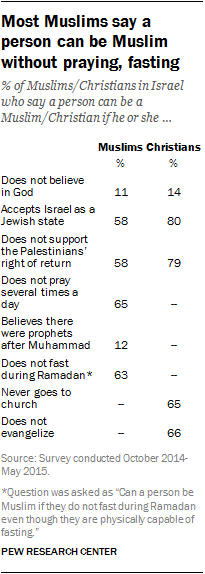
In the Arab sample, interlocking weights of the three religious groups – Muslims, Christians, Druze – were used along with age, gender and region to adjust the sample. In addition, the Arab sample was weighted on education for the general Arab population in Israel. This weighting approach adjusts the demographic profile separately for each of the religious subgroups among the Arab sample.

Step three:

In the third step, the Jewish and Arab samples were combined and a post-stratification weight was created to match the demographic profile of the national sample to known characteristics of the Israeli population. The full sample was weighted by region and by an interlocking weight of religion and ethnicity (Jews, including non-Jews but not Arabs; Arab Muslims; Arab Christians; and Arab Druze). The other demographics for the combined sample – age, gender, education – were all within acceptable limits and weighting was not necessary.

Sample size and margin of error

Margins of error

This table shows the total, unweighted sample size and associated margin of sampling error for each subgroup. For results based on these subsamples, one can say with 95% confidence that the error attributable to collecting data from some, rather than all, adults within the population is plus or minus the margin of error. This means that in 95 out of 100 samples of the same size and type, the results obtained would vary by no more than plus or minus the margin of error for the population in question.

Survey response rates

Response rates

The overall response rate for this survey is 57%. The response rate for different groups included in this survey vary somewhat, but are generally clustered within the range of 50% to 70%.

Mode effect considerations in comparing the results for American and Israeli Jews

One of the important challenges in international survey projects is the decision about the survey design and mode. This decision is influenced by research objectives, local research practices and experience, population coverage expectations and the availability of reliable sampling frames, timelines and costs. Conducting the survey in the same mode across countries, such as by telephone or by face-to-face interviews, is often not feasible in international research, since a mode that is optimal for one country may be a poor choice for another country.35

Telephone surveys in the United States can provide a high-quality nationally representative sample at a lower cost and with a shorter fieldwork period than a face-to-face survey. The situation in Israel is considerably different. Recent research has shown that available telephone frames underrepresent people with a lower socioeconomic status as well as Arabs and other subpopulations in Israel.36 At this point, it does not seem feasible to conduct a nationally representative survey with oversamples of key religious groups by telephone in Israel, which is why the survey was conducted via face-to-face interviews.
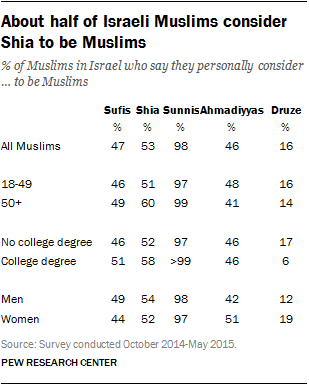
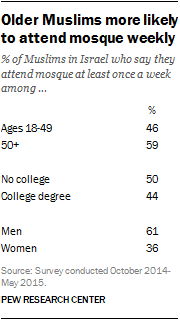
Since a goal of this research project is to compare the attitudes of Jews in the U.S. and Israel, it is important to address whether results collected through two different modes are comparable. Face-to-face and telephone interviews are, by and large, administered in very similar ways. Both are conducted by interviewers, meaning that the interviewer reads the questions and response options to respondents. This mode of communication allows interviewers to help respondents stay focused and to provide clarification or encouragement at difficult junctures during the interview.

Nonetheless, the physical presence of the interviewer in face-to-face interviews can lead to a closer rapport between the respondent and the interviewer and to a more engaging experience than in a telephone interview.37 Given these dynamics, it is possible that respondents interviewed by telephone will be more likely than people interviewed face-to-face to give answers that are considered socially acceptable, to avoid being seen in a negative light by the interviewer, and will be more likely to satisfice, meaning they will not be as thoughtful in formulating their responses to the survey questions. However, research has shown that the differences due to the mode in random-probability surveys tend to be small and limited to very sensitive questions.38

While it is important for the reader to be aware that differences observed in this study between American and Israeli respondents might be affected by the modes used, these effects should be considered minimal and most likely do not drive the results in this report.