Latest Trends in Religious Restrictions and Hostilities
Overall Decline in Social Hostilities in 2013, Though Harassment of Jews Worldwide Reached a Seven-Year High
About Pew Research Center
Pew Research Center is a nonpartisan, nonadvocacy fact tank that informs the public about the issues, attitudes and trends shaping the world. It does not take policy positions. The Center conducts public opinion polling, demographic research, computational social science research and other data-driven research. It studies politics and policy; news habits and media; the internet and technology; religion; race and ethnicity; international affairs; social, demographic and economic trends; science; research methodology and data science; and immigration and migration. Pew Research Center is a subsidiary of The Pew Charitable Trusts, its primary funder.
Latest Trends in Religious Restrictions and Hostilities
Overall Decline in Social Hostilities in 2013, Though Harassment of Jews Worldwide Reached a Seven-Year High
Worldwide, social hostilities involving religion declined somewhat in 2013 after reaching a six-year peak the previous year, but roughly a quarter of the world’s countries are still grappling with high levels of religious hostilities within their borders, according to the Pew Research Center’s latest annual study on global restrictions on religion.
The new study finds that the share of countries with high or very high levels of social hostilities involving religion dropped from 33% in 2012 to 27% in 2013, the most recent year for which data are available. These types of hostilities run the gamut from vandalism of religious property and desecration of sacred texts to violent assaults resulting in deaths and injuries.
By contrast, the share of countries with high or very high government restrictions on religion stayed roughly the same from 2012 to 2013. The share of countries in this category was 27% in 2013, compared with 29% in 2012. Government restrictions on religion include efforts to control religious groups and individuals in a variety of ways, ranging from registration requirements to discriminatory policies and outright bans on certain faiths.
Looking at the overall level of restrictions – whether resulting from government policies or from hostile acts by private individuals, organizations and social groups – the study finds that restrictions on religion were high or very high in 39% of countries. Because some of these countries (like China and India) are very populous, about 5.5 billion people (77% of the world’s population) were living in countries with a high or very high overall level of restrictions on religion in 2013, up from 76% in 2012 and 68% as of 2007.
Among the world’s 25 most populous countries, the highest overall levels of restrictions were found in Burma (Myanmar), Egypt, Indonesia, Pakistan and Russia, where both the government and society at large impose numerous limits on religious beliefs and practices. Among these populous countries, China had the highest level of government restrictions in 2013, and India had the highest level of social hostilities involving religion. (Click here to see an interactive feature showing the levels of restrictions and hostilities among the 25 most populous countries from 2007 to 2013.)
As in previous years, Christians and Muslims – who together make up more than half of the global population – faced harassment in the largest number of countries. Christians were harassed, either by government or social groups, in 102 of the 198 countries included in the study (52%), while Muslims were harassed in 99 countries (50%).
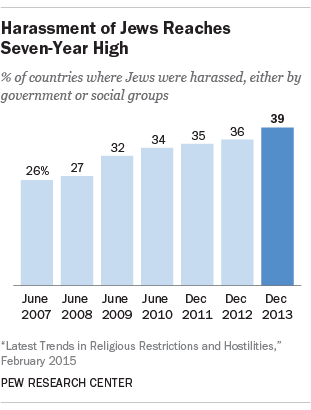
In recent years, there has been a marked increase in the number of countries where Jews were harassed. In 2013, harassment of Jews, either by government or social groups, was found in 77 countries (39%) – a seven-year high. Jews are much more likely to be harassed by individuals or groups in society than by governments. In Europe, for example, Jews were harassed by individuals or social groups in 34 of the region’s 45 countries (76%). (See sidebar on social hostilities and religious minorities in Europe.)
This is the sixth in a series of annual reports by the Pew Research Center analyzing the extent to which governments and societies around the world impinge on religious beliefs and practices. The studies are part of the Pew-Templeton Global Religious Futures project, which analyzes religious change and its impact on societies around the world. The project is jointly funded by The Pew Charitable Trusts and the John Templeton Foundation.
To measure global restrictions on religion in 2013, the new study scores 198 countries and territories on the same 10-point indexes used in the previous studies.
• The Government Restrictions Index measures government laws, policies and actions that restrict religious beliefs and practices. The GRI is comprised of 20 measures of restrictions, including efforts by government to ban particular faiths, prohibit conversion, limit preaching or give preferential treatment to one or more religious groups.
• The Social Hostilities Index measures acts of religious hostility by private individuals, organizations or groups in society. This includes religion-related armed conflict or terrorism, mob or sectarian violence, harassment over attire for religious reasons or other religion-related intimidation or abuse. The SHI includes 13 measures of social hostilities.1
This year’s report also looks at the prevalence of restrictions and hostilities that tend to target religious minorities around the world. The report finds that these types of restrictions and hostilities do not generally exist in isolation but often accompany broader restrictions on religion in society.
The Pew Research Center identified three measures on the Government Restrictions Index and three on the Social Hostilities Index that target groups out of favor with the government or society, which tend to be religious minorities. (The analysis focused on whether or not these restrictions and hostilities were in place, not on how many members of religious minorities were affected by them. For more details on the selection of the measures, click here.)
On the government side, these restrictions include prohibitions or bans on specific faiths; attempts to control or intimidate religious groups through the use of force; and efforts to eliminate a group’s presence from the country or a particular area. As of 2013, nearly a third of the countries in the world (59 countries, or 30%) had at least one of these restrictions.
The study also identified three measures on the Social Hostilities Index that tend to target religious minorities. In 2013, 120 countries (about 61%) experienced at least one of these hostilities, which include attempts to impose a particular perspective on religion on the rest of society; attempts by some religious groups to prevent other religious groups from operating; and assaults or other acts of hostility directed at individuals or groups seen as threatening to the majority faith.
In theory, a country might restrict a particular minority group but generally respect the religious rights of others living in the country. In reality, the new Pew Research study finds, countries with restrictions or hostilities aimed primarily at a religious minority are more likely than the rest of the world to have widespread restrictions and hostilities beyond those that tend to target religious minorities.
Among the 59 countries with at least one of the government restrictions aimed primarily at religious minorities, 43 (73%) had high or very high scores on the GRI in 2013.2 In the rest of the world, 8% of countries had high or very high scores on the GRI. The study also found that all of the most restrictive countries – those with very high scores on the GRI – had at least one type of restriction that was aimed primarily at religious minorities.
The same pattern was seen in the case of social hostilities. Among the 120 countries that had at least one of the social hostilities aimed primarily at religious minorities, 53 (44%) had high or very high scores on the SHI in 2013. In places where these types of hostilities were not picked up by the sources used for this study (see Methodology), no countries had high scores on the SHI. The countries with the most extensive social hostilities involving religion – those with very high scores on the SHI – all experienced at least one type of hostility that was aimed at religious minorities.
This suggests that it is relatively rare for countries to have restrictions or hostilities that only affect religious minorities. In general, restrictions on minorities go hand in hand with broader restrictions on religion.
About the Study
These are among the key findings of the Pew Research Center’s latest report on global restrictions on religion, which ranks 198 countries and territories by their levels of government restrictions on religion and social hostilities involving religion. The initial report, published in 2009, established a baseline for each country and five major geographic regions. Four follow-up reports looked at changes in the level of restrictions and hostilities in these countries and regions. The new report focuses on countries that had very high restrictions and hostilities in 2013, as well as countries that had large changes in their scores on Government Restrictions Index or Social Hostilities Index from 2012 to 2013. Where appropriate, it also compares the situation in 2013 with the situation in the baseline year of the study.
Readers should note that the categories of very high, high, moderate and low restrictions or hostilities are relative – not absolute – rankings based on the overall distribution of index scores in the initial year of this study. (See Methodology for more details.) As such, they provide a guide for comparing country scores and evaluating their direction over time. However, the Pew Research Center has not attached numerical rankings to the countries because there are many tie scores and the differences between the scores of countries that are close to each other are not necessarily as meaningful as they might appear.
As was the case in the previous restrictions reports, North Korea is not included in this study. The primary sources used in the study indicate that North Korea’s government is among the most repressive in the world, including toward religion. But because independent observers lack regular access to the country, the sources are unable to provide the kind of specific, timely information that formed the basis of this analysis.
Situation as of 2013
Countries With the Most Extensive Government Restrictions on Religion
Most countries in the world have some form of government restrictions on religion, but each year a few countries stand out as having particularly extensive restrictions.
In 2013, 18 countries had a “very high” level of government restrictions, down from 24 countries in 2012. Most of the countries in this category – including China, Indonesia, Uzbekistan, Iran and Egypt – already had very high restrictions. Two countries – Singapore and Turkey – had very high government restrictions in 2013 but not in 2012. Eight countries that had very high government restrictions in 2012 did not in 2013: Algeria, Iraq, Kazakhstan, Maldives, Morocco, Pakistan, Somalia and Vietnam.
The number of countries with high or moderate government restrictions each went up slightly between 2012 and 2013 (from 33 to 36 and from 36 to 44, respectively). Meanwhile, 98 countries (49%) had low levels of government restrictions in 2013, about the same number as in 2012 (97 countries). For a complete list of all countries in each category, see the Government Restrictions Index table.3
Countries With the Most Extensive Religious Hostilities
As is the case with government restrictions, some countries stand out for having very extensive social hostilities involving religion.
The number of countries and territories with a “very high” level of social hostilities involving religion fell from 20 in 2012 to 17 in 2013. Most of the countries and territories in this category – including Israel, India, Pakistan, the Palestinian territories and Nigeria – already had very high social hostilities. Two countries – the Central African Republic and Tanzania – had very high social hostilities in 2013 but not in 2012. Five countries that had very high social hostilities in 2012 did not in 2013: Burma (Myanmar), Lebanon, Sudan, Thailand and Yemen.
The number of countries with a high level of social hostilities fell from 45 (23%) in 2012 to 36 (18%) in 2013. The number of countries with a moderate level of social hostilities stayed about the same (55 in 2013 vs. 57 in 2012). Meanwhile, 90 countries (45%) had low levels of social hostilities in 2013, compared with 76 countries (38%) in 2012. For a complete list of all countries in each category, see the Social Hostilities Index table.4
Changes in Government Restrictions on Religion
Each year, some countries experience significant changes in their scores on the Government Restrictions Index without necessarily rising into – or falling out of – the “very high restrictions” category. Looking only at countries with very high government restrictions would overlook these important dynamics. For this reason, the Pew Research Center analyzes changes in government restrictions among all countries – not just those with a very high level of government restrictions – in order to provide greater insight into the nature of government restrictions on religion around the world.
Just three countries had large changes (2.0 points or more) in their scores on the 10-point Government Restrictions Index between 2012 and 2013. Two countries – Burundi and South Sudan – moved in the direction of higher restrictions and one country (Somalia) moved in direction of lower restrictions.5 (As of 2013, South Sudan and Somalia had moderate levels of government restrictions, while Burundi was at the high end of the “low restrictions” category.) In Burundi, there were frequent clashes between government forces and members of an informal religious group over access to a shrine to the Virgin Mary in the Kayanza region, located in the northern part of the country. Members of the group identify themselves as Catholics, but they are not accepted by the Catholic Church because some members claim they can communicate directly with the Virgin Mary.6 In March 2013, 10 pilgrims to the shrine were killed and 35 were injured when police opened fire on them, reportedly after being hit by stones thrown by the worshippers. Nearly 200 visitors to the shrine received jail sentences after being convicted of civil disobedience. While most were released within a few days, 15 received jail terms of five years each.7
Among the 14 countries with modest changes in their GRI scores (1.0 to 1.9 points), six had increases, including Singapore and Turkey.8 In Singapore, the government maintained its decades-long ban on Jehovah’s Witnesses and the Unification Church and reportedly restricted the actions of members of several other religious groups, including adherents of the Falun Gong spiritual movement.9 In Turkey, some evangelical Protestants and Mormons reported that they experienced government surveillance and police interference as a result of their proselytizing activities.10 The United Kingdom was one of eight countries (4%) with modest decreases in their GRI scores in 2013 (declines of 1.0 to 1.9 points).11 Among the reasons were fewer restrictions on those practicing Scientology. Under a 1970 Court of Appeal ruling, Scientology did not qualify as an officially recognized “place of meeting for religious worship” in the U.K., which meant, among other things, that weddings performed in Scientology chapels could not be officially registered. This policy was overturned in 2013, when the Supreme Court of the United Kingdom ruled that Scientology should be regarded as a religion and that the Registrar General of Births, Deaths and Marriages should therefore recognize weddings that take place in Scientology chapels.12
Among countries with small changes on the Government Restrictions Index (less than one point), 66 (33%) had increases and 77 (39%) had decreases.
Considering changes of one point or more in government restrictions from 2012 to 2013, 4% of countries had increases and 5% of countries had decreases.
Changes in Social Hostilities Involving Religion
Some countries may experience significant changes in their scores on the Social Hostilities Index irrespective of whether they have “very high” levels of social hostilities. This section looks at the extent and direction of those changes from 2012 to 2013.
Among the 14 countries with large changes (2.o points or more) in their scores on the 10-point Social Hostilities Index between 2012 and 2013, two had increases and 12 had decreases.13 The two countries with large increases were the Central African Republic and Niger. In the Central African Republic, which had a very high level of social hostilities as of 2013, sectarian violence between Muslim rebels and Christian vigilante groups resulted in the deaths of hundreds of people and led to the displacement of hundreds of thousands of civilians.14 In Niger, which had a high level of hostilities, villagers in the Tahoua region attacked members of an Islamic association in May 2013, killing one person and injuring more than a dozen others.15
Ivory Coast was one of the 12 countries where social hostilities decreased by two points or more in 2013. Religion-related violence in the country, which had spiked after presidential elections in 2010, continued to subside in 2013.16 Muslim and Christian clerics issued joint statements promoting national reconciliation and religious tolerance and organized a number of interfaith events, including “days of prayer” intended to promote national unity.17
Of the 53 countries (27%) that had modest changes (1.0 to 1.9 points) in their scores in 2013, 11 (6%) had increases and 42 (21%) had decreases. In the 86 countries (43%) that had small changes in their scores (less than one point), 22 (11%) had increases and 64 (32%) had decreases.
Considering changes of one point or more in social hostilities from 2012 to 2013, 7% of countries had increases and 27% had decreases.
Changes in Overall Restrictions on Religion
In addition to analyzing government restrictions and social hostilities separately, the Pew Research Center also considers government restrictions and social hostilities together. This provides insight into the overall extent of religious restrictions in a country. Looking at changes in overall restrictions, more countries experienced decreases than increases between 2012 and 2013. Among the 13 countries whose scores changed by 2.0 points or more on either of the indexes, two had increases and 11 had decreases. And among countries whose scores changed by 1.0 to 1.9 points, 10 had increases and 37 had decreases.
Overall, restrictions increased at least somewhat in 25% of countries and decreased in 60% from 2012 to 2013.
Harassment of Specific Groups
Harassment or intimidation of specific religious groups occurred in 164 countries in 2013, roughly the same as in 2012 (166). The world’s two largest religious groups, Christians and Muslims, continued to be harassed in the most countries, and there was a notable increase in the number of countries in which Jews and adherents of folk religions were harassed.
Harassment of specific religious groups takes many forms, including physical assaults; arrest and detentions; desecration of holy sites; and discrimination against religious groups in employment, education and housing. Harassment and intimidation also include things such as verbal assaults on members of one religious group by other groups or individuals.
While Christians and Muslims were harassed in the most countries in 2013, the total number of countries where the two groups were harassed dropped between 2012 and 2013. Christians were harassed in 102 countries in 2013, down from 110 in the previous year.18 Muslims were harassed in 99 countries, compared with 109 in 2012.
There was a notable increase in the number of countries in which Jews and adherents of folk religions were harassed. Jews, who make up 0.2% of the world’s population, were harassed in 77 countries (up from 71 countries in 2012), and adherents of folk religions were harassed in 34 countries (up from 26 in 2012).
There was a decrease in the number of countries in which Hindus were harassed, from 16 in 2012 to nine in 2013. The number of countries in which Buddhists were harassed stayed roughly the same (12 in 2013, compared with 13 in 2012).
In 2013, some religious groups were more likely to be harassed by governments, while others were more likely to be harassed by individuals or groups in society. Christians, for instance, experienced harassment by some level of government in more countries (85) than they experienced social harassment (71). By contrast, Jews were harassed by individuals or groups in society in many more countries (72) than they were by governments (39).
Impact of Restrictions and Hostilities on Religious Minorities
In addition to looking at the harassment of specific religious groups, this report, for the first time, looks at the prevalence of restrictions and hostilities that tend to target religious minorities.
To measure the extent of these restrictions and hostilities, Pew Research identified three measures on the Government Restrictions Index and three on the Social Hostilities Index which have a primary purpose of disrupting or harming groups that are out of favor with the government or society – often religious minorities. This allowed Pew Research to compare these particular restrictions and hostilities with the broader set of restrictions and hostilities that make up the GRI and SHI. (See the Methodology for more information on the new measures.)
How the Study Defines Religious Minorities
Previous Pew Research studies have found that a significant portion of the world’s population is made up of religious minorities – groups that constitute less than 50% of a country’s population. According to the Pew Research Center’s 2012 “Global Religious Landscape” study, 27% of the world’s population lives as a religious minority
when looking at distinctions among eight major religious groups, including Christians, Muslims, Hindus, Buddhists, Jews, adherents of other religions, adherents of folk religions and the religiously unaffiliated.
Unlike the 2012 Pew Research report, this study’s definition of religious minorities also takes into account subgroups within major religious groups, such as Orthodox Christianity and Roman Catholicism as subsets of Christianity. It also reflects differences among groups that may have differing interpretations of a religion, such as Salafist Muslims, who emphasize a conservative and literalist interpretation of Islamic scriptural sources. Unlike other Pew Research studies, this report does not count the religiously unaffiliated as a distinct religious group.
See the Methodology for more information on how this study distinguishes between religious minorities and majorities.
Government Restrictions With a Primary Impact on Religious Minorities
Pew Research identified three types of government restrictions that tend to target religious minorities. In 2013, nearly a third (30%) of the countries included in the study – 59 of 198 – had at least one of the three restrictions described below:
• Government at some level used physical violence against minority or disfavored religious groups in 47 of the 198 countries (24%). (For exact wording of the restriction, see GRI Q.12 in the Summary of Results.) In Vietnam, groups not officially recognized by the government were subject to various forms of harassment, including police beatings and arrests. In June, for example, police in An Giang Province attacked members of an unsanctioned group who were trying to attend a celebration in honor of the founding of the Hoa Hao Buddhist movement.19
• Government at some level banned certain religious groups in 37 of the 198 countries (19%). (For exact wording of the restriction, see GRI Q.16 in the Summary of Results.) In Indonesia, for example, where most of the population is made up of Sunni Muslims, the government of Aceh province continued to ban several Muslim sects, including Sufis, Shias and Ahmadiyya Muslims.20
• Government at some level attempted to eliminate a religious group’s presence in 24 of the 198 countries (12%). This includes forcible actions on the part of government that make it difficult for the group to function. (For exact wording of the restriction, see GRI Q.17 in the Summary of Results.) In China, for example, the government continued its campaign against the Falun Gong spiritual movement by using such tactics as mass arrests and detention of Falun Gong followers in “re-education centers.”21
Social Hostilities With a Primary Impact on Religious Minorities
Pew Research identified three types of social hostilities that tend to target religious minorities. In 2013, six-in-ten countries – 120 of 198, or 61% – had at least one of the three hostilities described below:
• Organized groups used force or coercion in an attempt to dominate public life with their perspective on religion in 88 of the 198 countries included in the study (44%). This includes attempts by individuals or groups to press their views of religion on others in society or stop people from committing what they view as unacceptable behavior. (For exact wording, see SHI Q.7 in the Summary of Results.) In Iraq, for example, militant Muslims organized violence against businesses owned by Christians, Yazidis and other religious minorities, often reportedly out of anger that the businesses sold alcohol. A campaign targeting liquor store owners beginning in May 2013 led to the killing of 12 people in Baghdad.22
• Religious groups attempted to prevent other religious groups from operating in 60 of the 198 countries (30%). This includes instances in which official or unofficial representatives of religious groups tried to keep adherents from other religious groups from moving into an area or freely practicing their faith. (For exact wording, see SHI Q.8 in the Summary of Results.) In Burma, for example, Buddhist residents in Kyawpadaung Township tried to prevent Muslims from living in the area, reportedly displaying signs that said the town had been “purified” of Muslims.23And in Moldova, an Orthodox Christian priest in the Gagauzia region pressured the mayor of the village of Congaz to restrict the activities of the local Baptist church, forcing the Baptist community to move its summer camp for children.24
• Assaults or other hostilities aimed at religious groups for activities considered offensive or threatening to the majority faith occurred in 78 of the 198 countries (39%). (For exact wording, see SHI Q.10 in the Summary of Results.) In Pakistan, Sunni Muslim clerics in the Kasur district organized an attack on an Ahmadiyya Muslim man and his family in March 2013, reportedly after he refused to renounce his faith.25
Relationship Between Restrictions on Religious Minorities and Overall Restrictions and Hostilities
The types of restrictions and hostilities that tend to target religious minorities do not exist independently of general government restrictions on religion or social hostilities involving religion. Instead, restrictions and hostilities targeting religious minorities often correspond with higher levels of government restrictions and social hostilities.
Countries with at least one type of restriction aimed at religious minorities were more likely than countries without such restrictions to have a high level of overall government restrictions in 2013. Among the 59 countries with at least one of these restrictions, 43 (73%) had high or very high government restrictions on religion as of 2013. By contrast, 11 countries (8%) without such government restrictions on religious minorities had a high or very high level of overall government restrictions in 2013. And all of the countries with very high overall government restrictions had at least one of the restrictions aimed at religious minorities.
Similarly, countries with at least one type of social hostility targeting religious minorities were more likely to have a high level of overall social hostilities than were countries without such hostilities. Among the 120 countries with at least one of these hostilities, 53 (44%) had high or very high religious hostilities as of 2013. And all of the countries with a very high level of overall social hostilities involving religion had at least one of these hostilities targeting religious minorities.
Countries with social hostilities targeting religious minorities tended to be among the countries that experienced significant increases in social hostilities between 2012 and 2013. All 12 countries whose scores on the Social Hostilities Index went up by one point or more experienced at least one type of hostility targeting religious minorities.
Compared with social hostilities, there was a much weaker relationship between government restrictions that tend to target religious minorities and changes in a country’s score on the Government Restrictions Index. Among the eight countries whose scores on the GRI rose by one point or more between 2012 and 2013, five had at least one type of restriction aimed at religious minorities and three did not. The difference between the two groups was negligible, indicating little relationship between government restrictions on minorities and change in GRI scores.
Regions and Countries
Government Restrictions by Region
The median level of government restrictions on religion increased in two of the five regions (Asia-Pacific and sub-Saharan Africa) and decreased in two regions (Middle East-North Africa and Europe). It stayed the same in the Americas.
In the latest year studied, the Middle East and North Africa continued to have the highest median level of government restrictions. The median score on the Government Restrictions Index for the 20 countries in the region decreased slightly, from 6.2 in 2012 to 6.0 in 2013, but it remained much higher than the global median (2.4). Many government restrictions present in the region in past years continued to occur in 2013. For example, government limits on public preaching were reported in 17 of the 20 countries, the same as in 2012. Similarly, government interference with worship occurred in 19 of the 20 – unchanged since 2012.
In the Asia-Pacific region, the median score on the GRI increased from 3.5 in 2012 to 4.2 in 2013. Government violence toward minority or unapproved religious groups was reported in 22 of the 50 countries in the region in 2013, up from 18 in 2012. In China, for instance, police in eastern Tibet reportedly beat a former Buddhist monk to death in April 2013 after he was found to have recordings of speeches by the Dalai Lama.26 And in Pakistan, the government continued to enforce laws designed to marginalize the minority Ahmadiyya community, including laws that make it difficult for members of the community to vote or obtain passports and other legal documents if they do not renounce their faith.27
In Europe, the median score on the GRI went from 2.6 in 2012 to 2.5 in 2013, remaining slightly above the global median. Decreases in government restrictions within the region included fewer limits on foreign missionaries and fewer reports of government harassment or intimidation of religious groups.
Sub-Saharan Africa’s median score on the GRI increased slightly, from 1.7 in 2012 to 1.9 in 2013, but it remained below the global median. The rise in government restrictions reflects an increase in reports of government limits on missionaries and an increase in government denouncement of religious groups as “sects” or “cults.”
The Americas’ median score on the GRI stayed the same in 2012 (at 1.5), considerably below the global median.
Social Hostilities by Region
The median level of social hostilities involving religion decreased in all five regions in 2013. As in the previous years of the study, social hostilities involving religion were highest across the Middle East and North Africa. Although the region’s median score on the Social Hostilities Index decreased, from 6.4 in 2012 to 5.8 in 2013, it remained well above the global median (1.6). Religious hostilities decreased in 17 of the 20 countries in the region and increased in only two – Libya and Qatar. (One territory, Western Sahara, had no change.)
Only one country in the Middle East-North Africa region had a score that increased by one point or more on the SHI: Libya, which rose from 5.4 in 2012 to 6.9 in 2013. Salafist groups in Libya destroyed several Sufi religious sites, including the 500-year-old Al-Andalusi mausoleum in Tripoli. Egyptian Coptic Christians living in Libya also were targeted. In March 2013, for example, arsonists set fire to the main Coptic church in Benghazi. According to the U.S. State Department, the arson attack “followed escalating anti-Coptic abuse,” including an assault on a Coptic priest and the reported seizure of dozens of Egyptian Coptic Christians by militia groups in Benghazi.28
Sub-Saharan Africa’s median score on the SHI fell from 2.1 in 2012 to 1.3 in 2013, slightly below the global median (1.6). Sectarian violence and attempts to enforce religious norms were reported in fewer countries in the region in 2013 than in 2012, with one notable exception. In the Central African Republic, conflict between predominantly Muslim rebels and Christian vigilante groups led to multiple types of religious hostilities into the country, including: sectarian violence; attempts by organized groups to dominate public life with their perspective on religion; religious groups attempting to prevent other groups from operating; hostilities over conversions; and mass civilian displacement.29 Collectively, these hostilities contributed to a significant increase in the level of social hostilities in the Central African Republic, whose score on the SHI rose from 4.5 in 2012 to 7.6 in 2013.
In the Asia-Pacific region, the median score on the SHI decreased from 2.9 in 2012 to 2.2 in 2013, but it remained above the global median. Factors contributing to the decrease included a decline in hostilities related to proselytizing, which was reported in 13 of the 50 countries in the region in 2013, down from 18 countries in 2012. There also was a decrease in the number of countries in the region where religious groups attempted to prevent other groups from operating.
Europe’s median score on the SHI declined slightly, from 2.7 in 2012 to 2.3 in 2013, but it remained above the global median and many examples of social hostilities involved religious minorities (see sidebar for more details). The median level of social hostilities in the Americas remained low, dropping to 0.1 in 2013 from 0.4 in 2012.
Sidebar: Religious Hostilities and Religious Minorities in Europe
On an early January morning in 2013, Shehzad Luqman, a 27-year-old Pakistani Muslim living in Greece, was riding his bicycle to work in an Athens suburb when he was violently attacked. Two men suspected of being members of Greece’s neo-Nazi political party, Golden Dawn, were later convicted of stabbing Luqman to death.30
While this attack was particularly violent, it was not an isolated incident. Although Europe’s median score on the Social Hostilities Index declined slightly, from 2.7 in 2012 to 2.3 in 2013, it remained well above the global median (1.6), and many acts of hostility in the region were directed at religious minorities.
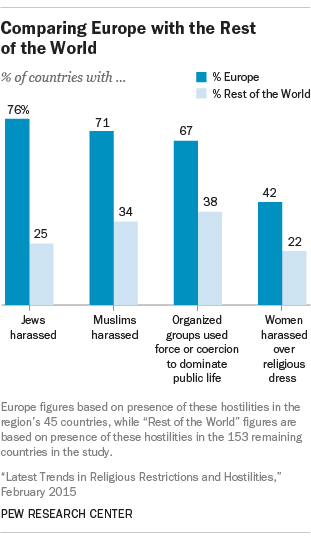
Harassment of Jews and Muslims was particularly widespread. Jews faced harassment in 34 of the region’s 45 countries (76%) — a higher share than in any other region. In the rest of the world, Jews were harassed by individuals or groups in society in 25% of countries.
In France, three men attacked a teenager who was wearing a kippah in Vitry-Sur-Seine in March, threatening, “We will kill all of you Jews.”31 In Spain, vandals painted a large swastika on the walls of a bull ring in the city of Pinto in August, along with the words “Hitler was right.”32 In the town of Komarno in southern Slovakia, metal tiles embedded in the pavement honoring a local Jewish family killed in the Holocaust were destroyed in October when vandals poured tar over them.33 And in Norway, the newspaper Dagbladet published a controversial cartoon in May that appeared to be mocking the practice of circumcision.34
Muslims experienced harassment in nearly as many European countries as Jews – 32 of the 45 countries, or 71%. By comparison, Muslims were harassed in 34% of the countries in the rest of the world.
In Germany, bloody pig heads were found at a site where the Ahmadiyya Muslim community planned to build Leipzig’s first mosque.35 In Ireland, several mosques and Muslim cultural centers received threatening letters. One of the letters stated, “Muslims have no right to be in Ireland. The Irish people are not happy with your presence in our country, which belongs to the true Irish people.”36
In about two-thirds of the countries in Europe, organized groups used force or coercion in an attempt to dominate public life with their perspective on religion. In many cases, organized groups that oppose the presence of minority religious groups in their country intimidated or attacked these religious communities. This type of social hostility was much more prevalent in Europe (30 of 45 countries, or 67%) than in the rest of the world (38%). In some cases, attempts to dominate public life with a particular perspective on religion included online intimidation of minority religious groups, including posting anti-Semitic and anti-Muslim rhetoric. In Italy, for example, four men were sent to jail in April after they published lists of Jewish residents and businesses on neo-Nazi websites.37
Other hostilities that were prevalent in Europe and involved religious minorities included the assault or displacement of individuals in retaliation for religious activities, harassment of women over religious dress and attempts by religious groups to prevent other religious groups from operating.
In four-in-ten countries in the region (42%), individuals were assaulted or displaced from their homes or places of worship in retaliation for religious activities considered offensive or threatening to the majority faith. In Poland, for example, arsonists set fire to the door of a mosque in Gdansk in October. Some accounts speculated that the attack was done in retaliation for the ritual slaughter of a lamb by the country’s chief mufti, Tomasz Miskiewicz, in violation of a Polish animal protection law that bans the practice of slaughtering animals without first stunning them.38
Women were harassed over religious dress in about four-in-ten countries in Europe (19 of 45, or 42%) – a higher percentage than in the rest of the world (22% of countries) and about the same share as in the Middle East-North Africa region (where it occurred in eight of 20 countries, or 40%). This measure of harassment includes cases in which women are harassed for wearing religious dress, as well as cases in which they are harassed for perceived violations of religious dress codes. In France, for example, two men attacked a pregnant Muslim woman in June, kicking her in the stomach and attempting to remove her headscarf and cut her hair; she reportedly suffered a miscarriage in the days following the attack, which occurred in the Parisian suburb of Argenteuil.39 In Italy, two Moroccan men attacked a young Moroccan woman in February, beating her for “offending Islam” when she refused to wear a headscarf.40
Religious groups attempted to prevent other groups from operating in a third of the countries in Europe (15 of 45 countries, or 33%). In Germany, religious leaders and church officials continued to issue warnings against groups labeled as “sects” or “cults” – including the Church of Scientology, the Unification Church, Transcendental Meditation and Universal Life practitioners.41 In Russia, activists and groups claiming to have ties to the Russian Orthodox Church disseminated publications casting minority religious groups in the country in a negative light.42
Some social hostilities involving religion were relatively rare in Europe in 2013, including hostilities involving conversion (2% of countries) or proselytizing (4%). Hostilities involving conversion were reported in only one European country (Romania) during the latest year studied. And social hostilities linked to proselytizing were found in just two countries – Romania and Russia. In Russia, residents of an apartment complex in Velikiy Novgorod were reported to have asked authorities to remove Mormon residents in order to “protect their children from the destructive influence of the sect.”43
Appendix 1: Methodology
This is the sixth time the Pew Research Center has measured restrictions on religion around the globe.44 This report, which includes data for the year ending Dec. 31, 2013, generally follows the same methodology as previous reports, although it includes one new analysis, which is discussed below.
Pew Research uses two 10-point indexes – the Government Restrictions Index (GRI) and the Social Hostilities Index (SHI) – to rate 198 countries and self-governing territories on their levels of restrictions.45 This report analyzes changes in restrictions on an annual basis, focusing on the period from 2012 to 2013.
The study categorizes the amount of change in each country’s scores in two ways, numerically and by percentile. First, countries are grouped into categories depending on the size of the numeric change in their scores from year to year on the two indexes: changes of two points or more in either direction; changes of at least one point but less than two points; changes of less than one point; or no change at all. (See chart at right.)
Changes in overall levels of restrictions are calculated for each country by comparing its scores on both indexes (the GRI and the SHI) from year to year. When a country’s scores on the GRI and the SHI changed in the same direction (both increased or both decreased), the greater amount of change determined the category. For instance, if the country’s GRI score increased by 0.8 and its SHI score increased by 1.5, the country was put into the overall “1.0 to 1.9 increase” category. When a country’s score increased on one index but decreased on the other, the difference between the amounts of change determined the grouping. For example, if the country’s GRI score increased by 2.0 and its SHI score decreased by 1.5, the country went into the overall “0.1 to 0.9 increase” category. When a country’s score on one index stayed the same, the amount of change on the other index was used to assign the category.
Second, this report categorizes the levels of government restrictions and social hostilities in each country by percentiles. As the benchmark, it uses the results from the baseline year of the study (the year ending in mid-2007). Scores in the top 5% on each index in mid-2007 were categorized as “very high.” The next highest 15% of scores were categorized as “high,” and the following 20% were categorized as “moderate.” The bottom 60% of scores were categorized as “low.” See the table to the right for the index score thresholds as determined from the mid-2007 data. These thresholds are applied to all subsequent years of data.
Overview of Procedures
The methodology used by Pew Research to assess and compare restrictions on religion was developed by former Pew Research senior researcher and director of cross-national data Brian J. Grim in consultation with other members of the Pew Research Center staff, building on a methodology that Grim and Professor Roger Finke developed while at Penn State University’s Association of Religion Data Archives.46 The goal was to devise quantifiable, objective and transparent measures of the extent to which governments and societal groups impinge on the practice of religion. The findings were used to rate countries and self-governing territories on two indexes that are reproducible and can be periodically updated.
This research goes beyond previous efforts to assess restrictions on religion in several ways. First, Pew Research coded (categorized and counted) data from more than a dozen published cross-national sources, providing a high degree of confidence in the findings. The Pew Research coders looked to the sources for only specific, well-documented facts, not opinions or commentary.
Second, Pew Research staff used extensive data-verification checks that reflect generally accepted best practices for such studies, such as double-blind coding (coders do not see each other’s ratings), inter-rater reliability assessments (checking for consistency among coders) and carefully monitored protocols to reconcile discrepancies among coders.
Third, the Pew Research coding took into account whether the perpetrators of religion-related violence were government or private actors. The coding also identified how widespread and intensive the restrictions were in each country.
Fourth, one of the most valuable contributions of the indexes and the questions used to construct them (see the section on “The Coding Instrument” on page 37) is their ability to chart change over time.
Countries and Territories
The 198 countries and self-administering territories covered by the study contain more than 99.5% of the world’s population. They include 192 of the 193 member states of the United Nations as of 2013 plus six self-administering territories – Kosovo, Hong Kong, Macau, the Palestinian territories, Taiwan and Western Sahara.47 Reporting on these territories does not imply any position on what their international political status should be, only recognition that the de facto situations in these territories require separate analysis.
Although the 198 countries and territories vary widely in size, population, wealth, ethnic diversity, religious makeup and form of government, the study does not attempt to adjust for such differences. Poor countries are not scored differently on the indexes than wealthy ones. Countries with diverse ethnic and religious populations are not “expected” to have more social hostilities than countries with more homogeneous populations. And democracies are not assessed more leniently or harshly than authoritarian regimes.
Information Sources
In the latest year of the study, Pew Research identified 17 widely available, frequently cited sources of information on government restrictions and social hostilities involving religion around the world. This study includes four sources that were not used in the baseline report on religious restrictions.
The primary sources, which are listed below, include reports from U.S. government agencies, several independent, nongovernmental organizations and a variety of European and United Nations bodies. Although most of these organizations are based in Western countries, many of them depend on local staff to collect information across the globe. As previously noted, Pew Research did not use the commentaries, opinions or normative judgments of the sources; the sources were combed only for factual information on specific policies and actions.
Primary Sources for 2013
1. Country constitutions
2. U.S. State Department annual reports on International Religious Freedom
3. U.S. Commission on International Religious Freedom annual reports
4. U.N. Special Rapporteur on Freedom of Religion or Belief reports
5. Human Rights First reports in first and second years of coding; Freedom House reports in subsequent years of coding
6. Human Rights Watch topical reports
7. International Crisis Group country reports
8. United Kingdom Foreign & Commonwealth Office annual report on human rights
9. Council of the European Union annual report on human rights
10. Global Terrorism Database
11. European Network Against Racism Shadow Reports
12. United Nations High Commissioner for Refugees reports
13. U.S. State Department annual Country Reports on Terrorism
14. Anti-Defamation League reports
15. U.S. State Department Country Reports on Human Rights Practices
16. Uppsala University’s Uppsala Conflict Data Program, Armed Conflict Database
17. Human Rights Without Frontiers “Freedom of Religion or Belief” newsletters
U.S. government reports with information on the situation in the United States
• U.S. Department of Justice “Religious Freedom in Focus” newsletters and reports
• FBI Hate Crime Reports
One source used in the previous report – Amnesty International’s Country Reports – was not available for the latest round of coding. But information provided in previous Amnesty International reports, including data on religion-related detentions, was covered in other sources used in the study.
As noted, this study includes four sources that were not included in the Pew Research Center’s first report on global restrictions on religion: Freedom House reports; Uppsala University’s Armed Conflict Database; the “Freedom of Religion or Belief” newsletters of Human Rights Without Frontiers; and the Global Terrorism Database.
The Freedom House reports have replaced Human Rights First reports, which have not been updated since mid-2008. The Uppsala Armed Conflict Database provides information on the number of people affected by religion-related armed conflicts, supplementing other sources. The Human Rights Without Frontiers “Freedom of Religion or Belief” newsletters have replaced the Hudson Institute publication “Religious Freedom in the World” (by Paul Marshall), which has not been updated since its release in 2008. Human Rights Without Frontiers is a nongovernmental organization based in Brussels that has affiliated offices throughout the world.
In the previous report, the Pew Research Center relied on three sources for information on religion-related terrorism: the International Crisis Group’s country reports, Uppsala University’s Armed Conflict Database and the State Department’s annual Country Reports on Terrorism. (One source used in earlier reports, the U.S. government’s Worldwide Incident Tracking System, is no longer available online.) In the latest year of coding, the Pew Research Center also used data from the Global Terrorism Database, maintained by the University of Maryland’s National Consortium for Terrorism and Responses to Terrorism. This database is one of the most comprehensive sources on terrorism around the world and is the source for the U.S. State Department’s Country Reports on Terrorism. The addition of this source thus provides greater context and information on terrorism without biasing the reporting through the addition of information that was not previously available.
While some of the increases in religious restrictions noted in this study could reflect the use of more up-to-date and/or better information sources, Pew Research staff monitor the impact of source information variability each year and have found no evidence of overall informational bias. (For additional discussion, see the “Potential Biases” section in 2014’s report, “Religious Hostilities Reach Six-Year High.”)
The Coding Instrument
As explained in more detail below, Pew Research staff developed a battery of questions similar to a survey questionnaire. Coders consulted the primary sources in order to answer the questions separately for each country. While the State Department’s annual reports on International Religious Freedom generally contained the most comprehensive information, the other sources provided additional factual detail that was used to settle ambiguities, resolve contradictions and help in the proper scoring of each question.
The questionnaire, or coding instrument, generated a set of numerical measures on restrictions in each country. It also made it possible to see how government restrictions intersect with broader social tensions and incidents of violence or intimidation by private actors. The coding instrument with the list of questions used for this report is shown in the Summary of Results starting on page 64.
The coding process required the coders to check all the sources for each country. Coders determined whether each source provided information critical to assigning a score; had supporting information but did not result in new facts; or had no available information on that particular country. Multiple sources of information were available for all countries and self-administering territories with populations greater than 1 million. Most of the countries and territories analyzed by the Pew Research Center were multi-sourced; only small, predominantly island, countries had a single source, namely, the State Department reports.
Coding the United States presented a special problem since it is not included in the State Department’s annual reports on International Religious Freedom. Accordingly, Pew Research coders also looked at reports from the U.S. Department of Justice and the FBI on violations of religious freedom in the United States, in addition to consulting all the primary sources, including reports by the United Nations, Human Rights Watch, Freedom House, the International Crisis Group and the U.K. Foreign & Commonwealth Office, many of which contain data on the United States.
The Coding Process
The Pew Research Center employed strict training and rigorous coding protocols to make its coding as objective and reproducible as possible. Coders worked directly under an experienced researcher’s supervision, with additional direction and support provided by other Pew Research Center researchers. The coders underwent an intensive training period that included a thorough overview of the research objectives, information sources and Methodology.
Countries were double-blind coded by two coders (coders did not see each other’s ratings), and the initial ratings were entered into an electronic document (coding instrument) including details on each incident. The coders began by filling out the coding instrument for each country using the information source that had the most comprehensive information. The protocol for each coder was to answer every question on which information was available in the initial source. Once a coder had completed that process, he or she then turned to the other sources. As new information was found, this was also coded and the source duly noted. Whenever ambiguities or contradictions arose, the source providing the most detailed, clearly documented evidence was used.
After two coders had separately completed the coding instrument for a particular country, their scores were compared by a research associate. Areas of discrepancy were discussed at length with the coders and were reconciled in order to arrive at a single score on each question for each country. The data for each country were then combined into a master file, and the answers and substantiating evidence were entered into a database.
The coding procedures used in the latest report varied somewhat from previous years because of the relatively late release of the U.S. State Department’s International Religious Freedom report, which was made public in July 2014. Prior to the release of the State Department report, Pew Research coders completed the coding procedure for each country using all other available sources. After the State Department released the International Religious Freedom report, the coders went back over each country and updated their coding as necessary.
After data collection for all countries was completed, Pew Research coders and researchers compared the scores from calendar year 2013 with those from the previous year, ending Dec. 31, 2012. They identified scores that had changed and analyzed the substantiating evidence for each year to make sure the change was substantive and not the result of coder error. Throughout this process, the coding instrument itself was continually monitored for possible defects. The questions were designed to be precise, comprehensive and objective so that, based on the same data and definitions, the coding could be reliably reproduced by others with the same results. At the same time, the Pew Research Center has attempted to minimize changes to the coding instrument as much as is possible to ensure all changes between years are the result of actual changes in restrictions and hostilities, not changes in methodology.
Pew Research staff generally found few cases in which one source contradicted another. When contradictions did arise – such as when sources provided differing estimates of the number of people displaced due to religion-related violence – the source that cited the most specific documentation was used. The coders were instructed to disregard broad, unsubstantiated generalizations regarding abuses and to focus on reports that contained clear, precise documentation and factual details, such as names, dates and places where incidents occurred.
Pew Research staff compared coders’ scores for all questions for each of the 198 countries and territories included in the study, computing the degree to which the scores matched. The inter-rater reliability score across all variables was 0.74. Scores above 0.7 are generally considered good.
The data-verification procedures went beyond the inter-rater reliability statistics. They also involved comparing the answers on the main measures for each country with other closely related questions in the data set. This provided a practical way to test the internal reliability of the data.
In previous years, Pew Research staff also checked the reliability of the coded data by comparing them with similar, though more limited, religious restrictions data sets. In particular, published government and social regulation of religion index scores are available from the Association of Religion Data Archives (for three years of data) and the Hudson Institute (for one year of data), which makes them ideal measures for cross-validation. The review process found very few significant discrepancies in the coded data; changes were made only if warranted by a further review of the primary sources.
Restriction of Religion Indexes
The Government Restrictions Index is based on 20 indicators of ways that national and local governments restrict religion, including through coercion and force. The Social Hostilities Index is based on 13 indicators of ways in which private individuals and social groups infringe on religious beliefs and practices, including religiously biased crimes, mob violence and efforts to stop particular religious groups from growing or operating. The study also counted the number and types of documented incidents of religion-related violence, including terrorism and armed conflict.
Government Restrictions Index
Coding multiple indicators makes it possible to construct a Government Restrictions Index of sufficient gradation to allow for meaningful cross-national comparisons. An additional advantage of using multiple indicators is that it helps mitigate the effects of measurement error in any one variable, providing greater confidence in the overall measure.
The Pew Research Center coded 20 indicators of government restrictions on religion (see the Summary of Results). These 20 items were added together to create the GRI. In two cases, these items represent an aggregation of several closely related questions: Measures of five types of physical abuses are combined into a single variable (GRI Q.19), and seven questions measuring aspects of government favoritism are combined into an overall favoritism scale. (GRI Q.20 is a summary variable showing whether a country received the maximum score on one or more of the seven questions.)
The GRI is a fine-grained measure created by adding the 20 items on a 0-to-10 metric, with zero indicating very low levels of government restrictions on religion and 10 indicating very high levels of restrictions. The 20 questions that form the GRI are coded in a standard scale from zero to one point, while gradations among the answers allowed for partial points to be given for lesser degrees of the particular government restriction being measured. The overall value of the index was calculated and proportionally adjusted – so that it had a maximum value of 10 and a possible range of zero to 10 – by dividing the sum of the variables by two.
A test of whether the 20 items were statistically reliable as a single index produced a scale reliability coefficient of 0.91 for calendar year 2013. Since coefficients of 0.7 or higher are generally considered acceptable, it was statistically appropriate to combine these 20 items into a single index.
Social Hostilities Index
In addition to government restrictions, violence and intimidation in societies also can limit religious beliefs and practices. Accordingly, Pew Research staff tracked more than a dozen indicators of social impediments on religion. Once again, coding multiple indicators made it possible to construct an index that shows gradations of severity or intensity and allows for comparisons among countries. The Summary of Results contains the 13 items used by Pew Research staff to create the Social Hostilities Index.
The SHI was constructed by adding together the 13 indicators based on a 0-to-10 metric, with zero indicating very low impediments to religious beliefs and practices and 10 indicating very high impediments. The various questions that form the index are coded in a standard scale from zero to one point, while gradations among the answers allow for partial points to be given for lesser degrees of the particular hostilities being measured. The indicators were added together and set to have a possible range of zero to 10 by dividing the sum of the variables by 1.3.
As with the Government Restrictions Index, various types of violence and intimidation were combined. A test of whether these 13 items were statistically reliable as a single index produced a scale reliability coefficient of 0.89. Since coefficients of 0.7 or higher are generally considered acceptable, it was statistically appropriate to combine these items into a single index.
How Examples Are Coded
Examples of each type of government restriction or social hostility are generally counted in a single measure on the GRI or SHI. For instance, a restriction on proselytizing (sharing one’s faith with the intent of persuading another to join the faith) is not also counted as a restriction on conversion (an individual changing his/her religion). In some situations, however, an individual restriction or hostility may be part of a broader set of restrictions or hostilities. For instance, a mob attack by members of one religious group on an individual of another religion may be an isolated event and counted just under question SHI Q.2: Was there mob violence related to religion? (See the Summary of Results.) However, if such an attack triggers repeated attacks between religious groups, it also might be an indication of sectarian or communal violence, which by definition involves two or more religious groups facing off in repeated clashes. In such a case, the mob attack also would be counted under question SHI Q.3: Were there acts of sectarian or communal violence between religious groups? (See the Summary of Results.)
Effects of Consolidating to a New Database
For the first few years of this study, information on the number, types and locations of incidents of government force and social violence toward religious groups as well as deference to religious authorities in matters of law were coded at the province level. (See example of data coding on pages 45-48 of the December 2009 baseline report.) Each year, the province numbers were summed and put into separate country-level files. Following the publication of the August 2011 report, Pew Research staff created a database that integrated all province- and country-level data on religious restrictions. During this process, Pew Research staff reviewed any discrepancies between province files and the sums that had been transferred to the country files and made appropriate corrections. The adjustments made were relatively minor and had small effects on index scores for countries, on average less than 0.005 points on the 10-point indexes. Consolidating the data into a database also entailed a review of the data on harassment of religious groups. In particular, instances of harassment from the year ending in mid-2007 were stored as open-ended questions, and in a few cases they were recoded to match the categories used in subsequent years.
Beginning in 2013, Pew Research stopped collecting data at the province-level; all data is coded at the country level.
Changing Time Period of Analysis
This is the third time Pew Research has analyzed restrictions on religion in a calendar year. Previous reports analyzed 12-month periods from July 1-June 30 (e.g., July 1, 2009-June 30, 2010). The shift to calendar years was made, in part, because most of the primary sources used in this study are based on calendar years.
Because of the shift in time frame, previous studies did not report directly on incidents that occurred during the period from July 1-Dec. 31, 2010. While this misses some incidents that occurred during the second half of 2010, events that had an ongoing impact – such as a change to a country’s constitution or the outbreak of a religion-related war – were captured by the coding. Researchers for the study carefully reviewed the situation in each country and territory during this six-month period and made sure that restrictions with an ongoing impact were not overlooked.
Religion-Related Terrorism and Armed Conflict
Terrorism and war can have huge direct and indirect effects on religious groups, including destroying religious sites, displacing whole communities and inflaming sectarian passions. Accordingly, Pew Research tallied the number, location and consequences of religion-related terrorism and armed conflict around the world, as reported in the same primary sources used to document other forms of intimidation and violence. However, war and terrorism are sufficiently complex that it is not always possible to determine the degree to which they are religiously motivated or state sponsored. Out of an abundance of caution, this study does not include them in the Government Restrictions Index. They are factored instead into the index of social hostilities involving religion, which includes one question specifically about religion-related terrorism and one question specifically about religion-related war or armed conflict. In addition, other measures in both indexes are likely to pick up spillover effects of war and terrorism on the level of religious tensions in society. For example, hate crimes, mob violence and sectarian fighting that occur in the aftermath of a terrorist attack or in the context of a religion-related war would be counted in the Social Hostilities Index, and laws or policies that clearly discriminate against a particular religious group would be registered on the Government Restrictions Index.
For the purposes of this study, the term “religion-related terrorism” is defined as premeditated, politically motivated violence perpetrated against noncombatant affects by subnational groups or clandestine agents that have some identifiable religious ideology or religious motivation. It also includes acts carried out by groups that have a nonreligious identity but affect religious personnel, such as clergy. Readers should note that it is the political character and motivation of the groups, not the type of violence, that is at issue here. For instance, a bombing would not be classified as religion-related terrorism if there was no clearly discernible religious ideology or bias behind it unless it was directed at religious personnel. Religion-related war or armed conflict is defined as armed conflict (a conflict that involves sustained casualties over time or more than 1,000 battle deaths) in which religious rhetoric is commonly used to justify the use of force, or in which one or more of the combatants primarily identifies itself or the opposing side by religion.
Changes to Somalia’s Coding
In the latest year studied, researchers changed the way they coded government restrictions in Somalia. In previous years of the study, researchers had coded actions by the al-Shabaab rebel group as government restrictions, largely because the group effectively controlled large swathes of Somali territory. The extent of al-Shabaab control over Somali territory decreased in calendar year 2013, so researchers did not code their actions as government restrictions but rather as social hostilities. This contributed to the drop in Somalia’s GRI score, even though actual practices by the government did not change appreciably.
Potential Biases
As noted earlier, the primary sources indicate that the North Korean government is among the most repressive in the world, including toward religion. But because independent observers lack regular access to North Korea, the sources are unable to provide the kind of specific, timely information that forms the basis of this report. Therefore, North Korea is not included on either index.
This raises two important issues concerning potential information bias in the sources. The first is whether other countries that limit outsiders’ access and that may seek to obscure or distort their record on religious restrictions were adequately covered by the sources. Countries with relatively limited access have multiple primary sources of information that the Pew Research Center used for its coding. Each is also covered by other secondary quantitative data sets on religious restrictions that have used a similar coding scheme, including earlier years of coded State Department report data produced by Grim at Penn State’s Association of Religion Data Archives (ARDA) project (four data sets); independent coding by experts at the Hudson Institute’s Center for Religious Liberty using indexes also available from ARDA (one data set); and content analysis of country constitutions conducted by the Becket Fund for Religious Liberty (one data set). Pew Research staff used these for cross-validation. Thus, contrary to what one might expect, even most countries that limit access to information tend to receive fairly extensive coverage by groups that monitor religious restrictions.
The second key question – the flipside of the first – is whether countries that provide freer access to information receive worse scores simply because more information is available on them. As described more fully in the methodology in the baseline report, Pew Research staff compared the length of State Department reports on freer-access countries with those of less-free-access countries. The comparison found that the median number of words was approximately three times as large for the limited-access countries as for the open-access countries. This suggests that problems in freer-access countries are generally not overreported in the State Department reports.
Only when it comes to religion-related violence and intimidation in society do the sources report more problems in the freer-access countries than in the limited-access ones. However, the Social Hostilities Index includes several measures – such as SHI Q.8 (“Did religious groups themselves attempt to prevent other religious groups from being able to operate?”) and SHI Q.11 (“Were women harassed for violating religious dress codes?”) – that are less susceptible to such reporting bias because they capture general social trends or attitudes as well as specific incidents. With these limitations in mind, it appears that the coded information on social hostilities is a fair gauge of the situation in the vast majority of countries and a valuable complement to the information on government restrictions.
Data on social impediments to religious practice can more confidently be used to make comparisons among countries with sufficient openness, which includes more than nine-in-ten countries covered in the coding. An analysis by Grim and Richard Wike, the Pew Research Center’s director of global attitudes research, tested the reliability of the State Department reports on social impediments to religious practice by comparing public opinion data with data coded from the reports in previous years by Grim and experts at Penn State. They concluded that “the understanding of social religious intolerance embodied in the State Department reports is comparable with the results of population surveys and individual expert opinion.”48
Coding Harassment of Specific Religious Groups
As in previous reports, this study provides a summary of the number of countries where specific religious groups faced government or social harassment. This is essentially a cross-tabulation of GRI.Q.11 (“Was there harassment or intimidation of religious groups by any level of government?”) and the first type of religious hatred or bias measured in SHI.Q.1.a. (“Did individuals face harassment or intimidation motivated by religious hatred or bias?”). For purposes of this study, the definition of harassment includes any mention in the primary sources of an offense against an individual or group based on religious identity. Such offenses may range from physical attacks and direct coercion to more subtle forms of discrimination. But prejudicial opinions or attitudes, in and of themselves, do not constitute harassment unless they are acted upon in a palpable way.
As noted above, this study provides data on the number of countries in which different religious groups are harassed or intimidated. But the study does not assess either the severity or the frequency of the harassment in each country. Therefore, the results should not be interpreted as gauging which religious group faces the most harassment or persecution around the world.
New Analysis Focused on Religious Minorities
This report includes a new analysis of government restrictions and social hostilities aimed primarily at religious minorities. The analysis relies on new aggregations and calculations of existing measures on the Government Restrictions Index and Social Hostilities Index, as discussed in detail below.
Defining Religious Minorities
For purposes of this analysis, groups that constitute less than 50% of a country’s population are considered religious minorities. This includes subgroups within major religious traditions, such as Roman Catholics and Orthodox Christians and Sunni and Shia Muslims. Including subgroups within religious traditions is important for the study of global restrictions on religion because many of the incidents described in the study’s primary sources focus on intra-religious conflicts and hostilities. When no religious group makes up more than 50% of the population – which is the case in countries with several large religious groups – smaller religious groups are considered religious minorities. For example, if a country’s population included three religious groups that each make up about 30% of the population, the groups that make up the remaining 10% would be considered religious minorities.
Unlike other Pew Research studies that examine the size and distribution of the world’s major religions, this study does not count the religiously unaffiliated as a distinct religious group.
Measuring Restrictions and Hostilities Affecting Religious Minorities
Pew Research Center staff identified a set of components of the Government Restrictions Index and the Social Hostilities Index that tend to target religious minorities. While all government restrictions on religion and social hostilities involving religion affect religious minorities to some extent, a few components of the indexes involve policies or hostilities that are specifically directed at groups out of favor with the government and/or members of society. Since these groups are often religious minorities, these measures were selected as proxies for government policies or social hostilities targeting religious minorities.
In the case of government restrictions, the questions chosen represent restrictions whose primary effect is to restrict the faith practices or threaten the existence of religious groups out of favor with the government through active government initiatives. Pew Research identified three questions that fit this category: GRI Q. 12, GRI Q.16 and GRI Q.17. (For full question wording, see text box on page 50.) In the case of social hostilities, the questions chosen represent social hostilities whose primary effect is to disrupt or harm religious groups that others in society do not approve of. Pew Research identified three questions that fit this category: SHI Q.7, SHI Q.8 and SHI Q.10. (For full question wording, see text box on
page 50.)
The selection of the questions used for this part of the analysis was based on researcher expertise and experience using the data Pew Research has collected over the eight years of this study.
Pew Research Center staff reviewed the incidents coded for the selected questions to determine whether or not they disproportionately affected religious minorities. Staff compared the details of the incident — particularly the religious groups affected — with information on religious demography in the country from the U.S. State Department’s International Religious Freedom Reports, one of the primary sources for the study. (The State Department reports include a detailed section on religious demography for each country.) If the group affected made up less than 50% of the population, staff considered the example of the restriction or hostility as affecting religious minorities. While the coding of these questions captured some incidents that did not involve religious minorities, the majority of the incidents did involve religious minorities, leading us to accept the items as a valid indicator of restrictions and hostilities targeting religious minorities.
Pew Research staff then developed two new variables indicating whether or not a country experienced at least one type of restriction or hostility that tends to target religious minorities. The variable measuring government restrictions is coded as 1 if GRI Q.12, GRI Q.16 or GRI Q.17 is above 0 for that country (indicating the type of restriction was in place). And the variable measuring social hostilities that tend to target religious minorities is coded as 1 if SHI Q.7, SHI Q.8 or SHI Q.10 is above 0 for that country. These two variables thus function in a similar manner as the Government Restrictions Index and Social Hostilities Index; they aggregate multiple specific indicators of religious minorities’ status in a country to measure this concept. The scale reliability coefficient for each aggregate — a measure of the extent to which a set of questions are related — was above 0.7, the acceptable level for reliability.
Limitations of This Approach to the Study of Religious Minorities
This way of measuring the impact of restrictions and hostilities on religious minorities allows the Pew Research Center to do so in a transparent manner, but there are some limitations to this approach. First, this study does not directly measure examples of governments imposing restrictions on religious minorities or social groups committing hostilities against religious minorities. Instead, it focuses on types of government restrictions and social hostilities that tend to target religious minorities. Second, this study does not measure the severity of restrictions or hostilities affecting religious minorities; as a result, any discussion involves analysis of whether or not the restriction or hostility occurred, not how many members of a religious minority it affected. Finally, although the questions used in the two new variables disproportionately affect religious minorities, they may not exclusively affect them; that is, these variables do include some incidents involving groups that are not in the minority.
Other possible approaches would encounter limitations of their own. Coding a new set of variables specifically measuring restrictions or hostilities on religious minorities would require a separate coding effort on the scale of the religious restrictions coding to ensure it is done in a valid and reliable manner. Likewise, it would be difficult to measure the severity or incidents of restrictions or hostilities targeting religious minorities due to issues with information availability. This is similar to the reason the Pew Research Center measures whether or not particular religious groups were harassed in a country, not the extent or severity of the harassment a group faces.