Pew Research Center

FOR RELEASE NOVEMBER 13, 2014

Religion in Latin America

Widespread Change in a Historically Catholic Region

FOR MEDIA OR OTHER INQUIRIES:

Communications Department
202.419.4372
www.pewresearch.org

RECOMMENDED CITATION

Pew Research Center, November 2014, "Religion in Latin America"

About Pew Research Center

Pew Research Center is a nonpartisan, nonadvocacy fact tank that informs the public about the issues, attitudes and trends shaping the world. It does not take policy positions. The Center conducts public opinion polling, demographic research, computational social science research and other data-driven research. It studies politics and policy; news habits and media; the internet and technology; religion; race and ethnicity; international affairs; social, demographic and economic trends; science; research methodology and data science; and immigration and migration. Pew Research Center is a subsidiary of The Pew Charitable Trusts, its primary funder.

© Pew Research Center 2026

Table of contents

  • About Pew Research Center
  • Religion in Latin America
  • Chapter 1: Religious Switching
  • Chapter 2: Religious Commitment and Practice
  • Chapter 3: Religious Beliefs
  • Chapter 4: Pentecostalism
  • Chapter 5: Social Attitudes
  • Chapter 6: Views on the Economy and Poverty
  • Chapter 7: Views on Politics
  • Chapter 8: Religion and Science
  • Chapter 9: Views of Pope Francis and the Catholic Church
  • Chapter 10: Demographic Profile of Religious Groups
  • Appendix A: Methodology
  • Appendix B: Glossary

Religion in Latin America

Widespread Change in a Historically Catholic Region

For more recent survey data about religion in Latin America, read our 2026 report “Catholicism Has Declined in Latin America Over the Past Decade.”

Latin America is home to more than 425 million Catholics – nearly 40% of the world’s total Catholic population – and the Roman Catholic Church now has a Latin American pope for the first time in its history. Yet identification with Catholicism has declined throughout the region, according to a major new Pew Research Center survey that examines religious affiliations, beliefs and practices in 18 countries and one U.S. territory (Puerto Rico) across Latin America and the Caribbean.
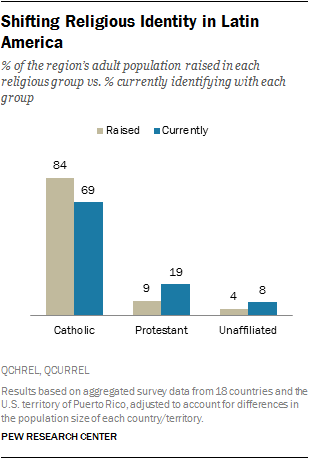
Historical data suggest that for most of the 20th century, from 1900 through the 1960s, at least 90% of Latin America’s population was Catholic (See History of Religious Change). Today, the Pew Research survey shows, 69% of adults across the region identify as Catholic. In nearly every country surveyed, the Catholic Church has experienced net losses from religious switching, as many Latin Americans have joined evangelical Protestant churches or rejected organized religion altogether. For example, roughly one-in-four Nicaraguans, one-in-five Brazilians and one-in-seven Venezuelans are former Catholics.

Overall, 84% of Latin American adults report that they were raised Catholic, 15 percentage points more than currently identify as Catholic. The pattern is reversed among Protestants and people who do not identify with any religion: While the Catholic Church has lost adherents through religious switching, both Protestant churches and the religiously unaffiliated population in the region have gained members. Just one-in-ten Latin Americans (9%) were raised in Protestant churches, but nearly one-in-five (19%) now describe themselves as Protestants. And while only 4% of Latin Americans were raised without a religious affiliation, twice as many (8%) are unaffiliated today.
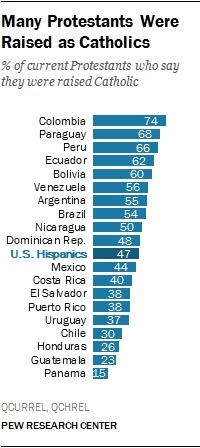
Much of the movement away from Catholicism and toward Protestantism in Latin America has occurred in the span of a single lifetime. Indeed, in most of the countries surveyed, at least a third of current Protestants were raised in the Catholic Church, and half or more say they were baptized as Catholics. For example, nearly three-quarters of current Protestants in Colombia were raised Catholic, and 84% say they were baptized as Catholics.

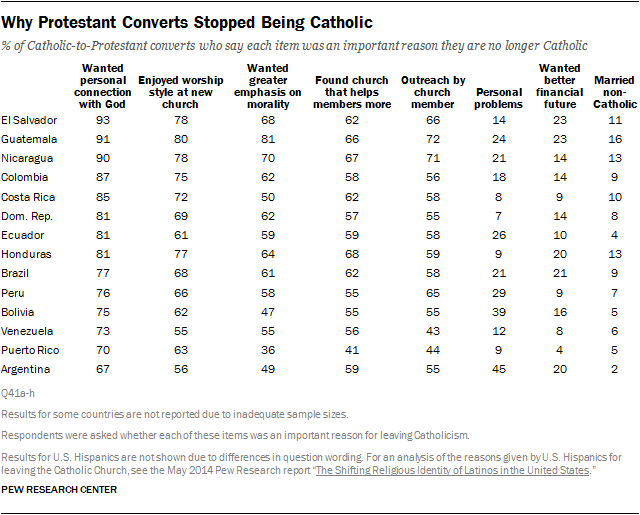
The survey asked former Catholics who have converted to Protestantism about the reasons they did so. Of the eight possible explanations offered on the survey, the most frequently cited was that they were seeking a more personal connection with God. Many former Catholics also said they became Protestants because they wanted a different style of worship or a church that helps its members more.

Smaller percentages of converts to Protestantism also cite other factors – such as health or family problems (a regional median of 20%) or marriage to a non-Catholic (median of 9%) – as important reasons why they are no longer Catholic.

What is a Median?

Most tables and charts in this report cite country-level findings. But on some questions, regional medians are reported to help readers see cross-national patterns. The median is the middle number in a list of numbers sorted in ascending or descending order. In a survey of 18 countries and Puerto Rico, the median result is 10th on a list of country-level findings ranked from highest to lowest.
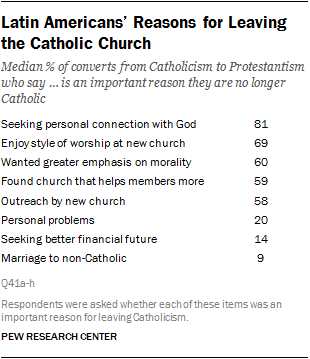
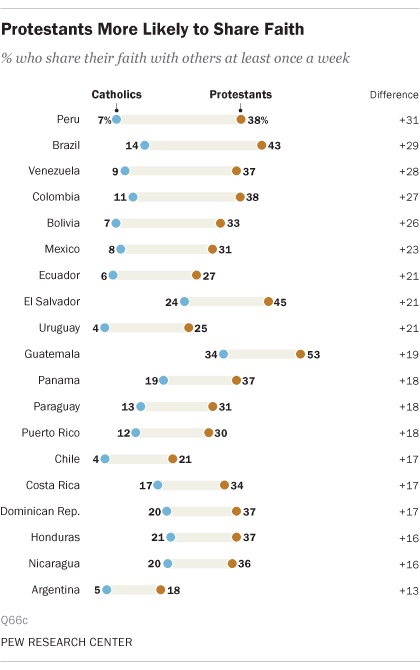
In addition, evangelization efforts by Protestant churches seem to be having an impact: Across Latin America, more than half of those who have switched from the Catholic Church to Protestantism say their new church reached out to them (median of 58%). And the survey finds that Protestants in the region are much more likely than Catholics to report sharing their faith with people outside their own religious group.

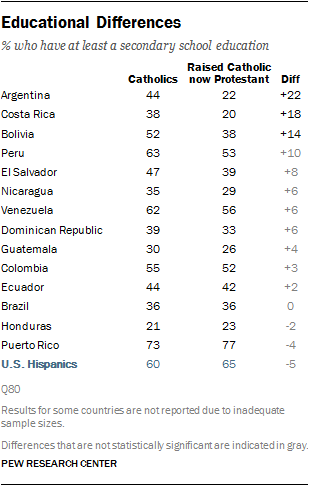
While the movement from Catholicism to Protestantism has occurred among people of all ages and socio-economic levels, the survey reveals some broad demographic patterns among converts. In most countries surveyed, pluralities of Catholic-to-Protestant converts say they left Catholicism before the age of 25. Geographic mobility may also be associated with conversion. In a few countries – Brazil, the Dominican Republic and Nicaragua – Catholic-to-Protestant converts are significantly more likely than current Catholics to have changed their place of residence, rather than to have always lived in one place.1 And in a few other countries – Argentina, Bolivia and Costa Rica – converts to Protestantism are less likely than Catholics to have a secondary education, though in most places, there are no statistically significant differences between the education levels of current Catholics and those who have converted.

A “Francis Effect”?

The Catholic Church’s status in Latin America has drawn more attention since Cardinal Jorge Mario Bergoglio of Argentina was elected pope in March 2013, taking the name Francis. While it is too soon to know whether Francis can stop or reverse the church’s losses in the region, the new survey finds that people who are currently Catholic overwhelmingly view Francis favorably and consider his papacy a major change for the church.

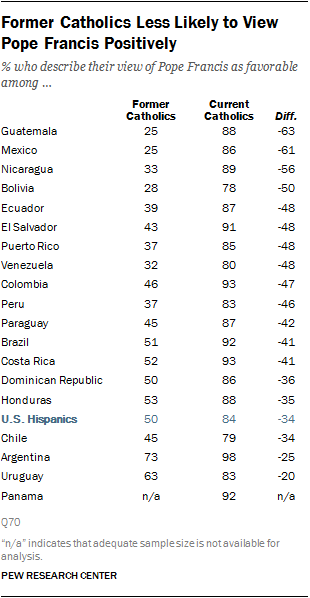
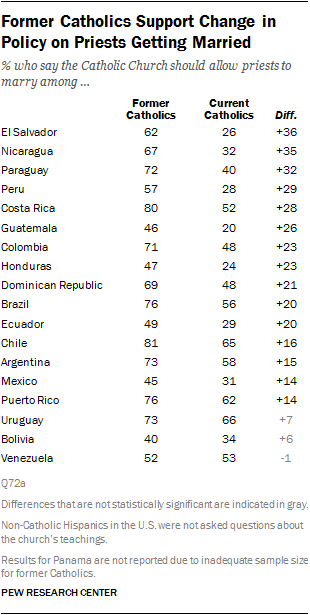
But former Catholics are more skeptical about Pope Francis. Only in Argentina and Uruguay do majorities of ex-Catholics express a favorable view of the pope. In every other country in the survey, no more than roughly half of ex-Catholics view Francis favorably, and relatively few see his papacy as a major change for the Catholic Church. Many say it is too soon to have an opinion about the pope. (For details, see Chapter 9.)

Protestant Identity in Latin America

Protestants in Latin America, like Protestants elsewhere, belong to a diverse group of denominations and independent churches. But unlike in the United States, where the labels “born again” and “evangelical” set certain Protestants apart, in Latin America “Protestant” and “evangelical” often are used interchangeably.

In this report, “Protestants” is broadly used to refer to members of historical Protestant churches (e.g., Baptists, Seventh-day Adventists, Methodists, Lutherans or Presbyterians), members of Pentecostal churches (e.g., Assemblies of God, the Pentecostal Church of God or the Quadrangular Evangelical Church) and members of other Protestant churches. Fewer than a quarter of Protestants in most countries surveyed say they belong to a historical Protestant church. Roughly half say they belong to a Pentecostal church. And, in most countries, at least a quarter say they belong to another Protestant church or that they do not know their denomination. Among those who belong to Pentecostal churches, Assemblies of God is one of the most commonly cited affiliations. (See topline for full results.)

Religious Observance

The new survey finds that Protestants in Latin America tend to be more religiously observant than Catholics. In nearly every country surveyed, Protestants say they go to church more frequently and pray more often than do Catholics; a regional median of 83% of Protestants report attending church at least once a month, compared with a median of 62% of Catholics. Protestants also are more likely than Catholics to read scripture outside of religious services, to approach the Bible literally and to believe that Jesus will return during their lifetime. (For more details, see Chapters 2 and 3.)

Appeal of Pentecostalism and Afro-Caribbean Religions
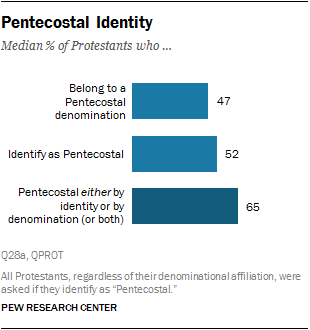
“Evangélicos” – as Protestants in the region often are called – include many Christians who belong to Pentecostal churches. While practices vary, Pentecostal worship services often involve experiences that believers consider “gifts of the Holy Spirit,” such as divine healing, speaking in tongues and receiving direct revelations from God. Across all 18 countries and Puerto Rico, a median of
nearly two-thirds of Protestants (65%) identify as Pentecostal Christians, either because they belong to a Pentecostal denomination (median of 47%) or because they personally identify as Pentecostal regardless of their denomination (median of 52%). Some Protestants identify as Pentecostal in both ways.

Although many Catholics in Latin America also say they have witnessed divine healing or other gifts of the Holy Spirit, these experiences are much less common in Catholic churches than in Protestant congregations. (For more details, see Chapter 4.)

Many Latin Americans – including substantial percentages of both Catholics and Protestants – say they subscribe to beliefs and practices often associated with Afro-Caribbean, Afro-Brazilian or indigenous religions. For example, at least a third of adults in every country surveyed believe in the “evil eye,” the idea that certain people can cast curses or spells that cause harm. Beliefs in witchcraft and reincarnation also are widespread, held by 20% or more of the population in most countries. Other beliefs and practices vary widely from country to country. For instance, a majority of Mexicans (60%) and more than a third of Bolivians (39%) say they make offerings of food, drinks, candles or flowers to spirits, but just one-in-ten Uruguayans (9%) do so. Overall, the survey finds the highest levels of indigenous or Afro-Caribbean religious practice in Panama, where most people (58%) – including 66% of Panamanian Catholics and 46% of Protestants – engage in at least three out of the eight indigenous beliefs and practices mentioned in the survey.

Differing Views on Social Issues and Helping the Poor

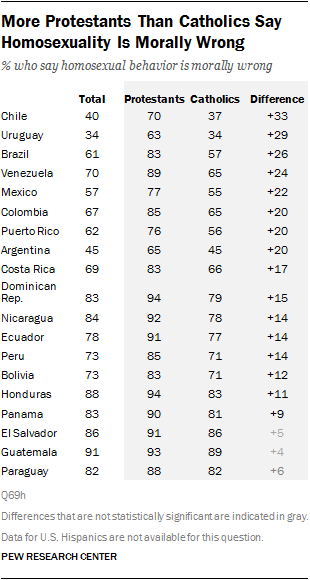
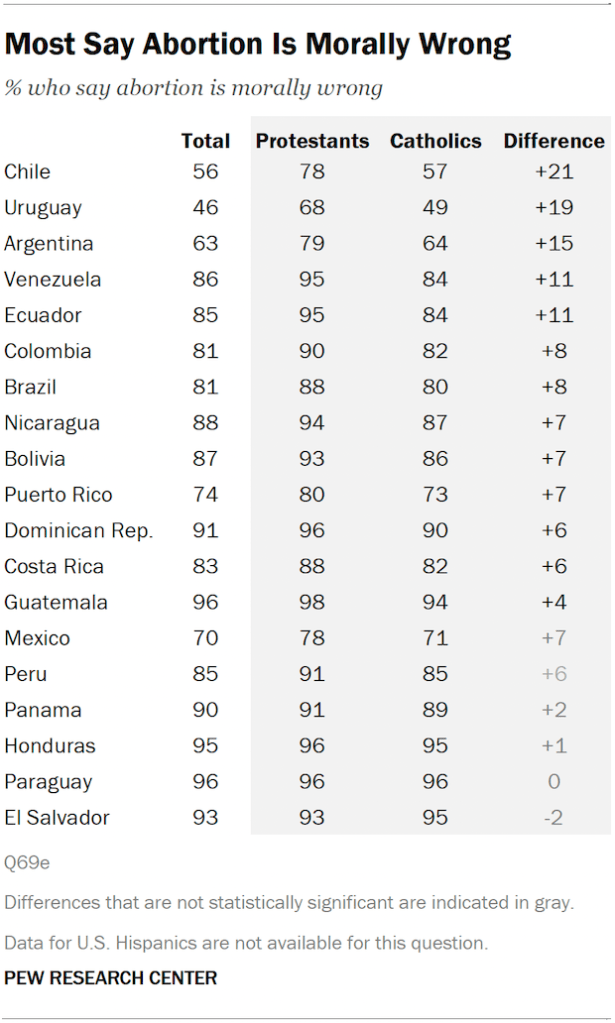
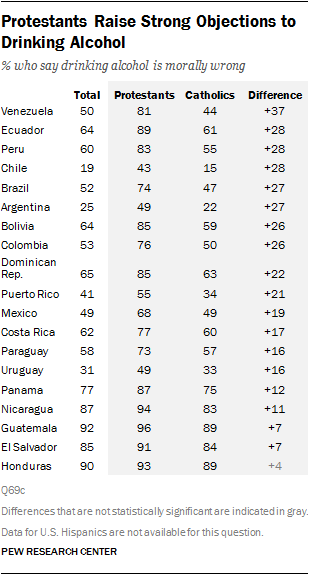
Even though the Catholic Church opposes abortion and same-sex marriage, Catholics in Latin America tend to be less conservative than Protestants on these kinds of social issues. On average, Catholics are less morally opposed to abortion, homosexuality, artificial means of birth control, sex outside of marriage, divorce and drinking alcohol than are Protestants.

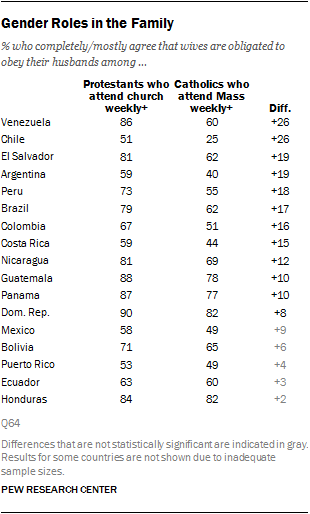
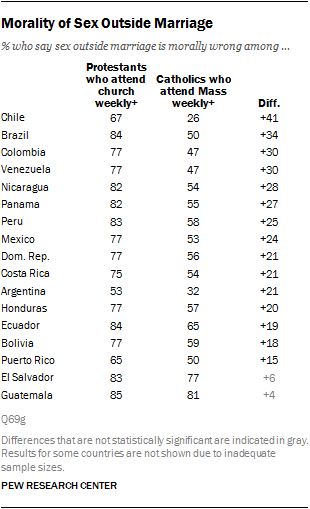
The differences between Catholics and Protestants on most of these issues hold true even when accounting for levels of religious observance. For example, Protestants who participate in religious services at least once a week are somewhat more likely to oppose abortion and divorce – and considerably more likely to oppose homosexuality, sex outside of marriage and drinking alcohol – than are Catholics who attend Mass at least weekly.2 These differing views on social issues may help explain why many former Catholics who have become Protestants say they were looking for a church that “places greater importance on living a moral life” (a median of 60%).
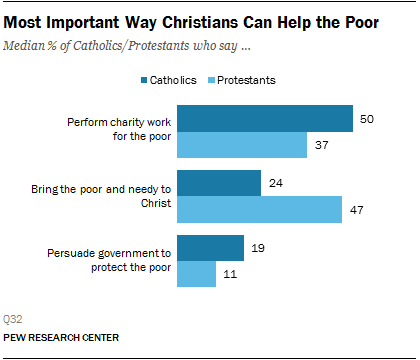
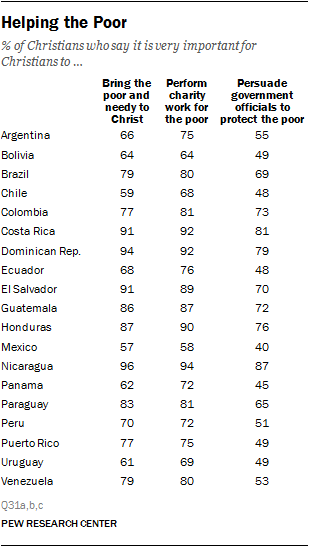
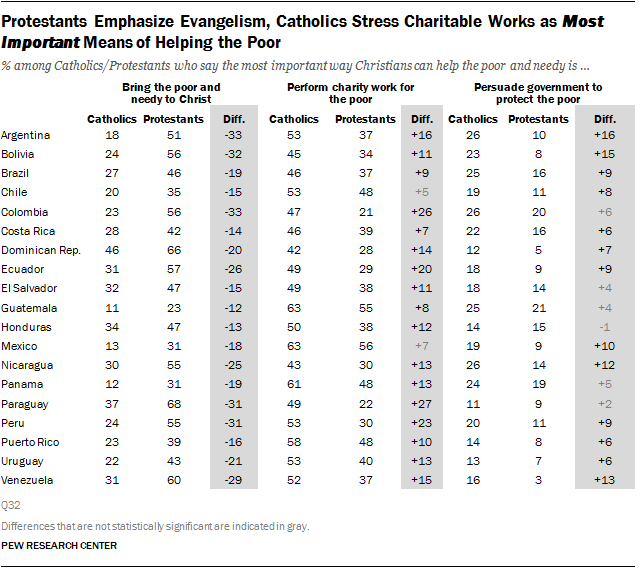
Across the region, both Catholics and Protestants generally say it is incumbent on Christians to help the poor in their societies, but they give somewhat different answers on how best to achieve this goal. When asked what is the most important way Christians can help the poor and needy, Protestants are more likely than Catholics to point toward bringing the poor to Christ, while Catholics are more inclined to say that performing charity work for the poor is most important.

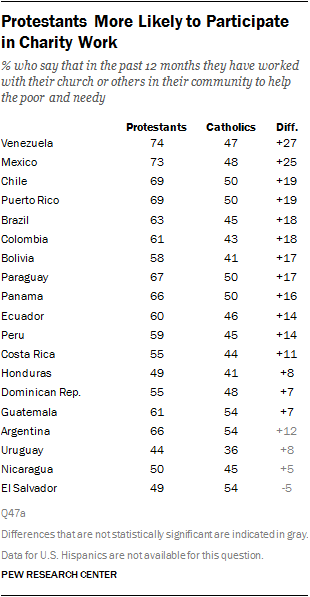
Yet across the countries surveyed, a considerably higher share of Protestants than Catholics say that they themselves or the church they attend engage in charity work – helping people find jobs, providing food and clothing for those in need or organizing other community initiatives to help the poor. (For more details, see Chapter 6.)


These are among the key findings of more than 30,000 face-to-face interviews conducted across 18 countries and Puerto Rico by the Pew Research Center between October 2013 and February 2014. The survey encompasses nearly all Spanish- and Portuguese-speaking countries and territories stretching from Mexico through Central America to the southern tip of South America. Due to fieldwork constraints and sensitivities related to polling about religion, Cuba could not be included; it is the only Spanish-speaking country in Latin America that was not polled.
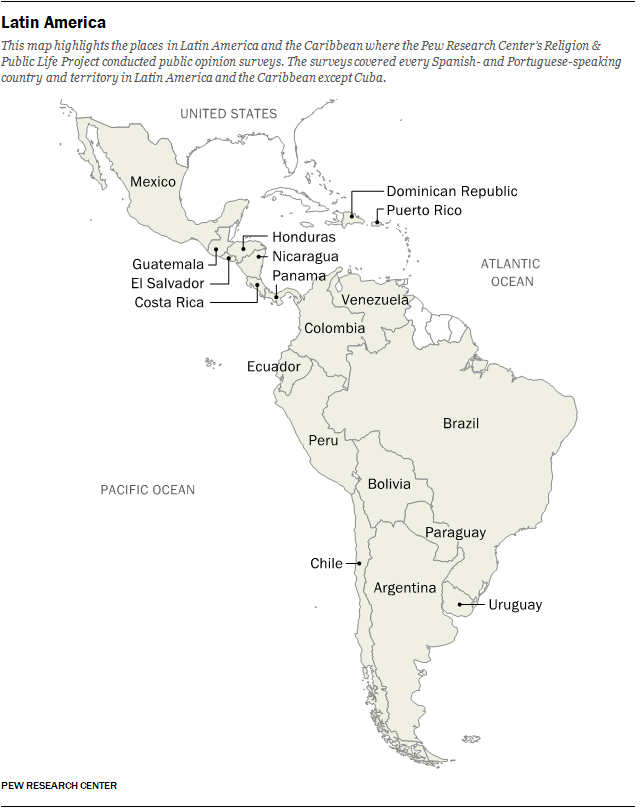
Map of Latin America

The survey of Latin America is part of a larger effort, the Pew-Templeton Global Religious Futures project, which analyzes religious change and its impact on societies around the world. The Global Religious Futures project is funded by The Pew Charitable Trusts and the John Templeton Foundation.

The remainder of this Overview explains the major findings in greater detail and provides additional context, beginning with some comparisons with Hispanics living in the United States.

Comparisons with U.S. Hispanics
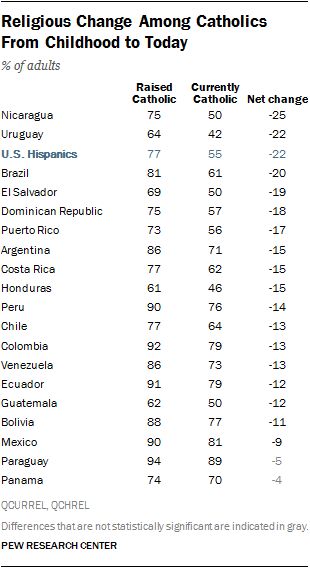
Many of the major patterns revealed by this survey mirror trends found among U.S. Hispanics, according to a 2013 Pew Research poll. The U.S. Hispanic population (now approximately 54.1 million people) is larger than the total population in all but two Latin American countries – Brazil (195 million) and Mexico (113 million).

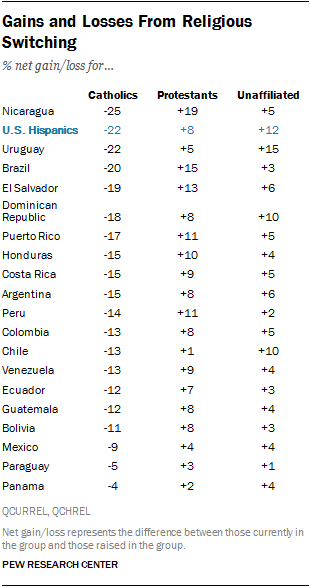
Nearly a quarter of Hispanic adults in the United States were raised Catholic but have since left the faith (24%), while just 2% of U.S. Hispanics have converted to Catholicism after being raised in another religious tradition or with no affiliation – a net drop of 22 percentage points. The scale of this exodus is roughly on par with several Latin American countries that also have experienced steep declines in the share of adults who identify as Catholic, including Nicaragua (minus 25 percentage points), Uruguay (minus 22 points), Brazil (minus 20) and El Salvador (minus 19).

Like their counterparts in Latin America, many U.S. Hispanics have left Catholicism for Protestant churches. Protestants now account for about one-in-five Hispanics in the United States (22%), roughly the same as in Latin America (19%). In addition, a substantial number of Hispanics in the United States (18%) describe their religion as atheist, agnostic or nothing in particular. This is more than double the percentage of Latin American adults (8%) who are religiously unaffiliated.

Religious Affiliations of Latin Americans and U.S. Hispanics
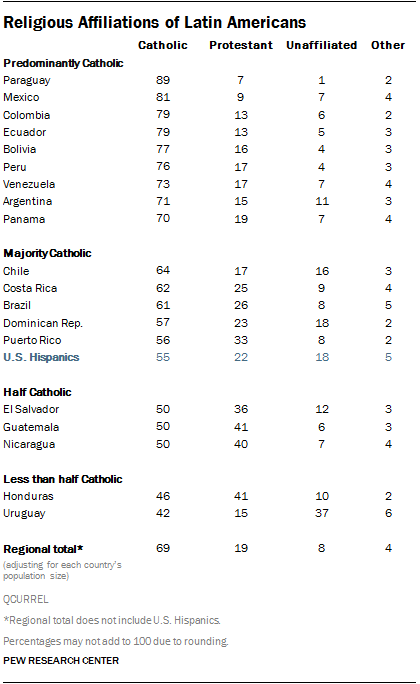
Although Catholicism’s historically dominant position has weakened in recent decades (see History of Religious Change), it remains the majority religion across much of Latin America. Catholics make up an overwhelming majority (more than two-thirds) of the adult population in nine of the countries surveyed, ranging from 89% in Paraguay to 70% in Panama. Even in these heavily Catholic countries, however, Protestants now are a significant minority, constituting nearly 10% or more of the population in each country.

Catholics make up between one-half and roughly two-thirds of the population in five of the places surveyed: Chile, Costa Rica, Brazil, the Dominican Republic and Puerto Rico. Similarly, 55% of U.S. Hispanics are Catholic.

In three Central American countries – El Salvador, Guatemala and Nicaragua – about half of the population is Catholic, while roughly four-in-ten adults describe themselves as Protestant.

Uruguay is the only country surveyed where the percentage of adults who say they are religiously unaffiliated (37%) rivals the share who identify as Catholic (42%). In addition, 15% of Uruguayans identify as Protestant. (See Religion in Uruguay.)

The Influence of Pentecostalism
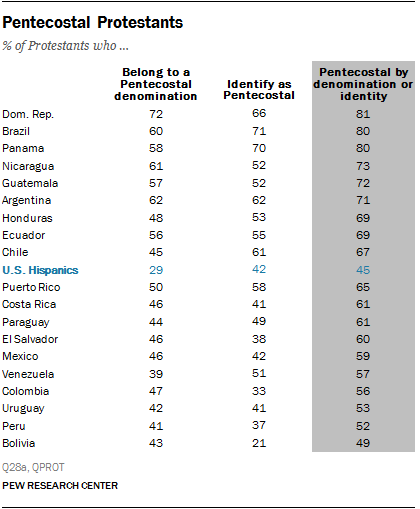
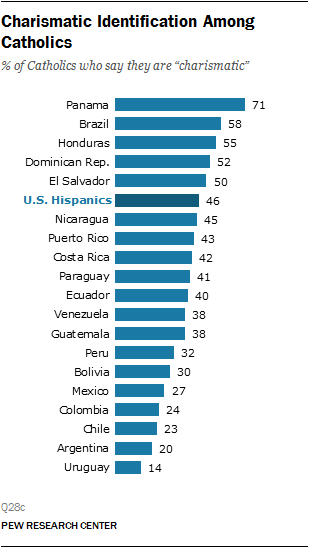
Most Protestants in Latin America identify with Pentecostalism. Across 18 countries and Puerto Rico, a median of 65% of Protestants either say they belong to a church that is part of a Pentecostal denomination (median of 47%) or personally identify as a Pentecostal Christian regardless of their denomination (median of 52%), with some overlap between the categories. In the United States, fewer than half of Hispanic Protestants describe themselves as Pentecostal by church denomination (29%), self-identification (42%) or both (45%). In addition, 46% of Hispanic Catholics in the U.S. and a median of 40% of Catholics across Latin America say they are “charismatic” – a term used to describe Catholics who incorporate beliefs and practices associated with Pentecostalism into their worship.3

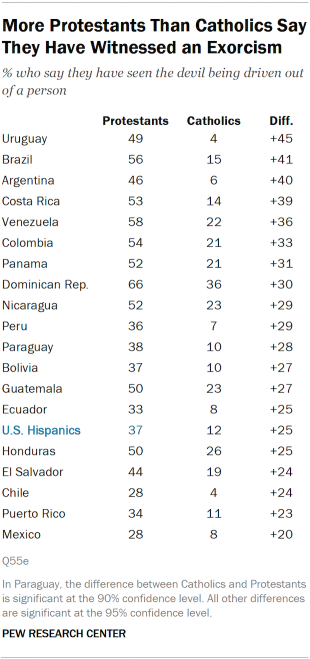
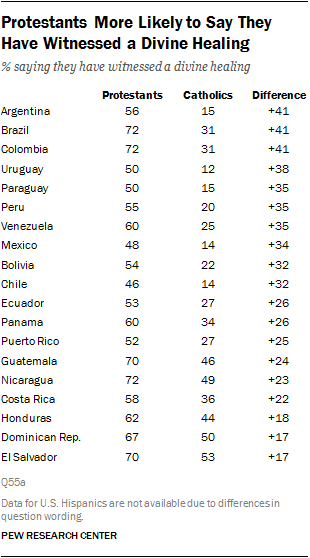
Significant percentages of Protestants across Latin America say that they engage in beliefs and practices associated with “gifts of the Holy Spirit,” such as divine healing and exorcism. In a majority of the countries surveyed, at least half of Protestants report that they have witnessed or experienced the divine healing of an illness or injury, and at least a third say they have experienced or witnessed the devil being driven out of a person.

Smaller but substantial shares of Catholics also report charismatic experiences. This is especially true in parts of Central America and the Caribbean, where roughly half of Catholics in El Salvador (53%), the Dominican Republic (50%), Nicaragua (49%) and Guatemala (46%) report that they have witnessed or experienced a divine healing. At least one-in-five Catholics in the Dominican Republic (36%), Honduras (26%), Guatemala (23%), Nicaragua (23%), Venezuela (22%), Panama (21%) and Colombia (21%) say they have been present for an exorcism.

The survey also asked respondents about “speaking in tongues” – a practice closely associated with Pentecostalism around the world. In a majority of the countries polled, at least one-in-five Protestants say they personally have spoken in tongues, including about four-in-ten in Panama (39%) and a third in Brazil (33%). By comparison, relatively few Catholics report speaking in tongues, ranging from 1% in Argentina, Chile and Panama to 12% in Guatemala.
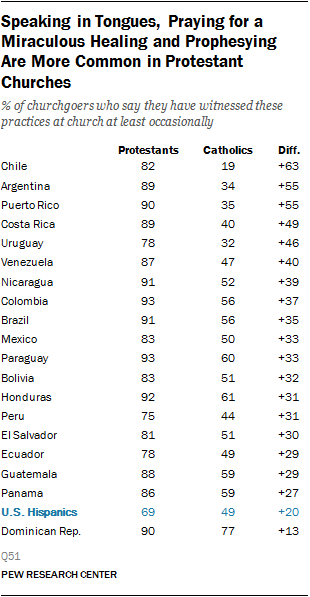
The survey also asked churchgoing respondents how often they see fellow worshipers speaking in tongues, praying for a miraculous healing or “prophesying” (spontaneously uttering a message or “word of knowledge” believed to come from the Holy Spirit). Most Latin American Protestants say that speaking in tongues, praying for a miraculous healing and prophesying are frequent occurrences in their religious services. Fewer Catholics say that such behaviors are on display during Catholic worship services, and majorities of Catholics in Uruguay (63%), Argentina (61%) and Puerto Rico (60%) report that speaking in tongues, praying for a miraculous healing and prophesying are never part of their worship practices.

In several countries in Latin America, however, at least half of Catholics say they have witnessed these practices during Mass at least occasionally. For example, majorities of Catholics in the Dominican Republic (77%), Honduras (61%) and Paraguay (60%) say they have witnessed fellow worshipers speaking in tongues, praying for a miraculous healing or prophesying. (For definitions of terms, see the glossary.)

The Religiously Unaffiliated
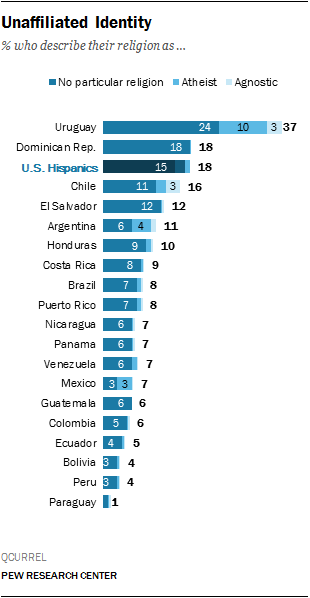
Latin America’s religious landscape is being reshaped not only by people who have switched from Catholic to Protestant churches but also by those who have given up any affiliation with organized religion. The unaffiliated category includes individuals who describe themselves as atheist, agnostic or having no particular religion.

Uruguay is home to the largest percentage of religiously unaffiliated adults in Latin America (37%), roughly double the share of unaffiliated people in any other country in the region. (See Religion in Uruguay.)

Across Latin America, as well as among Hispanics in the United States, most people who are unaffiliated say that they have no particular religion rather than describing themselves as atheist or agnostic. About one-in-ten or more adults in Uruguay (24%), the Dominican Republic (18%), El Salvador (12%) and Chile (11%) say they have no particular religion. In the United States, 15% of Hispanics fall into this category.

Religion in Uruguay

On many questions in the survey, Uruguay is an outlier, far and away Latin America’s most secular country. Fully 37% of Uruguayans say that they have no particular religion or are atheist or agnostic. In no other Latin American country surveyed do the religiously unaffiliated make up even 20% of the population.

Laicidad, or the separation of religion and the state, has a long history in Uruguay. In 1861, the government nationalized cemeteries across the country, breaking their affiliations with churches. Soon after, the government prohibited churches from having a role in public education or issuing marriage certificates.4 Secularization continued in the 20th century: A new constitution enshrined the separation of religion from public life, references to God were removed from the parliamentary oath and religious references were dropped from the names of cities and villages.5

Today, Uruguay has by far the lowest levels of religious commitment among the countries polled. Fewer than a third of Uruguayans (28%) say that religion is very important in their lives; in no other country surveyed do fewer than four-in-ten people say this. Relatively few Uruguayans say they pray daily (29%) or attend religious services weekly (13%). In neighboring Brazil, by contrast, 61% of adults say they pray daily, and 45% report attending services at least once a week.

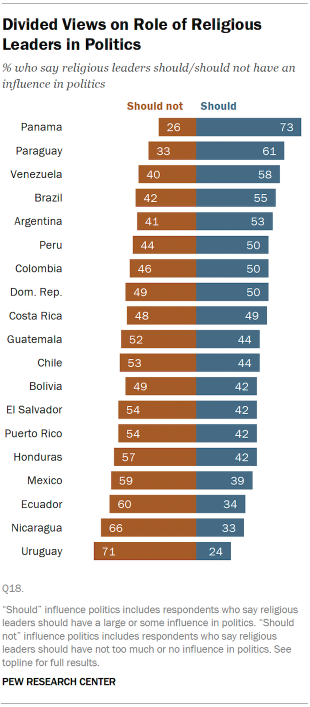
When it comes to social views and attitudes toward morality, Uruguay consistently stands out for its liberalism. It is the only country surveyed where a majority of the public favors allowing same-sex couples to legally marry (62%), and where as many as half of adults (54%) say that abortion should be legal in all or most cases. And it is the only country in the region where a majority (57%) says that religious leaders should have “no influence at all” in political matters.

Religious Commitment
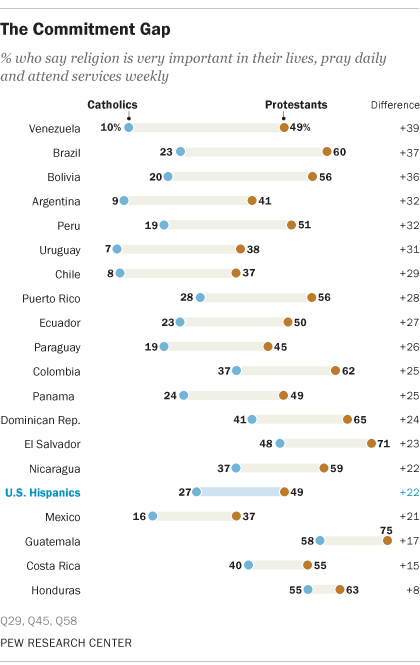
Catholics and Protestants in Latin America differ in their levels of religious observance. In every country surveyed, Protestants are more likely than Catholics to exhibit high levels of religious commitment – that is, to say they pray daily, attend worship services at least once a week and consider religion very important in their lives. Some of the widest gaps are found in Venezuela, Brazil, Bolivia, Argentina, Peru and Uruguay, where the share of adults who demonstrate high religious commitment is at least 30 percentage points higher among Protestants than among Catholics. The gaps between Protestants and Catholics on these standard measures of religious commitment are smallest, but still statistically significant, in the Central American countries of Guatemala (17 points), Costa Rica (15) and Honduras (8). (See Chapter 2 for an analysis of each component of the religious commitment index.)

Relatively few Latin Americans who are religiously unaffiliated say they attend worship services on a weekly basis. In Puerto Rico, for example, roughly a third of religiously unaffiliated adults (32%) say religion is very important in their lives, but only 3% attend religious services once a week or more.

Age and Gender Differences in Religious Commitment
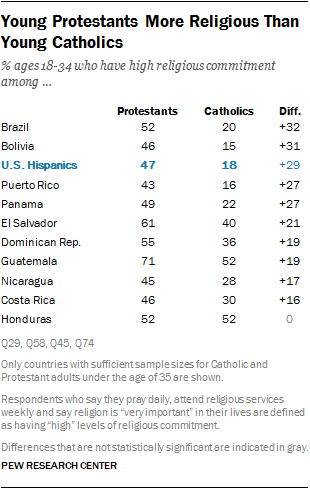
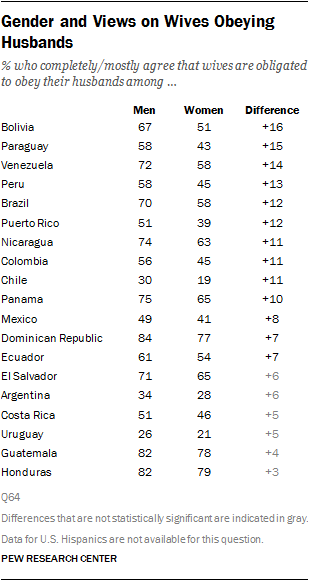
In many countries across the region, women demonstrate higher levels of religious commitment than do men, and people ages 35 and older tend to be more committed than those between the ages of 18 and 34.

Protestants generally display higher levels of religious commitment than Catholics in comparable demographic categories. For example, Protestant men report attending church more frequently than do Catholic men, and young Protestants report attending religious services more frequently than do young Catholics. These patterns prevail in nearly every country where the survey’s sample sizes are large enough to permit such comparisons.

Morality and Social Views
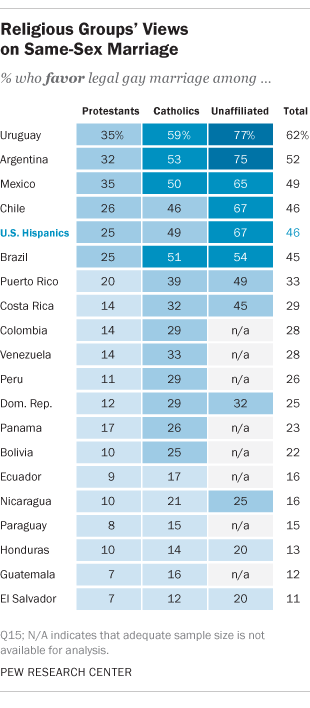
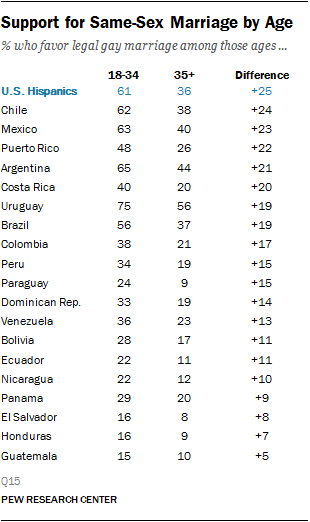
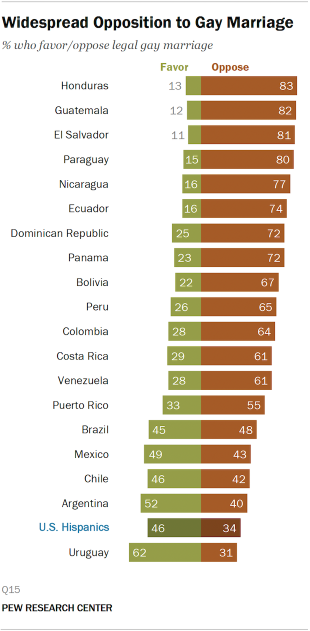
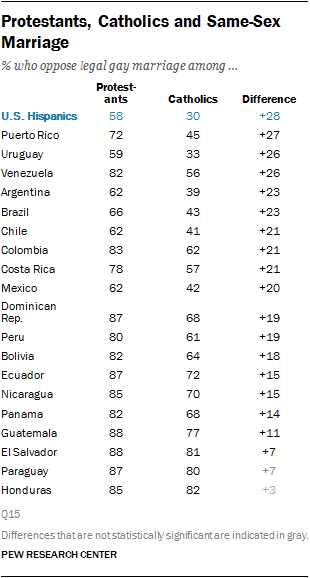
Compared with U.S. Hispanics, Latin Americans are generally more conservative when it comes to social and sexual mores. For example, in recent Pew Research polling in the United States, 46% of Hispanics support gay marriage, while 34% are opposed. In most Latin American countries, by contrast, solid majorities oppose allowing gays and lesbians to legally marry. Only in a handful of countries, such as Uruguay (62%), Argentina (52%) and Mexico (49%), do roughly half or more people favor legalizing same-sex marriage. (Same-sex marriage is currently legal in Argentina, Brazil, Uruguay and parts of Mexico, but nowhere else in Latin America.)

In most Latin American countries, opposition to same-sex marriage is more pronounced among Protestants than among Catholics. And in countries where there are adequate sample sizes to permit separate analysis of the views of religiously unaffiliated people, this group tends to be more supportive of granting marriage rights to gays and lesbians. Indeed, about two-thirds or more of the unaffiliated in Uruguay (77%), Argentina (75%), Chile (67%) and Mexico (65%) favor gay marriage.

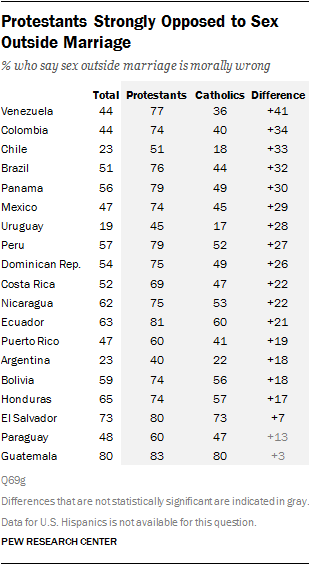
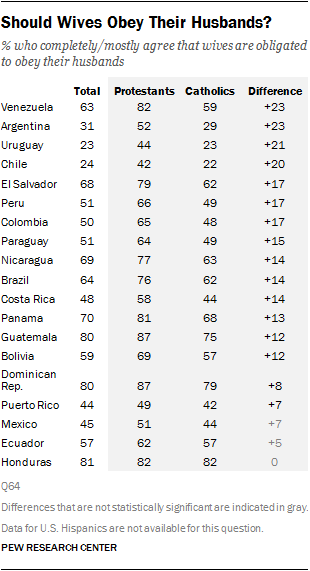
Differences among Catholics, Protestants and the religiously unaffiliated also are apparent on other social issues. Across Latin America, Protestants generally are more likely than Catholics and the unaffiliated to say that abortion should be illegal in all or most cases, that sex outside marriage and divorce are morally wrong and that a wife is always obligated to obey her husband.

Addressing Poverty
When asked what they think is the most important way for Christians to help the poor, Catholics in nearly every Latin American country point most often to charity work. By contrast, pluralities of Protestants in many countries say that “bringing the poor and needy to Christ” is the most important way to help. Overall, fewer members of either religious group say that “persuading government officials to protect the rights of the poor” is most important, though Catholics are somewhat more inclined than Protestants to take this position.

Even though Catholics are more likely than Protestants to say charity work is most important, higher percentages of Protestants report that they, personally, have joined with members of their church or others in their community to help the poor and needy. In most countries surveyed, solid majorities of Protestants say they have participated in charity work in the past 12 months. Among Catholics, roughly half or fewer report that they have done so.

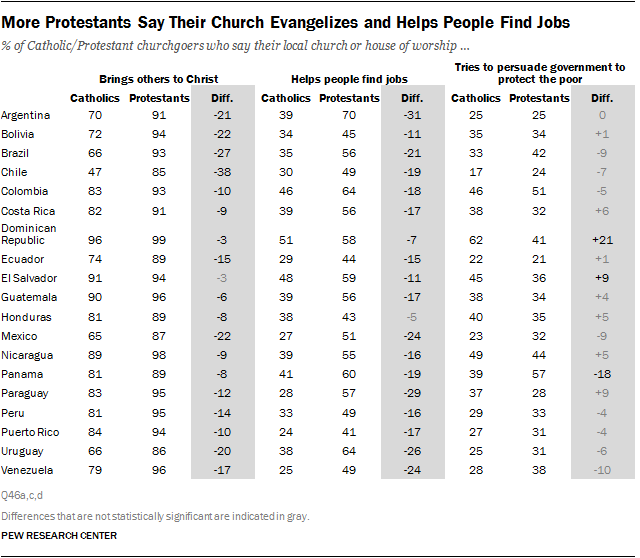
In addition, among those who attend church, higher percentages of Protestants than Catholics say their house of worship helps people find jobs or provides food and clothing for those in need. (For more details, see Chapter 6.)

Pope Francis, the Catholic Church and Change
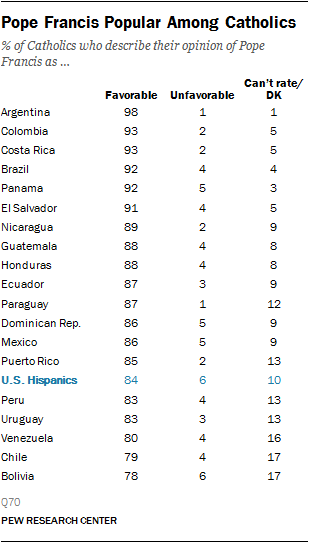
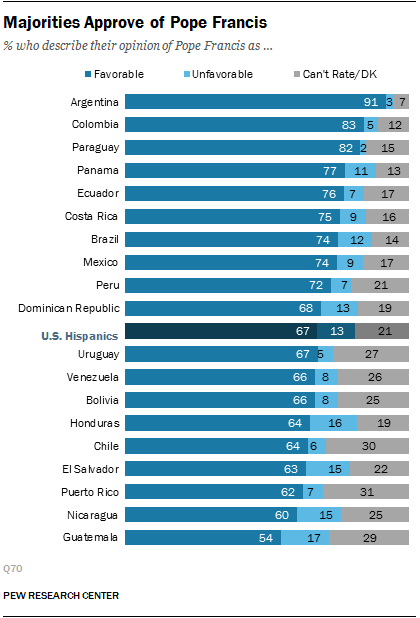
Latin Americans have widely embraced Pope Francis, the Argentine-born Jesuit bishop elected to lead the Catholic Church after Pope Benedict XVI resigned in 2013. Favorable views of the new pontiff prevail across the region, with two-thirds or more of the population in most countries expressing a positive opinion of Pope Francis when the survey was conducted in late 2013 and early 2014.

Latin American Catholics are particularly enthusiastic about Pope Francis, with clear majorities across the region rating him favorably. Indeed, in 14 of the countries surveyed, at least half of Catholics say they have a very favorable opinion of Francis.

Former Catholics, by comparison, are ambivalent about the new pope. Explicitly negative views of Pope Francis are relatively rare among this group, but so are overwhelmingly positive reactions, except in Francis’ home country of Argentina. For many former Catholics, the jury is still out. In most places surveyed, a third or more of ex-Catholics either offer no opinion on Francis or volunteer that it is too soon to assess him.

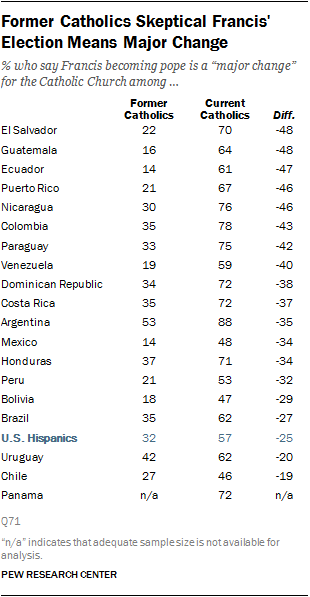
The survey also asked whether the election of Pope Francis signals a major change, a minor change or no change at all for the Catholic Church. Half or more of Catholics in 16 of the countries polled view the selection of the former Argentine bishop as a major change. Former Catholics are less certain; only in Argentina do as many as half (53%) see the new pope as representing a major change. As with the pope’s overall favorability, substantial percentages of former Catholics say it is too soon to tell whether Francis represents much change.
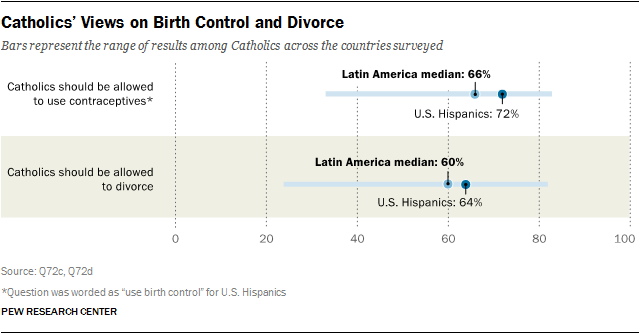
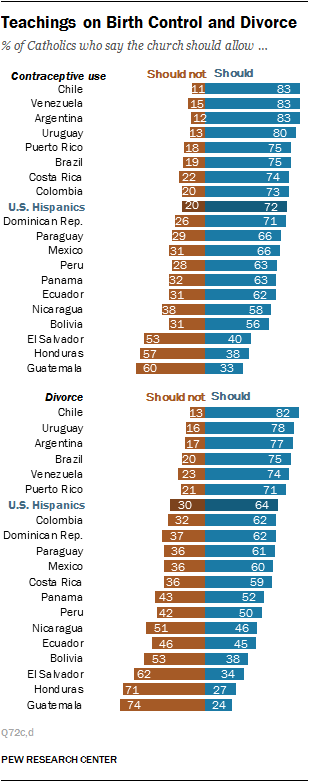
Regardless of their assessments of whether change is occurring, many Catholics think some of their church’s teachings should be revised. For instance, across Latin America, a median of 66% of Catholics say the church should allow Catholics to use artificial means of birth control, and in Chile, Venezuela, Argentina and Uruguay, roughly eight-in-ten Catholics favor a change in church teaching on contraception. In the U.S., 72% of Hispanic Catholics think the Catholic Church should permit the use of contraceptives.

There also is substantial support among Latin American Catholics (a regional median of 60%) for ending the church’s prohibition on divorce. Again, Catholics in Chile (82%), Uruguay (78%) and Argentina (77%) are among the most likely to voice support for change.

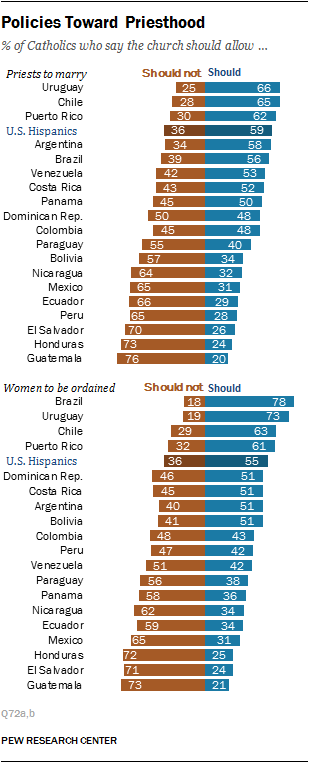
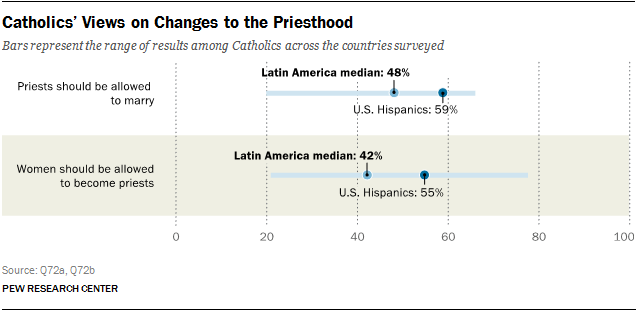
Catholics in Latin America are more divided when it comes to changes in the priesthood. Across the countries polled, a median of 48% of Catholics think priests should be allowed to marry. A similar share (regional median of 42%) say the church should permit women to be ordained as priests. On each issue, most Hispanic Catholics in the U.S. favor altering the Catholic Church’s traditional positions: 59% say priests should be allowed to marry, and 55% think women should be eligible to serve in the priesthood.
History of Religious Change
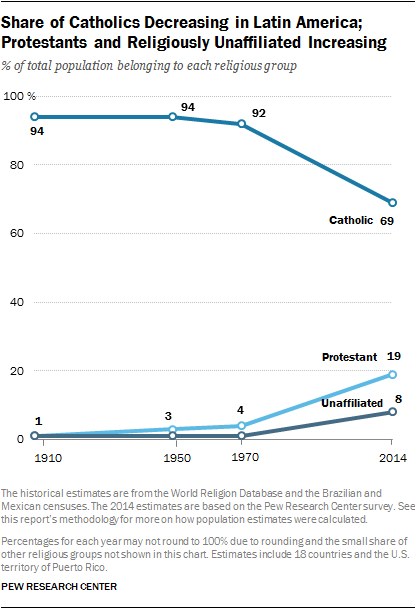
In 1910, an estimated 94% of Latin Americans were Catholic, and only about 1% were Protestant. But Catholics began declining as a share of the region’s population in the 1970s, according to Brazilian and Mexican census data and historical estimates from the World Religion Database.

As of 2014, the new Pew Research Center survey finds that 69% of Latin Americans identify as Catholic, while 19% belong to Protestant churches and 8% are religiously unaffiliated (atheist, agnostic or no particular religion). The remaining 4% include Jehovah’s Witnesses, Mormons, Muslims, Hindus, Jews, Spiritists and adherents of Afro-Caribbean, Afro-Brazilian or indigenous religions, such as Umbanda and Candomble. (See the glossary.)

Scholars of religion in Latin America offer several possible sociological explanations for the rise of Protestantism, and especially its Pentecostal variant. One theory posits that Pentecostalism’s compatibility with indigenous religions enhanced its appeal among Latin Americans. By emphasizing personal contact with the divine through faith healing, speaking in tongues and prophesying, Pentecostalism attracts those who share an affinity with indigenous religions that traditionally incorporate beliefs and practices associated with direct communication with the “spirit world.”
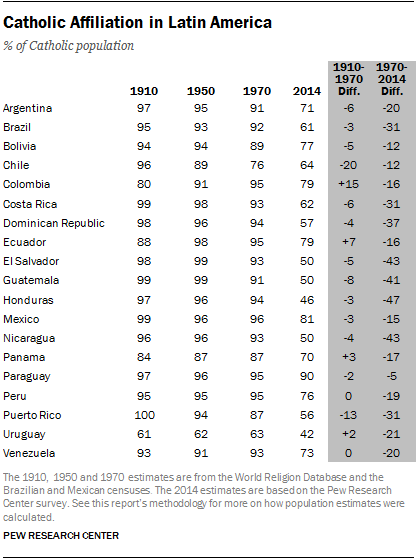
Another potential explanation highlights the practical reasons why Pentecostalism may have gained a following in the region. Pentecostals often emphasize upward social and economic mobility and thrift. Consequently, followers of Pentecostalism may see the religion as more conducive to economic prosperity.6 Historical estimates for individual Latin American countries underscore that the shift away from Catholicism is a relatively recent phenomenon in most locations. The estimates reveal only two places that experienced double-digit declines in Catholic identity between 1910 and 1970: Chile (a decline of 20 percentage points) and Puerto Rico (a 13-point decline). In Colombia, the percentage of people who identified as Catholic actually increased by 15 percentage points between 1910 and 1970.

By comparison, the period between 1970 and 2014 is marked by significant declines in the percentages of Catholics in nearly all of the countries surveyed – ranging from a 47-point drop in Honduras to a 5-point decrease in Paraguay.

The Pew Research Center previously noted post-1970 declines in Catholic identity in Brazil and Chile. (See the 2006 Pew Research report “Spirit and Power: A 10-Country Survey of Pentecostals” and the 2013 report “Brazil’s Changing Religious Landscape.”)

About the Survey

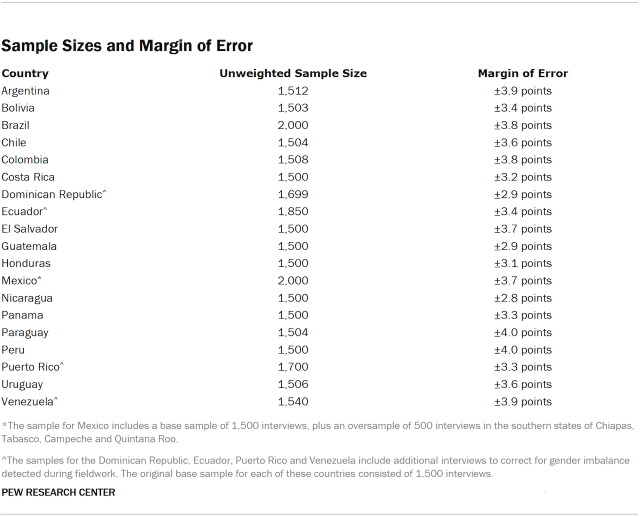
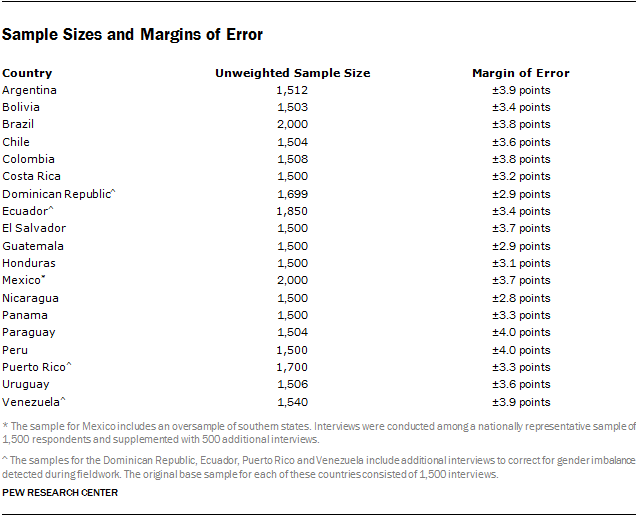
This report is based on findings from a Pew Research Center survey conducted with generous funding from The Pew Charitable Trusts and the John Templeton Foundation. The survey took place October 2013 to February 2014 among nationally representative samples in 18 countries and the U.S. territory of Puerto Rico. Together, these countries and Puerto Rico account for more than 95% of the total population of Latin America. The survey was conducted through face-to-face interviews in Spanish, Portuguese and Guarani. Sample sizes and margins of error by country are available below. For more details, see the survey methodology.

Many Pew Research staff members contributed to the development of this survey and accompanying report. James Bell and Neha Sahgal were the principal researchers and the lead authors of the report. Alan Cooperman was the lead editor. Steve Schwarzer, Fatima Ghani and Michael Robbins helped design sampling plans, monitor field work and evaluate data quality. Ghani drafted Chapter 9 (Views of Pope Francis and the Catholic Church) and Juan Carlos Donoso drafted Chapter 8 (Religion and Science). Phillip Connor drafted the sections on the history of religious change in the region. Cary Funk, Jessica Martinez, Juan Carlos Esparza Ochoa and Ana Gonzalez-Barrera assisted in questionnaire development; Martinez, Jill Carle, Kat Devlin, Elizabeth Sciupac, Claire Gecewicz, Besheer Mohamed and Angelina Theodorou assisted with number checking. Sandra Stencel, Michael Lipka and Aleksandra Sandstrom provided editorial review and copy editing. Stacy Rosenberg, Bill Webster, Adam Nekola, Ben Wormald and Diana Yoo designed the graphics and online interactive presentation. Others at the Pew Research Center who contributed to the report include Conrad Hackett, Mark Lopez, Claudia Deane, Michael Dimock, Anne Shi, Katie Simmons and Jessica Schillinger. Luis Lugo, former director of the center’s Religion & Public Life Project, was instrumental in conceiving the survey and provided guidance throughout its execution.

Fieldwork for this study was carried out by Princeton Survey Research Associates under the direction of Mary McIntosh and by Ipsos Public Affairs under the direction of Clifford Young. The questionnaire benefited greatly from guidance provided by experts on religion and public opinion in Latin America, including Matias Bargsted, Pontificia Universidad Catolica de Chile; Andrew Chesnut of Virginia Commonwealth University; Nestor Da Costa of Instituto Universitario CLAEH and Universidad Catolica del Uruguay, Uruguay; Juan Cruz Esquivel of CONICET – Universidad de Buenos Aires, Argentina; Silvia Fernandes of Universidade Federal Rural do Rio de Janeiro, Brazil; Frances Hagopian of Harvard University’s Department of Government; Fortunato Mallimaci of CONICET – Universidad de Buenos Aires, Argentina; Catalina Romero, Pontificia Universidad Catolica de Peru; and Mitchell Seligson of Vanderbilt University.
 

Chapter 1: Religious Switching

For more recent survey data about religion in Latin America, read our 2026 report “Catholicism Has Declined in Latin America Over the Past Decade.”

In most of the Latin American countries surveyed, at least one-in-six adults report that they no longer belong to the religion in which they were raised. Roughly one-in-three have changed their faith in Nicaragua, Uruguay and El Salvador. At the other end of the spectrum, much smaller proportions of adults in Mexico (12%), Panama (12%) and Paraguay (10%) say that they no longer belong to the religion in which they were raised.

By way of comparison, nearly a third (32%) of Hispanics in the U.S. report having switched their religious faith.

In most Latin American countries polled, religious switching has led to a net loss for Catholics and a net gain for Protestants. People unaffiliated with any faith also have experienced significant net gains in a few countries.

The survey finds that the movement away from Catholicism has occurred among people of all ages and socio-economic levels. But some demographic patterns are apparent among Catholic-to-Protestant converts: In a few countries, former Catholics who are now Protestant are significantly more likely than current Catholics to have relocated within their country. And while in most countries Catholics and Catholic-to-Protestant converts report similar levels of education, there are a few places (Argentina, Costa Rica and Bolivia) where those who have left the Catholic Church for Protestantism are less likely than Catholics to have at least a secondary school education.

When former Catholics who are now Protestant are asked whether certain factors were important in their decision to leave the Catholic Church, at least two-thirds in most countries say they wanted a more personal experience with God. Other common reasons people give for leaving the church are that they were looking for a different style of worship or a church that helps its members more. No more than about one-in-four Catholic-to-Protestant converts in any country surveyed say they changed their religious faith because they were seeking a better financial future.

Shifting Affiliations

Conversion out of Catholicism is significantly outpacing conversion into Catholicism, leading to a net loss for Catholics in most countries included in the survey. Much of this religious switching has resulted in net gains for Protestantism across the region.

In Nicaragua, for example, roughly one-in-four (26%) respondents are former Catholics. Hardly any Nicaraguans reported converting into Catholicism, leading to a net loss of 25 percentage points for Catholics in the country. (See the table below for percentages entering and leaving each group.)

At the same time, Nicaragua has seen a big net gain for Protestants (plus 19 percentage points); 22% of Nicaraguan adults say that they have left their childhood faith and are now Protestants, while 3% of those who were raised Protestant say that they are no longer affiliated with the Protestant faith. In Brazil, the country with the largest number of Catholics in the world, Protestants have seen a net gain of 15 percentage points.

People with no religion also have experienced double-digit gains in a few countries, as more adults report having switched into the ranks of the religiously unaffiliated than report switching out. The unaffiliated have seen significant net gains in Uruguay (plus 15 points), Chile (plus 10 points) and the Dominican Republic (plus 10 points).

How Net Gains and Losses for Religious Groups Are Calculated

Net gains and losses are defined as the difference between the percentage of the population in each country that was raised in a religious group and the percentage currently in that group. In this table, “percent entering” refers to respondents who currently identify as Catholic, Protestant or unaffiliated but were not raised in their current faith. “Percent leaving” refers to respondents who were raised Catholic, Protestant or unaffiliated but no longer identify with their childhood faith.

Leaving Catholicism

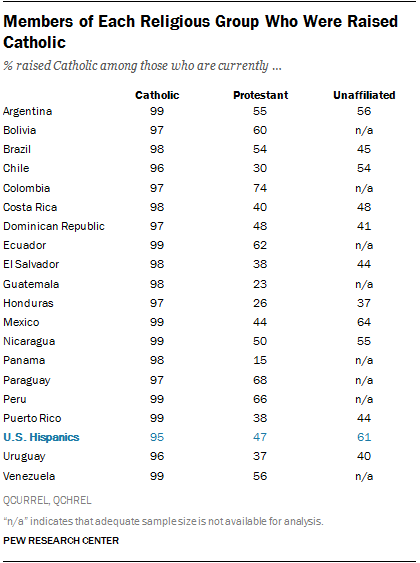
Nearly all current Catholics in Latin America say that they were raised Catholic. At the same time, many people who currently identify themselves as Protestant or unaffiliated also were raised Catholic.

In six of the countries surveyed, majorities of current Protestants say they were raised Catholic, including about three-quarters of Protestants in Colombia (74%) and roughly two-thirds of Protestants in Paraguay and Peru. Fewer Protestants say that they were raised Catholic in Puerto Rico (38%), Chile (30%), Honduras (26%), Guatemala (23%) and Panama (15%); in these countries, most Protestants say that they were raised Protestant.

Among those who are unaffiliated with any faith, majorities were raised Catholic in Mexico (64%) and Argentina (56%), similar to the share of unaffiliated Hispanics in the United States who say they were raised Catholic (61%). In other Latin American countries for which there are sufficient data for analysis, roughly four-in-ten or more religiously unaffiliated adults were raised Catholic, while others were raised as Protestant, in another faith or without any religion.

Age of Leaving Catholicism

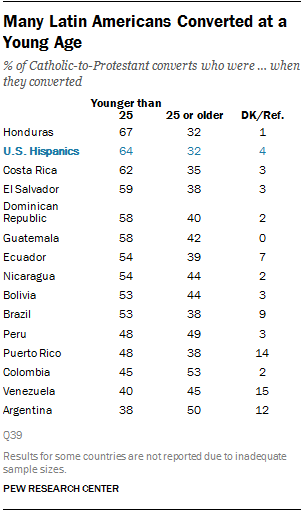
In most countries surveyed, about half or more of Catholic-to-Protestant converts say that they left Catholicism when they were younger than 25. Roughly six-in-ten or more Catholic-to-Protestant converts fall into this category in the Dominican Republic (58%), Guatemala (58%), El Salvador (59%), Costa Rica (62%) and Honduras (67%). Among U.S. Hispanics as well, a majority of converts (64%) say they became Protestants before age 25.

In Argentina, Colombia and Peru, about half of converts from Catholicism to Protestantism say they converted when they were 25 or older.

In most countries for which sample sizes of converts are large enough to permit analysis, fewer than half of former Catholics say they were attending Mass at least once a week right before they left the Catholic Church. By comparison, a majority of Catholic-to-Protestant converts now say they attend church weekly.

Other Demographic Patterns

The survey finds some other demographic patterns among those who have switched faiths.

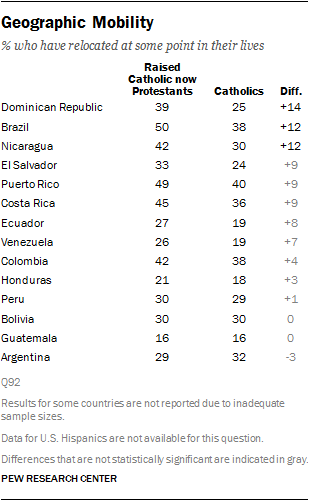
In the Dominican Republic, Brazil and Nicaragua, Catholic-to-Protestant converts are more likely than current Catholics to have relocated within their country. In Brazil, for example, half of those who converted to Protestantism after being raised in the Catholic Church report having moved to their current residence from a different part of Brazil; among current Brazilian Catholics, 38% say they have relocated.7

In no country where an adequate sample size is available for analysis are current Catholics more likely to have relocated than Catholic-to-Protestant converts to have relocated.

In most countries, Catholics and Catholic-to-Protestant converts report similar levels of education. But in a few countries, current Catholics have more formal education than do those who have converted to the Protestant faith.

Significant differences in education levels are found in Argentina, Costa Rica and Bolivia. In Argentina, 44% of Catholics have at least a secondary school education, compared with 22% of Protestants who were raised Catholic. In Costa Rica, 38% of Catholics have a secondary education or higher, compared with 20% of Protestants who were raised Catholic. Catholics in Bolivia also are more likely than Catholic-to-Protestant converts to report having completed secondary school (52% vs. 38%).

Reasons for Leaving Catholicism

The survey asked former Catholics whether each of eight factors was or was not an important reason they are no longer Catholic. Across the region, former Catholics who are now Protestant most frequently say they “wanted a more personal experience with God.” Clear majorities of Catholic-to-Protestant converts in each of the countries polled say this was an important reason for switching faiths, including roughly nine-in-ten in El Salvador (93%), Guatemala (91%) and Nicaragua (90%). Majorities in nearly every country also say that they were attracted to the style of worship at their new church. At least half of converts in most countries surveyed also say they were seeking a church that placed greater emphasis on morality. Many also point to the fact that they found a church that reaches out and helps its members more. In nearly every country, at least half say that recruitment by a Protestant church member was an important reason they are no longer Catholic.
Relatively few former Catholics say that crises or life circumstances – such as personal problems, marriage to a non-Catholic or financial issues – were important reasons for leaving the Catholic Church in favor of Protestant Christianity.
Chapter 2: Religious Commitment and Practice

For more recent survey data about religion in Latin America, read our 2026 report “Catholicism Has Declined in Latin America Over the Past Decade.”

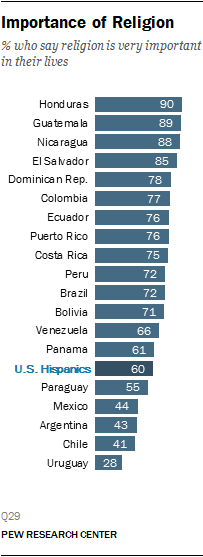
Religion is central to the lives of many Latin Americans. Indeed, majorities in most countries surveyed say religion is very important to them. Two-thirds or more express this view in Honduras, Guatemala, Nicaragua, El Salvador, the Dominican Republic, Colombia, Ecuador, Puerto Rico, Costa Rica, Peru, Brazil, Bolivia and Venezuela.

In the United States, by comparison, 56% of the general public and 60% of Hispanics say religion is very important in their lives.

In general, Protestants in Latin America are more likely than Catholics to say religion is central to their lives. Protestants also tend to be more observant when it comes to attendance at religious services and daily prayer.

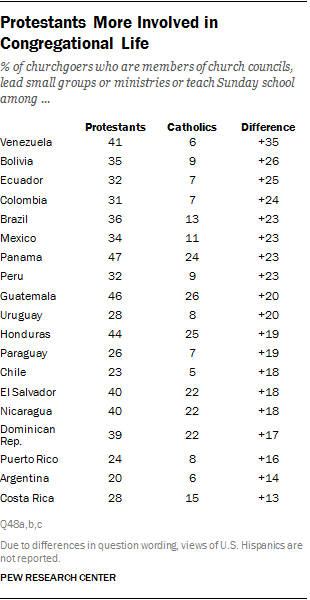
Differences between Protestants and Catholics extend to their involvement in congregational life, including participating in church councils, leading small groups or ministries and teaching Sunday school. Across Latin America, Protestants consistently exhibit higher levels of engagement in these areas than do Catholics.

Importance of Religion

Majorities in most countries surveyed say that religion is very important in their lives. The exceptions are Mexico (44%), Argentina (43%), Chile (41%) and Uruguay (28%).

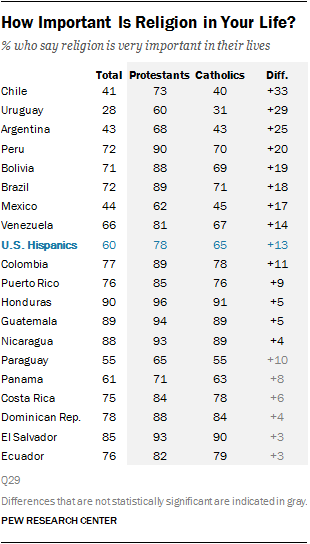
In general, Protestants are much more likely than Catholics to say that religion is very important in their lives. This is especially true in Chile, where 73% of Protestants say that religion is very important to them, compared with 40% of Catholics. On this question, large gaps also exist between Protestants and Catholics in Uruguay (29 percentage points), Argentina (25 points) and Peru (20 points).

This pattern holds true among Hispanics in the U.S. as well. Three-quarters of Hispanic Protestants (78%) say that religion is very important to them, compared with 65% of Hispanic Catholics.

In Latin America, the religiously unaffiliated are less likely than Catholics or Protestants to describe religion as central to their lives. Yet even among this group, religion plays an important role for many. In seven of the 11 countries where sample sizes are large enough to analyze, about a third or more of the unaffiliated say that religion is very important in their lives, including as many as 59% in Honduras and 52% in Nicaragua. (See survey topline for full results.)
In many Latin American countries, older Catholics are more likely than younger Catholics to describe religion as central to their lives. Generational differences are particularly wide in Chile, Mexico, Uruguay, Argentina, Paraguay and Costa Rica. In Mexico, for instance, about half of Catholics ages 35 and older say religion is very important in their lives, compared with 31% of those ages 18-34.

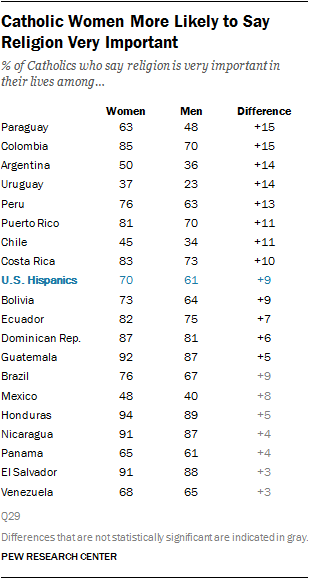
Gender differences also are evident among Catholics in many countries, with women more likely than men to say that religion is highly important in their lives. The largest gender gaps on this question appear in Paraguay, Colombia, Argentina and Uruguay, where the shares of women who say religion is very important to them are 14-15 percentage points higher than the comparable shares of men.

Among Protestants in Latin America, the importance of religion does not vary significantly by age or gender.

Religious Service Attendance

The frequency with which Latin Americans attend religious services varies across the region. In most Central American countries, roughly half or more say that they participate in worship services at least once a week. By contrast, one-in-five or fewer respondents in Argentina (20%), Chile (19%) and Uruguay (13%) report attending religious services as often.

In the United States, four-in-ten Hispanics say they attend church at least once a week.

In each of the countries surveyed, Protestants are considerably more likely than Catholics to attend religious services weekly. In Venezuela, for example, Protestants are about four times as likely as Catholics to attend church at least once a week (67% vs. 17%). In Bolivia, Argentina and Brazil, gaps of roughly 40 percentage points exist between the shares of Protestants and Catholics who go to services weekly.

Among both Catholics and Protestants, those ages 35 and older are more likely than younger adults to report attending religious services weekly.

In most countries, Catholic women are more likely than Catholic men to attend services weekly. Among Protestants, women and men are about equally likely to attend religious services in a majority of countries where adequate sample sizes are available. But in five countries – Costa Rica, Guatemala, Honduras, Panama and Nicaragua – more Protestant women than men say they attend church at least once a week.

Prayer

Across Latin America, prayer is a regular feature of day-to-day life. Majorities in most countries surveyed report praying at least once a day, including three-quarters or more in Guatemala (82%), Paraguay (82%), Honduras (78%), Costa Rica (78%), El Salvador (77%) and Nicaragua (75%). Prayer also is central to the lives of most U.S. Hispanics: About six-in-ten (59%) report praying once a day or more.

In nearly every Latin American country surveyed, Protestants are significantly more likely than Catholics to say they pray at least once a day. Some of the largest gaps are found in Argentina (where 69% of Protestants and 38% of Catholics say they pray daily), Peru (75% vs. 46%) and Uruguay (62% vs. 33%).

In some countries where sample sizes are large enough to permit analysis, substantial minorities of people with no religious affiliation say they pray every day, including at least four-in-ten in Honduras (47%), Costa Rica (46%), the Dominican Republic (46%) and Guatemala (44%). Daily prayer is much less common among the unaffiliated in Mexico (8%), Uruguay (7%) and Argentina (6%).

Similar to attendance at religious services, daily prayer is more frequent among Latin Americans ages 35 and older than it is among young adults. This pattern holds true among both Catholics and Protestants.

Across Latin America, women are significantly more likely than men to pray daily. Among Catholics, this pattern holds true in nearly every country surveyed. In most countries polled, Protestant women and men are about equally likely to pray daily. But in a few places, including the Dominican Republic, Nicaragua and Puerto Rico, more Protestant women than men say they pray at least once a day.

Index of Religious Commitment

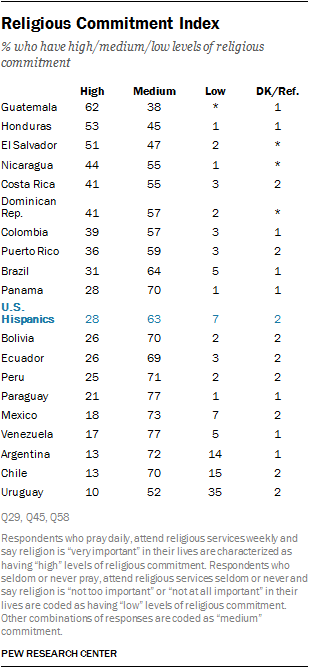
These three standard measures of religious commitment – importance of religion, attendance at religious services and frequency of prayer — can be combined into an index to summarize overall levels of religious commitment among Latin Americans.

Respondents who say that religion is very important in their lives and also report praying daily and attending religious services weekly are characterized as exhibiting a “high” level of religious commitment. Respondents who say religion is not central to their lives, and who also say they seldom or never attend religious services and seldom or never pray, are categorized as demonstrating “low” religious commitment. Other combinations of responses are put in the “medium” commitment category.

In most countries surveyed, majorities have medium levels of religious commitment. At least seven-in-ten adults occupy this middle category in several countries, including Venezuela (77%), Paraguay (77%) and Mexico (73%).

High levels of religious commitment are most common in Central America, where half or more of the respondents qualify as highly observant in Guatemala (62%), Honduras (53%) and El Salvador (51%). By contrast, relatively few Argentinians (13%), Chileans (13%) and Uruguayans (10%) display high religious commitment.

Nearly two-thirds of U.S. Hispanics (63%) exhibit medium levels of religious commitment, while 28% have high levels of commitment, and 7% are in the “low” category.

In every Latin American country surveyed, Protestants are more likely than Catholics to exhibit high levels of religious commitment, as discussed in the Overview of this report. The gaps between Protestants and Catholics are widest in Venezuela, Brazil, Bolivia, Argentina, Peru and Uruguay. (For details, see the Religious Commitment.)

Few, if any, religiously unaffiliated respondents report high levels of religious commitment. But substantial proportions of this group – ranging from 23% in Mexico to 85% in El Salvador and Nicaragua — show medium levels of religious commitment. In Uruguay, Latin America’s most secular country, 28% of the religiously unaffiliated fall into the middle category, while none have high levels of religious commitment and about two-thirds (67%) report low commitment.

Other Indicators of Religious Commitment

Involvement in Congregational Life

In most countries, fewer than a third of respondents who attend church at least occasionally also report serving on church councils, leading small groups or ministries or teaching Sunday school. Involvement in congregational life is most common among churchgoers in some Central American countries, including Guatemala (34%), Honduras (32%), Nicaragua (30%), Panama (27%) and El Salvador (27%).

In every country surveyed, Protestants report higher levels of involvement in congregational life than do Catholics. In Guatemala and Honduras, for example, more than four-in-ten Protestants say they are involved in church activities outside of worship services, compared with roughly one-quarter of Catholics.

Reading or Studying Scripture

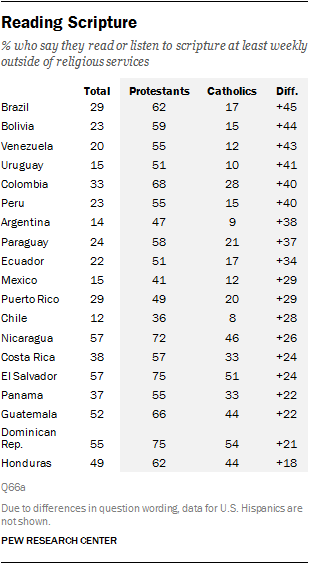
The survey also asked respondents how often they personally read or listen to scripture outside of religious services and how often they participate in scripture study groups or prayer groups. Across the region, Protestants are considerably more likely than Catholics to say they engage in each of these activities.

Among people who are not affiliated with any religion, relatively few say they participate monthly in scripture study groups. And in most countries where adequate sample sizes are available, few among the religiously unaffiliated say they read scripture weekly. But in Nicaragua and the Dominican Republic, roughly three-in-ten or more say they personally engage in weekly scripture reading.

Tithing

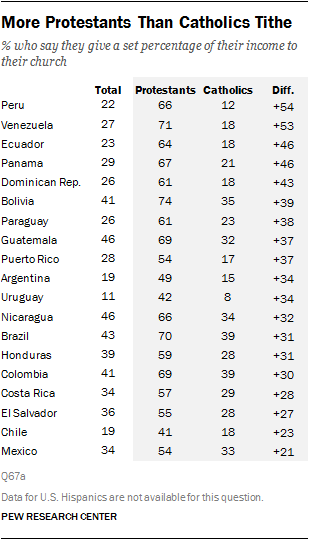
The survey asked all respondents about tithing – that is, giving a percentage of their income to their church or congregation. Overall, fewer than half in most countries say that they tithe, including only about one-in-ten Uruguayans (11%) and one-in-five adults in Argentina (19%) and Chile (19%). But more than four-in-ten respondents in Nicaragua (46%), Guatemala (46%) and Brazil (43%) say that they give a percentage of their income to the church.

Protestants are far more likely than Catholics to say that they tithe. In fact, in each of the countries surveyed, the share of Protestants who report tithing is more than 20 percentage points higher than the comparable share of Catholics. The biggest gaps are seen in Peru, where 66% of Protestants and 12% of Catholics tithe, and in Venezuela (71% vs. 18%).

Few among the religiously unaffiliated say they tithe, including just 1% in Chile and Uruguay and 2% in Argentina and Puerto Rico.

Fasting

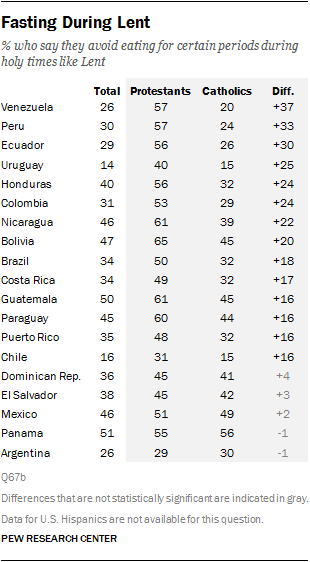
In a majority of countries surveyed, at least a quarter of respondents report fasting during sacred periods, such as Lent. Fasting is generally more common among Protestants than among Catholics, although in a few countries, including Mexico, Panama and Argentina, Catholics and Protestants are about equally likely to fast.

Chapter 3: Religious Beliefs

For more recent survey data about religion in Latin America, read our 2026 report “Catholicism Has Declined in Latin America Over the Past Decade.”

The Pew Research survey finds that nearly all Catholics and Protestants in most Latin American countries believe in God. In a number of countries, most of those who are unaffiliated with any religion also say they believe in God.

However, the survey finds significant differences between Catholics, Protestants and the unaffiliated when it comes to some religious beliefs. For instance, Protestants tend to be more likely than Catholics to take a literal view of the Bible and to believe in hell.

Protestants and Catholics also differ in their views on whether practices such as praying to the Virgin Mary or speaking in tongues fall within the Christian tradition. The vast majority of Latin American Catholics say that praying to the Virgin Mary is an acceptable Christian practice, while Protestants across the region generally reject this view. And while most Protestants see speaking in tongues as an acceptable part of the Christian faith, Catholics are divided on the subject.

The survey asked respondents whether they subscribe to a variety of beliefs and practices often associated with Afro-Caribbean, Afro-Brazilian or indigenous religions. While substantial proportions of both Catholics and Protestants say they hold at least some of these beliefs, Catholics generally are more likely than Protestants to subscribe to three or more of the eight Afro-Caribbean, Afro-Brazilian or indigenous beliefs and practices mentioned in the survey.

Belief in God, Angels and Miracles

Nearly all Latin American Christians –whether they are Catholic or Protestant – say they believe in God. Uruguay is the only country surveyed where fewer than nine-in-ten people (81%) profess such a belief.

In some countries, belief in God is widespread even among the religiously unaffiliated. For instance, overwhelming majorities of the unaffiliated in the Dominican Republic (99%), Nicaragua (98%), El Salvador (95%), Puerto Rico (91%), Honduras (90%), Brazil (89%) and Costa Rica (88%) say they believe in God. Smaller but substantial shares of the unaffiliated say they believe in God in Chile (64%), Uruguay (55%), Argentina (51%) and Mexico (39%).

Across the countries surveyed, the vast majority of Catholics and Protestants also say they believe in miracles. And in most countries surveyed, large shares of Catholics and Protestants say they believe in angels.

In general, the religiously unaffiliated are less likely than Catholics or Protestants to say they believe in either miracles or angels. But in seven of the 11 places where adequate sample sizes of this group are available for analysis, majorities of the unaffiliated say they believe in one or both phenomena. This includes Puerto Rico, where roughly seven-in-ten religiously unaffiliated respondents say they believe in angels (70%) or miracles (69%). (See survey topline for full results.)

Catholic Beliefs About Holy Communion

The vast majority of Catholics in Latin America say that they believe in transubstantiation – that the bread and wine used during Holy Communion become the actual body and blood of Christ.

In nearly every country surveyed, plus Puerto Rico, more than three-quarters of Catholics say they believe in transubstantiation. Uruguay is the one country where a smaller majority of Catholics (57%) say that during Communion, the bread and wine are transformed into the body and blood of Christ.

Catholics who attend Mass at least once a week are more likely to say they believe in transubstantiation than are Catholics who attend religious services less often, although majorities of both groups express this belief.

Biblical Literalism

In a majority of countries surveyed, half or more respondents say the Bible is the word of God and should be taken literally, word for word. This view is particularly widespread in the Central American countries of Guatemala (81%), Honduras (80%) and Nicaragua (77%). Only in the “Southern Cone” countries of Argentina (37%), Chile (36%) and Uruguay (24%) do fewer than half of adults subscribe to a literal reading of the Bible.

In the United States, 73% of Hispanics say the Bible is the word of God, but just 43% believe it should be taken literally, word for word.

Overall, Protestants in Latin America are more likely than Catholics to view the Bible as the literal word of God. This disparity is especially evident in Uruguay, where 56% of Protestants and 22% of Catholics say the Bible should be taken literally. There also are large gaps between Protestants and Catholics on this question in Chile (63% vs. 35%) and Venezuela (86% vs. 60%).

Attitudes toward the Bible vary among the religiously unaffiliated. In some countries, majorities of unaffiliated adults subscribe to biblical literalism, including six-in-ten or more in the Dominican Republic (73%), Nicaragua (70%), Honduras (66%) and El Salvador (61%). By contrast, relatively few among the unaffiliated take a literal view of the Bible in Mexico (12%), Chile (12%), Uruguay (11%) and Argentina (3%).

Views on Jesus’ Return to Earth

In many countries polled, roughly half or more of respondents believe Jesus will return to Earth during their lifetime, including majorities in Brazil (57%), Venezuela (57%), Panama (56%) and Puerto Rico (56%). Among U.S. Hispanics, 51% share this view.

In general, Protestants in Latin America are more likely than Catholics to say that Jesus’ second coming is imminent. In Chile, for example, roughly two-thirds of Protestants (68%) say that Jesus will return to Earth during their lifetime, compared with 38% of Catholics. Paraguay is an exception to this pattern; Catholics are more likely than Protestants in Paraguay to express the belief that Jesus will return during their lifetime, although less than a third of Paraguayans overall believe this.

Fewer people who are religiously unaffiliated anticipate Jesus’ return, but a third or more in the Dominican Republic (45%), Honduras (39%), Brazil (38%), El Salvador (38%), Nicaragua (38%) and Costa Rica (36%) believe such an event is imminent.

Belief in Heaven and Hell

When asked about the afterlife, majorities in most Latin American countries say they believe in heaven; on a separate question, majorities in most countries also say they believe in hell. Majorities in nearly every country also believe in hell; Uruguay is again an exception, with just 35% expressing belief in hell.

Catholics and Protestants differ little in terms of belief in heaven. Wider differences separate the two groups when it comes to belief in hell, with Protestants in most countries more likely than Catholics to believe in hell.

In countries with adequate sample sizes for analysis, the religiously unaffiliated vary widely in their views on the afterlife. Majorities among the religiously unaffiliated believe in heaven and hell in Costa Rica, the Dominican Republic, El Salvador, Honduras and Nicaragua. But no more than about a third of the unaffiliated believe in either heaven or hell in Chile (35% believe in heaven and 27% believe in hell), Uruguay (29% and 17%, respectively), Argentina (29% and 19%) and Mexico (26% and 31%).

Beliefs Associated With Afro-Caribbean, Afro-Brazilian or Indigenous Religions

The survey asked respondents if they hold certain beliefs associated with Afro-Caribbean, Afro-Brazilian or indigenous religions. These include belief in the “evil eye,” reincarnation, communicating with spirits, and magic, sorcery or witchcraft. The survey also asked respondents if they engage in practices such as making offerings to spirits, spiritual healing or seeking the help of a traditional healer.

Belief in the “evil eye”– that certain people can cast curses and spells that cause harm – is fairly common in Latin America. At least a third of respondents in every country surveyed say they believe in the evil eye, including more than half in Panama (64%), Venezuela (57%), the Dominican Republic (55%), Honduras (54%), Chile (53%) and Brazil (51%). Among U.S. Hispanics, 39% share this belief.

Fewer Latin Americans say they believe in reincarnation, communicating with spirits, and magic, sorcery or witchcraft. Still, at least a third of people in nearly every country surveyed say that magic, witchcraft or sorcery can influence people’s lives. And in most countries, roughly a quarter or more say they believe in reincarnation, as well as the possibility of being able to communicate with spirits.

In nearly every country surveyed, at least three-in-ten respondents say they have engaged in at least three of the eight indigenous beliefs and practices mentioned – belief in the evil eye, reincarnation, witchcraft or sorcery, communicating with spirits, offering food, drinks or flowers to spirits, participating in spiritual cleansing ceremonies, consulting traditional healers and experiencing black magic. (For full question wording, see the topline).

Engagement with such beliefs and practices is especially high in Panama, where a majority of people (58%) say they have engaged in at least three of these beliefs and practices (classified as “medium” to “high” levels of engagement with indigenous beliefs and practices). Roughly four-in-ten adults show at least medium levels of engagement with indigenous traditions in Mexico (44%), Honduras (42%), Bolivia (41%), Venezuela (39%) and Chile (38%).

On balance, larger shares of Catholics than Protestants report medium to high levels of engagement with indigenous beliefs and practices. In Mexico, for example, 49% of Catholics say they engage in at least three of the eight items mentioned in the survey, compared with 23% of Protestants.

Engagement with Afro-Caribbean, Afro-Brazilian or indigenous religions varies widely among the religiously unaffiliated – ranging from 45% who report medium to high levels of engagement in Nicaragua to 22% in Argentina and Mexico.

Who Qualifies as Christian?

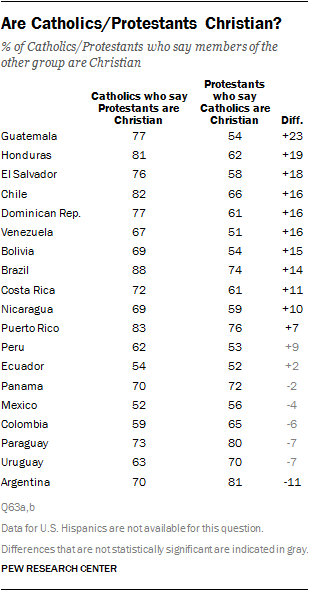
In most countries surveyed, majorities of both Catholics and Protestants recognize each other as belonging to the Christian faith. However, Catholics tend to be more accepting of Protestants as fellow Christians than vice versa.

Differing levels of acceptance are especially pronounced in Guatemala, where 77% of Catholics consider Protestants to be Christians, but only 54% of Protestants say the same about Catholics. Other countries where Catholics are considerably more accepting of Protestants as fellow Christians than the reverse include Honduras, El Salvador, Chile, the Dominican Republic and Venezuela.

On balance, Catholics also are more likely than Protestants to say that Mormons and Jehovah’s Witnesses are Christians. And in a few countries, Catholics are more accepting of members of Afro-Caribbean, Afro-Brazilian and indigenous religions as Christians than are Protestants.And in Brazil, more Catholics (38%) than Protestants (17%) accept Spiritists as fellow Christians. (For a brief definition of Spiritism, see the glossary.)

Boundaries of Religious Practice

When it comes to religious practices, Catholics and Protestants differ in their opinions about what is acceptable within Christianity. For example, in all countries surveyed, majorities of Catholics pray to the Virgin Mary and say this is part of Christian tradition, while majorities of Protestants consistently reject praying to the Virgin Mary as a Christian practice.

Catholics and Protestants are less polarized over speaking in tongues, a practice closely associated with Pentecostalism. In most countries surveyed, majorities of Protestants say that speaking in tongues falls within the Christian tradition. Catholics are somewhat ambivalent: About half in eight countries either believe the practice is acceptable for Christians or say that Christianity has nothing to say about speaking in tongues. Fewer than half of Catholics in nearly every country say that speaking in tongues falls outside the Christian tradition. (For more on religious beliefs associated with Pentecostalism, see Chapter 4.)

One True Faith?

The survey asked respondents which of the following statements is closer to their view: “My religion is the one true faith leading to eternal life,” or “Many religions can lead to eternal life.” In a majority of countries surveyed, roughly equal shares of Catholics and Protestants say theirs is the one true faith that can lead to eternal life. In a handful of countries, however, Protestants are more likely than Catholics to see their faith as the one true religion. In Argentina, for example, nearly half of Protestants (46%) say that theirs is the only faith that can show the path to eternal salvation, while just a quarter of Catholics take this view. In Brazil, Protestants are about twice as likely as Catholics to say that theirs is the one true faith.


Chapter 4: Pentecostalism

For more recent survey data about religion in Latin America, read our 2026 report “Catholicism Has Declined in Latin America Over the Past Decade.”

Many Christians in Latin America identify with Pentecostalism and related movements. Pentecostals take their name from the biblical feast of Pentecost (originally the Jewish festival of Shavuot, which took place 50 days after Passover), when the apostles and other early followers of Jesus were filled with the Holy Spirit and suddenly “began to speak in other tongues,” according to Acts of the Apostles in the New Testament. Today, Pentecostal worship services frequently include experiences that believers consider to be gifts of the Holy Spirit, such as speaking in tongues, divine healing, exorcisms, receiving direct revelations from God and giving or interpreting prophecy. Catholics who engage in similar practices often call themselves charismatics, from the Greek word for gift or favor.8

The Pew Research Center survey finds that in every country across Latin America, roughly half or more of Protestants either say they belong to a church that is part of a Pentecostal denomination or personally identify as a Pentecostal Christian, regardless of their denominational affiliation. In addition, in nearly every country surveyed, at least one-in-five Catholics describe themselves as charismatics.

Pentecostal Identification Among Protestants

Pentecostalism in Latin America, as elsewhere around the world, can refer both to a particular set of Protestant denominations (such as the Assemblies of God) and to a broader revival movement that dates back to the early 20th century in the United States. This broader movement now includes thousands of largely independent, indigenous churches in Asia, Africa and Latin America.

The survey finds that in three Latin American countries – the Dominican Republic, Brazil and Panama – about eight-in-ten Protestants either belong to a church that is part of a Pentecostal denomination or personally identify as Pentecostal Christians, regardless of denomination. And in Puerto Rico, Nicaragua, Guatemala, Argentina, Honduras, Ecuador and Chile, roughly two-thirds or more of Protestants are Pentecostal by denomination, personal identification or both. In the United States, by comparison, 18% of all Protestants, including 45% of Hispanic Protestants, are Pentecostal by one definition or another.

Charismatic Identification Among Catholics

Over time, some Catholics have incorporated elements associated with Pentecostalism into their worship, leading to the rise of charismatic movements within Catholicism. In virtually all of the places surveyed, self-identified charismatics make up a substantial portion of the Catholic population. And in a handful of Latin American countries – Panama, Brazil, Honduras, the Dominican Republic and El Salvador – at least half of Catholics say they are charismatic. Similarly, nearly half (46%) of Hispanic Catholics in the United States identify as charismatic.

Experiences With the Holy Spirit

The survey asked all respondents whether they personally have experienced or witnessed each of five practices that often are associated with Pentecostal or charismatic worship: divine healing, receiving a revelation, seeing the devil being driven out of a person, giving or interpreting prophecy and speaking in tongues. Overall, the survey finds that the most prevalent of these experiences in Latin America is divine healing. In a majority of the places surveyed, at least half of Protestants say they have seen or experienced the divine healing of an illness or injury. (See table in Overview.)

In addition, at least a third of Protestants in most countries report that they have seen the devil being driven out of a person. Although the Roman Catholic Church is associated with exorcisms in popular culture – and it continues to have a formal rite for priests who are authorized by their bishops to perform the procedure – Latin American Catholics are much less likely than Protestants to say they have witnessed or experienced an exorcism.

Receiving revelations, prophesying and speaking in tongues are somewhat less common.Roughly two-thirds of Protestants in the Dominican Republic (65%) and Brazil (63%) say they have received a direct revelation from God, as have a majority of Protestants in Colombia (58%). But elsewhere, roughly half or fewer of Protestants say they have received a direct revelation from God. Meanwhile, about a third or more of Protestants in the Dominican Republic (36%) and Brazil (33%) say they have given or interpreted prophecy; this experience is less common in other Latin American countries. Roughly a quarter or more of Protestants say they have spoken or prayed in tongues in Guatemala (24%), Nicaragua (24%), Colombia (25%), Honduras (25%), Uruguay (25%), Argentina (26%), Costa Rica (27%) and Panama (39%). (For complete results, see the survey topline.)

Among Catholics, at least one-in-four in many countries say they have received a direct revelation from God. This experience is particularly common among Catholics in the Dominican Republic (50% say they have received a direct revelation from God), Honduras (40%), Guatemala (37%) and Nicaragua (34%). Fewer than one-in-ten Catholics in most countries surveyed say they have given or interpreted prophesy or that they have ever spoken in tongues.

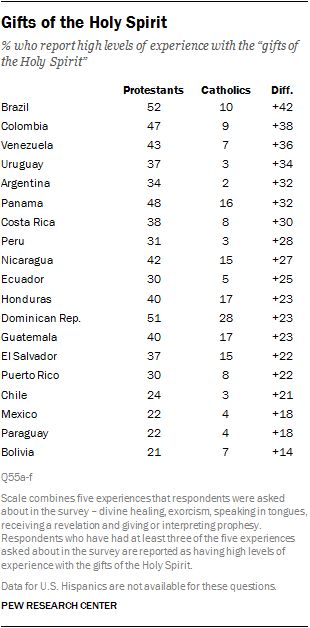
Combining all five gifts of the Holy Spirit mentioned in the survey into a scale provides a sense of how common these experiences are in each country. Protestants most frequently report high levels of exposure to Pentecostal practices in Brazil, the Dominican Republic, Panama and Colombia, with roughly half in each country saying they have witnessed or experienced at least three of the five gifts.

While Catholics report considerably less exposure to the gifts of the Holy Spirit than do Protestants, in some Central American countries, including El Salvador, Guatemala, Honduras, Nicaragua and Panama, at least 15% say that they have had at least three of the five experiences mentioned in the survey. Experiences with the gifts of the Holy Spirit also are relatively common among Catholics in the Dominican Republic, with more than a quarter (28%) reporting that they have witnessed or experienced at least three of the five practices.

Worship Style

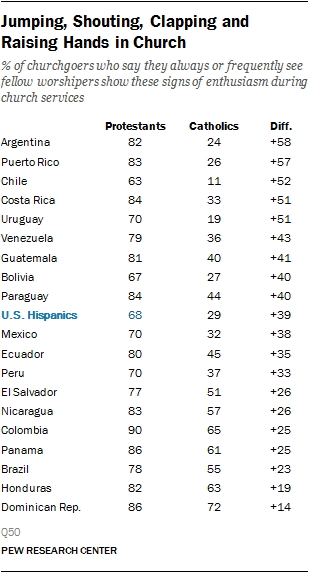
Another characteristic of Pentecostalism is its enthusiastic style of worship – including jumping, clapping, shouting and raising hands in church. This type of worship experience appears to be widespread across Latin America. The vast majority of Protestants who attend worship services report that they always or frequently experience these practices. Across the region, fewer Catholics report experiencing them. But in a handful of countries – including Colombia, the Dominican Republic, Honduras, Nicaragua and Panama – a majority of Catholics who attend church at least occasionally say they always or frequently see fellow worshipers jumping, shouting, clapping and raising their hands during Mass.

The Prosperity Gospel

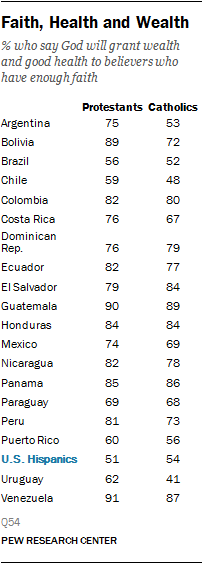
The survey asked about the belief – often associated with Pentecostalism – that God grants material wealth and good health to Christians who have enough faith. Known as the “prosperity gospel,” this idea is widespread among Protestants in Latin America. Majorities of Protestants in every country surveyed, ranging from 56% in Brazil to 91% in Venezuela, express the belief that God provides material prosperity to the faithful.

While belief in the prosperity gospel is closely associated with Pentecostalism, the survey finds that in most Latin American countries, majorities of Catholics also say that God will grant wealth and good health to believers who have enough faith. Belief in the prosperity gospel is particularly high among Catholics in five Central American countries – Guatemala (89%), Panama (86%), El Salvador (84%), Honduras (84%) and Nicaragua (78%) – as well as in Venezuela (87%), Colombia (80%), the Dominican Republic (79%) and Ecuador (77%).

Chapter 5: Social Attitudes

For more recent survey data about religion in Latin America, read our 2026 report “Catholicism Has Declined in Latin America Over the Past Decade.”

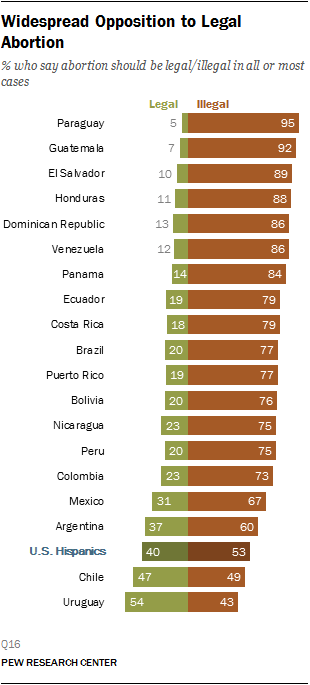
Latin Americans tend to express traditional views about sexuality, marriage and social mores. For example, majorities in most Latin American countries are opposed to allowing gay and lesbian couples to marry legally. And solid majorities in almost all countries surveyed say abortion should be illegal in all or most circumstances.

Across the region, Protestants are more likely than Catholics to say that abortion should be illegal in all or most circumstances and that same-sex couples should not be allowed to legally wed. Protestants also are consistently more likely than Catholics to view drinking alcohol, divorce, sex outside of marriage and using artificial means of birth control as immoral. And Protestants are more inclined than Catholics to say that wives should always obey their husbands.

In general, Catholics who are more religiously observant express somewhat more conservative social views than do Catholics who are less observant. For example, Catholics who attend Mass weekly generally express lower levels of support for allowing same-sex marriage than do Catholics who attend Mass less often.

Nevertheless, Protestants tend to be more socially conservative than Catholics even when levels of religious observance are taken into account.9 For example, Protestants who say they attend religious services at least once a week express more conservative social attitudes than Catholics who report going to Mass at least weekly. (For more details, see below.)

Views on Same-Sex Marriage

Across most of Latin America, the preponderance of public opinion is opposed to same-sex marriage. Majorities or pluralities in 13 of the 18 countries surveyed, plus Puerto Rico, say that gay and lesbian couples should not be allowed to marry legally.

However, opinion is more closely divided in Brazil, Chile, Mexico and Argentina, which in 2010 became the first Latin American country to legalize same-sex marriage. And in Uruguay, which legalized same-sex marriage in August 2013, a majority of the public (62%) says same-sex couples should be allowed to wed. Among Hispanics in the United States, there is more support for (46%) than opposition to (34%) same-sex marriage, just as there is among the U.S. general public as a whole (52% favor, 40% oppose).

Across the countries and territories surveyed in Latin America, Protestants oppose same-sex marriage by greater margins than do Catholics. In Puerto Rico, for example, 72% of Protestants reject gay marriage, compared with 45% of Catholics. Similar gaps of 20 percentage points or more are seen in Venezuela, Uruguay, Brazil, Argentina, Colombia, Costa Rica, Chile and Mexico.

In places where adequate sample sizes are available for analysis, people with no religious affiliation tend to be more supportive of gay marriage. Still, roughly two-thirds or more of the religiously unaffiliated oppose same-sex marriage in Honduras (74%), Nicaragua (69%), the Dominican Republic (65%) and El Salvador (65%). By contrast, the unaffiliated lean strongly in favor of same-sex marriage in Argentina (75% favor, 19% oppose) and Uruguay (77% vs. 17%).

Across Latin America, women and men are about equally likely to oppose same-sex marriage, but young adults (ages 18-34) are generally more supportive of gay marriage than are older adults. In Mexico, for example, 63% of those ages 18-34 say gay and lesbian couples should be allowed to marry, compared with 40% of those ages 35 and older. In the U.S. as well, younger Hispanics are more supportive of gay marriage than are older adults.

Views on Abortion

Most Latin Americans believe that abortion should be illegal in all or most cases. Only in Uruguay, which has some of the most liberal abortion laws in Latin America, does at least half the public (54%) voice support for legal abortion in all or most cases. In Chile, public opinion is divided on the issue; 47% say that abortion should be legal in all or most cases, while 49% say it should be illegal in all or most circumstances. Elsewhere, clear majorities – ranging from 60% in Argentina to 95% in Paraguay – oppose making abortion lawful. Even in Puerto Rico, where U.S. law guarantees a woman’s right to an abortion, roughly three-quarters of the public says that the procedure should be outlawed in all (51%) or most cases (26%).

More U.S. Hispanics say abortion should be illegal in all or most instances (53%) than say it should be legal (40%). Among Americans overall, the opposite is true; 54% say abortion should be legal in all or most cases, while 40% say it should be illegal.

Protestants lean more strongly than Catholics toward the position that abortion should be illegal in all or most cases. In Chile, for example, about two-thirds of Protestants say abortion should be illegal, while half of Catholics take that position. In Argentina, 59% of Catholics say abortion should be illegal, compared with about three-quarters of Protestants (76%).

In most countries, majorities of adults who have no religious affiliation say abortion should be illegal in all or most cases, including roughly eight-in-ten or more unaffiliated people in Honduras (85%), the Dominican Republic (82%) and El Salvador (81%). Opposition to legal abortion is lower among the religiously unaffiliated in Chile (28%), Uruguay (31%) and Argentina (40%).

The survey finds that across Latin America, men and women are about equally likely to oppose legal abortion, as are older and younger adults.

Homosexuality and Abortion as Moral Issues

Latin Americans’ attitudes toward same-sex marriage and abortion appear to be shaped in part by moral judgments. In 15 countries plus Puerto Rico, majorities say homosexuality is immoral, ranging from 57% in Mexico to 91% in Guatemala. Only in Argentina, Chile and Uruguay do fewer than half of adults consider homosexual behavior morally wrong.

In most countries surveyed, majorities of both Protestants and Catholics agree that homosexuality is immoral. However, Protestants are particularly inclined toward this view. Indeed, in several countries, the percentages of Protestants who say homosexual behavior is morally wrong exceed the comparable percentages of Catholics by at least 20 points.

Overall, the religiously unaffiliated are less likely than either Protestants or Catholics to say that homosexuality is morally wrong. Even among the unaffiliated, however, majorities in a handful of countries see homosexual behavior as morally objectionable. These countries include Honduras (80%), the Dominican Republic (80%), Nicaragua (74%), El Salvador and Venezuela (71% each).

Across Latin America, people between the ages of 18 and 34 are less likely than their elders to find homosexual behavior morally objectionable. In Argentina, for example, 37% of adults younger than 35 say that homosexual behavior is morally wrong, compared with fully half of those 35 and older (51%). Roughly half of younger Puerto Ricans say that homosexual behavior is morally objectionable (52%), compared with about two-thirds of older Puerto Ricans (66%).

In most countries, men and women share similar views on the moral acceptability of homosexuality. But in a handful of countries, more men than women say that homosexuality is morally wrong.

Clear majorities across the region describe abortion as morally wrong. Indeed, Uruguay is the only country surveyed where less than half of the public (46%) says abortion is immoral. Elsewhere, most respondents consider abortion morally wrong, a position verging on unanimity in Paraguay (96%), Guatemala (96%) and Honduras (95%).

Protestants are more likely than Catholics to describe abortion as morally unacceptable. In Uruguay, for example, about two-thirds of Protestants say that abortion is morally wrong (68%), compared with roughly half (49%) of Catholics.

In most countries, many people who do not identify with any religion also subscribe to the view that abortion is immoral. Only in Argentina, Chile, Mexico and Uruguay do fewer than half of religiously unaffiliated people say abortion is morally wrong.

Across the region, women are about as likely as men to say that abortion is morally unacceptable. And younger Latin Americans are about as likely as older Latin Americans to say that abortion is morally wrong. Where differences do arise, more women than men generally say that abortion is morally wrong. And in a handful of countries, those above the age of 34 are more likely than those between the ages of 18 and 34 to say that abortion is morally unacceptable.

Other Moral Issues

When it comes to the moral acceptability of drinking alcohol, divorce, having sexual relations outside of marriage and using artificial means of birth control, the survey shows that Protestants express considerably more conservative opinions than do Catholics. And on balance, the religiously unaffiliated are more accepting of these behaviors than are either Protestants or Catholics.

Drinking Alcohol

Many Latin Americans see the consumption of alcohol as morally objectionable. In most countries surveyed, half or more of adults say that drinking alcohol is morally wrong, including roughly nine-in-ten in Guatemala (92%) and Honduras (90%). Moral objections to drinking alcohol are least common in Chile (19%) and Argentina (25%).

Protestants tend to object to alcohol consumption more strongly than do Catholics. In most countries, clear majorities of Protestants say that drinking alcohol is morally wrong. Among Catholics, opinion is more divided. In about half of the countries surveyed, majorities of Catholics say that they have moral objections to drinking alcohol. But elsewhere, half of Catholics or fewer say that drinking alcohol is morally wrong.

In Venezuela, Protestants are far more likely to object to alcohol consumption (81%) than are Catholics (44%). Wide differences between the opinions of Catholics and Protestants also are seen in Ecuador, Peru and Chile, all of which have gaps of 28 percentage points between Protestants and Catholics on this question.

Smaller shares of the religiously unaffiliated have moral objections to drinking alcohol. But in a handful of countries, including Honduras (81%), Nicaragua (75%) and El Salvador (70%), majorities of the religiously unaffiliated say that drinking alcohol is morally wrong. (See survey topline for full results.)

Across Latin America, more women than men say that drinking alcohol is morally objectionable. Latin Americans ages 35 and older also are somewhat more likely to object to drinking alcohol than are adults under 35.

Divorce

In most Latin American countries, fewer than half of people say that divorce is morally wrong. However, more than half of adults raise a moral objection to divorce in Guatemala (69%), Honduras (59%), Panama (55%) and El Salvador (53%).

Although the Catholic Church teaches that marriage is an “indissoluble union” between a man and a woman, Protestants across Latin America are more solidly opposed to divorce than Catholics are. The gap between the views of Protestants and Catholics is especially wide in Venezuela, where half of Protestants (52%) say divorce is morally wrong, compared with 22% of Catholics. Protestants also are far more likely than Catholics to say that divorce is immoral in Peru (67% vs. 39%) and Ecuador (64% vs. 37%).

Overall, fewer Latin Americans ages 18-34 object to divorce on moral grounds than do older people in the region. Latin American men are about as likely as women to say that divorce is morally wrong.

Sex Outside Marriage

Latin Americans are divided on the morality of sex outside marriage. In eight of the countries surveyed, majorities of adults say that sex between people who are not married to one another is morally wrong. But in other countries, roughly half or fewer object to sex outside marriage. Moral objections to sex outside marriage are highest in Guatemala (80%) and El Salvador (73%) and lowest in Uruguay (19%), Chile (23%) and Argentina (23%).

Generally, Protestants are more likely to oppose sex outside marriage than are Catholics. In 15 countries plus Puerto Rico, majorities of Protestants say that sex between people who are not married to each other is morally wrong. Among Catholics, half or fewer share this view in most countries surveyed.

As on other topics related to morality, differences between Protestants and Catholics are especially pronounced in Venezuela, where 77% of Protestants and 36% of Catholics say that sex outside marriage is morally wrong. Gaps of 30 percentage points or more between Protestants and Catholics also are seen in Colombia, Chile, Brazil and Panama.

In nearly all countries where adequate sample sizes are available for analysis, fewer than half of people who are unaffiliated with any religion say that sex outside marriage is morally wrong. (See survey topline for full results.)

Younger Latin Americans (those ages 18-34) are less likely than older adults to find sex outside marriage morally objectionable. In most countries, men and women are about as likely to object to sex outside marriage. In a few countries, however, men are less likely to say that sex between people who are not married is morally wrong. In Colombia, for example, 38% of men say that sex outside marriage is morally wrong, compared with 49% of women.

Artificial Means of Birth Control

Fewer Latin Americans express moral objections to the use of contraceptives than object to abortion and same-sex marriage. In most countries, fewer than a third of adults – including just 10% of Argentinians, 8% of Chileans and 5% of Uruguayans – say that using contraceptives is morally wrong. Objections to artificial means of birth control are highest in Guatemala, Honduras, El Salvador and Panama, where roughly four-in-ten or more adults view contraception as morally wrong.

In many countries surveyed, significantly higher shares of Protestants than Catholics say that using contraceptives is morally wrong. In Chile, for example, roughly a quarter of Protestants (23%) say using contraceptives is morally wrong, compared with just 5% of Catholics. And in Peru, about four-in-ten Protestants (39%) object to artificial means of birth control, compared with 23% of Catholics.

Latin Americans who do not identify with any religion are less likely to object to contraceptive use than are either Catholics or Protestants. Very few religiously unaffiliated people in Argentina (3%), Uruguay (3%) and Chile (4%) say that contraceptive use is immoral. (See survey topline for full results.)

Young Latin American adults (ages 18-34) are less likely than older adults to object to using contraceptives. In El Salvador, for example, roughly half of people ages 35 and older (52%) say that using contraceptives is morally wrong, compared with 36% of adults under 35. Across the region, women are about as likely as men to say that using artificial means of birth control is morally wrong.

Gender Roles in the Family

The socially conservative attitudes espoused by Latin Americans extend to traditional notions about gender roles in the family. Indeed, majorities in roughly half of the countries surveyed either completely or mostly agree with the statement that “a wife must always obey her husband.” Only in Argentina (31%), Chile (24%) and Uruguay (23%) do fewer than four-in-ten adults share this view.

Protestants are especially likely to say that wives must obey their husbands; four-in-ten or more in every country surveyed completely or mostly agree with this statement. This opinion is especially widespread among Protestants in Guatemala (87%) and the Dominican Republic (87%).

Many Catholics, too, adhere to the idea that wives should subordinate themselves to their husbands. But in most countries, Catholics are less likely than Protestants to express this view. In Venezuela, Argentina, Uruguay and Chile, for example, the shares of Protestants who say that a wife must always obey her husband are at least 20 percentage points higher than the comparable figures among Catholics.

In most countries where adequate sample sizes are available for analysis, fewer than half of religiously unaffiliated people completely or mostly agree that a wife is obligated to obey her husband. Only in four countries – the Dominican Republic (76%), Honduras (65%), Venezuela (62%) and El Salvador (58%) – do majorities of the unaffiliated take this position. (See survey topline for full results.)

Younger adults (ages 18-34) are less likely than their elders to say that a wife is obligated to obey her husband. And overall, more Latin American men than women say that wives are obligated to obey their husbands.

Women across Latin America are divided on this question. In about half of the countries surveyed, majorities or pluralities of women completely or mostly agree that wives are obligated to obey their husbands. These countries include Honduras, Guatemala and the Dominican Republic, where more than eight-in-ten women say that wives are obligated to obey their husbands. In other places – such as Chile, Uruguay, Argentina, Puerto Rico and Mexico – women either mostly disagree with this view or express divided opinions.

Catholics and Protestants: Religious Commitment and Moral Views

Protestants who attend church at least weekly express more conservative views on social issues than do Catholics who attend Mass weekly.

Chapter 6: Views on the Economy and Poverty

For more recent survey data about religion in Latin America, read our 2026 report “Catholicism Has Declined in Latin America Over the Past Decade.”

On the whole, Latin Americans embrace free-market principles. Majorities in most countries surveyed say that people are better off in a free-market economy. Yet majorities in half of the countries point to the gap between rich and poor as a major national problem.

Overall, Catholics and Protestants differ little in their views of the free market or their concern about the divide between the haves and have-nots. Members of the two religious traditions also overwhelmingly agree that the state has a responsibility to help those living in poverty.

However, when asked what Christians can do to help those in need, Catholics and Protestants offer somewhat divergent views. Catholics are more likely than Protestants to say that the best way for Christians to help the poor is through works of charity, while Protestants place greater emphasis on bringing the poor to Christ.

At the same time, Protestants are more likely than Catholics to report that they, or their church, engage in charitable works or offer assistance to those in need.

Free Markets and the Problem of Poverty

Despite widespread agreement that the free market is a boon for most people, Latin Americans, regardless of religious affiliation, also agree that it is the responsibility of the government to take care of very poor people who cannot take care of themselves. At least eight-in-ten express this view in each of the countries surveyed, including 97% of adults in the Dominican Republic and Paraguay.

Catholics, Protestants and the religiously unaffiliated generally share the view that the state should provide for the poor and needy.

Views on Christians Helping the Poor

Beyond the role of government in addressing the problem of poverty, the survey asked Christian respondents how important it is for followers of the Christian faith to help those in need by performing works of charity, bringing the poor to Christ or persuading government officials to protect the rights of the poor and needy.

Strong majorities of Catholics and Protestants say that charitable acts are a very important means by which Christians can assist the poor. Similarly, in nearly every country, clear majorities of both Catholics and Protestants think bringing the poor and needy to Christ is very important. Among each group, fewer respondents say political advocacy on behalf of the poor is as important as either charity work or evangelism.

Although many Catholics and Protestants in Latin America agree there are multiple ways that Christians can assist the poor, members of the two religious traditions diverge when it comes to the question of which is the single most important means of helping those who cannot help themselves.

Across the region, Protestants are more likely than Catholics to place the greatest emphasis on bringing the poor and needy to Christ. Some of the widest gaps on this measure are found in Argentina and Colombia; in each country, 33 percentage points separate the shares of Protestants (51% and 56%, respectively) and Catholics (18% and 23%) who say evangelism is the most important way Christians can assist the poor. Protestants are also far more likely than Catholics to place the most emphasis on bringing the poor to Christ in Bolivia (32-point gap), Paraguay (31) and Peru (31).

Catholics, for their part, tend to emphasize performing works of charity to address the needs of the poor. In all but two of the countries surveyed, Catholics are significantly more likely than Protestants to point to charity as the most important way Christians can help those who are unable to help themselves – especially in Paraguay and Colombia.

Significant minorities of Catholics also say that persuading government officials to protect the rights of the poor is the single most important way Christians can help the poor and needy. In most countries polled, Catholics are considerably more likely than Protestants to take this view, with the widest differences observed in Argentina (16-point gap) and Bolivia (15).

Churches Helping the Poor

The survey also asked respondents whether the church or house of worship that they attend most often is engaged in activities that benefit the poor and needy – bringing people to Christ, helping people find jobs or persuading government officials to protect the rights of the poor. In nearly all countries, majorities of both Catholic and Protestant churchgoers say their local congregation reaches out to bring others to Christ. However, Protestants are more likely than Catholics to report that their church evangelizes. For example, in Brazil, 93% of churchgoing Protestants say their church brings others to Christ, compared with 66% of churchgoing Catholics – a gap of 27 percentage points. Similar differences are found in Mexico (22-point gap), Bolivia (22), Argentina (21) and Uruguay (20), while an even bigger gap is seen in Chile (38 points).


In most Latin American countries, Protestants also are more likely than Catholics to report that their church helps people find employment. This is especially true in Argentina, Paraguay, Uruguay, Mexico and Venezuela.

Protestants and Catholics differ less in terms of reported church involvement in political advocacy on behalf of the poor. There is no clear pattern with regard to whether Protestant or Catholic churches are more engaged in persuading the government to protect the poor.

Individuals Helping the Poor

Many Latin Americans say they themselves work with others in their community to provide for poor people’s needs through charitable works. More Protestants than Catholics say they personally engage in charity work – despite the fact that Catholics place greater emphasis on charitable acts as the single most important means of assisting those in need. (For more details on the proportions of Catholics and Protestants in each country who engage in charitable work, see this report’s Overview.)

In addition to differences by religious affiliation, the survey finds that people ages 35 and older tend to be more active in charity work to help the poor. Significant gaps between the charitable activities of younger and older Latin Americans are seen in Argentina, Colombia, Costa Rica, the Dominican Republic, Honduras and Paraguay.

On the separate question of political advocacy to protect the rights of the poor, the survey finds relatively few people who say they personally engage in such activities. Nearly a third of Panamanians (30%) say they have tried to help the poor in this way. In other countries, however, no more than one-in-six people say they have done this in the last 12 months.

In a few countries, older adults are more likely than those under the age of 35 to say they have pushed for government action on behalf of the poor. Overall, the survey does not find significant differences between Protestants and Catholics on this question.

Chapter 7: Views on Politics

For more recent survey data about religion in Latin America, read our 2026 report “Catholicism Has Declined in Latin America Over the Past Decade.”

Latin Americans generally embrace democracy as their preferred form of government. In most of the countries surveyed, majorities or pluralities also say they would prefer a government that refrains from promoting religious values and beliefs. But Latin Americans are more divided on the extent to which religious leaders should influence politics.

Democracy Favored Over Strong Leader

In most countries surveyed, solid majorities say they would prefer “a democratic form of government” over “a leader with a strong hand” to solve their country’s problems. Yet support for democracy is not equally strong across Latin America. In El Salvador, for example, the public is closely divided between those who favor democracy (48%) and those who say that a strong leader is preferable (45%). At the other end of the spectrum, roughly eight-in-ten people in nearby Nicaragua (79%) favor democracy, while just 18% prefer a leader with a strong hand.

Although the survey shows substantial variations among countries, within each country the major religious groups – Catholics, Protestants and the religiously unaffiliated – tend to express similar views on this question. (For details, see survey topline.) Younger and older adults, as well as men and women, are about equally likely to prefer democracy over a strong leader.

Latin Americans with at least a secondary school education are more likely than those with less than a secondary education to prefer democracy, although in most countries, majorities of both groups favor democracy over a strong leader.

Role of Religion in Politics

In most countries across the region, more Latin Americans say church and state should be “kept separate” than say the government “should promote religious values and beliefs.”

However, in a handful of countries, including Costa Rica, Guatemala and Paraguay, the public is closely divided on this issue. And in the Dominican Republic and El Salvador, the public leans toward the position that government should promote religious values and beliefs rather than separating church and state.

While most Latin Americans prefer a separation between church and state, opinion is closely divided on the role religious leaders should play in politics. In five of the countries polled – Panama, Paraguay, Venezuela, Brazil and Argentina – majorities or pluralities say that religious leaders should have either “some influence” or a “large influence” in politics. But in nine countries and Puerto Rico, the preponderance of public opinion leans in the opposite direction, with more respondents saying that religious leaders should have either “not too much influence” or “no influence at all” on political matters. (In four countries – Colombia, Costa Rica, the Dominican Republic and Peru – publics are split.)

Generally speaking, Catholics and Protestants across the region share similar views on the broad question of religion in politics. In Honduras, for example, roughly half of adults (52%) say religion should be kept separate from government, including 55% of Catholics as well as 49% of Protestants. Similarly, roughly four-in-ten Honduran Catholics (43%) as well as Honduran Protestants (40%) say that religious leaders should have at least some influence in politics. (For details, see survey topline.)

On balance, somewhat fewer religiously unaffiliated people support government promotion of religion and religious leaders having an influence in politics. But in about half of the countries where sample sizes allow analysis, including Brazil, the Dominican Republic and Honduras, the religiously unaffiliated are about as likely as Catholics and Protestants to say that government policies should promote religious values and that religious leaders should have at least some influence in politics. (For details, see survey topline.)

Political Engagement

Interest in politics varies substantially across the Latin American countries surveyed. Majorities say they often or sometimes follow what is going on in government and public affairs in Panama (65%), Puerto Rico (63%), Venezuela (63%), Paraguay (60%), Argentina (57%) and Chile (57%). In the other countries polled, less than half of the public closely follows political news, with interest lowest in Guatemala (31%) and the Dominican Republic (30%).

Overall, men and adults with at least a secondary school education are more likely to follow news about public affairs than are women and those with less education. Latin Americans ages 35 and older also are more likely than younger adults to follow public affairs.

With regard to religion, Catholics, Protestants and the religiously unaffiliated are about equally likely to say that they at least sometimes follow political news and events. Only in Argentina and Bolivia are Catholics more likely than Protestants to say they follow public affairs.

Chapter 8: Religion and Science

For more recent survey data about religion in Latin America, read our 2026 report “Catholicism Has Declined in Latin America Over the Past Decade.”

Overall, many Latin Americans see a basic tension between religion and science. Indeed, half or more in most countries surveyed think that faith and science generally are at odds with one another.

Despite the general belief that there is a conflict between religion and science, roughly half or more in most countries polled agree that humans and other living things have evolved over time. However, at least one-in-five respondents in each of the 18 countries and Puerto Rico subscribe to the view that humans and other creatures have existed in their present form since the beginning of time.

Across the region, Catholics, Protestants and people who are not affiliated with any religion generally have similar views on whether there is a conflict between faith and science. But Protestants are less accepting of evolution than are Catholics or the religiously unaffiliated.

Tensions Between Faith and Science

The general view in Latin America is that a basic tension exists between religion and science. Pluralities or majorities in most countries hold this opinion. Roughly six-in-ten express this view in the Dominican Republic (63%), Brazil (62%) and Costa Rica (60%). Only in three countries does public opinion clearly lean in the opposite direction; at least half of respondents in Uruguay (54%), Argentina (53%) and Venezuela (53%) say there is no conflict between religion and science. Opinion is closely divided on this question in Honduras, Mexico, Panama and Paraguay.

In general, Catholics, Protestants and the religiously unaffiliated do not significantly differ in their assessments of the relationship between religion and science. In Puerto Rico, for example, only a few percentage points separate the shares of Protestants (54%), Catholics (53%) and the unaffiliated (51%) who say there is a conflict between faith and science.

On balance, respondents between the ages of 18 and 34 are more likely than older adults to see a conflict between science and religion. The difference between these age groups is particularly large in Costa Rica, where 68% of younger adults (ages 18-34) say science is generally at odds with religion, compared with 53% of those ages 35 and older.

Evolution

Overall, Latin Americans embrace the idea that humans and other living things have evolved over time. Roughly half or more hold this view in all but a few of the countries surveyed, including solid majorities in Uruguay (74%), Argentina (71%), Chile (69%) and Brazil (66%). But people are more closely divided on the issue of evolution in the Central American countries of Honduras (49% believe in evolution, while 45% reject it), Nicaragua (47% vs. 48%) and El Salvador (46% vs. 45%). In the Dominican Republic, a majority of the public (56%) says that humans and other living things have existed in their present form since the beginning of time. (Respondents in this survey were not asked whether evolution was guided by a “supreme being” or natural selection.)

Catholics tend to be more accepting of evolution than are Protestants. Differences between the two groups are particularly wide in Peru and Venezuela, where there are 20-point differences in the percentages of Catholics and Protestants who express a belief in evolution. Large gaps between Catholics and Protestants over beliefs about evolution also are found in Panama (19 points) and Colombia (18 points).

In a few places, including Puerto Rico, El Salvador and Paraguay, Catholics and Protestants express nearly identical beliefs about evolution.

In countries where sample sizes permit analysis, religiously unaffiliated respondents generally resemble Catholics more than Protestants in their opinions about evolution. Only in the Dominican Republic do more than half of the religiously unaffiliated (55%) reject the theory of evolution. (See survey topline.)

In countries where adequate sample sizes of urban and rural populations are available for analysis, people living in urban areas tend to be more likely than rural residents to say that they believe in evolution. The gap between the views of urban and rural populations is especially wide in Peru, where 56% of city dwellers say they believe in evolution, compared with 32% of rural residents. Honduras is the only country polled where rural residents are more likely than their urban counterparts to say that humans and other living things have evolved over time (53% vs. 44%).

Generally, people with more formal education are more accepting of evolution. This is especially true in Bolivia, where 52% of adults who have completed at least a secondary school education believe in evolution, compared with 35% of those with less education.


Chapter 9: Views of Pope Francis and the Catholic Church

For more recent survey data about religion in Latin America, read our 2026 report “Catholicism Has Declined in Latin America Over the Past Decade.”

Latin Americans have widely embraced Pope Francis – the first head of the Catholic Church elected from the New World. More than half of respondents in each of the countries surveyed express a favorable opinion of the new pontiff, including nine-in-ten adults in his native Argentina; 67% of U.S. Hispanics also view Francis favorably.

Pope Francis has not impressed everyone in Latin America equally, however. Among former Catholics, relatively few give the pope a positive rating, with many saying it is too soon to rate him. Similarly, while majorities of Catholics in most countries describe the election of Francis as representing a major change for the Catholic Church, this view is held by much smaller shares of former Catholics.

Change is on the minds of many Latin American Catholics when it comes to certain church teachings. In a majority of the countries surveyed, at least half of Catholics think the church should alter its stances against divorce and the use of artificial means of birth control. Catholics’ views are more closely divided on whether the church should permit women to serve as priests or male clergy to get married. Overall, Catholics who are more religiously observant (that is, who attend Mass weekly) are less supportive of changes to the church’s teachings on these matters than are Catholics who attend Mass less often.

Views of Pope Francis

Pope Francis receives overwhelmingly positive ratings from Catholics in his home region. In every country polled, roughly eight-in-ten or more Catholics express favorable views of Francis, and he receives near-universal approval from Catholics in his native country – Argentina. More religiously observant Catholics hold the pope in especially high regard. In most countries, Catholics who say they attend church at least once a week express stronger support for the pope than do Catholics who attend church less often.

In contrast with the warm regard for Pope Francis among current Catholics, former Catholics are cooler toward the new pontiff. Only in Argentina (73%) and Uruguay (63%) do clear majorities of former Catholics say that they have a favorable view of the pope. Elsewhere, no more than about half of former Catholics give the pope a positive rating, with favorable opinion especially limited among ex-Catholics in Mexico and Guatemala (25% each).

Those who do not rate Francis favorably do not necessarily have negative views of him. In most countries, substantial shares of former Catholics volunteer that it is too soon to judge the new pope, including roughly half in Bolivia (54%), Mexico (50%), Chile (49%), Puerto Rico (49%), Guatemala (48%), Panama (48%) and Venezuela (47%). The survey was conducted in late 2013 and early 2014, less than a year into Francis’ papacy.

Pope Francis and Change Within the Church

Many Catholics across Latin America see the ascendance of Pope Francis as a watershed moment for the Catholic Church. In most countries surveyed, at least half of Catholics say the pope’s election is a “major change” for the church. Three-quarters or more of Catholics share this view in Argentina (88%), Colombia (78%), Nicaragua (76%) and Paraguay (75%).

Catholics who have a positive view of Pope Francis, as well as Catholics who attend religious services at least once a week, are especially likely to describe Francis’ election as a major change. Catholics ages 35 and older also are more convinced than their younger counterparts that the new pontiff signifies a major change for the church.

Former Catholics in Latin America are less likely to view Francis’ papacy as a major change for the Catholic Church. In most of the countries surveyed, about a third or fewer of former Catholics say that Francis becoming pope represents a major change. Only in Argentina do about half of former Catholics (53%) view his election as representing a big change.

Across most of the countries surveyed, at least a quarter of former Catholics do not offer a definite opinion about the impact of Pope Francis’ election.

Views on Catholic Church Teachings

Teachings on Birth Control and Divorce

Catholics across Latin America support changes to the Catholic Church’s teachings on contraceptive use and divorce.

Solid majorities of Catholics in most countries surveyed say the church should allow Catholics to use artificial means of birth control, including eight-in-ten or more in Chile (83%), Venezuela (83%), Argentina (83%) and Uruguay (80%).

Similarly, when asked if the Catholic Church should permit marriages to be dissolved by divorce, majorities of Catholics say yes in more than half of the countries polled.

Hispanic Catholics in the U.S. also support changes to these teachings; 72% say the church should allow Catholics to use birth control, while 64% say it should allow Catholics to divorce.

Catholics who attend Mass at least once a week are less likely than those who attend less often to support changes to the church’s teachings on contraception and divorce. And in almost every country, Catholics with less than a secondary school education are significantly less supportive of the church changing these teachings than are Catholics with more formal education.

Policies Toward the Priesthood

Catholics are more divided when it comes to changes in the priesthood. In only five places surveyed – Uruguay (66%), Chile (65%), Puerto Rico (62%), Argentina (58%) and Brazil (56%) – do clear majorities think that the church should permit priests to get married.10 In many countries, most Catholics object to allowing priests to marry, including seven-in-ten or more in Guatemala (76%), Honduras (73%) and El Salvador (70%).

Similarly, in just a few Latin American countries do majorities of Catholics say the church should allow women to be ordained as priests. In roughly half the countries surveyed, majorities or pluralities favor maintaining an all-male priesthood.

Catholics who attend religious services weekly and those who have no more than a primary school education are particularly likely to support the church’s requirements that priests be male and unmarried.

Views of Former Catholics Toward Church Teachings

Overall, former Catholics are significantly more likely than current Catholics to support a change in the church’s position on priests getting married. Indeed, in El Salvador, Guatemala, Peru and Nicaragua, former Catholics are about twice as likely as current Catholics to support a change in the church’s general rule against marriage for priests in Western rite churches, which predominate across Latin America.

When it comes to views on contraceptive use, former Catholics are more in line with current Catholics. Both groups generally support a change in the Catholic Church’s teaching on the use of contraception. Both groups are divided on whether women should be able to serve as priests.

On the question of whether the Catholic Church should allow divorce, former Catholics in a handful of countries (Bolivia, Colombia, the Dominican Republic, Paraguay, Peru and Venezuela) are less likely than current Catholics to say that the church should change its teaching. But substantial proportions of former Catholics – including roughly 20% in Bolivia, Guatemala and Peru – also do not take a position on the issue either way.

Chapter 10: Demographic Profile of Religious Groups

For more recent survey data about religion in Latin America, read our 2026 report “Catholicism Has Declined in Latin America Over the Past Decade.”

The Pew Research survey of 18 Latin American countries and the U.S. territory of Puerto Rico finds relatively few statistically significant differences between Catholics and Protestants when it comes to demographic characteristics, such as age, gender and educational attainment. In a few countries, however, Protestants are less likely than Catholics to have at least a secondary school education and are more likely to have relocated from a different part of the country. These demographic differences mirror the ones discussed in Chapter 1, which compares Catholics with those who were raised Catholic but have since converted to the Protestant faith.

Two factors that consistently distinguish the religiously unaffiliated from Catholics and Protestants are that, on average, the unaffiliated are younger and more likely to be male.

Age

Among the three major religious groups analyzed in this survey – Catholics, Protestants and the religiously unaffiliated – the unaffiliated are the youngest in age. Catholics, on balance, are the oldest population.

In Brazil, for example, the average age of the religiously unaffiliated is 33, compared with 42 among Catholics and 40 among Protestants. In Costa Rica, the average age of those who are religiously unaffiliated is 34, younger than Catholics (43) and Protestants (39).

Among Hispanics in the United States, Catholics and Protestants are similar in terms of age (averages of 42 and 41, respectively), while Hispanics who are religiously unaffiliated are significantly younger (average age of 34).

Gender

Across Latin America, the share of religiously unaffiliated people who are male is higher than the percentage of men among Catholics or Protestants. Catholics and Protestants are not significantly different from one another in terms of gender distribution.

The unaffiliated are mostly male in every country where adequate sample sizes are available for analysis. Roughly two-thirds or more of the unaffiliated are men in Honduras (76%), El Salvador (70%) and Nicaragua (68%), while about six-in-ten are men in several other countries. Among U.S. Hispanics as well, roughly six-in-ten religiously unaffiliated people (59%) are men.

In nearly every Latin American country, and among U.S. Hispanics, the gender breakdowns of Catholics and Protestants are roughly the same. The only exception is Colombia, where Protestants are significantly more female than are Catholics.

Education

Overall, the three religious groups included in the survey do not vary dramatically with regard to educational attainment.

In three countries – Argentina, Costa Rica and Panama – Catholics report significantly higher levels of education than do Protestants. Differences between Catholics and Protestants are especially large in Argentina, where 44% of Catholics have at least a secondary school education, compared with 24% of Protestants.

But in Honduras, significantly fewer Catholics report having a secondary school education compared with Protestants (21% vs. 30%). A similar pattern is seen among Hispanics in the U.S., where 68% of Hispanic Protestants say they have at least a high school education, compared with 60% of Hispanic Catholics.

The religiously unaffiliated generally report similar levels of education as do Catholics or Protestants. Chile is the one country where the religiously unaffiliated are significantly more likely than both Catholics and Protestants to report higher levels of education. In two countries – Argentina and Uruguay – the unaffiliated are more likely than Protestants to have at least secondary schooling, but they are not significantly different than Catholics in terms of education.

In the U.S., religiously unaffiliated Hispanics are somewhat more likely than Catholics or Protestants to report having a high school education or more.

Material Deprivation

The survey asked respondents whether in the past year they had been unable to afford food, medical care or clothing that their family needed. No clear pattern emerges linking religious identity to material deprivation. In most countries, similar percentages of Catholics, Protestants and the religiously unaffiliated report struggling to afford at least one of these basic necessities.

In a few countries – Argentina, Costa Rica and Uruguay – more Protestants than Catholics report being unable to afford food, medical care or clothes.

In nearly every country where analysis is possible, the religiously unaffiliated are about as likely as Catholics to report impoverishment. In Honduras, however, the religiously unaffiliated are less likely than either Catholics or Protestants to say they have been unable to afford basic necessities. And in Mexico, the religiously unaffiliated report lower rates of impoverishment than Catholics, but they are about as likely as Protestants to say that in the past year they have been unable to afford basic necessities.

In no country are the unaffiliated significantly more likely than Catholics or Protestants to report impoverishment.

Household Composition

The survey asked all women how many children they have ever borne. However, due to small sample sizes of women just past their prime child bearing years (that is, between the ages of 35 and 49), the survey is unable to determine differences in fertility rates among religious groups.

In two countries – Mexico and Brazil – census data on both religious identity and household composition are available. Pew Research’s analysis of the census data shows that, on average, Protestant women have slightly more children than Catholic women in these two countries.

In addition, the census data indicate that religiously unaffiliated women in Mexico and Brazil have slightly more children than do Catholic women. And in Mexico, religiously unaffiliated women also have more children than Protestant women.

Geographic Mobility

The survey asked respondents if they have lived in their current location their entire life, or if they previously lived in a different part of their country. In four countries, more Protestants than Catholics have relocated at some point in their lives. In Costa Rica, for example, nearly half of Protestants (47%) say they have relocated, compared with 36% of Catholics. This pattern also is seen in Ecuador, El Salvador and Nicaragua. Elsewhere, there are no statistically significant differences between Catholics and Protestants in terms of geographic mobility.

In nearly every country where adequate sample sizes permit analysis, the survey does not find significant differences between the geographic mobility reported by the religiously unaffiliated and either Catholics or Protestants. Only in Puerto Rico are the religiously unaffiliated significantly more likely than Catholics to have relocated within their country (54% vs. 40%). On this question, Puerto Ricans who are unaffiliated are not significantly different than Protestants.

Appendix A: Methodology

The survey was conducted via face-to-face interviews under the direction of Princeton Survey Research Associates International in Costa Rica, El Salvador, Guatemala, Honduras, Mexico, Nicaragua and Panama, and Ipsos Public Affairs in Argentina, Bolivia, Brazil, Chile, Colombia, the Dominican Republic, Ecuador, Paraguay, Peru, Puerto Rico, Uruguay and Venezuela. The survey is based on samples of non-institutionalized adults ages 18 and older. In some instances, samples exclude minor segments of the population due to accessibility problems or security concerns. In Mexico, an oversample was conducted in the southern states of Chiapas, Tabasco, Campeche and Quintana Roo – states known to have higher concentrations of Protestant Christians.

In all countries, surveys were administered through face-to-face interviews conducted at the respondent’s place of residence. All samples are based on multi-stage cluster designs, which typically entailed proportional stratification by region, locality size and urbanity, selection of primary sampling units (PSUs) proportional to population size, and random selection of secondary and tertiary sampling units within PSUs. Interview teams were assigned to designated random routes at the block or street level and followed predetermined skip patterns when contacting households. Within households, interviewers randomly selected a respondent by using a Kish grid (a random selection from a detailed list of all household members) or by selecting the adult with the next or most recent birthday.

The questionnaire administered by survey interviewers was designed by Pew Research Center staff in consultation with subject matter experts and advisers to the project. The questionnaire was translated into Spanish, Portuguese and Guarani, independently verified by professional linguists conversant in regional dialects and pretested prior to fieldwork.

Following fieldwork, survey performance for each country was assessed by comparing the results for key demographic variables with reliable, national-level population statistics. For each country, the data were weighted to account for different probabilities of selection among respondents. Where appropriate, data also were weighted through an iterative procedure to more closely align the samples with official population figures for gender, age and education. The reported sampling errors and the statistical tests of significance used in the analysis take into account the effects of weighting and specific sample designs.

The table below shows the total, unweighted sample size and associated margin of sampling error for each country. For results based on the total sample in the countries surveyed, one can say with 95% confidence that the error attributable to collecting data from some, rather than all, adults living in a country is plus or minus the margin of error. This means that in 95 out of 100 samples of the same size and type, the results obtained would vary by no more than plus or minus the margin of error for the country in question.

It should be noted that practical difficulties in conducting multinational surveys can introduce potential error or bias into the findings. In some countries, fieldwork checks revealed that initial samples were disproportionally female. Further investigation indicated that female interviewers, in particular, had departed from established protocols in order to limit the number of evening hours spent in unfamiliar or threatening neighborhoods. This resulted in fewer interviews with men, who often were not at home during the daytime.

Following this discovery, interviewers in Bolivia, Colombia, the Dominican Republic, Ecuador, Puerto Rico and Venezuela were trained to follow a modified fieldwork protocol that prioritized the selection of men but maintained random selection of respondents. And in the Dominican Republic, Ecuador, Puerto Rico and Venezuela, additional interviews were conducted to reduce the gender skew of the samples. New primary and secondary sampling units were randomly selected for the additional interviews without affecting the overall structure of the sampling design. These corrective fieldwork measures substantially reduced, but did not entirely eliminate, the gender imbalance in the final samples for Bolivia, Colombia, the Dominican Republic, Ecuador, Puerto Rico and Venezuela. Statistical weights were applied to further narrow the gender gap in these countries. Post-field analysis of the survey data revealed that the disproportionate share of female respondents does not influence the substantive survey findings.

In addition to sampling error and other practical difficulties, one should bear in mind that question wording can also have an impact on the findings of opinion polls.

The report is accompanied by a topline survey questionnaire.

Argentina

Sample design: Multi-stage cluster sample stratified by region, locality size and socioeconomic status Mode: Face-to-face adults 18+ Languages: Spanish Fieldwork dates: Nov. 15, 2013–Jan. 8, 2014 Representative: Nationally representative of 99% of the adult population (excluding Tierra del Fuego, inaccessible or sparsely populated areas, and villages with fewer than 400 people) Margin of error: ±3.9 percentage points

Bolivia

Sample design: Multi-stage cluster sample stratified by departments, regional capitals and urbanity Mode: Face-to-face adults 18+ Languages: Spanish Fieldwork dates: Nov. 7, 2013–Feb. 13, 2014 Representative: Nationally representative of 90% of the adult population (excluding villages with fewer than 110 people) Margin of error: ±3.4 percentage points

Brazil

Sample design: Multi-stage cluster sample stratified by region, municipality size and socioeconomic status Mode: Face-to-face adults 18+ Languages: Portuguese Fieldwork dates: Nov. 4, 2013–Feb. 14, 2014 Representative: Nationally representative of 97% of the adult population (excluding remote areas in the Amazon rainforest and interior parts of the Amazonian states) Margin of error: ±3.8 percentage points

Chile

Sample design: Multi-stage cluster sample stratified by provinces/major cities, urban/rural population and socioeconomic status Mode: Face-to-face adults 18+ Languages: Spanish Fieldwork dates: Nov. 11–Dec. 16, 2013 Representative: Nationally representative of 99% of the adult population (excluding remote areas in the Atacama Desert, in mountainous areas, on islands and in the far South) Margin of error: ±3.6 percentage points

Colombia

Sample design: Multi-stage cluster sample stratified by municipality and department size Mode: Face-to-face adults 18+ Languages: Spanish Fieldwork dates: Nov. 28, 2013–March 4, 2014 Representative: Nationally representative of 97% of the adult population (excluding remote areas in the Amazon rain forest and San Andres Island) Margin of error: ±3.8 percentage points

Costa Rica

Sample design: Multi-stage cluster sample stratified by province and urban/rural population Mode: Face-to-face adults 18+ Languages: Spanish Fieldwork dates: Nov. 9–Dec. 19, 2013 Representative: Nationally representative of 99% of the adult population (excluding residents of gated communities and multi-story residential buildings) Margin of error: ±3.2 percentage points

Dominican Republic

Sample design: Multi-stage cluster sample stratified by province and provincial capitals Mode: Face-to-face adults 18+ Languages: Spanish Fieldwork dates: Nov. 2, 2013–Feb. 2, 2014 Representative: Nationally representative of the adult population Margin of error: ±2.9 percentage points

Ecuador

Sample design: Multi-stage cluster sample stratified by region and parish size Mode: Face-to-face adults 18+ Languages: Spanish Fieldwork dates: Nov. 7, 2013–Jan. 26, 2014 Representative: Nationally representative of 98% of the adult population (excluding remote areas in the Galapagos and non-delimited areas between provinces) Margin of error: ±3.4 percentage points

El Salvador

Sample design: Multi-stage cluster sample stratified by department and urban/rural population Mode: Face-to-face adults 18+ Languages: Spanish Fieldwork dates: Nov. 9–Dec. 17, 2013 Representative: Nationally representative of the adult population Margin of error: ±3.7 percentage points

Guatemala

Sample design: Multi-stage cluster sample stratified by department and urban/rural population Mode: Face-to-face adults 18+ Languages: Spanish Fieldwork dates: Nov. 10–Dec. 16, 2013 Representative: Nationally representative of 98% of the adult population (excluding residents of gated communities and multi-story residential buildings) Margin of error: ±2.9 percentage points

Honduras

Sample design: Multi-stage cluster sample stratified by department and urban/rural population Mode: Face-to-face adults 18+ Languages: Spanish Fieldwork dates: Nov. 9–Dec. 19, 2013 Representative: Nationally representative of 98% of the adult population (excluding the Bay Islands department, the small urban populations of five departments and residents of gated communities and multi-story residential buildings) Margin of error: ±3.1 percentage points

Mexico

Sample design: Multi-stage cluster sample stratified by region, urban/rural population and election results Mode: Face-to-face adults 18+ Languages: Spanish Fieldwork dates: Oct. 30–Nov. 12, 2013 Representative: Nationally representative of the adult population, plus a booster sample of 500 adults in four states (Chiapas, Tabasco, Campeche and Quintana Roo) Margin of error: ±3.7 percentage points

Nicaragua

Sample design: Multi-stage cluster sample stratified by department and urban/rural population Mode: Face-to-face adults 18+ Languages: Spanish Fieldwork dates: Nov. 9–Dec. 13, 2013 Representative: Nationally representative of 99% of the adult population (excluding residents of gated communities and multi-story residential buildings) Margin of error: ±2.8 percentage points

Panama

Sample design: Multi-stage cluster sample stratified by province and urban/rural population Mode: Face-to-face adults 18+ Languages: Spanish Fieldwork dates: Nov. 13–Dec. 8, 2013 Representative: Nationally representative of the adult population Margin of error: ±3.3 percentage points

Paraguay

Sample design: Multi-stage cluster sample stratified by district size Mode: Face-to-face adults 18+ Languages: Spanish, Guarani Fieldwork dates: Nov. 26, 2013–Jan. 8, 2014 Representative: Nationally representative of the adult population Margin of error: ±4.0 percentage points

Peru

Sample design: Multi-stage cluster sample stratified by region, locality size and urban/rural population Mode: Face-to-face adults 18+ Languages: Spanish Fieldwork dates: Nov. 13–Dec. 16, 2013 Representative: Nationally representative of 99% of the adult population Margin of error: ±4.0 percentage points

Puerto Rico

Sample design: Multi-stage cluster sample stratified by region, municipality size, urban/rural population and socioeconomic status Mode: Face-to-face adults 18+ Languages: Spanish Fieldwork dates: Nov. 7, 2013–Feb. 28, 2014 Representative: Nationally representative of the adult population Margin of error: ±3.3 percentage points

Uruguay

Sample design: Multi-stage cluster sample stratified by locality size, socioeconomic status and urban/rural population Mode: Face-to-face adults 18+ Languages: Spanish Fieldwork dates: Nov. 22, 2013–Jan. 8, 2014 Representative: Nationally representative of the adult population Margin of error: ±3.6 percentage points

Venezuela

Sample design: Multi-stage cluster sample stratified by states and municipality size Mode: Face-to-face adults 18+ Languages: Spanish Fieldwork dates: Nov. 8, 2013–Feb. 12, 2014 Representative: Nationally representative of 95% of the adult population (excluding regions of Delta Amacuro, Amazonas and Dependecias Federales, as well as 183 parishes deemed inaccessible based on safety conditions at the time of fieldwork) Margin of error: ±3.9 percentage points

Determining Historical Trends in Religious Affiliation

Estimates for the religious affiliation of Latin Americans in 1910, 1950 and 1970 are based primarily on estimates from the World Religion Database (WRD). For Brazil and Mexico, estimates for 1970 are taken from the countries’ censuses. Brazil’s 1950 estimate is based on the country’s 1960 census.

For all estimates, Catholics are made up of all Catholic groups, including independent Catholics not affiliated with the Roman Catholic Church. (Catholics who are not part of the Roman Catholic Church represent a very small share of all Catholics and, at most, change Catholic estimates by one or two percentage points in any given country.) Protestants include those who belong to mainline denominations, Pentecostal churches and independent Protestant churches. Mormons, Jehovah’s Witnesses and Orthodox Christian groups are considered part of an “other Christians” category. Populations with no religious affiliation include atheists, agnostics and those with no religion in particular. Remaining populations of Muslims, Hindus, Buddhists and Spiritists are considered part of an “other religions” category.

Some adjustments to WRD data (1910, 1950 and 1970) were made to ensure a consistent categorization of religious groups across the century. The WRD’s categories of doubly affiliated and disaffiliated Christians, for example, were proportionally subtracted from the population of each Christian group, while unaffiliated Christians were proportionally added to each Christian group. These adjustments were small and did not greatly impact the relative size of each Christian group.

Estimates for 2014 are based on the Pew Research Center’s survey of Latin Americans. These current estimates of religious groups in Latin America are not always consistent with estimates for 2010 published by the Pew Research Center in its Global Christianity and Global Religious Landscape reports. Differences among the reports should be interpreted with caution, however, as some of the discrepancies fall within the reported margin of error for individual countries (+ 2.8% to 4%, depending on the country).

Post-stratification survey weights for gender, age and education were used to better align survey data with available population figures. In some countries, however, partial weights were used. Very few differences for the religious affiliation of the country or across demographic groups exist when results using partial weights are compared with fully weighted data.

Historical religion estimates rely on population estimates for each Latin American country. Population sizes were estimated by applying the shares of each religious group by Latin American country to country population totals supplied by the World Religion Database for 1910 and the United Nations Population Division (2012 revision) for remaining years. While estimates from the WRD are for the entire population, religious affiliation estimates of younger children (typically under the age of 5) are not available in the Brazilian or Mexican census. Consequently, the religious breakdowns of younger children in Brazil and Mexico are assumed to be the same as the rest of the population. Similarly, the 2014 survey only surveyed the adult population (age 18 and older); consequently, the religious breakdown of each country’s minor population is assumed to be the same as its adult population.

Finally, missing data for religious affiliation in censuses or the 2014 survey (often for less than 2% of the population) are not included in the estimates; therefore, it is assumed that the religious distribution of people not indicating their religious affiliation is the same as that for the entire population.


Appendix B: Glossary

Afro-Caribbean/Afro-Brazilian/indigenous religions

Traditions that combined African beliefs and practices, which initially were brought to the Caribbean and South America by African slaves, with religious beliefs and practices that were native to the region. Examples include Candomblé, Santeria and Umbanda.

Candomblé

Religion based on African beliefs that is very popular in Brazil. The religion mixes traditional Yoruba, Fon and Bantu beliefs, which originated in Africa, with some aspects of the Catholic faith. The name Candomblé means “dance in honor of the gods.”

Charismatics

Christians who engage in spiritual practices that are considered gifts of the Holy Spirit, such as speaking in tongues and divine healing, but are not members of a Pentecostal denomination. Most charismatics belong to Catholic, Orthodox, mainline Protestant or evangelical Protestant denominations.

End times

Time period that describes the end of the world, or the ultimate destiny of humankind. In the Christian tradition, end times are associated with the second coming of Christ, the resurrection of the dead or the last judgment.

Eternal life

A blessed life free from death, eternal life alludes to the resurrection of the body that many Christians believe will occur after the second coming, the expected return of Christ at the last judgment.

Evangelism

The spreading of the Christian gospel by public preaching or personal witness; the practice of relaying information about a particular set of beliefs to others with the intention of bringing them to the faith.

Evil eye

A curse believed to be cast by a malevolent glare, usually cast upon a person by someone who is envious of them.

Faith healing

Healing through spiritual means, founded on the belief that certain people have the ability to eliminate disease or heal injuries through a close connection with God. Faith healing can involve a prayer, a visit to a Christian shrine or simply a strong belief in Christ.

Gifts of the Holy Spirit

Listed in 1 Corinthians 12:4-14, these gifts include speaking in tongues, divine healing and prophesying. Some Christians contend that the Holy Spirit gave these gifts, or charisms, only to followers of Jesus during the New Testament period, but Pentecostals and charismatics believe such gifts are as valid today as they were in the early church.

Pentecostals

Christians who belong to a denomination or independent church that emphasizes the gifts of the Holy Spirit, including the belief that speaking in tongues is necessary evidence of the baptism of the Holy Spirit. Pentecostals belong either to one of the historical denominations that originated in the religious revivals of the early 20th century, such as the Assemblies of God and the Church of God in Christ, or to newer, largely independent churches, sometimes labeled as neo-Pentecostal churches.

Prophesying

Spontaneously uttering a message or “word of knowledge” believed to come from the Holy Spirit.

Prosperity gospel

A teaching that has emerged in recent decades in some Pentecostal and charismatic circles that emphasizes biblical verses on health and wealth to make the point that God wants believers to prosper. To release intended blessings, believers must have unwavering faith that God will provide for them, and they must practice certain principles, such as donating one-tenth of their income to a church, a practice known as tithing.

Santeria

Known by several other names, including Lukumi, this religion began as a combination of Catholic traditions and traditional West African folk rituals practiced in the Caribbean.

Speaking in tongues

Ecstatic worship or prayer using unintelligible speech that is considered a gift of the Holy Spirit; also called prayer language or glossolalia.

Spiritists

People who believe that the living can and do communicate with the spirits of the departed, and who adhere to the various practices by which such communication is attempted. Spiritism originated in France in the 19th century and was codified by French educator Allan Kardec.

Tithing

Giving money or goods to clergy for the maintenance and advancement of the church. A tithe is generally defined as one-tenth of something.

Transubstantiation

Catholic belief that the bread and wine of Communion actually become the body and blood of Christ.

Umbanda

Brazilian religion that blends African religions with Catholicism, Spiritism and indigenous beliefs. It is based on the adoration of spirits and other deities, as well as the Christian conception of God. Followers of Umbanda believe in the existence of a visible world and an invisible one, which interact with each other.


Glossary Sources

Burgess, Stanley M., and Eduard M. van der Maas, eds. 2003. “The New International Dictionary of Pentecostal and Charismatic Movements.” Zondervan.

Bowker, John, ed. 1997. “The Oxford Dictionary of World Religions.” Oxford University Press.

Friedman, David Noel, ed. 2000. “Eerdmans Dictionary of the Bible.” Eerdmans Publishing Co.