Pew Research Center

FOR RELEASE NOVEMBER 21, 2013

Views on End-of-Life Medical Treatments

Growing Minority of Americans Say Doctors Should Do Everything Possible to Keep Patients Alive

FOR MEDIA OR OTHER INQUIRIES:

Communications Department
202.419.4372
www.pewresearch.org

RECOMMENDED CITATION

Pew Research Center, November 2013, "Views on End-of-Life Medical Treatments"

About Pew Research Center

Pew Research Center is a nonpartisan, nonadvocacy fact tank that informs the public about the issues, attitudes and trends shaping the world. It does not take policy positions. The Center conducts public opinion polling, demographic research, computational social science research and other data-driven research. It studies politics and policy; news habits and media; the internet and technology; religion; race and ethnicity; international affairs; social, demographic and economic trends; science; research methodology and data science; and immigration and migration. Pew Research Center is a subsidiary of The Pew Charitable Trusts, its primary funder.

© Pew Research Center 2026

Table of contents

  • About Pew Research Center
  • Views on End-of-Life Medical Treatments
  • Terms and Definitions
  • Chapter 1: Opinion About Laws on Doctor-Assisted Suicide
  • Chapter 2: Views on the Morality of Suicide
  • Chapter 3: Personal Wishes for and Attention to End-of-Life Treatment
  • Chapter 4: General Views on End-Of-Life Medical Treatment
  • Chapter 5: Views on Medical Treatment Decisions by Proxy
  • Chapter 6: Aging and Quality of Life

Views on End-of-Life Medical Treatments

Growing Minority of Americans Say Doctors Should Do Everything Possible to Keep Patients Alive

At a time of national debate over health care costs and insurance, a Pew Research Center survey on end-of-life decisions finds most Americans say there are some circumstances in which doctors and nurses should allow a patient to die. At the same time, however, a growing minority says that medical professionals should do everything possible to save a patient’s life in all circumstances.

end-of-life-overview-2

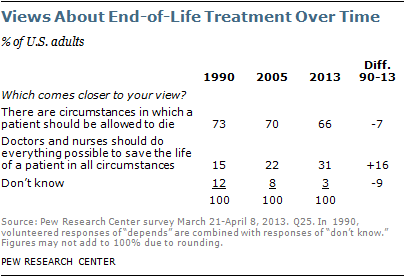
When asked about end-of-life decisions for other people, two-thirds of Americans (66%) say there are at least some situations in which a patient should be allowed to die, while nearly a third (31%) say that medical professionals always should do everything possible to save a patient’s life. Over the last quarter-century, the balance of opinion has moved modestly away from the majority position on this issue. While still a minority, the share of the public that says doctors and nurses should do everything possible to save a patient’s life has gone up 9 percentage points since 2005 and 16 points since 1990.

The uptick comes partly from a modest decline in the share that says there are circumstances in which a patient should be allowed to die and partly from an increase in the share of the public that expresses an opinion; the portion that has no opinion or declines to answer the survey question went down from 12% in 1990 to 8% in 2005 and now stands at 3%.

When thinking about a more personal situation, many Americans express preferences for end-of-life medical treatment that vary depending on the exact circumstances they might face. A majority of adults say there are at least some situations in which they, personally, would want to halt medical treatment and be allowed to die. For example, 57% say they would tell their doctors to stop treatment if they had a disease with no hope of improvement and were suffering a great deal of pain. And about half (52%) say they would ask their doctors to stop treatment if they had an incurable disease and were totally dependent on someone else for their care. But about a third of adults (35%) say they would tell their doctors to do everything possible to keep them alive – even in dire circumstances, such as having a disease with no hope of improvement and experiencing a great deal of pain. In 1990, by comparison, 28% expressed this view. This modest uptick stems largely from an increase in the share of the public that expresses a preference on these questions; the share saying they would stop their treatments so they could die has remained about the same over the past 23 years.
end-of-life-overview-3

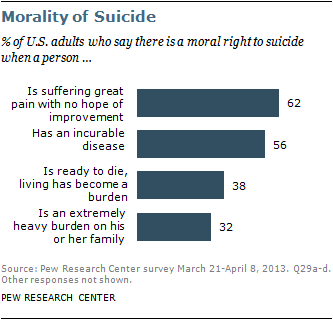
At the same time, a growing share of Americans also believe individuals have a moral right to end their own lives. About six-in-ten adults (62%) say that a person suffering a great deal of pain with no hope of improvement has a moral right to commit suicide, up from 55% in 1990. A 56% majority also says this about those who have an incurable disease, up from 49% in 1990. While far fewer (38%) believe there is a moral right to suicide when someone is “ready to die because living has become a burden,” the share saying this is up 11 percentage points, from 27% in 1990. About a third of adults (32%) say a person has a moral right to suicide when he or she “is an extremely heavy burden on his or her family,” roughly the same share as in 1990 (29%).
end-of-life-overview-4

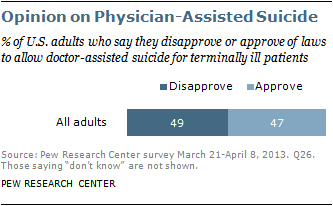
Meanwhile, the public remains closely divided on the issue of physician-assisted suicide: 47% approve and 49% disapprove of laws that would allow a physician to prescribe lethal doses of drugs that a terminally ill patient could use to commit suicide. Attitudes on physician-assisted suicide were roughly the same in 2005 (when 46% approved and 45% disapproved).

Religion and End-of-Life Care

Personal preferences about end-of-life treatment are strongly related to religious affiliation as well as race and ethnicity. For example, most white mainline Protestants (72%), white Catholics (65%) and white evangelical Protestants (62%) say they would stop their medical treatment if they had an incurable disease and were suffering a great deal of pain. (See the chart in Personal Wishes section below.) By contrast, most black Protestants (61%) and 57% of Hispanic Catholics say they would tell their doctors to do everything possible to save their lives in the same circumstances. On balance, blacks and Hispanics are less likely than whites to say they would halt medical treatment if they faced these kinds of situations.

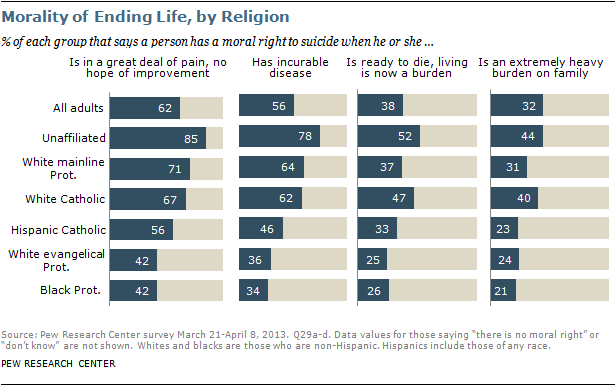
Religious groups also differ strongly in their beliefs about the morality of suicide. About half of white evangelical Protestants and black Protestants reject the idea that a person has a moral right to suicide in all four circumstances described in the survey. By comparison, the religiously unaffiliated, white mainline Protestants and white Catholics are more likely to say there is a moral right to commit suicide in each of the four situations considered. There is a similar pattern among religious groups when it comes to allowing physician-assisted suicide for the terminally ill. (See the chart in Physician-Assisted Suicide for the Terminally Ill section below.)
end-of-life-overview-5

These are some of the key findings from the Pew Research Center telephone survey, which was conducted on landlines and cellphones from March 21 to April 8, 2013, among a nationally representative sample of 1,994 adults. The margin of error for the survey is plus or minus 2.9 percentage points. For more details, see Appendix A: Survey Methodology.

Preparing for End-of-Life Decisions

end-of-life-overview-6

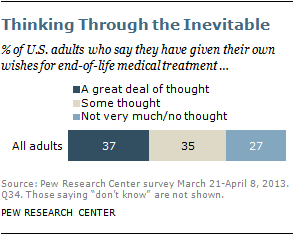
The share of the total U.S. population that is age 65 and older has more than tripled over the last century, from roughly 4% in 1900 to 14% in 2012. But despite the graying of America, a sizable minority of the populace has not thought about the kinds of medical decisions that people increasingly face as they age. Nearly four-in-ten U.S. adults (37%) say they have given a great deal of thought to their wishes for medical treatment at the end of their lives, and an additional 35% have given some thought to these issues. But fully a quarter of adults (27%) say they have not given very much thought or have given no thought at all to how they would like doctors and other medical professionals to handle their medical treatment at the end of their lives.

Even among Americans ages 75 and older, one-in-four say they have not given very much or any thought to their end-of-life wishes. Further, one-in-five Americans ages 75 and older (22%) say they have neither written down nor talked with someone about their wishes for medical treatment at the end of their lives. And three-in-ten of those who describe their health as fair or poor have neither written down nor talked about their wishes with anyone, according to the Pew Research survey.

There has been only modest change over time in the level of public attention to, and preparation for, end-of-life medical decisions. The share of Americans who report having given a great deal of thought to their own wishes for end-of-life medical treatment (37%) is roughly the same as it was in a 2005 Pew Research Center survey and up modestly from 23 years ago, when 28% said they had given a great deal of thought to their wishes. About a third of all adults (35%) say they have put their wishes for end-of-life decisions into writing, whether in an informal document (such as a letter to a relative) or a formal, legal one (such as a living will or health care directive). That share is about the same as in 2005 (34%) and up from about one-in-six (16%) in 1990.1

The vast majority of people who have given a great deal of thought to their own wishes have either written down or talked about their wishes with someone else (88%). Conversely, only about three-in-ten (31%) of those who say they have not given very much or any thought to their wishes have written down or talked about their wishes.

Americans with more education and higher incomes are more likely than those with less education and lower incomes to have communicated their wishes for end-of-life care. Whites are more likely than blacks or Hispanics to have made their wishes known. Those who have not written down or talked about their wishes are more likely than those who have made their wishes known to say they would want doctors and nurses to do everything possible to keep them alive if they were facing a dire medical situation.

Attention to, preparation for and preferences about end-of-life medical treatments also are correlated with age. Younger adults, especially those ages 18-49, are less likely than their older counterparts to have thought about these issues and to have put their wishes for end-of-life treatment in writing. Younger generations also are less inclined to say they would tell their doctors to stop treatment if they were facing a serious illness. Differences in personal preferences among Americans ages 50 and older are relatively muted, however. For example, if faced with an incurable disease and experiencing a great deal of pain, six-in-ten or more of those ages 50-64, 65-74, and 75 and older say they would tell their doctors to stop treatment so they could die, while 22-24% of each age group says they would tell their doctors to do everything possible to save their lives in those circumstances.

Other findings from the survey include:

  • Many Americans have faced end-of-life medical issues through experiences with friends or relatives. About half of adults (47%) say they have a friend or relative who has had a terminal illness or who has been in a coma within the last five years. This experience cuts across most social and demographic groups, including age, gender, education and religious affiliation. And about half of these adults (23% of the general public) report that the issue of withholding life-sustaining treatment arose for their loved one.
  • A strong majority of the public (78%) says that a close family member should be allowed to make decisions on behalf of a patient toward the end of life if the patient is unable to communicate his or her own wishes. At the same time, a substantial minority of adults (38%) say that parents have a right to refuse treatment on behalf of an infant born with a life-threatening defect, while 57% say such an infant should receive as much treatment as possible, regardless of the defect.
  • In an aging society, Americans see a number of characteristics and functions as important to a good quality of life. About half of adults (49%) rate being able to talk or communicate as extremely important for a good quality of life in older age; similar shares say being able to feed oneself (45%), getting enjoyment out of life (44%) and living without severe, long-lasting pain (43%) are extremely important for a good quality of life in older age. Adults ages 75 and older are less inclined than younger generations to rate seven of the eight characteristics included in the survey as important for a good quality of life.

The rest of this Overview discusses the key findings of the survey in greater detail.

An Aging America With Limited Attention to Preparation for Dying
end-of-life-overview-7

Advances in health and medicine have helped Americans live longer, with the average life expectancy in the U.S. now 78.7 years.2 Small but steady increases in longevity coupled with stagnant or declining fertility rates over the past several decades have led to a growing elderly population. The share of the total U.S. population (including children and adults) that is age 65 and older has more than tripled over the last century – rising from roughly 4% in 1900 to 14% in 2012 – and is expected to reach about a fifth of the total U.S. population by the year 2060, according to projections by U.S. Census Bureau.3 However, roughly a quarter of U.S. adults (27%) say they have given either no thought or not very much thought to their own wishes when it comes to end-of-life medical treatment.

end-of-life-overview-8

Nearly half of the general public has at least indirect experience with end-of-life treatment issues: 47% of adults say they have had a close friend or relative facing a terminal illness or in a coma within the past five years, and about a fifth of U.S. adults (23%) report that the question of whether to withhold life-sustaining treatment arose for that person.4 But the share of Americans who say they have given a great deal or some thought to their own wishes for end-of-life medical treatment (37%) is roughly the same as when last tracked in a 2005 Pew Research survey and up only modestly from 1990, when 28% said this.

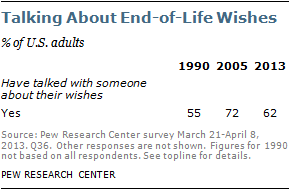
About a third of adults (35%) say their wishes are written down, whether informally or in a formal document such as a living will or a health care directive. The current share of adults who have put their wishes in writing is about the same as it was in 2005 (34%) and is up sharply from about one-in-six (16%) in 1990.5 Additionally, roughly six-in-ten adults today (62%) say they have talked with someone about their wishes for end-of-life medical treatment.

Personal Wishes

When it comes to personal preferences for end-of-life treatment, public attitudes are far from black and white, with preferences that vary depending on the situation.

end-of-life-overview-9

For example, a majority of adults (57%) say they would tell their doctors to stop their medical treatment so they could die if they had an incurable disease and were suffering a great deal of pain, while a sizable minority (35%) say they would tell their doctors to do everything possible to save their lives in that situation. About half of the public (52%) says they would have their doctors stop medical treatment if they faced an incurable disease that made them totally dependent on someone else for care, while 37% say they would pursue all treatment options in such circumstances. And the public is evenly divided about what to do in a situation involving an incurable disease that made it hard to function in day-to-day activities: 46% say they would tell their doctors to stop treatment under those circumstances, while an identical percentage say they would want their doctors to do everything possible to save their lives.
end-of-life-overview-10

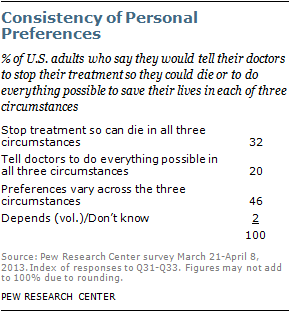
Looking across this set of three scenarios, about a third of adults (32%) consistently say they would tell their doctors to stop medical treatment in all three of these circumstances; a fifth (20%) say they would tell their doctors to do everything possible to save their lives in all three cases, and 46% give differing responses depending on the exact circumstances.

Personal preferences about end-of-life medical treatment have changed only modestly over time. A somewhat greater share of the public expresses a preference on this set of questions today than did so in past years, and a somewhat greater share of adults today say they would do everything possible to save their lives if they had an incurable disease in all three of these circumstances, especially compared with survey findings from 1990. However, the balance of personal preferences has been roughly the same in all three circumstances since 1990.

end-of-life-overview-11

Personal preferences for medical treatment differ by age. For example, a strong majority of adults ages 50 and older say they would tell their doctors to stop treatment and allow them to die if they were suffering a great deal of pain from an incurable illness. By comparison, 42% of adults under age 30 say they would do the same, and about half (51%) of adults ages 30-49 say they would tell doctors to stop their treatment so they could die.

end-of-life-overview-12

There are also substantial differences across racial and ethnic groups when it comes to personal choices about medical treatment. Whites are more inclined than either blacks or Hispanics to say they would stop their medical treatment in these kinds of circumstances. For example, about two-thirds of whites (65%) say they would want to be allowed to die if they had an incurable disease and were suffering a great deal of pain, compared with 26% who say they would ask their doctors to do everything possible to save their lives in such circumstances. By contrast, a majority of blacks (61%) and about half of Hispanics (55%) say they would tell their doctors to do everything possible to save their lives if they had an incurable disease and were suffering a great deal of pain.

Personal preferences also tend to differ by religious affiliation. Black Protestants are least inclined to say they would ask their doctors to stop their medical treatment so they could die if faced with an incurable disease and experiencing a great deal of pain; 32% say they would stop treatment, while a majority (61%) of black Protestants say they would want their doctors do everything possible to save their lives in this situation. The balance of opinion is similar among Hispanic Catholics: 38% would stop treatment, while 57% would tell their doctors to do everything possible to save their lives.

White mainline Protestants are most inclined to say they would ask their doctors to stop medical treatment in these circumstances (72%), followed by white Catholics (65%) and white evangelical Protestants (62%). Among the religiously unaffiliated, 61% say they would want to stop treatment, while a third would tell their doctors to do everything possible to save their lives.
end-of-life-overview-13

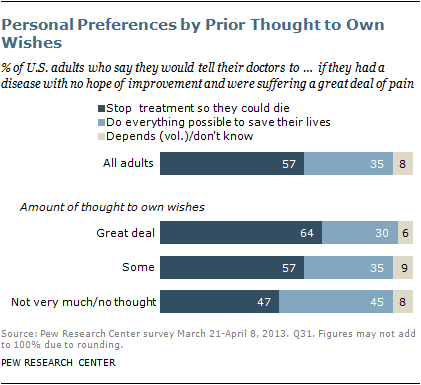
People who have given more thought to their personal wishes when it comes to end-of-life treatment issues are also more inclined to say they would stop their treatment so they could die if they were suffering from an incurable illness in all three of the circumstances addressed in the survey. For example, about two-thirds of those who have given a great deal of thought to their wishes (64%) say they would stop treatment so they could die if they had an incurable disease and were suffering a great deal of pain. Among those who have not given very much or any thought to their own wishes, fewer (47%) take that position.

Similarly, those who have either talked about or written down their wishes regarding end-of-life treatment are more inclined to say they would tell their doctors to stop treatment if they had an incurable disease and were suffering a great deal of pain.

General Views About End-of-Life Treatment

The Pew Research survey also asked a question about end-of-life medical decisions for other people. Respondents were asked to choose between two statements: 1) Doctors and nurses should do everything possible to save the life of a patient in all circumstances, or 2) Sometimes there are circumstances in which a patient should be allowed to die. The survey question poses a stark contrast, and both options leave the hypothetical patient’s own wishes unstated. Nevertheless, this forced-choice question provides a useful gauge of overall public attitudes about end-of-life treatment.

end-of-life-overview-14

Two-thirds of U.S. adults (66%) say there are sometimes situations when a patient should be allowed to die, while about three-in-ten (31%) say that under all circumstances medical personnel should do everything possible to save a patient’s life. The view that sometimes a patient should be allowed to die has remained the majority position in Pew Research surveys since 1990. However, the share of the public that says there are circumstances in which a patient should be allowed to die has declined slightly over that period. More adults express an opinion today than did so in 1990, and the share of adults who say doctors and nurses always should do everything possible to save a patient’s life has grown.

Compared with 1990, all age groups are now more inclined to say that medical personnel always should do everything possible to save a patient’s life. However, this change over time is especially pronounced among younger generations.6

Overall views about end-of-life medical treatment are strongly associated with religious affiliation as well as race and ethnicity. White Catholics (80%) and white mainline Protestants (76%) are particularly likely to say there are circumstances in which a patient should be allowed to die. A majority of white evangelical Protestants (68%) also hold this view. By contrast, a majority of Hispanic Catholics (66%) and 54% of black Protestants say medical staff should do everything possible to save a patient’s life in all circumstances.

Whites are more inclined than either blacks or Hispanics to say there are some circumstances in which a patient should be allowed to die.

end-of-life-overview-15

Opinions on this issue also tend to vary by age. About half or more of respondents in all age groups say there are times when a patient should be allowed to die. But older respondents are more inclined than younger ones to take this position. Younger adults ages 18-29 are most closely divided, with 54% saying there are circumstances in which a patient should be allowed to die and 43% saying medical personnel always should do everything possible to save a patient’s life.

As with personal preferences about end-of-life treatment, those who say they have given more thought to their personal wishes on these issues are more inclined to say there are times when a patient should be allowed to die.

Americans’ attitudes toward the cost and efficacy of medical care also are associated with their views about end-of-life treatment. The survey asked respondents whether medical treatments these days are generally “worth the costs because they allow people to live longer and better quality lives” or whether today’s medical treatments “often create as many problems as they solve.” About seven-in-ten (72%) of those who say medical treatments these days “often create as many problems as they solve” think there are times when a patient should be allowed to die. Fewer, though still a majority (62%), of those who say that medical treatments “allow people to live longer and better quality lives” think there are times when a patient should be allowed to die.

Overall views about end-of-life medical treatment are not strongly related to political party. Democrats are somewhat more inclined than Republicans to say that doctors and nurses should do everything possible to save a patient’s life in all circumstances, but these differences disappear after controlling for race and ethnicity. Among white, non-Hispanic respondents, there are no significant differences in overall views about end-of-life treatment by party affiliation.

Who Should Decide?

end-of-life-overview-16

There is strong agreement in the general public that a close family member should be allowed to make medical treatment decisions when a patient is incapacitated and his or her wishes are not otherwise known (for example, through a written document or a prior discussion with the attending physician). About eight-in-ten adults (78%) say the closest family member should be allowed to make decisions on behalf of a patient in such circumstances, while 16% disagree. The balance of opinion on this question has remained steady since 1990.

However, views on another question involving proxy decision-making illustrate the degree to which attitudes on these kinds of issues often depend on the particular circumstances. The Pew Research survey asked about a hypothetical situation in which a child is born with a life-threatening birth defect. In this case, about four-in-ten adults (38%) say a parent has a right to refuse treatment on behalf of an infant, while a majority (57%) says the infant should receive as much treatment as possible, no matter what the defect.

Views about a parent’s role as decision-maker in these circumstances are strongly related to religion as well race and ethnicity and opinion about the moral acceptability of abortion. See Chapter 5 for details.

Physician-Assisted Suicide for the Terminally Ill

end-of-life-overview-17

Public opinion on laws that would allow physician-assisted suicide is closely divided, with 47% approving and 49% disapproving of laws that would allow medical doctors to prescribe lethal doses of drugs for terminally ill patients who choose to commit suicide.7

Views on this issue are largely the same today as in the 2005 Pew Research survey. Surveys by Gallup have found a similar – and largely stable – divide in public opinion over whether doctor-assisted suicide is morally acceptable or morally wrong (45% say it is morally acceptable and 49% say it is morally wrong in Gallup’s most recent survey on the topic, conducted in May 2013).

There are sizable differences in opinion about this issue by race and ethnicity as well as religion. Whites are more inclined to favor laws allowing doctor-assisted suicide than are either blacks or Hispanics.

A majority of white mainline Protestants (61%) and about half of white Catholics (55%) approve of laws that allow physician-assisted suicide, as do two-thirds of religiously unaffiliated adults. However, by a margin of about two-to-one or more, black Protestants, white evangelical Protestants and Hispanic Catholics disapprove of laws that allow doctor-assisted suicide.

Beliefs About Suicide

end-of-life-overview-18

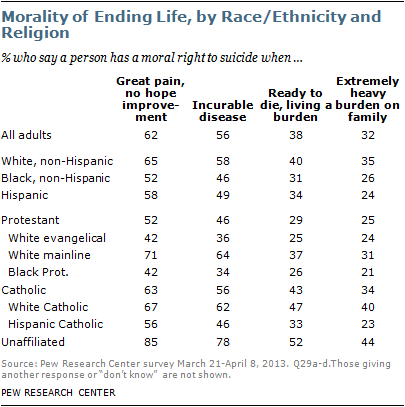
Public attitudes about the morality of suicide tend to vary depending on the circumstances. About six-in-ten adults (62%) believe people have a moral right to end their own lives if they are suffering great pain and have no hope of improvement. A majority (56%) also believes people have a moral right to end their lives if they are suffering from an incurable disease. But far fewer see a moral right to suicide when a person is “ready to die because living has become a burden” (38%) or when a person is “an extremely heavy burden on his or her family” (32%).

Compared with surveys conducted in 1990 and 2005, there has been a modest uptick in the belief that suicide is morally justified under three of these four circumstances. The changes stem mostly from an increased share of the public taking a position on these questions (instead of saying “don’t know”) in recent years rather than a decline in the share saying there is not a moral right to suicide under these conditions. There is one exception to this pattern: Compared with 1990, there has been an increase in the share of the public that says suicide is not morally justified when a person is an extremely heavy burden on his or her family.

Views about the morality of suicide are strongly related to religious affiliation. White evangelical Protestants and black Protestants are least inclined to believe suicide is morally justified. About half or more white evangelical Protestants and black Protestants reject the idea of a moral right to suicide in each of the four circumstances included in the survey.

The unaffiliated, followed by white mainline Protestants and white Catholics, are especially likely to say there is a moral right to suicide under each of these circumstances. Among each group, about six-in-ten or more believe a person is morally justified in ending his or her life when suffering great pain with no hope of improvement and when facing an incurable disease.

Beliefs about the morality of suicide also tend to vary by race and ethnicity. On average, whites are more inclined than either blacks or Hispanics to say people have a moral right to end their lives under any of these four circumstances.

end-of-life-overview-19

Aging and Life Assessments

end-of-life-overview-20

Views about aging and perceptions about the quality of life in older age may play a role in people’s thoughts and opinions about end-of-life medical treatment.

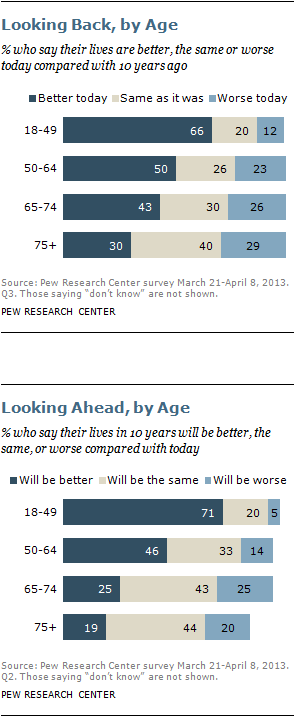
Assessments of one’s personal life are strongly colored by one’s place in the life cycle. When asked to reflect on their personal lives today compared with 10 years ago, older adults are much less inclined than younger ones to see improvement. Just three-in-ten adults ages 75 and older say their lives today are better than they were a decade earlier. By contrast, about twice as many adults ages 18-49 (66%) say their lives are better today than in the past.

By the same token, optimism for the future is harder to find among older generations. Only about a fifth (19%) of adults ages 75 and older expect their lives to get better in the future. By contrast, fully 71% of adults under age 50 expect their lives to be better in 10 years, and 46% of those ages 50-64 are optimistic that their lives will improve.

However, assessments of present life circumstances are only modestly associated with age. Fully eight-in-ten U.S. adults (81%), including 76% of those ages 75 and older, say they are satisfied with their personal lives today.

And assessments of life in specific domains – including financial status and social relationships – differ only modestly across age groups, with one notable exception – health status, which is inversely related to age. A third of adults under age 50 say their health is excellent. Only about half as many adults ages 65 and older say the same (16% each among those ages 65-74 and those ages 75 and older).

Ratings of social relationships, such as the number of friends one has, are only modestly related to age. Marital status tends to vary with the adult life cycle, but a majority of those who are married – whether they are older or younger – tend to say their relationship with their spouse is excellent.

And while fewer adults ages 65 and older are in the workforce, ratings of personal finances are not strongly associated with age. For example, 17% of adults ages 75 and older consider their personal financial situation to be excellent, compared with 11% among adults ages 18-49 and 13% among those ages 50-64.
end-of-life-overview-21

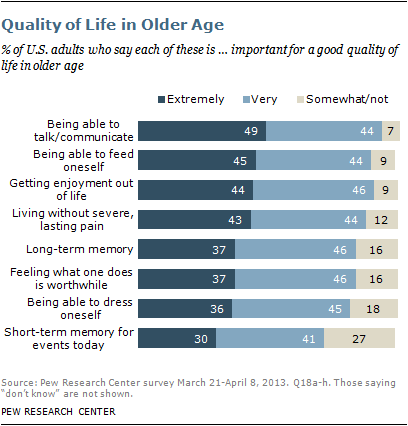
The Pew Research survey also explores public views about the conditions that make for better quality of life in older age. Several characteristics and functions are seen by at least four-in-ten Americans as “extremely important” for a good quality of life in older age, including being able to talk or communicate with others (49%), being able to feed oneself (45%), getting enjoyment out of life (44%) and living without severe, long-lasting pain (43%). A somewhat smaller share says other qualities are extremely important for a good quality of life in older age, including long-term memory for the important people and experiences in one’s life (37%), feeling what one does in life is worthwhile (37%) and being able to dress oneself (36%). Three-in-ten adults say that having short-term memory about events that happened today is extremely important for a good quality of life in older age.

end-of-life-overview-22

Older adults, especially those ages 75 and older who may have learned to live with some of these characteristics as part of their everyday lives, are less inclined than younger generations to rate all but one of these characteristics as extremely important for a good quality of life. (There are no age differences in the perceived importance of being able to dress oneself.) However, within all age groups, the largest share agrees that being able to communicate with others is extremely important.

About the Survey

Issues surrounding the end of life have sparked public debate for many decades and loom large in the lives of many Americans. This survey is part of the Pew Research Center’s ongoing effort to track public views about end-of-life medical treatments and, more broadly, bioethical questions at the intersection of religion and public life. Pew Research first conducted a survey on this topic in 1990, and a follow-up study was completed in 2005, shortly after the legal battle over treatment for Terri Schiavo drew national attention.8 Much has changed in the ensuing years, including dramatic increases in health care costs and more than a decade of public conversation over health care access and delivery, which continues today.

This is the second of two major reports by the Pew Research Center’s Religion and Public Life Project on the findings of a survey on bioethics questions. The first survey report, “Living to 120 and Beyond: Americans’ Views on Aging, Medical Advances and Radical Life Extension,” which was released in August 2013, explored attitudes about the prospect – still largely speculative – of living dramatically longer lives. This second report looks, instead, at the current state of medical treatments for the seriously ill. It explores public attitudes and beliefs about end-of-life medical treatment as well as physician-assisted suicide and the morality of taking one’s own life. The survey was conducted by telephone on landlines and cellphones from March 21 to April 8, 2013, among a nationally representative sample of 1,994 adults. The margin of error for the survey is plus or minus 2.9 percentage points.

Many Pew Research staff members contributed to the development of this survey and the accompanying reports. Senior Researcher Cary Funk was the principal researcher on the survey and the lead author of the report. Senior Researcher David Masci was the principal writer of two companion reports (described below). Their efforts were guided by Religion & Public Life Project Deputy Director Alan Cooperman and Project Director Luis Lugo. The survey questionnaire and analysis benefited from the guidance of a number of others at the Pew Research Center, including Andrew Kohut, Scott Keeter, Paul Taylor, Susannah Fox, Jon Cohen and Alan Murray. Data analysis and number checking assistance was provided by Jessica Hamar Martinez and Elizabeth Sciupac. Other staff who contributed to the report include Sandra Stencel, Erin O’Connell, Michael Lipka, Joseph Liu, Tracy Miller, Liga Plaveniece, Katherine Ritchey, Stacy Rosenberg and Bill Webster. Fieldwork for the survey was ably carried out by Princeton Survey Research Associates International.

Roadmap to the Report

The remainder of this report details the survey’s findings on end-of-life medical treatment and related issues, including aging and suicide. The first chapter looks at public views on laws allowing physician-assisted suicide. The second chapter covers beliefs about the morality of suicide under different conditions. The third chapter goes into detail on the public’s personal preferences for end-of-life medical treatment, how much attention people have given to end-of-life issues and what, if any, efforts they have taken to communicate their wishes for treatment. The fourth chapter looks at public attitudes on end-of-life medical treatment in a more general context and how those views have changed over time. The fifth chapter explores views about proxy medical treatment decisions for adults as well as for infants born with life-threatening defects. The sixth chapter looks at the public’s views on aging in general and levels of personal life satisfaction as they relate to age and to end-of-life treatment issues.

Together with the survey results, Pew Research is releasing three accompanying pieces. “To End Our Days: The Social, Legal and Political Dimensions of the End-of-Life Debate” presents an overview of the public debate on these issues in the last half-century in the U.S. An interactive timeline highlights key events and developments on the issue. “Religious Groups’ Views on End-of-Life Issues” describes what 16 major American religious traditions teach about one controversial aspect of the debate: physician-assisted suicide and euthanasia.

Photo Credit: © Tim Pannell/Corbis

Terms and Definitions

Aid-in-dying and physician-assisted-suicide laws State laws making it legal for a physician to prescribe lethal medication to a terminally ill, mentally competent patient who wants to end his or her life. This is currently allowed in four states: Oregon, Washington state, Montana and Vermont. Each state has different conditions under which physician-assisted suicide is legal. Elsewhere, such an act would be considered a felony.

Euthanasia The act or practice of ending the life – by lethal injection or the suspension of extraordinary medical treatment – of an individual suffering from a terminal illness or an incurable condition. Colloquially, euthanasia is sometimes referred to as “mercy killing” because the intent is often to provide relief to someone suffering from a debilitating chronic or terminal illness through a painless death. The Greek origins of the term are commonly translated as “a good death.” Passive euthanasia refers to withholding medical treatment that would keep a patient alive, such as life-support machines to feed or assist a patient in breathing. Active euthanasia refers to taking specific actions, such as injecting a lethal dose of drugs to cause death.

Hospice care Medical treatment for the seriously ill that accepts death as an inevitable outcome for a patient with a terminal (or end-stage) illness. The treatment is focused on maximizing quality of life by reducing pain and other symptoms for those likely to die within, at most, about six months if their disease runs its normal course. Hospice care is not used in conjunction with treatments intended to cure a disease. It is typically provided in a home setting but can also take place in a hospital or assisted-living facility.

Life-sustaining medical treatment Medical interventions that may prolong the life of a patient. These may entail treatments such as antibiotics, insulin, chemotherapy, nutrition and hydration provided intravenously as well as more technically demanding interventions such as organ transplant, respirators, kidney dialysis and vasoactive drug treatment.

Palliative care Medical treatment for the seriously ill that is focused on improving a patient’s quality of life by managing any physical and psychosocial symptoms associated with illness. Palliative care can occur simultaneously with treatments intended to cure a disease. It is typically offered in hospitals but can also take place in assisted-living facilities or in home-care settings.

Suicide Historically, suicide was often considered a felony under state law. At the present time, no U.S. state lists suicide as a crime, although some still consider it a “common law crime.” All states have some form of involuntary commitment law, however, designed to prevent suicide by empowering or requiring the state to commit anyone believed to be suicidal for evaluation and treatment.

Chapter 1: Opinion About Laws on Doctor-Assisted Suicide

Public opinion on laws that would allow physician-assisted suicide is closely divided, with 47% of U.S. adults approving and 49% disapproving of laws that would allow medical doctors to prescribe lethal doses of drugs for terminally ill patients who choose to commit suicide.

end-of-life-chp1-2

The opinion divide over this issue is virtually unchanged from a 2005 Pew Research survey. Surveys by Gallup have found a similar, and largely stable, division over whether doctor-assisted suicide is morally acceptable or morally wrong (45% say it is morally acceptable and 49% say it is morally wrong in a May 2013 Gallup poll).

There are sizable differences in opinion about this issue by race, ethnicity and religion. More whites than blacks and Hispanics favor laws allowing doctor-assisted suicide.

A majority of white mainline Protestants and about half of white Catholics approve of laws for this purpose. Two-thirds of the unaffiliated also approve of laws to allow physician-assisted suicide. However, majorities of black Protestants, white evangelical Protestants and Hispanic Catholics disapprove of laws for doctor-assisted suicide by about a two-to-one margin or more.

While there are differences among adherents of religious groups on views about this issue, most major American religious groups officially oppose physician-assisted suicide and euthanasia. For an overview of the positions of 16 major religious groups on physician-assisted suicide and euthanasia see, “Religious Groups’ Views on End-of-Life Issues.”

end-of-life-chp1-3

There also are differences in opinion by education, political party, ideology and the amount of prior thought given to end-of-life issues.

Those with more formal education (at least some college) are more apt to approve of such laws than are those with less education.

Democrats and independents are more inclined than Republicans to approve of laws allowing doctors to assist terminally ill patients in committing suicide. Differences in opinion by political party are virtually unchanged since the 2005 Pew Research survey. There are also differences by political ideology, with conservatives less inclined than either moderates or liberals to approve of laws allowing physician-assisted suicide.

Respondents who report having given more thought to their preferences about end-of-life treatment prior to taking the survey are more inclined to approve of laws allowing doctor-assisted suicide than those who report having given little or no prior thought to these issues.

However, there are no significant differences in opinion about laws allowing physician-assisted suicide by gender or age.

end-of-life-chp1-4

To what extent are opinions about doctor-assisted suicide consistent with beliefs about other issues that relate to life and death? To explore this question, the Pew Research survey also asked about views on capital punishment and abortion.

Among those who favor the death penalty for persons convicted of murder, a majority (55%) approve of laws to allow doctor-assisted suicide, while 42% disapprove. By contrast, those who oppose the death penalty tend to disapprove of laws that would allow doctor-assisted suicide by a 59% to 39% margin.

There is also a relationship between moral assessments of abortion and opinion about doctor-assisted suicide. Among those who say they personally believe having an abortion is morally wrong, seven-in-ten disapprove of laws allowing doctor-assisted suicide, while 28% approve. By contrast, among adults who say abortion is morally acceptable, eight-in-ten approve of laws to allow doctor-assisted suicide, while a fifth disapprove. Those who say abortion is not a moral issue also tend to approve of laws to allow physician-assisted suicide by a 59% to 38% margin.

Chapter 2: Views on the Morality of Suicide

Views about physician-assisted suicide are, as expected, tied more broadly to beliefs about the morality of suicide. Such beliefs tend to vary depending on the circumstances considered. About six-in-ten adults (62%) believe a person has a moral right to end their own life if they are suffering great pain and have no hope of improvement. A majority (56%) believe a person has a moral right to end his or her life if suffering from an incurable disease. Fewer see a moral right to suicide when a person is ready to die because living has become a burden (38%) or when a person is an extremely heavy burden on his or her family (32%).

Compared with a 1990 Pew Research survey, more Americans now say that a person has a moral right to end his or her own life in three of the four circumstances considered. Belief in a moral right to suicide when a person is “ready to die because living has become a burden” has increased by 11 percentage points from 27% in 1990 to 38% today. The shares of adults who say a person is morally justified in ending his or her life because of an incurable disease or because he or she is suffering great pain with no hope of improvement each have increased by 7 percentage points since 1990. By contrast, roughly the same share of the public says suicide is morally justified when a person is an extremely heavy burden on his or her family today as said this in 1990.

The uptick in belief that suicide is morally justified under certain conditions stems mostly from an increased share of the public taking a position on these questions rather than a decline in the share saying there is no moral right to suicide. There is one exception to this pattern: Compared with 1990, there has been an increase in the share of the public that says suicide is not morally justified when a person is an extremely heavy burden on his or her family.

end-of-life-chp2-2

Beliefs about the morality of suicide tend to vary by race and ethnicity. Whites are more inclined than blacks and tend to be more inclined than Hispanics to say a person has a moral right to end his or her life under any of the four circumstances in the survey.

Attitudes on these questions are strongly related to respondents’ religious affiliation as well. For example, about half or more of white evangelical Protestants and black Protestants reject the idea of a moral right to suicide in each of the four circumstances. By contrast, the unaffiliated, followed by white mainline Protestants and white Catholics, are especially likely to say there is a moral right to suicide under each of these circumstances. In particular, about six-in-ten or more in each group believe a person is morally justified in ending his or her life if suffering from great pain with no hope of improvement or if he or she has an incurable disease.

end-of-life-chp2-3

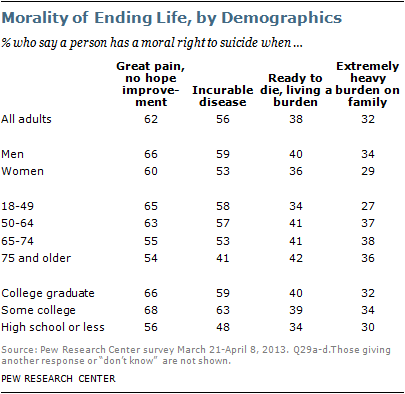
Men and women tend to hold similar positions about the morality of suicide in the four circumstances included in the survey, although men are somewhat more inclined than women to say suicide is morally justified when a person is in great pain and has no hope of improvement (66% vs. 60%).

There are only modest differences across education groups. Those with at least some college education are more inclined than those with less schooling to say suicide is morally justified when a person is in great pain and has no hope of improvement or when a person has an incurable disease.

About half or more of all age groups consider suicide morally justified when a person is in great pain and has no hope of improvement. Americans ages 75 and older are less inclined than their younger counterparts to say suicide is morally justified when a person has an incurable disease. But adults ages 18-49 are somewhat less inclined than older Americans to believe a person has a moral right to suicide when he or she is ready to die because living has become a burden or when he or she is an extremely heavy burden on family.

end-of-life-chp2-4

Looking across this set of four questions, about half the public takes a consistent position about the morality of suicide; roughly one quarter (24%) says there is a moral right to suicide in all four circumstances, while about three-in-ten Americans (29%) say a person does not have a moral right to suicide in any of these circumstances. The remainder of U.S. adults (46%) hold views about the morality of suicide that vary depending on the circumstances, and 1% have no opinion on any of the four questions.

Compared with previous Pew Research surveys, the share of the public that consistently says there is no moral right to suicide is roughly the same as it was in 1990, while more adults consider suicide morally justified in all four cases and fewer hold views that vary depending on the circumstances.

end-of-life-chp2-5

Views about the morality of suicide tend to vary widely by religious group. About half of white evangelical Protestants (51%) and black Protestants (49%) consistently reject a moral right to suicide in each of the four conditions considered in the survey.

A majority of Hispanic Catholics (60%) and 56% of white mainline Protestants have mixed views about the moral right to suicide across this set of four circumstances.

Relative to most religious groups, the unaffiliated are more inclined to say suicide is a moral right in all four cases (37%), although about half of this group holds views about the morality of suicide that vary depending on the circumstances (53%).

Those who attend worship services at least once a week are more likely to reject the idea that suicide is morally justified. For example, half (50%) of white Catholics who attend Mass at least weekly say suicide is not a moral right in any of these four circumstances, compared with just 8% among those who attend Mass less frequently.

Views about the morality of suicide also tend to vary by race and ethnicity. Blacks are more inclined to say there is no moral right to suicide in any of these four circumstances (39%); Hispanics are more inclined to hold views that vary depending on the circumstance considered (57%).

There are few differences on this index of beliefs about suicide by gender, education or income. Adults ages 50 and older are somewhat more inclined to say there is a moral right to suicide in all four circumstances, while adults ages 18-49 hold mixed views about the morality of suicide across these four circumstances.

Chapter 3: Personal Wishes for and Attention to End-of-Life Treatment

The Pew Research survey asked respondents about their personal preferences for medical treatment in different scenarios. A majority of adults (57%) say they would ask their doctors to stop medical treatment if they had a disease with no hope of improvement and they were suffering a great deal of pain, while 35% would tell their doctors to do everything possible to save their lives in such a situation.

About half of adults (52%) say they would want to stop treatment if they had an illness or condition that made them totally dependent on another person for their care, while 37% say they would want to do everything possible to save their lives in this situation.

Preferences are evenly divided when it comes to an incurable illness or condition that makes it hard to function in day-to-day activities: 46% say they would opt to stop medical treatment, and an equal share say they would want their doctors to do everything possible to save their lives in that circumstance.

Personal preferences about end-of-life medical treatment have changed modestly over time. Compared with 1990, a somewhat greater share of the public today expresses a preference on each of these questions; in addition, a somewhat greater share of adults today say they would tell their doctors to do everything possible to save their lives if faced with an incurable illness. The share of Americans who say they would tell their doctors to stop their treatment so they could die remains about the same as in 1990.

end-of-life-chp3-2(1)

To what extent are public preferences about end-of-life medical treatment consistent across circumstances? About a third of U.S. adults (32%) say they would stop their treatment in all three of the circumstances included in the survey, a fifth (20%) would ask their doctors to do everything possible to save their lives in all three circumstances, and 46% have varying preferences depending on the exact circumstances.

The share of Americans who consistently say they, personally, would stop their treatment so they could die in all three of these cases is roughly the same as it was in 1990 (32% today vs. 30% in 1990). Compared with a 1990 Pew Research survey, more adults today say they would tell their doctors to do everything possible to save their lives (up 6 percentage points) and fewer have varied preferences depending on the circumstances considered (down 7 percentage points since 1990).

end-of-life-chp3-2

Personal preferences about end-of-life medical treatment are strongly related to age and to race or ethnicity.

For instance, adults ages 50 and older are more inclined to say they would stop their treatment so they can die in all three cases considered. Roughly four-in-ten adults ages 50-64 (43%) say this for all three questions, as do similar shares of those ages 65-74 (42%) and those ages 75 and older (41%). By comparison, 23% of adults under age 50 say they would want to stop their treatment in all three circumstances.

In terms of race and ethnicity, blacks and Hispanics are more likely than whites to say they would tell their doctors to do everything possible to save their lives in all three situations; four-in-ten blacks (40%) and about a third of Hispanics (32%) say this, compared with 14% of non-Hispanic whites. By comparison, whites are more inclined to say they would stop their medical treatment in all three circumstances (35%).

Differences among religious groups are more modest and are largely in keeping with differences by race and ethnicity on this summary measure. On the one hand, about a third of white evangelical Protestants (33%), white mainline Protestants (33%) and white Catholics (35%) say they would stop their medical treatment in all three situations. A similar share of the religiously unaffiliated say the same (38%). On the other hand, black Protestants and Hispanic Catholics are more likely to say they would tell their doctors to do everything possible to save their lives in all three cases (42% and 33%, respectively). Among white mainline Protestants, 57% have preferences for medical treatment that vary depending on the circumstances.

Americans who have given a great deal of thought to their own wishes about end-of-life treatment are more inclined to say they would want to stop their treatment so they could die in all three cases (38%, compared with 23% among those who have given little or no thought to their wishes). By contrast, personal preferences about end-of-life treatment are not significantly related to having had a close friend or relative with a terminal illness in recent years. And there is not much difference in personal preference about end-of-life medical treatment based on a person’s own current health status.

Attention to and Experience With End-of-Life Treatment

end-of-life-chp3-3

The amount of thought and attention U.S. adults give to end-of-life issues varies; 37% of adults report having thought “a great deal” about end-of-life treatment prior to taking the survey. Another 35% say they have given “some” thought to these issues and 27% have given “not very much” or no prior thought to their end-of-life preferences.

The share of Americans who say they have given their own wishes about end-of-life treatment a great deal of thought is about the same as in the 2005 survey and up 9 percentage points since 1990 (when it stood at 28%).

Terminal illness has touched the lives of many U.S. adults, 47% of whom have recent personal experience with a close friend or family member suffering from this type of illness. About half of those with such a friend or family member (23% of all adults) report that the issue of withholding life-sustaining treatment arose for that person. Since 2005, experience with a close friend or relative facing a terminal illness is up 5 percentage points.

As expected, experience with a close friend or relative facing a terminal illness cuts across social and demographic groups, including age, gender, education and religious groups. For example, 46% of adults ages 18-49 say a close friend or relative has had a terminal illness or been in a coma within the past five years, and 48% of adults ages 50 and older say the same. However, fewer Hispanics than whites (36% and 50%, respectively) have had a loved one in this situation; among blacks the comparable figure is 45%.

end-of-life-chp3-4
end-of-life-chp3-5

Not surprisingly, experience with a friend or relative facing a serious illness is associated with more attention to one’s own wishes about end-of-life care; 45% of those with a terminally ill friend or relative say they have given a great deal of thought to their own wishes, compared with 31% of those without this kind of close experience.

Thinking about one’s own wishes also is related to a respondent’s age and personal health.

Among adults ages 75 and older, 47% report having given a great deal of thought to their own wishes about end-of-life treatment. By contrast, about a third (32%) of adults ages 18-49 say the same.

Those who describe their current health as fair or poor (of whom roughly half are ages 50 and older) are more likely to have given a great deal of thought to their wishes for end-of-life treatment (47%) compared with those who say their health is good (33%) or excellent (36%).

There are no or only modest differences in the amount of thought given to one’s end-of-life wishes by gender, race and ethnicity. Nor are there significant differences in the likelihood of having given end-of-life issues a great deal of thought by education, religious affiliation or frequency of worship service attendance.

Communicating One’s Wishes About End-of-Life Treatment

Pew Research surveys from 1990, 2005 and 2013 show that a majority of adults say they have talked with someone else about their wishes regarding end-of-life treatment, but substantially fewer have written down these thoughts.

end-of-life-chp3-6

The 2013 survey finds that 35% of adults say they have their wishes in writing or that they have a living will. This is roughly the same share as in 2005 (34%) but up substantially from one-in-six adults (16%) in 1990.9

end-of-life-chp3-7

By comparison, having talked with someone else about end-of-life treatment preferences is more common. A majority of Americans say they have done so, as was the case in 1990 and 2005. But these figures have fluctuated some over the years. Today, roughly six-in-ten adults (62%) say they have talked with someone else about their wishes, down from 72% in 2005 but up modestly from 55% in 1990.10

end-of-life-chp3-8

Altogether, about two-thirds of the general public has taken some sort of action to communicate their wishes for end-of-life care. A third of adults (33%) have neither talked about their wishes with others nor written their wishes down.

Not surprisingly, younger adults, particularly those under age 30, are less likely to have communicated their wishes about end-of-life treatment. Just 15% of young adults ages 18-29 say they have their wishes about end-of-life care written down. By contrast, six-in-ten adults ages 65 and older have their wishes in writing.

Differences by age are still apparent, even if not as stark, when factoring in both talking about and writing down one’s wishes for end-of-life treatment. About half of adults under age 30 say they have either talked about or written down their wishes (48%), compared with three-quarters of those ages 75 and older.

More whites (74%) than blacks (49%) and Hispanics (50%) have communicated their end-of-life wishes either verbally or in writing. In addition, Americans with more years of formal education are more likely than those with less education to have written down or talked with someone about their end-of-life wishes, and those with higher incomes are more likely than lower-income adults to say they have done this. And, not surprisingly, the amount of prior thought people have given to the issue also is correlated with whether they have talked about or written down their wishes. By contrast, respondents’ personal health status is not significantly related to whether or not they have communicated their end-of-life wishes either verbally or in writing.

Chapter 4: General Views on End-Of-Life Medical Treatment

In addition to asking about people’s preferences for their own end-of-life medical treatment, the Pew Research survey included a more general question to gauge views on the issue. In this question, respondents were asked whether there are any circumstances in which medical staff should allow a patient to die or whether doctors and nurses should do everything possible to save a patient’s life in all circumstances. The question does not address the role of the patient’s wishes in directing medical care.

end-of-life-chp4-1

About two-thirds of U.S. adults (66%) say there are circumstances when a patient should be allowed to die, and 31% say that doctors and nurses always should do everything possible to save a patient. While still a minority, the share of adults who say all possible efforts should be made to save a patient’s life has grown from 15% in 1990 to 22% in 2005 to 31% today, a difference of 16 percentage points from 1990 to today. The uptick in belief that medical staff should do everything possible to save a patient in all circumstances comes from a decline of 7 percentage points in the share saying there are circumstances when a patient should be allowed to die and a 9-percentage-point increase in the share of the public that expresses an opinion about end-of-life treatment.

Differences Among Groups in Views About End-of-Life Treatment

end-of-life-chp4-2

There are differences on this question by age. While about half or more of all age groups say there are circumstances when a patient should be allowed to die, this viewpoint is more common among older adults. Roughly seven-in-ten adults ages 50-64 (71%) say there are circumstances when a patient should be allowed to die, as do about three-quarters of those ages 65-74 (76%) and ages 75 and older (74%). By comparison, fewer younger adults say the same. About half of those ages 18-29 (54%) say there are circumstances when medical staff should let a patient die, as do 64% of adults ages 30-49.

There also are sizable differences in attitudes across racial and ethnic groups on this issue. About three-quarters of whites (76%) say there are times when a patient should be allowed to die, while a fifth (20%) says medical staff should do everything possible to save a patient’s life in all circumstances. By contrast, blacks and Hispanics are more inclined to say medical staff should do everything possible to save a patient’s life. Roughly four-in-ten blacks (43%) and Hispanics (38%) say there are times when a patient should be allowed to die, while about half or more say medical personnel should do everything possible to save a patient’s life in all circumstances (52% among blacks and 59% among Hispanics).

These patterns among racial and ethnic groups also are reflected in differences among religious groups. Hispanic Catholics are particularly inclined to say medical staff should do everything possible to save a patient’s life (66%), followed by black Protestants (54%). By contrast, only about a fifth of white Catholics (18%) take this position, while eight-in-ten (80%) say there are times when a patient should be allowed to die. There is a similar balance of opinion among white mainline Protestants and white evangelical Protestants. Among the unaffiliated, about three-quarters (73%) say a patient should sometimes be allowed to die, while 26% say medical staff should do everything possible to save a patient’s life regardless of circumstances.

end-of-life-chp4-3

There also are differences by education level: Those with more education are more likely to say that medical staff should sometimes let a patient die (79% among college graduates vs. 54% among those with a high school degree or less schooling). Meanwhile, there are no differences on this issue by gender.

Respondents who have given at least some thought to their own end-of-life wishes prior to taking the survey are more inclined than those who have given little or no prior thought to these issues to say that medical staff should sometimes allow a patient to die.

Respondents with a close friend or relative who has had a terminal illness or been in a coma in recent years also are more inclined to say that medical staff should sometimes let a patient die (70%, vs. 62% among those without this experience).

Similarly, those who have written down or talked about their own wishes are more inclined than those who have not done so to say there are times when a patient should be allowed to die.

end-of-life-chp4-4

Views about end-of-life treatment are not strongly related to political party. A majority of both Democrats and Republicans say there are circumstances in which medical staff should allow a patient to die. But Democrats are somewhat more inclined than Republicans to say medical staff should do everything possible to save a patient’s life in all circumstances (34% of Democrats vs. 27% of Republicans). These differences appear to be explained by the greater tendency of blacks and Hispanics to identify with the Democratic Party. Among non-Hispanic whites, there are no significant differences in overall views about end-of-life treatment by party affiliation.

Views About End-of-Life Treatment, Over Time

end-of-life-chp4-5

While a majority of most social and demographic groups say there are circumstances in which a patient should be allowed to die, a larger share of the public today says that medical staff always should try to save a patient’s life compared with 1990, when the question was first asked on a Pew Research survey. The increased propensity to say medical staff should do everything possible to save a patient’s life regardless of circumstances is more pronounced among younger generations, those with fewer years of formal schooling and those who report not having given very much or any thought to their own treatment preferences prior to the survey interview.

Among those ages 18-29, 43% believe doctors always should try to save a patient’s life, up somewhat from 35% in 2005 and 20% in 1990. Similarly, the share of support for always saving a patient’s life has grown among those ages 30-49 (13% in 1990 to 33% today). The change among seniors, while in the same direction, is less pronounced. A fifth of those ages 65 and older (20%) believe medical personnel always should try to save a patient’s life; that figure was the same in 2005 and was 13% in 1990.11

An increase in the belief that doctors and nurses always should try to save a patient’s life also is more pronounced among those with fewer years of formal schooling. Among adults with no more than a high school degree, 43% say doctors and nurses should do everything possible to save a patient’s life, up from 27% in 2005 and 17% in 1990. There have been more modest increases in the same direction among those with some college or more education.

In addition, those who have not given very much or any thought to their own wishes about end-of-life treatment prior to taking the survey are more inclined today than in earlier years to say that medical staff should do everything possible to save a patient’s life (43% today, 31% in 2005 and 20% in 1990).

The share of both whites and blacks who say medical staff should do everything possible to save a patient’s life is higher today than in 1990. This change is particularly pronounced among blacks. About half of blacks (52%) say medical staff always should do everything possible to save a patient’s life, up 18 percentage points, from 34% in 1990. However, views about end-of-life treatment have been largely stable among blacks since 2005. While there is no 1990 data available on Hispanic opinion, Hispanics are more likely to say medical staff always should do everything possible to save a patient’s life in 2013 (59%) than they were in 2005 (40%).12

The increase in the share of adults saying that medical personnel should do everything possible to save a patient’s life in all circumstances occurs to roughly the same degree among white evangelical Protestants, white mainline Protestants and white Catholics. Comparisons of other religious groups over time are not possible due to small sample sizes in earlier surveys of groups such as black Protestants and due to changes in the survey question used to identify religiously unaffiliated people.

General Views About Medical Care

end-of-life-chp4-6

The survey also asked people other general questions to gauge their beliefs about today’s medicine overall. A majority of the general public (54%) considers medical treatments these days “worth the costs because they allow people to live longer and better quality lives,” while roughly four-in-ten (41%) say that medical treatments “often create as many problems as they solve.” And while about a quarter of adults say they have a lot of confidence that new medicines and treatments are carefully tested, a similar share does not have much or any confidence that this occurs. Nearly half of U.S. adults (47%) say they have some confidence.

These general views about modern medical treatments are strongly related to views about end-of-life treatments. Those who are more skeptical about the value of medical treatments overall are, not surprisingly, more inclined to say there are circumstances when a patient should be allowed to die. Similarly, those who express less confidence that medical treatments have been carefully tested also are more inclined to say a patient should sometimes be allowed to die.

end-of-life-chp4-7

The public also tends to vary in its perception of health care providers’ attention to patients’ wishes when it comes to end-of-life treatment issues. Roughly a third of adults (36%) say that doctors and nurses pay a lot of attention to a patient’s instructions on these issues, 44% say medical staff pay some attention, and 16% say medical staff pay very little or no attention to a patient’s instructions for end-of-life treatment.

The perception that medical staff pay a lot of attention to patients’ wishes has risen over time, from just a fifth of adults in 1990 to three-in-ten in 2005 and 36% today. However, perception of medical staff behavior is, at most, weakly related to general views about end-of-life treatment. And those with a close friend or relative who has suffered from a terminal illness or been in a coma in the past five years are neither more nor less likely to say today, compared with 2005, that medical staff pays attention to patients’ instructions about end-of-life treatment.

Other Beliefs Related to Life and Death

end-of-life-chp4-8

Attitudes about end-of-life treatment tend to be related to other beliefs about life-and-death issues, such as capital punishment and abortion. For example, a majority of adults (55%) favor the death penalty for persons convicted of murder, while 37% oppose it, and those who oppose the death penalty are more inclined to say that medical staff should do everything possible to save a patient’s life in all circumstances.

Similarly, views about the morality of abortion are associated with views about end-of-life medical treatment. About half of U.S. adults (49%) say they personally believe that having an abortion is morally wrong, while 15% say having an abortion is morally acceptable, and 23% say they do not consider abortion a moral issue.13 Four-in-ten of those who consider abortion morally wrong also say that medical staff should do everything possible to save a patient’s life in all circumstances. By comparison, fewer of those who consider abortion morally acceptable or say it is not a moral issue say that doctors and nurses should do everything possible to save a patient’s life in all circumstances (22% of those who consider abortion morally acceptable say this, as do 24% of those who say abortion is not a moral issue).

Chapter 5: Views on Medical Treatment Decisions by Proxy

The Pew Research survey finds some ambivalence in public views about proxy decision-making – that is, decisions made by someone other than the patient – in end-of-life treatment matters. On the one hand, a clear majority supports the idea of allowing a close family member to decide whether or not to continue medical treatment when a patient is unable to communicate his or her own wishes directly. On the other hand, a minority of the public would extend that kind of decision-making authority to parents of an infant with a life-threatening defect. Such patterns highlight the complex nature of opinion on these topics and the tendency for views to vary depending on the exact circumstances considered.

Americans strongly support letting close family members decide whether to continue medical treatment for a terminally ill loved one who is unable to communicate his or her own wishes. Fully 78% of U.S. adults say a family member should be allowed to make this decision, up slightly from 74% in 2005 and 71% in 1990.

There are few differences of opinion about such proxy decision-making across demographic groups. Majorities of men and women; younger and older adults; and whites, blacks and Hispanics support allowing a family member to make a decision on behalf of the patient in such circumstances.

end-of-life-chp5-2

By contrast, public opinion is more mixed when it comes to the role of parents in making end-of-life treatment decisions for infants. About four-in-ten adults (38%) believe that parents should have the right to refuse medical treatment for an infant born with a life-threatening defect, while a 57% majority says infants in those circumstances should receive as much treatment as possible.

end-of-life-chp5-3

Views about a parent’s role as decision-maker in these circumstances are strongly related to religion. Hispanic Catholics (81%), black Protestants (75%) and white evangelical Protestants (69%) are especially inclined to believe an infant should receive as much treatment as possible. White mainline Protestants tilt in the opposite direction: half say that parents should be allowed to refuse medical treatment, while 41% say the infant should receive as much treatment as possible.

There also are sizable differences of opinion by race and ethnicity. Compared with blacks and Hispanics, more whites say that parents should have the right to refuse treatment on behalf of an infant with a life-threatening defect (43% among whites, 26% among blacks and 21% among Hispanics).

Views on this question do not differ by gender or age.

Views about a parent’s role as decision-maker for an infant also are strongly related to opinion about the moral acceptability of abortion. Among those who say abortion is morally wrong, a strong majority (72%) say infants born with a life-threatening defect should receive as much treatment as possible. A majority of those who consider abortion morally acceptable say parents have the right to refuse treatment (64%). And respondents who say that abortion is not a moral issue are closely divided: 47% say parents have the right to refuse medical treatment on behalf of their infant, while 48% say an infant with a life-threatening birth defect should receive as much treatment as possible.

Previous Pew Research surveys asked a different question about proxy decision-making for infants and found a similar difference in public opinion based on whether the patient is an adult or an infant.14 In the 1990 survey, for example, about seven-in-ten adults (71%) said that the closest family member should be allowed to decide whether or not to continue medical treatment for an adult with a terminal disease who is unable to communicate his or her wishes. In 1990, there were no or only small differences in views about proxy decision-making for adult patients among religious groups. The balance of opinion was quite different when asked about proxy decision-making on behalf of a child. The question posed was: “When a severely handicapped child is born, do you think the parents have the right to refuse medical treatment that might save the infant’s life or do you think the infant, no matter how handicapped, should receive as much treatment as possible?” Only about a third (32%) of respondents in 1990 said parents should be able to refuse treatment on behalf of their child. Further, evangelical Christians (of any race or ethnicity) and those who said religion was very important in their lives were particularly likely to reject the idea of parents being allowed to refuse medical treatment on behalf of a child.

Chapter 6: Aging and Quality of Life

For many Americans, opinions on end-of-life treatment issues are closely linked with views on aging and quality-of-life issues. A 2009 Pew Research report illustrates the sometimes surprising ways in which society’s expectations of aging do not always match up with the experiences of older adults.15 The new Pew Research survey examines generational differences in people’s evaluations of their personal lives and explores public attitudes about what it means to have a good quality of life in older age.

Age, Life Cycle and Evaluations of Personal Life

While 81% of U.S. adults, including 76% of people ages 75 and older, say they are satisfied with their lives today, there are strong age differences when it comes to forward- and backward-looking evaluations.

Older adults are considerably less optimistic about the future. Fully 71% of those under age 50 expect their lives to be better in 10 years than they are today, as do 46% of those ages 50-64. By contrast, only about a fifth of adults ages 75 and older (19%) expect their lives to be better in the future than they are today.

By the same token, older adults are more inclined to see their current lives less positively than their past. About two-thirds of adults ages 18-49 say their lives today are better than they were 10 years ago. But the share of adults who share this perspective drops with age. At the other end of the spectrum, just three-in-ten adults ages 75 and older consider their lives today to be better than they were 10 years ago.

end-of-life-chp5-5

But when it comes to evaluations of their lives today, strong majorities of all age groups say they are satisfied with their lives overall.

The Pew Research survey also asked respondents to evaluate a number of specific life domains, including financial status, personal health and social relationships. Differences by age in these evaluations are particularly strong in just one domain — health status.

There are sizable differences by age in personal health. For instance, a third of adults under age 50 say their health is excellent, but about half as many adults ages 65 and older (16%) say the same.

By comparison, evaluations of social relationships are more modestly related to age. There are no or only modest differences among age groups when it comes to rating the number of friends in their lives. Overall, 36% of U.S. adults consider the number of friends they have to be excellent.

Of course, many younger adults have not yet had children. But, among those rating the relationship with their children, most tend to give it high marks; 64% of adults ages 18-49 say they have an excellent relationship with their children. Middle-aged and older adults also tend to see their relationship with their children, or now adult children, in positive terms. Roughly half of those ages 75 and older say their relationship with their children is excellent (47%). A roughly similar (i.e., not statistically different) share of adults age 50-64 and 65-74 also say their relationship with their children is excellent (54% and 55%, respectively).

end-of-life-chp5-6

Marital status tends to vary with the adult life cycle, but a majority of those who are married —whether older or younger — tend to say their relationship with their spouse is excellent. Overall, about six-in-ten married adults say their spousal relationship is excellent, 32% say it is good, and only 7% say their relationship with their marriage partner is either fair or poor.

Americans’ ratings of their personal financial situation are not strongly associated with age; 17% of adults ages 75 and older consider their personal financial situation to be excellent, as do 11% of adults ages 18-49 and 13% of those ages 50-64.

What Contributes to a Good Quality of Life?

end-of-life-chp5-7

The Pew Research survey asked respondents for their perceptions of the characteristics and functions that influence quality of life in older age. About half of adults (49%) say being able to talk or communicate is extremely important for a good quality of life in older age. Similar shares of adults say that being able to feed oneself (45%), getting enjoyment out of life (44%) and living without severe, long-lasting pain (43%) are extremely important for a good quality of life. Fewer respondents rate other characteristics as extremely important, including having long-term memory about important people and experiences (37%), feeling what one does is worthwhile (37%), being able to dress oneself (36%) and having short-term memory for events that happened today (30%).

end-of-life-chp5-8

The older generation differs somewhat in its assessments of what contributes to a good quality of life, perhaps related to the higher likelihood that older adults have personal experience with some of these issues in their everyday lives. Older adults, especially those ages 75 and older, are less inclined than younger generations, especially those under age 50, to rate all but one of these characteristics as extremely important for a good quality of life. (The exception is being able to dress oneself; roughly a third of all age groups see this as extremely important for a good quality of life.) However, when it comes to the relative order of these ratings, all age groups rate being able to talk or communicate with others higher than the other characteristics considered.

Gender differences also are apparent on some of these ratings. Women are more inclined than men to say that being able to talk or communicate with others is extremely important for a good quality of life in older age (51% vs. 46%). However, this difference is concentrated among adults ages 50 and older; about half of both men (51%) and women (54%) ages 18-49 consider being able to communicate with others extremely important for a good quality of life.

end-of-life-chp5-9

More women than men also say that living without severe, long-lasting pain is extremely important for a good quality of life in older age (46% vs. 38%).

There also are modest gender differences in the importance of getting enjoyment out of life and feeling that what one does in life is worthwhile. Women are more inclined than men to consider each characteristic extremely important for a good quality of life in older age.

However, men and women are about equally likely to see each of the following characteristics as extremely important for a good quality of life in older age: being able to feed and dress oneself, having long-term memory about important people and experiences in one’s life, and having short-term memory about events happening on any given day.

end-of-life-chp5-10

Views about some of the characteristics necessary for a good quality of life in older age are modestly related to views about end-of-life treatment. For instance, those who consider the ability to communicate to be important for a good quality of life are more inclined to say there are circumstances in which a patient should be allowed to die compared with those who consider being able to talk or communicate less important (70% vs. 53%). Ratings for several other characteristics are not related to general views about end-of-life treatment, including the importance of being able to feed oneself; living without severe, long-lasting pain; and getting enjoyment out of life.

Perceptions of what contributes to a good quality of life in older age tend to be more closely related to opinions about doctor-assisted suicide. For example, those who consider being able to communicate with others or living without severe long-term pain to be extremely important for a good quality of life are more inclined to approve of laws to allow doctor-assisted suicide compared with those who see such characteristics as less critical to a good quality of life.