Pew Research Center

FOR RELEASE OCTOBER 1, 2013

A Portrait of Jewish Americans

American Jews overwhelmingly say they are proud to be Jewish and have a strong sense of belonging to the Jewish people, but their identity is also changing: 22% of American Jews now say they have no religion.

FOR MEDIA OR OTHER INQUIRIES:

Communications Department
202.419.4372
www.pewresearch.org

RECOMMENDED CITATION

Pew Research Center, October 2013, "A Portrait of Jewish Americans"

About Pew Research Center

Pew Research Center is a nonpartisan, nonadvocacy fact tank that informs the public about the issues, attitudes and trends shaping the world. It does not take policy positions. The Center conducts public opinion polling, demographic research, computational social science research and other data-driven research. It studies politics and policy; news habits and media; the internet and technology; religion; race and ethnicity; international affairs; social, demographic and economic trends; science; research methodology and data science; and immigration and migration. Pew Research Center is a subsidiary of The Pew Charitable Trusts, its primary funder.

© Pew Research Center 2026

Table of contents

  • About Pew Research Center
  • A Portrait of Jewish Americans
  • Sidebar: Who is a Jew?
  • Chapter 1: Population Estimates
  • Chapter 2: Intermarriage and Other Demographics
  • Chapter 3: Jewish Identity
  • Chapter 4: Religious Beliefs and Practices
  • Sidebar: Making Comparisons with the 2000-2001 National Jewish Population Survey (NJPS)
  • Chapter 5: Connection With and Attitudes Toward Israel
  • Chapter 6: Social and Political Views
  • Chapter 7: People of Jewish Background and Jewish Affinity

A Portrait of Jewish Americans

American Jews overwhelmingly say they are proud to be Jewish and have a strong sense of belonging to the Jewish people, but their identity is also changing: 22% of American Jews now say they have no religion.

American Jews overwhelmingly say they are proud to be Jewish and have a strong sense of belonging to the Jewish people, according to a major new survey by the Pew Research Center. But the survey also suggests that Jewish identity is changing in America, where one-in-five Jews (22%) now describe themselves as having no religion.
jew-overview-1

The percentage of U.S. adults who say they are Jewish when asked about their religion has declined by about half since the late 1950s and currently is a little less than 2%. Meanwhile, the number of Americans with direct Jewish ancestry or upbringing who consider themselves Jewish, yet describe themselves as atheist, agnostic or having no particular religion, appears to be rising and is now about 0.5% of the U.S. adult population.1

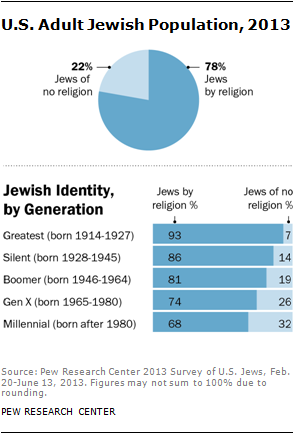
The changing nature of Jewish identity stands out sharply when the survey’s results are analyzed by generation. Fully 93% of Jews in the aging Greatest Generation identify as Jewish on the basis of religion (called “Jews by religion” in this report); just 7% describe themselves as having no religion (“Jews of no religion”). By contrast, among Jews in the youngest generation of U.S. adults – the Millennials – 68% identify as Jews by religion, while 32% describe themselves as having no religion and identify as Jewish on the basis of ancestry, ethnicity or culture.

jew-overview-2

This shift in Jewish self-identification reflects broader changes in the U.S. public. Americans as a whole – not just Jews – increasingly eschew any religious affiliation. Indeed, the share of U.S. Jews who say they have no religion (22%) is similar to the share of religious “nones” in the general public (20%), and religious disaffiliation is as common among all U.S. adults ages 18-29 as among Jewish Millennials (32% of each).2

Secularism has a long tradition in Jewish life in America, and most U.S. Jews seem to recognize this: 62% say being Jewish is mainly a matter of ancestry and culture, while just 15% say it is mainly a matter of religion. Even among Jews by religion, more than half (55%) say being Jewish is mainly a matter of ancestry and culture, and two-thirds say it is not necessary to believe in God to be Jewish.

jew-overview-4

Compared with Jews by religion, however, Jews of no religion (also commonly called secular or cultural Jews) are not only less religious but also much less connected to Jewish organizations and much less likely to be raising their children Jewish. More than 90% of Jews by religion who are currently raising minor children in their home say they are raising those children Jewish or partially Jewish. In stark contrast, the survey finds that two-thirds of Jews of no religion say they are not raising their children Jewish or partially Jewish – either by religion or aside from religion.

Intermarriage is a related phenomenon. It is much more common among secular Jews in the survey than among Jews by religion: 79% of married Jews of no religion have a spouse who is not Jewish, compared with 36% among Jews by religion. And intermarried Jews, like Jews of no religion, are much less likely to be raising their children in the Jewish faith. Nearly all Jews who have a Jewish spouse say they are raising their children as Jewish by religion (96%). Among Jews with a non-Jewish spouse, however, 20% say they are raising their children Jewish by religion, and 25% are raising their children partly Jewish by religion. Roughly one-third (37%) of intermarried Jews who are raising children say they are not raising those children Jewish at all.
jew-overview-5

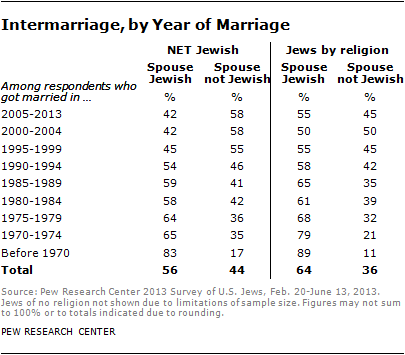
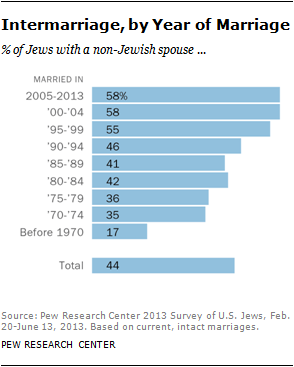
Moreover, intermarriage rates seem to have risen substantially over the last five decades. Among Jewish respondents who have gotten married since 2000, nearly six-in-ten have a non-Jewish spouse. Among those who got married in the 1980s, roughly four-in-ten have a non-Jewish spouse. And among Jews who got married before 1970, just 17% have a non-Jewish spouse.3

It is not clear whether being intermarried tends to make U.S. Jews less religious, or being less religious tends to make U.S. Jews more inclined to intermarry, or some of both. Whatever the causal connection, the survey finds a strong association between secular Jews and religious intermarriage. In some ways, the association seems to be circular or reinforcing, especially when child rearing is added into the picture. Married Jews of no religion are much more likely than married Jews by religion to have non-Jewish spouses. Jews who have non-Jewish spouses are much less likely than those married to fellow Jews to be raising children as Jewish by religion and much more likely to be raising children as partially Jewish, Jewish but not by religion, or not Jewish at all. Furthermore, Jews who are the offspring of intermarriages appear, themselves, to be more likely to intermarry than Jews with two Jewish parents.
jew-overview-6

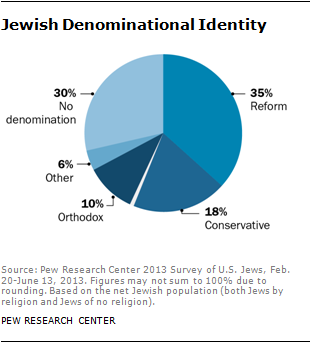
The survey also shows that Reform Judaism continues to be the largest Jewish denominational movement in the United States. One-third (35%) of all U.S. Jews identify with the Reform movement, while 18% identify with Conservative Judaism, 10% with Orthodox Judaism and 6% with a variety of smaller groups, such as the Reconstructionist and Jewish Renewal movements. About three-in-ten American Jews (including 19% of Jews by religion and two-thirds of Jews of no religion) say they do not identify with any particular Jewish denomination.

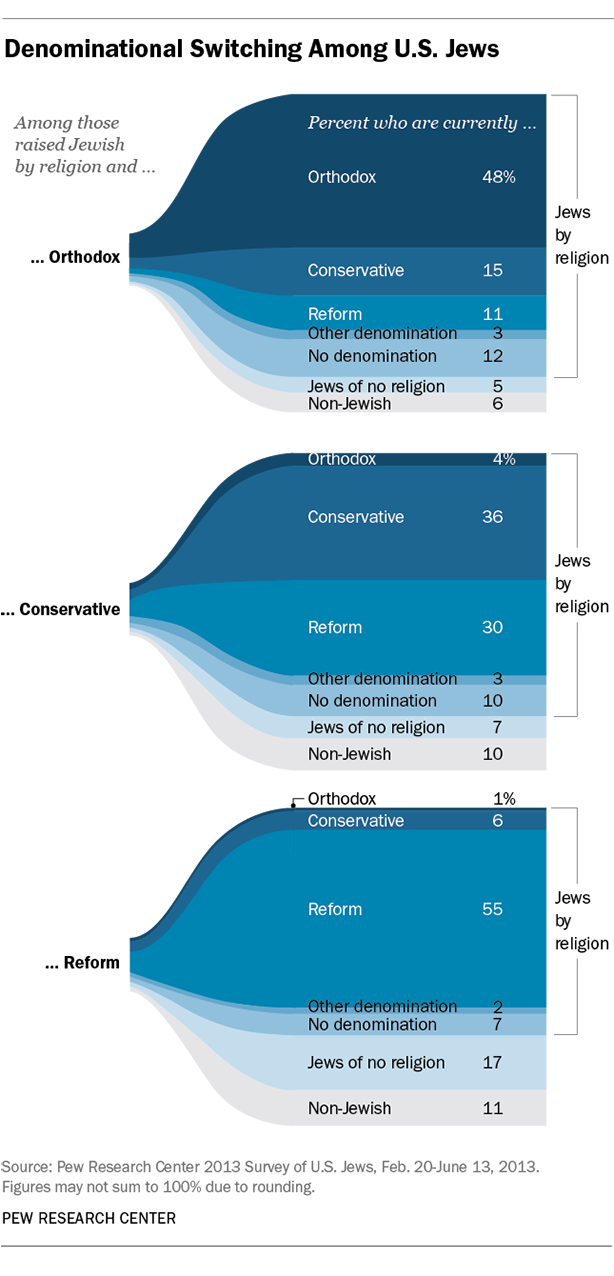
Though Orthodox Jews constitute the smallest of the three major denominational movements, they are much younger, on average, and tend to have much larger families than the overall Jewish population. This suggests that their share of the Jewish population will grow. In the past, high fertility in the U.S. Orthodox community has been at least partially offset by a low retention rate: Roughly half of the survey respondents who were raised as Orthodox Jews say they are no longer Orthodox. But the falloff from Orthodoxy appears to be declining and is significantly lower among 18-to-29-year-olds (17%) than among older people. (See discussion and table in Chapter 3, Jewish Identity.)

Within all three denominational movements, most of the switching is in the direction of less-traditional Judaism. The survey finds that approximately one-quarter of people who were raised Orthodox have since become Conservative or Reform Jews, while 30% of those raised Conservative have become Reform Jews, and 28% of those raised Reform have left the ranks of Jews by religion entirely. Much less switching is reported in the opposite direction. For example, just 7% of Jews raised in the Reform movement have become Conservative or Orthodox, and just 4% of those raised in Conservative Judaism have become Orthodox.
print_graphics_denom_switching

These are among the key findings of the Pew Research Center’s survey of U.S. Jews, conducted on landlines and cellphones among 3,475 Jews across the country from Feb. 20-June 13, 2013, with a statistical margin of error for the full Jewish sample of plus or minus 3.0 percentage points.

The new survey also finds that seven-in-ten Jews (70%) say they participated in a Passover meal (Seder) in the past year, and 53% say they fasted for all or part of Yom Kippur in 2012. These measures of observance appear to have ticked downward slightly compared with a national telephone survey conducted more than a decade ago, the 2000-2001 National Jewish Population Survey.4 In that poll, 78% of Jews said they had participated in a Seder in the past year, and 60% said they had fasted on Yom Kippur. If there has been any decline on these measures, however, it appears to be attributable to the rising number of Jews of no religion; rates of Passover and Yom Kippur observance have remained stable among Jews by religion.
jew-overview-8

Despite the changes in Jewish identity in America, 94% of U.S. Jews (including 97% of Jews by religion and 83% of Jews of no religion) say they are proud to be Jewish. Three-quarters of U.S. Jews (including 85% of Jews by religion and 42% of Jews of no religion) also say they have “a strong sense of belonging to the Jewish people.” And emotional attachment to Israel has not waned discernibly among American Jews in the past decade, though it is markedly stronger among Jews by religion (and older Jews in general) than among Jews of no religion (and younger Jews in general).5

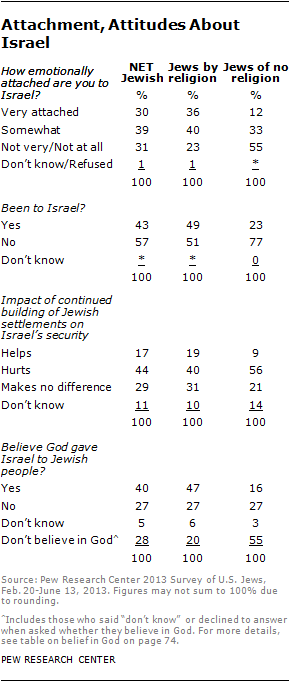
Overall, about seven-in-ten Jews surveyed say they feel either very attached (30%) or somewhat attached (39%) to Israel, essentially unchanged since 2000-2001. In addition, 43% of Jews have been to Israel, including 23% who have visited more than once. And 40% of Jews say they believe the land that is now Israel was given by God to the Jewish people.

At the same time, many American Jews express reservations about Israel’s approach to the peace process. Just 38% say the Israeli government is making a sincere effort to establish peace with the Palestinians. (Fewer still – 12% – think Palestinian leaders are sincerely seeking peace with Israel.) And just 17% of American Jews think the continued building of settlements in the West Bank is helpful to Israel’s security; 44% say that settlement construction hurts Israel’s own security interests.
jew-overview-9

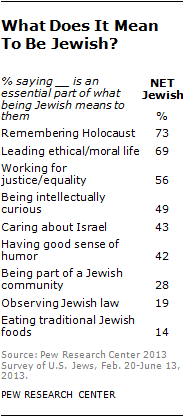
A key aim of the Pew Research Center survey is to explore Jewish identity: What does being Jewish mean in America today? Large majorities of U.S. Jews say that remembering the Holocaust (73%) and leading an ethical life (69%) are essential to their sense of Jewishness. More than half (56%) say that working for justice and equality is essential to what being Jewish means to them. And about four-in-ten say that caring about Israel (43%) and having a good sense of humor (42%) are essential to their Jewish identity.

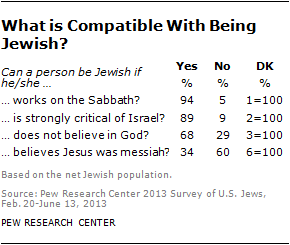
But observing religious law is not as central to most American Jews. Just 19% of the Jewish adults surveyed say observing Jewish law (halakha) is essential to what being Jewish means to them. And in a separate but related question, most Jews say a person can be Jewish even if that person works on the Sabbath or does not believe in God. Believing in Jesus, however, is enough to place one beyond the pale: 60% of U.S. Jews say a person cannot be Jewish if he or she believes Jesus was the messiah.
jew-overview-10

By several conventional measures, Jews tend to be less religious than the U.S. public as a whole. Compared with the overall population, for example, Jews are less likely to say that they attend religious services weekly or that they believe in God with absolute certainty. And just 26% of U.S. Jews say religion is very important in their lives, compared with 56% of the general public. (Orthodox Jews are a clear exception in this regard, exhibiting levels of religious commitment that place them among the most religiously committed groups in the country.) But while relatively few Jews attach high importance to religion, far more (46%) say being Jewish is very important to them.

Other findings from the Pew Research Center survey include:

  • Jews from the former Soviet Union and their offspring account for roughly one-tenth of the U.S. Jewish population; 5% of Jewish adults say they were born in the former Soviet Union, and an additional 6% say they were born in the U.S. but have at least one parent who was born in the former Soviet Union.
  • Jews have high levels of educational attainment. Most Jews are college graduates (58%), including 28% who say they have earned a post-graduate degree. By comparison, 29% of U.S. adults say they graduated from college, including 10% who have a post-graduate degree.
  • Fully one-quarter of Jews (25%) say they have a household income exceeding $150,000, compared with 8% of adults in the public as a whole. At the same time, 20% of U.S. Jews report household incomes of less than $30,000 per year; about six-in-ten Jews in this low-income category are either under age 30 or 65 or older.
  • Roughly four-in-ten U.S. Jewish adults (39%) say they live in a household where at least one person is a member of a synagogue. This includes 31% of Jewish adults (39% of Jews by religion and 4% of Jews of no religion) who say they personally belong to a synagogue, temple or other congregation.
  • Jews think several other minority groups face more discrimination than they do. Roughly seven-in-ten Jews (72%) say gays and lesbians face a lot of discrimination in American society, and an equal number say there is lot of discrimination against Muslims. More than six-in-ten (64%) say blacks face a lot of discrimination. By comparison, 43% say Jews face a lot of discrimination. Overall, 15% of Jews say that in the past year they personally have been called offensive names or snubbed in a social setting because they are Jewish.
  • Half of Jews (52%), including 60% of Jews by religion and 24% of Jews of no religion, say they know the Hebrew alphabet. But far fewer (13% of Jews overall, including 16% of Jews by religion and 4% of Jews of no religion) say they understand most or all of the words when they read Hebrew.
  • Jews are heavily concentrated in certain geographic regions: 43% live in the Northeast, compared with 18% of the public as a whole. Roughly a quarter of Jews reside in the South (23%) and in the West (23%), while 11% live in the Midwest. Half of Jews (49%) reside in urban areas and a similar number (47%) reside in the suburbs; just 4% of Jews reside in rural areas.
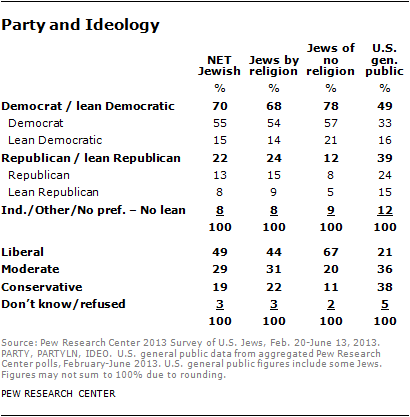
  • As a whole, Jews support the Democratic Party over the Republican Party by more than three-to-one: 70% say they are Democrats or lean toward the Democratic Party, while 22% are Republicans or lean Republican. Among Orthodox Jews, however, the balance tilts in the other direction: 57% are Republican or lean Republican, and 36% are Democrats or lean Democratic.

About the Survey
jew-overview-11

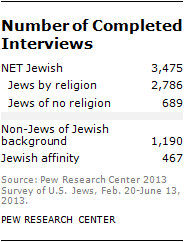
These are some of the findings of the new Pew Research Center survey, conducted Feb. 20-June 13, 2013, among a nationally representative sample of U.S. Jews. This is the most comprehensive national survey of the Jewish population since the 2000-2001 National Jewish Population Survey. More than 70,000 screening interviews were conducted to identify Jewish respondents in all 50 states and the District of Columbia. Longer interviews were completed with 3,475 Jews, including 2,786 Jews by religion and 689 Jews of no religion.

Interviews were conducted in English and Russian by random digit dialing on both landlines and cellphones. In order to reach Jewish respondents most efficiently, the survey focused on telephone exchanges for counties where previous surveys indicate that at least some Jews reside. Overall, the survey covered geographic areas that are home to more than 90% of U.S. adults. Counties were excluded from the survey only if (a) no Jews had been interviewed in those counties in more than 150 Pew Research Center surveys conducted over the past decade and (b) no other surveys in a Brandeis University database had ever interviewed a Jew in those counties and (c) no synagogues or institutions of Jewish education were known to be located in those counties at the time of the Pew Research survey.6 Based on this geographic coverage, more than 95% of the Jewish population, including 99% of the Jewish by religion population, is estimated to have been eligible to be called for the survey. A more detailed explanation of the survey’s methodology is provided in Appendix A (PDF).

In addition to interviewing Jews, the survey interviewed 1,190 people of Jewish background – U.S. adults who were raised Jewish or had at least one Jewish parent, but who now have a religion other than Judaism (most are Christian) or who say they do not consider themselves Jewish (either by religion or aside from religion). Finally, the survey also interviewed 467 people with a Jewish affinity – people who have a religion other than Judaism (or have no religion) and who were not raised Jewish and did not have a Jewish parent, but who nevertheless consider themselves Jewish or partially Jewish in some way.

This report focuses primarily on Jews by religion and Jews of no religion, which are combined into a “net” Jewish category. The size and characteristics of people of Jewish background and Jewish affinity are summarized in Chapter 1 (Population Estimates) and Chapter 7 (People of Jewish Background and Jewish Affinity).

Acknowledgments

The Pew Research Center’s 2013 survey of U.S. Jews was conducted by the center’s Religion & Public Life Project with generous funding from The Pew Charitable Trusts and the Neubauer Family Foundation.

Many Pew Research Center staff members contributed to this effort. Alan Cooperman oversaw the research project and served as lead editor of the report. Gregory Smith took the lead in the development of the survey instrument and sampling plan as well as the analysis of the results. Conrad Hackett and Noble Kuriakose developed the population estimates.

The report’s overview was written by Cooperman and Smith. Chapters 1 and 2 were written by Hackett, Smith, Cooperman and Kuriakose. Chapter 3 was written by Smith and Fatima Ghani. Besheer Mohamed and Juliana Horowitz wrote Chapters 4 and 5. Elizabeth Sciupac wrote Chapters 6 and 7. Smith, Hackett and Mohamed drafted Appendix A (Methodology). The report was number checked by Phillip Connor, Kathleen Flynn, Cary Funk, Jessica Martinez, Michael Robbins and Neha Sahgal as well as Ghani, Hackett, Kuriakose, Mohamed, Sciupac and Smith.

Others at the Pew Research Center who provided editorial or research guidance include Alan Murray, Andrew Kohut, Paul Taylor, Scott Keeter, Jon Cohen and Jeffrey Passel. Leah Christian, formerly a Pew Research Center senior researcher, also contributed to the project. Other staff members who contributed include Sandra Stencel, Erin O’Connell, Michael Lipka, Joseph Liu, Tracy Miller, Adam Nekola, Liga Plaveniece, Carla Ritz, Stacy Rosenberg, Bethany Smith, Bill Webster and Diana Yoo.

Fieldwork for the survey was carried out by the firm Abt SRBI, with Benjamin Phillips as project manager and Stas Kolenikov as lead statistician. Abt SRBI’s Mark Schulman, Chintan Turakhia and Charles DiSogra reviewed the weighting of the survey.

The Pew Research Center received invaluable advice on the survey questionnaire, methodology and analysis of results from a panel of advisers that included several of the leading figures in the study of American Jewry: Rabbi B. Elka Abrahamson, President of The Wexner Foundation, New Albany, Ohio; Sarah Bunin Benor, Associate Professor of Contemporary Jewish Studies, Hebrew Union College-Jewish Institute of Religion, Los Angeles; Steven M. Cohen, Research Professor of Jewish Social Policy at Hebrew Union College-Jewish Institute of Religion and Director of the Berman Jewish Policy Archive at NYU Wagner; Sergio DellaPergola, Shlomo Argov Professor Emeritus of Israel-Diaspora Relations at The Hebrew University of Jerusalem; David Dutwin, Executive Vice President and Chief Methodologist, Social Science Research Solutions, Media, Pa.; Jane Eisner, Editor-in-Chief, The Jewish Daily Forward, New York City; Laurence Kotler-Berkowitz, Senior Director of Research and Analysis and Director of the Berman Jewish DataBank at The Jewish Federations of North America, New York City; Jonathan Sarna, Joseph H. & Belle R. Braun Professor of American Jewish History at Brandeis University, Waltham, Mass.; Leonard Saxe, Klutznick Professor of Contemporary Jewish Studies and Social Policy at Brandeis University and Director of the university’s Cohen Center for Modern Jewish Studies and the Steinhardt Social Research Institute; Jack Wertheimer, Joseph and Martha Mendelson Professor of American Jewish History at The Jewish Theological Seminary, New York City; and Leon Wieseltier, Literary Editor of The New Republic, Washington, D.C.

In addition, the Pew Research Center’s Religion & Public Life Project would like to thank several other institutions and individuals who generously provided data and advice: Elizabeth Tighe, Matthew Boxer and Charles Kadushin at the Steinhardt Social Research Institute at Brandeis University; Samuel Heilman, Distinguished Professor of Sociology and Harold Proshansky Chair in Jewish Studies at Queens College, CUNY; Bruce A. Phillips, Professor of Jewish Communal Service in the Louchheim School of Judaic Studies at Hebrew Union College-Jewish Institute of Religion and the University of Southern California, Los Angeles; and John C. Green, Director of the Ray C. Bliss Institute of Applied Politics and Distinguished Professor of Political Science at the University of Akron, Ohio.

Roadmap to the Report

The rest of this report details the survey’s findings on the size, beliefs, practices and attitudes of the U.S. Jewish population. The first section estimates the size of the American Jewish population using various definitions of who is a Jew. The second section covers intermarriage and demographic characteristics, such as age, education and income. The third section examines aspects of Jewish identity, including questions about what is essential to Jewish identity, what is incompatible with being Jewish, friendship networks, Jewish education and child rearing. The fourth section explores religious beliefs and practices, including attendance at religious services, lighting Sabbath candles and participating in the Passover meal. The fifth section looks at attitudes toward and connection with Israel, including views on a two-state solution and the Israeli-Palestinian peace process. The sixth section discusses political views and social attitudes, including political party identification, views of President Obama, attitudes toward homosexuality and perceptions of discrimination. The seventh section describes the characteristics of people of Jewish background and Jewish affinity, including their answers to an open-ended question about the ways in which they consider themselves Jewish. The survey methodology, topline and full questionnaire are included in appendices.

The online version of the report includes two interactive features – one illustrating Jewish denominational switching and the other allowing the user to calculate the size of the Jewish population based on his or her own definition of who is a Jew.
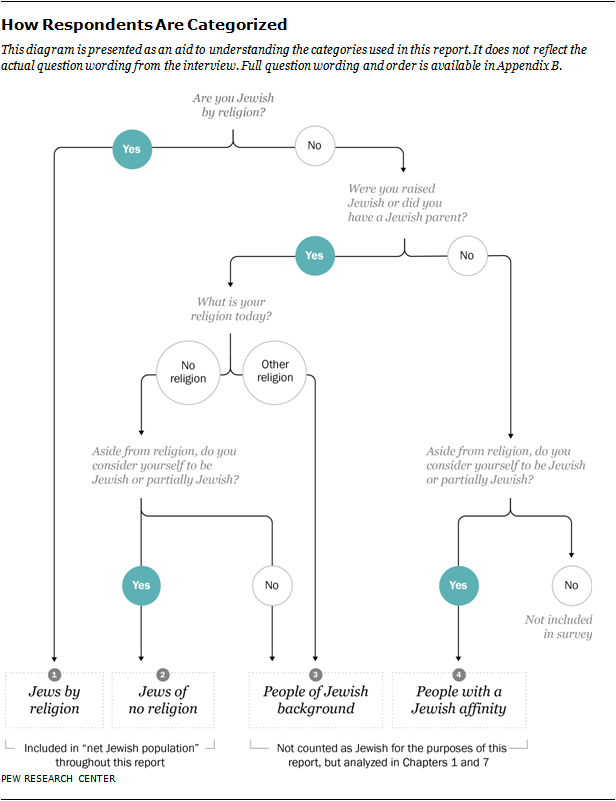
Sidebar: Who is a Jew?

One of the first decisions that had to be made in conducting this study and analyzing its results was to answer the question, “Who is a Jew?” This is an ancient question with no single, timeless answer. On the one hand, being Jewish is a matter of religion – the traditional, matrilineal definition of Jewish identity is founded on halakha (Jewish religious law). On the other hand, being Jewish also may be a matter of ancestry, ethnicity and cultural background. Jews (and non-Jews) may disagree on where to draw the line. Is an adult who has Jewish parents but who considers herself an atheist nevertheless Jewish, by virtue of her lineage? What about someone who has Jewish parents and has converted to Christianity? Or someone who has no known Jewish ancestry but is married to a Jew and has come to think of himself as Jewish, though he has not formally converted to Judaism?

Various readers will have their own answers to these questions. The approach taken in this survey was to cast the net widely, seeking to interview all adults who answer an initial set of questions (the “screener”) by saying (a) that their religion is Jewish, or (b) that aside from religion they consider themselves to be Jewish or partially Jewish, or (c) that they were raised Jewish or had at least one Jewish parent, even if they do not consider themselves Jewish today. Anyone who said “yes” to any of these questions was eligible for the main interview, which included many more questions detailing religious beliefs and practices; denominational affiliations such as Reform, Conservative and Orthodox; synagogue and Jewish community connections; the religious affiliation of parents, spouses, partners and children in the home; attitudes toward Jewish identity; social and political views; and demographic measures such as age and education. This wide-net approach gives readers (and scholars who later conduct secondary analysis of the survey data) a great deal of flexibility to apply whatever definitions of “Jewish” they think are appropriate.

This report analyzes the survey data using four main categories. These are defined to be as consistent as possible with previous major surveys of U.S. Jews (e.g., by counting as Jewish not just religious Jews but also people of Jewish upbringing, even if they are not religious) while still making intuitive sense to a general U.S. audience (e.g., by not counting as Jewish anyone who describes him/herself as a Christian or who does not consider him/herself Jewish). The categories are:

  • Jews by religion – people who say their religion is Jewish (and who do not profess any other religion);
  • Jews of no religion – people who describe themselves (religiously) as atheist, agnostic or nothing in particular, but who have a Jewish parent or were raised Jewish and who still consider themselves Jewish in some way.

These first two groups constitute, for the purposes of this analysis, the “net” Jewish population. In addition, the survey interviewed:

  • Non-Jewish people of Jewish background – people who have a Jewish parent or were raised Jewish but who, today, either have another religion (most are Christian) or say they do not consider themselves Jewish;
  • Non-Jewish people with a Jewish affinity – people who identify with another religion (in most cases, Christianity) or with no religion and who neither have a Jewish parent nor were raised Jewish but who nevertheless consider themselves Jewish in some way. Some say, for example, that they consider themselves partly Jewish because Jesus was Jewish, because “we all come from Abraham” or because they have Jewish friends or relatives.

Most of this report focuses on the net Jewish population (Jews by religion and Jews of no religion). Whenever the views or characteristics of U.S. Jews (or just “Jews”) are discussed, this refers to the combined categories of Jews by religion and Jews of no religion. The characteristics and attitudes of people of Jewish background and people with a Jewish affinity are discussed separately in Chapter 7 of this report.

jew-overview-sidebar

Chapter 1: Population Estimates

The size of the U.S. Jewish population has been a matter of lively debate among academic experts for more than a decade. Because the Pew Research survey involves a representative sample of Jews, rather than a census of all American Jews, it cannot definitively answer the question. However, data from the survey can be used to derive a rough estimate of the size of the U.S. Jewish population. Perhaps even more valuably, the survey illuminates the many different ways in which Americans self-identify as Jewish or partially Jewish, and it therefore provides a sense of how the size of the population varies depending on one’s definition of who is a Jew.

Jewish Adults

jew-chp1-1

If Jewish refers only to people whose religion is Jewish (Jews by religion), then the survey indicates that the Jewish population currently stands at about 1.8% of the total U.S. adult population, or 4.2 million people. If one includes secular or cultural Jews – those who say they have no religion but who were raised Jewish or have a Jewish parent and who still consider themselves Jewish aside from religion – then the estimate grows to 2.2% of American adults, or about 5.3 million. For the purposes of the analysis in this report, these two groups make up the “net” Jewish population.

Narrower or broader definitions would result in smaller or larger numbers. For example, if one were to exclude adults who self-identify as only “partly” Jewish, the 5.3 million figure would decrease by about 600,000, to approximately 4.7 million.

Alternatively, one could define Jewish more expansively, to include all Americans who have at least one Jewish parent or were raised Jewish, regardless of whether they now have another religion, such as Christianity. In that case, the survey suggests the total adult Jewish population (including all Jews by religion, Jews of no religion and people of Jewish background) would make up about 3.3% of American adults, or approximately 7.8 million people. If one were to adopt an even broader definition of Jewish identity and include all Americans who say they consider themselves Jewish for any reason – even if they do not have direct Jewish ancestry – the survey indicates the adult Jewish population would be roughly 3.8% of the overall adult population, or about 9.0 million people.

These are just a few of the many ways that data from the Pew Research survey could be used to generate differing population figures, depending on whom one counts as Jewish. One other common definition should be mentioned, though it is not shown in the accompanying tables: In traditional Jewish law (halakha), Jewish identity is passed down through matrilineal descent, and the survey finds that about 90% of Jews by religion and 64% of Jews of no religion – a total of about 4.4 million U.S. adults – say they have a Jewish mother. Additionally, about 1.3 million people who are not classified as Jews in this report (49% of non-Jews of Jewish background) say they have a Jewish mother.7

Jewish Children

The survey also asked Jewish adults to list the children in their household and to describe how each child is being raised. As a result, the estimates of the size of the Jewish population can be enlarged to include various categories of children. As with the number of Jewish adults, however, the number of Jewish children depends on who counts as Jewish.

jew-chp1-2

In total, the study estimates that 1.8 million children reside in households with at least one Jewish adult. This includes approximately 900,000 children who are being raised exclusively Jewish by religion; about 100,000 children who are being raised as Jews of no religion; and 300,000 children who are being raised partly Jewish and partly in another religion. In addition, survey respondents report that about 400,000 children are not being raised Jewish at all, despite residing in a household with at least one Jewish adult.8

Combining 5.3 million adult Jews (the estimated size of the net Jewish population in this survey) with 1.3 million children (in households with a Jewish adult who are being raised Jewish or partly Jewish) yields a total estimate of 6.7 million Jews of all ages in the United States (rounded to the nearest 100,000).

Using a more expansive definition, one could add children living in households with at least one adult of Jewish background. This could include approximately 200,000 children who are being raised both Jewish by religion and in another religion, as well as roughly 100,000 children who are being raised in another religion and partly Jewish aside from religion. In that case, the 6.7 million estimate would rise to about 7.0 million.

On the other hand, if one were to take a more restrictive definition and exclude children who are being raised only partly Jewish as well as adults who identify as only partly Jewish, the 6.7 million figure would decline by about 900,000, to approximately 5.7 million.

For an explanation of how the estimates are calculated (including adjustments for areas of the country not covered by the survey, people in institutionalized settings such as nursing homes and prisons, and people unable to take a telephone survey in either English or Russian), see Appendix A: Survey Methodology (PDF).

How Do These Estimates Compare With Previous Estimates?

Comparisons between surveys of U.S. Jews are complicated by differences in their sampling methods, question wording and definitions of who counts as Jewish. Probably the most frequently cited previous estimate of the size of the American Jewish population is from the 2000-2001 National Jewish Population Survey, which came up with a figure of 5.2 million adults and children in the “core” Jewish population. The NJPS population estimate, however, is not directly comparable to the population estimates in the Pew Research survey, for several reasons. Perhaps most important, some experts think the NJPS substantially undercounted the number of Jews in America; it became the subject of heavy criticism on methodological grounds, several reassessments and continuing academic controversy.9 In addition, the definitions of some of the Jewish population categories in the NJPS differ from the definitions of the corresponding categories in the current survey.10

Perhaps the most widely accepted prior estimate of the number of Jews by religion in America comes from the 1957 Current Population Survey, the only time in the last six decades that the U.S. Census Bureau has asked individual Americans about their religious affiliation. It found that Jews made up about 3.2% of Americans ages 14 and older, or about 3.9 million people in 1957. Surveys conducted by Gallup and the American National Election Studies (ANES) in the 1950s and 1960s also consistently found that 3-4% of American adults said their religion was Jewish. How many Americans considered themselves Jewish aside from religion in the 1950s and 1960s is not known, however, because the question was not asked in large-scale surveys at that time.

Since 2000, the share of American adults who say their religion is Jewish has generally ranged between 1.2% and 2% in national surveys. Using a variety of techniques, leading scholars have synthesized data from different sources to produce additional estimates:

  • A statistical meta-analysis of national surveys (including previous Pew Research surveys) by Leonard Saxe and Elizabeth Tighe at Brandeis University’s Steinhardt Social Research Institute concluded that as of 2010, 1.8% of U.S. adults (or 4.2 million people) were Jews by religion; they estimated the total Jewish population at 6.5 million, including 975,000 adults who identify as Jewish but not by religion and 1.3 million children who are being raised exclusively as Jewish.
  • Researchers Ira M. Sheskin of the University of Miami and Arnold Dashefsky of the University of Connecticut amalgamated the results of dozens of local surveys of Jewish communities and estimated that as of 2012 there were 6.7 million U.S. Jews of all ages across the country – although they also said the actual figure was probably somewhat lower, due to double-counting.
  • Sergio DellaPergola, a demographer at the Avraham Harman Institute of Contemporary Jewry at The Hebrew University of Jerusalem, analyzed patterns over time in Jewish fertility, mortality, conversion, migration and other demographic factors to estimate that the “core” U.S. Jewish population (including Jews by religion and Jews of no religion) was between 5.2 million and 5.7 million in 2010; he also estimated the total number of Americans with “direct Jewish ancestry,” regardless of their current religion, at about 6.8 million.
jew-chp1-3

The estimate from the new Pew Research survey that there are approximately 5.3 million “net” Jewish adults and 1 million children who are being raised exclusively as Jewish (or 1.3 million children being raised at least partly Jewish) falls roughly in the middle of these prior estimates – somewhat higher than DellaPergola’s numbers, somewhat lower than the Dashefsky-Sheskin figure and fairly close to the Saxe-Tighe estimates.

The estimate that Jews by religion make up 1.8% of U.S. adults also is consistent with the results of Pew Research surveys over the past five years and close to the findings of other recent national surveys (such as Gallup polls and the General Social Surveys conducted by the independent research organization NORC at the University of Chicago) that use similar, close-ended questions about religious affiliation.11 In aggregated Pew Research polling, the Jewish by religion share of the population has ranged in recent years between 1.5% (in 2009) and 1.9% (in 2010). GSS estimates have ranged from 1.5% (in 2012) to 1.7% (in 2008). Combining its own surveys conducted since 2008, Pew Research finds that a weighted average of 1.7% of U.S. adults identify as Jews by religion, while the GSS and Gallup find 1.6% identifying as Jews by religion.

Trends in the Size of the Jewish Population

Using the 1957 Current Population Survey as a benchmark, it appears that the number of adult Jews by religion rose about 15% over the last half-century, while the total U.S. population more than doubled over the same period.12 As a result, national surveys that repeatedly have asked Americans about their religion (Gallup, the American National Election Studies, the General Social Surveys and the American Religious Identification Surveys) show a decline, over the long term, in the percentage of U.S. adults who say their religion is Jewish, though the Jewish share of the adult population appears to have held fairly steady in the past two decades.13 (See charts below.)

The long-term decline in the Jewish by religion share of the population results partly from differences in the median age and fertility of Jews compared with the public at large. As early as 1957, Jews by religion were significantly older and had fewer children than the U.S. population as a whole. At that time, the median age of Jews older than age 14 was 44.5 years, compared with 40.4 years among the population as a whole, and Jewish women ages 15-44 had 1.2 children on average, compared with 1.7 children among this age group in the general public.14 Today, Jews by religion still are considerably older than U.S. adults as a whole, although they are similar to the general public in the number of children ever born. (See discussion of median age and fertility in the Age and Fertility sections in Chapter 2.)

Migration also is a factor. The growth in the overall U.S. population has been driven in part by Hispanic immigration, and the percentage of Jews by religion among Hispanics is even lower than in the general public. On the other hand, there have been two major waves of Jewish immigrants from the former Soviet Union in recent decades, and as a result, the share of Jewish adults who are foreign-born today (14%) is only a little lower than the share of all U.S. adults who are foreign born (17%). (For more details on Jewish immigrants, see the table on Ancestry and Place of Birth in Chapter 2.)

But demographics are not the only explanation for the long-term decline in the share of Americans who say their religion is Jewish. Jews by religion also have lost more people than they have gained due to religious switching. The new Pew Research survey finds that, by a two-to-one margin, former Jews by religion outnumber those who have become Jewish by religion after not having been raised Jewish.

jew-chp1-4

Growth of Jews of No Religion

Where have the Jews by religion gone? Some have converted to other faiths, but many have become Jews of no religion – people who describe their religion as atheist, agnostic or “nothing in particular” but who were raised Jewish or had a Jewish parent and who still consider themselves Jewish aside from religion. A Pew Research reanalysis of the 2000-2001 National Jewish Population Survey suggests that at that time, 93% of Jews in that study were Jews by religion and 7% were Jews of no religion (after some adjustments to make the NJPS and Pew Research categories as similar as possible). In the new Pew Research survey, 78% of Jews are Jews by religion, and fully 22% are Jews of no religion (including 6% who are atheist, 4% who are agnostic and 12% whose religion is “nothing in particular”). Though the two studies employed different question wording and methodologies and are thus not directly comparable, the magnitude of these differences suggests that Jews of no religion have grown as a share of the Jewish population and the overall U.S. public.15 The new Pew Research survey finds that approximately 0.5% of U.S. adults – about 1.2 million people – are Jews of no religion.

jew-chp1-5

The increase in Jews of no religion appears to be part of a broader trend in American life, the movement away from affiliation with organized religious groups. Surveys by Pew Research and other polling organizations have shown a decline in the percentage of U.S. adults who identify with Protestant denominations and a rapid rise, beginning in the 1990s, in the number of Americans who do not identify with any religion. This group, sometimes called the “nones,” now stands at about 20% of the U.S. public, including roughly a third of adults under 30. (For more information on these broad trends in American religion, including sociological theories about the root causes of disaffiliation, see the Pew Research Center’s October 2012 report “ ‘Nones’ on the Rise.”)

Chapter 2: Intermarriage and Other Demographics

The survey suggests that intermarriage is common among Jews; 44% of all currently married Jewish respondents – and 58% of those who have married since 2005 – indicate they are married to a non-Jewish spouse. The survey also shows that in some important respects, U.S. Jews have a distinctive demographic profile: They are older than the U.S. population as a whole, have high levels of educational attainment as well as average household income, and are geographically concentrated in the Northeast.

Intermarriage

jew-chp2-1

There are many different ways to calculate rates of religious intermarriage, which can result in confusion when making comparisons among studies. For example, one can focus either on the percentage of individuals who are intermarried or on the percentage of couples who are intermarried. One can ask whether a married couple had the same religion at the time of their wedding or whether they have the same religion at present. In theory, one can calculate rates based either on currently intact marriages or on all marriages, including divorces and annulments (though in practice, asking respondents to describe previous marriages may be burdensome, and the Pew Research Center survey did not attempt to do so). In addition, the same considerations that go into defining which respondents are Jewish come into play when deciding which spouses are Jewish. This analysis focuses on Jewish respondents in this survey (i.e., on the percentage of Jewish respondents who are married to non-Jews) and on current, intact marriages. It defines spouses as Jewish in the same way that respondents are categorized.

About half of Jewish respondents are currently married, including 54% of Jews by religion and 41% of Jews of no religion. The share of Jews who are married appears to have declined since 2000 (down from 60% in the 2000-2001 NJPS to 51% today), mirroring a decline in marriage rates among the population overall.

The new Pew Research survey finds that, overall, 56% of married Jews have a Jewish spouse, while 44% of Jewish respondents are married to a non-Jew. Among Jews by religion who are married, 64% have a Jewish spouse and 36% have a non-Jewish spouse. By comparison, Jews of no religion are much more likely to be in mixed marriages; just 21% of married Jews of no religion are married to a Jewish spouse, while 79% are married to a non-Jewish spouse.

Among respondents whose current, intact marriage took place in 2005 or later, 58% have a non-Jewish spouse. A similar number of those who got married between 2000 and 2004 are also in mixed marriages, as are 55% of those who got married in the late 1990s. Intermarriage rates are lower for those who have been married longer. For example, among respondents who got married in the 1980s, roughly four-in-ten have a non-Jewish spouse. And among those who were wed before 1970, just 17% have a non-Jewish spouse.

Among Jews by religion who got married in 2005 or more recently, 55% are married to a Jewish spouse and 45% are married to a non-Jew. (There are too few married Jews of no religion in the current sample to permit separate analysis of intermarriage rates by year of marriage for Jews of no religion alone.)

While these patterns strongly suggest that intermarriage has been rising, at least over the long term, it is important to bear in mind several points when assessing rates of Jewish intermarriage. First, some research indicates that “in-marriages” (marriages between people of the same religion) tend to be more durable than intermarriages; if this is the case, then the percentage of intermarriages in the 1970s and 1980s may have been higher than it appears from looking only at intact marriages today.

Second, racial and ethnic intermarriage as a whole has been increasing in the U.S. public; about 15% of all new marriages in the United States in 2010 were between spouses of a different race or ethnicity from one another, more than double the share in 1980 (6.7%).16

And, finally, the relatively small size of the U.S. Jewish population should be taken into account. If marital choices were purely random, the odds of one Jewish American marrying another Jewish American would be much smaller than the odds of one Protestant marrying another Protestant or one Catholic marrying another Catholic, since Protestants make up nearly half of the U.S. public and Catholics make up roughly a quarter of the overall population.17 For this reason, rates of intermarriage among Jews are perhaps most directly comparable to rates of intermarriage among other relatively small U.S. religious groups, such as Mormons and Muslims. Previous Pew Research surveys have found that 87% of Mormons and more than eight-in-ten Muslims (84%) in the United States are married to people with the same religion.18

jew-chp2-2

Rates of intermarriage vary considerably among the major U.S. Jewish movements or denominations. Virtually all Orthodox respondents who are married have a Jewish spouse (98%), and most married Conservative Jews also have Jewish spouses (73%). Half of Reform Jews who are married have a Jewish spouse. Among married Jews who have no denominational affiliation, 31% have a Jewish spouse.

The survey also suggests that intermarriage is much more common among Jewish respondents who are themselves the children of intermarriage. Among married Jews who report that only one of their parents was Jewish, fully 83% are married to a non-Jewish spouse. By contrast, among married Jews who say both of their parents were Jewish, 63% have a Jewish spouse and 37% have a non-Jewish spouse.

For a discussion of patterns in child rearing among intermarried and in-married Jews, see Child Rearing Section in Chapter 3.

jew-chp2-3

Age

The survey finds that, on average, Jewish adults are older than the U.S. public as a whole, and Jews by religion are older than Jews of no religion.

Roughly half of Jewish adults (51%) are ages 50 and older, compared with 44% of adults in the general population. Among Jews by religion, 55% are 50 and older, compared with 39% among Jews of no religion.

jew-chp2-4

Among adults, the median age in the Jewish population is 50.19 In the general public, the adult median age is 46. Though Jews of no religion are younger (median age of 43) than Jews by religion (52), they are not as young as the broader religiously unaffiliated population (37).

Orthodox Jews (median age of 40 among adults) are substantially younger than Conservative Jews (55) and Reform Jews (54).

In comparison, the median age of adults in the Christian population is 49, similar to the net Jewish population (50). The adult median age is higher among white evangelical Protestants (53), white mainline Protestants (52) and white Catholics (52).20 The median among Hispanic Catholics (40) and the unaffiliated (37) is comparatively young.

Fertility

jew-chp2-5

Jewish adults ages 40-59 report having had an average of 1.9 children, compared with an average of 2.2 children per adult in the same age cohort of the general public. Jews by religion average more children (2.1) than Jews of no religion (1.5), and the average number of children born to Orthodox Jews (4.1) is about twice the overall Jewish average. By contrast, Reform Jews have 1.7 children and Conservative Jews have 1.8 children, on average. Jewish respondents married to Jewish spouses have more children on average than Jews married to non-Jews (2.8 vs. 1.8), and married Jews have more children than those who have never been married (2.3 vs. 0.2).

While Christians as a whole tend to have more children (2.3) than do Jews (1.9), white evangelical Protestants, white mainline Protestants and white Catholics all average about the same number of children as Jews by religion (2.1). Among Christians, relatively high fertility is found among black Protestants (2.6 children) and Hispanic Catholics (3.1).

These results are based on births reported by male and female survey respondents.21 The number of children ever born to adults ages 40-59 is a good measure of what demographers call completed fertility. In comparisons of childbearing among younger adults across religious groups that vary significantly in educational attainment, it is difficult to determine the extent to which differences in children ever born may be due to differences in the timing of childbearing. By comparing completed fertility, it is possible to see differences that could otherwise be obscured by differences in the timing of childbirth.

Household Composition

On average, Jews live in households with 2.7 people, including 2.2 adults and 0.5 children. Jews by religion and Jews of no religion tend to live in households of similar size (an average of 2.7 people per household among both groups).

Orthodox Jews tend to live in larger households than Jews of other denominational movements. The average Orthodox household contains 1.7 children, compared with 0.3 children per household with a Conservative respondent and 0.4 children per household with a Reform respondent.

jew-chp2-6

Socioeconomic Status

jew-chp2-7

Jews are, on the whole, a comparatively well-educated, high-income group. Nearly six-in-ten adult Jews are college graduates, including 28% who have obtained a post-graduate degree. By comparison, roughly three-in-ten U.S. adults overall are college graduates, including 10% who have a post-graduate degree. Both Jews by religion and Jews of no religion have much higher levels of educational attainment, on average, than does the public overall.

A quarter of Jews, including 26% of Jews by religion and 20% of Jews of no religion, say they have family incomes of $150,000 or more. By comparison, just 8% of U.S. adults overall say their household income is this high.

At the same time, one-fifth of all U.S. Jews report annual household incomes of less than $30,000. Jews with household incomes less than $30,000 are concentrated among young adults and those who have reached retirement age; 38% of Jews under age 30 say they have family incomes of $30,000 or less, as do 24% of Jews 65 and older. By contrast, 16% of Jews ages 30-49 have household incomes of $30,000 or less, and just 11% of Jews ages 50-64 fall into this income bracket. About six-in-ten Reform Jews (61%) and Conservative Jews (62%) say they graduated from college, as do 58% of those with no denominational affiliation. Fewer Orthodox Jews (39%) report having graduated from college, though there are many more college graduates among Modern Orthodox Jews (65%) than among the Ultra-Orthodox (25%).22

jew-chp2-8

Upwards of one-fifth of Jews from all of the major Jewish movements or denominations say they have household incomes of $150,000 or more.

Roughly two-thirds of Jewish adults say they are currently employed. One-third are not employed, including 7% who are currently looking for work. About six-in-ten Jews say they own their home.

jew-chp2-9

Ancestry and Place of Birth

jew-chp2-10

The survey finds that 86% of Jewish adults were born in the United States, including 22% who are the adult children of immigrants and 65% whose families have been in the U.S. for three generations or longer. Roughly one-in-seven Jewish adults (14%) are immigrants, including 5% who were born in the former Soviet Union and 2% who were born in Israel.

In total, 35% of Jewish adults are first- or second- generation immigrants (i.e., are foreign-born or the U.S.-born children of immigrants). Overall, 14% of Jewish adults were born in Europe or had a parent who was born in Europe, and 11% were born in the former Soviet Union or had a parent who was born there. Roughly 4% of U.S. Jews were born in Israel or have a parent who was born in Israel.

jew-chp2-11

Race and Ethnicity

More than nine-in-ten U.S. Jews surveyed describe themselves as non-Hispanic whites, while 2% are black, 3% are Hispanic, and 2% are of other racial and ethnic backgrounds. Racial and ethnic minorities make up a far larger share of the U.S. general population than of the Jewish population.

Geographic Distribution

jew-chp2-12

More than four-in-ten U.S. Jewish adults (43%) live in the Northeast, while 23% reside in the South, 23% in the West and 11% in the Midwest. Compared with Jews by religion, Jews of no religion are less concentrated in the Northeast and more concentrated in the West.

The vast majority of Jews live either in urban areas (49%) or in the suburbs (47%). Just 4% of U.S. Jews reside in rural areas, compared with about one-in-five Americans overall.

Chapter 3: Jewish Identity

U.S. Jews see being Jewish as more a matter of ancestry, culture and values than of religious observance. Six-in-ten say, for example, that being Jewish is mainly a matter of culture or ancestry, compared with 15% who say it is mainly a matter of religion. Roughly seven-in-ten say remembering the Holocaust and leading an ethical life are essential to what it means to them to be Jewish, while far fewer say observing Jewish law is a central component of their Jewish identity. And two-thirds of Jews say that a person can be Jewish even if he or she does not believe in God.

To be sure, there are big differences among Jews about what it means to be Jewish. For instance, Orthodox Jews generally attach much more importance to the religious elements of being Jewish. And for Jews by religion, caring about Israel is much more central than it is for Jews of no religion.

There also are vast differences between Jews by religion and Jews of no religion in their level of involvement in Jewish organizations, in their self-reported ability to speak and understand Hebrew, and in their approach to child rearing. In all of these areas, Jews by religion are much more connected to their Jewish heritage than are Jews of no religion.

Denominational Identity

jew-chp3-1

More than one-third of U.S. Jews (35%) identify with the Reform movement. About one-in-five (18%) identify with the Conservative movement. One-in-ten Jews identify with Orthodox Judaism (10%), including 6% who belong to Ultra-Orthodox groups and 3% who are Modern Orthodox. Three-in-ten Jews (30%) do not identify with any particular Jewish denomination. The remainder (7%) identify with smaller movements (such as Reconstructionism or the Jewish Renewal movement), say they belong to more than one movement (such as both Conservative and Orthodox), or decline to answer the question.

Most Jews by religion identify with either Reform (40%), Conservative (22%) or Orthodox Judaism (12%), with just 19% saying they belong to no particular denomination. By contrast, most Jews of no religion have no denominational affiliation (66%). However, one-in-five Jews of no religion describe themselves as Reform Jews (20%), while 6% identify with Conservative Judaism and 1% say they are Orthodox Jews.

Not all Jews who identify with a denominational movement or stream are members of synagogues. Among Jews who say they are synagogue members, 39% identify with Reform Judaism, 29% with Conservative Judaism, 22% with Orthodox Judaism, 4% with another denominational movement and 6% with no denomination.

jew-chp3-2

Compared with older Jews, younger Jews are more likely to have no denominational attachment and somewhat more likely to be Orthodox Jews. Four-in-ten Jewish adults under age 30 (41%) have no denominational affiliation, and 33% of Jews in their 30s and 40s have no denominational attachment. By contrast, only about a quarter of Jews 50 and older say they have no denominational affiliation.

Among Jews under age 30, 11% are Orthodox Jews (including 9% who are Ultra-Orthodox). And among Jews in their 30s and 40s, 14% are Orthodox (including 10% who are Ultra-Orthodox). One-in-ten or fewer Jews ages 50 and older describe themselves as Orthodox Jews.

jew-chp3-3

Though Orthodox Jews today make up 10% of the net Jewish population and 12% of current Jews by religion, larger numbers (14% of all Jews and 17% of Jews by religion) say they were raised as Orthodox. This reflects a high rate of attrition from Orthodox Judaism, especially among older cohorts. Among those 65 and older who were raised as Orthodox Jews, just 22% are still Orthodox Jews by religion. And among those ages 50-64 who were raised Orthodox, just 41% are still Orthodox Jews by religion. In stark contrast, 83% of Jewish adults under 30 who were raised Orthodox are still Orthodox. Some experts think this is not a result of accumulated departures as people get older (i.e., a life cycle effect), but rather could be a period effect in which people who came of age during the 1950s, 1960s and 1970s left Orthodoxy in large numbers.

Importance of Being Jewish

jew-chp3-4

More than four-in-ten U.S. Jews (46%) say being Jewish is a very important part of their lives, and a third (34%) say being Jewish is somewhat important to them. One-fifth of Jews say that being Jewish is not too (15%) or not at all important to them (5%). Jews by religion are nearly five times more likely to say being Jewish is very important to them compared with Jews of no religion (56% vs. 12%).

Nearly nine-in-ten Orthodox Jews (87%) and two-thirds of Conservative Jews (69%) describe being Jewish as very important in their lives. Far fewer self-identified Reform Jews say being Jewish is very important to them (43%). Among Jews who are unaffiliated with any particular Jewish movement or denomination, just one-in-five say being Jewish is very important to them (22%).

A third of Jews under age 30 say being Jewish is very important to them. Jewish identity is very important to larger numbers of older Jews, including 46% of those ages 30-49, 50% of those ages 50-64 and 54% of those 65 and older.

Pride, Connectedness and Responsibility

jew-chp3-5

More than nine-in-ten Jews (94%) agree they are “proud to be Jewish.” Three-quarters (75%) say they have a strong sense of belonging to the Jewish people, and about six-in-ten (63%) say they have a special responsibility to care for Jews in need around the world.

Overwhelming majorities of both Jews by religion and Jews of no religion say they are proud to be Jewish (97% and 83%, respectively). Most Jews by religion also say they have a strong sense of belonging to the Jewish people (85%) and that they feel a responsibility to care for Jews in need (71%). Far fewer Jews of no religion share these sentiments.

Large majorities in all of the major Jewish movements express pride in being Jewish. Virtually all Orthodox (99%) and nine-in-ten Conservative Jews (92%) feel a strong sense of belonging to the Jewish people, as do 78% of Reform Jews. This connection with the Jewish people is felt less strongly by those with no denominational attachment (53%). Similarly, while majorities of Orthodox, Conservative and Reform Jews say they have a special responsibility to care for Jews in need, less than half of Jews with no denominational affiliation (39%) feel this kind of responsibility.

More older Jews than younger Jews say they feel a strong sense of belonging to the Jewish people. Eight-in-ten Jews 50 and older (80%) say they feel a strong sense of belonging to the Jewish people, compared with 70% of Jews under age 50. Differences among the age groups are smaller on the questions about pride in being Jewish and caring for Jews in need.

Married Jews who have Jewish spouses feel more connected to and responsible for other Jews as compared with Jews who are married to non-Jews. Fully nine-in-ten Jews married to fellow Jews say they have a strong sense of belonging to the Jewish people (92%), and 80% say they feel a responsibility to care for Jews in need. The comparable figures for Jews in mixed marriages are 59% and 49%, respectively.

What Does it Mean to be Jewish?

When asked whether being Jewish is mainly a matter of religion, ancestry or culture, six-in-ten (62%) cite either ancestry or culture (or a combination of the two). Fewer than one-in-five (15%) say being Jewish is mainly a matter of religion. About a quarter of Jews (23%) say being Jewish is a matter of religion as well as ancestry and/or culture.

jew-chp3-6

More than half of Jews by religion (55%) say being Jewish is mainly a matter of ancestry or culture, while 17% say it is mainly a matter of religion, and 26% say it is a combination of religion and ancestry/culture. Roughly eight-in-ten Jews of no religion (83%) say being Jewish is mainly a matter of ancestry or culture, while just 6% say it is mainly a matter of religion.

Orthodox Jews are more apt than other Jews to say that being Jewish is mainly a matter of religion. But even among the Orthodox, large numbers say being Jewish is mainly a matter of ancestry and culture (15%) or that being Jewish is a matter of both religion and ancestry/culture (38%).

The survey asked Jews whether each of nine attributes and activities is essential to what being Jewish means to them, is important but not essential, or is not an important part of what it means to be Jewish. In response, roughly seven-in-ten U.S. Jews (73%) say remembering the Holocaust is an essential part of what being Jewish means to them. Nearly as many say leading an ethical and moral life is essential to what it means to be Jewish. And a majority of U.S. Jews say working for justice and equality in society is essential  to being Jewish.

jew-chp3-7

Nearly half of U.S. Jews (49%) say being intellectually curious is central to their Jewish identity, and four-in-ten also include caring about Israel (43%) and having a good sense of humor (42%) as essential to what it means to be Jewish. Fewer Jews cite being part of a Jewish community (28%), observing Jewish law (19%) and eating traditional Jewish foods (14%) as essential elements of their Jewish identity.

Across the board, Jews by religion are more likely than Jews of no religion to consider the nine attributes or activities as essential to being Jewish. Both groups, however, prioritize the items in a similar way. Remembering the Holocaust and leading an ethical and moral life are most frequently cited as essential by both Jews by religion and Jews of no religion. And both groups rank observing Jewish law and eating traditional Jewish foods near the bottom of what it means to be Jewish.

However, one striking difference between the two groups is the importance they attach to caring about Israel. About half of Jews by religion (49%) say caring about Israel is essential to what it means to them to be Jewish. Among Jews of no religion, by contrast, roughly a quarter express this view (23%). In fact, Jews of no religion are more likely to see having a good sense of humor as essential to what it means to be Jewish than to see caring about Israel as essential to their Jewish identity (40% vs. 23%).

The survey also finds a generational divide in the importance attached to caring about Israel. Among Jews 65 and older, about half (53%) say caring about Israel is essential to what being Jewish means to them. Among Jews under age 30, by contrast, 32% express this view. Older Jews also are more likely than their younger counterparts to say remembering the Holocaust, working for justice and equality in society, and having a good sense of humor are essential to their Jewish identity.

The view that remembering the Holocaust is essential to what it means to be Jewish is shared by majorities in all of the large Jewish denominational groupings. But there are sizable differences across denominations in the importance attached to Israel. Half or more of Conservative Jews (58%) and Orthodox Jews (55%) say caring about Israel is essential to what being Jewish means to them. Among Reform Jews, 42% express this view. And among Jews with no denominational affiliation, just 31% say caring about Israel is essential to their Jewish identity.

Eight-in-ten Orthodox Jews (79%) say observing Jewish law is essential to what being Jewish means to them. This view is shared by just 24% of Conservative Jews, 11% of Reform Jews and 8% of Jews with no denominational affiliation.

jew-chp3-8

What is Compatible – and What is Incompatible – With Being Jewish?

jew-chp3-9

American Jews overwhelmingly say a person can be Jewish even if they work on the Sabbath (94%) or are strongly critical of Israel (89%). Two-thirds (68%) also say a person can be Jewish even if they do not believe in God. Far fewer say believing that Jesus was the messiah is compatible with being Jewish. Even here, however, a sizable minority (34%) says a person can be Jewish even if he or she believes Jesus was the messiah.

jew-chp3-10

Among both Jews by religion and Jews of no religion, roughly nine-in-ten or more say a person can be Jewish even if they work on the Sabbath or are strongly critical of Israel. Jews of no religion are somewhat more inclined than Jews by religion to say a person can be Jewish even if he or she does not believe in God (75% vs. 66%). Similarly, Jews of no religion are more likely than Jews by religion to say believing in Jesus is compatible with being Jewish (47% vs. 30%).

Jewish college graduates are nearly unanimous in saying a person can be Jewish even if they work on the Sabbath (98%), and three-quarters say a person can be Jewish without believing in God (73%). These views are shared by smaller majorities of Jews with less education. On the question of whether believing in Jesus is compatible with being Jewish, however, those who have not graduated from college are more permissive than Jewish college graduates; 48% of Jews with a high school diploma or less education and 38% of those with some college say a person can be Jewish even if they believe Jesus was the messiah, compared with 28% among college graduates.

The view that a person can be Jewish even if they work on the Sabbath is shared by a large majority of Orthodox Jews (75%). And nearly six-in-ten Orthodox Jews say a person can be Jewish without believing in God (57%). There are, however, large differences between Modern Orthodox Jews and Ultra-Orthodox Jews on these questions, with Ultra-Orthodox Jews espousing a stricter standard about what is compatible with being a Jew. Whereas 96% of Modern Orthodox say a person can be Jewish and work on the Sabbath, far fewer Ultra-Orthodox Jews share this view (64%). And while seven-in-ten Modern Orthodox (70%) say a person can be Jewish without believing in God, just half of Ultra-Orthodox say the same (50%).

Participation in Jewish Causes and Organizations

jew-chp3-11

Roughly one-third of Jews (31%) say they belong to a synagogue, and nearly one-in-five (18%) say they belong to other kinds of Jewish organizations. A majority of Jews (56%) say they made a donation to a Jewish charity or cause in 2012.

Participating in Jewish organizations in these ways is far more common among Jews by religion than among Jews of no religion. Synagogue membership is nearly 10 times more common among Jews by religion than among Jews of no religion (39% vs. 4%), and membership in other Jewish organizations is almost six times more common among Jews by religion than Jews of no religion (22% vs. 4%). And while 67% of Jews by religion say they made a donation to a Jewish cause in 2012, just 20% of Jews of no religion say the same.

Having made a financial contribution to a Jewish cause is more common among older Jews than among younger Jews. Making financial donations to Jewish causes is also more common among people in high-income households than among those with lower household incomes. Nearly two-thirds of Jews with a household income of $150,000 or more say they made a donation to a Jewish cause in 2012, as do 60% of those with incomes between $100,000 and $150,000 and 54% of those earning between $50,000 and $100,000. Among those earning less than $50,000, 46% say they donated to a Jewish cause. Higher household income also is associated with higher rates of synagogue membership. But the link between income and membership in other kinds of Jewish organizations is weaker.

Compared with members of other denominations, more Orthodox Jews say they belong to Jewish organizations and donate to Jewish causes. Perhaps not surprisingly, relatively few Jews who have no denominational affiliation say they belong to a synagogue (6%) or other Jewish organizations (4%).

Among married Jews, those who have Jewish spouses are much more engaged in the Jewish community in these ways than are those married to non-Jews. Nearly nine-in-ten Jews married to a Jewish spouse (88%) say they donated to a Jewish cause last year, compared with 42% of Jews in mixed marriages. Almost six-in-ten Jews married to a Jewish spouse (59%) say they belong to a synagogue, roughly four times the rate seen among Jews in mixed marriages (14%). And whereas one-third of Jews who are married to a Jewish spouse say they belong to a Jewish organization other than a synagogue, just 6% of those married to a non-Jew say the same.

Jewish Friendship Networks

jew-chp3-12

About a third of American Jews say that all (5%) or most (27%) of their close friends are Jewish. By comparison, 57% of Mormons say all (4%) or most (53%) of their close friends are Mormon, and about half of U.S. Muslims say that all (7%) or most (41%) of their friends are Muslim.23

Jews by religion are far more likely than Jews of no religion to say that most or all of their close friends are Jewish (38% vs. 14%). Among Orthodox Jews, 84% have a close circle of friends consisting mostly or entirely of other Jews, compared with 39% of Conservative Jews and 28% of Reform Jews. Among Jews with no denominational affiliation, 17% say all or most of their close friends are Jewish.

Older Jews are more connected with Jewish social networks than are younger Jews; 44% of those 65 and older say all or most of their friends are Jewish, while far fewer of those ages 18-29 (25%), 30-49 (32%) and 50-64 (30%) say the same about their close circle of friends.

Hebrew Language Ability

jew-chp3-13

Fully half of U.S. Jews (52%) say they know the Hebrew alphabet, though far fewer (13%) say they can understand most or all of the words when they read Hebrew. Roughly one-in-ten Jews say they can carry on a conversation in Hebrew, with an additional 5% volunteering they can “sort of” have a conversation in Hebrew.

Facility with Hebrew is much more common among Jews by religion than among Jews of no religion. Six-in-ten Jews by religion say they know the Hebrew alphabet (60%), compared with 24% of Jews of no religion. And whereas 15% of Jews by religion say they can have a conversation in Hebrew, just 2% of Jews of no religion say the same.

jew-chp3-14

Proficiency with Hebrew is much more common among Orthodox Jews – especially the Ultra-Orthodox – than among members of other Jewish denominations. Two-thirds of Orthodox Jews (and 74% of the Ultra-Orthodox) say they can understand all or most of the words when reading Hebrew, and 55% of Orthodox Jews (including 67% of Ultra-Orthodox Jews) say they can carry on a conversation in Hebrew.

Jews with a high school degree or less education report being able to understand written Hebrew at somewhat higher rates than do Jews with college experience.

Hebrew proficiency is higher among Jews who attended a yeshiva or Jewish day school than among Jews who had some other sort of formal Jewish education only. Four-in-ten (39%) of those who attended Jewish day school or yeshiva report being able to understand all or most Hebrew words, and a third (32%) say they can have a conversation in Hebrew. Proficiency rates increase with the number of years spent in formal schooling; 83% of those who attended yeshiva or a Jewish day school for more than 10 years can understand all or most Hebrew words, and 64% of that group can hold a conversation in Hebrew. Fewer than one-in-ten Jews who had some other formal Jewish education only (other than yeshiva or day school) can understand all or most Hebrew words (7%) or carry on a conversation in Hebrew (6%).

Adults’ Upbringing and Education

Three-quarters of Jews say they were raised Jewish by religion (77%). One-in-ten (11%) say they were not raised Jewish by religion but were raised Jewish aside from religion (e.g., culturally, ethnically or secularly Jewish). Nearly nine-in-ten Jews by religion say they were raised Jewish by religion, and 5% say they were raised Jewish aside from religion. Almost half of Jews of no religion were raised Jewish or partially Jewish by religion, with 28% saying they were raised Jewish aside from religion.

jew-chp3-15

Nearly all Jews say they had at least one Jewish parent, including 96% of Jews by religion and 97% of Jews of no religion.

All in all, 98% of Jews (and, by definition, 100% of Jews of no religion) were raised Jewish or had at least one Jewish parent; 2% of Jews had no such background but indicate they had a formal conversion to Judaism, while 1% did not formally convert.

Nearly one-quarter of Jews (23%) say they attended a yeshiva or Jewish day school as a child. And nearly six-in-ten say they participated in other formal Jewish education programs aside from day school. Overall, 67% of Jews either attended a Jewish day school or participated in some other kind of formal Jewish education.

jew-chp3-16

Jews by religion are more likely to have participated in these kinds of programs than are Jews of no religion. But even among Jews of no religion, sizable minorities say they attended yeshiva or day school (13%) or some other kind of Jewish educational program (44%).

Roughly half of Jews (51%) say they have had a bar mitzvah or a bat mitzvah. Most Jews by religion have undergone this rite of passage (58%), whereas about one-quarter of Jews of no religion have had a bar mitzvah or bat mitzvah.

More than one-third of Jews say they attended an overnight Jewish summer camp as a child, including 44% of Jews by religion who say they had this experience. Fewer Jews of no religion (18%) say they spent time at an overnight Jewish summer camp.

Child Rearing

jew-chp3-17

Among Jews who are currently parents or guardians of at least one child residing in their household, about eight-in-ten say they are raising those children as Jewish. This includes 59% who say they are raising their children Jewish by religion, 14% who say they are raising their children partly Jewish by religion and partly something else, and 8% who are raising their children Jewish but not by religion or who have multiple children with some being raised Jewish by religion and others being raised partially Jewish. Roughly one-in-five (18%) say they are not raising their children Jewish at all.

Among parents of minor children, more than nine-in-ten Jews by religion say they are raising their children Jewish in some way; 71% are raising their children Jewish by religion, 15% partly Jewish by religion and 7% Jewish but not by religion. Among Jews of no religion, by contrast, two-thirds (67%) say they are not raising their children Jewish in any way.

Among Jews in the largest denominational movements – Reform, Conservative and Orthodox – roughly nine-in-ten or more say they are raising their children Jewish. This includes 97% of Orthodox Jews and 88% of Conservative Jews who are raising their children Jewish by religion. But nearly half of Jewish parents who have no denominational affiliation (47%) say they are not raising their children Jewish (either by religion or otherwise).

There are vast differences in the approaches to child rearing by Jewish parents who are married to a Jewish spouse compared with Jewish respondents married to a non-Jewish spouse. Among the former group, 96% say they are raising their children Jewish by religion, and just 1% say they are not raising their children Jewish. But among Jews married to non-Jews, just 20% say they are raising their children Jewish by religion, and 37% say their children are not being raised Jewish.

jew-chp3-18

Overall, 25% of Jewish parents say they have a child who was enrolled in a yeshiva or Jewish day school in the past year; 22% say they have a child who was enrolled in some other kind of Jewish educational program, and 35% say they have a child enrolled in other kinds of Jewish youth programs such as Jewish day care, youth groups, day camps and sleep-away camps. In total, 50% of Jewish parents say they had a child enrolled in at least one of these kinds of programs over the past year.24

Participation by their children in all of these types of activities is far more common among parents who are Jews by religion than among Jews of no religion. Nearly six-in-ten Jews by religion (59%) had a child participating in at least one of these kinds of programs, compared with 13% of Jews of no religion. Similarly, Jewish parents who are married to a Jewish spouse are roughly four times as likely to have enrolled their children in one of these types of programs compared with Jews who are married to non-Jews (82% vs. 22%).

Among Orthodox Jewish parents, 87% say they have at least one child enrolled in at least one of the youth programs asked about in the survey, including 81% who say they have a child enrolled in a yeshiva or Jewish day school. Three-quarters of Conservative Jewish parents (77%) say they have a child enrolled in at least one of these activities, as do roughly half of Reform Jewish parents (48%). Among Jewish parents who have no denominational affiliation, 14% have a child enrolled in a Jewish educational or youth program.

Chapter 4: Religious Beliefs and Practices

On a variety of measures, Jews are less religious than the general public. For example, roughly one-quarter of Jews say religion is very important in their lives, compared with more than half of Americans overall. Similarly, a quarter of Jews say they attend religious services at least once or twice a month, compared with 50% among the general population. A key exception to this pattern is Orthodox Jews, whose level of religious commitment matches or exceeds most other religious groups in the population.

Though many Jews say religion is not a very important part of their lives, participation in Jewish traditions remains quite common. Seven-in-ten Jews say they participated in a Seder last Passover, for instance. And over half of Jews – including about one-in-five Jews of no religion – say they fasted for all or part of Yom Kippur in 2012.

The data also make clear that American Jews have a broad view of their identities; being Jewish is as much about ethnicity and culture as it is about religious belief and practice. And many Jews defy easy categorization. Some Jews by religion are non-believers, while some Jews of no religion are ritually observant. Though Jewish identity is correlated with religious observance (Jews by religion are substantially more observant than Jews of no religion), the correspondence is not perfect.

Religion’s Importance

jew-chp4-1

A slim majority of U.S. Jews say religion is very important (26%) or somewhat important (29%) in their lives. On this measure, Jews exhibit lower levels of religious commitment than the U.S. general public, among whom 56% say religion is very important in their lives and an additional 23% say it is somewhat important. However, the fact that many Jews say religion is relatively unimportant in their lives does not mean that being Jewish is unimportant to them; as described in Chapter 3, eight-in-ten Jews say being Jewish is either very important (46%) or somewhat important (34%) in their lives.

Among Americans who are Jewish by religion, two-thirds (66%) say religion is very or somewhat important in their lives. Far fewer Jews of no religion say religion is very (8%) or somewhat (9%) important to them.

Religion is somewhat more important to Jewish women than to Jewish men. And religion is more important in the lives of Jews with a high school education or less than among Jews with a college degree.

Orthodox Jews stand out sharply on this measure as compared with other Jews. About eight-in-ten Orthodox Jews say religion is very important to them, which is on par with white evangelical Protestants (86%) and black Protestants (89%). Among Conservative Jews, 43% say religion is very important to them. Fewer than one-in-five Reform Jews (16%) and fewer than one-in-ten Jews with no denominational affiliation (8%) say religion is very important in their lives.

Three-quarters of married Jews who have a Jewish spouse say religion is very (42%) or somewhat (33%) important to them. Far fewer intermarried Jews say religion is a key part of their lives.

Belief in God

jew-chp4-2

Seven-in-ten U.S. Jews believe in God or a universal spirit (72%), including one-third (34%) who say they are “absolutely certain” about this belief. Eight-in-ten Jews by religion say they believe in God or a universal spirit, including 39% who are absolutely certain about this belief. Among Jews of no religion, 45% believe in God with 18% saying they are absolutely convinced of God’s existence. Most Jews see no conflict between being Jewish and not believing in God; two-thirds say that a person can be Jewish even if he or she does not believe in God, as discussed in Chapter 3.

Belief in God is much more common among the general public than among Jews. Even among Jews by religion, belief in God is less common than among members of other major U.S. religious groups. And Jews of no religion are more skeptical of God’s existence than is the religiously unaffiliated general public.

Though most Jews express some doubt about God’s existence, certainty about God is nearly universal among Orthodox Jews, 89% of whom say they are absolutely convinced of God’s existence. Far fewer Jews from other denominational backgrounds share this level of conviction.

Religious Attendance

jew-chp4-3

Nearly one-in-four U.S. Jewish adults say they attend Jewish religious services at a synagogue or other place of worship at least once a week (11%) or once or twice a month (12%). Roughly one-third of Jews (35%) say they attend religious services a few times a year, such as for the High Holidays (including Rosh Hashana and Yom Kippur). And four-in-ten say they seldom (19%) or never (22%) attend Jewish religious services. Attendance at Jewish religious services is much more common among Jews by religion than among Jews of no religion, half of whom say they never attend religious services (52%).

jew-chp4-4

Jews report attending religious services at much lower rates than do other religious groups. Six-in-ten Christians (62%) say they attend religious services at least once or twice a month (compared with 29% of Jews by religion). Orthodox Jews, however, say they attend religious services at least as often as the most religiously committed Christian groups. Roughly three-quarters of Orthodox Jews (74%) say they attend religious services at least monthly, on par with white evangelical Protestants (75%) and black Protestants (71%).

Married Jewish respondents who have a Jewish spouse attend Jewish religious services much more frequently than do intermarried Jews. Four-in-ten of those who are married to a Jewish spouse (41%) say they attend religious services at least monthly, and just 7% say they never attend religious services. Among Jews married to a non-Jew, these figures are reversed (9% say they attend religious services at least monthly, and 37% say they never attend Jewish religious services).

Jewish Practices

jew-chp4-5

Many Jews, even those with no religious affiliation, engage in a variety of traditional Jewish practices. Seven-in-ten (70%), for example, say they participated last year in a Seder, a communal meal commemorating the beginning of the Passover holiday. Even among Jews of no religion, four-in-ten (42%) say they participated in a Seder.

Participating in a Seder appears to be slightly less common today than it was a decade ago. The 2000-2001 National Jewish Population Survey asked a similar question and found that 78% of Jews reported participating in a Seder during the previous year.

Attending a Seder is more common among Orthodox Jews (99%) than among members of other denominations. And it is more common among Jews married to other Jews (91%) than among intermarried Jews (54%).

Yom Kippur, or the Day of Atonement, is an important annual Jewish holiday traditionally marked by fasting. About half of U.S. Jews say that on Yom Kippur in 2012, they fasted for all (40%) or part (13%) of the day. As with participating in a Seder, the share of Jews who report fasting on Yom Kippur seems to have declined somewhat in recent years. In the 2000-2001 NJPS, six-in-ten Jews said they fasted for all or part of the previous Yom Kippur.

More than nine-in-ten Orthodox Jews report having fasted on Yom Kippur in 2012, as do three-quarters of Conservative Jews and 56% of Reform Jews. A quarter of Jews with no denominational affiliation say they fasted on Yom Kippur in 2012.

Regularly lighting candles to mark the start of the Sabbath is less common among Jews than participating in a Seder or fasting on Yom Kippur, as is keeping a kosher home. Nearly a quarter of Jews (23%) say they always or usually light Sabbath candles (down slightly from 28% in the 2000-2001 NJPS), and a similar number say they keep kosher in their home (22%).

As with other traditional practices, Orthodox Jews are much more likely than other Jews to say they regularly light Sabbath candles and keep kosher homes. Similarly, Jews married to a Jewish spouse perform these activities at much higher rates than intermarried Jews.

One-in-seven Jews say they avoid handling money on the Sabbath (13%). However, most Orthodox Jews continue to maintain this traditional Sabbath observance.

Combining Judaism and Other Faiths

jew-chp4-6

About a third of Jews (32%) say they had a Christmas tree in their home last year, including 27% of Jews by religion and 51% of Jews of no religion. Erecting a Christmas tree is especially common among Jews who are married to non-Jews; 71% of this group says they put up a tree last year.

Compared with younger Jews, those 65 and older are somewhat less likely to have had a Christmas tree last year. And relatively few Orthodox Jews, including just 1% of Ultra-Orthodox Jews, say there was a Christmas tree in their home last year.

Attending non-Jewish religious services is an infrequent occurrence for U.S. Jews; just 15% say they do this at least a few times a year.

Sidebar: Making Comparisons with the 2000-2001 National Jewish Population Survey (NJPS)

The Jewish community in the U.S. has a long tradition of conducting pioneering social scientific research on the size and characteristics of U.S. Jewry. The last major national survey effort undertaken by the U.S. Jewish community to enumerate and describe the Jewish population was the 2000-2001 National Jewish Population Survey (NJPS), sponsored by the United Jewish Communities, predecessor of today’s Jewish Federations of North America.

This report makes a number of rough comparisons between the NJPS and the new Pew Research survey of U.S. Jews. The comparisons are meant to be broadly illustrative of change or continuity over the past decade. But there are many differences between the NJPS and the current study, which means that direct, exact comparisons are not possible. Among other differences, the two studies:

  • Use different questions to identify Jews
  • Use different questions to examine attitudes and demographics, such as intermarriage and child rearing
  • Use different approaches in sampling and in statistically weighting the data

Despite these differences, examining the results of the new survey in light of the NJPS may help to put some of the new findings in context. While a number of surveys (including Pew Research surveys) regularly interview Jews by religion, the NJPS counted other types of Jews (including Jews of no religion), making it a potentially valuable source of comparisons from recent years.

As a result, Pew Research staff, in consultation with experts on the NJPS, have reanalyzed the NJPS data and recategorized some respondents from that survey to obtain as close a match as possible with the analytical categories employed in the new Pew Research survey. This recategorization and reanalysis is why some of the NJPS results cited here differ from the numbers in the NJPS reports published after that study was completed. Even with these efforts to recategorize and reanalyze the NJPS data, however, all comparisons between the two surveys should be made with caution and viewed as approximate.

Chapter 5: Connection With and Attitudes Toward Israel

Most American Jews feel at least some emotional attachment to Israel, and many have visited the Jewish state. Four-in-ten believe Israel was given to the Jewish people by God, a belief that is held by roughly eight-in-ten Orthodox Jews.

Six-in-ten U.S. Jews are optimistic that a way can be found for Israel and an independent Palestinian state to coexist peacefully, even though about half do not think the current Israeli government is making a sincere effort to bring about a peace settlement and three-quarters say the same about the current Palestinian leadership. Moreover, a 44% plurality says the continued building of Jewish settlements in the West Bank hurts Israel’s security.

A slim majority of U.S. Jews (54%) see the level of U.S. support for Israel as about right. Still, about three-in-ten say the U.S. is not supportive enough of the Jewish state, while 11% say the U.S. is too supportive.

Attachment to Israel

jew-chp5-1

About seven-in-ten American Jews (69%) say they are emotionally very attached (30%) or somewhat attached (39%) to Israel. These findings closely resemble results from the last National Jewish Population Survey, conducted in 2000-2001. In that survey, roughly seven-in-ten Jews said they felt very (32%) or somewhat (37%) emotionally attached to Israel.

Jews by religion feel substantially more attached to Israel than Jews of no religion. Fully three-quarters (76%) of Jews by religion say they are very or somewhat emotionally attached to the Jewish state, compared with less than half of Jews of no religion (45%).

Solid majorities of Orthodox (91%), Reform (71%) and Conservative Jews (88%) say they feel at least somewhat attached to Israel, as do 48% of Jews with no denominational affiliation. Orthodox Jews are more apt than members of other denominations to say they feel very emotionally attached to Israel. This is due to the deep attachment to Israel felt by Modern Orthodox Jews, 77% of whom say they feel very attached to the Jewish state.

Attachment to Israel is considerably more prevalent among American Jews 50 and older than among Jews under age 50, although majorities across all age groups say they are at least somewhat emotionally attached to the Jewish state. Roughly eight-in-ten American Jews 65 and older (79%) say they are attached to Israel, as do 75% of those ages 50-64. By comparison, 60% of those ages 18-29 and 61% of those ages 30-49 say they feel very or somewhat attached to the Jewish state.

jew-chp5-2

Roughly two-thirds of Jewish Democrats (65%) and independents (69%) say they feel at least somewhat attached to Israel. An even larger share of Jewish Republicans (84%) say they feel an emotional attachment to Israel, including half who say they feel very attached.

When asked whether caring about Israel is essential, important but not essential, or not an important part of what being Jewish means to them, 43% of American Jews say it is essential, 44% say it is important but not essential, and 12% say it is not important. About half of Jews by religion (49%) say caring about Israel is an essential part of what being Jewish means to them, compared with 23% of Jews of no religion.

About six-in-ten Conservative Jews (58%) consider caring for Israel an essential part of what being Jewish means to them, as do 55% of Orthodox Jews. Modern Orthodox Jews in particular place great importance on caring about the Jewish state, with 79% saying this is essential to what being Jewish means to them. About four-in-ten Reform Jews (42%) and three-in-ten Jews with no denominational affiliation (31%) say caring about Israel is an essential part of what it means to them to be Jewish.

Older Jews are more likely than younger Jews to see caring about Israel as an essential part of what being Jewish means to them. More than half of Jews 65 and older say caring about Israel is essential for their Jewish identity (53%), as do 47% of Jews ages 50-64. By comparison, 38% of Jews in their 30s and 40s and 32% of Jewish adults under age 30 say caring about Israel is central to what being Jewish means to them. It is hard to know whether these age differences suggest that U.S. Jews’ attachment to Israel will weaken over time. If younger Jews retain their lower levels of attachment to Israel, then overall attachment to Israel may weaken with time. Alternatively, if Jews become more attached to Israel as they get older, then attachment to Israel overall could hold steady or even grow in strength.

Travel to Israel

jew-chp5-3

More than four-in-ten American Jews (43%) have been to Israel, including 23% who have done so more than once. More than twice as many Jews by religion as Jews of no religion report having visited the Jewish state (49% vs. 23%).

Orthodox Jews are more likely than American Jews of any other denomination to have traveled to Israel; 77% have done so, followed by 56% of Conservative Jews, 40% of Reform Jews and 26% of those who have no denominational affiliation.

College graduates are more likely than those with less education to have visited Israel. About half of those with a college degree (51%) have traveled to Israel, compared with roughly one-third of those with less education.

Despite being more emotionally attached to Israel, older American Jews are not significantly more likely than younger ones to have traveled to that country. Among those younger than 30 who have visited Israel, 48% participated in a Taglit-Birthright Israel trip, a program that has been providing free trips to Israel for Jewish young adults ages 18-26 for more than a decade.25 Far fewer American Jews ages 30-39 have participated in the program (24%), while those ages 40 or older were already past the age of eligibility when the program started.

Many Believe God Gave Israel to the Jewish People

jew-chp5-4

Four-in-ten American Jews (40%) believe the land that is now Israel was given to the Jewish people by God, while more than half do not believe this is literally true (27%) or were not asked this question because they did not say earlier in the survey that they believe in God (28%). Nearly half of Jews by religion (47%) say Israel was given by God to the Jews, compared with 16% of Jews of no religion. Other Pew Research Center surveys show that more Christians than Jews believe God gave Israel to the Jews; 55% of U.S. Christians, including 82% of white evangelical Protestants, express this view.

The overwhelming majority of Orthodox Jews (84%) believe Israel was given to the Jews by God. Roughly half of Conservative Jews also share this view (54%). Fewer Reform Jews (35%) and Jews with no denominational affiliation (24%) share this belief.

Prospects for Two-State Solution

jew-chp5-5

American Jews are more optimistic than the U.S. general public that a way can be found for Israel and an independent Palestinian state to coexist peacefully; 61% of Jews say this is possible, compared with 50% of the public overall.

Among American Jews, Jews of no religion are more inclined than Jews by religion to believe in the possibility of a peaceful, two-state solution; 72% of Jews of no religion think this can happen, compared with 58% of those who are Jewish by religion.

About seven-in-ten Jews with no denominational affiliation (72%) think it is possible for Israel and an independent Palestinian state to coexist peacefully, as do majorities of Reform and Conservative Jews (58% and 62%, respectively). By contrast, most Orthodox Jews (61%) do not think a two-state solution will work.

Jews under age 30 and Jewish Democrats are somewhat more likely than other groups to say a way can be found for Israel and an independent Palestinian state to coexist peacefully. Seven-in-ten Jewish Americans younger than 30 think this is possible, compared with 60% of those ages 30-49 and those ages 50-64, and 55% of those 65 and older. Politically, seven-in-ten Jewish Democrats and a majority of independents (59%) are optimistic about the prospects for a peaceful two-state solution, but most Jewish Republicans (57%) do not think there is a way for both an Israeli and a Palestinian state to coexist peacefully.

U.S. Jews Skeptical of Both Israeli and Palestinian Leadership on Peace Process

About four-in-ten American Jews (38%) think the current Israeli government is making a sincere effort to bring about a peace settlement with the Palestinians, while 48% say this is not the case.

jew-chp5-6

Jews of no religion are considerably more skeptical of Israel’s effort than are Jews by religion. Roughly one-in-five Jews of no religion (21%) think the Israeli government is making a sincere effort, while 62% do not think this is the case. Jews by religion are evenly divided, with 44% saying the Israeli government is making a sincere effort and 44% saying it is not.

Most Orthodox Jews (61%) think the Israeli government is making a sincere effort to bring about peace with the Palestinians, as do 52% of Conservative Jews. Fewer Reform Jews (36%) and those with no denominational affiliation (27%) say Israeli leaders are making sincere efforts toward peace.

Jewish Republicans are more convinced of Israel’s sincerity in the peace process (62%) than are Democrats (32%) or independents (39%). And Jews under age 30 are less apt to say Israel is making sincere efforts at peacemaking as compared with Jews 30 and older.

Large majorities of Jewish Americans across religious denominations, political affiliation and demographic groups are skeptical about the Palestinian leadership’s efforts to bring about a peace settlement with Israel. Overall, just 12% of U.S. Jews think the Palestinian leadership is making a sincere attempt in the peace process, while 75% do not think this is the case.

Many Say Settlements Hurt Israel’s Security

jew-chp5-7

A 44% plurality of American Jews say the continued building of Jewish settlements in the West Bank hurts the security of Israel, while 17% say it helps and 29% say it does not make a difference. By way of rough comparison, a 2013 Pew Research Center survey in Israel found that Israeli Jews have more mixed views: 35% say the continued building of Jewish settlements hurts the security of Israel, 31% say it helps, and 27% say it does not make a difference.26

U.S. Jews of no religion are more likely than Jews by religion to say the settlements hurt the security of Israel (56% vs. 40%). About half or more of Reform Jews, those of no denomination, college graduates and Democrats also say the continued building of settlements in the West Bank hurt Israel’s security.

Most Important Problem Facing Israel

Respondents were asked what they think is the most important long-term problem facing Israel. Fully one-quarter of American Jews (25%) listed specific groups or countries – Palestinians, Arab nations, Iran and others – as Israel’s most important problem. One-in-five cited peace and coexistence; 14% mentioned violence in general; and about one-in-ten mentioned general threats like anti-Semitism (11%), relationships and conflict in the Middle East (11%) or Israel’s own domestic issues (9%).

jew-chp5-8

U.S. Policy Toward Israel

jew-chp5-9

More than half of U.S. Jews say U.S. support for Israel is about right (54%), although a substantial minority says the U.S. is not supportive enough of the Jewish state (31%), and 11% think the U.S. is too supportive. By comparison, 41% of the general public thinks support for Israel is about right, while the rest are nearly evenly divided between those who say the U.S. is not supportive enough (25%) and those who say it is too supportive of the Jewish state (22%). Interestingly, more white evangelical Protestants than Jews think the U.S. currently is not sufficiently supportive of Israel (46% vs. 31%).

Jews by religion are roughly twice as likely as Jews of no religion to say the U.S. is not supportive enough of Israel (35% vs. 17%).

Opinions about U.S. support for Israel vary considerably across denominations, with Orthodox Jews particularly likely to say the U.S. is not supportive enough; 53% say this is the case, while 41% say U.S. support is about right, and just 2% say the U.S. is too supportive of Israel. About half or more Conservative Jews and Reform Jews say support for Israel is about right (54% and 57%, respectively), but more Conservative Jews than Reform Jews say the U.S. is not supportive enough of the Jewish state (42% vs. 30%); few in each group think U.S. support is excessive. Among those not affiliated with a Jewish denomination, 57% say U.S. support for the Jewish state is about right, while 17% say the U.S. is not supportive enough, and 20% say the U.S. is too supportive of Israel.

Among Jews ages 65 and older, those who think the U.S. is not supportive enough of Israel far outnumber those who think the U.S. is too supportive (31% vs. 5%). By contrast, among Jews under age 30, the balance of those saying the U.S. is not supportive enough to those saying the U.S. is too supportive is almost even (29% vs. 25%).

Jewish Republicans are roughly three times more likely than Jewish Democrats to say the U.S. is not supportive enough of Israel (66% of Jewish Republicans vs. 21% of Jewish Democrats). Most Jewish Democrats say U.S. support for Israel is about right (62%), as do 52% of independents.

Chapter 6: Social and Political Views

Jews are among the most strongly liberal, Democratic groups in U.S. politics. There are more than twice as many self-identified Jewish liberals as conservatives, while among the general public, this balance is nearly reversed. In addition, about seven-in-ten Jews identify with or lean toward the Democratic Party. Jews are more supportive of President Barack Obama than are most other religious groups. And about eight-in-ten Jews say homosexuality should be accepted by society.

Interestingly, one Jewish subgroup does not fit this liberal, Democratic profile: Orthodox Jews. Roughly half of Orthodox Jews describe themselves as political conservatives, and 57% identify with or lean toward the Republican Party. And in their attitudes about homosexuality, Orthodox Jews more closely resemble evangelical Protestants than other Jews, with nearly six-in-ten saying homosexuality should be discouraged by society.

The survey also asked Jews about their perceptions and experiences of discrimination. Roughly one-in-seven say they have been called an offensive name or been snubbed in a social setting during the past year because they are Jewish. About four-in-ten say there is a lot of discrimination against Jews in the U.S. today, but this is much lower than the percentage of Jews who perceive a lot of discrimination in America against some other minorities, such as gays and lesbians, Muslims, blacks and Hispanics.

Partisanship and Ideology

jew-chp6-1

U.S. Jews are a largely Democratic, politically liberal group. Overall, seven-in-ten Jews (including 68% of Jews by religion and 78% of Jews of no religion) identify with or lean toward the Democratic Party, while just 22% identify with or lean toward the Republican Party. And roughly half of U.S. Jews describe themselves as political liberals (49%), including 44% of Jews by religion and two-thirds of Jews of no religion (67%). By comparison, the general public is much more evenly divided between the two parties (49% identify with or lean toward the Democratic Party, while 39% identify with or lean toward the GOP) and is much less politically liberal.

In Pew Research surveys conducted since 2000, the partisanship of Jews by religion has shown some variability, but they have always identified with the Democratic Party over the GOP by large margins. Roughly two-thirds of Jews by religion have identified as Democrats or Democratic-leaners over the past decade, and there has never been a year in which support for the Democratic Party has dipped below 62%.

jew-chp6-2

Jews by religion are more than twice as likely as members of most other religious traditions to describe themselves as politically liberal. And black Protestants are the only religious group with a larger share than Jews by religion that identifies with or leans toward the Democratic Party. For their part, Jews of no religion are even more politically liberal and Democratic-leaning than is the overall religiously unaffiliated population, which itself is among the most strongly liberal and Democratic groups in the population.

But while Jews overall are a strongly liberal, Democratic group, there are pockets of conservatism and Republicanism within the Jewish population. Orthodox Jews identify with or lean toward the Republican Party over the Democratic Party by a 57% to 36% margin. And 54% of Orthodox Jews, including 64% of Ultra-Orthodox Jews, consider themselves politically conservative. On these measures (partisanship and ideology), the only other U.S. religious groups that are as conservative and Republican as Orthodox Jews are white evangelical Protestants and Mormons.

jew-chp6-3

Upwards of eight-in-ten Jews (83%) say that they are absolutely certain they are registered to vote at their current address. This exceeds the share of the general public that says they are registered to vote.

Views of Obama

jew-chp6-4

The strong Democratic leanings of Jews carry over to their views of Obama. Exit polls indicate that two-thirds of Jews by religion (69%) voted for Obama over his Republican challenger, Mitt Romney, in the 2012 presidential election. And at the time of the survey, roughly two-thirds of Jews (65%) say they approve of the way Obama is handling his job as president. By comparison, in recent Pew Research surveys, half of the general population has expressed approval of Obama’s job performance. Only black Protestants (88%) and Hispanic Catholics (76%) approve of Obama’s performance at higher rates than Jews.

For the most part, Obama receives high approval ratings across a variety of Jewish subgroups. For example, both Jewish men and women approve of Obama’s job performance at high rates (64% and 66%, respectively), as do Jews under age 50 (66%) and those 50 and older (64%). However, one group stands out for its disapproval of Obama’s performance: Orthodox Jews, among whom 54% express dissatisfaction with Obama’s handling of his job.

jew-chp6-5

Jews’ above-average support for Obama is also seen in evaluations of his handling of specific issues, though he gets somewhat lower marks for his handling of specific issues than he does for his overall job performance. Six-in-ten Jews say they approve of the way Obama is handling the economy (60% compared with 44% among the population overall). Six-in-ten Jews also approve of Obama’s handling of the nation’s policy toward Israel (compared with 41% among the public as a whole), and 52% of Jews approve of the way Obama is dealing with Iran (compared with 45% of the public overall).

Obama receives higher marks from Jews by religion than from most other religious groups for his handling of the nation’s policy toward Israel. The strongest critics of Obama’s approach toward Israel are white evangelical Protestants, among whom just 26% approve of his performance in this area.

Orthodox Jews are more critical of Obama’s handling of these issues than are other Jews. Roughly one-third of Orthodox Jews approve of the way Obama is handling the nation’s policy toward Israel (36%), 27% approve of the way he is dealing with Iran, and just 22% give Obama positive marks for his handling of the economy.

Issues – Homosexuality and Size of Government

jew-chp6-6

Jews are strong supporters of gay rights. For example, Pew Research surveys conducted in 2012-2013 find that 78% of Jews by religion favor allowing gays and lesbians to marry legally. By comparison, support for same-sex marriage among the general public stands at 50% in recent polling.

More generally, the current survey of U.S. Jews finds that about eight-in-ten (82%) say homosexuality should be accepted by society, while just 13% say it should be discouraged by society. Eight-in-ten Jews by religion and nine-in-ten Jews of no religion say homosexuality should be accepted by society. Compared with Jews, the general public is far less accepting of homosexuality (57%).

Jewish Republicans are less accepting of homosexuality than Jewish Democrats and independents. But Jewish Republicans are more accepting of homosexuality compared with Republicans in the general population (51% vs. 38%).

jew-chp6-7

Orthodox Jews – especially the Ultra-Orthodox – are far less accepting of homosexuality than are other Jews. Seven-in-ten Ultra-Orthodox Jews say homosexuality should be discouraged by society, a level of disapproval similar to that expressed by white evangelical Protestants, among whom 61% say homosexuality should be discouraged by society. Modern Orthodox Jews are more accepting of homosexuality than Ultra-Orthodox Jews, but they still express less acceptance of homosexuality than do Jews overall.

If given just two choices, about half of the American Jewish population (54%) prefers a bigger government that offers more services, while 38% say they would prefer a smaller government providing fewer services. Among the general population, this balance of opinion is reversed, with 51% expressing support for a smaller government with fewer services and 40% desiring a bigger government with more services.

More Jewish women (60%) than men (47%) say they want a bigger government. Orthodox Jews are the only Jewish denominational group that prefers a smaller government (58%) to a larger government (34%).

Satisfaction With Country, Communities

jew-chp6-8

Most Jews are dissatisfied with the way things are going in the country today; 56% say they are dissatisfied, compared with 39% who are satisfied. Among the general public, 64% express dissatisfaction with the way things are going in the country, while 31% say they are satisfied.

jew-chp6-9

American Jews are about as likely as the U.S. population overall to rate their community as an excellent or a good place to live (88% and 84%, respectively), but Jews are considerably more likely to say their community is an excellent place to live (50% vs. 41%).

About nine-in-ten Jewish college graduates rate their community as either an excellent or good place to live (91%), as do 86% of those with some college education and a slightly smaller majority of those with a high school education or less (77%). Community satisfaction does not vary significantly across gender, age or partisanship.

jew-chp6-10

Discrimination Against Jews

More Jews say several non-Jewish groups face a lot of discrimination in American society than say this about Jews; 72% of Jews say gays and lesbians face a lot of discrimination, 72% say this about Muslims, 64% say blacks face a lot of discrimination, and 56% say the same about Hispanics. By contrast, most American Jews (54%) do not think there is a lot of discrimination against Jews in the U.S. today. A substantial minority, however, says Jews do face a lot of discrimination (43%). And Jews are more likely than the population as a whole to say that Jews face a lot of discrimination in the U.S. today (43% vs. 24% among the general public).

Compared with ratings about other groups, fewer Jews say Catholics (11%), evangelicals (16%) and atheists (27%) face a lot of discrimination in American society today.

jew-chp6-11

About one-in-ten American Jews say that in the past year they have been called offensive names (12%) or been snubbed in a social setting or left out of social activities (7%) because they are Jewish. Overall, 15% of Jews say they have experienced one or another of these things in the past year.

Younger Jews are more likely than others to say they have been called offensive names because they are Jewish. Among Jews under age 30, 22% say they have been called offensive names because they are Jewish, as have 16% of Jews in their 30s and 40s. By comparison, 6% of those ages 50-64 and 4% of those 65 or older say this has happened to them in the past year.

Chapter 7: People of Jewish Background and Jewish Affinity

Most of this report has focused on the characteristics, attitudes and experiences of the U.S. Jewish population, defined as Jews by religion and Jews of no religion. The survey also interviewed people who have a connection to Jews or Judaism but who have not been categorized as Jewish in this report. These respondents have been categorized into two groups, people of Jewish background and people with a Jewish affinity.

As the name suggests, people with a Jewish background were all raised Jewish or had a Jewish parent. But they have not been included among the Jewish population in this report because they all say either that they are not Jewish or that they are affiliated with a religion other than Judaism (e.g., Christianity).

All people in the Jewish affinity category describe themselves as Jewish or partially Jewish. But they have not been included among the Jewish population in this report because no one in this group is exclusively Jewish by religion – though a few describe their religion as both Judaism and something else, usually Christianity – and no one in this group was raised Jewish or had a Jewish parent.

Though they have not been included in the Jewish population in the analyses contained throughout most of this report, these are interesting groups in their own right. Thus, this chapter examines their responses on a number of the survey’s key questions.

Most respondents in the Jewish background and Jewish affinity categories are Christians, religiously speaking. Indeed, many of them – especially those in the Jewish affinity group – say they think of themselves as Jewish precisely because of their Christianity (e.g., because Jesus was Jewish).

Overall, people in the Jewish background and Jewish affinity categories tend to be more religious than both Jews by religion and Jews of no religion. But compared with Jews by religion, those in the Jewish background and Jewish affinity categories are substantially less involved in Jewish organizations and the Jewish community, and are less likely to participate in uniquely Jewish rituals and practices. Interestingly, Jews of no religion – who are a part of the overall Jewish population analyzed throughout this report – also are far less involved in Jewish institutions and practices than are Jews by religion. On these measures, Jews of no religion have more in common with people of Jewish background and Jewish affinity than with Jews by religion.

Jewish Identity and Background

jew-chp7-1

By definition, everyone in the Jewish background category was raised Jewish or had a Jewish parent. Having this kind of Jewish background is the key attribute that holds this category together. But why are these respondents not categorized as Jewish in the analyses contained in this report? The reason for treating them separately from the Jewish population is that everyone in the Jewish background category either says they are not Jewish (by religion or otherwise) or espouses a religion other than (or in addition to) Judaism.

Most people in the Jewish background category (70%) are Christians, religiously speaking, including half who are Protestant, 18% who are Catholic, and smaller numbers from other Christian groups. About one-in-ten people in the Jewish background category (11%) say they have no religion; all of them say they do not consider themselves Jewish or partially Jewish aside from religion.

Everyone in the Jewish affinity category describes themselves as at least partially Jewish. But no one in the Jewish affinity category describes themselves as exclusively Jewish by religion; if they had, they would have been in the Jewish by religion category. And no one in the Jewish affinity category was raised Jewish or had a Jewish parent; if they had, they would be in the Jews of no religion category (if they are religiously unaffiliated) or the Jewish background category (if they are religiously affiliated).

jew-chp7-2

As with the Jewish background category, the largest religious group represented among those with a Jewish affinity is Christianity (64%). About one-in-five people (21%) with a Jewish affinity are religiously unaffiliated, and 6% describe their religion as Judaism and something else, including 3% who are Messianic Jews.

As mentioned, 100% of those in the Jewish background category were raised Jewish or had a Jewish parent. One-fifth of those with a Jewish background were raised Jewish by religion, and 46% were raised Jewish aside from religion. Nearly nine-in-ten (87%) had a Jewish parent. Most respondents in the Jewish background category say that, religiously speaking, they were raised as Christians (58%).

By definition, no one in the Jewish affinity group was raised Jewish (by religion or otherwise) or had a Jewish parent. Nearly nine-in-ten of those with a Jewish affinity (86%) say they were raised as Christians.

The survey asked those people who identify themselves as Jewish aside from religion an open-ended question about the nature of their Jewish identity: “In your own words, could you please tell me in what way you consider yourself Jewish?”

jew-chp7-3

Among those with a Jewish background, the most commonly offered responses (48%) mentioned an ancestral or familial connection. This includes 22% who volunteered that they were raised Jewish or have a Jewish parent, 16% who say they have Jewish grandparents, and 10% who consider themselves ethnically or culturally Jewish. One-in-five people with a Jewish background (20%) say they consider themselves Jewish for religious reasons, including 8% who say they are Jewish because Jesus was Jewish. Roughly one-in-three respondents in the Jewish background category either do not think of themselves as Jewish (27%) or identify as partially Jewish by religion (3%), and thus were not asked this question.

Among those in the Jewish affinity category the most common response is that they think of themselves as Jewish for religious reasons (59%). This includes 31% who say they are Jewish because Jesus was Jewish. Smaller portions consider themselves Jewish because they observe Jewish practices and holidays (6%) or have shared beliefs and values (4%).

About a quarter of those in the Jewish affinity group say they consider themselves Jewish because of an ancestral or familial connection. This includes 9% who say they have a Jewish spouse, 7% who say they are ethnically or culturally Jewish, and 5% who volunteer that they have a Jewish grandparent. A few (2%) even volunteer they were raised Jewish or had a Jewish parent, even though their answers to the closed-ended questions used to define analytical categories indicate they were not raised Jewish and did not have a Jewish parent.

Demographics

jew-chp7-4

People with a Jewish background tend to be younger than Jews by religion but older than Jews of no religion; more than half of those in the Jewish background category are under age 50 (55%), compared with 45% of Jews by religion and 61% of Jews of no religion. The Jewish affinity population is an older group, resembling Jews by religion. Most of those with a Jewish affinity are 50 or older.

Respondents in the Jewish background and Jewish affinity categories have lower levels of educational attainment and lower household incomes compared with Jews. Nearly four-in-ten (37%) of those with a Jewish background are college graduates, as are a quarter (24%) of those with Jewish affinity. By contrast, half or more of Jews of no religion (53%) and Jews by religion (60%) have college degrees. And whereas a plurality of Jews by religion (44%) and 37% of Jews of no religion have household incomes of $100,000 or more, just 21% of people with a Jewish background and the same percentage (21%) of those with a Jewish affinity earn this much.

In their marital status, respondents with a Jewish background and those with a Jewish affinity roughly resemble Jews of no religion; all three groups are less likely to be married and far less likely to be married to a Jewish spouse as compared with Jews by religion.

Involvement With the Jewish Community

jew-chp7-5

Compared with Jews by religion, people with a Jewish background and those with a Jewish affinity are far less involved with Jewish institutions and less connected with the Jewish community. But interestingly, they are no less involved than Jews of no religion.

About one-in-ten of those with a Jewish background say they belong to a synagogue (5%) or that someone else in their home does (5%). Just 4% of those with a Jewish affinity live in a household where someone is a member of a synagogue. These levels of organizational involvement roughly match those seen among Jews of no religion, and pale in comparison with Jews by religion.

The same pattern holds true for having made a donation to a Jewish charity or cause. In 2012 about one-in-three of those with a Jewish background (28%) made a financial donation to a Jewish charity, slightly more than the percentage of Jews of no religion who donated (20%). A quarter of those with a Jewish affinity also contributed financially to a Jewish charity in 2012. At the other end of the spectrum, two-thirds of Jews by religion donated to a Jewish charity in 2012.

One-in-ten Americans with a Jewish background (11%) and with a Jewish affinity (9%) say that all or most of their close friends are Jewish. Among Jews of no religion, 14% say the same. By contrast, roughly four-in-ten of Jews by religion (38%) say that all or most of their close friends are Jewish.

Religious Beliefs and Practices

jew-chp7-6

On several measures, people of Jewish background and those with a Jewish affinity are significantly more religious than Jews of no religion and Jews by religion. But those of Jewish background and Jewish affinity are significantly less likely than Jews by religion to participate in specifically Jewish religious practices.

Roughly six-in-ten respondents with a Jewish affinity (62%) and of Jewish background (58%) say religion is very important in their lives, compared with 31% of Jews by religion and just 8% of Jews of no religion. Those of Jewish background and Jewish affinity also are far more likely to say they are absolutely sure God exists (72% and 81%, respectively) as compared with both Jews by religion (39%) and Jews of no religion (18%).

But most respondents in the Jewish background and Jewish affinity categories say they seldom or never attend Jewish religious services. Most also say they did not participate in a Seder last Passover, and most did not fast on Yom Kippur in 2012. Many Jews of no religion also report low levels of participation in these kinds of uniquely Jewish practices. Jews by religion are much more likely than all three other groups to say they participate in these rituals and traditions.

jew-chp7-7

Most respondents of Jewish background and Jewish affinity attend non-Jewish services at least a few times a year (58% and 57%, respectively) while only 15% of Jews do so.

Similarly, roughly six-in-ten people of Jewish background (61%) and people with a Jewish affinity (60%) say they had a Christmas tree in their home last year, compared with 27% of Jews by religion and 51% Jews of no religion.

The majority of people of Jewish background and people with a Jewish affinity say that someone can be Jewish even if they believe Jesus was the messiah. By comparison, three-in-ten Jews by religion (30%) and about half of Jews of no religion (47%) believe this.

Connection to Israel

jew-chp7-8

Roughly one-fifth of respondents of Jewish background (21%) and one-quarter of those with a Jewish affinity (26%) say they feel very emotionally attached to Israel. This exceeds the degree of attachment to Israel expressed by Jews of no religion (12%) but falls short of that seen among Jews by religion (36%).

Those of Jewish background and Jewish affinity also are more likely than Jews of no religion to say that the U.S. is not sufficiently supportive of Israel (37% and 41%, respectively, vs. 17% among Jews of no religion). But those in the Jewish background and Jewish affinity categories are less likely than both Jews by religion and Jews of no religion to have visited Israel. Among those of Jewish background, 13% have visited the Jewish state, as have 9% of those with a Jewish affinity. By comparison, about a quarter of Jews of no religion (23%) and half of Jews by religion (49%) say they have been to Israel.

Social and Political Attitudes

jew-chp7-9

Compared with Jews, those in the Jewish background and Jewish affinity categories are more politically conservative and Republican or Republican leaning. About four-in-ten of those with a Jewish affinity (42%) say they are Republican or lean toward the GOP, as do 37% of those with a Jewish background. By contrast, just 24% of Jews by religion and 12% of Jews of no religion identify with the GOP over the Democratic Party.

Similarly, roughly four-in-ten of those of Jewish background (37%) and Jewish affinity (41%) describe themselves as politically conservative. Just 22% of Jews by religion and 11% of Jews of no religion say the same. Respondents in the Jewish background and Jewish affinity categories are also more likely than Jews by religion and Jews of no religion to express disapproval of Obama’s performance as president.

The same broad patterns apply to political issues. People of Jewish background and Jewish affinity are more inclined than Jews to say they prefer a smaller government that provides fewer services, rather than a larger government that provides more services. They also are more likely to say that homosexuality should be discouraged by society.