Pew Research Center

FOR RELEASE APRIL 30, 2013

The World’s Muslims: Religion, Politics and Society

A new survey report looks at attitudes among Muslims in 39 countries on a wide range of topics, from science to sharia, polygamy to popular culture. The survey finds that overwhelming percentages of Muslims in many countries want Islamic law to be the official law of their land, but there is also widespread support for democracy and religious freedom.

FOR MEDIA OR OTHER INQUIRIES:

Communications Department
202.419.4372
www.pewresearch.org

RECOMMENDED CITATION

Pew Research Center, April 2013, "The World’s Muslims: Religion, Politics and Society"

About Pew Research Center

Pew Research Center is a nonpartisan, nonadvocacy fact tank that informs the public about the issues, attitudes and trends shaping the world. It does not take policy positions. The Center conducts public opinion polling, demographic research, computational social science research and other data-driven research. It studies politics and policy; news habits and media; the internet and technology; religion; race and ethnicity; international affairs; social, demographic and economic trends; science; research methodology and data science; and immigration and migration. Pew Research Center is a subsidiary of The Pew Charitable Trusts, its primary funder.

© Pew Research Center 2026

Table of contents

  • About Pew Research Center
  • The World’s Muslims: Religion, Politics and Society
  • Preface
  • Executive Summary
  • Chapter 1: Beliefs About Sharia
  • Chapter 2: Religion and Politics
  • Chapter 3: Morality
  • Chapter 4: Women In Society
  • Chapter 5: Relations Among Muslims
  • Chapter 6: Interfaith Relations
  • Chapter 7: Religion, Science and Popular Culture
  • Appendix A: U.S. Muslims — Views on Religion and Society in a Global Context
  • Appendix B: Glossary
  • Appendix C: Survey Methodology
  • Frequently Asked Questions About the Report

The World’s Muslims: Religion, Politics and Society

A new survey report looks at attitudes among Muslims in 39 countries on a wide range of topics, from science to sharia, polygamy to popular culture. The survey finds that overwhelming percentages of Muslims in many countries want Islamic law to be the official law of their land, but there is also widespread support for democracy and religious freedom.

Overwhelming percentages of Muslims in many countries want Islamic law (sharia) to be the official law of the land, according to a worldwide survey by the Pew Research Center. But many supporters of sharia say it should apply only to their country’s Muslim population.

Moreover, Muslims are not equally comfortable with all aspects of sharia: While most favor using religious law in family and property disputes, fewer support the application of severe punishments – such as whippings or cutting off hands – in criminal cases. The survey also shows that Muslims differ widely in how they interpret certain aspects of sharia, including whether divorce and family planning are morally acceptable.
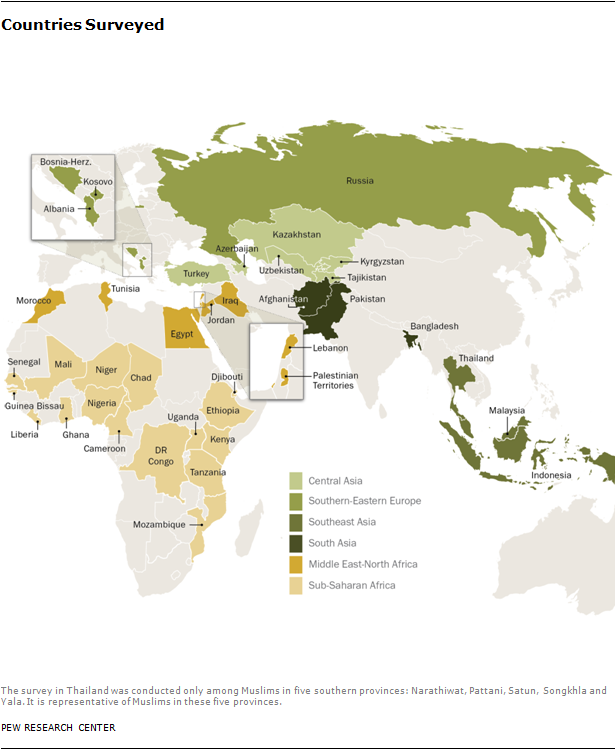
The survey involved a total of more than 38,000 face-to-face interviews in 80-plus languages. It covered Muslims in 39 countries, which are divided into six regions in this report – Southern and Eastern Europe (Russia and the Balkans), Central Asia, Southeast Asia, South Asia, the Middle East and North Africa, and sub-Saharan Africa.

Regional Differences
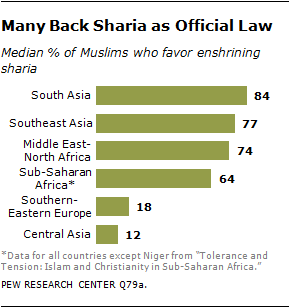
Attitudes toward Islamic law vary significantly by region. Support for making sharia the law of the land is highest in South Asia (median of 84%). Medians of at least six-in-ten Muslims in sub-Saharan Africa (64%), the Middle East-North Africa region (74%) and Southeast Asia (77%) also favor enshrining sharia as official law. But in two regions, far fewer Muslims say Islamic law should be endorsed by their governments: Southern and Eastern Europe (18%) and Central Asia (12%).

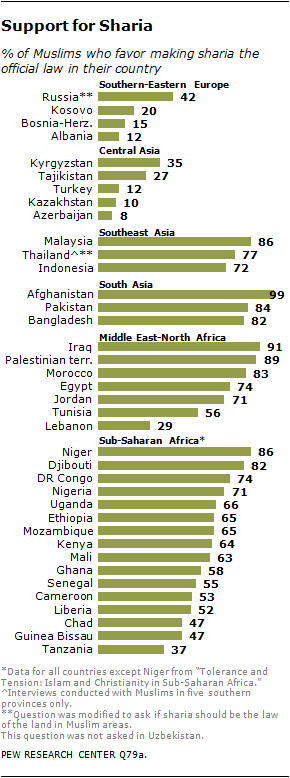
Within regions, support for enshrining sharia as official law is particularly high in some countries with predominantly Muslim populations, such as Afghanistan and Iraq.1 But support for sharia is not limited to countries where Muslims make up a majority of the population. In sub-Saharan Africa, for example, Muslims constitute less than a fifth of the population in Cameroon, the Democratic Republic of the Congo, Ghana, Kenya, Liberia, Mozambique and Uganda; yet in each of these countries, at least half of Muslims (52%-74%) say they want sharia to be the official law of the land.

Conversely, in some countries where Muslims make up more than 90% of the population, relatively few want their government to codify Islamic law; this is the case in Tajikistan (27%), Turkey (12%) and Azerbaijan (8%).

Distinct legal and political cultures may help to explain the differing levels of support for sharia. Many of the countries surveyed in Central Asia and Southern and Eastern Europe share a history of separating religion and the state. The policies of modern Turkey’s founding father, Mustafa Kemal Ataturk, for example, emphasized the creation of a secular government; other countries in these two regions experienced decades of secularization under communist rule. By contrast, governments in many of the countries surveyed in South Asia and the Middle East-North Africa region have officially embraced Islam.

Sharia

Sharia, or Islamic law, offers moral and legal guidance for nearly all aspects of life – from marriage and divorce, to inheritance and contracts, to criminal punishments. Sharia, in its broadest definition, refers to the ethical principles set down in Islam’s holy book (the Quran) and examples of actions by the Prophet Muhammad (sunna). The Islamic jurisprudence that comes out of the human exercise of codifying and interpreting these principles is known as fiqh. Muslim scholars and jurists continue to debate the boundary between sharia and fiqh as well as other aspects of Islamic law.

Existing Legal Frameworks

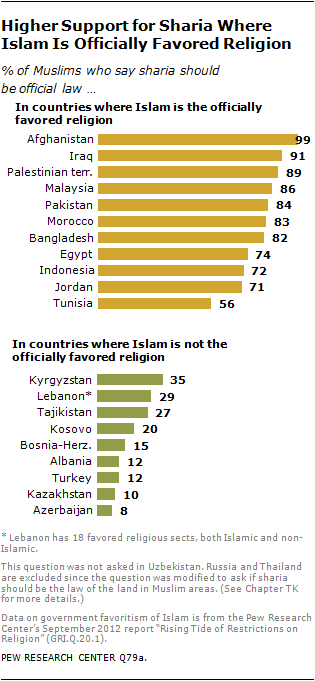
Indeed, the survey finds that support for making sharia the law of the land is often higher in countries where the constitution or basic laws already favor Islam over other religions.2 Majorities in such countries say sharia should be enshrined as official law, including at least nine-in-ten Muslims in Afghanistan (99%) and Iraq (91%). By comparison, in countries where Islam is not legally favored, roughly a third or fewer Muslims say sharia should be the law of the land. Support is especially low in Kazakhstan (10%) and Azerbaijan (8%).3
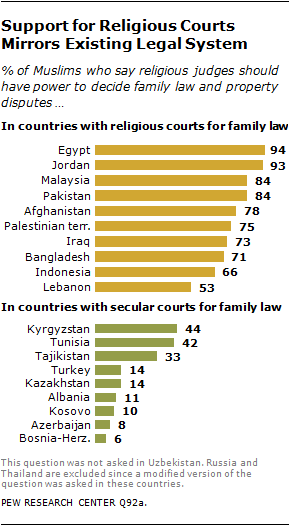
The survey also finds that views about instituting sharia in the domestic-civil sphere frequently mirror a country’s existing legal system. Asked whether religious judges should decide family and property disputes, at least half of Muslims living in countries that have religious family courts answer yes.4 By contrast, in countries where secular courts oversee family matters, fewer than half of Muslims think that family and property disputes should be within the purview of religious judges.

When comparing Muslim attitudes toward sharia as official law and its specific application in the domestic sphere, three countries are particularly instructive: Lebanon, Tunisia and Turkey.

In Lebanon, Islam is not the favored religion of the state, but the major Muslim sects in the country operate their own courts overseeing family law.5 Attitudes of Lebanese Muslims appear to mirror this political and legal structure: While roughly three-in-ten (29%) say sharia should be the official law of the land, about half (53%) say religious judges should have the power to decide family and property disputes.

Tunisia’s legal framework is, in key respects, the opposite of Lebanon’s: The Tunisian Constitution favors Islam over other religions, but religious courts, which once governed family law, were abolished in 1956.6 Perhaps reflecting this history, more than half of Tunisian Muslims (56%) want sharia to be the official law of the land, but a minority (42%) says religious courts should oversee family and property law.

Turkey’s evolution in the early 20th century included sweeping legal reforms resulting in a secular constitution and legal framework. As part of these changes, traditional sharia courts were eliminated in the 1920s.7 Today, only minorities of Turkish Muslims back enshrining sharia as official law (12%) or letting religious judges decide family and property disputes (14%).

Religious Commitment and Support for Sharia
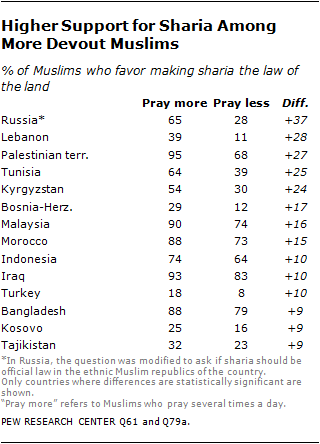
The survey finds that religious devotion also shapes attitudes toward sharia.8 In many countries, Muslims with higher levels of religious commitment are more likely to support sharia. In Russia, for example, Muslims who say they pray several times a day are 37 percentage points more likely to support making sharia official law than Muslims who say they pray less frequently. Similarly, in Lebanon, the Palestinian territories and Tunisia, Muslims who say they pray several times a day are at least 25 percentage points more supportive of enshrining sharia as official law than are less observant Muslims.

Age, Gender, Education and Support for Sharia

Across the countries surveyed, support for making sharia the official law of the land generally varies little by age, gender or education. In the few countries where support for Islamic law varies significantly by age, older Muslims tend to favor enshrining sharia as the law of the land more than younger Muslims do. This is particularly true in the Middle East-North Africa region, where Muslims ages 35 and older are more likely than those 18-34 to back sharia in Lebanon (+22 percentage points), Jordan (+12), Tunisia (+12) and the Palestinian territories (+10).

In only two countries are men significantly more likely than women to favor enshrining sharia as official law: Pakistan (+16 percentage points) and Russia (+9). In most countries, Muslims with a secondary degree or higher (i.e., graduates of a high school, technical institute or college) are about as likely as those with less education to support Islamic law.

Muslims Who Favor Making Sharia Official Law

When Muslims around the world say they want sharia to be the law of the land, what role do they envision for religious law in their country? First, many, but by no means all, supporters of sharia believe the law of Islam should apply only to Muslims. In addition, those who favor Islamic law tend to be most comfortable with its application to questions of family and property.9 In some regions, fewer back the imposition of severe punishments in criminal cases, such as cutting off the hands of thieves – an area of sharia known in Arabic as hudud (see Glossary). But in South Asia and the Middle East and North Africa, medians of more than half back both severe criminal punishments and the death penalty for Muslims who renounce their faith.

Muslims who favor making sharia the law of the land generally agree that the requirements of Islam should apply only to Muslims. Across the regions where the question was asked, medians of at least 51% say sharia should apply exclusively to adherents of the Muslim faith. This view is prevalent even in regions such as South Asia, Southeast Asia and the Middle East and North Africa, where there is overwhelming support for enshrining sharia as the official law of the land. (See chart in Should Sharia Apply to All Citizens? in Chapter 1: Beliefs About Sharia.)

At the country level, there are notable exceptions to the view that sharia should apply only to Muslims. These include Egypt, where 74% of Muslims say sharia should be the law of the land and nearly three-quarters of them (or 55% of all Egyptian Muslims) say Islamic law should apply to people of all faiths.

Sharia supporters around the world widely agree that Muslim leaders and religious judges should decide family and property disputes. The median percentage of sharia supporters who favor applying religious law in the domestic sphere is highest in Southeast Asia (84%), followed by South Asia (78%), the Middle East and North Africa (78%), and Central Asia (62%). In Southern and Eastern Europe, fewer (41%) think religious judges should oversee family and property issues. (See chart in How Should Sharia Be Applied? in Chapter 1: Beliefs About Sharia.)
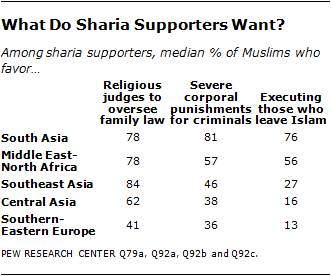
In South Asia, support for applying religious law to family and property disputes is coupled with strong backing for severe criminal punishments, such as cutting off the hands of thieves (median of 81%) and the death penalty for Muslims who renounce their faith (76%). In the Middle East-North Africa region, medians of more than half favor strict criminal penalties (57%) and the execution of those who convert from Islam to another faith (56%).

By contrast, fewer Muslims back severe criminal punishments in Southeast Asia (median of 46%), Central Asia (38%), and Southern and Eastern Europe (36%). Even smaller medians in these same regions (between 13% and 27%) say apostates should face the death penalty for leaving Islam to join another religion. (For more details on views toward apostasy, see How Should Sharia Be Applied? in Chapter 1: Beliefs About Sharia.)

What is a Median?

The median is the middle number in a list of numbers sorted from highest to lowest. On many questions in this report, medians are reported for groups of countries to help readers see regional patterns.

For a region with an odd number of countries, the median on a particular question is the middle spot among the countries surveyed in that region. For regions with an even number of countries, the median is computed as the average of the two countries at the middle of the list (e.g., where six nations are shown, the median is the average of the third and fourth countries listed in the region).

Faith and Morality
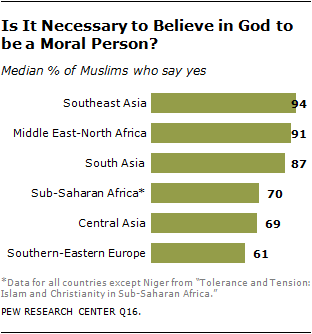
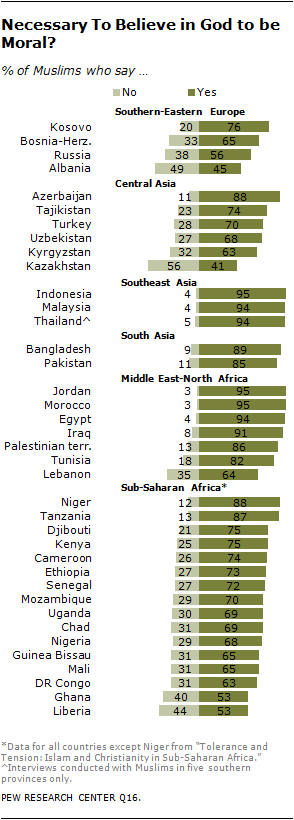
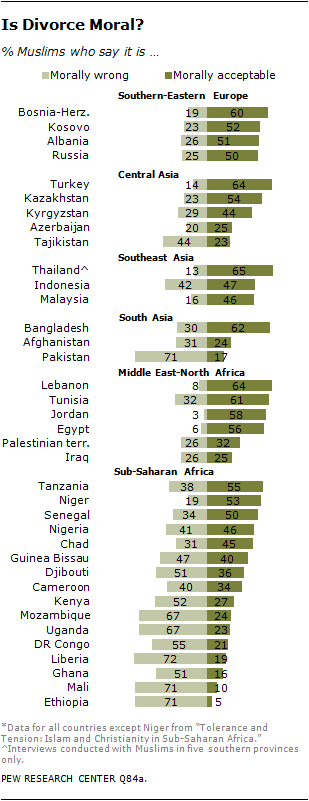
Regardless of whether they support making sharia the official law of the land, Muslims around the world overwhelmingly agree that in order for a person to be moral, he or she must believe in God. Muslims across all the regions surveyed also generally agree that certain behaviors – such as suicide, homosexuality and consuming alcohol – are morally unacceptable. However, Muslims are less unified when it comes to the morality of divorce, birth control and polygamy. Even Muslims who want to enshrine sharia as the official law of the land do not always line up on the same side of these issues.

The survey asked Muslims if it is necessary to believe in God to be moral and have good values. For the majority of Muslims, the answer is a clear yes. Median percentages of roughly seven-in-ten or more in Central Asia (69%), sub-Saharan Africa (70%), South Asia (87%), the Middle East-North Africa region (91%) and Southeast Asia (94%) agree that morality begins with faith in God. In Southern and Eastern Europe, where secular traditions tend to be strongest, a median of 61% agree that being moral and having good values depend on belief in God.10 In only two of the 38 countries where the question was asked – Albania (45%) and Kazakhstan (41%) – do fewer than half of Muslims link morality to faith in God. (The question was not asked in Afghanistan.)

Muslims around the world also share similar views about the immorality of some behaviors. For example, across the six regions surveyed, median percentages of roughly eight-in-ten or more consistently say prostitution, homosexuality and suicide are morally wrong. Medians of at least 60% also condemn sex outside marriage, drinking alcohol, abortion and euthanasia.
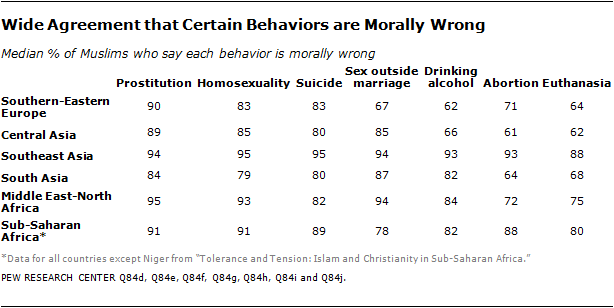
Moral attitudes are less uniform when it comes to questions of polygamy, divorce and family planning. In the case of polygamy, only in Southern and Eastern Europe (median of 68%) and Central Asia (62%) do most say that the practice of taking multiple wives is morally unacceptable. In the other regions surveyed, attitudes toward polygamy vary widely from country to country. For example, in the Middle East-North Africa region, the percentage of Muslims who think polygamy is morally unacceptable ranges from 6% in Jordan to 67% in Tunisia. Similarly, in sub-Saharan Africa, as few as 5% of Muslims in Niger say plural marriage is morally wrong, compared with 59% who hold this view in Mozambique.

In sub-Saharan Africa, a median of 51% explicitly describe divorce as morally wrong. In other regions, fewer share this view, although opinions vary substantially at the country level. Many Muslims say that divorce is either not a moral issue or that the morality of ending a marriage depends on the situation. In the Middle East and North Africa, for instance, more than a quarter of Muslims in five of the six countries where the question was asked say either that divorce is not a moral issue or that it depends on the context.

Muslims also are divided when it comes to the morality of birth control. In most countries where the question was asked, there was neither a clear majority saying family planning is morally acceptable nor a clear majority saying it is morally wrong. Rather, many Muslims around the world say that a married couple’s decision to limit pregnancies either is not a moral issue or depends on the situation; this includes medians of at least a quarter in Central Asia (27%), Southern and Eastern Europe (30%) and the Middle East-North Africa region (41%).
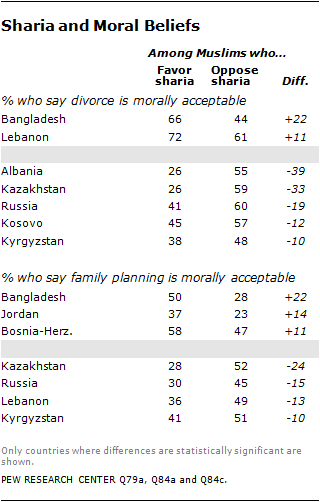
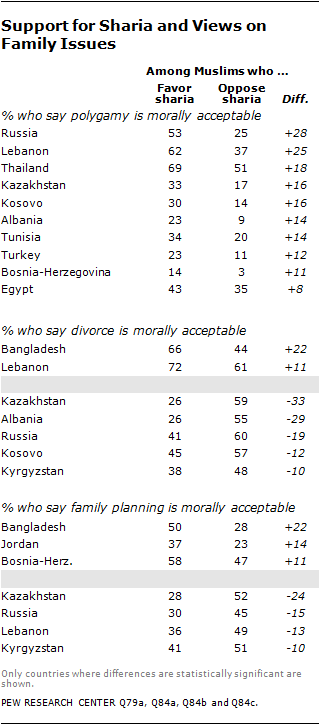
In addition, the survey finds that sharia supporters in different countries do not necessarily have the same views on the morality of divorce and family planning. For example, in Bangladesh and Lebanon, supporters of sharia are at least 11 percentage points more likely than other Muslims to say divorce is morally acceptable. But in Albania, Kazakhstan, Russia, Kosovo and Kyrgyzstan, those who want sharia to be official law are less likely than other Muslims to characterize divorce as morally acceptable. Sharia supporters in different countries also diverge in their attitudes toward family planning. In Bangladesh, Jordan and Bosnia-Herzegovina, Muslims who want to enshrine sharia as the law of land are more likely to say family planning is moral, while in Kazakhstan, Russia, Lebanon and Kyrgyzstan, supporters of sharia are less likely to say limiting pregnancies is morally acceptable. (For more details on views toward polygamy, divorce and family planning, see Morality and Marriage in Chapter 3: Morality.)

Women’s Rights
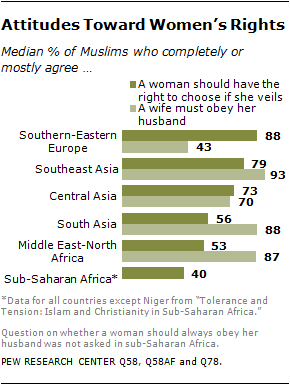
Muslims’ attitudes toward women’s rights are mixed. In most parts of the world, Muslims say that a woman should be able to decide whether to wear a veil. Yet when it comes to private life, most Muslims say a wife should always obey her husband. There is considerable disagreement over whether a wife should be able to initiate a divorce and whether a daughter should be able to receive an inheritance equal to a son’s.

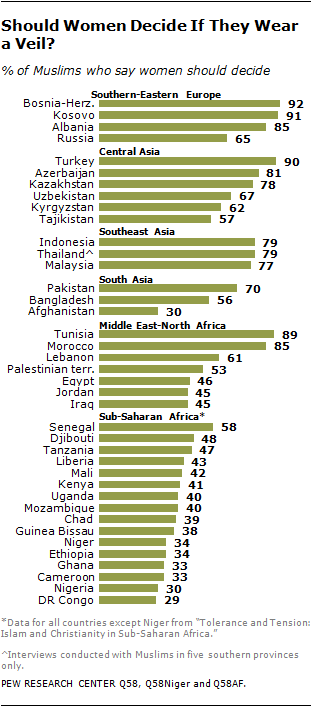
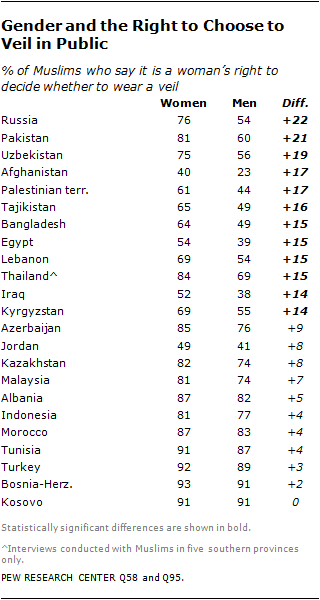
Across five of the six major regions included in the study, majorities of Muslims in most countries say a woman should be able to decide for herself whether to wear a veil in public. Medians of roughly seven-in-ten or more take this view in Southern and Eastern Europe (88%), Southeast Asia (79%) and Central Asia (73%). But fewer say women should have this right in South Asia (56%) and the Middle East-North Africa region (53%). Sub-Saharan Africa is the only region where a median of less than half (40%) think a woman should be able to decide for herself whether to wear a veil. (For more details on views toward veiling, see Women and Veiling in Chapter 4: Women In Society.)

Although many Muslims endorse a woman’s right to choose how she appears in public, overwhelming majorities in most regions say a wife should always obey her husband. Medians of more than eight-in-ten Muslims express this view in Southeast Asia (93%), South Asia (88%), and the Middle East and North Africa (87%). Even in Central Asia, a region characterized by relatively low levels of religious observance and strong support for a woman’s right to decide whether to wear a veil, seven-in-ten Muslims agree that a wife should carry out her husband’s wishes.11 Only in Southern and Eastern Europe do fewer than half (median of 43%) share this view.
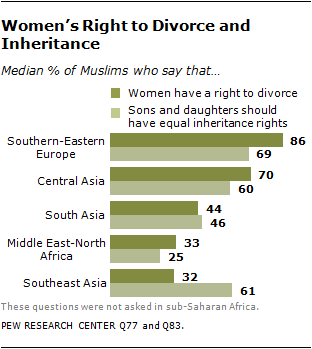
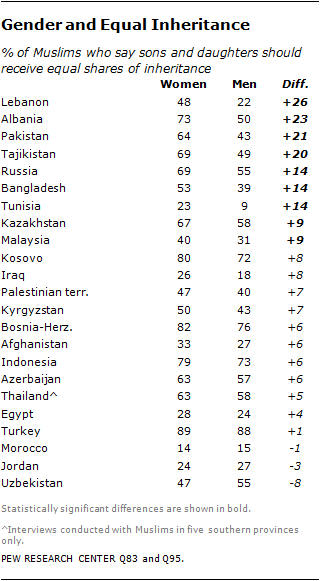
Views on a women’s rights to divorce and inheritance vary considerably across the regions surveyed. Muslims in Southern and Eastern Europe and Central Asia clearly support a wife’s right to initiate a divorce (regional medians of 86% and 70%, respectively). However, fewer in the other regions think this should be a woman’s prerogative. Similarly, medians of six-in-ten or more in three regions – Southern and Eastern Europe (69%), Southeast Asia (61%) and Central Asia (60%) – think daughters and sons should have equal inheritance rights. But far fewer agree in South Asia (46%) and the Middle East-North Africa region (25%).

As in the case of support for religious courts and making sharia official law, attitudes toward equal inheritance appear to reflect, at least in part, a society’s legal and social norms. For example, at least three-quarters of Muslims say children should be able to inherit equally, regardless of gender, in Turkey (88%), Bosnia-Herzegovina (79%) and Kosovo (76%) – all countries where laws do not require that sons should receive greater inheritance than daughters. By contrast, in Jordan (25%), Iraq (22%), Morocco (15%) and Tunisia (15%) – countries where laws specify unequal inheritance based on gender – a quarter or fewer say daughters and sons should have equal rights to their family’s wealth. (See Inheritance Rights for Women in Chapter 4: Women In Society.)

Differences in Views by Gender

Overall, the survey finds that Muslim women are often, but not always, more supportive of women’s rights.12 For example, in about half of the 39 countries surveyed, women are more likely than men to say that a woman should decide for herself whether to wear a veil in public. Yet in the remaining countries, women are just as likely as men to say that the question of veiling should not be left to individual women. When it comes to divorce and equal inheritance, there are even fewer countries where Muslim women are significantly more supportive of women’s rights than are Muslim men.

Extremism Widely Rejected
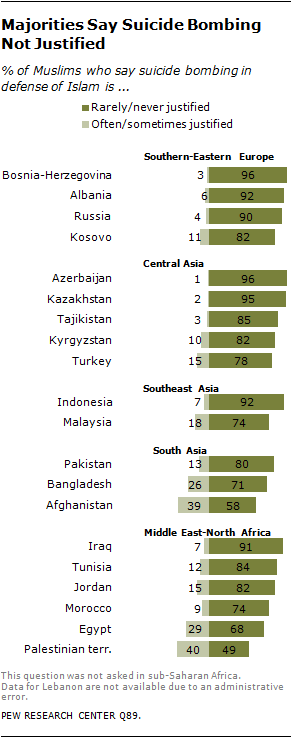
Muslims around the world strongly reject violence in the name of Islam. Asked specifically about suicide bombing, clear majorities in most countries say such acts are rarely or never justified as a means of defending Islam from its enemies.

In most countries where the question was asked, roughly three-quarters or more Muslims reject suicide bombing and other forms of violence against civilians. And in most countries, the prevailing view is that such acts are never justified as a means of defending Islam from its enemies. Yet there are some countries in which substantial minorities think violence against civilians is at least sometimes justified. This view is particularly widespread among Muslims in the Palestinian territories (40%), Afghanistan (39%), Egypt (29%) and Bangladesh (26%).

The survey finds little evidence that attitudes toward violence in the name of Islam are linked to factors such as age, gender or education. Similarly, the survey finds no consistent link between support for enshrining sharia as official law and attitudes toward religiously motivated violence. In only three of the 15 countries with sufficient samples sizes for analysis – Egypt, Kosovo and Tunisia – are sharia supporters significantly more likely to say suicide bombing and other forms of violence are at least sometimes justified. In Bangladesh, sharia supporters are significantly less likely to hold this view.

In a majority of countries surveyed, at least half of Muslims say they are somewhat or very concerned about religious extremism. And on balance, more Muslims are concerned about Islamic than Christian extremist groups. In all but one of the 36 countries where the question was asked, no more than one-in-five Muslims express worries about Christian extremism, compared with 28 countries where at least that many say they are concerned about Islamic extremist groups. This includes six countries in which 40% or more of Muslims worry about Islamic extremism: Guinea Bissau (54%), Indonesia (53%), Kazakhstan (46%), Iraq (45%), Ghana (45%) and Pakistan (40%). (For more details on views toward extremism, see Concern About Religious Extremism in Chapter 2: Religion and Politics.)

Few See Tensions Over Religious Differences

Although many Muslims are concerned about Islamic extremist groups, relatively few think tensions between more and less observant Muslims pose a major problem for their country. Similarly, most do not see Sunni-Shia hostilities as a major problem. And when asked specifically about relations between Muslims and Christians, majorities in most countries see little hostility between members of the two faiths.

Muslims in Southern and Eastern Europe and those in Central Asia are not as likely as those in other regions to describe tensions between more religious and less religious Muslims as a very big problem in their country (regional medians of 10% and 6%, respectively). Slightly more Muslims in South Asia (21%) and Southeast Asia (18%) see intra-faith differences as a major problem. In the Middle East and North Africa, a median of one-in-four say tensions between more and less devout Muslims is a pressing issue in their country.
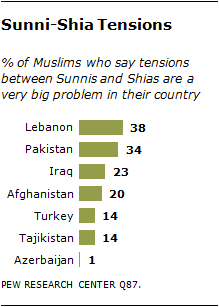
Across the seven countries where the question was asked, fewer than four-in-ten Muslims consider tensions between Sunnis and Shias to be a major national problem. However, levels of concern vary considerably. At one end of the spectrum, barely any Muslims in Azerbaijan (1%) say Sunni-Shia tensions are a pressing issue in their country. By contrast, in Lebanon (38%), Pakistan (34%) and Iraq (23%) – three countries that have experienced sectarian violence – about a quarter or more view Sunni-Shia tensions as a very big problem. (For more details on Sunni-Shia tensions, see Concern About Sunni-Shia Conflict in Chapter 5: Relations Among Muslims.)

Compared with issues such as unemployment and crime, which majorities often describe as pressing issues in their country, relatively few Muslims place religious conflict among their nation’s top problems. Regional medians of one-in-five or fewer characterize such conflict as a major issue in Southern and Eastern Europe (20%) and Central Asia (12%). Somewhat larger medians describe religious tensions as a pressing problem in South Asia (35%), sub-Saharan Africa (34%) and Southeast Asia (27%). Only in the Middle East-North Africa region does a median of 50% say religiously based conflict is a major problem facing their country.

The survey asked in particular about relations between Muslims and Christians. In nearly all countries, fewer than half of Muslims say that many or most members of either religious group are hostile toward the other group. In five countries, however, more than three-in-ten Muslims describe many or most Christians as antagonistic toward Muslims: Egypt (50%), Guinea Bissau (41%), the Democratic Republic of the Congo (37%), Chad (34%) and Bosnia-Herzegovina (31%). And in three countries similar percentages say many or most Muslims are hostile toward Christians: Guinea Bissau (49%), Chad (38%) and Egypt (35%). (For more details on Muslim-Christian tensions, see Views of Muslim-Christian Hostilities in Chapter 6: Interfaith Relations.)

Democracy and Religious Freedom
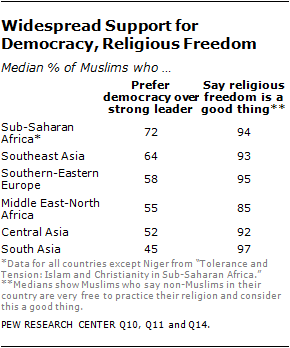
Most Muslims around the world express support for democracy, and most say it is a good thing when others are very free to practice their religion. At the same time, many Muslims want religious leaders to have at least some influence in political matters.

Given a choice between a leader with a strong hand or a democratic system of government, most Muslims choose democracy. Regional medians of roughly six-in-ten or more support democracy in sub-Saharan Africa (72%), Southeast Asia (64%) and Southern and Eastern Europe (58%), while slightly fewer agree in the Middle East and North Africa (55%) and Central Asia (52%). Muslims in South Asia are the most skeptical of democratic government (a median of 45% say they support democracy).

A majority of Muslims in most countries surveyed say they are “very free” to practice their religion. The only countries where fewer than half of Muslims say they are very free to practice their faith are Iraq (48%), Egypt (46%) and Uzbekistan (39%).

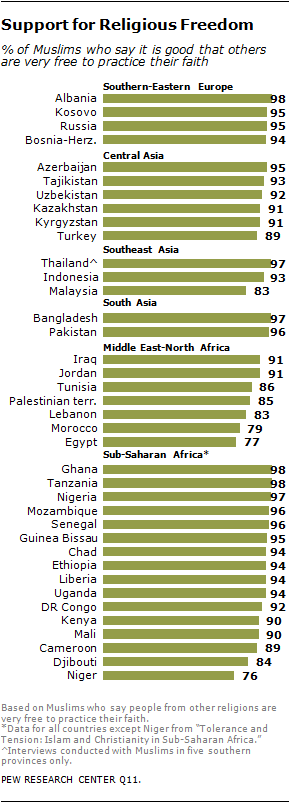
The survey also asked Muslims whether people of other faiths in their country are very free, somewhat free, not too free or not at all free to practice their religion; a follow-up question asked Muslims whether they consider this “a good thing” or “a bad thing.” In 31 of the 38 countries where the question was asked, majorities of Muslims say people of other faiths can practice their religion very freely. (The question was not asked in Afghanistan.) And of those who share this assessment, overwhelming majorities consider it a good thing. This includes median percentages of more than nine-in-ten in South Asia (97%), Southern and Eastern Europe (95%), sub-Saharan Africa (94%), Southeast Asia (93%) and Central Asia (92%). In the Middle East-North Africa region, nearly as many (85%) share this view.

There are a few countries where 10% or more of Muslims say non-Muslims are either “not too free” or “not at all free” to practice their faith. These include Egypt (18%), Turkey (14%), Iraq (13%), Djibouti (11%), Tajikistan (11%) and the Palestinian territories (10%). Very few Muslims in these countries call this lack of religious freedom “a good thing.” Egypt is the only country in which more than one-tenth (12%) of the total Muslim population says it is a good thing that non-Muslims are not free to practice their faith.

Islam and Politics
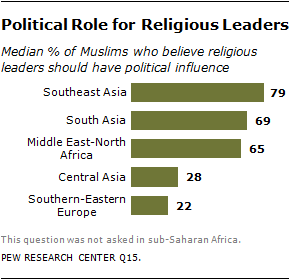
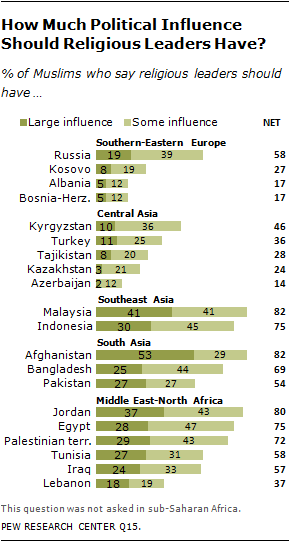
While Muslims widely embrace democracy and religious freedom, many also want religion to play a prominent role in politics. Medians of at least six-in-ten in Southeast Asia (79%), South Asia (69%), and the Middle East and North Africa (65%) say religious leaders should have at least some influence over political matters. This includes medians of at least a quarter across these three regions who would like to see religious leaders exert a large influence on politics. Muslims in the other two regions where the question was asked are less comfortable with the merger of politics and faith. Fewer than three-in-ten Muslims in Central Asia (28%) and Southern and Eastern Europe (22%) say religious leaders should wield influence in political matters. And among these, less than one-in-ten think religion should have a large influence.

Devout Muslims tend to be more supportive of religious leaders playing a role in politics. In a number of countries, particularly in the Middle East and North Africa but also in Southern and Eastern Europe, Muslims who pray several times a day are more likely than those who pray less frequently to say religious leaders should have at least some influence on political matters. At a country level, this gap is especially wide in Lebanon, where Muslims who pray several times a day are nearly four times more likely than other Muslims (51% vs. 13%) to say religious leaders should play a role in politics.

Islam and Contemporary Society

Most Muslims are comfortable practicing their faith in the contemporary world. Relatively few feel there is an inherent conflict between being religiously devout and living in a modern society, and the prevailing view in most countries surveyed is that there is no inherent conflict between religion and science. However, most Muslims think Western music, movies and television pose a threat to morality in their country – even though, on a personal level, substantial percentages say they enjoy Western entertainment.

Across the six major regions included in the study, most Muslims reject the notion that there is an inherent tension between modern society and leading a religiously devout life. This view prevails in regions characterized by low levels of religious observance – Central Asia (median of 71%) and Southern and Eastern Europe (58%) – as well as in regions where most Muslims are highly observant – Southeast Asia (64%) and the Middle East and North Africa (60%).13 Muslims in sub-Saharan Africa are more divided on the compatibility of religion and modern life (median of 50%). Muslims in South Asia, meanwhile, are less likely to say modern life and religious devotion are compatible (median of 39%). (For more details, see Religion and Modernity in Chapter 7: Religion, Science and Popular Culture.)

Across the 23 countries where the question was asked, most Muslims see no inherent conflict between religion and science. This view is especially widespread in the Middle East and North Africa (median of 75%) even though, as previously noted, many Muslims in the region are highly committed to their faith. Across the other regions surveyed, medians of 50% or more concur that religion and science are compatible. The one exception is South Asia, where fewer than half (45%) share this view.

Asked specifically about the origins of humans and other living things, Muslims in Central Asia, Southern and Eastern Europe, and the Middle East-North Africa region agree with the theory of evolution (regional medians from 54% to 58%). Fewer Muslims accept evolution in Southeast Asia (39%) and South Asia (30%). (For more details on views toward evolution, see Evolution in Chapter 7: Religion, Science and Popular Culture.)

Western Pop Culture
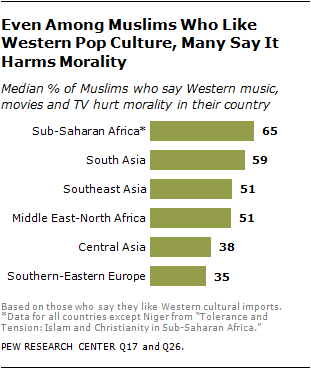
Western music, movies and television have become a fixture of contemporary society in many parts of the world. The survey finds that, at a personal level, many Muslims enjoy Western popular culture. This is especially true in Southern and Eastern Europe (66%), Central Asia (52%) and sub-Saharan Africa (51%), where medians of at least 50% say they like Western entertainment. Fewer in Southeast Asia (41%) and the Middle East and North Africa (38%) share this view. Favorable opinions of Western music, movies and television are even rarer in South Asia (25%).

Even though many Muslims enjoy Western pop culture, a clear majority of Muslims in most countries surveyed think that Western entertainment harms morality in their country. And it is not only Muslims who personally dislike Western music, movies and television who feel this way. In four of the six regions, medians of at least half of those who say they enjoy this type of entertainment also say Western cultural imports undermine morality: sub-Saharan Africa (65%), South Asia (59%), Southeast Asia (51%) and the Middle East-North Africa region (51%). (For more details, including Muslims’ views toward Bollywood, see Popular Culture in Chapter 7: Religion, Science and Popular Culture.)

How Do American Muslims Compare?

In 2011, the Pew Research Center conducted its second nationally representative survey of Muslims in the United States. When that survey is compared with the global survey of Muslims, some key differences emerge between U.S. Muslims and Muslims in other countries. In general, American Muslims are more at ease in the contemporary world. About six-in-ten Muslims living in the U.S. (63%) say there is no tension between being religiously devout and living in a modern society, compared with a median of 54% of Muslims worldwide. American Muslims also are more likely than Muslims in other parts of the world to say that many religions can lead to eternal salvation (56% vs. global median of 18%). Additionally, U.S. Muslims are much less likely than Muslims worldwide to say that all or most of their close friends are Muslim (48% vs. global median of 95%).

Muslims in the U.S. are about as likely as Muslims in other countries to view science and religion as fully compatible. In the U.S., 59% of Muslims say there generally is not a conflict between science and religion, compared with a median of 54% globally among Muslims. However, American Muslims are somewhat less likely to believe in evolution than are Muslims in other parts of the world (45% vs. global median of 53%). Indeed, when it comes to evolution, U.S. Muslims are closer to U.S. Christians (46% of whom say they believe in evolution) than they are to fellow Muslims elsewhere in the world.

American Muslims are even more likely than Muslims in other countries to firmly reject violence in the name of Islam. In the U.S., about eight-in-ten Muslims (81%) say that suicide bombing and similar acts targeting civilians are never justified. Across the globe, a median of roughly seven-in-ten Muslims (72%) agrees. (For more details on how U.S. Muslims compare with Muslims worldwide, see Appendix A: U.S. Muslims — Views on Religion and Society in a Global Context.)

About the Report

These and other findings are discussed in more detail in the remainder of this report, which is divided into seven chapters:

  • Beliefs About Sharia
  • Religion and Politics
  • Morality
  • Women in Society
  • Relations Among Muslims
  • Interfaith Relations
  • Religion, Science and Popular Culture

This report also includes an appendix with comparable results from past Pew Research Center surveys of Muslims in the United States. A glossary of key terms can be found here. The survey questionnaire and a topline with full results are available as a PDF. The online version of the report also includes an infographic. This report covers attitudes and views on a variety of social and political questions. A previous Pew Research report, released in August 2012, addressed religious affiliation, beliefs and practices among Muslims.

This report includes data on every nation with a Muslim population of more than 10 million except Algeria, China, India, Iran, Saudi Arabia, Sudan, Syria and Yemen. Together, the 39 countries and territories included in the survey are home to about two-thirds of all Muslims in the world.

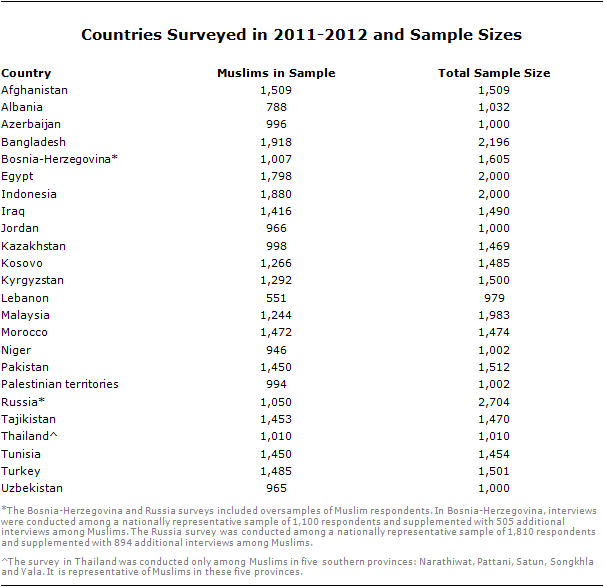
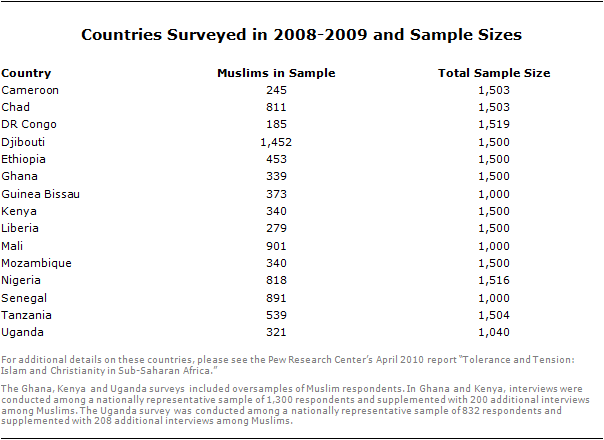
The surveys that are the basis for this report were conducted across multiple years. Fifteen sub-Saharan countries with substantial Muslim populations were surveyed in 2008-2009 as part of a larger project that examined religion in that region. The methods employed in those countries – as well as some of the findings – are detailed in the Pew Research Center’s 2010 report “Tolerance and Tension: Islam and Christianity in Sub-Saharan Africa.” An additional 24 countries and territories were surveyed in 2011-2012. In 21 of these countries, Muslims make up a majority of the population. In these cases, nationally representative samples of at least 1,000 respondents were fielded. The number of self-identified Muslims interviewed in these countries ranged from 551 in Lebanon to 1,918 in Bangladesh. In Russia and Bosnia-Herzegovina, where Muslims are a minority, oversamples were employed to ensure adequate representation of Muslims; in both cases, at least 1,000 Muslims were interviewed. Meanwhile, in Thailand, the survey was limited to the country’s five southern provinces, each with substantial Muslim populations; more than 1,000 interviews with Muslims were conducted across these provinces. Appendix C provides greater detail on the 2011-2012 survey’s methodology.
Footnotes:

1 The populations of both Afghanistan and Iraq are at least 99% Muslim. Estimates for the religious composition of countries in this report are from the Pew Research Center’s December 2012 report “The Global Religious Landscape.” (return to text)

2 The designation “officially favored religion” is based on the Pew Research Center’s September 2012 report “Rising Tide of Restrictions on Religion.” See 2010 data for question in Government Restrictions Index on whether a country’s constitution or basic law recognizes a favored religion (GRI.Q.20.1). For analysis of support for sharia among Muslims in sub-Saharan Africa, see the Pew Research Center’s April 2010 report “Tolerance and Tension: Islam and Christianity in Sub-Saharan Africa.”(return to text)

3 Whether a country’s legal system shapes, or is shaped by, public opinion is beyond the scope of this study. This report is not asserting a causal relationship in either direction. (return to text)

4 Information on countries that have religious family courts is from Stahnke, Tad and Robert C. Blitt. 2005. “The Religion-State Relationship and the Right to Freedom of Religion or Belief: A Comparative Textual Analysis of the Constitutions of Predominantly Muslim Countries.” Georgetown Journal of International Law, volume 36, issue 4; Emory Law School’s Islamic Family Law project; and University of Richmond’s Constitution Finder. (return to text)

5 See National Reconciliation Charter of Lebanon. 1989. Articles 1b and1j; and Abiad, Nisrine. 2008. “Sharia, Muslim States and International Human Rights Treaty Obligations: A Comparative Study.” British Institute of International and Comparative Law, page 56. (return to text)

6 See Constitution of Tunisia. 1959. Article 1; and Abiad, Nisrine. 2008. “Sharia, Muslim States and International Human Rights Treaty Obligations: A Comparative Study.” British Institute of International and Comparative Law, page 146. (return to text)

7 See Turkish Civil Code. 1926; Constitution of the Republic of Turkey. 1982. Part 3, Chapter 3, “Judiciary”; and Kocak, Mustafa. 2010. “Islam and National Law in Turkey.” In Otto, Jan Michiel, editor. “Sharia Incorporated: A Comparative Overview of the Legal Systems of Twelve Muslim Countries in Past and Present.” Leiden University Press, pages 231-272.(return to text)

8 For analysis of support for sharia among Muslims in sub-Saharan Africa, see the Pew Research Center’s April 2010 report “Tolerance and Tension: Islam and Christianity in Sub-Saharan Africa.” (return to text)

9 For analysis of support for sharia among Muslims in sub-Saharan Africa, see the Pew Research Center’s April 2010 report “Tolerance and Tension: Islam and Christianity in Sub-Saharan Africa.” (return to text)

10 For analysis of religious observance among Muslims around the world, see the Pew Research Center’s August 2012 report “The World’s Muslims: Unity and Diversity.” (return to text)

11 For background on levels of religious observance in the countries surveyed, see the Pew Research Center’s August 2012 report “The World’s Muslims: Unity and Diversity.” (return to text)

12 For analysis of support for women’s rights among Muslims in sub-Saharan Africa see the Pew Research Center’s April 2010 report “Tolerance and Tension: Islam and Christianity in Sub-Saharan Africa.” (return to text)

13 For background on levels of religious observance in the countries surveyed, see the Pew Research Center’s August 2012 report “The World’s Muslims: Unity and Diversity.” (return to text)

Photo Credit: © Scott E Barbour

Preface

This report examines the social and political views of Muslims around the world. It is based on public opinion surveys conducted by the Pew Research Center between 2008 and 2012 in a total of 39 countries and territories on three continents: Africa, Asia and Europe. Together, the surveys involved more than 38,000 face-to-face interviews in 80-plus languages and dialects, covering every country that has more than 10 million Muslims except for a handful (including China, India, Saudi Arabia and Syria) where political sensitivities or security concerns prevented opinion research among Muslims.

Collecting and analyzing this trove of data was a massive endeavor, and the Pew Research Center’s Forum on Religion & Public Life has published the results in stages. In August 2012, we released a report (“The World’s Muslims: Unity and Diversity”) that focused on the survey’s findings about religious beliefs and practices. It showed that while there is much commonality of belief among Muslims around the globe on some key tenets of their faith, there also are substantial differences in interpretation and levels of observance.

Unity and diversity also emerge as important themes in this second report (“The World’s Muslims: Religion, Politics and Society”). Pew Research’s global survey of Muslims analyzes opinions on a wide range of topics, from Islamic law and science to popular culture and the role of women. It also looks at Muslims’ views on religious extremism and religious conflict in their country. Finally, the report takes advantage of prior Pew Research surveys of Muslims in the United States to compare the views of U.S. Muslims with the views of Muslims worldwide.

The global survey of Muslims was conducted in two waves. Fifteen sub-Saharan African countries with substantial Muslim populations were surveyed in 2008-2009, and some of those findings previously were analyzed in the report “Tolerance and Tension: Islam and Christianity in Sub-Saharan Africa.” An additional 24 countries in Africa, Asia, the Middle East and Europe were surveyed in 2011-2012; results from all 39 countries are analyzed here as well as in the August 2012 report on Muslims’ religious beliefs and practices.

Pew Research’s global survey of Muslims is part of a larger effort, the Pew-Templeton Global Religious Futures project, which analyzes religious change and its impact on societies around the world. Recent studies produced under the Pew-Templeton initiative, jointly funded by The Pew Charitable Trusts and the John Templeton Foundation, include “The Global Religious Landscape: A Report on the Size and Distribution of the World’s Major Religious Groups as of 2010” (December 2012), “Rising Tide of Restrictions on Religion” (September 2012), “Faith on the Move: The Religious Affiliation of International Migrants” (March 2012), “Global Christianity: A Report on the Size and Distribution of the World’s Christian Population” (December 2011) and “The Future of the Global Muslim Population: Projections for 2010-2030” (January 2011).

With the release of this report, we also are launching a new website for the Pew-Templeton Global Religious Futures project that allows people to explore demographic data and survey results on religion in many countries around the world.

The primary researcher for “The World’s Muslims: Religion, Politics and Society” was James Bell, the director of international survey research for the Pew Research Center. He received valuable assistance from Senior Researcher Neha Sahgal, Research Associates Michael Robbins and Katie Simmons, and others listed on the masthead of this report. Leah Christian, formerly a senior researcher at the Pew Research Center, also contributed to the project. Fieldwork was carried out under the direction of Princeton Survey Research Associates International and Opinion Research Business; we particularly wish to thank Mary McIntosh and Jonathan Best of PSRAI and Johnny Heald and Cara Carter at ORB.

Amaney Jamal, Associate Professor of Politics at Princeton University, served as a special adviser. In the design of the survey questions and the preparation of this report, the Pew Research Center also was fortunate to be able to call on the expertise of several other academic experts, including Asma Afsaruddin of Indiana University, Xavier Bougarel of The National Centre for Scientific Research (Paris), Michael Cook of Princeton University, David Damrel of the University of South Carolina, Nile Green of the University of California, Los Angeles, Robert Hefner of Boston University, Marcia Hermansen of Loyola University Chicago, Leonard Lewisohn of the University of Exeter (United Kingdom), Peter Mandaville of George Mason University, Vali Nasr of The Johns Hopkins University, Stephen Prothero of Boston University, Asifa Quraishi of the University of Wisconsin Law School, Farid Senzai of Santa Clara University and Shibley Telhami of the University of Maryland.

While the survey design was guided by the counsel of our advisers, contractors and consultants, the Pew Research Center is solely responsible for the interpretation and reporting of the data.

Luis Lugo, Director Alan Cooperman, Associate Director for Research

Photo Credit: © Scott E Barbour

Executive Summary

A new Pew Research Center survey of Muslims around the globe finds that most adherents of the world’s second-largest religion are deeply committed to their faith and want its teachings to shape not only their personal lives but also their societies and politics. In all but a handful of the 39 countries surveyed, a majority of Muslims say that Islam is the one true faith leading to eternal life in heaven and that belief in God is necessary to be a moral person. Many also think that their religious leaders should have at least some influence over political matters. And many express a desire for sharia – traditional Islamic law – to be recognized as the official law of their country.

The percentage of Muslims who say they want sharia to be “the official law of the land” varies widely around the world, from fewer than one-in-ten in Azerbaijan (8%) to near unanimity in Afghanistan (99%). But solid majorities in most of the countries surveyed across the Middle East and North Africa, sub-Saharan Africa, South Asia and Southeast Asia favor the establishment of sharia, including 71% of Muslims in Nigeria, 72% in Indonesia, 74% in Egypt and 89% in the Palestinian territories.

At the same time, the survey finds that even in many countries where there is strong backing for sharia, most Muslims favor religious freedom for people of other faiths. In Pakistan, for example, three-quarters of Muslims say that non-Muslims are very free to practice their religion, and fully 96% of those who share this assessment say it is “a good thing.” Yet 84% of Pakistani Muslims favor enshrining sharia as official law. These seemingly divergent views are possible partly because most supporters of sharia in Pakistan – as in many other countries – think Islamic law should apply only to Muslims. Moreover, Muslims around the globe have differing understandings of what sharia means in practice.

The survey – which involved more than 38,000 face-to-face interviews in 80-plus languages with Muslims across Europe, Asia, the Middle East and Africa – shows that Muslims tend to be most comfortable with using sharia in the domestic sphere, to settle family or property disputes. In most countries surveyed, there is considerably less support for severe punishments, such as cutting off the hands of thieves or executing people who convert from Islam to another faith. And even in the domestic sphere, Muslims differ widely on such questions as whether polygamy, divorce and family planning are morally acceptable and whether daughters should be able to receive the same inheritance as sons.

In most countries surveyed, majorities of Muslim women as well as men agree that a wife is always obliged to obey her husband. Indeed, more than nine-in-ten Muslims in Iraq (92%), Morocco (92%), Tunisia (93%), Indonesia (93%), Afghanistan (94%) and Malaysia (96%) express this view. At the same time, majorities in many countries surveyed say a woman should be able to decide for herself whether to wear a veil.

Overall, the survey finds that most Muslims see no inherent tension between being religiously devout and living in a modern society. Nor do they see any conflict between religion and science. Many favor democracy over authoritarian rule, believe that humans and other living things have evolved over time and say they personally enjoy Western movies, music and television – even though most think Western popular culture undermines public morality.

The new survey also allows some comparisons with prior Pew Research Center surveys of Muslims in the United States. Like most Muslims worldwide, U.S. Muslims generally express strong commitment to their faith and tend not to see an inherent conflict between being devout and living in a modern society. But American Muslims are much more likely than Muslims in other countries to have close friends who do not share their faith, and they are much more open to the idea that many religions – not only Islam – can lead to eternal life in heaven. At the same time, U.S. Muslims are less inclined than their co-religionists around the globe to believe in evolution; on this subject, they are closer to U.S. Christians.

Few U.S. Muslims voice support for suicide bombing or other forms of violence against civilians in the name of Islam; 81% say such acts are never justified, while fewer than one-in-ten say violence against civilians either is often justified (1%) or is sometimes justified (7%) to defend Islam. Around the world, most Muslims also reject suicide bombing and other attacks against civilians. However, substantial minorities in several countries say such acts of violence are at least sometimes justified, including 26% of Muslims in Bangladesh, 29% in Egypt, 39% in Afghanistan and 40% in the Palestinian territories.

These are among the key findings of a worldwide survey by the Pew Research Center’s Forum on Religion & Public Life. The survey was conducted in two waves. Fifteen sub-Saharan African countries with substantial Muslim populations were surveyed in 2008-2009, and some of those results previously were analyzed in the Pew Research Center’s 2010 report “Tolerance and Tension: Islam and Christianity in Sub-Saharan Africa.” An additional 24 countries in Europe, Asia, the Middle East and Africa were surveyed in 2011-2012; results regarding religious beliefs and practices were first published in the Pew Research Center’s 2012 report “The World’s Muslims: Unity and Diversity.” The current report focuses on Muslims’ social and political attitudes, and it incorporates findings from both waves of the survey.

Other key findings include:

  • At least half of Muslims in most countries surveyed say they are concerned about religious extremist groups in their country, including two-thirds or more of Muslims in Egypt (67%), Tunisia (67%), Iraq (68%), Guinea Bissau (72%) and Indonesia (78%). On balance, more are worried about Islamic extremists than about Christian extremists.
  • Muslims around the world overwhelmingly view certain behaviors – including prostitution, homosexuality, suicide, abortion, euthanasia and consumption of alcohol – as immoral. But attitudes toward polygamy, divorce and birth control are more varied. For example, polygamy is seen as morally acceptable by just 4% of Muslims in Bosnia-Herzegovina and Azerbaijan; about half of Muslims in the Palestinian territories (48%) and Malaysia (49%); and the vast majority of Muslims in several countries in sub-Saharan Africa, such as Senegal (86%) and Niger (87%).
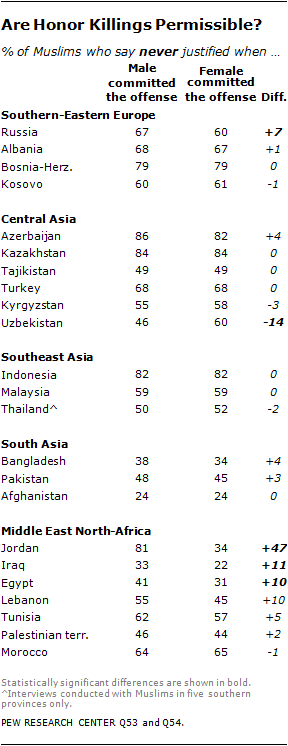
  • In most countries where a question about so-called “honor” killings was asked, majorities of Muslims say such killings are never justified. Only in two countries – Afghanistan and Iraq – do majorities condone extra-judicial executions of women who allegedly have shamed their families by engaging in premarital sex or adultery.
  • Relatively few Muslims say that tensions between more religiously observant and less observant Muslims are a very big problem in their country. In most countries where the question was asked, Muslims also see little tension between members of Islam’s two major sects, Sunnis and Shias – though a third or more of Muslims in Pakistan (34%) and Lebanon (38%) consider Sunni-Shia conflict to be a very big problem.
  • Muslims in sub-Saharan Africa are more likely than Muslims surveyed in other regions to say they attend interfaith meetings and are knowledgeable about other faiths. But substantial percentages of Muslims in sub-Saharan Africa also perceive hostility between Muslims and Christians. In Guinea-Bissau, for example, 41% of Muslims say “most” or “many” Christians are hostile toward Muslims, and 49% say “most” or “many” Muslims are hostile toward Christians.
  • In half of the countries where the question was asked, majorities of Muslims want religious leaders to have at least “some influence” in political matters, and sizable minorities in Asia, the Middle East and North Africa think religious leaders should have a lot of political influence. For example, 37% of Muslims in Jordan, 41% in Malaysia and 53% in Afghanistan say religious leaders should play a “large” role in politics.
  • Support for making sharia the official law of the land tends to be higher in countries like Pakistan (84%) and Morocco (83%) where the constitution or basic laws favor Islam over other religions.
  • In many countries, Muslims who pray several times a day are more likely to support making sharia official law than are Muslims who pray less frequently. In Russia, Lebanon, the Palestinian territories and Tunisia, for example, Muslims who pray several times a day are at least 25 percentage points more supportive of enshrining sharia than are less observant Muslims. Generally, however, there is little difference in support for sharia by age, gender or education.
gsi-exec-map

Photo Credit: © Scott E Barbour

Chapter 1: Beliefs About Sharia

According to the survey findings, most Muslims believe sharia is the revealed word of God rather than a body of law developed by men based on the word of God. Muslims also tend to believe sharia has only one, true understanding, but this opinion is far from universal; in some countries, substantial minorities of Muslims believe sharia should be open to multiple interpretations. Religious commitment is closely linked to views about sharia: Muslims who pray several times a day are more likely to say sharia is the revealed word of God, to say that it has only one interpretation and to support the implementation of Islamic law in their country.

Although many Muslims around the world say sharia should be the law of the land in their country, the survey reveals divergent opinions about the precise application of Islamic law.14 Generally, supporters of sharia are most comfortable with its application in cases of family or property disputes. In most regions, fewer favor other specific aspects of sharia, such as cutting off the hands of thieves and executing people who convert from Islam to another faith.

Sharia as Divine Revelation

gsi2-chp1-1

In 17 of the 23 countries where the question was asked, at least half of Muslims say sharia is the revealed word of God. (For more information on sharia see text box.) In no country are Muslims significantly more likely to say sharia was developed by men than to say it is the revealed word of God.

Acceptance of sharia as the revealed word of God is high across South Asia and most of the Middle East and North Africa. For example, roughly eight-in-ten Muslims (81%) in Pakistan and Jordan say sharia is the revealed word of God, as do clear majorities in most other countries surveyed in these two regions. Only in Lebanon is opinion more closely divided: 49% of Muslims say sharia is the divine word of God, while 38% say men have developed sharia from God’s word.

Muslims in Southeast Asia and Central Asia are somewhat less likely to say sharia comes directly from God. Only in Kyrgyzstan (69%) do more than two-thirds say Islamic law is the revealed word of God. Elsewhere in these regions, the percentage of Muslims who say it is the revealed word of God ranges from roughly four-in-ten in Malaysia (41%) to six-in-ten in Tajikistan.

Views about the origins of sharia are more mixed in Southern and Eastern Europe. At least half of Muslims describe sharia as the divine word of God in Russia (56%) and Bosnia-Herzegovina (52%). By contrast, three-in-ten or fewer hold this view in Kosovo (30%) and Albania (24%).

Overall, Muslims who pray several times a day are more likely to believe that sharia is the revealed word of God than are those who pray less frequently. This is the case in many countries where the question was asked, with especially large differences observed in Russia (+33 percentage points), Uzbekistan (+21), Kyrgyzstan (+20) and Egypt (+15). Views on the origins of sharia do not vary consistently with other measures, such as age or gender.

Interpreting Sharia

gsi2-chp1-2

Muslims differ widely as to whether sharia should be open to multiple understandings. While many say there is only one true interpretation, substantial percentages in most countries either say there are multiple interpretations or say they do not know.

A majority of Muslims in three Central Asian countries – Tajikistan (70%), Azerbaijan (65%) and Kyrgyzstan (55%) – say there is only one way to understand sharia. But elsewhere in the region there is less consensus, including in Turkey, where identical proportions (36% each) stand on either side of the question.

Muslims in Southern and Eastern Europe tend to lean in favor of a single interpretation of sharia. However, only in Bosnia-Herzegovina (56%) and Russia (56%), do majorities take this position.

Across the countries surveyed in South Asia, majorities consistently say there is only one possible way to understand sharia. The proportion holding this view ranges from 67% in Afghanistan to 57% in Bangladesh. But more than a quarter of Muslims in Afghanistan (29%) and Bangladesh (38%) say sharia should be open to multiple interpretations.

In the Middle East-North Africa region, belief in a single interpretation of sharia prevails in Lebanon (59%) and the Palestinian territories (51%). But opinion in Iraq is mixed: 46% say there is only one possible way to understand sharia, while 48% disagree. And in Tunisia and Morocco, large majorities (72% and 60%, respectively) believe sharia should be open to multiple interpretations.

In Southeast Asia, opinion leans modestly in favor of a single interpretation of sharia. The biggest divide is found in Thailand, where 51% of Muslims say there is only one possible understanding of Islamic law, while 29% say it should be open to multiple interpretations.

In a number of countries, significant percentages say they are unsure whether sharia should be subject to one or multiple understandings, including at least one-in-five Muslims in Albania (46%), Kosovo (42%), Uzbekistan (35%), Turkey (23%), Russia (21%), Malaysia (20%) and Pakistan (20%).

An individual’s degree of religious commitment appears to influence views on interpreting sharia. In many countries where the question was asked, Muslims who pray several times a day are more likely than those who pray less often to say that there is a single interpretation. The largest differences are found in Russia (+33 percentage points) and Uzbekistan (+27), but substantial gaps are also observed in Lebanon (+18), Malaysia (+16) and Thailand (+15).

Sharia as the Official Law of the Land

gsi2-chp1-3

Support for making sharia the official law of the land varies significantly across the six major regions included in the study. In countries across South Asia, Southeast Asia, sub-Saharan Africa and the Middle East-North Africa region most favor making sharia their country’s official legal code. By contrast, only a minority of Muslims across Central Asia as well as Southern and Eastern Europe want sharia to be the official law of the land.

In South Asia, high percentages in all the countries surveyed support making sharia the official law, including nearly universal support among Muslims in Afghanistan (99%). More than eight-in-ten Muslims in Pakistan (84%) and Bangladesh (82%) also hold this view. The percentage of Muslims who say they favor making Islamic law the official law in their country is nearly as high across the Southeast Asian countries surveyed (86% in Malaysia, 77% in Thailand and 72% in Indonesia).15

In sub-Saharan Africa, at least half of Muslims in most countries surveyed say they favor making sharia the official law of the land, including more than seven-in-ten in Niger (86%), Djibouti (82%), the Democratic Republic of the Congo (74%) and Nigeria (71%).

Support for sharia as the official law of the land also is widespread among Muslims in the Middle East-North Africa region – especially in Iraq (91%) and the Palestinian territories (89%). Only in Lebanon does opinion lean in the opposite direction: 29% of Lebanese Muslims favor making sharia the law of the land, while 66% oppose it.

Support for making sharia the official legal code of the country is relatively weak across Central Asia as well as Southern and Eastern Europe. Fewer than half of Muslims in all the countries surveyed in these regions favor making sharia their country’s official law. Support for sharia as the law of the land is greatest in Russia (42%); respondents in Russia were asked if sharia should be made the official law in the country’s ethnic-Muslim republics. Elsewhere in Central Asia and Southern and Eastern Europe, about one-in-three or fewer say sharia should be made the law of the land, including just 10% in Kazakhstan and 8% in Azerbaijan.

gsi2-chp1-4

Again, level of religious commitment makes a big difference in attitudes about the implementation of sharia. Muslims who pray several times a day are more likely than those who pray less frequently to favor Islamic law as the official law of the land. The difference is particularly large in Russia (+37 percentage points), Lebanon (+28), the Palestinian territories (+27), Tunisia (+25) and Kyrgyzstan (+24).

Across the countries surveyed, support for making sharia the official law of the land generally varies little by age, gender or education. However, in the Middle East-North Africa region, Muslims ages 35 and older are more likely than those 18-34 to back sharia in Lebanon (+22 percentage points), Jordan (+12), Tunisia (+12) and the Palestinian territories (+10).

Should Sharia Apply to All Citizens?

gsi2-chp1-5

Among Muslims who support making sharia the law of the land, most do not believe that it should be applied to non-Muslims. Only in five of 21 countries where this follow-up question was asked do at least half say all citizens should be subject to Islamic law.

The belief that sharia should extend to non-Muslims is most widespread in the Middle East and North Africa, where at least four-in-ten Muslims in all countries except Iraq (38%) and Morocco (29%) hold this opinion. Egyptian Muslims (74%) are the most likely to say it should apply to Muslims and non-Muslims alike, while 58% in Jordan hold this view.

By contrast, Muslims in Southern and Eastern Europe who favor making sharia the official law of the land are among the least likely to say it should apply to all citizens in their country. Across the nations surveyed in the region, fewer than a third take this view. This includes 22% of Russian Muslims (who were asked about the applying sharia in their country’s ethnic Muslim republics).

In other regions, opinion varies widely by country. For example, in Southeast Asia, half of Indonesian Muslims who favor sharia as the official law say it should apply to all citizens, compared with about a quarter (24%) of those in Thailand. (Thai Muslims were asked if sharia should be made the official law in the predominantly Muslim areas of the country.) Similarly, in Central Asia, a majority of Muslims in Kyrgyzstan (62%) who support making sharia the official law say it should apply to non-Muslims in their country, but far fewer in Kazakhstan (19%) agree. Meanwhile, in South Asia, Muslims who are in favor of making sharia the law of the land in Afghanistan are 27 percentage points more likely to say all citizens should be subject to Islamic law than are those in Pakistan (61% in Afghanistan vs. 34% in Pakistan).

How Should Sharia Be Applied?

gsi2-chp1-6

When Muslims in different regions of the world say they want sharia to be the law of the land, do they also share a vision for how sharia should be applied in practice? Overall, among those in favor of making sharia the law of the land, the survey finds broad support for allowing religious judges to adjudicate domestic disputes. Lower but substantial proportions of Muslims support severe punishments such as cutting off the hands of thieves or stoning people who commit adultery. The survey finds even lower support for executing apostates.

Family and Property Disputes

Islamic law addresses a range of domestic and personal matters, including marriage, divorce and inheritance.16 And most Muslims who say sharia should be the law of the land in their country are very supportive of the application of Islamic law in this sphere. Specifically, in 17 of the 20 countries where there are adequate samples for analysis, at least half favor giving Muslim leaders and religious judges the power to decide family and property disputes.

Support for allowing religious judges to decide domestic and property disputes is particularly widespread throughout Southeast Asia, South Asia and the Middle East-North Africa region. Across these three regions, at least six-in-ten Muslims who support the implementation of sharia as the official law say religious judges should decide family and property matters. This includes more than nine-in-ten in Egypt (95%) and Jordan (93%), and nearly as many in Malaysia (88%) and Pakistan (87%).

In Central Asia as well as Southern and Eastern Europe, Muslims who favor making sharia the law of the land are somewhat less enthusiastic about having religious judges decide matters in the domestic sphere. Across these two regions, fewer than two-thirds favor giving religious judges the power to decide family and property disputes. The least support for allowing religious judges to decide matters in the domestic sphere is found in Kosovo (26%) and Bosnia-Herzegovina (24%).

Penalty for Theft or Robbery

gsi2-chp1-7

Among those who want sharia to be the law of the land, in 10 of 20 countries where there are adequate samples for analysis at least half say they support penalties such as whippings or cutting off the hands of thieves and robbers.17 In South Asia, Pakistani and Afghan Muslims clearly support hudud punishments (see Glossary). In both countries, more than eight-in-ten Muslims who favor making sharia the official law of the land also back these types of penalties for theft and robbery (88% in Pakistan and 81% in Afghanistan). By contrast, only half of Bangladeshis who favor sharia as the law of the land share this view.

In the Middle East and North Africa, many Muslims who support making sharia the official law also favor punishments like cutting off the hands of thieves. This includes at least seven-in-ten in the Palestinian territories (76%) and Egypt (70%), and at least half in Jordan (57%), Iraq (56%) and Lebanon (50%). Only in Tunisia do fewer than half (44%) of those who want Islamic law as the law of the land also back these types of criminal penalties.

In Southeast Asia, about two-thirds (66%) of Malaysian Muslims who want sharia as the law of the land also favor punishments like cutting off the hands of thieves or robbers, but fewer than half say the same in Thailand (46%) and Indonesia (45%).

In Central Asia as well as Southern and Eastern Europe, relatively few Muslims who back sharia support severe criminal punishments. Across the two regions, only in Kyrgyzstan do more than half (54%) support punishments such as whippings or cutting off the hands of thieves. Elsewhere in these two regions, between 43% and 28% of Muslims favor corporal punishments for theft and robbery.

Penalty for Adultery

gsi2-chp1-8

In 10 of 20 countries where there are adequate samples for analysis, at least half of Muslims who favor making sharia the law of the land also favor stoning unfaithful spouses.18

Some of the highest support for stoning is found in South Asia and the Middle East-North Africa region. In Pakistan (89%) and Afghanistan (85%), more than eight-in-ten Muslims who want Islamic law as their country’s official law say adulterers should be stoned, while nearly as many say the same in the Palestinian territories (84%) and Egypt (81%). A majority also support stoning as a penalty for the unfaithful in Jordan (67%), Iraq (58%). However, support is significantly lower in Lebanon (46%) and Tunisia (44%), where less than half of those who support sharia as the official law of the land believe that adulterers should be stoned.

In Southeast Asia, six-in-ten Muslims in Malaysia consider stoning an appropriate penalty for adultery. About half hold this view in Thailand (51%) and Indonesia (48%).

Muslims in Central Asia as well as Southern and Eastern Europe are generally less likely to support stoning adulterers. Among those who favor Islamic law as the official law of the land, only in Tajikistan do about half (51%) support this form of punishment. Elsewhere in the two regions, fewer than four-in-ten favor this type of punishment, including roughly a quarter or fewer across the countries surveyed in Southern and Eastern Europe.

Penalty for Converting to Another Faith

gsi2-chp1-9

Compared with attitudes toward applying sharia in the domestic or criminal spheres, Muslims in the countries surveyed are significantly less supportive of the death penalty for converts.19 Nevertheless, in six of the 20 countries where there are adequate samples for analysis, at least half of those who favor making Islamic law the official law also support executing apostates.

Taking the life of those who abandon Islam is most widely supported in Egypt (86%) and Jordan (82%). Roughly two-thirds who want sharia to be the law of the land also back this penalty in the Palestinian territories (66%). In the other countries surveyed in the Middle East-North Africa region, fewer than half take this view.

In the South Asian countries of Afghanistan and Pakistan, strong majorities of those who favor making Islamic law the official law of the land also approve of executing apostates (79% and 76%, respectively). However, in Bangladesh far fewer (44%) share this view.

A majority of Malaysian Muslims (62%) who want to see sharia as their country’s official law also support taking the lives of those who convert to other faiths. But fewer take this position in neighboring Thailand (27%) and Indonesia (18%).

In Central Asia as well as Southern and Eastern Europe, only in Tajikistan (22%) do more than a fifth of Muslims who want sharia as the official law of the land also condone the execution of apostates. Support for killing converts to other faiths falls below one-in-ten in Albania (8%) and Kazakhstan (4%).

Views on Current Laws and Their Relation to Sharia

gsi2-chp1-10

Many Muslims say their country’s laws do not follow sharia, or Islamic law. At least half take this view in 11 of the 20 countries where the question was asked. Meanwhile, in six countries, at least half of Muslims believe their national laws closely adhere to sharia.

Muslims in Southern and Eastern Europe and Central Asia are among the most likely to say their laws do not adhere closely to Islamic law. A majority of Muslims in Bosnia-Herzegovina (68%), Russia (61%) and Kosovo (59%) take this view. Roughly four-in-ten Muslims in Albania (43%) also say their country’s laws do not follow sharia closely, and about half (48%) are unsure.

In Central Asia, at least half of Muslims in Kazakhstan (72%), Azerbaijan (69%) and Kyrgyzstan (54%) say their laws do not follow sharia closely. In Tajikistan, by contrast, 51% say the laws of their country follow sharia.

In the Middle East-North Africa region, Muslims differ considerably in their assessments on this question. Lebanese Muslims (79%) are the most likely to say their country’s laws do not follow Islamic law closely. At least half of Muslims in the Palestinian territories (59%), Jordan (57%), Egypt (56%) and Tunisia (56%) say the same. Fewer Muslims agree in Iraq (37%) and Morocco (26%).

In the two countries in Southeast Asia where the question was asked, at least half of Muslims say their country’s laws adhere to sharia. By a 58%-to-29% margin, most Malaysian Muslims say their laws follow sharia; in Indonesia, the margin is 54% to 42%.

gsi2-chp1-11

Muslims in Afghanistan stand out for the high percentage (88%) that says their laws follow sharia closely. Fewer Muslims in the other countries surveyed in South Asia believe their laws closely follow sharia (48% in Bangladesh and 41% in Pakistan).

Across the countries surveyed, many Muslims who say their laws do not follow sharia believe this is a bad thing. Muslims in South Asia are especially likely to express this sentiment, including at least eight-in-ten Muslims in Pakistan (91%), Afghanistan (84%) and Bangladesh (83%). In Southeast Asia and the Middle East-North Africa region, too, Muslims who believe their country’s laws depart from sharia tend to say this is a bad thing. At least six-in-ten in the Palestinian territories (83%), Morocco (76%), Iraq (71%), Jordan (69%), Egypt (67%), Malaysia (65%) and Indonesia (65%) hold this view. Somewhat fewer Muslims in Tunisia (54%) say the same.

In the Middle East-North Africa region, Lebanon is the only country where opinion on the matter is closely divided. Among Lebanese Muslims who say their laws do not follow sharia closely, 41% say this is a good thing, while 38% say it is a bad thing, and 21% have no definite opinion.

Muslims in Southern and Eastern Europe and Central Asia are less likely to say it is a bad thing that their country’s laws do not follow sharia. Among Muslims who believe their country’s laws do not follow sharia, fewer than a third in most countries surveyed in these regions say this is a bad thing, while many say it is neither good nor bad, or express no opinion. The two exceptions are Russia and Kyrgyzstan, where almost half (47% each) say it is a bad thing that their country’s laws do not adhere closely to Islamic law.


Footnotes:

14 For analysis of views about sharia among Muslims in sub-Saharan Africa, see the Pew Research Center’s April 2010 report “Tolerance and Tension: Islam and Christianity in Sub-Saharan Africa.” (return to text)

15 In Thailand, respondents were asked if sharia should be made the official law in the predominantly Muslim areas of the country. (return to text)

16 See Quran 4:22-4; 65:1-6; 4:11-2. See also Hourani, Albert. 1991. “A History of the Arab Peoples.” Harvard University Press, page 65. (return to text)

17 Certain hadith specify that some crimes, including theft, merit corporal punishments, such as whipping or the cutting off of hands. See Sahih al-Bukhari 81:771, 81:778, and 81:780. (return to text)

18 Certain hadith prescribe stoning as the appropriate penalty for adultery. See Sahih al-Muslim 17:4192 and 17:4198. (return to text)

19 Certain hadith either state or imply that the penalty for apostasy, or converting to another faith, is death. See Sahih al-Bukhari 52:260 and 83:37. (return to text)

Photo Credit: © Scott E Barbour
Chapter 2: Religion and Politics

Muslims around the world express broad support for democracy and for people of other faiths being able to practice their religion freely. At the same time, many Muslims say religious leaders should influence political matters and see Islamic political parties as just as good or better than other political parties.

Many Muslims express concern about religious extremist groups operating in their country. On balance, more Muslims are concerned about Islamic than Christian extremist groups. And while the vast majority of Muslims in most countries say suicide bombing is rarely or never justified to defend Islam against its enemies, substantial minorities in a few countries consider such violence justifiable in at least some circumstances.

Democracy

gsi2-chp2-1

In 31 of the 37 countries where the question was asked at least half of Muslims believe a democratic government, rather than a leader with a strong hand, is best able to address their country’s problems.

Support for democracy tends to be highest among Muslims in sub-Saharan Africa and Southeast Asia. In 12 of the 16 countries surveyed in sub-Saharan Africa, roughly two-thirds or more prefer a democratic government, including nearly nine-in-ten (87%) in Ghana. Fewer, though still a majority, prefer democracy over a strong leader in Guinea Bissau (61%), Niger (57%) and Tanzania (57%). In Southeast Asia, more than six-in-ten Muslims in Malaysia (67%), Thailand (64%) and Indonesia (61%) also prefer democracy.

In the Middle East and North Africa, at least three-quarters of Muslims support democracy in Lebanon (81%) and Tunisia (75%). At least half in Egypt (55%), the Palestinian territories (55%) and Iraq (54%) do so as well.

Attitudes vary somewhat in the other regions surveyed. In South Asia, the percentage of Muslims who say a democratic government is better able to solve their country’s problems ranges from 70% in Bangladesh to 29% in Pakistan. In Central Asia, at least half of Muslims in Tajikistan (76%), Turkey (67%), Kazakhstan (52%) and Azerbaijan (51%) prefer democracy over a leader with a strong hand, while far fewer in Kyrgyzstan (32%) say the same.

In Southern and Eastern Europe, support for democracy is much higher among Muslims in Kosovo (76%) and Albania (69%) than in Bosnia-Herzegovina (47%) and Russia (35%), where a majority of Muslims favor a powerful leader.

Views about the better type of government differ little by frequency of prayer, age, gender or education level.

Religious Freedom

Muslims generally say they are very free to practice their religion. Most also believe non-Muslims in their country are very free to practice their faith. And among those who view non-Muslims as very free to practice their faith, the prevailing opinion is that this is a good thing.

gsi2-chp2-2

Muslims in Southeast Asia, South Asia and sub-Saharan Africa are particularly likely to say they are “very free” to practice their faith. Roughly seven-in-ten or more Muslims in each country surveyed in these regions hold this view.

gsi2-chp2-3

There is more variation in the Middle East-North Africa region, where Muslims in Iraq (48%) and Egypt (46%) are much less likely than Muslims in Lebanon (90%) and Morocco (88%) to believe they are able to practice Islam very freely. Muslims in Uzbekistan (39%) are the least likely among the Muslim populations surveyed to say they are very free to practice their faith.

In addition to freedom for themselves, most Muslims believe individuals from other religions are able to practice their faith openly. In 33 of the 38 countries where the question was asked at least half say people of other faiths are very free to practice their religion. (This question was not asked in Afghanistan.)

Muslims in Central Asia and the Middle East and North Africa are generally less likely to believe non-Muslims can practice their faith freely. Fewer than half in Kyrgyzstan (48%), Tajikistan (47%) and Uzbekistan (26%), for example, say others are able to practice their faith openly. Similarly, in the Middle East-North Africa region, fewer than four-in-ten Muslims in Iraq (37%) and Egypt (31%) believe non-Muslims are free to practice their religion.

In 15 of the countries surveyed, Muslims are significantly more likely to say they themselves are very free to practice their religion than to say the same about people of other faiths. The gaps are particularly wide in Jordan (-22 percentage points), Kyrgyzstan (-20), Turkey  (-20) and Egypt (-15).

Overall, Muslims broadly support the idea of religious freedom. Among Muslims who say people of different religions are very free to practice their faith, three-quarters or more in each country say this is a good thing.

Religious Leaders’ Role in Politics

gsi2-chp2-4

Compared with support for democracy and religious freedom, sharper regional differences emerge over the question of the role of religious leaders in politics. The prevailing view among Muslims in Southeast Asia, South Asia and the Middle East-North Africa region is that religious leaders should have at least some influence in political matters. By contrast, this is the minority view in most of the countries surveyed in Central Asia and Southern and Eastern Europe. With the notable exception of Afghanistan, fewer than half of Muslims in any country surveyed say religious leaders should have a large influence in politics.

Support for religious leaders having a say in political matters is particularly high in Southeast Asia. At least three-quarters of Muslims in Malaysia (82%) and Indonesia (75%) believe religious leaders should influence political matters, including substantial percentages who say they should play a large role (41% and 30%, respectively).

In South Asia, a large majority in Afghanistan (82%) and Bangladesh (69%) believe religious leaders ought to influence political matters, while 54% of Pakistani Muslims agree. Afghan Muslims are the most likely among the populations surveyed to say religious leaders should have a large influence on politics (53%), while roughly a quarter of Muslims in Pakistan (27%) and Bangladesh (25%) express this view.

In the Middle East-North Africa region, a majority of Muslims in most countries surveyed say religious leaders should play a role in politics. Support is highest among Muslims in Jordan (80%), Egypt (75%) and the Palestinian territories (72%). Roughly six-in-ten in Tunisia (58%) and Iraq (57%) agree. Lebanese Muslims are significantly less supportive; 37% think religious leaders should have at least some role in political matters, while 62% disagree. In each country in the region except Lebanon, about a quarter or more say religious leaders should have a large influence on politics, including 37% in Jordan.

gsi2-chp2-5

Muslims in Southern and Eastern Europe and Central Asia tend to be less supportive of a role for religious leaders in political matters. Only in Russia does a majority (58%) believe religious leaders should have at least some influence. Meanwhile, Muslims in Kyrgyzstan are divided over the issue (46% say religious leaders should have an influence on political matters, 51% disagree). In the other countries surveyed in these two regions, fewer than four-in-ten Muslims believe religious leaders should have a role in politics.

In some countries, Muslims who pray several times a day are more likely than those who pray less often to say religious leaders should influence political matters. The gap is particularly large in Lebanon, where 51% of Muslims who pray several times a day believe religious leaders should have at least some political influence, compared with 13% of those who pray less often.

Islamic Political Parties

gsi2-chp2-6

In most countries where the question was asked at least half of Muslims rate Islamic parties as better than, or about the same, as other political parties.

The percentage of Muslims who say Islamic parties are better than other political parties is highest in Egypt (55%), Tunisia (55%) and Afghanistan (54%), although at least four-in-ten share this view in Jordan (46%), Malaysia (43%) and Bangladesh (41%). By contrast, fewer than a quarter of Muslims view Islamic parties more favorably than other parties in the Palestinian territories (21%), Kosovo (16%), Bosnia-Herzegovina (12%), Azerbaijan (11%) and Kazakhstan (9%).

In all countries where the question was asked, substantial percentages of Muslims rate Islamic parties as the same as other political parties, including at least half in Indonesia (57%) and Lebanon (51%). Elsewhere, at least one-in-five rate Islamic and other political parties the same.

Relatively few Muslims consider Islamic parties to be worse than other political parties. Only in the Palestinian territories (29%), Azerbaijan (27%) and Turkey (26%) do more than a quarter subscribe to this view.

In many countries, favorable assessments of Islamic political parties track with support for religious leaders having an influence on politics. In Lebanon, for example, Muslims who say religious leaders should have at least some political influence are 53 percentage points more likely than those who disagree to say Islamic parties are better (63% vs. 10%). In 15 of the other countries surveyed, similar double-digit gaps emerge over the question of Islamic parties, with those who support a role for religious leaders in politics consistently more favorable toward Islamic political parties.

gsi2-chp2-7

Views on the role of religion in politics may not be the only factor affecting attitudes toward Islamic parties. Local political circumstances may also influence opinions on this question. Both Tunisia and Egypt, for example, experienced major political upheavals in 2011, with Islamic parties emerging as the dominant political blocs. At the time of the surveys in Tunisia and Egypt, Muslims who said they were satisfied with the direction of the country were significantly more likely than those who were dissatisfied to say Islamic political parties are better than other political parties (+24 percentage points in Tunisia and +11 in Egypt).20

Concern About Religious Extremism

gsi2-chp2-8

At least half of Muslims in 22 of the 36 countries where the question was asked say they are at least somewhat concerned about religious extremist groups in their country. In most countries, Muslims are much more worried about Islamic extremists than Christian extremists. Substantial proportions in some countries, including countries surveyed in the Middle East and North Africa, express concern about both Muslim and Christian extremist groups.

The survey finds widespread concern about religious extremism in Southeast Asia, South Asia and the Middle East-North Africa region. In nearly every country surveyed in these regions, at least half of Muslims say they are very concerned or somewhat concerned about extremist groups. In Indonesia, nearly eight-in-ten Muslims say they are worried about religious extremism (78%), including more than half (53%) who are worried about Islamic extremists. In Malaysia, too, a majority of Muslims (63%) are worried about extremist groups; however, more Malaysian Muslims express concerns about Christian than Muslim groups (31% vs. 8%). In the Middle East-North Africa region, on balance, Muslims are more concerned about Islamic than Christian extremist groups, but more than one-in-five in most countries surveyed in the region are worried about both Islamic and Christian groups.

At least half in nine of the 16 countries surveyed in sub-Saharan Africa also say they are concerned about religious extremism. And in most countries, Islamic extremism rather than Christian extremism is the principal worry. For example, in Guinea Bissau, more than half of Muslims (54%) say they are at least somewhat concerned about Islamic extremist groups; in Ghana 45% say the same, as do roughly a third of Muslims in Djibouti (36%), Chad (33%), Kenya (33%) and Niger (32%).

In Southern and Eastern Europe, worries about religious extremism are most widespread in Bosnia-Herzegovina, where more than six-in-ten (63%) are at least somewhat concerned about religious extremist groups, including 27% who are specifically concerned about Islamic extremists. A similar proportion of Muslims (30%) in Bosnia-Herzegovina are worried about both Muslim and Christian groups in the country. Fewer than half say they are very or somewhat concerned about religious extremist groups in Russia (46%), Kosovo (45%) and Albania (21%).

In Central Asia, the percentage of Muslims concerned about religious extremism ranges from roughly six-in-ten in Kazakhstan (63%) and Kyrgyzstan (62%) to fewer than one-in-ten in Azerbaijan (6%). In most of the countries surveyed in the region, worries about Islamic extremists are more common than are concerns about Christian extremists, although one-in-five in Kyrgyzstan are concerned about extremists of both faiths.

Suicide Bombing

gsi2-chp2-9

In most of the 21 countries where the question was asked few Muslims endorse suicide bombing and other forms of violence against civilian targets as a means of defending Islam against its enemies. But in a few countries, substantial minorities believe suicide bombing can be often justified or sometimes justified.

Muslims in some countries surveyed in South Asia and the Middle East-North Africa region are more likely than Muslims elsewhere to consider suicide bombing justified. Four-in-ten Palestinian Muslims see suicide bombing as often or sometimes justified, while roughly half (49%) take the opposite view. In Egypt, about three-in-ten (29%) consider suicide bombing justified at least sometimes. Elsewhere in the region, fewer Muslims believe such violence is often or sometimes justified, including fewer than one-in-five in Jordan (15%) and about one-in-ten in Tunisia (12%), Morocco (9%) and Iraq (7%).

In Afghanistan, a substantial minority of Muslims (39%) say that this form of violence against civilian targets is often or sometimes justifiable in defense of Islam. In Bangladesh, more than a quarter of Muslims (26%) take this view. Support for suicide bombing is lower in Pakistan (13%).

In the countries surveyed in Central Asia and Southern and Eastern Europe, fewer than one-in-six Muslims consider suicide bombing justified in Turkey (15%), Kosovo (11%) and Kyrgyzstan (10%). Elsewhere in these two regions, even fewer say this tactic can be justified.

In Southeast Asia, Malaysian Muslims are more likely than Indonesian Muslims to consider suicide bombing justifiable (18% vs. 7%).


Footnotes:

20 The survey in Egypt was conducted Nov. 14-Dec. 18, 2011. Parliamentary elections were held in November 2011 through January 2012, and the Islamist Freedom and Justice Party was declared the winner of a plurality of seats in January 2012. The survey in Tunisia was conducted Nov. 10-Dec. 7, 2011. The Islamist party Ennahda won a plurality of seats in the Constituent Assembly elections in October 2011, and the Constituent Assembly met for the first time in November 2011. (return to text)

Photo Credit: © Scott E Barbour

Chapter 3: Morality

Most Muslims agree on certain moral principles. For example, in nearly all countries surveyed, a majority says it is necessary to believe in God to be a moral person. There also is widespread agreement that some behaviors – including drinking alcohol, sex outside marriage, homosexuality and committing suicide – are immoral.

gsi2-chp3-1

There is less agreement, however, when it comes to other moral questions related to marriage and family life. For example, the percentage of Muslims who say that divorce is morally acceptable varies widely among countries. Similarly, Muslims are divided about the acceptability of polygamy and the morality of family planning.

God and Morality

Muslims widely hold the view that it is necessary to believe in God to be moral and have good values. In nearly every country surveyed, at least half of Muslims say an individual’s morality is linked to belief in God. This is true especially in the countries surveyed in Southeast Asia, where more than nine-in-ten Muslims say it is necessary to believe in God to be a moral person. At least eight-in-ten say the same in most countries surveyed in South Asia and the Middle East-North Africa region; only in Lebanon does a smaller majority (64%) share this view.

At least half of Muslims in all the countries surveyed in sub-Saharan Africa accept that personal morality is based on belief in God. This view is most widely held in Niger (88%) and Tanzania (87%), followed by Djibouti and Kenya (75% each).

Most Muslims in Central Asia as well as Southern and Eastern Europe also agree that belief in God is necessary to be moral, including 88% in Azerbaijan and 76% in Kosovo. Only in Albania (45%) and Kazakhstan (41%) do fewer than half share this opinion.

In many countries, Muslims who pray several times a day are more likely than those who pray less often to say it is necessary to believe in God to be moral. The differences are particularly large in Russia (+40 percentage points), Lebanon (+39), Kosovo (+23) and Bosnia-Herzegovina (+22). On this question, there are no consistent differences by age or gender across the countries surveyed.

Beliefs About Morality

The survey asked Muslims around the world if they considered a range of behaviors to be morally wrong, morally acceptable or not a moral issue. Respondents also could volunteer that “it depends on the situation” or that they don’t know. The survey finds that most Muslims agree that certain behaviors – such as drinking alcohol, suicide and sex outside marriage – are morally wrong. However, significant minorities of Muslims in some countries consider such behaviors morally acceptable or say they are not a moral issue.

Drinking alcohol

Most Muslims surveyed say that drinking alcohol is morally wrong.21 More than half in all countries surveyed hold this view, including more than nine-in-ten in Thailand (98%), Ghana (93%), Malaysia (93%), the Palestinian territories (92%), Indonesia (91%), Niger (91%) and Pakistan (91%).

However, in 11 of the 37 countries where this question was asked, at least one-in-ten say that drinking alcohol is morally acceptable, including in Chad (23%), Mozambique (20%), the Democratic Republic of the Congo (17%) and Bosnia-Herzegovina (16%).

gsi2-chp3-2

In addition, in some countries sizable percentages say consuming alcohol is not a moral issue. These include Afghanistan (23%) and Chad (20%), as well as the former communist states of Albania (34%), Bosnia-Herzegovina (21%) and Azerbaijan (20%).

Suicide and Euthanasia

Majorities of Muslims in all countries believe that suicide is morally wrong, including three-quarters or more in 29 of the 37 countries where this question was asked.22 This view is almost universal in Thailand (nearly 100%), Cameroon (98%) and Kenya (97%).

In only four of the countries where this question was asked do as many as one-in-ten Muslims say suicide is morally acceptable. All four countries are in sub-Saharan Africa: Guinea Bissau (13%), the Democratic Republic of the Congo (11%), Mozambique (10%) and Uganda (10%).

gsi2-chp3-3

In 13 countries, at least one-in-ten Muslims do not consider suicide to be a moral issue. A third or more take this view in Jordan (40%), Azerbaijan (34%) and Egypt (33%).

As with suicide, most Muslims believe that euthanasia – defined in the survey as ending the life of an incurably ill person – is morally wrong. A majority of Muslims in 33 of the 37 countries surveyed hold this view, including more than three-quarters in 17 countries.

The sub-Saharan African countries of the Democratic Republic of the Congo (14%), Uganda (14%), Mozambique (13%) and Guinea Bissau (12%) are the only nations surveyed where more than one-in-ten Muslims say euthanasia is morally acceptable.

Substantial minorities, however, do not define euthanasia as a moral issue. In 16 of the 37 countries, at least one-in-ten Muslims say it is not a moral issue, including 46% in Jordan, 41% in Azerbaijan and 38% in Egypt. Additionally, in six countries, one-in-ten or more volunteer that the moral status of euthanasia depends on the context in which it occurs: Kazakhstan (14%), Egypt (11%), Albania (10%), the Democratic Republic of the Congo (10%), Kyrgyzstan (10%) and Russia (10%).

Abortion

Most Muslims say that having an abortion is morally wrong, including three-quarters or more in 24 of the 37 countries where the question was asked.23 Azerbaijan is the only country where fewer than a quarter (23%) say terminating a pregnancy is immoral.

By contrast, few Muslims say that abortion is morally acceptable. In only five countries do one-in-ten or more say the practice is morally permissible: Bangladesh (18%), Uganda (15%), Bosnia-Herzegovina (14%), Mozambique (13%) and the Democratic Republic of the Congo (10%).

gsi2-chp3-4

In 13 countries however, at least one-in-ten Muslims say abortion is not a moral issue. This view is especially common in some countries in the Middle East-North Africa region; 34% in Jordan, 22% in Egypt and 21% in Iraq say they do not consider abortion to be a moral question.

Additionally, in 11 of the countries surveyed, at least one-in-ten Muslims volunteer that the morality of having an abortion depends on the situation. Half of Azerbaijani Muslims and more than a third (34%) of Muslims in Tajikistan take this view. Overall, this perception is most common in Central Asia and the Middle East-North Africa region.

Sex Outside Marriage and Prostitution

A strong majority of Muslims in nearly all countries surveyed condemn pre- and extra-marital sex, including three-quarters or more in 29 of the 36 countries where the question was asked. This view is nearly universal in Thailand (99%), Jordan (96%), Lebanon (96%) and Egypt (95%).24

gsi2-chp3-5

Muslims in Southern and Eastern Europe as well as sub-Saharan Africa are somewhat more tolerant of sex outside marriage. At least one quarter in Bosnia-Herzegovina (26%) and Albania (25%) say sex outside marriage is morally acceptable. And in sub-Saharan Africa, nearly two-in-ten share this view in Guinea Bissau (19%), Chad (18%) and Uganda (18%).

Few Muslims believe sex outside marriage is not a moral issue. In only six of the countries surveyed does more than one-in-ten take this position: Cameroon (17%), Bosnia-Herzegovina (16%), Ethiopia (16%), Chad (15%), Bangladesh (13%) and Djibouti (12%).

Muslims are even more emphatic that prostitution is morally wrong. More than seven-in-ten in each country surveyed say it is immoral. Only in Chad (10%) do as many as one-in-ten Muslims say prostitution is morally acceptable. Meanwhile, in a few countries, small percentages of Muslims say prostitution is not a moral issue: Bangladesh (12%), Chad (12%), Djibouti (10%) and Guinea Bissau (10%).

Homosexuality

Muslims overwhelmingly say that homosexual behavior is morally wrong, including three-quarters or more in 33 of the 36 countries where the question was asked.25

gsi2-chp3-6

Only in three countries do as many as one-in-ten Muslims say that homosexuality is morally acceptable: Uganda (12%), Mozambique (11%) and Bangladesh (10%).

In most countries surveyed, fewer than one-in-ten Muslims believe homosexual behavior is not a moral issue. The exceptions are Bangladesh (14%), Guinea Bissau (14%) and Bosnia-Herzegovina (10%).

Morality and Marriage

Although Muslims strongly agree on the morality of a range of behaviors, Muslims hold a range of opinions on the morality of divorce, family planning and polygamy.

Divorce

In 15 of the 37 countries where the question was asked, at least half of Muslims consider divorce a morally acceptable practice.26 Acceptance is high in Thailand (65%), Turkey (64%), Lebanon (64%), Bangladesh (62%), Tunisia (61%) and Bosnia-Herzegovina (60%).

By contrast, at least half of Muslims in 10 countries believe divorce is morally wrong. This includes roughly seven-in-ten Muslims in Liberia (72%), Mali (71%), Ethiopia (71%) and Pakistan (71%).

gsi2-chp3-7

In the majority of countries surveyed, at least one-in-five Muslims say divorce is not a moral issue or that it depends on the situation. These views are particularly widespread in Azerbaijan (50%), Iraq (48%) and Afghanistan (44%).

There is no consistent pattern of differences on this question by age or gender across the countries surveyed. However, younger Muslims are more likely to say that divorce is morally acceptable in Albania (+14 percentage points) and Kosovo (+12). And men are somewhat more likely than women to say that divorce is morally acceptable in Pakistan (+13) and Egypt (+10).

Polygamy

Muslims in the countries surveyed are divided on the moral status of polygamy.27 At least half view polygamy as morally acceptable in 11 of the 37 countries where the question was asked. Acceptance is most widespread in sub-Saharan Africa; at least six-in-ten in Niger (87%), Senegal (86%), Mali (74%), Cameroon (67%), Tanzania (63%) and Nigeria (63%) describe polygamy as morally acceptable. Outside of sub-Saharan Africa, however, the only country where a majority of Muslims say polygamy is morally acceptable is Thailand (66%).

gsi2-chp3-8

At the opposite end of the spectrum, at least half of Muslims in 12 countries say polygamy is immoral. Muslims in Central Asia as well as Southern and Eastern Europe are the most likely to say that polygamy is morally wrong, with six-in-ten or more taking this position in all the countries surveyed in the regions except Kyrgyzstan (53%), Russia (49%) and Tajikistan (47%). Outside these two regions, Tunisia (67%) is the only country where more than six-in-ten reject polygamy.

Compared with divorce, fewer Muslims believe polygamy is not a moral issue or that it depends on the situation. Still, in 14 of 37 countries at least one-in-five say it is not a moral issue or it depends on the circumstances. These views are especially widespread in Jordan (52%), Egypt (51%), Afghanistan (44%), Malaysia (39%) and Tajikistan (38%).

In most countries men are more likely than women to say that polygamy is morally acceptable. The gap is largest in Pakistan (+29 percentage points), followed by Iraq (+21), Thailand (+21), Lebanon (+20), Russia (+19) and the Palestinian territories (+18). There are no consistent differences between the beliefs of younger and older Muslims about the moral status of polygamy.

Family Planning

There is no clear agreement among Muslims in the survey about the morality of family planning.28 In just three of the 21 countries where the question was asked do at least half of Muslims say that it is morally acceptable for married couples to choose to limit the number of children they have. Roughly six-in-ten say this in Indonesia (61%) and Tajikistan (58%). About half say family planning is morally acceptable in Tunisia (51%).

gsi2-chp3-9

Yet in two countries where this question was asked roughly half of Muslims say family planning is morally wrong – Thailand (50%) and Pakistan (47%). A substantial minority in Tunisia (40%) also shares this view.

In 17 countries, at least one-in-five Muslims say family planning is not a moral issue or say it depends on the situation. These beliefs are particularly common in the Middle East and North Africa. In every country surveyed in the region except Tunisia (8%), more than a third of Muslims say family planning is not a moral issue or it depends, including 56% in Jordan, 49% in Egypt and 47% in Iraq.

There are no consistent differences between older and younger Muslims or men and women in their beliefs about the moral status of family planning.

Sharia, Morality and the Family

gsi2-chp3-10

The survey finds that Muslims who want sharia to be the official law of the land in their country often have different views from other Muslims about the morality of issues related to marriage and the family. Across countries, however, Muslims who want sharia to be official law do not always take consistent positions on whether divorce and family planning are acceptable practices.

Polygamy

In many of the countries surveyed, beliefs about the moral status of polygamy are strongly linked to support for sharia as the official law of the land. Muslims who favor Islamic law as the official law in their country are consistently more likely to say polygamy is an acceptable practice than are those who do not want sharia as official law. The differences are relatively larger in Russia (+28 percentage points) and Lebanon (+25).

Divorce

On the question of whether divorce is morally acceptable, support for sharia does not have a uniform effect in all countries. In some countries, those who support Islamic law as the official law in their country are more likely to say that divorce is morally acceptable. This trend is most pronounced in Bangladesh (+22 percentage points) and Lebanon (+11). Meanwhile, in other countries, especially former communist countries in Southern and Eastern Europe, the opposite is true: Those who support sharia as the law of the land are less likely to say divorce is morally acceptable. The largest differences are in Kazakhstan (-33), Albania (-29) and Russia (-19).

Family Planning

In some countries, support for sharia is linked to attitudes on the moral status of family planning. But, as in the case of divorce, how the two are linked differs across countries. In some countries, those who favor sharia as the law of the land are less likely to say family planning is morally acceptable, including in Kazakhstan (-24 percentage points), Russia (-15) and Lebanon (-13). However, those who favor the implementation of sharia as the official law are more likely to say that family planning is a moral practice in Bangladesh (+22), Jordan (+14) and Bosnia-Herzegovina (+11).

Beliefs About Family Honor

gsi2-chp3-11

The survey asked Muslims whether honor killings are ever justified as punishment for pre- or extra-marital sex.29 In 14 of the 23 countries where the question was asked, at least half say honor killings are never justified when a woman stands accused. Similarly, at least half in 15 of 23 countries say honor killings of accused men are never justified. In only two countries – Afghanistan (60%) and Iraq (60%) – do majorities say honor killings of women are often or sometimes justified, while only in Afghanistan does a majority (59%) say the same about executing men who have allegedly engaged in pre- or extra-marital sex.

In all countries surveyed in Southern and Eastern Europe, Central Asia and Southeast Asia, roughly half or more of Muslims say honor killings of women who have been accused of pre- or extra-marital sex are never justified, including at least eight-in-ten who hold this view in Kazakhstan (84%), Azerbaijan (82%) and Indonesia (82%). With the exception of Uzbekistan, attitudes toward the execution of accused men are nearly identical to opinions about accused women in these countries.

Muslims in South Asia are less likely to say honor killings of both women and men are never justified. In Pakistan, 45% of Muslims say executing accused women is never justified, and 48% say the same about accused men. In Bangladesh, fewer than four-in-ten Muslims reject honor killings for women (34%) and men (38%), while in Afghanistan roughly a quarter say executing a woman (24%) or a man (24%) is never justified.

In four of the seven countries where the question was asked in the Middle East-North Africa region, at least half of Muslims say honor killings of accused men are never justified: Jordan (81%), Morocco (64%), Tunisia (62%) and Lebanon (55%). Smaller percentages share this view in the Palestinian territories (46%), Egypt (41%) and Iraq (33%). But in only two countries in the region – Morocco (65%) and Tunisia (57%) – does a majority reject honor killings of accused women. In the other countries surveyed in the region, the percentage of Muslims who reject honor killings of women ranges from 45% in Lebanon to 22% in Iraq.

gsi2-chp3-12

In three countries surveyed in the Middle East and North Africa, Muslims are significantly more likely to reject honor killings of men than women: Jordan (+47 percentage points), Iraq (+11) and Egypt (+10).

Across the countries surveyed, attitudes toward honor killings of women and men are not consistently linked to religious observance. In most countries, Muslims who pray several times a day are just as likely as those who pray less often to say that honor killings are never justified. There also are no consistent differences by age or gender. However, in some countries surveyed, Muslims who support sharia are less likely to say that honor killings of women and men are never justified. Large gaps are found in Albania, Tunisia, Tajikistan and Lebanon, among other countries.


Footnotes:

21 Alcohol and other intoxicants are forbidden in the Quran (5:90-1). (return to text)

22 Killing oneself is condemned in numerous hadith, including Sahih al-Bukhari 71:670 and 73:73. (return to text)

23 A hadith in Sahih al-Bukhari (54:430) says that a fetus has a soul within 120 days of gestation. (return to text)

24 Sex outside of marriage is forbidden by the Quran (17:32; 24:2-5). A hadith in Sahih al-Bukhari (34:439) forbids prostitution. (return to text)

25 Certain verses of the Quran indicate that homosexuality is forbidden (Quran 26:165-66 and 7:80-4). (return to text)

26 Surat (chapter) 65 of the Quran specifies certain conditions under which divorce is permissible. (return to text)

27 Polygamy is generally considered an accepted practice in all main schools of Islam. The Quran permits men to take up to four wives as long as they can treat all equitably and with justice. See Quran 4:3. (return to text)

28 According to John Esposito, “The Quran contains no clear or explicit text regarding birth control. However, the traditions (hadith) of Muhammad do. Though some traditions forbid birth control the majority permit it.” See Esposito, John L. 2003. “Birth Control/Contraception.” In The Oxford Dictionary of Islam. Oxford University Press, page 44. (return to text)

29 The Quran and hadith do not condone honor killings, that is, taking the life of a family member who has allegedly brought shame on his or her family. See Gill, Aisha. 2011. “Reconfiguring ‘Honour’-Based Violence as a Form of Gendered Violence.” In Idriss, Mohammad Mazher and Tahir Abbas, editors. Honour, Violence, Women and Islam. Routledge, pages 222-223. (return to text)

Photo Credit: © Scott E Barbour

Chapter 4: Women In Society

gsi2-300x200

In nearly all countries surveyed, a majority of Muslims say that a wife should always obey her husband. At the same time, there also is general agreement – at least outside sub-Saharan Africa – that a woman should have the right to decide for herself whether to wear a veil in public.

Muslims are less unified when it comes to questions of divorce and inheritance. The percentage of Muslims who say that a wife should have the right to divorce her husband varies widely among the countries surveyed, as does the proportion that believes sons and daughters should inherit equally.

In some, but not all, countries surveyed, Muslim women are more supportive of women’s rights than are Muslim men. Differences on these questions also are apparent between Muslims who want sharia to be the official law of the land in their country and those who do not.

Women and Veiling

Muslims in many of the countries surveyed generally favor a woman’s right to choose whether to wear a veil in public.30 This view is especially prevalent in Southern and Eastern Europe, Central Asia and Southeast Asia, including at least nine-in-ten Muslims in Bosnia-Herzegovina (92%), Kosovo (91%) and Turkey (90%).

gsi2-chp4-1

There is less agreement among Muslims in the Middle East-North Africa region and South Asia. While more than eight-in-ten Muslims in Tunisia (89%) and Morocco (85%) say women should have the right to choose whether they wear a veil, fewer than half in Egypt (46%), Jordan (45%), Iraq (45%) and Afghanistan (30%) say the same.

Sub-Saharan Africa is the one region surveyed where most Muslims do not think women should have the right to decide if they wear a veil. The only country in the region where a majority supports a woman’s right to decide is Senegal (58%); by contrast, fewer than a third support giving women this right in Nigeria (30%) and the Democratic Republic of the Congo (29%).

Wives’ Role

Muslims in most countries surveyed say that a wife should always obey her husband. In 20 of the 23 countries where the question was asked, at least half of Muslims believe a wife must obey her spouse.

gsi2-chp4-2

Muslims in South Asia and Southeast Asia overwhelmingly hold this view. In all countries surveyed in these regions, roughly nine-in-ten or more say wives must obey their husbands. Similarly, in all countries surveyed in the Middle East and North Africa, about three-quarters or more say the same.

Across Central Asia, most Muslims say that wives must obey their husbands, although views vary from country to country. Opinion ranges from nearly nine-in-ten in Tajikistan (89%) to about half in Kazakhstan (51%).

In most of the Southern and Eastern European countries surveyed, fewer than half of Muslims believe a wife must always obey her spouse. Russia is the one exception, with 69% of Muslims taking this view.

Women and Divorce

Muslims in the countries surveyed are not united on whether women should have the right to terminate a marriage.31 In 13 of the 22 countries where the question was asked, at least half of Muslims say a wife should have this right. Most Muslims in Central Asia and in Southern and Eastern Europe hold this view, including 94% in Bosnia-Herzegovina, 88% in Kosovo, 85% in Turkey and 84% in Albania. Tajikistan is the only country surveyed in these two regions where a minority (30%) says women should have the right to initiate divorce.

gsi2-chp4-3

Opinion is less unified among Muslims in South Asia and the Middle East-North Africa region. Large majorities affirm women’s right to divorce in Tunisia (81%), Morocco (73%) and Bangladesh (62%), but only about a quarter or fewer say the same in Pakistan (26%), Egypt (22%), Jordan (22%) and Iraq (14%).

In Southeast Asia, only a minority of Muslims believe women should be able to divorce their husbands, including as few as 8% in Malaysia.

Inheritance Rights for Women

In 12 of the 23 countries where the question was asked, at least half of Muslims say that sons and daughters should have equal inheritance rights.32 Most Muslims in Central Asia and in Southern and Eastern Europe hold this view, including 88% in Turkey and 79% in Bosnia-Herzegovina. In these regions, Kyrgyzstan is the only country where fewer than half (46%) support equal inheritance rights.

gsi2-chp4-4

In South Asia and Southeast Asia, opinion differs widely by country. More than half of Muslims in Indonesia (76%), Thailand (61%) and Pakistan (53%) support equal inheritance rights, but fewer than half do so in Bangladesh (46%), Malaysia (36%) and Afghanistan (30%).

Across the Middle East and North Africa, fewer than half of Muslims say sons and daughters should receive the same inheritance shares. Palestinian Muslims (43%) are most supportive of equal inheritance rights in this region, while support is low among Muslims in Morocco and Tunisia (15% each).

National Context and Gender Attitudes

Attitudes toward gender issues may be influenced by the social and political context in which Muslims live. For instance, levels of support for equal inheritance by sons and daughters is often more widespread in countries where laws do not specify that sons should receive greater shares. Indeed, in most countries where laws do not mandate unequal inheritance for sons and daughters, a majority of Muslims support equal inheritance. For example, nearly nine-in-ten Muslims in Turkey (88%) say all children should receive the same inheritance. Similarly, more than three-quarters of Muslims in post-communist Bosnia-Herzegovina (79%) and Kosovo (76%) hold this view. By contrast, in most countries where laws specify that sons should receive greater shares than daughters, a smaller percentage of Muslims favor equal inheritance, including a quarter or fewer in Jordan (25%), Iraq (22%), Morocco and Tunisia (15% each).

Women’s Views on Women’s Rights

In some, but not all, countries Muslim women are more supportive of women’s rights than are Muslim men. For example, in 12 of the 23 countries where the question was asked, Muslim women voice greater support than Muslim men for a woman’s right to decide whether to wear a veil in public. In the remaining 11 countries, opinions of women and men do not differ significantly on this question.

gsi2-chp4-5

Similarly, when it comes to the issue of equal inheritance for sons and daughters, Muslim women in nine countries are more likely than Muslim men to support it. But in the 14 other countries where the question was asked, the views of women and men are not significantly different.

In none of the countries surveyed are Muslim women substantially less likely than Muslim men to support a woman’s right to choose to wear a veil or the right to equal inheritance for daughters and sons.

gsi2-chp4-6

Attitudes of both Muslim women and men may reflect the prevailing cultural and legal norms of their society. For example, in Morocco, 87% of women say a woman should have the right to choose to wear a veil, as do 83% of men and 85% of all Moroccan Muslims.33 Yet, just 14% of Muslim women back equal inheritance for daughters and sons, compared with 15% of Muslim men and 15% of Moroccan Muslims, overall.34

Sharia and Women’s Rights

Overall, the survey finds that Muslims who want sharia to be the law of the land in their country often, though not uniformly, are less likely to support equal rights for women and more likely to favor traditional gender roles.

gsi2-chp4-7

Differences between those who want sharia to be the official law and those who do not are most pronounced when it comes to the role of wives. In 10 of the 23 countries where the question was asked, supporters of sharia as official law are more likely to say wives must always obey their husbands. Especially large gaps are found in Albania (+44 percentage points), Kosovo (+34), Bosnia-Herzegovina (+34) and Russia (+33).

Muslims who favor an official role for sharia also tend to be less supportive of granting specific rights to women. For instance, in six countries, those who want Islamic law as the official law are less likely to say women should have the right to divorce, including in Russia (-34 percentage points), Morocco (-19) and Albania (-19). However, the opposite is true in Bangladesh (+13) and Jordan (+12).

Additionally, in seven countries, supporters of sharia as the official law of the land are less likely to say sons and daughters should receive equal inheritance. And in five countries, those who favor sharia as the official law are less likely to believe a woman should have the right to decide whether to wear a veil in public.


Footnotes:

30 The Quran states that a woman should dress modestly, but it does not specifically require that she wear a veil. See Quran 24:30-31. Informed by certain hadith, however, all main legal schools of Islam (madhhab) mandate that women should veil. See Siddiqui, Mona. 2012. “Veil.” In McAuliffe, Jane Dammen, general editor. Encyclopaedia of the Qur’an. Brill. See also Hasan, Usama. 2011. “The Veil: Between Tradition and Reason, Culture and Context.” In Gabriel, Theodore and Rabiha Hannan, editors. “Islam and the Veil: Theoretical and Regional Contexts.” Continuum International Publishing Group, pages 65-80. (return to text)

31 According to most major schools of Islam (madhhab), a woman is permitted to divorce her husband under certain conditions. See Jawad, Haifaa A. 1998. “The Rights of Women in Islam: An Authentic Approach.” Palgrave Macmillan, page 8. (return to text)

32 The Quran specifies that a son should receive two shares of inheritance for every one share given to a daughter. See Quran 4:11. (return to text)

33 Moroccan law does not require or forbid wearing a hijab. See Gray, Doris H. 2008. “Muslim Women on the Move: Moroccan Women and French Women of Moroccan Origin Speak Out.” Lexington Books, page 109. (return to text)

34 Moroccan laws adhere to the Quranic injunction that sons should receive twice the inheritance of daughters. See Sadiqi, Fatima. 2010. “Women’s Rights in the Middle East and North Africa 2010 – Morocco.” Freedom House. (return to text)

Photo Credit: © Scott E Barbour
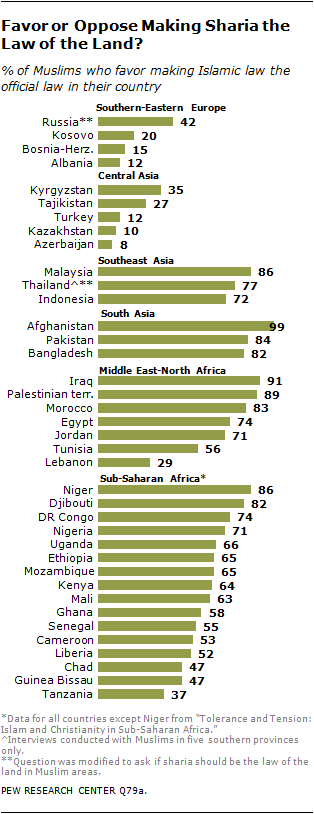
Chapter 5: Relations Among Muslims

Muslims see themselves as more devout than other Muslims in their country. Despite this fact, few see tensions between Muslims who are more religious and those who are less religious as a very big problem. Similarly, few Muslims say tensions between Sunnis and Shias are a very big problem in their country.

Perceived Levels of Devotion – Personal and Societal

gsi2-chp5-1

Majorities of Muslims in 17 of the 23 countries where the question was asked say the way they live their lives reflects the hadith and sunna (actions and words of the Prophet Muhammad) at least a little.35 However, in only five of the countries surveyed do at least half say their lives reflect the hadith and sunna a lot.

Muslims in South Asia and Southeast Asia are among the most likely to say they adhere to hadith and sunna. More than three-quarters of Muslims in each country surveyed in these regions say they follow the hadith and sunna at least a little, including a nearly universal proportion in Afghanistan (97%), and roughly nine-in-ten in Thailand and Pakistan (87% each). At least seven-in-ten Afghan (75%) and Thai Muslims (70%) say their lives reflect hadith and sunna a lot.

At least half of Muslims in nearly every country surveyed in the Middle East and North Africa say they adhere to hadith and sunna at least somewhat, including more than three-quarters of Muslims in Iraq (82%), Morocco (81%) and Tunisia (76%). However, with the exception of Iraqi Muslims (55%), fewer than three-in-ten Muslims in each of the countries surveyed in this region say their lives follow the hadith and sunna a lot.

Similarly, more than half of Muslims in most countries surveyed in Central Asia say they follow hadith and sunna at least a little; the one exception is Kazakhstan (38%). Self-described adherence to the hadith and sunna is particularly high in Turkey (76%) and Azerbaijan (72%), though only a third or fewer Muslims in these countries say their lives reflect the hadith and sunna a lot.

Muslims in Southern and Eastern Europe diverge in their adherence to the hadith and sunna. About six-in-ten Muslims in Russia (58%) and half in Bosnia-Herzegovina say they adhere to the hadith and sunna at least a little. Far fewer Muslims in Kosovo and Albania (20% each) say their lives reflect the hadith and sunna, while more than four-in-ten (46% each) are unsure. Less than a quarter in any of the Southern and Eastern European countries surveyed say their lives reflect the hadith and sunna a lot.

Overall, Muslims who pray several times a day are more likely than those who pray less often to say they follow the hadith and sunna in their daily lives. For example, 76% of Lebanese Muslims who pray several times a day say they follow the hadith and sunna at least a little; among those who pray less often, 22% say the same. There are double-digit gaps on this question in 19 of the 23 countries surveyed.

The survey also asked Muslims the extent to which most people in their country live in accordance with the hadith and sunna. In many countries surveyed, Muslims are more likely to say their own lives adhere to the hadith and sunna than they are to say the same about Muslims in the broader society. The gap between perceptions of themselves and their fellow Muslims is especially wide in the Middle East and North Africa. For example, in Lebanon, 56% say they follow the hadith and sunna at least a little, while just 24% say most Lebanese Muslims do the same. The difference in perceptions is also particularly large in Morocco (+26 percentage points), Iraq (+23), Egypt and the Palestinian territories (+21 each).

gsi2-chp5-2

Conflict Between More and Less Religious Muslims

gsi2-chp5-3

Despite the fact that many Muslims see themselves as more devout than other Muslims in their country, overall, few consider tensions between Muslims who are more religious and those who are less religious to be a very big problem in their country. Fewer than a third of Muslims in all 23 countries where the question was asked say these types of tensions are a pressing issue.

Muslims in the Middle East and North Africa are among the most likely to say tensions between Muslims who are more devout and those who are less devout represent a very big problem in their country. Roughly a quarter or more in the Palestinian territories (31%), Egypt (27%), Tunisia (26%), Lebanon (25%) and Morocco (24%) say these types of tensions are very problematic; somewhat fewer hold this view in Jordan (17%) and Iraq (12%).

In South Asia, more than one-in-five Muslims in Pakistan (26%) and Afghanistan (21%) say tensions between devout Muslims and those who are less devout are a very big problem. In Bangladesh, 14% take this view.

In Southeast Asia, roughly one-in-five Muslims in Indonesia (19%) and Thailand (18%) say tensions between more and less devout Muslims are a problem in their country. Roughly one-in-ten in Malaysia (11%) hold this view.

Muslims in Central Asia as well as Southern and Eastern Europe are among the least likely to say tensions between Muslims who are more devout and those who are less devout are a major problem. While 17% in Kazakhstan and 15% in Turkey believe these types of tensions among Muslims are a very big concern in their country, less than one-in-ten say the same in Kyrgyzstan (8%), Tajikistan (4%), Uzbekistan (3%) and Azerbaijan (1%). In Southern and Eastern Europe, 16% of Bosnian Muslims say these types of tensions are a very big problem, compared with just one-in-ten or fewer among Muslims in Russia (10%), Kosovo (10%) and Albania (3%).

Concern About Sunni-Shia Conflict

gsi2-chp5-4

In the seven countries where the question was asked, a minority of Muslims believe tensions between Sunni and Shia Muslims (the two main sects of Islam) are a very big problem in their country.

The percentage of Muslims who see Sunni-Shia tensions as a very big problem is highest in Lebanon (38%) and Pakistan (34%), both of which have a history of sectarian violence. Fewer Muslims in Iraq (23%) see Sunni-Shia tensions as a very big national problem, despite that country’s own sectarian struggles. In Afghanistan, one-in-five Muslims view Sunni-Shia tensions as a serious issue.

In Turkey and Tajikistan, fewer than one-in-six Muslims (14% each) say Sunni-Shia tensions are a very big problem. Almost no Muslims in Azerbaijan consider sectarian differences in their country to be very problematic.

In both Iraq and Lebanon, Sunnis are considerably more likely than Shias to rate sectarian conflict as a very big problem in their country. Fully, 40% of Iraqi Sunnis and 48% of Lebanese Sunnis see conflict with Shias as a major problem. By comparison, 11% of Iraqi Shias and 27% of Lebanese Shias see sectarian conflict as a very big problem.


Footnotes:

35 For more on the hadith and sunna, see the Glossary. (return to text)

Photo Credit: © Scott E Barbour

Chapter 6: Interfaith Relations

Muslims around the world agree that Islam is the one true faith that leads to salvation. Many Muslims also say it is their religious duty to convert others to Islam.

Many Muslims say they know little about Christianity and other faiths. And few believe Islam and other religions have a lot in common. Even in countries where a substantial proportion of the population is non-Muslim, most Muslims report that all or most of their friends also are Muslim. And while interfaith meetings and classes of Muslims and Christians are fairly common in sub-Saharan Africa, few Muslims in other regions participate in such gatherings.

Few Muslims see conflict between religious groups as a very big national problem. In fact, most consider unemployment, crime and corruption as bigger national problems than religious conflict. Asked specifically about Christian-Muslim hostilities, few Muslims say hostilities are widespread.

Islam and Eternal Salvation

gsi2-chp6-1

In 34 of the 38 countries where the question was asked, at least half of Muslims believe that Islam is the one true religion that can lead to eternal life in heaven.

Overwhelming majorities of Muslims say that Islam is the only religion that leads to eternal life in heaven in most countries surveyed in the Middle East and North Africa, including Egypt (96%), Jordan (96%), Iraq (95%), Morocco (94%) and the Palestinian territories (89%). Somewhat smaller majorities take this view in Lebanon (66%) and Tunisia (72%).

In most countries surveyed in sub-Saharan Africa, more than six-in-ten Muslims say that only Islam can lead to eternal life. Somewhat fewer take this view in Cameroon (57%), Guinea Bissau (54%), Chad (50%) and Mozambique (49%).

Similarly, in all but one country surveyed in Central Asia, at least six-in-ten Muslims say that Islam is the only path to eternal life. The exception is Kazakhstan, where 29% say that Islam is the only path that leads to eternal life, while 49% say that many religions can serve this role.

At least half of Muslims in most Southern and Eastern European countries surveyed also say that Islam is the exclusive path to heaven. Albanian Muslims are the exception: 37% say Islam is the only faith leading to eternal life, while a quarter say many faiths can lead to heaven, and 38% offer no clear opinion on the issue.

In the majority of countries where the question was asked, Muslims who pray several times a day are more likely than those who pray less often to believe that Islam is the one true faith leading to eternal life. Differences by frequency of prayer consistently are large across the countries surveyed in Southern and Eastern Europe. For example, in Russia, Muslims who pray several times a day are 41 percentage points more likely than those who pray less often to believe Islam is the one true path to eternal salvation. Significant gaps on this question between those who pray several times a day and those who pray less often also are found in Kosovo (+34 percentage points), Albania (+28) and Bosnia-Herzegovina (+27).

gsi2-chp6-2

Converting Others

gsi2-chp6-3

In most countries surveyed, at least half of Muslims believe it is their religious duty to try to convert others to the Islamic faith. Only in Indonesia and some countries in Central Asia and Southern and Eastern Europe do a clear majority say Muslims are not obliged to proselytize.

The belief that Muslims are obligated to proselytize is particularly widespread in sub-Saharan Africa. Across the region, at least three-quarters of Muslims believe it is their religious duty to try to spread Islam to non-Muslims.

A majority of Muslims in the South Asian countries surveyed also say trying to convert others to Islam is a religious duty. This sense is nearly universal in Afghanistan, where 96% of Muslims believe proselytizing is a duty of their faith. In Pakistan, 85% of Muslims share this view, as do 69% in Bangladesh.

In the Middle East and North Africa, a clear majority of Muslims in most countries surveyed believe trying to convert others is a religious duty, including roughly nine-in-ten in Jordan (92%) and Egypt (88%). Lebanon is the one country in the region where opinion is more divided (52% say proselytizing is a religious duty, 44% say it is not).

In Southeast Asia, a strong majority of Muslims in Malaysia (79%) and Thailand (74%) believe trying to convert others is a religious duty. However, most Indonesian Muslims disagree (65% say it is not a religious duty, 31% say it is).

Many Muslims in Central Asia as well as Southern and Eastern Europe do not believe that their faith obliges them to try to convert others. Roughly half or more in Kazakhstan (77%), Albania (72%), Bosnia-Herzegovina (59%), Kosovo (55%), Russia (51%), Kyrgyzstan (50%) and Turkey (48%) do not believe Muslims have a duty to proselytize. Opinion is divided in Azerbaijan (42% say it is a religious obligation, 36% disagree). Only in Tajikistan does a clear majority (69%) agree that Muslims have a duty to spread their faith.

In general, Muslims who pray several times a day are more likely than those who pray less frequently to say proselytizing is a religious duty. For example, in Lebanon, where Muslims overall are fairly divided on the question, those who pray several times day are nearly twice as likely as those who pray less often to say it is their duty to convert others (63% vs. 33%). Large gaps on the question of proselytizing between Muslims who pray frequently versus those who pray less often also are found in Russia (+27 percentage points), the Palestinian territories (+22) and Tunisia (+22).

Religious Conflict as a Big National Problem

gsi2-chp6-4

In only seven of the 38 countries where the question was asked do at least half of Muslims describe conflict between religious groups as a very big national problem, and in most cases worries about crime, unemployment, ethnic conflict and corruption far outweigh concerns about religious conflict. But a substantial minority of Muslims in a number of countries surveyed do see religious strife as a major issue.

In the Middle East-North Africa region, a majority of Muslims in Lebanon (68%) and Tunisia (65%) say religious conflict is a very big problem in their country, as do more than half in the Palestinian territories (54%) and more than four-in-ten in Iraq (46%). Fewer Muslims see religious conflict as a pressing issue in Egypt (28%) and Jordan (13%).

Concern about religious conflict is relatively high among Muslims in the countries surveyed in sub-Saharan Africa, including Niger (64%), Nigeria (60%) and Djibouti (52%). More than one-in-five Muslims in all but one country surveyed in the region see religious conflict as a very big problem; Ethiopia (16%) is the exception.

In South Asia, a majority of Pakistani Muslims (57%) consider religious conflict a big national problem, while roughly a third or fewer Muslims hold this view in Afghanistan (35%) and Bangladesh (29%).

Among Muslims in Central Asia as well as Southern and Eastern Europe, fewer than four-in-ten consider religious conflict a very big problem in every country surveyed. About a third of Muslims in Bosnia-Herzegovina (35%), Turkey (34%) and Kazakhstan (33%) say religious conflict is a very big problem in their country. In the other countries surveyed in these regions, less than a quarter see religious conflict as a very big problem.

In Southeast Asia as well, relatively few Muslims see religious conflict as a serious problem. Roughly a third of Indonesian Muslims (36%) consider conflict between religious groups a very big national problem, a view shared by 27% of Muslims in Thailand and 26% in Malaysia.

Overall, the survey finds that opinions about whether religious conflict is a very big problem track closely with opinions about ethnic conflict as a problem. In every country surveyed, Muslims who see religious conflict as a very big problem in their country are more likely than those who see it as a less serious issue to consider conflict between ethnic groups to be a major national concern.

Views of Muslim-Christian Hostilities

gsi2-chp6-5

A minority of Muslims in 24 of the 26 countries where the question was asked say “most” or “many” Muslims and Christians are hostile toward one another. In Thailand, a small percentage of Muslims report hostilities between Muslims and Buddhists in their country.

Perceived hostilities between Muslims and Christians are on the higher side in Egypt, where half of Muslims say most or many Christians are hostile toward Muslims, and roughly a third (35%) say the same about Muslims’ attitudes toward Christians. By comparison, in Lebanon, which has a history of religious conflict, fewer than three-in-ten describe either Muslims (27%) or Christians (27%) as hostile toward the other group.

In sub-Saharan Africa, more than four-in-ten Muslims in Guinea Bissau say Christians are hostile toward Muslims (41%) and Muslims are hostile toward Christians (49%). At least a third of Muslims hold this view in Chad (34% say Christians are hostile, 38% say Muslims are hostile). Elsewhere in the region, less than a third of Muslims see mutual tension between the two faiths, although 37% of Muslims in the Democratic Republic of the Congo describe most or many Christians as hostile toward Muslims (just 18% say the same about Muslims’ attitudes toward Christians).

In nearly every country surveyed in Central Asia and Southern and Eastern Europe, fewer than a quarter of Muslims perceive widespread religious hostilities. This includes Kosovo and Albania, where less than 10% of Muslims believe either Christians or Muslims are hostile toward one another. In Russia, a fifth of Muslims describe Christians as hostile toward Muslims, while 13% say this is how most or many Muslims feel about Christians. Bosnia-Herzegovina is the one country in these two regions where more than a quarter (31%) perceive Christians as hostile toward Muslims – roughly twice as many as say the same about Muslims’ attitudes toward Christians (14%).

Familiarity With Other Faiths

gsi2-chp6-6

In only three of the 37 countries where the question was asked do at least half of Muslims say they know a great deal or some about Christian beliefs and practices. In Thailand, where Muslims were asked to rate their knowledge of Buddhism, less than one-in-five say they are familiar with the Buddhist faith.

However, substantial proportions of Muslims in the sub-Saharan African countries surveyed do say they know some or a great deal about the Christian faith. At least half of Muslims say they are knowledgeable about Christianity in Mozambique (61%) and Guinea Bissau (55%), while four-in-ten or more in Ghana (46%), Kenya (45%), the Democratic Republic of Congo (44%), Ethiopia (44%), Uganda (44%), Chad (42%) and Liberia (41%) say the same. Fewer than one-in-five Muslims say they are familiar with Christianity in only one sub-Saharan African country: Niger (17%).

Bosnia-Herzegovina is the only country outside sub-Saharan Africa where about half (51%) of Muslims say they know some or a great deal about Christianity. Elsewhere in Southern and Eastern Europe, as well as Central Asia, fewer than one-in-four Muslims are familiar with the Christian faith.

In the countries surveyed in the Middle East and North Africa, roughly four-in-ten Muslims in Lebanon (38%) say they are familiar with Christian beliefs and practices. More than one-in-five Muslims in Jordan (25%) and Egypt (22%) say they are familiar with Christianity. But fewer than one-in-five Muslims in other countries in the region say they know some or a great deal about the Christian religion.

Familiarity with Christian beliefs and practices is also uniformly low across the countries surveyed in South Asia and Southeast Asia; 15% or fewer Muslims say they know some or a great deal about Christianity (or, in Thailand, Buddhism).

Common Ground With Other Religions

gsi2-chp6-7

At least half of Muslims in most countries surveyed say that Islam and Christianity are very different. In Thailand, most Muslims see Islam and Buddhism as very different.

In general, Muslims in sub-Saharan Africa are more likely than their counterparts in other regions to say that Islam and Christianity have a lot in common. Roughly six-in-ten hold this view in Guinea Bissau (62%), Senegal (61%), Tanzania (59%) and Cameroon (58%), while roughly half agree in Liberia (53%), Ghana (51%), Mali (51%) and Nigeria (48%). Only in the Democratic Republic of Congo do fewer than three-in-ten (26%) share this view.

A majority of Muslims in Bosnia-Herzegovina (59%) and at least half in Kazakhstan (52%) say Islam and Christianity have a lot in common; in Russia, a plurality (46%) agrees. Elsewhere in Central Asia and Southern and Eastern Europe, no more than about three-in-ten believe the two faiths have a lot in common.

In five of the seven countries surveyed in the Middle East and North Africa, a majority or plurality see Islam and Christianity as very different religions. While Palestinian Muslims are split on the issue of how much the two religions share (42% say they have a lot in common, 39% say they are very different), a majority of Muslims in Jordan (60%), Lebanon (57%) and Egypt (56%) consider Islam and Christianity to be very different. In Iraq, 57% of Muslims are uncertain, compared with 27% who believe Islam and Christianity have a lot in common and 16% who say they are very different.

Most Muslims in South Asia and Southeast Asia say Islam and Christianity are very different, including at least eight-in-ten in Indonesia (87%), Malaysia (83%) and Pakistan (81%). Asked about Buddhism, 60% of Thai Muslims say it is very different from Islam.

Knowledge Related to a Sense of Commonality

Muslims who say they know at least something about Christianity are considerably more likely than those with less knowledge to believe the two faiths have a lot in common. For example, in Tunisia, 68% of Muslims who say they know at least something about Christian beliefs and practices say Islam and Christianity share a lot in common. But among Tunisian Muslims who say they are less familiar with Christianity, about a quarter (27%) say the two religions share common ground. Large gaps are also seen in Iraq (+39), Kyrgyzstan (+34), Bosnia-Herzegovina (+30), Russia (+30) and Turkey (+30).

gsi2-chp6-8

Relationships With People of Other Faiths

Relatively few Muslims count non-Muslims among their close friends. And in most countries surveyed, few are comfortable with the idea of their son or daughter marrying outside the faith.

Sub-Saharan Africa is the one region where the contact between Muslims and non-Muslims is often more frequent. For instance, substantial percentages Muslims in the region report that their families include both Muslims and Christians. In addition, Muslims in sub-Saharan African tend to participate in inter-faith classes and meetings at a higher rate than Muslims in other regions.

Close Friends

In every country where the question was asked, a large majority of Muslims say all or most of their close friends share their faith. The survey finds that even in countries with substantial non-Muslim populations, a large majority of Muslims say most, if not all, of their close friends share their faith. For example, in Lebanon, where non-Muslims make up nearly 40% of the population, 94% of Muslims describe their circle of close friends as exclusively or mostly Muslim.36 In Russia, where non-Muslims make up 90% of the population, 78% of Muslims say most or all of their close friends share their Islamic faith.37

gsi2-chp6-9

Marrying Outside the Faith

In 22 countries outside sub-Saharan Africa, the survey asked Muslims how comfortable they would be with the idea of their son or daughter marrying a Christian. Overall, relatively few Muslims find the idea of inter-marriage acceptable.

gsi2-chp6-10

Openness to marrying outside the faith is greatest in Albania and Russia, where at least half of Muslims (77% and 52%, respectively) say they would be comfortable with their son marrying a Christian. A majority of Albanian Muslims (75%) also would be comfortable if their daughter married a Christian, but significantly fewer Russian Muslims (39%) say the same.

Elsewhere in Southern and Eastern Europe, as well as in Central Asia, fewer than four-in-ten Muslims say they would be comfortable with either a son or daughter marrying outside the faith. After Albania and Russia, acceptance of interfaith marriage is greatest in Kazakhstan (36% are comfortable with a son marrying a Christian, 32% with a daughter doing the same), and lowest in Azerbaijan (8% son, 3% daughter).

In the other regions surveyed, three-in-ten or fewer Muslims say they would be comfortable with a son marrying a Christian (or Buddhist, in the case of Thailand), with single-digit acceptance in Pakistan (9%) and Indonesia (6%). Almost no Muslims surveyed in Egypt and Jordan would be comfortable with an interfaith marriage for their daughter. Elsewhere, fewer than one-in-four Muslims would be comfortable with their daughter marrying a Christian.

In the countries surveyed in Middle East and North Africa, Muslims consistently express greater acceptance of interfaith marriage for sons than daughters. Muslims in Egypt and Tunisia, for example, are 17 percentage points more comfortable with a son entering into an interfaith marriage than a daughter doing the same. Among the other countries surveyed in the region, attitudes differ in the same direction by nine to 12 percentage points.

In many countries surveyed, Muslims who pray several times a day are less accepting than those who pray less often of a child marrying outside the faith. This is especially true in Russia, where only a minority of Muslims who pray several times a day are comfortable with their son (35%) or daughter (12%) marrying a Christian. By contrast, 61% of Russian Muslims who pray less often say they would be very or somewhat comfortable if their son married a Christian. Roughly half express the same level of acceptance with the idea of their daughter (53%) marrying a Christian.

Views on Interfaith Marriage and Families in Sub-Saharan Africa

In sub-Saharan Africa, Muslims were asked how comfortable they would be if a child of theirs, regardless of gender, someday married a Christian. Overall, few Muslims in the region say they would accept such a marriage.

Muslims in sub-Saharan Africa were also asked about whether their immediate family includes Christians. Substantial proportions in a number of countries surveyed answer yes, including a majority in Mozambique (93%), Uganda (66%) and the Democratic Republic of Congo (62%), and more than a third in Tanzania (39%), Liberia (38%) and Cameroon (34%).

Interfaith Meetings

In most regions, few Muslims say they attend interfaith meetings or classes. But in sub-Saharan Africa, substantial proportions in several countries say they attend such gatherings with Christians. Interfaith interactions are especially common in Mozambique, Uganda and Liberia, where more than half of Muslims say they engage in organized meetings with Christians.

gsi2-chp6-11

Outside sub-Saharan Africa, Thailand is the only country where a majority of Muslims (56%) say they attend interfaith meetings or classes – in this case, with Buddhists. Elsewhere in Southeast Asia, few Muslims report attending formal gatherings with Christians.

In other regions, the proportion of Muslims who take part in interfaith meetings does not exceed one-in-five and is often about one-in-ten or less. Participation in interfaith gatherings is especially low in the Middle East and North Africa, ranging from 8% of Muslims in the Palestinian territories to 3% in Jordan. Even in Lebanon, where Christians make up nearly 40% of the population, just 6% of Muslims say they participate in interfaith classes or meetings with Christians.


Footnotes:

36 See the Pew Research Center’s December 2012 report “The Global Religious Landscape.” (return to text)

37 See the Pew Research Center’s December 2012 report “The Global Religious Landscape.” (return to text)

Photo Credit: © Scott E Barbour

Chapter 7: Religion, Science and Popular Culture

The survey asked Muslims about their views on various dimensions of contemporary life. Muslims see few tensions between their faith and life in the modern world. Most think it is possible to be a devout Muslim and still live in a modern society, and many also dismiss the idea that there is an inherent antagonism between religion and science. Indeed, most Muslims say they believe in evolution.

But Western and Indian popular culture imports elicit mixed reactions from the world’s Muslims. While many Muslims say they personally like Western music, movies and television, most Muslims also agree that Western popular culture has hurt morality in their countries. On balance, more Muslims say they like Bollywood movies and music than say the same about Western entertainment. Muslims also see Bollywood as less harmful to morality than Western popular culture is.

Religion and Modernity

gsi2-chp7-1

Muslims in most regions surveyed say being a religious person is compatible with life in modern society. In sub-Saharan Africa, however, Muslims in many countries are divided on this issue.

Muslims in Southeast Asia, Central Asia, and Southern and Eastern Europe tend to be the least likely to see a conflict between being devout and living in the contemporary world. In Southeast Asia, for instance, fewer than a third of Muslims in Thailand (32%), Malaysia (23%) and Indonesia (21%) say religion and modernity are at odds.

In Central Asia as well as Southern and Eastern Europe, no more than four-in-ten Muslims say religion and modernity are incompatible, including just 13% of Azerbaijani Muslims. Of the populations surveyed in these regions, Turkish Muslims are the most closely divided on the issue: 38% say there is a conflict between religion and modern life, while 49% disagree.

In most countries surveyed in South Asia and the Middle East-North Africa region, fewer than a third of Muslims say there is a conflict between being devout and leading a modern life. But Muslims are more divided on this question in Tunisia (50% say there is a conflict, 46% say there is not), Lebanon (45% vs. 51%) and Bangladesh (55% vs. 39%).

Across the six major regions included in the study, Muslims in sub-Saharan Africa are among the most likely to say religious devotion and modern life are incompatible. In 14 of the 16 countries surveyed in the region, at least three-in-ten say there is a conflict, including a majority in Chad (59%) and Kenya (54%).

Muslims who pray several times a day are no more likely than those who pray less often to say that religion and modernity are in conflict. In addition, age, gender and education have little impact on whether Muslims see a tension between being a religious person and living in contemporary society.

Religion and Science

gsi2-chp7-2

Most Muslims do not believe there is an inherent tension between religion and science. In just two of the 23 countries where the question was asked do more than half of Muslims say there is a conflict between faith and science. In fact, at least half of Muslims in 17 countries say no conflict exists.

Muslims in the Middle East and North Africa are among the least likely to believe there is a conflict between science and religion. Fewer than one-in-five express this view in Morocco (18%), Egypt (16%), Iraq (15%), Jordan (15%) and the Palestinian territories (14%). However, a higher percentage of Muslims in Lebanon (53%) and Tunisia (42%) say there is a conflict.

In the Southeast Asian countries surveyed, fewer than a third of Muslims say there is a tension between religion and science. Similarly, in Central Asia, relatively few Muslims see a conflict, including just 19% in Azerbaijan and 18% in Uzbekistan. However, Muslims in Turkey are divided on this question (40% say there is a conflict, 44% disagree).

In the South Asian countries surveyed, Muslims’ opinions about the compatibility of science and religion differ considerably. By a 57%-to-29% margin, most Afghan Muslims say there is no inherent tension between faith and science. By comparison, Muslims in Bangladesh are evenly divided over the issue (with 45% on each side). Pakistani Muslims are less certain: 27% say there is a tension between science and religion, 33% say there is not, and 41% say they do not know.

Across the nations surveyed in Southern and Eastern Europe, more than a quarter of Muslims in each country believes there is an inherent tension between faith and science, including 57% in Albania. Nonetheless, about half of Muslims in Bosnia-Herzegovina (50%), Russia (50%) and Kosovo (49%) believe there is no conflict.

There are not significant differences on this question by frequency of prayer, gender, age or education.

Evolution

gsi2-chp7-3

Many Muslims around the world believe in evolution. In 13 of the 22 countries where the question was asked, at least half say humans and other living things have evolved over time. By contrast, in just four countries do at least half say that humans have remained in their present form since the beginning of time.

In Southern and Eastern Europe, a majority of Muslims in Albania (62%) and Russia (58%) believe in evolution. But Muslims are divided in Bosnia-Herzegovina (50% believe humans have evolved, while 45% take the opposite view) and Kosovo (34% vs. 40%).

In four of the Central Asian countries surveyed, more than half of Muslims say they believe in evolution, including nearly eight-in-ten in Kazakhstan (79%). In Tajikistan and Turkey, by contrast, the predominant view is that humans have remained in their present form since the beginning of time (55% and 49%, respectively).

At least six-in-ten Muslims in Lebanon (78%), the Palestinian territories (67%) and Morocco (63%) think humans and other living things have evolved over time, but Jordanian and Tunisian Muslims are more divided on the issue. About half in Jordan (52%) believe in evolution, while 47% say humans have always existed in their present form. And in Tunisia, 45% say humans have evolved, 36% say they have always existed in their present form, and 19% are unsure. Iraq is the only country surveyed in the Middle East-North Africa region where a majority rejects the theory of evolution (67%).

Muslims’ views on evolution vary in South Asia and Southeast Asia. Muslims in Thailand (55%) and Bangladesh (54%) tend to accept that humans have evolved over time. But Muslims in Malaysia and Pakistan are divided: roughly four-in-ten Malaysian Muslims (37%) believe in evolution, while 45% say humans have always existed in their present form. In Pakistan, 30% think humans have evolved, while 38% disagree and 32% say that they do not know. In Afghanistan and Indonesia, the prevailing view is that humans and living things have remained in their present form since the beginning of time (62% and 55%, respectively).

In countries surveyed in Southern and Eastern Europe, more religiously observant Muslims are less likely to believe in evolution. In Russia, for example, 41% of Muslims who pray several times a day believe in evolution, compared with 66% of those who pray less frequently. Significant gaps also appear between more and less devout Muslims in Bosnia-Herzegovina (-19 percentage points) and Kosovo (-14). Views on evolution do not differ significantly by religious commitment in the other regions surveyed.

Popular Culture

gsi2-chp7-4

In 18 of the 38 countries where data are available, at least half of Muslims say they like Western music, movies and television. However, in a number of countries views of Western entertainment are mixed.

Muslims in Southern and Eastern Europe are especially likely to say they enjoy Western popular culture. More than six-in-ten in Albania (77%), Kosovo (69%) and Bosnia-Herzegovina (62%) like Western entertainment. About half of Muslims in Russia (52%) say the same.

Central Asian Muslims are mixed in their views of Western cultural exports. More than half of Muslims in Tajikistan (57%), Kazakhstan (56%) and Azerbaijan (55%) say they like Western popular culture, but fewer say the same in Turkey (49%), Kyrgyzstan (45%) and Uzbekistan (38%).

In sub-Saharan Africa, Muslims also have divided opinions over Western entertainment. Preference for Western music, movies and television ranges from 71% in Guinea Bissau to 29% in Ethiopia.

Fewer Muslims in Southeast Asia enjoy Western popular culture. While half of Malaysian Muslims like Western entertainment, just 41% of Indonesian Muslims and 22% of Thai Muslims hold this opinion.

Similarly, fewer than half of Muslims in most countries surveyed in the Middle East and North Africa say they like Western entertainment. The one exception is Morocco (52%).

Muslims in South Asia are among the least likely to enjoy Western cultural exports. Just three-in-ten or fewer Muslims in the countries surveyed in the region have a favorable opinion of Western music, movies and television, including just 20% in Pakistan.

Muslims who pray several times a day are less likely than those who pray less frequently to say they enjoy Western entertainment. The gap is especially large in the Middle East and North Africa, including in Tunisia (-32 percentage points), the Palestinian territories (-30), Morocco (-29), Iraq (-19) and Jordan (-19).

Muslims ages 35 and older are less likely than younger Muslims to enjoy Western music, movies and television. The gap between generations is particularly wide in Russia (-37 percentage points), Malaysia (-35), Kyrgyzstan (-32) and Kazakhstan (-32).

Bollywood cultural exports – music and movies from India – are broadly popular in Central Asia, where at least half of Muslims in all the countries surveyed say they enjoy this type of entertainment. But fewer than half of Muslims surveyed in South Asian countries agree.

gsi2-chp7-5

On balance, Bollywood is more popular than Western entertainment. Muslims are more likely to say they enjoy Bollywood than to say the same about Western entertainment in Uzbekistan (+21 percentage points), Bangladesh (+15), Azerbaijan (+10) and Tajikistan (+9).

Impact on Morality

gsi2-chp7-6

Although many Muslims around the globe say they personally like Western music, movies and television, at least half in the majority of countries surveyed believe Western popular culture harms morality in their country.

In nearly every country surveyed in South Asia, Southeast Asia, the Middle East and North Africa, and sub-Saharan Africa, a majority of Muslims say Western entertainment is bad for their society, including at least eight-in-ten in Pakistan (88%), the Palestinian territories (81%), Tanzania (80%) and Uganda (80%). Guinea Bissau is the only country in these four regions where fewer than half (47%) believe Western cultural exports are harmful.

In Central Asia, a majority of Muslims in Uzbekistan (81%) and Kyrgyzstan (69%) believe Western popular culture has a negative effect on morality, but fewer hold this view in Azerbaijan (52%), Tajikistan (51%), Turkey (50%) and Kazakhstan (50%).

Muslims in Southern and Eastern Europe are among the least negative in their assessment of Western entertainment. Fewer than half of Muslims in Bosnia-Herzegovina (46%), Kosovo (44%) and Albania (40%) have negative views. Russia is the only country surveyed in the region where a majority of Muslims (58%) say Western entertainment is harmful.

Muslims who pray several times a day are more likely than those who pray less often to say Western entertainment is harmful to their society. The gap is particularly wide in Malaysia (+27 percentage points), Tunisia (+27), Iraq (+25), Bosnia-Herzegovina (+24), Kosovo (+21), Russia (+21) and Jordan (+20).

Older Muslims also are more likely than those younger than 35 to say that Western entertainment hurts morality. The age differences are particularly large in Kazakhstan (+22 percentage points), Azerbaijan (+20), Iraq (+19) and Jordan (+17).

In contrast to their views on the impact of Western popular culture, Muslims disagree over Bollywood’s effect on morality in their country. In the South Asian countries surveyed, more than six-in-ten Muslims say Bollywood is bad for their society, including 88% of Muslims in Pakistan. In the Central Asian countries surveyed, by contrast, fewer than half say this.

gsi2-chp7-7

In most countries where the question was asked, fewer Muslims say Bollywood music and movies are harmful to morality than say the same about Western entertainment. This is especially true in Central Asia. For example, 50% of Kazakhstani Muslims say that Western popular culture hurts morality, compared with 13% who say the same about Bollywood. Large differences are also found in Kyrgyzstan (-36 percentage points), Uzbekistan (-35), Azerbaijan (-33) and Tajikistan (-23).

Photo Credit: © Scott E Barbour

Appendix A: U.S. Muslims — Views on Religion and Society in a Global Context

In their attitudes toward modern society and their relations with people of other faiths, U.S. Muslims sometimes more closely resemble other Americans than they do Muslims around the world.

According to a 2011 Pew Research Center survey, about half of U.S. Muslims say that all (7%) or most (41%) of their close friends are followers of Islam, and half say that some (36%) or hardly any (14%) of their close friends are Muslim. By contrast, Muslims in other countries nearly universally report that all or most of their close friends are Muslim (global median of 95%). Even Muslims who also are religious minorities in their countries are less likely than U.S. Muslims to have friendships with non-Muslims. For example, 78% of Russian Muslims and 96% of Thai Muslims say most or all of their close friends are Muslim.

gsi2-appa-1

A majority of U.S. Muslims (56%) believe that many religions can lead to eternal life. Most Americans (65%), including nearly two-thirds of American Christians (64%), share this view. Across the world, however, this attitude is far less common among Muslims: a median of just 18% of Muslims worldwide think religions other than Islam can lead to eternal life.

gsi2-appa-2

Most U.S. Muslims (63%) say there is no inherent tension between being devout and living in a modern society. A nearly identical proportion of American Christians (64%) agree. Around the world, somewhat fewer Muslims (global median of 54%) share the view that modern life and religious devotion are not at odds.

gsi2-appa-3

The picture is more complicated when it comes to matters of science and religion. Roughly six-in-ten U.S. Muslims (59%) say there is generally no conflict between science and religion. Globally, about half of Muslims (median of 54%) agree. But among U.S. Christians (39%) and the U.S. general public (37%) smaller shares view religion and science as generally compatible. On the question of evolution, U.S. Muslims are split: 45% believe humans and other living things have evolved over time, while 44% disagree. U.S. Muslims are about as likely to believe in evolution as U.S. Christians (46% of whom say they believe in evolution). But Americans overall (52%) as well as Muslims worldwide (median of 53%) lean more clearly toward accepting evolution.

gsi2-appa-4

More than eight-in-ten American Muslims say suicide bombings and other forms of violence against civilian targets are never justified (81%) or rarely justified (5%) to defend Islam from its enemies. Worldwide, most Muslims also reject this type of violence, with a median of 72% saying such attacks are never justified and 10% saying they are rarely justified. Just 1% of U.S. Muslims and a median of 3% of Muslims worldwide say suicide bombings and other violence against civilian targets are often justified, while 7% of U.S. Muslims and a global median of 8% of Muslims say such attacks are sometimes justified to defend Islam.

gsi2-appa-5

Download selected questions and results from the 2011 and 2007 Surveys of U.S. Muslims PDF (30 KB, 2 pages).

Photo Credit: © Scott E Barbour

Appendix B: Glossary

Fiqh

Islamic jurisprudence based on the study of the Quran, the sunna and other sources. Several legal schools of Islamic jurisprudence have been developed over the centuries. The most commonly practiced and referenced today include four major Sunni schools – Hanafi, Shafi, Maliki and Hanbali – and the Shia Jafari school.

Hadith

Sayings or deeds ascribed to the Prophet Muhammad. In the first centuries after Muhammad’s death, Islamic scholars established a ranking system for the reliability of each reported hadith. However, there continues to be disagreement over the validity of various hadith. For Sunnis, hadith contained in the volumes Sahih al-Bukhari and Sahih Muslim are the most widely referenced, although other compilations exist. Shia Muslims favor hadith with a chain of transmission through the family of Ali, the son-in-law of Muhammad.

Hudud (Hadud, Hudood) Punishments

A class of punishments prescribed by the Quran and the sunna for crimes considered to be against God. Although interpretations by Islamic jurists vary, such crimes commonly include theft, adultery, making unproven accusations of adultery, consuming intoxicants, armed robbery and apostasy. The prescribed punishments range from lashes to banishment to death. Strict evidence is required for conviction, such as four credible eyewitnesses to prove adultery. In addition, the crime must have been committed by a willful and sane adult.

Quran

The Muslim holy book and highest Islamic jurisprudential authority.

Sharia

The moral and legal code of Islam. The word sharia derives from an Arabic word meaning “path” or “way.” In its strictest definition, sharia refers to divine principles and laws as set down explicitly in the Quran and the hadith and sunna. To some Muslims, sharia also may broadly include Islamic jurisprudence and interpretation (fiqh). Sharia offers moral and legal guidance for nearly all aspects of life, including contracts and transactions; politics and crime; civil and family relations; worship; and personal conduct such as diet, attire and hygiene.

Shia

One of the two main branches of Islam. The name is a shortened form of the historical term Shia-t-Ali, or “party of Ali,” and refers to one of the factions that emerged from a dispute over leadership succession soon after the death of the Prophet Muhammad in 632. Over time, the political divide between Shia and Sunni Muslims broadened to include theological distinctions as well as differences in religious practice.

Sunna

The practices of the Prophet Muhammad, including his habits, statements and characteristics. The sunna is considered the second-highest Islamic jurisprudential authority and serves as a guide for Muslims in their behavior and understanding of Islam. The sunna has been recorded and passed down over the centuries in the form of hadith.

Sunni

One of the two main branches of Islam. Sunni Muslims make up a majority of the world’s Muslim population. The name comes from Ahl al-Sunna wal-Jammah, or “people of the Sunna and the community.” Sunni Islam is associated with norms of Muslim conduct based on the sayings and actions of the Prophet Muhammad, particularly as enshrined in the four major schools of jurisprudence – Hanafi, Shafi, Maliki and Hanbali.

Photo Credit: © Scott E Barbour

Appendix C: Survey Methodology

Results for the survey are based on face-to-face interviews conducted under the direction of Opinion Research Business in Iraq, Morocco and Tunisia and Princeton Survey Research Associates International in the other 36 countries. Findings are reported exclusively for Muslims; however, the survey is based on national samples that did not screen out non-Muslims, except in Thailand, where a sample of only Muslims was fielded in five southern provinces. In certain instances, regions of countries with high levels of insecurity or limited access were also excluded from the national samples. Oversamples of Muslims were conducted in two countries: Bosnia-Herzegovina and Russia. In both countries, oversampling was achieved by disproportionately sampling regions or territories known to have higher concentrations of Muslims.

In all countries, surveys were administered through face-to-face interviews conducted at a respondent’s place of residence. All samples are based on area probability designs, which typically entailed proportional stratification by region and urbanity, selection of primary sampling units (PSUs) proportional to population size, and random selection of secondary and tertiary sampling units within PSUs. Interview teams were assigned to designated random routes at the block or street level and followed predetermined skip patterns when contacting households. Within households, adult respondents were randomly selected by enumerating all adults in the household using a Kish grid or selecting the adult with the most recent birthday.

The questionnaire administered by survey interviewers was designed by the staff of the Pew Research Center’s Forum on Religion & Public Life in consultation with subject matter experts and advisers to the project. The questionnaire was translated into the vernacular language(s) of each country surveyed, checked through back-translation and pretested prior to fieldwork. In total, the survey was conducted in more than 80 languages.

Conducting opinion polls in diverse societies necessitates adapting the survey to local sensitivities. In some countries, pretest results indicated the need to suppress certain questions to avoid offending respondents and/or risking the security of the interviewers. In other countries, interviewers considered some questions too sensitive to pretest. Thus, not all questions were asked in all countries.

For example, interviewers in Afghanistan, Uzbekistan and Morocco indicated that certain questions about sexual preference and sexual behavior were too sensitive to be asked. Questions on these topics were either eliminated or modified in these countries.

Following fieldwork, survey performance for each country was assessed by comparing the results for key demographic variables with reliable, national-level population statistics. For each country, the data were weighted to account for different probabilities of selection among respondents in each sample. Additionally, where appropriate, data were weighted through an iterative procedure to more closely align the samples with official population figures for characteristics such as gender, age, education and ethnicity. The reported sampling errors and the statistical tests of significance used in analysis take into account the effect of both types of weighting. The reported sampling errors and statistical tests of significance also take into account the design effects associated with each sample.

The table below shows the sample size and margin of sampling error for Muslim respondents in each country. For results based on the Muslim sample in the countries surveyed, one can say with 95% confidence that the error attributable to collecting data from some, rather than all, members of the Muslim population is plus or minus the margin of error. This means that in 95 out of 100 samples of the same size and type, the results obtained would vary by no more than plus or minus the margin of error for the country in question.

It should be noted that practical difficulties in conducting multinational surveys can introduce error or bias into the findings of opinion polls. In some countries, the achieved samples suffered from imbalances in the number of women or men interviewed, while in some countries a lack of adequate, national-level statistics made it difficult to assess the accuracy of educational characteristics among the sampled population. Specific difficulties encountered were:

Gender Imbalances: In Afghanistan and Niger, the survey respondents are disproportionately male, while in Thailand, Azerbaijan and Uzbekistan they are disproportionately female.

In each of these countries interviewers faced practical difficulties in reaching additional male or female respondents. In Afghanistan, despite strict gender matching, cultural norms frequently limited the ability of interviewers to contact women in certain areas. In Niger, difficulties associated with recruiting enough female interviewers affected gender matching and may have discouraged the participation of women in the survey.

Surveying in active conflict zones posed particular challenges for interviewers. In southern Thailand, security concerns limited the number of interviews that could be conducted in the evening hours, leading in part to fewer interviews with men, who often are out of the house during daytime hours.

In Azerbaijan and Uzbekistan, large-scale labor migration patterns may have contributed to fewer interviews with male respondents.

Education: In many countries, census statistics on education are unavailable, dated or disputed by experts. The lack of reliable national statistics limits the extent to which survey samples can be assessed for representativeness on this measure.

In Albania, the Palestinian territories and Tajikistan, the surveys appear to overrepresent highly educated respondents compared with the last available national census. In each of these cases, however, official education statistics are based on, or estimated from, censuses conducted five or more years prior to the survey and thus were not used for the purposes of weighting.

In Niger, the sample is disproportionately well-educated compared with the last available Demographic and Health Survey (2006), but no education census statistics are available to assess the representativeness of the sample.

In addition to sampling error and other practical difficulties, one should bear in mind that question wording can also have an impact on the findings of opinion polls.

For details about the surveys conducted in 15 sub-Saharan African countries in 2008-2009, see the Pew Research Center’s 2010 report “Tolerance and Tension: Islam and Christianity in Sub-Saharan Africa.”

The survey questionnaire and a topline with full results for the 24 countries surveyed in 2011-2012 is included in Appendix D (PDF).

gsi2-appc-1

Afghanistan Sample design: Stratified area probability sample of all 34 Afghan provinces (excluding nomadic populations) proportional to population size and urban/rural population. Mode: Face-to-face adults 18+ Languages: Baloch, Dari, Hazara, Pashto, Uzbek Fieldwork dates: Nov. 27–Dec. 17, 2011 Representative: Nationally representative of 94% of the adult population. Design effect: 3.4

Albania Sample design: Stratified area probability sample of all three regions proportional to population size and urban/rural population. Some difficult-to-reach areas were excluded. Mode: Face-to-face adults 18+ Languages: Albanian Fieldwork dates: Oct. 24–Nov. 13, 2011 Representative: Nationally representative of 98% of the adult population. Design effect: 2.3

Azerbaijan Sample design: Stratified area probability sample of eight of 11 oblasts (excluding Upper-Karabakh, Nakhchivan and Kalbacar-Lacin) and city of Baku proportional to population size and urban/rural population. Mode: Face-to-face adults 18+ Languages: Azeri, Russian Fieldwork dates: Dec. 4–Dec. 25, 2011 Representative: Nationally representative of 85% of the adult population. Design effect: 3.3

Bangladesh Sample design: Stratified area probability sample of all seven administrative divisions proportional to population size and urban/rural population. Mode: Face-to-face adults 18+ Languages: Bangla Fieldwork dates: Nov. 21, 2011–Feb. 5, 2012 Representative: Nationally representative of the adult population. Design effect: 3.8

Bosnia-Herzegovina Sample design: Stratified area probability sample of all seven regions proportional to population size and urban/rural population. In addition, an oversample of Muslims was conducted in majority-Bosniak areas. Some difficult-to-reach areas were excluded. Mode: Face-to-face adults 18+ Languages: Bosnian, Croatian, Serbian Fieldwork dates: Nov. 3–Nov. 20, 2011 Representative: Nationally representative of 98% of the adult population. Design effect: 1.8

Egypt Sample design: Stratified area probability sample of 24 of 29 governorates proportional to population size and urban/rural population. The five frontier provinces, containing 2% of the overall population, were excluded. Mode: Face-to-face adults 18+ Languages: Arabic Fieldwork dates: Nov. 14–Dec. 18, 2011 Representative: Nationally representative of 98% of the adult population. Design effect: 2.6

Indonesia Sample design: Stratified area probability sample of 19 provinces (excluding Papua and other remote areas and provinces with small populations) proportional to population size and urban/rural population. Mode: Face-to-face adults 18+ Languages: Bahasa Indonesian Fieldwork dates: Oct. 28–Nov. 19, 2011 Representative: Nationally representative of 87% of the adult population. Design effect: 2.3

Iraq Sample design: Stratified area probability sample of all 18 governorates proportional to population size and urban/rural population. Mode: Face-to-face adults 18+ Languages: Arabic, Kurdish Fieldwork dates: Nov. 4–Dec. 1, 2011 Representative: Nationally representative of the adult population. Design effect: 4.9

Jordan Sample design: Stratified area probability sample of all 12 governorates proportional to population size and urban/rural population. Mode: Face-to-face adults 18+ Languages: Arabic Fieldwork dates: Nov. 3–Dec. 3, 2011 Representative: Nationally representative of the adult population. Design effect: 3.5

Kazakhstan Sample design: Stratified area probability sample of all 14 oblasts proportional to population size and urban/rural population. Three districts each in Almaty oblast and East Kazakhstan were excluded due to government restrictions. Mode: Face-to-face adults 18+ Languages: Kazakh, Russian Fieldwork dates: Nov. 24–Dec. 17, 2011 Representative: Nationally representative of 98% of the adult population. Design effect: 2.5

Kosovo Sample design: Stratified area probability sample of all eight KFOR-administered regions proportional to population size and urban/rural population. Mode: Face-to-face adults 18+ Languages: Albanian, Serbian Fieldwork dates: Dec. 16, 2011–Jan. 20, 2012 Representative: Nationally representative of 99% of the adult population. Design effect: 3.7

Kyrgyzstan Sample design: Stratified area probability sample of all seven oblasts and the cities of Bishkek and Osh proportional to population size and urban/rural population. Mode: Face-to-face adults 18+ Languages: Kyrgyz, Russian, Uzbek Fieldwork dates: Jan. 31–Feb. 25, 2012 Representative: Nationally representative of the adult population. Design effect: 3.3

Lebanon Sample design: Stratified area probability sample of all seven regions (excluding areas of Beirut controlled by a militia group and a few villages in the south near the border with Israel) proportional to population size and urban/rural population. Mode: Face-to-face adults 18+ Languages: Arabic Fieldwork dates: Nov. 14–Dec. 8, 2011 Representative: Nationally representative of 98% of the adult population. Design effect: 2.2

Malaysia Sample design: Stratified area probability sample of Peninsular Malaysia, East Malaysia and the Federal Territory of Kuala Lumpur. In Peninsular Malaysia and Kuala Lumpur, interviews were conducted proportional to population size and urban/rural population. A disproportionately higher number of interviews were conducted in Sarawak and Sabah states in East Malaysia to adequately cover this geographically challenging region. Mode: Face-to-face adults 18+ Languages: Mandarin Chinese, English, Malay Fieldwork dates: Nov. 4, 2011–Jan. 25, 2012 Representative: Nationally representative of the adult population. Design effect: 2.5

Morocco Sample design: Stratified area probability sample of 15 regions proportional to population size and urban/rural population. Mode: Face-to-face adults 18+ Languages: Arabic, French Fieldwork dates: Nov. 3–Dec. 1, 2011 Representative: Nationally representative of the adult population. Design effect: 2.8

Niger Sample design: Stratified area probability sample of seven of eight regions (Agadez was excluded) and city of Niamey proportional to population size and urban/rural population. Mode: Face-to-face adults 18+ Languages: French, Hausa Fieldwork dates: Dec. 5–Dec. 16, 2011 Representative: Nationally representative of 97% of the adult population. Design effect: 3.1

Pakistan Sample design: Stratified area probability sample of all four provinces (excluding the Federally Administered Tribal Areas, Gilgit-Baltistan, and Azad Jammu and Kashmir for reasons of security as well as areas of instability in Khyber Pakhtunkhwa and Balochistan) proportional to population size and urban/rural population. Mode: Face-to-face adults 18+ Languages: Balochi, Hindko, Pashto, Punjabi, Sindhi, Saraiki, Urdu Fieldwork dates: Nov. 10–Nov. 30, 2011 Representative: Nationally representative of 82% of the adult population. Design effect: 4.7

Palestinian territories Sample design: Stratified area probability sample of all five regions (excluding Bedouins and some communities near Israeli settlements due to military restrictions) proportional to population size and urban/rural population. Mode: Face-to-face adults 18+ Languages: Arabic Fieldwork dates: Dec. 4, 2011–Jan. 2, 2012 Representative: Nationally representative of 95% of the adult population. Design effect: 4.1

Russia Sample design: Area probability sample of all 80 oblasts proportional to population. In addition, an oversample of Muslims was conducted in oblasts with a higher concentration of ethnic Muslims. Mode: Face-to-face adults 18+ Languages: Russian Fieldwork dates: Oct. 27–Dec. 2, 2011 Representative: Nationally representative of 99% of the adult population, with a Muslim oversample. Design effect: 0.9

Tajikistan Sample design: Stratified area probability sample of all four oblasts and city of Dushanbe proportional to population size and urban/rural population. Mode: Face-to-face adults 18+ Languages: Russian, Tajik Fieldwork dates: Dec. 28, 2011–Jan. 21, 2012 Representative: Nationally representative of 99% of the adult population. Design effect: 4.4

Thailand Sample design: Stratified area probability sample of Muslims in the provinces of Yala, Pattani, Narathiwat, Satun and Songkhla proportional to population size and urban/rural population. Mode: Face-to-face adults 18+ Languages: Thai, Yawee Fieldwork dates: Nov. 12, 2011–Jan. 8, 2012 Representative: Representative of adult Muslims in five southern provinces. Design effect: 3.3

Tunisia Sample design: Stratified area probability sample of all 24 governorates proportional to population size and urban/rural population. Mode: Face-to-face adults 18+ Languages: Arabic, French Fieldwork dates: Nov. 10–Dec. 7, 2011 Representative: Nationally representative of the adult population. Design effect: 1.6

Turkey Sample design: Stratified area probability sample of all 26 regions proportional to population size and urban/rural population. Mode: Face-to-face adults 18+ Languages: Turkish Fieldwork dates: Nov. 18–Dec. 19, 2011 Representative: Nationally representative of the adult population. Design effect: 5.2

Uzbekistan Sample design: Stratified area probability sample of all 14 oblasts and city of Tashkent proportional to population size and urban/rural population. Mode: Face-to-face adults 18+ Languages: Russian, Uzbek Fieldwork dates: Feb. 2–Feb. 12, 2012 Representative: Nationally representative of 99% of the adult population. Design effect: 2.2

Photo Credit: © Scott E Barbour

Frequently Asked Questions About the Report

The Pew Research Center study on “The World’s Muslims” has generated a great deal of domestic and international attention. We have received many emails from readers and are grateful for the interest and feedback. Here are answers to some of the most common questions we have been receiving. Readers who have other questions are invited to send them to us; when possible, responses will be posted in the future.

How did you select the countries for the Pew Research Center’s survey of Muslims around the world?

We set out to survey in all countries where Muslims constitute either a majority of the population or a very large minority (10 million or more). We succeeded in most cases. As we noted in the preface to the report, however, in a few countries we were unable to conduct face-to-face interviews, primarily due to cultural and political sensitivities associated with the topics of religious identity and belief. In such environments, the quality of data may be undermined if respondents do not feel free to express their true opinions. In addition, the safety of interviewers may be at risk if the survey meets objections from local residents or authorities. Based on a careful assessment of the conditions under which face-to-face surveys could be conducted, we judged that we could not meet our high standards for the safety of interviewers and data quality in some countries. We hope that circumstances will change and that in the future we will be able to conduct surveys on religion in all the places excluded from the current study.

How can you call a survey that excludes Saudi Arabia, India and China a “global” survey of Muslims?

Although we decided that we could not safely and reliably conduct face-to-face interviews on religion in a few countries, including Saudi Arabia, India and China, we were able to survey in a total of 39 countries that collectively are home to approximately 67% of the world’s 1.6 billion Muslims. These countries span the globe from Africa and the Middle East to Europe and Asia. Across these regions, the survey captures the views of Muslims in a wide range of social, cultural and political contexts. The results of the survey – from divergent views about sharia to differences over women’s rights to varying attitudes toward violence in the name of Islam – provide empirical evidence that the survey represents a broad, as well as in-depth, picture of how Muslims see themselves and their societies in the modern world.

Why weren’t Muslims in Western European countries included in this survey?

Pew Research previously has conducted public opinion polls among largely immigrant religious groups in both the United States and Europe. We surveyed Muslim Americans in 2007 and 2011, as well as Muslims in Britain, France, Germany and Spain in 2006. We believe that studies of immigrant communities should give special attention to issues related to integration, assimilation, discrimination and identity. These issues were beyond the scope of the current project, which focused on countries that have Muslim majorities or populations of at least 10 million Muslims.

The current report does offer some comparisons between U.S. Muslims and Muslims in other countries in Appendix A. It is our hope that in the future we will be able field surveys of European Muslims and provide similar cross-national comparisons.

Why didn’t you ask questions about sharia in the U.S.?

The goal of the 2007 and the 2011 studies of Muslim Americans was to understand how respondents view being a Muslim in the United States, especially after the events of Sept. 11, 2001. To this end, we included many questions about attitudes toward social and political issues in the U.S., experiences with discrimination and views on religious extremism.

“The World’s Muslims” study, by comparison, has a much stronger focus on religious beliefs and practices and related attitudes, including how Muslims interpret sharia and how they apply sharia in their daily lives.

Because the goals of the Muslim Americans surveys and the current study were different, there was only limited overlap between the two studies. “The World’s Muslims” report describes the results of the overlapping questions in Appendix A.

Why weren’t all the same questions asked in every country included in “The World’s Muslims”?

Conducting opinion polls in diverse societies requires adapting the questionnaire to local sensitivities and conditions. The survey was pre-tested in each country in order to assess whether respondents would understand and be comfortable answering the questions. In some countries, the pre-test results indicated that to avoid offending respondents or placing interviewers at risk, it was best to modify or remove certain questions. Thus, not all survey questions were asked, or identically phrased, in all countries.

For example, as a result of pre-tests, interviewers in Afghanistan, Uzbekistan and Morocco indicated that certain questions related to sexual conduct were too sensitive to be asked. Questions on this topic were either eliminated or modified in these countries.