Pew Research Center

FOR RELEASE OCTOBER 9, 2012

“Nones” on the Rise

The number of Americans who do not identify with any religion continues to grow at a rapid pace. One-fifth of the U.S. public – and a third of adults under 30 – are religiously unaffiliated today, the highest percentages ever in Pew Research Center polling.

FOR MEDIA OR OTHER INQUIRIES:

Communications Department
202.419.4372
www.pewresearch.org

RECOMMENDED CITATION

Pew Research Center, October 2012, "“Nones” on the Rise"

About Pew Research Center

Pew Research Center is a nonpartisan, nonadvocacy fact tank that informs the public about the issues, attitudes and trends shaping the world. It does not take policy positions. The Center conducts public opinion polling, demographic research, computational social science research and other data-driven research. It studies politics and policy; news habits and media; the internet and technology; religion; race and ethnicity; international affairs; social, demographic and economic trends; science; research methodology and data science; and immigration and migration. Pew Research Center is a subsidiary of The Pew Charitable Trusts, its primary funder.

© Pew Research Center 2026

Table of contents

  • About Pew Research Center
  • “Nones” on the Rise
  • Preface
  • Demographics
  • Religion and the Unaffiliated
  • Social and Political Views of the Unaffiliated
  • Appendix 1: Survey Methodology

“Nones” on the Rise

The number of Americans who do not identify with any religion continues to grow at a rapid pace. One-fifth of the U.S. public – and a third of adults under 30 – are religiously unaffiliated today, the highest percentages ever in Pew Research Center polling.

The number of Americans who do not identify with any religion continues to grow at a rapid pace. One-fifth of the U.S. public – and a third of adults under 30 – are religiously unaffiliated today, the highest percentages ever in Pew Research Center polling.

In the last five years alone, the unaffiliated have increased from just over 15% to just under 20% of all U.S. adults. Their ranks now include more than 13 million self-described atheists and agnostics (nearly 6% of the U.S. public), as well as nearly 33 million people who say they have no particular religious affiliation (14%).3
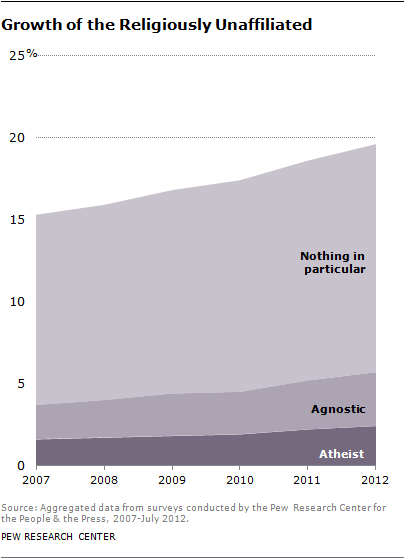
No religious affiliation in America has grown to 19.6%

This large and growing group of Americans is less religious than the public at large on many conventional measures, including frequency of attendance at religious services and the degree of importance they attach to religion in their lives.

However, a new survey by the Pew Research Center’s Forum on Religion & Public Life, conducted jointly with the PBS television program Religion & Ethics NewsWeekly, finds that many of the country’s 46 million unaffiliated adults are religious or spiritual in some way. Two-thirds of them say they believe in God (68%). More than half say they often feel a deep connection with nature and the earth (58%), while more than a third classify themselves as “spiritual” but not “religious” (37%), and one-in-five (21%) say they pray every day. In addition, most religiously unaffiliated Americans think that churches and other religious institutions benefit society by strengthening community bonds and aiding the poor.

With few exceptions, though, the unaffiliated say they are not looking for a religion that would be right for them. Overwhelmingly, they think that religious organizations are too concerned with money and power, too focused on rules and too involved in politics.

nones-exec-2

The growth in the number of religiously unaffiliated Americans – sometimes called the rise of the “nones” – is largely driven by generational replacement, the gradual supplanting of older generations by newer ones.4 A third of adults under 30 have no religious affiliation (32%), compared with just one-in-ten who are 65 and older (9%). And young adults today are much more likely to be unaffiliated than previous generations were at a similar stage in their lives.

nones-exec-3

These generational differences are consistent with other signs of a gradual softening of religious commitment among some (though by no means all) Americans in recent decades. Pew Research Center surveys conducted over the last 10 years, for example, find modest growth in the number of people who say they seldom or never attend religious services, as well as a declining number who say they never doubt the existence of God.

In addition to religious behavior, the way that Americans talk about their connection to religion seems to be changing. Increasingly, Americans describe their religious affiliation in terms that more closely match their level of involvement in churches and other religious organizations. In 2007, 60% of those who said they seldom or never attend religious services nevertheless described themselves as belonging to a particular religious tradition. In 2012, just 50% of those who say they seldom or never attend religious services still retain a religious affiliation – a 10-point drop in five years. These trends suggest that the ranks of the unaffiliated are swelling in surveys partly because Americans who rarely go to services are more willing than in the past to drop their religious attachments altogether.

nones-exec-4

With their rising numbers, the religiously unaffiliated are an increasingly important segment of the electorate. In the 2008 presidential election, they voted as heavily for Barack Obama as white evangelical Protestants did for John McCain. More than six-in-ten religiously unaffiliated registered voters are Democrats (39%) or lean toward the Democratic Party (24%). They are about twice as likely to describe themselves as political liberals than as conservatives, and solid majorities support legal abortion (72%) and same-sex marriage (73%). In the last five years, the unaffiliated have risen from 17% to 24% of all registered voters who are Democrats or lean Democratic. (See religious groupings in pie chart below.)

nones-exec-5

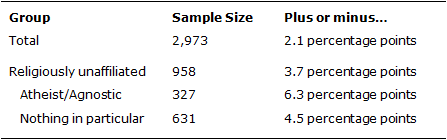
This report includes findings from a nationwide survey by the Pew Research Center, conducted June 28-July 9, 2012, using both landlines and cell phones, among a representative sample of 2,973 adults. In partnership with Religion & Ethics NewsWeekly, the Pew Forum conducted an additional 511 interviews with religiously unaffiliated adults between June 28 and July 10, producing a total sample of 958 religiously unaffiliated respondents in the new survey.

To help paint a full portrait of religiously unaffiliated Americans, the Pew Forum also aggregated and analyzed data on this large and growing population from prior Pew Research Center surveys.

In addition, this report contains capsule summaries of some leading theories put forward by scholars in an attempt to explain the root causes of the rise of the “nones.” These theories run the gamut from a backlash against the entanglement of religion and politics to a global relationship between economic development and secularization. While Pew Research Center surveys are unlikely to settle the debate, they may help to rule out some misconceptions about the unaffiliated. For example, the surveys show that religious affiliation is declining among Americans who do not have college degrees, as well as among college graduates, which suggests that the trend is not solely a result of attitudes toward religion on college campuses. Nor, as the new Pew Research Center/Religion & Ethics NewsWeekly survey shows, are the unaffiliated composed largely of religious “seekers” who are looking for a spiritual home and have not found it yet.

Ranks of the Religiously Unaffiliated Continue To Grow

In 2007 Pew Research Center surveys, 15.3% of U.S. adults answered a question about their current religion by saying they were atheist, agnostic or “nothing in particular.” The number of religiously unaffiliated respondents has ticked up each year since, and now stands at 19.6%.

nones-exec-6

While the ranks of the unaffiliated have grown significantly over the past five years, the Protestant share of the population has shrunk. In 2007, 53% of adults in Pew Research Center surveys described themselves as Protestants. In surveys conducted in the first half of 2012, fewer than half of American adults say they are Protestant (48%). This marks the first time in Pew Research Center surveys that the Protestant share of the population has dipped significantly below 50%.

The decline is concentrated among white Protestants, both evangelical and mainline. Currently, 19% of U.S. adults identify themselves as white, born-again or evangelical Protestants, down slightly from 21% in 2007. And 15% of adults describe themselves as white Protestants but say they are not born-again or evangelical Christians, down from 18% in 2007.5 There has been no change in minority Protestants’ share of the population over the past five years.

nones-exec-7

These findings represent a continuation of long-term trends.6 The General Social Surveys (GSS), conducted by the National Opinion Research Center at the University of Chicago for roughly four decades, show that the number of religiously unaffiliated adults remained below 10% from the 1970s through the early 1990s. The percentage of religiously unaffiliated respondents began to rise noticeably in the 1990s and stood at 18% in the 2010 GSS.

The Protestant share of the population, by contrast, has been declining since the early 1990s. In the GSS, about six-in-ten adults identified as Protestants in the 1970s and 1980s. By 2000, however, 54% of GSS respondents were Protestant. And in the 2010 GSS, 51% of respondents identified themselves as Protestants.

The Catholic share of the population has been roughly steady over this period, in part because of immigration from Latin America.7

What Is Behind the Growth of the Religiously Unaffiliated?

Generational Replacement

One important factor behind the growth of the religiously unaffiliated is generational replacement, the gradual supplanting of older generations by newer ones. Among the youngest Millennials (those ages 18-22, who were minors in 2007 and thus not eligible to be interviewed in Pew Research Center surveys conducted that year), fully one-third (34%) are religiously unaffiliated, compared with about one-in-ten members of the Silent Generation (9%) and one-in-twenty members of the World War II-era Greatest Generation (5%). Older Millennials (ages 23-30) also are substantially less likely than prior generations to be religiously affiliated.

But generational replacement is not the only factor at play. Generation Xers and Baby Boomers also have become more religiously unaffiliated in recent years. In 2012, 21% of Gen Xers and 15% of Baby Boomers describe themselves as religiously unaffiliated, up slightly (but by statistically significant margins) from 18% and 12%, respectively, since 2007. The trend lines for earlier generations are essentially flat. Not only are young adults less likely to be affiliated than their elders, but the GSS shows that the percentage of Americans who were raised without an affiliation has been rising gradually, from about 3% in the early 1970s to about 8% in the past decade. However, the overwhelming majority of the “nones” were brought up in a religious tradition. The new Pew Research Center/Religion & Ethics NewsWeekly survey finds that about three-quarters of unaffiliated adults were raised with some affiliation (74%).

nones-exec-8

Some Evidence of Decline in Religious Commitment in the U.S. Public

The continued growth of the religiously unaffiliated is one of several indicators suggesting that the U.S. public gradually may be growing less religious. To be sure, the United States remains a highly religious country – particularly by comparison with other advanced industrial democracies – and some measures of religious commitment in America have held remarkably steady over the years. The number of Americans who currently say religion is very important in their lives (58%), for instance, is little changed since 2007 (61%) and is far higher than in Britain (17%), France (13%), Germany (21%) or Spain (22%).8 And over the longer term, Pew Research surveys find no change in the percentage of Americans who say that prayer is an important part of their daily life; it is 76% in 2012, the same as it was 25 years ago, in 1987.

But on some other key measures, there is evidence of a gradual decline in religious commitment. In 2003, for instance, 25% of U.S. adults indicated they seldom or never attend religious services. By 2012, that number had ticked up 4 points, to 29%.

nones-exec-9

Similarly, the percentage of Americans who say they never doubt the existence of God has fallen modestly but noticeably over the past 25 years. In 1987, 88% of adults said they never doubt the existence of God. As of 2012, this figure was down 8 percentage points to 80%.

nones-exec-10

In addition, the percentage of Americans who say the Bible should be taken literally has fallen in Gallup polls from an average of about 38% of the public in the late 1970s and early 1980s to an average of 31% since.9 And based on analysis of GSS data, Mark Chaves of Duke University has found that Americans born in recent decades are much less likely than their elders to report having attended religious services weekly at age 12. Young adults are also less likely than older adults to report that when they were growing up, their parents attended religious services regularly.

Chaves recently summarized trends in American religion by asserting that “… there is much continuity, and there is some decline, but no traditional religious belief or practice has increased in recent decades.”10

Less Religious Americans Increasingly Say They Have No Affiliation

Part of the reason that the ranks of the unaffiliated have grown in recent years is that Americans who are not particularly religious – at least by conventional measures, such as self-reported rates of attendance at religious services – increasingly describe themselves as atheist, agnostic or “nothing in particular.”

nones-exec-11

In 2007, 38% of people who said they seldom or never attend religious services described themselves as religiously unaffiliated. In 2012, 49% of infrequent attenders eschew any religious affiliation. By comparison, the percentage describing themselves as unaffiliated has been flat among those who attend religious services once a week or more often.

Over this same period (2007-2012), change in self-reported levels of religious attendance has been relatively modest. In 2007, 38% of U.S. adults reported attending religious services weekly. Today, the figure is 37%. And although there has been a four-point uptick over the past decade in the number saying they seldom or never attend services, the change over the past five years has been more modest (from 27% saying they seldom or never attend in 2007 to 29% in 2012).

Summarizing these trends from another angle, the religiously unaffiliated population is increasingly composed of people who rarely or never attend religious services. In 2007, 68% of religiously unaffiliated Americans said they seldom or never attend religious services. As of 2012, this figure has risen slightly but significantly to 72%. Over the same period, the share of religiously affiliated adults who seldom or never attend religious services has declined slightly.11

nones-exec-12

Who Are the Unaffiliated?

Demographically Broad-Based

The growth of the unaffiliated has taken place across a wide variety of demographic groups. The percentage of unaffiliated respondents has ticked up among men and women, college graduates and those without a college degree, people earning $75,000 or more and those making less than $30,000 annually, and residents of all major regions of the country.

nones-exec-13

When it comes to race, however, the recent change has been concentrated in one group: whites. One-fifth of (non-Hispanic) whites now describe themselves as religiously unaffiliated, up five percentage points since 2007. By contrast, the share of blacks and Hispanics who are religiously unaffiliated has not changed by a statistically significant margin in recent years.

Beliefs and Practices

In terms of their religious beliefs and practices, the unaffiliated are a diverse group, and far from uniformly secular. Just 5% say they attend worship services on a weekly basis. But one-third of the unaffiliated say religion is at least somewhat important in their lives. Two-thirds believe in God (though less than half say they are absolutely certain of God’s existence). And although a substantial minority of the unaffiliated consider themselves neither religious nor spiritual (42%), the majority describe themselves either as a religious person (18%) or as spiritual but not religious (37%).

nones-exec-14

The unaffiliated also are not uniformly hostile toward religious institutions. They are much more likely than the public overall to say that churches and other religious organizations are too concerned with money and power, too focused on rules, and too involved in politics. But at the same time, a majority of the religiously unaffiliated clearly think that religion can be a force for good in society, with three-quarters saying religious organizations bring people together and help strengthen community bonds (78%) and a similar number saying religious organizations play an important role in helping the poor and needy (77%).

nones-exec-15

The religiously unaffiliated population is less convinced that religious institutions help protect morality; just half say this, considerably lower than the share of the general public that views churches and other religious organizations as defenders of morality (52% vs. 76%).

Two-thirds of Americans, including 63% of the religiously unaffiliated, say religion as a whole is losing its influence on American life. A large majority of those who think religion’s influence is on the decline see this as a bad thing. But those who describe their religion as “nothing in particular” are less inclined to view religion’s declining influence as a bad thing. And atheists and agnostics overwhelmingly view religion’s declining influence as a good thing for society.

nones-exec-16

The vast majority of religiously unaffiliated Americans are not actively seeking to find a church or other religious group to join. Leaving aside atheists or agnostics, just 10% of those who describe their current religion as “nothing in particular” say they are looking for a religion that is right for them; 88% say they are not.12

nones-exec-17

Nor are the ranks of the unaffiliated predominantly composed of practitioners of New Age spirituality or alternative forms of religion. Generally speaking, the unaffiliated are no more likely than members of the public as a whole to have such beliefs and practices.

For example, roughly three-in-ten religiously unaffiliated adults say they believe in spiritual energy in physical objects and in yoga as a spiritual practice. About a quarter believe in astrology and reincarnation. In addition, nearly six-in-ten of the religiously unaffiliated say they often feel a deep connection with nature and the earth; about three-in-ten say they have felt in touch with someone who is dead; and 15% have consulted a psychic. All of these figures closely resemble the survey’s findings among the public as a whole.

On the other hand, the religiously unaffiliated are less inclined than Americans overall to say they often think about the meaning and purpose of life (53% vs. 67%). They also attach much less importance to belonging to a community of people with shared values and beliefs; 28% of the unaffiliated say this is very important to them, compared with 49% of all adults.

Social and Political Views

The religiously unaffiliated are heavily Democratic in their partisanship and liberal in their political ideology. More than six-in-ten describe themselves as Democrats or say they lean toward the Democratic Party (compared with 48% of all registered voters). And there are roughly twice as many self-described liberals (38%) as conservatives (20%) among the religiously unaffiliated. Among voters overall, this balance is reversed.

nones-exec-18

The liberalism of the unaffiliated extends to social issues, though not necessarily to attitudes about the size of government. Nearly three-quarters (72%) of religiously unaffiliated Americans say abortion should be legal in most or all cases, compared with 53% of the public overall. And 73% of the religiously unaffiliated express support for same-sex marriage, compared with 48% of the public at large. But the portion of the unaffiliated who say they would prefer a smaller government providing fewer services to a larger government providing more services is similar to the share of the general public who take the same view (50% and 52%, respectively).

nones-exec-19

In recent elections, the religiously unaffiliated have become one of the most reliably Democratic segments of the electorate. Exit polls conducted by a consortium of news organizations indicate that in 2000, 61% of the unaffiliated voted for Al Gore over George W. Bush. By 2004, John Kerry’s share of the unaffiliated vote had increased to 67%. And in 2008, fully three-quarters of the religiously unaffiliated voted for Barack Obama over John McCain. In 2008, religiously unaffiliated voters were as strongly Democratic in their vote choice as white evangelicals were Republican. Obama’s margin of victory among the religiously unaffiliated was 52 points; McCain’s margin of victory among white evangelical voters was 47 points.

nones-exec-20

The religiously unaffiliated constitute a growing share of Democratic and Democratic-leaning registered voters. In 2007, there were about as many religiously unaffiliated Democratic and Democratic- leaning registered voters as white mainline and white Catholic Democratic voters. And the religiously unaffiliated were only slightly more numerous among Democratic and Democratic-leaning registered voters than were black Protestants (17% vs. 14%).

nones-exec-21

Today, the religiously unaffiliated are clearly more numerous than any of these groups within the Democratic coalition (24% unaffiliated, 16% black Protestant, 14% white mainline Protestant, 13% white Catholic). By contrast, Republican and Republican-leaning registered voters are only slightly more likely to be religiously unaffiliated today than they were in 2007 (11% vs. 9%).

Sidebar: Some Theories About Root Causes of the Rise of the Unaffiliated

Theory No. 1: Political Backlash

Several leading scholars contend that young adults, in particular, have turned away from organized religion because they perceive it as deeply entangled with conservative politics and do not want to have any association with it. University of California, Berkeley, sociologists Michael Hout and Claude S. Fischer first suggested in 2002 that “part of the increase in ‘nones’ can be viewed as a symbolic statement against the Religious Right.”13 And in their recent book, “American Grace: How Religion Divides and Unites Us,” Robert Putnam of Harvard University and David Campbell of Notre Dame marshall evidence from various surveys that supports this thesis. From the 1970s through the 1990s, they argue, “[r]eligiosity and conservative politics became increasingly aligned, and abortion and gay rights became emblematic of the emergent culture wars.” The result, they write, was that many young Americans came to view religion as “judgmental, homophobic, hypocritical, and too political.”14

The new Pew Research Center/Religion & Ethics NewsWeekly survey contains some data that can be seen as consistent with this hypothesis. The survey finds that the unaffiliated are concentrated among younger adults, political liberals and people who take liberal positions on same-sex marriage. In addition, two-thirds or more of the unaffiliated say that churches and other religious institutions are too concerned with money and power (70%) and too involved in politics (67%); these views are significantly more common among the unaffiliated than they are in the general public. Analysis of previous Pew Research Center surveys also shows that the unaffiliated are less likely than the affiliated to believe it is important to have a president with strong religious beliefs, and the unaffiliated are more likely than those with a religious affiliation to say that churches and other houses of worship should stay out of political matters.15 On the other hand, the percentage of religiously unaffiliated people has risen among Republican voters as well as among Democratic voters (though the increase is greater among Democrats).

Theory No. 2: Delays in Marriage

If there has been a political backlash, it may not be the only cause of the rise of the “nones.” As previously noted, the increase in the unaffiliated has taken place almost entirely among the segment of the population that seldom or never attends religious services. Some sociologists, such as Robert Wuthnow of Princeton University, have charted an overall decline in church attendance since the 1970s and attribute it to broader social and demographic trends, including the postponement of marriage and parenthood by growing numbers of young adults.16

Aggregated data from Pew Research Center polls also are consistent with this argument, showing that among adults under 30, married people are more likely to have a religious affiliation than are unmarried people. On the other hand, an analysis of religious affiliation patterns by generation, previously published by the Pew Forum, suggests that Americans do not generally become more affiliated as they move through the life cycle from young adulthood through marriage, parenting, middle age and retirement.17 Rather, the percentage of people in each generation who are religiously affiliated has remained stable, or decreased slightly, as that generation has aged.

Theory No. 3: Broad Social Disengagement

Yet another hypothesis loosely links the rise of the unaffiliated to what some observers contend has been a general decline in “social capital” – a tendency among Americans to live more separate lives and engage in fewer communal activities, famously summed up by Harvard’s Putnam as “bowling alone.”18 In this view, the growth of the religious “nones” is just one manifestation of much broader social disengagement.

Pew Research Center surveys offer limited evidence along these lines. For example, a survey by the Pew Research Center’s Internet & American Life Project found that the 40% of Americans who describe themselves as “active” in religious organizations – a higher bar than affiliation with a religious group – are more likely than other Americans to be involved in all types of volunteer and community groups, from sports leagues to arts groups, hobby clubs and alumni associations.19 The new Pew Research Center/Religion & Ethics NewsWeekly survey also finds that religiously unaffiliated Americans are less inclined than Americans as a whole to feel that it is very important to belong to “a community of people who share your values and beliefs” (28% of the unaffiliated say this is very important to them, compared with 49% of the general public).

Theory No. 4: Secularization

The rise of the unaffiliated in the U.S. also has helped to breathe new life into theories that link economic development with secularization around the globe. Back in the 1960s, when secularization theories first achieved high visibility, they were sometimes accompanied by predictions that religion would wither away in the United States by the 21st century.20 The theories propounded by social scientists today tend to be more subtle – contending, for example, that societies in which people feel constant threats to their health and well-being are more religious, while religious beliefs and practices tend to be less strong in places where “existential security” is greater.21 In this view, gradual secularization is to be expected in a generally healthy, wealthy, orderly society.

Surveys conducted by the Pew Forum and the Pew Research Center’s Global Attitudes Project have asked people in many countries about the importance of religion in their lives, how often they pray and whether they think it is necessary to believe in God to be a moral person. Throughout much of the world, there is an association between these measures of religiosity and a country’s national wealth: Publics in countries with a high gross domestic product (per capita) tend to be less religious, while publics in countries with a low GDP tend to be more religious. But as Pew Global Attitudes noted in a 2007 report, Americans are a major exception to the rule, because the U.S. has both high GDP per capita and high levels of religious commitment.22 Nonetheless, some theorists view the rise of the unaffiliated as a sign that secularization is advancing in America.23


Footnotes:

3 Pew Research Center calculations based on the U.S. Census Bureau’s August 2012 Current Population Survey, which estimates there are 234,787,000 adults in the U.S. (return to text)

4 The term “nones” is often used to describe people who indicate in surveys that they have no religion or do not belong to any particular religion.  See, for example, Kosmin, Barry A. and Ariela Keysar, with Ryan Cragun and Juhem Navarro-Rivera. 2009. “American Nones: The Profile of the No Religion Population, A Report Based on the American Religious Identification Survey 2008.” Trinity College, http://commons.trincoll.edu/aris/files/2011/08/NONES_08.pdf. See also Smith, Tom W. 2007. “Counting Religious Nones and Other Religious Measurement Issues: A Comparison of the Baylor Religion Survey and General Social Survey.” GSS Methodological Report No. 110. http://publicdata.norc.org:41000/gss/documents/MTRT/MR110-Counting-Religious-Nones-and-Other-Religious-Measurement-Issues.pdf.(return to text)

5 Evangelical Protestants are defined here as Protestants who say yes when asked, “Would you describe yourself as a born-again or evangelical Christian, or not?” Protestants who do not answer this question affirmatively are categorized here as mainline Protestants. Other research that sorts Protestants into evangelical and mainline categories based on denominational affiliation (e.g., Southern Baptist, United Methodist, etc.) finds that the long-term decline in American Protestantism is concentrated primarily among the Protestant mainline. See, for example, Chaves, Mark. 2011. “American Religion: Contemporary Trends.” Princeton University Press, pages 81-93. (return to text)

6 Notwithstanding the rise of the “nones,” some historical studies find that the portion of the U.S. population that is “churched” – i.e., that belongs to a parish or congregation – has increased dramatically over the nation’s history. Roger Finke and Rodney Stark have estimated, for example, that just 17% of Americans belonged to religious congregations in 1776, compared with about 62% in 1980. However, the historical figures pre-date the modern era of polling and are based instead on various kinds of church records; they are estimates of congregational membership, not self-identification or affiliation with a religious group. See Finke, Roger and Rodney Stark. 1992. “The Churching of America, 1776-1990: Winners and Losers in Our Religious Economy.” Rutgers University Press, pages 15-16. (return to text)

7 For more information on recent changes within American Catholicism, including the impact of religious switching and immigration, see the Pew Forum’s “U.S. Religious Landscape Survey,” conducted in 2007 and published in 2008, http://religions.pewresearch.org/pewresearch-org/religion/reports. See also the Pew Forum’s April 2007 report “Changing Faiths: Latinos and the Transformation of American Religion,” https://alpha.pewresearch.org/pewresearch-org/religion/Changing-Faiths-Latinos-and-the-Transformation-of-American-Religion.aspx. (return to text)

8 See the November 2007 report by the Pew Research Center’s Global Attitudes Project “The American-Western European Values Gap: American Exceptionalism Subsides,” https://alpha.pewresearch.org/pewresearch-org/global/2011/11/17/the-american-western-european-values-gap/. (return to text)

9 See Gallup. July 8, 2011. “In U.S., 3 in 10 Say They Take the Bible Literally.” http://www.gallup.com/poll/148427/say-bible-literally.aspx. (return to text)

10 See Chaves, Mark. 2011. “American Religion: Contemporary Trends.” Princeton University Press, pages 14, 50-51. (return to text)

11 Studies have found that some survey respondents switch back and forth between describing themselves as affiliated and unaffiliated. Researchers call such people “liminals” because they seem to straddle the threshold of a religious tradition, partly in and partly out. In a 2006 survey and follow-up interviews in 2007, Robert Putnam and David Campbell found that roughly 10% of the members of each major religious tradition can be considered liminals. Moreover, they found that although the liminals’ nominal affiliation changed (in either direction) from one year to the next, their self-reported religious beliefs and practices remained largely the same. This may be seen as further evidence that the rise in the number of unaffiliated Americans is not just a reflection of changes in religious behavior. The way that some people think about and describe their religious identity also is in flux. See Putnam, Robert D. and David E. Campbell. 2010. “American Grace: How Religion Divides and Unites Us,” Simon & Schuster, pages 135-136. See also Lim, Chaeyoon, Carol Ann MacGregor and Robert D. Putnam. 2010. “Secular and Liminal: Discovering Heterogeneity Among Religious Nones.” Journal for the Scientific Study of Religion, vol. 49, no. 4: 596-618. (return to text)

12 Nevertheless, there is substantial switching from unaffiliated to affiliated. In the current survey, four-in-ten adults who say they were raised unaffiliated now identify themselves as religiously affiliated. For a comprehensive analysis of patterns in religious switching and the reasons people give for switching, see the Pew Forum’s “U.S. Religious Landscape Survey,” conducted in 2007 and published in 2008, http://religions.pewresearch.org/pewresearch-org/religion/reports. Also see the Pew Forum’s April 2009 report “Faith in Flux,” https://alpha.pewresearch.org/pewresearch-org/religion/Faith-in-Flux.aspx. (return to text)

13 Hout, Michael and Claude S. Fischer. 2002. “Why More Americans Have No Religious Preference: Politics and Generations.” American Sociological Review, vol. 67: 165-190. http://www.jstor.org/stable/3088891. (return to text)

14 Putnam, Robert D. and David E. Campbell. 2010. “American Grace: How Religion Divides and Unites Us.” Simon & Schuster, pages 120-121.(return to text)

15 See the Pew Research Center’s July 2012 report “Little Voter Discomfort with Romney’s Mormon Religion: Only About Half Identify Obama as Christian.” Also see the Pew Research Center’s March 2012 report “More See ‘Too Much’ Religious Talk by Politicians: Santorum Voters Disagree,” https://alpha.pewresearch.org/pewresearch-org/religion/Politics-and-Elections/more-see-too-much-religious-talk-by-politicians.aspx. (return to text)

16 Wuthnow, Robert. 2007. “After the Baby Boomers: How Twenty- and Thirty-Somethings Are Shaping the Future of American Religion.” Princeton University Press, pages 51-70. (return to text)

17 By contrast, some measures of religious commitment – such as frequency of prayer and the degree of importance that people assign to religion in their lives – do tend to rise with age. See the Pew Forum’s February 2010 report “Religion Among the Millennials,” https://alpha.pewresearch.org/pewresearch-org/religion/Age/Religion-Among-the-Millennials.aspx. (return to text)

18 Putnam, Robert D. 2000. “Bowling Alone: The Collapse and Revival of American Community.” Simon & Schuster. In “American Grace,” Putnam and Campbell also consider changing moral and social beliefs to be part of the mix. “American Grace,” page 127. (return to text)

19 See the December 2011 report by the Pew Research Center’s Internet & American Life Project “The civic and community engagement of religiously active Americans,” http://pewresearch.org/pewresearch-org/internet/Reports/2011/Social-side-of-religious/Overview.aspx. (return to text)

20 See, for example, The New York Times. 1968. “A Bleak Outlook is Seen for Religion.” Feb. 25, page 3. The article quotes sociologist Peter L. Berger predicting that by the 21st century, traditional religions would survive only in “small enclaves and pockets.” Berger has since renounced his earlier position. (return to text)

21 See Norris, Pippa and Ronald Inglehart. 2004. “Sacred and Secular: Religion and Politics Worldwide.” Cambridge University Press, pages 216-217. They argue that “Societies where people’s daily lives are shaped by the threat of poverty, disease and premature death remain as religious today as centuries earlier. These same societies are also experiencing rapid population growth. In rich nations, by contrast, the evidence demonstrates that secularization has been proceeding since at least the mid-twentieth century (and probably earlier) – but at the same time fertility rates have fallen sharply, so that in recent years population growth has stagnated and their total population is starting to shrink. The result of these combined trends is that rich societies are becoming more secular but the world as a whole is becoming more religious.” Italics in original. Ibid, pages 216-217. (return to text)

22 See the 2007 report by the Pew Research Center’s Global Attitudes Project “World Publics Welcome Global Trade — But Not Immigration,” https://alpha.pewresearch.org/pewresearch-org/global/2007/10/04/world-publics-welcome-global-trade-but-not-immigration/. (return to text)

23 Norris and Inglehart, Ibid, pages 89-95. They offer a number of possible explanations for America’s exceptional religiosity – asserting, in particular, that economic inequality and the perception of a porous social welfare net leave Americans feeling “greater anxieties” than citizens in other advanced industrial countries. They also mention “the fact that the United States was founded by religious refugees” and the continuing arrival of new immigrants who bring “relatively strong religiosity with them.” Ibid, pages 107-108 and 225-226. (return to text)

Preface

Scholars of religion in the United States have been using the term “nones” since the 1960s, despite some qualms about its connotations. The term refers to people who answer a survey question about their religion by saying they have no religion, no particular religion, no religious preference, or the like. As sociologist Glenn Vernon of the University of Utah wrote in the Journal for the Scientific Study of Religion in 1968, “It provides a negative definition, specifying what a phenomenon is not, rather than what it is. Intentionally or not, such a use implies that only those affiliated with a formal group are religious.”1

Because of such misgivings, the Pew Research Center’s Forum on Religion & Public Life has used – and will continue to use – “religiously unaffiliated” as our preferred term for Americans who tell us in surveys that they are atheists, agnostics or have no particular religion. “Nones,” however, has become a popular label for the same population, used not only in social scientific journals but also by the media, including on the cover of Time magazine and Page One of USA Today.2 As a result, in this report we use both terms interchangeably, but we put “nones” in quotation marks to indicate that it is a colloquialism. More importantly, we emphasize that the absence of a religious affiliation does not necessarily indicate an absence of religious beliefs or practices. On the contrary, as the report makes clear, most of the “nones” say they believe in God, and most describe themselves as religious, spiritual or both.

To delve more deeply into the theological, social and political views of the large and growing number of Americans who have no religious affiliation, the Pew Forum partnered with the acclaimed PBS television program Religion & Ethics NewsWeekly, hosted by veteran journalist Bob Abernethy and produced by Thirteen/WNET New York. Together with the show’s executive producer, Arnold Labaton, its managing editor, Kim Lawton, Web editor Missy Daniel and other members of its staff, we developed several survey questions aimed specifically at the “nones.” We placed these questions on the Pew Research Center’s summer 2012 Religion and Politics Survey, augmenting our sample of religiously unaffiliated Americans with more than 500 additional survey interviews, for a total of 958 unaffiliated respondents. In addition, the Pew Forum analyzed data from previous surveys by the Pew Research Center and other polling organizations on the rise of the “nones” and related trends in American religion.

The primary researchers for this report were Pew Forum senior researchers Greg Smith and Cary Funk. The fieldwork for the new survey was carried out by Princeton Survey Research Associates International. We are grateful to our colleagues at Religion & Ethics NewsWeekly for their strong interest in the “nones” and their many contributions to our joint survey. We would also like to thank John Green of the University of Akron and David Campbell of the University of Notre Dame for their helpful advice in the development of the survey.

While the survey design was guided by the counsel of our advisers, contractors and consultants, the Pew Research Center is solely responsible for the interpretation and reporting of the data.

Luis Lugo, Director Alan Cooperman, Associate Director, Research


Footnotes:

1 Vernon, Glenn M. 1968. “The Religious ‘Nones’: A Neglected Category.” Journal for the Scientific Study of Religion, vol. 7, no. 2. (return to text)

2 Sullivan, Amy. March 12, 2012. “The Rise of the Nones.” Time magazine. http://www.time.com/time/magazine/article/0,9171,2108027,00.html. See also Grossman, Cathy Lynn. March 9, 2009. “Almost all denominations losing ground, survey finds; Faith is shifting, drifting or vanishing outright.” USAToday. http://www.usatoday.com/printedition/news/20090309/1areligion09_cv.art.htm. (return to text)

Demographics

The religiously unaffiliated population is younger, more heavily male and more likely to be single than the general public as a whole. About a third of unaffiliated adults (35%) are under age 30, compared with about one-in-five adults in the general population (22%). A higher percentage of the unaffiliated population is made up of men (56%) than women (44%), while the general public is 48% male and 52% female. Religiously unaffiliated Americans are more likely than U.S. adults as a whole to be living with a partner or never married. About four-in-ten of the unaffiliated are married (39%), compared with about half of the general public (51%). On average, however, the education and income levels of the unaffiliated are roughly the same as those in the general public.

Age

The religiously unaffiliated are relatively young compared with the general public. About seven-in-ten people who describe themselves as unaffiliated are under age 50 (72%), compared with 56% of the general public as a whole. And 35% of the unaffiliated are 18 to 29 years old, compared with 22% of the general public and 18% of U.S. adults who have a religious affiliation. Conversely, 8% of the unaffiliated are 65 and older, compared with 18% of the general public and 19% of those with a religious affiliation.

none-demog-1

Among the unaffiliated, atheists and agnostics are particularly young in comparison with other religious groups. A plurality of atheists and agnostics (42%) are ages 18 to 29, and just 9% are 65 and older. By comparison, about one-fifth of the religiously affiliated (18%) are ages 18 to 29, and a similar portion are 65 and older (19%).

Socioeconomic Status

As a group, the unaffiliated are roughly similar to the general public on education and income. Among the unaffiliated, however, atheists and agnostics stand out from those who say their religion is “nothing in particular.”

none-demog-2

About three-in-ten of the religiously unaffiliated have at least a college degree (31%), slightly higher than among the general public overall (28%). And the annual family income of the unaffiliated as a whole roughly matches that of the general public.

Atheists and agnostics, however, are higher on these socioeconomic measures than other unaffiliated Americans and the general public. Fully 44% of atheists and agnostics have at least a college degree, compared with 26% of those who say their religion is ”nothing in particular” and 28% of the general public. And about 38% of atheists and agnostics have an annual family income of at least $75,000, compared with 29% of the general public. Those who say their religion is “nothing in particular” line up more closely with the general public on family income levels.

none-demog-3

Race and Ethnicity

When compared with those who are religiously affiliated, the unaffiliated population contains a slightly larger percentage of non-Hispanic whites (71% of the unaffiliated vs. 68% of the religiously affiliated). Non-Hispanic blacks make up a slightly smaller share of the unaffiliated (9%) than they do of the religiously affiliated (12%). Hispanics make up 11% of the unaffiliated, compared with 14% of the religiously affiliated.

none-demog-4

Atheists and agnostics are particularly likely to be non-Hispanic whites. Fully eight-in-ten atheists and agnostics (82%) are white, 3% are black, 6% are Hispanic, and the remainder is of some other race or of mixed race. Those who say their religion is “nothing in particular” have a racial and ethnic distribution that closely mirrors that of the general public.

Gender

The unaffiliated population is more male than the general public. Among the unaffiliated as a whole, 56% are men and 44% are women. Among the general public overall, 48% are men and 52% are women.

none-demog-5

Atheists and agnostics are much more likely to be male (64%) than female (36%). Americans who identify their religion as “nothing in particular” are more evenly divided: 53% are men, and 47% are women.

Those who are affiliated with a religion, by contrast, are somewhat more likely to be women (53%) than men (47%).

Region

Compared with the general public, the religiously unaffiliated are somewhat more concentrated in the Western U.S. (30% among the unaffiliated vs. 23% among the general public) and less concentrated in the South (28% vs. 37%).

none-demog-6

Protestants, particularly white evangelical and black Protestants, are particularly likely to live in the South.

Compared with Protestants, Catholics are distributed more evenly across the four regions of the country.

Marital Status

About four-in-ten of the religiously unaffiliated are married (39%), compared with about half of the general public (51%).

none-demog-7

This difference is not merely an artifact of the higher concentration of young people among the unaffiliated. Even among those ages 18 to 29, there are fewer married people among the religiously unaffiliated (12%) than among those with an affiliation (23%).

none-demog-8

Religion and the Unaffiliated

Religiously unaffiliated Americans tend to be, almost by definition, less religious than Americans who belong to a religious tradition. In Pew Research Center surveys, the unaffiliated are less likely than the general public as a whole to say that religion is very important in their lives, to attend worship services regularly and to pray on a daily basis.

At the same time, the unaffiliated are not wholly secular. Substantial portions of the unaffiliated – particularly among those who describe their religion as “nothing in particular” – say they believe in God or a universal spirit. And while 42% of the unaffiliated describe themselves as neither a religious nor a spiritual person, 18% say they are a religious person, and 37% say they are spiritual but not religious.

There is little evidence that the unaffiliated are, by and large, “seekers” who are searching for a religion that fits them or that they have embraced New Age spirituality, Eastern religious ideas or other beliefs from non-Abrahamic faiths. Only about one-in-ten U.S. adults who identify their current religion as “nothing in particular” say they are looking for a religious affiliation. The unaffiliated are about as likely as others in the general public to believe in reincarnation, astrology and the evil eye. And they are only slightly more likely to believe in yoga as a spiritual practice and in spiritual energy located in physical things such as mountains, trees and crystals.

Compared with other adults in the general public, the unaffiliated are less likely to say that belonging to a community of people who share their beliefs and values is very important to them. And their views of churches and other religious organizations are decidedly mixed. A majority agree that religious organizations strengthen community bonds and play an important role in helping the poor and needy. But most also say that religious organizations are too concerned with money and power, too focused on rules and too involved in politics. The unaffiliated also are more skeptical than others in the general public of the idea that churches and other houses of worship contribute to solving important social problems, and the notion that religious organizations protect and strengthen morality in society.

Both the affiliated and the unaffiliated tend to agree that religion is losing influence on society today. Unlike the general public, however, the unaffiliated are divided over whether a decline in religion’s influence on society is a good or bad thing.

Composition of the Unaffiliated

The religiously unaffiliated are comprised of three distinct subgroups. About three-in-ten of the unaffiliated describe their religion as either atheist (12%) or agnostic (17%), while about seven-in-ten describe their religion as “nothing in particular” (71%).

nones-relig-1

Religion’s Importance

As expected, there is a wide gulf between the religiously unaffiliated and others in the general public when it comes to the importance of religion in their lives. Roughly two-thirds of the unaffiliated (65%) say that religion is not too or not at all important in their life. About eight-in-ten atheists and agnostics say religion is not too or not at all important to them (84%), as do more than half of those who describe their religion as “nothing in particular” (58%). By contrast, just 8% of affiliated Christians say religion is not too or not at all important to them; about seven-in-ten (68%) describe religion as very important in their lives.

nones-relig-2

Religious, Spiritual or Neither?

nones-relig-3

The Pew Research Center/Religion & Ethics NewsWeekly survey asked respondents whether they consider themselves to be “a religious person” and, in a separate question, whether they consider themselves to be “a spiritual person.” Responses to these questions provide a window into the degree to which levels of self-identified spirituality and religiosity overlap among U.S. religious groups.

All told, about two-thirds of U.S. adults (65%) describe themselves as religious (either in addition to be being spiritual or not). Nearly one-in-five say they are spiritual but not religious (18%), and about one-in-six say they are neither religious nor spiritual (15%).

Among all those with a religious affiliation, about three-quarters (75%) consider themselves religious, one-in-six (15%) consider themselves to be spiritual but not religious, and fewer than one-in-ten (8%) say they are neither.

By contrast, among the religiously unaffiliated, 18% describe themselves as religious, 37% say they are spiritual but not religious, and about four-in-ten say they are neither (42%).

Among atheists and agnostics, 57% say they are neither spiritual nor religious, while a third consider themselves to be spiritual but not religious (34%). Just 7% of atheists and agnostics describe themselves as religious.

Among those who say their religion is “nothing in particular,” about a quarter say they are a religious person (23%), nearly four-in-ten say they are spiritual but not religious (39%), and about a third say they are neither religious nor spiritual (36%).

nones-relig-4

Profile of the “Spiritual but not Religious”

Who are the “spiritual but not religious,” and how do they compare with those who reject both labels as well as those who do consider themselves religious?

nones-relig-side-5

A sizable minority of those in the general public who consider themselves to be spiritual but not religious are unaffiliated (32%), but fully two-thirds have a religious affiliation.

Among those who say they are neither spiritual nor religious, about half are unaffiliated (52%), 45% are affiliated with a religion, and the remainder did not specify a religious affiliation.

Not surprisingly, about nine-in-ten of those who consider themselves to be a religious person (whether or not they also consider themselves spiritual) are affiliated with a religion (94%).

When it comes to religious practice and commitment, those who say they are spiritual but not religious tend to fall between the religious and those who describe themselves as neither religious nor spiritual. For example, 44% of the spiritual but not religious say they pray daily.

By comparison, 73% of those who describe themselves as a religious person pray daily, and just 11% of those who say they are neither do so.

And although nine-in-ten of the spiritual but not religious say they believe in God (92%), they express less certainty in this belief than do those who describe themselves as religious. Both groups are more likely than people in the “neither” category to believe in God, however.

Demographically, the spiritual but not religious are similar to those who are neither religious nor spiritual in terms of higher education; about a third of both groups have graduated from college. They differ in age and marital status, however. The spiritual but not religious tend to be older than those who are in the “neither” group. And while both groups are more likely to be unmarried than those who describe themselves as religious, the spiritual but not religious are more likely than those who are neither to be living with a partner or to be divorced, separated or widowed.

nones-relig-side-2

When it comes to politics, voters who are spiritual but not religious generally favor the Democratic Party and more often describe themselves as liberal (36%) or moderate (35%) than conservative (26%). On these questions, they resemble voters who are neither spiritual nor religious. Registered voters who describe themselves as religious, by contrast, are much more inclined to call themselves conservatives (48%) than liberals (15%), and they are about evenly split in their support for the two major political parties.

nones-relig-side-3

Little Evidence of Seeking

Relatively few people who say their religion is “nothing in particular” are actively seeking to affiliate with a religious group. Just one-in-ten describe themselves as looking for a religion that is right for them, while 88% say they are not looking.

nones-relig-5

Belief in God

As expected, the religiously unaffiliated are less likely than the general public as a whole to believe in God. However, there are stark differences in this regard between the unaffiliated who identify themselves as atheist or agnostic and those who describe their religion as “nothing in particular.” Among the “nothing in particulars,” about eight-in-ten (81%) say they believe in God or a universal spirit – and a plurality of those who believe in God say they are “absolutely certain” about this belief. In addition, about four-in-ten atheists and agnostics (including 14% of atheists and 56% of agnostics) say they believe in God or a universal spirit.

nones-relig-6

By contrast, belief in God is nearly universal among Christians; fully 98% of self-identified Christians also say they believe in God. In addition, the overwhelming majority of Christians (both Protestants and Catholics) say they are absolutely certain about their belief in God or a universal spirit.

Worship Attendance

Not surprisingly, the unaffiliated stand out from other religious groups in the U.S. for their infrequent attendance at worship services. Just 5% of the unaffiliated report going to worship services at least once a week, compared with about half of Protestants (49%) and four-in-ten Catholics (41%). The overwhelming majority of the unaffiliated say they seldom or never attend worship services apart from weddings or funerals. Fully 83% of atheists and agnostics seldom or never attend worship services, and the same is true of 67% of those with no particular religious affiliation.

nones-relig-7

White evangelicals and black Protestants stand in stark contrast to the unaffiliated in terms of self-reported levels of church attendance. About two-thirds of white evangelicals (63%) and 56% of black Protestants say they attend church services at least once a week; only about one-in-ten of each group (10% among white evangelicals and 12% among black Protestants) say they seldom or never attend services.

What Keeps People Out of the Pews?

nones-relig-8

Among American adults who say religion is either very or somewhat important in their lives, two-thirds also say they attend religious services at least once a month (67%). But one-third report attending less often. The Pew Research Center/Religion & Ethics NewsWeekly survey asked this second group of people – those who consider religion at least somewhat important but who attend worship services seldom, never or only a few times a year – to explain in their own words why they do not attend services more frequently. They offered a wide variety of reasons, including personal priorities, practical difficulties getting to services, and concerns about religion generally or in specific faiths and congregations.

The religiously unaffiliated who were asked this question were particularly likely to give religion-related reasons for not attending services more frequently. About six-in-ten (59%) of the unaffiliated asked about this cited some kind of religion-related reason. The most common response, given by 28% of the unaffiliated asked this question, concerns disagreements with the beliefs of the religion or their church leaders, or beliefs that attending worship services is not particularly important. Other religion-related reasons include mentions of hypocrisy or the idea that church leaders were too pushy or demanding in terms of pushing beliefs or actions among congregants.

Roughly one-in-six (17%) unaffiliated respondents asked this question cite reasons related to their personal priorities, such as being “too busy” to attend religious services. A similar proportion (15%) cite practical difficulties getting to worship services, including work schedules, lack of transportation, health problems or mobility issues due to aging.

Adults with a religious affiliation who consider religion at least somewhat important in their lives yet who attend services relatively infrequently provide a similarly varied list of reasons. Compared with the unaffiliated, however, those with a religious affiliation are more likely to cite practical issues in getting to services (24% vs. 15% among the unaffiliated asked). And the affiliated were less likely to cite objections to religious organizations or give other religion-related reasons. In sum, 37% of those with a religious affiliation gave a religion-related reason for their relatively infrequent attendance, compared with 59% of the unaffiliated.

Frequency of Prayer

Religiously unaffiliated Americans are less likely than others in the general public to pray outside of worship services. About one-fifth of the unaffiliated say they pray at least once day (21%), another fifth pray at least once a month, and about six-in-ten seldom or never pray (58%).

But there are sizable differences between atheists/agnostics and other unaffiliated adults in frequency of prayer. About eight-in-ten atheists and agnostics seldom or never pray (82%). People who describe their religion as “nothing in particular,” however, are almost evenly divided between those who seldom or never pray (48%) and those who pray either daily (27%) or at least once a month (24%).

nones-relig-9

Neither subgroup of the unaffiliated prays as often as the religiously affiliated, however. Among Protestants, 72% say they pray at least once a day, as do 58% of Catholics. White evangelicals and black Protestants are particularly likely to report that they pray at least once a day (82% and 78%, respectively). White mainline Protestants pray less frequently, with about half doing so at least once a day (49%), three-in-ten praying at least once a month (31%) and about a fifth saying they seldom or never engage in prayer (18%).

New Age and Eastern Beliefs and Experiences

A Pew Research Center survey conducted in 2009 asked about a number of spiritual beliefs, including several with roots in non-Abrahamic faiths, such as spiritual energy in physical objects, yoga, reincarnation, astrology and the “evil eye.” (For details see the Pew Forum’s 2009 report “Many Americans Mix Multiple Faiths: Eastern, New Age Beliefs Widespread.”)

nones-relig-10

For the most part, the religiously unaffiliated look similar to Christians on these beliefs. For example, the unaffiliated are about as likely as Christians to believe in reincarnation, astrology or the evil eye. There are two exceptions, however. The unaffiliated are somewhat more likely than Christians to believe in spiritual energy in physical things such as mountains, trees and crystals (30% vs. 23%), although this is a minority viewpoint within both groups. The unaffiliated also are somewhat more likely than Christians to believe in yoga as a spiritual practice (28% vs. 21%), though again, this is a minority viewpoint among both the unaffiliated and Christians.

The 2009 survey also found few differences between the unaffiliated and Christians in terms of self-reported experiences with the supernatural.

nones-relig-11

Roughly equal portions of the unaffiliated (31%) and of Christians (28%) report having been in touch with someone who has died. Similarly, roughly one-in-six of each group has used a fortuneteller or psychic (15% among the unaffiliated, 14% among Christians). And 19% of the unaffiliated and 17% of Christians report having seen or been in the presence of a ghost.

nones-relig-12

Overall, the religiously unaffiliated are less likely than Christians to report having had a moment of sudden religious insight or awakening.

Importance of Community, Pondering Meaning of Life, Connecting With Nature

nones-relig-13

The Pew Research Center/Religion & Ethics NewsWeekly survey also asked about the value respondents place on belonging to a community of people who share their values and beliefs. About half of the general public (49%) says that belonging to a community that shares their values and beliefs is very important to them, while 34% say it is somewhat important, and 16% say it is not too or not at all important.

The religiously unaffiliated place far less importance on this than do other groups. Among the unaffiliated, about three-in-ten say that belonging to a community of like-minded people is very important to them (28%), a roughly equal portion say it is not too or not at all important (31%), and four-in-ten say it is somewhat important to them. Atheists and agnostics (22%) are even less likely than people who say their religion is “nothing in particular” (31%) to consider this to be very important.

About half of all Christians say belonging to a community of people with shared values and beliefs is very important (53%), and a third say it is somewhat important (34%). White evangelicals, black Protestants and Hispanic Catholics are somewhat more likely than white mainline Protestants and white Catholics to consider this to be very important.

nones-relig-14

The new survey also included two questions that address the frequency of spiritual reflection outside of an explicitly religious context. One question asked how often respondents reflect on the meaning of life, and a second asked how often respondents feel a deep connection with nature. The findings suggest that the unaffiliated are less likely than other religious groups to think about the meaning and purpose of life. However, the religiously unaffiliated are no less likely than the public overall to say they often feel a connection with nature and the earth.

Seven-in-ten Christians report that they often think about the meaning and purpose of life. Results on this question among Christian groups range from 57% among Hispanic Catholics and 62% among white mainline Protestants to about eight-in-ten among white evangelicals (79%) and black Protestants (82%). By comparison, fewer unaffiliated Americans say they often think about the meaning and purpose of life. About half of the unaffiliated (53%), including 56% of those who are “nothing in particular” and 45% of atheists and agnostics, say they often think about the meaning and purpose of life. About three-in-ten of the unaffiliated (29%) say they sometimes do so, and 17% say they rarely or never do so.

When it comes to feeling a connection with nature and the earth, there are relatively few differences among religious groups. About six-in-ten adults in the general public (58%) say they often feel a deep connection with nature, while 26% sometimes feel such a connection and 13% say they rarely or never do. The unaffiliated are about as likely as Christians to say they often feel a deep connection with nature (58% and 59%, respectively).

nones-relig-15

Views About Organized Religion

Religiously unaffiliated Americans, on the whole, express ambivalence about churches and other religious organizations. On the one hand, a majority agree that religious organizations have positive effects on society, such as bringing people together and playing an important role in helping the poor and needy. On the other hand, a majority of the unaffiliated also say that religious organizations are too focused on money and power, on rules and on politics.

nones-relig-16

Adults with a religious affiliation (including Christians and members of other faiths) are even more strongly inclined to say that religious organizations have positive effects on society, and they are less likely than the unaffiliated to be critical of churches and other religious organizations.

Overwhelming majorities of all U.S. religious groups see churches and other religious organizations as important in helping the poor and needy in society. Three-quarters of atheists and agnostics say churches play an important role in helping the poor and needy, as do 77% of those who say they are “nothing in particular.” About nine-in-ten Protestants (90%) and Catholics (89%) say the same.

nones-relig-17

Similarly, sizable majorities of all U.S. religious groups agree that churches and other religious organizations bring people together and strengthen community bonds. Eight-in-ten people with no particular religion (and 73% of atheists and agnostics) agree that churches help build community bonds. About nine-in-ten Protestants (91%) and Catholics (89%) also agree.

Two-thirds of the general public believes that churches, synagogues and other houses of worship contribute either some (40%) or a great deal (26%) to solving important social problems. Large majorities have expressed this view for more than a decade.

nones-relig-18

The unaffiliated, however, are more skeptical than the public as a whole about the contribution of religious organizations to solving social problems. While seven-in-ten of those with a religious affiliation say that churches and other houses of worship contribute either some or a great deal to solving social problems, 45% of the unaffiliated say the same. People who describe their religion as “nothing in particular” are evenly divided between saying houses of worship make at least some contribution to solving social problems (48%) and saying they contribute not much or nothing at all (47%). But atheists and agnostics are more negative in their assessments: While 35% say houses of worship contribute either some or a great deal, a 63% majority say they contribute not much or nothing at all to solving important social problems.

Religiously unaffiliated Americans also tend to differ from people with a religious affiliation in their views on the influence of organized religion on morality. Overwhelming majorities of Christian groups agree that churches protect and strengthen morality in society, including 90% of white evangelical Protestants and three-quarters of white mainline Protestants (76%) and black Protestants (76%). About eight-in-ten Catholics (82%) say the same. By contrast, 52% of the unaffiliated agree that churches protect and strengthen morality in society, while 44% disagree. Among those who say they have no particular religion, a majority (58%) agrees that churches protect and strengthen morality. Among atheists and agnostics, 35% view churches and other religious organizations as protecting and strengthening morality, while 60% disagree.

nones-relig-19

Public views are divided about some aspects of organized religion, with the unaffiliated more likely than other groups to see a downside to organized religion.

nones-relig-20

A majority of the unaffiliated agrees that churches are too focused on rules (67%), too concerned with money and power (70%), and too involved with politics (67%). Atheists and agnostics are particularly likely to agree with each of these negative statements about churches and other religious organizations.

Religiously affiliated Americans are more closely divided in their assessments of religious organizations. For example, among Catholics, 56% agree that churches are too focused on rules, about half (48%) say they are too concerned with money and power, and almost as many (43%) say churches are too involved in politics. Protestants are less likely than Catholics to see churches as too focused on rules. White evangelical Protestants stand out as least likely to say that churches are too involved in politics, and they are also less likely than other groups to see churches as too focused on rules.

Religion in American Life

nones-relig-21

Two-thirds of the general public sees religion as losing influence on society today, while a quarter say it is increasing its influence. There are few differences among religious groups about the influence of religion on society.

But while the unaffiliated hold views similar to others in the general public about whether religion’s influence is waxing or waning, they are divided over whether this is a good or bad thing. Atheists and agnostics who see religion as losing influence on society mostly consider this a good thing; among all atheists and agnostics, more say the declining influence of religion on society is a good thing (43%) than a bad thing (10%). Those who have no particular religion are more inclined to see religion’s declining influence on society as a bad thing (32%) than a good thing (22%).

Social and Political Views of the Unaffiliated

The religiously unaffiliated have become one of the most reliably Democratic constituencies in recent elections. According to national exit polls, 61% of the unaffiliated voted for Al Gore over George W. Bush in 2000. In 2004, John Kerry’s share of the unaffiliated vote increased to 67%. And in 2008, Barack Obama captured fully three-quarters of the vote among the religiously unaffiliated, while 23% voted for John McCain.

The partisan and ideological leanings of the unaffiliated follow the same pattern. Compared with the general public, the religiously unaffiliated are more Democratic in their partisanship and more liberal in their political ideology. And, given their growing share among U.S. adults, the unaffiliated constitute a larger share of Democrats and Democratic-leaning voters in 2012 than they did five years ago.

While the views of the unaffiliated on social issues such as abortion and homosexuality are distinctive from those of other religious groups, their preferences about the role of government mirror the general public’s.

The unaffiliated, and especially those who are atheist or agnostic, tend to diverge from the general public when it comes to attitudes about the role of religion in politics. The unaffiliated are more strongly opposed to the idea of church involvement in political matters and to the notion of churches endorsing political candidates than is the public as a whole. They are less likely than the general public to think it is important for a president to have strong religious beliefs, and they are more uncomfortable with political candidates discussing their faith or religious commitment.

Voting Patterns

The Democratic presidential candidate has captured the lion’s share of the religiously unaffiliated vote in the past three election cycles. In the 2000 election, the religiously unaffiliated voted for Gore over Bush by a margin of two-to-one (61% to 30%). In 2008, 75% of the unaffiliated voted for Obama, while 23% voted for McCain, a 52-point gap.

nones-social-1

The 2012 presidential race is following the same pattern to date. As of mid-September, roughly two-thirds of the unaffiliated say they would vote for Obama (65%) over Republican candidate Mitt Romney (27%) if the election was held today. Obama’s advantage among the religiously unaffiliated has been largely steady throughout 2012.

nones-social-2

Partisanship and Ideology

Registered voters in the general public tend to identify with or lean toward the Democratic Party over the Republican Party by a margin of 48% to 43%. Religiously unaffiliated voters tilt strongly toward the Democrats over the Republicans, however. About six-in-ten unaffiliated voters (63%) say they are Democrats or lean toward the Democrats, while a quarter (26%) identify with or lean toward the GOP. This pattern is especially pronounced among atheists and agnostics.

nones-social-3

In contrast with the unaffiliated, voters who are affiliated with a religious group are more likely to identify with or lean toward the Republicans (48%) than the Democrats (45%).

Voters who are unaffiliated with a religion also are more likely than the general public to describe themselves as liberal (38% to 21%), and less likely to identify as conservative (20% to 39%).

Within the unaffiliated, about half of those who call themselves atheist or agnostic identify as liberal (51%), compared with 13% who identify as conservative. The margin is narrower among those who identify their religion as ”nothing in particular,” with 31% of that group calling themselves liberal and 23% conservative.

Compared with the unaffiliated, voters who are affiliated with a particular religion are more than 20 points more likely to be conservative (44% vs. 20% among the unaffiliated) and about half as likely to identify as liberal (17% vs. 38% among the unaffiliated). In fact, each affiliated religious group is significantly more conservative than they are liberal – a direct contrast with the unaffiliated.

nones-social-4

Two-thirds of the unaffiliated are registered to vote (67%), which is slightly less than the 72% of the general population and 73% of those with a religious affiliation who are registered to vote. However, among younger adults (ages 18 to 29) there is no difference between the affiliated (50%) and unaffiliated (51%) in likelihood of being registered to vote.

Views on Social Issues

Overall, the religiously unaffiliated are significantly more likely than the general public to say that abortion should be legal in most or all cases. About seven-in-ten of the unaffiliated (72%) hold this view, compared with about half of the general public (53%). Among atheists and agnostics, fully 84% say abortion should be legal in most or all cases, while just 14% say it should be mostly or entirely illegal.

nones-social-5

By contrast, the margin among those who are affiliated with a religion is narrower – 49% say abortion should be legal in most cases, and 46% say it should be illegal. White evangelical Protestants lean heavily toward saying abortion should be illegal (64%), while white mainline Protestants lean toward saying it should be legal (64%). Catholics as a whole are more evenly split (50% legal, 45% illegal), but 54% of white, non-Hispanic Catholics say abortion should be legal (vs. 41% who say illegal).

Similarly, the unaffiliated stand out from the general public in their views about homosexuality and same-sex marriage. The unaffiliated are more likely than those with a religious affiliation to say that homosexuality should be accepted by society (76% vs. 52% among the affiliated).

nones-social-6

The same pattern occurs on views about same-sex marriage; the religiously unaffiliated stand out among religious groups for their support of it. Nearly three-quarters of the unaffiliated (73%) favor same-sex marriage, while 20% oppose it. Among those who identify as atheist or agnostic, support for same-sex marriage is even higher (89%). Two-thirds of those who describe their religion as “nothing in particular” (67%) also favor same-sex marriage.

By contrast, among those who are affiliated with a religious group, fully half (50%) say that they oppose same-sex marriage, while four-in-ten (41%) favor it.

nones-social-7

Role of Government

The unaffiliated closely mirror the general public in their views about the role of government. Half of the unaffiliated say they would rather have a smaller government with fewer services, while 42% would rather have a bigger government providing more services. The views of those with a religious affiliation are roughly the same: 52% of this group prefers a smaller government with fewer services, while 38% would rather have a larger, more activist government.

nones-social-8

Religion in Politics

About one-third of the unaffiliated (32%) say it is important for the president to have strong religious beliefs, while 65% say it is not important. Among those who identify as atheist or agnostic, the split is even greater. Only one-in-ten (11%) agree that a president should have strong religious beliefs, compared with 86% who disagree.

nones-social-9

Among the general public, that opinion is reversed. About two-thirds of the general public say having strong religious beliefs is important for the president (67%), compared with less than one-third (29%) who disagree.

A slim majority of the general public says that churches and other houses of worship should keep out of political matters. This point of view is even more common among the religiously unaffiliated (66%) than among the public as a whole (54%).

nones-social-10

When it comes to endorsing political candidates, there is somewhat greater consensus between the affiliated and the unaffiliated. Fully three-quarters of the unaffiliated are opposed to churches endorsing political candidates. Similarly, two-thirds of the general public is opposed to churches and other houses of worship coming out in favor of political candidates. Majorities of most religious groups hold the same position, with white Catholics and white mainline Protestants most strongly opposed to churches endorsing political candidates (74% and 73%, respectively). White evangelicals and black Protestants are more divided over this issue, with 56% of white evangelicals and 52% of black Protestants saying that churches should not come out in favor of political candidates.

nones-social-11

The unaffiliated also tend to be less comfortable than others in the general public when political leaders talk about religion. About half of the unaffiliated (54%) are uncomfortable when politicians talk about their religious commitment. Among those with a religious affiliation, 41% say the same. Atheists and agnostics are particularly likely to say such talk makes them uncomfortable (67%). Similarly, half of the unaffiliated say they are uncomfortable when political leaders discuss their faith and beliefs. By comparison, fewer in the general public (38%) are uncomfortable with this.

nones-social-12

Appendix 1: Survey Methodology

This report includes survey data from several sources, including newly released results from a survey conducted June 28-July 9, 2012, by the Pew Research Center for the People & the Press and the Pew Research Center’s Forum on Religion & Public Life, among a national sample of 2,973 adults. The new survey is based on telephone interviews among adults 18 years of age or older living in all 50 U.S. states and the District of Columbia (1,771 respondents were interviewed on a landline telephone, and 1,202 were interviewed on a cell phone, including 596 who had no landline telephone). The survey was conducted by interviewers at Princeton Data Source and Universal Survey Center under the direction of Princeton Survey Research Associates International. A combination of landline and cell phone random digit dial samples were used; both samples were provided by Survey Sampling International. Interviews were conducted in English and Spanish. Respondents in the landline sample were selected by randomly asking for the youngest adult male or female who is now at home. Interviews in the cell sample were conducted with the person who answered the phone, if that person was an adult 18 years of age or older. For detailed information about our survey methodology, see http://pewresearch.org/pewresearch-org/politics/methodology/.

The combined landline and cell phone sample are weighted using an iterative technique that matches gender, age, education, race, Hispanic origin and nativity and region to parameters from the March 2011 Census Bureau’s Current Population Survey and population density to parameters from the Decennial Census. The sample also is weighted to match current patterns of telephone status and relative usage of landline and cell phones (for those with both), based on extrapolations from the 2011 National Health Interview Survey. The weighting procedure also accounts for the fact that respondents with both landline and cell phones have a greater probability of being included in the combined sample and adjusts for household size among respondents with a landline phone.

In partnership with Religion & Ethics NewsWeekly, the Pew Forum conducted an additional 511 interviews with religiously unaffiliated adults to produce a total sample of 958 unaffiliated respondents. These 511 additional interviews were conducted June 28-July 10, 2012, with religiously unaffiliated adults recruited by screening respondents from a fresh sample of landline and cell phone RDD phone numbers (261 interviews) and by recontacting respondents from recent surveys who had identified themselves as religiously unaffiliated (250 interviews). These additional interviews are used only when reporting on the religiously unaffiliated (including the unaffiliated subgroups – atheist, agnostic and those who describe their religion as “nothing in particular”); these interviews are not used when reporting results for the general public. For the RDD and cell phone recontact samples, respondents were initially selected in the same way as described above. For the landline recontact sample, interviewers asked to speak with the person who, based on gender and age, participated in the earlier survey. Once the selected respondents were on the phone, interviewers asked them a few questions and then asked their religious affiliation; those who are religiously unaffiliated continued with the remainder of the interview.

The weighting procedure for the additional interviews with religiously unaffiliated respondents used an iterative technique that included all of the parameters described above. In addition, the weighting accounted for the oversampling of unaffiliated respondents in the screened and callback samples, the type of unaffiliated respondent (atheist, agnostic or “nothing in particular”), as well as gender, age, region and the 2012 presidential vote preference among the unaffiliated. The parameters for the type of unaffiliated respondent and for gender, age and region among the unaffiliated are based on combined data from Pew Research Center surveys conducted from July 2011-June 2012. The parameter for the 2012 vote preference is based on the vote preferences of unaffiliated respondents in the main June 28-July 9 sample.

In total, the new survey includes 958 religiously unaffiliated respondents (447 from the main sample plus the 511 additional interviews). The following table shows the sample sizes and the error attributable to sampling that would be expected at the 95% level of confidence for key groups in this survey. Sampling errors and statistical tests of significance take into account the effect of weighting.

nones-methodology

Sample sizes and sampling errors for other subgroups are available upon request.

In addition to sampling error, one should bear in mind that question wording and practical difficulties in conducting surveys can introduce error or bias into the findings of opinion polls.

The following questions on the survey were developed in consultation with Religion & Ethics NewsWeekly: Q21a-b, Q22, Q51-54 Q70, Q72, Q73a-g and Q97a-b.

This report also includes analysis of past survey data, including aggregated data from Pew Research Center surveys conducted over months or years, data from individual past Pew Research Center surveys and data from surveys conducted by other organizations. Full details on previous Pew Research Center surveys are available at www.pewresearch.org.