Pew Research Center

FOR RELEASE AUGUST 9, 2012

The World’s Muslims: Unity and Diversity

The world’s Muslims are united in their belief in God and the Prophet Muhammad and are bound together by such religious practices as fasting during Ramadan and almsgiving to assist the needy. But they have widely differing views about other aspects of their faith, including how important religion is to their lives, who counts as a Muslim and what practices are acceptable in Islam.

FOR MEDIA OR OTHER INQUIRIES:

Communications Department
202.419.4372
www.pewresearch.org

RECOMMENDED CITATION

Pew Research Center, August 2012, "The World’s Muslims: Unity and Diversity"

About Pew Research Center

Pew Research Center is a nonpartisan, nonadvocacy fact tank that informs the public about the issues, attitudes and trends shaping the world. It does not take policy positions. The Center conducts public opinion polling, demographic research, computational social science research and other data-driven research. It studies politics and policy; news habits and media; the internet and technology; religion; race and ethnicity; international affairs; social, demographic and economic trends; science; research methodology and data science; and immigration and migration. Pew Research Center is a subsidiary of The Pew Charitable Trusts, its primary funder.

© Pew Research Center 2026

Table of contents

  • About Pew Research Center
  • The World’s Muslims: Unity and Diversity
  • Preface
  • Chapter 1: Religious Affiliation
  • Chapter 2: Religious Commitment
  • Chapter 3: Articles of Faith
  • Chapter 4: Other Beliefs and Practices
  • Chapter 5: Boundaries of Religious Identity
  • Chapter 6: Boundaries of Religious Practice
  • Appendix A: U.S. Muslims: Beliefs and Practices in a Global Context
  • Appendix B: Glossary
  • Appendix C: Survey Methodology

The World’s Muslims: Unity and Diversity

The world’s Muslims are united in their belief in God and the Prophet Muhammad and are bound together by such religious practices as fasting during Ramadan and almsgiving to assist the needy. But they have widely differing views about other aspects of their faith, including how important religion is to their lives, who counts as a Muslim and what practices are acceptable in Islam.

The world’s 1.6 billion Muslims are united in their belief in God and the Prophet Muhammad and are bound together by such religious practices as fasting during the holy month of Ramadan and almsgiving to assist people in need. But they have widely differing views about many other aspects of their faith, including how important religion is to their lives, who counts as a Muslim and what practices are acceptable in Islam, according to a worldwide survey by the Pew Research Center’s Forum on Religion & Public Life.

The survey, which involved more than 38,000 face-to-face interviews in over 80 languages, finds that in addition to the widespread conviction that there is only one God and that Muhammad is His Prophet, large percentages of Muslims around the world share other articles of faith, including belief in angels, heaven, hell and fate (or predestination). While there is broad agreement on the core tenets of Islam, however, Muslims across the 39 countries and territories surveyed differ significantly in their levels of religious commitment, openness to multiple interpretations of their faith and acceptance of various sects and movements.
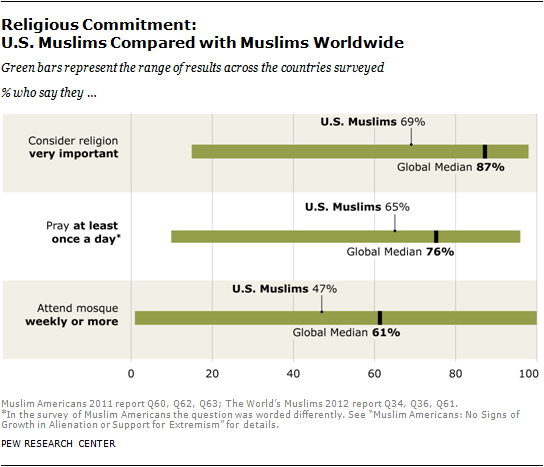
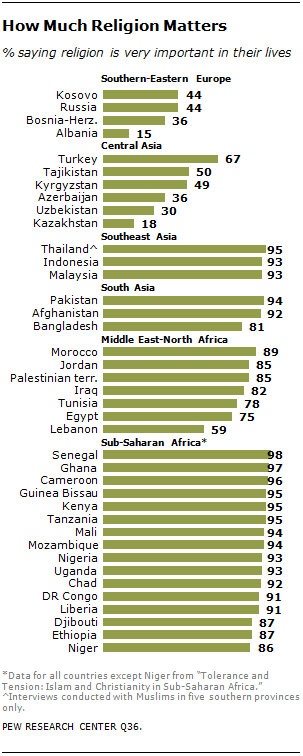
Some of these differences are apparent at a regional level. For example, at least eight-in-ten Muslims in every country surveyed in sub-Saharan Africa, Southeast Asia and South Asia say that religion is very important in their lives. Across the Middle East and North Africa, roughly six-in-ten or more say the same. And in the United States, a 2011 Pew Research Center survey found that nearly seven-in-ten Muslims (69%) say religion is very important to them. (For more comparisons with U.S. Muslims, see Appendix A.) But religion plays a much less central role for some Muslims, particularly in nations that only recently have emerged from communism. No more than half of those surveyed in Russia, the Balkans and the former Soviet republics of Central Asia say religion is very important in their lives. The one exception across this broad swath of Eastern Europe, Southern Europe and Central Asia is Turkey, which never came under communist rule; fully two-thirds of Turkish Muslims (67%) say religion is very important to them.

Generational differences are also apparent. Across the Middle East and North Africa, for example, Muslims 35 and older tend to place greater emphasis on religion and to exhibit higher levels of religious commitment than do Muslims between the ages of 18 and 34. In all seven countries surveyed in the region, older Muslims are more likely to report that they attend mosque, read the Quran (also spelled Koran) on a daily basis and pray multiple times each day. Outside of the Middle East and North Africa, the generational differences are not as sharp. And the survey finds that in one country – Russia – the general pattern is reversed and younger Muslims are significantly more observant than their elders.
There are also differences in how male and female Muslims practice their faith. In most of the 39 countries surveyed, men are more likely than women to attend mosque. This is especially true in Central Asia and South Asia, where majorities of women in most of the countries surveyed say they never attend mosque. However, this disparity appears to result from cultural norms or local customs that constrain women from attending mosque, rather than from differences in the importance that Muslim women and men place on religion. In most countries surveyed, for example, women are about as likely as men to read (or listen to readings from) the Quran on a daily basis. And there are no consistent differences between men and women when it comes to the frequency of prayer or participation in annual rites, such as almsgiving and fasting during Ramadan.

Sectarian Differences

The survey asked Muslims whether they identify with various branches of Islam and about their attitudes toward other branches or subgroups. While these sectarian differences are important in some countries, the survey suggests that many Muslims around the world either do not know or do not care about them.

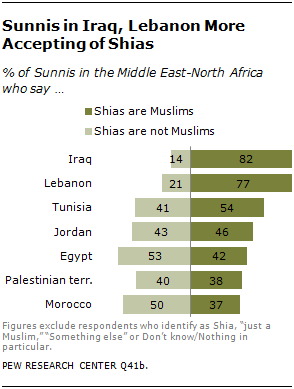
Muslims in the Middle East and North Africa tend to be most keenly aware of the distinction between the two main branches of Islam, Sunni and Shia.2 (See text box for definitions.) In most countries surveyed in the region, at least 40% of Sunnis do not accept Shias as fellow Muslims. In many cases, even greater percentages do not believe that some practices common among Shias, such as visiting the shrines of saints, are acceptable as part of Islamic tradition. Only in Lebanon and Iraq – nations where sizable populations of Sunnis and Shias live side by side – do large majorities of Sunnis recognize Shias as fellow Muslims and accept their distinctive practices as part of Islam.
Outside of the Middle East and North Africa, the distinction between Sunni and Shia appears to be of lesser consequence. In many of the countries surveyed in Central Asia, for instance, most Muslims do not identify with either branch of Islam, saying instead that they are “just a Muslim.” A similar pattern prevails in Southern and Eastern Europe, where pluralities or majorities in all countries identify as “just a Muslim.” In some of these countries, decades of communist rule may have made sectarian distinctions unfamiliar. But identification as “just a Muslim” is also prevalent in many countries without a communist legacy. For example, in Indonesia, which has the world’s largest Muslim population, 26% of Muslims describe themselves as Sunnis, compared with 56% who say they are “just a Muslim” and 13% who do not give a definite response.

Opinion also varies as to whether Sufis – members of religious orders who emphasize the mystical dimensions of Islam – belong to the Islamic faith.3 In South Asia, Sufis are widely seen as Muslims, while in other regions they tend to be less well known or not widely accepted as part of the Islamic tradition. Views differ, too, with regard to certain practices traditionally associated with particular Sufi orders. For example, reciting poetry or singing in praise of God is generally accepted in most of the countries where the question was asked. But only in Turkey do a majority of Muslims believe that devotional dancing is an acceptable form of worship, likely reflecting the historical prominence of the Mevlevi or “whirling dervish” Sufi order in Turkey.

Differing Views on Orthodoxy

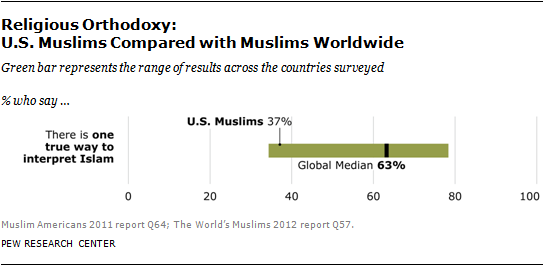
The survey asked Muslims whether they believe there is only one true way to understand Islam’s teachings or if multiple interpretations are possible. In 32 of the 39 countries surveyed, half or more Muslims say there is only one correct way to understand the teachings of Islam.
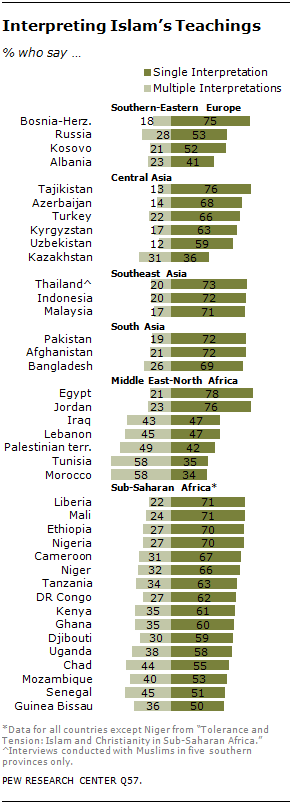
This view, however, is far from universal. In the Middle East and North Africa, majorities or substantial minorities in most countries – including Tunisia, Morocco, the Palestinian territories, Lebanon and Iraq – believe that it is possible to interpret Islam’s teachings in multiple ways. In sub-Saharan Africa, at least one-in-five Muslims agree. In South Asia, Southeast Asia and across Southern and Eastern Europe, at least one-in-six in every country surveyed believe Islam is open to multiple interpretations.

In some Central Asian countries, slightly fewer Muslims say their faith can be subject to more than one interpretation. But in Kazakhstan (31%), Turkey (22%) and Kyrgyzstan (17%), the percentage that holds this view is on par with countries in other regions.

In the United States, by contrast, 57% of Muslims say Islam is open to multiple interpretations. On this measure, Muslim Americans look similar to Muslims in Morocco and Tunisia. (For more comparisons with previous surveys of U.S. Muslims, see Appendix A.)

What is a Median?

The median is the middle number in a list of numbers sorted from highest to lowest. On many questions in this report, medians are reported for groups of countries to help readers see regional patterns in religious beliefs and practices.

For a region with an odd number of countries, the median on a particular question is the middle spot among the countries surveyed in that region. For regions with an even number of countries, the median is computed as the average of the two countries at the middle of the list (e.g., where six nations are shown, the median is the average of the third and fourth countries listed in the region).

By contrast, figures reported for individual countries represent the total percentage for the category reported.

Core Beliefs

Traditionally, Muslims adhere to several articles of faith. Among the most widely known are: there is only one God; God has sent numerous messengers, with Muhammad being His final Prophet; God has revealed Holy Scriptures, including the Quran; God’s angels exist, even if people cannot see them; there will be a Day of Judgment, when God will determine whether individuals are consigned to heaven or hell; and God’s will and knowledge are absolute, meaning that people are subject to fate or predestination.4
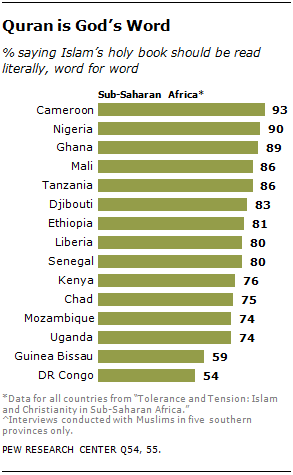
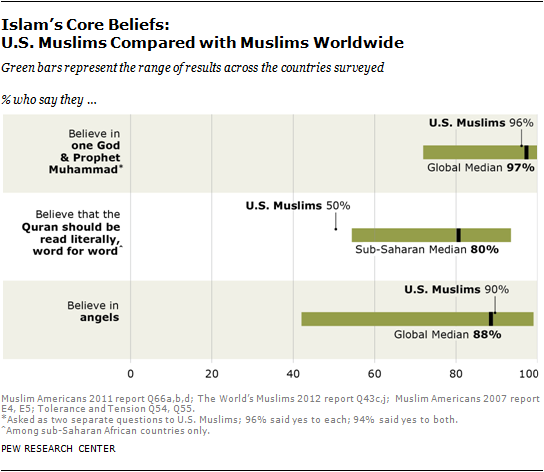
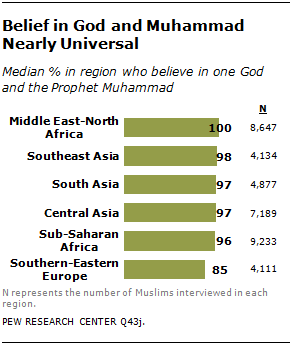
As previously noted, belief in one God and the Prophet Muhammad is nearly universal among Muslims in most countries surveyed. Although the survey asked only respondents in sub-Saharan Africa whether they consider the Quran to be the word of God, the findings in that region indicate broad assent.5 Across most of the African nations surveyed, more than nine-in-ten Muslims say the Quran is the word of God, and solid majorities say it should be taken literally, word for word. Only in two countries in the region – Guinea Bissau (59%) and the Democratic Republic of the Congo (54%) – do smaller percentages think the Quran should be read literally. The results in those two countries are similar to the United States, where 86% of Muslims said in a 2007 survey that the Quran was the word of God, including 50% who said it should be read literally, word for word. (For more U.S. results, see Appendix A.)

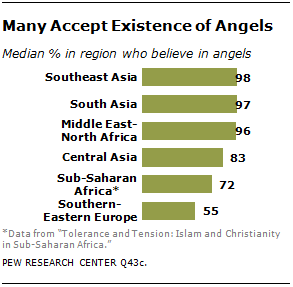
The survey asked respondents in all 39 countries whether they believe in the existence of angels. In Southeast Asia, South Asia and the Middle East-North Africa region, belief in angels is nearly universal. In Central Asia and sub-Saharan Africa more than seven-in-ten also say angels are real. Even in Southern and Eastern Europe,  a median of 55% share this view.
The expression “Inshallah” (“If God wills”) is a common figure of speech among Muslims and reflects the Islamic tradition that the destiny of individuals, and the world, is in the hands of God. And indeed, the survey finds that the concept of predestination, or fate, is widely accepted among Muslims in most parts of the world. In four of the five regions where the question was asked, medians of about nine-in-ten (88% to 93%) say they believe in fate, while a median of 57% express this view in Southern and Eastern Europe.
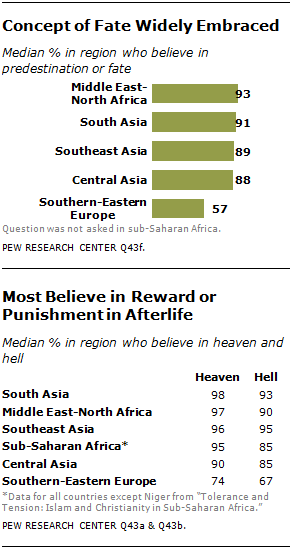
The survey also asked about the existence of heaven and hell. Across the six regions included in the study, a median of more than seven-in-ten Muslims say that paradise awaits those who have lived righteous lives, while a median of at least two-thirds say hell is the ultimate fate of those who do not live righteously and do not repent.

Unifying Rituals

Along with the core beliefs discussed above, Islam is defined by “Five Pillars” – basic rituals that are obligatory for all members of the Islamic community who are physically able to perform them. The Five Pillars include: the profession of faith (shahadah); daily prayer (salat); fasting during the holy month of Ramadan (sawm); annual almsgiving to assist the poor or needy (zakat); and participation in the annual pilgrimage to Mecca at least once during one’s lifetime (hajj). Two of these – fasting during Ramadan and almsgiving – stand out as communal rituals that are especially widespread among Muslims across the globe.

Fasting during the month of Ramadan, which according to Islamic tradition is required of all healthy, adult Muslims, is part of an annual rite in which individuals place renewed emphasis on the teachings of the Quran. The survey finds that many Muslims in all six major geographical regions surveyed observe the month-long, daytime fast during Ramadan. In Southeast Asia, South Asia, the Middle East and North Africa, and sub-Saharan Africa, medians of more than nine-in-ten say they fast annually (94%-99%). Many Muslims in Southern and Eastern Europe and in Central Asia also report fasting during Ramadan.
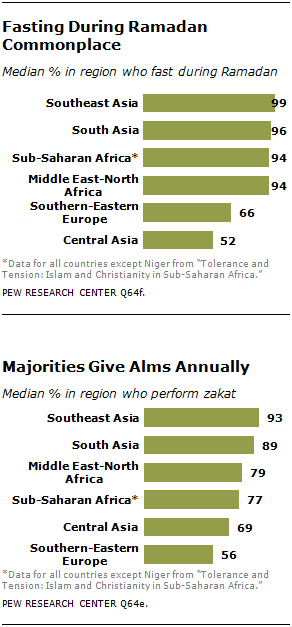
Annual almsgiving, which by custom is supposed to equal approximately 2.5% of a person’s total wealth, is almost as widely observed as fasting during Ramadan. In Southeast Asia and South Asia, a median of roughly nine-in-ten Muslims (93% and 89%, respectively) say they perform zakat. At least three-quarters of respondents in the countries surveyed in the Middle East and North Africa (79%) and sub-Saharan Africa (77%) also report that they perform zakat. Smaller majorities in Central Asia (69%) and Southern and Eastern Europe (56%) say they practice annual almsgiving.

One Faith, Different Levels of Commitment

These common practices and shared beliefs help to explain why, to many Muslims, the principles of Islam seem both clear and universal. As mentioned above, half or more in most of the 39 countries surveyed agree that there is only one way to interpret the teachings of Islam.

But even though the idea of a single faith is widespread, the survey finds that Muslims differ significantly in their assessments of the importance of religion in their lives, as well as in their views about the forms of worship that should be accepted as part of the Islamic faith.

Central Asia along with Southern and Eastern Europe have relatively low levels of religious commitment, both in terms of the lower importance that Muslims in those regions place on religion and in terms of self-reported religious practices. With the exception of Turkey, where two-thirds of Muslims say religion is very important in their lives, half or fewer across these two regions say religion is personally very important to them. This includes Kazakhstan and Albania, where just 18% and 15%, respectively, say religion is central to their lives. (See “How Much Religion Matters” chart.)

Along with the lower percentages who say religion is very important in their lives, Muslims in Central Asia and across Southern and Eastern Europe also report lower levels of religious practice than Muslims in other regions. For instance, only in Azerbaijan does a majority (70%) pray more than once a day. Elsewhere in these two regions, the number of Muslims who say they pray several times a day ranges from slightly more than four-in-ten in Kosovo (43%), Turkey (43%) and Tajikistan (42%) to fewer than one-in-ten in Albania (7%) and Kazakhstan (4%).

In other regions included in the study, daily prayer is much more common among Muslims. In Southeast Asia, for example, at least three-quarters pray more than once a day, while in the Middle East and North Africa, sub-Saharan Africa and South Asia, majorities in most countries report the same.

Muslims in Central Asia, as well as in Southern and Eastern Europe, also tend to be less observant than their counterparts in other regions when it comes to mosque attendance. Just over four-in-ten Turkish Muslims (44%) say they visit their local mosque once a week or more, while three-in-ten do the same in Tajikistan and Bosnia-Herzegovina. In the remaining countries, fewer than a quarter of Muslims say they go to worship services at least once a week.

By contrast, outside Central Asia and the Southern-Eastern Europe region, substantially larger percentages of Muslims say they attend mosque once a week or more, although only in sub-Saharan Africa do broad majorities in all countries display this high level of religious commitment.

It is important to keep in mind, however, that despite lower levels of religious commitment on some measures, majorities of Muslims across most of Central Asia and Southern and Eastern Europe nonetheless subscribe to core tenets of Islam, and many also report that they observe such pillars of the faith as fasting during Ramadan and annual almsgiving to the poor.

Generational Differences in Religious Commitment
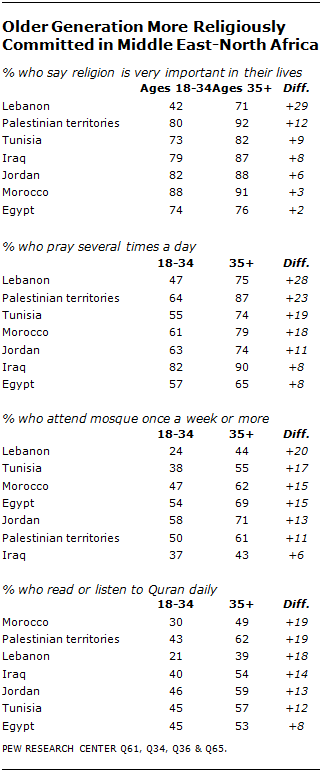
Of all the countries surveyed, only in Russia do Muslims ages 18-34 place significantly more importance on religion than Muslims 35 and older (48% vs. 41%). Younger Muslims in Russia also tend to pray more frequently (48% do so once a day or more, compared with 41% of older Muslims).

Elsewhere in Southern and Eastern Europe and Central Asia, the older generation of Muslims generally places a greater emphasis on religion and engages more often in prayer. For example, Muslims ages 35 and older are more likely than younger Muslims to pray several times a day in Uzbekistan (+18 percentage points), Tajikistan (+16) and Kyrgyzstan (+8).

The biggest generational differences are found in the Middle East and North Africa. In Lebanon, for example, Muslims ages 35 and older are 28 percentage points more likely than younger Muslims to pray several times a day, 20 points more likely to attend mosque at least weekly and 18 points more likely to read the Quran daily. On each of these measures, age gaps of 10 points or more also are found in the Palestinian territories, Morocco and Tunisia. And somewhat smaller but statistically significant differences are observed as well in Jordan and Egypt.

Women and Men Similar, Except in Mosque Attendance
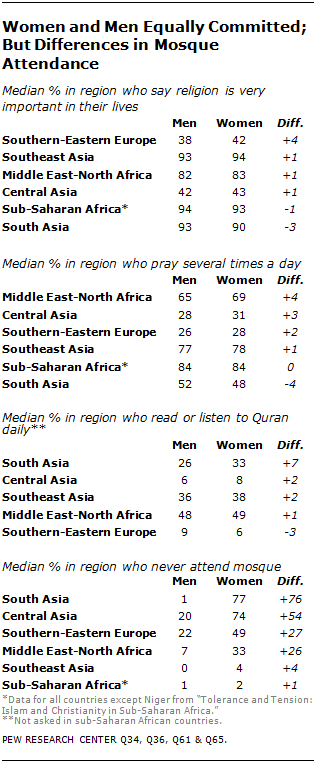
Across the six regions included in the survey, women and men tend to be very similar in terms of the role religion plays in daily life. This holds true for the importance that both sexes place on religion, as well as for the frequency with which they observe daily rituals, such as prayer and reading (or listening to) the Quran. For example, among the countries surveyed in Central Asia, a median of 43% of Muslim women say religion is very important in their lives, compared with 42% of men. When it comes to prayer, medians of 31% of women and 28% of men in Central Asia pray several times a day. And nearly equal percentages of women (8%) and men (6%) across the region say they read or listen to the Quran daily.

The one exception to this pattern is mosque attendance: women are much more likely than men to say they never visit their local mosque. This gender gap is largest in South Asia and Central Asia. In South Asia, including Pakistan, a median of about three-quarters of women (77%) say they never attend mosque, compared with just 1% of men. In Central Asia, the comparable figures are 74% and 20%. Gender differences in mosque attendance are smaller, though still significant, in Southern and Eastern Europe (+27 percentage points) and the Middle East-North Africa region (+26 points). There is little or no gap, however, in Southeast Asia (+4) and sub-Saharan Africa (+1).

Sectarian Differences Vary in Importance

The survey finds that sectarian identities, especially the distinction between Sunni and Shia Muslims, seem to be unfamiliar or unimportant to many Muslims. This is especially true across Southern and Eastern Europe, as well as in Central Asia, where medians of at least 50% describe themselves as “just a Muslim” rather than as a follower of any particular branch of Islam. Substantial minorities in sub-Saharan Africa and Southeast Asia also identify as “just a Muslim” (regional medians of 23% and 18%).
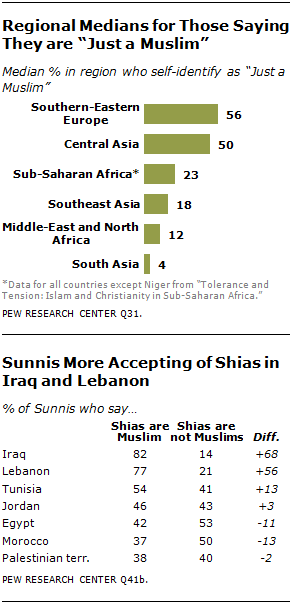
Sectarian identities appear to be particularly relevant in South Asia and the Middle East-North Africa region, where majorities identify as Sunnis or Shias. In the Middle East and North Africa, moreover, widespread identification with the Sunni sect is often coupled with mixed views about whether Shias are Muslims.

In five of seven countries surveyed in the Middle East and North Africa, at least four-in-ten or more Sunnis say Shias are not Muslims.6 Only in Iraq and Lebanon do overwhelming majorities of Sunnis accept Shias as members of the same faith. Indeed, Sunnis in these two countries are at least 23 to 28 percentage points more likely than Sunnis elsewhere in the region to recognize Shias as Muslims.7

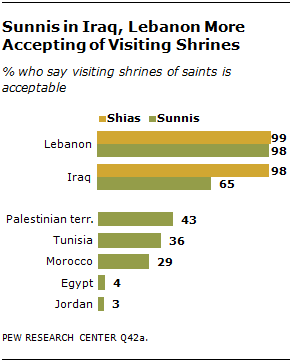
This greater willingness of Sunnis in Iraq and Lebanon to accept Shias as fellow Muslims extends as well to attitudes about forms of worship traditionally associated with Shias. For example, while most Sunnis in the Middle East and North Africa view pilgrimages to the shrines of saints as falling outside Islamic tradition, majorities of Sunnis in Lebanon (98%) and Iraq (65%) believe this practice is acceptable in Islam. In this regard, Sunnis in these two countries resemble their fellow Shia countrymen more than they resemble Sunnis in neighboring countries such as Egypt and Jordan.
In Lebanon sectarian attitudes vary significantly by age. Lebanese Sunnis who are 35 and older are less willing than younger Sunnis to accept Shias as Muslims. The history of sectarian conflict in Lebanon in the 1970s and 1980s may help explain the generational difference. Sunnis who came of age during the conflict years are less inclined to view Shias as fellow Muslims. Yet, even with this generational difference, both younger and older Sunnis in Lebanon still are more willing than most Sunnis in the Middle East-North Africa region to say that Shias share the same faith.

Not just in the Middle East and North Africa but in other regions as well, the willingness of Sunnis to accept Shia as fellow Muslims tends to be higher in countries with sizable Shia populations. For example, in Azerbaijan, Afghanistan and Russia – countries with self-identified Shia populations ranging from 6% to 37% – clear majorities of Sunnis (both men and women, young and old) agree that Shias belong to the Islamic faith. On the other hand, in Pakistan, where 6% of the survey respondents identify as Shia, Sunni attitudes are more mixed: 50% say Shias are Muslims, while 41% say they are not.

Sunnis and Shias

Sunni Muslims and Shia Muslims (also known as Shiites) comprise the two main branches of Islam. Sunni and Shia identities first formed soon after the death of the Prophet Muhammad in 632 C.E., centering on a dispute over leadership succession. Over time, however, the political divide between the two groups broadened to include theological distinctions and differences in religious practices as well.

While the two groups are similar in many ways, they differ over conceptions of religious authority and interpretation as well as the role of the Prophet Muhammad’s descendants, among other issues.

Members of Sufi orders, which embrace mystical practices, can fall within either the Sunni or the Shia tradition. In some cases, Sufis may accept teachings from both traditions.

For additional information regarding Sunni and Shia Islam, see John Esposito, editor. 2003. “Shii Islam” and “Sunni Islam” in “The Oxford Dictionary of Islam.” Oxford: Oxford University Press, pages 290-93 and 304-307.

Views of Other Groups

The survey also asked about attitudes toward Sufis and members of regionally specific groups or movements. Views of Sufis vary greatly by region. In South Asia, for example, a median of 77% consider Sufis to be Muslims; half in the Middle East and North Africa concur. However, significantly fewer Muslims in other regions surveyed accept Sufis as members of the Islamic faith. For example, in Southern and Eastern Europe (Russia and the Balkans), a median of 32% recognize Sufis as fellow Muslims, while in Southeast Asia and Central Asia the comparable figures are 24% and 18%.
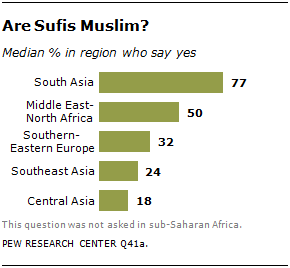
Especially in Central Asia, the low percentage that accepts Sufis as Muslims may be linked to a lack of knowledge about this mystical branch of Islam: majorities in most Central Asian countries surveyed say either that they have never heard of Sufis or that they do not have an opinion about whether Sufis are Muslims.

Views of regionally or locally based groups and movements are mixed. For example, in South Asia and Southeast Asia, relatively few Muslims accept Ahmadiyyas as members of the Islamic faith. Only in Bangladesh do as many as four-in-ten recognize members of this movement as fellow Muslims; elsewhere in the two regions, a quarter or fewer agree. Even smaller percentages in Malaysia and Indonesia (9% and 5%, respectively) say that members of the mystical Aliran Kepercayaan movement are Muslims. (See Glossary for brief definitions of these groups.)

In Turkey, most Muslims (69%) acknowledge Alevis, who are part of the Shia tradition, as fellow Muslims. Meanwhile, in Lebanon, a modest majority (57%) say members of the Alawite sect are Muslims. By comparison, only about four-in-ten Lebanese Muslims (39%) say the same about the Druze.

About the Report

These and other findings are discussed in more detail in the remainder of this report, which is divided into six main sections:

  • Religious Affiliation
  • Religious Commitment
  • Articles of Faith
  • Other Beliefs and Practices
  • Boundaries of Religious Identity
  • Boundaries of Religious Practice

This report also includes an appendix with comparable results from past Pew Research Center surveys of Muslims in the United States. There is also a glossary of key terms. The survey questionnaire and a topline with full results is also available. The report also includes an infographic. This report covers religious affiliation, beliefs and practices. A second report will cover Muslims’ attitudes and views on a variety of social and political questions.

The Pew Forum’s survey of the world’s Muslims includes every nation with a Muslim population of more than 10 million except Algeria, China, India, Iran, Saudi Arabia, Sudan, Syria and Yemen. Together, the 39 countries and territories included in the survey are home to about two-thirds of all Muslims in the world.

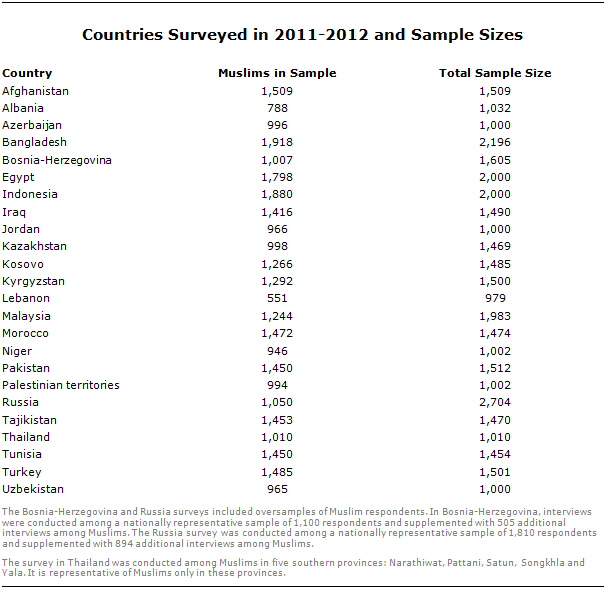
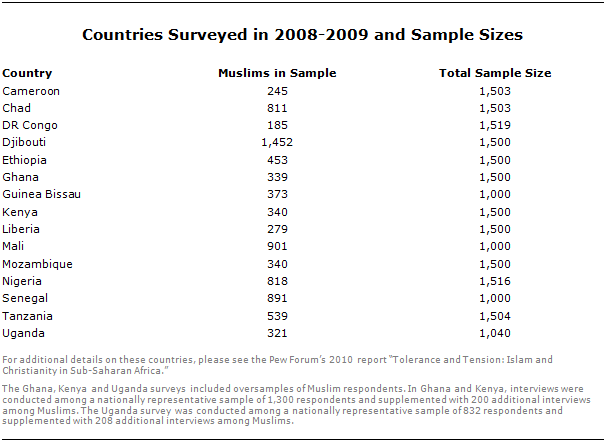
The surveys that are the basis for this report were conducted across multiple years. Fifteen sub-Saharan countries with substantial Muslim populations were surveyed in 2008-2009 as part of a larger project that examined religion in that region. The methods employed in those countries – as well as some of the findings – are detailed in the Pew Forum report “Tolerance and Tension: Islam and Christianity in Sub-Saharan Africa.” An additional 24 countries and territories were surveyed in 2011-2012. In 21 of these countries, Muslims make up a majority of the population. In these cases, nationally representative samples of at least 1,000 respondents were fielded. The number of self-identified Muslims interviewed in these countries ranged from 551 in Lebanon to 1,918 in Bangladesh. In Russia and Bosnia-Herzegovina, where Muslims are a minority, oversamples were employed to ensure adequate representation of Muslims; in both cases, at least 1,000 Muslims were interviewed. Meanwhile, in Thailand, the survey was limited to the country’s five southern provinces, each with substantial Muslim populations; more than 1,000 interviews with Muslims were conducted across these provinces. Appendix C provides greater detail on the 2011-2012 survey’s methodology.
Footnotes:

2 According to Pew Forum estimates, 87-90% of the world’s Muslims are Sunnis, while 10-13% are Shias. For country-by-country estimates of the percentage of Sunnis and Shias, see the Pew Forum’s 2009 report “Mapping the Global Muslim Population,” page 38. (return to text)

3 For background on Sufi orders, see the Pew Forum’s 2010 report “Muslim Networks and Movements in Western Europe.” (return to text)

4 Enumerations and translations of the articles of faith vary. Most are derived from the Hadith of Gabriel. See, for example, Sahih al-Bukhari 2:47 and Sahih al-Muslim 1:1. For details on hadith, see text box in Chapter 3. (return to text)

5 In 2008-2009, the Pew Forum asked both Muslims and Christians in sub-Saharan Africa if the sacred texts of their respective religions are the word of God and should be taken literally. The results are reported in the 2010 report “Tolerance and Tension: Islam and Christianity in Sub-Saharan Africa.” (return to text)

6 Questions about views of Muslim sects were not asked in sub-Saharan Africa. (return to text)

7 All figures for Shia and Sunni subgroups within countries are based on self-identification in response to a multi-part survey question that first asked if an individual was Muslim (Q28 and Q28b), and if yes, if they were Sunni, Shia or “something else” (Q31). The percentage of Shias and Sunnis identified by the survey may diverge from country estimates reported in the Pew Forum’s 2009 report “Mapping the Global Muslim Population,” which are based on demographic and ethnographic analyses, as well as reviews of frequently used estimates. (return to text)

Photo Credit: © SZE FEI WONG / istockphoto

Preface

From its origin on the Arabian Peninsula in the seventh century C.E., Islam has grown into a worldwide religion with more than 1.6 billion adherents – nearly a quarter of the world’s population.1 Today, Muslims live on all inhabited continents and embody a wide range of races, ethnicities and cultures. What beliefs and practices unite these diverse peoples into a single religious community, or ummah? And how do their religious convictions and observances vary?

This report by the Pew Research Center’s Forum on Religion & Public Life seeks to describe both the unity and the diversity of Islam around the globe. It is based on more than 38,000 face-to-face interviews conducted in over 80 languages with Muslims in 39 countries and territories that collectively are home to roughly two-thirds (67%) of all Muslims in the world. The survey includes every country that has a Muslim population of more than 10 million, except those (such as China, India, Iran, Saudi Arabia and Syria) where political sensitivities or security concerns prevented opinion research among Muslims.

Unity and diversity are themes that emerge naturally from the survey results. On what are often considered Islam’s articles of faith and “pillars” of practice, there is much commonality among Muslims around the world. But on other important questions, such as whether Islam is open to more than one correct interpretation or which groups should be considered part of the Muslim community, there are substantial differences of opinion. The survey also suggests that many Muslims do not see themselves as belonging to any particular sect: Fully a quarter of the Muslims surveyed identify themselves neither as Sunni nor as Shia but as “just a Muslim.”

The survey was conducted in two waves. Fifteen sub-Saharan African countries with substantial Muslim populations were surveyed in 2008-2009, and some of those findings previously were analyzed in the Pew Forum report “Tolerance and Tension: Islam and Christianity in Sub-Saharan Africa.” An additional 24 countries in Africa, Asia and Europe were surveyed in 2011-2012; those results are published here for the first time. This report on religious beliefs and practices, however, is just the first of two planned analyses of the survey data. The Pew Forum plans to issue a second report, focusing on Muslims’ social and political attitudes, in late 2012 or early 2013.

GRFP_small

The Pew Forum’s global survey of Islam is part of a larger effort, the Pew-Templeton Global Religious Futures project, which analyzes religious change and its impact on societies around the world. Previous studies produced under the Pew-Templeton initiative, jointly funded by The Pew Charitable Trusts and the John Templeton Foundation, include “Faith on the Move: The Religious Affiliation of International Migrants” (March 2012), “Global Christianity: A Report on the Size and Distribution of the World’s Christian Population” (December 2011), “Rising Restrictions on Religion” (August 2011), “Global Survey of Evangelical Protestant Leaders” (June 2011), “The Future of the Global Muslim Population: Projections for 2010-2030” (January 2011), “Global Restrictions on Religion” (December 2009), “Mapping the Global Muslim Population: A Report on the Size and Distribution of the World’s Muslim Population” (October 2009) and “Spirit and Power: A 10-Country Survey of Pentecostals” (October 2006).

The primary researcher for “The World’s Muslims: Unity and Diversity” was James Bell, the Pew Forum’s director of international survey research. He received valuable research assistance from Michael Robbins, Neha Sahgal and Katie Simmons. Fieldwork was carried out under the direction of Princeton Survey Research Associates International and Opinion Research Business; we particularly wish to thank Mary McIntosh and Jonathan Best of PSRAI and Johnny Heald and Cara Carter at ORB.

Amaney Jamal, Associate Professor of Politics at Princeton University, served as a special adviser. In the design of the survey questions and preparation of this report, the Pew Forum also was fortunate to be able to call on the expertise of several other academic experts, including Asma Afsaruddin of Indiana University, Xavier Bougarel of The National Centre for Scientific Research (Paris), Michael Cook of Princeton University, David Damrel of the University of South Carolina, Nile Green of the University of California, Los Angeles, Robert Hefner of Boston University, Marcia Hermansen of Loyola University Chicago, Leonard Lewisohn of the University of Exeter (United Kingdom), Peter Mandaville of George Mason University, Vali Nasr of Tufts University, Steven Prothero of Boston University, Asifa Quraishi of the University of Wisconsin Law School, Farid Senzai of Santa Clara University and Shibley Telhami of the University of Maryland.

While the survey design was guided by the counsel of our advisers, contractors and consultants, the Pew Forum is solely responsible for the interpretation and reporting of the data.

Luis Lugo, Director Alan Cooperman, Associate Director for Research


Footnotes:

1 For further information on the global and regional distribution of Muslims, see the Pew Forum’s 2011 report “The Future of the Global Muslim Population” and 2009 report “Mapping the Global Muslim Population.” (return to text)

Photo Credit: © SZE FEI WONG / istockphoto

Chapter 1: Religious Affiliation

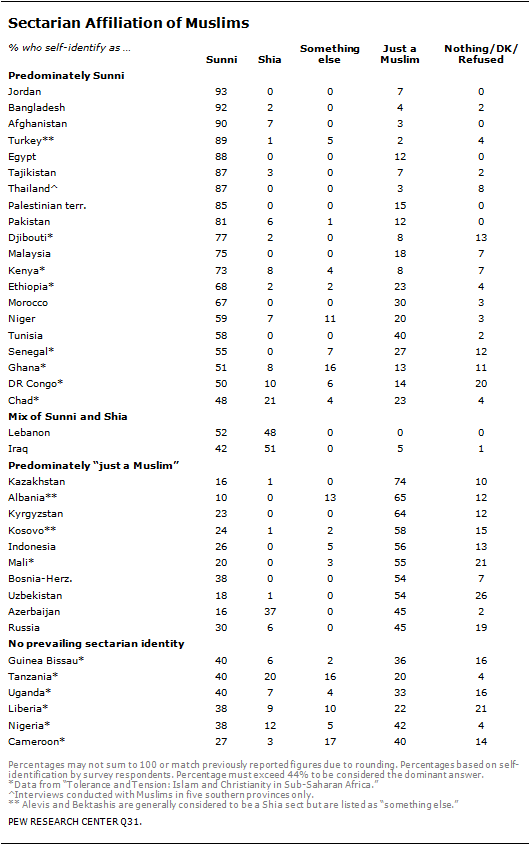
Most of the world’s Muslims identify as Sunnis or Shias.8 However, many Muslims do not identify with either sect but rather see themselves as “just a Muslim.” At least one-in-five Muslims in 22 of the 38 countries where the question was asked identify themselves in this nonsectarian way.9

Other affiliations, such as membership in a Sufi order, may overlap with Sunni and Shia identities. Although Sufism has a long history within Islam, relatively few Muslims describe themselves as Sufis or say they belong to a particular Sufi brotherhood. Self-identified Sufis are most prevalent in sub-Saharan Africa and South Asia.

The overwhelming majority of people who identify as Muslim today were raised within the Islamic faith. In sub-Saharan Africa, which has some of the countries with the highest percentage of people who have switched faiths since childhood, most who have converted to Islam have done so from either Christianity or traditional African religions.10 In other regions, nearly all adult Muslims who were not raised in the faith grew up in nonreligious households.

Religious Identity Among Muslims in the Survey

gsi-ch1-1

In 20 of the countries surveyed, half or more Muslims identify as Sunni. Self-identified Sunnis make up a high percentage of Muslims in South Asia, Southeast Asia, and the Middle East and North Africa. Across these three regions, the median percentage of Sunnis is two-thirds or more. About half the Muslims surveyed in sub-Saharan Africa self-identify as Sunni. In Central Asia and across Southern and Eastern Europe (Russia and the Balkans), by contrast, self-identification as Sunni is less common. Across both regions, the median percentage of people identifying as Sunni is fewer than three-in-ten.

Relatively few Muslims in the 38 countries where the question was asked say they are Shia. Those who do are concentrated in Iraq, Lebanon, Azerbaijan, Afghanistan, Pakistan, Russia and 10 sub-Saharan African countries.11 In addition to those who specifically identify as Shia, some respondents report belonging to regional sects or religious orders that are often classified as branches of Shia Islam. For example, 5% of Turkish Muslims volunteer that they are Alevis, while 2% of Kosovar Muslims volunteer that they are Bektashis. (See Glossary.)

“Just a Muslim”

Many Muslims worldwide choose not to affiliate with a specific sect but volunteer that they are “just a Muslim.” This affiliation is most common in Central Asia and across Southern and Eastern Europe; in both regions, the median percentage stating they are “just a Muslim” is half or more. In Kazakhstan, nearly three-quarters (74%) of Muslims volunteer this response, as do more than six-in-ten Muslims in Albania (65%) and Kyrgyzstan (64%).

In sub-Saharan Africa and Southeast Asia, substantial minorities also consider themselves “just a Muslim” (medians of 23% and 18%, respectively). And in three countries – Indonesia (56%), Mali (55%) and Cameroon (40%) – “just a Muslim” is the single most-frequent response when people are queried about their sect. Identification as “just a Muslim” is less prevalent in the Middle East and North Africa (median of 12%) and South Asia (median of 4%).

Muslim Affiliation by Country

In addition to Muslims who identify as Sunni, Shia or “just a Muslim,” the survey finds substantial percentages of Muslims who express affiliation with other sects or movements. For instance, many Muslims, particularly in sub-Saharan Africa, identify as Ahmadiyyas. (See Glossary). This affiliation is most common in Ghana (16%), Tanzania, (15%), Cameroon (12%) and Liberia (10%).

Based on how Muslims self-identify in the survey, the 38 countries where the questions were asked can be grouped into four categories: 1) predominantly Sunni; 2) mix of Sunni and Shia; 3) predominantly “just a Muslim”; and 4) countries with no prevailing sectarian identity. These categories do not fully overlap with regional divisions, but certain geographic patterns are evident. For example, countries without a clear, dominant sectarian identity are concentrated in sub-Saharan Africa, while nations where “just a Muslim” predominates are found mostly in Central Asia and across Southern and Eastern Europe.

gsi-ch1-2

Sufi Affiliation

gsi-ch1-3

For some Muslims, another layer of identity comes from membership in a Sufi order, or tariqa. Also known as brotherhoods, Sufi orders represent a mystical movement within Islam that emphasizes the possibility of gaining direct knowledge of God through euphoric worship and other practices. These orders can fall within either Sunni or Shia Islam.

Identification with Sufism is highest in sub-Saharan Africa. In 11 of 15 countries surveyed in the region, a quarter or more Muslims say they belong to a Sufi order, including Senegal, where 92% say they belong to a brotherhood.

The Tijaniyya order is the most common across the region, with at least one-in-ten Muslims identifying with this brotherhood in Senegal (51%), Chad (35%), Niger (34%), Cameroon (31%), Ghana (27%), Liberia (25%), Guinea Bissau (20%), Nigeria (19%), Uganda (12%) and the Democratic Republic of the Congo (10%).

The second most widespread movement is the Qadiriyya brotherhood, which is followed by 11% of Muslims in Chad, 9% in Nigeria and 8% in Tanzania. Additionally, the Muridiyya order is prevalent in Senegal (34%), but it does not have a broad following among Muslims in other countries surveyed.

In the other regions surveyed, affiliation with Sufi orders is less common. Only in Bangladesh (26%), Russia (19%), Tajikistan (18%), Pakistan (17%), Malaysia (17%), Albania (13%) and Uzbekistan (11%) do more than one-in-ten Muslims identify with a Sufi brotherhood. Several orders are prominent in individual countries, including the Naqshbandiyya in Tajikistan (16% of all Muslims), Chistiyya in Bangladesh (12%) and Bektashiyya in Albania (12%).

Low Rates of Religious Switching

gsi-ch1-4

The survey finds that the vast majority of adult Muslims were raised as Muslims. Nine-in-ten or more in all but four countries surveyed indicate that they had the same faith as children. In South Asia and across the Middle East and North Africa, nearly 100% of adult Muslims surveyed say they were raised in the Islamic faith.

In Southeast Asia, conversion to Islam is similarly rare. Evidence of religious switching is found only in Thailand, where 3% of Muslims report growing up as Buddhists.

In Central Asia and across Southern and Eastern Europe, conversion to Islam is more common, with 10% of adult Muslims in Kazakhstan, 7% in Russia, 6% in Uzbekistan and 5% in Albania stating they were not raised in the faith. Nearly all these instances of switching involve people who were brought up as atheists, agnostics or “nothing in particular” and later adopted Islam as their faith.

In the 15 countries where the question was asked in sub-Saharan Africa, rates of conversion are similar to those in Central Asia and across Southern and Eastern Europe. The one exception is the Democratic Republic of the Congo, where 24% of those who are currently Muslim say they were raised in another faith. Unlike in Central Asia and across Southern and Eastern Europe, most converts to Islam in this part of the world report switching from Christianity or traditional African religions. For example, in the Democratic Republic of the Congo, roughly a fifth of Muslims (22%) say they were raised Christian, as do 11% of Muslims in Kenya and 10% in Uganda.

Intra-Religious Switching

Changing from Sunni to Shia, or vice versa, is relatively rare. In the case of Shias, only in Azerbaijan does the percentage of respondents who were raised Shia and who are currently Shia differ by as much as five points. Elsewhere the difference is two percentage points or less.

Similarly, in all but three countries, the percentage of respondents who were raised Sunni and who are currently Sunni differs by five points or less. A slightly larger difference is found in Liberia, where 30% of Muslims were raised Sunni but 38% now identify as Sunni. In Nigeria and Niger, meanwhile, the percentage of adult Muslims who say they are Sunni is seven and six percentage points higher, respectively, than the percentage brought up as Sunni.

Most respondents who currently identify as “just a Muslim” recall being raised as “just a Muslim.” In 35 of the 38 countries where the question was asked, the percentage that were “just a Muslim” as a child and the percentage that are “just a Muslim” now differ by five percentage points or less. The largest disparity is found in Kosovo, where 58% state they are now “just a Muslim,” while 41% report growing up with this identity, though a substantial percentage of Kosovar Muslims say they don’t know their childhood affiliation. In both Azerbaijan and Uganda, by contrast, the percentage that says they are “just a Muslim” as an adult is six points lower than the percentage that was raised as “just a Muslim.”

gsi-ch1-5


Footnotes:

8 All figures for Shia and Sunni subgroups within countries are based on self-identification in response to a multi-part survey question that first asked if an individual was Muslim (Q28 and Q28b), and if yes, if they were Sunni, Shia or “something else” (Q31). The percentage of Shias and Sunnis identified by the survey may diverge from country estimates reported in the Pew Forum’s 2009 report “Mapping the Global Muslim Population,” which are based on demographic and ethnographic analyses, as well as reviews of frequently used estimates. (return to text)

9 Due to data collection problems with this question in Mozambique, results for Mozambique are not reported for sectarian identity. (return to text)

10 For more details, see the Pew Forum’s 2010 report “Tolerance and Tension: Islam and Christianity in Sub-Saharan Africa.” (return to text)

11 Not included in the survey are Iran, home to an estimated 66-70 million Shias, or 37-40% of the world’s Shia population, and India, where at least 16 million Shias are estimated to reside (9-14% of the world’s Shia population). For more information, see the Pew Forum’s 2009 report “Mapping the Global Muslim Population.” (return to text)

Photo Credit: © SZE FEI WONG / istockphoto
Chapter 2: Religious Commitment

The vast majority of Muslims surveyed subscribe to the basic tenets of Islam – that there is only one God and that Muhammad is His Prophet. Acceptance of these central articles of the Islamic faith forms the foundation of a global ummah, or community of believers. But it does not necessarily follow that religion plays an equally prominent role in the lives of all Muslims.

Indeed, the survey finds that religion’s importance in Muslims’ daily lives varies greatly across the six major geographic regions included in the study. In sub-Saharan Africa, Southeast Asia and South Asia, at least eight-in-ten Muslims in every country surveyed say that religion is very important in their lives, while in the Middle East and North Africa the comparable percentages range from 59% in Lebanon to 89% in Morocco. In Central Asia and across Southern and Eastern Europe (Russia and the Balkans), no more than half of Muslims describe religion as central to their lives in any country surveyed except Turkey, where 67% say religion is very important to them.

Other measures of religious commitment follow a similar pattern. In four of the six regions included in the study – the Middle East and North Africa, Southeast Asia, South Asia and sub-Saharan Africa – a majority of Muslims in most countries surveyed pray several times a day, including three-quarters or more in 12 countries who say they perform all five salat daily. By contrast, across Central Asia and in the four countries with substantial Muslim populations surveyed in Southern and Eastern Europe, only in Azerbaijan do a majority of Muslims (70%) report praying several times a day (including 21% who say they perform all five salat). In the other countries in these two regions, far fewer Muslims, including 7% in Albania and 4% in Kazakhstan, say they pray several times a day.

Because having the opportunity to pray is generally unrelated to gender, income or literacy, it is perhaps the most universal measure of religious commitment among Muslims. The survey also explored other forms of religious engagement, including mosque attendance and reading or listening to the Quran, which may not be equally available to all Muslims. In both instances, the same pattern holds: levels of commitment tend to be significantly lower among Muslims in Central Asia and across Southern and Eastern Europe.

It is only when it comes to almsgiving and fasting during Ramadan that there are less pronounced differences between Muslims in Central Asia and in Southern and Eastern Europe and those in other regions. For example, the percentage of Muslims who say they give zakat, or annual donations to benefit the poor and less fortunate, is as high in countries such as Bosnia-Herzegovina (81%), Kyrgyzstan (77%), Uzbekistan (73%) and Turkey (72%) as it is in many other nations surveyed.

Five Pillars of Islam

All Muslims, regardless of sect, trace their religious heritage to the Arabian Peninsula in the seventh century C.E., when the Prophet Muhammad lived and Islam was born. Since that time, the Quran and traditions associated with Muhammad have defined five core rituals through which individuals can profess and confirm their adherence to the Islamic faith. Collectively, these practices are known as the Five Pillars:

  • Profession of faith, or shahadah. By testifying that there is one God, and Muhammad is His Prophet, an individual distinguishes himself or herself as a Muslim.
  • Praying, or salat. Muslims are supposed to pray five times a day – at dawn, noon, mid-afternoon, sunset and evening. The shahadah is repeated at each call to prayer and closes each prayer, as well.
  • Giving of alms, or zakat. All adult Muslims who are able to do so are required to make an annual donation to assist the poor or less fortunate. The amount is typically 2.5% of a person’s total wealth, not just annual income.
  • Fasting during the holy month of Ramadan, or sawm. Throughout the month of Ramadan, when the Quran was first revealed, all physically fit Muslim adults are to abstain from food, drink, smoking and sexual activity from dawn to dusk.
  • Pilgrimage to Mecca, or hajj. At least once in a lifetime, Muslims who are physically and financially capable of making the journey are expected to visit Islam’s holiest city, Mecca, and perform rituals associated with the hajj.


Profession of Faith

gsi-ch2-1

The shahadah, or testimony that there is only one God and that Muhammad is His Prophet, is the first and most basic of the Five Pillars of Islam. Bearing witness to this belief is the traditional means by which an individual becomes a Muslim, and it is the foundation on which the other pillars are built. (See text box above on the Five Pillars of Islam.)

To gauge the degree to which the shahadah is central to Muslim identity, the survey asked, “Do you believe in one God, Allah, and His Prophet Muhammad?” In the majority of countries surveyed, overwhelming percentages confirm that they subscribe to this belief.

In the Middle East and North Africa, the profession of faith is an almost universal creed among self-identified Muslims, with no fewer than 98% in all seven of the countries surveyed saying they believe in God and His Prophet Muhammad. Similarly high percentages in Southeast Asia and South Asia share in this core profession of faith.

Among Muslims in sub-Saharan Africa, belief that there is only one God and that Muhammad is His Prophet is nearly unanimous in nine of the 16 countries surveyed: Cameroon (99%), Senegal (99%), Kenya (98%), Tanzania (98%), Niger (97%), Chad (96%), Ethiopia (96%), Mali (96%) and Ghana (95%). In the other seven countries surveyed in the region, at least eight-in-ten Muslims say they believe in the traditional Muslim profession of faith.

Across Central Asia, nearly all Muslims in Tajikistan (99%), Azerbaijan (98%), Turkey (97%) and Uzbekistan (97%) profess their faith in God and the Prophet Muhammad. Slightly fewer Muslims in Kyrgyzstan (94%) share this belief, as do 83% of Muslims in Kazakhstan.

In Southern and Eastern Europe, nearly all Muslims in Bosnia-Herzegovina (96%) affirm the conviction that there is only one God and that Muhammad is His Prophet. Among self-identified Muslims in Russia, about nine-in-ten (89%) share this belief. In Kosovo, 81% of Muslims surveyed embrace the shahadah, while 5% do not and 14% are unsure. And in Albania, 72% of Muslims profess their faith in one God and Muhammad as His Prophet, while 21% reject this core belief and 7% do not have a definite opinion.

Importance of Religion

gsi-ch2-2

Belief in only one God and Muhammad as His Prophet is a unifying foundation for Muslim identity around the globe. However, this common belief does not necessarily mean that religion is equally important to the lives of all Muslims. The importance Muslims place on religion varies significantly by region. In addition, in some countries younger and more highly educated Muslims assign less importance to religion than do older and less educated Muslims.

In sub-Saharan Africa, overwhelming percentages say religion is very important to them. In Senegal, Ghana, Cameroon, Guinea Bissau, Kenya and Tanzania, fully 95% or more share this assessment. In the other countries surveyed in the region, no fewer than 86% of Muslims describe religion as very important in their lives.

Similar attitudes are widespread among Muslims in Southeast Asia, where nine-in-ten or more in Thailand (95%), Indonesia (93%) and Malaysia (93%) attest to the centrality of religion in their lives. In the South Asian countries of Pakistan and Afghanistan, overwhelming percentages (94% and 92%, respectively) say religion is very important to them. Fewer Bangladeshis (81%) say the same.

Among Muslims in the Middle East and North Africa, solid majorities describe religion as very important. But overall the levels are not as high in the Middle East and North Africa as they are in sub-Saharan Africa, Southeast Asia and South Asia. About nine-in-ten Moroccan Muslims (89%) say religion is very important to them, followed by Muslims in Jordan (85%), the Palestinian territories (85%), Iraq (82%) and Tunisia (78%). Three-quarters of Muslims in Egypt also describe religion as very important in their lives, but significantly fewer in Lebanon (59%) say the same.

Views on the importance of religion vary considerably in Central Asia. Turkey stands out from other countries in the region, with two-thirds of its Muslims saying religion is very important in their lives. In Tajikistan and Kyrgyzstan, about half (50% and 49%, respectively) share this view, while fewer in Azerbaijan (36%) and Uzbekistan (30%) feel the same. Just 18% of Muslims in Kazakhstan say religion is very important in their lives.

In Southern and Eastern Europe, the role of religion is also relatively muted. In both Russia and Kosovo, fewer than half of Muslims (44%) say religion has a very important place in their lives, while roughly a third (36%) in Bosnia-Herzegovina agree. Albanian Muslims place the least emphasis on their faith, with only 15% describing religion as very important to them.

In most countries, there are few consistent differences by age, gender or education when it comes to the importance of religion in Muslims’ lives. However, the importance placed on religion varies by age in a few nations. The most striking example is Lebanon, where 42% of Muslims ages 18-34 say religion is very important in their lives, compared with 71% of those 35 and older.

Several other countries in the Middle East and North Africa exhibit a similar, though not as dramatic, divergence in the importance of religion for younger and older generations of Muslims. In the Palestinian territories, for instance, 80% of those ages 18-34 say religion is central to their lives, compared with 92% among those 35 and older. In Tunisia, there is a difference of nine percentage points in the importance of religion among Muslims 18-34 and those 35+ (73% vs. 82%), and in Iraq there is an eight-point difference (79% vs. 87%).

Older Muslims also tend to place somewhat greater importance on religion in some of the former communist countries of Central Asia and Southern and Eastern Europe. In Tajikistan, for instance, 45% of those ages 18-34 say religion is very important in their lives, while 55% of those 35 and older say the same. Likewise, in Albania, just 11% of young adult Muslims say religion is integral to their lives, compared with 19% of the 35-and-older cohort. And in Uzbekistan, the comparable percentages are 25% and 33%.

The one country where younger Muslims place greater importance on religion than their older counterparts is Russia: 48% of those ages 18-34 describe religion as very important to their lives, compared with 41% of those 35 and older.

Education also affects attitudes toward religion in some of the countries surveyed. In Lebanon, for example, 68% of Muslims with less than a secondary education say religion is very important in their lives, compared with 41% of those with a secondary education or more.

In Southern and Eastern Europe, too, Muslims with less education tend to value religion more. In Russia, for example, 66% of those with less than a secondary education say religion is very important in their lives, compared with 41% of those with a secondary or higher education.

Frequency of Prayer

gsi-ch2-3

Salat, or prayer, is the most frequent practice through which Muslims profess their faith in one God and His Prophet Muhammad.

Prayer is also universally accessible. Regardless of gender, health, income or distance from Islam’s birthplace on the Arabian Peninsula, Muslims can equally engage in prayer. The same is not true of mosque attendance, annual giving of alms, fasting during the holy month of Ramadan or making the pilgrimage to Mecca. The universal quality of prayer makes it a useful indicator of religious commitment among Muslims across the globe.

According to tradition, Muslims are to offer five prayers a day, typically at daybreak, noon, mid-afternoon, sunset and evening.

The survey asked how often, aside from religious services, individuals pray: several times a day, once a day, less often or never? In addition, respondents who said they pray several times a day were asked whether they observe all five salat.

The survey finds that daily prayer features prominently in the lives of Muslims in sub-Saharan Africa, Southeast Asia, South Asia and across the Middle East and North Africa. In the countries surveyed in these regions, six-in-ten or more in all but one country say they pray at least once a day; the exception is Tanzania, where 55% pray at least once a day. Muslims in Southern and Eastern Europe and in Central Asia are generally less likely to pray at least once a day, although there is considerable variation within the two regions. In Central Asia, for example, nearly three-quarters of Azerbaijani Muslims (74%) say they pray once a day or more, compared with one-in-ten Muslims in Kazakhstan.

In many of the countries surveyed, most Muslims who say they pray daily do so at least several times a day. Among the regions included in the study, Muslims in sub-Saharan Africa tend to pray most frequently. In 14 of the 16 countries surveyed in the region, majorities say they pray at least several times a day, including half or more who observe all five salat from dawn through evening. Only in Tanzania (48%) and Mozambique (41%) do fewer than half pray several times a day.

Prayer is also central to the lives of Muslims in Southeast Asia. More than three-quarters in Malaysia (79%), Thailand (78%) and Indonesia (77%) say they pray several times a day. This includes at least seven-in-ten in all three countries who say they perform all the salat.

Further to the west, in Afghanistan, the overwhelming majority (91%) of Muslims say they pray multiple times each day, with about the same percentage performing all five salat (88%). Fewer Muslims in Pakistan (50%) and Bangladesh (39%) pray several times a day, while even smaller percentages (42% and 30%, respectively) observe all the salat.

Across the countries surveyed in the Middle East and North Africa, prayer is a common part of life for Muslims, with six-in-ten or more saying they pray several times a day. Iraqi Muslims particularly stand out, with 83% reporting that they perform all five salat in the course of a day. Fewer than seven-in-ten in nearby countries say the same, including about half of Egyptian Muslims (53%).

In general, Muslims in Central Asia pray much less frequently than their counterparts in other regions. Azerbaijani Muslims are an exception, with seven-in-ten reporting that they pray several times a day. Fewer than half of Muslims in Turkey (42%), Tajikistan (42%), Kyrgyzstan (18%) and Uzbekistan (17%) pray as often. In Kazakhstan, relatively few Muslims (4%) say they pray several times a day.

Although a majority of Azerbaijani Muslims say they pray several times a day, only about one-in-five (21%) observe all five salat. In Central Asia, Tajik Muslims are the most devout in this regard, with 39% performing the five required prayers each day. Elsewhere in the region, fewer than three-in-ten perform all five salat, including just 2% of Muslims in Kazakhstan.

Daily prayer is also less common in Southern and Eastern Europe. In none of the countries surveyed in the region do a majority of Muslims pray several times a day, and fewer than a third of Muslims in these nations observe all five salat from dawn through evening.

gsi-ch2-4

When it comes to differences by age, it is especially in the Middle East and North Africa that Muslims 35 and older are more likely than their younger counterparts to pray several times a day. The greatest disparity in the frequency of prayer is in Lebanon, where 75% of those 35 and older pray more than once per day, compared with 47% of Lebanese Muslims who are 18-34 years old. Sizable age gaps in the observance of daily prayer also are found in the Palestinian territories (+23 percentage points), Tunisia (+19) and Morocco (+18), with those 35 and older consistently praying more often than younger adults. Smaller, but significant, differences are observed elsewhere in the region.

In some of the other regions surveyed, observance of daily prayer also differs by age cohort. In Central Asia, for instance, sizable gaps in the frequency of prayer among those 35 and older and those 18-34 are found in Uzbekistan (+18 percentage points), Tajikistan (+16 points) and Kyrgyzstan (+8). In Southeast Asia, older people similarly are more likely to pray several times a day – by an 86% to 74% margin in Malaysia and 81% to 73% in Indonesia.

Mosque Attendance

gsi-ch2-5

As with other religions, in the Islamic tradition prayer can be either an individual or a communal act. Friday is the day of the week when Muslims around the globe typically gather at their local mosque to worship together and observe jumah, or Friday prayer. As a measure of religious commitment, the survey asked Muslims not only whether they attend jumah prayer but also whether they go to a mosque at other times of the week.

Across the regions surveyed, the percentage of Muslims attending mosque at least once a week is highest in sub-Saharan Africa. More than nine-in-ten Muslims in Ghana (nearly 100%), Liberia (94%), Uganda (93%), Ethiopia (93%), Guinea Bissau (92%), Mozambique (92%) and Kenya (91%) say they visit their local mosque at least weekly. Elsewhere in sub-Saharan Africa, roughly two-thirds or more in every country surveyed report the same.

In other regions, rates of mosque attendance tend to be lower. In South Asia, for example, 61% of Muslims in Afghanistan say they visit their local mosque at least once a week, while 59% in Pakistan and 53% in Bangladesh say the same. In Southeast Asia, meanwhile, 72% of Indonesian Muslims attend mosque at least weekly, compared with 57% of Muslims in Malaysia and 52% in Thailand.

gsi-ch2-6

Across the countries surveyed in the Middle East and North Africa, the percentage of Muslims who say they attend mosque at least once a week ranges from about two-thirds in Jordan (65%) to roughly a third in Lebanon (35%). Rates of mosque attendance are relatively low throughout Central Asia and across Southern and Eastern Europe. Turkish Muslims are the most frequent mosque visitors, with 44% saying they do so at least once a week. Muslims in Bosnia-Herzegovina and Tajikistan are the next most likely (30%) to attend at least once per week.

Among Muslims who attend mosque at least once a week, many pay repeated visits between Friday prayers. This is especially true in sub-Saharan Africa, where at least four-in-ten Muslims in each country surveyed report attending mosque multiple times each week. In South Asia and Southeast Asia, at least one-in-three Muslims say they attend mosque more than once a week, while in the Middle East and North Africa the percentage of Muslims attending mosque multiple times each week ranges from 15% in Lebanon to 38% in Tunisia.

gsi-ch2-7

Relatively few Muslims in Central Asia and across Southern and Eastern Europe visit their local mosque more than once per week. Across these two regions, Turkish Muslims are the most likely (19%) to attend mosque multiple times a week.

At the other end of the spectrum, substantial percentages of Muslims report never attending mosque. This response is most common in Central Asia, where half or more in Uzbekistan (71%), Azerbaijan (64%), Tajikistan (54%) and Kyrgyzstan (50%) say they never visit their local mosque. In Southern and Eastern Europe, roughly a third or more in Albania (44%), Kosovo (39%) and Russia (33%) report the same.

Across the three countries surveyed in South Asia, more than a quarter say they never attend mosque. In the Middle East and North Africa, the percentage that says they never frequent their local mosque ranges from 4% in Egypt to 34% in Iraq.

Overall rates of mosque attendance can disguise the fact that in some countries women are constrained by custom or other considerations from visiting their local mosque. Countries in Central Asia and South Asia stand out in this regard. For example, Tajik women are 79 percentage points more likely to say they never attend mosque than Tajik men (93% vs. 14%).

Women are also much more likely to say they never attend mosque in Afghanistan (+78 points), Bangladesh (+75), Kyrgyzstan (+65), Uzbekistan (+54) and Pakistan (+54).

In the Middle East and North Africa, the gap between women and men who never attend mosque ranges from 56 percentage points in Iraq to two points in Egypt and Morocco. In sub-Saharan Africa, the gender differences in non-attendance are generally smaller: six points or less in 12 of the 16 countries surveyed. However, sizable gaps are found in Senegal (+25 percentage points), Cameroon (+18), Niger (+16) and Chad (+13).

The survey finds that age can also be a factor in mosque attendance. For instance, across the seven countries surveyed in the Middle East and North Africa, Muslims ages 35 and older are consistently more likely than those ages 18-34 to attend mosque at least once a week. The largest age gaps in mosque attendance are found in Lebanon (+20 percentage points), followed by Tunisia (+17), Egypt (+15), Morocco (+15) and Jordan (+13).

In Southeast Asia, similar age gaps in mosque attendance are found in Thailand (+14 percentage points) and Indonesia (+11). In other regions, age is not a consistent factor in mosque attendance.

Reading or Listening to the Quran

gsi-ch2-8

Reading from or listening to the Quran – the holy book of Islam – is another practice through which Muslims affirm their belief in God and His Messenger Muhammad.

The survey asked respondents how often they read or listen to the Quran – every day, once a week or less, or never. Reading or listening to the Quran is most common in the Middle East and North Africa, where most people are native speakers of Arabic, the language of the Quran.12 About half of Muslims in Jordan (52%), the Palestinian territories (52%), Tunisia (51%) and Egypt (49%) report that they read or listen to Islam’s holy book on a daily basis. In Morocco (39%) and Lebanon (31%) at least three-in-ten say the same.

In Southeast Asia, reading or listening to the Quran is somewhat less common. In Thailand, 48% of Muslims say they engage in this practice each day, compared with fewer in Indonesia (37%) and Malaysia (35%). In South Asia, daily reading or listening to the Quran is most prevalent in Afghanistan (43%), followed by Pakistan (36%) and Bangladesh (15%).

Daily reading or listening to the Quran is relatively rare in Central Asia and across Southern and Eastern Europe. The practice is most common in Kyrgyzstan, where 18% say they engage in this practice every day. In other countries surveyed in the two regions, no more than one-in-ten read or listen to the Quran on a daily basis.

As in the case of prayer and mosque attendance, older Muslims in many cases are more likely than their younger counterparts to read or listen to the Quran. This is especially true in the Middle East and North Africa, where the percentage of those 35 and older who read or listen to the Quran daily is as much as 19 percentage points higher in the Palestinian territories and Morocco. Other significant gaps between older and younger Muslims are found in Lebanon (+18 points), Iraq (+14 points), Jordan (+13), Tunisia (+12) and Egypt (+8). Outside the Middle East and North Africa, however, reading or listening to the Quran does not vary consistently by age.

In contrast with mosque attendance, the gap between women and men in terms of daily reading or listening to the Quran tends to be small or nonexistent. Only in Pakistan do significantly more women than men read or listen to Islam’s holy book each day (46% vs. 26%). Afghanistan is the one nation surveyed where significantly more men than women (51% vs. 33%) read or listen to the Quran each day.

Almsgiving

gsi-ch2-9

The practice of giving zakat, or alms, is another central pillar of Islam. By tradition, all adult Muslims who are able are expected to annually contribute 2.5% of their accumulated wealth (not annual income) to aid the poor, sick and otherwise needy. In some countries, such as Malaysia and Pakistan, government agencies collect zakat, but in most cases donations are made through mosques or religious organizations.13 Impoverished individuals for whom giving zakat would be a burden are exempt from the annual alms requirement.

In 36 of the 39 countries surveyed, majorities of Muslims say they engage in the traditional giving of alms. In Southeast Asia, this includes nearly all Muslims in Indonesia (98%) and more than nine-in-ten in Malaysia (93%) and Thailand (93%). Rates of annual almsgiving are nearly as high in South Asia, with roughly nine-in-ten in Afghanistan (91%) and Pakistan (89%) observing zakat. Fewer in Bangladesh (78%) report giving alms.

Among the countries surveyed in the Middle East and North Africa, Morocco stands out, with 92% of Muslims saying they make annual donations to the poor. At least seven-in-ten in the Palestinian territories (84%), Tunisia (81%), Iraq (79%), Lebanon (78%), Jordan (74%) and Egypt (70%) also give alms annually.

Rates of zakat observance in sub-Saharan Africa range from 89% in Liberia to 58% in Mozambique. In most of the countries surveyed in the region, two-thirds or more of Muslims say they annually donate a percentage of their wealth to charity or the mosque.

Although the practice of giving zakat tends to be less common in Central Asia and across Southern and Eastern Europe than in other regions, substantial percentages of Muslims living in these areas nonetheless observe this central obligation. For example, roughly two-thirds or more in Bosnia-Herzegovina (81%), Kyrgyzstan (77%), Uzbekistan (73%), Turkey (72%), Kosovo (69%) and Tajikistan (66%) say they give alms annually. Substantial minorities in Albania (43%), Russia (39%) and Kazakhstan (36%) do the same.

Fasting During Ramadan

gsi-ch2-10

Abstaining from food and drink during the day and breaking the fast only after sundown is a core practice associated with the holy month of Ramadan. Observance of the annual fast is widespread across most of the countries surveyed. In Southeast Asia, for example, abstinence from food and drink during the Islamic calendar’s ninth month is nearly universal in Thailand (nearly 100%), Indonesia (99%) and Malaysia (99%).

Fasting during Ramadan is also practiced by the overwhelming majority of Muslims in the South Asian countries of Pakistan (97%), Afghanistan (96%) and Bangladesh (96%). Similarly high percentages observe the annual rite in much of the Middle East and North Africa. At least eight-in-ten Muslims in every country surveyed in the region say they avoid eating and drinking during the daytime throughout Ramadan.

In sub-Saharan Africa, too, a high proportion of Muslims report that they observe the annual fast. Participation ranges from 69% in the Democratic Republic of the Congo to nearly 100% in Cameroon.

In Central Asia and across Southern and Eastern Europe – where Muslims tend to pray, attend mosque and read the Quran less often than their counterparts in other regions – the annual fast also is fairly common. In Central Asia, more than eight-in-ten Muslims in Tajikistan (88%) and Turkey (84%) say they abstain from eating or drinking in the daytime during Ramadan. In Kyrgyzstan and Uzbekistan, roughly half do so. Only in Azerbaijan (43%) and Kazakhstan (30%) do minorities of Muslims observe this annual rite.

In the four Southern and Eastern European countries surveyed, majorities of Muslims fast in the month of Ramadan in all but Albania (44%). In Russia, 56% fast during the day, while about three-quarters do so in Kosovo (76%) and Bosnia-Herzegovina (75%).

Pilgrimage to Mecca

gsi-ch2-11

According to Islamic tradition, all Muslim adults are required to participate in the annual hajj, or pilgrimage, to Mecca at least once in their lifetime unless they are physically or financially incapable of making the journey. Especially for Muslims who live far from Saudi Arabia, the pilgrimage often entails major expense and effort, and few Muslims across the 39 countries surveyed report having made the journey to Islam’s holiest city. Indeed, in no country does a majority say they have completed the hajj14.

Many pilgrims to Mecca reside in the Middle East and North Africa, with a median of 17% saying they have completed the hajj. Proximity to Saudi Arabia may be a key factor in whether an individual has made the journey. For example, Muslims in Egypt (20%), Lebanon (20%), Jordan (18%) and the Palestinian territories (17%) are much more likely to have performed the hajj than their counterparts in Morocco (6%) and Tunisia (4%).

Muslim pilgrims from sub-Saharan Africa also are relatively prevalent: a median of 13% of Muslims surveyed across the region have completed the hajj. This includes about half (48%) in Djibouti, which is relatively close to the Arabian Peninsula. More than a quarter in Liberia (32%), Chad (28%) and Guinea Bissau (27%) also say they have made the pilgrimage. In the other countries surveyed in the region, roughly one-in-five or fewer has been to Mecca.

gsi-ch2-12

Pilgrims are far rarer in Southeast Asia and South Asia. The median percentage of Muslims in Southeast Asia who have made their way to Mecca is only 8%; in South Asia, the median is 6%. In Central Asia and across Southern and Eastern Europe, meanwhile, a median of only 3% in each region have completed the hajj.


Footnotes:

12 Since the Quran is understood to be the direct word of God and was communicated in Arabic, it cannot be reliably translated into other languages. See Ruthven, Malise. 2006. “Islam in the World, third edition.” Oxford: Oxford University Press, pages 89-90. (return to text)

13 See Ahmed, Habib. 2004. “The Role of Zakah and Awqaf in Poverty Alleviation.” Islamic Development Bank Group, Islamic Research & Training Institute, Occasional Paper No. 8, pages 78 and 98. (return to text)

14 In addition, in many countries, the number of people that can perform the hajj in any given year is limited by the number of visas issued by the government of Saudi Arabia. (return to text)

Photo Credit: © SZE FEI WONG / istockphoto

Chapter 3: Articles of Faith

Traditionally, Muslims adhere to several articles of faith. Some of the most widely known include: There is only one God; God has sent numerous Prophets, with Muhammad being the last; God has revealed Holy Scriptures, including the Quran; God’s angels exist, even if people cannot see them; and there will be a Day of Judgment, when God will determine whether individuals are consigned to heaven or hell.15 In addition, another core tenet is that God’s will and knowledge are absolute, meaning that people are subject to predestination, or fate, though they also have free will.

Belief in these articles of faith is generally widespread among Muslims. As discussed in Chapter 2, affirmation that there is one God and Muhammad is His Prophet is nearly unanimous in most of the 39 countries included in the study. Only Muslims in sub-Saharan Africa were asked whether they view the Quran as the word of God or a book written by men; across most of the African nations polled, nine-in-ten or more Muslims say that the Quran is the word of God, including more than seven-in-ten who believe it should be taken literally, word for word.

Other articles of faith – belief in angels, predestination, heaven and hell – also are broadly embraced. In the countries surveyed in Southeast Asia, South Asia, and the Middle East and North Africa, clear majorities of Muslims endorse these tenets. In Central Asia and across Southern and Eastern Europe (Russia and the Balkans), however, there is more variability; in these two regions, for example, the percentage of Muslims who believe in predestination or fate ranges from fewer than half in Albania to over nine-in-ten in Azerbaijan and Turkey.

The survey also asked respondents about the imminence of two events that, according to Islamic tradition, will presage the Day of Judgment: the return of the Mahdi (the Guided One who will initiate the final period before the day of resurrection and judgment) and the return of Jesus. (See Glossary.) In nine of the 23 nations where the question was asked, half or more of Muslim adults say they believe the return of the Mahdi will occur in their lifetime, including at least two-thirds who express this view in Afghanistan (83%), Iraq (72%), Turkey (68%) and Tunisia (67%).16 Belief in the imminent return of Jesus is also common in some countries; half or more Muslims in seven nations say they expect to be alive to see this event. The conviction that Jesus will return soon is most widespread in Tunisia (67%), Turkey (65%) and Iraq (64%).17

Hadith

Hadith – or “sayings” – are accounts of the words or practices of the Prophet Muhammad. They are a key source of authority in Islam, surpassed only by the Quran.

This report cites a variety of hadith, in part to explain why particular questions are included in the survey. Readers should note that the meaning, reliability and application of specific hadith may be subject to interpretation. For example, Sunni and Shia Muslims do not necessarily accept the same sets of hadith as reliable.

For additional information regarding hadith, see Wilfred Madelung and Farhad Daftary, editors. 2008. “The Encyclopaedia Islamica.” London: Brill.

Angels

gsi-ch3-2

The Quran makes multiple mentions of angels, both collectively and individually, as in the case of the angel Gabriel.18 In light of this, it is perhaps not surprising that in most countries surveyed, a majority of Muslims say they believe in angels; in some regions this belief is nearly universal.

Across Southeast Asia, South Asia, and the Middle East and North Africa, nine-in-ten or more Muslims affirm the existence of angels. In the Central Asian countries of Turkey (96%), Tajikistan (89%) and Azerbaijan (88%), overwhelming numbers also say they believe in angels. However, acceptance of angels is slightly less prevalent elsewhere in Central Asia, including in Kyrgyzstan (77%), Uzbekistan (74%) and Kazakhstan (66%).

Muslims in sub-Saharan Africa also vary in their attitudes toward angels, though more than half in all countries surveyed affirm this belief. In seven of the 16 countries in the region, eight-in-ten or more say angels exist, including as many as 97% in Tanzania. In the remaining nine countries surveyed in the region, belief in angels ranges from 72% in Mali to 52% in Djibouti.

Among those surveyed, Muslims in Southern and Eastern Europe are generally the least likely to believe in angels. Fewer than two-thirds of Muslims embrace this article of faith in Russia (63%), Kosovo (60%) and Bosnia-Herzegovina (50%), while Albania is the only country in the study where fewer than half of Muslims (42%) believe in angels.

In general, Muslims who are highly committed to their faith, as measured by frequency of prayer, are more likely to believe in angels. The gap on this question between those who are highly committed (they pray several times a day) and those who pray once a day or less is particularly large in Southern and Eastern Europe and in Central Asia. In Kosovo, for example, highly committed Muslims are 32 percentage points more likely to believe in angels; in Russia, the gap is 28 points. Among the Central Asian countries surveyed, the gap is 20 percentage points in Uzbekistan and 15 points each in Azerbaijan and Kyrgyzstan.

Fate

gsi-ch3-3

Predestination, or fate, is another traditional article of faith that is widely embraced by Muslims around the globe. In 19 of the 23 countries where the question was asked, at least seven-in-ten Muslims say they believe in fate. In the Middle East and North Africa, roughly nine-in-ten or more Muslims in Tunisia (98%), the Palestinian territories (94%), Egypt (93%), Iraq (93%), Jordan (91%), Morocco (91%) and Lebanon (89%) endorse the idea of fate.

Belief in fate is also widespread across Southeast Asia and South Asia, with the number of Muslims who affirm this article of faith ranging from 95% in Indonesia and Afghanistan to 74% in Bangladesh.

Acceptance of fate is nearly as high in Central Asia. With the exception of Muslims in Kazakhstan (59%), at least seven-in-ten in every country in the region embrace the concept of predestination, including as many as 93% in Azerbaijan and 92% in Turkey.

Overall, Muslims in Southern and Eastern Europe are less likely to embrace the notion of fate. Levels of belief range from 78% in Bosnia-Herzegovina to 44% in Albania.

Belief in fate varies by level of religious commitment. In seven of the 23 countries where the question was asked, those who are more religiously committed are more likely to believe in fate. The prime example is Kosovo, where 59% of those who pray several times a day believe in predestination, compared with 36% of those who pray less often.

The Afterlife

The Quran states that God will judge each individual by his or her deeds and that heaven awaits those who have lived righteously and hell those who have not.19 Belief in the afterlife is widespread among Muslims – majorities in all but one of the countries surveyed say they believe in heaven and in hell.

Heaven

In South Asia and Southeast Asia, belief in heaven is nearly universal. The conviction that paradise awaits the faithful is nearly as prevalent across the Middle East-North Africa region. In these three regions, belief in heaven ranges from 99% in Thailand and Tunisia to 88% in the Palestinian territories.

Similar levels of belief are found in sub-Saharan Africa and Central Asia, with nine-in-ten or more Muslims in most countries reporting that heaven awaits those who have lived righteously. In sub-Saharan Africa, the only countries where slightly fewer subscribe to this view are Chad (87%), Guinea Bissau (87%), Tanzania (86%) and the Democratic Republic of the Congo (85%). In Central Asia, Kazakhstan is the outlier, with only 70% of Kazakh Muslims expressing belief in heaven.

gsi-ch3-4

Overall, the lowest levels of belief in heaven are found in Southern and Eastern Europe, although even in that region at least half of Muslims surveyed in each country subscribe to the idea of paradise in the afterlife.

Hell

gsi-ch3-5

As in the case of heaven, belief in hell is particularly pronounced among Muslims in Southeast Asia, South Asia, and the Middle East and North Africa. Across all three regions, more than eight-in-ten Muslims say they believe in hell, with as many as 99% in Thailand and Tunisia subscribing to this view.

Slightly smaller majorities in Central Asia – ranging from 88% in Azerbaijan and Kyrgyzstan to 66% in Kazakhstan – also say that hell awaits those who have not lived righteously. Overall, the concept of hell is less widely embraced in Southern and Eastern Europe, with as few as 46% of Muslims in Albania endorsing the concept – the only country surveyed where less than a majority of Muslims believe in hell.

While respondents in some countries are less likely to say they believe in hell than heaven, the difference is especially pronounced in sub-Saharan Africa. In four of the 16 countries surveyed in the region, the percentage that believes in hell is at least 20 points lower than the percentage that says heaven exists: Guinea Bissau (23-point difference), Liberia (23  points), Uganda (23 points) and Mozambique (22 points). In the other sub-Saharan countries surveyed, belief in hell and heaven differs by about 10 points or less.

Muslims who are more religiously committed tend to express higher belief in the existence of both heaven and hell. This is especially true in Southern and Eastern Europe. For example, in Russia, among those who pray several times a day, 79% believe in heaven and 78% in hell. By contrast, among Russian Muslims who pray less frequently, 49% believe in heaven and 46% in hell.

End Times

According to Islamic tradition, the Mahdi will rid the world of injustice and his return – along with the return of Jesus – will precede the Day of Judgment (see Glossary).20 The survey asked Muslims in 23 countries whether they expect the Mahdi to return in their lifetime. A similar question was asked about the return of Jesus.

Return of the Mahdi

gsi-ch3-6

In most countries surveyed in the Middle East and North Africa, South Asia and Southeast Asia, half or more Muslims believe they will live to see the return of the Mahdi. This expectation is most widespread in Afghanistan (83%), Iraq (72%), Tunisia (67%) and Malaysia (62%). It is least common in Bangladesh (29%) and Indonesia (23%).

Outside of these three regions, belief that the return of the Mahdi is imminent is much less prevalent. Across Central Asia, no more than about four-in-ten Muslims surveyed in any country think they will live to see the Mahdi return; the exception is Turkey, where about two-thirds (68%) expect to witness his return. In Southern and Eastern Europe, only about a quarter or less share this expectation.

In some countries with sizable Sunni and Shia populations, views on the Mahdi’s return differ by sect. In Iraq, for example, Shias are more likely than Sunnis to expect the Mahdi to return in their lifetime, by an 88% to 55% margin. In Azerbaijan, the difference between the two groups is also large (25 percentage points). Differences between Shias and Sunnis on this issue may reflect the more central role that the Mahdi’s return plays in Shia Islam.21

Return of Jesus

Belief that Jesus will return in one’s lifetime generally mirrors belief in the imminent appearance of the Mahdi. In only five of the 22 countries where the question was asked do substantially fewer Muslims believe Jesus’ return is imminent: Azerbaijan (-22 percentage points, compared with belief in the return of the Mahdi), Bangladesh (-15), Indonesia (-15), Jordan (-13) and Russia (-12).  In just one country, Uzbekistan, do significantly more Muslims anticipate the return of Jesus than the Mahdi (31% vs. 22%).

gsi-ch3-7


Footnotes:

15 Hadith of Gabriel, see Sahih al-Bukhari 2:47 and Sahih al-Muslim 1:1. (return to text)

16 Many Muslims believe the Mahdi will rule on earth shortly before the day of resurrection or judgment to rid the world of error, corruption and injustice. Results for sub-Saharan Africa are not reported here due to differences in question wording. For details on the findings, see Pew Forum’s 2010 report “Tolerance and Tension: Islam and Christianity in Sub-Saharan Africa.” (return to text)

17 Jesus (Isa) is considered a holy prophet in Islam and is mentioned in the Quran more than 20 times. According to Islamic teaching, Jesus will return prior to Judgment Day to establish a reign of peace and justice on earth. (return to text)

18 Quran 2:97-98. (return to text)

19 Quran 2:81-82. (return to text)

20 Sahih Muslim 1:293 and Sahih Muslim 41:6931; Sunan Abu Dawud 36:4269. (return to text)

21 See Amir-Moezzi, Mohammad Ali. 2007. “The Concept of Mahdi in Twelver Shi’ism.” Encyclopaedia Iranica, vol. XIV, pages 136-143. (return to text)

Photo Credit: © SZE FEI WONG / istockphoto

Chapter 4: Other Beliefs and Practices

Both the Quran and hadith make reference to witchcraft and the evil eye as well as to supernatural beings known in Arabic as jinn (the origin of the English word genie).22

gsi-ch4-1

To gauge how widespread belief in these supernatural forces is today, the survey asked Muslims separate questions about witchcraft, jinn and the evil eye (defined in the survey as the belief that certain people can cast curses or spells that cause bad things to happen). In most of the countries surveyed, roughly half or more Muslims affirm that jinn exist and that the evil eye is real. Belief in sorcery is somewhat less common: half or more Muslims in nine of the countries included in the study say they believe in witchcraft. At the same time, however, most Muslims agree that Islam forbids appealing to jinn or using sorcery. As will be discussed in Chapter 6, in all but one country surveyed, no more than one-in-five say that Islam condones people appealing to jinn. Similarly low percentages say the same about the use of sorcery (see Appeals to Jinn in Chapter 6).

Islamic tradition also holds that Muslims should rely on God alone to keep them safe from sorcery and malicious spirits rather than resorting to talismans, which are charms or amulets bearing symbols or precious stones believed to have magical powers, or other means of protection. Perhaps reflecting the influence of this Islamic teaching, a large majority of Muslims in most countries say they do not possess talismans or other protective objects. The use of talismans is most widespread in Pakistan (41%) and Albania (39%), while in other countries fewer than three-in-ten Muslims say they wear talismans or precious stones for protection. Although using objects specifically to ward off the evil eye is somewhat more common, only in Azerbaijan (74%) and Kazakhstan (54%) do more than half the Muslims surveyed say they rely on objects for this purpose.

Reliance on traditional religious healers is most prevalent among Muslims in sub-Saharan Africa and South Asia, with roughly two-thirds or more in Senegal (73%), Chad (68%) and Afghanistan (66%) saying they have turned to traditional healers to help cure someone who is ill.

Jinn

gsi-ch4-2

According to the Quran, God created jinn as well as angels and humans. Belief in jinn is relatively widespread – in 13 of 23 countries where the question was asked, more than half of Muslims believe in these supernatural beings.

In the South Asian countries surveyed, at least seven-in-ten Muslims affirm that jinn exist, including 84% in Bangladesh. In Southeast Asia, a similar proportion of Malaysian Muslims (77%) believe in jinn, while fewer in Indonesia (53%) and Thailand (47%) share this belief.

Across the Middle Eastern and North African nations surveyed, belief in jinn ranges from 86% in Morocco to 55% in Iraq.

Overall, Muslims in Central Asia and across Southern and Eastern Europe (Russia and the Balkans) are least likely to say that jinn are real. In Central Asia, Turkey is the only country where a majority (63%) of Muslims believe in jinn. Elsewhere in Central Asia, about a fifth or fewer Muslims accept the existence of jinn. In Southern and Eastern Europe, fewer than four-in-ten in any country surveyed believe in these supernatural beings.

In general, Muslims who pray several times a day are more likely to believe in jinn. For example, in Russia, 62% of those who pray more than once a day say that jinn exist, compared with 24% of those who pray less often. A similar gap also appears in Lebanon (+25 percentage points), Malaysia (+24) and Afghanistan (+21).

The survey also asked if respondents had ever seen jinn. In 21 of the 23 countries where the question was asked, fewer than one-in-ten report having seen jinn, while the proportion is 12% in Bangladesh and 10% in Lebanon.

It is important to note that while belief in jinn is widespread, relatively few Muslims in the countries surveyed believe it is an acceptable part of Islamic tradition to make offerings to jinn. As discussed in Chapter 6, Bangladesh is the only country surveyed in which more than a fifth of Muslims (28%) say appeals to jinn are acceptable. In 18 of the countries, no more than one-in-ten say this is an acceptable practice.

Witchcraft

gsi-ch4-3

The Quran and hadith both make reference to witchcraft and sorcery in the time of the Prophet Muhammad.23 Today, the survey finds, substantial numbers of Muslims continue to believe in the existence of witchcraft, although levels of belief vary widely across the countries included in the study, and – as discussed later in this report – very few Muslims believe the use of sorcery is an acceptable practice under Islam. (See Use of Sorcery in Chapter 6.)

In sub-Saharan Africa, the proportion of Muslims who say witchcraft or sorcery is real ranges from more than nine-in-ten in Tanzania (92%) to about one-in-six in Ethiopia (15%). A similar range of views is found in the Middle East and North Africa, where more than three-quarters of Muslims in Tunisia (89%) and Morocco (78%) believe in witchcraft, compared with as few as 16% in Egypt and 14% in the Palestinian territories.

Among the Southeast Asian countries surveyed, Indonesian Muslims are the most convinced that witchcraft is real (69%). In South Asia, Pakistani Muslims (50%) are more likely than their counterparts in Afghanistan (35%) or Bangladesh (9%) to believe in the existence of sorcery.

Meanwhile, in Southern and Eastern Europe, Albanian Muslims are the most likely to believe in witchcraft (43%), compared with a third or fewer elsewhere in the region.

Belief in the existence of witchcraft is least common in Central Asia. With the exception of Turkey, where about half of Muslims (49%) believe that sorcery exists, no more than three-in-ten in any of the Central Asian nations surveyed believe witchcraft is real.

Across most of the countries surveyed, Muslims who pray more than once a day are about as likely to accept the existence of witchcraft as those who pray less often. However, there are exceptions to this pattern. In Kosovo and Lebanon, Muslims who pray several times a day are significantly more likely to believe in sorcery (32 percentage points in the former, 16 points in the latter), while in Kyrgyzstan and Egypt the opposite is true: those who pray multiple times a day are slightly less likely to believe in witchcraft (by 10 and eight points, respectively).

Evil Eye

gsi-ch4-4

According to hadith, the Prophet Muhammad confirmed that the evil eye, borne by jealousy or envy, is real and capable of causing harm or misfortune.24 In 20 of the 39 countries surveyed, half or more Muslims say they believe in the evil eye.

Acceptance is generally highest in the Middle East and North Africa. With the exception of Lebanon (50%), solid majorities across the region affirm that the evil eye exists, including at least eight-in-ten Muslims in Tunisia (90%) and Morocco (80%).

Many Muslims in Central Asia also believe in the evil eye. Clear majorities in Turkey (69%) and Kazakhstan (66%) say the evil eye is real.  About half in each of the other countries in the region share this view.

In Southern and Eastern Europe, Russian (59%) and Albanian (54%) Muslims are most likely to believe in the evil eye. Fewer say the same in Kosovo (40%) and Bosnia-Herzegovina (37%).

Opinion about the evil eye varies significantly across South Asia and sub-Saharan Africa. In the former, Pakistani and Afghan Muslims are much more likely than their counterparts in Bangladesh to believe in the evil eye (61% and 53%, respectively, vs. 22%). Of countries surveyed in sub-Saharan Africa, Tanzania has the highest share of Muslims who say the evil eye is real (83%). In the majority of countries in the region, fewer than half accept that the evil eye exists.

In most nations surveyed, more believe the evil eye is real than say the same about witchcraft.  Muslims in Southeast Asia, however, differ from this pattern. While 69% in Indonesia and 49% in Malaysia say witchcraft exists, just 29% and 36%, respectively, say the same about the evil eye.

Talismans

gsi-ch4-5

Some hadith condemn the wearing of talismans – charms or amulets bearing symbols or precious stones believed to have magical powers.25 In all countries surveyed a majority of Muslims report that they do not use magical objects to ward off evil or misfortune. Indeed, in 21 of 23 countries where the question was asked, fewer than three-in-ten Muslims say they wear talismans or precious stones for protection.

The practice of wearing talismans or amulets is most common among Pakistani and Albanian Muslims (41% and 39%, respectively). By comparison, in the remaining South Asian and Southern and Eastern European countries, roughly a quarter or fewer report wearing talismans.

Across Central Asia and the Middle East-North Africa region, only modest numbers rely on the protective powers of talismans or precious stones. In Central Asia, the wearing of talismans is most common in Kazakhstan (27%), Tajikistan (26%) and Turkey (23%). In the Middle East and North Africa, the practice is most common in Jordan (28%), Tunisia (25%) and Egypt (25%).

Overall, reliance on talismans is least common in Southeast Asia, where only a small number of Muslims in Indonesia (4%), Thailand (3%) and Malaysia (3%) report wearing objects to ward off evil or misfortune.

For the most part, there is little difference in the use of talismans between Muslims who pray several times a day and those who pray less often. One exception is in Lebanon, where those who pray more than once a day are 15 percentage points more likely to wear protective objects.

Smaller gaps by frequency of prayer are also found in Turkey (+13 percentage points among those who pray more than once a day) and Azerbaijan (+7). The opposite relationship is found in Tunisia (-12) and Morocco (-8), where those who pray less frequently are more likely to wear talismans.

Objects to Ward Off the Evil Eye

gsi-ch4-6

Although the survey finds that most Muslims do not wear talismans, a substantial number of Muslims appear to make an exception for charms kept at home to ward off the evil eye. In 14 of 23 countries where the question was asked, significantly more Muslims say they possess objects in their home to protect against the evil eye than say the same about wearing talismans.

The largest difference in the two practices is found in Azerbaijan, where Muslims are more than seven times as likely to have an object to protect against the evil eye as to wear talismans (74% vs. 10%). In the other Central Asian nations surveyed, the gaps are smaller, ranging from 27 percentage points in Kazakhstan and Uzbekistan to nine points in Kyrgyzstan.

The use of charms to ward off the evil eye is also relatively common in some Middle Eastern and North African countries. Many more Muslims keep objects to protect against the evil eye than wear talismans in Iraq (+24 percentage points), Tunisia (+22), Lebanon (+17) and the Palestinian territories (+14).

In the other countries surveyed, the difference between the number of Muslims who use objects to ward off the evil eye and those who wear talismans tends to be small to negligible, although the gap is 18 percentage points in Afghanistan and 10 points in Russia.

In some countries, the use of objects to ward off the evil eye varies significantly by sect. In Azerbaijan, for example, 77% of Shia Muslims say they have items in their home to protect against the evil eye, compared with 57% of the country’s Sunni Muslims. Similarly, in Iraq, Shias are much more inclined than Sunnis to rely on charms against the evil eye, by a 56% to 28% margin. In Lebanon, however, there is no significant difference between Shias and Sunnis with respect to this practice.

In general, Muslims who pray several times a day are no more likely than less religiously committed Muslims to have objects to ward off the evil eye. But there are a few exceptions to this pattern, including Muslims in Azerbaijan (+23-percentage-point difference between Muslims who pray more than once a day and those who pray less often), Turkey (+19) and Lebanon (+13).  In contrast, the reverse is true in Morocco (-17), Uzbekistan (-14) and Egypt (-14), with those who pray less often being more likely to have objects to ward off the evil eye.

Displaying Quranic Verses

In 19 of the 22 countries where the question was asked, it is more common for Muslims to display verses from the Quran in their home than it is to have talismans or objects to ward off the evil eye. In Southeast Asia, South Asia, and the Middle East and North Africa, seven-in-ten or more in all countries report having verses on display in their dwellings. This practice is somewhat less common in Central Asia and across Southern and Eastern Europe.

Overall, those who pray more than once a day are more likely to display Quranic writings in their home. This difference tends to be greatest in countries in Southern and Eastern Europe and in Central Asia, including Russia (+26 percentage points), Kyrgyzstan (+23), Turkey (+22), Azerbaijan (+19), Bosnia-Herzegovina (+18) and Tajikistan (+18).

Traditional Religious Healers

gsi-ch4-8

Substantial numbers of Muslims report that they turn to traditional religious healers when they or their family members are ill. This practice is common among Muslims in sub-Saharan Africa and South Asia. In the former region, more than half in Senegal (73%), Chad (68%), Cameroon (57%), Liberia (55%), Mali (55%) and Tanzania (53%) say they sometimes use traditional healers. In South Asia, most Afghan and Pakistani Muslims (66% and 55%, respectively) say the same.

Although a majority of Tajik Muslims (66%) also report turning to traditional religious healers, fewer in the other Central Asian nations say they sometimes seek such help for themselves or a family member.

Across the countries surveyed in Southeast Asia and the Middle East-North Africa region, fewer than half of Muslims say they ever enlist the aid of traditional religious healers. In Southeast Asia, the practice is most common in Thailand (48%), while in the Middle East and North Africa reliance on traditional healers is most prevalent among Muslims in Iraq (46%), Egypt (44%), Jordan (42%) and Tunisia (41%).

Muslims in Southern and Eastern Europe are less likely to consult traditional religious healers. About four-in-ten Albanian Muslims (38%) say they sometimes use such healers, while elsewhere in the region a quarter or fewer say they ever turn to a traditional healer.

In some countries, Muslims who pray several times a day are more likely than those who pray less often to use traditional religious healers. For example, in Jordan 47% of those who pray more than once a day have turned to traditional healers, compared with 31% of those who pray less often; in Turkey, the difference is 35% vs. 18%. Smaller but significant gaps are found in Kosovo (+16 percentage points among those who pray more than once a day), Azerbaijan (+15), Kyrgyzstan (+13), Egypt (+12) and Lebanon (+12).

Exorcism

The survey also asked respondents whether they have ever seen the devil or evil spirits being driven out of someone, as in an exorcism. Across Southern and Eastern Europe and in Central Asia fewer than one-in-ten Muslims say they have experienced or witnessed such an event. First-hand accounts are almost as rare in the Middle East and North Africa, although 18% of Moroccan Muslims say they have observed an exorcism.  In South Asia and Southeast Asia, between 7% and 21% claim to have been present at an exorcism. Muslims residing in sub-Saharan Africa express greater familiarity with this practice: in 10 sub-Saharan countries, more than a quarter of all Muslims, including 48% in Ethiopia, say they have seen the devil or evil spirits being expelled from a person.


Footnotes:

22 The use of sorcery or witchcraft is condemned in the Quran (2:102), but some hadith indicate that certain types of spells or incantations (ruqyah) are permitted (Sahih Muslim 26:5448). With regard to the evil eye, certain hadith affirm that it is real (Sahih Muslim 26:5427; Sahih Muslim 26:5450), while some interpretations claim the Quran (68:51) also mentions the evil eye. Jinn are mentioned in the Quran (for example, 55:15; 55:56). (return to text)

23 See Quran 2:102; Sahih al-Bukhari 54:490. (return to text)

24 Sahih al-Bukhari 71:635; Sahih al-Bukhari 71:636. (return to text)

25 Sunan Abu Dawud 1:36. (return to text)

Photo Credit: © SZE FEI WONG / istockphoto

Chapter 5: Boundaries of Religious Identity

Who counts as a Muslim, and who does not? Which beliefs and practices are Islamic, and which are not? Many Muslims across the globe hold firm views on such questions. Asked, for example, whether there is only one true way to interpret Islam’s teachings or whether multiple interpretations are possible, half or more of the Muslims surveyed in 32 of the 39 countries included in the study say there is only one true way to interpret their religion. Yet, at the same time, opinion as to which groups or sects adhere to the true interpretation – and which do not – varies significantly among Muslims around the world.

The status of Shia Muslims is a case in point. In some countries in the Middle East and North Africa with predominantly Sunni populations, such as Egypt and Morocco, the prevailing view is that Shias are not members of the Islamic faith. In Iraq and Lebanon, however, overwhelming majorities of all Muslims affirm Shias are Muslims. (For definitions of Shia and Sunni, see the Glossary.)

One factor that distinguishes Iraq and Lebanon is that, unlike other Sunni-majority countries in the region, they are home to substantial numbers of Shias as well. Rather than reinforcing perceived distinctions between the groups, living side-by-side appears to increase mutual recognition: Solid majorities of Sunnis in Iraq (82%) and Lebanon (77%) recognize Shias as fellow members of the Islamic faith, while overwhelming percentages of Shias in both countries say the same about Sunnis.

In countries outside the Middle East and North Africa that are also home to substantial Shia populations – such as Azerbaijan, Afghanistan and Russia – Sunnis also tend to be more accepting of Shias.

In some regions of the globe, sectarian divisions appear to have limited importance. This is especially true in Central Asia and across Southern and Eastern Europe (Russia and the Balkans), where respondents tend to be either unfamiliar with the terms “Sunni” and “Shia” or do not have a definite opinion as to whether these groups should be considered members of the Islamic community.

The survey also asked about perceptions of Sufis, who embrace mystical or esoteric dimensions of Islam and often mix standard religious practices with a range of supplementary spiritual practices, including the chanting of God’s attributes, ritual dancing or the veneration of Islamic saints. Opinions about Sufism vary widely. Acceptance is broadest in South Asia, where seven-in-ten or more Muslims view Sufis as fellow believers. In other regions, fewer than six-in-ten share this view, although in no country does a majority reject Sufis as Muslims. In many of the countries surveyed, substantial numbers of Muslims say they are unfamiliar with Sufis or do not have an opinion about their status within Islam.

Interpreting Islam’s Teachings

Muslims in most of the 39 countries surveyed tend to agree that there is only one true interpretation of Islam’s teachings, although this view is far from unanimous.

gsi-ch5-1

Across Southeast Asia and South Asia, roughly seven-in-ten in each country hold this view. And in 10 of the 16 sub-Saharan African countries surveyed, six-in-ten or more believe there is only one interpretation of Islam.

With the exception of Kazakhstan (36%), clear majorities of self-identified Muslims across Central Asia also subscribe to the notion that there is a single interpretation of their faith.

Opinion is more varied across Southern and Eastern Europe. While three-quarters of Muslims in Bosnia-Herzegovina endorse the view that there is only one interpretation of Islam, only about half in Russia (53%) and Kosovo (52%) agree. Even fewer Albanian Muslims (41%) embrace this idea.

The most diverse views on Islam’s interpretation are found in the Middle East and North Africa. At one end of the spectrum, super-majorities in Egypt (78%) and Jordan (76%) say there is only one true interpretation of Islam. At the other end of the spectrum, only about a third of Muslims in Tunisia (35%) and Morocco (34%) concur.

Beyond these regional variations, views on the interpretation of Islam also vary with levels of personal religious commitment as measured by frequency of prayer. In many of the countries surveyed, Muslims who pray several times a day are more likely than those who pray less often to believe there is a single correct interpretation of Islam’s teachings.

gsi-ch5-2

Acceptance of Sunnis

gsi-ch5-3

When asked whether Sunnis are Muslims, more than half of respondents in 17 of the 23 countries where the question was posed say yes. There is particularly broad agreement on this question in South Asia and the Middle East-North Africa region, with more than nine-in-ten across both regions identifying Sunnis as Muslims.

In the Central Asian nations of Tajikistan (98%), Azerbaijan (91%) and Turkey (91%), overwhelming numbers also recognize Sunnis as Muslims. Similar attitudes are evident in Southeast Asia among Thai Muslims (94%). In Southern and Eastern Europe, smaller majorities of Bosnian and Russian Muslims agree (74% and 56%, respectively).

In the handful of countries where fewer recognize Sunnis as Muslims, substantial percentages say either that they have not heard of Sunnis or that they do not know whether Sunnis are Muslims. This tendency is most pronounced in Central Asia and across Southern and Eastern Europe, where about four-in-ten or more Muslims in Uzbekistan (72%), Kyrgyzstan (50%), Kazakhstan (42%), Albania (49%) and Kosovo (38%) are either unfamiliar with the term “Sunni” or have no definite opinion.

In Iraq and Lebanon – two countries with significant populations of both self-identified Sunnis and Shias – Shia Muslims almost universally agree that Sunnis are members of the Islamic community (99% in Iraq, 97% in Lebanon). In Azerbaijan, another country where both sects have large followings, 78% of Shias agree that Sunnis are Muslims, while 18% disagree.

Acceptance of Shias

In 13 of the 23 countries where the question was asked, at least half of respondents say that Shias are members of the Islamic faith. However, opinion on this matter is far from universal, and in at least two countries – Egypt and Morocco – the dominant view is that Shias are not Muslims.

gsi-ch5-4

Overall, Muslims in South Asia most consistently agree that Shias share their religion. At least three-quarters express this view in Afghanistan (84%) and Bangladesh (77%), while about half (53%) agree in Pakistan.

Acceptance of Shias as fellow Muslims also is widespread in Southern and Eastern Europe. The one exception is Kosovo, where 36% of Muslims consider Shias as belonging to the Islamic faith. However, a substantial percentage of Kosovar Muslims (43%) either have not heard of Shias or are not sure whether Shias are Muslims. Only about one-in-five (21%) actually reject the notion that Shias are Muslims.

In the Middle East and North Africa, distinctions between Sunnis and Shias appear to be better known: in no country in the region do more than a quarter (23%) of respondents say they are either unfamiliar with the term “Shia” or unsure whether Shias are Muslims.

In three of the countries surveyed in the region – Tunisia, Jordan and the Palestinian territories – opinion is closely divided on whether Shias are Muslims. In Egypt and Morocco, the prevailing view (52% and 51%, respectively) is that Shias are not Muslims. Only in Iraq and Lebanon do overwhelming majorities (92% and 88%, respectively) acknowledge Shias as Muslims.

gsi-ch5-5

In part, these findings reflect the fact that in both countries Shias make up a substantial portion of the population (51% of Iraqi Muslims surveyed self-identify as Shia; 48% of Lebanese Muslims self-identify as Shia), and Shia views are incorporated into these overall numbers.26

But when the attitudes of Sunnis in these countries are examined separately, it becomes clear that the Sunni communities in Iraq and Lebanon are much more welcoming of Shias than Sunnis in other parts of the Middle East and North Africa. Indeed, Sunnis in these two countries are at least 23 to 28 percentage points more likely than Sunnis elsewhere in the region to recognize Shias as Muslims.

The cases of Iraq and Lebanon suggest that the experience of living side-by-side may increase, rather than decrease, mutual recognition between Sunnis and Shias. And the survey findings indicate that these may not be the only instances where this is true.

Sunnis are also more likely to embrace Shias as fellow Muslims in Azerbaijan, Russia and Afghanistan – countries where 6% or more of Muslims self-identify as Shia. Rates of acceptance range from 90% in Azerbaijan, to 85% in Russia, to 83% in Afghanistan. Overall, these three countries – along with Iraq and Lebanon – represent five of the six countries where Sunnis are most accepting of Shias. (The sixth is Bangladesh, at 77%.)

Pakistan, where 6% of Muslims surveyed self-identify as Shias, is the one exception to this rule. Pakistan’s Sunnis are more mixed in their attitudes toward Shias: half say they are Muslims, while 41% disagree.

gsi-ch5-6

In five of the six countries where self-identified Shias make up more than 6% of the Muslim population, the size of the Sunni population permits further analysis by age and gender.27 Age differences in Sunni attitudes toward Shias are not statistically significant, except in Lebanon. Lebanese Sunnis ages 18-34 are 15 points more likely than those 35 and older to say that Shias are Muslims. Lebanon experienced a civil war along sectarian lines from 1975 to 1991, and this history may help explain the generational difference. Older Sunnis, who came of age during the conflict years, are somewhat less inclined to view Shias as fellow Muslims than are younger Sunnis, who may not have any firsthand recollection of the civil war. Still, a majority of Lebanese Sunnis – of all ages – do accept Shias as Muslims.

Across the same five countries, gender differences in Sunni attitudes toward Shias are statistically significant only in Russia, where Sunni women are more accepting of Shias than Sunni men (+8 percentage points).

Attitudes Toward Sufis

gsi-ch5-7

Opinion varies as to whether Sufis – self-professed Muslims who emphasize the mystical dimension of religious belief and practice – are part of the Islamic tradition. In a few countries, they are widely embraced as fellow Muslims. In many countries, however, substantial percentages of Muslims say they are unfamiliar with Sufis as a group; those who are familiar enough to form an opinion are divided in their views toward Sufis.

Acceptance of Sufis as Muslims is most widespread in South Asia. Broad majorities in Bangladesh (83%), Afghanistan (77%) and Pakistan (70%) agree that Sufis belong to the Islamic tradition.

In the Middle East and North Africa, half or more in four of the seven countries surveyed agree that Sufis are Muslims. Moroccan views on the issue are the most closely divided: 43% say yes, 41% say no, and 16% say they don’t know or they have never heard of Sufis.

Across the regions of Central Asia, Southeast Asia, and Southern and Eastern Europe, only in Turkey (56%) and Tajikistan (52%) do more than half say Sufis are Muslims. In most of the other countries in these regions, fewer than a quarter believe Sufis are members of the Islamic faith. This finding reflects, in part, the fact that large percentages of Muslims in these three regions are unfamiliar with Sufis.

In both Iraq and Lebanon, Sunnis tend to be more willing than Shias to acknowledge Sufis as Muslims. Iraqi Sunnis, for instance, are 49 percentage points more likely to believe Sufis are Muslims than are Iraqi Shias; in Lebanon, the difference is 18 points. In Azerbaijan, however, there is no significant difference in how Sunni and Shia Muslims view Sufis.

Views of Other Groups

gsi-ch5-8

The survey also asked about several groups and movements that are based in specific regions or countries. These include Alevis, Alawites and Druze in the Middle East and Central Asia, Ahmadiyyas in South Asia and Southeast Asia and two groups – Islam Liberal and Aliran Kepercayaan – that are mainly present in Indonesia and neighboring Malaysia.

Alevis fall within the Shia tradition, and they are most numerous in Turkey. A 69% majority of Turkish Muslims accept Alevis as fellow members of the Islamic faith; only 17% disagree, while 14% are unsure.

Alawites and Druze are centuries-old sects based in the Levant region of the Middle East. The former group practices a form of Shia Islam.  Among Lebanese Muslims, nearly six-in-ten (57%) believe Alawites share the same faith as themselves, while 38% disagree. Opinion of the Druze leans in the opposite direction: 39% say the sect is part of the Islamic tradition, while about half (52%) believe it is not.

In South Asia and Southeast Asia, Muslims tend to be skeptical of regionally or locally based religious sects. For example, Ahmadiyyas, members of an Islamic reformist movement founded by Mirza Ghulam Ahmad in India in the late 19th century, are not widely considered to be Muslims (see Glossary). Out of the five countries where this question was asked, only in Bangladesh do more than a quarter (40%) of Muslims believe Ahmadiyyas are Muslims. In Indonesia and Pakistan, a majority of those interviewed state that Ahmadiyyas are not Muslims, while in Malaysia and Thailand most either have not heard of the group or do not know if it is part of the Islamic tradition.

Islam Liberal is a movement in Indonesia that prioritizes ethics over textual literalism. Only 16% of Indonesian Muslims think the movement is part of the Islamic faith, compared with 58% who do not. About a quarter (26%) are either unfamiliar with the group or do not know.

Doubts also surround Aliran Kepercayaan, a mystical movement centered in Indonesia that combines elements of Islam with other religious traditions. In Indonesia, relatively few Muslims (5%) say the group is part of the Islamic faith, while fully 80% disagree. In Malaysia, just 9% say Aliran Kepercayaan falls within the bounds of Islam, compared with nearly two-thirds (66%) who have never heard of the group or do not know and 26% who think members of the movement are not Muslims.


Footnotes:

26 The percentages reported here reflect the results of the survey. These results sometimes differ from the Pew Forum’s demographic estimates. For example, the Pew Forum’s 2009 report, “Mapping the Global Muslim Population” estimates that Shia Muslims in Iraq make up 65-70% of the population, while Shia Muslims in Lebanon account for 45-55% of the population. (return to text)

27 The sample size of Sunnis in Azerbaijan is too small to be included in this analysis. (return to text)

Photo Credit: © SZE FEI WONG / istockphoto

Chapter 6: Boundaries of Religious Practice

In addition to probing opinions about different sects, the survey asked whether certain forms of worship – visiting shrines, reciting religious poetry and dancing devotionally – are acceptable under Islam. The survey also asked whether the teachings of Islam permit appeals to dead ancestors and jinn and the use of sorcery.

gsi-ch6-1

In most of the 23 countries where the question was asked, majorities endorse visiting shrines of Muslim saints as a legitimate form of worship. This view is especially widespread in Central Asia, Southeast Asia and South Asia. Visiting shrines is least accepted in the Middle East and North Africa where, with the exception of Lebanon and Iraq, fewer than half think this practice is part of Islamic tradition.

There is also substantial approval of devotional poetry or singing as a form of worship. In more than half of the 23 countries where the question was posed, at least 50% of Muslims say reciting poetry is part of Islamic tradition, including as many as 91% in Lebanon and 88% in Afghanistan.

Far fewer see devotional dancing as an acceptable practice. Indeed, Turkey is the only country surveyed in which a majority (72%) believes such dancing falls within the bounds of Islam – perhaps reflecting the prominence of Turkey’s Mevlevi Sufi order, the “whirling dervishes,” known for their devotional dances.

Appealing to deceased relatives or ancestors for aid is generally seen as outside the Islamic faith, although sizable numbers accept the practice in Central Asia, Russia and Bosnia-Herzegovina. Appeals to jinn and the use of sorcery are almost universally regarded as falling outside of Islamic tradition even though, as previously discussed, many Muslims say they believe in the existence of these supernatural beings and in witchcraft. (See Chapter 4).

In Azerbaijan, Iraq and Lebanon, which are home to substantial numbers of both Sunnis and Shias, there is no clear sectarian divide over which forms of worship or practice are accepted within Islam. On only one issue – appealing to deceased ancestors – are Shias in all three countries more accepting than their Sunni counterparts.

Worship Practices

Visiting Shrines

gsi-ch6-2

Other than the pilgrimage to Mecca, which is one of the Five Pillars of Islam (see Five Pillars of Islam text box in Chapter 2), the Quran does not specifically mention pilgrimages. However, certain hadith encourage pilgrimages to shrines, including Jerusalem’s al-Aqsa mosque in the Sunni tradition and the shrine of Imam Hussein in Karbala, Iraq, in the Shia tradition.28 Overall the survey finds that many Muslims consider visiting the shrines of Muslim saints an acceptable practice.

This is especially true in Southeast Asia, where eight-in-ten or more Muslims in Thailand (99%), Malaysia (89%) and Indonesia (81%) say visiting shrines falls within the bounds of Islam. The acceptance of pilgrimages to shrines is also widespread in Central Asia, with three-quarters or more endorsing the practice.

In South Asia, the number of Muslims who believe visiting shrines is part of Islamic tradition ranges from 96% in Bangladesh to a more modest 63% in Pakistan. In Southern and Eastern Europe (Russia and the Balkans), too, opinion varies considerably: 82% of Russian Muslims say the practice is acceptable, but fewer than six-in-ten Muslims in Kosovo (57%) and Albania (55%) agree.

Acceptance of pilgrimages to shrines is lower in the Middle East and North Africa. Although large majorities in Lebanon (99%) and Iraq (84%) see the practice as part of Islamic tradition, relatively few Muslims elsewhere in the region agree, including just 6% in Egypt and 4% in Jordan.

Reciting Poetry

gsi-ch6-3

Many Muslims agree that it is acceptable to recite poetry or sing in praise of God. In 17 of the 23 countries where the question was asked, roughly half or more take this view.

Religious poetry is embraced in much of the Middle East and North Africa, including in Lebanon, where 91% believe this practice falls within the bounds of Islam. Elsewhere in the region, seven-in-ten or more in Iraq (74%), Jordan (73%) and Egypt (72%) share this view. Only in Tunisia (38%) do fewer than half agree.

Reciting poetry in praise of God is also endorsed by roughly half or more Muslims in most of the nations surveyed in Central Asia and across Southern and Eastern Europe. Indeed, more than six-in-ten affirm this practice in Russia (79%), Turkey (77%), Kazakhstan (65%), Azerbaijan (64%) and Bosnia-Herzegovina (61%). Uzbekistan is the only country in the two regions where fewer than one-in-five Muslims (17%) say religious poetry is part of Islamic tradition.

Attitudes toward reciting poetry vary considerably in South Asia and Southeast Asia: more than seven-in-ten in Afghanistan (88%) and Malaysia (73%) voice acceptance, while only  about a third approve in Pakistan (35%), Thailand (32%), Indonesia (28%) and Bangladesh (28%).

In a number of countries, religious commitment, as measured by frequency of prayer, is linked with attitudes toward religious poetry.  For example, in Russia, 91% of those who pray more than once a day believe reciting poetry is acceptable, compared with only 74% of those who pray less often. Similar gaps are found in Azerbaijan (+14 points among those who pray more than once a day), Kyrgyzstan (+14), Turkey (+12), Malaysia (+11) and Indonesia (+9). In Egypt and Pakistan, by contrast, those who pray multiple times a day are less likely to believe poetry is permissible, by 18 and 11 percentage points, respectively.

Devotional Dancing

Unlike visiting shrines or reciting religious poetry, relatively few Muslims endorse devotional dancing as a form of worship.29 In all but one of the countries surveyed, fewer than four-in-ten say this practice is part of Islamic tradition. The exception is Turkey, where 72% of Muslims believe devotional dancing falls within the bounds of Islam. That Turkish Muslims depart from other Muslims on this question is perhaps not surprising given the prominence of the so-called “whirling dervishes” in Turkish culture.

In Turkey, Muslims who pray several times a day are more likely to say that devotional dancing is acceptable (+16 percentage points). The same pattern holds in Russia and Lebanon, but with even larger gaps (+23 percentage points each).

gsi-ch6-4

Appeals to Spirits, Jinn and Sorcery

Appealing to the Deceased

Relatively few Muslims in the countries surveyed believe it is permissible to appeal to dead relatives or ancestors for aid. However, views on this question vary by region.30

gsi-ch6-5

Muslims in Central Asia tend to be the most accepting of the practice, with more than three-in-ten in Kazakhstan (51%), Uzbekistan (38%), Kyrgyzstan (35%) and Tajikistan (32%) saying appeals to spirits of the dead are part of Islamic tradition.

Across Southern and Eastern Europe, about a third of Muslims in Bosnia-Herzegovina (36%) and Russia (34%) believe appeals to deceased relatives or ancestors are acceptable, but fewer than one-in-five in Albania (16%) and Kosovo (5%) agree.

Acceptance of the practice is relatively rare in South Asia and Southeast Asia, with less than a fifth of Muslims in these regions saying it is part of Islamic tradition. Meanwhile, in most countries in the Middle East and North Africa, only a handful of Muslims say appeals to the deceased fall within Islam. The two exceptions are Iraq and Lebanon, where 28% and 22% of Muslims, respectively, say the practice is acceptable, perhaps reflecting the Shia tradition of honoring forebears, such as Hussein and Ali.31

Appeals to Jinn

The Quran states that God created non-human creatures, referred to as jinn and, as discussed earlier in this report, many Muslims affirm that jinn exist (see Jinn in Chapter 4). However, few Muslims believe it is an accepted part of Islamic tradition to make offerings or appeals to these supernatural beings.32

gsi-ch6-6

Among the countries surveyed, only in Bangladesh do more than a fifth of Muslims (28%) say this practice is part of Islamic tradition. In Russia (18%), Kazakhstan (15%), Bosnia-Herzegovina (12%) and Afghanistan (10%), one-in-ten or more also share this view.  But elsewhere, very low percentages of Muslims believe appeals to jinn are acceptable.

Use of Sorcery

As discussed earlier in this report, substantial numbers of Muslims believe in the existence of witchcraft (see Witchcraft in Chapter 4). Nevertheless, across the nations surveyed, there is near universal agreement that the use of sorcery is not permissible within Islam.33 In only three countries – Thailand (22%), Albania (12%) and Kazakhstan (10%) – do one-in-ten or more say the use of sorcery falls within the bounds of Islam.

gsi-ch6-7

Sunni and Shia Views on Boundaries of Practice

In Azerbaijan, Iraq and Lebanon, which are each home to substantial numbers of Sunni and Shia Muslims, the survey finds no clear sectarian divide regarding the boundaries of acceptable worship or practice. That is not to say that members of the two groups always agree on what is permitted within Islam, but the degree, and direction, of disagreement varies more by country than by sect.

gsi-ch6-8

In Lebanon, Sunnis and Shias generally concur that visiting shrines and reciting poetry in praise of God are accepted within Islam.  And on the question of devotional dancing, similarly low percentages of Shias and Sunnis approve.

Among Shias and Sunnis in Azerbaijan, there is general agreement that visiting shrines is permitted within Islam, but many fewer in both sects say the same about devotional dancing. The sects do diverge on reciting religious poetry, but only slightly.

In Iraq, Shias and Sunnis do not differ greatly on the acceptance of religious poetry. And although the two groups do significantly diverge (33 percentage points) on the question of shrine visitation, a majority of Iraqi Sunnis (65%) still endorse the practice – unlike their counterparts in nearby countries such as Jordan and Egypt, where only 3% and 4% of Sunnis, respectively, share this view.

gsi-ch6-9

Iraqi Sunnis are more inclined (12 percentage points) to approve of devotional dancing than are Shias, although this gap is largely due to the fact that Sunni Kurds – who are concentrated in the country’s north, where Sufi traditions tend to be stronger – are twice as likely as the country’s Sunni Arabs to endorse devotional dancing.

gsi-ch6-10

In all three countries, Shia and Sunni Muslims differ little when it comes to rejecting the use of sorcery within Islam. And in Lebanon and Azerbaijan, members of both groups hold similar views on the acceptability of making appeals to jinn.34

The survey finds a consistent pattern of sectarian differences on only one practice: appealing to deceased relatives or ancestors.  Across all three countries, significantly more Shias than Sunnis approve of this practice.  Again, this may reflect the widespread tradition of venerating and appealing to figures such as Ali and Hussein in the Shia tradition.35


Footnotes:

28 For more on pilgrimages to shrines in the Sunni tradition, see Sahih Muslim 7:3218 and Elad, Amikam. 1999. “Medieval Jerusalem and Islamic Worship, second edition.” Leiden: E.J. Brill, page 65. For more on pilgrimages to shrines in the Shia tradition, see a hadith of the eighth Shia Imam, Ali al-Rida, as cited in Nakash, Yitzak. 1995. “The Visitation of the Shrines of the Imams and the Shi‘i Mujtahids in the Early Twentieth Century.” Studia Islamica, vol. 81, page 155. (return to text)

29 Devotional dancing tends to be more common among some Sufi orders. These orders uphold that it is a form of dhikr (also transliterated as zhikr), literally meaning “remembrance of God.” Dhikr is prescribed in the Quran (13:28; 33:41; 87:14-15), and a common form is performed by reciting the 99 names of God. For more on dhikr and Sufism, see the Pew Forum’s 2010 report “Muslim Networks and Movements in Western Europe.” (return to text)

30 The Quran states that prayers should be offered to God alone (108:2). (return to text)

31 Ali was the son-in-law of the Prophet Muhammad and, according to Shias, the rightful successor (Imam) to the Prophet. Hussein, one of Ali’s sons, was the third Imam in Shia Islam. (return to text)

32 The Quran states that prayers and sacrifices should be made to God alone (108:2). (return to text)

33 The Quran condemns sorcery (2:102), and one hadith refers to it as one of the seven destructive sins (Sahih al-Bukhari 51:28). (return to text)

34 The results of this item are not available for Iraq due to an administrative error. (return to text)

35 See footnote 31. (return to text)

Photo Credit: © SZE FEI WONG / istockphoto

Appendix A: U.S. Muslims: Beliefs and Practices in a Global Context

American Muslims, like Muslims in other countries, overwhelmingly accept certain core religious beliefs, such as the conviction that there is one God and that Muhammad is His Prophet. However, U.S. Muslims tend to be less observant than Muslims in many countries surveyed when it comes to practices such as daily prayer and mosque attendance. Moreover, American Muslims stand out from other Muslims surveyed on the question of orthodoxy: Muslims in the U.S. are much more inclined to say that Islam is open to multiple understandings, rather than a single, correct interpretation.

Nearly all American Muslims adhere to central tenets of the Islamic faith, according to Pew Research Center surveys of U.S. Muslims in 2011 and 2007. For instance, the percentage of U.S. Muslims who believe in one God (96%) and the Prophet Muhammad (96%) is about the same as the median percentage across the countries included in the current study who subscribe to these core tenets (97%). More than eight-in-ten U.S. Muslims say the Quran is the word of God, including 50% who say it should be read literally. By comparison, about nine-in-ten or more Muslims in every country surveyed in sub-Saharan Africa – the only region in the current survey where the question was asked – say the Quran is the word of God, and about three-quarters or more in most sub-Saharan countries say the Islamic holy book should be taken literally, word for word. At the same time, the proportion of U.S. Muslims who say they believe in the existence of angels (90%) is in line with attitudes among Muslims in other parts of the globe (a median of 88% say angels exist).

gsi-appa-1

A majority of American Muslims (69%) say religion is very important in their lives. However, U.S. Muslims place somewhat less emphasis on religion than Muslims in most of the countries in the current survey (a median of 87% say religion is very important to them). In addition, when it comes to practices such as prayer and mosque attendance, American Muslims are somewhat less observant than most Muslims surveyed elsewhere in the world. About two-thirds (65%) of U.S. Muslims say they pray once a day or more, while slightly less than half (47%) attend mosque at least once a week. Across the other countries surveyed, a median of 76% report praying daily, and 61% say they attend mosque one or more times a week.

gsi-appa-2

Unlike Muslims in most countries surveyed, American Muslims are inclined to see their faith as open to interpretation. A majority of U.S. Muslims (57%) say Islam can be understood in more than one way, compared with 37% who believe there is only one correct interpretation of Islam. Globally, views among Muslims trend in the opposite direction: a median of 27% say Islam is open to more than one interpretation, while a median of 63% disagree.

gsi-appa-3

Download the topline survey results on these questions from the 2011 and 2007 Pew Research Center surveys of U.S. Muslims (PDF, 31 KB, 2 pages)

Photo Credit: © SZE FEI WONG / istockphoto

Appendix B: Glossary

Ahmadi or Ahmadiyya A religious movement that emerged in late 19th-century India around Mirza Ghulam Ahmad (1835-1908), whose followers believe he was a mujaddid (reformer) who showed the way to revive and restore Islam.

Alawite or Alawi A sect of Shia Islam centered in Syria that highly venerates Ali, the son-in-law of the Prophet Muhammad, and incorporates elements of Gnostic teachings. Historically, the community has placed less emphasis than other sects on the role of daily prayer, fasting during Ramadan and performing the hajj.

Alevite or Alevi A sect combining elements from Shia Islam and Sufi traditions. Alevis comprise the second-largest religious community in Turkey.

Aliran Kepercayaan A faith tradition that incorporates elements of animism, Hinduism, Buddhism and Islam and is sometimes described by adherents as a meditation-based spiritual path. It is found predominantly in parts of Southeast Asia, particularly Indonesia.

Aliwiyya A Sufi order in Sunni Islam that dates to the early 20th century. It was founded in Algeria and has spread throughout much of North Africa, Europe and the Levant.

Bektashiyya A Sufi order in the Shia tradition. It is found predominantly in Turkey and the Balkan countries. In Albania, it is recognized as an official religious order.

Chistiyya A Sufi order in Sunni Islam dating from the 10th century. It was founded in Afghanistan and is most prominent in South Asia and Africa today.

Druze A religious sect that emerged from the Ismaili branch of Shia Islam. The movement was started in 11th-century Egypt by Muhammad bin Ismail al-Darazi, who taught that the Fatimid caliph al-Hakim bi-Amr Allah was divine and did not die but went into occultation. Today its followers are found mainly in Lebanon and Syria.

Evil Eye The belief that certain people can cast curses or spells that cause harm. Certain hadith record that the Prophet Muhammad said the evil eye is real, but others indicate that Muhammad rejected this practice. Many Muslims believe that the evil eye can be averted by repeating Quranic verses or by using amulets such as the hand of Fatima, a traditional palm-shaped design.

Hadith Sayings or deeds ascribed to the Prophet Muhammad, and a key source of Islamic authority and jurisprudence. In the first centuries after Muhammad’s death, Islamic scholars established a ranking system for the reliability of each reported hadith. However there continues to be disagreement over the validity of various hadith. For Sunnis, hadith contained in the volumes Sahih al-Bukhari and Sahih Muslim are the most widely referenced, although other compilations exist. Shia Muslims favor hadith with a chain of transmission through the family of Ali, the son-in-law of Muhammad.

Hajj The annual pilgrimage to Mecca and its associated rituals that take place on the eighth through 12th days of the last month in the Muslim lunar calendar. It is one of the five main practices or pillars of Islam, holding that all Muslims who are physically and financially able to make the pilgrimage have a religious duty to do so at least once in their lifetime.

Islam Liberal A recent movement in Indonesia that describes itself as an effort to counter militant and radical Islam by promulgating a discourse on the faith that prioritizes religio-ethics over textual literalism.

Ismaili One of the major sects of Shia Islam (Ithnashari, or Twelver, Islam is another). Ismailis believe that Ismail ibn Jafar was the spiritual successor (Imam) to Jafar al-Sadiq, whose lineage can be traced back to Ali, a contemporary of the Prophet Muhammad.

Jerrahiyya A Sufi order in Sunni Islam that is an offshoot of the Halvatiyya order. It was founded in the 17th century and is most prominent in Turkey, the Balkans and the Middle East-North Africa.

Jesus in Islam Jesus (Isa) is mentioned more than 20 times in the Quran and is considered a holy prophet in Islam, but not the son of God. According to Islamic teaching, Jesus will return prior to Judgment Day to establish a reign of peace and justice on earth.

Jinn (Djinn) Jinn (the singular is jinni) are supernatural spiritual beings, created by God, that are described in the Quran. Jinn can be good, evil or morally neutral.

Khwajagan A Sufi order in Sunni Islam centered in Central Asia. It is a branch of the Naqshbandiyya tradition.

Kubrawiyya A Sufi order in Shia Islam that dates to the 13th century. The movement is centered in Central Asia and is a branch of the Naqshbandiyya order.

Mahdi The redeemer or “Guided One” who many Muslims believe will rule on earth shortly before the day of resurrection or judgment to rid the world of error, corruption and injustice.

Mevleviyya A Sufi order in Sunni Islam commonly known as the “whirling dervishes” due to their devotional dancing. The group dates to the 13th century and is centered in Turkey.

Muridiyya A Sufi order in Sunni Islam dating to the late 19th century and founded by Abadu Bamba M’Backe. It is especially prominent in Senegal and the Gambia.

Naqshbandiyya One of the largest Sufi orders in Sunni Islam, Naqshbandis are found throughout the world. It encompasses many distinct branches and played a significant religious and political role in historical times on the Indian subcontinent and in the Ottoman Empire.

Naqshbandiyya Khalidiyya A branch of the Naqshbandiyya order.

Qadiriyya A Sufi order in Sunni Islam with origins in 12th-century Iran. The tradition now extends throughout Asia, Africa and Southern Europe.

Qadiriyya wa Naqshbandiyya A Sufi order in Sunni Islam that combines the teachings of the Qadiriyya and Naqshbandiyya orders. It is found mainly in Southeast Asia.

Qalandariyya A Sufi order in Sunni Islam dating from the 12th century. It arose in modern-day Spain and is now most prevalent in South and Central Asia.

Quran The Muslim holy book.

Ramadan The ninth month of the Muslim lunar calendar, marked by daytime fasting (sawm) to commemorate the revelation of the Quran.

Salat or salah Salat are formal prayers that adult Muslims are prescribed to perform five times a day.

Shadhiliyya or Shaziliyya A Sufi order in Sunni Islam dating to the 13th century. Today, it is found in the Middle East-North Africa, South Asia, sub-Saharan Africa and Turkey.

Shattariyya A Sufi order in Sunni Islam dating to the 15th century. It was founded in Iran but is most prevalent in South Asia today.

Shia One of the two main branches of Islam. The name is a shortened form of the historical term Shia-t-Ali, or “party of Ali,” and refers to one of the factions that emerged from a dispute over leadership succession soon after the death of the Prophet Muhammad in 632. Over time, the political divide between Shia and Sunni Muslims broadened to include theological distinctions and differences in religious practice.

Sufi A mystical movement in Islam that encompasses a set of rituals, such as euphoric worship, as well as certain beliefs, such as the existence of saints and the possibility of gaining direct knowledge of God. Today, Sufism is organized into orders, or tariqas, each grouped around a spiritual leader or shaykh.

Suhrawardiyya A Sufi order in Sunni Islam dating to the 12th century. It was founded in Iraq but is most prominent in South Asia today.

Sunni One of the two main branches of Islam. Sunni Muslims make up a majority of the world’s Muslim population. The name comes from Ahl al-Sunna Jammah, or “people of the Sunna and the community.” Sunni Islam is associated with norms of Muslim conduct based on the sayings and actions of Muhammad, particularly as enshrined in the four major schools of jurisprudence – Hanafi, Shafi, Maliki and Hanbali.

Tijaniyya A Sufi order in Sunni Islam that emerged from the Qadiriyya order in the late 18th century. It was founded in North Africa but has spread widely in sub-Saharan Africa. It is considered a reformist movement that sought to simplify the practice of Islam based on the words and practices of the Prophet Muhammad.

Ummah The worldwide Muslim community of believers.

Vis Haji A Sufi order in Sunni Islam that is an offshoot of the Qadiriyya order. It was founded in the Caucasus region in the mid-20th century.

Yasawiyya A Sufi order in Sunni Islam that dates to the 11th century. The movement is centered in Central Asia.

Zakat or zakah The religious duty of Muslims to give a portion of their wealth to charity. It is one of the five main practices, or pillars, of Islam.

Photo Credit: © SZE FEI WONG / istockphoto

Appendix C: Survey Methodology

Results for the survey are based on face-to-face interviews conducted under the direction of Opinion Research Business in Iraq, Morocco and Tunisia and Princeton Survey Research Associates International in the other 36 countries. Findings are reported exclusively for Muslims; however, the survey is based on national samples that did not screen out non-Muslims, except in Thailand, where a sample of only Muslims was fielded in five southern provinces. In certain instances, regions of countries with high levels of insecurity or limited access were also excluded from the national samples. Oversamples of Muslims were conducted in two countries: Bosnia-Herzegovina and Russia. In both countries, oversampling was achieved by disproportionately sampling regions or territories known to have higher concentrations of Muslims.

In all countries, surveys were administered through face-to-face interviews conducted at a respondent’s place of residence. All samples are based on area probability designs, which typically entailed proportional stratification by region and urbanity, selection of primary sampling units (PSUs) proportional to population size, and random selection of secondary and tertiary sampling units within PSUs. Interview teams were assigned to designated random routes at the block or street level and followed predetermined skip patterns when contacting households. Within households, adult respondents were randomly selected by enumerating all adults in the household using a Kish grid or selecting the adult with the most recent birthday.

The questionnaire administered by survey interviewers was designed by the Pew Forum staff in consultation with subject matter experts and advisers to the project. The questionnaire was translated into the vernacular language(s) of each survey country, checked through back-translation and pretested prior to fieldwork. In total, the survey was conducted in more than 80 languages.

Conducting opinion polls in diverse societies necessitates adapting the survey to local sensitivities. In some countries, pretest results indicated the need to suppress certain questions to avoid offending respondents and/or risking the security of the interviewers. In other countries, interviewers considered some questions too sensitive to pretest. Thus, not all questions were asked in all countries.

For example, in 2008-2009, Muslims and Christians in sub-Saharan Africa were asked whether the sacred texts of their respective religions are the literal word of God. In 2011-2012, pretest results indicated that respondents found this item offensive because it “questioned the unquestionable.” Therefore, it was removed from the questionnaire.

In another example, interviewers in Afghanistan said they were uncomfortable asking respondents whether they believe there is only one God and that Muhammad is God’s Prophet, as respondents could interpret the question to be blasphemous. Therefore, the question was omitted in Afghanistan.

Following fieldwork, survey performance for each country was assessed by comparing the results for key demographic variables with reliable, national-level population statistics. For each country, the data were weighted to account for different probabilities of selection among respondents in each sample. Additionally, where appropriate, data were weighted through an iterative procedure to more closely align the samples with official population figures for characteristics such as gender, age, education and ethnicity. The reported sampling errors and the statistical tests of significance used in analysis take into account the effect of both types of weighting. The reported sampling errors and statistical tests of significance also take into account the design effects associated with each sample.

The table below shows the sample size and margin of sampling error for Muslim respondents in each country. For results based on the Muslim sample in the countries surveyed, one can say with 95% confidence that the error attributable to collecting data from some, rather than all, members of the Muslim population is plus or minus the margin of error. This means that in 95 out of 100 samples of the same size and type, the results we obtain would vary by no more than plus or minus the margin of error for the country in question.

It should be noted that practical difficulties in conducting multinational surveys can introduce error or bias into the findings of opinion polls. In some countries, the achieved samples suffered from imbalances in the number of women or men interviewed, while in some countries a lack of adequate, national-level statistics made it difficult to assess the accuracy of educational characteristics among the sampled population. Specific difficulties encountered were:

Gender Imbalances: In Afghanistan and Niger, the survey respondents are disproportionately male, while in Thailand, Azerbaijan and Uzbekistan they are disproportionately female.

In each of these countries interviewers faced practical difficulties in reaching additional male or female respondents. In Afghanistan, despite strict gender matching, cultural norms frequently limited the ability of interviewers to contact women in certain areas. In Niger, difficulties associated with recruiting enough female interviewers affected gender matching and may have discouraged the participation of women in the survey.

Surveying in active conflict zones posed particular challenges for interviewers. In southern Thailand, security concerns limited the number of interviews that could be conducted in the evening hours, leading in part to fewer interviews with men, who often are out of the house during daytime hours.

In Azerbaijan and Uzbekistan, large-scale labor migration patterns may have contributed to fewer interviews with male respondents.

Education: In many countries, census statistics on education are unavailable, dated or disputed by experts. The lack of reliable national statistics limits the extent to which survey samples can be assessed for representativeness on this measure.

In Albania, the Palestinian territories and Tajikistan, the surveys appear to overrepresent highly educated respondents compared with the last available national census. In each of these cases, however, official education statistics are based on, or estimated from, censuses conducted five or more years prior to the survey and thus were not used for the purposes of weighting.

In Niger, the sample is disproportionately well-educated compared with the last available Demographic and Health Survey (2006), but no education census statistics are available to assess the representativeness of the sample.

In addition to sampling error and other practical difficulties, one should bear in mind that question wording can also have an impact on the findings of opinion polls.

For details about the surveys conducted in 15 sub-Saharan African countries in 2008-2009, see the Pew Forum’s 2010 report “Tolerance and Tension: Islam and Christianity in Sub-Saharan Africa.”

The survey questionnaire and a topline with full results for the 24 countries surveyed in 2011-2012 is included in Appendix D.

Afghanistan Sample design: Stratified area probability sample of all 34 Afghan provinces (excluding nomadic populations) proportional to population size and urban/rural population. Mode: Face-to-face adults 18+ Languages: Baloch, Dari, Hazara, Pashto, Uzbek Fieldwork dates: Nov. 27–Dec. 17, 2011 Representative: Nationally representative of 94% of the adult population. Design effect: 3.4

Albania Sample design: Stratified area probability sample of all three regions proportional to population size and urban/rural population. Some difficult-to-reach areas were excluded. Mode: Face-to-face adults 18+ Languages: Albanian Fieldwork dates: Oct. 24–Nov. 13, 2011 Representative: Nationally representative of 98% of the adult population. Design effect: 2.3

Azerbaijan Sample design: Stratified area probability sample of eight of 11 oblasts (excluding Upper-Karabakh, Nakhchivan and Kalbacar-Lacin) and city of Baku proportional to population size and urban/rural population. Mode: Face-to-face adults 18+ Languages: Azeri, Russian Fieldwork dates: Dec. 4–Dec. 25, 2011 Representative: Nationally representative of 85% of the adult population. Design effect: 3.3

Bangladesh Sample design: Stratified area probability sample of all seven administrative divisions proportional to population size and urban/rural population. Mode: Face-to-face adults 18+ Languages: Bangla Fieldwork dates: Nov. 21, 2011–Feb. 5, 2012 Representative: Nationally representative of the adult population. Design effect: 3.8

Bosnia-Herzegovina Sample design: Stratified area probability sample of all seven regions proportional to population size and urban/rural population. In addition, an oversample of Muslims was conducted in majority-Bosniak areas. Some difficult-to-reach areas were excluded. Mode: Face-to-face adults 18+ Languages: Bosnian, Croatian, Serbian Fieldwork dates: Nov. 3–Nov. 20, 2011 Representative: Nationally representative of 98% of the adult population. Design effect: 1.8

Egypt Sample design: Stratified area probability sample of 24 of 29 governorates proportional to population size and urban/rural population. The five frontier provinces, containing 2% of the overall population, were excluded. Mode: Face-to-face adults 18+ Languages: Arabic Fieldwork dates: Nov. 14–Dec. 18, 2011 Representative: Nationally representative of 98% of the adult population. Design effect: 2.6

Indonesia Sample design: Stratified area probability sample of 19 provinces (excluding Papua and other remote areas and provinces with small populations) proportional to population size and urban/rural population. Mode: Face-to-face adults 18+ Languages: Bahasa Indonesian Fieldwork dates: Oct. 28–Nov. 19, 2011 Representative: Nationally representative of 87% of the adult population. Design effect: 2.3

Iraq Sample design: Stratified area probability sample of all 18 governorates proportional to population size and urban/rural population. Mode: Face-to-face adults 18+ Languages: Arabic, Kurdish Fieldwork dates: Nov. 4–Dec. 1, 2011 Representative: Nationally representative of the adult population. Design effect: 4.9

Jordan Sample design: Stratified area probability sample of all 12 governorates proportional to population size and urban/rural population. Mode: Face-to-face adults 18+ Languages: Arabic Fieldwork dates: Nov. 3–Dec. 3, 2011 Representative: Nationally representative of the adult population. Design effect: 3.5

Kazakhstan Sample design: Stratified area probability sample of all 14 oblasts proportional to population size and urban/rural population. Three districts each in Almaty oblast and East Kazakhstan were excluded due to government restrictions. Mode: Face-to-face adults 18+ Languages: Kazakh, Russian Fieldwork dates: Nov. 24–Dec. 17, 2011 Representative: Nationally representative of 98% of the adult population. Design effect: 2.5

Kosovo Sample design: Stratified area probability sample of all eight KFOR-administered regions proportional to population size and urban/rural population. Mode: Face-to-face adults 18+ Languages: Albanian, Serbian Fieldwork dates: Dec. 16, 2011–Jan. 20, 2012 Representative: Nationally representative of 99% of the adult population. Design effect: 3.7

Kyrgyzstan Sample design: Stratified area probability sample of all seven oblasts and the cities of Bishkek and Osh proportional to population size and urban/rural population. Mode: Face-to-face adults 18+ Languages: Kyrgyz, Russian, Uzbek Fieldwork dates: Jan. 31–Feb. 25, 2012 Representative: Nationally representative of the adult population. Design effect: 3.3

Lebanon Sample design: Stratified area probability sample of all seven regions (excluding areas of Beirut controlled by a militia group and a few villages in the south near the border with Israel) proportional to population size and urban/rural population. Mode: Face-to-face adults 18+ Languages: Arabic Fieldwork dates: Nov. 14–Dec. 8, 2011 Representative: Nationally representative of 98% of the adult population. Design effect: 2.2

Malaysia Sample design: Stratified area probability sample of Peninsular Malaysia, East Malaysia and the Federal Territory of Kuala Lumpur. In Peninsular Malaysia and Kuala Lumpur, interviews were conducted proportional to population size and urban/rural population. A disproportionately higher number of interviews were conducted in Sarawak and Sabah states in East Malaysia to adequately cover this geographically challenging region. Mode: Face-to-face adults 18+ Languages: Mandarin Chinese, English, Malay Fieldwork dates: Nov. 4, 2011–Jan. 25, 2012 Representative: Nationally representative of the adult population. Design effect: 2.5

Morocco Sample design: Stratified area probability sample of 15 regions proportional to population size and urban/rural population. Mode: Face-to-face adults 18+ Languages: Arabic, French Fieldwork dates: Nov. 3–Dec. 1, 2011 Representative: Nationally representative of the adult population. Design effect: 2.8

Niger Sample design: Stratified area probability sample of seven of eight regions (Agadez was excluded) and city of Niamey proportional to population size and urban/rural population. Mode: Face-to-face adults 18+ Languages: French, Hausa Fieldwork dates: Dec. 5–Dec. 16, 2011 Representative: Nationally representative of 97% of the adult population. Design effect: 3.1

Pakistan Sample design: Stratified area probability sample of all four provinces (excluding the Federally Administered Tribal Areas, Gilgit-Baltistan, and Azad Jammu and Kashmir for reasons of security as well as areas of instability in Khyber Pakhtunkhwa and Balochistan) proportional to population size and urban/rural population. Mode: Face-to-face adults 18+ Languages: Balochi, Hindko, Pashto, Punjabi, Sindhi, Saraiki, Urdu Fieldwork dates: Nov. 10–Nov. 30, 2011 Representative: Nationally representative of 82% of the adult population. Design effect: 4.7

Palestinian territories Sample design: Stratified area probability sample of all five regions (excluding Bedouins and some communities near Israeli settlements due to military restrictions) proportional to population size and urban/rural population. Mode: Face-to-face adults 18+ Languages: Arabic Fieldwork dates: Dec. 4, 2011–Jan. 2, 2012 Representative: Nationally representative of 95% of the adult population. Design effect: 4.1

Russia Sample design: Area probability sample of all 80 oblasts proportional to population. In addition, an oversample of Muslims was conducted in oblasts with a higher concentration of ethnic Muslims. Mode: Face-to-face adults 18+ Languages: Russian Fieldwork dates: Oct. 27–Dec. 2, 2011 Representative: Nationally representative of 99% of the adult population, with a Muslim oversample. Design effect: 0.9

Tajikistan Sample design: Stratified area probability sample of all four oblasts and city of Dushanbe proportional to population size and urban/rural population. Mode: Face-to-face adults 18+ Languages: Russian, Tajik Fieldwork dates: Dec. 28, 2011–Jan. 21, 2012 Representative: Nationally representative of 99% of the adult population. Design effect: 4.4

Thailand Sample design: Stratified area probability sample of Muslims in the provinces of Yala, Pattani, Narathiwat, Satun and Songkhla proportional to population size and urban/rural population. Mode: Face-to-face adults 18+ Languages: Thai, Yawee Fieldwork dates: Nov. 12, 2011–Jan. 8, 2012 Representative: Representative of adult Muslims in five southern provinces. Design effect: 3.3

Tunisia Sample design: Stratified area probability sample of all 24 governorates proportional to population size and urban/rural population. Mode: Face-to-face adults 18+ Languages: Arabic, French Fieldwork dates: Nov. 10–Dec. 7, 2011 Representative: Nationally representative of the adult population. Design effect: 1.6

Turkey Sample design: Stratified area probability sample of all 26 regions proportional to population size and urban/rural population. Mode: Face-to-face adults 18+ Languages: Turkish Fieldwork dates: Nov. 18–Dec. 19, 2011 Representative: Nationally representative of the adult population. Design effect: 5.2

Uzbekistan Sample design: Stratified area probability sample of all 14 oblasts and city of Tashkent proportional to population size and urban/rural population. Mode: Face-to-face adults 18+ Languages: Russian, Uzbek Fieldwork dates: Feb. 2–Feb. 12, 2012 Representative: Nationally representative of 99% of the adult population. Design effect: 2.2

Photo Credit: © SZE FEI WONG / istockphoto