Little Voter Discomfort with Romney’s Mormon Religion
A new Pew Research Center poll finds that voters have limited awareness of Mitt Romney’s Mormon faith and Barack Obama’s religion. And there is little evidence to suggest that concerns about the candidates’ respective faiths will have a meaningful impact in the 2012 fall elections.
About Pew Research Center
Pew Research Center is a nonpartisan, nonadvocacy fact tank that informs the public about the issues, attitudes and trends shaping the world. It does not take policy positions. The Center conducts public opinion polling, demographic research, computational social science research and other data-driven research. It studies politics and policy; news habits and media; the internet and technology; religion; race and ethnicity; international affairs; social, demographic and economic trends; science; research methodology and data science; and immigration and migration. Pew Research Center is a subsidiary of The Pew Charitable Trusts, its primary funder.
Little Voter Discomfort with Romney’s Mormon Religion
A new Pew Research Center poll finds that voters have limited awareness of Mitt Romney’s Mormon faith and Barack Obama’s religion. And there is little evidence to suggest that concerns about the candidates’ respective faiths will have a meaningful impact in the 2012 fall elections.
Most voters continue to say it is important for a president to have strong religious beliefs. But voters have limited awareness of the religious faiths of both Mitt Romney and Barack Obama. And there is little evidence to suggest that concerns about the candidates’ respective faiths will have a meaningful impact in the fall elections.
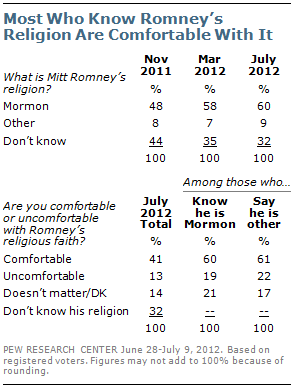
The latest national survey by the Pew Research Center’s Forum on Religion & Public Life and the Pew Research Center for the People & the Press, conducted June 28-July 9, 2012, among 2,973 adults, including 2,373 registered voters, finds that 60% of voters are aware that Romney is Mormon, virtually unchanged from four months ago, during the GOP primaries.
The vast majority of those who are aware of Romney’s faith say it doesn’t concern them. Fully eight-in-ten voters who know Romney is Mormon say they are either comfortable with his faith (60%) or that it doesn’t matter to them (21%).
Along religious lines, white evangelical Protestants and black Protestants, on the one hand, and atheists and agnostics on the other, are the most likely to say they are uncomfortable with Romney’s faith. Yet unease with Romney’s religion has little impact on voting preferences. Republicans and white evangelicals overwhelmingly back Romney irrespective of their views of his faith, and Democrats and seculars overwhelmingly oppose him regardless of their impression.
Comfort with Romney’s faith, however, is related to the enthusiasm of Republican support for his candidacy. Among Republican and Republican-leaning voters who say they are comfortable with Romney being Mormon, 44% back him strongly. Among those who are uncomfortable with it, just 21% say they back him strongly.
A separate Pew Research survey, released July 24, found that voters have little interest in learning more about Romney’s religious beliefs. Just 16% said they wanted to hear more about Romney’s religious beliefs. Far more wanted to hear more about Romney’s record as governor (41%), his federal income tax returns (36%) and his record as chief executive of Bain Capital (35%). (For more see “Most Say They Already Know Enough about the Candidates”, July 24, 2012.)
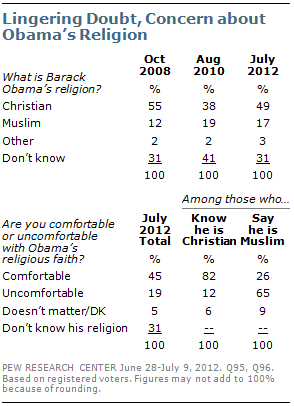
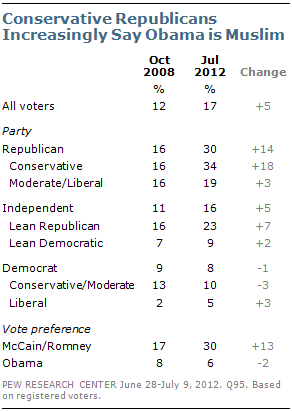
The new survey on religion and politics finds that nearly four years into his presidency the view that Barack Obama is Muslim persists. Currently, 17% of registered voters say that Obama is Muslim; 49% say he is Christian, while 31% say they do not know Obama’s religion.
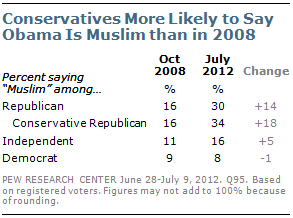
The percentage of voters identifying Obama’s religion as Christian has increased since August 2010, from 38% to 49%, while there has been little change in the percentage saying he is Muslim (19% then, 17% today). Still, fewer say Obama is Christian – and more say he is Muslim – than did so in October 2008, near the end of the last presidential campaign. The increase since 2008 is particularly concentrated among conservative Republicans, about a third of whom (34%) describe the president as a Muslim.
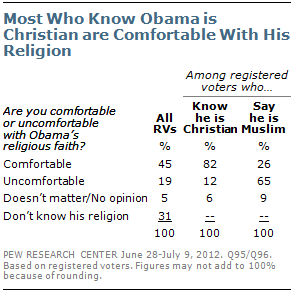
Overall, 45% of voters say they are comfortable with Obama’s religion, while 19% are uncomfortable. Among those who say Obama is Christian, 82% are comfortable with Obama’s religious beliefs. Among those who describe him as a Muslim, just 26% are comfortable with his beliefs.
The survey also finds continued public ambivalence about the role of religion in politics. Fully 67% agree “It’s important to me that a president have strong religious beliefs,” an opinion that has changed little over the past decade. And more than half say they are comfortable with politicians expressing their religious beliefs.
Yet the public remains opposed to churches explicitly endorsing political candidates, with two-thirds saying churches and other houses of worship should not come out in favor of political candidates. And a Pew Research Center survey released in March found that concern about too much church involvement in political matters has been on the rise over the past decade.
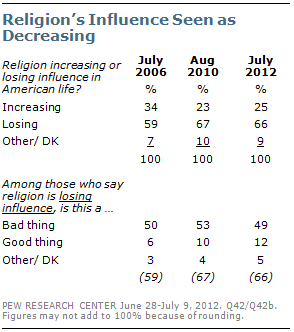
The new survey also finds that 66% of the public says that religion is losing its influence on American life. That is little changed from 2010, but among the highest percentages saying religion is losing its influence since the question was first asked in a Gallup poll in 1957. A small but growing share of Americans say it is good that religion’s influence is declining: Currently, 12% say this, up from 6% in 2006.
Photo Credits: Getty Images
Section 1: Candidates’ Religions and Views of Mormonism
There has been little change in recent years in the public’s views about Mormonism. Most adults say that Mormonism is very different from their own religious beliefs, and only about half of the public thinks of Mormonism as a Christian religion. Still, the poll finds that most voters who know that Romney is Mormon say they are not bothered by his faith. And even among those who say they are uncomfortable with Romney’s faith, there is little evidence that the discomfort will sway their votes. Regardless of their comfort level, the overwhelming majority of those who are Republicans or lean Republican say they will vote for Romney, and the overwhelming majority of Democratic and Democratic-leaning voters say they will vote for Obama.
Nearly one-in-five voters (17%) say that Obama is Muslim. And 19% of voters say they are uncomfortable with Obama’s religion. Discomfort with Obama’s religion is predominantly concentrated among those who say he is Muslim. And there is a much stronger partisan component in views of Obama’s religion than Romney’s. More than one-third (36%) of Republican and Republican-leaning registered voters say they are uncomfortable with Obama’s religion, compared with only 7% of Democratic and Democratic-leaning registered voters. Differences between Republicans and Democrats in views of Romney’s religion are much smaller by comparison; 10% of Republican voters and 16% of Democratic voters say they are uncomfortable with Romney’s faith.
Views of Romney’s Religion
Six-in-ten voters (60%) are able to identify Romney as a Mormon. About one-in-ten voters (9%) say that Romney belongs to some other (non-Mormon) religion and 32% say they do not know what Romney’s religion is.
The percentage of voters who know that Romney is a Mormon has remained largely unchanged since March (58%). Last November, before the start of the GOP primaries, 48% said Romney is a Mormon.
Seven-in-ten Republican voters know that Romney is a Mormon (70%). Fewer Democrats (54%) and independents (60%) identify Romney’s faith. Awareness has increased across party lines since last November, when 58% of Republicans, 40% of Democrats and 52% of independent registered voters identified Romney as Mormon. Older voters and college graduates are more likely to be aware of Romney’s faith than are younger voters and those with less education.
Among religious groups, atheist and agnostic voters are most knowledgeable about Romney’s religion; 81% identify him as a Mormon. Roughly two-thirds of white Catholic voters (68%), white evangelicals (66%) and white mainline Protestants (66%) know that Romney is a Mormon. Fewer black Protestant registered voters know that Romney is a Mormon (38%).
Eight-in-ten voters who are aware of Romney’s religion say that they are comfortable with his religious faith (60%), that his religion does not matter to them (19%) or express no opinion (2%). Among voters who know that Romney is Mormon, about one-in-five (19%) say they are uncomfortable with it. This represents 11% of all registered voters, given that many are unaware of his faith.
The general comfort with Romney’s Mormonism spans all major religious groups. About six-in-ten white Catholic voters (62%) and white evangelical voters (59%) who know Romney’s faith say they are comfortable with it, as do 73% of white mainline Protestants.
Among voters with no religious affiliation, 54% who know Romney is Mormon say they are comfortable with his religious faith, while 23% are uncomfortable. Atheist and agnostic voters are among the most inclined to say Romney’s Mormonism makes them uncomfortable (30%).
There are partisan differences in views of Romney’s religion, but large majorities of Republicans, Democrats and independents who know Romney’s religion say either that they are comfortable with it or that it does not matter. About a quarter of Democratic voters (23%) say they uncomfortable with Romney’s religion, as do 18% of independents and 15% of Republicans.
Romney’s Religion Not Hurting Him in Presidential Race
Discomfort with Romney’s Mormonism appears to be of little consequence for the upcoming presidential election. Overwhelming majorities of Republican and Republican-leaning voters who know Romney is Mormon support him, whether they are comfortable with his religion or not. Conversely, about nine-in-ten Democrats and Democratic-leaners intend to vote for Barack Obama, regardless of their view of Romney’s faith.
However, Romney supporters who are uncomfortable with his Mormonism are less enthusiastic about his candidacy than those who are not bothered by his faith. Among Republican and Republican-leaning registered voters who express no discomfort with Romney’s Mormonism, 92% plan to vote for Romney, and 42% back him strongly. By comparison, Republican and Republican-leaning voters who are uncomfortable with his faith still prefer Romney over Obama – 93% say they will vote for him – but strong support drops to just 21%.
The same is true among white evangelical voters. White evangelical Protestants overwhelmingly back Romney over Obama regardless of their feelings about his faith. But evangelicals who are comfortable with Romney’s Mormonism express substantially more strong support for his candidacy than those who are uncomfortable with his faith (41% vs. 16%).
Views of Mormonism
There has been little change in views of Mormonism over the course of the 2012 campaign season. Currently, 23% of non-Mormons say that Mormonism and their own faith have a lot in common, while 61% say Mormonism and their own religious beliefs are very different. These figures are similar to previous polls conducted in November 2011 and August 2007.
Majorities of most religious groups say that Mormonism and their own respective faiths are very different from each other. This point of view is most common among atheists and agnostics, among whom 84% say Mormonism and their own beliefs are very different.
Half of non-Mormons say that Mormonism is a Christian religion, while 31% say it is not a Christian faith, and 19% say they don’t know whether Mormonism is Christian. These figures have not changed since 2007.
The greatest skepticism about whether Mormonism is a Christian faith is among white evangelicals (42% of whom say it is not) and black Protestants (38% of whom say it is not). Majorities of white mainline Protestants, white Catholics and religiously unaffiliated respondents say Mormonism is a Christian religion.
Views of Obama’s Religion
There has long been significant confusion about Barack Obama’s religious faith. In mid-October of 2008 – just weeks before his election – only 55% of voters identified him as Christian. Most of the rest (31% of registered voters) said they did not know what his religious faith was, and 12% said they thought he was Muslim.
To the extent that these views have changed over his first term in office, the shift has not been toward greater awareness of Obama’s Christian faith. Currently, 49% of registered voters identify Obama as Christian, while 31% say they don’t know what he is, and 17% misidentify him as Muslim.
The slight rise in the number saying that Obama is a Muslim has been most pronounced among conservative Republicans. The number of conservative Republicans who say Obama is a Muslim has doubled since October 2008 (from 16% to 34%). There has been virtually no change in the share of moderate and liberal Republicans who say Obama is Muslim, or among any Democratic or Democratic-leaning groups.
Because of the increasing partisan polarization in perceptions of Obama’s faith, a Romney supporter today is much more likely than a McCain voter four years ago to say that Barack Obama is Muslim (30% vs. 17% in October 2008).
Overall, half of registered voters either say they are comfortable with Obama’s religion (45%) or that his religious faith does not matter to them (5%). One-in-five registered voters say they are uncomfortable with Obama’s religion (19%), which is slightly higher than the percent who say they are uncomfortable with Romney’s faith (13%). Not surprisingly, discomfort with Obama’s religion is concentrated among those who say he is a Muslim. Two-thirds of registered voters who say Obama is a Muslim say they are uncomfortable with his faith (65%), while eight-in-ten voters who say Obama is Christian say they are comfortable with his religion (82%).
Photo Credits: Getty Images
Section 2: Religion and Politics
Americans have long been comfortable with religion having a role in politics. A sizable majority continues to say it is important for the president to have strong religious beliefs. And a majority says they are not bothered when politicians talk about their religion.
At the same time, however, there is widespread opposition to churches and other houses of worship endorsing one political candidate over another. And recent Pew Research Center polling found that an increasing percentage thinks there has been “too much” religious talk from politicians.
Roughly half of the public believes that conservative Christians have gone too far in trying to impose their religious values on the country. But there is even more concern that liberals have gone too far in trying to keep religion out of schools and government.
This imbalance reflects the continued public view that religious groups, and religion in general, strengthen American society. By two-to-one, most say that churches, synagogues and other houses of worship contribute to solving important social problems. Yet there is a continued sense that religion’s influence is declining in America. An overwhelming majority of those who share this perception see this as a bad thing.
Most Want President to Have Strong Religious Beliefs
Two-thirds of adults (67%) say it is important for the president to have strong religious beliefs. This number is down since 2008 (72%), but is similar to polls conducted during the 2004 and 2000 elections (70%).
The consistent importance of religion matches another survey finding from a May 2011 poll, which found 61% of adults say they would be less likely to support a presidential candidate who does not believe in God. Of 14 items tested, this was the only potential trait that a clear majority of Americans said would affect their vote negatively.
Eight-in-ten Republicans (81%) say it is important to have a president with strong religious beliefs, which is significantly higher than the number of Democrats (66%) and independents (60%) who say this. Similar partisan divisions have existed since this question was first asked in 2000.
Women are more likely than men to say it is important for a president to have strong religious beliefs (70% vs. 64%). And having a strongly religious president is more important to older people than to younger adults. Those with a high school education or less attach more importance to having a president with strong religious beliefs (74%) than do those with some college (66%), who in turn prioritize this more than college graduates (58%).
Having a president with strong religious beliefs is important to large majorities across a variety of religious groups. Those who are unaffiliated with a religion, especially atheists and agnostics, are the major exception. Two-thirds of the religiously unaffiliated, including 86% of atheists and agnostics, say it is not important that presidents have strong religious beliefs. White evangelical Protestants (88%), black Protestants (78%) and Hispanic Catholics (79%) are among the most likely to say it is important that a president have strong religious beliefs.
Most Okay with Religious Talk from Politicians
Overall, half of Americans (52%) say it does not bother them when politicians “talk about how religious they are,” while 43% say this makes them uncomfortable. Views on this question have held steady in recent years.
In addition to asking the long-standing question about comfort with politicians talking about “how religious they are,” the survey also asked half of respondents whether it makes them uncomfortable when politicians talk about “their religious faith and beliefs.” When the question is worded this way, 57% disagree, while 37% agree.
Nearly half of Democrats (48%) say it makes them uncomfortable when politicians talk about how religious they are, while about as many (44%) say they are uncomfortable with politicians talking about their religious faith and beliefs. Only about a third of Republicans express discomfort when politicians talk about how religious they are (34%) and their religious faith and beliefs (31%).
Continued Opposition to Churches Endorsing Candidates
Pew Research Center surveys conducted over the past decade show a steady consensus that churches and other houses of worship should not come out in favor of one candidate over another during elections. Currently, about two-thirds of Americans take this view (66%), while 27% say churches should endorse one candidate over another.
There is broad agreement across many demographic groups on this question. Nearly seven-in-ten Democrats (69%) and independents (68%) say churches and other houses of worship should refrain from voicing support for one political candidate over another. Republicans are less opposed to church endorsements of candidates, though even among Republicans a majority opposes church endorsements (59%).
Among religious groups, roughly three-quarters of white mainline Protestants (73%), white Catholics (74%), and the unaffiliated (75%) say that churches should not come out in favor of one candidate over another. Opposition to political endorsements by churches is less pronounced among white evangelical Protestants (56%) and black Protestants (52%).
People who attend religious services regularly and those who say religion is very important in their lives are more inclined than less religious Americans to support houses of worship making political endorsements. But even among these more religious groups, majorities say churches should refrain from endorsing political candidates (57% and 58%, respectively).
Liberals, Conservative Christians and Religion in Public Life
Nearly two-thirds of Americans believe liberals have gone too far in trying to keep religion out of the schools and the government (65%), a view that has remained stable in recent years. The public is more divided about whether conservative Christians have gone too far in trying to impose their religious values on the country; 48% say yes while 44% say no.
About a quarter of Americans (27%) say both sides have gone too far when it comes to religion – liberals in trying to keep it out of schools and government, and conservative Christians in trying to impose religious values.
The view that liberals have gone too far in trying to limit religion’s influence in government and schools is more prevalent among older than younger Americans. About half (53%) of adults younger than 30 say liberals have gone too far, compared with 66% of those ages 30-49, 70% of those ages 50-64 and 72% of those ages 65 or older. Those under 30 are more likely than those ages 65 and older to say that conservative Christians have gone too far, though generational differences are more modest on this question.
A large majority of Republicans think liberals have gone too far in keeping religion out of schools and government (86%), compared with about half of Democrats (55%) and six-in-ten independents (62%). Conversely, the view that conservative Christians have gone too far to impose their values is much more common among Democrats (62%) and independents (50%) than Republicans (28%).
Among religious groups, the view that liberals have crossed a line in trying to keep religion out of government is most common among white evangelical Protestants (87%), but is also shared by majorities of black Protestants (74%), white mainline Protestants (67%) and Catholics (64%). By contrast, less than half of the religiously unaffiliated (43%) say liberals have gone too far, including only 19% of atheists and agnostics.
This pattern is essentially reversed when it comes to views of conservative Christians. Only 28% of white evangelical Protestants think conservative Christians have gone too far in trying to impose their values. Roughly half or more of white mainline Protestants (51%), Catholics (50%) and black Protestants (47%) say conservative Christians have gone too far. And the religiously unaffiliated are more likely than any other religious group to say conservative Christians have crossed the line (71%), including fully 86% of atheists and agnostics who express this view.
Religion’s Influence on American Life
Two-thirds of Americans (66%) say religion as a whole is losing its influence on American life. The percentage of people who hold this view is up significantly over the last decade (from 52% in 2002), but has not changed since 2010. One-in-four Americans thinks religion’s influence on American life is increasing (25%).
The large majority of those who think religion’s influence is on the decline see this as a bad thing (49% of the public as a whole), compared with 12% who think religion’s influence is waning and that this is a good thing. Conversely, most of those who think religion’s influence is on the rise think this is a good thing (16% of the public overall), while 8% say religion’s influence is growing and see this as a negative.
Though most Americans say religion’s influence is declining, two-thirds (65%) still believe churches, synagogues, and other houses of worship contribute either “some” (40%) or “a great deal” (26%) to solving important social problems. While large majorities have expressed this view for more than a decade, there has been a decline in the number saying churches contribute a great deal or some to solving social problems since 2008 (the last time the question was asked by the Pew Research Center), when 75% of Americans said this.
Photo Credits: Getty Images
About the Survey
The analysis in this report is based on telephone interviews conducted June 28-July 9, 2012, among a national sample of 2,973 adults, 18 years of age or older, living in all 50 U.S. states and the District of Columbia (1,771 respondents were interviewed on a landline telephone, and 1,202 were interviewed on a cell phone, including 596 who had no landline telephone). The survey was conducted by interviewers at Princeton Data Source and Universal Survey Center under the direction of Princeton Survey Research Associates International. A combination of landline and cell phone random digit dial samples were used; both samples were provided by Survey Sampling International. Interviews were conducted in English and Spanish. Respondents in the landline sample were selected by randomly asking for the youngest adult male or female who is now at home. Interviews in the cell sample were conducted with the person who answered the phone, if that person was an adult 18 years of age or older. For detailed information about our survey methodology, see http://pewresearch.org/pewresearch-org/politics/methodology/
The combined landline and cell phone sample are weighted using an iterative technique that matches gender, age, education, race, Hispanic origin and nativity and region to parameters from the March 2011 Census Bureau’s Current Population Survey and population density to parameters from the Decennial Census. The sample also is weighted to match current patterns of telephone status and relative usage of landline and cell phones (for those with both), based on extrapolations from the 2011 National Health Interview Survey. The weighting procedure also accounts for the fact that respondents with both landline and cell phones have a greater probability of being included in the combined sample and adjusts for household size among respondents with a landline phone.
An additional 511 interviews were conducted June 28-July 10, 2012, with religiously unaffiliated adults by screening landline and cell phone RDD samples (261 interviews) and by recontacting respondents from recent surveys who had identified as religiously unaffiliated (250 interviews). These interviews are used only when reporting on the religiously unaffiliated (including the unaffiliated subgroups – atheist, agnostic, and those who describe their religion as “nothing in particular”). For the RDD and cell phone recontact samples, respondents were initially selected in the same way as described above. For the landline recontact sample, interviewers asked to speak with the person based on gender and age who participated in the earlier survey. Once the selected respondents were on the phone, interviewers asked them a few questions and then asked their religious affiliation; those who are religiously unaffiliated continued with the remainder of the interview.
The weighting procedure for the additional interviews with religiously unaffiliated respondents used an iterative technique that included all of the parameters described above. In addition, the weighting accounted for the oversampling of unaffiliated respondents in the screened and callback samples, the type of unaffiliated respondent (atheist, agnostic or “nothing in particular”), as well as gender, age, region and the 2012 presidential vote preference among the unaffiliated. The parameters for the type of unaffiliated respondent and for gender, age and region among the unaffiliated are based on combined data from Pew Research Center surveys conducted from July 2011-June 2012. The parameter for the 2012 vote preference is based on the vote preferences of unaffiliated respondents in the main sample.
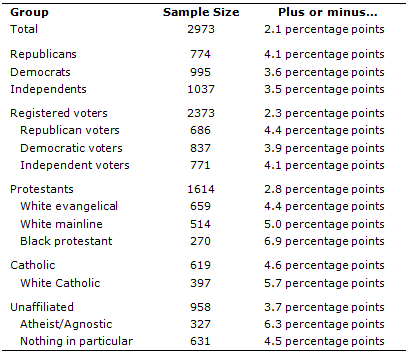
Sampling errors and statistical tests of significance take into account the effect of weighting. The following table shows the sample sizes and the error attributable to sampling that would be expected at the 95% level of confidence for different groups in the survey:
Sample sizes and sampling errors for other subgroups are available upon request.
In addition to sampling error, one should bear in mind that question wording and practical difficulties in conducting surveys can introduce error or bias into the findings of opinion polls.