Faith on the Move – The Religious Affiliation of International Migrants
This study focuses on the religious affiliation of international migrants, examining patterns of migration among seven major groups: Christians, Muslims, Hindus, Buddhists, Jews, adherents of other religions and the religiously unaffiliated.
About Pew Research Center
Pew Research Center is a nonpartisan, nonadvocacy fact tank that informs the public about the issues, attitudes and trends shaping the world. It does not take policy positions. The Center conducts public opinion polling, demographic research, computational social science research and other data-driven research. It studies politics and policy; news habits and media; the internet and technology; religion; race and ethnicity; international affairs; social, demographic and economic trends; science; research methodology and data science; and immigration and migration. Pew Research Center is a subsidiary of The Pew Charitable Trusts, its primary funder.
Faith on the Move – The Religious Affiliation of International Migrants
This study focuses on the religious affiliation of international migrants, examining patterns of migration among seven major groups: Christians, Muslims, Hindus, Buddhists, Jews, adherents of other religions and the religiously unaffiliated.
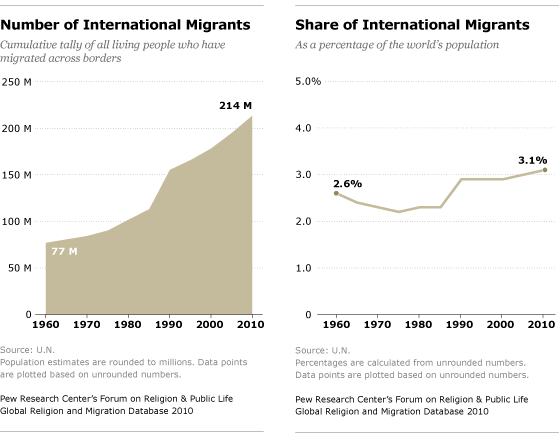
About 3% of the world’s population has migrated across international borders. While that may seem like a small percentage, it represents a lot of people. If the world’s 214 million international migrants were counted as one nation, they would constitute the fifth most populous country on the globe, just behind Indonesia and ahead of Brazil.
Faith on the Move, a new study by the Pew Research Center’s Forum on Religion & Public Life, focuses on the religious affiliation of international migrants, examining patterns of migration among seven major groups: Christians, Muslims, Hindus, Buddhists, Jews, adherents of other religions and the religiously unaffiliated.
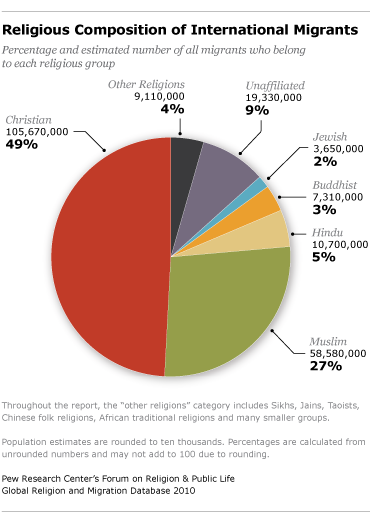
Christians comprise nearly half – an estimated 106 million, or 49% – of the world’s 214 million international migrants, the total number of people who reside permanently in a country other than where they were born. (See Defining International Migrants box. All figures in this report are as of 2010.)
Muslims make up the second-largest share of people who have migrated across borders – almost 60 million, or 27% Hindus (nearly 11 million) account for 5%) and Buddhists (about 7 million) account for 3%.
There are more than 3.6 million Jewish migrants living around the world (nearly 2%). Adherents of all other faiths – including Sikhs, Jains, Taoists, Chinese folk religions, African traditional religions and many smaller groups – collectively account for an estimated 9 million migrants (4%).
The rest of the world’s cumulative “stock” of migrants (more than 19 million, or 9%) is unaffiliated. This category includes atheists, agnostics and people who say they have no particular religion.
In some respects, the religious affiliation of migrants mirrors the religious composition of the world’s overall population. For instance, Christians and Muslims are the two largest religious groups among migrants as well as the two largest religious groups in general.1
At the same time, however, Christians clearly are overrepresented among international migrants. They comprise a much greater share of migrants (about one-in-two) than they do of the general population (nearly one-in-three). Muslims also appear to be overrepresented among migrants, but not by as large a margin. They comprise only a slightly higher share of migrants (27%) than of the world’s total population (23%). Together, Christians and Muslims account for about half the people in the world, but they make up an estimated three-quarters of all those who have emigrated from their country of birth, as of 2010. The remaining quarter belong to smaller groups. Some, like Jews, make up a larger share of migrants (nearly 2%) than they do of the world’s total population (less than 1%). For other groups, the opposite is true. Hindus, for example, comprise about 5% of international migrants but 10-15% of the global population.
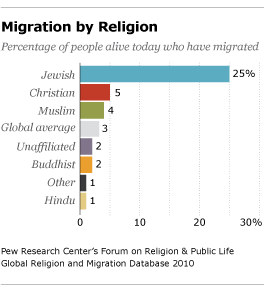
Another way to look at the same data is to ask: What proportion of the living members of each religious group have migrated across international borders? Of the seven groups considered in this study, Jews have by far the highest level of migration, in percentage terms. About one-quarter of Jews alive today (25%) have left the country in which they were born and now live somewhere else. The proportions of Christians (5%) and Muslims (4%) who have migrated across borders also exceed the global average of 3%. Members of all the other major religious groups have migrated at levels lower than the global average of 3%.
Defining International Migrants
According to the United Nations Population Division, an international migrant is someone who has been living for one year or longer in a country other than the one in which he or she was born. This means that many foreign workers and international students are counted as migrants. Additionally, the U.N. considers refugees and, in some cases, their descendants (such as Palestinians born in refugee camps) to be international migrants. For the purposes of this report, estimates of the number of unauthorized or illegal immigrants living in various countries also are included in the total counts. On the other hand, tourists, foreign-aid workers, temporary workers employed abroad for less than a year and overseas military personnel typically are not counted as migrants. The figures in this report refer to the total number (or cumulative “stocks”) of migrants living around the world as of 2010 rather than to the annual rate of migration (or current “flows”). Since migrants have both an origin and a destination, international migrants can be viewed from two directions – as an emigrant (leaving an origin country) or as an immigrant (entering a destination country).
Overall Patterns in Global Migration
Before looking more closely at patterns of migration among the seven major religious groups, it may be helpful to see where international migrants, as a whole, have come from and where they have gone.
Origins
As the Origins cartogram (weighted map) graphically shows, migrants come from every inhabited part of the globe, and no one continent or region is the source of a majority. The largest single share – about a third of the 214 million migrants living around the world – has come from the Asia-Pacific region. The second-largest group of migrants (about 28%) is from Europe, largely the result of people moving from one European country to another. Latin America and the Caribbean rank as the third-highest source of migrants (about 16%). Finally, sub-Saharan Africa and the Middle East-North Africa region each are the origin of about 10% of all international migrants alive today, and North America is the origin of roughly 2%.
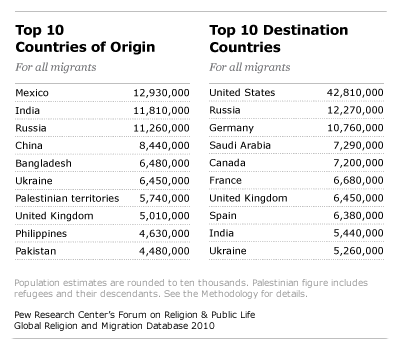
In terms of individual countries, the leading sources of international migrants have been Mexico, India and Russia. More than 10 million people have left each of those countries and now live elsewhere. In addition, China has been the source of more than 8 million emigrants, and Bangladesh and Ukraine each have been the source of more than 6 million.
Destinations
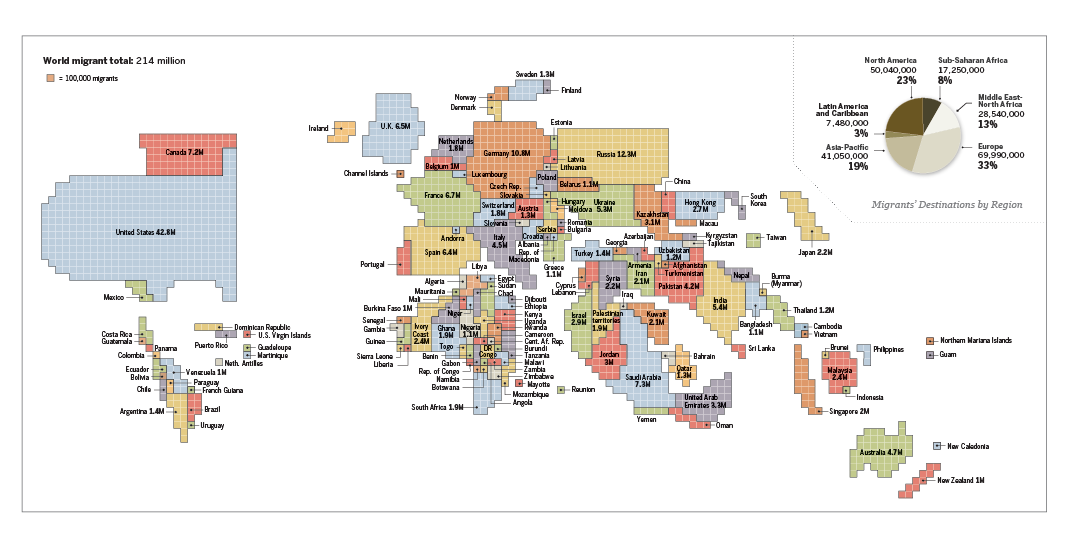
While migrants come from a very diverse and widespread array of countries, the vast majority end up immigrating to a relatively few areas – North America, Europe, Australia and the Arab states of the Persian Gulf, as shown on the Destinations cartogram.
North America and Europe have received more than half of the newcomers: As of 2010, about a third of all international migrants live in Europe, and nearly a quarter reside in North America. About one-fifth of international migrants have moved to the Asia-Pacific region, settling in such places as India, Australia, Pakistan, Kazakhstan, Hong Kong and Malaysia. Smaller numbers of migrants have ended up in the remaining three regions: the Middle East-North Africa, sub-Saharan Africa and Latin America plus the Caribbean.
Among destination countries, the United States is in a class by itself. About one-in-five international migrants alive today (nearly 43 million, including unauthorized immigrants and people born in U.S. territories, such as Puerto Rico and Guam) reside in the United States. This is more than three times the number that reside in any other country. Only Russia and Germany also exceed the 10-million mark. In fact, the United States has about as many immigrants from Mexico alone (more than 12 million, including both legal immigrants and unauthorized ones) as any other nation has received from all sources combined.
Among the world’s other Top 10 destinations for migrants have been Saudi Arabia (7.3 million foreign-born residents), Canada (7.2 million), France (6.7 million), the United Kingdom (6.5 million), Spain (6.4 million), India (5.4 million) and Ukraine (5.3 million).
Patterns in Migration, by Religion
Origins
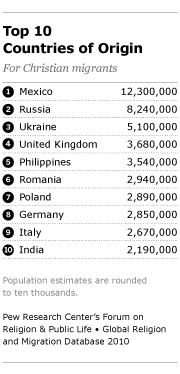
Globally, the top country of origin for Christian migrants has been Mexico (more than 12 million). Other major sources of Christian migrants include Russia (more than 8 million) and Ukraine (about 5 million), mostly due to changing international borders following the collapse of the Soviet Union. There also have been millions of Christian emigrants from the United Kingdom and the Philippines.
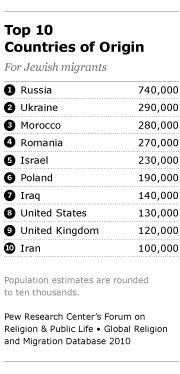
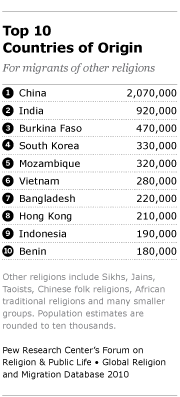
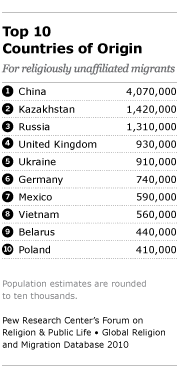
The largest share of the world’s Muslim migrants is Palestinian in origin (more than 5 million), followed by Pakistan, Bangladesh and India (more than 3 million each). The main sources of Jewish migrants are Russia (more than 700,000) and Ukraine (290,000). The top country of origin for Buddhist migrants is Vietnam, followed closely by China (more than 1 million each). Hindu migrants have come overwhelmingly from India (more than 5 million). China has been the largest source of migrants belonging to other religions (2 million) as well as the primary country of origin for migrants who are religiously unaffiliated (4 million).
Destinations
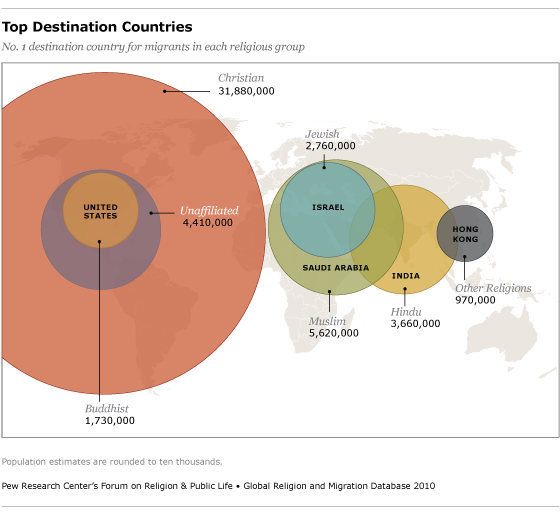
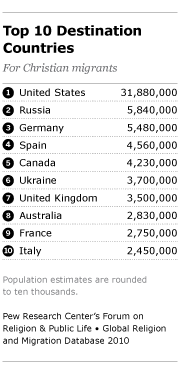
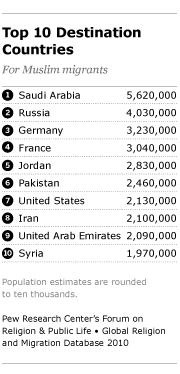
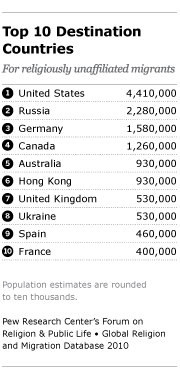
With its huge population of immigrants, the United States has been a leading destination for many, though not all, religious groups. The U.S. is the world’s No. 1 destination for Christian migrants, who make up nearly three-quarters (74%) of all foreign-born people living in the United States. The United States is also the top destination for Buddhist migrants (including many from Vietnam) and for people with no particular religious affiliation (including many from China). It is the world’s second-leading destination for Hindu migrants, after India, and for Jewish migrants, after Israel. Among Muslim migrants, however, the United States ranks just seventh as a destination – behind Saudi Arabia, Russia, Germany, France, Jordan and Pakistan. (For more details, see Spotlight on the United States).
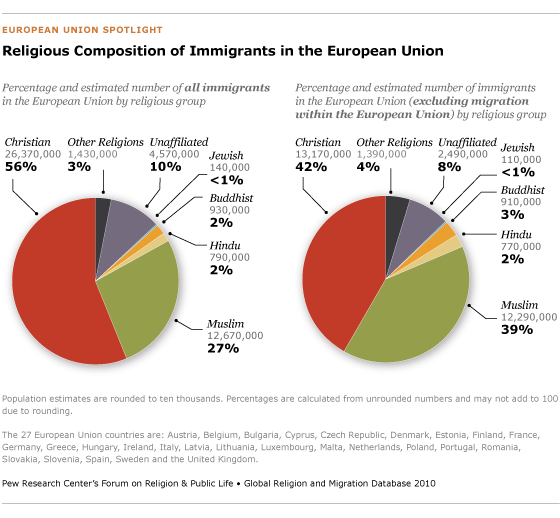
European countries also have been major destinations for migrants of many faiths. Russia, for example, has about 4 million Muslim immigrants, mostly from neighboring former Soviet republics, while Germany and France each are estimated to have more than 3 million first-generation (foreign-born) Muslim residents. Perhaps contrary to popular perception, however, Christian immigrants outnumber Muslim immigrants in the European Union as a whole. The 27 E.U. member countries collectively have an estimated 26 million Christian immigrants (56% of the foreign-born population) and nearly 13 million Muslim immigrants (27%). Even when migration within the E.U. is excluded, the estimated number of foreign-born Christians (about 13 million) is still slightly larger than the estimated number of foreign-born Muslims (about 12 million) living in the European Union. (For more details, see Spotlight on Europe.)
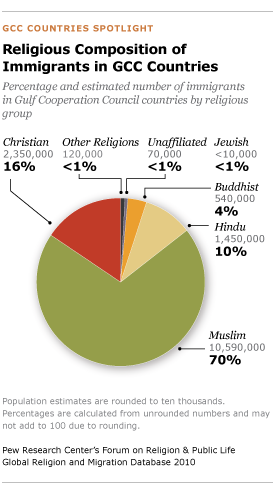
The six countries of the Gulf Cooperation Council (Bahrain, Kuwait, Oman, Qatar, Saudi Arabia and the United Arab Emirates) also have large populations of foreign-born residents, ranging from about a quarter to more than 80% of each country’s total population. Although they are often legally treated as temporary workers rather than as immigrants, many labor migrants routinely renew their work permits and stay on in the GCC countries for years. Over time, this influx could bring significant change in the religious composition of these once overwhelmingly Muslim nations. While a majority of migrants to all the GCC countries are estimated to be Muslims, they also include substantial minorities of other faiths, including Hindus and Christians. (For more details, see Spotlight on the Gulf Cooperation Council Countries.)
These are among the key findings of Faith on the Move. The report draws from hundreds of censuses and surveys to arrive at estimates of the size and religious affiliation of immigrant populations in 231 countries and territories as of 2010.
About the Estimates
Since migrants by definition move around, tracking their origins and destinations is not easy. The fact that many come from countries that keep only rudimentary records adds to the challenge. Determining their religious affiliation is even harder – which may be why, until now, no religious breakdown has been available for international migrants as a whole. The Pew Forum’s new Global Religion and Migration Database (GRMD) seeks to fill this gap. Based on the GRMD, this report addresses three basic questions: Where have migrants come from? Where have they gone? And what is their religion?
These questions can be answered, however, only within certain limits imposed by the underlying data. For example, figures on the annual movement of people across borders are scant and extremely difficult to reconcile globally, in part because of uncertainty about the final destination of travelers and how long they intend to stay. Consequently, this report focuses on the long-term data, estimating the total number (or cumulative “stocks”) of living migrants as of 2010 rather than annual migration rates (or current “flows”).
A second limitation is that censuses and surveys around the world provide varying levels of detail about religious groups. As a result, this report divides international migrants into just seven religious categories: Christians, Muslims, Hindus, Buddhists, Jews, adherents of other religions and the unaffiliated (including atheists, agnostics and people who have no particular religion). The Pew Forum sought to analyze additional groups, such as Sikhs and Jains, but this proved impossible because censuses and surveys in many countries do not provide separate counts of these groups.
Third, many governments collect data on immigrants, but relatively few gather information on emigrants. Simply put, countries generally know where their current residents come from, but they do not know where their ex-residents have ended up. As a result, most of the data for this study were gathered from official statistics (censuses, surveys and population registers) in destination countries. The emigration figures were then imputed backward to the country of origin. For example, if a census in France found 10,000 residents who were born in Greece, an entry was made in the database to show that 10,000 migrants left Greece and ended up in France. In total, the database contains approximately 500,000 data points.
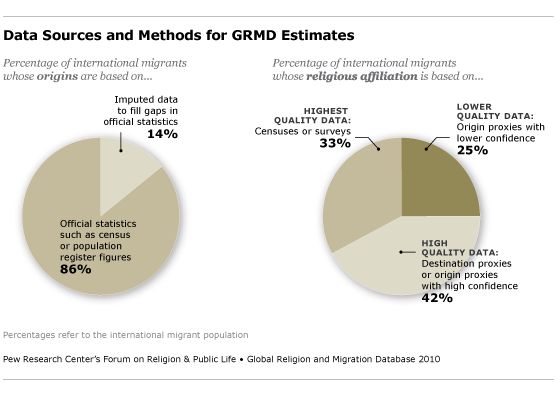
Unfortunately, data from high-quality sources such as censuses and large-scale surveys do not cover all of the world’s migrants. The Pew Forum was able to find high-quality data on the origins of the overwhelming majority of international migrants (about 86%). But the origins of the remaining migrants (14%) were estimated using statistical techniques for imputing missing information and relying, in part, on a previous study of global migration by researchers at the University of Sussex in England.
Estimating the religious makeup of immigrants involved an additional layer of data collection and analysis. The most reliable information on the religion of migrants comes from censuses or large-scale surveys that contain questions about immigrants’ religious affiliation as well as about their country of birth. This kind of data was available for about one-third of the world’s migrant population, including for immigrants in many of the leading destination countries, such as the United States, Canada, Australia and the United Kingdom.
In cases in which no data were available on the religious affiliation of migrants in a particular country, the Pew Forum sometimes was able to use census or survey data from a religiously similar country in the same region as a “destination proxy.” For example, Bahrain does not release detailed data on the religion of its immigrants. But data are available on the religious affiliation of immigrants to Egypt, which, like Bahrain, is a Muslim-majority country in the Middle East-North Africa region. So in estimating the percentage of Muslims, Christians, Hindus and members of other religious groups among migrants from India to Bahrain, the Pew Forum used the religious breakdown of migrants from India to Egypt as a guide. This is important because migrants often do not match the religious composition of their home country. Even though India is a Hindu-majority country, for example, most migrants from India to Egypt are Muslims – and the same is assumed to be true of most migrants from India to Bahrain.
The religious distribution of the remaining migrants was estimated using an “origin proxy.” This assumes that the religious makeup of migrants is roughly the same as the religious makeup of the country they come from, particularly when they are moving between countries in which the majority religion is the same, such as migrants moving from Latin America to the United States. Origin proxies also were used in some cases in which migrants originate from a country composed almost entirely of a single religious group, such as migrants from Turkey to Europe. Data reliability tests indicate that selective use of origin proxies in these circumstances is highly reliable. Combined with destination proxies (7%), origin proxies with a high level of data confidence (35%) were the basis for estimating the religious composition of about 42% of the migrant population.
The religious distribution of the remaining 25% of global migrants also is based on origin proxies, but in circumstances in which the religious composition of the emigrant population may differ significantly from the religious composition of the origin country. Migrants from Cameroon to Belgium, for example, are assumed – in the absence of other data – to have the same religious breakdown as Cameroon’s population, which is about 70% Christian and roughly 20% Muslim. In reality, however, there may be a higher percentage of Christians among migrants from Cameroon to Belgium (a Christian-majority country) than there is in Cameroon’s population as a whole. In such circumstances, the origin proxies yield less reliable estimates of religious affiliation. Many of the estimates with a lower level of data confidence, however, are for the movement of relatively small numbers of migrants between countries that are neither major origins nor major destinations.
Taking these limitations into account, this report focuses on the Top 10 origin countries and the Top 10 destination countries of each religious group – estimates that generally are based on censuses, surveys or proxies with a high level of data confidence. The report also highlights broad patterns in migration across major geographic regions, such as Europe and the Middle East-North Africa. Throughout the report and the accompanying interactive graphics, large numbers are rounded to the nearest 10,000. Estimates between 1,000 and 9,999 are shown as <10,000. Estimates between 0 and 999 are shown as <1,000. All percentages are rounded to whole numbers.
For a more detailed explanation of the construction of the Global Religion and Migration Database, including data reliability tests, see the Methodology section (Appendix B). A complete list of the data sources used for each country, including proxies, is provided in Appendix C.
Footnotes:
1 Comparisons in this report to the world’s religious distribution rely primarily on figures from Boston University’s World Religion Database. The Pew Forum is currently compiling detailed statistics on the size and distribution of the world’s major faiths based on censuses and national surveys. Some of those figures were released in The Future of the Global Muslim Population: Projections for 2010-2030 (January 2011), which estimated that Muslims comprised about 23% of the global population in 2010, and in Global Christianity: A Report on the Size and Distribution of the World’s Christian Population (December 2011), which estimated that Christians made up nearly 32% of the world’s people in 2010. (return to text)
Preface
People are on the move, and so are their faiths.
The total number of international migrants living around the world has grown substantially over the past 50 years, climbing from about 80 million people (or 2.6% of the world’s population) in 1960 to about 214 million (or roughly 3% of the world’s population) in 2010, according to estimates by the United Nations Population Division.
At times in history, religious persecution and strife have been major causes of migration. But many experts think that, on the whole, economic opportunities – better jobs and higher wages – have been the single biggest driver of international migration. At the same time, religion remains a factor in some people’s decisions to leave their countries of birth and their choices of where to go. And, regardless of motive, the movement of millions of people across oceans and continents can have significant effects on the religious makeup of nations.
In the United States, for instance, more than a century of immigration by Catholics, Jews, Muslims, Buddhists, Hindus, Sikhs and others has contributed to the gradual reduction of the once-overwhelming proportion of Protestants, which has fallen from two-thirds of the U.S. public in the 1960s to about half today. In Western Europe, a more recent influx of Muslim immigrants is producing political tensions along with greater cultural diversity. And in some of the oil-rich Gulf states, large numbers of foreign workers – including Hindus from India, Christians from the Philippines and religiously unaffiliated people from Europe and North America – are changing the face of once-homogeneous societies.
To better understand the relationship of migration and religion, the Pew Research Center’s Forum on Religion & Public Life began more than a year ago to build a database of information that combines hundreds of censuses, surveys and other sources to shed light on the origins, destinations and religious affiliations of international migrants. This report draws on the new Global Religion and Migration Database to estimate the religious breakdown of all international migrants living around the world as of 2010. The database is akin to a puzzle assembled from hundreds of thousands of tiny pieces. It allows us to see – for the first time – a global picture of where migrants have come from, where they have gone and their religious composition.
The picture is, inevitably, fuzzy in places. Some pieces of the puzzle are missing (reliable survey or census data on the religious affiliation of immigrants are not available for every country), and some pieces do not fit perfectly together (censuses and surveys in different countries gather information in ways that are sometimes difficult to harmonize). So it is important to emphasize that the figures in this report are estimates, not precise counts.
Still, this emerging picture of the religious affiliation of international migrants is much clearer than what demographers and social scientists previously have been able to produce. General readers also may be surprised by some of the findings. We can now see, for example, that Europe has more Christian immigrants than Muslim immigrants; that Saudi Arabia is the top destination country for Muslim migrants; and that the United States is the No. 1 destination not only for Christian migrants but also for Buddhists and for people who have no particular religion.
This report is just a beginning – a baseline look at the nominal affiliation of migrants, with no attempt to measure their levels of religious commitment. We hope to gather additional data over time, so that we can more closely examine the experience of immigrants in particular countries. For example, future reports may explore whether migration tends to increase or decrease the religiosity of migrants, the role of religion in how immigrants adapt to their new surroundings, and other related issues. With its surveys in the United States and around the world, the Pew Forum also will continue to explore the connections between people’s religious beliefs and practices and their social and political attitudes.
The principal researcher for Faith on the Move and architect of the Global Religion and Migration Database is Pew Forum Research Associate Phillip Connor, Ph.D. Jeffrey Passel of the Pew Research Center’s Hispanic Center contributed important insights at several stages of the project. We also received invaluable assistance and feedback on drafts of this report from Guy Abel of the Vienna Institute of Demography, Christopher Parsons of the University of Nottingham, Philippe Fargues of the European University Institute and Michael Fix of the Migration Policy Institute. With all this generous help, any failings of this report are, needless to say, ours alone.
Luis Lugo, Director
Alan Cooperman, Associate Director, Research
Overview of Migrants’ Origins and Destinations
This report begins where all international migrants begin – in their home countries. More than 77 million migrants, or about 36% of the worldwide total, have come from the 10 leading origin countries.
Overall, Mexico has been the largest single source of migrants (12.9 million), followed closely by India (11.8 million) and Russia (11.3 million). In addition, China (8.4 million), Bangladesh (6.5 million) and Ukraine (6.5 million) each have more than 6 million emigrants. Because the United Nations counts both Palestinian refugees and their descendants as migrants, the Palestinian territories have been the source of 5.7 million migrants, by the U.N.’s definition. The United Kingdom, the Philippines and Pakistan round out the Top 10 list of countries of origin for international migrants alive today.
About 110 million migrants, or more than 50% of the global total, have gone to the 10 leading destination countries. With nearly 43 million foreign-born residents, including more than 11 million unauthorized immigrants, the U.S. has more than three times as many international migrants as any other single country.2 Indeed, the U.S. has about as many immigrants as Europe’s top five destinations – Russia (12.3 million), Germany (10.8 million), France (6.7 million), the United Kingdom (6.5 million) and Spain (6.4 million) – combined.3
Levels of Migration, by Religion
Of the seven groups examined in this report, Jews have by far the highest overall level of international migration, in percentage terms. About one-quarter of Jews alive today have left the country in which they were born. Yet because Jews make up only a sliver of the world’s population – roughly 14 million out of a total of 6.9 billion people in 2010 – they represent a small fraction (about 2%) of all international migrants.4
By contrast, only one-in-twenty Christians alive today (5%) have emigrated from their country of birth. But because there are nearly 2.2 billion Christians around the world, that translates to nearly half of the world’s 214 million international migrants. Muslims make up the second-largest share of all migrants – almost 60 million
migrants, or a little more than a quarter of all international migrants. Only a small percentage (1-2%) of all Hindus, Buddhists and adherents of other faiths have migrated across borders.
The rest of international migrants (about 19 million) are unaffiliated with any particular religion.
Regional Patterns
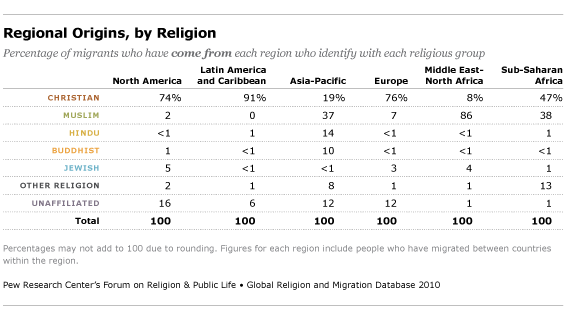
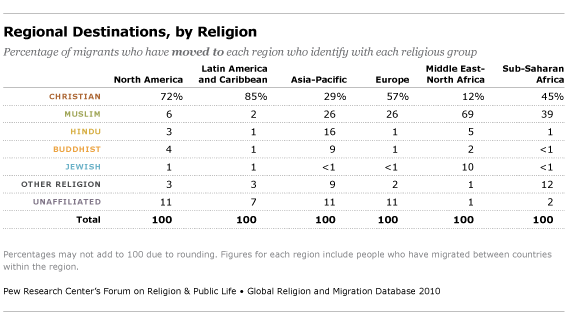
The vast majority of people who have emigrated from their native countries in North America, Latin America (including the Caribbean) and Europe are Christians. And, not surprisingly, emigrants from most countries in the Middle East and North Africa overwhelmingly are Muslims. But emigrants from the remaining two regions – Asia-Pacific and sub-Saharan Africa – are more religiously mixed.
A plurality of migrants from Asia and the Pacific are Muslims (37%), but a substantial share are Christians (19%), Hindus (14%), unaffiliated (12%) or Buddhists (10%), reflecting the diverse mix of religions in that vast region. Meanwhile, more than eight-in-ten emigrants from sub-Saharan Africa are either Christians (47%) or Muslims (38%).
In general, the religious affiliation of immigrants to each region is similar to the religious affiliation of emigrants from that region. For example, most migrants who have moved to countries in North America are Christians. This includes large numbers of people who have migrated from Latin America to the United States. The result is that in North America as a whole, Christians make up the vast majority both of emigrants (74%) and of immigrants (72%).
There is more of a disparity between emigrants and immigrants in Europe. While roughly three-quarters of the people who have left European countries are Christians (76%), a substantially lower proportion of people who have moved to European countries are Christians (57%). Both figures include people who have moved within Europe. (For information on immigration to European Countries solely from outside Europe, see the Spotlight on Europe.) About a quarter of all immigrants living in European countries are Muslims (26%), and the rest are mostly unaffiliated (11%).
The Asia-Pacific region also has a notable difference between its largest group of emigrants (Muslims, 37%) and its largest group of immigrants (Christians, 29%). In part, this reflects the number of Muslim emigrants from the region who have moved to Europe and the Middle East. In addition, some countries in the Asia-Pacific region, such as Australia and New Zealand, have large immigrant populations that are predominantly Christian.
Most emigrants from countries in the Middle East and North Africa are Muslims (86%), but the proportion of Muslims among immigrants in the region is substantially lower (69%). This reflects, in part, the movement of laborers to oil-rich countries in the region as well as Jewish migration to Israel.
Footnotes:
2 The Pew Hispanic Center has estimated that about 11.2 million unauthorized immigrants were living in the United States in 2010, of which about 6.5 million originated from Mexico. See Jeffrey Passel and D’Vera Cohn, “Unauthorized Immigrant Population: National and State Trends, 2010,” Pew Hispanic Center, Feb. 1, 2011. (return to text)
3 In this report, immigrants to the United States are classified as foreign-born residents if they were born outside of the 50 U.S. states and the District of Columbia. Although people born in some U.S. territories (such as Puerto Rico and Guam) and people born overseas to American citizens receive U.S. citizenship at birth, they are still included among the “foreign-born” in this report, following definitions used by the United Nations Population Division for its demographic estimates. The U.S. Census Bureau, however, does not consider U.S. citizens born abroad (including people born in Puerto Rico and other U.S. territories) to be foreign-born. This explains why the 2010 American Community Survey estimates the number of foreign-born U.S. residents in 2010 at about 40 million, or almost 3 million less than the foreign-born estimate provided by the U.N. Population Division (42.8 million) for the same year. (return to text)
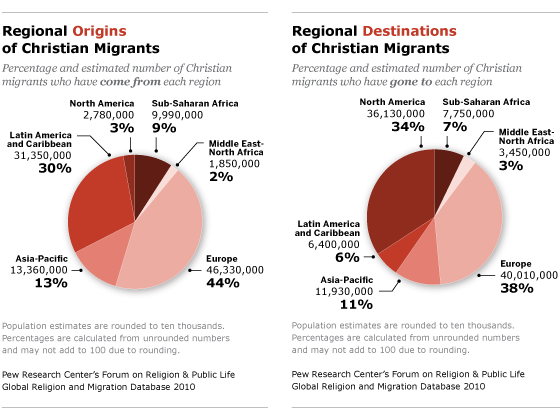
Another way to see patterns in global migration is to look individually at each religious group. Among Christian migrants, the main destination regions have been North America and Europe. European countries, as a whole, are also the leading source of Christian migrants, accounting for more than four-in-ten worldwide (44%). About three-in-ten Christian migrants originate from Latin America and the Caribbean.
The largest single country of origin for Christian migrants, however, has been Mexico, with more than 12 million. Most of them now reside in the United States, which has taken in a total of about 32 million Christian migrants, nearly two-thirds originating in Latin America.
Russia and Ukraine have been major sources as well as major destinations of Christian migrants, mostly due to changing international borders following the collapse of the Soviet Union.5
Other European countries (such as the United Kingdom, Poland, Germany and Italy) also are the origin of sizable numbers of Christian emigrants, many of whom have gone to the United States, Canada and Australia.
Meanwhile, most Christian immigrants living in Germany (about 5.5 million) and Italy (about 2.5 million) were born in other European countries, including those in Eastern Europe. The same is true for almost half of the United Kingdom’s nearly 3.5 million Christian immigrants. Spain’s large population of Christian immigrants (nearly 4.6 million) consists principally of migrants from Latin America as well as Romania, the United Kingdom, Germany and France. Many Christian immigrants to Canada (about 4.2 million) and Australia (about 2.8 million) have come from Europe, especially the United Kingdom.
.
Footnotes:
5 During the 1990s, many former Soviet citizens moved between the 15 newly independent countries that had comprised the Soviet Union. In addition, many people did not physically move but nonetheless found themselves in a new country when international borders were redrawn. People born in Russia but living in Ukraine, for example, were classified as international migrants when Ukraine became an independent state. (return to text)
Muslim Migrants
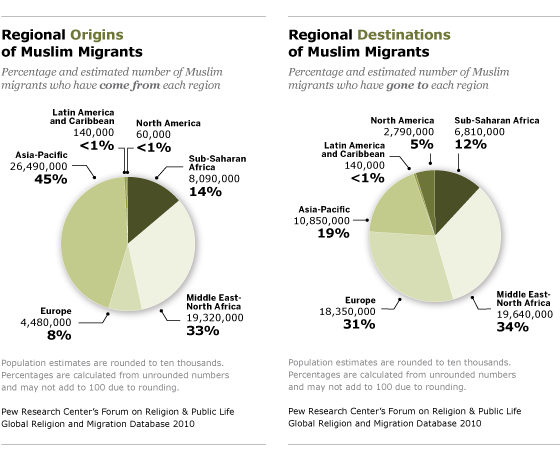
The main regional destinations for Muslims are different from their origins. About a third of Muslim migrants have gone to Europe, while less than 10% of Muslim migrants have come from Europe. At the same time, nearly half of Muslim migrants have come from the Asia-Pacific region, where only about one-in-five Muslim migrants have moved.
There has been a rough balance, however, between Muslim emigration and immigration in the Middle East-North Africa region as a whole. About a third of Muslim migrants have come from the Middle East-North Africa, and a similar percentage have ended up there, including many who have moved from one country to another within the region.
The greatest number of Muslim migrants have come from the Palestinian territories (more than 5 million). By the U.N.’s reckoning, this group includes Palestinian refugees and their descendants.6 A large number of Muslims also have left Pakistan, Bangladesh and India. Much of the migration out of these countries was prompted by the partitioning of the Indian subcontinent in the years following the withdrawal of the British Raj in 1947. However, even today, people continue to move between countries in the area, with Muslims generally migrating to Pakistan and Bangladesh while Hindus tend to move to India. Significant numbers of Muslim migrants also originate from Afghanistan, Turkey and Morocco. Unlike the migrants on the Indian subcontinent (India, Pakistan, Sri Lanka, Bangladesh, Bhutan and Nepal), who have mostly crossed into neighboring countries, many Muslim migrants from North Africa and Turkey have moved farther away, including to Western Europe.
Saudi Arabia has been the top destination country for Muslim migrants, most of whom are workers from nearby Arab countries, the Indian subcontinent, Indonesia and the Philippines. Russia’s Muslim migrant population (about 4 million) comes mainly from neighboring states (such as Kazakhstan, Uzbekistan and Azerbaijan) that were once part of the Soviet Union. Nearly half of Germany’s foreign-born Muslim immigrants (estimated at more than 3 million) have been from Turkey, but they also include substantial numbers from Kosovo, Iraq, Bosnia-Herzegovina, Morocco and Iran. France’s Muslim immigrants (about 3 million) are primarily from the former French colonies of Algeria, Morocco and Tunisia. Regional conflicts in Iraq and the Palestinian territories largely account for the influx of Muslims to Jordan (nearly 3 million) and Syria (about 2 million). Similarly, decades of conflict in Afghanistan help to explain the high number of Muslim migrants in Pakistan (about 2.5 million) and Iran (more than 2 million).7
<
.
Footnotes:
6 The United Nations includes cross-border refugees in its estimates of the number of migrants living in each country. Generally speaking, refugees are people who have fled from violence, famine or disaster in their home country. In the case of Palestinian refugees, however, the U.N. also considers their descendants (including the second, third and fourth generations) to be refugees – and therefore international migrants – even if they were born in the country where they now reside. If descendants were not counted as international migrants, the number of Muslim migrants from the Palestinian territories would be much smaller than 5.6 million. This is especially the case since the U.N. considers nearly 2 million people living in the Palestinian territories to be refugees (and hence, by definition, international migrants). The Palestinian territories are the only locality where the origin and destination of international migrants are identical, according to the U.N.’s definitions. (return to text)
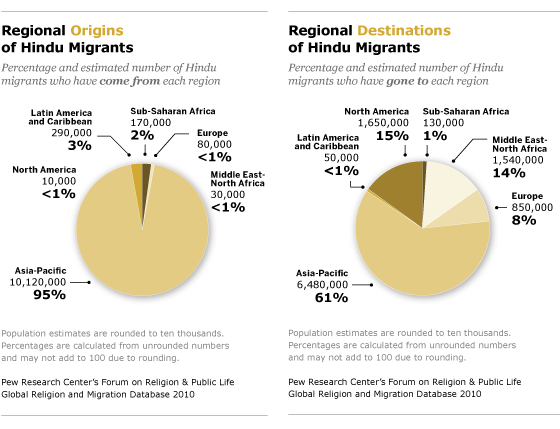
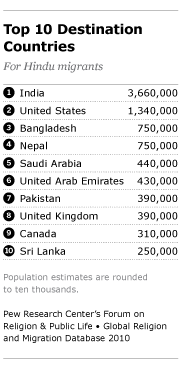
The leading regional destination for Hindus is the same as their top region of origin: About six-in-ten Hindu migrants have moved to countries in the Asia-Pacific region, where more than nine-in-ten originate. There has been substantial movement between the South Asian countries of India, Pakistan, Sri Lanka, Bangladesh and Bhutan. But substantial numbers of Hindus also have moved to North America and the Middle East-North Africa (mostly Gulf Cooperation Council countries).
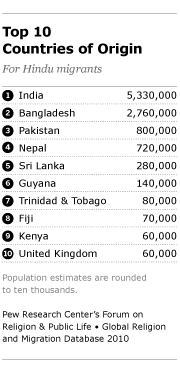
Hindu migrants have come mostly from India (more than 5 million) and Bangladesh (almost 3 million). Much smaller numbers of Hindu migrants have come from the Pacific region known as Oceania (particularly Fiji) and the Caribbean (particularly Trinidad and Tobago and Guyana).
For Hindus, India is far and away the No. 1 destination country. About 3.7 million Hindu immigrants have moved to India, principally from neighboring countries, for reasons ranging from family reunification to job opportunities. But those factors also sometimes operate in reverse, drawing Hindus from India and nearby countries to Bangladesh, Nepal, Pakistan and Sri Lanka, which are among the Top 10 destinations – as well as among the Top 10 origins – for Hindu migrants.
Outside of South Asia, the United States has by far the most Hindu immigrants: an estimated 1.3 million first-generation (foreign-born) Hindus, most of whom have arrived in recent decades. Significant Hindu migration also has occurred to the Arab states of the Persian Gulf (especially Saudi Arabia and the United Arab Emirates) and to the United Kingdom and Canada.
.
Buddhist Migrants
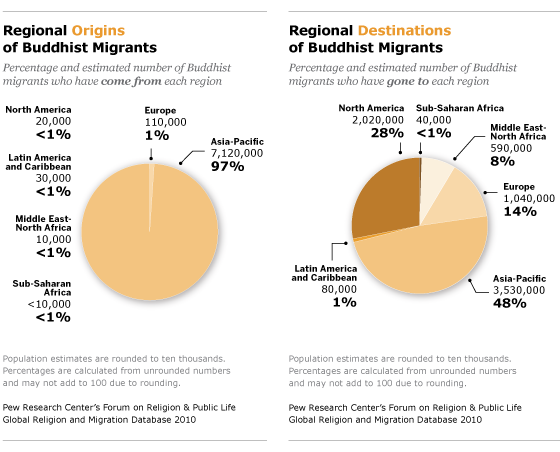
Like Hindus, Buddhist migrants overwhelmingly have come from the Asia-Pacific region. Nearly half of Buddhists who have left countries in the region have moved to other countries in that same region. But large numbers of Buddhists also have moved to North America, as well as to Europe.
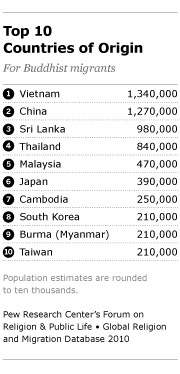
In terms of individual countries, the top two sources of Buddhist migrants have been Vietnam and China (more than 1 million each). Other major countries of origin for Buddhist migrants include Sri Lanka, Thailand, Malaysia and Japan.
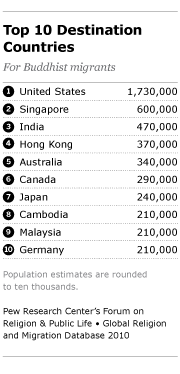
Many Buddhist migrants have moved to nearby countries in Asia, though significant numbers also have gone to the United States and Canada. Indeed, the United States has far more Buddhist migrants (about 1.7 million) than any other single country. Singapore, the second-largest destination for Buddhists, has about 600,000, mostly from the nearby countries of China and Malaysia.
Buddhists also have migrated in substantial numbers to Australia (more than 300,000), Canada (nearly 300,000) and Germany (about 200,000). Most of the remaining top destinations for Buddhist migrants are in the Asia-Pacific region (Hong Kong, Japan, Cambodia and Malaysia).
.
Jewish Migrants
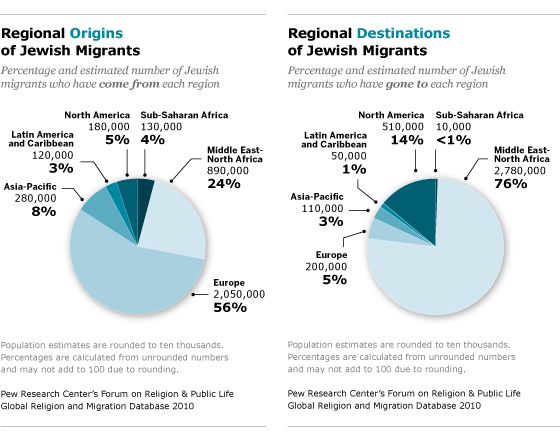
While a majority of Jewish migrants have come from Europe, more than three-quarters of those alive today have moved to the Middle East-North Africa region, almost entirely to Israel.
In terms of individual countries, Russia has been the largest source of living Jewish migrants (more than 700,000), followed by Ukraine (about 300,000). Many of the other top countries of origin for Jewish migrants – Morocco, Romania, Poland, Iraq and Iran – once contained thriving Jewish communities that today, in some cases, are relatively small.
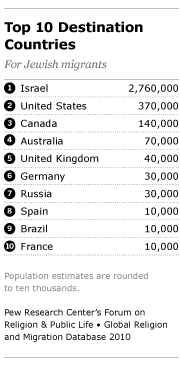
A substantial majority of Jewish migrants (nearly 3 million) have ended up in Israel. These migrants have come from all over the world, but mostly from Europe, particularly Russia. Other countries with large first-generation (foreign-born) Jewish immigrant populations include the United States (almost 400,000), Canada (about 140,000) and Australia (about 70,000).
.
Migrants of Other Religions
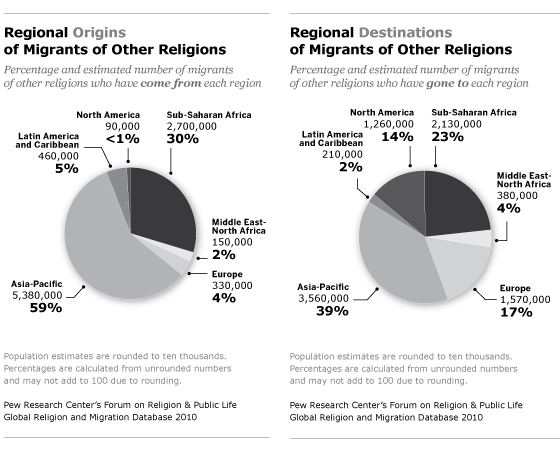
Adherents of other faiths (including Sikhs, Jains, followers of traditional Chinese religions and many smaller religious groups) have gone primarily to countries in the Asia-Pacific region and sub-Saharan Africa, where most also originate.
The origins of these migrants reflect the geographic distribution of the largest remaining religious groups. China (2 million) is the No. 1 country of origin for migrants in this catch-all category, including traditional Chinese religions. India is No. 2, with about 900,000 emigrants who belong to other religions, including Sikhs and Jains. Some African countries, such as Burkina Faso and Mozambique, also have hundreds of thousands of emigrants in this category, which includes adherents of African traditional religions.
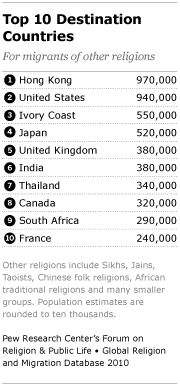
Migrants of other faiths tend to move to countries that already have a high number of immigrants – such as the United States, the United Kingdom and Canada – or they are part of large migrations to neighboring countries. For example, Hong Kong has received many immigrants of other religions from China, including some who adhere to traditional Asian belief systems such as Confucianism and Taoism. Similarly, the Ivory Coast has many immigrants of other faiths from Burkina Faso and Mali, where traditional African religions are found.
.
Unaffiliated Migrants
Among religiously unaffiliated migrants – a plurality of whom have come from the Asia-Pacific region – the main destination regions have been Europe and North America.
The three largest countries of origin for religiously unaffiliated migrants are, or recently were, officially atheist states. Many of these migrants have come from China (about 4 million), followed by two countries of the former Soviet Union – Kazakhstan and Russia (each more than 1 million). Significant numbers of unaffiliated migrants also have come from the United Kingdom, Germany and Mexico.
More than 4 million religiously unaffiliated migrants have moved to the United States, many from China. Sizable numbers of unaffiliated migrants, including many from China, also live in Canada (about 1.3 million), Australia (nearly 1 million) and Hong Kong (nearly 1 million). The large populations of unaffiliated migrants in Russia (more than 2 million) and Ukraine (more than 500,000) are mostly due to changing borders since the breakup of the Soviet Union in 1991.
Appendix A: Destination Spotlights
Spotlight on the United States
The United States is often described as “a nation of immigrants,” a phrase coined by John F. Kennedy in an essay written in 1958 when he was the junior senator from Massachusetts.8 As the future president wrote, “This was the secret of America: a nation of people with the fresh memory of old traditions who dared to explore new frontiers, people eager to build lives for themselves in a spacious society that did not restrict their freedom of choice and action.”9
Poverty, famine, war and other hardships drove millions of immigrants to the U.S. in the 19th and early 20th centuries, primarily from Europe. Since the 1960s, when Kennedy’s essay was posthumously published as a book, America’s immigrant population has continued to grow and diversify. In the past 50 years, millions of immigrants from Latin America and the Caribbean have made their way to the U.S., along with significant numbers from East Asia (including China, Korea and Vietnam), India and sub-Saharan Africa. Today, the United States is home to immigrants from virtually every country in the world.10
As of 2010, there were nearly 43 million foreign-born residents in the U.S. – more than three times as many as in Russia (12 million), the second-leading destination.11 One of every five international migrants alive today resides in the United States.
Mexico has been by far the largest country of origin for U.S. immigrants. In fact, the U.S. has received about as many immigrants from Mexico alone (more than 12 million, including both legal immigrants and unauthorized ones) as any other nation has received from all sources combined.12 Among the other leading countries of origin for U.S. immigrants have been the Philippines (1.8 million), India (1.7 million), China (1.4 million) and Germany (1.2 million). (For more details on migration to and from the United States, see the interactive graphics.)
While the United States has taken in more immigrants than any other country, the share of the U.S. population that is foreign-born (13%) is about average for Western industrial democracies. Indeed, among the 159 countries with populations of 1 million or more, the United States ranks 26th in the percentage of residents who were born abroad. By comparison, first-generation (foreign-born) immigrants make up more than 20% of the population in Australia (ranks 12th) and Canada (ranks 13th), two other countries that historically have attracted a large number of immigrants.13
Immigrant Religious Distribution in the United States
With its huge population of immigrants, the United States has been the leading destination for many, though not all, religious groups. The U.S. is the world’s No. 1 destination for Christian migrants, who make up an estimated 32 million (74%) of the 43 million foreign-born people living in the United States. The U.S. is also the top destination for Buddhist migrants (including many from Vietnam) and for people with no particular religion (including many from China). The U.S. is the world’s second-leading destination for Hindu migrants, after India, and for Jewish migrants, after Israel. Among Muslim migrants, however, the U.S. ranks just seventh as a destination – behind Saudi Arabia, Russia, Germany, France, Jordan and Pakistan. About 5% of U.S. immigrants are Muslims, a much lower share than in Europe, where Muslims represent about 25% or more of the immigrants living in many countries, including France, the Netherlands, Italy and Germany. (See Spotlight on Europe.)
Spotlight on Europe
During the 18th, 19th and early 20th centuries, European countries were a source of many more migrants than they received. After World War II, however, the pattern began to change. As Europe, and particularly Western Europe, began a period of great economic growth, fewer people on the continent felt the need to emigrate. The dismantling of the colonial system in Africa and Asia also reversed the flow of migrants, who began to move in sizable numbers from former colonies to Europe. By the 1960s, booming economies in the United Kingdom, France, Germany and other European countries were attracting job seekers from North Africa, Asia and elsewhere. More recently, countries in Southern Europe, such as Spain and Italy, also have become important destinations, experiencing rapid immigration in the past decade or so.14
In a number of ways, the scale of immigration in the European Union now is remarkably similar to the scale of immigration in the United States:
The U.S. has an estimated 43 million immigrants; the E.U.’s 27 member states collectively have 47 million.
About 13% of the U.S. population was born abroad; many Western European countries (such as Spain and Germany) have a similar percentage of foreign-born residents.
The estimated number of Muslim immigrants living in the E.U. (nearly 13 million) is about the same as the estimated number of Mexican immigrants residing in the U.S. (more than 12 million).
Movement within Europe also has become more like movement within the United States. Since 1985, with the signing of the Schengen Agreement on freedom of movement in Europe, a growing number of people in the E.U. and a few other countries have been able to travel to – and reside permanently in – other member states without an immigrant visa.15
This report defines an international migrant as a person residing outside the country in which he or she was born. So when someone from one European country, such as France, moves to another European country, such as Italy, is that person an international migrant? For the purposes of this report, the answer is yes.
Using this “foreign-born rule” – that is, counting everyone who has moved from one European country to another as an immigrant – the religious composition of the E.U.’s immigrant population is heavily Christian (56%), albeit with a substantial Muslim minority (27%).16
But what if internal migration within the European Union was excluded and only people born outside the 27 E.U. countries were counted as immigrants? In that case, the share of Christian immigrants (42%) and the share of Muslim immigrants (39%) in the E.U. are much closer, though Christians still outnumber Muslim immigrants by nearly 1 million.17 (Other religious groups besides Muslims and Christians remain at about the same percentage whether or not internal migration within the E.U. is excluded. About one-in-ten migrants have no religion in particular, and the remainder belong to a variety of smaller religious groups.)
When internal migration is excluded, the main origins of Christian immigrants to the E.U. include Russia (1.3 million), Ukraine (1 million) Albania (640,000), Serbia (580,000), Ecuador (580,000), Brazil (460,000), Colombia (440,000), the United States (430,000) and several countries in sub-Saharan Africa. Top origins for Muslim immigrants are Turkey, Morocco, Algeria and Pakistan. Hindu immigrants are mostly from India, and the religiously unaffiliated have mostly come from Russia and China. The vast majority of Buddhist immigrants in Europe have come from Asian countries, including Sri Lanka, Vietnam and Thailand.
Spotlight on the Gulf Cooperation Council Countries
The Arab countries of the Persian Gulf have been transformed by the discovery of huge oil reserves. In just a few decades, the region’s economies have expanded enormously – and so, too, have their populations, fueled in part by the arrival of millions of foreign-born workers.18
To maintain their economic growth and high standards of living, the six Gulf Cooperation Council countries (Bahrain, Kuwait, Oman, Qatar, Saudi Arabia and the United Arab Emirates) have leaned on a largely immigrant labor force. All together, the GCC countries have a total of more than 15 million foreign-born residents drawn heavily from such countries as India, Egypt, Pakistan, Bangladesh, the Philippines and Sri Lanka.
Moreover, these foreign-born workers are very numerous in comparison with the native-born population in all the GCC countries. In Qatar, for instance, more than 80% of the total population is estimated to be foreign born. Even in Saudi Arabia, which has the lowest percentage of foreign-born residents in the GCC, immigrants make up more than a quarter of the population (28%), about twice the level in the United States (13%).19
Although GCC countries consider most immigrants to be temporary workers on short-term visas, many have repeatedly renewed their visas and work contracts, making their presence less temporary than it may seem. At the same time, many of these workers have disincentives to stay permanently, including little hope of gaining citizenship either for themselves or for their children, as well as social barriers to integration and significant restrictions on their ability to practice religions other than Islam.20
Most GCC countries either do not count foreign-born residents in their censuses or do not publicly release detailed data about their immigrant populations. A few countries, particularly Bahrain and Qatar, do periodically describe the number of non-nationals residing within their borders and provide some information on migrants’ regional origins (Europe, Asia, Americas, etc.). As a result, scholars have been able to use a combination of migrant population data (stocks) and migrant visa records (flows) from the region to generate some estimates. Still, detailed figures on migration to the GCC are nonexistent, and most estimates are very rough.
The religious distribution of immigrants in the region is also challenging to determine. It appears from the limited statistics available that Muslims from religiously diverse countries (such as India, which has a Hindu majority but a sizable Muslim minority) are more likely than non-Muslims to move to the Arabian Peninsula. Therefore, the religious affiliation estimates in this report for GCC countries are guided by the religious distribution of immigrants to Egypt, also a Muslim-majority country, but one for which much more reliable data on immigrants is available. (For an explanation of this use of “destination proxies,” see Appendix B: Methodology).
Using this data, it appears that Muslims are the majority (about seven-in-ten) of immigrants in Gulf Cooperation Council countries, coming primarily from India, Pakistan, Egypt, Bangladesh and the Philippines. Among non-Muslim immigrants, most are either Christian or Hindu. Christian immigrants to the GCC come mainly from India, the Philippines, North America and Europe. Hindu immigrants are primarily from India. A much smaller share of immigrants are Buddhist, Jewish, follow other religions or are religiously unaffiliated.
If the pace of immigration to the region continues, some GCC states, particularly those with small populations, may see dramatic changes in the religious composition of their societies, though all six GCC countries are expected to retain Muslim majorities for the foreseeable future. (For more details, see the Pew Forum’s report, The Future of the Global Muslim Population: Projections for 2010-2030.)
9 John F. Kennedy, A Nation of Immigrants, Anti-Defamation League, 1958. Kennedy was working on a revision of the publication when he was assassinated in 1963. It was published posthumously in 1964 by HarperCollins. A 50th anniversary edition was published in January 2008. (return to text)
10 For more information on the history of U.S. immigration, see Aristide R. Zolberg, A Nation by Design, Russell Sage Foundation, 2006. (return to text)
11 As previously noted, the U.N. Population Division estimate of 42.8 million immigrants in the U.S. includes about 3 million people born in U.S. territories, such as Puerto Rico and Guam, as well as people born overseas to American citizens. (return to text)
12 The estimate for Mexican immigrants living in the U.S. is taken from a recent Pew Hispanic Center report based on the March 2010 Current Population Survey (PDF) (see page 8). The CPS’ estimate of nearly 12.4 million Mexican immigrants has been adjusted by the Pew Hispanic Center to take into a account the likely undercounting of unauthorized immigrants. (return to text)
13 Other countries that have a higher percentage of immigrants than the U.S. include some Gulf Cooperation Council countries (such as Qatar, the United Arab Emirates and Kuwait); countries with a high number of refugees (such as Jordan and Lebanon); and some European countries (such as Switzerland and Spain). See the United Nations 2009 International Migration figures. (return to text)
14 For more information on European immigration, see Anna Triandafyllidou and Ruby Gropas, editors. European Immigration: A Sourcebook, Ashgate Publishing, 2007. (return to text)
15 The borders of the Schengen Area and the E.U. overlap but are not identical. Signatories to the Schengen Agreement include some non-E.U. countries, such as Iceland, Norway and Switzerland. At the same time, some E.U. countries either have not fully come on board with the agreement (the United Kingdom, Ireland) or have not yet fully become part of it (Bulgaria, Cyprus, Romania). (return to text)
16 Those who have moved from one E.U. country to another are overwhelmingly Christian. Of the nearly 16 million people who have migrated within the E.U., more than 13 million (more than 80%) are Christian. The second-largest group is the religiously unaffiliated (more than 2 million). (return to text)
17 The borders of Europe can be defined in numerous other ways as well. Each definition affects both the number and the religious breakdown of the immigrant population. For example, if one were to look just at Western Europe – sometimes defined as the original 15 E.U. countries plus Norway and Switzerland – it has an estimated 46 million immigrants, including 56% Christians and 28% Muslims. If, further, one were to take this definition of Western Europe and exclude internal migration, then it would have an estimated 36 million immigrants, including 49% Christians and 35% Muslims. (return to text)
18 For more information on labor migration in the Persian Gulf, see Douglas S. Massey et al., Worlds in Motion, Oxford University Press, 1998. (return to text)
19 United Nations, Department of Economic and Social Affairs, Population Division, International Migration, 2009 Wallchart, United Nations publication, Sales No. E.09.XIII.8, 2009. (return to text)
Appendix B: Methodology and the Construction of the Global Religion and Migration Database (GRMD)
Conceptual Framework
The religion of international migrants has been investigated in many parts of the world (for research reviews see Cadge and Ecklund 2007, Ebaugh 2003, and Koenig 2005).21 But most studies have focused on particular religious groups in specific destination countries, such as Catholic immigrants in the U.S. or Muslim immigrants in the United Kingdom. And, although some studies have looked at specific immigrant religious groups across several countries (examples include Fetzer and Soper 2005, Foner and Alba 2008, Mooney 2009), no previous research has attempted to provide a baseline set of estimates of ALL migrant groups by origin, destination and religion – an essential step for comparing migrant religious groups around the world.
What is an International Migrant?
Generally speaking, an international migrant is someone who has been living one year or longer in a country other than the one in which he or she was born.22 The Global Religion and Migration Database allows for cumulative counts of all migrants living in the world in 2010 (or stocks), including those who may have moved across international borders decades ago. But the database cannot be used to report how many people migrated to or from particular countries in 2010 (or flows). Rather, it reflects the total number of migrants alive as of 2010, regardless of their legal status. Since migrants have both an origin and a destination, every international migrant can be viewed from two directions – as an emigrant having left an origin country or as an immigrant having entered a destination country.
Fortunately, some previous research projects have estimated the origins and destinations of international migrants (see Parsons et al 2007) or used origin-and-destination information to estimate the movement of migrants by gender (see Ozden et al. 2011) and education level (see Docquier and Marfouk 2006). Origin-and-destination grids also have been used to study the monetary remittances that many migrants send to their home countries (see Ratha and Shaw 2007). So, in short, there is some recent experience and collective know-how among researchers in compiling and harmonizing global data on migrants’ origins and destinations.
The Global Religion and Migration Database (GRMD) adds a layer of complication by including data for migrants to and from every country by religious group. But Pew Forum researchers were able to consult with migration experts who have constructed similar migrant databases. Although the Global Religion and Migration Database is new in many respects, the method for constructing it is similar to previous studies that have attempted to estimate other characteristics of international migrants, such as gender and education.
The GRMD does not attempt to measure degrees of religiosity among migrants. Scholars including Peggy Levitt (2007) and Jacqueline Hagan (2008) have argued that just as migrants’ other circumstances (for example, employment and family composition) may change as a result of moving across international borders, their religious beliefs and practices also may change. So, although a Muslim emigrant from Morocco may still self-identify as a Muslim in France, his or her religious beliefs and practices may be much different in France than they were in Morocco. The Global Religion and Migration Database does not seek to measure these qualitative changes, which are perhaps best captured by surveys and ethnographic approaches. Instead, the aim of the GRMD is to provide a basic demographic picture of the religious affiliation of international migrants.
Since there has been no single, worldwide census or survey of international migrants and their religious affiliation, certain assumptions inevitably have to be made in order to estimate the size of each religious group by origin and destination countries. Due to data limitations, some of these assumptions are less than ideal. Pew Forum researchers have attempted to assess the reliability of each data point in the database, as well as to conduct a series of tests to determine the robustness of the key assumptions. For the great majority of data points, the GRMD passes these tests. The assumptions and various robustness tests are explained in this methodology. A discussion of data limitations and potential resulting biases can be found here. Data sources for each destination country are available in Appendix C (PDF).
Overview of Procedures
In constructing the Global Religion and Migration Database, the Pew Forum first sought all census and survey data available on the origins of immigrants living in each destination country. Next, Pew Forum staff looked for all available information on the religious makeup of these immigrant groups, estimating the religious breakdown of migrants from each origin country to each destination country. Once all these data were collected, they were merged to create the Global Religion and Migration Database, which generates a count of the number of people in each of the world’s seven major religious groups (including the unaffiliated) who have moved from every origin country to every destination country.
Migrant Origins and Destinations
The Global Religion and Migration Database is based primarily on data from destination countries. The reason is simple: Many countries collect data on where their new residents come from, but relatively few countries keep records on where their former residents have gone. With these data in hand, three steps were taken in harmonizing all the data for every destination country.
First, destination information on newcomers often is incomplete. Many destination countries group immigrants into catch-all categories – reporting, for example, on migrants from the “rest of Africa” and other broadly defined areas. In addition, some countries do not release information on their residents’ countries of birth. Pew Forum researchers borrowed missing values from an earlier research project on migrant origins and destinations conducted by the University of Sussex’s (U.K.) Development Research Centre using data from the 2000 round of censuses. (See Detailed View of Procedures for a description of this project.)
Second, destination countries define who is and is not an immigrant differently. Some countries count foreigners by their nationality or citizenship rather than by their country of birth, while other countries define migrants by ethnicity regardless of where they were born. Additionally, the age of some of the data presented difficulties. Most of the information from censuses and surveys in the Global Religion and Migration Database dates from between 2000 and 2010, but there are countries whose data are older. To help standardize different types of data, as well as to update data from different years, the Pew Forum harmonized the various sources using the United Nation’s 2010 total immigrant population estimates for each destination country.
Third, some countries do not count refugees as immigrants. To ensure that refugees were not overlooked or undercounted, data for each country were compared with estimates from the United Nations High Commissioner for Refugees (UNHCR) and the United Nations Relief and Works Agency for Palestinian Refugees (UNRWA). If the UNHCR/UNRWA estimate was higher than the previously calculated estimate, the UNHCR/UNRWA estimate was used in place of the destination country’s estimate.
Religious Breakdown of Migrants
The first step in trying to determine the religious makeup of migrants was to decide which religious groups would be included in the database. Should there be categories for smaller religious groups? What about subdivisions within each major religious tradition? To a considerable extent, the options were limited by the religious categories in the data sources. For example, although censuses and surveys in many countries divide Christian immigrants into subgroups such as Catholics, Protestants and Orthodox, there are many countries for which data are available only on Christians as a whole. Similarly, the data sources do not consistently make distinctions within other major faith traditions, such as between Sunni and Shia Muslims or among various schools of Buddhism. And although the Pew Forum sought to collect migration statistics on several additional religious groups (such as Sikhs, Jains and traditional Chinese religions), this proved impossible because censuses and surveys in many countries do not provide separate counts of these groups. Based on such considerations, Pew Forum researchers chose to divide international migrants into seven major religious categories: Christian, Muslim, Hindu, Buddhist, Jewish, all other religions and unaffiliated (which includes atheists, agnostics and those who have no particular religion).23
To determine the religious breakdown of migrants, the Pew Forum used two techniques – original data and data proxies. First, Pew Forum staff sought information on the religious affiliation of immigrants in each destination country. The best data come from religion questions in censuses or surveys of immigrants that also include information about the immigrants’ country of birth. By cross-tabulating this information, it is possible to see what percentage of immigrants who have moved to Country A and were born in Country B identify themselves as belonging to each major religious group. Very often, the religious makeup of this immigrant population is different from the religious makeup of the general population in the origin country. For example, survey data from the New Immigrant Survey show that the percentage of Christians among immigrants to the United States from Egypt (62%) is higher than the percentage of Christians in the Egyptian population as a whole (<10%).24 Similarly, the percentage of Indian migrants to the U.S. who are Christian (9%) is higher than the percentage of Christians in India’s overall population (<5%).25
When detailed survey or census data on immigrants and religion were unavailable, the Global Religion and Migration Database used proxy measures. In some cases, Pew Forum researchers assumed that the religious makeup of migrants going to a certain country is similar to the religious distribution of migrants going to a religiously similar country for which census or survey data do exist. An example of this type of “destination proxy” is found in the migration estimates for the Gulf Cooperation Council countries. Bahrain does not release detailed data on the religious affiliation of its foreign-born population. But Egypt – which, like Bahrain, has a Muslim majority – does have census data on its immigrants. In this case, the religious distribution of migrants from some origin countries (for example, India and the Philippines) to Bahrain was assigned the religious distribution of migrants from the same origin countries to Egypt.
Finally, in some cases, immigrants to Country A who were born in Country B were assigned the religious makeup of the general population in Country B. Although this assumption is less than ideal, it is the best alternative when other reliable data are lacking. Fortunately, tests for these “origin proxies” indicate few problems in estimating the religious affiliation of international migrants.26
Detailed View of Procedures
Phase One: Country Origins
The first phase in assembling the Global Religion and Migration Database involved the construction of a two-way table of 231 origin and destination countries and territories for which the United Nations Population Division provides general population estimates.27 Each data point represents a different origin-destination combination. This process of data collection and data harmonization is similar to methods used by researchers both at Sussex University’s Development Research Centre on Migration, Globalisation & Poverty and the World Bank in constructing previous origin-destination grids for 2000 and 2005.28
During 2010, Pew Forum staff sought census and survey data from destination countries, downloaded information from statistical databases and made numerous email and telephone queries to statistical agencies around the world in an effort to assemble the most complete picture of the world’s migrant (foreign-born) population. After examining the various data sources available, Pew Forum researchers selected the most recent data that best fit the Global Religion and Migration Database’s definition of an international migrant: a person who currently resides in a country other than his or her country of birth and has lived in that new country for one year or longer. For most destination countries, the best data came from the most recent census figures for the foreign-born population. But in some cases, data came from population registers and large-scale surveys, mostly gathered through secondary sources (e.g. the World Bank, United Nations and Eurostat). For a full list of origin data by destination country, see Appendix C (PDF).
Fortunately, most migrant-origin figures (representing 86% of the international migrant population) are based on actual census or other population data. However, since a small percentage of data were still missing, a second step in determining migrant origins involved imputing missing data. The table for Step 1 provides an example of the database in its first phase of construction. The rows (Bulgaria and the United States) are destinations, while the countries in the columns (Afghanistan, etc.) are origins. As the table for Step 1 shows, data for many smaller-sized origin countries are missing. In Bulgaria, for example, Albania is the only origin country listed with data. In the United States, Andorra as an origin country is also missing. This does not mean that no one from these missing countries lives in either Bulgaria or the United States; rather, it suggests that migrants may have been labeled in a category other than their specific country of origin. For example, many destination countries group smaller origin countries into categories like “rest of Africa” or “Europe, not included elsewhere.”
In dealing with these missing data, Sussex University’s bilateral migration grid proved invaluable.29 The Sussex Global Migrant Origin Database, which took a number of years to construct, imputed missing data by assuming that the origin distribution for missing data cells is similar to the origin distribution of destination countries in the same geographic region.30 It is important to keep in mind that in most cases, these imputations are for missing cells within destination countries where data exist for the majority of the immigrant population. However, there are several destination countries (Afghanistan, Algeria, China, Eritrea, Lebanon, Maldives, Morocco, North Korea and Somalia) where all immigrant origins are imputed. Nonetheless, only 14% of GRMD’s population is based on imputations of missing data, including destination countries where all immigrant origin data are drawn from Sussex’s imputations.31
The red font numbers in the table for Step 2 represent missing origin countries that received an immigrant count based on a remainder or leftover country category provided in the original data. As the table for Step 2 indicates, most imputed values are quite small numbers. In many respects, then, they are mere placeholders that allow for immigrants to be assigned somewhere. Yet, due to their small population sizes, these imputations do not result in substantial differences in global and national totals.
The third major step in determining the final origin numbers involved standardizing them with the United Nations Population Division’s estimates for the number of immigrants in each destination country. Based on various data sources and projection techniques, the U.N. estimates the total immigrant population of every country in the world. These U.N. estimates were used to harmonize the various types of origin data (e.g., census and population register figures) as well as to smooth out problems caused by the fact that data from different sources were collected in different years. The origin data were redistributed to equal the U.N. immigrant total for each destination country.
In most instances, this meant scaling upward or inflating the numbers, since most countries’ immigrant populations are rising. For both the Bulgaria and U.S. examples, the U.N. total immigrant estimates were higher than the original data – mostly as a consequence of the original data being collected a few years earlier than 2010.32
For the fourth and final step in putting together a complete picture of migrant origins, the Pew Forum consulted refugee data to be sure the origin estimates were in line with this important slice of the migrant population. For a variety of political and economic reasons, many destination countries do not include refugees in their foreign-born estimates; however, refugees are included in the total immigrant count provided by the U.N. Previous migration databases, such as those constructed by researchers at the World Bank, largely removed refugees from U.N. totals because the researchers were more concerned about “economic” migrants. However, since religion is often an important variable in understanding the complexities surrounding the movement of refugees across international boundaries, it did not seem appropriate to exclude refugees from the Global Religion and Migration Database.
Making adjustments to include refugees involved a lengthy comparison process for each destination country. Taking the 2009 United Nations High Commissioner for Refugees’ (UNHCR) origin-destination grid for the world’s current refugee population as well as United Nations Relief and Works Agency (UNRWA) data for Palestinian refugees, each destination country was studied in detail to determine if the estimated refugee in-bound population exceeded the Pew Forum’s earlier calculated estimates. When the UNCHR/UNRWA estimate for refugees living in a specific country was more than 1,000 individuals and exceeded the Pew Forum’s previous estimates, the UNHCR/UNRWA estimate replaced the previous origin country’s estimate.
Most of the adjustments to refugee estimates involved figures for less-developed regions of the world. For example, no changes were made to the United States, since the U.S. Census Bureau records refugees just like other foreign-born persons. Adjustments to refugee figures were most frequent for three origins: Afghanistan, Iraq and the Palestinian territories. In fact, about 8.5 million migrants, or more than 60% of a total of 13.6 million refugees counted in UNHCR and UNRWA data, were from these three origins; most of these refugees have gone to Iraq, Iran, Pakistan, Jordan, Syria, Egypt and Lebanon. For the rest of the less-developed world, refugee adjustments were minor.
Continuing with Bulgaria as an example, since the UNHCR indicated there to be more than 2,000 refugees from Afghanistan living in Bulgaria (see table for Step 4), this number replaced the previous estimate of 252 Afghanis (see table for Step 3). When a change of this nature was made, the sum total of refugee replacements were subtracted from the total Bulgaria migrant count. Following this, the remaining origin countries were redistributed to the new total for Bulgaria, not including refugees. All specific changes by destination country are listed in detail in Appendix C (PDF).33
Phase Two: Religious Distribution
The second phase of constructing the Global Religion and Migration Database involved estimating the religious distribution of migrants by their origin countries. Before immigrants could be assigned a religion, however, a consistent list of religious groups across the world was needed. After analyzing the various data sources, the following seven religious affiliation categories were deemed as the most manageable while at the same time offering a sufficient level of detail for this stage of the project: Christian, Muslim, Jewish, Buddhist, Hindu, other religions and unaffiliated.34 The unaffiliated category refers to migrants who are atheist, agnostic, humanist or claim no particular religion.35 The “other religion” category includes African traditional religions; Chinese traditional religions, Shintoism and other Asian religions; Sikhism, Jainism, Zoroastrianism and Baha’i, among other faiths.36
With these religious categories in hand, the Pew Forum sought out the best data describing the religious breakdown of immigrant populations in each destination country. Religious affiliation is asked in some country censuses, and this can be broken down by country of birth. In all, about 15% of the GRMD’s population uses such census data to estimate the religious distribution of international migrants.
The second best data source for estimating the religious distribution of migrants is general population and immigrant surveys. Since religion is not asked in the U.S. census, and about one-fifth of international migrants reside in the United States, survey data became crucially important in estimating the size of immigrant religious groups. Drawing from the New Immigrant Survey and a variety of Pew Forum surveys, the religious distribution of most origin groups in the United States was estimated.37 Additional surveys for other destination countries besides the U.S. were also used. In total, the religious distribution of 18% of the international migrant population was calculated on this basis.
Following an imputation procedure similar to the one used for missing origin data in phase one, the religious distribution of about 7% of the GRMD’s population was based on origin-destination pairs for which reliable census data were available. These “destination proxies” were used for some of the largest migrant population groups. For example, it would be expected that migrants from Country X to the Gulf Cooperation Council countries would be proportionally more Muslim than the general population of Country X. This may be especially true for origin countries such as India and the Philippines that have substantial Muslim minority populations. Therefore, the religious distribution of migrants to Gulf Cooperation Council countries from India and the Philippines was based on the known religious distribution of migrants from these same countries to a similar destination country, in this case Egypt. Another example of a destination proxy involves imputing the religious distribution of Pakistani migrants to India (a Hindu-majority country) based on the known religious distribution of Pakistanis to Nepal (also a Hindu-majority country, but where religion census data for immigrant populations are available). All destination proxies are listed in Appendix C (PDF).38
More than 40% of the religious distribution of international migrants was estimated using census/survey data or a reasonable destination proxy that was also based on census data. But for more than half of the international migrant population, no such religious affiliation data by country of origin or reliable origin-destination replacements exist; therefore, an “origin-proxy” method was used. The origin proxy method assumes, for lack of better information, that the religious profile of a country’s emigrants is the same as the religious profile of that country’s population as a whole. Relying on the 2010 religious affiliation estimates in the World Religion Database (WRD) by origin country, the origin-proxy method was used when no better data were available. As illustrated in the table for Step 3, using the origin-proxy method fills in all remaining cells for the religious distribution of international migrants.
Merging Origin and Religious Distribution Data
With the completion of the origin-destination grid (phase one) and the religious distribution of international migrants (phase two), a simple multiplication procedure was performed to obtain a count for each religious group by each country of birth within each destination country.
The table for the final phase displays the final counts of migrants from Afghanistan, Albania, Algeria, American Samoa and Andorra to both Bulgaria and the United States. This is only a very small portion of a very large dataset, as the complete database contains nearly half a million records.39 Given that there is a value for every cell in the database, the rows and columns of the dataset can be reversed to become an origin-to-destination database. In this way, both emigration and immigration can be examined.
Data Limitations and Potential Biases
In constructing any new cross-national database, a number of limitations exist, mostly due to the absence of reliable data. First, migrant populations are often undercounted even in census data. Even though scaling to the U.N. total migrant counts helps alleviate this concern, potential census under-counting of some immigrant groups may still result in groups that are routinely underestimated. It is also more difficult to determine whether a religious under- or over-counting of migrant populations within a destination country occurs when surveys (and some censuses) are voluntary or may be completed by an individual other than the respondent.
Second, it is also difficult to assess whether migrants within a given destination country arrived with their currently stated religious affiliations or changed religious affiliations once settled in the destination country.40 Although no nationally representative data finds mass religious conversion among immigrants across broad religious categories (e.g., from Christianity to Islam or from Hinduism to Christianity), some studies have found that sizable numbers of immigrants who had no religious affiliation in their home country eventually adopt some kind of religious affiliation after living in the United States (see Chen 2008 and Skirbekk et al. forthcoming). The aim of the Global Religion and Migration Database is to estimate the current religious affiliation of international migrants in 2010, including those who may have changed religious affiliations since migration. Estimates relying on census and survey data account for religious change, but other estimates relying on the origin-proxy method do not.
The third and perhaps most important area of potential bias is the origin-proxy method itself – the assumption that the religious composition of emigrants is the same as the religious composition of the general population in their country of origin. For example, recent media reports have described the disproportionately large number of Christians who have exited some Middle Eastern countries.41 This type of religious migration would be undercounted by the origin-proxy method, since the great majority of residents in most of these countries are Muslim, not Christian. Substantial scholarship has pointed to the importance of age, gender, education and other variables in the self-selection of emigrants, and there is also strong evidence of selective migration on the basis of religion. For example, the WRD estimates India’s overall population to be 73% Hindu, while census data suggest that only 26% of Indian immigrants in Canada are Hindus, and only 38% of Indian immigrants in the United Kingdom are Hindus. Without question, in some countries, certain religious groups are more likely to leave than others, and they are also more likely to choose certain destination countries over others.
However, it is important to note that of the nearly 130 million migrants whose religious affiliation is estimated using the origin-proxy method, nearly 75 million (about 60%) have moved within geographic regions where the majority religion for the origin and destination countries is the same. For example, more than 30 million migrants whose estimated affiliation relies on the origin-proxy method have moved within Christian-majority countries in Europe. Religious selection would not be expected to be a major factor within these migration corridors. Another migrant corridor where religious selection does not appear to be a major issue is from majority-Muslim countries to continental Europe (about 15 million migrants from such countries as Turkey, Morocco and Pakistan, or nearly 12% of all migrant data relying on the origin-proxy method). These migrants to Europe are from countries in which the population is almost entirely Muslim, ruling out the possibility of large numbers of non-Muslim emigrants. In all, it is expected that religious selection is not occurring for more than two-thirds of migrants where affiliation is estimated using the origin-proxy method.42
To assess the data quality of its estimates, the Pew Forum performed two further comparisons. The first comparison looked at the GRMD’s origin estimates and compared them with other published estimates of the size of immigrant communities. These estimates are mostly found online and usually focus on a particular ethnic diaspora in a particular country. Generally, GRMD foreign-born estimates by destination country should be lower than these estimated diaspora populations, since the latter estimates tend not only to include immigrants but also to include their native-born offspring. The second comparison involved lining up GRMD estimates with the 2010 World Religion Database. As with the diaspora estimates, all WRD estimates for total populations by religious group should be higher than the GRMD migrant estimates because WRD estimates include not only migrants but also all people of a particular religious group in a particular country. Thus, whenever GRMD estimates were higher than diaspora or WRD estimates, Pew Forum researchers re-examined the data to see whether mistakes may have been made.
Finally, Pew Forum staff coded the quality of all data in the GRMD.43 Data priorities were determined for each of the two phases (migrant origins and religious distribution) in constructing the GRMD. For the migrant origins phase, data from original sources (e.g., census, population register, UNCHR and other survey estimates) were considered to be of the highest quality (86% of the migrant population). If census or similar data were unavailable, imputations based on the population share of the source country or the Sussex Global Migrant Origin Database were used to fill remaining gaps in the data (14% of the migrant population).
For the religious distribution phase, census data were considered to be the best, followed by survey data (both immigrant surveys and immigrant sub-samples of general social surveys). This type of data is considered the most reliable and represents 33% of the world’s total migrant population.
When no other data for the religious distribution of immigrants were available, the destination-proxy was used, accounting for 7% of the international migrant population. Origin-proxies where tests indicate a high level of confidence in the data were used for 35% of the international migrant population. These origin-proxies mostly represent migrants moving within or between regions where the majority religion is the same (for example, Christian migrants moving within the Americas) or where migrants originate from a country whose population is composed almost entirely of one religious group (for example, Muslim migrants from Turkey to Europe). The second part (25% of migrants) also uses an origin-proxy but represents migration between countries in which there may be more selection on the basis of religion.
In all, the estimated religious affiliation of more than three-fourths of the migrant population relies on high quality data. But because countries measure their immigrant populations in various ways, and solid information on the religious affiliation of migrants is not always available, the Pew Forum advises readers of this report and accompanying interactive graphics to treat all the figures as estimates and to take the sources of information and methods of estimation into account. (See Appendix C (PDF) for a complete list of data sources and adjustments for each destination country.)
22 This is the United Nations Population Division’s general definition of an international migrant. In addition, the U.N. considers refugees and, in some cases, their descendants (such as Palestinians born in refugee camps) to be international migrants. For the U.N.’s detailed definition of an international migrant, see United Nations, Department of Economic and Social Affairs, Population Division, “International Migration Report 2006: A Global Assessment (PDF),” page 337, 2009. For further discussion on defining international migrant stock, see United Nations, Department of Economic and Social Affairs, Statistics Division, “Recommendations on Statistics of International Migration: Revision 1 (PDF),” Statistical Paper Series M No. 58, pages 84-91, 1998. (return to text)
23 The final database does contain some estimates for Christian subgroups (Catholic, Protestant and Orthodox), but the figures for these Christian subgroups are considered less reliable and thus not presented in the Faith on the Move report. Users of GRMD data are advised to be cautious in citing subgroup differences within Christian estimates. (return to text)
24 The New Immigrant Survey (NIS) is a nationally representative study of new legal immigrants to the United States and their children. The first full wave of the NIS was conducted in 2003 and 2004, involving nearly 10,000 respondents. Interviews were conducted face-to-face and by telephone in the respondent’s preferred language. The NIS was designed by Guillermina Jasso, Douglas S. Massey, Mark R. Rosenzweig and James P. Smith and funded by the National Institutes of Health, National Science Foundation and the U.S. Citizenship and Immigration Services. Additional support was provided by the U.S. Department of Health and Human Services, Office of the Assistant Secretary for Planning and Evaluation, and The Pew Charitable Trusts. The Pew Forum had access to restricted-use data, which was retrieved in August 2007. For further information, see The New Immigrant Survey. (return to text)
25 The Pew Forum’s December 2011 report Global Christianity: A Report on the Size and Distribution of the World’s Christian Population estimates that Christians make up 5.3% of Egypt’s population and 2.6% of India’s population as of 2010. (return to text)
26 For the religious composition of the general population in countries of origin, the GRMD primarily relies on the 2010 World Religion Database. The Pew Forum is preparing its own estimates for the religious composition of each country in the world. Until this data is available, the 2010 World Religion Database is used. Besides census and survey reports, WRD estimates take into account other sources of information on religious affiliation, including anthropological and ethnographic studies as well as statistical reports from religious groups. The WRD is an outgrowth of the international religious demography project at Boston University’s Institute on Culture, Religion, and World Affairs. (return to text)
27 Previous Pew Forum reports have covered 232 countries – the United Nations’ list of 230 countries and territories plus Kosovo and Taiwan. All these countries except for Pitcairn Islands are included in the GRMD, resulting in 231 countries and territories. Since South Sudan became independent in 2011, it is not included for 2010 migration estimates. No migration data for Kosovo as a destination country are available, but it is included as an origin country nonetheless. Migration data for Taiwan were drawn from Taiwan’s 2009 population register. (return to text)
28 For methodological descriptions of previous origin-destination grids, see the Sussex Global Migrant Origin Database methodological paper (Parsons et al. 2007), World Bank Global Bilateral Migration Database methodological paper (Ozden et al. 2011) and World Bank Bilateral Migration and Remittances methodological paper (Ratha and Shaw 2007). (return to text)
30 Using Sussex imputations in the GRMD assumes that the origins of migrants within the same geographic region have not changed considerably since 2000. An updated version of the Sussex database, the World Bank’s Global Bilateral Migration Database (see Ozden et al. 2011), was released in late 2011; however, this data was unavailable when the Global Religion and Migration Database was constructed. (return to text)
31 Sussex University’s origin-destination grid has 226 countries, compared with 231 countries in the GRMD. Therefore, there are instances in which data for country groupings in the original data (e.g. former Yugoslavia, Hong Kong and Macau, Israeli-Palestinian territories) could not be subdivided according to Sussex University’s origin distribution because no data in Sussex University’s grid existed for these countries and territories. In these isolated cases, country groupings were redistributed according to the relative size of the origin country’s population in 2010. Additionally, origin estimates for a few destination countries (e.g., Channel Islands, Isle of Man, Kosovo, Vatican City and Western Sahara) were entirely based on scholarly publications. Again, this is because these countries were unavailable in the Sussex University origin-destination grid. All decisions involving the editing of origin data are noted in Appendix C (PDF). (return to text)
32 Most population totals from original data sources closely matched the U.N. totals. However, some destination country data were old (collected prior to 2000) while other countries defined immigrants differently than the U.N. Most of the population differences between source data and the U.N.’s 2010 estimates were resolved by adding in refugees (see Step 4) or were the result of increases in immigrants since data was originally collected. In all, these population differences by destination country represent only 10% of the globe’s migrant population. (return to text)
33 Because refugee replacements occurred in countries where origin data on immigrants are less reliable, it is difficult to know whether the refugee replacement is still underestimating the actual immigrant population for a particular origin country. For example, it is reasonable to assume that more immigrants than the UNHCR/UNRWA estimates of registered refugees are living in these destination countries, some of whom may have migrated principally for economic reasons. To avoid double counting, the GRMD takes a conservative approach and assumes that the UNHCR/UNRWA estimate is the minimum population size of immigrants living in the destination country. (return to text)
35 Although some individuals may have multiple religious affiliations, few censuses or surveys around the world report data on overlapping affiliations (e.g., on Christians who also consider themselves to be Jews). For this reason, the seven categories are treated as mutually exclusive. Because of the inclusion of the “other religion” and “unaffiliated” categories, the seven categories are also treated as exhaustive. Many censuses and other data sources include a missing or “not stated” category for religious affiliation. This category was removed from the denominator, which assumes that all religious groups are equally likely to refuse to answer religious affiliation questions. Given the variety of data sources, this was the only consistent way of dealing with non-response in censuses and surveys. (return to text)
36 While the “other religion” category includes a disparate mix of religious groups, knowing the general religious makeup of an origin country does permit users of the GRMD in many cases to speculate about which religious groups are most likely to be present within this category. For example, among migrants from India, people of “other religions” (besides Hinduism, Islam, Christianity and Judaism) are likely to include many Sikhs and Jains. (return to text)
37 The New Immigrant Survey (NIS) is a nationally representative study of new legal immigrants to the United States and their children. The first full wave of the NIS was conducted in 2003 and 2004 and involved nearly 10,000 respondents. It could be argued that the religious distribution of new immigrants is not reflective of the total immigrant population from a given country within the United States – both the immigrants and the immigrant flows have changed over several years. Fortunately, however, about half of the NIS sample represents immigrants adjusting their status to permanent residents, many of whom have lived in the United States for five years or more. Mostly using NIS data, the GRMD estimates that there were 2.1 million Muslim immigrants living in the U.S. in 2010. As a point of comparison, using the Pew Research Center’s 2011 survey of Muslim Americans, Pew Research demographers estimated that there were 2.0 million Muslim immigrants in the U.S. one year later, which is quite consistent with the 2010 GRMD estimate. (See “Muslim Americans: No Sign of Growth in Alienation or Support for Extremism (PDF),” Pew Research Center, 2011.) Therefore, it appears that using NIS data does not severely bias immigrant religion estimates, at least for Muslim immigrants in the U.S. (return to text)
38 As an example of a robustness check for the destination-proxy method, Bahrain’s 2010 census estimates 55% of immigrants to be non-Muslim. Using the destination-proxy method, the GRMD estimates 47% of immigrants in Bahrain are non-Muslim. (return to text)
39 The complete GRMD includes data on some Christian sub groups (Catholics, Protestants and Orthodox) which results in 231 origin countries x 230 destination countries x nine religious groups (Catholics, Protestants, Orthodox, Muslims, Jews, Buddhists, Hindus, adherents of other religions and the unaffiliated), totaling nearly half a million records. (return to text)
40 An analysis by the Pew Forum of the first wave of the New Immigrant Survey (2003) suggests that religious switching across major religious groups (for example, Hinduism to Christianity, Buddhism to Islam) is relatively rare among first-generation migrants. (return to text)
42 A thorough assessment of religious selection was conducted by Pew Forum researchers for data points relying on the origin-proxy method. Migrant population using the origin-proxy method were subdivided into regions of origin and destination and then within majority religion groups by origin-destination countries. The origin country’s religious distribution for the largest origins of migrants by destination country was compared to similar destinations where reliable census data were available. For example, using the Canadian census, migrants from France to Canada are 73% Christian whereas France itself is 68% Christian (2010 WRD). Additionally, several census and survey estimates of Turkish, North African and Pakistani immigrants in Europe show little religious selection. (return to text)