Pew Research Center

FOR RELEASE FEBRUARY 2, 2012

Trends in Party Identification of Religious Groups

Since 2008, the share of voters identifying with or leaning toward the GOP has either grown or held steady among major religious groups. This includes both religious groups that are part of the GOP’s traditional constituency as well as some groups that have tended to be more aligned with the Democratic Party, including Jewish voters.

FOR MEDIA OR OTHER INQUIRIES:

Communications Department
202.419.4372
www.pewresearch.org

RECOMMENDED CITATION

Pew Research Center, February 2012, "Trends in Party Identification of Religious Groups"

About Pew Research Center

Pew Research Center is a nonpartisan, nonadvocacy fact tank that informs the public about the issues, attitudes and trends shaping the world. It does not take policy positions. The Center conducts public opinion polling, demographic research, computational social science research and other data-driven research. It studies politics and policy; news habits and media; the internet and technology; religion; race and ethnicity; international affairs; social, demographic and economic trends; science; research methodology and data science; and immigration and migration. Pew Research Center is a subsidiary of The Pew Charitable Trusts, its primary funder.

© Pew Research Center 2026

Table of contents

  • About Pew Research Center
  • Trends in Party Identification of Religious Groups
  • By Religious Affiliation
  • By Frequency of Attendance
  • By Age
  • Sample Sizes and Margins of Error

Trends in Party Identification of Religious Groups

Since 2008, the share of voters identifying with or leaning toward the GOP has either grown or held steady among major religious groups. This includes both religious groups that are part of the GOP’s traditional constituency as well as some groups that have tended to be more aligned with the Democratic Party, including Jewish voters.

As the 2012 presidential election approaches, the partisan affiliations of the electorate have shifted significantly since 2008. In 12 surveys conducted over the course of 2011 by the Pew Research Center for the People & the Press among a total of more than 15,000 registered voters, 34% described themselves as Democrats, down four points compared with 2008 (38%). Over the same period, the percentage of voters describing themselves as Republicans has held steady at 28%, while the total saying they are politically independent or have no partisan preference has risen four points (from 34% in 2008 to 38% in 2011).

The Democrats’ decline is especially apparent when the partisan leanings of independents are taken into account.

partyid-1

Though there has been no change in the share of the electorate identifying with the GOP, there has been a significant increase in the number of Republican-leaning independents (from 11% in 2008 to 16% in 2011). Taken together, the share of voters who say they are Republican or that they lean toward the GOP has grown from 39% in 2008 to 43% in 2011, while the number saying they identify with or lean toward the Democratic Party has declined from 51% to 48%. A 12-point Democratic advantage in 2008 has shrunk to just five points heading into the 2012 presidential election year. This marks a continuation of a trend first observed in 2010, when 43% of the electorate supported or leaned toward the GOP while 47% favored the Democratic Party. (For a detailed analysis of longer-term trends in party identification and of changes in the partisan preferences of a variety of demographic groups, see “GOP Makes Big Gains among White Voters, Especially among the Young and Poor,” July 22, 2011.)

A new analysis shows that the share of voters identifying with or leaning toward the GOP has either grown or held steady in every major religious group. This includes both religious groups that are part of the GOP’s traditional constituency as well as some groups that have tended to be more aligned with the Democratic Party, including Jewish voters. In general, the pattern among religious groups mirrors that among the electorate as a whole; the number of voters who identify as a Democrat has declined, while the number saying they lean toward the GOP has risen.

partyid-2

Among white evangelical Protestants (a traditionally Republican group), support for the GOP has grown from 65% in 2008 to 70% today. The GOP has also posted gains among Mormons, with 80% now saying they identify with or lean toward the Republican Party. Republican gains are also apparent among white mainline Protestants (who were evenly divided between the parties in 2008 but who now favor the GOP by a 12-point margin) and white non-Hispanic Catholics (among whom an eight-point Democratic advantage in 2008 has become a seven-point Republican advantage at the end of 2011). Even Jewish voters, who have traditionally been and remain one of the strongest Democratic constituencies, have moved noticeably in the Republican direction; Jewish voters favored the Democrats by a 52-point margin in 2008 but now prefer the Democratic Party by a significantly smaller 36-point margin. There has been less change in the partisanship of black Protestants and the religiously unaffiliated, two other strongly Democratic groups.

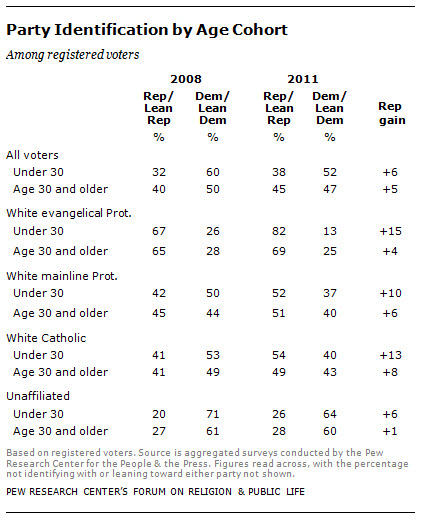
The analysis shows that across several religious groups, the move toward the GOP has been at least as large – if not more pronounced – among those under age 30 as among those 30 and older. White evangelicals under 30, for instance, are now more heavily Republican than those over 30 (82% vs. 69%); in 2008, by contrast, the partisan preferences of younger evangelicals closely matched those of evangelicals over age 30. And among white non-Hispanic Catholics under age 30, support for the GOP has increased from 41% in 2008 to 54% in 2011.

By Religious Affiliation

White evangelical Protestants have long been a key part of the GOP coalition. In 2008, 65% of white evangelical Protestant voters identified as Republicans or said they leaned toward the Republican Party, while 28% expressed support for the Democratic Party. By 2010, support for the GOP had increased to 69% among evangelical voters while support for the Democratic Party had declined to 23%. These Republican gains persisted in 2011, with polls showing that 70% of evangelicals favor the GOP compared with 24% who favor the Democratic Party. The 37-point advantage the GOP held in 2008 among evangelical voters has become a 46-point advantage in 2011.

partyid-3

Mormon voters, like evangelicals, are a largely Republican-leaning group. In 2008, nearly seven-in-ten Mormon voters (68%) favored  the GOP. Since then, the number of Mormons saying they lean toward the GOP has increased significantly, bringing the total number who say they identify with or lean toward the Republican Party to 80%. The GOP now holds a 63-point advantage over the Democratic Party among Mormons.

partyid-4

In 2008, white mainline Protestants were evenly divided between the two parties, with 45% identifying as Republican or saying they leaned toward the Republican Party and an equal number identifying with or leaning toward the Democratic Party. By 2010 and 2011, however, the number of mainline Protestants favoring the Republican Party had jumped by six points (to 51%), and Democratic support had dropped by six points (to 39%). White mainline Protestants are now 12 points more likely to express support for the GOP than for the Democratic Party.

partyid-5

White non-Hispanic Catholics polled over the course of 2008 expressed significantly more support for the Democratic Party than for the GOP. In fact, the Democrats enjoyed an eight-point advantage over the GOP in Pew Research Center polling conducted in 2008, with nearly half of white Catholics (49%) expressing support for the Democratic Party and about four-in-ten (41%) identifying as Republican or saying they lean toward the GOP. Today, the tables have turned; the percentage of white Catholics identifying with the Democratic Party has declined significantly and the number leaning toward the GOP has grown. Combining partisans and partisan-leaners, the GOP now enjoys a seven-point advantage among white Catholics.

partyid-6

Republicans have also seen gains among Jewish voters, who have long been strong supporters of the Democratic Party. In 2008, 72% of Jews identified themselves as Democrats or said they leaned toward the Democratic Party, and Democrats held a 52-point advantage among this group. In 2011, the Democratic advantage among Jews has shrunk to 36 points, with 29% of the Jewish population aligning with the GOP. While the majority of Jews are still Democrats or lean toward the Democratic Party, Democrats’ dominance among this group has weakened since the last presidential election. In fact, Jews are the only religious group analyzed in which the percentage who identify themselves as Republican (as opposed to leaning toward the GOP) has risen significantly.

partyid-7

By contrast with other religious groups, changes in the partisanship of religiously unaffiliated voters have been more modest. In 2008, 64% of religiously unaffiliated voters identified with or leaned toward the Democratic Party; in 2011, this figure stands at 61%. There has been little change in the partisanship of black Protestants, another core Democratic constituency.

partyid-8

By Frequency of Attendance

The increase in support for the Republican Party among a variety of religious groups is also seen across levels of religious observance. Among voters who attend religious services at least once a week, the GOP’s five-point advantage in 2008 has become an 11-point advantage in 2011 (with 52% of weekly attenders expressing support for the GOP compared with 41% who favor the Democratic Party). And among those who attend religious services less often, the Democrats’ 25-point advantage in 2008 has shrunk to 14 points in 2011.

partyid-9

These overall patterns are also apparent among white evangelical Protestants and white Catholics. Among evangelicals, for instance, the GOP has registered significant gains among both those who are highly religiously observant and those who are less observant. The GOP held a 47-point advantage among weekly attending white evangelicals in 2008 (70% Republican vs. 23% Democratic); in 2011, they hold a 57-point advantage (76% Republican, 19% Democratic). And the Republicans’ 15-point advantage in 2008 among white evangelicals who attend religious services less often has grown to a 26-point advantage in 2011.

In 2008, white Catholics who reported attending religious services at least once a week were evenly divided between the Democratic and Republican parties. In 2011, by contrast, 52% of weekly attending white Catholics favor the GOP compared with 40% who identify with or lean toward the Democratic Party, giving the GOP a 12-point advantage. White Catholics who attend religious services less often clearly favored the Democrats over the Republicans in 2008 (by a 54% to 38% margin), but the GOP has pulled even among this group in polling conducted in 2011.

White mainline Protestant voters who attend religious services less than once a week have also contributed to the Republican Party’s significant gains. In 2008, 46% of white mainline Protestants who attend religious services less than weekly identified with or leaned toward the Democratic Party, compared with 44% who favored the GOP. Today, more than half (51%) of white mainline Protestants who attend services less than weekly call themselves Republican or lean toward the GOP, while 39% favor the Democratic Party. Changes in partisanship have been much less pronounced among white mainline Protestants who say they attend religious services at least once a week.

By Age

GOP gains are seen among both younger and older voters. Among the population as a whole, roughly half of voters under age 30 (52%) express support for the Democrats. This is a significant decline from 2008 when fully 60% of this group identified with or leaned toward the Democratic Party. The Democrats’ 28-point advantage among the under-30 cohort has fallen to a 14-point advantage. Among voters age 30 and older, the Democrats 10-point advantage in 2008 has shrunk to two points as of 2011.

This pattern is echoed within several religious groups. In fact, among several religious groups, the move toward the GOP

partyid-10

has been at least as large – if not more pronounced – among those under 30 as among those age 30 and older.

In 2008, 67% of young white evangelicals aligned themselves with the GOP, giving the Republican Party a 41-point advantage among this group. In Pew Research Center polling conducted in 2011, 82% of white evangelicals under age 30 expressed support for the Republican Party, giving the GOP a 69-point advantage over the Democratic Party. Whereas in 2008 the partisanship of evangelicals under 30 closely resembled the partisanship of their older counterparts, young white evangelicals are now significantly more Republican in their partisanship than older white evangelicals.

In 2008, roughly half of white Catholics under 30 called themselves Democrats or leaned toward the Democratic Party (53%), while 41% favored the GOP. By 2011, these figures were reversed, with 54% of young white Catholics favoring the GOP and 40% preferring the Democratic Party. A similar decline in support for the Democratic Party is seen among white mainline Protestants under 30. Religiously unaffiliated voters under 30 continue to express majority support for the Democratic Party, but the Democratic advantage among this group has shrunk from 51 points in 2008 to 38 points in 2011.

Sample Sizes and Margins of Error

This analysis is based on aggregated data from more than 84,000 interviews with registered voters conducted by the Pew Research Center for the People & the Press in 54 surveys completed between January 2008 and December 2011. These surveys are combined into one large data file that can be sorted according to a range of demographic and religious characteristics. The tables below show the number of interviews and corresponding margins of error for 2008 and 2011 for the groups analyzed in this report.

partyid-app-1
partyid-app-2