Pew Research Center

FOR RELEASE JANUARY 12, 2012

Mormons in America – Certain in Their Beliefs, Uncertain of Their Place in Society

A new nationally representative survey focused exclusively on Mormons explores their religious beliefs and practices, political ideology, views on moral and social issues, and attitudes toward faith, family life, the media and society.

FOR MEDIA OR OTHER INQUIRIES:

Communications Department
202.419.4372
www.pewresearch.org

RECOMMENDED CITATION

Pew Research Center, January 2012, "Mormons in America – Certain in Their Beliefs, Uncertain of Their Place in Society"

About Pew Research Center

Pew Research Center is a nonpartisan, nonadvocacy fact tank that informs the public about the issues, attitudes and trends shaping the world. It does not take policy positions. The Center conducts public opinion polling, demographic research, computational social science research and other data-driven research. It studies politics and policy; news habits and media; the internet and technology; religion; race and ethnicity; international affairs; social, demographic and economic trends; science; research methodology and data science; and immigration and migration. Pew Research Center is a subsidiary of The Pew Charitable Trusts, its primary funder.

© Pew Research Center 2026

Table of contents

  • About Pew Research Center
  • Mormons in America – Certain in Their Beliefs, Uncertain of Their Place in Society
  • Preface
  • Reactions to the “Mormon Moment”
  • Religious Beliefs and Practices
  • Mormons and Family Life
  • Politics, Society and Morality
  • Survey Methodology
  • Glossary

Mormons in America – Certain in Their Beliefs, Uncertain of Their Place in Society

A new nationally representative survey focused exclusively on Mormons explores their religious beliefs and practices, political ideology, views on moral and social issues, and attitudes toward faith, family life, the media and society.

With a Mormon candidate among the front-runners for the 2012 GOP presidential nomination, a musical about Mormons playing on Broadway and The Church of Jesus Christ of Latter-day Saints (LDS) running television ads about ordinary Mormons, America is in the midst of what some media accounts have dubbed a “Mormon moment.”

Mormonism and American Society

But how do Mormons themselves feel about the media spotlight, the election campaign and their place in America? A major new survey finds a mixed picture: Many Mormons feel they are misunderstood, discriminated against and not accepted by other Americans as part of mainstream society. Yet, at the same time, a majority of Mormons think that acceptance of Mormonism is rising. Overwhelmingly, they are satisfied with their lives and content with their communities. And most say they think the country is ready to elect a Mormon president.

These are among the findings of a comprehensive survey by the Pew Research Center’s Forum on Religion & Public Life of more than 1,000 Mormons across the country – the first of its kind ever published by a non-LDS research organization. Previous studies, including the Pew Forum’s 2007 U.S. Religious Landscape Survey, have found that Mormons make up slightly less than 2% of the U.S. public.

Six-in-ten Mormons (62%) say the American people as a whole are uninformed about Mormonism. Nearly half (46%) say that Mormons face a lot of discrimination in the U.S. today – which is higher than the percentage that says the same about blacks (31%) and atheists (13%). Two-thirds (68%) say the American people as a whole do not see Mormonism as part of mainstream American society. And when asked to describe in their own words the most important problems facing Mormons living in the United States today, 56% cite misperceptions about Mormonism, discrimination, lack of acceptance in American society and the like.

Yet most U.S. Mormons also think acceptance of Mormonism is on the rise, with 63% saying the American people are becoming more likely to see Mormonism as part of mainstream society. And 56% of those surveyed say the American people are ready for a Mormon president.

The nationwide survey of 1,019 Mormons, conducted Oct. 25-Nov. 16, 2011, finds that Mormons share many of the religious practices and beliefs of traditional Christianity. Three-quarters of Mormons (77%) say they attend church at least once a week, 79% say they donate 10% of their earnings to the church, 83% say they pray every day and fully 98% say they believe in the resurrection of Jesus.

Mormons are nearly unanimous in describing Mormonism as a Christian religion, with 97% expressing this point of view. Indeed, when asked to volunteer the one word that best describes Mormons, the most common response from those surveyed was “Christian” or “Christ-centered” (17%), and an additional 5% volunteered “Jesus.”

Is mormonism a christian religion

By contrast, many non-Mormons do not see Mormonism as a Christian faith. A November 2011 Pew Research Center survey found that one-third of non-Mormon U.S. adults (32%) say the Mormon faith is not a Christian religion, and an additional 17% are unsure whether Mormonism is Christian. In an open-ended question asking what one word best describes the Mormon religion, the same survey found that the most commonly offered response was “cult.”

There are a number of tenets that are central to the teachings of the LDS Church and widely held by Mormons that are not shared by other Christian traditions. Nine-in-ten Mormons believe that the president of the LDS Church is a prophet of God (94%) and that the Book of Mormon was written by ancient prophets (91%). Similarly large numbers believe that families can be bound together eternally in temple ceremonies (95%) and that God the Father and Jesus Christ are separate, physical beings (94%). (More information on these and other elements of Mormonism can be found in the glossary.)

The survey finds that Mormons place a high priority on family life. Large majorities say that being a good parent (81%) and having a successful marriage (73%) are among their most important goals in life, far surpassing the numbers in the general public who say the same. (See Life Goals for details.)

Geographically, Mormons are heavily concentrated in the western part of the United States. In this survey, 71% of the respondents reside in the West, including more than half (53%) who reside in states in the Mountain West and 34% who live in Utah (which is part of the Mountain West).2 In terms of their racial and ethnic background, Mormons are overwhelmingly white; 88% of the current sample is comprised of white non-Hispanics, while 7% are Hispanic, 1% are black non-Hispanic and 4% are of other racial and ethnic backgrounds.

Politically, Mormons are quite conservative and supportive of the Republican Party – even compared with other people who share some of their demographic characteristics. Two-thirds of Mormons (66%) describe themselves as politically conservative, and three-quarters of Mormon voters (74%) identify with or lean toward the Republican Party. By comparison, Pew Research Center surveys conducted from September-November 2011 find that 37% of U.S. adults describe themselves as conservative (including 40% of white non-Mormons residing in the Mountain West). And 45% of registered voters in the population as a whole (and 60% of white non-Mormons in the Mountain West) identify with the Republican Party.

Mormons and white evangelical Protestants resemble each other and stand out from the broader public in that majorities of both groups exhibit high levels of religious commitment. Nonetheless, Mormons perceive hostility directed toward them from evangelical Christians. Fully half of those surveyed (50%) say that evangelical Christians are generally unfriendly toward Mormons, compared with 21% who think evangelicals are neutral toward Mormons and 18% who say evangelicals are friendly toward Mormonism. Pew Research Center surveys show that roughly half of white evangelicals (47%) say that Mormonism is not a Christian religion, and two-thirds of evangelicals (66%) say that Mormonism and their own religion are very or somewhat different.

Being Mormon During a “Mormon Moment”
mormonism and the media

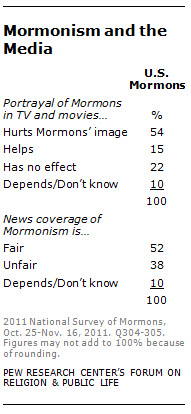
Many Mormons (54%) say that the way their religion is portrayed in television and movies hurts society’s image of Mormons in general. Far fewer (15%) say their image is helped by the portrayal of Mormons in entertainment media.

But Mormons are less negative in their assessment of the news media’s treatment of Mormonism. About half of those surveyed (52%) say that coverage of Mormons and Mormonism by American news organizations is generally fair, though a significant minority (38%) says news coverage of Mormonism is unfair.

The survey also finds that despite the large number of Mormons who feel that Mormons are misunderstood and discriminated against, the overwhelming majority are satisfied in their own lives and content with their communities. Nearly nine-in-ten Mormons (87%) say they are satisfied with the way things are going in their own life – more than say the same among the general public (75%). And 92% of Mormons rate their communities as excellent (52%) or good (40%) places to live. Mormons are more positive about their communities than is the public as a whole, among whom 81% rate their communities as excellent or good places to live. Community satisfaction is higher among Mormons who reside in the western part of the U.S. (where 55% give their community an excellent rating) than among those living elsewhere, and it is especially high among Mormons who reside in Utah (71% excellent).

Religious Beliefs and Practices

The survey confirms that Mormons are highly religious. About eight-in-ten (82%) say that religion is very important in their lives. A similar number (83%) says they pray every day. And upwards of three-quarters (77%) say they attend religious services at least once a week. More than two-thirds of Mormons (69%) fit all three of these descriptions, saying that religion is very important to them, that they pray every day and that they go to church every week. By this measure, Mormons exhibit higher levels of religious commitment than many other religious groups, including white evangelical Protestants.

Mormons are also firm believers in the teachings of their church. Asked whether they believe wholeheartedly in all the teachings of the LDS Church or whether they find some of the teachings of the church hard to believe, three-quarters of the Mormons surveyed (77%) say they believe wholeheartedly in all the church’s teachings.

being a good mormon

Mormons are well-known for avoiding beverages like coffee and tea as well as avoiding R-rated movies. Though a large majority of those surveyed say that these are important elements of being a good Mormon, many see them as less critical than other beliefs and practices. Fully eight-in-ten (80%) say believing that Joseph Smith actually saw God the Father and Jesus Christ is essential for being a good Mormon, and 73% say working to help the poor is essential to be a good Mormon. By contrast, 49% say not drinking coffee and tea is essential for good Mormons, and 32% say avoiding R-rated movies is essential to be a good Mormon. About half of Mormons (51%) say it is essential for Mormon families to regularly hold “family home evenings” (time set aside for family prayers and activities), and an additional 45% say it is important, though not essential, to do so.

Another distinctive aspect of Mormonism is the tradition of young adults participating in full-time missionary service (usually for a period of two years), called a proselyting mission. (See glossary.) The survey finds that roughly one-quarter of Mormons (27%) have served a full-time mission, including more than four-in-ten men (43%) and 11% of women. Slightly more than half of the former missionaries surveyed (56%) say their mission was very valuable in gaining converts to the LDS Church. And even larger majorities say their missionary experience was very valuable in helping them prepare for career success (80%) and for helping them to grow in their own faith (92%).

LDS Church leaders encourage Mormons to keep a supply of food in storage in case of catastrophe, recommending that at least three months of supplies be kept on hand. Eight-in-ten Mormons (82%) say they keep a supply of food in storage, including 58% who keep at least a three-months’ supply.

Ideology, Partisanship and Economic Views
ideology, partisanship and views of political figures

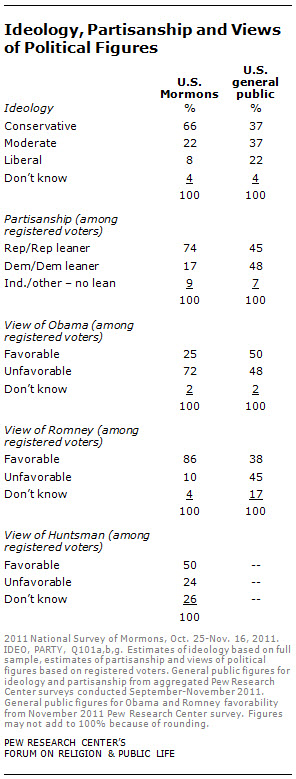
Mormons tend to be quite conservative in their political leanings and in their views on social and moral issues. Two-thirds (66%) call themselves conservatives, and three-quarters of Mormon registered voters (74%) are Republican or lean toward the Republican Party. These ideological and partisan leanings are reflected in their views of President Barack Obama, whose favorability rating among Mormon voters (25%) is half of what it is among voters in the public as a whole.

Mormons express highly positive views of GOP presidential candidate Mitt Romney (a fellow Mormon). Romney is viewed favorably by 86% of all Mormon voters and 94% of Mormons who are Republican or lean Republican. But even among Mormon Democrats and Democratic-leaning registered voters, 62% rate Romney favorably. In fact, Romney’s favorability rating is about as high among Mormon Democrats as it is among Republicans in the general population (56%).

Two other prominent Mormon political leaders are viewed less favorably than Romney. Half of Mormon voters (50%) express a favorable view of Republican presidential candidate (and former Utah governor) Jon Huntsman Jr., while 24% express an unfavorable view and 26% have no opinion. Huntsman is viewed more favorably by registered voters in Utah, where 70% offer a favorable assessment and only 4% are unable to offer an opinion about him. Less than a quarter of Mormon voters (22%) have a favorable view of Senate Majority Leader Harry Reid, a Democrat; 51% of Mormon voters have an unfavorable opinion of Reid while 27% express no opinion about him.

Mormons also tend to be conservative on other political issues. Three-quarters of Mormons (75%) say they prefer a smaller government providing fewer services to a bigger government providing more services; among the general public, 48% express a preference for smaller government. But Mormons are divided as to whether immigrants strengthen the U.S. because of their hard work and talents (45%) or burden the U.S. by taking American jobs, housing and health care (41%). On this question, Mormons’ views closely resemble those of the public as a whole.

Cultural and Moral Issues

Mormons tend to hold conservative views on social issues. Two-thirds (65%) say that homosexuality should be discouraged by society, while 26% say it should be accepted by society. Among the general public, by contrast, a majority says that homosexuality should be accepted by society (58%), compared with 33% who say it should be discouraged.

mormon - morality

Mormons’ conservatism also extends to a variety of other moral issues. Nearly eight-in-ten (79%) say that sex between unmarried adults is morally wrong, far higher than the 35% of the general public who hold the same view. Three-quarters of Mormons (74%) say that having an abortion is morally wrong (compared with 52% of the general public). And 54% of Mormons say that drinking alcohol is morally problematic, more than three times the percentage of all U.S. adults who express moral reservations about drinking alcohol (15%).

Polygamy was officially banned by the LDS Church in 1890, and the survey finds little acceptance of polygamy among Mormons. Nearly nine-in-ten (86%) say it is morally wrong, 11% of Mormons say polygamy is not a moral issue and 2% say it is morally acceptable.

Mormons and Family Life

The survey confirms that family life is very important to most Mormons. Four out of five Mormons (81%) believe that being a good parent is one of the most important goals in life, and roughly three out of four Mormons (73%) put having a successful marriage in this category. This puts family concerns significantly above career concerns, having free time and even living a very religious life as priorities for Mormons.

Two-thirds of Mormon adults (67%) are married, compared with 52% of the general public.3 More than four out of five married Mormons (85%) are married to another Mormon. By comparison, 81% of married Protestants are married to another Protestant, and 78% of married Catholics are married to another Catholic, according to the Pew Forum’s 2007 U.S. Religious Landscape Survey.

Nearly six-in-ten Mormons (58%) say that the more satisfying kind of marriage is one where the husband provides for the family and the wife takes care of the house and children, while 38% say that a marriage where the husband and wife both have jobs and both take care of the house and children is preferable. Among the general public, the balance of opinion on this question is reversed – 30% prefer a marriage where the husband is the sole breadwinner, while 62% prefer a marriage in which both husband and wife work.

Other Findings

Other key findings of the Pew Forum’s 2011 National Survey of Mormons include:

  • The majority of those surveyed say that most (53%) or all (4%) of their close friends are Mormon, while 33% say some of their close friends are Mormon and 10% say hardly any or none of their close friends are Mormon. Friendship networks that consist mostly or entirely of fellow Mormons are particularly common among those living in the West (especially in Utah, where 73% of those surveyed say most or all of their close friends are Mormon).
  • As is the case with members of other religious groups in the U.S., significant minorities of Mormons express belief in certain tenets of Eastern religions. Roughly one-quarter of Mormons (27%) say they believe in yoga not just as exercise but as a spiritual practice, and one-in-ten Mormons (11%) say they believe in reincarnation. Among the general public, 23% say they believe in yoga as a spiritual practice and 24% say they believe in reincarnation.
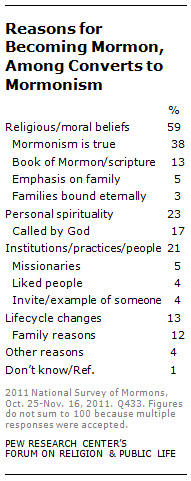
  • Three-quarters of Mormons (74%) were raised in the Mormon faith, while roughly one-quarter are converts (26%). When asked to describe their reasons for converting to Mormonism, six-in-ten converts (59%) cite the religion’s beliefs as the main reason they joined the church.
  • Nearly four-in-ten Mormons (39%) say the GOP is friendly toward Mormons, more than twice the percentage that says the Democratic Party is friendly toward Mormons (17%). Mormon Republicans and Republican leaners are much more apt to say the GOP is friendly toward Mormons than to say this about the Democratic Party (45% vs. 14%). On the other hand, nearly as many Mormon Democrats and Democratic leaners view the GOP as friendly toward Mormons (30%) as say this about the Democratic Party (33%).

About the Report

The subsequent sections of the report describe the survey’s findings in more detail. Results are based on interviews conducted among a national sample of 1,019 Mormons between Oct. 25 and Nov. 16, 2011. Interviews were conducted with respondents who currently describe their religion as “Mormon.” The survey does not include interviews with former Mormons or respondents with Mormon backgrounds and heritage who no longer consider themselves to be Mormon. It also does not include Mormons living outside the United States. (According to the LDS Church, more than half of all Mormons live outside the U.S.) Full details on the survey’s methodology are included in section 5.


Footnotes:

2 The states in the Mountain West are Arizona, Colorado, Idaho, Montana, Nevada, New Mexico, Utah and Wyoming. More broadly, the West (a geographic category frequently analyzed in this report) includes these states as well as Alaska, California, Hawaii, Oregon and Washington. (return to text)

3 The estimate that 52% of adults in the general population are married comes from surveys conducted in 2010-2011 by the Pew Research Center for the People & the Press and differs slightly from a recent, comprehensive analysis of trends in marriage rates published by the Pew Research Center’s Social & Demographic Trends project, which was based on U.S. Census Bureau data. The Pew Research Center for the People & the Press surveys were used for comparison in this report because the marital status question in those surveys is identical to the marital status question used in the current survey of Mormons. (return to text)

Photo Credit: © Walter Bibikow/JAI/Corbis
Preface

The idea for this survey arose in the early summer of 2011, around the time that a Newsweek cover story and a New York Times article declared that the United States was experiencing a “Mormon moment.” As evidence of the rising profile of The Church of Jesus Christ of Latter-day Saints (LDS) – as the Mormon Church is formally known – Newsweek cited not only the presidential aspirations of former Massachusetts governor Mitt Romney and former Utah governor Jon Huntsman Jr. but also the best-selling Twilight vampire novels by Mormon author Stephenie Meyer; the radio show of Mormon convert Glenn Beck; the finale of the HBO television series “Big Love”; and the hit Broadway musical “The Book of Mormon.” “But despite the sudden proliferation of Mormons in the mainstream, Mormonism itself isn’t any closer to gaining mainstream acceptance,” the Newsweek article stated.

That got us thinking. Over the years, numerous polls have gauged public attitudes toward Mormons, who make up about 2% of all U.S. adults.1 But what do Mormons themselves think about their place in American life? With the rising prominence of members of the LDS Church in politics, popular culture and the media, do Mormons feel more secure and accepted in American society? What do they think of other religions? What do they believe, how do they practice their faith and what do they see as essential to being a good Mormon and to leading a good life?

To answer such questions, the Pew Research Center’s Forum on Religion & Public Life decided to conduct a nationally representative survey focused exclusively on Mormons, the first ever published by a non-LDS research organization. As a first step, we researched the sociological literature on Mormons and recruited a panel of expert advisers, including Matthew Bowman of Hampden-Sydney College, David Campbell of the University of Notre Dame, Marie Cornwall of Brigham Young University, Terryl Givens of the University of Richmond and Allison Pond of the Deseret News. John Green of the University of Akron, a longstanding Pew Forum research adviser, also offered very helpful guidance.

With their help, the Pew Forum’s staff designed an approximately 25-minute questionnaire in August and September 2011. Social Science Research Solutions of Media, Pa., pre-tested the questionnaire with two small samples of Mormons in October and then fielded it by telephone (both cell phones and landlines) between Oct. 25 and Nov. 16, 2011.

Readers should note that the survey focuses on those who currently identify themselves as Mormon when asked about their religion. This means that people who were raised in the LDS Church but who no longer consider themselves as members of it are not likely to be among the respondents.

While this survey comes amid a contentious election campaign, it is not solely or even chiefly about politics. Rather, we hope that it will contribute to a broader public understanding of Mormons and Mormonism at a time of great interest in both, and we see it as part of the Pew Forum’s continuing efforts to explore the intersection of religion and public life in the United States and around the world.

Luis Lugo, Director Alan Cooperman, Associate Director, Research


Footnotes

1 See, for example, the Pew Research Center’s November 2011 report, Romney’s Mormon Faith Likely a Factor in Primaries, Not in a General Election, and September 2007 report, Public Expresses Mixed Views of Islam, Mormonism. (return to text)

Photo Credit: © Walter Bibikow/JAI/Corbis

Reactions to the “Mormon Moment”

Mitt Romney’s presidential campaign, the Broadway musical “The Book of Mormon” and other popular treatments of Mormonism in entertainment media have brought sustained attention to Mormons and their religion, but Mormons themselves think that the American people are ill-informed about Mormonism and reluctant to accept Mormonism as part of mainstream American society. More than four-in-ten Mormons (46%) say they face a lot of discrimination in the U.S. today. And more than half of those surveyed say that the portrayal of Mormons in television and movies is harmful to Mormons’ image.

At the same time, however, Mormons also say that acceptance of Mormonism by the broader society is on the rise, and most Mormons think that Americans are ready to elect a Mormon president. And large majorities of Mormons are happy with their community as a place to live and satisfied with the way things are going in their lives.

Assessment of Americans’ Knowledge of Mormonism

how much do american people know about mormonism

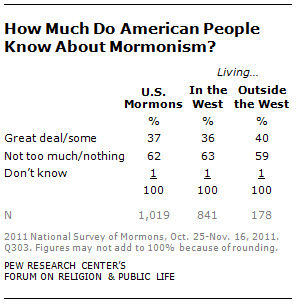
Most Mormons think that non-Mormons in the U.S. are ill-informed about Mormonism. More than six-in-ten Mormons say that the American people as a whole know “not too much” (58%) or nothing at all (4%) about the Mormon religion. Less than four-in-ten Mormons say that the American people know a great deal (4%) or “some” (33%) about Mormonism. The view that most Americans are uninformed about Mormonism is held by six-in-ten Mormons living in the West (63%) and by a similar number of those living in other regions of the country (59%).

Mormons’ assessment of the public’s knowledge about Mormonism tracks fairly closely with the public’s self-assessment. A November 2011 Pew Research Center poll found that among non-Mormons in the U.S., 50% say they know “not very much” or “nothing at all” about Mormonism, while 49% say they know “a great deal” or “some” about the Mormon religion. And a 2010 Pew Research Center survey found that roughly half or more of the public could not correctly identify that Joseph Smith was a Mormon (49%), that the Mormon religion was founded after 1800 (56%) and that the Book of Mormon recounts Jesus’ appearance in North America (60%).

Acceptance of Mormonism

is mormonism a christian religion

Mormons are nearly unanimous in the view that Mormonism is a Christian religion, with 97% expressing this point of view. By contrast, a November 2011 Pew Research Center survey found that a third of non-Mormons in the U.S. (32%) say the Mormon faith is not a Christian religion; 51% of non-Mormons think that Mormonism is a Christian religion, while 17% are unsure. Compared with other religious groups, more white evangelical Protestants say that Mormonism is not a Christian religion (47%). The general public’s views about whether Mormonism is a Christian religion are unchanged since 2007.

Two-thirds of Mormons (68%) say that the American people as a whole do not see Mormonism as part of mainstream American society, while 28% say their religion is accepted as part of mainstream American culture. Large majorities of Mormons across a variety of subgroups subscribe to the view that Mormonism is seen as being outside the mainstream. Among both men and women, younger Mormons and older Mormons, college graduates and those with less education, roughly two-thirds share the view that most Americans do not see Mormonism as part of mainstream society. There also is little difference on this question between Mormons living in the West and those living in other parts of the country. About two-thirds of both groups say most Americans do not view Mormonism as part of mainstream society.

do the american people see mormonism as part of mainstream society

However, most Mormons think that acceptance of Mormonism is on the rise and that the country is ready to elect a Mormon president. More than six-in-ten (63%) say that the American people are becoming more likely to see Mormonism as mainstream. By comparison, only 5% say Americans are becoming less inclined to view Mormonism as mainstream, and 29% say that the situation is not changing very much.

most say acceptance of mormonism on the rise

The view that acceptance of Mormonism is increasing is more common among college graduates (68%) than among those with a high school education or less (57%). Similarly, Mormons with the highest levels of religious commitment (those who say they pray every day, that religion is very important in their own lives and that they attend religious services at least weekly) are more convinced that acceptance of Mormonism is on the upswing (70%) than are those with lower levels of religious commitment (47%). Men and women express similar views on this question, and the views of Mormons living in the West closely resemble the views of Mormons living in other parts of the country.

are the american people ready to elect a mormon president

Mormons who think their religion is already accepted as part of mainstream society are more apt to say that acceptance of Mormonism is on the rise compared with those who say that Mormonism is not yet seen as mainstream. Majorities in both groups, however, say that Americans are becoming more likely to view Mormonism as mainstream (78% and 58%, respectively).

Most Mormons surveyed (56%) think that the country is ready to elect a Mormon president, while one-third (32%) say the country is not ready for a Mormon president and 12% are unsure.4 Recent Pew Research Center polling indicates that Romney’s Mormonism is a potential stumbling block in the GOP nomination campaign, though it is unlikely to affect him adversely in the general election should he obtain the GOP nomination.

Mormon men are much more convinced than Mormon women that Americans are ready to elect a Mormon president (64% vs. 48%). And more Republican or Republican-leaning Mormons (64%) than Democrat or Democratic-leaning Mormons (36%) say the public is ready for a Mormon chief executive. Mormons living in the Western U.S. and those living in other regions express similar views on this question.

Mormonism and the Media

A majority of those polled (54%) say that the way Mormons are portrayed in television and movies hurts society’s image of Mormons in general. Far fewer (15%) say that the way Mormons are portrayed by the entertainment industry helps their image, while 22% say that the way Mormons are portrayed on TV and in the movies has no effect on society’s view of Mormons.

The view that Mormons’ image is harmed by their portrayal in entertainment media is particularly common among college graduates, among whom 63% express this view. By comparison, fewer Mormons with some college education (52%) or with a high school education or less (47%) say that Mormonism’s image is harmed by the portrayal of Mormons in the entertainment media.

ma-sec1-6
ma-sec1-7

Mormons appear to make a distinction between the entertainment media and the news media. Whereas upwards of half of Mormons say that the image of their religion is harmed by their portrayal in television and movies, 52% of those surveyed say that coverage of Mormons and Mormonism by American news organizations is generally fair. A sizable minority (38%), however, says that the news media’s coverage of Mormonism is unfair.

Anti-Mormon Discrimination

Nearly half of Mormons (46%) say there is a lot of discrimination against Mormons in the United States today. Larger numbers of Mormons say that gays and lesbians (59%) and Muslims (55%) face a lot of discrimination. Fewer Mormons see a lot of discrimination against blacks (31%), evangelicals (19%) or atheists (13%).

discrimination against mormons compared to others

Mormons are about twice as likely as the public as a whole to say Mormons face a lot of discrimination (46% vs. 24% of the general public). (Similarly, a 2009 Pew Research Center poll found that blacks were more likely than the public as a whole to say there is a lot of discrimination against blacks, and white evangelicals were more likely than the general public to say there is a lot of discrimination against evangelical Christians.) Among Mormons, there are few large demographic differences in perceptions of anti-Mormon discrimination.

anti-mormon discrimination

The concern among Mormons about discrimination is highlighted by answers to an open-ended question in the survey asking respondents to describe in their own words the most important problems facing Mormons in the U.S. today. More than half of Mormons (56%) name something related to discrimination or misperceptions about Mormonism as one of the most important problems faced by Mormons today. This includes 34% who name misconceptions about Mormonism, 12% who say that Mormons are not seen as Christian, 7% who say that Mormonism is seen as a cult and 7% who say that Mormons are perceived as polygamists.

most important problems for mormons

Perceptions of Friendliness Toward Mormons

Half of Mormons (50%) say evangelical Christians are unfriendly toward Mormons, while 21% say evangelicals are neutral toward Mormons and 18% say evangelicals are friendly toward Mormons. The view that evangelicals are unfriendly toward Mormons is somewhat more prevalent among Mormon men (54%) than among Mormon women (45%). Nearly two-thirds of Mormon college graduates (65%) view evangelicals as unfriendly toward Mormonism, compared with roughly half of those with some college education (52%) and roughly one-third of those with a high school education or less (35%). Six-in-ten Mormons who live outside the Western U.S. (60%) say evangelicals generally are unfriendly toward Mormons, compared with less than half of Mormons who reside in the West (46%). Two thirds of Mormons who served a full-time mission (65%) view evangelicals as unfriendly toward Mormons, which is significantly higher than the number saying this among those who did not serve a mission (44%).

half of mormons say evangelicals are unfriendly toward mormons

Far fewer Mormons think that people who are not religious are unfriendly toward Mormonism. Whereas fully half of Mormons (50%) say evangelicals are unfriendly toward their religion, fewer than one-in-four Mormons (22%) say that people who are not religious are unfriendly toward Mormons.

Mormon men and women express roughly similar views on this question. College graduates are somewhat more likely than those with less education to say people who are not religious are neutral toward Mormons and less likely to view them as unfriendly toward Mormonism. Mormons who have not served a mission are somewhat more likely than those with missionary experience to say that people who are not religious are unfriendly toward Mormonism (24% vs. 17%).

Similarities and Differences with Other Religions

mormon similiarities and differences with other faiths

Mormons are divided over whether Mormonism and Catholicism are mostly similar or mostly different; 46% say Mormonism and Catholicism are very or somewhat similar to each other, while 50% say the two faiths are very or somewhat different from one another. Mormons are similarly divided over whether evangelical Protestantism and their own faith are similar (40%) or different (45%), with 15% unsure. Four in-ten Mormons see their faith as similar to Judaism, while 48% say Mormonism and Judaism are very or somewhat different from one another. Islam is the one religion asked about on which a clear consensus is seen; 63% of Mormons say the Muslim religion and their own religion are different than each other, while 20% say Mormonism and Islam are similar.

Catholics and white evangelical Protestants are much less likely to see their own faiths as similar to Mormonism than Mormons are to see Catholicism and Protestantism as similar to Mormonism. An August 2009 Pew Research Center poll found that 22% of American Catholics say that Mormonism and their own religion are very or somewhat similar, while 59% of Catholics say Catholicism and Mormonism are very or somewhat different. Among white evangelical Protestants, 18% say Mormonism and their own faith are similar, while two-thirds (66%) view Mormonism and their own faith as different.

which religions are similar to mormonism

More Mormon men than women say that both Catholicism and evangelical Protestantism are similar to their own faith. Upwards of half of Mormon men (52%) say their faith is similar to Catholicism and 49% say Mormonism is similar to evangelicalism. Among Mormon women, by contrast, 40% see their own faith as similar to Catholicism and 31% see Mormonism as similar to evangelicalism. The differences between men and women are not statistically significant on the questions of whether Mormonism is similar to Judaism and Islam.

The majority of Mormons under 50 (56%) say Mormonism is similar to Catholicism. Far fewer older Mormons take this view (33%). Generational differences are smaller on the questions about evangelicalism, Judaism and Islam.

College graduates are consistently more likely than those with less education to see each of these other faiths as similar to Mormonism. Similarly, Mormons who have served a full-time mission are consistently more likely than those who have not served a mission to view other faiths as similar to Mormonism.

Mormons with the highest levels of religious commitment and those with lower religious commitment express similar opinions on the questions of whether Catholicism and Islam are similar to or different from Mormonism. However, Mormons with the highest levels of religious commitment are more inclined than those with lower commitment to view evangelicalism and Judaism as similar to Mormonism.

Mormons in the West express roughly comparable views to those in other regions about the similarities and differences between Mormonism and other faiths. Notably, the view that Mormonism is similar to evangelicalism is much more common among Mormons who reside in the South (54%) than among Mormons who live outside the South (37%). (The Pew Forum’s 2007 U.S. Religious Landscape Survey found that upwards of one-third of Southerners are evangelicals and that half of evangelicals live in the South.)

Satisfaction with Communities and Lives

Upwards of nine-in-ten Mormons rate their communities as excellent (52%) or good (40%) places to live. Mormons’ rate their communities more positively than does the American public as a whole (52% excellent among Mormons compared with 38% excellent among the general public).

widespread satisfaction with communities

Community satisfaction is particularly high among well-educated Mormons and among those living in the West – especially Utah. Nearly two thirds of college graduates (64%) rate their community as an excellent place to live, compared with roughly half of those with some college education (48%) or a high school education or less (46%). Among Mormons living in the West, 55% rate their community as an excellent place to live, a figure that rises to 71% among Mormons living in Utah. Among Mormons living outside the West, 44% rate their community as an excellent place to live.

ma-sec1-16

The vast majority of Mormons (87%) also say that they are satisfied with the way things are going in their own lives. Mormons rate their own lives more positively than do members of the public as a whole (75%).

Younger Mormons express particularly high levels of satisfaction with the way things are going in their lives. Fully 92% of Mormons under age 50 are satisfied with their lives. By comparison, life satisfaction stands at 79% among Mormons over age 50.

Mormons with at least some college experience rate their lives more positively than those with a high school education or less; 92% of college graduates are satisfied with their lives as are 89% of those with some college education, compared with 80% of those with a high school education or less. And Mormons with the highest levels of religious commitment are more satisfied with their lives than Mormons with lower levels of religious commitment (91% vs. 78%).

While a majority of Mormons are satisfied with their lives, most Mormons (75%) are dissatisfied with the way things are going in the U.S. today. On this question, Mormons closely resemble the public as a whole (78% dissatisfied in an October 2011 Pew Research Center survey).

most are dissatisfied with direction of country

Mormon Friendship Networks

Nearly six-in-ten Mormons (57%) say that most (53%) or all (4%) of their close friends are also Mormon. Among Mormon women, upwards of six-in-ten (62%) say that all or most of their close friends are Mormon, compared with 52% of Mormon men who say this.

mormon friendship networks

Six-in-ten Mormons living in the West (61%) say that all or most of their close friends are Mormon, a figure that rises to 73% among those living in Utah. Fewer Mormons who live outside the West say that all or most of their friends are fellow Mormons (47%). Having a mostly Mormon friendship network is substantially more common among those with the highest levels of religious commitment (67%) than among those with lower levels of religious commitment (34%). And lifelong Mormons are more apt than converts to say that most or all of their friends are Mormons (60% vs. 48%).


Footnotes:

4 This question was asked in the context of a larger set of questions about the acceptance of Mormonism by the broader society and was designed to help gauge Mormons’ views on this topic. It was not meant to obtain Mormons’ predictions about the outcome of the current presidential campaign. (return to text)

Photo Credit: © Walter Bibikow/JAI/Corbis

Religious Beliefs and Practices

A large majority of Mormons say religion is very important in their lives, more than four-in-five pray at least once a day and three-quarters attend religious services weekly or more. Almost all Mormons (98%) accept the traditional Christian teaching that Jesus rose from the dead. Mormons are also nearly unanimous in accepting other teachings of their church that are different from the beliefs of other Christian traditions. For example, 94% of Mormons believe that the president of the LDS Church is a prophet and 91% believe that the Book of Mormon was written by ancient prophets and then translated by Joseph Smith. However, more than one-in-five Mormons (22%) say they find some of the church’s teachings hard to accept, and nearly one-in-ten (8%) say they seldom or never attend religious services.

Importance of Religion

how important is religion in your life

More than four out of five Mormons (82%) say religion is very important to them, compared with 56% of the general public. Mormons closely resemble black Protestants (86% of whom say religion is very important to them) and white evangelicals (83% very important) on this question. Mormons are significantly more likely than Catholics (56%) and white mainline Protestants (45%) to say religion is very important in their lives.

Mormon women are more apt than Mormon men to say that religion is very important in their lives (87% vs. 78%). College graduates (90%) and those with some college education (88%) are more likely to say religion is very important in their lives than those with a high school education or less (70%). More Mormons residing outside the West say religion is very important to them compared with those who live in the West (88% vs. 80%).

Prayer and Religious Attendance

More than four out of five Mormons (83%) pray at least once a day, with nearly two-thirds (64%) saying they pray multiple times per day. Mormons pray at rates similar to those seen among black Protestants (80% pray daily) and white evangelicals (81%). Mormons pray much more frequently than Catholics (58% pray daily) and white mainline Protestants (48%).

ma-sec2-2

Upwards of three-quarters of Mormons (77%) say they attend religious services at least once a week, and in response to a separate question two-thirds (67%) say they are “very active” in the LDS Church. Mormon rates of worship attendance are well above the national average, with 39% of the general public saying they attend religious services at least weekly. Mormons’ church attendance exceeds that reported by white evangelical Protestants, among whom nearly two-thirds (64%) say they attend church at least once a week.

ma-sec2-3

Religious Commitment

ma-sec2-4

The survey’s questions about the importance of religion, frequency of prayer and frequency of religious attendance can be combined to form a scale of religious commitment. By this measure, nearly seven-in-ten Mormons (69%) exhibit high levels of religious commitment, saying religion is very important in their lives and that they pray every day and that they attend religious services at least once a week. Only one-in-fifty Mormons (2%) exhibit low levels of religious commitment, saying that religion is “not too” or “not at all” important to them and that they seldom or never pray and seldom or never attend religious services. Roughly three-in-ten Mormons (28%) fall somewhere in between, exhibiting medium levels of religious commitment.

Mormons express significantly higher levels of religious commitment on this scale than other religious groups, including white evangelical Protestants (55% high commitment) and black Protestants (50%). Among the U.S. public as a whole, 30% exhibit high religious commitment.

The survey finds a significant gender gap in religious commitment, with more Mormon women than men exhibiting a high level of religious commitment (73% vs. 65%). A similar gender gap is seen among the general public; in the Pew Forum’s 2007 U.S. Religious Landscape Survey, 36% of women exhibited a high level of religious commitment, compared with 24% of men.

Mormons who have graduated from college display the highest levels of religious commitment (84%) followed by those with some college education (75%). Mormons with a high school education or less exhibit substantially lower levels of religious commitment (50% score high on the scale) than their more highly educated counterparts. These large differences in religious commitment among respondents with different educational backgrounds are not seen among many other religious groups in the population. Among all Christians interviewed in the 2007 U.S. Religious Landscape Survey, for instance, 40% of college graduates exhibited high religious commitment on this measure, as did 36% of Christians with a high school education or less. Similarly, religious commitment gaps across levels of educational attainment are fairly muted among white mainline Protestants, black Protestants and white Catholics. Among white evangelical Protestants, however, there is an 18-point gap in religious commitment between those with the highest and lowest levels of educational attainment. In the 2007 U.S. Religious Landscape Survey, 68% of white evangelical college graduates exhibited high religious commitment, compared with 50% among evangelicals with a high school education or less.

Mormon Temple Recommends

ma-sec2-5

One distinctive aspect of the LDS faith is that worship takes place in two separate contexts. Weekly congregational services and other church activities are held in local meetinghouses or churches. In addition, members in good standing are encouraged to attend a Mormon temple regularly, and many Mormons do this about once a month. In order to attend a temple, members must have a “temple recommend” provided by local leaders and renewed every other year. (For more information on Mormon temples and temple recommends, see the glossary).

About two-thirds of Mormons (65%) say they have a current temple recommend. Possessing a temple recommend is most common among college graduates (85%), followed by those with some college (67%) and those with a high school education or less (46%). Married Mormons are more likely than those who are not married to say they have a current temple recommend (74% vs. 47%). Mormons with the highest levels of religious commitment are four times as likely to have a temple recommend compared with those with lower levels of religious commitment. There are no significant differences on this question across age groups or between those living in the West and those who live in other regions.

Tithing

Mormons are expected to tithe (or “pay tithing”), donating 10% of their earnings to the church. Nearly four-in-five Mormons say they pay tithing (79%). Tithing is most common among those with the highest levels of religious commitment (96%), and less common among those with lower levels of religious commitment (41%). Tithing is also correlated with educational attainment and income. Fully 91% of college graduates say they “pay tithing,” compared with 80% of those with some college and 66% of those with a high school degree or less education. Among those whose family income exceeds $30,000, 83% say they pay tithing, compared with 69% of those with incomes of less than $30,000.

ma-sec2-6

Missionary Service

Perhaps the most well-known of the practices distinctive to Mormons is a period of full-time missionary work – which Mormons refer to as a “proselyting” mission (see glossary). Just over one-in-four Mormon adults (27%) has served in such a mission at some point in their lives, though this number is significantly higher for men (43%) than for women (11%). Missionary service is more common among those under age 50, among whom 32% say they served a full-time mission, than among those age 50 and older (21%). More college graduates (48%) and those with some college (26%) have served a mission as compared with those with a high school education or less (10%). And there are more missionaries among those who were raised Mormon than among converts to the faith (31% vs. 16%). This may partly reflect the fact that most full-time Mormon missions are served in early adulthood, whereas many converts to Mormonism joined the church later in life.

ma-sec2-7

Of those who have served a mission, 56% say it was very valuable in gaining converts to Mormonism. Many more say their missionary service was very valuable in preparing them for job or career success (80%) and for helping them to grow in their own faith (92%).

ma-sec2-8

Religious Beliefs

Most Mormons hold many of the same beliefs espoused by other Christian traditions. For example, the Pew Forum’s 2007 U.S. Religious Landscape Survey found that 90% of Mormons express certainty in their belief in God, that 91% believe that the Bible is the word of God and that 98% believe in life after death. And the current survey finds that 98% of Mormons believe in the resurrection of Jesus.

ma-sec2-9

The current survey also shows that Mormons hold firm views on a variety of doctrines that are not shared by other Christian traditions. For example, Mormons are nearly unanimous in the view that God the Father and Jesus Christ are separate, physical beings, with 94% expressing this view. Identically large majorities of Mormons affirm that the president of the LDS Church is a prophet of God (94%) and that families can be bound together eternally in temple ceremonies (95%). Mormons are also united in the belief that the Book of Mormon was written by ancient prophets and translated by Joseph Smith (91%); by comparison, less than one-in-ten say that the Book of Mormon was written by Joseph Smith himself (8%). (For more information on LDS teachings about these and other matters, see the glossary.)

ma-sec2-10

Fully three-quarters of Mormons (77%) say they believe wholeheartedly in all the teachings of Mormonism, but a significant minority (22%) finds some of the teachings of their church hard to believe.5 Mormons over age 50 are somewhat more apt than younger Mormons to say they find some Mormon teachings hard to believe (28% vs. 18%). And Mormons with a high school education or less are substantially more likely than those with more education to say they find some elements of Mormonism difficult to believe (34% of those with a high school degree or less, compared with 19% of those with some college education and 14% of college graduates). And more converts to Mormonism (30%) than lifelong Mormons (20%) say they find certain teachings of the faith hard to believe.

Being a Good Mormon

ma-sec2-11

Eight-in-ten Mormons say that believing that Joseph Smith actually saw God the Father and Jesus Christ is an essential part of being a good Mormon. Nearly three-quarters (73%) say that working to help the poor and needy is essential for being a good Mormon.

By comparison, other practices are seen as important but less essential. For example, half of Mormons (51%) say holding regular “family home evenings” is crucial for being a good Mormon, while 45% say this family time is important but not essential. Half (49%) also say that avoiding coffee and tea is essential, while 32% say this is important but not essential for being a good Mormon; nearly one-in-five (17%) say that avoiding these beverages is “not too” or “not at all” important for being a good Mormon. (For more information on family home evenings and Mormon beliefs about coffee and tea, see the glossary.)

One-third of Mormons (32%) say it is essential for good Mormons to avoid R-rated movies, while 47% say this is important but not essential and 19% say avoiding R-rated movies is not important.

ma-sec2-12

By wide margins, Mormons who exhibit the highest levels of religious commitment are more likely than those with lower religious commitment to say that each of these elements is essential to being a good Mormon. And those who have served a full-time mission are more likely than those who have not served a mission to say that believing Joseph Smith saw God, helping the poor and avoiding coffee and tea are essential for being a good Mormon.

Compared with Mormons under 50, those age 50 and older are much more inclined to say that not watching R-rated movies is central to Mormonism (42% among those over 50, compared with 25% of those under 50). Otherwise, there are only small differences across age groups in opinions about what is central for being a good Mormon.

College graduates are more likely than those with a high school education or less to see believing Joseph Smith saw God, helping the poor and not drinking coffee or tea as essential for being a good Mormon. On the other hand, those with a high school education or less are more inclined than those with higher levels of education to say that avoiding R-rated movies is essential for being a good Mormon (41% among those with a high school education or less, compared with 28% among college graduates and 27% of those with some college education).

Married Mormons see helping the poor and avoiding coffee and tea as more central to being a good Mormon as compared with those who are not married. Differences between married and unmarried people are smaller on other requirements for being a good Mormon.

Food Storage

Mormons are encouraged to keep a supply of food in storage in case of emergencies, with church leaders recommending that Mormons keep at least three months of supplies on hand. (For more information on the practice of food storage among Mormons, see the glossary.) Four out of five Mormons interviewed (82%) say they do this, with more than half of all Mormons (58%) saying they keep at least three months of food in storage.

ma-sec2-13

Belief in Reincarnation, Yoga

As is the case among members of other religious groups, significant minorities of Mormons express belief in certain tenets more commonly associated with Eastern religions. One-in-ten Mormons (11%) say they believe in reincarnation – that people will be reborn in this world again and again. This is comparable to the number of white evangelical Protestants who hold this belief (and significantly lower than the share of the general population saying they believe in reincarnation). In addition, more than one-in-four Mormons (27%) believe in yoga “not just as exercise, but as a spiritual practice,” comparable to the 23% of the general public who share this belief.

ma-sec2-14

Converting to Mormonism

ma-sec2-15

Three-quarters of Mormon adults (74%) say they were raised Mormon, while 26% say they were not raised in the faith. More than four out of five converts to Mormonism (84%) were raised in a different Christian religion. About half (53%) were raised as Protestants, while one-third of all converts to Mormonism (31%) were raised Catholic. In addition, 15% of converts to Mormonism were religiously unaffiliated as children. Only 1% of converts to Mormonism came from a non-Christian religion.

Converts to Mormonism tend to be older than other Mormons (67% of converts are over the age of 50, compared with 32% of Mormons who were raised in the faith). There are more women among the converts surveyed (57%) than among those who were raised Mormon (47%). And compared with lifelong Mormons, there are far more racial and ethnic minorities among converts to the faith. Fewer than one-in-ten lifelong Mormons (8%) are non-whites, compared with 24% of converts to Mormonism. Three-quarters of lifelong Mormons (78%) live in Western states and 40% live in Utah, but nearly half of converts (47%) live outside the West and only 16% live in Utah.

Converts and non-converts have comparable levels of religious commitment, but converts are somewhat more likely to say that some of the teachings of the Mormon faith are hard to accept (30% vs. 20%).

Roughly half of converts to Mormonism (51%) say they joined the church before turning 24, including 26% who converted before reaching the age of 18. One-third (34%) say they converted between the ages of 24 and 35, 9% became Mormon between the ages of 36 and 50, and 6% joined the church when they were over the age of 50.

When asked to describe in their own words their reasons for converting to Mormonism, 59% of converts cite the religion’s beliefs as a reason. The most common responses within this category are general statements about the religion being true or making sense (38%), as well as statements about the Book of Mormon or other scriptures (13%). Mormonism’s emphasis on the family and family values is cited as a reason for converting by 5% of converts, and 3% cite the faith’s specific teaching that families can be bound together for eternity.

ma-sec2-16
ma-sec2-17

Roughly one-quarter of converts to Mormonism (23%) cite issues of personal spirituality as reasons for their conversion, including 17% who say they felt called by God or “gained a testimony.” About one-in-five converts to Mormonism (21%) cite either the influence of Mormons they interacted with before they converted or an appreciation for the institutions and practices of the LDS Church. Common responses in this category include the work of Mormon missionaries (5%) and positive impressions of Mormon people (4%).

Just over one-in-ten converts (13%) mention a major life change as their reason for becoming Mormon. This includes 12% who say they converted because they married a Mormon or for other family reasons.


Footnotes:

5 The survey did not ask those saying they find some teachings hard to believe to specify which particular teachings they find hard to believe. (return to text)

Photo Credit: © Walter Bibikow/JAI/Corbis

Mormons and Family Life

Previous Pew Research Center surveys have found that one common association that the general public has for Mormons is “family” or “family values.” This survey finds that family is, indeed, very important to most Mormons. Mormons are more likely than the general public to feel that marriage and childrearing are some of the most important things in life. More Mormons are married compared with the population as a whole, and Mormons have more children on average than the general public. Finally, Mormons hold traditional views of gender roles inside the family and in their religious community.

Family Demographics

Two-thirds of Mormon adults in the current sample (67%) are married, compared with 52% of the general public.6 Mormons also tend to have more children than does the general public. Mormons in the current survey report having had 2.6 children on average, compared with 1.8 among the general population.7

ma-sec3-1

Intermarriage

More than four out of five Mormons who are married or living with a partner (85%) are married to or partnered with another Mormon; 6% have a spouse or partner who is Protestant, while 3% are in a relationship with a Catholic and 5% have a partner who is religiously unaffiliated. By comparison, the Pew Forum’s 2007 U.S. Religious Landscape Survey found that 81% of Protestants are married to another Protestant and 78% of married Catholics are married to another Catholic. Intermarriage rates are higher among the religiously unaffiliated, 28% of whom are married to Protestants and 22% of whom are married to Catholics.

ma-sec3-2

Life Goals

Four out of five Mormons (81%) say that being a good parent is one of their most important goals in life. Being a good parent also ranks among the top life goals of the public overall, though only 50% of the general population says that being a good parent is one of their most important goals in life. Nearly three out of four Mormons (73%) believe that having a successful marriage is one of the most important things in life, compared with 34% of the general public. For Mormons (as for the general public), this puts family concerns significantly above career concerns, having free time and even living a very religious life.

ma-sec3-3

This prioritization of family life is seen across Mormon subgroups. Being a good parent and having a successful marriage rank as top priorities in life for both Mormon men and Mormon women, and for both the highly religious and those with lower levels of religious commitment. Married Mormons are more likely than those who are not married to say having a successful marriage is one of their most important goals in life, but more than half of those who are not married (56%) express the same view. Similarly, those who have had children are more inclined than those who have not to say being a good parent is one of the most important things in life, but large majorities of both groups express this point of view.

ma-sec3-4

Those with higher levels of educational attainment are more likely than those with a high school degree or less to say that being a good parent, having a successful marriage and being very religious are among their most important goals in life.

Gender Roles

ma-sec3-6

Nearly six-in-ten Mormons (58%) say that the more satisfying kind of marriage is one in which the husband provides for the family and the wife takes care of the house and children. About four-in-ten (38%) prefer a marriage in which both the husband and wife have jobs and both take care of the house and children. Among the general public, including many other major religious groups, the balance of opinion on this question is reversed, with 62% preferring a marriage in which both husband and wife work and 30% preferring a marriage in which the husband is the sole breadwinner for the family.

Mormon men and women express similar views on this question, and there is no difference in views across age cohorts. Upwards of seven-in-ten Mormon college graduates (71%) say they prefer a marriage in which the husband is the sole provider, compared with 59% of those with some college education and less than half of those with a high school education or less (45%). This pattern is not observed among the general public.

Married Mormons are more likely than those who are unmarried to say they prefer a marriage in which the husband works and the wife stays home (65% vs. 43%). And Mormons who have had three or more children are much more inclined than those who have had fewer children to prefer this approach, with 70% of this group saying they prefer a marriage in which the wife stays home and the husband works. More than two-thirds of Mormons (69%) who have high levels of religious commitment believe that the ideal family structure is one in which the wife stays home and her husband works, but only one-third of Mormons (33%) with lower levels of religious commitment hold this view.

The survey finds little support for the notion that women should be eligible for the Mormon priesthood. (The Mormon priesthood is different than the priesthood in some other faiths; all worthy male members of the church are eligible to begin priesthood service when they reach age 12, and they may hold various offices in the priesthood at different stages in their lives. Mormon women are not ordained to the priesthood. See the glossary for more details.) One-in-ten Mormons (11%) believe that women should be ordained to the priesthood of their church, whereas 87% think the priesthood should be open only to males. Large majorities of both men and women express this view, but Mormon women are somewhat more likely than Mormon men to say the priesthood should be open only to males (90% vs. 84%). The belief that women should be ordained to the priesthood is less common among those who have the highest levels of religious commitment than among those with lower levels of commitment. Even among this latter group, however, nearly seven-in-ten (69%) say women should not be eligible for the priesthood.

ma-sec3-5


Footnotes:

6 The estimate that 52% of adults in the general population are married comes from surveys conducted in 2010-2011 by the Pew Research Center for the People & the Press and differs slightly from a recent, comprehensive analysis of trends in marriage rates published by the Pew Research Center’s Social & Demographic Trends project, which was based on U.S. Census Bureau data. The Pew Research Center surveys were used for comparison in this report because the marital status question in those surveys is identical to the marital status question used in the current survey of Mormons. (return to text)

7 Source for general public comparison is the Pew Forum’s 2010 U.S. Religious Knowledge Survey. (return to text)

Photo Credit: © Walter Bibikow/JAI/Corbis

Politics, Society and Morality

Mormons are more conservative than the general public on a variety of political, social and moral issues. Compared with the population as a whole, Mormons are more Republican in their party affiliation and conservative in their political ideology. They have a less favorable view of Barack Obama than non-Mormons, and they hold more conservative views than the general public on issues such as the size of government, abortion and homosexuality. On questions of morality, Mormons are more likely than others to say that extramarital sex and drinking alcohol are morally wrong.

Ideology and Partisanship

ma-sec4-1

Two-thirds of Mormons (66%) call themselves conservative, about one-in-five (22%) say they are moderate and only about one-in-ten (8%) say they are liberal. The political ideology of Mormons closely resembles that of white evangelical Protestants (61% conservative, 27% moderate and 9% liberal), and both groups are far more conservative than other major religious groups and the public overall.

While majorities across a variety of Mormon subgroups describe themselves as conservative, the survey finds that Mormon men (73%) are more conservative than Mormon women (59%). Mormons in the West express higher levels of conservatism than those living outside the West (69% vs. 58%). And Mormons who exhibit the highest levels of religious commitment are substantially more conservative than those with lower levels of religious commitment (74% vs. 47%).

Roughly equal numbers of Mormons under age 50 and those age 50 and older describe themselves as politically conservative (68% and 62%, respectively). Among the general population, those under 50 are somewhat less conservative than those age 50 and older (33% vs. 41%).

Nearly three-in-four Mormon registered voters (74%) either identify as Republican (52%) or lean toward the Republican Party (22%). Far fewer (17%) identify with or lean toward the Democratic Party. By comparison, the general public is much more evenly split between the two parties, with 45% of all registered voters favoring the GOP and 48% favoring the Democratic Party in Pew Research Center polls conducted September-November 2011. White evangelical Protestants (68% of whom identify with or lean toward the GOP) are the only other large religious group that rivals Mormons’ level of support for the Republican Party; white mainline Protestants, black Protestants, Catholics and the religiously unaffiliated are all far less Republican than are Mormons.

ma-sec4-2

Majority support for the Republican Party is seen across a variety of Mormon subgroups, but some groups are more unified than others in their support of the GOP. Mormon women, for instance, are less Republican (67%) and more Democratic (22%) than Mormon men (81% Republican vs. 12% Democratic). Mormons who live in the West are somewhat more Republican (77%) than Mormons from other regions of the country (66%). Mormons under the age of 50 are more strongly Republican (80%) than Mormons over 50 (68%). (By contrast, there is little difference in the partisanship of those under 50 and those age 50 and older in the general population.) And Mormons who exhibit the highest levels of religious commitment express more support for the GOP (78%) than Mormons with lower levels of religious commitment (63%).

ma-sec4-3

Roughly one-third (36%) of Mormon registered voters say they agree with the Tea Party movement, while 17% say they disagree and 47% express no opinion. Support for the Tea Party is higher among Mormons than among the public as a whole, which is largely attributable to Mormons’ high level of Republicanism. Mormon Republicans closely resemble Republicans as a whole in their views about the Tea Party, and Mormon Democrats closely resemble all Democrats in their attitudes about the movement. Mormons residing in the West express similar views about the Tea Party as Mormons residing outside the West.

Perceptions of Parties’ Friendliness Toward Mormonism

ma-sec4-4

Nearly four-in-ten Mormons (39%) say the Republican Party is friendly toward Mormonism and a similar number say the GOP is neutral toward Mormonism (41%). Far fewer (10%) say the Republican Party is unfriendly toward Mormonism. Compared with the GOP, the Democratic Party is seen as less friendly (17%) and more unfriendly (30%) toward Mormonism.

Predictably, Mormon Republicans are much more likely than Mormon Democrats to say the GOP is friendly toward Mormons. And Mormon Democrats are much more likely than Republicans to say that the Democratic Party is friendly toward Mormonism. But while three times as many Mormon Republicans say the GOP is friendly toward Mormons as say this about the Democratic Party (45% vs. 14%), Mormon Democrats are equally likely to view the GOP and the Democratic Party as friendly toward Mormons (30% and 33%, respectively).

Views of Political Figures

ma-sec4-5

The survey, which was conducted from late October through mid-November 2011, asked respondents about their views of eight prominent political leaders, including five Republicans and three Democrats. Among the Republicans asked about, Mormons express overwhelmingly positive views of Mitt Romney, with 86% of registered voters saying they have a favorable view of Romney compared with only 10% who have an unfavorable view. Romney is viewed most favorably by Mormon Republicans (94%), but he also is seen in a positive light by Mormon Democrats (62% favorable). In fact, Mormon Democrats view Romney as favorably as do Republicans in the general population (56% favorable).

Former Utah Governor Jon Huntsman Jr. – another candidate for the GOP presidential nomination who is Mormon – is viewed favorably by half of Mormon registered voters (50%), while 24% view him unfavorably and 26% are unable to rate Huntsman or offer no opinion. Huntsman’s favorability ratings are higher among Mormons in the West (55%) than among those in other parts of the country (40%), where he is less familiar to Mormons (36% of those living outside the West are unable to rate Huntsman, compared with 22% of those residing in the West). Among Mormons residing in Utah, 70% express a favorable view of Huntsman and only 4% are unable to give him a rating.

Sarah Palin is rated favorably by half of Mormon voters, and Herman Cain – who was Romney’s main challenger for front-runner status at the time the survey was conducted – is rated favorably by 43% of Mormons. Of the Republicans asked about, Rick Perry received the most negative ratings from Mormons, with half (51%) viewing him unfavorably compared with 28% who view him favorably.

Barack Obama is viewed favorably by 25% of Mormon registered voters, while 72% say they have an unfavorable view of the president. Obama’s relatively low rating among Mormons (his favorability rating was 50% among the general public at the time the survey of Mormons was conducted) largely reflects the high rates of Republicanism among the Mormon population. Among Mormon Democrats, 78% give Obama a favorable rating, as do 84% of Democrats in the general population.

More Mormons have a favorable view of Secretary of State Hillary Clinton (42%) than of Barack Obama. Mormon women are more favorably disposed toward Clinton than are Mormon men (48% favorable among women vs. 35% among men). Half of Mormon registered voters (51%) express an unfavorable view of Nevada Democrat Harry Reid, a Mormon who is the majority leader of the U.S. Senate; 22% of Mormons rate Reid favorably, while 27% have no opinion.

Size of Government

ma-sec4-6

Three-quarters of Mormons say they would prefer a smaller government providing fewer services (75%) over a bigger government that provides more services (20%). By comparison, opinions among the general public are more closely divided. About half of the general public (48%) supports a smaller government, while 41% want a bigger government. Mormon views on this issue closely match those of white evangelical Protestants.

Mormon men are more supportive of a smaller government than Mormon women (83% vs. 66%). And Mormons with the highest level of religious commitment are more inclined toward small government than those with lower levels of religious commitment (80% vs. 64%).

College graduates are most supportive of limited government (86%), followed by those with some college (76%) and then by those with a high school education or less (64%). There are no differences on this question among Mormons from different age cohorts.

Immigration

Mormons are divided on the question of whether immigrants strengthen the U.S. because of their hard work and talents (45%) or burden the country by taking American jobs, housing and health care (41%). On this issue, the views of Mormons line up very closely with the views of the general public (45% strengthen, 44% burden). Mormons are much more likely than evangelical Protestants to say that immigrants strengthen rather than burden the United States (45% vs. 27% among white evangelicals).

ma-sec4-7

Compared with Mormons over 50, younger Mormons are more likely to view immigrants as an asset to the country (49% vs. 39%). Mormon Republicans are evenly divided on this question (42% strengthen, 44% burden), but Mormon Democrats who say immigrants strengthen the country clearly outnumber those who say immigrants are a burden (59% vs. 36%). Roughly half of Mormons with the highest levels of religious commitment say immigrants strengthen the country (48%), compared with 38% among Mormons with lower levels of religious commitment.

Homosexuality

ma-sec4-9

Roughly two-thirds of Mormons (65%) say that homosexuality should be discouraged by society, while less than half as many (26%) say that homosexuality should be accepted by society. Mormon attitudes toward homosexuality closely resemble the views expressed by white evangelical Protestants, and are substantially more conservative than the views expressed by other large religious groups and the public as a whole.

Mormons with high levels of religious commitment express the greatest opposition toward homosexuality, with 77% saying it should be discouraged and 15% saying it should be accepted by society. Among those in the survey with lower levels of religious commitment, opinion leans in the other direction (51% say it should be accepted, 39% say it should be discouraged). A similar division exists between Mormon Republicans and Democrats, with a large majority of Republicans saying homosexuality should be discouraged (74%) and the balance of opinion among Democrats in the survey leaning toward acceptance (52%).

Mormons with a high school education or less are more accepting of homosexuality (34%) than are those with some college (22%) and those with college degrees (21%). There is no clear pattern in views of homosexuality by age.

Other Moral Issues

ma-sec4-8

Mormons take conservative positions on the morality of various behaviors, including having sex outside of marriage (which 79% say is morally wrong), having an abortion (74% morally wrong) and drinking alcohol (54% morally wrong). The view that these activities are morally wrong is far more common among Mormons than among the general public.

A similar number of Mormons and white evangelical Protestants say that having an abortion is morally wrong (74% among each group). Mormons are significantly more likely than evangelicals to say that sex outside of marriage is wrong (79% vs. 61%) and that drinking alcohol is morally wrong (54% vs. 22%). Nearly half of Mormons (46%) say that divorce is not a moral issue, while 25% say it is morally wrong and 16% say it is morally acceptable. The 25% of Mormons who say divorce is morally wrong is similar to the 29% seen among the general population. White evangelicals are much more likely than Mormons to say that divorce is morally wrong (45% vs. 25%).

Nearly nine-in-ten Mormons (86%) say that polygamy is morally wrong. Roughly one-in-ten (11%) say that polygamy is not a moral issue and 2% say that polygamy is morally acceptable.

ma-sec4-10

More Mormon women than men say that drinking alcohol is morally wrong (59% vs. 48%). Men, on the other hand, see divorce as more morally problematic than women do (30% vs. 20%). Differences between the sexes are negligible on other moral issues.

Mormons with the highest levels of religious commitment consistently express more morally stringent views than those with lower levels of commitment. This includes the question of polygamy, which is seen as morally wrong by 88% of those with high religious commitment and 79% of those with lower levels of commitment. On most issues, Republicans are more strict than Democrats. The exception is polygamy, which is viewed as morally problematic by equally large majorities of both groups (86% of Republicans, 87% of Democrats).

Compared with Mormon college graduates, those with a high school education or less are more likely to say that divorce is morally wrong (30% vs. 20%). A similar pattern is seen in attitudes about polygamy, which is viewed as morally wrong by 90% of Mormons with a high school education or less compared with 81% of college graduates. One-in-six college graduates (16%) says that polygamy is not a moral issue, though very few say it is morally acceptable (1%). On the question of extramarital sex, however, Mormons with a high school education or less are more permissive than college graduates (66% morally wrong vs. 89% among college graduates).

Photo Credit: © Walter Bibikow/JAI/Corbis

Survey Methodology

The analysis in this report is based on telephone interviews conducted Oct. 25-Nov. 16, 2011, among a national sample of 1,019 Mormon adults 18 years old and older; 694 interviews were conducted on landlines and 325 were conducted on cell phones. The survey was conducted by Social Science Research Solutions (SSRS).

Sample Design

Mormons constitute a rare population in the U.S.; Pew Research Center surveys conducted in 2011 find that 1.9% of U.S. adults describe themselves as Mormons. In order to sample Mormons efficiently, the study design involved oversampling certain regions of the country where Mormons are most numerous (as a percentage of the overall population) and recontacting self-identified Mormons from previous surveys conducted by the Pew Research Center and by SSRS. When data collection was completed, the sample was weighted to correct for the geographic stratification and to account for the use of recontact sample in the study (more details on weighting are provided below). This ensures that Mormons from the various geographic regions of the country and from a variety of demographic groups are represented in the sample in their proper proportions.

Geographic Stratification

ma-method-1

To identify U.S. counties with the largest Mormon populations, results from Pew Research Center surveys conducted between 2008-2011 were combined and analyzed along with results from surveys conducted by SSRS over the same period. Based on this analysis, each county in the U.S. was categorized into one of five geographic strata based on the estimated percentage of adults who are Mormon. The “very high” stratum consists of counties (located mostly in Utah and Idaho) that previous Pew Research Center surveys suggest are home to 23% of the Mormon population but only 1% of the total U.S. adult population, and in which Mormons comprise upwards of 50% of the total population. The “very low” stratum includes counties that are home to an estimated 29% of the Mormon population and 87% of the total U.S. population, and in which Mormons comprise less than 2% of the total population. 8 Similarly, other counties are grouped into “high,” “medium” or “low” strata based on the share of the county’s total population estimated to be Mormon.9

ma-method-2

After the geographic stratification was complete, interviews were allocated such that the “very high” stratum was oversampled (35% of all interviews were conducted among Mormons residing in the “very high” stratum counties). The “high” and “medium” strata were sampled roughly in proportion to their share of the Mormon population, with 18% of all interviews conducted among Mormons residing in the “high” stratum counties and 13% of interviews conducted among Mormons in the “medium” stratum counties. The “low” and “very low” strata were undersampled, with 13% of interviews conducted among Mormons in “low” stratum counties and 21% conducted among Mormons in the “very low” stratum. After data collection was completed, the sample was weighted such that each of the five strata is ultimately represented in its proper proportion in the final data.

Recontact Sample

Though the geographic stratification described above dramatically increases the efficiency with which Mormons can be reached and interviewed relative to a simple random sample, geographic stratification alone is not sufficient to conduct a nationally representative survey of Mormons at an affordable cost. Thus, to supplement the geographic stratification, the study also recontacted households from previous Pew Research Center and SSRS surveys since January 2008 in which a Mormon had been interviewed. The recontact sample was used strategically for two specific purposes. First, the recontact sample was used to boost coverage of Mormons residing in the “very low,” “low” and “medium” strata. The study design called for the “very low” stratum to be covered entirely by the recontact sample and for the “low” and “medium” strata to be covered primarily by the fresh sample (i.e., interviews with Mormons contacted and screened for the first time as part of the current study) and supplemented with some recontact sample.10 This strategic use of the recontact sample to cover areas of the country with lower Mormon incidence rates helped to decrease the total number of screening interviews required for the project and thus reduced the cost of the study.

The second consideration underlying the use of the recontact sample for this study was the need to achieve a good balance of landline and cell phone interviews. As the cell-phone-only population has continued to grow, the proportion of surveys conducted by organizations like the Pew Research Center and SSRS among cell-phone samples has also grown. This means that the older recontact sample (e.g., from 2008) includes less cell-phone sample and thus less representation of the cell-phone-only population as compared with the more recent recontact sample (e.g., from 2011). To help offset this disparity and to boost coverage of cell-phone-only Mormons, the study attempted to recontact and interview all Mormons interviewed on cell phones by SSRS over the past three years, regardless of the stratum in which they reside.

ma-method-3

In total, 697 interviews were conducted among the fresh sample, and 322 were conducted among the recontact sample. Interviews with Mormons residing in the “high” and “very high” strata were conducted almost exclusively among fresh sample, with the exception of a small number of recontact interviews conducted on cell phones. Interviews in the “medium” stratum were conducted primarily using fresh sample (71%), but with a significant amount of recontact sample incorporated as well (29%). Interviews in the “low” stratum were evenly divided between fresh sample and recontact sample. And interviews with Mormons residing in the “very low” stratum were conducted almost exclusively among recontact sample.

Identification of Mormons

For both freshly sampled households and those in the recontact sample, the survey began with a screening interview. Respondents reached by landline were selected by randomly asking for the youngest adult male or female currently at home. Interviews on cell phones were conducted with the person who answered the phone, if that person was an adult 18 years of age or older. The screening interview consisted of a few short warm-up questions (about the respondent’s level of satisfaction with their community and their life), followed by a question about the respondent’s religious affiliation: “What is your present religion, if any? Are you Protestant, Roman Catholic, Mormon, Orthodox such as Greek or Russian Orthodox, Jewish, Muslim, Buddhist, Hindu, atheist, agnostic, something else, or nothing in particular?” Those who described themselves as Mormons in response to this question were then administered the main survey, while the interview was discontinued for non-Mormons.11

After identifying themselves as Mormons, qualified respondents were asked a separate question, “And is that The Church of Jesus Christ of Latter-day Saints, the Community of Christ, or some other Mormon church?” All self-identified Mormons were eligible for the survey, regardless of whether they identified themselves as part of the LDS Church. In practice, nearly all self-identified Mormons (99% in the current sample) describe themselves as part of the LDS Church.

Questionnaire Design

The study had two main goals. First, it sought to learn about Mormons’ perceptions of American society and of their own place within it at a time when Mormons and Mormonism are receiving increased attention in the news media and popular culture. Second, it sought to assess the degree to which Mormons resemble or are distinctive from the broader public in their social and political attitudes and in their religious beliefs and practices. As such, the survey included a mix of new questions specific to Mormons and Mormonism and “trend” questions that have previously been asked of the general population in Pew Research Center surveys. The development of the survey questionnaire was informed by the advice and feedback received from a panel of advisers with expertise in the study of the U.S. Mormon population.

As with other surveys the Pew Research Center has conducted among relatively rare populations, the initial questions in the current survey were chosen to be of a general nature in order to establish rapport with respondents. After these items, respondents were asked about their religious affiliation (as described above), and the survey then proceeded with a series of questions on social and political topics (e.g., about satisfaction with the direction of the country; views about a variety of prominent political figures; attitudes about homosexuality, immigration and the size of government; life priorities; the morality of various activities such as extramarital sex and drinking alcohol; and an assessment of the degree to which various groups face discrimination in American society today).

At this point in the interview, respondents were told that the survey was designed specifically for Mormons. They were told, “Just to give you a little more background before we continue, the Pew Research Center conducts many surveys on religion and public life in the United States. Earlier, you mentioned that you are a Mormon, and we have some questions about the views and experiences of Mormons living in the United States. I think you will find these questions very interesting.” The interview then continued with questions probing how Mormons perceive their place in American society and with questions about their religious beliefs and practices, before concluding with a set of questions about their demographic characteristics.

Data collection was preceded by two pretests of the survey instrument. The first pretest was conducted on Oct. 11, 2011, among 47 Mormon respondents residing in Utah, Idaho and Nevada. The second pretest was conducted on Oct. 18, 2011, among 17 Mormon respondents residing in Utah, Idaho and Wyoming.

Survey Administration

Interviewing for the study was conducted Oct. 25-Nov. 16, 2011, by SSRS. All interviews were conducted using a computer-assisted telephone interviewing (CATI) system. Interviews averaged 24.7 minutes in length. The questionnaire was translated into Spanish and respondents who were unable to complete the interview in English were offered the option of completing it in Spanish. In total, two interviews were conducted in Spanish.

The administration of the survey utilized a seven-call design, in which all numbers that were not immediately determined to be government offices, businesses, other types of institutions or out of service were attempted at least seven times over different times of day and days of the week before being abandoned. A voice mail message about the content of the study was left the first time an answering machine or voice mail system was encountered. Respondents were offered the opportunity to call in and complete the interview, as well as the opportunity to schedule an appointment to be interviewed if they were reached at an inconvenient time. All cell phone respondents were offered a $5 reimbursement.

Weighting

A two-stage weighting design was applied to ensure an accurate representation of the national population of Mormons. The first stage of weighting is called the design-weight phase. The second stage of weighting is called the post-stratification phase.

Design-Weight Phase

The first step in the design-weight phase is the stratification correction. The percentage of interviews conducted in each stratum was divided by the actual proportion of the Mormon population that lives in that stratum, as estimated by the combined set of Pew Research Center and SSRS interviews conducted over the past three years. This was done separately for the landline and cell-phone samples. This step ensures that respondents in the various strata are represented in their proper proportions in the final data and that the views of Mormons living in areas heavily comprised of Mormons are not given undue weight.

The second step in the design-weight phase is the within-household selection correction. This corrects for the unequal probabilities that are introduced by some households having more adults than others. Landline-sample households with a single adult receive a weight of one, whereas landline-sample households with two or more adults receive a weight of two. Landline-sample respondents with missing household composition data and cell phone respondents were given a weight of one.

The third step in the design-weight phase is the dual-frame correction. This adjusts for the greater probability of selection of households that have both a landline phone and a cell phone, which are twice as likely to be sampled as households that have only one kind of phone or the other. Dual users (i.e., those with both a landline and a cell phone) receive a weight of 0.5, whereas those who have only a landline or only a cell phone receive a weight of one.

The fourth and final step in the design-weight phase is the recontact-propensity correction. This step accounts for the potential bias associated with recontacting (panel bias) and is applied to the prescreened sample only. It uses demographic attributes as measured in the original survey in which a respondent was interviewed to model the probability that a household in the recontact sample yielded a successful interview in the current project. The propensity regression analysis found that households in the original sample where the respondent was white, childless, politically independent (as opposed to Democratic) and registered to vote are more likely than others to have been successfully recontacted; respondents who have these characteristics were weighted “down” accordingly, while respondents who do not have these traits were weighted “up.”

Post-Stratification Phase

Following the design-weight phase, the data were put through a second weighting stage, called the post-stratification phase. This involved using a sample balancing method to match the demographic characteristics of the current sample to known population targets for age, gender, education, geographic region, race/ethnicity, population density and phone status and usage. The population targets were derived from analysis of the demographic characteristics of Mormons interviewed in Pew Research Center surveys between 2008 and 2011 and in SSRS surveys over the same time period. The estimates from the Pew Research Center surveys and SSRS surveys were developed separately and then averaged together to compute the post-stratification weighting targets. An analysis of the demographic characteristics of the (weighted) current sample and how it compares with Mormons interviewed in recent Pew Research Center surveys is presented below.

Design Effect and Margin of Error

ma-method-4

Surveys that use a complex sampling design, rather than a simple random sample, ordinarily will have a margin of sampling error larger than in a simple random sample of the same size. In addition, the post-stratification weighting can also increase the margin of error. The extent to which the margin of error is inflated by the design and the weighting is called the study’s “design effect,” and it must be taken into account when reporting a margin of error and conducting tests of statistical significance. The overall design effect for this study, taking into account both the design-weight and post-stratification phases of the weighting process, is 1.97. The margin of error for the full sample of 1,019 Mormons (at the 95% level of confidence) is +/-4.5 percentage points. The margins of error for subgroups are larger. Sample sizes and corresponding margins of error for many of the subgroups analyzed throughout this report are provided in the accompanying table.

Mormon Demographics

As mentioned above, estimates from interviews with U.S. Mormons conducted as part of other Pew Research Center surveys from 2008-2011 were used in order to create demographic targets for post-stratification weighting of the current sample. This section discusses how the demographic characteristics of Mormons in the current sample compare with the demographic characteristics of Mormons in previous Pew Research Center surveys. With few exceptions, the demographic characteristics of the current sample closely match the demographic characteristics from previous surveys. Because the current sample was weighted on several demographic characteristics, it will be similar though not identical to the previous surveys on those measures.

Gender, Age and Marital Status

In recent Pew Research Center surveys, the gender distribution of U.S. Mormons has been nearly evenly split, 49% male and 51% female. This is also the case in the current sample (50% male, 50% female).

Two-thirds of Mormons in recent Pew Research Center surveys (66%) have been under 50 years old. By comparison, the current survey of Mormons is somewhat older (58% are under 50).

ma-method-5

Among Mormon respondents in recent Pew Research Center surveys, two-thirds (67%) have been married, 9% divorced or separated and 17% had never been married. Similarly, in the current sample, two-thirds of Mormons are married (67%), 9% are divorced or separated and 16% have never been married.

Race and Ethnicity

Among U.S. Mormons in recent Pew Research Center surveys, 84% have been white and non-Hispanic, while 8% were Hispanic, 2% were black non-Hispanic and 5% of another race. In the current sample, 88% are white, 7% are Hispanic, 1% are black and 4% are of another race.

ma-method-6

Comparatively, among the general public, about seven-in-ten (68%) people are white and non-Hispanic, while 11% are black, 14% are Hispanic and 7% are of other racial and ethnic backgrounds.

Income and Education

In recent Pew Research Center surveys, three-in-ten U.S. Mormons (29%) had a household income of less than $30,000, while 30% had a household income of $75,000-$100,000 (14%) or over $100,000 (16%). In the current sample, 28% have a household income less than $30,000 and 26% report household incomes of $75,000 or more.

ma-method-7

The vast majority of U.S. Mormons in previous Pew Research Center surveys had a high school diploma or higher (93%). About one-third (32%) had completed some college, and almost another third (30%) had a college degree and/or some post-graduate education. The levels of educational attainment among Mormons in the current sample closely match these estimates.

Region

A majority of U.S. Mormons in previous Pew Research Center surveys resided in the West (73%), as do 71% of Mormons in the current sample. Just over a third (37%) of Mormons in previous surveys lived in the state of Utah, while about two-thirds (63%) lived in other states. Similarly, in the current sample, about one-third (34%) of Mormons live in Utah and two-thirds (66%) live in other states.

ma-method-8

Response Rates and Sample Disposition Reports

The disposition of all telephone numbers in the sample is available in the full report PDF, broken down by stratum and sample type. The response and cooperation rates for this study were calculated using AAPOR’s RR3 and COOP3 formulas, respectively. In the case of the prescreened sample, the response rates reported in the tables below reflect only the current study. The final response rate for these cases, and thus for the full study, must take account of both the response rates provided below and the response rates of the original surveys from which recontact sample was obtained. The original surveys from which the recontact sample was drawn attained average response rates of 12% for the SSRS omnibus landline samples, 8% for the SSRS omnibus cell-phone samples, and 6% for the SSRS address-based design samples. The average response rate for recent Pew Research Center cell phone surveys is 9%. Taking these into account, the final combined weighted response rate for the full study is 20.4%.


Footnotes:

8 The “very low” stratum includes those counties in which neither the Pew Research Center nor SSRS has interviewed a Mormon respondent since 2008. (return to text)

9 Until recently, Pew Research Center surveys did not cover Alaska and Hawaii. As a result, most counties in these states could not be categorized into strata based on their estimated Mormon incidence rates. Instead, all counties in Alaska and Hawaii were included in the “medium” stratum, with the exception of Anchorage Borough, which was placed in the “high” stratum. (return to text)

10 There is an imperfect correspondence between respondents’ phone numbers and the geographic area in which they actually reside. As a result, a small number of interviews in the “very low” stratum actually come from fresh sample. (return to text)

11 In an effort to find and interview Mormons with maximum efficiency, non-Mormons were asked whether there are any other adults in the household whose religion is different than the respondent’s own religion. In those households where the respondent indicated that there is another household member who is Mormon, interviewers asked to speak with the Mormon household member and attempted to complete the interview with that person. This approach was followed for landline sample respondents for the entirety of the field period; for the cell phone sample, this approach was followed early in the field period before being discontinued. Ultimately, 14 interviews with Mormon respondents were completed via this “handoff” technique. (return to text)

Photo Credit: © Walter Bibikow/JAI/Corbis

Glossary

The following reference list includes a brief description of terms, concepts and core beliefs of the Mormon faith that are included in the report and topline. Some of the descriptions have been adapted from the website of The Church of Jesus Christ of Latter-day Saints, http://lds.org.

Term Definition
Book of Mormon Mormons regard the Book of Mormon as a volume of holy scripture comparable with the Bible. They believe it was engraved on metal plates by prophets living in the Americas from roughly 600 B.C. to A.D. 421. It is named for one of the last of these ancient prophets, Mormon. According to church teachings, the plates were buried in the ground until the angel Moroni visited Joseph Smith in 1823 and “subsequently delivered the engraved plates to him.” Mormons believe Joseph Smith translated the writing on the plates into English through the inspiration of the Holy Spirit.
Family Home Evening Church leaders encourage Mormons to set aside Monday night as “family home evening,” a time for families to study their faith and spend time together doing activities such as playing games, making arts and crafts, playing music or engaging in other activities to strengthen family relationships.
Food Storage Mormons have embraced a strong ethic of economic self-reliance since the Great Depression. To this end, church leaders counsel members to prepare to care for themselves and their families in times of need. This includes, to the extent possible, building up and storing at least a three-month supply of food.
Godhead Mormon doctrine teaches that God the Father and his son Jesus Christ are separate, physical beings with “tangible bodies of flesh and bones.” Together with the Holy Ghost, a “personage of spirit,” they make up the Godhead, the Latter-day Saints’ name for the Trinity. According to LDS teachings, God the Father, his son Jesus and the Holy Ghost are separate beings with distinct roles yet are one in mind and purpose.
Missionary Work The LDS Church teaches that missionary work is the responsibility of all followers of Jesus Christ. In addition to sharing the gospel with friends and family members, all able young men in the church are expected to serve a period of full-time missionary work, which Mormons refer to as a proselyting mission. Women and older married couples also are welcome to serve. Young men typically serve two-year missions from ages 19-21; women generally serve for 18 months beginning at age 21; and couples may serve missions of varying lengths after their children have left home.
Priesthood Mormon doctrine teaches that priesthood is the authority to act in God’s name and that it is necessary to govern the church and to perform ordinances, such as baptisms, blessings of healing and administration of Communion, which Mormons call the sacrament. All worthy male members of the church may begin their priesthood service when they reach age 12, and they may hold various offices in the priesthood, such as deacon, teacher, priest, elder or high priest, at different stages in their lives. Women are not ordained to the priesthood.
Prophets Mormons traditionally believe that, through the ages, God has called inspired men – such as Moses, Isaiah and Paul – to speak for the Lord and that God continues in modern times to call prophets to make his will known and to preside over the church. Mormons generally regard the president of The Church of Jesus Christ of Latter-day Saints and other members of the LDS Church’s top leadership body, known as the Quorum of the Twelve Apostles, as modern-day prophets.
Temples In addition to chapels where regular Sunday church services take place, Mormons also build temples as holy places of worship. Inside temples, church members perform sacred ordinances, such as celestial marriages in which families are sealed, or united, for all eternity.
Temple Recommend In order to enter a temple, members of the church must obtain a temple recommend. In interviews with local church leaders, members affirm their acceptance of basic church principles. Those who self-certify their worthiness in this way receive a credit-card sized “recommend” to show upon arrival at a temple. Temple recommends are renewed every other year.
Word of Wisdom The Word of Wisdom is a code of health that Mormons believe God revealed to Joseph Smith in 1833. It lists healthy foods as well as substances that are harmful to the human body, including tobacco and “hot drinks.” Today, it is interpreted to include a prohibition on alcohol, tobacco, tea, coffee and illegal drugs.

Photo Credit: © Walter Bibikow/JAI/Corbis