Pew Research Center

FOR RELEASE JUNE 22, 2011

Global Survey of Evangelical Protestant Leaders

Evangelical Protestant leaders who live in the Global South generally are optimistic about the prospects for evangelicalism in their countries: 71% expect that five years from now the state of evangelicalism in their countries will be better than it is today. But those who live in the Global North expect that the state of evangelicalism in their countries will either stay about the same (21%) or worsen (33%) over the next five years.

FOR MEDIA OR OTHER INQUIRIES:

Communications Department
202.419.4372
www.pewresearch.org

RECOMMENDED CITATION

Pew Research Center, June 2011, "Global Survey of Evangelical Protestant Leaders"

About Pew Research Center

Pew Research Center is a nonpartisan, nonadvocacy fact tank that informs the public about the issues, attitudes and trends shaping the world. It does not take policy positions. The Center conducts public opinion polling, demographic research, computational social science research and other data-driven research. It studies politics and policy; news habits and media; the internet and technology; religion; race and ethnicity; international affairs; social, demographic and economic trends; science; research methodology and data science; and immigration and migration. Pew Research Center is a subsidiary of The Pew Charitable Trusts, its primary funder.

© Pew Research Center 2026

Table of contents

  • About Pew Research Center
  • Global Survey of Evangelical Protestant Leaders
  • Preface
  • Global South and Global North
  • Evangelical Beliefs and Practices
  • Tensions with Secularism and Modernity
  • Intergroup Relations
  • Priorities and Strategies for Evangelization
  • Why Cape Town 2010?
  • Morality, Society and Politics
  • Appendix A: Survey Methodology
  • Appendix B: Survey Topline

Global Survey of Evangelical Protestant Leaders

Evangelical Protestant leaders who live in the Global South generally are optimistic about the prospects for evangelicalism in their countries: 71% expect that five years from now the state of evangelicalism in their countries will be better than it is today. But those who live in the Global North expect that the state of evangelicalism in their countries will either stay about the same (21%) or worsen (33%) over the next five years.

Evangelical Protestant leaders who live in the Global South (sub-Saharan Africa, the Middle East and North Africa, Latin America and most of Asia) generally are optimistic about the prospects for evangelicalism in their countries. But those who live in the Global North (Europe, North America, Japan, Australia and New Zealand) tend to be more pessimistic.

lausanne-exec-1
lausanne-exec-2
lausanne-exec-3

Seven-in-ten evangelical leaders who live in the Global South (71%) expect that five years from now the state of evangelicalism in their countries will be better than it is today. But a majority of evangelical leaders in the Global North expect that the state of evangelicalism in their countries will either stay about the same (21%) or worsen (33%) over the next five years.

In addition, most leaders in the Global South (58%) say that evangelical Christians are gaining influence on life in their countries. By contrast, most leaders in the Global North (66%) say that, in the societies in which they live, evangelicals are losing influence. U.S. evangelical leaders are especially downbeat about the prospects for evangelical Christianity in their society; 82% say evangelicals are losing influence in the United States today, while only 17% think evangelicals are gaining influence.

These are among the key findings of a survey by the Pew Research Center’s Forum on Religion & Public Life of 2,196 evangelical leaders from 166 countries and territories who were invited to attend the Third Lausanne Congress of World Evangelization, a 10-day gathering of ministers and lay leaders held in October 2010 in Cape Town, South Africa.

The survey finds nearly unanimous agreement among the global evangelical leaders on some key beliefs, such as that Christianity is the one, true faith leading to eternal life. They also hold traditional views on family and social issues. For example, more than nine-in-ten say abortion is usually wrong (45%) or always wrong (51%). About eight-in-ten say that society should discourage homosexuality (84%) and that men should serve as the religious leaders in the marriage and family (79%).

Virtually all the leaders surveyed (98%) also agree that the Bible is the word of God. But they are almost evenly divided between those who say the Bible should be read literally, word for word (50%), and those who do not think that everything in the Bible should be taken literally (48%). They are similarly split on whether it is necessary to believe in God in order to be a moral person (49% yes, 49% no), and whether drinking alcohol is compatible with being a good evangelical (42% yes, 52% no).

In a number of ways, leaders in the Global South are more conservative than those in the Global North. For instance, leaders in the Global South are more likely than those in the Global North to read the Bible literally (58% vs. 40%) and to favor making the Bible the official law of the land in their countries (58% vs. 28%).  More evangelical leaders in the Global South than in the Global North take the position that abortion is always wrong (59% vs. 41%), and more say that a wife must always obey her husband (67% vs. 39%). Leaders in the Global South are also much more inclined than those in the Global North to say that consuming alcohol is incompatible with being a good evangelical (75% vs. 23%).

Overall, evangelical leaders around the world view secularism, consumerism and popular culture as the greatest threats they face today. More of the leaders express concern about these aspects of modern life than express concern about other religions, internal disagree-ments among evangelicals or government restrictions on religion.

lausanne-exec-4

Of the nearly 2,200 evangelical leaders surveyed by the Pew Forum, about seven-in-ten (71%) see the influence of secularism as a major threat to evangelical Christianity in the countries where they live. Two-thirds (67%) also cite “too much emphasis on consumerism and material goods” as a major threat to evangelicalism, and nearly six-in-ten (59%) put “sex and violence in popular culture” into the same category. In addition, nearly two-thirds of the global evangelical leaders (64%) say there is a “natural conflict” between being an evangelical and living in a modern society.

Conflict between religious groups, by contrast, does not loom as a particularly large concern for most of the evangelical leaders surveyed. A majority says that conflict between religious groups is either a small problem (41%) or not a problem at all (14%) in their countries – though a sizeable minority considers it either a moderately big problem (27%) or a very big problem (17%). Those who live in the Middle East and North Africa are especially inclined to see inter-religious conflict as a moderately big (37%) or very big problem (35%). Nine-in-ten evangelical leaders (90%) who live in Muslim-majority countries say the influence of Islam is a major threat, compared with 41% of leaders who live elsewhere.

On the whole, the evangelical Protestant leaders express favorable opinions of adherents of other faiths in the Judeo-Christian tradition, including Judaism, Catholicism and Eastern Orthodox Christianity. But of those who express an opinion, solid majorities express unfavorable views of Buddhists (65%), Hindus (65%), Muslims (67%) and atheists (70%). Interestingly, the leaders who live in Muslim-majority countries generally are more positive in their assessments of Muslims than are the evangelical leaders overall.2

lausanne-exec-5

Other Findings

In addition, the survey finds:

  • Evangelical leaders in both the Global North and the Global South agree that their colleagues in Africa, Asia and Latin America have “too little influence” on global Christianity; in fact, leaders from the Global North are even more inclined than those from the Global South to say this.
  • The leaders are divided on evolution. Slightly more reject the idea of evolution (47%) than believe in theistic evolution, the notion that God has used evolution for the purpose of creating humans and other life (41%). Few (3%) believe that human life has evolved solely by natural processes with no involvement from a supreme being.
  • A slight majority of the leaders surveyed believe that the Second Coming of Jesus probably (44%) or definitely (8%) will occur in their lifetimes.
  • Nine-in-ten of the leaders (90%) reject the so-called prosperity gospel, the notion that God will grant wealth and good health to those who have enough faith.
  • The evangelical leaders overwhelmingly express positive views of Pentecostal Christians (92% favorable, 8% unfavorable), Catholics (76% favorable, 24% unfavorable) and Jews (75% favorable, 25% unfavorable).
  • More of the leaders say they sympathize with Israel (34%) than with the Palestinians (11%), but a small majority says they sympathize either with both sides equally (39%) or with neither side (13%).
  • Nearly three-quarters of the evangelical leaders (73%) say it is a “top priority” to evangelize among non-religious people. Fewer say it is a top priority to evangelize among Muslims (59%), Buddhists (39%), Hindus (39%), Jews (27%), non-evangelical Christians (26%) and Catholics (20%).
  • Most say that men should be the religious leaders in the marriage and family (79%) and the main financial providers for the family (53%). But most do not think that women must stay home and raise children (63%). And a solid majority favors allowing women to serve as pastors (75%).
  • The global evangelical leaders are strongly inclined to participate in politics; 84% say religious leaders should express their views on political matters, and 56% say that to be a good evangelical, it is essential to take a public stand on social and political issues when they conflict with moral and biblical principles.

About the Survey

lausanne-exec-6

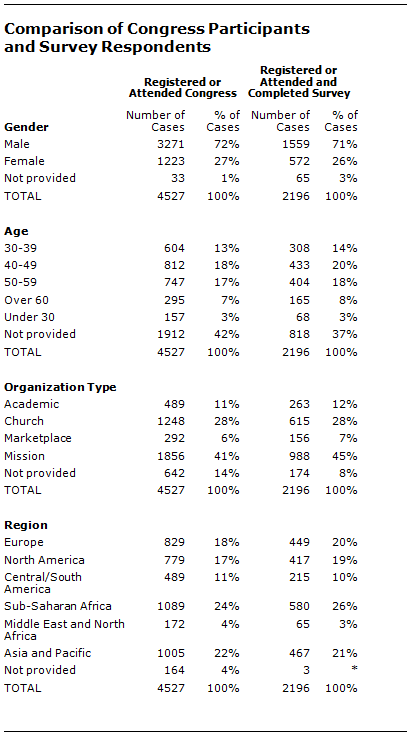
The Pew Forum conducted the survey in nine languages, including English, from August to December 2010. A total of about 4,500 people registered to attend the Third Lausanne Congress, and nearly half completed the survey, using Web and paper questionnaires.

The survey’s 2,196 respondents turned out to closely mirror the full set of leaders attending the congress in terms of region, gender, age and organization type. The organizers of the gathering sought to create a body that was representative of the geographic distribution of evangelicals around the world. Thus, they divided the world into 12 regions and invited delegates in rough proportion to their estimates of the number of evangelicals in each region and country. About six-in-ten of the evangelical leaders surveyed (57%) are from the Global South while about four-in-ten (43%) are from the Global North, including 16% from the United States. They are ethnically and racially diverse: 36% identify as Caucasian, 23% as black, 17% as Asian, 5% as Hispanic and 1% as Arab, with the remainder either not identifying as any of these (10%) or indicating they are of mixed race (7%). But they are less diverse in other ways: Nearly three-quarters of the evangelical leaders surveyed (74%) are employed by churches or other religious organizations, and they are predominantly college-educated, male and middle-aged, with very few under age 30.

The Global South and the Global North

In recent years, numerous books and articles have discussed the shifting demographics of Christianity, particularly the rapid growth in the proportion of Christians who live in the Global South (especially Africa, Asia and Latin America) and whether the influence of Christians in the Global North is waning, or not.3 The survey contains several questions about the relationship of Christians in the United States and Europe (part of the Global North, sometimes also called “the West”) with those in the Global South. On the whole, these questions show that evangelicals can be quite self-critical. For example, not only do most Lausanne Congress participants say that evangelical leaders from Africa, Asia and Latin America have “too little influence” on global Christianity, but leaders from the Global North are even more likely than those from the South to make this criticism (78% vs. 62%). At the same time, leaders from both regions say that evangelical Christians from their respective region fail to provide their fair share of financial support for global Christianity.

lausanne-exec-7

Nearly two-thirds (65%) of leaders from the Global South say that evangelicals in Africa, Asia and Latin America provide too little financial support, and 51% of leaders from the Global North say the same about evangelicals in the U.S. and Europe.

lausanne-exec-8

There is a noticeable gap between the North and South, however, in the degree of optimism about the future of evangelicalism. More than two-thirds of Global South leaders (71%) think the state of evangelicalism in their country will be better in five years than it is today. By comparison, 44% of Global North leaders take that view. Evangelical leaders from the United States stand out for their particularly high levels of pessimism. More than half of U.S. leaders (53%) see the current state of evangelical Christianity in America as worse than it was five years ago; only 17% think it has improved. And as U.S. leaders look a few years ahead, about half (48%) expect the state of evangelical Christianity to worsen, and two-in-ten (20%) expect things to remain about the same; only three-in-ten (31%) think evangelical Christianity will be in a better position in five years than it is today.

Evangelical Beliefs and Practices

lausanne-exec-9
lausanne-exec-10

Virtually all the leaders surveyed (96%) say that Christianity is the one, true faith leading to eternal life, and 95% say that believing otherwise – taking the position that “Jesus Christ is NOT the only path to salvation” – is incompatible with being a good evangelical. There is also broad agreement among the leaders on the practices that are necessary to be “a good evangelical Christian.” Two broad types of behavior are almost unanimously seen as essential: Nearly all leaders (97%) say evangelicals must follow the teachings of Christ in their personal and family life, and 94% say working to lead others to Christ is essential for being a good evangelical Christian.

Majorities also agree on several other practices. About three-quarters (73%) say working to help the poor and needy is essential for being a good evangelical Christian; an additional 24% say helping the poor is important but not essential. In addition, tithing – giving at least a tenth of one’s income to the church – is deemed essential to being a good evangelical by 58% of the leaders. And nearly as many (56%) say that evangelicals are obliged to take a stand on social and political issues that conflict with moral and biblical principles. About a third (36%) say that working to protect the natural environment is essential to being a good evangelical (an additional 47% say protecting the environment is important but not essential). Leaders from the Global South are more inclined than leaders from the Global North to view environmental protection as essential to being a good evangelical.

There is also widespread agreement that practices associated with other religious traditions are incompatible with being a good evangelical Christian: More than 90% of the leaders say that engaging in yoga as a spiritual practice and believing in astrology or reincarnation are not compatible with evangelicalism. But evangelical leaders are divided over the consumption of alcohol. About four-in-ten (42%) say it is compatible with being a good evangelical, while 52% say it is incompatible. Leaders from sub-Saharan Africa are especially likely to oppose alcohol use; 78% of them say it is incompatible with being a good evangelical, as do 78% of evangelical leaders who live in Muslim-majority countries.

Nearly nine-in-ten leaders surveyed (88%) reject the notion that humans have evolved entirely by natural processes that do not involve God. But they are divided between those who believe that humans and other living things have existed in their present form since the beginning of time (47%) and those who believe that a supreme being guided the evolution of living things for the purpose of creating humans and other life in its present form (41%).

lausanne-exec-11

When it comes to teachings about the Second Coming of Jesus, slightly more than half (52%) say they believe that Jesus probably or definitely will return in their lifetimes; among leaders from the Global South, two-thirds (67%) expect the Second Coming to occur in their lifetimes, compared with a third of leaders (34%) from the Global North. Moreover, about six-in-ten Lausanne Congress participants (61%) believe in the Rapture of the church – the prophecy that as the end of the world draws near, Christians will be instantly taken up to heaven, leaving non-believers behind.

Roughly half or more of the global evangelical leaders surveyed report that they have experienced or witnessed a divine healing (76%), received a direct revelation from God (61%) and spoken in tongues (47%). These experiences, often associated with Pentecostalism, are particularly common among leaders from the Global South.  Seven-in-ten (70%) of those from the Global South, for example, say they have witnessed the devil or evil spirits being driven out of a person, compared with four-in-ten (41%) of the leaders from the Global North. Moreover, fully one-third of the Global South leaders (33%) describe themselves as Pentecostals, compared with only about one-in-seven of the leaders from the Global North (14%). While the survey finds a high degree of acceptance of Pentecostal practices, however, it is not universal. Roughly a quarter of the Lausanne Congress participants (26%) say, for example, that speaking in tongues is not compatible with being a good evangelical. Among leaders from Latin America, the Asia-Pacific region and the Middle East-North Africa, at least a third take this position.

lausanne-exec-12
lausanne-exec-13

But leaders from all the regions of the world are solidly united in rejecting the so-called “prosperity gospel” – the idea (sometimes associated with Pentecostalism but accepted as well by many Christians outside that tradition) that God will grant wealth and good health to those who have enough faith.4

Tensions with Secularism and Modernity

The global evangelical leaders surveyed express high levels of concern about secularism, consumerism and popular culture. More than nine-in-ten consider the influence of secularism to be either a major threat (71%) or a minor threat (20%) to evangelical Christianity in their countries. This threat is closely followed by “too much emphasis on consumerism and material goods,” which two-thirds of the leaders call a major threat (67%) and one-quarter call a minor threat (24%), and by “sex and violence in popular culture,” which about six-in-ten identify as a major threat (59%) and three-in-ten cite as a minor threat (30%). On a list of nine potential threats to evangelicalism, no other item is seen as a major threat by a majority of the leaders. Only the influence of Islam comes close, with 47% saying it is a major threat and an additional 34% calling it a minor threat.

lausanne-exec-14

Perceptions of the threat from secularism are high both in the Global North and in the Global South, though they are higher in the North (86%) than in the South (59%). Nine-in-ten leaders (90%) from North America (including 92% from the United States) say the influence of secularism is a major threat; nearly as many leaders from Europe agree (82%). Concern about secularism is lowest in the Middle East and North Africa, where slightly more than a third view it as a major threat (37%).

The Lausanne leaders express lower – but still substantial – levels of concern about a variety of internal disagreements and shortcomings among evangelicals. More than a quarter of the leaders perceive major threats from theological divisions among evangelicals (30%), evangelical leaders displaying lavish lifestyles (30%) and evangelical leaders violating sexual morals (26%). U.S. leaders are particularly likely to worry about sexual issues; four-in-ten U.S. leaders surveyed (40%) say violations of sexual morals are a major threat to evangelicalism, compared with 23% of leaders from other countries.

In addition, about one-in-five of the evangelical leaders surveyed (22%) considers government restrictions on religious freedom to be a major threat. Just one-in-ten (10%) views the influence of Catholicism as a major threat; a slight majority (51%) says Catholicism is no threat at all.

Relations with Other Religious Traditions

Historically, the evangelical Protestant tradition was at odds with Catholicism.  But the survey shows that evangelical leaders today hold favorable views of Catholics by a more than three-to-one margin, and they perceive Catholics as mostly friendly or neutral toward evangelicals. The leaders express similarly positive views about adherents of Eastern Orthodoxy, the third major historic tradition (alongside Protestantism and Catholicism) within global Christianity.

lausanne-exec-15

The evangelical leaders also are favorably disposed toward the century-old renewalist movement known as Pentecostalism. Some evangelical Christian denominations in the U.S. (including the largest, the Southern Baptist Convention) forbid or discourage Pentecostal practices such as speaking in tongues. But the survey finds little friction between the Lausanne delegates and Pentecostal Christians. More than nine-in-ten of the leaders who express an opinion (92%) have a favorable view of Pentecostals, and eight-in-ten (80%) see Pentecostal Christians as friendly toward evangelicals in their country — more than any other group considered. Only 3% say Pentecostals are unfriendly, suggesting there is little tension with this closely related movement or, in the view of some scholars, sub-set of evangelical Protestantism.5

lausanne-exec-16

Overall, most of the evangelical leaders report that conflict between religious groups is not a big problem in their home countries. Leaders in the Middle East and North Africa are most likely to say religious conflict is a moderately big (37%) or very big (35%) problem. About half of those in the Asia-Pacific region (55%) and sub-Saharan Africa (49%) also see inter-religious conflict as a moderately or very big problem. By contrast, in North America, Latin America and Europe, majorities say it is either a small problem or not a problem at all.6

lausanne-exec-17

Still, the survey finds some signs of tension with non-Christian religions, particularly Islam. Nearly seven-in-ten of the evangelical leaders (69%) name Islam as more prone to violence than other religions.7 Far more leaders say Islam and Christianity are “very different” (69%) than say the two faiths have “a lot in common” (25%). And a solid majority of the leaders who express an opinion (69%) feel that Muslims are generally unfriendly toward evangelicals in their country. Sizeable minorities also see Hindus (41%) and Buddhists (39%) as unfriendly toward evangelicals. Of the evangelical leaders who express opinions on other religious groups, most say they hold generally unfavorable views of Hindus (65%), Buddhists (65%) and Muslims (67%).

Jews are the only non-Christian religious group toward which the leaders express generally favorable opinions. Three-quarters have either mostly favorable (60%) or very favorable (16%) views of Jews, even though most do not think those views are reciprocated;

lausanne-exec-18

86% think that Jews are either neutral (53%) or unfriendly (33%) toward evangelicals. By a margin of more than three-to-one, most also say that God’s covenant with the Jewish people continues today (73%) rather than that the biblical covenant with the Jewish people no longer applies (22%).

Attitudes toward Israel, however, are more mixed. Overall, 48% of the evangelicals say the state of Israel is a fulfillment of biblical prophecy about the Second Coming of Jesus, while 42% say it is not. More say they sympathize with Israel (34%) than with the Palestinians (11%), but a small majority say they either sympathize with both sides equally (39%) or with neither side (13%). Leaders from sub-Saharan Africa are especially inclined to sympathize with Israel (50%), while sympathy for the Palestinians is strongest in the Middle East and North Africa (26%). Among evangelical leaders from the United States, three-in-ten (30%) sympathize more with Israel, 13% sympathize more with the Palestinians and nearly half (49%) say they sympathize with both sides equally.

The survey also assesses the evangelical leaders’ perceptions of non-religious people. Asked to assess the attitudes of various groups toward evangelical Christians in their country, just 7% say they consider non-religious people to be friendly, while 45% say the non-religious are unfriendly toward evangelicals. And seven-in-ten leaders who answered the question (70%) say they have either a very unfavorable (35%) or mostly unfavorable (35%) opinion of atheists.

Priorities and Strategies for Evangelization

Perhaps not surprisingly, given their concerns about secularism and their views of atheists, the leaders place the greatest importance on evangelizing non-religious people, which 73% of those expressing an opinion call a top priority and an additional 19% say is very important.

lausanne-exec-19

Evangelizing Muslims emerges as the leaders’ second-highest priority; 59% say it is a top priority and an additional 27% say it is very important. By an overall margin of about four-to-one (78% to 17%), most of the evangelical leaders think that Christianity is gaining more adherents than Islam in their countries. But Christian leaders from the Middle East and North Africa are less sanguine; more than a third of them (37%) say Islam is gaining more adherents than Christianity in the countries where they live.

Eight-in-ten leaders living in Muslim-majority countries (80%) say evangelizing Muslims is a top priority, compared with 56% of those living in non-Muslim-majority countries. Similarly, nearly nine-in-ten leaders who live in Hindu-majority countries (87%) cite evangelizing Hindus as a top priority, and 83% of those living in Buddhist-majority countries say evangelizing Buddhists is a top priority. Evangelical leaders who live in Europe and the United States, which have large populations of non-religious people, overwhelmingly cite evangelization of the non-religious as a top priority (83% in Europe, 78% in the U.S.).

Jews, Catholics and other (non-evangelical) Christians are generally seen as lower-priority groups for evangelization, though substantial minorities (ranging from one-fifth to roughly a quarter) of the Lausanne leaders also consider evangelizing these groups to be a top priority.

There is general consensus among the leaders about strategies for evangelization. Regardless of where they live, the leaders surveyed overwhelmingly think that such efforts should focus on changing individual hearts (80%) rather than on reforming social institutions (16%). Most leaders also agree that empowering local missionaries is more effective in promoting Christianity (86%) than sending missionaries to other countries (12%).

lausanne-exec-20

There is less agreement, however, on short-term missions, those lasting a few weeks or months. About one-quarter of evangelical leaders (28%) say that short-term missions are very valuable, but most give them a lukewarm endorsement, calling them either somewhat valuable (42%) or not too valuable (26%). The evangelical leaders also appear to be somewhat skeptical about the role of Christian schools in transmitting the faith. Far more leaders rate Christian schools in their country as good or excellent at providing a high-quality academic education in subjects such as reading, writing and arithmetic (78%) than rate those schools as good or excellent at nurturing children in the Christian faith (45%).

Social and Political Attitudes

On the whole, global evangelical leaders hold conservative opinions on social issues. For example, nearly all the leaders surveyed (96%) say that abortion is usually or always wrong, with a slight majority (51%) saying it is always wrong.

lausanne-exec-21

Overall, more than eight-in-ten (84%) of the evangelical leaders also say that society should discourage homosexuality. There is a sizeable amount of regional variation on this question, however, with about half (51%) of the leaders from Latin America and nearly a quarter (23%) of those from Europe saying that homo-sexuality should be accepted by society, while 87% of the North American leaders and upwards of 85% of leaders in other regions say that homosexuality should be discouraged.

Leaders from the Global South are much more inclined than those from the Global North to say that it is necessary to believe in God to be a moral person (63% vs. 29%). And on some issues relating to family, marriage and gender, leaders from the Global South tend to be more conservative than their counterparts from the Global North. For example, two-thirds (67%) of those from the Global South say a wife must always obey her husband, while 39% of the leaders from the Global North take that position. Leaders from the Global South are nearly twice as likely as those from the Global North to say that all adults have a responsibility to marry and have children (60% vs. 33%). Leaders from the Global South also are more likely to say that men should be the main financial providers and religious leaders in the family (61% in the Global South, 43% in the Global North). Latin American leaders tend to be relatively less conservative on these measures than other leaders from the Global South.

lausanne-exec-22

These North-South differences are greater, in many cases, than the differences between male and female leaders, even on issues related to gender. The evangelical women surveyed, for example, are about as likely as the men to say that a wife should always obey her husband (53% of women vs. 57% of men). Strong majorities of both sexes also say that men have a duty to serve as the religious leaders in a family.

However, large majorities of both the Global South leaders (77%) and the Global North leaders (73%) think that women should be allowed to serve as pastors, though leaders from the Middle East-North Africa region are almost evenly split on this question (46% yes, 43% no). In addition, most leaders from both the North and the South reject the idea that “women should stay at home and raise the children in the family.” Leaders in the U.S. are more narrowly divided on this issue; 44% agree that women should stay at home and raise the children, while 53% disagree. By comparison, leaders in Europe oppose this idea by a more than two-to-one margin (28% agree, 69% disagree), and those in the Global South do so as well (31% agree, 64% disagree).

lausanne-exec-23
lausanne-exec-24

Global evangelical leaders support political activism. More than eight-in-ten (84%) think that religious leaders should express their views on political matters, while just 13% say religious leaders should not express their views. This activism fits with the belief (described above) that to be a good evangelical, it is essential to take a public stand on political issues that conflict with moral and biblical principles.

Most of the evangelical leaders consider helping the poor to be both a personal and a public responsibility. Eight-in-ten (80%) agree that government has a responsibility to help the very poor who cannot take care of themselves. Among leaders from the United States, however, a smaller majority (56%) takes this position.

The leaders are nearly evenly split on whether the Bible should become the “official law of the land” in their countries; 48% oppose making the Bible the law of the land, while 45% favor it. By a more than three-to-one margin (74% vs. 21%), however, evangelical leaders surveyed say it is acceptable to them if their country’s political leaders have a different religion than their own. This is true even though many feel that evangelicals face religious discrimination. Fully a third (34%) say evangelicals are treated unfairly by the government in their country either very often (12%) or somewhat often (22%). They report discrimination particularly in employment and government services; about one-in-five says that in their country, evangelical Christians often face discrimination when they apply for a job (20%) or seek government services or benefits (18%). Somewhat fewer (16%) say that they, personally, experience discrimination very often or somewhat often, while 41% say they never personally experience discrimination because of their religion.

Roadmap to the Report

The remainder of this report is divided into several parts. The next section, “Global South and Global North,” looks at the leaders’ assessments of whether evangelicals are gaining or losing influence and their degree of optimism or pessimism about the state of evangelicalism. “Evangelical Beliefs and Practices” explores the boundaries of Christian belief and practice as understood by this group of leaders. “Tensions with Secularism and Modernity” discusses the concerns among these global evangelical leaders about secularism and other aspects of modern society. “Intergroup Relations” examines their attitudes toward other religious groups and contacts across faith lines. “Priorities and Strategies for Evangelization” looks at efforts to spread the Christian faith. “Morality, Society and Politics” details the evangelical leaders’ positions on social, political and family issues, including gender roles. Details about how the survey was conducted are in Appendix A (Survey Methodology). The survey results are in Appendix B (Survey Topline).


Footnotes:

2 As with many survey questions, these favorability ratings are open to varying interpretations. When expressing a view on a religious group, a respondent may be thinking about all followers of that faith, or about a few people the respondent knows personally, or about certain doctrines or teachings of the religion, or about a mix of these and other factors. The wording of the survey does not specify how the respondent should think about the question, and evangelical leaders who approached Pew Forum staff for guidance at the Cape Town 2010 congress were advised simply to answer the question as best they could. (return to text)

3 See, for example, Philip Jenkins, The Next Christendom: The Coming of Global Christianity, Oxford University Press, 2002, and Robert Wuthnow, Boundless Faith: The Global Outreach of American Churches, University of California Press, 2009. (return to text)

4 For background on the prosperity gospel, see the Pew Forum’s reports Spirit and Power: A 10-Country Survey of Pentecostals, 2006, and Tolerance and Tension: Islam and Christianity in Sub-Saharan Africa, 2010. (return to text)

5 Some studies classify Pentecostal Christians as a sub-set of evangelicals. See, for example, the Institute for the Study of American Evangelicals. Other studies treat Pentecostalism as a movement that is separate from evangelicalism, though there clearly is substantial overlap between the two movements. See, for example, the World Christian Database. For more information on Pentecostalism, see the Pew Forum’s 2006 report, Spirit and Power: A 10-Country Survey of Pentecostals. (return to text)

6 These perceptions generally track with the levels of social hostilities in each region as measured in the Pew Forum’s 2009 report, Global Restrictions on Religion. (return to text)

7 Respondents who said (in response to Q29) that some religions are more prone to violence than others were asked an open-ended follow-up question (Q29b) that asked, “Which religion, if any, do you think is more prone to violence than others?” Up to four responses to Q29b were coded. (return to text)

Photo credit: ©Ocean/Corbis

Preface

Although its historical roots are mostly in Northern Europe and North America, evangelical Protestantism is a global phenomenon today. In 1910, by one estimate, there were about 80 million evangelicals, and more than 90% of them lived in Europe and North America. By 2010, the number of evangelicals had risen to at least 260 million, and most lived outside Europe or North America. Indeed, the “Global South” (sub-Saharan Africa, the Middle East and North Africa, Latin America and most of Asia) is home to more evangelicals today than the “Global North” (Europe, North America, Japan, Australia and New Zealand).1

As the evangelical movement has grown and spread around the globe over the past century, it has become enormously diverse, ranging from Anglicans in Africa, to Baptists in Russia, to independent house churches in China, to Pentecostals in Latin America. And this diversity, in turn, gives rise to numerous questions. How much do evangelicals around the world have in common? What unites them? What divides them? Do leading evangelicals in the Global South see eye-to-eye with those in the Global North on what is essential to their faith, what is important but not essential and what is simply incompatible with evangelical Christianity?

To help answer these kinds of questions, the Pew Research Center’s Forum on Religion & Public Life conducted a survey of participants in the Third Lausanne Congress of World Evangelization. The congress takes its name from a worldwide gathering of evangelical leaders convened by the Rev. Billy Graham in Lausanne, Switzerland, in 1974. The 1974 gathering led to a foundational document called the Lausanne Covenant and a coordinating body known as the Lausanne Committee for World Evangelization (LCWE). The LCWE continues to spearhead the Lausanne Movement, which describes itself as “a worldwide movement that mobilizes evangelical leaders to collaborate for world evangelization.” The movement held a second Lausanne Congress in Manila, Philippines, in 1989. The third congress took place in Cape Town, South Africa, in October 2010.

The organizers of the Cape Town 2010 gathering sought to bring together a geographically representative “global parliament” of evangelical leaders that would reflect the “demographic, cultural, theological and ecclesiastical diversity of the global Church.” The selection of participants was largely decentralized, with the LCWE’s international deputy directors working in each of 12 regions to invite participants in approximate proportion to each country’s share of the global evangelical population.

This selection process resulted in a body that was ethnically and linguistically diverse. At the same time, however, the participants surveyed by the Pew Forum differ in important ways from rank-and-file evangelicals in their home countries. They are predominantly male, middle-aged and college-educated, and nearly three-quarters (74%) are employed by churches or religious organizations. Fully half (51%) are ordained ministers. Hence, the survey results do not necessarily reflect the views ofevangelicals as a whole. Rather, the survey captures the attitudes and experiences of the global group of evangelical leaders who participated in the Lausanne conference,which is the way the results are characterized throughout this report.

One advantage of surveying a leadership group, as opposed to the general public, is that the questions can be more specialized and presume more knowledge among the respondents. The Pew Forum survey asked the Lausanne Congress participants to rate the prospects for evangelical Christianity in their home countries, to express their views on what it means to be an evangelical and to describe their beliefs on a number of theological, social and political issues. We also asked for their perceptions about the relationship between evangelical Protestants and other religious groups, for their assessment of the greatest threats to evangelicalism today and for their views on evangelization, including whom to evangelize and how.

The resulting report offers a detailed portrait of the beliefs and practices of this group of global evangelical leaders. It finds, perhaps not surprisingly, a high degree of consensus on some core theological matters, such as the belief that Christianity is the “one, true faith leading to eternal life” and that the Bible is the word of God. But it also finds a number of subjects on which evangelical leaders are divided, including whether everything in the Bible should be read literally, whether it is necessary to believe in God to be a moral person and whether it is acceptable for evangelical Christians to drink alcohol. On many questions, the evangelical leaders’ opinions vary substantially by region, reflecting the differing contexts in which the leaders live and work.

The survey was conducted with the cooperation of the Lausanne Committee for World Evangelization, which sought “an honest appraisal of who we are,” in the words of its executive chairman, the Rev. S. Douglas Birdsall. But the Pew Forum bore all the financial costs, including sending personnel to Cape Town to administer the survey, and had full responsibility for all aspects of the survey’s design, content and analysis. Thus, no part of the survey or this report should be construed as a statement or endorsement from the LCWE.

The Global Survey of Evangelical Protestant Leaders is part of the Pew-Templeton Global Religious Futures project, which analyzes religious change and its impact on societies around the world. Previous reports produced under this initiative, funded by The Pew Charitable Trusts and the John Templeton Foundation, include The Future of the Global Muslim Population (January 2011), Tolerance and Tension: Islam and Christianity in Sub-Saharan Africa (April 2010), Global Restrictions on Religion (December 2009) and Spirit and Power: A 10-Country Survey of Pentecostals (October 2006).

The project manager for this survey was Cary Funk, an experienced public opinion researcher, associate professor at Virginia Commonwealth University and consultant to the Pew Research Center. We are immensely grateful for her sure hand through all phases of the survey. The primary researchers were Greg Smith and Allison Pond. The fieldwork, which involved the distribution and collection of electronic as well as paper questionnaires, was carried out by Princeton Survey Research Associates International, led by PSRAI President Mary McIntosh.

For generously sharing their expertise on evangelicals and evangelicalism, we would like to thank Timothy Samuel Shah of the Berkley Center for Religion, Peace and World Affairs at Georgetown University; Todd M. Johnson and Bert Hickman of Gordon-Conwell Theological Seminary; and John Green of the University of Akron. Finally, this survey could not have taken place without the steadfast cooperation of LCWE Executive Chairman Doug Birdsall; the Rev. Blair T. Carlson, the LCWE’s congress director for Cape Town 2010; and Kimberly Iannelli, the LCWE’s chief operating officer.

Luis Lugo, Director Alan Cooperman, Associate Director, Research


Footnotes:

1 See Todd M. Johnson and Kenneth R. Ross, editors, Atlas of Global Christianity, 1910-2010, Edinburgh University Press, 2010, p. 98. Their 260 million estimate is a relatively conservative count. If the definition of evangelical Protestants is broadened to include all Pentecostal Christians, the worldwide total could be 600 million or more. Return to text

Photo credit: ©Ocean/Corbis

Global South and Global North

The evangelical leaders attending the Lausanne Congress were asked to assess the past, present and future of evangelical Christianity in their respective countries. Taken as a whole, their responses provide a window on the state of evangelicalism around the world. Leaders from the Global South emerge as much more optimistic than those from the Global North.

A. Views of Each Other

The survey asked about the relative amount of influence and financial support for global Christianity from the West (defined as the U.S. and Europe) and the Global South (defined as Africa, Asia and Latin America). About two-thirds (68%) of all the leaders surveyed say that those from the Global South have “too little influence” on global Christianity today, while 22% say the influence of leaders from the Global South is about right and 7% say these leaders have too much influence.

Leaders from all parts of the world tend to share the view that the South lacks sufficient influence. In fact, leaders from the Global North are even more likely than their counterparts from the Global South to say that evangelical leaders in Africa, Asia and Latin America have too little influence on global Christianity (78% vs. 62%).

Views on the influence of leaders from the U.S. and Europe are more mixed; 44% of all respondents say such leaders have too much influence, 32% say their influence is about right and 22% think they have too little influence on global Christianity.

A plurality of leaders from both the Global North and the Global South say that leaders in the West have too much influence. Leaders who are themselves from the Global North are a bit more likely than those from the Global South to say that Western leaders have too much influence on global Christianity (47% vs. 42%).

lausanne-global-1

When it comes to financial support for global Christianity, evangelicals from both the Global North and the Global South think there is much room for improvement and tend to see their own efforts as wanting. More than half of all respondents (55%) say evangelicals in Africa, Asia and Latin America provide “less than their fair share” of financial support for global Christianity. About three-in-ten (31%) say that Christians in the Global South provide about their fair share of financial support, and 7% say they provide more than their fair share.

Similarly, a 45% plurality says evangelicals in the West provide “less than their fair share” of financial support for global Christianity. About three-in-ten (29%) say that Christians in the West provide about their fair share, and 21% say they provide more than their fair share.

Leaders tend to be more critical of their own regions. Respondents from the Global North are more likely than those from the Global South to say that evangelicals in the West provide less than their fair share of support (51% vs. 40%). Similarly, respondents from the Global South are more likely than those in the Global North to say that evangelicals in Africa, Asia and Latin America provide less than their fair share of financial support (65% vs. 40%).

B. Status of Evangelicalism

A series of three questions probes the evangelical leaders’ assessments of the current state of evangelical Christianity in their country, as well as their optimism or pessimism about the near future.8

On a zero-to-10 scale, with zero being the worst and 10 the best, the evangelical leaders give an average (mean) rating of exactly 5.0 to the current state of evangelical Christianity in their country today. Asked to assess the state of evangelicalism five years ago, the leaders provide an average rating of 4.9, which is little different from the average rating they give the state of evangelicalism at present. The leaders tend to be more positive about the future: They rate the expected state of evangelical Christianity in another five years at 5.7 on average.

lausanne-global-2

The average ratings, however, mask a fair amount of variation. One-fifth of the leaders (20%) put the current state of evangelicalism in their country at the most positive, top end of the scale (7 to 10), while 21% rate the current situation at the bottom end of the scale (from 0 to 3). About six-in-ten (58%) rate the state of affairs in the middle range (from 4 to 6 on the scale).

Moreover, there are wide regional differences in the leaders’ assessments. Leaders from the Global South are more likely than those in the Global North to see the current state of evangelicalism in their country in positive terms. One quarter of the Global South leaders rate the present at the top end of the scale (7 to 10), compared with just 13% of the Global North leaders who do the same. A majority of both groups, however, rates the present state of evangelical Christianity in the middle range of the scale (a mean of 5.3 for the Global South vs. a mean of 4.7 for the Global North).

lausanne-global-3

The leaders hold a tempered sense of progress over the past five years. Four-in-ten rate the current state of evangelical Christianity as better than where things stood five years ago. But about a third (32%) consider it worse today, and 27% see it as about the same.

Global South leaders are more likely than those in the Global North to think that evangelicalism has made progress in recent years. A majority of Global North leaders either see no progress for evangelical Christianity over the past five years (34%) or see it as worse today than five years ago (38%).

lausanne-global-4

On the whole, leaders are more optimistic about the future of evangelicalism. About six-in-ten (59%) leaders expect the future of evangelical Christianity to be better than where things stand today. Leaders from the Global South are especially upbeat about the future; 71% expect progress for evangelical Christianity in the near future, compared with 44% of leaders from the Global North who expect progress to be made over the next five years.

lausanne-global-5

Leaders from the U.S. stand out from the rest as especially downbeat about the state of evangelical Christianity at home. A 53% majority considers the state of evangelical Christianity today to be worse than it was five years ago. And nearly half of U.S. leaders (48%) are pessimistic about the future of evangelicalism in the U.S.

Overall, opinion about whether evangelicals are increasing or losing influence  is divided, with 51% of the leaders saying that evangelicals are losing influence in their countries and 46% saying that evangelicals are increasing their influence.

lausanne-global-6

Once again, however, there are wide differences of perspective on this issue. Leaders in the Global South think evangelicals are gaining influence on life in their countries, by a margin of 58% to 39%. By contrast, two-thirds of those in the Global North (66%) say that evangelicals are losing influence, while just 31% think evangelicals are gaining influence. Leaders from the United States are particularly pessimistic; only 17% say evangelicals have an increasing influence on life in the U.S. today, while 82% say evangelicals are losing influence.


Footnotes

8 These questions, adapted from quality-of-life ratings first developed in the mid-20th century by Hadley Cantril and colleagues, use what researchers call a “self-anchoring scale.” Respondents first give a numerical rating of the present state of evangelicalism. Then, having anchored their assessment of evangelicalism in the present, they are asked to rate the past and future in the same way. Respondents are not asked directly whether they think the future (or the past) of evangelicalism is better or worse than the present; they are simply asked to rate three points in time on the same numerical scale. See Hadley Cantril, The Pattern of Human Concerns, Rutgers University Press, 1965. (return to text)

Photo credit: ©Ocean/Corbis

Evangelical Beliefs and Practices

Who are evangelical Christians? What do they believe? And what do they see as the boundaries of their faith? The survey contains several questions that probe how participants in the Third Lausanne Congress of World Evangelization identify themselves religiously, in what faith they were raised and what spiritual experiences they have had. It finds broad agreement among these Christian leaders on some beliefs and practices that are essential to being “a good evangelical.” Virtually all the leaders surveyed, for example, say evangelicals must follow the teachings of Christ in their personal and family life. But the survey also finds areas of substantial disagreement, including over biblical literalism and the consumption of alcohol.

A. Religious Identities

lausanne-belief-1

The “born-again” experience is a defining characteristic of the evangelical movement, and one that is reported by nearly all of the leaders surveyed. More than nine-in-ten (93%) say they have been born-again, in most cases at a relatively young age. The average is 17, with nearly all of the leaders (86%) saying they were born-again before the age of 30. Two-thirds (67%) say the experience occurred before they turned 20. Even among those who were not raised as evangelical Christians, the average reported age of a born-again experience is 20. Among those who were raised as evangelicals, it is 14.

Not surprisingly, an overwhelming majority of the leaders (90%) identify themselves as evangelical Christians. But a substantial minority also describe themselves as Pente-costal (25%) or charismatic (31%) Christians. Younger evangelical leaders are more likely to identify as Pentecostal Christians. Among those under age 40, for example, 31% say they are Pentecostals, as do 29% of those in their 40s, compared with 22% of those in their fifties and 16% of those age 60 or older. Younger leaders are also more likely to identify as charismatic Christians (35% of those under 40, compared with 23% of those 60 and older).

lausanne-belief-2

As previous studies have emphasized, Pentecostalism is especially common in the Global South, and in this survey, leaders in the Global South are indeed more likely to say they are Pentecostals (33%) than leaders in the Global North (14%).9 Leaders in sub-Saharan Africa are particularly likely to identify with Pentecostalism (42%). When it comes to identifying as a charismatic Christian, however, there is little difference between leaders from the Global North (30%) and the Global South (32%). Leaders from Europe (37%) and sub-Saharan-Africa (38%) are equally likely to say they think of themselves as charismatic Christians.

For the purposes of this report, those who identify themselves as either charismatic or Pentecostal Christians on these questions are grouped together and referred to as renewalist Christians, or simply renewalists. Four-in-ten leaders at the Congress are included in this umbrella category. By contrast, only 11% of the leaders say they think of themselves as fundamentalist Christians.

lausanne-belief-3

Half of the leaders surveyed say they were raised as evangelical Protestants, and an additional 17% were raised as non-evangelical Protestants. Roughly one-in-eight (13%) were raised Catholic, and 5% say they were raised without any particular religion. Very few grew up as Muslims (3%), Buddhists (2%), Orthodox Christians (2%) or in a traditional, animist or new age religion (2%). Leaders age 60 or older are most likely to say they were raised as Protestants (80%). Among those raised outside of Protestantism, differences in childhood religion tend to reflect the predominant religion of the region in which they live.

B. What Does it Mean to be an Evangelical?

With near unanimity, the Lausanne leaders see two practices as essential to being a good evangelical Christian. Virtually all of the leaders surveyed (97%) say it is necessary to follow the teachings of Christ in one’s personal and family life. Nearly as many (94%) say that working to lead others to Christ is part of being a good evangelical.

Smaller but still substantial majorities of leaders also agree on several other essential behaviors. About three-quarters (73%) say working to help the poor and needy is essential for being a good evangelical Christian; 24% say this is important but not essential. There is widespread agreement about this activity among leaders from all regions of the world. Fully 74% of leaders from the Global North say helping the poor and needy is essential, as do 72% of leaders from the Global South.

lausanne-belief-4

Tithing – or giving at least a tenth of one’s income to the church – is deemed essential for being a good evangelical Christian by 58% of the leaders; 32% say tithing is important but not essential, and 8% consider tithing either not too important or not at all important. Leaders from Europe are less likely than those in other regions to say tithing is essential for being a good evangelical. About a third of European leaders (36%) say tithing is essential, compared with 59% of North American leaders and 66% of leaders in the Global South.

Overall, a solid majority says that it is essential for evangelicals to take a public stand on social and political issues when those issues conflict with moral and biblical principles; 56% call this essential, while 37% say it is important but not essential, and 5% say it is either not too important or not at all important. In addition, about half of the leaders (49%) say that it is essential to take a public stand on social and political issues that could limit the freedom of evangelicals to practice their faith; 39% say this is important but not essential, and 9% say it is either not too or not at all important.

About one-third (36%) say working to protect the natural environment is essential for being a good evangelical, while close to half (47%) say that protecting the environment is important but not essential, and 16% say it is either not too or not at all important. Leaders living in Hindu-majority countries, namely India and Nepal, are more likely than others (57% vs. 34%) to say that protecting the environment is essential for being a good evangelical.

There is strong consensus among the leaders on the compatibility of some religious beliefs and practices with evangelicalism. More than nine-in-ten see no problem, for example, with believing that miracles can take place today (94%) or believing in divine healing (93%).

There is also solid agreement among the Lausanne leaders on some beliefs and practices that are not compatible with being a good evangelical, such as mixing Christianity with elements of other faiths, sometimes called syncretism. More than nine-in-ten of the leaders surveyed say that engaging in yoga as a spiritual practice (92%), believing in astrology (97%) and believing in reincarnation (96%) are incompatible with being a good evangelical. Nearly all the leaders surveyed (95%) also say that believing Jesus Christ is not the only path to salvation is incompatible with being a good evangelical Christian.

lausanne-belief-5

Among the Lausanne leaders, 70% say that speaking in tongues is compatible with being a good evangelical Christian. But a sizeable minority (26%) considers this practice, which is commonly associated with Pentecostalism, to be incompatible. Among renewalist leaders, 84% say speaking in tongues is compatible with being a good evangelical Christian, compared with 64% of non-renewalists.

The item on which the leaders are most evenly split is the question of whether consuming alcohol is compatible with being a good evangelical Christian. Roughly half (52%) of the evangelical leaders say drinking alcohol is not compatible with being a good evangelical, while 42% say it is compatible, and 6% are not sure or do not answer.

lausanne-belief-6

Beliefs about this issue are related to the regional backgrounds of the respondents. A majority (73%) of the leaders from the Global North consider alcohol consumption to be compatible with being a good evangelical Christian. By contrast, a similarly large majority of the leaders from the Global South (75%) say alcohol consumption is not compatible with being a good evangelical. Leaders from sub-Saharan Africa are especially likely to say this; fully 78% say consuming alcohol is not compatible with being a good evangelical.

These regional differences may also reflect the influence of other religious and cultural traditions in certain areas of the world. More than eight-in-ten (83%) leaders living in Hindu-majority countries say consuming alcohol is incompatible with being a good evangelical; 78% of those living in Muslim-majority countries take the same position, as do 67% of those living in Buddhist-majority countries.

C. Beliefs

Nearly all of the Lausanne leaders (96%) believe that Christianity is the one, true faith leading to eternal life. Only 1% say that many religions can lead to eternal life.

lausanne-belief-7

This near unanimity contrasts sharply with the answers given by rank-and-file evangelicals on surveys in the U.S. and sub-Saharan Africa. Evangelical Protestants in the U.S. are divided on whether “my religion is the one, true faith leading to eternal life,” with 51% saying it is the sole path to eternal life and 45% saying many religions can lead to eternal life.10 Opinions among evangelical Protestants in 15 countries across sub-Saharan Africa vary widely on this question. The percentage of self-identified evangelical Protestants saying “my religion is the one true faith leading to eternal life” ranges from a low of 25% in Cameroon to a high of 86% in Ethiopia.11

Nearly all of the Lausanne Congress participants (98%) believe that the Bible is the Word of God. However, there is an almost even split between those who believe that everything in the Bible should be taken literally (50%) and those who do not (48%). Global South leaders are more likely than those from the Global North to say that the Bible should be taken literally, word for word (58% vs. 40%).

U.S. leaders participating in the Congress are evenly split between those who take everything in the Bible literally and those who do not (48% to 49%, respectively). As a point of comparison, evangelical Protestants in the U.S. are more likely to say they read the Bible literally; two-thirds (68%) take this view, while about one-quarter (27%) say that the Bible is the Word of God but that not everything in it should be taken literally, word for word.12

lausanne-belief-8

By a wide margin, the evangelical leaders surveyed reject the idea that human beings and other living things have evolved over time due solely to natural processes. Nearly half (47%) believe that humans and other living things have existed in their present form since the beginning of time, while 41% believe that a supreme being guided the evolutionary process. Only 3% say that humans and other living things have evolved over time due to natural processes such as natural selection.

Leaders from the Global North are more likely than those from the Global South to say that the evolution of living things, guided by a supreme being, has taken place. Half of the leaders from the Global North (50%) take this position (including 49% of U.S. leaders), as do 34% among Global South leaders. Leaders from the Global South are more likely than those from the Global North to say that humans and other living things have always existed in their present form (54% vs. 39%).

A slight majority of leaders (52%) believe that Christ will either probably (44%) or definitely (8%) return in their lifetimes.  Six-in-ten leaders (61%) also say they believe in the Rapture of the Church — the teaching that believers will be instantly caught up with Christ before the Great Tribulation, leaving non-believers behind to suffer on Earth.

When it comes to these beliefs about eschatology or the End Times, regional differences once again are notable. Two-thirds of Global South leaders (67%) say Christ definitely or probably will return in their lifetimes, compared with a third of Global North leaders (34%). Renewalist leaders are also more likely than non-renewalists to believe that Christ is likely to return in their lifetimes (60% vs. 47%). Among leaders from the Global South, 73% say they believe in the Rapture, compared with 44% of Global North leaders. But majorities of those surveyed from all regions except Europe believe in the rapture of the Church; evangelical leaders from sub-Saharan Africa are especially likely to believe in the Rapture (82%).

D. Practices

The global evangelical leaders tend to be frequent church-goers. The vast majority (89%) say they participate in religious services at least once a week, with two-thirds (68%) saying they attend more than once a week.

lausanne-belief-9

The evangelical leaders are also quite likely to say they participate in prayer or scripture study groups on a weekly basis (75%). By comparison, they listen to religious radio or watch religious TV programs less often; about a third (37%) do so weekly, and 29% do so seldom or never.

lausanne-belief-10
lausanne-belief-11

Leaders from the Global South are more likely than those from the Global North to participate in prayer or study groups and to tune in to religious media. For example, about half of the leaders from the Global South (47%) watch or listen to religious media programs weekly, compared with about one-quarter of the leaders from the Global North (23%). Renewalist leaders are also more likely to engage in these activities.

Nearly all the evangelical leaders surveyed (94%) say they have received a direct answer to a specific prayer request at some point in the past.

E. Renewalist Experiences

High numbers of the leaders surveyed also report having experienced or witnessed practices that are often associated with renewalist groups. For example, roughly half or more of the evangelical leaders report having spoken or prayed in tongues (47%), experienced or witnessed the devil or evil spirits being driven out of a person (57%), received a direct revelation from God (61%) or personally witnessed or experienced a faith healing (76%). A smaller but still significant number (40%) have given or interpreted prophecy.

lausanne-belief-12
lausanne-belief-13

Not surprisingly, renewalist leaders (that is, those who identify as either Pentecostal or charismatic) are more likely than other leaders to report having these experiences. More than three-quarters of renewalists say they have witnessed or experienced a divine healing (91%), a direct revelation (80%), an exorcism (78%) and speaking in tongues (81%). And two-thirds of the self-identified renewalists surveyed (67%) have given or interpreted prophecy. While non-renewalist leaders are less likely to say they have experienced each of these things, large numbers still claim some of them.

In particular, two-thirds (66%) of the leaders who do not identify as Pentecostal or charismatic say they have witnessed or experienced a divine healing, and more than four-in-ten have received a direct revelation from God (48%) or witnessed or experienced an exorcism (43%).

lausanne-belief-14

Some of these experiences appear to be more common in the Global South, where renewalist identification is higher. But even accounting for identification as a renewalist Christian, leaders from the Global South are significantly more likely than those from the Global North to say they have witnessed or experienced the devil or evil spirits being driven out of a person. They are also more likely to say they have experienced or witnessed a divine healing. And while renewalist identification is most important in understanding differences in rates of speaking in tongues, there is also a geographic difference among non-renewalist leaders on this item, with those from the South twice as likely as those from the North to have participated.

When it comes to the prosperity gospel – an issue that generates considerable controversy among Christians globally – the Lausanne leaders express a clear consensus. An overwhelming majority rejects the idea that God will grant wealth and good health to all believers who have deep faith. Only 7% of the leaders surveyed endorse the prosperity gospel, while 90% say that God does not always give wealth and good health to believers with deep faith. There is strong consensus on this point among renewalists and non-renewalists alike.


Footnotes:

9 See, for example, the Pew Forum’s 2006 report, Spirit and Power: A 10-Country Survey of Pentecostals. (return to text)

10 See the Pew Research Center, Many Americans Say Other Faiths Can Lead to Eternal Life, 2008. (return to text)

11 For more details see the Pew Forum’s 2010 report, Tolerance and Tension: Islam and Christianity in Sub-Saharan Africa, 2010. (return to text)

12 See Pew Research Center’s Forum on Religion & Public Life, U.S. Religious Knowledge Survey, 2010. (return to text)

Photo credit: ©Ocean/Corbis

Tensions with Secularism and Modernity

The Lausanne leaders consider evangelicalism to be at odds with secularism and some other aspects of modern life. Majorities living in both the Global North and the Global South see a natural conflict between being an evangelical and living in modern society. Furthermore, there is widespread agreement among the evangelical leaders that secularism, materialism, and sex and violence in popular culture constitute major threats to evangelicalism today.

A. Conflict between Evangelicalism and Modern Society?

More than six-in-ten of the evangelical leaders surveyed (64%) say there is a natural conflict between being an evangelical Christian and living in a modern society, about twice the portion who say there is no such conflict (33%). This balance of opinion is found consistently across various sub-sets of leaders, including those from the Global South and the Global North, and those from Christian-majority as well as non-Christian-majority countries.

Leaders from the U.S. are slightly more likely than leaders overall to say there is a natural conflict between being an evangelical and living in a modern society, with 71% saying there is such a conflict and 26% saying there is not. This contrasts with the attitudes of rank-and-file evangelicals in the United States; asked a similar question, about half of all U.S. evangelicals (51%) see a conflict between being “a devout religious person” and living in modern society, while 43% do not see a conflict between the two.13

B. Potential Threats to Evangelicalism

The survey finds a strong concern among the evangelical leaders about the influence of secularism, consumerism, and sex and violence in popular culture. About seven-in-ten of the leaders (71%) rate the influence of secularism as a major threat today. This is closely followed by “too much emphasis on consumerism and material goods,” which 67% call a major threat. About six-in-ten (59%) also say that sex and violence in popular culture is a major threat to evangelical Christianity today. No other item on the list of nine potential threats to evangelical Christianity is seen as a major threat by a majority of the leaders. Only the influence of Islam comes close, with 47% saying it is a major threat.

lausanne-tensions-1

Concern about secularism is high in both the Global North and the Global South, although the degree of the perceived threat is notably higher among evangelical leaders in the North (86%) than in the South (59%). Nine-in-ten leaders from North America (and 92% from the U.S.) say the influence of secularism is a major threat to evangelical Christianity; 82% of leaders from Europe say the same. While a solid majority of leaders in the Global South (59%) also see secularism as a major threat, this figure masks significant variation across regions. Fully 82% of leaders from South and Central America say the influence of secularism is a major threat in their home countries today. Evangelical leaders from other regions are less likely to see secularism as a major threat; 64% of those in Asia and the Pacific say this, compared with 53% in sub-Saharan Africa and 37% in the Middle East and North Africa.

lausanne-tensions-2

A somewhat different pattern emerges when it comes to the perceived threat from sex and violence in popular culture. Those most likely to consider this a major threat are from Central and South America (81%), followed by North America (71%), sub-Saharan Africa (59%), the Asia-Pacific region (53%) and Europe (49%). In the Middle East and North Africa, only 28% see sex and violence in popular culture as a major threat to evangelical Christianity.

Women leaders are somewhat more likely than men to say consumerism is a major threat to evangelical Christianity in their country (72% vs. 66%) and that sex and violence in popular culture is a major threat (65% vs. 57%). Both groups are about equally likely, however, to consider secularism a major threat (73% among women, 70% among men).

Of the nine potential threats to evangelicalism considered, the influence of Islam is the only other item that a near majority of the Lausanne leaders view as a major threat. All told, 47% say the influence of Islam is a major threat to evangelicalism, and an additional 34% say it is a minor threat. The perceived threat from Islam is especially high among leaders living in Muslim-majority countries. Nine-in-ten evangelical leaders who live in Muslim-majority countries say the influence of Islam is a major threat to evangelical Christianity, while less than half as many leaders who live elsewhere (41%) take that view.

Lausanne leaders express lower – but still substantial – levels of concern about threats from internal divisions and shortcomings within evangelicalism. Theological divisions among evangelicals are considered a major threat by three-in-ten and a minor threat by an additional 54% of the leaders surveyed. Evangelical leaders living lavish lifestyles are seen as a major threat by 30% and as a minor threat by 47%. And evangelical leaders violating sexual morals in their personal relationships are considered a major threat by 26% and a minor threat by 52% of the group surveyed.

Evangelical leaders from different parts of the world vary in the degree to which they see these internal issues as a threat. Central and South American leaders are more likely than those in other regions to see theological divisions among evangelicals as a major threat (49% of the Latin American leaders say this, compared with 28% of all the others). Central and South American leaders are also more likely than others to say that lavish lifestyles among evangelical leaders are a major threat (52%, compared with 27% among all others).

Concern about the sexual morality of leaders is more pronounced among those from the United States than among those from other parts of the world. Four-in-ten U.S. leaders (40%) say evangelical leaders violating sexual morals is a major threat to evangelicalism; just 23% of all other leaders agree.

Women leaders are more likely than men to call each of these internal issues a major threat to evangelical Christianity. About four-in-ten women surveyed (39%) see theological divisions as a major threat, compared with 27% of men. Women also are more likely than men to perceive leaders living a lavish lifestyle as a major threat (34% vs. 28%). Gender differences are smaller on the question of leaders violating sexual morals (29% of women see it as a major threat, compared with 25% of men). Younger leaders (those under 40) are also more likely than their elders to consider theological divisions within evangelicalism and evangelical leaders leading a lavish lifestyle as major threats to evangelical Christianity.

Government restrictions on religion are generally of lower concern. About a fifth (22%) of the leaders surveyed see government restrictions as a major threat to evangelicalism, 39% see them as a minor threat and 35% say they are not a threat in their home countries. As expected, evangelical leaders in countries that the Pew Forum has classified as experiencing high restrictions are more likely to see government restrictions on religion as a threat to evangelical Christianity.14 About six-in-ten of those living in countries with high levels of restrictions (59%) say government restrictions are a major threat, compared with two-in-ten (19%) leaders living in countries with moderate levels of restrictions and 14% among those from countries with low restrictions.

A majority of the evangelical leaders (51%) say the influence of Catholicism is not a threat to evangelical Christianity in their country. Just one-in-ten (10%) call Catholicism a major threat, and 35% say it is a minor threat.


Footnotes:

13 See Pew Research Center’s Forum on Religion & Public Life, U.S. Religious Landscape Survey, 2008. (return to text)

14 See Pew Research Center’s Forum on Religion & Public Life, Global Restrictions on Religion, 2009. (return to text)

Photo credit: ©Ocean/Corbis

Intergroup Relations

Relations between evangelicals and other religious groups do not appear to be a major concern to most evangelical leaders surveyed. A majority report that conflict between religious groups is either a small problem or not a problem in their country. The Lausanne leaders also report positive relations with a range of Christian groups, including Catholics, Orthodox Christians and Pentecostal Christians. But there are some signs of tension with non-Christian groups, especially Muslims. Jews are the only non-Christian group toward which the leaders express generally favorable views.

A. Seriousness of Inter-religious Conflict

lausanne-inter-1

Overall, most of the leaders report that conflict between religious groups is either not a problem (14%) or is a small problem (41%) in their country. However, a substantial minority (44%) view interfaith conflict as a moderately big problem (27%) or a very big problem (17%).

Leaders from the Middle East and North Africa are most likely to say religious conflict is a moderately big or very big problem (72%), followed by those from the Asia-Pacific region (55%) and sub-Saharan Africa (49%). In other regions, a majority considers interfaith conflict a small problem or not a problem at all.

About three-quarters (76%) of leaders from countries that previous Pew Forum research classifies as having high social hostilities involving religion say that conflict between groups is either a very big or moderately big problem.15 By contrast, only about one-in-three leaders (31%) living in countries classified as lower in social hostilities say the same.

B. Interfaith Contact and Outreach

lausanne-inter-2

One-in-five evangelical leaders surveyed (20%) say that the church or house of worship they most often attend works together with houses of worship from non-Christian faiths, such as Islam, Hinduism or Buddhism, to find solutions to community problems. Churches appear to be especially likely to engage in interfaith outreach in places where religious conflict is more pronounced and where Christians are in the minority.

In countries where social hostilities involving religion are high, 28% say their house of worship engages in interfaith activities to solve community problems, compared with 19% in countries with low social hostilities.16 Three-in-ten leaders from non-Christian-majority countries report that their church engages in interfaith activities to address community problems, while 16% of leaders living in Christian-majority countries report this kind of activity.

In addition, 44% of the leaders report that they personally participate in interfaith religious groups, classes or meetings several times a year or more. About half (52%) say they seldom or never do so. Evangelical leaders from the Middle East and North Africa are among the most likely to say they personally take part in interfaith activities; 62% report doing so several times a year or more.

C. Friendliness of Other Groups toward Evangelicals

Most of the leaders surveyed see other Christians (Pentecostals, Catholics and Orthodox Christians in particular) as either friendly or neutral toward evangelicals. On the other hand, most of the leaders view people of non-Christian faiths (including people who are not religious) as either unfriendly or neutral toward evangelicals.17

lausanne-inter-3

Pentecostal Christians are widely viewed as friendly toward evangelicals, with only 3% of the evangelical leaders saying Pentecostals are unfriendly. This suggests that there is relatively little tension with this close relative (or sub-set) of evangelical Protestantism. It is important to note that about a quarter of the Lausanne leaders identify themselves as Pentecostal Christians. But the large majority of those who do not identify as Pentecostals (as well as those who do) see Pentecostals as friendly toward evangelicals.

Considerably fewer of the evangelical leaders view Catholics as friendly (37%) toward evangelicals. Indeed, a plurality (46%) see Catholics as neutral toward evangelicals, and 17% say Catholics are unfriendly. Orthodox Christians are seen as neutral by nearly half of the evangelical leaders (48%), with 30% saying Orthodox Christians are friendly and 22% saying they are unfriendly toward evangelicals.

Of the eight religious groups asked about in this question, Muslims are the only one that a majority of evangelicals view as unfriendly. Nearly seven-in-ten of the leaders surveyed (69%) say Muslims are generally unfriendly toward evangelicals in their country; 26% say Muslims are neutral and just 4% say they are friendly.

Less than 10% of the evangelical leaders who rated the friendliness of Hindus, Buddhists and non-religious people called those groups friendly toward evangelicals. Slightly more (14%) rated Jews as friendly. A majority of the leaders answering the question see Jews, Hindus and Buddhists as neutral toward evangelicals. Lausanne leaders are more closely divided on how to assess the friendliness of non-religious people; 49% say the non-religious are neutral, while 45% say the non-religious are unfriendly toward evangelicals.

In general, evangelical leaders who live in countries where Christians are clearly in the minority tend to see the majority group as unfriendly. For example, 82% of leaders living in Muslim-majority countries see Muslims as unfriendly toward evangelicals. About two-thirds (65%) of those living in Hindu-majority countries say the same about Hindus. However, leaders from Buddhist-majority countries are more evenly divided in their assessment of relations between evangelicals and Buddhists; 46% say Buddhists are unfriendly toward evangelicals, while the same percentage says Buddhists are neutral.

Slim majorities of the leaders from both the Global South and the Global North see Jews as neutral toward evangelicals. U.S. leaders, however, are more likely than others to say that Jews are unfriendly toward evangelical Christians (42% of the U.S. leaders say Jews are unfriendly and 44% say they are neutral toward evangelicals in America). Most leaders from the Middle East and North Africa say the question about Jews is not applicable to their country.

By this measure, tension with the non-religious population is stronger in the Global North than in the Global South. A majority of leaders from the Global North (59%) perceive the non-religious as unfriendly toward evangelicals, compared with 33% of leaders from the Global South. About two-thirds of leaders from the United States (68%) consider the non-religious to be generally unfriendly toward evangelicals. A majority of European leaders surveyed (54%) say the same. In other parts of the world, a majority of evangelical leaders see the non-religious as neutral toward evangelicals.

D. Favorability Ratings of Religious Groups

Global evangelical leaders view other Christian groups (namely Pentecostals, Catholics and Orthodox Christians) in largely positive terms, while they tend to see other faith groups (including atheists) more negatively. Jews are the only non-Christian group viewed favorably by a majority of the evangelical leaders who expressed an opinion.

lausanne-inter-4

This part of the survey asked: “How favorable or unfavorable is your overall opinion of the following groups? Very favorable, mostly favorable, mostly unfavorable, or very unfavorable?” Respondents also had the option of saying that they “don’t know enough to rate” a particular group.18

Among those expressing an opinion, most evangelical leaders view Pentecostal Christians favorably. More than nine-in-ten (92%) of the leaders say they have a mostly or very favorable opinion of Pentecostals, and just 8% express an unfavorable opinion. Favorable views of Pentecostals are held both by those who self-identify as Pentecostal Christians and by those who do not. Three-quarters of the evangelical leaders (76%) also hold a favorable view of Catholics, and nearly the same proportion expresses a favorable view of Orthodox Christians (74%).

In addition, three-quarters of the leaders (75%) have a mostly or very favorable opinion of Jews. But a majority of Lausanne leaders express generally negative views about all other non-Christian groups listed in this question, including Muslims (67% unfavorable), Hindus (65% unfavorable) and Buddhists (65% unfavorable). Leaders from majority-Muslim countries are more likely than other leaders to hold favorable views of Muslims, although a majority of both groups hold unfavorable views of Muslims. The same pattern holds with respect to opinions of Hindus, with those living in Hindu-majority countries more likely than other leaders to have a favorable opinion of Hindus.

Atheists are also seen in negative terms by a majority of the leaders who express an opinion. Seven-in-ten leaders (70%) report mostly or very unfavorable views of atheists; three-in-ten (30%) express a favorable view of atheists.

E. Christianity and Judaism

Many Lausanne leaders attach special theological significance to Israel and especially to the Jewish people. Nearly three-quarters of the leaders surveyed (73%) endorse the statement that God’s covenant with the Jewish people continues today, while less than a quarter (22%) say it no longer applies.

lausanne-inter-5

But there are significant regional differences on this question. Leaders from sub-Saharan Africa are especially likely to say that God’s covenant with the Jewish people continues today (81%). Upwards of two-thirds of leaders from Europe, North America, Central and South America, and Asia and the Pacific say the same, including 67% of leaders from the U.S. Leaders from the Middle East and North Africa, on the other hand, are about evenly split, with 48% saying that God’s covenant with the Jewish people no longer applies and 46% saying it continues today.

Overall, the global evangelical leaders are more evenly split on whether the state of Israel is a fulfillment of biblical prophecy about the Second Coming of Jesus. About half of the evangelical leaders (48%) say that the state of Israel is a fulfillment of biblical prophecy about the Second Coming, and 42% say it is not, with 10% giving no response.

Nearly six-in-ten sub-Saharan African leaders (58%) agree with the statement that the state of Israel is a fulfillment of biblical prophecy, while 32% disagree. By contrast, about half of the leaders from the Middle East and North Africa (51%) say they do not believe that the state of Israel is a fulfillment of the biblical prophecy about the Second Coming of Jesus, while 40% say they believe it is.

Nearly half of the U.S. leaders surveyed (48%) say that Israel is not a fulfillment of biblical prophecy, while 44% believe that it is. By contrast, among rank-and-file evangelical Protestants in the U.S., a solid majority (59%) considers Israel a fulfillment of the biblical prophecy about the Second Coming, while 22% do not. 19

lausanne-inter-6

In the Israeli-Palestinian dispute, a plurality of the evangelical leaders (39%) sympathizes equally with both parties. At the same time, of those who express greater sympathy for one side than for the other, more than twice as many lean toward Israel (34%) than lean toward the Palestinians (13%).

Leaders from sub-Saharan Africa are especially likely to say they have greater sympathy for Israel (50%), compared with only 5% who sympathize more with the Palestinians. By contrast, among the Middle Eastern and North African leaders surveyed, only 14% sympathize more with Israel, while 26% favor the Palestinians and 43% sympathize equally with both sides.

While most U.S. evangelical leaders hold a favorable view of Jews overall (82%), they tend to take an even-handed view of the Israeli-Palestinian conflict. About half of the U.S. leaders surveyed (49%) express equal sympathy for both parties. Three-in-ten U.S. evangelical leaders (30%) say they sympathize more with Israel, while 13% sympathize more with the Palestinians.20

F. Christianity and Islam

lausanne-inter-7

A majority of evangelical leaders surveyed report having at least some knowledge of Islam; 53% say they know “some” and 28% say they know “a great deal” about the world’s second largest faith. But nearly one-in-five of the leaders (18%) describe themselves as knowing either “not too much” or “nothing at all” about Islam. Not surprisingly, leaders from majority-Muslim countries are more likely to say they know a great deal about Islam (48%); leaders from the Middle East and North Africa stand out for their high self-reported knowledge, with 65% saying they know a great deal about Islam. Among leaders from other regions, roughly one-third or fewer say they know a great deal about Islam.

Most of the evangelical leaders view Islam and Christianity as “very different” (69%), while one-in-four (25%) say the two faiths “have a lot in common.” This balance of opinion holds across all regions.

lausanne-inter-8
lausanne-inter-9

Among the minority who see the two religions as having a lot in common, the most frequently cited reason is that the two faiths share a common scriptural tradition (33%). About a fifth (21%) say that Muslims and Christians share a piety and commitment to their respective faith, and the same proportion says the two faiths share many moral teachings. Less common responses include a belief that Muslims and Christians ultimately worship the same God (8%), that both faiths are mono-theistic (4%), and that the two religions share common historical roots as Abrahamic faiths or common beliefs and practices (3% each).

G. Religion and Violence

Eight-in-ten evangelical leaders surveyed (82%) say that some religions are more prone to violence than others. Most of the remainder (13%) say that all religions are about the same when it comes to violence.

In an open-ended follow-up question, leaders who said that some religions are more prone to violence were asked to identify which religion or religions they think are particularly prone to violence. Islam is the most common answer (84% of those asked). By comparison, 6% mention Hinduism and 4% mention Christianity; Judaism and Buddhism were each mentioned by 1%.21

This view is reflected across all regions. However, evangelical leaders who live in Hindu-majority countries are especially likely to say that Hinduism is more prone to violence (39% cite Hinduism and 73% mention Islam).


Footnotes:

15 See Pew Research Center’s Forum on Religion & Public Life, Global Restrictions on Religion, 2009. (return to text)

16 See Pew Research Center’s Forum on Religion & Public Life, Global Restrictions on Religion, 2009. (return to text)

17 Depending on the country where they live, evangelicals can have quite a lot or very little contact with various religious groups. Orthodox Christians, for example, are common in Eastern Europe but relatively rare in Latin America, where Catholics make up a majority of the population. To account for these differences, all of the percentages reported here are based only on those who answered the question, omitting those who declined to answer or indicated the question was not applicable in their country. (return to text)

18 Just as with the friendliness ratings described above, all of the favorability ratings reported here are based on the answers from those rating each group, omitting those who decline to answer or who say they don’t know enough to rate a group. For analytical purposes, the chart above combines “mostly favorable” and “very favorable” responses into a “favorable” category and “mostly unfavorable” and “very unfavorable” responses into an “unfavorable” category. (return to text)

19 See Pew Research Center, Many Americans Uneasy with Mix of Religion and Politics, 2006. (return to text)

20 Rank-and-file evangelical Protestants in the United States are more likely to say their sympathies lie with Israel (62%), while 10% say they sympathize more with the Palestinians and just 3% volunteered that they sympathize with both equally. However, the question asked of global evangelical leaders offered four response options (including both and neither as explicit options) while the question asked of the general population in the U.S. contained only two explicit response options (sympathize more with Israel or more with the Palestinians), though respondents could volunteer a response of both or neither. Thus, the two questions are not directly comparable. See Pew Research Center for the People & the Press, Pessimistic Public Doubts Effectiveness of Stimulus, TARP, 2010. (return to text)

21 Respondents could name more than one religion. Up to four responses were coded. (return to text)

Photo credit: ©Ocean/Corbis

Priorities and Strategies for Evangelization

There is strong consensus among the global evangelical leaders on methods and strategies for evangelization. Eight-in-ten (80%) think the focus of evangelization efforts should be on changing individual hearts, not social institutions. There is also widespread agreement that evangelizing people who are not religious should be a top priority.

A. Frequency of Sharing Faith

lausanne-prior-1
lausanne-prior-2

About half of the Lausanne leaders (51%) report sharing their faith with people of other religions at least once or twice a month, with nearly three-in-ten (27%) saying they do so weekly. Another three-in-ten (30%) say they share their faith several times a year. One-third of Global South leaders (34%) say they share their faith with someone of another religion at least weekly, compared with 16% of Global North leaders.

B. Methods of Evangelization

Eight-in-ten leaders say efforts to promote Christianity in their respective countries should focus “more on changing individual hearts,” while 16% say efforts should focus “more on reforming social institutions.” There is little difference on this question between leaders living in the Global South and Global North.

In the Global South, 78% of leaders say evangelicals should focus on changing individual hearts, while 18% say the focus should be on reforming social institutions. In the Global North, 82% of leaders say the focus should be on changing individual hearts, and 13% say it should be on reforming social institutions.

Most leaders believe that empowering local missionaries is more effective in promoting Christianity (86%) than is sending missionaries to other countries (12%). Leaders from the Global North and the Global South are about equally likely to say empowering local missionaries is more effective.

When asked to rate the value of short-term missions (those lasting a few weeks or months) in promoting Christianity, 28% of leaders say such missions are very valuable, 42% say they are somewhat valuable, and 30% say they are either not too valuable or not at all valuable. Leaders from the Global South are more positive than those from the Global North about short-term missions. About a third of leaders in the Global South (33%) say short-term missions are very valuable, while just a fifth of leaders in the Global North (20%) agree. Leaders living in sub-Saharan Africa give short-term missions particularly positive ratings; among this group, 42% say short-term missions are very valuable.

lausanne-prior-3
lausanne-prior-4

Christian schools are another venue for promoting Christianity in many countries. The survey included two questions about Christian schools. One asked for an evaluation of the academic quality of Christian schools, and a second asked respondents to evaluate how well the schools do at nurturing children in the Christian faith. Among all leaders responding, 78% rate Christian schools in their country as either good or excellent in terms of academic quality, while 22% say they are only fair or poor. But evangelical leaders are more divided when it comes to how well Christian schools nurture children in the faith. Less than half (45%) of those expressing an opinion say that Christian schools in their country do a good or excellent job of nurturing children in this regard, while a majority of the leaders (55%) say they are only fair or poor.

Leaders from the Global North are more positive in their assessment of how well religious schools teach Christianity. A majority of leaders from the Global North (54%) say the schools are excellent or good at nurturing children in the Christian faith; this compares with 39% among Global South leaders. Among U.S. evangelical leaders, 58% say Christian schools are doing an excellent or good job at nurturing children in the faith.

C. Priorities for Evangelization

The survey asked leaders to rate the importance of evangelizing among each of seven groups in their respective countries today. One group is seen as a top priority for evangelization by nearly three-quarters (73%) of all leaders responding: those who are not religious. In addition, a solid majority of leaders (59%) see Muslims as a top priority for evangelization in their country. Other religious groups are generally seen as a lower priority. About four-in-ten leaders (39%) say that evangelizing either Buddhists or Hindus is a top priority in their country. Fewer consider Jews, Catholics and other (non-evangelical) Christians to be a high priority for evangelization.22

lausanne-prior-5

Those who are not religious are considered a top priority for evangelizing by a majority of leaders surveyed from all regions of the world. More than eight-in-ten evangelical leaders (83%) from Europe, where the non-religious are particularly numerous, say this group is a top priority for evangelizing, as do 78% of leaders from the United States. Among leaders from the Global South, 66% say that evangelizing among the non-religious is a top priority.

Priorities for evangelization also appear to be influenced, in part, by the relative size and geographic concentration of the potential target groups. Leaders living in Muslim-majority countries are more likely than others to say that evangelizing Muslims is a top priority (80% call this a top priority, compared with 56% of those living in non-Muslim-majority countries). Similarly, those living in Hindu-majority and Buddhist-majority countries are more likely than other leaders to say that evangelizing among Hindus and Buddhists, respectively, is a top priority in their country today. Nearly nine-in-ten (87%) leaders answering from Hindu-majority countries say evangelizing among Hindus is a top priority; 35% of other leaders say the same. And 83% of leaders responding from Buddhist-majority countries call it a top priority to evangelize among Buddhists in their country, while 37% of other leaders say the same.

D. Which Is Attracting More Converts – Christianity or Islam?

lausanne-prior-6

In the eyes of most of the evangelical leaders surveyed, Christianity is making greater strides at attracting converts than Islam. More than three-quarters (78%) say that Christianity is converting more people in their country, compared with 17% who say Islam is making more converts.

However, there are wide differences in judgment about this among leaders in various countries. Those from predominantly Christian countries overwhelmingly say that Christianity is winning more converts than Islam in their country (82%). More than eight-in-ten leaders from Hindu-majority and Buddhist-majority countries also think that Christianity is attracting more converts. But those from Muslim-majority countries are evenly divided, with 47% saying Islam is converting more people and 48% saying Christianity is converting more followers.


Footnotes:

22 These items were asked in a fixed order, with “Catholics” listed earlier in the list than “non-evangelical Christians.” (return to text)

Photo credit: ©Ocean/Corbis

Why Cape Town 2010?

A statement from the Third Lausanne Congress outlines six key reasons for meeting in Cape Town, and the survey asked leaders to choose which one they personally consider the most urgent.23 The most frequently cited reason is “the brokenness of our world” (35%). As explained by LCWE Executive Chair Doug Birdsall, this phrase refers to the need for Christians to serve as “agents of reconciliation” identifying “with the pain and suffering in the lives of individuals, families, communities and nations.”

About a fifth of leaders say that shifts in global Christianity (21%) and globalization (20%) are the most urgent reasons for holding the Congress.

lausanne-capetown

Less frequently cited reasons include “the reality of Islam” (11%), “the impact of hedonism” (5%) and “the challenge of the new atheism” (5%).

Most of the leaders are optimistic that the Cape Town 2010 gathering “will make a significant contribution” to evangelical Christianity around the world. Overall, 44% of leaders say it definitely will do so, 49% say it probably will do so and just 6% think it will not make a significant contribution.

Leaders from the Global South are more certain than those from the Global North that the Congress will make a difference. Among leaders from the Global South, 57% say the Congress definitely will make a significant contribution; this compares with 27% among leaders from the Global North.


Footnotes:

23 See www.lausanne.org/cape-town-2010/why-cape-town-2010.html. (return to text)

Photo credit: ©Ocean/Corbis

Morality, Society and Politics

The Lausanne leaders generally hold conservative opinions on social issues. For example, nearly all (96%) say that abortion is either always or usually wrong. The leaders also tend to hold conservative views on issues related to family, marriage and gender, although a solid majority (63%) disagree that women should stay at home and raise children. When it comes to matters outside the home, a majority considers it essential to take a stand on political issues that conflict with moral and biblical principles. More than eight-in-ten of the evangelical leaders surveyed (84%) also believe that religious leaders should express their views on political questions.

A. Belief in God and Morality

Evangelical leaders are split on the relationship between belief in God and morality. About half of the leaders (49%) say it is necessary to believe in God “in order to be moral and have good values.” An equal portion (49%) says it is not necessary to believe in God in order to be moral and have good values.

There are strong regional differences in opinions on this issue. Nearly two-thirds of the leaders from the Global South (63%) say that belief in God is necessary to be moral, while less than a third of the Global North leaders (29%) agree. In fact, majorities from Europe (71%) and North America (67%) say that belief in God is not necessary to be moral. The balance of opinion among leaders from Central and South America is similar to those in Europe and North America; 38% say belief in God is necessary to be moral, while six-in-ten (60%) say belief in God is not necessary to be moral.

B. Abortion and Homosexuality

On abortion and homosexuality, large majorities of leaders endorse socially conservative views.

Nearly all (96%) say that abortion is always or usually morally wrong, with a slim majority of those polled (51%) saying it is always wrong. Leaders under age 50 are more likely than older leaders (57% vs. 44%) to say that abortion is always wrong. In addition, those from the Global South are more likely than those from the Global North to say that abortion is always wrong (59% vs. 41%).

lausanne-morality-1
lausanne-morality-2

There is also strong consensus among evangelical leaders about homosexuality. More than eight-in-ten leaders surveyed (84%), including 89% of U.S. leaders, say that homosexuality is a way of life that should be discouraged by society. There is some regional variation, with support for accepting homosexuality much higher among leaders from Central and South America. A majority of leaders from this region (51%) endorse the view that it should be accepted by society. Better than seven-in-ten from all other regions, by contrast, say that homosexuality should be discouraged by society.

C. Family, Marriage and Gender Issues

lausanne-morality-3

The global evangelical leaders exhibit a strong consensus of opinion concerning religious leadership in the family. Nearly eight-in-ten (79%) agree that men have a duty to serve as the religious leaders in marriage and the family. Men are particularly likely to endorse this viewpoint, with 51% completely agreeing and 33% mostly agreeing. But a large majority of women also endorse this view, with 37% completely agreeing and 33% mostly agreeing. There are no significant differences by age on this issue; about eight-in-ten leaders of all age groups agree with this statement. And nearly three-quarters or more from all regions endorse this view.

lausanne-morality-4

When it comes to gender roles in the church, however, the leaders overwhelmingly support women in leadership positions. Three-quarters of the leaders surveyed (75%) say that women should be allowed to serve as pastors. Women leaders are more inclined than men to feel this way (88% vs. 72%). In most regions, upwards of seven-in-ten support allowing women to serve as pastors. But leaders from the Middle East and North Africa are notably less supportive of female pastors; 46% say women should be allowed to serve as pastors, while 43% say they should not be allowed to do so.

One-third of the leaders surveyed (33%) say they agree with the statement that “women should stay at home and raise the children in the family.” But more than six-in-ten leaders (63%) say they do not agree. Fully 72% of female leaders and 61% of male leaders disagree that women should stay at home.

lausanne-morality-5

Older leaders – those age 60 and above – are more inclined than their younger counterparts to say that women should stay at home. Among this group, 44% agree that women should stay at home, and 53% disagree.

Among U.S. leaders, 44% agree women should stay at home, while 53% disagree. Leaders in Europe, however, reject the idea of women staying at home by a more than two-to-one margin, 69% to 28%. Those from the Global South disagree with the idea that women should stay at home by about a two-to-one margin (64% to 31%).

lausanne-morality-6

A small majority of the leaders surveyed (55%) mostly or completely agree that a wife “must always obey her husband,” while 41% mostly or completely disagree. Two-thirds of the leaders from the Global South (67%) mostly or completely agree with the statement. Among leaders from the Global North, a majority (58%) disagrees. There is some variation in opinion about this issue across regions. European leaders (62%) and North American leaders (54%) are especially likely to reject the idea that a wife must always obey her husband. On the other hand, upwards of six-in-ten leaders from sub-Saharan Africa, the Middle East-North Africa and the Asia-Pacific region agree that a wife must always obey her husband. Among leaders from Central and South America, 53% agree that a wife must always obey her husband and 43% disagree.

lausanne-morality-7

More than half (53%) of the leaders surveyed say that men should be the main financial provider for the family, while 43% disagree. Male leaders are more likely than female leaders to think that men should be the main providers. Global South leaders are also more likely to hold a traditional view of gender roles on this question, with 61% saying that men should be the main financial provider for the family. A majority of Global North leaders surveyed (53%) disagree. However, North American leaders are sharply divided about this issue, with 49% agreeing that men should be the main provider and 47% disagreeing (52% of U.S. leaders agree, 44% disagree). Nearly six-in-ten European leaders (58%) reject the idea that men should be the main financial provider.

There is an almost even split between those who think that all adults have a responsibility to marry and have children and those who do not think so — 49% and 48%, respectively. Once again, opinion diverges along gender and regional lines. Women leaders are less inclined than men to say that all adults have a responsibility to marry and have children; 42% of women agree with this statement, while 55% disagree. The balance of opinion tilts in the opposite direction among men (52% agree, 46% disagree). Leaders who themselves have never married are less likely to see marriage and childbearing as incumbent on all adults (40% of those who have never married agree with the statement, compared with 51% among those currently married.) Finally, a solid majority of leaders from the Global South (60%) agree that all adults have a responsibility to marry and have families, while just one-in-three leaders from the Global North (33%) say the same. On this question, however, leaders from Central and South America stand apart from the rest of the Global South; 54% of Latin American leaders do not think that all adults have a responsibility to get married and bear children.

D. Religion and Politics

A majority of the evangelical leaders think that religious leaders should be politically engaged and that government should play a role in solving some social problems. For example, more than eight-in-ten leaders surveyed (84%) say that religious leaders should express their views on political matters, with only 13% saying they should keep out of politics.

lausanne-morality-8

Wariness about political involvement is somewhat greater among leaders from the Middle East and North Africa than among leaders from most other regions. But even in this region, roughly twice as many evangelical leaders say that religious leaders should express their views on political questions (65%) as say that religious leaders should keep out of political matters (29%).

As noted previously, a majority of leaders think that a good evangelical should take a public stand on social and political issues that conflict with moral and biblical principles; 56% say taking a stand in these cases is essential, while 37% say it is important but not essential, and 5% say it is either not too or not at all important for being a good evangelical. In addition, about half of the leaders surveyed (49%) say it is essential to take a public stand on social and political issues that could limit the freedom of evangelicals to practice their faith, while 39% say it is important but not essential, and 9% say it is either not too or not at all important.

The evangelical leaders are almost evenly split over whether the Bible should become “the official law of the land” in their country. About half (48%) say they oppose making the Bible the law of the land, while almost as many (45%) favor the idea.

Nearly six-in-ten Global South leaders (58%) favor making the Bible the official law of the land in their country, compared with 28% of Global North leaders. Among leaders from the United States, 21% favor this idea, with a strong majority opposed (73%).

At the same time, a large majority of leaders surveyed are tolerant of religious diversity in their country’s political leadership. Three-quarters of respondents (74%) say it would be acceptable with them if their political leaders had a different religion from theirs; 21% say they only want political leaders who share their religion. A majority of leaders in all regions say it is acceptable for their political leaders to have a different religion.

lausanne-morality-9

<

lausanne-morality-10

Eight-in-ten leaders surveyed think that it is the responsibility of government to take care of very poor people who cannot take care of themselves. About one-third (32%) say they completely agree with this view, and an additional 49% say they mostly agree. Leaders from the United States stand out for relatively low levels of agreement with this proposition. A majority (56%) says that government should be responsible for very poor people who cannot care for themselves, but four-in-ten say they either mostly disagree (34%) or completely disagree (6%). In regions of the world outside of North America, by contrast, roughly eight-in-ten evangelical leaders or more say the government has a responsibility to care for the very poor.

E. Government Treatment of Evangelicals and Experiences with Discrimination

lausanne-morality-11

About one-third of the evangelical leaders (34%) say that the government treats evangelicals unfairly either very often (12%) or somewhat often (22%) in their country. A majority says that unfair treatment occurs either never (15%) or not too often (49%).

Perceptions about government treatment vary substantially across countries. Leaders from Christian-majority countries say such treatment is uncommon; according to these leaders, unfair treatment by the government never occurs (17%) or does so not too often (56%). One-in-four leaders from these countries say that unfair treatment happens somewhat often (19%) or very often (6%).

By contrast, sizeable majorities of leaders from certain other countries report that evangelicals face unfair government treatment either somewhat often or very often. More than three-quarters (77%) of leaders from Hindu-majority countries (India and Nepal) say this, with 44% saying it happens very often. Among leaders from Muslim-majority countries, two-thirds (66%) say unfair treatment occurs at least somewhat often, including 32% who say it occurs very often.

Leaders from countries in which the government imposes high restrictions on religion were considerably more likely to say that evangelical Christians are treated unfairly. Nearly eight-in-ten (78%) say this occurs at least somewhat often, including 40% who say it occurs very often.

lausanne-morality-12

Looking more specifically at how evangelicals are treated in society, the survey finds modest overall levels of reported discrimination.

At least three-quarters of leaders surveyed say evangelicals in their countries either “never” or “not too often” face discrimination when they try to find housing, advance their education, apply for government services or apply for a job. About half of the leaders say such discrimination never occurs in housing, education or access to government services, and about one-third (32%) say it never occurs when evangelicals apply for a job.

On the other hand, one-fifth of leaders (20%) say that evangelicals in their country face discrimination on religious grounds either somewhat often or very often when they apply for a job; 18% report such discrimination when evangelicals seek government benefits, 15% when they seek to advance their education and 13% when they seek housing opportunities.

Upwards of half of leaders from Muslim-majority countries and Hindu-majority countries report that evangelicals in their countries face discrimination at least somewhat often when they apply for government services or when they apply for a job. And about one-in-three leaders from Buddhist-majority countries say the same. In countries where Christians are a majority, only about one-in-ten say evangelicals face discrimination in these situations.

Half of leaders (50%) from Hindu-majority countries and 40% of leaders from Muslim-majority countries also say that evangelicals in their countries are discriminated against at least somewhat often when they try to find housing. More than a quarter of leaders from Buddhist-majority countries (28%) say housing discrimination occurs at least somewhat often. Only 4% of leaders from Christian majority countries say this.

Fully four-in-ten leaders (41%) from Muslim-majority countries say evangelicals in their countries are discriminated against at least somewhat often when they apply to advance their schooling or education. About one-in-three leaders from Hindu-majority countries (35%) and Buddhist-majority countries (34%) report that this kind of discrimination occurs in their countries at least somewhat often. In Christian-majority countries, 8% say this.

lausanne-morality-13

However, a large majority of the leaders surveyed say that they, personally, are never or not often discriminated against because of their religion. Fully eight-in-ten leaders say they never personally experience discrimination because of their religion (41%) or that such experiences do not occur often (42%). About one-in-six (16%) say they personally experience religious discrimination either somewhat often or very often.

Less than one-in-ten leaders from the Global North (7%) and 22% from the Global South report that they personally experience discrimination somewhat or very often.

Leaders from Hindu-majority countries are among the most likely to say that they personally experience discrimination because of their religion. Slightly more than half (51%) of leaders from Hindu-majority countries say this, with 35% saying they personally experience discrimination somewhat often and 16% very often. Almost half of the leaders from Muslim-majority countries also say they personally experience discrimination at least somewhat often.

More than four-in-ten leaders from countries with high levels of government restrictions on religion (46%) say they personally experience discrimination at least somewhat often. About one-in-three leaders from countries with high social hostilities involving religion (34%) say this occurs at least somewhat often.


Photo credit: ©Ocean/Corbis

Appendix A: Survey Methodology

Navigate this page:

  • Sampling and Interviewing
  • Questionnaire Design
  • Survey Administration
  • Response Rate
  • Weighting
  • Margin of Error

The Third Lausanne Congress of World Evangelization, also known as Cape Town 2010, was a gathering of global evangelical Christian leaders in Cape Town, South Africa, from Oct. 16-25, 2010. The congress had about 4,500 participants from 198 countries or territories. The organizers of Cape Town 2010 – the Lausanne Committee for World Evangelization (LCWE) – aimed to bring together a “global parliament” of evangelical leaders. The selection of participants was largely decentralized, with LCWE’s international deputy directors working in each of 12 regions to select participants in approximate proportion to the estimated number of evangelicals in each country. Participants were selected to attend the congress using a variety of criteria, including age, gender and other considerations aimed at broadly representing the evangelical Christian Church.

Sampling and Interviewing

The Pew Research Center’s Forum on Religion & Public Life (Pew Forum) conducted a survey of the leaders selected to participate in the congress using web and paper-and-pencil questionnaires between Aug. 16, 2010, and Dec 6, 2010.24  The survey was administered by Princeton Survey Research Associates International (PSRAI). Nearly all questionnaires were completed by the end of the congress on Oct. 25, 2010; seven respondents completed the survey after that date. The survey was offered in nine languages, including English. A total of 2,196 leaders completed the survey.

In advance of the congress, the Lausanne Committee for World Evangelization provided a list, with email addresses, for 3,415 participants who had registered to attend the congress.25  About seven-in-ten respondents (68%) completed the survey prior to arriving at the congress in Cape Town, while 32% completed the survey during or after the congress. Nearly all of the surveys completed before the congress (99%) were done online, while nearly all of the surveys completed during and after the congress (99%) were completed on paper.

An attempt was made to contact all leaders selected to attend the congress, and the majority of leaders were sent an email prior to the congress and asked to participate in the survey. A group of leaders coming from countries with more extensive restrictions on religious freedom were not contacted prior to the congress because of concerns that such contact might jeopardize their safety. Attempts were made to contact this group at the congress through a small card enclosed with registration materials and through announcements at the meeting. Approximately 49% of the total number of delegates attending the congress completed the survey.26  The 2,196 leaders who completed the survey turned out to closely mirror the full set of leaders attending the congress in terms of region, gender, age and organization type (additional details are provided below). The survey data reported here are not weighted.

Questionnaire Design

The questionnaire was designed by the Pew Forum. The survey was conducted in nine languages (English, Arabic, Chinese, French, German, Korean, Portuguese, Russian and Spanish). Questionnaires were translated and reviewed by PSRAI. Translations were also reviewed by consultants retained by the Pew Forum in order to ensure they accurately reflected the way Christians speak about religious issues in each of the nine languages. The comments of the reviewers were independently evaluated and the translations were revised accordingly.

The online questionnaire included programming for skip patterns. Question order and response order was fixed for all questions in order to increase the comparability of the online and paper survey modes. This departs from typical practice in web surveys (and telephone surveys) where the order of response options and questions (especially in serial lists of questions) is sometimes randomized. The purpose of randomizing order is to control for potential primacy and recency effects in response option order and for serial item position effects in question order. However, the practical issues of conducting a survey in two modes and nine languages precluded the use of randomization. The fixed question order should be kept in mind when interpreting the survey results.

The Pew Forum conducted the survey with the cooperation of the Lausanne Committee for World Evangelization. It would not have been possible to contact those attending the congress without such support from LCWE. While members of the LCWE advisory group provided comments about the survey questionnaire prior to fielding, the Pew Forum had final authority and responsibility for the design of the questionnaire and retains sole responsibility for the analysis and interpretation of survey findings.

Survey Administration

In the summer of 2010, the LCWE provided PSRAI with an initial database of delegates registered to attend the congress. On Aug. 16, 2010, PSRAI emailed an invitation to participate in the survey to the delegates in the database. The invitations to participate consisted of two components: (1) a letter from Douglas Birdsall, executive chair of the Lausanne Committee for World Evangelization, explaining the purpose of the survey, and (2) an invitation letter from the Pew Forum and PSRAI inviting participation and explaining procedures for completing the online survey. To protect respondents’ privacy, this letter did not identify respondents by name. The invitation letter emphasized PSRAI’s commitment to confidentiality by stating that the names of individual respondents would not be revealed and that data from the survey would be reported in aggregate form only. Respondents were also given the option of printing the survey from the website and returning it via fax or mail. PSRAI sent up to three reminder e-mails, prior to the congress, in an effort to increase participation.

The online survey was programmed by PSRAI and tested by both PSRAI and the Pew Forum. To ensure security, respondents were issued unique user names and directed to a fully secure Internet website to complete the survey. Respondents were able to log on and off the site to complete the survey at their convenience.

Prior to the start of the congress, 1,475 respondents completed the survey online. By the end of the field period, 1,480 respondents completed the online questionnaire.

During the congress, two representatives from the Pew Forum worked on-site in Cape Town to reach participants who had not responded to the online survey or who had not been contacted prior to the congress because they were from “closed countries” (including China and several Middle Eastern countries) or because they had not yet registered when the preliminary list of names was provided to PSRAI.27 A small card was inserted into all registration packets instructing those who had not yet completed the survey to visit a table staffed by the Pew Forum, where they received a paper copy of the survey. These paper copies also included the advance letter and the invitation letter, as well as instructions for completing the survey online. The table remained open for the duration of the conference, and participants were offered candy and drinks as a thank you for completing the survey. Announcements were made during plenary sessions, information appeared in the daily newspaper alerting participants to the survey, and Forum staff approached participants to solicit their participation. Participants were encouraged to complete the survey at the Pew Forum table or to take a copy to complete and return at their convenience. In total, approximately 2,500 paper questionnaires were distributed to conference attendees. Of these, 694 were returned complete at the congress.

The 2,196 survey respondents includes 1,480 who completed the survey online, 694 who completed the survey on paper during the congress and 22 who returned a hard-copy of the survey to PSRAI via fax or email.

During the congress, participants alerted Pew Forum staff to translation errors affecting one question in the printed Spanish questionnaire (Q53c) and one question in the printed Korean questionnaire (Q27b). It was also discovered that the formatting of four questions (Q24a-h, Q27a-d, Q28, and Q42) in the printed Arabic questionnaire garbled the scripting of words and made them illegible. All errors that were pointed out during the congress were corrected by PSRAI, and the Pew Forum reprinted the questionnaires for subsequent respondents. In the printed Arabic questionnaire, there was also an error in Q18h that was not identified until after the congress.

All respondents completing the survey online were required to log-in with a unique identification number. Additionally, the paper questionnaires asked respondents to fill in their unique identification number. These identification numbers were used to ensure that only one response from each participant was included in the final dataset.28 Identification numbers were also compared against each of two databases of congress participants provided by LCWE – an initial database provided in summer 2010 and used to solicit survey participation from delegates registered to attend the congress, and a final database of congress attendees provided after the conclusion of the congress. After removing duplicate responses, 2,196 cases were retained in the final dataset.

Included in the 2,196 cases are 157 for whom participation in the congress is uncertain. This figure includes 112 people who completed the survey as a result of having been invited to participate on Aug. 16, 2010, because they were in the initial database of congress delegates but were not listed in the final database of congress attendees provided after the congress. It is uncertain whether they attended the congress or not. There were also 45 questionnaires completed at the congress that could not be matched to the final database. It is uncertain whether these respondents were actual congress participants, whether they were at the conference in some other capacity, or whether they provided incomplete or inaccurate identification numbers.

Response Rate

The table below summarizes the response rate for all participants who completed the survey based on the assumption that all eligible participants were successfully contacted and received an invitation to participate.

lausanne-a-1

Weighting

The data were not weighted. The table below compares all who either registered for the congress by July 17, 2010, or who were in the final database of those attending the congress with those who completed a survey. The composition of those who completed a survey closely resembles the overall composition of the group. As the table below shows, the demographic characteristics of the survey respondents are very similar in terms of gender, age, organization type and geographic region to the total group of Lausanne leaders at the congress.

lausanne-a-2

Margin of Error

The margin of sampling error for the full sample and various subgroups is shown below. In addition to sampling error, one should bear in mind that question wording and practical difficulties in conducting surveys can introduce error or bias in the findings of opinion polls.

lausanne-a-3


Footnotes:

24 The Pew survey was limited to official participants in the congress, not counting day participants, spouses, observers, staff, volunteers or the roughly 100,000 estimated virtual participants taking part in some or all of the events online. (return to text)

25 Two participants did not have email addresses. (return to text)

26 This figure assumes that all eligible leaders were successfully contacted and asked to participate in the survey. (return to text)

27 The LCWE said that more than 200 Christian leaders from China were not permitted by the government to attend Cape Town 2010. See http://www.lausanne.org/news-releases/china-missing-from-global-table-as-cape-town-2010-congress-opened-sunday-in-south-africa.html. (return to text)

28 A total of 58 questionnaires were judged to be duplicates, meaning that a participant completed the survey twice. In these cases, the survey that was the most complete was retained in the final dataset. If both questionnaires were equally complete, the one completed first was selected. (return to text)

Photo credit: ©Ocean/Corbis

Appendix B: Survey Topline

Cape Town Survey of Evangelical Leaders August-December 2010 Topline Report N=2196

Notes:

  • For exact question wording and layout, please download the questionnaire in the right rail, or click here.
  • “No answer” was not offered as a response option, but is used to indicate cases in which a respondent did not provide an answer to a question.
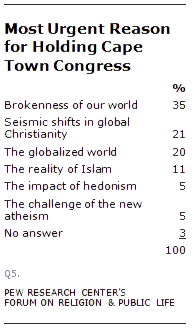
Welcome to the Survey of Cape Town 2010

The value of Cape Town 2010 comes, in part, from the unique perspective of each participant joining together to form a global parliament of leaders on world evangelization. This survey asks for your own personal views and perceptions about issues facing evangelical Christianity, both in your country and around the world. Your participation in this survey is important in order to provide an accurate picture of what evangelical Christian leaders around the world think about these issues.

Q1.       How would you evaluate the current state of evangelical Christianity in your country on a scale from 0 to 10 where 10 represents the best possible situation and 0 represents the worst possible situation? (Please answer this question and others referring to “in your country” based on the country you are representing at the Congress.)

Worst

Best

No answer

0

1

2

3

4

5

6

7

8

9

10

%

%

%

%

%

%

%

%

%

%

%

%

*

1

5

13

17

20

21

13

5

1

1

1

MEAN RESPONSE=5.0

Q2.       Using the same scale, where would you say evangelical Christianity was five years ago in your country? (Scale from 0 to 10 where the 10 represents the best possible situation and 0 represents the worst possible situation)

Worst

Best

No answer

0

1

2

3

4

5

6

7

8

9

10

%

%

%

%

%

%

%

%

%

%

%

%

1

3

6

13

19

21

17

12

6

1

*

2

MEAN RESPONSE=4.9

Q3.       Just your best guess, where would you say evangelical Christianity will be five years from now in your country? (Scale from 0 to 10 where the 10 represents the best possible situation and 0 represents the worst possible situation)

Worst

Best

No answer

0

1

2

3

4

5

6

7

8

9

10

%

%

%

%

%

%

%

%

%

%

%

%

*

2

5

10

12

15

15

18

14

5

2

2

MEAN RESPONSE=5.7 

Q4.       Do you believe the Cape Town 2010 Congress will make a significant contribution to the cause of evangelical Christianity around the world, or not?

%

44

Yes, definitely will

49

Yes, probably will

6

No, probably will not

*

No, definitely will not

1

No answer

Q5.       In your view, which of these six purposes described in the Congress Mission statement is the most urgent reason for holding Cape Town 2010?

%


35

The Brokenness of Our World

21

Seismic Shifts in Global Christianity

20

The Globalized World

11

The Reality of Islam

5

The Impact of Hedonism

5

The Challenge of the New Atheism

3

No answer

Q6.       How important do you think it is to evangelize among the following groups in your country today?

Top priority

Very important,   but lower priority

Some- what important

Not too import-ant

Not applicable in my country

No answer

%

%

%

%

%

%

a. Those who are not religious

67

17

5

2

2

7

b. Catholics

17

24

26

20

3

10

c. Muslims

54

24

9

4

4

5

d. Jews

16

19

15

10

26

15

e. Hindus

25

19

12

9

22

13

f. Non-evangelical Christians

23

20

21

22

4

10

g. Buddhists

26

19

13

9

21

12

Rank Order Q6. How important do you think it is to evangelize among the following groups in your country today?

(BASED ON TOTAL ANSWERING)

Top priority

Very important,   but lower priority

Somewhat important

Not too important

N

%

%

%

%

%

a. Those who are not religious

73

19

6

2

1997

c. Muslims

59

27

10

4

2004

g. Buddhists

39

28

20

13

1467

e. Hindus

39

30

18

13

1430

d. Jews

27

32

25

17

1296

f. Non-evangelical Christians

26

23

25

26

1894

b. Catholics

20

28

30

23

1901

Q7.       Which of these do you consider more effective in promoting Christianity today?

%

12

Sending missionaries to other countries

86

Empowering local missionaries

3

No answer

Q8.       How valuable do you consider short-term missions, meaning those lasting a few weeks or months, in promoting Christianity today?

%

28

Very valuable

42

Somewhat valuable

26

Not too valuable

4

Not at all valuable

1

No answer

Q9.       Do you think efforts to promote Christianity in your country should focus more on changing individual hearts or more on reforming social institutions?

%

80

Focus more on changing individual hearts

16

Focus more on reforming social institutions

4

No answer

Q10.     How would you rate Christian schools in your country today at each of the following?

a.         Providing a high quality academic education in subjects like reading, writing and arithmetic

Based on total

Based on all answering

(N=1957)

%

%

Excellent

25

28

Good

44

50

Only fair

16

17

Poor

4

5

Not applicable in my country

7

–

No answer

4

–

b.         Nurturing children in the Christian faith

Based on total

Based on all answering

(N=1924)

%

%

Excellent

9

10

Good

31

35

Only fair

31

36

Poor

16

19

Not applicable in my country

7

–

No answer

6

–

Thinking about global Christianity…

Q11.     Do you think evangelical Christian leaders in the West (that is the U.S. and Europe) have too much, too little, or about the right amount of influence on global Christianity today?

%

44

Too much influence

22

Too little influence

32

About the right amount of influence

2

No answer

Q12.     Do you think evangelical Christian leaders in Africa, Asia and Latin America have too much, too little, or about the right amount of influence on global Christianity today?

%

7

Too much influence

68

Too little influence

22

About the right amount of influence

2

No answer

Q13.     How much financial support do evangelical Christians in the West (that is the U.S. and Europe) provide for global Christianity?

%

21

More than their fair share

45

Less than their fair share

29

About their fair share

6

No answer

Q14.     How much financial support do evangelical Christians in Africa, Asia and Latin America provide for global Christianity?

%

7

More than their fair share

55

Less than their fair share

31

About their fair share

8

No answer

Thinking about your country…

Q15.     At the present time, do you think evangelical Christians are increasing their influence on life in your country or losing their influence?

%

46

Increasing their influence

51

Losing their influence

3

No answer

Q16.     How much of a threat, if any, does each of these pose to evangelical Christianity in your country today?

Major threat

Minor threat

Not a threat

No answer

%

%

%

%

a. Influence of Islam

47

34

16

2

b. Influence of Secularism

71

20

5

4

c. Influence of Catholicism

10

35

51

5

d. Sex and violence in popular culture

59

30

6

5

e. Government restrictions on religion

22

39

35

4

f. Too much emphasis on consumerism and material goods

67

24

5

4

g. Theological divisions among evangelicals

30

54

13

3

h. Evangelical leaders violating sexual morals in their personal relationships

26

52

18

4

i. Evangelical leaders leading a lavish lifestyle

30

47

20

3

Rank Order Q16.  How much of a threat, if any, does each of these pose to evangelical Christianity in your country today?

Major threat

Minor threat

Not a threat

No answer

%

%

%

%

b. Influence of Secularism

71

20

5

4

f. Too much emphasis on consumerism and material goods

67

24

5

4

d. Sex and violence in popular culture

59

30

6

5

a. Influence of Islam

47

34

16

2

g. Theological divisions among evangelicals

30

54

13

3

i. Evangelical leaders leading a lavish lifestyle

30

47

20

3

h. Evangelical leaders violating sexual morals in their personal relationships

26

52

18

4

e. Government restrictions on religion

22

39

35

4

c. Influence of Catholicism

10

35

51

5

Q17.     In your view, how important is each of the following for being a good evangelical Christian?

Essential

Important, but not essential

Not too important

Not at all important

No answer

%

%

%

%

%

a. Working to help the poor and needy

73

24

1

*

2

b. Taking a public stand on social and political issues when they conflict with moral and biblical principles

56

37

4

1

2

c. Working to protect the natural environment

36

47

14

2

2

d. Taking a public stand on social and political issues that could limit the freedom of evangelicals to practice their faith

49

39

7

2

3

e. Working to lead others to Christ

94

4

1

*

1

f. Following the teachings of Christ in one’s personal and family life

97

2

*

0

1

g. Tithing

58

32

6

2

3

Rank Order Q17:  In your view, how important is each of the following for being a good evangelical Christian?

Essential

Important, but not essential

Not too important

Not at all important

No answer

%

%

%

%

%

f. Following the teachings of Christ in one’s personal and family life

97

2

*

0

1

e. Working to lead others to Christ

94

4

1

*

1

a. Working to help the poor and needy

73

24

1

*

2

g. Tithing

58

32

6

2

3

b. Taking a public stand on social and political issues when they conflict with moral and biblical principles

56

37

4

1

2

d. Taking a public stand on social and political issues that could limit the freedom of evangelicals to practice their faith

49

39

7

2

3

c. Working to protect the natural environment

36

47

14

2

2

Q18.     Do you think each of the following is compatible with being a good evangelical Christian, or not?

Compatible with being a good evangelical Christian

Not compatible with being a good evangelical Christian

No answer

%

%

%

a. Believing that miracles can take place today

94

4

2

b. Believing in divine healing

93

5

2

c. Speaking in tongues

70

26

4

d. Believing in astrology

1

97

3

e. Engaging in yoga as a spiritual practice

5

92

3

f. Believing in reincarnation, that people will be re-born in this world again and again

1

96

3

g. Believing that Jesus Christ is NOT the only path to salvation

3

95

3

h. Consuming alcohol29

42

52

6

Rank order Q18.  Do you think each of the following is compatible with being a good evangelical Christian, or not?

Compatible with being a good evangelical Christian

Not compatible with being a good evangelical Christian

No answer

%

%

%

a. Believing that miracles can take place today

94

4

2

b. Believing in divine healing

93

5

2

c. Speaking in tongues

70

26

4

h. Consuming alcohol*

42

52

6

e. Engaging in yoga as a spiritual practice

5

92

3

g. Believing that Jesus Christ is NOT the only path to salvation

3

95

3

f. Believing in reincarnation, that people will be re-born in this world again and again

1

96

3

d. Believing in astrology

1

97

3

Q19.     How favorable or unfavorable is your overall opinion of the following groups?

NET favorable

Very favorable

Mostly favorable

NET unfav-orable

Mostly unfav-orable

Very unfav-orable

Don’t know enough to rate

No answer

%

%

%

%

%

%

%

%

a. Catholics

67

10

57

22

18

4

4

7

b. Jews

54

11

43

18

13

4

19

9

c. Muslims

28

5

23

56

30

26

6

9

d. Pentecostal Christians

83

32

51

7

6

2

3

7

e. Atheists, that is people who don’t believe in God

25

5

20

58

29

29

8

9

f. Hindus

24

4

20

45

23

22

21

10

g. Orthodox Christians

56

13

43

20

15

5

16

9

h. Buddhists

24

4

20

45

24

21

22

9

Rank order Q19.  How favorable or unfavorable is your overall opinion of the following groups?

(BASED ON TOTAL ANSWERING)

NET favorable

Very favorable

Mostly favorable

NET unfav-orable

Mostly unfav-orable

Very unfav-orable

N

%

%

%

%

%

%

d.Pentecostal Christians

92

36

57

8

6

2

1981

a. Catholics

76

12

64

24

20

5

1953

b. Jews

75

16

60

25

18

6

1575

g. Orthodox Christians

74

17

57

26

20

6

1657

h. Buddhists

35

6

29

65

34

31

1522

f. Hindus

35

6

29

65

33

32

1519

c. Muslims

33

6

27

67

36

31

1858

e. Atheists, that is people who don’t believe in God

30

6

24

70

35

35

1814

Q20.     How much would you say you know about Islam and its practices?

%

28

A great deal

53

Some

17

Not too much

2

Nothing at all

*

No answer

Q21.     From what you know, do you think that Islam and Christianity have a lot in common, or do you think that Islam and Christianity are very different?

%

25

Islam and Christianity have a lot in common (Answer Q21b)

69

Islam and Christianity are very different (Skip to Q22)

5

No answer

IF HAVE A LOT IN COMMON in Q21:

Q21b.   Which of these is the MAIN reason you think Islam and Christianity have a lot in common?30

Based on all asked Q21b

(N=553)

Based on total

%

%

Islam and Christianity share a common scriptural tradition

33

8

Muslims and Christians share a piety and commitment to their faith

21

5

Muslims and Christians ultimately worship the same God

8

2

Islam and Christianity share many moral teachings

21

5

Something else (please specify):

Islam and Christianity are both monotheistic faiths (VOL.)

4

1

Islam and Christianity share common historical roots/are Abrahamic faiths (VOL.)

3

1

Islam and Christianity share some common doctrinal beliefs/practices (VOL.)

3

1

Other response (VOL.)

3

1

No response

11

3

Q21 Think Islam/Christianity very different OR No answer

—

75

Q22.     Which religion do you think is attracting more converts in your country today?

%

17

Islam

78

Christianity

4

No answer


Q23.     Turning to events in the world today, in the dispute between Israel and the Palestinians, which side do you sympathize with more, Israel or the Palestinians?

%

34

Israel

11

The Palestinians

39

Both equally

13

Neither

2

No answer

Q24.     Do you feel each of these groups is generally friendly toward evangelical Christians in your country, neutral toward evangelical Christians or unfriendly toward evangelical Christians in your country?31

Friendly toward evangelical Christians

Neutral toward evangelical Christians

Unfriendly toward evangelical Christians

Not applicable in my country

No answer

%

%

%

%

%

a. Catholics

35

44

16

1

3

b. Orthodox Christians

21

35

16

21

6

c. Jews

8

31

19

35

7

d. Muslims

4

23

61

7

6

e. Pentecostal Christians

75

16

3

1

4

f. Those who are not religious

6

44

40

5

5

g. Buddhists

3

33

22

36

7

h. Hindus

3

30

23

37

7

Q24 Rank Order.  Do you feel each of these groups is generally friendly toward evangelical Christians in your country, neutral toward evangelical Christians or unfriendly toward evangelical Christians in your country?

 (BASED ON TOTAL ANSWERING)

Friendly toward evangelical Christians

Neutral toward evangelical Christians

Unfriendly toward evangelical Christians

N

%

%

%

%

e. Pentecostal Christians

80

17

3

2066

a. Catholics

37

46

17

2096

b. Orthodox Christians

30

48

22

1596

c. Jews

14

53

33

1266

f. Those who are not religious

7

49

45

1976

h. Hindus

6

53

41

1236

g. Buddhists

5

56

39

1267

d. Muslims

4

26

69

1925

Q25.     Is conflict between religious groups a very big problem, a moderately big problem, a small problem or not a problem at all in your country?

%

17

Very big problem

27

Moderately big problem

41

Small problem

14

Not a problem at all

1

No answer


Q26.     How often, if ever, are evangelical Christians treated unfairly by the government in your country?

%

12

Very often

22

Somewhat often

49

Not too often

15

Never

1

No answer

Q27.     In your country, how often, if ever, do you think evangelical Christians are discriminated against because of their religion when they do the following?

NET Very or somewhat often

Very often

Somewhat often

Not too often

Never

No answer

%

%

%

%

%

%

a. Apply for a job32

20

7

13

46

32

3

b. Try to find housing33

13

4

9

32

52

3

c. Apply to advance their schooling or education34

15

4

10

33

49

3

d. Apply for government services or benefits35

18

8

10

31

48

3

Q28.     How often, if ever, do you personally experience discrimination in your country because of your religion?36

%

4

Very often

11

Somewhat often

42

Not too often

41

Never

2

No answer


On another topic…

Q29.     Which statement comes closer to your own views even if neither is exactly right?

%

82

Some religions are more prone to violence than others. (Answer Q29b)

13

All religions are about the same when it comes to violence. (Skip to Q30)

4

No answer

IF SOME RELIGIONS ARE MORE PRONE TO VIOLENCE THAN OTHERS in Q29:

Q29b.   Which religion, if any, do you think is more prone to violence than others?37

[OPEN END]

Based on all asked Q29b

(N=1806)

Based on total

%

%

Islam

84

69

Hinduism

6

5

Christianity

4

3

Judaism

1

1

Buddhism

1

*

Atheism/secularism

*

*

Other response

3

2

No response

11

9

Q29 All religions are about the same when it comes to violence/ No response

—

18

Q30.     Which statement comes closer to your own views even if neither is exactly right?

%

96

Christianity is the one, true faith leading to eternal life

1

Many religions can lead to eternal life

3

No answer

Q31.     Which of these statements comes closest to your own views?

%

50

The Bible is the actual Word of God and is to be taken literally word for word

48

The Bible is the Word of God, but not everything in it should be taken literally word for word.

*

The Bible is a book written by men and is not the word of God.

2

No answer

Q32.     Do you believe the second coming of Jesus Christ will occur in your lifetime, or not?

%

8

Yes, definitely will

44

Yes, probably will

37

No, probably will not

2

No, definitely will not

10

No answer

Q33.     Which statement comes closer to your own views even if neither is exactly right? 

%

49

It is not necessary to believe in God in order to be moral and have good values.

49

It is necessary to believe in God in order to be moral and have good values.

2

No answer

Q34.     Which statement comes closer to your own views even if neither is exactly right?

%

73

God’s covenant with the Jewish people continues today.

22

God’s covenant with the Jewish people no longer applies.

5

No answer

Q35.     Some people say that the state of Israel is a fulfillment of the biblical prophecy about the second coming of Jesus.  Do you believe that this is true, or not?

%

48

Yes, true

42

No, not true

10

No answer

Q36.     Do you believe in the rapture of the Church—that believers will be instantly caught up with Christ before the Great Tribulation, or don’t you believe the end times will occur exactly this way?

%

61

Yes, believe in the rapture of the Church

32

No, do not believe the end times will occur exactly this way

8

No answer

Q37.     Which statement comes closer to your own views even if neither is exactly right? 

%

7

God will grant wealth and good health to all believers who have enough faith.

90

God doesn’t always give wealth and good health even to believers who have deep faith.

2

No answer

Q38.     Which statement comes closer to your own views even if neither is exactly right?

%

13

Homosexuality is a way of life that should be accepted by society.

84

Homosexuality is a way of life that should be discouraged by society.

4

No answer

Q39.     Which statement comes closest to your own views?

%

*

Abortion is always morally acceptable

2

Abortion is usually morally acceptable

45

Abortion is usually morally wrong

51

Abortion is always morally wrong

2

No answer

Q40.     Do you think there is a natural conflict between being an evangelical Christian and living in a modern society, or don’t you think so?

%

64

Yes, there is a natural conflict

33

No, don’t think so

3

No answer

Q41. Which statement comes closest to your own views?

%

3

Humans and other living things have evolved over time due to natural processes such as natural selection

41

A supreme being guided the evolution of living things for the purpose of creating humans and other life in the form it exists today

47

Humans and other living things have existed in their present form since the beginning of time

9

No answer

Q42.     Do you agree or disagree with each of the following?38

NET agree

Completely agree

Mostly agree

NET disagree

Mostly disagree

Completely disagree

No answer

%

%

%

%

%

%

%

a. All adults have a responsibility to marry and have children.

49

12

36

48

17

31

3

b. A wife must always obey her husband.

55

15

40

41

20

21

4

c. Men should be the main financial provider for the family.

53

12

41

43

24

19

4

d. Women should stay at home and raise the children in the family.

33

2

31

63

35

28

4

e. Men have a duty to serve as the religious leaders in the marriage and family.

79

47

32

18

10

8

3

Q43.     Do you think women should be allowed to serve as pastors, or don’t you think so?

%

75

Yes, should be allowed

20

No, should not be allowed

5

No answer

Q44.     Would it be O.K. with you if the political leaders of your country have a different religion than yours, or do you only want political leaders who share your religion?

%

74

O.K. if political leaders have a different religion

21

Only want political leaders who share my religion

4

No answer

Q45.     Which statement comes closer to your own views even if neither is exactly right? 

%

13

Religious leaders should keep out of political matters.

84

Religious leaders should express their views on political questions.

3

No answer

Q46.     Would you favor or oppose making the Bible the official law of the land in your country?

%

45

Favor

48

Oppose

7

No answer

Q47.     Do you agree or disagree with the following statement:  It is the responsibility of the government to take care of very poor people who can’t take care of themselves.

%

32

Completely agree

49

Mostly agree

13

Mostly disagree

3

Completely disagree

3

No answer

Q48.     For each, does this describe you, or not?

Yes, describes

No, does not describe

No answer

%

%

%

a. Pentecostal Christian

25

48

27

b. Charismatic Christian

31

41

29

c. Fundamentalist Christian

11

56

33

d. Evangelical Christian

90

2

8

Q49.     Have you had a born-again experience, or not?

%

93

Yes      (Answer Q49b)

4

No        (Skip to Q50)

3

No answer

IF YES in Q49:

[OPEN-ENDED]

Based on all asked Q49b

(N=2040)

Based on total

%

%

Under 10

13

12

10-15

27

25

16-19

32

30

20-29

21

19

30+

5

5

No answer

2

2

Q49 Have not had born-again experience OR No answer

—

7

Mean age

16.8

Q50.     Aside from weddings and funerals, how often do you participate in religious services?

%

68

More than once a week

21

Once a week

4

Once or twice a month

2

A few times a year

1

Seldom

*

Never

4

No answer

Q51.     Which church or denomination, if any, do you identify with most closely? (Please be as specific as possible.)

[OPEN END]

[IMPORTANT NOTE: RESPONSES TO THIS OPEN-ENDED QUESTION COULD NOT BE COLLAPSED INTO DENOMINATIONAL FAMILiES WITH A HIGH DEGREE OF PRECISION. THESE TENTATIVE RESULTS ARE PRESENTED ONLY TO PROVIDE A BROAD SENSE OF THE RELIGIOUS AFFILIATION OF RESPONDENTS]

%

14

Baptist

13

Pentecostal

7

Presbyterian

7

Anglican

6

Nondenominational/Independent

5

Holiness

4

Lutheran

4

Charismatic

3

Reformed

3

Methodist

2

Pietist

2

Anabaptist

1

Evangelistic and Missionary Associations

1

Fundamentalist Brethren

1

Bible Churches

1

Congregationalist

*

Restorationist

*

House church/new church

*

Adventist

*

Friends

14

Other: Includes vague answers such as “evangelical” or “Protestant,” as well as pan-Protestant groups.  Also includes mixed/more than one church, interdenominational, and other faiths including Catholic, Orthodox or Messianic Jew.  Also includes unintelligible cases and cases which could not be definitively assigned to a category.

1

None

11

No response

Q52.     Generally speaking, how often, if ever, do you do each of the following?

At least once a week

Once or twice a month

Several times a year

Seldom

Never

No answer

%

%

%

%

%

%

a. Participate in prayer groups, Scripture study groups or religious education programs

75

15

5

2

*

3

b. Share your faith or views on God with people from other religions

27

24

30

14

1

4

c. Listen to religious radio or watch religious television programs

37

17

14

21

8

4

d. Participate in inter-faith religious groups, classes, or meetings with people from other religions

8

11

26

38

14

4


Q53.     Have you ever …?

Yes

No

No answer

%

%

%

a. Experienced or witnessed a divine healing of an illness or injury

76

20

4

b. Given or interpreted prophecy

40

55

6

c. Received a definite answer to a specific prayer request39

94

3

4

d. Received a direct revelation from God

61

33

6

e. Experienced or witnessed the devil or evil spirits being driven out of a person

57

38

5

f. Spoken or prayed in tongues

47

48

5

Q54.     Does the church or house of worship where you most often attend religious services work together with houses of worship from non-Christian faiths such as Muslims, Hindus or Buddhists to find solutions to community problems, or not?

%

20

Yes, does

75

No, does not

4

No answer

Q55.     Are you employed by a church or religious organization, or not?

%

74

Yes

15

No

7

Not employed

4

No answer

Q56.     Are you an ordained minister, or not?

%

51

Yes

45

No

4

No answer

Q57.     Do you have a degree from a university, or not? (Include degrees from a four-year college.)

%

85

Yes, have a degree from a university

12

No, do not have a degree from a university

3

No answer

Q58.     Thinking about when you were a child, in what religion were you raised, if any?        

%

67

Protestant

13

Catholic

*

Jewish

3

Muslim

1

Hindu

2

Buddhist

2

African traditional, animist, pagan, spiritist, new age (VOL.)

2

Orthodox/Coptic Christian (VOL.)

1

Other religion/unclear (VOL.)

1

More than one/mixed religion (VOL.)

5

None/Nothing in particular

4

No answer

Q59.     Thinking about when you were a child, were you raised as an evangelical Christian, or not?

%

52

Yes, raised as an evangelical Christian

44

No, not raised as an evangelical Christian

4

No answer

Q60.     Which of these best describes your current situation?

%

83

Married

*

Living with a partner

1

Widowed

1

Divorced

*

Separated

11

Never been married

3

No answer

Q61.     What is your current age?

%

5

Under 30 years of age

19

30-39 years

30

40-49 years

29

50-59 years

13

60 years and older

3

No answer

Q62.     Are you male or female?

%

71

Male

26

Female

3

No answer

Q63.     In what country are you currently living?

[OPEN-END]

Q64.     Which of these regions best describes the country where you are currently living?39

BEST REGION:40

%

20

Europe

19

North America

10

Central and South America

 26

Sub-Saharan Africa

 3

Middle East and North Africa

 21

Asia and the Pacific

 *

Unable to determine

%

43

Global North (includes Europe, North America, Japan, Australia and New Zealand)

57

Global South (includes all other countries)

Q65.     For each, does this describe your racial, ethnic or nationality group, or not?

Yes, describes

No, does not describe

No answer

%

%

%

a. Caucasian

37

40

23

b. Black

24

49

27

c. Mixed race

6

62

32

d. Arab

2

65

34

e. Hispanic, Latino or Spanish origin

8

61

31

f. South Asian

10

60

30

g. East Asian

10

59

31

DATE OF COMPLETION

%

68

Prior to Congress

32

During Congress

TYPE OF COMPLETION

%

67

Web survey

33

Paper survey


Footnotes

29 Based on 2,173 cases due to errors in questionnaire translation. (return to text)

30 Figures do not sum to 100% because multiple responses were allowed for those answering “something else.” (return to text)

31 Based on 2,193 cases due to errors in questionnaire translation. (return to text)

32 Based on 2,193 cases due to errors in questionnaire translation. (return to text)

33 Based on 2,183 cases due to errors in questionnaire translation. (return to text)

34 Based on 2,193 cases due to errors in questionnaire translation. (return to text)

35 Based on 2,193 cases due to errors in questionnaire translation. (return to text)

36 Based on 2,193 cases due to errors in questionnaire translation. (return to text)

37 Figures do not sum to 100% because multiple answers were counted. (return to text)

38 Based on 2,193 cases due to errors in questionnaire translation. (return to text)

39 Based on 2,190 cases due to errors in questionnaire translation. (return to text)

40 Response options included: Eurasia (includes Russia, Ukraine and more); English, Portuguese, and Spanish-speaking Africa; Francophone Africa; Middle East and North Africa; East Asia (includes Hong Kong, Macao, People’s Republic of China, and Republic of China); South Asia (includes India, Pakistan, Bangladesh and more); South Pacific (includes Australia, Papua New Guinea and more); Caribbean; Europe (includes European Union nations and more); Latin America (includes Mexico, Central America and South America); North America (Canada and the United States); North Asia (includes Japan, Mongolia, North Korea, South Korea); Southeast Asia (includes Indonesia, Philippines and more). The response option “Southeast Asia” was omitted from Q64 in the online survey, but was included on hard copies of the survey. (return to text)

41 BEST REGION was determined for each respondent in two stages.  First, a “best country” variable was created based on q63 and, if necessary, on the Congress registration database. Second, a “best region” variable was created based on “best country” and, if necessary, on Q64. (return to text)

Photo credit: ©Ocean/Corbis