Executive Summary Atheists and agnostics, Jews and Mormons are among the highest-scoring groups on a new survey of religious knowledge, outperforming evangelical Protestants, mainline Protestants and Catholics on questions about the core teachings, history and leading figures of major world religions. On average, Americans correctly answer 16 of the 32 religious knowledge questions on the […]
About Pew Research Center
Pew Research Center is a nonpartisan, nonadvocacy fact tank that informs the public about the issues, attitudes and trends shaping the world. It does not take policy positions. The Center conducts public opinion polling, demographic research, computational social science research and other data-driven research. It studies politics and policy; news habits and media; the internet and technology; religion; race and ethnicity; international affairs; social, demographic and economic trends; science; research methodology and data science; and immigration and migration. Pew Research Center is a subsidiary of The Pew Charitable Trusts, its primary funder.
Executive Summary Atheists and agnostics, Jews and Mormons are among the highest-scoring groups on a new survey of religious knowledge, outperforming evangelical Protestants, mainline Protestants and Catholics on questions about the core teachings, history and leading figures of major world religions. On average, Americans correctly answer 16 of the 32 religious knowledge questions on the […]
Executive Summary
Atheists and agnostics, Jews and Mormons are among the highest-scoring groups on a new survey of religious knowledge, outperforming evangelical Protestants, mainline Protestants and Catholics on questions about the core teachings, history and leading figures of major world religions.
On average, Americans correctly answer 16 of the 32 religious knowledge questions on the survey by the Pew Research Center’s Forum on Religion & Public Life. Atheists and agnostics average 20.9 correct answers. Jews and Mormons do about as well, averaging 20.5 and 20.3 correct answers, respectively. Protestants as a whole average 16 correct answers; Catholics as a whole, 14.7. Atheists and agnostics, Jews and Mormons perform better than other groups on the survey even after controlling for differing levels of education.
How much do you know about religion?
And how do you compare with the average American? Take our short, 15-question quiz to find out.
On questions about Christianity – including a battery of questions about the Bible – Mormons (7.9 out of 12 right on average) and white evangelical Protestants (7.3 correct on average) show the highest levels of knowledge. Jews and atheists/agnostics stand out for their knowledge of other world religions, including Islam, Buddhism, Hinduism and Judaism; out of 11 such questions on the survey, Jews answer 7.9 correctly (nearly three better than the national average) and atheists/agnostics answer 7.5 correctly (2.5 better than the national average). Atheists/agnostics and Jews also do particularly well on questions about the role of religion in public life, including a question about what the U.S. Constitution says about religion.
These are among the key findings of the U.S. Religious Knowledge Survey, a nationwide poll conducted from May 19 through June 6, 2010,* among 3,412 Americans age 18 and older, on landlines and cell phones, in English and Spanish. Jews, Mormons and atheists/agnostics were oversampled to allow analysis of these relatively small groups.1
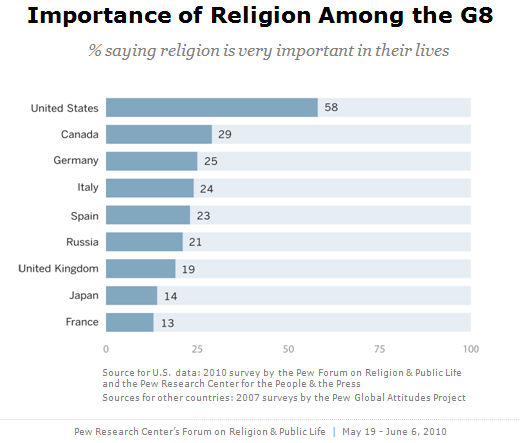
Previous surveys by the Pew Research Center have shown that America is among the most religious of the world’s developed nations. Nearly six-in-ten U.S. adults say that religion is “very important” in their lives, and roughly four-in-ten say they attend worship services at least once a week. But the U.S. Religious Knowledge Survey shows that large numbers of Americans are uninformed about the tenets, practices, history and leading figures of major faith traditions – including their own. Many people also think the constitutional restrictions on religion in public schools are stricter than they really are.
More than four-in-ten Catholics in the United States (45%) do not know that their church teaches that the bread and wine used in Communion do not merely symbolize but actually become the body and blood of Christ. About half of Protestants (53%) cannot correctly identify Martin Luther as the person whose writings and actions inspired the Protestant Reformation, which made their religion a separate branch of Christianity. Roughly four-in-ten Jews (43%) do not recognize that Maimonides, one of the most venerated rabbis in history, was Jewish.
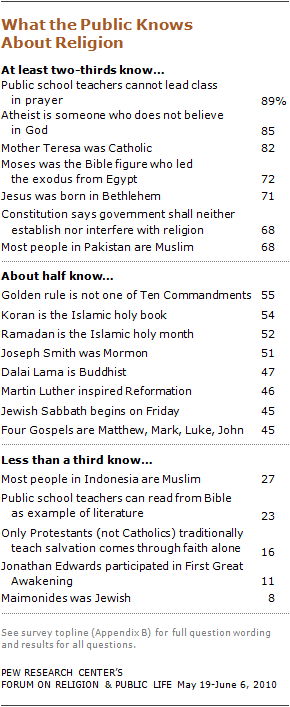
In addition, fewer than half of Americans (47%) know that the Dalai Lama is Buddhist. Fewer than four-in-ten (38%) correctly associate Vishnu and Shiva with Hinduism. And only about a quarter of all Americans (27%) correctly answer that most people in Indonesia – the country with the world’s largest Muslim population – are Muslims.
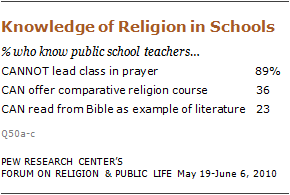
The survey also finds widespread confusion over the line between teaching and preaching in public schools. Out of a total of 41 knowledge questions (32 about religion and nine testing general knowledge) the single question that respondents most frequently get right is whether U.S. Supreme Court rulings allow teachers to lead public school classes in prayer. Nine-in-ten (89%) correctly say this is not allowed. But among the questions most often answered incorrectly is whether public school teachers are permitted to read from the Bible as an example of literature. Fully two-thirds of people surveyed (67%) also say “no” to this question, even though the Supreme Court has clearly stated that the Bible may be taught for its “literary and historic” qualities, as long as it is part of a secular curriculum.2 On a third question along these lines, just 36% of the public knows that comparative religion classes may be taught in public schools. Together, this block of questions suggests that many Americans think the constitutional restrictions on religion in public schools are tighter than they really are.
On the other hand, most Americans are able to correctly answer at least half of the survey’s questions about the Bible. For example, roughly seven-in-ten (71%) know that, according to the Bible, Jesus was born in Bethlehem. More than six-in-ten (63%) correctly name Genesis as the first book of the Bible. And more than half know that the Golden Rule – “Do unto others as you would have them do unto you” – is not one of the Ten Commandments. On the full battery of seven questions about the Bible (five Old Testament and two New Testament items) Mormons do best, followed by white evangelical Protestants. Atheists/agnostics, black Protestants and Jews come next, all exhibiting greater knowledge of the Bible than white mainline Protestants and white Catholics, who in turn outscore those who describe their religion as nothing in particular.
Factors in Religious Knowledge
What factors seem to contribute to religious knowledge? Data from the survey indicate that educational attainment – how much schooling an individual has completed – is the single best predictor of religious knowledge. College graduates get nearly eight more questions right on average than do people with a high school education or less. Having taken a religion course in college is also strongly associated with higher religious knowledge.
Other factors linked with religious knowledge include reading Scripture at least once a week and talking about religion with friends and family. People who say they frequently talk about religion with friends and family get an average of roughly two more questions right than those who say they rarely or never discuss religion. People with the highest levels of religious commitment – those who say that they attend worship services at least once a week and that religion is very important in their lives – generally demonstrate higher levels of religious knowledge than those with medium or low religious commitment.3 Having regularly attended religious education classes or participated in a youth group as a child adds more than two questions to the average number answered correctly, compared with those who seldom or never participated in such activities. And those who attended private school score more than two questions better on average than those who attended public school when they were growing up. Interestingly, however, those who attended a private religious school score no better than those who attended a private nonreligious school.
This survey and previous Pew Forum studies have shown that Jews and atheists/agnostics have high levels of educational attainment on average, which partially explains their performance on the religious knowledge survey. However, even after controlling for levels of education and other key demographic traits (race, age, gender and region), significant differences in religious knowledge persist among adherents of various faith traditions. Atheists/agnostics, Jews and Mormons still have the highest levels of religious knowledge, followed by evangelical Protestants, then those whose religion is nothing in particular, mainline Protestants and Catholics. Atheists/agnostics and Jews stand out for high levels of knowledge about world religions other than Christianity, though they also score at or above the national average on questions about the Bible and Christianity. Holding demographic factors constant, evangelical Protestants outperform most groups (with the exceptions of Mormons and atheists/agnostics) on questions about the Bible and Christianity, but evangelicals fare less well compared with other groups on questions about world religions such as Islam, Buddhism, Hinduism and Judaism. Mormons are the highest-scoring group on questions about the Bible.
When education and other demographic traits are held equal, whites score better than minorities on the survey’s religious knowledge questions, men score somewhat better than women, and people outside the South score better than Southerners. The oldest group in the population (age 65 and older) gets fewer questions right than other age groups. However, people 65 and older do about as well as people under age 50 on questions about the Bible and Christianity; they do less well on questions about other world religions.
Other Findings
Other findings of the U.S. Religious Knowledge Survey include:
On world religions other than Christianity, about six-in-ten Americans (62%) know that most people in India are Hindus. About half know that Ramadan is the Islamic holy month (52%) and can name the Koran as the Muslim holy book (54%). Roughly one-third (36%) correctly associate striving for nirvana with Buddhism.
Around four-in-ten Americans know that the Mormon religion was founded sometime after 1800 (44%) and that the Book of Mormon tells the story of Jesus appearing to people in the Americas (40%). About half (51%) correctly identify Joseph Smith, founder of the Church of Jesus Christ of Latter-day Saints, as a Mormon.
In addition to questions about religious knowledge, the survey included nine general knowledge questions (on history, politics, science and literature) for comparison purposes. These show, for example, that about six-in-ten Americans can name the vice president of the United States (59%) and understand that lasers do not work by focusing sound waves (60%). More than seven-in-ten (72%) correctly associate Susan B. Anthony with the movement to give women the right to vote, while just 42% know that Herman Melville was the author of the novel Moby Dick.
Overall, people who score well on the general knowledge questions also tend to do well on the religion questions. Atheists/agnostics and Jews correctly answer an average of roughly seven of the nine general knowledge questions. Among the public overall, the average respondent correctly answers 5.2 of these general knowledge questions.
While people with a high level of religious commitment do better than average on the religion questions, people with low levels of religious commitment do better than average on the general knowledge questions.
Many Americans are devoted readers of Scripture: More than a third (37%) say they read the Bible or other Holy Scriptures at least once a week, not counting worship services. But Americans as a whole are much less inclined to read other books about religion. Nearly half of Americans who are affiliated with a religion (48%) say they “seldom” or “never” read books (other than Scripture) or visit websites about their own religion, and 70% say they seldom or never read books or visit websites about other religions.
Mormons, black Protestants and white evangelicals are the most frequent readers of materials about religion. Fully half of all Mormons (51%) and roughly three-in-ten white evangelicals (30%) and black Protestants (29%) report that they read books or go online to learn about their own religion at least once a week. Only a small fraction of all religiously affiliated Americans – 6% of the general public and no more than 8% of any religious group – say they read books (other than Scripture) or visit websites to learn about religions other than their own at least once a week.
The remainder of this report is divided into two parts. Section II, “Who Knows What About Religion,” focuses on differences between religious groups in eight domains of knowledge: the Bible, Elements of Christianity, Elements of Judaism, Elements of Mormonism, World Religions, Atheism and Agnosticism, the Role of Religion in Public Life, and Nonreligious Topics. Section III, “Factors Linked With Religious Knowledge,” describes factors associated with religious knowledge. Details about the survey’s methodology are available in Appendix A, and the full wording of all questions and topline survey results are provided in Appendix B.
This survey is being released at the God in America National Symposium on Religious Literacy on Sept. 28, 2010, in Washington, D.C. WGBH Television in Boston collaborated with the Pew Forum and the Religious Freedom Education Project at the Newseum on the symposium, which will also feature a screening of the three-part PBS documentary “God in America.” The series interweaves documentary footage, historical dramatization and interviews to explore the historical role of religion in the U.S., including its impact on society, politics and culture.
Footnotes
1 The Pew Forum’s 2007 U.S. Religious Landscape Survey estimated that Jews and Mormons each make up about 1.7% of the U.S. public, while atheists and agnostics combined account for about 4% of the U.S. population. Atheists and agnostics are treated as a single group throughout this report. The survey sample included too few interviews with atheists to analyze them separately. For more details on the sample sizes of religious groups, see Appendix A. (return to text)
[I]
3 This may seem paradoxical, since atheists and agnostics have very low levels of religious commitment and yet score very well on the survey questions. However, atheists and agnostics account for a relatively small share of the total number of people with low levels of religious commitment; 4% of Americans describe themselves as atheists or agnostics, while fully 35% have low religious commitment. Atheists and agnostics answer an average of 20.9 questions correctly, compared with an average of 15.4 correct answers among people with low religious commitment who do not describe themselves as atheists or agnostics. (return to text)
* Correction added April 2011: Interviewing for the survey actually was completed on Friday, June 4, 2010. (return to text)
Photo credit: Eric Swanson/Corbis
Preface
In his 2007 book, Religious Literacy: What Every American Needs to Know – And Doesn’t, Boston University professor Stephen Prothero wrote that “Americans are both deeply religious and profoundly ignorant about religion.” To support his contention, Prothero offered many compelling anecdotes and some isolated findings from public opinion polls. He also cited a few studies about the extent of biblical literacy among young people. But, as he discovered, there was no comprehensive, national survey assessing the general state of religious knowledge among U.S. adults.
To address this gap, the Pew Research Center’s Forum on Religion & Public Life set out to gauge what Americans know about their own faiths and about other religions. The resulting survey covered a wide range of topics, including the beliefs and practices of major religious traditions as well as the role of religion in American history and public life. Based on an analysis of answers from more than 3,400 people to 32 religious knowledge questions, this report attempts to provide a baseline measurement of how much Americans know about religion today.
How much do you know about religion?
And how do you compare with the average American? Take our short, 15-question quiz to find out.
Readers should bear in mind some key limitations of the survey. With a few notable exceptions – such as a study by Rodney Stark and Charles Y. Glock of Northern California churchgoers in 1963 and some Gallup questions from the 1950s – the Pew Forum’s staff found little historical data on levels of religious knowledge in the U.S. public. As a consequence, we cannot say with assurance whether Americans in 2010 know more, or less, about religion than prior generations did. Before we put any religious knowledge questions to the public, we also decided that, no matter what the results, we would not give the public an “A,” an “F” or any other grade because we have no objective way of determining how much the public should know about religion. Moreover, we could have designed harder questions, or easier ones. As it happens, through a combination of good survey design and good luck, the results were an almost perfect bell curve in which the average score was exactly half of the 32 possible correct answers, and very few people got all questions right or all questions wrong. Readers can decide for themselves whether this justifies Prothero’s conclusion or not.
In designing the survey and analyzing the results, we were fortunate to be able to draw on the expertise of an exceptional panel of advisers, including Prothero, Marilyn Mellowes of WGBH-Boston and John Green of the University of Akron. We also received invaluable help from colleagues at the Pew Research Center, particularly Scott Keeter and Leah Christian, who shared their experience in conducting knowledge surveys. We are grateful to David Dutwin and Robyn Rapoport of Social Science Research Solutions for their advice and diligent work on methodological issues. Our friends at WGBH Television in Boston encouraged this survey and collaborated with us in releasing it (along with WGBH’s three-part PBS documentary, “God in America”) to the public at a Sept. 28, 2010, symposium generously hosted by the Religious Freedom Education Project at the Newseum in Washington, D.C. We also received insightful advice on portions of this report from E.J. Dionne of the Brookings Institution and Charles Haynes of the First Amendment Center. And, most of all, we wish to thank our polling consultant, Mike Mokrzycki, for his professional expertise, project management skills and unfailing good cheer. With all this help, any failings of this report are, needless to say, ours alone.
Luis Lugo, Director
Alan Cooperman, Associate Director, Research
Photo credit: Eric Swanson/Corbis
FAQs About Measuring Religious Knowledge (updated)
The release of the U.S. Religious Knowledge Survey has generated record traffic on the Pew Forum’s website as well as many individual emails from readers. We are very grateful for the feedback. Here are some of the most common questions we’ve been receiving.
Why didn’t you include smaller religious groups such as Muslims, Buddhists, Hindus, Orthodox Christians and Jehovah’s Witnesses in your survey results?
Members of these relatively small (in the U.S.) religious groups were included in the survey, and their answers are reflected in the total figures; no one was excluded from the survey on the basis of their religious affiliation. Unfortunately, however, there are too few members of these smaller religious groups in our survey sample to analyze and report their results separately. Greek and Russian Orthodox Christians, Muslims, Buddhists, Sikhs, Hindus, Wiccans, Jehovah’s Witnesses, Baha’is and numerous other religious groups each comprise less than 1% of the U.S. adult population, according to the Pew Forum’s 2007 U.S. Religious Landscape Survey. As a result, even in a relatively large, nationally representative survey of 3,412 people, we still had fewer than 30 Muslim respondents and fewer than 20 Hindus, for example. In keeping with sound survey research practice, we generally do not report separate results for any group that has fewer than 100 members in the sample.
How much do you know about religion?
And how do you compare with the average American? Take our short, 15-question quiz to find out.
Your website slowed down while I was completing the online quiz, and my scores were not recorded, so how can I trust your survey?
We sincerely apologize for the inconvenience. The huge numbers of people trying to take the online quiz overwhelmed our Web servers, and at peak periods, might have timed out or miscalculated the quiz results. We very much appreciate the patience of the many people who returned to complete the quiz and view the report.
Rest assured, however, that the online quiz has absolutely no bearing on the national survey results. The national survey was conducted by telephone and was completed long before the Web quiz went online. The quiz contains fewer than half – just 15 – of the 32 religious knowledge questions that were included in the telephone survey. People who take the online quiz can see how they do on those 15 questions compared with the nationally representative sample of U.S. adults who took the telephone survey between May 19 and June 6, 2010.* But the online quiz and the telephone survey are totally separate. How people do on the quiz does not change the results of the survey.
I think the survey question about nirvana had two possible correct answers, Buddhism and Hinduism.
The question asked, “Which of these religions aims at nirvana, the state of being free from suffering? Islam, Buddhism or Hinduism.” We scored Buddhism as the correct answer because nirvana is a central aim in Buddhism. It is true, however, that there is a similar concept in Hinduism, called “moksha.” Some survey respondents who are familiar with Hinduism might have equated moksha with nirvana and therefore chosen Hinduism as the answer. The results on this question were: 36% of respondents said Buddhism, 16% said Hinduism, 5% said Islam and 43% said they didn’t know. If both Buddhism and Hinduism were treated as correct answers to this question, what would that do to the survey’s overall results? The average number of religious knowledge questions answered correctly would go up slightly, from 16.0 to 16.2. There would be a small bump upward in the overall scores for every religious group analyzed in the survey, but there would be no substantive change in the findings about which religious groups did best overall.
Isn’t Saturday, rather than Friday, the correct answer to the question about the Jewish Sabbath?
No. The exact question wording was: “When does the Jewish Sabbath begin? Does it begin on Friday, Saturday or Sunday?” The Jewish Sabbath begins on Friday evening, at sundown, and continues until sundown on Saturday. Of the more than 200 Jewish respondents to the survey, 94% gave Friday as their answer to this question. Among the general public, however, just 45% got this question right.
Why did you include seemingly irrelevant questions about politics and other subjects in this survey if it was aimed at measuring religious knowledge?
For two main reasons. First, we wanted to be able to compare people’s levels of religious knowledge with their levels of general knowledge. Second, we were concerned that if we asked questions only about religion, then people who are not particularly interested in religion, or who don’t know much about religion, would break off the interview and not complete the survey. That would yield a biased sample, one with greater religious knowledge than the public as a whole. So we began the survey by asking a question we often ask in political polls: “All in all, are you satisfied or dissatisfied with the way things are going in this country today?” We also included questions about history, literature and science.
What is oversampling, and why did you oversample some religious groups and not others?
Oversampling refers to a variety of techniques that survey researchers sometimes use to generate additional interviews with members of selected groups over and above what would be expected in a national sample. In the U.S. Religious Knowledge Survey, we oversampled four religious groups that each represent about 2% of the adult U.S. population, according to our 2007 Religious Landscape Survey: Mormons, Jews, atheists and agnostics. This was accomplished by re-contacting some members of those groups who had been identified in previous surveys, then re-weighting the sample to reflect their actual share of the overall population. (For more details, see the methodology section of the survey report.) To go below the 2% threshold and oversample the numerous religious groups whose members make up less than 1% of the population would be substantially more difficult and costly.
Did the survey reflect the most important things to know about religion?
Not necessarily. Nor was it meant to test mere trivia. With help from a panel of experts (including Boston University Professor Stephen Prothero, author of the 2007 book Religious Literacy), the Pew Forum selected questions intended to serve as indicators of how much people know in several areas: religious history, teachings of major religions, religious leaders, Holy Scriptures, the global geography of religion and the role of religion in American public life. The questions included in the survey were intended to be representative of a body of important knowledge about religion; they were not meant to be a list of the most essential facts.
Were some of the survey questions too hard – or too easy?
To discern differences in knowledge, the questions varied widely in difficulty. The harder questions helped to separate out people who are very knowledgeable about religion; the easier questions helped to differentiate the least knowledgeable people from the rest of the public. The portion of respondents who got each question right ranged from 8% to 89%, and there was a nearly perfect “bell curve” to the overall pattern: On average, Americans correctly answer exactly half the religious knowledge questions (16 out of 32). Very few people got all or nearly all of the questions right, and very few got all or nearly all wrong.
Do the people who agree to take a survey like this tend to be more interested in – and more knowledgeable about – religion?
This was a major concern in the design and testing of the questionnaire. To try to minimize such “nonresponse bias,” the telephone survey began with nonreligious questions, the order and wording of the questions were designed to keep respondents engaged, and each interview was held to an average of roughly 20 minutes, about the same as other Pew Research Center surveys. The Pew Forum also kept careful track of people who quit midstream. All telephone surveys suffer “break-offs”; the break-off rate for this survey was not abnormal. That said, those who broke off partway through the questionnaire were doing worse than average up to that point. If all the people who broke off had completed the survey, the average number of correct answers to the religious knowledge questions may have been lower by one question.
Did this survey test people’s recall rather than “real” knowledge?
A person may have learned a fact and know it – it is stored in memory – but just cannot recall it on the spur of the moment. For this reason, the survey consisted mostly of multiple-choice questions, which test people’s ability to recognize a correct answer from a list rather than their ability to recall facts on demand. But four knowledge items – three related to religion, and one not – were asked in an open-ended format, mainly to allow comparison with past surveys that asked those same questions.
How did the survey account for people guessing at answers when questions were multiple-choice?
Guessing was possible, though interviewers subtly discouraged it, telling each respondent twice in the survey, “If you don’t know the answer just tell me and we’ll move to the next question.” For all religious knowledge questions combined, a quarter of the time respondents volunteered that they did not know the answer, about the same rate as they gave wrong answers. The number of “don’t knows” peaked at 71%, on a question about the Jewish philosopher Maimonides.
* Correction added April 2011: Interviewing for the survey actually was completed on Friday, June 4, 2010. (return to text)
Photo credit: Eric Swanson/Corbis
Who Knows What About Religion
The Pew Forum’s religious knowledge survey included 32 questions about various aspects of religion: the Bible, Christianity, Judaism, Mormonism, world religions, religion in public life, and atheism and agnosticism. The average respondent answered 16 of the 32 religious knowledge questions correctly. Just 2% of those surveyed answered 29 or more questions correctly (including just eight individuals, out of 3,412 surveyed, who scored a perfect 32); 3% correctly answered fewer than five questions (including six respondents who answered no questions correctly).
The scores on individual questions ranged from 8% to 89% correct. At the top end of that scale, at least eight-in-ten Americans know that teachers are not allowed to lead public school classes in prayer, that the term “atheist” refers to someone who does not believe in God, and that Mother Teresa was Catholic. At the other end of the spectrum, just 8% know that the 12th-century philosopher and Torah scholar Maimonides was Jewish, and 11% correctly identify Jonathan Edwards, viewed by many scholars as the pre-eminent American theologian, as a preacher during the First Great Awakening, a period of heightened religious fervor in the 1730s and ’40s.4
Overall, the three groups that perform best in this survey are atheists and agnostics (who get an average of 20.9 out of 32 questions right), Jews (20.5 questions right on average) and Mormons (20.3 questions right). Looked at another way, 27% of Jews, 22% of atheists and agnostics, and 20% of Mormons score in the top 10% of all respondents in overall number of correct answers to religious knowledge questions, getting at least 26 questions right. As will be discussed in detail later in this report, these groups display greater religious knowledge even when education and other factors are held constant. Mormons outperform Jews as well as atheists and agnostics on questions about the Bible but do not perform as well as the other two groups on questions having to do with world religions such as Islam, Hinduism and Buddhism.
White evangelical Protestants answer an average of 17.6 religious knowledge questions correctly. Though white evangelicals have lower scores than Jews and atheists/agnostics overall, they do significantly better on questions about the Bible. White evangelicals correctly answer an average of 5.1 out of seven Bible questions, compared with 4.4 among atheists and agnostics and 4.3 among Jews. Mormons answer almost six of the seven Bible questions correctly on average.
White mainline Protestants and white Catholics each closely resemble the public overall, getting about half of the 32 religious knowledge questions right on average (16 for white Catholics, 15.8 for white mainline Protestants). Those who describe their religion as “nothing in particular” answer an average of 15.2 questions correctly. Black Protestants answer an average of 13.4 questions correctly, and Hispanic Catholics get 11.6 right on average. Scores on this survey are higher among whites than among blacks or Hispanics even after controlling for other factors linked with religious knowledge, including education and religious affiliation.
The remainder of this section analyzes religious knowledge within the following subject areas:
The Bible: Five questions on the Old Testament and two on the New Testament.
How much do you know about religion?
And how do you compare with the average American? Take our short, 15-question quiz to find out.
Elements of Christianity: The Bible items plus questions about Catholic teaching on the Eucharist, Protestant teaching about salvation through faith alone, Mother Teresa, Martin Luther and the First Great Awakening.
Elements of Judaism: The five Old Testament items plus questions about the Jewish Sabbath and Maimonides.
Elements of Mormonism: Three questions on the founding of the Church of Jesus Christ of Latter-day Saints and the Book of Mormon.
Knowledge of world religions: Items on the Jewish Sabbath and Maimonides (Judaism), Ramadan and the Koran (Islam), nirvana and the Dalai Lama (Buddhism), Vishnu and Shiva (Hinduism), Greek mythology (Zeus) and the religious composition of India, Pakistan and Indonesia.
Questions below have been paraphrased for brevity; most response options were rotated. See topline survey results (Appendix B) for exact wording and question order.
Bible
What is the first book of the Bible? (Open-ended)
What are the names of the first four books of the New Testament, that is, the four Gospels? (Open-ended)
Where, according to the Bible, was Jesus born? Bethlehem, Jerusalem, Nazareth or Jericho?
Which of these is NOT in the Ten Commandments? Do unto others…, no adultery, no stealing, keep Sabbath?
Which figure is associated with remaining obedient to God despite suffering? Job, Elijah, Moses or Abraham?
Which figure is associated with leading the exodus from Egypt? Moses, Job, Elijah or Abraham?
Which figure is associated with willingness to sacrifice his son for God? Abraham, Job, Moses or Elijah?
Elements of Christianity
What is Catholic teaching about bread and wine in Communion? They become body and blood, or are symbols?
Which group traditionally teaches that salvation is through faith alone? Protestants, Catholics, both or neither?
Was Mother Teresa Catholic, Jewish, Buddhist, Hindu or Mormon?
What is the name of the person whose writings and actions inspired the Reformation? Luther, Aquinas or Wesley?
Who was a preacher during the First Great Awakening? Jonathan Edwards, Charles Finney or Billy Graham?
Elements of Judaism
When does the Jewish Sabbath begin? Friday, Saturday or Sunday?
Was Maimonides Jewish, Catholic, Buddhist, Hindu or Mormon?
Elements of Mormonism
When was the Mormon religion founded? After 1800, between 1200 and 1800, or before 1200 A.D.?
The Book of Mormon tells of Jesus appearing to people in what area? The Americas, Middle East or Asia?
Was Joseph Smith Mormon, Catholic, Jewish, Buddhist or Hindu?
World Religions
Is Ramadan the Islamic holy month, the Hindu festival of lights or a Jewish day of atonement?
Do you happen to know the name of the holy book of Islam? (Open-ended)
Which religion aims at nirvana, the state of being free from suffering? Buddhism, Hinduism or Islam?
Is the Dalai Lama Buddhist, Hindu, Jewish, Catholic or Mormon?
In which religion are Vishnu and Shiva central figures? Hinduism, Islam or Taoism?
What is the religion of most people in India? Hindu, Buddhist, Muslim or Christian?
What is the religion of most people in Pakistan? Muslim, Hindu, Buddhist or Christian?
What is the religion of most people in Indonesia? Muslim, Hindu, Buddhist or Christian?
Who is the king of Gods in Greek mythology? Zeus, Mars or Apollo?
Atheism and Agnosticism
Is an atheist someone who does NOT believe in God, believes in God, or is unsure whether God exists?
Is an agnostic someone who is unsure whether God exists, does NOT believe in God, or believes in God?
Religion in Public Life
What does Constitution say about religion? Separation of church and state, emphasize Christianity, or nothing?
According to the Supreme Court, can a public school teacher lead a class in prayer?
According to the Supreme Court, can a public school teacher read from the Bible as an example of literature?
According to the Supreme Court, can a public school teacher offer a class comparing the world’s religions?
The Bible
The survey included seven questions about the Bible, tapping people’s knowledge on five topics from the Old Testament (the name of the first book of the Bible, the Ten Commandments and the identities of Abraham, Job and Moses) and two topics from the New Testament (the names of the four Gospels and the birthplace of Jesus).
Old Testament Questions
Nearly two-thirds of the public (63%) correctly name Genesis as the first book of the Bible when asked this question in an open-ended (not multiple-choice) format. More than eight-in-ten white evangelicals (85%), Mormons (85%) and black Protestants (83%) get this question right, as do roughly seven-in-ten atheists and agnostics (71%). By comparison, fewer than half of Catholics (42%), including 47% of white Catholics and 29% of Hispanic Catholics, are able to name Genesis as the first book of the Bible.
A slim majority of the public (55%) correctly says that the Golden Rule, “Do unto others as you would have them do unto you,” is not one of the Ten Commandments. More than eight-in-ten Mormons (81%) answer this question correctly, as do roughly two-thirds of white evangelicals (67%) and more than six-in-ten white Catholics (63%), atheists/agnostics (62%) and Jews (62%). By contrast, less than half of white mainline Protestants and black Protestants (49% each) get this question right.
Of the three Old Testament figures asked about in the survey, Americans are most familiar with Moses. Overall, more than seven-in-ten Americans (72%) know he was the biblical figure who led the exodus out of Egypt; 92% of Mormons and about as many Jews and atheists/agnostics answer this question correctly. Eight-in-ten white evangelicals correctly identify Moses, as do roughly three-quarters of black Protestants (73%) and about two-thirds of white mainline Protestants (68%) and Catholics (65%).
Compared with Moses, Abraham is less well-known, with 60% of all Americans correctly identifying him as the biblical figure who was willing to sacrifice his son’s life for God. Fewer (39%) identify Job as the biblical figure known for remaining obedient to God despite extraordinary suffering.
New Testament Questions
The New Testament questions inquired about the birthplace of Jesus and the names of the four Gospels. Most people (71%) know that, according to the Bible, Jesus was born in Bethlehem. This includes majorities of nearly every religious group, though less than half of Hispanic Catholics (47%) answer this question correctly.
Slightly less than half of those polled (45%) can name all four Gospels (Matthew, Mark, Luke and John). An additional 6% correctly name between one and three of the Gospels in this open-ended (not multiple-choice) question. Mormons and white evangelical Protestants do best (73% and 71%, respectively, correctly name all four Gospels). For Jews, this is among the toughest questions in the survey – just 17% are able to name all four Gospels. Roughly four-in-ten atheists/agnostics (39%) correctly name all four Gospels.
Overall Knowledge of the Bible
Overall, Mormons score best on these items, answering an average of 5.7 of the seven Bible questions correctly. White evangelical Protestants get about five of the seven Bible items right (5.1), while atheists and agnostics (4.4), black Protestants (4.4) and Jews (4.3) answer more than four of these questions correctly. (Jews, not surprisingly, know more about the Hebrew Scriptures, or Old Testament, than about the New Testament; 35% of Jews answer all five Old Testament questions correctly, while only 14% answer both New Testament questions correctly.) White mainline Protestants and Catholics answer an average of fewer than four Bible questions correctly (3.9 and 3.4, respectively). White Catholics score significantly higher than Latino Catholics on these items (3.8 correct on average among white Catholics vs. 2.4 correct among Latino Catholics).
Elements of Christianity
In addition to the Bible questions, the survey contained five items about elements of Christianity, including one question about the Catholic doctrine of transubstantiation (the belief that during Communion, the bread and wine become the body and blood of Jesus), one about the traditional Protestant teaching that salvation comes through faith alone, and three about major Christian figures (Mother Teresa, Martin Luther and Jonathan Edwards).
About half of those polled (52%) say, incorrectly, that Catholicism teaches that the bread and wine used for Communion are symbols of the body and blood of Jesus. Just four-in-ten people correctly answer that, according to the Catholic Church, the bread and wine actually become the body and blood of Jesus. Even many Catholics are unaware of their church’s teaching on this topic; while 55% of Catholics get the question right, more than four-in-ten Catholics (41%) say the church teaches that the bread and wine are symbols of Christ’s body and blood, and 3% say they do not know what the church’s teaching is. Still, Catholics perform better on this question than does any other religious group.5
Fewer than one-in-five people (16%) correctly identify Protestantism as the faith that traditionally teaches that salvation comes through faith alone. Most people get this question wrong: 9% say this teaching is traditionally associated with Catholicism, 38% say it is traditionally associated with both Protestantism and Catholicism, 10% say it is not normally associated with either faith and more than a quarter (27%) say they do not know the answer. White evangelicals (28% correct), Mormons (22%) and atheists/agnostics (22%) perform better than other groups on this question. However, even among these groups, many more people get the answer wrong than get it right.6
The survey finds great variation in awareness of three prominent figures in Christianity. Eight-in-ten Americans (82%) know that Mother Teresa (1910-1997) was Catholic, including nearly nine-in-ten Catholics, who do better on this question than on any other religious knowledge question except prayer in public schools.
Just 46% of those polled correctly identify Martin Luther (1483-1546) as the person whose writings and actions inspired the Protestant reformation. Familiarity with Martin Luther is highest among Jews (70%), atheists/agnostics (68%) and Mormons (61%). About half of all Protestants (47%) answer this question correctly.
Finally, there is little public awareness of Jonathan Edwards (1703-1758), viewed by many scholars as the greatest theologian in American history. Only about one-in-ten people surveyed (11%) are able to identify him as a preacher during the First Great Awakening of the Colonial era. Nearly three-in-ten people (28%) incorrectly name Billy Graham as a preacher who was active during the First Great Awakening, 10% incorrectly name Charles Finney, and fully half of those polled say they do not know which of these three men was active during the First Great Awakening.
Combining these five items on elements of Christianity with the seven questions about the Bible into a single scale makes it possible to compare religious groups’ overall knowledge of Christianity. Mormons score best on this scale, getting an average of 7.9 of the 12 questions about Christianity right. They are followed by white evangelical Protestants, who average 7.3 questions right. Atheists/agnostics (6.7) and Jews (6.3) get more than six of the 12 questions about Christianity right. Black Protestants (5.9), white Catholics (5.9) and white mainline Protestants (5.8) get roughly half of the questions about Christianity correct. Those who say their religion is “nothing in particular” (4.9) and Hispanic Catholics (4.2) answer fewer than five of these 12 questions correctly.
Elements of Judaism
In addition to the five items about the Old Testament, the survey included two other questions about elements of Judaism – the Sabbath and the identity of Maimonides. Overall, 45% of those polled correctly identify Friday as the day on which the Jewish Sabbath begins. Three-in-ten say the Jewish Sabbath begins on Saturday, which actually is the day it ends, while 7% select Sunday, and the rest say they do not know when the Jewish Sabbath begins. Among Jews, 94% get this question right. Most atheists/ agnostics (56%) and Mormons (55%) in the survey also answer this question correctly, while most people in other religious groups do not know when the Jewish Sabbath begins.
Fewer than one-in-ten adults (8%) know that Maimonides was Jewish. Jews answer this question correctly at much higher rates than the general public, with 57% getting it right. But there is considerable confusion about Maimonides’ identity even among Jews, with 13% selecting an incorrect answer to the question and 30% saying they do not know. One-in-five atheists/agnostics (19%) know Maimonides was Jewish; no more than one-in-ten people in any other religious group get this question right.
Jews on average correctly answer five of the seven questions pertaining to Judaism (the five Old Testament questions discussed previously and the two questions discussed here). Mormons also do well on these questions (4.8 correct on average), though many more Jews than Mormons get all seven questions right (29% among Jews, 6% among Mormons). White evangelical Protestants and atheists/agnostics each answer about four of these questions correctly. Black Protestants get slightly more than half of these items right on average (3.6), putting them ahead of white Catholics (3.2) and white mainline Protestants (3.1).
Elements of Mormonism
The survey included three questions about Mormonism. Overall, 51% of Americans identify Joseph Smith, founder of the Latter-day Saints, as a Mormon, and 44% know that Mormonism was founded after 1800. Four-in-ten know that according to the Book of Mormon, Jesus appeared to followers in the Americas.
Mormons clearly know more about their own faith than others do about Mormonism. On average, Mormons get 2.7 of the three questions right, with eight-in-ten Mormons (81%) answering all three questions correctly. Atheists/agnostics (2.1) and Jews (1.9) each get an average of roughly two of these questions right, with members of other religious groups exhibiting significantly lower levels of knowledge about Mormonism.
World Religions
The survey included 11 questions about world religions other than Christianity. These consisted of the questions about the Jewish Sabbath and Maimonides described previously, as well as two questions about Islam (about Ramadan and the Koran), two questions about Buddhism (about nirvana and the Dalai Lama), one question about Hinduism (recognition of Vishnu and Shiva as Hindu deities), one question about ancient Greek mythology, and three questions about the religious make-up of large, geopolitically important countries (India, Pakistan and Indonesia).
Among all Americans, 54% correctly name the Koran as the holy book of Islam, and 52% know that Ramadan is the Islamic holy month. Knowledge of these elements of Islam is highest among Jews (77% get both of these questions right) and atheists/agnostics (69% get both right). The survey did not include enough interviews with Muslim respondents to permit reliable analysis of their religious knowledge.
About half of those polled (47%) correctly identify the Dalai Lama’s religion as Buddhism. This includes roughly three-quarters of atheists/agnostics (74%) and Jews (74%) who know the Dalai Lama’s faith. Fewer people (36%) identify Buddhism as the religion that aims at nirvana, the state of being free from suffering. A similar proportion (38%) correctly name Hinduism as the faith with which the deities Vishnu and Shiva are associated. As is the case with Muslims, however, the survey did not include enough interviews with Buddhist or Hindu respondents to permit reliable analysis of their religious knowledge.
About two-thirds of Americans (68%) know that most people in Pakistan consider themselves to be Muslim, while 62% know that most people in India consider themselves to be Hindu. Far fewer (27%) are aware that most Indonesians are Muslim.
In total, Jews and atheists/agnostics do far better on these questions about elements of world religions than do members of any other group. On average, Jews answer 7.9 of these 11 questions correctly, while atheists and agnostics answer 7.5 correctly. Mormons also score better than the public overall, getting 5.6 questions right, and those whose religion is nothing in particular get 5.4 right on average. White Catholics, white evang-elicals and white mainline Protestants all get about five of these questions right on average, while black Protestants and Hispanic Catholics each get slightly fewer than four of these items correct.
Atheism and Agnosticism
Among the public as a whole, 85% know that an atheist is someone who does not believe in God. This includes 94% of self-described atheists and agnostics as well as similarly large numbers of white evangelical Protestants (94%). Roughly nine-in-ten Mormons (92%), Jews (91%), white mainline Protestants and white Catholics (88% each) also know what the term “atheist” means. Roughly eight-in-ten black Protestants (79%) are able to define the term “atheist.” Among Hispanic Catholics, about six-in-ten (61%) get this question right.
Fewer people know the definition of an agnostic than the definition of an atheist. Overall, 62% correctly say that an agnostic is someone who is unsure whether God exists; 12% incorrectly say an agnostic is someone who does not believe in God, 5% say an agnostic is someone who does believe in God and 22% volunteer that they do not know the answer. Among atheists and agnostics, 86% get this question right, as do roughly three-in-four Jews (76%) and Mormons (73%). About six-in-ten white evangelical Protestants (64%), white mainline Protestants (63%), white Catholics (60%) and those whose religion is nothing in particular (60%) know what an agnostic is, as do about half of Hispanic Catholics (53%) and black Protestants (49%).
In total, about six-in-ten people (58%) get both of these questions right.
The Role of Religion in Public Life
Across the board, majorities of those surveyed – including seven-in-ten people in many religious groups – know that the Constitution says the government shall neither establish an official religion nor interfere with the free exercise of religion. But the survey also shows that large numbers think the Constitution, as interpreted in Supreme Court rulings in recent decades, places tighter reins on religious education in public schools than it actually does.
Nearly nine-in-ten people (89%) correctly say that Supreme Court rulings prohibit public school teachers from leading a class in prayer. At least eight-in-ten members of all religious groups correctly answer this question. But two-thirds of those polled (67%) also think that public school teachers are prohibited from reading from the Bible as an example of literature. Only 23% correctly say that reading from the Bible as an example of literature is permitted. More than half of those surveyed (51%) say that public school teachers are prohibited from offering a class comparing the world’s religions, while 36% know that offering courses in comparative religion is permitted.
Atheists/agnostics and Jews perform better than other groups on questions related to the role of religion in public life. On average, atheists and agnostics get 2.8 of these four questions right, and Jews get 2.7 right. Mormons and white evangelicals average 2.3 correct answers and white mainline Protestants and white Catholics 2.2 each. Black Protestants and Hispanic Catholics give an average of fewer than two correct answers (1.7 for each group) to the survey’s four questions about religion in public life.
Nonreligious Knowledge
For comparison purposes, the survey also included nine questions about knowledge of topics other than religion. These consisted of two questions about politics (the name of the vice president of the United States and which political party currently holds a majority in the U.S. House of Representatives), three questions about science (one each about antibiotics, lasers and Charles Darwin) and four questions about historical or literary topics (Susan B. Anthony, the New Deal, Herman Melville and the Scopes trial). Overall, 60% of those surveyed get more than half of the general knowledge questions right, compared with 52% who get half or more of the religion questions right. This does not mean, however, that Americans have greater general knowledge than religious knowledge; it could simply be that the general knowledge questions on the survey are easier than the religious knowledge questions.
In the political domain, roughly seven-in-ten people (72%) know that Democrats currently have a majority in the House of Representatives. Six-in-ten (59%) correctly name Joe Biden as the vice president in an open-ended (not multiple-choice) question. More people (69%) were able to identify Dick Cheney as the vice president in a 2007 Pew Research Center survey, but at the time Cheney had been in office six years, compared with about a year and a half for Biden when this survey was conducted.
All three scientific knowledge questions were answered correctly by large majorities of those polled. Seven-in-ten (71%) know that Charles Darwin (not Sigmund Freud or Clarence Darrow) developed the theory of evolution by natural selection. In true-or-false questions, 60% correctly say it is false that lasers work by focusing sound waves, and 59% know it is false that antibiotics will kill viruses as well as bacteria.
Nearly three-quarters of Americans (72%) identify Susan B. Anthony as a leader of the women’s suffrage movement (and not the abolitionist or prohibitionist movements). And nearly six-in-ten (57%) correctly name the New Deal (not the Square Deal or the Great Society) as the series of government programs passed while Franklin D. Roosevelt was president. Fewer people are able to identify the author of the novel Moby Dick (42% know it is Herman Melville, while 18% think it is Nathaniel Hawthorne, 4% say Stephen King, 2% say Edith Wharton and 33% say they do not know). And only about one-third of those polled know which famous court trial dealt with whether evolution could be taught in public schools; 31% know this was the Scopes trial, while 36% say it was Brown vs. Board of Education and 3% name the Salem witch trials.
Atheists/agnostics (7.2 out of nine correct on average) and Jews (7.1) perform best on these general knowledge items. Mormons answer six of these questions correctly on average. White Catholics and white mainline Protestants each give an average of 5.6 correct answers to these questions, while white evangelicals get 5.5 correct and those whose religion is nothing in particular answer 5.3 correctly. Black Protestants (3.8) and Hispanic Catholics (3.5) each get fewer than four of these nine questions right on average.
Overall, those who perform well on the religious knowledge questions also score well on the general knowledge questions, while those who score poorly on religious knowledge questions also answer relatively few general knowledge questions correctly. Most people either get more than half of the questions in both domains of knowledge right (41%), or less than half in both domains right (35%). About one-in-five people (19%) answer more than half of the general knowledge questions correctly while answering less than half of the religious knowledge questions accurately, while only 6% get most religious knowledge questions right and most general knowledge questions wrong.
Footnotes
[Edwards]
5 The centrality of this teaching was emphasized by Pope John Paul II in his 2003 encyclical, Ecclesia de Eucharistia, which cited “the perennially valid teaching of the Council of Trent: ‘the consecration of the bread and wine effects the change of the whole substance of the bread into the substance of the body of Christ our Lord, and of the whole substance of the wine into the substance of his blood. And the holy Catholic Church has fittingly and properly called this change transubstantiation.’ ” http://www.vatican.va/edocs/ENG0821/_P3.HTM (ch. 1, section 15). (return to text)
6 This doctrine, known by the Latin phrase sola fide (by faith alone), is one of the key theological differences between most Protestant denominations and the Catholic or Eastern Orthodox Churches. It is summed up in Article IV of the 1530 Augsburg Confession, which states that “men cannot be justified before God by their own strength, merits, or works, but are freely justified for Christ’s sake, through faith…” http://bookofconcord.org/augsburgconfession.php. (return to text)
Photo credit: Eric Swanson/Corbis
Factors Linked With Religious Knowledge
Most of the preceding discussion focused on differences in religious knowledge among members of different religious groups. But what other religious and demographic factors are linked with differences in religious knowledge? The survey shows that religious knowledge is most closely linked with years of schooling. In addition, a variety of religious traits – including overall levels of religious commitment and frequency of reading religious materials – help to explain differences in religious knowledge. Among demographic groups, men perform better than women, whites do better than blacks and Hispanics, and people who live in the East, Midwest and West score better than people in the South.
This final section of the report begins by examining differences in knowledge about religion first by education, then by religious traits and finally by other demographic and political traits besides education. It concludes with an analysis of the relative strength of the impact of each of these factors on religious knowledge while holding the other factors constant.
Education Drives Knowledge
The survey results are clear: People with higher levels of education tend to be more knowledgeable about religion. College graduates get an average of 20.6 out of 32 religious knowledge questions right. Within this group, people who have a post-graduate degree (such as a master’s degree, doctorate, medical degree or law degree) do even better, averaging 22.2 out of 32 questions correct, with 30% falling in the top 10% of all respondents (answering 26 or more questions correctly). Those with bachelor’s degrees get roughly 20 questions right on average.
Scores are significantly lower among respondents with less education. Among people who have some college experience (but no degree), the average number of correct answers is 17.5. Those whose formal education ended with a high school diploma get 13.7 questions right on average. At the low end of the education spectrum, people who did not complete high school give an average of 10.7 correct answers on religious knowledge questions, roughly half as many as those with post-graduate degrees.
In addition to asking about overall levels of education, the survey included several questions about religious education specifically. One such question asked whether people have ever taken a college-level religion course. Those who say they have taken a religion course get 22.1 questions right on average, compared with 17.9 for those who have at least some college education but who have not taken a religion course at that level, and 12.8 for those who have not been to college.
How much do you know about religion?
And how do you compare with the average American? Take our short, 15-question quiz to find out.
The survey also asked respondents whether they attended public, private religious or private non-religious schools in their childhood. Those who attended private school score better than those who attended public school by more than two questions
on average. However, there is no significant difference between those who attended private religious schools (17.8 questions right on average) and those who attended nonreligious private schools (18.5 questions right on average). Those who went to public schools get an average of 15.5 questions right.
Those who say they regularly attended (at least once a week) religious education classes or participated in religious youth groups as children get an average of 16.6 questions right. Those who participated in religious education and youth groups more sporadically (monthly or yearly) get fewer questions right (15.9 on average), while those who say they seldom or never participated in these activities answer the lowest number of questions correctly (14.3).
Religious Traits and Religious Knowledge
In this study, a person’s degree of religious commitment is measured by combining two questions, one asking about the importance of religion in the person’s life and the other asking how often the person attends worship services. Religious commitment has a complicated relationship with religious knowledge. People with a high level of religious commitment – those who describe religion as “very important” in their lives and who say they attend worship services at least once a week – answer 17 of the 32 religious knowledge questions correctly on average. People with a low level of religious commit-ment perform at the national norm, answering an average of 16 questions correctly. But, interestingly, people with a medium level of religious commitment get fewer questions right (14.8 on average) than people with either high or low commitment.
Moreover, statistical analyses that look simultaneously at different factors in religious knowledge reveal that the most pronounced differences are between people with the highest levels of religious commitment and everyone else. In other words, once education, religious affil-iation and other factors are controlled for, differences in religious knowledge be-tween those with low and medium levels of religious commitment mostly go away. But people with a high level of religious commitment continue to display higher religious knowledge, even when other factors are held equal.
The same analyses also show that the strength of the link between religious commitment and religious knowledge depends on the particular domain of knowledge. On questions about the Bible, for instance, there is a simple, straightforward relationship – people with high levels of religious commitment get more questions right, while those with lower levels of commitment get fewer questions right. But on questions related to world religions, there are no significant differences associated with religious commitment.
The survey shows that reading and talking about religion are related to higher levels of religious knowledge. People who say they read Scripture at least once a week, for instance, get significantly more questions right on average than those who read Scripture less often. The same pattern is seen in frequency of reading books (besides Scripture) about one’s own faith. People who are affiliated with a religion and read books about their faith at least once a week get an average of 18 (out of 32) questions right, compared with 14.5 for those who say they seldom or never read books (other than Scripture) about their faith. Similarly, reading books at least occasionally about religions other than one’s own is linked with higher levels of religious knowledge compared with those who seldom or never read about other faiths. And people who say they frequently discuss religion with their family and friends get an average of 16.9 questions correct, which is significantly higher than the number answered correctly by people who discuss religion less often.
Beliefs about God and the Bible are also associated with religious knowledge. People who say they do not believe in God or a universal spirit perform relatively well on the survey, getting an average of 18.7 questions right. By comparison, those who believe in God get significantly fewer questions right (those who say they believe in God with absolute certainty get an average of 16 questions right, while those who say they believe in God but are not absolutely certain about God’s existence get 15.3 right). This is consistent with the survey’s finding that people who describe themselves (in response to a separate question) as atheists and agnostics score better overall than people affiliated with many religious faiths.
In general, people who say they do not believe that the Bible is the word of God score higher on the survey than do those who do view the Bible as the word of God. Respondents who say the Bible was written by man and is not the word of God get 18 questions right, on average. Those who say the Bible is the word of God but should not be taken literally get an average of 16.3 questions right. And those who say the Bible is the word of God and should be taken literally, word for word, get an average of 14.5 questions right.
People who have switched religions since childhood7 score better on the survey (16.9 questions right on average) than people who hold the same faith now as they did when they were growing up (15.7 questions right on average). People who are married to someone from a different faith get 17 questions right on average, while those who are married to someone who shares their faith get 16.5 questions right on average.
Demographics, Politics and Religious Knowledge
A number of demographic characteristics are closely correlated with levels of religious knowledge. Whites, for instance, score higher than both blacks and Hispanics. Whites get an average of 17 questions right, compared with 13.8 for blacks and 13.3 for Hispanics. Consistent with this, those who were born in the United States generally score higher (16.3 questions right) than those who were born abroad (13.8).
Men get more questions right on average than women (16.7 vs. 15.3). People living in regions other than the South get more questions right on average than people living in the South (16.8 right for people living in the West, 16.3 in the East, 16.2 in the Midwest and 15.4 in the South). And those in the middle age groups (ages 30-64) get more questions right than the oldest adults (those 65 and older). Those age 18-29 get fewer questions right than those age 30-49, but are not significantly different compared with those age 50 and older.
People who have not had a child score significantly higher on the survey than parents do – an average of 17.2 questions right for those who have not had children vs. 15.5 for those who have had children. (A similar pattern is seen on the general knowledge questions.)
People who are married or living with a partner tend to score higher than those who are single (16.6 questions right vs. 15.2). However, this apparent difference is actually a function of differing levels of education and other religious and demographic characteristics; once these other factors are controlled for, there is no significant difference in the religious knowledge levels of married people and those who are single.
Politically, Republicans (17.5 questions right, on average) score significantly higher than Democrats (15.9) and independents (15.7). But here again, these apparent differences actually have a lot to do with other traits; once education, religious affiliation and other factors are taken into account, Democrats actually perform somewhat better than Republicans. Similarly, people who describe themselves as liberals answer about the same number of questions correctly as self-described conservatives (16.7 on average for liberals, 16.6 for conservatives). However, as will be described in more detail in the next section, once other factors are taken into account, liberals show slightly higher religious knowledge than conservatives do.
Assessing the Relative Impact of Religious and Demographic Factors on Religious Knowledge
The results of the survey suggest that there are many traits that seem to be linked with levels of religious knowledge – including demographic factors, such as age and race, as well as religious factors, such as religious affiliation and reading about religion. But which of these traits are strongly related to greater knowledge, and which are related only tangentially, if at all? The remainder of the report attempts to answer this question, based on a technique known as multiple regression analysis.
The multiple regression analysis begins with a statistical model that includes seven main variables: religious affiliation, religious commitment, education level, race, gender, age and geographic region. It considers the impact of each of those variables, one at a time, holding the other six constant. Then the analysis holds all seven of the main variables constant and adds into the model, one by one, a number of other possible factors in religious knowledge, such as frequency of Scripture reading, interfaith marriage and belief in biblical literalism. This produces a picture of how much each factor contributes to religious knowledge independent of the other variables. Put somewhat differently, this method of analysis imagines a survey respondent who is completely typical in all ways but one and calculates the impact of that one factor on the respondent’s level of religious knowledge.
These analyses confirm that educational attainment is far and away the single leading predictor of higher religious knowledge. Having a college degree is associated with an additional 4.3 correct answers (above the national average) even after religious affiliation and other demographic characteristics are taken into account. By comparison, having a high school education or less is linked with 2.9 fewer correct answers. Thus, with all else held equal, having a college degree makes a difference of 7.2 additional correct answers (out of 32 possible on this survey) compared with someone with a high school education or less.
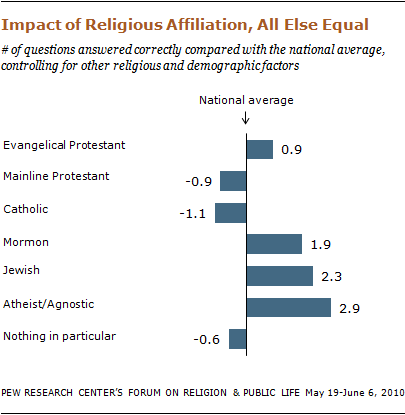
Religious affiliation also remains a good predictor of religious knowledge in these models. Even after education, race and other factors are taken into account, atheists/agnostics, Jews and Mormons perform better than other religious groups on this survey. Atheists and agnostics get an additional 2.9 questions correct compared with the national average, Jews do 2.3 questions better than average and Mormons get 1.9 more questions right over the national average. Atheists/agnostics, Jews and Mormons are followed by evangelicals, who do 0.9 questions better compared with the national average. By contrast, mainline Protestants, Catholics and those whose religion is nothing in particular trail other groups even after demographic factors are taken into account.
Holding other factors constant, people with high religious commitment – those who attend worship services frequently and consider religion to be very important in their lives – get one additional question correct (compared with the national average). By comparison, those with medium and low levels of religious commitment each get 0.5 fewer correct answers.
Religious Education
People who took a religion course in college answer about three more questions correctly (out of 32) than those who have not taken a college-level religion course, even after controlling for overall levels of educational attainment. People who attended religious education classes or participated in religious youth groups at least once a week growing up get nearly two additional questions right, compared with those who did so seldom or never. Those who attended private religious schools as a child get an extra 1.7 questions right, compared with those who attended public school. However, there is no statistically significant difference in the scores of those who attended private religious schools and those who attended private nonreligious schools.
Reading and Talking About Religion
Holding other factors constant, people who read Scripture at least once a week get roughly two additional questions right on average compared with those who seldom or never read Scripture. Frequent Scripture reading has a stronger impact on knowledge of the Bible than on knowledge of world religions.
Among people who are affiliated with a religion, those who regularly read other books (besides Scripture) about their own faith get an additional 2.3 questions right compared with those who seldom or never read other books about their own faith. By a similar margin, people who say they regularly read books or visit websites about religions other than their own also do better than those who do not read books about other faiths. People who talk frequently about religion with family and friends get roughly two additional questions right compared with those who rarely or never discuss religion.
Scriptural Literalism and Belief in God
Holding other factors constant, people who say Scripture was written by men answer nearly three additional questions correctly, compared with those who say Scripture is the word of God and is to be taken literally, word for word. People who do not believe in God score slightly better (by 0.7 questions, out of 32) than people who believe in God but express doubts about this belief.
Interfaith Marriage and Religious Switching
After controlling for other factors, being married to someone from a different religion adds roughly one correct answer, on average, to a person’s score on the survey compared with people who are married to someone who shares their religion. Religious knowledge also tends to be higher (by one question) among people who have switched faiths than among those who belong to the religion in which they were raised.
Demographic Factors
Holding other factors constant, blacks and Hispanics score significantly lower on the religious knowledge survey than do whites (by 2.5 questions for blacks and by 2.1 for Hispanics, out of 32 questions in total). Immigrants give 1.3 fewer correct answers than the U.S.-born do, all else held equal. Men score better than women by 1.4 questions. Those who live in the East, West or Midwest all score better (by about one correct answer) than those who live in the South. The oldest group in the population scores significantly lower than other age groups, by about one question. People who have never had children get 1.3 extra questions right compared with those who have had children.
Partisanship and Ideology
Democrats score better than Republicans on the survey by a slim but statistically significant margin of half a question, all else held equal. Self-described liberals score better than self-described conservatives by 0.8 questions.
Footnote
7 Switching was determined by asking respondents their present religion and the religion in which they were raised as a child, then comparing the two. (return to text)
Photo credit: Eric Swanson/Corbis
About the Project
This report was produced by the Pew Research Center’s Forum on Religion & Public Life. The Pew Forum delivers timely, impartial information on issues at the intersection of religion and public affairs. The Pew Forum is a nonpartisan, nonadvocacy organization and does not take positions on policy debates. Based in Washington, D.C., the Pew Forum is a project of the Pew Research Center, which is funded by The Pew Charitable Trusts.
The report is a collaborative effort based on the input and analysis of the following individuals:
How much do you know about religion?
And how do you compare with the average American? Take our short, 15-question quiz to find out.
Pew Forum
Luis Lugo, Director
Research
Alan Cooperman, Associate Director, Research
John Green, Senior Research Adviser
Greg Smith, Senior Researcher
Christine Bhutta, Allison Pond, Neha Sahgal
and Jacqueline Wenger, Research Associates
Scott Clement, Research Analyst
Noble Kuriakose and Elizabeth Podrebarac, Research Assistants
Communications and Web Publishing
Erin O’Connell, Associate Director, Communications
Brian Bailey, Online Project Manager
Mary Schultz, Communications Manager
Liga Plaveniece, Program Coordinator
Project Manager and Polling Consultant
Mike Mokrzycki
Pew Research Center
Andrew Kohut, President
Paul Taylor, Executive Vice President
Elizabeth Mueller Gross, Vice President
Scott Keeter, Director of Survey Research
Michael Piccorossi, Director of Digital Strategy
Russell Heimlich, Web Developer
Leah Christian, Senior Researcher, Pew Research Center for the People & the Press
Photo credit: Eric Swanson/Corbis
Appendix A: Survey Methodology
Results for this survey are based on telephone interviews conducted under the direction of Social Science Research Solutions (SSRS) among a national sample of 3,412 adults living in the continental United States, 18 years of age or older, from May 19-June 6, 2010* (2,393 respondents were interviewed on a landline telephone, and 1,019 were interviewed on a cell phone, including 444 who had no landline telephone). Interviews were conducted in English and Spanish.
Interviewing
All interviews were conducted using a Computer Assisted Telephone Interviewing (CATI) system, which ensures that questions were asked in the proper sequence with appropriate skip patterns. CATI also allows certain questions and certain answer choices to be rotated, eliminating potential biases from the sequencing of questions or answers.
How much do you know about religion?
And how do you compare with the average American? Take our short, 15-question quiz to find out.
For the landline sample, half of the time interviewers asked to speak with the youngest adult male currently at home and the other half of the time asked to speak with the youngest adult female currently at home. If no respondent of the initially requested gender was available, interviewers asked to speak with the youngest adult of the opposite gender who was currently at home. For the cell-phone sample, interviews were conducted with the person who answered the phone; interviewers verified that the person was an adult and could complete the call safely.
In an attempt to maximize survey response, unless an interview was completed or a callback scheduled for a respondent at a phone number in the sample, each number was contacted approximately seven times at varied times of day and days of the week. Cell-phone respondents also were offered a reimbursement of $5 to cover any costs of taking the call on their mobile phones.
Sampling
The survey of the full national population used “random digit dial” (RDD) methodology. Samples of landline and cell phone exchanges were generated by Marketing Systems Group, a sister company of SSRS. The landline sample was “list-assisted,” meaning numbers were sampled from active “blocks” (area code plus three-digit exchange plus two-digit block number) that contained at least three residential directory listings; this is intended to exclude blocks dedicated for business or other nonresidential purposes.
The cell sample was not list-assisted but was drawn from systematic sampling of blocks dedicated to wireless phones and shared-service blocks with no directory-listed landline numbers.
The sample of 3,412 respondents included interviews with a nationally representative sample of 3,013 adults as well as an oversample of 399 people who are Jewish, Mormon, atheist or agnostic. One goal of the study was to attain sufficient numbers of interviews with members of these groups to permit reliable analysis of their religious knowledge. Oversampling was necessary because these groups account for a relatively small share of the overall population. Jews and Mormons each comprise roughly 1.7% of U.S. adults, according to the Pew Forum’s 2007 U.S. Religious Landscape Survey, while atheists and agnostics combined account for about 4% of the adult population, meaning that most surveys – even those based on large samples – do not include enough interviews with members of these groups to permit analysis of their views and characteristics.
Oversampling was accomplished by recontacting respondents from previous SSRS surveys. SSRS conducts nationally representative dual-frame (landline and cell phone) random-digit-dial surveys every week and asks respondents their religion; for this study, SSRS recontacted households it had reached in the preceding six months that contained at least one adult who reported being Jewish, Mormon or having no religion. Adults reached in those households were asked to confirm whether they were Jewish, Mormon, or atheist or agnostic and then the interview proceeded.
In total, the sample includes 212 interviews with Jewish respondents (56 interviewed as part of the main national sample and 156 interviewed as part of the oversampling), 215 interviews with Mormons (54 interviewed as part of the national sample and 161 as part of the oversampling), and 212 interviews with atheists and agnostics (130 interviewed as part of the national sample and 82 as part of the oversampling). The survey included a total of 74 self-described atheists, by themselves too small a group for reliable statistical analysis, so those individuals were aggregated with the 138 agnostics for this analysis.
The accompanying table shows the error attributable to sampling that would be expected at the 95% level of confidence for different groups in the survey.
Weighting
A two-stage weighting design was applied to ensure an accurate representation of the national population.
The first stage, the base or design weight phase, included four steps. The first was a correction for the disproportionate oversamples and was created by dividing the percentage of each of the four oversampled groups (Jews, Mormons, atheists and agnostics) by their corresponding percentage in the main RDD sample. (Atheists and agnostics were treated as separate groups in this stage of the weighting process.) The second step was a correction for the unequal probabilities of selection that result from some households having more qualified adults than others; households reporting having a single adult received a weight of 1, while those with two or more adults received a weight of 2 (cell respondents were given the average weight of 1). Third, a weight of 0.5 was applied to all respondents who reported having both a landline and a cell phone, as they were twice as likely to be sampled as respondents who only had one phone type. Finally, the recontact sample was provided a propensity weight to account for the potential bias associated with recontacting (panel bias). These four corrections (sample type, household adults, dual frame and recontact propensity) were then multiplied together to arrive at a final base (design) weight.
The data were then put through a second weighting stage, a post-stratification sample balancing routine utilizing national estimates from the Census’ Current Population Survey Annual Social and Economic Supplement for age, race and ethnicity, gender, education and region of the country; from the decennial census for population density; and from the National Health Interview Survey for telephone usage (landline-only, cell-only or dual usage according to whether the respondent mostly uses the cell phone or uses the landline regularly).
Sample Disposition and Response Rate
The overall response rate for this study is 17.2% using formula “RR3” of the Standard Definitions of the American Association for Public Opinion Research (see http://www.aapor.org/Standards-Ethics/Standard-Definitions-(1).aspx for detail on this calculation). Following is a full disposition of the sample selected for this survey:
* Correction added April 2011: Interviewing for the survey actually was completed on Friday, June 4, 2010. (return to text)
Photo credit: Eric Swanson/Corbis
An Overview of the Pew Forum Survey, Results and Implications
The Pew Forum’s Alan Cooperman and Greg Smith, along with Boston University professor and author Stephen Prothero and Krista Tippett of American Public Media, explore key findings from a new Pew Forum survey on how much Americans know about religion as part of a panel discussion at a national symposium on religious literacy in Washington, D.C. The symposium, which was held in conjunction with a screening of the upcoming PBS documentary series “God in America,” was coordinated by WGBH Television in Boston and the Religious Freedom Education Project at the Newseum.
Speakers:
Alan Cooperman, Associate Director for Research, Pew Forum on Religion & Public Life
Greg Smith, Senior Researcher, Pew Forum on Religion & Public Life
Stephen Prothero, Professor, Boston University
Krista Tippett, Host and Producer, “Being,” American Public Media
Moderator:
Ray Suarez, Senior Correspondent, PBS NewsHour
RAY SUAREZ, PBS NEWSHOUR: We’ll set the table for our first discussion – “U.S. Religious Knowledge” – with Alan Cooperman, the associate director for research at the Pew Research Center’s Forum on Religion & Public Life. Alan?
ALAN COOPERMAN, PEW FORUM ON RELIGION & PUBLIC LIFE: We know from our past surveys that the United States is a very religious country. Indeed, by some measures, it is the most religious of the world’s rich, industrial countries. Nearly six-in-ten Americans say religion is very important in their lives. That is double, roughly speaking, the percentage in any of the other G-8 countries.
But the question arises, how much do Americans actually know about religion? Three years ago, Professor Stephen Prothero, who’s here, wrote a best-selling book, in which he argued that Americans are both deeply religious and profoundly ignorant about religion. At the same time, Professor Prothero lamented that there really wasn’t much hard data available about this, and he noted that researchers – that would be us – had put a lot more effort into measuring Americans’ religious beliefs than they had into measuring Americans’ religious knowledge. So in short, three years ago, Steve threw down the gauntlet and we’re picking it up today.
Steve has been a great help in this project. We’re deeply grateful to him and to our other expert advisers – Marilyn Mellowes of WGBH and John Green of the University of Akron – as well as to our polling consultant, Mike Mokrzycki. We’ve got some very provocative, in the best sense of that word, results to discuss with you.
But before I do that, I want to acknowledge a couple of very important limitations. First of all, because this is a first-time effort – never done a survey like this before – we don’t have any historical data. So we do not try to say anything about whether Americans today are more or less knowledgeable about religion than previous generations of Americans. You can have speculation on that, but we just don’t know.
Second caveat is that we have deliberately abstained from grading the American public with an A, an F or anything in between. We feel we do not have any objective way of determining what the public should know about religion. So this survey is not like a college course that Steve or others might give, where a curriculum has been presented to the American public and now we can test how well the public has done. It’s not like that.
We cannot claim that the questions we asked are necessarily the most important things to know about religion. We do hope that they are not trivial. And we think that they are pretty good indicators of how much Americans know about religion. In total, the survey contained 32 questions designed to test Americans’ religious knowledge. I’m going to show you just a small sample.
Most of them were multiple-choice. About a third were about the Bible and Christianity. Another third or so were about world religions, including Judaism, Islam, Buddhism, Hinduism and religious geography. A third explored Americans’ knowledge about Mormonism, the meaning of terms such as atheist and agnostic, some historical issues in religion, and religion in public schools.
So let’s begin, just to give you an introduction to the questions, by starting with a few of the questions that most people got right. These are some of the questions most frequently answered correctly. At least two-thirds of the people surveyed – 3,412 people surveyed – at least two-thirds got these questions right. Eighty-five percent knew that an atheist is someone who does not believe in God. By the way, 7% confused that term with agnostic and said that an atheist is someone who is unsure whether God exists.
Eighty-two percent know that Mother Teresa was a Catholic. Three percent think she was Jewish. Seventy-two percent know that Moses, and not Job or Elijah or Abraham, led the Biblical exodus from Egypt. Seventy-one percent know that the Bible says Jesus was born in Bethlehem. By the way, a quarter thought he was born in Nazareth or Jerusalem.
About two-thirds of the public knows that the Constitution says that the government shall neither establish a religion nor interfere with the practice of religion. By the way, 18% think the Constitution does not say anything, one way or the other, about religion, and 3% think that the Constitution privileges Christianity. Sixty-eight percent know that most people in Pakistan are Muslim, and not Buddhist, Hindu or Christian.
Now here are some of the things that about half – roughly speaking – half the public gets right. To begin with, we asked a question where we gave four statements and we asked, which one is not among the Ten Commandments? Do not commit adultery. Do not steal. Keep the Sabbath holy. Or, do unto others as you would have them do unto you. A little more than half the public knows that the Golden Rule is not among the Ten Commandments. By the way, the most common wrong answer: Keep the Sabbath holy. More than a quarter of Americans think that “Keep the Sabbath holy” is not among the Ten Commandments and that “Do unto others as you would have them do unto you” is.
Fifty-four percent correctly named the Koran when asked to name the Islamic holy book, and 52% know that Ramadan is the Islamic holy month and not the Jewish day of atonement or the Hindu festival of lights. Fifty-one percent know Joseph Smith was a Mormon. Nearly as many know that the Dalai Lama is a Buddhist. Also, almost half know the Jewish Sabbath begins on Friday. The largest single wrong answer to that question was Saturday, although a substantial number also said Sunday – 7% said Sunday; 18% said they didn’t know.
And a little less than half of the public can correctly name, in a non-multiple choice question, an open-ended question, the four Gospels: Matthew, Mark, Luke and John.
Finally, here are some of the things that less than a third of the public gets right. Only about a quarter of Americans know that most of the people in the largest Muslim-majority country in the world – Indonesia – are Muslim.
Only about one-in-five people understand sola fide – that Protestants and not Catholics teach that salvation comes through faith alone. By the way, 38% attribute this teaching both to Catholicism and to Protestantism. So not too great an understanding of the Reformation here. Jonathan Edwards – only about one-in-ten Americans can identify Jonathan Edwards as a preacher who participated in the first Great Awakening. Twenty-eight percent named Billy Graham. Billy Graham is old, by the way, but he wasn’t around in 1740. (Laughter)
Now, I’m not sure whether what you’ve seen thus far strikes you as pretty good, pretty terrible. As I said, we abstained from giving the public an A or an F or anything else, and we feel that we have no way, really, of saying whether Americans know more or less about religion than they do about physics or history or geography or politics or sports. But I do think that it’s fair, in particular, to ask how well people do on basic questions about their own faiths.
The survey finds, not surprisingly, that on specific questions about specific faiths, members of those faiths generally do better than the rest of the public. But on the other hand, we do find that large numbers of Americans are not well-informed about some of the major tenets, practices and history of their own faith tradition. So let’s go through some of those.
For example, we asked, which of the following statements best describes the Catholic Church’s teaching about the bread and wine used for communion? Do the bread and wine actually become the body and blood of Christ or does the church teach that the bread and wine are just symbolic of the body and blood of Christ?
Now, of the general public, more than half get this question wrong; just 40% get it right. Catholics do substantially – maybe I should say trans-substantially (laughter) – better: 55% of Catholics know that their church teaches that during communion, the bread and wine actually become the real presence of the body and blood of Christ. And Catholics who go to Mass regularly do even better. But still, this question shows that almost half of Catholics do not understand, are not familiar with the church’s teaching on the Eucharist.
Judaism – my people. We also asked, would you tell me if Maimonides was Catholic, Jewish, Buddhist, Mormon or Hindu? Again, what was the faith of Maimonides? Less than one-in-ten Americans know that Maimonides was a Jew. By the way, one wonders what this would be if there weren’t 25 medical centers named for him. (Laughter.) Jews do a lot better on this question – 57% of Jews get this right. But still, more than four-in-ten Jews in America apparently do not recognize the name and faith of the most venerated rabbi and Torah sage in history.
Protestantism – we asked the name of the person whose writings and actions inspired the Protestant Reformation. Was it Thomas Aquinas, John Wesley or Martin Luther? Three possibilities on this one. Like the general public, fewer than half of Protestants said Luther. A third of Protestants, by the way, said they didn’t know, and 15% incorrectly named an 18th-century theologian, John Wesley. The Protestants who attend services weekly or more did somewhat better. Still, it’s fewer than half of Protestants in the United States who can identify Martin Luther.
This is a tough question, in some respects: Which religious group traditionally teaches that salvation comes through faith alone? About one-in-five Americans correctly answers Protestantism. Protestants themselves do a little bit better, and Protestants who are frequent churchgoers do considerably better. But still, as you see, the vast majority of American Protestants apparently do not recognize sola fide, one of the key theological distinctions between Protestantism and Catholicism.
The survey also included three questions about restrictions on religion in public schools. Of all the questions in our survey, the single question that the highest percentage of people got right was, according to Supreme Court rulings – not your own opinion – according to Supreme Court rulings, is a public school teacher allowed to lead a class in prayer?
Nearly nine out of 10 Americans correctly said no. At the same time, however, one of the questions most often answered incorrectly was whether it is permissible, according to Supreme Court rulings, for public school teachers to read from the Bible as an example of literature. Only 23% of those surveyed know that this is permitted. It’s explicitly permitted by the Supreme Court. Similarly, most people don’t realize that public school teachers can, and in fact do, offer courses comparing the world’s major religions. Only 36% get this correct.
Together, this block of questions suggests to us that many people think that the restrictions on teaching religion in the public schools are stricter than, in reality, they are. Now, I haven’t covered the entire survey by any means, but these are some of the highlights. And as I mentioned at the outset – and we do need to be humble about this – we cannot pretend that these questions necessarily reflect the most important things to know about religion.
And we know that we could have made up harder questions or easier questions, but what we can say with some confidence, and even delight, is that the questions we chose did a very good job of differentiating levels of knowledge among U.S. adults because, through a combination of good design and good luck, the overall results are an almost perfect Bell curve.
Of 3,412 people surveyed nationally, only eight people – they’re probably all here in this room – only eight people got all 32 answers right. And only six people got all 32 questions wrong. Now, the person largely responsible for that is my colleague, Greg Smith, the head of our survey data team. I’ll turn the mike over to Greg to dig more deeply into these results. (Applause.)
GREG SMITH, PEW FORUM ON RELIGION & PUBLIC LIFE: Good morning. Thank you, Alan. It’s a great pleasure to be here. It’s very exciting to be able to share the findings from this survey with all of you. I’d like to pick up where Alan left off, by considering the survey’s findings, as to the patterns in religious knowledge.
Who knows the most about religion and who knows the least? As has been alluded to, the groups that do best on our survey are atheists and agnostics, Jews and Mormons. Out of the 32 questions that we asked, atheists and agnostics answered an average of 20.9 questions correctly. Jews answered 20.5 questions correctly, on average. And Mormons got 20.3 questions right, on average.
These three top scores are followed by white evangelical Protestants, who answered an average of 17.6 of the survey’s 32 questions correctly. White Catholics and white mainline Protestants each answered about 16 – about half – of our questions right. And those who describe their religion as just “nothing in particular” got a little bit more than 15 questions right. Black Protestants answered 13.4 questions right, on average, and Hispanic Catholics – 11.6.
I think it’s fair to say that my colleagues and I, and probably many of you, have been struck by the strong performance of atheists and agnostics on this survey. What might explain their relatively high levels of religious knowledge? I have to say that our data don’t speak directly to this question, but we do know, as I’ll discuss in just a few minutes, that their strong performance is not nearly a function of their higher-than-average levels of educational attainment.
We think, though, that their relatively high levels of religious knowledge may reflect a fair amount of thought and consideration given to religion by people who describe themselves as atheist or agnostic. These are folks who have chosen to identify with a relatively small – they make up about 4% of the U.S. population – and a relatively unpopular portion of the U.S. population. We know that very few people were raised as atheists or agnostics. Indeed, our data show that about three-quarters of atheists and agnostics say that they were raised as Christians.
So the very fact that people identify themselves as atheist or agnostic may indicate that they’ve taken a side, so to speak, in the American religious discussion. Their very identification as atheist or agnostic may reflect that they’ve considered and given considerable thought to these matters, and that might be reflected in their high scores.
Another way that you can see this in our data is by comparing atheists and agnostics to those who describe their religion simply as “nothing in particular.” Atheists and agnostics are among the very top scorers on our survey, whereas those who describe their faith simply as “nothing in particular” performed below the national average. So it’s not simply the absence of a connection to a religious group that’s associated with higher knowledge; instead, it’s the presence of this self-identification as an atheist or agnostic. We think that those things might have something to do with this puzzle.
Digging into the data a little bit more deeply, we see that the realm of religious knowledge in which atheists and agnostics and Jews really excel is on the questions that we asked about world religions other than Christianity, including Islam, Buddhism, Hinduism and Judaism.
Out of 11 questions in this area, Jews answered an average of 7.9 correctly, and atheists and agnostics answered 7.5 correctly, on average. You can see here that no other group really comes close in this area. Mormons, the next-highest scoring group, get an average of two fewer questions right, out of only 11, compared with atheists and agnostics. White evangelical Protestants, white mainline Protestants and white Catholics all answered fewer than half of the survey’s 11 questions about world religions correctly.
We see a very different pattern on the survey’s 12 questions about the Bible and Christianity. Here, Mormons do best, with 7.9 out of 12 questions answered correctly, on average. And they’re closely followed by white evangelical Protestants. Atheists and agnostics and Jews also get more than half of the Bible and Christianity questions right, but they’re not the very best performers in this area, as they are in so many of the other areas we looked at in the survey.
Notice, too, that Black Protestants do better on questions about the Bible and Christianity, relative to other groups, than they do on the full set of 32 religious knowledge items. Black Protestants, white mainline Protestants and white Catholics each answer about a half of the survey’s Bible and Christianity questions correctly, on average.
Now, what are the factors that help to contribute to overall levels of religious knowledge? The survey shows that the No. 1 predictor of how people did on the religious knowledge questions is educational attainment. College graduates get an average of 20.6 of the questions right – about two-thirds of our total of 32 questions. Those with post-graduate training or post-graduate degrees, who get more than 22 questions right, on average, do even better than those with bachelor’s degrees, who get an average of 19.8 questions right. Those people with some college education but no four-year degree get 17-and-a-half questions right, on average. And those with a high-school education or less get about 13 questions – about 40% of the total – right.
You can also see that those people with post-graduate training get about twice as many religious knowledge questions right, compared with those who have not completed high school. So educational attainment is a very powerful predictor. It’s, without question, the most powerful factor we examined in shaping people’s overall levels of religious knowledge.
The survey also shows that, beyond overall levels of educational attainment, specific kinds of educational experiences are linked with religious knowledge. The survey asked people who had been to college whether or not they took a religion course while they were there. Those who say they did take a religion course in college answered an average of 22.1 questions right, significantly higher than the 17.9 among people who did go to college but did not take a religion course while they were there.
The survey also asked people what kinds of schools they attended as children – public or private – and it asked those who’d been to private school whether they’d gone to a religious private school or a non-religious private school. Now, perhaps as you’d expect, those who attended private school did better on the religious knowledge questions than those who attended public schools, by more than two questions, on average. However, the survey also shows, interestingly, I think, that among those who attended private school, there is no significant difference between those who went to a religious private school and those who attended a secular private school.
Let me also point out one other thing that we really tried to do with this project. In this report, we really wanted to dig below the surface and try to answer the question of what kinds of traits are strongly associated with religious knowledge and which traits seem to be linked with religious knowledge but, in reality, are only tangentially linked, if at all.
In other words, do atheists and agnostics, Jews and Mormons outperform other groups in our survey because they’re more educated than members of most religious groups or because they have other traits that are linked with higher levels of religious knowledge? Or is it the case that atheists, agnostics, Jews and Mormons are more knowledgeable than evangelicals, mainline Protestants and Catholics, even after education and other factors are taken into account?
To try to address these kinds of questions, we used a technique called multiple regression analysis. We began with a statistical model that includes a variety of religious and demographic variables, like education, age, gender and race. And it considers the impact of each one of these one at a time, while holding all of the others constant. This produces a picture of how much each factor contributes to religious knowledge, independent of all of the other variables we looked at.
This analysis confirms that educational attainment is, far and away, the single leading predictor of higher religious knowledge, even when you take other things into account. It also shows that men score a little bit better than women, by about 1.4 questions, on average. It shows that whites score better on the religious knowledge test than Blacks and Hispanics. It shows that people who live outside the South do better on our survey than Southerners by about one question, on average. And it shows that the oldest group in the population gets about one fewer question right compared with younger age cohorts.
These analyses also show – and this is probably the most interesting finding of the survey from my perspective. These analyses also show, as I alluded to earlier, that the strong performance on these questions by atheists and agnostics, Jews and Mormons is not simply attributable to their educational background or to other of their demographic characteristics. Instead, even after all of these other factors, including education, are taken into account, atheists and agnostics, Jews and Mormons still outperform all other religious groups in our survey.
These three top performers are followed by evangelical Protestants, who, in turn, score better than mainline Protestants, Catholics and those who describe their religion simply as “nothing in particular.” I should also point out, though, that even though atheists and agnostics are among the best performers on the survey, if we look at the population overall, it turns out that people with the highest levels of religious commitment – those who say that they attend religious services regularly and that religion is very important in their lives. Those with the highest levels of religious commitment do a little bit better on the survey compared with those with medium or low levels of religious commitment.
Now, this might seem contradictory. How can atheists and agnostics be among the top performers on the survey if those with low levels of religious commitment do worse than those with the highest levels of religious commitment? What we have to remember is that atheists and agnostics make up only a small portion of people, even a small portion of people with low levels of religious commitment. There are lots of people in the low- and medium-religious-commitment categories, in other words, who are not themselves atheist or agnostic and who don’t do as well on the religious knowledge questions.
So these are some of the highlights of our survey, some of the highlights of our analysis. Atheists and agnostics, Jews and Mormons do best on religious knowledge questions overall. Large numbers of people are unfamiliar even with important aspects of their own faiths. And the public thinks that there are more restrictions on religion in the public schools than is actually the case.
Let me also point out one great new feature that accompanies this project: With this report, we are entering the world of online quizzes. You can go to our website and complete a selection of the survey’s questions for yourselves, and you can also see there how your results compare to those for the public overall, as well as to a variety of religious and demographic groups. So with that, I thank you for your attention. I look forward to discussing these findings further. And I will yield the floor.
SUAREZ: Joining Gregory Smith, whom you just heard from, and Alan Cooperman, are the rest of our panel: Stephen Prothero, author of Religious Literacy: What Every American Needs to Know – and Doesn’t, and a professor of religion at Boston University, and Krista Tippett, host of “Being” on American Public Media, and the author of Speaking of Faith: Why Religion Matters and How to Talk About It, which is a pretty useful thing for the purposes of this morning’s conversation.
At the risk of sounding dismissive, Stephen Prothero, so what? Beyond being able to do well if “Jeopardy” is on in the room while you’re doing something else, beyond walking into a church on your travels and, even if you’re not Catholic, seeing a monstrance on the altar and knowing what it is, so what?
You had to commute. You had to put your pants on in the morning. You had to get yourself three meals. You had to worry, perhaps, about other people and whether they were getting their three meals. This, depending on how you look at the numbers, that base of knowledge or lack of knowledge means what to 306 million people’s daily lives?
STEPHEN PROTHERO, BOSTON UNIVERSITY: Well, I think the level of religious education inside these religious communities is very important to each of them. So if you talk to rabbis, they’re concerned about Jewish illiteracy. If you talk to Catholic priests and nuns, they’re concerned about Catholic illiteracy. If you talk to evangelical Christians, they’re concerned about biblical illiteracy in their ranks.
But the focus of my own writing on this question has been more about the political and civic side. And I think there are two ways in which religious illiteracy matters. One is domestic and one is international.
On the domestic side, we have, now, two religious political parties. We used to have one, until maybe six years ago, or maybe four or maybe two, depending on how you count. But we now have both parties that are trying to link their particular public policy initiatives to the Bible and to Christianity in particular, and then, more broadly, to religion.
So without an understanding of Christianity and the Bible, the American public is handicapped in terms of evaluating whether it makes sense, for example, when Hillary Clinton says that Republican initiatives about immigration violate the Good Samaritan story. That’s not a claim we can evaluate if we don’t know what the Good Samaritan story is. Similarly, we can’t evaluate claims of people who say, I’m a Christian and I’m opposed to abortion because the Bible is opposed to abortion, if we don’t know anything about the Bible or we wouldn’t know where to look in the Bible to look for the question of abortion.
The more important issue, though, to me, is international. The question is, how can Americans understand the world, act in it economically, politically and militarily, without knowing something about the world’s religions? We’re having a conversation in the United States, or trying to, about Islam. Someone’s trying to burn Korans and half the American public doesn’t know that the Koran is a scripture in Islam, according to this survey – 46 or 48%, or something like that.
We’re looking for moderate Islam. That’s been in the conversation since 9/11. Where are the moderates? Well, hundreds of millions of them are in Indonesia, but three-quarters of Americans don’t know that Indonesia is a Muslim-majority country and we wouldn’t know to look there because we don’t know that Islam is active there. So yes, there is a kind of “Jeopardy” quality to this. I think it’s very easy to look at a particular question and dismiss it and say, well, what does that really indicate?
But I think these kind of simple questions indicate the deficit that we have, as a country, in understanding the religions of the world and our own religions, and it handicaps us to act as informed citizens, as we’re supposed to in the democracy that we live in. So I think it matters a lot and I think the answers to the “so what” question are many and various, but those are at least two.
SUAREZ: Well, you used the phrase, “what it indicates,” and what if it indicates nothing but a set of habits of mind? Krista, I was not surprised at all when the survey results showed that atheists knew an awful lot about religion because, just as a practical matter, they know what they have to argue against, and they know what they’re leaving.
And when you hear that three-quarters of all atheists were once Christians, you know, good job, Sunday school teachers – (laughter) – because something obviously didn’t stick. But it may show nothing more than a way of being immersed in our common world. I mean, New Yorkers know when it’s Yom Kippur because they don’t have to pay parking meters, apart from those who have a confessional allegiance to it.
So if you are the kind of person who’s just alive to the world around you, you’re more likely to be picking up things that really have nothing to do with you on a daily basis, but it makes life more interesting. Surely, as someone who’s talking to people about how to talk – you’re talking to people about how to talk about it. Well –
KRISTA TIPPETT, AMERICAN PUBLIC MEDIA: So what you’re pointing at is that religious experience is bigger than beliefs and bigger than knowledge, right? It’s practice; it’s experience; it’s ritual; it’s community. And people may not be able to turn that into correct answers or incorrect answers. I guess I think you’re right, atheists and agnostics may know what they’re rejecting. I also think the breakdown – what is the breakdown? It’s a small percentage point of atheists and a larger percentage point of agnostics, right, isn’t it? More people say they’re agnostic or unaffiliated – many more.
SMITH: A few more.
TIPPETT: OK, OK.
SMITH: It’s 4% total, and then each, roughly 2%, but there are a few more – atheists, a little below 2; agnostics a little above 2. But it’s not a huge difference.
TIPPETT: I’ll just say, experientially, starting a program on public radio called “Speaking of Faith” – we recently have changed the name – but we have become aware, over these seven years, that we have a huge number of atheists and agnostics who are some of our most engaged listeners.
So I experience, I would say, atheists and agnostics to be some of the most ethically engaged people in our culture. And I would even say, although some of them might bristle at this language, to be some of the most energized spiritual seekers. So that’s a dynamic here, too. Something I’m also aware of, having grown up in the Bible Belt going to church three times a week, I would have utterly failed. I would have been one of those six people.
SUAREZ: Oh, come on!
TIPPETT: No, really! I wouldn’t have learned any of this. It was about living in a culture, OK? It wasn’t about a base of knowledge. Intellectual curiosity was not encouraged. And this gets at the question that’s raised for me so much – not the “so what” question, but, so what’s the source of the problem and how do we talk about a solution? I don’t think intellectual curiosity is encouraged inside many traditions and many religious communities.
SUAREZ: No, but I’m interested in your use of that phrase “source of the problem” because it presumes that this is a problem, when the high level of correlation with education may simply mean that people who are more likely to know the answers to these questions are more likely to know a lot of things that people who have less education are less likely to know about.
PROTHERO: Yes, but let’s not forget, though, that two-thirds of the people who go to college and are scoring high, along with the agnostics and atheists, they’re only getting 66%. And I know that you all aren’t going to grade it, but I will because I’m not an employee of Pew. (Laughter.) And that’s a D, you know?–
SUAREZ: But Americans only grade on a curve.
PROTHERO: So I mean, the atheists and the agnostics, if they’re in my class, that’s a D and the average American is getting an F. So it’s not like this is something so great to write home about. Yes, you can talk about the relative performance, but in terms of absolute performance, it’s pretty sad. I mean, we did not ask whether the Pope was Catholic. I was sort of keen to ask a question like that, just to show.
But we did ask, is the Dalai Lama Buddhist, and to me, that’s pretty close to, is the Pope Catholic? But half of Americans don’t know that the Dalai Lama is Buddhist. How do you have a conversation about Tibet if you’ve never even heard of this guy? It’s like having a conversation about Vatican City without having heard of that guy. It’s a difficult thing to do.
SUAREZ: But probably, the same –– it’s many of the same people who can’t find Iraq on a map when we’ve got 150,000 troops fighting there. So maybe the question is broader than religious knowledge but implicates religious knowledge because we’ve asked discretely about this area of our shared experience and shown that people aren’t really paying that much attention.
PROTHERO: But I think it’s important to remember, too, though, on these questions about religion in the public schools, that we have an erroneous public perception that we’re not allowed to teach about the Bible or the world’s religions in the public schools. Between three-quarters and two-thirds of Americans, on those questions, think that this is not a topic that can be broached in public schools. We don’t have that perception about geography, for example.
We know we’re allowed to teach where Iraq is on a map. We think we’re not allowed to teach what Christians believe. We think we’re not allowed to teach what the Five Pillars of Islam are. So this, to me, is the great catch-22 in the survey, that we have this religious illiteracy in the public but the illiteracy is so huge that we think we’re not allowed to remedy it in the public schools.
But it’s very, very clear, from what the Supreme Court has said about religion in public education – and there’s, I think, one quote in the report – that no, you cannot pray with your teacher; no, you cannot read the Bible devotionally; but yes, you can teach the Bible as literature and yes, you can teach the world’s religions. And the Supreme Court justices don’t just say that this is constitutionally kosher; they also say that we should do it – that you’re not an educated person unless you know something about the Bible and you’re not an educated person unless you know something about the world’s religions.
But this message is not getting out to school administrators. It’s not getting out to public school teachers. And I think that it’s different from other arenas where we have a deficit, like science and geography, in that we actually believe, wrongly, that we can’t teach it in public schools.
SUAREZ: But if the current elbows-out wrestling in the public sphere is as content-free as it tends to be, it has to do with self-representation rather than actual underpinnings of what this is all about.
When they have a fight in the Kansas City Zoo over whether you can put a statue of Ganesh at the elephant house because Christians rush in, complain to the authorities that oversee the public parks in Kansas City and say, you must have Noah’s Ark there as well or else you’re making a gesture that is biased toward Hindus in a city – and this is no knock at Kansas City – but I doubt one-in-100 people could explain what Hindus believe or their creation story or their pantheon, or very much about Hinduism at all, but Ganesh is perceived as a threat by the elephant house.
We’re in a period in our shared life here in this country where everybody’s very vehement about religion, but in a kind of content-free manner. I don’t know how you pull up your socks from that kind of posture. What’s the next thing to do, Alan? I mean, what’s the project, at this point?
COOPERMAN: Well, I am an employee of Pew. (Laughter.) We are agnostic – almost atheist – about policy prescriptions. Some of this conversation, though, has led me to think that there might be interest in how the public does on general knowledge questions. We did have a few of those in the survey. ––We don’t really have a way, again, to say whether people know more about Christianity than they know about chemistry, or vice versa. And on, essentially, a 20-minute telephone survey, we can only ask so many questions. But we did ask nine general knowledge questions for comparison purposes.
So 59% of the public knows that – who is it – Joe Biden is vice president. The same percentage – six-in-ten – know that antibiotics don’t kill viruses. Susan B. Anthony stunned us; she’s on top of the charts here. I mean, people really get the Susan B. – I don’t know whether it’s the dollar coins that no one uses, or – (laughter). Forty-two percent know that Herman Melville wrote Moby Dick. By the way, 4% believe it was Stephen King.
And in an interesting comparison, to get to Ray’s general point, yes, those who do well on the religion questions do well on the general knowledge questions, and those who do poorly on the general knowledge questions do poorly on the religion questions. They do go hand-in-hand. And maybe Greg can give more of an analysis than that.
SMITH: The one thing I would add, in terms of the elbows-out approach and whether or not it’s content-free, I mean, I think we should keep a couple things in mind. One is that the survey clearly demonstrates that when it comes to religion, there’s an awful lot of important stuff that people are unfamiliar with.
But at the same time, the survey also shows that it’s not like the public knows nothing, either. People tend to be more knowledgeable, in particular, about their own faiths, as you’d expect. Eight-in-ten Mormons get all three of our questions about Mormonism right. Most Americans – I realize that this would warrant an F in a class – but most Americans get more than half of the questions we asked about the Bible right.
Seven-in-ten people recognized Moses as the one who led the exodus from Egypt. Seven-in-ten people can tell you where Jesus was born. I mean, these are important things about people’s own faiths that they are aware of. So I wouldn’t quite describe it as content-free, in terms of knowledge.
The other thing we should keep in mind is that it’s also not content-free in terms of beliefs. Even though people –clearly are not –experts in religious studies, it doesn’t mean that they don’t have deeply held beliefs, that they aren’t deeply engaged in their faiths, that they aren’t pious practitioners of their faiths. In many ways, there probably are some parallels with politics.
We probably don’t have a lot of people who are experts in the workings of American government, but it doesn’t mean that they don’t hold their ideological beliefs or their party identification very deeply. So I think there are two kinds of content that we have to keep in mind here: knowledge, but also depth of belief and practice.
SUAREZ: Well, let me amend that and say largely content-free. During the time of some of the highest-volume conflict about the posting of the Ten Commandments in civic buildings, it was found that a distressingly high number of Americans – and I say that out of a conviction that this is part of our common, Western cultural deposit – you should know what’s in it even if you’re not a believer – a distressingly high percentage couldn’t name the Ten Commandments, even if you said, don’t worry, you can say them out of order.
So here they were, ready to go to the barricades over posting the Ten Commandments in civic spaces, insisting on their right to be there, in many cases insisting on the primacy of Christianity in our civic life, and yet were making, not a content-free assertion, but let’s say, a content-handicapped assertion because they, themselves, could not even stand up for this Decalogue that they insist is a foundation stone of the United States. And I guess that gets to your point, Stephen, about when this is important and when it’s not.
PROTHERO: I remember there was a survey done in the ’60s where people were asked about the Ten Commandments. It was one of the few places where there were knowledge surveys before. But the question was, do you know the Ten Commandments? And the answer was, yes or no. So people were able to just say, oh yeah, I know the Ten Commandments. So it was a very different kind of survey.
But I think, for me, if you want to talk about the religion that everybody wants to talk about now, which is Islam, it seems since 9/11, we’ve been struggling to have a national conversation about Islam and we’ve been failing to have the national conversation. We have people who say, Islam is a religion of peace, and we have people who say, Islam is a religion of war. And then we have a rebuttal that says, Islam is a religion of peace. And then there’s a rebuttal to that, that says, Islam is a religion of war. And then there’s a rebuttal to that, that says, Islam is a religion of peace.
And that’s basically all we’re able to say. The question is, why? The answer, I think, as this survey helps to point out,– is because we don’t know enough to have a conversation. So we are then launched into your point exactly, which is the assertion of identity, right? I’m a Christian; they’re Muslims, right? And so we can’t have a conversation about, for example, Jesus in the Koran – Jesus appearing a hundred times in the Koran. Because we don’t even know that the Koran is the holy book of Islam, or at least, only half of us do. We haven’t read it enough to know that Jesus is in there.
So what happens, in terms of interfaith conversation and civic conversation about religion, is simply the assertion of identity. I think that if we had more knowledge about the world’s religions, we could actually have conversations, whereas right now we can’t have them. I think that’s to the great detriment of our public and civic life, that we can’t have a conversation about Islam, and so we see what is happening at the Islamic community center at ground zero. It isn’t a conversation. It’s a sort of assertion of, this is me and you’re not me and therefore, go away.
TIPPETT: I know you’re not saying that knowledge alone suffices, but I also think that a larger issue is not having a better cerebral knowledge of Islam, but knowing Muslims, right? It’s that personal relationship. It’s faces. And this is where the limits of something like this come in, although it’s incredibly valuable.
One thing I think that’s gone wrong with religion in America is how we have taken on – we, journalists, media, politicians –talk about religious people as sets of beliefs, and we define religions in terms of beliefs. You know, in fact, Muslims don’t really talk about beliefs, right? It’s about when you pray. It’s about how you live. It’s daily-lived piety. Buddhists don’t really have beliefs. Hindus don’t really have beliefs. So to me, it’s a combination of knowledge and that human component.
I actually think the thing that makes me most hopeful about all of this is a generational difference. Because what I see the young doing – I hate to generalize, even about generations – is engaging in relationships, engaging in service projects and then learning through that, building their knowledge base out of that, even starting to think theologically with more rigor about their own traditions out of that kind of contact.
SUAREZ: I’m wondering whether it’s a good thing or a bad thing that religion is one of those parts of our national life where everyone’s qualified to speak. If we were doing a segment on quarks on the NewsHour, no offense, Stephen, but we wouldn’t invite you–– because we’re assuming that there are probably better guys on quarks. But everybody can have an opinion on religion, whether they know anything or not.
And so it’s one of the hallmarks of the current – I mean, I don’t want to dignify it by calling it a debate – but the debate over Islam is – it’s like confetti being thrown into the air – people just saying stuff, and whether it’s grounded in 1400 years of the history of this religion or not remains to be seen.
PROTHERO: This is where, I think, the interpersonal point that Krista’s pointing out is really important. Because if you hear from Franklin Graham, for example, that what Muslims want is to kill Christians and Jews whenever they see them and you actually have a classmate in your high school, or a neighbor in your neighborhood, who’s a Muslim, you know that there is at least one Muslim that isn’t trying to kill all the Christians and Jews.
So I mean, I think that’s important. I totally agree, by the way, about the issue that religion is not about belief, or even necessarily about faith. I make this point in my latest book, that we shouldn’t even refer to religions as faiths because that gives too much ground to the Protestants, who think that religion is about faith – although now we’re not so sure, based on the survey, whether that’s true anymore. (Laughter.)
But to be fair, in this survey there are questions about things like Ramadan, which isn’t about a belief. It’s about a practice, right? So there’s a question about whether Americans know something about other people’s practices, or when the Sabbath starts, and things like that. But I also think that story is important, and that’s another thing that we tried to get at in the survey by asking about figures in stories, like Job or like – who else was asked – Moses, right?
So anyway, I’m totally agreed that religions are not belief systems, purely, and that there’s a sort of category mistake if you go there, and that one way we really do learn about other religions is through friends and neighbors who can tell us something about them.
SUAREZ: One of the interesting developments, Alan and Greg, in polling is deliberative polling, where you try to take a pool of people and see if they modify their views over time when you tell them more about something that you’re asking them about.
I wonder if questions about religion, because of where the answers reside in our personalities, would change that much over time if we told people more about these things and then asked them again in two months, a year, two years, or whatever. As people who are in this game, do you find this a useful exercise and could it be applied to this set of ideas and questions?
COOPERMAN: Well, we don’t do much in the way of deliberative polling. That is a part of our polling ethos, is that we try not to supply information that we know is going to affect the answer because we’re just getting the answer in one sense that, in another, we’ve supplied. We actually believe in fairly clean polling. Pew is not one of the places that does long introductions.
You know that in Congress a bill that would do this and that and the other thing is now under consideration; what do you think about it? We tend not to do that. We tend to ask, do you know whether this bill is under consideration, a bill about X, and do you follow it closely or not closely? And then we ask the follow-up questions. But I would just say that on the point about whether knowledge accretes to understanding, I don’t know.
Back in a previous life, to keep up my Russian, I used to lead tours in the Soviet Union during the Cold War. And some of the people that I brought to the Soviet Union – everybody learned a great deal – some came away more adamantly anti-Soviet and some came away less. Not by any means was everybody less, at the end of the day. But we do see in our data that there is a correlation between knowledge, or more broadly, familiarity, and positive attitudes about other things.
So we have asked this question about the Koran and a question about Allah – oh yes, thank you – what is the Islamic name for God? And we also asked, do you happen to know a Muslim? And people who know Muslims, people who know the word “Allah,” and people who know that the Koran is a holy book do tend to have more positive views of Islam than those who do not.
Similarly, it’s almost a truism in polling: People who say they personally know someone who is gay/lesbian/etc. are going to have more positive attitudes. Someone who says they know a Catholic or Jew or etc. will have more positive attitudes. So that familiarity, I would say, more than knowledge is what we can directly correlate with more positive attitudes.
SUAREZ: Well, let me turn that around, then, and ask Stephen and Krista whether, in the face of more and better information, people would even take onboard more, so that they’d have a different result. I think there’s plenty of evidence to demonstrate that even when you tell people something in this sort of free-fire zone of knowledge in the United States, they won’t necessarily take it onboard. They’ll just continue to assert what they’ve been asserting all along, like, don’t confuse me with facts, kind of thing.
So I’m wondering how malleable these results are by doing better in supplying knowledge, supplying facts, or whether, if you’re predisposed to have certain views about certain other Americans, you’re going to have them, even if you supply more information and say, no, no, no, not a religion of war, not full of murderous hate for believers of other religions, that kind of thing.
TIPPETT: One thing that, again, with the younger generations – there are many religious leaders who are understandably bemoaning the fact that people are not being raised in their traditions and they’re not staying in their traditions.– Pew’s done a lot of work on that. But I think a flipside of that is that people who are 18, 19, 20 don’t have the baggage that their parents had or that their grandparents had. They’re not rejecting anything.
I hear a lot of stories – and maybe you could speak to this – about undergraduates coming to college, about classes in New Testament and Hebrew Bible filling up with this open-minded, open-hearted curiosity, just wanting to know. Is that also an experience you have?
PROTHERO: Yeah, I think so. I think especially in the last 10 years there’s been a real interest of undergrads in courses on religion. I think that one thing that does happen, though, is, there’s a real quest for, kind of, big questions that goes on, on college campuses. And I think there is a redirection sometime in these courses toward facts and things like that, and that students are sort of like, well, wait a minute, I thought I was going to figure out my purpose in life, but instead, I’m being told whether Matthew was written before Luke and how much of Luke was stolen from Mark, and that wasn’t what I was here for.
But I don’t know. I guess it’s an institutional malady of college professors that we do tend to be hopeful about – maybe it’s true if NPR hosts – we’re hopeful about young people. So I’ll continue to be hopeful as well.
SUAREZ: I was interested in the South/not-South data because the South is, by its own self-reporting, the most congregationally affiliated, the most likely to answer religion “very important” in their lives, the highest levels of people who say they believe in God, and so on. Yet, this quadrant of the country is also the place with the lowest per-capita incomes, the lowest education levels, and also, now at the front lines of this question because so many Muslim students have come out of the countries of the world that will send them to the United States to learn to be engineers and doctors and various other things.
One-third of all the doctors in the rural South were born in South Asia, which sort of troubles the waters of racial hierarchies in a nice, fundamental way when the gentleman telling you to take off your clothes and put on this paper gown is of a different race from yourself. What can you tell us about what’s going on in the South, Greg?
SMITH: It’s very interesting. As we covered in the presentation, if you look at the results overall, the South is the region that really stands out. And it stands out because people in the South don’t score as well as people in the other regions of the country. People in the East and the Midwest and the West, they all do about the same as each other, and they all do a little bit better than people in the South.
I should also point out, though, something that gets back to this dichotomy, as to knowing about one’s own faith versus other faiths. If we restrict the analysis and we look only at questions about the Bible and about Christianity, then the South doesn’t come out at the bottom. Now, people in the South don’t do better than people in other regions about the Bible and about Christianity.
Perhaps you’d hypothesize that the Bible Belt would do better on questions about the Bible. They don’t. They do about the same as people in the Northeast and about the same as people in the West. The people in the Midwest actually do slightly better than people in the South, even on questions about Bible and Christianity.
But I do think that, that’s something that’s important to keep in mind. –I think it’s very helpful to look at the overall findings. We designed the survey specifically to try to get a good read both on what people know about their own faiths, as well as what they know about other faiths.
But we should also keep in mind that if you drill down a little bit and look at different domains, then the patterns can change a little bit, and that’s one of the things you see going on with the South. They don’t necessarily know less about their own faith, but they don’t score as well on questions about world religions and other faiths.
SUAREZ: This, of all the regions in the country, has been a hotbed of state-level battles over curriculum, over content, over symbolic displays of religious symbols in civic space – a lot of these wrestling matches over the place of religion in our common life. The South has been the locus of a lot of these battles.
PROTHERO: Yeah, there are now efforts in Texas to get mentions of Islam out of school textbooks so that our kids won’t be troubled by information about Islam. I think that’s something to look at.
Something we haven’t talked about is Catholics. Are we so used to Catholics not knowing anything about Catholicism that it’s not even to be remarked here? (Laughter.) As I traveled around and talked about religious literacy a few years ago, people were pretty aware and worried – the Catholics I spoke with – about just how bad the situation was. I remember there was a sociological study done a few years ago – some of you might know it – I think it was called “Young Adult Catholics.” And there was a finding in there that basically there was no correlation between knowledge about the Catholic tradition and how many years you took CCD classes – zero correlation.
In other words, you were just as likely to know nothing about your religion from having taken all these classes as you were having never taken them at all. I think there’s a finding here that the Catholic tradition is in really big trouble, in terms of – I mean, we already know that 10%of Americans are ex-Catholics, but it seems that Catholics are doing much worse – significantly worse – than other religious groups in terms of teaching the basics of their tradition. I guess I shouldn’t be asking you all why or anything like that, because you’re not allowed to say. (Laughter.)
COOPERMAN: I asked a priest about this and the priest said, well, we don’t even get the Bible until third theologate, meaning that in the training for the priesthood, that their training in the Bible doesn’t begin until the third year. So there is something in the Catholic tradition that is more based around the magisterium – the teachings, the accreted deposit of faith over the centuries – that’s different from the Protestant weight placed on the Bible.
And so at least on the Bible questions, it’s not surprising to me that Catholics would do less well than Protestants. And you alluded, Steve, to a couple of Gallup poll questions. As I said, there’s really very little historical data, but Glock and Stark did do a survey of Northern California churchgoers in 1963.
That study is really best-known for its findings on anti-Semitism. But among the other findings in that survey were that, among Northern California churchgoers, Protestants did considerably better on knowledge questions about the Bible than Catholics did. So in the literature of sociology on this, we have known that Protestants do better on the Bible than Catholics do.
PROTHERO: And yet, Catholic students are also taking – in Catholic parochial schools, –they do have, as part of the curriculum, I think almost everywhere, a world religions course. And that’s not working for world religions knowledge, either.
SMITH: That’s a good point. One of the things that the data show are that across the domains of knowledge, Catholics perhaps don’t perform very well, but they’re certainly very consistent. No matter what kind of question you look at, they always come in just ever so slightly below the national average. So it’s not that there’s one area in which they really fall down, and there’s also no area in which they really excel. Whether we’re talking about questions about the Bible or world religions or religion in the public schools or atheism and agnosticism, Catholics are very consistently just below the national average.
SUAREZ: If you look at the coverage of religion – and we’ll talk more about this later – I think the awareness among non-Catholics and Catholics would be very low, that the church is in that kind of crisis, that the number of ex-Catholics is far greater than that of any other religious group in America, except for self-identifying Roman Catholics.
Without the new Latino immigration, the Catholic Church’s numbers would be dropping like a rock, though maybe, given the coverage of the church lately in the popular media, having an argument about what they know and what they don’t know would be better than what’s in those stories in recent months.
We have two microphones, –and if you have questions for our panelists, please tell us who you are, where you’re from and let it fly.
SUAREZ: Krista and Stephen, any particular answer or result that made you say, wow, or gee, or just think that it was either going to be much higher or much lower – that sort of stuck out for you?
TIPPETT: Not really. I would like to just say something to the “so what” question. Part of our reaction to it is, so I don’t know if it matters if people know who Jonathan Edwards is. I kind of wish they knew a little bit about Niebuhr and Heschel – but not who they were, but what their thinking was –
SUAREZ: Who? That’s a homework assignment for the rest of you.
TIPPETT: So I agree with you that to be a citizen of the 21st century, we need to be more literate. Americans need to know more. I also think our public lives, our common lives, can use all the assets we can bring to it, including theological perspective, including these practices of care for the other that religious traditions have cultivated across centuries.
And ultimately, that’s not just about knowledge, but knowledge is a part of that. As I said, maybe people start with service and go back to knowledge, but to me, there is a big “so what” here, even though I would quibble with some of the questions – whether it’s those particular things.––
Q: My name is Chris Stephenson from America’s Quilt of Faith in Northern Virginia. Let’s say that we make some progress in religious literacy. And here’s a question I’d like to ask. It is hypothetical. Are there differences between an America that does better in 10 years, say, on a similar religious survey because they were taught religion in public schools and universities and one that does better because they, collectively – we Americans had been more active in our different faiths? If so, what are these differences? And if not, why not?
PROTHERO: I’m sure Pew is not allowed to answer hypothetical questions, is that right? So can I do that one? I think that there’s a difference between learning about your own religion inside your own religious tradition, including learning about others from the perspective of your tradition, and learning about things in the public schools or in the media or in a public forum that is not religiously committed.
A lot of people have said to me, OK, it’s a religious problem; it should be solved by religious people. Don’t involve the public schools. Don’t involve the media. Let Catholics deal with it. But the reality is, churches and synagogues and mosques and Zen centers, they’re not set up to educate you about other religions. That’s not their job.
The job of the public schools is to educate our young people about the world and to prepare them to be citizens. And I think the question is, do you accept the premise that I have argued – and others, as well – that knowing about the world includes knowing about the religious traditions of the world, and that that’s something we need to do to equip for citizenship.
So I think there would be a difference in those two hypotheticals, and I think the one where we learn about religions inside our public institutions would, in some ways, be preferable because we would be getting a kind of collective, civic conversation about religions going, rather than an intra – inside a particular religious tradition.
That said, I totally welcome conversations about other religions inside particular religious perspectives. I think some of those are incendiary. I’m not sure I would want to send my kid to a class on Islam that was taught by the Rev. Franklin Graham. But some of them are informative.
SUAREZ: Krista, what do you think? Is a country that does better on this test, both inside and outside the faith, a better country down the road?
TIPPETT: One would hope so. I think that’s all I can say.
SUAREZ: Fair answer.
Q: I have two questions. Did anybody harvest data on standardized testing and whether there were religious literacy questions asked?
SMITH: Well, no. – When we looked at the questions that had been asked in the past, we tried to focus our results on things that we might be able to tap into, in terms of trend data. So we’d be most interested in questions that had been asked on nationally representative surveys of adults because our own samples don’t tend to deal with student populations or with minors.
That said, I think it would be very interesting to look and see if there have been questions about religious history, for instance, on standardized tests or college admissions exams. I think that would be something very interesting. And that might be a way to, at least for a certain segment of the population, to try and look back over time and see what kind of a trajectory these things had.
PROTHERO: I think you could keep that question in mind for the panel today that includes some religious educators and educators in public schools.
SUAREZ: In my business, that’s called forward-promoting. Very good.
Q: George Conklin from Berkeley. Several decades ago, Bob Bellah and his colleagues at UC-Berkeley did a study of faith in America, published as “Habits of the Heart.” They identified a pattern of aggregated faith with a thread of Buddhism, a thread of Catholicism, and they termed that “Sheila-ism.” Is Sheila-ism on the increase today?
COOPERMAN: Yes, and we don’t have that data from this survey, but we did a survey last year on the mixing and matching of religious faiths in the United States. Again, historical data is a problem, but we had some, and the indications in the questions that we do have trend data on are that it’s on the rise.
Where our particular contribution on this was, being able to correlate how often people go to religious services with their syncretic beliefs, if you will – not that we ever use that word in the report. But what we found, for example, is that even among Roman Catholics who tell us that they go to church every single week – once a week or more – about a quarter of them believe in reincarnation and about 20% believe in astrology.
And if I remember off the top of my head, about 20% – or maybe about 15% – believe in spiritual energy in physical objects, such as crystals and mountains. We had a wonderful set of questions about this that demonstrated all across the board, including among evangelical Protestants who go to church once a week – if you go to an evangelical Protestant church and you sit in your pew this Sunday and you look down at the 10 people in your pew, one of the 10 of you believes in reincarnation, – if your church is nationally representative.
SMITH: Can I just point out one other thing to follow up on that? In a similar vein, we’ve also done other surveys over the last few years, and one of the most interesting questions we’ve asked is about what people think it takes to attain eternal life, and who people think can attain eternal life.
Is this something that only members of your faith can achieve, or is it something that members of other faiths can achieve? And our surveys have shown that lots of people – majorities of people – think that many faiths, not just their own, can lead to eternal life. We found this so interesting that we actually went back and did follow-up surveys on this question and asked people, specifically, when they say many faiths can lead to eternal life, what do they mean?
Are they talking just about members of the Christian denomination next door? Are these Methodists who are sort of grudgingly admitting that Lutherans can get to heaven, or are these Christians who mean that, you know what, Judaism and Islam and Hinduism and even non-belief are things that can get you to eternal life? And it turns out people really mean other faiths. Christians, when they say many religions can lead to eternal life, mean religions other than Christianity.
I think that points in a similar direction. I also think it raises an interesting question, though, with respect to religious knowledge. I mean, that’s a pretty open-minded thing to say, right – that many religions can lead to eternal life. One question I have – I don’t think these data answer it directly – is, do these people realize that, that may not be what their religion teaches?
And if they did realize that, would it change their belief, would it change their perspective? I mean, we know, on the one hand, that generally speaking, knowledge of people from other faiths is associated with more tolerance, more favorable views. But this is one area where that might not be the case. If you actually were to come to learn that your religion didn’t teach that many religions can lead to eternal life, would that lead to you holding a less-inclusive view about these things? I don’t know.
SUAREZ: That set of data, over time, is given tremendous significance by Bob Putnam in his new book, American Grace, where he looks at people who are adherents of faiths that make very concrete, exclusive faith claims, and then asks the members of those faiths whether people who believe other things can still get to heaven based on being a decent person.
Very, very high percentages – and the trend is up over time, which may be an argument for knowing people. It’s hard to condemn the Jew next door if you know the Jew next door. We are out of time for this session. (Applause.)
This written transcript has been edited by Amy Stern for clarity and grammar.