Pew Research Center

FOR RELEASE NOVEMBER 5, 2009

Religion and Science in the United States

The relationship between faith and science in the United States seems, at least on the surface, to be paradoxical. Surveys repeatedly show that most Americans respect science and the benefits it brings to society, such as new technologies and medical treatments. Nevertheless, strong religious convictions can affect some Americans’ willingness to accept certain scientific theories […]

FOR MEDIA OR OTHER INQUIRIES:

Communications Department
202.419.4372
www.pewresearch.org

RECOMMENDED CITATION

Pew Research Center, November 2009, "Religion and Science in the United States"

About Pew Research Center

Pew Research Center is a nonpartisan, nonadvocacy fact tank that informs the public about the issues, attitudes and trends shaping the world. It does not take policy positions. The Center conducts public opinion polling, demographic research, computational social science research and other data-driven research. It studies politics and policy; news habits and media; the internet and technology; religion; race and ethnicity; international affairs; social, demographic and economic trends; science; research methodology and data science; and immigration and migration. Pew Research Center is a subsidiary of The Pew Charitable Trusts, its primary funder.

© Pew Research Center 2026

Table of contents

  • About Pew Research Center
  • Religion and Science in the United States
  • Public Opinion on Religion and Science in the United States
  • Scientists and Belief
  • Religion and Science: A Timeline

Religion and Science in the United States

The relationship between faith and science in the United States seems, at least on the surface, to be paradoxical. Surveys repeatedly show that most Americans respect science and the benefits it brings to society, such as new technologies and medical treatments. Nevertheless, strong religious convictions can affect some Americans’ willingness to accept certain scientific theories […]

The relationship between faith and science in the United States seems, at least on the surface, to be paradoxical. Surveys repeatedly show that most Americans respect science and the benefits it brings to society, such as new technologies and medical treatments. Nevertheless, strong religious convictions can affect some Americans’ willingness to accept certain scientific theories and discoveries, such as evolution, and new, life-changing technologies, such as genetic engineering.

Religion and Science as Adversaries

Science and religion have often been viewed as adversaries. A number of famous battles between scientists and religious authorities have helped to fuel this perception. For instance, Italian scientist Galileo Galilei, who 400 years ago began the first systematic astronomical observations using a telescope, was tried and convicted of heresy by the Catholic Church for his defense of the Copernican model that put the sun, rather than the Earth, at the center of the universe. Roughly 250 years later, British naturalist Charles Darwin was criticized by Anglican Church authorities who rejected his theory that life evolved through natural selection, particularly when the theory was explicitly applied to human beings. (See Darwin and His Theory of Evolution.)

There have been and still are scientists who are hostile to religious belief. For instance, British biologist and atheist Richard Dawkins, in his bestselling book The God Delusion, argues that many social ills – from bigotry to ignorance – can be blamed, at least in part, on religion. Other scientists, such as Nobel Prize-winning American physicist Steven Weinberg, contend that one of the purposes of science is to free people from what they call “religious superstition.”

In addition, scientists tend to be much less religious than the public overall. A poll of scientists who are members of the American Association for the Advancement of Science, conducted by the Pew Research Center for the People & the Press in May and June 2009, found that 51% of scientists believe in God or a higher power. That figure is far below the 95% of the American public that professes such belief, according to a Pew Research Center survey of the general public conducted in July 2006. (See Scientists and Belief.)

Religion and Science as Allies

Despite instances of hostility toward religion and high levels of disbelief in the scientific community, however, science and religion have often operated in tandem rather than at cross-purposes.

Indeed, throughout much of ancient and modern human history, religious institutions have actively supported scientific endeavors. For centuries, throughout Europe and the Middle East, almost all universities and other institutions of learning were religiously affiliated, and many scientists, including astronomer Nicolaus Copernicus and biologist Gregor Mendel (known as the father of genetics), were men of the cloth. Others, including Galileo, physicist Sir Isaac Newton and astronomer Johannes Kepler, were deeply devout and often viewed their work as a way to illuminate God’s creation. (See Religion and Science: A Timeline.)

Even in the 20th century, some of the greatest scientists, such as Georges Lemaitre (the Catholic priest who first proposed what became known as the Big Bang theory) and physicist Max Planck (the founder of the quantum theory of physics), have been people of faith. More recently, geneticist Francis Collins, the founder of the Human Genome Project as well as President Barack Obama’s choice to head the National Institutes of Health, has spoken publicly about how he believes his evangelical Christian faith and his work in science are compatible.

In addition, many scientists, including many who are not personally religious, tend to view science and religion as distinct rather than in conflict, with each attempting to answer different kinds of questions using different methods. Albert Einstein, for instance, once said that “science without religion is lame and religion without science is blind.” And the late evolutionary biologist Stephen Jay Gould famously referred to this separate but complementary relationship as “nonoverlapping magisteria.”

Debates Over Evolution and Other Issues

There are times when these “magisteria” do seem to overlap, however. In the United States, the debate over the origins and development of life offers a compelling example of this conflict.

All but a small number of scientists accept Darwin’s theory of evolution through natural selection; according to the 2009 Pew Research Center survey of scientists, 87% of scientists accept evolution through natural processes. But a complementary May 2009 Pew Research Center poll of public attitudes toward science shows that only 32% of the general public fully embraces Darwin’s theory. One-in-five (22%) believe that evolution has occurred but that it has been guided by a supreme being, and 31% contend that humans and other livings things have existed in their present form since the beginning of time. (See Public Opinion on Religion and Science in the United States.)

There is a similar divide between the public and the scientific community on the issue of federal funding for embryonic stem cell research. But unlike the divide on evolution, which revolves around questions of fact, the division on embryonic stem cell research is largely driven by moral questions, including disputes over the status of embryos. (See the full Pew Research Center survey report for differences between scientists and the public on this and other issues.) And yet the poll of the public shows that the vast majority of Americans, including religious Americans, hold science and scientists in very high regard. (See Public Opinion on Religion and Science in the United States.)

What is at work here? How can majorities of Americans say they respect science and yet still disagree with the scientific community on some fundamental questions? The answer may be that many in the general public choose not to believe scientific theories and discoveries that seem to contradict religious or other important beliefs. When asked what they would do if scientists were to disprove a particular religious belief, for instance, nearly two-thirds (64%) of people in an October 2006 Time magazine poll said they would continue to hold to what their religion teaches rather than accept a contrary scientific finding.

Looking Ahead

Meanwhile scientists continue to use increasingly sophisticated instruments – from MRI brain scanners to the Hubble Space Telescope – to probe the natural world, raising the prospect that researchers in one field or another will continue to produce evidence that challenges some core religious beliefs. For example, some scientists claim that recent research on the human brain shows that the brain and the brain alone is the seat of consciousness and that such evidence disproves the existence of a soul.

While religion and science usually strive to answer different questions, the battles over issues such as evolution and the study of consciousness show that they also sometimes tread on each other’s turf. So far, at least in the United States, both faith and scientific endeavor have survived these clashes. And if the past is any guide, the United States will likely continue to be a nation of both high levels of religious commitment and high regard for scientific achievement.

This report was written by David Masci, Senior Researcher, Pew Research Center’s Forum on Religion & Public Life.

Public Opinion on Religion and Science in the United States

Views on Science and Scientists

The United States is the most religious industrial democracy in the world. At the same time, the U.S. is a science superpower, leading the world in many key areas of scientific research and in most fields of technological development. While this combination of widespread religious commitment and leadership in science and technology could be a potential source of conflict, evidence from a May 2009 survey of public attitudes toward science conducted by the Pew Research Center shows that most Americans, including most religious Americans, hold scientific research and scientists themselves in high regard.

Indeed, while there are a few areas of conflict between science and religion in the United States, particularly regarding questions of life’s origins, more than eight-in-ten Americans (84% in the recent Pew Research Center survey) say they view science as having a mostly positive impact on society. Among those who attend religious services at least once a week, the number is roughly the same (80%).

Broad consensus

Source: May 2009 Pew Research Center for the People & the Press survey. For complete question wording, see survey topline. Numbers may not sum to 100 due to rounding.

The public also views scientists themselves in a positive light. According to the Pew Research Center poll, 70% of U.S. adults think scientists contribute “a lot” to society. In addition, a solid majority of Americans (61%) say that science does not conflict with their own religious beliefs. Even among those who attend worship services at least once a week, a slim majority (52%) sees no conflict between science and their faith. But while most people do not perceive a conflict between science and their personal religious beliefs, many do believe there is an inherent conflict between science and religion in general. When asked in a separate question whether science and religion, generally speaking, are often in conflict, a majority of Americans (55%) say yes, compared with 38% who believe the two realms are mostly compatible.

Interestingly, those who are the most religiously observant (as measured by frequency of worship service attendance) are the least likely to perceive a clash between faith and science; only 48% of those who attend religious services at least once a week see a conflict. However, among those who attend worship services once a month or less, as well as those who attend rarely if ever, perception of a conflict runs higher, at 58% and 60%, respectively. Those who have no specific religious affiliation are the most likely to perceive a conflict between religion and science (68%), while only 53% of all Protestants and Catholics feel this way.

Perceived conflict

Source: May 2009 Pew Research Center for the People & the Press survey. Numbers may not sum to 100 due to rounding.

[OPTIONS READ IN REVERSE ORDER TO HALF OF SAMPLE]

Evolution and Related Issues

In the last century, the sharpest and most persistent clash between religion and science in the U.S. has centered on evolution as the explanation of the origin and development of human life. According to a poll of scientists who are members of the American Association for the Advancement of Science, conducted by the Pew Research Center for the People & the Press in May and June 2009, most scientists (87%) agree that life on Earth has evolved over time due to natural processes such as natural selection.

Consensus not shared

Source: Scientists data and general public data from Pew Research Center for the People & the Press surveys, May-June 2009. For complete question wording, see survey toplines. Numbers may not sum to 100 due to rounding.

By contrast, according to the 2009 Pew Research Center poll on public attitudes toward science, public opinion about evolution is divided. While six-in-ten (61%) believe that evolution has occurred, many (22% overall) say it was guided by a supreme being or a higher power. Fewer than a third of those sampled (32%) believe in evolution through natural processes. At the same time, 31% of Americans directly reject evolution, believing instead that humans and other living creatures have existed in their present form since the beginning of time.

Life's origins

Source: May 2009 Pew Research Center for the People & the Press survey. For complete question wording, see survey topline. Numbers may not sum to 100 due to rounding.

The strongest opposition to the idea of evolution comes from evangelical Protestants. A majority of evangelical Protestants (55%) say that humans and other living things have existed in their present form since the beginning of time, while an additional 20% contend that life has evolved but under the guidance of a supreme being or higher power; only 10% think evolution occurred due to natural processes.

Among those unaffiliated with any particular religion, the numbers are nearly the reverse: Fully 60% accept evolution through natural processes and only 11% believe that life did not evolve at all. Catholics and mainline Protestants fit somewhere between evangelical Protestants and the religiously unaffiliated, with 32% of mainline Protestants and 33% of Catholics saying they believe in evolution through natural processes. (See Religious Groups’ Views on Evolution.) In both groups, about a quarter say that humans and other living things have existed in their present form since the beginning of time.

Although a significant number of Americans reject the idea of Darwinian evolution, most people (60%) believe that scientists are in agreement that human life has evolved over time. Indeed, even among those who reject the idea of evolution, 41% agree that there is a scientific consensus in this area.

Stem Cells

Unlike the disagreements surrounding evolution, the conflict over whether or not to conduct embryonic stem cell research is not primarily a factual dispute. Instead, the debate is largely focused on moral and ethical questions, similar to the abortion controversy.

However, as with opinion on evolution, the general public is more divided in its views about stem cell research than is the scientific community. Indeed, while 93% of scientists favor federal funding of embryonic stem cell research, only 58% of the public holds this view, according to the 2009 Pew Research Center poll on public attitudes toward science. And among those who attend worship services at least weekly, support for federal funding of the research drops to 42%, while a slight majority (51%) opposes it. By contrast, those who seldom or never attend worship services are much more supportive of federal funding for embryonic stem cell research, with 70% in favor of it.

Substantial differences also exist among major faith traditions. For instance, while only 41% of evangelical Protestants favor federal funding of embryonic stem cell research, 57% of mainline Protestants and 60% of Catholics support it. And among those unaffiliated with a particular religion, nearly three-quarters (74%) favor federal funding for the research.

It is impossible to say whether the sort of religiously based misgivings that currently color public opinion on embryonic stem cell research and evolution might impact Americans’ views on other scientific issues at some point in the future. For, now, however, there is little evidence to suggest that there is widespread conflict between science and religion.

This report was written by David Masci, Senior Researcher, Pew Research Center’s Forum on Religion & Public Life.

Scientists and Belief

When President Barack Obama announced on July 8, 2009, that he would nominate renowned geneticist Francis Collins to be the new director of the National Institutes of Health, a number of scientists and pundits publicly questioned whether the nominee’s devout religious faith should disqualify him from the position. In particular, some worried that an outspoken evangelical Christian who believes in miracles might not be the right person to fill what many consider to be the nation’s most visible job in science. Collins was unanimously confirmed by the U.S. Senate on Aug. 7, 2009, but the controversy over his nomination reflects a broader debate within the scientific community between those who believe religion and science each examine legitimate but different realms of knowledge and those who see science as the only true way of understanding the universe.

A survey of scientists who are members of the American Association for the Advancement of Science, conducted by the Pew Research Center for the People & the Press in May and June 2009, finds that members of this group are, on the whole, much less religious than the general public.1 Indeed, the survey shows that scientists are roughly half as likely as the general public to believe in God or a higher power. According to the poll, just over half of scientists (51%) believe in some form of deity or higher power; specifically, 33% of scientists say they believe in God, while 18% believe in a universal spirit or higher power. By contrast, 95% of Americans believe in some form of deity or higher power, according to a survey of the general public conducted by the Pew Research Center in July 2006. Specifically, more than eight-in-ten Americans (83%) say they believe in God and 12% believe in a universal spirit or higher power. Finally, the poll of scientists finds that four-in-ten scientists (41%) say they do not believe in God or a higher power, while the poll of the public finds that only 4% of Americans share this view.

Religious belief

Source: Scientists data from Pew Research Center for the People & the Press survey, conducted in May and June 2009; for complete question wording, see survey topline. General public data from Pew Research Center survey conducted in July 2006; for complete question wording, see survey topline. Numbers may not sum to 100 due to rounding.

The recent survey of scientists tracks fairly closely with earlier polls that gauged scientists’ views on religion. The first of these was conducted in 1914 by Swiss-American psychologist James Leuba, who surveyed about 1,000 scientists in the United States to ask them about their views on God. Leuba found the scientific community equally divided, with 42% saying that they believed in a personal God and the same number saying they did not.

More than 80 years later, Edward Larson, a historian of science then teaching at the University of Georgia, recreated Leuba’s survey, asking the same number of scientists the exact same questions. To the surprise of many, Larson’s 1996 poll came up with similar results, finding that 40% of scientists believed in a personal God, while 45% said they did not. Other surveys of scientists have yielded roughly similar results.

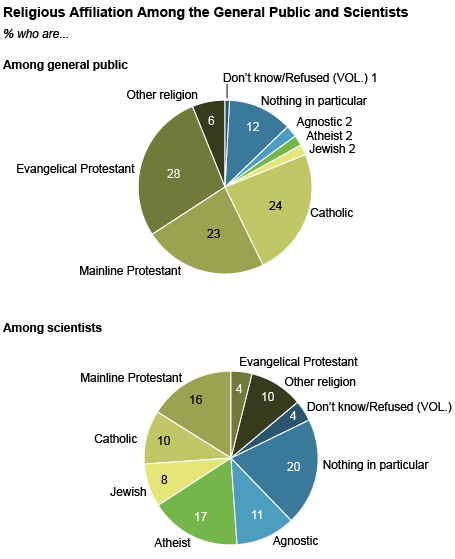
Given their much lower levels of belief in God or a higher power, it is not surprising that the percentage of scientists who are unaffiliated with any religion is much higher than among the general public. Nearly half of all scientists in the 2009 Pew Research Center poll (48%) say they have no religious affiliation (meaning they describe themselves as atheist, agnostic or nothing in particular), compared with only 17% of the public. Thus, it follows that most faith traditions are represented in smaller numbers in the scientific community than in the public as a whole. For instance, the scientific community is far less Protestant (21%) and Catholic (10%) than the general public, which is 51% Protestant and 24% Catholic. And while evangelical Protestants make up more than a fourth of the general population (28%), they make up only a small slice (4%) of the scientific community. One notable exception is Jews, who make up a larger proportion of the scientific community (8%) than the general population (2%).

Affiliation

Source: Scientists data from Pew Research Center for the People & the Press survey, conducted in May and June 2009; for complete question wording, see survey topline. General public data from Pew Research Center surveys conducted between January and June 2009. Numbers may not sum to 100 due to rounding.

The Pew Research Center poll of scientists also found that levels of religious faith vary according to scientific specialty and age. For instance, chemists are more likely to believe in God (41%) than those who work in the other major scientific fields. Meanwhile, younger scientists (ages 18-34) are more likely to believe in God or a higher power than those who are older.

Belief among scientists

Source: Pew Research Center for the People & the Press survey, conducted in May and June 2009. For complete question wording, see survey topline. Numbers may not sum to 100 due to rounding.

This report was written by David Masci, Senior Researcher, Pew Research Center’s Forum on Religion & Public Life.

Religion and Science: A Timeline

This timeline was written by David Masci, Senior Researcher, Pew Research Center’s Forum on Religion & Public Life.

Photo credits: DNA: iStockPhoto; Madrassa: Corbis; Copernican solar system, Corbis; Galileo: Getty Images; Isaac Newton: Corbis; Charles Darwin: Julia Margaret Cameron; Clarence Darrow and William Jennings Bryan: Corbis; Adam: iStockPhoto; Big Bang: Getty Images; Richard Dawkins: Corbis.