
Pew Research Center

FOR RELEASE OCTOBER 7, 2009

Mapping the Global Muslim Population

A comprehensive demographic study of more than 200 countries finds that there are 1.57 billion Muslims of all ages living in the world today, representing 23% of an estimated 2009 world population of 6.8 billion.

FOR MEDIA OR OTHER INQUIRIES:

Communications Department
202.419.4372
www.pewresearch.org

RECOMMENDED CITATION

Pew Research Center, October 2009, "Mapping the Global Muslim Population"

About Pew Research Center

Pew Research Center is a nonpartisan, nonadvocacy fact tank that informs the public about the issues, attitudes and trends shaping the world. It does not take policy positions. The Center conducts public opinion polling, demographic research, computational social science research and other data-driven research. It studies politics and policy; news habits and media; the internet and technology; religion; race and ethnicity; international affairs; social, demographic and economic trends; science; research methodology and data science; and immigration and migration. Pew Research Center is a subsidiary of The Pew Charitable Trusts, its primary funder.

© Pew Research Center 2026

Table of contents

  • About Pew Research Center
  • Mapping the Global Muslim Population
  • Asia-Pacific Overview
  • Middle East-North Africa Overview
  • Sub-Saharan Africa Overview
  • Europe Overview
  • Americas Overview
  • Interactive Data Table: World Muslim Population by Country
  • Interactive Data Table: World Muslim Population by Region
  • Methodology for Muslim Population Estimates
  • Methodology for Sunni-Shia Estimates
  • Data Sources by Country
  • About this Report

Mapping the Global Muslim Population

A comprehensive demographic study of more than 200 countries finds that there are 1.57 billion Muslims of all ages living in the world today, representing 23% of an estimated 2009 world population of 6.8 billion.

Note (June 2025): Our new report “How the Global Religious Landscape Changed from 2010 to 2020” includes revised 2010 religious composition estimates at the country, regional and global levels. Refer to the 2025 report, methodology and interactive table for more detail.

A comprehensive demographic study of more than 200 countries finds that there are 1.57 billion Muslims of all ages living in the world today, representing 23% of an estimated 2009 world population of 6.8 billion.

While Muslims are found on all five inhabited continents, more than 60% of the global Muslim population is in Asia and about 20% is in the Middle East and North Africa. However, the Middle East-North Africa region has the highest percentage of Muslim-majority countries. Indeed, more than half of the 20 countries and territories1 in that region have populations that are approximately 95% Muslim or greater.

More than 300 million Muslims, or one-fifth of the world’s Muslim population, live in countries where Islam is not the majority religion. These minority Muslim populations are often quite large. India, for example, has the third-largest population of Muslims worldwide. China has more Muslims than Syria, while Russia is home to more Muslims than Jordan and Libya combined.

Of the total Muslim population, 10-13% are Shia Muslims and 87-90% are Sunni Muslims. Most Shias (between 68% and 80%) live in just four countries: Iran, Pakistan, India and Iraq.

These are some of the key findings of Mapping the Global Muslim Population: A Report on the Size and Distribution of the World’s Muslim Population, a new study by the Pew Research Center’s Forum on Religion & Public Life. The report offers the most up-to-date and fully sourced estimates of the size and distribution of the worldwide Muslim population, including sectarian identity.

Previously published estimates of the size of the global Muslim population have ranged widely, from 1 billion to 1.8 billion.2 But these commonly quoted estimates often have appeared without citations to specific sources or explanations of how the figures were generated.

The Pew Forum report is based on the best available data for 232 countries and territories. Pew Forum researchers, in consultation with nearly 50 demographers and social scientists at universities and research centers around the world, acquired and analyzed about 1,500 sources, including census reports, demographic studies and general population surveys, to arrive at these figures – the largest project of its kind to date. (See Methodology for more detail.)

The Pew Forum’s estimate of the Shia population (10-13%) is in keeping with previous estimates, which generally have been in the range of 10-15%. Some previous estimates, however, have placed the number of Shias at nearly 20% of the world’s Muslim population.3 Readers should bear in mind that the figures given in this report for the Sunni and Shia populations are less precise than the figures for the overall Muslim population. Data on sectarian affiliation have been infrequently collected or, in many countries, not collected at all. Therefore, the Sunni and Shia numbers reported here are expressed as broad ranges and should be treated as approximate.

These findings on the world Muslim population lay the foundation for a forthcoming study by the Pew Forum, scheduled to be released in 2010, that will estimate growth rates among Muslim populations worldwide and project Muslim populations into the future. The Pew Forum plans to launch a similar study of global Christianity in 2010 as well. The Pew Forum also plans to conduct in-depth public opinion surveys on the intersection of religion and public life around the world, starting with a 19-country survey of sub-Saharan Africa scheduled to be released later this year. These forthcoming studies are part of a larger effort – the Global Religious Futures Project, jointly funded by The Pew Charitable Trusts and the John Templeton Foundation – that aims to increase people’s understanding of religion around the world.

Map: Distribution of Muslim Population by Country and Territory

Only countries with more than 1 million Muslims are shown 2009 Muslim population, the percentage of its population that is Muslim and the percentage of the world Muslim population it represents.

* Indicates the use of a source with a small enough sample size to make these estimates somewhat less reliable. Due to this greater margin of error, percentages are rounded to the nearest integer rather than to the first decimal place and are therefore more approximate (~). The only exception to this rule is the display of Turkey’s percentage of world population as 4.7% rather than ~ 5%.

“–” indicates that the number of Muslims is too small to be reliably estimated.


Map: World Distribution of Muslim Population

This “weighted” map of the world shows each country’s relative size based on its Muslim population. Figures are rounded to the nearest million. Click to enlarge.

world-distribution-weighted-thumb

Download the map

Asia Predominates

Two-thirds of all Muslims worldwide live in the 10 countries shown below. Of the 10 countries, six are in Asia (Indonesia, Pakistan, India, Bangladesh, Iran and Turkey), three are in North Africa (Egypt, Algeria and Morocco) and one is in Sub-Saharan Africa (Nigeria).

Countries with the Largest Number of Muslims

Estimated 2009 Muslim Population Percentage of Population that is Muslim Percentage of World Muslim Population
Indonesia 202,867,000 88.2% 12.9%
Pakistan 174,082,000 96.3 11.1
India 160,945,000 13.4 10.3
Bangladesh 145,312,000 89.6 9.3
Egypt 78,513,000 94.6 5.0
Nigeria 78,056,000 50.4 5.0
Iran 73,777,000 99.4 4.7
Turkey* 73,619,000 ~98 4.7
Algeria 34,199,000 98.0 2.2
Morocco* 31,993,000 ~99 ~2
* Data for Turkey and Morocco come primarily from general population surveys, which are less reliable than censuses or large-scale demographic and health surveys for estimating minority-majority ratios (see Methodology). As a result, the percentage of the population that is Muslim in these two countries is rounded to the nearest integer.

Pew Research Center’s Forum on Religion & Public Life • Mapping the Global Muslim Population, October 2009

The bulk of the world’s Muslim population – more than six-in-ten (62%) – is located in Asia, a region that, for the purposes of this report, includes not only East Asian countries such as China but also countries as far west as Turkey. (For a complete breakdown of countries by region, see World Muslim Population by Region and Country.)

Muslim Population by Region

Estimated 2009 Muslim Population Percentage of Population that is Muslim Percentage of World Muslim Population
Asia-Pacific 972,537,000 24.1% 61.9%
Middle East-North Africa 315,322,000 91.2 20.1
Sub-Saharan Africa 240,632,000 30.1 15.3
Europe 38,112,000 5.2 2.4
Americas 4,596,000 0.5 0.3
World Total 1,571,198,000 22.9 100.0
Note: The list of countries that make up each region can be found in the section titled “World Muslim Population by Region and Country.”

Pew Research Center’s Forum on Religion & Public Life • Mapping the Global Muslim Population, October 2009

Living as Majorities and Minorities

While 80% of the world’s Muslims live in countries where Muslims are in the majority, significant numbers – about one-fifth of the world’s Muslim population – live as religious minorities in their home countries. Of the roughly 317 million Muslims living as minorities, about 240 million – about three-quarters – live in five countries: India (161 million), Ethiopia (28 million), China (22 million), Russia (16 million) and Tanzania (13 million). Two of the 10 countries with the largest number of Muslims living as minorities are in Europe: Russia (16 million) and Germany (4 million).

These minority populations are often quite large. For example, India, a Hindu-majority country, has the third-largest population of Muslims worldwide. The Muslim population of Ethiopia is about as large as that of Afghanistan. China has more Muslims than Syria; Russia is home to more Muslims than Jordan and Libya combined; and Germany has more Muslims than Lebanon.

Countries with the Largest Number of Muslims Living as Minorities

Estimated 2009 Muslim Population Percentage of Population that is Muslim Percentage of World Muslim Population
India 160,945,000 13.4% 10.3%
Ethiopia 28,063,000 33.9 1.8
China 21,667,000 1.6 1.4
Russia 16,482,000 11.7 1.0
Tanzania 13,218,000 30.2 0.8
Ivory Coast 7,745,000 36.7 0.5
Mozambique 5,224,000 22.8 0.3
Philippines 4,654,000 5.1 0.3
Germany* 4,026,000 ~5 <1
Uganda 3,958,000 12.1 0.3
* Data for Germany come in part from general population surveys, which are less reliable than censuses or large-scale demographic and health surveys for estimating minority-majority ratios (see Methodology). As a result, the percentage of the population that is Muslim in Germany is rounded to the nearest integer.

Pew Research Center’s Forum on Religion & Public Life • Mapping the Global Muslim Population, October 2009

Of the 232 countries and territories included in this study, 50 are Muslim-majority. Out of these, however, more than six-in-ten (62%) have a smaller Muslim population than do Russia and China individually.

The Middle East-North Africa region contains the highest percentage of Muslim-majority countries compared with other regions. Of the 20 countries and territories in the region, 17 have a population that is more than 75% Muslim, with Israel, Lebanon and Sudan being the only exceptions. In comparison, only 12 of 61 countries in Asia, 10 of 50 countries in Sub-Saharan Africa and two of 50 countries in Europe (Kosovo and Albania) are 75% or more Muslim.

Sunni and Shia Populations

An overwhelming majority of Muslims are Sunnis, while an estimated 10-13% are Shias. This report estimates that there are between 154 million and 200 million Shia Muslims in the world today.

Between 116 million and 147 million Shias live in Asia, representing about three-quarters of the world’s Shia population (note that Iran is included in the Asia-Pacific region). Meanwhile, nearly a quarter of the world’s Shias (36 million to 44 million) live in the Middle East-North Africa.4 Looked at in a different way, 12-15% of the Muslim population in the Asia-Pacific region is Shia, as is 11-14% of the Muslim population in the Middle East-North Africa region. The figures for Shias are generally given as a range because of the limitations in the secondary-source data (see Methodology for Sunni-Shia Estimates).

Quick Definition: Sunnis and Shias

Sunni Muslims and Shia Muslims (also known as Shiites) comprise the two main sects within Islam. Sunni and Shia identities first formed around a dispute over leadership succession soon after the death of the Prophet Muhammad in 632 A.D. Over time, however, the political divide between the two groups broadened to include theological distinctions and differences in religious practices as well.While the two sects are similar in many ways, they differ over conceptions of religious authority and interpretation as well as the role of the Prophet Muhammad’s descendants, for example.For readers seeking more detail on the categories used in this report, Sunnis include followers of the Hanafi, Shafi, Maliki and Hanbali schools of Islamic jurisprudence as well as the Wahhabi or Salafi movement. Shias include Ithna Asharis (Twelvers), Ismailis, Zaydis, Alevis and Alawites.

There also are a few Muslim groups that are difficult to classify as either Sunni or Shia. These include Kharijites in Oman and the Nation of Islam movement in the United States, as well as the Druze, who are located primarily in and around Lebanon. Given the relatively small numbers of people associated with such groups, this report does not provide separate figures for them, but they are included in the overall Muslim population statistics.

Readers should also note that there is no separate estimate for Sufis, whose spiritual and mystical practices have a following among both Sunnis and Shias. There are no reliable figures on the proportion of Muslims worldwide who follow Sufi practices.

Most Shias (between 68% and 80%) live in four countries: Iran, Pakistan, India and Iraq. Iran has 66 million to 70 million Shias, or 37-40% of the world’s total Shia population. Iraq, India and Pakistan each are home to at least 16 million Shias.

Sizeable numbers of Shias (1 million or more) are found in Turkey, Yemen, Azerbaijan, Afghanistan, Syria, Saudi Arabia, Lebanon, Nigeria and Tanzania. Shias constitute a relatively small percentage of the Muslim population elsewhere in the world. About 300,000 Shias are estimated to be living in North America, including both the U.S. and Canada, constituting about 10% of North America’s Muslim population.

In four countries – Iran, Azerbaijan, Bahrain and Iraq – Shia Muslims make up a majority of the total population.

Map: More Than a Third of the World’s Shia Muslims Live in Iran

Roll over a country bubble to see the percentage of its Muslim population that is Shia and the percentage of the world Shia population it represents.

Pew Research Center’s Forum on Religion & Public Life • Mapping the Global Muslim Population, October 2009

Countries with More Than 100,000 Shia Muslims

Estimated 2009 Shia Population Approximate Percentage of Muslim Population that is Shia Approximate Percentage of World Shia Population
Iran 66 – 70 million 90 – 95% 37 – 40%
Pakistan 17 – 26 million 10 – 15 10 – 15
India 16 – 24 million 10 – 15 9 – 14
Iraq 19 -22 million 65 – 70 11 – 12
Turkey 7 – 11 million 10 – 15 4 – 6
Yemen 8 – 10 million 35 – 40 ~5
Azerbaijan 5 – 7 million 65 – 75 3 – 4
Afghanistan 3 – 4 million 10 – 15 ~2
Syria 3 – 4 million 15 – 20 ~2
Saudi Arabia 2 – 4 million 10 – 15 1 – 2
Nigeria <4 million <5 <2
Lebanon 1 – 2 million 45 – 55 <1
Tanzania <2 million <10 <1
Kuwait 500,000 – 700,000 20 – 25 <1
Germany 400,000 – 600,000 10 – 15 <1
Bahrain 400,000 – 500,000 65 – 75 <1
Tajikistan ~400,000 ~7 <1
United Arab Emirates 300,000 – 400,000 ~10 <1
United States 200,000 – 400,000 10 – 15 <1
Oman 100,000 – 300,000 5 – 10 <1
United Kingdom 100,000 – 300,000 10 – 15 <1
Bulgaria ~100,000 10 – 15 <1
Qatar ~100,000 ~10 <1
World Total 154 – 200 million 10 – 13 100
Note: Countries with an estimated Shia population of less than 1% of the country’s Muslim population are not listed. The figures for Shias are generally given in a range because of the limitations of the secondary-source data (see Methodology for Sunni-Shia Estimates). Figures may not sum to totals due to rounding.

Pew Research Center’s Forum on Religion & Public Life • Mapping the Global Muslim Population, October 2009


Footnotes

1 For a definition of “territories,” see the methodology.

2 See, for example, CIA World Factbook; Foreign Policy magazine, May 2007; Who Speaks for Islam: What a Billion Muslims Really Think, 2008; Adherents.com; and IslamicPopulation.com.

3 See, for example, IslamicWeb.com; “Shia Muslims in the Middle East,” Council on Foreign Relations, June 2006; and “The Revival of Shia Islam,” Vali Nasr speaking at a Pew Forum event, July 2006.

4 The three-quarters figure for Asia was calculated by comparing the middle of the range of the estimates for Asia’s Shia population (about 132 million) with the middle of the range of the estimates for the world’s Shia population (about 177 million). The figure for the Middle East-North Africa was calculated by comparing the middle of the range of the estimates for the Middle East-North Africa’s Shia population (about 40 million) with the middle of the range of the estimates for the world’s Shia population (about 177 million).
Asia-Pacific Overview

Muslims living in the Asia-Pacific region, which includes 61 countries and territories, constitute 62% of all Muslims worldwide.

The six Asian countries with the largest Muslim populations are: Indonesia (203 million), Pakistan (174 million), India (161 million), Bangladesh (145 million), Iran (74 million) and Turkey (74 million). Together these six countries are home to about 85% of Asia’s Muslim population and more than half (53%) of the global Muslim population.

Asia subregions pie chart

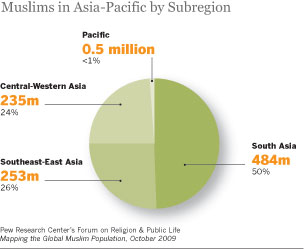
About half of the Muslim population within Asia lives in South Asia (50%) and the remainder are somewhat equally divided between Southeast-East Asia (26%) and Central-Western Asia (24%). Very few Muslims, however, live in the Pacific (<1%).1

Indonesia is the country with the world’s largest Muslim population (203 million); about 13% of all Muslims in the world live in Indonesia. Indonesia’s Muslim population accounts for about 80% of all Muslims living in Southeast-East Asia.

In South Asia, three of the seven countries – Pakistan, India and Bangladesh – together are home to nearly a third (31%) of the world’s Muslim population and 99% of South Asia’s Muslim population.

Other Asian countries with more than 20 million Muslims include Afghanistan (28 million), Uzbekistan (26 million) and China (22 million). There are Muslims in every province of China, but the highest concentrations are in the west, primarily in Xinjiang, Ningxia and Gansu, with other significant populations in Henan, Qinghai, Yunnan, Hebei and Shandong. Xinjiang is the only Muslim-majority province of China, with Muslims accounting for approximately 53% of the total population.

Countries in Asia-Pacific with the Largest Number of Muslims

Estimated 2009 Muslim Population Percentage of Population that is Muslim Percentage of World Muslim Population
Indonesia 202,867,000 88.2% 12.9%
Pakistan 174,082,000 96.3 11.1
India 160,945,000 13.4 10.3
Bangladesh 145,312,000 89.6 9.3
Iran 73,777,000 99.4 4.7
Turkey* 73,619,000 ~98 4.7
Afghanistan 28,072,000 99.7 1.8
Uzbekistan 26,469,000 96.3 1.7
China 21,667,000 1.6 1.4
Malaysia 16,581,000 60.4 1.1
Rest of Region 49,148,000 7.1 3.1
Regional Total 972,537,000 24.1 61.9
World Total 1,571,198,000 22.9 100.0
* Data for Turkey come primarily from general population surveys, which are less reliable than censuses or large-scale demographic and health surveys for estimating minority-majority ratios (see Methodology). As a result, the percentage of the population that is Muslim in Turkey is rounded to the nearest integer.Note: Figures may not sum to totals due to rounding.

Pew Research Center’s Forum on Religion & Public Life • Mapping the Global Muslim Population, October 2009

Map: Distribution of Muslim Population in Asia-Pacific

Roll over a country bubble to see its estimated 2009 Muslim population, the percentage of its population that is Muslim and the percentage of the world Muslim population it represents.

[embeded: src=”https://assets.pewresearch.org/wp-content/uploads/sites/11/2009/10/I_asia_map.swf” width=”640px” height=”486px”]

* Indicates the use of a source with a small enough sample size to make these estimates somewhat less reliable. Due to this greater margin of error, percentages are rounded to the nearest integer rather than to the first decimal place and are therefore more approximate (~). The only exception to this rule is the display of Turkey’s percentage of world population as 4.7% rather than ~ 5%.

Countries where the number of Muslims is too small to be reliably estimated not shown.


Footnote

1 In this report, South Asia includes seven countries: Bangladesh, Bhutan, India, Maldives, Nepal, Pakistan and Sri Lanka. Southeast-East Asia includes 19 countries: Brunei, Burma (Myanmar), Cambodia, China, Hong Kong, Indonesia, Japan, Laos, Macau, Malaysia, Mongolia, North Korea, Philippines, Singapore, South Korea, Taiwan, Thailand, Timor-Leste and Vietnam. Central-Western Asia includes 11 countries: Afghanistan, Armenia, Azerbaijan, Cyprus, Iran, Kazakhstan, Kyrgyzstan, Tajikistan, Turkey, Turkmenistan and Uzbekistan. The Pacific includes 24 countries: American Samoa, Australia, Cook Islands, Federated States of Micronesia, Fiji, French Polynesia, Guam, Kiribati, Marshall Islands, Nauru, New Caledonia, New Zealand, Niue, Northern Mariana Islands, Palau, Papua New Guinea, Pitcairn Islands, Samoa, Solomon Islands, Tokelau, Tonga, Tuvalu, Vanuatu, and Wallis and Futuna.

Middle East-North Africa Overview

The Middle East-North Africa region, which includes 20 countries and territories, is home to an estimated 315 million Muslims, or about 20% of the world’s Muslim population. Of these, approximately 79 million live in Egypt, meaning that about one-in-four (25%) Muslims in the region live in Egypt.

More than half the countries in the Middle East-North Africa region have populations that are approximately 95% Muslim or greater. These include Algeria, Egypt, Iraq,1 Jordan, Kuwait, Libya, Morocco, Palestinian territories, Saudi Arabia, Tunisia, Western Sahara and Yemen. Other countries in the region also have populations with a high percentage of Muslims, including Syria (92%), Oman (88%), Bahrain (81%), Qatar (78%), United Arab Emirates (76%) and Sudan (71%). Although most of the citizens of the Persian Gulf countries of Oman, Bahrain, Qatar and United Arab Emirates are Muslim, these countries have a substantial number of non-Muslim workers who are not citizens; this brings down the total percentage of their populations that is Muslim.

North Africa is home to the three largest Muslim populations in the Middle East-North Africa region: Egypt (79 million), Algeria (34 million) and Morocco (32 million). Other countries in the region with large Muslim populations include: Iraq (30 million), Sudan (30 million), Saudi Arabia (25 million), Yemen (23 million), Syria (20 million) and Tunisia (10 million). The population of the remaining 11 countries and territories in the region – Libya, Jordan, Palestinian territories, United Arab Emirates, Kuwait, Lebanon, Oman, Israel, Qatar, Bahrain and Western Sahara – totals about 31 million.

The Palestinian territories are home to about 4 million Muslims. In addition, Israel is home to roughly 1 million Muslims, slightly more than Qatar. Although Israel has a Muslim population similar in size to those of some western European countries, Muslims constitute a much larger portion (about 17%) of its population. By comparison, the United Kingdom is home to between 1 million and 2 million Muslims, about 3% of its total population.

Countries in the Middle East-North Africa with the Largest Number of Muslims

Estimated 2009 Muslim Population Percentage of Population that is Muslim Percentage of World Muslim Population
Egypt 78,513,000 94.6% 5.0%
Algeria 34,199,000 98.0 2.2
Morocco* 31,993,000 ~99 ~2
Iraq* 30,428,000 ~99 ~2
Sudan 30,121,000 71.3 1.9
Saudi Arabia* 24,949,000 ~97 ~2
Yemen 23,363,000 99.1 1.5
Syria 20,196,000 92.2 1.3
Tunisia 10,216,000 99.5 0.7
Libya 6,203,000 96.6 0.4
Jordan 6,202,000 98.2 0.4
Rest of Region 18,937,000 65.7 1.2
Regional Total 315,322,000 91.2 20.1
World Total 1,571,198,000 22.9 100.0
* Data for Morocco, Iraq and Saudi Arabia come primarily from general population surveys, which are less reliable than censuses or large-scale demographic and health surveys for estimating minority-majority ratios (see Methodology). As a result, the percentage of the population that is Muslim in these three countries is rounded to the nearest integer.Note: Figures may not sum to totals due to rounding.

Pew Research Center’s Forum on Religion & Public Life • Mapping the Global Muslim Population, October 2009

Map: Distribution of Muslim Population in Middle East-North Africa

Roll over a country bubble to see its estimated 2009 Muslim population, the percentage of its population that is Muslim and the percentage of the world Muslim population it represents.

[embeded: src=”https://assets.pewresearch.org/wp-content/uploads/sites/11/2009/10/I_mena_map.swf” width=”560″ height=”360″ ]

* Indicates the use of a source with a small enough sample size to make these estimates somewhat less reliable. Due to this greater margin of error, percentages are rounded to the nearest integer rather than to the first decimal place and are therefore more approximate (~).


Footnote

1 In Iraq and Afghanistan (Asia-Pacific), foreign military personnel or others associated with ongoing military and humanitarian operations are not included in the population estimates.

Sub-Saharan Africa Overview

Sub-Saharan Africa, which includes 50 countries and territories, has about 241 million Muslims, which is about 15% of the world Muslim population. Nigeria has the largest Muslim population in Sub-Saharan Africa, with about 78 million Muslims (about 50% of Nigeria’s total population). Almost one-in-three Muslims (about 32%) in Sub-Saharan Africa live in Nigeria. Western Africa is the only area in Sub-Saharan Africa with a Muslim majority. In contrast, the southern part of Africa has the smallest Muslim population.

Sub-Saharan Africa is also home to a number of countries that have very large Muslim majorities. Countries with the highest percentages of Muslim populations are: Mauritania (99%), Niger (99%), Somalia (99%), Mayotte (98%), Comoros (98%), Djibouti (97%), Senegal (96%), Gambia (95%), Mali (93%), Guinea (84%) and Sierra Leone (71%). The combined Muslim population of all these countries is about 67 million, or about 4% of the global Muslim population.

Countries in Sub-Saharan Africa with the Largest Number of Muslims

Estimated 2009 Muslim Population Percentage of Population that is Muslim Percentage of World Muslim Population
Nigeria 78,056,000 50.4% 5.0%
Ethiopia 28,063,000 33.9 1.8
Niger 15,075,000 98.6 1.0
Tanzania 13,218,000 30.2 0.8
Mali 12,040,000 92.5 0.8
Senegal 12,028,000 96.0 0.8
Burkina Faso 9,292,000 59.0 0.6
Somalia 8,995,000 98.5 0.6
Guinea 8,502,000 84.4 0.5
Ivory Coast 7,745,000 36.7 0.5
Rest of Region 47,618,000 11.3 3.0
Regional Total 240,632,000 30.1 15.3
World Total 1,571,198,000 22.9 100.0
Note: Figures may not sum to totals due to rounding.Pew Research Center’s Forum on Religion & Public Life • Mapping the Global Muslim Population, October 2009

Map: Distribution of Muslim Population in Sub-Saharan Africa

Roll over a country bubble to see its estimated 2009 Muslim population, the percentage of its population that is Muslim and the percentage of the world Muslim population it represents.

[embeded: src=”https://assets.pewresearch.org/wp-content/uploads/sites/11/2009/10/I_africa_map.swf” width=”560″ height=”460″ ]

* Indicates the use of a source with a small enough sample size to make these estimates somewhat less reliable. Due to this greater margin of error, percentages are rounded to the nearest integer rather than to the first decimal place and are therefore more approximate (~).

Countries where the number of Muslims is too small to be reliably estimated not shown

Europe Overview

Europe, which includes 50 countries and territories, has about 38 million Muslims, constituting about 5% of its population. European Muslims make up slightly more than 2% of the world’s Muslim population.

Readers should bear in mind that estimates of the numbers of Muslims in Europe vary widely because of the difficulty of counting new immigrants. Nevertheless, it is clear that most European Muslims live in eastern and central Europe. The country with the largest Muslim population in Europe is Russia, with more than 16 million Muslims, meaning that more than four-in-ten European Muslims live in Russia. While most Muslims in western Europe are relatively recent immigrants (or children of immigrants) from Turkey, North Africa or South Asia, most of those in Russia, Albania, Kosovo, Bosnia-Herzegovina and Bulgaria belong to populations that are centuries old, meaning that more than six-in-ten European Muslims are indigenous.

Despite the limitations of the underlying data for Europe, it appears that Germany is home to more than 4 million Muslims – almost as many as North and South America combined. This means that Germany has more Muslims than Lebanon (between 2 million and 3 million) and more than any other country in western Europe. This also puts Germany among the top-10 countries with the largest number of Muslims living as a minority population. While France has a slightly higher percentage of Muslims than Germany, this study finds that it has slightly fewer Muslims overall.1 The United Kingdom is home to fewer than 2 million Muslims, about 3% of its total population.

The European countries with the highest concentration of Muslims are located in eastern and central Europe: Kosovo (90%), Albania (80%), Bosnia-Herzegovina (40%) and Republic of Macedonia (33%). Greece is about 3% Muslim, while Spain is about 1% Muslim. Italy has one of the smallest populations of Muslims in Europe, with less than 1% of its population being Muslim.2

Countries in Europe with the Largest Number of Muslims

Estimated 2009 Muslim Population Percentage of Population that is Muslim Percentage of World Muslim Population
Russia 16,482,000 11.7% 1.0%
Germany* 4,026,000 ~5 <1
France* 3,554,000 ~6 <1
Albania 2,522,000 79.9 0.2
Kosovo 1,999,000 89.6 0.1
United Kingdom 1,647,000 2.7 0.1
Bosnia-Herzegovina* 1,522,000 ~40 <1
Netherlands 946,000 5.7 0.1
Bulgaria 920,000 12.2 0.1
Republic of Macedonia 680,000 33.3 <0.1
Rest of Region 3,814,000 1.1 0.2
Regional Total 38,112,000 5.2 2.4
World Total 1,571,198,000 22.9 100.0
* Data for Germany, France and Bosnia-Herzegovina come primarily from general population surveys, which are less reliable than censuses or large-scale demographic and health surveys for estimating minority-majority ratios (see Methodology). As a result, the percentage of the population that is Muslim in these three countries is rounded to the nearest integer.Note: Figures may not sum to totals due to rounding.

Pew Research Center’s Forum on Religion & Public Life • Mapping the Global Muslim Population, October 2009

Map: Distribution of Muslim Population in Europe

Roll over a country bubble to see its estimated 2009 Muslim population, the percentage of its population that is Muslim and the percentage of the world Muslim population it represents.

[embeded: src=”https://assets.pewresearch.org/wp-content/uploads/sites/11/2009/10/I_europe_map.swf” width=”560″ height=”491″ ]

* Indicates the use of a source with a small enough sample size to make these estimates somewhat less reliable. Due to this greater margin of error, percentages are rounded to the nearest integer rather than to the first decimal place and are therefore more approximate (~). The only exception to this rule is the display of Turkey’s percentage of world population as 4.7% rather than ~ 5%.


Footnotes

1 This report estimates that France’s Muslim population is between 3 million and 4 million based on recent immigrant data and a 2005 Generations and Gender Survey projected forward to 2009. Other sources, including the U.S. State Department, CIA World Factbook, World Religion Database and general population surveys, have variously estimated the Muslim population of France at between 2.5 million and 6 million.

2 Figures for Italy come from the 2004 European Social Survey. Similar estimates were found in other general population surveys, including the 2002 and 2007 Pew Research Center’s Global Attitudes Projects surveys. However, other sources have variously estimated Italy’s Muslim population at between 30,000 and 1.5 million.

Americas Overview

Of the approximately 4.6 million Muslims in the Americas, which includes 51 countries and territories, more than half, or about 2.5 million, live in the United States.1 But Canada has more than double the percentage of Muslims in the United States. Two percent of Canadians, about 700,000 people, are Muslim; in contrast, 0.8% of the U.S. population is Muslim.

Suriname is the country in the region with the largest Muslim population percentage, at about 16%. Guyana is next, at about 7% Muslim, and Trinidad and Tobago is about 6% Muslim. Argentina, with about 800,000 Muslims, is home to the largest number of Muslims in South America. Less than 1% of Mexico’s population is Muslim.

Countries in the Americas with the Largest Number of Muslims

Estimated 2009 Muslim Population Percentage of Population that is Muslim Percentage of World Muslim Population
United States 2,454,000 0.8% 0.2%
Argentina 784,000 1.9 0.1
Canada 657,000 2.0 <0.1
Brazil 191,000 0.1 <0.1
Mexico* 110,000 <1 <1
Venezuela 94,000 0.3 <0.1
Suriname 83,000 15.9 <0.1
Trinidad and Tobago 78,000 5.8 <0.1
Guyana 55,000 7.2 <0.1
Panama 24,000 0.7 <0.1
Rest of Region 67,000 <0.1 <0.1
Regional Total 4,596,000 0.5 0.3
World Total 1,571,198,000 22.9 100.0
* Data for Mexico come primarily from general population surveys, which are less reliable than censuses or large-scale demographic and health surveys for estimating minority-majority ratios (see Methodology). As a result, the percentage of the population that is Muslim in Mexico is rounded to the nearest integer.Note: Figures may not sum to totals due to rounding.

Pew Research Center’s Forum on Religion & Public Life • Mapping the Global Muslim Population, October 2009

Map: Distribution of Muslim Population in the Americas

Roll over a country bubble to see its estimated 2009 Muslim population, the percentage of its population that is Muslim and the percentage of the world Muslim population it represents.

[embeded: src=”https://assets.pewresearch.org/wp-content/uploads/sites/11/2009/10/I_americas_map.swf” width=”560px” height=”618″ ]

* Indicates the use of a source with a small enough sample size to make these estimates somewhat less reliable. Due to this greater margin of error, percentages are rounded to the nearest integer rather than to the first decimal place and are therefore more approximate (~).

Countries where the number of Muslims is too small to be reliably estimated not shown.


Footnote

1 There has been considerable debate over the exact number of Muslims in the United States. The 2.5 million figure is a projection for 2009 based on the Pew Research Center’s 2007 survey “Muslim Americans: Middle Class and Mostly Mainstream” and available Census Bureau data, adjusted for U.S. population growth. For a discussion of the larger debate, see http://pewresearch.org/pubs/532/questions-muslim-survey.

Interactive Data Table: World Muslim Population by Country

For information about how data for each country or territory were collected and analyzed, see Data Sources by Region. Sources include national censuses, demographic and health surveys, and other general population surveys and studies. Population figures for previous years have been projected forward to 2009 based on the assumption that the Muslim population of the country is growing at the same rate as the general population. (See Methodology for Muslim Population Estimates.)

[chart id=”29144″]

Interactive Data Table: World Muslim Population by Region

For information about how data for each country or territory were collected and analyzed, see Data Sources by Country. Sources include national censuses, demographic and health surveys, and other general population surveys and studies. Population figures for previous years have been projected forward to 2009 based on the assumption that the Muslim population of the country is growing at the same rate as the general population. (See Methodology for Muslim Population Estimates.)

Data for countries marked with an asterisk (*) are drawn primarily from general population surveys, which have smaller sample sizes than demographic surveys and are not designed to measure the size of small minority populations. This may lead to undercounts of Muslims in countries where they represent a small minority of the population and overcounts where they represent the vast majority of the population. Those numbers, therefore, should be considered more approximate.

*Data for some countries come primarily from general population surveys, which are less reliable than censuses or large-scale demographic and health surveys for estimating minority-majority ratios (see Methodology). As a result, the percentage of the population that is Muslim in these three countries is rounded to the nearest integer. The only exception to this rule is the display of Turkey’s percentage of world population as 4.7% rather than ~5%.

“–” indicates that the number of Muslims is too small to be reliably estimated.

Note: Figures may not sum to totals due to rounding.

Methodology for Muslim Population Estimates

The Pew Forum’s Mapping the Global Muslim Population: A Report on the Size and Distribution of the World’s Muslim Population seeks to provide the most up-to-date and comprehensive demographic estimate of the number of Muslims in the 232 countries and territories for which the United Nations Population Division provides general population estimates.1 In order to have statistics that are comparable across countries, wherever possible this study counts all groups and individuals who self-identify as Muslim. (The method for identifying Sunnis and Shias is different; see Methodology for Sunni-Shia Estimates for a complete explanation.)

The number of Muslims in each of the countries and territories is calculated by multiplying the United Nations’ 2009 total population estimate for each country and territory by the single most recent and reliable demographic or social-scientific estimate of the percentage of Muslims in each country’s population, based on the conservative assumption that Muslim populations are growing at the same rate as each country’s general population. (A 2010 Pew Forum report will provide estimates of the differential growth rates of Muslim populations.)

Sources include national censuses, demographic and health surveys, and general population surveys and studies. The specific source used for each country is indicated in Data Sources by Country. Readers should note, however, that general population surveys generally have smaller sample sizes than demographic surveys and are not designed to measure the size of small minority populations. This may lead to undercounts of Muslims in countries where they represent a small minority of the population and overcounts where they represent the vast majority of the population. See below for more detail.

With all sources, results may have been affected by methodological decisions with respect to how the data were collected and managed. Social, cultural or political factors could also have affected how answers to census and survey questions are provided and recorded.

Discussion of Sources

Censuses

For this study, Pew Forum researchers acquired and analyzed religious affiliation data from 81 censuses that were conducted since 1999, comparing more current sources of data with older census data on religious affiliation for an additional 103 countries as a cross check. Religious affiliation questions from national censuses are the best source for estimating the number of Muslims because they generally cover the entire population and are conducted on a fairly regular basis. The chief limitation in using census data is that fewer than half of recent country censuses included a religious affiliation question. In addition, these surveys are conducted only once every 10 years.

Demographic Surveys

Where recent census data on religion are not available, religious affiliation questions from large-scale demographic surveys, such as Macro International’s MEASURE Demographic and Health Surveys (DHS), are the second-best source because of their large sample sizes, sampling frame and representative results at the province level. Though less comprehensive than census data, demographic surveys complete sufficiently high numbers of household interviews to produce a generally accurate demographic profile of the country. For this report, DHS data were acquired and analyzed for more than 60 countries, or nearly two-thirds of the countries where census data are lacking or are older than 1999. For most of the DHS surveys, both women and men are interviewed and Macro International provides the data in separate male-female datasets. Pew Forum staff pooled the female and male datasets in consultation with sampling experts at Macro International so that the combined dataset retains nationally representative results. In countries where only females are interviewed, Pew Forum staff used those data to make the overall Muslim population estimate for the country.

General Population Surveys

Pew Forum researchers acquired and analyzed religious affiliation data from general population surveys for some 100 countries. In more than 20 of those countries, these surveys provide religious affiliation data where a recent census or demographic survey is lacking. Since general population surveys typically involve only 1,000 to 2,000 respondents, however, they provide less accurate numbers. This is especially true where the size of the Muslim population is quite small or Muslims live in concentrated locations that are not oversampled. As a result, data drawn primarily from these sources is marked with an asterisk in the tables throughout this report.

World Religion Database

Pew Forum researchers also used estimates from the World Religion Database, primarily for countries where census and survey estimates were out-of-date, unavailable or lacked sufficient coverage. Besides census and survey reports, WRD estimates also take into account other sources of information on religious affiliation, including anthropological and ethnographic studies as well as reputable statistical reports from religious groups themselves. The WRD is an outgrowth of the international religious demography project at Boston University’s Institute on Culture, Religion and World Affairs.

A Note on Country and Territory Designation

The word “country” in this report refers to all countries recognized as such by the United Nations. The word “territory” in this report does not have a technical definition, but rather is a general term for distinct geographical entities not recognized as countries by the United Nations but that have separate population estimates reported by the United Nations. Territories in this report include such entities as Hong Kong and Macau (special administrative regions of China), Greenland (an autonomous constituent country within the Kingdom of Denmark) and the Commonwealth of Puerto Rico (an unincorporated territory of the United States).


Footnote

1 Population estimates for 2009 for Taiwan and Kosovo are from the Population Reference Bureau. Taiwan’s population is deducted from the U.N.’s China estimate and Kosovo’s from the U.N.’s Serbia estimate.

Methodology for Sunni-Shia Estimates

For the purposes of this report, sectarian differences among Muslims were simplified into two categories: Sunni and Shia. It should be noted, however, that both these groups contain self-identified Muslim communities that may be considered heterodox or nonmainstream by other Muslims.

Unlike estimates for Muslim populations overall, almost no censuses and relatively few surveys ask Muslims about their Sunni or Shia affiliation. Accordingly, Pew Forum researchers have relied on three primary sources to generate Sunni-Shia estimates:

  • Analyses by more than 20 demographers and social scientists at universities and research centers around the world who are acting as consultants on this project;
  • Ethnographic analyses published in the World Religion Database (WRD); and
  • A review of other published or frequently used estimates.

For most countries with sizeable Muslim populations, one or more experts provided the Pew Forum with their best estimate of the Sunni-Shia breakdown based on their own review of the published sources and other expert analyses available to them.

Additionally, for all countries and territories in the study, Pew Forum researchers consulted the WRD estimates of the proportion of Muslims who are Sunni and Shia in each country. The WRD estimates are based in turn on the WRD’s ethnicity database of more than 4,300 ethno-linguistic groups. Readers should note, however, that these estimates are limited both by the initial assumptions made about the Sunni-Shia composition of each ethnicity and by the variability of ethnicity information available in each country.

As a result, the Sunni-Shia estimates presented in this report are based primarily on data gathered via ethnographic and anthropological studies, necessitated by the fact that many Muslims either cannot or will not identify themselves as Sunni or Shia. Therefore, Pew Forum staff are not able to estimate the possible margin of error associated with any one particular estimate. Taking into account the three different sources, this study provides a likely range of the proportion of Muslims worldwide that are Shia based on an analysis of each country. Some ranges are broader than others because the sources consulted provided different estimates or because the sources suggest a wider range due to the lack of more precise information for a particular country.

Finally, for nearly 200 countries, Pew Forum researchers also consulted estimates contained in the religious demography section of the annual International Religious Freedom reports published by the U.S. State Department as well as estimates published in the CIA World Factbook.

Data Sources by Country

The below list of general sources provides bibliographic information for sources that were used to provide estimates for the Muslim populations of multiple countries. The subsequent list of sources by country provides abbreviated bibliographic information identifying which general sources were used to provide estimates for countries, as well as fuller bibliographic information for sources that were used for one country only.

General Sources

Demographic and Health Surveys (DHS). MEASURE DHS. Calverton, Maryland: Administered by Macro International, 1995-2007.

European Social Survey (ESS). London: Led by Centre for Comparative Social Surveys, City University, 2004, 2006.

Pew Research Center’s Global Attitudes Project 2009 Survey

Pew Research Center’s Global Attitudes Project 2007 Survey

Pew Research Center’s Global Attitudes Project 2002 Survey

United Nations Demographic Yearbook. “Special Census Topics Volume 2 – Social characteristics, ‘Table 6: Population by religion, sex, urban/rural residence and percentage: each census, 1985-2004.’ ” New York: United Nations Statistics Division, 2006.

World Christian Encyclopedia, 2nd Edition. David B. Barrett, George T. Kurian, and Todd M. Johnson, eds. United States: Oxford University Press, 2001.

World Religion Database: International Religious Demographic Statistics and Sources (WRD). Todd M. Johnson and Brian J. Grim, eds. Leiden, Netherlands and Boston, Mass.: Brill, 2008. (Muslim population estimates from 2005.)

World Values Survey (WVS). “Values Survey Database.” World Values Survey Association, 1999-2006.

About this Report

This report was produced by the Pew Research Center’s Forum on Religion & Public Life. The Pew Forum delivers timely, impartial information on issues at the intersection of religion and public affairs. The Pew Forum is a nonpartisan, nonadvocacy organization and does not take positions on policy debates. Based in Washington, D.C., the Pew Forum is a project of the Pew Research Center, which is funded by The Pew Charitable Trusts.

This report is a collaborative effort based on the input and analysis of the following individuals:

Pew Forum on Religion & Public Life

Luis Lugo, Director

Research Alan Cooperman, Associate Director, Research Brian J. Grim, Senior Researcher Mehtab S. Karim, Visiting Senior Research Fellow Sahar Chaudhry, Research Analyst Becky Hsu, Project Consultant Jacqueline E. Wenger, Research Associate Kimberly McKnight, Megan Pavlischek and Hilary Ramp, Research Interns

Communications and Web Publishing Erin O’Connell, Associate Director, Communications Oliver Read, Web Manager Loralei Coyle, Communications Manager Robert Mills, Communications Associate Liga Plaveniece, Program Coordinator

Editorial Sandra Stencel, Associate Director, Editorial Andrea Useem, Contributing Editor Tracy Miller, Editor Sara Tisdale, Assistant Editor

Pew Research Center

Andrew Kohut, President Paul Taylor, Executive Vice President Scott Keeter, Director of Survey Research Michael Piccorossi, Director of Operations Michael Keegan, Graphics Director Alicia Parlapiano, Infographics Designer Russell Heimlich, Web Developer