
Pew Research Center

FOR RELEASE APRIL 29, 2009

The Religious Dimensions of the Torture Debate

Updated May 7, 2009 Amid intense public debate over the use of torture against suspected terrorists, an analysis by the Pew Research Center’s Forum on Religion & Public Life of a new survey by the Pew Research Center for the People & the Press illustrates differences in the views of four major religious traditions in […]

FOR MEDIA OR OTHER INQUIRIES:

Communications Department
202.419.4372
www.pewresearch.org

RECOMMENDED CITATION

Pew Research Center, April 2009, "The Religious Dimensions of the Torture Debate"

About Pew Research Center

Pew Research Center is a nonpartisan, nonadvocacy fact tank that informs the public about the issues, attitudes and trends shaping the world. It does not take policy positions. The Center conducts public opinion polling, demographic research, computational social science research and other data-driven research. It studies politics and policy; news habits and media; the internet and technology; religion; race and ethnicity; international affairs; social, demographic and economic trends; science; research methodology and data science; and immigration and migration. Pew Research Center is a subsidiary of The Pew Charitable Trusts, its primary funder.

© Pew Research Center 2026

Table of contents

  • About Pew Research Center

The Religious Dimensions of the Torture Debate

Updated May 7, 2009 Amid intense public debate over the use of torture against suspected terrorists, an analysis by the Pew Research Center’s Forum on Religion & Public Life of a new survey by the Pew Research Center for the People & the Press illustrates differences in the views of four major religious traditions in […]

Updated May 7, 2009

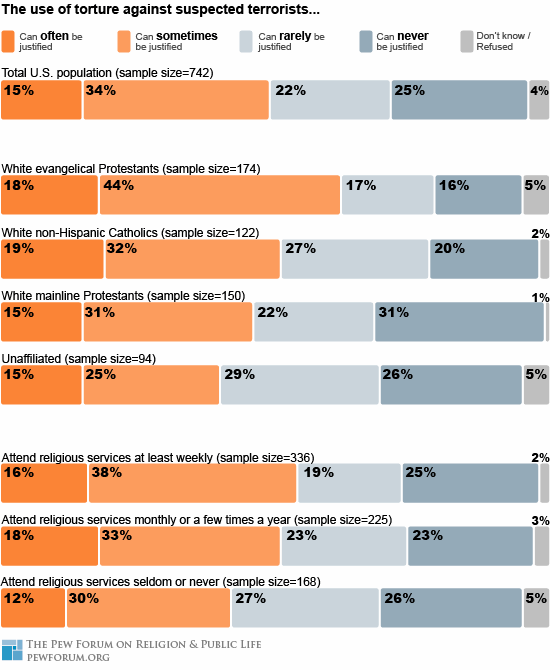
Amid intense public debate over the use of torture against suspected terrorists, an analysis by the Pew Research Center’s Forum on Religion & Public Life of a new survey by the Pew Research Center for the People & the Press illustrates differences in the views of four major religious traditions in the U.S. about whether torture of suspected terrorists can be justified. Differences in opinion on this issue also are apparent based on frequency of attendance at religious services.

However, statistical analysis that simultaneously examines correlations between views on torture, partisanship, ideology and demographic variables (including religion, education, race, etc.) finds that party and ideology are much better predictors of views on torture than are religion and most other demographic factors (See “The Torture Debate: A Closer Look“). Of course, religion itself is known to be a strong factor shaping individuals’ partisanship and political ideology. Attitudes about torture are likely to reflect both moral judgments and political considerations – both of which may be formed in part by religious convictions – about circumstances under which torture may be justified.
Torture

Data from a Pew Research Center survey conducted April 14-21, 2009, among 742 American adults. Other religious groups are not reported due to small sample sizes.

Question wording: Do you think the use of torture against suspected terrorists in order to gain important information can often be justified, sometimes be justified, rarely be justified, or never be justified?